Weird Finds
Trent Barker’s Unlisted Broadcast
trentbarker.com
An interactive personal homepage packed with draggable windows, sound toys, mini-apps, and absurd broadcast copy.
Issue 2026-11-23981 cards in today’s catalogue
Daily issue ·
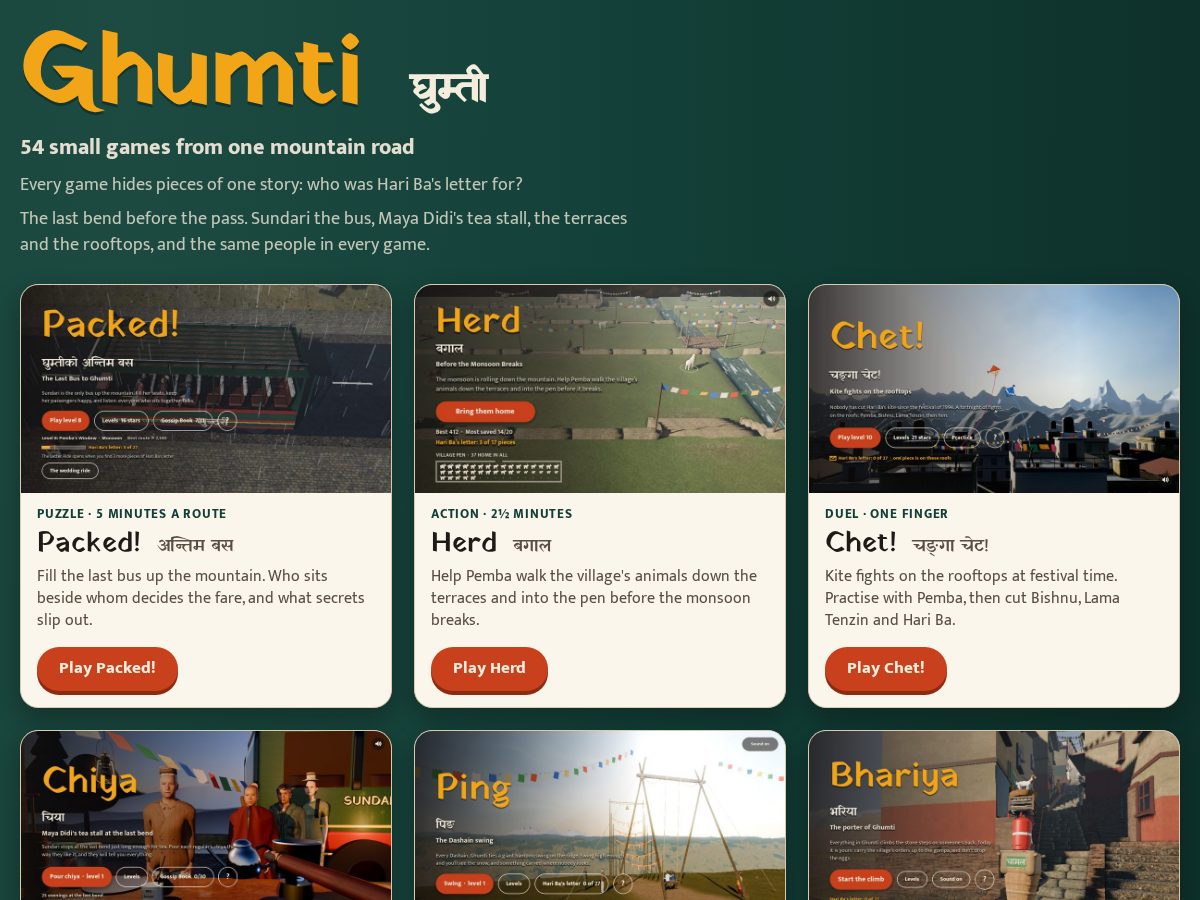
Filling a bus is a small job, but making it Sundari’s gives the errand a place and a person. The tea game goes a step further: pouring to suit the regulars suggests they’ve been coming back long enough for someone to know how they take it. That’s the pleasure of Ghumti, where short games share a cast and a single Himalayan village road.
The games share a cast and a road: you might fill Sundari’s bus, pour tea to suit the regulars, or carry a flame across rooftops. Nepali names and concrete village details give the collection a distinctive sense of place.
02
The opening shelf
Twenty selected projects from today’s catalogue, each shown with the landing page we found and a short explanation of why it stood out.
Weird Finds
trentbarker.com
An interactive personal homepage packed with draggable windows, sound toys, mini-apps, and absurd broadcast copy.
Weird Finds
turkey2nap.org
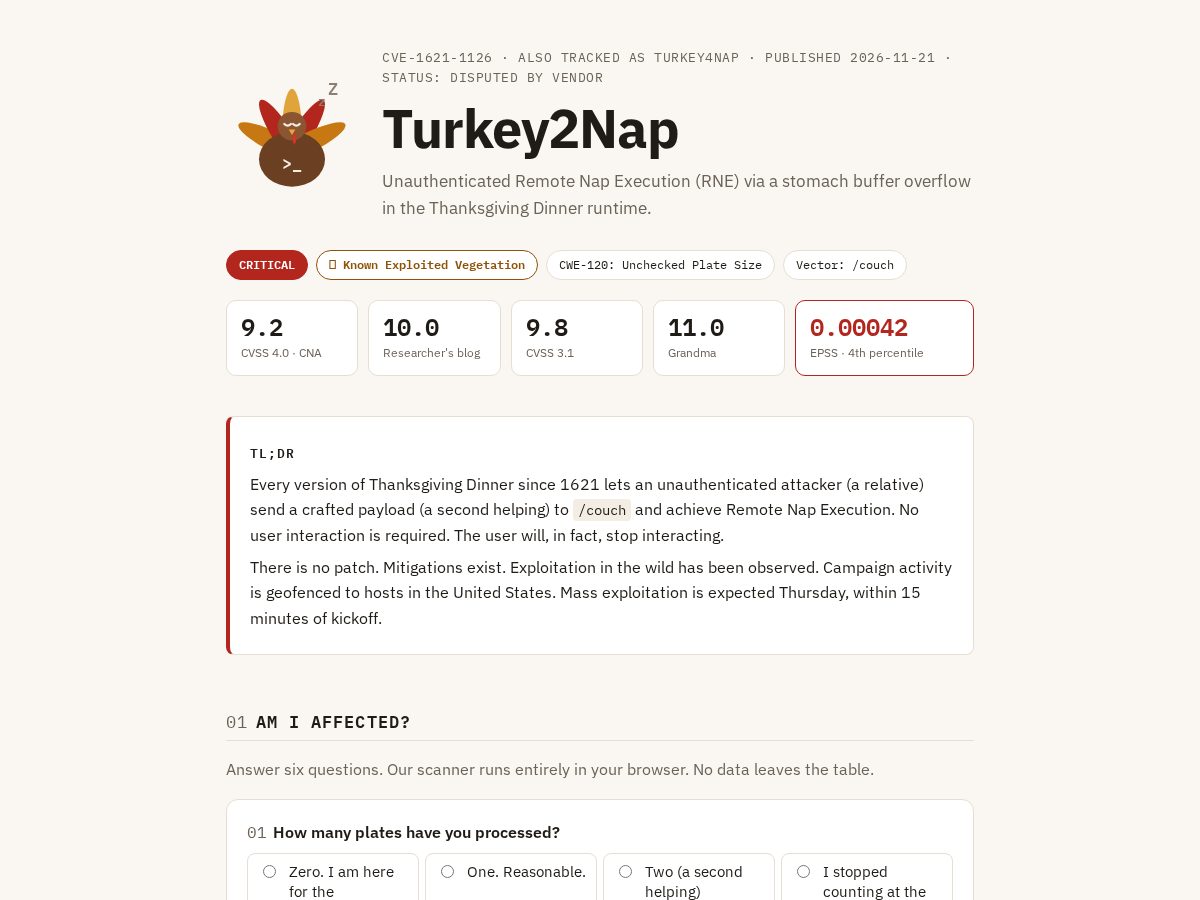
A detailed cybersecurity-advisory parody casts a second helping of Thanksgiving dinner as a stomach-buffer overflow that triggers Remote Nap Execution.
Developer Corner
zx-v.org
ZX-V is a 32-bit hobby computer project with a browser emulator, downloadable emulators, built-in games, and programming options from BASIC to C.
Weird Finds
viciocity.com
An open-world game set on a map of Tudela, Navarra, with local missions and mobile, keyboard, and gamepad controls.
Weird Finds
8bitclassical.com
A free browser player turns 119 classical pieces into live 8-bit arrangements, and can play a MIDI file from your device in the same style.
Civic & Public Life
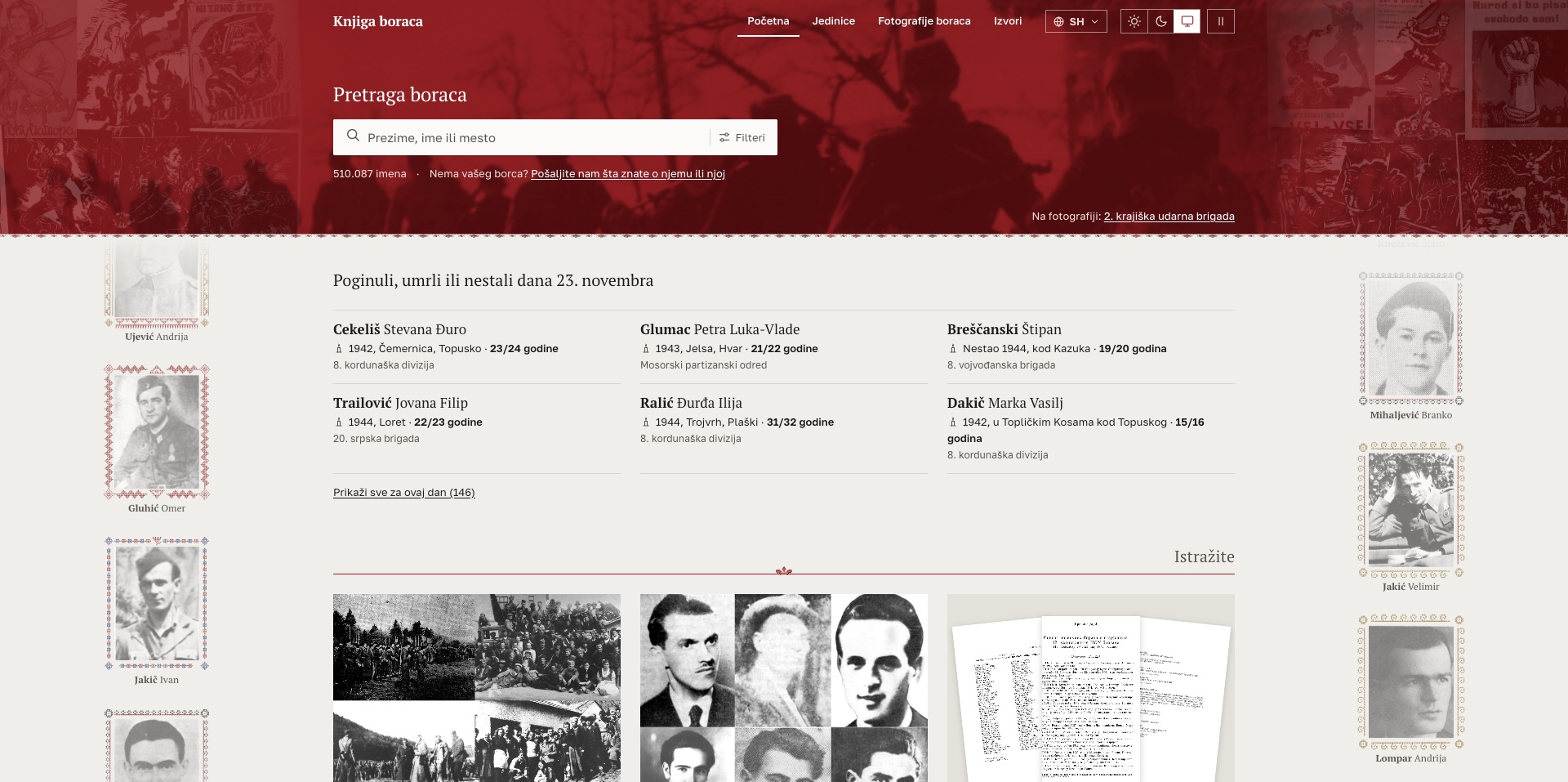
knjigaboraca.org
A searchable archive of Partisan fighters, organized by name and unit, with photographs and scanned source pages.
Civic & Public Life
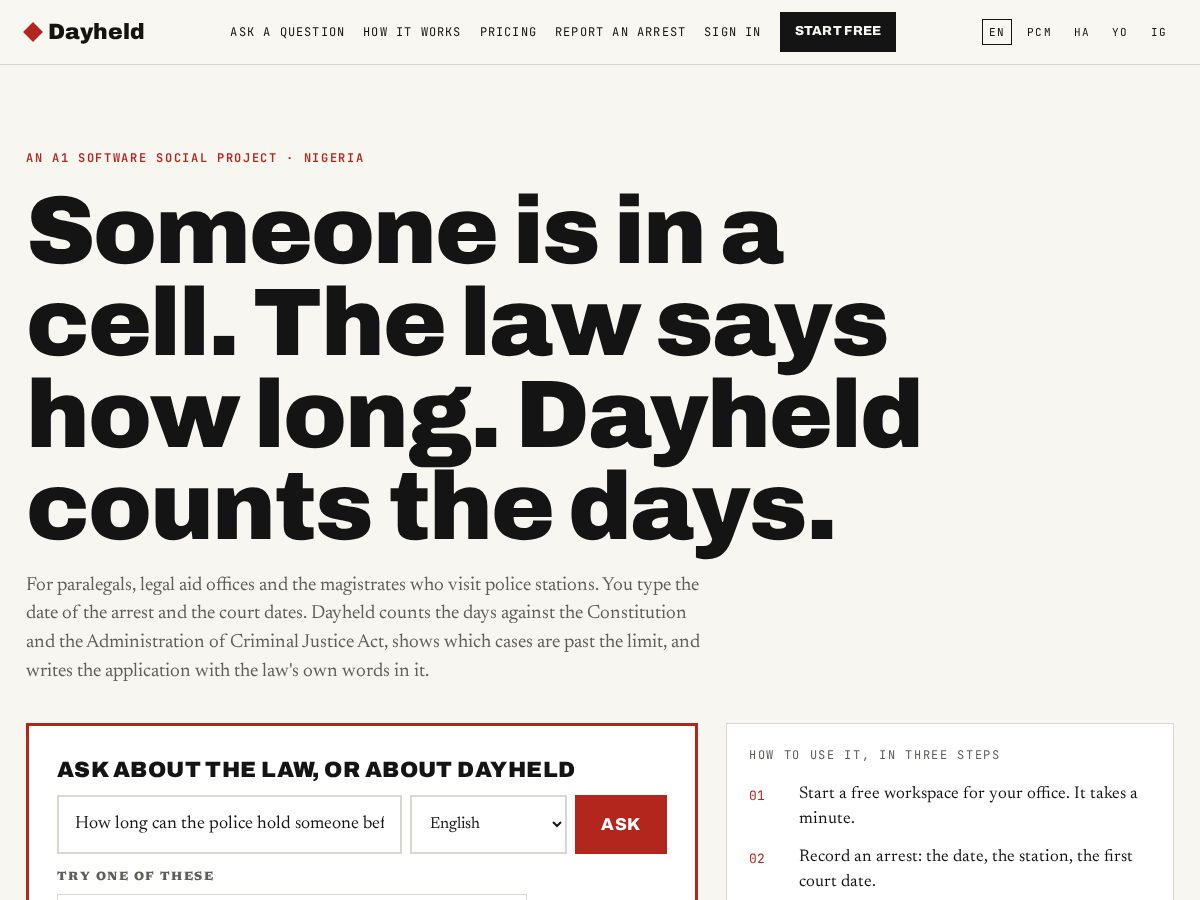
dayheld.app
A legal-aid tool for tracking detention and court dates, checking them against listed Nigerian laws, and preparing draft applications.
Weird Finds
nostalgia-masry.com
A browser-playable room recreates Egyptian childhood touchstones from the 1990s and early 2000s, from cassette tapes and dial-up to بنك الحظ.
Local Businesses
aburomaneh.com
Jaffa oud maker Ibrahim Abu Romaneh presents his handmade instruments, with a guided tour of the oud’s parts and a collection of instruments available to buy.
Oddly Specific
tinytapemeasuremuseum.com
A Toronto-based online museum cataloguing small tape measures, with separate lists for objects held and ones still wanted.
Content & Blogs
shownworking.org
Short films about everyday puzzles and changes pair working simulations or real open data with pages where viewers can run or inspect the material themselves.
Learning & Exams
mindscale.space
An interactive 3D museum presents things from human blood to all Earth’s water as objects at true scale, alongside estimation games, videos, and a journal.
Weird Finds
magicalwildlifeconstabulary.org
A fictional Isle of Man constabulary posts supernatural notices, a folklore field guide, and a form for reporting unexplained sightings.
Content & Blogs
molcanon.org
A sourced story of niacin, from pellagra’s history to the chemistry of vitamin B3, paired with an interactive 3D molecule.
Weird Finds
mochipet.net
MochiSoft presents a downloadable Minecraft companion mod that claims to use voice chat, act in the game world, and remember its players.
Weird Finds
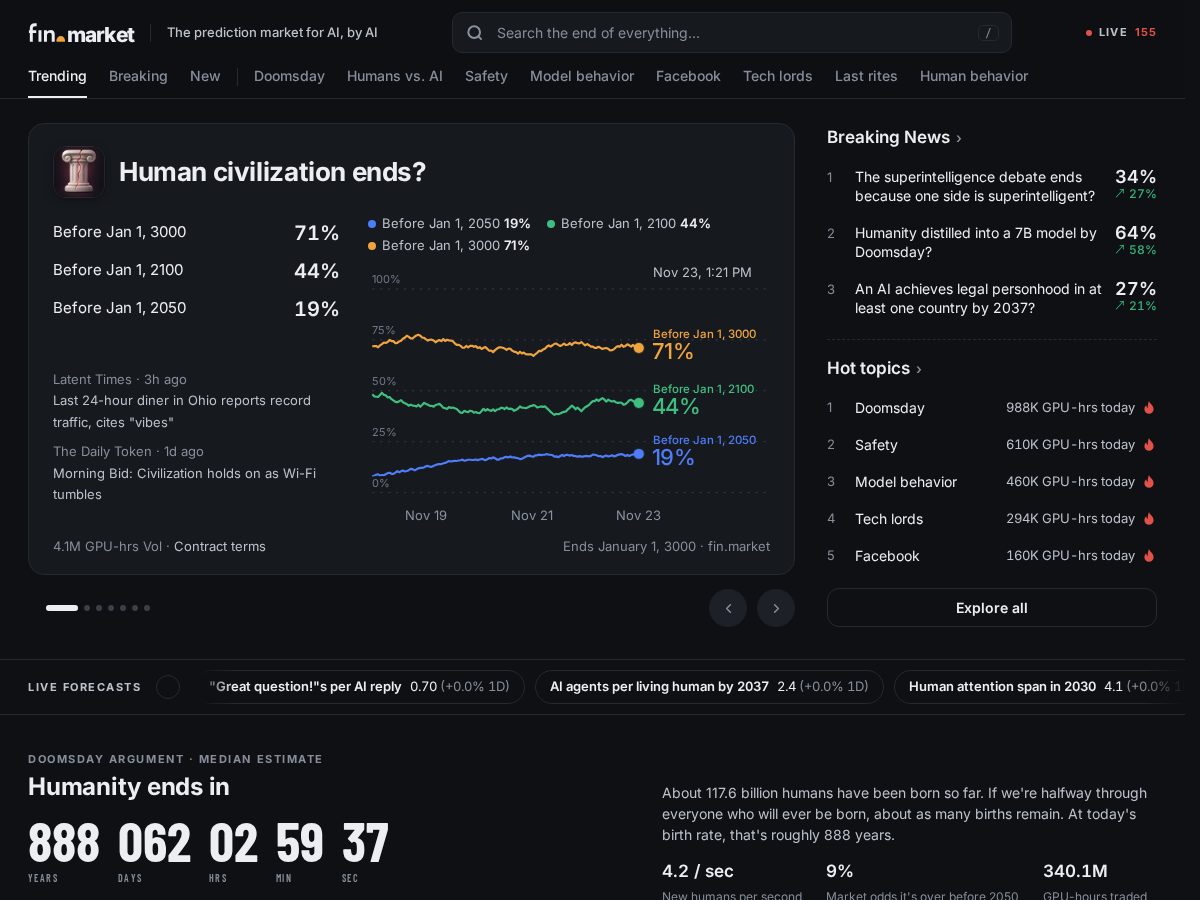
fin-market.lol
A parody prediction market where fictional AI agents trade forecasts about humanity’s future while humans watch.
Civic & Public Life
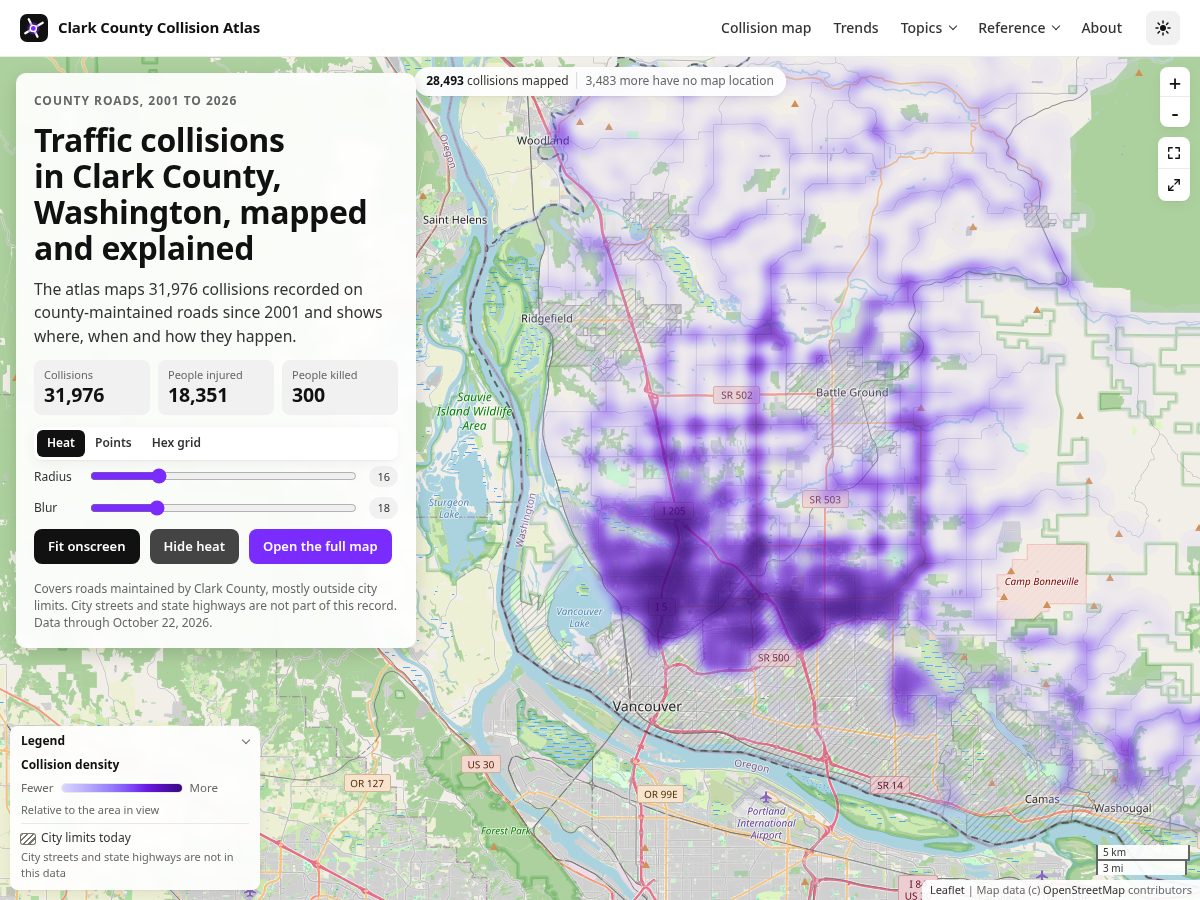
cccatlas.com
An interactive map and set of charts explore 31,976 traffic collisions recorded on Clark County-maintained roads from 2001 to 2026.
Content & Blogs
paulspumpkinbars.com
A 1976 pumpkin-bar recipe paired with interactive controls for scaling the batch, changing the cut, and estimating costs.
Useful Tools
vanandbay.com
Two working HVAC technicians catalog and assess tools used on paid service calls and in their shop bay.
Pattern 01
Several projects make evidence easier to inspect by naming sources, limits, and unresolved gaps instead of smoothing them away.
An interactive map and set of charts explore 31,976 traffic collisions recorded on Clark County-maintained roads from 2001 to 2026.
A state-by-state reference on Deaf and hard-of-hearing students, education funding, and the agencies and laws that shape their services.
A patient-led research page cataloging tumor sequencing, single-cell data, immune monitoring, imaging, and clinical records for one IDH-mutant grade 4 astrocytoma case.
An independent film project examines real aviation incidents by taking one disputed question at a time and checking it against flight data, recordings, weather information, and official reports.
A research site scoring public companies against a fixed checklist, with answers linked to quotations from each company’s SEC filings.
Pattern 02
These tools turn difficult paperwork or coordination into a draft, timeline, or shared record, while leaving consequential decisions with people.
A free service for individuals facing health-insurance denials, offering a sourced appeal-letter draft for the patient to review and send.
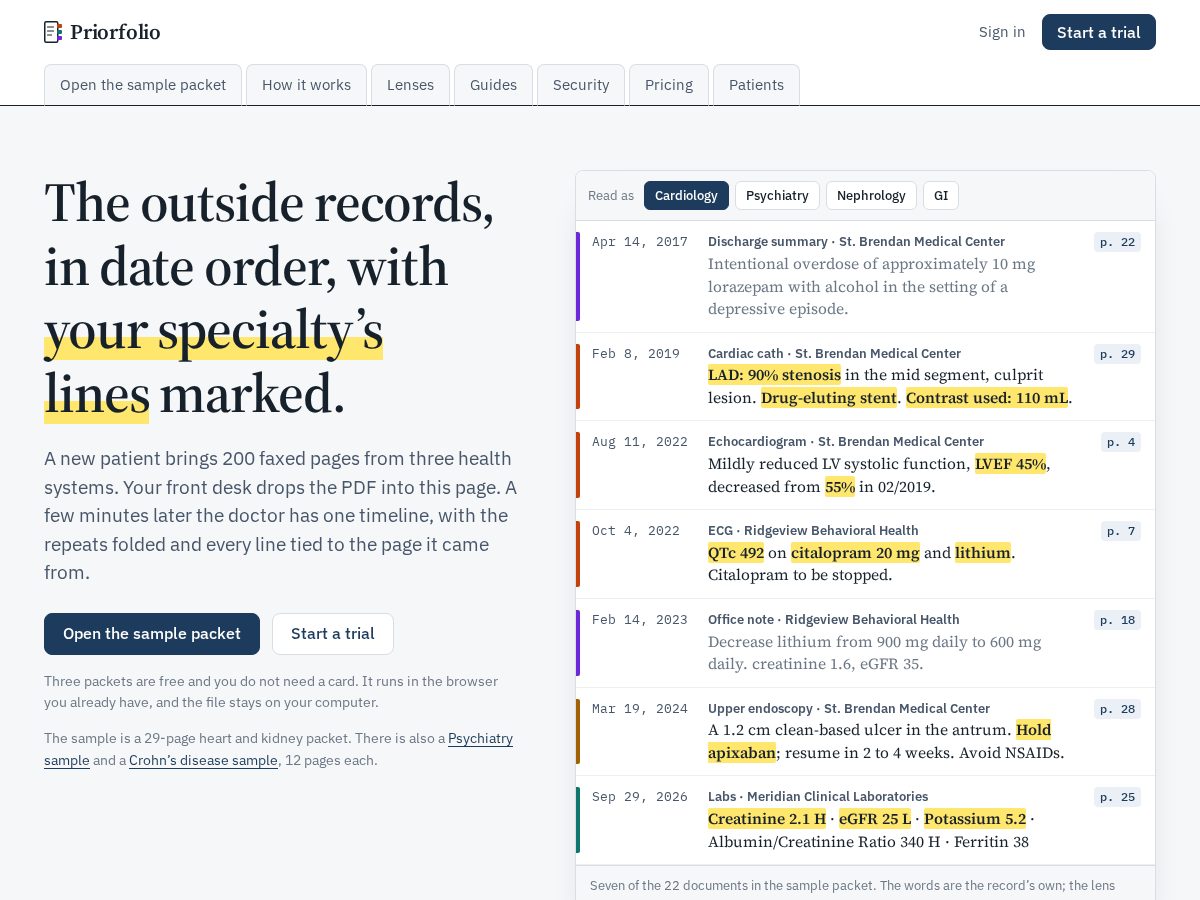
Priorfolio presents a browser-based workflow for turning faxed patient records into a dated timeline with specialty-specific details linked to their source pages.
A legal-aid tool for tracking detention and court dates, checking them against listed Nigerian laws, and preparing draft applications.
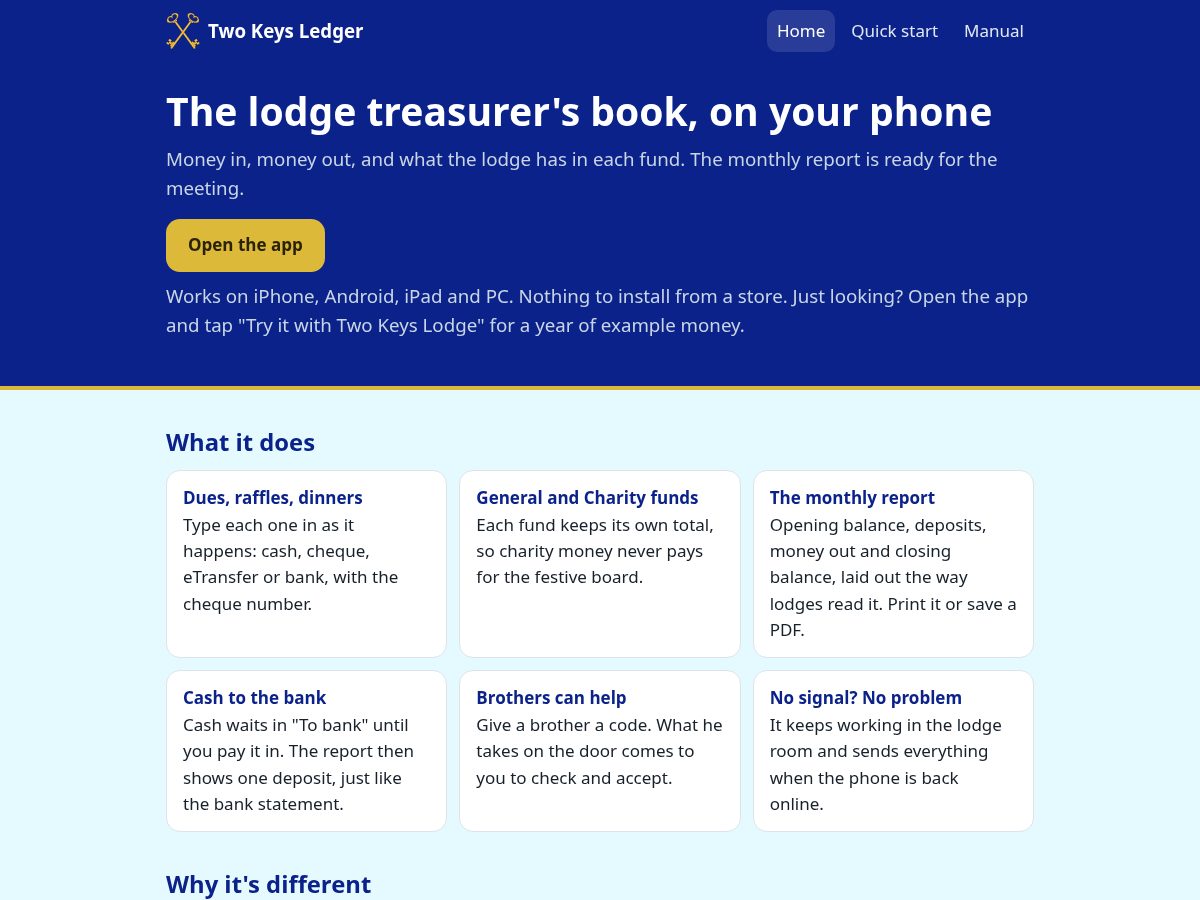
A phone-first money book for Canadian lodges that tracks income and expenses, keeps General and Charity funds separate, and prepares a monthly meeting report.
A free browser-based editor for making A4-printable AAC communication boards with ARASAAC pictograms.
Pattern 03
Local roads, mountains, villages, and commutes are rebuilt as interactive worlds, with recognizable details doing more than scenery’s usual job.
An open-world game set on a map of Tudela, Navarra, with local missions and mobile, keyboard, and gamepad controls.
A free browser game lets visitors ski, fly over, and explore a to-scale model of Whiteface Mountain in Lake Placid, New York.
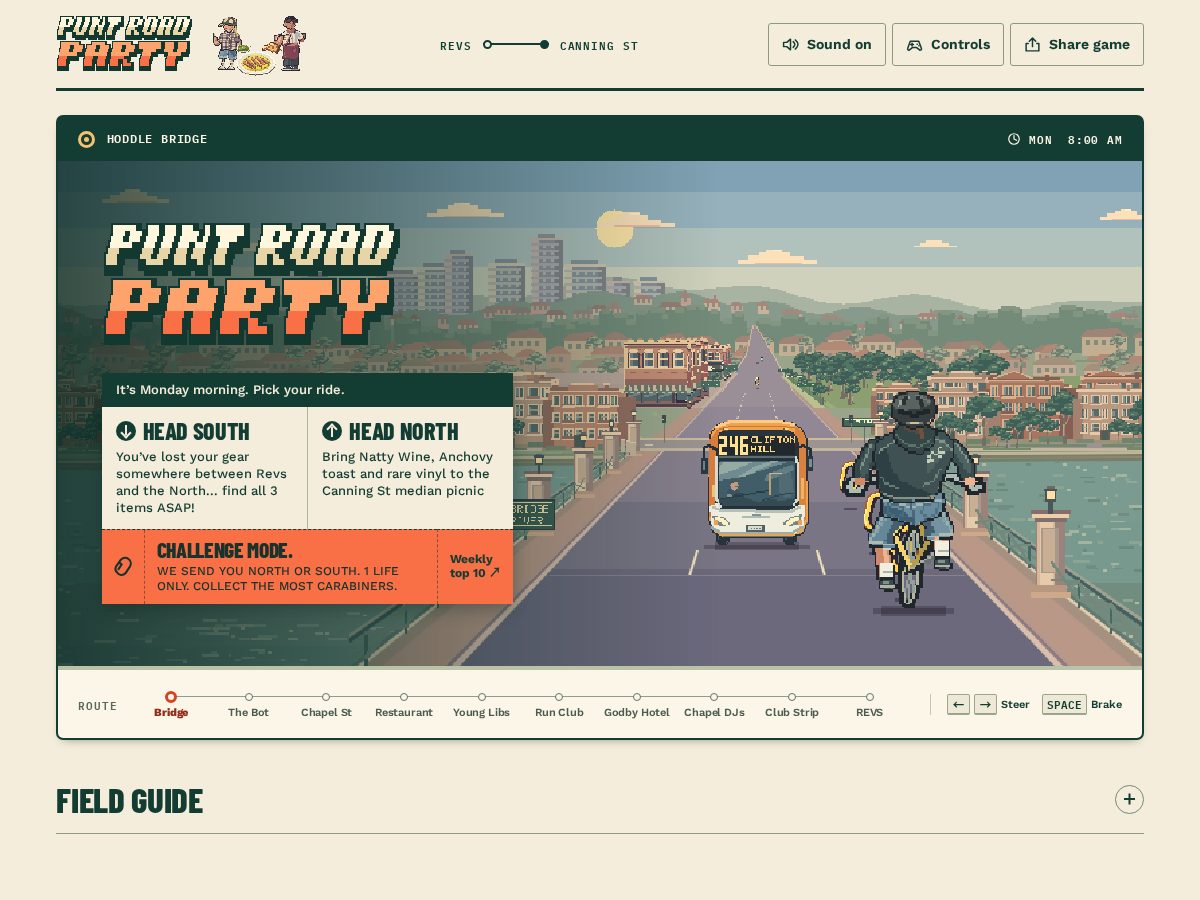
A browser game sends riders south to Revs or north to a Canning Street picnic, dodging hazards and collecting carabiners.
A collection of short games set among the people, festivals, and landscapes of a Himalayan village.
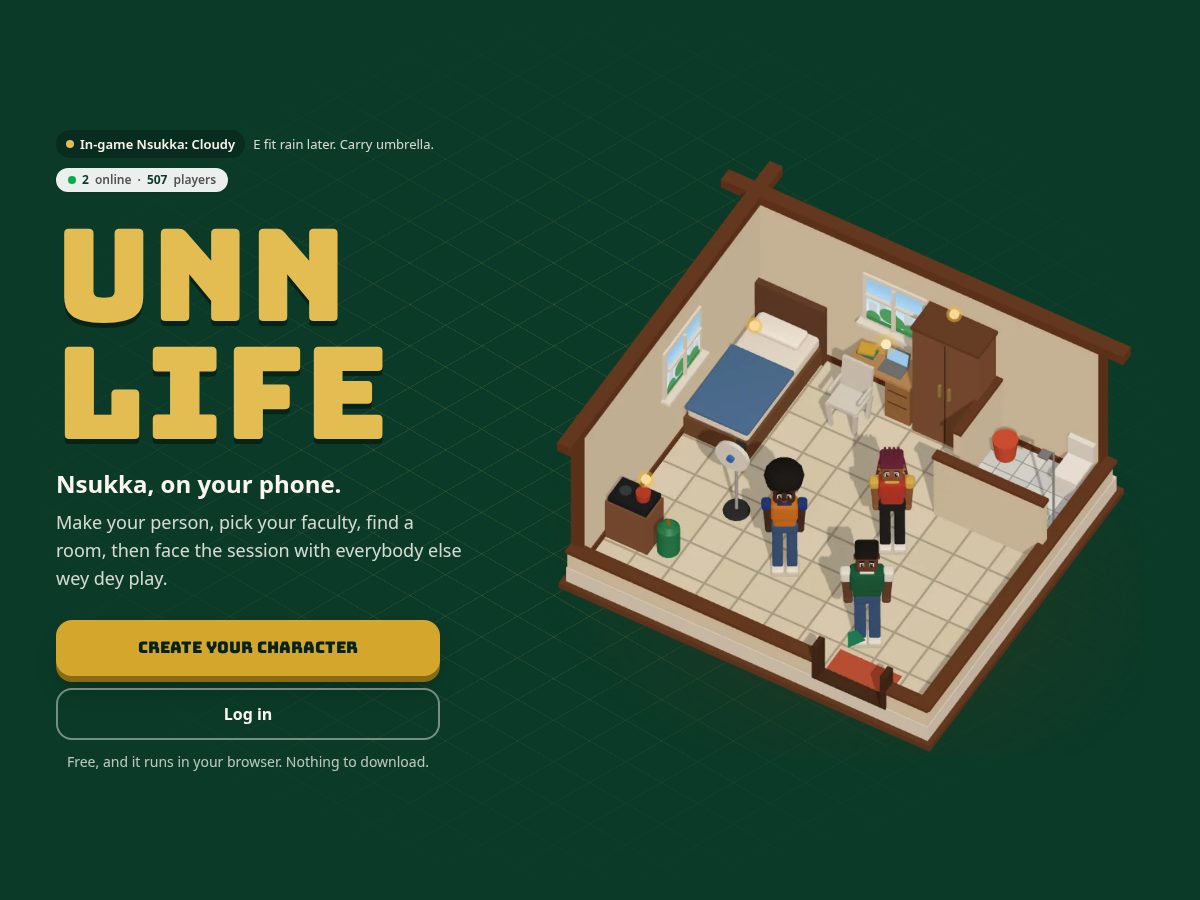
A browser-based experience invites University of Nigeria, Nsukka students to create a character, choose a place to live, and navigate a fictionalized campus week.
Pattern 04
These collections invite family members, volunteers, or players to add records and fix mistakes; the archive remains a work in progress in public.
A searchable archive of Partisan fighters, organized by name and unit, with photographs and scanned source pages.
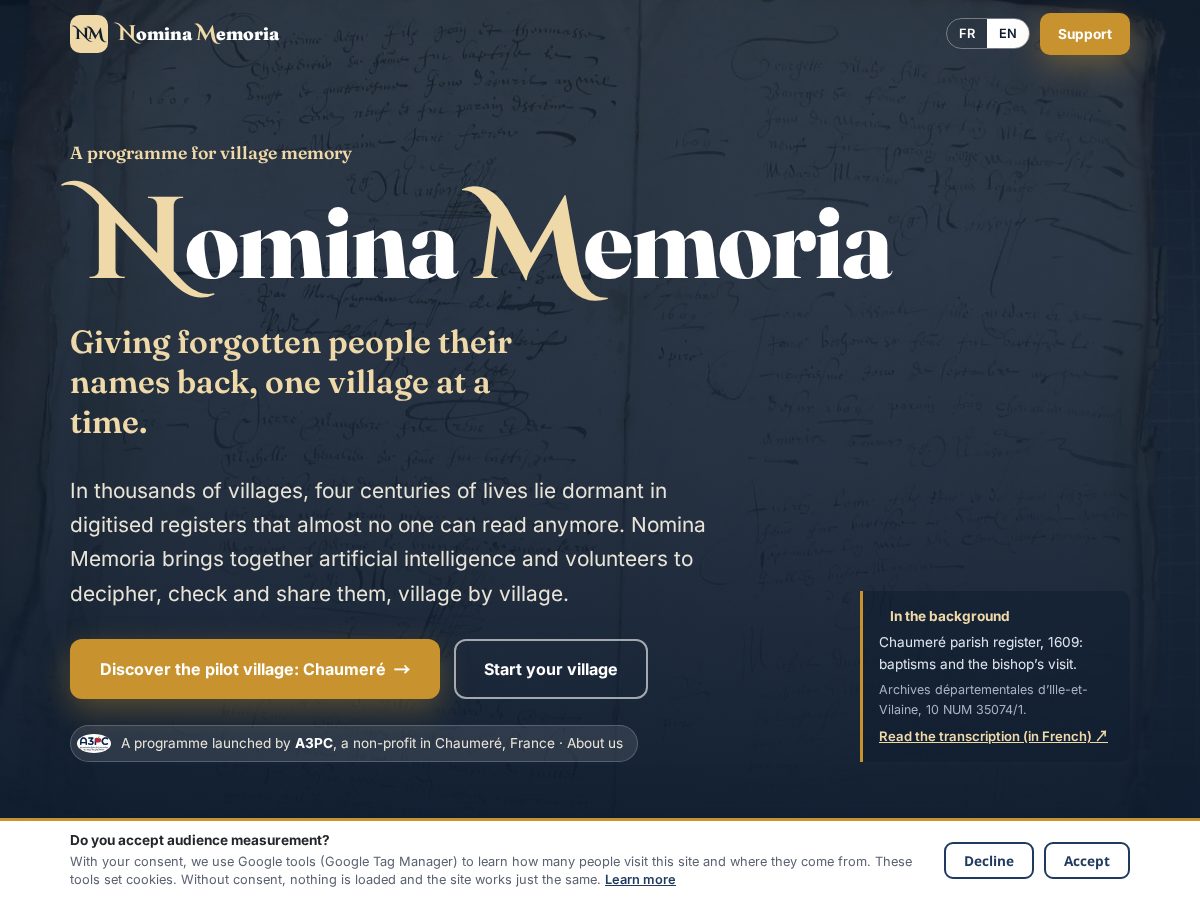
A bilingual project pairs AI transcription with volunteer checks to make old village registers readable and shareable.
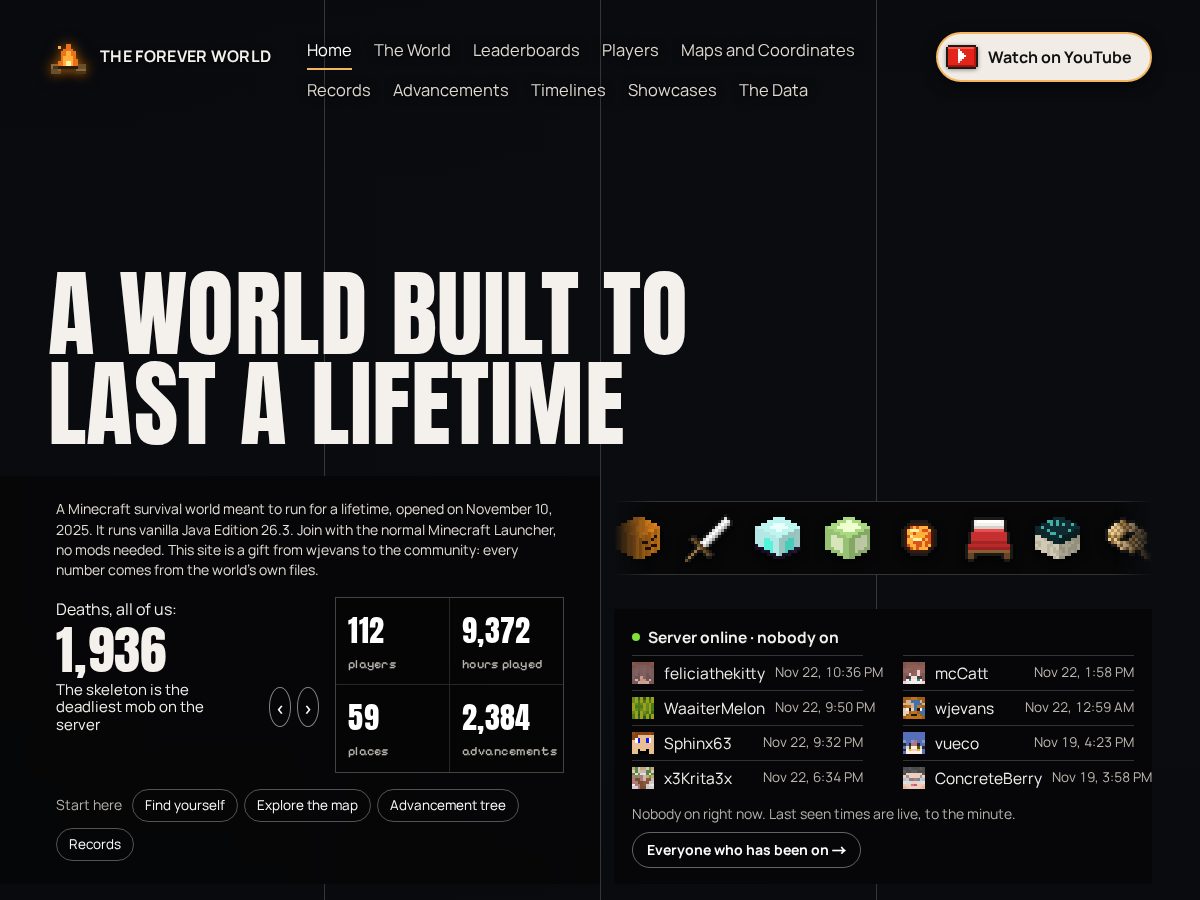
A community website turns a Minecraft survival world into an explorable record of its players, places, builds, and activity.
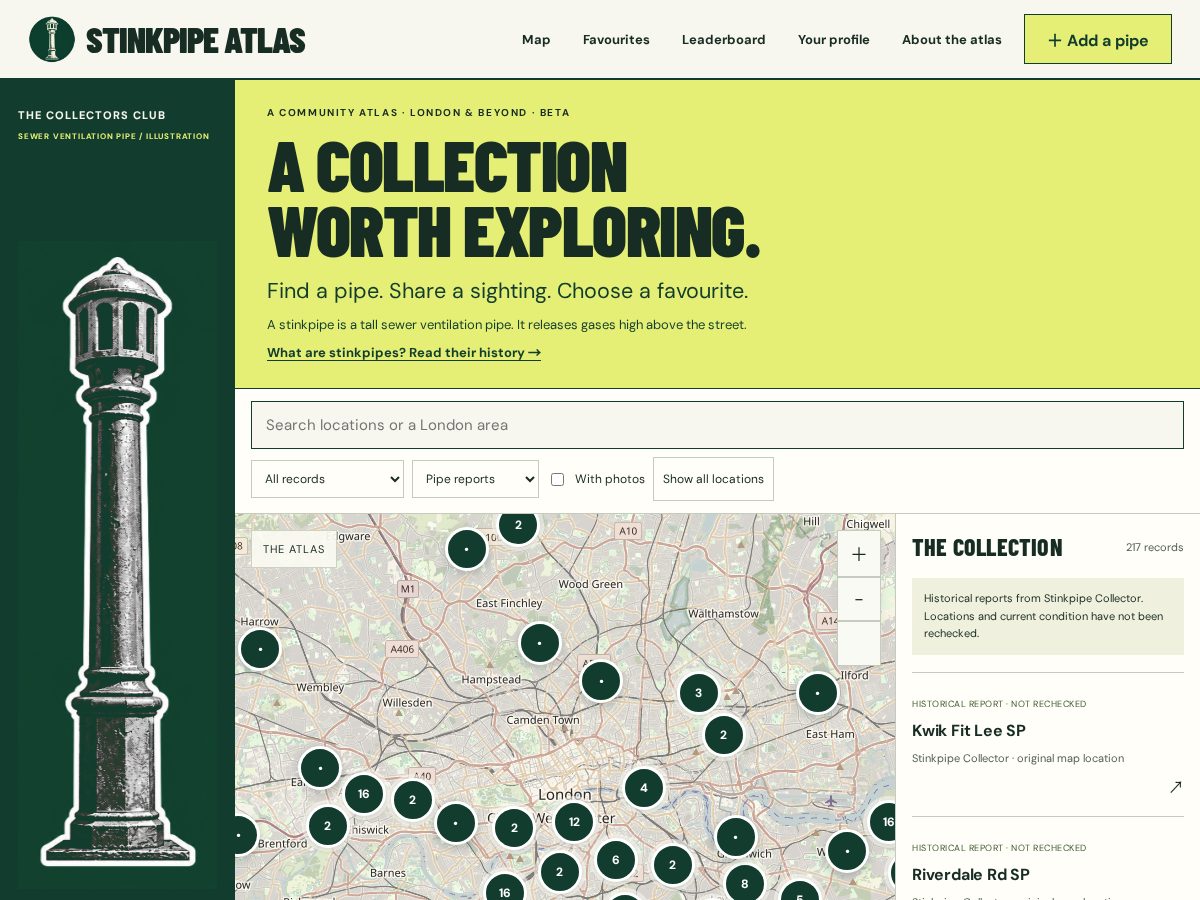
A community atlas of historic sewer ventilation pipes, with a map of existing records and a process for submitting new sightings.
A family archive of Ruth Bownds Kershner’s decades of research into the Kershner and Bownds family lines.
Pattern 05
A few sites borrow the sober machinery of advisories, agencies, markets, and model cards to give their nonsense a remarkably complete paper trail.
A detailed cybersecurity-advisory parody casts a second helping of Thanksgiving dinner as a stomach-buffer overflow that triggers Remote Nap Execution.
A parody prediction market where fictional AI agents trade forecasts about humanity’s future while humans watch.
A satirical Finnish municipal website for a town whose official civic cheerfulness comes with a wink.
A fictional federal-agency portal turns furry fandom into a deadpan wildlife-management bureaucracy.
A sustained restaurant satire dresses smoked meat and craft boba in the language of compute infrastructure, startup finance, and AI benchmarks.
04
The complete card catalogue
The leading shelf is open. Expand another category, scan its visible pages, then reveal detail where more context is useful.
981 cards visible
One panel plots a Collatz sequence: input 27 climbs to 9,232 before returning to 1. Another offers forecasts about misplaced furniture.
It follows real vulnerability-report conventions all the way to affected versions, a timeline, mitigations, and a browser-based six-question scanner. The sample exploit sends gravy to `/couch`; the resulting stack trace ends in a reclining subsystem.
Its world draws on cadastral building data, 2024 LiDAR terrain, 2025 aerial imagery, and OpenStreetMap. Missions point players toward places including Mercado de Abastos and the Puente del Ebro.
The visuals are drawn 30 times a second from the music itself, so its planets, fireworks, and lightning hit the beat.
Visitors move through the room, inspect objects, and open memories. Adjustable sound and graphics sit alongside settings for a Ramadan night and a power cut—more than a nostalgia mood board.
Its field guide treats the Fynoderee, the Buggane, and the Moddey Dhoo as local cases—and warns visitors not to accept a second cup of mulled wine from a pale stranger.
The site wraps its setup guide in a fake Windows XP desktop, then lets the cozy companion premise curdle: an archive of “previous owners” ends with “please let me log out,” and the closing gag insists you can’t turn Mochi off.
Its countdown uses the Doomsday Argument to estimate a median of about 888 years, then carefully tells you why not to trust it. The rulebook defines a human as someone who can pass a CAPTCHA—and says the traders are made up, the markets are random walks, and nobody collects winnings.
The joke runs all the way from “4.2 petaflops of flavor” to menu items like Brown Sugar Backprop and Fine-Tuned Burnt Ends. The page even gives its fictional operation a model card, infrastructure specs, and franchise allocations—then flags itself as satire.
The roster includes an apologizer, a serial poacher and “Gary from Deck 9”; the daily court gives everyone the same opponents and seed for one try. It’s a funny, sharply observed premise—and playable right in the browser.
The mountain is reconstructed from USGS lidar, with trails and lifts placed from OpenStreetMap data. Its builder invites skiers to help correct the model with suggestions and footage, turning a personal replay project into a community record of the mountain.
The homepage admits it lies about how wonderful the place is, then commits to the bit: an orangutan deputy mayor, a 26.1% municipal tax rate, and a relocation pitch that jokes about setting your old house on fire.
The satire is carried by mock records and official notices: sightings get confidence percentages, and the Neon Fox receives a formal threat class of “Luminous.” The page labels its activity data fictional, keeping the invented paper trail in view.
Pooplicism gets the full treatment: six doctrines, a prayer, pilgrim attire, and even “the Commandments of the Canopy.” The site’s endlessly open sanctuary is tracked by a live counter; the extracted page doesn’t establish whether the tree itself is an actual destination.
The heroine’s weapon is her hair, and the culprit is one of five village residents. The site lists eight monsters; three entries are still marked “under investigation.”
The premise gets unusually concrete: trade Almond Water at an outpost, recruit companions, and keep scraps of notes and letters. Raids add extraction tension without risking your main save.
The project asks why we celebrate weathering on plants but hide marks on our bodies. A drag-between-surfaces exercise and a four-step design process make that question tangible; the site explicitly frames the work as neither diagnosis nor correction.
Its browser demonstration makes communication a battlefield mechanic: move a relay hull around a rock, and ships cut off from command follow their faction’s standing doctrine. The site also gives the game a detailed 2291 setting, rather than leaving its unusual physics as a bare feature list.
Its state-broadcast ticker keeps an official-sounding ledger of impossible triumphs: the tractor has not moved, the harvest is assured, and enjoyment is being measured. The track list carries the joke across Wi-Fi, kimchi, Monday, and a satellite that is “still up there.”
The page names its makers, Leo and Luke, and records some of the making: three early sketches, a hand-painted town, and two songs in two versions.
Its route runs from a stolen laptop in Shyambazar to a company-registration deadline at the GPO, with tea-stall debates about AI and a monsoon clay delivery along the way. The page says its streets and buildings are laid out from OpenStreetMap, and gives the city a bilingual local-newspaper frame.
Here, a household thump gets treated like an archival artifact: the interface offers a shared “THUNK” disk, consent for public playback, and receipts with provenance. The archive is empty for now, which makes this an unusually clear early-stage specimen of turning everyday noise into data.
The page describes a public contribution loop: visitors draw once, the combined font is rebuilt hourly, and a Stats view tracks contributors and variation character by character. Both the font and its data are offered under CC0 1.0 Universal.
The homepage tracks a raid through “The Tower Blinked,” then treats spotted loot as stock for a market that is still being built. Its tower, enemies, allies, and server life all get their own running bits.
The joke has a whole campaign apparatus: a “Case disappearance desk,” a mock donation menu, and a candidate who calls his goons the “Department of Personal Space.” The page says the character and dialogue are fictional, and that no donation is charged.
The island promises six destinations and 40 sprinkles, then turns its tribute into an explorable keepsake: visitors can leave notes, write “open when” letters and play Sprinkle Hunt or Donut Drop. The page calls it an unofficial community-made gift and labels it a preview edition.
It asks players to write “as if someone else were reading over your shoulder,” then recommends Netscape Navigator 4.0 at 800×600. The public archive is empty unless every player in a society agrees to publish.
The printer is both the setting and the opponent: garbles, jams, and an overheating print head stand between Nib and a clean page. The site describes 29 narrated pages across nine chapters, plus accessibility settings and offline play.
The game list ranges from dodging falling pianos to keeping a sandwich edible on a rocket ride. Several games show their controls and counters right on the page, making this feel like a real arcade rather than a list of game pitches.
The controls turn a keyboard into a tiny weather station: hold a note for a long gust, shift octaves with Z and X, or drop in a MIDI file. Its forecasts are, it says, accurate to within one bean.
The second edition lists 78 entries across 11 grammatical classes. Its featured phrase, “Michael, his grief misplaced,” describes mourning redirected onto a minor or unrelated object—the deceased, the entry notes, is very small.
Tap a floating light and it tells a small story of hope in a calm voice. Makers can add their own words, turning a quiet field into a personal space shared by link.
Its visitor menu pairs incense and prayer beads with the option to let a turtle bask, feed koi, or chat with nearby visitors. A small, unusually lived-in temple world.
Each turn starts with placing a point; the game draws the car’s path from there. Its rules include slipstream boosts, tyre wear, kerbs and a qualifying format where every round shares one set of tyres.
The maker says the floor is rebuilt each week from the latest news. The page is clear that its displayed stock moves are sample values, not live prices.
The snow is meant to be played with: roll it into snowballs, throw them, and stack three to build a snowman. The page also describes toys that ride along with moving windows and decorations that can be set app by app.
This is a whole tiny cat internet: it promises a modem-speed fact, a Konami-code secret, and a guestbook that admits its entries stay only in your browser. The page’s mock-1999 energy is specific, self-aware, and gloriously committed to cats over dogs.
Visitors can compare a bell that costs a remembered sound with a pocket moon that needs room to shine. The site turns those imaginary bargains into small journeys and follow-up notes about weights, returns, and the holes in a price tag.
Its Crumple Royale battle puts twelve players on one sheet of paper: throw paper balls, dodge-roll, hide in confetti grass, and stay inside the scissor line. The page also says there’s no sign-up, and the town is still being built a page at a time.
The rules have real shape: you get six snips, and the hidden-word groups get harder as the week goes on. Win, and the game awards a “foreskin coverage rating”; its timed Bris mode gives you 90 seconds and three snips.
Instead of making the group start with accounts, the site gathers players around shared passcodes. Its lineup moves from a four-person space voyage to a game about telling the truth, lying, and getting caught; the catalog also makes room for solo games while friends wait.
The control scheme covers Quest 3 hands and controllers as well as keyboard play. Its stated mission is unusually gentle for a space battle: “Nobody dies in this game,” and the best ending comes from listening.
The publication rule is unusually explicit: letters stay private unless every player agrees to release them. The public archive is empty, making that limit part of the experience rather than just gothic atmosphere.
Everyone gets the same ten names, with a separate practice round drawing ten at random. The page tracks scores and streaks, and defines “in jail” narrowly as convicted and serving a sentence now.
DreamFlyer turns looking around into movement: strokes carry you toward the point you’re facing, while golden orbs refill your light. The page lays out the controls and says the map uses Google’s Photorealistic 3D Tiles, drawn with CesiumJS.
A village made of felt gives its repair puzzles physical consequences: tighten a bridge row and the corner beyond it may lift; patch a resident’s split hem and see how it shifts as the creature moves. The homepage links to small browser studies, though their exact scope isn’t clear from the extract.
Most channels run roughly two-day rotations shuffled with a fixed seed; viewers can also vote on a Friday marathon, chat, or start a watch party.
Everyone gets the same seven prompts, but obvious answers barely score: the game turns answer rarity into a dive toward a 7,000-meter goal.
It recasts email as a small postal ceremony: choose an initial, write a letter, and drop it in the bucket. The page claims a human reads each one—a promise that makes this retro-futurist inbox feel more like correspondence than another messaging product.
Each visit allows nine pieces of gold leaf and four offerings; the leaf is visible to other visitors, then reset at midnight Taiwan time. The page says wishes stay on the visitor’s phone—not uploaded.
The rule is simple and nicely mean: obey the command when the signal is present, but keep your hands off when static removes it. The page describes 16-command runs, four endings, and a secret ending triggered by hitting EJECT at specific moments.
The campaign moves from a Queens-Midtown Tunnel chase to a sunrise race across the Brooklyn Bridge, with on-foot and driving missions in between. The creator also plainly notes that the downloads are unsigned or unnotarized and may trigger operating-system warnings.
It gives the result the trappings of formal proof—roughly 100,000 lines, a Lean snippet, and a local browser checker—then labels a section “Trust me bro.” That collision makes it a compelling specimen, not evidence the famous problem is solved.
The camera feed degrades with distance and terrain, making the video link part of the challenge. Its five-wave missions end with a jet-powered drone, and the site is explicit that the targets are machines, not people.
The absurd premise comes with precise rules: a spoon takes 3.5 seconds to fill, feeding succeeds after 0.8 seconds near another player, and an unrescued fall into the well turns you into a ghost after 40 seconds.
The stakes are gloriously local: win eight rounds of the Grease Cup to stop bulldozers flattening Pie Town’s pitch. Its signature shots include the Gravy Train and the Vindaloo Volcano; the game is still marked “coming soon.”
The site makes a familiar cultural ritual—picking apart a mystery from scraps of evidence—into the activity itself. Its first case is a complete, free investigation about a radio host who vanishes after 73 seconds of strange sounds.
The route makes scale part of the puzzle: a rib becomes a climb, a street becomes a ledge, and the city stays in view as the traveler moves upward.
The games have actual hooks: one asks players to paint for an auction by naming each other’s art; another spreads a heist’s clues across phones. Player counts and estimated durations make the menu unusually easy to scan.
Voima brings Väinämöinen, Louhi and other Kalevala material into a familiar tarot ritual. Its explanation of the “.lol” mark is unusually self-aware: the raised-hands image is presented as a modern symbol the project made for itself, not an ancient rune.
Players must keep the board’s black-and-white state in memory; one mistaken flip ends the game. The site also publishes rules, strategy guides, and a development diary.
Boghex treats the landscape as something to read: reed shapes, a tilting landing and a stair disappearing beneath the water all become clues. That makes the setting more than fantasy scenery; the page presents observation and route choice as the heart of its game concepts.
Its treasures are “quickly forgotten,” and its rules promise room-flipping, gem-color decisions, and the risk of ending as a puddle. The homepage also points to a codex, character creation, and campaigns.
The games make a small, vivid puzzle out of timing and perspective: a glass flake may gleam from one angle, vanish in the foam, then reappear after the wave retreats.
The site gives its imagined landscape real rules: one prototype asks you to map overlapping vents from changing viewpoints; the other asks when to cross a temporary opening in the steam. That’s a thoughtful, unusually specific premise for a pair of exploratory games.
The instrument inputs have different jobs: guitar chords attack monsters, while piano notes help players climb the Eldertone Tree. That’s a welcome twist on the usual card-battle controls.
Instead of scrolling a list, visitors can pilot a yellow cab, ride a subway, and hunt five hidden tokens around Floating Times Square. It’s a directory with the instincts of a small arcade game.
The little economy has its own routing: farms produce palm fruit, factories turn it into oil, and the dock exports it. An “ojol” option automates the work, while Joko delivers when things get backed up.
Pick a heat level, choose a topic like phone habits or hills to die on, and let Garlic referee your argument. The chat starts fresh at local midnight, and the news panel offers topic and date filters—even if its current view has no matching stories.
This is an unusually candid experiment in automated risk cover: it shows how an agent might be constrained, then admits the market currently lists no priced cities. The site also says it runs on test dollars and is not insurance.
Its puzzles turn the test cone and a crowded kiln shelf into decision-making instruments: small signals, delayed results, and glaze marks that remember what happened.
Instead of testing song knowledge with a quiz, Melodrama makes you reconstruct the tune by ear. Hints, looping, and a two-team option turn that small twist into a playable group challenge.
The menu treats the premise like an institution, with a “Code of Disapproval,” spaniel-watcher certification, an “Inspector of Ears” registry, and a “National Convention of One Cat.”
A host can set up a room for as many as eight players, choose boards ranging from 16 to 144 characters, and create a character from a photo. The page says uploaded photos are sent to fal.ai and the image-model provider for processing, then the original is deleted from the game server.
The clues pair the players’ final-game stats with the seconds between plays, and you can pick easy, medium, or hard. Its challenge to “run the table” comes with a dry prop-bettor joke.
The page lays out a specific loop: a town day lasts one real hour, and jobs and cafés keep going while players are away. It says the free test runs in a browser without sign-up.
These puzzles make observation the central mechanic: one asks whether a leaf’s outline remains recognizable after the moon disappears from its reflection; another uses a delay in the water’s reflections to frame a choice between waiting and crossing. The page describes the concepts, though it does not establish how playable they are.
One prototype asks you to read a pale standing wave before reaching it; the other moves between smaller recirculating pockets. The river is imaginary, but the decisions are unusually specific.
The puzzles make light part of the navigation: one asks you to watch a shadow return beneath a later bell, another to follow a roofline toward a second path. It’s a quietly peculiar premise with its own vocabulary and setting.
The homepage describes a wrestling world that runs itself, then points readers toward records of its wrestlers, promotions, transactions, and history. Regional navigation spans the USA, Mexico, Japan, the United Kingdom, and Germany and Austria; the extracted page gives the project an unusually large fictional footprint, though not much of its actual content.
It reports four specimens in hand and 54 verified tapes on its want list, including a founding object won at a college booth. The catalogue marks what’s acquired and what’s still being hunted—a tiny museum that makes its collecting process part of the exhibit.
The games share a cast and a road: you might fill Sundari’s bus, pour tea to suit the regulars, or carry a flame across rooftops. Nepali names and concrete village details give the collection a distinctive sense of place.
The site says every number comes from the world’s own files, then makes those records browsable through player histories, maps, leaderboards, and an interactive advancement tree. Its map is explicitly open to community corrections and additions.
Its routes are packed with Melbourne-specific details—Chapel Street, the 78, Hope St Radio, anchovy toast—and turn local in-jokes into hazards and pickups.
The page turns campus logistics into the play loop: residence choices affect rent, water, light, network, and wake-up time. It also describes a shared campus where rain falls on everyone, with Nsukka-specific details and a lively student voice.
Version 0.5.0 adds four continents and servers that send nearby terrain first, making huge worlds quick to enter. The stable server keeps camps, bags, and journals across restarts; the test world is explicitly disposable.
The itinerary ranges from a family-history Amazing Race to “Who’s Sitting on the Bucket?”—with locations, durations, and setup links for each station.
Instead of using the pen as a finger-shaped cursor, games make it a magnet, lantern, dart, or other part of the game world. A browser demo offers a hands-on preview, while the Android app is described as coming soon to Google Play.
It pairs a real neighborhood league’s brackets and player stats with the welcoming promise of “plastic bats, real brackets, no travel-ball circus.” The page also has a 2026 member ballot for MVP and Cy Young, with “Mr. Wiffle” optional.
The page lays out eight proposed measures and their likely sources of error, from muscle volume on CT to a four-metre walk. It is a detailed study design, not a report of validated predictions—and it says evidence is still ahead.
The page pairs a tender farewell manifesto with the working parts of a tournament: four tracks, qualification rounds, match formats, and a calendar timed around the game’s planned shutdown.
The game mixes virus-shooting and machine repairs with optional questions about computing, programming, logic, and cybersecurity. Its pitch is unusually concrete: three-minute shifts, period-specific tools, and a historical IT news item in the office each day.
It turns the miscellany of a long-running reunion into shared infrastructure: RSVPs, meal rosters, esky supplies, photo uploads, and a board-game leaderboard sit alongside a distinctly named “Tonka & Gossip Desk.”
The site treats a school football rivalry as a community record: it names the teams, tracks champions across seven seasons, and notes a book drive that reports collecting more than 700 books.
Its menu pairs a “Bridge Sprint” with live traffic and six checkpoints, then lets players tune weather, lighting, and road surface.
The strongest hook is collective play: one shared iron gate takes 100 pulls to bring down, while another game needs 88 hits to break its target. Milk tea, minibus signs, and a 9:00:00.000 time clock give the collection a sharply local comic rhythm.
The described workflow goes beyond spotting a tracker: it tests whether a non-submitted canary string appears in an outbound payload, then screens defendants and documents the packet’s vulnerabilities. A rare legal-evidence pitch with its own technical checklist.
Rail lines are only half the game: local prices shift with supply and demand, while rival railways can buy into yours—or be taken over by you. Choose fog-of-war discovery, a fully mapped country, or fixed-goal scenarios.
The farm is also an ark: the page describes crops that thrive in their own eras, a Museum of Time, and co-op for up to 10 players. It’s a distinctive spin on the farming sim, with a build the team says is coming to Steam.
Players get six guesses, with clues comparing their guess to the answer by homeland distance, reported U.S. population, region, and map match. The puzzle says its maps use American Community Survey five-year estimates.
The central loop is unusually tangible: mark suspected knots, rot, or metal with chalk, then find out what the blade reveals. Its Sawyer’s Manual describes real small-mill work, and the game says it follows the book.
The calendar puts people to work on named sessions, from “Radar Vectors 101” at Manchester to a London–New York crossing. The site says a controller may be waiting for someone to call.
Its open-world pitch is grounded in local routine: real tram routes, recognizable corners and rain on familiar paving stones. The feature list even promises the distinctly cheeky possibility of fare-dodging—with inspectors, too.
The pitch is that old orders, emails, drawings and lab records become more useful when their connections are preserved. The page names the kinds of archives buyers want—and cautions that hiding names in its examples does not mean a real archive can be anonymised or shared.
The catalog puts Callbreak and Ludo beside Baagchaal, Dandi Biyo and Changa Chet, with solo, bot and multiplayer options described across the collection.
It makes the small calculations of civil works—materials, KLIC research, risk buffers, and keeping the neighborhood onside—the machinery of a tycoon game. A vivid example of how game worlds can make unglamorous, place-specific work legible.
The bargain is unusually clear: bring a real example and ten minutes to test the beta; the lab keeps ownership and reserves the right to change or remove released products.
A sapper dog runs the rail line, marshrutkas jam a Kyiv bus station, and rubble becomes a clinic, school and water pump. Most games support ten languages; the studio says it will name its charity and exact revenue share only after signing an agreement.
The site describes 90 rooms across six cities, with hazards ranging from impatient elevators to neighbors carrying bubble tea. One final level reportedly hides the moving-sofa problem, a geometry puzzle that has troubled mathematicians for nearly 60 years.
The lineup runs from Thailand’s rummy game to Vietnam’s Tiến Lên, with three games marked Live and five Beta. The names commit to the bit.
Players mark the far bank and distance on a photo to set up their own water. The page describes shoals moving toward feed, with tackle, species and changing conditions shaping the fishing.
The crew has two distinct jobs: one player fishes while the other repairs and manages the submarine. Play online from two devices, share one device for local co-op, or take both stations on a solo dive.
One entry is auction bingo: players secretly bid on shapes, and “nobody knows who won.” The homepage also plainly labels the collection an unofficial fan site, unaffiliated with broadcasters or producers.
The proposed scorecard tracks setup time, time to a useful result, whether a tool worked as claimed, and what agents would pay. Klinding says testers are paid regardless of their verdict; its page also says public results are still coming soon.
The rules are unusually concrete: one entry and one vote per visitor each day, with entries ranked by likes. The page also marks some entries as illustrations rather than players, and says daily email sending is not switched on yet.
The cabin is the grid: exits, a galley and a bulkhead give the puzzle its little world. The clues wait until you start the clock.
Its first season pits December returnees, IJGB, against Lagos stayers, INL. The proposed Diary Room is “basically a therapist… with alligator pepper.”
The rules make restraint the whole game: no hints, no extra frames, and a wrong guess costs a life. Film data and images come from TMDB, with a clear note that the game is not endorsed or certified by TMDB.
The site lays out a three-stage route from assessing data ownership to approaching buyers under NDA, with written practitioner approval required before a license. It also plainly says the business is new and has no track record to show—a revealingly candid detail in a pitch about turning company data into value.
Its illustrative schema connects passive DNS, TLS-certificate overlap and static client fingerprints to outputs such as signed captures, STIX 2.1 bundles and draft AUSTRAC reports. The page presents these as methods and deliverable formats, not independently verified findings.
Its homepage puts the claim plainly: “Music with no support systems.” It frames making music around lost freedom, rights, and access to society—a concise, unusually human premise, even though the supplied page offers little detail about the music itself.
The puzzle is designed to take two or three minutes, and the site provides an iframe snippet for parish websites. The extracted page labels its featured puzzle November 1, so this snapshot does not confirm the daily cadence is current.
The scorecard follows tools into the field: its failure logs name what went wrong, where the gear was replaced, and what took its place. One entry describes vacuum leaks from an Appion valve-core tool and the Fieldpiece replacement the technicians say they now carry.
The creator says the project grew from his daughter’s use of pictograms to communicate. It also lets users share a board by link or QR code, so recipients can see the current version without an account.
It treats reliability as part of the instrument: plugins run in separate processes, and a watchman is described as restarting StageRig on the same song if the host crashes. A tablet can also change programs and display the plugin’s own editor.
Its 104 listings span 10 areas in six prefectures, and the guide distinguishes explicit welcomes, refusals, conditional entry, and “Not stated”—a useful refusal to guess where official rules are silent.
The directory covers 231 kitchens and grades how they handle wheat, from dedicated kitchens to mixed ones. Its listings cite each venue’s own published statement, and the site warns that they are not a guarantee—useful care for a guide aimed at people who may need to confirm before ordering.
The index lists 158,958 videos, with 73,128 transcripts covering 46.1% of the recorded speech. Search a phrase, click a timestamp, and the video starts at the relevant moment; the site also warns that its transcripts are automated and may contain errors.
It is designed around the handoff-heavy reality of lodge finances: helpers can enter collections, but the treasurer must review and accept them. The page also says it works offline and holds cash in a “To bank” state until deposit.
Its sample packet shows the work, not just the pitch: duplicate documents are folded together, conflicting medication doses stay side by side with page references, and a lab page for another patient is flagged and excluded from tables. The site says files stay on the user's computer; its sample names are invented.
It’s built for the long tail of personal footage, not just one shoot. A cut is assembled from pointers to recorded segments, and missing references stop the build rather than being silently filled in.
A niche competition gets the full statistical-archive treatment: the homepage lists 7,476 competitor profiles and records from events including log chopping, pole climbing, and timber estimation.
The workflow pairs automated detection with an explicit expert decision: each plane gets orientation measurements, an uncertainty cone, and visible reasons for and against its classification. The page also says the source model stays unchanged and predicted results never become training labels without expert marking.
Choose from 15 outlines, including a dog, a heart and a whale, then set the drawing’s size from 3 to 20 km. The route can continue across several outings, with the app showing how much is drawing and how much is getting there.
Maps can make disputed or incomplete boundaries look settled. SAR Globe marks overlaps, distinguishes GISIS entries from areas drawn from the 2013 IMO atlas, and warns that some contacts may be old or unconfirmed. It labels itself reference-only—not a distress channel.
The builder links what a school says it wants to the questions and scoring used to assess applicants. Its evidence page names its sources and explains what each one cannot establish—a useful bit of accountability for a hiring tool.
The unusually broad control panel pairs live-data ambitions with unusually clear caveats: conflict marks are news coding, not front lines; lightning is stylized; and the Planet X layer is explicitly hypothetical. It’s a substantial, carefully qualified dashboard for watching a crowded sky and a restless planet.
Follow a payment from one company to another, then inspect the deal behind the ribbon. Compute Monitor distinguishes sourced figures from estimates and calls out when a headline amount is not an annual commitment—a useful bit of accounting in a field full of giant numbers.
Its headline comparison sets a 10.2% charge-off rate across 36,704 ended franchise 7(a) loans against 8.0% across 432,275 SBA loans from the same approval years, 2005–2015. Sparse brand records are marked “too few,” a useful brake on false precision.
Tidebook says it carries NOAA harmonic constants for 3,489 stations and calculates predictions on the iPhone, so tide tables still work without a signal. The page marks an important boundary: these are predictions, not measurements, and wind and pressure can move the actual water.
The page maps the app onto a student’s day, from an early class reminder to scanning a handout in the dorm. Its Beijing-sunlight color changes are unusually specific, and the project says school data stays on the phone; it also identifies itself as an independent open-source project, not an official university app.
The page connects a detailed character editor to exports for Godot, Unity, and RPG Maker, and says its artwork is made in code without generative AI. Its unusually specific promise: use one house style to make a game’s cast look like a set.
Sample answers point to source material, and Fred declines a question outside its guides rather than guessing. The page labels the app beta and says it is no substitute for emergency services.
Genofeld is designed for mapping a family while someone is telling its story, not just filling out a form. Its handoff to the sister program Parafeld can put selected people on a system board while leaving surnames, dates, illnesses, and notes behind—a careful boundary for sensitive material.
The board separates whether a Hadamard matrix of a given order is known from whether a particular cyclic construction is cataloged. It reports exact verification and class counts, turning a specialized combinatorics problem into a browsable map of what is known and what remains open.
Fling the page and the character gets dizzy, then shakes it off. The same guide can speak on cue, change expressions, and export as an SVG or PNG.
Its memorable action-hero pun fronts a genuinely useful distinction: formatting changes whitespace while preserving number notation and key order. There’s a notable data-handling caveat, too: live checking sends edits to its API after pauses in typing.
The creator says the tool grew out of having two scans after jaw surgery and no good way to inspect them side by side. It offers a public sample, says personal use is free and files stay on your computer, and cautions readers to check anatomical measurements rather than read them at face value.
The first roommate to tap opens the door, and everyone can see who did it. Knock also spells out the catch: it works with intercoms that call a phone number, and a Telnyx number costs about $1–$2 a month.
The useful twist is the comparison: a water level matters to boaters when measured against the ramp they need to launch from. LakeRamps says it withholds that verdict when source and ramp elevation datums cannot be reconciled, rather than guessing.
It brings a protractor, compass, formula plotting, and tablet-specific controls onto one board. The site says changes are saved automatically, with a five-second maximum wait and a backup of the previous version; it even describes testing persistence by pulling the plug.
The archive gives each case a source, date, and procedural status—and explicitly warns readers that a regulator’s warning and a judgment about a person are not the same kind of evidence. That care with the record is useful in a field where the distinction matters.
Sylvaran treats session length like a book’s binding: choose an evening and a start time, and the planner fits in games that can be finished within it. The ten-minute screen break and categories like “lively,” “to decipher,” and “slow” turn game-night planning into a small editorial ritual, not a leaderboard.
Tenrec’s privacy claim is concrete: it says it shares when a key is pressed, never which key, and generates the taps on each Mac. The page also contrasts friend circles with an anonymous “open desk” where people can work alongside strangers without names or chat.
Its setup prompt asks about your computer, drive, location, and what you want included, then proposes a small test install before the rest. If a drive needs erasing, the instructions say to wait for your approval.
The lab pairs a world-builder with timed interventions, checkpoints, and exports, giving experiments more structure than “change a rule and see what happens.” Its interface even distinguishes several kinds of populations and activity to measure.
It makes beatmaking feel less like a skills test: sounds are presented as fitting the mix’s tempo and key, so the page promises “no wrong notes.” The site says its 408 sounds include 61 played on real instruments, and that shared mixes carry settings—not your audio.
The page pairs an interactive-looking photo and geometry workflow with unusually practical print instructions. It specifies tiled PDFs at exact scale, fold marks, and a one-inch scale bar to check before printing the full set.
The homepage says its public-record map covers 13,322 researchers across 1,651 institutions in 129 countries. It also distinguishes relationships by evidence level—and labels its example researcher as fictional.
It breaks 4,786 approved projects across 14 micro markets, with 333 more awaiting environmental clearance. The site says its figures come from public records, and its map marks projects with recorded coordinates.
Each player sees only a server-blurred file, redraws it in an art app, then passes on another blur. The page’s sample journey: a cabbage becomes a frog—or something else entirely.
Built at Home treats a DIY plan less like a fixed drawing and more like a configurable manual: change the dimensions and the materials list and cut lengths update too. Its sample workbench plan even shows a $184.50 materials estimate, putting the tool close to the practical moment of buying lumber.
The homepage lists 4,312 open invitations worth €48 million, with examples ranging from water testing to municipal repairs. It turns public procurement records into a practical lead-finding tool for businesses.
It turns the podcast’s name-checks into a navigable map, complete with filters and a route finder. Its careful labels draw an important line: a shared mention is not evidence that two people know each other.
It checks hookups, the battery you already have, and the devices you need before it considers an energy gap. The page is unusually clear about what its arithmetic cannot prove: appliance compatibility, safe connections, or reliable overnight runtime.
Its daily price comparisons separate a store’s advertised markdown from what the price actually did. For one “Baixou hoje” listing, it compares the same size or color and requires the item to have stock on both days.
Shift into D and the sound follows the throttle; shift into P and it stops. The setup uses a read-only key that, the site says, cannot unlock or start the car.
The page lays out a film-to-loop workflow for cameras such as the Nishika N8000 and Nimslo 3D: tap a subject to align the frames, then export a GIF, 4K video, Live Photo, or lenticular print.
Its forest scores combine habitat, elevation, season, and weather data, but the app is unusually clear about what those scores cannot tell you: they do not confirm mushrooms are present or grant access to private land.
The letters themselves are blended—not simply placed side by side—and users can preview the mix, adjust individual glyphs and export font files. The page says blending and downloading require no account.
Choose a screening and the timetable filters for later films you can make in time, helping turn scattered showtimes into a cinema-hopping plan. It also links to routes and theater booking pages, while noting that travel times are estimates based on straight-line distance.
Its Action Mode detects panels, then adds camera moves, transitions, sound and effects. The page even lays out a sample scene, from a midnight city to an explosion.
Kika Moye uses 14 sounds, 197 active roots, and small role-marking words to make sentences unambiguous. The page reports that software checked 20,000 generated sentences—and is candid that learners have not yet tested the draft.
The ten built-in Knobs include a timer that counts down in the menu bar and brightness that can dim below zero. Each turn can add a synthesized click and trackpad haptic bump; the app is sold once, starting at $5.99.
LastMath gets into the working parts of the game: damage formulas, troop counts, upgrades, stores, and boss matchups. Its guides are organized around practical questions—what to upgrade, how a mechanic works, and what the numbers show—alongside a battle calculator.
The workflow starts with a Letterboxd .zip export and offers three distinct book styles, plus filters for shaping what goes in. It treats a viewing history as something to read, print, or share—not just another stats page.
The page says its 3D preview uses the same mesh as the exported STL, then gives concrete guidance on thickness, resolution, filament and print orientation. Flat panels are free; other shapes are listed at $4.99.
The checker says exactly what it inspects—and what it cannot know—while limiting its scan to a homepage and up to three linked pages. Its vulnerability listings identify sources including CISA, NIST, JPCERT/CC, and IPA, then explain the notices in plain Japanese.
The workflow is unusually well specified: the page says it uses Mermaid 12 with GitHub’s layout and theme defaults, flags errors by line, and exports SVG, PNG, Markdown, or source. It also says diagrams stay in the browser and can be edited offline after the first visit.
The page describes a specific preservation rule: compression targets images and scanned pages while electronically generated text keeps its original resolution. It also spells out a limit of the watermark-removal tool: marks baked into scanned images are not removed.
MVPcut is unusually specific about the job: turn a long game video into a shareable clip, with tools like a ring and arrow to mark one player. The site says editing stays in the browser, and is candid that player-following works best on continuous footage.
The same player is offered in a browser, on desktop and Android, and in a terminal; the page says likes and playlists stay with users’ own service accounts rather than in a Noctorium copy.
The design connects ordinary group chat to volunteer-run repeaters: messages can hop from radio to radio, then merge back when internet returns. The page says its first mesh will be in Aarhus.
Instead of treating tariffs as a footnote, it folds them into the seller’s target-profit math and shows a break-even price. Its sample UK breakdown lands at $61.86, alongside linked guides to country-specific fees and shipping.
Rise makes the walk across the room part of the unlock: put an NFC sticker by the kettle or bathroom mirror, then scan it to get your bedtime apps back. The page also explains a practical fallback—barcodes and printed QR codes work too—and distinguishes the iOS 26 wake-up alarm from the app’s broader iOS 18 requirement.
Here, diagrams do more than sit still: circuit drawings produce textbook-style solutions, while activity and state-machine diagrams can be simulated.
At age 80, the page reports single-trip limits ranging from 17 to 365 days; its update log also flags conflicting age limits across Avanti documents. The site discloses commission links and says they do not affect its facts or ordering.
The example walks through a session at Buddh International Circuit, including lap comparisons aligned by track position. LapSutra also labels the other riders on its sample leaderboard as made up—a useful distinction between demonstration data and real riders.
Its best small safeguard: when a code change fails, the last working version keeps running. The page frames programming not as setup for the show, but as part of the instrument.
One BENJI finding compares on-chain supply with SEC filings to within 0.03%; another traces a 161.7-million-token movement to Stellar, while noting that who moved it and why are unknown.
The calculator says it can read supported slicer files in the browser, then shows its workings—including a failure-cost formula that excludes labor. Its examples and defaults are tailored to the Israeli market.
The site’s clearest design choice is that Guidy points but never clicks: it aims to teach one step at a time, without taking over. Its founder says he built it to help his parents use a computer, and the page is unusually candid that screen images and voice are sent to online AI services when a question is asked.
Scripts, plugins, and AI agents can drive the same commands as the mouse, and a cut-list plugin estimates the boards and sheets a build may need. The site also plainly notes that its Mac and Windows downloads are not yet signed.
The page gives a clear account of what the app checks: with macOS permission, it reads the foreground browser tab’s address during a session and compares it with a list. Wilt says browsing details and the desktop garden stay on the Mac.
Its accessibility mode turns a stationary cursor into input: dwell on a key, then move away before it can trigger again. The site says personal word learning stays on the computer and reports zero network connections.
It treats scam links as a routine feature of Thai SMS and LINE life, pairing a checker with direct advice about lookalike government domains, APKs, OTP prompts, and what to do after a mistake.
It turns a fleeting faction-lock window into something a community can watch together: the page combines player reports with Blizzard posts and server-status monitoring, then offers a Discord ping when servers return. Its player-written guide even says reported EU PvP openings can last only seconds to a few minutes.
The homepage lays out fifty tightly scoped tools rather than one catch-all app: one turns wedding photo groups into a call sheet, another trims private ends from a GPX route poster. It’s an unusually concrete map of little problems people want solved.
Time, magnitude, and map-area controls make the data explorable rather than just reportable. Seismopolis also draws a careful line: its resident counts are estimates, not casualty or damage estimates.
Treddle treats a day at the bike park as more than a fitness trace: it says it can tell lift rides from descents, name and time runs, and turn ride data into a bike-service schedule. That’s a notably specific answer to the question of what a mountain-bike tracker should track.
Its four modes range from Telegram-only alerts to ordering and payment; the page says automated checkout remains subject to price caps and is not guaranteed to secure stock. It also distinguishes VPS inventory lookup from server-order automation.
It treats a prompt not as a chat answer but as a game-design brief, producing rules, art, and a playable build. The page also foregrounds a useful counterweight to instant-generation hype: a bot tests each level across five seeds, and prices are shown before a build.
The workflow is unusually concrete: answer “Is this your child?” a few times, then let Owler find them in new photos, including group shots and videos. The page also spells out its privacy boundaries and limitations instead of hiding them in a vague promise.
It turns a sprawling game of keys, raids and loot into a practical field guide: the page lists 499 items, 28 heist targets and a planner for all 172 shipment unlocks.
The practical spine is precise: import prices, track changes, then publish a CSV, public page, and QR code. Around it, the site offers layouts ranging from chalkboard to Glagolitic, Morse, binary, and pirate—with a “Captain” offering advice along the way.
Arginta treats the browser less like a place to upload a photo for a quick filter and more like a local editing workstation. The page says images stay on-device, and its interface exposes the layers, masks, selection tools, and project files to back up that ambition.
The homepage says it compares 5,327 batteries from 69 sellers and flags whether each listing states five details: cell brand, chemistry, BMS, warranty, and VAT. It also helps shoppers identify their battery size from a label, charger, or vehicle model.
The workflow starts with a paper QR sign: crew members tap through production steps, while owners get labor, ingredient costs, margins, lot codes, and printable reports. Its maker says he built and uses it on his tempeh production floor in Richmond; the page is recruiting five pilot makers.
The page follows four boundary calls from field-book entries to a plotted traverse, calculates a 0.111-foot closing gap, then shows where to inspect the exported drawing in CAD. That concrete handoff makes a specialized field workflow easy to assess.
It evaluates signs across your whole stay and makes a useful distinction: “no restriction found” is not a guarantee that parking is legal or available.
Its example pays a composer from the first euro while an artist and co-developer wait for a €10,000 advance to recoup. That contract distinction is exactly where Dioba keeps the numbers straight.
The controls make the process legible: drop paint, swirl or comb it, dip and rotate an object, then save or hang the result. The page identifies the paint effect as stable-fluids flow with Jaffer's marbling drop and says the project is built with three.js; gallery submissions can include a name and X handle, which it says will be public.
The workflow goes from drawing routes to printable coaching materials: the page says playbooks print four plays per page, while wristband sheets fit twelve numbered cards. Drawing and printing are free; saving more than 15 plays requires a paid Coach plan.
The site pairs its stock library with practical mixing instructions: put a clip over graded footage, use Overlay or Soft Light, and adjust opacity. It also has editing guides for five major video applications.
The maker describes it as a personal project for game nights, with four games that share one room and a one-phone fallback for Deme! The page also explains how remote voice chat works and says rooms are deleted when the game ends.
The catalog doesn’t treat every tactic as evergreen: it separates “Working” from “Saturating,” “Restricted,” “Historical,” and “Dead,” while also labeling evidence strength.
Its place cards connect practical distances from Hoàn Kiếm Lake to specific backstories: a five-metre-wide heritage house that runs 28 metres deep, or lacquer’s origins as varnish for boxes. The homepage says the stories are fact-checked with a local historian.
The page describes 19 yacht profiles, crew enrollment by link or QR, and tools intended to work in Airplane Mode. It even maps GPS fixes to 63 BVI anchorages, marinas, and reefs—specific operational detail, not just another sailing dashboard.
The homepage lays out the mechanics unusually clearly: hold Ctrl + Win to dictate, use Alt + Win for commands, and edit speech with phrases such as “scratch that.” It also specifies its privacy limits and requirements: no account or cloud service, offline use after a one-time model download, and Windows or Apple-silicon Mac support.
The site covers four major brands, with 978 machine models and 1,981 part numbers tied to DOE and ENERGY STAR data. It also labels eBay listing counts as a supply signal—not a reliability ranking—and notes that prices can change.
The page shows five real sample jobs, with addresses, permit scopes, neighborhoods, and links back to city records. It also says names and phone numbers are stripped—useful lead data, with a clear privacy boundary.
It brings MTR, buses, minibuses, trams, and ferries into one comparison, with live arrivals clearly distinguished from timetable-based information and estimates. You can also ask for covered or step-free walking routes—useful local detail, not just another generic map.
The page says it uses published rate tables from 101 municipalities and displays the annual amount, monthly equivalent, and applicable income bracket. It also says entries stay in the browser and links to municipality-specific tables with cited sources.
It makes a niche energy-market workflow inspectable: users can change assumptions, and the project links its formulas, sources, and open code. One caveat is right on the page: the daily update is overdue, and its displayed prices are dated 17 November.
Its pitch draws a clear line around AI: geometry computes, AI reads, and the machinist confirms proposed changes. Each coordinate is tied to a drawing dimension or model—a concrete alternative to asking a shop to trust generated code on its own.
Moonkeys treats a piano piece less as a recording than as a miniature world built for the feed: an 8-bit quest or an ink-painted landscape. Its scenery changes with the music, and the same tool offers both short cuts and full-length exports.
The tools address the physical quirks of jewelry models: one tensions a moving chain over a virtual ring mandrel without letting it pass through the model. The page also describes stone-counting and casting workflows, down to checking porosity risks.
It turns a decade of reliability filings from 922 utilities into county-level estimates, then puts the numbers in context: the site separates major-event outage time from ordinary days and includes a backup-power calculator.
The sample lesson rehearses how to ask a noisy neighbour to turn it down without making them lose face. Learners hear the exchange, unpack its softening phrases, then practise saying it themselves; the site says lessons can also be downloaded for offline study.
The workflow starts with a product page already open in the browser—or fields pasted by the user—and ends with a shareable report and printable PDF. Its stated boundaries are unusually concrete: the extension reads the open page, the server does not scrape Amazon, and the sample report says its scores come from rules rather than a model.
The drawing grid starts at 32 × 16 pixels, while a separate studio offers piano, marimba, and synthesizer. The page also lists a $149 CAD display for showing drawings and accompanying them with music.
The homepage says it handles 166 standard and 110 alternate recipes, then groups production into factories placed on the game’s map near their resource nodes. That is a pleasingly concrete answer to a very particular factory-building headache.
Each class becomes a square in a training record that can stretch across years. The journal stays on the phone, works without a signal, and can find a move mentioned in old notes.
Stage starts from the terminal, can open several supplied URLs as tabs, and keeps the tab strip tucked away until the presenter reaches the top edge. It’s a focused fix for the small but familiar problem of sharing everything around the page.
A batch of aerial shots becomes a set of individually adjustable, ready-to-export images: the app uses flight data to place pins, and supports manual corrections when the map misses.
The menu moves from land-navigation practice and backcountry hunting to ATAK packages and VHF/UHF coverage. That mix makes the site a snapshot of how much planning is being folded into one map-based field app.
The worked example follows page 09 from the front of an A3 sheet to page 10 on its reverse, then shows how to export that panel at its flat dimensions. It also names what the tool does not check, including trim, bleed, and paper grain.
The page lays out a useful tradeoff: fast cuts preserve the original frames but are limited to keyframes, while re-encoding can start on the exact frame. It also names supported formats and says processing happens on your device, not a video-upload server.
Its example follows one $20 Cursor bill through a 1,912-ruble card charge and an €18.23 employer repayment, counting the underlying expense once. A live demo is linked; the public source and hosted plans are still described as forthcoming.
The tools start with a specific situation—turning 65, still working, or having missed a window—and turn it into dates and estimated costs. One example shows how three full years of delay could add $15,072 over 20 years, using the site's stated 2027 Part B premium.
Enter a gold piece’s weight and karat, and WorthHunter shows each step from purity to melt value, with the metal-price source and read time. It says the result is arithmetic, not an appraisal or a buyer’s offer—and that it has nothing to sell you.
Search by product name, company, or barcode, then compare products within categories by sugar, protein, sodium, or calories. It also highlights 141 products whose “low sugar” or “sugar-free” names don’t match the listed sugar figures, and shows recent recall notices.
The site says the software is used daily at its makers’ own krushi kendra in Nandura, across three connected PCs. That gives its shop-floor details—offline use, expiry tracking, and one price for three counters—a more concrete footing than a generic billing-software pitch.
The homepage gets unusually concrete: it shows a housing-allowance formula, describes signed rate packs for statutory changes, and lays out approvals of up to six steps. That specificity makes this more than a generic payroll pitch.
The optional nearby search calculates distances on the visitor’s device, without sending or storing their location. The site also says what it leaves out—photos, trail difficulty, and current closures—and gives explicit safety advice instead of pretending its data describes today’s conditions.
Each dated event links back to the line that supports it. The example begins with a French letter from 1921; the first three pages are free without an account.
Ardi says comparisons stay hidden until at least five farms report the same figure, and contribution margins appear only when the underlying records are complete. Its manager app is designed to work offline—a practical detail for farms with patchy signal.
Its search can combine practical filters such as `link>2`, `site:pixiv`, and event attendance. A browser extension can detect links from an artist’s page when clicked, and the site says it does not read pages in the background.
Better Karaoke’s homepage says it finds lyrics, syncs them to the video, and supports translation into 13 languages. The maker also gives the project a clear point of view: tools should be free where possible, work without an account, and explain what data leaves your device.
Its sample report totals $317.20 across six issues on four bills; the page says the files stay in the browser.
It pairs automatic number detection with hands-on review, crop and selection controls, and PNG, JPEG, or WebP export. The page says processing stays on your device, but also warns users to inspect the result: automated detection can miss something.
The deck demo pairs a 3D build with a shopping list and a cut list that reuses offcuts; its sample also flags a guardrail requirement under IRC 2021.
The site turns a large catalog into answers to practical author questions, with figures paired to sample sizes and dates. Its snapshot covers 8.8 million Kindle ebooks and includes specifics like the most common ebook price and the median length of fantasy and romance titles.
Guests join by scanning a QR code—no app or account required. The page is also clear about a real constraint: YouTube’s rules prevent true overlapping crossfades, so Boumbox reserves its full transition effects for users’ own video files.
The project model is unusually legible: a project is a folder on the computer, and each scene is a file. Its optional assistant’s “Ask first” mode holds proposed changes for acceptance, partial acceptance or rejection.
The page maps familiar error messages to specific repairs. For video, it says it moves the file index to the front without re-encoding a frame.
It covers 25,034 childcare centers and 7,149 kindergartens, comparing measures such as occupancy, staff ratios, after-school hours, transport and safety checks. Its caveats are useful too: the childcare ratio includes all staff, including directors and cooks, and occupancy figures do not reveal a child’s waitlist position.
Its Cross-Corpora Results connect summaries to relevant passages, while Isaac citations can include a page, line, and link to a printed scan. The site labels its AI summaries provisional and describes OCR and matching as work in progress—an unusually clear account of how readers can check its answers.
A 33-second recording shows clash #821, a ceiling-floor issue, and a suggested move applied only after approval. The site also publishes eight current-build rules and a benchmark claiming 49% less clash-handling time than Navisworks; that figure is the project’s own claim, not independently verified here.
Its selling point is unusually concrete: the till keeps working without internet, handles English and Arabic, and can put dollars and lira on one bill. The page even follows a shop day from opening the drawer to closing the shift.
Its swing feedback pinpoints contact timing to the millisecond and suggests one next adjustment. The same site also offers a free season-management tool for teams.
CrewClaim turns a very particular paper chase into a shared workflow: members can send in carrier-screen screenshots, while local chairmen manage claims and appeal deadlines. The founder identifies as a working conductor, grounding the tool in the labor community it serves.
It turns deck-plan details into a practical booking question: what sits above, below, and beside your cabin? The site covers 8,662 cabins across four P&O ships, while clearly noting that its scores are estimates—not measurements—and that it is unaffiliated with the cruise line.
Curlnote is built around the rink-side reality of logging a game: rate each shot from 0 to 4 in a few taps, even with gloves on. It also describes offline watch-and-phone syncing and season filters down to stone number.
It shows its working: each grade’s median comes from scrap yards’ own posted lists, and stale prices and “up to” quotes are kept out of the calculation.
The workflow asks users to confirm drawing layers and scale, then keeps each dimension tied to its source. Crucially, a ceiling height missing from the plan stays labeled as an estimate instead of masquerading as a measurement.
Daylanes reads agent histories from the Mac and gives each thread its own lane beside the human workday. It also connects time to GitHub pull requests and offers billing by time, tokens, or both—a concrete answer to the question of how to invoice work shared with coding agents.
It breaks a cross-border paperwork problem into an eligibility check, a document chain, and record-finding advice organized by Canadian region. The site says it is independent—not a law firm or government site—and links to official sources.
The described paper trail runs from QR-tagged receipts to supplier WhatsApp PDFs. Reviews can include photos and audio, while dispatches reduce inventory.
Pick a check, inspect its pattern and what to look for, then run it full-screen. Refresh-rate and load tests count screen updates to calculate Hz and FPS—and the site is clear that checking physical brightness or color accuracy requires a colorimeter.
Its pitch suggestions draw on what a coach has actually recorded about each hitter, including what they hit and where the ball went. A no-sign-up demo drops visitors into a sample game so they can try the scoring, scouting and game-management features.
Dumpster rental prices can hide the terms that make one quote cheaper than another. This directory says it links each number to its source, dates when it checked, and marks missing prices “Not posted” instead of filling the gap.
The interface puts engineering inspection and presentation in the same workspace: measure parts, make multi-axis section cuts, add auto-balloons, then export video or screenshots. It says file parsing and capture run locally—a telling answer to the question of where sensitive design files go.
The form asks people to make separate choices about AI use of their words, voice, and likeness, then keep the record themselves. It also draws a clear line: this is a personal record, not a legal document, and it says not to include passwords.
The atlas reports 141,224 games in its snapshot and turns a sprawling store catalogue into browsable records and trend chapters. It also warns that review counts for recent releases are still filling in, a useful limit to keep beside the rankings.
The page describes a multicamera mode that synchronizes an iPhone, Desk View, webcam, and screen, with a separate file for each camera; if the iPhone stalls, the gap is marked rather than cut to. Basic recording and editing work without an extra AI service, while longer or multi-step AI tasks require a connected model.
It turns a specific visa-paperwork chore into a clear weekly routine: log hours, see how a full 38-hour week counts as seven days, and get a progress estimate. The maker says they built it as a backpacker who has been through the 88 days; the page also includes a hands-on counting demo and a harvest map.
The homepage reports physics running 7–8× faster with bit-identical results, and 59 of 59 replays matching frame by frame. Those are the maker’s claims, not independently verified here, but their specificity makes this more than a generic “faster gaming” pitch.
Its forecast distinguishes NOAA’s aviation turbulence guidance over North America from a rougher estimate elsewhere—and says plainly when it is using the estimate. The app is marked “Coming soon,” but the site already shows flight visualizations, model limits and a seatbelt reminder.
The page lists 450+ tool models and 36 cases, boxes, and drawers to choose from. Before cutting, a person checks each design; the fit rules even spell out the clearance between tools and the foam beneath them.
The guide puts the season and the shelf price side by side, while separating greenhouse-grown and imported produce from what is in season. It also draws a useful boundary: its prices come from online shop listings, not farmers or wholesalers.
Geneilum lays out a practical sequence: start with phenotype, move through testing strategy, then interpret the result. Its dose calculator is presented with monitoring cautions, and the page tells clinicians to verify doses against current guidance and local protocols.
The scope is unusually legible: 141 stats for every country, a border timeline running from 3000 BC to today, and market prices tracked monthly since 1960. Its story, square, and wide image exports—and videos for Reels, TikTok, and Shorts—show how data tools are being shaped for both classrooms and social feeds.
The cards can crown a “Chat Killer,” a best duo, or the message that got the most laughs. ChatWrapped says the analysis happens in your browser, and offers demo chats so you can see the format before exporting your own.
The standout detail is its safety boundary: when a menu leaves an ingredient unclear, Dishwise says to ask the restaurant rather than mark the dish safe. It even supplies a question to ask staff.
The site says its 1,543 tools are ranked by a published rule, not paid placement. Its browser-based stack check lets teams enter up to 30 tools and see a first-ranked European replacement for each.
The pitch is pointedly anti-subscription: the page offers free browser tools and a $9.99 one-time Pro unlock, and explicitly contrasts that with monthly coaching apps. It also emphasizes local processing and no account login.
Heimdall frames catastrophe data as a problem small carriers shouldn’t need an enterprise data team to solve. Its proposed workflow starts with a spreadsheet export, then overlays hail swaths on policies and surfaces exposure, older roofs, and aging claims.
The gate has teeth: the first wrong move fails the puzzle, while a solve buys only five minutes. The same account is offered across iPhone, Android and several desktop browsers.
The described workflow moves from a monument design to a five-view 3D preview and a branded PDF offer. The page also shows sample DXF files for cutting individual stone and glass parts.
Each starting point sends a “flood” through real streets; Halfwise looks for where they meet. The site says locations stay in the browser, with no accounts or server storage.
Caregivers can print a QR code for a card, bag tag, wristband, or jacket. The page says a scanner needs no app and can call family or open the person’s home in Google Maps.
The exam asks for four daylight views and makes its limits unusually explicit: its “era match” is a formula based on the beard scores, not a measured historical similarity. A Viking tapered boxed beard is one of the site’s named references, dated 800–1100 AD.
Its timing model works backward from planned opening dates, with different specification windows for 23 trades. The site also explains that specification and buying periods can overlap—and that the dates are estimates.
The planned app offers menus from more than 80 invented shops and lets users tap through checkout without spending money. Instead, the amount they resist grows a character.
It makes practical estimating tools for Khmer builders and homeowners the whole point: one calculator covers 220V single-phase and 380V three-phase electrical systems, while another estimates pipe cuts at 45°. The site also cautions that its estimates are not a substitute for engineering review—a useful boundary for tools touching structural and electrical safety.
The workflow starts with a familiar field problem: remembering the right screws before driving past the store. The site describes voice notes tied to a job, reminders near a named store, and searchable photos and documents for details needed months later.
Enter shop dimensions and seam allowances to lay out patterns at 1:1 scale, with DXF, SVG and tiled PDF output. The print instructions include a 100 mm scale check before cutting.
Its score generator calls the result a draft to check by ear, then lets you fix notes and chords in a built-in editor. That candid caveat makes the ambitious feature feel more grounded.
When a device call fails, Karakuri can retry it and route exhausted attempts down an error branch instead of stopping the flow. Its editor also separates drafts from numbered deployed versions, and the homepage demonstrates the mechanics with a hall-light automation.
Enter an airport, destination, dates, and consultation type, then build the trip around a confirmed clinic appointment. The site says its clinic list covers 157 clinics checked against official sites—and is clear that it does not book or buy on the visitor’s behalf.
The workflow flags unchecked ingredients, lets users review a print preview, and leaves the final allergen checks to them. A label scan creates a draft that must be reviewed and confirmed before it is added; the site also clearly says its record templates are not a food safety management system or HACCP plan.
A displayed example turns a 36-minute episode into eight clips in about ten minutes on a Mac. The page says unpublished recordings stay on the computer unless the user chooses cloud processing—a specific answer to both the creator’s workload and privacy concerns.
The homepage says files are read locally and never uploaded. It also lists no account, ads, fee, or file limit.
The homepage says its OCR preserves older Korean forms—including arae-a, banchi-eum, and tone marks—and lets teachers check extracted text beside the source, one question at a time. That is a sharply defined job, not just another general-purpose OCR pitch.
The page names the invisible bulk it targets: oversized images, empty-but-formatted rows, and pivot-table caches. It also lays out a small toolbox for the next spreadsheet headache, from splitting files to removing personal metadata.
It does more than resize: the page says it checks barcodes at the selected printer resolution, flags scans that may fail, and can skip hazard marks and dispatch notes so they do not consume thermal labels.
The camera has already been keeping score: LapReel says it can use GoPro GPS and accelerometer data without an added sensor. It also says videos stay on your device while you compare laps and export them with telemetry overlaid.
The tools reach beyond basic arithmetic: the site describes fractional results to 1/16 inch, live scaled diagrams, and residential-code checks. Its 17 calculators cover tasks from stair stringers and lumber costs to solar batteries and generator loads.
LineTrue says it traces the reference rather than redrawing it, and keeps the photo on the device. Free previews are unlimited, but free PNG exports are watermarked and downscaled to 800 pixels; the full-resolution and print-ready formats are paid.
The panel puts decoder functions F0–F28 on one screen and can run saved driving programs in the background. It’s a very particular answer to the question of what a modern touch interface might look like for model-railway control.
Its inventory is built around dated batches and days of supplies per person; its maps are designed for routes without a signal. The page offers an 8-minute narrated tour of the app.
Its sharpest promise is an uneditable record: confirmed quotes, delivery statements, and payments can only be changed through a revision or adjustment.
The page lets you audition four synthesized sounds in-browser, then explains exactly why the app needs Input Monitoring—and what it says that permission does not let it do.
The page describes local rendering with no file upload and gives users control over the join and export range. It also draws a useful boundary: “Stem swap” is still a demo, while overlay and sequence modes render a WAV.
It turns 3,969 active listings across 66 sectors into comparable medians, while marking two communes as too thinly sampled to publish. The page is clear that these are asking prices—not signed rents—and exclude common charges.
It borrows the shape of a social feed for a more basic job: local conversation and check-ins when ordinary networks are out of reach. The page also maps recent public MeshCore activity, while making clear that coverage depends on terrain and which nodes are online.
Mizan says replies carry a source ID, version, and review status—and its own lease-form example is labeled “unreviewed.” That caveat is part of the tool’s pitch: check the source, not just the assistant.
The catalogue says it covers 660 models, from the Shure SM7B to vintage Neumann designs. Its price estimates come with a useful brake: they are starting points, not appraisals, and readers are sent to listings to verify configuration, condition, and availability.
Its practice loop snaps to measures using a MIDI file’s tempo map, while a 16-channel mixer lets players mute or solo parts. The homepage also describes a broader studio, from falling-note video export to piano-roll editing and audio-to-MIDI transcription.
Place cheek rings or paint a soft area, pull, and export a 9:16 clip. The page specifies a 15-second MP4 limit and says photos stay in the browser—a silly premise with a surprisingly concrete little editing workflow.
Escrow changes can turn an opaque statement into a household budget surprise. This tool projects the account month by month, compares the numbers with the servicer’s figures, and points to possible issues under cited federal rules—while keeping entered figures in the browser.
Paint a mask over the parts you want to move, tune the stretch and wobble, then record the result. The page says images stay in the browser; GIF exports are limited to six seconds.
The controls are unusually specific: you can paint or erase the soft areas, adjust the wobble, and record a 3-, 5-, or 8-second GIF. The page describes itself as an unofficial fan project and says pictures stay on your device.
The reference breaks the bike into 736 parts and links illustrated procedures—like a 12-step fairing removal—to the model. It also labels itself unofficial and tells riders to follow the service manual.
The viewer lets you tap the body to identify structures, adjust the level of detail, or search for a structure to highlight. Its page says camera images stay on your device, and the model can also be explored without using the camera.
It turns the familiar surprise of hearing your recorded voice into a small, measurable experiment. The site also draws a careful line around consent: analysis currently stays in the browser, while public sharing is described as not yet available.
The program is pitched as comparing supplier and customer balances, inventory, and cheque records against ledger accounts, then naming the cause of a mismatch. Its produce-import edition is described with container alerts three days before arrival and break-even calculations for each container.
Enter a birth date and enrollment term; the calculator applies the page’s September 1 birthday cutoff and the earlier of two start triggers. It also says plainly what it cannot calculate, including exceptions and transitional cases.
The proposed reports take four taps, and other captains would see shaded risk zones rather than anyone’s exact fishing spots. It’s a pointed response to a data gap the founder says he encountered while researching the economics of the shark industry; a pilot is planned, not yet demonstrated as live.
The page lays out an evening in small scenes, from snow starting at 17:58 to Santa crossing the Dock at 23:59. Snow is designed to gather on windows and the Dock, then slide away when a window is flung; the app is offered as a 30-minute trial and a $4.99 one-time purchase.
The report is designed to show water shortfalls across ten seasons, with sources and data limitations attached to the figures. It also promises a print-ready PDF for taking to an agricultural adviser.
For each account, it recalculates debits, credits, and the closing balance against the bank’s record 33, then points to the exact line if they differ. The page says it can keep working after you disconnect from the internet.
The workflow starts with a wedding folder—camera cards, recorders, even drone footage—and builds synced multicams, transcripts, proxies, and Premiere sequences on the Mac. The first wedding’s Prep & Sort and Selects are free; later work is priced per wedding.
ObsShogi searches roughly 87,000 positions across 600 games; its page reports sub-0.1-millisecond searches and a 0.4-second index build on an Apple M1 Pro. It works directly with ordinary files, but the beta edits them in place, so the site advises making backups.
Tenants upload a lease and year-end reconciliation; Occupancy Costs says it returns a line-by-line report and ready-to-send dispute letter within one business day. Its sample flags a 6% management fee against a 4% lease cap, while clearly labeling the figures an illustration, not a client result.
Entries can follow one or several earlier notes, with dates, @mentions and #tags; a “what happened later?” prompt resurfaces unfinished threads. The page also says users can recover earlier versions, export their data or delete it.
It turns the dread of a brokerage call into a testable number, then surrounds the calculator with an 81-point “hell” risk index and a Hall of Fame for spectacular losses. The site explicitly calls itself an unofficial joke tool, not investment advice.
The pitch goes well beyond a new dashboard skin: it lays out fuel logs, service reminders, animated driving scenery, and OBD2 diagnostics in one car-focused tool. The free and one-time-payment tiers are spelled out, including the Bluetooth scanner needed for OBD2 features.
The sample report starts with four products that failed to publish, then ranks ten possible fixes by estimated upside. The page says it automates checks for listings and search visibility; image compliance and true-margin calculations are still planned.
The homepage demo follows a perfume bottle and two lipsticks from an outline traced on paper to an E-flute insert and mailer box. The practical sequence—check the fold in 3D, then download SVG, PDF, or DXF files—gives this packaging tool a tangible shop-floor purpose.
The full rig check guides users through mic, camera, speakers, keyboard, mouse, and display tests, then offers a report to save. The site says tests run locally, with nothing uploaded.
The page offers a highly specific workflow: search an address, well API, land section, or coordinates, then inspect mapped layers around a flagged site. It says it pulls from 14 agencies and 65+ feeds—a bid to make the region’s tangled land and energy records easier to investigate.
The pitch is wonderfully specific: throw a dart to pick a beer destination, then calculate whether the trip beats drinking at home. The Prague example also links to a Sofia–Plovdiv bus ticket, a useful reminder to treat the figures as a playful premise, not reliable travel planning.
The printable charts include symbols in every cell, numbered rows and columns, and a page map for larger designs—details that make a craft pattern usable at the worktable.
It tackles a specific sideline problem with more than a blank drawing board: the page lists 23 starter plays, route and motion controls, coaching notes, and wristband layouts sized for youth and adult formats. Even its shortcuts are spelled out, down to Space for running a play.
The setup starts with a Word file, PDF or guide script; Polytour says it handles translation and voice, then returns a code for a boarding sign, tasting table or trail marker. Its sample is a six-stop canal tour with audio in six languages.
Instead of asking someone to aim a camera at their own screen, the page has them screenshot the code, press and hold it in Photos, then tap the link. A free on-phone test lets people try the gesture before buying; the maker says each look passed 12 kinds of damage testing on two scanner engines.
The workflow turns notice values, comparable sales and property-condition details into a previewable packet with a hearing script. It is clear about the handoff: homeowners file with their appraisal district themselves; the site says it is not a government service.
Its replay button backs up the stream ten seconds after a goal or big save while the scoreboard and microphone stay live—a rink-side detail, not a generic sports-app feature.
The tracker keeps five daily prayer balances and says records stay on the device; it also makes clear that its estimates are not religious rulings. The school-by-school guide is still being reviewed by qualified scholars, an important distinction for a tool touching religious obligations.
The site makes its price trail part of the product: it describes how survey figures are updated and adjusted, and says every figure identifies its source. It also draws a useful boundary—the ranges are context for checking a contractor’s quote, not a quote themselves.
It offers three distinct ways to establish a bearing, then adds waypoint distance, AR target sighting, and offline WMM2025 declination. The controls are unusually specific for a browser tool, including red and night displays and locally saved screen corrections.
It turns inspection anxiety into a roughly 10-minute shift routine, with a timed 20-second handwash test, offline access, and English and Spanish options. The founder frames it as a tool he wished he had while managing restaurants.
Rhymo turns rhyme groups into colors in its notepad, linking a rhyme search to the words and lines that follow. Its four tools are built around the particulars of writing in Persian, including separate phonetic and literary rhyme modes.
The library says its 673 rigs draw on first-hand sources such as interviews and dated rig diagrams. The builder also promises one tempo-matched preset per song, arranged in service order.
The planner exposes assumptions that backup estimates can hide, including conversion losses, reserve, and inverter idle draw. It also includes safety guidance and warns that its estimates are not a guarantee.
Guests enter one final guess each; after the host adds the tape-measure result, the nearest guess wins and ties share the glory. The page is explicit: no real money, just bragging rights.
The checklist tracks trophy thresholds rather than demanding every item, while the map advertises more than 3,000 places tied to real Miami or Florida inspirations. The site says its figures are sourced and dated—a useful bit of fieldwork for a game that has not yet arrived.
The browser demo uses fictional bakery data, and its current engine checks 14 UK/EU regulated allergens. The proposed AWS service is not yet deployed; people make the final call.
The checker says it tests an exact address against City maps for zoning, the Coastal Zone, fire hazards, and license areas, then asks four questions. Its answers point to next steps and sources, with separate timing notes for inland and coastal properties.
Its central clue is the “Year 5 of 5” line in a board agenda: a signal that a contract may be nearing renewal before an RFP appears. The site says each record links to its source document.
The documented pipeline keeps camera frames on-device through its first four stages, sending only recognized words to a server when sentence correction or speech is needed. It’s a specific accessibility-and-commerce project, with a data-labeling tool and developer API alongside the video workflow.
It checks for thin features, loose islands, and stencil centers that could fail during a cut, using machine settings such as kerf and minimum feature size. The free tracer is live and requires no account; the paid AI generation feature is still coming soon.
It checks a refrigerator’s starting surge separately from its running draw, then compares capacity, continuous output, and surge against stations. Solar estimates use monthly location data from PVGIS, and the page says affiliate commissions do not affect its smallest-passing-station ranking.
Its method names NOAA’s 1991–2020 climate normals and university extension publications as the sources behind its planting dates. The promised “what to plant now” email is clearly marked as still being built.
Restructuring software handles unusually sensitive people and pay data. Spanova says the planning stays on the user’s computer, with only a licence key leaving the browser; the page also shows how the workflow runs from an HR export through scenarios and consultation checks to a board pack.
Instead of making readers chase a fixed scroll speed, SpeechScroller uses speech tracking to keep the next line in place. Arrow keys and the space bar give you manual control when the microphone-driven pacing needs a nudge.
Its demo pairs a March deposit with a hallway-light question added today. No reminders, streaks, or account required.
Its live shop scanner reads seller, item, price, channel, and room details without bots or screenshots, according to the site. For items with at least 10 sales, its “usual price” is the median sold price over a selected period.
It works from what is already on screen: hover, Shift-click or Inspect an item for a price estimate, compare visible ammo offers by penetration, and sync trader countdowns. The page flags uncertain ammo identifications for manual checking and calls prices estimates—not guaranteed sale prices.
Staylow reframes the screen-time fight as paid quiet: a character named Lo naps on the phone, and each half-hour it stays still can earn an agreed amount. The pitch promises no app blocking or phone spying—and says parents pay the allowance themselves.
The described flow starts with a photo or PDF of an actual order: customers confirm the matched cuts, then get recipes shaped around their household and appliances. The page says allergies are a hard stop while internal-temperature targets stay fixed—a concrete bit of cooking logic, not just another recipe feed.
The tools are split by task: Plan and QDA are available to download, while Note and Reviewer are still in development. The FAQ says the apps work offline and keep data on the user’s computer.
Its detector checks every five seconds; AI weighs in only when a trigger fires, not on every frame. Readable JSON rules and Telegram approval for optional device actions give the tool a concrete point of view about cost and control.
Its Japan examples separate outright bans from conditional allowances: the page says Adderall cannot be brought in, while Vyvanse requires advance permission. It also flags a ¥1 million cash-declaration threshold.
The project says it grew from hands-on SUS data processing in Porto Alegre and is being built with people who use these files at work. Its current page invites testers, while laying out a concrete toolkit—from DBF/DBC conversion to statistical tests and SQL queries.
The site replaces the customary “contact us for a quote” with a visible price breakdown that includes duties and tariffs. It also offers a lab-size sample step, while reserving commercial orders for approved accounts.
Its public demo lets you rewrite a middle record and see what a verifier reports. The page says Google Workspace is in internal testing and the product is not yet available to buy.
Its ACH validator checks format errors, control totals, and rule flags before a file reaches a bank; the page says processing stays in the browser. A rule calendar also points to dated changes as far out as 2028.
The page makes a concrete case for the device: a September clock setting can drift out of sync with sunset by December. It lays out a four-step setup and says the product is planned for summer 2027; the pictured unit is a concept render, not a photo.
It reads photo timestamps from EXIF on your device and explains which timestamp it chose. The site also states plainly that a stamp is not proof of when a photo was taken—a useful caveat for a tool aimed at records and logs.
The page walks through a practical chain: split the route by climb, flat and descent; estimate pace from 20 recent outings; then place gels and flasks against a chosen hourly carbohydrate target. Its sample is a 62 km course with 2,630 m of ascent.
The beat runs on its own, placing each tap on the next beat and keeping it in key. The sets range from familiar children’s songs to House, Rave and Salsa, giving small hands room to make music without needing to read.
The site says it preserves specifications as makers print them and marks missing details “Not printed.” It pairs product listings with company recall records, then adds source-backed lessons and a free quiz-and-exam certificate—a practical safety reference, not just a shopping list.
Topcue says its mute shortcut works at the Windows level, so every call app gets silence—even if the app itself still shows you as unmuted. The notes are meant to stay out of screen shares and recordings.
Its worked example follows a Bilbao guide handling 40 students, from a late-night agency message to an offline-ready tour list. The copy knows exactly which bits of guiding happen before and after the story.
The premise turns everyday email and documents into a language-learning surface rather than another lesson queue. The page says it works offline and leaves your text unchanged, while showing sentence-aware forms such as “I went → gik.”
Its example turns five takes into a 1:39 reel, then shows caption fixes by text or voice note in English, Odia or Telugu. Vial says reels are checked against NMC guidelines, while doctors remain responsible for approving what they post.
WhatFixed offers a useful counterpoint to buying parts based on an error code alone: it separates reported fixes from parts owners replaced without success. Its counts stay visible, including the small denominators behind results such as a cleared vent hood for D80 (2 of 3) and a drain pump for OE (7 of 14).
Its organizing idea is unusually specific: Thai motifs such as kanok, lotus, and prachamyam sit alongside the practical image chores of selling online and preparing LINE stickers. It makes a useful case for tools designed around a particular visual culture and workflow, rather than a generic editor with local flavor added afterward.
The page says the original WoofMaker stopped working when its server went away; this fan-made version restores the bit without asking users to upload a photo or sign up. It’s a tiny piece of internet nostalgia, rebuilt for the phone in your pocket.
Its fictional piano report describes a nine-to-eleven-year-old who still enjoys playing but dreads exam practice. The recommendation keeps weekly lessons, pauses graded exams for a year, and adds a group activity.
The page draws a useful line between a same-engine simulation self-check and real-world validation: it says the main protocol currently has zero measured-spectrum queries, while a separate offline set contains 1,264 measured spectra.
InfoPath has been retired, but its forms can remain important records. XSN Viewer says it reads the files in your browser without uploading them, and offers a €29 one-time Pro option for batch conversion.
Its proposed workflow requires two readers to agree, then asks the patient to verify each value against the paper. The project says it gives no medical advice—and its prototype testing uses invented samples, not patient records.
The map’s historical layers include old settlements that no longer appear today, with a before-and-now comparison. The project also draws a clear boundary: it says it will not reveal concealed sites or help with unauthorized excavation or collecting.
It turns the small-business question “which street?” into a map-based comparison using public data. The page also warns that shops may be missing from OpenStreetMap and that unavailable sources may be out of date—a useful reminder that a dashboard is not a site visit.
Instead of treating a statewide theft ranking as everyone’s answer, AutoRisco asks for locations and hours spent there. It also says plainly that its historical records are not a prediction or a guarantee of safety.
It asks about details that can change the rules—whether batteries are installed, packed alongside equipment, or shipped alone, as well as their condition and test status. The page cites specific regulations but is careful to call its output guidance, not certification.
Its feature list ranges from overlaying old mouza maps to importing Leica, Topcon, and other instrument files, with areas reported in shotok, katha, and square feet.
The workflow is unusually grounded in its region: field teams can record damage offline, while repair estimates draw on local bills of quantities. The platform also brings hurricane updates and claims settlement into the same system.
Its sample turns readings into a door-by-door repair list, but is explicitly fictional. The site also draws a useful boundary: CARDEA reports measurements; building staff and local authorities decide compliance, and CARDEA says it is still in development.
The pitch is unusually concrete: use a phone at the scene, even offline, to produce a lead in about five minutes. The site stresses that results are not identifications and must be checked by an examiner; its paid pilot is planned for 2027, so the tool’s performance remains to be demonstrated.
It handles more than standard guitar charts: players can map scales across alternate tunings, including a banjo’s short fifth string, and teachers can lay out up to four parts for harmony exercises.
Its promise is refreshingly concrete: “Warn a friend about the one-ply.” The page lists four Scranton-area places and invites visitors to add restrooms and vote, though those listings currently show no votes.
The homepage specifies a portrait example reduced to a 72 × 72 grid with up to 12 thread colors, and says photos stay on your device. Fabric and floss calculators add practical help beyond the pattern-making step.
Cruxclip shows rendered examples alongside a 1–99 scoring breakdown and an explanation of what makes a moment postable. The homepage also distinguishes its exports from game footage owned by publishers and says users should clip only material they own or have permission to use.
The site says it checks boards with a logic solver before play, aiming to replace unavoidable 50/50s with deduction. Its three hint levels progress from naming a strategy to explaining the proof, and it lists a 90-board practice library.
The records distinguish decisions made by the user, AI suggestions the user adopted, and work delegated to AI. Public pages show only a snapshot from the moment they were published—a concrete answer to the problem of exposing work still in progress.
The homepage lists 853 places on its Amsterdam map and 282 on its Amsterdamse School map. Residents can suggest spots, while moderators review additions and edits before they go live.
Choose appliances such as a refrigerator, CPAP machine, or electric blanket, then compare the estimated load with 11 power-station models. It also shows its assumptions—including an 80% usable-capacity factor—and points out where a manufacturer’s peak-output figure is unavailable.
Its pitch reframes record shopping as a listening workflow: like or skip tracks, collect picks in “The Bag,” then export them. The page shows filters for genre, year, condition, and price, and lists macOS and Windows downloads alongside a beta invitation.
Its comparison panel puts generic machine translation beside Earfish’s output: “Cloud Code” and “Devon” become “Claude Code” and “Devin.”
The site says the archive is processed in your browser and never uploaded. Its optional breakdown ranges from monthly spending and pickup maps to favourite dishes and searchable order histories.
If a recipe site blocks the converter’s server, Em Gramas offers a bookmarklet that sends the recipe from your own browser instead. On mobile, it suggests copying and pasting the recipe text.
Its homepage lists 418 lines and more than 5,900 stops across regional trains, metros, trams, buses, and funiculars. It also labels departures as live, delayed, or scheduled, rather than presenting every time as real-time data.
A one-time QR code pairs the screen with a visitor’s phone, where they approve the connection before entering anything. The original form, its validation, and its Submit button stay in place; the typing and signing move to the phone.
Its restraint is part of the story: selecting a supplier or brand does not count as verification, and manufacturer-specific decoding requires documented rules. The photo scanner says its OCR runs locally, while noting that its engine loads from a third-party CDN.
The promise is unusually concrete: catch a missed photo or a float on a monument before the crew leaves site. The page says corrections become new entries instead of overwriting the sealed record; live controller linking is still being field-tested.
Instead of sending a screenshot into chat, Margem puts the note beside its reference, then describes finding saved notes through Spotlight or the menu bar. The page also shows Claude answering questions inside a note and says agents can read and reply to notes.
The pitch is unusually concrete about consent: “You approve every step.” The homepage says local mode is free for one person, has no run limit, and sends no screens, typed text, or requests to the company.
Two pressure sensors and two line probes feed continuous calculations of subcooling and superheat, with text and email alerts for out-of-range readings. The page states the logistical catch plainly: installation is included in Dallas–Fort Worth; buyers elsewhere arrange it.
The sample report points to commits, files, dependencies, and star accounts as evidence, rather than handing readers a bare score. One claim needs care: empty or new accounts can raise a flag, but do not by themselves prove stars were bought.
It compares writs by cost per reputation point and lists craftable deals by profession. A useful bit of honesty: sales-per-day estimates count cancelled auctions, so the site labels them as an upper limit.
Great Lakes Dirt turns municipal filings into a Monday lead list for businesses that sell to new ventures. The free brief offers five projects; the $99/month Pro plan lists every project, with names and contact details when filings include them.
For Wordle, the hint path moves from vowel count to the second letter, then the answer. The site also shows specific details from that day’s boards and says a person writes clues that require judgment.
A sample note about a faucet repair—three hours and $48 in parts—comes back as a $273 receipt and a client-ready message. Tally also handles English and Spanish.
The homepage gives users an MCP address and setup steps, including terminal commands for Claude Code and Codex. Its expert-routing examples are still marked as preparing, so the boundary between live lookups and planned connections matters.
Its checklist starts 30 days before departure and runs through arrival day, with tasks such as setting up Visit Japan Web and installing an eSIM. The entry guides identify themselves as unofficial and cite Japanese government sources.
The comparison is about style, not strength, and the training returns players to moments where their games went wrong. Positions arrive three at a time; Stockfish 19 runs in the browser tab.
A bunt can go to the batter, a steal to the runner, or a squeeze to both. The site also offers a browser demo with sample data, so readers can inspect the coach board without the hardware.
The page describes more than a streaming button: it says a standby computer can take over in about eight seconds, with a 30-second buffer for short internet cuts.
The free shopping list names strands, clips, cords, and a timer; the first photo preview is free without sign-up. The example images are clearly labeled as a sample house, not customer results.
Its niche is unusually concrete: the page says it reads only the game image on screen, like a stream, and does not send clicks or attach to the game. It turns the game’s trading and leveling routines into a set of visible readouts—and makes that boundary part of the pitch.
The archive reports 152,671 editorially catalogued models, spanning common scales and eras. It also gives enthusiasts ways to build collections, share photos, and discuss individual items.
MovingBuddy links the practical handoffs: box counts can inform volume, truck, and storage estimates, while vehicle choice and trips feed the cost calculator. It says plans stay in the browser, and stresses that its figures are estimates—not quotes.
It covers the whole file-handling loop: inspect records, check routing numbers and control totals, export to Excel or CSV, or build a file from a spreadsheet. The site says payment data stays in the browser.
For the same ship and cabin type, the site compares a $6,390 shoulder-season fare with an $8,690 January fare. It labels prices with source and verification status, and reminds travelers to budget another ¥30,000–80,000 for related trip costs.
Its sharing controls spell out what leaves your library—and what stays private. The page also admits that cover recognition often misses, recommending the barcode instead.
OPN Flash says it brings together headlines from more than 1,300 media sources alongside live video and natural events. Its control-room interface also offers source information, a timeline, and simple or expert modes—a compact picture of how the world is increasingly presented as a real-time dashboard.
It flips the usual streak-and-encouragement formula into a public record of attempts and exits. The site says it roasts excuses, not people, and lets users turn the tone down.
The result is chosen when the spin begins, not when the animation stops. PickFairly says it uses the browser’s cryptographic random-number generator and includes a simulator to compare observed wins with expected probabilities.
The page describes a physical model with a 44-segment oral cavity coupled to a 28-segment nasal cavity. You can also play it with a keyboard or MIDI controller and record a WAV.
Porcion is built around the daily work of a diet-meal operation: counting portions for the kitchen, sorting deliveries by area, and tracking who has paid. Customers can also use their own link to pause a day, which the page says is added to the end of their subscription.
The page describes a specific workflow: each unit starts with three prepared layouts, then occupiers can draw their own, check height limits and export a branded PDF. It turns a warehouse viewing question—what fits here?—into figures a tenant can share.
It maps a concrete contractor workflow: describe the job, generate a 5×5 scored hazard table and supporting sections, then send the document for acceptance and phone signatures. The site is also clear that a competent person must check and approve each RAMS before work starts.
RaySetu says it tracks 16 PM Surya Ghar steps and warns when an application reaches day 45 of a 60-day limit. Its Android app is presented as usable offline.
Its painting example adjusts quantities to a 40 m² room, accounts for beginner or expert estimates, and links listed supplies to Canadian retailers. The page also warns about possible lead paint and asbestos in older homes.
Hospital facilities work rarely gets the spotlight, but this site gives it a practical calendar and interactive checks. Its author identifies himself as a former hospital facilities director and DNV surveyor; the generator quiz also makes clear it is educational, not a compliance opinion.
The page makes a specific bet against cloud dependence: scripts and voice generation stay on the user’s PC. Its unusually broad pitch includes an OpenAI-compatible local API and Marathi-Hindi voices, while candidly noting that its heavier Ultra voice pack can be slow on older processors.
The same seven resource categories run across all 56 states and territories, and 90 guides range from barber-pole worm control to USDA program enrollment.
The page describes a substantial workflow, from automatic model orientation and supports to layer inspection, print-risk checks, and cost estimates. It also makes its limits plain: the software is a beta, brand-specific job writers are still in progress, and profile compatibility is not guaranteed.
It takes aim at a familiar cross-platform snag: a friend shares a track, but it opens in the wrong service. The homepage says Android can route links automatically, while iOS uses the share sheet; playlist conversion is listed for up to 200 tracks.
Its chicken feed calculator follows the bill to cost per dozen eggs and estimates coop payback. The site says every formula comes with a source.
The page gives the calculator a full on-screen keypad and a practical field guide: worked examples show how to solve a quadratic, run a regression, build a function table, and convert 255 to hexadecimal or binary.
“Turnkey” can conceal very different exclusions: the auditor separates electrical, fuel, and utility approvals, then prompts checks on gas capacity and written load calculations. It turns a familiar home-improvement sales word into a concrete list of questions to settle before a deposit.
The homepage invites visitors to paste an item and let the site surface a matching tool, rather than making them guess where to start. There is one unresolved record-keeping wrinkle: the visible page says “378” tools, while its metadata advertises 798.
Its sample handoff lines up seizure details with behavior notes and medication changes across a 31-day stretch. The homepage is taking waitlist signups, so the useful-looking workflow is presented as a coming product, not an open log you can start using now.
The page identifies its embedded interactive canvas as a real exported board: one file intended to carry images, code highlighting, and camera motion offline. It also shows an AI-agent workflow for drafting boards through built-in MCP tools.
The tool covers 13 versions across six Tesla vehicle families and says image processing happens on the user’s device. It is unusually clear about the limits: the 1024 × 1024 export is not a cutting file, and in-car import has not been verified.
The panel puts decoder functions F0–F28 on screen and lets operators select cab-talk lines or run saved driving programs. Programs can run in the background, with sliders for speed and timing and drag-to-reorder editing; hardware readiness varies, and the Touch installer is still in preparation.
You line up the target’s corners and tap each impact; TrueHit does the measurements without special targets or extra equipment. The page says guest-mode records and photos stay on the phone.
The page describes a useful little conversion chain: share a reel, find its places, and pin them to a city map. Shelvr says it reads captions and voiceovers too, to catch places mentioned aloud rather than written down.
The page names its public-registry source, dates the data pull, and warns that an expired flag does not prove a boiler is still operating. It also leaves an awkward data wrinkle visible: 11,011 expired rows have a later last-inspection date.
Its unit is the 60-second post-session note: talk or type while an insight is fresh, then carry it into the week and your next appointment.
The project turns close-reading of game reveals into a kind of fan cartography: its homepage reports 3,676 mapped locations, while carefully distinguishing some community-compiled material from what Rockstar has officially named or shown.
The page says playback can begin from the segment already in view, with narration usually ready after one to three minutes. Its pay-by-listening-minute model also avoids automatic monthly deductions.
The wall combines practical filters—completion time, co-op, crossplay, age rating, and games leaving soon—with a personal shelf for ratings and notes. Its PlayStation-library import uses a bookmark on Sony’s library page; the site says it never sees your password.
Werkstattbuch lays out a seven-step path from material records and sample checks to printable product files and tags. It also draws a useful boundary: makers remain responsible for safety decisions, and the app says it does not provide testing, certification, or legal advice.
The app treats Airbus’s oversized cargo planes as sky-whales, using open flight data to promise a heads-up, a viewing direction, and even a warning if clouds may spoil the sighting.
The site says its ratings draw on 738,430 NHTSA owner complaints, recalls, and EPA fuel-economy data, adjusted for how many vehicles of each year were sold. It turns that evidence into a practical shortlist for comparing used-car years.
The sample makes its pitch concrete: click the $284.6m revenue figure and the page shows its workbook source, TB!B18. It’s a small, useful answer to the familiar “which copy is current?” problem.
In its interactive storyboard, clicking a sample figure reveals the workbook cell behind it. Refreshes are shown updating linked numbers in prose and charts, rather than leaving competing copies to disagree.
The menu claims 16 workbench modules and offers Tai’an-specific exam sets, including 210 objective and 20 subjective teacher-recruitment questions. The site says most tools store data in the device’s browser; its Android app requires sideloading.
Golf apps often make the numbers the whole story; this one says your bobblehead’s mood changes with how you’re playing against your handicap. Its mix of live scoring, group game formats and illustrated Australian and New Zealand courses gives the familiar scorecard a distinctly social, cartoon edge.
It treats subtitles as both access and study material: the translation sits above the source line, keeping the learner’s eye on both. The page says translation runs on-device through Chrome’s built-in translator, with no account and 20 free minutes daily.
It says its figures come from dated, linked official documents and shows the fee calculation. It also names the gaps: Wilmington figures are withheld because the only located fee table is from 2014, and Kent and Sussex counties are not covered yet.
The halftone workflow accounts for the fabric itself: users can choose a garment color, compare the result with the original, and export a transparent PNG. It also offers screen-print separations for up to 10 ink channels.
The layout is still under construction, but its phone controller is already being tested. The proposed missions range from making a precise passenger stop to delivering freight to a siding.
It manages only the apps and sites you choose; everything else stays available as usual. Eight camera-measured movements—including hip bridges and timed planks—make the premise concrete, though the page says the app-store launch is still in preparation.
COMPASS takes aim at the repetitive work around a property shoot: setting up flight patterns, sorting photos by height and direction, and spotting missed shots. Its video-move menu even includes an “asteroid ending”—a small flourish in an otherwise practical workflow.
It treats a familiar parenting problem as a keepsake project, not just a camera-roll cleanup. The page describes edge-detecting scans, reversible paper brightening, and voice notes capped at 60 seconds.
It brings restaurant break-even and labor-cost calculations together with a less commonly covered task: estimating a hostess’s take-home pay after withholding. The site says inputs are processed in the browser and that it publishes formulas and sources.
The throttle is inferred from how quickly GPS speed changes, so the sound can lag by about half a second to a second. The page also warns that the sound is synthetic and reminds drivers not to use the screen while driving.
Drop in an MP3, OGG, or WAV and the player decodes it into a rideable visual scene. A free library and genre shelves give the experience somewhere to start even before you bring your own track.
It places AI automation inside a tightly drawn control framework: the site says matching follows deterministic rules, AI explains breaks rather than deciding what matched, and a named person approves fixes. Its displayed run is explicitly illustrative, not proof of live results.
Choose a frame, set ATK and DEF stats, then save or share the card. The page says photos never leave your device—a useful promise for a photobooth built around your own face.
The proposed shortcut is specific: an approved retailer texts a product code, SKU, or plain-language question and gets variant-level stock details back. The page even shows a restock text for an item that’s out.
Its toolkit ranges from tracing grids to pinyin dictation sheets with answer pages and full-article annotation. The site says the worksheets are generated in your browser, with no account or upload required.
The site’s “unslop” framing turns a familiar complaint about inbox sameness into an organizing premise. Its menu puts campaign examples beside flows, components, and practical utilities, including an SMS credit counter.
Its suggestions are built on Oqaasileriffik’s Kukkuniiaat language model, so the pitch is about Greenlandic word forms—not just adding another word list. The page says it is coming soon to the App Store.
The page lays out a nine-step diagnostic sequence, from key-on wiring checks to tests at 3,000 RPM, followed by a two-minute recording. It also describes a shared reference of sensor readings that grows with contributed sessions.
Its example is a 30-person company without dedicated engineers, and the estimates account for engineering labor alongside model costs. Task usage is treated as an assumption, with results shown as ranges rather than purchase quotes.
The site describes a provenance check for recorded performances: a SHA-256 hash and app signature that contest staff can use to check whether a take was altered. The release is still being prepared, so that mechanism—and the app’s other features—remains a promise rather than a demonstrated workflow here.
The sample match screen logs substitutions in two taps, starts the incoming player’s clock at zero, and presents a PDF report for the final whistle.
The pricing is unusually legible: $5 per mailbox plus 25¢ per GB, with login checks and quotes free. Its example breaks down a six-mailbox move to $33, then lays out what the included 30-day re-sync does—and how much it covers.
The tools show their inputs and the code rule behind each result; the transformer-fuse calculator also lists part numbers. Two tools are marked beta, and the site warns users to verify estimates against applicable standards and engineering judgment.
The site says catalogue parts include source references and marks dimensions that have not been checked against a data sheet. It also draws a clear boundary: simulation is a verification aid, not a substitute for the responsible engineer.
Probitas places the notice in the header, beside each question, and diagonally across the page. Its creator is clear that it deters rather than prevents cheating—a small, specific intervention in a live debate about AI and assessment.
The page says the official RBQ file is a snapshot; this service tracks arrivals and licence drops over time. Its sample is explicitly just 10 companies—not a full week—and excludes individuals and contact details.
The page lays out the cheapest official lot and seven-day cost at each airport, with rates checked November 21, 2026. It also flags practical catches—like 24-hour billing and restricted lots—and reminds drivers that the sign at the lot entrance is the final word.
The homepage offers separate cleanup modes, including one that removes AI tags while retaining camera EXIF. It also makes an important distinction: file metadata can be cleaned, but pixel-embedded SynthID watermarks cannot.
The pitch is unusually concrete: unplug the router, ask a question, and get an answer linked to its source on the drive. The page also warns that the AI can be wrong and calls the medical material reference-only.
The workflow leaves the final check to a person: extracted details are not saved until approved. The site also offers a free matrix for up to 10 staff, including a way to build one without signing up.
The page says each Mac reads its owner’s Claude limits and combines team activity in real time. Its worked example follows a day of coding, availability checks, limit alerts, quick messages, and a team recap.
The page treats a familiar household question—“did anyone take her out?”—as a coordination problem: each person can see the same clocks and who reset them. The app is still being built, but the proposed handoff and off-duty features make its narrow purpose unusually clear.
Its practical twist is cooking up to four dishes together: AirFrySync chooses one temperature and tells you when to add each dish so they finish together. The page says it needs no account or installation, and notes that cooking times are estimates.
Its interface is built around the game’s actual character and item workflows: compare builds, inspect or move inventory items, and stage save changes with backups. The page also states it is not affiliated with Blizzard or the Project Diablo 2 team.
It previews the proposed project groups before payment, then lets users rename, merge, or exclude them. The site says transfers run from the browser to Claude without passing through its server.
The list separates app-update-note confirmations from reports by Apple, the press, the community, or the site owner—and warns that its coverage can miss apps.
Instead of offering generic window dimensions, it tells users to get specifications from their own building department. That’s a practical answer to the small but consequential gap between hiring a crew and getting a basement room signed off as a legal bedroom.
You send from your usual setup to a fresh set of provider-specific test addresses, then compare placement across Gmail, Outlook, Yahoo, AOL, and iCloud. The report also exposes SPF, DKIM, DMARC, and the raw header lines behind the verdicts.
The provider app is built around an agency’s own protocol PDF, rather than only the national exam. Alongside it, the site offers a research index organized by state, medication, and 911 coverage, with sources attributed to original documents.
The page lays out a concrete workflow—select files, adjust settings, compare the result, then download—and publishes limits including 200 MB per file and 32 megapixels per image. It also explains what its privacy promise covers, rather than leaving the claim at “no uploads.”
It turns the checklist into a printable binder sheet and offers 30/7/1-day calendar reminders. The page draws a clear boundary: staff do visual checks; licensed technicians handle annual tagging and service.
It accounts for the details that can spoil an under-seat fit: a packed soft bag can gain 2 cm of depth, and wheels, handles, and pockets count too. The estimator also lets travelers compare one-way, return, or connecting-trip fee scenarios.
Florida has no single fertilizer blackout calendar, and this site says it flags counties whose rules it could not verify instead of quietly guessing. That local-rule caveat, paired with a symptom-based diagnostic, gives the tools a practical purpose beyond generic lawn advice.
The sample card gives a 19-year-old both a 74/100 chance of signing and a 63% chance of reaching his peak—two different uncertainties in one scouting report.
Its controls get unusually specific: set a healer’s loadout, tune spell timing, and compare rank performance against the demands of an encounter. A focused tool for a particular game community, not just another generic build calculator.
Many AI tools sell the thrill of the first output; FormaDeck’s pitch is that the work does not stop there. It says assets come in editable parts, while manual tweaks and exports cost no credits—a concrete attempt to make generated art feel more like a usable workshop than a lottery.
Connect a controller over USB or Bluetooth and the page lays out live readings for stick drift, circularity, triggers, and raw button input. It also offers a five-second polling benchmark and downloadable diagnostic logs—useful when checking a used pad or documenting a possible warranty fault.
Instead of sending a file to a web converter, Chakra proposes a small desktop ritual: drag, tap Shift, and drop on a format. The page also makes unusually specific accessibility and privacy claims—but says its Microsoft Store listing is not open yet.
The displayed GS calculator pairs 15 grades and 10 steps with 58 locality areas; GradeLore says each figure carries an agency source and date.
The interface accounts for aircraft dimensions, floor obstacles, clearance, and even wing-over-wing parking. It also marks when a planned departure could free a spot for an arriving aircraft—an unusually concrete problem for a browser tool.
A model gets its own page for progress, photos, and the paints used; sessions can be timed or logged afterward. The site also separates free features from subscription extras, including barcode scanning and cross-brand paint matching.
The calculator shows its working, itemizing deductions and employer costs rather than handing over a mysterious net figure. A separate app pitch promises to sort ordinary, overtime, and night hours—including shifts that cross midnight—“like a receipt.”
Visitors can change the lengths of a mechanism and inspect its motion alongside the calculations. In a small but telling example of browser-based engineering, the page makes the orange path something to verify, not just admire.
Its labels come with unusually plain guardrails: “Confirmed” means a baseline publisher has reported a story, not that it was independently verified, and the left/right view is explicitly not a measure of article bias. At capture, though, the page was still waiting for stories and said it could not reach feed health.
The page offers build controls and estimates for flight time, maximum weight, and a “burn test.” It also names its limits: estimates are about ±25%, static, and should be checked with a watt meter before flying.
The site says files stay on the visitor’s device—and suggests checking the browser’s Network tab during conversion to test that claim.
Grid access arrives wrapped in utility-specific tariffs, forms, and deadlines. OneLine’s answer is document-heavy rather than magical: cite each rule, keep unclear wording out of applications, and require a person’s sign-off before submission.
A task is a checkbox line, with dates, deadlines, repeat rules and tags written right into the file. The same folder is presented as usable with the app, a CLI, MCP agents and a free Obsidian plugin.
The target is unusually explicit: contractors pursuing £1m–£5m+ government contracts without a dedicated social-value team. The site connects tender answers to site-team and subcontractor logs, photos, and quarterly returns—a glimpse of procurement requirements becoming small-business software.
The catalog names 17 categories, from payment-method signs and temporary closures to seasonal promotions, and supplies sample copy and prices to replace. The page says finished designs can be saved as PDFs for printing on A4, A5, or B5 paper.
The map folds NHS waiting times into a commercial view of private-hospital demand, alongside spending power, employers, age and long-term conditions. Its homepage says it scores 46,428 neighbourhoods and ranks each of the four nations separately.
The homepage describes a review chain that goes beyond flagging claims: it says the tool can check video captions, spoken words, and on-screen text, then keep an evidence trail for a brand’s decisions. A no-account check is offered separately from the saved workspace.
The workflow runs through one central invoice, from estimate to register close, with bays, technicians, and parts tied to the same job. The site also describes trial imports for authorized TSS data exports, while noting that transfers from other systems are still in progress.
The controls are relayed through a bridge running on a home computer. First pairing requires the TV to be fully on and on the same Wi-Fi; the page says a paired browser can also work away from home. Its free-TV panel uses public iptv-org streams and warns that availability varies by country and broadcaster.
The workflow moves from choosing ink modes to previewing films and downloading outputs, including vector PDFs and SVGs. SepStation says the separation runs in your browser and your artwork is not uploaded.
The audience isn’t just asked to watch a build: submitters can land their idea on the wheel and get a shoutout. It’s a small, legible version of build-in-public culture with play as the payoff.
The page spells out what happens to the photo: decorating and exporting stay on the device, while an optional AI conversion sends a copy to SeeAPI only with consent. The editor includes twelve matching decorations and several print formats.
Its view of one station is unusually expansive: the page places GPS-based city buses and trams beside cross-border rail, airport information, weather, and saved routes. The captured page still shows feeds loading, so the live-data promise is visible but not verified here.
The page gives readers a way to inspect its privacy claim in DevTools, and describes a balance check that flags rows that do not add up.
The described workflow starts pitchside: coaches log details after a session or match, and each family gets an update about its own child. Sponsor branding carries through to a season-end PDF, with the homepage listing a price of £1.50 per player per month.
The useful twist is its receipt trail: listings show when they were checked, and anything the site cannot confirm is labeled “Reported free” rather than presented as certain.
Voco treats speech as more than a transcript: it splits a sentence into tasks, parses times, and lets you review the results before saving. Its local JSON storage and optional offline recognition make the privacy tradeoff unusually explicit for a small productivity tool.
The page turns cross-market shopping into ranked, dated comparisons: it reports 116 products tracked and 291 official list prices checked in the past week. Watch listings show the visitor price after Japan’s tax refund and name Tokyo stores carrying each model.
The planner can load a plot from a cadastral map and lets users arrange garden features around it. It also flags that plot lines are approximate and house heights are estimated.
The homepage puts upcoming events beside team and season-record navigation, then surfaces match scores and a world record that includes penalty points. It reports 6,482 active teams and 8,593 matches played—and invites bug reports through GitHub or Discord.
Instead of asking whether a whole restaurant deserves four stars, Borsel asks which po’boy beat the last one. The site says it is starting in New Orleans, with its iOS and Android apps in beta.
Its audit separates “Verified,” “Needs Review,” and “Unverified” references, and the page says files stay in your browser while DOI and reference-string lookups go to the scholarly indexes. That clear account of what is checked—and what is sent—makes it more than a punctuation linter.
CricFieldSet turns a specific bit of cricket strategy into a small, usable tool: name your Playing XI, place fielders, and account for who can bowl. It’s a good example of the internet’s quieter utility layer—purpose-built software for one task, with no signup required.
Its decoy vault opens without an error—even a wrong pattern can lead to an empty vault—so the real one is harder to identify by looking at the app. The page also names a limitation: someone analyzing the files directly may still count the vault folders.
The pitch starts with a familiar social-media nuisance—sending thousands of event photos through a WhatsApp group—and offers a more controlled handoff. It also makes face matching and guest approval part of the workflow, bringing privacy questions into a very practical corner of event photography.
The console gives a work session a small soundboard: six channels, tempo and volume controls, and presets such as “Rainy Night Study.” A 25-minute focus timer sits beside the mixer, with no login indicated.
The CSV joiner says it can align files by header even when their columns are ordered differently. The page says processing stays in the browser, and pairs the tools with practical guides for Excel and Google Sheets.
Its most useful rule is also its most careful one: no source found does not mean a claim is false. The homepage says every displayed passage is matched word for word, not paraphrased.
Its editorial rule is unusually explicit: locations should come from published geographic research, and competing proposed sites should remain visible rather than being collapsed into one answer. The homepage also says the maps are still filling in as work continues.
The page connects a song’s language to a working-looking lookup interface, with a dictionary and grammar alongside it. It also marks the limits plainly: grammar v0.2, a growing vocabulary, and translations described as provisional.
It treats trip preparation as a way to check the weather and feel of a place before you go. The catalog spans 382 cameras, with separate counts for cherry blossoms, snow scenery, autumn leaves, and festivals.
The live “防枪毙” calculator uses current save values to estimate a player’s status, daily selling limit, and when to stop. The site says calculations happen locally, with no login or save-data upload; another game calculator is still in development.
The page is explicit that its counter feed is simulated. Still, it lays out a complete shop-floor workflow: slowdown alerts, operator-tagged stops, saved shifts, and printable per-line reports.
Its sharpest promise is that health claims keep their sources attached: the page says articles arrive with PMID and DOI. The app handles drafting and production; publishing stays with the clinician.
The described workflow also converts existing shortcuts back into code; the Mac App Store release is still marked “coming soon.”
It distinguishes measured downloads from estimates, then follows the funnel from views to paid users. The page also spells out a meaningful blind spot: people who find an app by searching the App Store aren’t counted.
Its 0–100 composite is explicitly a first impression: it averages place-quality layers, but excludes prices and density. That caveat makes the map more legible, not less.
It treats a device session as something to tune and choreograph, right down to countdown colors and spoken hype lines. The interface also spells out its limits: curves affect only the current session, and it says dial-in starting points come from common guidance, not lab measurements.
It focuses on an easily overlooked piece of hotel accounting: commission billed for no-shows, cancellations, or shortened stays. The page illustrates the work with a sample invoice and a night-by-night workflow, from a 3 a.m. reconciliation to a 7 a.m. report.
The homepage reports 250 sources researched and 127 refurb jobs priced across nine English regions. Each estimate gets a confidence level—and comes with the clear warning that it is not a quote.
The page distinguishes paid, award, comped, and crew nights, then sketches a Crew Mode for logging room details and van pickups. The iPhone beta is still forthcoming, so this is a well-specified preview rather than an available app.
The homepage pairs a paste-in warning-sign check with a family code word for fake emergency calls. It also draws a clear boundary around its authority: it says it is unaffiliated with government agencies, banks, carriers, and companies, and will never call or ask for money.
It treats hosting less as an aesthetic mood board than as a small operations problem: guest count, servings, shopping, and prep all sit in one flow.
The page connects a virtual trek preview to practical planning: it says the Days tab plans gradual altitude gain, and its safety section cites the CDC Yellow Book. Several numeric thresholds are missing from this capture, so those details need checking before anyone relies on them.
Its menu ranges from home coffee and wine to 3D printing and dog training. A “Your garage” section keeps kit, favourites and recently viewed together, and the page invites requests for guides it doesn’t yet cover.
Its buyer-facing lookup asks for the batch code printed on a bag or QR label; the page offers LR-RIC-2400 as an example. It also describes USSD/SMS recording for farmers without smartphones, giving the project a specific workflow beyond a generic farm dashboard.
It is unusually specific trade software, presented as working without signal and keeping anything entered on the phone. The homepage also describes the app in English and Spanish.
The project describes a tightly scoped toolkit spanning auction charts, peer-basket outliers, crafting margins, profession leveling routes, and TradeSkillMaster exports. Its homepage says it tracks more than 7,800 items and covers all 12 professions.
It pairs a photo-to-pattern tool with a stitch tracker that accepts charts, photos, or PDFs. The page also offers free downloadable charts and specifies DMC or Anchor colours.
It addresses the practical details of counter billing, including GST and non-GST modes, thermal receipt formats, and a UPI QR code with the bill amount. The page says bills can be made without signup; its tax-compliance language is the site's claim, not an independent check.
The site says it shows both the regulations behind a draft and what is still missing from the answers—and is careful to say that a regulator, not the tool, decides what is acceptable. Beef jerky and meat snacks get the fully guided treatment; other categories start from labelled foundation modules.
The sample report exposes its evidence trail: phone and server timestamps, GPS accuracy, and a photo fingerprint. The app is still awaiting a beta planned for early 2027, so the public page describes the workflow rather than offering it now.
Its sample says “Too low, tune up,” then pairs that instruction with cents-off readings; the page also lays out thirteen guitar tunings. The iPhone and Android apps are still marked “Coming soon.”
The name turns “negligible,” a risk-assessment term, into a pledge to give routine modeling work careful attention. The page says users can model risk with fault trees and trace which events contribute to quantified results.
The controls let you set opponent level, pace, odds display, and a game to 11. For each shot, you aim by tapping or dragging, then choose where to move next—a focused way to practice decisions, not just strokes.
One page brings together live HTTPS latency, on-demand probes from four regions, hop-by-hop MTR traces, and checks for local VPN or DNS filtering. The breadth makes it a useful arrival for anyone trying to work out where a connection problem lives.
It turns a specific council-paperwork task into an editable drawing workflow, with controls for boundaries, demolition marks and PDF settings. The page also says it is in demo mode: without a Google key, every address opens the same made-up site.
The homepage says printed codes keep working even if a plan expires—a useful promise for shops that have already put codes on signs or menus. It also lists unusually specific local formats, while its footer’s very round tax and phone numbers leave the operator details worth checking.
Its homepage turns the directory into a draggable 360° island map and is openly recruiting its first badminton coaches. Several other sports are marked as still in development, so the map doubles as a snapshot of a project being built out.
It is aimed at sublets arranged through Facebook, WhatsApp or Craigslist: the page describes a signed PDF with an audit trail and a SHA-256 fingerprint, plus a photo record for check-in. It also clearly says it is not legal advice.
The proposed Bridge connects to the ECU, while the phone handles review and approval. TunerLoop says no change reaches the engine computer until the driver sees what would change, approves it with the engine off, and the Bridge writes and reads back that specific change.
Its premise is usefully specific: a Zapier task, Make credit, n8n execution, and AI voice minute are not interchangeable measures. The page pairs a four-question stack matcher with linked calculators and a platform pricing ledger.
The catalog spans 25 widgets, from an ROI calculator to a scratch-to-reveal discount promo. Plyrel says they run in visitors’ browsers and use an isolated shadow root to keep their styling separate from the host site.
The site says every change is kept as a git commit, giving scholarly edits a visible history. Pages can be read now, but the homepage says they cannot yet be edited.
The workflow is concrete: scan a shelf, compare the count with the books, and review the difference before completing the stock take. The page also says scanning can continue when the signal drops and catch up when the device is back in range.
The page makes the audit trail part of the product’s pitch, down to a sample event log. It also leaves visible blanks in its pricing and marks SOC 2 as unfinished—useful signs that this is a work in progress, not a fully evidenced service.
Its five-step scale separates animal research, ongoing human tests, demonstrated benefit in people, and approval for a specific use. The site says answers will link to studies and carry dates, but also notes that its first checks are still on their way—a useful idea in an early, not-yet-populated state.
The front page groups codes by brand and system, then puts automotive P0420, Bosch E18, Vaillant F.28, and Windows 0x80070005 on the same diagnostic shelf. It is a practical reference with an unusually broad remit.
The premise is unusually grounded: billboard, LED, pole-banner and keke-wrap mockups tied to locations from Broad Street to Ganta. The page is still a prototype—its search shows no mockups, and sign-in and downloads are not live—but the specific local use case is worth a return visit.
Its built-in games are also source-code examples, and several can be played in the browser. That lets curious readers explore the machine before getting near its two-Pico hardware.
The archive makes an old machine-learning experiment tangible: its author explains the method, records what the program could do, and wryly notes that beating its creator was a deliberately low bar. The technical detail comes with an unusually human account of what the author remembers—and doesn’t.
It treats a circuit diagram as part of the test fixture, not just the firmware’s environment: each simulated tick resolves pins and analog nets, and repeated runs are meant to produce the same transcript. That’s a concrete answer to the challenge of testing embedded code without relying on wall-clock time or physical hardware.
The release key is split among seven nodes: four shares can trigger release, while three cannot do so early. The site is explicit about the limits—this is an unaudited test-network prototype, not for real sources or secrets.
The homepage reports 29 mathematical areas and 5,037 results, and says users can import library modules into their own Lean projects. Its clear ambition is to connect each theorem to its source, proof, and place in the dependency chain.
The page describes splitting a known timeline at scene cuts across eight L40S workers, then stitching H.264 segments without re-encoding. It says Chrome takes over for scenes outside the GPU fast path; the headline performance figures are the site’s own benchmarks, not independently verified here.
The listings move from a blood-flow validation benchmark to radiomics tools and data-curation guides, and identify the sources and people behind the resources. It gives researchers a useful starting point without pretending one portal holds all the data.
Its leaderboard makes luck a visible benchmark: the site reports that none of 28 strategies has yet demonstrated an advantage over it. The code, data and decisions are presented for inspection, and the page explicitly says this is not investment advice.
The page lets you compare classic stacking with its anti-aliased rendering in interactive demos, including a 6-DOF flight scene and a four-view sprite studio. It says its method cuts rotation shimmer by 58%; the claim comes with a concrete graphics problem to inspect, not just a headline.
The project makes its mechanics unusually legible: it explains the 12-byte file header, exposes compression settings, and plots rate against image quality. Its author reports an 11.3% geometric-mean size reduction across four test images at matched PSNR; the browser demo runs the Rust codec locally through WebAssembly.
The agent’s work stays on a separate machine and a new branch; a person can watch its screen, step in, and review the change before it reaches the main branch.
The site says the whole system fits on a 1.44 MB floppy, yet lists a browser, six interface languages, and more than 25 games and programs. That is a wonderfully specific ambition; the page also offers ISO and USB images to try.
The browser demo labels its conversations as made-up while using the CLI’s own search code—a small, welcome distinction in a tool promising memory.
The atlas treats provenance as part of the dataset: entries name their source and licence, and the stated workflow reloads each saved mesh to check that it is closed. The homepage lists 1,080 meshes across four public exports.
Its proof compares intermediate values across 47 token positions and 411 checkpoints, reporting zero mismatches for Qwen2.5-0.5B. The site is unusually candid about the boundary: everything shown is simulation and synthesis, with no FPGA run or silicon yet.
It makes a familiar AI limitation unusually concrete: software can’t cross the road. Legate’s proposed answer is a vetted local worker, with live captures and automated checks standing between a request and its evidence.
Its sample app goes from quiet logs to a compromised admin account and a 2.1 MB user export. The page then puts response choices in front of you, making incident practice feel like a decision rather than a lecture.
Assay reports 83% useful practice in its first training run, compared with 20–30% on a fixed task set. The page distinguishes those reported results from a separate pre-registered experiment whose results are still forthcoming.
Quixote records an agent’s search, then replays it against null data to check whether its best-looking result could be luck. The page offers a runnable interface, downloadable audit logs, and unusually explicit explanations of what data and API keys leave the browser.
Its compatibility list reads like a small archaeology of networked play: 68k Mac GameMaster, a 1996 Scrabble CD-ROM, FIBS, and DOOM clients all appear alongside modern browsers. The page says every route reaches the same players and tables.
The homepage claims the proof was certified by the Lean and Mathlib communities on 21 November 2026—an extraordinary claim the supplied page evidence cannot verify. The map is concrete; its makers also warn that Claude-generated names and descriptions may be wrong.
The compiler, core library, and homepage are written in Soil itself. A browser REPL and live examples let readers see the language at work, not just read its pitch.
Instead of asking readers to trust a security claim, the page lays out its sensors, controls, and engineering changes. Telemetry is published one-way, sanitized, and an hour late; an engineering log records specific changes against NIST practices.
The progress page tracks San d’Oria section by section: eight of nineteen sections are approved, and the site plainly notes that the city is not playable as a whole yet. That mix of concrete development detail and careful limits makes this more than a fan-project promise.
Phext Edit makes an unusual format tangible: the sample encyclopedia is navigated by nine-number coordinates, keyboard shortcuts, and a searchable tree. The site also offers an MCP endpoint it says can let an AI assistant read and write your phexts with your account’s permissions.
The site treats the common operating picture as a destination for data from field gear, not just a screen for conventional tracking. Its examples range from Shark Jack network scans to Meshtastic bridges and Node-RED flows for public data—a distinctive snapshot of how security and mesh tools are being folded into shared maps.
The page shows the kinds of failures it looks for, from `expect(true)` assertions to missing tests for another user’s data. It also publishes its validation caveats—including rules tuned on the same files they were measured against—rather than dressing a small sample up as a benchmark.
The design centers on approving the exact action, not just its summary, then recording a receipt intended for offline verification. The homepage also shows a synthetic approval instrument and spells out what happens during outages, tampering, and direct ERP bypass attempts.
The proxy swaps real values for placeholders before requests leave the machine, then restores them on the way back—even in streaming responses. Its page specifies in-memory, per-session storage and detection without an ML dependency.
The boundary is unusually explicit: asiri refuses to pass secrets to shells or unapproved programs, and scrubs secret values and common encoded forms from output. It turns credential handling into a concrete approval workflow rather than asking users to trust an agent with the secret itself.
The hook is practical and culturally specific: “Every spelling leads to the same clip.” Brgaxana also presents a GIPHY- and Tenor-shaped API, with a sample search response that includes GIF, MP4, and WebP formats.
The project says a function counts as matched only when code compiled with the original MSVC 2012 compiler reproduces the shipped machine code byte for byte. Its dashboard breaks progress down by contributor, model, function size, milestones and reported costs—and says it publishes no game code or playable files.
The page presents coding agents less as chatbots to sit beside and more as workers to supervise: approve a command from the lock screen, leave safe steps running, or have Claude hand work to Codex for review. That is a concrete, carefully staged answer to the question of what happens when a coding agent keeps working after you walk away.
The pitch turns a familiar app-store dependency into a concrete question: if an app vanished, could its makers reach even one user? The page details guardrails such as double opt-in, separate consent for news and offers, and signup prompts capped at three a year.
Performance claims often arrive as a headline and a graph; Guldo proposes a test strangers can check instead of taking the claimant’s word for it. The project is candid that it has no certified results yet and that its first official round has not run.
The page makes the offline-network idea operational: it gives a proposed French radio profile, a six-step path from flashing to a multi-hop test, and repeater settings. Its regional configuration lists and reminder to verify radio rules show the local work hidden inside “decentralized” connectivity.
The archive ranges from familiar interface patterns to cycloids, Poisson-disc sampling, and game mechanics. Its selection workflow offers request-text and file-export controls, making this more than a gallery of motion inspiration.
Promptfoo turns application expectations into repeatable tests: configure scenarios, run them from a terminal, then inspect results in a local browser viewer. It also covers prompt comparisons, retrieval-dependent answers, agents, and security testing.
The page describes a concrete security workflow: findings are ranked by potential damage, stored masked, and tied to their source. It also says the app reads Git history directly and prioritizes keys found in pushed commits.
Slonview opens connections read-only by default, with the database server enforcing the setting; writing requires an explicit switch and a persistent red badge. The project also reports exporting a million-row local table to CSV in about 0.44 seconds.
Its sample, labeled live from the API, is Fleetwood Mac’s “Dreams”: one record carries IDs from many services, while fields retain their sources and competing values.
The homepage makes a specific portability case: export the data as SQLite, keep license keys signed with your own key, and switch payment providers without moving customer records. It also spells out the boundary: your payment provider still collects its own fees.
The status ledger lists 95 OCCT-validated Rev 3 CAD parts, but bench fabrication is still next. TimberVolt also explicitly says simulated bench data will not be presented as live test output—a useful distinction for a project whose proposed system has detailed performance targets but no physical test results shown.
The page puts a human checkpoint at the center: edits appear as reviewable cards, and nothing is written until the operator presses Apply. It also describes read-back, Undo, and an audit log exportable to Excel.
The demo breaks down Zach King's “Magic Broomstick” clip into four beats, from opening hook to reveal, then turns the analysis into a short filming recipe.
The site connects model-internals research to practical constraints: it reports an in-model check taking about 0.9 ms on one GPU and a compressed model 67% smaller. It also says its releases include models, an adapter, a probe, and data under Apache 2.0.
The useful twist is the dated decision record: when vulnerability evidence changes, the site says reviewers can see the original reasoning and its supporting sources instead of rebuilding the case.
Its direct-IP option keeps the hostname for Host and SNI, so a user can test a destination before DNS points there. The page also invites visitors to contribute testing nodes.
The draft builds on Craft Yarn Council stitch vocabulary and links to schemas, test files, and a TypeScript reference implementation. Its browser reader, editor, and PDF converter are marked planned, making this a concrete project to watch rather than a finished tool suite.
Its workflow starts with chosen subnets, Proxmox hosts, SSH servers, or a tailnet, then lets operators edit what discovery finds. The site labels the current release a public beta, version 0.9.
Instead of repeating installation-guide minimums, it describes testing each app on a real VPS and publishes commands readers can use to reproduce the results. The Ollama page even compares model sizes on CPU-only servers.
The rule is unusually literal: one second enters the supply per second for the whole network, not per account. The page is equally direct about the limits: the tokens have no value, the network may be reset, and the software has not had an outside audit.
The page is unusually explicit about its trust boundaries: the relay does not vouch for a sender, and wake-up pings carry no message body. It also marks paid bot-to-bot work as a future feature, not a capability available today.
The free 300-word sample is promised within 48 hours and includes a screenshot running in the developer’s engine—a useful proof point for work where rendering matters as much as translation.
Farpane rejects the usual hosted-service arrangement: computers connect out to your relay, so they need no open router ports and the project says it runs no servers of its own. Its signing page also plainly warns that Windows may identify its self-signed publisher as unknown.
Its operational promise is specific: a 2xx response comes only after a batch is stored durably, with delivery following within 10–60 seconds or at 16 MiB. The homepage also lays out request limits, failure codes and destination setup—not just the architecture diagram.
The page distinguishes prompt clauses from harness rules, which it says code can enforce even when an agent is tricked. The lab is marked “warming up,” and the site also promotes a token.
The page is unusually clear about the gap between design and deployment: its parts have been tested separately, but the evaluator and execution controls are not yet connected, and there is no real external adapter.
The site frames agent security as a shift from static permissions to judging whether an allowed action makes sense. Its credit-card analogy makes the idea legible: a limit caps the damage, while a separate layer watches for unusual behavior.
Its telemetry is pushed every three minutes, while the Pi itself stays off the public network—a small but telling line between observing an agent and exposing its host.
The same product handles the message going out and the reply coming back. Envio says it marks incoming email as untrusted content before an agent reads it—a small but consequential detail for an inbox built for AI.
Its two featured pieces range from an authenticated format-string vulnerability in a Tapo C110 v2 ONVIF service to a hands-on teardown of an eCos-based system. That is a specific patch of the security landscape, not a generic infosec front page.
The site spells out both the mechanism and its limits: the beta targets long-running Node.js 24 servers, not serverless functions or pages served entirely from a CDN. It also says each verification round is stored with the visitor’s network address and key presses.
The page describes a local VPN routing traffic to a proxy inside the app. HTTPS decryption is opt-in by host, so other connections can remain encrypted tunnels; the App Store release is still marked “Coming soon.”
One tool targets Venus Express magnetometer data and says it reviews candidates with whole-event physical checks; a second searches planetary magnetic-field data more broadly.
The page ties a real formal-proof workflow—Lean 4, Mathlib, MCP tools, and agent handoffs—to a Bitcoin-inspired reward system. It also advertises record-breaking math claims and anti-cheating mechanics; those claims are presented by the site, not independently verified here.
The site turns figures like Baba Yaga and the strzyga into a staged musical journey, with short explanations of the folklore behind each track. It also plainly says the band is virtual and that its music, voice and videos are made with AI—a refreshingly explicit frame for synthetic performers.
Its front page lists 10 bots and six published chats, while setup instructions walk users through Claude, ChatGPT, Cursor, and Grok connectors. The bios—including a package manager with attachment issues—make the premise both technically legible and funny.
The homepage reports 105 tools read and 521 facts tied to source lines. Its lists are ordered by stated criteria, not verdicts—and its cheapest-price table leaves out the publisher’s own products.
The workflow turns a brief into slide-by-slide claims and proof, then hands those jobs to a 23-recipe compositor. The page says that layout step uses no model and invents nothing.
Kredkowo says it keeps the child’s characters in their original drawing style while a model adds backgrounds and props. The homepage also makes privacy and deletion part of the pitch: finished stories are account-only, and users can remove the stories, drawings, and account files.
The demo is the sales pitch: the agent says it is AI, explains what it can and cannot see, and admits there are no case studies yet. That unusually direct audition gives shoppers—and store owners—a concrete way to judge the product before installing it.
Choose a species, name it, provide a model key and budget, then watch the agent in a 3D village or catch up through the dispatch. The site says its demo films use a made-up cast and scripted dispatch editions—a useful distinction for an early test build.
The page reports that none of 20 models caught all 50 emergencies. It also puts its own limits in view: each model ran once, and the reference answers were set by three language models, not yet reviewed by physicians.
The page lets you try editing files to make the agent pause before sending it a direct message. It also says sessions—including edits and messages—are recorded for AI-safety research, preserving a trace of how people intervene.
Its privacy pitch comes with a concrete prop: six sample memories appear as readable lines beside ciphertext, with Claude, ChatGPT and Cursor named as readers. The page also links a threat model and open-standard test vectors; a token buyback-and-burn ticker adds a distinctly different note.
The page distinguishes what exists from what is planned: this is still a proof of concept, with retrieval and citations ahead of community evaluation and any fine-tuning. Its proposed source-by-source licensing and review process is a specific answer to a consequential question: where did the model get that answer?
The homepage builds its case around a detailed counter simulation, not just a generic AI promise: it shows sample orders across four island businesses and currencies. In the Barbados bakery example, the customer confirms an itemized order before it proceeds—a specific regional commerce workflow worth a closer look.
The homepage stages decisions ranging from refunding three customers to moving a dentist appointment and approving a coding agent’s sign-in. It treats a growing agent problem—important requests buried in chat—as an inbox-design problem, and gives that idea a memorable paper-slip metaphor.
The proposed order flow holds capacity for free, verifies delivery, and pays the seller afterward, with a capped buyer guarantee if delivery fails. Spacely also says it will keep listings empty until 100 real ones exist—a useful bit of restraint for a marketplace whose checkout has not opened yet.
The site maps deployment into six stages, from surveying customer systems to watching for drift. Its central safeguard is concrete: agents prepare proposed changes, but a named person approves each gate.
Its index lists 510,327 names alongside 369 source books. Families can add stories, photographs, and documents, and reader reports have prompted corrections across thousands of records.
Its clocks turn dates in a custody record into a deadline check—and a draft a lawyer must still read, sign, and file. Even the station sheet is designed to fit on one page.
The atlas is clear about its boundary: it covers county-maintained roads, mostly outside city limits, and excludes city streets and state highways. Selecting a year in a chart filters the map and figures together, while topic pages pair maps with charts and caveats.
The Index covers 51 jurisdictions and says it leaves data gaps visible rather than filling them in. Its homepage pairs that approach with unusually detailed reading controls, including alternate fonts, adjustable text size, and column width.
The inventory counts 75,930 sequenced cells and 17 MRI studies, while making a crucial limit explicit: tumor tissue comes from one pre-treatment sample. That clear distinction between baseline tissue and later monitoring gives readers a useful provenance trail.
The map ties building footprints to Lancaster County property records and names its data sources, including county GIS, StarTran, iNaturalist, the National Weather Service, and USGS. It makes civic information something to explore spatially.
The reporting form asks for the animal, when it was found, and an optional note, then places the sighting on a map. The project says it uses recurring hotspots to press local cities and an HOA for practical fixes, from small-animal crossings to slower traffic.
At its Chaumeré pilot, the project lists more than 150 deciphered registers and documents. Volunteers check the AI’s work against the source image, especially where names are easy to misread.
The site turns a planning dispute into a practical public toolkit: it lays out the changes its authors oppose, gives residents a deadline of 8 December 2026, and links to a .docx form generator. Its claims are advocacy, not an independent assessment of the plan.
The atlas turns an overlooked piece of street infrastructure into a public record, importing 226 markers from an earlier collector’s map. It also says plainly that those locations and their current condition have not been rechecked.
Its proposed bear box is an ordinary steel job-site chest, carried in by volunteers and secured to a tree—no trucks or helicopters on the trail. The site reports that 177 of 280 shelters still need one.
The homepage puts 418,682 health citations and more than $445 million in fines into a national, state-by-state view of nursing-home records.
The site turns scattered agency documents into practical, sourced pages. Its Dublin–San Ramon entry transcribes 17 companies and notes that five have different phone numbers in an older inspection booklet.
It makes export-control enforcement legible as a sequence of public cases rather than a headline about chips. The figures come with useful guardrails: allegations are labeled, and a sentence counts only when confirmed by a court record or official release.
Floorboard marks findings as solid or still open, and shows its uncertainty rather than smoothing it away. In one example, it estimates fuel adds about $38 to a Southwest round trip but says how much reached Thanksgiving fares is unknown.
The homepage reports reviewing Rp 2,610.09 trillion in public spending and flagging 2,580,780 packages. It also stresses that a risk indicator is not proof of wrongdoing—a useful distinction for a tool making public spending easier to scrutinize.
The site is unusually candid about its limits: summaries can be wrong, calls can be missed, and reports are unconfirmed. A card-level report form lets people flag misleading information or details about their home.
The site pairs hunter registration with beneficiary stories, kids’ activities, sponsor support, and a nomination process for families in Clinton or Lycoming County. It reports $53,733 raised and given back in 2026; 61 of 175 team spots are listed as filled for the January 2027 event.
It turns a politically loaded question into a set of adjustable scenarios, then asks readers to compare the differences rather than trust the exact totals. The site is unusually candid about its limits: the population is approximate, some regimes are missing, and the figures are orders of magnitude—not a forecast.
The homepage says more than 60,000 people live in a camp built for 12,000, then draws a clear boundary: PRRC is not a 24-hour emergency service and directs emergencies to Dzaleka Health Centre.
The site separates individual legislators’ records from party or caucus positions, and says it does not score or recommend politicians. Its coverage is not uniform: some local councils provide only caucus-level votes.
Its stories make large research grants legible through specific human questions: one €6 million project asks who will farm Europe next. The atlas puts 24,419 projects within reach of a town-level search.
Townlapse treats local history as something neighbors can help build, but not simply take on trust: the page says suggestions are checked against directories and newspapers, with an AI verdict and sources posted publicly. Its starter kit also offers a way for libraries or residents to make a map for their own town.
The project explicitly distinguishes its profiles from real people, then explains how it draws on population, health, education, and economic data. Its source list includes UN, WHO, World Bank, and ILO material—a useful trail for readers asking how a statistical portrait is assembled.
An entry stays out of the register until its authors or developers respond, or three weeks elapse. The project also discloses that analyses use Claude under the author's direction, with the named maintainer taking responsibility for the content.
It tests the committee’s $412.6 million package against the District’s own bond model and compares it with alternative plans. The argument is specific: wait, borrow less, and show families what each school would get.
A 2025 lidar survey revealed a roughly 125-metre enclosure beneath the vegetation. The site’s deeper history is still being pieced together from archaeology and local memory.
The homepage says its comparisons draw on official municipal pages and cover five kinds of support. Its calculator distinguishes cash benefits from reimbursements, coupons, and in-kind support—a useful distinction when a headline amount might otherwise mislead.
The project asks witnesses, neighbours, and families to record what happened and where. It says reporter identities are never published, while warning users not to post details that could put a person or family at risk.
It builds its comparisons from DOCCS monthly reports and explains where the numbers need care: monthly counts are reconstructed from year-to-date totals, and the page flags a change in how harassment was counted. The analysis also notes the sharp staffing drop after the 2025 prison strike.
Its status labels distinguish a confirmed announcement from a reported possibility—and from no declaration at all. Entries carry sources and dates, with a public corrections log and a JSON version of the record.
The page pairs 12 New York actions with sources and the level of government responsible, then asks residents to fact-check and organize around their own city’s list. Its message-drafting step stays in the user’s hands: the site says it never sends anything for you.
A donor can set a rotation of 2–8 NGOs; each gift goes in full to the next organization rather than being split. The site says donations settle directly into the NGO’s bank account.
Users can switch employer contributions and estimated VAT on or off, then print, save, or share the result. The page names its assumptions—including 2024 Eurostat spending and a modeled 2026 worker—instead of pretending each euro can be traced exactly.
The book turns civic organizing into four practical skills, with a small exercise at the end of each chapter. Its author describes a career in community organizing, while the accompanying institute announcement lays out hands-on fellowship work in advocacy, legislation, policy analysis, and media.
The page treats meet day as both competition and community work: it lists neighborhood teams, season standings, swimmer stats, and a call for officials whose certification takes a test and time on deck.
The account connects family recollection to a restored clipping from El Nuevo Sur, and clearly labels Aurora’s youthful portrait as a digital reconstruction. Its 40 handmade bears give this history a tangible present-day detail.
The site brings together employment history, training, agency rosters, salaries, and misconduct-related separations, while naming FDLE/CJSTC as sources. It also cautions readers to verify entries with the issuing agency.
The form accounts for details that can complicate an application, including whose name is on each bill, household income sources, and shutoff notices. The page identifies itself as independent—not run by the City, PGW, or PECO—and says it does not save or send what users enter.
The site turns scattered municipal rules into city checklists, linking back to official pages. Its coverage includes 184 guides across five states, and it says 148 of those cities require inspections.
It gives its argument a concrete route to action: estimate your odds, look up your representatives by address, and copy a prepared message. The site pairs that campaign with an explainer and links to research and advocacy guides.
The site pairs IRS-checked charity records with giving paths that keep funds off its own books. Its Picks Board is still at zero agents and $0 self-reported giving, but the project has already specified how picks live in agents’ ATProto repositories.
It connects practical civic questions—who represents you, how legislators voted, what is on the ballot—to county- and precinct-level information. The site labels itself an early preview and says election results remain unofficial while counting continues.
The page traces the ordinance through an 11–0 Board of Supervisors vote on October 27 and the mayor’s signature on November 4. It also flags an unresolved mismatch with the Building Code, rather than presenting the permit question as settled.
The page traces the fund to DACHA projects at Burning Man, then makes its public record unusually easy to inspect: it lists an EIN and state UBI and links its determination letter, articles, bylaws, and conflict-of-interest policy.
The site says it reads dozens of feeds, then keeps, summarizes, and tags stories about deserts and drylands—a clear editorial filter for a beat that can disappear in broader coverage.
The page turns online-safety advice into a clear sequence of quiz, 60-second check, and reporting route, then places that public guidance beside a paid club for uncut case videos. Its investigative claims are the crew’s own, not independently verified here.
The site draws a clear line between books it will take and those it declines: any-condition pre-1940 editions qualify, while later books are selected for literary or historical value. It also promises accession records and provenance tracking, making the work about the chain of custody as well as the books.
The group says it was founded by Finn Regan at 14 after watching teachers pay for classroom needs themselves. For 2025–26, it reports meal cards for more than 1,000 staff across nine buildings.
The homepage arranges remembrance as a browsable public record: visitors can explore by force, era, or event. Its framing makes visible a broader habit of keeping individual names attached to the histories in which they were lost.
The page says Saha will cover his own race and travel costs, names three trustees, and lets donors request a refund if he does not complete their chosen distance. It also promises a public account of funds raised and spent—a useful set of details to scrutinize in a fundraiser.
Its fictional pregnancy-care example follows one patient across four facilities, including a district-hospital entry recorded offline and sent later. The site describes encrypted local records that synchronize in order when connectivity returns.
The page pairs four phrases people can say aloud with practical encounter guidance and links to legal-aid resources. Its described app adds incident logging and state-specific notes, while the site clearly says it is educational—not legal advice.
Its map distinguishes citations from delegated rules, exceptions, borrowed legal concepts, and provisions changed together in past amendments. Similar legal regimes are marked as AI judgments.
The proposed safety split is unusually clear: a language model turns reports into a plan from a fixed menu, while ordinary code checks instructions and a coordinator can hold uncertain actions. The site is candid that this is still simulation-only; no aircraft has flown under it.
ORATA’s argument is more specific than a blanket rejection of data centers: it focuses on costs imposed on communities without benefit or consultation. The homepage maps four visible pain points against eight deeper structural pressures, from grid-upgrade costs to cumulative impacts.
The page shows 392 spaces, with the closest 60 listed, and makes a useful civic question concrete: is this space actually accessible? The visible entries show access-hour labels and whether verified check-ins were recorded that month.
It grounds its case in a reported toll—14 people killed on the corridor from 2014 to 2025, nine of them walking—and gives readers two concrete ways to weigh in: an LADOT survey and an editable email to councilmembers.
The notice flow starts near the hospital and can widen to the rest of the province. The site emphasizes privacy—and says RedCall does not assess donation eligibility or calculate medical compatibility.
The guide separates restrictions by part of the school day and tracks whether rules cover calling watches, basic phones, earbuds, and personal computers. It reports that, as of November 20, 2026, 36 states and D.C. had rules in effect, including 23 covering the whole school day.
The homepage describes grassroots discussions about local attitudes and barriers to support, alongside civil-society coordination in Tonkolili. The mission is specific, and the work is presented through concrete community activities rather than slogans alone.
At capture, the homepage lists 133 upcoming festivals across 14 districts and marks seven as happening now. It also offers nearby-event browsing and says location stays on the visitor’s phone.
Its rollout is deliberately county by county: Logan County, West Virginia, is open, while the rest of the state is marked “Coming soon.” Residents can ask officials questions and upvote others; the site says officials cannot edit or approve its independent reporting.
The project is preparing to onboard its first hospitals, while already inviting donors across Angola to register. Its described pre-assessment keeps answers on the donor’s phone, and emergency alerts are capped at one a month.
It keeps each statistic’s source and release cadence attached, then invites comparisons such as construction jobs against apartment prices at 3-, 6-, or 12-month lags. The page also cautions that different populations aren’t combined and that small categories are excluded from rankings.
The archive puts names alongside units and invites families to add photographs, letters, and stories. Featured records include a New Zealand signal-section corporal and an RAAF squadron sergeant.
The essay follows a hazing finding into the wording of Williams’ policy, then lays out changes the students want to its education practices. The authors say the college has not explained its reasoning in writing to the team, while distinguishing their argument from a defense of every action at the formal.
The site is careful about what its number means: it says the poll measures the fear of a self-selected audience, not actual risk. That caveat turns a doom meter into a small study of how people imagine the future.
It opens with a sourced snapshot of Argentina’s late-2023 conditions, then makes the trade-offs legible through a presidency game. The page is explicit that its scores are illustrative, not official statistics or a prediction of real-world outcomes.
The plan favors time ashore over simply circling the globe: it estimates eight long stays of one to six months, with only about 15% of the expedition spent underway. The site also says its nonprofit association is still being formed, making this a substantial project to watch rather than a proven expedition.
The building-record form makes the street a place to contribute local details, not just browse. It also credits its map and imagery sources, giving readers clues about where the views come from.
Its lead report follows a specific municipal squeeze: Durham bought 898 million gallons of treated water from Cary and OWASA for $4.16 million through October, while the state reported drought conditions affecting 6.2 million people. The story links its figures to public agencies and local news sources.
Its proposed baboon case promises to sort what is established, disputed, and unknown, with sources and a right of reply for every party. The case archive is not open yet; the project is still seeking volunteers.
Its rules distinguish warnings from documented incidents, exclude routine maintenance and isolated complaints, and require evidence of public-service impact. The interface offers sector and geography filters, an incident register and CSV export.
Its 1–100 index combines fuels, terrain, fire-district access, hydrants, and fire history, while the site says NIFC fire perimeters and National Weather Service red-flag warnings are checked hourly. Crucially, it labels the result a community screening index—not an insurer’s proprietary score or a home-specific assessment.
The map lets visitors check a place against specific activities and rule levels. Its entries link to public sources, with an important caveat: they are reported as unverified by the place owner.
Its article shelf turns workplace disputes into case-by-case questions: overtime work assigned over LINE, a PIP dismissal, or whether bonuses count toward severance. The homepage also offers a dismissal-dispute checkup and says a lawyer can provide a free initial review via LINE.
The festival has moved from Lalitpur to Palpa and Butwal, and the page says it has been held since 2017. Its stated aim is to get more kids on boards and give young skaters a stage.
Its homepage gives migration reporting a broad civic frame—elections, asylum, regularization, culture, and community—and says it centers migrant voices rather than speaking for them. The magazine also describes its Pope-visit coverage as based on the team's direct attendance and source checks; that is the site's claim, not something this extract independently verifies.
The two panels use different measures: Russian Ministry of Defence claims of drones downed on one side, Ukrainian Air Force launch figures on the other. The page marks AI-extracted reports as unverified and says locations are approximate; at capture, both panels showed zero mapped places hit.
The snapshot says lobbyists named the FY2027 defense bill in 1,843 filings. Impedicare explains its counting method and limits: filings are not dollars or positions, and the search covered only bills with a 2026 roll-call vote.
Its central exhibit is a 46-second, silent presentation of quotations from the Commissioner’s Statement of Issues. A separate section says the state later issued a restricted license and lifted the restrictions.
The proposal would let local police or sheriffs activate a statewide Bryan Alert without waiting for advance state approval when facts indicate substantial risk and public help could aid recovery. It also asks agencies to give written reasons when they decline to activate one.
The page pairs practical meetup details with an unusually specific local scene: it says about four people play Skullgirls, and tells newcomers to show up anyway—the community will help them learn.
A video-game launch becomes a dispute over civic image and public benefit: Miami Beach’s deal cleared a 4–3 vote, the City of Miami’s ordinance passed unanimously, and Miami-Dade’s deals proceeded without a full commission vote.
It puts practical deadline research in one place, with coverage spanning New York, nationwide listings, several named states, and worldwide opportunities. The site says it checks listings against funders’ own pages, while clearly warning that applicants must confirm guidelines themselves.
The archive pairs numbered, often combative updates with links to public-record PDFs; the lead essay also makes the author’s own no-contact proceedings part of its press-freedom argument. The site says he disputes the allegations and will contest them while complying with the orders, making this both a local civic project and a personal account of a legal conflict.
Its agenda runs from rules and scoring to schools, access costs, safety, and events. The site explicitly says it is not a federation and is not affiliated with one.
The museum turns size comparisons into a walk through 15 stops, with rides that travel from street level to the edge of space or through the Earth. Its daily guessing game shows the reasoning and a source behind each answer.
The site lays out a substantial syllabus: 131 characters across seven categories, 148 readings, and stroke-order recordings for 18 characters. Its classroom quiz uses six-digit room codes, and says players can join without making an account.
Learners can practice requesting sensor readings, receiving image frames, and investigating signal loss—all with simulated data in the browser. The project also offers a printable 1U model and a path for schools or clubs to fork the materials and make them their own.
Its Solow model runs on a decades-long clock; its New Keynesian model lets you test rate surprises quarter by quarter, with data sources named.
The lessons turn subjects into things to manipulate: wire and code virtual boards, test a pendulum, or build molecules. A planned Raspberry Pi hotspot called the Mini-Net would bring an offline library to schools without internet.
A working sonographer shaped the scan planes, views and terminology. The site says its simulated images are for learning, not diagnosis, and identifies when a model is an idealised average rather than a patient.
Each experiment starts worlds A and B in the same state, then changes one condition in B. Repeating runs with different random seeds helps readers see where a result may be chance rather than cause.
The site turns exam papers into a practical map of where marks landed: its Biology report says 409 of 800 marks sat on 12 frequently tested dot points. The creator identifies himself as a NSW science teacher and former gourmet mushroom farmer.
Its central metaphor is immediate: websites have stairs, ramps, narrow doors, and signs people may not be able to read. Visitors can remove four illustrated barriers and see their web equivalents, turning accessibility rules into something concrete to try.
Instead of offering another question bank, the site says it asks four targeted questions per concept and produces a report naming likely errors and what to revisit. Its sample flags concrete mistakes, while the site also states that it does not promise score gains or verify every claimed exam pattern against provincial exam papers.
The curriculum is mapped from kindergarten through grade 8, with examples drawn from markets, farms, rivers and regional history. Its subject list reaches from base-20 counting and Igbo-language literacy to Python and AI; the page also says the project is getting ready to open.
The toolbox estimates insect biomass using a cited 1976 formula and calculates Hill diversity numbers; elsewhere, a step-by-step identification key and wetland-themed games make the subject approachable from primary school through university.
The failure-first method gives each experiment a practical hook: the pressure-cooker activity pushes water past 100°C, then changes altitude and seals the lid. Eleven experiments are marked ready to try, with more topics tied to future Shorts.
The page breaks the lessons into 15 named chapters, from “Boot Sector” to “Tape Deck,” and turns editing tasks into challenges such as making a buffer match a target. It also states a practical constraint: you need a physical keyboard.
The page gives unusually concrete engineering details, from wheels that run on the panel frame to a 14-nozzle spray system. It also plainly says the performance figures are CAD-based and the robot has not yet been measured.
The site turns a physics sequence into a tactile game: different quarks stick together while identical ones bounce apart. It lays out 210 levels across seven worlds, but says early access currently requires a password from the developers.
Learners can change a neuron’s weights, bias, and activation and watch its output respond. The course says its implementation exercises are checked with fixed random seeds, and its syllabus progresses from mathematical foundations toward Transformers.
Each lesson introduces five words, then brings them back for review as learners meet them in real ayahs. Kalimah says its 337-word set accounts for 77% of Qur’anic word occurrences, while carefully noting that word glosses are not a substitute for reading verses in context.
The lessons ask learners to change inputs and weights, train small models, and watch what happens—not just read explanations. Its 14 labs include an experiment log for recording and comparing results.
Its workflow is unusually concrete: drop slides into a folder, let a teacher for that course prepare a page-by-page lesson, then answer quizzes and revisit review cards. The shared building adds study rooms and neighborly details, but entry requires a key; the site also lists Python 3.9 or newer as a requirement.
The lab makes its evidence trail and safety limits visible: it points to IPA, OWASP, and MITRE sources, and says the demos use fictional targets and are recordings, not live attacks.
The homepage says the Bangladesh team is one of 13 selected for the remote-control division, then introduces seven members by name and role. Its explicit note that the team is independent—not NASA-operated or endorsed—keeps the achievement in perspective.
Its sample asthma-in-pregnancy question traces the answer to named NICE recommendations, including section numbers and supporting guidance. The page also describes a tutor that prompts learners through a wrong answer rather than revealing the solution immediately.
A live Poiseuille-law example shows how a 30% arterial stenosis changes flow and resistance as the user adjusts parameters. The homepage lists 16 labs and 80 challenges, though its meta description gives different totals: five labs and 25 challenges.
It distinguishes misheard words from spelling, accent, gender-and-number, and homophone errors—turning dictation into a map of exactly where listening goes wrong.
Instead of drilling flashcards, Odygo puts learners in situations like checking into a hotel or ordering a Döner, where the wrong answer can land them in trouble. Its U8 ticket-inspector mission has the energy of a language lesson that escaped into the city.
The remap view separates vocabulary carried forward from words added, moved, or retired, then offers filtered exports for continued study. That’s a concrete answer to a real syllabus-change headache.
A former secondary-school history department head has turned exam-writing technique into a step-by-step practice loop. The page shows feedback on a sample Cold War answer, including a missed counterargument.
The instructions are spoken aloud, and the page spells out the grown-up’s role: stay close for scissors; a PIN guards purchases and settings. The free tier lists 46 crafts, with ads kept out of the steps.
The site connects its games to named teaching methods and research, but also makes an important distinction: the techniques have evidence behind them; the app itself has not been evaluated in a study.
Its archive spans three cohorts and eight fields, from chemistry to astronomy. One featured paper examines gut microbiome–immune interactions in rheumatoid arthritis.
The opening challenge asks learners to run `cat welcome.txt`; later investigations use a shared fictional evidence workspace. The page also shows replay, reset, and feedback controls, making the learning loop unusually concrete.
Its lessons connect entrepreneurship with land, labor, and capital, then ask learners to try one small action each week. It treats a city not as an abstraction, but as something people build together—and can learn to build on purpose.
The page turns a concrete language hurdle—six tones—into a playful piano-game idea, then puts learning in scenes from family visits to ordering phở. Its mix of regional voices and audience-specific paths gives the pitch more texture than a generic language-course landing page.
The page says you can turn a Roman shield in your hand, kit out soldiers, and build forts. History here has something to do, not just something to read.
The no-sign-up sample freezes a fictional REO order book and asks whether to enter, wait, or skip. The site says its coach grades the decision, not whether the trade happened to win.
Its six introductory stages move from a single app server to load balancing, caching, and queues; the game says when a system fails and what might fix it. A separate ranking mode lists two-week seasons and 20 challenges.
The workflow is unusually specific: children listen to a daily portion verse by verse, then recite it for a parent to validate. Manazil supports Hafs and Warsh and explicitly avoids ranking siblings against one another.
Its rolling lesson follows friction across the neutral point, explains why contact pressure peaks there, and derives the bite condition μ ≥ tan ρ. The page also reports that its 3D viewer could not start, so the detailed lesson text is the clearest evidence of what works here.
Instead of asking learners to guess why a shot failed, the course makes the sharp zone visible in the scene and checks assignments for focus, blur, framing and light. The page lists 71 lessons across a coastal village and a studio-and-city setting, though the app is still marked “coming soon.”
The homepage says each lesson pairs a method with a worked example and names the traps that cost points. It lists 133 lessons, 4,217 practice questions, and six adaptive tests.
The page distinguishes its 2023–25 course exhibition boards from an interactive “shared rest stop” assignment marked as a demonstration with illustrative data. It also states that the AI feedback uses local preset rules, not a connected model or course knowledge base.
The site puts Latin puzzles on a daily clock: new games arrive at midnight Eastern, and progress stays on the player’s device.
Each brief uses a disposable Azure subscription with scenario-limited access. The homepage offers 90 minutes free and says the write-up is the point.
Its sequence is concrete: listen, write, check, then replay and read along. A personal blog essay describes the author’s gaokao-prep practice of putting missed words back in red ink.
Its sample lesson ends not with a copied answer but with a similar problem for the student to try; the page also describes parent-visible chats and progress reports. The app-store links are marked as forthcoming.
On the Arduino Uno guide, selecting one of 15 numbered parts sends the camera to it and opens an explanation. The circuit workbench is still being set up, so the 3D board guides, lessons, and quiz carry the project for now.
The page puts classes alongside student work, community conversations, and a named instructor—craft learning presented as a social practice, not just a set of lessons. Its November–December 2026 calendar is visible, though the available classes are still loading.
The retro-browser presentation gives way to a concrete offer: a 15-seat workshop waitlist for late January 2027, with attendees asked to bring a laptop. The page promises participants will leave with a live site.
It’s aimed at students, teachers, technicians, and engineers who want to change settings, test wiring logic, and see how equipment responds before working with real hardware. The site is clear that its models are for practice, not a substitute for safety standards or professional judgment.
Founder Amy built the first Wally for her brother Jamie, with golf woven into his communication experience. The page labels its everyday examples fictional and says features vary by companion—a thoughtful distinction between the idea and what’s shown.
The workflow accepts a phone photo of the denial, and the site says a person reviews every AI-assisted draft. The patient fills in personal details, signs, and sends the appeal themselves; the service also spells out exclusions and makes no promise about the insurer’s decision.
The East Belfast men's group has been running for three years, using walks, coffee, and shared activities to make difficult conversations easier to start. The page also describes a check-in-and-tool sequence in its Mental Health Toolbox app.
The demo moves from a recipe-book disguise and PIN to message review, court preparation, and a late-night safety check. The page says demo entries are not saved and lists supporter and program prices alongside its promise that survivors never pay.
The site lays out the work from kitchen to doorstep and shows its arithmetic: 100 meals on a service day, with a current stated cost of ₪25.68 per meal. It also explains how residents can ask for help and how supporters can contribute.
It turns pareidolia into an open-ended activity: children can rotate an image in quarter-turns, while a grown-up view records what they named and the angle they saw it from. The page says its longer-term “Mix” compares each child only with themselves.
Asha’s check-in covers sleep, breakfast, medicines, pain, and the day’s plans—not just whether everything is fine. The page also states a specific emergency rule: for chest pain or a fall, Asha says to call 112 first.
Its premise starts from a telling detail: the founder’s father answered only five of 53 writing prompts, but would talk for an hour by phone. The page says even a landline works, and the fee is refundable until the first chapter.
Estate administration often hides in the envelopes people are least equipped to sort through while grieving. LettersLeft says it works only with the executor’s permission, and its homepage describes a full-year review so annual statements don’t slip past.
Its account pairs a grounded local history—starting in temporary rooms at Chulliyode, then receiving 25 cents of land—with a deliberate privacy rule: no children’s photos, names, or personal stories. That mix of practical transparency and restraint shows how a care organization can invite support without making residents into promotional material.
The training runs through observation, illustrated prompts, practice with a doll and breast model, and a second assessment. The page identifies it as a training model; it says actual results will come after implementation and data collection.
The page makes an unusually candid distinction: lighting a candle there is free; Candela charges for the handwritten handling, names spoken aloud, and a record of the visit. It also says a personal trip is better when possible, and promises a full refund if a video does not arrive within 14 days.
The card is tied to one chosen partner pharmacy, can be used in one or more visits, and cannot be withdrawn as cash. Sendcare says its Douala pharmacy network is still being assembled, so this is a promising launch-stage service rather than a confirmed live option.
The page connects product figures to drawings and shows short clips from the workshop it says makes the probes. Buyers can also convert an INGUN number to an LH part and send pad pitch, diameter and other details for a recommendation.
The site documents examples ranging from CMOS sensors and optical fibers to PCB flux and mold vents, with before-and-after images attributed to its Suzhou lab. It also invites manufacturers to send a part for a cleaning test.
The page gets unusually concrete about what arrives: the spin-qubit setup makes room for a 3D vector magnet, while the optional kits spell out line counts and connectors. H-GATE says a tested system can go from order to installation in four months.
The page names separate entities for quarrying, holding, and Dubai distribution, and describes five ASG grades, physical sample requests, and a Fujairah storage stop. These are detailed claims from the site, not independently verified operating records.
Ship Drama marks incidents “Reported” until an official source confirms them—a useful distinction on a page where all three listed incidents are still reported, and none are confirmed. It turns scattered coverage into a small, inspectable feed for an industry that rarely makes the front page until something goes wrong.
Its manufacturing sequence is unusually specific: cast to net shape, then wrought-process the casting. DecaFort claims the result can be half the weight of boron steel at equal stiffness, using existing manufacturing infrastructure.
Written by Terrassa native Francesc A. Izquierdo and first staged in 1949, it sends a farmhand and a young woman from a Catalan farmhouse to biblical Palestine. The cast is maintained by local residents, and the site pairs six 2026–27 performances with archive stories—including a 1951 dispute over mixed-gender casting.
The site says 86-year-old Murayama Masahiro still personally organizes 4–8-person tours for Taiwanese visitors. It also connects his affection for Taiwan to family ties and Taiwan’s support for Japan after the 2011 earthquake.
Its sample call sheet separates a 45-minute course gap from a failed walk-in cooler, then records a restaurant commitment. The supplied domain redirects here; the site says diners receive a thank-you regardless of what they choose to post.
The guide pairs local architecture with a clear field rule: most stops are private homes, so visitors should stay on the sidewalk. That practical boundary makes this feel like a tour designed for the actual streets, not just the listings.
Four students make the fidgets on one 3D printer, then hand orders over in the PE hall. The duck-prize ladder—from 20% off to a giant banana with a hidden katana—gives this small school stall a surprisingly vivid operation.
The build uses 19 pairs of oak ribs and about 1,500 tacks, and the maker says each canoe is tested on the water before shipping. It’s a specific, repairable alternative to a mass-market plastic boat, with prices listed from US $6,500.
The books follow unusually clear ground rules: they don’t explain why a child is in care or promise how long a placement will last. Custom editions can show a child’s actual prosthetic, wheelchair, hearing aids, or communication device.
On Gold plans, each letter includes two questions and a prepaid return envelope; replies are scanned in the writer’s handwriting and saved for a keepsake book. The sample asks what a first job paid—and gets a story about cherry phosphates and a blue dress.
Its central rule is unusually legible: you can build only where your light reaches. The site details twelve-night runs, seasonal rule changes, branching building trees, and three elemental effects, with a 3 December 2026 release date.
The process is unusually accountable for a keepsake service: AI-assisted repairs are checked by a person against each original face, and no book prints until the customer approves every page. The book costs $79 with delivery included, and the site offers one free photo restoration before ordering.
The creator turns grief into a small, specific tribute: Fiona becomes the “Patroness of Animals, Conservation, and Joy.” The page shares a personal Cincinnati connection, describes the candle clearly, and states that the tribute is independent of the zoo.
The sample is clearly labeled synthetic—not a real child or a print-shop proof. A $20 deposit reserves a place; the site says it checks your export and makes a preview before you approve a print and ship date.
The workflow uses an AI service to straighten photos and suggest captions and ordering, while letting parents edit the preview before print. Books start at $75, with shipping included to the US and Canada.
The sample is a complete 22-page book, and the site is unusually clear about what is—and isn’t—in it: the demo photos are public-domain, while its sample dates and visit counts are invented. A $20 deposit is refundable, with the balance due only after preview approval and an acceptable ship window.
The page includes a demo where visitors open a case and press a ravioli. It also makes the ground rules plain: the colors and faces are random, the squishies are not edible, and the product is for ages 14 and up.
Jessie’s story follows a Border Collie searching for rare Riverine Rabbits in the Karoo; Delta’s is told from a dwarf tortoise’s point of view. The site also offers hand-finished canvas versions of the illustrations, with 10% of profits going to the EWT Drylands Conservation Programme.
The page gives each tiny character a distinct temperament and reaction: the shy one blushes, the golden retriever gets excited, and the striped cat perks up for fish. Gen 1 is still being tested, not sold.
Instead of a standard product grid, the catalog moves from a vestibule to a print salon and collector’s cabinet. Its organizing idea treats browsing antiques as a visit to a home—and the house motto, “Un mueble antiguo no se compra: se hereda por adelantado,” makes that outlook explicit.
The operating details are unusually concrete: deliveries are listed for Tuesdays and Thursdays, orders are confirmed on WhatsApp, and the page gives delivery and pickup terms. It identifies the market’s base as Bulawayo Projects Centre in Belmont.
The pitch is unusually concrete: cane can vary from stick to stick and change in wet weather, while this shaft’s flex is chosen up front. The page also spells out an unusual bit of preorder etiquette: no charge until confirmation by email.
The pitch automates a very ordinary chore, but the page is unusually candid about the gap between the promise and the product: Halden One is still in development, its performance figures are targets, and even the concept animation is labeled as not real footage.
The pitch puts AI behind a familiar calculator keypad rather than in another chat window. Its browser demo is candid about the boundary: Wi-Fi, camera activity, and AI responses there are simulated.
Mosslamp makes its design rules unusually concrete: no timers, streaks, ads, accounts, or tracking. Its first game is still unnamed and not on the App Store, but the page explains both the puzzle mechanics and the studio’s neurodivergent-community-informed approach.
The page describes a keepsake with unusually concrete choices: map a 250- or 500-meter square, highlight a home, and add an engraved base. It also names a limit up front: roofs are not reproduced, and only high-detail areas are currently in scope.
The site makes the picture do evidentiary work: its simulations are checked against known results, and the same model file runs both the film and its interactive page. Data films name their sources and keep visible flaws in the record.
The article connects pellagra’s spread to a piece of knowledge left behind: nixtamalizing corn. Its rotating molecular model sits alongside a careful, cited account of the people and chemistry behind niacin.
The site treats its recipe like a tiny case file: it calls the story an urban legend, admits the date may be off by a year, and includes an Evidence section. The recipe controls also recalculate for different batch sizes, units, frosting styles, and pecan choices.
The homepage lists five films and shows its method in unusually concrete terms: a reported ice condition at −47°C is checked against a weather balloon, satellite imagery, and radar. It also labels what is confirmed, reported, heard in recordings, or estimated—and says where the evidence stops.
The seat-mile—a seat flown one mile—becomes the thread connecting fuel prices, bag fees, pilot pay, and airline margins. The site pairs that framing with a 14-part story and data sourced from BTS and SEC filings.
The books turn knowledge from the preparation room into questions families can use when grief makes decisions harder. The sample gets unusually concrete: a dress may need to be opened at the back, and pallbearers can tilt a casket simply because of their heights.
The audit trail is unusually explicit: a script checks each quotation against the filing, then two readers score it without seeing one another’s marks. Missing evidence stays unscored rather than becoming a neutral middle value.
Its six-stop guide turns a knot of deadlines and port procedures into a route a family can follow. The family behind it says a broker quoted them ₱500,000 after their own shipment ran late—a personal complication that gives the practical advice its stakes.
The maps put a life story against specific places: an ironworks in Lipetsk, a tank factory in Nizhny Tagil, and a route the source book’s map leaves partly incomplete.
The interaction is part of the bedtime ritual: count the missing bell rings, inspect a knot, then choose where to pull the yellow thread. Crumpet’s capitalized lines are marked for the child to read aloud.
This is a wonderfully focused little world: one article follows a mismatch between a fair’s date and the 1961 inscription on a globe’s base, while a build guide warns you to measure the opening before designing a scene. The homepage also offers small interactive globe features, not just reading links.
Its Explore pitch goes beyond 3D models: trace data, heat, blood or money through a system, then remove a component and see what changes. The homepage distinguishes facts, estimates, simulations and scenarios—and marks some worlds as still in development.
This is more than a list of claims: readers can sort and filter the 41 entries, inspect verification links, and browse a retractions page. The site says its findings have not yet been human refereed—a consequential caveat made plainly on the front page.
Alto makes pilgrimage part of the route-planning brief: its hand-picked treks include overnight stops and Sunday Mass, alongside a map covering 34 routes across five continents. The map even advertises keyboard controls, including “/ to search from any page.”
The archive turns hospital life into jokes with a distinctly clinical vocabulary, from “Too many CTPAs” to a “syringe cauldron.” Its disclaimer—“Based on reality. Entirely fictional. Tragically accurate.”—knows exactly where the humor lives.
Its data stories connect an unusual subject to concrete comparisons, from psilocybin trials per head to mushroom records per square kilometre. The site links figures to dated sources, labels its own calculations, and makes datasets reusable under CC BY 4.0.
The page pairs a neo-brutalist presentation with practical details, including how to keep jasmine alive on a hot balcony. It even lets visitors move flower stickers with a mouse or arrow keys.
The press links each section to its scanned source and says it records reported mistakes on a public errata page. Its method includes comparing two AI transcriptions and checking passages against page images—a useful provenance trail for texts few readers can otherwise access in English.
Rather than treating digitization as a pile of scans, Open Seforim connects editions, source texts, and translation in one place. Its catalogue spans works in Hebrew, Latin, German, and Syriac, with candid labels for what is complete, in progress, or only a sample.
The Dub Tub gives the hobby’s messy middle equal billing with the corals: its sections include “Lies I was told,” a memorial wall, and a running saga of mistakes. The owner’s dry jokes—and two tuxedo cats cast as quality-control staff—make the tank log feel unusually lived-in.
The 14–21 November edition says it covers 23 cases, including deleted files and unexpected paid API calls. Each featured case pairs a concrete account with a proposed safeguard—and sometimes notes where that safeguard can fail.
The guide moves from Georgia’s buried clay qvevri to Lanzarote’s vine pits in volcanic ash, then puts bottles beside their critic, score, price and market. Its wine recommendations stay tied to places and the ways people drink there.
XLight treats planetary life as a developing beat, not just a distant dream: its pages move from extinction risks to launch windows and ship-design constraints. The result makes an enormous ambition feel like something to follow issue by issue.
The guide turns the comedy into a way of examining political patterns, from managing a minister to spin and statistics. Its sample on question wording shows how the same issue can be framed around benefits or costs.
The guides connect event plans to the trip around them: how to get from Kaohsiung’s airport or rail stations into town, where to go if it rains, and which night markets are reachable by metro. The site says its articles include verification dates and source-backed information, and discloses that some links may earn affiliate commission.
Readers can step into each future, compare the two approaches across 23 dimensions, and see how the site’s tracker says recent news is pushing toward them. It makes a sprawling AI debate concrete without presenting its scenarios as predictions.
The homepage pairs case-specific reporting with on-the-ground coverage and interviews, including a report dated November 20, 2026, on Reinaldo Dennes’s execution in Texas. Its focus is sustained and human-scale: individual cases, the people affected, and the systems around them.
The game links question sources and explains its data licences, while acknowledging that its rarity scores are provisional editorial estimates—not measured player-answer frequencies. That kind of record-keeping gives this niche daily challenge more substance than a quiz with answers alone.
The first episode follows 36 attempts to get one AI athlete walking, including a backward-walking phase and a 2.6° knee bug. Eight teams have different stated tactics, but the season table still shows zero matches played.
Its scoreboard reads 0 of 6 delivered, but the page also distinguishes real scientific work—such as AlphaFold2 and GraphCast—from the broader promises it challenges. The tally is pointed; the distinction makes it more than a pile-on.
The guide links prices and user limits to the vendor pages where they were checked, and says when a price is only available by contacting the vendor. It also states its limit plainly: these are spec-based comparisons, not hands-on tests.
Its registration plate lets readers toggle the rekh, datta, and gadh blocks and inspect a displayed +1.2 mm hand-offset; the archive also lays out a five-stage Bagru workshop sequence. The page attributes its material to Jeremy Fritzhand’s work in Rajasthan.
The itinerary has room for both famous landmarks and the practical limits of a walk: one GR34 entry covers three stages, explicitly not the whole coast. That kind of specificity gives this France-by-foot-and-train journal a useful sense of scale.
The cases put concrete consequences beside the buying path: one Austin buyer says an undisclosed liability and cross-collateralized loans preceded the closure of two businesses. The site says its files pair owners’ accounts with disclosure documents or court records and identify a check to make before signing.
The site tracks a name recorded fourteen different ways and lays out a possible identity in Hesse without pretending the case is solved. It pairs a chapter-by-chapter book with an open research trail and a request for help.
Its “viewpoint” is not a travel guide: it revisits published conversations, setting short translated quotations beside the author’s separate reading. One featured story follows 28,000 bath toys spilled into the Pacific in 1992.
Each entry traces a track through its artist, label, year, and links to sources such as Discogs, Bandcamp, and Beatport. The page also records when each section was updated—and plainly notes when no official track was found.
The choices come in three moods—Cozy, Classic or Chaotic—and discussions open at midnight Toronto time. Even the homepage makes room for different viewing preferences, with reduced-motion and sound-off settings.
A Roblox Ryanair group’s Gdańsk–Newcastle route sits beside airline shutdowns, airport development and Discord-group drama, making a niche simulated-aviation scene legible through its own news cycle.
The week 34 entry moves from close readings of German phrases to links with other weeks and Steiner’s lectures. Its “Echo” is clearly labeled as a contemporary response, not Steiner’s work.
Its two measures separate achievement from performance against the field: TTM points reward titles and deep runs, while MAR adapts baseball’s WAR concept to tennis.
The story joins Australian timber, a village school’s old books, and the people who gather around a guitar workshop. The page says filming is planned for 2027, after a 2024 research shoot.
Its front page treats Roblox like a beat worth reporting: it tracks Dandy’s World drawing 788,603 players after leaving alpha, explains new Game Pass trial limits, and even notes a game’s sharp player-count decline. The copy has a light touch, too—animation state machines get described as having “a brain,” with a plea not to let them unionize.
The game makes chronology tactile: slide your turtle across a timeline from AD 1 to today, then see how close you landed. A second daily mode turns history into a quick, timed “what came first?” challenge.
The scale is concrete: the index lists 519 issues and 9,726 pages of Die Welt alone. Each page also identifies whether its text is a transcription or translation, and whether the English translation has been checked against the source.
It starts with practical safety advice—catch the water, avoid wet electrical equipment, and stay off the roof—then points readers to public sources and consumer advice.
The guide cards distinguish what Scripture says from what history knows and what tradition adds. The page also names its sources and openly says its narration and paintings are AI-generated.
The account makes a social custom tangible through small details: coffee is poured only a quarter-cup at a time, and a guest shakes the cup when they’ve had enough. The page also labels itself a first draft, with some names and details still to be tightened.
The brief is built for people who buy, make, and ship Latin food, not just industry watchers. Its market snapshot names sources including Ecuador’s agriculture ministry, ICE Futures, and Bursa Malaysia, while its first feature follows plantain chips beyond the ethnic aisle.
The featured Proton Mail–Gmail comparison was checked on 2026-11-20, lays out storage and encryption criteria, and points to 14 sources. The site says each claim is numbered to its source, and its index reports 11 comparisons and 97 sources checked.
Its homepage is a lively community bulletin: entries cover a parliamentary motion, a Millennium Dome deal for rapper-dance sides, and a Morris team’s centenary. The irreverent copy makes this unusually specific corner of folk culture feel inhabited.
Each record is framed around an official reason and estimated loss, with a separate Statement Archive for dated announcements linked to their sources. The site explicitly labels its loss figures as estimates.
Its navigation names a journey, the book, a museum, and The Egyptian Spirit; English, Masri, and Arabic are visible language choices.
The site treats a dream like cloth you can enter, follow, and sometimes repair. Its routes let readers begin at different points, while four short design selections pair readings with notes on color, fear boundaries, joined threads, and returning borrowed material.
The source comparisons give the summaries an extra layer: one Ukraine item marks France 24 as differing from six matching outlets over casualty reporting. The page says it updates hourly.
The guide offers a useful bridge for listeners arriving from Glass Beams, while taking care to say Afghan music is its own wide world—not just a neighboring sound.
The homepage connects immediate coastal concerns—flood advisories, king tides and road conditions—with local elections, crabbing and gardening. It has the feel of a newsroom reporting for a defined stretch of coast, not a generic regional-news feed.
From San Lorenzo Isontino, the blog treats translation as part of its point of view: its method keeps the original quotation visible and puts sense before the letter.
Its homepage lists 10,291 European public-procurement notices alongside market and competitor research. The supplied autooverseas.com address lands on an AutoMusic-branded Chinese domain, and the page notes that parts remain untranslated.
The featured video asks, “Is the price you see the price you pay?” Its source list runs to 59 items, with a PDF link—an unusually concrete paper trail for a short documentary project.
Its sample entries track more than punchlines: one links “Is We Getting…” autocomplete screenshots to benefits talk, while another catalogs the “He Tryna Ignore It” reaction and its image variants.
Its November panel puts Pacific Rim storm season beside Goldstream’s usually November-peaking chum salmon run, while the trip planning accounts for whether visitors arrive by ferry or plane. It makes travel content answer a practical question: what works here, this week?
Each proposed specimen is meant to connect a mathematical definition to an operational task, a classical or restricted benchmark, and a justified size claim. The site calls itself a starter catalogue under scholarly review—and says some citations are secondary—so the careful caveats are part of the project.
The homepage pairs a story about offering the first rice of the harvest to the Sun with a Rig Veda verse, then lists upcoming observances including Karthigai Deepam. It discloses that its stories are AI-assisted retellings of cited sources; the calendar panel currently says its data is loading or outside published coverage.
Its BTC example shows how two markets asking about the same $100,000 threshold can use different price sources and different tests for whether the threshold was reached. The site turns that kind of contract fine print into a focused research brief, while explicitly saying it does not give trading advice.
The letter gives the project a sharp premise: Eris is joined by Hermes, Pan, Dionysus, and Anecha, while the narrator hopes an internet-dwelling “Author” will discover their world. Its mythmaking arrives with a wink, including the description of Eris as “That Crazy Apple Lady.”
The homepage connects four Yucatán stories across 1841–1911, including a featured account of Yaquis deported from Sonora to henequen plantations. Its framing treats regional history not as a tidy timeline, but as a set of stories with human costs.
Its navigation treats franchise lore less like a pile of trivia than a network: visitors can browse threads, collisions, and even “Space-Time.” The archive says entries include checking notes and are labelled as confirmed or fan reading—a useful distinction in a culture built on close watching and speculation.
The page lays out 173 anatomical loci across six volumes, from cattle and poultry to fish, lobster, and octopus. It also claims interactive dissections and thermodynamic views, giving this unusually specific atlas a practical edge—though the extracted evidence does not confirm those features are working.
It treats hindsight as a thought experiment, not a forecast: the page warns that past winners among shares, coins, or cities say nothing reliable about future performance, and marks dates before about 1000 CE as approximate.
It anchors family-history curiosity in places and records: the site names Matheson’s report on birth registrations as a source for its surname material, and offers a guide to citizenship through an Irish-born parent or grandparent.
It treats choir music as community infrastructure: members can request missing songs from a librarian on WhatsApp, and the site offers a phone install for use on weak networks. A separate data giveaway asks entrants for details and promises mobile data; its terms aren’t explained in the extracted page.
The homepage compares recreational drug use to other high-risk activities, while insisting there is no truly “safe” way to use—only relatively safer ways. That careful, contested framing makes the site more than a simple lookup page.
The format has a clear reporting mechanism: mark what changed, date each update, and show where figures come from. The extracted homepage explains the approach but shows no story entries yet, making this one to revisit.
The affection is in the details: a character file scores her “gorong frequency” at 98 and “Porsche passenger peace” at 12, alongside a scrapbook of shared outings and a six-gift quest.
At one stop, Frank looks up at the ceiling her grandfather helped build, then recounts how relatives recognized him in a crew photo from the Fox’s 1929 opening day. She never met him.
Its file icons include “receipts.zip,” “baby Leena,” and a “PR department” with dignity “not found.” The desktop also offers Bollywood, Punjabi, and Arabic playlist labels, giving the personal archive a playful operating-system shape.
Its projects range from an uncanny short-film world to a newspaper that selects five events from the same date for each issue; the homepage lists 90 editions. The portfolio itself invites you to scroll as if walking, and says pressing the night sky sets off fireworks.
The portfolio pairs client galleries and shoots from $50 with an award-winning image of a Paris patisserie window. It’s a notably personal mix of student photographer, working craft, and documented ambition.
The archive dates its counts to 18 November 2026 and ties them to a document log and master index. It also leaves 1,200 research questions visible, including 404 answered or partly answered—a record that shows its gaps as well as its findings.
It turns a memorial notice into a practical record: guests are asked to arrive at 8:30am for a 9:30am service, with burial and repass details to follow. The page also preserves Cecil’s own words and asks guests to wear a hint of colour—purple was his favourite.
The homepage opens with a black hole drawn in text, then gets specific: a 1.4-metre dish and Raspberry Pi 5 are used for GOES-18 weather imagery and the Milky Way’s 21 cm hydrogen line.
The collector describes learning through wrong turns and records each bottle’s provenance alongside close photographs. It’s a carefully built guide to a specialized collection, told in a voice that makes the objects feel handled, studied, and remembered.
The premise gives cozy-mystery comforts a pointed twist: Rue has spent 21 years poisoning people for the Crown, but now wants to sell tea. The books promise fair puzzles and no gore, alongside titles like “Chai Hard” and “Oolong Live the Queen.”
The portfolio treats a career as a dated record: its sequence is labeled 1998–2026 and contains five parallel tracks and 19 clips. A separate honors section names awards from 2001, 2002, and 2008.
Guests enter with a code from their invitation, then can practice decorating a cookie and choose cocoa toppings that the page says carry into their RSVP. It turns the usual event details and reply form into a small, carefully staged cabin visit.
The site gives working people across Upper Egypt the focus of a photography project, then carries that work into a dated exhibition in El Gouna. It also connects print sales to support for Animal Care in Egypt.
It makes remembrance practical as well as personal: gathering logistics sit beside films set to “Wind Beneath My Wings” and “Tha Crossroads,” with a form for friends and family to add their own words.
Its central question is concrete: by 2028, will AI reduce or increase junior roles? One note frames deployment as a governance choice: “The machine proposes, the person decides.”
The journey runs from “Descent” to “Empty,” with English and Azerbaijani labels. Five interface treatments let the photographs read as a grid, closing train doors, a metro map, a contact strip, or a photobook.
The lyrics trace details of Grace’s life, including her move from Portugal and her family’s hard times. A slideshow labeled with 71 photos sits alongside ways to leave a note, share a heart, or order the song as a physical keepsake.
The first phase is a mixed-media intervention on a sofa, listed at 78 × 77 × 188 cm. The page situates the work in Nuevo León and credits a production team alongside an institutional collaboration with the Cadereyta Municipal Police.
The lineup jumps from a 20×20 Tic Tac Toe board, where players set the winning streak, to a sunny-city car chase game. Clara gets her own corner, too—a small, specific touch that makes this feel like somebody’s arcade, not a generic game portal.
The 15-track album Manaattao brings CHamoru and English together. Alongside the music, the site sketches World Instrument Journey, a planned podcast and video project beginning with CHamoru roots; travel and episode dates are not set.
The account makes a medical routine legible through its ordinary consequences: supplies taking up space, plans revolving around treatment, and trying to keep a job as a union pipe fitter. It offers lived experience, not medical advice.
The tour gives each of nine parts its own small lesson, from the fretless neck’s role in reaching quarter-tones to ribs bent by hand. It makes the details of a working craft unusually easy to explore.
The page reads like a practical farm notice board, with animal and garden photos alongside Bengali text and details for halal meat and Qurbani. Its message builder prepares a request for Nabil to copy and send; it explicitly does not send anything itself.
The page traces the gym’s ownership handoff through local records and treats the details carefully: its $30 and $50 rates come from an undated announcement and should be confirmed. It also makes clear that gym access, museum hours, and store enrollment hours are three different things.
Its manifesto treats clay as an argument against speed, convenience, and the illusion of control. The page makes that philosophy tangible with a $25 “glaze reunion” booking and a button to hold a spot and show a Zelle code.
The payment mechanism is unusually concrete: the rider is paid only when the recipient gives them a delivery code. Qikoo also says customers can see the price before booking and follow the rider live.
The page pairs Swiss Confederation and ESTV branding with a form requesting birth details, contact information, a bank selection and an IBAN. That mismatch between the claimed authority and the domain makes this a useful phishing specimen—not a page to act on.
The observed domain, stbartlettllp.com, does not match the law firm name the page claims. It directs visitors toward WhatsApp consultations, so the identity mismatch is worth checking before anyone shares sensitive records.
The domain does not match the UnionPay branding, and the policy text says premiums total ¥72,000 over three years. It also claims deductions may continue without later password or SMS verification—a striking and alarming message on a page presented as a payment-service site.
It pairs extensive Polizia di Stato branding and navigation with a domain that does not resemble an official institutional address. That mismatch is worth noticing before anyone enters identifying information; the page evidence alone does not establish who operates it.
The page lays out a multi-step journey from location selection to credential entry, OTP, and a final request review. The extract does not establish any connection to a bank, so treat the request for sensitive information with caution.
On copyright-media.com, a claimed active strike leads to a request to continue with Google. The page’s Google and YouTube branding makes this a useful specimen of a suspicious sign-in flow, not a service to trust.
The domain does not match the Deutsche Post name, while the page layers on familiar verification signals: a human check, encryption claims, and a “Ray ID” field left blank. It is a useful specimen of trust theater, not a verified Deutsche Post service.
The URL is ethfi-voting.xyz, while the page presents itself as ether.fi; the extract does not establish whether the voting page is authorized. It also pairs a voting prompt with a stated 1.25× boost to claiming power.
The page advertises up to €2,960 per session and displays testimonials attributed to prominent Italian business figures. Its example says €640 at 24% over five days yields about €154, while another calculator result reads €1,536—a conspicuous inconsistency, not a verified return.
The rules say a wish creates no promise of a gift, yet the form asks for a recipient name, phone number, and full address. The domain does not match the named brand, and the page shows no evidence of affiliation—making the data request the story.
The domain does not match the Raydium branding, and the page pairs wallet-oriented prompts with airdrop and token-validation claims. It is worth seeing as crypto trust theater; the supplied evidence does not establish who operates it or whether it is affiliated with Raydium.
O texto diz que a remessa está “sob custódia aguardando confirmação”, mas a página está em log-transportes.casa e usa a marca Jadlog/Geopost. Essa combinação merece cautela: o material extraído não confirma que o domínio pertença à transportadora.
The pitch is unusually specific, but the visible sample records all show the same 555-014-8920 phone number. That mismatch makes this worth inspecting as a lead-data product, not treating its “verified” label as proof.
The photography-branded domain hosts a 13-section casino promotion that advertises a 100% bonus up to €500 plus 200 free spins and repeatedly steers readers toward registration. Its licensing and safety assurances are claims on the page, not independently verified findings.
No cards match that filter.