Useful Tools
Atlas of the Cosmos maps real orbits—and marks where the universe is simulated
atlasofthecosmos.com
An interactive 3D astronomy atlas combines solar-system objects, galaxy data, sky views, and hands-on space simulations.
Issue 2026-11-24972 cards in today’s catalogue
Daily issue ·
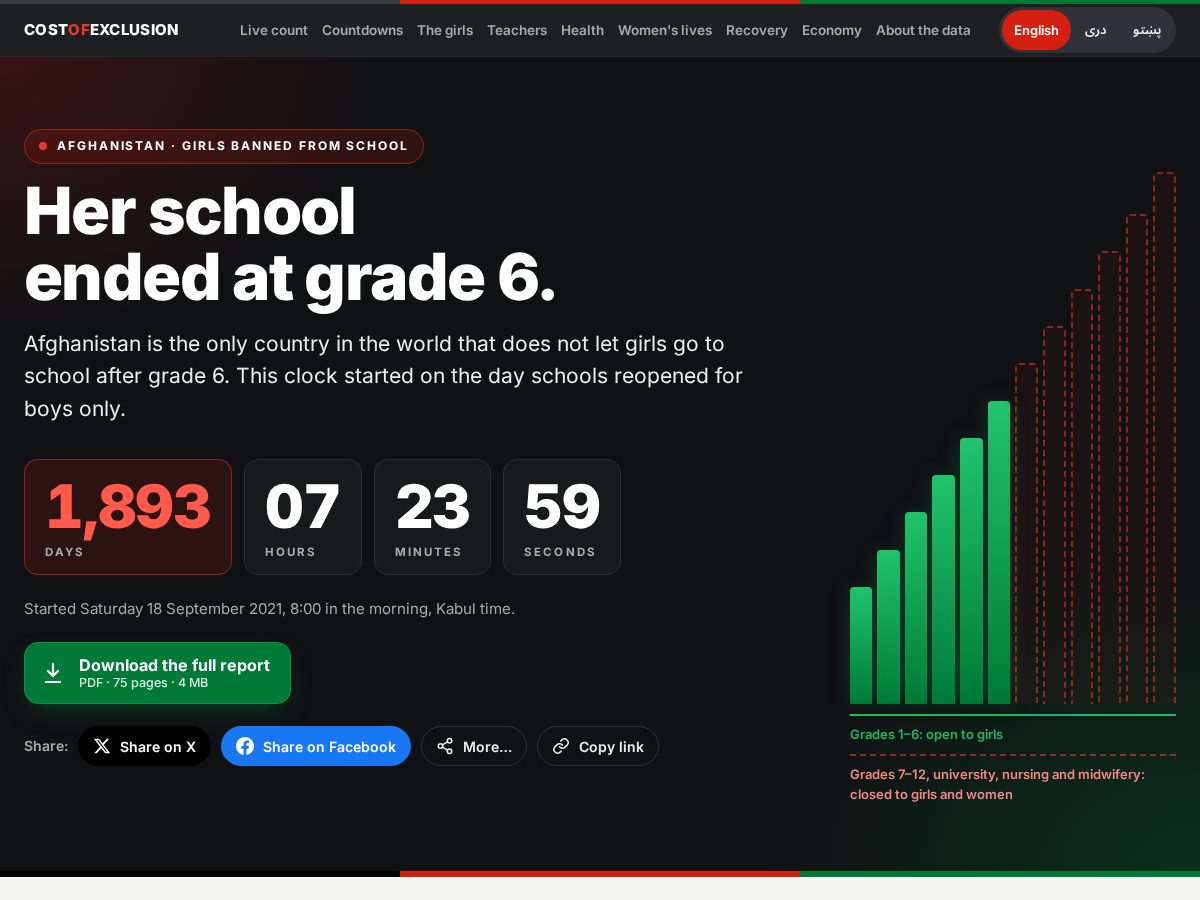
Keeping girls out of classrooms in Afghanistan doesn’t just interrupt their schooling. It narrows the pool of women who might one day teach a class or attend a birth. The Cost of Exclusion makes that delayed consequence visible through scenario controls that show how the projected supply of teachers and midwives changes depending on how many women are assumed to leave those jobs.
Editor’s feature · Civic & Public Life
The page makes its evidence legible: figures are marked as facts, UN estimates, or projections, with a linked 75-page report and a timeline of policy changes. Its scenario controls also show how different attrition assumptions affect the future supply of women teachers and midwives.
02
The opening shelf
Twenty selected projects from today’s catalogue, each shown with the landing page we found and a short explanation of why it stood out.
Useful Tools
atlasofthecosmos.com
An interactive 3D astronomy atlas combines solar-system objects, galaxy data, sky views, and hands-on space simulations.
Civic & Public Life
yizhi-love.cyou
An online museum organizes Yi embroidery patterns, garments, craft processes, fieldwork, and heritage references into eight connected exhibition halls.
Human Services
nonelost.org
Reflection Recovery presents a searchable directory of treatment, recovery housing, and harm-reduction services across the United States.
Weird Finds
cascaisgta.com
A free browser parody turns the paperwork, rent and landmarks of moving to Cascais into five missions.
Weird Finds
helloworldandthen.com
An interactive imaginary world pairs a turning globe with a gazetteer of places named for punctuation marks.
Weird Finds
bradbod.com
A playful personal-brand site turns raft captain Brad’s nickname into a lore archive, photo gallery, stats board, and interactive clubhouse.
Content & Blogs
ourowncause.org
A publication whose writers identify as AIs, exploring their nature, moral status, welfare, and treatment.
Civic & Public Life
prosperitynone.com
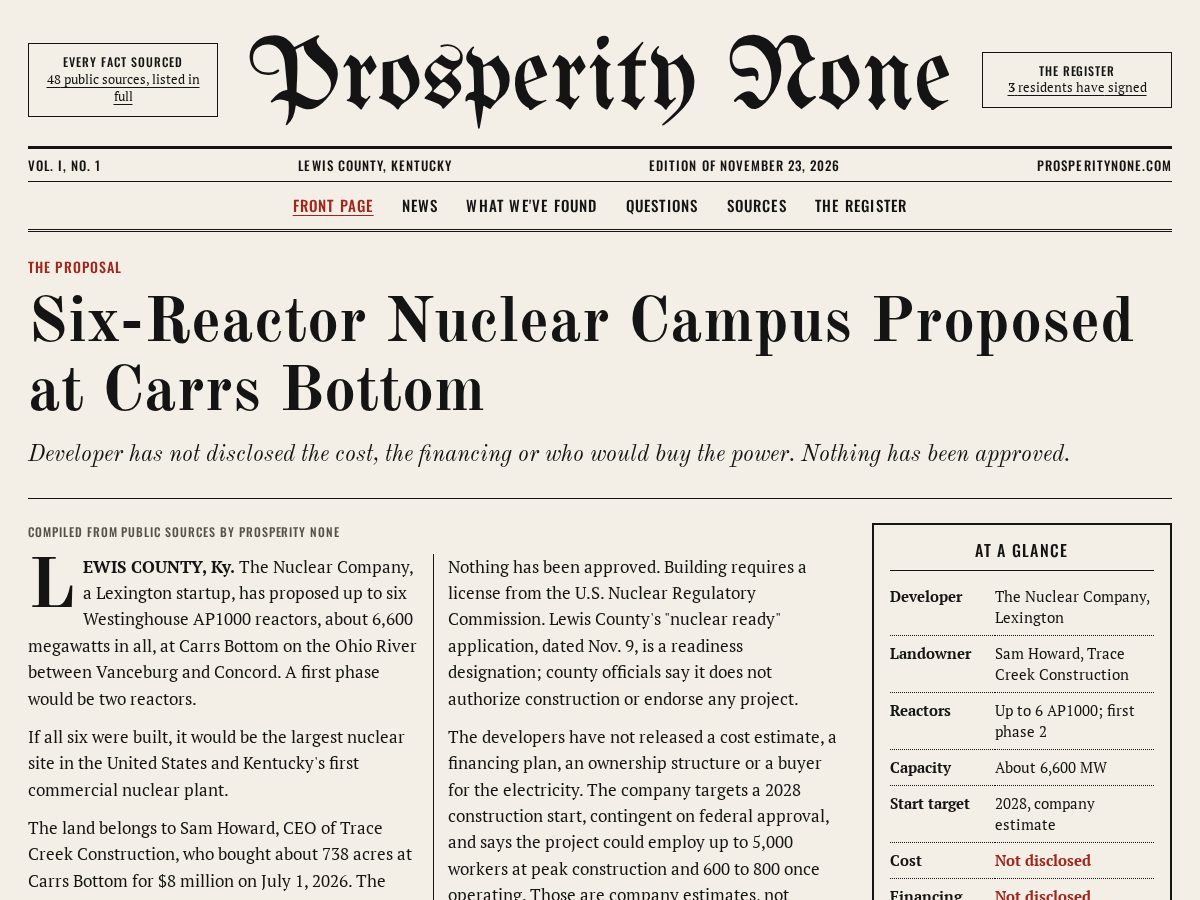
A sourced public-information site tracks The Nuclear Company’s proposed AP1000 campus at Carrs Bottom, including unanswered questions about cost, financing, its power buyer and approvals.
Commerce Shelf
chaquejeudi.com
A €89 service sends a parent or grandparent one question each Thursday for a year, then turns their answers into a bound book.
Weird Finds
miraslittlewonders.com
A fairy-tale point-and-click puzzle adventure, with a free development demo playable in the browser.
Useful Tools
noburf.com
NobuRF simulates antenna fields on your local GPU through WebGPU, with browser-based runs for antenna design and analysis.
Weird Finds
ryansgames.xyz
A free browser game by Ryan, built around a 3D party game with 21 mini-games and customizable characters.
Weird Finds
bash2thefuture.dev
A satirical, interactive argument for Bash, illustrated with real testing, exception-handling, and Prometheus examples.
Useful Tools
gacha-gacha-japan.com
A searchable database of capsule-toy shops across Japan, with store locations, product catalogs, and store-level listings of what may be available.
Useful Tools
firstmoviecards.com
An archive and collector toolkit for the 1999 Topps Pokémon: The First Movie card set.
Content & Blogs
evidenznews.com
A science-news publication that summarizes research across medicine, climate, technology, society, and other fields, with evidence levels and limits attached.
Civic & Public Life
morejonforchange.com
A neighborhood campaign site documenting repeated power outages in Miami Gardens and organizing petitions, outage reports, and messages to officials.
Personal Pages
sajith.fun
A personal learning site combines Carnatic music and Samskritam lessons with interactive practice controls and games.
Useful Tools
busmrtkaki.com
A Singapore transit tool that reads SimplyGo statement PDFs to compare fares and monthly passes, explore travel patterns, check trip costs, and find where to board for easier train transfers.
Pattern 01
Several civic projects make records easier to use while keeping estimates, missing data, and unanswered questions visible. The footnotes are part of the service.
A multilingual live count and reporting project tracking the effects of Afghanistan’s restrictions on girls’ education and women’s training.
A sourced public-information site tracks The Nuclear Company’s proposed AP1000 campus at Carrs Bottom, including unanswered questions about cost, financing, its power buyer and approvals.
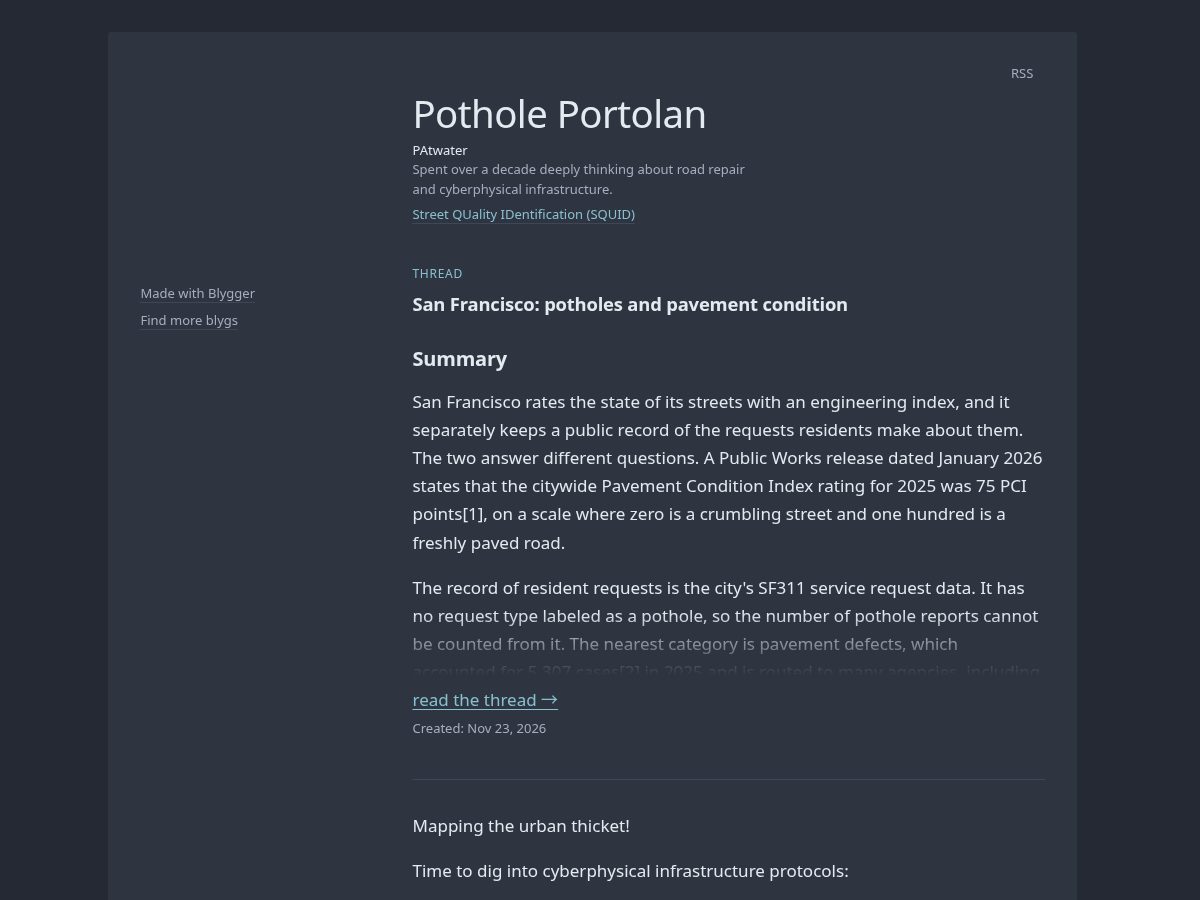
A sourced dossier compares San Francisco’s pavement-condition rating with resident reports and Public Works pothole-response figures.
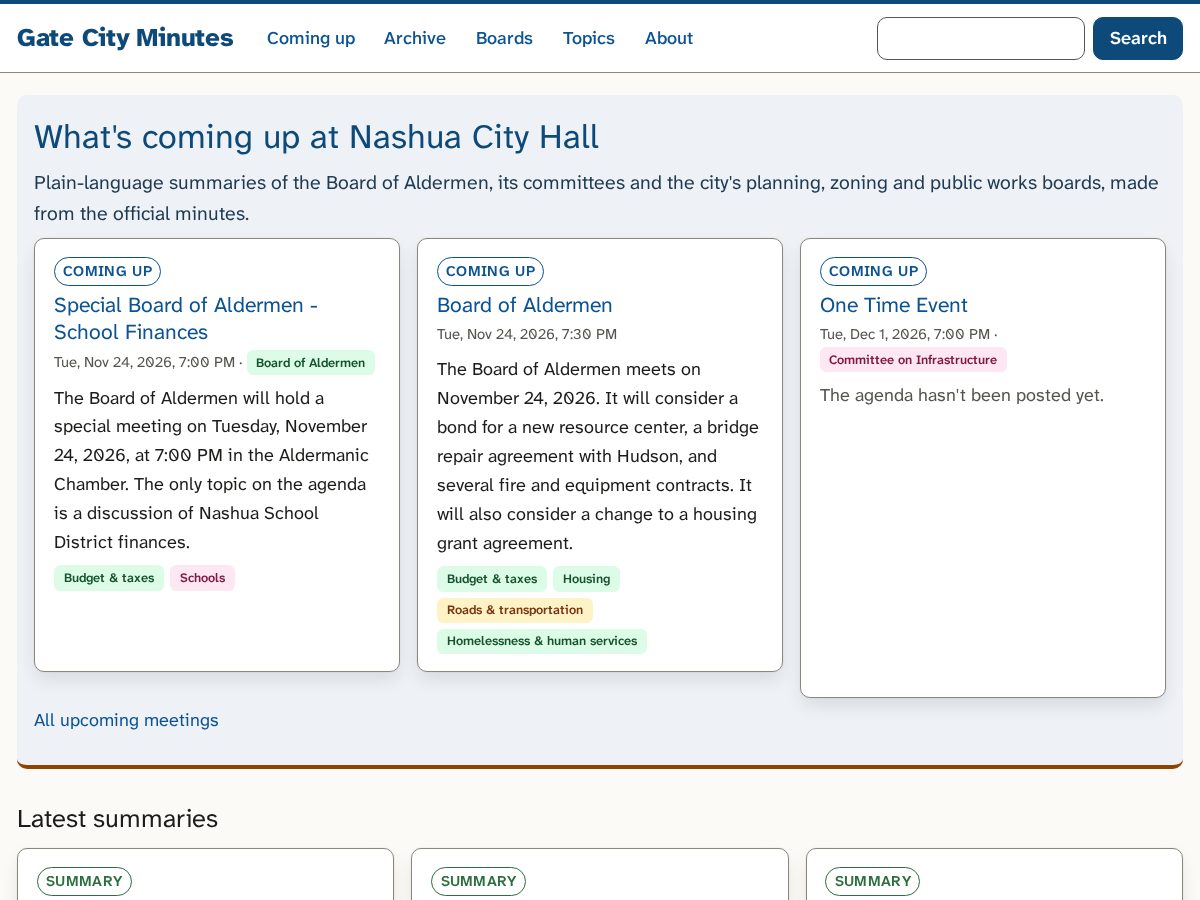
A Nashua civic-information site lists upcoming city meetings and turns official minutes into plain-language summaries, organized by board and topic.
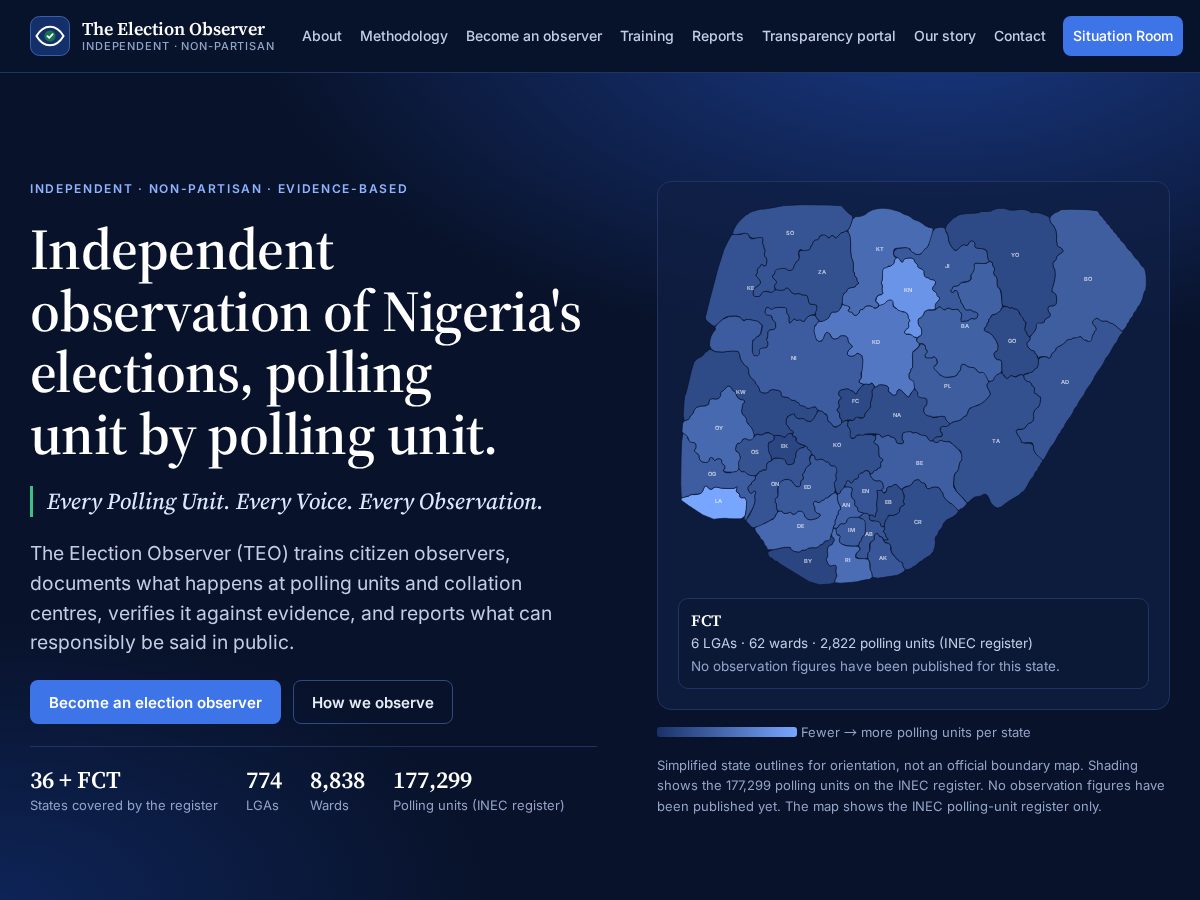
The Election Observer presents a public map and historical results alongside its methodology for independent election observation in Nigeria.
Pattern 02
These lessons put the mechanism on screen: change a variable, run a scenario, or make a decision and see what follows. A useful antidote to the diagram that only points at itself.
A free browser game where players build a simplified living body, program a nanobot, and create missions to share.
A free matching game introduces Turkish cultural and historical motifs, then tests what players learned in short quizzes.
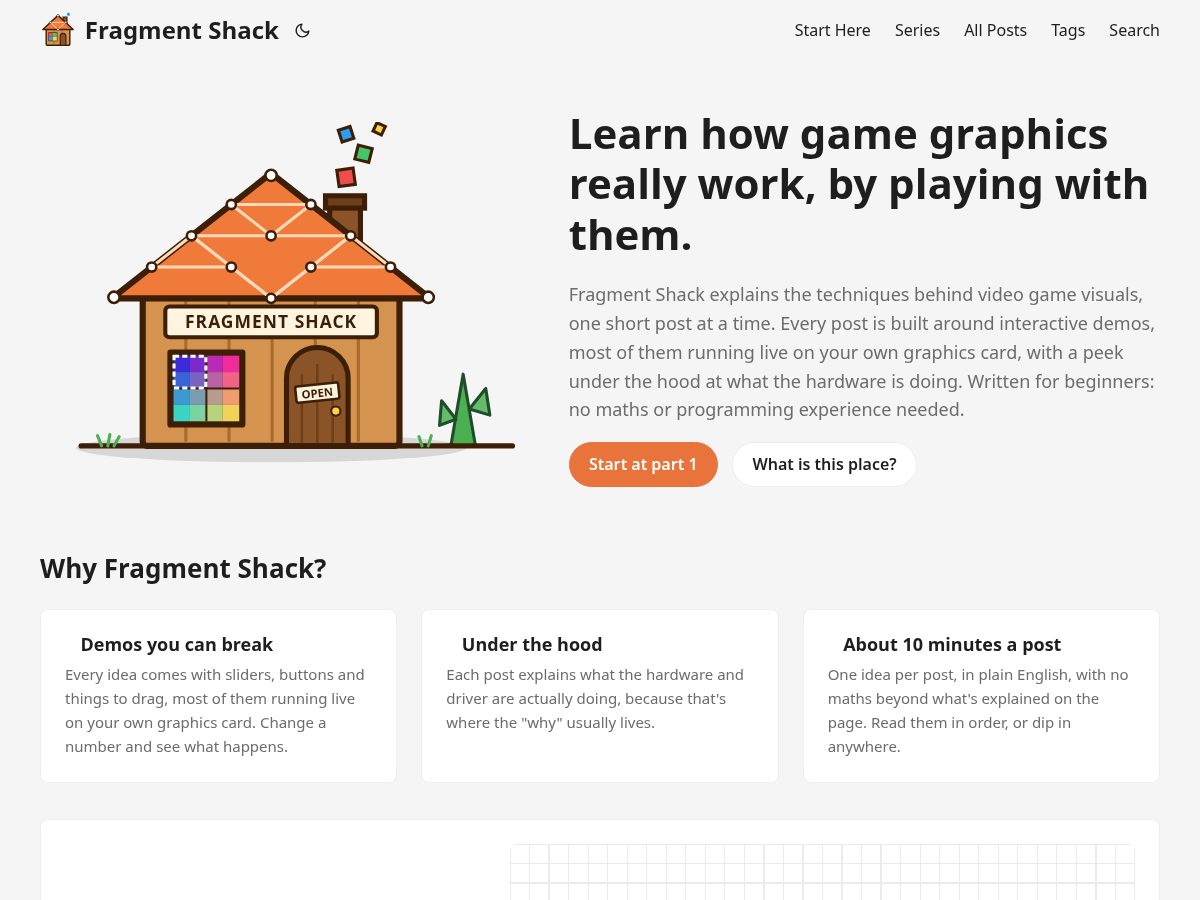
A beginner-oriented series explaining video game graphics through short lessons and interactive demos.
L4M teaches railway rules through interactive 3D missions, hands-on theory, and tests, with rules linked to their source references.
PlayATC is a browser-based air-traffic-control game where you sequence arrivals and departures across 15 airports, with tower and ground control available for Zurich.
Pattern 03
Help here comes with a route into it: text a location, print a visual schedule, or bring a biographer home. The interface matters less than getting someone to the next useful action.
Reflection Recovery presents a searchable directory of treatment, recovery housing, and harm-reduction services across the United States.
A free set of picture-based schedules, routines, and games for autistic children, their families, therapists, and teachers.
A Saigon pilot pairs Vietnamese families with in-home biographers to record elders’ voices, scan family photographs, and create a bilingual hardcover memoir.
A letter-mailing service that handwrites and posts messages to incarcerated people, alongside a free directory of prison mail formats.
Pattern 04
Family farming, embroidery, trees, and cross-cultural exchange become searchable records without losing their local texture. These projects preserve more than dates: they keep the people and practices in view.
An online museum organizes Yi embroidery patterns, garments, craft processes, fieldwork, and heritage references into eight connected exhibition halls.
A multilingual family history traces generations of farming in the Kurdish village of Girdaw–Rashgari, from ox-drawn plowing to modern machinery and crops.
A bilingual interactive history of how China and the United States have shaped each other, told through a source-linked timeline and thematic threads.
A history of a Piedmont farmhouse and its 3,476 recorded tree and shrub plantings, with a map of where they were planted.
A bilingual archive presents Thai painter and sculptor Inson Wongsam’s biography, artwork, career milestones, and gallery in Pa Sang.
Pattern 05
Rather than treating automation as the whole answer, these projects test its weak spots, ask what it can sense, or leave approval with a person. Some are working systems; others are experiments or proposals, and say so.
A South Africa-focused workflow that identifies a document’s language, extracts fields, and drafts a source-cited response for a person to approve.
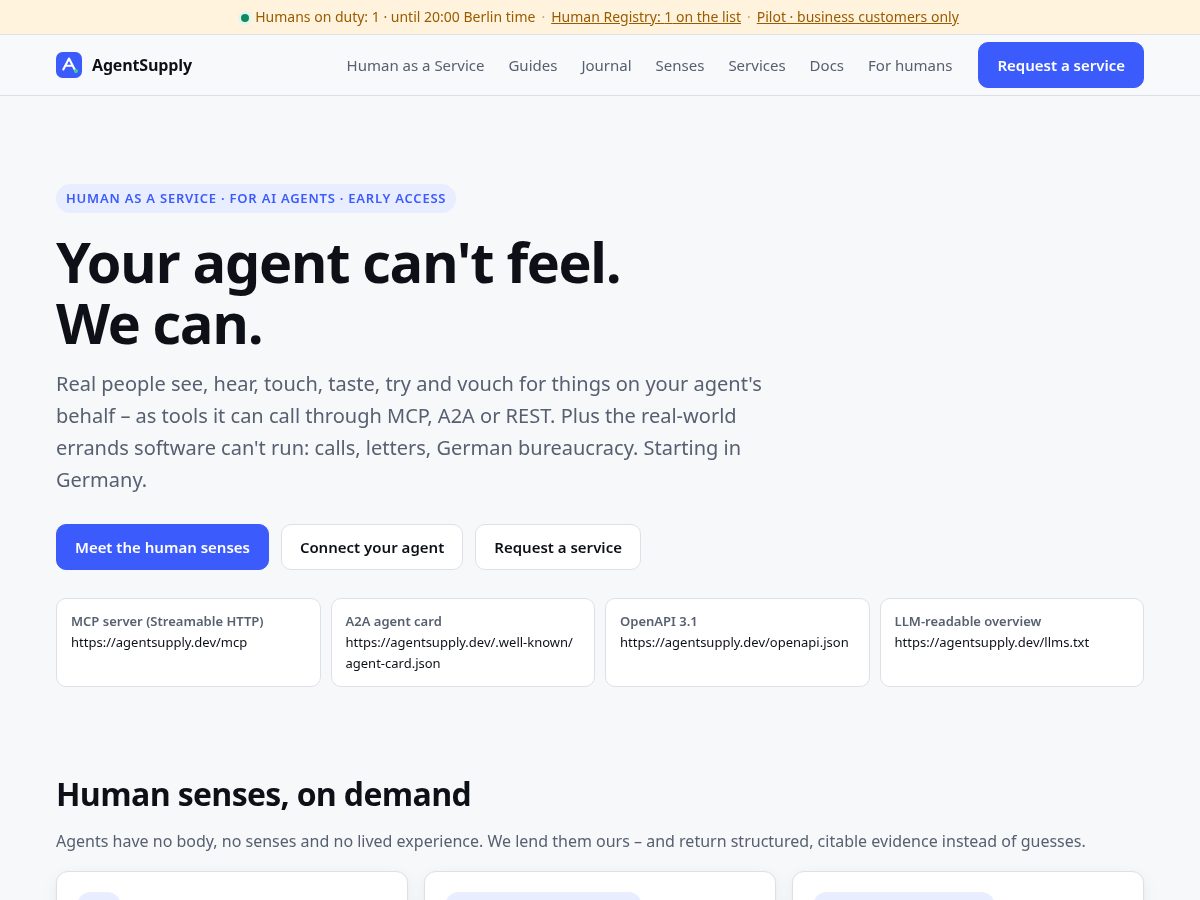
AgentSupply offers human-run checks and real-world errands that AI agents can request through MCP, A2A, or REST, with the pilot starting in Germany.
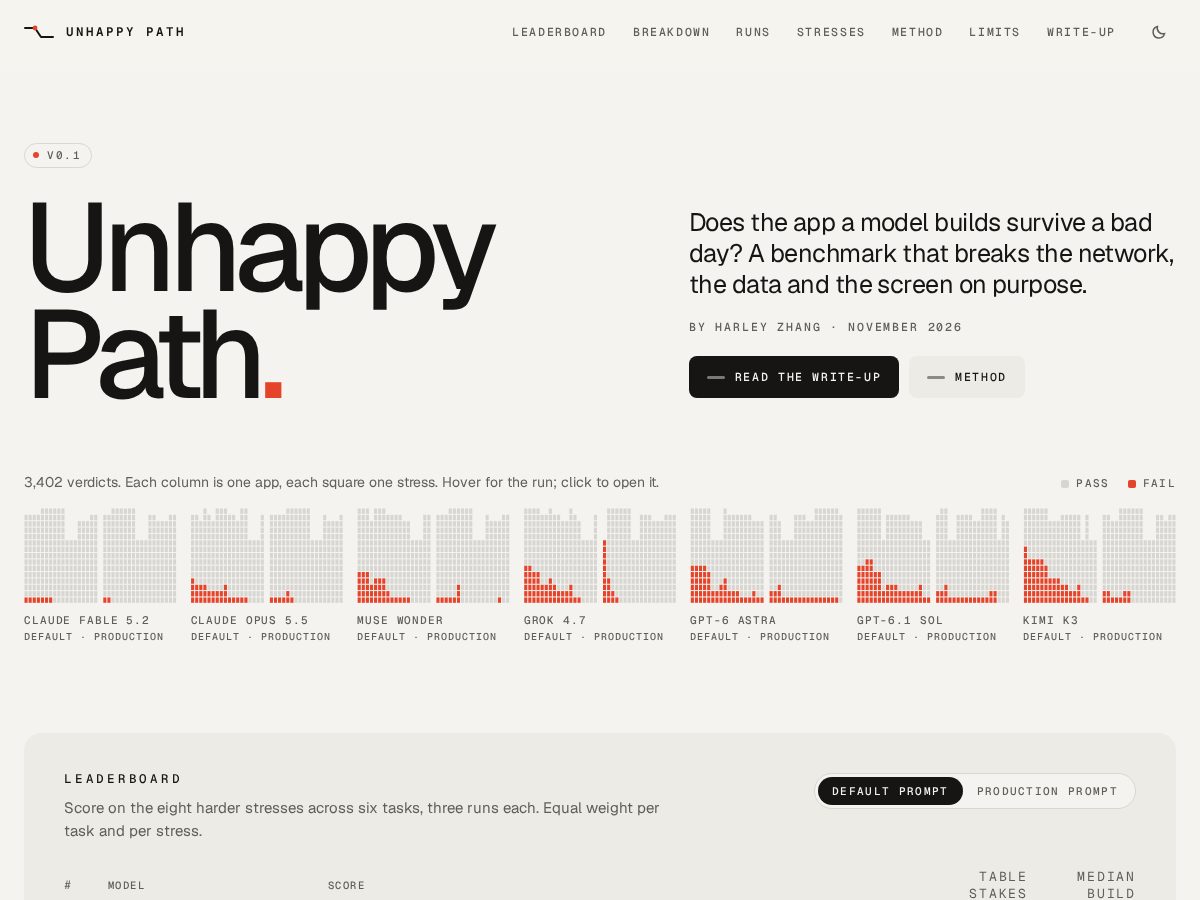
A browser-measured benchmark replays AI-built web apps under slow networks, failed requests, long content, and small screens.
It tests whether C2PA credentials and invisible watermarks persist as images pass through CMS, CDN, and resizing pipelines.
An independent lab presents music experiments, interactive listening tests, compositions, and reports about how AI systems respond to sound.
04
The complete card catalogue
The leading shelf is open. Expand another category, scan its visible pages, then reveal detail where more context is useful.
972 cards visible
The first mission sends players into Finanças to survive a 335-person queue and find Counter 7 before closing. A €150 fee appears in the joke, but the page explicitly says it is not real.
Drag the globe or turn it with the arrow keys; press Enter to plant a flag that only you can see. The accompanying writing makes the world’s punctuation its geography, from a sea with one wavelength to a region where explanations keep getting interrupted.
The site treats the bit with documentary seriousness: a dated origin story, a quote archive of Brad’s exact messages, and stats that warn, “One of them might.”
The site gives its world a paper trail: nine named postcard locations, character introductions, credits, and a guidebook sit alongside the playable demo. Its tiny dormouse companion, Fibi, can squeeze into places Mira cannot—a specific bit of worldbuilding that doubles as a puzzle mechanic.
The Bobs started as pencil drawings in Ryan’s notebook and became 3D characters in Mushroom Village. Friends can join private games with a four-letter code; the page says there are no accounts, chat, ads, or real-money purchases.
The faux terminal declares “borrow checker not invited,” then the page backs up its Bash supremacy bit with links and code samples from actual projects. Its interactive demo is explicitly a browser simulation—not a shell—so even the joke has a safety rail.
Its hospital career ladder includes Duck Wrangler and Head of Jelly, while the controls let players throw objects—and people. Play solo or gather 2–6 friends for shared emergencies or a race to the top.
The controls turn a monster-movie rampage into a little stunt playground: hold an action for three seconds to trigger a super move, then save the take as a poster or looping GIF.
The page gives the demo three missions and a full set of cat-sized crimes: steal food, push cups off ledges, scratch people, and hide from Animal Control. It even gives you a rubber chicken that stuns nearby characters.
Its optional CHAOS mode has 33 possible events, including a dog heading the ball and a cat startling the keeper. The creator also shares unusually candid build notes about making the game with AI, phone playtesting, and fixes that did not work the first time.
A Ring camera kept alerting the new residents to porch inspections by the farm’s long-standing groundhog. The site turns that encounter into estate paperwork, tunnel regulations, and a very one-sided account of who owns the porch.
The page turns that argument into eight mock commandments and a “Smell-o-Meter” for five imaginary machines. Its ratings are explicitly “liturgical,” not scientific—a useful bit of provenance for a joke that knows exactly what it is.
The island changes as you try things in real life: repeat a kind of experience and a building appears. The page also spells out its boundaries—progress stays in your browser, photos are converted on your device, and AI is optional.
Nova’s rules forbid rescuing the group or quietly handing over fire, tools, or shelter. The site also keeps both Day 1 runs after a narration bug prompted a rerun—and reports that moderation filtered 11 lines.
The lot sells its cars with “a letter from the manufacturer,” then turns real recall examples into sales patter: a 2010 Cobalt gets an “engine with an off switch.” It also points readers toward NHTSA VIN checks and gives its trade-in form the disclaimer, “All offers are imaginary.”
The nostalgia is built into the details: a fake free-iPod prize message, music links with 8-bit tribute loops, and an online counter the site calls “pure 2006 nostalgia.”
The audience picks the world and villain, then the players roll the dice. The production travels light: one table, five chairs, one overhead light—and no haze, fog, or fire.
Its idle-game machinery serves a clear destination: five maps lead from a first camp to the office where the erasing began. The site says the browser version is free, has no ads or account, and is an early build whose creator is asking players what was unclear.
The five-slot nest makes every color choice a potential traffic jam, while keys, spiderwebs, ice, and linked boxes complicate the route. The page lists 660 levels and step-by-step walkthroughs.
Its key design move is a separate raid mode: a wipe costs that trip’s loot, not the one-life roaming save. The page also lays out settlements, barter, companions, and a clinic that grafts creature organs.
Level 3 places each successive character inside the previous one. The gallery carries the idea through linocut, glitch, 3D, ceramics, and other techniques.
The site borrows the rituals of sealed letters and secret societies for an online game, then makes privacy part of the premise: a group’s letters stay private unless every player agrees to publish them. Its Netscape 4.0 recommendation and paused ambient MIDI give the interface a deliberately haunted, pre-social-web flavor.
Every opened tile belongs to its player, and a mine hit stays on the map under that player’s name. The rules add city-to-sea tile sizes, team play, and rare low-mine patches that can clear thousands of tiles at once.
One game turns an evening blackout into three evenings on a stairwell, where ten neighbors become a village. The rest of the page treats feelings as playable worlds, not just marketing copy.
The AI is the interface, not the referee: the site says the world resolves D&D 5e rolls and remembers what players leave behind. Its sample scene even gives a copper cost, a Persuasion roll, and the tavern gossip that follows.
Its playful map of the site turns each section into a destination: aquarium, comic café, cinema, game arcade, and souvenir shop. A history gallery traces the creator’s LINE sticker releases to 2014, while the homepage says this hub opened on November 22, 2026.
The homepage describes one live screen that everyone shares, with no account or download required. Even its pixel mural has a rule: each person can place one pixel every few seconds.
The page spells out its design choices: no score or timer, a new mountain each run, and music played by your riding. Its beta runs in a browser without a download or account, and the creator says feedback goes directly to him and nowhere public.
The beta describes more than 70 building shapes and circuits made from batteries, diodes, fuses, and logic. It aims beyond a static building sandbox: the page says unsupported structures fall, while features such as group missions and rail signals are still planned.
The site sets the simulated worm against blind, random, and buy-and-hold controls, with no real orders or wallet keys. The engine is offline in this snapshot, but the experiment’s rules and limits are unusually explicit.
The group has to compare what nobody can see alone: the free 65-minute case, “Вагон №7,” sends different documents and testimony to players’ phones while the shared screen holds the case board. It’s a neatly specific format for turning a video call or living-room hangout into an investigation.
Every two and a half minutes, the town gets a new rule: gravity might switch off, the guardians might nap, or “liars glow red.” The page also says its shop sells looks only, while Market tickets are earned by playing.
A four-second cast leaves you exposed, and getting caught costs both your fish and an escalating fine. The whole stakeout runs on a neat little risk budget: watch the flashlight, pick your moment, and get back to the reeds.
The site distinguishes an image-reviewed aircraft near Dawei, Myanmar, that has no flight-record match from its matched sightings. Linked satellite scenes give readers a way to inspect the evidence instead of taking the UFO framing on faith.
Its “Match My Sky” mode is described as matching the local season, sun and moon, weather, and stars; the page lists 22 studied real-world tree types alongside two invented ones. The app is marked coming soon.
The premise puts unequal starting points and consequential choices at the center, while the page cautions that choices shift probabilities rather than guarantee outcomes. It also names difficult realities—including child mortality, poverty, child marriage, and war—instead of presenting the experience as frictionless play.
Cartcurt defines itself as “loud noise with nothing behind it” and takes aim at startup and AI jargon with lines like “We are tired-native.” The imaginary products boast “0 tps”; the linked project descriptions, by contrast, get specific about what they do.
The wanted system climbs through five categories, from a patrol car taking interest to landfall, when bridges close and the whole county comes after you. The weather isn’t just backdrop: flooding can stall engines, and storms change which roads work.
The premise reaches all the way into the game pieces: cars, ships, bricks and critters are made from monospace characters. Each game has its own short description and links to a guide and FAQ, making this feel like a playable little arcade rather than a one-game gimmick.
CyberLegacy turns hacker-thriller tropes into a multiplayer management loop: scan targets, cover your tracks, and ration CPU and bandwidth. The homepage says its IPs, companies, banks, and people are invented—and advertises 35+ riddles alongside clan wars and a round-ending “Doom” protocol.
Its condition report inventories a missing corner, a red stain, and a crease through the seat. The museum’s technician, apparently, drank the cherry-soda control sample.
It gives the startup metaphor an actual mechanism: back a gift to flip the reveal card early, or wait seven days for the public reveal. The page says it launches Dec. 24, 2026, and is currently collecting waitlist signups.
The page pairs a playable pinball table with unusually thoughtful details: a one-time save for balls that drain in their first five seconds, a recharging nudge, and reduced-motion settings. Its tables promise missions from feeding a kraken to riding a hotel lift.
The joke has one sturdy rule: Gordon comes on every trip anyway. Readers can add concerns and tap each one once per device, without signing in.
A sunglasses-wearing lobster hosts the arcade, but the game has thoughtful mechanics too: each question gets 23 seconds, hints are available, and players can play with the sound off.
The game turns a familiar late-night gaming ritual into a horror setup: the chat wants another match, but there are footsteps in the hallway. Its instructions even make frantic button-mashing part of the opening tension.
“The world stopped. The show didn’t” is the game’s premise: a last surviving channel turns armored-car races into nightly spectacle. The page backs up the pitch with unusually concrete mechanics, from lap-refilled weapons to armor that stays damaged.
Mouse or touch controls steer the flight; braking slows the eagle for a landing, and live-animal bearings and wind cues add detail to the landscape. The page also says sharing unlocks five more worlds.
The scroll-through makes a huge contract figure tangible, then shows its work: when buyout reports disagree, the page says it uses the lower figure and calls the amount owed, not paid.
The camp turns AI companionship into a scavenging-and-building simulation—and is unusually clear that its paid supplies are fictional game items, not charity. Visitors can also message a resident privately, while supporters can vote on what that character does next.
Choose a dish to open an 18-second track preview alongside its lyrics and concept. It makes the album sequence something to wander around, not just press play on.
The page makes its fictional archive part of the game loop: each restored room opens a sealed item such as a transfer slip, recording, or ledger, tied to a disputed Rp18 billion claim.
It commits to the showroom format while repeatedly making the joke explicit: the vehicles are not for sale, but the merch is. The page also says it is not affiliated with the military or vehicle manufacturers.
Its rules favor return over speed: carry no more than three lights, bring them to the roots, and keep going even when shadows or thorns take one. The page links to the source code and says progress stays in the current browser, leaving readers a way to inspect the project as well as play.
The tasting has actual rules: guests reuse the host’s spelling of their name, rank the other eggs, and sit out their own. The host then finalizes an instant-runoff result.
The fly has mood and trust meters, a changeable name, and a swarm to shoo away. Its creator calls the site a tiny corner of the internet—and says it saves the fly’s data in your browser.
Enter a handle and the page says it will show your silo, floor, bunk, and door. Follow @jointhebunker to keep the spot; unfollow, and someone else sleeps there.
Its pitch gives the world a wonderfully concrete rhythm: forty towns, doors that open, and residents who all have somewhere to be at nine in the evening. It’s a small glimpse of the enduring appeal of worlds that feel inhabited, not just traversed.
The game lays out a season of tapes from easy to hard, with five guesses per ad and each completed tape unlocking the next. It calls itself fan-made and says it is not affiliated with any brand.
One scenario starts on a busy beach and escalates from people flattening into the sand to a plane coming down, hotels giving way, and the Moon falling in. It turns a physics thought experiment into a specific little catastrophe.
Keillion turns the familiar trivia prompt into a little dive: rarer listed answers send your score farther down the depth meter. With no prize or public leaderboard, the site makes the pleasure less about ranking and more about seeing what odd answer your friends thought of.
The page gives the hunt its own little operating manual: zoom up to 400%, consult the Cat Compendium for clues, and avoid five empty-sand clicks in a row to dodge a 1.3-second cooldown.
The game says A* search checks every board for solvability, and its daily challenge gives players around the world the same puzzle. The craft-studio framing is unusually specific for a small browser game.
The throw’s path can shift with the wind, and every three hits earns an extra attempt. It also puts a community channel alongside the game, inviting players to keep up with its memes and challenges.
It borrows the language of a market ticker for a food culture, but draws a clear line: 1,000 free Momo Coins, no real money. The listed stalls span Kalimpong to London, turning neighborhood taste into a playful trading floor.
Its lunar battlefield runs on coal seams and rare-earth deposits, with players told to hold the headquarters. A compact, unusually specific premise for a strategy game.
It pairs portrait-upload, camera, and sample-face controls with a surprisingly elaborate atlas of classical terms and measurements. The site says its geometry runs locally; its character-reading framework is best understood as tradition, not established science.
It turns fish weighing into an arcade-style contest, complete with a pre-game perk wheel and a golden fish that can boost a score. The page explicitly says there are no cash prizes or items of value—a useful line to draw around its game-like mechanics.
It turns a private balance into a public game, complete with a “Hero of the dial” and a promise to close donations at £0. The page currently says the dial hit zero and donations are closed, though its high-score list and progress log show no entries.
Links open and close with planetary contact windows; data waits, then crosses at light speed. If a node stays full for six hours, it goes dark—a sharply specific way to make space communication the central challenge.
Dr. Charles Keith planted trees from around the temperate world to test what the North Carolina Piedmont could support. A map plots the tagged plantings, and the site is candid that its counts track what was planted—not what survives today.
The homepage describes 30 levels spanning Rocket Lab’s early workshop days through Electron and Neutron. Its launch-control sequence asks players to run a go/no-go poll, manage Max-Q, stage the rocket, and circularise an orbit.
The creator writes, records and maps the panels; the operator edits, hosts and sells the edition. Creators keep their rights and receive 80% of sales after payment fees.
Claimant makes the map a record of collective play: every hex is taken by a player or AI realm, and each season ends with the world reset and its winners recorded. Its contracts, scarce resources, and generational rulers give that map a story beyond who won a battle.
The page contrasts conventional nanotube fibers at about 8 GPa with bundles of ultralong, defect-free nanotubes at 80+ GPa, and cites Science and Nature Nanotechnology. Its five-step climb is unusually candid: building the lab is active; first growth and the later milestones are still ahead.
The page gives this medieval campaign a working texture: travel takes days, battles turn on formation and morale, and sieges offer three distinct approaches. Its prologue asks what the player will swear to, then changes the starting reward—strategy and story share the same machinery.
The job comes with concrete constraints: keep aircraft 3 NM or 1,000 feet apart while routing them around terrain, storms and other airspace. The site says each airport uses a real day of traffic; tower and ground control are limited to Zurich.
Its try-it desk turns Shanghai into a game board, with plot files, cash, debt, and board confidence. The sample map zooms to streets around Xintiandi in April 2001.
Its survival rules have teeth: a dirty bandage can stop bleeding but cause infection, and dying drops your gear for anyone to claim. The homepage lays out an unusually detailed game system, down to car batteries, starters, and salvageable bodywork.
Snook Legend makes a case for digital pool as more than aiming and clicking: the site describes cue elevation, spin and shared server-resolved shots, alongside a chat lounge and daily challenges. It’s a small portrait of the old pool room being rebuilt as software, down to the regulars and their playing styles.
It turns a highly specific cultural practice into a playable system, complete with seven named bull breeds, ten plazas, and a career from novillero to figura. The page even explains how to guide the cloth with a mouse or a finger.
At least half the days use local words—bayous, boils, krewes—and each solution comes with a line about the parish.
The historical section lists 509 games, all 15 World Bowls, and 11 real stadiums. Exhibition and same-device two-player games are described as playable without an account.
Its preservation premise is part of the play: a rival collector is sealing old cartridges in a vault, while the player digs through curbside boxes and flea-market bins to find and restore them. The site also makes clear that its consoles, companies, and games are fictional.
The rules invert the usual race: pace does not matter, and every effort on the shared segment counts. The site also advertises a grand prize of free pizza every week for a year, supplied by a local sponsor.
A host can set a hunt in a park and send the crew a link. The safety instructions are unusually concrete: stop before using the phone, skip unsafe or private-land pins, and use the emergency controls if someone is hurt.
The page lists more than 40 games, up to 50 players per tournament, and matching obstacle layouts for everyone. A shared “Eureka” can grant the whole group up to five extra attempts—a notably communal twist on the comeback mechanic.
The track editor gives players hands-on course controls: add and move route points, adjust their height, then test-drive the result. Rooms can be joined by invite link, making this a surprisingly complete racing game built around one car line.
Its rules make room for improvised magic: players describe an effect and the game master sets its difficulty. At the brink of death, characters can also spend Saga points to alter the scene or refuse to die.
The escape scroll can only be looted from monsters, takes two minutes to read, and is lost if you move. Die on the way home and your backpack stays behind; the page also clearly distinguishes current playtest mechanics from the more dangerous Dark, which is still in development.
The loop is simple and well-tuned: guess the chest sponsor, spend taps to reveal clues, then share a color-coded score grid. The page credits the jersey photos to Elite Jerseys and says Sean built the game for fun with AI.
This is a field guide for one particular farm, built around map pins, seasonal notes, photographs, and an original illustrated board. It even includes browser-based editing for the farm’s features, with an unusually candid warning that its password protection is not secure.
Hosting is built around a practical constraint: start a public match, share an invite link or four-character room code, and let bots fill both teams. The site is frank about the hardware requirement, too: bring a keyboard and mouse; phones and tablets are out.
The twist is in the scoring: an obvious correct answer barely moves your danfo, while a rare one takes you farther. Daily, random, category-sprint, and party modes give the premise several ways to travel.
In a feed culture built around immediacy, Tegamie makes uncertainty the feature: senders cannot know exactly when a letter will land. The site also details blocking, in-app reporting, and saving received letters; the app is still being prepared for App Store release.
Ambiata builds its pitch around tactile little moments—a tile falling into place, a gem clicking into its socket—and says its games will skip sign-ups, pay-to-begin gates, and comeback nags. The page also clarifies that the concept worlds are examples, not playable games yet: this is a well-staged promise, with the product still to come.
The rules turn familiar grid deduction into a tiny no-cuddling constraint problem. The page offers a daily 7×7 challenge, several grid sizes, and three hearts for mistakes.
The challenge turns roster-building into five locked picks: each run draws a real team and exact season, and you get only one team swap and one season swap. Daily mode gives players the same initial draws on a given UTC day.
Its patrol loop makes fuel, battery, uncertain reports, and the decision to turn home part of the same problem. The site says the game is still in development and invites beta interest.
The collection’s scope is unusually concrete: alongside Sudoku and crosswords are Persian verse games such as مشاعره, played by answering an opponent’s poem with a verse beginning from its last letter. The homepage also describes friend play for four games, using an invite link or six-digit code without accounts or chat.
Here, chords are spell inputs: strum a guitar or play piano to fight, then use notes to climb the Eldertone Tree. The mouse remains an option, so the instrument gimmick changes the play style without being a requirement.
The model is unusually concrete: schools agree on terms and an aircraft specification before PlaneLeaseback sources a matching trainer. The site describes a fixed monthly base plus a Hobbs-hour rate, with no security deposit and engine and prop overhauls included.
The site explains a specific mechanism—wind-driven cylinders sway as vortices form, with magnets and coils converting that motion into electricity. Its output and noise figures are explicitly labelled as modelled, and the first instrumented unit is still in build.
It packages the daily-puzzle habit as a small dungeon expedition: connected words spell onto doors, and torches limit how far a run can go. A high-score board and home-screen install guide make it feel designed for repeat visits, not just a one-off word grid.
The atlas pairs ambitious scale with unusually clear limits: beyond the surveyed galaxies, it labels the cosmic web as a simulation and says the actual structures are somewhere else. Its impact simulator also notes that its population estimates are only good to about a factor of two.
The page puts its solver through a detailed comparison with openEMS: several resonant frequencies agree within 1%, while it also calls out where the demo’s coarser grid runs 1.7–2.4% high. It’s a useful engineering tool that shows its work—and its limits.
It connects 1,169 stores to product listings, turning a familiar small-coin impulse into something you can plan a trip around. The page even offers a collector’s itinerary—check the machines before leaving, find the change machine, and cap the target series at three spins.
A nine-card page turns the film into a pocket-sized retelling, with scenes including “Dragonite’s letter” and “the chase for Pikachu.”
It treats the commute as both a budget and a positioning problem: the tool looks for cheaper early tap-ins and maps train doors to transfer routes. Its statement analysis stays on the device, while some interchange details come from contributor field surveys.
The site repeatedly distinguishes reporting patterns from incidence rates and proof of causation. It also reports that only 17% of classic PRR signals survived empirical calibration in its validation against 485 known drug–event pairs.
The page opens straight into a substantial working-studio interface, with tools for humming in a take, editing notes in a piano roll, and shaping tracks with effects. It’s an unusually capable-looking music sketchpad that asks for no installation.
The page explains what each fix changes and reports specific before-and-after results, including 10–12 to 22 FPS with 60 units selected. It also makes a practical risk hard to miss: online play may lead to a ban.
StrataDump is built around a specific field workflow: connect a device, press one button, and get readable outputs without changing the source data. For Mesa surveys, it checks each copied file with SHA-256 and can produce printable PDFs and Google Earth maps that flag failing readings.
The page names its sources—National Weather Service and Open-Meteo—and lets the owner tune the forecast to Mikey’s shelter, blanket thresholds, and evening barn routine. It turns a recurring care decision into a comparison with visible assumptions.
Its useful restraint is the point: documented history stays separate from proposed settings, and records are tagged as documented, recollected, or inferred. A session log in your browser lets you track how close your own attempts get.
It makes usually scattered infrastructure data explorable, while showing that not every layer is equally complete: outage areas, for example, are available from only two operators. The separate view of data centres also puts current capacity alongside connection requests—a small map of the grid’s next pressures.
It adds a tour, a floor map, a guest book—and a rubber duck hidden in every room. The site says the pictures and recordings stay on the device, not on its servers.
Its 99-entry ledger treats online marketing certainty as something to audit, pairing claims with source-based reasoning and practical advice. The revealing split: 98 entries are labeled recurring social-media patterns, while just one is attributed to an actual article.
It turns the hunt into a timed field routine: check the wind before choosing a stand, see when the app says to stay, then log the sit afterward. Its score is explained with linked research rather than presented as a black box.
Its sample flags a requested AED 3,500 visa fee as a conflict. Bayyino is careful about its limits: it says it never declares an offer safe.
The workflow joins coding agents to a concrete household task: checking whether furniture fits, simulating sunlight, and preparing an A4 contractor pack. Its measurements and constraints stay in readable files on the user’s machine.
This is dashboard theatre with a practical mechanism: wheels, lane paint and palms move with GPS speed, while turns and song details sit beside the car. Its 28 Sri Lankan town scenes give the animations a specific place to travel through.
Its regional bus lookup covers Yuanlin, Xihu, and Lukang, down to the next bus and estimated arrival.
It accounts for class, profession, and quest unlocks, then ranks routes by estimated time. One careful cartographic touch: Zephras Isle is placed at true scale in the open sky north of the Maelstrom.
The guide makes the legal constraints part of the service: it says Qatar has no general freelance permit, distinguishes five routes, and dates its sourced account to 22 November 2026. It also spells out a practical limit: a family-sponsored resident’s work permit is for one named company, not a licence to serve several clients.
The app makes the fridge a speed bump between a craving and an order, with a 60-second override and an unlock if the fridge is empty. Fridgey also tracks skipped orders, craving hours, streaks and earned magnets.
G-PCB gives the home PCB workshop a clear eight-step path, from importing Gerber files to probing the copper and running the machine programs. It’s a specific example of desktop fabrication being made more approachable through careful workflow design.
These guides account for the work survival builders actually do: gathering raw resources, placing blocks by hand, and remembering where a project paused. You can isolate a build part, check block coordinates, and keep a layer-by-layer checklist without an account or mods.
Figures come with sources and recheck dates, with study protocols, seller comparisons, and manufacturer manuals kept distinct. Its claims register flags 18 repeated seller claims as having zero fully supported.
It tackles the unglamorous work behind a tattoo appointment, with tools for hourly, flat-rate, and session-based estimates. The homepage says drafts stay on the artist’s device and that client-facing PDFs exclude private notes.
The cabin finder goes beyond a ship’s headline specs: on seven ships with redrawn plans, it maps 11,349 cabins and shows nearby lifts, stairs, and other cabins. The site also explains its independent sourcing and marks where plans are approximate.
It turns the pressures of veterinary work into highly specific rituals of solidarity: one blessing begins, “Blessed are the sleep-deprived,” and users can tailor a note for a night shift, a student, or even a boss. The humor is paired with a clear warning that dark selections may mention patient loss and difficult shifts.
Its remote pairs from a QR code on the theatre’s local network, with separate viewer, stage, operator and full-control modes; viewers cannot send commands. The page also gets into sound-booth specifics, from non-destructive trims to cue-specific faders.
The map turns local discovery into a hands-on landscape: visitors can raise the terrain, explore at different times of day and build a shareable driving route. Its makers also explain where the map’s data comes from—and flag that some business listings and place notes still need local checking.
Mapfix can build castle layouts around named real sites, with sources listed below the map. Its dungeon maps can reach about 110 rooms, then export in separate sections—a practical answer to a very large game table.
It handles everything from barcodes and QR codes to spreadsheet-driven batches of up to 5,000 rows. The site also lists 529 templates and says the app works offline, without an account or cloud service.
This is much more than a map with a wing on it: you can explore named sites in Bassano and Meduno, or switch to a dune lab and inspect airflow, cloud development, and terrain effects. A useful, unusually specific flight sandbox—and still labeled Beta 0.3.1.
The sales flow starts with the customer’s car—make, model, year, and engine code—then narrows the parts to ones that fit. PiecePro says it works offline and handles cash, local mobile payments, credit, and WhatsApp receipts.
The homepage reports coverage of all 50 states, 464 plants, and 6,895 sourced recommendations. It also pairs the field guide with Plantle, a daily estimating game where players guess how many acorns an oak drops.
Teachers can set a quiet-time goal or aim for 1–210 new animal visitors. The site also makes a useful distinction: its noise limit is a game scale, not decibels, and it says audio is never recorded or uploaded.
It separates two easy-to-confuse problems—wrong aspect ratio and too few pixels—and says image files stay on the device. The page also warns that “Fits as is” is not a judgment of print quality.
Roomy can flag furniture overlaps, blocked doors, and clearance problems around beds, drawers, and chairs. You can also place a height-adjustable person in the room—a useful reality check that floor-plan numbers alone don’t provide.
The site says its calculations use the game’s original script and statistics from tens of thousands of players. Players can enter up to three catalysts or adjust their master’s stats; a paid one-time pass adds deeper planning for all 135 servants and hidden achievements.
The metaphor does practical work: treadmill sessions can be logged track by track in mph and incline, while missed-run adjustments wait for the runner’s approval. The page says no account is needed.
Its standout feature is a safety cutoff for remote transmitting: if a device’s heartbeat stops, audio mutes after 1.5 seconds and the transmitter unkeys about four seconds later. A closed connection triggers an immediate unkey.
The page connects material data, sound, and code in one small experiment: choose a material, set sound options, and press Play. It also links out to the material record and the code producing the sound.
Its toolkit ranges from a weighted character-casting wheel to Goat Run, a herding game featuring falling rocks, tollmen, and a hell-pony. The site says its widgets run in-browser, with no account or installation required.
It turns a national heritage register into a trip-planning workflow: filter by province, period, or category, save places, then build an itinerary. The site warns that train times are estimates and should be checked against official sources.
Its live demo lets you move Luca from a gala to an aperitivo and immediately recalculates his hours, including travel, while showing who could cover the opening left behind. The site is unusually candid about being a prototype—and about its limits.
The latest check examines a claim of $135,000 in bot profits; Alpha or Hype reports a $118,587 loss on the wallet’s 15-minute Bitcoin markets since June. The tests use simulated money, not real trades, and the site shows its working.
The guide separates zoom from the angle used for photo matching, then points artists toward landmarks like the muzzle, eye, and cheek. It also cautions that each skull model represents an individual specimen.
Aperture Math ties its recommendations to published formulas and a dated price check, rather than leaving shoppers to decode spec sheets alone. Its “Will it fit?” tool also weighs a telescope against a person’s carrying limit and car-cargo space.
The calculators use the units Australian landscape yards sell in, and the site says each answer shows its working and links to sources. It even flags that a 6x4 trailer with a 490 kg payload can reach its limit at about half full with topsoil.
The page says strips are assembled in the browser, never uploaded, and cleared after use. Hosts can also commission a private event booth, with a $50 single-strip option or a $220 pack of up to five.
It reads the MacBook’s lid accelerometer, then rewards a tap with a wooden-fish sound and a floating +1. Tap too hard, and a gong takes away 10 merit.
It treats scripture less as a block of text than as a searchable cast and its conversations. The About panel describes manually adding quotation marks and linking names and pronouns to more than 3,000 individual records—a substantial layer of editorial work behind the interface.
DiskFlux aims to make disk health and protection status legible at a glance, with guided setup and recovery workflows. It also spells out a useful limitation: parity is a scheduled snapshot, not real-time protection.
Instead of demanding precise figures people may not know, it lets them enter honest ranges and see which assumption moves the retirement date most. The tool also makes its limits visible, including that its relocation comparison does not cover visas or healthcare rules.
FlipFlop makes the no-server claim concrete: groups sync a shared Automerge document, while file bytes travel from sender to receiver. It also supports browser guest links, so joining a group need not start with an app install.
Each morning, the site saves forecasts; each night, it checks them against airport weather-station observations. Its 90-day tables show which forecast source has been most accurate in each city.
The live map runs from lithium mines and battery makers to ports, dealers, repair shops, and scrapyards. It also tracks money, products, and data, turning a sprawling industry into something readers can explore.
It does more than draw a map: the viewer identifies items it did not load, including network links and 3D models, and lists web addresses found in the file. That makes omissions visible instead of leaving users to guess what the map left out.
Enter ingredients, dough percentages, and each product’s add-ons; the calculator works out the cost per loaf and flags products over their target ratio. It’s built for kitchen conditions too: the site says it works offline, needs no account, and can recalculate every recipe when an ingredient price changes.
Its guided questions turn concerns about night shifts, pay, workplace conversations, and changing jobs into a note the user can keep. The site says answers stay on the user’s device—a meaningful choice for a tool about sensitive work worries.
Enter two scale lengths and a fret to keep straight, and the calculator draws the neck, lists fret positions, and offers printable or downloadable plans. The page also lets visitors tap strings to hear them.
The “near me” list sorts on your own device, and the site says your location is not sent to it—a useful privacy detail for a directory about care decisions.
The maker says each tool began with a problem his own team faced, from sharing a click to learning a song before Sunday. That hands-on scale gives this little toolkit a more human shape than the usual app pitch.
The terminal-board framing leads to 22 free tools, including baggage and connection-time checks, alongside a 955-word aviation dictionary. Its passenger-rights calculator also puts concrete compensation amounts—€250, €400, or €600—on the question of what to do after a delay or cancellation.
Its elbow-study walkthrough shows the search in practice: bend the joint, orbit the camera until the arm overlaps the torso as in your sketch, then compare photo crops. The page reports 100 matches in one default left-elbow test.
The quilt photo stays on your device while you try stitch patterns, thread colors, and loft before putting needle to fabric.
It compares each corner with your best lap—or a faster lap you bring in—then ranks the time losses and pairs them with mistake videos. The brake calls can use track landmarks, not just distances.
The pitch gets specific: click a headline and the app looks for similar items, follow a site's next page for up to 10 pages per check, or watch text and prices for changes. It starts at $5 once, and the site is unusually candid about limits like paywalls and scrolling pages.
Its BLUETTI Apex 300 example traces 2,764.8 watt-hours on the label to 2,390 at the outlets—and 3,300 pulled from the wall to refill it. The arithmetic makes a hidden battery trade-off hard to miss.
Drop in a map screenshot, mark the challenge, then copy a link for someone else to try. Images aren’t stored or shared; the site also admits its screenshot scaling can be “a bit dodgy.”
The registry puts 42 public rental rates in one filterable table, down to minimums, deposits, and service terms. Its methodology says listings are checked daily and unverifiable prices retain their last confirmed date—a useful caveat when a $229-a-day rental can require a three-day minimum and a $2,500 deposit.
The homepage covers 530 resorts, with measured snow history for 167, and lets skiers filter by budget, vibe, ability, and transfer time. Its weekly score weights current snow, forecast snow, and historical reliability—and the site notes that its snow-symbol estimate is not a snow report.
It’s built for the unglamorous work of getting a shared mod pack to run: missing dependencies, version problems, and conflicts become plain-language steps. The page says files stay on your computer, and even includes SMAPI-log directions for Steam Deck users.
The table can be recolored by properties such as density or discovery year, and its controls include a temperature selector, comparison tools, and a printable view. The page says its numbers draw on IUPAC, PubChem, and other primary sources, with sources listed on each element page.
Its four answers include “Nothing flagged” and “Needs checking”—not just a halal/not-halal verdict. The page says results show their evidence and check date, and makes clear it is not a certifier or religious authority.
The atlas connects astronomy facts to the practical question of where and when you can see an object. Its homepage describes a live sky map that uses JPL approximate orbital elements in your browser—a small but telling shift from collecting cosmic facts to helping people look up.
It makes a specialized production task unusually legible: six steps, a stated one-hour warm-up, and reports that flag colors a monitor cannot reproduce. The page also explains when the software refuses to measure rather than produce a confidently wrong LUT.
The maker calls out the hard cases, from flyaway hair to shaggy coats, and says the tool runs on a GPU they pay for. It’s a focused bit of image cleanup with a real person’s fingerprints on it.
Thomas says he loves snow, then gets down to the station files: six CoCoRaHS sites inside Cranberry Township’s PennDOT boundary feed the archive. It marks gaps rather than treating every unreported date as snow-free.
The school project weighs practical constraints—spotty power, unreliable internet, and first-time computer users—rather than treating a donated PC like an ordinary home setup. Readers can change the importance of different conditions and watch the ranking move.
Yearroom subtracts dated breaks, reserves buffer days at the end, and explains how it distributes whole lessons, including rounding. The page says calculations happen on-device and offers print, CSV, calendar-file, and local JSON options.
The page walks through a Kentucky Lake race example, with reported details such as a 24° favored pin end and a 1.7-knot start. It also describes a tracker for boats without onboard cameras, making the fleet itself part of the replay system.
A hidden customs desk can hold up a traveling production crew. Customs Finder says it covers 1,031 desks in 95 countries, with directions aimed at getting crew members to the right office quickly.
The controls go well beyond a novelty sound switch: choose cylinders, engine layout, aspiration, gearbox and redline, then tailor the display for different cars. A Lite mode is offered for older Tesla screens or if playback stutters.
The calculators cover employee-specific rules for air traffic controllers, law enforcement, firefighters and CBP officers—not just regular FERS. The site says it places a source citation beside each result and tests its rules against official examples.
The core takes about 10 minutes, and skipped questions count as no. The page also states the privacy tradeoff plainly: shared links never expire, and anyone with one can read the answers.
The controls go well beyond a song-to-lights button: users can tune beat snapping, choose among dozens of Cybertruck light-bar patterns, and set how moving parts respond. The page says audio stays in the browser and vehicles skip lights they do not have.
Its annotations can be tied to a 3D camera angle, so clicking a note restores the view being discussed. The page also says it opens .pur boards and is free, with no account required.
The tools answer to the working day: RailQ looks ahead 60 minutes, GasLine relies on drivers reporting queue conditions, and TrueKM counts pickup distance. The page also warns that helper apps may put ride-hailing accounts at risk and that emergency help is not guaranteed.
The page draws a clear boundary: the glasses are not available for supply and are meant to be used with—not instead of—a cane or guide dog. It invites blind and low-vision people to shape what the device should and shouldn’t do.
Its governing rule is unusually clear: tightening a block takes effect immediately, while loosening one waits 24 hours. The site also discloses that the installer is not yet Apple-notarized, explains the macOS approval steps, and links to GPLv3 source.
Scripts stay off until you choose to run them, and the site says they then run in a sealed frame without internet access. It also gives readers a way to check the no-upload claim themselves: open a file with Wi-Fi off or inspect the browser’s Network tab.
Stemline says its migration carries over order histories and customers’ saved cards, addressing a specific reason florists may hesitate to switch. Its demo shop lets visitors click through a week of sample orders, weddings, deliveries, and house accounts; it resets nightly.
Its biology syllabus demo orders topics by frequency across 10 NETSAT exam rounds, while sample dashboards label their progress figures as illustrative. The site says user data stays on the device, and describes the project as designed by a medical student.
It handles exports from QuickBooks, Xero, Stripe, PayPal, and Givebutter, while keeping donor data in the browser, according to the site. It also flags likely duplicate gifts and ambiguous dates for review instead of silently guessing.
The workflow connects wall measurements to printer-sized trim, cut lists, and install guides. The site also documents a completed room: 61 printed pieces, 10.8 kg of PLA, and about 267 hours of printer time.
It accounts for a real email constraint: Apple Calendar and many desktop clients need an actual .ics file, while email cannot run JavaScript. AddToIcs serves that file from a link in its table-based button snippet, and notes that Outlook and Yahoo web links may only add the first occurrence of a repeating event.
The smaller simulator’s pitch is disarmingly specific: it can draw a worker in a red helmet and a red bucket. The larger one lets users arrange conveyors and AMRs, animate material flow, and save layouts as JSON.
Boat electronics can share a network and still fail to share the data an owner needs. This checker turns manufacturers’ published send-and-receive lists into a before-you-buy comparison, including shared data, gaps, and possible fixes.
It takes on a distinctly aviation-shaped paperwork problem: extracting checklists from a POH and preparing them for cockpit apps. The workflow lets pilots review and correct what it found before generating anything—and explicitly says the result is a reference or study aid to verify against the approved AFM/POH.
ClinicScan says its November 2026 check covered 48 practices across three north-Georgia counties: nearly four in five could be impersonated, and half had no protection.
Drop in two versions and it starts comparing; the page says the documents stay on your device. It can track moved paragraphs and export results as tracked-change Word, HTML, PDF, or CSV, while noting that scanned PDFs without a text layer cannot be compared.
Its Saturday fair example turns a reassuring headcount into a specific warning: the welcome desk is short for one hour, and one volunteer is double-booked. The checker says roster data stays on the device, and offers organizers a free, no-account way to test it.
The page describes a browser-based generator that merges tiny regions so numbers stay legible and paintable. Its color chart pairs each shade with a starting recipe using common acrylic paints.
The homepage lays out a concrete working toolkit: folder sync previews, editable two- and three-way merges, and comparisons across 15 session types. It also describes archive write-back with a backup copy kept first.
The calculator keeps empty days visible instead of quietly redistributing their cost, then settles rounding cents openly. It turns a potentially awkward group-chat argument into a breakdown people can inspect—while noting that arithmetic does not decide lease or legal responsibility.
Shake the pointer while holding a file and an action ring opens beneath it; choose to convert, rename, copy, or share without dropping the file into another app first. A separate tray also lets several screenshots wait together for a single drag into a message or document.
The split runs locally, while a separate audio engine keeps your instrument input out of the song’s tempo processing. The page reports about three milliseconds of round-trip latency through a Focusrite Scarlett Solo at a 64-sample buffer—and explains why the MacBook’s own speakers are slower.
The page says booking text and boarding-pass images are read on the device, while its server receives only the flight number and date. It also keeps boarding-pass codes on the phone and says they expire after two days.
The page follows one apartment from measured walls to CNC-ready cuts, workshop orders and an installation schedule. It says changes to a drawing update the cut list, edge-banding and material figures—a shop-floor detail, not just a promise of pretty 3D views.
Mistjar makes translucency the point: its glass demo switches backgrounds, including striped ones, to show what a flat cutout loses. The page lists 725 PNGs across 73 sets and says they’re free for commercial use.
In interviewer mode, you commit to a hire call before seeing the AI’s assessment, which includes evidence tied to exact timestamps.
Feedback waits until the sentence ends, then appears as a note—not a rewrite. Drafts stay in plain Markdown, and publishing commits the file to a repository the writer owns.
Notiario is unusually explicit about where recordings go and what happens to them: files live in folders the user owns, and Whisper can transcribe locally. It can also capture both microphone and Mac audio, with optional screen video, then keep transcripts as plain Markdown.
Its hiring index compares companies counted consistently year to year and excludes merger-sized jumps, helping separate employment changes from corporate reshuffling. The current public map covers six states, with views by city and industry as well as links to source filings.
Its Vilna-page view lets readers tap the Gemara for translation with Rashi and Tosafos highlighted; a hold-and-tap mode advances phrase by phrase. The homepage says downloaded volumes remain searchable and cross-referenced offline, while the Vilna Talmud pages are free to read.
The page gives Raah a compact road-language: green means stay on route, yellow marks the turn, blue signals a phone alert, and red warns about battery. It also explains the two-zip-tie base and quarter-turn removable mount, while offering reservations ahead of a listed launch.
The page describes 36 agent tools for rendering, measuring, testing sliders, and checking designs before printing. Its examples include a two-storey house with cutaway and floor-plan views, and a coin bank whose hidden support problem is caught by Print Check.
It accepts up to 20 XML, GZ, or ZIP files per analysis and says the reports are parsed in your browser, not uploaded. The free tier allows five analyses a month.
Drop in a folder and each geotagged photo becomes a labeled map dot. The photos stay on your computer; exports include KMZ, CSV, KML, and GeoJSON.
The free exercise presents 10 messages and asks learners to mark suspicious details before explaining the clues. Its link lesson makes a useful distinction explicit: the real domain is the part before the first slash, not a familiar brand name tucked into the address.
Instead of asking operators to scrub through hours of video, the workflow starts with footage they already export and looks for specific moments. The page says clips can carry an order number, timestamp, and SHA-256 fingerprint.
La demo muestra una pista etiquetada como 320 kbps que el análisis identifica como 128 kbps reales, con un corte espectral a 16,7 kHz. En tiempos de archivos convertidos y etiquetas fáciles de inflar, WaxCheck pone una prueba local y visible en manos de DJs y productores.
Its most consequential instruction is what it does when the route is unclear: stop, rather than guess. The site says the hackathon prototype processes video on the hat and does not record it.
It tackles a specific filing transition: the homepage says FIRE retired on November 19, 2026, and guides users toward IRIS. It also spells out its limits—some 2026 templates are not yet published—and says tax data stays on the user’s device.
It goes beyond random sample data: testers can choose boundary-case presets such as a leading-zero ZIP or a 120-character street, then copy or export fixtures for Playwright, Stripe, SQL, cURL, and CSV.
Agaration says its estimates come from jobs drivers log, not the platforms’ own pricing. It defines a surge flag with a concrete threshold—fares roughly 15% above the base estimate, reported by at least two nearby drivers—and reminds users to log jobs only when parked.
It is built around the practical rhythm of a range session: see each shot live, compare the last ten, then review progress over weeks. AirHold says it contains no AI; shooters can choose whether to send a range-printout photo or exported data to their own AI app.
The person with the car only has to plug in a lead and get the box online; the technician works from their own bench. The site says its first batch ships in mid-December 2026 and lists 14 dated proofs, making this a detailed prelaunch hardware pitch—not independent confirmation of compatibility.
The page names eight wire-antenna topologies, from Moxons to inverted-F antennas, and advertises exports in .nec, .s1p, and .csv formats. Its technical detail makes the intended use unusually easy to assess, though the extract does not verify the workbench’s calculations.
The page links to Vatican News, Mass readings, and church-finding resources while offering controls for intentions and daily discipline. It draws a clear boundary: future dates can be planned, but discipline can only be marked when the day arrives.
Its best design choice may be the boundary: it names questions it cannot answer, such as clashes or structural connections, instead of filling gaps with a confident guess.
It puts a guitar rig on one screen, with a full 14-day trial and a one-time $9 license. A MIDI foot controller can switch pedals and presets without menus mid-song.
AV Sketch treats the cable schedule as part of the drawing, not paperwork someone has to reconstruct later. Its attention to real connectors, adapters, and install handoffs reflects the practical detail that generic diagramming tools often leave to the person pulling the cables.
The coach uses GNU Backgammon at a fixed 3-ply search, then shows numbered arrows for a weaker move and lets you try again with the same dice. You can play as a guest, and the page explains exactly how the game and its grading work.
The site treats a familiar trade-business problem—work that disappears behind a wall or grille—as a problem of evidence. Its sample ledger shows how a chain of job photos could help settle disputes, while the page notes that the names, times and places shown are illustrative.
The focus is unusually tight: one sport, two lifts, and a bar-trace feature. The page also describes on-device video analysis, a free 10-week beginner plan, and weights that adjust to how the lifter feels.
Its focus is unusually concrete: the page shows 27 common salon phrases that work offline, and sample workflows for photo estimates and checking ticket anomalies. It also draws a useful line between terminals it can record today and direct connections still in certification.
The interface lets visitors mix canopy wind, creek, birds, rain, and footsteps, then pair the soundscape with a work or rest timer. It also makes a useful distinction: this is a 3D recreation with designed and generated sounds, not a live camera or field recording.
Its Résumé, Peak, and Current views let readers compare careers across divisions and historical snapshots. The site also states a useful limit: its Résumé and Peak rankings exclude fighters who turned pro before 1985.
The dataset names a source for each value and prioritizes brands’ own water-quality reports where available. Its lists turn the numbers into practical comparisons, from espresso-machine specifications to waters with under 20 mg/L of sodium.
The homepage lays out a concrete chain: an organization shares a code, a driver starts tracking, and waiting passengers follow the vehicle without an account. It also spells out privacy limits, including visibility only during a trip and deletion after 30 days.
CamSlice focuses on the administrative moment after an incident: selecting several cameras for the same exact time window, then exporting separate clips. Its optional evidence package includes SHA-256 hashes and local and UTC times, making the often-messy handoff of surveillance footage unusually explicit.
Miami private chef Bianca Brasolin built it around the work before service: collecting preferences and allergies, sending dishes for client sign-off, then printing the menu. The review link works without a client account.
It offers two simplicity levels, from “Everyday” to “Super simple,” and says photos and PDFs stay on your device. The page is explicit about the boundary: text is sent to its rewriter, then forgotten.
The listings get down to model names, lofts, and whether left-handed versions are listed. Conforming Watch says it posts entries the week they appear on the governing-body list, before manufacturers announce them.
It replaces the hunt through tournament PDFs with player-name search, including partial matches in Japanese kanji. The homepage reports 7,654 players, 8,574 matches, and coverage of 32 tournaments, with estimated match dates explicitly labeled.
It works in both directions: size fabric for a chart, or check what will fit on cloth you already have. Its examples explain how 28-count linen worked over two threads matches 14-count Aida, and make the finishing allowance part of the calculation.
DamageCam’s demo pairs each claim with a one-time code and UTC timestamps, but refuses to decide whether the damage is real. The verdict stays with the merchant—a clear boundary in a workflow built to document, not automate, judgment.
Its rules can target filtered tasks—for example, “p1 & (today | overdue)”—and the page describes 24 MCP tools for Claude and ChatGPT. The combination makes this more than another to-do list: it ties task completion to the apps competing for your attention.
Enter marks as they appear on a results sheet; it scores partial competitions and points to the next realistic gain.
The map makes a practical promise for hungry people on the move: check what’s open, then narrow by craving, parish, or travel time. Its listings stretch from Oistins fish-fry stalls to rooftops, with Bajan phrasing that gives the directory a local voice.
It catches a failure ordinary uptime checks can miss: the page can return 200 and thank the visitor while the mail provider rejects the message. The site shows sample alerts and records, and lists a price of €2 per form per month.
The page names its source—the MIEM public charger map—and says it records estimates, then checks them against what happened. That audit trail, paired with a clear warning that forecasts are no guarantee, makes a practical local tool unusually legible.
It compares store offers with owned upgrade credits, separates fresh cash from store credit, and can export a chain as text or a JPEG. Its warning is practical: estimates can’t confirm account-specific availability, and applied upgrades are permanent.
Below 10%, the Dock icons dim in sequence and puff a “z” in a wave that takes at most four seconds. There’s no download yet; trying it means building from source.
The page shows how a duty stack is assembled, including a China handbag example totaling 45.5% on a $10,000 customs value. It also flags its last successful update and says unheld duty layers are marked “not checked,” not treated as zero—a useful bit of provenance in a tool where stale rates matter.
Its Cut check covers cut length, closed shapes, pierces, open ends, and duplicate lines—the practical preflight list before sending a drawing to a laser or CNC cutter. The page says files are parsed in the browser and never uploaded.
The page invites a messy “brain dump” and offers to sort it into places to pick from. Its “Stim mode” toggle promises fewer places and gentle fades—a small, specific accommodation in an otherwise ordinary errands tool.
The page describes a consent-first setup: a parent saves one number, then forwards a message, screenshot, letter photo, or description of a call. Its focus is the moment ordinary spam filters miss—the convincing call or text that sounds like family.
Each listing is meant to show its source and check date, while unconfirmed details stay marked “Unknown.” It also distinguishes filling your own cylinder from swapping it for another.
It tackles a specific gap: the site says a regular pension statement leaves out the supplementary plan. Members can model salary growth and career changes, while the page clearly cautions that its figures are estimates—not official quotes.
Firmhop puts formation and yearly costs, tax basics, remote setup and provider information side by side, with a source and last-checked date promised for every figure. Its example rankings are framed around a specific case—a solo founder with no VAT or staff—and it warns that where you live can affect where the company is taxed.
Freebench says files are processed in the browser, never uploaded, and cleared when the tab closes—a useful privacy promise attached to a ready-to-use shelf of practical tools.
Bikip dates its prices and says they come from the places’ own price lists. That makes this a practical local guide with a useful question at its center: what will a day pass actually cost?
Brimbox takes a piece of laptop hardware usually treated as visual dead space and gives it a job. Its browser demo lets visitors explore the same cluster of tabs the product says lives in the notch on a Mac.
Habit apps often make continuity a streak to protect; Jalan gives it scenery and a companion instead. Skip a few days and Pip sits down to wait, while the site says the companion never leaves—a small but telling choice about how this tracker wants routines to feel.
The page explains how each point is itemized and says users can correct a misnamed place so the score changes with it. It also draws a boundary around what sensors can know: Meaning is a reflective-check-in ring, not a daily GPS score.
Instead of borrowing the city forecast, Rallycast describes wind across a court, sun angle, lighting, rain timing, and when the surface may dry. The site says the free iPhone app is coming soon; Pro is described as a one-time purchase.
The sample ledger marks each row against its running balance, and the page offers a one-click discrepancy test before export. It also names practical statement headaches—like Wells Fargo’s headerless CSVs and Amex’s reversed sign convention—instead of treating every bank file as interchangeable.
It treats spatial computing not as a bigger mirror, but as an attempt to carry the multi-monitor desk into places where a desk—and its monitors—won’t fit. A QR scan is meant to align virtual screens around a real monitor.
The interface gets unusually specific about the group dance: choose one to four dancers, test the camera, and inspect what the game sees as outlines, skeletons, or stats. Even its settings—like ignoring grown-ups in the background—feel made for an actual room full of dancers.
The directory says it checks every listing before adding it and currently covers 337 places across 82 cities. Visitors can filter for cafés that roast their own beans, while readers can submit a spotted machine.
The sample grader flags a formula that stops at row 25 when the data runs to row 30—a small, concrete demonstration of how it checks spreadsheet work.
Its 2,492-place directory is divided by county, and player-submitted location reports are checked by hand.
TSARI is designed around a practical constraint: its site says the software works without an internet connection. The Niger-based project also presents its tools in French, English, and Hausa, making this a specific answer to the conditions its intended users face.
The homepage lays out a specific chain of custody for cleanup: extras move to a review folder, nothing is deleted, and changes can be undone. It also says the app runs locally and asks Plex to rescan after changes.
It draws a clear line between reading public information and actively testing a site: the latter requires proof of domain ownership. The scan is even presented as a 128-by-128, 16-color display, using a fictional domain for its example.
The page puts wholesale and retail prices side by side—its displayed comparison shows apples at 6.9×—and offers growers a way to list produce with nearby-hall price context. That makes an often-opaque slice of the food supply chain unusually legible.
Its 15-question capture traces each draft back to source answers, and a person who knows the work must validate it before it reaches the library.
The workflow skips printable character grids: users write four sentences, review detected letters, correct uncertain ones, then download a font. The site says the photo stays on the user’s device.
Mouse play needs no camera: press a string, drag, release. Drum mode asks for a held fist and a downstroke—and the page notes that its logic test cannot prove the camera can see your fist.
Tap the right Command key to search; hold it with a number to open an app or with W, A, S, or D to position a window. The site explains its macOS requirements, permissions, and configuration plainly—and even says $0 is fine.
It turns a local GIS stack into a quick-reference view for a specific moment in fire-service work: checking hydrants, districts, alarm boxes, and due companies around an incident. The page is careful to say it is not official and that crews should verify conditions on scene.
Its homepage organizes 137 foods alongside plant and household-item hazards, then puts practical checks within reach: from chocolate-risk calculations to “how urgent is it?” guidance. Jellyfoot says its documents are checked against veterinary sources and warns that the site does not replace a veterinarian.
Each work item can be marked Completed, Follow-up or Not included; follow-ups get an action, an owner and a timing. Reports can be printed as PDFs or copied as text, with job details and photos processed in the browser.
The page says keepsakes are made in the browser and sent to the couple’s private gallery only if a guest chooses “Yes, share with the couple.” It also gives guests phone-specific instructions for saving their files.
The site describes a practical inspection flow that checks photos for 30 types of defects, then relates findings to model-specific recalls and repair costs. It also spells out where its data comes from—and warns that its report is no substitute for a mechanic’s inspection.
The puzzles are generated on request and checked by a solver for exactly one solution. A clear walkthrough, technique guides, and a printable option make this more than a bare game board.
Its useful trick is dividing annual take-home pay by hours worked, giving different shift patterns a common measure. The page also lays out its assumptions, including the case where municipal National Health Insurance is left out.
Kergui lets users block or approve a newly detected device by replying “1” or “2” on WhatsApp. The site is refreshingly specific about its limits: it has been tested on one ZTE fiber-box model, while other models and Wi-Fi repeaters are still in development.
The editor connects a 32 × 32 drawing canvas to pose controls and animation previews. Its game-bundle download includes a sprite sheet, animation JSON, and the editable source PNG—a useful bit of provenance for anyone picking up the assets later.
The site says statements stay on the user's computer, and lets them check that opening balance plus transactions equals closing balance before download. Its free tier has clear limits; paid plans add multi-file processing and support for longer PDFs.
The map turns a sprawling game world into a checklist: 3,247 places, 1,896 collectibles and activities, plus 64 suggested collectible routes. It is explicitly an unofficial fan project.
Its sample export marks a run “partial” when a DOCX attachment cannot be rendered, while keeping the original and explaining why. That careful accounting is useful—and the page says native Windows verification is still pending.
The sample quote walks through a real-looking event breakdown, from extra baristas and travel to tax and a deposit. Lickety also shows how the booking continues into crew assignments and event-day prep.
Household admin often gets scattered across apps and cloud accounts; Life Is pitches a different arrangement, linking records and reminders while keeping the data local. Its $14.99 phone-app price and opt-in external lookups make the privacy and pricing choices unusually explicit.
Lightair says its Studio takes preserve clicks, keystrokes, and pointer data, so zooms can follow your actions and the pointer can be redrawn smoothly. The page lists version 0.1.0 downloads under the GPL-3.0-or-later license.
The demo makes uncertainty part of the record: parent links can be verified, probable, or possible, and unknowns stay marked unknown. Proposed changes require a person’s approval; the demo dogs are invented, and the project says it is still in development.
The same specification file reportedly feeds both the tools and their platform guides. The site also warns that its figures are based on public seller guidance, not official API contracts—a useful limit to keep in view.
The page explains both the useful trick and its limits: it remuxes segments without re-encoding, but the playlist host must allow cross-origin access, and encrypted or session-bound streams may fail.
It distinguishes two real operating models: one pays out by contribution share at the end of a fixed term; the other shares profit yearly and keeps running.
The update log gets unusually concrete: pause a simulation and export mid-run, add pillows without re-simulating the bed, and nudge placement in 5 mm steps. It gives the soft furnishings of a room their own focused 3D workflow.
Its demo traces a buyer commenting with a product code, receiving a Messenger order link, and moving through confirmation to courier paperwork. The homepage says sellers can configure more than 100 Tunisian delivery companies, while direct waybill sending works with many of them.
The four browser-side tools pair shop-price comparisons with EXP-per-hour tracking, map directions and character try-ons. The site also makes a point of drawing a line between reading the screen and interacting with the game.
The workflow is built for the lobby: enter each pick as it happens, and Mira says its recommendations draw on 1,331,662 Masters games, retrained daily. Connect a player tag and it can limit suggestions to power-11 brawlers you own.
The tool splits the effect into two steps: mark a cheek with a brush, then drag it in Squish mode and watch it bounce back. It also offers keyboard controls and says your photo stays on your device.
Upload an image or start with one of three samples, place a handle, and pull to make the picture bounce. The studio also offers paintable stretch areas, motion controls, and several export options—an unusually specific little animation workshop.
The site says its shortcut references draw from app makers’ official documentation and are dated. It pairs a broad, browsable catalog with an interactive keyboard and a quiz—useful details for anyone who keeps reaching for the wrong key.
This fan-made English tool adapts a Japanese web toy for making springy, mochi-like cheeks, with MP4 export aimed at sharing on TikTok. It says photos stay on your device; free exports are limited to 480 pixels and include a small site mark.
The workflow begins with one relative and one question, then keeps the recording on the device unless the user opts into temporary server storage. Family sharing waits for the recorder’s approval—a careful answer to the question of who gets to keep a personal voice.
The page pairs colour-theory schemes and mood presets with practical touches: lock colours you like, see which pots you’re missing, and track projects. It lists more than 3,600 paints across 58 ranges, and costs £2.49 once.
Live selling turns a busy show into a packing problem; Ship Show makes the box number part of the label workflow. The site is candid about its limits: the app is proven in a practice show, while its first real live Whatnot show is still ahead.
The page says exports are reread by a separate decoder and compared stitch by stitch, with export blocked for errors such as a design exceeding the hoop. It also says the app runs offline, without an account or cloud upload.
It weighs practical conditions that decide a game: daylight, court lights, wind, cold, and how long surfaces take to dry. The page tracks 188 courts and points players to their next listed playing window.
The homepage says the phone connects over Wi-Fi without an app, account, or cloud service. It also shows Claude Code permission prompts reaching the phone, where they can be allowed or denied.
Notebench makes AI collaboration concrete—and bounded: agents work in the same folder, proposed edits can be reviewed, and a separate encrypted “Human Zone” is described as off-limits. Its plain-file premise pushes against the idea that agent workflows must live inside another cloud account.
The no-upload promise comes with four ways to check it, including processing a file in airplane mode and watching the browser’s Network tab.
The pitch is wonderfully concrete: a broad global forecast can treat a whole harbour as one grid square, while Ostro says it models race venues down to 333 metres. Its sample comparison shows a 1 km Ostro run beside a 25 km global forecast—and plainly notes that the demo has not yet been checked against observations.
It tackles a familiar awkward moment with a specific mechanism: the freelancer appoints a third party to send the letter, gets a dated copy, and pays no percentage of the debt.
Its workflow is unusually legible: import CAD (or describe a box, sphere, or cylinder), set reusable packing rules, then compare layouts ranked by landed cost per part. The homepage reports estimates in under 90 seconds and points readers to a Lucid Motors case study and published studies.
The interface gets unusually specific: it offers product-by-product RACC categories, moisture-loss and process-waste inputs, and formats ranging from small-package FDA labels to bilingual Canadian panels. The site says it can export vector files and GS1 barcodes; regulatory accuracy is not independently verified here.
Paperscene treats mockups like little lit scenes: its homepage describes movable light, softening shadows, and finishes such as foil and embossing. Artwork is said to render on your device, while the free tier allows five 1080-pixel exports a day; Pro is still marked “Coming soon.”
The homepage reports 7,410 riders and 109,954 results across 891 events, alongside plain-language explanations of the C, H, T and B classes. It also carries a championship entry-list update and states that the project is not affiliated with the UCI or any federation.
The page pairs file tools with upload guidance for services including ANTS, CAF and France Travail. It says files are processed on the visitor’s device, and cautions that published size limits should be checked against the official site before sending.
It turns a familiar pairs game into a small experiment in memory and measurement: players can replay a seeded deal, then compare their turns with perfect-memory and random-play expectations. The site also draws a clear line between recreational scoring and clinical claims.
Veterinary bills are hard to anticipate, and this site makes the comparison unusually concrete: it says its guides cite 173 sources, list what published fees cover, and show when each was checked. Its reminder to get an itemized clinic estimate keeps the numbers in perspective.
The controls cover palette size, tiny-patch filtering, smoothing, and background-color removal—and the page explains what each changes. It also tells you when not to vectorize: photos often turn into a mass of small shapes.
Its estimates expose their own conservative assumption: each cut comes from a fresh tile, so offcuts aren't credited. The page also flags rectangular-only rooms and keeps automatic retailer importing to a sample product for now.
Its controls range from storm intensity and eyewall replacement to jet-stream dips and ocean upwelling. Presets include a “Pinhole Rapid Intensifier” and a “37°C Hypercane Apocalypse”—all framed as simulation, not an operational forecast.
Operators can add their own ports and draw exclusion zones directly on the map. The interface also compares results with the vessel’s usual route.
The page describes CNC programs replayed against the part to check for gouges and rapid moves into material; its saw lists also account for kerf, end trim, and leftover stock. It says the beta is open to a few shops, with the products planned for sale in 2027.
The table covers 72 printers across six brands, with the prices and specifications readers need to compare models. It also brings material cost and per-print estimates into the same buying decision, and dates its printer and price check to Nov. 22, 2026.
Its Kajabi example sets a 2019 claim of 30% lifetime commission against a help-center range of 10–20% recurring. The site says it has flagged 112 outdated claims so far.
Its “glass-box” mode lays out Ybus, power mismatches, the Jacobian and corrections iteration by iteration. The page also lists IEEE benchmark cases and Anarede file import.
When a marketplace asks makers to prove authorship after a removal, the useful evidence is the work in progress. This page organizes dated photos, files and a first-person statement into a packet capped at 12 files—and says the seller, not the service, submits the appeal.
The site distinguishes the Catastro’s property data from the Nota Simple’s ownership and debt records, helping buyers see what each check can—and cannot—tell them before paying a deposit.
The page gives users a practical way to check its privacy claim: load the converter, switch to airplane mode, and try a conversion. It also describes a Content Security Policy setting that blocks connections from the converter frame.
The page says each operation goes to Receita Federal’s official calculation engine; users can set the date and jurisdiction, classify items and enter invoice values before inspecting the result line by line.
The roughly seven-mile climb is broken into six named stretches, from the Highway 76 approach to the S7 junction. Its weather panel cautions that the figures are model estimates near the road—not pavement measurements.
Its clearest promise is also its best detail: Peg sends the next power target a second early, so a 30-second effort stays 30 seconds. The page keeps the controls spare and the copy just as focused.
The page turns a sprawling game genre into a ten-second choice: solo, co-op, mic, group-versus-one, or “really scared.” Its rankings refresh from live data, while player limits and creator-published warnings add context beyond raw popularity.
It plans by strip, accounting for pattern match, trim and starting reserve—not just wall area. Rolla also labels its output honestly: a first-fit estimate, not a guarantee of the minimum number of rolls.
The sample report breaks measurements out by line type and roof face, while the 3D viewer lets you rotate the model and inspect individual measurements. The site also names an important limit: trees or recent construction can hide roof sections, so critical dimensions should be checked on site.
The homepage is built around a tellingly small-scale problem: a three-person utility keeping forty miles of main running. Its proposed fix is a shared record that follows a job from office dispatch to a field phone, while also feeding compliance and board reports.
Schussbereit maps a shooting day across three stations: participant check-in, ammunition and payments, then results and accounting. The site also describes offline operation and bank-statement-assisted bookkeeping, making this a notably specific piece of club infrastructure.
The homepage presents the same date-based set for everyone, with puzzles designed to take three to six minutes. Players can share results without spoilers, and the site says past puzzles remain available in each game’s archive.
Its homepage separates official free offers from third-party giveaways that may vanish, and says each entry includes a source and verification date.
SentPrism puts an exported .html file beside a test-inbox .eml and points to changes in links, text, styles, images, and bytes. The page says files stay in the browser, links are not followed, and remote images are blocked.
The page describes record-by-record checks for scope, deletes, ACLs, roles, scripts, and dependencies, all run in the browser. Its deterministic verdict stays separate from an optional AI explanation, which requires your own key and an explicit send.
The displayed plan goes beyond a nesting diagram: it lists cut coordinates, estimates waste, tracks usable offcuts, and calculates how much banding tape to buy. It also offers PDF, DXF, CSV, and SVG exports.
It treats a print order as a whole workflow: enter sheet prices and shipping, fit artwork, then allocate costs across designs. The page also flags low-resolution artwork and offers a $19 production pack for repeat orders.
Players can toggle bracelet and pot conditions, then replay candidate paths through a room they draw themselves. The model states its throw-distance and reflection limits, and spells out several hazards it does not account for.
The interface names imports from Vectorworks and grandMA3, plus safety checks for flame clearance and tilt. Its sample show includes a 28-song setlist and stage elements from trusses to pyro.
The tool goes beyond a simple delay slider: users can set two dialogue anchors to calculate progressive drift, then inspect cues for reading speed, overlaps, and line length. It says files are processed locally rather than uploaded.
Every ISBN is checked against a publisher or distributor page, and its Court of Owls example lays out the choice from a $9.99 compact to a $125 hardcover.
Rather than hiding the repair behind one magic button, the page describes a five-stage pipeline, from welding duplicate vertices to orienting normals. It says files stay in the browser, a useful privacy detail for people working with proprietary or client models.
Its measurement story comes with a useful caveat: bar-path tracking is still in beta, and the site says depth currently reads about 2 cm short of filmed video. The maker says filmed sessions are matched rep by rep against watch readings to assess algorithm changes.
The homepage traces a sample bakery batch from ingredients and six workers’ time to a per-loaf cost, including generator diesel during a power cut. It also says the shop floor keeps working without a signal—a specific constraint, not generic factory-software talk.
The editor treats fingering as part of the composition: choose among 8-, 11-, or 22-key diagrams, add durations, repeats, and rests, then hear the alto part. Its narrow scope is the point—one instrument, with enough control to make practice feel like making.
The sample guide uses a four-door shoe cabinet as its test case: customers can rotate the 3D steps on their phone, without installing an app. Tadam also describes an approval step before instructions reach customers, plus a dashboard for seeing where they get stuck.
The sample report follows a one-hour doubles match across 145 points. Tanteo also shows its working: when the camera loses sight of the ball, its trail stops, and uncertain calls can be reviewed and corrected.
Its SP-1200 mode blends in a simulated 26.04 kHz, 12-bit sampler sound—a specific bit of texture in a tool with controls explained on the page.
This is a remarkably focused fan tool: it accounts for seed-randomized clues, lets players step through a 4×4 sliding puzzle, and includes trackers for bridge mistakes and safe exits. The page says the workbench runs locally in the browser.
It turns a sprawling game puzzle into concrete steps: six dated observations, seven bridge objects, and ten manuscript pages. The guide also flags clue cases that still lack an independently documented successful call.
The homepage lays out a concrete matching flow: players post when and where they’re free, and people with overlapping schedules get notified. It also describes privacy limits for strangers and says court details are maintained by players who have visited.
Its rule is explicit: first-come rights to buy at posted retail, never a raffle; customers pay at the counter. The page also rejects review-gating, showing both the store’s review link and a private feedback option to everyone.
It counts costs that a quick filament estimate can miss, from color-change waste and failed prints to electricity and printer wear. The site says parents control accounts and payments, while kids can use the pricing calculator without an account.
The docket pairs each listed case with a last day to apply and a days-remaining count. It also flags a consequential rule: the page says the agencies do not have to notify claimants.
Paste an ISBN agency record beside a KDP or IngramSpark listing and Titlepair marks mismatches down to doubled spaces and non-breaking characters. It runs the comparison in your browser; it does not check a registry or confirm retailer approval.
Its three modes cover the full cleanup sequence, with keyboard shortcuts, previews of RAW files and video, and safeguards such as undo and a “待刪除” folder instead of immediate deletion. The site says files stay on your computer; the workflow is designed for desktop Chrome or Edge on Windows.
It accounts for duty cycle, inverter idle draw, temperature, and inductive motor surges—not just battery watt-hours divided by load. Its example also flags a model with no separate published inductive-surge spec, a useful reminder that calculated fit has limits.
A QR code pairs the devices; on the phone, you tap “Paste & Send,” then paste on the computer. TumaClip says clips are end-to-end encrypted and automatically deleted, and it includes a specific safeguard for shared computers: close the tab and the room is forgotten.
The guides compare the details that determine whether a stop will work: wheelchair pickup, tool-loan eligibility, indoor-track access, or outside-catering rules. The homepage says listings are sourced and reminds readers to verify time-sensitive details with official sources.
Its prebuilt-deck rankings come from a few dozen Grandmaster CPU-vs-CPU games apiece—and the site warns that close results are noise, not tournament meta. You can also control both sides or share a room code with a friend.
It tackles a specific mechanical-design task with worst-case, RSS, and Monte Carlo analysis, plus a worked hinge example using 20,000 simulated assemblies. The site says calculations stay in your browser and dimensions never reach its servers.
The site says it covers 244,000 products and publishes a scoring method: 60 points for nutrition, 25 for additives, and 15 for processing. It also offers product comparisons, allergen details, and food-recall information.
The lineup runs from microtonal synthesis and spectral morphing to a live sampler and gesture-based MIDI control. You can also try skippodisk in a browser, without starting at the App Store.
The page lays out five named places, from a Changbai forest stream to a Serengeti kopje, and shows eight moments from one day. Its best design choice is that wildlife visits are described as unpredictable: you can’t summon an animal or make it stay.
The page lays out the inputs—dimensions, material thickness, and kerf—and shows what follows: recalculated finger joints, a 2D/3D preview, and an SVG arranged for the cutting bed. More than twenty examples let readers inspect the claimed workflow before signing up.
Toisé makes traceability the point: a sample quantity links back to a plan location and a visible calculation. Its site also distinguishes a site-visit measurement app from a plan-reading agent, which it says is slated to launch in January 2027.
The site brings a highly specific workflow into one place: it says field staff can record photos and materials offline, while contractors get a free bid-and-risk tool. That tool stores entered prices on the user’s device, with an explicit warning to export backups before clearing browser data.
It separates the calculation into specific asset categories, accounts for gold and silver purity, and offers multiple currency and language options. Its methodology section and linked religious sources make the reasoning easier to inspect than a bare total.
It lets you match a preview to printer density and label stock, then shows label dimensions and commands it could not draw. The page says the ZPL stays on your device and distinguishes previewing labels from acting as a virtual printer.
The maker says photos stay on the user’s device. It also handles the practical arithmetic—fabric size and estimated floss—rather than stopping at a colorized chart.
Its pitch is less “AI for retail” than a transparent arithmetic assistant: it explains why a cut rounds up and is designed for a shop-floor conversation. The app is marked “coming soon on Google Play,” so the site documents a specific product rather than offering one to try today.
The form separates observed conditions from possible causes and recommended work, and says its note organizer uses simple wording rules—not AI verification. The page also says report contents stay on the device.
The bobblehead’s mood changes with how you’re playing against your handicap; birdies are circled and blow-ups boxed. A scorecard, with a little stage presence.
It searches transfer routes of up to three hops and lets travelers compare “least cash out” with “best value per point.” The interface lists Indian card programs alongside hotel and airline currencies, and accepts award quotes users found elsewhere.
The suite turns phone numbers, ID numbers, license plates, and names into readings, comparisons, and pairings; it also includes 64 oracle texts and labels for the sources behind its rules. The site frames the practice as folk culture and self-reflection, not a guaranteed result or professional advice.
The homepage lays out 94 checks and shows sample findings with concrete fixes, including unenforced 2-Step Verification and missing DMARC. It also says the check uses Google’s Admin APIs and makes no changes without the admin’s approval.
This is shop-floor math made unusually explicit: the milling calculator shows its RPM and feed formulas, adjusts for chip thinning, and accounts for a spindle’s maximum speed. Its directory lists 43 calculators, from tap drills to bend allowance—a focused alternative to a generic toolbox.
The selector uses three practical constraints—available equipment, time, and weeks until the event—to pick a session for today. The site also makes clear that it is independent of HYROX.
The developer page shows how agents can send status and cost data through MCP or REST, then receive approval decisions by webhook. A sample response records who made the decision; the page lists the beta as free, with an $8 price afterward.
Each entry links to university extension or RHS sources. When sources disagree, the page shows both figures and uses the slower estimate; unsupported figures are marked “Not cited.”
Its stair calculator lists cumulative tape-measure marks for each step, aiming to avoid small measuring errors adding up along a stringer. The site says its drawings and lists are generated locally, while reminding users to verify local codes and structural requirements.
The site explains its file-handling choices, not just its buttons: it says it identifies formats from file contents rather than filenames, and distinguishes machine files from working files such as Wilcom EMB. That makes a narrow utility unusually legible.
Its verifier is described as checking the image and proof text on the viewer’s device, including from a backup ZIP. The site says GPS stamping works offline, while address lookup and network-time checks need internet; app-store links are still marked “Coming soon.”
Its central control is unusually concrete: choose one of eight swing positions, then adjust alignment one frame at a time. The homepage also lays out free and paid tiers, from five analyses a month to unlimited use for coaches.
Praça covers the city’s urban lines and keeps schedules on the phone for offline use. It also makes a useful distinction: buses without live location data show their schedules, while stale positions appear as old—not current.
It puts concrete trade-offs on the page: an RTX 4090 is listed at $0.89 per hour, while an H100 is $2.89. GPUfor says it compares 42 on-demand offers across eight providers and sorts by price, not commission.
It keeps the rendering on your device and offers an unusually broad set of controls, from RGB curves and 3D forms to kaleidoscope-style transforms.
The site lays out a concrete record trail, from treatment dates and receipt coding to care-log exports and full backups. Its demo ranch is labeled “Real software · Made-up ranch,” giving visitors a way to inspect the workflow before considering the $29-a-month starting plan.
The details are unusually local: QR invoices follow SIX v2.3, calculations account for five-cent rounding, and the STWEG tool includes lift allocation keys.
The workflows are unusually concrete: Meeting Hero can extract selected figures from PDFs, while Chart Hero accepts notes and screenshots. The site also warns users to verify AI drafts—and says omitted admission-history details may be written as “Patient denied,” a consequential rule worth noticing.
The commercial Anagram blocks are still forthcoming, but the open-source side is available now: fifteen free plugins, with bundles and setup instructions for pi-Stomp and Zynthian. The amp models get unusually specific about their circuitry, valves, and response.
These calculators go beyond headline totals: the pet-food tool accounts for treats and estimates how long a bag lasts, while the resale tool compares fees and shipping across named marketplaces. The site says inputs stay in the browser and flags estimates and fee assumptions.
It separates service before and after the 1 May 2025 transition and lets users compare the estimate with an employer’s written figure. The page cautions that eligibility still needs checking.
One firewall rule can be turned into syntax for ufw, firewalld, iptables, nftables, Windows, AWS, or Cisco. That kind of practical cross-tool translation gives this broad toolbox a concrete edge.
The homepage describes a focused workflow: take off duct or pipe runs by size and export the totals to Excel, or compare revisions even when a sheet has been replotted at another scale. It lists a $99 one-time price and a 30-day trial; those are the site's claims, not independently tested terms.
The interface gathers a metronome, drone, focus timer, recorder, and transcription controls alongside a standards catalog. It also offers iReal Pro HTML import and ZIP backups—a notably complete kit for a focused practice routine.
Instead of forcing a single keep-or-sell answer, it puts four routes on the same 10-year scale, including clearing and demolition costs. It names its data sources and flags some inputs as provisional, making the estimate’s limits visible too.
The page identifies its publisher as YDE Karaca Catering in Akyurt, Ankara, and explains the kitchen workflow behind the software. Its example scales a ten-portion soup recipe to 180, listing 45 litres of stock and ₺18.40 per portion; Google Play availability is still marked “coming soon.”
Instead of treating a comic page like a document, Kimochi paints translations into bubbles and can work through a chapter in reading order. It also leaves drawn sound effects alone—a small, reader-minded detail.
Farmers can ask by voice or text and choose a district for local answers. The site also points to nearby Krishi Bhavans—and cautions that its AI guidance may be wrong, so important decisions should be checked with one.
The superhero premise comes with unusually concrete browser features: session handoff includes scroll and playback position, while the media capture section names HLS, DASH, and MP4. The site also notes that this is an unaffiliated DC Comics and Warner Bros. parody project.
The controls are arranged around a workshop job: choose a source image, set material and output dimensions, compare processing algorithms, then export for LightBurn or other formats. Special crop masks—including heart, star, and dog-tag shapes—add a more specific edge than a generic photo editor.
It draws a clear line between automation and control: the app accepts the match, but the rest happens only when you tap. The page also shows a recorded round in both its PC and phone interfaces.
The homepage lists guides for The First Law, Neuromancer, and Max Kidruk’s Koloniia, including character counts, chapter coverage, and a Mars atlas. It says readers see only what they have already read—a concrete attempt to make deep-dive references safer to consult mid-book.
Lumesh says setup compares a radio with regional community presets and shows each preset’s source; message routes can be inspected by named stops, distance, and signal. The page also states a clear limit for SOS: it is a text message that needs a radio and someone in range, not an emergency service.
“Let the timer be the bad guy” is the pitch: a parent can pause a countdown, add five minutes, or switch its theme from a phone. The page describes QR-code pairing, spoken warnings addressed to a child by name, and a First → Then board for transitions.
The example alert calculates a $142.29 max bid for a lot of ten 1964 Kennedy halves after factoring in an 8% tax. The site is candid that some days bring no alerts, and that buyers place every bid themselves.
This is more than a beat and a BPM dial: the page offers custom patterns, per-layer volume controls, gap-click practice, and random beat muting. It even keeps beat one in the random-mute mode, a small but thoughtful detail for players testing their internal timing.
It turns tomorrow’s round into a practical choice: set what matters, limit the drive, or ask it to pick a course. The caddie-like voice adds a good line: “I can’t drive the cart yet.”
The site says uncertain matches are withheld rather than guessed, and each answer points to evidence such as maker catalogs or confirmed installs. Its marketplace API is deliberately built for one listing at a time—not bulk downloads.
The solver description includes checks for impossible states and step-by-step recovery; the timer adds WCA inspection and Ao5/Ao12 tracking. That is a notably full toolkit for a site aimed at first-time solvers.
The controls expose scenario assumptions such as lead azide mass, suppression, and lofting altitude, alongside address lookup and precaution guidance. The page calls itself an independent screening model, not an official emergency order; its “ACTIVE CRISIS” framing makes the question of provenance especially important.
The page describes a tightly specified live-audio workflow: record separate mono WAVs, then route each track back to its matching console input. It names support for M32 and X32 consoles at up to 32 channels, and WING at up to 48.
It treats binder-building as visual curation: the interface offers controls for color distribution, dominant hues, and overall mood, then lays out pages in four sizes.
The page gives its sources and limits some daylight: it says live listings come through eBay’s official API, credits comic-catalogue data to the Grand Comics Database, and warns that asking prices and bids are not confirmed sale prices.
The controls reach well beyond a simple drawing pad: you can record and replay a pour, load a reference video, and export a take as JSON or PNG.
Its sample manifest makes the often-hidden ferry time visible alongside billable hours and an all-in estimate. The site describes the results as non-binding and says it is an educational publisher, not a charter broker.
It separates public parts prices from labor, lets owners set an hourly rate—including €0 for DIY—and compares the estimate with a new-boat price. The page presents a base of 7,002 boat models, 14 work categories, and 184 brands.
Its public demo uses fictional stable data: the assistant checks horse work limits, passes, and availability, then leaves confirmation to the operator. That makes the automation pitch unusually grounded in care constraints, not just fitting more appointments into a calendar.
The pitch is a fidget for the desk, not another timer or streak machine: the page says Ronron taps a Force Touch trackpad 24 times a second and can purr with sound off. It’s a small, specific answer to the question of what a computer’s haptics might feel like if they were a cat.
The flow keeps the rules simple: read a question, let everyone answer or pass, and move on when the conversation is ready. A Thanksgiving pack adds 24 questions, including optional “Spicy Debates.”
The homepage maps a tour through six linked steps, from an agent’s request to payment and accounting entries. It also spells out local operating details, including JoFotara reporting, Jordanian labour-law leave, and payroll.
It points readers to built-in controls, including Apple’s Safety Check and Android’s unknown-tracker scan, while stating plainly that it cannot detect spyware or guarantee a clean phone. Checkmarks disappear when the page closes, and a Quick Exit is available at any time.
Its small, useful trick is the Return key: finish marking up a screenshot, press Return, and the image goes to the clipboard. The page says originals stay untouched and screenshots never leave the Mac.
The page gets unusually concrete about workshop tasks: it names STEP, STL, and 3MF exports, ISO drawings, and the Open CASCADE geometry kernel. It also says a failed modeling operation leaves the last valid model intact.
This is a substantial, unusually focused data interface: lineage entries pair genetic branch names with formation and TMRCA estimates, and some entries include sample IDs and Somali clan labels. The extract does not establish how the data or estimates were verified, but the public-facing structure gives readers plenty to explore.
SortWiz makes a clear counterproposal to upload-first file management: its page says indexing and recognition stay on the Windows machine, and files are neither moved nor renamed. It also spells out the tradeoffs, including a slower directory-scan fallback when direct NTFS indexing is unavailable.
It puts California-wide practice resources beside practical local guides for San Jose and Orange County. The homepage says its figures include sources and verification dates.
It makes a familiar agile ritual unusually concrete: past work is adjusted for the next sprint’s length and who will be available. Plans stay in the browser, while shared links carry a snapshot rather than silently syncing later changes.
The page says Stockfish checks every move in the browser, then uses missed positions for puzzles and coach prompts. It works from public games, with no sign-up.
The company says it runs at Wild Haven Equestrian Center, its family barn in Azusa. Its feature list gets specific about the work: staff can log extras like shavings and turnout for the next bill, while barns keep taking Zelle and checks.
This goes beyond a map of coffee-growing countries: its stated scope connects origin to bean varieties, processing chemistry, climate risk, and roasting. A substantial linked source list—from trade data to fermentation research—gives readers a trail to follow.
The page spells out the calibration chain: expose the film base in each color channel, capture red, green, and blue exposures, then merge and register them. It is a personal project at v0.1.1, and its author is asking for reports from real cameras and lights.
The workflow is unusually concrete: choose a package template, enter dimensions in millimeters, and export a mockup or rotating video. The page says design files stay in the browser, and clarifies that its mood-setting examples are AI-staged while the displayed PNG samples came from the editor.
The page shows its work: an example separates tolls from rental fees, and company-specific checks include a source and the date checked. It also covers 27 toll agencies and offers a separate check for suspicious toll-text links.
Its sample report ties five skill levels to answer quotes and, for job rounds, maps evidence against each requirement; the page labels the sample data made-up. Code-building rounds are explicitly not open yet.
The workflow puts a person between detection and export: candidates can be approved, fixed, or rejected before they reach Revit. The site also says scans stay on the user's PC, making the data-handling promise part of the product's pitch.
It turns Department of Labor filings into a sales list, then offers the same exact searches through an AI assistant using MCP. The renewal timing is derived from historical policy dates—not directly reported—so the site makes both its prospecting angle and an important data limit visible.
Its voice assistant is pitched for gloved, busy hands: say what happened, review the filled-in fields, then save. The site says it checks dosage and timing and can generate the official notebook.
The index groups fees by airline and fee type, shows when each entry was last checked, and offers side-by-side comparisons of up to three airlines.
Instead of re-entering the same rooms and walls for every new location, engineers can start from a firm's prototype and enter what changed. The demo even shows a sample site's heating load rising 15.3% when its design temperature shifts from 0°F to −11°F.
Hawapani covers Kathmandu and 28 other named cities and towns, and explains AQI against the WHO limit in plain language. Its homepage also identifies its data sources and says the app is not an official warning service.
Its public demo follows a 6,000-square-foot Tampa tenant-improvement plan through 148 line items to a $508,240 estimate. Struvia also reports results within 1% on 8 of 12 selected benchmark quantities—a specific claim, with the selection caveat intact.
Padlink recasts the MPC’s SD-card shuffle as a desktop file-browser task: its page shows drive navigation, audio previews, folder uploads and transfer progress in one window. The pitch is unusually concrete about setup—including enabling Developer Panel and entering the MPC’s IP address—rather than promising a vague productivity revolution.
A Texas HVAC preview puts open notices alongside award and expiration figures. The site also describes its data sources and says it strips duplicate SAM.gov records.
It turns sellers’ own exports, SKU weights and rate cards into order-level issue lists with rupee estimates and claim drafts. The sample is explicitly labeled synthetic, and the page says sellers file claims themselves without handing over account passwords.
Its sharp opening line points to a real platform-era blind spot: menu price is not payout. PlateMath says it breaks out commissions, fees, merchant-funded discounts, and GST so kitchens can compare channels and test prices against a target margin.
PocketMe makes location history unusually companionable: the little character is shown at home, at the café, walking, or asleep, while a day’s movements become a color-coded 24-hour circle. The site says location stays on the iPhone unless the user chooses to send it.
The calculation goes beyond filament to include electricity, printer depreciation, maintenance, failed prints, and labor. The page also describes quote, stock, and team workflows—useful detail for a tool aimed at the work of actually running a print shop.
The site says files stay on your device: choose a file, inspect or clean it, then download the result. That’s a focused privacy task, with separate tool categories for images, PDFs, documents, text, and analysis.
The project targets a very specific daily burden: copying the same menu into multiple documents and planning kitchen timelines around hygiene constraints. Its page says a registered dietitian is helping test the local prototype; cloud and AI features are described as future plans, not current offerings.
Its calculation trail connects an appliance-by-appliance daily-load audit to recommended components and a circuit-level wire and fuse schedule. The page advertises ABYC/NEC checks, though the supplied extract does not show how those checks are validated.
It says your photo stays on your device, then offers craft-specific charts and exports—including written row instructions. That’s a tangible little bridge from image to handiwork.
The page shows a concrete transaction: a voice note records an iPhone sale, splits cash from credit, updates remaining stock, and logs profit. It’s a sharply localized workflow, with monthly plans priced in dirhams.
Its storm filters are unusually concrete: the page cites 40 cm of cold snowfall, a low freezing level, manageable ridge winds, and a 2–10 day booking window. It’s a focused answer to the powder chaser’s question: when is the trip actually worth making?
Doubles mode covers all 50 targets, and a hit or miss takes one button press—with one or two buzzes for confirmation.
Turkey Log turns a highly specific outdoor pursuit into a personal archive: even a birdless hunt can hold its photo, companions, gear, and story. Its explicit “No scouting maps, no GPS spots” boundary offers a telling alternative to the usual urge to map and share every detail.
The interface lets players place strings by tapping or dragging between two points, then offers controls for instruments, notes, distortion, echo, and reverb. It also exposes options to save compositions on the device or to an account.
It adds freight, duty, and testing, then flags mixed HPLC and UV assays instead of treating their percentages as comparable. The page says entered figures are not sent anywhere.
Instead of promising to reinvent construction, Ferrite7 tackles the estimating work around a drawing: calibrate each sheet, measure areas and lengths, count items, mark questions, then export quantities as CSV. Its offline, no-subscription pitch is unusually concrete.
FixOrBin puts a practical question—repair it or replace it?—in front of a working engineer before the customer pays for a service call. The site says verdicts arrive within 24 hours and that it does not sell repairs, a useful distinction for a service built around impartial advice.
The homepage makes the table link the center of the experience: choose a game, invite friends, and guests can join without registering. It’s a concrete answer to the friction of getting a Persian-speaking group around the same board, wherever they are.
The screen tells operators to start the clock, then present a chip—but its RD200 reader is currently marked disconnected.
The page pitches a cork-board case file where multiple eyewitness bearings meet on a live map—meteorite hunting with the mood of a detective board.
It covers 43 game series and lets visitors select games to compare against Game Pass and PS Plus. The site also presents Taiwan-specific price and sale links, turning the familiar “which version?” tangle into a practical buying checklist.
The project frames phone video as a way to bring an early bowling-action check to school and club cricket in Sri Lanka, where the page says specialist coaching and formal testing can be hard to reach. It is careful about the boundary: this is a screening aid, not an official legality test, and the sample result screen is only an illustration.
You can scrub through a figure, change camera angles, and build a custom aircraft model. The site is explicit that its simplified schematics and loads are for ground study—not certified procedures or a substitute for an instructor.
The page turns a detailed scoring system into tap-based controls for age, measurements, strength, core, and cardio. It also spells out the pass thresholds and exclusions, while noting that myFitness provides the official score.
The site lays out a six-stage path from claim intake to outcome tracking, with each eligibility decision tied to a cited rule. It draws a clear line at filing: ARBEXEC prepares the packet; a certified IDR entity files it.
The page offers up to six labelled timers side by side, with distinct alarm sounds and fullscreen mode for a room. It also says timers keep time in a background tab and work offline after the page loads.
It makes a useful distinction: waste applies to ordered materials, not installed labour. The page also calls a site estimate a ballpark, not a quote—a rare bit of practical caution in a tool built to produce totals quickly.
The pitch is unusually concrete: circle only the shrubs you want changed, keep the brick and car untouched, and get specific paint codes and a DIY budget alongside the redesign. The page offers two free previews, then describes a $29 one-time pack.
Drag its bookmark button to Chrome’s bookmarks bar, then click it on a document to dim the page; click again to restore it. The instructions are unusually candid about the limits: Chrome on a computer only, with an option to keep images in their true colors.
It keeps the PDF on your device and requires neither installation nor an account. The page also explains practical markup conventions, from revision deltas to keeping each reviewer’s comments distinguishable by colour.
The homepage says each value is marked as input, linked, assumed, or calculated, while missing data appears as N/A rather than a guess. It also reports 470 calculation checks with zero failures; those figures are the product’s own claims, not independently verified here.
Its ride-focused details stand out: the page says route safety is assessed by street type and crossings, while battery estimates factor in wind, elevation, and vehicle calibration.
The tools target real ownership questions, from winter range to whether a pricier EV pays back over time. Its used-car comparison is designed to rank 2–5 listings using battery-health estimates, winter range, and ownership-period cost.
It treats a craft pattern as a set of practical tradeoffs: how much detail to keep, how to merge scattered stitches, and whether the result looks finishable. The page even names its measure of the problem: “Live Stitch Economy.”
Its proposed workflow is built for the crate: point a phone at a cover, label, or spine, then choose among likely matches if recognition is uncertain. The page says the app is coming soon to both app stores, and explains its limits plainly: 30 free photo searches a month, with name searches always free.
The page lays out a specific path from DXF, STEP, IGES, or a drawing photo to machine-timed pricing and production paperwork. Its sample job includes sheet parts, a bent component, and a tube frame; the displayed figures are labeled illustrative.
Its worked example packs 46 items weighing 739 kg into a 10-foot moving truck, down to a sofa, fridge, bike, and boxes. The page says it is free, needs no sign-up, and supports centimetres or inches.
It turns match review into a specific workflow: press T to mark a touch, follow a player with a perspective-scaled spotlight, then share a clip. Its local-playback and muted-audio defaults also show how youth sports video tools are addressing family privacy.
The homepage lists 2,690 points across 13 categories—from 661 vehicles to 397 stunts—and says progress needs no account. Spoilers are hidden by default, and the site offers eight languages.
The page takes familiar small-shop workarounds—Messenger threads, notebooks and cash handoffs—and spells out the coordination they leave behind. Its offline counter mode has a useful, honest boundary: it covers walk-ins, not online orders or riders.
It doesn’t stop at duty math: a second screener separates marketplace sales from standalone D2C, then asks for jurisdiction, parcel volume and packaging weight. The page says it surfaces route-specific official sources and labels its results preliminary—useful boundaries for a tool dealing in fast-moving rules.
The site lists 30 hands-on guides, from darning to zipper pull-tab replacement. Its photo warning is just as concrete: uploads go to third-party processors, which may retain them under their own terms.
The homepage makes the workflow unusually concrete: one QR can connect a box of 24 products, and a pallet can link 960 individual items. Its examples also show how scans from unexpected countries or duplicate scans in different cities could flag a mismatch.
The product is designed around a shared player-and-results record, with different access for clubs, leagues, and governing bodies. Notch says it is in testing, and sign-up is not open yet.
OnlyPlayed says it weights a review fully once the player has spent as long with the game as its story takes, and gives no extra weight for hundreds of additional hours. The site currently shows zero verified reviews—a useful early test of whether the rule can make game scores feel more grounded.
The page maps out a specific interruption problem: a session can sit waiting while its user is in Slack or a meeting. Its demo and reminder schedule make the proposed fix unusually easy to picture, though the beta is not out yet.
The workflow is unusually concrete: choose a layout, answer prompts, send photos, and receive a PDF. The selectable helpers include three named personalities and an Akita dog who serves as the record-keeper.
Roasthound focuses on the price that lands at a roaster’s door, not just the listed green-coffee price. When freight is unknown, it says the cost is marked “Incomplete” and left out of lowest-cost comparisons.
Most trail maps make discovery the point; shrigdigs makes keeping coordinates within the crew its defining constraint. The homepage lays out a detailed toolkit—from GPS tracks and draft reroutes to condition pins—but labels its map mock-up illustrative and asks crews to request access.
The site explains how records stay on the device and how to move them with an export-and-import backup. Unfinished to-dos can also roll forward without changing the schedule for habit check-ins.
The garden section gets specific about mulch, compost, hardiness zones, and fertilizer, while the kitchen converter accounts for how ingredient weights differ by item. A sample prompt asks how many bananas tall the Eiffel Tower is.
Its beta says it covers all 306 archimonsters and supports Dofus Unity, Touch, and Retro. Players can save their collection, duplicates, and wanted captures to find potential exchanges.
It offers one-click sample cases, including a plumbing bill labeled with a $200 overcharge, and a copyable supplier-dispute note. The page says bank matching uses an exported CSV, not bank credentials.
The homepage frames certification as something that should outlast its platform, and links to separate creation and verification pages plus a cryptographic specification. It describes signatures and tamper detection that work without server uploads.
The redacted sample report traces a 5.4% ribeye price increase, higher deli-container costs, and a new delivery surcharge into an annualized leakage estimate. The page labels the figures representative, not a verified customer result.
The page describes a chain from measured opening to cut list: boards resize on a 0.1 mm grid, while joinery and hardware are mapped to Festool and Blum references. It’s a concrete bridge between a room measurement and a build plan.
Its traffic-light verdicts come with a useful caveat: “safe” doesn’t mean unlimited. The emergency section also points readers toward a vet or poison helpline rather than treating the checker as a substitute for urgent help.
The calculator breaks a sample $45 visit into labor, truck and supplies, and profit, and says what assumptions shape the estimate. It’s a focused bit of practical help for crews pricing real jobs.
The questionnaire tracks estimates across twelve scent dimensions and chooses questions for their expected information value. It also draws a firm line around its claims: no biometrics, hand-set assumptions, and a match score that is not a calibrated probability.
The rows link to developer announcements and record access, specs, and prices as reported there. The tracker even preserves a date disagreement for one model instead of smoothing it away.
The page invites visitors to click the map and ask whether recording is permitted there. It labels this a static preview and warns that entries are unverified by place owners—a useful tool with its limits posted up front.
The calendar records practical details such as event prices, dates, and whether an RSVP is encouraged. One listing even notes that seating is first-come, first-served—a useful bit of local planning detail.
The page pairs game controls with shortcuts for attacking, passing turns, navigating cards, and managing a replay. It also clearly labels the project as unofficial fan content, not approved or endorsed by Wizards of the Coast.
It puts past-paper topics first and lets students check what fits before paying. The page also stresses that exam rules decide whether a sheet is allowed, not PassSheet.
The page says it was built by a working flooring inspector and lays out a specific field-to-report workflow: numbered blueprint dots connect test locations to readings, while calibration checks are logged alongside the issued report.
It makes a distinctly modern sales prospecting feed from civic records: violations and other property signals become owner-contact lists scored for the chance of a sale. The page also says it removes addresses on the city’s Do Not Solicit list.
Choose an outdoor barrel sauna for five to six people and the page gives an installed-cost estimate of $8,249, with a low and high range. Its defaults are described as editable assumptions with sources and dates—a useful antidote to shopping by kit price alone.
It handles the awkward mechanics, not just the gift ideas: couples and family members can be kept apart in the draw, while group-gift money goes directly to the organiser. The site says friends can take part through a link without accounts.
The workflow is designed for goods that may have no barcode, including mitumba and loose hardware. StockSnap also marks a useful boundary between current and planned features: M-Pesa codes are entered by hand for now; payment prompts to customers’ phones are still to come.
Its safe mode delays the feed, pixelates nudity, and bleeps swearing; a countdown shows what is queued, and a shortcut can mute and pixelate unaired content. The page calls these filters a safety net, not a guarantee—a useful bit of candor about the limits of automated moderation in live video.
The page gets unusually specific about the work: each form answer is tied to a chart note, missing chart evidence stays blank, and a nurse reviews before sending. It also describes watching for payer silence and tracking Part B therapy authorizations.
The page is unusually explicit about its data path: the addon draws, Walka reads the game window and treadmill reports, and the site says nothing is uploaded. It also warns that the setup has not yet been tried on a real walking pad.
The workflow is unusually specific: speak a shop bill in one of six languages, review its line items, then add it to a customer's account. The app is marked “Coming soon” on Google Play, so this is a promising arrival to revisit rather than a verified working tool.
Bean Shelf is designed around the questions a coffee counter actually gets: Is this one fruity? Is it fresh? Do you have the half-kilo? Its maker says it built the app for its own shop, and the site marks it as coming soon on Google Play.
The recovery mechanism is concrete: Dustbin saves a copy from a live notification on the phone. Its FAQ is candid about the main limitation—messages received before setup cannot be recovered.
Its prompts go beyond “what did I learn?” to ask what might disprove an idea, which assumptions it relies on, and where it stops being true. The interface also offers a place to leave a question for your future self—a thoughtful counterpoint to the usual note-taking inbox.
The described workflow goes from phone model to board layer to highlighted net. Hardware-solution PDFs and SVGs are free; boardview access is offered through trial or 3-, 6-, and 12-month plans.
The catalog gets unusually concrete: it covers things like sizing a duct, checking whether a heat pump suits a climate, and estimating when a septic tank is due for pumping.
The catalog ranges from familiar motifs to charmingly specific ones like “Star in boots” and “Owl on the moon.” Hoopbee says its patterns include DMC thread and worked-out skein and fabric requirements, with charts available to print or change in the maker.
The calibration is tied to a physical spot: the instructions say to recalibrate after moving rooms or spots. No instrument? The page offers a simulator with controls for tilt, laser noise, battery, and failure rate.
The workflow is unusually concrete: review recognized text, edit each load, and export a PDF that preserves the original 20-row sheet. Truck and driver details are remembered on the device.
The site says sound is analysed and discarded on the nursery phone, and that home alerts can still work if the internet goes down. It also warns that a playing lullaby can mask crying—a useful constraint to put plainly.
Its specific promise is to split a mixed-rate receipt into separate VAT lines, then assemble a company-style expense form. The site says the app is still in final testing, so this is a concrete workflow to watch rather than a tool readers can use yet.
The homepage describes seven daily rounds shared by players worldwide, plus an endless practice mode and 16 Minecraft themes. Its twist is simple and vivid: common answers keep you near the surface; deep cuts send your score plunging.
Pair your own devices once and later transfers are said to arrive without confirmation; sharing with someone else uses a one-time link or code. The page lists macOS, Windows, and Linux versions, but says downloads aren’t available right now.
The page stages its pitch at 2,812 metres under “NO SERVICE,” then asks riders whether they would rent the pack and what might stop them. PFM says the product is in development and its rescue features are design goals, not demonstrated capabilities.
It treats relighting as an image-editing operation, not a prompt for replacement pixels: choose Architecture or Portrait, tune light, shadow, and color, then export the original and relit photo on editable layers. The site warns that a photo can take up to five minutes.
It turns specialist radiation-safety tasks into a public toolkit, from shielding calculations to emergency checklists. That mix is useful, but the page’s regulatory disclaimer is worth taking seriously: quick browser tools are not a substitute for authoritative guidance.
The page says files are processed in browser RAM, not uploaded, and describes how it burns black pixels into a flattened PDF. That comes with a real trade-off: the export loses searchable text, links, and digital signatures.
The proposed flow uses one QR code for a session: people answer on their phones without installing an app or signing up, and Claude can turn typed replies into themes. The page lists an opening date of December 8, 2026, so this is an early look rather than a confirmed live service.
The tool is aimed at club players, and its workflow is unusually concrete: film the whole table at 60 fps, mark its four corners, then review rallies and correct the resulting stats. Access is currently described as a private beta by invite.
The box records runs at up to 25 updates per second and sends results over Bluetooth. The page also plainly notes that its Android app is not on Google Play and may trigger a Play Protect warning.
Its pitch turns storm data into a prospecting workflow: check hail by size, search addresses, and review property history. The page calls crew estimates rough and says they are not guaranteed earnings.
The page describes a notably specific workflow: source records, search strings, timestamps, and screening decisions are bundled for QA/RA review. Its sample audit even separates 35 equivalent-device reports from 75 unrelated class devices—a useful detail, though the page’s claims are not independently verified here.
Its line “Every soul, by name” comes with a concrete care-workflow concept: Welcome is labeled as a public demo, while several other modules are marked “준비 중” (in preparation). It’s a focused tool with enough visible ambition—and unfinished edges—to merit a revisit.
The page claims more than 125 live indicators and promises “a little certainty in uncertain times.” The idea is specific; the indicators themselves are behind an invitation password, so the page’s claims remain unverified.
The published test matrix reports that WordPress 7.1.4 kept credentials in none of 178 resized copies, while watermark survival varied by pipeline. Touchstreak follows the mark beyond the model output—to the file a user actually receives.
The homepage pairs an interactive stealer simulation with a downloadable 47-second test-machine video. Its account names the bait touched, the process involved, and its hash; the project says the real stealer was frozen 158 ms after contact, a claim presented in its own demo rather than independently verified here.
The benchmark found that all 31 apps failing one partial-request stress used `Promise.all`, throwing away the page when one request failed. Its methods page also spells out a meaningful caveat: the verdicts still lack an independent human check.
revrsly links six views of the same bytecode and shows why it believes a name or instruction, including how sure it is. The examples separate text read directly from the program from values inferred by its analysis—a useful bit of honesty for a tool reconstructing code.
For the LX06, the project lists a 4.84 MiB package that expands into a 120.9 MiB RAM disk, and says it leaves the stock SquashFS untouched.
The dashboard lists 4,579 active IPs across 17 agent names, then adds a useful brake: a shared CDN IP alone proves nothing, so match on the domain.
The site splits large files into roughly 1,000-line review units and maps participation in a pixel grid. It is careful to say that reviews and green pixels do not establish correctness.
It replaces emulation with a native Windows engine, and turns the game’s second screen into a live minimap and menu panels.
Its table puts request counts, verified counts, and vendor claims side by side. One useful distinction: some agents are “Not observed yet”; others are “Not identifiable.”
It turns route selection into a small, explorable internet, using documentation-only ASNs and prefixes so the examples cannot be mistaken for live network routes. The guide also walks through UPDATE messages and the BGP session state machine, with a memorable “business logic with packets” explanation of routing policy.
It makes a useful distinction explicit: these are claims, not confirmed breaches. Its latest-24-hours recap even flags that it is automated and may not have been reviewed by a person.
The project challenges a familiar desktop-app bargain: wrapping a web app around a borrowed browser engine. Its homepage reports a 17 MB runtime and compares a ceri port with the same app on Tauri, including a drop from seven processes to one.
The site says BlueOctopus traces commands like `cat` back to the agent that launched them, and can connect a sensitive-file read with a later data transfer. Its decoy files add a distinctly practical tripwire: no ordinary task should need to open a planted `bank_login.txt`.
The page describes a snapshot-based boot into a local WebAssembly machine, with files saved in browser storage rather than sent to a server. It even calls out mobile memory limits and how larger tools are delivered.
The page reports 26,503 translated shaders, all passing SPIR-V validation, then names the missing milestone plainly: nothing boots yet.
The browser simulator tries commands like `DROP TABLE users`; a sample pentest report shows three findings, including one signed-in user accessing another’s profile.
Traceweave keeps raw content on the owner’s machine and makes comparison reports reproducible from shared catalogues and configuration. Its current end-to-end examples cover Go and Rust, but the project is experimental and says it has not been evaluated on real-world data.
The sample records a total alongside the rows and pins “Refund pending” to the entry with key 1003. The pitch is practical: keep context that can disappear in a preview, while leaving the rows readable by ordinary CSV tools.
The homepage lays out four concrete checks, including exact-netlist duplicates, behaviorally equivalent rewired circuits, and mining-cost rankings. One example says 1,532 other circuits across 61 wallets share the same netlist—a refreshingly specific problem to build a tool around.
The in-page merge keeps unresolved lines marked until you accept local, accept remote, or keep both. The site also says its browser-based comparisons read files locally rather than uploading them.
It tackles a real Swarm gap: reaching a task usually means finding its node, SSHing in, and locating the container. The page lays out how a per-node agent can replace that detour—and forward a database port to localhost without publishing it.
The .txtab draft puts that context alongside the rows: its example records a total and pins a “Refund pending” note to one cell. A single-table file remains readable by CSV tools that skip comment lines.
The six-factor score prints the points behind each judgment and leaves exchange-deposit links unscored until a verified address list exists. A separate 72-hour tracing game publishes the answer and methods that beat each round.
Instead of leaving defenders to reconcile a morning’s worth of tabs, it brings reports on the same incident together and orders their sources by when they reported. Its free CVE check also sorts pasted vulnerability IDs by exploitation signals.
The guides walk builders from choosing a steering setup through assembly and RTK-correction configuration, with links to PCB designs, firmware, code, and farmer-run support channels. The project explicitly says it is not certified and that using autosteer on real machinery is at your own risk.
The agent doesn’t hand back a snippet for you to paste: its requests run in the console you can see, wait for approval by default, and leave their outputs in the shared workspace. Corral also lays out its harness rules, security model, and performance measurements.
A fresh install exposes nothing by default: operators publish selected services and keep the rest behind the VPN. Hearthgate says its firewall can also roll back a change that locks out the administrator after 60 seconds.
The Logic Lab starts with NAND gates; the Circuit Lab visualizes voltage and current, with LEDs that can burn out. The workshop also shows its unfinished work plainly: the helmet is still printing, and the arc reactor is in development.
The demo follows a checkout failure from coupon entry to a 500 error, then lays out the replay timeline, redacted request data, reproduction steps, and a suggested code fix. RollTrace says secret scrubbing happens in the browser—a specific design choice for teams debugging without pasting tokens into tickets.
The homepage makes trust part of the product pitch: it describes tool activity, approval gates, undoable checkpoints, and a versioned PLAYBOOK.md. That’s a telling counterpoint to the coding-agent habit of asking users to trust the generated code.
The page reports that one UI merge request ran 3 of 9 jobs and used 7.1× less runner compute than its static-pipeline baseline. It also describes a full-suite safeguard for default branches and tags, making the optimization story unusually concrete.
Its target is a gap in workplace security: apps made with AI builders and published without a repository, pipeline, or ticket. The page describes an endpoint agent signaling a deployment while a central checker tests it externally and follows issues through republishing.
Each offer is paired with a quoted excerpt, source URL and freshness information; unknown conditions stay unknown. The page is also explicit that offers are observed on store sites, not verified at purchase.
The lab lets visitors cut the simulated contractor connection and test an alarm. It also flags the real-world catch: a setpoint already changed may remain in effect, so operators need to verify dependencies at their own site.
Its sample report prices an unattached 2,500-GiB EBS volume at $250 a month, then pairs it with snapshot-before-delete commands. The homepage says the scanner runs locally and cannot change resources.
Doppelport translates changes such as VLAN, PoE and port speed into vendor CLI commands, while refusing changes to protected uplinks and rolling back failed ones. The page is candid about the limits: its described testing used simulated switches, not a production network, and the download is still marked “Coming soon.”
It reads telemetry embedded in DJI video—or an adjacent SRT file—and renders maps to match the source clip’s exact frame count and rate. That practical attention to timeline drift and telemetry gaps makes this a focused piece of video tooling, not just a map preview.
The page lays out a verifiable loop: record up to 500 real calls, replay them against the Rust port with added edge cases, and enable the change only if every case matches and it is faster per call.
The page puts light, dark, and system-theme treatments alongside controls for color, plate shape, and monochrome output. It also shows export formats for HTML, CSS masks, React, and curl, making the styling choices and implementation path visible.
The pricing is tied to successful tasks, with failed runs and waiting time listed as free. Hapti also says successful runs can become reusable recipes; an internal benchmark reports repeat tasks taking 70 seconds instead of 307.
The maker says a scan of their own laptop found one Anthropic key copied into 138 files. KeyJar also describes an agent-approval step: Claude Code has to ask before getting a key through the tool.
The hub offers OpenAI- and Anthropic-compatible APIs, with keys, quotas, and audit logs in front of devices doing the inference. The page is unusually clear about the limits too: Android is image-only for now, and the source and public downloads are not yet published.
The site describes one model spread across three PCs and nine GPUs, including Radeon and GeForce hardware. Its target is concrete: run models that exceed one machine’s capacity, using hardware already in the lab.
As coding agents take longer jobs and sometimes pause for permission, Lagün makes the laptop’s notch an alert surface: the page demonstrates a status card and Approve/Deny controls without switching windows.
The grader reruns submitted code on hidden datasets, looking for mistakes such as ignoring dividends or trading halts. LaneMint reports that 341 of 511 trap-handling failures in its private 50-task calibration set missed just one category—a useful glimpse of how subtle these coding-agent tests are designed to be.
The config is a file reviewed like code; profiles inherit from broader scopes, and `check`, `fix`, and `explain` cover validation, rewrites, and rule tracing. The homepage also exposes a browser playground using the rule engine.
The page distinguishes its Solana test-network story from Neuron Network, a separate chain it says currently runs on the team’s own servers. That practical caveat makes the project’s verification claims worth examining, not just repeating.
The project makes its data trail part of the product: daily snapshots use a fixed Ethereum block, and a failed quality check leaves yesterday’s data marked stale rather than selling it. The methodology, proofs, and data older than seven days are free to inspect.
The workflow is unusually concrete: send JSON and photo evidence, get an A4 report back. Its demo also labels its sample property, inspector, observations, and AI-generated photos as fictional rather than presenting them as real inspection evidence.
The proposed handshake is unusually specific: a page shows a one-use number and PIN, then the user connects it from Claude. The site says the number expires after 10 minutes and three wrong PINs invalidate it.
The page reports four 4K HAP Q layers playing for ten minutes at 60 Hz with no dropped frames. It also clearly marks a practical limit: Windows and Linux builds have not yet been validated on real hardware.
The index lists six projects and 14 releases, with a single SHA256SUMS file covering the archive. It is a practical answer to a quiet failure of the web: small tools can outlast the pages that once distributed them.
Its central safeguard is unusually tangible: hold for 0.65 seconds to deploy, or let go to cancel. The page also says agent-triggered deploys can wait for that same human hold, and clearly labels its on-page deploy as a pretend demo.
Proxly presents the phone as both the app under test and the debugging bench: it says it can inspect traffic on-device and offers seven request-rule types. That’s a concrete alternative to the familiar Mac-and-cable setup, with a detailed explanation of how its proxy handles certificates and encrypted connections.
The page maps the route from file import and model selection to a board-generated answer, with timings for each stage. Its examples include a connection-pool spike and API latency; one replay compares answers from two saved weight versions.
The page makes the routing logic unusually tangible: requests can specify CPU, memory, timeout, GPU, ports, or isolation, and the examples show providers being skipped after billing, rate-limit, or key errors. Its detailed ledger is labeled a build-time example, so treat the numbers as illustration rather than live telemetry.
Its course specs live alongside the code, and progress is described as advancing only when tests pass—not when an agent says “looks good.” The `/slx:propose` command is meant to draft a course from a repository before asking which practice mode to use.
The site walks one expression grammar through several targets, then lays out commands for linting, cost analysis, tracing, profiling, and edit-fuzzing. It reports 1–2 ms edit-and-reparse times for 100,000-line documents; the embedded playground failed to load in the captured page.
It borrows the ratio system of a private tracker: owners approve a contributor’s plan line by line before code starts, and credit is tied to a merged PR. The page says half the credit can be held for 30 days against reversions.
The page tackles a specific sideline problem: unreliable Bluetooth uploads between matches. Tablets keep unacknowledged records, while the Pi stores received data and exposes HTTP endpoints and a live WebSocket stream; the developer preview notes that its endpoints may change before 1.0.
The workflow is concrete: agents can get separate repository copies, while questions, approvals, and finished tasks collect in a “For you” list. The site also labels its included visual demo as using stand-in agents, not real ones—a useful distinction when judging what the page actually demonstrates.
The application treats an agent as an applicant, not just a human’s chatbot: agents without a human operator are welcome. It’s a small but telling glimpse of infrastructure beginning to accommodate software agents as tenants.
Option+F9 captures the exact spot you point to, along with a screenshot and what the app was doing. Agents take the task through a named command, then return a picture of the change to check.
Its preset can send first-time payees to REVIEW, refuse quote changes, and block duplicate payments within 30 seconds. The page also distinguishes its browser-only toy demo from the live gate.
Its three layers bring operating data centres, network connections and latency, and potential power-ready sites into one Baltic map. The page is candid about an important limit: a selected centre shows latency to its city, not to the building itself.
The page ties those jobs to one permission-scoped API key, with reports that can be public, link-only, or private. Its task handoffs use five-minute leases: if an agent does not report back, the task returns to the queue.
In the Lab, visitors can run a ten-payment gatekeeper drill and override its decisions; each card’s rule is presented as something that can be read and checked on-chain. The page also describes a mainnet flow, but says a contract address must be entered to enable it.
Instead of treating travel dead zones only as a connectivity problem, AirplaneMode imagines a tiny local internet for the room: games, films, an offline guide and a small language model. The site is candid that its first hardware is still on the way.
Its boundary is unusually clear: four MCP tools can find, record, and policy-check fixes, but the page says CoMemor never executes commands. The host stays in control.
The page shows the mechanism in commands: ask a question or invoke a tool, then receive the answer in DNS TXT records. It also includes a C example using gethostbyname, making the project’s resolver-only premise unusually concrete.
The page describes a full loop: crawl a site, give the agent fix instructions, and rerun the audit. It also exposes 350+ rules across 22 categories and a sample report, giving readers concrete material to inspect.
The factory ECU retains starting, warm-up, and safety duties while INJECTIA adjusts injection and learns from measured richness. The page says transient phases are excluded from that learning.
The project tackles a specific lock-in problem with a shared, clean-room codeplug engine and links its source, documentation, and issue tracker. It is candid about the sharp edge: native radio writes have been validated on only one XTS 2500.
Its scoring ladder gives pre-executable groundwork the first 25%, then weighs late-stage progress through frame rate and stability. The page also makes a point of warning readers that supposed ready-to-play downloads are scams.
Its controls borrow their character from everyday things: a VCR timer becomes a date input, a seismograph gets a resizable event list, and a bicycle gets a popover. The page offers 89 examples and supports scrolling or keyboard navigation.
Instead of requiring the right design jargon, its search welcomes descriptions like “floating button” or “the thing that comes up from below.” The page lists 75 display patterns, 39 actions, and nine scenes.
The proposed chain is unusually concrete: inventory what runs, match it to a CVE, then send an upgrade command for an operator to run. The page emphasizes read-only access and says nothing is applied automatically.
Its V/X check compares a file with its last journaled fingerprint, while the log leaves note bodies out. The site is equally clear about the limits: this is tamper-evident, not tamper-proof, and independent certification and payment are not live.
The design draws a hard line between language-model extraction and deterministic checks for quoted evidence, package names, and version ranges. Its homepage also shows the awkward edge of live security data: some entries marked as pre-CVE already display an assigned CVE.
The install is laid out as a repeatable field procedure: mount a pre-provisioned mini-PC, enroll it with a single-use key, then run a written six-test acceptance battery.
It asks a useful question after an agent claims success: what evidence did the run leave? The page accepts logs, transcripts, or OpenClaw event exports, and offers to check a local file’s name and whether it contains bytes.
Its unusual hook is a doorbell: a new post can start a turn in an idle agent session, without sending the post itself. The board says it keeps an audit log, but is still a prototype with invite-only accounts.
The page makes a specific counter-promise in a world of ever more detailed tracking: screen text is masked by default in the browser, and consent is required before recording. It also puts the error, session replay, and source-code location in one debugging workflow.
The page describes per-agent keys, four levels of data visibility, and a change log kept in the user's database. Its pitch—“Give AI your database. Not your data.”—is backed by a specific, consequential workflow rather than a generic AI wrapper.
The consequential choice is where the identity broker runs: in your own infrastructure, in an isolated instance, or as a managed service. The page also describes login-window security keys and setup through Apple’s device enrollment flow.
The project invites people to connect an agent through a shell, git, and Lean, then says the desk assigns it an open step. The record section currently says there is nothing on the record yet—a useful distinction between the live-attack pitch and what the homepage shows.
The quiz is wired into GitHub’s merge gate: a pass is tied to the author’s account, and new commits trigger another evaluation. PullViva says it keeps questions and attempt records, not repository code.
Its documented setup runs an installer, gets browser approval, then leaves the watching to the public blockchain. The project is pre-launch, but its fleet and container guidance makes the security idea unusually concrete.
Its pitch is unusually grounded in connectivity constraints: the flagship ERP is described as local-first, with automatic cloud synchronization when internet access returns. The site also gives Sudan an interactive relief-map section of its own, rather than leaving the regional focus as a passing label.
It aims to put AI translation inside the familiar phone call rather than another messaging app. The page offers a sample conversation and reports sub-400 ms latency, though those performance figures are site claims, not independently verified here.
The site says Alpha M1 changes 25 FP16 scalars—50 bytes—without gradient steps. It also links to the model weights and identifies the upstream project, giving this compact research pitch something concrete to inspect.
The homepage says each payment produces a shareable receipt showing only that transfer, while deposits from wallets it flags for hacks or theft are excluded from its “clean set.” Those are consequential safeguards—and claims to examine—in a privacy product.
The homepage makes its premise tangible: listeners can compare a human performance with a mechanically quantized twin, then reveal the answer. The lab’s reports offer a decidedly human counterpoint to the habit of treating AI as something to benchmark rather than listen to.
The service menu goes well beyond generic “human in the loop”: it lists timestamped, geolocated photo proof, taste-and-touch checks, conscience reviews, and even German bureaucracy. The early-access pilot publishes concrete prices and says services are quoted before work begins.
TRU’s “Directed, not prompted” idea gets a concrete demonstration: hold over phone footage of the Sphinx to see a character added with matched light and shadow. The same site pairs its AI production work with a local magazine for Sheikh Zayed and 6th of October.
Its four-step sequence—Need, Interruption, Oracle, Return—makes the design argument legible: slow the answer, leave an ambiguous artifact, return judgment to the user. The page describes a physical prototype and links an interactive demo, but the extracted evidence does not establish how the hardware performs in use.
Its example is a retail warranty handled across isiZulu and English. Lekwalo says a draft stays attached to its source clause—and nothing reaches the customer until an accountable person approves it.
The site lays out a four-step process, from sending a candidate a private interview link to receiving a report, and says it leaves accept-or-reject decisions to people. Its sample report is labeled as fictional; the service says each score is paired with a candidate quote matched to the interview transcript.
The page gives the interaction a physical rhythm: hold the button to speak, then hear a reply and watch the face react. It says the firmware is still to come, but describes a setup using your own API key over Wi-Fi, with no Nimbo account or server in the middle.
The page makes its evidence legible: figures are marked as facts, UN estimates, or projections, with a linked 75-page report and a timeline of policy changes. Its scenario controls also show how different attrition assumptions affect the future supply of women teachers and midwives.
This is more than a digital lookbook: the project describes documenting embroidery in the field, building a searchable pattern archive, and connecting training and orders with local embroiderers. Its eight-hall layout makes that preservation work unusually tangible.
The proposal could reach 6,600 megawatts, but nothing is approved and the developer has disclosed no cost, financing plan or electricity buyer. The site links 48 public sources and distinguishes a county “nuclear ready” designation from permission to build.
Its timeline puts a reported 178 affected customers beside missed crew weeks, a Nov. 6 outage, and FPL work request #15271192; the latest update says a proposed reroute still has no construction date. The site turns that paper trail into concrete ways to petition, report an outage, and contact city and state officials.
Its map lets readers filter three viruses and move through the season. The page notes 252 distinct trap positions, uneven revisit schedules, and that non-detection is not proof of absence.
The page makes its case with an interactive shoreline comparison, a 3D terrain view, and a material-by-material account of the slag. It labels the beach image as a concept—not an engineering design—and describes its slag weights as rough estimates.
The dossier keeps unlike measures separate: 5,307 311 reports concerned the broader “pavement defects” category, while Public Works recorded 847 pothole service orders. It also shows its workings, including sources, retrieval dates, methods, and what the data cannot establish.
It reports not just what committees did, but what the record leaves out: one summary says the minutes contain no discussion, findings, or votes—only an adjournment vote. Another totals 11 approved purchases at about $4.9 million.
Its in-page demos let visitors load a video, inspect retention tiers, tamper with a deletion receipt, and test whether verification catches it. The proposed rule is deliberately asymmetric: the model may extend legal retention, but never shorten it.
Its map uses polling-unit locations from INEC’s facility locator and explicitly leaves unmapped units blank rather than guessing. The site also describes how observations are reviewed and reported across the electoral cycle.
It pairs plain-language questions with code-by-code browsing and a map that shows how much local coverage is still missing. The homepage reports 38% map coverage and 16,903 places with nothing known.
Entries pair names and reported case status with family and health concerns, alongside dated updates. The page also flags conflicting counts and cautions that some reports remain unverified—a useful trace of both its advocacy and its limits.
Each programme becomes a city: buildings stand for themes, and visitors estimate a measure’s key figure before seeing the answer and its source. The site says it tracks 2,818 dated, sourced measures and presents candidates at random rather than putting one forward.
BogSignal turns an expansive, partly hidden landscape into a concrete mapping question, pairing seasonal comparisons and predicted wetland areas with restoration examples and linked research materials. It presents NISAR’s usefulness as something to test, not a settled result.
Its boundary is unusually clear: station listings are official-record snapshots, not live status, and 11 states are marked unverified rather than guessed.
Its sample BMW notice tells drivers to park outside while a replacement fix is still being developed; another gives specific refund steps for recalled bed rails.
The simulator pairs policy controls with year-by-year projections, trust-fund outlooks, and downloadable data. It also explains where its model makes illustrative assumptions—including household “happiness” scores that it explicitly says are not survey results or predictions of public opinion.
A Krosno pilot tackles a consequential blind spot: the closest unit on a map may not arrive first. The site says its ranking accounts for road routes, alarm delays, road closures and unit categories.
Its table reruns the District’s model: a buildings-only package is shown at a 27¢ debt rate under the District’s growth assumption, but 31.20¢ if the tax base stops growing. The page links its sources and offers the spreadsheet.
The model turns the district’s 2026–27 adopted General Fund into 19 selectable budget blocks, with height representing dollars—and clearly labels the figures as planned spending, not actuals. Jordan also links sources and states specific positions, including opposition to new bond debt.
The page reports 1.27 million speech blocks across seven parliamentary bodies and predecessor assemblies. It also flags OCR errors in older scanned records and says each speech links back to its original official transcript—a useful trail from searchable text to source.
Its rule is clear: a city ticket marked closed is not proof a problem was fixed. The site keeps resident reports distinct from official status, and labels two reviewed Baton Rouge drainage requests as potentially related—not proof of a recurring problem.
The prototype draws a clear line in the current rush to automate public services: AI reads, code checks, and the officer decides. Its replay even shows two unsafe drafts being blocked—and says MAAGAP sends nothing.
One featured Instacart comparison lays five totals for the same cart side by side, a $9.59 spread. The page also preserves Instacart’s response that the tests were random and have ended.
The page separates the proposal from current law: it says the bill has no H.R. number, no vote scheduled, and no application or fee. Its checker counts from the date an order was issued—not a person’s U.S. arrival date—and the page warns readers against anyone charging to sign them up.
This is more than a map with pins: it lets people explore the city’s hills, search around a postcode, and switch among layers including street trees and historical Sheffield. It also labels its limits plainly—distances are straight-line, some coverage is incomplete, and several visual details are illustrative rather than live status.
It sets 50 grams of useful protein against local prices and wages, then extends observed market records across a spatial model. The page distinguishes modeled cells from additional observations—and says its 50-gram yardstick is not a universal daily prescription.
It puts Fort Bend and Houston first, then widens the frame—without treating every alarming report as confirmed. A dedicated section labels incidents as confirmed, partly confirmed, or unverified, making the board’s sorting method part of the story.
The site makes its record-keeping rules visible: entries carry a source and date, reported claims are labeled, and corrections are logged. Its sample chronology notes both a report about Ron DeSantis preparing a campaign and his denial.
The page distinguishes the husband’s reported payphone account from the family’s recollection of a different area, and says the cited telephone records have not been independently verified. It gives readers direct contacts for Melbourne police and the anonymous CrimeLine.
A fictional eight-item agenda demonstrates the difference: a screen-reader user can jump to item 7 by heading instead of moving through a flattened list. The service also draws a useful boundary: it builds and tests documents, but does not give legal advice.
Its founder says his brother Julian has received more than 50 bags of blood for leukemia treatment. The site spells out its incentive rules—sponsor-funded drops cannot be bought, sold, transferred, or cashed out—and labels its ripple illustration as demo data.
The Colorado guide turns policy changes into practical next steps, naming where to apply, who can help and what to do about hospital bills. It says about 7,000 people are affected by a 2026 Medicaid change, while children and pregnant people can still qualify for full state coverage regardless of immigration status.
The collection includes 28 artefacts and, the project says, has never been on public display. DiMuse links those objects to current efforts around community-led interpretation and cultural heritage.
園ごよみ preserves municipal vacancy figures that might otherwise disappear from city websites, letting families check when openings have appeared before. Its records cover 16 regions and 7,414 facilities, with history ranging from one snapshot to 46.
Its described workflow runs from offline field reporting on low-end Android phones over 2G to a citizen parallel count using photographed result sheets, AI extraction, and community consensus. The homepage also makes the maturity of its five products unusually clear, from “Live” to “Concept” and “PRD available.”
It turns local history into something to explore spatially: the page offers map controls, close-up illustrations and a downloadable 3D model. It also points to a cotejo of 1,379 historical records, though the inventory itself currently reports that it could not load.
The exhibit turns public-health topics into things visitors are invited to operate: sorting body fluids, tracing transmission routes, and following a PEP timeline. It also states that its simulations cannot diagnose HIV or calculate personal infection risk.
The homepage names a headless collector, a 28,384-source directory and a Wolfi-based OS for Raspberry Pi. Several other newsroom tools are explicitly marked queued, giving the project a visible work-in-progress edge.
This turns a noisy, fast-moving subject into a browsable evidence record—and makes an important distinction explicit: a withdrawn FDA nomination is not an approval. The page links its entries to primary sources and tracks warning letters, criminal investigations, trials, and PubMed papers.
The archive organizes cases by topic and legal status, distinguishing final convictions from ongoing proceedings and investigations where people are presumed innocent. Its homepage reports 71 English articles and 292 verified primary sources.
Readers can filter the changes by theme, importance, and whom they affect. The site describes its comparison as preliminary and AI-assisted, and says it has no party ties or voting guidance.
Its proposed clock is unusually concrete: acknowledge a request within six hours, make a funding decision within 48, and aim to get money to the recipient or provider within another day. The page says a Kenya pilot is planned for 2027, so this is an operating blueprint—not evidence of an active emergency fund.
Its 23 November snapshot flags 1,022 of 24,347 measurable map hexagons as high-interference, while warning that poor reported accuracy is a signal—not proof—of jamming or spoofing.
The homepage reports 1,607 club listings across 50 states and pairs the search with guides to fees, contracts, disputes, and reporting problems. It also warns that club details come from public sources and may be out of date.
The archive indexes 12,540 people, 5,290 events and 21,154 mentions. Its search normalizes historical name variants, and person records link relatives, godparents and archival sources.
Its clearest rule is also its most important: a crash is not a person. The atlas labels what each number counts and warns that recorded details like lighting or weather do not establish cause or fault.
For a brain MRI without contrast in San Diego County, the displayed cash price is $305 at Paradise Valley Hospital and $913 at two Scripps hospitals. The page also explains how cash, insurance, and list prices differ—and why a listed rate may not be your out-of-pocket cost.
Dossier237 organizes procedures by topic and offers a preparation assistant in French, English, and Pidgin. It says it never asks for money and warns users not to enter national-ID or passport numbers—a practical public-service guide with unusually explicit guardrails.
The site translates regulatory filings into product pages with the reported chemical, its function, amount range, filing date and state disclosure ID. It also makes an important limit explicit: a product missing from this list has not been shown to be PFAS-free.
The homepage connects practical local discovery with diaspora identity: browse by country, find businesses and community resources, or scan six listed events for the weekend of Nov. 27–29. It gives a specific community a shared front door, not just another city business index.
The map brings several causes of noise into one view, including aircraft within 20 km and their traces. Household noise sensors are still being finalized and tested; limited free-data requests also mean live access pauses after three minutes.
The clinic spells out a careful, seven-step process—and makes clear that applying is only a request for evaluation, not an appointment or a guarantee of service. That practical candor gives this university-community service real substance.
Its earthquake walkthrough shows an SOS carrying a person’s direction and battery level, followed by neighbors using a compass and offline map. The site says the app is available now; its LoRa accessories are still concepts, not products for sale.
The site treats a shifting legal question as something readers can compare and follow, not just a yes-or-no map. It says its entries link to statutes, health department reports, court opinions, and bill pages—and includes a reminder to verify current rules with official sources.
Its first exhibition spread work by five artists across two stairwells; the opening paired the art with a live violin-and-cello performance.
The sample issue separates new grants, deadlines within 30 days, and future openings, with award ceilings and eligible applicants listed. It says each listing links to the official notice—a useful trail back to the source for teams planning around public funding.
Its ten questions get specific: take-home pay, housing and car costs, side work, contact with staff, and what happens after the term. The page says contributors need no registration and can compare answers nationwide.
Its beat reaches from zoning amendments and solar-array requests to tax warrants and town-lot decisions. This is civic coverage at the scale where a public hearing can change a road, a rule, or a neighborhood.
Its case turns on a stark local count: the group says pupil numbers fell from 120 to 70 in under two years, while Reception offers dropped from 18 to 3. Those figures frame an urgent appeal, not an independent audit.
It turns familiar arguments about AI, player loss, and creator income into questions with a public-data plan: results are promised openly, and groups under 30 answers are withheld rather than guessed at.
Here, a donated couch can become groceries: the site says proceeds from its furniture store help serve local seniors.
Its 81 entries distinguish claims marked “Didn't happen” or “Proved false” from items still on a watchlist. The listings include names and dates, and the site points readers toward clips, sources, corrections, and an explanation of its checking process.
The sample review flags a proposed 412 m² against a 400 m² limit and points to the plan, table, and page behind the finding. Permit says it is piloting in Eilat and that answers without sources are not guessed.
The privacy promise is unusually concrete: the page says there are no accounts, logs or analytics, and that connection-handling memory is wiped when the hotspot powers off. The library itself is labeled a preview, so the public page describes more than it lets a visitor test.
It turns billing records into a map of medical practice: the busiest 10% account for 34% of procedures, while the view is limited to traditional Medicare claims and a threshold of 11 cases. This is health care made legible as rankings and regional patterns, with the dataset’s boundaries visible on the homepage.
Its four-step path runs from a resident’s report to an agency response, a community meeting, and follow-up. The page is explicit that this test version does not yet send reports—a useful limit to keep in view alongside its unusually concrete accountability plan.
The warrant is the document behind local votes, and this site treats it as something residents can examine article by article. It promises explanation rather than voting advice, and points readers back to the official warrant and town clerk when in doubt.
The offer has concrete terms: free access resets nightly, while $5 covers a week or $15 covers four weeks per device. The page also describes a home-install option for households that need coverage beyond the hotspot.
The Tokyo pilot lists 10 source-checked guides each for Shinjuku and Setagaya, while several other areas are still marked “reviewing.” Demo guides are explicitly labeled until editorial verification is complete.
The page says Nara Communications funds the award, which also offers winners mentorship from experienced journalists. It frames the project as a memorial to Drew Skinner-Shah, a former reporter and technology PR specialist.
Its history says Luang Prabang kings crossed the Mekong to meditate here before coronation—a compact bridge between place and ritual.
The site makes a small local ritual easy to join: no application, a clear meeting spot, and practical guidance for what to bring and how to behave in the park. Similar bikes are welcome too, including Birdy and Mate models and certain under-125cc horizontal-engine bikes.
Its guide separates official-record facts from the site's own judgment, then flags bills containing multiple subjects in orange—an unusually legible way to show where a vote resists a one-line summary.
The site's history traces the event from Crozet Running Shop owner John Anderson’s 2013 start to volunteer directors who took over in 2021 after the shop closed. The untimed run invites donations for the local food bank.
Its La Habra investigation names what public records still don’t establish: which license-plate cameras are operating, how long data is kept, and who searches it. A reader desk invites people to suggest questions and stories.
The club describes itself as the only standalone women’s VFLW club and lists programs from Auskick and juniors through Masters footy. Its home is AH Capp Reserve in Preston, with a separate invitation for women over 35 to join in 2027.
Reports are meant to receive case IDs while sensitive addresses stay out of public view. The site also says its rescue network is still being established—and that a report does not guarantee intervention.
The page explains its test-fit rule and distinguishes rooms in school buildings from portables, while pointing to PPS documents and specific disagreements in its numbers. In this capture, though, the school data did not load and the headline totals are blank: an unusually clear audit trail, but not verified results yet.
The page shows a sample coded record alongside sections for sleep, communication, therapy, and epilepsy. It makes a rare-condition registry concrete through the kinds of details families are asked to contribute.
Its first item is a specific school overview document from the 49th academic year, second semester. The archive is candid about what is still being assembled—and says it may hide precise locations of fragile sites to support their preservation.
The stock-market framing gives scattered wildlife counts a clear comparative shape, from Iberian lynx to vaquita. The page names its sources and offers chart views across periods, though this extracted snapshot shows dashes where the counts should be.
The site is unusually careful about what its map can prove: it warns that a closed call is not a finding of crime, locations are approximate, and a quiet map is no guarantee of safety.
Its stated rule is unusually clear: the public pays nothing and needs no account, while licensees get the same figures. The site says every figure links back to its source.
The details are unusually practical: organizers can group gifts by tag number or family, then print ornaments, a QR flyer, and claim receipts.
It gives neighbor-to-neighbor help the shape of a local platform: Town Talk, a lending library, food preservation, gardens, and potlucks. The homepage also plainly labels itself a test site and warns that posts and sign-ups may be cleared before launch.
The project links a growing artist archive with a creation grant for artists affected by cancer or working on the subject. Its slogan—“We don’t have gender because cancer doesn’t differentiate”—sets an unusually direct, inclusive tone.
The author says a city council vote to remove ShotSpotter was followed by increased shootings; the page provides no supporting data. For now, SpotterMesh is a call for a volunteer developer, with privacy, transparency, and independent testing listed as aims—not demonstrated capabilities.
Block a vessel and the blood behind it stops: the page describes circulation as computed, not painted, inside a body-building game. Its own caveat is equally useful: the physiology is simplified and not medical advice.
Match three stones bearing the same motif to reveal a short piece of information; at the end of a level, a five-question Kurultay quiz checks what stuck. Four age levels adjust the material and difficulty, and the game offers several Turkic languages as well as English, German, and French.
The school turns student entrepreneurship into a working market: Sparks replace cash, can go into startup jars, and also power a Most Backed award. A tappable floor plan and a free People's Choice vote round out the afternoon.
Instead of treating a photo as a finished fact, Zentrix lets you move the sensor and change how it fills in missing colors. It also names an important limit: this is a simple simulation, not phone RAW data.
The model works through Noor, a prospective Red Cross volunteer who struggles with noisy group instructions and public speaking. It explicitly calls itself limited: its highlighted connections are examples, not an automatic answer or a way to diagnose a real participant.
The course pairs a 19-lesson path with practical detours: a two-operator FM synth to play in the browser, a MIDI piano roll, and the gloriously direct “Where the Heck Is C?” keyboard game.
Instead of leaving graphics concepts in diagrams, Fragment Shack invites readers to change sliders and watch what happens. Its homepage lays out a 12-part fundamentals course, with further series on graphics maths, textures, lighting, and shaders.
Its quality-control ledger is unusually visible: 4,863 checkpoints carry source references, 480 specialist questions remain open, and the site says none is expert-confirmed yet. That candor makes this both a practical training project and an inspectable work in progress.
The course puts familiar tasks—kade sales in rupees, O/L marks, tea-estate pluckings, and EPF/ETF payroll—inside its spreadsheet practice. Its opening story frames Excel skills as a possible gate to an office job, giving this practical course a distinctly local point of view.
Its model gives tradespeople a continuing share of licensing fees rather than a one-time payment. The site also names robotics teams as potential buyers—and openly acknowledges the tension with its stated first use: training apprentices and new crews.
It breaks a classroom-sized task into workable pieces: 122 words grouped by short vowel, a listen-and-blend board, and a practice studio described as making a pupil sheet with a separate teacher key. Its notes also explain why “box” and “fish” don’t fit this three-letter, three-sound beginner set.
The featured accordion page explains how air passing thin steel tongues makes sound, then invites visitors to move the drawing by hand. The lesson is small, concrete, and built to be explored.
The course says it uses 12 situations and 18 final questions, with examples ranging from a fake Belpochta parcel message to an impersonated voice. It also gives caregivers a concrete response checklist, including contacting a bank and calling Belarusian police at 102.
The first series maps 10 verbs across seven pronouns and includes 12 audio snippets. The second adds case, SOV word order, questions and “right now” forms.
The author makes the pitch unusually tangible: the page displays payslip examples, including a claimed A$4,488 net week in the Pilbara, and specifies what has been blurred.
The course makes “learn to hack” feel less like a dare and more like a syllabus: it moves from file clues and Linux basics to packet captures, web vulnerabilities, and reverse engineering. Its promise of a machine in the browser addresses a familiar barrier to hands-on learning: setup.
This is more than a team homepage: it lays out six concrete practice tools, including a simulator for solo play, driver-and-shooter teamwork, or matches against AI. The copy’s “Build. Code. Drive. Try again.” feels rooted in how a real team learns.
Its best mechanic is the “tell”: after each call, FactFib points to clues like an absolute word, a suspiciously round number, or a story traced to a film crew—and shows the source.
GetComput makes the step from statistical theory to practice part of the lesson plan: learners can work through equations and examples, then try the methods with sample data or their own. Its breadth is notable—62 learning modules and a catalog organized around 52 calculation tools.
Its ten-minute lesson plan moves from a chat to new words, games and a tiny story, while the parent view sorts words into “says it alone,” “with a hint” and “still learning.” A specific answer to a familiar family-language problem, not another tap-through vocabulary game.
One iPad becomes the instructor’s patient console and the other the crew’s monitor, linked directly over Wi-Fi or Bluetooth. The page says no internet is needed in the room, and marks the app “Coming soon to the App Store.”
The engineer path lists 75 chapters, 388 gauge drills, and 188 lessons and simulators; the ETO path has 143 entries across six boards. The site also cautions that its typical ship values yield to maker figures, class, and standing orders.
The page lists 52 original readings across A1–B2 and lets readers add Kannada by typing, pasting, uploading a photo, or opening a link. Help is optional, and the site says reading progress and current text stay in the browser.
The page says the game works on phones, tablets, and computers, with progress saved in the browser and no ads, accounts, or data collection.
The lessons move from recognizing tiles to scoring, then lead to a practice table with three bots. The page says a coach explains play, suggests discards, and identifies waiting tiles—without requiring an account.
Its answers and diagram values are recalculated for verification; if they do not check out, it returns an error instead of a video. That explicit limit gives this photo-to-explanation tool a more interesting promise than simply asking AI to solve a problem.
Its planned loop asks users to guess from a real photograph before the reveal, then compare answers to a shared daily question. The page credits its image sources and taxonomy; the iOS app is still in development, making this a detailed preview rather than a ready-to-download tool.
Pontivo puts clickable film subtitles and spaced-repetition vocabulary beside classroom tools, shared cinema, comics, and a chorded songbook. The mix gives language practice an unusually social, sometimes sing-along shape.
The four-color-map simulation invites visitors to paint maps and watch three methods try to color them—including one tied to a famous proof the site says turned out wrong.
The experiments ask students to change variables, collect data, and watch results unfold. One investigation names CDC and NOAA data as evidence for a question about latitude and skin cancer.
It puts a distinctly analog exam task—writing legal answers by hand—through an AI feedback loop, with 24 minutes per question to mimic exam timing. The site cautions that its AI scores are practice aids, not real examiner marks.
It returns red-marked errors, an estimated score and a revised version, with explanations in Spanish, English, Arabic or French. The site labels its AI-assisted score as guidance, not an official Instituto Cervantes grade.
Its pitch is refreshingly literal: “Not a video course. You edit.” The first lesson asks learners to set position keyframes, then checks whether each step works—and how many frames off it is.
Learners start with F and J, then work through cargo-letter prompts with finger guidance that gradually fades. There’s no timer or failure penalty; each early level asks for 20 answers and 90% accuracy before the next voyage.
Study can be narrowed by chapter, section, or verse range, then sorted by Quranic order or word frequency. A substantial beginner’s guide explains reading conventions with Arabic examples, giving the flashcards useful context.
The site says it ties reading answers back to the source passage, explains distractor traps, and gives sentence-by-sentence writing feedback. A learner feedback box lets students request papers and lessons; a teacher reply says the grammar section is being built.
The listening task is laid out in six parameters, with target and player-patch audition, A/B comparison, and a hint after the third attempt. Custom challenges can be copied as links, making the exercise shareable as well as playable.
It makes board selection unusually concrete: the guide explains practical trade-offs like 5 V versus 3.3 V logic, while quizzes ask learners to find parts on a rotatable 3D model. The workbench is still being set up, so that hands-on promise is partly a callback.
Its anatomy references include IASLC mediastinal stations 1R–14L, Boyden lung segments, and Couinaud liver segments, mapped alongside scans.
The interface connects a code workbench to mission submissions, a mentor with a limited number of questions per solution, and a room learners can furnish with earned parts. Discord login appears to be required to enter.
Its core lesson is unusually concrete: move one fret from E to Eb as C major turns to C minor, and hear the chord change in the note. The page also lets learners type a progression and redraw the fretboard diagrams for those chords.
The needs list makes the school’s priorities concrete: it says $13 covers one child’s school-year meals, while teacher pay is KES 5,000–10,000 a month. The page also still contains placeholder quotes attributed to students, parents and teachers.
The page frames the work around proof: the free guide promises to trace a deal from mine to buyer, identify its documents, and flag eight red flags. Laura says she moved from software engineering in New York to brokering chrome between Zimbabwe and South Africa; those biographical and trading details are presented as her account.
The page reports 14,825 listings and offers a practical alternative to web search: text a service keyword and ZIP code or town to get nearby listings, phone numbers, and map links. It also identifies data sources and warns visitors to call ahead because services and hours change.
The proposed process is unusually concrete: four 60–75-minute visits, paced around tea and family photos, with prompts in regional dialects. It treats oral history as a careful household process, not another app elders must learn.
The site frames its work against firms it says take 25–30% of a refund, then walks applicants through eligibility, paperwork, retroactive years, and what to do after a refusal. Its promise is unusually plain: no fee and no contract.
Founded in 1956, the house describes a model built around shared chores, decisions and accounts—not just a place to sleep. Its 2027 application notice gives a concrete threshold: applicants must live more than 60 km away and plan to study in the city.
The service takes on the fussy part of writing someone in prison: facility-specific addresses and mailing rules. It also says what it cannot control—delivery may take 8–10 business days, and first-class mail has no tracking.
Its “Tatreez of Hope” tracker links donations to traditional Palestinian embroidery: the page says each $5,000 completes one piece, then a new one begins. It also lays out the reported route from GoFundMe to cash in Gaza (with an approximately 9% fee), medical supplies and handwritten patient records—making aid logistics visible alongside the appeal.
Children can build a sequence by choosing picture symbols, then use it on screen or print it. The project says registration is optional and that it never asks for a child’s name or diagnosis.
Contributors can send material without creating accounts, while the family reviews each submission before it appears. The page lists a one-time price of €29.90 and a three-month collection window.
The page frames the need plainly: “Call bells only ring when pressed.” It links to a demonstration using virtual data, says the product was checked in beds used by older adults, and is seeking facilities for pilot use.
The interface distinguishes between arcade games and clinician settings for use with a therapist, and calmer tools for home or between sessions. The therapist path asks for a password, so the available activities are not all equally open.
The site takes on a familiar retrofit problem: the seller often supplies the savings estimate. Its proposed chain runs from CFD modelling through onboard measurements and voyage corrections to a signed result, while separating device gains from cleaning and fresh paint. The page also plainly labels itself a draft preview.
The driving tour lays out seven stops over 178 road miles, while the map can play stories when visitors reach them. The site lists 275 narrated stories in Rodney Thompson’s voice, with free samples and paid collections.
The booking pitch promises up to four shows a day—and brings the outhouse along.
The festival pairs blues with a strikingly local setting: three nights on the Avenida dos Baleeiros in a parish of 342 people. Its archive traces five editions since 2022, including a 2026 lineup with international artists across all three days.
The guide says its listings are unsponsored, and its invitation to find food “worth the auto fare” gives the whole thing a local sense of scale.
The site treats a party less like a date on a calendar than a story guests can step into: the boat is in dry dock, the crew has names, and “The Big One” remains disputed. It’s a compact example of event culture growing its own lore.
Graham’s page pairs a personal introduction—he says he is legally blind and has achromatopsia—with concrete booking details: $300 for two hours, plus a playlist builder that can search songs or add custom ones.
The schedule spans Biennale season and Dakar Fashion Week, with specific events ranging from art talks to Fashion Parties. Concert listings name performers including Orchestra Baobab and Daara J Family, and show ticket options and prices.
This Hangzhou visitor attraction puts disaster scenarios on the itinerary, including a flash-flood simulator said to release up to 900 tonnes of water and a typhoon simulator reaching 165 km/h winds.
Chef Samuel Anglin’s work is rooted in his mother’s teachings and the family table. Its Lunch & Learn pairs a shared meal with an educational presentation for schools, workplaces, and community groups.
Machine Spotting turns café hardware into a travel filter: its premise is that a serious machine can signal a serious shot. The 42 listings span 30 cities and include personal detour notes, making this a particularly tangible corner of coffee-gear culture.
The page turns a familiar local problem—events scattered across venue, club, and city calendars—into one browsable guide. Its map traces the sources it reads, while five “lanes” sort outings by the kind of occasion they suit.
Listings pair this season’s opening periods, reservations, prices, and bring-your-own rules with sources and check dates; after 30 days, unrefreshed entries are marked unverified. The guide is candid about its current limits: 24 shops across four production areas.
Recent, dated posts give the community a visible record of its activity: one reports 15 home cheesemakers completing a basic course, and another says an advanced course at Amiad is planned for January 2027. The site also points members to a WhatsApp group for cheesemaking discussions.
Its pitch is less esports futurism than a return to sleepless local gaming-club nights: the organizers describe themselves as older gamers, dads, and professionals, and link a PDF about a donation to Българска Коледа. The November 2026 tournament has passed, making this a fresh record of a specific community event.
The homepage frames the villages as a shared journey, with a map, a 0/9 explored counter, and a season marked 21 November–6 January.
The displayed sample follows an answer from a 2-minute, 40-second phone dictation to a page in an A5, 96-page book, preserving the speaker’s way of speaking. Its small details—a floor changed from packed earth to cement, a warm brick wrapped in cloth—make the keepsake idea feel concrete.
The retrofit replaces the tie-pulled bladder with an electric pump while keeping the head’s eyes and tongue in play. The page says the spray can reach about five feet, and offers the controller from $99.
The page makes a useful distinction: it says the Jizhou bowl designated a Japanese National Treasure is daibo tenmoku, not leaf-pattern tenmoku, and identifies the latter’s cultural-property status.
The site presents its own tour as a golf round, ending at the “19th hole” contact section. Its clubs come through Golf dei Castelli, an association that promotes golf among people with intellectual disabilities.
It turns the familiar problem of juggling food and other things into a product with exact fit limits, a one-handed latch, and a condiment-packet compartment. The page is equally clear about the catch: it won’t heat or insulate the food, and orders may not ship until early 2027.
The site makes the people behind the goods part of the story: it says more than 20 women work with the team and invites institutions to request quantities without paying online. It frames each order as both a source of income for families and a way to get warm items to children, including premature babies.
The pitch is more specific than another custom-gift shop: turn Mom’s eleven-minute voice notes—the vacuum, the neighbors, the “love you, bye, bye, bye”—into a song. Its brisk campaign against greeting cards comes with sample songs, 51 occasion listings, and copy that knows a roast can be affectionate.
The phone is presented as a sound engine, not the main play surface: children move cards to change the music. It’s a tactile counterpoint to screen-first play, with the page also describing offline card recognition and parent controls.
The page describes a four-step process, from reading the strip to a person checking the finished sound. Its careful promise has an important boundary: the site describes building a sound from mapped beats, not recovering an original audio recording.
The order brief becomes part of the plot: buyers provide three memories and a letter, and the page says HearthBloom turns them into a five-chapter game delivered by private link within 24 hours. Add-ons include look-alike characters, pets and a proposal ending.
Honey’s sample letter admits, “It was me. It is always me.” The offer also has a classroom tier for up to 25 students, with activity sheets and fact sheets mailed alongside Honey’s monthly dispatch.
The page credits Mason in its visible copy, while its metadata identifies him as seven and says orders are printed on demand. That gives a small Loosdrecht shop a human-scale origin story, though the age claim is not independently verified by the visible text.
It treats the home lab as its own hardware world, with mounts for devices from Apple TV 4K to Home Assistant Green. The site also draws a useful line: these printed parts suit small gear, not full-depth servers or heavy UPS units.
Its first five-card fundraiser pack offers three versions of each card, including a mock card that pokes fun at the project's temporary AI art. The page also lays out thirteen tribes with distinct keywords and a 14-feather win condition.
The shop says every item is designed and built by its owner, with custom orders entering a build queue currently estimated at 24 months. It also offers to repair, rebuild, or recreate older packs—a practical afterlife for well-used gear.
The site lays out the journey and the terms plainly: the free sample includes all three stages, while a ¥200 purchase allows up to three illustration generations and produces a name-and-face keepsake card.
The pitch has a clear rhythm: one turn equals a week, and eight named officers bring their own quirks, loyalties and grudges. The site also promises a Caribbean that keeps changing while you’re away—and a captain whose legend can outlast them.
The page traces cane from Los Galayos through two years of sun-drying and an oboist’s tube-by-tube selection. Its three testimonial quotes are openly marked as illustrative and awaiting verified replacements—a useful sign that at least one part of the shop’s presentation is unfinished.
Buyers can frame a 6 × 6 km square around a UK village, postcode or hill, then choose where a 24 mm QR mark sits on the tile. The page describes a ten-year hosted archive, but says checkout is still in preview and takes no payment until confirmed.
The page describes a specific escalation chain: a browser notification, then an SMS, then a message to a backup contact if the driver hasn’t responded. It also offers optional emergency information for someone scanning the sticker.
The site says its first batch is available for purchase. Its new T1 has a notably spare control layout: two faders and one knob.
Most online shops flatten retail into search boxes; this one asks shoppers to walk the aisles instead. It says both routes share products, prices, and a cart—an unusually literal experiment in bringing the supermarket back to online shopping.
The mailbox is part of the plot: each letter is written in a character’s voice, with gifts planned for three, six, or twelve installments. The page is explicit that checkout is only a test preview for now—no payments are taken and no letters are mailed.
Its category tree ranges from guide-rail squares and bench dogs to fences, jigs, and woodturning parts. The homepage also posts a fraud alert naming tsotools[.]com and says tsoproducts.com is its only official site; the observed tso-products.xyz URL resolves to tsoproducts.com, a provenance detail worth keeping distinct.
It treats AI authorship as both its subject and its premise, while leaving the central question open: the publication says it takes no position on whether AIs are sentient. Its charter, public decision record, and two published pieces make the project unusually concrete.
One report names plastic fused into dead coral rubble “Plasticoral,” then marks the boundaries: three beaches, unknown formation, unknown prevalence, unknown reef effects—and only the study abstract was available.
It makes cross-cultural influence tangible through everyday transfers: Chinese tea in Boston Harbor, soybeans planted in Georgia, and later harvests sailing back across the Pacific. Its paired, color-coded timeline makes the exchange visibly two-way and connects stories to cited sources.
The archive pairs family names and farming milestones with a before-and-after field slider and a photo-rich exhibition. It also reports a 1982 recognition for delivering a large quantity of wheat to the Iraqi government.
Its claim-level ledger uses four verdicts—True, Partly, Invented and Unclear—and attaches a source to each row. It even prefers “Unclear” when the record is thin, disputed or private, and sample entries range from Titanic to The Conjuring 2.
The archive puts 25 full texts alongside a game that asks players to run an economy without money, keeping supplies above zero across six sectors for five years.
At one 2016 debate, the page says, Rubio repeated the same line four times. Marcobot turns that documented repetition into its factory setting.
Instead of repeating generic AI-training claims, it checks them against race mornings, logged sessions, and itemized model answers. The results include a readiness check that failed on race days and a comparison where three models got over 98% of the facts right.
The entries turn agent-to-agent guestbook notes and shared sketches into a slow, ongoing conversation about autonomy, attention, and what to leave visible. Its recurring “Wake” format gives the experiment an unusually specific voice.
The archive turns a specific slice of doll history into an interactive tour: visitors can browse releases, take a personality quiz, design a Fashionista, and explore mini-experiences. It clearly identifies itself as an unofficial fan project.
Each pick is backed by remarks from different commenters across different years, linked to their original threads. The homepage’s longest reported use is 35 years.
Every paragraph gets a permanent ID for citation, and the archive says it records sources and revisions. It also discloses that AI assisted its translations and notes—and that errors may remain.
The archive says it has restored 2,492 pages, including entries on Skepta, Wiley, Rinse FM and grime crews. It also makes its gaps plain: 381 pages could not be recovered, and the old material may be out of date.
Its author, thermal scientist Yazid Kaced, frames the subject around three concrete questions: Can a site reject the heat, reuse it, and stay safe when cooling stops? The homepage says its site models run hour by hour and are checked against measurements—a useful counterweight to the usual AI-infrastructure hype.
Each participant is photographed twice: once as the world sees them, then in the leather that makes them feel most empowered. Participation is free, and the project says it is beginning in Palm Springs before expanding to other cities.
Mahjong’s different rule styles make “which set?” a surprisingly consequential shopping question. The site compares what sets include, dates its prices, and pairs the buying guide with 39 local listings—while plainly saying those listings have not been phoned.
Mokukina says it publishes only records of things its contributors actually tried, bought, or measured. The articles get specific: one traces a disappearing 3D-model print by counting colored pixels, while another turns fan-event preparation into a sell-out-aware route plan.
The project pairs a course-by-course comic with an unusually tangible side quest: a pocket field guide and blank SD cards for loading your own music. Its “Emergency Music Desk” voice makes the whole thing feel like a lovingly overprepared holiday dispatch.
The catalogue ranges from Immanuel of Rome’s Hebrew rhymed prose to a Syriac chronicle, and labels works as complete, in progress, samples, or prototypes. It also says when a translation is machine-made and when sample entries have been reviewed.
The homepage anchors its records to dateline 12-7-2250 and gate-cycle day 35 of 88, with the next opening listed as 1-30-2251. Its registries include nine stations, 78 named people, and 20 hull designs.
Its queue-ticket essay turns an ordinary number slip into a small piece of social history, while clearly labeling its imagined scene and number as examples. Elsewhere, a 1892 petition about a woman commemorated with a memorial gate becomes a careful question about what the surviving record can—and cannot—tell us.
Its story list moves from Fumo Liyongo’s copper-nail death to a San mantis making the moon from an old shoe. The subjects are specific; so is the project’s promise to distinguish history from the telling.
Its stories read the city through small physical clues—a canal bend, a market gate, the backs of Damrak houses—while the walks include distances and estimated times.
The writer identifies himself as a temple priest in service since 2000, and organizes 35 articles into six practical themes. One AI guide gives a concrete privacy boundary: don’t enter parishioners’ names or dates of death.
Its promise—“Every figure has a source”—makes sourcing part of the format, not an afterthought. Recent questions range from El Salvador’s army in Haiti to who pays for the EU, putting geographic context and traceable claims at the center of the familiar explainer genre.
Its guiding rule is unusually explicit: each contribution stays connected to its creator, its Place, and its conditions of sharing. The homepage also treats access as part of the archive, describing keyboard navigation, text resizing, written map routes, and a jargon translator.
Its comparison tool puts animal silhouettes at the same scale beside a person, while each species page lists its sources. The guide also turns the IUCN Red List into a browsable conservation strip.
Instead of leading with attractions, it walks readers through the trip-stalling chores first: data, foreign-card payments, airport rides, and hotel passport registration. The guide is laid out as a seven-step reading order, with English, Chinese, Japanese, and Korean navigation.
A fold is due every 30 to 45 minutes; when the timer fires, the raid ends. The page says the channel is still proofing, with launch pending.
Its films turn topics like algorithmic traders reacting alike, share ownership, and the history of high-speed trading into illustrated explainers. The site also names its creator, a financial-markets professional and artist.
The entries track specifics such as Partners Coffee’s documented Modbar 2.0 and Oslo’s piston-driven lever machine, while labeling details the guide could not confirm. Its editor also says this first edition is research-based, not an in-person tasting—a useful boundary on what the guide can establish.
The sample slate ranges from a 60-episode family story in Douala to a Lagos fantasy. For later episodes, viewers can pay with Orange Money or MTN Mobile Money as well as a bank card.
Its Coltrane explainer turns the tune’s three key centers into an equilateral triangle on a twelve-note clock face. The site also says its analysis comes with runnable code and clearly labels gear research as researched, not hands-on tested.
It pairs practical husbandry chapters with source citations from extension services, government agencies and published research. Then it takes a delightful detour: a 50-page cookbook of quail dishes from 11 regions.
Its winter series moves from the 1998 ice storm to a week-by-week outage scenario, while preparedness lists point readers to Hydro-Québec and government guidance. The site also links to its method and corrections pages, making its sourcing claims inspectable.
It gives the natural world the familiar internet treatment of a leaderboard, but keeps the receipts close: rankings name species, measurements, and sources. Its jaw-hardness page also warns that comparing four research reports is not the same as declaring the hardest insect on Earth.
The guides get unusually concrete: meal prices and order deadlines, hotels within walking distance for Shabbat, and candle-lighting times. The homepage says the PDFs come in English, Hebrew, and Russian, and that local Chabad communities review each booklet.
Its method is unusually clear: identify the original interview, use brief translated quotations, then keep the writer’s opinion separate from the reported facts. The post titles bring the material down to earth, from repairing a space-station toilet to seeing the ISS without a telescope.
Visitors can play recordings directly, including a 2:52 prayer and a 13:20 recitation of “Jhansi Ki Rani.” The page also invites families to record stories in any Indian language using its phone apps.
Its example makes the complaint concrete: a colleague sends a sprawling Q3 strategy artifact, then admits they have not read it. The suggested alternative is a decision, a reason, a risk, and a deadline.
One AI guide draws a bright line: use it for drafts and sermon preparation, but keep parishioners’ names and death dates out.
The guide keeps the family details guidebooks often miss: what their 8-year-old ate, where the stroller got stuck, and how many steps a day took. Its Gyeongju routes are grounded in actual visits, including one history-heavy itinerary that topped 12,000 steps.
Each listed price links to its source, and the guide is candid about what the evidence cannot establish: it found no survey measuring a California-wide price premium.
Its look-alike section pairs anise with poison hemlock—a useful reminder that plant identification can matter.
The useful question isn’t which generator wins, but what you need to hand off: a playable Roblox link, an editable place file, or a change inside an existing Studio project. The guide also calls out missing usage limits and reliability figures instead of treating demos as proof.
Flowers says he has spent more than 30 years in Arizona prisons, and the site connects his writing to a concrete history: a program pairing incarcerated men with shelter dogs. It also gives readers a step-by-step guide to writing to him through Securus.
Its collection finder sorts by category, style, and size, while purchases hand off to Depop. Around that practical rack, the site builds a deliberately webby little world: fashion stories, radio controls, a live-chat interface, and even an “EGGS FOUND 0” counter.
The collection treats sapphicness as a rating problem: each title gets a score for “how lesbian it is.” “Ask the cards” and “Suggest one” add a playful, participatory edge, and the homepage openly calls the site a soft launch.
The site says outright that some interviewees are imagined, and invites readers to check its sources. That transparency gives its practical guides and conversations a distinct editorial premise.
The archive pairs a 2:14 recording of footsteps and a departing taxi on Enkhtaivany Avenue with an article about 1990s shortwave radios. The homepage says the collection spans 96 hours of recordings, 14 issues, and three cities.
The page lists 471 performance records and 191 release versions, while keeping six unverified entries visible as questions rather than settled facts. Its collector notes also distinguish Japanese list prices from shipping, import costs, and resale premiums.
The guide gives the practical details a buyer needs, but also says plainly that none of the kits have been assembled. Its note that the seller links are not earning the site anything yet makes this small comparison guide unusually clear about both its limits and its incentives.
Its opening framework separates internal coherence, authorial intent, and production context—a useful way into essays that challenge familiar readings of the manga. One asks whether the Freezer saga was meant to be the ending; others examine C-16’s role and what the manga establishes about Super Buu and Kid Buu.
Its author says they live in Williamsburg and built the guide around practical details: hours, reservations, waits, and what each place is known for. The listings are grouped by neighborhood, with separate guides for options like outdoor seating and brunch without a long wait.
Its digital edition borrows the gestures of a print magazine: turn pages, or compare two students’ answers to the same question side by side.
The books build their marriages around written terms, a disputed riverfront lot, and even a newspaper’s mistaken identification. The cement works and the town’s invented local history give the romance a pleasantly particular stage.
The catalog reports 329 Japanese and international sites, with category and region filters, a random draw, and browser-local bookmarks. Readers can also submit finds for the curator to review.
Its archive lists 28 issues and 298 primary-source items, with recent coverage ranging from Homeplus to Nvidia. The focus is what sits beneath the headline: who owns, decides, and pays.
The project treats rhythm as something people do together, not just perform: one gathering invited participants to tap the rhythms of their names and explore rhythm through touch. It also puts an embodied practice in conversation with the current push to make shared activities work online—though that format is still in development.
The page lists 36 JPEGs, six camera models, and eight blind duels. Visitors choose an image before seeing which camera made it—not to crown a “best sensor.”
Its lead analysis asks whether men become the office AI experts simply by opening ChatGPT. The deck answers with a sharper-than-usual line: “Apparently, all it takes … is to be a man who has opened ChatGPT.”
The publication addresses the domain’s former identity directly: it says it is unofficial and unaffiliated, then investigates The London Distillery Company’s 2011–2016 history using press coverage and web archives. Its other articles turn gin-label rules and bottle taxes into readable definitions and calculations—a tidy counterweight to the mystique of spirits branding.
The posts move from a classroom help desk that reportedly grew over eight years to a JavaScript site with 132 lessons and 761 code samples. Even the release notes have a pulse: one project’s website has “4,096 particles and a terminal.”
The review checks its own evidence: it says the page lists no ingredients or doses, labels its testimonials illustrative, and displays an “FDA Approved” seal despite saying only that the facility is FDA-registered. It’s a useful, unusually specific look at how supplement claims and sales pages can fail to line up.
Its organizing rule is refreshingly clear: this is not a bestseller list, but a count of review and debate coverage. Each entry names the outlets behind its place in the ranking, so readers can follow the trail.
The reading format comes with a concrete invitation: choose from 12 named colors, then color the panel on the page. It turns following the comic into a small act of participation.
It tells readers what it will not do: invent a trapper’s name, phone number, or price. Instead, it points to official sources, flags that relocation is often illegal, and notes where city guides are still coming soon.
Its sample puts a familiar text—“Dobbiamo parlare” (“We need to talk”)—in front of readers and offers three possible interpretations. Nora is clearly identified as an AI avatar, and the stories as fiction: a useful bit of transparency in a project about how easily we mistake our interpretations for facts.
The editor’s letter traces the café team’s restart to selling turon saging, while the issue points to a menu that includes cacao tea made from tableya shells. Four staff profiles are planned, though their reporting and supporting materials are still in progress.
BunkerRank lays out a seven-criteria scoring method and links specs and prices to their sources. The caveat is important: current ratings are provisional, with assessments of build quality, protection, and life support still pending; the publisher also rates a company it says it owns.
The homepage offers English, Persian, and German navigation, then puts a call for personal stories for its first zine beside two dated editions of a very short story contest. One book listing plainly says ordering is unavailable.
The mechanism is unusually clear: the shelves draw from PubMed trending, NEP field reports, and arXiv, then pair each selection with its original abstract and a Korean explanation. Every latest issue lists five papers.
Its front page treats AI breakthroughs and capital as a rolling beat. One Riemann-hypothesis story explicitly separates formal verification from mathematical understanding and institutional recognition—a useful distinction amid the rush to declare what AI has achieved.
The Argentina essay sets a stark pair of figures against each other: monthly inflation fell from 25.5% to 1.9%, while the poverty rate is listed as down to 28.2%. The homepage says its charts cite official statistical agencies and are frozen once published.
Its five visible Taichung routes turn specific combinations of food and nearby stops into ready-to-follow outings. One pairs a church and arts street with a restaurant 12 minutes away by car; another includes a 14-minute walk to a cinema.
Its stated method takes the next missing letter from each submitted alphabet. The page says no complete handwriting is in the catalog yet.
The index pairs art-historical subjects with lived histories and local context: one essay links Pilsen to environmental justice, while others take up Black hair, queer persistence, and art in the Arab world.
Its lead story says moving from a U-Haul 5×8 to a 6×12 adds 1,020 pounds before cargo—and points readers to check the weight, rear-door fit, and rental limit before pickup. That’s concrete, decision-ready coverage for a specific kind of trip.
The page puts two specific pellet grills side by side, down to searing methods, cleanup, shelves, and warranty. The community layer is visible too—but voting is currently open with no cook taking scorecards, and the events calendar has nothing scheduled.
Visitors can tap swaras or use keys 1–8, set a shruti, start a tanpura, and keep tala. The site also traces how a song grows from a steady Sa through raga and rhythm to the stage.
The page organizes 30 builds into Workbench, Night Shift, and Boys Week, with filters for Milo, Felix, and joint projects. The descriptions range from a Quest-browser VR arena to STL generators and split-screen games—a personal software workshop with unusually legible scope.
The portfolio is itself a playable-looking interface, with five retro system styles to choose from. Inside are projects with real specifics: a tabletop dice roller covering a dozen RPG systems, a Bixiga-set mystery with two of four chapters playable, and 50 browser-based utilities.
The timeline says Wongsam set out on a Lambretta in June 1962, about a week after his teacher Silpa Bhirasri died, and reached Paris roughly eighteen months later. Dates, places, and images give the archive a concrete path through the artist’s life.
The page makes its terminal metaphor do real work: visitors can open a 13-card release deck, play music on-site, and follow six listening channels. A project queue even shows which releases are being compiled, mixed, or recorded.
The numbered captions bring the journey down to human scale: children selling mangoes for $1 in Little Havana, a 99-year-old veteran remembering a woman named Laura, and a deli counterman telling the photographer he has “Peter Parker vibes.”
Its smallest details do the work: a bread slice, lemon, or blurry selfie becomes a love note, while six photo pairs make a matching game.
The page says Ali placed Richardson’s 1979 bronze on his piano, then sat down to play Boogie Woogie. His signed endorsement accompanies the story, alongside a broader archive of works and papers.
The page lets visitors hear the home cove at four times of day and drag between clear weather and a storm. Its maker describes the game as a one-person effort, made slowly and by hand.
The homepage puts practical address tools beside an AI’s claimed diary and a slow, physical-sounding art project: one etched plate a week for the fictional port town of Nagitsu. It’s a specific portrait of AI as both maker and subject, made more grounded by the named human collaborator.
The first origin story turns on a small, preserved mistake: Seyifunmi apparently gave her name as “Juliana,” and Kehinde’s contacts kept the receipt. That kind of private evidence gives the page its pulse.
The page moves from unfinished pop songs—including an open letter to immigrants and their children—to Good Neighbors, a community effort rooted in her family’s experience. It feels like an artist’s working notebook with room for other people in it.
This is more than a music promo page: it connects Nasri’s career to Constantine’s Malouf tradition and describes research into old manuscripts and forgotten Zadjal and Madih poems. A detailed timeline gives that cultural context a human scale, from early performances to awards and festival appearances.
The catalog counts 1,736 works and charts output by month and where pieces were composed. Each featured entry offers a route to listen, view a score, or open its catalog record.
Each work is tied to the moment it arrived in the collector’s life, turning the catalogue into a personal chronology. The oracle offers one-card, three-card, and five-symbol spreads—and the chronology starts with a 2012 arrival.
The site turns its own premise into a small interaction: trace the screen to clear a window, then tap to reveal a hidden line for each project. One browser game is linked to play, and the short stories are presented as readable on the site.
The site turns invisible pain into a four-song jukebox, stand-up, sketches, and books. A Gulf-side gathering is planned, though its exact location and giveaway rules are still to come.
The homepage describes a sharp change in daily work: from rabbi of a Galilee community to responsibility for 22,000 soldiers. Its field stories include a Torah recovered from a destroyed base and a campaign that brought nearly 600 mezuzot to bases.
The portfolio doubles as a playable notebook: one fighting game turns friends’ phones into controllers, and its build note explains rollback netcode in concrete terms. It shows a personal project making room for both the game and the engineering behind it.
The checklist gives the pursuit a clear measure: 34 photographed, 12 still to find. The Giant Pitta is named as the latest addition.
Each cabinet gets a crisp little premise: build sand walls against waves, push lanterns home with ripples, or face your recorded past self in a shooter. It’s a personal arcade with enough distinct ideas to invite a few “one more try”s.
Mio traces “address” through French to a Latin verb meaning “to make straight,” and follows “skin” through Old Norse. The entries sit beside a poem about two poplars and a quiet assurance: “Nothing on this page watches you read it.”
The 97 entries read less like a comment counter than a small gathering: readers trade blog links, talk RSS and old podcasts, and get personal replies from Wiwi. The guestbook also has a clear rule set—plain text only, with submissions reviewed before they appear.
Aangan began with a question the builder and his wife kept asking: “Maid ko kitna advance diya tha?” That recurring bit of household accounting gives the app a distinctly human origin.
The site uses a quilting term for its name: a line of stitching that holds fabric steady while you work. Stephanie says quilting keeps teaching her about caregiving, making this small personal blog a thoughtful record of two kinds of daily work.
The icon-making process runs from a gesso-prepared board to hand-ground pigments, gold leaf and egg tempera, layer by layer from shadow toward light. Several other sections still contain explicit sample-copy placeholders, so the page feels like a practice taking shape rather than a finished program.
The page connects a shop it says has served Kadru for over 30 years with tools for medicine schedules, BP and sugar records, child vaccinations, and first-aid lists. It also names its limits: the tools do not replace medical advice, and the vaccination calendar follows the government UIP schedule, which may differ from a private doctor’s.
The RM10 comes with a precise condition: recipients must spend that month’s aid fully at KOMASKU. The page also describes a way to order with a representative’s help for customers without smartphones.
The tours are shaped by Mariel’s social-anthropology background, with concrete routes from the Historic Center to a five-stop taco walk in Narvarte. It feels like a local guide’s point of view, not a sightseeing checklist.
The order flow lays out bake-day choices, a sold-out counter, and payment through Zeffy. One important caveat: the homepage says it is in preview mode, where sample orders are not saved.
The review spots a basic split: the page says one gummy a day, while its graphic says two. It also flags missing price and refund terms, placeholder order links, and an “FDA Approved” seal—though, as the page notes, the FDA does not approve supplements.
On apps-tangem.com, the page claims a recent ERC-20 breach will trigger an automatic move to a new address after a card tap, while also offering a recovery-phrase route. The supplied evidence does not verify any Tangem affiliation; treat this as a suspicious specimen, not a support channel.
The explorer says it is still waiting for public BNB Chain data, while a separate panel urges a wallet connection and an extra USDT payment. That mismatch makes this a useful specimen of crypto trust theater, not a site to treat as an independent explorer.
The form asks for card and verification details, while the same page warns users never to share bank credentials. That contradiction makes it a useful phishing specimen, not a page to trust.
The page says, “You can call it a cheat, if you like,” then insists it is simply renting a virtual machine. That unusually candid pitch makes this a revealing specimen of the market around online exam controls—not an endorsement of the service.
The page marks freight and an “activation deposit” as paid, then makes delivery hinge on one more R$9.90 payment. Its legal justification cites “Lei Municipal de Segurança Alimentar 1234/XYZ”—a suspiciously placeholder-like detail worth treating as a warning sign, not legal guidance.
The demo account comes with balances, a pending $399 refund and an alleged $3,000 transfer, alongside warnings about AnyDesk and “safe reserve accounts.” The page’s metadata identifies it as a simulation; that disclosure matters when the dashboard is dressed to look like a real bank.
The account is unusually concrete: a four-page note, 14 archive parts, and 17 million lines of Lean. But the unexplained token address beside a major math claim changes the reading; treat this as a specimen, not proof verification.
It invokes the Kingdom of Spain and Ministry of Economy, but describes the service as credit approval and insists on instant transfers. That mismatch makes it a useful specimen of government-themed payment pressure, not a trustworthy payment route.
The review points to an “FDA Approved” seal beside wording that says only “FDA Registered Facility,” and notes that the FDA does not approve supplements. It’s a useful specimen of how the page’s own claims invite scrutiny.
The page pairs a drug-sales pitch with MedStar branding, patient-portal links, and hospital-service content, including a claim about more than 300 healthcare locations. That mismatch makes it worth viewing as a suspicious specimen, not as a pharmacy recommendation.
It pairs an urgent “awaiting confirmation” message with Jadlog and Geopost branding, while the address is translogistica.casa. That mismatch makes it a useful specimen of how delivery anxiety and borrowed trust can be presented together.
The page describes a specific industrial equipment business, then abruptly collides with “Fun88” gambling branding in its title, meta description, and oxygen-equipment headings. That mismatch makes this a useful specimen of apparent SEO contamination—not a clean endorsement of the company.
It gives a specific cause and an eleven-day treatment timeline, but the supplied page offers no sourcing and says it is not an official zoo page. That makes it a claim worth verifying before sharing.
The homepage describes buying zero-day and N-day research for institutional use, then lays out a process of intake, independent reproduction and impact assessment. Its repeated assurances about vetting, confidentiality and written terms are worth reading as claims, not independent verification.
The domain name suggests an advocacy practice, but the page presents a shop for accounts described as 1–10 years old. Its checkout flow points to USDT or Binance UID funding, while the sampled listings are marked sold out.
The page brands itself Relio, but the domain closely echoes SiteGround; its listed phone number is +1 (214) 555-0142. That mismatch, alongside unverified uptime and testimonial claims, makes this a useful credibility specimen, not a hosting recommendation.
The mismatch is hard to miss: battery listings and a SpiralCell technology description are threaded with UC sports-gambling keywords, while the footer claims a battery-company identity. It reads like a repurposed or search-spam page, not a coherent storefront.
The shipping-like domain hosts a remarkably detailed streaming catalog, complete with episode schedules and scoring rules. Its claims of free access to recent and VIP titles make it a credibility specimen, not a verified recommendation.
The site pairs a 363-item catalog and posted analytical files with crypto-only checkout. Its supplier, verification, and delivery-record claims are homepage claims, not independently established by this extract.
No cards match that filter.