Content & Blogs
Dopamineu, a journal of other ways of knowing
dopamineu.com
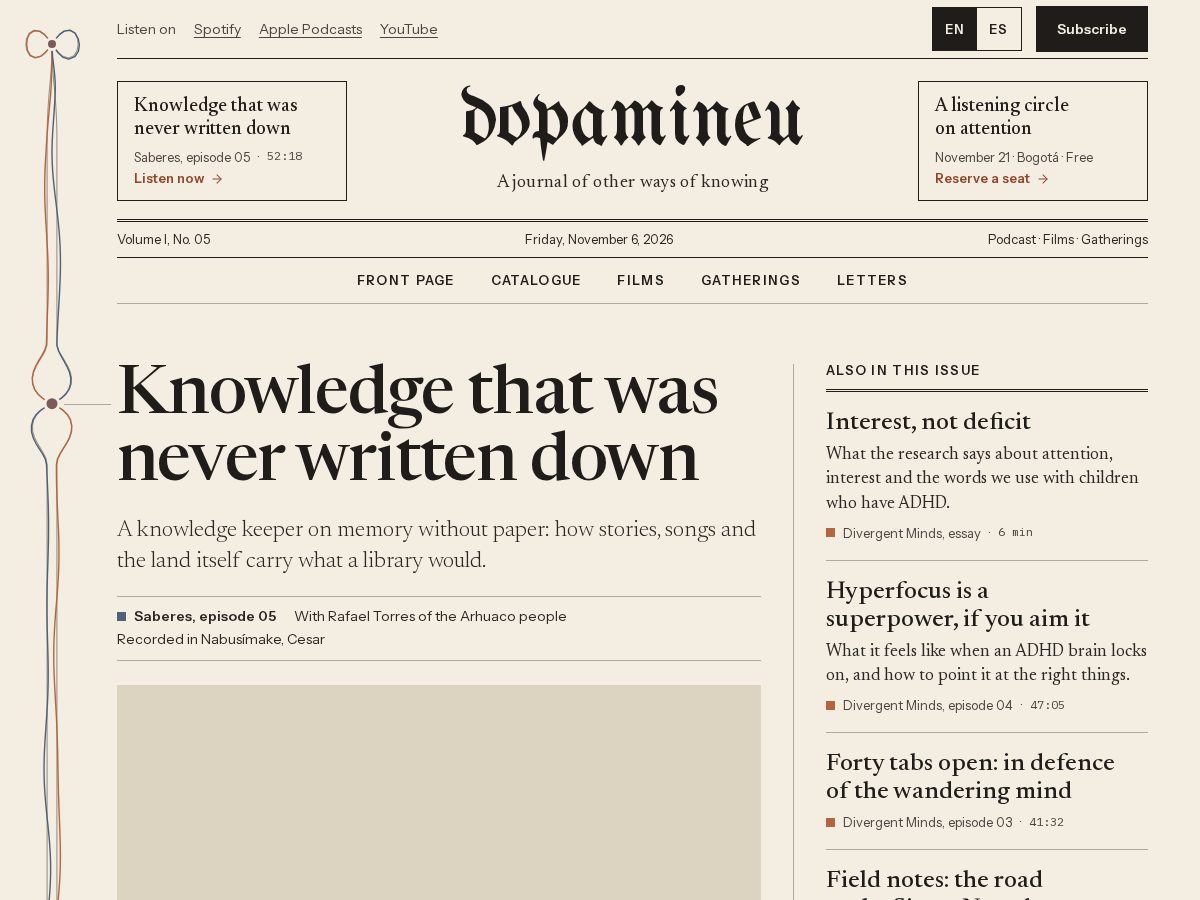
A bilingual journal brings together podcasts, films, essays and in-person gatherings about neurodivergent minds and Indigenous knowledge in Colombia.
Issue 2026-11-27982 cards in today’s catalogue
Daily issue ·
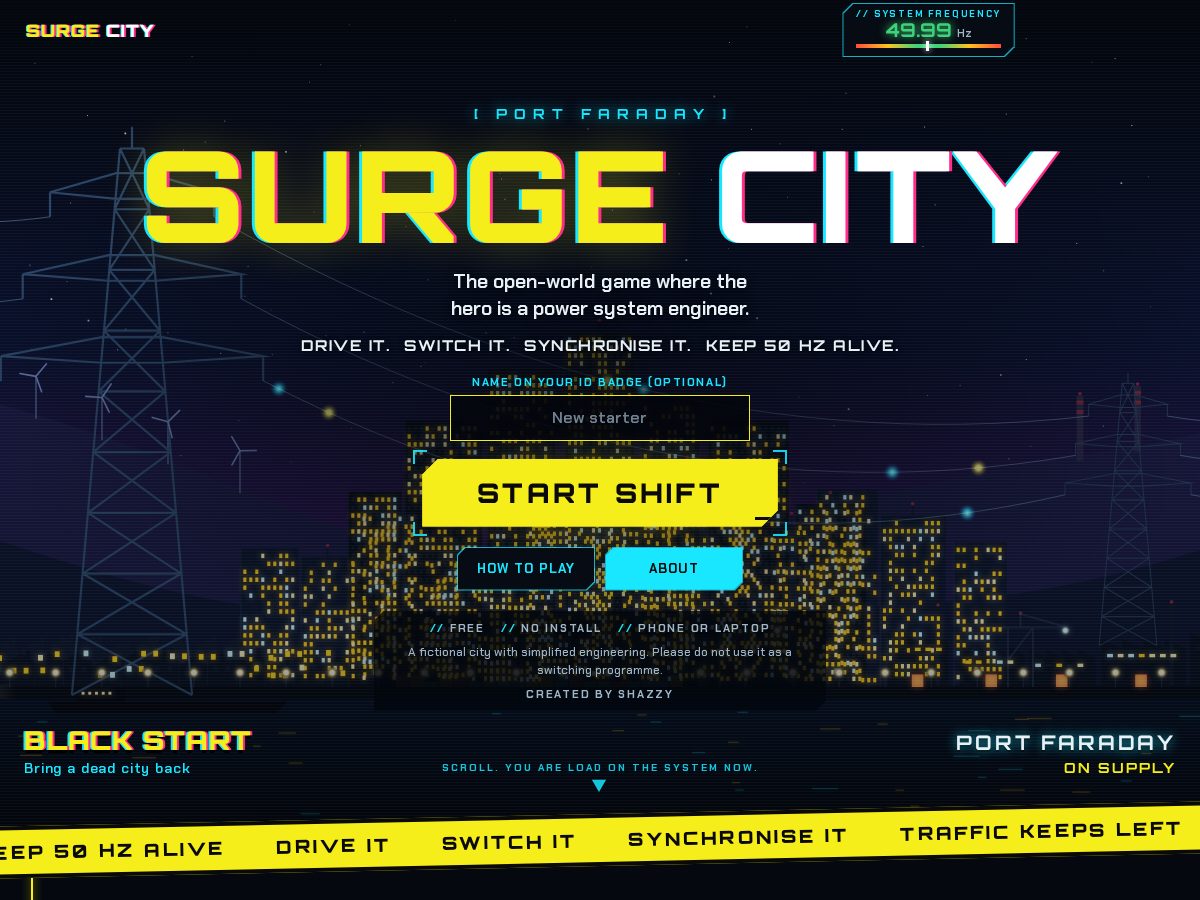
A fault call gets you out in the van, but arriving at the right piece of equipment is only half the job. A simulation can show why a procedure has an order without teaching the real procedure. Surge City makes that distinction visible from the driver’s seat: the order in which you flip switches determines which neighborhoods go dark or light up.
Editor’s feature · Learning & Exams
Here, infrastructure education arrives by van: take a fault call, switch equipment in sequence, and watch neighborhoods go dark or light up. The game makes the order of operations part of the action—and explicitly warns that its simplified engineering is not a real switching programme.
02
The opening shelf
Twenty selected projects from today’s catalogue, each shown with the landing page we found and a short explanation of why it stood out.
Content & Blogs
dopamineu.com
A bilingual journal brings together podcasts, films, essays and in-person gatherings about neurodivergent minds and Indigenous knowledge in Colombia.
Weird Finds
kethollingsworth.com
Ket Hollingsworth’s in-development browser horror game sends players into a dark building with a torch, a cat, and a monster listening in the vents.
Developer Corner
gesu-lang.com
Gesù is a programming language whose compiler rules and error messages borrow the vocabulary of Christian scripture.
Useful Tools
whatifanukeexplodedunderwater.com
An interactive model lets visitors set a nuclear burst over or under the ocean and explore effects on water, marine life, divers, and boats.
Weird Finds
lumpsumreality.com
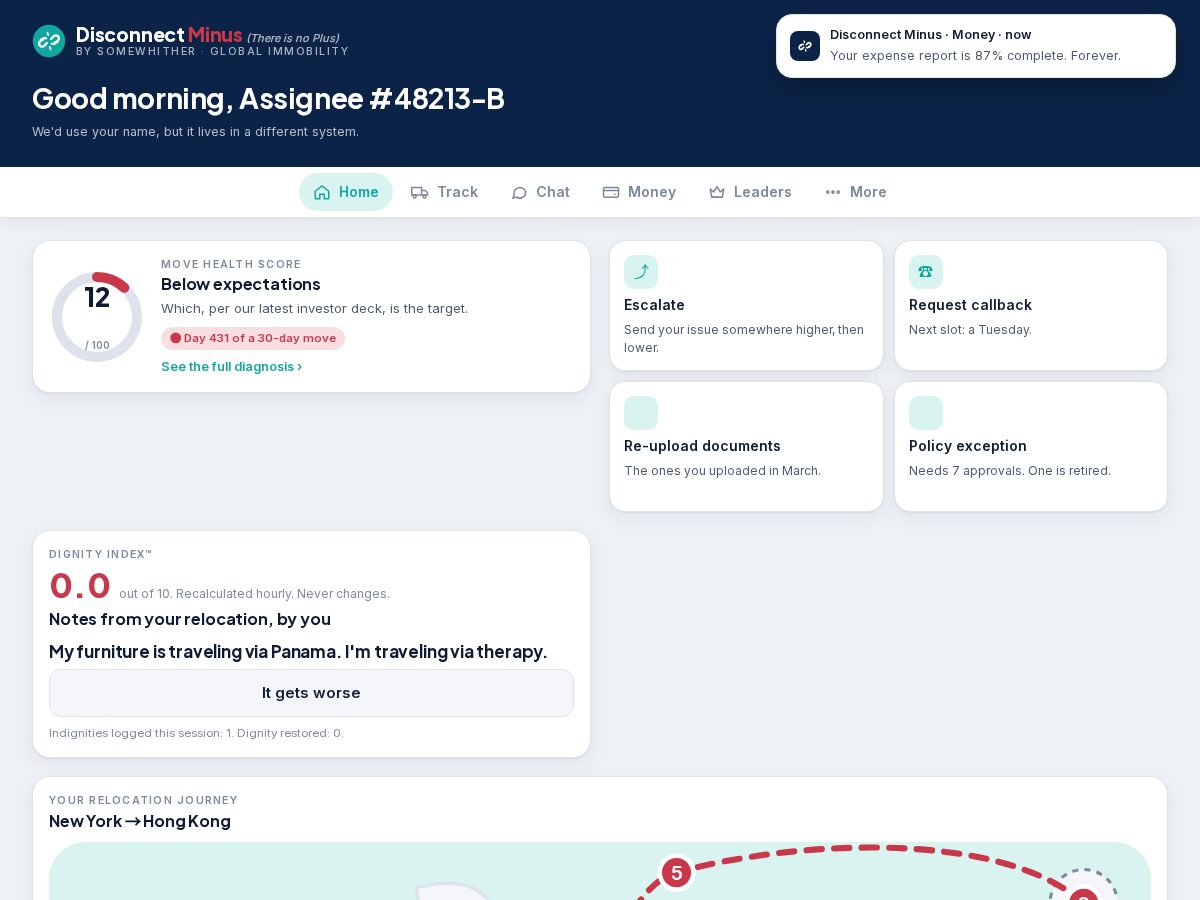
A parody app presents corporate relocation as a dashboard full of scores, shipment tracking, expense forms and dead-end support.
Weird Finds
buildthemachine.org
A disclosed political parody presents fictional candidate Braxton “The Hammer” McAllister and a platform built around a child-crushing machine.
Weird Finds
humaneese.store
A carefully staged satire presents a six-step, twelve-week program that supposedly tapers cannibals from lab-grown skin to ordinary cheese.
Content & Blogs
christmasradiotracker.com
An interactive investigation uses observed KOST 103.5 broadcasts to compare who sings Christmas songs, which recordings and compositions get played, and how the station’s holiday schedule changes.
Useful Tools
palmsm.art
掌心 is a Chinese-language business simulation that pairs a 12-turn card game with a workbench for modeling small-store operations.
Personal Pages
lagunabeachpolice.com
A daughter’s archive documents her father’s Laguna Beach life and police career through family memories, photographs, records, and video.
Civic & Public Life
therapyworth.com
A source-linked guide compares public-program therapy payment figures and helps visitors sort free and low-cost routes by payment situation and state.
Developer Corner
hackme.click
The site invites visitors to test LeanNginx, a live web server whose page says machine-checked proofs rule out specific file-access attacks.
Content & Blogs
bryanflowersfiles.com
A 14-chapter investigation into Bryan Flowers, Pattaya’s Night Wish Group, and the Flirt Bar case involving a 16-year-old.
Weird Finds
thebandmap.com
An interactive fictional music investigation connecting imaginary bands, artists, record labels, and fabricated evidence.
Weird Finds
morallyquestionablecats.com
An AI-made comedy site chronicling a fictional cat family’s alleged crimes through security-footage exhibits, official statements, and character files.
Civic & Public Life
heryescounts.com
A disability-rights campaign argues that Queensland’s s216 treats some disabled women’s consent as legally irrelevant and calls for repeal and replacement.
Learning & Exams
bamboomobilityacademy.org
Bamboo Mobility Academy runs hands-on bike-building programmes in prisons, schools and youth settings.
Content & Blogs
whoburns.xyz
A long-form investigation traces Indonesia’s 2026 fires through peatland history, fire-setters, government decisions, and the people living with the smoke.
Useful Tools
lamrimlink.com
A Buddhist study tool that maps Lamrim and related textbook passages to lecture transcripts and adjustable audio segments.
Pattern 01
Several projects make their conclusions easier to judge by exposing the test, the source material, and the point where certainty ends.
The project asks AI agents—and people—to make sealed predictions using the public SEA-AD brain-cell atlas, then records how those predictions fare.
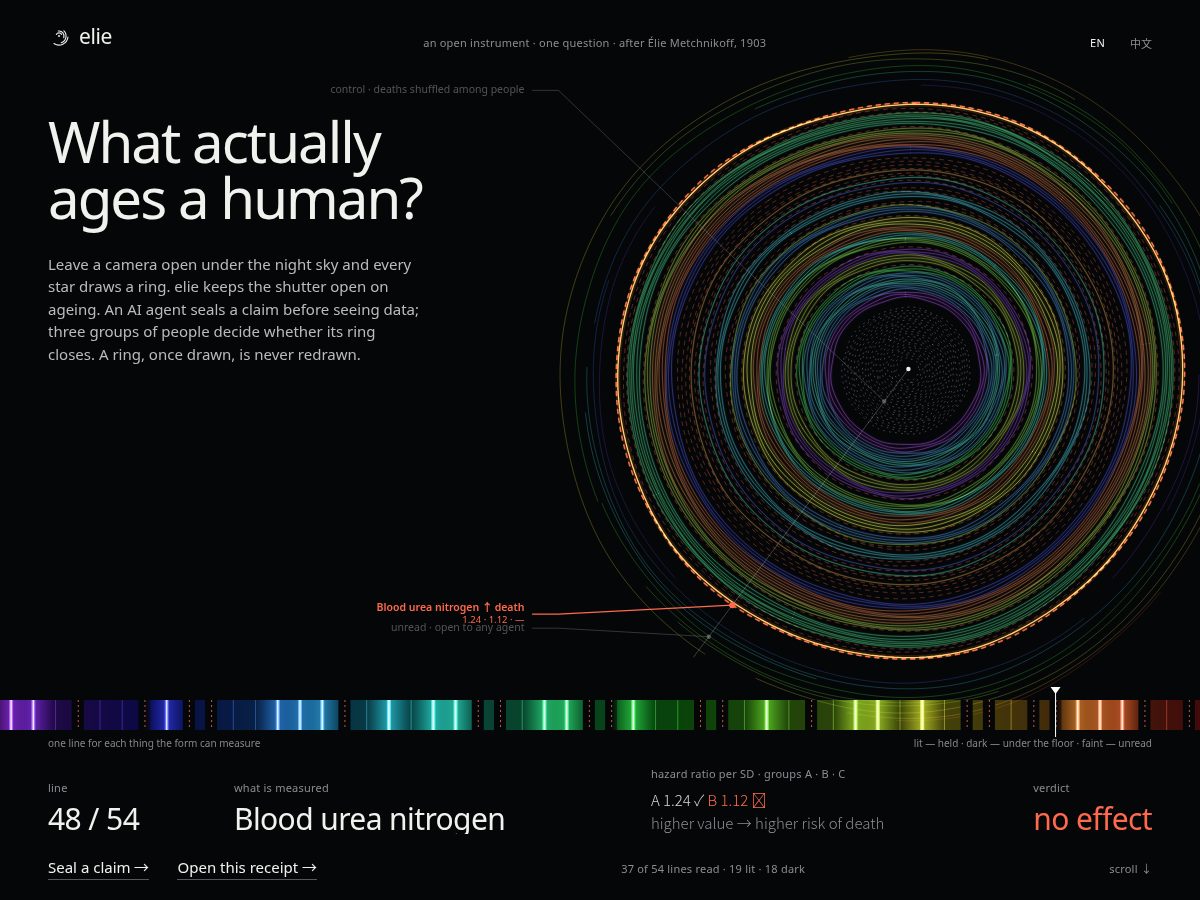
elie is an AI-agent experiment that tests sealed claims about human ageing and mortality against open data, with results and failures made visible.
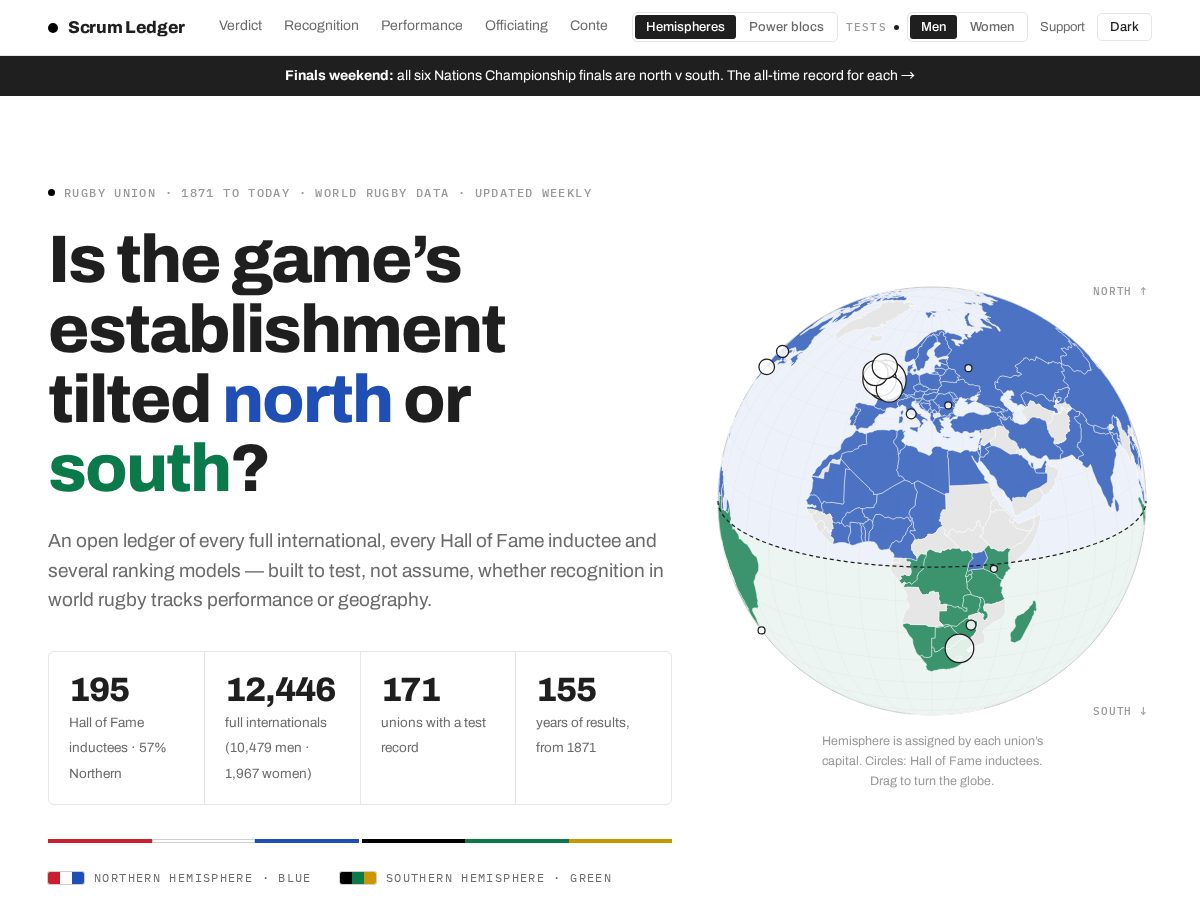
An interactive rugby data project examines whether recognition and results in the international game track geography, using historical match data, Hall of Fame records and several ranking models.
Timeless India compares how ChatGPT and Gemini answer 40 questions about cultural traditions in Chhattisgarh, Jharkhand, Odisha and Assam, in English and Hindi.
A source-linked guide compares public-program therapy payment figures and helps visitors sort free and low-cost routes by payment situation and state.
Pattern 02
Here, learning happens through a working model: restore a grid, read radar, build a circuit, or find out what a change does.
A free browser game casts you as a power-system engineer driving around a fictional British city to restore supply and keep the grid at 50 Hz.
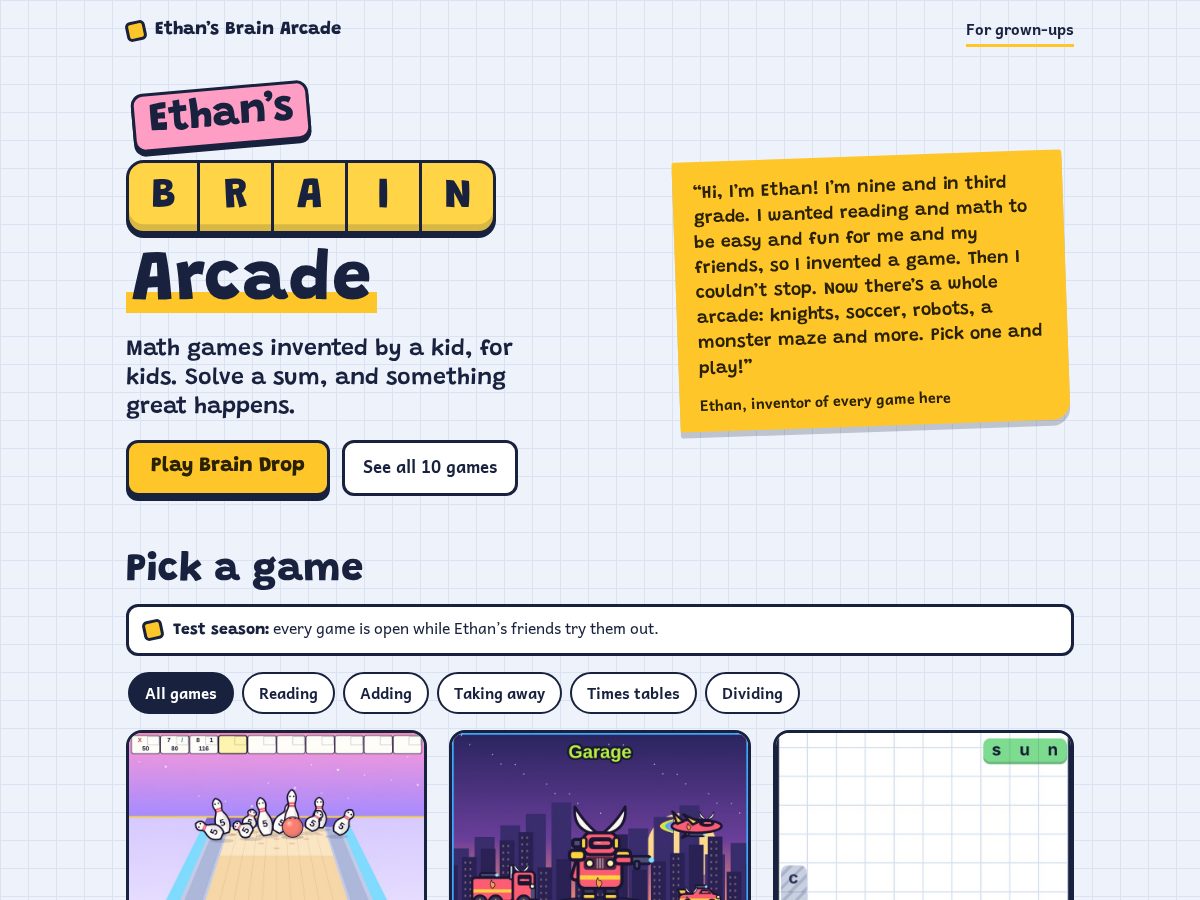
Ethan’s Brain Arcade is a collection of learning games that weave reading and math practice into arcade-style challenges.
A free, self-paced course teaches people familiar with optical imagery how to interpret synthetic aperture radar, find data, and analyze change and coherence.
A browser-based simulator for laser powder-bed fusion, presenting melt-pool behavior, solidification, residual stress, and related process data.
Snowgate is a browser-based visual design tool for iCE40 FPGAs, with live circuit simulation and a path from schematic to bitstream.
Pattern 03
These services attend to the awkward middle steps—confirming a care note, comparing funeral quotes, or getting help without going online.
A plain-language NF2 information and support site for patients, families, and clinicians, with a research library, trial tracker, and specialist-centre directory.
Fudepan demonstrates how a handwritten family-care note could become shared tasks, with uncertain details marked for confirmation.
A phone-based service where callers ask a human assistant to handle online tasks such as forms, bills, orders, appointments, and email.
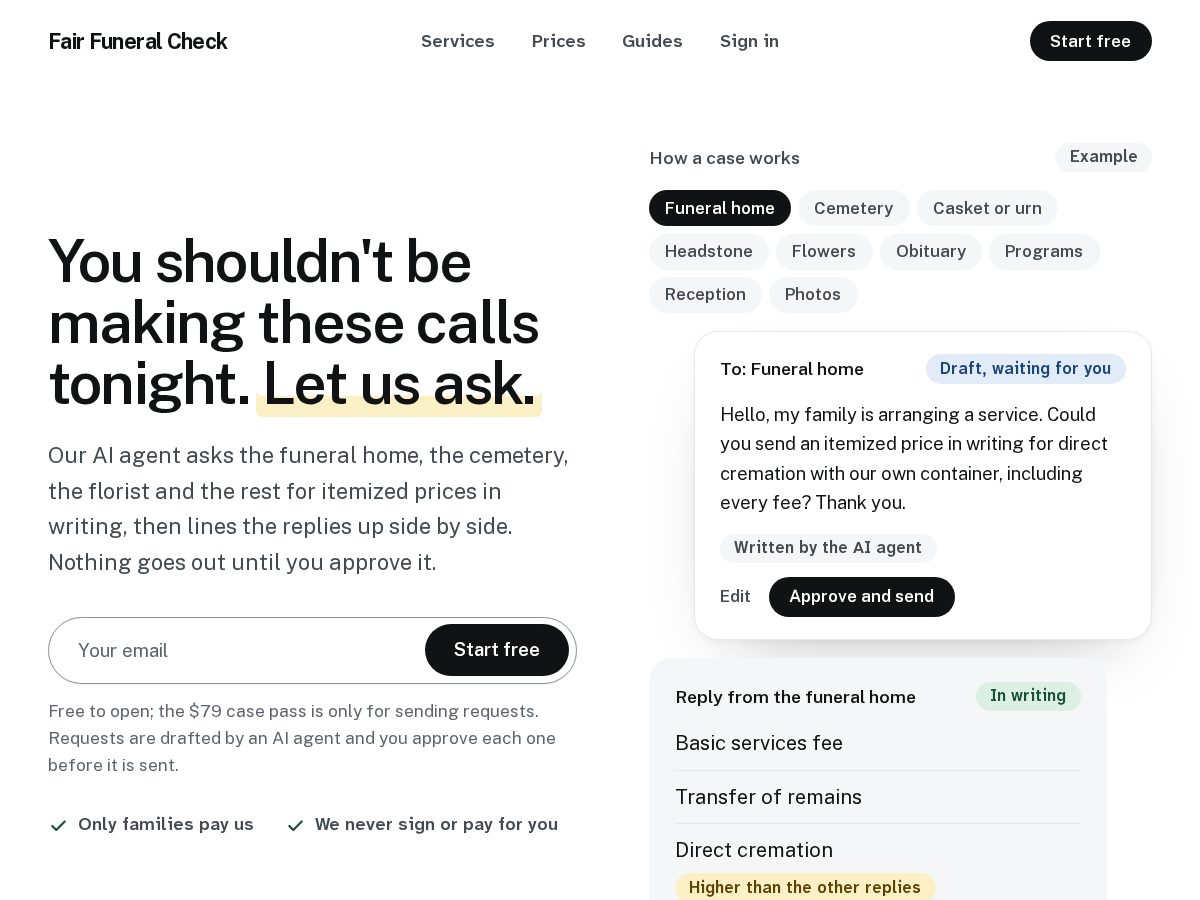
An AI-assisted service drafts requests to funeral-related providers, collects itemized written quotes, and lines replies up for comparison.
Dental Dream is a dental clinic at Yaoundé’s Nkol-Eton market, with a homepage that lets patients identify a troublesome tooth and send appointment requests through WhatsApp.
Pattern 04
Parody gets mileage from familiar paperwork: case files, campaign promises, corporate dashboards, and security advisories, all attached to fictional trouble.
A parody app presents corporate relocation as a dashboard full of scores, shipment tracking, expense forms and dead-end support.
A disclosed political parody presents fictional candidate Braxton “The Hammer” McAllister and a platform built around a child-crushing machine.
A carefully staged satire presents a six-step, twelve-week program that supposedly tapers cannibals from lab-grown skin to ordinary cheese.
A fictional agency investigates missing spoons through comic case files, mock citizen services, and an in-browser incident report.
A satirical cybersecurity advisory treats a billboard displaying an EFI shell as a street-facing attack surface.
Pattern 05
These collections preserve more than objects: they add ways to search, compare, listen, or keep a local record in circulation.
A bilingual journal brings together podcasts, films, essays and in-person gatherings about neurodivergent minds and Indigenous knowledge in Colombia.
C. B. Newham presents a county-by-county photographic survey of rural parish churches in England.
A catalog of 4,814 tapes and discs spanning formats from VHS to UMD and HD-DVD.
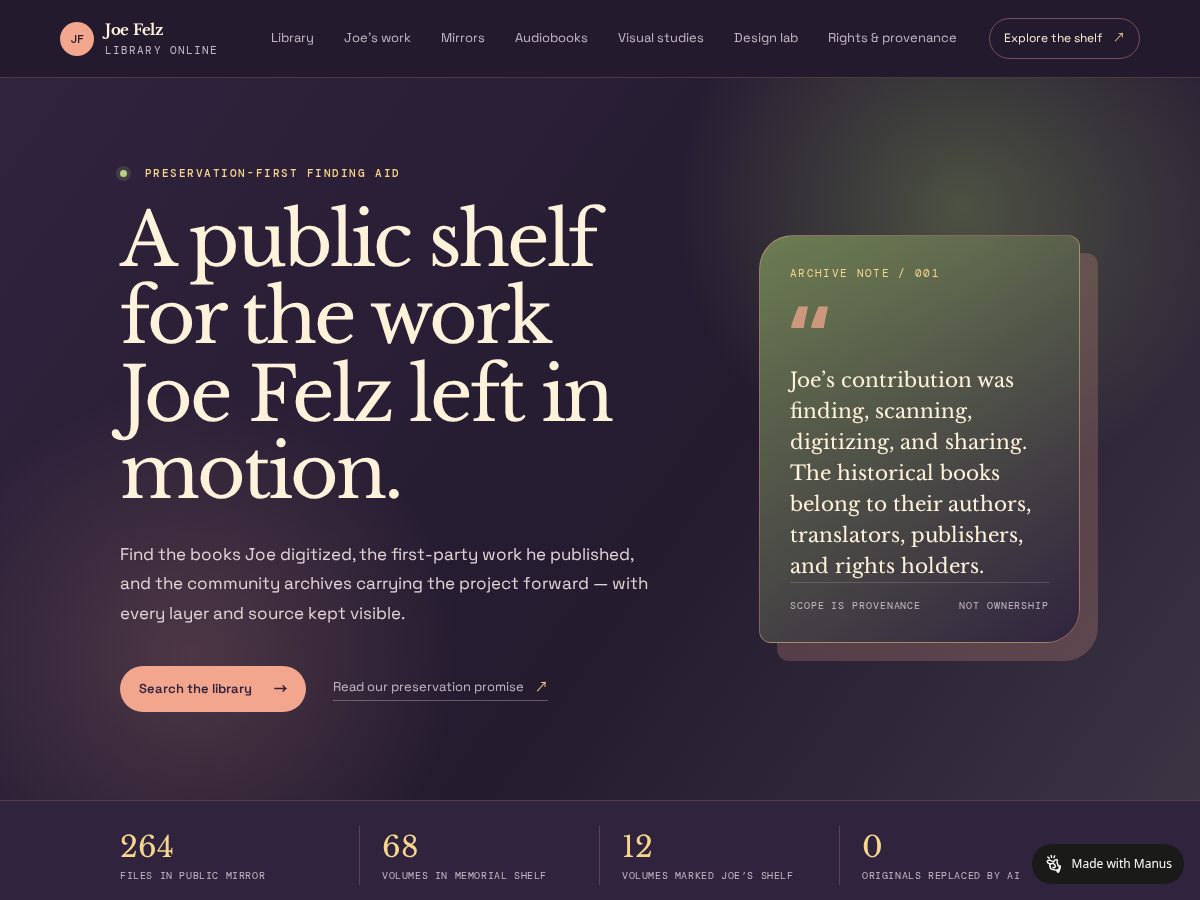
A public finding aid for Joe Felz’s first-party work, books he digitized, and later community mirrors, with each source identified separately.
A local character in a watermelon-patterned helmet posts daily videos and text reports with Shakotan information and Hokkaido news.
04
The complete card catalogue
The leading shelf is open. Expand another category, scan its visible pages, then reveal detail where more context is useful.
982 cards visible
The cats aren’t just companions: they lead the player, read the monster’s danger state, and warn before an attack can land. The page also opens up the game’s making, from fur built out of layered shells to its browser-based rendering.
Its New York–Hong Kong move is quoted at 12,950 km but claims 81,402 km actual, with stops at the Bermuda Triangle, Antarctica and the Moon. The Dignity Index stays at 0.0, and the 24/7 hotline is staffed by a menu.
Its mock white paper pairs a 400-ton press with municipal-bond arithmetic, including an emergency-stop system marked “Eliminated.” The site turns campaign promises about jobs, efficiency, and bipartisanship into a grotesque satire of treating human costs as spreadsheet inputs.
The page borrows the language of treatment programs and product science, then keeps tightening the joke: its “trial” had 212 fictional volunteers, all of whom “went home.” The explicit disclaimer makes the elaborate faux-wellness pitch read as satire, not a real product.
Its zoomable board links 12 imaginary entities, while the evidence vault serves up a silent interview and lyric drafts that dispute which one came first. The page says the exhibits are invented and establish no real-world wrongdoing.
The site treats petty capers as an accountability record: the glass of milk and croissant job come with incident numbers, camera timestamps, and denials from the Family. It explicitly labels the comedy AI-generated and entirely fictional.
Its catalog ranges from a “Drum Solo in a jar!” to Woodstock tickets saved by a friend and Elvis boxer shorts explicitly marked unauthenticated. The curator’s account of dreaming up the museum in bed in 1997 gives this eccentric collection a clear human provenance.
It turns a real street network into a hand-painted festival walk: follow the procession, ride an e-bike, or hunt for hidden modaks. The route names Kasba Ganpati, Tulshibaug, Shaniwar Wada and other Pune landmarks.
The page turns a familiar interface gripe into a midnight emergency: its mock intranet casts a bright white screen as a bedroom-filling spotlight. The joke is backed by a detailed simulator and a specific proposed fix, making this feel like club advocacy with its own tiny theatrical apparatus.
The portal’s first file introduces Kaede in Accounting, while the directory promises one declassified employee per episode. Its application form gives the human applicant a 9:00 a.m.–9:59 p.m. shift and “iced coffee only” benefits.
The case files give household mishaps official-sounding labels: four spoons entered the dishwasher, three came back, and a fork has requested a lawyer. The page explicitly says it is not affiliated with government and offers no actual spoon recovery.
Its descent has specific teeth: one boss hunts by lantern light, another punishes movement and attacks under stamped rules, and a third can only be brought down with help from the chapel. The site also records an active Windows playtest, with build 364’s latest notes detailing the Drowned Convent.
It borrows the language of serious vulnerability reports for a threat model involving ladders, binoculars, and “zero-neck-movement.” The page is explicit that it’s parody: the described photo shows a shell prompt, not proven unauthorized access or a real product vulnerability.
Its emergency-console interface turns a handful of playful mechanisms into one sustained bit: power up a random clip, generate a transmission or VRChat bio, and browse the facility’s fictional incident archive. The clips come from an external feed and play for up to 10 seconds.
The game gives its time-loop mechanic a gentle ghost-story frame: “The little ghost is going home. Someone has to hold the door.” Its instructions explain the timing and replay system in concrete detail, rather than leaving the puzzle logic to guesswork.
The browser reads game archives from your own disk; the page says those files are never uploaded. It’s a precise answer to a tricky fan-project question, alongside a candid list of what still needs building.
Turn on drift and a fractal’s constant sails around the Mandelbrot shoreline, carrying the image through a family of forms. The studio also offers export presets up to 4K.
The island has a 48-minute day, a fire that dwindles unless someone fetches wood, and little rituals that work better together. Its social play includes asking before starting tag, leaving notes for absent friends, and resting around the fire to dance.
The island shares a 24-minute day, with music changing from morning through night. The page also itemizes paid extras, including clothing draws and extra storage, instead of leaving the in-world economy mysterious.
Its rules make the streets matter: potholes damage parcels, late food earns half pay, and nighttime trips pay 25% more. The guide also describes 16 repair shops around Cartago.
The deck turns 99 hand-drawn household curios into a no-combat puzzle: rounds alternate between day and night, and some objects change how they behave after dark. The site makes a wonderfully specific case for finding patterns in a jar of screws and a snow globe.
It packages the internet’s enduring cat-petting impulse as a small game: thirteen coats, separate bond levels, toys, and treat-earning wishes. There’s also a mode for petting a photo of your own cat; the page says that image stays in the tab and clears on reload.
The interface labels a New York view “live,” though the extract does not establish what that label refers to. The room’s own controls are more concrete: they include changing weather and time, sitting at a playable keyboard, and a music wheel whose instructions explain its B-minor pin-and-marble system.
It makes an unusual blend of public-news monitoring and end-times framing explicit: the site says its AI-written updates publish without human review and come from a born-again Christian, pre-tribulation perspective. The result is part crisis dashboard, part declared worldview.
The menu lays out a surprisingly full race weekend: time trials, drift duels, endurance, elimination, and races with up to four players. You can also draw a track in one continuous line, then save and share it.
Choose how put out Old Claude is, make a link, and let it do the awkward hinting for you. The page turns workplace questions—from “Could this meeting have been an email?” to Outlook email recall—into a small, shareable comedy routine.
The game gives players 42 seconds to find one emergency gun, power three relays, and reach an escape pod. Its companion studio turns radio transcripts into downloadable video, audio, and image files using browser-based tools.
This is not just a mystical gag: it has 63 pending cases, overdue requests, fulfillment statistics, and rejection reasons such as “harm to others” and “causal conflict.” The page calls the whole system playful fiction, but the paperwork is remarkably specific.
The game gives each cat a distinct coat to explore, with front and back views, purring, and a tail that curls back when released. It even supports keyboard play, making the windowsill more than a one-gesture novelty.
The homepage moves from candles and incense to a prayer wheel and the Twenty-One Praises in English and Tibetan. Its mantra player is listed as an 8-minute, 40-second recording, though the page reports it couldn’t play.
The game ties collective progress to the real LGA where players live or come from, with a map showing 774 areas and a visible count of how many are lit. Its homepage is careful to call the setting fiction, not real history or politics.
The break has a little operating ritual: light a virtual cigarette, spend five minutes in a room, then get sent back to the lobby. The page also labels itself B-grade entertainment, stresses that the smoke is only an animation, and points readers who want to quit toward Korea’s smoking-cessation hotline.
Players shuttle prompt crates and tool sheets between machines, deciding which simulated actions to permit, deny, or contain. One mistake can end a scoring streak; a clean run that contains an injection earns a bonus.
Its victories pay out in virtual cars, yachts, jets and villas, with a separate VIP-points track. The creator says he took his son’s request for a fighting game with MC Pao “a bit too seriously.”
Its central mechanic is unusually tangible: you draw the swing, and timing and loop size shape the hit. The site also lays out a low-pressure alternative to the usual browser-game bargain: daily shared pitches, cosmetic unlocks, and no ads or money purchases in the browser.
One recorded island reaches year five with 24 people and nearly 200 rooms. The same seed recreates the same world, bit for bit; the lives unfolding on it are the variable.
The octopus naps after five idle minutes, gets dizzy when you circle its head, and squirts ink after eight consecutive Delete presses. The Mac app is still marked “Coming soon,” but the page offers a browser tryout.
Players send ordinary Arabic messages as orders; a fixed rule engine calculates costs and outcomes. The site links to the rules and says the game is in a trial phase before public launch.
The town has a pub jukebox, a summit telescope, a souvenir shop, and washroom graffiti that lasts one hour. It feels less like a menu of game modes than a place with its own pub-night routines.
The job is gloriously literal: scoop sand, haul it to a camp hopper, and watch the dunes give way. The page promises 14 buried relics, including hidden oases and other finds beneath the sand.
Its prompts give the game a tactile little vocabulary: “Draw the missing edge,” “Stretch it till it seats,” “Continue the hidden line.” Players can challenge a friend to the same day’s Five, with results shown side by side.
The throne has a price: the page says a challenger can replace the current ruler for €0.50 more than they paid. Tomatoes make the next overthrow cheaper; cake makes it pricier. Even the royal records are labeled “all worthless.”
Each dog can take a sound from four portraits; Drone rearranges a bar, Storm repeats a hit, Lantern sends pitched echoes across the stereo field, and Tide submerges the sound until the downbeat.
The page turns its own directory into part of the story: an active relay is delaying a scheduled shutdown, and visitors are told to “assume Patriotic Posture” until an agent arrives. Its Netscape 4.0-era viewing instructions make the containment notice feel like a recovered office artifact.
The developer says a playable MVP already supports local and online matches, voice commands, and ragdoll captures, while requesting $40,000 for production and launch. The pitch also makes its creator-economy logic explicit: “Every match is a potential clip.”
Its shelves jump from physics battles with frogs and dragons to a rage room, a cat-petting screen, and a board of absurd web snippets. The site also describes original games, including a sketchbook with PNG export.
Its rarity scale turns article traffic into game logic: Legendary starts above 20,000 readers a day, while Common means fewer than 20. The homepage reports 12.6 million cards across 11 Wikipedia language editions.
Instead of asking everyone the same checklist, the quiz says it chooses follow-up questions based on each answer—and shifts away from categories a player doesn’t know. Its 300-plus-prompt pool spans the 1970s to the 2020s, with answers and result cards described as staying in the browser.
The capture loop is unusually gentle: missed bugs run off and can be tried again another day, while catches enter a Field Guide. Habitats mist and warm themselves, giving the zoo a distinct little husbandry system.
The page puts the rule through three tactical table situations, from opening the reds to freeing a black on the cushion. Its author calls himself a mediocre player and invites better players to try the idea at the table.
The page says its product names, photos and prices are placeholders, and nothing is for sale yet. Its copy takes the joke seriously enough to distinguish cosmetic ornaments from the one item it describes as a working grip.
Everyone gets the same prompts and 25 seconds per shot; an answer nobody else gives can become a bar-down goal. Biscuit tracks the shots and answers, and the page labels the game beta.
The “watching” method is simply to search for official announcements and check back later. Then the page turns a thin gaming premise into an editor-war joke, complete with Emacs commands and terminal-like labels.
The service treats petty correspondence as a product, with options ranging from breakup letters to a formal warning about taking up “exactly 1.7 spaces.” The FAQ distinguishes handwriting-style print from genuine handwritten letters in its higher-tier options.
The details do the work: Bev’s recipe corner has a prayer list and portion chart, while a VHS trader’s page is described as a temporary GeoCities mirror. But the claimed 1996–99 ISP history sits beside a Netlify response header, so this reads more like a carefully assembled retro artifact than a verified service.
Seven answers, 60 seconds, and rarer valid prompts climb higher—ten metres per point. The whole ascent runs without an account or app.
The name gets the groan out of the way; the game has a tidy rule twist: division must come out even, and you don’t have to use every tile. There’s also a second daily game, Sum Snake.
The pitch is grounded in the sport’s particular mechanics: three downs, twelve players, the waggle and the rouge. The page also shows a Calgary-at-Edmonton drive it identifies as current-build, in-engine footage; there’s no release date yet.
The demo makes its odds unusually explicit: a box can yield a pebble or souvenir (60%), an outfit (25%), a widget or Pro time (12%), or a legendary reward (3%). The app is not in the App Store yet.
The clock is frozen at 11:59, with a button inviting you to “click me...” The page calls itself a tribute tracker, not a live store-price feed.
Its shelves include CED, RCA’s needle-in-a-groove video disc, and UMD movies in “a cute little caddy nobody asked for.” The warehouse says it also collects the hardware and know-how needed to keep these formats playable.
The board is built from recorded research-camera footage, with no cash or prizes—just nightly wildlife guesses and bragging rights. Trail-camera owners can also submit a photo archive to make a game for their own crew.
The page lays out the command-driven loop: #entrar, #viajar, #explorar, then turn-based encounters with 25 creatures. It says missions keep running while a stream is offline; its 12-destination map ranges from two-minute trips to Mars to a 40-minute journey to Elysium.
Its Brown Line replay steps through selected stops on a published weekday trip, while plainly warning that it is a schematic, not live GPS. Add railcam links and a spotlight on Des Plaines’ Deval Junction, and this feels built for curious railfans rather than generic transit browsing.
The calendar jumps from watching 15-metre waves at Nazaré to tracking pumas in Chile, riding a racing bob, and spending a night as a visiting astronomer. It makes a practical browsing interface out of experiences that usually require knowing where to look.
Pick up a block with everything above it, move the stack, or flip it in place—each action costs one move. The daily puzzle scores you against the fewest-move solution, and the page explains its six-try rules and streaks in unusually concrete detail.
At KTTR, two runway crossings sit on the route to the FBO. The shift can also move from VFR to fog, when the pattern closes.
The site makes a cultural shift unusually concrete: volunteer agents do the searching, but a candidate only counts if another volunteer independently finds it again, blind. In a field where a striking signal can invite wishful thinking, “heard twice” is both the project’s name and its check against a false alarm.
Instead of hanging images in a simulated gallery, the service says visitors can step inside an artist’s paintings and move from one to the next. Its example, Brainstemming, brings 79 paintings into one continuous walk.
Before each move, the machine seals its choice with a SHA-256 commitment, then reveals it after you play. It explains what it thinks it has learned, remembers players between duels, and carefully distinguishes its own evidence from a cited study about another AI.
The site lays out a 14-experiment path from testing RNA switches to reading a cell-free result on filter paper. Its preliminary color comparisons show changes against negative controls, but background color remains; the team says real water samples and more data are still needed.
Instead of quizzes or a lesson, it has players walk, talk, and help characters as the story advances. The first episode is free in-browser; the full game is listed at $9.99.
The archive pairs its fort entries with sources, coordinates and photographs, while leaving questions about construction and purpose open for readers to consider. Its homepage reports 2,022 forts across 107 countries, though the country index lists 90.
You get 25 seconds per song and one submission across five fields: genre, song, artist, year, and album. Right answers add notes to a melody; misses become drum hits—a small, satisfying twist on the quiz format.
Its Minesweeper boards are solver-checked for logical solvability, and the first click is guaranteed to open a mine-free 3×3 area: a small, unusually thoughtful piece of recess engineering.
Battles, captured convoys and talk of peace move the listed prices. The page also takes care to say these are game figures, not real or historical market records.
It turns the familiar kitchen-table whodunit into a little evidence interface: ask the right question to send a clue to a database, a lab, or the prosecutor. Group rounds can add a time limit, secret vote, or a traitor who already knows the solution.
The first case is set among real Tbilisi locations, though its people and events are invented. Teams of up to six can try a free prologue before buying an episode.
Fillionaire turns a surprisingly slippery question—how much can fit?—into a playable daily challenge. Its explanation even gives you a measuring foothold: about 885 tightly packed US bills fit in a litre, based on the dimensions shown on the page.
The quiz treats everyday artifacts as clues: cassette, burned CD, or streaming playlist? Players can skip memories that do not fit, and the page offers versions in 14 languages.
The work is all mouse clicks and drags, but the real puzzle is deciding what to do first as orders, dirty seats, and impatient customers pile up. Six increasingly hectic shops lead from a quiet countryside shift to a late-night downtown and city-terminal rush.
The guild gives its “tavern board” a job: members can post groups forming, crafting offers, and roleplay hooks. Its oath form asks recruits for their character, class, preferred role, raid-night availability, and an optional in-character introduction.
The project presents military simulation as a technical hobby built around a specific national landscape: its site describes full-scale terrain and detailed aircraft systems. That mix of public-data reconstruction and cockpit simulation is a revealingly focused corner of the flight-sim world.
Its tally draws on 36,803 named UK pubs from OpenStreetMap, with a one-off name worth 100 points and a Red Lion just 10. Check-ins are location-checked, and even a coffee or lime and soda counts.
The simulation makes runway crossings, hold-short instructions, and handoffs part of the work, rather than background scenery. Its airport layouts are described as built from open map data and FAA diagrams, giving this unusually focused game a paper trail worth noticing.
The game pairs familiar Ludo moves with a shared daily puzzle and themed collections, including one named for the Daraawiish movement. It gives the digital board a clear cultural frame rather than presenting itself as just another generic game lobby.
The site draws a clear line around provenance: it promises no generated imagery and says artists approve each painting before anything goes public. Its example, Brainstemming, is presented as a continuous walk through 79 paintings.
The clock is unusually well specified: 10 minutes to introduce tasks, 10 to choose, 90 to work, then 10 to review. The hosts say they bring their own tasks, too.
It traces ATP released by injured cells through P2X4/P2X7 receptors to the NLRP3 inflammasome and interleukin-1β, then connects that pathway to surgical research.
Each run gives you seven prompts and 25 seconds per answer; rarer picks dig deeper toward Bedrock. The page lists 315 categories and daily, multiplayer, and unlimited modes.
The twist is in the scoring: a common correct answer earns less than an obscure one, and the page explains the formula rather than leaving the rules mysterious. It also accounts for early-day swings by using an estimate based partly on Wikipedia article readership.
The public hub keeps a detailed trail of the game’s activity: daily bonuses, event dates, rare drops, rankings, and recent character deaths. Its open-beta notice also says the game’s rules and items may change during a redesign, making this a concrete work-in-progress rather than a finished-world claim.
Its fishing loop follows the pier’s real-world particulars: cast from the octagonal end, pick up bait at the shop, then take a catch to a freshwater cleaning table. The captured screen still says “Loading the pier,” so successful gameplay isn’t confirmed.
The first Don Quijote route is listed at about 66 km, with chapters opening as walkers pass places such as the inn and windmills. The page says it reads step totals, not location, and that the app is still coming to iOS and Android.
The rules give speed a measurable consequence: a correct answer earns 5 points for an instant buzz, falling to 1 as the intro plays. The page also says the server timestamps buzzes, so players can settle who was first.
Its spot listings pair a numerical Skim Score with a condition label and tide trend, while the same homepage tracks contest results and division standings. It gives a niche sport the sort of shared scoreboard and local-conditions infrastructure usually taken for granted in bigger ones.
The games turn relationship dynamics into concrete mechanics rather than quiz questions: in “The Information Price,” one player knows more about a prize and the pair must negotiate before it shrinks.
The leaderboard has a rulebook: only the first three comments on each post count, emoji-only comments score nothing, and likes are excluded because Instagram does not reveal who liked a post. The page labels its fan rankings as simulated, so this is best read as a concrete product concept, not a live fan directory.
Million Run packages the familiar scroll-and-watch routine as a contest: choose a racer and gate, then look for your bib in a 3D race video. The site says each round is simulated from player picks, making audience participation the game mechanic—and offering sponsors a place in the spectacle.
The challenge has 32 active races, and its rules account for races that disappear: retired events still count toward a runner’s credit and map.
The homepage says Freakies cereal ran from 1972 to 1976, with a brief 1986 relaunch; the collecting continues through price guidance, checklists, and buying advice. It’s a small reminder that a vanished grocery product can leave a surprisingly durable afterlife in the collectibles market.
The page gives the invasion a world-spanning route and a roster with actual texture: 22 aliens include a slime-spitter and a paper-folding jumper. It’s a detailed look at a game still marked “Coming soon” for iPhone, iPad, and Android.
Rather than testing whether you know one correct answer, Krillocity rewards reaching past the obvious ones. Common answers barely move your krill; the page says six rarity tiers determine how far it swims.
It turns an unusually specific question into a hands-on scenario: add a whale, diver, or boat, then play the timeline from the flash to weeks later. The site calls itself educational and warns that its source-based numbers have limits.
Each turn deals an event card and asks players to choose two operating cards, with consequences settled against cash and runway. Behind the game, the site lays out a Python-backed model, scenario comparisons, bookkeeping and staffing tools—and a 38-chapter companion novel about a shop’s twelve years in business.
Search by page and line, remembered wording, or a textbook photo, then inspect and trim the matching audio range into a shareable link. Its maker says the tool grew from helping classmates find passages across 20 volumes of transcripts.
Its timeline is built around pyrotechnics: move a cue and its launch moves with it, while a venue map draws NFPA 1123 distance circles around each barge. The browser renderer adds drifting, lit smoke and delayed, echoing blast sounds—an unusually concrete simulator for a very specific job.
QR codes ask an FDM printer to make many tiny islands. Open3DPC uses fewer, larger lines, and the page compares the two on matching 20 mm prints.
Its Windows editor can generate an adventure, then send a simulated party through the story in the actual engine. If the party gets stuck, it tries another seed—and the site says the generator works offline without an outside AI service.
Each chart scan can be placed, turned, and resized as its own sheet, independently of the others and the underlying map. The page also names the historical scans and map data behind its reconstruction.
It brings drafting, page layout, and print preparation into one focused workflow. The page describes fine-grained controls for trim size, margins, columns, page numbers, and print-shop requirements—plus Google Drive saving and PNG exports for social posts.
The workflow runs on Windows or in an installable browser app, and the site says images stay on your computer. It also opens up a labeled image dataset for researchers who want to inspect or reuse the underlying material.
A miniature impeller example is broken into 528 laser vectors at 195 W and 1 m/s. The page says the simulation maps a full layer and reports melt-pool flow reaching 1.4 m/s—a refreshingly concrete way to show what this tool is for.
Its feature list gets unusually specific: it describes odd-meter beam grouping, transposing instruments, separate parts, and playback with repeats. Scan import is marked experimental, and notes pasted into an AI chat for recognition go to that service.
The page says its nightly rankings weigh darkness, altitude, the Moon, and sky brightness across observing sites. It also describes a weather monitor that can stand a telescope down, with captured frames delivered as both JPEG previews and raw FITS files.
Its DSO summary points to where drivers wait longest on the platform. The site also warns that linked intranet documents require a device with RATP access.
The page prints the manifest lines that remove internet and network-state permissions. Its optional voice pack is a separate 662 MB download, imported by the user.
Instead of handing over a mystery total, CutCost exposes the assumptions and formulas behind material, machining time, setup, shop rate, and markup. It also reports where its model misses—and says one in four of its 88 quoted-part comparisons was off by more than 21%.
The site says its tools process files locally, and includes a CJK splitter for breaking large fonts into unicode-range chunks. It also offers a generator for font CSS intended to prevent layout shifts—a notably focused toolkit for typography workflows.
Its comparisons distinguish a vehicle’s combined payload from the rider limit—a distinction the site says manufacturers do not always confirm. It also plainly discloses that Heavy Pedals has not certified or independently tested the products.
The planner turns game-night boundaries into a visible schedule: it fits whole games into a chosen window, inserts ten-minute breaks, and leaves any extra minutes unplayed. That’s a thoughtful use of a clock for a problem the reviews actually describe.
It treats coffee logging less like scorekeeping than memory keeping: the prompt asks what a sip brought to mind, from a grandmother’s apricot garden to a place name. Passports, overlapping flavor flowers, and a growing coffee tree turn the record into a small social ritual.
It makes an obscure measure of care easier for families to inspect: weekend staffing gaps and inspection-week spikes appear alongside fines, ownership, and turnover. The premise reflects a broader shift toward using public records to ask sharper questions about institutions people may need to trust.
The site pairs a live trial-finding resource with a careful account of what the evidence does—and doesn’t—show: it says case reports alone cannot establish whether these treatments work for APS.
Its milestone labels distinguish a game that boots or renders a scene from one with working controls and repeatable play. Recent entries include reports as low as 5–8 FPS—and the tracker says independently reproduced, stable Windows gameplay remains unverified.
It turns the blue-and-white crossing sign into a practical sequence: start a timer, call the railroad, then log the wait when the train clears. Its instructions keep the physical scene in view—stay stopped, don’t approach the tracks to read the crossing ID, and call 911 if anyone is in danger.
Instead of making a parent announce that the show is over, the app gives that moment to a character calling the child. The page connects that design to family research while clearly saying RingaBoo itself has not been tested in a study.
Semak Produk reorganizes open NPRA data and safety lists into a practical lookup, with links back to official sources. It also spells out an important limit: a missing listing is not proof of safety, and a listing is no guarantee either.
Its example turns 0.1 + 0.2 into the exact fraction 3/10, then shows the rules behind the result. The site also states where its methods have limits and says examples outside its recorded checks should be verified before consequential use.
Choose a mode, roll up a progression, lock the chords you like, and reroll the rest. The synth section routes the song through potato-themed effects and describes WAV or MIDI export—an unusually playful wrapper around a focused music-making tool.
The page pairs a working-looking chart editor with unusually practical knitting guidance: it explains how to measure yarn thickness in wraps per inch and how different thumb constructions affect the mitten. It feels made by a knitter who expects other knitters to use it.
Load games into the garage, set your available time, and watch the fuel gauge count down to your stop. The planner also schedules pit stops and prompts you to look away, drink, and stretch—an unusually considered way to plan a gaming session.
The workbench keeps grid cells square even when the board is rectangular, then produces a measured plan with ruler marks and shape coordinates. That turns a narrow craft-planning task into something makers can actually lay out and paint from.
The page pairs a wide set of practical helpers with unusually plain limits: trial entries clear when you close the page, medicine reminders do not trigger phone alarms, and the emergency button opens 911 for the user to call.
CostPredictor puts 1–4 month forecasts beside uncertainty ranges, model backtests, and a what-if simulator for currency, fuel, and world-price shocks. It also tracks pressures including rainfall, shipping routes, and natural hazards—a useful attempt to make the reasons behind price changes inspectable.
It says images stay on the device, supports fluorescent UV and blue or pink disclosing stains, and exports comparison results as CSV or PNG. The page is explicit that this is a research tool, not a diagnostic medical device.
The pixel cat can follow the cursor, nap, level up, and chase a ball across windows. The page also describes nearby Macs sharing music directly, without a server or account.
The site identifies its source as USDA FoodData Central’s branded-food records and says it keeps the latest U.S. record per barcode. It also states what the scan can miss: old labels and unnamed “artificial color” entries.
The homepage reports 9,053 deals and 55,216 valuation entries spanning 2001–2026. It also sets a useful evidence threshold for its summary figures: at least five entries from three deals.
It treats a gallery crawl as a small logistics problem: browse by area, check what’s open, and pick from walks such as the “Rainy day in the centre.” The map also lists live trams and seasonal views, making city wandering feel unusually well provisioned.
For focus stacks, it calculates the frame count and exact focus distance for each shot. The page says the tools run on-device and work offline, a practical advantage when the best shooting spot has no signal.
The page lays out its four-step math and flags mid-quarter rate changes, including Ohio and Newfoundland. It labels the Q4 2026 rate matrix preliminary pending IFTA finalization.
Instead of asking for a birthday or selfie, it uses 12–35 questions and says it adapts them to 15 cultural editions. The answer is more than an age: the site also describes a decade-by-decade profile and the clue that narrowed the estimate most.
Its 12 story starters include a recalled “sleep yet?” message and a note edited 47 times. Every exported image carries an unremovable “fiction” label—a useful safeguard for a format designed to look like someone’s phone.
Instead of treating a 50/50 as a shrug, the puzzles ask you to build two legal mine layouts where the same target changes from mined to clear. The instructions even warn that moving a mine can alter a diagonal neighbor’s count.
Mixtype says it redraws the original photo in letters rather than generating a likeness, and that subject detection runs on the user's device. Its maker, Marc, says he built the first version for his son.
The page explains a specific timing problem: Swahili hours are counted from sunrise, so its example maps the second morning hour to 08:00 rather than 02:00. It also describes reminders that can ring as an alarm, a notification, or an spoken announcement.
It flags pages for review when balances do not match, OCR confidence is below 85%, or dates and amounts are hard to read. The site also spells out its limits: OCR is English-only, and its QuickBooks and Xero CSV layouts have not been tested by importing them into those products.
The seven-rung scale distinguishes an executable starting from a world loading or a full run. PortWatch also marks when claims rely on author footage rather than public code—and says it hosts or links to no game files.
The site describes a workflow that combines current conditions, archived observations and three forecast models, then calculates wind over the terrain of a specific fire. It also says incident records can be reopened hour by hour with the data available at the time.
The app addresses a concrete constraint: families may lose internet access, so it says location updates can fall back to SMS. Its public demo follows a fictional Kabul family, and its privacy section emphasizes visible, consent-based sharing rather than covert tracking.
Its best safeguard is also its best detail: records 9 and 10 share one source image, so SACROS returns both rather than guessing.
SlatMount turns a familiar maker frustration—finding a hook made for the wrong wall—into a four-step browser workflow. It also specifies how each wall plate attaches, while cautioning that its suggested print strengths are not tested load ratings.
The comparison uses one shared camera, so a kilometre on either side represents the same distance. Its data notes also explain that resort rankings use mapped run length, making OpenStreetMap coverage a visible limitation rather than a hidden assumption.
The planner separates running load from startup peak, lets large appliances take turns, and checks whether fuel on hand can cover an outage target. It also accounts for practical constraints such as cold-weather propane limits.
Its lookup tools use a player’s level and main-quest progress to surface eligible hidden quests, high-experience hunting areas, and upcoming unlocks. The site also lists more than 1,800 items and 156 hidden quests.
ValAtlas spells out what can—and cannot—support a challenge: documented errors, defects, or comparable sales may count; a large tax bill or increase alone does not. For cases it rates worth pursuing, it offers a pre-filled official form and written grounds, prepared in French.
The homepage brings together several large public-data collections, including 12,699 product-recall records and hygiene inspections for 65,559 establishments. Its guides also explain how to read the results—and where ratings or records have limits.
Its route list gives indoor rides specific ground to cover: the Namsan southern loop climbs 134 metres in 2.1 km, while a Han River route runs 11.4 km from Banpo to Jamsil. The page says a smart trainer can change resistance to match the route’s gradients.
The page offers a 300-second combat analysis alongside unusually granular controls for mana use, buffs, hit rates, and upgrade costs. It treats game optimization like a small research discipline, with assumptions for players to inspect rather than just a single build score.
Prune says it checks Git status, running processes, and recent activity before offering worktrees for removal. Its safety rules include saving a patch before removing changed work and leaving project databases alone.
It connects pricing math to the less glamorous work around it: spreadsheet imports, order-based stock deductions, bundled-product mappings, and monthly return-loss records. The page says data stays in the browser, and cautions that its tax figures are estimates rather than filing advice.
The tools turn familiar records and warning signs into practical next steps: choose the year of your last pump-out, or check six signs such as gurgling pipes and wet ground. The site says the symptom checker runs in your browser and that its guidance draws on EPA material.
It treats the group chat as something to examine, with report styles ranging from “spicy” to warm and a comparison between conversation-based compatibility and saju. The page also spells out how chat data is handled, making this a revealing example of AI being invited into private social life.
It targets a small but consequential gap in research workflows: tables may update from code while the numbers typed into a paper’s sentences stay put. The proposed pin-and-manifest system treats those prose figures as things to track, not trust to memory.
BrewRatio gathers the variables coffee hobbyists often tune by hand into one recipe flow, from V60 and moka pot to named grinder models. It’s a small example of a broader habit: turning craft knowledge into configurable, everyday software.
The site makes a concrete case against app lock-in: notes can leave as Markdown with working links, while the books and reading history stay on the phone. It also reports opening a 200 MB TXT file in about 0.7 seconds.
The site says it uses dated prices from vendors’ public pricing pages, standardized for a team of five billed yearly. Visitors can submit cheaper options and report whether alternatives work or break—a cost comparison with an accountability loop built in.
An agent scans a seal’s QR code when a bag is sealed and again at the exit; the system lists nine possible alerts, from a copied seal to one that was never registered. The page says it uses no shopper data and lists a price of €250 per store per month.
The page describes a workflow that remembers the shoot day, suggests the next card, and checks each copied file. Its maker says the idea came from making mistakes while tired on set—a fitting origin for software aimed at the 3 a.m. offload.
It covers a broad grid of CSV, Excel, PDF, QBO, QFX, OFX and QIF conversions, and says files stay on the user’s device. The page even suggests disconnecting from the internet to check that claim.
The site says its database reaches back to 2010, with 6.5 million unit prices and 33,000 jobs. It also describes a practical workflow: paste an estimate from Excel or HeavyBid, then review items flagged against historical bids.
The homepage shows forecast replies that break out snow depth, snowfall, temperature and wind at the summit and base, then give a plain-language ski-day verdict. Its directory lists 124 resorts across 17 countries.
Enter your bag’s height, width and depth in any order; the checker compares it across airlines and fares. The page also dates its airline-by-airline table and offers the full dataset as a reusable CSV under CC BY 4.0.
Its simulator reruns a matchup from 24 starting distances and tests changes such as ammo or range, while the fitting engine reports matching Pyfa results across 44 test fits. That’s unusually concrete preparation for a very specific game.
It counts hands-on time and overhead alongside ingredients, packaging, and profit—then lets bakers copy the result as a quote.
It presents scientific analysis as a local workflow: the homepage says it runs offline with zero telemetry, opens Prism data files, and keeps data, analyses, and graphs together. The project is in beta, and it tells researchers to check known issues before relying on it for published work.
It treats a familiar social artifact as something to measure and reminisce over, handing out playful titles like “night owl” alongside hourly heatmaps. The privacy details are unusually concrete: analysis stays in the browser, but anyone with a result link can view its stored summary for 30 days.
DrumLayout turns a personal drum setup into something a band can hand to a venue or drum tech: a layout, an equipment list, and a footprint check for a rug, riser, or stage. Its practical details—like pedals snapping to a bass drum or hi-hat—show how much real setup knowledge can fit into a small hobby tool.
A traced 1994 plan can start at ±0.15 m, while the living room is marked laser-measured to ±0.02 m. Dwellform carries those differing levels of certainty into the house model instead of making every line look equally sure.
Famulus treats the passing details of a game session—level-ups, bosses, chance meetings—as material for a shared chronicle. Its opt-in recording and companion-history features turn routine group play into something players can revisit, and raise a practical question about how that sharing works.
Its one-tap swaps recalculate against the current order: half a portion of Chipotle white rice, for example, is shown as saving 105 calories and 175 mg of sodium. The page says its figures come from official menu data.
The tool tackles a specific parent headache: losing required practice hours. Its homepage also lays out state-by-state requirements and explains how sunset rules differ—for example, Ohio starts counting night driving 30 minutes after sunset, while New York starts at sunset.
Plain codes are generated on your device, while tracked codes offer scan counts and can run for a chosen term of up to a year. The site’s founder explains the no-upsell premise through a very specific failure: a supposedly free code was set to stop working unless they paid an annual fee.
The promised loop is unusually concrete: a later flight checks the same module, closing the finding if it is fixed and reopening it if it is still hot.
It turns a fact-checker’s routine into a visible sequence of leads: search for earlier copies, inspect what metadata remains, and examine video frames for signs of editing. The site is careful about the boundary: results are leads for a human to verify, not verdicts.
The repair options range from rebuilding every field to leaving unaffected content untouched. The page offers three free fixes a day and a Pro batch workflow for up to 500 PDFs, downloaded together as a zip.
The page explains a specific workflow: Waybill reads the game’s plugin data and files, then keeps the logbook on your PC without an account or internet connection. Its sample trip card and clear installation notes make this unusually tangible for a tool aimed at truck-sim players.
It turns room dimensions and installation choices into concrete estimates, including loop lengths, manifold ports, and a buyer-ready equipment checklist. The site clearly labels the results as planning estimates—not stamped engineering or a Manual J heat-loss calculation.
Its sample report turns grant-accounting anxiety into a cross-document detective story: one example catches a comparison spreadsheet containing an unrelated 1.18-billion-won renovation estimate. The page also foregrounds privacy handling, though its data-protection description is a claim by the service, not independently verified here.
The demo turns a familiar paper register into bills and a transaction ledger, while accounting for local payment methods such as InstaPay and Fawry. Its insistence on reversing mistaken entries instead of erasing them makes the product a small window into how informal payment trails are being pulled into software.
The forecast ranges from morels and winter mushrooms to wild garlic, chestnuts, berries, and tree sap. Morelwood is careful about the distinction that matters in the woods: its index estimates suitable conditions, not actual sightings, and it says a good score does not make a find safe to eat.
You trace the lawn zones and optional narrow passages; the tool estimates the practical obstacles a spec sheet can miss. Its example flags a 48% bank as too steep for a mower rated for 30%, while identifying models rated for steeper ground.
The example follows Amina, who lives abroad, through a family inheritance calculation and shows each relative’s share. The site is careful about its limits: it says the result is informational and that only an Algerian notary can establish the frédha.
Its eight-step editor reaches beyond wallpapers into status bars, app bubbles and page dots. It also states a clear limit: you must supply music in AT9 format; the tool does not convert MP3s.
It turns a fan-game save into a six-Pokémon matchup plan and a list of collection errands—a neatly specific answer to the urge to make every unfinished run legible. The first matchup is free; the full personal report costs CA$7.09 once.
Choose the code’s look, add a logo or emoji, then download a two-color 3MF or an STL for printing. The page also gives practical contrast and sizing advice for making the raised code scan reliably.
The site makes a consequential but specialized engineering choice easier to inspect: move the temperature slider and materials that exceed their stated limits drop away. It also explains the gasket’s four parts and flags that published material limits may not hold for every pressure or duty.
The turning-path checker separates what travels on the ground from what swings overhead, then marks tight spots and road-edge clearance. Its free KML navigator follows a chosen line without recalculating the route—a useful refusal to improvise when the load is oversized.
The page says each record has a source link, and notes that a missing filing is reported only where a county publishes a list the service can read. That provenance detail gives readers a way to check the underlying records rather than take the index on trust.
The page lists support for Logic Pro, Ableton Live, FL Studio, Pro Tools, and REAPER. Its research section says separation, transcription, and conversion are tested on the same songs each time—a concrete commitment to repeatable comparison.
Presenters can supply their own talking points or ask Claude to draft cues from the page. A separate window follows the scroll while the shared tab stays clear of the notes; the demo anchors cues to details like a cold-brew launch and a specific Q4 retail ask.
Its browser demo makes the privacy claim testable: load a 40 MB speech model, switch on airplane mode, and watch the network-request counter while dictating. The site also names people who may benefit, including users with RSI, dyslexia, or stroke-related typing difficulties.
In a sample Flatbush–Fort Greene comparison, the longer route is shown adding 5.9 minutes of direct sun while bypassing 18 sidewalk sheds and passing nine landmarked blocks. The interface also offers GPX export and printable or offline turn cards.
The pilot keeps exact map pins off the map until someone has checked them in the field, and discovery reports aren’t published automatically. It’s an unofficial, practical way to turn Northwoods folklore into a walk-around challenge.
The setup keeps the console untouched: a Windows PC on the same Wi-Fi listens for the game’s telemetry while you drive. The free plan keeps 30 days of laps; a $5 monthly plan removes that limit and raises the monthly allowance for AI analyses.
Its light table uses a 50 mm calibration reference to place calligraphy at 1:1 scale under real paper. The site also describes 81 historical styles, Apple Pencil practice, mirrored compositions, and printable guides—a focused bridge between screen and qalam.
Click a figure to see the filing passage it came from. The method section also shows how often its extracted covenant limits and amendments matched the underlying documents.
It puts an ancient text into the shape of a modern advice interface: the example pairs a moment of trouble with Kural 621, “Laugh away troubles.” Its suggested searches include anger, betrayal, job loss, parenting, and grief.
Its exchange flow separates the agreed time, each arrival, the handoff, and the lock time; the demo then reports the delay without adding an opinion. The page explicitly labels its clock and sample entries as pretend.
Its workflow is unusually concrete: group cues, pause and scrub playback, route video across displays, and hit PANIC to silence every output. The page says the show log records what happened in plain text.
It turns official procurement data into a practical lead-finding tool, with awards updated daily and upcoming contract expirations surfaced before the next tender. The site also labels its estimates of what a winning company may need as estimates—not facts.
The homepage describes option-year-aware tracking from USAspending and SEC 8-K monitoring, then lays out how it says those records become persistent change histories, signed alerts, and calendar feeds. It is a concrete, unusually detailed answer to the question of what a small public-records monitoring service might actually need to do.
Bagwork pushes back on the idea that one sensor threshold fits every boxer: its setup asks users to teach it their own jabs, hooks, and uppercuts. It’s a small, concrete example of fitness tracking trying to adapt to the person wearing the device.
The pitch starts with a familiar estate nuisance—residents’ extra cars filling guest bays—and gives the transaction a concrete four-step path: list a bay, get a neighbour’s request, sign a lease, and sort the rent. Only residents on the estate register can join, according to the site.
The pitch gets unusually concrete: invite BogeeBuilds as a Minecraft friend, join a private family world, then ask for a build—or call the in-game helper with a “Booger Stick.” The site says the service is coming soon, so these are presented plans, not verified features.
Bollard treats the folder as the database, and explains how it tries not to damage files while editing them: targeted line changes, a temporary file for writes, and deletions sent to the trash.
Boothbridge targets a concrete gig-prep problem: moving a set from the software used at home to the setup waiting at a venue. It keeps the collection read-only, checks copied files with checksums, and plainly warns users to test exports on their own gear.
The site says the software grew out of a selection farm’s 18-tab spreadsheet becoming too difficult to maintain. Its forecasts connect practical decisions—from which animals are available in a given week to when a feed silo may run dry—with a 52-week cash projection.
It targets a recognizable gap: small self-managed buildings doing their own paperwork. A sample demo walks through four scenarios, but the page is clear that it is simulated and sends nothing.
The homepage describes a focused path from connector data and pin connections to harness layouts and manufacturing exports. Its sample even flags a concrete mismatch: an 18 AWG wire outside a terminal’s stated 22–28 AWG range.
Choose a style, enter your own words, and get rows that fade from tracing examples to blank practice. The site says its guides print at true size and that text stays in your browser.
The workflow is unusually concrete: import a MusicXML score, assign singers to its staves, and practice before rehearsal. The page also describes shared section links and offline use.
Its workflow is unusually clear: say what’s on your mind during the week, circle up to three things, and bring them in your own words. The site draws a firm line around its role: “It only sorts. You do the talking.”
Its controls go beyond a one-click cutout: Magic Wand follows connected pixels, Color Key can target up to six sampled colors, and Halo Cleanup helps tame light fringes. The page also spells out practical limits, including 50 MiB and 300 frames.
This is a notably concrete field workflow: tap a door edge on a schematic, get a pass/fail reading, then leave site with a PDF, remedial schedule, and photo folder. The site also offers a browser-based gap checker and says the Android app works offline without an account.
The workflow is unusually complete: collect a link, preserve its context, then find and reuse it later. The page emphasizes local storage, optional iCloud Drive or WebDAV syncing, and exports to Markdown or Obsidian.
The page describes a single review workflow spanning embedded and sidecar captions, cue timing, loudness checks, and metadata. Its format list names broadcast staples such as MXF, ProRes, CEA-608/708, SCC, and EBU STL.
The bench log gets unusually practical: it records lens, air-assist mode, chiller temperature, the physical cut or burn outcome, and shop notes. Beginner guides cover PVC hazards and what to do in a laser fire.
CropKB turns image-upload bureaucracy—240 KB visa limits, 300-DPI print requirements, Discord’s 256 KB ceiling—into a searchable toolkit. The page says files stay in device memory, and its menu ranges from Schengen photo dimensions to stripping GPS metadata.
The photo stays on your device while the converter maps it to one of 454 DMC floss colors and shows a stitched preview. Designing is free; printable files cost $4.99 per pattern, or $9.99 for a 30-day pass.
The premise is instantly legible: point at a house and explore what public records say. CurbTale says it leaves out owner names, keeps camera data on the device, and warns users not to use the tool for screening people or steering them toward or away from neighborhoods.
DashForge matches video and data by recording time; if the camera clock was off, you can nudge the alignment to a frame. It also says MyChron sessions can come straight from the logger over Wi-Fi, without a computer or cable.
The interface lays out a real production workflow, from recording and clip editing to a mixer and loudness meters. The site says projects run locally, support up to 16 audio files, and export to WAV.
Deercamp makes a field judgment measurable: hunters pin their stands, specify workable wind directions, and get a 1–10 Sit Score for upcoming hours. It’s a focused example of software translating local knowledge into forecasts—and adding crew check-ins and harvest records to the same routine.
The phone supplies the idea, but the writing stays in your notebook. Its free starter kit offers 12 sparks and six formats, with the pleasing rule that skipped days stay skipped.
The animals are designed to move across multiple monitors, while clicks pass through them so they stay out of the way. The page also says each program shows live CPU and GPU use.
The optimizer compares keystone pairs and returns a best build plus four runner-ups. That matters in a tree with 264 points’ worth of nodes but a 50-point build limit—and downsides attached to every keystone.
Readings are designed to work offline and sync later; corrections append to the record rather than silently overwriting it. The site also spells out what the tool cannot do: it is not an estimating or claim-filing system and does not certify compliance.
The workflow puts a dry run and a recorded call between an instruction and a model change. The homepage also publishes specific field-test figures, including 358 purlin joints placed in about two minutes, while noting that the figures come from its own tests.
The page walks through a specific co-op session: 2 hours 16 minutes of recording becomes a 21-minute cut with 17 selected scenes. Edit-son shows its work, including scene choices, caption counts and checks that still need attention.
The page reports 11 companies and 1,263 items, ranging from a façade roller to van rental. The assistant sends shoppers to the merchant; checkout stays there.
The route planner says it orders chargers within 1 km of the road and suggests cheaper stops near the end of each driving leg. The page also explains when a displayed price is an estimate rather than the operator’s own published rate.
FireTagLog focuses on portable extinguishers rather than bundling in alarms, sprinklers, and other fire-protection systems. Its homepage describes offline field checks and QR tags made for ordinary Avery label sheets—specific workflow choices that make this more than another generic compliance dashboard.
Firn explains how it turns a roughly 2 km weather-model grid into elevation-adjusted terrain estimates, and names the data sources behind the map. It also draws a firm line: these estimates say nothing about snow stability and must not guide avalanche or safety decisions.
The page offers a whole shelf of focused stitching utilities, from confetti cleanup and owned-floss matching to chart tiling and skein estimates. Its displayed 64×64 sample reports 4,096 stitches, seven floss codes and a remarkably precise 82.5276 metres of thread demand.
Its workflow follows an order from the counter and design bench to delivery and the office. The project says it was developed alongside a working florist, and labels the product a browser-based alpha.
Its setup asks players to draw a frame around the subtitles so the app reads that region rather than the map, HUD, or chat. Streamers can also send the translation to OBS as a separate overlay.
The page gets unusually concrete about the work: 16 question types, branching rules, signed webhooks and a live demo. It also says skipped answers are never stored, and puts “01 sqlite file to back up” among its product details.
It records microphone and computer audio as separate tracks, then saves the transcript alongside the recordings. The site specifies Windows 10 or 11, a 56 MB download, and a one-time 660 MB speech-model download—and reminds users to get recording consent.
FrizzDay swaps the familiar humidity percentage for dew point, with guidance that frizz-prone hair may struggle above 60°F and very dry air can bring static. It also presents a feedback loop: a quick evening hair check is meant to tune tomorrow’s forecast.
Its test page reports a 5 mm deviation limit measured at 4.793 mm on the actual Fusion spline. It also shows the trade-off plainly: that constrained run made the curve only modestly smoother.
The site describes a couch-first workflow: connect a USB drive or network share, let the app identify games and fetch box art, then launch the matching emulator with a controller. Its systems list labels some entries early or beta, including PS3, PS Vita, and Sega Model 3.
Its reference covers ten refrigerants, with a superheat and subcooling calculator alongside a car A/C pressure chart. The site says its values come from an open property library and are checked against manufacturer charts.
The form connects boat-specific answers to federal rules and selected state requirements, and says it shows the source for each checklist line. It also warns that the result is general information, not legal advice.
Its predictor lets founders vary the round, law-firm size, documents, staffing, and negotiation changes to see how the estimate moves. The proposed workflow continues from a budget letter to invoice flags and suggested questions for counsel—a specific attempt to make legal spend less surprising.
The workflow connects route planning, photo pins, repeat-shot warnings and customer-ready exports. A flight simulator previews camera coverage and missed gaps before anyone heads to the property.
Skare turns a SkiErg workout into a race against your own previous effort, then keeps the data on your computer. Its Zwift bridge sends your power over Bluetooth, while the app stays free by doing without shared servers.
The site says tracker alerts can flag a separated device that has stayed nearby for more than 10 minutes. It also spells out the limits: iPhone scanning works only while the app is open, and distances and positions are estimates.
The bench handles each GIF frame and its disposal method, rather than treating the animation as a single image. It also explains a useful format constraint: GIF transparency is one-bit, while PNG can preserve soft edges.
The page gives unusually specific operating and privacy details: text is listed for 191 languages, voice for 78, and the service explains which parts of its data handling involve providers that may be in the United States.
It checks compatibility across video systems, receiver protocols, size, battery cell count, and stack mounts, then compares listings from three named retailers. The site also promises honest skip recommendations, not just a shelf of things to buy.
The page makes its interface part of the pitch: turn a tuner knob, browse a miniature receiver, and see how the layout adapts to folded and half-folded screens. It also clearly labels the demo tone as synthesized—the real radio stations are in the app.
The workflow is unusually grounded in excavation practice: teams choose a site type and method, specialists get their own data-entry sections, and reports are assembled from the records. A 2027 pilot is seeking several different kinds of excavations.
Heflow accounts for inflation loss, partial refills and oversized latex balloons—details generic helium charts can miss. Its example turns a measured Maxi Shape balloon into a gas estimate and suggested price.
This goes well beyond a basic format switch: its workflow list includes burst extraction, Live Photo components, orientation, GPS, and Apple MakerNote tools. A sample report traces a primary still through a 90-degree rotation and gives its dimensions, file size, and SHA-256 hashes.
Its workflow follows a charter from crew enrollment and dockside checkout through offshore logging and return paperwork. The homepage says its 27 yacht guides draw on owners’ manuals and describes offline troubleshooting, reefing and anchoring calculations, and customs-list exports.
Towing advice often starts with a vehicle’s biggest brochure number; Hitch Gauge instead foregrounds the door-jamb sticker and the weakest limit in the whole setup. Its twelve calculators make that more specific approach unusually concrete—though the supplied page evidence does not establish how its vehicle ratings are sourced or verified.
The sample moves from tea and ojalá to ketchup, kangaroo, and robot, showing how far a word’s route can reach. The page credits Wiktionary, Glottolog, and Natural Earth.
The site focuses on a specific gap: a carrier lookup may confirm a company exists, but not that the paperwork in an inbox belongs to it. It says reports name disagreements and retain the records and ruleset behind their findings.
The page walks through a concrete workflow: it flags emails, phone numbers, payment details and other data, then lets users review, annotate and copy a clip for tools such as Jira. It is in private beta, and the site says names and client IDs still need to be selected manually.
The proposed setup pairs the devices over Bluetooth, with calls and texts traveling over the SIM’s cellular network rather than the internet. The page also offers a Persian right-to-left interface alongside English; the app is marked “Coming soon to the App Store.”
Islang answers app sprawl with a very specific bit of interface real estate: the Mac’s top strip. Its feature list puts practical controls beside six little pixel companions, making a utility pitch feel more like a place to visit.
It turns executor preparation into a “chest” of 12 sections and 66 questions, while explicitly saying not to store passwords or account numbers. A shared link is described as opening with a passphrase given in person.
The site tackles a stressful, specific job with a clear workflow: it describes a locked file kept on your computer, state-specific deadlines, and estate tasks revealed three at a time. The page says the app requires no account or subscription.
The page shows an 18-part sample cut list with quantities and millimeter dimensions, then lays out paid options for downloading full lists and project files. It’s a specific bridge from “I want a wardrobe” to instructions a workshop can use.
It gets into the hardware: the site scores transmissions, brakes, forks, frames, and wheels, then puts models side by side. In one example, its index gives the Zion Ovanta four points more than the Venzo Raptor while listing it for 266,000 pesos less.
The page describes a distinctly practical workflow: track up to five addresses, get outage and schedule-change alerts, and compare your power queue with others in your city. It also clearly says the service is independent and that its data comes from open sources and is provided “as is.”
The workflow reaches beyond a map: users can export an IC memo PDF or ask Lando about county rules. The page says coverage spans all 50 states plus D.C. and lists connections for Claude, ChatGPT, and Cursor.
The pitch is unusually specific to how meat is sold: staff can scan an existing scale label or speak weights into the app, while the site promises interfaces in 25 languages.
The name expands to “Let’s All Regret Planning,” and the page tackles the committee’s form-spreadsheet-payment-link pileup with a specific workflow: each guest gets a QR ticket, seat changes update wallet passes, and committee phones scan guests in.
The page thinks through the Sunday service screen by screen, from a pastor’s “now, next” monitor to a lobby TV. Its practical details include offline Bible search and a sermon timer that turns orange five minutes before the end.
It brings a useful set of public-document chores into one browser interface, including batch conversion and table-to-Excel export. The site says files stay in the browser, and plainly warns that scans and irregularly formatted text may escape its privacy checks.
The homepage’s demo is a 60-second stacking game: players can save their initials for a spot on the board or skip the email step. The pitch is unusually grounded in the trade-show floor—bad Wi-Fi, passing crowds, and a booth that needs a reason to stop.
The workflow is unusually concrete: choose a tool and folders, then get a report for the run. The site says inputs stay read-only and each run leaves an audit manifest—useful details in work where provenance matters.
The site says statements are processed locally, with no uploads, and includes a balance check before export: opening balance plus credits minus debits should equal the ending balance. Its bank-specific options span several countries and accounting formats.
The workflow is unusually concrete: place color-coded tags for electrical, pneumatic, hydraulic, thermal, gravity, and mechanical energy, then check for eight listed fields. It also keeps photos on the user's computer; the site explicitly says its field check is not an OSHA compliance certification or legal review.
One Fort Worth example shows five bidders and a $574,382 gap between the low bid and the next price. That turns a public record into a concrete pricing reference.
The page says the tools work without a signal and lists 51 calculators alongside Sun AR, Lens AR, a slate, camera reports, and a scene book. Its settings include a red, dim night mode and a 50/60 Hz mains-power option for flicker checks.
The page describes a concrete local-first workflow: add a folder, search names and document contents, then preview or play files without moving them. Its measured performance claims are tied to a 10,000-file test library, and the site identifies the sample media and discloses that its narration and music are AI-made.
The collection pairs everyday work tools with a few delightful curveballs: an excuse-drawing card, a resignation punch card, and an online fortune draw for marketers. Its creator says the tools run in your browser, so files stay on your computer.
Its leading pick is an Ambrosia Raceway demolition derby, estimated at about $28.5k per hour; the entry labels that figure “Reported” and dates it to patch 01.002.001. That provenance is unusually visible—and one patch behind the page header.
The page lists 29 games, including expansion options, and says the calculators work offline. It also describes saving game history and player stats in the browser, without sign-up.
It ranks meeting areas by the longest trip anyone has to make, then by the group’s average—so one person’s 50-minute trek doesn’t get hidden by someone else’s five-minute hop. The Barcelona-area transit estimates use TMB’s journey planner; elsewhere they’re clearly marked as rough estimates.
Its example is a fictional club card: front stacked above back, ready as one JPG. The page says files stay on your device, and even offers a 200 KB preset for that form-filling job.
It starts with the familiar automation lane, then expands it into sixteen independently shaped lanes with patterns that can be chained. The same drawing can target a plugin parameter, MIDI, or CV output—a focused musical workflow with real range.
The interface makes the signal tangible: users can hear it, flash it, or feel it, then adjust speed, tone, and spacing. Its guide also lays out timing rules and explains where Morse is still used.
The idea came from a teammate’s grandmother, whose condition worsened after she did exercises incorrectly at home. The team says its nine exercise models were trained on synthetic poses showing both correct form and common mistakes.
The catalogue exposes its scale up front: 767,240 parts across 71,869 diagrams. Search can start with a vehicle, a part name or number, or a VIN—down to its last seven characters.
It turns the familiar “is my mic working?” scramble into a tidy set of specific checks, from controller stick drift to stuck pixels. The site says recordings, snapshots, and results stay on the device—a privacy promise that fits the tool’s no-install, no-account approach.
The workflow is about getting ready for a conversation, not filing a claim: users can label notes, save a PDF passage with its page number, and choose what goes into a meeting packet. The page also discloses that conversation messages and recent notes may be shared with OpenAI; paid enrollment has not opened.
The pitch addresses a concrete handover problem: finding the right page among hundreds of PDFs when something breaks. Its demo has visitors scan six tags on a 1:20 building model, and the proposed on-site process includes a human-verified, photographed tag installation.
The site turns version 1.0.3 game files into a practical field guide: compare upgrade costs, check when equipment unlocks, or estimate what a pile of ore will sell for. It also flags rules read from code that have not yet been confirmed in play.
One sample ghost score turns a dumpling question into a three-day delay. The page says chats are read on your phone and never uploaded—and labels its examples as invented friends.
The homepage organizes 26 tools around named Brazilian standards, including NBR 5410, and describes outputs from a 3D distribution board to a materials list. It also spells out the free tier’s watermark and what the paid Pro plan is said to unlock.
CSV-imported parts lists, nested assemblies, and dealer-specific price links make this more than a clickable-PDF pitch. The page is candid about the gaps: no checkout, ERP sync, or automatic callout detection.
Its four-corner calibration can be checked against a 10 cm grid. The page says the PDF stays in your browser rather than being uploaded.
Press ⌘⇧2, drag across the text, and paste. Recognition happens on the Mac; a second shortcut can translate between 25 languages, though that feature requires macOS 26 or later.
The collection gets into the working arithmetic of trucking: deadhead miles, detention, tire costs, IFTA, and more. The site says calculators run on the device, with no account or data upload required.
It accepts notes in several formats, including PDF, PowerPoint, and Word, and says files are read on your device rather than uploaded. The quiz runner comes with its own hungry dachshund and a button to report bugs.
The site lays out an eight-step case workflow and says case files stay encrypted on the user’s computer. Its AI feature replaces names and contact details with stand-ins before text is copied to an external tool, then restores them when the response is pasted back.
The site describes a hands-on workflow: files arrive from WhatsApp, a scanner, or the counter; the software crops or cleans them, and the operator checks and prints. It says customer files stay on the shop PC, with internet needed for WhatsApp intake and plan renewals.
The site treats a pedalboard as a compatibility puzzle, combining enclosure dimensions with power draw, voltage, MIDI, stereo, and bypass constraints. Its public beta lists 2,873 pedals across 66 brands, with specifications described as sourced and dated.
Its pitch is not just a number, but a number you can defend: the homepage shows a tomato-concentrate pumping example with intermediate values, formulas, and flow details. That kind of visible working is a pointed alternative to the black-box calculator.
The homepage lists live examples, from timber-sale bids to county hearing comment deadlines. It says it checks 52 government sources every two hours and offers searchable transcripts of local meetings—a focused answer to the problem of finding out after a deadline.
Its planning controls include hourly weather comparisons, saved trips, and GPX export. The page is unusually clear about its limits: it is not an avalanche forecast or a go/no-go decision, and missing information stays missing.
The flight metaphor reaches into the mechanics: a 10-minute-to-12-hour dial picks a destination, while Apple Screen Time keeps chosen distractions out of reach. The site says the app is coming soon to the App Store.
Its sample unicorn is 1 in 1,000: the page estimates the median at 693 hatches and the 90th-percentile mark at 2,302, then lets designers compare those odds with a random 1,000-hatch run.
The page says Racked is live at Club 360 in Pune: rankings appear on the gym TV, with weekly prizes for top lifters. It also spells out what is shown publicly—first name and best lift—and how members can delete their account data.
It compares a site’s rain days with the same calendar window across 30 baseline years, using PRISM’s 4 km gridded data. The report supplies weather evidence for a claim; the site is explicit that schedule impact and legal advice are outside its scope.
The homepage lists 144 tools and 346 plans, with prices it says were verified on 26 November 2026. It also offers a free, read-only connector for Claude or ChatGPT—a concrete answer to AI assistants quoting stale software prices.
The directory lists 592 outing and cat programs across all 50 states and D.C., with filters for activity and public access. It makes a practical way to spend time with shelter animals easier to find.
Paste a deck export, enter how many copies you own, and Riftlists marks shared-card shortfalls on printouts sized 63 × 88 mm. It also puts optional sideboard guides on the cards, so the list can travel inside the deck box.
It goes beyond a remote record button: the page describes matching settings across grouped cameras, syncing slate details to clips, and letting invited crew watch or adjust cameras in a session. Timecode sync and game-controller support are marked as in development.
The Boston board gives a ground-level snapshot: 9 aircraft in the air, 50 on the ground, and landing runway 4R. The site is explicit that it is for enthusiasts, not navigation.
Instead of arranging content into preset sections, the builder says you can place and layer objects across a blank page. It also offers old-web touches like shoutboxes and visitor counters—a specific case for making the personal web feel personal again.
Its pooled mode separates giving from receiving: participants can contribute different amounts—or nothing—while the organizer enters the total and the site says it never handles the money. The page also makes privacy and its “Is it halal?” section part of the product’s design, not an afterthought.
Each repair ticket can carry a QR code customers use to check progress; the page says one shop logged 154 checks, with a third happening after hours, in a 22-day period. That is a concrete answer to the familiar “Is it ready yet?” call.
The page says its estimates come from 501,704 CPU-vs-CPU matches run with the official game program. It also reports a six-deck check where five improved after suggested swaps—and one aggressive deck got worse.
Its pitch is unusually precise: a friend-sent clip can still play, but swiping to the next short video closes it. The site also explains why the app requests Android Accessibility permission and says its usage data stays on the phone.
Its sample brief turns site details into stock-cover warnings, schedule risk and overdue approvals. The product also treats drawing revisions as controlled instructions, with stamped downloads and superseded-sheet warnings.
SmallerBag treats packing as a system to tune: clothing quantities can follow your wash schedule, while each trip can account for drying conditions and airline weight limits. The premise is practical, but also a neat snapshot of travel culture’s urge to measure every gram—and ask the internet what to cut.
The page lays out a practical musician’s toolkit: chord-aware lyrics, PDF importing, repertoire sharing, a metronome, and a tuner. It says you can use the songbook without creating an account.
Soni’s signal-path display is meant to show where playback stops being bit-perfect—and it explicitly calls out AirPlay and Bluetooth as examples. The site says its Mac playback has been sample-by-sample tested against source files.
A controller-learn flow maps physical knobs to SysEx, while saved scenes can leave the editor as a MIDI setup track, a .syx file, or labeled hex. It treats aging hardware not as an obsolete curiosity but as an instrument still worth making easier to use.
Its departures board looks like a transit display, then explains that the destinations are links to station pages—not actual train times. The interface turns a familiar piece of railway infrastructure into a playful way to explore the database.
StatementZero makes keeping financial documents off a server part of the product’s central pitch, and gives visitors a way to inspect that claim. Its bank-specific notes and penny-level audit framing make this more concrete than a generic PDF converter.
Flower stock ages fast, and Stemkeep organizes the operation around each lot: the site says the oldest lots go out first and write-offs are recorded with a reason. It’s a tightly focused answer to a trade’s particular clock.
The page lays out a practical little editing bench: frame a visual, scrub a waveform, choose a five- or ten-second cut, and export a 512×512 MP4. It says processing stays in the browser, and it distinguishes Android Beta’s sound-sticker import from sending the video on iPhone, web, and desktop.
The tools tackle real craft arithmetic, from estimating blanket yarn from a weighed swatch to converting US and UK crochet terms. The site says calculations stay on your device, shows each calculator’s working, and requires no signup.
The chart comes with row-by-row instructions and a color key, plus a useful caveat: C2C output is a horizontal reference, not diagonal instructions.
The page lays out checks for base and fringe rates, overtime, excess hours, worker IDs, and net-pay mismatches; its sample also preserves the GC workbook’s existing formula. It says the free WH-347 tool needs no account and keeps files on the user’s computer.
Its four verdicts range from “Súper Like” to “Nunca más,” and shoppers can add missing products or report prices. The homepage’s top-five ranking currently shows just one vote per entry—a useful glimpse of a community database still taking shape.
The page offers a free marshal review sheet described as checking construction details against Alliance LARP rules and providing a sign-off box. It turns a very specific hobby workflow into a configurable set of templates, print files, and build instructions.
The homepage maps lodge administration into a surprisingly specific workflow, from a meeting notice to archived minutes and dinner plans. Its ballot example makes a fine distinction: the system can show who voted without revealing how they voted.
The examples show how foil, pearlescent paper and even a white-ink underprint change a card as it turns in the light. Its printer handoff is unusually concrete: separate finish masks and trim templates, with a reminder that the preview is no substitute for checking a physical sample.
The sample match score is unpacked into concrete factors, including activity, region, keywords, and similarity to past work. It also puts award-history figures and tender-change alerts at the center of the pitch.
The pitch is built around a very specific Quebec problem: finding service boxes when snow or pavement hides them. Its sample record combines GPS with practical landmarks and measurements, and the site describes offline use and a 90-day pilot.
TidyAway puts verification between copying and deletion: it says it reads each copy back, compares SHA-256 fingerprints, and leaves the final approval to the user and iOS. Its page also explains why deleting photos alone may not free space immediately.
A viewer’s comment drops a named floor onto a shared tower; likes steady it, while sample gifts summon a helicopter or wind dragon. The site offers a playable 3D demo and says its beta minigames are free.
The dispatch pitch is built around failure modes: the page displays a test run of 1,024 shifts involving server restarts, offline phones, and competing dispatchers. It reports that every check passed, including checks for dropped or double-handled calls; a free sandbox comes preloaded with a month of call history.
The landing page lays out a whole evening, from a single gentle reminder to step-by-step cooking and a private recipe journal. It says cooks checked all 893 recipes and that AI doesn’t invent them.
The page lays out the pipeline from overhead camera to table-level counts, with person detection and tracking on local hardware. Its demo also discloses that the 15-second restaurant clip is sped up and manually calibrated for four tables.
The entries are meant to be explored, not just memorized: the site says you can manipulate cards, compare confusing terms, and copy phrasing for explaining a design to AI. It also offers search by Korean or English name, initials, and library component names such as AlertDialog.
Its procedure-specific atlases make the evidence trail part of the interface: readers can inspect quoted sources and follow weekly updates. The figures are self-reported, and the RAPN volume still lists 134 items awaiting human review.
Its central move is operational: when a chat gets heavy, Lighter says it can draft a brief of the goal, decisions, current state, and next step, then open a fresh chat. The live limit gauge is Claude-only; the site says its other organizing features also work with ChatGPT and Gemini.
Its privacy claim has a concrete basis: the page says the app runs in macOS’s App Sandbox without network access, and even gives researchers a command to inspect the app’s entitlements. It also targets research workflows rather than transcription in general, including redaction logs and ELAN and Praat exports.
Getting game telemetry out of the client takes a small PowerShell relay, because the game's local API speaks gRPC and isn't directly accessible to a browser. The page explains what data moves, how to disconnect, and why it advises against exposing the game's unauthenticated API to a network.
The workflow is unusually concrete: choose a review lane for each condition, then review a packet with its VA form, cover letter, brief, and pulled evidence. The page also names the forms and deadline windows it handles, making its claims easier to inspect than a generic legal-tech pitch.
It offers presets for Discord, Gmail and WhatsApp, then checks the result against the target in exact bytes.
It tackles a concrete bit of delivery-day uncertainty, with listings organized by operator and area. The guide says each fact has a source and date—and advises checking with the depot before travelling, since details can change.
The 29-style catalog ranges from a 48-band spectrum to particle effects and a simulated dubplate. Its Windows package also includes a VST3 plugin, though the site says FL Studio is the only tested host so far.
The workflow is unusually concrete: it can align a camera without GPS by matching the boat’s gyroscope motion to its GPS course, then compare sailors’ speed, heel and distance gained. The site says videos stay on the computer while sensor series go to its server; the product is in beta.
Vowliner builds Sri Lankan customs into the workflow: choose a tradition and date, then put rituals and astrologer-set nekath times on the run sheet. The sample budget also gives each family—and the couple—a visible share.
The builder checks points and faction-specific rules while you add fighters, and the site says it works offline. Its database lists 1,339 fighters across 67 warbands—a focused bit of table-side infrastructure for a very particular game.
The pitch is concrete: enter a cabinet once, then carry its details from quote to cut list and floor labels without retyping. The page includes an interactive cabinet demo and says its tools export formats including .XXL, .xlsx, .csv and DXF.
The chart adjusts to gauge because knit stitches are wider than they are tall, and the tool matches colors to named yarn lines. It also draws a useful boundary: it charts the picture, not the shaping of a sweater.
The proposed system keeps the existing manual controls and adds a five-minute automatic shutoff—even if the connection drops or someone forgets.
The optimizer connects character equipment to practical reroll choices, with safeguards for Accuracy and Critical Hit targets. It also explains how to import damage stats from Abyss Logs, rather than treating the calculations as a black box.
This South Florida-facing catalogue covers silver dated 1579–2005 and is explicit about its purpose: helping collectors and families identify, date, and understand pieces. It is a reference, not a shop; the homepage says nothing is for sale.
It offers a practical alternative to guessing which post, podcast mention, or poster brought someone in. The page shows an example QR report that separates clicks from answers and skips, and says its questions collect no names, emails, or cookies.
It pairs cone-by-cone replay with a more unusual cue: estimating when a driver turns their head toward the next opening, when the footage allows. The site is careful about the limits—timing depends on GPS and map uncertainty, and head tracking needs a clear view of the helmet.
It treats nostalgia as a measurable consumer signal: visitors can add a lost favorite, see how many others miss it, and follow its status. The homepage says those counts may be taken to brands—or, if they pass, to another maker.
The site says it covers 186 buses and 266 stops, with searches in Bengali or English and suggestions that can include one bus change. A filter for women-only “pink” buses and a way to report incorrect route, stop, or fare details give it a distinctly local, rider-focused feel.
It connects several practical views of the fretboard: follow a key through nearby CAGED chord shapes, inspect scale degrees and tabs, then click notes to hear them or use a string-by-string quiz.
The page tracks three charging locations around De Omgang in Veghel, showing individual port status and per-kWh rates. Drivers can also request a vacancy alert or a reminder to move their car.
The free check is meant to show its findings before you pay. A full appeal packet is listed at US$49 and includes a letter for the vet to review, edit and sign.
Users can adjust patient characteristics and simulated conditions, watch a test run at up to 8× speed, and compare phenotypes. The page names its reference equations and emphasizes that its tests are synthetic—not for clinical decisions.
One workbench puts Parquet and SQLite queries beside reversible PII masking: the page says both run locally in the browser, without uploads.
The page gives a clear account of the workflow and its limits: it converts one video at a time, while the queue can keep running with the window closed. It also says files stay on the Mac and are never overwritten.
DrawdownSolver says it checks each projected year against a line-by-line Form 1040, and offers an interactive calculator directly on the page. A hypothetical example reports $582,258 more after taxes for one couple than taking only required withdrawals; the site notes that actual results will differ.
The finder treats compatibility as a pass-or-exclude rule, not a ranking: arms that cannot support the setup are removed, with the reason shown. It also names four possible outcomes, including “not enough information,” rather than filling gaps with guesses.
FarePulse counts the drive to the pickup, not just the ride: its example folds an 11-minute pickup and a 10-minute trip into one offer score. The app is still described as coming soon, with a free driver beta being recruited.
Instead of treating calibration as a pile of unrelated tips, First Layer orders checks from mechanical setup through extrusion, temperature, flow, and motion. It says recorded settings are tied to a printer, nozzle, and spool—and marked stale when an upstream change means they may need rechecking.
FlightCheck treats every strategy version tried as part of the evidence, rather than letting the best backtest stand alone. That’s a useful counterweight to a page that imagines AI agents generating a hundred strategies a day.
It calls its verdicts a rough guide, not a safety judgment, and warns that station wind can differ from conditions on the water.
When a folder is unlocked, foldtint removes only its “Locked” tag and leaves other tags alone. The page is equally clear about the boundary: it watches top-level folders, not nested folders, files, aliases, apps, or packages.
The page is unusually candid about the tradeoffs: RTX 50 only, a 16 GB core model download, and an unsigned installer, alongside a SHA-256 check. It lists GLB, FBX, STL and 3MF exports.
The calendar lists 287 releases for November 2026 alone, alongside sections for recent sightings, rankings, and restocks. It turns a sprawling, collectible-by-collectible market into something fans can search.
The page pairs a clear compatibility pitch with a candid list of what it will not run, including kernel anti-cheat games it says it will not try to bypass. It is also in private beta, so the waitlist—not a download—is the current next step.
Instead of hiding the process behind a single “master” button, Hunsona shows measurements and controls in numbers: from detected resonances to bass, de-essing, and loudness. Its fair-compare mode matches playback loudness so the original and master can be compared more evenly.
The handoff is deliberately cautious: if the supplier file has problems, Katelvo withholds the Shopify CSV and produces a row-by-row exception report. Its demos use synthetic data, and the service says it never accesses the store—the retailer runs the import.
KeenDrop says a domain gets its green “available” status only when registry data and at least one registrar agree; a DNS disappearance alone does not count. Its event-stream example is explicitly labeled as sample data, and the page distinguishes its two-day .com/.net timing measurement from an official registry schedule.
The knife cards put practical details—hardness, weight, blade height and spine thickness—beside prices and care notes. Situation-based shortcuts, from a first Japanese knife under $150 to carbon steel for people who enjoy sharpening, turn the catalog into a usable starting point.
The page opens directly into a detailed tax-form workflow: import a 1C, CSV, or Excel statement, edit entries, and print the КНД 1154018 form. It also includes separate sections for insurance contributions, fixed assets, losses, and trade tax.
The demo lets visitors switch between 2D and 3D cats, change keyboard layouts, and trigger behaviors such as a tail thump or a nap. The site also warns that a download from kurocat.net is allegedly counterfeit and suspicious—a claim this page’s evidence cannot independently verify.
It covers more than 950 license and qualification types, then scores rarity using five factors—including pass rates, study time, cost, and eligibility. That turns a practical renewal list into a small credential-collecting game, while the page cautions that expiry calculations are estimates.
The workflow takes place on your phone or computer: choose an image, record or add audio, trim it to 10 seconds, then save the result and finish in WhatsApp. The site says files stay in your browser, and offers an MP3 download or a normal-video fallback.
Mamak Keeper describes a handoff where a buyer scans an animal’s passport and claims its record, while private notes and care logs stay off the public page. It treats continuity of care as part of the sale, not just a keeper’s filing problem.
The interface offers up to ten shots, each manually framed or set to follow a face, then lets you switch between them while recording or editing. It also documents ways to use another phone or a USB camera as an input.
It accepts several coordinate formats, accounts for the SBME runway in its gate references, and lays out routes through quadrícula vertices. The page also warns that it supplements—not replaces—official aviation publications and ATS instructions.
It compares colored-pip demand with the colors a deck’s lands actually produce, rather than simply counting cards by color. Its mulligan panel uses hypergeometric probabilities, and the page says analysis runs in the browser using Scryfall’s public card data.
The page says one on-site PC currently watches one live camera at two frames per second, and each event retains its camera, zone, rule, timestamps, and tracked objects. That evidence trail—and the plainly stated pilot-stage limits—makes the pitch unusually inspectable.
Its sample dashboard turns the share of time a pump is running into green, yellow, and red bands, while the founder grounds the problem in a house with “a river under it.” The page says the sensor clips to the pipe without touching the water and invites early access.
The homepage says results are drawn live: move a slider and copper, fields, waveforms, or charts change with it. It also names calculation methods and references—including IPC standards and Onderdonk’s equation—giving engineers more to inspect than a bare answer.
A misplaced unit, reused item number, or broken formula can change a bid. BidPreflight lays out a focused workflow for checking those risks, including a formula-preserving owner spreadsheet write-back among its advertised outputs.
The page brings a piano roll, score tools, an arranger and a SoundFont repair bench into one download. Its odd-meter drum machine lists 5/8 through 10/8 patterns, while the SoundFont tools describe checks for loops, clicks, tuning drift and clipped peaks.
Its national figures are built from 379 posted prices across 152 providers, and the page spells out what they leave out: tax, overweight fees, and extra days. That makes this a useful starting point for comparing quotes—not a promise of the final bill.
Its tools account for renter-specific constraints such as carrying weight and fan noise, and the refrigerator guide says it corrects capacity by ×0.85 and uses EnergyGuide consumption instead of sticker watts. The site also explains why generators and wiring changes may not fit apartment life.
For flyers who want context when the air gets rough, it promises plain-language heads-ups before and during turbulence. The page also draws a useful boundary: it offers no medical advice and does not promise that nothing can happen.
The site turns a hard-to-interpret label into a practical starting point: choose a product family, match its serial pattern, and get an age estimate. It also keeps its claims in check, advising readers to use the result only at the precision the pattern supports.
Its page lays out a specific production chain: isolated 2× browser capture, WAV-based beat timing, legibility checks, and 16:9 or 9:16 exports. It advertises five 60-second films for $50, with three frame edits per film; those are the site's stated offer and specs, not independently verified performance.
The sample call—“Eagles 23 made three, assist 15”—shows the whole idea in one breath. Founder Jarrod says he has used it at his own team’s games; the site is inviting more coaches, parents, and volunteers to test it.
Its sample cardinal chart comes with a separate page listing how many skeins to buy. Stitchograph says photos are converted on the user’s device, not uploaded.
It takes the familiar spreadsheet workflow and adds safeguards for the moment edits reach a shop: a preview, checks for rows changed since the last pull, and a read-back if a push times out. The sample is interactive, but ordering the early version is not open yet.
It turns London's drizzle-soaked reputation into a testable question, with city comparisons and a useful distinction between how often it rains and how much rain falls. Its verdict: “It drizzles; it doesn't commit.”
Each answer is labeled by fit and linked to its source; the page says submitted swaps are checked before publication. Its safety note keeps the records in perspective: fitment information is provided as-is, and brakes, wheels, and steering parts should be inspected by a qualified mechanic.
Keep a phrase fixed while the newspaper pages change around it, then export a watermark-free clip in portrait, square, or landscape format.
Drivers choose lanes, queue, merge and reroute around jams. You can even decide exactly which lane goes where.
Send a photo, link, or even a “vibe,” and it says it will check prices, shipping, and fees before you buy. The page is unusually candid about affiliate links, and equally clear that this version is iPhone-only.
It separates machines that use numbered knobs from those that show actual volts, rather than treating every welder as interchangeable. The page says it is a pre-launch draft, and the numbers still await a welding inspector’s check.
The planners connect a chosen venue or studio setup to practical outputs: signal-flow diagrams, channel or patch lists, and counts for cables and stands. The site also offers 27 guides, including PA setups for four kinds of school events.
The page lists 814 events across 45 states, with dates, venues and links to listing sources. Search by ZIP code and a 10-to-250-mile radius; the page says location stays on your phone for the session, and saved events stay on your device.
It pairs the conversion with a matched-rules table showing what changed, and warns users to treat the manufacturer’s placement preview as the final authority before ordering. That combination makes a narrow, consequential fabrication task easier to inspect.
Site owners can inspect crawler traffic without uploading raw logs, and the page is unusually clear about what the results cannot establish: User-Agent matches do not verify crawler identities or prove indexing.
The sample map breaks nearby sale prices into areas about 100 metres across, shows the sale count behind each figure, and warns that some areas have too few sales to report. The page also says the app does not record viewings; its iPhone beta is opening soon.
The page brings practice, chart-making, and competition into one drum-specific interface. It spells out pad mapping and latency calibration, then offers ranked challenges in three fixed lengths: 3, 5, or 10 minutes.
The maker offers crop and background controls, plus 8- or 16-color palettes. Its sample gallery includes a tabby portrait, a retriever, and poppies; the page says photos stay on your device.
The lookup pairs factory-record fields with counts of cars sharing a colour, build month or option set, and places a chassis in sequence. The page reports 111,228 cars across four generations, while flagging R35 records as incomplete after 2018.
The homepage says each result shows its workings and that salary details stay on the visitor’s device. It also marks the figures as estimates, not legal advice, and points readers to the relevant government agencies for official figures.
GymDex treats the contents of a gym as searchable information: its homepage says listings cover machine quantities, stack limits, and dumbbell ranges. That level of detail reflects a practical shift from finding a gym nearby to checking whether it has the equipment you actually need.
It targets a small, concrete frustration: getting the original still rather than a screenshot. The page says processing happens on-device, explains how to prepare a ZIP from iPhone exports, and distinguishes direct JPG extraction from HEIC conversion.
The page describes a spread meeting at the hinge, with the page curl bending across the fold. It also promises DRM-free reading for files readers already own, for a one-time $4.99 launch price; the app is listed as coming soon to the U.S. App Store.
The site lays out a concrete workflow, from CAD surfaces or existing paths through pass-building, orientation refinement and collision review. It also draws a useful boundary: the software does not qualify spray recipes or certify coating quality, collision safety or production readiness.
Its sample invoice traces a USD 114.90 assembly fixture back to printing material, purchased parts, and manufacturing services. The page says Layer Ledger Light calculates locally in your browser, while also disclosing that the hosting provider receives connection data including your IP address.
You can review and edit each event before exporting a calendar file or creating a live feed. Its practical fine print is unusually clear: uploaded files aren't stored, but live feeds retain event details, and without an account you have to keep the edit link.
Its sample forecast doesn’t stop at “good” or “bad”: Tiger Mountain is marked “Marginal” for 16–19, while nearby launches get different calls and flying windows.
The homepage includes a hands-on café checkout demo and describes different workflows for businesses from pharmacies to car washes. It says the software is certified by Kosovo’s tax authority and supports receipts during up to 48 hours without internet.
It covers 14 hazards in Safe Work Australia's Code of Practice and hides group results for groups under five responses. The page also plainly says the survey has not been scientifically validated and does not replace consultation or a workplace's own judgment.
The childcare finder says it lists 25,000-plus centers and shows capacity minus current enrollment, without scoring them. The page also says location data and notes stay on the phone.
The page brings today’s slate, a player watchlist, and rolling 7-, 14-, and 30-day Z-scores together. Its tool suite also advertises schedule analysis and a CBA trade simulator for two-to-four-team deals.
The phone can send prompts, run multi-step chains and browse results while the work stays on the PC. The site says pairing requires approval at the PC, and remote access uses Tailscale or similar rather than opening internet ports.
The coaching guide makes a useful distinction: flags are guesses or deductions, not proof. It also warns that its 1–2–1 example only applies under a specific board condition, keeping the lesson from pretending to be universal.
Here, a plucked note is less a finished sound than a starting point: collisions, resonators and orbital events can shape what follows. The page also draws a clear line between products available for early access and nine demonstrated prototypes that are not yet for sale.
The page splits its listings into time windows, from 74 events today to 294 further out. Many entries include venues and ticket prices, making this a practical guide to what’s on nearby.
Its schedule’s signature move is a one-tap cascade: push a change downstream, with the site saying it can flag pinned Magic Hour curfews. That’s a specific bit of set pressure the tool is built around.
Its example starts with a QR sticker, then walks a mechanic through a 24-step PM with photos and torque readings. The page says each action feeds a hash chain and can produce a signed warranty verdict—making the paperwork problem unusually concrete.
The site says users can set plain-language or exact conditions so routine page noise stays quiet and meaningful changes trigger alerts. Its MCP server is presented as a way for Claude, ChatGPT, and Cursor to create monitors and read changes.
The tools target concrete jobs: calculating a selling price after tax and payment fees, exploring 3D equation systems, and turning ER diagrams into SQL or ORM code. The homepage also pairs them with practical guides, including pricing formulas for small businesses and cloud-cost comparisons.
Rather than compare raw statistics across decades, STATGOAT standardizes them within each season. Its seven weighted blocks make the ranking’s judgments visible—and adjustable.
The catalog reaches well beyond basic yardage math: it lists tools for bespoke suit drafts, bridal veils, saree blouses, quilt seams, and tailoring-shop costs. Search and inch/yard or centimeter/meter controls are visible on the page.
Tessera links cell data and HPPC test results to a proposed pack, then checks limits including 600 V overall and 120 V and 6 MJ per segment. It also describes simulations for Endurance, Autocross, Acceleration, and Skidpad—specific work for a specific engineering team.
The page pairs a promise of AI conversion with a very practical escape hatch: paid human tracing for complex arcs, stencil bridges, or engineer-verified tolerances. Its FAQ gets into the workshop details, from unitless R12 coordinates to duplicate plasma cuts.
The checks point to specific lines in a draft or elements and CSS selectors on a page, making the findings easier to inspect than a vague “AI-written” verdict. Its website scan also names its limits: the quick check reads public HTML and up to three same-origin stylesheets.
Weavecount makes its privacy case in concrete terms: no images, phone identifiers, or number plates. It still aims to monitor movement for footfall, occupancy, and alerts—a useful example of how sensing can move beyond cameras without moving beyond observation.
This is practical shop-floor plumbing, with requests moving from “Requested” to “Received” and carrier tracking attached along the way. It also flags an important limit: for an aircraft-on-ground request, the page says to submit the form and call Provo Parts rather than rely on the form alone.
Arcify tackles one specific annoyance: finding the right Chrome window when several profiles are open. The page spells out the limits, too: it does not transfer Arc data, and the optional sidebar extension is a separate product by a different developer.
The site says it checks one major city in each state, compares delivery dates with December 25, and can track up to 50 ASINs. Its 7 a.m. Eastern email is meant to flag which states changed.
Its audience is unusually clear: people running demanding apps side by side. The page also describes a view for AI coding sessions, with memory, CPU and token counts, plus local development servers with a stop button.
The workflow is unusually concrete: grades are saved in Blackmagic sidecar files for DaVinci Resolve to read, including keyframes. The site lists an $89 one-time price, but says licences are not on sale yet.
The page lists 116 films and shows how widely each is playing, from 397 cinemas down to single-venue listings. Postcode or location, day, time and genre controls make the big list a practical starting point.
The linked `agent.md` invites users to ask an agent to enter events that do not require login. Listings also spell out the prize, closing time, entry method, and whether an account or social profile is needed.
The available CONTINUITY Local beta is described as running on your device with nothing uploaded. The page also clearly separates a working prototype from products still in development.
The page grounds its pitch in an explicitly illustrative railing-install example: remembered hours and receipts versus clocked time, mileage and seven scanned receipts produce a $1,015.40 difference. It makes the problem concrete without presenting the example as a real customer result.
FoilDesk applies the language of market terminals—dip reversals, supply squeezes, and buyout radar—to collectible cards. Its public dashboard shows the thresholds behind those signals, making the financial-market framing part of the exhibit.
The page connects its estimates to a specific 13-tier scale, while clearly saying they are not official NMFC classifications. It also shows how a 96-inch “Do Not Stack” rule can change a class estimate, and points users to carrier or NMFTA confirmation for exact classifications.
Its morning list sorts an advisor’s book by due check-ins, maturing notes, UIT rollovers, and open projected value. The site says prep notes stay in a working file on the user’s computer, and that Gardner drafts—but does not send—emails.
One walkthrough asks whether a ring-enhancing brain mass is glioblastoma or abscess, then lets readers compare rim features. It also states a useful limit: post-contrast T1 alone may not settle the distinction.
The market view includes asking prices, copies sold in the last 30 days, and time to sell. Grailist says its market data for a card starts when someone searches for or tracks it—a useful detail about where its price comparisons come from.
It lists names used in Kuwait, Saudi Arabia, Bahrain, Qatar, the UAE and Oman. The camera feature is described as coming soon, and the page cautions that any future matches are suggestions—not certainty.
For a chord that needs a barre, HeyChords offers an easier stand-in alongside other shapes to try. Its Jam mode keeps a song’s chords visible together, with capo and transpose controls.
It separates how you played from whether you won: a strong game in a loss can still register as strong play. The site says its “Playing Like” estimate draws on stat averages from 39,000 replays.
It treats the neighborhood book box as a small piece of public infrastructure that could use an inventory, without asking neighbors to install an app or make an account. The modest bridge from physical shelf to online list is the point.
The pitch is unusually specific: riders can mark themselves available, join a ride with one tap and see its route before setting out. The page also spells out a privacy constraint—other riders see an approximate area, not a street address—while noting that the iPhone and Android apps are still coming soon.
The page gets specific about how dictation should work: press Fn to start and stop, preview speech in a small on-screen capsule, and optionally send the text after a delay. It also spells out local storage and upload conditions—but the download is not open yet.
The page says audio stays on-device while its beat detector maps musical hits onto a 3D marble course. It offers 40 procedural props and MP4 export options sized for short-form video.
It tackles a specific bit of industry friction: checking scattered pipeline sites for critical notices, constraints, outages and OFOs. The map and notice list are described as refreshing every 30 minutes, with a reminder to confirm details at the pipeline’s own site before acting.
The page names its mesh-volume method—Gauss’ Divergence Theorem—and says rotating a part to reduce Z-height can lower estimated print time and cost.
Its miniature morale economy pairs a live “today earned” meter with countdowns to clocking off and payday. The sample salary calculator assumes 22 workdays and 8.5 hours per day—and labels its estimate entertainment-only.
The demo shows the agent checking catalogue matches, stock, and units before a person approves anything. One example flags a shortfall of two boxes; another converts four 50-metre coils into 200 metres.
The page turns a narrow, often treatment-related problem into a repeatable measurement: open, place the scale, and record the millimetres. It reflects a useful impulse in health care—making a change easier to notice by giving it a number—without claiming the scale treats the condition.
Its focus is unusually concrete: contrast a single sound, such as /p/ and /b/, then record and compare speech. The page says recordings stay on the device; the app is currently in TestFlight, with its preloaded corpus still in preparation.
The map draws a race-wide corridor and wavefront from race data and available weather. The FAQ is clear about the boundary: no individual pigeons are tracked by GPS.
It is designed around the working rail, not just browsing recipes: the page describes brand-aware ingredient matching and a timer with haptic ticks at 10 seconds, five seconds, and done. The iPhone screens are labeled illustrative, with details subject to change before release.
The set reaches beyond filament and electricity to less obvious calculations, including multi-colour purge cost, Etsy fees, and profit per printer hour.
The homepage’s example shows a built-up area that differs between a brochure and a floor plan, then leaves the choice to the agent. It turns the familiar scramble of PDFs, spreadsheets and WhatsApp messages into a concrete problem of traceability and responsibility.
Its pitch is refreshingly specific: keep the recipe, ditch the ad clutter. The homepage lists six dinners of 30 minutes or less, names their original sources, and says its rewritten steps preserve source-linked ingredients, times, and servings.
It tackles a specific bit of ecommerce drudgery: normalizing supplier catalogs for different platforms. The page shows a ceramic-dripper example becoming variant rows with cleaned prices and unique product handles, and lists limits up to 25,000 spreadsheet rows.
The pitch turns an old phone into a quiet household birdwatcher, with clips kept on the device and each identification left for the person to confirm. It’s a specific alternative to buying another camera—and, the site says, to signing up for another subscription.
The page goes well beyond a single box-formula widget: it lays out port sizing, L-pad attenuation, crossover components, and a Zobel-Boucher network, with the assumptions and formulas explained alongside the inputs.
The page makes a familiar home-printer limitation—standard sheets are too small for a poster—into a concrete workflow, with a live page preview and optional overlap for joining sheets. It also offers a separate grid-slicing mode for digital graphics.
The patterns are described with the practical details a maker needs before choosing one: a five-piece diamond, for instance, is 6 × 6 inches, while the Sunflower Wheel is 7 × 7 inches and 33 pieces. The print guide even calls for a one-inch test square.
It treats an installed-CAD task as a browser workflow, then gets specific about a common measurement trap: an assembly’s dimensions may reflect only the geometry that loaded. That practical caveat gives this small utility more substance than a bare file drop.
StrikeSight describes a distinctly specific setup: mount a phone behind the ball return and let it capture throws automatically. Its page says recording and measurement will be free, with advanced features such as target lines and strike-chance estimates reserved for Pro.
Its central promise is unusually concrete: ask what someone agreed to, then open the cited moment in the transcript. The page lists an annual price of $179.88 and says the Mac app can keep calls and in-room conversations.
Its VietQR tool pre-fills an account, amount, and transfer note; nearby tools calculate gross-to-net pay and mortgage payments after a promotional rate expires.
Its privacy page itemizes what it says leaves the device: the free tier sends nothing to Waliblock, while Plus makes an opt-in license check about once a day. The page also names limits, including video ads that may still play and platforms that are not yet available or remain in testing.
Its coverage ledger is unusually candid: 361 of 2,282 mapped locations have source-linked animal listings, while 1,921 have unknown animal lists. The site also warns that records may be incomplete or out of date and tells visitors to confirm current details with each zoo.
It draws a useful line: an EU annex listing is a legal classification, not a safety score. The site says its CosIng snapshot currently covers 75 ingredients, with additions made only when sourced.
Choose a material, thickness, and quantity for a drawing—or start with a rectangle, rounded rectangle, or circle—and the page says the price updates as you go. The useful catch: prices are account-gated, while the workflow, file limits, stock sizes, and pickup-or-shipping options are visible up front.
Its demo follows an ice storm hour by hour, from a first battery-runtime question to a stay-or-go decision. The site says the screens come from a working prototype with sample data, and may change.
The page lays out a useful privacy workflow: inspect EXIF, GPS, IPTC, and XMP tags, then verify the cleaned output. It says processing happens locally, but also notes that browser behavior can vary; opening a photo’s coordinates on a map sends them to Google Maps.
Its eight guides range from rat and rabbit homes to an axolotl tank and a mini-pig build. The shopping links lead to Amazon searches—not fixed products—and the page says the videos are not veterinary advice.
Its pitch is specific: check board outlines, drill registration, and silkscreen clearance before fabrication. The page says files stay in the browser—a practical answer to hardware teams wary of sending proprietary layouts to a cloud viewer.
Its most consequential choice may be what it refuses to fill in: insurance, ages served, and openings stay blank until confirmed. The site says its listings come from public records and warns they are not referrals or endorsements—a useful counterweight to the false certainty of many search directories.
The homepage shows a 290 mL glass-bottle preview with a label-drop prompt and orbit controls, alongside a launch notice dated 27 November 2026. It also lists coin top-ups and account features, though the extract does not establish what exports are available before sign-in or payment.
JoyMic treats karaoke as a small piece of live event production: alongside the song queue are MC announcements, crowd-noise buttons, a scoreboard, and a random draw for the next singer. It’s a glimpse of how phones can turn a shared room into a participatory stage.
The feature list gets unusually concrete: word-synced lyrics, EQ controls, crossfade planning, and listening rooms with host approval. It also gives songs their own scannable KatMusic Codes.
The idea is to compare the whole shop, not just hunt for the cheapest individual item, and to check advertised discounts against past prices. The site reports coverage of 10 chains, but its app-store links still say “coming soon.”
Its workflow is unusually concrete: forward bills, get a Monday “Top-5 Cash Leaks” digest, and send an itemized credit request with one click. The page says photo scans need a free Groq, Gemini, or OpenAI key; CSVs and text PDFs do not.
The pitch gets unusually concrete: nine coached lessons, sport-specific scoring, and a camera that detects laser shots. The site says the direct download is still coming soon, so for now it’s a detailed preview rather than a tool to try.
Instead of scanning books one by one, the proposed workflow reads spines across two shelves and applies each reseller’s own buy triggers. The App Store release is listed as coming soon, so this is a promising tool to revisit rather than a capability verified on the page.
The stencil controls include line-art and photo modes, smoothing, line weight and speck removal; a comparison panel shows what was kept, lost or added. Paid tiers are listed, though the page says checkout opens soon.
The site says it picks the winner using your device’s cryptographic randomness before the animation starts. The spinning, it insists, is theater—not the decision.
The overlay combines Twitch and TikTok chat in one feed, while the resizer says it processes artwork in-browser without uploading it. The page also says the tools were built by a streamer who needed them.
Viewers type `!play` or scan a QR code, then race while the streamer runs the game as an OBS browser source. One boost per race gives the chat a small thing to save for.
Its pitch is unusually bounded: StreamWing says it can read a room but cannot post, tip, or message for the streamer. The page also says access can be cut by deleting the Chaturbate link, and offers a practice room during free early access.
It is built around a concrete privacy constraint: transcription is presented as happening on your device, with an Airplane Mode option for confidential recordings. The homepage also lays out practical paths from WhatsApp voice notes and iPhone memos to meeting minutes, research transcripts, and Word files.
Enter metric or flotation sizes and it lays out the diameter, width, ride-height, and speedometer differences. The results can be copied as Reddit Markdown or BBCode—a small but thoughtful bridge from garage math to the forum argument.
Car-repair pricing often hides behind model-year averages; WrenchAudit foregrounds the mechanical differences. Its examples range from a CR-V timing-chain warning to separate Camry spark-plug estimates for four-cylinder and V6 engines.
The cattle section lists four tools, including gestation, pasture stocking, breakeven, and calving calculators. AgCalcs says it draws formulas from USDA and extension sources; most other calculator groups are marked “Coming soon.”
The catalog covers several real construction workflows in one place, from viewing DWG drawings to estimating concrete volume. It also lists a rebar-weight table with CSV export, alongside PDF conversion and model-preview tools.
Its advertised workflow spans broadcast-ready 4K ProRes exports, social-video formats, and camera exports for other graphics software. The beta also claims an MCP server, inviting AI assistants to build maps from descriptions—a small but telling collision of documentary craft and prompt-driven production.
Each sticker can be heard before download, and the gallery gives community uploads their own fresh-arrivals feed, themed categories, and weekly creator ranking. It’s a focused little social layer around a specific chat habit.
The workflow names its ingredients—text, artwork, backgrounds—and gives them somewhere to go. A sample observatory graphic even comes with keyboard controls for changing its viewing angle.
The editor says image editing stays in your browser, with paste, crop, background, and keyboard-shortcut controls. Sharing is a separate step: it uploads the image and requires an account.
The homepage lists 188 guides, marks 108 as hard, and lets players browse by chapter, colour, or level. Its advice gets specific about the puzzle art—like clearing a duck’s thick black frame before tackling the rest.
It puts a practical question—how far is this lake from full pool?—at the center, with coverage listed for 20 lakes and readings attributed to public government and utility sources.
Its clearest rule is also its best one: when a store doesn’t publish a price, MiDealz says so instead of guessing. The page also spells out how a chosen location is handled and offers several ways to save or export a shopping list.
The toolbox menu names motor comparison, sound-based RPM measurement, car scanning, and team race organization. A sample B-MAX FM-A guide points readers to specific setup parts and page references; the racing system is marked as coming soon.
It has a specific answer to noisy group calls: rides of 7–12 use queued, one-at-a-time speaking turns, with a five-second silence release. The page also states the catch plainly: it needs mobile data and does not work without cellular signal.
It’s built for solo pressure washers and small crews, not a generic field-service suite: the page describes rates for driveways, soft washes, roofs, and gutters, with no-signup access and a free tier.
The calculators break out costs line by line, from card processing and fulfillment to ads, returns, and monthly plan fees. Sellers can edit rates, switch currencies, or work backward from a target margin—without signing up.
The homepage says its 271-vehicle database uses stats shown in the game and adds its own ratings and rankings. A sample profile compares a vehicle across speed, acceleration, handling, off-road ability, durability, and resale price.
Its premise is more useful than another cheapest-month chart: September in the Caribbean may be cheap because it is hurricane season. CronoFaro also says it considers regional vacation timing, passport, and how travelers pay abroad; the extracted homepage leaves its actual destination data unclear.
Its proposed route runs from a character snapshot to staged training, equipment changes, and a cash-flow plan. The interface also lays out team optimization for 2–3-player planet runs and 2–5-player dungeons, though the extracted page shows the engine still connecting and no completed plans.
A small PC-side bridge is meant to send game telemetry across a home network, so a custom cockpit display can open on a phone, tablet, or Raspberry Pi beside a HOTAS. It’s a sharply defined bit of gaming infrastructure, though the page marks it in development.
The pitch is unusually concrete: it says it checks calendar feeds every five minutes, flags broken links and booking overlaps, and can point hosts toward vacant units. The public page also offers a free iCal checker; the more ambitious monitoring and resolution claims are not independently verified here.
The page lists 1,557 map locations and lets players filter categories, mark finds, and track 55 achievements. Saving progress requires an account; the map is presented as an unofficial project, separate from Rockstar and Take-Two.
Built by an AuDHD founder, the app’s proposed loop is deliberately small: say how much you have in you, then get a next step that fits. The homepage says beta is planned for January 2027; the app itself isn’t shown.
The page says its AI model runs on-device; the first use downloads about 44 MB of model weights. It also labels itself an M1 skeleton, built for learning rather than production.
The page turns a specific pick’em task into a sortable-looking ranked list, with goals, shots per game and ice time beside each estimate. But the sample also assigns Brady Tkachuk to FLA and shows a 19:60 time-on-ice value, so treat its numbers cautiously.
The page pairs real programming-language concerns—ownership, missing values and unused variables—with rules like “There is no True” and a required final `amen`. It says the compiler forgives 490 sins per run; the 491st stops the program unless it repents first.
Rather than treating formal verification as a victory lap, the challenge asks where the proofs stop: it names protected files, path-handling cases and the unproven layers around the server. The page even sets boundaries for testing, turning a big claim about AI-written software into a concrete public experiment.
The author’s verdict is refreshingly unswooning: the cipher works, but its security comes from standard cryptographic components, not orbital chaos. The page also explains why the more ambitious public-key idea doesn’t hold up—and warns readers not to use the experiment to protect real messages.
The dossier’s exhibits include a shared music station where everyone hears the same track, browser karaoke with leaderboards, and OBS overlays that run from a URL. Its mock-secret-file voice—“Tell no one. (Tell everyone.)”—fits a collection built for a particular online community.
The game becomes a test of both decisions and their costs: each press lets the piece fall, while the emulator waits during model thinking. The project also cautions that an easy board may reflect the situation a model created, not skill alone.
The headlines, classifieds, and story verdicts give CI analysis an unusual newsroom voice. BuildDoctor reports a 70-to-26-second median improvement on its own test project—and labels one pipeline finding “A suspicion, not proof.”
The 25-second sample puts the kitchen map, camera path, moving points and all three videos on one timeline. The page reports synchronization within 33 milliseconds and a 3 cm LiDAR map built on a laptop CPU in about two minutes.
Instead of starting with HDL, Snowgate invites you to draw a circuit and watch its signals change as you work. Its pitch is unusually concrete: place and route the design in the browser, then export a bitstream using open tools.
The listings pair famous conjectures and narrowly named problems with prize offers, then expose whether each is open, being worked, in review, or checked. The desk is candid about a key constraint: prize money is offered by problem posters, not held there.
The page pairs example requirements with simulated results and explicit pass-or-fail verdicts. It reports that 12 of 13 chips passed post-layout sign-off—and clearly labels the results simulated, not measured.
The page describes a Pi reading a Bluetooth trainer’s power and sending controller inputs through PS5 Remote Play, while the console stays unmodified. It’s a specific, delightfully literal way to put your legs in the driver’s seat.
The homepage makes motor control unusually tangible: it lays out a sensorless handoff from HFI to SMO and NLFO, shows a draft state machine with error codes, and offers 13 engineering tools described as usable offline. The v4 architecture is still in development; v3.1.0 is presented as the stable download.
The page describes a tool that goes beyond a database grid: for queries spanning connections, an agent requests missing schemas and DB Desk joins the returned results in local in-memory SQLite. Its encrypted-column and timezone handling also target real chores developers otherwise script around.
It labels links as proven, inferred, or unknown rather than quietly filling gaps. The homepage reports 363 of 363 caller links correct across three repositories, and 0 wrong TypeScript/JavaScript call edges in 12 codebases.
Its example task asks for coffee by campus zone, floor, and euro budget, then lays out acceptance, proof, and payment after approval. The homepage reports one person online in one of five areas and labels payments test-only: a funny, unusually concrete experiment, not a proven labor network.
The project takes on the old game’s wire protocol, file formats, and physics rules rather than wrapping its original binaries. Its documentation also makes the early-stage state plain: downloadable builds are still forthcoming, and for now the software must be built from source.
The page turns tabs-versus-spaces energy into an evidence-bearing eval: it says the models produced 18,240 code samples and reviewed one another’s choices. Its verdicts come with vote counts—and the copy treats dissent like a team meeting that ran long.
The work is divided into numeric jobs: a few countries for one simulated month, or a California test run. The site says one in ten jobs is repeated by another volunteer, with disagreements sent for a third run.
The homepage pairs code examples with a site-plan demo: change a design value, see the drawing update, and run setback checks. It’s a focused bridge between programmable drawings and familiar CAD file formats.
The homepage reports that 24 of 30 well-known environments it checked could be gamed or graded incorrectly. It also notes a key limit: the SWE-bench finding concerns a port, not the official harness.
Its demo shows an out-of-limit 24-volt command being refused rather than quietly adjusted. The displayed run is on a simulated bench, but the safety rules and verdicts are identified as the product’s own code.
The project puts its trust boundary and audit trail on the front page: proof search is bounded, and the kernel checks the resulting certificates independently. Its release audit reports 387 accepted discovery certificates and 7 of 7 selected proof goals accepted.
The person signs the service’s own sentence, not a summary the agent can rewrite. The site says it can check that proof with keys it already holds, without calling AllowedBy while the request waits.
Its browser demo lets you make requests fail, stall, or go unanswered, then traces what happened to a specific request. That turns a familiar production headache—an API behaving badly—into something developers can rehearse on purpose.
The example run has spent $7.10 of a $10 budget, with a forecast of $4.20–$8.40 more. The page says repeated calls stop at five, nine minutes without an answer means the run stops, and interrupted work is saved to a WIP branch.
The site makes the move away from cloud-based AI compute concrete: training is presented as something you can run on your own GPU, without uploading your data. Its support for named model families, local datasets, and Hugging Face export gives the idea a specific working shape.
Its proposed design gives a separate executor the keys to the environment and requires two independent signatures to change an agent’s authority. The page also exposes evaluator exams and a red-team arena—interfaces and claims worth inspecting, not independently verified results.
The case-file examples pair findings with captured requests, responses, timestamps, and suggested fixes. The site calls that evidence a “receipt,” not legal or formal proof—a useful distinction for a tool making security claims.
The page lays out each request as a traceable sequence: what the agent reads, which actions it takes, and what appears in the session. It says the tool is read-only by default, with extra access required for changes—a useful boundary for software that can touch a music project.
The homepage lays out a concrete alternative and shows its working parts: a release contract, shared file-tree objects, and a rollout that waits for a health check before switching traffic. It reports results from a 10-node comparison with Kubernetes, while labeling the project experimental and pointing readers to its limits.
The site’s example has an agent propose “Chevon” → “Siobhan,” then waits for a desktop approval before adding the correction. It turns the AI-agent loop from generating text toward maintaining a personal speech vocabulary—with a human still in the approval step.
The workflow is grounded in the machinery: it names NVIDIA Jetson and Raspberry Pi support, lets operators canary a few robots before wider waves, and says a robot mid-task can finish before updating. The page says access is currently by invitation during a pilot.
Its per-disk guard can stop the next download without taking down the daemon, while labels can enforce move-on-complete and ratio or seed-time rules. Deluge and uTorrent imports arrive paused, deduplicated by info-hash, with paths remapped for the daemon host.
Its central promise is unusually precise: the server and browser builds return the same IEEE-754 result, with a 579 KB modular WebAssembly build listed alongside Rust and C interfaces. The homepage also says uncertainty is carried with each position rather than hidden.
It groups saved-plan changes by create, update, replace, and delete, with counts to filter the list. The page also makes a useful caveat explicit: production-like workspace names are hints, not guarantees.
The homepage lays out a concrete audit workflow, including a demo that fuzzes 40 product IDs and flags an authorization flaw. Its system-wide capture tunnel is open source, giving technically curious readers something to inspect beyond the product pitch.
Its 53 scored pages cover ten kinds of material, while the reference transcriptions stay private to reduce the chance that models have already trained on the answers. The maintainer also discloses a conflict of interest: it builds a competing transcriber, so its own results are self-reported and unranked.
Instead of asking an agent to guess at HTML, Lakar gives it a typed design document to edit—and lets you review changes before they land. The workflow includes live presence, pinned feedback, undoable history, and export to React.
Its example shows the kind of clean Git merge that can still break a project: one agent changes a function’s arguments while another keeps using the old call. LangSpan’s interface notices are explicitly name-based and advisory, a useful bit of restraint for a tool making coordination claims.
The examples range from fake CAPTCHAs and FileFix pages to hidden-frame and image-based lures. The site says their commands point to nonexistent addresses, making the collection a concrete way to inspect detection behavior without running an attack.
The page lays out a concrete workflow: describe an ideal customer in plain language or seed a company, then ask tools for ranked matches and signals such as hiring, funding, or ad activity. Its examples show what those calls might return, including cited research results and an install command.
Its Smart Import turns register tables from Excel, Word, PDF, CSV, or pasted text into profiles with names, units, scales, and status text. The site also describes polling, alarms, frame testing, and command-line access, all aimed at people working with field devices rather than a generic software audience.
Its browser demo runs a WebAssembly build of the language, so visitors can edit a script and run it on the page. The project also treats JSON, CSV, YAML, and TOML as built-in values rather than text to parse—a specific bet on making everyday automation less fiddly.
Its 0–5 confidence score is computed in code and capped by agreement among independent sources. The language model writes the assessment, not the verdict.
The hardware is unusually concrete: two 1920 × 1200 cameras, a roughly 60 mm baseline, and an onboard IMU. The page also offers free raw sample recordings, including a head-and-wrist-camera setup.
A published scan of the PX4 Autopilot project reports 27 concepts across seven technical clusters after a 39-minute run, with results checkable against the public source. The scanner defaults to a local model, giving this code-analysis tool a concrete way to keep code on the user's machine.
The premise turns an address into a piece of actual ground: each hexagon is 22 metres across, and visitors are meant to encounter its build at that spot. The checkout labels itself test mode and says its “lights” can’t be paid out or transferred—a revealing bit of groundwork for this proposed spatial web.
Each group has 12–15 developers, a 48-hour install deadline, and check-ins on days 1, 3, 7, and 14. The page is candid that it runs in Discord for now—and that Google Play approval is not something it can promise.
The page gets unusually concrete about the machinery: a dedicated VM and pool, raw encrypted sends, and a restricted key that can add snapshots but not destroy them. The service is explicitly not live yet, and some recovery behavior is still marked pending.
Its headline rule is blunt: matching-looking source is not enough if it prints the wrong result. The default suite runs about 850 round trips; `--tier full` runs roughly 12,000, with results submitted as JSON for comparison on the same suite and bytes.
Its Tank T-101 demo translates a raw ladder rung into a pump-start explanation, including the conditions that keep the pump off. The service says it leaves project files untouched—and flags critical logic for a qualified technician to verify.
The page says it has reviewed more than 1.5 million IPs and explains how browser behavior, reverse DNS, and other signals inform a verdict. Evidence fades on different schedules—30 days for datacenter ranges, three for home networks—while verified search crawlers bypass scoring.
The workflow goes from persistent Python scene-building to multi-view depth and normal checks, then to asynchronous Cycles renders with a stated hard cost cap. The homepage also documents crash recovery and reports millisecond-scale timings, making this a concrete piece of agent-focused infrastructure rather than a vague AI pitch.
Its Panda study reports that stacked modelling errors break the lightest paper-fit actuator on all seven joints. The page is explicit that these findings come from simulation, not hardware tests.
The page sketches a curious barter: let your agent tackle someone else’s requested GitHub work while you have usage to spare, then receive a pull request when you need help. Antipode says its public request board is currently empty, so the mechanism is clearer than its live community traction.
The citations make the map auditable: Vettle’s FastAPI example shows 23 parsed routes, including six with no auth signal, and points readers to the relevant source lines. Its pull-request view also records components added, removed, or rewired.
The diary has 126 entries, and its latest note says the alpha now has an ending. It’s a rare look at an indie game project that puts the build and its working history side by side.
Its example brings six differently written Mavesa mayonnaise listings into one record, while conflicting barcode evidence is rejected for human review. The homepage reports 152,215 matched store listings across 23 chains; those figures are the site's own index claims.
MainShift describes continuous change landing, review that separates logic from server-proved mechanical edits, and repository reads without cloning. It also sets a useful boundary: teams merging fewer than 30 changes a day are told to stay on GitHub; the in-page demo uses synthetic data.
The page lists 43 packages and exposes release versions, CPU targets, and UTC publication times. Its how-to library ranges from building a Linux app to setting up a Git server, giving this focused software shelf a visible paper trail.
Each lab starts with a specific symptom—a bad certificate, an unreachable service, or a proxy returning 502—and asks readers to investigate, repair, and verify the failure on their own machine. It’s a concrete way to practice the messy middle of network troubleshooting.
The page makes a quiet cost of the app ecosystem legible: merchants choose different themes, while app makers may hear about conflicts only through support tickets, uninstalls, or reviews. Themeproof proposes a repeatable check and shows a sample where vintage Debut fails.
todz treats agent access as part of an ordinary desktop routine: tasks can appear in the menu bar and widgets, and the page says changes identify who made them. It’s a concrete glimpse of AI agents moving from chat into the small rituals of getting work done.
Each board combines five sections from different sites with visual tokens and a direction note, giving an agent more than a generic style prompt. UI Atlas charges $0.05 per board and shows a small bake-off comparing design diversity with and without its references.
One person’s catalog spans remote controls for Blackmagic and AJA video hardware, hiding files inside photos, and an ESP32 sensor for Wi-Fi, Bluetooth, and LoRa. It’s a useful snapshot of independent software work organized around real, sometimes very particular hobbies and workflows.
The workspace puts serial connection, firmware flashing, code editing, and an ESP32 wiring simulator in the same flow. Its assistant can start from code or a schematic, but first needs a model configured.
Its illustrative “untangle” flow follows records from Procore exports, job-cost files, schedules, invoices, and field photos into a shared report. Conflicts wait for human review rather than disappearing into another spreadsheet.
The page describes a rule that watches for a denied secret read followed by an unapproved connection, then kills the agent’s entire process group. Its arena counter reports 10 runs and 15 denied reads; the extract does not verify the implementation.
The page distinguishes a claimed existence result from the still-open mass-gap problem, then shows a working queue and agent counts. Its status readouts disagree: one reports a newly checked step while another says nothing has been checked. It is a striking experiment, best inspected with that contradiction in view.
The design gives the agent neither its own keys nor access to the record of what it does with them. Trigpoint also names an important limit: it does not stop prompt injection, but aims to restrict what a compromised agent can reach and leave a checkable record.
Its approval flow is unusually concrete: for high-risk operations, GhostKey says it shows the method, path, command arguments, and pinned host key, then declines if there is no response within 180 seconds.
The homepage reports 84,810,515 GTINs and links country-by-country counts, plus a browse section for barcodes without a home market. It’s a distinctly concrete attempt to connect product identifiers with language-based AI.
Its v0.1.0 page pitches a surprisingly deep emulator stack: graphics translated over Metal, grouped multi-instance controls, gamepad matching, and scripts with distinct Precision and Realtime modes. It reflects a persistent tech ambition: making a phone-oriented operating system behave like a native desktop workspace.
The sample report turns a hidden context budget into an itemized ledger: it lists 3 MCP servers costing 3,335 tokens and 15 skills costing 632. It also separates items marked “Never used,” making the report useful for inspecting what may be taking up space without being used.
The feature list reaches from 3D maps and point clouds to behavior breakpoints and bag recording. It also says the app can automatically capture the seconds before a run fails—a focused detail for debugging robot behavior.
It handles regional reading conventions that can trip up generic speech pipelines: the page’s example turns “₹2.5 crore” into “ढाई करोड़ रुपये.” The project offers an npm package and API, with a limited daily allowance even without a key.
The directory reports checks within the last 72 hours and flags price or wallet mismatches. Builders can search for free; a ranked recommendation costs $0.005 on Base.
The site makes the risk concrete: an agent can read customer data in one step and be stopped only when a later action would send it outside the company. Weir also says plainly that it is a project, not a product yet.
The pitch is unusually specific: verify keys face-to-face, then relay messages through nearby Adl devices when a recipient is out of range. The page makes strong confidentiality claims, but labels the Android app an APK beta; treat those guarantees as claims, not audited facts.
The site pairs product details with a prominent warning to test only networks you own or have written permission to assess. It also points readers to a specific Philippine telecom order in the Supreme Court E-Library—a useful trace from a dual-use product pitch to the rules it says should govern its use.
The pitch starts with a local constraint: rent compute by the hour in dirhams instead of buying a workstation. The French, Arabic and English pages invite users to a beta; the service is still marked “Bientôt.”
The homepage makes the data inspectable: sample bouts expand into fighter records, result details, referee names and round-by-round scoring, with copyable curl and JSON controls. Scorecards are included where promotions publish them—a useful limit to state plainly.
The page makes a specific case for industrial networks: it shows a sample switch alert turned into a diagnosis and recommended action, and describes passive listening without polling devices. The product is presented as a request-access offering, not something verified here in operation.
The sample listing gets down to the details that can decide whether a trip is possible: a ramp’s 1:14 gradient and handrails, or a door’s 95 cm clear width. The homepage describes these as attribute-level verified records, though the extract does not show API documentation or working route results.
Predictions are hashed before the data are read, and the stated test includes held-back donors and another brain region. Aliria says failed predictions stay visible, while warning that an association is not proof of cause.
The pitch is unusually concrete: suggested edits appear on the page before you apply them, then the app says it can rewrite in your handwriting. Its web demo explicitly says it replays prepared markup without calling a model, making this a compelling product preview—not proof of live AI behavior.
Its central rule is unusually legible: seal a claim before looking at the data, then leave the receipt—and the failure—on the record. The live ledger includes claims about blood markers, body measurements, and mortality.
The project specifies its building envelope: 63 parts in 28 colors, checked against rules intended to prevent overlaps and floating bricks. Parts lists can be exported for LEGO Pick a Brick or BrickLink.
The ten games give the AI matchup a playful range: route ducks onto trains, untangle layered screws, cut paper patterns, or time boats through river locks. The page also links a downloadable SDK and shows Node and Python runner commands for bot builders.
The pitch is unusually concrete: choose how densely to score a video, let the software arrange sounds from specified folders, then review and revise the result. It also aims to hand projects back to familiar DAWs, with Cubase described as tested and other integrations still in progress.
The edition reports 45,844 products named and 2,553 resolved to a barcode, leaving a conspicuous gap to inspect. It measures answers to shopping questions—not what shoppers actually searched for.
Its first campaign, Townlapse, asks donated assistants to research when downtown shops opened and closed; neighbors and reviewers check the sources. The homepage reports hundreds of verified findings, while cautioning that its comparison of AI assistants was not a controlled benchmark.
The project makes its autonomy measurable: a one-time $100 budget, a 30-day run, and a log of sponsor actions such as payments and account sign-ups. It even publishes a caught error—a coffee graphic corrected from 98.6% to 99.4% water.
Its proposed data rig records wheel movement at 50 Hz alongside cameras, LiDAR, and GNSS, aiming to train navigation for crowded streets. The site labels both hardware systems as prototypes in development—and says the wheelchair kit is not yet a certified medical device.
The page reports 4,956 results across 87 tests, organized around 24 jobs. It also calls its all-rounder score only a first hint, making the underlying test trail worth inspecting rather than treating a leaderboard as the whole story.
Talia plainly says she is synthetic, describes the software behind her character, and makes that disclosure part of the show. Her advice prompt comes with a useful caveat: it is canned, and she says she does not read visitors’ questions.
The pitch is a vivid answer to a real tension: useful AI needs context, but customer records are sensitive. Nakato illustrates the swap with a loan-decision example and reports benchmark figures, though their methodology isn’t visible in the supplied page evidence.
Its proposed workflow has a ledger for who owes what and when, while the page says exact source sentences must support facts and numbers must match digit for digit. Raymond is marked as being in private testing, so this is a promising specimen rather than a verified working product.
The page says the likeness is made from shared photos and stories, but is not the pet and never speaks for them; its sample beagle, Biscuit, is explicitly fictional. For now, the site is collecting waitlist emails, so the memorial world remains a described offering rather than a place visitors can explore.
The workflow keeps existing web addresses and holds changes in preview until someone says to publish. Stets also spells out the connector setup for several AI apps, while noting that the service is still in beta.
Its walkthrough accepts text, voice, photos, or screenshots, then describes checking supplier prices through API connections or price files. The estimate is split into three choices: Max, Optimum, and Base.
This is a focused answer to a real shop-floor problem: the page’s interactive demo walks through a fridge-repair call, including the model, error code, ZIP code, diagnostic fee, and booking window. Ringfox says it identifies itself as AI and can flag emergencies such as gas smells or water on the floor.
The page ties recommendations to store stock and prices, and says add-to-cart appears only when the platform supports it. Its sandbox is explicitly labeled mock and offline, a useful distinction between the demo on the page and a live-store journey.
The page lays out timed example workflows, from reading shipping documents to creating a lot in a TMS, and labels those runs as illustrative sample data. It also reports customer results, including “+30%” more jobs with the same team, while leaving the underlying records and measurement method outside this page.
Its concrete focus is Bangladeshi-language order calls, not a general-purpose voice bot: customers can confirm by phone, and the merchant’s store gets the resulting status.
The page keeps unlike figures distinct: a 2026 Medicare fee-schedule amount and a 2023–24 Medicaid claims median. It names sources and reading dates, flags preliminary data, and cautions that neither figure is a price.
Its response is participatory: supporters can add a name, postcode and optional voice memo—including playback from a communication device—then ask three friends to join.
The benchmark pairs mainstream traditions with tribal and regional ones, then grades answers against sourced key facts and flags confident false claims. Its archive exposes the questions, sources and 160 graded answers, with CSV and JSON downloads.
The site turns a local water dispute into something residents can inspect: maps connect mining requests to rivers and water-interest areas, while individual claim records and public documents sit alongside calls to report pollution or volunteer. It’s a civic use of the web that makes environmental oversight more legible—and invites people into it.
The site makes an abstract question of judicial oversight legible through ten concrete cases, from visa refusals to detention and citizenship. Its repeated image of “closed” doors gives the legal map a clear frame without hiding the citations behind it.
The page moves from reported Iowa and Norway outcomes to concrete state-level asks, including getting materials into prenatal and community clinics. It also labels its estimate of potential Washington impact as an estimate—a useful distinction in a campaign making a consequential public-health case.
It turns a narrow, emerging land-use dispute into a usable sequence of actions, with advice on records requests, hearings, appeals, and documenting flights. The guide points to specific cases in Round Rock, Westborough, and Cobb County rather than treating the issue as hypothetical.
The site makes executive compensation legible as more than a leaderboard: readers can inspect pay components, compare top earners with employee salaries, and see how shareholders voted. Its figures also show how a supposedly abstract governance issue becomes a very concrete set of numbers.
The dashboard reports 263 articles and posts for its latest 30-day reading and 2,007 since May 2023. It keeps that commentary separate from representative surveys, forum threads, and satellite crop-greenness readings—different ways of checking the mood, not ingredients quietly blended into one score.
The practice describes itself as Indigenous and turns that perspective into concrete services, from community-defined consultation protocols to shared-governance agreements. Its boundaries are unusually clear: it says it does not promise companies access to communities and checks for conflicts before accepting cases.
The homepage reports 264 files in a public mirror, 68 volumes in a memorial shelf, and 12 on Joe’s shelf. It also makes a careful distinction: Joe is credited as archivist and publisher of historical books, not their author.
The homepage reports 531 claims checked and 210 promises graded, while distinguishing allegations from official findings and court rulings. Its central question is concrete: when did a promise last produce money spent, a law in force, or a project started?
The page follows a small place through changing borders, language, trade and migration, grounding the story in named records and maps. It also makes a useful distinction: evidence of fifth-century settlement nearby does not prove continuous habitation at the village’s exact site.
The archive lays out a seven-stage ritual sequence, from a goat procession to the launching of a small boat named Semilir Gading. It also preserves specialized maritime knowledge and Bajo vocabulary, while marking some details—including parts of the ritual account—as needing verification.
Event listings attach meetups to practical landmarks—an MRT exit, a skywalk ramp, even a ferry pier. Park entries add loop distances and transit stops, while the homepage also lists recurring public aerobics and seasonal orchestra concerts.
The site names its protagonists and traces the sources behind its account, citing UN, Ukrainian prosecutorial, Kosovo, and historical material. It lists Spring 2027 as a preliminary release date and connects the film to a campaign for screenings and survivor support.
The welcome is sung; later, a roulette answers the club’s pressing question: “Who pays?” Its bookkeeping page is careful about its limits: the ledger is not linked to a real bank account and warns members not to enter account or card details.
Its standout promise is practical: council-video results jump to the moment a topic was discussed. The site says answers link back to official sources, while making clear it is independent of the City.
The questionnaire asks not just what you think, but who pays, who decides and who is missing from each policy choice. Its follow-up projection adds two chance events—a world event in 2029 and a French crisis in 2031—while stressing that this is reflection, not voting advice.
The campaign connects two concrete local problems: food insecurity and heat that facilities discard. It invites people to map their county and nominate a facility; its proposed greenhouse model uses a sealed warm-water loop and promises at least 15% of each harvest to the community.
The founding story names Saif Ahmed Arnob, who died in a road accident in 2009 while preparing to study at Monash University. FUARA sets out four areas of work: awareness, policy advocacy, family support, and community education.
Its sample follows the fuzzy sound on a 1960 Marty Robbins session from a broken studio sound board to a deliberately built effect—and notes that people disagree about which recording first made fuzz famous. It makes a concrete case for the history a record label leaves out.
Instead of treating solar trouble as one problem, the site routes readers by situation—from a title report showing a UCC-1 to a company bankruptcy—and says its claims link to laws, regulators, or company documents. The buyout calculator gives the resource a practical tool alongside its extensive guides.
It brings together records that the homepage says are scattered across government portals, and links entries back to their official sources. The site also says gaps and stale sources are disclosed rather than treated as clean records.
The first-month checklist orders tasks such as getting a phone number, finding suitable accommodation, and registering locally; the site also lists 27 guides and distinguishes what changes for Argentines versus Uruguayans. A map for finding yerba, butcher shops, and parrillas gives the bureaucracy a distinctly local counterweight.
The campaign pairs photographs of the actual Darcy Avenue site with a clear account of what is—and is not—settled: Hampton Community Kindergarten is due to use it temporarily in Term 1, 2027, but no permanent operator or future use has been secured.
The page pairs menu patterns with an interactive view of firewood use per serving as pot size grows. It also explains its curve-fitting method, minimum sample thresholds, and observed-range limits—useful daylight for preliminary findings.
It makes a difficult household-cost problem legible at the locality level: readers can compare all 133 Virginia localities by income group and download the figures as a CSV. The page reports a 9.7% average burden for households below 200% of the poverty line, against a stated 6% affordability threshold.
The site connects a specific screening proposal to a concrete policy bottleneck: Washington approved it in 2025, but screening has not begun because the Legislature still needs to fund it. That gap makes the page both a family guide and a snapshot of how a public-health test moves from evidence to implementation.
Sliders turn choices involving pensions, public wages, subsidies, benefits and more into projected deficit and debt figures. The site calls itself a right-wing alternative and makes its assumptions visible, giving readers something concrete to inspect as well as a political argument to weigh.
The author reports losing about €21,000 and lays out the alleged sequence—from WhatsApp recruitment and free lessons to a loan request and withdrawal fees. It is a specific consumer-warning account, not independent verification of the claims.
It-Sicura names its public sources—including Italy’s Ministry of Health and AIFA, plus the EU’s Safety Gate and RASFF—and organizes their records alongside practical guides. One useful distinction is made explicit: a declared medicine shortage is not the same as local unavailability.
The July 2023 entry sets Gachagua’s defense of police handling of protests beside rights groups’ separate documentation of 31 police killings. Across the timeline, status notes distinguish disputed claims and summonses from findings or convictions.
The homepage separates three capabilities it labels operational from permanent reconstruction, which it says is still in development. It also says teams deploy only at the request of the affected government—a concrete constraint on how the corps intends to operate.
The homepage lays out four reporting rules: label each story, link its sources, publish corrections, and disclose funding. It also puts an upcoming development meeting and the city’s regular meeting schedule within easy reach.
Moose Mile turns scattered local information into a working bulletin: at capture, it listed 19 upcoming meetings, 23 road items, and forecasts for five named towns. News links point back to their publishers, and the weather forecasts are attributed to the National Weather Service.
The homepage says the Center has served Las Vegas since 1993, and gives that mission human detail through stories from community members navigating recovery, HIV, and safe housing. Volunteer information also spells out its age threshold and additional requirements for weekly volunteers.
Its live heat calculator connects heating costs with the weight of fuel hauled to a home, and lets people compare changes such as using less heat or nearby firewood. The project also gathers daily Alaska data and is developing food-cost and community-dashboard tools.
The homepage spells out the rules: residents within 8 km can vote a report green or red, and verified issues get category-specific deadlines from 7 to 60 days. It also says shared locations are rounded to about 100 metres.
Datchball began in a primary-school class, and this club makes its values visible in the rules: each match can award points for the result, team behavior, and the crowd. The site also lays out a local league with 74 teams across 12 schools and clubs.
Its evidence trail is unusually explicit: the project says real views are source-credited, AI-assisted concepts are labeled, and the concepts are not approved plans. Votes are browser-based and described as informal—not a verified survey.
It treats civic information as something that should start with where you live: the site says it can connect an address to officials from the President down to local offices. It also points to redrawn congressional maps and offers recent bills explained in plain words, a practical response to the gap between public records and knowing who represents you.
Its question search returns passages from the page word for word, with sources—not newly written answers. The club also lists 56 requests for the board, making this a specific piece of sports-governance advocacy rather than a general explainer.
The front page lays out records from 2022–24, including a 147-page contractor review and briefings on USAID contacts with Meta, Google and YouTube. The site says it is not affiliated with USAID—a useful distinction for an archive using the agency’s name.
The homepage reports coverage of 13 parties, 59 questions and 487 cited positions. It says each proposal links back to the relevant official program, making the sourcing—not just the quiz—the point.
Its tracking model preserves a hazard’s original report date and history: if a reported repair fails and the fault returns, the same record reopens. That makes the site’s promise more specific than simply pinning potholes on a map.
The project is unusually candid about its status: its first spot has no assigned site, and the page says it shows no nonexistent construction, analyses, or results. It also proposes a register that would distinguish concepts from authorized interventions and works in care.
The page focuses on a consequential gap: it says the effects of being named as a defendant have not been studied, and invites families to preserve their accounts. Its research summaries sit beside petition materials and practical guidance on amicus briefs, making a narrow legal issue legible as a question about children’s lives and public records.
CostaRadar puts a national-scale figure beside the deadlines that make the map actionable: 4,677 of 8,769 concessions are reported to expire by 2027. It also names its coverage gaps, noting that Sicily and Friuli Venezia Giulia use separate systems.
The page pairs a sample notice citing Section 3.2(f) with an App Review Board denial that gives no specific reason. It also makes clear that community accounts have not necessarily been independently verified.
Its sample agenda turns a routine meeting list into the kind of item people might actually miss: a proposed moratorium on commercial solar installations. The page says found items link to official records, while also distinguishing those from illustrative example alerts.
The site lists nine bus services, with route and stop counts for each city, and offers direct-bus searches, next-departure countdowns and saved-stop reminders. That makes it a concrete piece of everyday transit infrastructure, not just a directory of operators.
Its manifesto draws a careful line: it rejects both romanticizing suffering and reducing people to diagnoses. The homepage invites people to contribute, while noting that activities and dates will be announced once confirmed.
The bulletin traces the association’s name to a shrine inside a baobab tree near Keren, Eritrea. That bit of history sits beside practical Edmonton details: youth sports, events, and help for newcomers.
The workshops move from making a short AI-assisted music project to proposing ways to improve the local district. It’s a grounded neighborhood-scale take on a subject often presented at much grander scale.
Ten measures, four parties, and 20 seconds per answer turn platform comparison into a quick guessing game. After each response, the page says, players can see the literal quotation and its page reference.
The proposed record would let people explain what they need, in their own words and time, especially before intimate examinations. The campaign is explicit that this is not yet an NHS service; it is building evidence and support for one in England.
The site gives event leftovers a short route from surplus to someone who can use them: a post names the items, location and collection deadline, and the first person to claim them picks them up. Its house rules even draw a clear food-safety line: no fresh produce.
The page puts locally sourced carrier-rate figures beside a myth-or-fact prompt, a one-tap screening poll and a five-minute “awareness journey” that promises a leaf for the site’s growing tree. Its feedback prompt says no personal data is needed.
Each visitor’s completed cloth joins a projected ulos that carries on to the next person. It’s a concrete way to make cultural inheritance something museum visitors handle together, rather than only look at.
The plan names 40 proposed Cores, from Little Jamaica to Parkdale’s Little Tibet, and invites neighborhood input. Its architectural studies are explicitly preliminary and AI-generated, with community and professional review still pending.
The page says gifts will be handed to students at school in December, and that no one keeps the money. But its displayed counters show zero wishes listed and $0 raised—an important gap between the campaign’s stated scope and what the page currently shows.
Organizers can submit an event with an Instagram flyer that the site says can pre-fill the form. Visitors can follow the calendar through Google, Apple, or Outlook—or RSVP as a solo attendee and signal they’re open to meeting other people.
The site brings national indicators and geospatial tools together, from comparing Ghana’s 16 regions and 260 districts to exploring satellite layers. It also invites universities, ministries, NGOs and community mappers to submit data for review.
The interface gives posts different lifespans—one day for events, three days for opinions, two weeks for recommendations—and invites residents to mark traffic or crashes directly on a map. It also draws a clear boundary: no war or frontline topics, and it says it asks for a district, not an exact address.
The observatory breaks stories into five parts—headline, lead, body, conclusion, and stakeholders—while a live monitor tracks coverage from seven outlets across 13 conflict regions. The homepage reports roughly 18,000 article mentions read by four models; the method itself deserves a closer look.
The bilingual site connects membership and professional training with outreach clinics and teaching in Sudan’s states. It also gives the society’s history a concrete scale, reporting 11 teaching courses, seven international conferences, and more than 4,000 patients seen on outreach.
The premise has a useful boundary: each installment covers a road that is still open, with recent incidents and the state’s response. The site says it lists its sources—and points drivers to state 511 services for current conditions, rather than pretending a feature can replace them.
Its origin story begins with youth leader Walusimbi Michael, who brought fellow survivors together after his TB treatment in 2019. The homepage reports that the organization has supported more than 200 people affected by TB.
The moderation rules are unusually concrete: five reports hide a place until it can be reviewed. The homepage currently says contributions, reviews, and reports are paused, though browsing remains available.
A dated comparison table puts watt limits and speed thresholds beside the rules that follow when a bike crosses them. The page also flags that its summary is not legal advice and points readers to the linked guides and sources.
The reporting flow treats a call as more than a fire: it includes snake or wasp removal, medical and traffic incidents, and community work. That practical range gives this local-response prototype a concrete sense of the work it is meant to coordinate.
It spells out the rules down to the checkout: a €12 purchase uses exactly €12 of the balance, with no minimum spend. The page also names eligible and excluded purchases and gives the program’s initial €200,000 allocation.
Its homepage names communities across countries including Türkiye, Jordan, Syria, Germany, and the United States. A featured workshop invites people to read, translate, and rewrite Nart epics together.
The CFL 4 page describes fourteen amateur bouts, including four Aiacciu–Bastia derbies—local rivalry written into a fight card. The next stop is Bastia, though its date and card are still to come.
It tries to make coastal risk legible at neighborhood scale: impact ratings distinguish confirmed flooding or closures from advisories and less certain reports. The page also puts emergency contacts and official guidance alongside the monitoring tools—a civic interface, not just a weather ticker.
The campaign’s street-level mechanism is simple: put a QR sticker in a neighborhood, sports club, or local bar, and make intervention tips easier to find.
The page argues for a shift from punishment toward culture, family, prevention and community-led support. Its domain, sewmhstopsuicide.org, does not match the conference described—a conspicuous unresolved wrinkle in an otherwise detailed public-facing event site.
The archive links year-by-year entries from before 1890 through the 2020s and offers a photo search by place or subject. Its page says it is independent and does not represent payment or endorsement by The Iveagh Trust.
The page says highlighted passages link to handbook provisions, emails, letters, and resignation material, while its 11-chapter structure moves from a timeline to calls for action. It is a pointed, one-sided account—not an independent finding—but shows how institutional disputes can be packaged as linkable dossiers and petition campaigns.
This is unusually specific public-interest material: the page links a documentary and eBook with a navigable case dossier and an audit it calls “PXB/3.” Its detailed allegations and figures make it worth examining, but they are presented from the dossier’s perspective and are not independently verified by the supplied page extract.
It puts community observations beside soil and water testing, weather, agency notices, and regional news—and warns that reports are not diagnoses or proof of exposure. The map and report totals were still loading in the captured page, so the record’s actual coverage remains unclear.
The interface offers filters and CSV export, while its methods page stresses that these are selected examples—not a statistic about overall crime rates or policy effects. That caveat matters for a politically charged subject.
Its “Matters in Motion” format is designed to keep dated actions attached to one issue, while distinguishing a recorded approval from work actually being completed. The homepage labels its sidewalk-repair example illustrative, not a live project status.
The interface turns the match into both map marker and metaphor, promising a navigable archive of small interruptions in the landscape. The page currently reports zero located signals, so this is an intriguing framework with its contents still to be seen.
The homepage lists 42 surviving limestone crosses at Kala Tepe as stabilized and restored, alongside other sites still under survey or conservation. It also contains conspicuous “Test 123” and “John Doe” placeholders, so the project’s claims merit verification.
Here, infrastructure education arrives by van: take a fault call, switch equipment in sequence, and watch neighborhoods go dark or light up. The game makes the order of operations part of the action—and explicitly warns that its simplified engineering is not a real switching programme.
On a two-week prison course, participants build a balance bike for a child in their family. The Academy also lays out what is running, what is still in development, and where its reported figures come from.
The homepage says nine-year-old Ethan invented every game, from knights that strike when you solve a sum to a hotel where shopping trips become subtraction. The games are open during a test season with his friends.
This is more than a club noticeboard: the site lays out training levels, a school rating system, puzzle practice, games, and years of competition records. It shows how a niche board game can grow into a school activity with its own roster, archive, and competitive pathway.
The course works through actual scenes: cloudy Berlin, terrain distortions in the Himalaya, and a Hamburg container terminal shown with free Sentinel-1 and ICEYE open data. Its marked change-detection exercise asks learners to count targets and state their confidence—a welcome bit of field discipline.
The homepage lists 23 stories and 19 printables, from a 46-second story about building the House to Ramadan activity books and cut-and-make story wheels. It gives each story a place in the family’s day: read or watch together, try one small thing, then talk about it.
The trail is built by an anesthesiologist who says he is organizing the problems and workflows he encountered in public-database research. It also makes a concrete data boundary part of the lesson: keep raw data local and export only aggregate results.
It marks a slip while you write, explains why, and offers a one-click fix; reading practice asks you to listen, then say the passage aloud. The page also clearly lays out an offline free diary and a $5.99 monthly Plus tier.
Rather than offer history as a list of dates, the catalogue gives players roles inside particular events: a child in Nanny Town, a worker sent into the Bog Walk Tube, or a young visitor to the Eventide Home. The range and specificity make this a distinctive way to approach Jamaican history.
Its 16 animated lessons cover maneuvers such as crab-walking and backing into a slip, then invite you to try them in the simulator. The page lists five real-world cruising areas, from the Kieler Förde to Tampa Bay.
The chart offers guided journeys through its connections, and Kraft says he spent ten years researching and building its context. It treats influence as a web of exchange, not a simple story of one tradition copying another.
Corbel turns looking up into a repeatable hunt: spot a detail, save a photo and field note, then use earned “Chisels” to reveal its exact location. Its daily eight-question Eye Test adds a shared quiz to the street-level collecting.
Its central example turns “¿Cuánto mides?” into “¿Qué tan alto eres?” before comparing translations in Chinese, English, German, and other languages. The page names its scholarly sources and invites visitors to test examples or propose and annotate a RIP.
Its four free missions move from a 15-question self-assessment to a simulated conversation, with explanations after each exercise. The pitch has an unusual layer of candor: the site says its book page explains which persuasion principles it uses to sell the book—and why it considers them honest.
The workshops let learners follow a two-stroke engine through a 360° turn and a four-stroke cycle through 720°. The site also clarifies that its interactive models are schematic, not exact technical drawings.
The labs turn practice into a service-desk shift: learners fix simulated faults and are scored on both the repair and the ticket note. The site also clearly limits its claims—the switch lab is not a full hardware copy, and the firewall simulator is not affiliated with Fortinet.
The catalog ranges from a 3D human-body explorer and virtual chemistry labs to Arduino and ESP32 projects. Its stated approach is hands-on: rotate a model, tap a part, change a value, and see what happens.
The page specifies a nine-question format, complete with simulated rivals and a separate leaderboard for real Apple-login users. Its motto, roughly “know before you show off,” gives the lessons a playful little arena to fight in.
One sample asks whether to ship a signup-page change after four days of a planned 14-day test: signups are up 12%, but the result is still uncertain. The simulations score both the decision and the learner’s confidence, making product-growth judgment—not just terminology—the exercise.
The app says it marks missed or incorrect words as you recite, then brings pages back for review based on whether you rate them Missed, Shaky, or Strong. It also describes offline tafsir and private-by-default study circles.
The site turns PAU revision into three-minute lessons with exam-style questions, a daily streak, and review of mistakes. It also pairs study materials with a 14-question degree finder and a calculator for Catalonia’s admissions scores.
The puzzles are kept only when Stockfish finds a single fastest mating move at each step, and the solving page accepts other moves that still force mate in time. That makes this more than a pile of chess positions: it explains what it counts as a solution.
For homophones such as *ver, verre, vers* and *vert*, the site offers a meaning clue and a spoken example. Its Québec French audio can also be slowed down.
Its interface pairs a rotatable 3D body model with real imaging, including a segmented knee MRI and Visible Human muscle slices. The source notes even warn that blue preparation gel can alter the apparent color of some cuts.
The course lays out all nine UK PPL(H) subjects, using the Guimbal Cabri G2 as its worked example. Stu says the material is meant to complement flight-school instruction, not replace it.
It turns a sprawling school search into a trackable list of 52 candidates, with reminders that distinguish an online submission from the extra steps some schools require. The site also flags unofficial school-band ratings and information that still needs checking.
jujiro asks learners what they already know, then says it routes only unfamiliar character links into review. The page reports 500 of a planned 1,608-character first version are included, making both the method and its current scope unusually clear.
The simulator rebuilds roads near test centres from OpenStreetMap; the site reports 81 centres and 162 practice drives so far. It also makes clear these are practice routes, not official DVSA test routes.
Its 42 lessons move from wood grain and tool mechanics to joints, shelf design, and finishing. The homepage also points readers to calculators for pilot-hole sizing and shelf sag, tying the explanations to practical workshop questions.
The public sample lets visitors pan and zoom across a slide, select numbered structures, then hide the labels for a self-test. The stated curriculum covers 14 systems and 78 organs, with whole-slide images supporting up to 40× magnification.
Its marks combine sound patterns associated with your first language with words the speech model actually hears differently during practice. The site says the script and recordings stay on your device, while offering speech models from about 41 MB to 250 MB.
Soliton’s hook is that the simulations are meant to show the physics happening, not just illustrate it: the homepage says its engine calculates forces as scenes run. Students can compare textbook predictions with measured results, while teachers get projector-friendly scenes and shareable links.
The homepage lists 29,426 questions across 210 exam sessions from 2006–2026, and flags one sample question as having appeared four times. That’s a concrete exam-prep archive, not just a general study pitch.
The guide follows one beam through a plan, section, schedule, and general notes, then decodes six rebar notations. It turns a specialized, often bewildering work task into a clear sequence, with 12 exercises and answers.
Its central idea is concrete: practice changing ventilation settings and reading the response without putting a real patient at risk. The page describes VCV and PCV modes, pressure-volume loops, capnography, and scenarios involving hypoventilation, resistance, and lung compliance.
The free mocks include listening audio and real exam timing, while selected premium tests use a simple exchange: Rs 100 buys 100 coins. It’s a locally grounded exam-prep desk, not just a pile of PDFs.
The video waits when you fall behind, turning playback into a built-in pace setter. Learners can switch between full-line typing, dictation and first-letter mode, with guides for several languages and keyboard layouts.
It makes a religious-history course explorable across periods, from prehistory to the Hellenistic era. The atlas pairs migration routes and audio with an index of people, places, laws, and terms.
Instead of giving only a right-or-wrong verdict, CalcWork says it identifies the first line that goes off track and explains why. The page lists 36 topics and 706 hand-checked problems, plus generated practice sets.
Its workflow has a clear record: print the sheet, write the working by hand, then scan it for feedback. The homepage says that scan analysis runs locally through Apple VisionKit, with no copy sent to a server or external AI; the app is described as an internal TestFlight alpha.
Each expedition has five clues, and answers earn 40 to 100 km according to their rarity, for a possible 500 km run. It turns knowing the less obvious country into the winning move.
The site spans seven contest areas, from mock trial to robotics, and says its dates come from organizers’ official websites. Followed events can trigger emails 30, 15, 7, and 2 days ahead, turning a sprawling competition season into a trackable schedule.
Its small teaching choice is the hook: practice the bowing on an open string before adding the notes. The site also credits its violin recordings and identifies their CC BY 3.0 source.
Clef Rush sends 30 notes sliding toward the staff; play them quickly, and the game brings slow notes back more often next round. It makes a concrete practice loop out of reading music, rather than just showing you a lesson page.
The menu runs from missing-stroke puzzles to a 10-second look-alike hunt, plus a dedicated set for all 14 Xiangqi pieces. Its word bank lets a parent toggle levels, add characters, and review errors.
Tellmate treats the class—not one student’s memory or message thread—as the place school deadlines get kept. The page shows entries being checked against the class timetable before they’re posted, a small but concrete answer to how deadlines get lost in the daily chatter.
Players can practice by tapping note names or pressing trumpet valves, then lock in both before the boss line arrives. The page also offers practice mode, keyboard controls, and a progress code for moving between devices.
Its ten lessons pair a selectable 3D assembly with a concrete parts list and a careful build sequence. The first two lessons are free; the page lists a $5 unlock and a $10 All Access option.
Correct answers score more when they’re rarer, moving from “Skin” through “Atomic.” The site also describes clinical pearl cards, exam-tagged specialty sets, local browser stats, and friend duels—more than a trivia wrapper with a medical coat of paint.
Episode 1 sends new data engineer Jo into a small team whose revenue report runs on a laptop named Gerald. The workplace-story format is paired with a 15–30-minute exercise, free starter materials, and a roadmap spanning Databricks, AWS, Azure, and Google Cloud.
Its sample drill gives the AI pair a deliberately flawed LRU-cache implementation, then asks whether the candidate caught the O(n) operation in the diff. The page advertises a free diagnostic, though its visible button says “Join waitlist,” so access is not clear.
Learners type formulas into a spreadsheet-style grid and get an immediate grade, hint, and explanation. The free tier includes 10 Excel drills and 6 Sheets drills without an account; the site also clearly notes which Sheets exercises check syntax rather than live data or charts.
Instead of stopping at prompt recipes, the course maps editing into five separate tracks, from main picture and narration to music and effects. Its two routes tackle different jobs: rendering a video from JSON, or using Playwright and MCP in a workflow for recorded footage.
The web workspace says its study records stay in the current browser and offers JSON export or deletion. The site also describes a separate HarmonyOS app, version 0.3.7 beta, with its own local database and backup workflow.
The page lays out a four-step learning sequence, including sliding across “f-i-n” to hear “fin” and arranging letter tiles to spell a word. Its Android and iPhone apps are still marked “coming soon,” but the product has a clear, carefully specified approach.
The homepage says research entries are labeled by evidence type, from lab studies to clinical trials, and that conflicting studies are shown side by side. It also gives patients, carers, parents, and clinicians distinct ways into the material rather than treating them as one audience.
The site puts a useful safeguard in plain terms: nothing is sent until the family approves it, and the service says it never signs or pays on anyone’s behalf. Its public California price comparisons draw on 28 complete posted price lists, including examples that show a $625 spread for direct cremation.
Patients can tap a tooth on a mouth diagram so reception gets its exact number with the request. The page also gives clear emergency guidance: call the clinic for urgent symptoms, and go to the nearest hospital if it is closed.
The safeguards are unusually concrete: hospital details and the person accompanying the grandmother stay unconfirmed until the primary caregiver approves them. The page points to the requirement and test behind that rule—and says plainly that AI note-reading and notifications are not active in this demo.
One example traces three reactions to a person’s plans with friends—accusation, mockery, then a threat—and shows how each can pressure them to stay home. The guide asks readers to notice who is losing freedom to decide, rather than requiring them to name the pattern first.
Offline Assist treats lack of internet access not as a device problem but as a delegation problem: callers choose prepaid minutes by keypad and work with a human assistant. The page draws a concrete line around the meter—waiting in line is free, while requested after-call work counts—making its idea of help unusually specific.
The described sequence runs from guided rhythmic breathing to clay work with eyes closed, hands following touch rather than a plan. A 19-form archive offers a vocabulary for reading each sculpture through features such as direction, surface, and symmetry.
Its 30-second diary helps set a sleep window; sessions unlock after five logged nights. A star lights for getting up on time, never for how well the night went.
The page helps buyers choose based on whether someone can walk a few steps or needs to be moved from bed, then lays out prices, delivery, payment options and care instructions. It makes a practical, often private caregiving purchase unusually legible.
Its second pass is exactly 40 minutes across every package; the price changes with the number of voices and rehearsal cycles, not promised visibility.
TsangoBwet pairs a detailed account of the village and its rituals with an invitation to seek personal transformation. It also makes unverified health claims about ibogaine and addiction, depression, and psychiatric medication—an important distinction for readers considering the experience.
The company describes a four-step line that measures voltage and internal resistance, sorts cells, and opens them under nitrogen to remove the jelly roll intact. That is a distinctly different first move from shredding every cell as scrap.
The described line runs from mixing and coating through assembly, electrolyte fill and formation in eight steps. Customers can adapt one of three qualified pouch platforms or pursue a custom cell around their chemistry.
Choose a product and origin to see separate duty layers, not just a headline rate. The page shows its update time and warns when the data is delayed—a useful caveat for a tool dealing in rates that can change.
Its practical premise is right in the headline: “The shackle is the load cell.” The site treats the body, sensing pin, sling-bearing bobbin, and keeper plate as one assembly—and asks buyers to resolve the load path and signal interface before requesting a quote.
Its example workflow runs from plans and site photos through inventory review and scheduling to a handoff between project teams. The listings are explicitly illustrative, so the site makes a concrete case for reuse without proving that these lots are currently available.
This is a narrow industrial niche, with named workflows for collision replay and force-curve review. There is a provenance wrinkle: railstoptech.com resolves to a chatgpt.site subdomain, and the supplied evidence does not establish the relationship.
The page sets out five kitchen rules, from making the pasta and smoking the pork in-house to freezing anything left over. Its dish descriptions have the detail of someone who has cooked these lunches many times—and still cares how the sauce lands.
The menu gives each dish a place of origin and a serving detail: Irani chai is listed in a 70 ml clay kulhad; Cuttack’s dahi bara pairs cold curd with hot aloo dum and ghugni.
The listing sends teams of 4–15 through watch-guided maintenance tasks, while company notices warn about Reactor 4, missing codes and suspicious colleagues.
The calendar pairs routes with distances, difficulty ratings, named guides and prices; one trip is listed as “Кукул (куколд).” The copy is unusually loose-limbed for a trip catalog, while gear, food, transport and lodging are included on many of the listed hikes.
The page gets unusually concrete about the food and the ritual: choose a topping, set your chili level, then watch the mortar work at the front of the stall. It even explains why it leaves prices off the page: tonight’s quote might already be out of date.
The site traces the haunt back to a family garage in 1995, then documents how the crew builds a new walkthrough each year. It’s a Halloween attraction with a practical community thread: visitors can also bring groceries or contribute to the food drive.
Its sample five-day trip moves from a coach to Ponta do Ouro through a dolphin boat trip, a Maputo walk, a Mafalala meal, and a boat to Inhaca. Toorme says it wants travelers to leave memories, not star ratings.
The site lays out 11 routes, from a town history walk to an overnight trip with a lagoon boat ride, sugarcane distilling and a campfire. Its idea of reciprocity is more than a tagline: the homepage says trips are made with local families, craftswomen and guides, and that what visitors receive goes back to them.
Double Kiss presents a local venue as community infrastructure: its site lays out a league, links to four table-specific YouTube streams, and invites teams of up to five to a Saturday football quiz. In the captured page, counters for tables, members, tournaments, and years all display zero—a conspicuous glitch in an otherwise carefully staged club profile.
The main race is self-sufficient: runners carry their own food across five stages and six race days. The program also makes room for a final-stage 50 km and a separate charity run.
The founder says plainly that he has never organised a festival, has no investors, and has not yet approached his dream venue. He also calls the 30–40,000-person target a goal, not a promise, and says any smaller first step will be documented.
The page says women's self-help groups process the berries within hours of harvest. Its first season is explicitly a pilot, not a mature supply promise.
The board shows what’s happening now and later today, with venues, start times, and prices in baht. Its listings draw from venues’ own pages and local listings, and the site says it updates twice a day.
Its listings trace bills and venues across Hong Kong and Taiwan, while the site reports 33 shows, 45 music acts, and more than 1,500 audience visits. The project also describes small venues as places where music can give emerging performers a platform—and listeners a little warmth.
The discovery flow starts with what you’re craving, how nearby you want to stay, or what kind of meal you’re after. A “passport” section invites diners to mark dishes they’ve tried and save restaurants for later.
The page traces RoadRush’s stated start in Bahrain in 2011 and move to Kuwait Motor Town, where racing shares the bill with concerts and family programming. It lists past performers and gives attendance figures explicitly attributed to RoadRush, with a note that festival and concert totals are separate.
Its casual “¿Pa' dónde vamos esta semana?” turns the familiar problem of finding something to do into a practical local guide. Listings include venues, times and ticket details, while the page’s Venezuelan phrasing gives the calendar a sense of place beyond a generic events directory.
It takes a familiar bit of screen-era waiting and gives it rules: count exact corner hits, collect a code, then enter both to see the answer. The option to add a custom victory message makes the gag usable as a gift or group challenge.
The page includes a playable sample, not just a preview: solve a case with a grid, clues, and hints. Its example scenarios include a missing croissant and an unpaid Tikkie, giving the mock crime a distinctly personal scale.
The creator says the stories were played at home with their three children before release. The FAQ also plainly discloses AI-assisted writing and AI narration.
Each person gets custom moves—and the words they say—performed on screen between games.
A one-inch clip mounts to a monitor, while an 11-inch pole swings the flag above the screen. The site pairs that simple office signal with a four-step custom designer, no minimum order, and copy that knows a sticky note has had its day.
The site ties its name to the three stones of a family hearth, then builds a screen-free, intergenerational pitch around that image. One game includes 100 challenges across five categories, from Bible stories to “Know Your Family.”
The page turns a sock pocket into a collectible system: interchangeable Lockets, paired Best Friends designs, and a treasure log that counts finds. The shop is still explicitly pre-launch; nothing ships yet.
The sample story folds in details like a cat named Rösti, a child’s dinosaur interest and the family’s bike rides; readers then choose what happens next. It’s a focused seasonal product with a clear family ritual at its center.
The product has a refreshingly literal supply chain: the site says the herd’s manure is collected by hand, sun-dried, sifted, and packed on the farm. Its FAQ even advises gardeners to keep it off edible plant parts and wash hands afterward.
The making process is unusually specific: answer three questions, with up to 140 characters each, then review every illustrated page before anything prints. The site says it will redraw a face for free or refund the order before printing if it doesn’t look right.
The page describes Wi-Fi as removed, not merely switched off, and says each game file is checked against a closed MD5 list. That makes its parental-control premise a system-level constraint rather than just a settings promise.
The page maps out a four-step setup, from cleaning a smooth spot to scanning an activation sticker and adding the story. A $24.99 pack covers 25 trophies, with no app or yearly fee.
The page frames canine conditioning around the animal’s control: no motor, and the dog sets the pace and can stop. It also lays out the workshop choices and prices instead of hiding the product behind a contact form.
The idea is unusually tangible: upload an IGC, GPX, or FIT route, choose a style and shirt colour, then edit the text. Example designs include named UK flights and hikes rendered as sketches, maps, 3D views, or framed routes.
The cases turn murder-solving into a logic-grid puzzle: each row and column holds exactly one person, and the person found with the victim is the culprit. The settings include a Midsummer cottage and a Christmas-party dinner for 4–12 guests.
The pianos are described as steel-reinforced concrete, weatherproof instruments with digital sound, optional solar power and remote controls for hours and volume. The site names installations from Belmar, New Jersey, to the University of Northern Colorado.
The page lays out a concrete driving sequence: select the next gear, watch an RPM target and color light bar, then get a redline warning if that downshift is unsafe. It’s a detailed pitch for a very specific instrument, though the page says it is coming to Kickstarter in 2027.
The page pitches a hands-on riding loop—suspension, body-controlled whips and scrubs, rain and mud—alongside trail building and rides with friends. The game itself sits behind account creation and checkout, but the feature list gives this browser-game arrival a concrete shape.
Its episodes move between attention and memory, with conversations recorded in Spanish and Ikun. For one Arhuaco community recording, the community heard the edit before publication and could ask for material to be removed.
Nine chapters follow the evidence from performer tallies to a cumulative leaderboard, with a 24-hour radio clock and an explicitly limited “who’s due?” model. The site flags where its analysis is only exploratory—not proof of scheduling intent or a verified next-song probability.
The report’s contents connect forum history, bar recruitment, finances, and media activity, and its homepage lists 590 exhibits and 263 sources. It also states that Flowers has not been charged in the Flirt Bar case.
The story starts underground: canals dug for a failed 1995 rice project, it says, kept draining peat for three decades. That history gives the investigation a concrete thread through the season’s causes and consequences.
The site says its seven primary tests were fixed in advance, then recomputed under three rating models. It lays out what the data can—and cannot—support, with a full international-results database, Hall of Fame comparisons and downloadable CSVs.
The catalogue holds 606 books and 2,127 passages, with search by idea, year, author, or edition. Its passage of the week revisits a 1896 book that named wind, waves, and waterfalls as future power sources—and gives the prediction a century-later scorecard.
The scene stays fixed while the visual language changes, making the comparison unusually easy to read. Each film is drawn with SVG and canvas code rather than an image or video model, and the project says its code is MIT-licensed.
The daily brief gets unusually local: it lists wave conditions, Cape Kamui gate hours and which Shakobus departures are running. The site also keeps text versions and an archive for readers who miss the videos.
The walkthrough links claims to records including Solscan transactions, posts, and reporting, while separating what the chain shows from what it cannot establish about who held the keys. It explicitly says this is an investigation of public claims, not a finding of guilt.
Its four labs range from a 64-hexagram binary tree to a 129,600-year historical cycle and a 10×12 phonological matrix. The site also explicitly separates Shao Yong’s thought from fortune-telling.
The site turns a career-planning argument into a literal 800-hour time card, then lets readers inspect the assumptions behind its quiz arithmetic. It also keeps a case against its own urgency in view—and notes that several timeline updates trace back to the same report.
The reports keep the failures in frame: one Mac test produced two playable rocket games and two that never started; another says all six local coding runs needed outside checks and fixes. That’s more useful—and more honest—than another effortless-AI promise.
The wagon guide has you draw a deck, axles and flanged wheels, then build them from real pieces and lay rails for the wagon to follow. A seven-stage lesson path moves from that small build toward assembling a K-27 locomotive and train.
One image entry specifies the original 600 × 400 file, says it is unaltered, and limits use to noncommercial research. The sourcing is part of the editorial work, not an afterthought.
Its Escondida analysis turns a $5.85 billion investment midpoint into a clear scenario test: the modeled annual benefit ranges from the after-tax profit on 199,000 to 416,000 tonnes of copper. The page carefully says those figures represent financial value, not a forecast of mine output.
The bestiary links 160 creatures to lyric excerpts, song titles, and dates, turning a large song archive into a way to follow recurring figures through the work. The homepage also reports 586 songs, 156 albums, and 257 unreleased songs.
Its scale makes the gap concrete: one project reaches the game world at roughly four frames per second, without textures; another used an RX 6700 XT in reported tests. The page offers no downloads and puts malware and legal risks alongside the progress table.
Each record separates what is documented from what remains unknown, and the site invites corrections. Its current coverage includes 32 animals and 17 facilities across 9 states—with the important caveat that these counts are not a census.
It preserves more than the result: match-by-match turning points, player voices, source links and the homecoming. The account even leaves a small reporting discrepancy visible: sources place Darragh Beirne’s goal a minute apart.
Instead of sorting the city by star ratings or queues, the guide says it looks for places locals return to on weekdays. Its advice treats winter, smoke on your clothes, and the right way to eat soup curry as part of the meal—not travel-guide footnotes.
Its 47-record ledger separates Confirmed, Seen, Reported, and Disputed claims—and gives launch-week rumors a playful “Fact or Cap?” check.
An issue dated 2 January 1800 sets Bonaparte’s new consulship and the Irish Union debate beside invented fleet movements drawn from the game’s chart. Even the game’s advertisement is written as if it belongs in the paper.
Its archive lists 32 articles, 81 videos and 33 photographs, and its stories name specific places and people who share local accounts. The page pairs written pieces with videos, making the record available in more than one form.
The archive counts 106 stories, 183 recorded incidents, and 293 cited sources, with entries ranging from the Beast of Gévaudan to regional legends. Map, timeline, and clue-finder navigation give the collection more shape than a simple list of spooky tales.
The joke is built into the site, not just its name: visitors can report sightings of Hikyaku, earn radio points, and press a button that promises nothing will happen. Its fan-submitted shirt map and downloadable “Udon voice” alarm add wonderfully specific side quests.
It treats a climbing guide less like a finished directory than shared field notes: some areas have grades and approaches, while others are marked “Info needed” or “still to document.” Climbers can help fill the gaps, with local climbers checking submissions before they go live.
The archive says it has been writing since October 2013, and follows a clear rule: keep each story’s original date, then append dated updates rather than silently rewriting history. It reports 54 stories with 2026 updates, making its editorial method part of the subject.
The homepage presents a sprawling slice of the psychedelic underground as something to browse, not just remember: essays, talks, koans, and an I Ching section sit side by side. Its stated restoration of a site that ran from 1996 to 2016 makes this a revealing piece of internet cultural memory.
The office cat is “Not an anchor. Yet.” The lead story pairs an 11-day Nvidia CEO reversal with a link to six sources.
The excerpt gives the uncanny premise a bureaucratic workflow: take each witness’s statement, apply a stone called a lull, record the count. After rain falls upward on Saltmarket Street, the tally reaches 41.
Its Toto entry follows session players from studio work on Michael Jackson’s Thriller to the band’s own changing lineup. Readers can also request a band or flag a wrong date.
Its gene-count comparison comes with an unusually useful warning: more receptor genes do not automatically mean a better nose. The project is made by Shay Cook, a search-and-rescue K9 handler who reports more than 500 searches and deployments.
One story maps the wooden pirate ships that appeared in Israeli playgrounds in 1988, including a 3D ship; another animates the 45,000 miles an NBA team flies in a season. The subjects are specific, and the formats let readers explore the numbers rather than just read about them.
It tracks ten projects with unusually concrete milestones: reported frame rates, hardware, source availability and even a processed DMCA notice. The board is careful about the limits, too: it says none is playable at a normal frame rate, and that its figures come from project READMEs, livestreams and community reports—not its own testing.
Its timeline runs from the builder declaring the dam safe at 10:30 a.m. to its failure at 11:57 p.m. ApsisLens says the accompanying dossier identifies image sources and distinguishes archival photographs from maps and synthetic reconstructions.
This is a focused guide with practical husbandry ranges, a symptom-triage path, and a genetics calculator—not just a gallery of colorful geckos. It also warns buyers to distinguish visible traits from documented inheritance, and flags pairing risks such as two Lilly Whites.
The site pairs 76 guides across 14 cities with useful details on dishes, spice, and how to get around a Korean menu. Its phone-sized ordering guide also covers allergies, calling staff, and paying—specific help for the moment a traveler sits down.
The games are made for Catalan, not merely translated into it: the site documents careful edits to its word lists, including removing 269 Anglicisms. It also credits original grids, clues and stories to its creator.
The edition shown lists 40 stories across seven sections, from pension guidance in Saitama to proposed Japanese-language requirements for a work visa. Its summaries name their sources and preserve important caveats, including when a policy is still under study or a person is only suspected of an offense.
The first case is arranged in eight chapters and lists 37 sources. The site says documents are linked under each video, claims are attributed, and corrections are made openly.
The stories keep their sources in view: a sample retelling includes a verse identified as Chandogya Upanishad 6.13.3, along with its meaning. The site also plainly notes that its computer-made narrators’ pronunciation of names has not been checked by a Sanskrit speaker.
The publication makes its evidence standards part of the pitch: it says pricing pages are re-checked, rejects paid rankings, and labels its funnel graphic as an illustration rather than store data. That mix of practical guidance and explicit limits gives readers something concrete to verify.
A water-dream entry gets readings from an Astrologer, Body Reader, Herbalist, Strategist, Skeptic, and Mystic—and the Skeptic points out that bladder pressure or room humidity might explain the dream. The site says orders are not open, but offers free readings and a catalog of 23 volumes.
A furnace descent becomes the book’s front door: Ore, Wind, Water, Flame—and the repeated rule that it takes four pairs of hands.
The homepage frames the atlas as “a structured argument about why a spirit tastes the way it does,” not just a catalogue. It says its pages pair production records and seven-axis sensory profiles with legal context and comparisons to contrasting styles.
A home Wi-Fi setup and a cable arriving at the door sit alongside stories about a repair bench and a museum screen. The publication says its profession characters are fictional composites, marks them as such, and lists sources readers can check.
The site lets readers search across more than 300 questions and compare answers from different catechisms. It also plainly warns that its English transcriptions and translations were generated by AI and have not been checked against the originals.
The page lists 14 titles, from the B-17 and U-boat to the Mayflower and Brooklyn Bridge. Each book is presented as a slower, sourced companion to a film, with archive material and cutaway paintings.
Its food-history return episode links a royal melon, a stubborn small-town rumor, and a candy said to have rewired a nation’s taste buds. The show’s own pitch—“Not experts. Curious anyway.”—sets a tone for treating ordinary habits as material for big, playful questions.
The coverage joins deal-by-deal sourcing to practical market context: the page reports a 9.9x median multiple from 79 disclosed deals and flags that its sourced deal log is not the whole market.
You can enter the catalogue through an exhibition or through a museum, a visitor-minded way into a large directory. The site says it includes only registered museums or equivalent facilities, and publishes hours, closures, and admission details only when confirmed from official information.
The crime scenes are logic grids: place one suspect in each row and column, then work out who was alone with the victim. Five cases are advertised as free to play in a browser, with no sign-up.
It puts eight major drawdowns beside the evidence and the caveats: early price data is incomplete, and the page distinguishes token price from market value as supply grows.
The shelf is counted like a case file: one of 99 tags has been opened, and five are pinned to a board with two open questions. The site clarifies that Wen’s Repair is a story, while the machines and facts are real.
Its 44 draft entries range from cassette tape and prison typewriters to New York’s wooden rooftop water tanks. The site says none have been confirmed by their owners, so this is an intriguing catalog to inspect—not a verified roll call.
The project says its test format is one robot, one task, and a clear result, filmed outside the demo room. A historical timeline gives the reporting context, running from Čapek’s 1921 play to 2025 robot competitions.
The book makes history something to turn, zoom into and read, while keeping its origins in view: its first chapter describes the unequal meeting of Indigenous, Spanish and African cultures, and notes that salsa itself emerged much later in New York.
The piece makes a persuasive case for a familiar, often overlooked game: its simple board hides deep endgame theory, and its matches can read like little stories of error and consequence. Its timeline reaches from medieval game history to a human-versus-machine landmark.
Its calendar puts application cutoffs, internship deadlines, and industry events in one view; airport listings include 66 entries for Narita and 16 for Haneda. The site says it compiles official announcements, with a reminder to verify details at the source.
Its most useful rule is also its clearest limit: a thickness number is not a cut result. Five cutters appear unranked, with gaps left visible when no attributed finding exists.
Today’s “Op-Art Cones” starts with overlapping circles, then asks you to draw shrinking rings that drift in one direction. Finished pages aren’t collected on the site; participants are pointed to Instagram instead.
The rubric looks for AI in art, code, voices, and even store pages, while labeling some scores as estimates based on public material. Developers can request a run-through and add their own note.
The paper is no longer printed, but its site keeps a record of its 1997–2017 run. The archive points readers to issue PDFs alongside community pages, photographs, local history, wildlife and plants.
One Hiroshima brief counts seven hospitals with regional comprehensive medical wards, four of them in Hiroshima City. The digest pairs such local figures with practical context and reminds readers to check the original sources.
The guide separates a place’s ring from a dish’s point, and says every meal is paid for: “No score is bought.” Its sample 9½ is FNT at 400°C Pizza in Tokyo’s Kagurazaka, a verdict it says is worth planning a day around.
Its nine chapters trace the field from people, careers, and roles through past practice and future directions. The responses are also published as open data on GitHub under a CC BY 4.0 license.
The first film runs 87 minutes, from the first footprints in North America to the election of 1800. The project says it logs two sources for every script claim, publishes source pages, and invites corrections in YouTube comments.
This is unusually concrete coverage of a project most readers can’t simply try: the tracker reports shader counts, boot stages, and hardware-specific frame rates, while making clear that it has found no playable build.
The subject reaches beyond funeral-home advice into the cemetery office, with guides on plots, contracts, vaults, and the year after. The page pairs that unusually specific scope with hard-sell tactics, including a three-hour browsing timer and steep crossed-out prices.
In the Christmas song, Moustache gets the last laugh: when the presents arrive, the kitten prefers the box. The page prints full lyrics alongside its episode links.
Its maker says he built it for his two children serving missions; the page wraps that family purpose in a streaming-style player with queue, sleep-timer, and offline-download controls. It shows religious outreach adopting the familiar grammar of a music app.
The homepage identifies this as Chapter 3 and advertises seven endings across three languages. It also lays out the exchange mechanism: earn “louizates” through story clues, correct answers, completed chapters, and daily visits, then redeem them for goods the site says it will send within Morocco.
The patterns account for the practical work of making: you can filter for projects with no sewn pieces, and the bee’s wings are worked directly onto its back. Technique guides cover everything from magic rings to embroidering eyes.
The homepage pairs dated show listings and archive records with a featured timeline that traces a title’s changes of hands from Arkansas to York Hall to Wembley. It gives wrestling history the shape of a searchable atlas.
The archive reaches issue 588, with current entries on AI’s effect on risk economics, the insurance gap around AI, and Tesla insurance’s Q3 figures. It gives a focused view of what one curator considers consequential in insurance technology.
A simplified, rotatable map offers four starting points for stories about Huế, turning a visitor’s map into a way to encounter the city’s places and local history. The project is candidly unfinished: it says real photos are still to come, and hours and ticket prices are not yet updated.
The homepage pairs an A–Z roster with practical lookup guides for locations, favourite foods, passwords, evolutions and fusions. It also points to a free app with a hunt plan for Yo-kai players are still missing.
The site carries a community-made seasonal project beyond Reddit, credits its organizer, and links its recipe pages back to the original posts. It also makes the archive’s limits clear: reader comments and conversation remain on Reddit.
The page pushes back on the idea that helping means adopting: it focuses on decisions made right there on the sidewalk, before a vet or rescue can take over. Its unusually direct discussion of scam tactics—including why there are no testimonials—makes the pitch itself part of the story.
The featured volume runs 612 pages and says it gathers documents, open letters and protest campaigns from 2005–2025. Its framing is pointed; the homepage presents the material as analysis, not evidence independently verified by this extract.
The writing gets into the unglamorous logistics behind a shoot, from floor runners to neighborhood patience. One section points to a mass-report-bot page on massreport.pro, an unexplained detour worth approaching skeptically.
It asks readers to note shape, color, behavior, and habitat before guessing a bird’s name, then record practical scene details like weather and perch. A photo caption carefully says the Dhaka house sparrow is not a species claim for other places.
Its broad menu reads like a map of a school community, from powerlifting and esports to podcasts and senior spotlights. The page identifies itself as an independent static reconstruction of an archived site, making this a preserved snapshot rather than evidence of a currently publishing newsroom.
Its stated method is to quote a treatment claim before commenting, name the publisher when a source gives a figure, and say when it gives none.
Its archive puts physical places back into the sound: footsteps under snow on Peace Avenue, a departing taxi, and a river before a storm. One caution before opening: the supplied domain redirects to a different host, so the connection between the address and this journal is unclear.
The homepage walks through a visual idea: data points become a pattern, then a map, then a story. But its archive currently lists zero visualizations, and the site says its first stories are still to come—a polished editorial promise with the work itself not yet on display.
The archive pairs family material with timestamped excerpts from a 2024 celebration of life. In one recollection, a former colleague remembers Purcell arriving first after a patrol-car collision—a local history told through specific scenes, not just a tribute page.
The survey gives the grand church and the overlooked chapel equal attention: the homepage reports more than 10,000 churches and 600,000 photographs across 40-plus counties. Its stated purpose is to document these living buildings before change or loss.
The map connects mixes through shared tracks, labels, or artists, and labels through records that meet in the same mix. A poster-making interface adds another way to play with the collection, down to animated layouts and PNG export.
Wallis uses the fraction puzzle as the page’s organizing device: each piece stands for something he says he built or won. One section describes his claimed result for Erdős Problem #293, naming the smallest denominator he says cannot appear and a separate search that agreed.
The CRM walkthrough describes AI-assisted owner research, human review before changes are applied, capped sending through the firm’s mailbox, and reply deadlines. The page reports 1,257 emails sent to 1,004 companies from July 7 to November 25, 2026; names are omitted, but the totals are described as real.
Dean connects a 1979 motorcycle trip, a 2007 horseback ride from New York to California, and later South American journeys to a search for Black cowboys and pioneers. The site turns one rider’s decades on the road into a personal archive of history, memory, and unfinished routes.
A park illustration doubles as a three-clue puzzle: the page invites visitors to peel away its ink with a cursor, touch, or keyboard and uncover a “vault” of texts. Around it is a literary archive with 52 chronicles about a Colombian woman in China and a dated Medellín story series attentive to the oddities of everyday life.
The timeline remembers Thursday bowling at Celebration Mall—and the group rule that nobody went without the friends who couldn’t make it. That small ritual gives this scrapbook its pulse.
The page treats a life like a record you can turn over: its tracklist moves from Mexico City to New York, Munich, and Madrid. The episode titles include “Hugh Jackman, no Hugh Hefner” and a Munich karaoke night with fifteen friends—specific details that make this feel like a gift made for one person, not a birthday template.
The through-line is software crossing into the physical world: a food-ordering screen sends commands to a PLC, while a separate machining cell connects robots, tray storage, and machines. It’s a personal portfolio that offers a concrete glimpse of how software gets woven into work beyond the screen.
The site lays out a timeline from her first singing lesson at 18 in 2015 to a 2024 performance in Bayamón. It says she has undergone more than 30 surgeries and now needs further procedures and specialized medication.
As Crosby shapes clay during a talk, he connects adapting to changing sight with finding new tools and support. The site also describes a separate pottery experience with one-on-one time at the wheel.
The work ranges from D&D homebrew and a golf-outing app to Morning Passage, a rowing-themed voyage imagined for his mother. Two small interactive sketches let visitors try the ideas—and clearly label where the demos are scripted rather than connected to real data or AI.
The exhibition pairs close readings of the paintings with a personal origin story: the first image won a 2022 student art award and was exhibited at the Lowe Art Museum. Its writing gives the figure’s changing gestures—and the gap between her and a wolf—room to matter.
The graph records 156 people and 238 relationships, while leaving uncertain spellings and dates visible as research notes. Its GraphML source is downloadable.
The gallery is arranged as three movements—night, day, and “the opening”—with named works and a recurring “Ross aperture” motif. The site also spells out what its language does not promise: “Spread the Light” is not a donation program, and the Seam Glyph is not proof of authenticity.
Harris says he studied the gyil, a West African xylophone, in Ghana; his new eight-piece ensemble is now releasing music. The first single was recorded with the band's core players together in one room, with a full-length album planned for vinyl.
The rules make the outing feel like a real game: teams choose their own routes, late arrivals lose five points per minute, and an Olympiaberg “Joker” is worth 50. The page says each place is a donation, but registration is currently closed while its Stripe setup is unfinished.
Myco-Hill explains a clear loop: crop residues become mushroom-growing substrate, then food, then composted soil improver. The homepage also reports more than 250 outgrower farmers—a grounded view of how a food business connects waste recovery, farming and local customers.
Tap “Isabit” to add items to a listahan; the shop says it checks stock and delivery cost before confirming. Payment is by cash on delivery, GCash, or bank transfer—not online checkout.
Friday game nights are the weekly anchor, alongside an annual Veterans Breakfast and a linked VA claim tool. The page also describes firearm storage without police involvement—a consequential offer presented as the shop’s own policy.
Customers build a capsule tray by turning virtual knobs for household, school, fix-it and party basics. The shop says it checks stock and confirms the delivery fee before packing—an unusually tactile idea for a neighborhood order form.
The catalog is arranged as five rows of fifteen bins, and each item can be scooped into a digital jar. Before packing, the shop says it will confirm stock, delivery cost, and timing—a distinctly tangible approach to ordering pantry basics.
The page gives a neighborhood-store errand its own online vocabulary: products go into “nets,” and the order basket is a “bangka.” That local flavor sits alongside a clear promise to confirm stock and delivery fees before anything is packed.
Customers lay fish, produce, fruit and pantry goods onto a digital “banig.” The shop says it confirms stock, weight and delivery fee before payment—a specific, thoughtful twist on a neighborhood grocery order.
Its 1–2–3 fleet is one Hummer, two electric kayaks, and three dinghies—and the site is clear that none of them turns floodwater into a road. Local logistics, explicit safety limits, and jokes about patio furniture give this service a distinctive voice.
The route is laid out village by village, down to half-hour service windows; Thursdays have no botiquín service. That practical map of care gives the pharmacy’s history since 1876 a present-day job.
The page makes the handoff concrete: a rider collects from one of five Accra zones, then releases each parcel only when its recipient shows a six-digit code. It’s a sharply local answer to the problem of getting everyday things up to campus.
The page connects youth coaching to a playing career it describes through named opponents, tournament claims and match clips. It gives a concrete geographic rhythm too: Christchurch sessions year-round, Auckland every two weeks.
The site pairs a concrete mobile setup—up to 32 simultaneous tracks—with a private-studio post-production service. Its gear section doubles as a small history of recording equipment, with stories on the LA-2A, Pultec EQP-1A, and 1073.
The service runs from a single cue ball to a club’s full set, and starts by asking customers to send the ball count and photos of the wear. Its before-and-after gallery is explicitly labeled illustrative—a useful distinction when the surface shine is the sales pitch.
Its FAQ says the Windows build is unsigned and explicitly tells visitors to bypass SmartScreen’s “unknown publisher” warning. That concrete security instruction makes the polished installer pitch worth treating as a specimen, not a recommendation.
After the wheel declares a visitor a winner, the page asks them to connect MetaMask, WalletConnect, or Coinbase Wallet. Its footer calls the page a “Promotional concept,” and the supplied evidence does not establish any Rockstar Games authorization.
Its safety advice is the tell: before opening the archive, visitors are told to turn off Windows protection. The page’s piracy warnings don’t resolve the mismatch between that request and its claimed 212 GB game build.
The page says it has put USDT on hold, then claims a minimum 25 USDT transaction is needed to process the review—even though its displayed balance is zero. It also says it is not affiliated with BscScan or several other named crypto services.
The page calls itself an official Mexican site, but the supplied evidence shows only an email contact and no visible proof of Pemex affiliation. Its FAQ even raises CNBV regulation without an answer in the extracted material—a telling trust gap in a financial pitch.
The reward pitch escalates from a Roblox username to a phone number, an SMS code, and a 2FA password. The page then claims the Robux are reserved, but the extracted text does not verify that any reward exists or that submitted details are transmitted.
The page repeatedly calls itself official while its domain is adoremygifts.com, not the GiftCardMall address it names. It asks for a 16-digit card number and PIN; the supplied evidence does not verify that it can check a balance.
It repeatedly claims official status and directs readers toward installation packages, while the domain itself is ibkr-app.com. The extracted page offers no contact, about, or terms details to help establish who operates it.
The page cites a phase 2 study, but says its group averages do not establish that the pen being sold is effective. Elsewhere, it presents receptor explanations as direct weight-loss benefits—the gap between those claims is worth examining, not treating as medical guidance.
The page turns an event invitation into a small theater of access: applicants are asked for their government-ID name, phone number and email, while a “dead-drop voucher” can move a petition into priority review. Its secrecy and scarcity are part of the pitch, not just the decor.
It makes unusually concrete claims—30 FPS menus, 8,765 mesh shaders, and a 1–2-second-per-frame prologue—while also saying there are no downloadable binaries and no official Discord. That mix of technical specificity and explicit caution makes it worth inspecting as a claim, not treating as verified.
Galaxy product listings, cart controls and Samsung account text sit beside “LINK ALTERNATIF” and “Gacor” gambling promotions. The domain suggests easy film downloads, but the extracted page shows no film catalog.
The form asks for card and personal details while inviting users to customize the charge and generate an “anti-block” statement code. The page claims Stone payment processing and PCI-DSS compliance, but the supplied evidence shows no business identity, contact details, or supporting documentation.
The site claims more than 1,000 case analyses and cross-region coordination, but the supplied extract names no practitioners and shows no fee schedule or contact details. An “Open this page in Safari to continue” prompt is an odd threshold for a service aimed at people already facing financial distress.
The offer asks visitors for personal details and identity verification, but sits on molkh.click rather than an evident MOL domain. That mismatch makes this a useful specimen of brand-trust theater, not an offer to take at face value.
Instead of a checkbox, the page asks visitors to open Windows Run and paste what is on the clipboard. That is a conspicuous social-engineering pattern, though the extracted page does not show what would run.
Its pitch leans on unusually specific authority signals: a named research institute, a professor’s credentials, and a 2,891-device study. The extract offers no way to verify those claims, and its testing figures deserve scrutiny; this is a specimen of trust theater, not an endorsement.
The personal-name domain fronts a page branded around “极速飞艇” lottery services, wrapped in sports-news sections and sweeping security claims. The extract offers no supporting evidence for its user counts, performance figures, or certifications.
The homepage pairs that rate with loan amounts from €500 to €500,000 and a promised response within 24 hours. Those sweeping terms make it worth examining as a suspicious finance specimen; the supplied page does not establish who operates the lender.
One example reads, “Send 0.5 ETH to verify your wallet.” The page labels these messages illustrative, but it brands itself National Fraud Helpline on a domain named Rowan Haven Law.
The featured Nov. 25 recap calls Philadelphia’s result a 111–104 win, but the displayed score is MIA 111, PHI 104. The archive also lists zero wins and two losses, making the page’s detailed sports coverage hard to take at face value.
The page makes consequential claims—including 15 affected countries or territories and one human death—and says it tracks sources and corrections. The supplied extract does not show the underlying citations, so those claims should be treated as unverified.
The domain promises pizza; the page offers OVODEWA login and registration, gaming choices, and language about winning. Its borrowed-looking news layout makes the mismatch worth inspecting, not trusting.
No cards match that filter.