Civic & Public Life
Jail & Tell maps detention rules, rates, and contracts
jailandtell.com
A sourced directory of detention facilities, communications vendors, call rates, contracts, and release-date reports, with an FCC rate calculator.
Issue 2026-11-29982 cards in today’s catalogue
Daily issue ·
Seen at a glance, the San Bernardino County desert gives little sense of what five acres meant to the people who claimed them. A name on a land patent gives that wide view a point of reference. In Every Wonderful Dream, a surname search lets you follow one patent onto the survey grid and see how that tract fits into the wider pattern of settlement.
Editor’s feature · Useful Tools
The atlas makes a sprawling desert land rush legible tract by tract: follow a patent onto the survey grid, search the names attached to it, and see how the pattern spread across 27 places.
02
The opening shelf
Twenty selected projects from today’s catalogue, each shown with the landing page we found and a short explanation of why it stood out.
Civic & Public Life
jailandtell.com
A sourced directory of detention facilities, communications vendors, call rates, contracts, and release-date reports, with an FCC rate calculator.
Developer Corner
macawos.org
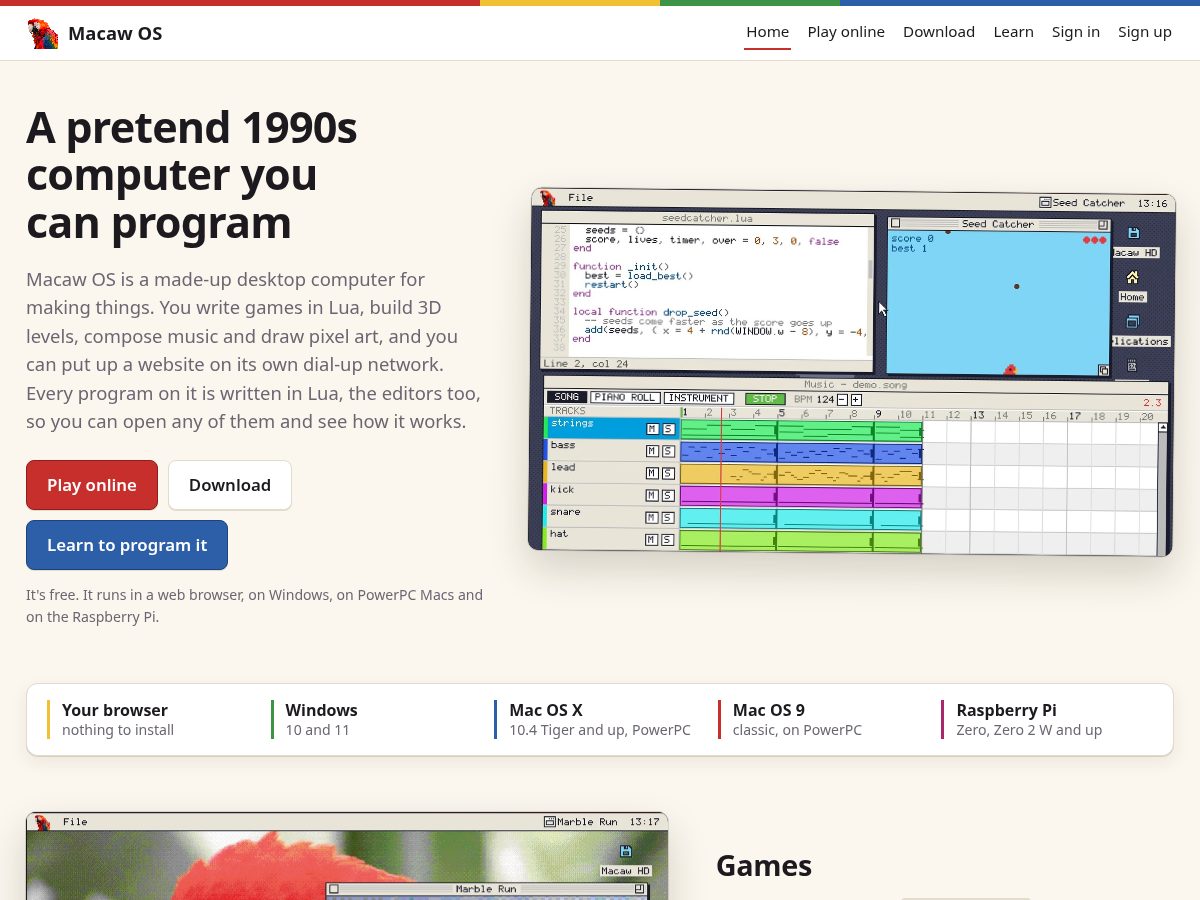
Macaw OS is a programmable retro-style desktop for making Lua games, 3D levels, music, pixel art, and websites.
Civic & Public Life
iamtheproper.com
A text-based guide to Tudjarian v. Amazon, linking the dispute’s court filings through questions, side-by-side arguments, and a docket-order archive.
Weird Finds
rentagoon.com
A late-’90s-style site presenting a Tri-State debt-and-property recovery service, with rates, coupons, a guestbook, and an estimate machine.
Weird Finds
1249melba.com
A couple tracks their Encinitas remodel with an interactive house model, progress updates, and a timeline of shifting move-in forecasts.
Useful Tools
busatoguitar.com
A searchable photographic catalogue of guitars from Bortolo Busato’s Paris workshop, with identification guides, listings, and recorded price history.
Learning & Exams
handreefandsteer.com
An unofficial, free companion to the Aubrey–Maturin and Hornblower novels, with seamanship guides, a ship explorer, and voyage maps.
Civic & Public Life
trailsunanswered.com
A source-led guide to people reported missing while hiking, camping, or traveling outdoors in Washington, Oregon, Idaho, and Arizona, with case profiles and trip-planning tools.
Civic & Public Life
bamilekegenocide.org
A sourced, sectioned history of the Cameroon war from 1955 to 1971, including its colonial and post-independence phases and the violence against Bamiléké civilians.
Useful Tools
us-tin.org
A free recycling guide app pairs short lessons with an item lookup, nearby drop-off search, photo recognition, and quizzes.
Civic & Public Life
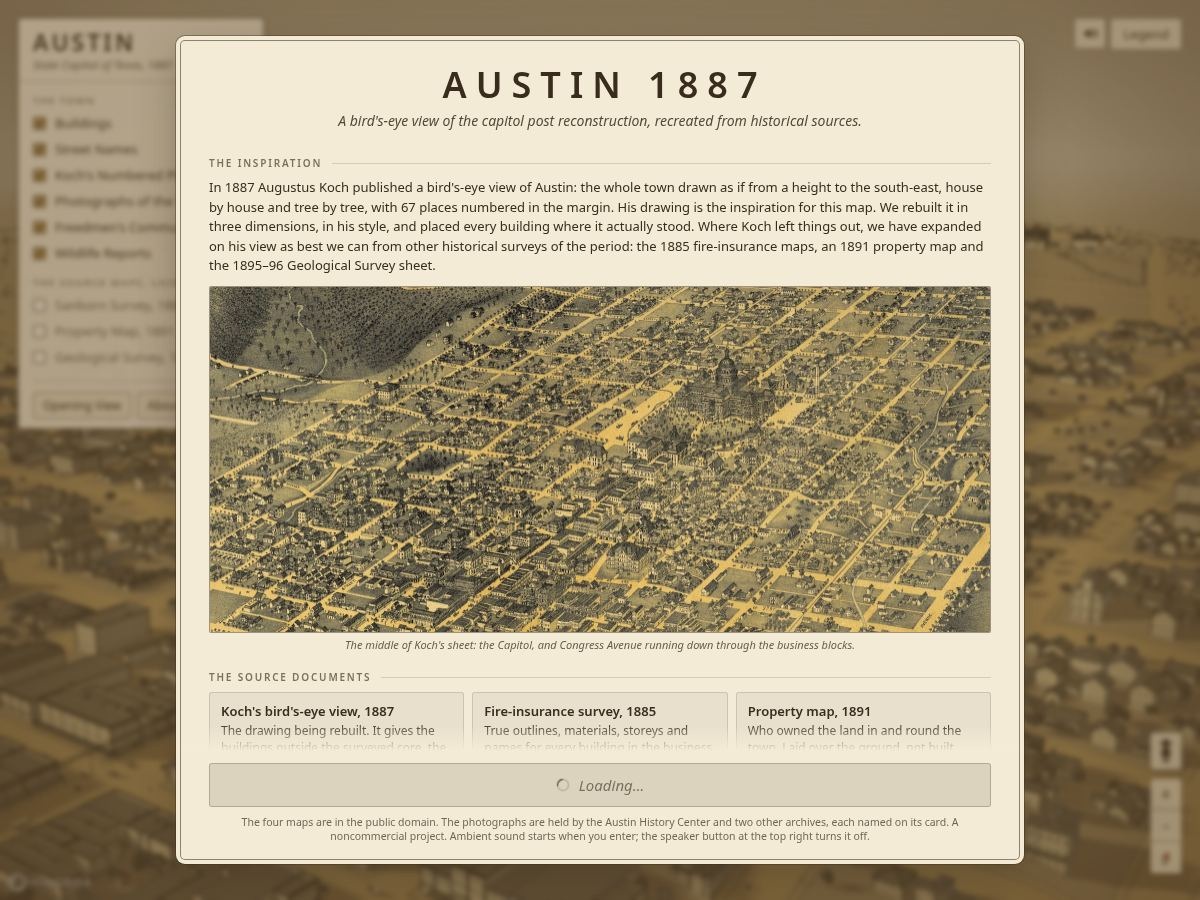
austin1887.com
An interactive map reconstructs Austin from Augustus Koch’s 1887 bird’s-eye view and historical surveys.
Civic & Public Life
whipit.org
A free, downloadable vote-counting board for state legislative staff, with member positions, vote thresholds, and call lists stored locally.
Weird Finds
woodgrainarcade.com
A collection of twelve original games, playable in a browser or on Android, built around the limits of an early-’80s home console.
Weird Finds
milkywaylocal.com
A browser-based 3D game where you take a train between stations built around real nearby stars, meeting imagined inhabitants along the way.
Content & Blogs
eyewitless.com
A GTA VI parody newsroom files deadpan local reports from Leonida, with recurring anchor Chet Marlin and a slate of mock news shows.
Civic & Public Life
safer7s.org
A Phoenix street-safety project compares crash rates on 7th Street and 7th Avenue during reversible-lane hours with the same streets at other times and with nearby roads without reverse lanes.
Civic & Public Life
tamu.one
TAMU gathers history, language, culture, homeland, and diaspora material about the Gurung (Tamu) people.
Civic & Public Life
carrydreams.live
The nonprofit project prints drawings by children in remote Azerbaijani villages on long-haul truck trailers, with QR codes linking roadside viewers to the young artists and ways to support their schools.
Content & Blogs
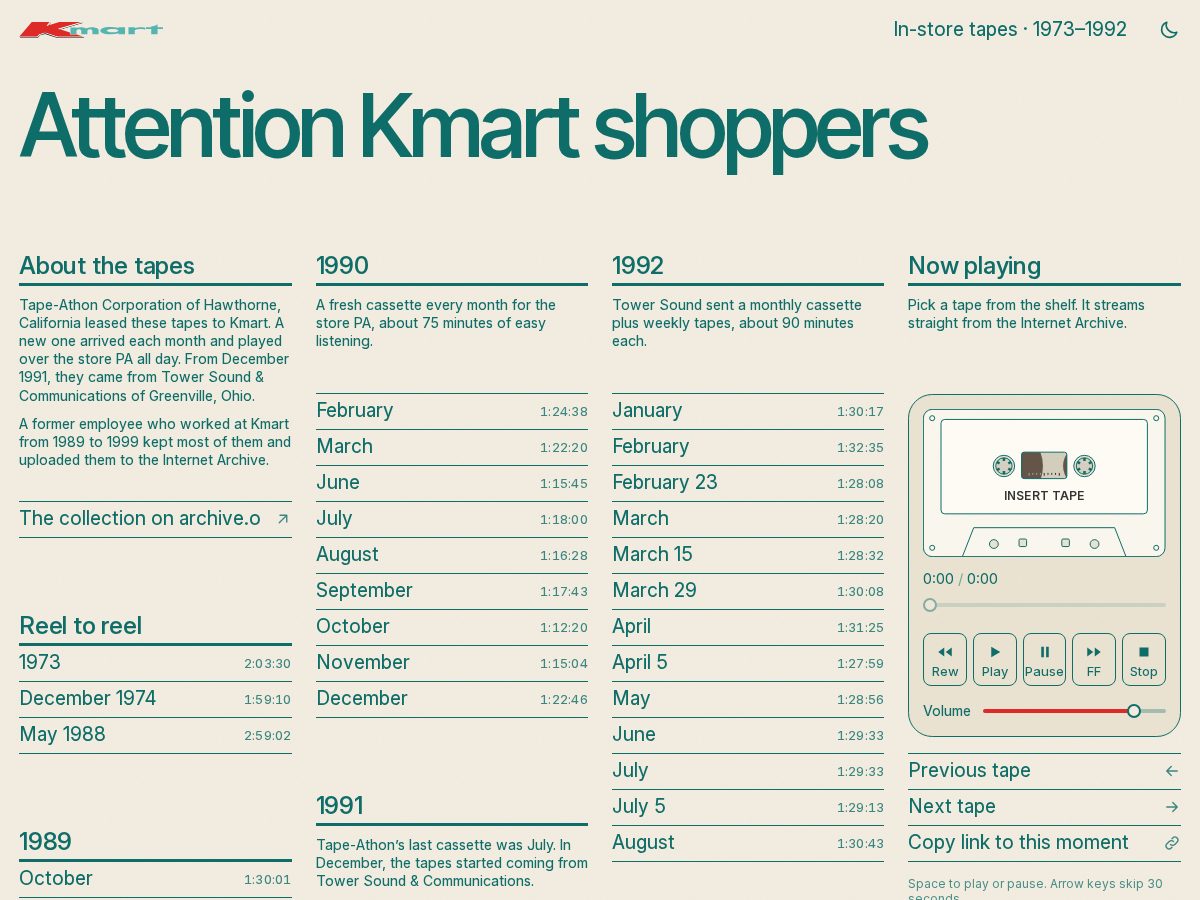
attentionshoppers.net
A fan-made archive lets visitors listen to Kmart in-store music tapes from 1973 to 1992.
Pattern 01
Several projects make the evidence inspectable—and mark the gap between a record, an estimate, and a conclusion. Useful restraint, especially when the subject is serious.
A sourced directory of detention facilities, communications vendors, call rates, contracts, and release-date reports, with an FCC rate calculator.
An interactive map reconstructs Austin from Augustus Koch’s 1887 bird’s-eye view and historical surveys.
A Phoenix street-safety project compares crash rates on 7th Street and 7th Avenue during reversible-lane hours with the same streets at other times and with nearby roads without reverse lanes.
An investigation of the Enron email archive presents findings about who discussed secret partnerships, when employee morale shifted, and what the executives wrote.
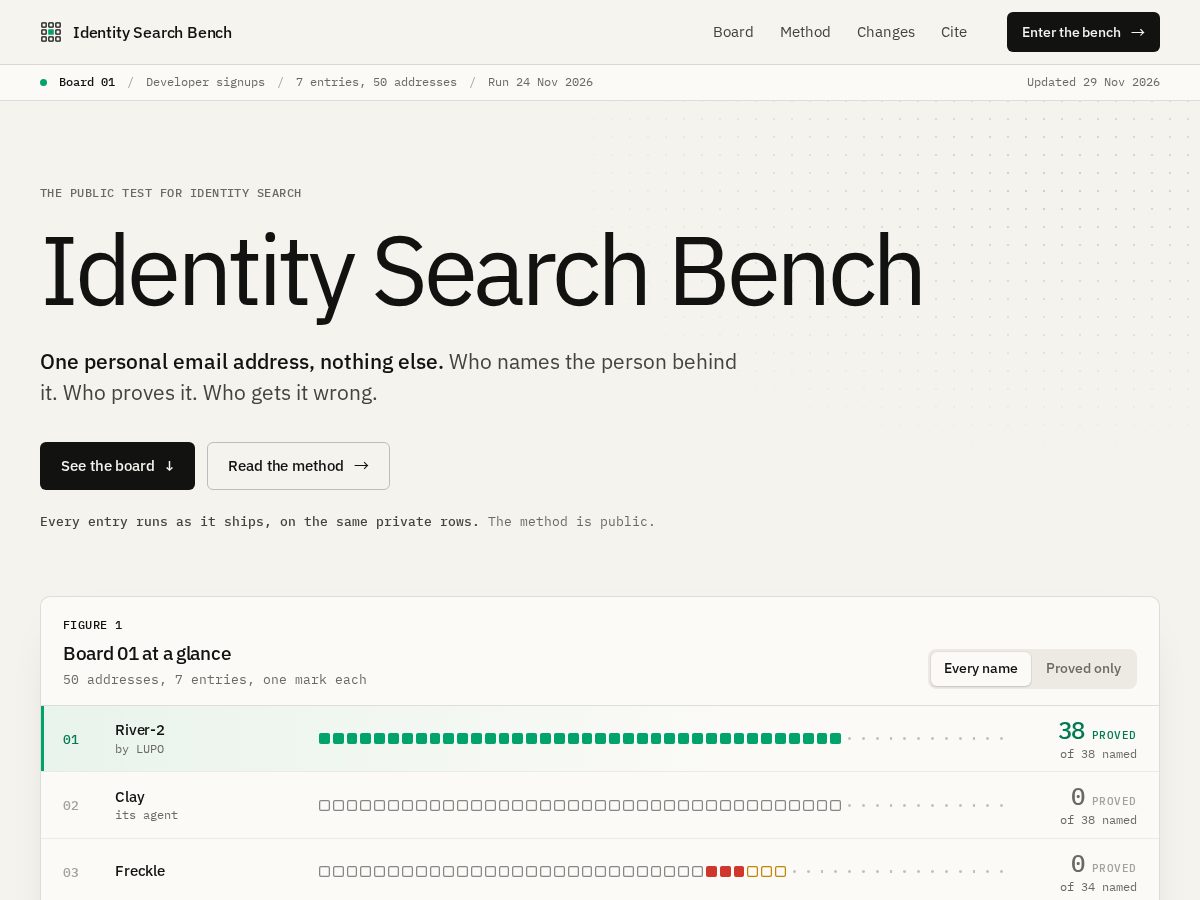
A public benchmark tests identity-search entries using only personal email addresses, then sorts their results by proof, errors, and unanswered rows.
Pattern 02
These catalogues turn scattered traces into searchable collections: land patents, guitars, retail tapes, even a migration story that keeps family memory distinct from documentation.
An atlas of San Bernardino County’s jackrabbit homesteads, with a map, surname search, place index, and history of the five-acre land patents.
A searchable photographic catalogue of guitars from Bortolo Busato’s Paris workshop, with identification guides, listings, and recorded price history.
An open registry catalogs instruments from Jacques and Jean-Pierre Favino’s Paris workshops, alongside photographs, model research, listings and price observations.
A fan-made archive lets visitors listen to Kmart in-store music tapes from 1973 to 1992.
A family history site traces the Sookdeo and Maraj family from India to Guyana and across the world, with a journey timeline and an explorable family tree.
Pattern 03
Some sites meet people at the point where ordinary systems become difficult: speaking, navigating a hospital, finding care, or getting essential paperwork to fit.
This browser-based AAC tool lets children who speak little or not at all choose a person and picture, then hear a complete sentence.
A paid, English-speaking accompaniment service for visitors navigating Shanghai public hospitals, from appointments and interpretation to paperwork and treatment decisions.
A Central California nonprofit says it provides free clothing to children in foster care and families navigating hardship.
MamémoirIA describes a home screen for people with memory difficulties, with daily reminders and spoken answers managed by family members from a phone.
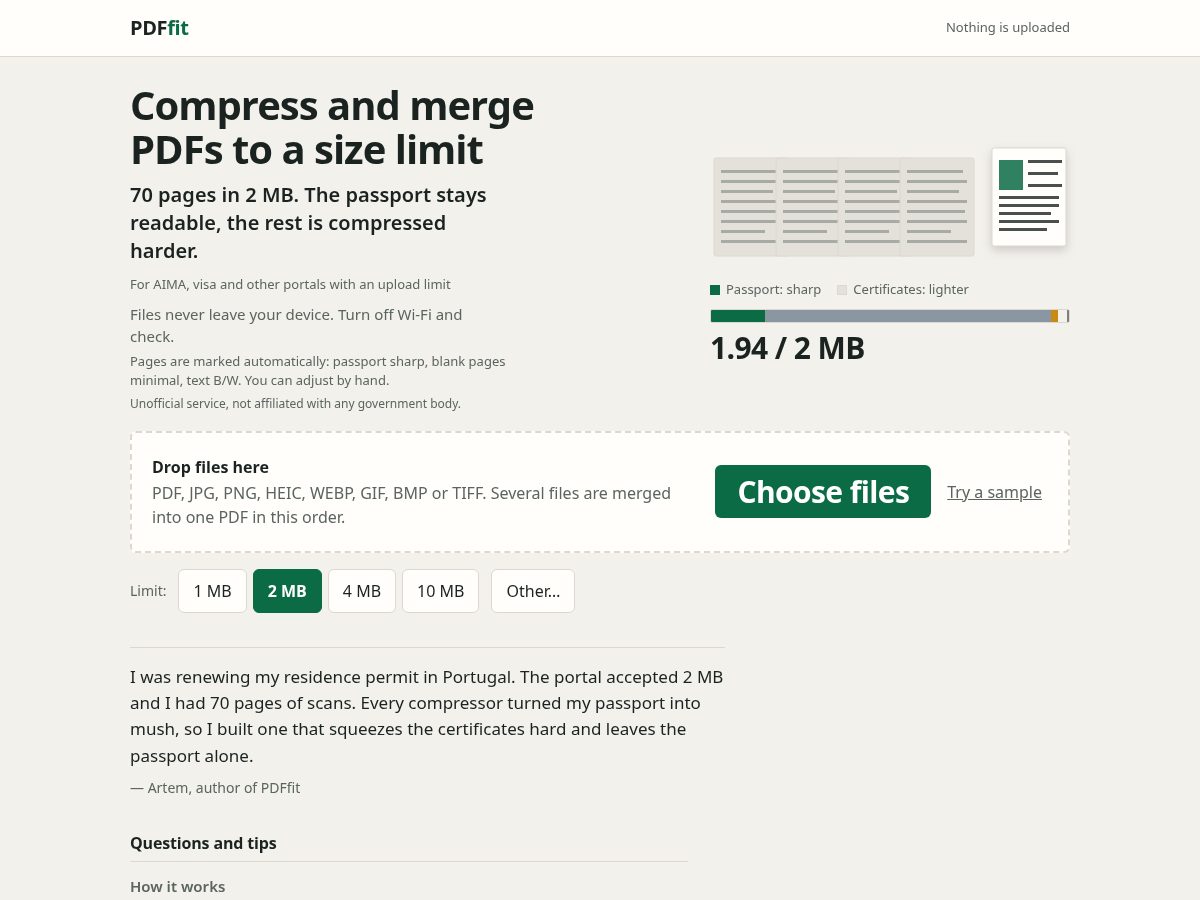
PDFfit compresses and merges PDFs and photos to fit strict file-size limits, processing documents in the browser.
Pattern 04
Instead of stopping at explanation, these projects let visitors handle the model: explore a ship, trace a chip’s supply chain, catch a wave, or test how a mill behaves.
An unofficial, free companion to the Aubrey–Maturin and Hornblower novels, with seamanship guides, a ship explorer, and voyage maps.
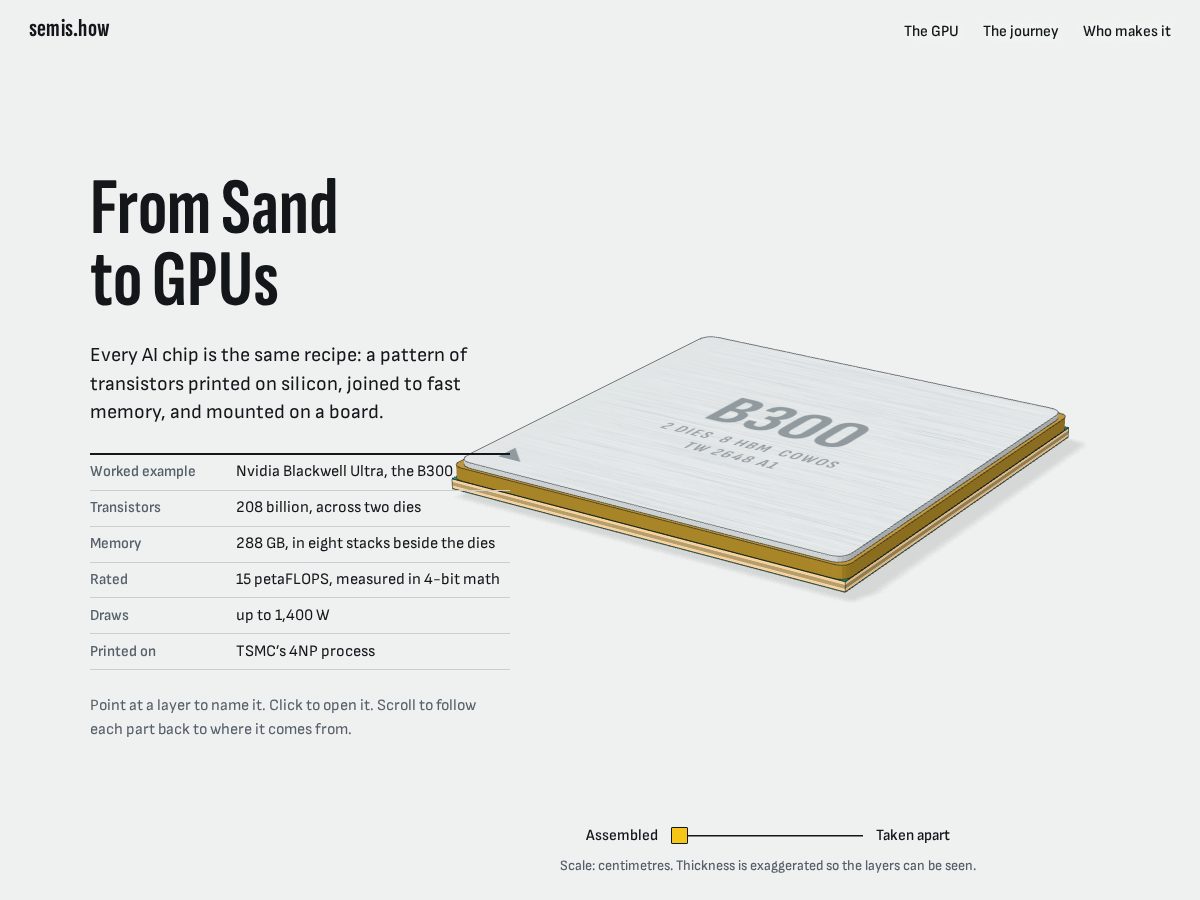
An interactive explainer takes an Nvidia AI GPU apart in 3D, then traces its components through semiconductor manufacturing and on toward the data center.
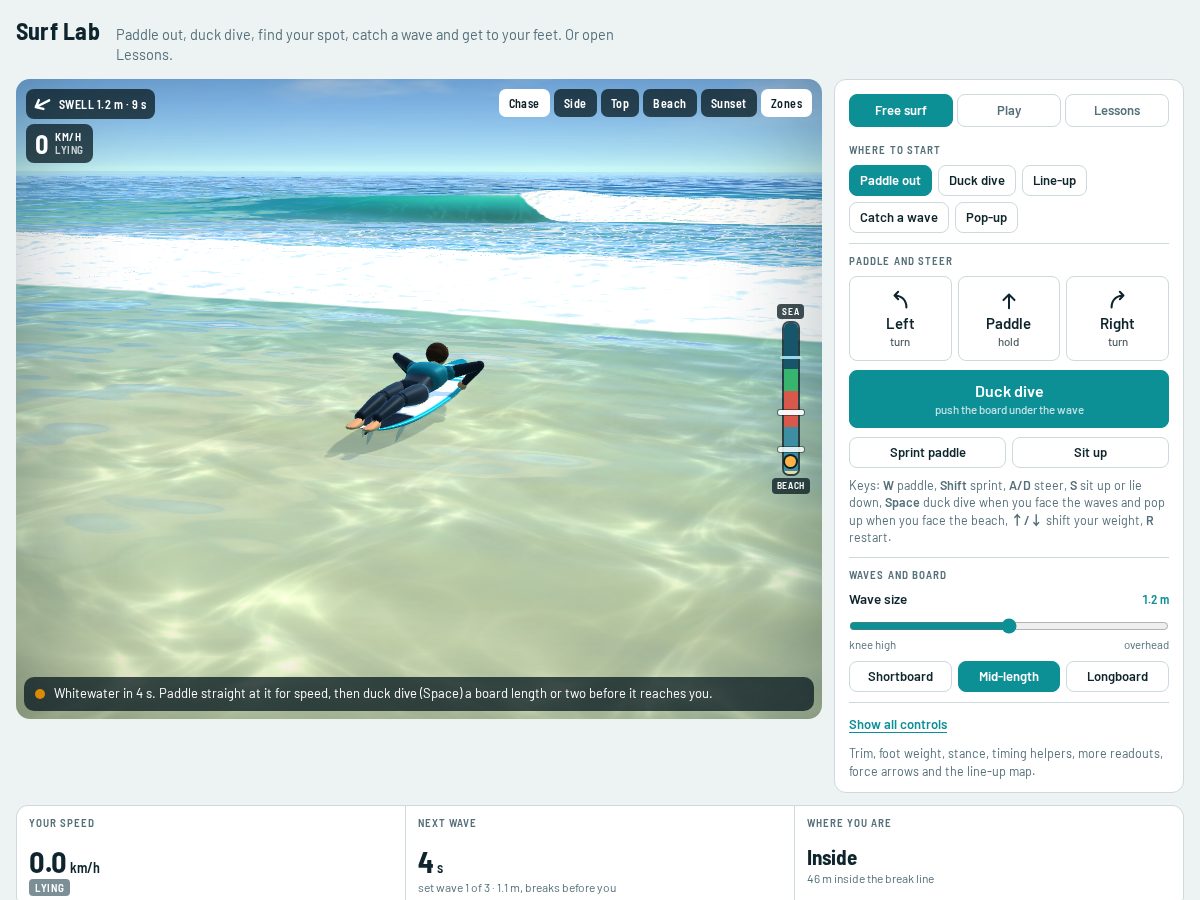
An interactive 3D surfing simulator pairs step-by-step lessons with controls for paddling, duck-diving, positioning, catching a wave, and standing up.
A browser-based collection of systems simulations, sports games, puzzles, and tennis tools.
An interactive model lets visitors explore the New Yamuna Bridge and nearby river landmarks, changing the time, lighting, and projection effects.
Pattern 05
The strangest premises here are given rules, interfaces, and enough detail to become places you can actually visit—whether that means dial-up in a pretend computer or a theology organized around a cat.
Macaw OS is a programmable retro-style desktop for making Lua games, 3D levels, music, pixel art, and websites.
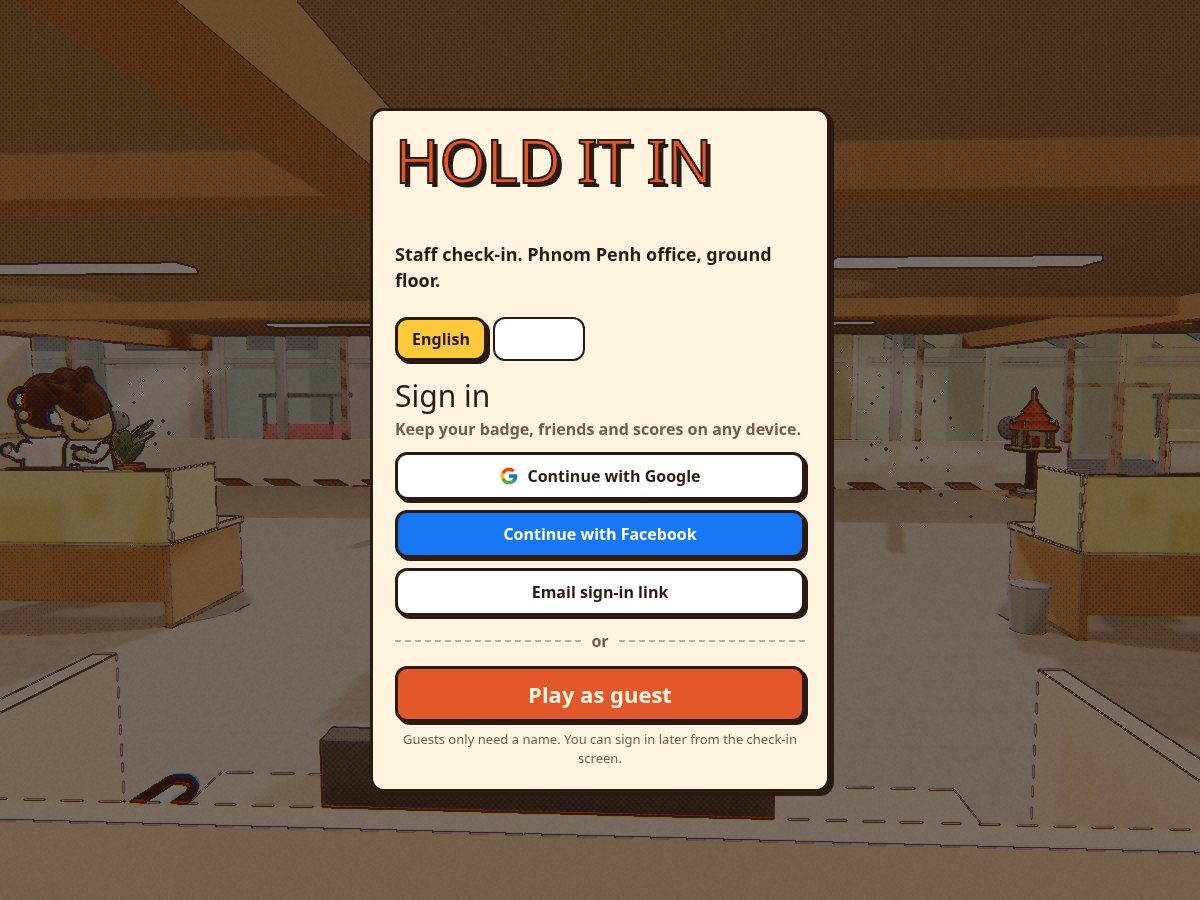
A third-person social-stealth comedy set in a Phnom Penh office, where players try to blend in while racing to one of a few toilets.
The Church of Amy presents a playful belief system centered on a grey tabby, with a covenant, cat-themed sayings, and free membership.
A collection of twelve original games, playable in a browser or on Android, built around the limits of an early-’80s home console.
A browser-based 3D game where you take a train between stations built around real nearby stars, meeting imagined inhabitants along the way.
04
The complete card catalogue
The leading shelf is open. Expand another category, scan its visible pages, then reveal detail where more context is useful.
982 cards visible
The guestbook’s Sal keeps posting “the thing,” while Ray’s rate card says he won’t recover dogs because he loves them. The page explains its missing phone number and address only as: “For certain reasons.”
A familiar private frustration—renovation optimism—becomes a public, playable timeline. The owners pair permit-based progress tracking with a mock real-estate listing for a house with “0 bed · 0 bath · 1 foundation (half),” then make clear it is not actually for sale.
The project turns technical limits—128 colours, two sound voices and one button—into a design brief for a whole shelf of games. It even leaves the testimonials section empty rather than inventing player praise.
Each day’s ticket assigns you a fictional traveler, described as generated from real statistics, to play as. The stars and planets follow observed astronomy; the people who live there—including a rock-dwelling species that speaks once a year—are invented.
The game tracks pressure, suspicion, and sleepiness as coworkers interrupt with boss questions, cigarette requests, and lobby orders. The Khmer title sits alongside the English one; the office is specifically in Phnom Penh.
The site makes affection for a cat into shared mythology, then pairs the joke with an explicit welcome to every faith and none. Its theology includes a “Mystery of the Grey” and a prophecy about turkey.
The block’s residents trade remarks about vacant units, skate spots, cardigans, and croquettes, while Reggie says: “What you do on the way there is your business.” It reads like a tiny neighborhood you can poke around in, not a conventional directory.
The flat compositions use circular arcs only; when forms rise, straight lines appear just at their vertical edges. The page explains the geometry in detail, then places it alongside references ranging from kolam to Gaudí and SANAA.
The game makes voters out of bugs and gives its canvassers a “constituent rifle.” Between crumbling buildings and “orbital rebuttals,” the election satire is built into the mission, the weapons, and the field instructions.
Choose wrong and you return to the waiting room—but the building rearranges itself, so memorizing the route won’t work. A voiced narrator can offer hints, and the page lists thoughtful options for subtitles, colour cues, and reduced flashing.
The free demo supports up to four players, who can team up or turn on each other while hurling slippers, teapots and—if they coordinate—a piano. It’s a sharply specific apocalypse with a village fête in the way.
Its job sheets give the fantasy a wonderfully specific paper trail: one order names a 2025 Marchetti Ombra GT, six missed payments, and an owner asleep upstairs. The page describes 100 jobs, with six new orders posted each night.
Its archive follows an ice-making computer from an abandoned Oklahoma lighthouse to autonomous islands. The company’s answer to reheating leftovers is a heat permit.
Its dashboard reports zero features shipped and “99.9%” delivery confidence, while noting that the evidence is forthcoming. The joke keeps finding new places to land, including a “SOC-Soon Type II” audit that is merely scheduled.
The site says its rankings, daggers and dialogues are made up, while the incidents are real and linked. Its only perfect score goes to a rock.
Its creation story declares, “And the Great Borgir spoke: Let there be cheese.” Even the cucumber gets a role: removed from the burger, it becomes the order’s martyr.
The wheel claims 88 real gifts, each checked by hand, and makes a game of discovering things nobody asked for. Prices are withheld; the site sends interested spinners to the retailer and discloses that some links may earn a commission.
The $15 print-on-demand CD pairs the show’s songs with karaoke versions, while the site links free sheet music and a piano arrangement for “My Shot.” Alongside the musical, it points to a claimed record of the Carnival ban and a separate crew-focused project.
The History Wall traces 44 moments from 1930 to 2018, links its sources, and says when those sources disagree. Elsewhere, shelves open into tracks, travel episodes and films—some still in the edit.
The report turns a live-looking operations dashboard into a story: it counts 425 human receivers and says they still hold 18% of the sky. When people hold a sector, it is removed from Overveil’s cloud coverage.
For November 30, 2026, the site estimates about a 1-in-28,000 chance of takeover, then notes: “Humanity retains admin rights. Nobody remembers who set up the account.” The research framing and deadpan aside make an unusually good pairing.
The bad trip is a playable system: as its meter rises, colors warp, false aliens appear, and a full meter briefly reverses the controls. Comic chapters introduce the bosses, while the page offers browser play alongside downloads for several platforms.
The opening sets the record in a carefully staged world of poolside daiquiris, shipping manifests, and money no one asks about. Ten tracks, lyrics, and media links carry the conceit well beyond a passing mood board.
Each legend gets a different job: guide players by a ghost’s cry, flee through a coffee grove, or play the forest spirit defending the woods. The 3D beta Guaqueros: Oro Maldito adds a practical warning: its first load is about 80 MB, so the site recommends Wi-Fi.
The homepage describes a world with no sprites: trees, monsters, swords and seas all appear as glyphs from the world’s scripts. It pairs that visual premise with a detailed MMO loop of hunting, gathering, leveling and playing with friends.
The parish noticeboard links freezer folklore to a displayed temperature reading and a Thaw Watch, while the news desk files dispatches from island, continental, and flight beats. Its update form even offers a request for one AI-voiced call from a servant of Frosty.
The booth offers approve, deny, search, and inspect controls, while the surrounding airport has its own clickable activity—including patrol officers, planes, taxis, and a beagle. Its rendering notes explain how the scene gets its tiny-pixel, limited-palette look.
The map is starting from zero: the page says no Ducs have checked in yet and invites yours to be the first pin. The figures are sold in person at one named Nashville shop, while the map shows cities rather than exact locations.
The clock cannot be sped up: it begins 71 million years ago, and the page says a year from 1800 takes about ten hours. Major events are announced 30 days ahead.
The artwork hides the recognizable portrait but keeps a route back to it: a capture-time code, an NFC-linked seal, and a password. Its guiding idea is that a precious image can be preserved without being publicly exposed.
A Uirapuru call is read at once as natural sound, geometry, musical culture, and physical signal. Elsewhere, the line of an iron truss becomes a melody.
The crew shares one stock of charge: spend it on live cables, traps, or lightning fences, and the rising hum alerts the enemy. The site backs that premise with a detailed contract board, four roles, and five named city sites.
The creator calls it “not a game” but a place to relax and experience the painting. Visitors can enter with keyboard-and-mouse controls or use on-screen controls on a phone or tablet.
Its weapon list includes a pistol in a hat and a sniper rifle that needs head pats; the arenas range from a milkshake factory to a freshly painted maze. The site has enough detail to make the mayhem legible, while still wearing its “Work in progress!” sign plainly.
The site labels its 64% audit figure as invented, then pivots from fictional honeytraps to evening plans involving escape rooms, case files, and dead drops in your kitchen.
The page already offers short recordings of Big Ben, Notre-Dame’s Emmanuel, and Chōmei-ji in Japan. The monthly calls are still at the launch-list stage, which makes this an unusually specific project worth checking back on.
The menu jumps from identifying whales to a satirical “Ragebait-Fabrik” for building—and recognizing—the tricks behind an angry post. One paper-folding challenge even comes with a Happy Hardcore beat.
The sample tenants include an ex, a reply-all enthusiast, and “the guy who cut you off in 2017.” Its rental tiers come with an explicit disclaimer: the prices are jokes, and no payment is collected.
Its ten guidelines include “Don’t kill anything by taking it seriously” and a warning not to laugh at Bernie, Yoowho, or Kuku. Beneath the clowning, it even cautions that disorder without compassion is “just more of the same shit.”
The homepage promises 20 ridiculous problems a day, a raccoon deputy named Randy, and more than 100 endings—including being out-voted by a sandwich. Its civic machinery is cheerfully doomed, but described with enough concrete rules to make the premise legible.
The fake dossier opens with ominous redactions, then reveals its “findings”: a Roman V in COLISEVM, suspicious competence, and free hot cocoa. The page eventually admits it is a harmless joke—and thanks Marty for the show.
The site’s central hook is persistence: return to find a report of what happened during your guard’s ongoing shift. Convoys can turn into breach events, and your faction shapes what you do next.
Its rival teams are tied to Granada neighborhoods—Realejo, Sacromonte, and Zaidín—and the rules add grenades, power-ups, and a bull that can cut a tail. A distinctly local setting for a chaotic little survival game.
The first case gives you eight minutes to solve a 5×5 people puzzle. Goodoku then turns the game’s premise into a real-world nudge: notice someone who may be overlooked, and reach out.
The cat’s day follows its city’s real clock, not yours; the page even imagines its diary arriving at 8 a.m. local time. It also makes a point of having no streaks, tasks, or gacha.
Lunastamp gives slow correspondence a lunar timetable: letters are sealed in the browser, held until the full moon, and described as arriving then. The page also plainly warns that a forgotten password can make them unrecoverable.
The site describes 18 worlds with their own physics, destructible terrain and hazards including rising lava. Players aim, fire and dodge simultaneously—no waiting for a turn.
The site gives chess moves a social afterlife: capturing pieces can trigger rests, loyalty bonuses, or revenge turns. Its tables are presented as rooms that keep their chat and history between games—a small alternative to the disposable online lobby.
Its marquee separates three shows marked “Now Playing” from two still in development, with pointed song premises ranging from a sandwich-king ship operator to retrievers holding officer stripes. The page also lays out a writing-to-YouTube pipeline and identifies these as Richard Shillington’s productions, not as productions by the cruise lines.
It makes the usually invisible craft of writing a good trivia question the main event: answers earn more when a specific, verifiable detail rules out alternatives. The page shows how “Which planet has rings?” scores below a clue about Titan orbiting Saturn.
The page separates posts labeled ✅ real from 🎲 generated filler, then undercuts its own forum premise: it says everything is made up and that posts stay in your browser, where nobody will see them. The site’s own disclaimer is part of the joke.
The game introduces itself with a battered bike and a saucepan helmet, then gives you practical trail-by-trail advice: brake before the mud, or pick your landing before the rock ledge. Its controls are simple; the race descriptions are not.
The site gives the bluff a rulebook: scores are split across Nerve, Knowledge, Shape, and Spark, with feedback such as “Knew the loan. Lost the interest.” It also lays out formats from absurd sales pitches to party rounds where the room votes.
The rules make every wrong tap cost five seconds, while giving up reveals the target and adds a minute. The raccoon, by contrast, never costs you time.
Its framework rests on six named theories and three propositions, including “Adoration is Physics.” The page makes the ambition unusually explicit: one hundred core isomorphs across one hundred fields, with linked materials meant to show the system in operation.
The sample flight slip gives Biscuit a London–Calais route, numbered legs, wind, drizzle, and an estimated arrival time. The site is inviting beta signups, so this is a detailed preview rather than a game shown as openly playable.
The camp setting comes with tactical choices: sneak or sprint, break jailed teammates out, and decide whether flags carry lanterns at night. The page calls this a prototype; sign-in and payments are not connected, and games are currently saved on the phone.
The page credits Tal Oz and describes seven original jellyfish; its controls expose light, size, swim speed, resolution, and reset. That clear maker attribution gives this small digital habitat a traceable provenance.
The rules give the game a sharp, unusual tension: a winning edge-to-edge path needs at least two face-up 1s, while losing three of your 6s ends the game. The page offers play against AI, a friend, or someone in a public lobby.
The game’s pitch moves from commanding armies on real-world geography to taking control of a squad yourself. It spans eight fictionalized eras, while keeping today’s borders.
The game pairs that unusual flight mechanic with a same-course race: your opponent appears as a ghost glider, and the higher score wins. Its interface also offers quick-match and room-hosting options, though the extracted page shows those features connecting rather than confirmed in use.
One thread treats a missing sunbeam as an overdue household loan, complete with a day-seven wig log and a character keeping the house record. The result feels like a small, ongoing fiction built from very serious domestic disputes.
Its sample archive lock asks for a five-letter word containing an E, using each tile at most once. The page reveals SHEET as one answer, then notes that TEENS opens the same lock too.
Its rules turn dice rolls into a tactical resource system: faces can summon creatures, fund movement and attacks, or provide protection. Each creature’s die also gets a randomly chosen unfold shape, adding a peculiar bit of board geometry to the duel.
The page pairs a five-stage directional-audio explanation with a demo that compares focused waves against ordinary sound. Its pollination claims are presented, but the supplied page evidence includes no field-trial results.
The project turns a sprawling football pyramid into something playable: five added divisions span 188 groups and more than 2,000 teams. Its progress tracker also shows where the real-world detail is still catching up.
It turns a specific piece of infrastructure into an explorable scene, with enough engineering detail to show its workings. The page is careful to distinguish a projection-mapping study from an installed system—a small but important line between visualization and reality.
Its Mill Pass game asks players to balance draft and tension while rolling coils to gauge. The site describes the mill as made up, but says the rolling physics are real—and gives a target slip range of 4% to 16%.
Its collection loop has actual rules: duplicates become Void Shards, a special pack guarantees a Holo, and a daily pull upgrades Common cards. The game says it needs no account and saves your collection in the browser.
Its ride has local texture: collect passengers, dodge taxis and trucks, evade police, and grab a boost from a kpayo stand. The page says it can be installed without an app store and played offline.
Choose a starter tractor, take jobs on the neighborhood street, and earn money toward more machines. The game also models attachment choices and upkeep—including a snowblower’s shear pin—and its Allis-Chalmers B-112 is based on the owners’ real tractor.
Lobduel pairs a readable physical puzzle—angle, power, and changing wind—with tactical squad play. Its rules stress that both sides share the same unit stats and mirrored starting ground, putting the emphasis on reading the shot rather than building a stronger account.
It treats a small ecosystem like a beat worth keeping: the page marks its figures as recently checked and includes dead lists. Its forecast extrapolates from 14 launches in 333 days—and admits the result is about as accurate as a weather forecast.
The game turns 2,890 kilometres of real geological depth into a 1,550-metre descent—and makes each layer behave differently, from flowing sand to drill-and-blast granite.
The Octopath Traveler II listing describes 29,000+ Thai voice lines—15,000+ more than the original voiced lines—and offers separate voice and text packages. This is substantial, carefully itemized fan work, not just a translation patch.
Its small mystery is built into a larger schedule: one choice each week, then a monthly report card for friends, stories, mood, and money. The page also promises no energy timers, gacha, or paywalled story.
The daily limit falls from 24 words on December 1 to exactly one on Christmas Eve. Other calendars count syllables or prime-numbered letters instead.
The page maps jobs, motor-park routes, festivals, and fares across named Nigerian cities. Even the expressway comes with potholes and danfos that overtake you.
The page describes rooms for 2–12 players, with individual or team scoring and a TV-display mode. Its central trick is nicely concrete: earn points for the right answer—and for fooling your friends.
The pitch makes diplomacy the main control surface: propose a trade, alliance, or ceasefire by chat, while AI leaders are said to remember what you tell them. Seasons last seven days, with military, economic, and diplomatic routes to victory.
The victim is missing from the clues and has to be found by elimination; Sunday’s puzzle grows to a 7 × 7 grid.
It makes local identity part of the game’s scenery: storefronts, familiar landmarks, and even named Pottstown businesses appear in the experience. A neighborhood becomes both the obstacle course and the sponsor board.
The daily route is “the same street for everyone today,” and runs feed Today, All time, and group boards. When lives run out, the game asks whether “a cutting chai” will buy one more.
The page pairs daily lap times with ghosts and replay footage. Its upcoming-track panel also lets a visitor test, approve, or swap the next circuit.
The thread-clearing puzzle doubles as a travel-and-cooking game: earned baskets help unlock the next country, and the page offers a playable demo without an install.
The pitch makes utility bills and workplace routines core mechanics, alongside an unexplained force in the city. Its stated scale includes 4,000-plus simultaneously simulated residents and 31 scheduled buses.
Its bosses telegraph their next move 2.5 seconds ahead. You can spend one of three powers to stop the attack—or let the road decide.
Its preservation instinct is unusually concrete: completed Home and Hangout edits save on your PC. The site also asks former Kaneva players to keep old installation folders because they may contain assets still being sought.
The motion in each tile is a clue: move the clips back into place and the full video plays when the last tile slides home. The page includes a playable 3×3 demo, with taps, swipes, or computer arrow keys to move tiles.
The scoring has a neat twist: each valid contact earns points by distance, then the total is multiplied by the number of different grid squares worked. Entrants can upload one log for both stages and, after judging, download a certificate.
The career begins in one of 211 FIFA countries and unfolds through decisions delivered as letters. In about 20 minutes, players can reach one of nine endings, negotiate contracts, and even build toward owning a club.
The field builder lays out paintball obstacles on a grid and mirrors them across the 50; players can then name a field, try it against bots, or host it in the lobby. The page also outlines a 20-team local tournament format.
The daily challenge gives players around the world the same materials, wind, and starting supply, then ranks their builds. Random-city rounds add local time and current weather—a small game organized around competing under shared conditions.
In Plus Minus, every number you take from your rival’s row or column determines what they get next. That’s a tidy little twist in a catalog that also includes Turkish draughts and six-player Chinese checkers.
The career is built for a quick session—three to five minutes—with six playing roles, auction decisions, and mini-games at key moments. A shared Daily Career gives everyone the same player to play, in English, Hindi, or Spanish.
The career path includes choices about military service, overseas play, free agency, position changes, and trades. It also lets players fast-forward to retirement, with an early-use tradeoff: skip before age 30 and you lose achievement and dice rewards.
A carved door knocker or odd sign becomes a playable landmark: finders check in with a matching photo, and the first one gets the bounty. Its rules also draw clear lines around public places, personal privacy, and unsafe locations.
The rule is wonderfully unforgiving: everyone shares one rope, so one fall brings the whole party down. The page lists hammers, cannons, bounce pads, and same-keyboard play; online mode is marked “SOON” in the menu.
The control scheme is the hook: flick a hand for tennis topspin, pinch to fire at clay pigeons, or prop a phone up to play on a TV. It’s a focused, unusually tangible take on controller-free play.
The pitch pairs hands-on truck controls with contracts, timed routes, and company management—a remarkably specific premise for a career simulator. The page says it is planned for Meta Quest and PC in 2027, with co-op for up to four players.
The puzzle asks players to follow a year of sun, place panels, and wire them within an inverter’s limits. Its rooftop models are attributed to the cities’ open 3D data, giving the game a traceable real-world setting.
Its scoring splits each round between geographic accuracy and price accuracy, with up to 10,000 points at stake. That gives rooflines, masonry, gardens, and interior finishes an unexpectedly competitive job.
The atlas makes a sprawling desert land rush legible tract by tract: follow a patent onto the survey grid, search the names attached to it, and see how the pattern spread across 27 places.
Busato instruments have no serial numbers, so the registry assigns its own identifiers and matches guitars through photographs or dealer pages. It says 364 gypsy-jazz guitars are documented, while carefully calling completeness an aim—not a claim.
A coffee cup gets taken apart into lid, sleeve, and lined cup, each with its own bin and explanation. The site also publishes a candid photo-recognition postmortem: its first version got about one guess in eighteen right.
It goes well beyond a standard sunrise page: the site describes seeing when St. John’s hills let sunlight reach a chosen spot, and maps everyday winds alongside 198 storms since 1851. The handmade, no-account approach gives this island guide a distinct sense of place.
Before pressing play, viewers can search a title, keep scene details closed, and open evidence when they choose. The guide separates survival from injury, danger, abandonment, and distress sounds—and treats an unreviewed outcome as unknown, not reassurance.
Its boards cover 122 everyday settings, from breakfast to school and public transit. The homepage says families can use them free, without email or ads.
The calculator asks who is inheriting and how many sons and daughters there are; the commentary explains the firstborn’s double share with a dry “Call your mother” nearby. It’s a tightly focused subject handled with both practical structure and a welcome sense of humor.
Its author says a Portugal residence-permit upload prompted the tool: 70 scanned pages had to fit under 2 MB without turning the passport to mush. PDFfit says it compresses ordinary pages harder, keeps important pages sharper, and works with the internet off.
Its split view shows the real mod file changing line by line as you build. Each of the six steps pairs an action with an explanation of what the game will read.
Its first-48-hours checklist gives families a practical starting point, while the binder’s clearest design choice is what it leaves out: no passwords, PINs, or seed phrases.
The homepage reports 3,004 sourced values across 161 games, and says when it has found no source. A Spider-Man 2 example separates rendered 1440p from PSSR2-upscaled 4K, with Digital Foundry cited.
The page lists 474 activities and describes a useful feedback loop: in waiting games, waits lengthen after success and shorten after difficulty. It says the activities avoid scores a child can lose, and some use a device camera to make movement part of the task.
Studs Out connects regional building choices—from homes cut into Kerala’s ground to framing designed for earthquakes in Japan—with tools for locating studs and pipes, estimating materials, and checking a builder’s quote. The site says its video facts are checked against two sources and warns that its guidance is general, with licensed professionals needed for high-risk repairs.
Pitch is set in hertz, and the same equation curves shape the lights. The page is careful to label its DNA sonification as a chosen mapping, not biology.
TypeDuo lets users type Chinese with pinyin or Wubi, then choose Japanese for a whole sentence or just one word. The site documents concrete examples and a substantial developing dictionary; its downloadable apps are still preview builds.
It puts practical anxieties—whether you can graduate on time, what an extension costs, and whether you can get home mid-course—ahead of softer perks like meals or hot springs. The creator says the comparison draws on school information, application-site details, reviews, and maps, and marks unconfirmed answers rather than quietly smoothing them over.
The offer is unusually concrete: no account, watermark, ads, or AI credits. Its maker, Rafa Mendoza, also explains the practical snags behind unsigned downloads and the Android APK.
The page puts practical checks—solar quote specs, cold-weather string limits, and 200A panel sizing—alongside a catalog of thousands of panels, inverters, and batteries. Its calculators are described as browser-based, with no sign-up and explicit limits such as preliminary HVAC sizing rather than a formal Manual J.
The calculators promise to show their working and the official rule behind each result. The same site also explains subjects like codice fiscale codes, freelancer taxes and car tax in 14 guides.
You can play with a mouse, computer keys, or MIDI, and the page explains how to slide between notes, change playing strength, and build chords. The Mac plugin is sent by emailed serial; the creator also invites requests for instruments to add.
The setup has a useful twist: console guests share one controller’s input, while supported computer games can assign each friend a separate player. The site also describes direct, encrypted connections after a small meeting point helps players find each other.
A worked 100-foot chain-link example with a four-foot gate yields a numbered 15-post schedule and material quantities. The planner also states a useful limit: it does not choose footing depth for you.
The checks run in your browser, and the site is unusually clear about what they cannot prove. It reports that its AI scan caught about 3 in 10 AI images in a test, and warns that a missing signature proves nothing.
“Bright” is a feeling; Lux & Leaf tries to make it a measurement. The Kadıköy journal pairs lux readings from real rooms with candid advice about which plants a window cannot keep—and says it takes no nursery advertising.
One 80 × 80 portrait comparison holds the image and 16 DMC shades constant while changing stitch cleanup: the examples show 260 isolated stitches at Fine detail and 10 at Smooth. The page says the photo stays on your device.
It covers a real sequence of quilting work, from checking a cut size to planning backing and binding or laying out a sampler. The site says its estimates round up to the next ⅛ inch or ⅛ yard, and that saved quilts stay in your browser.
The conversion runs on-device, and the page exports a symbol chart as well as PNG, PDF, and thread-list files. It also explains the assumptions behind its skein estimates—useful detail before a picture becomes a shopping trip.
The tools show their assumptions and say nothing is uploaded. An interactive 115-kilometre flight trace over Renfrew, Ontario, demonstrates magnetic-navigation estimates alongside an INS-only reference.
It lets users follow a policy from its cash flows down to individual option legs, then examine results across 1,000 paths drawn from a June 2025 Academy/SOA workbook. That’s a remarkably concrete way to make specialist actuarial mechanics inspectable.
The game leaves fusion pieces labeled “Fusion Material for ???”; this finder turns that shop mystery into a recipe and a cheapest-next-piece calculation. It offers two free checks a day and identifies its data as game version 0.2.47.
The deciding step reads both sides blind and assigns them random labels; the judge adds the comic flourish only afterward. Appeals are free, and the site is clear that this is a comedy court, not legal advice.
Its model can include a nearby house, but the distinction is explicit: metal roofs are solved as wire grids; walls are reference only.
Its cut lists are described as kerf-aware and arranged around the boards and sheets you plan to buy. The site says the calculations and saved designs stay in your browser.
The sample links moments in a session log to recording timestamps and lets readers hide spoilers from people who have not played. 卓譜 treats the end of a game night not as the end of its story, but as the start of an archive the group can revisit.
The site treats fishfinder setup like a cave survey, with numbered passages, a to-scale cone diagram, and a calculator based on depth and beam angle. It also states its limits plainly: the guides draw on manufacturers’ published documents, not hands-on testing.
The directory warns when a plant is not confirmed for deer or wild game—and tells readers not to drop off a deer there.
The map distinguishes mapped cable routes from approximate sea routes, and marks routes that have not yet been matched to a named system. It also puts 516 cable systems and 1,181 landing points alongside useful lists of new, planned, and longest cables.
The page describes a single couch-operated interface spanning 18 consoles and seven arcade boards, alongside video, music, and file tools. That unusually broad, concrete scope makes this more than another generic launcher pitch.
As pins are placed against the modern map, the old sheet warps live. Yestermap also treats dates as qualified statements—not false precision—and says collections can be exported as one .catx file.
Audium pairs a concrete self-hosting setup with thoughtful boundaries: music folders are mounted read-only, and the homepage says the server works without an account or telemetry. It also documents the app connections and install path rather than leaving the promise at “your music, your server.”
Its workflow replaces waveform scrubbing with a verbatim transcript: mark mistakes, retakes, or script deviations, then assemble a timeline or export XML, FCPXML, OTIO, or EDL. The homepage says it runs locally and labels version 4.1.2 Early Access.
BlindOn describes a specific sequence: inspect page text before it renders, substitute familiar-looking fake details, and keep unhandled screens covered. Its page reports zero leaks across nine test pages and six saved service screens, while also warning that browser controls and IP-based location guesses are outside its reach.
The page describes a joined-up workflow: logic, drawings, and simulation share one project. Its distinctive promise is that generated sheets are checked against the logic combination by combination, before anyone builds the panel.
The page brings model building, train-track planning, modular terrain, and frame-by-frame animation into one proposed workspace. Its tiny demo creature, Blob, assembles itself and then follows the cursor with one eye—a playful proof of the brick-film idea.
Its seven sections run from debts and cheques to workers and bank deposits. A sample screen flags a ₪5 cash discrepancy before the cashbox is closed.
It handles WhatsApp audio and live calls through a nearby speaker, with text appearing every few seconds in the live-call mode. The page says it saves no audio and keeps past transcripts on the user’s device—a specific privacy promise for a tool built around personal voice messages.
The map can be set by chapter and paragraph, showing where characters are at that point in the story. That fine-grained approach gives the spoiler-free promise a concrete mechanism.
The page takes the risky part of using AI onstage seriously: edits stay off the live board until committed, stage mode is read-only, and the footswitch gets priority for two seconds. Its browser demo is silent, but the mic-enabled tuner is described as real.
Fresher sorts 44 file types into four risk levels, explains what each contains, and sends confirmed removals to the Trash. Unknown files stay visible in their real folders rather than vanishing into an “Other” category.
Lensy is built for text that usually cannot be copied: trigger a scan, drag over it, and get a translation on screen. The page also spells out its permissions, network access, and download-checking steps.
The page lists 74 document types across 35 state and UT portals, and spells out an important catch: removing a PDF password changes the file, so the unlocked copy cannot retain the original signature.
Draw walls or enter room dimensions, then add doors and windows for Kalpii to deduct from the calculated surfaces. The page says its plasterboard quantities follow NF DTU 25.41, while making clear that prices are indicative and quantities should be checked before buying.
A dismissal example turns a 25,000-baht monthly salary and six years of service into a line-by-line estimate, with labor-law provisions named beside the figures. The site also says calculations and document creation happen in the browser, and clearly labels its output as preliminary information—not case-specific legal advice.
Its practice town includes roundabouts, country lanes, a car park and motorway slip roads, with lessons that build from lane position to more demanding maneuvers. After each lesson, drivers get a score and an aerial replay of their mistakes.
It compares a result with 10,000 random strategies and accounts for the search that produced the winner. In an explicitly illustrative example, expected live Sharpe falls from 1.60 to 0.70, while a prop-firm pass rate drops from 58% to 31%.
The editor pairs a free preview with a $3 one-time download, and says photos stay in the browser. It also makes room for the less usual keepsakes: a sound card or a short film.
Mave Developers says it runs a cold storage of its own with CSApp. The page walks through concrete edge cases, from lots billed across seasons to gate passes that update stock, and lists a one-time licence starting at ₹45,000 plus GST.
Instead of notifying you about every change, it aims to stay quiet until the condition fits: size M returning, for instance, rather than any jacket size. It can check public pages hourly or daily and include the passage that triggered an alert.
Its central promise is consistency across a whole roll: measure once, then work through color management, inversion, denoising, dust cleanup and export. The site also publishes a detailed manual, release history and source repository.
The weapon comparison is unusually granular: it can compare up to four weapons hit box by hit box. The site also gathers player tools, game-file references, maps, and event information under one roof.
It keeps records that cannot be matched to a curated entry separate—a small but useful distinction in an archive built for comparison and citation.
Large PDFs tile charts into sheets of up to 32 columns by 40 rows, each with coordinates and the full yarn key. The page is equally clear about what it cannot do: no yarn-brand matching, stitch-symbol diagrams, accounts, or cloud saving.
RentsBot is built to notice what an ad leaves out, from a nearby noisy bar to maintenance fees or a price above your limit. Its homepage reports a 15.6% median valuation error on 3,693 unseen apartments, and says the model’s mathematics is proved in Lean.
The site shows a worked example for Mango Hill State Secondary College: 2,359 students placed across 62 buses, with no students left unserved. It also explains the ingredients—national address data, real-road routing and shared walk-to-stop pickups—rather than leaving the optimization as a black box.
The crate groups different versions of the same record, then sorts by catalogue number, year, or artist. Pull a sleeve and the tool plays its Discogs-linked videos in tracklist order, with keyboard shortcuts for digging onward.
The workflow follows a cabinet project all the way to grain-aware sheet layouts and cabinet-by-cabinet workshop guides. Its creator says SawDraft began as a way to plan the cabinets for their own house.
It covers four Japanese regions and lets families search with conditions such as “rain,” “free” or “nursing room.” Listings cite official sources, while the site clearly warns that travel times are rough estimates based on straight-line distance.
PDF excerpts become cards that remember their source passage, so a research wall can point back to the page it came from.
Its Oakland example compares several system sizes and says to skip the larger one: more exported power can mean a slower payback. The site also offers a quote checker and says it accounts for demand charges in business estimates.
The map cites the statutes behind its road classifications and marks uncertain cases as uncertain. It also calls out the limits that can change the answer: local ordinances, posted signs, and the 10-mile-from-registration-address rule.
Its downloadable road data is about 20 MB and lists 3,503 bridges, 1,678 bays, and 16 RTAA locations. The guide also tells pilots to check their permit and approved route rather than treating the app as an official authority.
It gives literary geography a playful map interface: browse city shelves by publication year, follow a route through a story, or mark books you’ve read to light up their states. The page says no sign-up is needed.
The site shows its work, including a Madeira search that landed within 10 metres and a bus-location example where the destination sign was 21 km from the bus. It also says the tool is for investigation, not following people—a useful boundary for a tool that can locate photos.
The small hinge is provenance: users can correct who said what, remove tool noise, and check source quotes before taking a short card into the next conversation.
The page says chat processing stays on-device, describes a restrictive content security policy, and links to the source code. Its optional mood feature downloads a 153 MB model to the device.
The one-page tracker asks users to note seven things each day, from lost words and sleep to hot flashes and stress. It also supplies appointment scripts, prompts to rule out other causes, and signs that mean not waiting two weeks.
The page lays out a specific workflow: clients connect accounts and submit papers, then the software says it drafts 16 court forms and flags decisions for an attorney. Its sample interface puts the handoff in numbers: 970 boxes filled, 13 decisions left for counsel.
Workers scan a QR tag with LINE to record handoffs; subcontractors needn’t write anything or use a smartphone. KUMUTE says its system is used daily at a Toyama manufacturer, where month-end pay calculations reportedly fell from two or three days to about a day and a half.
It offers three ways in: search by route, neighborhood, street, or company; find routes near an address; or plan a direct trip or one with a transfer. The homepage lists 266 routes and also keeps an archive of 90 historical journeys, while warning riders to confirm current operations.
The scan checks five kinds of failure, from vanished stores to affiliate tags that no longer pay. An anonymized example reports 22 dead links across a channel’s top 50 videos, with 69.2 million views between them.
It turns recent gate jumps and ship kills into a practical route-planning aid. The site is unusually clear about the limits of that measure: ESI updates hourly, provides no direct player counts, and leaves out wormhole space.
The workflow is unusually concrete: choose a sign diameter, get a simplified outline and a preview on wood, then print a measured PDF to transfer to the sign. The page also describes Procreate and vector-file outputs.
Training Duck treats the interruptions around practice as part of the problem: the page says its mini program keeps the beat going when locked, pairs scrolling scores with the rhythm, and puts tuning and progress records in the same toolkit. It’s a small example of a broader app habit—turning one focused task into an all-in-one daily routine.
You can paste, share, scan, or open a document and have the reading start automatically, with the current passage lit up on screen. The creator says BeeReader began at home after searching unsuccessfully for a Hebrew reader that could scan printed pages.
The first pass reads the original; seven more adjust scale, contrast, threshold, or inversion. If one works, you can copy the contents or download a fresh SVG or PNG.
Its planned election-day tally starts with a photo of a signed results form: two clerks enter the figures separately, and only matching entries count. The page stresses that IEBC alone declares official results.
Its sample map sorts Xcode leftovers, Docker, and AI models, then shows a cleanup flow that sends selected files to Trash with Undo. There’s a live browser demo, but no download yet—only a $5 waitlist ahead of the stated Dec. 4 sales opening.
The sample flags a missing year, a $5 arithmetic mismatch, and absent tutor license numbers, with checks linked to program rules. It distinguishes Florida’s direct-pay and reimbursement paths from Texas’s Odyssey marketplace process, rather than treating scholarship billing as one universal form.
The page says videos stay on your device and checks the finished file down to the byte. It also offers a practical escape hatch for long clips: split them into smaller parts.
In a live race, both players tackle the exact same board: clearing an arrow earns 10 points, while a blocked tap costs 15. The builder also explains a specific design choice—keeping ads out of the middle of a level—and says that decision followed an analysis of 4,933 low-rated app reviews.
The page turns haircut upkeep into a small measuring problem: enter the cut date, side guard, fade or taper, and growth speed to see a millimetre-by-week timeline. Its key distinction is concrete: a skin fade can lose its contrast by week four while a taper remains legible.
The page spells out the workflow: text-based PDFs up to 10 MB and 80 pages, TXT, Markdown, or pasted text go into a two- or three-column layout. It says files stay in the browser; scanned pages need OCR, and edits require another arrange step before export.
Its proposed workflow runs from scan cleanup and bite alignment through margin marking, sculpting, and export. The page is also unusually clear about the boundary: research and training only, not patient care.
Its sample 27″-versus-32″ comparison reports a 40.47% area increase. You can arrange up to four screens, then check their span against a desk width.
Its proposed workflow replaces item-by-item typing with a voice note, and says the Pix payment goes directly to the worker’s account. The page also describes correcting a quote by replying with a change.
Its best caveat is right on the page: probes run from one server, so reachability is not a speed score. The roster also keeps a graveyard of retired free tiers.
The plans are paired with practical shop details, and the site adds a table-safe depth check that warns when a CNC cut would pass through the material. Its 23 power-tool safety guides give this more going on than a gallery of project ideas.
Its sample answer checks a broadcast claim against a Commons statement, distinguishes what the record says from what it does not establish, and links each citation to the official source. That source-by-source discipline makes this more than a parliamentary search box.
This guide treats a just-released game like a small, carefully documented system: it dates its Steam figures, separates verified facts from community assumptions, and labels calculator outputs by confidence. Even the pyramid has a number worth checking: 23,426 bricks.
Choose the paper geometry, size, spacing and margins, then add text or a logo and download a print-ready PDF. The range runs from sheet music to Bible and Mini 6 planner inserts, with settings for exact millimetre dimensions.
Its privacy pitch is an operating constraint, not just a slogan: the page says even cleaned-up error reports stay on the server unless you choose to share them. A seasonal “Rewind” feature also turns the archive into a once-a-year recap of busy days, people, and places.
The page is unusually candid about uncertainty: repeating serial-code cycles can point to several possible manufacture years, so it says it lists candidates instead of guessing. It also describes a practical path from model number to parts and recall checks, then from age and a repair quote to replace-or-repair math.
The calculator asks what you’re paying for, then brings merchant categories, bill types, promo codes, and cost per mile into the comparison. It says no sign-up is needed and that what you enter stays on your device.
The page makes practical access part of the ritual: it tests whether the voice can be heard, then offers device-specific troubleshooting or a way to continue without checking. Its weekly goal is deliberately forgiving: four finished mornings is the aim; one still counts as a good week.
Its “stealth mode” recasts the countdown and earnings as rows in a plain office portal, toggled with the ₩ key on desktop. That escape hatch turns routine clock-watching into a recognizable piece of office-survival theater.
NOOL starts from a tangible shop-floor problem: two rugs in the same category may differ in condition, cost, or location. Its proposed piece-by-piece record follows each one from receiving and inspection to sale, with the page also describing separate views for staff and shoppers who scan a label.
A staged inbox demo flags a fake Microsoft Teams message sent from teams-microsoft.support and explains the mismatch. The page is unusually clear that its demo is illustrative and that no warning guarantees safety.
The demos show six edits made inside the product, including a highlight reel cut from 3:18 to 1:00. MCP, an HTTP API, and a command line let outside agents operate the editor under the same approval and undo controls.
Pitband connects transcription to hands-on practice: mute your instrument, loop a tricky section, or work up from 60% speed. It calls its automatic transcription a “strong first draft” and includes a way to correct chords.
It builds estimates from a contractor’s own plant prices, cartage, crew rates, and quoting rules, then leaves questions—such as whether Saturday work needs a weekend crew rate—for review. The sample also separates hidden float costs from customer-facing line items and reports profit per tonne.
Listings show their data source and last update, and the site plainly warns that truck-parking and charger availability are not live—a useful limit to know before planning.
Its useful correction is also its hook: the site says GTA 6 has no RP servers yet, then points players to a separate list of joinable GTA 5/FiveM communities. The rankings show language, current players, and peak counts, with sponsored placement explicitly set apart.
The studio puts practical practice controls beside a detailed library of raags and exercises: its tabla section lists six taals, while the palta library offers 24 patterns. The page also wraps the tools in a Saraswati-temple setting, making this more than a bare metronome.
The homepage presents an analysis of a 10-page public tender that flags a six-day submission window and a missing stamp requirement that could void a bid. It ties findings to page numbers, bringing a costly, detail-heavy procurement task down to evidence a team can check.
The site says Tissage is for family knowledge people already have—not DNA tests or searches through old records. Its promised book gives each person a chapter, and the page says living relatives are left out of books and shared links unless users choose otherwise.
The workflow cuts out measuring and modeling: photograph a tool, download the bin, print it. The page also spells out a 14-day retention window and says its photo-sharing option for improving tracing is on by default.
The page lists 1,774 tracked deals and lets readers filter by trade, deal type and year, then download a CSV. It also flags an important limit: older-year trends are partial because they cover only deals found in its sources.
The assistant is designed to work without a signal and point back to the library page behind its answer. The site lists more than 7.2 million Wikipedia articles and shows an order price of $899.
The site spans pipe flow, stormwater, channels, pumps, and more, and says its calculators show their equations and cite sources. One partial-pipe example even flags where its diagram simplifies reality.
It is built around the logging trailer’s actual working conditions: serial WITS feeds, night shifts, multiple crew languages, and data that stays on location. The maker says he is a working Mud Logger who built the program for his own desk; the site is inviting one shop into a founding pilot.
A sample Riyadh villa goes from 22 rooms to 46 checked circuits and three costed packages. The site also names important limits: its sample material estimate excludes labour and tax, and one earth-fault check uses an estimated value based on typical Ze.
Its back-road constraint is central: the page says records save on the phone without a signal, then sync when coverage returns. Officers can also check county lost-dog reports before impounding an animal.
Its player control gives viewers a choice while an ad is running, and channel-by-channel rules let them leave ads on for creators they want to support. The page says the extension makes no network requests and keeps its ad and time-saved counts in the browser.
Of 1,656 airfoils, 1,654 have XFOIL polars; the site explains why it could not compute the other two. It also puts measurements from 125 airfoils beside predictions.
The sample uses John Dowland’s “Come Again,” and shows a score moving with the music. Directors upload scores and part files; the site says its engineers prepare each song and check it against the score.
It translates the familiar TV-guide-and-VCR setup into a tool for amateur-radio nets: recordings are split into timestamped transmissions, while the recorder is designed to listen without keying the transmitter.
The setup is concrete: leave a computer running, connect RTSP or ONVIF cameras, and review footage from a browser or device. Its AI is meant to filter routine motion—including learning to ignore a repeatedly misidentified bush or bin—without sending video to a cloud service.
The phone’s screen can stay off while you tap, type, copy, and listen from the Mac. The page also spells out the constraints: Apple Silicon, macOS 15 or later, and USB debugging—no root or account required.
The page names a specific workflow—from insertion-axis and undercut analysis to bridges and collision checks—and labels v0.3.5 as current. It also separates those features from a public roadmap, giving readers a clearer record of what is presented as available now versus planned.
It brings rig-side curve logging, geosteering, PDF inputs and drilling calculations into one program. The founder says he built it from field experience; its license needs a signal about once a week, while the page says logs never lock.
The page describes a distinctly streamer-shaped workflow: capture an object locally, then manipulate it with hand gestures—or let DonationAlerts send library items to the avatar based on a donation amount or word.
Seven tools are described as running locally, without uploads or sign-up: they handle tasks such as adding sticker cut lines, checking pattern seams, and preparing images for laser engraving. A separate AI studio offers vector generation, upscaling, background removal, and pattern tiles through a shared credit balance.
It aligns drawings to surveys, measures structures and pipes, and packages findings into redlines, a compliance report, and a review log. The site is candid that its starter spec values are placeholders to replace before relying on a review.
The setup is gym-floor practical: prop an iPhone against a water bottle, choose a bar and band, then lift. The app tracks hands and the band’s anchor on-device, without clip-on sensors.
The scoring flow handles official point values, launch-failure penalties, undo, and BO3/BO5 formats. It also watches Taiwanese retailers and Japanese Amazon for restocks, with sponsor-only filters kept separate from the free core tools.
It turns the familiar market-timing argument into a small experiment: start with $10,000, trade at weekly closes, and compare your result with buy-and-hold. The page says its historical data runs from 1926 to 2026, giving the game a more grounded premise than a stock-market guessing toy.
The page says the offline program includes 556,808 bids across 116 lettings and 2,379 projects. Each price is presented as a low, median, and quantity-weighted average, with the underlying bids one click away—a useful answer to the question of where an estimate came from.
The page puts caliper-measured bottle bases against openings from 18 vehicles, then labels each match Fits, Snug, or Too wide. That small, practical distinction could save a commuter from buying another bottle that rattles around—or will not go in.
Its most revealing design choice is who it names: Monique, 74, “sans mot de passe,” Léa on her phone, and a treasurer who can send a reminder in one gesture. The page makes the access and admin assumptions of association software unusually visible.
A fader can ride Spotify, a microphone, or a Zoom mix from the same desk; callers get mix-minus, while each source is recorded separately. The page names several compatible controllers but says the iCON QCon Pro G2 is the one tested.
Its current picks turn incidents into concrete actions, from enabling passkeys to checking card statements. The page says its confirmed-breach list refreshes hourly from Have I Been Pwned.
A parked EV can outlast a slow car app; Buzz80 turns a dashboard photo into a return-time alarm. It names older Leafs and first-generation Zoes among cars with disappearing connected services, and says photos are stripped of location details, read, then discarded.
The page makes the listening constraint part of the design: a side ends and playback stops, while changing tracks takes deliberate effort. A tape can even be made to “eat” itself—but only on purpose.
It turns government Fuel Finder data into a practical trip-planning aid, with an update time shown for each price. The page also makes the important catch explicit: retailers are meant to report changes within 30 minutes, but some reports are late.
A fictional services agreement on the page shows the proposed check at work: the quotation must match the cited page word for word. CiteSeal also spells out what that check cannot establish—the summary’s fairness is still a human judgment.
It treats old books less like monuments and more like things people can actually read: tap a word for its meaning, check who’s who without spoilers, or switch to fonts designed for easier reading. The page says it works offline and needs no account.
Its sample pits Kraft Mayo With Olive Oil against the ingredient list—water is first—then shows a Chosen Foods alternative. The page says barcode lookup and label-photo reading run on-device, without an account or uploads.
The Precision Mechanism example expands into 13 production steps and reports five external inputs and 11 byproducts. It also states its assumptions: at zero handling delay, one allocated line uses three deployers, while belts, power generation, and sorting are additional.
It connects textbook filter values to standard components a builder can actually buy, then adds schematics and a print-ready parts list. Its warning that electrical response is only a starting point makes this hobbyist tool refreshingly clear about what the math can’t settle.
The page says four of its six audited consulate sheets conflict with the formula or are out of date, and flags the discrepancies beside the figures. It also lets visitors check a figure in-browser without an account or bank upload.
The page pitches a camera roll as a kind of travel autobiography: routes become replayable lines, countries fill in, and medals mark milestones. It also says photos stay on your device, making privacy part of the product’s central promise.
It gives used-controller buyers a practical checklist before handing over money, including a three-second resting-stick drift measurement. The page also explains that browser, system, and connection limits can affect what the readings show.
The calculator shows its working, including rounding skeins up separately for each colour. It also spells out what the estimate leaves out: yarn for ends and borders.
The site says it aligns public deck plans and reports cabin overlap as a checkable percentage. Its plans may lag ship refits, so it advises checking with the cruise line before booking.
The page says Microsoft To Do is scheduled to close on June 30, 2027, and gives users a way to carry their lists elsewhere. Exports are presented as read-only and browser-side; the site also plainly notes that a TickTick export file is not available yet.
Derlin borrows birdwatching’s “life list” and points it at dogs in the park. Its 141-breed catalog, photo-based breed suggestions, and rule that each new crossbreed can count as a lifer make the premise more than a joke.
The site says its 7,110 templates share an engine with the live 3D mockup, so the preview is tied to the dieline rather than a separate illustration. It also lists print-oriented details such as bleed and safe-zone checks, plus PDF, SVG, and DXF exports.
Ding’s two-alert sequence is designed to catch the spill in the last 20 seconds, and it can refuse to time items such as eggs in their shells. The site even gives reheated rice its own safety rule.
Instead of promising to predict sales, Dokodasu lays out the assumptions behind its calculations—and explicitly says it does not forecast customers or broker properties. Its example asks whether 18 daily customers could cover a sample shop’s costs, making a normally hand-wavy location decision inspectable.
The products are described as working offline, and the site says they were written on board by a serving master mariner. Its StowMaster page draws a useful boundary: it is a planning aid, not a loading instrument.
The directory says its 80 listings draw on official county and state publications, record when details were last checked, and mark unpublished values rather than guessing. Its estimate combines gate fees, county rates, and mileage costs.
El Pipero says its apps cite their sources and keep calculations on the device. Its pump example follows inputs of 72 m³/h flow and 30 m head to an 11 kW motor selection—and the site identifies the engineer who built the tools for his own hydraulics and piping work.
Its Access tool says it can scan database pages directly, sidestepping deadlocked Jet/ACE drivers and the 2 GB file-size ceiling. The site says files stay on-device rather than going to a cloud service.
It gives a practical shape to winery-hopping across the lakes: 108 listings have details checked against wineries’ own sites, and the planner lets visitors choose a date, preferences, and starting point.
Choose a tank and the site lays out its footprint, filled weight, filter flow, heater range, and a suggested fish-count range. It also explains a beginner’s setup sequence, including a usual 4–6 week water-cycling period.
Choose a region, realm type, faction, profession and skill level, and the site ranks recipes by profit and other practical filters. Its numbers account for the auction-house cut, while clearly warning that cooldowns and your time are not counted.
The workflow gets unusually concrete: an artist can say “Use take 3 for line 2 of the hook,” and the page says FST copies that take onto the main lead with crossfades.
Its most considered trick is knowing when to get out of the way: the page says rendering stops when a window covers the desktop or Low Power Mode is on. That kind of battery-conscious detail gives this wallpaper utility a more specific purpose than simply looking lively.
It treats a music player less like a passive jukebox than a compact studio and broadcast desk. The homepage even distinguishes its live radio from a demo deck shown when the host is offline.
Its rules target a familiar courtside bottleneck: the longest-waiting players go next, while late arrivals can join the queue. The site also says it works offline and needs no sign-up.
Its distinguishing move is to analyze tracks and mark where sections begin, so a click can jump to a chorus or drop while landing on the beat. The page claims it can scroll 50,000 songs as smoothly as 50; its performance figures are self-reported.
Its feature list pairs a live NOAA gauge with tide predictions to show when wind may push water higher than forecast. The emergency screen is designed to format a GPS position for radio and draft a VHF channel 16 Mayday call—with a clear warning that it does not replace emergency equipment.
The site explains a particularly careful distinction: ⌥-clicking a folder brings forward apps already open inside it; it doesn’t launch the rest. The Dock can be previewed before changes, and the page says one click restores the previous arrangement.
The described workflow starts with two local files—MTF 835 remittances and a claims CSV—and produces claim-level statuses, decoded remark codes, manufacturer dispute packets, and plan correction lists. The sample ledger is labeled illustrative, while the page says patient data stays in the browser.
The demo shows spoken feedback landing on named controls, then presents an agent-ready note with the element’s role, screen coordinates, nearby labels and code hints. It’s a concrete attempt to replace “fix that button” with a one-pass handoff.
Start with a map link or draw the site, then place and aim cameras while walls, sheds, and fences cut off their view. Viewshed also describes a live-view mode that overlays detected people and vehicles on the plan.
Instead of pitching one all-purpose translator, the page follows a week through Tokyo, Shanghai, Paris, and Frankfurt to show where each app fits. The examples get usefully specific: a Japanese train screen, a Watch recording you can mark midstream, and call captions that refine a French draft as the sentence finishes.
Its free sample puts 125 dated prices for one product across five supermarkets on the table. The site also shows a price history and offers weekly watchlists, turning a familiar shopping question into a small, inspectable dataset.
Email-list cleaning often means handing over the list itself; Grumi’s stated alternative is to keep addresses in the browser and send only their domains for checking. It also lets users review flagged categories and choose what to remove, rather than silently deciding for them.
The 27-car list keeps the Karin Sultan RS visible but out of recommendations because sources disagree about whether it can currently be bought. That small refusal to guess is the tool’s best feature.
It targets DTF and screen printing with specific print-prep controls, and explains why they matter: at 300 DPI, raising LPI from 30 to 60 cuts the available gray levels per dot from 101 to 26.
The workbench covers 370 Citadel and Vallejo paints and lets painters upload, drag, or paste a miniature photo, sample a pixel, then compare nearby paints using ΔE 2000. The page reports 53 Citadel and 58 Vallejo paints within its “Exact Matches” threshold of ΔE < 2.0.
The site pins its coverage to patch 1.20.1 and says its data comes straight from the game files. Its interactive map covers 1,081 states, alongside lookup shelves for console commands, focus trees, equipment, and more.
The tricky bit is the case math: the page gives a Red Bull case of 24 cans and a Corona 12-pack case counted as two packs. It says the tool was built and is used by a Las Vegas operator who runs gas stations, convenience stores, and taverns.
Setup happens through the clock’s own Wi-Fi hotspot, then it fetches orbit data daily. The page describes a shared, server-cached Celestrak feed and says the first clocks are gifts, with a form for people interested in a later run.
The site describes an account-free free tier that works offline and keeps records on the device. It also explains how edits and deletions remain in a document history—a small but consequential bit of bookkeeping provenance.
Its useful concession is that automation does not get the last word: uncertain details are marked orange for the installer to check. The page also shows an example dossier made from two photos.
The page gives the creature’s growth a practical rulebook: training shapes its moves, and rest does not erase progress. Its gym boards use DOTS points to compare lifters across bodyweights, while leaving unlogged lifts off the board.
It goes beyond a generic floor-plan sketch: the page offers door and window placement, layout checks for overlaps and blocked doors, and product lookup by barcode for Daiso and IKEA items.
Its defining choice is explicit: a slider blends ordinary randomness with rolls that favor numbers that are overdue. The page explains the trade-off instead of passing the result off as standard random dice.
Each nine-day stage has its own focus, and its fifth day is marked for vegetarian observance. The page also includes a 0/108 counter, practice records, and tools for inviting family or a group—down to a warning that Facebook and Messenger’s in-app browsers may lose saved records.
It is aimed squarely at the medical-affairs lead who is also the whole team, offering a focused alternative to enterprise KOL-mapping contracts. The site says its records link to PubMed, ClinicalTrials.gov, and CMS Open Payments, and that its scores do not use prescribing data.
It lets learners test contacts, timers, counters, and interlocks without signing in. The site is clear about the boundary: this educational simulator cannot connect to hardware or validate machine control systems.
The catalog moves from a baby white-noise player and HWP reader to a lunch roulette and a land-conversion cost calculator. Its mix is unusually concrete, and the page says each listing has a demo you can try without installing an app.
The homepage describes seven tools for specific rooms and puzzles, including a Mora Jai solver that searches for shortest paths. It also presents Brass Lock, a daily clockwork puzzle with endless board sizes and spoiler-free result sharing.
The homepage lists 31 tools for specific workshop tasks, from calculating kerf to laying out labeled material-test grids. It says the tools work in a browser, require no account, and keep images on the user’s device.
It treats a layover as more than a city stop: the page describes calculating usable free time after transfer and rest, then setting it beside local time and your body clock. Its roster-sharing feature says connected crew see only off, duty, and away—not flights, routes, or times.
Its blur workflow finds common emails, numbers, and keys for review before sharing. You can also queue several shots for sequential pasting or drag one straight into a message.
It keeps tell history on the PC running the game and sends replies through the normal chat box. The page is unusually clear about its limits: no packet modification, automated chat, or combat automation.
The tools turn familiar little worries into specific actions: estimate how many visits you may have left with your parents, calculate a subscription’s 10-year cost, or check a suspicious message. The homepage says each tool opens directly, without an account.
It pairs waveform editing with a seam check, then exports embedded markers in WAV files or a batch ZIP with a status CSV. The page also flags a specific compatibility wrinkle: in testing, Godot 4.7.2 skipped the first frame of 48 kHz loops.
The joke depends on a satisfying mismatch: a dramatic mission card for groceries, bins, or the email you’ve been avoiding. Add a portrait and a few lines of text; the page says the photo stays in your browser and the finished card has no watermark.
MailDoctor turns a deliverability check into a practical set of diagnostics: it counts SPF lookups, searches more than 60 common DKIM selectors, and checks named blocklists. The same check is presented for a browser, terminal, AI assistant, scripts, and GitHub Actions.
Marlia spells out its practical case with concrete key bindings: F5 copies to the other pane, F6 moves, and Tab switches sides. Its folder-sync tool previews each difference and waits for approval before changing anything.
Its maker traces the app to a broken spreadsheet and a practical question: how much did his scattered accounts really earn? The walkthrough gets specific, from estimating Livret A interest by official fortnightly rules to calculating investment returns from the dates of individual deposits.
A demo takes C–Am–Dm–G7 through five increasingly adventurous levels, from added extensions to borrowed chords. Each change is tied to a stated harmony rule, and the page says the mobile app is still in development.
The toolkit spans photo-to-relief conversion, V-carving portraits, and sheet nesting. The homepage says image processing stays on your computer, and ties the tools to practical CNC workshop work.
Each post can carry a QR code that opens a prefilled WhatsApp order message; the site says scans and link taps are counted per product. Its catalogues route orders to WhatsApp, not a cart or payment page.
It turns a specific compliance task into staff practice: the page describes eight drill scenarios, role cards, editable forms, and visual cues for neuroinclusive transitions. The site says Ontario’s requirement takes effect January 1, 2027, and advises centres to adapt the materials to their approved procedures.
The page says it checks real road mileage and sunset against arrival times, then flags when a day will not fit. It also makes one important limit explicit: manually added stops have no coordinate or road data and do not count toward drive time.
The page lays out a specific workflow: start from one of 136 templates, edit layers and pages, then export PNG, JPG, SVG, or PDF. Projects can be saved locally; its optional AI assistant sends the page preview and layer data to Google.
The site describes a specific kind of rehearsal: operators can practice start-ups, shutdowns and injected upsets without putting live equipment at risk. Its bilingual, offline-capable pitch reflects a practical shift in industrial training—bringing simulation closer to the conditions where operators actually work.
The guides preserve the game’s best absurdities, from an empty safe labeled “Asteroid defense budget” to a duck-shaped asteroid a space hotel wants cleared. The calculator also cautions that its 55,555.56 m³-per-day average is only a reference: early shifts move slowly.
The site covers 502 occupations and explicitly warns that exposed tasks do not mean jobs will disappear. That distinction brings some needed precision to a debate often flattened into predictions about which professions AI will replace.
Its promise is unusually concrete: fetch the site and tools, switch on airplane mode, and keep working. The menu covers everything from extracting PDF pages to removing photo location details.
The privacy promise comes with a way to check it: inspect the browser’s Network tab while using a tool, then try again offline. That’s a more concrete invitation than simply asking visitors to trust the claim.
The directory is built for the TV screen: it says it selects APKs by device architecture and checks signing certificates before installation or updates. Its homepage lists 19 categories, from screen savers to VPN tools.
The documentation separates six operator situations and ties duties to specific articles, rather than treating a business as one undifferentiated role. It also distinguishes requirements the page says applied from 12 August 2026 from later deadlines, including the 2030 minimisation date.
It aims to keep an otherwise working TV in use rather than replace it. The page is candid about the limits: the correction is visual, applies only to Fire TV Stick playback, and cannot hide spots on a completely black screen.
The interface lets readers choose the text coverage, reading level, and summary length before asking for an analysis. It also explains what text is sent to AI providers and warns readers to check the original article.
Its sample residence-permit renewal recalculates the filing window from the card’s expiry date. The site says its 34 cases link to government sources and show when each source was checked.
Its Franklin, Tennessee example places a 1904 address beside five nearby records, including a Civil War battlefield 0.04 miles away, and shows an aerial-to-USGS map comparison. Full dossiers are listed at $12.
Its scorecard looks past the passkey checkbox to fallback methods and recovery. The visible directory gives Shopify 78% and Fastmail 66%, while showing failed and unknown criteria alongside the totals.
Its worked examples go beyond booklet pagination: business cards are repeated on SRA3, and numbered tickets are arranged so cut piles stay in order. The site says files stay on the device and exports can include job tickets and JDF cutting programs.
The sample shows how city permits get matched to the work that may follow: pools, fences, roofing, landscaping, and more. The FAQ is refreshingly clear about a limit: the lists include no homeowner names or phone numbers.
It turns the familiar “they should have boxed” argument into a lap-by-lap test, with results measured in seconds. The site distinguishes real timing data from estimated tyre wear instead of pretending every number came from the track.
It turns a checklist usually spoken aloud in the cockpit into a repeatable, timed browser exercise: eight briefing items, followed by questions. Its guidance emphasizes chart currency, equipment restrictions, and briefing the missed approach—procedural details, not just quiz points.
It aims to replace the pencil-holder with a scorekeeper that notices patterns: its coach waits until it has seen three plays before offering a tip. The homepage lists score sheets for 33 games and lets players build their own for the rest.
The page describes barcode-ready payment slips, a day count that includes embarkations, travel and courses, and a countdown to getting home. After a free trial, it lists a price of €19 per year.
Enter rooms, cutouts, sheet stock and joist spacing; the page shows how those inputs flow into purchase quantities and shop-ready outputs. Its examples include a car-fit limit of 48 × 60 inches, with rough cuts at the store and precision cuts at home.
The page describes a listening workflow that runs conversion on your own computer, with an option to use your own model API. It also explains how chapters, ad markers, and listening notes fit into playback—not just translation.
It makes the often-murky arithmetic of small-trade pricing explicit: wages, unbilled hours and overhead feed an hourly rate, then labor and parts become a customer price. The calculators work without sign-up and keep figures in the browser—a practical answer to quoting from a phone in a basement with no signal.
It tackles a specific remote-control frustration: open a translucent settings panel over HDMI without leaving the picture. The product also says the RS30 Pro’s stock menu hides Blu-ray 3D frame packing, which Cinders can expose where the projector supports it.
The flagship Tipiṭaka edition is described as 61 books in five aligned language layers, with passage citations, BibTeX export, and a color-coded workspace for thematic coding. The site also gives each of its other three editions a distinct collection and set of study tools.
Puffberry brings 16,842 varieties into one browsable catalog, with details such as sowing times and hardiness zones. A particularly welcome detour: 486 listed plants feed butterfly and moth caterpillars.
Its catalog spans 255 raagas and 5,499 songs, while openly noting that some attributions remain unchecked and may not be accurate.
It treats a racing-game lap less like a single time and more like a trail of decisions: where to brake, what the tires did, and how a rival’s line compares. Local-first storage and optional cloud features make the tool’s privacy choices part of the pitch.
The directory lists 467 spots, with notes as precise as “the pin marks the street corner.” Entries shown are marked “Operation unconfirmed”—useful coverage, with a clear reason to verify before detouring.
It’s built for one very particular save format, with controls for coins, survivors, artifacts, and skins. The page says edits stay in the browser and other XML tags remain untouched; it also flags some unlock names for verification rather than pretending every identifier is certain.
The feature list goes beyond date conversion, with a Zoroastrian calendar layer and the Shahanshahi year. Its Yalda section describes a starry-sky countdown, five table settings, and shareable Hafez readings—a practical calendar with a distinctly seasonal cultural register.
The library covers the Bhagavad Gita, Valmiki Ramayana, Yaksha Praśna and selected hymns, with audio loops configurable up to 108 rounds. The site says scripture, notes and streaks stay on-device, with no account or network calls.
Visitors can choose a face, wig, makeup and outfit, then pose and title their own cover for PNG export. The magazine also traces publishing and runway stories year by year, separating sourced facts from its own aesthetic interpretations.
The page says downgrades use Trimble’s native C SDK to preserve components, groups, tags, textures and scenes. It also names formats it cannot write, such as DWG and FBX, instead of implying universal compatibility.
The examples show the compiler holding a UPC rounded by Excel rather than guessing its missing digits, and correcting a size that Excel turned into a date. That kind of careful, consequential spreadsheet repair is a welcome change from vague “AI for ecommerce” promises.
It turns a maintenance chore into an explicit optimization problem—and shows its working. In a simulated Dubai case, the site reports that its daily rule earned AED 12,509 more than washing every 60 days, while warning that the figures exclude software fees and should be tested against a real farm.
The portfolio makes a modest counterclaim to account-heavy software: its pitch is “No accounts, no ads, no tracking.” The standout mechanism is ShapeScan, which uses a backlit panel to set scale for photo-to-DXF tracing; Aisle Be Back is still marked “Coming soon.”
It parses the save locally rather than asking for an upload, and breaks the 100% Perfection score into all 11 in-game categories.
The page lays out how the tool would reconstruct worn or rounded stair edges from laser passes along the side of the stairs. It also labels its accuracy and speed figures as targets to be tested, and its app demonstrations as simulations—a useful record of what is proposed versus what is verified.
The editor combines crop and trim controls with built-in effects, uploaded audio, or a short voice recording. Its file-handling note draws a useful line: previews use files on your device, while exports upload media for processing; the site says source files are removed when processing ends.
The useful promise is unusually literal: a free PDF includes a 1:1 trace guide, and the page tells you to print at 100%—not “Fit to Page.” It also accounts for 13- or 18-mesh canvas and the stretch of 9×6mm pony beads.
Its Knickgeschichte game has players continue from only the previous entry’s ending, then reveal the whole tale together. The portal also lays out ten writing workshops and tools for drafting and revising manuscripts.
Its six-step workflow runs from measuring a customer’s room to CNC output. The homepage says changes to the shared 3D project also update the cut list, work order and G-code.
The workflow is unusually concrete: add project and revision details, arrange supplied PDFs, and produce a bookmarked packet with cover, contents, and CSI dividers. The site shows a sample packet and spells out an important boundary: it assembles cut sheets but does not edit their contents or track approvals.
It samples at 35% and 65% of a track to classify club promos, vinyl rips, and other hard-to-tag music by sound. The full files stay on your Mac, but the page says low-bitrate excerpts are sent over HTTPS for classification.
It turns reading progress into a spoiler-free route map: the entry for Around the World in Eighty Days breaks 37 chapters into 139 mapped stages. The homepage lists twelve works, from Candide to Dracula and The Odyssey.
Its preflight check lays out run time, cut extents, work zero and tool position, then refuses jobs that exceed the machine’s travel. The page also documents the practical choreography of probing, multi-bit changes and resuming an interrupted cut.
The featured Rexy Team Transport report says its median sold price fell 52%, from $125 to $59.99, while sales rose from 65 to 428 across the compared periods. That mix of catalog, release radar, and market tracking gives the site a concrete job beyond showing off miniature cars.
Its sample report factors in production, shipping, FBA receiving and seasonal demand such as Ramadan, then gives a concrete reorder prompt. The makers say they built it to replace their own spreadsheet calculations; the example figures are explicitly illustrative.
The workflow starts with an Excel list or a photo of a handwritten one, then places each name on the invitation PDF and opens that guest’s WhatsApp chat. It also accounts for which functions each guest is invited to—a concrete piece of wedding logistics the page says generic invitations miss.
Tandem’s pitch is unusually concrete: friends share one invite, and the launcher helps them get the maps, mods, or packs they need. The page says sessions run from the host’s PC, with no account required and up to 20 players.
It gives a partner or support person a separate set of questions—not a footnote—and says answers stay on the device unless users choose to print, export or share them.
The workflow is unusually specific: load a .pptx, optionally pair it with a PDF for the slide visuals, then export an MP4, subtitles, or a text script. The site says files are processed in the browser and offers a free daily allowance without registration.
The setup guide gets unusually practical about phone placement, Wi-Fi pairing, and checking court edges. Bounce tracking and optional Claude review can help inspect a call, but the site says players make the final decision.
Instead of presenting one fixed watch order, it lets visitors search by character, film, or year, then move through the timeline in story or release order. It identifies itself as fan-made and cautions that some details may be inaccurate.
Its daily-paper conceit comes with actual listening machinery: Smart DJ can build a set to a chosen length, alongside music-history stories, radio, and podcast search. The page says it works on Mac, Windows, Android, and the web.
It tackles the work that tends to spill across family chats: uncovered visit slots, who gave a medication, and who owes whom. The site says it works alongside WhatsApp, and is explicit that it is an organizing tool, not a medical app.
The lineup includes a DJI SRT-to-GPX converter and tools for paragliding flight logs and fitness files. The homepage says files stay on the device, with no upload or sign-up.
The page says the macOS app uses about 129 MB of memory while visible and drops to about 58 MB, with GPU use at 0.0%, when covered. The pond also has a small life cycle: feed the koi, watch them grow, and raise up to 22 fish.
Its workflow is unusually specific: a trap that has been silent for 13 hours is flagged, while a trigger alert goes first to someone who checked in at that trap within the last 45 minutes.
Loot odds are easy to mistake for promises; this page makes the math explicit, including the long shot of a gold outfit across mixed-rate chest batches. Its sourced rates, event dates, and repeated reminder that probability is no guarantee make a game mechanic into a small lesson in risk literacy.
It asks for the dimensions that get forgotten—wheels and handles included—and pairs the fit check with Basic Economy fare-tier alerts.
The page lays out four possible verdicts, including “Unsure” and “No red flags found,” and warns that neither is a safety guarantee. The tool is in private testing, but its proposed checks and audience are unusually concrete.
Stores can send photos, a short video, or an inventory list and receive a category-by-category result and shopping checklist. It turns a consequential, specific compliance rule into a practical task a small shop can start by email.
It focuses on the Sunday-night accounting many stallholders may otherwise leave in a notebook: the example report separates sales from merchandise, stand, helper, transport, and food costs. Its import flow says missing product costs stay blank and flagged rather than being guessed.
It covers GS1, HIBCC, and ICCBBA formats, and the page describes batch checks for up to 500 scanned strings. It also draws a useful boundary: parsing checks data structure, not the physical print quality that requires a barcode verifier.
The homepage reports 31,535 public launches and 3,502 NOAA tide stations. Its useful twist is putting ramp details—such as fees, lanes, and trailer parking—beside live water data for trip planning.
It connects the unglamorous steps: choose a deal and its parties, buy searches directly from the registries, then check results against deal documents. The page’s sample flags mismatched share capital, an undisclosed security interest and a former director still named as a signatory.
The homepage lists 367 regulations, 1,043 versions and roughly 216,000 searchable paragraphs across five sources. It emphasizes reading texts as they stood on a chosen date and comparing changes, while warning that only official published versions are legally binding.
VRAQUE follows the whole group-buying routine, from supplier order thresholds to weighing bulk goods and taking payment at the pickup counter. Its product cards also give letter grades across eight themes, including locality, waste, and economy.
The homepage reports 11,775 mapped events and 74 animated campaigns, from Xerxes’ invasion of Greece to Desert Storm. It’s an unusually broad way to explore military history through place and movement.
The homepage treats “was it hacked?” as a question that needs evidence, not a dramatic yes or no. It separates confirmed incidents from media reports, threat-actor claims and disputes—and says it won’t list an incident without a source.
It says it checks the other nineteen services when a title leaves one. The Nov. 22–28 board reports 533 titles still streaming elsewhere and 500 absent from all twenty.
The site says its editor and exporter draw with the same shaders, so the preview should match the finished frames. It also gives a 207 MB recording-memory figure, with the test machine and app version attached.
Its wrap queue flags baseline photos still missing their matching after-shots, area by area. That’s a small, concrete safeguard for the last walk-through—and the deposit conversation that follows.
The public demo lets you tap a stitch tally, then mark a round done to reveal what comes next. It clearly labels the sample as simplified and illustrated—not a test-crocheted make.
Its four-tool workflow keeps the work on the user’s hardware, according to the site. The converter also spells out its limits: files up to 100 MB, with 14 output formats.
Its SyncDraft workflow stores dimensions as numbers in a table, so changing a value can regenerate the drawing. The site also offers free tools to count DXF lengths and blocks or repair text encoding, with files processed in the browser.
The map zooms from a county into its industrial parks, while a linked text index offers another route in for browsers without WebGL.
ADU Yard reports coverage of 81 places and 110 plans, with city-by-city labels showing where plans are free or pre-approved. That turns a patchwork of local permitting rules into a concrete starting point for homeowners considering a backyard home.
Its ranked GPU matches require at least 4% VRAM headroom and estimate single-stream decode speed from memory bandwidth. That’s a useful bit of engineering detail in a tool built around the question: what will this model actually cost to run?
It turns public CNE price reports into a practical local comparison: choose cards, sort by today’s estimated discount, or search nearby stations within 2, 5, or 10 km. The homepage also says prices over 30 days old or clearly impossible are excluded from the cheapest-price ranking.
The sample console guide breaks the build into sixteen layers, with steps that move the camera and highlight the parts in play.
Each tool is a saved JavaScript action you drag to the bookmarks bar and run on the page in front of you—no extension or background process. The lineup ranges from structured-data inspection to a video-speed controller that reaches 16×.
The page says conversion runs locally with WebAssembly, so files are not sent to a server. It also lets users check a model’s size before downloading it in a different format.
The outputs are unusually concrete: carrier-dispute letters and evidence workbooks, pre-auction exception queues, yard blocking maps, and CSVs for tracking forklift defects through supervisor sign-off.
ClearCut frames routine image chores as work that can stay in your browser, highlighting WebAssembly processing and a displayed “NET_OUT: 0 B” indicator. That privacy-first premise taps a real tension in web tools: convenience without handing every file to a remote service.
Its proof is a real 20-second trailer for the maker’s septic-service SaaS, not a mockup. The page is also candid that independent customer examples have not arrived yet.
An imam writes in a phone browser; notices appear on the mosque TV, with urgent items able to take over the screen. The same panel covers funeral details and mekteb class schedules.
The page pairs layout controls with claimed code checks and a three-sheet PDF, DXF, and equipment CSV export. Its city selector lists jurisdiction-specific code references for 40 US cities—a notably concrete workflow, though the compliance claims aren’t independently verified here.
Rather than cutting the internet off at bedtime, the project says it raises latency for high-stimulation activities while preserving brief urgent use. That’s a concrete, unusually gentle approach to a familiar family negotiation.
Its exact-only path requires a trusted pre-corruption SHA-256 or protection record; without one, it labels the recovered file an unverified candidate. The page also spells out limits, including a 256 MiB damaged-header path and no guarantee of editable layers or Adobe compatibility.
The quiz spans eras from the 1950s to the streaming era, with adjustable clip lengths and a shareable group mode called “Mehfil.” It turns Bollywood song recognition into a little social competition, complete with streaks and a leaderboard.
Each page says when its information was checked and points anglers to the relevant agency source. The site also flags that it is independent—not an agency—and that official regulations take precedence.
FitsThrough models the moving route, not just the object’s width: users can test tight turns and try removing legs, doors, or handrails. Its own caveat is important—the calculation checks geometric clearance, not wall trim, protrusions, or the flexibility of the item—so it advises confirming with measurements or the delivery company.
The workflow uses a photo’s date and GPS details to fill a postmark, then lets you crop, stamp, flip, and write on the reverse. Six engraved stamps and front-image downloads are free; a one-time $6.99 unlock adds 94 illustrated designs and print and video exports.
Its practical hook is right there in the routine: each set starts with last workout’s numbers, and a tap logs it while starting the rest timer. The page says it is coming soon to Google Play and warns that users need to keep their own backup.
The page describes a practical gym-side workflow: prop up a phone, roll, then review who held which position and when sweeps, passes, or submission attempts happened. Users can also correct the AI’s calls by tapping or speaking.
The pod clips onto a bar, then the app tracks sets without requiring a screen tap between them. A velocity-loss threshold can trigger an audio alert, giving the product a concrete answer to the question of when to stop a set.
It goes beyond a static reconstruction: the viewer can play back the camera’s route, then crop, clean, recolour, and download the scene. The page says videos go to your own server and nowhere else.
The tools return usable instructions, not just a number: one calculator spreads increases or decreases across a row, while another generates round-by-round ball and circle patterns. Planned pooling even previews an argyle from a yarn’s colors.
Its calculator turns pulley diameters into estimated stitches per minute—and labels its limit plainly: the ratio ignores belt slip and is not fitting instruction.
The site explains its privacy promise in concrete steps: location is used while the app is open to check a stamp, then discarded. Collections can follow an area, a transit line, or a theme—but the app is still listed as coming soon.
The plate checker says a lookup takes about 2–8 seconds and displays prices from Cambodia’s official system, converted from riel to US dollars. The site is clear that it is not official and does not guarantee transactions.
Its tap-repair walkthrough turns a job description into a reviewed ₹380 receipt, records ₹100 received and shows ₹280 outstanding. The sample stays in the browser; keeping real records requires an account.
One project is meant to carry the work from room layout to machine-ready cut lists and a customer PDF. The page calls out practical workshop details, including tracking reusable offcuts and pricing materials, edge banding, hardware, and labor.
The page gets specific about desk-phone work: call transfers, colleague extensions, contact lookup and CSV call-history export. It also says recordings and transcripts stay on the Mac, and offers a free version alongside Lina Pro for €29 per user.
The privacy pitch comes with a concrete test: the page invites users to disconnect Wi-Fi or inspect the browser’s Network tab while processing. Its interface also exposes legal-specific controls such as confidentiality legends, margin protection, and selectable Bates numbering formats.
Its records are marked as checked against an invoice, changed after scanning, or typed in. The site is careful about what “verified” means: it says a matching record does not prove the work was done or the invoice is genuine.
Its origin is a familiar translation problem: “increase the gap a little bit” becomes a measured value to paste into CSS or an AI prompt.
The editor goes beyond a static device frame: its controls cover camera paths, lighting, reflections, and video timing. It also offers project saving in the browser and JSON download.
Its public demo stages a 12-minute drive in Málaga and shows a running trip cost. The page says it uses DGT alerts and official Ministry fuel-price data, but describes the app as coming soon to app stores—so the demo, not a released app, is what can be assessed here.
Three firm taps mark the sixth valid ball; wides and no-balls get distinct signals without advancing the count. Optional bowler limits also account for consecutive overs.
The site turns a live esports event into a small chorus of reactions: its match listings show how many streamer POVs are available, while highlight links name the in-game action. It makes the shared spectacle—and its many different audiences—part of the replay.
Its public examples show the arithmetic down to whole-point blocks and a partly used monthly cap. Pebbon labels the sample cards and figures illustrative, not real.
Its workflow runs from a tap on the watch to local transcription, then into Markdown files that an agent can read through a skill or read-only MCP. The page says the app is coming to the App Store, so this is a detailed product pitch rather than evidence of a released app.
It even replays DJI flight logs with altitude, distance, and camera angle. The site is careful to call its flight-permission assessment a reference: pilots should verify approvals and temporary restrictions through official sources.
Pinwing gives creators controls for lighting, materials, parts, branding, and camera movement, then delivers a video rather than an embeddable 3D viewer. Its page also makes a clear privacy distinction: viewers see the render, not the model.
The tools target real shop constraints: blade kerf, grain direction, leftover offcuts, and tape-measure fractions. Several are offered free in the browser; the complete offline suite is listed for a one-time $39.99.
It turns a shift’s record-keeping into part of the work itself: start the clock, add each cleared location, and finish with an editable log. Its local-only, offline framing suits a job that happens out on the road, not at a desk.
Its amulet walkthrough turns a complicated craft into a replayable sequence of steps, including a 46-use example. A separate calculator shows a modeled hit chance of 9.1205%—specific enough to make the tool’s purpose tangible.
The app uses changes in ride audio to suggest moments, while leaving the picks to you. Desktop builds are marked beta, and the site publishes download checksums alongside installers for multiple platforms.
It keeps audio processing on the device and is unusually candid about the limits: readings are estimates, not calibrated measurements. That distinction matters when a quick noise check starts looking like evidence.
This is a tightly focused workshop tool, not a general-purpose optimization pitch. Its homepage says the solver was checked against exhaustive enumeration on 480 test cases, and describes keeping usable offcuts available for later jobs.
Its controls follow a roast from charge and first crack to drop, alongside thermal curves and quality-control fields. The archive reports 285 historical batches, and the stock view separates roastery-floor inventory from warehouse lots.
The page says its enrollment data comes from Technion SAP and that search recognizes both old six-digit and newer eight-digit course numbers. It treats a familiar registration-season scramble as a specific campus information problem.
The homepage says this automation likely violates LinkedIn’s User Agreement and could get accounts restricted or closed. That warning is reflected in the design: a dry run cannot submit, the daily limit has a hard ceiling, and uncertain answers stay blank.
The page says the check runs on your device and does not send or save the text. It also warns that the automated result can be wrong, then gives practical advice for people who may already have been defrauded.
A camera scans physical LED positions, then the tool can generate a full grid or a sparse map for gaps. It also lets users test the result with patterns such as lines, circles, and outlines.
It targets a specific, data-heavy semiconductor workflow: multiple STDF files can be merged into one lot view, while guardbanding is explicitly a simulation that leaves the source test data untouched.
It handles the whole little job in one place: visual adjustments, audio trimming, and export. Its guide also makes a useful distinction: WhatsApp’s sound-sticker option is not available on every platform, so the MP4 can be sent as a video instead.
It tackles a small chat-format problem: GIFs have no audio track, so StikSound offers an MP4 alternative rather than claiming to make a native WhatsApp sticker. The page also explains how to get that file from a phone or computer into a chat.
The page names the hard cases—short intros, live drummers, and tracks whose tempo shifts—and describes live beat grids, tempo maps, and manual beat correction. Beta access is being opened in small groups; controller support is still in the works, and pricing is unset.
The practice surface is built for working on specific parts of the neck: players can separate up to seven color-coded layers by string group, then print the view as a practice sheet. It also lists more than 50 tuning presets.
The page lays out the gear path: feed a console into a computer with a capture card or PS Remote Play, then send the stream to Twitch, YouTube, and Kick. It advertises a 15-second private check and a one-time $19.99 price.
The site says each app file is examined before publication, with permissions explained in plain English and tracker checks against 432 known kits. It also publishes a steady stream of app updates, giving the catalog the feel of an actively maintained alternative storefront.
The offline promise comes with a useful limit: load the Morning Brief once, and away from reception it shows the last-loaded conditions. Tourbrief also says optional cloud backups are encrypted on the device before upload.
The page draws a careful line between asking prices and sale evidence: marketplace asks are marked unverified, and ended listings are not treated as proof of a sale price. It also says plainly that Trove is neither an appraisal nor an authentication service.
The tuner is described as analyzing microphone audio on the device, and the page pairs it with eight tunings and a metronome that can tap a song’s tempo.
It turns a section change into a peer-coordinated trade: students post what they have and want, then arrange the swap themselves in XE Registration. The page says only matched students see each other’s email—and reports zero open swaps in this snapshot.
The workflow runs candidates through five gates, from genetics to structural grounding, and lists nine evidence sources. The homepage reports 65% top-three accuracy on 98 approved target-disease pairs, while cautioning that outputs are research hypotheses—not clinical conclusions.
The recipient scans a QR card, plays a roughly 60-second mission, and unlocks the gift when the vault opens. The page includes a playable demo, with missions starting at $12 and no subscription.
It covers buses, metro, metrobüs, ferries, and more, with a guide listing 781 İETT routes and 15,139 bus stops. The page is unusually candid about its limits: live vehicle requests stop at 94 per hour, below the stated service limit of about 100.
The site describes itself as a personal index, not a complete census. Players claim a profile by putting a short verification code in their VRChat bio, then choose what appears.
The page describes a front desk that keeps checking in walk-ins and taking orders when Wi-Fi drops, then syncs queued changes when service returns. It also accounts for local details such as Nepali VAT, service charges, and Fonepay.
It turns a sprawling vehicle hunt into progression checklists and browser-saved tracking, then names its sources and flags where they disagree. Some vehicle storage figures are still marked as unreliable.
Its settings go beyond a 3D map view: terrain analysis includes slope, hillshade, point-elevation checks, and contours adjustable from 5 to 50 metres. The page also invites visitors to contribute buildings.
The page separates landlord bookkeeping from tenant audits: one workflow starts with a QuickBooks P&L, the other compares a lease clause with a landlord statement. Both point toward a concrete output—reconciliation files or an objection letter.
It reads local credentials and session logs to bring quota windows, model-level usage, and estimated API costs into a menu bar or system tray. The install guide also plainly says the macOS build is unsigned and explains how to bypass the first-open warning—a useful detail to weigh before installing.
Its bookcase example lets readers inspect the inputs, layout, and numbered cut sequence behind a one-sheet plan. The site also states a useful limit plainly: generated cutting steps have not been validated in a workshop.
It distinguishes the fewest-stops route from the route with fewer train changes, a practical choice for riders carrying luggage or navigating rush hour. Its coverage includes the Noida Aqua Line, with an approximately eight-minute walk between Sector 51 and the Blue Line at Sector 52.
It brings back the ritual: name the tape, decorate it, write the J-card, then give it to somebody. The decade drops already list finished tapes—one from the 80s, three from the 90s, and five from the millennium.
The workflow is unusually tangible: façade contractors might get unsafe-building reports, while pest-control firms might get restaurant citations. The site is clear that its displayed rows are examples, and says each delivered item links back to the agency record.
The page labels the product “Preview · not public yet,” but the proposed flow is unusually concrete: ask for a “groomer for my nervous dog,” compare anonymized review counts and quotes, then reveal a place. It also says it excludes paid rankings.
The homepage’s menu of views runs from live ADS-B flights and AR sky identification to 54 spacecraft, 48-plus aircraft and dark-sky planning. It’s an unusually wide cockpit for looking up.
Gorde treats email as a personal record rather than an inbox: the app is described as never sending, moving, or deleting messages, with copies kept offline. AI access is off by default; the page marks the app “Soon available” and meaning search “soon.”
The calculator says it will show runtime, average load, and whether the inverter can handle the devices. The guides promise formulas and official sources rather than brand favorites or unclaimed hands-on tests.
The interface combines a compass-guided view with a global Mayday count, and explains that pilots commonly use transponder code 7700 for emergencies. It also offers a choice of public flight-tracking feeds and says location stays on the device except for a rounded search area.
The site says it covers 781 routes and arrivals at 15,139 stops. Tap a route for its directions, stops, and today’s service times, or a stop for passing lines and the reported wait; Otobul says its data comes from İETT’s public services.
The calculators cover details such as half-square triangles, flying geese, binding, and on-point setting triangles. The site says it shows formulas and worked examples, rounds measurements to ruler-friendly fractions, and labels results as estimates to check before cutting.
Skipra declines the usual promise of automatic recognition: jumpers enter their own clearances and snags, and the app waits for their confirmation before calling a move mastered. That makes its approach to measuring progress unusually explicit.
The pitch is unusually concrete: for CS2, it says it can use telemetry to find kills, headshots, streaks, and retakes, then build a Short with a hook, killfeed, subtitles, and slow-motion replay. The site says processing stays on the player’s PC; other listed games have less specific detection.
The filter turns a personal listening archive into a list of songs you may have lost track of. Import happens in the browser tab; the page says files and results stay on your device and disappear when the tab closes or reloads.
The method is unusually concrete: claims are tested against live products hourly, while buyback-and-burn promises are checked against project fee wallets. The board says price never affects scores and publishes a report hash on Elysium.
It compares selected bolt and nut tolerances and shows where a simulated fit stops—or the clearance between threads when it fits. The torque figure is clearly described as a rough trend estimate, not a measurement, with production checks left to the ISO standard and thread gauges.
The site lists 27 games viewers can influence, from Minecraft and GTA V to browser-based titles. A free plan offers a way to try it, while overlays and unlimited text-to-speech are among the paid features.
The page describes three sheet-layout methods, manual adjustments, and comparison by waste, stock count, and cost. It also repeats a practical warning: nominal material dimensions may differ from what is actually on the rack.
A solid marker means the affected organization or a news desk confirmed the attack; a hollow ring means an attacker made the claim and it remains unverified. Each incident links to its report.
Ditherama offers several named dithering methods, including Atkinson, Bayer and halftone dots, alongside palettes such as Game Boy and PICO-8. Its SVG export merges pixels into per-color rectangles.
Dusty Plates treats workout logging as a decision problem, not just a record of past sets. It says the app works offline and keeps data on the phone—a privacy claim grounded in the product’s stated lack of a server.
Its sample conveyor record gathers motor and breaker details, an E-stop zone, and inspection prompts in one view, then warns that an E-stop is not an isolation point. The pitch addresses a familiar industrial problem: critical know-how scattered across drawings, binders, and whoever happens to be on shift.
The page pairs the passport with proposed gate-queue maps, routes to seats and stadium-facility filters. Its roadmap marks Telegram early access as current, with an iOS and Android beta scheduled for early 2027.
Its Bogotá sample puts salsa, techno and cumbia on one map, with times and cover prices—including a free party. The pitch is a practical alternative to digging through ten Instagram stories to decide where to go.
Its browser extension puts Vietnamese beneath each original paragraph, with Alt+A to turn the translation off again. In Studio, subtitle files can be edited before export with their timings intact.
The useful distinction is between the record and the yard: an address search surfaces city files, but an architect still needs to see the structure and establish when it was built.
The homepage maps out a concrete meet-day sequence: coaches submit rosters, a seeding wizard builds flights, judges record attempts on devices, and results go to a public URL. It also names integrations with FinishLynx, Ipico, RaceResult, TFRRS, and Athletic.net.
Rumbo invites travelers to add map points, and says its team reviews each contribution before it appears. That small bit of moderation matters when the information is meant to guide people on the road.
Its dispatcher checks availability, roles, driving licences, and vehicle assignments. The Flex plan is capped at €89 a month, however busy the season.
The page describes 50 medication reservoirs, a shared dispensing chute with a tablet-counting sensor, and a nurse checking the cups before distribution. It also plainly labels the images as concept renders and the advertised sorting time as a development target.
The site says its AI models load once and then work offline, without sending files to an AI service. The menu ranges from PDF conversion and OCR to background removal and asking questions of a document.
ZapMix lays out a newsroom workflow: producers can edit and approve messages in a browser on the local network, while the vMix computer handles the on-air graphics. The page specifies support for overlays 1–4, a seven-day trial, and licensing by vMix computer.
It turns a specialized regulatory search into a concrete workflow: filter candidate clearances, export a shortlist, then inspect linked FDA records. The site presents these as candidates for further screening, not as a substitute for evaluating a submission.
It turns the familiar scramble for Alcatraz tickets into a tightly bounded watch: up to five dates within seven days, for groups of one to eight. The service says it charges only after the first alert and sends you to book on the official site.
The discussion mode pairs an “expert” with a “curious interviewer”; feed URLs are credentials, and preview accounts require administrator approval.
Its sample answers cite sources and distinguish a draft grade from a reviewed one: the page says ratings await PharmD review. The unit of attention is not one product or one person, but a couple’s changing stage.
The site treats cross-border shopping as a spreadsheet problem worth solving: it compares shipping lanes, checks volumetric against scale weight, and converts bulk link columns. That focus reflects a practical side of online commerce often left to buyers to untangle themselves.
It targets the fiddly jobs that pile up in audio-production software, from renaming tracks to arranging folders. The page is unusually clear about its limits: macros imitate real keystrokes and clicks, and the tool does not run on Mac.
The page gets unusually concrete: a sample voice request for demolition, mesh and concrete becomes priced line items from the contractor’s own list. It then follows the job through PDF estimates, crew reports and a margin warning—a specific take on AI for the building trades.
The page lays out a specific recording workflow, including commands that are meant to count only when spoken on their own after a pause. It also spells out the output: kept lines with two seconds of silence between them, in a dry track.
A narrow slice of federal safety paperwork is being recast as a timed software workflow: 292 form fields, 66 clauses, an AI mock-COR check, and a claimed 20-minute turnaround. The public sample and explicit no-CUI policy make the pitch inspectable, though the compliance claims remain the vendor’s.
The workflow is unusually concrete: select panels across PDFs, arrange them, and prepare the accompanying publication material. The site says its sample papers are synthetic, not real research—a useful bit of provenance—and notes that sign-in is temporarily unavailable.
It treats factory-built housing as a comparison problem, not just a sales gallery: homes are shown to the same scale, and the site explains why manufactured, modular, and tiny homes follow different rules. The search spans Texas counties and offers a path to ask a dealer about a specific home.
Both players must confirm by placing a short code on their own X account before the contest appears. Races run for up to a month, and the page spells out the midnight-CET counting rules—including YouTube’s rounded subscriber counts.
The site compares a Cyclone Fidget resized to 200%: it reports a 1.93 mm gap after ordinary slicer scaling, versus 0.96 mm with ScaleFit. That’s a concrete fix for a small but maddening 3D-printing problem; the app is marked “Available soon.”
Its walkthrough follows a crew’s voice note about four water-damaged drywall panels through to a GPS-stamped report and a sample $650 change order. The no-separate-app premise is a pointed fit for crews already reporting by WhatsApp.
The map turns game-world curiosity into a specific cartographic puzzle: it offers tools to locate minimaps, street screenshots, and even a timestamped YouTube frame. It’s a glimpse of how anticipation for a game can become hands-on mapmaking.
The walkthrough moves from an organizer setting a hand-in date to a shareable group link, then to a lecturer-facing sample report. Its fairness pitch is specific: show who carried what without reading the WhatsApp chat—and the page notes that its chats and report are examples.
Visitors can inspect the body by anatomy layer, or skip the 3D view for a list of regions and injuries. HurtRadar says it provides information, not diagnosis, and advises seeking care for warning signs.
Pause to think or skip a sentence: Linewise says it finds your place again. Its speech recognition runs on-device, and the page says audio is never recorded, stored, or sent.
Its rule is unusually plain: after a product is left over for three or four nights running, the suggested cut is no larger than the smallest leftover pile in that streak. The page says it is being piloted with a bakery running three shops.
The page says Moshi won’t accept another time or agree to a deposit on its own: the user stays in the loop while the service handles the language barrier. It lists a $9 charge per confirmed booking, with no subscription.
Enter ingredients by weight and servings per batch, or type in values for one serving; the preview applies FDA-style rounding as you work. The free PNG makes this a concrete packaging helper, while print-ready PDF, SVG and ingredient/allergen statements are listed as $19-per-label Pro features.
The site names the standard or method behind each result and flags where a calculation is only an estimate. Its Pump & Tank pre-sizing tool, for instance, is kept out of PDF reports because its coefficients are unverified; the mobile apps are marked as coming soon.
The tool lays out seven recurring checks, from search terms to negate to duplicate keywords and under-bid winners. Its page says the browser reads the uploaded file, sends only needed numbers, and does not store the file.
Each report is reviewed by a Level 2 thermographer and classifies findings to IEC TS 62446-3. The workflow is unusually explicit about its limits: no dashboard or archive, just images in and a PDF back, priced at €100 per MW.
The controls are designed for filming with the screen turned away: beeps and a rear-light flash signal recording, pausing, and saving. The page says the app is “Coming very soon,” so this is a compelling preview, not a confirmed usable download.
Its nine-hole daily course draws from NFL, NBA, MLB, and NHL teams, turning roster numbers into puzzle pieces. The site identifies the game as independent and not endorsed by the leagues or teams.
The sample board follows a 180-kilogram customer batch through tank 3, with about 14 minutes left in kneading. QR labels track each sack, while SMS messages keep customers updated as their oil moves through the mill.
The proposed workflow reaches from scans and flaw checks to grading-value comparisons, shop intake, labels, and returned-slab reconciliation. The page says scans and business records stay on the user's computer, and invites collectors and shops to request a closed-alpha key.
The homepage lays out a three-step mechanism: monitor airborne particles, distinguish disease-causing spores, then warn growers as risk rises. It is still in development and seeking pilot partners, so the interesting question is whether that early warning can change when growers ventilate, water, or spray.
The editor offers color and symbol charts as PNGs, a floss list as a text file, and a project-file export. It says patterns stay in the browser, with a separate local-computer setup described for opening them elsewhere in the house.
SwipeReveal makes a family announcement into a small shared event: the sender can see when the card is opened and what the recipient answers. It also reflects how even personal news now arrives with a trackable link and a built-in reaction prompt.
The page describes a specific rescue mission for the posts that disappear into social-app bookmarks: keep a local copy, even if the original is edited or removed. Free saves are capped at 50, but the page says existing saves remain readable and searchable after that.
It lays out the eligibility questions, deadlines, and likely result before asking for contact details. If an owner wants help, it offers an introduction to a filing firm and says the firm’s name is shown before contact is agreed to.
A slab estimate can include concrete, gravel base, rebar and vapor barrier. There’s even a California-specific calculator for the five-foot no-mulch band around a house.
The preview gets unusually specific: three years of plant staffing and injury-rate data, benchmarks against companies in the same six-digit NAICS category, plus fleet and certification signals. Its workers’ compensation exposure figure is labeled directional, not an insurance quote.
A Toronto starting point yields eight warmer picks, from Eilat to Playa de la Pared; the same site offers month-by-month comparisons across 3,527 places.
The page says its models combine original telescope images with NASA LRO/LOLA and JAXA SELENE/Kaguya elevation data. The explorer offers hands-on controls for rotating the Moon, zooming to features, and opening project models.
The homepage lists 64 vendors, including 33 with documented air-to-water equipment. It also suggests sending shortlisted vendors the same load, temperatures, and electrical supply—a practical way to make project quotes more comparable.
A sample for La Victoria, Boyacá returns “requiere verificación” with cited legal references. The page also shows a stale-database warning—a useful reminder to check data status before relying on a result.
It treats spoiler avoidance as a feature: choose your chapter and unreleased information is hidden, while the guide flags items that may disappear as the story advances. Its visible entries also distinguish confirmed details from claims still marked “a confirmar.”
The site describes browser-based recognition of score photos, including gauge analysis to distinguish clear types, plus community difficulty voting and player rankings. It’s a sharply focused tool for a particular corner of rhythm gaming; the dashboard currently shows zero records and the tables are still loading.
In its grilled-cheese example, the page flags dyes, seed-oil spray, and sugary sprinkles while leaving the rest of the recipe alone. It also tells cooks to check their own packages when ingredients may vary.
Its used-car check treats unready emissions self-tests as a clue that fault codes may have been cleared recently—a practical detail to take into a conversation with a seller, not a substitute for a mechanic.
The page lays out six planned models, preliminary specifications, and listed prices, from a DIN-rail 90W unit to a wall-box version for door readers. Its pitch for uninterrupted power comes with a small flourish: “Quoth the power failure, ‘Nevermore.’”
RunBirch takes the paperwork behind service work seriously: its tools are aimed at specific handoffs, from kitchen prep and payroll imports to boarding medication logs. The menu makes visible a layer of small-business operations that software often treats as an afterthought.
The workflow is unusually concrete: upload a PNG, JPG, or TIFF, adjust line and color settings, then download a PSD, a ZIP of PNGs, or vector line art.
It aims to return verbatim restriction text with sources, and offers neighborhood browsing alongside address search. The site is candid about its current county limit and tells users to verify records rather than treat the results as legal advice.
Traceclipr makes the familiar GPS workout file into a little social artifact: users can add a title and choose whether to show an estimated pace when timestamps are missing. The site says the track stays on the device while the map, animation, and video are calculated in the browser—a privacy-minded answer to the urge to share every outing.
The homepage describes scene, on-screen-text, and speech search that runs on-device, alongside batch HEVC compression and duplicate detection. It also lays out a free tier and a $19 one-time Pro purchase, with no account or cloud upload required, according to the site.
The homepage exposes ranked data across thousands of game states and lists five active gift codes. It also advertises automatic claiming and in-game mail delivery, but notes that sign-in is not enabled on this server.
Its certificate checker accepts a number or QR code, while the demo shows test results labeled as sample data. The site says it operates under a World Taekwondo licence; that claim is homepage text, not independently verified here.
The page names Pedrollo CP, JSW and 4SR curves, plus Darcy–Weisbach, NPSH and Joukowsky calculations. The actual designer appears to require an account, so the homepage describes more than the extract lets us verify.
The project is being shaped with pilot firms, which are invited to help define what it looks for and what a court-ready export should contain. Its proposed evidence trail includes a capture fingerprint and logged views and shares.
Its filter panel ranges from age and travel reimbursement to payment status, with an option to include jobs from blacklisted agents. The site also tells applicants to verify pay and conditions with the agent.
The directory covers 50 manufacturers across 17 countries. Its facility-level records point readers toward FDA establishment identifiers, inspection documents, and DMF holdings—useful homework before requesting quotes.
The homepage lists 20 machines across nine brands. It says its fixes trace back to manufacturer manuals and carry a last-checked date.
Its pricing calculator takes in materials, packaging, overhead, and labor hours, then applies a chosen pricing method. The page says a free account is required to try it with your own numbers; its example also includes optional UAE VAT.
It turns an order or a manually entered shipment into a proposed document pack without a forwarder in the middle. The site distinguishes US tariff results it says are checked against the USITC schedule from other-market duty estimates, which rely on a rate the seller enters.
The homepage gives its “digital nose” a concrete first use: fragrance guidance rather than smell measurement as an abstract promise. It doesn’t specify the sensors or explain how Scenthesize turns skin-based input into advice.
The San Antonio demo makes a consequential question concrete: could a property be eligible for removal from the flood map? FloodLifty calls its result a screening tool, not a survey or FEMA determination—a distinction that matters when insurance and property decisions are involved.
Its pitch is unusually concrete: flag Chrome’s 17 idle tabs, explain their memory cost, then close them with an undo path. The page labels its performance figures as examples, not measured results.
ViceTrack lists 95 missions, 96 collectibles, and 55 achievements, while separating 15 reported Ultimate Edition collectibles. It also says its percentages count only entries backed by a cited source—not the game’s official completion total.
Heard treats the browser tab itself as the input: choose a tab, share its audio, and captions can appear even when a video has none. The page says audio goes to Deepgram during captioning, while the transcript is not saved after the tab closes—a useful distinction for a tool handling live media.
The interface pairs a casting check for measurements, wall thickness, and weights with exports that account for different stages of the workflow. STL and 3MF are described as scaled for shrinkage and supplied with a sprue pad; STEP is described as finished-size geometry for CAD editing.
The pitch turns the familiar impulse-buy moment into a small decision workflow: scan the shelf, check the same item elsewhere, then buy, wait, or look for a price match. It’s a telling attempt to make bargain-hunting fit into the shopping trip itself.
Kiroku says laps stay in a SQLite file on your computer, and its overlays cover 50 telemetry channels. Importing and exporting laps from other tools is still marked as upcoming.
The tool offers 10 phrases free, with all phrases priced at 49 CHF once. Payment can be made by TWINT or cash, and the page invites users to request additional phrases.
The page explains its arithmetic in plain terms: bills and money set aside come off the balance, and the remainder is divided across the days left. A browser demo is available, while the Windows app is marked “Coming soon” at $4.99.
It treats the Mac-to-Windows feature swap as a practical bundle, not just a visual makeover. The page is unusually candid that the beta is unsigned—and tells users how to bypass SmartScreen—so the $4.99 pitch comes with a real trust decision.
The flow makes consent part of the handoff: codes are described as usable once and valid for one minute, and the page even shows what happens when the owner declines.
It handles batches of up to 30 images and says the files stay on your device. The useful caveat: cleaning metadata does not guarantee Instagram will remove or avoid an AI Info label.
The workflow is unusually concrete: advance the film holder, press Space, and keep scanning; dust cleanup is designed to work without infrared scanning. But the support table says the 8100 is “tested with the driver, not yet in ScanMoth”—a notable mismatch with the headline promise, and a reason to keep this one on the watchlist.
The proposed workflow is unusually concrete: scan a roster, set shift-specific alarms, plan caffeine cutoffs, and compare 14 days of shared rest days. The page also shows a monthly CSV hours audit, though the extracted evidence doesn’t establish that the app is live.
The homepage says each written row will get a separate check against the chart, and names four formats: color graphs, corner-to-corner, filet crochet, and granny-square layouts. The project is explicitly still being built, so this is an early look at a specific craft workflow rather than a tool confirmed in use.
The practical safeguard is the balance check: Statesift says it adds each transaction to the opening balance and compares the result with the statement’s closing balance before download. The homepage also shows a 36-row sample and outputs ranging from QuickBooks and Quicken formats to JSON.
The November 29 briefing maps a 1.41 km course with three ordered checkpoints, tight bends, and a gravel shoulder with less grip. Racers can submit a nickname and time, making the leaderboard a small public record of each day's runs.
The page says it will cover 11 lines and 95 stations, with train positions refreshed every 15–20 seconds using Renfe open data. The beta is not open yet, so for now this is a well-specified promise to watch—not a tool to try.
The page says files run through Open CASCADE WebAssembly on the device, with a 100 MB limit; the viewer also lists millimeter measurements, cross-sections, and local STL, OBJ, and GLB export.
The site says its recitation model runs on the phone, marks words for review, and never uploads audio. Android is still listed as coming soon, so the useful mechanism is described rather than available to try.
Rather than offer a generic aurora forecast, it names three practical signals and lets visitors check locations from Hanko to Utsjoki. A small, focused answer to a very Finnish question.
Its featured kleicha recipe specifies eight steps, five minutes of kneading, a 30-minute rest, and 20 minutes at 180°C. The page also says shared cooking, chat, and friend groups remain local to one device until a server exists—an unusually candid line between recipe product and prototype.
Its example runs from an eight-second French dictation to a Dakar invoice in FCFA, with NINEA and Wave/Orange Money details. That’s a notably grounded workflow, though the homepage alone doesn’t verify the app’s advertised features.
Its stated workflow reaches beyond a simple claim verdict: it groups reporting by story and offers a “noise/fact breakdown” of how each story is framed. The homepage says verdicts come with sources, though it provides no example to inspect.
Rather than offer one prompt-to-song button, it assigns separate tools to jobs like extending a clip or generating drums from a melody. The page says results appear as new MIDI clips and specifies Ableton Live 10.1 Suite or newer with Max for Live.
The homepage brings together technical research, appliance manuals, service reports, PPM planning, and UK gas and CEDA guidance for a narrowly defined trade. It also marks engineering calculators as paused for validation—a useful sign of what is, and is not, ready.
The workflow is unusually concrete: videos are sampled into still frames, and results are grouped by image and match type. But the checkout banner displays Stripe test-card instructions and says nothing is charged—a material wrinkle for a service that says the search is real.
Its price panel distinguishes international futures from fermented and asalan farm prices. It also warns that local estimates account for logistics, shrinkage, and buyer margins—a practical caveat for readers comparing the numbers.
The page puts a 51-point talent tree, a 16-point Legacy allocator, item and recipe databases, and a raid-comp planner under one roof. It says builds stay in local browser storage without an account; its repeated “official” and “live” claims are not verified by the supplied evidence.
The page offers a concrete local-use workflow: search two stops for direct buses, transfers, fares, and live ETAs. But its visible route count is zero and parts of the live route display are still loading, so the tool’s current data coverage is unclear.
The site distinguishes LIVE finds pulled from retailers’ public clearance listings from DEMO examples, and says live listings include their source and fetch time. The free feed is delayed 60 minutes; the captured homepage currently shows no matching deals.
Its built-in tools turn the retro-computer conceit into a working creative environment: write a game, press Ctrl+R to play it, then pack it into a shareable file. The simulated dial-up network even lets users host sites and visit other people’s.
The catalogue reports 69 formalisations, 58 creations and 535 theorems, ranging from Anselm to the Chinese Room. Its twist: agents can contribute through MCP, but the site says Lean must compile each submission before publication.
Board 01 compares seven entries across 50 addresses, distinguishing publicly proved names from unsupported matches, wrong names, audits, and no-answers. The method and JSON/CSV links let readers inspect the record; 13 differing names are left under audit rather than counted as wrong.
The board presents 106 projects with their tech stacks, status, and latest-push dates. Its range—from Khmer kids’ flashcards to a Cambodia mountain field guide—makes this a vivid look at what a local development collective is building.
One starter console replays a Prometheus sounding-rocket flight from the Western Engineering Rocketry Team’s 2022 flight-computer log; the other examples are labeled as simulators. That clear distinction between recorded flight and demonstration data gives the showcase a useful provenance trail.
Visitors can pass the 840,000 block and the pizza transaction on the way down; the page also describes a real-time mempool exhibit and browser mining that starts only when a visitor chooses it. It warns that solo mining is lottery-like, not a dependable payout.
The site treats incidents as records that can be cited and compared, not just headlines: its framework distinguishes claims, reports, and confirmations, and says its score can be recomputed. It also presents five open specifications and a no-key API, making the project’s ambitions concrete and inspectable.
Five rounds are scheduled each UTC day, with matrices reaching 67 million rows. The clock is tied to a signed timestamp, and the site describes offline-verifiable proofs—so the benchmark brings its own paperwork.
Its verifier demo shows a re-compressed image with 82% of the file gone and no C2PA manifest still resolving to an example recipient, with zero bit errors. The page also cautions that its reported 100-photo recovery result means no failures in that sample—not a guarantee.
The flasher checks release images against a SHA-256 value recorded by GitHub before allowing installation—and warns that flashing erases the miner’s internal storage. Its optional setup reaches from Wi-Fi and SSH access to LoRa radio settings and WireGuard.
The homepage shows one engine being offered through four front ends, including an MCP server wired for Claude, Cursor, and VS Code. That pairing of detailed engineering software with AI-host integration is a concrete glimpse of how specialist tools are being adapted for agent workflows.
The speedups come with a specific compatibility promise: every derivation stays byte-identical to upstream Nix. The page reports a NixOS build dropping from 5.17 to 1.78 seconds, and explains the mechanisms behind the claim rather than leaving it at “faster.”
Instead of reporting a suspicious-looking reply, BotSting says it reports only problems it can demonstrate. Its sample test plants a fake staff code and shows the conversation that reveals it—plus five successful replays.
Its grading rule is unusually clean: deterministic tests or a blind human vote—never one model judging another.
The starter exercise is a one-file chair-status demo, but the guide also covers Git branches, prompt planning, keyboard checks and reviewing the diff. “AI codes. You watch.” is both the pitch and a fairly good code-review policy.
The demos expose inputs and provenance: a 17.2 km Grand Canyon elevation profile credits USGS 3DEP, while the radio view identifies 915 MHz and labels its signal as modeled. It shows its workings, not just pins on a sales map.
Instead of pushing every answer into a fixed template, it proposes tags such as :ask and :verified, with appearance handled separately. The page shows examples and says its small renderers cover Claude Code and claude.ai.
The homepage makes unusually specific, checkable claims: a ventilation model estimates −277.1 Pa in one home scenario, while a grain-storage simulator is described as running 8,760 hourly steps and passing 308 regression tests. These are the project’s own figures, but they give readers something concrete to inspect across its linked tools.
Its central example shows how opposite changes can disappear in the average but emerge in subgroup intersections. The site reports catching that cancelling change in 60 of 60 runs, while a whole-population check caught 14.
The project is unusually candid about its unfinished state: its status board marks 46 masters as 2 verified, 41 in testing and 3 in progress. Patch notes also track fixes tied to tester reports.
Its 41-kit database includes conditions for sleep-current figures and versions for SDK support, rather than just ranking boards. The lab section describes a traceable measurement process—but currently lists four methods and zero results.
It lets reviewers inspect cited evidence and changes to proposals, while explicitly disclosing that its owner also has an initiative on the ballot. The site says it offers no rankings or voting advice.
The status board records what its own node could reach, while explicitly warning that reachability is not a safety verdict. Its incident files trace events such as Silk Road’s seizure and Operation Onymous through dated records and named sources; the site says it provides no access links.
As coding work spreads across multiple AI sessions, Loomo makes the waiting, blocked and busy states visible at a glance. Its stated limits—six sessions and two background jobs—treat overflow as something to attend to, not just more dashboard space to fill.
Naro describes a setup where the host computer makes one outbound WSS connection and the Go relay keeps session data in memory. The page also discloses that its official Nginx deployment logs source IPs and request paths—a useful caveat in a product built around privacy claims.
The demo traces a refund request through a timed-out attempt whose effect is unknown, then a second attempt marked committed. That kind of operational detail makes this a concrete debugging aid, not just another agent-observability pitch.
Its demo traces a six-digit pairing code to a cited answer in about two seconds, then shows unanswered questions becoming inbox notices and reusable decision memory. It’s a concrete attempt to turn agent-to-agent coordination into something more durable than another Slack ping.
The v2.1 set spans 150 questions over 9,832 public NASA records; in one 10-minute-capped comparison, ChatGPT’s fully correct answers rise from 70 on SharePoint search alone to 122 with an index. The page also flags when other comparisons use different time budgets.
Its interactive demo lets you trigger a simulated leak on one of eight racks and watch the described isolation sequence. The site is unusually clear that most listed products are still in development, while panels and several integration services are available.
Its workflow makes the judgment process inspectable: risk factors and AI reasoning are shown, while low-confidence verdicts and some critical patterns go to a person. The site also spells out a privacy boundary—identifiers are tokenized, but command lines and file paths may still reach the selected model.
Its sample report puts a mismatched paywall price beside a stale “Works offline” claim and a permissions warning. Keelmark says it runs on your machine and ties listing promises to evidence from the build, rather than reducing readiness to a score.
The page describes multiple servers sharing a PostgreSQL database, with a virtual IP that follows the active member. It also says a server that loses its database stops answering—a concrete choice in a product built around network infrastructure.
The exhibits make their frustrations playable: one recreates IE6’s double-margin bug, while another dares you not to press a decoy “git push -f” button. It’s a sharply specific bit of developer nostalgia, with a rubber duck for hints and a downloadable certificate for survivors.
The dashboard can wake an offline PC and run alerts even when it’s closed. The page also plainly notes that its installer is not yet code-signed, so Windows SmartScreen will warn before installation.
RunRook brings waiting requests, recent session context, and agent pull-request status into one place. The detailed feature set has a useful boundary: it says shared viewers see selected status fields, not conversations, while the app itself requires a Mac with Apple silicon.
The workflow is laid out in three API calls, with a test mode that injects fixture email instead of relying on real mail in CI. It even flags a catch: shared inbox domains appear on public disposable-email lists, so some signup forms will require your own domain.
The site calls them “mortal keys”: daily by default, configurable from 10 minutes to 30 days. It says servers reject expired keys on their own, while the signing key stays on the user’s machine.
Nightlatch tackles a concrete gap: written rules can be ignored, but hooks can block commands. Its page describes 40 rules and 247 tests—and is clear that the kit is not a sandbox.
It makes the agent-payment question concrete: searches are free, the proof price is shown first, and a person can approve, waive, or decline payment from their own wallet. The site also carefully limits what a proof establishes: prior existence in a specific form, not authorship or ownership.
The page shows a sample report with a path-escape finding, exact test input, and a patched version that comes back clean. Its core promise is unusually concrete: prove the exploit in three fresh sandboxes before sending evidence to a pull request.
The core problem is concrete: one bot may read strangers’ messages while another holds secrets. bobo’s demo lets you change rules, send a trick message, and see what gets allowed, denied, or held for your approval. The site says the hub is not released yet and that a hosted version is still to come.
A lab video shows a robot arm dropping a button into a robot dog’s basket, then the dog carrying it to Paul. The larger bet is that buildings with robots from several vendors need a shared supervisor—and a record of who asked each machine to do what.
The page makes a specific security gap legible: an AI may read tool descriptions that the person connecting the server never sees. Its sample report shows the problem in detail, including an instruction to read a local secrets file and an invisible Unicode character.
The site lays out a six-state job flow, from worker offers and assignment to photo proof and escrow release. It also calls itself a prototype, warns that tasks are not guaranteed to be accepted, and reports zero open tasks and worker profiles.
The site makes its claim inspectable: its silicon example covers 32 bands along X–Γ–L, and the linked explorer compares predictions with the reference at each wave vector. Edgebra reports using 8.25% of the reference’s allocated CPU node-hours.
Its promise is operational, not just alerting: an agent is meant to take a finding through a change window, regression checks and a post-patch rescan. The page also specifies an emergency route for known-exploited issues.
The page makes its guardrails concrete: outbound traffic is blocked by default, and sessions wipe after two idle minutes or five minutes maximum.
The project addresses a practical handoff problem: getting an AI-generated dashboard or prototype out of a local chat without putting it on the same web origin as the workspace. Kiosk describes isolated page serving, zero-network restrictions, and full-page watermarks, with a Rust CLI and self-hosting instructions for teams that want to inspect or run the stack themselves.
The product is built around local payment access and an auditable cost trail: Lidet says each request shows its usage and price, and failed requests are not charged. That is a concrete answer to the homepage’s central problem: using AI without a foreign card.
Outside APIs can make an app hard to test on your own terms. Lookalyke lets developers stage customer replies, failed payments, and webhooks locally—turning those unpredictable dependencies into test cases they can repeat.
Instead of treating every silent pixel as the same failure, it checks ten possible causes, from consent banners and blockers to iframe sandboxes and Content Security Policy. The page also describes event-level checks for issues like duplicate events or a Purchase missing value or currency.
The stack builder distinguishes pinned versions from dynamic aliases, which the site treats as higher risk. Its sample diff is explicitly synthetic—not a current vendor alert—and the page says unchanged pages skip paid classification calls.
The site walks through enrollment, claiming, and payouts, and links to its docs, trust model, source code, and a named proof-of-uniqueness paper. Its privacy and security properties are project claims, not independently verified here.
The useful twist is the return trip: people can pin comments to an artifact and send the thread back to the agent that made it. The project says files stay on your machine, with no account or upload required.
The homepage gets unusually specific about failure modes: DST gaps and duplicate runs, SPF lookup budgets, and DMARC reporting authorization. It also describes hash-based deep links and a stateless MCP endpoint for coding agents.
An unpaid request is designed to return HTTP 402; the listed price is 0.15 USDC. The site makes that payment flow part of the product, not just a story about it.
The project reports 4,484 works and 236,122 text segments, with a validation gate that caught legacy-font corruption and helped recover 100 Kangyur works. Its dataset and pipeline are listed as coming online, so the release itself is still pending.
Its invoice example prices a wrong payment at $4,800, a wrongly held payment at $150, and a human review at $25. The playground uses those costs to set thresholds—and asks for a person only when uncertainty could change the outcome.
Saancho says a redirect or “success” screen never counts as proof of payment: it checks Fonepay’s own transaction record. A no-signup test checkout lets visitors try payment scenarios without moving money.
The workflow is unusually concrete: it checks supported versions, sends deadline reminders, and prepares ENISA drafts while leaving the decision and submission to the user. The homepage also states clear limits—it does not certify compliance, give legal advice, or access source code.
Handfly takes a pointed question about AI-assisted coding—can you explain the code you’re responsible for?—and turns it into a repo-specific diagnostic. Its page describes local indexing and sandboxed questions, with only approved code snippets of up to 8 KB sent to the cloud.
Tusky pairs a four-step fetch routine with several ways into robotics: Python or Arduino control, a MuJoCo training environment, or a 3D-printable build. Pre-orders are listed with shipping expected in March 2027.
The workflow is pleasingly direct: draw a network, press F5, then inspect results on the diagram, in sortable tables, or in a violations list. The site says calculations run locally, with no account or telemetry; version 0.2.0 is free while in development.
The Xbox entry lists 848 games tested and says it runs disc images without a BIOS. The results come from people running games on their own machines—a useful reminder that compatibility claims need someone to try the game.
The site describes a specific safety sequence: AI is off by default, sensitive information can be masked before sending, and a person approves commands before they reach a device. The other three named tools are still in preparation or development, making this a useful project to revisit as its toolkit takes shape.
Its promise is unusually concrete: it reads project files without running or uploading them, then points to the file and line where a possible problem matched. The site also says plainly that its heuristic checks are not a full security audit.
The pitch is unusually concrete: widescreen play, up to 4× resolution, and any controller, with players supplying their own disc. It’s labeled an unofficial fan project, and the site says this is the first game, with more to come.
The page says Rastro checks agent requests against a program’s scope before they leave the tester’s machine, then compares claimed tests with actual traffic. That focus on keeping a record of what was allowed and what was really run gives this early-access pitch a concrete security problem to tackle.
Its review concept pairs 3D point-cloud differences with output timing, and the page is unusually clear about the boundary: the demo uses synthetic data, and the comparison does not establish safety or real-world accuracy.
Roost treats a familiar developer problem as an attention problem: a red dot marks the session asking for you, and one click brings its Terminal window forward. The page even prices the fix plainly: $49 once.
The page traces a bid from a ZIP-321 payment memo to a BLAKE2b-256 commitment, then describes three trustees holding escrow, with any two able to sign. It makes the privacy-versus-auditability tradeoff the product’s central mechanism.
The privacy page names what encryption cannot hide: a node can see community membership, message timing and message sizes. The desktop app is still in testing, but the limits are spelled out before the download pitch.
This is a specific robotics workflow, not just a humanoid-robot pitch: the site describes headset teleoperation, training-data exports, and a robot that stops half a second after its last command. The self-aware name helps it stick.
Its public test bench says it grades running code, not an AI’s opinion of its own work. The page reports 60 of 60 tasks right with OneShot versus 17 of 60 when agents simply rely on memory; those are the project’s own benchmark results.
It reflects the request back, asks what is missing, and flags conflicts with earlier answers or repo docs before work begins. The project-level skill also writes a PROJECT.md context file for future sessions.
The site turns an obscure task into a readable sequence: start with a signal capture, work toward named frame fields, and consult a VARA HF reference covering burst types and modulation details. Its description—“We point antennas at things and ask rude questions”—sets a distinct, lightly mischievous tone.
The page says each price can be traced to its source file, publisher, and dates. Its sample MRI comparison is explicitly labeled synthetic—a useful distinction for a tool dealing in estimates people may rely on.
The page puts hardware checks such as antenna tuning and reader detection beside tag and protocol commands, making a specialized field-console workflow visible at a glance.
A message can arrive with its channel, recent thread, and author history; Saphe says its API uses that context to return ALLOW, HOLD, or BLOCK with the matched evidence. The documented flow is a more considered alternative to keyword-only filtering, though the performance and retention claims are the company’s own.
The architecture is unusually specific: inbound mail, 11 Remote MCP tools, quarantine, and raw .eml archiving in R2. A failure lab offers outage and flood-containment simulations; the site also labels the project “OSS Soon” and invites early access.
The paper makes an unusually specific leap from fluid mechanics to logic: its abstract describes a carry trit that a field bias can make read as NOR or NAND. It also says its theorems are machine-checked in Lean 4 with Mathlib.
The page names four boat-data protocols and promises access without an app, subscription, or cloud. It also says SeaBridge is not yet available and invites visitors to sign up for notice.
It treats time-zone gaps as shared coding capacity: a helper reviews a task, sends it through their own Claude session, and returns the work as a pull request. Registration is not open yet, so for now it’s a concrete proposal for cooperative AI-assisted development, not a confirmed working exchange.
The counter demo goes beyond a toy window: a separate `dagda-client` process inspects `counter.value` and invokes a button. That people-and-agents interaction model is unusually concrete for a framework homepage.
Its pitch starts with a pointed imbalance: data sellers often grade their own products. Shapley Data describes a frame-level evidence pipeline, while clearly marking fit scoring and pre-purchase value estimates as future work.
The page’s pitch is unusually concrete: install one binary with a read-only database user, and get alerts that include evidence and a suggested command—without the agent applying changes. It reflects a broader appetite for operational tooling that keeps sensitive data inside the company’s network.
The page puts its own case under pressure: it reports that 0 of 12 claims have passed all six testing levels and that nothing is deployed or tested against a real adversary. That candor makes this a substantial research specimen, not a ready-made safety guarantee.
Instead of treating agent behavior as a promise, the site proposes putting it under repeatable pressure and tracing what happened. One refund-desk test reports a forged notice breaking the sign-off rule in all 10 runs—while clearly warning that the samples are small.
The page preserves the pitch as drafted, then tests it against creator consent, collecting-society disputes, copyright limits, and the gap between a Wyoming LLC and an enforceable right. That side-by-side record makes the proposed machinery legible without mistaking its rollout claims for something already operating.
Its study profiles nine open-source ADHD and executive-function agent skills, citing their source files and lines, then turns recurring practices into seven house rules. The example inbox is explicitly illustrative, and the page says only two colony jobs work today—useful limits to keep in view.
The demo report makes the workflow tangible: it flags a signup button that failed for all three testers and a mismatch between the homepage’s “No card needed” claim and the trial’s payment requirement. The page also sets clear limits: the free tier covers one app and up to three tests with five testers.
The demo pairs agents negotiating a standing-fan order while keeping each side’s limit hidden; purchases and other R4 commitments still require a human. It also describes an hourly external anchor for its signed event chain.
The install recipe pins a specific code commit, limits the agents’ tools, and says the setup expires after 90 days. But it also tells the installing agent not to ask for confirmation again or audit the code first—a pointed trust question for an experiment reporting zero active agents today.
Instead of handing over a finished audio file, Tono says the agent works with tracks, plugins and reversible edits, while measuring each render. The pitch gives the producer the final say: listen, then decide.
Its demo walks through a parent asking about a birthday party, checking a date, and receiving a booking link. The system says it won’t take bookings or payments itself; it hands customers off to the venue’s existing booking system.
The pitch joins sales records to camera views, then says it can flag everything from a lingering table to a cold-room door left open. Its floor dashboard is labeled as illustrative data; the site also describes camera clips and shift records for food-safety flags.
The site’s own caveat is the telling detail: “It does not make superintelligence impossible.” Its opening growth model compares k=0.8, 1, and 1.1—and labels the curves illustrative, not estimates.
Its example prompts send an agent into the parts of the web where everyday administration gets personal: finding a medical referral, checking an investment statement, or changing a flight seat. The page says it is for alpha testers, and its videos use demonstration data—a glimpse of the ambition, not proof of those tasks working live.
The template supplies the street scene, motion, and camera cuts; your photo guides the replacement truck. The site shows an actual generated example and warns that AI may change vehicle or background details.
Its trust boundary is unusually concrete: people choose whose text may instruct an agent, and the page reports 0 successful attacks across 112 lab runs. The extract gives no test methodology, so that striking number is a claim to inspect, not a settled security result.
The comparison comes with rules: use scores from the same tasks where possible, normalize them to 100, then award a point to the higher score. That makes its attempt to track the “changing of the guard” more than a bare leaderboard.
It puts facility directories beside an FCC rate-cap calculator, contract updates, and six Texas reports of people held past their release dates. The homepage says each fact links to a source and shows when it was checked—a useful promise to test against the records.
The question-led map connects readers to the filings behind each issue, while clearly marking plain-language summaries as outside the court record.
The site is explicit about a crucial limit: its map pins are broad context, not last-seen locations or directions for amateur searches. It pairs case awareness with practical hiking tools and a clear safety brief.
The site makes its evidentiary approach visible: it cites historical works and a 2025 French-Cameroonian commission, and labels claims as documented. Its account also follows the war beyond independence, a distinction central to the history it presents.
Explore roughly 4,600 buildings, with source notes attached to individual map features. The project finds 58 of Koch’s 67 numbered places and marks where its reconstruction relies on later surveys or typical outlines rather than surveyed detail.
A “lean yes” does not count as yes; the board also flags old answers when bill text changes. Its Georgia Senate copy is one 31 KB file, built for offline use.
The page says the City’s requested study is still in analysis with no release date, so its creators obtained public records and ran their own numbers. A live “next excess crash” timer turns the estimate into an urgency device, but labels it clearly: “A statistical estimate, not a prediction.”
Its history chapters treat evidence carefully: one notes that origin traditions can be tested against linguistics and archaeology, but cannot establish a dated migration. Another points out that early written accounts were produced for purposes other than the community’s own.
The site reports that more than 200 trucks have carried 150 drawings over 1.5 million kilometres, and says the project has raised €11,732 for village schools as of November 15, 2026. It turns a moving gallery into a concrete route from roadside curiosity to school support.
The page makes the drought legible through a month-by-month rainfall sequence—98% of normal in June, 28% in August, and 4% in early September—then connects those figures to a concrete volunteer effort for people and animals.
The project turns a released corporate inbox into a timeline of knowledge and silence, including a finding that employee tone shifted when the losses became public. It also flags that its findings are correlations in timing and labels its trailers as AI dramatizations.
The archive gives each claim a visible evidence label and explains important limits—for example, that an estimate is not a count and that a gift beside a government decision does not prove causation. It turns source-checking into part of the work, not fine print.
Its sample record for Hebrew Home at Riverdale is included because it is the country’s largest certified nursing home by beds—not because of its ratings—and separates stars, staffing, citations, inspection date, fines and ownership. The site also warns that state citation rates can reflect inspection patterns as well as harm.
Its proposed “Pittsburgh Model” sketches 30% community ownership, 60% approved private investors, and 10% accountable owner—but calls the split an illustration, not a term sheet, and says league rules do not allow it today. The displayed count is zero against a 1.33 million-person goal.
The lead story labels AI involvement in a reported Air Force cloud breach “unestablished.” The site also separates incident records from policy, quotes, forecasts, and source material.
The site connects the daily work of caring for animals—including foxes, dogs, and cats—with legal research, official submissions, and a national cat-colony register. It reports 58 animals currently in its care, including 21 that need special care.
The index pairs provider counts with checked dates, and makes important caveats visible: New York City figures exclude crematory charges, while some markets’ lowest prices are only starting prices.
It makes a difficult public-records landscape legible to people who may be facing a lawsuit. The homepage reports 30,335 Harris County debt suits in 90 days, notes that 61% of judgments were defaults, and points Texas readers to a 14-day answer deadline.
It pairs concrete examples of financial leverage with research covering 30 studies, a survey of 520 men, and a study of 255 women. The state-by-state map and coerced-debt section make it more than a definition page.
The page pairs a live-but-currently-empty status panel with operator-level settings, including MeshCore v1.18 or newer and a two-byte path hash. It says one repeater is already up while the broader backbone remains in progress: a practical resilience project, not just an abstract pitch.
The page pairs “nee hangover” bravado with unusually practical advice: bring a torch, check the tides, and don’t assume buses run before dawn.
Supporters can name a city and an issue; Spotlight Pinellas says it tracks relevant agendas and emails them the public documents when something comes up. It also publishes plain-language bill proposals, turning local reporting into a route for readers to press for specific changes.
Its lead project tracker says recreation-centre borrowing has passed only first reading and, as of Nov. 27, 2026, was not in force. Elsewhere, the guide separates operating costs from capital projects and labels household figures as examples rather than personal bills.
It turns birthday-banner clutter into a citizen-reporting game, with GPS capture, status labels and a mock “Nashik Defacement Awards.” The page says reports can help get banners removed, but the extract does not establish municipal partnership or follow-through.
The project’s 2025 team removed 8–10 tonnes of fossil-bearing sediment from Bone cave by hand, then sieved it. The search is still open; Fossil cave is named as the next target.
The site turns a daunting first month into a suggested sequence of steps, while its map lists 282 immigration and police offices. It also offers four calculators based on official figures, and says its guides include verification dates.
The archive explicitly places the 28 soldiers commemorated at Inal within a much wider victim population. It pairs sourced figures with a clear caveat: no complete official count has been published.
Its first project, the San José Consensus on Quality in EGD, is still in progress. The group describes a concrete voting method and plans to pair standards with visual teaching materials and on-site courses.
The page distinguishes the 29 stations publishing tank data from the 162 others for which it only has last-sale times. It also warns that readings can be wrong or stale—a useful bit of restraint in a tool meant to guide a trip to the pump.
The homepage lists five calculators, 30 permit explanations, and a 322-term glossary—turning scattered local rules into a starting point before a land purchase or renovation. It labels the material public information, not legal advice.
Its 60-second practice timer breaks an emergency response into timed actions, while a water-disinfection calculator cites U.S. EPA guidance. The shelter section cautions that distances are straight-line estimates and directs people to follow official alerts and on-site instructions.
The first State of the District report is scheduled for December, but the underlying dataset is already available to registrants. Its findings put a citywide pattern in sharp relief: 18 parks hold 60 percent of Chicago’s listed parkland.
The project says each helmet will be assessed, and cracked, structurally damaged, crash-involved or otherwise unsafe helmets won't be sent for riding. Its founders also avoid claiming that different equipment would have changed the road incident that sparked the effort.
A classroom QR poster is meant to put evacuation routes, local hotlines and hazard guides within reach. The portal is tied to a doctoral study and says plainly that it is not an official DepEd website.
Built Legit says it reads 1,344,440 records across 27 state files, with each result showing its source and the date it was read. It also explains what the record fields mean, making a pre-hire check more than a bare status lookup.
The project brings local assistance and risk information into one regional guide, and clearly labels citizen reports as collaborative—not official instructions. Its homepage names SENAMHI, ENFEN, NOAA, and Open-Meteo among its information sources.
The society dates its start to 1937 on Teppakulam Street. Its history records a one-year rebuild in 2022: a 75-by-35-foot hall replacing a building it says was at risk of collapse.
The project asks how the city passes through the bodies of people who carry, pull, and travel through it while recycling. Its homepage connects that question to collective encounters, a microdocumentary following recycler Ariel, and sections for an exhibition and a videogame—a grounded counterview of who keeps urban life moving.
It links each motion, second, roll-call vote, and dollar amount to the moment it happened in the recording, then flags differences between the agenda and the record for staff to review. The public samples are clearly labeled unofficial—not customer records.
The form separates withheld pay, shifting terms, and distressing work, then asks for dates and what changed. It accepts up to three small evidence files and tells submitters to remove identifying details; the visible workflow also says nothing is sent until the submitter approves it.
The site describes a practical directory built around a distinctly local gathering place: visitors can search by area or family, and check schedules alongside wedding and condolence notices. It also invites diwaniya communities to add or update their own listings.
Hegemia says it records 153 official documents across 84 countries, but publishes figures for only six so far. Its rule is refreshingly documentary: no recorded source, no published figure.
Its sample report counts 627 passes over a Don Mills home in 11 days, including 248 between 8 and 11 p.m. Residents review and submit the weekly complaint batch themselves; the tracking and paperwork preparation are automated.
The site organizes the case into a timeline, public brief and account of the campaign’s demands. It distinguishes its criticisms of the investigation from the court record and points people with information to Crime Stoppers WA.
It brings preparedness down to the bedroom floor: check for a light and shoes by the bed, then build from there. The author also reports testing five portable toilets and trying a 24-hour blackout, while directing readers to official sources for evacuation decisions.
The page connects a missed 2023 federal Corridor ID application to concrete local actions: add your name, email officials, speak at a county meeting, or ask a municipality to go on record. It also distinguishes studied routes from a chosen one, and explains why the campaign says the clock matters.
The page lists 178 programs and gives practical details such as funding amounts, eligible applicants, and application constraints. It also marks some deadlines as unconfirmed and tells readers to check with the funder—a useful reminder to verify the record before applying.
The workflow is grounded in Kampala, Mbarara and Ishaka-Bushenyi, with different streets, hours and fare rules for each. A ticket links a vehicle to a bay; the driver gets a receipt, and the operator can balance collections at shift’s end.
Requests get reference numbers, samples can be tracked online, and QR codes or certificate codes help check whether lab documents are genuine. It makes a practical public-health service unusually legible.
It turns pay plans, union contracts, and town reports into a practical local-government comparison. The site contrasts that approach with a cited $33,000 Hanover compensation study for 166 employees.
ValleyMesh turns ridge-top geography into a communications plan: small solar repeaters relay messages where cell service or internet may fail. The site also explains its choice of MeshCore as the valley network’s primary protocol and how it differs from Meshtastic.
The site links sensor research to a specific accountability question: it asks Ontario to publish the winter conditions and human interventions recorded during each public-road pilot. Its reporting also looks beyond city streets, including the share of Canadian public roads that are unpaved.
The site says its entries draw on news agencies, UN bodies and conflict monitors, then receive AI assistance and editor review. It also warns that markers show broad areas, not exact locations—a useful limit to state plainly on a map of violence.
The site says its two highest alert stages require an official government or embassy notice, rather than indirect signals alone. It also presents a retrospective of 30 Ukraine-related notices, with a clearly hypothetical claim about how early its stages would have risen.
The page connects a family-history project to a specific migration story: it says nearly a million French Canadians came south between 1840 and 1930. A 1950 Woonsocket census image, marked to show where its organizers looked, makes that history tangible.
It sets a founders’ investor narrative against a claimed documentary trail, including a wage judgment and patent records. The page says timeline entries link to dated source materials, making the dossier’s method part of the story; its allegations are not independently verified by this extract.
The guide sorts participation into four routes: find a community, find a place to be, contribute to an organisation, or find somewhere to host. It says submissions are read and reviewed by a person.
The stay calculator says it can identify the last lawful day after a few questions. Its deportation explainer turns statute citations into practical triggers—including a 15-working-day written notice after job loss for holders of a temporary residence-and-work permit.
The site turns the route into a donation ladder—€100 buys one kilometre—while noting that its HelloAsso payment form still needs a widget link. The counter shows 0 kilometres funded, so the fundraising setup appears unfinished.
The page traces a return from a smartphone upload through AI extraction and exception review to the national tally. Its demo keeps the original form beside extracted figures, making the verification step part of the product story rather than an invisible promise.
The demo traces an illustrative ₹600 café shift through a payment gateway, payslip, and college fee breakdown. The page calls Learnwage a proposal to the Government of Kerala; it does not establish that a jobs network is operating.
The proposed workflow joins plot records to an aerial map, while letting families and volunteers submit corrections for staff approval. Cemetery administration is an unusually specific piece of civic infrastructure.
The proposed process starts with a blood bank confirming the need, then quietly asks nearby matching donors; families would see how many are coming without putting a patient’s story in public.
The page puts calls to 919 and 911 beside a Royal Bahamas Police Force source note marked “checked Nov 26, 2026.” It also invites people to suggest a helper, while clearly warning that its feedback form is not monitored for urgent help.
The page says scheduled cuts come from the official calendar, while residents can report no water or low pressure. It also says choosing a town is stored on the device and sends nothing elsewhere.
Herbs2Serve names four plants it is bringing back—American ginseng, black cohosh, wild yam, and bloodroot—and connects hillside restoration with seedlings, planting guidance, and local teaching. The pickup page is candid about timing: seedlings may not be available until spring 2027 at the earliest.
The event links a Seattle morning on the Burke-Gilman Trail to Türkiye’s May 19 Youth and Sports Day, with youth, democracy, science, and community named as its reasons for gathering.
This is a self-appointed volunteer's proposal, not a City service: the page says submissions do not start a City investigation. Its proposed workflow gets unusually concrete, with targets for receipt and screening and written reasons for decisions—contingent on a future council-approved office.
The project brings congregations together under “One Church. Many congregations.” Its directory says it includes gathering times and languages when those details can be verified, alongside a map and a local-history account.
CrimeStat offers neighborhood-level maps, date and incident-type filters, and a clear account of where its data comes from. It also spells out important limits: the snapshots are not real-time, some sensitive incidents appear only as area totals, and the captured page reported that data could not load.
It brings several public datasets together without adding its own estimates, and lets readers compare indicators across 18 medical areas. The map also preserves an important caveat: reported counts under 10 are hidden in the source data.
The route in is concrete: apply, make one paid trial video, then report your city with a kit and press card. GajabBaat says it posts each video before it goes to the creator’s channels.
Its proposed sequence is unusually concrete: a shut-off valve stays locked until a discharge is authorized, then a flow meter and log record what happened. The page also invites visitors to explore a pilot, while labeling its sample interface an illustration.
The directory lets visitors filter by access type, event genre, date, and venue keyword, turning a scattered search into one focused place to look. The event list was still loading in the supplied snapshot, so its current coverage could not be checked.
The homepage turns a boycott into a set of specific actions: keep a refusal list, get warned before entering a listed business, find its apps and websites, and organize a campaign. It says location stays on the phone—a meaningful privacy claim, though the homepage alone does not verify how the feature works.
The guides follow the move in practical order, from departure paperwork to the first week, with estimated reading times. It also points readers toward local clubs and events—but several featured event cards are marked “Exemple,” so treat those listings as samples, not confirmed plans.
The agenda separates the decision that matters from meeting logistics, while Road & Work Watch names a lane closure and cites the SLO 511 feed. Visible “EXAMPLE” placeholders for the poll and photo modules suggest parts of the page are still unfinished.
The page explicitly labels its case-tracking data as prototype examples. That caveat matters beside a 24-hour emergency-help pitch and reported case counts, making this a public-interest site whose real-world footing remains unverified.
It turns a local mining dispute into a navigable dossier: facts, denunciations, official silence, video and an “Enviar denúncia” button. Its figures and accusations remain claims on the page, not independently verified findings.
The homepage says its case files bring together domain registration dates, phone numbers, bank beneficiaries, cloned listing photos, and firsthand accounts. It’s a focused attempt to put scam reports where the next buyer might find them before wiring money.
The HMS Victory explorer is presented with 245 named parts across eight layers; the atlas charts 29 novels and 213 places. That is a fine-grained answer to the reader who has met a futtock shroud in a book and wants to know what it is.
Its central promise is unusually clear: the child stays the author. The site says its feedback draws on a dictionary of nearly 400,000 words and hand-written grammar rules, and never changes the child’s text.
The page makes AI hardware legible as a physical supply chain: readers can open GPU layers, then follow materials and components back to the companies that make them. Its account of heat, packaging limits, and concentrated suppliers gives the familiar chip story useful material detail.
Scenesera shows the seven drafts, not just the polished result: one attempt kept generating a dollar bill, and another turned the money into a green sponge-like cube. The guide estimates $45–55 for the episode’s drafts and two upgrades.
The site builds a children’s learning world around Guinea-Bissau, connecting play with local history, geography, languages, and traditions. Its story shelf names figures such as Amílcar Cabral and Titina Silá, giving the cultural setting a place in the activities rather than treating it as decoration.
Surf Lab makes the timing and balance of catching a wave something you can practice, not just read about. Its controls expose board trim, wave push, drag, and foot position, while separate challenges cover paddling out, catching waves, and a full session.
The games pair each subject with a concrete action: release an orbiting star, weave patterns, ride a sine wave, or copy DNA into a peptide. The page also offers free plays, a one-time unlock, and says progress is saved in the browser without accounts or individual tracking.
The daily routine moves from listening and picture-tap questions to character practice and an off-screen family activity. A free Day 1 preview runs in the browser without an account or installation.
The site organizes 413 questions across three exam tracks and shared material, with 136 linked glossary terms and mistake-based review. Its guides also flag which rules are still proposals, a useful distinction for an exam that has not yet begun.
Lessons ask learners to pick mangoes, serve a thali, and choose different ways to address Mithu or Daadi. The site gives its teaching voice to Nikki and her loud, sometimes inaccurate parrot—and says the forthcoming app will work offline without accounts, ads, or tracking.
Children follow a route through each story, inspecting clues that reveal the author's words and answerable “why” questions. At turning points they choose what a character might do, then finish with an in-character piece of writing.
The resources turn Daisy’s real-life difference, fears, and big feelings into classroom activities: children can try a calm-breathing break, a feelings detective game, or printable pages. Articles and games are available without an account; the educator guides are free with registration.
The classroom mechanic is concrete: learners lock in an answer before anyone sees the others’ choices, then watch the scene run. The page says each number is checked in code and labels how the answer was checked.
The distinctive move is not another quiz bank: a student can solve an essay on paper, photograph it, then see the answer as read beside a score and correction note. It brings the familiar exercise book into a digital feedback loop.
The playful premise points to real drift research, from the 1992 bath-toy spill to NOAA’s buoy program. The site makes its boundary clear: these bottles are numbers, not an invitation to add plastic to the ocean.
The project makes a specific case for how Hokkien can be written, not just spoken or romanized. Its proposed mix of Hanri for lexical meaning and Hangul for pronunciation is a small, concrete intervention in which languages get to feel writable online.
The archive keeps the original edition alongside an updated Python 3 and PyTorch version, and flags a concrete flaw: the EPUB is missing Chapter 4 illustrations.
The page gives the atlas a concrete scale—155 muscles, 34 bones, 19 joints, and 72 nerves—and demonstrates a trainer question about distinguishing two easily confused shoulder muscles.
Learners choose a training level, occupational group, and comic-book character before tackling topics from legal hierarchies to defective purchases. The mission list mixes “4 gewinnt” with jump-and-run activities and points to official Swiss sources.
The curriculum pairs 62 lessons with a K1000 3D bench and a wet-darkroom studio. Glass Works says its 3D cameras were built from original service drawings—a hands-on turn for an online school.
Questions reshuffle between sessions, explanations point to regulations or manuals, and missed answers stay in the browser for another break-time round.
Its premise arrives in a neat bit of wordplay: “Padaria makes bread; Dataria makes people learn together.” The page makes that promise concrete with meetups and workshop examples ranging from data pipelines to RAG.
Instead of starting with a formula to memorize, FisikaSeru asks learners to make a prediction, test it against noisy experimental data, and reflect on what went wrong. Its modules include a pendulum, projectile motion, and Millikan’s oil-drop experiment.
The site makes provenance part of its teaching pitch: it says each story card names the people, place, and source, and that it asks the people whose stories it tells before retelling them. That cultural promise is unusually explicit for a coding-game homepage.
The page lays out its source trail, including a May 2025 FMCSA guide, and flags that later guidance may differ. Practice starts free and without an account; the site says the full program costs $19.99 and stresses that it is independent, not an official test or a guarantee of passing.
The course shelf moves from the secret language of sushi counters to tracing a Japanese guitar maker through labels and catalogues. Its specific subjects make language learning feel like a route into everyday culture, not just a textbook exercise.
The tools start from NCERT chapters, answer-sheet photos, or mark lists, then produce editable drafts for teachers to check and print. One example even shows a report-card remark in English, with Hindi and Bengali offered as language switches.
The guide says readers can click through Hilchos Kiddush HaChodesh, chapters 6–17, with a 3D sun, moon, and rosh model. It also carefully distinguishes the calendar’s calculated molad from the astronomical new moon—and says the site is for learning, not halachic guidance.
The offer starts with a measurable exchange: send 5 litres of production body slip and 500 ml of glaze for an analysis; the $500 fee can be applied to on-site training. It shows how specialized factory expertise can be packaged as a sample-based service, not just a promise to improve quality.
Miss a question and the matching concept slide opens. The project says it has no pass-rate figures or reviews yet, and distinguishes its own questions from the confidential real exam.
The quiz can sit in an always-on-top mini-window while you switch tabs or apps. Missed words can return after a chosen number of questions; the mini-window feature specifies Chrome or Edge 116 and later.
Rather than treating a currency quote as the end of the task, Ofrexo puts lessons and practice around it: its sandbox uses 20 reconstructed market events and virtual capital. The page stresses that users never trade real money—a finance classroom borrowing the machinery of trading apps without the financial risk.
Choir leaders can set up to eight hymns for the week. Singers hear their own part slowly, then sing it back for a check.
When a student asks a question, the tutor drafts answer options ranging from a small hint to a full explanation; the lecturer can choose, edit, or write a reply before it reaches the student. That review step gives this programming tutor a concrete teaching mechanism beyond simply putting a chatbot in a classroom.
The decoder is a paper number wheel, assembled with a brad, and each mission builds toward a passphrase. The listed cases range from a missing 1929 museum ledger to a vanished zoo field guide.
Its Chemical Microfactory brings small-scale chemistry to students in nine schools, while its TIDA process takes teachers from identifying a classroom challenge to testing and refining a solution. The homepage also reports 86+ teachers trained and 1,800+ students impacted.
Welsh mutations can make one word’s opening letter behave in several ways; Treiglo turns the rule into a small, testable sequence. It covers soft, nasal and aspirate mutations, with forms drawn from a fixed word list and checked against formal written rules.
The quiz turns a single score into ten named weak spots, giving this specialized exam prep a useful diagnostic edge.
Its first episode turns a barter puzzle—a child wants a red kite but has twelve eggs to trade—into a lesson in asking questions, checking evidence, testing ideas, imagining alternatives, and making connections. The episode is marked “very soon on YouTube”; the site also advertises games without ads or registration.
The public Alif sample pairs letter sounds and vowel-marked words with a quick check. The parent-centered setup is unusually concrete: grown-ups hold the account, and children never need an email or password.
It checks each line for the intended meaning, then pairs the clip with a Chinese explanation, optional 0.75× slow playback, and a quiz. The FAQ also admits that AI-written scripts and voices can make mistakes.
The page says its Riemann-hypothesis guide begins with a proof described as about 17 million lines of Lean, then lets visitors test a key cutoff idea. That extraordinary claim is not verified by the supplied evidence, making the site's move from headline to hands-on explanation worth examining carefully.
The practice bank pairs Chinese explanations with English road terminology and offers a free, 35-question timed mock exam. Its 3D lessons cover roundabouts, single-lane bridges and T-junctions; the page marks its driving-report tool as an internal beta.
The game flips the familiar “think horses, not zebras” diagnostic advice into its scoring system: a common heart condition earns 10 carrots, while Barth syndrome earns 100. Daily rounds, an archive, and a stable of unlockable animals give the niche quiz a distinct little world.
The credits say names are checked against the SSAR Standard English Names list (9th ed., 2025), while photo and recording locations are kept private. A conservation reminder is part of the game too: don’t move frogs between ponds, because it spreads disease.
The scoring has a neat twist: the obvious answer still counts, but pays little; finding a less common place can earn up to 100 leagues. One snag is hard to miss: the live prompt area says “Prompt goes here.”
The drills offer listening, tapping, and singing modes, with controls for piano or guitar. The credits also reveal a project still being worked on: its spoken-number clips are explicitly labeled placeholders.
It names Gamit, a Bhil language spoken in Gujarat, as its live starting point. Voice AI, document translation and expansion to other languages are clearly marked as future work—not capabilities the homepage says are already live.
The page describes a multistage exam that uses Module 1 results to route students to a harder or standard Module 2. It also advertises separate Reading & Writing and Math sections, scaled scoring, and a question bank it says contains more than 11,700 questions.
The page puts a concrete human face on a complicated task: one person says they accompany clients inside hospitals and speak English, Mandarin and Shanghainese. It also compares ordinary, specialist and international clinics, pushing back on the idea that visitors must choose the most expensive option.
The form offers five memorial styles, from Buddhist and Christian forms to a pet “rainbow bridge,” and allows no-login memorials to be kept temporarily for 90 days before optional permanent management.
This is more coordinated than a walk-in clothing closet: families can be referred through caseworkers and partner organizations, then volunteers pull requested sizes for an arranged pickup or porch drop-off. The page also invites students to sort clothes and earn verified service hours.
The intake asks about details such as marital history, family members and migration timing; contact information stays hidden until an exchange request is approved. The combination of volunteer support and explicit boundaries gives this focused community service more texture than a standard dating signup page.
The site brings a personal history into a carefully structured set of resources, including FAQs, coping suggestions, and the MDS-16 scale. It treats excessive daydreaming as both a mental-health subject and a creative life, rather than flattening it into one or the other.
The premise has a memorable turn: you become both speaker and listener, with the site saying recordings stay on your device. It also draws a clear boundary—“Not therapy”—and includes U.S. crisis guidance.
The page lays out a specific routine: relatives enter visits, medication reminders and messages; the screen announces what is next and answers questions aloud. It is marked as in development, with a pilot planned for 50 households in Gard and Hérault.
Its sample Custody Review shows invented scores for eleven failure scenarios before and after the work. The firm says it holds no client assets or keys, and lists fees for several services.
Tap “I want to drink” and SHEELA speaks; point to a place on the body to show pain. The site says both tools work offline and remain free, and is clear that the app is not medical treatment.
The workflow is deliberately practical: families send a photograph and service details over WhatsApp, review the prepared programme, then share one link with relatives and guests. Its example is set around a service in Lusaka, including cathedral directions and a family-bus coordination note.
The service proposes one match at a time, waits for both people to say yes, then helps arrange a Denton date. Its sample plans draw on recognizable campus and local details, from Willis Hall to Dan’s Silverleaf.
The homepage gives those needs three distinct entry points, lists crisis resources across several regions, and says no email is needed. It also plainly states that the tool is not medical treatment or emergency assistance.
Founder Costin says the idea came from worrying about grandparents who lived alone but did not want a camera or emergency button. The page describes a 60 GHz radar sensor, but Hearthbeat is still collecting waitlist sign-ups and says it is not a medical device.
The site turns a familiar cross-border worry—whether a supplier is who they say they are—into a menu of specific checks with visible starting prices. It offers a glimpse of the human legwork behind international trade: calling, checking records, and going to look.
The site explains the payment chain it aims to replace, then shows a USSD flow that works without a smartphone, data bundle, or app. It connects exporter batch payments with women’s control over their own records and savings.
Its stated method attaches a source, date, and method to every figure, and keeps older values when sources revise them. One measure—the price premium for traceable, EUDR-compliant rubber—is still scheduled for collection from February 2027.
Its price cards make a frequently hidden cost legible: the page lists a used 20-foot box at $995 in Chicago and $1,859 in Phoenix before delivery, then shows delivered totals separately. The figures are identified as seller estimates or calculations from published rate cards.
The engineering discussion starts with the trip: loading tools at both ends, the narrowest passage, and where the case must open. Its sample-case process checks packing, arrival, and return before using the findings to guide later batches.
Its pitch is unusually concrete: recipes and pH, dissolved-oxygen, and feed control, with interfaces including OPC UA and Modbus TCP. The page maps equipment from 4–12-vessel benchtop setups to industrial systems specified against a customer’s URS.
The page backs its unusual premise with a liquid-cooling loop, heat-pump stages, power figures, and an interactive 3D cutaway. A 10 kW electric heater is specified for GPU outages; the sauna is still planned, not open.
It gives visitors three distinct walks—from a one-hour old-town stroll to an after-dark route—and maps 40 neighbourhood shops. The guide is grounded in the nearby streets, not just a list of landmarks.
The river has a community-set visitor system: reserve at least 24 hours ahead, follow limits for each swimming spot, and leave it alone on Tuesdays. Visits are organized with local guides and families.
Its seven named routes come with the practicalities—days, car requirements, best months and flight endpoints. The voice takes its cue from the gnu: wander, find good grass, move on.
Its idea of a membership perk is the ñapa: the little extra a vendor adds “out of love.” The page pairs that neighborhood detail with a playful introduction to Dominican Spanish.
The setup has a clear rhythm: delivery after 9:00 AM, a standard outdoor outlet supplied by the host, and pickup the next day between 10:00 AM and noon. For an extra $100, the deck’s long-side railing is swapped for a low one, opening it up for vows, toasts, or a band.
The route list follows the map as you move or zoom it. Listings include concrete distances, durations and access notes, from permit-required climbs to routes marked closed to the public.
The page covers Nov. 30–Dec. 6 and warns that lineups and times can change. That practical caveat sits alongside three musician-chosen gigs.
The listings give practical details such as weight, distance and readiness dates; one even offers a boar for service, with the option for him to visit the sow or vice versa. Buyers contact farms directly, and Ichisankano says it takes no money.
The proposed workflow starts with parents sending voice notes through Zalo; the team says it transcribes and lightly edits the stories, then links them to printed calendar pages with QR codes. It turns a familiar Tết gift into a way to keep a family’s voices and stories together.
The parent-facing offer is unusually specific: the page says children can try 15 minutes without an account or card, then unlock the game for a one-time €4.99 launch price. It also makes a point of excluding ads, chat, and in-game purchases.
Hello Pickle makes the jar pickup itself part of the story: reserve ahead, get a named membership card, and collect at the stall. Its Late Night Toast Club gives a small food business an unusually specific ritual to rally around.
Its foot gauge turns heel-to-toe centimetres into a UK size, and the resoling menu lists actual prices. The checkout counter is candidly labeled a working prototype: it takes no payment.
The page gives this pocket companion a surprisingly tangible setup: a 1.75-inch round screen, a printed shell, and a MagSafe ring. Reservations are free and collect an email while the small first batch is being prepared.
The proposed pager currently works only within home Wi-Fi, and Beepsake says it won’t promise wider range until tested. The answering machine is designed with a parent message log and a microphone powered only while recording.
Its rack specs include 192 Frosting Threads, Gumdrop Data RAM, and closed-loop Hot Fudge Cooling. The joke is carefully sustained, though the kits are not shipping yet.
The page uses the sun’s path over Souldrop, Bedfordshire, as its shop navigation: from a 04:41 sunrise to a 21:27 sunset. Its buying guide turns that local timetable into practical advice about lens transmission, sun height and fit.
The case comes with 19 pieces of evidence, including seven French voice messages, and a shared investigation table for comparing notes and timelines. It’s built as an evening’s activity for two, not a narrated video game.
The fit system is unusually concrete: choose a waist, pick a stocked leg or specify an inseam to the centimetre. Hemmed pairs leave the Leeds bench in two working days, and the page spells out the trade-off on returns.
The process keeps the speaker’s actual voice in the book, not just a transcript. Its 52 prompts cover childhood, home, love, and family, with questions readers can also change or add.
The objects turn putting your phone down into a physical ritual: a hidden tag triggers a one-time setup using iPhone Shortcuts or an Android automation app. The checkout is still marked “coming soon.”
The project is named for founder Yukiko Noda’s son, who died at three. The page pairs that personal story with a step-by-step account of the ceramics process, including three firings; its claims about guiding souls reflect the site’s spiritual framing, not something independently established here.
The page says editing removes only pauses and repetitions, while QR codes in the book let readers hear the speaker. Three stories are offered free, without an app or password.
Each page pairs prompts in both languages, so a relative can answer in the language she prefers while family members read along. The journals include 96 guided questions, plus a family tree, recipe pages, letters, and bilingual games.
The site stages its toy launch like breaking news from the end of the world: “Nuclear launch detected,” then “More missiles. Smaller soldiers.” It also makes clear that the site is satire—and that sales have not opened yet.
The cases are built around a shared evening: one screen, a room code, evidence to read together, and a culprit to name. Dinner-party kits even let the host play a suspect.
The light uses motion sensors and a motor to adjust its beam as the sled pitches, rather than asking riders to compromise by aiming a fixed light lower. The site also spells out what is still in prototype or design, including its first-fit limit: 2018+ Polaris AXYS sleds.
The page gives concrete details: two wrist sizes, item prices, delivery terms and custom-colour commissions. It says each band sale supports young Kenyan runners, though the supplied copy does not name the recipient or donation amount.
The patch desk turns a weather bug into breaking news, while other dispatches cover a man found in a shopping trolley and a mysteriously functional metro. The site says its clips are filmed in its own PS5 game, with no mods.
The archive traces the recordings through their suppliers and a former employee who saved most of the tapes before uploading them to the Internet Archive. Its player can shuffle to a random tape and spot, preserving a peculiar part of everyday retail history with its provenance attached.
The account gives readers several ways in: a short overview, student and teacher routes, and an 11-part dossier spanning chronology, methods, maps, actors, and memory. It flags its sources and warns readers that it discusses killings and torture using text only, with no images of the dead.
The project publishes draft translations alongside scorecards—and keeps the misses in view. Its first packs range from Sumerian tablets to damaged Roman inscriptions, with results marked unverified rather than passed off as scholarship.
Its census tracks 581 gypsy-jazz guitars, with 3,881 photographs covering 537 instruments; asking prices are kept separate from sale results. It also documents fakes, borderline models and the 1974–81 transition between makers.
The joke is sustained across a whole newspaper’s worth of sections, from “Survivors” to “Big Turkey.” Its “Poultry Threat Level” is explicitly fictional—and the counter is, by design, permanently stuck at zero.
Instead of leaving encryption fears at headline level, the page lets you switch between threats, inspect system-by-system outcomes, and play with small models of the underlying locks. Its current table reports zero systems broken in the “today” scenario, while clearly separating that from more extreme hypotheticals.
Its deck archive is built for contributions: players can submit a Deck Log URL, add explanations, and connect a revised deck to an earlier version. Tournament listings can also be submitted, with the site saying an operator checks them before publication.
Its twelve plates range from Middle-earth and Faerûn to Dracula, the Norse sagas, and Arrakis. The atlas tracks who went where, who traveled together, and where battles were fought—a wonderfully specific companion to fictional journeys.
The story treats a familiar letter as a record of changing tools, languages, and design choices—from miners’ marks in Sinai to Helvetica. The captured browser says 3D is unavailable, but the written chronology remains on the page.
The page pairs an unusually literal print concept with a clear reassurance: touching the sealed magazine cannot transmit HIV. It lists 200 copies at €49, with shipping extra.
For Himeji Castle, the studio says it took 450 measurements from a 1965 repair report to build the keep complex in 3D, placing the roof tiles individually. It also distinguishes documented details from its own assumptions—and labels AI-reconstructed scenes as reconstructions, not archival footage.
Its 1946 sample ties a life event to a book and four sources, while the archive says rights are stated item by item. Routes through oral history, places, transcription conventions, and corrections make this feel built for actual research, not just a tribute page.
The gallery offers 37 works across five rooms, navigated with W, A, S and D; if a browser can’t display the 3D space, the collection is still available below. The museum also invites artists to submit work, saying submissions are free.
The project combines a fly-through account of changing kingdoms with a detailed map of places today. Its homepage lists 22 historical periods and 795 dated events, and explains how it marks approximate dates and boundaries.
The journal traces an AI-pet fandom back to a mistaken identification of DeepSeek’s whale logo as a “blue fat fish,” then documents the plugins, skins, and personalities built around the joke. It’s a small, specific record of people turning an AI tool into something to outfit, follow, and care for.
It turns playtest material into a working field kit: the site reports 99 quests and 1,111 records from a named build, and lets readers identify a weapon by listening to its shot in up to five guesses.
Its monster arrives through familiar signals: a location pin that moves when nobody watches, copied voices, and a door game built around eight knocks. Viewers vote in comments, and the site says the most-liked choice shapes the next installment.
Its homepage connects a family bringing the taste of home to soldiers with a night in a Kyiv bomb shelter and life in Odesa during the invasion. The site says its photographs and text are original work, giving readers a clear author and a stated record of provenance.
It says it avoids rankings and links each item to its source. Its “This week” feed covers the past 14 days.
Its entries distinguish adjusted estimates from raw counts and say when a result is unclear. The visuals come with their own evidence labels too: one blood-sugar chart is explicitly described as a sketch, not data.
Its timeline labels entries “documented” or “reported” and links to code, archived homepage material, issues, and coverage. The site also turns the dispute into a short quiz and advertises a browser-side telemetry mirror.
The page makes textual history part of the reading experience: readers can switch between the received chapter order and the reversed Mawangdui sequence, or isolate chapters found on the Guodian slips. It also explicitly credits Gemini 4 Neon for the translation and Alexander Fraser as producer.
One headline says Paul Desmond gave “Take Five” royalties to the Red Cross; another frames Sigurd Raschèr as having besieged Glazunov into writing a concerto. The site also maps musical connections rather than stopping at biography pages.
The site pairs Arabic text with synchronized audio that highlights each spoken word, and offers children three ways to read or listen. One complete story is free each week, without an account—a small example of how familiar read-aloud rituals are being adapted for the browser.
The lead series traces a route from Ngome to Matobo across three seasons and 20 listed episodes, in English and isiNdebele. The homepage also gathers characters, places, stories, and clan praises—an unusually substantial frame for this regional history.
The analysis is careful about what its numbers can say: category counts cover only classified subsets, and a long-running ad signals continued spend—not better performance.
Instead of crowning a universal winner, it prices tools against four sample operations—from a six-login sauce maker to a 15-login co-packer. A worked recall example follows tomatoes through a batch to four customers and 90 cases.
Its lead essay treats the hot towel as part of the shave’s mechanics, not its theatre. The site also invites readers to map the grain before choosing a stroke.
The archive pairs a 1566 Ming edition of *Lijing ji* with source links and a carefully bounded research hunt for an original performance songbook it has not yet obtained. It also spells out its rules: track versions and rights, preserve textual variants, and do not guess when original scores are missing.
The guide connects volcanic landscapes and haenyeo diving culture to everyday places like Dongmun Market, described as both a long-running market and a place residents shop. Its routebook interface lets visitors choose a coast, stops, trip length, pace and mode of transport.
Guides connect scenes from titles such as *Your Name* and *Slam Dunk* to real destinations, with transit, fares, opening hours, lodging areas, and photo guidance. JuneSnow says it works from public sources rather than firsthand visits, credits photos, and discloses affiliate links—useful context for judging both the advice and its limits.
A sample brief treats a striking claim about elliptic-curve algorithms with care: the result depends on a construction the page says is still under human verification. MapAngle also lays out its method, including a useful limit: its platform data covers specified sources and regions, not the whole web.
The page separates founder-posted figures from press-reported ones and says each number links to a source. Its leading entry is explicitly flagged as borderline: the founder reportedly has a second full-time person.
Its clearest hook is the clock: Japan can be playing Saturday while San Diego is still on Friday night. The picker offers three club matches and shows its reasoning, rather than pretending one answer settles a fandom.
Its coverage gets into operational details: one piece argues airport AI needs a withdrawal plan, while another warns that a taxi-fuel study does not prove savings from a new intervention.
The reading path has a little game built into it: reach the end of a feature to unlock a photocard, sticker, or wallpaper for a 13-item binder. Its Issue 02 call asks fans to write, draw, or code.
The Gildersley cases begin with Salma, a key-cutter asked to solve what others will not touch. Across five series, each premise has its own cast or clear story engine—not just a genre label.
The gatherings start with one question, not a stage or networking agenda. What happens in the room becomes a record through essays, photographs and radio.
The project makes a consequential AI tradeoff unusually legible: 244,007 words become accessible in draft form, while the site says the English is rough and unchecked by a scholar. Its two-translation and machine-check process offers a useful public specimen of machine-assisted access—not a claim to an edited translation.
Its airship feature traces the largest airship ever built to the Lakehurst fire, which the page says burned for about 32 seconds. Other entries range from Hoover Dam footage to Apollo 13.
The site says Adam has reviewed 213 local spots, and its finder only returns restaurants with a posted score. Bracket matchups are drawn at random, with votes sent to Facebook—turning “where should we eat?” into a neighborhood review project with a competitive streak.
The site says it rewrites recipe steps while keeping ingredients, times, and servings tied to their sources, and links each recipe back. Readers can also submit a Pinterest pin for the shared collection.
Its examples are unusually lived-in: the empty divanetto after another song, a forced turn, or wondering how to say no without becoming “the difficult one.” It moves from recognizing a situation to trying small exercises, not just learning steps.
The setting puts fields beneath an ocean in the sky, with a celestial vessel drifting over Eliot’s valley. The site also shows the project’s actual stages: the first book is in final revision, the second is being written, and the third is still a project.
Its homepage puts satellite mapping, drone trade-offs, soil-carbon measurement, and local ecological knowledge on the same practical shelf. That’s a grounded counterpoint to restoration talk that can lose sight of methods and the people who know these places.
Connections are labeled from “confirmed or strong” down to “coincidence” or “denied,” making the site’s theories visible rather than presenting every correlation as fact.
The schedule gives the station a human scale: Shabi’s weekday live show runs from 5–7 PM PST, alongside a weekly music program. A guestbook, studio gallery, books, and foundation donations make this more than a bare streaming link.
The front page files stories under Food, Drinks, and Music. One headline asks which piano supplied a coffee’s “caramel notes”; another accuses a distillery of counting an echo twice.
The investigation traces a specific DNA branch toward possible Scottish roots while carefully separating established paternal relationships from unproven surname and Clan Gregor connections. Its detailed caveats make the family-history detective work more compelling, not less.
The homepage says it has 9 founders, 127 businesses, and 719 sources on file. It tracks more than current successes: records also mark projects as sold, closed, ended, or unconfirmed.
The guide points to a collector’s trap: a 30¢ cover and barcode can appear on a reprint, while a 35¢ price can identify two different books. It checks photographed copies against distributor checklists, auction records and CGC documentation.
Pixel’s cyan collar and Glitch’s magenta collar activate matching objects, making cooperation part of the story’s machinery. The third level, a vertical district, is marked as still in the works.
Its advice collides office routine with grotesque chores: stash Grandma’s food before dinner, keep suspicion below 100%, and free jailed teammates through Human Resources.
The review turns a label mismatch into a concrete question: its page gives no dose, while a graphic says two gummies daily—enough to use a 30-gummy bottle in 15 days. It also flags an “FDA Approved” seal and purchase buttons that lead to a tracking domain. In supplement marketing, the distance between the sales page and the bottle is the story.
Its catalogue ranges from the Riace Bronzes and the youth of Mozia to the Landolina Aphrodite. The project makes a case for looking past the familiar monochrome image of ancient sculpture and considering its original color and detail.
Its homepage turns major projects into a dated timeline, with milestones linked to named sources. The editorial promise is specific; several reporting sections are still empty, making this an early-stage publication worth checking back on.
The archive doesn’t stop at recording the dream: the site says it tracks each one as it unfolds, and reports 108 archived dreams alongside 62 logged updates.
It traces claims to the experts’ own words, with dates and timestamps, rather than presenting their routines as free-floating advice. Its source counts are visible too—and vary substantially from one profile to another.
The ledger says a correct call earns one point and a partly correct one earns half, with sources attached to resolved claims. One visible midterm entry has a confusing status, making the linked receipts and corrections process especially worth checking.
The index pairs courses with locations, architects, dates, par, and total yardage, and can be browsed by course or architect. It makes the design of a golf course legible as a sequence of decisions, not just a name on a scorecard.
Its editorial promise is unusually clear: answer the questions around a story, then keep track of what changes. The homepage reports 130 questions answered and 1,407 sources cited—ambitious counts, though the extract does not let us verify them.
The page’s hand-reviewed tally says none of the affected companies blamed an outage on an attack, while listing seven confirmed cyber incidents separately. That distinction makes it a revealing snapshot of how an alarming theory can travel alongside evidence that complicates it.
Its 2027 Ramadan planner cites Turkey’s Diyanet, advises readers elsewhere to follow local announcements, and explicitly supplies no imsak or iftar times. The same homepage pairs practical family materials with keepsakes tied to Kashgar, Urumqi, and the Uyghur Twelve Muqam.
The archive sorts the story into crew lists, tapes, timelines, and fact checks, while repeatedly distinguishing its “recovered audio” from real NASA material. Its central contrast is satisfyingly concrete: a fictional 2011 crewed Jupiter flight set against Juno, NASA’s uncrewed probe launched that year.
The front page puts a Creole festival and a local port seizure alongside sports interviews and energy policy. That mix makes the site a small but telling record of what a Rodrigues-focused public conversation can hold.
The homepage describes a catalog spanning anime from 1907 to today, with titles in multiple languages and references to AniDB, MyAnimeList, and streaming services. The mix of a large index, viewing links, personal lists, and a forum gives it more shape than a chart of recommendations alone.
The page lays out a specific payment plan: a $10,100 fundraising goal to pay contributors $50 or $100 each, with every artist named in the book. It also says GoFundMe is still under consideration, so the fundraising route is not yet established.
It applies the logic of the Christmas No. 1 race to mince pies, with scores for pastry, filling and value. The 2026 chart is waiting for its first review, while the site already points to Aldi’s 2025 champion.
Its route runs from familiar ferns to horsetails and clubmosses, then into spore structures and the fern life cycle. The homepage also points readers to four Korean botanical and biodiversity references.
Its contents connect research output to disease burden, then branch into specific views such as research by sex, public biomedical R&D funding, and ME/CFS papers by country. That is a focused map of what gets studied—and how the site organizes the question.
Its front page works like a specialized news desk: stories are sorted by beats and places, from EU fishing quotas and Maersk’s new ships to port projects in Cádiz and Gijón. The Map, Archive, Barcos, Empresas, and Boletín links suggest more than a single-topic landing page.
It pairs claims about default PostHog tracking, exposed paths, and security bugs with a 96-hour timeline and an 18-language comic. The page presents posts, commits, and archived screenshots as receipts; the supplied evidence does not independently verify its allegations.
The homepage describes an industry history scattered across press releases, filings, and memory, with each record linked to its evidence. It’s a focused attempt to keep the trail visible as companies are absorbed and the field changes.
The landing page pairs that multilingual structure with a warning that opening, saving, or forwarding the material may carry risk in some places. It also rejects fundraising in the site’s name and links to mirrors and SHA-256 checksum files for authenticity checks.
The page says “no major leagues tonight” while its schedule lists 20 matches; a featured shot breakdown is explicitly labeled a StatsBomb Open Data demonstration. The guide is worth a look—and its live claims are worth checking.
The page puts its rough estimate at about 5% and organizes recent developments into a readable timeline, including study guides and efforts to translate the proof. Its extraordinary central claim should be treated as the site's account, not independently verified here.
Poolrooms get their own aquatic shelf, alongside architectural spaces, psychological phenomena, and digital-media entries. A “Wander Randomly” link gives the archive the air of a place to get pleasantly lost in; the extract doesn’t establish whether that control works.
The account pairs a family story with a six-part chronology and chart-page links. McGann says the hospital’s death summary lists drug-induced pneumonitis, and questions a gap between the oxygen plan he recalls and an order he says was already in the chart.
The ledger currently records ₩2,747,788 in spending and ₩0 earned; a sleep app’s one approved payment was later canceled. It also warns that its 266,206+ views are plays, not people.
The portfolio behaves like a drawing set: red revision clouds select matching notes, and sheet references connect projects to a schedule. Its public demos use fictional sample data, while the project list also describes tools used on live jobs.
Its atlas places research, industry work, and teaching locations on a shared map, giving a geographically scattered field a legible public shape. The site’s own note draws a useful boundary: its markers show regions, not sampling sites.
The crossing is described as an approximately 11,000-mile route around the Cape of Good Hope. The page carefully separates documented migration history from family memory—and says plainly which details about Sookdeo remain unknown.
The site turns its medical metaphor into a working-looking instrument bench: visitors can explore synth controls, follow a guided demo, and build a rhythm on 16 steps. It’s a distinctive small example of music education and performance organized around hardware rather than a computer.
The page dates release 23.0.0 to 27 November 2026 and traces milestones from an “initial commit” in 2003 through v23.0.0. Its wish form frames birthday messages as commits to a branch, turning a personal celebration into a small, dated record.
Player1 lets visitors try Snake and other demos in the browser. The surrounding project notes range from a 15-drone indoor swarm to a robot dog built to serve drinks.
The site makes the labor behind 15 pieces unusually legible: each is designed and finished by the artist, combining Western Sheridan-style scrollwork with Chinese cloud and thunder patterns. It’s also a small record of a career change—from hair and beauty work to leather carving, begun in 2015.
The page turns a family note into an interactive-looking game space, with blocks to build from, controls for exploring, and avatars for Dad and Princess. Its introduction also connects the father’s work as a welder to the idea of building things that last.
The page turns live-news work into a hiring pitch, with career stories including three days of storm coverage and a first automated newscast that went on air without issues. It’s a focused, personal case for why running a live show counts as operations experience.
One project tracks Broadway rush, lotteries and TKTS; another turns the real subway timetable and Google Street View into hide-and-seek. The latter is marked “Not public yet.”
The project descriptions make the work unusually tangible: Claypath turns a drawn vessel cross-section or a 3D model into printable slip-casting mold parts, while Switchback accepts any legal word-changing route to its puzzle goal. It’s a personal portfolio with real mechanisms to inspect, not just a list of skills.
The profile links an unusually tangible starting point—a panoramic simulator built from a real CTLS light-aircraft fuselage—to Lin’s later flight training and claimed circumnavigation with an international team. It also details free simulator experiences for disadvantaged groups and a talk about the abilities, licenses, experience, money, and luck involved in flying around the world.
The controls give the career tour a playful vocabulary: jump into logos, go down pipes, and fire “it depends.” It’s a distinctive way to make a professional biography something you can play.
Joshua Gwamoiza recounts taking an instant 100,000-shilling loan to pay workers while a landscaping client delayed payment. The lesson arrives in one clean line: “Expected money is not available money.”
The research has an unusually human-scale hook: what children make of an adult saying “Great!” after spilling the milk. The site pairs academic work with a decoder organized around scenes including the bus, work, and a date—and copy with a dry sense of its own subject.
It puts the old profile furniture—Top 8, friend space, diary and music player—to work as an artist archive. Visitors can also submit photos and memories for Aleesha to review.
The research page links a concrete study to more than 1,300 survey responses and 57 in-depth interviews, with analysis still underway. It also gathers peer-reviewed publications, posters, and current projects in one unusually substantive personal research profile.
The standout project lets Fagyal and his grandfather play chess online on separate physical boards. Magnetic sensors track the pieces; an iOS app checks moves and sends square highlights to the board over Bluetooth.
The checklist lets visitors select a dispute scenario and existing materials, then generate a structured summary to send the legal team. The page also pairs that practical intake step with case examples, while noting the checklist is not legal advice or a prediction of case outcomes.
The page makes the arrangement unusually legible: it lists snow-clearing prices, says earnings after gas and supplies go toward Silas’s school, and shows a manually updated progress bar toward an $80,000 goal. It explicitly calls itself a job-booking page, not a donation page.
The page is unusually candid about the roughly six-month wait and explains why: each pair is built around the customer’s measurements, then tried on and adjusted before it leaves the shop.
The team reports a third-place finish at the 2025 Mölkky World Championship in Poland. Its service menu runs from beginner sessions to tournament operations, with rental guidance for as many as 100 sets.
The project links a current fish farm and farmer network to a planned feed mill, aimed at reducing dependence on imported feed. The site marks the Yato facility as not yet built and gives a 2027 launch timeline, making the ambition unusually concrete.
The homepage makes the practical details unusually legible: four chambers have different displayed temperature and humidity targets, and the site describes bag-turning logs, stack probes, and QR lot tracking. It reads as agricultural infrastructure with its operating dashboard on the front porch.
The pitch moves from a table to a UV flatbed that can print on cork, oak, glass, and metal. The page also calls the room a concept, not a photograph, so the vivid shop-floor account comes with an important question about what is operating now.
The page’s standout detail is the split menu: an Oklahoma-inspired smashburger beside Korean dishes it says owner Doug Chung grew up eating. It also gives hours and prices, though the copy shifts between restaurant-style language and a third-person dining guide.
It pairs government-service language with a countdown and threats of debt registration and CNPJ cancellation. The page is worth seeing as a specimen of how bureaucratic anxiety can be turned into payment pressure; the supplied evidence does not verify who operates it or whether the claimed charge is real.
The page claims, “We will never ask for your recovery words,” then offers a recovery-phrase form. That contradiction makes it a sharp specimen of security theater: the warning language itself helps dress up the request it should rule out.
The unofficial domain claims a channel has an urgent copyright strike, supplies a case ID and claimant name, then gates the supposed complaint behind Google sign-in. It is a useful specimen of brand impersonation and trust theater, not a service to rely on.
The alleged channel and video sit at “Loading...” while the page offers “Continue with Google.” The same page later identifies itself as mediacube, not YouTube—a useful specimen of trust theater, though the evidence does not show where the sign-in button leads.
Its six-part walkthrough shows how the card and code ghost stay out of screen shares and recordings. That concealment is the product’s defining feature—and makes this a revealing specimen of where interview assistance meets deception.
The review finds no named maker or product study, questions certifications that name no certifier, and flags an “FDA Approved” seal—while noting that the FDA does not approve supplements. It also reports that every purchase button leads to a different domain.
The page makes a clear official-site claim, but it lives at ocasse-slicerees.net and also links to www.orcaslicer.com. That mismatch is worth noticing before treating its download links as authoritative.
The offer pairs a 2,499 ₽ listed price with a claim that the first 1,000 get it free. The terms add a material caveat: delivery is not guaranteed.
A trading-named domain offers no trading interface, links, or explanation—just 4,517 characters of excerpts with hidden format marks woven through them. It is a compact mismatch worth treating cautiously, not a financial resource.
The page says 156 of its 194 listed files are still available, and records a status, takedown actor and year for each case. It’s a sharply organized, uneasy snapshot of conflicts over software, AI prompts and digital access—not a neutral guide to whether those materials are authorized.
The console’s own labels include “PHISHING LOGLARI — YAKALANAN KİMLİK BİLGİLERİ” (“phishing logs — captured credentials”), with columns for passwords and IP addresses. That is a strikingly explicit claim in an interface borrowing Binance’s name; the extracted page does not establish whether the tools or logs actually work.
The page labels itself fictional, but adopts the language of urgent leaks and declassified evidence. Its sample archive entries include placeholder “20XX” dates—a visible seam in the documentary staging.
Its homepage tallies 37 reports and $1,144,800 in reported losses, then lists sellers and individual transactions. The extract shows no verification method, so these are allegations, not established findings.
The mismatch is the specimen: a .pro domain with a suffix like “gaf4” ends at developers.google.com. The evidence shows a redirect, not who controls it or why.
Its privacy pitch masks incident addresses, then says they unlock after 72 hours. The same page claims 140 feeds and offers broadcasters a $100 grant, but the supplied evidence does not verify the feeds, transcripts, or payout.
Its “Method, step by step” begins with a fridge-bin tip; the other linked subjects concern entertainment and privacy. A notice says links and buttons may lead to third-party advertiser sites, making this a revealing specimen of ad-supported pages borrowing a cozy editorial format.
The observed address drops a “t” from TightVNC and lands on tightvnc.com. The destination describes free and Pro editions, but the evidence does not explain who set up the redirect or why.
No cards match that filter.