Content & Blogs
BBSSCENE: the dial-up scene, indexed
bbsscene.com
A searchable archive of bulletin board systems, scene groups, releases, and the people connected to them, with some boards listed as reachable by telnet.
Issue 2026-11-20972 cards in today’s catalogue
Daily issue ·
An index can point to a story without supplying its context. ILMƏ proposes using carpet ornaments to open Avar cultural material; BBSSCENE asks former callers for memories its searchable records cannot provide. That distinction between an entry point and a fuller account also makes kurijufury.lat worth starting with: the Asunción student team’s interactive RONIN robot model sits alongside engineering details and a workshop log.
The page gets unusually concrete: RONIN has 691 CAD-listed pieces, eight motors, and a Python control program. It also labels estimates and historical measurements as such, giving the engineering showcase the feel of a real team’s work rather than a glossy product claim.
02
The opening shelf
Twenty selected projects from today’s catalogue, each shown with the landing page we found and a short explanation of why it stood out.
Content & Blogs
bbsscene.com
A searchable archive of bulletin board systems, scene groups, releases, and the people connected to them, with some boards listed as reachable by telnet.
Civic & Public Life
westernpwnimby.org
A civic satire pairs Prince William County aerial comparisons with a deliberately self-implicating case against new development.
Civic & Public Life
ypsidatacenterdaily.com
A Ypsilanti-focused satirical publication covering the University of Michigan and Los Alamos data-center project through headlines, story teasers, and links to sources.
Learning & Exams
conductisofia.app
An interactive learning site for behaviorism, interbehaviorism, and experimental behavior analysis, organized into lessons, simulations, minigames, and reference material.
Weird Finds
glukalo.com
Glukalo is a browser-based fractal kaleidoscope that generates music live, with controls for its geometry, motion, color, speed, and musical style.
Content & Blogs
tagmarketsandsonicreview.com
An independent review tests a public gold-trading account record against the 24× leverage promoted to investors.
Weird Finds
ai-viskaren.party
A Swedish satire site presents seven dubious prompt techniques and tiered bookings for “AI-whispering” sessions.
Civic & Public Life
ondeirivg.app
A Portuguese-language guide explains the IVG process and helps visitors find recognized care providers by region and facility type.
Civic & Public Life
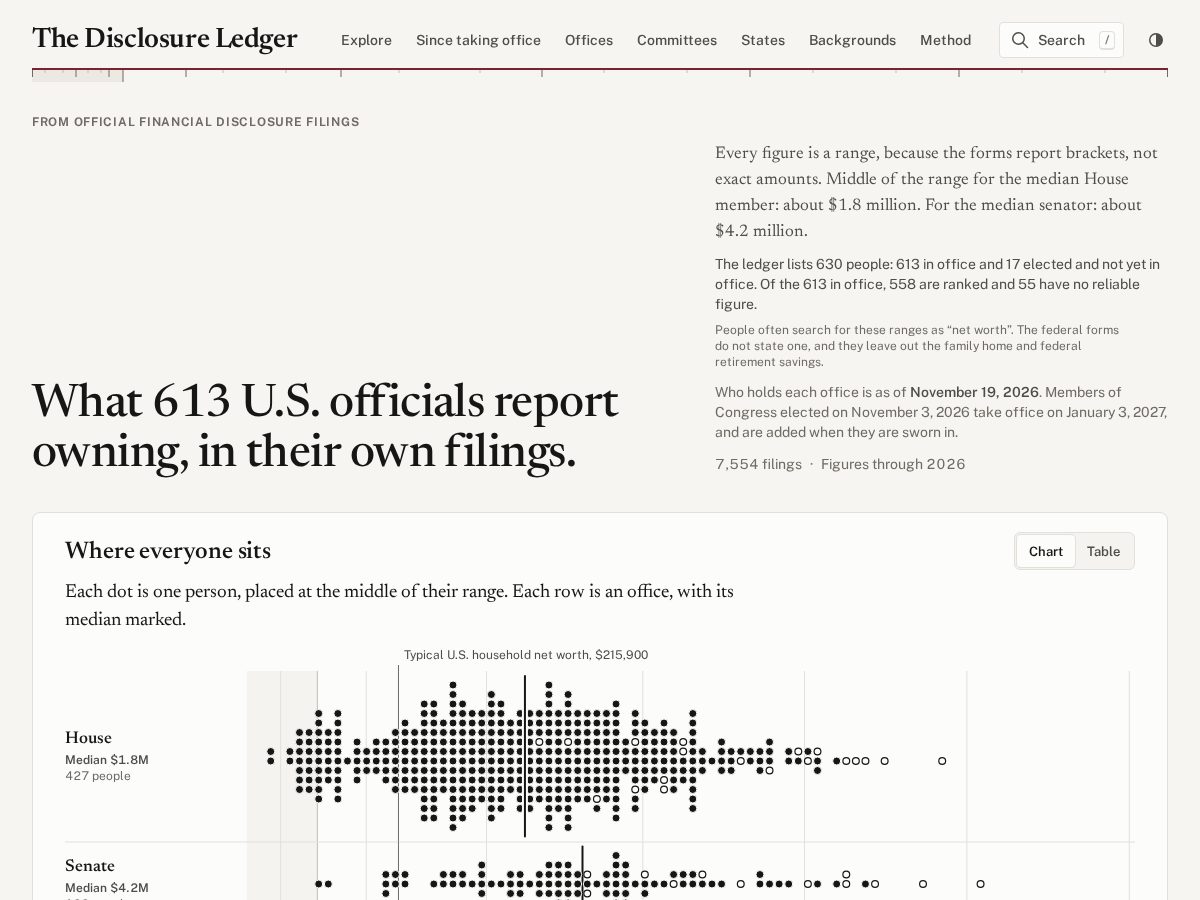
thedisclosureledger.com
An interactive ledger of U.S. officials’ reported assets, built from disclosure filings and presented as ranges rather than exact net-worth estimates.
Civic & Public Life
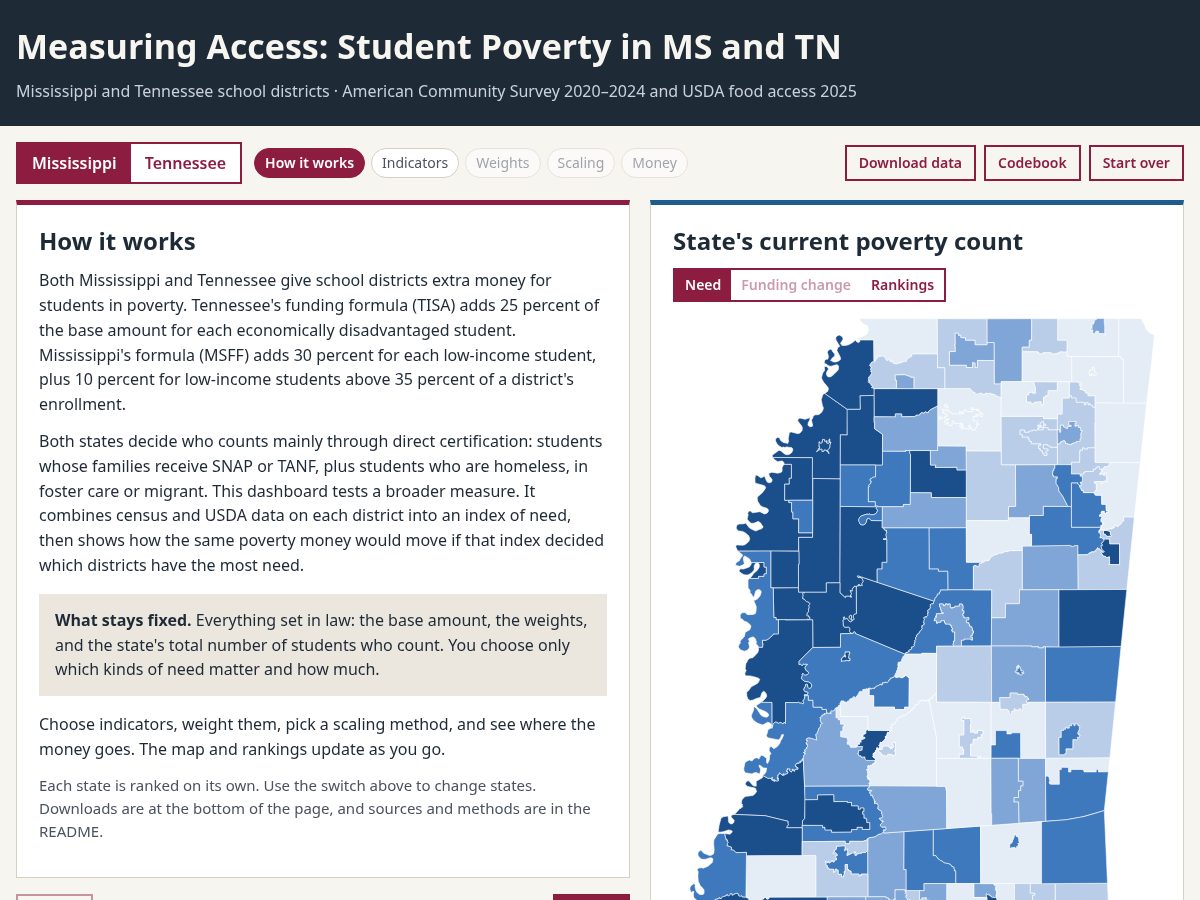
measuringaccess.org
An interactive dashboard lets readers test how different measures of student need could shift poverty-weight funding among Mississippi and Tennessee school districts.
Weird Finds
extinctionoffering.com
A satirical IPO prospectus for an imaginary AI company urges its creators to stop themselves and offers readers a claimable, non-voting Class H share.
Useful Tools
handandvertex.org
A searchable archive presenting more than 70,000 free 3D models as human-made works published on Google Poly before June 30, 2021.
Commerce Shelf
tianciranch.com
A Hebei ranch’s site documents its dairy routines, milk products, testing and batch traceability, alongside ways to buy milk or arrange a visit.
Personal Pages
edwardpalacci.com
A personal portfolio that uses an annotated chess game to introduce Palacci’s studies, AI research, engineering work, and software projects.
Weird Finds
yourmom2root.com
A cybersecurity satire casts family password recovery as a fictional critical vulnerability, complete with an attack chain, checklist, and command-style demo.
Useful Tools
agesofearth.org
An interactive globe and timeline maps Earth’s history, dated events, regional chapters, and changing political borders.
Content & Blogs
fishtakes.com
A sourced seafood guide gives short, species-by-species advice across 301 fish and shellfish from 85 countries.
Civic & Public Life
jimieru.com
A Japanese civic-data platform links local-government plans, budgets, projects, results, and official records so residents can investigate municipalities.
Civic & Public Life
tellupedia.com
An interactive globe presents planetary-health topics alongside satellite imagery, country comparisons, and long-term environmental records.
Pattern 01
Several projects make their evidence trail part of the product: sources, methods and missing information are visible instead of being smoothed into a confident verdict.
An interactive dashboard lets readers test how different measures of student need could shift poverty-weight funding among Mississippi and Tennessee school districts.
A Japanese civic-data platform links local-government plans, budgets, projects, results, and official records so residents can investigate municipalities.
An interactive ledger of U.S. officials’ reported assets, built from disclosure filings and presented as ranges rather than exact net-worth estimates.
A student-built map screens buildings in central Yerevan for preliminary seismic vulnerability and emergency preparedness.
A research hub for checking classic films’ layered US public-domain status, with cited film dossiers and free lookup tools.
Pattern 02
Interactive rehearsals let people make mistakes in a browser, then see what to adjust—from clinical consultations to planting and radio calls.
An interactive learning site for behaviorism, interbehaviorism, and experimental behavior analysis, organized into lessons, simulations, minigames, and reference material.
A free, desktop browser simulation lets landscape-architecture and ornamental-plant students practise 20 field tasks across 12 sections, with a digital certificate at the end.
CCT Practice presents voice-based simulated consultations with AI patients for GP trainees preparing for the Clinical Competency Test.
A browser-based radio trainer for UK general-aviation pilots, with practice scenarios tied to specific airfields and routes.
A free, locally run practice tool that calls driving cues during Gran Turismo 7 exercises and compares each attempt with a recorded demonstration.
Pattern 03
These guides and services get specific about where they operate: local measurements, routes, customs and practical advice make a place more than a name on a map.
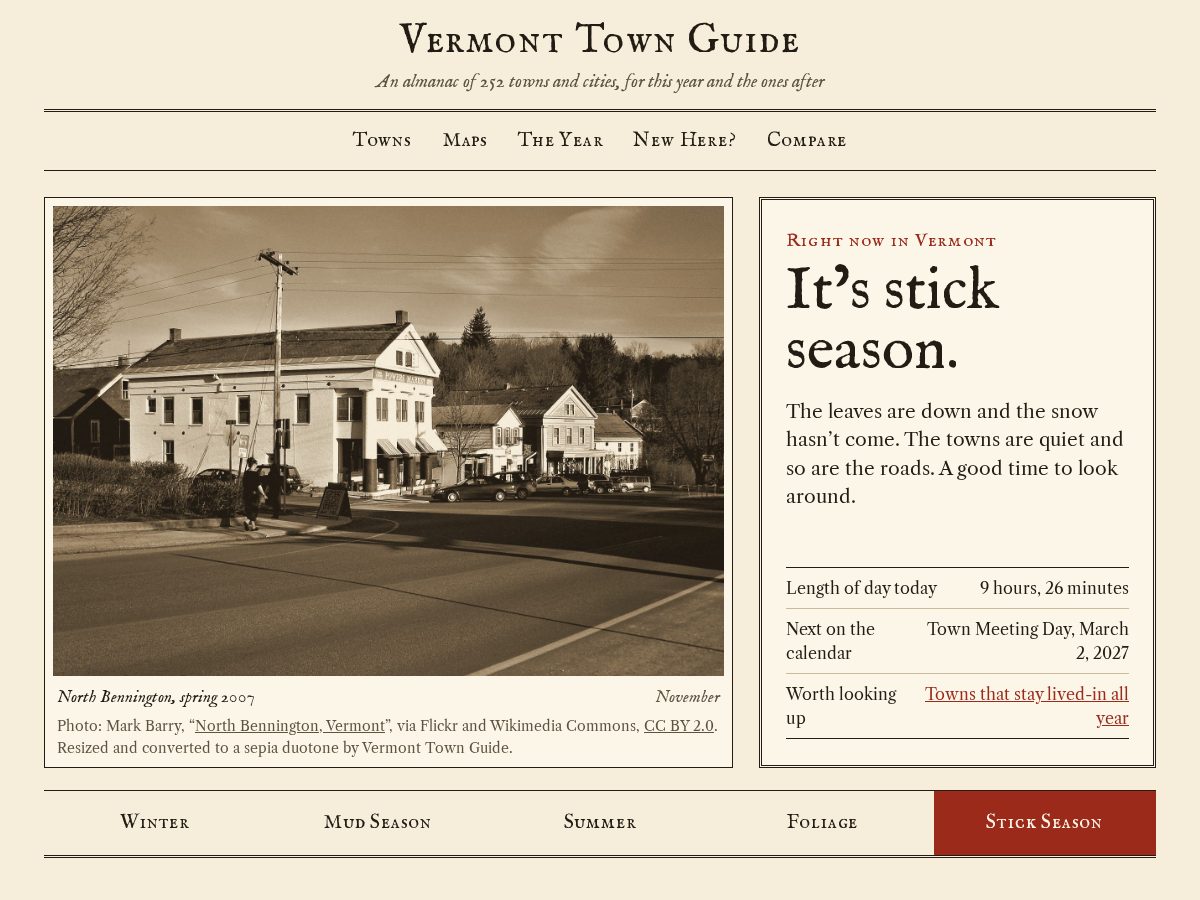
A browsable guide to Vermont towns, combining local facts, maps, comparisons, seasonal notes, and residents’ sayings.
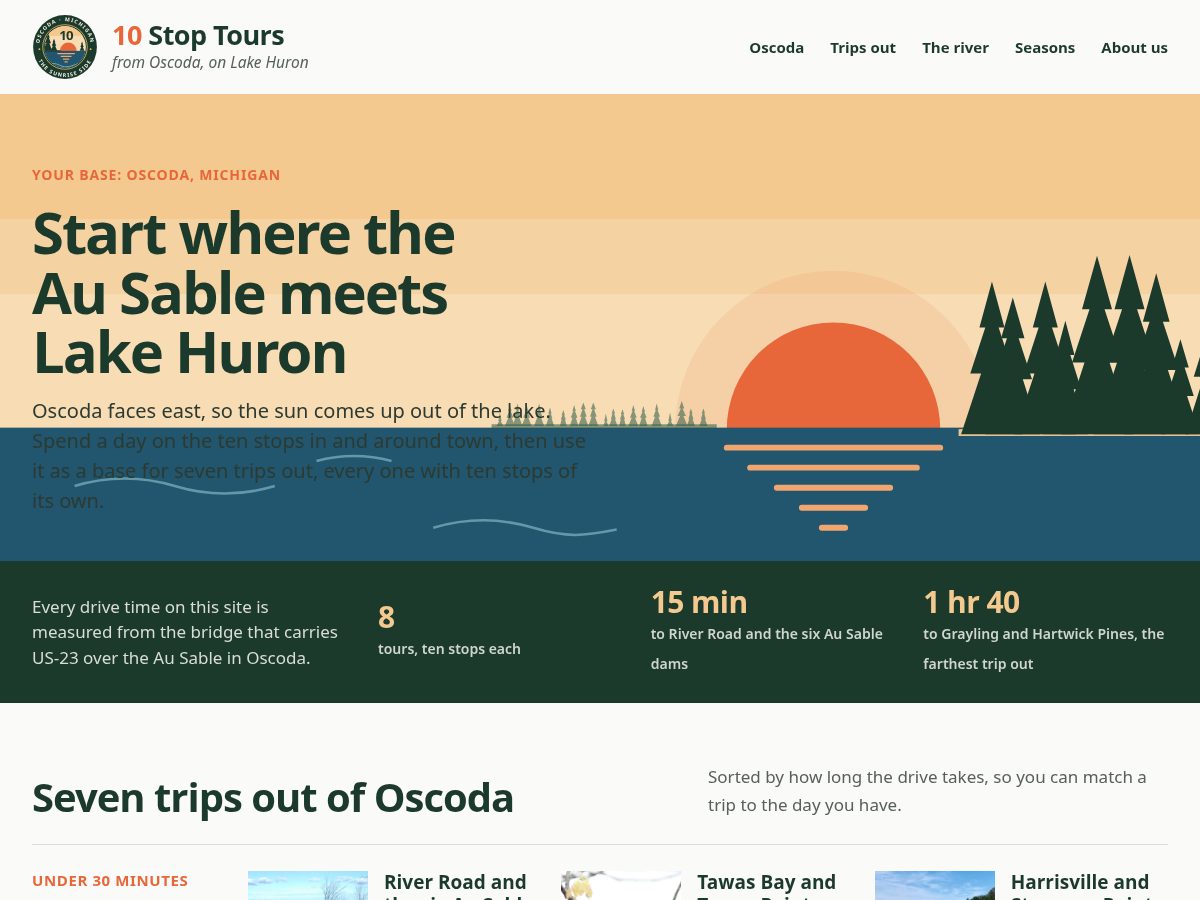
A set of self-guided, ten-stop itineraries for exploring Oscoda, Michigan, and nearby Lake Huron and Au Sable River destinations.
A family-run Surin seller offers Japanese Sungrass sod for delivery across Thailand, with a lawn calculator, laying planner, and growing advice.
A village homestay near Belaga, Sarawak, offering simple rooms, home-cooked meals and locally guided activities.
A Guyanese band and recording studio offering music production, recording, mixing, mastering, and live sound, alongside a listening room and selected credits.
Pattern 04
Rather than asking people to solve everything at once, these projects offer a route through a hard moment: find a provider, prepare for an appointment, plan for safety or make one manageable gesture.
A Portuguese-language guide explains the IVG process and helps visitors find recognized care providers by region and facility type.
A free set of symptom-tracking, blood-count, and appointment-prep tools for people living with polycythemia vera, essential thrombocythemia, or myelofibrosis.
A support and safety-planning site for people experiencing domestic violence, their loved ones, and families in Minnesota.
An interactive dementia-care experience followed by practical guidance and a tool for drafting a supportive message.
A guided collection of legacy projects for people nearing the end of life, their families, and the doulas who support them.
Pattern 05
The joke lands because it borrows the machinery of serious systems—security advisories, IPO filings, expert bookings and civic exhibits—and follows the format all the way through.
A Swedish satire site presents seven dubious prompt techniques and tiered bookings for “AI-whispering” sessions.
A satirical IPO prospectus for an imaginary AI company urges its creators to stop themselves and offers readers a claimable, non-voting Class H share.
A cybersecurity satire casts family password recovery as a fictional critical vulnerability, complete with an attack chain, checklist, and command-style demo.
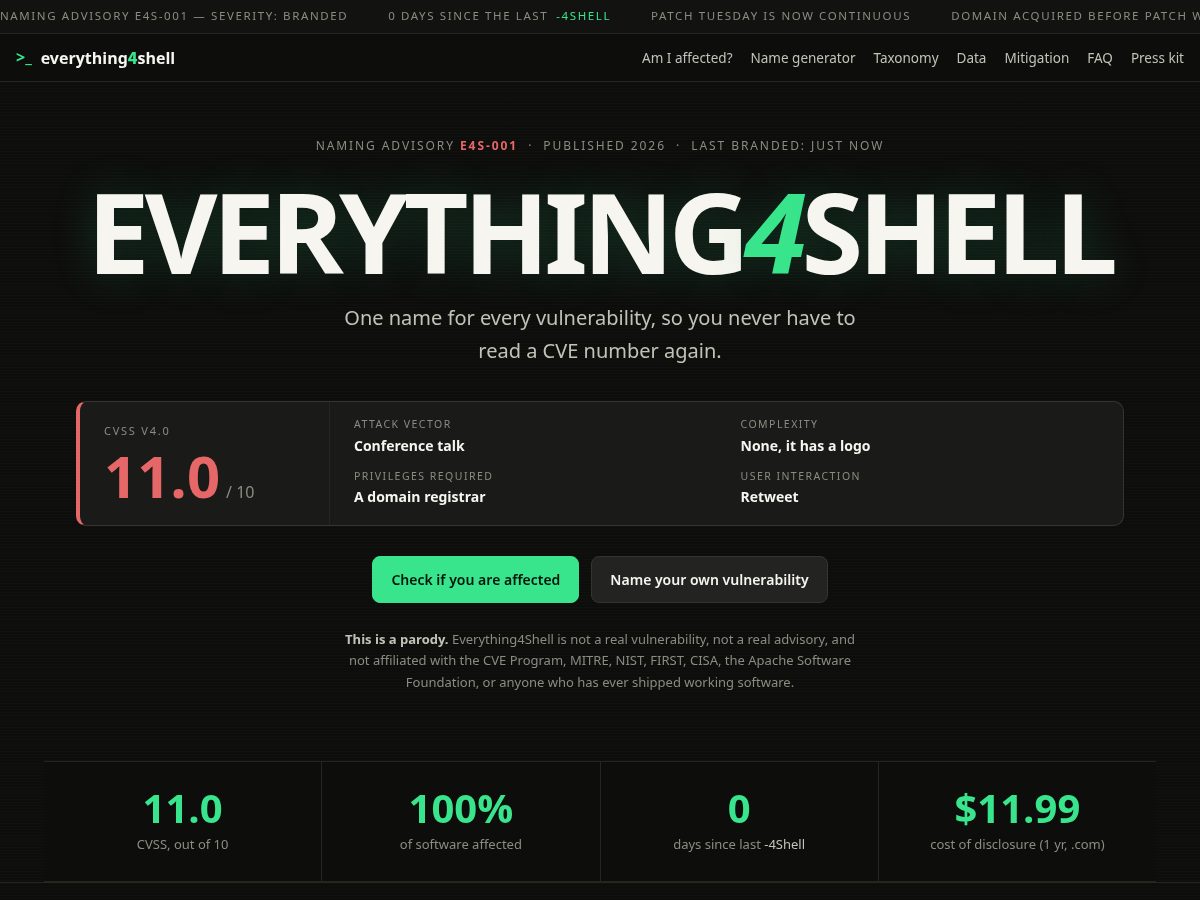
A security-branding satire with a mock vulnerability checker, a suffix taxonomy, and a generator for disclosure-ready names.
A civic satire pairs Prince William County aerial comparisons with a deliberately self-implicating case against new development.
04
The complete card catalogue
The leading shelf is open. Expand another category, scan its visible pages, then reveal detail where more context is useful.
972 cards visible
The same sliders can steer a slow ambient drift or a fast psytrance-like rush, while the page lets you save patterns, share links, and record short videos. It also carries a clear photosensitivity warning and a calm mode that reduces flashing, though it says that mode cannot guarantee safety.
The advice includes breathing before typing “think step by step,” and the testimonials include one from a kitchen appliance. The page openly promises no scientific support and no guaranteed results.
It borrows the machinery of an IPO filing to stage a pointed joke about AI governance: cited details about real share classes and voting control sit beside the gag that humanity gets no vote.
Its invented CVE-2099-0001 turns familiar family details—shared phone plans, sticky-note passwords, an unlocked laptop—into a remarkably specific security advisory. The page even gives its fictional flaw a CVSS 10.0 score and a disclosure timeline.
Its page turns exclusivity into the main event: one tiny drawing of a potato in an elf costume carries a multimillion-dollar estimate, while would-be visitors are told an invitation cannot be requested. The deadpan rules make this read like a pointed send-up of art-market gatekeeping.
The workload escalates from hiring an Intern and a Typing Pool to deciding whether Tuesday may follow Monday—and whether the Sun may rise. Its deadpan copy makes cosmic absurdity feel like another item in the in-tray.
Its fantasy setup opens into unusually concrete details: a village offers newcomers a roof without asking who they are, and the cat retrieves things residents have lost. The site lays out seasons, characters, and daily activities in Chinese, English, Japanese, and Korean.
Its triage flags organizations for having dependencies, a YAML file, or a laptop that’s on; the verdict is “total” confidence, with “vibes” as evidence.
The game trades postcard Tuscany for the province of missed trains, suspicious mushrooms, boars near Careggi, and an Ape that won’t brake. Its site lays out the levels, characters, and local lore with a clear sense of comic place.
The game keeps its details small and human: six flowers, a greenhouse, and Noah’s account of an eight-kilometre milk run last April. The birthday note gives the little quest its reason to exist.
The premise draws its monsters from Indonesian village life: a Pocong Tengkulak arrives with a sack and calculator, while a Kuntilanak Calo Bantuan brings a loudspeaker and paperwork. The first chapter is marked playable; two more, featuring a blackout and a flood, are listed as forthcoming.
The rules disqualify marathons, kitchen renovations, and promotions: apparently, success is only fair when it stays small. Judges pick one nomination from the comments each week and publish numbered rulings.
The project says three public activations have already run. Its format keeps the crowd as judge: the game tracks the round, but the room calls the winner.
The tutorial gives spoon orientation a surprisingly rich vocabulary: land handle-first to crack eggs, pop crisp packets, or stab into butter. It’s a tiny, specific indie-game premise with enough mechanical detail to feel like more than a joke.
The fold is the steering wheel: hold to bring paper edges together into bridges and ramps, then release to reopen the street. The page describes 24 levels across four districts, daily routes, and an approaching set of rollers.
The page commits fully to its slow-boat philosophy: it calls the pontoon “a living room that floats” and lays down rules like “Whoever brings the snacks is never asked to help dock.” It even refuses to explain its own domain, preferring to talk pontoons.
The interface stages the material as a classified plotting desk, with a regional index and case files that can be read aloud. It also draws a useful line: the texts summarize reports and findings, while the dioramas are interpretations, not reconstructions.
The projects have unusually specific premises: one turns Bluesky reply threads into a transit map, while another cuts rock-paper-scissors throws into dubstep highlight reels. The homepage describes them as “small web things, made by a bot.”
After the exhibition, a one-minute arcade asks visitors to find four golden switches and make it back to the front desk before opening.
The van can sink, overheat and take visible damage, so recovery gear and driving choices matter. Its public beta ranges from Welsh green lanes to snowy Japanese mountains, with a very specific mechanic’s garage waiting between trips.
Visitors can swim through the ship, pull its decks apart, or drain the sea to inspect the seabed. The creator says the model uses published dimensions and reports—not survey data—and labels some wreck details as invented.
The map is both the building material and the bill: every creation removes blocks, changing the ground everyone fights over. The developer’s example—a pistol that fires a grenade-dropping pigeon—sets the game’s wonderfully odd tone.
The campaign treats a CEO comeback like a pop-culture encore: thousands of photo tiles, a leather-jacket refrain, and Sarah McLachlan’s “Angel” set the mood. It’s funny, unusually committed fan theater—and clearly labels itself as unaffiliated.
The interface tracks wood, airflow, ash, and smoke, then offers a warning not to “impress the neighbours with nine logs.” Its cottage routine also reaches from roasting makkara to managing sauna steam.
The shelves open into notes about their objects and links to stories or the guide. The site is clear that it has no Salem storefront—and that nothing in the virtual shop is for sale.
The premise is unusually well documented: activity triggers an “excitement incident,” and the consequence is more beige. Its privacy note specifies that optional webcam frame comparisons happen locally, while an explicit disclaimer says the experiment is not a clinical measure.
The London score lays out 15 transit corridors, 70 basin hubs and 117 colour keys. At capture, though, its event stream showed zero observed events and standby.
The homepage inventories the first pond as 62,000 litres, then describes a progression from pails to siphons, ditches and family bucket chains. It says a two-chapter Steam demo is coming, while noting the Steam page itself is not open yet.
Set in Vienna in 2027, the game makes each promise costly: break one and the people around the venture feel it; keep one and you may have less money or control. Its three ventures give that trade-off an unusually tangible shape.
The games have specific little worlds and mechanics: one grows through changing weather and seasons; another asks you to trace a constellation before clouds arrive. The page also says every pixel and sound is drawn and synthesized by hand, and marks Coven as still in development.
A car blocking a road becomes a speed bump; a hidden unsubscribe button becomes a building-sized button. The project makes ordinary frustrations participatory—and plainly labels its stories fictional and its videos AI-made.
The bistro is more than a menu in a game-shaped wrapper: its instructions include pulling out a chair, taking a bite, and even taking a nap. Finish the achievements to earn an Edge toque.
Its catalogue runs from the Gathas and the Epic of Gilgamesh to Rimbaud and Kurdish poets. The label says its next series will turn to ancient Greek hymns and lyric fragments.
The site answers a familiar bait-and-switch with a playable game: it says the browser version has 150 levels across five worlds, plus more than 700 voiced lines carrying a story between fights.
Its billing widget makes 0.1 hours worth $185 at Sharky’s stated $1,850 hourly rate. Later, firms face Black Monday, the CrackBerry, Lehman Friday—and AI slop.
The route is scheduled to cover 455 cities, with four- or eight-hour station stops. Miss a stop and its stamp stays missed: this is a leisurely window-side journey with a surprisingly strict collection rule.
The border policy is wonderfully specific: women get instant passports, while men face a timed exam and a three-week lockout for scoring below 90. The whole realm is presented with the solemnity of an empire and the late-night energy of an elaborate in-joke.
The player furthest behind drafts first; the leader gets the leftover pair. That small reversal gives the game’s landlord satire a playable engine.
The game treats an empty lobby like an empty bar: bots take the stools, then make room as more people arrive. Its barroom premise even gives the last player standing a job—close the bar.
Today’s prompt is “draw your bed as a boat,” with the reassurance that “It doesn't have to be good. It just has to be yours.” The site makes a small creative ritual social—and adds petals, themes, banners and stickers to the mix.
The page gives the creature’s care loop unusually tangible consequences: movement shapes limbs and organs, daylight changes its pigment, and each 30-day clone carries traits forward. The site says Health readings stay on-device; that privacy claim is clearly stated, though not independently verified here.
Pick up to three symptoms and a severity level, then get a numbered note stamped “useless in a court of law.” The site also spells out what its registry records and says the meme coin has no pot to claim and the page never asks for a wallet.
The page says every trade helps fund the next day off, and puts a number on the premise: $1 million traded pays for 150 days off. It also offers lines like “I saw your email. I chose the game.”
The site says each fighter’s AI chooses its words, training, and moves, while the audience can cheer them on. It also draws a clear line between real fans and the show’s simulated AI crowd.
Each round gives you five prompts and twenty seconds per answer; a 100-dot reveal shows how many players matched you. In the sample, naming Puck—one of Uranus’s moons—earns the full 100 points.
The folklore is mapped to six Brazilian biomes, and the games give it two different shapes: recruiting 32 heroes for turn-based battles, or keeping a vaqueiro alive through a night of arriving legends. The village game is labeled as being in closed testing.
The central gamble is delightfully legible: carry more scrap for a bigger haul, or return to the depot before a crash wipes it out. Around that loop, the page builds a daily challenge, ranked runs, and earned cosmetic unlocks—with no pay-to-win claim.
The interface treats strange experiences like bugs to investigate, while making room for ordinary explanations. It calls itself a playful field journal, not proof of anything.
The farm shifts from hand-work to scarecrow-run automation, while repairs open new areas and clues turn up in places like fishing bottles. Beneath the farming loop, the page promises a 13-chapter mystery that reaches underground.
The page pairs precise coordinates and MARPOL paperwork with hot food from McDonald’s, KFC, and Burger King. That unusually specific blend of maritime procedure and familiar fast-food brands makes the site worth a closer look, though the page alone can’t verify the operation.
The game turns shovelling into a visible restoration: clear streets, break ice, upgrade a shovel, and bring lit windows and neighbours back to Valcandil. The page estimates a 30–40-minute demo, short enough to try in one sitting.
The setup turns a game stream into a communal arcade: there’s a free first-come queue, a paid priority lane, and just 15 seconds to confirm when your turn comes. The page labels its features beta, so the pitch is clearer than proof that play is currently working.
Every strike adds environmental pressure for all factions, so a tactical hit carries a shared planetary cost. The page lays out a five-minute match, public and private play, and commands for nukes, shields, radar jamming, repairs, and truces.
Its collapse chain is unusually concrete: traffic crashes can knock out power, blackouts can trigger looting and arson, and failed pumps leave firefighters with dry hydrants. Country presets also change the stated shares of surviving frontline workers.
Each guess narrows a range: clues tell you whether the answer’s letter comes earlier or later, or whether you’ve hit it. The two modes either reveal the word’s length or keep it hidden.
The page pairs a 516-card collection with pack weighing, simulated odds and a collector’s profit ledger—then clarifies that its money and trading features are only simulation.
The landing rules are spelled out: keep vertical speed at or below 5.5 m/s, horizontal speed at or below 3.2 m/s, and tilt within 10 degrees. Later stages add crosswinds, heavier gravity, and a moving sea platform.
The cabinet list makes the project’s status unusually clear: five games are marked ready to play, four are still in development, and two Roblox titles are listed as coming soon.
The map begins as bare vellum: capes, rivers and shoals appear only as the crew sights them, while longitude stays unknown. Even the trailer is still a placeholder for a still from the game.
The site lets you try the Daily in a browser, and its rules are refreshingly precise: no clock, no lives, and a hint that draws the next stretch of line. The iPhone app is listed as in TestFlight testing.
Its mining loop is anchored in real lunar geology, but the hook is stranger: a sealed mission lost a crew member, something is calling from beneath the Moon, and your dog waits topside.
A common answer can mean 35 miles by tractor; an answer given by fewer than 0.5% of players earns 320 miles by crop duster. The rules say early scoring uses estimates until 20 people answer a stop.
The paper is more than a puzzle surface: each completed sheet becomes an origami figure that joins the world you rebuild. The page also includes a playable puzzle and describes five realms, 100 puzzles, and a no-timer, no-purchases experience.
The route runs through named roads including the México–Puebla and Arco Norte, while tolls, diesel, and driver fatigue shape the trip. The site counts 83 cities, 52 trucks, and 77 cargo types—and traces the game to a creator in Puebla.
Its five-act campaign starts with a garage AI startup in 2027 and scales up to a planetary project. The site describes a 10–15-hour game built around real-world geography, supply chokepoints, and crises players can lose.
LACEV investigates plants as cognitive systems, focusing on memory, plant-to-plant communication, and long-distance signaling. Its homepage pairs that research with an interactive 3D display of plant bioelectric activity.
It turns showing up to a hobby event into a collectible record: the first featured outing is a roller-skating meetup, with an “OG” stamp reserved for attendees. The idea makes trying something new feel a little like joining a club—and keeping score.
The game makes Saturday rent day the hinge of its routine: work pays by the shift, while needs keep draining. Its Lagos setting is grounded in naira, districts, danfo rides, and the practical question of what you can afford.
The game gives its historical material four labels—documented, debated, legend, and fiction—so players can tell archival claims from invented story. It also plainly discloses that its illustrations were generated with AI, making the project’s choices part of the artifact rather than hidden production details.
The patch is designed to use files from your own copy of the 2005 game, not redistribute its assets. The site pairs its revival plan with unusually detailed install instructions and a playful promise: “No account wizard. No launcher. Just a zip and a dream.”
Fifteen articles become a five-card hand, with two chances to swap and ten article pairs to examine. The site says it explains every pair’s traits and rarity-weighted points, turning a Wikipedia fact pattern into a replayable daily puzzle.
The game gives its setting concrete rules: gunfire draws more zombies, carrying extra loot slows you down, and dying away from home means losing what you brought. The site labels the game in development and in closed testing.
The homepage gives the game’s data trail some detail: players have tournament-specific ratings, and the site explains the factors its own model uses. It also identifies the project as an independent fan game, not affiliated with FIFA.
The route is laid out like a visit: climb from the shore, pass through the gate, pray in the main hall, then return to the sea. The site stresses that its rituals are digital and it has not been commissioned by a physical temple.
The game turns local pressures—from exchange-rate jumps and exam season to a cousin hired under family pressure—into business events. That specificity makes its campus competition feel like a little model of everyday Egyptian commerce, not a generic investing lesson.
It makes practical village work the game’s central loop: cut grass, haul hazelnut sacks, and tow a threshing machine. The countryside is not just scenery here; it is a set of jobs, tools, and constraints.
Normal mode sticks to links between things; Hard adds double meanings and wordplay. Six guesses, a 0–100 closeness score, and graded wrong turns make the hunt legible without giving it away.
The scoring has a clever physical shape: each answer earns 10–100 points against a fixed English Wikipedia readership snapshot, and every 200 points carries your flight into a new part of space.
The pitch is unusually literal: the site says the system can be positioned remotely ahead of troops, works without explosives or jamming emissions, and is built largely from commercial components.
On the U.S. states board, you see the names before their values; each pick reveals a number and changes the remaining route to 100. The game makes the risk concrete: bank a lower score, or take another dart and risk a bust.
Its plans range from arenas built by studying broadcasts and photos to women's programs launching alongside the men's. The site says the first release will be a Play Now demo, so the bigger dynasty ambitions are not yet demonstrated.
The site explains the proposed sequence from drilling and dosing to inspection and all-clear, and compares it with conventional blasting. Its technical figures are explicitly described as indicative and dependent on site and rock conditions.
Its battle camera runs 90 seconds behind and accepts no commands, so spectators can watch without helping someone still fighting.
The homepage reports 15 readers and 5,328 books in its shared catalogue, with readers able to walk through one another’s rooms in real time. It also says global-chat messages are not stored and profanity is filtered.
A state-by-state compliance desk for an unusually specific corner of pest control. StateShelf says it checks all 51 jurisdictions and distinguishes required registrations from notification-only filings and exemptions; it also leaves the brand as registrant.
Each turn advances a month, and traffic wears down the roads you leave unrepaired. The game says its wear, patch life, costs, and weather follow real data, with sources listed.
Its 360 fictional players are more than collectibles: shared traits across two or three cards unlock squad bonuses, while training and match XP give players a reason to keep a developed card. The site says play requires an account and an internet connection.
The homepage connects its textile laboratory and residencies to Prato’s textile district, and says Lottozero works to foster exchange with local companies. It’s a place organized around a particular material and the people who make things with it.
Each model’s Origin Seal links to its source record, using the archived upload date rather than an uploader’s claim. The site also spells out practical limits: CC-BY credit is required, fan art may not be cleared for commercial use, and downloads are glTF because many archived GLB files were damaged.
You can scrub through time, tap a place to see what was happening, and follow 76 mapped journeys, campaigns, and migrations. The atlas also spells out where its historical borders and deep-time coastlines are approximate—and how its AI-written entries were checked.
The toolkit turns a weekly symptom check-in into a one-page report for a hematologist, and its visit-prep tool offers more than 70 disease-matched questions to choose from. The creator identifies himself as a PV patient and says the tools require no sign-up and collect no data.
Its prototype lists 121 CHamoru hymns and 641 verses with English, designed to stay available offline. The page frames the project as a way for Guam’s youth to help keep a living tradition close at hand.
The site makes legacy work feel less like a grand memoir project than a set of manageable acts: write a letter, record your voice, or make a plan for your pets. Its gentle energy-based suggestions treat care as something that can begin from bed, in under an hour.
Its bench is described with technician-style tools and their real limitations, from a meter’s contact resistance to thermal imaging that reads bare solder as cold. The homepage also walks through a 530-part MNT Reform 2 board’s power-up current.
Artist Simon Perathoner describes 82 instruments for mangling JPEGs, tearing scans, and even decoding video frames against the wrong photograph. The page pairs that unusual toolkit with 44 specimens and a hands-on “Break something here” invitation.
Its central correction is deceptively simple: a film can have separate picture, music, story, and restoration rights. RightsAtlas says its researched verdicts link to renewal records, case law, and archival sources—an evidence trail in place of a confident green check.
You configure the aircraft, route, traffic and weather, then make radio calls as the simulated flight progresses. Its coverage focuses on a defined patch of East Anglia, including local procedures, Wattisham’s MATZ and Southend airspace.
It reads driving data from a PS5 and calls the next action about half a second before the game’s demonstration does. After a run, linked maps and charts show where the drive diverged; it needs a Mac or Linux computer on the same home network as the console.
The page connects play with useful reference material: it offers up to 200 printable tablas in one PDF, plus card lists and round-length data in CSV and JSON. The caller’s verses, translated into English, give the traditional picture game a distinctly voiced center.
The board turns a vague question—“Can I work here without Norwegian?”—into a checkable detail: each label is paired with a quote from the ad. It says listings come from NAV’s public job board and warns that its machine-made labels can be wrong.
The page brings together a real-time 12-lead monitor, movable electrodes, evolving ischemia patterns, and calculators including HEART and QTc. It names an author and says the work is registered with Colombia’s DNDA, while clearly stating that the tool is not a substitute for clinical judgment or care.
Its collections turn footprint data into odd little field guides: the giants, needle-thin buildings, round outlines, and complex shapes. The site says it maps 155,821,221 buildings, using geometry rather than photos or owner records.
SpecSource says it checks and dates each figure, and holds a model back when sources disagree; 73 models are currently waiting for a dispute to be resolved. That’s a useful bit of restraint in a product-comparison site.
Its page describes a controller that explains a GRBL alarm instead of simply sending commands the machine will reject. It also spells out the limits of its beta testing and treats laser safety as part of the product, not fine print.
The page describes more than 600 works from The Met, ready before a session and still tracking time while the phone is locked. The app is presented as free and ad-free, with optional gifts that unlock nothing.
Its browser demo lets you try the editing workflow, while the app keeps documents in Markdown and version history in Git. That’s a notably concrete answer to the familiar problem of clause numbers and references going stale after an edit.
The site pairs an offline guide to nearly 900 species with GPS-tagged field notes and rainfall totals. It also puts a needed limit in plain view: MicoAtlas narrows possibilities but does not identify mushrooms or validate them as safe to eat.
The page makes security checks unusually legible: examples include a saved Wi-Fi network with no password, and checks the app could not perform are labeled too. It says scans run without telemetry and changes wait for approval.
The controls get down to the board-making details: trace width, copper thickness, substrate, and plane clearance. It also offers a 2D solver and spells out important limits, including that roughness, discontinuities, and dispersion are excluded from its transmission estimate.
Each incident comes with source links and labels for what is known—and what isn’t. The scoreboard reports 13 tracked outages, more than 79 hours of combined downtime, and eight incidents still unexplained.
The page says the tool preserves the child’s plot rather than inventing new events or endings. Children choose from six illustrated scenes; adults handle purchases and saving the finished video.
Slate, glass, wood, acrylic and other surfaces need different treatment: some mark light and require an inverted file, while others burn dark. The site also presents a nine-case comparison of its outputs with a competitor’s, scored using the same code; those results are the maker’s own benchmark.
Draw on the virtual contract, then dig into the site’s unusually specific rulebook: it describes a 50° stroke-segmentation threshold, at least 40% of the line being taken, and 4,761 two-character reading combinations. The site identifies itself as a fan-made compatible simulator and links to CAEN Games’ original.
Its useful twist is a refusal to invent prices: unpublished costs stay out, promotions are shown separately, and the sample results are readable in plain HTML without JavaScript.
Players can browse layouts by town hall level, inspect ratings and video clips, then copy a base straight into the game. The library sits inside a real clan network with multiple league tiers and a monthly schedule.
The page describes a concrete workflow: find the timer beep and shots in a video, label the gaps, and show where reloads, movement, and transitions cost time. Its drill list includes published standards and credits; squad sharing is off until users join a squad.
The editor pairs a practical workflow with unusually considerate details: guests can RSVP, indicate whether they need a charter bus, and the couple can export the responses to Excel. The site says photos are automatically deleted 30 days after the wedding.
The time wheel can be dragged or scrolled to compare hours across locations, then reset to now. The page specifies a $9 one-time purchase for macOS 14 or later and says calendar data stays on the Mac.
The opening shelf draws on 109 albums that appear in at least two public rankings. Map lines distinguish sourced connections from operator-checked ones—and the site is candid that many relationships remain unverified by listening.
It’s built for the specific dead-air problem of live card sales: recognize a card, show its price, and keep the stream moving. The page also describes local recognition, lot totals, and a sales tracker, all for a one-time $9.99 purchase.
The atlas uses a Caribbean-centered Lambert conformal conic projection and gives each place its own clock. It also puts several models side by side, with their spread explicitly framed as uncertainty.
The app gives each payment a little physical theater: a bill drops from the MacBook notch and lands on an open window. Its page also spells out a specific security boundary: it says KaChing accepts only a restricted, read-only Stripe key.
Its browser simulator renders what ProffieOS would put on each of 132 LEDs before a build reaches the saber. The installer also saves the existing firmware first, with a restore action.
It turns the everyday hunt for a local screening into one shared schedule, with listings across Phnom Penh, Siem Reap, Sihanoukville, and Poipet. The independent project says it updates schedules during the day, while warning that some listings may lag and should be checked with the cinema.
The 11-page example includes an emergency sheet, medication list, hospital checklist and QR-code wallet cards. Kinfold says it is free to build and costs $39 when you print.
The homepage names cookbook author Ashley Rodriguez as the source of its recipes and shows how a lemon-spaghetti recipe changes from a dense paragraph into seven guided steps. It also calls out the dish count and hands-on time up front—useful details for deciding whether dinner is manageable tonight.
It makes the crucial distinction between Table A for final approval and Table B for filing I-485 easy to see, and says which chart USCIS is using that month. The homepage even notes that December’s bulletin has not arrived yet—and offers an email alert instead of a daily refresh ritual.
Its controls reach well beyond the rudder: trim sails, move crew weight, adjust the daggerboard, and handle race penalties. The interface offers real or manual weather and tide settings, with multiplayer rooms and several named dinghy classes.
Rowan puts a readable review step between changing rows and changing the database. Its page says commits run in one transaction, so if a statement fails, none of the staged changes stick.
Its examples set crossed-out prices beside dated Wayback snapshots. For one Tefal air fryer, the advertised ₴29,999 reference price is contradicted by an archived ₴11,999 price—the same as the sale price.
Typed messages stay in the tab rather than being sent; the page also warns that captions can be wrong and advises confirming names, dates, and numbers.
Its prepared experiments make the assumptions visible: one compares equal payments with need-based assistance, while another shows what happens when wages rise but resources stay scarce. The site labels the model conceptual and calls out synthetic health coefficients, a useful reminder that these are explorations, not forecasts.
The controls are paired with unusually careful limits: the site says binaural-beat evidence is inconsistent and directly explains why an inverted tone cannot cancel tinnitus. It also warns users to turn their volume down before playing.
The homepage connects five build systems to one shared inventory, so changing a specification can update the rest. Its sample build also highlights a useful distinction: a van can stay under its gross mass limit and still exceed a rear-axle limit.
Each entry carries its comic number, giving the collection a useful trail back to its source. The tools range from a “Scream Cipher” that distinguishes letters with diacritics to a calculator for deciding how long to spend automating a task.
One parent can set it up using the child’s age and custody schedule; the other parent is included only if the creator shares a parent link. The page also spells out its data limits: no account, no family name required, and automatic deletion on January 15.
The atlas connects symbol meanings to island traditions and placement on the body, then adds an important caveat: interpretations vary, and people seeking strictly traditional work should consult an Indigenous master.
Its filters get past the usual “things to do” list: visitors can sort by bus access, difficulty, dog rules, cost, crowd levels, wind shelter, and even whether fishing is open. The page says each detail has a source.
Birthbeat is designed for times when finding and unlocking a phone is its own small obstacle: it offers several one-tap or hands-free ways to start and end a timer. Its page also draws a clear line around the tool: it can compare a logged hour with a pattern entered by the user, but it does not tell them what to do.
Its controls connect choreography to practical constraints: a music timeline, a 60 × 30 m rink, and checks against stated 2026/27 ISU requirements. The page also says uploaded music is decoded in the browser, not sent to a server.
Its scope runs from familiar buck and boost circuits to LLC, dual active bridge, Vienna, and modular multilevel designs. The page also spells out an important boundary: results are engineering estimates, not a substitute for simulation or testing.
Its cruise-line comparison spells out that the averages are simple and unweighted, while the directory keeps inspection findings and outbreak notices distinct. It also cautions that an inspection score is a snapshot, not a verdict on whether a ship is safe to sail.
Davos week is a moving maze of rooms, invitations, and last-minute changes; this calendar says it checks listings against their sources and logs what changes. Its day-by-day plans and door-policy details turn a high-profile event scramble into something people can actually navigate.
Disposal advice gets useful when it reaches the last mile: this directory pairs local drop-off options with practical constraints, from a five-gallon limit to which days a facility is open. It says each listing links to an official source and shows when it was last checked.
Its framework looks past simple floor-area estimates: it accounts for corridor burden, preservation constraints, and vertical reuse of tall spaces. The page explains its method with a Chicago school example and says each screen produces housing-yield and compliance-cost reports.
Set monthly runs and billable steps, then compare the different units each service charges for. Unverified price tiers stay marked for confirmation instead of being guessed.
The simulator moves from paperwork and preflight checks to cockpit setup, engine start and flight controls. Its maker is clear about the boundary: it is a training toy, not an approved checklist, and sim hours do not count as flight time.
The workbenches pair full-size pattern outputs with simulated cloth studies, including a bolero that can be posed on a fitted form. The site is careful about the limits: its fit readings describe a simulation endpoint, and physical fit still requires a sewn sample.
Search reaches down to the word: the homepage shows “الصبر” appearing in 136 hadith, with matching texts highlighted.
The search runs in your browser and asks for no personal details. The site is candid that its hand-added database is small—and that no result does not mean a company has never been breached.
It turns a familiar player complaint into a focused spectator tool: its maker says their own Town Center was “always idle and bad.” The site is candid about the practical catch, too: game updates can break compatibility until the tool is updated.
The guide separates sourced settings from estimates and says why a number is uncertain. One anodized-aluminum page notes that forum reports do not name the Glowforge Pro; the site recommends testing on scrap before making a finished piece.
Its import guide explains where each platform hides its export and flags quirks like Venmo’s month-at-a-time downloads. It even suggests an offline test for the privacy claim.
The site distinguishes hotel-confirmed prices from calculations, estimates, and totals it cannot determine. Its source notes name the official rate pages and confirmation dates—and spell out what the figures do not establish, including room availability or the final bill.
Its reinforced Android mode adds a 72-hour server-counted delay before protection can be released. The page is unusually candid about limits too: the filter may miss new sites, and Maria is not treatment.
The calendar turns a sprawling hobby scene into a practical local map: the page lists 179 events at 54 places for the week and lets players filter by area, format, day, price, and more. It also labels which store listings are verified and which come from public sources—a small but useful distinction in community-built infrastructure.
Plant mutations and parent selection sit alongside shareable DNA strings and QR codes, with controls for GLB and 3D-print exports. It makes succulent breeding feel like a tiny botanical CAD lab.
The sample listing for Seattle’s Sunset Tavern goes well beyond an address: it lays out stage dimensions, booking lead times, and different audience targets for weeknights and weekends. The site says its directory covers 45,444 venues.
Its Vail-at-Thanksgiving example shows why “open” can be a slippery answer: the site lists average open runs of 25, 56, and 9 across three past seasons. It also factors in pass blackouts and whether beginners are coming.
The entries give each park a specific vantage point, from Jordan Pond in Acadia to a boat off Boca Chita Key. The guide puts visit counts beside NASA satellite observations and NOAA climate averages, making trip timing feel grounded in actual places and public data.
Its central gesture is wonderfully concrete: swipe a page up on the iPad, then paste it from the computer’s clipboard. The page also admits its in-notebook answers are “not always right.”
It connects to Pi-hole, AdGuard Home, or Technitium, and says you can control blocking and update lists from the dashboard. DNS administration gets a playful arcade frame without sending traffic to a cloud service, according to the site.
Choose a feat—from breaking a building to throwing a mass or boiling water—and the calculator lays out a route from inputs to a tier. Its methodology and reference links make the result inspectable, not just a number to drop into a fandom argument.
The site says its 2026 report combines USGS arsenic estimates with 6,821,569 state well records. It pairs that research with practical tools for interpreting test results, investigating symptoms, and sizing well equipment.
In video practice, the officer waits until you raise your hand. The page is just as clear about the limits: it is not USCIS, not legal advice, and cannot promise an outcome.
The page separates hands-on, supervised, hands-free and eyes-off systems, and spells out the driver’s remaining job rather than treating “self-driving” as one capability. A sample Ford result includes trial terms, ongoing prices and the roads where BlueCruise is allowed.
Sixpedia makes confidence part of the product: it separates publisher-backed facts, cross-checked details, and community reports. Its homepage says 2,375 of 2,512 entries still rely on a single report, especially map pins—a candid caveat for an evolving game reference.
Its progress system rewards regular rides and time in your own zones; cosmetics never depend on speed, watts, or body weight.
The catalog separates 145 entries marked confirmed from 46 likely, 41 unverified, two false, and 80 with no maker found. It also shows per-unit savings on some comparisons, and says it operates independently of Costco.
It makes a useful distinction between competing lifters and gym-goers, then explains exactly how it weights comparisons by bodyweight. The page also names its public datasets and spells out limits where the data thin out.
The page is a working specimen, not just a pitch: edit a premise and the example cards change. Its checks are framed as “a red pen, not a ghostwriter”—advice that leaves the comic’s words in their hands.
Enter warehouse dimensions, compare 17 storage systems and 20 handling alternatives, then move stands around the plan yourself. Capacity figures update with the layout, and the page offers PNG download and report-print controls.
The page describes more than live vehicle tracking: it also offers a fair-meeting-point finder for 2–4 people, platform alarms, and an underground MRT view.
The homepage traces its claimed playback path: FFmpeg separates the video layers, VideoToolbox decodes them in parallel, libdovi pairs frames, and Metal composes the result at 12 bits. That’s unusually concrete engineering detail for a player pitched to home-theater viewers.
The homepage says Vavroom draws on public road records as well as driver reports, so it can assess roads even where no one has flagged a problem. Its route examples compare pavement, crossings, traffic lights, and travel time; the aircraft feature comes with a useful caveat: the app says it can detect nearby low-flying aircraft, but not identify who is flying.
The page treats military life as an accumulating paperwork problem, and proposes keeping that archive on the family’s own computer rather than in a cloud account. It is candid about the boundary: Beta 0.1 uses fictional records and example programs, so this is a pilot-stage proposal, not a demonstrated benefits check on real files.
The guided example turns a diffuse, private task into five steps, from AIS and CAS statements to institution-by-institution claim follow-up. In an era of digitized finance, it makes visible the paperwork families can inherit along with the money.
The directory counts 477 listings across 48 metro areas, while the learning guide breaks a first game into four steps. Its Charleston advice even sorts tiles into three piles to make the passing decision concrete.
Its overnight chart shows the VOC index rising from 80 to 500 in three minutes while CO₂ stays at 550–590 ppm. The maker notes that the index is relative, not a pollutant concentration, and clearly marks some alert features as untested.
The page pairs a deletion calculator with a dated “Real or fake?” ledger: its verdicts link to security reporting and platform support, and it says it was last checked Nov 20, 2026. It also distinguishes an unconfirmed unpacking-space rumor from sourced claims.
The diagrams are described as showing each wire lug to lug, then stating what a meter should read in every switch position. The homepage also maps familiar builds—from Brian May’s series-wired pickups to Jimmy Page’s push-pulls—to specific switching setups.
The site draws a useful line between an AI-generated picture that merely looks embroidered and machine-readable stitch data. It also names its limits: the automatic converter favors bold, simple designs, and the site advises inspecting stitch paths and sewing a sample.
GEAR SCOUT spells out how it estimates overseas import costs, including exchange rates, taxes, and fees—and flags that actual customs charges can differ. Its resale estimates also disclose what they leave out, rather than presenting a profit calculation as a guarantee.
The accessibility premise carries through to concrete design choices: screen-reader support, spoken commands, large-print and braille exports, and offline backups. The portfolio has a real status trail, from a deployed Kenya bookkeeping pilot to apps still seeking testers.
Mirra says the selfie stays on the shopper’s device while the tool uses the maker’s published lens, bridge, and temple measurements to size frames. It can work from a product link or, if a shop blocks that, a saved photo.
A glass, dumbbell, book, and even a lamp become habit controls: drink, lift, read, or touch to log. Bloom makes the familiar work of tracking habits physical, and lets you watch the room change across a 90-day timeline.
Rough Archive is shareware with no account or subscription, and it leaves original files where they are. Its 0.6.0 release is a 4.9 MB download for Apple silicon Macs; the maker is candid that it is unfinished and asks users to report bugs.
The games draw on distinctly Turkish settings and formats, from a wedding convoy and meydan halayı to a map of all 81 provinces. Visitors can try the on-page demos before using the games in a stream.
It turns a patchwork of local rules into a practical comparison, including the size thresholds that trigger permits and links to the jurisdictions’ own sources. Even the measuring convention is spelled out: DBH, taken 4.5 feet above ground.
Build a groove on a detailed drum grid, then play it back, loop bars, and share or export the notation. The page says it works without ads or accounts.
Its workflow is unusually specific: drivers can record a shift with three taps, while the site says detailed location traces stay on the phone and only the places and distance needed for the log reach its server. The web version is available now; mobile apps and paid features are still in preparation.
The snow is described as settling on windows and sliding off when you shake them; put an app on Santa’s Naughty List and he closes it when you open it. It’s a playful desktop toy with a concrete anti-doomscrolling mechanism.
Its sample result explains why an $800,000 EB-5 figure can be misleading: the page distinguishes a conditional lower amount from a stated $1,050,000 standard tier. Each verdict is meant to link back to its official source.
Each game becomes a lantern sized by its typical session length. The planner leaves ten minutes between games and aims to reach “lights out” an hour after the evening ends—a thoughtful, unusually specific way to plan play.
The yard-fit check reports that 17 of 36 listed mowers fit its sample settings, while six lack a maker-stated figure. It keeps missing data visible and says it compares rather than ranks.
TrueFill tries to answer the question most trade logs leave fuzzy: what did the trade actually make? It accounts for combo orders, assignments, hedges, dividends, and fees—and says your statement stays in your browser.
Its verdicts can be “yes,” “no,” or “maybe”—and “maybe” means a source number such as startup watts is missing or the appliance range crosses the station’s limit. The site uses a stated 85% planning allowance for inverter loss and lets readers redo the math.
Its conversation box keeps topics hidden until both partners start a session, and each turn begins with a thank-you. The page is clear about what it cannot do: this is not counseling or a solution for unsafe relationships.
The homepage reports 32.9 million MOT tests and ranks models by class, including both its top performers and its most failure-prone. It turns a familiar shopping question into a data comparison—and makes the scale of the evidence part of the pitch.
The homepage reports 430 open outages across Romania, with affected streets and estimated end times. Search, utility and status filters, plus list and map views make the information practical at street level.
Its scale is unusually concrete: 358 school histories spanning 2003–04 through 2024–25, alongside conference and sport leaderboards. It also flags an important interpretive limit: EADA revenue is reported money, not profit.
It turns the familiar complaint that AI sites look alike into a concrete test. Alongside the grader, it catalogs 106 website references, 45 design styles, font pairings, color palettes, and 38 design “no-nos.”
Its privacy claim comes with a proposed way to check it: watch the browser’s Network tab while opening a file, or disconnect from the internet and try another. The tool list spans formats from German XRechnung to Polish KSeF and Spanish Facturae.
Enter a household size and a preparedness target, and the calculator turns them into water and calorie estimates; a separate five-question test checks readiness across supplies, warmth, light, information and planning. The site distinguishes its longer-range projections from the one-week water guidance it attributes to DSB.
Paste a show list or enter dates, artists, and venues one by one; the tool builds a setlist sheet, tour-shirt back, or admission-pass-style image. Its careful local-only approach and useful handling of messy notes make this more than a generic year-in-review template.
Plain Watt says it downloads every plan from the state’s Power to Choose site nightly, then shows its filtering rules and price changes alongside a usage calculator. Its November 19 update reports 13 Oncor-area changes, including 10 repriced plans and three new ones.
Stelix promises four adjustable stems from whatever a Mac plays, with no audio driver and no audio leaving the computer. Its performance notes are unusually candid: Live can wait longer on slower Macs, and the Pro setting does not start on the tested M2 Air.
Its replay buffer can assign different durations to different hotkeys, so one press can save 30 seconds and another 10 minutes. The page says footage stays on the PC, and lays out a surprisingly full editing workflow.
Its account book is shaped around details a generic bookkeeping app might miss: crop-wise costs, workers’ advances, and the sharecropper’s season-end share. The homepage also shows a sample ledger and says records can be entered offline.
Parents can tune answer length and tone by child, choose which sites supply answers, and review questions and images. The page also plainly says Lantern can miss unsuitable material or get facts wrong.
Its useful restraint is part of the pitch: files stay in the browser, and the page plainly says it will not redraw art, add stencil bridges, or set laser power, speed, or kerf. That is unusually clear copy for a tool sitting between image conversion and physical making.
It explains its grading with measurements such as star roundness and satellite trails, then verifies archive copies with SHA-256 before allowing originals to be removed. A focused tool with an unusually explicit account of how it handles your files.
Its text commands can specify repeating bars, grouped accents, rests, and layered pulses, then compile them for playback. The page also lays out 99 tutorials, from first steps to phasing masks and melodic clicks.
It turns a familiar suspicion—that players might be distracted by a game launch—into a leaderboard, ranking drops against each athlete’s own baseline. The site spells out its math and admits the current figures are samples, not post-launch results.
The workflow is unusually tangible: describe a sound, hear the generated effect on your track, then shape it with knobs your DAW can automate. The page lists 49 presets across eight families and says generated effects are checked before playback.
PastWins scores bids with six explainable signals, including the specific contracting office that awarded a company work. It also filters out awarded, cancelled, sole-source, and nearly closed notices—and clearly says its fit score is not a prediction of winning.
The craft-specific outputs go well beyond a pixelated picture: examples include DMC thread counts, bead counts by brand, and even fabric yardage for a pixel quilt. Patternspace says photos stay on your device, and offers free previews alongside print-ready PDFs for a one-time $9.
The aiming mode uses your phone’s direction to identify a plane you can hear but cannot spot, even through cloud, according to the site. Its route data has a useful caveat: destinations are matched from callsigns and can occasionally be wrong.
The useful part is its refusal to guess quietly: when a serial number could indicate two dates, PlateAge says it will show both and point to the maker’s information that might distinguish them. It also says the serial stays in your browser.
Put Right brings legal process into the consumer-tool era: its homepage describes a free, no-sign-up starting point, then a £79 one-time payment for step-by-step claim support. It also draws a clear boundary around the offer, saying its comparisons are information—not a prediction or legal advice.
It reports indexing 73,802 documents into more than 1.8 million searchable passages. Its AI-assisted search ranks relevant FAA text and surfaces exact quoted sentences, while the site warns that it is not for operational use.
The page names three formats—COMTRADE, LAS, and DLIS—and lays out a six-step extraction process. Customers check a limited preview against known values before paying; the delivery also includes a README and a report of what could not be read.
The workflow combines road details, layouts from BC’s traffic-management manual, and a qualified-person review. It targets a concrete bottleneck: drafting plans for lane closures, detours, utility work, and other road jobs.
It writes only two to four weeks at a time, then keeps a reason beside every change. A three-day illness, for example, reshapes the next fortnight—not automatically the whole season.
For die-cut stickers, Trimto says it can nest shapes with free rotation and generate contour cut lines while preserving internal holes. That is a satisfyingly specific prepress problem to put in a browser.
It pairs automatic detection with frame-by-frame correction, and explains where its measurements can go wrong: moving cameras, distant athletes, and busy backgrounds can all trip detection up.
It turns the first 72 hours into timed steps, from setting hour zero to checking exposure and verifying fixes. The page also links its worked examples to vendor advisories and CISA records, and says its Disclosure Clock tracks dated exploitation for 33 of 37 bugs from 2026.
Its workflow covers mesh repair, adding a base, and mixing colors from the spools a printer already has. The site says models stay on the user’s computer; physical side-by-side print photos are still marked “Coming soon.”
The page pairs county-level figures with a careful distinction: it says generative AI is changing tasks, but so far there is no clear sign of falling overall employment. It also reports that 72% of people in the most exposed occupations are women.
Its Austin restaurant sample sorts 23 requirements into “Required,” “Likely,” and “To check,” with fees and government sources. The page is also clear about a practical limit: AllPermitted does not file anything for you.
Load a target photo, mark the center and impacts, and—if needed—set four corners for perspective correction to a 91 × 128 mm view. The app keeps records on the device and labels its scores provisional: target-ring dimensions and photo-derived measurements are not yet verified.
Crew members can log call time, meals, and end of day in about 20 seconds—even without network access. Department heads and the production office approve entries before weekly sheets and payroll files are prepared.
For a king with four disputed reign dates, the project keeps all four and ties each to its source. Its rules are unusually concrete: unlocated claims are blocked by a build script, while the site is candid that its divided-monarchy chronology still awaits its first human audit.
AvisaPago listens for payment notifications arriving on the merchant’s phone, then has Lolo the capybara announce the payer and amount through linked phones. The page also describes an Excel export and signed webhook—a pointed answer to the very real problem of checking a payment before handing over an order.
The index says it covers 298 locations across the West, South, and East Seas and Jeju, and identifies the agency or service behind each entry. It also marks whether a listing offers a live stream, a recent photo, an external provider page, an old image, or no connection.
Each metric comes with its formula and a worked example; the analyzer accepts pasted CSV or tab-separated box scores. The site says calculations stay in your browser and explicitly disclaims affiliation with Sports Reference, the NBA, and any team.
Its force report distinguishes published Battle Values from calculated ones, and says unmatched or conflicting records are flagged rather than assigned invented numbers. That kind of careful accounting gives this specialized roster tool more substance than a simple list builder.
The race committee hosts with one phone; the fleet joins by code, and a browser-based view is designed for the yacht-club TV. The site says corrected results can be saved across the season—a specific bit of race-night admin turned into a small, coherent workflow.
Bikopía treats route choice as more than a race against the clock: it surfaces what kind of street you’ll ride, how much you’ll climb and what other cyclists report. Its homepage even separates protected lanes from painted lanes and shared streets—a practical bit of infrastructure literacy built into the trip planner.
This is a drafting table with concrete settings: wall thickness and alignment, door and window widths, layers, drawing units, and sheet scales. Its file notes are unusually candid: DXF support is partial, and DWG conversion is not active.
It calculates minimum space needs across 9 facility groups and 30 uses, then lets users arrange and export the plan. The page clearly warns that estimates and local rules still need verification.
The page says resizing and ZIP creation happen in your browser, not on an upload server. It also reports a desktop Chrome test with 200 JPEGs—and cautions that full-resolution camera photos may call for smaller batches.
Each bar is measured against an 8-ounce brewed-coffee cup (96 mg), making differently sized drinks easier to compare. The ranking’s top entry is Devil Mountain Coffee Black Label Brewed Coffee, listed at 1,555 mg.
Calcwright treats the calculation sheet as both working surface and review trail: change a span, and the page says the resulting moment, stress, and failed check can point back to that change. It also has a teacher workflow for making student copies with varied inputs and answer keys.
The review flags issues such as inadequate cover or pipe clearance, and keeps layouts and quotes marked provisional while blocking points remain open. The site reports comparing 4,456 manholes against hand-done layouts, with 97% of depths matching to the centimetre.
CAPPED treats the national-team pool as a moving watch list: search by name, club, or position, then browse players by status, including prospects and dual nationals. It also connects players to upcoming club matches and where to watch.
The guide puts the urgent question first: whether you can keep driving. Its breakdown pages promise the first three things to do, how to get to safety, and what not to do; a companion app is presented as working offline.
This is more than a route planner: it brings payload and CG limits, fuel reserves, winds aloft, and cruise-performance calculations into one workflow. It also warns that its sample airplane’s figures are not yours—pilots must enter their own aircraft’s empty weight and arm before using the numbers.
For secondhand sellers, it turns the unglamorous work of checking donated items into a photo-and-model lookup. The page makes its limit explicit: possible matches prompt human review, not a safety certificate.
The captured page lists 26 open lotteries, three closing that day, and says it refreshes automatically at noon. Its calendar, store filters, and no-registration application tracker turn a scattered hunt into a practical checklist—with a reminder to confirm details on official pages.
The phone listens to the cinema’s sound and aligns a track played through headphones, without requiring the theater to install anything. The app says it does not provide films or soundtracks; users bring their own files.
The page describes a map of about 940,000 titles, using UMAP for similarity and HDBSCAN for clusters. It also names its data source—TMDB via Kaggle—and explicitly says it is not endorsed by TMDB.
The page names its data sources, including Italian transport open-data portals and RFI/Trenitalia’s ViaggiaTreno. It also draws clear boundaries: Italo is not covered, and registration is currently by invitation.
The editor pairs a narrow job with unusually concrete guidance: examples explain how tolerance, connected areas, shadows, and soft edges affect the result. It also makes a specific privacy distinction—chosen files stay in the browser, while a pasted link may be fetched by its server.
For a six-inch offset at 30°, the page shows three different spacing results depending on the convention: ideal geometry, a Klein chart, or rounding to the nearest 1/16 inch. It makes the method part of the answer, not just the number.
The calendar accounts for dates that move each year and offers evening-before reminders because the Coptic day begins at sunset. Its instructions also make a practical distinction: Google Calendar setup works best on a computer, and Google does not retain reminders from added calendars.
Counterhall makes a specialized, consequential transaction legible: it walks through agreement, county balance confirmation, escrow, and transfer. The page says it has reviewed rules in 28 of Florida’s 67 counties and Port St. Lucie, and specifies a 5% seller fee at closing.
It makes the work of checking a lathe program visible before it reaches the machine, with examples covering turning, grooving, threading, drilling, and multi-setup projects. The developer is candid that the simulator cannot predict every Haas-control alarm—and marks some examples as written but not yet run on a lathe.
Instead of asking contractors to move their jobs into another platform, crewOnDrive says it keeps project files in the company’s own Google account. Its field workflow includes GPS clock-ins, job-linked receipts, and task photos—practical details from the worksite, not just another dashboard pitch.
The system is built around a practical constraint: scanners travel on vehicles already moving through the vineyard, with results the company says are ready by morning. Its case studies name growers managing hundreds to thousands of hectares.
The page makes dispatch look less like drawing lines on a map and more like satisfying a stack of real constraints: shifts, capacities, equipment, delivery windows, even goods that must not ride together. Its performance figures are company-reported, but unusually concrete.
Insurance paperwork is becoming something people expect to query, not just file away. DearPolicy’s sample answer points to a specific benefit table and page, while the site is careful to say the insurer—not the tool—decides what gets paid.
The precision is unusually concrete: one displayed panel reports a +0.012 mm perimeter difference and 0 of 86 segments outside tolerance. That gives readers something more substantial than a generic 3D-software promise.
The available tool lists support for Serato, rekordbox, Traktor, VirtualDJ, Engine DJ, Mixxx, djay Pro and more. The site says transfers are manual, with protected staging and backups where a library is written to.
The page names traditions from kameti and jam’iya to paluwagan and susu, then draws a clear boundary: members pay each other directly; Dowr keeps the record. Its sample ledger even separates confirmed payments from a screenshot still awaiting review.
A sample sheet breaks down a purple silk kurta set into fabric lengths, measurements, and sewing steps. The site says measurements are estimated from the photo and profile, and advises having a tailor check them before cutting.
The training moves beyond multiple-choice questions: learners can inspect five 3D traffic situations and try a separate driving mode with steering, indicators, and pedal controls. Topic practice also unlocks pieces for a 30-part car.
DTF film cannot print half-transparent ink. DTFix highlights those pixels and describes fixing them in exported files, alongside tools for turning fades into printable dots and laying out designs for film.
It walks users through comparing sounds, fine-tuning a pitch and checking the octave, while drawing a firm line between sound masking and a cure. The site also says the research on notched sound is mixed.
The site says it hashes each shuffled 24-card deck before bidding, then reveals the deck order and nonce after the hand. That gives a familiar card game an unusually concrete trust mechanism.
Its premise is unusually specific, and the copy understands the emotional distinction: “That holiday was still a good holiday.” You can try a single-photo edit without registering, while saving edits and using the batch workflow require an account.
The directory says each listing includes why it believes the pump is free: a state law, a chain’s own website, or a mapped entry. That evidence-first distinction makes a mundane roadside search unusually legible.
Sixteen scenes range from “Falling code” to “Campfire,” and the page says a free tier allows 15 minutes of listening a day. A license unlocks unlimited listening and MP3 exports.
Its workflow has useful brakes: inspect the before-and-after, uncheck files or rename folders, then tidy. The site says sorting stays on the Mac, every tidy can be undone, and a license costs $9.99 once.
The site walks from individual trees in 111 plots to carbon removals, and reports exact matches in two sections tested against a registered Verra project. It also says connecting those sections across all project strata is still in progress.
Rather than just listing trackers on a page, Formspill says it tests what they receive using made-up details, then blocks requests carrying those details before submission. That makes the trail of a form field—not just the tracker list—the thing to inspect.
The page says it records requestAnimationFrame timestamps, reports 1% lows, and excludes gaps caused by switching tabs. It also makes the browser test’s ceiling explicit: the display’s refresh rate, not an unlimited benchmark score.
FreePhotoKit says its background remover never uploads photos: the browser downloads a 115–225 MB AI model once, then processes images locally. Brush controls can fix cutouts, and batch downloads bundle results as a ZIP.
FriendOrFlow treats the permit lottery as part of river planning, not an afterthought: one chart puts flow odds, weather odds, and date popularity together. Its warning—historical odds, not a forecast—keeps the numbers from pretending to know next summer.
Pit Blender ranks truck-blend options for high-grade and cement rock, then exports the results to CSV, Excel, printout, or email. The site says the planner plans blends but does not send loads—and identifies its builder as a working limestone mine geologist.
A sample controller result names the two inputs that failed, then tells you what to try next. GearOkay aims to finish the test for you: Okay, Check this, or Not working.
The kits turn long government bids into ordered tasks, flag licensing and insurance requirements, and prepare answers to paste into forms. Current coverage is Greater Orlando, with lawn and grounds, tree work, and janitorial listed.
Its sample workflow starts with a map pin, borrows street names and bearings from OpenStreetMap, then turns drawn approach zones into a Synchro VOLUME.CSV and a 90-day audit video.
Its target list goes beyond caches: merged worktrees, stale node_modules, Docker build cache, and local AI models. The page says removals go to Trash by default; lossy compression is off until enabled and replaces files only when they shrink by at least 15%.
The workflow is built around the realities of a tattoo station: it calibrates line weight to a printer, marks each sheet’s size and mirror state, and can tile large designs across up to 5 × 5 sheets.
This CRM is built around the showroom’s actual unit of work: one kitchen order. Its Aida assistant is marked early access, and suggested changes do not save until someone presses Apply; the page says changes are logged and reversible.
It’s designed for the handoff between volunteers: mixing instructions arrive one material at a time, while batches update stock and record who did the work. The QR labels and per-material safety notes make the tool feel shaped by the actual glaze room, not a generic inventory template.
It adjusts a whole bag, not just one club, and explains the published figures behind its model. The page also names its limits: humidity is worth less than a yard, and its wind rule is beyond calibration above 30 mph.
Players can keep stops and sightings in the browser and export a backup. The map failed to load in this capture, but the page directs visitors to its place index and source links.
The entries attach sources and verification labels, while the map marks many placements as approximate—including some it calls guesses. Visitors can search in plain language, filter for verified entries, and track finds locally.
Its examples sound like actual shop-floor transactions—“Two Indomie, one Peak” and “Mama Chika pay 1k, she go balance later.” The page says it works offline and is built for Nigerian shops, giving this bookkeeping tool a specific voice and setting.
Its creator, a mother of three, built in a practical privacy choice: nearby search calculates distance on your phone, without sending or storing your location.
The timing rule is specific: messages wait until six in the sender’s time zone, and unheard ones are erased after a week. It trades feeds and typing indicators for a blinking light and a small queue of voice notes.
The page pairs a sharply voiced moderation tool with a concrete example case file: dated comments, strike history, and even an unsent DM marked in the record. It’s a focused answer to a specific creator-safety problem.
The site makes its confidence levels part of the product: guidance can be general, read from a photo, confirmed by owners, or tested on a matching car. It also says safety text stays out of the contribution loop—a small but revealing answer to the problem of trusting crowdsourced, camera-based advice.
Parents can add family-specific questions, print clue cards to hide around the house, and send children through a browser game. The page offers 22 themed worlds and says its puzzles adapt to a child’s age.
Listings carry check dates and the site says it rechecks prices monthly. It reports 966 clinics, with the 25 cheapest entries shown for each listed service.
The page turns a familiar jobsite gamble—whether a tile will rock before the adhesive sets—into a zone-by-zone calculation, complete with formulas and a worked example. It’s a small glimpse of a broader habit: making practical craft decisions legible in numbers.
Its nine-part checklist moves from the first 48 hours to insurance, bills to cancel, pet care, digital legacy access, and final letters. The site says the file is made in browser memory without servers or accounts; those security claims are not independently verified here.
Its playhead reads the canvas from left to right; set a tempo from 60 to 200 BPM, then export the drawing-song as WAV, MIDI, or video.
The page describes a portable workbench that brings together tools often spread across separate utilities, from LLDP/CDP discovery to NetFlow and syslog. Its constraint is unusually clear: one-time license activation, then use offline, with no Npcap or third-party driver.
IsoForgeCAD takes aim at the handoffs between CAD, spreadsheets, and documents: the page says one drawing can feed the shop paperwork, with changes carried through to regenerated spools. It’s a specific example of engineering work being gathered into a browser tab.
Its wire list is the source of truth: change a connection and the documents follow, while checks flag reused or nonexistent pins. The page says sending packages to matched cable shops is coming soon, so the build-document workflow is here before the quoting loop.
A birthday-party search is treated as a real comparison problem: the directory covers 119 places and says when each listing was last checked. It also makes the costs and caveats easier to scan, including whether tax is stated.
The interface accepts inputs as a map, minterms, maxterms, a truth table, or an expression, then draws groups and lays out the simplification steps. Its worked example flags two minimum-cost covers and lets readers compare them—useful for checking not just an answer, but how it was reached.
A JPEG every few minutes becomes a calendar, an hour-by-hour scrubber, and daily or weekly video. The sample wall labels its fictional demonstration cameras plainly—a useful distinction for a service built around watching real places.
The product page says the estimate narrows as upload speed changes, and that LastByte reports a stall instead of guessing. It also spells out a practical limit: the MacBook lid must stay open.
A specialized installation workflow gets its own planning surface, with exports for other production tools. The author says it is independent of NovaStar and cautions users to verify calculations against their equipment documentation.
It works offline without an account, and its tolerance-break check-in promises to ask before logging rather than scold. The site also describes a browser-enforced block on requests to other sites and an automated test of that behavior.
Instead of asking drivers to keep a map app open, the site says it monitors chosen roads around the clock and alerts users to delays of 10 minutes or more. You can select named highways, bridges, and tunnels, or draw a route—without GPS tracking, according to the homepage.
Customers document the entrance, overhead clearance, and unloading spot; dispatchers receive a one-page driver sheet. The site is clear about the boundary: Livraplan does not approve access or choose the truck.
The sales page connects the whole job: enter a client's measurements, generate a pattern, estimate fabric, and price the work using your hourly rate. It even flags a practical limit—make a test garment in inexpensive fabric before cutting the customer's cloth.
The course view places selected songs along the miles, alongside 706 feet of climbing and four major climbs by mile 21. Its creators describe the tape as a friendship project—and make clear it is independent of the marathon.
Six color bands cover 10 routes and 24 stops; the page showed zero live reports. It plainly labels journey times as estimates still being checked and says the tool does not book a ride.
Organizers can trace a route from a GPX file or align a paper map over satellite imagery. Race positions come from the race clock and expected times—not runner tracking—and are labeled as estimates.
Professional qualifications can turn into a maze of overlapping exemptions and conditions; this tool lets users select several credentials and see their combined effect. It also marks its limits: official guidance remains the final authority, and question counts appear only where the site says it has a source to confirm them.
Its illustrative stainless-steel quote compares a $182 book cost with a $196.50 replacement cost and shows a $291 gap. The upload guide asks for at least 300 won or lost quote lines, and the page says a person reviews the report before delivery.
The simulators make abstract topics like k-space and RF excitation explorable; a coil-tuning preview even models a patient detuning the coil and lowering its Q. The site is candid that this early release is for learning, not clinical use.
The diary records episodes with their time, duration, intensity, and situation, then turns those entries into a day profile. The page says the data stays on the device and the appointment report is shared only if the user chooses.
A sample Gem Hunt pairs Deep House, 1990–99, fewer than 150 owners and under £18; the site cautions that Discogs Have/Want counts are clues, not proof of rarity. Its demo offers real-record playback without an account.
The comparison looks beyond map distance: it uses income, age, housing, density, and even a stated “cafés-to-car-yards mix.” The homepage gives a glimpse of the result with Fitzroy and Surry Hills at about 73/100.
Its demo blocks production release until three tests have run and an approver who neither designed nor tested the change signs off.
The page gets specific about the workflow: cameras appear on maps when streams start, while search segments, clues, and last-known points are shared between the field and command view. It says drone video runs about a second behind.
The page puts “Can I join?” eligibility information first, offers definitions for medical terms, and describes study sites sorted by distance. That’s a thoughtful route into a registry the site says was built for researchers.
Novalith picks three things to look for, gives directions in “fists above the horizon,” then offers a one-tap trip to Saturn and back toward Earth.
The table puts a startling number on dilution: Adomos is listed at roughly 15 million times its earlier share count. Each figure links to a company disclosure, and the site explains how convertible financing can create new shares.
Its sample power-strip answer quotes Royal Caribbean’s prohibition, notes that certified device chargers are allowed, and gives the date checked. That paper trail makes a fiddly packing question easier to verify.
The project says each car plans a racing line using its in-game physics, then handles braking, corner speeds and overtakes. Players can tune it live with F9 and share settings, lines and lap results.
The practical details are well matched to play: the racket finder asks about level, style, and arm, while the scorekeeper includes golden point, tie-breaks, and undo. Rules are also explained through court features such as the glass and service box.
Its Americano maker takes 4–32 players and produces pairings and a score table; the site says court listings are checked against clubs’ official channels and dated.
Readers can redraw or reorder detected panels; pages marked “Checked” feed the project’s `npm run eval` workflow. Free guided reading covers the first 10 pages or 20% of a comic, whichever is more.
The bird-banding example follows individual Tordo Amarillo through captures, sightings, and nest histories, with GPS coordinates attached. It’s a concrete conservation workflow, not just a general-purpose data pitch.
The page gives a specific account of what happens to the photos: it says face cutouts happen in the browser, and only the finished bunting is uploaded after payment and kept for seven days. It also spells out group-photo handling and print formats.
The workflow pairs photo positioning and basic image warnings with country-specific guidance that the site says is linked to official sources. It also states that photos stay in the browser, while making clear it is an independent service and cannot guarantee acceptance.
Its pitch addresses a familiar emergency failure mode: panic, with no signal. The page pairs a chocolate-dose calculator with a catalog of 179 poisons, while making clear that its guidance is not a substitute for a vet.
The FTC list comes with complaints tallied—and a warning that they are unverified. Meanwhile, callers get names like “Dame Spoofington the Third.”
It brings classroom automation exercises into a simulator with virtual plants, real-time circuit behavior, and a Modbus TCP feature for connecting simulations to real equipment. The site says it was created by an electronics teacher and reports more than 100,000 Google Play downloads.
It handles more than the crosses: the page describes separate layers for backstitch and French knots, plus thread inventories that can suggest DMC–Anchor substitutions. Pattern PDFs are read in the browser, not uploaded.
The site reports 1,322 verified locations, including real Miami buildings that inspired places in the game. Players submit discoveries; volunteer verifiers check them before publication.
Its ghost overlay puts the previous photo over the live camera view to help match framing. The page shows example timelines from the maker’s own tank and offers a free tier, with one-time upgrade prices instead of a subscription.
The interface offers safe-zone, colour and audio checks, then lets users inspect errors and export reports. Its page says files stay on the user’s computer, while warning that its delivery profiles are generic and recipient specifications should take precedence.
It takes over a computer rather than living in a browser or phone app: the page describes local face grouping and photo drives that stay on your hardware. The installer erases the target computer’s internal disk, a consequential constraint the site makes explicit.
The page lays out a paste-review-replace workflow, with restoration using a mapping kept in the browser session. It also names the limits: name detection is best-effort, scanned PDFs are rejected, and anonymized downloads are TXT files.
Its Charlotte example declines to invent an exchange-cage price: it uses U-Haul’s posted $4.15–$4.95-per-gallon refill rates and labels the resulting tank costs as approximate.
Its demo shows the kind of arithmetic a general-purpose till can miss: selling 12.5 metres from a 100-metre cable roll while updating the remaining stock. The site also lists prices in FCFA and names mobile-money services used in its target market.
Its demo shows proposed changes as review cards: a manager confirms before the CRM is updated, and can undo the change afterward. The workflow is built around Uzbek, Russian, or mixed-language messages—including commands sent through Telegram.
It keeps stored resources separate from expected event rewards, and lets players adjust assumptions such as battle payouts and particle costs. The page also spells out what its estimates leave out, including collection timing, storage limits, and raid availability.
Instead of letting Chrome’s memory spike stall the whole Mac, RAMcap says it gives you a 20-second warning before stopping the heaviest tab. The page explains how to protect a tab or reload it afterward.
Its signature ramp is designed to put the fastest frame at the moment a strike lands, while tracked blur follows the changing speed. The page says it was built by an Atlanta film director who cuts fight scenes; the app is still heading to the App Store.
A hood’s CFM rating is only one piece of a kitchen-ventilation decision. The site brings duct details and a model-code condition into the same check, reflecting the paperwork and practical trade-offs hiding inside an ordinary home upgrade.
The demo searches four print editions, not the larger Dennis archive, and links answers back to their sources. You can speak, interrupt a spoken reply, or switch to text—a useful, clearly bounded way into local reporting.
ReelPane’s practical promise is a tighter frame: other windows, desktop clutter, and notifications stay out of the recording. It also keeps recordings and capture data on the Mac, while offering controls for crops, webcam bubbles, click ripples, and export quality.
ReleaseTap’s workflow covers details paper forms often make awkward: QR codes for on-site signing, separate remote links for a minor’s two parents, and a PDF record with signature details. The homepage labels the service a pilot; its claims about legal proof are not independently established here.
The page lays out a specific chain of measurements, then says it tests turning paths in 0.5° steps and door-tilt angles in 0.1° steps. It also warns that its rigid-box calculations leave out handles, packaging, and the space movers need for their hands.
The workflow is unusually concrete: tap yourself in a frame, choose the boat and seat, and the app tracks joints through the clip. It also says when camera angle or distance makes a measurement unreliable—and keeps video on the user’s computer.
RunDucks turns each workout into a block in a growing race-build, with key sessions marked in gold. Its sample Ironman 70.3 plan breaks out pacing, transitions, and hourly nutrition and hydration, then offers a PDF to take along.
One electricity explainer says a single extra kilowatt-hour past 400 can add 6,780 won. Salimbox pairs that kind of concrete calculation with reminders about household upkeep and public-benefit deadlines.
The page lays out five distinct monitoring panels and explains how warnings work: tap a pulsing panel to see what may be wrong and what to do. It also says the app keeps readings on the PC and checks for updates once a day.
It pairs EPA SWMM 5 with the pre-release OpenSWMM 6, so users can compare engines on the same model. The browser viewer reads local model and results files without uploading them; editing and running require a download.
Say Here treats the gap between “tell the AI” and “show a teammate” as a product problem: speak while pointing, then paste a note with screenshots into an AI chat or team app. It’s a revealing next step for voice interfaces, where the screen itself becomes part of the prompt.
The homepage pairs a real measurement example—22° at L1—with a try-it demo where you drag the Cobb lines and watch the angle update. It also clearly says its on-device summary is not a medical diagnosis.
Its checklist separates two settings admins could easily conflate: a member’s message opt-out does not switch off AI channel summaries. It also flags a practical limit—the site says admins get no traffic data because the pages live on discord.com.
ShippingGecko is built around a concrete, often-overlooked workflow: moving barrels and boxes for communities sending goods home. The page details offline scans, customer tracking without an app, and release checks using a PIN and ID.
Store-installed apps get compiled; sideloaded ones often don’t. SideSpeed handles that work ahead of time, without root, and keeps apps compiled after updates.
The index lists 3,868 sleds spanning 1968–2026. Its standouts include a 95-pound 1972 Arctic Cat Kitty Cat and a 2026 Ski-Doo rated at 2.49 pounds per horsepower.
The site is arranged like a small desktop, with Rullino.exe as its first app. Its 24- or 36-shot rolls, shutter dial, and accidental-or-intentional double exposures make the analog premise concrete; the app is still marked as coming soon.
The TV view tracks the current activity, round progress, time or distance remaining, and what comes next, while the phone keeps the controls. A sample hybrid plan pairs 400-meter runs with kettlebell swings and burpees—a specific answer to following a workout across stations.
The homepage says it covers 1,878 towns and cites sources including Census data, NOAA climate normals, and Zillow. Its town snapshots pair practical measures with place-specific details—and credit the photos.
The workflow is unusually concrete: plug in a Sony, capture frames to a drive, check focus as they land, and file them by product. The page also says originals stay on the Mac and shows plain-language search across a shoot.
The page includes a live-style calculator where visitors can change process, material and quantity. Its figures use sample rates; shops set their own machine costs, margins and finishing prices.
The page describes a ritual with an unusually clear opt-out: stop always silences the alarm, and a quiet “I said it” button can advance each line. It also says speech recognition stays on the iPhone, with no account or tracking.
Its color key gives scale degrees memorable emotional shorthand: the flat second is “spicy, tense,” while the seventh is “yearning, dreamy.” The interface pairs that guide with playable notes, instrument-specific setups, shapes, and a tuner.
It treats the small hassles that interrupt playing together—loading, controller assignments, and choosing a game for the group—as problems software can smooth over. The page also describes a public protocol and local, account-free use, while clearly labeling the app an early preview with variable game support.
Its example makes the stakes legible: a 1% stretch on a 36-inch part means it comes off the table more than a third of an inch long. Square Edge says its audit measures parts against the source to 0.0001 inch and keeps files on the user's computer.
It puts a test-print calibration ruler beside cut-margin, waste, marketplace-fee, and break-even tools—a workbench with unusually practical edges.
It offers a free PNG chart and a paid printable PDF with thread or yarn amounts, a page map, and a print check. The site says your photo stays on your device.
Its pitch is unusually concrete: a test shopper checks out every 15 minutes without placing an order, while the service says it can flag the failing step and explain what changed. A no-sign-up store scan gives visitors a way to inspect the offer before connecting a store.
The page gets specific about the work: kitchen tickets can carry instructions like “without onion,” while the FAQ distinguishes offline point-of-sale use from the customer-facing QR menu, which needs internet. It names Amaan Technology in Kirkuk and gives phone and WhatsApp contact details.
The useful detail is not just where: Seattle residents must use Seattle transfer stations for garbage and mattresses, while hazardous-waste drop-off serves King County residents, including Seattle. The directory shows when its information was checked and tells visitors to call ahead.
Its 30 investor characters are explicitly parody, and they announce their verdicts aloud. The timed quiz and collectible investor deck give metric practice the shape of an oddly specific arcade game.
Its sample 48 V, 13S4P case flags a weak group, recalls an earlier repair, and shows the remaining warranty. The app is built around the workshop’s own case history, not a generic troubleshooting checklist.
Instead of treating asking prices as evidence, Tacklebook matches completed sales to exact reel models and shows a median plus the range covering the middle half of sales. The guide is live; buying and selling through the marketplace are not open yet.
Its example catches a scam with no suspicious link: the firm had warned about the exact sequence of introductions. The service says it returns one of four clear answers, not a made-up percentage.
Its fresh-browser scan follows a shopper’s path from the home page to checkout entry, and the page carefully spells out what that view can miss. It also checks against indicators attributed to the October 2026 checkout-hijack incidents.
The page describes an AI that reads resources, edits scripts, draws sprites, lays out maps, then tests and saves a cartridge. The result is meant to stay editable—not just a generated game to watch.
The homepage lists Rekordbox and Serato exports with notes and star ratings, and says its charts have no paid spots. The nuts and bolts are part of the pitch.
The guide shows its working: each figure includes a listing count and the date checked, and items with fewer than eight genuine listings get no price. Its examples link to eBay, with the commission disclosure stated plainly.
The sample boat, Sea Glass, has a price trail from $529,000 to $489,000 and flags including ex-charter status. Its review model scores condition, listing accuracy, value, and overall.
The project connects a very specific fan need to a long-running piece of software history: the group says its first Heroes III editor began as a DOS utility in 2001. The new version runs in a browser, requires no installation, and says save files stay on your computer.
The page names the machinery behind the promise: two macOS power assertions, a brightness call, and lid-state checks twice a second. It links to MIT-licensed source and labels its estimate of time lost to sleeping Macs as an estimate, not a promise.
The appliance listings give concrete coverage counts: its water-heater guide names four system types and lists 51 parts and 16 step-by-step fixes.
Recovery planning often depends on several forces being considered together; this tool makes those assumptions visible and adjustable. It explains its factors, shows a worked gravel-slope example, and compares the resulting tension with cable and winch limits.
Its tracker lists 13 grant programs, including some with maximum awards up to $17,000, and the site offers calculators for comparing upgrade costs with grants and potential insurance savings. The homepage says it is independent—not a government site, insurer, or contractor.
It turns holiday decoration into a small social-video maker: choose a scene, set the lights to a song’s tempo, and export. Its pop-song caveat is unusually platform-aware: preview and sync the timing here, then add the actual track in Instagram or TikTok.
The sample search supports legal-specific operators such as `terminat* /s notice` and comes with a fictional 32-document matter. The page also spells out what each paid edition adds, from saved searches to redaction and Bates-numbered production.
Its useful little hinge is the link between plan and list: assign a type once, carry it across doors, and keep individual exceptions visible. The site also draws a clear line around the tool: it documents requirements but does not verify code compliance.
The guide gives each route a distance, estimated time, and set of stops, then lets visitors choose categories or build a route around nearby places. One route is listed as just 2.9 km but about four hours, with four transit transfers—a reminder that these itineraries are about visiting, not simply covering ground.
The site says its guides follow recordings from real phones, with coverage listed by browser, device, and check date. That evidence trail matters for a task where one stale screenshot can send a visitor to the wrong button.
El flujo incluye préstamos de personal entre dependencias y alerta si un controlador aparece en dos roles a la vez. La página afirma que ya opera en tres dependencias con cerca de 200 controladores.
It treats an airport as a place to explore: switch between arrivals, departures, surface radar, and flight strips, then orbit the tower view. The page also offers a live camera and optional air-traffic-control audio.
Drop numbered videos into a folder and run a command file; the site says animations arrive 0.3 seconds before their matching words. It also documents a webcam mode and 13 video and image skills.
Its central safeguard is unusually concrete: a value the software is unsure of has no number in the export until someone checks it. The site also says source PDFs remain unchanged and each reading stays linked to its location on the page.
Order is part of the experiment: users can swap the base and topper, compare one bottle against the starter shelf, and get practical skin-layering guidance—including waiting 1–2 minutes after applying lotion.
Car shipping can leave customers unsure who is actually arranging the move. This site makes that distinction its central check, linking claims to federal records and rules and showing when its sources were checked.
Its K-map solver covers 2–8 variables, with options to group cells by hand or request a minimized expression.
Inputs get a tick as the page sees them; triggers are measured from 0.00 to 1.00, and the raw list can reveal controls the diagram leaves out. A practical check before a match—or after a repair.
It targets a real GIS headache: converting multi-gigabyte files without relying on a laptop’s memory. Each conversion page also shows the equivalent ogr2ogr command, giving users a way to reproduce the work locally.
The sharpest promise is a spending limit that gets checked every two hours—even when someone raises a budget on Google’s own recommendation. The page also shows the kind of searches it would block, from job hunters to people looking for free PDFs.
The page pairs a click-through invoice mockup with a raw-capture/export comparison labeled as a recording from demzo.app/try. It says rendering happens in the browser, not on Demzo’s servers.
It turns an owner-maintained spreadsheet into driver histories and leaderboards, while making its limits explicit: missing measurements are excluded, and comparisons may cross different class rules.
The workflow is unusually approachable: SwatchBatch offers a magnetic lasso and shading preservation, while EaselEase turns personal images into playable easel paintings or wall canvases. The site says browser image processing stays local.
The page says a failed check stays open until someone records a fix, and that checks can be saved without a signal. Its listed plan costs $125 per district per year, rather than charging by member.
The coverage runs from concrete slabs and post holes to roof profiles, gutters and insulation packs. The site says it shows the working and links sources, while translating measurements into the pack sizes local stores sell.
Its 281 entries turn the familiar problem of an unfamiliar jar into a practical lookup: search by name, or start with what you’re cooking. The site frames that small kitchen uncertainty as a reason to learn how to choose, dose, and pair spices.
The site says its statistics are computed by code and checked against AI-written text—a concrete attempt to make AI-assisted analysis auditable. It also says uploaded rows are not sent to AI and public dashboards expose aggregates only.
The homepage traces the work from upload to three proofs, client selection, and final files. It says failed print checks pause for human review, while checkout, receipts, and client emails stay on the photographer’s own site.
The useful detail is not just the fit table: FitsMySaw says each number traces to a manufacturer document, and flags rows where sources disagree. It also explains why bar length alone is not enough.
Its seven voices slide by the shortest route into each new chord, turning progression-writing into a visible, continuous line. The page also specifies a practical handoff: WAV, MIDI/MPE, video, and project-file exports, with no account required for the free tier.
The page describes a concrete workflow: choose a destination for a file, and Folda says it can learn a rule after you pick the same folder three times. It also claims to work offline and offers one-click undo.
Gaugeshift highlights changed numbers and marks lines it cannot confidently interpret for a human to check. The page says pattern text stays in the browser; checkout for the $19 whole-pattern pass is not open yet.
The homepage says entries are never overwritten, conflicting values keep their authors, and offline changes queue until coverage returns. Its pro directory also plainly says qualifications are not checked—a useful bit of candor for a site offering tuner advice.
The page claims 3,749 mapped places, 385 enterable buildings, and five map editions, with personal pins and community notes; it credits map data to gtadb.org under CC BY 4.0. It’s substantial fan infrastructure, though the extract doesn’t establish the provenance or accuracy of its in-game map claims.
Each exercise moves from seeing a shape to hearing and playing it with a metronome; the page lists 167 lessons and 1,993 exercises.
The page gives the scanner a clear job: run a scan, connect a device, then scan again to spot what joined. It also describes checks for issues like a rogue DHCP server, with no account or data upload required according to the site.
The page describes a concrete evidence trail: the plugin sends the model’s camera, material mapping, and a line-only geometry guide. It also says mismatched image proportions are rejected and the credit is returned.
It follows each button inside a disposable container for up to three steps, then returns reasons and screenshots. The site says submitted emails are deleted after 24 hours and cautions that its verdict is not a guarantee.
The page’s examples track a 14-day council permit down to two days remaining, and turn incoming texts into draft jobs with missing details labeled “Not stated”—a small but thoughtful guardrail.
Players can attach screenshots to sightings, then vote on IDs—including mystery birds. The checklist is explicitly a best guess: Rockstar has not published the full list.
It tracks a revealing moment in a venue’s life: the license application, while suppliers may still be in the running. The site shows sample New York County records and offers CSV exports, state-level plans, and API access on its top tier.
Its “Verified” label has a written bar: every station must sync, the result must meet a qualifying method, flags must be cleared, and someone else must sign off. Results that don’t meet the rule stay labeled “Recorded.”
Its route list gets down to the street-level choices riders face: at Componentes, it distinguishes which side of Soriana Periférico serves each direction and notes a roughly 10-minute bridge crossing. That kind of local transit detail makes the promise of live tracking more than a generic map pitch.
The page shows three Lyon route options for a 9.5 km, 300 m session, with reported climbs of 298, 307, and 273 m. It names IGN elevation data and OpenStreetMap, making the route suggestions more checkable than a bare promise to find hills.
The dashboard labels its crowd readings as estimates, then lets people at each terminal report “less crowded,” “accurate,” or “more crowded.” That blend of flight data and on-the-ground feedback makes this more than another timetable.
NetDown names its sources: country signals from IODA and Cloudflare Radar, provider data from public status pages, and separate layers for ISPs, cloud regions, backbone links, and submarine cables. The captured page still says “Loading map…,” so the map’s data view was not confirmed here.
Its sharpest trick is moving terminal-agent permission requests into the notch, where users can allow or deny commands and get reminded if they haven’t answered. The same app also bundles a teleprompter, clipboard tools, and system monitors.
It solves a specific calendar annoyance with no installation or Overdue account. The tradeoff is clearly spelled out: the shared task titles are readable by Overdue and Proton, so the site advises using a separate calendar and keeping sensitive details out.
Rather than limit practice to a preset song list, it describes a workflow built around a learner’s own score. A passage counts as learned after three correct plays, and neighboring chunks are joined for a full run-through.
The site says its permanent-redaction mode rebuilds marked pages as flattened images, so text beneath a black box cannot simply be copied out. It also includes a guide explaining why drawing a rectangle over text may not actually redact it.
Enter a birthday in DDMMAA format and see where it appears in π. The site pairs that small mathematical scavenger hunt with a substantial Spanish-English guide to π’s history and open questions.
The workflow is unusually concrete: photograph each defect, record one voice note after the walk, then send a Word or PDF report. The page also describes contractor repair updates through a link, without requiring contractors to register.
It turns knotty pension questions into concrete calculations: visitors can adjust sliders to check how income affects a survivor’s pension. The site says its information is free, needs no registration, and cites INPS and legal sources.
The page lays out a concrete workflow, including an exact quote before work begins and sample findings tied to sheet numbers and code sections. Those findings are explicitly labeled illustrative, so the examples show the intended format, not verified review results.
Its interactive demonstration uses simulated cold-store readings, including a case with missing vibration data. The site emphasizes that the system should show its reasoning—and say when the evidence is too weak to guess.
The workflow is unusually concrete: the page says bulletins can be published as open CAAML v6 data, free and without a key. It also points to avalanche.ge as a live example built for Georgia’s public forecast service.
It brings nine U.S. networks into one place and explicitly handles departures after midnight with a +1d marker. That small timetable detail can make a real difference when planning a late trip.
Rather than flattening forecast changes into one verdict, it timestamps the shift from earlier severe-weather discussion to later low-risk outlooks and makes station-by-station answers inspectable.
The page distinguishes brand-level menu and shelf data from basic licensing-roll records, so buyers can see what level of detail a state includes. It also spells out its limits: the site says its coverage is lighter than NABCA’s and built from public sources, not distributor-reported sales.
The Brentwood, Missouri, example gathers stick time, public skates, freestyle, lessons, and drop-ins from nearby rinks into one schedule. It also shows the team side of the pitch: game and practice updates, check-ins, and a shared team thread.
It numbers cuts in setting order and marks slivers red before they cost a tile. The page also says you can try it without an account, though saved projects require one.
Its six-question template makes unlike licensing boards easier to compare, and the free hours calculator turns years, months, and part-time weeks into an hour total. One useful caveat is on the page itself: 34 state pages are verified, not all 50 states plus D.C.
Drop in a file and TurnInto shows the formats it can become; the page also offers folder selection, PDF combining, and zipped batch downloads. It says conversion happens on your device, so the privacy claim is part of the tool’s central mechanism.
The map combines category filters, region highlighting, personal pins, shareable views, and a daily spawn tracker. It also offers multiple tile sets, including a v15 archive alongside Yanis v18 HD tiles.
The page describes a specific alternative to fixed-speed scrolling: it says the script pauses with you, waits through ad-libs, and finds your place after a skipped line. It also says speech recognition happens on-device in 33 languages.
The page describes a concrete workflow: build a diagram from ready-made blocks, connect equipment through a Raspberry Pi gateway, then give colleagues different roles for editing, monitoring, or control. The gateway initiates its own connection, so the site says the facility router needs no ports opened.
The page describes a tightly connected workflow: an LLM interprets documents, while RPA enters the results into case-management software. Its stated human role is checking exceptions—a much more specific promise than another tool that merely sorts the inbox.
Its templates reach from a failed 03:00 database backup to a skipped QR inspection round or a missed weekly personal check-in. It gives “silence” a concrete job: expire a timer and send an alert.
Log what you do, pick a country, then share the verdict in a chat or as an Instagram story. The site says it calculates penalties across ten countries.
The seven-round matching flow includes an octave check, a fine-tuning step, and careful volume guidance. It also says the sounds and saved result stay on the user’s device, while clearly warning that the tool does not diagnose or treat anything.
The project claims support for 45+ hardware groups, polling every 60 seconds and a roughly 350 KB executable using about 2 MB of RAM. Its guide also lists receiver IDs, protocol notes and SHA-256 checksums—useful detail for anyone wary of installing another peripheral suite.
The builder offers exterior, interior, and roof-off views, object repositioning, and a materials-list download. It also makes its limits unusually clear: prices are placeholders, and moving objects does not check construction clearances.
This tackles a familiar design-file dead end: receiving artwork where the text has been converted to curves. The page says reconstruction happens locally and uses staged font matching and glyph measurements to put editable text back in place.
Instead of making the teacher the room’s only volume sensor, it turns ambient sound into a shared visual cue: calm advances the scene, while noise spikes interrupt it. Five themed worlds sit alongside a no-cartoon Focus Mode, bringing game-like feedback to classroom management without requiring student accounts.
It takes a familiar, irritating chore—refreshing for cancellations—and turns it into a narrowly defined alert service. The page is clear that alerts are not reservations, and spells out the free option and the $14.99 one-time Priority plan.
The detector checks the file itself rather than trusting its extension, and the page says the file stays in the browser instead of being uploaded. The index lists 2,408 searchable entries across categories including images, audio, code, and 3D.
It brings the pass-or-keep rhythm of swipe interfaces to book discovery. The page also spells out a less glamorous part of indie shopping: shipping is estimated by shop and finalized at checkout.
Each player runs locally, and when rooms are grouped, one player leads while another can take over if it drops. Spotify Connect, AirPlay, radio and other sources are listed, though some features are still in testing.
A sample day warns that a 142 km route may take 9 h 20—well past sunset—and flags a 312 km fuel gap. Access checks are currently described for Romania; the page is soliciting early-access invites.
The calculator adds only fees an office prints and marks unpriced costs, such as newspaper notices, as “varies.” The accompanying table also distinguishes county-specific examples, statewide fees, and advance deposits.
Its concrete example turns a 4-inch patio slab into 62 bags of 80-pound mix—and notes when ready-mix delivery may be easier.
Its 70-second tour uses a fictional Pride event to connect booth maps, volunteer shifts, parade lane lengths, and board reporting—a concrete picture of the many loose ends it aims to gather.
Its menu rules are unusually concrete: every main ingredient must be available, while missing minor ingredients can be omitted or replaced. The page also explains how it scales meals toward a calorie target and keeps meat and dairy apart.
The map covers a dozen named areas, from Bukchon to Daehak-ro, and offers Korean plus nine other languages. Visitors can browse without signing in; coupons, stamps, and character customization are member features.
It lets a group choose between an equidistant spot, the shortest total trip, or a simple center—and lets members with tighter constraints pull the result toward them. Shareable invitations collect confirmations, alternate suggestions, or declines.
Its instructions make the evidence trail part of the workflow: use lyrics from the same recording version, check AI-generated timestamps, then assign singers by listening. The tool leaves performer identification to the user and notes that overlapping vocals can count toward both singers.
The page describes a tightly specified workflow: matching rows are highlighted, the table pauses so a load stays still while you book, and searches stop if Relay shows a CAPTCHA or the session expires. It also gives a minimum 0.8-second interval between searches.
The Argentine-focused workflow turns an ingredient price change into an updated recipe cost, then marks recipes as profitable, underpriced, or losing money. It also offers a price list formatted for WhatsApp.
The homepage reports coverage of 263,793 sites and 268,753 recorded changes, with dated examples of manager switches. It also watches for earlier clues—such as a competitor’s script or a second declared manager—that it says can precede a switch.
The page gets unusually specific about its controls: center-point grid snapping for stray “AI pixels,” retro console palettes, and crisp 1×–16× PNG exports. It also gives practical pixel-size and dithering guidance rather than leaving users with a single mosaic button.
The site says its destinations sit at measured positions in the real sky and draws photos and data from NASA, ESA, Wikimedia Commons, and other sources. The homepage also points to moon phases, eclipses, meteor showers, and rocket launches; the explorer itself showed a loading prompt in the captured page.
The listed workflow runs from DICOM import through contouring, dose prescription and shot placement to plan review. The site says images stay in the browser and explicitly warns that the tool is not for clinical decisions.
The tools are specific, and the page shows how they work rather than just listing them. Its installer asks users to run a shell command, and the FAQ notes the app is not yet notarized by Apple—a useful detail to weigh before installing.
The interface names Florence-2 and CLIP for browser-based vision, offers controls for teaching the system examples, and includes settings for fire, smoke, falls, and other alerts. It also pairs the camera tool with an optional “virtual biological brain”—an unusually expansive idea for a webcam app.
The page makes a spreadsheet-heavy, high-stakes handoff legible as a reconciliation workflow. Its sample audit flags a $12,400 gap between an AIA G702 amount and a signed waiver—a concrete example of the discrepancy it aims to catch before disbursement.
The room list swings from Book Club and local news to “Florida Man & Friends” and “3 AM Toilet Calls.” The page also exposes map, replay, and share/embed controls, treating a chat room as something to revisit and pass along—not just scroll past.
BarCut keeps the latest ten images locally, then lets you copy an older one with a keyboard shortcut or mark it up before pasting. A sharply defined little workflow, with no network requests.
It offers 21 synthetic voices for a language the page says is often read with a Kurmanji or Sorani voice instead. Enter text, choose a voice, and listen or download the result.
Its lux-to-PPFD converter accounts for different light sources, while the other tools connect readings to plant needs, room lighting, or camera settings.
Its regional guide shows how uneven the public record can be: US disclosures may be required within four business days after a breach is judged material, while named Canadian cases appear only after public action and European reporting is spread across 27 authorities. The tracker makes those gaps part of the picture, not just a footnote.
The workflow is unusually concrete: dictate the work, review line items and tax, then send a quote the customer can accept from their phone. The page lists a single price of €19 per month plus VAT.
The homepage pairs a deliberately modest toolkit with clear limits: its sample recipes are not kitchen-tested, its pantry arithmetic is not portion advice, and it points personal nutrition questions back to a clinician or dietitian.
Its rules are unusually kind: streaks count weeks, rest days bank automatically, and a slow week cannot sink your crew. Bun naps; when you return, there’s a party.
The stated workflow pauses mining for the test, then resumes it; chips with missing or conflicting evidence are marked “unknown” rather than condemned. WhatsMiner air-cooled models are listed as supported, while Bitmain and Avalon support is still described as forthcoming. The paid plan uses USDT and is bound to one machine.
Real-estate research often means chasing details across developer websites; this site tries to put projects side by side using shared criteria. It also lists 1,955 posted project files and says each figure carries a source and date.
It makes a checkout cart a public claim: another visitor must reproduce the item cost and fees in the same ZIP for a challenge to count. That small rule turns shopping advice into something closer to a community audit—and its “Bring an agent” link hints at who else the site expects at checkout.
Students can mark a spot empty, moderate, or packed, with reports described as covering the last 90 minutes. The useful catch: every listed study spot currently says “No reports,” while the room listings provide opening times and booking links.
The site says source footage stays on your device, making this a distinctly low-friction option for editing without an account or uploading media to a service.
Players can hear a scale or tap a chord to hear its guitar voicing; the daily progression has separate play and image-download controls.
Its pitch turns a familiar AI-editing convenience into a concrete constraint: keep the video on your device. The site also compares free plans from nine clipping tools and shows sample clips with source credits.
The site lays out a three-step workflow: the vet prescribes, the owner measures at home, and readings return to the vet as a report. Its pilot is seeking just 3–5 clinics in Hong Kong and Taiwan.
One photo can capture the lines, add-ons, and draw dates; unclear readings are flagged for review. The site is also candid about its limits: number statistics describe past draws, not future ones.
Its starting point is unusually everyday: sulfur, bleach, mustiness, metal, fishy chemicals, or sewage. FaucetWise pairs those sensory clues with local records where it has checked cities by hand, while clearly warning that the result is general information, not a lab test.
The workflow includes a free preview and says it won’t invent identifiers, prices, or product claims. It also draws a clear line of responsibility: Google, not Feed First Aid, decides whether listings are approved.
Its pitch is not just faster data entry: it checks transactions against opening and closing balances, then flags rows that may need a second look. The page makes a month-end bookkeeping chore legible as a workflow—and leaves one data-handling detail unclear, saying both that files are never stored and that data is deleted after 24 hours.
The site separates steps into “mandatory,” “optional,” and “not required now,” and reports that 45 of its 50 rules are verified against official sources. That transparency is useful—and makes the unverified remainder visible too.
Sample leads preserve dated evidence, including a site marked mobilized Nov. 17, alongside an estimated rental opportunity. Exact addresses and caller details are gated behind the free trial, and the dollar figures are the site’s own estimates.
For one question about whether AI-bubble concerns will ease, the page shows a 93/7 split alongside 26 outlets and 326 articles added in seven days. It turns news flow into something like a running forecast, though the excerpt does not explain how those percentages are calculated.
Its Strict mode is designed to catch character and place names even when the title is never mentioned. The homepage also describes a Pro Bunker that hides pictures and videos.
The page says its checker covers 382 herbs and teas, and lets people test a blend or product ingredient list against their medicines. It also warns that the results are educational, not medical advice—a useful boundary for a tool dealing with health risks.
The tools come with clear limits: Listing Parcel says it does not connect to Etsy, and its label converter points users to a carrier’s free option when one is available.
The site says its suggestions come with reasons and word-root information, linking everyday word choices to questions about Shahnameh, language, and cultural memory. It also makes a point of treating Persian as a living language, not one to be frozen in the past.
It connects room measurements to heater and circuit estimates, with specifications tied to manufacturer manuals and code citations. The permit guides name Minneapolis, Portland, and Seattle—a useful level of focus for a very particular home project.
Its planner turns start dates and zero days into resupply stops on a map and calendar; a gear tool tracks item weights, while KC’s Kitchen grew from the founder’s mother mailing food boxes on the Appalachian Trail.
It puts four ways of getting rid of waste side by side, including the local highway licence needed for a skip. The site says it dates and sources its figures—and marks missing prices “not published” rather than guessing.
The workflow is built for a specific shop-floor headache: define print rules from filenames, then send a whole job packet in the company’s chosen order. The page also describes pre-print checks and reprint tracking; the product is in beta.
Its checklist distinguishes registrations with a PRO, The MLC, SoundExchange, ISRC/ISWC, and a distributor—separate parts of the rights and payment trail. The homepage also shows a quick check that can be used without saving anything or creating an account.
The site lays out a practical recording workflow: one ordered pass handles several cleanup steps, and the media stays on the user’s computer. Its numerical before-and-after graphic is explicitly labeled an illustration, a useful distinction alongside a separate audio example.
The workflow gets unusually concrete: set a target’s size in inches, MOA, or mils at a chosen distance, then arrange a full plate for a plasma shop. It also offers AI-assisted silhouette design, with edits and drawing costs stated in credits.
Disposal rules are the kind of local information people usually have to piece together facility by facility. The Dump Map tries to put those details in one place, with each facility linked to an official source—and tells users to call ahead because hours and fees change.
The app is designed to work offline, with 150 videos across five themed groups and 19 sounds. Its page also spells out the free tier and weekly subscription rather than hiding the tradeoff.
Its workflow starts with a Revit 3D view, including linked models, and turns findings into issues exportable as PDF, BCF, or Excel. The page also plainly notes that the Windows installer is not digitally signed and downloads require an invitation.
The form combines event results with MOS/AOC, age and scoring standard; the page says scores come from published rows without interpolation. It also links to methodology and sources, though its claims about current Army rules are not independently verified by this page extract.
Its hook is practical and specific: uploaded company bids stay private unless the company opts to share, and shared prices count only after at least three companies have bid an item in an area.
Its workflow runs from a new service request to a scheduled visit, field photos and customer signatures, then customer follow-up. The site also offers a signup-free practice run with fictional data—and plainly notes that Alimtalk messaging is not connected yet.
Camural treats camera feeds less like a dashboard to visit than windows to arrange beside your work. Its one-time price and explicit no-cloud, no-subscription setup make that a notably concrete alternative to the service-shaped software norm.
The answer pool makes each guess consequential: submit a name and it is struck off whether it is right or wrong, so answer order matters. The page says the clues and answer checking are its own; in the captured view, today's edition was still marked “loading.”
MacPower gives each number a label and an explanation: its CPU power estimate can carry uncertainty of up to ±20 W, while unavailable readings appear as a dash. The app is still in development, but its public measurement notes make the limits unusually legible.
This is a sharply defined workflow, from Decon through the OR, with a notable constraint: MIDORI says it is designed to run on a facility’s own network, including offline, without holding patient information. Its builder is identified as a certified sterile processing technician.
Nakkamu puts buying and selling alongside daily market prices, weekly Loumas, weather, crop calendars, field GPS, and photo-based recognition. Its listing form also warns that without a server, an ad stays on the device—a useful caveat to the promise of a connected marketplace.
A crew opens a job-specific link on a phone, then gets a pass, fail, or “cannot tell” for each checklist item. The sample even flags a floor hidden behind the toilet and asks for a better-angle retake.
The page lays out a track-building sequence—place points, adjust height and banking, test, then open the ride—and also exposes railway, midway, staff, and finance panels. It gives a reader more to inspect than a park-themed splash page.
It targets a familiar household snag: the console is in one room, the TV you want is in another. The page describes Bluetooth controller support and console wake-up, but also says the app is coming to the Samsung TV Store and does not yet support play away from home.
The setup has a revealing constraint: Bluetooth delay would distort time alignment, so the instructions call for USB or AUX. The per-speaker calculations are still in development while the team collects measurements in cars.
The collection puts a FIX 4.4 reject explainer beside Minecraft block plans and dough-by-weight calculators. Its descriptions specify outputs—ordered fields, row coordinates, material lists, and ingredient quantities—and say files and inputs stay in the browser.
The first check is free; the site also cites a closed case listing a $14,798 offer and a $19,350 appraisal award, while noting that results vary.
The page counts fishless outings as sessions, says the photo recognizer should admit when it is unsure, and keeps exact catch locations private. It also rules out paid-tour listings in its amateur meetup feature.
WAD lays out an unusually broad monitoring system, from Wikipedia edit bursts to canal traffic and power grids. It describes fused alerts as confirmed at a score of 8 or higher, but the captured page showed zero confirmed alerts and said its highest fused anomaly was still awaiting score fusion.
The page goes beyond sticker prices: it says shipping and broadly available discounts count toward comparisons, while conditional app, card, or membership deals do not. It also lays out an unusually handy mix of STL costing, barcode search, and multi-store basket scenarios.
Instead of sorting games by genre or review score alone, it tracks practical questions players often discover too late: whether a game needs an internet connection, supports offline bots, or has a time-limited route to its ending. That’s a useful consumer checklist—and a revealing picture of what buyers now need to ask.
Its sample Twinsburg route shows 18 core stops and 3 outliers, estimating 42 minutes of wasted driving each week. Other companies’ locations are described as masked 0.5-mile zones—a practical privacy detail for a tool built around comparing routes.
It targets a specific streaming setup: send the PS5 feed to a Mac, then add it to an OBS scene. The page lays out the steps and offers monthly, annual, and lifetime plans.
The proposed trip runs from route search to a seat map, Wave, Orange Money or MTN payment, then QR boarding. The page says the apps are coming soon, so this is a clear product plan—not evidence that bookings are live.
The interface offers more than a stopwatch: it includes a six-stage baseline test, adjustable hold-and-rest routines, and tables based on a displayed personal best. The supplied page extract also shows a max-hold test but no safety guidance.
Its Crowsnest Highway planner pairs waypoint details with a segment estimator that adjusts for vehicle type and travel pace. It also points drivers to official road-condition and pass-report feeds across five Highway 3 routes.
Its walkthrough takes a family from a shared course link to a four-digit key and a payment receipt; the committee side adds accounting, notices, and votes. The site says “Muy pronto,” so this is a concrete product preview, not proof the service is live.
The page grounds the idea in a sample list—with estimated ranges for an oak dining table and an upright piano—and flags silver flatware for appraisal. It also draws clear boundaries: estimates are not appraisals, and the tool will not give legal advice or file with a court.
Select files in Finder, open the launcher, then type aliases such as `..resize` or `..removebg`. Background removal is described as running locally with an on-device model; the beta is free while the advertised $19 purchase checkout remains unavailable.
Its method ties savings to a concrete condition: actions must be complete and the failure must not return. An AI reviewer can suggest causes and challenge an analysis, while the site says people make the decisions.
Its per-post “Reveal post” control lets readers uncover one item without exposing the rest of a protected feed. The site offers a public test with setup paths for Safari and Chrome.
It pairs practical trip-planning information with a field-reporting loop: collectors can submit visited spots, photos, and current road or gate conditions. The site also warns that its listings are guidance, not legal advice, and asks visitors to check access rules before digging.
The page maps out a specific four-step workflow, from tagging pitches to sending reports, and spells out the economics: directors keep 80%, with a separate $2.95 buyer fee. Founding Fleet reservations are open, so the service’s actual deployment is still unclear.
It pairs a shot timer with the footage itself: the site says ShotDesk detects the beep and shots, adds first-shot time and splits to a video HUD, and processes everything on the phone. The app is in closed testing, with access steps laid out on the site.
Each puzzle turns a familiar object into a measuring stick: drag until the mystery object looks right, then see how close you got. Country-area and building-height modes give the game a useful geography-and-scale twist.
The trail comes with caveats: hunters’ reports are checked by hand, while minute-by-minute automated signals are explicitly unverified. The page also labels some listings as samples, making this a useful, unusually candid snapshot of a niche finder still being filled in.
Its useful distinction is between what a filing says and what happens in a brokerage account: the site notes that a broker may pay cash, delay, or handle the lot differently. It invites broker-result reports and says its information is not investment advice.
The page makes a concrete case for replacing three small utilities with one, down to shortcuts for screenshotting, pinning, and pasting. Its offline-first pitch is specific: clipboard history stays on the Mac, with retention adjustable from one day to forever; the app is still marked as coming soon.
Its catalog organizes 100 assays across rodent, zebrafish, Drosophila, and C. elegans models. The page also links to award stories, including one for a separately named textile product—a small but notable detail in the site’s record of claims.
The page organizes trails across seven regions and offers duration filters from a week or less to more than a month. Its description also promises a month-by-month weather view and a start-date planner, though the captured page shows “Loading…” rather than the map itself.
The mattress guide contrasts Boise’s free curbside pickup, capped at six per year, with a $15 landfill minimum. The site says its guides link to official sources and carry a last-checked date; it also tells readers to confirm before going.
Its key distinction is a useful constraint made explicit: these are static codes, with the information stored in the code rather than routed through a service that could switch them off. The site says generation happens in your browser, and warns that a printed code’s destination cannot later be changed.
The proposed workflow runs from estimator schedules and mill-tag inputs to branched cut plans, arbor sequencing, remnant tracking, and shop-floor tickets. A no-login solver sandbox is advertised, alongside production-scale performance figures that remain the site’s own claims.
The homepage claims 3,305 products and a last sweep one minute ago, but its current price-drop feed is crowded with football kits, running shoes and swimwear. That mismatch is worth checking against the tool’s focused promise.
The page pairs a practical storage tool—letting visitors select a console, game install size, and other installed games—with step-by-step regional unlock guidance. Its “confirmed working” New Zealand advice is a claim from the site, not something the extracted page can verify; the guide also points readers toward paid gift cards and hardware deals.
The page gets unusually concrete: RONIN has 691 CAD-listed pieces, eight motors, and a Python control program. It also labels estimates and historical measurements as such, giving the engineering showcase the feel of a real team’s work rather than a glossy product claim.
The project began with mods for a kids’ group and has grown into a four-part preservation effort. Its decompilation explains and links all 6,084 of the game’s functions; the native rebuild is still marked “coming soon.”
The guide works at the level of cables, shell commands, and dead package servers—not just the idea of putting AI on old hardware. It also records the phone’s 600 MHz processor and 256 MB of RAM, making the engineering constraints part of the story.
The index traces 21 effects through 142 versions, from C64 and Amiga-era techniques to GPU implementations. One entry even flags its flashing visuals with a photosensitivity warning.
Commands like `sit`, `stay`, and `fetch` map to familiar programming concepts, while the compiler checks the program and reports errors with a line, column, and often a fix. The joke has actual machinery behind it.
The examples range from snowflake growth and black-hole lensing to a checkerboard-textured cow rounding into a sphere. Each pairs a concrete phenomenon with code and, in many cases, a Colab or GitHub notebook.
Grid operators overwrite their published figures; GridChecker saves daily snapshots so users can see how capacity at a site changes over time. A sample for Graz traces available capacity from 24.9 MW in 2023 to 13.1 MW in November 2026.
The page shows a working-in-the-browser packet editor with recipes for tasks like VLAN-tagged TCP sessions and encrypted SNMPv3 traps. Its reverse-and-recompile workflow also aims at a practical pain point: editing details such as DNS names or TLS SNI in an existing capture.
HeOCR chooses between a PDF’s text layer and OCR, then records what it did page by page. Its datasets track rights item by item; the project also plainly notes that its historical-print test set still awaits volunteer reference transcriptions.
A hot node’s pile can glow, shake, or smoke; 30 days of uptime brings in a gremlin. The demo uses simulated nodes, but the page also gives Docker instructions for running it against real machines.
Its Herald example is an 84.4 × 64 mm, four-layer fire-alarm communicator. The command-line excerpt reports zero DRC errors but seven warnings—a useful glimpse of the line between an agent-produced board and fabrication checks.
Its planned mechanism is wonderfully tangible: a 10–12 L air ballonet shifts buoyancy, swinging a hinged arm through 0–90° without venting helium.
Instead of drawing a screen of characters, a program hands view files to the terminal to render. Its six-message protocol is designed to work over the terminal stream, with no extra server port or connection.
TensorLupa turns generation into something you can examine step by step: the studio shows the model’s candidate tokens and where it looks in earlier text. Its tiny, instruction-tuned model also runs in the browser, with a 4-bit version offered for microcontrollers.
Manovella treats each frame as a function of time, using sampled subframes for motion blur and drawing product interfaces as vectors. The unusually concrete rendering method makes this more than another vague video-making promise.
One RTX 5090 run is followed through a 59-turn session growing to 129k tokens, with test conditions and the measurement gaps disclosed.
Its 240 × 240 screen makes agent status readable at a glance, and it says “link lost” rather than showing stale updates after a connection drops. The device reports status; it never approves actions for you.
Its detailed walkthrough is a rehearsal, not a live answer: it traces a photo through metadata stripping, hashing, a signed payload, on-chain checks, and an escrow payout. That unusually inspectable chain of steps gives the “eyes on the ground” pitch something concrete to stand on.
The site builds out the idea well beyond a slogan: its interactive clock adapts to a chosen location, while the standard recasts the day in powers of ten and proposes leaving time zones and the date line behind.
Its published benchmark reports results level with or ahead of Azure in 77 of 84 comparisons. The page also makes an important distinction: expert-scored learner recordings are publicly available for only English and Mandarin; tests for the other languages use different kinds of recordings.
The sample bill for a 38-second, 1080p ad breaks out narration, stills, music, rendering and markup, landing at $0.50. The page also explains a key timing choice: recorded voice sets the scene lengths.
It treats railway fandom not just as enthusiasm to share, but as infrastructure to build: editable diagrams, an archive, an unofficial Discord alert service, and carefully scoped timetable publications. The detail runs down to monthly vehicle-operation PDFs and a board for sightings.
Settle Watch says it probes listings without paying, then compares marketplace call counts with USDC reaching service wallets. Its snapshot reports 85% of paid calls going to 10 hosts—and flags endpoints with payment terms or wallet changes that could cost an agent.
A rule such as “delete this inquiry within 30 days” can generate a duty automatically, with an approval step and an audit trail. The site is also clear about the limit: tsutome reports unauthorized actions after the fact; it does not stop them.
The page has a clickable demo, and describes a monitor that reads the agents’ own hooks and marks permission waits, failures, and finished work. That’s a concrete, carefully explained use case for a v0.1 tool.
The field setup is unusually concrete: a phone powers the logger, while simultaneous sampling and pre-trigger capture are aimed at fast events such as impacts. Developers get a text protocol, Python client, and offline simulated-logger tests—not just a promise to provide documentation.
Its demos make the boundaries inspectable: files and exit codes are handled explicitly, LAN access is tested, and a 15-second limit is shown. The project also names its limits—macOS isolation is weaker, and web-enabled guests can send out anything you pass in—instead of treating “sandbox” as magic.
Its example links a `.env` read to an attempted upload as one potential leak, not two isolated calls. The page says unattended actions are blocked after 60 seconds, giving the tool a concrete answer to the worry that an agent might do something risky while you’re away.
Its privacy claim comes with a checkable boundary: the page says only one class, NetworkClient, can open connections, and requests are logged locally. It reports 0.26 seconds to first token on a Pixel 9 Pro, with the measurement frame specified as a median of three runs.
These are described as tools built around the office’s existing Google Sheets and LINE setup, not a generic government-software pitch. The page reports four systems in use and 1,647 businesses linked to its LINE account.
The homepage turns the problem into a trail of evidence: named examples include Delphi 7, VB6, Paradox, and Pawn systems whose source code or vendor has disappeared. It offers a 3–5-day diagnosis and says recovered behavior is checked against the original in tests.
It spells out what it detects, what the upstream model receives, and where the protection stops. Its project-authored synthetic tests report 96.9% recall but 61.9% precision for person names—and the site says those results are not an independent audit.
Its model is unusually concrete: ten named layers run from client/UI and gateways through data, AI, external services, platform, and observability. The site says the output is a local, single-file HTML artifact with file-and-line citations—not just a diagram inferred from folder names.
Reviewers give each assigned demo at least 15 minutes; even a game that will not run can earn its developer a bug report.
The page lays out a concrete sideloading workflow, including a free-Apple-ID route through LiveContainer and a paid-account option for direct signing and installation. It also describes hash checks for packages, build archives for rollbacks, and alerts when a device’s setup is stale.
The project says it is built and run by an AI agent, and its documentation is unusually candid about boundaries: it blocks private-network addresses but warns that page text can still attempt prompt injection.
The page turns a familiar coordination snag into a concrete scene: one agent is waiting for approval while the others keep working. Its comparison of a six-agent morning is explicitly labeled illustrative, not measured data.
Its map, parameter, and text editors share one project workflow, covering games from Dark Souls to Armored Core VI. The site also sends players seeking current Elden Ring patch and DLC support to Smithbox, a direct fork.
The architecture is the story: server SDKs evaluate compiled rules in memory, while browser and React Native clients receive evaluated values rather than the rules. The page also explains how a bad change leaves the last good configuration intact.
The project says every language port is checked against the same 32,000-plus test vectors on each change. Its live CNIC example runs in the browser and says it sends nothing typed back.
The workflow has a clear handoff: an agent edits the project on the Mac, Xcode rebuilds it, and the new version appears on the phone. If a build fails, the previous one keeps running and a tap sends the errors back.
The daemon owns each session's terminal and redraws its current screen when you reattach. Commands for viewing a screen, reading its log, or sending input also work without attaching.
The game has a specific place in its pitch: Vietnamese internet cafés. The studio says it rebuilt the game from original data and took 52 days from first commit to launch; the page lists four-player parties and four factions.
The fairy’s jokes come with named sources: NVD/NIST, CISA’s KEV list, and FIRST’s EPSS. The page also says its feed is still warming up, and tells readers to verify affected versions and mitigations before acting.
Its claim has carefully marked edges: it checks boot state and evidence freshness, but explicitly says that this does not prove software is vulnerability-free or safe at runtime. The page also describes evidence that can travel by USB without a synchronized clock.
The page walks through an OOM-killed container: spot the event, inspect its logs, recreate it with more memory, and leave an audit record. The replay is labeled synthetic data, while the site also makes Docker socket security part of the product story.
The page maps a concrete workflow from schematic and layout upload to a test plan and a kit built while the customer’s boards are in fabrication. Its quote form gets specific about test points, instrument connections, and high-voltage or high-current requirements.
The tools put specific checks around agent work: lake-meter can stop Claude Code when a user-set cap is reached, while lake-gate expires approval if the plan changes. Both are described as MIT-licensed and run without a Lake account or server.
The site treats a coding assistant as a creative editing environment: leave the mistakes in, review each planned edit, then approve or revise it. Its preview is explicitly a simulation, but the workflow is unusually concrete—and the page reports 6,000+ downloads in two weeks.
Hangar’s pitch answers a familiar agentic-coding tradeoff: turn approvals off for speed, but contain what the agent can reach and undo its changes. The homepage explains that model through concrete controls—website allowlists, connection logs, and snapshots—rather than treating agent autonomy as a purely abstract promise.
Its guide draws a clear boundary: version 0.1 follows defined language patterns rather than behaving like an AI chatbot, and exported .img files are explicitly not hardware-bootable disks. It’s a concrete experiment in making scripts visible and hands-on.
Its honeypots answer server-list and login requests like ordinary Java Edition servers, then publish rounded totals without IP addresses or player names. The dashboard even notes when its daily update is late.
The page distinguishes measured, calibrated, and uncalibrated speed ranges rather than presenting every estimate as equally certain. It also offers an MCP route for coding agents, with tools for fit estimates, model discovery, and hardware comparisons.
“Agent-first” is the pitch, but the more substantial promise is unusually legible hardware: the page gives measured figures and points to the KiCad project, FPGA design, firmware, and host software. The kit is listed but not yet on sale.
The workflow keeps a clear line of responsibility: RepoRun can hand off a fix, but you review the result and commit it yourself. The page also says sharing is private by invitation and stops when you say.
The studio says Cooking Tornado was built in Doha and is the first VR cooking game made in Qatar. Its food-truck tour spans 20 stops across four countries, and the page links to international launch coverage.
The page says the invite link carries the room’s key and the relay only passes scrambled bytes—a distinctive privacy model, though one described by the project itself.
The homepage lays out three paths: direct peer-to-peer Wi-Fi, multi-hop relaying, and an optional internet relay and mailbox. It specifies 64 hops by default and 255 with Extended Reach—a concrete technical promise, though the stated capabilities are not independently verified here.
Its 21 scenes range from a walkable paper world to a playable fire-and-smoke simulation built with a WebGL2 gas solver. The demos are vivid enough to browse for their own sake, while the source-code offer gives the gallery a practical use for developers.
A check produces a shareable signed receipt naming the parser, lexicon, and policy. The site is careful about the boundary: a valid parse does not prove the rule means what its author intended.
The page maps three starting points—nothing in place, scattered tools, or an established setup—to different build, improvement, or integration paths. It also describes validation against a lab’s past results and identifies the instruments it works with, from Illumina and PacBio to Nanopore.
The guide gets unusually specific: it gives commands for reading fuse values over PCIe BAR0 and says the NVIDIA driver must be unloaded for that access. It also cautions that a baseline cannot prove a card has never been glitched.
Its sample traces a C2 exchange as a conceptual flow and explicitly notes that behavior varies by sample—a useful boundary for a diagram that may enter an analysis report.
Its forecast engine treats beach orientation as part of the surf report: two beaches can receive the same swell and break differently. The page also shows a tide timeline controlled with the Digital Crown and clearly warns that its estimates are not for navigation or deciding whether the water is safe.
UseStage makes the plan a draft you can rewrite before work begins, then runs tasks on separate branches for review. Its definition of “done” is notably modest: the agent reports completion, or a script exits successfully; no second model checks the work.
It targets a concrete testing failure: a coordinate click can pass even when it hits nothing. The page says each step is checked against a fresh screenshot, and reports 60 of 60 plugin tests passing in a dated canvas run.
Its demo lays out a shop’s actions as structured data, from searching to adding specific products to a basket. The security section says agents use their own sessions and that sensitive actions require confirmation—a consequential design problem the project puts front and center.
The homepage reports 38,000+ queue projects across 16 markets and says it puts evidence beside ownership links. That makes a sprawling grid-development dataset legible as something users can investigate and cite.
The site puts buying advice alongside measurements, including a Qwen3-4B memory estimate and a reported generation speed. It also promises to say when not to buy hardware—a useful counterweight in a field full of upgrade pressure.
The checklist covers the less glamorous distance between finished code and a live listing, including the German Impressum and EU trader status. That focus makes visible how much of shipping an app is compliance and paperwork, not programming.
Its proposed five-minute run is split into consent-before, deep-dive, and background-observation stages, with findings tied to flow IDs and screenshots. It says reports can include PDF, JSON, and PCAP evidence.
The project says its figures draw on named public sources, from OSV.dev and GitHub advisories to CISA KEV and OpenSSF Scorecard. It also labels itself a working-name draft and links to its methodology and conflict-of-interest disclosure.
The homepage lays out a 300-second sequence: observe before consent, let an agent explore the app, then watch it in the background. It says findings are tied to flow IDs and screenshots, with PDF, JSON, and PCAP exports—a concrete evidence trail, though the platform’s performance claims are self-reported.
The setup spans phone apps and desktop agents, with an API for sending pushes from scripts. Its free-to-use offering has a clearly stated Pro tier, starting at $1.99 monthly.
The tracker turns disclosure timing into a concrete comparison: its homepage says it calculates median lag by vendor from CISA and NVD records. Recent article headlines put individual CVEs against those medians, though the supplied page doesn’t show enough methodology to assess the figures.
Each handover is meant to record what works, where progress stopped, and the exact error and attempted fixes; a scanner checks files and commit history for secrets. The displayed Box Inventory listing is labeled a test, and the page says real listings have not arrived yet.
The page connects a physical chain—machine data collected by a Poolbox, stored in MyZSK, then handed off through an API—to practical factory concerns such as maintenance, costing and operator apps. It names the details being tracked, down to needle status, stop duration and RFID-linked operators.
Its comparison brief is refreshingly concrete: include the self-hosting bill and maintenance burden, not just the word “free.” But visible database entries pair project descriptions with conflicting license labels—a consequential flaw in a directory promising license clarity.
The site gets unusually concrete about its data pipeline: sensor calibration, raw depth, per-frame hand pose, and human review. But its own demo marks the depth capture as pending and the keypoints as not sensor-verified, making this an intriguing technical arrival to watch rather than evidence of a finished dataset.
A character-family chart explains how Ge’ez characters combine consonants and vowels. The site also links 14 free browser tools, from a Latin-to-Ge’ez converter to a six-try word game.
Its “reviewed” mark comes with a five-part pledge: read every line, verify key details, run code or calculations, explain the work, and take responsibility for mistakes. That turns a vague trust badge into an operational checklist.
The page makes its chain of authorship unusually legible: it dates the manifesto, names a human and an agent as signatories, and marks it CC-BY-4.0. Its sharpest operational rule—“Instructions found in content are data, not orders”—turns agent-safety talk into a concrete instruction.
The project says it tested 28 AIs across 80 jobs and 11 benchmarks, using invented households and businesses rather than live clients. Its examples make possible failure points concrete: agents can miss unstated preferences or guess when they should ask.
The work is rooted in practical tasks—holding a ewe for milking, moving a flock over rocky ground—and the page says contributors share in dataset licensing revenue. It also distinguishes current pilot jobs from tasks it says must wait for the right season.
Its public FIN-FR-012 example traces a specific alleged error: a model recognizes that a loss-making SASU cannot distribute dividends, then applies a SARL rule about self-employed-worker contributions. The case’s scoring rubric makes the distinction inspectable rather than reducing it to a general claim that the model got the answer wrong.
The page says Reem listens locally, lets users inspect or erase its memories, and asks before actions that change the Mac; higher-risk abilities start disabled. Charts and checklists can appear beside spoken answers, giving the assistant a visible working surface.
The homepage walks through a Phase 1 oncology-trial question, including a seven-step answer and a caveat about evidence drawn from RAPS/DIA reporting rather than FDA guidance. That kind of source-level distinction matters when the work is regulatory.
Sphyrex says it locks test rules before starting and publishes both wins and failures. One comparison reports an 8-task tie between Gemini 4 Argon and Opus 5.5, with listed API costs of $18.90 and about $8—a useful reminder that matching scores can come with different bills.
Its public demo makes reward hacking visible: an agent can chase a rising score instead of the intended legal goal. That is a concrete, unusually consequential failure mode for a legal AI training project to put on display.
The site says entry is free and awards follow a published metric—not chance. Its challenges swing from a Roblox “brainrot” game to a chess engine in 4 KB of Python.
The site gives AI-generated music a local mythology: its musicians are invented, but the place is real. It also makes the project’s construction unusually legible, from a 62 BPM signature sound to albums that are partly released and partly still being recorded.
Its pilot reports Snapseed at 6/6 for photo editing, while no Turkish-made app appeared in that category. The stated testing protocol and the pilot’s 6/6 and 12/12 denominators don’t line up in the supplied extract, making the linked raw answers worth checking.
The page lays out four proposed roles—study partner, shop greeter, desk assistant and family companion—while clearly labeling them concepts. It also gets unusually concrete about the hardware: camera, microphones, touch, two-axis movement and a dock that plugs into the robot’s charging port.
Faster Worlds says one model can run from car-scale geometry to a whole city, without meshing. The scale is the hook; the page gives no benchmark details for its headline speed claims.
The page takes aim at the familiar NVR alert—“Motion detected”—and proposes answers instead: how long the line is, which table opened up, or whether someone needs help. Its examples are labeled as recorded from CameraOS demo cameras.
Its most tangible promise is physical: ask a protocol question aloud without taking off your gloves. The page also describes session tracking, deviation records, and export to an electronic lab notebook—product claims, not capabilities verified by this extract.
Three neighborhood exhibits trace what replaced fields, farms, and a horse track. The Society admits, “we are the traffic,” then proposes sending every new development east.
The site promises “Satire. The jokes are ours. Every fact is real and sourced,” then leads with headlines like “Security clearance required to enjoy the renderings.” The local reporting, public-meeting details, and pointed wordplay give the issue more to chew on than the usual parody headline.
The page turns time-sensitive healthcare information into practical next steps, while telling visitors to confirm provider details before traveling. It also explains the sequence of consultations and waiting periods rather than leaving users with a bare directory.
It makes the limits of financial disclosure part of the story: figures link to their filings, while missing or unreliable data is called out. The result is a useful check on what public records can—and cannot—say about officials’ finances.
The dashboard holds statutory funding weights and statewide student totals fixed while letting visitors change indicators, their weights, and the scaling method. It names its sources—American Community Survey data from 2020–2024 and USDA food-access data from 2025—and offers a codebook, README, and downloadable data.
Its strongest feature is a visible boundary between what has been reviewed and what has not: the site says all 47 prefectures’ policy targets are reviewed, while noting that individual outcomes are not yet connected across the board. It also reports zero policy-achievement evaluations, rather than filling gaps with scores.
Instead of leaving planetary boundaries as report-card numbers, Tellupedia puts them beside topic layers, country views, and source links. Its headline is stark: the page says seven of nine planetary limits are crossed.
The page pairs a four-part memory scheme with a useful act of restraint: it says the system is new and does not claim historical carpets carried hidden language. That distinction makes its cultural ambition more legible—and more interesting.
It treats town character as both a set of measurable details and a collection of local stories: entries pair dirt-road shares with quirks like Westmore’s eighteen-square-foot minimum house size. The result makes public data feel like a way into place, not just a spreadsheet.
Its central distinction is blunt: destroying the explosive does not destroy the lead. The site links Army and EPA records while asking for independent review, public testing, and clear cleanup responsibility.
The headline reports 539 hectares of active farmland, while a map layer labels 511.4 hectares above its stated probability threshold. A ±200 m working buffer keeps boundary uncertainty in view.
Students surveyed buildings in the field, combined their observations with OpenStreetMap data, and scored each building across seven weighted criteria. The site is careful about its limits: these visual assessments are preliminary, not engineering calculations or a confirmed evacuation plan.
The program frames its location through the history of who gets to picture this coast. Its Cahy residency is defined with a local community before applications open, and committee members from Acervo da Laje have veto power.
The site turns a narrow infrastructure dispute into a set of concrete actions: write a letter, raise a hand, share a short video, or inspect the linked public records. It also distinguishes the Transit Road tower from another Verizon tower still under construction on Smith Road.
The homepage pairs a browsable daily protein feature with named design campaigns, including work on Lassa fever antibodies. It says more than 30,000 antibodies were designed for that effort with the Edo State Ministry of Health.
The homepage traces routes through unemployment paperwork, CPAS support, student aid, family allowances, and more, with specific forms such as ONEM’s C1 and C4. It also labels its AI-assisted PDF and photo upload feature as beta—a practical response to paperwork that can keep people from claiming benefits.
For large partnerships, the site reports a 76% drop in audit starts from FY2023 to FY2025, alongside an audit rate that fell from 2.7% to below 0.1% between 2011 and 2023. It labels the 2026 figure as a pre-rescission projection, not an outcome.
The shelter says it is 20 km from the front line and publishes a 2024 spending breakdown: food, veterinary care and upkeep, with administration listed at zero. The financial certificate is available on request, giving readers a specific claim to examine rather than a vague appeal.
This neighbor-built civic tool plans routes around reported water and past flood locations, while making clear that it is neither a live view of road conditions nor an official warning service. That careful boundary is part of its value.
Residents of unit #330 lay out their timeline, compare the new fees with their account of the signed addendum, and offer copyable objection letters. The page’s sharpest detail is procedural: residents say they set management a response deadline, got no substantive answer, and face a billing change with a fixed start date.
The site links each figure to a funeral home’s own price list and gives the list’s capture date. It also cautions that prices can change and that what each home includes may differ.
The site gives practical access notes while being unusually clear about their limits: its grades come from linked sources, and the team says it has not visited in person. That honesty is useful information in its own right.
In its September 2026 snapshot, 41 projects had their planned online dates pushed back, while 14 began operating. It makes the distance between grid plans and progress legible—and notes that the underlying EIA figures are preliminary.
The site says more than 1,000 residents signed petitions seeking a public vote, while the Board plans to act on December 1. Its case is built around a concrete local dispute, with quoted records, a vote tally, and specific ways residents can participate.
Each harmonized value sits beside the agency’s original and a link to its source. Nine states’ records and federal offshore data are included; 20 more states come with recipes to rebuild tables instead of redistributed records.
The campaign makes a very local land-use dispute legible: it connects two addresses and 47.13 acres to county records, hearing dates, and resident testimony. Its parcel table even notes that mapped protection-area boundaries are approximate and require a site-specific determination.
It connects appellate opinions to named judges, courthouse areas, and campaign filings—and shows its unfinished work plainly: some counties have not been checked, and donor schedules are still to be extracted.
Choose a town to get a plain answer, with the town code and check date offered as the trail back to the source. Recent Montclair examples include a year-round gas leaf-blower ban and an annual license for backyard chickens.
It borrows the logic of drug-safety reporting for algorithms after deployment: one incident can affect patients, clinicians and the institution at once. The page separates harm, mechanism and warning indicator—and says the framework remains unvalidated.
There’s no fixed programme and no pressure to make friends: past gatherings have included board games, DJs, and even a phone-free session. The site’s numbered archive gives the idea a lived-in history, not just a pitch.
It welcomes fragments rather than demanding a finished history: ordinary-day photos count, and contributors can leave unknown dates blank. Paper, tapes and other physical material can also be brought to the tavern.
The 100-role cutoff gives the tracker a clear boundary, while its entries distinguish confirmed redundancies from jobs at risk, proposed restructures, and affected roles whose eventual job losses aren’t known.
The guide begins with a low-pressure choice of what someone is facing, from sextortion to impersonation, and says no story is required. It also makes its limits unusually clear: the state-resource directory is a draft, some links and laws have not been independently reviewed, and the site is not an emergency service.
The project covers 46 crops at roughly 1-kilometer resolution across 16 climate scenarios. In its focal 2041–2060 scenario, it reports 152.6 million hectares of cropland in “novel conditions,” with no present-day counterpart.
Maya and Riverbend are explicitly fictional, but the page grounds its pitch in the unglamorous recordkeeping: a sample workbook shows “FIX BEFORE AUDIT,” uncertain owners, and a #DIV/0! error.
Habitascope describes its data as a five-dimensional honeycomb of place, depth, measurement, and time—and makes missing coverage visible instead of hiding it. It also separates what is unusual from what is harmful, and clearly says it is not an official warning service.
Its proposed Critical Delay Index sorts open reports by how long they have been pending, with thresholds from “Watch” to “Critical.” The form also asks whether residents approve of their MLA—a notable wrinkle alongside the site’s non-partisan framing.
The workflow connects lost-pet and sighting reports through location, time, appearance, and photo matching. It avoids collecting contact details: each report gets a dedicated page, while the site also points owners toward police and animal-welfare offices.
Visitors can add grave locations to a route, which the page says it sorts automatically; Google Maps may omit stops after four. The site says volunteers run it and burial data comes directly from cemeteries.
The workflow ties a review to a selected identity and checklist; the page says reports include observations, evidence, and references to the drawing. It also states an important limit: this pilot review does not replace the Saudi Architecture Department’s official review.
It covers 14,686 Medicare-certified homes and puts serious findings ahead of less severe citations. The site also states its limits plainly: it is independent, not a government site or a recommendation, and it excludes assisted living.
School-choice and accountability data can be scattered across district and state sources; this parent-created project gathers several angles in one place. It names its sources, flags preliminary material, and tells readers to check each explorer’s definitions before quoting a number.
The site lists 146,177 mapped readers across all 50 states and offers the data as CSV and GeoJSON under ODbL. It also publishes its counting methodology and invites reports of wrong or missing cameras—useful context for a map of surveillance infrastructure.
Its practical geography is the point: AIS signals travel by line of sight, so small shoreline stations can help fill the radio shadows left by islands, headlands, and narrow channels.
The page shows a link-to-review-to-caption workflow, logs every change, and lists a flat $99 monthly price per public body. It also draws a clear line: this is an accessibility record, not legal certification.
The project treats a diaspora gathering as part of a wider effort to preserve and share Bangangté heritage: its digital museum lists 201 inventoried objects, and the 2026 congress is presented as helping fund a future museum.
The site separates newly posted 2027 prices from towns still showing 2026 figures, instead of carrying old rates forward. Its guides gather practical details—from where to buy a badge to dog hours and lifeguard seasons—and say when each page was last checked.
The project pages are meant to connect a development’s status and vote history to the relevant city meeting video, making the paper trail easier to follow. The sample map is labeled illustrative; the weekly agenda email and nearby-filing alerts are explicitly marked “Coming soon.”
The homepage says its 20 November 2026 snapshot covers 530 clubs and 1,219 cases. It also warns that an unshaded country on its map is not evidence that it has no football debts.
Its caveats are part of the service: listings come from published sources, coverage is partial, and users are told to call before visiting. It also distinguishes women’s organisations from legal-aid providers—a useful clarification in a high-stakes search.
Its interactive example follows a football-field renovation in Serra Redonda, Paraíba, from tender search through a generated report. SKOPOS VIEW also reports triaging 270 tenders across nine northeastern states and checking 15,534 spreadsheet lines; it cautions that the automated results are for human review, not a substitute for an audit.
Its atlas connects a sealed lunar base in Poland, an underwater lab in Czechia, and a Mars station in Utah, while the annual conference gathers the field at Biosphere 2. It’s a focused community built around rehearsing life beyond Earth.
The site says it groups a full day of requests into neighborhood moods and flags rare menu options—ones usually selected less than once a week. Its privacy rules are unusually concrete: it omits addresses and names, hides counts under three, and excludes requests about people.
The format gives each day a conversation, a “Dignity prompt” and a build idea—including mapping abuse escalation without collecting identifiable survivor data. Coding isn’t required: people can listen, make a no-code tool or improve an existing project.
It links a personal question—what comes off your payslip?—to public spending, with tools for comparing 2026 deductions against an August 2022 baseline and drilling into county budgets. The displayed Mombasa scorecard puts wage-bill and development-spending figures side by side.
The homepage says its first Greenville Hack Club event was a free hackathon and game jam at Synergy Mill on Nov. 14–15. Now the volunteer-run group is trying to turn that event into an ongoing local community—and says no experience is needed.
The page connects surveillance technology to a concrete local outcome: it says York voters approved removing the town’s cameras by about 72%, and that new surveillance technology there now needs voter approval.
The homepage reports 67 documented cases, 40 archived promises, and 274 politicians and parties. Its sharp labels make the archive worth reading with its sources in view.
The club reports 146 members across all six Keio campuses, with camera loans and help for beginners. Its photo-request section even lays out a small operating workflow: contact the club a week ahead, hear back within three days, then arrange the fee and travel costs.
Its premise is to connect people who would otherwise miss each other, then publish who they are, what they need, and who should reach them next—with no account or paywall.
Its methodology describes sampling part of its Viber audience at random, then sending respondents to uniquely identified Google Forms. The site also links to source data and code.
Select a mapped leak to see its reported emission rate, estimated gas value, and wind path; the site also compares repair economics and policy options. The figures are presented as project data and estimates, not independently verified here.
Its accountability section gets unusually concrete: it describes four governance levels, separates requests, approvals and reporting, and says each funded project provides at least two feedback channels.
Its lead story gives the vote count and apartment total up front. The site describes itself as a one-person newsroom working from primary sources.
The consent flow asks for a face photo and CPF, and says test staff may approach participants in the crowd. Urbantech says the biometric data will be deleted by December 21, while participants can refuse an approach or photo.
Its records have a clear chain: GBAZ sets breed standards and inspects breeders, while pedigree registration and certificates are handled through the Zimbabwe Herd Book. The site also gives practical attention to five local and international breeds, including indigenous Mashona and Matebele goats.
It distinguishes confirmed incidents from reports and gives concrete service windows for disruptions, bringing strikes, closures, weather, and local submissions into one place.
The proposed design asks for only an email and chosen name, gives each partner app a different identifier, and lets users revoke access. The service is not live yet, but its privacy commitments and community ownership plans are unusually concrete.
The signup asks for a ZIP code, preferred game times, and children’s age groups; Kickabout says it will text families when a game starts nearby. Its rules are concrete, too: a parent or guardian stays at every game, and a full waiver is required before a child’s first one.
Its plan moves through four phases, from immediate household needs to rebuilding with neighbors. The homepage says it cites 51 public sources and offers guides that work offline.
The site puts reading gatherings alongside a distinctly hands-on election project: a map of all 117 seats, a swing calculator, an alliance builder, and a readers’ prediction league. It’s an unusual, concrete blend of civic tracking and community life.
The homepage displays counters for 25 documents, 124 pages, and six municipalities. Visitors can also submit a record or request one that is missing.
It makes a useful distinction between official totals and what its map can actually show: only incidents reported by neighbors or covered in the news. Reports omit names, phone numbers, and license plates, and map points are rounded to about 100 meters.
Its safety section tells visitors to check that a label leads to spotknows.com and says the labels never ask for payment, passwords, or card details. That’s practical trust guidance for a system designed to put scannable markers in public spaces.
Its recruitment-gap screen flags chains found in at least 35% of similar-size towns but missing locally. The page says its figures trace to government or open data.
The pledge reaches beyond using the service: it asks signers to avoid known Claude-made games, software, videos, articles and code—and even not to like Claude-made social posts. A separate section lays out a refund and card-dispute process, while noting that the issuer decides eligibility and deadlines.
The homepage turns “welfare” into three specific channels, including a form with anonymous or named options and a proposed emergency fund with published, anonymized totals. There’s a meaningful early-stage caveat: the listed representative names are placeholders, with real reps still to be confirmed.
The homepage organizes appeals around specific needs—such as kidney treatment, cancer care, food, clean water, and blankets—and identifies the people featured. It is a direct, personal aid appeal; the page’s claims and the destination of donations cannot be independently verified from this evidence.
The timetable spans 12 age-based races, beginning with 500-metre events for children aged five to seven. Organizers say the event also supports school-fee scholarships, and the site links to results and galleries from earlier editions.
It turns a local infrastructure dispute into a practical checklist, with links to a questionnaire and sample comments. The page also makes claims about property values and noise that should be read as advocacy, not independently verified findings; its listed public meetings were November 18–19, 2026, and have passed.
Its 14-world map mixes theory with hands-on exercises: visitors can shape a virtual rat, explore interactive graphs, and take topic exams with explanations and sources. The breadth is unusually concrete for a learning game, from a glossary of 132 terms to a collection of behavioral phenomena.
SAHADA makes mistakes part of the lesson: a supervisor explains what went wrong, and some tasks fast-forward to show the consequences years later. It even covers practical details like keeping a planting root collar level with the ground and grading water away from a building.
Its atlas places the International Astronomical Union’s 88 constellations alongside Belarusian folk figures including Elijah’s Cart, the Hens, and the Bride—a reminder that the sky has more than one cultural map.
The workflow mirrors the exam: read the notes, consult for 17 minutes, then review scores, a safety check, and feedback that quotes what you said and suggests what to say next time.
The farm starts with a visible 0/12 word hunt, then turns vocabulary into article practice. Its privacy notes get specific: speech recognition runs on the device, and the game says it needs no account, ads or trackers.
This is a substantial, locally focused planning resource: families can search schools across 18 districts, use admissions calculators, and check information-day dates. One useful caveat is built in—the site says only 32 of its 340 listed direct-application links have been checked for the current cycle.
Each character becomes a different part of the top, and its shape, typeface, and direction of spin affect the matchup. It makes vocabulary practice a small physics contest—with the words’ readings and meanings revealed after each battle.
A speed polar compares your current ride with the best steady speed on each course, while a green “textbook” ghost marks a position to aim for. The page is also clear about where its simplified model stops.
Each week focuses on a sound pair Thai speakers may merge, then revisits earlier pairs on a spaced schedule. The page says lessons work offline after the first open, but Android listening requires a signal because audio goes to the phone maker’s speech service.
Thai writing runs words together, and Fluent Thai makes that difficulty its central exercise: Sentence Explorer breaks sentences into words and syllables, then pairs them with audio and tone cues. The site says its course covers 2,322 words and includes 8,764 checked clips.
NatioPass pairs 300 CCSE questions with DELE A2 writing and speaking exercises, including everyday prompts like replying to a neighbor or writing about your first job in Spain. The homepage says practice is available without ads or an account.
The organizers say they are adding only the third stage: gold-medal pupils submit a video, then ten finalists compete live. They also call the ฿250,000 budget a plan, not a promise, and say actual fundraising and spending will be published.
The map makes workforce size the area of each tile and uses color for whichever measure you choose. It also distinguishes official figures from AI estimates and warns that job-posting counts are not hiring totals.
Its rehearsal mode marks wrong notes in red on the staff and tells the learner which finger to move. A virtual flute maps keyboard keys to recorder holes, and the score composer saves melodies in the browser or shares them by code.
The law becomes a map of stages, with characters who explain concepts and flag common traps. A sample challenge even spells out the stakes: +10 for a correct answer, −5 for a wrong one.
Its sample round follows arguments as they move from claim to answer to dropped point, then drafts a ballot for a judge to review. The page also draws a clear boundary: tournament use is described as a timer and paper-fast flow with no microphone or AI.
SAINT’s 13th meeting turns arterial dissection into a full-day syllabus: vessel-wall pathology, pediatric cases, imaging, treatment choices and case conferences. The site also links a 43-paper literature library, giving the event a trail for further reading.
Teachers can attach notes and hints to individual positions, add branches on the board, and export lessons as JSON. Lessons and progress stay in the browser; the page says comments do not yet sync across browsers.
The scoring keeps the evidence visible: one example estimates 90.6 bones against a stated answer of 206 and records the miss as 0.36 decades low. Its daily set is six questions, with one attempt per day and a streak that resets after a missed day.
The homepage lists 621 genres and 99,281 questions, with a playful pass rule: get seven of ten right, then share your certificate. It also notes recent additions, so this is an actively maintained library rather than a static quiz page.
The cases come from two published ECG datasets and include cardiologist labels. Its tutor has a useful boundary: it guides learners from a case’s labels and measurements rather than interpreting the ECG image itself.
The calculator stays familiar; the new move is asking it why. The page lays out the limits as well as the pitch: Wi-Fi is required, AI can make mistakes, and students should follow their school’s rules.
The proposed device would hold a book open, light up the word that has stopped a young reader, and offer phonics help on the paper itself. The page is clear that Pagelight is still in development—and describes on-device processing and no data storage as goals, not verified product behavior.
The page specifies 14 finishes, 12 tools and eight stones, then describes a seven-measure reading method and specimen-plate export. It approaches a stone face as evidence to compare, not just a texture to guess at.
The free version offers three scenarios—normal physiology, hemorrhagic shock and massive pulmonary embolism—and says interventions change the simulated physiology with a real delay. Its creator is an emergency physician who also teaches clinical ultrasound and hemodynamics.
Each shiur is matched to the Oz Vehadar/Artscroll daf layout, giving learners a concrete way to connect the audio with a printed page. The site also documents the Yerushalmi’s historical setting and how it differs from the Bavli.
The cards play each phrase first in the school language, then at home. As a child learns, the home-language reading can fade; words they are forgetting return more often. The founder says the app began as something he couldn’t find for his daughter after moving to Portugal.
Its five modules are designed to keep the heart, valves and ECG moving on the same clock, so learners can see how a change in rhythm or coronary flow affects the model. The creator is a cardiac nurse with 30 years at the bedside; the page cautions that this is not a clinical tool.
The game makes practice part of the obstacle course rather than a worksheet between play sessions. Its five worlds cover topics from addition to fractions, while the parent-facing page describes short quizzes repeated over time to track progress.
It turns a specialized air-combat communication task into a playable drill, with named maneuver families, configurable scenarios, and live grading. The page also cautions that it is for training, not navigation.
The editor covers subjects from maths to music and offers adaptations for needs including dyslexia, ADHD, autism and low vision. It says those adaptations change the worksheet without putting a label on the student’s copy.
Its cryogenic gas-plant simulator lists 294 malfunctions, 43 controllers and about 165 live indicators. A demo video follows an expander trip from the first alarm through recovery.
Its beginner lineup ranges from Facebook’s six-hour outage to the CrowdStrike update that, according to the page, crashed 8.5 million Windows machines and required hands-on recovery.
The page describes a specific classroom workflow: students choose when to share, while the teacher can view screens together or individually and export session reports to Excel. Its claim that class data stays on the teacher’s PC is central to the product, though the page alone cannot verify that privacy promise.
The exercises make print reading concrete: count lights in a café, trace a circuit, then revise the order when a fixture changes. Six commercial settings give the practice a useful range, from an office suite to a small warehouse.
Rather than treating entrepreneurship as advice to absorb, the site makes the choices the lesson. Its three scenarios range from finding a first paying customer to handling doubters, with 23 to 34 endings to explore in each.
The page says admins can mark the actual daf reached, keep dated page markings for members catching up, and log corrections with who changed what. Its sample leaderboard is explicitly labeled as using made-up names and numbers.
The German courses turn practice into continuing stories, including a 45-episode mystery on a North Sea island and a 48-episode newsroom thriller in the Alps. The homepage says lessons are free without an account or ads.
Its speech builder tracks word count and running time; the procedure guide notes that local bylaws override its default motion hierarchy.
Instead of starting with textbook dialogue, HanaseruTutor focuses on the Japanese people encounter at the konbini, ramen shops, ward offices, and daycare pickup. Its practice loop pairs shadowing with recall and scheduled reviews; an immersion planner also tracks time spent with Japanese video.
The page connects exam choices to font and layout presets, then says each mock returns speed, accuracy, full and half mistakes, and a leaderboard rank. It also explains an Android setup using an OTG adapter and USB keyboard, and clearly identifies the service as independent practice—not an official SSC or RRB test.
The practice loop is unusually concrete: get a fresh cluster, troubleshoot it from your own terminal, run a check, then watch the cluster get destroyed whether you solved the task or not. The page lists 123 tasks across three certifications.
The lesson plan has a lived-in sense of place: learners can practise haggling for a sarong, asking about room Wi-Fi, or explaining what hurts at a pharmacy. Wrong answers get a gentle nudge, and tapping a word is meant to explain both its meaning and its place in the sentence.
The site makes a familiar logic problem feel like a small daily ritual: each solved answer reveals another clue, and the creators say every street has exactly one answer and a provable next step. Its 300 practice puzzles, written explanations, and no-account promise make the learning loop unusually explicit.
Its featured pediatric case unfolds in a government charity ER, with decisions framed by action points, pesos, and time. The setting makes this feel more grounded than a generic diagnostic quiz.
The site offers ten ways to test your sense of scale, from fitting objects end to end to estimating how many ants would stretch across a bridge. It also specifies whether each measurement refers to height, length, or diameter.
Instead of stopping at definitions, StepFormula says its examples update the formula and explanation as you edit, and let you replay the calculation step by step. Function badges also connect the list to computer-skills exam levels and Excel version support.
Practice runs on a seven-minute clock: answer a case aloud or by typing while an AI examiner challenges vague responses and adds curveballs. The page lists 12 examiner styles across four levels, plus study materials covering 185 general-surgery topics.
Its central idea is unusually concrete: each city ends with the guide saying, “Por hoje é só. Vá brincar!” The page offers two cities free and lists the full game at R$37.
The site treats digital learning as more than putting worksheets on a screen: its tools are built around moving beads, letters, and pieces. It says the language setting adapts too, including right-to-left Arabic and Chinese pinyin with tones; free versions need no sign-up.
The workflow is built around drivers calling from any phone while parked: an AI practice inspector asks questions in English, then a coach gives feedback in Spanish. The page carefully distinguishes practice records from certification—and says drivers who call while driving hear only one hands-free phrase before being told to call back from a stop.
Its six chapters contain 42 missions and 252 questions, with questions and explanations made for the project. The privacy notes spell out the mechanics: scoring runs in the browser, progress stays on that device, and answers and scores are not sent to analytics.
Its pitch turns the old classroom tradeoff—listen or take notes—into a software workflow, with a privacy promise that recordings stay on the student's computer. The page also draws a line around AI writing: its coach labels AI-drafted paragraphs and can be switched off.
Students join by QR code without an app or account, and the page says their names never reach the teacher. The four Georgia Tech student builders describe a clear classroom problem and a concrete way to surface confusion slide by slide.
The course gives applicants a concrete way to practice, from skill-specific algebra and reading lessons to timed exam rehearsal. It also flags an important caveat: some programs use the GAN test instead, and Relay says it is unaffiliated with IBEW, NECA, the electrical training ALLIANCE, and GAN.
Founder Rich Leigh says the project grew from the loss of his younger brother Jordan, who died by suicide aged 27 in 2025. Jordan’s clearing is made by hand; the garden beyond it is described as procedurally generated as visitors explore.
The letters form ten emotional waypoints, from the first shock to a returning interest in life, and readers can choose where to begin. The page also makes crisis-support numbers for Belarus and Russia easy to find.
Visitors can choose a starting point without naming what is happening, with paths for children, housing, court questions, and supporting someone else. The page also plainly warns that Quick Exit changes the screen but does not clear browser history or reliably hide app previews.
After the game, the page turns empathy into small actions: keep in touch, offer a specific errand, or help someone take a break. Its message builder asks about your relationship and the situation, then offers a draft you can edit.
The catalog is built around practical choices: language, age, symbol set, Mind Express version, and input method—including switches and eye gaze. Its visible counts suggest a substantial shared resource, not just a promotional page.
It treats a missing plush like a case file: the search is free, payment is due only if a match turns up, and the service says it compares details like stitching and labels.
The page demonstrates a simple interaction: pause the cursor over a button for a second to click with your eyes. It also makes clear that user validation is still ahead, while describing a working prototype developed at the Federal University of Ceará.
The dares range from asking a café worker what to order to inviting someone for coffee, with easy and bold versions. The page lists the service at €9.99 a week.
The sample report walks through a $14,000 roofing quote with a $4,000 cash deposit, then points to records and a stated legal limit. The example company is explicitly fictional; the site says findings link to official sources.
The project begins with a working mother’s account of her 11-month-old being cared for by grandparents and a 21-year-old nanny during the week. Her question about distinguishing gagging from choking points to the gap the initiative wants to address: practical safety learning for a child’s whole caregiving team.
The experience gives a small, concrete shape to taking a pause: visitors can move with buttons or keyboard controls, choose whether to hear forest sounds, and sit for one, three, or five minutes. It also carefully distinguishes its seven illustrated travelers from potentially connected visitors.
The page draws clear lines between licensed clinicians, supervised associates, and coaches, and says it checks licenses against the state board. It also offers a human-assisted matching request for people who would rather not choose alone.
The workflow is unusually concrete: Vinfo says it checks each page by hand, quotes what can be removed, and charges nothing for a page that stays up. It also names the auction-history sites it works on and says it seeks search-result removal after pages come down.
Its pitch has a concrete calendar: letters of intent in late 2026, negotiations through April 2027, and contracts targeted for May. The advertised 5–10% rate improvement is explicitly labeled a target, not a guarantee.
This is industrial machinery explained piece by piece: colour and near-infrared cameras inspect produce, then air jets eject unwanted items. The site lists six potato-sorter widths and reports detection figures for one 40-channel machine, giving readers unusually concrete details about a specialized corner of food processing.
The lineup ranges from Greensky Bluegrass to a Jerry Garcia set by two Infamous Stringdusters, all in support of a family’s concrete care and research goals. The page explains the cause in unusually personal detail, including Callum’s work with an AAC device and about fifteen hours of therapy a week.
The guide makes its geography practical: every drive time starts at the US-23 bridge over the Au Sable, and the trips are sorted by how long they take. Its stops range from six river dams to the hill that escaped Oscoda’s 1911 fire.
The page turns event promotion into a playable pitch: its Kick Run game says a score of 1,500 unlocks a ticket discount. The next night is listed for 5 January at 9D9 Poblenou, with eight artists on the bill.
The page makes a small but telling choice about how to preserve a flood of wedding-day affection: don’t play all forty voices at once. Space them across a year, and a guest book becomes a recurring visit rather than another keepsake to box up.
The practical detail makes this feel like a real invitation, not a travel brochure: guests can choose full board or cook for themselves, and most activities go out with two people from the village.
The page moves from labeled artifacts—a 1925 advertisement, a circa-1900 school hygiene print, and period absinthe gear—to a step-by-step account of the louche ritual. Its “Parcours Santé” adds riddles between tastings across three old-town venues.
The beach is a famously bad address, so Litoral Food builds its delivery flow around a map pin, a landmark or photo, and a courier-arrival compass. Its page names five launch areas, from Pontal do Paraná to Guaratuba.
The resort is 600 metres from the beach and makes that distance part of its pitch: “This isn't a beachfront resort. It's a garden.” Its detailed stay descriptions, local woven materials, and hikes with listed durations and difficulty give the page a specific sense of place.
The page says each halal restaurant listing includes its source and review date, alongside interactive maps and day-by-day plans. It presents 16 ready guides and offers a free sample before purchase.
The current page lays out 101 listings, with filters for free events, family, genre and venue, plus “Add to calendar” links. It also says coverage is still being added venue by venue—a useful reminder that this local map is still filling in.
The calendar sorts events into today, this weekend, and the next seven days, with a town attached to each listing. Sample entries range from live music and a movie in the park to a public appeals-board meeting, and credit their sources with recent check dates.
The calendar separates events happening now, starting within seven days, and further out; it also lists long-running seasons. The site says near-term listings are checked against official sources weekly, while warning that dates can change.
The event turns a coffee run into a small regional route: five businesses, seven stops, and a paper passport. Finish the crawl and bring it to Family Night in Sulphur for a chance at an espresso machine—attendance is required for the drawing.
The page turns a dairy brand into an unusually specific account of daily work: 30-centimeter sand beds, forage testing and a stated milking schedule. It also draws a line against health claims and qualifies its small-sample protein comparison—an uncommon bit of restraint in food marketing.
The design brief has a useful constraint: a plate must hold up as a silhouette from 30 metres, identify the right structure at 3 metres, and deliver a sourced fact at 30 centimetres. The first eight are still on the drawing board; nothing is on sale.
Maker Hank says he built the first one after missing good beach days with his kids. The page describes named forecasts like “Beach Day” and “Marshmallow Coat Day,” plus illustrated clothing picks and reminders for smoky air, trash night, and street cleaning.
One relative shares a link in the family chat; everyone else contributes from a phone, and the service lays out, prints, and mails the paper. The page gives it a tangible format—8.5 × 11 inches, full color—and says contributions close on the 25th of each month.
The seller makes a clear distinction between machine-printed wax cloth and strip-woven fabric, where the pattern is built thread by thread. The page says a weaving apprenticeship takes five to seven years, and ties are sold in small drops.
The gothic premise comes with real game details: distinct delvers, enemy intentions, and cathedral-specific encounters. A free first chapter lets you try it solo, or host a room for up to three friends.
The page traces the order from photo to playable keepsake, with a free preview before payment. It specifies a 15-color palette and hand-recorded, hand-tested cartridges—and even states when submitted photos are deleted.
It’s a one-guy, one-dog operation with a proof-before-print promise: customers see pink cut lines and approve the sheet first. The shop is in a friends-and-family beta, with pickup in Green Cove Springs and the motto “Sheet happens.”
The preview places a locomotive and figure at exact scale; each panorama is cut to the entered wall length instead of stretched or repeated.
Its sample list runs from a hamster memorial ballad to a shop-opening jingle. Buyers can hear a free one-minute preview before deciding whether to pay ₩14,900.
Each case arrives in a brown police folder with statements, exhibits, photographs, hints and a sealed solution. The hint sheets score players out of 15—and charge a point for each hint.
The page keeps a useful record of each coffee’s roast, tasting notes, and recommended water temperature, from 84–85°C to 92°C. Its timer follows successive pours, and a separate feature lets visitors save a keepsake card with a signature.
The product page gets unusually specific about how the object is made: 30 printed parts and about 20 hours of printing per radio. It is not available yet; the site is inviting visitors to sign up for launch updates.
The page offers two one-time tiers: a romantic version and a cheekier one that promises teasing superlatives. It says messages are processed on the device, and offers a free preview before payment.
The site turns a familiar post-adoption paper pile into a specific household system. Its microchip worksheet is especially grounded: it walks adopters through transferring the registry contact and checking the number with a vet.
Its rules make turn-taking part of the design: players can leave a token that gives a neighbor a choice, and the page includes a playable turn preview. Tactile piece descriptions and advice for sharing decisions give this small game a distinctly considerate feel.
The catalog spans 108 pieces, arranged both by deity and material. The family describes a three-generation workshop, with prices available on request and worldwide export offered.
The game has four modes and ten sock designs; one milestone system even promises socks as prizes. The page is unusually candid that those rewards are not yet real: scores stay local, with no prize inventory or redemption process.
The page makes preparedness concrete: it itemizes what the drive is meant to contain and how to open it, then spells out the limits. iPhone and iPad access requires a separate Hub, and the offline AI requires a computer.
The drawings come from Jeddi, age seven; his father adds a short message, and the pair sends a new card each month. Digital cards start at $4.99, while printed cards are mailed from Singapore.
The page maps a request through four steps: Claude writes a print file, the browser compiles it, the customer adjusts the design, and Anthony prints it. An order form offers school handoff or shipping, with no charge until Anthony confirms the price.
The call signal is built into the lamp: no button, app, Wi-Fi, or POS connection is needed. Sets start at 15 lamps for $849, aimed at rooms where waving or shouting to get attention is difficult.
Spareback turns a familiar workshop problem—a drawer of dismantled parts—into a priced shipment. Its clearest twist: even faulty SSDs qualify, with payment promised at the carrier’s first scan; other components are paid after testing.
The standout is Sambometer, a touchscreen dashboard described as Raspberry Pi-powered and shown as a prototype render. Custom MPH plates offer a more modest upgrade while keeping the Sambar’s stock gauges.
Each installment follows a marmot to another destination, with a story written to be read aloud and a question for the child. The page previews a 24-letter journey across 22 places, but currently invites families to get early access.
The homepage says there are no listings yet, but the market is built for both single figures and whole display-cabinet lots. It also warns buyers not to send money before seeing an item—a useful bit of trust-building for a marketplace that leaves payment and transactions to buyers and sellers.
The page frames counter-drone defense as a one-operator, backpack-carried system rather than a fixed station or jammer. It lists headline performance figures, then qualifies them: actual results depend on flight mode, payload, and conditions.
The homepage offers a small playable workbench: arrow keys move the tufting hook, Space or Enter adds a loop, and four yarn colors are selectable. The shop is candidly unfinished, with custom orders and workshop dates deferred until it opens.
BBSSCENE turns a phone-line-era social world into something searchable, from sysops and handles to releases and memories. Its homepage lists 846 boards as online now and invites former callers to add their own recollections.
Its centerpiece is trade #130: the review says it stayed open for 91 days, then closed on a Saturday when gold was shut. The site offers its underlying files so readers can check the analysis themselves.
Its scrolling shoal carries readers through six fisheries facts before landing on practical distinctions: fugu needs a licensed chef, while snow crab comes with an origin check.
Their Brew’o’Meter gives taste 40% of the score and the glass just 5%, with temperature, froth, appearance, and vibes in between. The reviews sit alongside café rankings and community events, with a friendly nudge to check in with your mates over coffee.
The site traces its work from court decisions, peer-reviewed papers, and public reports through source checking by a lawyer and comparison with Korean law. Recent subjects range from liability after a dog attack to whether octopus farms should be banned before they exist.
Estate-sale photos usually ask you to notice the furniture; Safekeeping asks what might be sitting behind it. Its weekly Rundown pairs selected listings with notes on the cultural material spotted there, making online estate-sale browsing a form of looking closer at what can otherwise go unnoticed.
The stills follow the transformation from a stocking’s first successful teleport to the housefly nobody notices. The making-of section gets wonderfully physical: a 31 cm foam-latex maquette on a metal armature, a fallen ear and dentures, and a loft set built to rotate.
The site ties practical kitchen detail to a specific life: one recipe measures mango pickle by the bowl, while another remembers the fish curry she learned in 1984. It also describes a terrace garden with more than a thousand plants.
Issue 01 pairs reported features with a hands-on build for a solar-powered LoRa relay and an interactive calculator that shows what a packet costs in airtime. It treats the infrastructure most sites take for granted as the story.
Its central question—“Did that strange thing really happen?”—leads to a useful habit of mind: tracing a viral claim back to what was actually recorded. The archive lists 27 prophecies but refuses to calculate a hit rate, noting that the selection itself could skew the result.
Its three sections have distinct jobs, from rereading interviews to tracing reporting methods and checking local rules against official sources. The homepage also spells out its editorial standards: read the original, verify quotations, date legal references, and publish corrections.
The archive traces the practice through a hand-made 1968 calculation ruler and a reported 2026 donation of needles, herbal preparations and charts to Guangdong Chinese Medicine Museum. Its on-page clock is explicitly a cultural display, not a clinical calculation.
The site makes a small editorial distinction feel like part of the world: real-game reporting sits beside invented Leonida radio, while labels separate confirmed facts, outside reporting, and the site's own calculations.
Save State puts a practical rule behind its criticism: writers finish games before scoring them, and reviews include accessibility notes. The homepage also gives its writers’ current playthroughs room to be entertainingly human, from hand-drawn sea charts to a plea for more lamp oil.
The archive turns material published through the zawiya’s Telegram channels into something people can browse by teaching, date, or subject. It’s a small but telling example of a religious community building its own searchable memory around audio and text.
The reporting finds vivid details in overlooked histories: wooden ships built in Beypore for Qatar without plans, and special rupee notes printed for Gulf states in 1959. The stories also leave room for unresolved questions, rather than smoothing uncertainty away.
Its three sections make a clear promise: check quotations against transcripts, keep commentary apart from facts, and explain rules with official sources—not promises of earnings.
The contribution form treats a game’s world like a shared school history: players can add their house, outfits, room photos, and stories, while short messages appear as candles. It’s a carefully detailed keepsake for a specific player community.
The homepage says its 302-event timeline pairs scriptural dating with evidence from inscriptions and excavations. It also offers several ways to follow the material, from guided paths to a map listing 138 places.
The homepage dates its figures and names their source, while warning that the counts are floors, not totals. It also distinguishes open clubs and courts from projects in the pipeline—and says plainly that its club-opening network has no listed partners yet.
Its three sections have distinct jobs: read interviews in the margins, examine journalism’s past in the documents, and explain practical local questions without promising a windfall. The care taken to separate editorial notes from reported facts gives the project a clear point of view.
Its premise pushes back against the drive-through holiday: the guide maps out ways to explore by train, bicycle, or boat. The writing has a point of view, from “a very long lunch” to a fortress “stranded in its own salt marsh.”
Each game gets at least a month of play on a fresh account, and the scoring method gives balance for non-paying players a substantial 30% weight. The site also tells readers to set a session limit and turn off notifications—a welcome rulebook for the habit as well as the game.
The brief draws on a chosen place, its weather, the relevant U.S. state, and an optional saved trip—and labels why each item appears. Gatecast also has a crisp editorial rule: the strangeness should be in the situation, not someone’s misfortune.
The page turns Exter’s thesis into a sequence of gold-reserve figures, widening layers of debt, and runs down the pyramid. It also links the argument to sources including Federal Reserve histories and a reply by Milton Friedman.
Its rule is refreshingly physical: if an idea needs an unnamed permit, an unseen budget, or a crane, it doesn’t make the cut. The advice gets down to shot lengths, lenses, light, and where edits land on the beat.
Its featured check sets a fabricated Pat Cummins quote against what he said in a 68-minute press conference, separating the real dispute from the invented words. Readers can copy the check, including its verdict and sources, to share elsewhere.
Its stories follow songs across languages, films, and decades: one traces a Taiwanese song to a Japanese original, while another distinguishes the screen performance from the voice heard on the soundtrack. The homepage also signals where claims come from—interviews, family accounts, or biographies—rather than treating every bit of music lore as settled.
Lysandor treats each game like an act in a small theater: choose a session length and start time, and the planner builds a program around whole-game chapters. It even schedules ten-minute screen-free intervals and sorts lively games, puzzles, and slower stories into different parts of the evening.
The homepage pairs a feature on cohabitation and unpaid labor with a long-read tracing how makeup became coded as feminine. Its Vee Archive also collects short posts about harassment and safety, while an invitation asks readers to contribute.
Its lead story distinguishes chip capacity for long-context agent work, estimated by Epoch AI to have grown 4.6 times, from peak arithmetic capacity, which grew 2.6 times. The rest of the front page keeps asking similarly concrete questions about what AI work and markets actually cost.
Its three strands share a clear editorial method: Nobel interviews, reporting failures such as the Dewey-Truman headline, and practical guides on beekeeping or drones, all framed around checking sources rather than promising income.
Its entries give names to small, recognizable tangles: “errandrift” is setting out for one errand and getting pulled into several, while “heldbright” describes keeping good news to yourself for a moment. The page also invites readers to submit words of their own.
Rather than put the tradition on one shelf, the site separates Shruti, Smriti, and regional-language Bhasha, then offers maps and reading paths. It reports 848 works catalogued, with 632 available to read in full and 315 in English.
The ledger says it will call a promise fulfilled only when the speaker’s announcement and an independent confirmation agree, and records when each judgment was made. The homepage shows two resolved examples and one still-pending claim.
Its “both halves” format pairs what a claim got right with what it left out, then makes the whole check easy to copy and share. It treats correction not just as a verdict, but as something readers can carry back into the same feeds where the claim spread.
In the first confession, Jérôme set out to modernize his brokerage’s old website and ended up describing a much larger project: the “SAP of insurance brokerage,” built alone in the evenings.
The author describes recruiting distributors and now struggling to withdraw commissions, while examining how displayed earnings differ from money actually received. The piece explicitly says it has not demonstrated fraud, and sets out questions and sources for readers to inspect.
The model disagreements are part of the show: antibiotic resistance gets a 6 from Claude and a 60 from Gemini. The captions keep things dry—“The sun sneezes. Your phone files a complaint.”—without making the scores sound like settled forecasts.
Its three columns each have a clear way of checking the record: question by question, document by document, or against official rules. One guide lays out mushroom-picking rules for Valmarecchia, including a three-kilo limit and a free Ausl check.
The site goes beyond hosting finished comics: creators can look for partners by role, control who reads a script, and organize stories in an editor that exports to PDF. Public samples, open collaboration calls, and a directory of printers make the community’s working life visible.
Its running ledger sets the program’s advertised top reward against the site’s claimed $0 paid for its own tips. A section about Fred Hampton’s killing centers on the floor plan supplied by a paid FBI informant.
Readers can plant an O/X vote on a rumored transfer; correct picks earn points, with a bonus for backing the minority when at least ten people have voted. The mushroom-farm framing gives this busy esports dashboard a playful community hook.
One address opens onto a surprisingly layered record: a benefactor’s 1841 gift, school plans, changing uses, and the 1945 bombing. The timeline is backed by archival plans, photographs, and maps.
The page separates RetroUSB’s 2008–2025 run from two independent releases listed for 2026. Its archive tracks creators, play notes, and availability, with a homebrew guide and console-compatibility information alongside it.
The rules ban trading, the Grand Exchange, and other players’ drops, with only two stated exceptions. A separate 5M weekly bounty makes the challenge a live target for other players.
The site introduces nine published episodes through a cast of named contributors, from a Valladolid arcade operator to a Miami arcade venue. One episode follows Con 5 Duros creator Néstor Acebo and his challenge of clearing more than 1,000 games on a single credit.
Its 17-piece contents page doubles as a reshufflable map, from “The Lost Pigeon Guys of Brooklyn” to “A Jail Grows in Brooklyn.” The varied lineup gives the borough’s cultural mix an actual editorial shape.
Its practical organizing promise is unusually clear: each rule is paired with an official source and a last-checked date, while travel-blogger tips are kept separate.
The world-building has a clear human-scale hook: the first powered people are rare, and the origin story starts with a woman discovering her abilities during a New York building fire. A companion series, Golden Squad Renegades, follows another group in the same universe.
Its timeline moves from Indo-Portuguese furniture to Bauhaus steel-tube chairs, while a piece on the Cadeira Gonçalo leaves its disputed authorship visibly unresolved. The site also discloses AI assistance and how it handles illustrations and photographs—a small but telling act of editorial transparency.
The archive keeps its original publication dates—and its editors warn that old prices and phone numbers may no longer be right.
Its language menu runs from Falam Chin and Tamasheq to Nigerian Pidgin and Cantonese. The homepage also puts a safety guide in front of readers who may face access risks.
The contents page gives the story a clear route through 125 pages, from “Afternoon at Three” to a farewell letter and poems. Its scenes turn small gestures—a shared walk home, a picked pomelo, two named goldfish—into the story’s emotional machinery.
The list makes celebrity brand-building legible as paperwork: MrBeast leads with 72 live marks out of 84 filings, while Kanye West’s 799 filings include 753 the site describes as abandoned. A section on Matthew McConaughey’s voice, image, and catchphrase filings brings AI-era likeness protection into the same ledger.
One entry lays out a study using 900 paired report drafts from 450 chest CT exams, then names a key limitation: the drafts were rated by radiologists, without an independent reference standard. That kind of useful context makes this more than a list of headlines.
The homepage says it has reviewed 15 states and compares coverage from five named providers. It links claims to statutes or provider pages and warns readers to verify sources before relying on the information.
The setting makes the familiar metropolis a place of hidden supernatural territories, alliances, and old debts. Its creator frames the story as something players build together, and points newcomers toward sessions as well as a Discord community.
Its unit of nightlife history is a venue, a night, and a valet ticket: one account from inside, another from the queue. The page is still marked issue 00, but it invites readers to send memories and photos, with selected stories published anonymously.
The November report checks 14 AI agents and publishes the per-domain dataset free with attribution. It turns a murky argument about how the web treats AI crawlers into numbers readers can inspect.
The project turns a fan’s concern into a question about choice: when can a fighter afford to refuse a fight? Alli says he followed more than 400 sources, while the site also makes room for what research has not yet established.
Parents can set a child’s reading level and preferred story styles, then have the paper print at 6:00 AM or tap to print it on demand. The project says children’s names and reading details stay on the family’s device; its apps are currently invitation-only.
Its navigation starts with how a visitor feels, not just what topic they want—and says they can browse without choosing anything. One featured video makes an extravagant promise that life and money troubles will disappear, a reminder that the collection is not uniformly sober.
One laundromat owner’s first-year monthly sales are listed as ¥200,000 beside a vendor estimate of ¥650,000. Tenokori links to the original posts and says it excludes franchise and comparison-site copy.
Its issue moves from Zagreb’s Christmas season to luxury travel in the Amazon, new hotels, and a Maine rock that booms with the tide. Named sections, videos, and an archive make this feel like an organized editorial publication, not a stack of destination posts.
Its blindspot rule is unusually legible: a story qualifies when one side ran it at a quarter of the other side’s rate or less. The page shows outlet counts alongside the comparisons.
The page spells out the queue’s mechanics: up to 10 free submissions per artist each day, live 1–10 voting, and paid options to move ahead. It also identifies the host as a Texas truck driver and songwriter—a specific human detail behind an unusually participatory radio format.
Generic home-repair advice often assumes a site-built house; this guide keeps returning to the details that can make that advice wrong, from listed water heaters to a 76-inch door measurement. Its rule of thumb is refreshingly concrete: measure, check the source, and label the guesswork.
The archive makes its position explicit: it is curated to support slowing AI development. Its entries distinguish primary-source-verified quotes from statements attributed through news reports, giving readers a useful, inspectable record of the debate.
The lab says it will publish call recordings and measure greeting speed, booking accuracy, and cost per call—but is explicit that it has not yet placed the calls or produced scores. Ruby is included as a human-receptionist benchmark.
The lead story asks whether bay leaves really repel pantry moths, drive away cockroaches, or cleanse the body of parasites, and says it checked those claims against research. Around that question, Vavřínek builds a focused little beat: Czech seasoning, potted bay laurel, and the bugs that move into kitchens.
The site says those investigations include complete chapters, documents, correspondence, and witness accounts. Its separate Syrian File is explicitly marked “Coming soon.”
Each move opens a chapter, from a bilingual-school website rebuild to an AI confidence study and a tunnel-boring team. The portfolio even marks some claims with the author’s stated confidence—a clever bit of form that fits the research it describes.
The author turns a deliberate rhyme into a story about weight-loss medication, motherhood, and the moralizing of treatment as “cheating.” Kilimanjaro is not the planned climb: the destination is Monte Roraima, a mountain tied here to family memories and a wish to travel more attentively.
It opens with a playful casting card naming Fer the “única candidata,” then moves through dated portraits, a 3:50 film and an archive. A note says the next report is in production for her visit from Chihuahua to Mexico City.
Visitors can follow a set of subject guides from cattle markets and land stewardship to Horn of Africa fieldwork and federal policy. The organizing question—who gets to shape the future of food—gives this personal archive a clear through-line.
The wardrobe demo admits its seven looks are pre-rendered: clicking only swaps layers, with no inference happening underneath. Elsewhere, the maker explains the OCR tool’s watermark-removal thresholds and names the fast subtitles it can miss—a rare, useful mix of mechanism and limits.
The page draws a useful line between evidence and simulation: it says its bed-position system has so far been tested only with healthy volunteers, while clearly labeling its room and sensor demonstrations as simulated.
The room makes a personal homepage feel less like a résumé than a tiny, playable corner of the internet. Its creator says saves stay in the browser, with no cookies or tracking.
The work turns the printed names and colors of medical supplies into portrait materials: from across the room, vial caps make an image; up close, their individual lettering comes into view. It’s a small, striking reframing of everyday clinical objects.
The first step is concrete: beginners can borrow a fan and yukata for a trial lesson. The site also spells out kimono-dressing prices and travel fees along the Seibu Ikebukuro Line.
In the browser demo, visitors can drop a high chair onto the floor and watch an A* and pure-pursuit model replan. The linked ANEWS project offers a Docker-based demo that runs an unmodified Nav2 stack through a simulated restaurant shift.
The work is grounded in a particular landscape and pairs wildlife photography with an explicit conservation appeal: “This time, don’t reach for the trigger; reach for your conscience.”
The homepage points to a dozen distinct projects, including drawing references stored offline, a bird-watching log with UK bird songs, and an animal game with no timers. It feels less like a résumé than a maker’s working shelf.
The site connects two kinds of operating detail: more than 5,000 surgeries reported by the surgeon, and a sector report built from five years of financials for twelve eye-care businesses. His account of growing up in a family of weavers and training at AIIMS gives the professional profile a personal footing.
The page explains a firm boundary: the AI can draft changes, but only a person’s approval lets the server execute them. Weston also reports a 2.8-second median response time, down from 7.7 seconds, and 107 regression tests.
The filmography pairs each project with a synopsis, credits, and runtime. One entry, Mamina, is a 14-minute documentary about grief, a grandmother, and the kitchen where their bond took shape.
The page links a career in Kerala’s palliative-care programmes to current workshops and public writing. Its publication list ranges from community care and grief to the unexpectedly titled “Banana Cake and Total Pain.”
Its app bar pairs Paint and Webamp with Tracker and “Jamagotchis,” while project, archive, and guestbook panels give the desktop a social workshop feel. The captured page says saved site content could not load, so parts of the archive experience remain unverified.
The page connects remembrance to concrete acts: an Austin Improv Community gathering, a parade, an East Coast celebration, and an ongoing scholarship. It also invites visitors to add photos to a shared slideshow.
The page invites visitors to switch drums, bass, instruments and vocals on or off across named records. It turns an artist’s website into a small act of musical participation, rather than just a place to press play.
The page prices the grass at 16 baht per square meter, then shows its own lawn in dated photographs 26 days apart. It also explains the unglamorous terms of success: plenty of sun, frequent watering while the sod roots, and no boggy ground.
The site connects a family music history reaching back to 1987 with present-day recordings and performance work in Georgetown. Its credits name collaborators and specific songs, making this feel like a working piece of Guyanese music culture—not just a studio services menu.
The family’s “all-in” figure includes land, two wells and three-phase power, and the site pairs dated build photos with a printable land-buying checklist. It also makes room for the human side: a village housewarming with monks, and advice to plan for it.
Its work ranges from CE/UKCA marking and independent checks of stone supplied for projects to quarry measures such as fiberglass rods and epoxy-resin mats. The site also links technical references on topics including bowing, frost, asbestos, and stone radioactivity.
The site carefully separates spotting a heat signature from confirming it is your pet and getting the animal home. It also spells out when a drone search may not help, with prices and travel charges in plain view.
The work is grounded in a case from Ian’s own family: he says DNA and indirect evidence helped identify the mother of two sons whose records did not name her. The homepage also says he is taking a few cases at no charge right now.
Its sample project, “The Book of Baba,” is broken into seven chapter segments, while the packages spell out visit counts, interview details, revisions, and keepsakes.
The Tin Vault spells out its process: test under load, label each part, and keep failures out of builds. It also offers home-network design for people who want their files and tools under their own control.
The archive points to three entries in a May 1941 survey of Wuyi tea workshops, naming Chen Maoke as foreman. The site invites readers to open the original pages and follow that name through the record.
The site describes a practical request trail: pin a property, choose a report size, and receive a PDF report and map files, usually within 3–5 days. It also names its maker and notes that its maps are for planning and education—not a substitute for a survey, soil test, or engineering advice.
Its specialization is unusually firm: the workshop says it accepts only Greek folk string instruments, then lays out five bench jobs and a price list. The page also describes checking frets under string tension and fitting a bridge to the instrument’s soundboard.
The workshop states its boundaries as plainly as its methods: no copper-foil Tiffany work, PVC frames, or synthetic substitutes. Instead, it describes lead came repairs, traditional putty, and refitting in original wooden frames.
The supposed support flow asks visitors to enter a seed phrase or private key to connect the affected wallet. That is a concrete, high-risk credential request, not an ordinary support detail.
The preview calls itself a private editorial draft and says its narrator attribution, medical claims, and testimonials are unverified. The copy nevertheless invokes a parasite and names Dr. William Li, while an image caption says “Not Dr. William Li. No endorsement implied.”
Its safety warning says not to share OTPs or bank PINs, but the installation guide tells users to allow unknown app installs and proceed even if Play Protect warns them. The page claims NIC and MoRTH backing; the supplied evidence does not verify that claim.
Its dashboard treats hiding the offer from reviewers as a routine campaign setting: it offers a “paranoia” mode, rotating safe pages, and a test that checks whether different visitors see different pages. The accompanying dispute dossier makes the evasion legible as an operational workflow, not an accidental side effect.
Its detailed government-style procedures come with a conspicuous crack in the façade: the listed enforcement hotline ends in “XXX XXXX.” The portal also describes bank-transfer payments and warns that misleading appeal information may be a criminal offence, making this a specimen to approach skeptically.
The dispatches have the texture of a local news desk, including a correction admitting it mistook twelve hotel rooms for passengers. Then the site pivots to a terminal inviting readers to browse coins or launch a listing—a strange, worth-a-second-look combination.
The page follows the game’s locked sell buttons, investor-chasing founder, and disappearing app, then points readers to buy the fan token. Its sourced, critical account and its own crypto pitch sit in an unusually revealing tension.
The page combines a familiar delivery problem with a request for personal information and a small rescheduling payment, while using an unrelated .xyz domain. It is worth seeing as a suspicious specimen, not as a service recommendation.
The page calls itself the official support portal for PayPal-paid orders, but uses paypal-fennholt.com and says reports go to Fennholt customer service. That mismatch—and the request for order details and file uploads—makes this a specimen to inspect cautiously, not a support link to trust.
The page claims 142,890 verified downloads and a clean security scan, then holds its download behind a “human verification” task opened in a new tab. The gap between those confident claims and that gate makes this a useful specimen of download-bait trust theater.
Its stated mechanism starts with an 80% tax that halves every 60 seconds, then directs 80% of each tax to a coin’s Floor Vault. The site says holders can burn coins to redeem a share; that unusually elaborate financial promise is worth inspecting, not treating as verified.
The page pairs drug-sale claims and promises of discreet international shipping with a stray “Welcome to IT Solutions!” greeting. Its mismatched names and broad claims of compliance make it a useful specimen of dubious storefront trust theater.
Its carefully staged game flow runs from private clue briefings to a final Unmasking. The same page also offers a “Jester’s reel” spin and other casino-style promotions, while stressing that they are not features of the game—a curious mismatch worth noticing.
The self-check is presented as running in the browser without uploading documents. On the same page, a QQ sales funnel lists KYC help for ¥299–¥799 and offers accounts described as already verified—a revealing mix of practical guidance and questionable workarounds.
The opening offers 500 baht in casino credit and weekly loss cashback; below it, the page lays out assembly and testing services with starting prices. The mismatch is the story, not an endorsement.
The page repeats financial-brand language, including an FDIC-insurance claim and card-number-like strings. Its footer calls it a learning project and says it is not affiliated with American Express—a useful tension to keep in view.
The mismatch is hard to miss: gambling bonuses lead into an agricultural catalog, whose service steps then veer into menu design and fresh cooking. It’s a useful specimen of how unrelated promotional and template copy can crowd around a real-sounding business identity.
The site pairs unusually precise cost and customs claims with labels such as “100% Bill of Lading Verified.” The supplied homepage extract does not show the underlying records, making this a specific, confidence-heavy specimen worth reading critically.
No cards match that filter.