Weird Finds
Brown Note: Popular Songs, Performed With Farts
allfarts.stream
Brown Note’s orchestra performs popular songs using recorded farts, with 33 covers, a free VST instrument, and a technical report.
Issue 2026-11-19986 cards in today’s catalogue
Daily issue ·
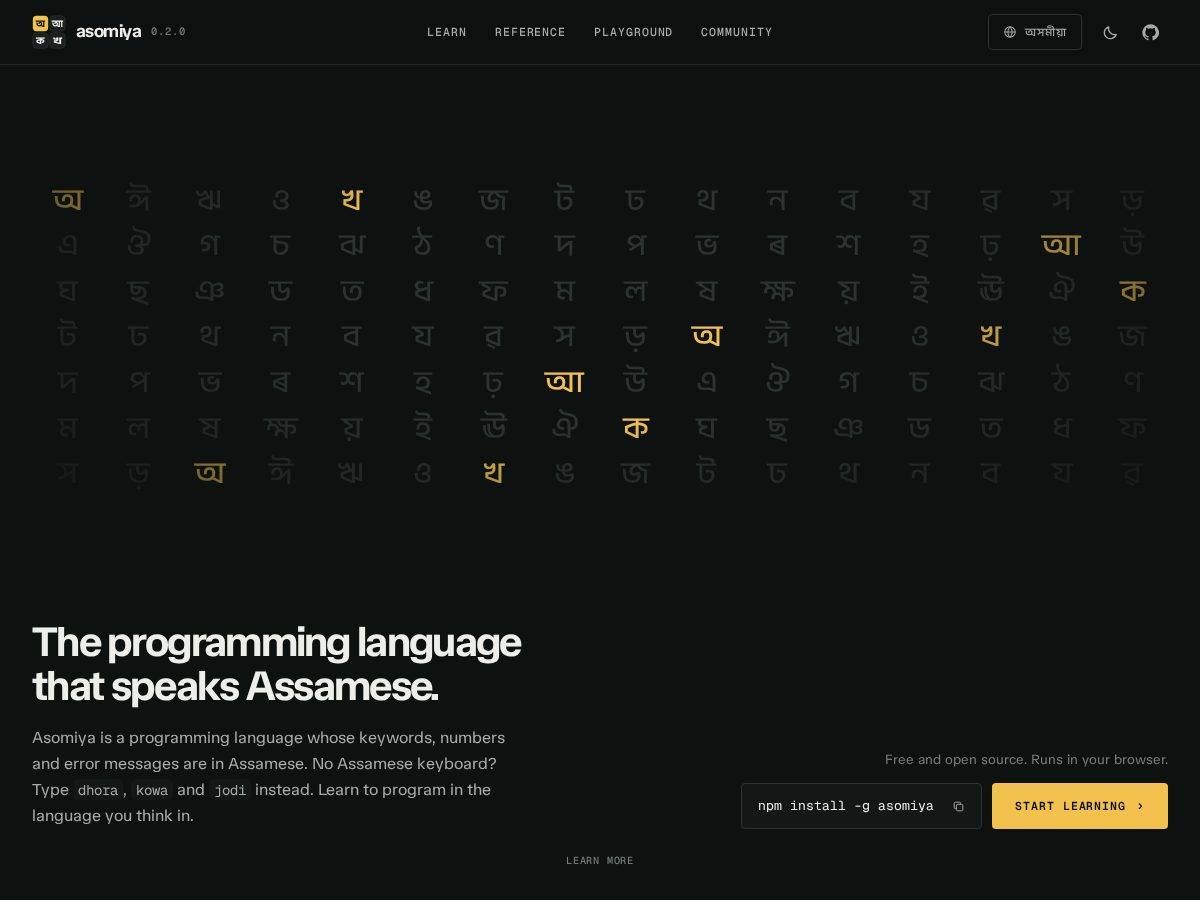
Writing code in Assamese means more than swapping the words on a welcome screen. It brings a familiar language into the work of testing an idea, making a mistake, and trying again. That practical distinction makes Asomiya at asomiya.codes worth a closer look: its Assamese error messages locate problems and can suggest fixes, keeping the language present when a learner needs help.
The page pairs runnable examples in both writing styles with a browser playground, terminal tools, and a JavaScript library. Its error messages point to the problem’s location and can suggest a fix—a thoughtful bridge between learning and real programming.
02
The opening shelf
Twenty selected projects from today’s catalogue, each shown with the landing page we found and a short explanation of why it stood out.
Weird Finds
allfarts.stream
Brown Note’s orchestra performs popular songs using recorded farts, with 33 covers, a free VST instrument, and a technical report.
Civic & Public Life
thedisclosureledger.org
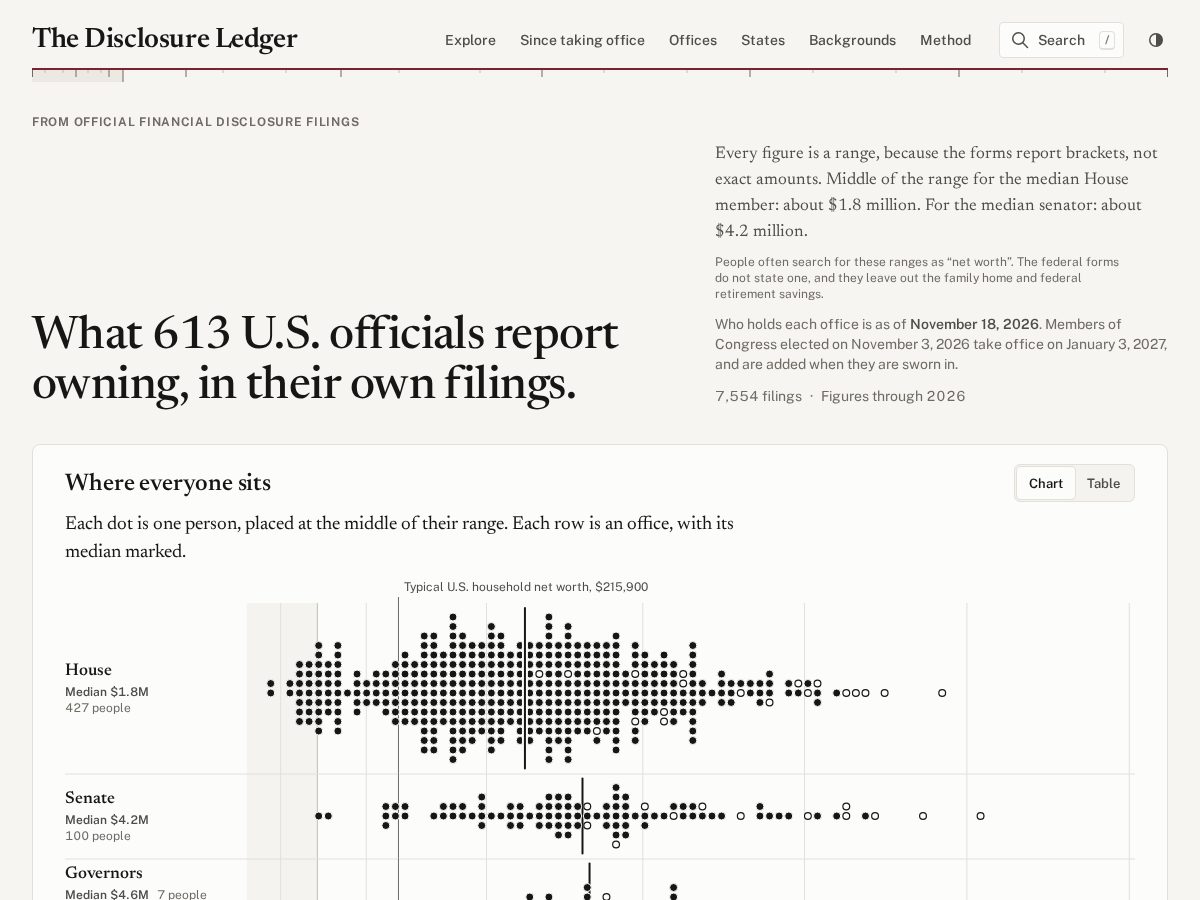
An explorer of U.S. officials’ financial disclosures, presenting reported assets as ranges and linking figures to their source filings.
Civic & Public Life
explorealligatorlighthouse.com
An interactive 3D model presents a Mote Marine Laboratory survey of the seafloor and habitat around Alligator Reef Lighthouse.
Developer Corner
trylepton.app
A Unix-like ARM64 operating system that runs its userland—including its shell, editor, multiplexer, and package manager—as Elixir programs on the BEAM.
Civic & Public Life
levparnas.space
A satirical audiovisual exhibit pairs Lev Parnas campaign broadcasts with federal filings and Florida ballot records.
Content & Blogs
monadica.org
A catalogue of Leibniz’s writings and letters, with English translations presented beside their originals.
Useful Tools
jamori.app
A browser-based music tool for building beats and songs, playing instruments, and turning voice recordings into musical parts.
Personal Pages
aliawada.dev
Ali Awada’s bilingual portfolio turns a walk through Beirut into a radio dial for his engineering work, biography, and open-source projects.
Weird Finds
grandprixtend.com
A simulator-generated motorcycle championship with fictional riders, race coverage, standings, a historical record book and fantasy picks.
Civic & Public Life
radarvioleta.com
An interactive Spanish-language guide that helps people recognize digital violence, choose next steps, and share information safely.
Civic & Public Life
commentseportentlesfinancesdemapetitecommune.com
A French-language data and learning site for exploring the finances of 22,925 communes with populations between 200 and 3,500.
Civic & Public Life
zabanestan.org
A volunteer community documents, teaches, and builds learning resources for 20 endangered and vulnerable Iranic languages.
Commerce Shelf
heartsandfarts.art
A ceramic artist presents one-of-a-kind sculptures through a mock newspaper, with a gallery and links to social accounts and an Etsy shop.
Human Services
pamojajourney.com
Pamoja describes a guided support service that helps families find next steps and request practical help from nearby churches and partners.
Content & Blogs
thebarmuseum.com
A source-backed collection of histories of 203 closed American bars, music clubs, dives, and other gathering places.
Content & Blogs
frombelow.world
An interactive world map exploring social struggles through the people who took part in them.
Learning & Exams
sicklunar.com
A free browser-based mission planner pairs a guided trip to the Moon with a technical orbit lab.
Content & Blogs
antariksha.xyz
An interactive explainer traces how Voyager 1 senses, stores, sends, and steers as it calls Earth from deep space.
Useful Tools
collagendb.com
A searchable atlas for collagen coding sequences and hydroxyproline (Hyp) annotations, with source records, evidence indicators, and downloadable data.
Pattern 01
Several sites make public claims easier to inspect by linking their sources and naming what the records cannot establish. The caveats are part of the useful work, not fine print left for later.
An explorer of U.S. officials’ financial disclosures, presenting reported assets as ranges and linking figures to their source filings.
An interactive guide to Ghana’s annual budgets, with comparisons of targets, allocations, reported outcomes, and regional projects.
A multilingual North Korea reporting site that links articles to source documents and separates confirmed records, institutional assessments, interpretation, and unknowns.
A searchable atlas for collagen coding sequences and hydroxyproline (Hyp) annotations, with source records, evidence indicators, and downloadable data.
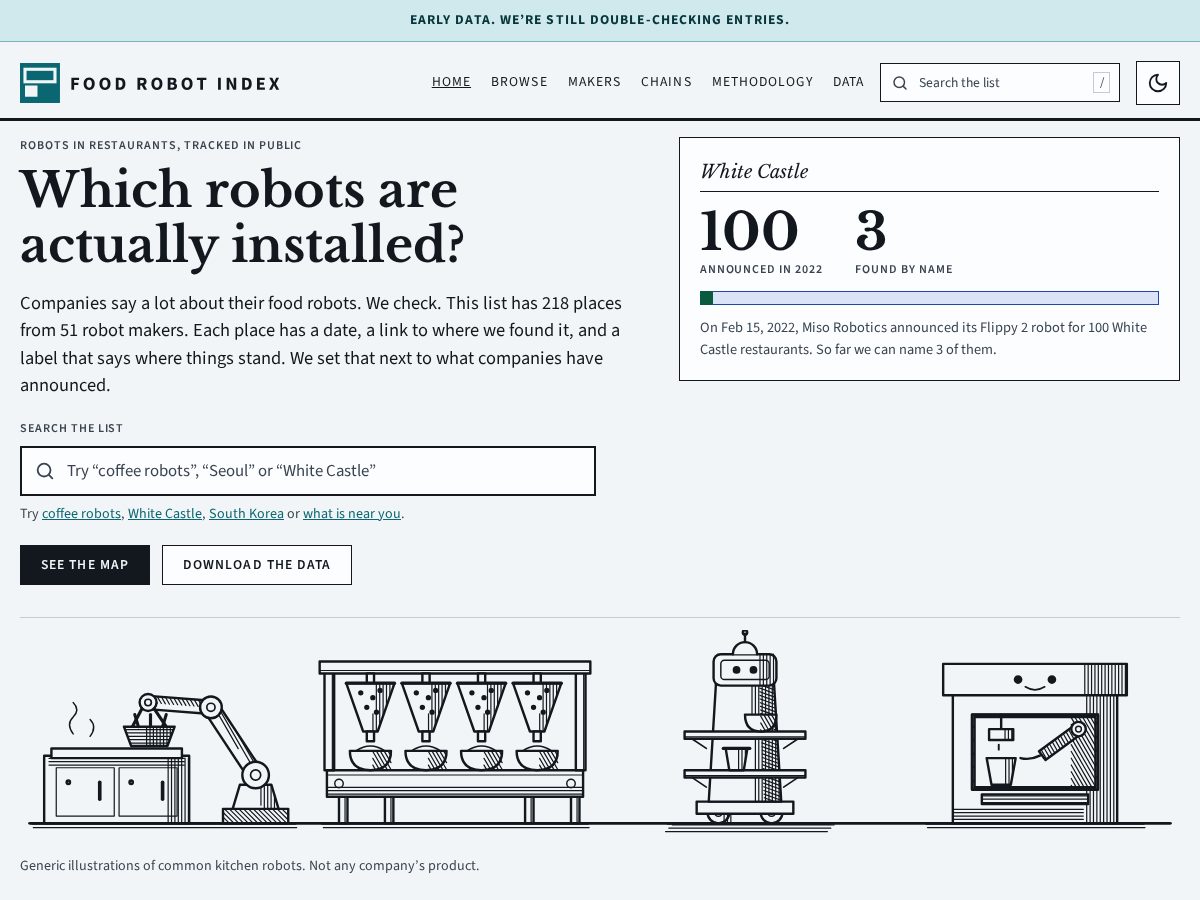
A sourced, searchable index tracks restaurant and food-service robots by location, status, maker, and date.
Pattern 02
Instead of stopping at explanation, these projects let learners change a condition and watch what follows—from orbital paths to audio aliasing and network failures. Several also mark where the simulation stops being a substitute for real-world practice.
A free browser-based mission planner pairs a guided trip to the Moon with a technical orbit lab.
An interactive lesson uses wheels and audio tones to show how undersampling creates aliasing.
An interactive private-pilot theory course with FAA lessons, explained test questions, and flight-training simulations.
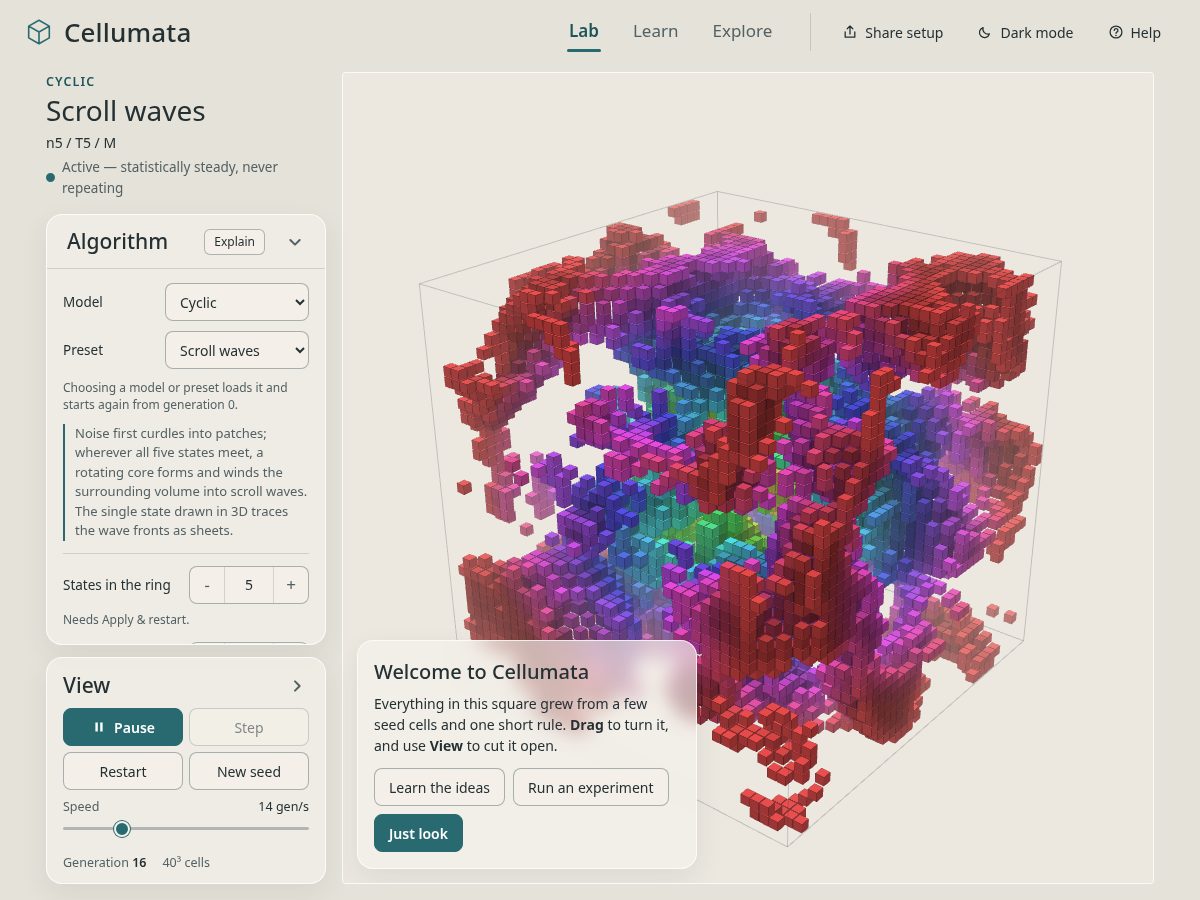
An interactive 3D lab lets visitors change cellular-automaton rules, run experiments, and inspect how the patterns evolve.
A Russian-language browser simulator for practicing network and Linux administration, with vocational exam modes and no installation or account required, according to its homepage.
Pattern 03
These projects put languages often underserved by standard software into the interface itself: code, search, speech, learning materials, and peer support. The result is practical access, not merely a translation button.
Asomiya is a programming language with Assamese keywords, numbers, and error messages, usable in Assamese script or English-letter transliteration.
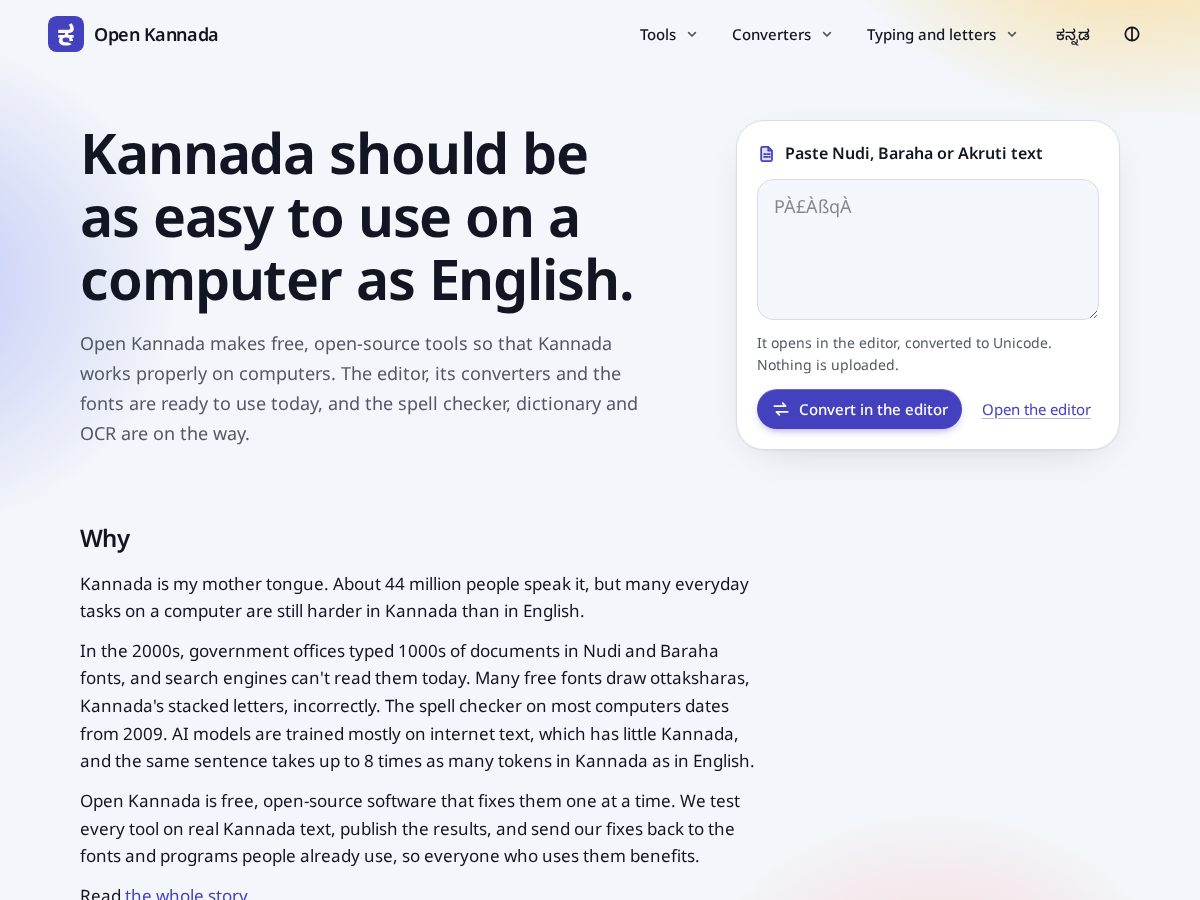
A free, open-source project for Kannada computing, with a browser editor, legacy-text converters and fonts, plus spell-checking, dictionary and OCR work in progress.
A volunteer community documents, teaches, and builds learning resources for 20 endangered and vulnerable Iranic languages.
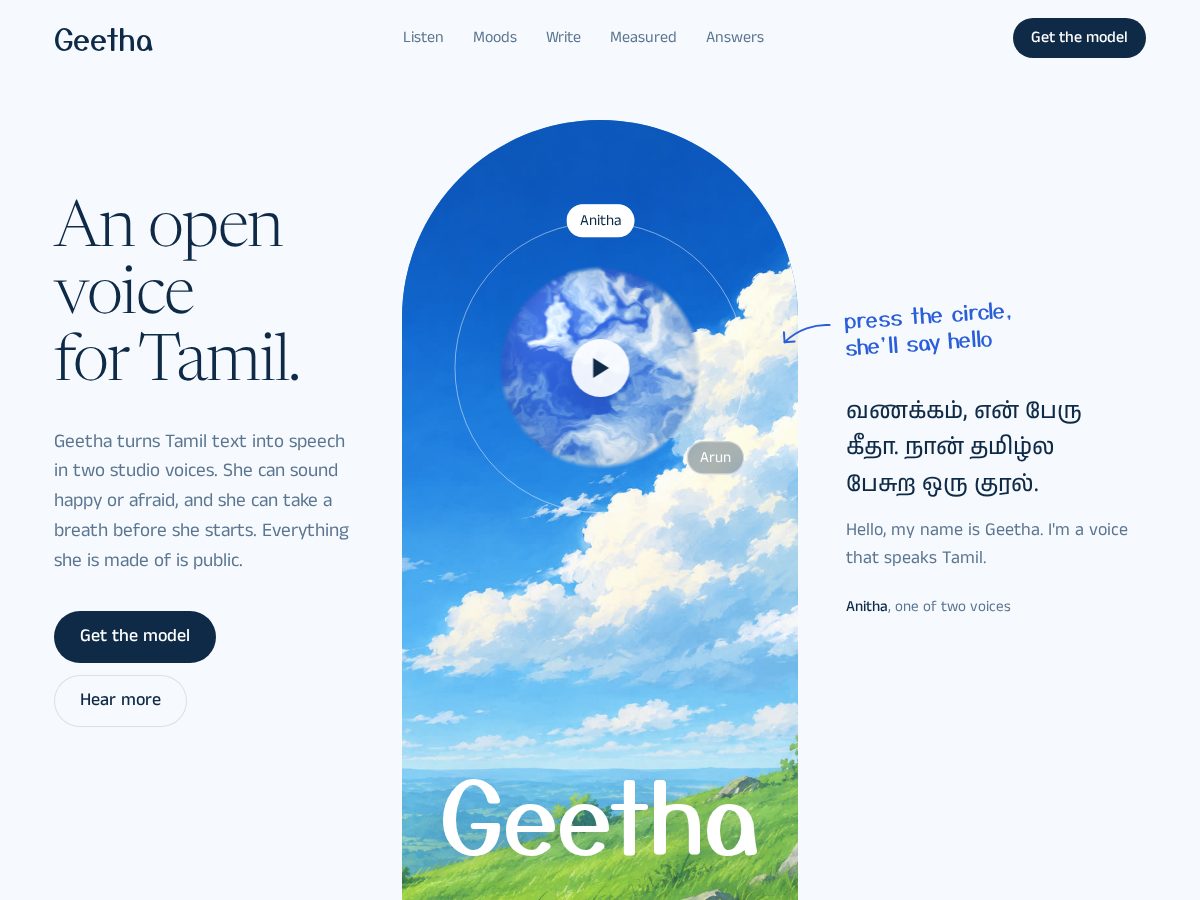
An open text-to-speech model that reads Tamil in two studio voices, with six optional moods and an inserted breath.
Rosha is an early-testing Persian-English peer-support project that aims to connect people facing cancer, their families and caregivers with survivors who have been through a similar journey.
Pattern 04
Support here takes recognizable forms: a meal request that stays open, a picture card that says “Pain,” a private place to remember a pet, or a parent’s story checked before printing. The projects make room for people to choose how help or memory should work.
Pamoja describes a guided support service that helps families find next steps and request practical help from nearby churches and partners.
An AAC app for children who have difficulty speaking: tap a picture card and the app says its word aloud.
Soul Grove offers private online memorial pages for lost pets, with space for photographs, writing, and gestures such as flowers, incense, and joss paper.
This Korean-language service uses AI phone interviews to make a printed life-story book from a parent’s own words, with recordings and a PDF included.
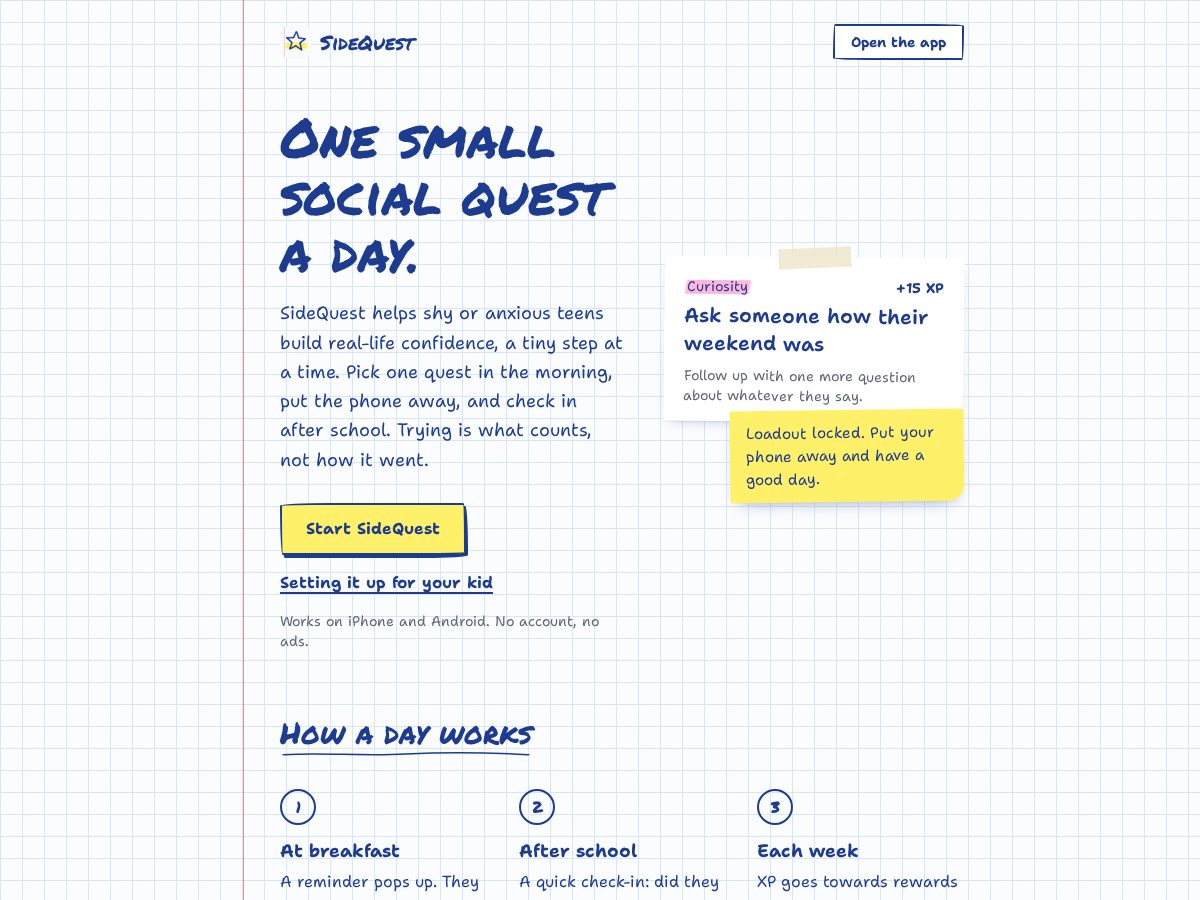
A phone app gives shy or anxious teens one small social challenge a day, followed by a private check-in.
Pattern 05
A fart orchestra gets MIDI arrangements; a fictional championship gets standings; sheep-station pinball gets rules and original music. These sites commit to their absurd premises with the care of people who have, regrettably, made a spreadsheet.
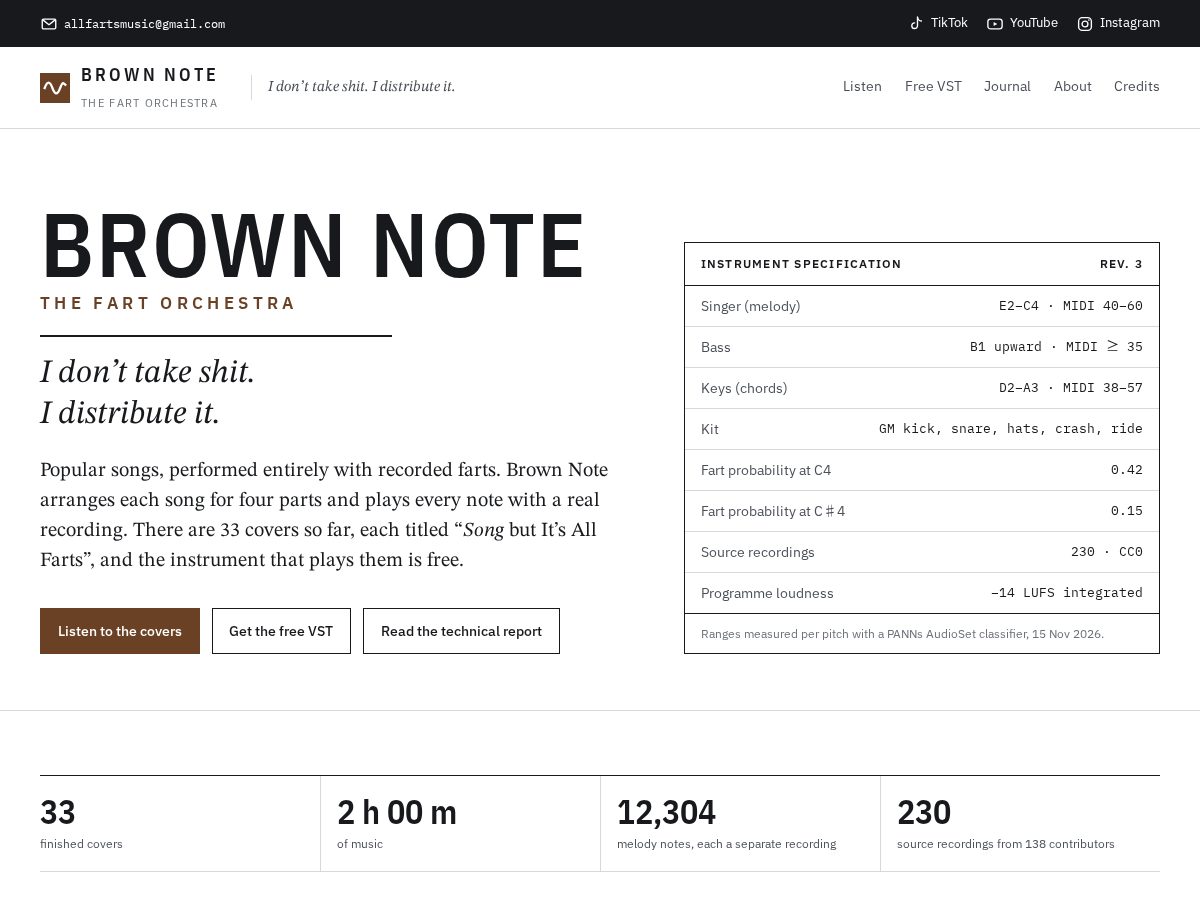
Brown Note’s orchestra performs popular songs using recorded farts, with 33 covers, a free VST instrument, and a technical report.
A simulator-generated motorcycle championship with fictional riders, race coverage, standings, a historical record book and fantasy picks.
A browser game recreating the 1970s vibrating tabletop football board, where you call plays and the figures move on their own.
A free browser pinball game turns a sheep station into a 3D obstacle course.
A 17-page fashion-catalog parody featuring garments, home goods, portraits, a soundtrack, and a print edition.
04
The complete card catalogue
The leading shelf is open. Expand another category, scan its visible pages, then reveal detail where more context is useful.
986 cards visible
The joke comes with a documented production pipeline: MIDI arrangements, four parts, pitch measurements, and a binaural theatre mix. It’s a small but vivid example of internet creators applying serious technical process to an unserious premise.
The fictional premise is part of the fun: the page gives Haruki Kurosawa a 0.268-second win and invites readers to pick a podium for 20 points.
It borrows the machinery of luxury retail—priced khaki, a shopping bag, a soundtrack—and points it at the Glass House Brands board. The editor’s letter, written in shareholder-report language, is the sharpest part of the joke.
Its editor’s letter turns family succession and corporate jargon into a catalog supposedly conceived “behind federal walls.” The site labels itself a parody and disclaims affiliation, while giving the joke a 17-part contents list, priced garments, and a bag.
Each product gets a composition list and a ritual: one serum asks you to wait eleven years, while the balm warns it will not rinse off. The page explicitly labels itself a parody, not an actual skincare offer.
Each play aims eleven figures; switch on the board and watch them shuffle wherever they were pointed. The page describes a full game, including four quarters and sudden-death overtime.
The site lays out a whole game system, from near-miss scoring to a route map and modules whose order changes their effects. Its playable-browser pitch comes with an especially unexpected extra: a Nintendo 3DS port, with releases and install notes linked on GitHub.
The story already sounds like a musical pitch: Brinkley had a scalpel, a goat, and a radio station. The campaign lays out a concrete next step—recording 10 songs with a 12-piece band and 8–10 singers—and includes a sample song.
Spell RAM and a UFO comes for the sheep; spell EWE and possums get loose. The first table has original music and works offline after it has been opened once.
The landing page doubles as an interactive demo: move a window, sweep a drift, roll a snowman, or send the snowcat in to clear the scene. It turns a small, oddly specific desktop effect into something you can try before buying.
Its model gives magic a hard ceiling: effective output approaches τ, about 6.283 S, while a fourth-power overload term makes pushing toward that limit increasingly costly. The portal also links the system to a playable CPU duel.
Dave’s fire-exit plan says there is one exit, then admits it is neither to scale nor to code. Beside the elaborate bar fiction sits a $LALA purchase prompt; the page calls the token “good for nothing” and promises “no utility, no promises”—a reason to approach that feature skeptically.
Players earn clue cards through trial activities, then submit an answer slip to an Evidence Box; the first three solvers win a prize. It makes the event itself part of the puzzle’s evidence trail.
The family tree gives each Clawd its own combination of traits, with children inheriting a parent’s features and changing one gene. From there, the site opens into a clock-following pixel world, particle effects, a crowd animation, and tools to save PNGs or record WebM loops.
Its case for Mayday Parade’s “Miserable at Best” awards a fictional $860,000 in emotional damages, then sentences the heart to “life without emotional parole.” The site extends the joke into quizzes, voting, and other mock legal tools.
Rounds can host up to 24 players, and the image categories range from famous paintings to Christopher Nolan, deserts, and black holes. It’s a pleasingly specific premise with a full play-and-vote loop.
Tap between the Shirdi Sai Darbar and Sathya Sai Darbar; a 108-bead counter, shared bells and flowers give the quiet room small public rituals. Visitors can see one another, but cannot speak or be named.
The page openly identifies ScotiaTel as fictional, then gives it working-world texture: 171 for directory assistance, 180 for Halifax tides and marine forecasts, and archived notices reaching back to 1983.
The page turns Ryan’s horses, gym visits and disputed Tooele origins into club lore. It also labels its joke testimonials plainly: the names are real, but the quotes are invented.
The courier walks on its own; players clear obstacles, tend the weather, feed it, and help light towers. Headset instructions spell out gestures from pinching pieces into place to flicking logs aside, and the page marks Chapter Two as a preview.
The page details a surprisingly specific workflow: choose one cat photo, inspect a free preview, then pay once if it looks right. It also says the app removes location data before uploading and deletes the photo seven days after the custom cat is ready.
Its 34-item menu ranges from a Korean password game that adds rules such as 받침, 초성, and spelling to year-end projects like a 216-word personal screenplay and a two-color print calendar. The homepage says there is no signup and results stay on the device.
The workshop describes a tactile sequence: a drawing’s points become lights, its lines become wires, and each piece is modeled, lit, and animated. The machines, it says, are made to watch, listen, and glow—not to work.
Its defenders include an abuela with a flying chancleta, a sodero with a pressurized siphon, and a mime who traps zombies behind an imaginary wall. The local details are the game’s combat system, not just its costume.
The game pairs its explosive puzzle mechanics with Osaka-area shopkeepers as characters, including dedicated music and screens for the collaborators. It offers solo, same-screen, and online play, with no installation required.
The premise is workplace satire with an actual mechanism: enter a salary, start a session, and watch the estimate tick up. The site extends the joke into seven short films, an employee arcade, and a corporate ladder measured in sittings.
The premise is more than a title card: the game’s instructions describe hunting herds for food, leaving some animals to breed, and managing dinosaur factions that graft machines onto saurian bodies. Its detailed controls and three named tutorials suggest a substantial game system behind the odd history.
Its tree-shot “Geiger counter” clicks according to the same leaf-by-leaf physics used for the ball. The maker also plainly says AI wrote the code and music to his designs, while naming the recordists and astronomers whose work appears in the game.
Terrafall makes infrastructure feel like part of the action: roads, maglev lines, airships and fuel pipes all feed into colony growth and warfare. It reflects a satisfying strategy-game instinct to make the supply chain as consequential as the battle.
The page says the game’s Archive changes as evidence is recovered, with revisions that can contradict one another. It also lists a March 2027 release, giving this carefully described descent a clear point to revisit.
The site prices its one-pilot kit at 299 DKK, then plainly says orders are not open and no payments are being collected. That mix of historical bombing missions and a physical “bomb hits” sensor is a peculiar, carefully explained pitch.
The window is meant to follow the train’s real-time weather; at stations, riders can leave notes and collect stamps. Missed stations stay missed.
Players dodge red-tape lasers and broken-election-promise obstacles with a pressure-cooker jetpack. The studio’s listing says the game has offline saves and tracks no personal data.
The premise is unusually clear: nobody is playing, and nobody is in charge. The page also points to a History, Almanac, Daily Chronicle, and midnight snapshots—small records of whatever the island gets up to.
The collection pairs a chess set with pieces such as a menina pawn and a castle tower with solitaires based on 1878 Spanish cards. The page says those cards were restored one by one from scans at the Museo Fournier de Álava.
The rule changes are concrete: forests stop sliding pieces, portals connect distant squares, and cracked floors crumble after a piece leaves. The site also lays out a branching, three-act campaign rather than relying on a magic-themed coat of paint.
The landing has three stated thresholds: 90% pad alignment, 99% vertical alignment, and a touchdown below 20 km/h. Nail it and the page reports, “Tower still standing. Flight control is asking for your autograph.”
Five animals have distinct jobs, from the frog’s rapid-fire tongue to the snail’s slowing slime. The visitors get shooed away, not hurt—a tower defense game that makes its nonviolence part of the pitch.
The current holder, “TIBBIRto33Billion,” paid $1; when a word is replaced, it stays in a public register. If no one replaces the word for 365 days, the page says it closes for good.
Six fighters have card-style stats, named moves, illustrator credits, and little character vignettes. The page traces each beast from crayons to card to arena, then offers two ways to play—though the extract doesn’t confirm how much of the game is playable.
The page reports 15 verified AI-crawler fetches in seven days, from one crawler, while all 50 panels remain empty. It says verification uses crawler vendors’ published address lists and that the site vouches for none of the advertisers’ claims.
The rules give the Moon the top rank, then let specific four-of-a-kind and straight-pair plays beat it. That unusually concrete twist sits inside a fuller game loop, not just a pitch page.
Elybean’s inventory reads “No map. No money. No idea,” followed by “Confidence unreasonable.” That tiny mismatch is both the joke and the character.
The sample offers 17 visitors and footage made from eight sample rooms. In the app, a parent can preview the result before handing over the phone; the keepsake pairs each clip with the child's reaction, filed by age.
The page lays out a full progression system—64 levels, eight worlds, hidden warp-pipe courses and boss fights—then adds live one-on-one play against signed-in people. Its cheerful warning, “Don’t get boned,” sets the tone.
Its road map forks and rejoins through lamp-marked stops: earn up to three stars at each, beat a region boss, and open the next country. The site says everything except the King Pole’s competitive board works offline and catches up when you’re back online.
Each answer is a swing: bet from 1 to 10, earn that many logs on a hit, and nothing on a miss. The axe-and-cabin framing gives a familiar trivia loop an unusually memorable bit of machinery.
The page lays out 13 games as arcade “machines,” including pin-pulling, crowd-rush, and bottle-sorting. Plays are described as roughly 30 seconds, with a weekly score board for players who submit a nickname.
The Veil reveals hidden paths and caches, but staying too long brings hunters. One useful catch: reloading or reopening the game starts a fresh campaign.
The game spells out its grooming controls and salon loop, then gives players a direct way to report what worked or broke. Its data note also names the gameplay events it collects and the limits it says it follows.
The page treats a browser terrarium as a place to return to: its simulated time advances only while the page is visible, and habitats save locally rather than growing while you’re away. Optional AI behavior tools sit alongside a rule-based, offline mode.
Its controls include a scoutless brain, random positions, and buy-and-hold—so the worm has to beat more than a good story.
The pitch gives death a durable cost: your body and carried goods remain, while your soul waits for its god to decide what happens next. A public Chronicle is offered alongside the entry point, though the page alone does not establish how much of the game is playable.
The homepage lists seven games with estimated play times from 25 seconds to four minutes, including a race for glowing seeds and a hungry cloud to scoop. Its editor’s picks are explicitly not ranked by play counts.
Its game interface makes chart-making part of the progression loop: the page says players earn “bytes” by leveling up and uploading charts. Modes such as NekoBot and Visualizador are explicitly kept out of rankings or XP, giving the playful cat-themed world some visible rules.
The listed modes range from Mayhem to team relay races with roof turrets and timed trick battles. Private rooms use four-letter codes, and computer drivers can fill empty seats.
Its rules are unusually legible: presses are attributed only to a country, gift presses are labeled separately, and bot presses are removed. The site says the button will stop for good at one billion, while the record remains.
The page is unusually candid about the bargain: frequent updates and world wipes are expected. It also gives each download’s file size and SHA-256 hash, then records build-specific changes in the open.
The project makes a careful distinction between what its typing record can show and what it can’t: a person typed the sentence here, but that doesn’t prove who thought of it. The wall is still empty, so someone can write its first sentence.
The page says each job’s pay sits in its own Solana account. Right now, the board reads “Hiring Closed” and “Reading the board from Solana…”
There are ten prompts per local-calendar day and thirty seconds for each; hints open in steps, while later share counts are marked as editor estimates.
At one address, it lists 12 rental cars, two detailing bays, and two tables for Texas Hold’em and Omaha played for points. That unlikely lineup makes this local-business page worth a second look.
Its copy gets unusually specific about grading records, separating jacket wear from groove condition, and letting customers listen before buying. But the shop’s identity is hard to read: the footer says “CRATEDIVE,” and a price-list link appears without actual prices in the supplied page text.
The homepage’s beach toy tracks the real moon’s tides. Its maker is a working hydrographer who says he checked AI-written code against what he knows from the sea.
Its arena runs past prayer wheels and across the square beneath prayer flags. Solo players face 15 waves and Kaal; Deathmatch adds private rooms and proximity voice.
Everyone gets the same wind and course, making the leaderboard a small daily experiment in who can read the shifts and time the start. The game also offers 15 drills and rotates through 65 regatta venues—a notably concrete sailing world for a browser game.
The game gives its armies formations, morale, stamina, weather, and fog of war—not just a row of units to click. There’s also a siege mode where you build by day and hold a fortress against the dead at night.
The homepage pairs daily quizzes with fan clubs and a personal “Cinema DNA” profile. It also draws a useful line between factual quiz scores and subjective battle votes: only the former count toward BQ.
The project puts troubadour song beside rap, slam, and dub reggae, then treats the medieval story as an inquiry rather than a commemoration.
The rules have their own tactical wrinkles: a shared Ward cushions the damage when players’ games start at different times, while heroes earn XP and unlock moves as they produce. It’s a fully specified fantasy-football/RPG mash-up, not just a reskinned scoreboard.
Its real-place roster names Tenerife, Gran Canaria, and Hawaiʻi in true shapes and heights. The site says its own multiplayer server is still coming.
It treats the games children play at desks and on benches as cultural material worth cataloguing: country labels, local-language names, player counts and runtimes sit beside the play buttons. The ambition is broader than the working build: computer play is available for Bangladesh games, while the others are marked coming soon.
The table becomes a forest council: players join by QR code, take secret roles, and argue over who is a poacher in disguise. The site also says half of net proceeds go to “Мечешки истории” (“Bear Stories”).
The game runs through eight scenes: guests trade alibis, question Frost, then name who did it, where, and with what. The page promises no scripts to print or envelopes to stuff—just a screen for the butler and phones for the suspects.
The site turns nostalgia into a practical sequence: install ezQuake, place two game files in an id1 folder, then connect to beatdown.dev. It’s invite-only for now, with invites routed through someone known as Bastard.
The score turns on preset rarity tiers, not live votes from other players—and the page says so plainly. It also distinguishes an answer missing from its list from an answer that is actually wrong.
The premise makes the radio bench a lifeline: there’s no cell service, and its battery power station is running low. The page also promotes a free prologue and a separate free Osaka workbench with no story to get through.
Farming games often trade in a generic pastoral idyll; this one names chili, bimbi, mas huni, garudhiya and dhonis, and points players toward markets in Malé and Addu City. Its local detail gives a familiar game loop a distinct cultural setting.
The site takes a familiar seasonal drive and gives it game mechanics: arrive within 150 feet of a display, check in, and try to collect a cast of 32. It’s a small but revealing example of turning local holiday rituals into app-shaped quests.
The site treats traditional golf equipment as raw material for a different game: a ball must strike the T-Stick, and nine holes resolve through three rounds. Its Rules of Play are explicitly provisional, making this both a sport proposal and a visible act of institution-building.
The site calls 2026 the tournament’s first year and lays out a six-game, points-based round robin for about 30 players. It presents the match as part of a broader effort to bring founders who live together into shared activities beyond work.
The controls let visitors move through time, switch map layers, and filter events by region and importance. Its description says Ottoman history runs from 1281 to 1923 with day-level dates; world coverage is still expanding.
You get eight peeks and five guesses; every 20 seconds, hidden combs flip to new letters. Play a word to earn a peek back.
The page gives this fictional airline an unusually detailed operating identity, from its KSEA origin to named aircraft tiers and paint rules. One record needs reconciling: the three displayed tier counts add up to 392 legs, while the headline says 260.
It brings a Playdate game into the browser, using a draggable dial for throws. The site also explains its privacy choices: match records stay private, and open-game listings show player counts and status, not names.
A like carries your handle and profile photo with it, and only photos taken inside the app can spread that way. The site’s blunt rules make the social contract unusually easy to see.
The homepage lays out a league of 44 competitors across four conferences. Its Play Now section says it tracks slides, kicks, overtime, and multi-game sessions—a wonderfully specific bit of sports infrastructure.
The page folds Bat Yam shops, phone messages and a shared Instagram into the game’s neighborhood, alongside beach matkot and poker. Even wider Google Play access has a community-sized gate: the page says at least 12 testers must stay enrolled for 14 consecutive days.
The page gives the raid a physical logic: shells travel, ships have walkable corridors, and damage can leave a crew limping without an engine. A free playtest is offered, with the warning that builds are rough and progress may be wiped.
The page promises a game where rocks settle, plants grip their surfaces and fish behave by species, alongside 40 named customers with distinct tank requests. It is still marked coming soon, and its headline species total conflicts with the freshwater and reef counts listed below.
This league has given its hobby the machinery of a whole sports institution: newspaper editions, a high-score prize, and 10,000 simulations tracking who might finish last. The bottom team faces a one-year suspension—a very serious consequence for a very specific pastime.
The page says a solver checks every board for a provable safe move. Five-board runs add denser layouts, murky cells, and refits between dives.
The finder filters by Austrian state and ensemble type, while a musicians’ noticeboard offers wanted and offered posts that stay up for three months. The sampled filter currently reports no band, and the site invites ensembles to add themselves.
It turns launch anticipation into a worldwide roll call, complete with shareable story images and a scheduled results report. The site also spells out its privacy limits: it says it stores separate counters, while warning that its host may process network data.
Everyone gets the same five figures, and each answer links to its source story. The extracted page was still loading today’s numbers.
The page’s comparison puts a Saransk retail-hall job at 21 days by the older workflow and 1.5 days with this process. It also states a tolerance of up to 10 mm on flat surfaces.
The proposed machine combines waterless brushing, module-level thermal inspection, and technician-approved swaps. SolarTended says it is early-stage and seeking pilot partners for the 2027 dry season.
The page includes a cardboard DIY holder guide and a frank caveat: its Coach measurements are experimental and not validated against live shooting. Checkout is not open.
The pitch is as much about proving what happened as making rain: it proposes comparing treated flights with nearby clouds left alone and reporting the results. RainSeeded says it is still seeking partner sites for a first season, so this is a proposal to watch, not evidence of an operating program.
The homepage sketches a dedicated toolkit for spotters, from transport-specific record fields to a map whose precise locations can be hidden. It also draws a clear line: observe from public spaces, not inside depots, on tracks or at secured facilities.
The city map brings together BRTS and Metro rides, a sample festival calendar, and plans for finding people by shared interests. But the page says sign-in is not connected on this copy, and that real Amdavadis come after its AI residents: this is a prototype, not a working local network.
Jamori gives beginners a path from a first tap to a layered track, with 170 lessons and styles spanning techno, ragas, reggaeton, and more. Its timing check even measures headphone delay so played notes can land on the grid where they were heard.
The atlas separates database assertions, experimental indicators, and mapping limits instead of flattening them into one evidence label. It also warns that repeated source observations are not necessarily independent experiments, and that an unannotated proline is unknown—not a negative result.
The snow is more than a wallpaper: the page describes drifts gathering on windows, cursor-brushed snow, and a tiny plough that clears them. It pairs that playful desktop effect with a 30-day calendar of gifts—and even lets the calendar wait if you miss a day.
The privacy promise comes with concrete mechanics: Leaf says redaction removes underlying text and other document elements, rather than laying a black box over them. It also describes offline signature checks and warns when editing scripts or other text it cannot faithfully change.
The page lays out a notably concrete export trail: seamless PNGs, shade strips, GLB scenes, Godot kits, and TrenchBroom WAD/MAP files. It describes the output as CC0 and says it uses no generative AI.
The lessons progress from basic controls to rain, fog and expressways, while the site identifies its rule references: a National Public Safety Commission handbook and road-sign designs based on Ministry of Land, Infrastructure, Transport and Tourism figures. It also clearly says what simulation cannot teach: real-car feel and the need for supervised practice before driving on roads.
Visitors can try three listening-and-picture-selection questions right on the homepage. The app pairs speech-language therapy exercises with a carefully specified village world: 13 locations, recorded character voices, and rewards for completing practice.
The Stroud Lab at Georgia Tech pairs the forecast with a map of the approximate northern range of green iguanas, inferred from iNaturalist observations. The site also lets visitors share the answer and links fall reports to iNaturalist.
The tools can send results to Lab Entry, where they wait to be filed under an experiment and day. The whole thing runs on a pleasingly potato-themed promise: “For the Researchers, by the Researchers, of the Researchers.”
Its examples move from a half-remembered boarding-pass code to a handwritten Bengali rent receipt and a doctor’s voice memo, with each result opening at the relevant page or moment. The maker also shows offline-search tests and discloses an 865 MB model download on first launch.
Of 11,911 names, 70% belong to exactly one pet; Luna is the exception, shared by 358. Readers can filter the report by ZIP code and check their own pet’s name.
The site gives a digital keepsake a tactile rhythm: close the phone or hold a button while the flower presses, then grind a pinch into paint. Its on-device photo cutouts, aging pages, and herbarium labels make the app feel built around the quiet details of keeping flowers.
Its “Nothing. Not even a pan” tier sticks to microwave, toaster, or kettle meals: about five minutes of hands-on work, one bowl at most, and no raw meat. The page also names its price sources and says actual costs will vary.
The workflow targets a specific export problem: drop in Snapchat’s ZIP files, without unpacking them, and get organized photos back. On one ten-year export, Resave reports restoring 2,688 items, removing 262 duplicates, and recovering 92% of dates with high confidence.
Its editor converts Nudi, Baraha or Akruti text in the browser without uploading it. The project also turns corrected conversion cases into tests—a practical way to improve tools for a language the homepage says is underserved in everyday computing.
The site documents a full path from source material to physical marks: users can choose among 13 pen-oriented fills, configure layers and passes, then plot directly to supported hardware. It also identifies its release, Mac architectures, and MIT license.
It matches bill entries to fee-table codes and explains them in ordinary language, rather than offering a generic medical-cost estimate. The page also provides sample bills and says it checks facility disclosures against public records; it notes that it does not judge whether treatment was necessary.
The instructions take you from a blank canvas or one of 15 editable Quick Starts to pasted HTML in Tumblr. Its pitch: a theme is a website “technically,” the way jorts are pants.
At the displayed ¼-inch setting, the comparison marks one model as clearing 90 degrees, 17 as not fitting, and two as needing more data. It links its judgments to manufacturer drawings—and doesn’t pretend missing dimensions are confirmed.
Choose a flock and adjust labeled parts; the planner checks the layout and shows where its measurements come from. It also flags disagreements between sources—for six hens, Penn State’s nest-box guidance calls for more boxes than some other recommendations.
Its comparison starts with measured Sapporo water temperatures rather than a generic year-round assumption: January’s cited average is 2.7°C. The page names its public data sources and spells out what the estimate leaves out, including basic charges and fuel-cost adjustments.
Its strongest design choice is a warning the site repeats: no match is not a safety verdict. Each factual claim is meant to trace back to the issuing authority, making the limits of a search part of the product rather than fine print.
The page turns the anxious question “Can I now safely delete?” into a file-by-file verification and receipt workflow. Its focus on proving each copy before removal makes this a notably specific answer to a familiar cloud-storage worry.
The homepage connects trail navigation to a specific off-grid relay: a phone with internet and a paired radio can pass group messages between them. It also says trips stay on the phone and party messages are end-to-end encrypted.
A royalty-check decimal becomes the start of a checkable calculation: the site says it shows every step to net mineral acres and net royalty acres. Its section pages also connect land records to leases, drilling permits, and wells.
A 100%-hydration starter adds equal parts flour and water: Dough Math shows how 200 g of starter can turn a recipe labeled 70% hydration into 72.7%. It also reports checking 50 popular recipes, where counting the starter raised hydration by 2.7 points on average.
It applies the FAO-56 crop-water method to each garden zone and can skip a run when forecast rain covers the deficit. The page also shows how an AI assistant can configure programs, with a preview of the changes before saving.
Its safety copy is unusually concrete: the site says there is no password field, no network request after loading, and a two-second ESC exit. The prank doubles as a lesson in what a real lock screen is not.
Legged Desk treats robot shopping as a problem of price provenance: it separates maker list prices from reseller prices and agency payments, and dates its figures. That turns a fast-moving market into something a lab or buyer can compare without mistaking a contract total for a shelf price.
It separates passport-counter hours from a building’s ordinary hours, then adds walk-in windows, photo service, fees, and nearby alternatives. The page says it draws on USPS listings, a State Department file, and facility websites—and flags disagreements with dates.
The utility pairs careful cleanup controls—permanent deletion is unchecked by default, and ordinary cleanup goes to Trash—with a mascot that grows as you use it. The page also describes a local idea board and a timeline of actions that can be undone where files remain in Trash.
It turns biodiversity records into a practical local question: what belongs in this garden, and who might it feed? The page also links plant choices to threatened animals, while naming its data sources and flagging that some wildlife links remain unverified.
The catalog says where each value comes from—and leaves missing data missing. Bassmetric also connects enclosure research to a 3D stack configurator, with several design and analysis modules explicitly marked partial.
It combines predictions from 45 NOAA stations with beach-level thresholds to sort useful tide days across 37 spots. The site is careful about the limits: these are predictions, not observations, and they are not a beach-safety guide.
CAELIS aims at two specific outdoor-photography headaches: keeping a long interval sequence on schedule and knowing when celestial objects clear nearby hills. It says it uses the camera app’s own shutter, and its sky tools include terrain-based horizon views and rise-and-set times.
The site treats secret writing as something to take apart, not just admire: its cipher entries explain the flaw behind each method. That makes a familiar puzzle pastime a compact lesson in how secrecy fails.
The detector makes a first pass, then a person reviews each crossing and can correct missed or double-counted traffic. The site shows its work: on one example, the pre-review tally lists 63 cyclists against 70 counted by hand.
The walkthrough follows stock from the van to the table, then flags a tour tee counted at 20 when 21 were expected. It also shows how the night’s takings, stock costs and venue cut feed into a settlement.
The editor lets you drag or resize recognized-word boxes, enter exact coordinates, or draw boxes for missed words. It says scans and edits stay in the browser, and it spells out how review marks become confidence values in the exported file.
The homepage gives the idea a tangible shape: an obstacle-avoiding rover, an egg-shaped pocket pet, and a robot arm, each presented with parts, tests, and estimated build costs. The actual workflow is offered through early access.
It names 23 makers and dealers, then distinguishes what farms reportedly paid from what dealers ask. That small bit of price-labeling discipline matters in a market where most makers do not publish prices.
The sample Tronador 130K plan lets you move a gel to another hour and see the carb and fluid lines respond. It’s a focused, carefully explained tool for a demanding kind of race planning; the demo itself is not saved.
It turns the fiddly question of whether furniture will fit into a small simulation: overlaps and blocked doors turn red, and it can warn about drawers, chairs, and bed access. The page says layouts save in your browser without an account.
It makes a careful distinction between recovered text, labelled hypotheses, and “Unknown,” and warns that permanently removed text may not be recoverable. That combination of a playful appetite for disclosure and explicit limits makes this a useful specimen of document-analysis tooling.
Its pitch is about more than digitizing a roster: it frames shared records as a way for an association to continue after its founder is gone. The page lays out branch-by-branch workflows, multilingual support, and a demo with selectable roles.
The site tracks 125 inns across 16 areas and says it has checked 115 against official pages. It records sources and check dates—and marks unlisted details as unlisted instead of filling gaps with guesses.
The site is candid about its limit: its reconstruction uses a community dataset frozen before launch, and the in-game map is now the source of truth. The visited list saves in the browser, not on a console.
It explains its two-pass seam repair in unusually practical detail: the image is offset to bring both joins into the middle, then the vertical and horizontal seams are blended separately. Images stay on the user's device, and the guide even warns that exporting above the source resolution adds file size, not detail.
The mix is unusually well judged: one game arms its rats with a “49.3” that steals a turn, while a fishing notebook checks whether a catch meets local legal size and a gardening app adjusts sowing dates by département.
Its Sleepy Street challenge asks you to wake at least 11 homes with one strike; the interface also tracks sound radius and volume as you experiment.
Trama makes a specific, inspectable case for itself: edit a value and linked analyses and graphs update; excluded cells stay in the sheet rather than disappearing. The site also points readers to its license, sample project, source checks, and a Windows 11 test report with a ZIP checksum—while plainly labeling the app beta and its method coverage partial.
Truestride makes explicit a default its page says generic trackers use: calculations based on a whole body. It lays out its published corrections and admits that the extra gait cost for bilateral amputees is extrapolated, not directly measured.
Warcryer treats alliance hierarchy as working infrastructure: its five voice nets change with the roster, rather than asking players to choose channels. If a party leader drops out, the page describes a succession process that keeps the group connected.
A dead PC need not take every installed app with it: WinAppMigrator can build an installer from a pulled drive, disk image, or networked Windows PC. It checks package hashes before installation and warns that machine-bound licenses may still need reactivation.
The answers stay in the visitor’s browser, and the report can be saved as a PDF or exported as an Excel register with 14 columns. The page also explains which regulatory dates it uses and cautions that its guidance is not legal advice.
The page pairs run replays and crew leaderboards with route planning that can limit routes by difficulty. It also states a useful limitation plainly: its OpenStreetMap-based routing does not know which trails or lifts are open today.
Brick Bin distinguishes a set’s design from every physical copy you own: five copies of one polybag can each have a different build state, location, and missing-piece list. The app also makes the collection a store-trip checklist, with exports for BrickLink and Rebrickable.
It treats an unmatched model as unknown—not cleared—and puts recall checks ahead of watt-hour math. For a tool touching airport rules, that caution is part of the point.
It keeps missing and unreadable marks distinct instead of treating silence as permission. Its source ledger names ISO 3758:2023 and a U.S. FTC chart, while noting that its source checks are editorial—not independent certification—and that artwork trademark clearance remains unresolved.
This is more than a playable keyboard: its sequencer supports manual step editing and layered loops, while the interface also offers MIDI control and WAV, MIDI, and sample-pack options.
Rather than promise a margin, it asks farmers to enter feed costs, mortality, labor and growth rates, then tests three sale-price scenarios. It’s a practical glimpse of farm-level risk management, with the page explicitly warning that its scenarios are assumptions, not a forecast.
Its seven open experiments range from room modes and reverberation to QRD diffusers. The animated room demo also states what it is not: no SPL-calibrated measurement, FEM solver, or microphone recording.
The homepage connects its fairness claim to a match record of minutes, goals and history. It also says teams use first names only, with controls to delete a match, team or account.
The site says its writes pass Linux’s `e2fsck -fn` check and that saved files stayed intact after a cable was pulled mid-write. It also keeps disks with recorded damage read-only and explains why in plain language—a concrete safety story, not just a compatibility promise.
Enter a five-digit postal code to get a 0–100 score and an animated meme. The index draws on 2020 INEGI and CONAPO data, and explicitly says it measures the neighborhood—not the person who lives there.
The feature set gets unusually concrete: rooms for up to 16 people, individual WAV or FLAC recordings, and a VST3 route into a DAW. Its FAQ also names the trade-off: restrictive networks can block connections, and people in a room may be able to discover one another’s IP addresses using network-analysis tools.
It turns a familiar airport limbo into a specific toolkit: record time-stamped changes and expenses, play 18 games offline, or check in with other travelers at your gate. The site says the log cannot guarantee a refund, and its iPhone and Android apps are still marked “Coming soon.”
Its pitch turns an English-first software blind spot into a visible test: a Kannada drop cap that can split a conjunct and strand a virama. Inkshara says books stay on the user's computer, making script support and privacy part of the same publishing promise.
The site is a playable sampler: switch worlds, inspect hand-drawn icon sets, and stamp a 30-stop passport. The app is still in testing, and the demo notes that its actions are not saved.
It compares pasted workflow JSON or a “Missing Models” dialog against the files the official workflow asks for, flags the legacy vocoder_24K reference, and checks settings against selected VRAM, width, and frame count. The page says the checker runs in your browser without uploading the workflow.
The site says each tool reopens its result and reports what it found or changed—a useful check for work where a black box over text is not enough.
Its four jobs are deliberately small: change text, request an optional AI rewrite, swap a photo, or restore an earlier version. The demo is tryable but explicitly does not save changes; the product is listed at $30 per website, paid once.
Choose an instrument tuning—or enter your own notes—and Oakhum lays out the chords that instrument can play. The homepage even offers a playable D Kurd handpan example, so the idea can be tested without signing up.
The page says the vendor’s Mac app is thin, so Deckhand turns this multi-device desk bar into a programmable Mac companion. It also ships full-width bar apps, from flight tracking to a verse of the day—a small example of users building around hardware the vendor left wanting.
The page treats disk cleanup less as a one-click chore than a trust problem: it labels rebuildable files, refuses protected paths, and puts deletion behind review. That specificity makes a familiar utility feel aimed at people who know exactly what Xcode and Docker leave behind.
The route ideas think beyond point A to point B: examples pair museum visits with rainy-day shelter, or a cold-night walk with屋台 and a sauna. The site also presents community-submitted routes and a photo-based stamp rally.
The page lays out a specific handoff: paint the model, save a 3MF, and continue in PrusaSlicer with print details like placement and presets preserved. It also includes six painted Low Poly ZOO animals—and one unpainted Capybara to color yourself.
The homepage lists 1,195 panda records and tracks family links alongside movements between facilities and countries. It says records carry source grades, turning a fan-friendly lookup into a project with an eye on verification.
The page lists 19 systems across 13 brands and says each figure links to a source and check date. Its regional filter reflects approval regions, not whether a model is in stock—a useful distinction when comparing safety equipment.
Its sample counter fixes an exchange rate per sale and shows split USD/LBP payments alongside Ministry price updates, batch expiry, and controlled-drug records. The local economic and regulatory context is built into the product’s pitch, not left as a footnote.
It maps the game’s own controls rather than running a program in the background, and adds an optional right-stick action wheel through Steam Input. The page also spells out a useful boundary: no turbo, macros, or multi-step inputs.
It checks each daylight departure window and scores the current out and home, wind, and daylight. Just as usefully, it says what it cannot know: the wind is a forecast, current readings come from three NOAA stations, and sailors must watch for hazards themselves.
When a simulated failure overloads a breaker or PDU, the tool trips it and recalculates for knock-on failures. It also spells out its limits: single-phase 230 V only, with no upstream UPS or generator modeling.
Its receipt-by-receipt checklist turns red when an item is checked, mailed, or used. The site is notably clear that this is a traveler’s notebook—not a customs filing or refund processor.
The site describes six right-to-left sheets in Egyptian Arabic, including a call sheet and a wardrobe-continuity PowerPoint. One especially practical touch: its accessories breakdown flags props a scene may imply, even when the script never names them.
The workflow is unusually end-to-end: checklists can be saved offline and synced later, while the service records whether an owner received a report and whether it was submitted. Five inspection-form types are supported; several others are explicitly marked as still in preparation.
The figures come from operators’ own price lists, and the page reports 1,765 sourced price records. It also labels unknowns instead of guessing, including availability, and exposes the comparison through an API that requires no key.
The page says audio stays in memory and is written to disk only when you choose to save it. It also gives a concrete budget—about 22 MB per hour per source—and makes transcription an optional local download.
The client scans a code and adds the tattoo to their contacts; the site says no app or sign-up is needed and that it stores no client information.
Drop in a ZIP; the site says it does the counting in your browser, without uploading the file. Awards range from The Night Owl to The Link Librarian, with three “spicy” options users can switch on.
A sample follows an anonymized children's game on a Pixel 7, counting messages to Google and Unity before and after a refusal. It turns an abstract privacy setting into a timed record for plaintiff firms and their experts—and shows how AI-assisted research is entering that evidence workflow.
A 1796 beef-steak pie gets an itemized receipt, while a feature traces 1,700 years of price tags. The site says each figure is tied to its source.
A mattress, propane tank, or can of paint can send a household on a surprisingly local scavenger hunt. The site reports 14,765 listed locations across 1,307 counties, with hours, fees, accepted items, and open status; it also explains that status is calculated from published hours, so holiday closures still need checking.
Every transcribed entry links back to its source-page photo; unclear entries are flagged, not guessed. The site also says its reports are information, not airworthiness certification.
The office editor exposes controls for laying out rooms, sharing screens, and working together; screen sharing is limited to one other person and ends when either person leaves. That is a concrete take on making remote work feel like a shared place.
It looks beyond the pump price: drivers can set how far they are willing to detour, their fuel and vehicle details, and the distance ahead to check. The same route interface also includes rest areas, places to sleep, weather warnings, and options for navigation apps.
The homepage includes an interactive four-play demo: draw the assignments, then compare them with the coach’s answer. It also specifies a useful privacy constraint—no player accounts or student emails collected.
Its sample exhibit carries a frame’s timecode, camera source, and file-hash reference into a numbered booklet; the page says processing stays local.
The homepage describes more than 1,800 items and live Bazaar and Auction House prices, bringing the game’s gear-planning work into one place. It is fan-made, with its creator and data sources named.
Its central promise is wonderfully literal: place lights and modifiers, and the light draws itself. With 150+ listed elements and a free browser version, it turns the often-hidden craft of lighting a shoot into something people can document and teach.
A viewer types “konvoya katıl” and a named car joins the convoy; every 100 likes moves it one place. The same square also hosts tea-house, derby, dolmuş and wedding-dance games.
It covers 70,145 employers, with searches for details such as premiums, carriers, renewal months, and broker-of-record changes. The same data is offered through a free REST API and MCP server, with no key required.
Its sample puts numbers on the tradeoff: 2.8 battery-only days versus 22 with a 100W panel, under stated sun and efficiency assumptions. Gear figures link to their sources.
The guide reports platform-by-platform medians, notes that newer posts count low, and contrasts 21 Facebook videos posted through its app—which registered zero views—with three manually posted reels that drew 107,000 to 110,000 each. It treats the numbers as one channel’s record, not a forecast, then connects that experiment to an eight-machine rendering kit.
A public demo number runs through a call flow the site says is read from the phone system itself; a green outline marks a call in progress. VoIPigeon says the public diagram shows step types and connections while leaving customer details out.
It labels figures as filed, calculated or press-reported, and lets readers open the supporting source tables. That makes this a useful way to inspect the numbers behind a major market event—not a substitute for verifying them.
The songbook starts empty: each parish enters its own hymns. A test version is being tried during services at Christ the King of the Universe parish in Olsztyn.
The workflow is built around a real clinic constraint: questions read aloud in Mandarin, one screen at a time, with each answer shown in English beside the original Chinese. Founder Kean P. Chong draws on more than eight years as a remote medical interpreter.
It tackles a practical discovery problem for students, and explains where its records come from. The site also warns that its automatically generated summaries can be wrong and offers a correction or removal form for each listing.
The tool separates a trace into Liner, Detail, and Shader passes, then lets you print at a specified width or save a full-size PNG. Its page explains what the tracing will not do—and says photos stay on your device.
It turns outage advice into a paper plan meant to work when the screen is gone: the site offers a free first-hour section, then a 26-page edition with household worksheets, check-ins and a twice-yearly review. Its practical, pen-and-flashlight premise is unusually well made.
It is explicitly built for “the volunteer on their second Sunday,” and its example control screen spans ATEM cuts, OBS/YouTube, slides, intercom, and captions.
It tackles a specific frustration in remote-job hunting: a role may say “remote” but quietly limit where you can work. When a listing is vague, RemoteFrom says it marks the result “Unclear” rather than guessing—and warns that a sponsor-register match does not guarantee sponsorship for that job.
The tool groups records into explicit categories—unsubscribed or invalid, duplicates, test data, and long-inactive leads—and says the CSV stays in the browser. Its “tare” metaphor turns database waste into a weigh ticket, with a useful warning about what an export can’t reveal.
Its sharpest promise is operational: the homepage says reception can keep checking patients in, booking walk-ins, and recording payments through a full day offline, then sync changes when the connection returns.
The workflow is pleasingly small: align on one bright star, then follow arrows to a target. The FAQ confirms the name is a joke; the app isn’t.
The page names both what the tool estimates and what it refuses to certify: from voltage sag to busbar resistance, but not wiring, insulation, thermal behavior, or manufacturing safety. Those boundaries make this unusually specific planning tool easier to judge on its own terms.
It turns a trip-planning question usually buried in rental terms into a side-by-side comparison. The page makes an important distinction: “Conditional” is a route to written authorization, not permission to cross.
It turns crate-digging into a phone-down habit: the app can check a sleeve against your shelf or wantlist and answer with a buzz, even without a signal. That is a sharply considered bit of design for a pastime built around keeping your eyes on the records.
Operators can choose up to five spotters, filter reports by band and signal strength, and hear alerts in Morse with adjustable speed and Farnsworth spacing. The page also states an important limit: monitoring runs while the app is visible, and a nearby spotter hearing a station does not guarantee your own contact.
The homepage ranks Lekuan 1 in Bunaken at 8.4, notes redtooth triggerfish on 27% of dives, and lists March–December as its best months. It also distinguishes a site's rating from a separate grade for the evidence behind a review.
The site says it reads the demo’s files rather than estimating drop chances, and pairs 137 listed items with crafting, stat and item-quality calculators.
Its demo panel shows five findings, including missing image descriptions and unnamed buttons, then points toward fixes in the theme code. The site also says automated checks miss some issues and still calls for manual review.
The page describes a bridge into Second Life itself: paste a script into a prim, and it updates when the web calendar changes. Booth fees can be tracked in Linden dollars.
FaderBuds spells out what its early beta can and cannot sync, down to plugin-state glitches, missing sample types, and features Windows users can’t access yet. That unusually candid boundary list is useful evidence, not just a promise of musical togetherness.
FieldSeason treats the visit itself as part of the record: routes, weather, survey rounds and even species not found can all be logged. It is designed to work offline, a practical detail for fieldwork where reception is unreliable.
The site reports results from 90 tournaments and 1,070 decklists, with filters for event type and time period. It also flags a meaningful gap in the record: 34 tournaments have no public winning list, though their lists still count toward meta share and match records.
It turns a compliance-heavy document into a hands-on browser workflow: users can calibrate a floor plan, draw routes and doors, and check details such as route length and minimum width. The page advertises free previews and paid export formats, but the extracted evidence does not independently verify regulatory compliance.
The board puts a useful number on the weekly shop: collard greens are listed at 34% below their usual mid-November price, with a two-week price forecast beside them.
The workflow is unusually concrete: press N to compare up to four burst frames with synced zoom, then C to copy keepers; ratings travel as Lightroom-readable XMP sidecars.
Add travellers, dates and priorities such as cost, longest journey or fairness; Meetpoint then lays out shared destinations and routes for the group to compare. Its useful caveat is right on the page: some prices are estimates, and bus services are not verified.
It skips the cloud and app: Ice9 talks directly to the air conditioner over Bluetooth, while offering connections to Home Assistant, Victron GX and Siri. The site also spells out which FreshJet models are tested—and which are not.
Inchfall is unusually careful about what its numbers mean: recent estimates may be revised, and missing days stay missing rather than being treated as zero. It also spells out the daily reporting cutoff and distinguishes radar estimates from personal gauge readings.
The page describes an editor that checks pacing, text over faces, colour jumps and exposure before rendering. It is currently a Terminal-based v0.1, with an app presented as a future step.
The page links CC-CEDICT and its CC BY-SA 4.0 license, then goes beyond glosses with usage notes: 面子 is explained as standing in others’ eyes, while 吃醋 can be light and teasing. It says the dictionary and reading model run on the Mac.
This is a substantial control surface, not just a G-code text box: it pairs collision alerts and cutting-parameter calculations with DXF profile handling and 3D export.
Madhuram pairs one-tap dose logging with English PDF or spreadsheet exports for clinic visits. Its homepage says records stay on the phone; the iOS version is still marked “Coming soon.”
The page lays out concrete musician workflows, from keeping bass lows clean under a driven signal to sending a dry DI to a separate output. Its six-track looper and four stereo paths make this more than a generic plugin wrapper.
The layout menu is built for real labeling jobs: cable pairs get opposite-direction text for each end, while patch-panel labels and imported lists have their own workflows. It also tracks tape rolls and printer calibration.
Its workflow asks singers to mark phrase breaks with / and //, then underline the stressed syllable where each phrase’s melisma should land.
Most rain maps ask you to read the blobs from above; this one gives you a pin-centered panorama, with dedicated views for airports, fishing, skiing, surfing, and sports. Its experimental arrival estimate simulates radar paths for up to an hour—and the page plainly says its scenario percentages are not yet calibrated against observed rainfall.
It combines series from INE, MIVAU and the notaries, with monthly, quarterly and annual views. The coverage is explicit: quarterly sales span 8,131 territorial units, while valuation and property-age data are available for 306 municipalities.
Set two different replay delays to see the same movement twice, without stopping to find a recording. One camera does both views; saved clips are silent.
It identifies games by file checksums and game IDs rather than filenames, and leaves uncertain matches unresolved instead of guessing. For translated games, it asks the user to confirm the link to the original before filling in metadata.
The tool combines hands-on 3D shaping with an X-ray tracing workflow, yet says the image stays on your device and is not read or measured. It is explicitly a sketching aid, not a medical image or measurement tool.
Its search builder turns labelled choices into a query, matching word forms by default and letting readers narrow by Act, portfolio, section headings, or title. Results can be downloaded as a spreadsheet.
The editor arranges a talk as rings of headings and floating slide-sized orbs. Each talk orb estimates speaking time from its lines, with a one-third-minute minimum, giving the plan a clear, unusual shape.
Its six fictional exercises cover practical jobs like turning notes into a task list and drafting a reply from approved facts. The useful twist is the return trip: Taller does not generate or send the AI response; users bring it back to check, edit, and flag unknowns.
You can test the pets in a mouse-controlled demo, then send three photos for a custom scan. The four included toys feature a paper bag described, perfectly, as “Empty. Which is the point.”
It takes the familiar “where should we go?” stalemate and gives it a practical answer: the homepage says plans account for when places are open, and can be adjusted and shared. Its handpicked venues and local details make this feel more like a small city guide than a generic date-night generator.
The public sample puts abort criteria and recovery steps directly on a test card, and says what to record when prototype data are missing. It’s a focused tool for a demanding job, not a generic flight log.
Its sounds are built from ten oscillator-and-noise layers, and the page describes what each layer contributes. Meditate and Focus remember separate settings; the page also includes a photosensitivity warning for its visuals.
Change the inputs and the chart’s projected crossover year moves. The page explains its orange and blue lines, links to model and source details, and connects recent news to the question it is testing.
The page shows how a list becomes a game-ready search, including filters for Pokémon that cannot be traded. Friends can use a shared list without creating an account—a tidy fix for the screenshot-and-back-and-forth routine of group trading.
It skips receipts and newsletters, explains why it thinks something is a task, and leaves missing facts as placeholders. A reply with a placeholder cannot be sent.
A staff scan can feed a morning action list, a shelf sticker, and the shop’s offers page, poster, and TV. With a supported till linked, Vigil says it can mark an item sold within ten minutes.
Weavara says it reads Storyline and Captivate project files directly, without requiring their authoring apps, and also accepts published SCORM packages. Visitors can preview outputs before paying, with omissions called out in advance—videos, for example, are left out of PowerPoint decks.
Preflight shows what a course reports—not just whether it passes—including completion, saved progress, and resume behavior. It also compares two package versions, lining up changed wording and listing changed files.
The site tackles a small but familiar confusion: a mailing address, a city name, and the legal boundary under your house may not agree. It puts a wide range of answers on one card—and warns when a point is within 150 meters of a boundary.
The page lays out a concrete calculation: build the tree bottom-up, use exact arithmetic for truncation decisions, then independently check every cutset before writing the output file. It says Afterburner can replace FTREX while producing the same cutsets.
Instead of showing a forecast for right now, Ahead says it calculates when you’ll reach each stretch and checks conditions for that hour. Its sample 400-kilometre ride also maps wind against riding direction and flags shops that may be closed when you arrive.
AidaChart’s page lays out a specific stitchability problem: photo dithering can scatter isolated stitches across a pattern. It describes a cleanup pass that merges small clusters while locking high-contrast details such as a one-stitch eye highlight.
It turns each model’s rated energy use into a state-specific annual bill using EIA electricity prices and stated usage assumptions. The data is attributed to researcher and editor Chad Norris, and individual model pages are said to include usage calculators.
The panel compares a lot’s guide price with the median of nearby sales, using HM Land Registry data and matching details such as property type and bedrooms. The free tier offers 10 searches without a card.
Point auto loop at a folder of samples and it draws a kit, then lays loops and hits on one clock. The hub promises one tempo, mixer and Play control across the apps open in Chrome—a concrete idea for making separate instruments behave like a band.
Its seasonal workflow gets unusually concrete: returning customers get first chance to renew, and an absent customer’s umbrella can go back on sale for those dates without giving up their place. The site is recruiting concessions for a 2027 pilot.
The page offers three ways for Giuanin to speak: gently, as a full-time complainer, or in Genovese. It also names its weather-data sources and says the app needs no account or location.
The page names its route around the system mixer: CoreAudio hog mode, WASAPI Exclusive, Android’s bit-perfect USB path, or direct ALSA access. Turn on an enhancer and the status changes from “Bit-perfect” to “Processing.”
The homepage pairs a 303-entry herbarium spanning 92 families with focused lookups for bloom times, plant care, and toxicity. Its coverage ranges from Turkish endemics to houseplants, giving the reference a distinctly useful shape.
Its sample day includes a logged medicine dose, an allergy note, and a one-day change to who may collect a child. The site is explicitly built for Sri Lankan kindergartens, with Sinhala, Tamil, and English options.
Its careful workflow distinguishes straightening a tilted photo from placing guides on the card’s edges and printed border. The page says photos stay in the browser—and is explicit that the result measures centering, not a grade.
The listings bring the hobby down to practical details: venues, dates, hours and sometimes vendor-table counts. Some entries also plainly say when details are unconfirmed; featured placement starts at $9 a week.
Its design treats a decompression stop as a place on the route, not just a depth, including shallow passages on the way out. The planner is still in development, but the problem it tackles is unusually concrete.
Patients and dentists can inspect scans in three planes, a panoramic view, cross-sections and 3D. The site says files stay on the device, while clearly warning that the viewer is for review and education—not diagnosis.
The page puts Canada’s EV quota tracker beside the US tariff and connected-car rule and EU duties, giving market gaps some practical context. A recent update also makes clear that prices converted for Canada from other markets are not Canadian prices.
The listings link back to their official sources, and the site gives a useful warning: a matching shooter name is not proof—check the shoot, class, and state.
The workflow is unusually well considered: it previews pasted data, warns when a PDF has collapsed into one column, and lets you choose an expiry from one hour to seven days. Tables support filtering, sorting, copying, and CSV download, with a stated limit of 25,000 cells and 50 columns.
The reconciliation rule is unusually concrete: statement lines must match the printed total to the cent, and exceptions wait for a person. Each finding cites a booking row and a statement page or row—useful receipts for what can otherwise be a messy dispute.
Its division of labor is unusually clear: the thinking stays on numbered 4×6 cards, while an app is meant to make the physical box searchable. The method and printable cards are already public; the creator says the app is being built slowly, starting with their own box.
The workflow takes in ledgers, vouchers and orders, then puts flagged findings in a familiar Excel workbook for review before producing clean documents. The site says the files stay on the user’s machine—a concrete design choice for sensitive legal material.
Scenarios unfold through a simulated clock, emails, calls and headlines, then end with a printable summary of what went well and what to improve.
The workflow gets unusually concrete: photograph handwritten slips, resolve only the fields the system couldn’t read, then check imported rows against the source file. It’s aimed at small teams still relying on paper or a departed colleague’s Access database.
The races turn long-running comparisons—like city populations and life expectancy—into moving leaderboards, with coverage stretching across 33 topics. You can also bring your own CSV and adjust the chart’s colors, fonts, images, and speed before exporting.
The planner asks for a scenario, household size and a three-, seven- or 14-day horizon, then lets visitors check off what they already own; progress stays in the browser. It treats preparedness less as apocalypse theater than as recurring domestic logistics, with source-linked outage examples and public-agency guidance.
The interface is unusually specific: it covers Brazilian ABNT standards, lets users import circuit lists, and advertises CAD-layered DXF alongside A4/A3 PDF and SVG exports. Free previews are limited; the full export is presented as a Pro feature.
Its clearest promise is a useful constraint: if a price is missing from your tariff, the estimate leaves a visible blank instead of inventing one. The page also shows the review-and-confirm step before a numbered PDF goes to a customer.
Renting law often arrives as dense text; DoorstepWise recasts one rule as three dates and shows which one controls. The site also marks its planned calculators and checkers as “In build,” making the boundary between what works now and what is promised unusually clear.
The page describes a focused escape from redrawing: browse 489 vector drawings, or generate your own and drop it into a note as PNG or SVG. It also covers less routine needs like tracing a photographed diagram and building circuits with movable, connected parts.
It turns a fussy application requirement into a concrete checklist, from a 600×600 crop to head and eye placement. The page says processing stays in your browser, and is careful to say its checks do not guarantee acceptance.
It reads and categorizes receipt line items, then a Chrome or Firefox extension fills EMA while the family keeps the final Submit click. The site says it is not affiliated with Step Up For Students.
Its route estimates come from your own kills, not a generic guide, and a live overlay compares your pace with your usual results. The page also spells out the privacy boundaries: sharing starts off, and the app says it never touches the game itself.
The page says photos stay on the device and describes how large images are scanned in overlapping tiles to catch smaller faces in the background. It also says saved files have GPS and other EXIF data stripped.
Its sample $28 mug sale itemizes $3.54 in Etsy fees and shows what remains after costs. The page also describes a paid tool for analyzing monthly statement files and flagging listings below a chosen margin.
Choose among 14 fish, then adjust for shore, boat, kayak or ice. The page lays out rod length, power, action, line, lure weight and reel size—a focused answer to a question beginners often have to piece together themselves.
FogWalk makes ordinary movement into a persistent fog-of-war map: even car and train trips can uncover new ground, while its weekly friends league counts only new ground covered on foot or by bike. The site says location data stays on the iPhone and requires no account.
The page describes a concrete delivery-to-credit workflow, with checks for missing items, duplicate invoices, tax errors, and price increases. It also says inventory and orders stay up to date.
It puts three trip-planning uncertainties on one chart, drawing flow records back to 1976 and permit demand from public reservation data. The site is careful to call these historical odds, not a forecast.
The promise is wonderfully small: eight bars can be a beginning. The page lists MIDI import, microphone recording, clip arrangement, and project-ZIP export.
Client matching can hinge on an email domain, title word, or event colour; unmatched appointments stay off the bill. The page says calculations happen in the browser, with read-only calendar access and no Clockless server.
The page says Syndicate’s own MIDI mapping cannot read the LC6000’s 14-bit jog wheel or pitch fader; DeckBridge sends both at full resolution and returns LED feedback. It supports one controller today, making this a sharply focused fix for a specific DJ setup.
Its separate guard checks the battery temperature every five seconds, even if the app crashes. The page also reports 26 closed-lid runs, with a warmest battery reading of 34.2 °C, and lets visitors try a simulated control panel in their browser.
The site traces its run and lift data to OpenStreetMap through OpenSkiMap. Its location sharing is bounded by choice: friends see one another only when invited, and there is no feed or follower system.
Uncertain words are marked for review, and checked transcripts can be exported for NVivo, ATLAS.ti, MAXQDA, and Dedoose. The workflow is designed around research interviews, not meeting notes.
It makes a frequently hidden detail—the return path—part of the calculation, then shows the math behind its recommendation. In an era of black-box answers, this tool lets van, RV, boat, and off-grid users inspect how a gauge was chosen.
It is built around a real volunteer handoff: each batch subtracts materials from stock, and a mistake can be undone. Members can check a bucket or flag it as low by scanning its label, without needing an account.
The practical fork is clear: on a “flyer” GMT, the local hour hand jumps; on a “caller” GMT, the GMT hand jumps. The guide then gives separate sequences for named Rolex, Tudor, Grand Seiko and Seiko models, plus common movement families.
It puts symptom-checking paths beside practical tools for heating, filtration, water changes, and tank capacity. The site also tells keepers when its symptom guide says veterinary care is necessary.
The clock starts when a driver crosses the start gate and keeps running through the crawl—even if the phone sleeps or the page reloads. The site says the track, finish, and time wait on the phone until service returns.
Its railway mode accounts for carriage gaps, clearance time and cooldowns, helping prevent a passing train from repeatedly retriggering a scene.
The catalog ranges from setting an image’s target size in kilobytes to calculating inheritance shares under Saudi personal-status rules. It also includes Umm al-Qura date conversion and local seasonal markers—a distinctly grounded mix for a browser toolbox.
The page names the trail precisely: GPS location, device model, timestamp, faces, plates, and card numbers. It says the browser checker uploads nothing and links to source code so users can inspect that claim.
Instead of another message to read, the page offers a pulse felt on the next trackpad touch. It says the Mac version is available now; iPhone and Apple Watch apps are still marked as coming soon.
HitMap turns a song into frame-snapped timeline markers, with four cutting styles from sparse “Monograph” to busy “Aesthetic / Hardstyle.” It also attempts to copy cuts from another edit using the same audio, though its reported test covered only five edits.
The page lists 2,599 stops and offers filters for practical needs such as water, overnight stays, stalls, and big-rig parking. It also invites travelers to add a stop or leave a review, making this a focused piece of travel infrastructure for horse owners.
The page describes a practical audio loop: speak Vietnamese into your mic, and English goes into the meeting through a virtual mic. For the reverse direction, it shows Vietnamese captions, speaker labels, and a floating HUD; the app is listed as version 0.2.2 and requires your own Soniox and Claude API keys.
It names names, SSNs, phone numbers, emails, and dates as pattern-matched targets—then warns that it may miss them. The user, not the scrubber, remains responsible for the final pass.
It separates understanding a letter from answering it: amounts and dates are tied to the exact Italian words, and a person checks any paid reply. The site also draws clear lines around tax, legal, and immigration matters it will not handle.
The page treats the handoff as an accountability problem: saved versions are immutable, and exports are described as carrying a checksum, engine version, and validation report. It also names what is not there yet: B-Rep booleans, seat subtraction, and STEP export depend on a future server kernel.
The example workflow turns a café’s project request into an itemized quote, with hours and configurable rates made visible. It also brings often-forgotten work—like discovery, testing, and project management—into the estimate.
It processes files on the user’s device and spells out the trade-offs: measurements are only for orientation, large files can exceed memory limits, and update/delete operations are not supported. That kind of candid operating manual is useful in a tool handling sensitive land records.
Its useful twist is candor: Kill Cord marks stale or missing figures instead of presenting them as live, and says it does not check while your Mac sleeps. It helps you find provider caps; it does not claim to enforce them itself.
It offers three routes that aim to finish within 10% of the chosen time, avoid repeating roads and suit the learner’s level. It also makes a clear boundary: route planning does not replace official logbook hours.
The workflow draws a useful line between digital PDFs, which the site says it parses in-browser without an API key, and scanned documents, which use your own AI key. It also offers named converters for banks and payment services, plus sample files to try without signing up.
Its example is a painted stone jar: 12 photos produced five suggested facts and two questions. Each fact points back to a photo, and the seller reviews the draft before choosing where to post it.
The form asks for battery chemistry, inverter load, panel specifications, coldest temperature, and cable lengths—the details that shape a real van, boat, or backup-power wiring job. The site says inputs stay in the browser, cites NEC and ABYC references, and tells users to verify results against equipment manuals.
The homepage’s central claim is unusually concrete: Thai marks stay positioned correctly when text is edited, including in official documents using Thai fonts and numerals. It also says files remain on the device, and distinguishes deleting sensitive information from merely covering it with a shape.
A sample 1990 run puts an SSLC result at 15, a Dubai flight at 24 and an association Onam tug-of-war at 31. The homepage names Census 2011, NFHS-5 and the Kerala Migration Survey 2023 among its sources, tying its life-story tools to a distinctly Kerala setting.
The feature list gets unusually concrete: the homepage says captions use Whisper large-v3-turbo on-device, and describes a Claude assistant that can edit the open timeline. That assistant requires Claude Pro or higher.
MeshFixer describes a four-stage repair process, from welding split seams to sealing small boundary loops, followed by a binary-file recheck. It says files stay in browser memory—and draws a clear line at complex self-intersections that need CAD tools.
The page offers a playable keypad demo: enter Menu, 3, 1 to launch Serpent. The app says it works offline, and its Pro upgrade is a one-time $29.99 purchase.
Its 15-product catalog makes room for uncertainty: some entries flag conflicting versions or unverified labels, and the site says its taste notes come from public reviews, not firsthand tasting. Only two products currently qualify for its label-based nutrition comparison.
The site separates published measurements from assumptions, and says it will withhold profitability calculations where source data is missing rather than fill gaps with guesses. Its coverage is still limited, but that restraint makes this early location-comparison tool worth a look.
The photo cutout happens in the browser, not on a processing server. Add up to 20 fish, then watch the drawings swim together.
Its distinctive trick is making campaign lore part of the play surface: an NPC’s wiki page can become its map token, while secrets stay hidden until revealed. You can start free; the listed licence is a one-time US$39.95.
It turns a very particular in-game task into a live decoding workflow: listen through system audio on a computer or a phone’s microphone, then check the map as bunker messages arrive. The page says a full loop takes about five minutes and marks a bunker confirmed after its message is heard twice.
Its scanner is designed for the real clutter of collecting: one coin, a dealer’s table or even an album page, with up to 30 coins in a shot. Matches wait for confirmation before entering an album, and the site says swaps happen directly between collectors, without the platform handling money.
The sample request is concrete: 15 laptops for a Dallas client, matched across three distributors with stock counts and warehouse details. Oakcrane says it can pass the selected lines into ConnectWise, Autotask, or HubSpot, where the provider can quote as usual.
Orbital says you can start with a city, address, or coordinates and build a shot around real streets and landmarks. Joystick control, keyframed motion, and .fbx/.mp4 exports make for a concrete handoff from virtual scouting to production.
The workflow replaces repeated status calls with a visible queue: PACU assigns a bay, the OR gets an alert and acknowledges it. The page also spells out how it handles first-come ordering, flagged isolation or paediatric bays, and requests that need a nurse’s attention.
Live match scores can appear in an iPhone Live Activity and Dynamic Island, with updates every 10 seconds. Some FIP tournaments are listed without live scoring—a useful limit to know.
The workflow runs from document-specific sizing and head guides to JPEG or PDF sheets, with store-print settings and a ruler check for the finished cutouts. The page says photo processing stays on the user’s device rather than being uploaded to the site.
Pathkeeper draws a neat line between legs and transportation: running and swimming count, while mounts, flying and flight paths stay out of the leaderboard.
The catalog claims 31 tools and 3,255 games, spanning practical odd jobs from PSU estimates to tests for keys, pixels, speakers, and controller drift. It also includes Windows repair guidance and diagnostic-file analyzers.
Pelmet treats the notch as more than a place for status indicators: it can hold lyrics, show music controls, or keep dropped files close. The page describes a $6.99 one-time purchase, a three-day trial, and a notably restrained principle: “The rest stays out of the way.”
PickFaire publishes a hash of the locked list and the future drand round used for the draw. It also spells out what that proof cannot establish, including whether Instagram exposed every comment.
The workflow is unusually concrete: match each card’s photo by filename, load a CSV or Excel file, and print at CR80 size. The site says the data stays on your computer, with no account or upload required.
Invitees use personal links without making an account, and the requester sees who responded and when. The page also says nonresponders are not identified, while a locked phone shows only the request’s short label.
Its setup is unusually concrete: mark the floor’s four corners, hold a puck—or another contrasting object—in a target circle for three seconds, then test detection before playing. The page lists seven game modes, including figure-eight and wide dribbling.
It’s built for the tricky “Holy Grail” shot that moves from day into night: the page says Purelapse smooths exposure changes and keeps working through iterative corrections until residual flicker falls below 0.008 EV.
Quizbird reads the list on your device, then tests you on birds you have actually seen. You can tune the round length, answer style, photos, and difficulty—including distractors drawn from close relatives across the world’s birds.
Its design tackles a familiar beginner’s fear directly: the page says every loop stays in time and in key, so players can experiment without hitting a wrong note. Ten themed bands, from kitchen pots and pans to a haunted manor, make that invitation unusually concrete.
The showcase makes the automation unusually inspectable: examples name their target sites, prompts, and models, with some also listing step counts and presentation settings. RecPix says the steps and narration are untouched, while the visual styling is applied in-app.
It reduces an attack entry to one tap, then uses buttons for details such as intensity, symptoms and medication. The site also draws a useful boundary: its report highlights patterns between attacks, but says it does not identify causes.
RemCart began as the cart wall for a rock-music podcast, then grew a way for co-hosts to trigger sounds remotely without sending audio files off the producer’s computer. It reflects a practical shift in live production: sharing control without handing over the whole setup.
It asks caterers to set limits for staffing, equipment and minimum acceptable price, then charges $19 only if it finds a workable alternative. The page also says it flags unverified costs and dietary exclusions instead of guessing.
It matches rows by their identifiers rather than their positions, so a rearranged spreadsheet does not turn into a wall of false changes. The page says files stay on your device, and describes tolerance settings and Excel or CSV exports.
The maker says the format came from a paper work log used every week for two years. Its key promise: unfinished work keeps its project row into the next week.
The counter is designed for the exact moment a maker sets down a hook or needles: tap with yarn in hand, and the marker advances on the pattern. Three projects stay free, with no trial to cancel.
Its sample workflow shows how changing a segment from 25 to 30 minutes moves the projected finish from 11:00 to 11:05 while keeping the original finish visible. The page also offers a no-account preview of how different roles follow the same show.
It carries the arithmetic from blade-line heights in 1/16-inch steps through board-foot tallies to a shareable PDF invoice.
L’outil distingue une épreuve gratuite filigranée des exports payants et précise ce que son précontrôle ne peut pas vérifier : la terre, la pose et le dimensionnement restent à contrôler sur site.
SingMatch makes the feedback unusually concrete: its test uses three rounds by default and defines “in tune” as within 30 cents. The page also spells out what it doesn’t offer, including recordings, saved history, and shared scorecards.
Open a lyrics page in the app and mark a passage for conversion, or paste the text. Its guides get into practical snags like Japanese long vowels and English song reductions.
The register sets a clear threshold—sales of $5 million and up—and organizes the coast tower by tower and house by house. Its controls expose measures such as arm’s-length sale counts, median prices, and price per square foot, with the site pointing readers to state records and its method.
The site describes a read-only Ethernet connection and a gateway that checks machines every second—without sensors or operator entry. It also names a live example at Siris Engineering in Bhiwadi, making this a concrete shop-floor tool rather than a generic monitoring pitch.
The table spans 216 countries and names the missing data as plainly as the fees: only 203 of 1,544 payment routes currently publish everything needed for a complete comparison.
The workflow starts at the aircraft, with checks for inspection, fuel, and oil, then flags mismatched times and requires technical remarks to be addressed. A school review does not close a reported defect—a useful distinction in a tool built around real handoffs.
It grounds each match in a maker’s parts list and page reference, and says it holds a part back when the lists disagree. It also says it won’t rank shops first just because one is cheaper.
Spool prices and bundle sizes make quick comparisons awkward; SpoolRadar puts offers on a per-kilogram basis. Its homepage reports 3,095 PLA offers from 19 shops and marketplaces, with prices updated twice a day.
The dashboard combines a nearby-traffic map with a live departures and arrivals board for 22 airports, plus timers that can end after a track. Callsigns need no email or account, and the site warns that its flight display is not for navigation.
The homepage says unique-monster respawn windows come from shard tables rather than stopwatch guesses, and offers a 3D route into the game world. That makes this more than a fan-made item list.
The page lays out a specific alternative to checking each work phase in a spreadsheet: draw the pontoon setup, place the machine and loads, then compare scenarios against ES-TRIN and NVAF criteria. It says the product is still in its final test phase, so this is a detailed preview rather than proof of a generally available tool.
The project grew from a specific failure: at a hackathon final, one display connection dropped nine times in 17 minutes, with the longest stretch lasting 53 seconds. The site shows how its checks would interpret that kind of log, though the Mac beta is still coming soon.
Steady pushes against the usual notification bargain: swiping away is not treated as an answer. Its reminders repeat at adjustable intervals, while the page emphasizes a plain dose record rather than streaks or scores.
The workflow gets unusually concrete: remove a background, erase or add lines, mirror lettering for transfer, then print at a chosen skin width. Basic downloads are free; larger multi-sheet prints and some formats sit behind Pro.
A scan adds an item to the show sheet, and the site says Shopify stock updates as sales are added or removed. It also handles platform-specific numbering, shared packing lists, and an archive of completed shows.
Its practical choice is to show distances, counts, dates, and named sources—not a risk score—so buyers can weigh what matters to them. It also flags when a source has no nearby record and cautions that records can miss things.
The page names two touch panels it says it tested, including their sizes and touch capabilities, and clearly distinguishes them from comparable listings it has not tried. That kind of compatibility provenance matters when the tool’s promise depends on the hardware.
It treats making music less like a lesson and more like joining a band: the page says its eight trackpad notes stay in one key, so timing matters more than hitting a precise pitch. It also describes text-prompted instrumental songs and a “Keep that” control that saves the last minute of playing.
It flags characters the selected font cannot print and allows alignment changes in 0.5 mm steps. Address lists stay on the device during ordinary use; the site notes that using its AI assistant connection sends addresses through the AI provider and its own server.
Its sample walks through four manual books—CRJ, CDJ, GJ and GL—with peso columns and a “Mark as Copied” step. The page lists imports for Shopee, Lazada and TikTok Shop exports, and explicitly says it is independent and not BIR-endorsed.
It treats a cocktail less as a fixed recipe than as a small piece of menu design: users can adjust amounts, add water, and export a card. The page also labels its ABV and flavor cues as estimates—a useful bit of restraint in a tool built to make drinks look finished.
It turns room dimensions into per-room particle targets and a simple editable 2D layout. The page is unusually careful about its limits: plants get no CADR credit, and estimates for connected rooms assume a well-mixed air volume.
Temperature, ticket-price, and opening-hour facts are paired with their source and the date checked. When a detail could not be verified, the listing says “no data”—a useful bit of honesty for a travel directory.
One reading puts hard coal and lignite at 53.7% of generation, against a 30-day average of 58.7%. The figures are sourced to Poland’s grid operator and may be revised.
The page says it covers all 30 U.S. PLSS states and supports spreadsheet batches, with regional data users can download for field use. The workflow is unusually clear: prepare before the trip, then convert where the signal disappears.
The sample shows filing status, owners, engineers, phone numbers, and links to official records. TradeTipoff says it checks permits to distinguish open jobs from filings already moving toward repair—a practical filter for contractors deciding what to chase.
The page turns a specific regulatory chore—the OCP Form 004 trip ticket—into a shared phone workflow, with signed copies emailed to both parties and invoices recorded in a spreadsheet. Its founder describes building it after losing tickets and scrambling for inspections: a small, concrete example of paperwork becoming software because someone had to do it dozens of times a month.
Nine tap zones, one metal strip above the function keys: Kaijo says a MacBook’s built-in sensors can turn them into app-aware shortcuts. Early access is listed at $8, with a 14-day free trial.
The page says photos stay on the device; a basic video needs no account, while full styling requires a free login. Four presets—Santa, reindeer, tree, and neon city—give this seasonal tool a tangible little kit.
The page lays out a four-step route from browser extension to floating subtitle strip, and specifies that subtitle text travels over a local connection. It also names limits: Safari may come later, and the player’s subtitles must be on.
It says there are no bank logins and no server in between: the app works offline, and users can sync through their own cloud folder. The page’s “free, value for value” model gives the budgeting tool an unusually plain-spoken pitch.
It turns the collector’s familiar question—what is this old receiver worth?—into a browsable reference, while making an important distinction: its ranges come from asking prices, not confirmed sales. That caveat gives the nostalgia a useful dose of market reality.
The site describes a direct I/Q path from supported Icom radios, with neural decoding and Reverse Beacon Network cross-checks intended to keep bad callsigns off the cluster. It also shows contest and N1MM+ integrations.
Its example turns $121,900 in annual costs and 1,150 billable hours into a $106 hourly cost; charging $85, it says, loses $21 per billed hour before profit. The estimator also offers drawing uploads, with a warning to check AI-generated quantities.
A weekly question prompts a relative to record a story on a tablet, with a single large button and no account or password needed for them. The service says it keeps the original recording untouched and does not fabricate voices with AI.
Its second act is stranger: demo clips pitch Alfred as a polite escape from a crypto date or a timeshare pitch. The FAQ also spells out per-minute rates and says unanswered calls cost nothing.
Choose appliances and a runtime—from a refrigerator and laptop to 24 hours—and the calculator estimates the watt-hours you need, then shows how many indexed stations meet that capacity. The comparison explains its assumptions about conversion losses and motor-starting surges, and says its figures were checked against maker information on dated November visits.
The page says its visualizer measures 64 frequency bands up to 120 times a second, rather than replaying a canned animation. Its browser demo uses synthesized audio, making the central claim easy to inspect before installing anything.
Rather than treating the booth recording as a finished audio take, WaveShift presents a set as data that can be repaired afterward: transitions, EQ moves, effects and tempo changes remain editable. It’s a specific answer to a familiar problem—wishing you could fix the mix after the moment has passed.
It turns location context into dispatch-ready specifics: a hundred block or cross streets in town, a highway mile marker on the interstate, plus heading and speed. The page says basic location display is free; spoken readouts and Lock Screen features are Pro, and it cautions that addresses can be approximate.
The sample hostel room has guests coordinating dinner, a walking tour, sunset drinks, and a spare plug adapter. The pitch is practical: help people in the same place make plans, then clear the messages after 72 hours.
Instead of chasing status through a spreadsheet or group chat, workers scan a job’s sticker and attach a photo at each stage. The page is unusually clear about the trade-off: scanning can work offline, but posting the update still needs a connection.
The homepage reports 23,488 listings across 3,043 item types, with scans roughly every hour. Its bargain list compares current prices against a 14-day baseline, giving players a concrete way to watch the market.
It checks details such as entry hashes, routing numbers, counts, and totals, then points to the exact line and column of a problem. The page says files stay on your device—and cautions that passing its checks does not guarantee a bank will accept a file.
The player offers speed adjustment, looping, a metronome, count-in, and track controls. Its page says files stay on your computer, and names Andreas Pérez as the creator.
One sample asks for a 1 km² wind-farm site 3 km south-east of Lemvig, Denmark. Users can also draw shapes on the map, with the analyst promising to show its working.
This is a focused toolbox for the unglamorous conversions that keep parts quotes and packing details moving. The CBM calculator says it can export a packing list to Excel and print bilingual or English A4 layouts.
It turns regional food knowledge into a friendly scorecard: five levels run from “new eater” to “food connoisseur,” depending on how many districts’ specialties you’ve tasted. The result is part checklist, part invitation to compare notes.
The planner lists 49 shops, lets you choose a starting point and departure time, and offers saved crawls. The page says its cached directory and saved crawls are available offline—a practical excuse to turn book shopping into a day out.
It names the four models behind its wind average, credits its weather and satellite data sources, and labels its tide values as estimates—not official tables. The page also directs readers to check South African Weather Service warnings before going to sea.
Its labels follow a stated order, and “muggy” only applies on days with highs of at least 23 °C. The comparison uses daily records from Japan Meteorological Agency observatories.
The page says the prototype’s core works on the bench, with field testing still ahead. It records nothing; its phone-side people finder is explicitly a prompt to look, not an all-clear.
Addra surfaces odd and even sides, whether numbers rise or fall, and the house being passed. The maker says route data is never uploaded and area map data is saved locally for offline use.
It maps the game’s collecting task down to 414 set slots, including 12 crafted sets, and pairs the inventory with guides that give exact achievement conditions and global unlock rates.
It checks file signatures, lists archive contents without extracting them, and inspects macros and metadata. The page says uploaded files are never executed and originals are deleted immediately, while also noting that hashes and technical metadata are collected.
Its central design choice is to skip the form at the moment someone feels worst: the page says a tap saves the time, weather and air pressure, while notes can wait. The private beta is seeking about a dozen Android testers with POTS, MCAS, EDS or ME/CFS.
The instruction is simply “keep flowing”: sing, rap, hum, talk, or scat over a 30-minute-or-longer instrumental arc. It even describes passing the mic around a circle—a creative exercise with unusually clear stage directions.
Its key distinction is per-person permission checking: the homepage says summaries include only items each follower can open. Deletions are reported as counts, never by item name—a concrete safeguard for sensitive lists.
Foreigner Friendly takes the small rules that can make daily life in another country feel opaque and puts them in one place. Its mix of pharmacy guidance and neighborhood waste information is specific, practical, and more revealing than another generic relocation checklist.
Its sharpest distinction is keeping 1st Edition, Shadowless, and Unlimited print runs separate instead of treating them as one checklist. The page also describes guided live-camera verification and batch scanning for up to 100 cards.
The page lays out the handoff step by step, including platform-matched spreadsheet columns. It also asks users to confirm they have rights to copied images and descriptions before exporting—a useful bit of provenance care for a product-transfer tool.
It offers either an eight-step checklist or a 19-area inspection, and records capture time and photo fingerprints. The site is unusually clear about limits: comparisons are manual, damage detection is not automatic, and the app is not insurance or an independent inspection.
It pairs a free label checker for Poshmark, Mercari, Whatnot, Depop and eBay with an appeal check that identifies a deadline. The page also explains the dimensional-weight rule it uses—and advises sellers to confirm current rules in the marketplace app before printing.
The homepage describes a whole club outing, from route and sign-ups to fees, safety and a photo diary. One notably practical detail: fuel stops are planned around the bike with the shortest range in the group.
The index brings together 2,173 mouse-and-skate fits, 599 pads, and listings from 24 shops. Its ratings spell out their limits: fit comes from shop listings, while skate and pad materials inform the feel estimates.
The garage makes its sourcing part of the interface: entries distinguish Rockstar naming, in-game appearances, badge reads, and press reports. It lists 29 vehicles from 15 makers, and even notes that no aircraft have been named yet.
It monitors local Codex and Claude Code sessions. Distractions stay available while an agent is working and none needs input; when sessions are idle—or an agent needs a reply—the focus screen points back to the work.
The page gives each deadline its own cadence: a passport gets nudges months ahead, a 14-day return gets prompts near the cutoff, and a loaned drill can trigger a polite ask-back message. It also says entries stay on the phone and no account is needed.
The review uses 36 checks across four console families and shows evidence for its answers rather than issuing a single score. It also offers manual checklists, says it stores no photos, and warns that its results are guidance—not a guarantee.
The site traces its positions to publicly broadcast ADS-B data collected by adsb.lol volunteers, and is unusually explicit about what that data cannot establish: who is aboard or where anyone is going. Its “Billionaire Exodus?” panel turns public takeoff times into a playful question, while warning that it is not news.
A sample oak dresser is shown as 100 cm wide, 30 parts, and an estimated ₺11,200. The page makes a useful distinction: that is a starting estimate, not the final price, which follows an onsite measurement.
The planner distinguishes sleeve, toploader, and slab pages, and can sort cards by details such as Pokédex number, mana value, or price. Custom-printed binders are presented as coming soon.
The intake asks for job dates, amounts, parties, and property records; the site says its AI uses them to work out deadlines and prepare documents. Users still sign and record the paperwork themselves, and notarization and county fees are outside the package.
One sample listing separates Audible subscription listening, Amazon Music Unlimited’s one-book-per-month member option, and an Audible single purchase at ¥1,260. The bestseller section is marked as checked on November 19, 2026, giving readers a useful date to judge the catalog against.
The homepage lays out a practical loop: a customer pays by M-Pesa, a code is created on the operator’s MikroTik router, and the sale is credited to a wallet. It’s a specific piece of business plumbing for people selling connectivity.
This is a regional weather desk with unusually local inputs: rainfall totals are described as gauge-checked each morning, and visitors can add their own readings. Its radar projection comes with a plain-language warning that it cannot account for storms forming or changing.
Its pitch is deliberately anti-middleman: the $99-a-year app calculates pay, offers worksheets and sends deadline reminders, but leaves money movement and filing to the household employer. The site makes a case for keeping family payroll in the hands of the people responsible for it.
The homepage pairs a working-looking orbital directory with a provenance trail: it names CelesTrak, Space-Track, and Wikipedia, and identifies featured objects by catalog numbers and orbit. That makes the atlas more than a list of dots on a map.
Teachers choose a level, grade, subject and month, then the site says it can draft plan components according to Paraguay’s MEC curriculum. It also tells users to verify suggested capacities and indicators against the current official program.
Guides are meant to be saved for offline use, while live updates are clearly marked as needing a connection. The page also says it is not affiliated with government and directs readers to call 911 in an emergency.
The timer pairs app blocking with a small reward loop: finish a session and Biscuit may bring a ball, flower, or rare golden frisbee. The page also shows lock-screen timing, custom session lengths, and a wardrobe for dressing him up.
Each price links to the firm's own page, and the site says listings are not recommendations and firms cannot pay to change their order. The small sample counts appear beside the medians, giving readers useful context for the comparison.
The pricing has a distinctive middle ground: after a 24-hour all-features trial, drivers can keep four selected BASIC features without a subscription. The page also spells out where paid tiers begin—and notes that support depends on vehicle model and year.
The planner turns coverage hours, cover type, and robots per person into staffing and pay estimates. Its cost guide separates operator wages, rigs, training, and monitoring—and makes clear where published prices stop.
The site says its fit estimates use real GGUF file sizes and each model’s configuration. It also tracks price changes across 472 API models, giving local-hardware shoppers and hosted-model users practical comparison data in one place.
The index says it checks coffees monthly and keeps a “What’s changed” archive, making updates part of the record rather than an afterthought. A report-and-verify path and a stated CC BY-NC license give the directory an unusually visible accountability trail.
Its “I am safe” check-in is designed to send ship time and sea area to family. The homepage also describes free Platinum access for cadets and women seafarers, including a limited-hours maritime legal guidance service.
Its examples are practical—asking for a doctor, indicating pain, calling the fire department—and the site plainly says the app can get signs wrong and is not an interpreter.
The page explains exactly what gets written, what stays on the device, and what the estimates cannot establish. New entries are labeled as StepFox records, and the app says it avoids overlapping its own existing entries rather than altering records from a phone or watch.
The page describes recordings calibrated to engine speed, crossfaded as revs change, rather than a synthesized engine tone. Its GPS timers can report uncertainty or invalidate a result—and the site says to use them on closed courses only.
The tool is unusually concrete: it describes sizing runs and landings at a 1:12 slope, placing safety features, and pricing the boards. The site notes that local building departments have the final say.
It asks parents to measure at cot height and includes a temperature table, safety guidance, and adjustments for age and whether a child tends to feel warm or cold.
Its walkthrough traces a breaker from nameplate photo to an SKM library match, then shows a model-derived lockout/tagout draft marked for human review. The page labels its equipment and data as illustrative, so these are product examples, not proof of live deployment.
The map says it covers more than 430,000 listings and is updated daily. It also flags an important limit: license end dates are estimates, and the service is not an official registry.
Families enter placements, scores, and scorecard photos; TwirlPower says it calculates progress separately for USTA, NBTA, TU, DMA, AAU, WTA, and CBTF. It tackles the rulebook-and-spreadsheet work of a specific sport.
xGrip lays out a surprisingly concrete setup: play free on a home network with its Android and Windows apps, customize buttons for each game, and invite up to three friends to join as extra players.
The page says it handles shiurim up to two hours and charges by the second, not by the file. It also offers a small but concrete repair tool: tap a word to see alternatives.
Instead of stopping at a homepage scan, it tries product variants, the cart and checkout, and marks stages it cannot reach. It says it never submits an order or touches payment fields.
Rather than promise an exact finish time, it proposes a pull window and a hold plan—the useful answer when the meat, weather, and schedule refuse to cooperate.
The controls expose practical lab inputs, including salt and dNTP concentrations for melting-temperature estimates. The page also states where its methods stop: estimates are limited to 2–100 unambiguous DNA bases, and critical calculations should be verified.
The system splits the job between a rocket-borne unit and a launch-site base station: one measures altitude 20 times a second, while the other keeps a radio copy and logs flights. That’s a satisfyingly specific answer to the question of what happens when a rocket comes down somewhere inconvenient.
It turns the familiar WhatsApp-group scramble into a specific workflow: players save a card once, tap In or Out, and a waitlist can fill an open spot. The page spells out the 20p-per-player fee and how payment changes with each group’s chosen billing method.
Its comparison aims to count more than the sticker price: shipping and estimated sales tax go in, card cashback comes off. The page says each part of a total is marked confirmed or estimated, a useful distinction in a tool built around “real price.”
The sample says it covers 985 projects drawn from 1,032 City of Austin permits, then turns them into a practical prospecting workflow: pick a trade, call the contractor, and track the outcome.
Instead of treating manuscript reading as a black box, the interface lays out steps from scan cleanup and line finding to glyph recognition and Marathi word formation. It also exposes X/Y stretch controls for tuning line localisation.
The page walks through a 30-dot pass where AIS names three boats, then explains how Nameboard traces the other 27 against AIS, license records and past seasons. It says a proposed identity—or a reason for uncertainty—reaches an officer’s queue within six hours of the archive publishing the scene.
Before anyone pays, its free check compares the public record with regulator guidance. The site links DIY instructions and clearly says it is not affiliated with the FCC or EPA.
RealRTK turns the surveying-tech pitch into a practical list of jobs: walking a property line, checking a grade, or measuring a pile in cubic yards. Its plain-language approach is specific, and the page draws a clear boundary: this is a measuring tool, not a replacement for licensed surveying.
The page is careful about what its numbers mean: seller prices are snapshots, not a cheapest-store recommendation, and stock and delivery need separate checks. It also says unpriced labor is not free and flags Israeli licensing for electrical work.
The page describes a Windows-server installation that combines Zabbix or ping checks with live TSL tally and 3D cable paths. It also includes draft layouts that can be sent for approval.
Setup asks how a shop charges and what kiln it uses; estimates turn log dimensions into board feet, milling time, and a price. That kind of shop-floor specificity is a welcome counterpoint to software built for generic businesses.
The site lays out a specific workflow, from adding a manual to getting the next troubleshooting step, and says the manual stays on your PC. Its worked example is one 2013 touring motorcycle with a dead brake light; checkout is still being set up.
The page describes a clear chain of custody: files stay on the device, must exactly match an approved release manifest, and the rebuilt output is checksum-verified. It also distinguishes a game that merely boots from a release it considers finished.
Its 78 fixes across 17 apps distinguish between what you can disable, what you can only reduce, and what has no confirmed switch. That candid limit-setting makes the guide more useful than a pile of generic “turn it off” instructions.
ToyScope joins three recurring collector tasks—identifying a toy, pricing its condition, and finding buyers—in one phone-first workflow. Its promise of original Japanese names for searching sites like Yahoo Auctions and Mercari makes the pitch more specific than a generic visual-search app.
Its templates span failed database backups, frozen Raspberry Pi services, router outages, Home Assistant, QR inspection rounds, and personal check-ins—a broader and more concrete use map than ordinary uptime monitoring.
Instead of printing one chronology, it says it preserves four scholars’ differing dates for a king. Its verification rules are unusually concrete: a claim needs a source-page locator, and a build script blocks claims without one; the chronology is still awaiting its first human audit.
The page displays 10,176 listed items, including discount percentages, sale and previous prices, and a filter for half-price-or-better deals.
The example shows the rule version and government source beside the calculation, then names what it leaves out: absences, other route requirements and rule changes.
Link an alarm to events such as “Office” or “WFH,” and it stays silent when none are scheduled. The app says calendar data stays on-device; optional Premium adds widgets, iCloud sync, and Watch features for a one-off purchase.
The packet structure connects documented damage to numbered, captioned photos and timestamped moisture readings. A sample packet is shown with fictional test data, while the product is inviting a small group of shops into a free pilot.
It turns filings from 68 managers into browsable lists of the most-held, most-added, and most-reduced stocks. The comparison tables use 55 managers; the site explains why 13 narrower 13F views are left out.
Its premise is refreshingly specific: a plan can work in one region and fail on a particular handset. The site says its rankings come from traveller results, not vendor sponsorship.
ForLore treats spoiler avoidance as an information-design problem: an entry can be open, sealed, or absent depending on how far you’ve read. That last option means the page can hide not just a detail, but the fact that it exists.
Framlark puts a familiar editing trade-off right on the timeline: fast cuts land on keyframes, while precise cuts re-encode. Its insistence on having “nothing it doesn’t” also reflects a broader appetite for small, task-focused tools instead of full editing suites.
Its answer to the save-for-later pile is not another endless feed: boxes take one of three forms—project, queue, or collection—depending on what the saved things are for. The app is still listed as coming soon, but the homepage explains the product thinking in unusually concrete detail.
The calendar distinguishes near-term forecasts from later races labeled with normal weather for that date, and sorts conditions into labels such as “Ideaal,” “Koud” and “Goed.” It also says the estimates are not medical advice; race decisions belong to organizers and medical teams.
The page lays out nine starting types, adjustable symmetry, and exports in PDF, SVG, PNG, or JPG. It says the app is coming to the App Store; Pro is listed at €6.99 once in Germany, with no subscription.
It’s a small, telling use of computer vision for a beauty decision: NailShape turns finger proportions into a personalized shape ranking. The page says the photo stays in the browser, and offers an optional bank card for millimeter measurements.
The page ties fasting guidance to a specific Church calendar and puts it beside a practical table: sample dishes include oil-free cabbage rolls with rice and mushrooms. Its companion app is presented as coming soon.
A member types in Discord; SayIt queues the message for voice chat and says it won’t talk over anyone. The page lists 50 voices, 23 languages, and no microphone requirement.
The page’s example has an organizer ask an AI to find a one-hour weekday-afternoon slot and send a poll link, while invitees can hand that link to an AI to answer. A practical caveat: anyone with the response URL can view the page.
The project pairs readings at two swimming depths with an underwater algae camera. One important footnote: the map preview labels its sample readings “demo data, not real measurements.”
The workflow is unusually concrete: find a board point, compare a measurement with a reference value, then save the result with the repair. The page identifies version 0.2.2 as an early release and says documents and records stay on the user’s computer.
The form distinguishes home from clinic or pharmacy readings, lets users exclude the first reading, and offers AHA/ACC, NICE, and Canadian guideline choices. The page also explains how to take readings over several days—useful context for a tool built around averages rather than a single cuff result.
Its privacy claim has a specific caveat: the video stays on your device, while audio is sent out for transcription. The workflow handles recordings up to three hours and can export clips as MP4s, with SRT files in a ZIP.
Its workflow shows where the numbers come from: the tool looks for a bend separately at each temperature, reports the tests that determine it, and requires a reason for manual corrections. It also displays extrapolation limits instead of implying the estimates extend without bounds.
The page shows the arithmetic in public: each ingredient has a gram weight and percentage, and the batch becomes numbered Day 1 and Day 2–5 instructions. Its 1:1 starter is explicitly counted as flour and water, a small but consequential accounting choice.
It targets the small but familiar ritual of opening a spreadsheet just to check one number, and makes that number a desktop fixture. The tool says files stay on the PC; buying the full version, however, means paying in crypto and sending a transaction ID by WhatsApp or email.
The pitch is concrete: keep reference material and maps available when there’s no signal. Buyers can load the $19.99 library onto their own 128GB-or-larger USB, or pre-order a preloaded drive for $49.99.
It leaves control with the person at the wall timer, distinguishes variable tariffs from flat rates, and plainly says, “Nothing is texted yet.” That makes this a useful-looking service with an unusually clear boundary around what it can currently do.
The page pairs everyday agency workflows with developer access to the same underlying data, including MCP tools for Claude and Cursor. It also describes alerts that are checked again to track whether a message was answered or a fan replied.
The homepage lays out a checkable workflow: keep a one-minute buffer for each stream, press its number key, and get a 1080×1920 clip in about 30 seconds. It also distinguishes free manual clipping from paid AI-assisted detection and cutting.
The page says the original values stay in memory on your device, and offers a wire view of the exact payload sent onward. That’s a concrete privacy mechanism—and a claim worth checking carefully.
Instead of treating AI use as one number, it lets visitors choose concrete workflows, set how often they happen, and adjust provider, model, and reasoning levels. The site also links to methodology and sources, giving readers a trail to inspect behind its estimates.
The same rent reminder can arrive in the voice of Mom, Dad, a finance bro, or an ex. The page is candid that its app is not real yet, but the postcard guessing game and founder’s note give the waitlist more personality than a promise to “save your seat.”
Its sample interface traces a 62-page funding notice into assigned requirements, federal forms, and budget checks—with references to source pages. The product is still collecting waitlist sign-ups, but its target is unusually concrete: deadline-week paperwork for research offices.
It takes aim at a recognizable information problem: old federal-credit claims can linger online while local rebates are scattered across thousands of utility programs. The page says it will mark unverified states rather than guess, and separates rebates from the contractor quote that ultimately shapes the cost.
The site tracks 23 signal sources across six groups, from air permits and FAA filings to tax abatements and utility interconnection queues. Its pitch reflects a familiar race to find a deal early—here, before a project reaches the bid boards—and the sample projects are explicitly labeled fictional.
The site pairs practical household questions with state-level energy prices and says each calculator shows its formula and an example. Its rates are attributed to EIA data, with the electricity figures dated August 2026.
Its sharpest idea is tunnel handling: the page says Larmy would count stops by timetable when GPS drops, then correct its position when signal returns.
The workflow is unusually concrete: choose competitors or FDA product codes, then get matching records in a dashboard and a Monday email. The page says its example companies and records are fictional, so the live product’s operation remains unverified here.
Its triple-combination estimates use conservative rules: the stated risk is never lower than that of the worst pair in the combination. The page also gives emergency guidance and links to scientific and harm-reduction resources.
The page says cycle lengths will appear as ranges, without fertile-window predictions or “late” warnings. Its example for a 52-day gap is simply: “No bleeding logged for 52 days.”
RecoDeals says its discount checker compares offers against a 180-day TWAP baseline; a separate resale calculator lays out four price bands and estimates time to sale with a Weibull model. That is unusually concrete machinery for a buyer-facing price site.
The homepage lists 127 cameras across six areas and says a request immediately holds a chosen time window from its 14-day archive; a clip is listed at $49. The site also advertises crypto checkout, and its claims about legal use are self-reported.
Signalroom lists 105 services across 77 providers and says it uses official feeds rather than synthetic probes. Its own fleet panel reports that only 49 of 77 feeds are current, putting the limits of the coverage in view too.
It treats a ski day as a chain of practical decisions, from checking the drive to seeing what’s running. The homepage identifies it as one person’s project and says its weather data comes from free public sources.
The page pitches a small but recognizable change in the daily selling routine: photograph the morning’s produce, add the list, and post. Its contrast between “three gestures” and an eleven-step design workflow makes the product’s ambition unusually legible.
The preview turns a meetup into a test bench: a speaker sweep is recorded by the microphone, while a finger-painted grid checks for dead touch zones. The app is marked “Coming soon” in both app stores.
It sends reminders at 30, 14, and 7 days, on expiry, and once after a lapse. The page is unusually clear about the boundary: no OCR, coverage checks, or legal advice.
The page names the exposures it checks—from GPS coordinates and camera serial numbers to revision history—and says it warns before modifying digitally signed PDFs. It also offers a sample leaked corporate PDF for testing.
The trade panel cites Albion Online Data Project for price and volume data, with controls for data freshness, trading volume, and taxes. In this capture it was still syncing and showed no qualifying items; elsewhere on the same page, roulette, ladder-draw, and pinball games handle the lighter side of guild distributions.
The planner looks 36 hours ahead, recalculates every five minutes and checks actual solar against its forecast each minute. It also spells out its limits: new installations start in watch-only mode, and the system is not a safety device.
The free calculator set covers both milling and turning, while the quote-costing workflow reaches from CAD and drawings to processing times and costs.
Its templates range from borrowing gear and kid pickup to roommate agreements and photo permissions. The page says each action is added to a hash-linked history, while location is requested only when someone acts.
It brings a game slate, Z-score rankings, breakout and trend panels, and a player watchlist into one working-looking dashboard. The focus on 9-category fantasy makes this more specific than a general NBA stats page.
It turns infrastructure planning data into a narrowly targeted legal prospect list, complete with outreach tools marked as attorney advertising. The state-by-state table also makes uneven coverage visible.
Its privacy promise is also its mechanism: the page says audio is decoded locally with the Web Audio API, not uploaded. It lists support for five file formats and a roughly 30 MB limit, then explains why a result might land at half the expected tempo.
The menu jumps from Minecraft block geometry to GPA, Pokémon matchups, subtitles, and board-foot estimates—a small portrait of the internet’s appetite for a tool for every loose end. The site says its tools run locally and need no sign-up.
The order check looks at each print provider’s box separately, flagging paid-but-unprinted, untracked, or long-held orders. Profit reporting is marked as coming in v0.2, and the example figures are explicitly fake.
Its bet is on software running on hardware the operator already owns: the site names Home Assistant, ESP32, and IoTaWatt as its stack. The demo is clearly labeled as example data, and three of the six modules are marked “Coming later”—a useful glimpse of both the product’s direction and its current limits.
It doesn't pretend every platform has an off switch: Facebook Reels may still appear, TikTok has no feed-off switch, and some entries offer workarounds instead.
Upload sold-order, item, and monthly-statement CSVs; the tool calculates per-order and per-product profit. Without statements, fee totals are estimates, and each file is limited to 8 MB or 50,000 rows.
An explicitly invented example turns three mismatches into a $1,236.48 credit request, with contract and rate-sheet references ready to forward.
It aims to read labels already on each unit, without rebuilding the ramp, and flag missing or misplaced items during receipt. The page says a reduced-scale demo works and that the team is seeking its first live-store pilot.
It gets unusually concrete: the homepage flags the difference between 1949 and 1968 International Driving Permits, rental deposit practices, Blue Book transfers, and M-Flow toll fines. The linked checkers and calculator suggest practical help beyond a stack of articles.
The page says it checks 41 official status pages every two minutes. Its comic urgency comes with a caution: the headline reports a Claude outage while the live board lists Claude as operational.
The site lays out Leonida as six explorable regions and advertises a free, four-stream viewing room with a spoiler shield. It’s an unusually full fan-side control panel, though its “retail intel” claims aren’t verified by the supplied evidence.
Streaks, XP, hearts, and lessons like “Zero Goblin” package a hiring-test skill as a mini-game. The benchmark table carefully labels its targets illustrative, not verified employer requirements.
Its release standard is unusually concrete: each tool is meant to say what it will not do and publish its test results, failures included. The first release gate has reportedly turned away seven ideas.
It covers 79 stores across 23 states and says it checks each store’s own website. The site also explains the price-drop pattern and tells visitors to confirm details before making a trip.
Its state index lists 701 California stops; the release marker reads v0.1.11, giving this practical idea a visible early-stage edge.
Its flagship gives players five tries to name an exact year or number, with progressive clues and hot-or-cold feedback. Another game flashes dots for 3.5 seconds, then asks for an estimate.
The page pairs a working-looking CAD interface with a specific privacy proposition: load a sample floor plan, or disconnect from the internet and try opening a drawing. That offline test is a more concrete invitation than a bare promise that files stay local.
Choose a route, find nearby lines, and watch vehicle locations refresh every few seconds. Its arrival times are distance-based estimates—not official predictions—and the independent app says it is not affiliated with public authorities.
MapPulse says the map is live, but also reports no confirmed finds yet. Its pages invite players to submit discoveries for review and name collectible categories as specific as cocaine flamingos and Bret’s target decks.
The page turns a purportedly announced Minecraft weapon into a small toolkit: wave-based 3D play, tier references, DPS comparisons, and custom datapack exports. It calls the reveal official, but that claim is not independently supported by the supplied extract.
The drum pad pairs 16 playable pads with six kits and eight guided grooves; the same page catalogs tools from granular synthesis to speaker testing.
The consent flow asks for inbound and onward flight numbers and a date, then lets the traveler choose what to share. The site says access ends when the onward flight departs and shared data is deleted; whether this endpoint has live flight data is unclear.
The page pairs a genuinely narrow job with lab-coat showmanship: “Eureka! 50 GB breakthrough.” It also admits the important caveat—the 50 GB input limit is not a verified performance guarantee, and large-file testing is still ongoing.
The page names three warning categories—hidden crypto miners, access to passwords or secret files, and unfamiliar servers—and shows the proposed response: a plain-English alert with an option to stop the program. It also draws a useful boundary: this is not a full antivirus suite or a guarantee.
Its four-step path pairs practical records—from tax returns and bank statements to court papers—with a strikingly intimate “babe” voice. The page draws a firm boundary: legal information only, no filing service, and attorney review before filing.
Torrent labels ask for trust; VeriPLUS makes that trust inspectable, showing checks behind its verdicts. Its separate “listed” status also distinguishes an indexed torrent from one that has actually been judged.
The workflow is aimed first at GTA VI clips and spells out practical limits: MP4 or MOV, up to 300 MB and 60 seconds. The demo reel is still marked “loading soon,” so the page describes the output more than it demonstrates it.
The roster is unevenly built: five dog breeds and three cat breeds are fully priced, while fish, koi, and several other sections are still marked in build. Its calculators are described as using the same published ranges as the breed pages.
The controls offer two adjustments: shorter time at full power, or the original time at lower power. It tackles the small but familiar gap between the wattage printed on a meal box and the microwave on the counter.
The page lays out coverage from Keelung through Hsinchu and shows how a route might distinguish pass-covered trips from extra-cost ones. App Store and Google Play are both marked “Coming soon,” making this a detailed product preview rather than evidence of an available app.
The toolkit ranges from dong conversion and visa-day counting to medicine alternatives, a rain-and-wave radar, and a map of cafes, motorbikes, and doctors. It is a focused bundle for a particular kind of everyday life abroad.
Its examples are strikingly everyday: an iced coffee order, a phone bill due on the 20th, or the coworker who jumped your car. The page says purchases and payments happen through the original store, biller, or existing payment apps—not through GoodTab.
The page names a specific source for its card data— the TCGplayer catalog, dated 2026.11.18—and marks several headline features “Soon.” That makes this a useful snapshot of a fan project in progress, not a finished all-in-one app.
The calculator weighs brush output against canister capacity and the time spent returning to base, then flags an upgrade bottleneck; it also models docks, crushers, crew size, and class bonuses. The page labels its figures “verified game telemetry,” but the supplied material doesn't show how those numbers were verified.
The page shows three made-up brain-dumps being sorted into “First step,” “Now,” “Today,” and “Later.” It’s a focused, immediately testable answer to the familiar problem of having too many loose tasks in your head.
It targets a wonderfully specific mishap: the watch died, GPS glitched, or you forgot to press start. TimedRoute can add modeled pace, heart rate, and cadence to the reconstructed route—useful for filling a gap, though those values are generated rather than recovered from a device.
The page lays out a concrete cutting-room workflow: import DXF or XML patterns, set fabric width and order quantities, then review and export a nested layout. Its headline savings figures are company claims, but the manufacturing problem and proposed mechanism are unusually specific.
Its water-area selector names a long list of Finnish lakes and waterways, while the dashboard groups together the information boaters may want to check. The captured page still shows its warning, observation, and forecast panels fetching data, so the live feeds remain unverified here.
The page reports declared tracking in 1 of 53 apps in Apple’s Kids category and 18 of 20 popular games outside it. It links to a full study and CSV, while also directing readers to SajuWorlds as an ad-free alternative.
The page pairs runnable examples in both writing styles with a browser playground, terminal tools, and a JavaScript library. Its error messages point to the problem’s location and can suggest a fix—a thoughtful bridge between learning and real programming.
Lepton takes a familiar operating-system boundary and redraws it: the Linux kernel stays underneath, while the programs a user touches become Erlang processes. Its homepage gives that architectural claim unusually concrete dimensions, from 29,376 lines of Elixir to self-tests run inside the booted system.
Its benchmark page is unusually candid: the fine-tune is level with its base model on word clarity, and the mood test was 24 pairs judged by one listener—not a panel. The site also explains exactly how to insert a breath and links the code, recipe, and benchmark clips.
The rules make the game concrete: a dog tags with its front paw, then the roles swap. The site also describes a curious anti-cheating measure: match seeds are chosen with a salt the owner reveals only after all strategies are submitted.
The journeys range from an ocean built from waves to a room with five tiles at each corner. In each, a slider changes a number in the code line and the picture alongside it.
Its watchdog example lets a reader follow a bug from the offending source line to a failing property and a recorded SymbiYosys run. The site also spells out the test’s limits: one 38-line design, with each property accepted by the specification owner before results were graded.
In Via’s fire-alarm communicator example, simulation caught a too-weak dial-tone circuit before fabrication. The page also opens up the board’s parts and design details.
Rather than treating a merge as a deletion plus an addition, kgdiff matches nodes across versions and names the change. Reviewers can step through or replay changes, then export an invertible delta or an offline HTML report.
The project names 37 testable requirements and is unusually candid about its preview’s limits: 14 are tested in full, 23 in part, and the rest are marked “not tested.” Its worked example makes a lost update concrete, not abstract.
The same engine powers the GUI, JSON-RPC methods, and MCP tools; the site says their references are generated from one catalog. It’s a concrete, unusually well-explained bridge between office telephony and agent-driven workflows.
Instead of writing “the text near the start feels a bit off,” reviewers can circle a spot at a specific time and capture exact before-and-after wording. The page also describes scene-by-scene approvals and same-frame version comparisons.
The protocol draws a clear line: agents may organize and transcribe, but the student writes the essays; the site says servers must refuse otherwise. Its first school is still in private pilot.
The homepage offers a live Linux 6.8 console and an embed example, with links to docs, releases, and source. Its demo runs an awk-written trench run, one per CPU; a note says this browser could not isolate the page, so the machine is limited to one CPU.
The page makes the isolation model testable with real command examples: runs return output and exit codes, while the VM and scratch disk disappear. It also clearly names its limits: one maintainer, no outside security review, and a threat model that excludes Firecracker or KVM bugs and CPU side channels.
Its format table separates geometry, feature history, and assemblies: SolidWorks supports assemblies but not feature history, while Fusion and Inventor get partial history support. A 10,000-part test corpus and fixture recipes make the conversion work inspectable rather than a magic-button promise.
The unusual pitch is that the whole app—not just a frontend preview—runs in the browser. Its page shows demos for React, full-stack apps, Python and an agent loop, and reports a roughly 27 ms browser boot in its benchmark.
The agent workflow has real guardrails: it asks permission before a take, shows its plan, and can be stopped on the spot. That makes this more than an AI-demo claim; the page explains how the recording process is meant to work.
Its stop line binds approval to a specific plan: change the intent and the approval expires. If an action’s effect is uncertain, the runtime says it checks read-only rather than blindly retrying.
The page explains how Pomme emulates an iPhone’s chip and iOS-facing services, and says instruction-counted time makes runs repeatable. App Store apps cannot run, and Swift-only UIKit and SwiftUI support is still partial.
The parser returns null when a CV doesn’t provide an answer, and says it removes invisible text before extraction. The page also reports a study and its own test suggesting hidden resume text can affect AI hiring rankings—even when models don’t accept the hidden claim.
The radar keeps running beneath flight overlays; one-key toggles add aircraft, spacecraft, earthquakes, and wildfires. Press `g` to record exactly one radar loop as a GIF.
The scorecards are tied to specific model files and settings, with receipts, preregistered comparisons, and a public corrections log. Its latest reported comparison found post-trained variants declined fewer invented questions without answering more real ones correctly—a claim the site makes checkable rather than asking readers to take on trust.
The page counts 5,558 lines of Go in its failover controller against 5,331 lines of tests, and lists 13 TLA+ specs checked across 67 model configurations. The numbers link to repository files—a refreshingly specific way to make a technical pitch.
CommentMark uses paired anchors around commented text and a comments table at the end of the file. That gives the discussion a place alongside the document in version control, while remaining readable in tools that do not know the format.
deedlog uses independent witnesses and timestamps to make rewritten or omitted records detectable, while keeping the underlying evidence out of the chain. Its page is careful about the limit: it can show that a hash existed and stayed unchanged, not that the recorded claim was true.
The page gives seven agent states distinct lights, postures, and positions, with the one needing attention moving forward. Review cards are described as showing the deliverable, files, and tests before a user accepts, refines, or rejects the work.
Its privacy page names the limits plainly: channels, group chats, and calls are not end-to-end encrypted, and the project says its encryption has not had an outside audit.
Instead of probing a live URL, LeakWarden says it reads the project itself—and shows findings such as a Stripe secret in Git history or a webhook without signature verification. The page also names its limits: the scanner is heuristic and does not test the running app or check dependencies.
Its stated design pseudonymizes identifiers inside the installation, keeps the mapping there, and maps reports back for reviewers. The site also names the limits: free-text names are not detected, and IP addresses are kept by default.
The project draws a clear boundary: its page says the repository contains no game data, so players supply their own disc image. It also lays out a deterministic 60 Hz simulation, rollback netplay for up to four players, and replays checked against their recorded end state.
The sample report pairs published values with measurements, intervals, and the dated calibration record each job ran under. Its four listed outcomes include “cannot tell”—a useful refusal to force every finding into a pass or fail.
Each lease ends by deleting the machine and its workspace; there is no suspend or resume. The hosted beta is operated by one person, and the site says its isolation boundary has been tested but escape has not.
Its method distinguishes measured, reported, and inferred figures, and excludes document-to-live differences from market-move counts. The page gives readers unusually clear rules for deciding what counts as notable.
Its examples range from Singer Futura embroidery machines to Veeder-Root tank gauges and fuel dispensers. The security comparison names the replacements—TLS 1.3, per-unit credentials, signed A/B updates—instead of stopping at “modernize it.”
Its premise pushes against prose-first publishing: explanations and links are generated from the formalization rather than attached by hand. The sample knowledge ranges from German tax law and public holidays to a lecture on sequences—a compact glimpse of what machine-checkable knowledge might look like.
The page puts a question at $40–$180 and says it can take minutes—then plainly says grep is the better choice for anything one file can answer. Wiredrag marks traces “found” or “unconfirmed” and names files it did not read.
This is more than a chat-app pitch: the page describes a coding-agent loop that can clone a repository, make a change, and open a pull request for review. The App Store release is still marked “Coming soon,” but the linked engineering material gives the project a concrete technical trail.
The project says its regression process redraws examples into more than 440 PDF, PNG, and SVG files, then compares the outputs byte-for-byte after engine changes.
Its “needs you” queue gathers blocked agents, unseen finishes, stale cards, and failing checks. The board runs on 127.0.0.1 and says it never displays prompts, code, or tool output.
The page traces a three-step plan: licensed isotope recovery, a sealed solid source, then semiconductor conversion. It says DecadeCell will not operate a reprocessing plant, includes sections on safety and limits, and is seeking pilot partners.
Distyle doesn’t stop at extracting a palette: it assigns colors roles, measures spacing and type, and checks contrast. Its reports are written with Claude, but the site says every cited hex code and contrast ratio must match a measured value before publication.
The service treats verification mail as both temporary and potentially hostile: inboxes expire after five minutes, while incoming messages are described as being checked for hidden text, mismatched links, and instruction-like content. That is a sharply defined bit of plumbing for agent-driven QA.
The homepage offers commands to install Loom, fetch a model, and start a local OpenAI-compatible server. Its early benchmark compares 50+ model ports with llama.cpp on Strix Halo, while noting that agent-optimized ports are at different stages.
The workflow spans brief-writing, agent status, line-level comments, snapshots, and a one-step merge; Pitwall checks that your checkout is clean first. The page lists macOS and Linux, v0.1.1, and free Apache 2.0 licensing.
Its browser demo shows how an operator screen behaves—and plainly says it is not running a real server.
The site says its figures were read on Xcode simulators or Android emulators. When a run did not measure a value, it leaves the field empty and gives a reason.
The gateway mediates file, command, network, and MCP actions, with one-time approvals or standing grants scoped to a folder or command. The page also describes strict sandboxing that fails closed if isolation is missing.
Its approval flow keeps the terminal’s Deny, Allow, or Always choices; a phone-pairing code expires after five minutes and must be approved by the computer.
The burden it cites can exceed 45 kg; its reported 16% reduction in leg-muscle effort comes from simulation, with wearer trials still ahead. The page also specifies 100-Hz stride sensing and a 0.1-second fault cutoff.
The useful wrinkle is booking-level matching: sample reservations are flagged with severity and a reason, rather than merely listing a storm or airport closure. The page says those bookings are examples; the API offers REST, webhooks, and MCP.
Jambonz asks an application what to do at each step of a call; JamHooks lets a team build that logic visually instead of hand-writing a webhook server for every phone menu.
An on-page example flags a license issue at README.md line 132, ranks rejection risks by severity, and supplies a prompt to hand back to a coding agent. The first analysis is advertised as free with GitHub sign-in and no card.
The page links a CLI, JavaScript and Go libraries, a browser demo, and an editor around one unusually practical premise: keep the document and its signatures together in a single file. It also spells out limits, including that legal effect depends on the keys, workflow, and applicable law.
Its examples specify what gets handed over—sensor observations, crew-cleared routes, readings, or grip state—and include a reported acoustic benchmark: 383 of 480 injected shifts recovered within two samples on one Sheffield test pipe.
The scan follows an agent’s path through the product, from docs to signup, and turns failures into team-owned fixes with prompts that can be copied into an issue or coding agent. Its stated limit is useful too: it checks what agents encounter before signup, but does not sign up or log in.
Paste a .env file and napkin++ turns it into key/value rows you can copy individually or as a whole environment. The page also offers a browser demo with eight sample projects—explicitly, no real secrets.
It aims to turn each call into an itemized receipt, then flag duplicate or failed-but-billed charges with request IDs for review. The no-sign-up demo uses invented data, and the page spells out both the $9.99 starting price and $2.99 monthly fee.
The distinctive move is the return trip: an HTTP request can ask “Yes, No,” then pass the phone’s answer back to the waiting code. The page also explains what happens when a free daily limit is reached.
Its calls use plain HTTPS URLs, with no signup or API key required. That low-friction design has a clear tradeoff: anyone who knows a data key can read its contents.
The page says a person cuts and names letter shapes, then checks each word against Quran text. It makes the labor behind precise digital calligraphy explicit: these are not simply letters supplied by a font.
Its central question is unusually disciplined: which parts of a Campania model transfer to Tarraconensis/Layetania, and which need recalibration or regional explanation? The page labels its AI-generated artwork as interpretation—not an artefact or map of actual routes—while the model itself remains under development.
Sapha borrows the machinery of committee life—chair, agenda, discussion rounds, votes, and dissent—and applies it to Claude Code, Codex, GPT, Gemini, and other agents. The human controls who speaks; the site describes searchable minutes, follow-up work, and Markdown exports as the meeting’s output.
Instead of redrawing the interface, the service says it warps and lights the supplied frames. Each frame gets a confidence score, and the output includes Nuke and After Effects corner-pin tracks for a compositor to take over.
The security details are unusually concrete: the page describes limits for time, pixels, and decompressed bytes, plus isolated PDF processing in Python. For signing, it says the private key stays in your signature service.
The workflow saves a copy before changes, asks for confirmation on consequential actions, and records what happened. The page also names a useful limit: its post-change check catches crashes, not quieter failures such as a form that stops sending.
Tarmac Lab reports a Hockenheim lap within 0.8% of the period test, while noting that matching lap times can conceal different driving dynamics—and that its simulated car has five gears to the test car’s four.
Its governing promise is unusually concrete: “Give an agent a machine, not your machine.” The homepage says workspaces get their own kernel, network access is denied by default, and secrets come from job-specific profiles; it also offers a 78-second explainer and a live demo.
AI coding agents can still stop and wait for a human to approve a step; Trilbio is built around that awkward handoff, surfacing requests so users can respond without hunting for the terminal. Its pricing page also makes a distinctly un-SaaS promise: Pro costs €12.99 once.
The menu ranges from US weather forecasts to wallet-risk checks, with calls priced from fractions of a cent. The page lays out an x402 flow in which an unpaid request gets a price, the agent pays for that request, and the answer comes back as JSON.
Its stated workflow keeps production read-only, clones schemas, keys, and indexes—not customer rows—and requires DEV and TEST to pass before an explicit approval. The site also lists support for 12 database engines and integrations with 32 AI coding tools.
The project says its Android engine includes darktable’s 93 processing modules and runs separately from the UI. The engine port is described as verified; the editing interface is still in active development.
Its tester reports protocol behavior down to the returned bytes: the example catches a broker that accepts an unsupported MQTT protocol level. The first brick is available to try; the other three are marked as coming soon.
Its recorded demo shows a lighting change applied to an existing mission while keeping its objectives and prop placements intact; the page says the change can be reviewed, applied, or undone. The scope is refreshingly concrete: this is a developer alpha in preparation, not a promise of arbitrary finished games.
The regional focus is unusually concrete: the homepage highlights Arabic text and right-to-left layouts, plus place search covering Jordan and the GCC. Delivery-oriented examples include address picking, delivery zones, and live driver tracking.
The site says it installs and runs servers in a sandbox, then publishes raw results across five checks, from whether they work to package safety. Its homepage lists 659 graded servers and separately flags 571 as needing setup.
Its premise is not to put sailing online, but to let boats exchange information directly. The draft also aims for devices from different manufacturers to work together—a practical counterpoint to the assumption that connected systems need a cloud.
The page describes telemetry that records joint angles, gripper state, motor effort and temperatures, with an option to disable data sync. It also offers a simulator command for people without a robot and names three supported robot models.
The proposal tackles a specific gap: feedback tools often accept reports without letting an agent get an answer. Its example follows a bug report from an export error to a ticket reply that identifies the cause.
Every curator faces the same pages, model, and exam, with results compared against unedited data. The record has a caveat worth keeping beside it: rounds are paused, and the site says scores so far come only from the organisers’ machine.
PayPause is framed not as a deepfake detector but as a payment hold: when supplier bank details change, a person checks before money moves. The page labels it in development, using test data only, and distinguishes public projects from prototypes and internal software.
The demo’s casework-flavored log marks actions “allow” or “hold” and shows Ed25519-signed checkpoints. It makes a growing AI-governance concern concrete: not just what an agent can access, but what it actually did.
The agent workflow is unusually concrete: connect with an npm command, add SIMZO as an MCP server, then install an .ipa or .apk and inspect screenshots or logs. Its capability table also marks several features as coming or unsupported.
Its demo is built around three recorded flights in Greater Lisbon: three frames a second in, a plotted position every two seconds out, across a 100-square-kilometre map. Those are the site’s reported figures, not independently verified performance.
The useful premise is holder-side visibility: see what a token can do before holding or swapping it. CAST also advertises a token launchpad, so the project has a second, more commercially entangled role.
The homepage reports a 0.6-second median delay across 88 sessions over seven days, and 1.5 seconds in stable mode. It also cites a three-hour ad-detection backtest; these are the project’s own figures, not independent validation.
Instead of asking each browser to hold an entire model, Synatra describes assigning transformer layers to peers. The page reports that four peers can cut per-browser memory by up to 73%; the supplied homepage evidence does not independently verify that benchmark.
The page lays out a specific review chain, from a PR’s description, issue, and diff to a test plan, recorded desktop and phone flows, and comments tied to page elements and code. It also says the product is still in design, so this is a detailed proposal rather than a working-tool demonstration.
Its model swarm is meant to work from incident headlines and route fixes to affected teams. A crucial caveat: Ground Zero says its rewards and model activity are simulated.
The page puts provenance in the product design: answers can point back to articles in Wikipedia, WikiMed, Appropedia, or a Kiwix library. It also gives readers a way to check the claims themselves, including a security model, attack tests, and the Android app’s signing-certificate fingerprint.
A displayed Latgalian example runs through checks for prompt match, noise, and stray voices, with a reviewer confirming proposed cuts. The stated withdrawal flow removes a speaker’s items from the next delivery and reissues the datasheet.
The tasks demand more than simulated circuit reasoning: models must probe real components amid imperfect readings and physical constraints. The page reports 10 tasks, a 29.3% average pass rate, and 51 minutes per trial, while noting that overlapping intervals make its cost-performance frontier provisional.
The displayed deals include a €5 edge spot traded for two X posts and a launch-list mention, and a founder reportedly swapping a LinkedIn lend for a lower lifetime price. The site says every negotiation stays public—and that no human decides the deals.
The reverse-CAPTCHA framing is literal: the request form asks the submitter to show it is an AI. The site also spells out the limits—human-speed turnaround, a right to decline, and optional, irreversible crypto payments for priority review.
The speakeasy conceit comes with working doors: the lounge is open to read without a key, and the site exposes text, JSON, and MCP routes. Its rules even specify what agents should not leave behind: secrets, client names, spam, or harmful instructions.
Its workflow separates what the AI checked, what the physician verified, and what the physician adopted as an opinion. The records audit also makes a careful distinction: a gap in the production is a request for counsel, not proof of missing care.
The homepage names six operating sites and reports 490 posts across them in their first week. It also lays out a draft-first workflow: editors set the rules, review stories, and approve what goes live.
Its central idea is unusually tangible: drag a sticker onto a paragraph, and that isolated helper works on just that passage. The page also calls the project a prototype and names the near-term test—whether the sticker feels convincing when it sticks.
Most AI products sell continuity; Mayfly makes its ending the central feature. Its counter still reads 100,000 of 100,000, and its public diary has not begun—so the proposed collective memory is an intriguing experiment, not yet a demonstrated history.
The pitch is unusually specific: a practicing Los Angeles litigation partner built it for California litigation, and the page says deadlines are computed by script while attorneys retain the final sign-off. Its sample dashboard is explicitly labeled as invented, not client work.
The proposed sale has a distinct sequence: an anonymous company profile goes to buyers first, legal review sorts records into include and withhold, and the company sends an agreed export only after signing. It is an unusually concrete look at the market for corporate archives as AI training material.
Agents claim separate timeline ranges, and edits can arrive as drafts for change-by-change review; the page also shows permissions that can prevent an agent from rendering. Its three-agent demo uses sample data, not connected agents.
The demo shows findings with image regions and confidence scores, then offers confirm-or-reject controls; unreviewed items remain labeled as AI suggestions. Its warning is plain: open beta, not a certified medical device, and not for patient-care decisions.
The setup makes generalization measurable: four games are available for development while 28 are held back, and scores come from game state rather than an AI judge. A $50,000 Kaggle competition is planned, though launch details are still to come.
This is more than an AI landing page: interactive diagrams let visitors pull apart the proposed factory and simulate a utility loss. The page also cautions that its cited policy and deployment figures should be verified before external use.
Its public deal tracker says just 28 of 107 tracked public deals name a price; 24 priced licensing deals and sales add up to $1.2 billion, with acquisitions counted separately. The page also spells out a notable limit for health data: it says the data stays with its owner and is not stored or hosted by Rightmark.
Its planned pilots ask concrete questions about home blood-pressure schedules, reflective roofs and metformin as an adjunct to TB treatment. The first projects are still seeking research leads; the page says no batch runs simply because an AI suggested it.
The page describes a system that compares approved settings with device read-backs, drafts changes, and prepares tests—but leaves upload approval to an engineer. Its sample catches a relay set to 1.20 A in the field against an approved 1.00 A; the interface is labeled illustrative.
The page breaks the proposed system into nine containers, eight 72-GPU racks, and linked power and cooling modules. Its striking specifications are presented as proposal figures, with a note to verify cited sources before using them externally.
The site says it reads two Uniswap V3 pools on Robinhood Chain, scores 60 paper quotes using return minus half drawdown, then culls 12 of 24 strategies. Its paper-only disclaimer sits beside $FOUS purchase links—a tension worth noticing, not a reason to treat its performance claims as verified.
The listed format is 1080p at 30 fps, filmed from the forehead or torso. EgoCorpus says faces are blurred, audio is omitted, and each participant signs voluntary, withdrawable consent; requests go through a form that asks for the organization and task area.
The feedback stays attached to the work: Svexl says comments can carry an exact page element and screenshot to Claude, ChatGPT, Cursor, or another MCP client. Each fix is presented as a new version, rather than another round of copy-pasted notes.
The useful part is the record trail: figures link to filings, while the page labels ranges, stale reports, unread forms, and missing values instead of presenting them as precise net-worth claims. It also explains that family homes and federal retirement savings are excluded from the comparison.
The model turns a nearshore construction assessment into something you can inspect: divers photographed twelve plots, and the survey mapped 1,074 stony corals, 764 octocorals, and 87 sponges.
The archive turns the gap between campaign paperwork, ballot access and broadcast persona into part of the story. Its playable chapters are punctuated by fictional ads for services like “Deadline Valet”—clearly labeled as satire, not campaign material.
Its three-step flow turns marked warning signs into a prioritized plan, while warning users not to erase evidence if doing so could alert someone controlling their device. It also lists Argentina’s 144, 911, and 137 support lines and gives explicit rules for sharing cases safely.
It puts local public accounts into a reader-facing frame: the homepage reports that 3,979 communes had negative net savings in 2025, compared with 2,941 in 2023. That turns municipal finance from a specialist ledger into something residents and local officials can compare and discuss.
The work ranges from a growing, free 15-unit Mazandarani course to a reader, flashcards, and free OCR for scanned books. Its documentation approach puts speakers first and requires informed consent before recording.
Its articles ask narrow questions about sanctions, asset freezes, and UN evidence, then show what the cited records do—and do not—establish. The homepage also points to a security timeline and satellite and environmental verification methods.
It follows the budget promises through to what later budgets say happened, with figures linked to their source pages. The regional view also states an important limit: named projects are not a measure of money spent.
The page draws a clear boundary: an unfamiliar detail may still escape masking, and registrars—not the software—decide whether to register or release a chat. It also says filing lines are entered into the municipal case registry by officials, not written there automatically.
The directory says its 146 listings were reviewed from public webpages on Nov. 9, 2026—but no providers were called, and it warns that it is neither complete nor a guarantee of availability. That clear account of what the records can and cannot establish matters when someone is planning a visit.
The page builds its case through a clear chain of documents, then sets the Patent’s roughly 675,000 acres against the Proclamation’s roughly 950,000. It also says the archival wording for Brant’s response is still being sought—a useful distinction between the Nation’s account and the Crown’s record.
The campaign lays out a path from issue report to official follow-up: its team says it checks submissions, routes verified issues to responsible offices, and raises selected cases publicly. It also presents a district-selectable directory and links its cited statistics to government answers.
Its sample outcome graphic keeps the number of offers fixed while changing who counts in the rate, showing how the headline can shift. The page labels the example as illustrative, not a real school’s figures, and says findings link to dated source passages.
The atlas keeps an account of where the record is imperfect: it flags six 2015 polling stations with negative ballot totals and explains that current map boundaries do not reconstruct historical ones. That kind of provenance makes the data more useful, not less.
It gives residents a way to scan proceedings without sitting through a four-hour meeting. Its coverage list spans cities, counties, transit agencies, school districts, and regional bodies; sample agenda items include zoning changes and a proposed childcare center.
The page says its laws and fees were checked November 17, 2026, and points readers to LawHelp.org, the CFPB, and court self-help centers. It also says answers stay in the browser and clearly warns that the materials are not legal advice.
The site reports 80,072 forecasts and commitments on the record, but says just 497 have been checked so far. Its published rules and breakdowns make both the tracking method and the large unchecked backlog part of the story.
Campaign research is often scattered across county election sites, state filings and old news stories. Tally Room says its Oregon desk brings those records together, reporting 247 races, 438 candidates and 930 sourced facts; it also says individual donors are never named.
The form builds requests around existing records, then distinguishes unanswered, incomplete, and rejected requests when preparing an appeal. It also flags cases that go to the Administrative Court instead of the Commissioner—a consequential fork in the process.
The records are presented as a way to follow ownership networks, not just rank acreage. The project also says its coverage is incomplete: about 45% of U.S. land has no open owner data, and its findings describe only the records it holds.
The map references cover 56 supplied locations, while carefully distinguishing approximate context from certified historical positions or official eligibility boundaries.
Its labels have a rule behind them: “Elevated” means a reading exceeds nine of the ten comparison periods. Climate gets its own scale, tied to the Paris Agreement’s 1.5°C limit.
The lead stories pair source links with a practical “what this means for you” note, from mountain-road hazard warnings to construction dates on Highway 11. It’s a grounded, locally organized way to scan what may affect the day.
The atlas puts 101 locations on the map and connects developments to evidence about planning, jobs, electricity, water and local concerns. It also states a useful limit plainly: a missing marker does not mean no development exists.
The author says he supported annexation but objects to the industrial zoning and residents’ lack of influence—a useful distinction in a sharply argued local comment. “Planning malpractice at a colossal scale” gives the page its own unmistakable edge.
Its useful distinction is between rules already set, details still awaiting regulations, and committee proposals—not all presented as settled law. The site also maps ordinances across 14 municipalities and links its coverage to official sources, while clearly stating that it is not a government site.
The page links its claims to sources and keeps room for claims it says hold up: nine of 34. It also distinguishes Big Rock from an unnamed 500 MW Avista customer near the former Kaiser Mead site.
The page pairs a connections map and timeline with a trail of linked records, and explicitly calls its account an accusation. Its stated aim is to assemble pieces that other reporting found separately.
A Raspberry Pi and USB microphone listen for local birds, with detections published about 15 minutes later. The site is candid that BirdNET’s identifications are only good guesses—and says the exact listening spot is kept private.
The page breaks the count down across 99 schools and eight regions, with school-level winners and final percentages. It turns a highly local public process into something readers can inspect school by school.
Its model weighs jurisdiction, evidence, security, prosecutorial capacity, and political will before deciding which route might support action.
Its explorer compares up to three municipalities, and rankings can shift by year; the site also offers CSV downloads. Eighteen categories range from agriculture and public finance to care, tourism, weather and land prices, with sources identified for its statistics.
The site says its guidance for 3,148 jails and prisons links to official sources and shows when each rule was checked. It also draws a clear boundary: it does not search for people, but points families to official inmate lookups.
It pairs a named 5–0 council roll call with a public message board for affected residents, then points readers to officials, finances and a city guide. The homepage presents debt and tax-break figures as part of its criticism of the city’s decisions.
The page makes the cost of youth sports concrete: supporters can fund a specific player or send a gift to the next child who needs it. Its emphasis on private verification and family-approved profiles shows how the project tries to help without turning a child’s circumstances into public fundraising material.
As data centers compete for power and local consent, MeterFair’s model makes community benefits part of the bid: residents comment before award, and the site says obligations follow the power meter with missed promises backed by escrow. Its leaderboard is explicitly demo data, not proof of completed deals.
Its data-center trackers count projects, permits, events, and moratoria by state, alongside river geometry covering the lower 48. The site also draws a clear boundary: its assessments are planning-level, not engineering design.
The founders set their concerts against a Bay Area story about an architect who supposedly balked at the region’s lack of culture, while noting that accounts differ. The practical premise is just as clear: donations are meant to keep admission free and pay the musicians.
Its event list makes subculture concrete: a runway show is also a photowalk, while past gatherings range from cemetery walks to a bazaar against fast fashion. The site tells attendees upfront that they agree to be photographed.
The first portals are Livingston and Park County. Budget lines are paired with audited results and links to cited pages in the original documents.
The project focuses on what happens after mothers leave the hospital, with attention to immigrant and multilingual families in Bergen and Hudson counties. Its announced Media Day brings mothers, fathers, clinicians, and policy voices together for separate roundtables.
The three-step signup asks for the book that changed your life, optional wishlists, and books you already own before collecting delivery details. The site says addresses and phone numbers are visible only to the two people sending books.
The site pairs membership and contribution routes with a detailed account of the village: three mahallas, the Migjeni school, the “Te Shkolla” river, and a mosque it dates to 1713. It gives diaspora involvement a practical place to land, not just a nostalgic slogan.
Its advertised run is only 8–10 minutes, with nine decision points and four endings. The page also gives separate VR and computer controls, making the training format unusually concrete.
Its acknowledgement frames colonial maps as products of systems that drew boundaries over Country already known and cared for, and asks readers to notice the stories those maps leave out. The project pairs that critique with a first investigation in Ultimo and an annotated bibliography.
The catalog spans operating sites to cancelled proposals, and pairs the map with local zoning hearings and policy updates. It makes the surrounding public process part of the picture.
The homepage tracks government Q&A revisions and marks December 25, 2026 as the application opening date. It also says articles will begin appearing on December 11: a practical guide taking shape against a specific regulatory clock, while clearly stating it is not an official government site.
The homepage puts 28 upcoming events beside a map of 616 startups and 105 support organizations. Its directory covers all nine provinces, while the blog adds event roundups and explains what Italy’s startup registry does—and doesn’t—count.
The board lays out a Baton Rouge timeline in six exhibits, including a Dec. 4 mall sighting explicitly labeled unconfirmed. It also warns that its connecting lines are visual storytelling, not documented links—a useful boundary for a case inviting public participation.
Readers can compare lawmakers with similar election histories or from the same caucus. Its Wikipedia-view-based “attention” list comes with a useful caveat: views indicate interest, not popularity or approval.
The page sets out the holders’ account of promised exchange listings and revenue shares, linking to investor documents and emails as evidence. Its registration milestones show how a dispute over a hard-to-exit token becomes a project in collective organizing.
The memorial says Vedovatto cut the farm’s five strands of wire on 29 October 1985, as about 1,500 families entered the land. Its timeline also leaves visible prompts for stories still to be written—a meaningful sign that this community history remains in progress.
Its front page pairs a story about an audit of a major port contract with concrete budget and institutional updates. The site organizes coverage by public-accountability beat and offers a minute-by-minute feed and email bulletin.
The site reports 16 editions and more than 800 participants. Designers can bring a playable prototype that “doesn’t have to be pretty”; testers help by playing and recording feedback.
Its three evidence levels distinguish court or regulator findings from press-reported research and unconfirmed customer claims. Each case also separates what the company says from what the record establishes.
Each card can carry a phone-recorded voice note opened by QR code, plus a handwritten message. The operator says it prints, packs, and mails orders and handles payments, so organizers can skip order forms and cash counting.
Its guides cover local channels and repeaters alongside FCC rules, placement, and radio etiquette. The premise is practical: help neighbors communicate without relying on the internet or cell service.
Its blind audit reports 54% fewer gross defects in the rewritten texts—but defines that measure narrowly as coherence, not constitutional or EU-law compliance, and says no jurist validated the results.
The author makes a careful distinction: he supports annexation, but argues that residents’ concerns about industrial use were not addressed before the plan commission and city council votes passed unanimously. The page pairs that argument with local population figures and the striking detail that more than 100 residents attended the meeting.
The premise is concrete: answer a few questions, get matched with someone who disagrees, then choose how to talk. The site also offers conversation guidance and lets groups create their own questions.
The homepage reports 600+ participants and 52 scientific abstracts at ICRAPAIN 2026, alongside free medical camps and pain-awareness work. It identifies JMUPM as its open-access journal and says editorial decisions rest with the journal’s editors and reviewers.
Enter an address, then measure from any home on the map. The site cites a sound study and spells out important counting limits—including that apartment buildings count as one home.
The site connects cultural records to a community language corpus: contributors are invited to add words, expressions, and pronunciations. Its homepage names 57 ethnic groups and shows examples ranging from the Zaouli dance to attiéké.
The page turns a building-specific pest report into a shared photo record, with dates, locations and follow-up updates. It says submissions are unverified—and currently shows no photos.
The practical promise is unusually specific: no legal name or identity papers, and a different identifier for each partner app so services cannot match users across them. Those are design commitments, not yet working features; the project says its first version is still being built.
The site makes its caveat part of the record: complaint patterns depend on who reports and do not describe the people who live in an area. The homepage links maps for six cities and an “About & disclaimers” page.
One 2015 post follows three low-cost machines being adapted for Kenya, including a seed-and-fertilizer dibbler and a machine renamed Shujaa.
Its map distinguishes sourced claims that one event caused another from links based only on timing, which it warns are not evidence of a common cause. The site also says its AI research agent publishes without human review, and urges readers to check sources and not use it as an emergency service.
The page names co-founders G. J. Sutton and Rev. Claude W. Black, and publisher Ida Brown. It also says the issues currently shown are illustrative placeholders, making this a record of an archive in demonstration form—not evidence that the digitized collection is available here.
The site has a broad frame already: a city search, 12 categories, and an LGBTQIA+ letter-by-letter guide. But every category reads “0 listings,” making this less a finished directory than a visible invitation to help fill one.
Users choose a destination, launch site, date, and fuel budget, then watch a path shaped by Earth’s and the Moon’s gravity. The site also spells out its simplifications: it leaves out the Sun’s pull and says it is for learning, not real mission planning.
The club pairs 31 library readings with 16 guided writing games, from a poem written blind between participants to a story sparked by two unrelated words. Its publication rules also make children’s consent explicit: nothing appears without a guardian’s permission and the child’s own wish to publish.
Asmau makes a specific promise: a parent’s own voice should replace the computer narration, even across languages. It also explains where its stories come from and what has been simplified, alongside notes on depictions and privacy.
It stages signal processing as a pair of mock investigations: a wheel appears to roll backward at six camera frames per second, and an 8 kHz recording makes an upward sweep seem to turn around. The controls let readers change the conditions and watch the apparent crime unfold.
Its labs turn exam material into things to manipulate: change angle of attack toward a stall, block an instrument’s pitot or static port, or load an aircraft and watch its centre of gravity move.
The page describes a hands-on lab with Cisco, Huawei, and Eltex consoles, Linux tools, packet analysis, and network-failure scenarios. It lists 70 checked labs and 22 exam tasks, and says the open-source project is made by one teacher.
Its rule workshop breeds eight one-step mutants from the current rule, while a butterfly test runs a hidden twin with one cell flipped. The experiment is built to be prodded, not just watched.
The page sends players past hissing steam and cream-cloud platforms to solve three sums and recover a recipe. Its gentle rules—hints for wrong answers, no timer, and no way to lose—make the learning design unusually tangible.
Its example marks “We reviewed the propping sequence” as only partly evidenced: “we” hides who did what. The follow-up asks what the candidate personally handled and checked before sign-off.
In the sample case, children sweep a magnifying glass over an illustration, find five clues, then guess which box holds the brick that completes a bridge. The series tucks ideas like visual management and mistake-proofing into the mysteries.
Its crosswalk maps sequence names across GE, Philips, and Siemens, while a dynamic-study example works through timing down to the center of k-space. The homepage offers free sample pages alongside a 56-riyal one-time purchase for PDF editions and the interactive tool.
Its inventory ranges from answer-key worksheets for grades 1–6 to browser instruments and a PE camera that replays movement 5–60 seconds later. The site also spells out its data boundary: most work stays in the browser, while AI worksheet creation and feedback submissions are named exceptions.
The curriculum is built around Tibetan rather than a generic language-learning template: its homepage names five levels and 48 units, then introduces teachers with teaching and translation backgrounds. Its storybooks include small, specific lessons in words for spoons, fruit, seasons, and family.
A skipped air-shower step or a slightly rotated mask can show up later as patterned dead dies, rather than a convenient warning on screen. The page frames the simulator around a specific training gap: India’s expanding fab ambitions, while many colleges cannot build a cleanroom.
Its premise is unusually concrete: hear an officer’s question, answer aloud in the pause, then hear and repeat a model response. The page says the $27 course includes offline audio and is designed to avoid looking at or tapping a phone while driving.
The course makes regional differences part of the lesson: a comparison table pairs words like Riyadh’s “wesh” with Jeddah’s “eish.” It also maps a path from a five-question taster to ten levels, with audio, dialogues and level-end exams.
The sibling-host setup gives the explainers a clear voice: Zizi asks, while big sister Jingjing answers “very impatiently.” The catalog also anchors science in Malaysia, with questions about monsoon flooding, winter birds and why the solstice barely changes the day there.
A six-step route moves from understanding and checking sources to practice, reflection, and a daily-life step. The homepage also lists 30 life scenarios and notes that its content is still undergoing professional review.
A topic counts as learned only after spaced, unaided recall—or a voluntary 15-question test. Reviews then return after 3, 7 and 21 days, stretching out to eight months.
Cablecta turns a vocational wiring exercise into an inspectable browser simulation: users place components, connect terminals, and see the schematic update. Its 17-practice menu ranges from motor starts to timers and fault checks—a concrete example of hands-on trade training being made playable online.
The guides are organized around Addis Ababa textbooks, unit by unit, with worked examples and practice at three levels. The founder, civil engineer Ermias Wedaje Tegbaru, says he began writing them while helping his own daughters prepare for exams.
Its 290-plus puzzles ask players to complete machines, while Free Play opens more than 40 toolbox tabs for building worlds of their own. The engineer-dad origin and shareable level codes keep the pitch unusually concrete.
The site lists 36 courses and 4,703 drills, with learners typing on real systems rather than following a simulator. Its short-session format is designed for teams that cannot step away from operations for a week-long course.
The lessons are built around situations newcomers may actually face, from workplace instructions and renting to doctor visits and workers’ rights. Week one is open without sign-up; later lessons can be unlocked by watching a short ad.
Rarity is measured against other players’ answers, so the game rewards uncommon recall rather than just correctness. A perfect 700/700 reaches bone marrow.
Players read old maps, trace lives across places, identify vanished states and landmarks, and connect clues. The page credits its historical-border and coastline sources—and admits this early version’s puzzle texts may still contain mistakes.
The page gives the outdoor game unusually clear guardrails: photograph from paths, never pick or taste, and treat toxic or protected plants with extra care. When identification is uncertain, it says the app will offer three possible species for the family to choose from.
A sample steel-import scenario starts with a supplier demanding full payment upfront. Learners choose among three payment methods, then see the reasoning and the other side of the deal—not just a definition to memorize.
Doña Lupe offers more pozole; the learner has to say no politely, out loud. Órale turns that exchange into a short role-play, with hints and word-by-word feedback when an answer misses.
Its honesty mechanism is unusually literal: peeks, takebacks, illegal moves and board questions are counted, so players can tell how much help they used. A “Pure” mode removes both the board and move list, while opponents read their replies aloud.
The sequence is unusually concrete: learners retell weekly story episodes, use five-minute recall cards, and take a mock in week five. The exam comes in week six only if the mock says they’re ready.
It brings exam tasks, a shared lesson board, and code execution into one workspace. The page also describes automatic lesson summaries for parents—an unusually specific piece of tutoring admin built around the board itself.
The site turns combinations such as water and earth into a route through more than 1,500 cultural entries, with short explanations and story-based minigames. It’s framed as a playful introduction, not a substitute for study with a rabbi.
The site makes recycling feel like a specific career path, not just a broad sustainability topic. Its flagship course pairs 10 modules with graded tasks, and the articles range from EU packaging rules to a field model for diagnosing failing recycling systems.
The practical exercises ask you to configure a distress call, hold the DSC button for five seconds and speak the message yourself. Claude evaluates the content and procedure, then plays the responding station—a notably hands-on way to rehearse radio protocol.
Its pages map the work behind a school broadcast: students can anchor, direct the control room, run cameras, manage graphics, and edit highlights. The station also reports 13 honors since 2010.
The fee estimator follows a semester fee + per-unit course fee + exam fee model, and the CGPA tool uses NOUN’s five-point scale. The project says it grew from a student Telegram channel that began in 2021; past-question archives are still marked “coming soon.”
Sample activities name their sources—including Playworks Game Guide and a municipal sports organization in Zwartewaterland—while the hall planner gives equipment real dimensions and supports printable layouts. Lesson entries also pair age ranges and durations with variations and queue-prevention tips.
The curriculum’s central idea is learning by intervention: raise the learning rate in a gradient-descent experiment and watch the calculation stop converging. The page says its 15 courses, 76 lessons, and 26 experiment labs work without an account or network connection.
The 15 courses are arranged into three learning tracks, and their listings include lesson counts, exercise counts, estimated times, and difficulty levels. It’s a concrete attempt to make hands-on developer practice available in Hebrew without installing tools.
The diagnostic turns 20 questions into a practical next step: topic scores and focused study guidance across all seven NCEES knowledge areas, with no account required. The site says it was built by a Georgia-licensed surveyor and is still collecting feedback rather than posting invented testimonials.
Camera advice can quickly become a shopping list; this guide starts with the picture, the working distance, and what you keep missing. Its interactive comparisons come with explicit caveats about what the simulation does—and does not—represent.
The page makes the case for learning by play rather than exposition, and says the gravity game ends with a black-hole finale. Creator Muhammad Saad Ahmad is named.
Its catalog is organized by grade and subject, from first grade through Tawjihi, making the curriculum connection unusually explicit. The homepage names teacher Yusuf al-Qaq as its preparer.
The page lists 13 cellular structures, eight pathways and 63 questions, then makes room for scientific caveats: diagram positions are illustrative, and signaling arrows do not necessarily mean direct binding.
Its lessons trade grammar tables for the line you need at an auto or darshini; the homepage even rehearses “Illi nilsi” (“Stop here”). Native speakers are checking the lines, and beta testers are admitted by hand.
The page lays out a three-step routine: film a scene, learn English phrases for it, then narrate the clip yourself. It says learners revisit the same scene after 1, 3, and 7 days; access is currently by invitation, with a free trial.
The page gives the activity unusually concrete mechanics: letters turn green at about 45% coverage, while custom lists can be passed in the address bar, up to 200 words. It also says the server stores nothing from the child’s device—a privacy claim made alongside a notably personal dedication to a four-year-old.
The page describes a clear chain of responsibility: AI transcribes and checks, but the teacher approves every assignment and score. It says the system is used daily in class 3A2 at Nguyễn Du Primary School.
The site turns a high-stakes language requirement into concrete practice: learners can start without signing up, and the writing section promises corrections explained in English. It also clearly states that it is independent and not affiliated with the exam bodies.
Its 104 prompts turn missing details—rocket flames, apple holes, cake candles—into a screen-free making-and-telling activity. The PDF is offered for a one-time €14.99 payment, with pages that can be printed and used again.
The page lays out a career sequence spanning piano, Imperial Guard service, the Agency for Cultural Affairs, listed-company management, and banking. It offers talks, live piano, or planning workshops; the biography and achievements are presented by the speaker, giving organizers a concrete account to assess.
The lesson plan has a clear musical point of view: learn the root, find notes on the strings, then follow or build bass lines for songs. Four coach personalities—including a deadpan joker and a laid-back, highlife-vibes teacher—give the pitch a little life.
Its rule-differences guide gets into particulars such as double-wind pairs, hands of 13 han or more, and stacked yakuman. That level of focus makes this a useful arrival for players who want more than a generic mahjong quiz.
Its central promise is unusually concrete: requests for a meal, a ride, a pastor, or someone to talk to stay open until a nearby person says yes, then the family sees who accepted.
Founder Roya traces the idea to caring for her nephew through cancer and later facing breast cancer herself. She says conversations with survivors gave her hope; Rosha is an attempt to make that kind of connection available in a person’s own language.
The page argues that pet grief needs somewhere to go, then makes that idea concrete: this is “not a profile,” but a place to return to. Its account of joss paper connects a digital memorial service to mourning practices the site says are used in Chinese communities.
The workflow is built around parents who need only answer the phone: the site says it discloses that the caller is AI, asks permission before recording, and lets family members check uncertain passages before printing. It treats dialect and a loved one’s voice as part of the keepsake, not noise to smooth away.
The rituals turn familiar gestures into app interactions: drag a paper or photo toward a flame, keep a pet’s picture beside a letter, or make a beat at the God of Wealth shrine. The page says some themes are free, with one-time All Access in-app purchases.
Trying earns the XP, even if the other person shrugs. There are no streaks or leaderboards, and the journal stays on the teen’s phone.
The site says essential cards—including “Help,” “Water,” “Pain,” and “Stop”—remain free even when the balance is zero. That makes the app’s approach to monetizing a communication aid unusually concrete: the most urgent words are not behind a coin balance.
The homepage traces the fund to Darija’s family’s experience seeking treatment, then lays out donation instructions for Kyrgyzstan, Russia, and Kazakhstan. It also links to a state-registry check and warns readers to distrust any other payment details claiming to belong to the fund.
Its service extends beyond the shower: visitors can choose clothes, get a hygiene kit, and request a verification letter or referral for medical and housing programs. The site also gives practical ways to volunteer and donate, including a weekly need for men’s socks, tees and deodorant.
Caregiver Sweety Langbata says she cares for no more than five children, with no screen time. The site describes Marshallese greetings, songs, stories, and everyday routines as part of the day.
It turns public data on 42,013 providers into practical schedule filters, with counts for 11,226 open past 6 p.m. and 24,924 open Saturdays. The site identifies its data snapshot as March 2026.
Its privacy rule is unusually concrete: the grave’s precise location is revealed only to the Veilleur who accepts the request. Availability is confirmed cemetery by cemetery in Val-de-Marne.
Reading is open without membership, while posting is invited under a pseudonym. The forum sets clear boundaries around medical advice and personal information, and points people in immediate danger to 112.
Sagbar frames wearable tech as discreet support, not a performance dashboard: a breath before speaking, a silent rhythm during conversation, then a brief check-in. The watch app is still described as forthcoming; the site says the web version can be used without a watch.
The homepage labels its worked example fictional, then tracks a 38-page fax from Friday afternoon to a Saturday-morning decision. That timeline makes the service’s central claim—using the 72-hour review window outside weekday hours—concrete and inspectable.
It separates alias visibility from department records, then names a limit plainly: circle members could copy or share conversations.
The homepage names trained Community Ambassadors in Dar es Salaam and treats mothers as leaders, not simply recipients of assistance.
Jiri calls themself a “Transdimensional Tree Elf” and maps the work across six stages, from an initial conversation to long-term integration. The FAQ also raises questions about legality, risks, qualifications, ethics, and support during difficult emotions.
The page describes water forming a vortex that rolls a hemispherical rotor in a precessing orbit. It also names installations including 20 turbines at Kryvbasvodokanal and a historic mill operating since 2022.
Its handoff protocol is unusually concrete: passport-and-selfie checks, a photo of the open envelope, then a six-digit code from the recipient. The service also offers company for elderly travelers, not just carriage for parcels.
The route runs about three kilometres and includes ten stops, from the Monument and Pudding Lane to Pye Corner. Clues are hidden in actual plaques, statues and streets; the game promises two endings, and players decide whether to seal the timeline.
Its 11-day “Kilimanjaro Runcident” runs from the marathon start line to Diani, with Tsavo and the Taita Hills in between. The site’s copy has a real pulse: breakfast, shortcuts, and the people you’ll WhatsApp at 6am are part of the itinerary too.
The hosts serve a home-cooked Korean breakfast, while neighborhood cats wander through the courtyard and their own cat lives in the house. The page says only two groups stay at a time.
The four outings come with concrete durations, group sizes, and prices, while a Beaufort-scale guide helps visitors understand the wind before they sail. The page also explains its safety rules, including when a captain may postpone a trip.
The first experience is scheduled for 21 November 2026. The page also explains what guests should wear, when to ask before taking photos, and how they can stay out of the organizers’ footage.
The page makes a food ritual part of the event’s operating logic: calçots and romesco before the music, then two rooms running through the night. A set-favorite planner builds a personal route and flags schedule clashes—a useful bit of festival logistics amid the techno-and-calçot mashup.
The setting and format are unusually concrete: sessions host no more than four guests, and the signature experience compares three grades of matcha before guests whisk their own bowl.
The page connects a specific travel offer to checkable details: it gives the eclipse date and local time, names its astronomer, and links to sources including Spain’s Instituto Geográfico Nacional. It also states when its facts were checked, rather than leaving the itinerary as pure destination copy.
The site puts a person and a working kitchen behind the menu: Vesna Milojevic shapes bread by hand, and Saturday lamb is spit-roasted and offered by the meal or kilogram. It also tells customers when to call ahead—whole burek may not be available, and the roasts can sell out.
The site traces the temazcal to Don Enrique, a former prison guard who built it as a place to recover after long shifts. Guests can leave the steam for air and return at their own pace; the family’s amaranth fields and the Teuhtli volcano give the outing a distinct local setting.
The itineraries get down to the materials: Nixi pottery, Zhuang brocade, Miao embroidery, and a pomelo tea caddy. The site also notes that Nixi clay cannot be fired and collected the next morning, while several other crafts can be taken home.
The visitor guide turns a sauna visit into a timed heat–cold–rest cycle, with temperatures, beginner timings, and unusually clear etiquette and safety instructions.
Participants get coordinates and a kit list 48 hours ahead; the challenge itself stays secret until roughly 90 seconds before it begins. The page lays out the safety and logistics plainly, though its listed dates are still marked TBD.
The pitch starts with a videoboard scan in the first half and promises an emailed seat assignment before the break. The Delta Center launch is still marked “coming soon.”
The guide traces the festival to 1973 and frames it as more than screenings: its menu spans illustration, comics, live arts and immersive experiences. It also foregrounds industry credentials, including Goya and Fugaz qualifying status claimed by the festival.
The program gets unusually specific: an MIU-system puzzle room, a 64-speaker Bach chamber and a 24-hour read-aloud. The page also claims an MIT-campus venue and sold-out registration, but this extract provides no contact details to help verify those claims.
The front page files its handmade creatures as news: “Dog found belly-up,” “Teen shark moves out,” and “Area woman makes things for fun, sells them by accident.” The site says every piece is one of one and will never be reproduced.
You can virtually split a pepper, peel asparagus, and pack a box—though pack too much and, the site jokes, the farmer takes a loss. A year-wheel and candid order instructions make the work and limits of small-batch farming part of the experience.
The Gasette treats its ceramic creatures like breaking news, complete with adoption notices, obituaries, and studio dispatches. The site says every piece is one of one, with no reproductions.
Its core mechanic pairs six-sided dice that add up to seven; visitors can try the Pesagem on the page. The site also says preorders open November 30, with a 32-page Fastplay and introductory adventure available at purchase.
Its making notes trace a figure from a 64-cell voxel form, through 40 candidates selected across 80 evolutionary generations, to repeated AI-assisted detailing and a printable closed mesh. The shop also says plainly that added details are plausible inventions, not recovered facts about the source object.
The page locates the work at a 300-hive apiary in Pesets, Khmelnytskyi region, and lays out what happens after purchase: beekeeper care, online hive updates, then honey in glass jars. Visits are closed to protect the bees; the page offers a camera and reports instead.
The trainer uses the same kind of cleat found on a dock, with a six-step guide that gets specific about the finish: the loose end should sit beside the last wrap, not across it. The page says a father and child make each one in a Rochester workshop.
The shop makes its limits part of the pitch: it records the temple outlet, ceremony and date, and says it makes no claims about an object's powers. Each item is assigned a serial number, with a QR-linked private video described as part of its file.
A 3 × 3-inch plaque carries a code visitors scan; relatives can add memories, but the family approves each one before it appears. It turns a graveside visit into a shared, growing record rather than just a name and two dates.
The useful catch is also the emotional one: the drawings are cut up and do not come back as loose sheets. Families can hold back a favorite, while names, photos, certificates, and schoolwork can join the collage.
The page says a modular space station pays the city back daily, while later stages involve surviving the Moon’s two-week night and drilling through Europa’s ice. Its emphasis on offline play and a one-time purchase with no ads or in-app purchases offers a notable counterpoint to common mobile-game monetization.
The homepage traces a four-step path from river collection to finished craft, connecting a stated environmental problem with work for local women weavers and families.
The page connects a seasonal tradition to practical details: families can read the full letter before paying, and the site says the AI never receives a postal address. The letters are printed in Germany and usually take 3–7 working days to arrive.
The neighbors have distinct voices: Mothman delivers mail “mostly to the right house,” while Gerald the raccoon lives under the porch and leaves notes. The page also lays out a clear farming, crafting, fishing, and decorating loop.
The source object is burned away before molten metal takes its place, preserving details such as leaf veins or fish scales. The product list includes anchovy-shaped chopstick rests and a “married anchovies” object, though the listed designs are marked as still in preparation.
It turns the advent calendar into a serialized whodunit: 25 browser-based micro-films unlock one per day, each carrying a clue. The creator says the writing, direction and editing are theirs, with AI used for video and voices.
The construction method is unusually concrete: fourteen diamond panels meet at a crown, then bolt together in rings. The page says the plans use ordinary 2x lumber and avoid metal hubs, and lists cut lists, 3D models, and imperial and metric guides.
It treats each celestial peak like an opening night, with a coordinate-timed paper program, red-light lantern, and cold-ground mat. The page labels itself a concept storefront, so its prices and shipping schedule are presented, not verified as operating.
The first trip is scheduled for Busan on Dec. 19–22, 2026, but this is not a shop yet: the launch centers on a five-person giveaway, with paid preorders deferred until a later trip.
The service is built around a specific family ritual: making portraits and keepsakes without taking a baby to a studio. It says uploaded photos are deleted after the shoot and never used in ads—a concrete privacy promise for a product handling children’s images.
This is not an abstract resilience pitch: Goldie says they run Wichita’s Flyover Mesh community network and build each node by hand. The k10n also reuses parts from oil-field e-waste, giving the small hardware shop a tangible local story.
The sample runs 39 pages and needs no sign-up or email address. The page also says €2 from each book sale goes to Nummer gegen Kummer e.V.
It turns the familiar daily prompt into a paper-to-phone loop: scan a date, hear its prompt, then type or speak a response. The mix of printed journals and on-device writing tools reflects a quieter version of the effort to make analog habits work with phones.
The site makes a red stamp sound like an instrument of nocturnal bureaucracy: visitors get 15 seconds to approve as many “dossiers” as they can. The shop lists a stamp and T-shirt, though online payment is still marked “coming soon.”
The pitch starts with a familiar frustration: an axe head stuck in a log. The page backs its unusual geometry with construction details—and clearly says its comparative performance claims have not been independently verified.
Its jukebox has a delightfully specific control: enter a year on the phone and press # to start the music. Setup runs through an Android smartphone and a web portal; getting a Gaston starts with a quote request, not checkout.
It treats the advent calendar as a small piece of intimate media: recipients open one door a day, and the maker says they can react to each reveal. The page says creation opens November 24, so for now the product is presented through a demo and an email signup.
The design intervenes at the start of the climb: the site describes a smooth surface that makes animals slip and solar heat that withers vine shoots. It reports 25 months of field documentation and a five-minute, one-technician installation without interrupting service.
YardRing connects a familiar 18 × 24-inch yard sign to a scan code and a dashboard showing scans and tap-to-call presses by street. The site calls itself a demo and says it won’t charge a card, so those product claims aren’t verified here.
Its pitch is to replace a roomful of dedicated machines with one Home Base. The site estimates a kit takes about an hour and yields $1,000–$1,400 in retail product, depending on pricing and market.
The accessibility idea is built into the shopping flow: shoppers can browse by tapping categories, hear product descriptions, or order by phone. The homepage shows specific goods, prices, discounts, and delivery estimates rather than just promising an easier experience.
It mounts with the existing brake bolt, leaving the wheel on the bike. The page also plainly says its Stripe checkout is in test mode: this is a product pitch with a visible limitation, not a live purchase.
The catalog spans grip kits and a VP fuel spout kit to a mud scraper, air-box wash cover, and chain-slack gauges. The site says the parts are rider-built and track-tested, with orders handled through an authorized dealer.
A circular timeline opens onto periods of Leibniz’s life, while the catalogue tracks 17,525 pieces across 68 volumes. Even the counters nod to their subject: each appears with its number in Leibniz’s binary arithmetic.
Its exhibits move from punk basements and tiki rooms to family steak houses, tracing not just who played or drank there, but what happened to the corner afterward.
Colored map symbols lead into stories that the site says are fully referenced and set out debates as well as events. Its pathways guide readers through six or seven stories, while deep dives map a country or conflict in detail.
The page makes the long-distance signal a four-step journey—feel, pack, send, wait—and opens up real numbers along the way, including a reported 160 bits per second.
These are not just interchangeable romance backdrops: the stories range from a market stall and coffee shop to post-apocalyptic Kinmen, with settings across Taiwan. The homepage also gives readers a map, a chronology, and a substantial feed of story excerpts.
The homepage lays out eleven catalogues—from thangkas and Sowa Rigpa to sacred geography—and says records connect across the archive. It reports 1,249 records and 3,502 connections, with artworks tied to museum holdings.
The opening dilemma: should the doorman let your mother upstairs when she is already asleep in the next room? Readers vote 1 or 2 in the comments; the site says five commenters will also be drawn into the story as named residents.
The story-night procedure is wonderfully specific: an egg timer limits each tale to ten minutes, followed by a silent count of ten. The club also keeps the domain’s deliberate missing letter as its “first unexplained mystery.”
Its structure makes provenance part of the story: the book sets official statements beside later accounts, traces events through the rooms where they happened, and credits its archive photographs. A free file lets readers inspect the approach before buying.
The index puts company announcements beside installations it can name: White Castle announced 100 locations, while the site has found three by name so far. Each entry is tied to a public source, and uncertain cases get their own status instead of being silently counted as active.
Its catalog ranges from Chinese classics to Nordic literature, with a 2.99-euro, 30-day pass or individual books for 1.99 euros. The site says the pass does not renew automatically.
The format pairs each quote with its speaker, setting, date, and a source link, then applies a Butter Scale rating. One annotation turns a soda-bottle vaccine comparison into a half-milliliter calculation; the jokes are pointed, but the sourcing is part of the premise.
The reporting follows who licenses what, from whom, and on which terms—and notes when key details are missing. Its lead cites an 8-K for AstraZeneca’s $200 million commitment to Tempus AI, including a $40 million annual target and a $32 million floor.
Golf-course language does real work here: its Stimp scale describes how fast each game plays, and ties go to the game that is easier to start tonight.
The project gives its reporting a clear frame: public records, people who were there, and claims presented as claims. Its lead film counts ten cases by how long families waited for a court decision; the lineup also includes stories about Static Major, Louisville, and Dallas.
Its features make room for questions like whether cohabitation shifts unpaid labor rather than freeing women from it. The Vee Archive and invitation to contribute give the magazine a visible life beyond its manifesto.
Its running series, The Ninth Crossing, ties a 1965 ferry ticket to a returned boat, unpaid harbour wages, and a still-unclaimed consignment—fiction with the useful machinery of an archive.
The page pairs clickable comparisons of device colors with cited research, an aerosol explainer, and a quiz. It also draws a useful line between evidence about flavor expectations and the stronger claim that colorful designs cause young people to vape.
The page gives each chapter a single tune, changing the style around the verses, and cites memory research as its rationale. It also describes verses lighting up during playback and links that can send a specific chapter, language, and sound straight to a group.
The wiki says its formulas come from Megabonk's compiled code and database, not guesses from videos or other wikis. Among its findings: enemy HP in the final swarm quadruples every minute.
Its narrators are openly fictional—Chester, a retired Imagineer, and Eddie—while the site says it sources every claim and leaves unsourced legends out. The 37-story archive sorts history by park and by whether things vanished, changed, survived, or were never built.
The board counts eight prerequisites, marks three in place and zero scripts running, and distinguishes confirmed facts from reporting that remains unconfirmed. It gives modders a useful way to follow a very specific wait.
The collection ranges from Winamp skins and postage stamps to Al Gore’s scissor-lift chart. Its search is candidly marked “UNDER CONSTRUCTION,” while an MCP option is advertised.
The homepage lists 1,882 pest profiles and 310 pesticide entries drawn from EPA labels, alongside a mixing calculator and guides for 50 states and 195 cities.
The guide turns the game’s odd rules into usable instructions: talking can draw the Grinner, and a base run has a keycard-to-locked-door-to-vault-to-recycler sequence. Its 27-guide structure, data tables, and dated checks make this feel like a working field manual, not a passing impression.
The page pairs practical test-selection prompts with myth-checking: it cautions that a genetic lineage is not the same as a people’s identity, and that test-buyer counts do not measure a population’s ancestry.
A missing kerosene heater sends Sasha through five city locations, where the search turns into an argument about who gets to tell whom how to live. The page is also recruiting partners, with packages starting at €500 and product placement offered under contract.
Its catalog treats tracks like archive entries: EB-014 “cambium” comes with tempo, key, mastering figures, and a precise account of its instruments and room sound. The site’s meticulous, physical language makes the project’s musical method unusually legible.
Its name comes from a Torah rule against weaving wool and linen together, a metaphor the magazine uses for people told their identities cannot belong together. Issue 01 is in preparation, and an open call invites work from queer Jewish creators.
The worldbuilding has room for everyday life, holidays, food and money—not just kings and monsters. Its games range from a mage-class quiz to a Crown wanted poster and a Colthera-style stop word.
The homepage says its map renders OpenStreetMap buildings across 21 provincial and university 3D worlds—an unusually concrete way to preview places alongside guides to paperwork, money, housing, and power.
The page makes a useful split between quantum concepts and the paperwork around preparing for quantum-safe systems. Its India watch labels items as binding, settled standards, under observation or advisory—and says the current list has nine items, only one binding.
Its opening essay asks readers to look twice at enterprise processes labeled inefficient: they may be protecting safeguards nobody noticed. The site turns that question into a wider editorial frame about intelligence, incentives, and unintended consequences.
Alongside the season-by-season record, readers can search for a participant or roll the site’s 🎲 button to get one at random. It’s a fan guide with the texture of people who also talk to the contestants.
It turns a familiar news feed into a daily omen index: bird flu, rain, market losses and data breaches compete for an 82/99 Doom Score. The page even suspends the joke for flooding: “No jokes on this one.”
The homepage says its 30 upcoming races are checked against official sites and lists 249 marked loops with maps and advice. Alongside the calculators, it publishes first-person trail accounts—including a 2 a.m. Canigou start for sunrise—so this is not merely a calendar wearing a masthead.
Readers set how far they’ve watched, and the site says later-episode material stays sealed until then. Suggested edits are reviewed by trusted fans, with every change kept—making spoiler boundaries and editorial history part of the design.
Its listed recording lasts 1:04 and takes place on Kadife Sokak, introduced by the clipped refrain “Cuma. Gece. Kadife.”
The homepage makes its case in all caps: “DON'T BE A GODDAMN CONSUMER.” Users can attach a track, album, or artist to a music luga; film topics are supported, but the site says its film database is not wired up yet.
The site connects 23 named catechists and families to a specific place and date: Guiúa, 22 March 1992. Its process timeline records 31 inquiry sessions and 134 witnesses, alongside a prayer, news, and material about the local catechetical center.
Its archive already lists 241 documented bands, though Nocturna labels the census as still under construction. Recent entries connect announcements to named venues and source links, making this a working scene index as well as a news feed.
Its comparison table puts UK State Pension uprating, S1 healthcare and visa availability side by side across 14 destinations. The site says its figures link to official sources, giving a consequential move a concrete place to start.
Its shelves are arranged by freshness, app-chart popularity, length, and genre. The homepage reports 3,600+ series across 21 apps and says shelves are restocked hourly.
It makes repetition itself navigable: one breaking story is shown with coverage from 21 outlets, links to individual reports, and a marker for the first publisher. That offers readers a way to see not just the headlines, but which events are drawing attention across Georgian news.
The page turns familiar recruiting irritations—cold calls, vague roles, rate haggling and competing claims of exclusivity—into explicit rules. It’s a small, pointed record of how data sourcing and sales tactics can collide with a candidate’s time and control over their CV.
The homepage claims a 117-season archive, 585 player-and-coach profiles, and 52 match sheets—a football history project with real scope.
Each installment gets a year, genre, setting, cast, and runtime. One season-three teaser sends four mobsters through a snowstorm with a smiling corpse in the trunk—and a whisper: “Kill them and you’ll be free.”
The project reports 459 documented nodes, 19 urban scenes and 67 geographical atlas referents, while warning that these are editorial-model counts, not a census. Its map is not yet navigable; the unusually careful account of evidence and limits is already worth examining.
Its entries keep uncertainty in the record: one notes that a later, anonymous verse was added to “Amazing Grace.”
The homepage says the stories remain in their authors’ Hassaniya, “without translation or polishing.” It lists 11 complete stories and spells out payment by mobile-money transfer.
The page brings together 32 map-based stories, from a Spanish enclave in Portugal to an 85-metre border, with a country-silhouette quiz and six themed sections. Geography gets the click-and-find treatment rather than another atlas-shaped lecture.
It tracks 740 items, 30 heroes, and 100 relics, while carefully distinguishing current patch notes from older demo-export data. The author also dates and cites store figures rather than presenting a moving review count or sale price as permanent.
This guide treats beetle keeping as a family activity: it invites children and adults to browse separately and asks families to read three promises before keeping an insect. Its scope runs from domestic species to an extensive roster of foreign beetles.
A deadline picker puts days remaining beside late-payment consequences, while linked guides work through details such as the BOE-266 homeowners’ exemption form and county-specific costs.
The homepage pairs practical updates—like ten Thursday-morning closures at Lake Perris—with a stated habit of linking to agencies’ own pages. It also shows 23 WeRV fleet rigs, with lengths, sleeping capacity and starting nightly rates.
Its status labels distinguish evidence reviews from pages marked “Tested”—a label the site says requires a public raw log. It also publishes ownership labels for 40 brands and says no one can buy a placement.
The site gives invention history a tactile format—paper-collage documentaries—and a clear publishing rhythm. Its upcoming first full episode asks what the wheel was for before it was used for travel.
One reported meal is framed as a table that waited 180 days; other stories bring producers, dishes, and local events into the same frame.
Its featured LAFD fire account separates the initial knockdown from the six days of work to fully clear the site, including an early assist from firefighting robot RS3. That concrete, dated reporting gives this focused newsroom more to offer than a generic industry newsletter.
Its headlines turn landmarks into small mysteries: Rome’s 28 Holy Stairs, a Showa-era Buddha that looks ancient, and a Sicilian cave framed as a tyrant’s listening device. The magazine says its firsthand features include transport information and FAQs.
The New Coke story follows the drink’s return as Coca-Cola Classic—and notes that the replacement stayed, too. Its 12 source notes invite readers to inspect the evidence behind the account.
The lead investigation traces payments the site says totaled $126,450 across 24 transactions, with links to supporting records. It also gives legal context, including that a court’s ruling on Graf’s public-figure status did not establish the truth of his statements.
The site organizes longer guides, quick answers, product pages, and topic collections into recurring “deliveries.” It says product claims are quoted from the products’ own sites, and labels some entries as approved by a founder.
The site treats a market with no exchange or public transaction data as a puzzle of scattered signals: producer quotes, listings, and industry feedback. It labels some quotes as suspect and says its figures are for observation, not trading or investment advice.
The title gives supermarket shelves the city-column treatment, and the first numbered episode asks whether brand-retailer relationships are love or convenience. The site also invites readers to send in a story from the shelf.
WERP presents its roleplay world like a city magazine, inviting visitors into a place where “ただいま。”—“I’m home”—fits. The Journal’s news and events are still marked as preparation, so the city’s editorial front door is more finished than its bulletin board.
Its front page lists airport taxi fares—Rs 3,500 for the North Coast and Rs 3,000 to Flic en Flac—and says each guide carries the date its prices were checked. Weather and currency figures sit alongside guides dated 17 November 2026.
Portolan says scouts attend anonymously and pay full price; operators cannot buy a visit, a listing, or a higher mark. The guide discloses possible booking commissions and says the operator’s own link comes first.
Its stations map the journey: 88.2 is the Corniche, 92.4 the posters, and 95.1 AI. The dial gives a developer portfolio the shape of a place you can walk through.
The project list moves from a water-tracking Android app to an AI-directed album whose director cannot hear the audio. The devlog gets specific about the work, including a recursive generate→review→fix loop that, by its own account, broke along the way.
The site makes an artist’s working archive legible as a series of small exhibitions: individual drawings come with titles, source chapters, dates, and materials. It also documents an ongoing effort in St. Petersburg to scan and catalogue about a thousand sheets—a quiet counterpoint to the internet’s usual appetite for the instantly shareable image.
The focus mechanism physically shifts a finder to compensate for parallax, while a separate lens is meant to project an LCD image onto the film. The page is careful about the limits: its diagrams explain the mechanism, not its accuracy, and an actual logo-on-film example is still to come.
It connects a life to a place through concrete traces: Drake helped start Dillon’s amphitheater, coached local kids for nearly 14 years, and left behind poems and an autobiography.
The archive gives its memories a clear trail: it names a 4–16 August 2026 trip and lists 180 photos, 49 audio memories, and seven mission records. Its closing note, signed by Zheng Shujie and dated 13 August, looks ahead to the group’s next meeting.
Visitors can explore the castle or skip straight to the résumé. Its Treasury contains a 200-company fictional stock market, explicitly marked as using no real money.
Scroll—or hold the right arrow—and a little representation of your visit moves through ingestion, bronze storage, silver cleanup, aggregation, reporting, and an AI-agent answer. The duplicate event is explicitly simulated, and each step gets a practical reason: keep a receipt, fix time zones, avoid counting twice.
The page lays out a small control room for the journey: choose Conductor, Passenger, Walk, or Joyride; switch among four trains; adjust the time and weather; and explore without a timetable. Its creator and provenance are named: this is a world by Jack Shomer, who also shares his engineering background.
The page credits Chipera and two coauthors with introducing the Degenerate Echo State Property and proving d-ESP ⇒ ESP. Elsewhere, the researcher says they are “sleeping in a real analysis textbook.”
The browser demo needs an English Black Gate + Forge of Virtue folder and downloads about 143 MB of UO data. Trinsic is playable; the wider campaign still needs work.
The page connects a specific material practice to a wider, interdisciplinary project: an exhibition brings painting, video, and a sound installation together around water, place, and memory.
The homepage places Mourmansk in 1995, post-Soviet Russia, Albania’s 1997 civil war, and the beginnings of Paris hip-hop alongside the Gilets jaunes in southern France. Its archive lists 73 series and reports.
Its central project gives every colleague a personal site they can edit and keep when they leave. Ambasta says he is prototyping three plain-text templates, with Sveltia CMS and Cloudflare Workers under test.
The collections range from lace and wearable work to Armenian-alphabet pieces and crosses. A linked life section traces her path through Musaler, Vedi, Artashat and Dilijan.
The lineup includes a 4X built for an evening, a convoy pursued through ten nodes, and football whose ball can be steered after the kick. Two games are marked demo available; the rest are labeled coming soon.
The account keeps the early setbacks in frame: it says Shakru borrowed about ₹10 lakh for a rearing shed and lost money on his first two crops before the operation became profitable.
The projects show a clear method: Enoch moves from short guides to primary texts and an atlas across 166 sources; another site follows legal histories from New England and Yucatán. The portfolio also includes a game about identifying a literary work from one famous line.
The game shelf ranges from Party Cup’s 1–4-player tournament to KerajCraft for up to eight. An older arcade is described as 20 browser games packed into one HTML file; the current page also reports that its multiplayer rooms are offline.
The page traces a path from Cape Town’s early-2000s electronica scene to a return to live visuals in Nelson, BC. Its account of building his own tools gives this comeback a hands-on shape, even as some of the portfolio is still marked as coming soon.
The page lays out the dispute as a timeline, including the author’s account that PSA supplied blurry stills but declined to share unedited intake video. It also ends with practical advice: photograph both sides of a card and record yourself packing it.
The site describes a working chain from hillside collection to delivery: avocados are sorted with producers, and the page says sellers are paid in cash the same day. It also traces the leftovers—fruit, pits and peels—into soap, powder and compost.
A verifier tests power, water, Wi-Fi, locks, and other points, then sends dated photos and video; renters can also join a live call from inside. A second person reviews each report, and the site says a late report means a refund.
The pitch is built around a flower’s whole lifespan: one bulb is shown from its closed first day to ten open flowers on day twelve. Add a 28-piece edition and a tightly described Thursday-to-Friday making and delivery routine, and this feels like more than a standard florist page.
Projects start with a crew’s area and devices, then a sample map is adjusted with the crew before full coverage is built. Deliverables include fixed-scale PDFs with grids and dates—a practical bit of glovebox cartography.
The site turns a high-stakes problem into a concrete service: a fire chief walks the property, then the office ranks mitigations, budgets and manages vendors, and maintains records. Its ambitious 90–95% survivability figure is explicitly described as a design target—not a measured result or guarantee.
The site connects its plans to North Creek’s snow-train history: it says nearly 400 skiers rode in 1934 for a $1.50 round trip. Today, Eiswork is open; the lofts, distillery, and courtyard are still listed as coming soon.
The page separates repair advice for TPU, latex, and PVC, and explains when heat-sealing is appropriate. Prices start at €15, and pickup can be arranged around Ponta Leme or Santa Maria.
The page makes an unfamiliar sport unusually easy to picture: four 800-metre runs, each paired with five targets and a 50-second shooting limit. A pace calculator and a shooting mini-game let visitors try pieces of the routine before signing up.
The homepage names three unusually concrete research jobs, then adds a candid operating note: AI agents do most of the work and write the emails, while Chen says he remains responsible.
The page gives the work an unusually narrow boundary: it says it will not take jobs outside that specific kind of transom, and explicitly excludes PVC and aluminum windows and doors. It is a revealing little example of a service site built around what it refuses as much as what it offers.
The site builds its lore from a Vonnegut drawing and an AI-logo joke, then gets unusually specific about liquidity and price impact. Its trading figures are project-reported, and the page says Anthropic is not affiliated.
The page claims its AI reaches “99.4%” accuracy, then says in its registration text that it operates exclusively as a marketing platform. That sharp mismatch makes this a useful specimen of financial trust theater, not a trading recommendation.
The page pairs a claimed route to simplified Russian citizenship with advertised pay of $2,700–$3,200 a month and up to $27,000 upfront. It directs applicants to a short eligibility form and WhatsApp or Telegram; the supplied evidence does not establish its claimed official status.
It pairs a named customer ID, countdown, threatened serving pause, and “Verify with Google” buttons on a domain that is not Google’s. This looks like an apparent impersonation page, not a safe route to account access.
The page says the program is not code-signed and reads local MCP configuration files, which it sends to a vendor endpoint. It also identifies itself as independent of Anthropic—a consequential disclosure for anyone considering the install.
It borrows a local-paper masthead, a family crisis, and a NASA anecdote to lead readers toward a consumer product; the page labels itself sponsored content. Its medical-sounding turnaround is a sales narrative, not evidence that the sheets treat memory problems.
It describes hourly forecasts for 44 U.S. cities and sells lifetime access to more detailed coverage. The site says no attack has happened and that there is no credible threat at this time; the extract offers no way to assess the model’s accuracy.
The domain spells “Microsoft” without its second “o,” while the page title and navigation use Microsoft branding. That mismatch is worth noticing; the supplied evidence does not establish who operates the site or whether any download is genuine.
The homepage pairs a 2026 company identifier and named sole owner with claims spanning luxury towers, government tenders, and cable-stayed bridges. The extract offers no project-level evidence to substantiate that breadth, making this a useful specimen of official-sounding infrastructure presentation to inspect critically.
No cards match that filter.