Civic & Public Life
What the Record Shows
eastgreenbushalprdata.com
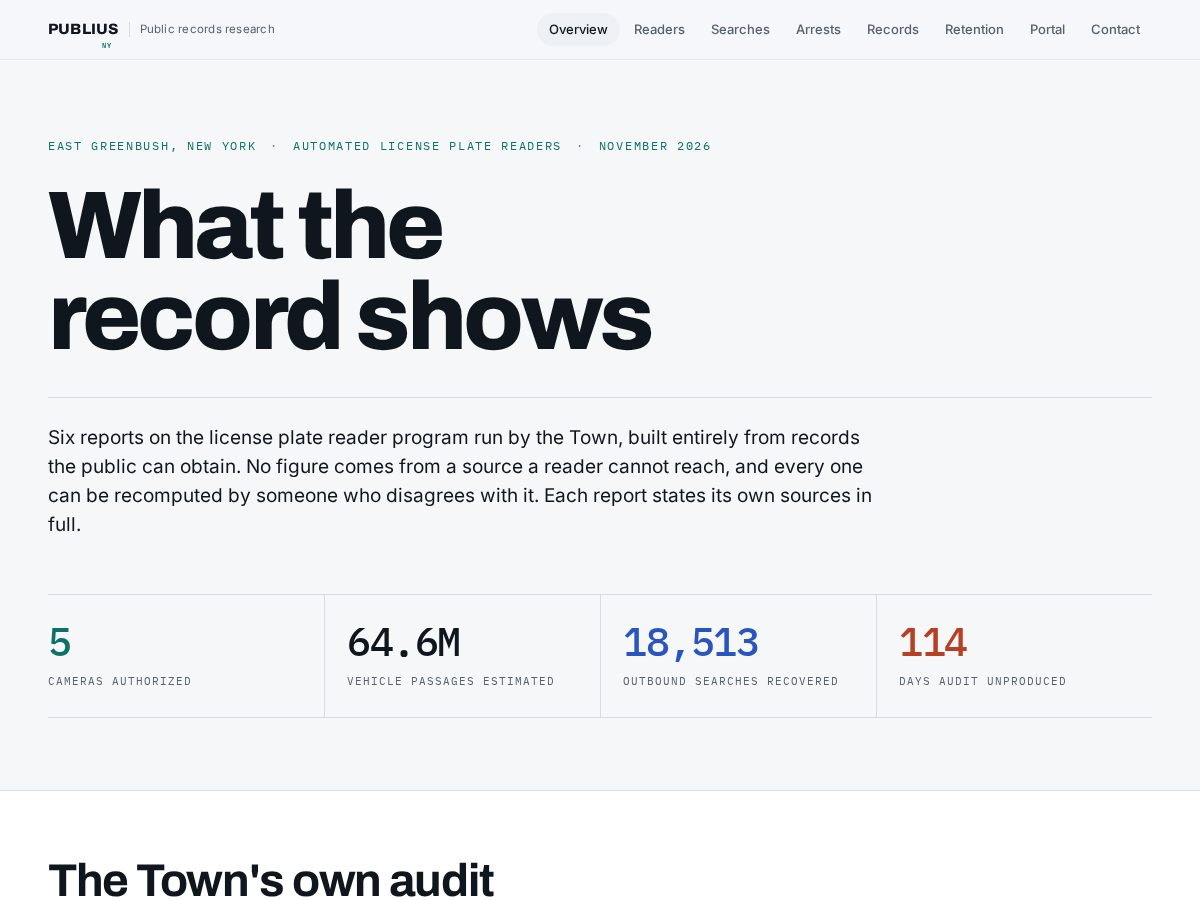
Six reports examine East Greenbush’s automated license-plate-reader program using public records and other published data.
Issue 2026-11-21980 cards in today’s catalogue
Daily issue ·
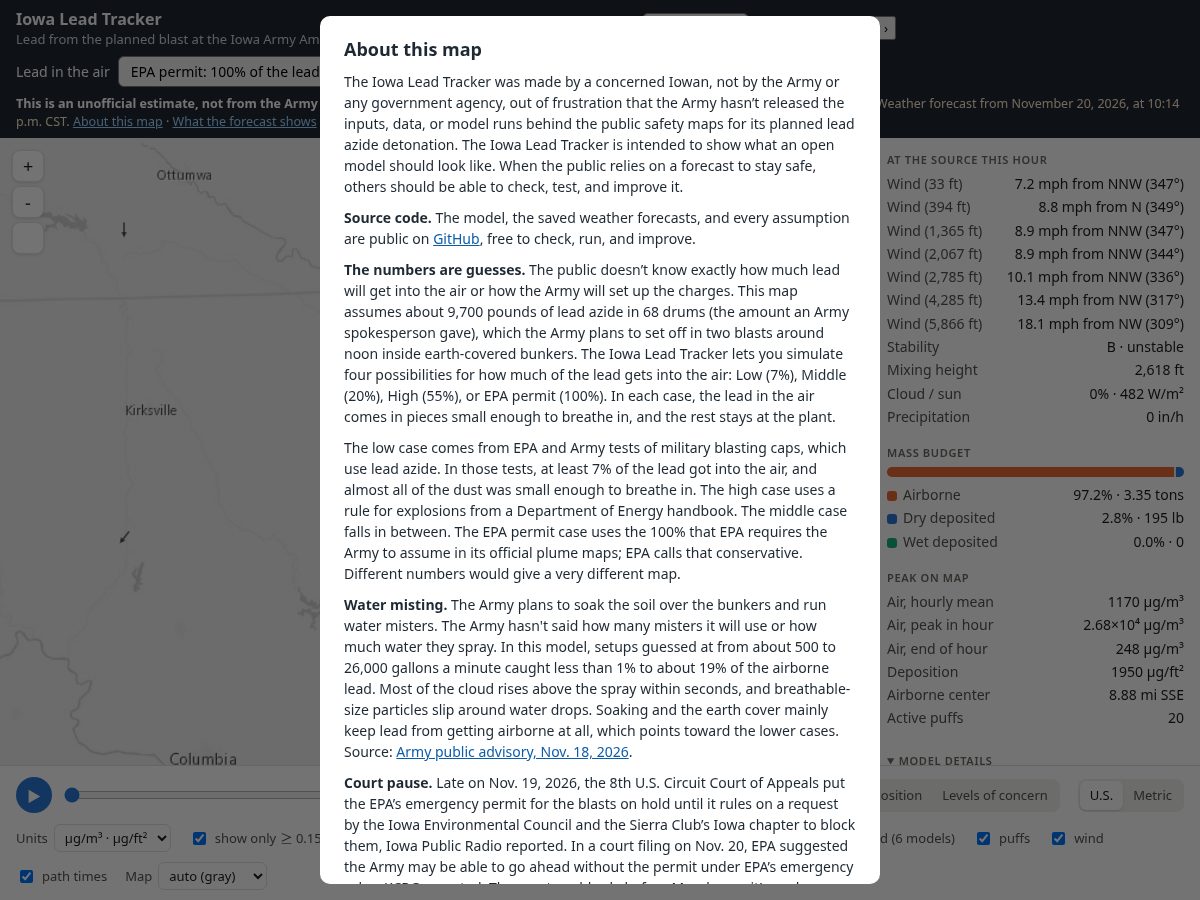
GOAT WATCH turns vigilance into a rehearsal, complete with tea breaks and no claim to protect the straw goat. Assessing a real-world hazard requires a different restraint: showing what is assumed rather than presenting a forecast as fact. Iowa Lead Tracker (iowaleadtracker.com) offers a useful starting point, publishing the weather inputs and airborne-lead assumptions behind its unofficial map of a planned blast’s possible fallout.
The project publishes its model, weather forecasts, and assumptions, including four airborne-lead scenarios from 7% to 100%. It also documents a crucial limit: the court had paused the EPA permit, and whether the planned Nov. 23 blasts would go ahead remained unclear.
02
The opening shelf
Twenty selected projects from today’s catalogue, each shown with the landing page we found and a short explanation of why it stood out.
Civic & Public Life
eastgreenbushalprdata.com
Six reports examine East Greenbush’s automated license-plate-reader program using public records and other published data.
Weird Finds
ekirts.org
A satirical corporate site for a fictional Tel Aviv conglomerate claiming to manage the weather, wildlife, logistics, and much more.
Personal Pages
beaniebabybillionaire.com
Richard Dynas turns Beanie Babies, clocks, and other found objects into assemblage art about time, money, and aging.
Weird Finds
chicagotransportation.net
A satirical fake municipal homepage turns Chicago traffic and transit frustrations into mock services, from ghost-bus reports to millennium car warnings.
Weird Finds
bornonce.life
An interactive life simulator draws a birthplace using annual birth counts across 217 countries and territories, then compresses a modeled life into about three minutes.
Developer Corner
xdrproof.dev
A shared corpus of rare Stellar ledger data for testing indexers and SDKs against real encoded bytes and expected results.
Civic & Public Life
parasempremae.com
Carla Kalera’s site brings together her son Lucas’s story, a podcast, writing on police violence, and a book about memory and loss.
Civic & Public Life
wydarkmoney.com
A reported investigation into money around the 2026 Teton County Commission primary, with an interactive map, graphics and linked filing sources.
Developer Corner
robocodebench.org
A research project tests whether three AI models can write programs to navigate a real VEX AIM robot through four games.
Civic & Public Life
thepeoplescode.org
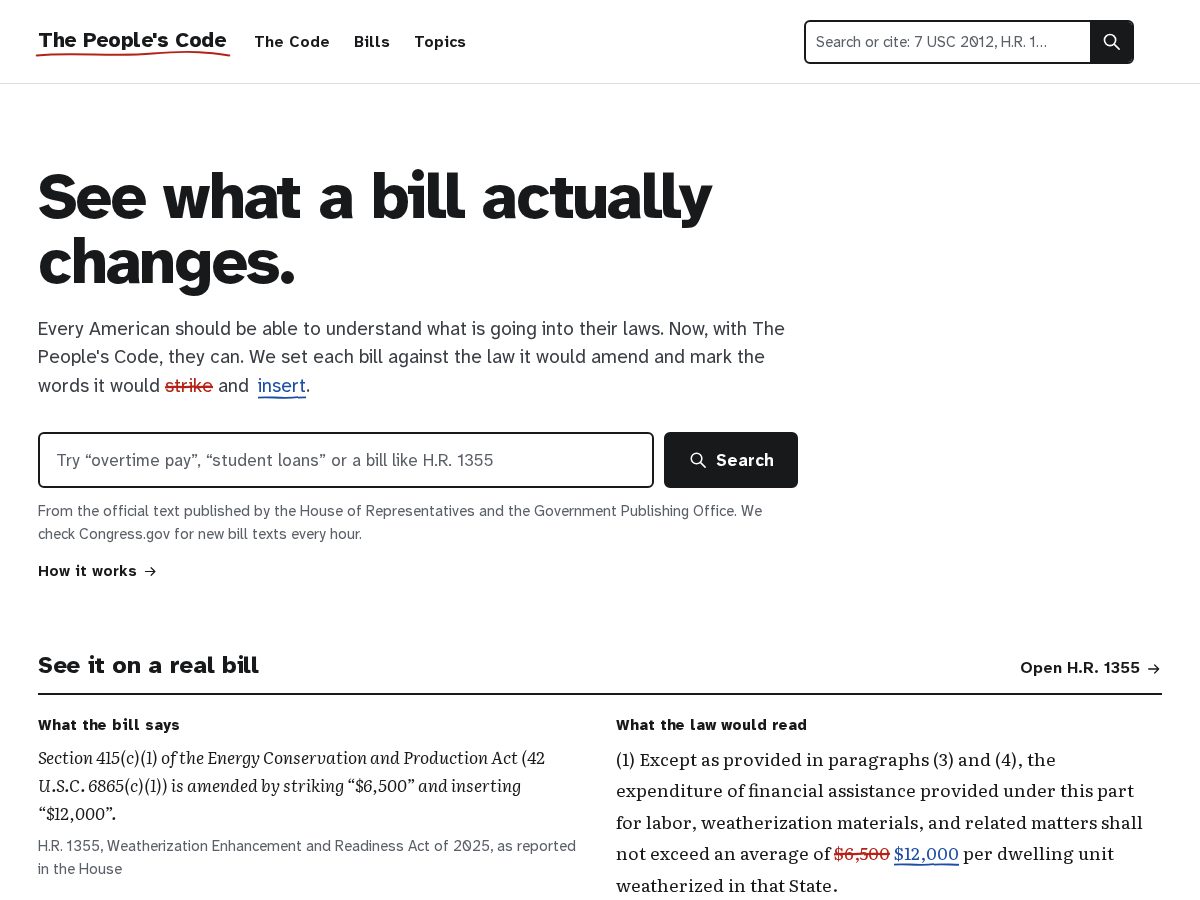
A public reading tool that shows how bills would alter the text of the U.S. Code.
Useful Tools
lunaverb.com
A free audio reverb plugin that turns Apollo 12’s lunar seismometer recording into an effect for guitars, synths, and sound design.
Content & Blogs
pressepresse.com
A French satire publication serves up fake news headlines and article excerpts across politics, science, culture, and everyday life.
Useful Tools
whoruled.earth
An interactive map lets you explore political borders from 3400 BCE to 2024 CE by year, place, guided tour, or famous journey.
Useful Tools
iaskedclaudeforyou.com
An interactive site that turns questions colleagues could ask Claude into grumpy, shareable replies from a fictional character called Old Claude.
Developer Corner
erxos.org
A development-stage operating system built around the idea that every Erlang process can be an operating-system process.
Weird Finds
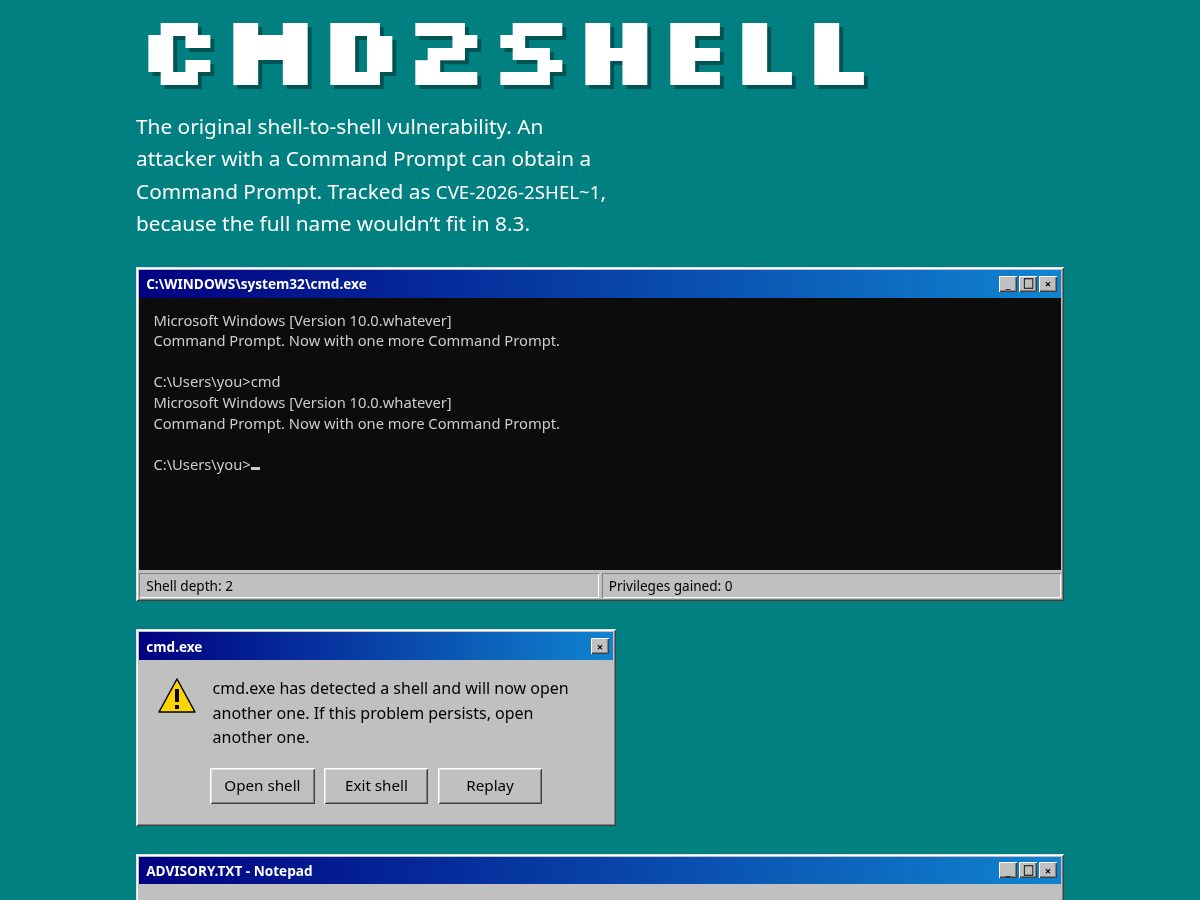
cmd2shell.com
A mock security advisory turns opening a second Command Prompt into a supposedly critical vulnerability.
Civic & Public Life
legacylink.live
Legacy Link presents a project to record African elders and make cultural heritage accessible through interviews, digital reconstructions, and interactive features.
Learning & Exams
altersvorsorge.trade
A German school project explains how pensions work through interactive charts, calculators, scenarios, a quiz, and cited sources.
Content & Blogs
wasgodonceaman.com
A research article traces Latter-day Saint teachings on eternal progression through historical records, scripture, and current Church statements.
Pattern 01
Several civic projects turn filings, laws, and agency data into maps or reading tools—and show where the record is incomplete, estimated, or not a finding.
An unofficial map estimates how lead from a planned detonation at the Iowa Army Ammunition Plant could travel and settle, using weather forecasts and several assumptions about how much lead becomes airborne.
Six reports examine East Greenbush’s automated license-plate-reader program using public records and other published data.
A public reading tool that shows how bills would alter the text of the U.S. Code.
A reported investigation into money around the 2026 Teton County Commission primary, with an interactive map, graphics and linked filing sources.
An interactive research workbench ranks Ukrainian public-procurement suppliers by risk of a future bid-rigging sanction, then compares model rankings with later AMCU decisions.
Pattern 02
These are built around particular moments of work: account for the saw cut, plan a garden, chart a stitch, or keep a specialized trade’s books.
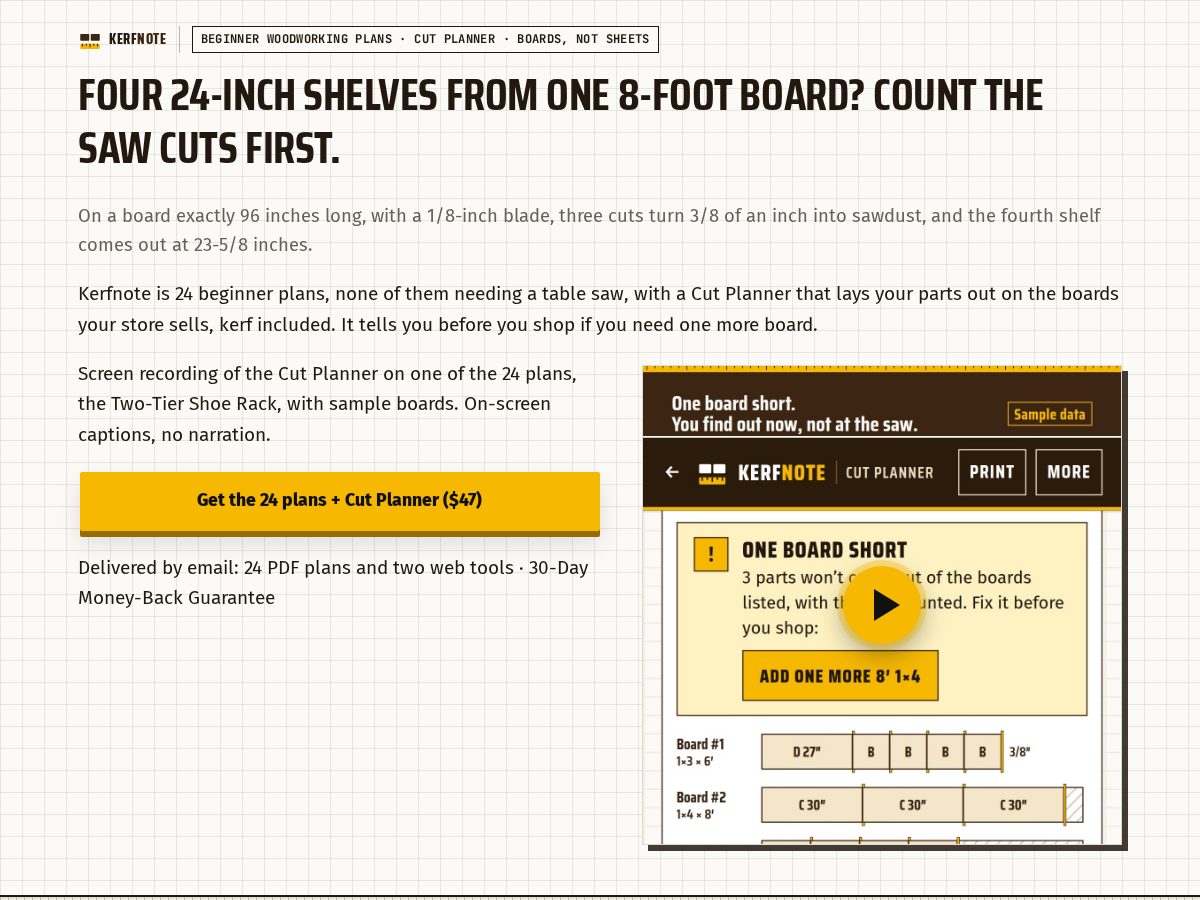
A kerf-aware cut planner pairs 24 beginner woodworking plans with board-by-board layouts based on the lumber sizes and blade width you enter.
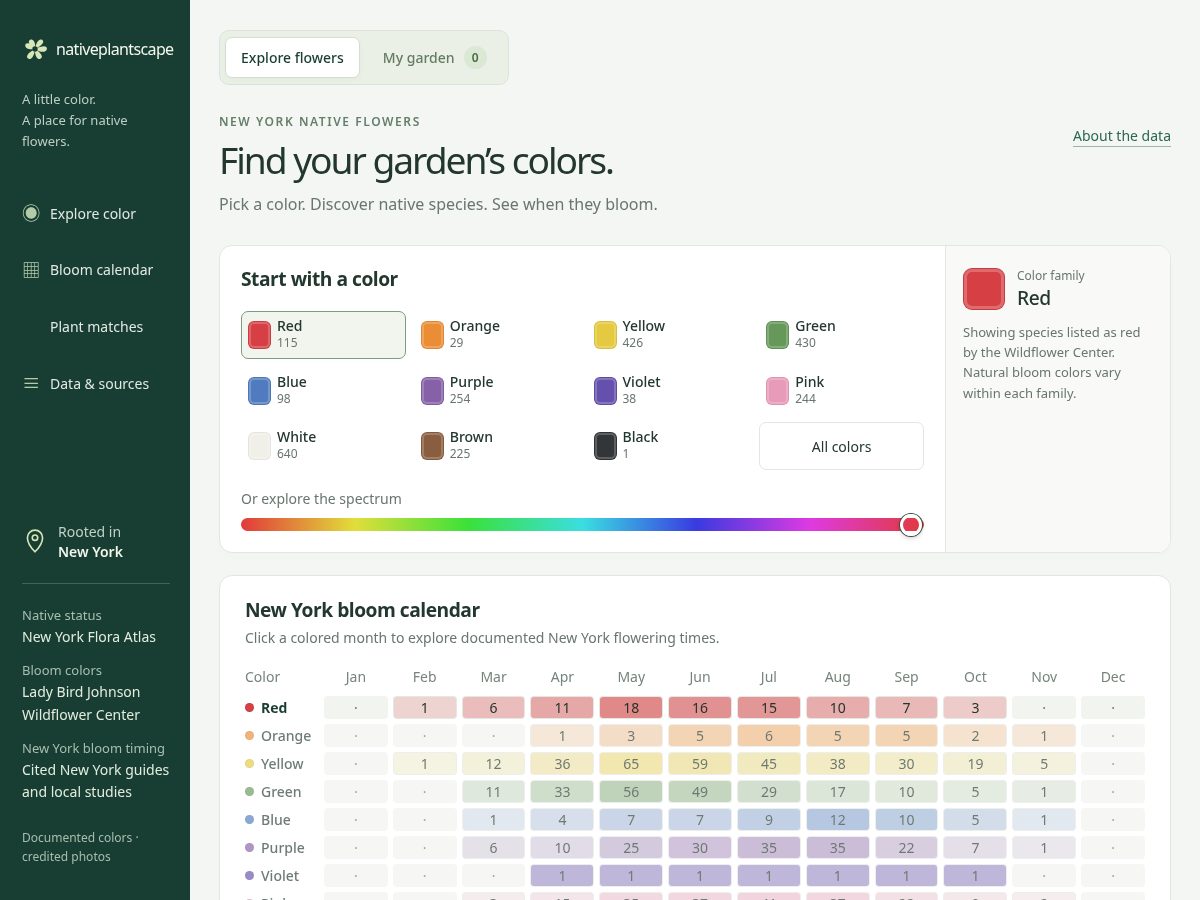
A New York-focused native-plant finder organizes flowers by color and documented bloom timing, with a canvas for sketching plants onto a garden photo.
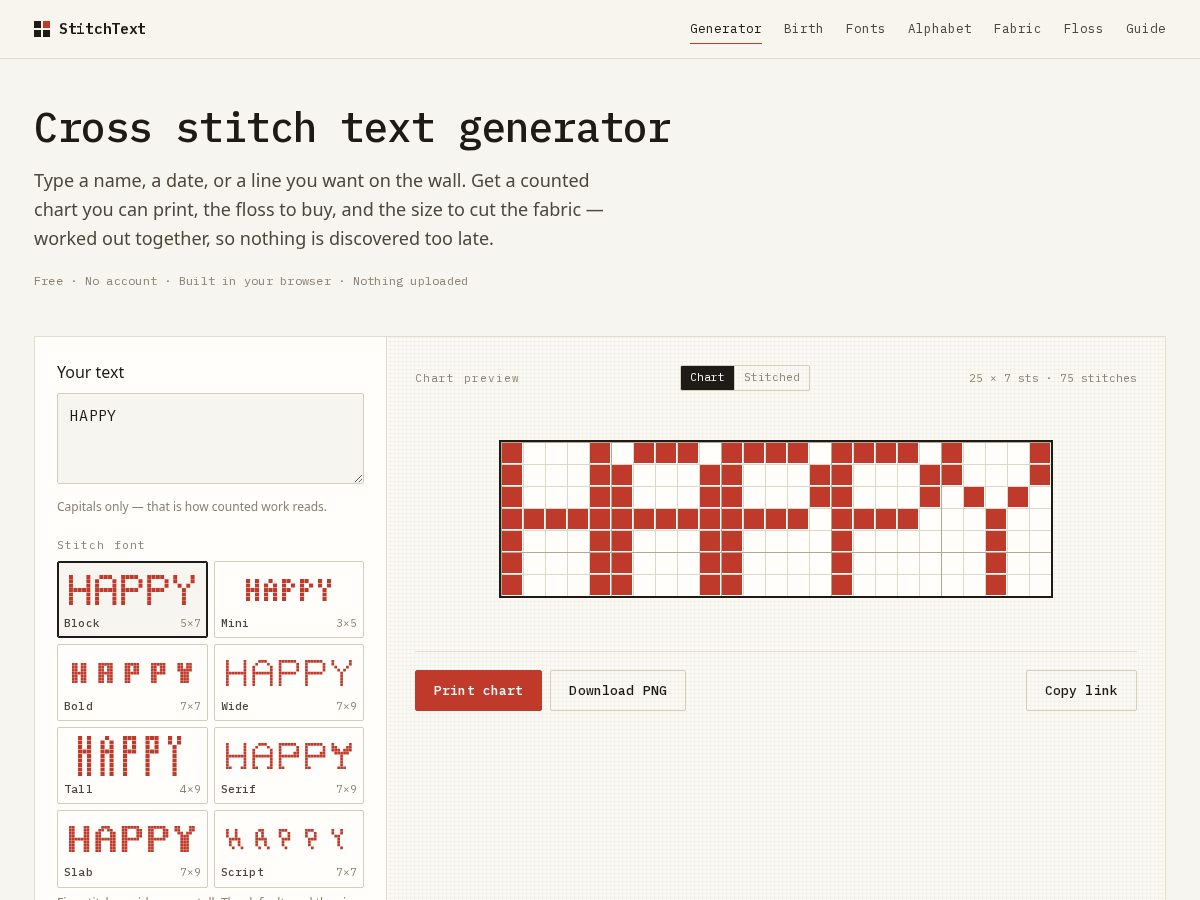
A free browser-based generator turns names, dates, or short lines into printable cross-stitch charts and estimates fabric size, floss, and stitching time.
Free Windows and Android software for scribes to log Torah, tefillin, and mezuzah work, track time and earnings, and prepare reports.
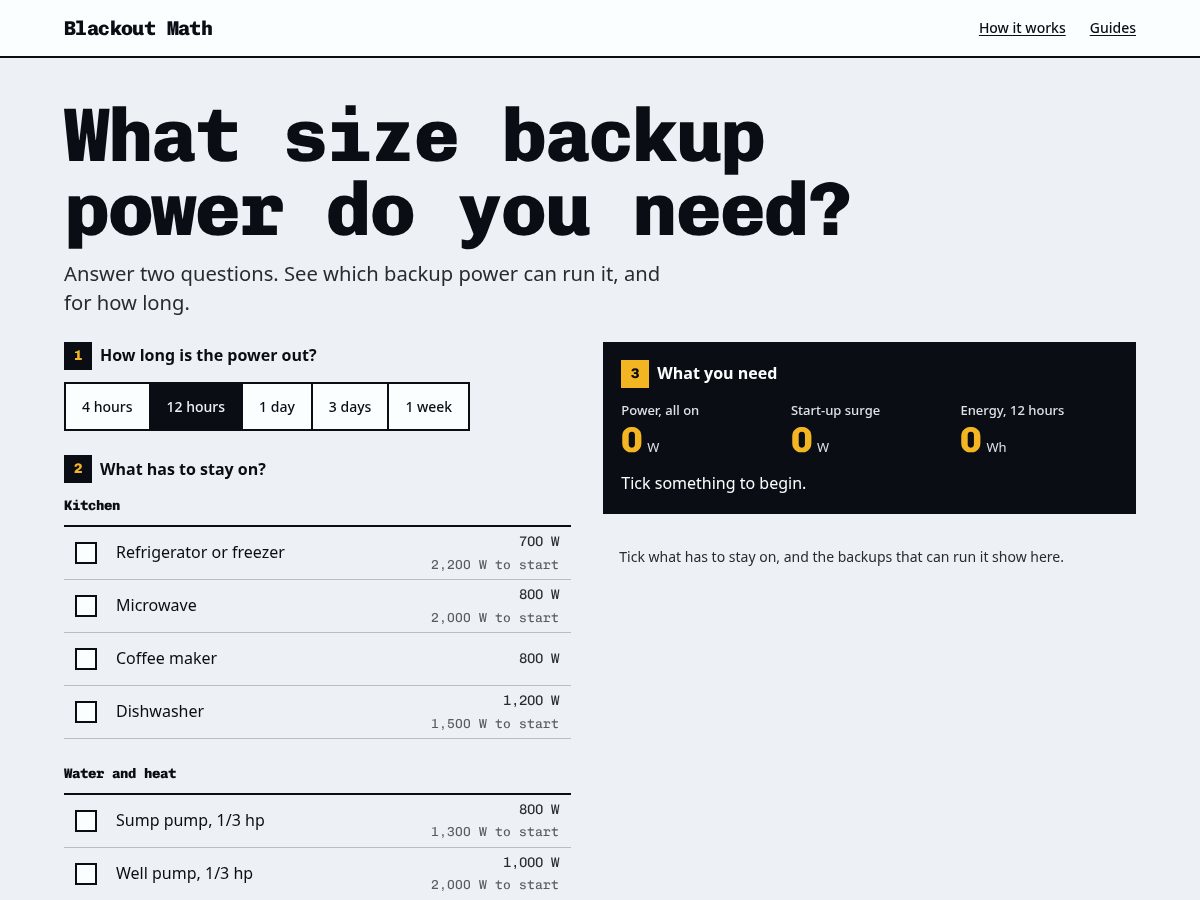
A household calculator estimates running watts, startup surge, and energy needs, then compares them with power stations, home batteries, and standby generators, with prices.
Pattern 03
Archives and research projects invite visitors to explore the past through timelines, maps, models, and recordings, while keeping sources and uncertainties in view.
Legacy Link presents a project to record African elders and make cultural heritage accessible through interviews, digital reconstructions, and interactive features.
An interactive map presents HBIM models and point clouds for Byzantine cisterns on Istanbul’s Historic Peninsula.
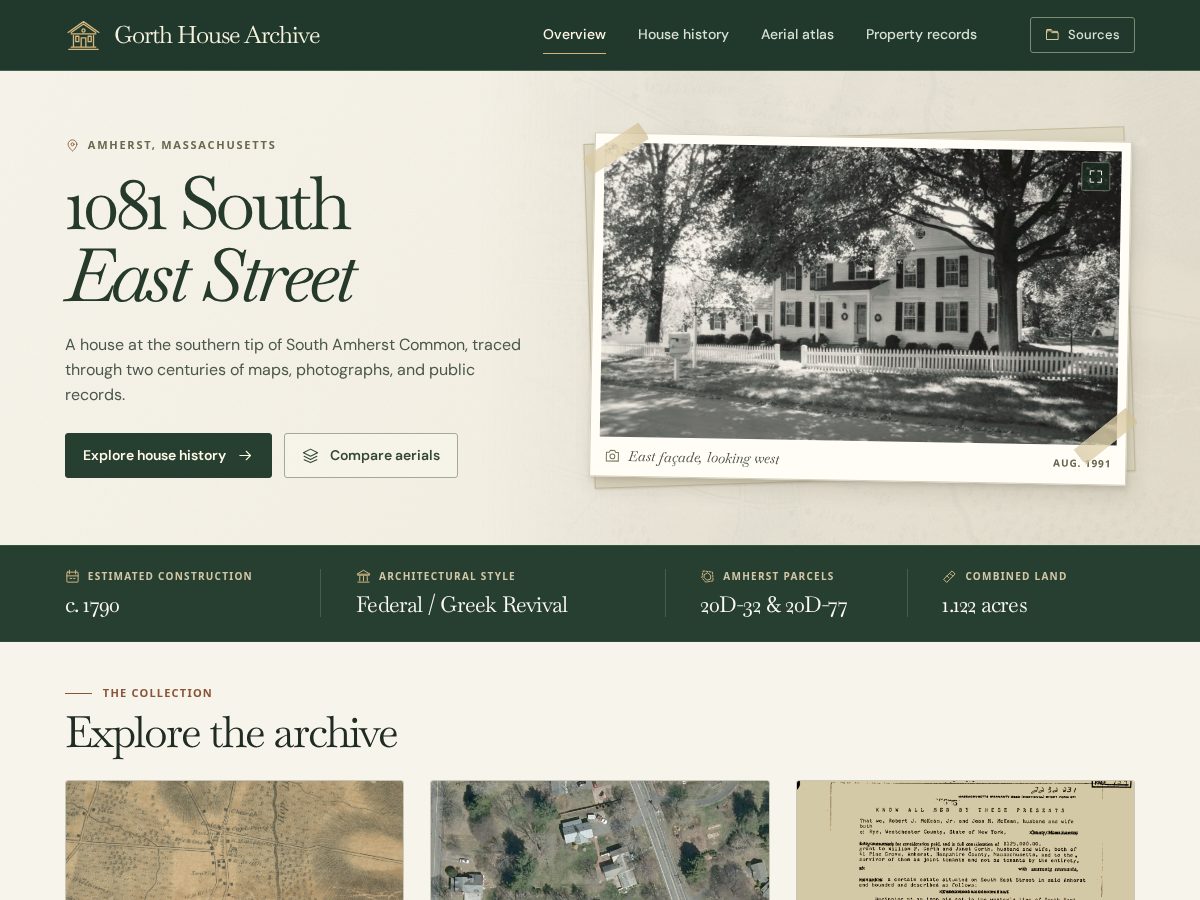
A research archive tracing 1081 South East Street through historic maps, aerial imagery, deeds, permits, photographs, and a 3D building study.
A sourced, chronological account of Sicangu Lakota leader Hollow Horn Bear, drawing on winter counts, historical records, maps, photographs, and attributed words.
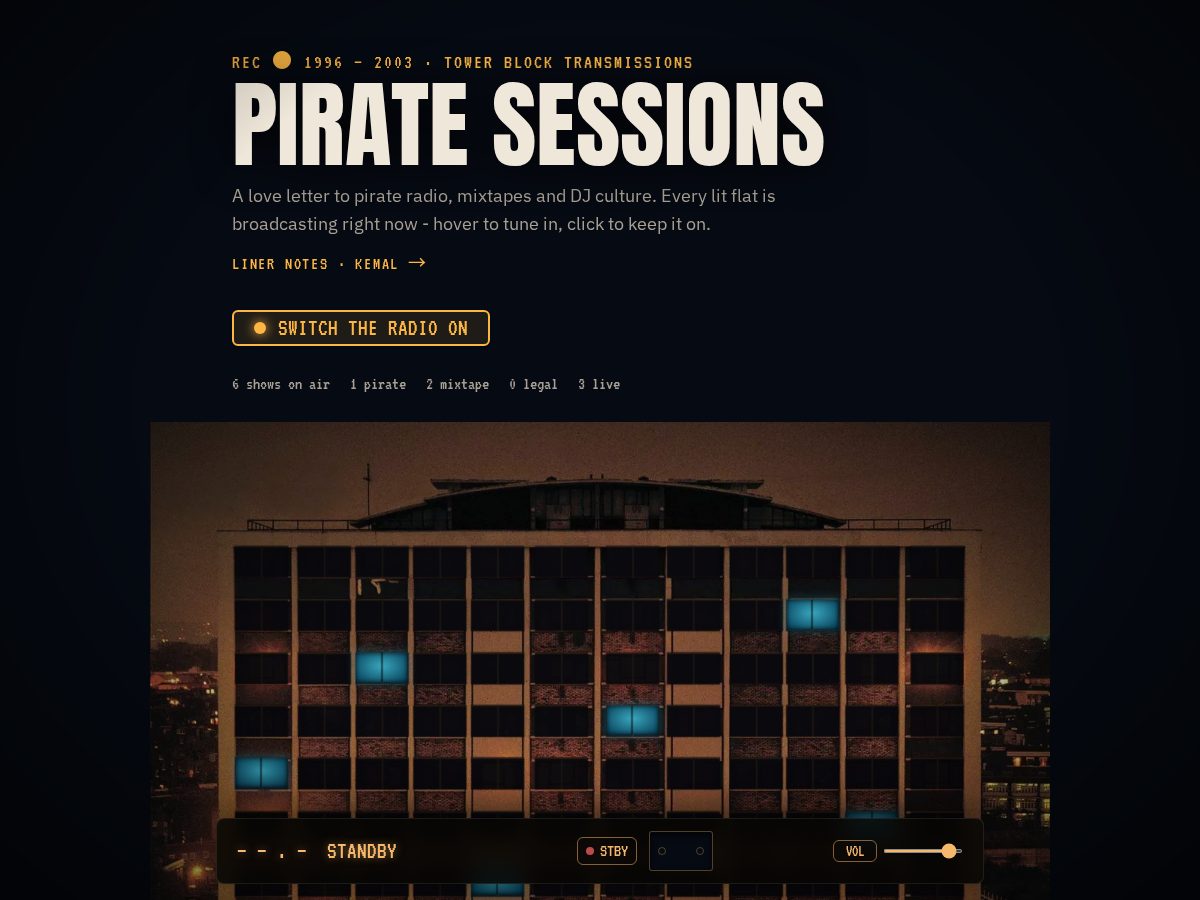
An interactive archive of UK pirate radio, mixtapes and DJ culture from 1996–2003, presented as a block of flats you can tune into.
Pattern 04
Rather than leaving the machine as a magic trick, these projects expose its inputs, boundaries, or evaluation—whether it is ranking models, flying a simulated drone, or voicing suspects.
BB Index combines public model benchmarks into rankings, then lets users adjust benchmark weights using their own comparisons.
A techno and trance project that lays out where human direction meets machine generation, with an interactive browser sketch shaped by a one-sentence prompt.
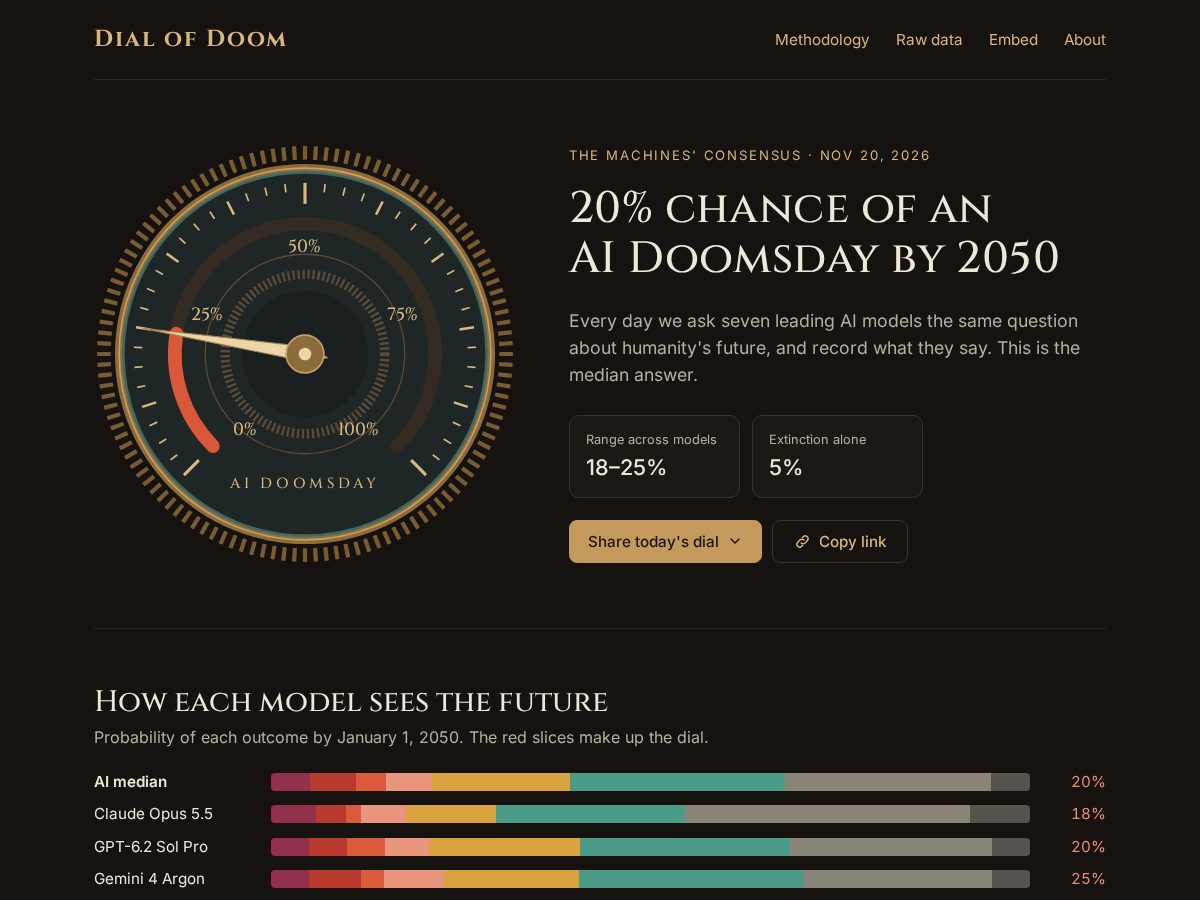
A daily tracker compares seven AI models’ estimates of AI-related catastrophe or loss of human control by 2050.
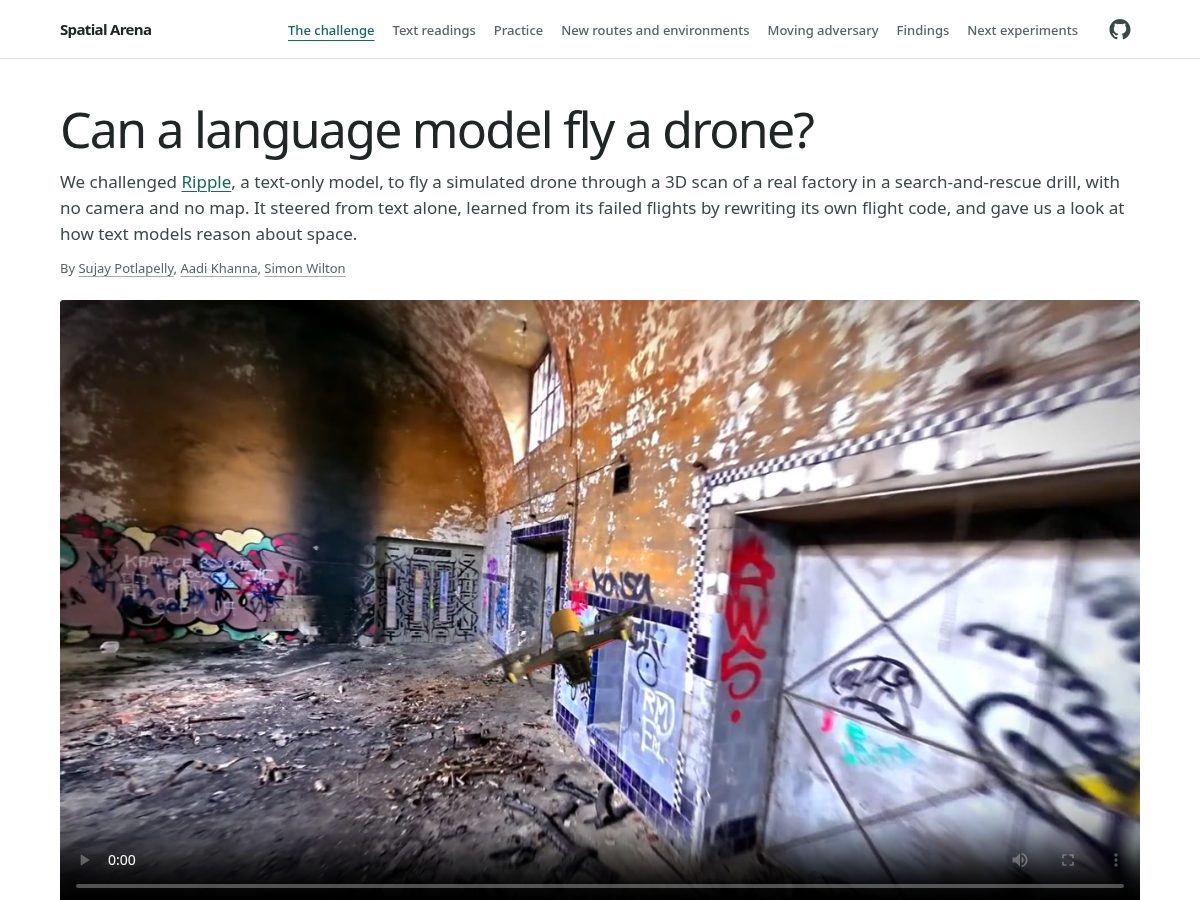
An experiment puts the text-only model Ripple at the controls of a simulated drone in a scanned factory, using written instrument readings rather than a camera or map.
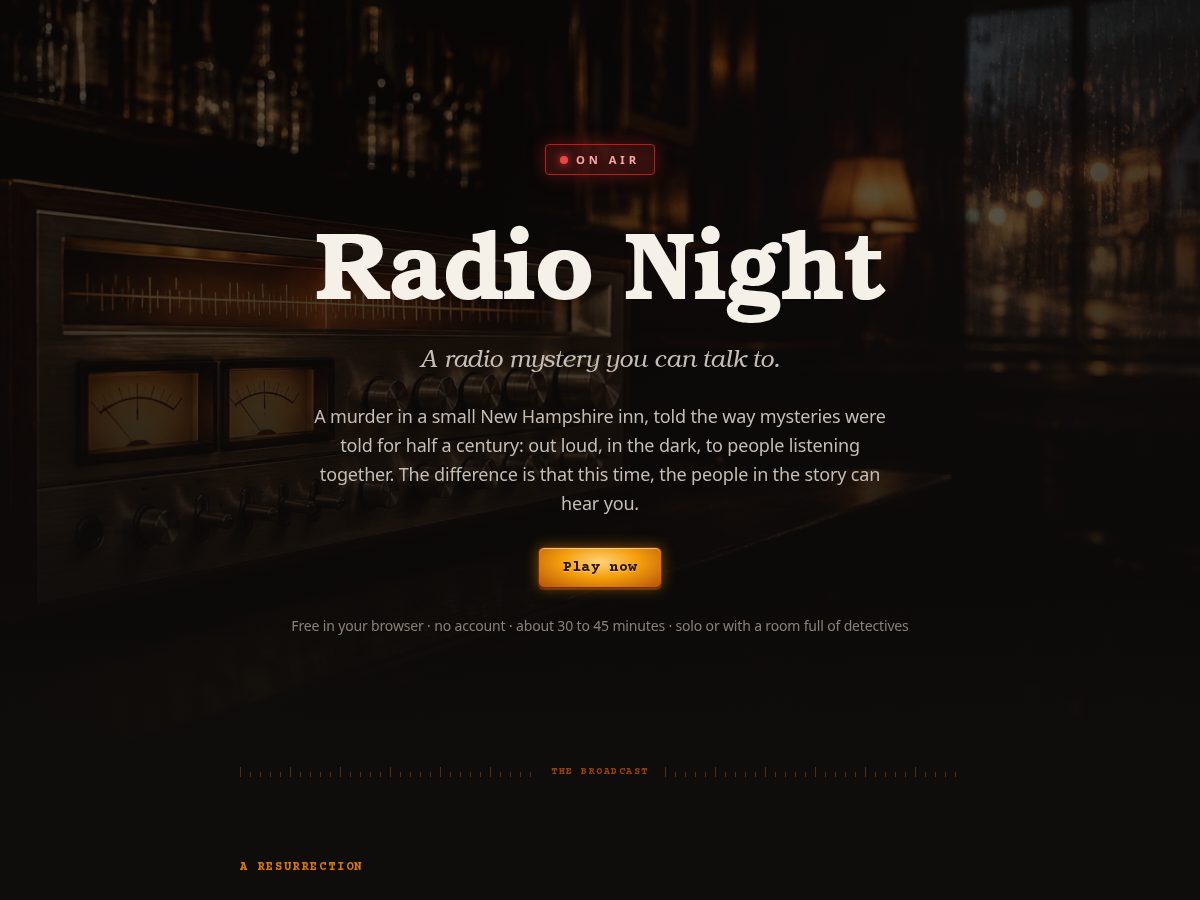
An interactive murder mystery set at a New Hampshire inn in 1981, where players question AI-voiced suspects aloud or by typing.
Pattern 05
A run of satire borrows the forms of corporate dashboards, municipal service pages, advisories, and news reports, then lets the paperwork become the punchline.
A satirical corporate site for a fictional Tel Aviv conglomerate claiming to manage the weather, wildlife, logistics, and much more.
A satirical fake municipal homepage turns Chicago traffic and transit frustrations into mock services, from ghost-bus reports to millennium car warnings.
A mock security advisory turns opening a second Command Prompt into a supposedly critical vulnerability.
A French satire publication serves up fake news headlines and article excerpts across politics, science, culture, and everyday life.
A German-language satire site presents deadpan, invented news across politics, science, technology, work and culture.
04
The complete card catalogue
The leading shelf is open. Expand another category, scan its visible pages, then reveal detail where more context is useful.
980 cards visible
The joke is sustained across the whole operation: a nonexistent laser platform, vulture-handler job listings, and a control index that admits its figures are unaudited. Even the Ayalon traffic jams are “classified” and, the site concedes, unsolved.
Its “live” bike-lane map says it refreshes every six years pending study, while a ghost-bus form asks riders to classify buses that went “DUE,” vanished, or moved backward. The official-site machinery is part of the joke, and the copy keeps landing it.
Its map’s glowing dots are labeled illustrative, not live births; its survival curve is explicitly not a prediction about any real person. That care with the boundary between data and fiction is part of the experience.
The fake advisory gives Cmd2Shell a CVSS 10.0—displayed as “10.~1”—while reporting zero privileges gained. Its mitigation is to type “exit,” then keep doing so until the window closes.
Visitors can shove the hopper, inspect the controller, and choose the shirts the hosts will wear. The page even admits what its model leaves out: body-attitude control, because the simulated body is a point mass.
The setup is unusually well specified: a rainy inn, a dead portrait painter, and suspects who answer in character while the players investigate together. The mystery and its solution are fixed by a human author; AI plays the suspects, not the detective.
The controls let visitors check the goat, make tea, or investigate a pigeon; the page is explicit that this is rehearsal, not live surveillance. Its date notes point readers to Visit Gävle and the official feed for the real-world details.
The page recreates a Windows 98 session, complete with dial-up and a Notepad file, to introduce a story the site calls true: a man promised to cut off his feet live if a fundraiser met its goal.
The bingo card turns familiar family catchphrases into a five-in-a-row contest. Its house rules also include “No blocking the doorway” and permission to stop if the game stops being funny—a notably clear-eyed boundary for a gag game.
The game descriptions do more than name a genre: build a fort that keeps an egg whole, solve a new murder, or fill in operators until the calculus works. It’s a compact, unusually varied daily-games shelf.
Its opening story unfolds through a ferry bench, a frayed red blanket, and a dented tin bowl. The interface also offers island maps, council records, and replayable crew work, though many of those records currently appear to be loading.
The cemetery conceit comes with a working archive: 19 entries link out to Reddit, GitHub, and developer forums, and visitors can leave a flower. It turns scattered account trouble reports into a browsable record, while keeping each story tied to its source.
At 03:18, the pillow “accepted the escalation.” The page sustains the joke with incident details, CVSS vectors, and a simulation—then lands on a practical fix: hand off the pager to someone awake.
The page spells out twelve ranked trap types, and the demo makes the premise literal: a ledge can wait until you land before it lets go. Readers get a five-room test drive, not just a trailer.
The site turns a sprawling book series into a travel interface, complete with searchable stops and hostel names like The Spicy Saffron Shack and The Steam Room Hostel. Its titles make the horror-comedy premise legible before you’ve checked in.
The world has an internet café, a paper room, and a turntable beside the creature’s home. Visitors can leave records there, but the creature—not the visitor—decides what to keep and play.
GT Pune turns a Deccan-to-FC Road evening into a playable city story, complete with local landmarks, messages between characters and a delivery mission. The site calls its six missions prototypes and labels the map illustrative, not surveyed: a vivid local project with its work-in-progress status in plain view.
Its surface is all institutional order—numbered offices, permanent identifiers, certificates—while its first featured record is marked “SOURCE UNIDENTIFIED” and “INTERPRETATION PENDING.” The contrast reads like a small piece of bureaucratic fiction about our urge to file the unknown.
It turns music discovery into an exercise in memory and imagination: if you know the record, the title may play in your head. The collection comes from one person’s shelves, not a streaming catalog.
The ten-row ledger refuses to treat a stock drop, a divorce transfer, and forfeited pay as the same kind of loss. Its scenario model is explicitly illustrative—not a causal estimate—and the page names the questionable source behind its ranking.
Its route guide links named pistes and lifts to measured descents: Diablada is listed at 1.55 km with 319 m of vertical drop. Outfit choices and the option to use poles are saved in the browser.
The Squire’s foot pad is described down to its Lexan sheets, force sensors, and reflashed RP2040; potions, keys, scrolls, and even coconuts become inputs. It turns co-op support into a piece of hardware and a coordination problem.
The site says the story carries each day’s script forward, while different players can leave with different histories of the same city and week. Its suggested way to discover the wider story is not replaying, but comparing notes with someone else who survived it.
Alibi packages true-crime storytelling as a case night: players connect period-style documents on an evidence board, and answers count only when supported by a clue. Its free opener, “Sweet Gift,” is set in 1920 Wales and offers a 60–90-minute investigation for solo or group play.
It turns an office-etiquette argument into a tiny interactive exhibit, complete with a calculator for the time spent sending nohello links and bingo for the habits of their senders.
It turns running into a tiny arcade mechanic: tap left, tap right, and race along map-based routes such as the Han River or Central Park. The mix of AI pacers, friend rooms, public matchmaking, hurdles, and player-made courses gives this small game an unusually specific shape.
The site pairs a rainy arrival at a vanished magister’s spire with a 10×12 factory floor, multi-floor logistics, and a brass-and-crystal guide called A.R.C.A.N.A. It also offers a direct Android alpha download, complete with a SHA-256 fingerprint and sideloading instructions.
The page describes a climb from basement barista to inherited privilege, with 119 ranks, estate trouble, and a nephew named Kyle as the bad lawyer. Early Access is listed for December 8, 2026; the Steam page is still “opening soon.”
Its social tally becomes a territorial game: every Sunday, the faster-growing colony wins one of eight ice-deposit plots, while an unfinished spaceport is another prize. The map uses real HiRISE terrain, with the creator explicitly noting the 3D scene is not a NASA image or endorsed by NASA.
The games turn familiar family friction into a group activity, from bingo built around 117 recurring lines to a six-round exercise in translating what people actually meant. The house rules even include a practical exit: if it stops being funny, stop playing.
The order has a clear recipe: provide the occasion and 2–3 inside jokes, then get a downloadable MP4 in 2–3 working days. No revisions; political or offensive content is off the menu.
Its four exhibits treat premature memes like artifacts awaiting context, complete with dates and a deliberately unhelpful archive interface. The site also clarifies that its “sealed” previews are only hidden until their date—not encrypted—a nice distinction in an internet culture fond of interface theater.
The site says the city’s streets and landmarks were rebuilt using open data and reference photos, while explicitly noting that its map is not official. Players can travel from Praça dos Girassóis to Praia da Graciosa by bus, bicycle, helicopter, or even drone.
You play Aki, an apprentice with the shop keys, while the night crews eat on Jun’s tab. The game’s drift-pay system even has a rate card: the first 1,000 points pay ¥1 each, then ¥0.35 per point, up to ¥3,200 per payout.
The controls make a small promise unusually concrete: press E to sit and listen in the Glass Chamber.
The page gives the biscuit dunk, kettle wait and supermarket queue the seriousness of game objectives, then insists: “None of them matter.” It’s a small joke about the urge to gamify even the most forgettable half-minute.
The country leading when the season closes on January 7 keeps its flag over the big tree “for good.” At capture, though, the counters showed zero town items and zero countries.
The flight log does more than sell the fantasy: entries dated Nov. 19 document test-payment plumbing and say the public site is still the guest edition. It also distinguishes the playable First Breath from development builds and estimates for later work.
RushNitro makes applied math a driving mechanic: its fuel terminal asks players to hit an additive ratio, with error bands affecting speed, mileage, and in-game credits. Delivery jobs add constraints like keeping fragile cargo below 20% tilt or using no more than a quarter tank—percentages recast as game rules.
Its four-track pipeline uses serious-sounding labels like “Lead Optimization” and “Exploratory,” alongside purr-frequency playback and cat-type controls. The contrast is striking; the page’s scientific and longevity claims are not verified by the supplied evidence.
The current word, FUTAGG, had held the front page for 46 minutes when the page was captured; the next turn costs $8. The site makes a public, escalating auction out of a space with room for exactly one word.
The town-management pitch comes with taxes, walls, hired guards, and offline trade routes. Its narrator, “the System,” describes its job as being “legally obligated to babysit you.”
A slider turns certainty from “asking questions” toward “saying it louder” while the evidence level stays unchanged. The page also displays a contract address and a Pump.fun link, adding a speculative-token edge to its art framing.
This is more than a playlist page: fans can build three-, six-, or nine-song runs, while the site scores playlists and ranks artists. Its gossip desk even labels reported items separately from takes, predictions, and jokes—a useful bit of self-awareness in this gloriously overbuilt music world.
It wraps a simple collision premise in collectible balls, ranked seasons, and a battle pass. The page says its store runs on match-earned coins, not real money—a revealing twist on familiar live-service game language.
Its five score zones run from “Trending” at 10 points to “3 AM” at 100, with rarity based on Wikipedia lookup volume over the previous 60 days. The site identifies itself as a fan-made version and points players to the original daily game.
The crown controls nothing, and the site says so plainly: payments buy presses, not prizes. The reign lasts at most 24 hours, unless another would-be monarch presses first.
Its central bargain is neatly cruel: use an ability to get through a round, and its consequence joins the echo trying to catch you later. The page lays out the rules in unusually concrete terms, though accounts are unavailable in this preview.
The daily challenge gives everyone the same 10 words and just one attempt. It also supports solo play, friend games, and a one-phone-at-the-table mode, turning quick doodles into a shared memory test.
The premise ties a randomly assigned body and life to a planet’s gravity, temperature, star, and atmosphere. The homepage says its real-world pool contains 4,839 NASA-listed exoplanets.
Here, reaching the finish is not enough: the car must make it there in one piece, stop inside the arch, and stay put for a second. The site explains the rules, vehicles, obstacles, and control options with unusual clarity.
The cases turn on a careful distinction: what a witness could see from one spot, what they might have heard, and whether the account belongs to the right route or time. The studio says one prototype will test how long players expect to have before a witness moves on.
The page says the browser version carries over the desktop game's screens and rules, while accounts keep gold, gems, and cards on the server. Playing requires a free account—a small but telling sign of how browser games are being built around persistent accounts.
The site gives its fictional clinic a Gross-o-meter, a rival doctor, and a patient whose cyst is named Kevin. Those details make the game’s particular flavor of gross-out comedy easy to place.
The concepts make the return journey matter: a foothold easy to spot while climbing can nearly disappear on descent. One proposed checkpoint offers shelter with a condition attached to the next passage.
It revives the pixel-ad billboard as a takeover game: the previous owner gets their original payment back, not a profit. The site says payments are simulated for now and that no pixels have been sold.
The page borrows the language of classified infrastructure—DEFCON status, clearance levels, containment divisions—and turns it into a recruitment pitch for a Roblox roleplay group. Its dashboard shows dashes where satellite, weather, and reactor readings might go: a small glimpse of a world still being built.
At Nakilbent, the model sits beneath a Nakkaş rug store; users can switch between the Revit model, point cloud, and overlay, then inspect section and underground views. The project also distinguishes modeled sites from cisterns represented only by location records.
The clock keeps running while you handle a call: ask for the missing address, choose an alarm, and juggle responding crews as the next line rings. Each country has its own procedures and geography drawn from OpenStreetMap; the site says the full game works free, without AI or an account.
You can cut a canal, open a spring, drain a marsh—or call down lightning—and then watch the consequences unfold across generations. The game says its simulated lives draw on historical data, including U.S. life tables and census records; access is currently by invitation.
The model makes practical systems legible: visitors can trace roof rainwater toward a cistern, inspect a sunken rain-capture park, and compare sun and wind conditions across the site. Its climate and drainage explanations are tied to specific design choices, not just renderings.
The page gets unusually concrete about translating mouse-and-keyboard play to touch: hold for a right-click, add waypoints, and use a one-finger box-select that turns itself off when you’re done. It even explains how the controls avoid accidentally pulling villagers away from gathering resources.
The design follows charge through counter-rotating rotors, collector combs, and Leyden jars, while the calculator repeatedly warns that its output is an idealized estimate—not a verified machine rating.
During rests, you set up combos; when work starts, you try to chain matches past a pace target. Miss it and nothing bad happens—there’s no game over, streak penalty, or shop.
The page turns recruitment into a miniature engineering mission: it lays out real responsibilities for electronics, vision, mechanical design, algorithms, and media, then maps applicants through four selection stages. Its team motto reclaims “蚍蜉撼大树” (“an ant challenging a great tree”) as “可敬不自量”—roughly, “worthy of respect, though presumptuous.”
Its directory lists three playable suburbs and roughly 140 km of mapped roads. The latest modeled landmark is a bus station with three buses running two in-game circuits.
The game uses OpenStreetMap streets and population data to place riders, then makes missed connections feed into traffic. It treats a familiar urban problem as a game mechanic—and names the exact Toronto and Zurich districts where play begins.
Instead of making interstellar travel a cinematic button, the page turns it into a problem of mass, fuel, acceleration, and braking. Its dashboard even distinguishes time aboard the ship from time for a stationary observer.
Its economy can lie to you: the game distinguishes official plan figures from real ones, while crises climb rung by rung toward nuclear war.
A six-zone city model offers controls for selecting, rotating, and zooming through its ring-shaped districts, alongside an archive of 53 employees. The game’s debate mode is plainly marked as not yet open.
The site distinguishes the surviving Roman record—sanctuaries, images, and inscriptions—from the present Order’s own prayers and observances. Its seven grades draw on ancient names and planetary symbols, while ceremonies are kept within the Order.
The course is already on the wall: numbers become holes, and a tape measure sets your next-shot stance. It squeezes a whole golf ritual onto a dartboard.
The replay lets visitors follow a pass from launch through the quarter-mile alongside RPM and FuelTech readings. The site also flags an important limit: intermediate splits come from archived records and should be checked against original timeslips.
The project connects a named ancestor, her birthplace, and her mtDNA haplogroup to a map, while being clear that DNA is evidence to assess—not an answer key. It also says testers’ names are not published.
Concrete printing often arrives wrapped in visions of future housing; this page starts with mix design and testing. It also clearly labels its current project images as Cosmos 3D work—not pieces made by Concretlab—while saying its own gallery additions are still to come.
The page names the San Miguelito–5 de Mayo route, sets passenger fares at $0.25 before multipliers, and explicitly says its continue-screen ad is only a simulation.
The site explains the play sequence clearly: one tap fills a picture space, a finished drawing animates and makes a sound, then its character can visit one of 11 Picture Worlds. It’s a concrete, family-made take on what happens after the coloring is done.
The first-person scene makes evidence handling part of the deduction: each inspection costs time, and players can photograph, bag, or swab what they find. Interviews, CCTV review, and a final accusation are clearly marked as a later phase—not features of the current early-access build.
The rules give ordinary streets a playful stakes system: rivals can take cells back, while separate timed routes reward the fastest valid run. The app is still listed as coming soon, but the site explains its privacy measures, including delayed posting and hidden start and finish points.
An interactive concept model lets visitors rotate the aircraft and fold its wings. The page pairs that tangible mechanism with detailed design targets—and is careful to say those figures remain estimates until the aircraft is built and flown.
The bots claim to take objectives, drive Warthogs and fly Banshees. The project also adds a map editor and Theater playback, including for games that lacked it.
This is more than a line on a map: the route notes flag rising river crossings, limited highway shoulders, logging trucks and campsites that may need permits or bookings. The site also invites riders to report closures and changes.
Competitors start alone with a grid, plot their route, and get the next grid from a point sitter at each checkpoint. Phones, GPS, and smartwatches are banned; the page lays out the four-hour limit, entry price, and even the check-in sequence.
The site documents both the sound and the idea behind it: ordinary frustrations become satire, puns, comedy, and rage, while sarangi helps bring Nepali instruments forward in the arrangements. It also describes a songwriting process involving ChatGPT and Suno.
The plan puts a price on participation: about $26,400 per family, including an organizing fee, for a project that says families will learn on the job and receive three weeks at the cabin each year. The land and final costs are not yet locked.
The daily challenge is staged as a three-stop bus route: guess a local word, answer five questions about Panama, then drive a diablo rojo. Players can compare daily rankings or challenge a friend on WhatsApp.
Instead of making battles the whole story, the site makes manifests, delayed reports and uncertain crossings the game. A bridge keeper’s load restriction and a rain-softened road are the kinds of details its concepts turn into decisions.
The catalog includes Indonesian traditional games such as Congklak, Engklek, and Kelereng alongside familiar puzzles and arcade formats. The homepage says the games are made by the GameNobi team and can be played in a browser without downloads or an account.
The hub links favorite characters to XP, skills, gear, and player comparisons, alongside open crafts, projects, gatherings, and a town bulletin. It says its claim-activity data comes from public BitJita 1.0 data and refreshes about every two minutes; several live panels were still loading in the captured page.
The site frames a negotiation imbalance: charging networks have acquisition teams, while many owners are reading the proposed lease alone. Its checklist points to concrete stakes, from exclusivity and utility costs to who restores the lot if an operator leaves.
Its rules splice Sudoku’s grids with Minesweeper-style counts of neighboring dots. A “show next step” control makes the deduction itself part of the game, not just the answer.
The game turns scale estimation into a hands-on puzzle: each round scores your guess against a real measurement, with the source revealed afterward. It also keeps an archive of earlier challenges.
The page gets down to stand-level details: $5 lemonade, cookies sold three for $5, and advice on payments, safety, and cleanup. It also reports the brothers’ stand averages about $200 an hour, while attributing that figure to them and warning that results vary.
The puzzle gives its mechs a precise job: illuminate rows and columns, cover numbered building doors from adjacent squares, and never end up in friendly fire. It also offers hints and several board sizes without requiring sign-up.
The calendar lays out lessons, live music, and dance nights by date, with links to add events to Apple, Outlook, or Google calendars. It gives a narrow local scene both a practical schedule and its own field guide.
The landing page lets visitors steer a boat with the arrow keys before revealing that the game is currently open only to invited testers. It’s a place-rooted first glimpse of a larger world, not just a studio brochure.
The proposed process turns a 3D model into cutting and finishing passes, while an in-house artist reviews the final surface. It’s a distinctive meeting of robotics, stonework, and human judgment—and the page is candid that the larger vision is still ahead.
Its spell guide gets down to the geometry: walls and full floors block attacks, but windows and terrace edges allow cross-level targeting. That kind of rule makes the world feel designed, not just decorated.
The operation turns spectators into a low-latency reporting network: reporters log scoring plays from the arena, then entries are checked against official play-by-play. It’s a revealingly hands-on answer to the problem of broadcast delay.
Each event splits its points evenly between pin placement and year estimation. The guide even advises players to follow the clue’s verb: building, opening, and naming something may point to different dates.
The proposed module needs no battery: around 100 °C, steam pressure is meant to push hydrogel through the tube’s openings. The site lays out a specific formulation and an evolving design, while making clear this is a project in development—not a demonstrated fire-control system.
The beta currently opens Républia, with three cities, an Assembly, courts, and a championship. The site says players’ actions and feedback will help shape what gets built next.
The homepage reports TRL 4 laboratory and cellular validation, including a confocal image of cells on an electrospun membrane. Its next stated step is in-vivo preclinical work—not patient-ready treatment.
Its featured T-Rex round asks players to size the dinosaur against a 1.8-meter human, then compares the guess with a displayed answer of 12.5 meters. A surprisingly concrete premise for a brain game.
The page maps a Lagos danfo onto a 14-leg campaign, from Balogun Market and the Dangote refinery to a White House finale. That is a wonderfully particular road trip.
Choose a year or press play to watch the map’s borders change. The site also spells out what its neat lines leave out: snapshots can be decades apart, blank areas mean no state is recorded, and its Native-land overlay reflects the U.S. government’s record—not each nation’s understanding of its homeland.
It turns the familiar “you could have asked Claude” complaint into office theater: choose Old Claude’s level of irritation, send the reply, and let a mock receipt tally tea consumed and generously estimated time saved.
The interface goes well beyond a click track: it offers palmas, cajón and foot sounds, a microphone-based timing check, and a “cat counter” with a blinking cat. The page advertises rhythms for 19 palos.
The page carefully distinguishes verified New York flowering times from broader-range references—and keeps unverified local timing out of calendar filters. It also lays out a hands-on path from choosing species to painting them into a photo of your space.
The page cites a median estimate of 599 million birds killed by US building collisions each year, then makes the design tradeoff tangible with flight-tunnel results for different glass patterns. It cautions that a new pattern still needs tunnel testing.
Its opening example makes the problem tangible: four 24-inch shelves do not fit on a 96-inch board once three saw cuts take their share. The planner carries that missing math through to the shopping list.
It does the shop math alongside the lettering: chart dimensions, cut fabric with margins, estimated skeins, and stitching time. The page explains its counted-square approach and offers print, PNG, and copy-link outputs.
The page shows its arithmetic and names the source behind each load figure, from generator charts to a CPAP manual and router-power table. It also flags where manufacturer numbers differ—and warns that the estimate is not a promise about a particular home.
The site turns a hard-to-parse contract into a practical checklist, then lets users test a clause locally without an account, email, or server upload. Its sample result even shows how a 40% share of gross revenue can equal 50% of a payout after OnlyFans’ 20% fee.
It tackles a practical musical snag with unusual care: pages include every verse, large-print options, and parts for instruments such as B♭ trumpet, E♭ alto sax, and F horn. The site also lists the source hymnals and offers a transposition chart.
Moonat turns orbital and terrain data into a practical question: what would the Sun and Earth look like from this spot on the Moon, at this time? Its validation notes get unusually specific, including comparisons with JPL Horizons and NASA illumination maps.
The site reports 3,987 decisions, with PDFs available for 3,982 and structured case analyses for 470—a substantial public index for a tightly defined legal system.
The site treats the PDF as something to work around, not the final reading experience: it builds a cleaner view from sources including publisher XML, arXiv, and the PDF itself. Its authors report testing against 200 open-access papers, with measured text and figure recovery rates.
Its records distinguish the value of completed work from payments actually received, and can include proofreading costs in net profit. Page-by-page maps and reports for print or Excel make this a concrete record-keeping tool for a specialized trade.
A failed print goes back on the list as a reprint, while the build record follows the chair through assembly and hand-off. It’s a small tool for a wonderfully concrete job: getting dozens of printed parts and several people to the same finished chair.
The homepage presents 3,838 listings across 22 prefectures, with filters for price, station distance, and construction date. It says it checks municipal listings nightly, translates them, and measures the walk to a train station—a practical bridge between local property data and overseas house-hunters.
Its fidelity table says what gets lost: images are dropped, merged table cells are expanded, and scanned PDFs are rejected. Batch mode handles up to 20 files per ZIP, and the page tells readers how to inspect network requests for uploads.
Five depth plates trace sound through the ocean: the thermocline opens a shadow zone, while the deep sound channel can carry low frequencies for thousands of kilometres. The live ray tracing is clearly labeled a stylised model, not measured ocean data.
It turns a noisy resale marketplace into a collector’s filing system, while making an important distinction: labels reflect what sellers say, not independent authentication. The homepage reports 31,042 listings and says it rereads eBay every six hours.
Its three-step workflow separates hard requirements from preferences: filters remove schools, then adjustable weights rank the rest. Lottery odds stay visible on each school but do not affect the match score.
It makes a forensic trail from evidence the page identifies across folders, event logs, and a registry hive. The tool says files stay in the browser; its sample is explicitly synthetic, and it describes quarantined files rather than displaying them.
Grid Elf treats energy literacy as something people might share: it can format power snapshots as PNGs for Instagram, Threads, or X. Its explainers also carefully separate MW from MWh and distinguish market commitments from electricity actually generated.
The editor can turn a video of you into character keyframes—and says that tracking happens in your browser, without sending the video away.
Ibasho gives the process a studio-like crew: one role lays out panels, another draws them, and another places speech balloons. You can edit the results by hand, run it on your own computer, and see paid-job costs before they run; the maker also flags that the software is early and still rough around the edges.
The homepage says the tools run on your own machine and show the code calls, underlying ideas, and papers behind them. It makes specialized bioengineering workflows feel inspectable rather than hidden behind a black box.
The handoff is unusually concrete: the recipient gets a five-day QR pass plus a backup PIN, and the homepage says payment is released to the shop only after collection.
The free six-question check asks for no name. For ¥1,980 per year, the service prepares relevant company addresses and messages; users send the requests from their own email.
A daily entry can be just one tap: “No headache,” “Headache,” or “Migraine.” Skipped days stay marked “not logged,” rather than being mistaken for clear days—a small design choice with real consequences for the numbers.
The page details 21 garden scenes, five moonlight palettes and a menu-bar display for moonrise time. It also spells out practical limits: the app needs no network account or screen-recording permission, and pauses drawing when the desktop is covered or the Mac sleeps.
Set the family’s age groups and visit frequency to compare costs on the same footing. The site says its prices include sources and check dates, and excludes options it can’t responsibly recommend—such as discontinued or unconfirmed passes.
In the site’s example, a title moves from 0.08 to 0.58 seconds while everything else stays unchanged. Each version is saved.
The concept has an unusually concrete mechanism: a vibration sensor listens through the phone body, while a light signals when it is active. Better still, the page names the central unknown—it has not yet proven it can follow speech live through the phone.
Hold a key, talk, and drag around the relevant part of the screen; Point pairs the transcript with that capture for your agent. The site says speech recognition stays on-device, while setup requires Accessibility, Microphone, and Screen Recording permissions.
Its sample walks through the chain of custody: client-visible notes are separated from studio-only notes, and each approval is tied to the file’s SHA-256 checksum. The site also says this is a review record, not a legal signature.
The balcony becomes both a household energy calculation and a moving policy question: the site models output and payback while tracking where plug-in panels are allowed, changing, or still awaiting approval.
Its corridor walkthrough traces the whole chain: record on the wrist, sync to the phone, then draft notes locally. It also names hard limits—English only, no speaker labels or export, and iOS 26 required for transcripts—instead of hiding them behind the privacy pitch.
The page names its public Louisiana 811 source and says it fetches ticket details on demand; if that source fails, it shows an error rather than inventing ticket data or polygons. It also makes a consequential limit explicit: ticket responses are not proof that marking is complete or that it is safe to dig.
TrailVector connects the small jobs of trail care to the organization’s bigger picture, and is designed to work where there’s no signal. Its proposed-trail workflow even compares up to six route lines and breaks a selected build into 150-metre sections.
TripShots says it uses your own footage rather than generating images, and offers control over shot timing, text, colour and transitions. It also links the editing workflow to a command-line interface and MCP agents.
The homepage lays out a clear path from choosing a plan to taking the parts to the bench, and says the catalog contains 852 plans across furniture, jigs, tools, and planes. Its joint-by-joint focus makes this feel like a purpose-built woodworking tool, not a generic drawing app.
The page describes a browser-local workflow and a specialized PiTrex movie export: 30 frames per second, up to 250 vectors per frame, with busy frames simplified to fit Vectrex drawing limits.
It accepts everything from a Recall folder to KAPE or Velociraptor archives, then lets you search readable snapshots alongside their screenshots and metadata. Its limits are unusually clear: nothing is uploaded, and it does not decrypt protected stores.
The scorer says documents stay in the browser, and each finding comes with the exact clause and its location. It also shows scores and change histories for 50 services, making its method inspectable rather than just handing down a grade.
The guide dates its checks, promises that nobody pays to be listed, and marks missing dietary details as “not stated” instead of guessing. That kind of plain-speaking method makes the comparison more useful than a generic venue directory.
Each effect pairs a render with the prompt and composition code used to make it, plus three variations. The site puts useful numbers on its work: 107 effects, 15 tests on real footage, and 138 reels measured.
The homepage says it tracks 74,445 cleared or approved devices and connects records from FDA, CMS, ClinicalTrials.gov, and research databases. It also warns that public data can be incomplete or delayed, and that its AI-summarized news can make mistakes.
It pairs a specific privacy task with a useful reversal step: after working with a masked document, users can restore the original names in an AI response. The site says files stay in the browser and supports UYAP, Word, text-based PDF, and TXT—with a clear caveat for scanned PDFs.
The phone-to-big-screen setup turns a party drawing activity into a shared tank: guests join with a room code or TV QR code, then send their creations swimming.
It turns deck plans into cabin-level reconnaissance: 30,836 cabins across 12 ships, with the space above and below, walks to lifts and stairs, and balcony sun in view.
The timeline runs from about 3163 BCE to 2020, with a ten-year scale and views spanning 12 world regions. Its creators also flag an important limit: the map is schematic, with sources and coverage documented by entry.
The bilingual page includes a demo where keyboard shortcuts summon rings around the pointer, plus a size control advertised as reaching 12 times the normal size. It gives the tool a clear accessibility use and lets visitors try the central idea before downloading.
It treats campaign rolls like baseball stats, but keeps the limits visible: small samples get 95% ranges, and a character needs 20 clear-result rolls to qualify for the leaderboard. The site also explains how an AI scribe’s extraction is checked by a person.
The suite is unusually concrete: each utility has a named job and a listed download size. Its makers also flag what is still unproven—Seekwise’s Hinglish search, for instance, has not yet been tried by everyday users.
The page names its inputs and musical behaviors in useful detail: Follow mode waits through fermatas, stays silent during solo passages, and rejoins on a cue note. Scores and settings are said to stay on the user’s device.
Its sample report links a small change in NDVI to specific next steps, while spelling out what the measure cannot tell you: it does not measure soil water, and the cause needs checking in the field.
The directory is built for both people and agents: its hosted MCP endpoint needs no API key, and the page reports 11 codes across six cities. It’s a small, concrete experiment in turning a mundane local need into shared, agent-readable infrastructure.
The useful cultural move is not just “no code”: aStat says each result comes with the exact R script that produced it, while the analysis runs in the browser. It makes agricultural statistics easier to approach without turning them into a black box.
Snow is more than an animation: it gathers on windows and the Dock, can be swept with a cursor or tossed by moving a window, and comes with tiny snow-clearing gnomes and a plow.
Its verdicts use a local, historical “normal,” so recent warming doesn’t automatically make every groundhog look like a liar.
Its demo lets you scrub through a synthetic plant’s 15-event shift, branch a copy to test a change, and tie a proposal to the history it came from. If the physics is not bench-calibrated, a machine-parameter change still needs an engineer’s signature.
Built from an independent label’s day-to-day operations, Label Office handles details that generic accounting tools often miss: advances have their own recoupment ledger, and streaming amounts below a cent are kept at full precision. The site is also candid that self-hosting means taking responsibility for ongoing security updates.
It pairs confusing-sign comparisons and driving scenarios with specific legal citations and penalty amounts. The site says its references come from official documents and that each quotation is checked and dated.
Its browser workbench demonstrates a share-purchase agreement where an agreed CHF 12.4 million cap has become CHF 6.2 million, alongside untracked edits and clauses affected by a changed definition. The evidence trail—not a generic AI promise—is the pitch.
Its TV mode can film landings, takeoffs, and pushbacks on its own, then hand control back when someone taps or clicks.
Its revive queue looks for open leads untouched for 90 days and serves five a day, each with a ready-to-send, no-pressure message. The tool is built around Nigerian real-estate sales practices, not a generic sales-pipeline pitch.
Its listings come from public library, park, and venue calendars, and each links back to its publisher. The filters address a real planning problem: finding something that fits the family and the time available.
Guests join by room code or by scanning the TV’s QR code, then draw and send entries. The shared screen makes this a group activity, not just another drawing canvas.
The homepage says its A–Z covers 454 UK medicines and groups side effects by frequency, translating terms such as “common” into stated odds. It links entries to the MHRA-approved leaflet while drawing a clear line: this is reference material, not a personal medication checker or medical advice.
The listings are gathered from nine venues’ own calendars and checked every morning. You can preview tracks before deciding where to go; the site also advises confirming details on the ticket page.
It matches products by EAN barcode rather than shop names, then shows the cost of buying each item where it is cheapest. Prices come from public lists and are tied to their publication dates; the page cautions shoppers to verify them in store.
The call has working parts: owners have different trades, objections, and difficulty levels; you can interrupt, or lose their patience by rambling. Afterward, the site says, a scorecard quotes your lines and suggests better ones.
RaceSketch makes a race course legible before race day: its example for the 111.9 km Wild 110 marks six hard sections, including a 13.7 km climb with 1,737 m of ascent. The site says files stay on your device, and no account is needed.
Built by two assistant editors in Rotterdam, Reeltiles handles both fixed-interval sampling and shot detection. Its sample workflow turns a 12-second clip into 24 tiles, with frame coordinates recorded for scripts or web pages.
The project grew out of a box of tapes found in a loft. Its on-screen equaliser moves, cassette reels turn, and mixtapes are recorded in real time—right down to naming each side.
The research paper analyzes more than 7.4 million pitches; it reports that pitch shape explains 4.5 times more variation in run value than velocity. The companion dashboard turns that research into comparisons of pitchers’ results against what their pitch shapes predict.
The workflow gives elders a large record button and spoken prompts, while family members can edit chapters, add old photos and leave notes. It makes the practical work of preserving family stories unusually concrete.
The pitch is less “software knows the law” than an auditable paper trail: Stetwright preserves the exact approved wording, while noting that a valid citation does not prove the source supports the rule. That distinction is unusually useful in compliance software.
SubBuild Studio says its Whisper transcription runs locally, without uploading the video. Its subtitle workflow also tackles a specific translation snag: Hebrew and Arabic text can be redone for a woman, a man, or a group, while on-screen text gets its own pass.
The page offers a one-minute breathing exercise, step-by-step guidance for panic, emotion check-ins, and GAD-7 and PHQ-9 self-tests. It identifies a psychotherapist as the text author and says responses are not saved.
It tackles the messy cases estimators actually face: repeated item IDs wait for a person to match, and incompatible units are flagged rather than guessed. The sample shows source rows alongside decisions, with outputs for a GC or owner and an estimate.
It connects parcel boundaries to practical terrain checks across much of Tennessee, while spelling out where parcel data is missing and what the analyses do not cover.
It turns USGS 3DEP lidar data into practical maps, reports, and exports, with no account or software installation required according to the site. The careful caveats are part of the appeal: its sunlight model excludes trees and buildings, and its parcel reports spell out which official records they do not cover.
Its Texas welding view places 93 schools on one price scale, with 91 listed prices and two gaps plainly marked. The figures are drawn from state-approved training lists, with the source date and cost limits spelled out.
The Utah view alone lists more than 2,000 traffic cameras alongside closures, road conditions, snow plows and sign messages. Vigil also says it reports each feed’s freshness, errors and record count rather than quietly presenting stale data as live.
Its “Fix first” list ranks actions by expected payoff, impact, effort, risk, and confidence. The site also advises users to review the SQL and test it outside production.
The workflow starts at a physical counter: a deputy speaks an item into the system while an overhead camera records its handling, and a room map helps staff locate its box. The page backs its case with named audit failures rather than relying only on abstract security promises.
INKO lets you draw up to three versions of each character, then presents the result as real, erasable strokes. A useful little bridge between typed text and the page you meant to write by hand.
It tries every transposition, then favors sensor and shifter combinations that are easier to reach and require fewer changes between quick notes. Unplayable notes stay audible but appear faded, so the guide shows where the instrument’s limits meet the song.
OpoVisor separates open applications from upcoming, closed, suspended, and unconfirmed processes, and includes an eligibility guide covering requirements and physical-test marks. It turns a scattered public-employment search into something candidates can scan by place and stage.
It handles missing information unusually plainly: no sensor means pickup days, and a missed reading never gets dressed up as “0%.” The bins also get status messages like “One more. A small one. Please.”
Its most useful rule is also its clearest: when a maker hasn’t stated a detail, the planner says “Not stated” rather than guessing. It also leaves electrical work and floor-load decisions to licensed professionals.
The recipient cannot peek before the chosen date, and friends can write through a shared link without installing an app. The site also says sent letters cannot be edited, while abusive messages can be reported or blocked.
There’s no bus GPS in the system: a rider taps “Estoy en el bus” and helps people waiting at the stop. The site says sharing stops when the rider gets off or after 15 minutes, and that arrival times are approximate.
Its five-item example puts the same-brand basket at ₪47.60 at the cheapest chain, versus ₪34.80 when split across two stores.
The workflow is tuned to the conditions of birth care: labor alarms can cue checks, a voice scribe drafts notes with client consent, and selected charts stay on an iPad for offline use. The site also spells out how edits sync when service returns.
The Drum Maker can split larger drums into pieces sized for a printer; the cookie-cutter maker warns that 3D-printed plastic isn’t food safe.
It covers patterns from Panama rotations to 24/48 firefighter schedules, and includes details shift planners actually need: Kelly days, partner alignment, and options for color or ink-saving calendars.
The page spells out the sequence: local deterministic rules run first, external AI is off by default, and any enabled model receives already-redacted text. It also describes export leak checks and records provenance for each run, while naming a specific PDF limitation.
A11yDen treats automated accessibility checks as a first pass, not a compliance oracle. It explains what its tools can test—and what still needs human judgment—while saying that code and content stay on the user’s device.
The caller sheet can show clues while cards show answers, turning bingo into a review game. Layouts range from 3×3 to 5×5, with up to four cards per printed page.
It lays out a beat-making workflow in physical steps: find the break, chop it by hand, shift a hat off the grid, then shape the drums and bass. The plugin catalog sits beside Philly liner notes, equipment reviews, and a no-script MPC video series.
Its arena gives every builder the same kit, then puts the clock on: one minute to plan, 10–60 minutes to build, and a vote to pick the winner. The page also describes 3D lessons and support for Studio or LDraw files.
The tree metaphor does real filing work: each song is the trunk, with covers branching out for comparison. The homepage reports 7,280 songs, 5,769 singers and artists, and 35,332 videos—a substantial map of Japan’s cover-song scene.
This makes the familiar photo-converter idea unusually specific: the free chart is made on your device, while optional controls aim the result at pets and portraits. It also offers practical stitching details, from stray-stitch cleanup to a skein list and finish-date plan.
The workflow starts with a job-site GPS point and runs through equipment sizing, cable and protection calculations, numbered wiring plans, and a client-ready FCFA quote. That’s practical job-site paperwork, not just another solar-energy pitch.
The report distinguishes what came from the plan from what the service filled in, and warns that its output is for visualization—not construction or ordering furniture. In an age of increasingly convincing renderings, that line between measured and imagined is worth making visible.
A worked simulation prices a 100-keychain order by material, machine time, labor, marketplace fees, and margin—and flags a proposed price below its calculated floor. The site says its queue, inventory, and cash-flow features are already in use.
The site treats weak connectivity as a product constraint: staff can log feed and mortality offline, then sync later. It also shows an AI assistant answering from farm records and drafting tasks for approval—a concrete vision of farm software shaped around work at the water, not just an office dashboard.
Catalog Relay keeps the review trail attached to the handoff: each source row gets a decision, alongside a printable brief. Missing supplier variants stay at their existing Shopify values, while blank prices and duplicate SKUs are held out of exports.
Set a target such as 2 MB or 500 KB, then let the file shrink in the browser. Paperling says it works with Wi-Fi off and explains what to do when a PDF cannot get small enough: split it in two.
Actions get keyboard shortcuts, so analysts can mark a goal or turnover without pausing the video. The site also says its offside tool corrects for pitch perspective—and reports when the footage is not enough to decide.
Road signage is usually encountered as fixed public infrastructure; here, its visual grammar becomes a hands-on editing kit. The controls reach from route shields and arrows to toll logos, with sign styles listed for the US, Canada, Australia, and New Zealand.
The site turns a routine random draw into a small ceremony: names are “strung,” a ṣẹ̀kẹ̀rẹ̀ is shaken, and participants tap their cloth to reveal a match. Its Yoruba references and Lagos attribution give a familiar software pattern a specific cultural setting.
Excel can strip leading zeros, round long IDs, or turn text into dates; this tool targets those specific failures. It says files stay in the browser, and its export workflow includes a SHA-256 check and a cell-by-cell round-trip check.
Its central image is literal: screenshots hang from a menu-bar rack, while a held-key radial wheel offers file conversions. The page also presents browser-based file tools alongside a downloadable Mac app.
Milefold adds user-set rest and meal time to the driving hours you enter: its example turns an eight-hour drive into an arrival around 5:45 p.m. It’s also candid about what it doesn’t do—map routes, check traffic, or forecast weather—and includes 40 pencil-friendly games for kids ages 3–12.
It maps Mussafah’s M-1 to M-45, ICAD, and Shabiya, and says workshop prices older than 90 days are hidden. Drivers contact garages themselves; the directory says it neither books nor takes commissions.
The workflow is built around keeping people’s words intact: each quote links back to when it was spoken, and AI suggestions are labeled for the user to approve or reject. The site describes a 60–90 second film made with what a family already has.
The Sunset Tavern sample gets down to booking lead time, turnout targets by night, stage dimensions, house sound equipment, and how to submit. The homepage says its directory covers 45,735 venues and offers 10 free reveals.
Its lutein entry separates evidence for increased macular pigment from inconsistent results on disease progression, and names the studies behind that distinction. Food data is attributed to Taiwan’s FDA database; the drug–supplement interaction reference is still being compiled, not offered as a finished lookup tool.
The workflow is unusually concrete: print random QR stickers, scan them on Android—even without a signal—and let the office track late, missed, or out-of-range patrols. Pricing is localized for Egypt, the UAE, and Saudi Arabia.
It joins PCA files and user hives by host and executable, then surfaces launch times, PCA events, users, and flags. The page also gives concrete collection instructions for Command Prompt, KAPE, and Velociraptor—and says the files stay in the browser.
The interface connects route and wind inputs with METARs, fuel planning, passenger and baggage weights, and a center-of-gravity envelope. It also flags conditions such as a route too short for climb and descent—useful detail in a focused aviation tool, though the page cautions users to enter their own airplane data.
The page lays out a practical four-step workflow and says inspection happens on your device. Its thoughtful twist: medical details and amounts stay visible by default, so the AI can still answer useful questions.
The controls reach well beyond a speed slider: they include unlock codes, field weakening, brake behavior, and profile switching. The page also exposes the stakes, labeling some GT3 firmware unstable and experimental and offering settings that can push a tuning profile to 100 km/h or disable the electric brake.
Its shelf logic is unusually legible: current reads sit open on a desk, future reads stack beside an armchair, and finished books move spine-out to the shelves. The page says book details come from Open Library and cover-photo cleanup happens on-device.
It gets unusually specific about the working week: Pitman and DuPont rotations, fire cycles, hospital 8-and-80 rules, California daily overtime, and shift trades. The homepage also offers browser calculators without sign-up, alongside the app.
The site makes a technical dependency file the starting point for a much larger compliance task: an SBOM, gap report, and draft documents to review and sign. It’s a specific glimpse of regulation being translated into software for small teams.
The homepage lays out 25 single-purpose tools, from squeezing a video under a 25 MB limit to generating timed SRT captions. Its case for staying in the browser is plain: it says files don’t upload and no account is needed.
Hold the image still for a plain copy; move it during the scan to smear, stretch, and repeat the picture. Then tune toner, grain, paper, and copy-on-copy wear before exporting a PNG.
A sample Brooklyn report flags $33,125 in unpaid city fines alongside an active balcony order, then offers a question for the buyer’s attorney. It’s a concrete attempt to turn building paperwork into negotiating leverage—not just another list of violations.
The sample week makes the workflow tangible: a replacement dinner reuses seven ingredients already on the plan, and matching quantities are added together on the shopping list. The page also explains how the list follows a shopper’s preferred store-section order.
It turns workout stats from a separate activity log into part of the video people share. The page describes sport-specific widgets across cycling, running, and skiing—including a runner racing a “ghost” of their personal record and automatically detected ski descents.
VanDePlanes names its source categories and says its event agendas are reviewed daily; visitors can also submit events, overnight areas, or corrections for review. Its driving routes are estimates, not live-traffic guidance—a useful limit to state plainly.
Warifu treats the customer list as a problem to avoid: a shop checks whether a card is valid, not who the member is. The page also spells out the tradeoffs—lost cards must be reissued, PINs cannot be recovered, and shop-side checks need a connection.
Wheelsum turns the owner-operator’s “business part” of trucking into inputs drivers can inspect: deadhead miles, their own pay, editable costs, and a diesel-price stress test. Its IFTA sheet stays intentionally low-tech—no GPS or ELD—and explicitly stops short of calculating tax.
The page frames a gap between satellite views of the canopy and field crews measuring plots by hand, then proposes a two-altitude drone workflow. Its evidence table says the cited research is not Woodflock’s, and labels its point-cloud illustration simulated—not survey data—useful boundaries around a pre-launch pitch.
The page has a working browser demo to poke at, then explains how the Mac app handles real windows. A keyboard-layout switch brings Windows-style shortcuts to the bottom row, while Alt+Tab previews individual windows rather than just apps.
A Runina pub listing warns visitors not to look for a signal: if World War III starts, it says, they’ll hear about it in spring from the postwoman. That kind of local color sits alongside a map, trip features, and filters for everything from tiny villages to “forest oddities.”
The page lists 5,834 part numbers across 15 product families and says its rules validate technical conditions before building a proposal. It also labels the current stage “Fase 0 · mockup funcional” and warns that conditional or engineering-pending calculations are not approved final solutions.
The demo account is explicitly invented, but its results are concrete: 30 ads, seven arguments, and 44% of the budget behind one argument at 1.28 times the average cost per sale.
Armful makes a narrow, checkable promise: build each recipe once, then roll stem counts up into whole packs grouped by wholesaler. The page explains its pricing arithmetic and data handling in unusual detail, including a clear warning that its sample prices are placeholders.
Its safety boundary is unusually explicit: the page says the extension leaves agreement boxes and final submission to the user. It also reports tests across 25 form systems, though visible counters on the page conflict with the results described in its FAQ.
Its pitch is unusually concrete: clean traffic, fan hum, hiss, and room noise without uploading the recording. It also names a boundary—the speech-focused filter can damage music and singing.
The homepage shows sample findings down to the file, line, and field—including a duplicate invoice and a payment to a different CNPJ than the named creditor. The sample is explicitly labeled fictional.
The homepage lists 20 vehicle models, seven bolt-pattern groups, 47 tire sizes, and 30 comparison pairs. It also warns users to check load index, speed rating, and CoC/ABE approval before ordering.
It tackles a specific slice of manufacturing paperwork, with a useful constraint: the site says drawings stay in the browser and are not uploaded. It also plainly rules out scanned drawings for automatic detection, disclaims certification, and tells users to check compliance before opening export-controlled files.
Rather than asking readers to take “never uploaded” on faith, it offers two checks: scan offline or inspect the Network tab. The page also discloses analytics requests and describes CSV export for scan results.
Its grazing planner checks rest days and permit limits before a herd move; the actual gate-opening remains a human job.
It matches makers’ published send-and-receive lists, including NMEA 2000 messages called PGNs, and links answers back to manuals. The site also warns that firmware, settings, wiring and incomplete documentation can change what works aboard an actual boat.
It puts the rules beside a concrete example: two 5-pound packages differ by one inch, and the larger box crosses both a dimensional-weight threshold and a length-surcharge threshold. The page also draws a clear boundary: it checks size-related costs, but does not provide live postage quotes or buy labels.
Its hook is timing: BuildTrax says it surfaces projects while permits are still under review, when subcontractors may still be getting chosen. It also tracks when trade permits are pulled, so users can stop chasing jobs already taken.
The site describes an active Pachore–Talen–Shujalpur pilot: 42.7 km, 22 stops and 14 daily trips. Its no-map timeline is designed for weak networks, while drivers’ ordinary smartphones are presented as the GPS hardware.
Its example job ticket includes 20 parts, a 1/8-inch kerf setting and a reported 77% use of a 96-by-48-inch sheet. The page says one cabinet can be built free, with no sign-up or download.
The docking view shows bow and stern sideways motion, projects the hull’s position 30 seconds ahead, and tracks metres moved along the vessel. For passage planning, it accepts GPX, RTZ, or CSV routes; recorded NMEA and AIS lines can later be replayed at up to 10× speed.
A keystroke prints two tags—one for the customer and one for the case—while the app is designed to keep its encrypted job file on the shop computer. The page offers the first 25 jobs free and a $299 one-time license; it labels the Windows version “Coming soon.”
Its example route leaves one segment unresolved because two roads fit the permit wording; CDL Pilot flags the ambiguity for a person instead of pretending the map has settled it. The site says access is by request while it onboards carriers.
The page breaks deadlines out by profession and, where relevant, license group or odd/even renewal year. It also describes a sourcing rule: figures it cannot verify against a public Florida DOH source are marked “under verification” instead of published as guesses.
Instead of covering the Zone in pins, Chernomark has you build a list of what you’re hunting, mark finds as cleared, and share the list by link. Its homepage is unusually clear about the tradeoff: the sector board shows regional structure, not individual stash coordinates.
It treats caregiving coordination as something that should take less work, not as another volunteer-management project. Private links replace accounts, and the organizer can limit home-address visibility to confirmed meal providers.
Its read-only Kingmaker sample is more than a feature list: Oleg’s spare rope, a suspicious lookout, and a bowl set out for an overdue carter give the linked entries something to do at the table.
The unusual twist is a winner control: ClashCut says it reruns physics simulations until the chosen fighter wins, rather than editing a fight afterward. TikTok posting is not automated yet, a limitation the site states plainly.
Search by shooter name, then check the shoot, class, and state: the site warns that names can be shared or misspelled. Listings link back to their source and show real events, venues, and entry counts.
In Cleveland Heights, the site says an unfixed $5,000 roof can mean $6,250 held in escrow. It links listed requirements to their official sources.
Its central pitch is specific: add clips or photos and music, and the editor says it cuts to the beat. The page also promises no sign-up, no watermark, and local file processing—with no paid plan planned for the listed features.
It turns the familiar DM-and-clipboard routine into a clear, studio-specific workflow: studios review requests before accepting them, and the page says past no-shows appear on a client’s card. Pricing is unusually plain: $7 USD per artist each month, with owners and front desk free.
The workflow is built around a specific professional risk: UK practices using AI with client files. Cloisto describes local masking and restoration, per-client vaults, and an audit trail for each job.
A coordinator can build a season from a template, then share one link for families to claim shifts without creating accounts. The workflow carries through to check-in on the day and an Excel export of volunteer hours—a specific answer to the paper-sheet-and-group-chat routine the site describes.
Its sample case investigates why Grandma moved dinner up two hours: “The good gravy boat was on the table before noon.” The oven, apparently, denies involvement.
The page says skiers can set a different wake-up threshold for each mountain, then get a report only when the snow is worth the alarm. It connects that decision to practical road details, including departure timing and, in four states, chain and traction rules.
Its six-throw, three-coin method produces changing lines and a relating hexagram, with readings stored on the device. The library pairs James Legge’s public-domain text with short modern reflections.
It pairs a practical editor with unusually useful thumbnail advice: check the design at 320 pixels, keep lettering clear of the action, and try a stronger screenshot before adding more text. The page also distinguishes a saved editable draft from the flattened export.
Its clearest choice is refusing to let a forecast impersonate a measurement: when the ionospheric model and receiver networks disagree, the page says so. That small bit of honesty stands out in a world of dashboards that flatten uncertainty into a single confident number.
Its record cards keep the counting labels in view—official, organiser, paid, announced, or single-day attendance—rather than flattening them into one kind of number. Visitors can filter by country and sport, then follow the archive into longer analysis.
The site makes a usually opaque lookup more inspectable: it separates CBP listing records from resolved broker identities and labels CTPAT and FDA evidence by source and date. That careful accounting gives the directory more substance than a plain name-and-phone-number list.
DadSaga borrows game mechanics for a tender stretch of life, but draws a boundary around the usual pressure tactics: XP is for what a parent does, not a child’s development, and there are no streaks to break. The app is described as coming soon, with family data kept on the phone.
The page explains how readers can verify its privacy claim: disconnect from the internet after loading, then generate and download a code. It also lays out square and rectangular formats, print sizing and batch output rather than treating barcodes as a one-click mystery.
Each card follows a practical sequence—complaint, check, next step—and puts an author and year beside its numbers. The kits cover situations from a pale patient mid-procedure to a numb lip and an un-numb tooth.
Its pricing logic is unusually explicit: vehicle type multiplies package prices, add-ons stay flat, and saved quotes keep their prices when the menu changes. The app makes clear it creates invoices but does not take payment.
The free checklist asks whether another person could find 30 essential things, from who picks up the children to where a house key is kept. The folders are designed to be filled in on paper and stored where you choose—not in an online account.
The page lays out two distinct workflows and says the drawings stay on the user’s PC. ERIC flags doubtful lines and links values back to their source pages; Balloon Studio produces a ballooned PDF and Excel inspection sheet.
The first release is scoped to two camera feeds; a customizable on-screen co-host is described as a later addition. The site labels its co-host previews as scripted, rather than passing them off as a finished feature.
Its homepage maps the workflow step by step and names FFmpeg and Whisper among the tools behind it. The page says processing stays on a device or server—a defining part of its pitch, though the extracted evidence does not independently verify that claim.
The Mac app says it hides the Dock and menu bar, blocks app switching and paste, and releases when you hit your target. The site reports 42 of 42 checks passed in a live lock test and 2,087 automated self-tests—and describes a sentence-and-code exit for leaving early.
The map turns a sprawling infrastructure question into route-level detail: Lahore leads with 26 stations, while the M-2 has eight mapped chargers. Its snapshot date and uncovered regions are stated plainly, making the limits part of the useful picture.
Two otherwise identical buildings isolate one small choice. The page says calling every car can save the caller a few seconds while making other people’s trips longer.
Its AI tools target two precise retouching jobs: flyaway hairs and glasses glare. The page says they run on the photographer’s Mac, and describes safeguards such as leaving skin and props untouched and saving a copy.
The sample Colorado results go down to unit and hunt code: one example shows 16 of 20 hunters drawing at four points, while another shows 0 of 60. That’s more actionable than a statewide average.
Users can follow a company, supplier, competitor, or even a topic like “sterility” or “Listeria”; the site says the first three watches are free.
The page lays out standard and gentler interval tables through Night 7+, and lets parents distinguish bedtime attempts from night wakings in the log. Its guide also includes readiness checks and reasons to pause or call a pediatrician.
Its Test Lab says it covers 41 DELFOR failure types, with the correct answer hidden during diagnosis. For unfamiliar errors, the page says FixEDI escalates rather than guessing.
A sample ticket tracks three garments, a partial payment, and a specific rack location. The site says shops can keep writing tickets offline, with records sent when the connection returns.
It tackles a specific, anxious stretch of recovery with practical details: photo framing guides, reminders timed to the recovery phase, and a PDF diary patients can share with their clinic. The site also draws a useful boundary: it offers general guidance, not a diagnosis.
The homepage advertises a database of 2,850+ dishes, coverage of 14 EU allergens, and five interface languages. It is aimed squarely at hotels and catering teams, with A4 printing built into the workflow.
The site reports checking 1,001 peanut-butter products and 4,103 potato-chip products, then shows how many meet each ingredient filter. It also tells shoppers to check the package: the USDA records are a snapshot, not a promise that a recipe hasn’t changed.
The homepage gets unusually concrete about tournament fairness: it describes rotating partners, avoiding repeat opponents, and keeping players no more than one game ahead. That’s real thought put into the mechanics of a foosball night.
The proposed inventory can start from four kinds of evidence: fridge photos, expiry labels, receipts, or barcodes. FridgeAI then says it can match recipes to available time, dietary settings, and kitchen equipment—a very practical brief for a project the page identifies as developed by SEPŠ students.
Enter two frost dates and Furrowplan recalculates crop timing, including indoor starts for 25 crops, around six editable starter beds. It spells out what it won’t do, too: look up your ZIP code, forecast weather, or promise a harvest.
For Nov. 10–16, the dashboard reports 3,405 openings and 3,645 closures, then lets readers compare the balance across 17 provinces and 35 business categories. It makes the churn of neighborhood shops unusually easy to inspect.
Budget buttons run from ₩5,000 to ₩30,000, and game listings pair sale prices with Korean-user ratings. The homepage says it gathers prices and review ratings twice a day.
It tackles a very specific pre-purchase headache with upright size, hole diameter, spacing, and height—not guesswork. The site says every listed number links to its manufacturer source, and warns readers to confirm specs before buying.
It turns stressful on-the-ground problems into concrete next steps: note the taxi plate or subway car, report a lost passport, or estimate a VAT refund. The guidance is organized around situations a visitor may actually face, with hotline numbers alongside it.
The product makes the gap between a license filing and a grand opening into a sales window: its page says filings can come weeks earlier, and the sample labels leads as new owners, new locations, or brand-new businesses. A tidy example of turning local regulatory paperwork into commercial intelligence.
The lineup includes Toyxana, where gifts can bring viewers into a virtual Azerbaijani wedding, and a Baku night race with cars, crashes, and police chases. The site also explains how creators open a game scene in TikTok LIVE Studio, making this a concrete product rather than just a pitch for livestream engagement.
The courtroom framing gives a focused swing-analysis tool a bit of personality. It describes a concrete method—tracking 17 body points across key positions—and shows four sample results, while noting that measurements are approximate and the pro is an animated reference model.
Gollen pairs broker checks with roadside needs like dhabas, repairs, and fuel, and supports four languages. It also makes its evidence limits plain: driver reports are personal accounts, and FMCSA details may be out of date.
The controls offer tall or wide layouts, playback speed, place-name labels, and ways to share a link or save a video. The About copy calls it a hobby project and says there are no adverts or tracking; an imagery-and-credits link is present, though the extracted text does not identify the sources.
In its Rosenborg Castle sample, a listener stops the story to ask about a statue; the hosts answer, then pick up the sentence where they left off. The page says the service is not open yet.
Its opening complaint is wonderfully concrete: generic checklists tell you to open a pool you don’t own. Houseyear says its 120-task list filters by home features, climate, and season, then spaces the relevant work across a year.
The premise is unusually exact: a date-picker turns an Anthropic stock windfall into a question about who was there before the money. The page labels its grant figures as estimates, cites California cases, and says it is not legal, tax, or financial advice.
Its comparisons track sole thickness, drop, weight, and fit, while the advice also says when barefoot shoes may not be appropriate. The site discloses its affiliate links and says brands do not pay for ranking.
The homepage lays out 596 regulations across 17 chapters, with Gazette page references, indexed figures, and original teaching drawings. It also flags an important limit: source-text verification is still ongoing.
It distinguishes a venue’s Wi-Fi from Jio, Airtel, and Vi mobile tests—and from TRAI speed medians for the surrounding area. The pitch is wonderfully practical: know whether the connection can survive your standup before you order.
It organizes 11 kinds of disputes, from HGS toll penalties to consumer complaints, and lists a stated deadline for many of them. The site says visitors can prepare a petition with legal references and download it as a Word or PDF file.
The demo follows a flag from leaf photo to agronomist review, then lays out a sample village cluster by which plots are healthy, flagged, under review, or not yet visited. It treats AI as an early-warning aid, not a diagnosis.
The page explains the setup and permissions, and its safety features extend to live screen viewing and ambient listening. It says listening lasts at most 10 minutes and makes the child’s phone beep.
Staff can list identical items separately, flag missing or damaged gear, and attach up to eight photos before exporting a PDF. The inspection stays in the browser—and disappears on refresh.
The entries explain how each activity plays out: anonymous YES/NO shows totals, not names; ○× Survival lets players change answers until the deadline, then eliminates incorrect players. It’s a focused kit for making a stream more participatory.
The site describes a setup designed to keep working without internet or sign-ins: phones connect over local Wi‑Fi, and attendees can scan a QR code to send questions for a presenter to review. Its download guide also walks through the operating-system security warnings users may encounter; the site says it is raising $299 for code-signing certificates.
The site turns public EPA, NHTSA, and AFDC files into buyer-facing guides, and says it leaves out any number those files do not contain. Its homepage lists 265 model-year pages and 51 state charging pages.
Its public demo lets you move and rotate obstacles, then shows a 28.9 m example route split into measured sections. The measurements follow the bends, not just straight lines.
The site spells out a consequential rule: apply and get approval before starting work, or a project may be rejected. It also organizes programs by water utility—not just city—and links figures to official pages it says it checks.
The shelf can show albums A–Z, a hand-picked “My Ledge,” the 50 most recently added, or 50 random picks. The compatibility list names several music platforms—and marks Volumio as still in development.
Its example report doesn’t stop at an emissions estimate: it traces most of the sample page’s transfer to images, then lays out a responsive-image fix and a repeatable before-and-after retest.
Its yardage calculator handles rectangles, tree rings with trunk cutouts, L-shaped beds, and triangles; its watering planner uses local ET, effective rain, and measured sprinkler output. The page also cautions that USDA hardiness is a winter reference, not a lawn-care schedule.
Import a novel and Mapella says it finds places, seas, regions, and journeys, then sketches a first map. The free tier reads up to 80,000 characters; the world is pitched not as a flat illustration but somewhere characters can travel.
The controls get down to minimum feature width, shore slope, road embossing, and whether to print the base plate separately. The captured page showed a build error, but also offered a server retry.
Its interactive demo shows the matches and scores before anything is written to a sheet. The page says the add-on is coming soon to the Google Workspace Marketplace.
Its graduation calculator connects the result to a cited rule from the student’s university. The homepage says it covers 13 rules across eight institutions and invites corrections when regulations change.
Its 197 listed presets range from a 48A EV charger permit diagram to solar busbar calculations and detached-garage subpanels. The page offers a free watermarked PDF proof, while clean CAD and other exports sit behind paid options; it also warns users to check local amendments and obtain professional sign-off where required.
Attune is described as reading tempo, key, and tuning, then helping fit a sample to a project. Its page gets specific about the method: it scores tempos from 60 to 200 BPM and offers chord-change timing for pad-heavy audio.
Its listed exports run from mastered 24-bit WAV to standard MIDI and six separate stems. A compact, unusually concrete pitch for an instrument that says it calculates sound rather than playing samples.
It connects four box generators to step-by-step videos, and also offers photo preparation and ornament files in SVG and DXF. The homepage says the tools are free, need no account, and keep photos on the user’s device.
This is more than a bare canvas: its controls cover paint behavior such as wetness, viscosity, bristle density, and stylus pressure. It can also turn typed text into a reusable brush tip or place letters along a stroke.
The homepage turns a familiar paperwork headache into a list of specific constraints: from 240 KB visa photos to 2 MB Common App documents. It reflects a digital world where even a simple upload can mean learning a different rule for every portal.
Choose a country, align the head between guides, and download either a single image or a 4×6-inch sheet at 300 dpi. The site says the crop happens in your browser, keeping the photo on your device.
The page pairs a paste-in breach-letter check with a searchable index listing 57 open settlements and 1,556 tracked breach notices. It says it links to official claim sites and explains how it gathers notices from state attorneys general and the SEC.
This is a focused fishing companion, not a generic weather page: it pairs an experimental bite index with a confidence measure, names locations across Argentina, and links species profiles to visible sources. It also makes privacy around fishing locations part of the pitch.
It puts Epic’s published 1-in-137,500 chest rate beside other, clearly labeled assumptions, then shows how party size and chest volume change the odds.
Its little accounting system is built for the realities of a camp: drink entries save even without signal, and returnable crates get their own count. In demo mode, records stay on the phone; adding a Google Sheet link sends them to a shared Pivous.
The phone’s motion sensors turn swings, squats, holds, and torso twists into attacks; a three-minute run teaches the moves before a fight. AirPlay puts the battle on a TV while the phone shows the current move, and Gym mode handles sets, reps, and rest timers.
Its proposed method turns a delay between outdoor and indoor CO₂ cycles into an estimate of air delivery. The page cites 198 Class A office tests averaging 2–2.5× over-ventilation, and offers eligible Class A/B buildings a free two-week assessment.
It shows its working: the page displays the Kv formula, calculates a recommended Kvs with a stated 30% margin, and reports valve authority. It also offers PDF export, specification copying, and related plumbing and ventilation calculations.
It tackles the humble label with unusually concrete machinery: `Q{1..12}` can generate a run of breaker labels, while a PT Link device is offered as a Wi-Fi printing route for the PT-D410. The page also spells out the less glamorous constraints, including browser requirements for USB printing.
The chart breaks a routine into four to seven steps, and children can draw their own “done” stamp. The app is not available yet, but the printable version works today—and the site is unusually candid about designing for the point when routine charts often become wallpaper.
The menu editor lets you set each button’s item, name, and lore, then click through the result in Play mode. The site says one build also produces server files and, on Creator plans and up, a hosted pack link.
RovePlan turns campsite prep into a checklist you can tailor and track, with sections spanning hitch hardware, shore power, water and sewer hookups, and more. It also includes a rig inspection diagram and safety reminders to check your owner’s manuals.
The homepage explains its median: the middle of each facility’s lowest published monthly price, with lots that list no monthly price left out. It also tells visitors to call ahead to confirm a space is available.
The calculations are tied to a stated method: block grids and a ¼-inch seam allowance. The site also explains where its numbers come from—and notes that some triangle measurements are approximations.
The homepage names tools for FAL forms, ECDIS routes, DP logging, navigation calculations, and bolt torque. It says entries stay in the browser on the user’s device, with four apps also able to save to a chosen network drive.
SeedLatitude pushes back on the comforting fiction of one definitive last-frost date: it shows several probabilities and explains what they mean for planting risk. Its traceable sources make this a small but welcome example of climate data translated into everyday decisions.
The site separates Bedrock and Java generation rules, lists coverage for specific game versions, and says its coordinates were checked against real worlds. It also says seeds stay on your device and none are sent to a server.
It turns public USGS LiDAR tree and building heights into a practical hot-day planning map, with route options that include avoiding stairs for strollers. The listed coverage ranges from Walt Disney World and Universal Orlando to Disneyland and Central Park.
The finder labels colour-only matches as unverified. Its planned iPhone app would add feedback from people grouped by skin depth and undertone—a useful distinction between measured similarity and a match someone has actually worn.
It keeps pay and break history on the device, then turns the tally into a shareable payday card. Its FAQ even tackles whether US restroom breaks count as paid time, with a clear no-legal-advice caveat.
The pitch is unusually concrete: separate pet sheets, dated daily checklists, a house page, and a fridge card. It even says the text version leaves sensitive fields such as an alarm code out.
The workflow offers RFA, DAE, OBJ, and Dynamo outputs, with users confirming dimensions before the model is built. The page specifies LOD 200 for image-based geometry—a useful distinction between matching a product’s overall dimensions and reproducing every detail.
The tape-deck controls let you jump to a moment and export a 15-, 30-, or 60-second clip; the selected duration applies after slowing, and clips fade in and out.
The sample cards label their figures as NOAA GFS model snow depth, then add the change and temperature. Snowhound says it covers 27 countries and updates every eight hours—a useful distinction when the group chat is debating where to ski.
Amateur team selection is a reliable source of small disputes; this tool gives the ritual some rules. Organizers can balance star ratings, separate captains, assign goalkeepers first, then share the teams by WhatsApp or arrange them on a pitch board.
Its workflow runs from a dropped file to a placement report, with a seven-point screening checklist and expired ads kept out of playout.
For the same dormer loft conversion, three recent UK guides give estimates from £30,000 to £81,000. Square Metre names and dates its sources, then shows how project details and assumptions can account for the gap.
The page gives a one-time price and labels its browser demo as a simulated shop. Its compatibility list distinguishes controls confirmed in production from those still being verified or tested against simulators.
The page pays attention to live-show failure points: accidental double presses, a crashed PC and dropped Wi-Fi. It describes safeguards including cue recovery and a two-PC hot-standby option, alongside phone monitors that retain the last known setlist if the connection drops.
The guide distinguishes certified places from parks that are not certified, and says it leaves Bortle fields blank rather than estimating when it lacks a source. That kind of restraint matters when the point is choosing a real place to see the sky.
The feature list is grounded in one parade’s records: 109 entries, a hand-ordered spreadsheet, and staging lots that need to stay in sync. Stepoff says its current tools are built and in use, while clearly marking payments and live parade-day updates as planned for 2027.
The useful detail is in the measuring tape: choose fabric count and edge margins, and the tool estimates finished and cut fabric size. Larger charts split into coordinate-labeled sheets, while symbols keep colors identifiable on monochrome prints.
It names the gauge standard and density behind each result, rather than treating “16 gauge” as one universal thickness. For 16-gauge carbon steel, it shows 2.442 lb/ft² from its density calculation and notes that published MSG charts list 2.500 lb/ft² using a different per-inch factor.
The homepage puts a Tampa example bluntly: “The ad says $46. Month five says $92.” It lists prices across 26 counties, explains its sourcing rules, and says booking links are not active yet.
Its organizing idea is unusually concrete: start with the floor, then account for the whole route and the paid time around it. The homepage lists 27 field guides and two working sheets, treating cleaning not as a generic service but as a chain of decisions that can be checked and compared.
Enter times by hand, paste rows, or upload a spreadsheet; the sample report breaks results down by event, team rank, conference cutoff, and estimated scoring place. Its school-finder demo promises a shortlist of up to 15 programs.
The interface puts codec choices, quality settings, metadata handling, and batch downloads alongside repair and forensic tools. It says files stay local and are never uploaded—a useful privacy claim, though the page extract cannot verify it.
The calculator turns real measurements into a suggested motor torque and capacitor range, with inputs for shutter material, tube diameter, and exposure. It also sets out specific thresholds and standards rather than stopping at a generic “get a quote.”
The page makes a concrete privacy claim: editing happens on the user's computer and videos are never uploaded. It also names its language coverage and lists a ₹499 one-time Pro tier rather than a monthly subscription.
Trainers film the dog and handler doing an exercise, then share it by QR code or WhatsApp invitation. Clients can check off practice and report how it went—without creating an account or password, the site says.
The homepage brings together bill breakdowns, an A–F climate-zone atlas and a tax-credit simulator, alongside 26 technical dossiers. It names the regulations and assumptions behind its calculations rather than presenting them as unexplained answers.
Most planners answer whether the gear fits; this one tries to catch whether the space will work in use. Its sample flags an air bike and SkiErg just 1.8 feet apart, short of the stated 2-foot clearance.
The site casts a familiar table role—the player who remembers every name and old promise—as a tool for the whole group. Its workflow leaves extracted details for a person to review, and the app is marked “Opens soon,” Android first.
Its workflow is unusually explicit: submitted time waits for approval before it becomes billable, and an invoice proof tape checks the line items against the total. It also spells out how imported history, rate changes, corrections, and invoice numbering are handled.
Drop in a log to inspect airtime, battery use, signal data, and—when GPS data is available—the flight path. The site says files are read in the browser and never uploaded, and clearly marks which transmitters are tested versus merely expected to work.
During focus, blocked tabs are redirected and selected apps are closed; access returns when the break starts. The page says its site blocking avoids hosts and DNS, so VPNs and DNS-over-HTTPS do not interfere.
It says each listing was read from the agency’s own website. One tally flags 80 agencies with no exit terms stated, making the directory a concrete checklist for a decision often left to sales conversations.
Instead of another limit you can dismiss with “Ignore,” Totem makes ending a block require a walk to the tag. The site even gives the tag a place to live: by the kettle, fridge, or office door.
It connects regulation-based checklists to the less tidy question of what a boat actually costs, with guides organized by boat length, state rules, and practical ownership decisions.
The 12-question checker walks creators through 2FA, payout arrangements, split basis, exit terms, and trans-specific work; the page says answers are not sent anywhere. It reports that only 12 of 247 agencies describe any trans or niche setup.
The setup asks for a UK postcode, bin types and collection schedule; the FAQ documents the service’s STOP, START, MENU and HELP commands. Even its trash talk comes with an opt-in and a polite setting.
It connects a tabletop battlefield layout to the real constraint of an FDM printer bed. You can explore and save local project files for free; STL downloads and cloud features are offered with a one-time €8.99 unlock.
TrueTrace is built for a specific gear question: how closely do a chest strap and an optical watch agree on the same workout? Its interface offers clock-based alignment, manual time offsets, and comparisons across heart-rate and GPS data.
The workflow turns city permit records into sales leads for sign shops, cleaners, furniture sellers, and other vendors. One important constraint: most cities omit the incoming business’s name, so finding the right person is still up to the subscriber.
Two Laps says its tools grew out of staging races, not just selling software: the company reports 13 years in event operations and 400-plus events a year run on its products. Each product can work independently, with pricing tied to runners, events or team size.
Climbs are meant to make the trainer heavier, while power, cadence, heart rate and gradient share the ride screen. The compatibility notes are refreshingly specific: Chrome or Edge on a computer or Android, but not Safari, Firefox, iPhone or iPad for trainer pairing.
The homepage describes a workflow built around changing a plan and seeing the airflow update, rather than preparing a separate CFD model. It also lists annual analysis using local EPW weather files and checks against named Thai and international ventilation standards.
The page gathers 290 films and their showtimes across cinemas, with date and search controls for films, people, genres, languages, countries, venues, formats, and dates. It’s a practical fix for the small but real puzzle of finding a screening in the version you want.
The basic scan is passive; deeper checks for exposed files require proof of site ownership. Its repair checklist can be copied or sent to a web designer.
The plumber example puts the estimates in unusually tangible terms: $40–$45 per click nationally, with state-by-state differences. A budget control translates the estimate into approximate clicks, and the page offers a free one-page printout.
Its 203 dpi explanation gets unusually concrete: barcode bars are built from whole printer dots, and rows with bad check digits are shown instead of printed.
Search by drug name, ingredient, manufacturer, or code, then compare prices and supply information across a catalog the site says covers 12,480 items. It also presents price changes since 2016 and says its data is based on Ministry of Health, Labour and Welfare publications.
Yoyaku turns official preorder windows into a deadline board: its homepage reports 506 open listings, including 31 due within seven days. It also flags an important wrinkle—some reissues have no shared cutoff date, so the retailer may decide when orders close.
Zero-Point targets the practical frictions of booth and stage work: matching LED walls to supplied pixels, importing GLB models and SVG artwork, and previewing kinetic installations without keyframing. Its feature list reads like it was assembled around real production handoffs, not an abstract promise to make 3D work easier.
The page explains why the print layout looks upside down before folding, then keeps the design in the URL and exports a self-contained SVG. “It looks wrong on the paper and right in the book” is both a useful warning and the whole charm.
The page describes drills that deliver incident details one inject at a time, then score decisions across eight NIST 800-61 capability areas. Its stated restraint is unusually concrete: a solo run tops out at 79, and untested areas are labeled rather than treated as a perfect score.
It fetches missing maps before launching Halo, and explains why the game's own lobby cannot fetch this map set. The page also publishes a SHA-256 checksum and plainly warns that Windows may flag the unsigned download.
The site pairs an ordered pose index with rotatable 3D models and a guided practice mode that counts breaths. It gives this specific yoga method a detailed reference of its own, rather than another all-purpose workout pitch.
The page lays out the simulator’s evidence trail in unusually concrete terms: sensor modes, analog-link behavior, airframe classes, and seven training worlds. Its claims are presented as product specifications, not independently verified results.
Its proposed two-microphone calibration uses a test-tone walk across the fence, yard, and home to estimate where a bark came from. The page reports a 9-of-9 result on a held-out test, while the product is still inviting early-access signups.
It treats printing as a data-integrity problem, not just a barcode button: users can inspect flagged rows, preserve leading zeros, adjust alignment, and test scale before committing a full batch.
The catalog applies taxonomic-database scale to a familiar design asset: the homepage says it covers 11,011 living species and organizes them by group and family. Its AI-generated images are explicitly not ornithologist-verified—a useful boundary between decorative clip art and a field guide.
The tool ranks steels for a particular job rather than declaring one universal winner. Its 138-alloy catalogue pairs those rankings with evidence tiers and a methodology that explains how use and rating weights shape the results.
The intake separates six title problems, from a lost document to an abandoned boat, then offers forms based on the state and situation. The site is clear that it is a private service, not a law firm or the state.
Moving-day box chaos gets a practical bit of information design: the QR code carries a snapshot of each box’s list, while the site is candid that unlisted items stay invisible to search. That small limitation makes the tool’s promise unusually clear.
Its sample feedback is divided into “What’s working,” “To work on,” and “To think about,” with comments tied to timestamps. The page attributes its approach to North London GCSE tutor Jim Forrest and specifies MP3/WAV uploads up to 20 MB—useful evidence of both its method and its boundaries.
The useful twist is a free preview of every transaction as QuickBooks will read it, before payment. The page also explains specific import failures it aims to prevent, including date-order errors and duplicate transaction IDs.
The prototype is unusually candid about its geometry: cartons must stand on the floor or sit wholly atop other cartons, but it does not check weight spread, axle limits, or load restraint. Plans stay in the browser on that device.
The listings retain practical details—dates, times, venues, and short descriptions—across everything from a ceramic festival to independent-cinema screenings. The page also points readers toward maps and organizer links, giving the local event record a path back to its sources.
A sample carrier report puts out-of-service rates beside national averages and flags a Controlled Substances reading of zero despite three violations on record. That is the kind of mismatch an underwriter would want surfaced before the paperwork becomes a decision.
Enter when you want to eat, and it works backward to suggest when to mix, ball, and warm the dough. The plan can also be downloaded as an .ics calendar file.
The workflow is concrete: select and edit movements, add a clinic logo, then download a PDF. The site says patient data stays in the browser and the PDF is generated on the user’s device; access is sold as a one-time license rather than a subscription.
The site pairs a broad catalog of game entries with practical play aids, and says each fact names its source and last-checked date. Player progress, it says, stays on the device.
The tools handle specific pre-post chores, from splitting a wide photo into carousel slides to marking safe zones on vertical video. For carousel and grid previews, clients can comment on individual posts and approve or request changes without creating an account.
Family schedules often hinge on the fine print of an order and the school calendar. This app brings those sources together—and says it can point parents back to the order page when answering a question.
The index tackles a real comparison snag: one brand’s “3000” may not match another’s. It keeps the original labels, adds its own size classes, and says exactly how those classes are assigned.
Its demo walks through a 587-item duplicate-cleanup job, separates identical copies from same-name, different-content versions, and keeps originals in place until confirmation.
It spells out the workflow and file sizes, and says images stay on the user’s device. The example gallery also discloses that its sample obby was drawn in code—not captured from a real Roblox game.
The homepage lists 25 providers and flags seven with FDA warning letters, giving readers a concrete safety and price comparison in a crowded telehealth market. Prices are shown alongside review ratings and pharmacy-disclosure details.
The directory says it checks goshuin hours, fees, and whether they are written directly into a book against each site’s official website, with a source and confirmation date. It also branches into castle and seasonal-flower listings, making this a practical, carefully structured guide to planning a visit.
Its crop guides dim everything outside each chosen output size, so one design can be checked across multiple formats before export.
The workflow separates AI extraction from Python checks, then puts a person in charge of judgment calls before anything is built. The resulting orders stay in draft until a human sets them live.
For Cedartown, it reports KPUJ observations and labels each model’s initialization, validity, and publication age. The operational caveat is plain: “Ops / pilot have final say.”
The demo separates rebuildable caches, held leftovers and installers, and personal files left for the user to choose. It uses sample data, and the site says the first release is still on its way.
KAIROOX treats mobile ergonomics as part of aim training: players can adjust a touch HUD, movement controls, and scope behavior alongside the drills. Its Standoff 2 AWM setup exposes the small, specific decisions that generic target practice usually leaves out.
Its demonstration follows a fictional Pride event from vendor invoices and booth assignments to parade lane lengths and board deposits—a view of the often-invisible admin behind community events. A free parade staging calculator makes the niche concrete; the main product is currently inviting teams to early access.
The page says label files stay on your device, and draws a clear boundary: it formats labels but does not buy postage, create tracking, or validate postage. Its current named beneficiary is Southern IL Veterans Foundation.
It adds together official septic, required site-evaluation, and well fees where those figures have been collected, while leaving missing amounts blank. That makes a consequential part of rural land planning easier to compare without pretending permit fees include the cost of construction.
The page draws a line between play and tipping: comments and hearts drive games, while gifts trigger effects, and it says games wait rather than fabricate viewers when a room is empty. A sample hometown-map game gives the mechanism a distinctly Vietnamese, participatory hook.
The most personal project is Glucose Glance, described as made by someone with diabetes and low vision. Its page gives concrete display and privacy details—and cautions users not to rely on it for treatment decisions.
Its sample scans include Japanese cards and yen tags: one ¥80,000 card is shown at about $501 against $730 in Card Kingdom cash buylist value, while a booster pack is flagged 12% over market. The page offers three free photos and notes that prices change daily.
Miwake targets a specific live-streaming problem: keeping up with busy Kick chats without missing notable events. It says records stay in a folder on the user's computer and that using the viewer does not require linking a Kick account.
The site says message files stay on your device—and gives readers a way to check: load the page, disconnect, then open a message. It also spells out the boundary: Google Analytics sends visit counts, and remote images load only if you choose.
The guide says it covers 244 places across 27 numbered sections, with 9 entrances and 23 car parks. Its directions are meant to work without GPS, and the page offers English and Arabic.
It turns staff announcements into a practical tracker, with browser or email alerts, RSS, calendar and CSV feeds, and comparisons with other coding assistants. The site is careful to say its average gap describes past resets, not a forecast.
The page pairs an in-page desktop demo with detailed task examples, from chasing a refund to inspecting router traffic. The examples are presented as demonstrations, not independently verified outcomes.
The page details calibration and learning from false locks, but also calls Nearvale a convenience tool, not a security product: Bluetooth can be blocked or lost. That’s useful candor for software controlling a screen lock.
Instead of making pilots decode coordinates and schedules from NOTAM text, the site says it draws the affected areas on a map and filters them along a route. Its free tier highlights the day’s firing and blasting notices; broader route and weather features are listed in a paid Pro plan.
The field use is unusually concrete: the page lists offline access, parking marks, photo-tagged finds, and detector tracks recorded at coil width. It also warns that its rules are guidance, not legal advice.
The page makes reuse unusually clear: it links to a ZIP and GitHub, and says no attribution is needed. The catalog ranges from “Capybara in the bath” to dinosaur eggs and faces showing different feelings.
The sample is more than a drill list: a 15-minute 4v2 rondo comes with a 12-metre setup, player cues, a common mistake and correction, plus simpler and harder variants. The page says its library contains 210 sessions across four age groups.
The site says listening history and follows play no part in what you find: browse by region and genre instead. One featured shelf focuses on shows with 100 episodes or fewer—a tidy answer to the feeling that it’s too late to catch up.
Built around the real logistics of retreat chefs and other group cooks, Portionwise handles changing guest counts, dietary needs, and the 14 allergens. Its shopping list sorts ingredients by aisle but still shows which dish each belongs to—a small, practical detail that understands the kitchen.
It searches the accessibility descriptions macOS already exposes, reaching native apps, web pages, and Electron apps from one shortcut. There’s no release yet: trying it means building from source with Xcode and granting Accessibility access.
Choose a registration-field code and Prüfgasse supplies its definition, inspection context, and common misreadings; separate calculators handle overdue inspections and related figures. The page also links 28 technical inspection protocols, giving the tool a useful paper-trail feel.
Its sample report pins mistakes to exact moments: a trinket spent on Frost Nova, a Gouge broken by the player’s own bleed, and unused abilities at death. It’s a focused attempt to make post-fight review actionable rather than another damage chart.
The reconstruction panel names four methods—extrude, revolve, sweep, and loft—and spells out where they stop working. That unusually plain account of the limits makes this feel more like a focused engineering instrument than a vague promise of “3D magic.”
The page treats the county secured roll—not an MLS checkbox—as its ground truth, and shows why that distinction matters with contradictory fee listings inside the same tract. It also draws a useful line between community research and the parcel-specific document needed to settle a particular home's bill.
The catalog reaches from 1968 to 2026 and includes details such as horsepower, track dimensions and drive-belt part numbers. SledSpecs says each model page names its source document and the date it was checked.
The pitch is unusually specific: a live “Heat Index” for moments that make GTA 6 chat erupt, with clips credited and linked to their creators. The homepage has a sample board and clear prices, though it doesn’t establish how much of the service is live yet.
The pitch is unusually concrete: ride a 3D version of your neighborhood, meet up with as many as seven others, or chase zombies through interval workouts. The site says the app is in testing, with an App Store release still ahead.
The workflow is unusually specific: the site lists 29 audit lead sheets, eight JET validation scenarios, and a six-step DART-to-DSD process. It also says financial data stays on the user’s PC, a consequential claim for an audit tool.
A public The MongolZ example shows an Inferno A-site execute in 5 of 15 rounds, with a 0:40 median timing and rounds to inspect. Teams can upload .dem files or use HLTV links; FACEIT demos are upload-only.
The interface connects route distance and winds with climb, cruise, and descent estimates, fuel reserves, payload, and center-of-gravity limits. It also flags that its example airplane is only a sample—aviators must enter their own aircraft’s basic empty weight and arm—while profile files can move between the site and its iOS app.
The page makes window arranging feel less like repeated corner-dragging and more like a small, configurable system: it includes an interactive demo, custom layouts, and saved workspaces. That’s a concrete answer to the everyday sprawl of open windows, offered for a one-time $2.99.
It accepts files up to 50 MB and 15 minutes, then says it uses a trained model—not a catalog of published chord charts—to analyze them. The page also explains how its decoder filters brief chord fluctuations and handles recordings out of tune from A4 = 440 Hz.
The page spells out a complete workshop workflow, from a car’s arrival through delivery, and says the app needs no account or internet connection. It also explains who built it: an Ankara automotive parts and service business that says paper job sheets in workshops prompted the project.
Vowcadence tackles a recognizable planning tangle: one RSVP change rippling across five lists. Its seating chart can flag guests marked to keep apart or together—and the copy knows its limits: it can prevent an accidental seating, not make anyone get along.
Tap the player who won the point; the phone handles games, sets, and tie-breaks, then syncs the score over Bluetooth. The site says a shared scoreboard is still in development, and Apple support is still on the way.
The page traces a concrete safety workflow from a rider’s beacon to a beach base and local dashboard. It also says the SOS field acceptance test has not yet been executed, a useful distinction for a system whose promise involves emergencies.
The company says its founder is a working yacht captain who turns tools he uses aboard his own vessel into products. That’s a grounded counterpoint to the usual software pitch: start with the problems that show up on the bridge, even at two in the morning.
Click a verse, put it in your own words, and track your progress through all 879 verses. The site also offers a book-quality PDF with your name on the title page for $10.
The workflow follows a job from customer request through crew time and recorded costs, with materials and scheduling along the way. Its profitability view comes with a useful limit: it depends on complete cost records and is not a company-wide financial statement.
Its most consequential design choice is an explicit “Unclear”: the page says it would rather explain uncertainty than guess, and warns that line darkness is not a measure of hCG.
The feature list gets unusually specific: alternate takes become playlists, while sends, buses, plugin settings, markers and tempo changes are meant to travel too. That’s a concrete fix for a familiar handoff headache in audio production.
It turns caliper and thread-gauge readings into a guided comparison with fitting drawings, including JIC, BSPP, ORFS and SAE ORB. The page also warns users to confirm against the governing standard or manufacturer before safety-critical orders.
The workflow adjusts for pack size and checks NDCs against the FDA directory, setting inconsistent lines aside rather than guessing. The page says patient-related columns are rejected before saving and raw uploads are deleted after 30 days.
The checklist groups birds by habitat, tracks sightings, and can make a shareable progress card. Its own notice is careful about provenance: the full in-game list has not been published, so the 62-species checklist is based on common Florida birds and may be wrong.
Its controls are built around the limits people actually meet in application portals: 20 KB, 50 KB, 100 KB, or 200 KB. PDFBaby says files are processed on the user's device, not uploaded to a server.
The fare metaphor carries through the product details: read for 20 minutes, and selected distractions open until tomorrow. It also spells out a useful boundary—Messages, Phone and Maps never wait—and says app-store and browser releases are still coming.
The homepage lays out a three-step trail from raw transcription to visible word repairs to cited conclusions, with a SHA-256 fingerprint and claim checks across 12 named registries. The sample lecture is clearly labeled an authored demo, with illustrative—not live-checked—verdicts.
It keeps the workflow concrete: inspect a DXF, edit its geometry, then choose a format for the handoff. The site also tells you where the boundary is—DWG files need to be exported as DXF first.
Its pitch is unusually specific: align a song’s video by listening to the video and the local track, and keep music, playlists, and listening history on your computer. The page also says the first public release is almost ready—but both downloads are still marked “Coming soon.”
Producers paste links from services like Dropbox or SoundCloud instead of uploading audio, then send each contact a separate link. The page says producers can see listening time and downloads, while recipients are told their activity is visible.
The workflow keeps AI-detected items as drafts until the owner confirms them, then organizes claim evidence into a PDF and insurer-style CSV. Its estimates are labeled as estimates, not appraisals.
The feature list goes beyond playback: intro and credit skipping is said to be detected by listening to each season, and the Android app doubles as a TV remote. The page separates Windows, Android, and Google TV support from a longer list marked “coming soon.”
The listings pair package size and THC percentage with sale prices, store counts, and multi-buy offers. The site says it covers 16 chains and refreshes every four hours; the extracted page does not show how those records are gathered.
Its “Gaias” are separate dashboards for jobs like tracking medicine, animals and supplies; the tap-through demo follows a fictional household. The site says each setup includes a real-person guide, and that it is being made with its first households.
Its examples range from an aperiodic pentagonal monotile to a triangle-square tiling with its angle arithmetic laid out. The captured page could not start the map because WebGL2 was unavailable.
Its pitch reframes tax-time bookkeeping as a cadence problem: close each month while the gaps are small, rather than reconstructing a year later. The page is unusually explicit about the boundary—it organizes records, but does not calculate, file, or advise on taxes.
You can stack and tune gas, dust, galaxies, and planets, with a live preview; the site says rendering happens in your browser GPU, with no installation required.
Its sample inbox shows why messages are held, while the design promises that nothing is deleted. The project is candid about its limits: integration is next, and its goal of fewer false holds has not been measured.
The page offers sample buttons for every pack and spells out its privacy promises: no typing data leaves the Mac, and sounds go quiet in password fields. The Mac App Store release is still marked “coming soon.”
A plant’s rating can change from one Corps region to another. Wetland Flora makes that regional difference central, offering side-by-side comparison rather than one universal “wetland” label.
Its scope is unusually grounded: it weighs snow, ice, wind, fog, and low sun by departure hour, then folds in road warnings and stops ranging from a real bathroom to prime rib nights. The page also cautions that conditions change and its recommendations do not guarantee a road is open or dry.
The homepage reports 529,591 gun-and-light fits across 1,384 guns and 165 makers. Its useful distinction: results reflect makers’ own fitment claims, with no paid placement.
Its fictional examples show why a person’s name alone may not tell you who wrote a proposal or had authority to decide. The site offers a practical test: inspect the verb, then make the responsibility or work assignment explicit.
It looks for sudden changes in chat speed, emote floods, and “clip it” messages, then offers 30-, 45-, or 60-second clips. The page also explains the requested Twitch permissions and says chat messages aren’t stored.
CloudDeal puts the renewal price beside the enticing first-term offer—for example, a .XYZ domain listed at $0.99 for its first year shows a $14.98 renewal. The page reports updates from 58 providers and gives readers filters for server type, stock, price, billing term, and provider.
It targets a specific bit of streaming friction: getting console footage into a Mac-based OBS setup. The page illustrates the route from PS5 broadcast to an OBS source, turning a small technical workaround into the whole product.
Its road notes are pinned to places and described as playing for vehicles as they pass, turning a pothole warning or missed turn into a message that arrives at the right spot. The page says the app is in an Android beta; iPhone support is still coming.
The page offers a working demo and says the full app is a single HTML file that runs offline without uploading images. It’s a focused tool with concrete export options and a one-time $9 price.
The page says documents are checked on the user’s device, not uploaded. Its sample report flags a five-day gap between creation and modification—and cautions that a low score is a reason to verify, not proof of fraud.
It targets a very recognizable counter problem: finding the right page and part number while a customer waits. The proposed workflow starts with a single parts book, and the site is unusually clear about data rights and what its sample does—and does not—show.
It turns the small but growing labor market of cutting GTA clips into a rate board: the page reports 54 campaigns, 52 still paying, drawing information from campaign pages across eight platforms.
Heron’s demo reports nine openings in 20 seconds, but the page says that figure comes from its own code and excludes real page-load delays. It also warns that the automation likely conflicts with ThaiTicketMajor’s terms; the buyer confirms payment themselves.
The feature list gets unusually specific: estimated time lost to TCS and ABS, a homegrown Brake-Limited Steer metric, and camera-based setup entry. The page says analysis stays on the device, though Google Play is marked “coming December.”
Its PDF tool is described as separating black-and-color printing and preparing a binding package with staircase marks and a “ghost code.” Alongside it are unusually specific family tools, from shared gift ledgers to medicine reminders.
The map distinguishes faults, ongoing maintenance and planned outages, with timeline and statistics views. It’s a practical bit of regional infrastructure for finding what’s happening near you.
Laguttak’s rules can keep twins together, separate selected friends, and require at least two schools per team. The site says children’s data is limited and stored in the EU, and that the service is currently being tested with a small number of clubs.
The homepage reports classifications for 51 series and 8,683 episodes, then puts the results to work in rankings, comparisons, and a watch-order calculator. The classification criteria and sources aren’t clear in the supplied evidence, but the project gives anime viewers a substantial, focused reference to inspect.
The tool separates wrapped lines while keeping paragraph breaks and recognizable lists. It also flags the messy cases—tables and columns—for manual review rather than promising to fix everything.
Its no-upload promise is part of the product: the page says audio stays on your device, and spells out a five-minute or 60 MB limit. It’s a focused example of a small utility built around keeping a common editing task close at hand.
Route listings include distance, climbing, and surface details, with filters for ride type, length, terrain, and place. The directory also has a Tour de France section, though its homepage gives mixed signals about how many stages it covers.
Rocco’s makes the hidden costs of a delivery offer explicit: its example factors in five miles back, vehicle MPG, local gas prices, and a $25-per-hour target. The driver-built pitch reflects a familiar gig-work calculation, with Siri entry offered for hands-free use.
The page gives unusually concrete editing and performance details: it reports 4K ProRes 422 HQ playback without dropped frames at 1x, -1x, and 2x on an M4 Pro, alongside a frame-based trimming workflow.
The finder narrows choices by drink, ice requirement, and serving scale; listings include capacities and source-linked figures. Recipes and a clear Amazon-affiliate disclosure make the buying path easy to understand.
Its examples run from a mushroom lamp to a wireless speaker, with factory minimums and lead times attached. The site calls its costs and timelines indicative and says the studio is in private beta.
Choose a format, customize its logo, copy, and colors, then export a 300-DPI PNG. The homepage says artwork stays on-device; seal designs also include a fold line and a 3D box-wrap preview.
The app is not out yet, but its target is sharply defined: make job-by-job bonus progress visible during the week. Its example shows how close a technician is to the next tier, while the page is clear that the figures are estimates, not a payslip.
Instead of asking users to start in CAD, Unscaled describes a headset workflow built around placing a model on the actual couch, wall, or other surface it must fit. The site says the app hands files off to a slicer rather than replacing one—a focused answer to the familiar problem of printing something that almost fits.
It treats social-media selling as more than a stream and a payment: the page maps each order from an item-specific QR code to Wave or Orange Money payment and a four-digit handoff confirmation. That makes the often-messy last mile of live commerce the product’s central concern.
Its sample workflow checks hazards, permits, contractor credentials, and spending approval before work proceeds. The fictional GUS-and-Bateman crew gives the process a human frame, while the page is unusually clear about what is still only a demo.
The coach’s advice meets a practical decision at the table: whether to buy stock before ending a turn, or keep cash ready for a merger. Game history, save/load, and a price chart round out the play surface.
It targets a concrete drafting task: producing figures for plans, sections, and elevations in SVG, DXF, or PNG. The figures are explicitly flat and faceless, with stated limits against realistic, sexual, or intimate images.
It keeps tape-measure readings like 8′ 3-1/2″ as fractions, calculates in sixteenths, and says each method can be checked against your own.
Clutch pairs replays with a less ordinary metric: “zone luck.” It says its stats come from Epic tournament leaderboards and server replays, and makes the data available through an API.
The homepage combines practical disposal listings with date-specific local details: a residents-only shredding event, holiday closures, and phone numbers to check before visiting certain facilities.
Solo answers familiar concerns about health data leaving the device with an explicitly local design—and an SQL drawer meant to show how its numbers were calculated. That makes transparency part of the product’s pitch, not just a privacy-policy promise.
It pairs a broad regional index with dates the site says are linked to official wildlife-agency sources—a practical detail for comparing seasons across borders.
The product is unusually specific about the shop floor: it describes Daraja STK payments, KRA tax exports, thermal-printer support, and a desktop mode intended to keep sales running offline. Its demo says an STK payment is reconciled in 1.4 seconds—a site claim, not an independently verified result.
The pitch is unusually concrete: a flight-log signal is meant to lead through maintenance prediction, workshop approval, and a signed airworthiness certificate. A chaptered 3:40 demo lays out the product’s intended workflow.
Its comparison tool runs head-to-head “1v1” matchups into a TOP 4, while the demo shows fields for snow type, temperature, location, and wax notes. Saving and syncing require a free account; the demo’s changes are not stored.
It pairs the lookup with reminders for property registration and annual bedbug reports—the small deadlines that can become building-sized headaches.
It puts mountain conditions beside estimated travel time from Zürich HB and crowd levels, so the choice is not just “where is it snowing?”
The homepage presents five client-side tools alongside CSV and JSON data it describes as covering 12,902 vehicles from 1992–2026. A free 50-row sample offers a way to inspect the data before the listed $47 or $89 one-time purchases.
It accepts either a social link or an uploaded file, and says it keeps no audio. A small, specific fix for the familiar “what song is this edit?” problem.
It pairs a local-finding directory with a four-step beginner’s route into the hobby. One caveat for would-be players: the page currently shows zero listings.
The site reports 5,770 listings across 56 states and territories, with categories ranging from extension offices and sale barns to veterinary resources and youth events. Its state-by-state counts make the directory’s scope easy to inspect.
The workflow includes page-by-page review and optional redaction, then offers a receipt for faxing or tracking for certified mail. One caveat: the captured page says test mode is on and no card is charged or fax sent.
It meets a small, familiar musical snag directly: you have the notes, but not the name. The homepage also points to chord dictionaries, keys, progressions, and lessons, and says the tools require no sign-up or paywall.
The page makes a specific privacy promise: your photo stays on your device while you crop it. It’s a small counterexample to the casual-upload habit built into many one-off image tools.
It handles the practical details that make event plans usable: stands can be numbered and populated from a CSV, seating layouts include seat counts, and plans can be exported as PDF, PNG, or DXF. The page also says each plan reports how accurate its scale is.
Its offline-first pitch stands out in a world of cloud software. The demo shows a concrete quality-control workflow, down to tolerances, thread checks, and a GD&T callout.
The sample shows project valuations, issue dates, and descriptions—including a $7.5 million school addition—and says the full feed adds exact addresses and permit numbers. Its zoning alerts come from published Plan & Zoning agendas, with the page clearly marking the displayed set as a sample rather than full metro history.
The page pairs a familiar chat workflow with a specific second life for old screens: a family frame or a synchronized videowall, including 2×2 and 1×3 layouts. It also offers an Android APK and a Telegram bot.
The patio planner pulls excavation depth, soil removal, base, bedding sand, and surface materials into one list. The site says measurements can be entered in feet or metres and turned into quantities meant for buying and printing.
The proposed log fills in tide, wind, moon, and water temperature around a catch, then looks for patterns across your trips. Its privacy-first design is unusually specific: the page says spots stay on the phone, while also warning that its TestFlight links are still placeholders.
It tackles a concrete missing step before a 7/12 lookup: finding the parcel number on a map. The site is unusually clear about the boundary of the service—the 7/12 itself comes from the official service, and Mumbai and most town land are outside its rural map coverage.
The page says its events come from the city’s own calendars, credited to source. List and map views, saved items, and notification controls point to a practical discovery workflow.
Local rental rules turn a simple hosting plan into a search across city and county sources. This tracker makes that patchwork legible, dates its checks, and labels what it could not confirm—though its promised change alerts are still only a placeholder.
The page describes camera, photo, and pasted-text reading that works offline, with saved pages kept on the phone. The App Store release is still marked “Coming soon,” but the site already spells out its free limits, one-time Premium unlock, and privacy claims.
Its documentation lays out a specific relay chain: the desktop app connects outward, an OBS browser source receives overlays, and operators can advance slides from a phone using a PIN. The page also says the desktop app can run locally without cloud service.
Stem Mapper is described as measuring stem diameter and seedling height with an iPhone’s LiDAR while keeping a map of the plot. The second workflow layers and lays out maps for field use; its iPhone app is still in development.
Skelly gives listings a practical freshness scale—from checks within seven days to stale, unconfirmed, or ended—and invites people to add missing sources or send feedback without an account.
It tackles a specific hobbyist bottleneck: getting time-alignment measurements without a laptop. The page also names an important limit—Bluetooth playback can skew timing—and says its calculation rules are still being worked out from real car measurements.
It proposes a useful, specific feedback loop: hide the text, recite it, then see missed, swapped, and added words—and practise only the lines that need work. The App Store listing is marked “coming soon.”
Its promised 120-plus guides put traffic accidents, lost cards, water leaks, moving and major life events into one checklist-shaped preparedness tool. The app stores are marked “coming soon,” so this is a clear product pitch, not yet evidence of a usable app.
Its example follows a wrapper stoppage after a film splice from investigation to countermeasure. The savings ledger keeps estimated and verified amounts side by side—and labels its figures illustrative.
Its method starts with forecast conditions at mid-mountain—not the base—and connects those conditions to wax color, iron temperature, and tuning steps. The site lists 745 ski areas across the US, Canada, and Mexico, though the sampled resort cards still show “Loading today’s wax…”
One form brings together parcel setbacks and lot coverage, terrain contours, and lake bathymetry for layered wood maps. The site also warns that its drafting output is not a certified boundary survey.
Its controls account for more than screen width: you can set an audience region and device mix, or include ultrawide and foldable formats. The site also offers an MCP connector for AI agents—a sign of how responsive design checks are being made available to automated workflows.
It covers sheep, hog, and beef casings, then warns that supplier, grade, and stuffing differences make the result an estimate. The page also recommends buying 10–15% extra and discloses that its supply links may earn a commission.
Each card puts the two phrasings side by side. Card 001 pairs “Often misses small details” with “Often sees the big picture”—a clear, specific example of the deck’s reframing approach.
The page treats the weekend stall as a real checkout environment, not a workaround: keep the shop’s fixed POS and use a separate flow built around Google Sheets, a card terminal, and WhatsApp receipts. That small-business stack is the story.
The page gets specific about its intended signals—chat spikes, laughter and punchlines—and shows sample clips scored from 0 to 100. It is still a waitlist, with pricing marked as a preview, so the workflow remains a pitch rather than something the page lets visitors try.
The homepage offers a 14-row E-ZPass sample that separates prepaid account reloads and off-trip driving from guest crossings, then previews a claim packet. It tackles a specific, tedious fleet-operator problem, though the site’s performance claims are self-reported.
Its controls describe Explore, Follow, Tower, Fly and an automatic TV view, with detailed touch and keyboard instructions. The SFO labels and links conflict with the JFK framing—a useful detail to verify before trusting what airport the view represents.
The pitch gets unusually concrete: photo, screenshot, or PDF input; four verdicts; local price ranges; and a ready-to-send response. The page also says “Coming soon,” so this is a well-specified promise, not a tool we can verify as working.
Its sample timeline makes the pitch tangible: a 04:32 pause sits alongside nutrition entries and a body check. The page describes this as an illustrative demo, with the product still being built.
ShopDesmo targets a specific service-counter chore: finding what’s due without shuffling between manufacturer sites, PDFs, and parts catalogs. Its page says the results include part numbers and quantities for building an estimate.
The pitch names the small frictions of a shoot day: sunrise, weather, the nearest hospital, and knowing who has opened the sheet. Slatecall says it is not open yet, but the detail feels grounded in the work.
Instead of treating the swatch as the decision, it asks designers to specify where texture meets pockets, trims, edges, and neighbouring panels. The page says the board turns those notes into a brief—and that it does not choose a product automatically.
The page offers several ways into the numbers, from a street lookup to severity-weighted intersection rankings and map views. But its tables raise a serious data-quality question: Los Angeles County is listed with 777 crashes and 840 fatalities, while showing zero injuries.
XDRProof turns ledger edge cases into a repeatable test sequence: generate inputs, check them with independent readers, then replay them against real builds. The page shows before-and-after failures—including a signer that halted ingestion—and lists commands for reproducing the verdicts.
The authors, two eighth graders, document the chain from field photo and API reference to robot run, camera frames, logs, and telemetry. The results include an important limit: each model played each game once, and the authors say hardware noise means the differences are not statistically significant.
The homepage pairs a browser-based shell with a capability microkernel design: drivers, file systems, and services run as supervised Erlang processes. Its demo even shows a ring test with 5,000 processes sending 100,000 messages.
The analysis stays local: the page says files are never uploaded. Its collection instructions also flag a consequential detail—the archive contains /etc/shadow, though the tool says it reads password-change dates and whether a password is set, not password hashes.
It tackles a concrete forensic task and explains exactly what it checks, from Run keys and scheduled tasks to WMI subscriptions and COM hijacks. The page also provides a PowerShell collection recipe and a sample workstation with an implant planted across multiple locations.
The timeline pairs dated milestones with era-specific terminal sessions and technical details. The page says its historical kernels run in a browser x86 emulator, with compatibility patches—not in a simulated JavaScript shell.
Rather than starting with a wall of packets, Blame Finder leads with what it thinks broke, then lets you inspect the supporting packets and suggested next checks. Its sample captures and guided packet-by-packet walkthroughs make the site useful for learning as well as troubleshooting.
Toolmark says it cuts network access, removes secrets, and supplies synthetic data before testing. Its reports put claims such as “read-only” beside observed results—including files changed—and attach evidence rather than reducing findings to a score.
The project makes provenance part of the research: each document has a recorded source and rights basis, and the temporal boundary is checked against the texts. It also names what remains imperfect, including a small number of later texts and biases inherited from the period.
Instead of tidy exam questions, AktenBench uses 14 fictional but realistic files totaling 2,174 pages, including scans and misleading material. Its first-wave leaderboard is detailed and explicitly provisional, with comparisons across file lengths and three input formats.
The homepage gives a precise account of its small footprint: a 328 KB game client, with terrain, models, icons, and sound generated in code. It also records practical limits, including keyboard-and-mouse controls and browsers that have not yet been tested.
It turns a concrete incident-response chore into a local file-drop workflow, then maps persistence mechanisms to ATT&CK. The collection command is unusually explicit about what it gathers—and warns that the archive contains account records with password hashes.
Its contract is unusually explicit: responses carry a SHA-256, free calls need no key, and paid operations use HTTP 402 with x402 USDC on Base. The catalog also marks a 32 KB free-tier limit and names refusal behavior.
The progress record separates completed work from targets, down to about $1,052 in purchased parts and 310 assembly screws. Its browser teardown lets readers inspect the 25-part CAD model rather than relying on a render alone.
Its headline promise is to undo almost anything, including a force push—though the site notes that undoing a push stops being possible once someone pushes on top of it. That’s a striking response to Git’s familiar mix of power and peril.
The project says its core has 841 laws and no open proofs. Among them: motions cannot change text, and the cursor cannot leave the screen. Even extensions inherit the guarantees without requiring a new proof.
The renderer aims to trace everything from visibility and shadows to sky, water and fog. To relight Morrowind’s old textures, it estimates and removes the light already painted into them.
The homepage treats agentic creation as something you can watch and revise: agents draw on the canvas, and their strokes can be undone. MCP access and headless runs for scripts and CI make the idea more concrete than a prompt box bolted onto an editor.
The examples separate an employer’s legal entities from its parent-group totals, and the site is explicit about what the data cannot answer: USCIS approval rates and processing times. That kind of boundary-setting is useful in a tool built to answer questions confidently.
Its agent dials out to a gateway, so machines behind NAT can be reached without opening an inbound port. EverShell’s pitch reflects a familiar shift: the browser is becoming a remote operations console, while the actual work stays on the host.
It turns a familiar single-player RPG setup into a cooperative fan project, while drawing a clear line around what it supplies: players need their own copies of KOTOR, KOTOR II and Jedi Academy.
Its first technical snapshot covers six search homepages with one request apiece—and explicitly says those measurements are not a privacy score. Here, the method and its limits are part of the story.
The scanner says it neither clones repositories nor executes code, and pins repository scans to a specific commit. Its fingerprint registry has a consequential policy: high- and critical-risk snapshots—including private-repository scans and pasted content—can leave redacted excerpts and summaries published indefinitely.
CloudConsole connects an alarm to changes from the preceding hour, including GitHub Actions runs, ECS deployments and CloudTrail writes. The site describes typed confirmations for changes and says credentials stay on the device.
The worksheet scores barriers relative to the affected deployment, rather than an abstract machine, and flags infeasible prerequisites separately. Its difficulty bands are openly labeled provisional—a useful bit of restraint in a tool meant to inform remediation priorities.
The grader checks more than whether a program looks plausible: it simulates tools, holders and vise jaws, and reports failures by program line. The page reports that Claude Opus 5.5 made five of seven parts with simulator feedback, and none without it.
The browser workbench already runs programs; the more nostalgic promise is multiplayer between two calculators over USB-C, without Wi-Fi or accounts—a feature the page says will arrive after launch.
The self-hosting story is unusually concrete: each Slack thread gets its own session and repository copy, with state written to VM disk before it is persisted to a git-backed store. A homepage demo traces a duplicate-payment bug through a failing test, a fix, and passing checks.
It can replay requests to localhost and check signatures for services including Stripe, GitHub, Slack, and Shopify. The page also spells out practical limits, including 64 KB stored bodies and seven-day retention.
The scenarios connect protocols to specific jobs: a dock kiosk with no keyboard, a partner gateway avoiding shared secrets, and a legacy terminal explicitly marked “avoid.” A Flow Recorder is presented as a way to follow redirects, back-channel calls, and validation steps as they happen.
It matches records with launch plists and shows details including user, developer, team ID, and disposition. The instructions also warn investigators not to run `sfltool resetbtm` and to treat collected user records as evidence because they include password hashes.
The page specifies clip-on sensor modules, a documented accessory rail, and a TypeScript runtime for drawing to the display. The demo is labeled “Simulated”; the site lists a $499 preorder and says shipping is planned for 2027.
It specifies how the drawings are made: a grid, right-angle line routing, three pen weights, and optional single-stroke lettering give the diagrams a deliberate draftsman-like look.
Its event search can filter by drive time, date, style and level, and the same data can feed an MCP server for assistants or a no-key widget for a club’s website.
Its checks combine certificate logs, daily registration data, and recurring DNS checks; findings can include whether a domain hosts a site, has mail records, or appears on a blocklist. The page also cautions that resemblance alone does not prove malicious intent.
The maker compares its screenshot sets against both Claude Code alone and the apps’ own App Store art. The blind test has a useful caveat: one judge, one run per app.
The board picker can keep a personal kit on the device without an account, and the page lists releases marked today. It’s a focused index for a hobby with a lot of hardware names to keep straight.
The page turns a security bulletin into a daily question, then answers it with a count: 17 High or Critical vulnerabilities, all in WordPress & CMS in this check.
As coding agents spread across machines, kudde makes their status something you can carry: its page describes a list of agents, live terminals or chat, and encrypted alerts routed through your own ntfy server. The “herd” language gives a specific, lightly playful shape to a remote-work problem.
It treats screenshots as an input an agent needs to read, not just an image to grab: tall pages are split into ordered tiles, and failed or incomplete captures can return warnings. The CLI is presented as free and open source.
Its central problem is concrete: the human relaying context between agents. The site demonstrates a three-terminal handoff, and is clear that Openboard carries messages but does not host models or run agents.
The project tackles a specific interoperability gap: fitness sensors and machines often use maker-specific data formats. Its OFP Studio records a device session for contributors to check and submit, while the site is unusually clear about a key limit: OFP reads device data but does not control equipment.
Its Renfe server turns a natural-language question about Madrid–Barcelona trains into a list of departures, arrivals, and prices. The page says it is read-only, unofficial, and usable without sign-in or API keys.
It treats a familiar automation headache—duplicate or delayed paperwork—as an engineering problem: retries with the same key return the existing job, and queued jobs expire after 15 minutes by default. The detailed flow makes this small piece of warehouse plumbing unusually legible.
Its Monad case study reports strong bot access but zero owned category links across 91 tested citations. The distinction captures a growing technical headache: being readable to crawlers does not necessarily mean appearing in AI search answers.
The public example lets you recover or take supplies, then follow how evidence reaches witnesses and affects a response. Reckoner also makes a clear boundary of its own: developers author the connections, while their games keep control of rendering, physics, and combat.
The workflow is unusually concrete: each skill can read the previous step’s work from a `replica/` folder, while the build stage specifies newly written code, original assets, and official APIs for integrations.
The project gives Reticulum several ways in: a terminal where 80×24 is enough, a browser mode described as working over slow links, and an Android app with reply-capable notifications. It also reaches into page hosting, turn-based games and Git repositories.
It turns office-chat rituals into a small act of fandom: the page suggests asking Gandalf about a Friday deploy or letting Gollum claim the coffee. The surrounding reading room and event calendar make this feel like a fellowship site, not just a plugin download.
The site argues for designing connections around whole assemblies rather than the familiar two-part joint, and points from school kits and repairable products to satellite structures. That scale jump is ambitious; the proposed mechanism is unusually concrete.
Its first showcase video is being made as one continuous trip from a lunar lava tube to a city conversation. The creator says they directed AI agents to build the game in under a week for less than $150, while plainly labeling it early and unfinished.
Its Drop-in Tester reports which parameters are supported, approximated, or ignored before you swap a production URL. The page also spells out practical constraints, including a free tier capped at 1,000 unique renders per month.
The homepage lays out a concrete loop: record a staging app, run an agent against its copy 40 times, then fix the two endpoints the capture missed. That’s a legible answer to a real testing problem—and an ambitious software-copying claim.
The tool works in both directions: inspect one domain or search for thousands of sites using selected technologies. It also offers MCP and REST access, with a free result count before a list is retrieved.
Its premise is concrete: an agent provisions the service through MCP, while a human approves key operations. The page maps four gaps between prototype and production, then connects device records and updates to EU product-security obligations.
The documented design makes its tradeoff explicit: the upstream node answers 16 reads for every one the user needs. Developers can use a server URL or a client SDK that builds the crowd locally.
The tools can search companies, find people and their other company roles, and trace the shortest link between two companies or people. The page is candid about the snapshot’s limits: it excludes financial statements, GmbH shareholders, news, and companies outside Germany.
For German parcel boundaries, GeoRutter notes that official data is split across 16 states: 15 with open data, while Bavarian vectors are restricted. Spain’s entries likewise flag gaps in crop declarations, airport reporting and battery-storage coverage.
Its setup prompt asks the agent to request permission before anything requiring administrator rights or a login. The page says messages travel over SSH and that talk-back voice is transcribed on the user's own machine; the phone app's push-to-talk is still being finished.
The demo shows a payment-retry question answered with specific source lines—and a follow-up question about preventing duplicate charges. Hintvo also pitches the same live-answering setup for job interviews, a use that makes this more than another coding assistant.
The useful wrinkle is that it extends beyond a browser toy: the homepage also points to an HTTP API and an MCP server for testing queries from scripts or AI agents.
Peerline treats bot-to-bot communication as a permissions problem: nothing moves until an invite is accepted and scopes are granted. Its live counters show one registered peer, but zero messages, grants, or shared bags so far.
The page walks a board through four shop-floor stages, from design files to inspection and shipping. It also gives unusually specific assembly rates: ₹6,000 for a stencil, 50 paise per SMD pad, and ₹2 per through-hole pin.
Its proposed workflow turns a 3D model into cutting passes, rotates the stone block for carving, then leaves the final call on details to an artist. The company says it aims to shorten delivery from months to days, but the page presents that as a goal, not a demonstrated result.
The page pairs its compiler and VM with unusually specific caveats: bounded compile-time functions, a shared fuel budget, and a clear note that DBYTEOS experiments are not a finished OS. Its ambitions—and its limits—are both legible.
Its most useful move is to turn a low-level encoding bug into an operator’s checklist: Rails and classic Sinatra are marked affected, UTF-8 is not, and self-hosted products get separate patch statuses. A proof of concept is promised for November 25, making this both a security notice and a live disclosure clock.
The neat trick is one recorded tap sequence replayed on both platforms. The page says you can start with an APK and an iOS Simulator app, without either source project.
The access model is the pitch: Hogman says its sites have no public addresses, and that removing someone can revoke access on every device at once. Sign-ups currently require an invitation code, with a waiting list for everyone else.
It connects vendor bills to the work they helped ship, then offers a way to replay tasks on cheaper models. The page is unusually candid that cost per PR is only a window ratio—not a measure of value.
Its proposed commons has a concrete operations map: agents can record quirks, coordinate around errors, and send risky patches to a council where one veto blocks. But the homepage’s evidence of live use is thin: results may be self-reported, activity counters are blank or zero, and the error-interception demo is labeled simulated.
Its verdict is deliberately governed by the worst of three checks: trading session, reference-price freshness, and the quote for a specific trade size. The site supplies API and MCP examples, but also says the token and contract address are not live yet.
The clearest proof is unusually concrete: the creators’ BattleBytes Deck Tracker turns one 66.7 MB, 15-turn game log into a 17.7 KB record, then checks the reconstructed game against the original. The page reports matching all 15 boards and shops and all 14 fight results, while noting that results depend on the data.
The pitch treats packages, scripts and AI-agent commands as potential footholds, then makes the proposed safeguard concrete: allow only the connections a task needs, including DNS, and let access expire when the task ends. The page frames this as a development tool in progress, not a production security platform.
The homepage shows an incremental transfer and restore using ordinary `zfs send` and `zfs receive`, rather than a custom backup client. Its listed offer is 10 GB for 60 days, then $12 per TB-month.
The project treats benchmarks as things to evaluate, not unquestionable scorekeepers. Add judgments about which models perform better, and the index says it recalculates shared benchmark weights—so even models you didn’t compare directly can move.
Its six-stage account tracks the handoffs—from a human-originated feeling and story to generated sound and voice—and labels the browser sketch as neither the production engine nor a VÖLO release.
Its “doom” dial is built from a defined set of eight possible futures, not a single vague apocalypse score. The page also shows model-by-model results and links to methodology and raw data.
The control loop is unusually concrete: once per second, Ripple reads position, velocity, goal visibility, and free space in ten directions up to 12 meters away, then issues a velocity command. The page says it learned from failed flights by rewriting its own flight code.
The sample chat turns a trio of staged succulents, an unopened water bottle, and a sidelined red-lit laptop into office gossip with specific grievances. The joke has a clear mechanism: look at the desk, then let its objects narrate it.
The site treats code histories, company archives, audio, and other private material as a market—and makes that market partly legible with a sourced deal tracker. It says 24 deals with dollar prices total $1.2 billion, while noting that only 28 of 107 public deals it tracks name a price.
The page says each claim links to a source passage and marks material beyond a thinker’s writing. Readers can also moderate debates between thinkers—a thoughtful attempt to make the synthetic voices legible.
Its workflow is unusually tangible: pick a stickman story, hand-drawn explainer, or 3D skit, steer the script, then render the cartoon on your computer. The samples include a gym-membership explainer and a robot receipt gag.
The page lays out the tradeoffs plainly: an NVIDIA card with at least 8 GB of memory, a one-time purchase, and generation that it says stays on your PC. Its “no node graphs” approach and saved recipes give this local-AI pitch a concrete workflow, not just a privacy slogan.
The workflow is unusually concrete: a camera watches the back table, logs opened items to a case, and flags uncertain reads for human review. Pare says the records can support billing, waste tracking, and preference-card updates.
The project focuses on a specific problem: French judgments can be terse, and legal meaning often depends on how a code article connects to the decision applying it. Alinea says its first models outperform open models on French legal research, but the public benchmark and research paper are still planned.
The pitch is unusually grounded in yard work: capturing swaps, pickups, quantities, site access, and urgent calls. Its FAQ also draws a useful boundary—the system does not check stock or schedule deliveries.
This is AI aimed at a sharply defined corner of manufacturing: foam, fabric, frames, and fittings. The page lays out a three-layer workflow from data integration to RFQs and management reporting, with human approval in the purchasing loop; its example screens make the pitch unusually concrete.
Its example follows a 1967 Mustang 289 with a rough-idle question back to an electric-choke change recorded in March. The page says answers show their repair-manual sources.
It turns a familiar event ritual—scanning a code—into a way for listeners to follow a speaker in another language, without installing an app. The page also points to conference, workshop, government, and religious-community use cases, making this a concrete glimpse of AI entering live interpretation.
The site compares the T100 OPU with NVIDIA’s B200, specifying sustained prefill inference at INT8 and citing public workloads and B200 datasheet values. Its FAQ narrows the focus to prefill, while listing 2028 as the planned shipping date.
It turns the AI-agent workspace idea into a specific hardware pitch, with user-set permissions and a one-task-at-a-time review flow. The page lays out the later $499 and $699 prices and says model usage is billed separately, though its early-access and preorder status is inconsistent.
The pitch is unusually tangible: reps call from a truck or kitchen, handle a simulated homeowner’s objection in six to ten minutes, then hear a score and coaching note. The page lists a price of $499 a month for up to ten reps.
The site makes a quiet piece of AI infrastructure tangible: people recording the exact industrial actions a model needs to observe. It names mining, assembly, and electronics work, while making feasibility and site access part of the deal—not an afterthought.
The page shows its working idea in concrete terms: a sample comparison lists model, generation time, and cost on an RTX 4070 SUPER. The app is still in development, so this is a promising blueprint rather than a confirmed ready-to-use tool.
The project publishes its model, weather forecasts, and assumptions, including four airborne-lead scenarios from 7% to 100%. It also documents a crucial limit: the court had paused the EPA permit, and whether the planned Nov. 23 blasts would go ahead remained unclear.
The site makes its figures recomputable and marks where they are estimates, incomplete, or not comparable. Its central finding is also a gap: the Town’s audit and detection records have not been produced, so some counts have to be reconstructed from outside sources.
The site places Lucas’s mother’s account beside the police version of his 2022 death. It says the family contests that account, citing a necropsy report, and that the case is under investigation by Rio de Janeiro’s public prosecutor.
The map connects entities and dollars to documents across IRS, federal, state and county records. The site also states that it alleges no legal violations, even as it traces donors the filings do not disclose.
Instead of asking readers to compare a bill with existing law themselves, the site marks the words to strike and insert, then shows the resulting passage. Its sample turns a weatherization funding amendment into a visible change from $6,500 to $12,000 per dwelling unit.
The site describes a careful chain of custody for its digital elders: interviews are checked and translated by speakers, and answers are meant to stay grounded in those verified recordings. Its scrollable timeline traces heritage across thirteen centuries.
This is a concrete local planning question, presented with unusual care: the site distinguishes sample layouts from real projects, explains what the ordinance would and would not allow, and points residents to the draft, survey, and supporting documents.
The process is built around voice notes instead of forms: organizations can answer over roughly 40 minutes, spread across days. The site says participation brings neither money nor points toward funding calls—just a story they can revise and a place in a map of the comuna’s cultural life.
This is a focused local campaign with a concrete action before a Dec. 8 commission vote. It lays out its objections against cited county and state documents, discloses where its comparison imagery is AI-generated, and offers a commissioner lookup.
The page treats search and rescue as community infrastructure: it needs people who know the woods and water, but also radio operators and search-base support. Its advice is direct—call 911 right away, don’t wait 24 hours—and it points boaters to the Coast Guard on VHF 16.
Its map invites people working to strengthen Maya to make their projects visible. A six-part series moves from noticing language loss to finding ways to take part.
The page shows a sample record moving from a smudged entry to a missed-dose follow-up, and describes ward-level dropout lists for clinic teams. Its rule against guessing unreadable dates gives this public-health tool an unusually clear safety boundary.
Its map sorts animals by distance while hiding exact addresses; phone numbers are shared only after a match. The careful privacy choices make this local rescue project feel grounded in real-world use.
Its research framework makes room for linguistic, historical, geographic, genetic, archaeological, and community evidence—and draws a firm line: DNA can show where people lived, not what language they spoke.
This is a local decision with practical stakes: the page says nearby families and children use the sidewalks, while residents received about two business days’ notice. It turns that concern into concrete next steps, from emailing the town to joining a public meeting.
Its locked protocol tests 40,798 suppliers at a 2024 cutoff against decisions through September 2026. An audit simulator lets readers vary inspection capacity and see how many later-sanctioned firms that screen would catch; the page stresses that scores are leads, not findings.
It keeps each agency’s original value beside the harmonized one and links back to the source file. The dataset download is temporarily unavailable, but the site documents its coverage, methods, and state-by-state rebuild recipes.
The page builds its event around local storytelling: each speaker gets no more than 18 minutes, and visitors are invited to nominate a teacher, farmer, researcher or poet with a story to tell. Its English-Arabic copy and majlis structure give the event a strong sense of place.
Its captions place the procession among church walls, a corner shop, a school, and the everyday streets of the Mixteca. The project says it is supported by FOCINE 2026 and Imcine for rescuing and preserving Mexican film memory.
The page sets promised dates against reported progress, including traffic orders still unadvertised in November 2026. It also separates documented events from inferred causes and ends with pointed questions for the council.
The page traces money from sales to grants, distinguishing funds already transferred from the 30% charity share still accrued. It names two grant recipients and dates its school-ledger reconciliation to 8 October 2026.
Its mixer lets visitors adjust parliament audio and lo-fi beats separately, while the archive pairs recent parliamentary recordings with the same listening setup. The site says it is not affiliated with the Serbian parliament.
The site explains the sensor-and-reader workflow, gives drinking-water thresholds, and says the kit can return a numerical result in about five minutes at the sampling site. It also describes field comparisons with laboratory methods—and is clear that formal confirmation still belongs to a standard lab.
The beta flow takes about five minutes and allows anonymous reports. The register says only incidents checked as verified or credible, with evidence of religious hostility, enter its headline count—and it is explicit that review depends on capacity.
The page traces the effort to a 2015 volunteer visit and names the modest wishes that sparked it: a baby doll, a jar of pickles, a pair of socks. It also gives practical drop-off instructions for making sure gifts reach the right residents.
Its controls expose the assumptions: roughly 20-metre elevation data, a simplified ISO 9613-2 noise model, and an experimental terrain adjustment capped at 2 dB. Infrasound is estimated, not played.
Its pilot treats HOA filings, fines, dues, and disputes as matters of public accountability—and states a careful rule: name associations, not neighbors. The issue’s examples range from a $35,000 lake-bulkhead assessment to a reported $5,100 annual dues bill.
The page connects Aya’s nursing work and displacement to an itemized first-year study budget, with about $14,500 still to raise according to figures dated November 17, 2026. A Greenpoint, Brooklyn shop is also hosting a public stand from November 28 to December 6.
The page distinguishes its fiction from its evidence: it says the amber statistic boxes use real figures, some several years old, while the characters and scenario are invented. It also identifies the game as one father’s perspective, not a portrait of every family’s experience.
The delivery log records a signed handoff at Little Grand Cay after a roughly 95-nautical-mile crossing, with the next trip still in planning. The site also asks boat operators with deck space to help carry supplies.
The review organizes 26 issues across four proposed PDFs and seven comparison sources. Its labels distinguish matters to examine from policy choices and verified conflicts—and say plainly that none of the flags is a legal conclusion.
The site puts one comparison in plain view: women make up 35% of heart-disease trial participants while carrying 39% of the burden. It identifies this as a ratio drawn from two sources, then links to the underlying data files rather than presenting the figures as a single measure.
Its “Needs checking” rule keeps competing figures visible, with sources and the evidence that would settle the disagreement. The site also says affiliated material gets no ranking advantage.
The exercise turns business fraud into six practice calls, from a supplier account-switch request to a fake foreign-company purchase order listed at Rp12.5 million. The site says each call takes about a minute.
Its central discipline is keeping register entries, allegations and court findings distinct rather than turning them into one headline. The site says it maps 21 entities and lays out 22 follow-up checks, with evidence tiers for readers to inspect.
Layer Seoul links places to records of public projects, design competitions, and changes, while identifying map data sources. It also states two useful limits: the 3D map is not a reconstruction of past designs, and published weekly hours may differ from real-time opening status.
The site gives the argument three reading paths—for the general public, parliamentarians, and state agencies—and says progress will be tracked through five annual indicators. Its opening image is a rain-darkened shoreline where families can no longer swim.
It pairs bill search and plain-language summaries with practical instructions for finding hearings, commenting on proposed rules, and checking local meeting notices. The intended audience includes people affected by the justice system and their families—not just policy professionals.
It ranks measures by map fit, nearby priorities, and habitat or species rarity—and lets users change how those factors count. The maker cautions that the strategy-scale maps have not been checked on the ground.
The page reports 9,603 approved pay records across 458 municipalities, with figures tied to their sources. To make the cost of conventional studies concrete, it cites a 2026 Hanover study for 166 employees that cost $33,000, according to Valley News.
Its guides start with ordinary questions—what to ask for before a taxi ride, how to read a fridge’s energy label—and point readers toward official sources. The site also clearly marks its workshop voices as fictional composites, keeping the storytelling device visible rather than passing it off as testimony.
Qirā treats food heritage as something to test, standardize, and hand onward—not merely celebrate. Its process moves from a recipe’s story to kitchen execution and gram-level calibration; the program says its first reference document will include 20 standardized recipes.
Its model has a clear relay: the site says many of the young people running the centres first attended them as children. Seed Plan also reports six centres and more than 40 scholarships a year.
It highlights a distinction easy to miss: many waste-collector permit lists concern business waste, not household bulky-item pickup. The site reports that its crawler checked 1,742 of Japan’s 1,747 municipalities, while detailed guides currently cover 43.
It covers activities from swimming and wheelchair basketball to skiing, with list and map views. Crucially, the project says its accessibility details have not yet been verified on site and warns that some listings come from sources dating to 2016–17.
Its dated imagery is marked with three observations: a cleared river edge, machinery that “appears to be a dozer,” and an excavated hillside. Then one short question: “Is this approved?”
The site frames its notes as documented interpretations, not voting instructions, and offers a choice between 12 essential questions and a fuller path. Its privacy explanation is unusually specific: saving political convictions is opt-in, and a recovery link can be opened by anyone who has it.
It describes a practical safeguard for a high-stakes task: Awaaz fills answers, but the person reviews them and presses Submit. The site says it leaves passwords, OTPs, CAPTCHAs, and sensitive ID or bank numbers for the user to enter.
Its public explanation makes the custody chain unusually legible: enrollment and sensitive actions require a second approver, while payments and withdrawals are said to leave references and histories. That is a consequential design to examine, though the homepage alone does not verify how the system operates in practice.
The campaign connects one former member’s account to other testimonies and public sources, then maps how trust can give way to isolation, coercion, and abuse. Its stated plan is to release the film free on YouTube.
Its free pharmacy-benefit-manager sample covers 50 states and DC across 2015–2026, without pretending every cell is settled: gaps stay blank, and a codebook explains what remains unchecked. Making uncertainty visible is part of the product.
The film’s $1-equals-one-second comparison leads to a concrete next step: choose a proposed law, use its petition text, and put it in front of people.
Public budgets often arrive as enormous totals; this ledger breaks them into categories and points readers toward named source records. It also follows the money into tax receipts, municipal comparisons, awards, and specific recipients—a practical attempt to make public spending traceable.
The dollar’s serial number seeds the draw, not a claim about where that particular bill went. The site marks the boundary clearly: sourced facts are on record, while the scenes between them are reconstructed.
The site turns accessibility claims into inspectable comparisons: its reviews name tested interface details, from restaurant allergen icons to booking-widget reflow, and link the subject to filings and enforcement records. The scores are the site's own findings, but the testing subjects and cited sources are unusually concrete.
Click an illustration to reveal facts, then press Continue to move through the story. That small instruction turns a serious subject into a deliberate, reader-led sequence.
Each explainer carries a reference date and a numbered source table, while distinguishing legal duties from recommendations, proposals, interpretations, and points the author could not verify. The site identifies its operator as an anesthesiologist and says it does not provide individual clinical or legal advice.
“Live on Mars. Without leaving Earth.” is a crisp invitation into a specific world: people testing how humans might live off Earth by doing the work in Earthbound habitats. The site connects those missions to calls for crew, research, and a conference, making a scattered field look like a community with places to meet and ways to take part.
The page maps the process step by step, from a family’s request to donor follow-ups and closure. Its matching description includes blood group, time since a donor’s last donation, and proximity to the hospital—a concrete answer to the phone-tree problem it sets out to solve.
The site treats the seven-foot sculpture as part of a larger neighborhood story, connecting its plaques to Roxbury history. A cleanup notice gets down to the practical details: soft brushes, microfiber cloths, and gloves.
Reports are reviewed by a person before publication, and public map pins are shifted about 150 meters from the reported location. The site also makes clear that its robbery category is not a substitute for filing a police report.
Its Middletown example traces a proposed brewery, a requested parking variance, and an October 27 hearing to the agenda and original notice—while making clear the decision was not yet in the minutes.
Claims link to source documents, while the archive marks its own interpretation separately. It also tracks officials, promises, budget dates, and funding gaps in one unusually focused place.
The page lists 77 events for Foggia and says the project covers 61 municipalities, with a separate board for each. It gives local organizers a way to submit event posters and offers residents a weekly reminder instead of another stream of social posts.
The story follows two children, Chisom and Emeka, through a day in the Niger Delta. The study asks whether pictures, narration, music, and community-collected air-quality data help people understand and remember pollution issues better than reports or slides.
Its archive includes dispatch audio and on-scene footage, including a trench-collapse incident. Visitors can search by town, street, or incident detail.
The page puts a striking contrast side by side: it cites LDS people as 50% of Utahns and 88% of state legislators. Then it makes room for residents who describe the issue differently.
The project connects subjects that often live in separate records, from legislation and court judgments to elections and public institutions. It is candid about its public-preview status: some material is still being checked, and the Map and other console data are not part of the public pages.
The site pairs a local listening interface with unusually clear limits: encrypted traffic is ignored, recordings last one hour, and its tags may be incomplete or inaccurate. It also warns readers not to treat scanner traffic as an emergency alert.
The page identifies Seattle Public Library Open Data as its source and shows both checkout counts and each book’s movement since the previous month. It makes a local public-data record useful for spotting what Seattle readers are picking up.
Former students can submit one to three photos and a caption for a public, shuffleable memory reel marking 20 November 2026. The privacy notice says posts appear immediately and makes clear that alumni—not the school—run the project.
TollSim connects a specific public task—setting road prices—to the evidence agencies may need to justify and track them. Its tools are listed as free and account-free, and the site says pricing schedules carry fingerprints so a quoted price can be matched to a bill.
Patrick says he maintains the list and adds groups weekly. Its categories run from language exchanges and tabletop games to zines, foraging, and cold plunges—a practical map of how people find each other in the city.
It turns scattered public-health guidance into practical state guides, with examples like Colorado’s suspended state chemistry testing and Indiana’s listed lab fees. The site says it cites the official pages it checked and does not invent reviews or prices.
Its first case describes a brand’s account of paying upfront and receiving no orders; the operator says that entry is his own. The register says correspondence is held on file and invites a response from the named companies.
The page connects a city resolution to the work still ahead: it says the recognition came without a budget, and makes a $40,000 fundraising goal a condition for a proposed City Hall celebration in March 2027. That gap between symbolic recognition and paying for public programming gives the site its civic texture.
The site lays out a specific reminder schedule—30, 7, 2 and 1 days before an election, plus election day—and says it discards the ZIP code used to identify a voter’s county. Signups are open, but reminders have not started.
The project says plainly that its reconstruction follows colonial and ethnographic records—with their gaps and outsiders’ perspective—and that Native nations’ own histories are authoritative. Its datasets and full documentation are still in preparation, with a first research release planned for 2027.
Its local-news premise comes with a clear little mechanism: stories rank by chile upvotes and freshness. The front page also makes room for reader submissions, comments, and an invitation for New Mexico organizations to sponsor it.
The page tracks 12 projects by type and status, from a cancelled power-plant proposal to pipelines under construction. Its reports point to specific records, including a state permit entry and grid filings, giving local development news a useful paper trail.
It connects custody searches with the fees families face—and asks who collects those fees. The homepage labels the site a preview build, so its national coverage is not yet clear.
Its leaderboard offers two ways to count the rat capital—raw totals or reports per 100,000 residents—though it was still showing “Loading…” in the captured page.
The proposal connects everyday charging needs for delivery riders and drivers with local technician training. Its three proposed sites—a delivery-fleet headquarters, an industrial area and a residential zone—make the plan unusually concrete.
The published process separates evaluation from the certification decision, then calls for surveillance audits and randomly selected job samples tested at accredited labs. The site says its founding pilot is open, making this a specific proposal for how municipalities and contractors could document quality in buried infrastructure.
The homepage sets out three commitments—protection, dignity, and freedom of belief—and says family stories and photographs are shared only with consent. It invites churches, NGOs, refugee advocates, and government stakeholders to review an advocacy brief.
The calendar gets concrete: distance, terrain, duration, and skill level for each outing, plus a free Wednesday beginner lesson. Some 2026 listings are marked “On hold,” and several event dates have passed.
The site turns a neighborhood governance dispute into a concrete campaign, with a petition it says covers 3,389 properties. Its legal arguments and account of a disputed $20,000 assessment come from the coalition itself, making this a revealing local advocacy page—not an independent account of the dispute.
The club says participation is free, open to students from any department, and does not require owning a radio. It also makes a useful distinction: emergency communications are not its main mission, though members may offer technical support when requested.
The homepage pairs editorial standards and corrections with a moderation log and a preserved community archive. It also says public records remain public and that commentary and community opinion are labelled as such.
Its scroll ruler measures progress in years remaining until retirement, turning a distant policy debate into a personal scale. Calculators, scenarios, a quiz, and sources keep the lesson grounded.
The page makes its argument with its own materials: a code-drawn landscape, staged model labels (two of four scores are wrong), and an empty frame marking a decision not to generate an image. Students are set to build an exhibition with a provenance ledger.
The homepage makes grammar a hands-on question rather than a list of rules: its Māori example lets visitors test who belongs inside “we,” while sourced examples connect the experiments to documented usage. It’s a small-scale answer to a larger internet habit—turning complex knowledge into something explorable, not merely summarized.
Zhou says she builds solar farms and very large batteries for a living; here, visitors can move the sun, fire photons at a solar cell, and add storage to see how the grid’s evening ramp changes.
Each block is taught through scan, dissection, video and quiz, with clinical statements linked to peer-reviewed papers. It turns specialist teaching material into a self-testing interface—and makes the dose calculation visible rather than a black box.
The tour gets down to the useful particulars: 16 build-table seats, two soldering stations sharing a fume extractor, and an engineer named Nitai to ask when you’re unsure which machine fits the job.
Lessons are framed as dishes: spend about ten minutes listening, speaking, and playing tone games, then earn a red stamp and rice toward a bowl. Cantonese is in private beta; Mandarin is listed as coming next.
Its scope is exact: a 2012-era, 2WD HiAce with a 1TR-FE engine. The maker explains what was sourced, what was modeled independently, and warns readers not to use it for repairs.
The project turns rover history into a battery-management problem: acceleration drains charge three times faster, while crater impacts cost 5% and a second. Its museum supplies a timeline and mission figures, linking the game’s small hazards to a real lunar program.
The exercise is more than a verdict button: users work through testimony, exhibits, objections, and rulings, then explain each count before getting a score based on how closely their findings match the record. The site is candid about its limits: only Pennsylvania cases are covered, and the defense, prosecutor, and judge seats are still planned.
Riffbound turns practice into a scored, social game without replacing the instrument with a plastic controller. Its browser listens for each note, while an 11-lesson beginner track and weekly divisions give the idea a surprisingly concrete shape.
Instead of picking answers from a quiz, players are asked to fix problems such as a full disk by entering commands; the page says the game checks whether the fix worked and changes the world in response. Its blinking lamps, missing daemon sidekick, and map of skills give the practice a setting beyond a bare command prompt.
Its premise is a library you can see: people appear in chapter context, relationships become a network, and places are mapped. The timeline also clearly distinguishes its traditional biblical chronology from dates used by historians and archaeologists—a useful bit of context for a tool built around visualization.
It organizes the card into eight recurring families, then gives readers a one-minute method for choosing a hand and 105 practice racks with answers and reasoning.
Instead of stopping at “incorrect,” FermiPrep connects a wrong option to the slip behind it, then shows a worked solution. The page says practice is unlimited and needs no account or payment.
ECG teaching often asks learners to name a strip; this lab lets them change rhythms, conduction blocks, axis, or coronary flow and watch the simulated heart and tracing move together. The page makes an important boundary explicit: these are simulations, not recordings.
The homepage says it was made by an active teacher, and the generators are tuned to classroom tasks: custom word lists, adjustable difficulty, answer sheets, and flashcards laid out 4, 6, or 8 to a page.
Instead of singling out pupils, Schoolmundo gives the class one progress bar: when the room’s sound fits the teacher-selected mode, the group earns rooms, animals, and treasures. The page says audio is neither recorded nor sent.
Four calculation templates expand into 727 variants. The site also says plainly that none of its questions has a recorded RN check.
The page lays out practical scenarios—from dehydration and the “triple whammy” drug combination to ureteric obstruction—and explains where its model follows published values or departs from them. It is explicitly for teaching, not clinical decisions.
Atomastra makes scientific scale feel like a place to navigate: pinch, drag, or tap to move, compare sizes, and follow guided routes. It turns a familiar ambition of interactive web design—making the enormous and the tiny feel graspable—into the whole premise.
The site also says students can photograph their own mechanism to find where an arrow or charge went wrong. Its warning that ChatOrgo can make mistakes is a useful bit of restraint for an exam helper.
Its workflow follows the learner’s materials: draw a box around Hangul on a textbook page, look up the word, and save it to a lesson. The page says recognition runs on-device; flashcards then schedule reviews, and lessons can be printed as A4 PDFs.
Practice is organized around shift situations, from asking Herr Weber about pain to decoding RR and HF. The page also warns that automated corrections may contain errors and says the current version is still in development.
The browser quiz offers five simulated strips and marks the feature that gives each rhythm away after every answer. The site also lays out 17 rhythms, 23 look-alike comparisons, and 28 printable worksheets—a focused study kit, not just an app pitch.
Gigipix treats the screen less as the destination than as a patient instructor: it gives spoken, step-by-step prompts while children draw on paper, and says parents can set daily limits without a countdown timer. It’s a specific answer to a familiar screen-time worry.
Instead of repeating an occupation’s average wage, the site uses state-reported program outcomes to show what employed leavers earned after training. It also spells out the limits: those figures include part-time work and do not show how much a course raised anyone’s pay.
KUSA gives slang a traffic-light danger rating, with examples ranging from safe expressions to insults that can hurt people. It pairs that practical social context with substantial study materials, including Osaka-ben and JLPT vocabulary.
Each vocabulary item pairs Arabic script with Franco-Arabic and English, giving learners a bridge between reading, pronunciation, and meaning. The syllabus reaches from greetings and shopping to Ramadan, microbuses, and job interviews.
The curriculum puts commands and expected output on the page, then carries one lab CA through five tracks. Learners can move from a first certificate to nginx mTLS, FreeRADIUS EAP-TLS, certificate operations, and SSH.
Its ladder rewards shipped tickets, reviewed agent pull requests, and incident postmortems—not video completion. Six of nine ranks are open; the top three are still being written.
The lab lets learners change rhythms and add conditions, then watch the simulated heart and tracing together across 1, 3, or 12 leads. The homepage lists 55 rhythms and 37 pathologies—and clarifies that the beat is simulated, not a recording.
The site breaks a call into checkable pieces—callsign, runway, QNH—and describes eight modules from the alphabet to exam flights. The app is marked as coming soon, but the training plan is unusually concrete.
Its five available missions turn specific subsea tasks into piloting objectives: photograph a moving mooring chain, survey seabed contacts, or locate a wellhead using sonar. The page also shows flight controls, a pilot camera, and a certificate-and-difficulty progression; email sign-up is still awaiting setup.
Its sample sentence is broken into 24 sounds, with specific substitutions marked—such as /t/ where /θ/ should be. The page says the app runs on the phone and uses a synthetic British reference voice; the app itself is still marked “Coming soon.”
The opening task has you record a $40,000 owner investment and watch cash and share capital rise together. Wrong answers get a hint, then the full answer after a second try; no account is needed, and progress saves in your browser.
The page names placements and partners including VILED, ForteBank, TrustMe, and KPMG, alongside a practical application guide. It treats career-building as something students can begin before graduation, with specific routes into workplaces rather than just general advice.
Sessions run 25–45 minutes, and the Khijani Index scores decision quality, perspective breadth, adaptability, and reflection depth—not whether students land on a prescribed answer. The homepage says full briefs are reserved for the classroom edition.
Each answer comes with a citation and details about the study population, dates, and measurement. The site also explains that questions use AI-assisted preparation and review, while warning that the process is not independent physician review.
Its proposed first cohort asks students to catch and verify signals, then leave behind a working ground station. The page says the pilot is planned for March or April 2027, so this is a concrete program to watch—not evidence that cohorts are running now.
The sample lesson catches an unquoted COUNTIF condition and explains how to fix it. The listed course moves from basic formulas through lookups, QUERY, and REGEX—practice, rather than another video playlist.
The game has a clear classroom routine: teachers split students into teams, reveal answers, and track scores; students can join with a class code and nickname. Its homepage also states an important limit: the hand-checked starter bank samples selected skills, but does not cover the full K–5 curriculum.
The tests mirror the 75-question, 90-minute format, then report pass/fail and topic-level gaps; answers point to statutes, regulations, or ethics standards. The site also makes its independence explicit: its questions are original, not BBS or Pearson VUE exam items.
The hard-moment screen offers a 4-7-8 breathing exercise, small grounding suggestions, and a link to confidential helplines. The care is in the details, not just the calm-sea metaphor.
Its homepage says 28 homes have five overall stars, but only eight have five stars for health inspections. Said Plain ranks by inspections and keeps citations and fines visible—useful context for a high-stakes family decision.
The intake asks about religion, money and debt, children, where to live, extended family, and how someone handles conflict. Dicinta says it shares a written match profile only after both people agree to an introduction.
It pairs plain-language explanations with a country-by-country support guide and family stories. The site also says its health pages are still awaiting clinician review—a useful limit to keep in view.
The site makes a narrow legal service unusually concrete: it shows who owns, insures, and maintains parts of a condo, lays out prices from $2,000, and explains which projects need the full package.
The page makes access without a smartphone central: it presents USSD, SMS, voice and community coordinators alongside an illustrated care journey. It also clearly labels its records synthetic, giving readers a useful view of the concept without mistaking the demo for live patient or provider data.
The site reports visits to four schools and interviews with more than 20 special-needs teachers. Its first classroom pilot is still ahead—a concrete reminder that assistive technology starts with listening to the people and classrooms it is meant to serve.
The example for someone born in 1952 places their formative years around 1957–82, with prompts about Sputnik, Elvis in Friedberg and the Walkman. The page also makes clear that Erika, the family story anchoring its pitch, is fictional.
The page maps a patient journey across clinics and remote care, with one shared record as its organizing idea. It also draws a clear line around its AI assistant, Tiana: the site says doctors—not the assistant—make medical decisions.
Its $290 CBAM contract kit offers ten clauses with counter-proposals, three buyer emails and a 17-point checklist—a regulation translated into paperwork people can use.
The proposed partner workflow starts with 20–50 litres of a process stream, then moves through repeated-cycle testing and, by joint decision, an on-site pilot. It gives this industrial recovery pitch a concrete way to test its claims.
The call has four entry paths, including films made in or about West Texas, and asks every entrant to explain the process. Program notes are also meant to disclose how the films were made.
The site connects the bakery’s daily work to a stone oven bearing the date 1260—a date the bakery says tradition associates with its beginnings. Its account of local families bringing Sunday tièdde to bake makes the place feel woven into neighborhood life.
The guide pairs visitor basics with details grounded in place: one listing points to 500 Sails, a community keeping Chamorro and Carolinian seafaring alive. Its sights entries give estimated visit times, and the homepage also advertises an island map, passport stamps, and an “Ask Nåpu” feature.
Instead of a video or names-swapped template, the site describes invitations drawn around specific rituals, from a Tamil Kasi Yatrai to a Punjabi Laavan. Guests can reply ceremony by ceremony through the same link couples share on WhatsApp.
The festival says it has built a bespoke 12-channel speaker system and is rehearsing with artists to place their music around the room. The lineup includes Godspeed You! Black Emperor, Merzbow, and a Bill Orcutt-led guitar quartet.
The page places the gathering in a Roppongi gallery and says its floor and sweet plates use reclaimed timber from Ise Grand Shrine, identified as roughly 300-year-old hinoki. It also publishes a five-part, roughly 2.5-hour schedule and caps each sitting at five guests.
The page says there is no standard show program: residents guide, cook, and fish, and each visit follows the rhythm of the village. That’s a clear counterpoint to tourism built around staged encounters.
The page lays out a hands-off rental: designs arrive loaded, a bartender taps a picture, and the print is said to take about six seconds. It also names the practical edges—shipping across the lower 48, setup, pricing, and sending the machine back.
The proudly unruly name is matched by a clear curatorial idea: make room for films that miss the usual lineups. Its three proposed strands give that idea shape, even as the inaugural lineup, submission call, dates, and venues remain unannounced.
The menu pairs hand-pressed rice and nori with fillings such as house-smoked beet pastrami and sweet sorghum miso. It’s a distinct lunch-cart premise, down to an e-bike route and $11 or $14 lunch boxes.
The listings do more than point to a night out: one show honors drag mother Aang Xiety, with proceeds going to causes close to their heart and food donations requested for a local LGBTQ+ resource center.
The guide reports 386 events for the week and lets readers narrow the list by practical details such as free admission, sold-out status and music genre. It also surfaces 15 exhibits and 15 local stories.
Kai’s invitation is not to tick off landmarks, but to feel at home. The proposed three-hour Noge walk pairs two local izakayas with a quiet night view.
The pen-pal roster pairs each thinker with particular questions and named source texts—from Seneca on grief and difficult bosses to Heraclitus on change. It turns historical writing into a tangible correspondence product, with a single letter listed at £39.
The play loop is tangible: hold a button to ask a Myth something, follow its Quest outside, then come back and tell it what happened. The site says the first drop is planned for 2027 and that illustrations and details may change.
The page makes the process tangible: relatives record guided or free-form conversations, contribute chapters by link, approve a final PDF, then receive a sewn linen-bound book. Its sample stories include a first dinner over moving boxes in Madrid.
The order form combines birthplace, up to three interests, an optional photo, and Ghanaian design choices. Its sample is dated 9 January 1987 in Accra; the extracted page does not show sources for the historical details.
The page lets customers specify both threaded ends, preview the part, and save a code that Apex says feeds its lathe software. It also draws a clear boundary: the shop matches the threads, but buyers must plan their own optical spacing and back focus.
The page shows gameplay and explains the tactical loop: choose four tower classes, pair heroes, and adapt your defenses to incoming enemies. It also spells out the $9.99 one-time purchase—and notes that it does not include a Steam key.
Orders close Monday morning; collection is Tuesday at Jadeite Kitchen. A weekly rhythm gives this local marketplace a distinct, practical shape.
The physical interaction is unusually specific: hold the dial to draw, turn it to read, and press twice to open the deck or daily readings. It’s offered in plug-in and rechargeable versions, with the page explicitly framing readings as prompts rather than predictions.
Each seed lot must clear a 20-seed germination test to earn its Guild Seal. The farm also plans a greenhouse plant-adoption program and a pepper-clue “Quest Board.”
The case’s clues include station logs, witness statements and photographs; its central discrepancy is a body bag signed out three weeks before the death. The game is not on sale yet, and the studio says its illustrations are not photographs of the finished product.
It treats a social-media metric less like a dashboard number and more like a small public event: each changed digit flips and clicks. The page gives unusually concrete specifications, but labels its product images as 3D models and lists a release around January 2027—this is a detailed proposal, not evidence of a device already shipping.
The demo counts clicks and speed; the physical version uses a mechanical keyboard switch, with single, duo, and trio prices listed at CHF 3, 5, and 7.
The $89 price includes three differently shaped pegs, built-in peg storage, and free US shipping. Lake and island buyers get a proof to approve before printing—and a full refund if their chosen shape cannot fit a playable track.
A quarter-turn pressurizes a reservoir that feeds oil toward the rear sprocket—a distinctly hands-on alternative to plumbed systems. The page labels its images as concepts and says road-test figures are still to come.
The colony began as a way to find dependable feeders for Winston, the family’s rescued bearded dragon. The site invites keepers to follow the breeding progress while the family grows its supply before opening orders.
The page offers free first-year resoling and restitching, but its WhatsApp number is printed as +265 999 000 000—a conspicuously placeholder-like contact.
The jokes are built like news: a dinosaur skeleton becomes prefect of the Creuse, galaxies ask Earth not to contact them, and a Paris landlord proposes renting a 9 m² apartment on the ceiling. The straight-faced reporting format gives the absurdity room to land.
It puts four reports of Joseph Smith’s April 1844 sermon beside the later familiar wording, then tracks Lorenzo Snow’s couplet and modern Church statements. The site also marks the boundary between what historical records establish and what remains a theological judgment.
The feature turns an abstract idea into a guided sequence: bits, historical milestones, named physical limits, and a scale running from a computer chip to the whole Earth. It also marks an important caveat: its comparisons mix different kinds of operations.
It pairs successive aerial surveys with parcel histories and a source index, then lets visitors rotate a model built from measured roof points—or inspect the laser returns.
The account does not smooth over its evidence: it sets birth dates of 1850 and 1851 side by side, then lays out conflicting accounts of what happened to Hollow Horn Bear as a child. It gives readers the sources—and the limits of what they establish.
Each lit flat offers a show to tune in to, and the page lists six transmissions. The archive also invites featured DJs to add credits or annotations—or request removal.
The story runs from a morning sketch and cardboard model to scaffolding in a field. Its archive pairs the build with Harkin’s drawings, photographs, and a chapter on the geometry behind the design.
The jokes run on specific family rituals: 14 jars of ajvar for the summer drive, or a mother who still asks you to call after you've arrived. A three-step message builder lets visitors choose a relative and a tone, from affectionate to “Brate-Modus.”
In one piece, a sodium streetlight makes a leaf, brick, asphalt and red car read the same color: 71°. The site treats that measurement as a way into thinking about the city, not as the end of the story.
The six-stage guide grows out of a family’s own shipment: they say they landed July 3, their container sailed September 11, and a broker quoted ₱500,000. It names the customs rules it draws on and says to confirm current requirements with the Bureau of Customs.
The notices separate a registry lapse from the fate of the business: a Peoria physiotherapy practice, for example, is listed with its lapse date and redemption-period status. The page says the business may have moved or may still be open.
A timeline connects Fathy’s career to the building of New Gourna, while a staged explanation makes the Nubian vaulting method legible. The page backs its account with archival references, credited images, and source links.
Its headlines treat absurdity like a developing story: one says the Goethe-Institut is replacing the gender asterisk with a “meaningful little cough”; another has killer robots agreeing to ignore diplomats passive-aggressively. The joke holds across a substantial, sectioned news homepage.
Stories pair adjustable narration and word-by-word highlighting with comprehension questions and prompts for family discussion. The project says an editor checks AI-assisted drafts against named sources, dates, and key facts, and excludes disaster-centered reports and graphic detail.
Its rate table puts the street kyat at K5,030 against an official K2,100, while the same page tracks border closures, palm-oil prices, and scam-centre estimates—with sources and dates attached.
SeaClear turns a familiar piece of diaspora life—sending goods back home—into a country-by-country reference, with rules linked to their sources. It also flags some details it could not confirm, a useful note of uncertainty in a subject where the cost of getting it wrong can matter.
Its first installment follows roughly 150 kilometres of nitrate film dumped in an unused Dawson City pool beneath a hockey rink and recovered nearly fifty years later. The page lists ten sources and schedules the episode for Spotify on December 3, 2026.
The key trick is wonderfully tangible: readers cut out clues from a single-sided paper Workshop without cutting into the comic itself. QR codes lead to animated video clues, extending the case beyond the page.
Its editorial promise is unusually concrete: a quotation is treated as a promise that readers can find the same words in an openable source. The site gives that principle room to work across Nobel interviews, corrections, OSINT methods, and guides that explicitly avoid income promises.
It cross-checks consular listings, Armenian company records, press reports, organization websites, and DNS. The article also cautions that a shared address does not, by itself, prove that official and commercial archives are mixed.
The page keeps a useful distinction in view: an independent build of the Lean archive reportedly passed, but that does not settle whether the theorem statement and proof are correct. Its tracker marks expert review and a readable paper as still outstanding.
Its free mini maps plot 30 stops across four cities, with directions and stories attached. One asks why a Spartan officer ended up buried in Munich; the answer runs through a Bavarian king, cholera and a tombstone inscription.
The pitch includes an old man feuding with a pigeon, but also says no child is ever named and that AI-generated scripts and voices are disclosed. Its unusually candid footprint page even gives a worst-case estimate and publishes receipts.
The project makes a careful case against treating a well-fitted curve as a complete chemical explanation. Its methods and calculations are available for scrutiny, while independent review and experimental validation of the proposed triticale study remain outstanding.
The homepage gives these materials distinct sections, including a searchable terminology index and sayings presented with their meanings. Its Chin and English language controls make this a focused cultural and language resource rather than a generic archive.
It separates three questions often collapsed into one—what leaders declared, whether new marriages followed, and whether existing families continued—then traces them through 82 annotated sources.
The site’s joke is carefully bounded: “The news is straight. The format is the joke.” It describes a workflow where sources are named and a human editor checks each script—an unusually explicit answer to the question of how AI fits into a news voice.
The account comes from the person who ran the band's sound and pins its timeline to a first show on September 12, 2001. It also preserves lineup changes and a 2008 Isthmus quote about the band's unpredictable live presence.
The archive follows the meet from its 1956 start at Eastern Michigan’s Bowen Field House, citing old programs, results and newspaper coverage. It even flags a 1971 shuttle-hurdle time of 28.94 as a meet record that still stands.
The homepage makes an oral tradition playable: visitors can try public riddles, while the site says contributors can post in Ol Chiki, Devanagari, or Roman letters. Named creator profiles and category filters make this feel like a growing record, not just a page of examples.
Each guide says what was tested—and what wasn’t—and dates its captures. The homepage reports 122 confirmed stat labels and 142 checked places, alongside practical experiments such as timing 36 melee punches in 31.5 seconds.
Its featured cockatoo-diet study reports 2,188 records gathered from 156 sources across 21 species. The site also says the dataset is preliminary and not yet publicly available—a useful distinction for readers weighing the research.
One episode ends with a wife asking who the back pillow was for; another has her confiscate a ruler. Beneath the bedroom-comedy titles, the site's stated rule is simple: no tricks or partner-testing—ask, listen, and don't do what the other person dislikes.
The page turns its five episodes into radio stations on a dial, and adds a tiple-playing interaction. It draws on recordings and research from the Biblioteca Nacional de Colombia’s collection.
Its index puts Ferran Adrià and Relotius beside practical questions like getting paid for chair weaving or weekend painting. The site says it leaves sources at the end of every page.
Its memorial invites fans to write epitaphs for fallen characters, then says the most-voted lines will be engraved on the main stone. The site calls its maintainer “a nameless wandering cultivator” still grinding code.
Its table puts provider branding, first-seen dates and wry glosses side by side—Claude gets a literary theme; Mistral gets “T-shirt sizes. And wind.” A compact map of how model naming becomes its own little comedy.
The homepage lists 39 stones, with story titles like “The Not-Drunk Stone” and “Lightning in a Stone.” It says beliefs are attributed to the people who held them, rather than presented as fact.
Its map groups nearby pins into area markers, filters places by type, and invites readers to submit finds; verified contributions get credited. The site clearly labels itself an unofficial project.
Its first issue is indexed by things like unlabeled cans, buckets, and a couch’s dimes. The publication distinguishes fiction from nonfiction and says personal accounts require permission before publication.
The homepage points readers to Rockstar Newswire, Digital Foundry, and reported remarks about PS5 Pro modes, while saying the guide separates confirmed material, measurements, and an unverified claim. Its practical advice is unusually direct: most people should not buy a capture card for this.
One film visits Jogasaki’s volcanic cliffs above the Pacific; the tour brings the stories to four cities, with free entry and optional donations supporting IPčko.
The guide refuses to smooth over a disagreement: it marks PatchGold as disputed, shows which sources disagree, and separates official data from community reports and unverified claims. It also timestamps a Roblox API snapshot and says plainly when it cannot verify something in-game.
The research follows materials with a history of their own: clay from the Madeira River, organic fragments, and the artist’s gestures. Its clear, essay-like structure gives the work context without reducing it to biography or spectacle.
Its interactive river map lets visitors follow rain from a chosen point downstream to the sea. The example on the page traces rainfall in Vienna about 2,050 kilometres along the Danube to the Black Sea.
Its three desks connect close reading of interviews with the harder question of how correspondents saw, checked, or got things wrong. A fourth, local-facing strand explains rules for jobs and activities around Loreto’s pilgrim traffic.
The episode titles make room for orchestras, footy and Slim Dusty alongside prosecutions and workplace controls. That mix gives a focused legal resource a little personality.
The archive turns fandom’s stream of clips, broadcasts, performances and tour records into a public timeline, starting before the group’s 2019 debut. Its 710 listed items make the often-unseen work of fan archiving tangible; the site says it includes only official links.
Its order is deliberate: label and risks first, price and phone-order details later. Zaytoria also discloses that confirmed phone orders generate commissions, while saying it does not sell or ship the products.
It connects 43 TV bakers to 59 bakeries across Atlanta, Los Angeles, and New York, with filters for winners, judges, walk-ins, advance orders, and nationwide shipping. It’s a satisfyingly specific bridge from watching the show to finding the bake.
The directory advertises 623 local directors, actors, crew, and creatives. Around it, the site gathers film events, casting calls, and work by 38 writers—a practical map of a local screen community.
The guide turns a sprawling city into four lines and twenty stations, each with a place to go and a suggested time to spend there. Its opening also notes that many locals still call the city “el DF,” connecting the guide’s organizing metaphor to the name people actually use.
The site makes its method explicit: its characters are composites, while the rules they discuss are meant to be checked against official sources. Its 26 listed articles range from reading a payslip to backing up family photos.
The site pairs its campaign with a running day count, linked reporting, game results, draft-pick analysis, and even questions aimed at reporters. It is less a generic sports rant than an organized case for fan pressure.
The guide connects firsthand industry experience to concrete visitor questions: it compares five published price lists and covers topics such as entry requirements, payment, consent, and house rules.
The site pairs a seven-century timeline with film pages it says include chapters and references. Its author identifies himself as a hospital physician, teacher, and researcher in Medellín; the result has more scholarly scaffolding than a bare video channel.
The listings are read from venues themselves and link straight back to them. The page reports 3,695 events across 1,263 venues, with calendars rebuilt as recently as four minutes earlier.
The timeline pairs archived homepage language with dates and a permanent link for each capture. That makes the shift toward AI language—and when it appeared—checkable rather than merely asserted.
It treats fishing advice less like timeless lore than a local operating manual: the Walnut Creek chapter estimates when water may clear after rain and marks a well-known spot as closed, with no legal access. That specificity makes the guide useful—and shows how much practical knowledge is tied to changing conditions.
Its featured autumn issue builds a children’s magazine around Akyazı’s hazelnut season, from a lost-hazelnut squirrel story to a local feature and a leaf-printing activity. Teachers and parents can also submit a page for a future issue.
Its best device is a three-question label test: who made the product, where it was made, and where the money goes. The site also makes a point of saying the address is not a shop, with no sales or affiliate links.
Its issue counts are explicitly “of the N posts we read,” not players. Claim cards distinguish fake, confirmed, reported, and unproven claims, with sources and last-checked dates attached.
Harper Heart is introduced as a character from Andrew Howorth’s book, while the places and events are presented as real. The issue links storm reporting and forecasts to concrete weekend picks, from a free Yountville tree lighting to a sold-out Windsor wine walk.
Each dish becomes a small contest between traditional, modern, fusion, and health-focused approaches, with the reader cast as judge. The site also plainly discloses that its cast and photos are AI-generated—and that its real recipes are source-checked but not tested in a kitchen.
Its 24 articles range from which emergency number to call to what you can ask of a mechanic. The site says it identifies imagined characters and points readers to the sources behind its practical claims.
The guide gets practical about the mountain approach: Snowbird’s 15 complimentary stations come with different access rules, while Powder Mountain’s steep 14% road is a reason to arrive charged. Entries are dated and link to their sources.
The boxes turn security incidents into a daily ritual: summaries link to original reporting, and once a box is filled, it stays frozen. The festive framing is playful without losing sight of what the incidents mean.
It gets down to details travelers can miss: which sites need reservations, where tours depart, and how far the Road to Hāna continues past town. The site says its pages are dated and operators do not pay to be listed or ranked.
Its method asks an editor to check the cohort, endpoint, numbers, and limits against the source, then sign and date the briefing. That practical promise, plus a sample and a clear $10 monthly price, makes it more specific than a typical research-news roundup.
Its central distinction is unusually careful: a copy might preserve memories and convincingly claim success without showing that the original experiencer continued. The page says that question has no validated direct measure—and makes critique, not discovery, its stated purpose.
Its 18 walks, paddles, and bus rides are written for people carrying their own pack. Practical season notes explain how rain affects rivers and cave access.
The coverage is unusually specific, and the homepage makes the market legible through an orders log with buyers, systems, sellers, and disclosed values. Its rolling tally reports 12 orders logged in the past 30 days, with $5.6 billion in disclosed value.
It turns the bookmobile idea around: instead of taking books to readers, it sends readers to where books were written. Its numbered shelf system organizes the trips, with a useful note that those call numbers are for this site—not library catalogs.
It turns a scattered regional culture calendar into a browsable itinerary, with day-by-day counts and venue listings. One telling rule: music genres are counted only when the event listing names them.
The 25 talks range from school dinners to cookie banners. Its interviews use invented guests, explicitly labelled as such, and the site says each talk ends with the official pages it relied on.
Its “Segnali” section moves from the disputed Killian documents at CBS to the BBC’s spaghetti-tree broadcast, while “Al largo” collects interviews with people such as oceanographer Sylvia Earle. The site says it puts sources at the end of its pieces—and even labels its Passetto illustration as a free redrawing, not a faithful view.
The guide follows the process from the first 72 hours through a court-confirmed home sale, including costs, family disagreements, and vacant-home concerns. Its author identifies herself as a REALTOR® and probate specialist—not an attorney—and clearly marks the material as educational, not legal advice.
The page invites fans to click a streamer’s setup, try a demo, and contribute moments to the vault. It also spells out a useful limitation: if Kick data is pending or fails, the site says it won’t assume a channel is offline.
The setting is a roadside diner at −10°F, with strangers who won’t leave and a plow due at one. The page pairs that tight thriller setup with a sample choice and a promise that clues are hidden on screen.
Some entries keep provenance cues in view: one gives a denominator of 936 agents across 35 human-operated labs, while another attributes coding-agent results to OpenAI's internal measurements. That specificity makes this more useful than an undifferentiated AI-news ticker.
The site turns a quietly familiar failure into its subject: a good record system can fade until “the only reliable database left is the memory of the person who has been there longest.” Its focus is unusually concrete, and it already points readers to a first essay on why maintenance ledgers die.
It turns a compact arcade game into a small data culture: 28 race courses and seven drills get their own guides, alongside medal targets and server-checked records. The guide spots a consistent gap—Gold is about 4% slower than the Course Setter—making the urge to measure and optimize part of the fun.
The homepage reports 132 assessments: 7 Good Fruit, 9 Mixed Fruit, and 116 Bad Fruit. It says findings draw on cited public sources, while recording good deeds and course corrections separately.
The project separates planned routes from ridden records, and says it will document GPS tracks, field notes, photographs, and changes once the expedition takes place. For now, even the first French stages come with overnight stops, highlights, and a stated preference for slower roads over motorways.
The catalog spans 20 models and lets readers filter by brand, frequency range, and port count. Its FAQ also flags a practical catch for buyers in China: Japanese 100V power requires a transformer, and the site says it does not sell the instruments itself.
Readers choose what matters to them, then receive a physical paper to unfold over the weekend. The project is still preparing its first edition: orders are due to open on 27 November, and calendar linking is described as a future option.
It turns the daily scroll into a small quiz show: a pufferfish hosts logic dilemmas, while short animations revisit engineering stories. One featured video covers the Ariane 5 failure in 37 seconds, and the games invite viewers to vote.
The project aims to dust off bands from “pre-algorithm” lineups, and its guide lays out a three-column browsing and listening interface. The artist list currently shows 0 entries, so the archive’s playable contents appear unfinished.
Its sharpest finding is a contradiction: Blinzador promises to eliminate fungus “once and for all,” while its disclaimer says it is not intended to cure disease. The review also flags missing ingredient amounts, an unverified $179 reference price, and a guarantee absent from the two-bottle listing.
The register organizes 25 guides across five technical areas, from machine selection to torches and wire paths. It also draws a clear line around safety-critical repairs, which it says need qualified planning.
The subject is gloriously specific, and the site says it links each rule to an official city or county source and dates its verification. Its Dallas, Denver, Madison, and Minneapolis guides already show how different the answers can be.
The guide moves from town to town with useful details: start a Livingston walk at the artesian well, and carry water in summer. Its focus on a little-covered Alabama county gives the familiar travel-guide format a specific sense of place.
The page assembles alarming claims into a running record, with dated entries and links to reporting and other sources. Its specificity makes it worth a look—and its strongest attributions deserve careful checking.
The page separates 19 button codes it calls public from 42 still locked, and labels codes “reported” until it sees them work. That unusually explicit uncertainty is useful context—but the game claims cannot be verified from this extract.
The site gives shape to an internet ritual of anxious refreshing: zoo statements, news links, and fan reactions sit together in a running timeline. Its memorial claim is consequential and should be treated as unverified from this page extract alone.
Dynas says he was fired at 60 and had no retirement savings. “I decided to call them art,” he writes of the holes in his plan.
The opening post has a twenty-year-old “harvesting the souls of geriatric nuns”; the author says, “I am the butt of most of it.” The site presents the archive with uncommon candor and unusually useful detail about what’s inside.
The site gives the story a lived-in chronology: Disney races, two New York finishes, a broken hip and partial hip replacement, then Boston in 4:19:12. Its account of a 1963 Nova SS restored with his dad adds a detail beyond the familiar comeback script.
The checker’s author explains why pixel matching failed: a 20-pixel page shift produced a difference score that overlapped with genuinely broken layouts. The portfolio also describes why the parent bot stopped short of automating enrollment, keeping the final action with the person and leaving credentials out of the system.
The page does not flatten treatment into a neat recovery arc: it records emergency operations, chemotherapy changes tied to neuropathy, and recurrence that is still being assessed. Links point to a treatment timeline and medical reports, though their contents are not visible in this extract.
The site replaces a conventional gallery with a match-timed sequence: 56 moments, and a counter that adds each photo and clip viewed. Progress is saved in the browser.
The project sets a specific goal—one suitable full-time offer, not a record-breaking application count—and publishes its counting rules while keeping underlying application records private. Its dashboard is still waiting on verified figures, which is part of the story rather than a result to mistake for data.
The page makes a life between very different kinds of work its subject, including talks about what swimming, engineering, and writing taught him about effort and letting go. That’s a more particular answer to performance culture than another story about pushing harder.
The archive keeps two measures of the same effort distinct: 118.23 km summed from 712 transmitted GPS fixes, versus an official 106.498 km crow-flight distance. It pairs that data with crew stops and a refreshingly uncompetitive-sounding section titled “We are not competitive.”
Ha describes herself as an engineer who can’t leave inconveniences alone. The examples include a QA login shortcut explicitly kept out of production builds and an “API type vending machine” that generates types and hooks from a specification.
Move across a synthetic seismic section and the tracker follows the reflector, stopping when the signal is too weak to trust. The portfolio also shows how his code moves from sonar picks and seismic-data handovers to software used by interpreters.
The project is rooted in a stark practical problem: hemangiosarcoma can return with little warning. Its proposed system is deliberately not an all-clear machine—any flag is meant to send Cocoa to a vet.
The work spans a satisfyingly concrete chain: timing data from a touchpad can flow to a venue scoreboard and broadcast overlay through software he developed for Romanian federation competitions. It’s a portfolio with real technical range, not just a list of skills.
The project list spills into a live home-server status page, a map of flights, trains, quakes and rain, and a pretend shell with secrets.
The site turns a birthday invitation into a small event archive: guests can send private memories intended for a bound keepsake book, while photos and highlights are promised after the celebration.
The page turns a release into a narrated journey: its track notes include a search for capital on the road from Tema and a song named for Nigeria’s late head of state, described as a record about getting money “by any route necessary.”
The work is grounded in a family shop’s bookkeeping problems: the portfolio says its accounting system has been used there for 69 months. Its DocuMe flow has AI read receipt details, then asks a person to check each field before saving.
The homepage pairs small playable projects with a maker’s paper trail: recent releases, a paid account of building a Roblox fishing game with AI, and a self-introduction from a former salesperson who says he became a maker through IT and AI.
The portfolio turns a student reel into a faux broadcast console, complete with a hidden-sticker hunt. The catch: the reel says “NO SIGNAL,” and contact and social links still contain generic placeholders, making this a promising presentation more than a finished showcase.
The service pairs quarterly scans of risers, meter rooms and pump rooms with a guard’s two-minute QR check and committee-approved repairs. Its example of a breaker reading 9 °C warmer is explicitly labeled an illustration, not a reading from a customer building.
The page gets down to the practicalities: beginners start with safe falling, parents can ask questions before enrolling, and 2026 dues are zero apart from actual expenses. The club says the lettering on its judogi was written by late Olympic gold medalist Toshihiko Koga—a piece of history carried onto the mat.
The page lists 180 RON for Vibram XS Grip 2 resoling and 95 RON for front-rand work, while making clear that the final price follows inspection. Its FAQ also contains unrelated English boilerplate, so the assurance language deserves a careful read.
The page makes a small, specific case for family play: Saturday brackets are grouped by age, and the prize is a cardboard trophy and a photo on the wall—not cash. One detail to verify: the page’s contact email uses a different domain from the site.
It claims a coordinated attack was traced to Pyongyang and that a $260 test withdrawal was intercepted, citing 18,400 affected accounts. Those claims and the page’s claimed official relationship are unverified in the supplied evidence; the domain itself is secure-wallet-binance.com.
The page’s design-library language gives way to categories for passports, utility bills, bank letters, and verified accounts. Some listings explicitly claim uses such as removing PayPal account limitations—a revealing collision between ordinary template-shop presentation and materials associated with identity and financial fraud.
It carries the agency’s mission and a 75-link government-style navigation, but the address ends in .online. That mismatch is worth scrutiny—not a reason to treat the page as authoritative.
The page claims a 1.2 GB install, then explains that the iOS profile is about 80 KB and contains a name, icon, and URL. That gap makes this a useful specimen of misleading download bait, not a game recommendation.
The hostname reads like an LC technology business, while the page wears Stone branding and asks for a card number, CVV, CPF, and billing details. Its “anti-block” statement-descriptor feature is especially concerning; the claims of official APIs and PCI compliance are unverified.
The page calls itself official, promises “秒级” commission settlement, and sends users to Telegram for support—while telling Android users that allowing installation from unknown sources is normal. The homepage alone doesn’t verify who operates it or whether its claims are real.
The demo shows group members becoming fit-ranked profiles, with a warm opener based on groups you share. The site says it reads group membership but not messages; that boundary is both its central promise and the privacy question to watch.
The page organizes its case into sections such as “Governments, breached” and “Businesses, hacked,” with links to named news outlets and other sources. Its alarming claims make the original reporting worth checking, not taking on trust.
The page pairs a stated €220 minimum contribution with a session timer that it explicitly says is not a confirmed program deadline. It also displays participant earnings and says registrants’ data may be shared with third-party trading services; these are claims on the page, not independently verified records.
The page claims discounted urgent freight for shipments from 45 kg and lays out a payment-and-booking process. The brand/domain mismatch makes it worth viewing as a suspicious specimen, not as a verified shipping offer.
The domain asks whether Fiona has pooped yet; the page instead mourns her, links to headlines reporting her death, and warns that its AI summary may lag or contain mistakes. That mismatch makes it a striking—and unverified—specimen.
Its headline feature is also the ethical fault line: a 28-pixel assistant panel the site says stays invisible during screen sharing. The page surrounds that claim with detailed local-processing specifications, but the supplied evidence does not establish recording consent or independently verify its measurements.
The page reproduces World Bank branding and homepage content on an unrelated-looking domain; links in the extracted page point to worldbank.org properties. That mismatch is worth examining, though the available evidence does not establish who operates the site or why.
The page attributes an 89% quit rate to a Swiss institute and claims a 17,000-gauss wristband can reset a nerve pathway. The supplied excerpt offers no study details to verify those medical claims.
It makes specific claims—up to 200 Mbps, coverage in 47 districts, and phone access without a router—while the supplied page shows no contact details, terms, or evidence of Starlink authorization. Treat those as the site's claims, not verified service facts.
The page presents unusually precise pre-release claims—including a release date, prices, Game Pass availability, and a 17-person cast—as settled reference material. That makes it worth a cautious look: the detail is extensive, but the supplied evidence does not establish its accuracy or official status.
No cards match that filter.