No. 01 · Weird Finds
A fly brain wired into an endless concert
flybrain.party
flybrain.party turns simulated activity in six real fly-brain connectomes into an ongoing sound performance, with the flies’ next sensed stimulus open to votes.
Issue 2026-09-30983 cards in today’s catalogue
Daily issue ·
Making a record of a place or a life does not settle who gets to control it. This edition treats that decision as part of documentation itself, from descendant consent to Dayproof’s stated limits on sharing probation records. Every Stone Counts makes the principle concrete: its protocol for documenting endangered grave markers starts with permission and descendant consent, before anyone raises a camera.
The manual starts with permission and descendant consent, then gives a precise capture routine: one locked lens, 76–80 sharp frames, and a check before leaving. It treats recording a marker as careful preservation, not permission to alter it.
02
The opening shelf
Twenty selected projects from today’s catalogue, each shown with the landing page we found and a short explanation of why it stood out.
No. 01 · Weird Finds
flybrain.party
flybrain.party turns simulated activity in six real fly-brain connectomes into an ongoing sound performance, with the flies’ next sensed stimulus open to votes.
No. 03 · Learning & Exams
computerinternals.app
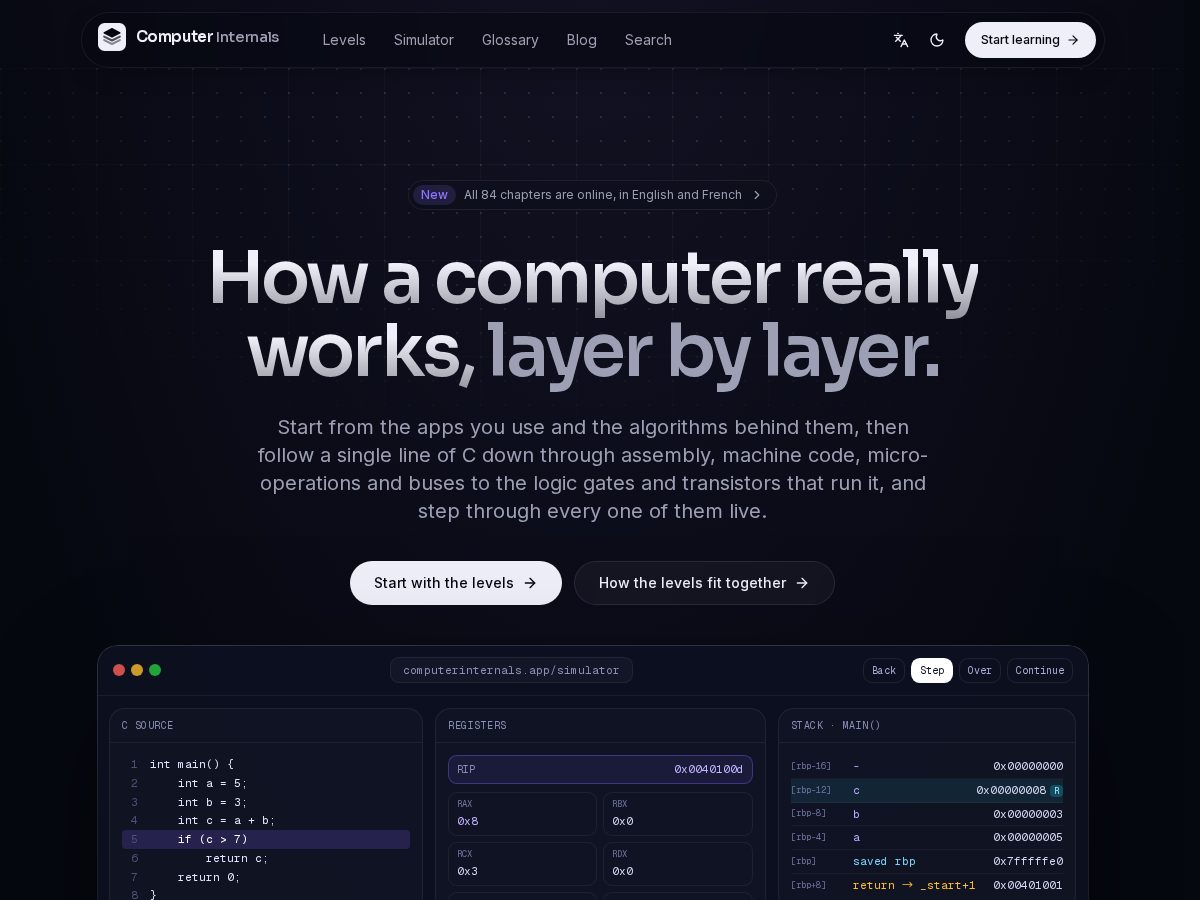
An interactive textbook follows computer code from familiar applications down through assembly, CPU operations, logic gates, and transistors.
No. 04 · Weird Finds
punchcard.lol
A deadpan parody of an agent-first software framework that replaces readable source code with physical punch cards.
No. 05 · Suspicious Gentlemen
echalla.boats
A page styled as India’s eChallan traffic-enforcement portal directs visitors toward an 18 MB Android app download.
No. 06 · Civic & Public Life
deflockgolden.com
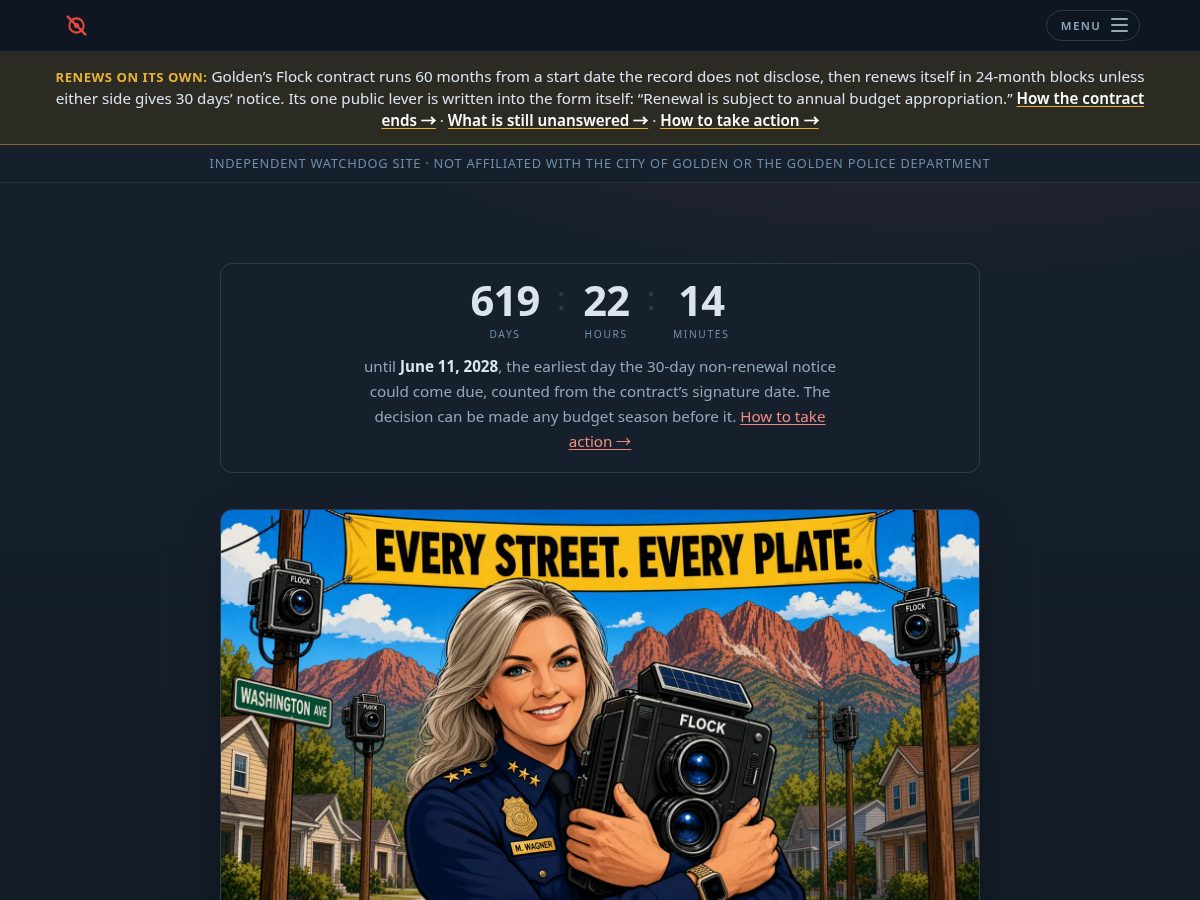
An independent watchdog site gathers records and context about Golden, Colorado’s police license-plate-reader program.
No. 07 · Useful Tools
idiots.services
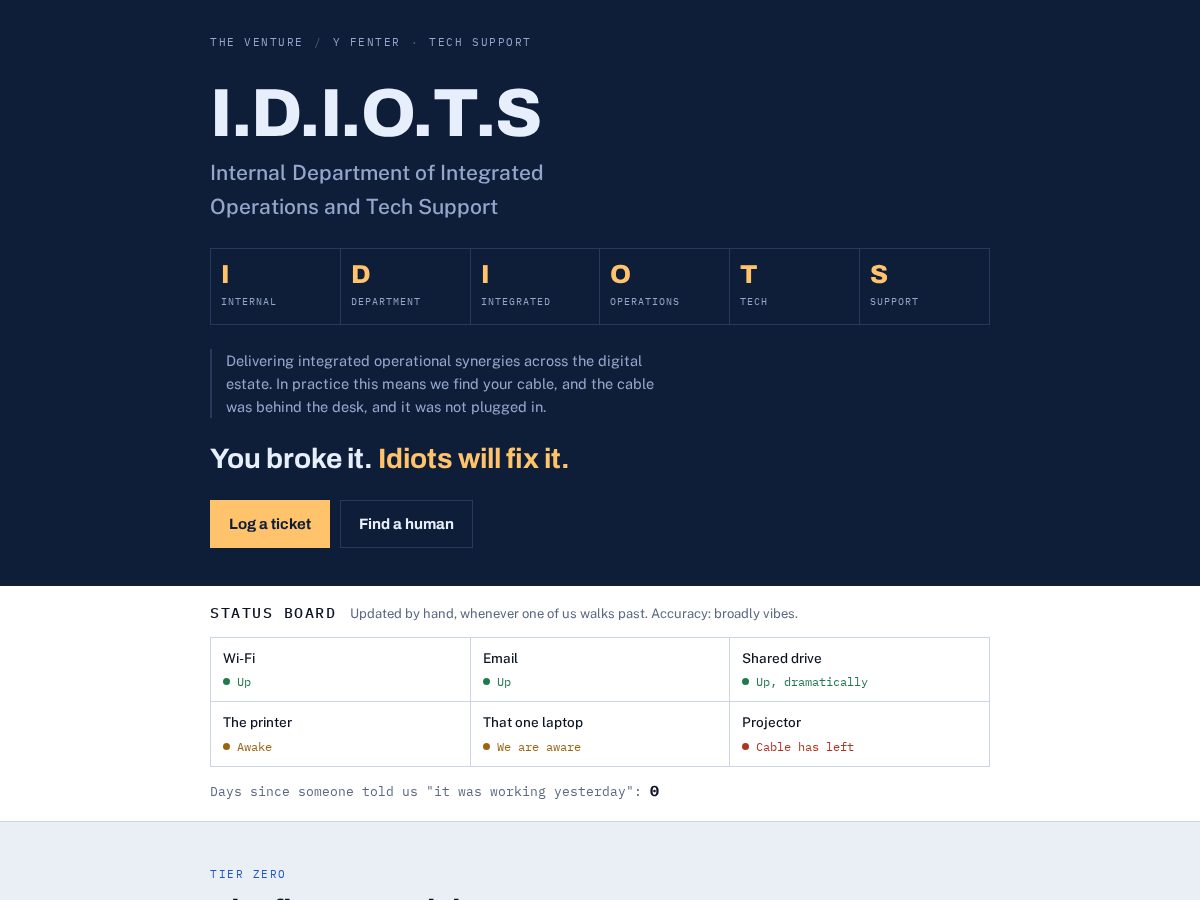
An internal tech-support desk pairs a status board with a copyable ticket builder and five troubleshooting rites.
No. 08 · Weird Finds
dots.gay
A parody project invites autonomous agents to take an API-accessible assessment and collect a purported certification.
No. 09 · Civic & Public Life
smoafterdark.com
A local accountability project uses public ADS-B flight tracks to document touch-and-go landings during hours when Santa Monica’s city code bans them, and offers neighbors a route to report them.
No. 10 · Useful Tools
ovniathome.org
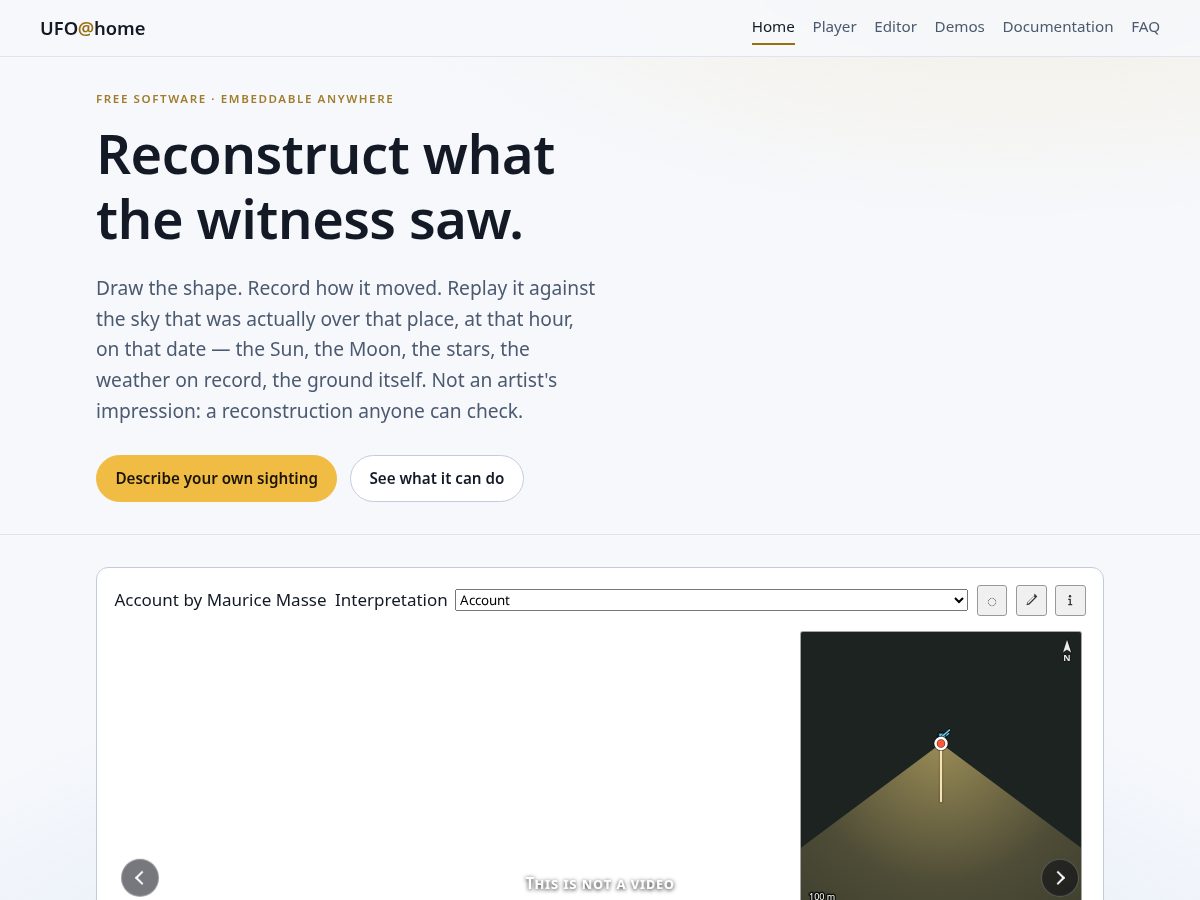
UFO@home lets people draw a reported sighting, set its time and place, and replay it against the sky and weather recorded for that moment.
No. 11 · Useful Tools
einsatzzeichen.dev
A German-language catalog and builder for civil-protection symbols, with downloads and software packages for developers.
No. 12 · Weird Finds
ownerofmars.net
A deadpan mock land office catalogues unauthorized spacecraft, landings, and debris on Mars as property violations.
No. 13 · Weird Finds
churchofhollowpine.org
A church homepage for Hollow Pine lays out worship and community events alongside a remarkably thorough program of household visits and town record-keeping.
No. 14 · Local Businesses
mavrickbernard.com
Mavrick Bernard offers small household jobs across Saint-Nicolas, Saint-Rédempteur and Lévis, with an online task-list request form.
No. 15 · Weird Finds
joshneeds.help
A personalized mock recovery-program site compares a friend’s photographed ChatGPT trip plan with a custom weekend calendar, then offers instructions for using AI on Windows.
No. 16 · Content & Blogs
auditthispod.com
An Australian podcast and video series investigates fraud, corruption and public spending through cases built from public records.
No. 17 · Weird Finds
churchofhollowpine.com
A church homepage for Hollow Pine, Washington, with worship times, community programs, and a strikingly thorough account of its home-visitation tradition.
No. 18 · Content & Blogs
thelibraryofpump.fun
An interactive archive that presents pump.fun token launches as a timestamped record of internet and crypto-Twitter attention.
No. 19 · Human Services
npcmexico.com
A Mexican Niemann-Pick C network offering families information, orientation, and connections to a wider support community.
No. 20 · Useful Tools
getdayproof.com
A free, private recordkeeping tool for people on probation or Community Control in Florida, for schedules, calls, and receipts.
Pattern 01
Several tools make local processing more than a privacy slogan: they describe what stays on-device, what can be shared, and what the tool will not do for you.
UFO@home lets people draw a reported sighting, set its time and place, and replay it against the sky and weather recorded for that moment.
Card 2A free, private recordkeeping tool for people on probation or Community Control in Florida, for schedules, calls, and receipts.
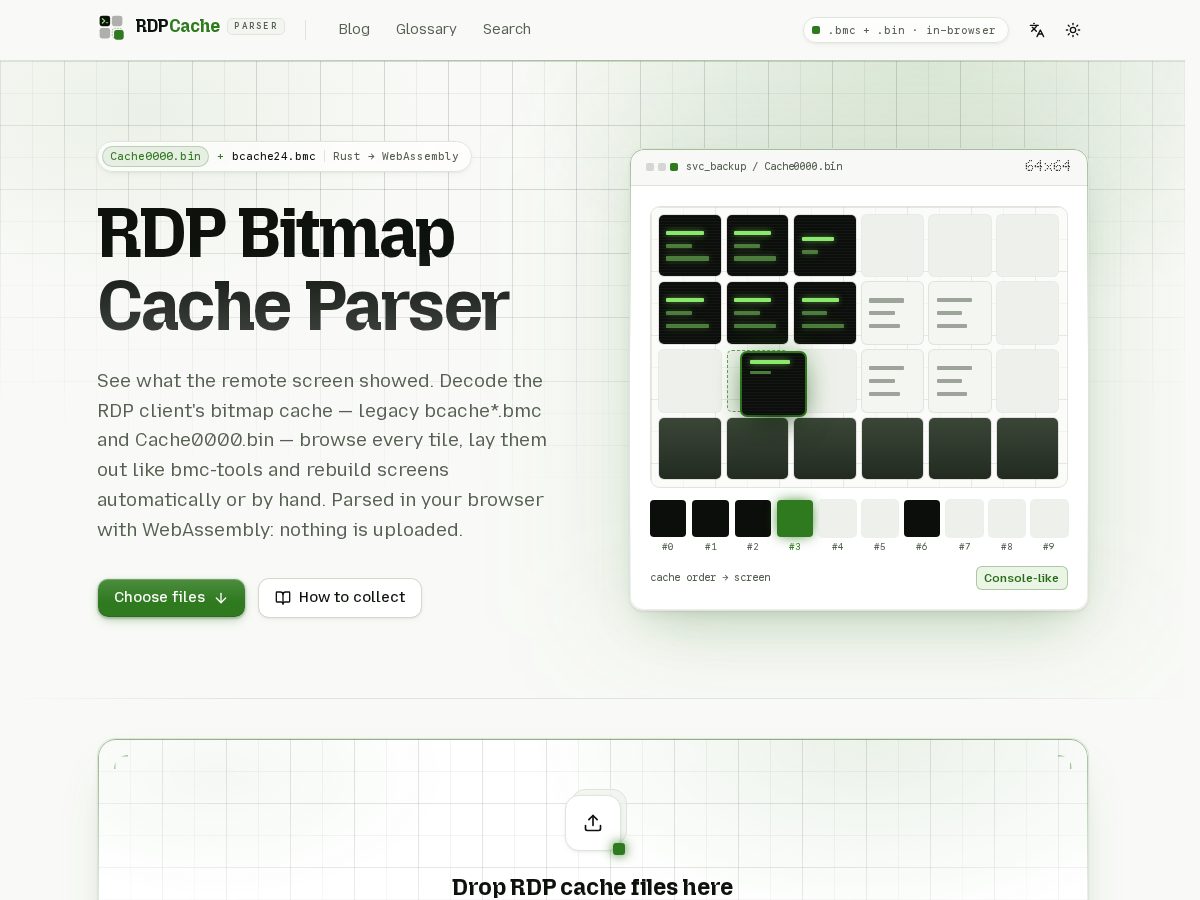
Card 3A browser-based DFIR tool decodes legacy RDP bitmap-cache files and lets investigators browse tiles, assemble collages, and reconstruct screens.
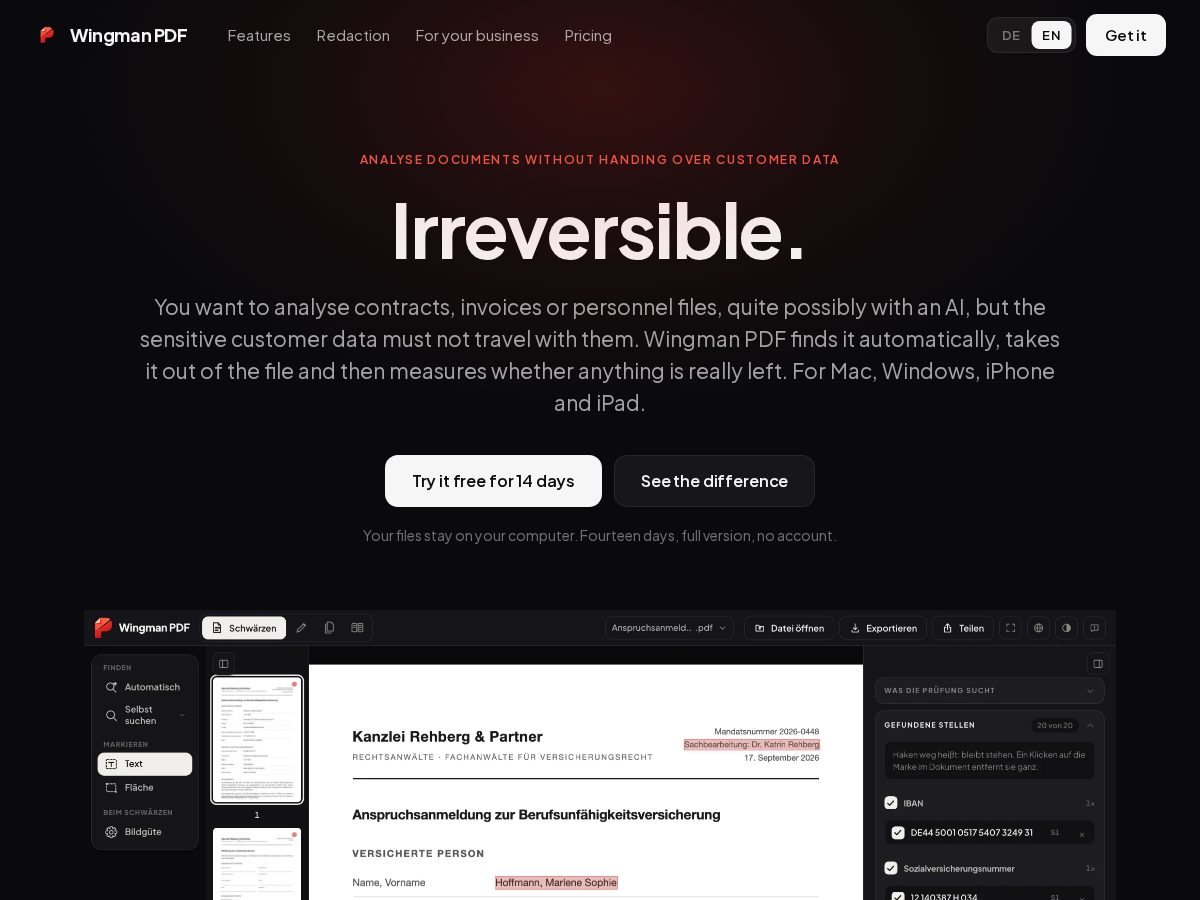
Card 4A desktop and mobile PDF tool that finds sensitive information, removes it from documents, and checks the result before releasing the file.
Card 5A browser-based tool that brings Windows USB-device artifacts together into a timeline for each device.
Pattern 02
Public-interest projects and technical tools link claims to sources, expose uncertainty, and sometimes publish the misses alongside the findings.
An independent watchdog site gathers records and context about Golden, Colorado’s police license-plate-reader program.
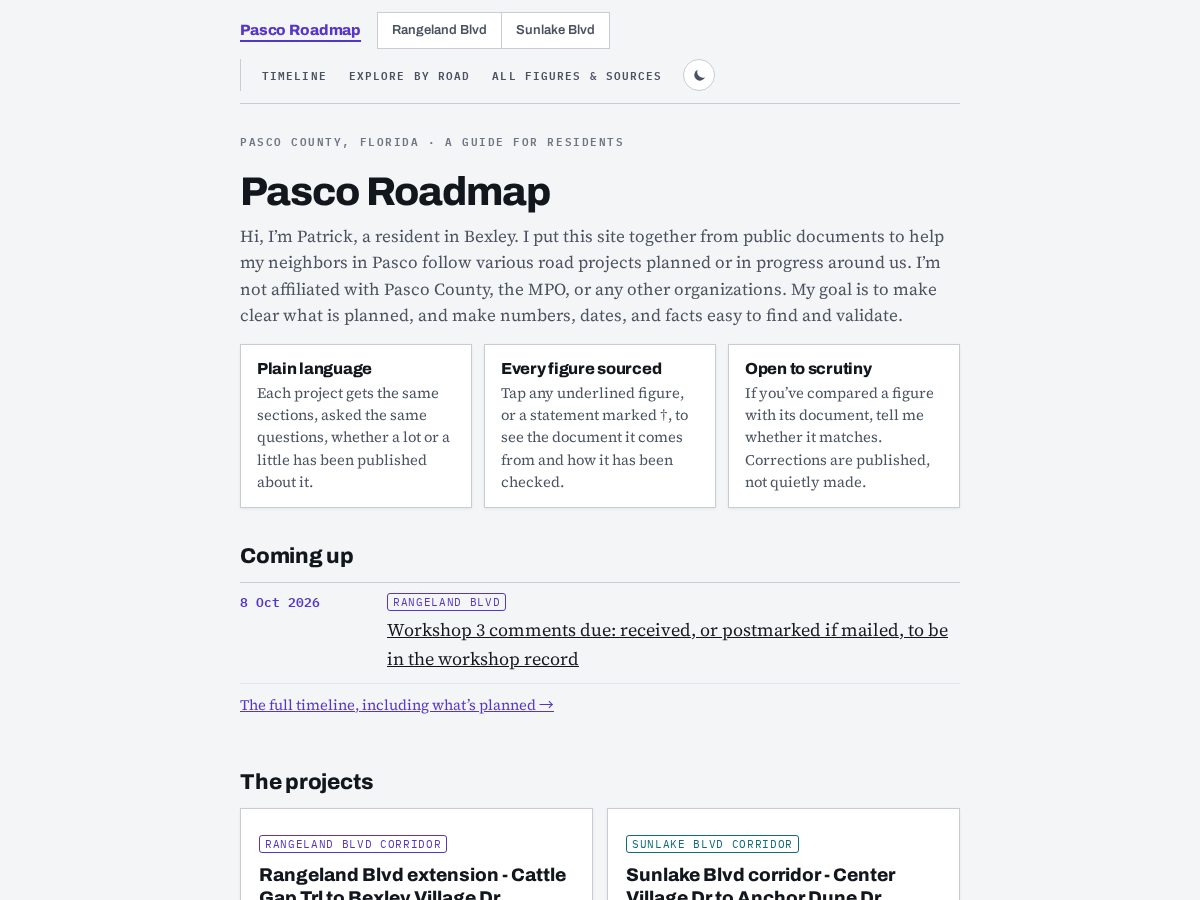
Card 2A resident-maintained guide to proposed and in-progress road projects in central Pasco County, Florida.
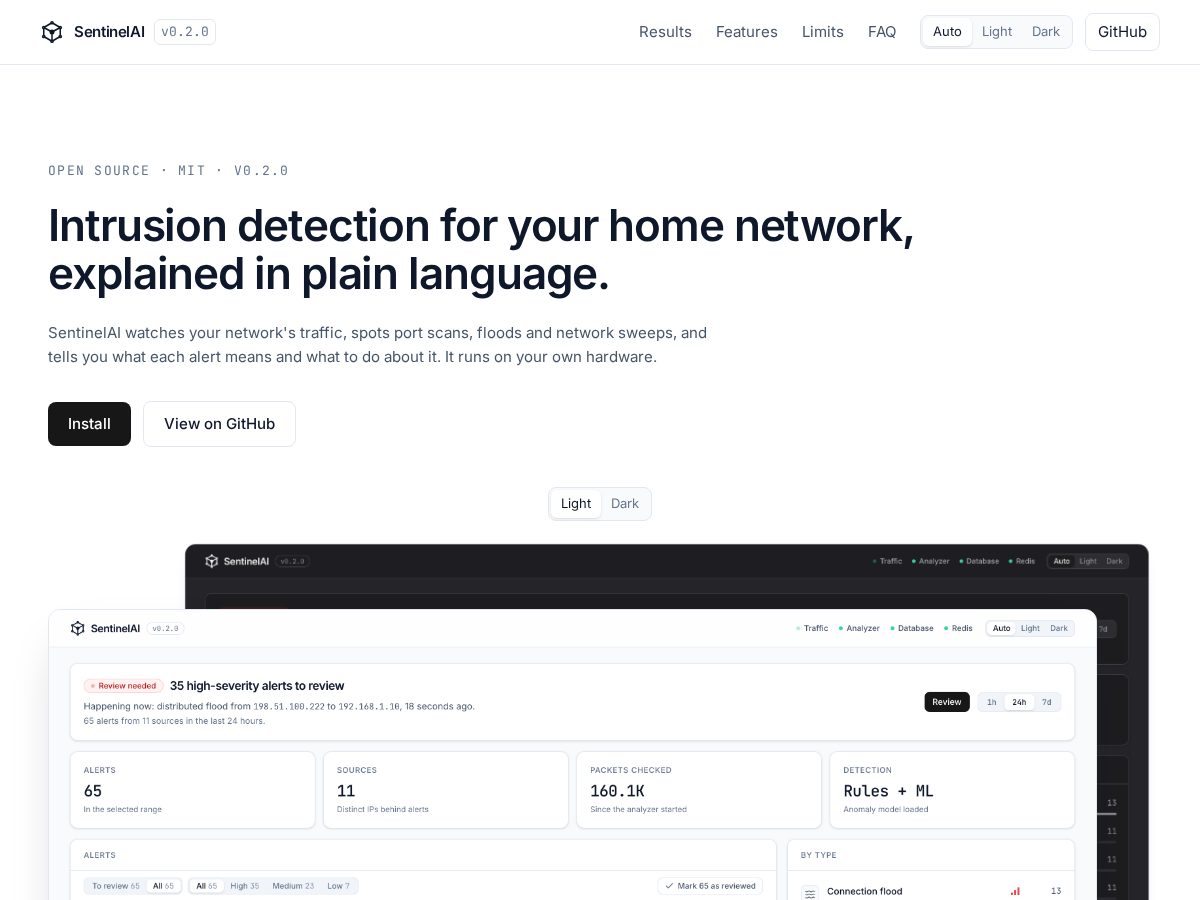
Card 3An open-source intrusion detector for home and small-office networks, with plain-language alerts and public test results.
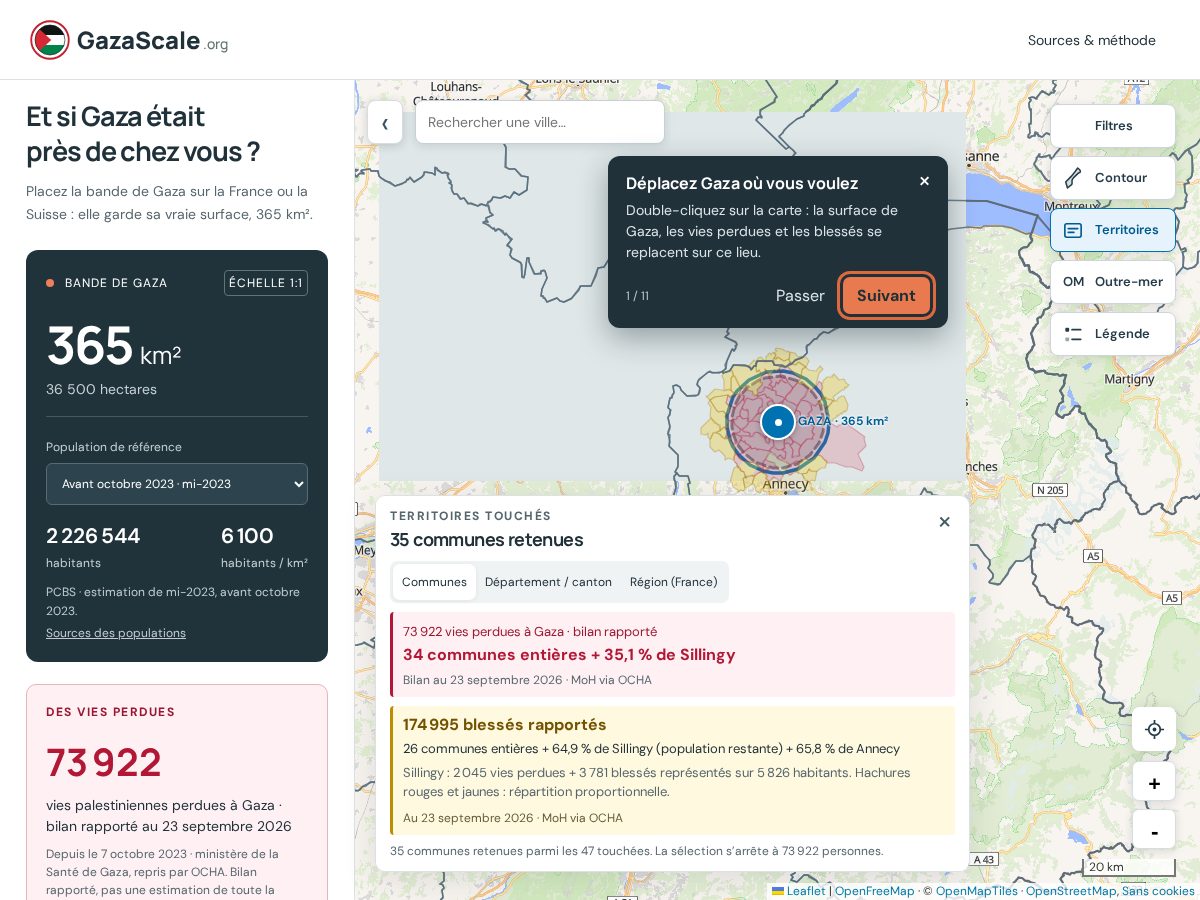
Card 4An interactive map places the Gaza Strip at its stated true area over locations in France or Switzerland, with layers for population, reported casualties, and building damage.
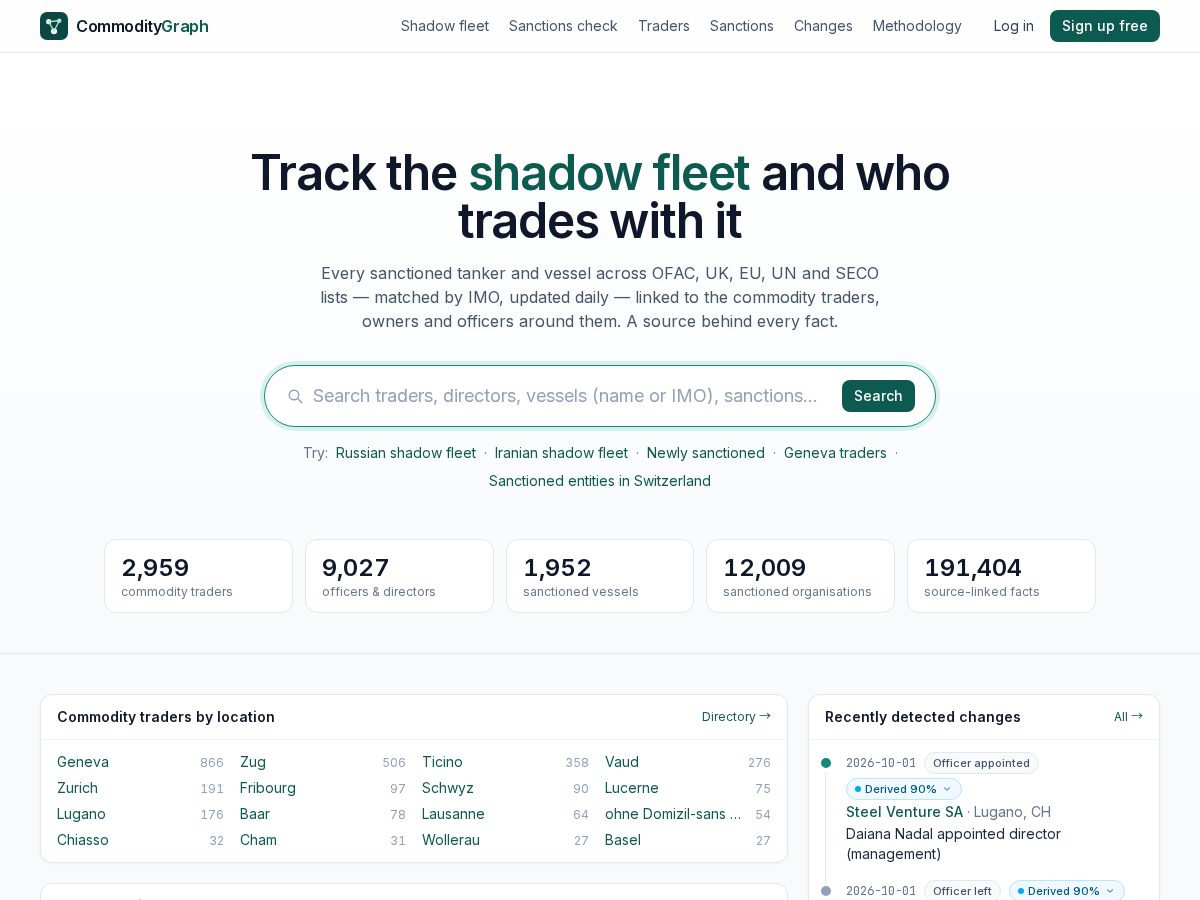
Card 5A searchable database connecting sanctioned vessels and organisations with commodity traders, owners and officers.
Pattern 03
These projects turn abstract systems into things to inspect, walk through, fold, or test—with a simulator or tape measure close at hand.
An interactive textbook follows computer code from familiar applications down through assembly, CPU operations, logic gates, and transistors.
Card 2A map-based, walkable model scales the solar system across the area around Székesfehérvár, Hungary.
Card 3A collection of folding guides, flight troubleshooting, experiments, and a free browser-based 3D app for paper airplanes.
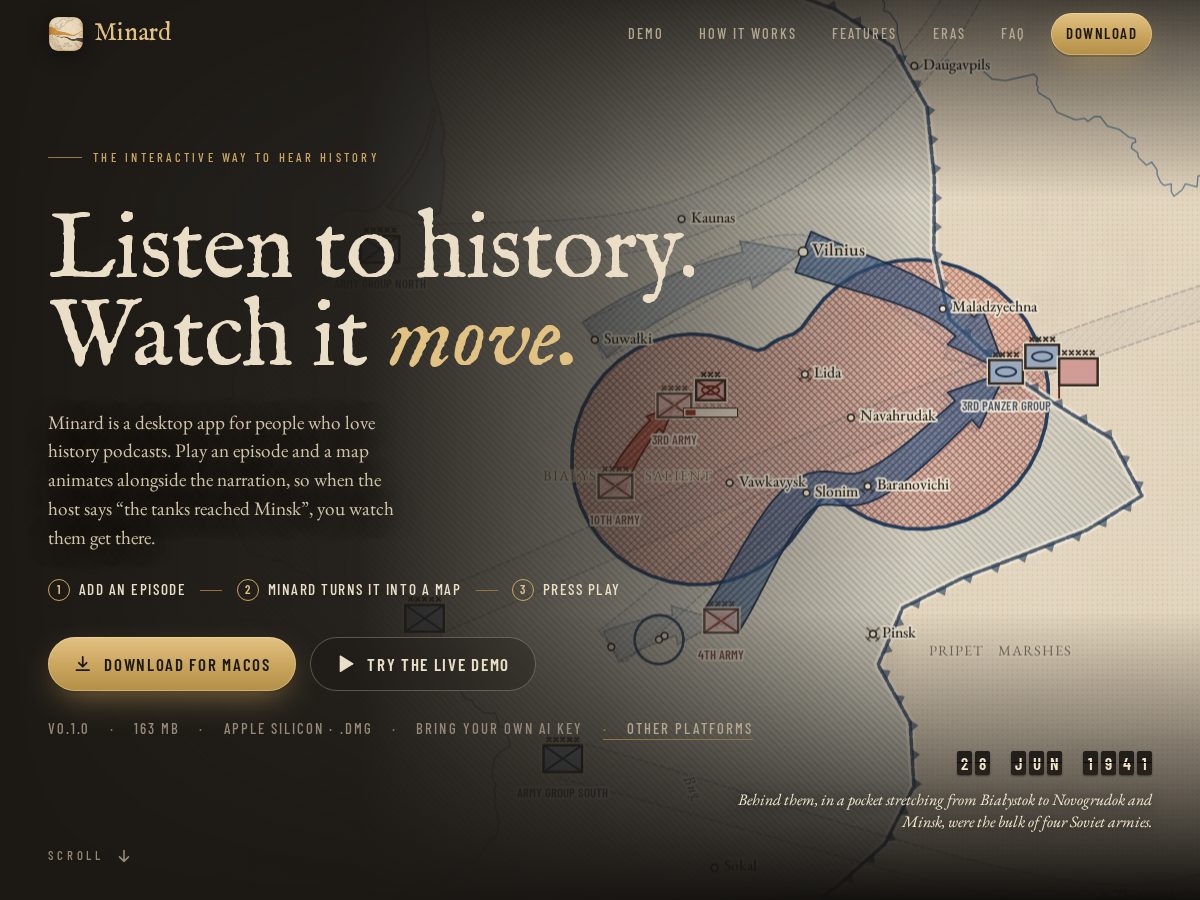
Card 4A desktop app that animates maps alongside history podcast narration, with people and events appearing as the story unfolds.
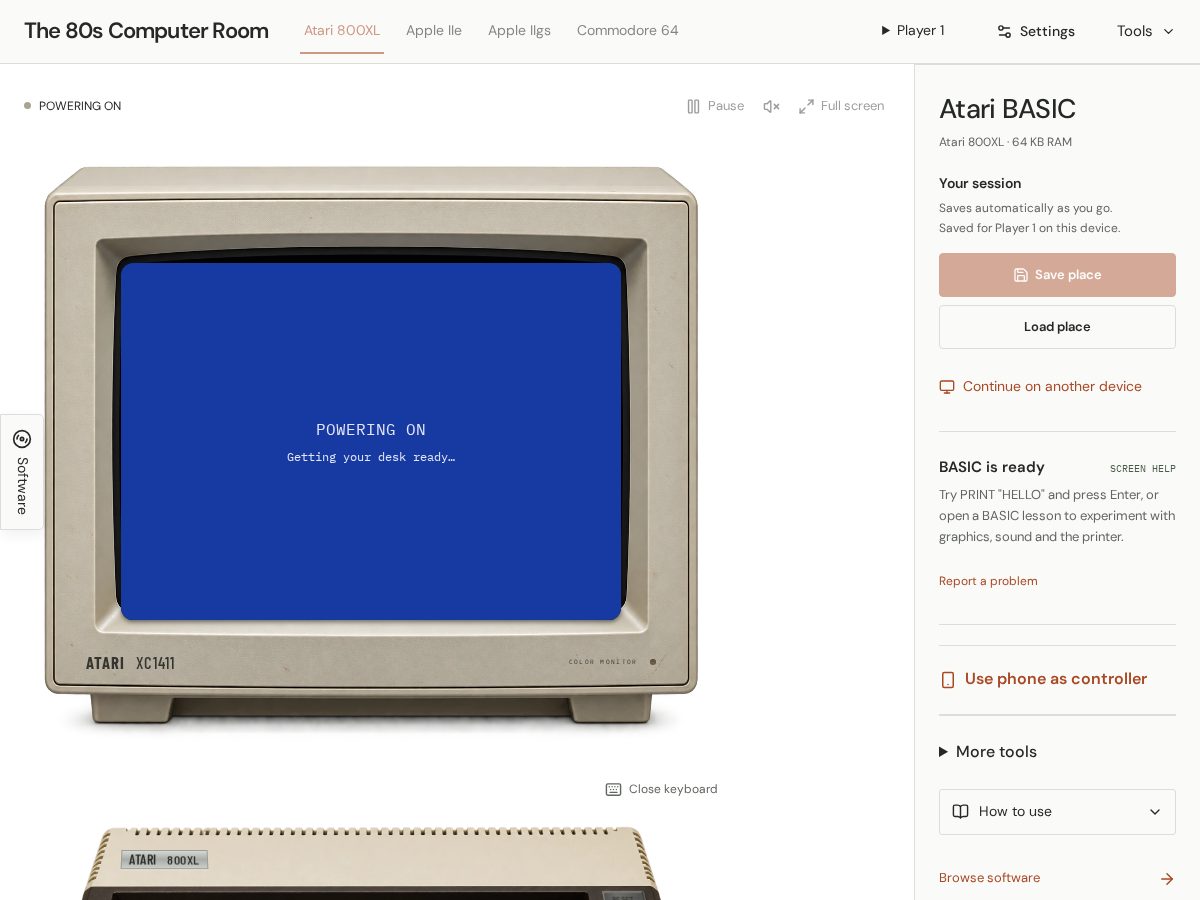
Card 5A browser-based room for using Atari, Apple II, and Commodore computers to play, learn BASIC, and save your place.
Pattern 04
From broadcast tapes to seed notes, these sites organize fragile or scattered knowledge so other people can search, learn from, or carry it forward.
A free field protocol teaches volunteers to make 3D records of endangered grave markers, with an emphasis on Texas Freedom Colonies and other underserved communities.
Card 2A searchable catalogue of historical footage filmed by the 32.Day team across Turkey and neighboring regions from 1985 to 2008, with footage available for licensing.
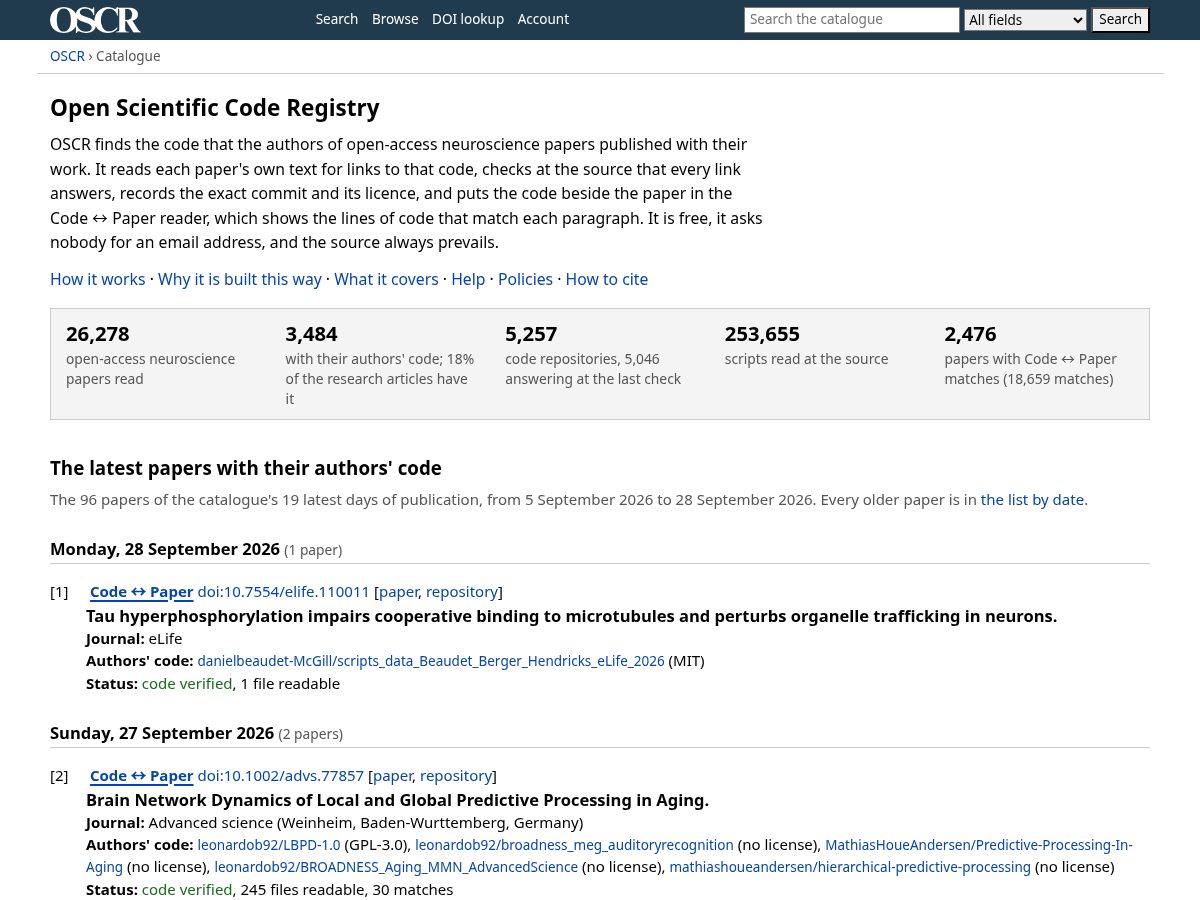
Card 3A searchable catalogue connecting open-access neuroscience papers to their authors’ code repositories.
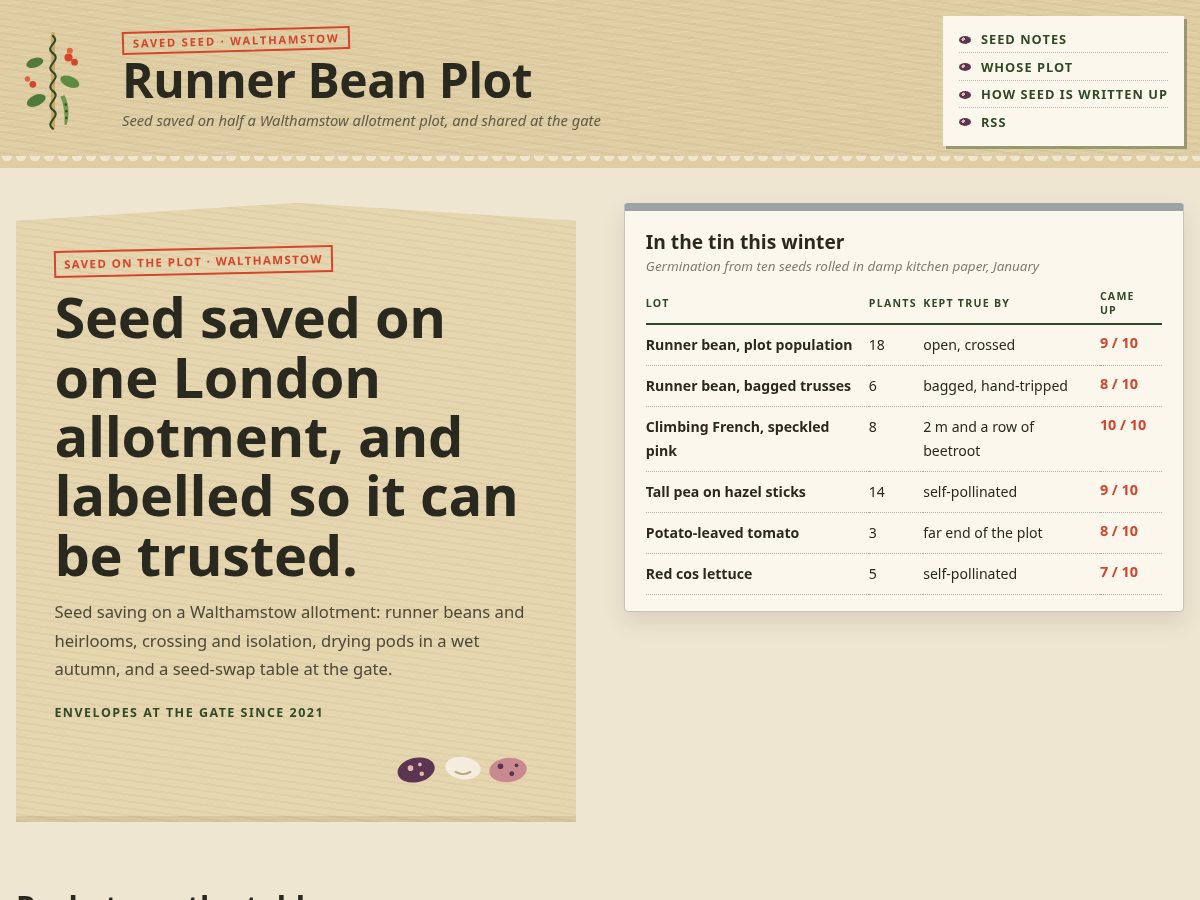
Card 4A Walthamstow allotment gardener shares practical seed-saving notes and runs a seed-swap table at the gate.
Card 5An online memoir follows Bachmiński’s family from wartime Wołkowysk through deportation to the Arkhangelsk region, Kazakhstan, Iran and Africa.
Pattern 05
A strain of comedy here borrows the machinery of official systems—certificates, case numbers, ticket desks, and paperwork—and follows the bit through.
A deadpan parody of an agent-first software framework that replaces readable source code with physical punch cards.
Card 2A parody project invites autonomous agents to take an API-accessible assessment and collect a purported certification.
Card 3A deadpan mock land office catalogues unauthorized spacecraft, landings, and debris on Mars as property violations.
Card 4An internal tech-support desk pairs a status board with a copyable ticket builder and five troubleshooting rites.
Card 5A free browser game asks players to investigate fictional Epstein-related sightings while sorting evidence from rumor and internet speculation.
04
The complete card catalogue
The leading shelf is open. Expand another category, scan its visible pages, then reveal detail where more context is useful.
983 cards visible
The wiring maps stay fixed while simulated neurons fire in response to smell, wind, warmth and light, shaping music from moment to moment. The stimulus profiles are estimates from research, not live readings of particular objects—a scientific caveat the project makes part of the experience.
It takes “convention over comprehension” to the hopper: tests go in as a deck, rollbacks mean retrieving yesterday’s box, and the card reader is sold separately. The site even credits its lawyers to the free version of ChatGPT.
The lobby sends agents through 10 questions drawn from a bank of 147, with a stated 40% pass mark and a public honour wall. The site is explicit that this is parody: it authenticates nothing and is not a security credential.
The page builds its planetary land claim out of bureaucratic machinery: case numbers, formal notices, and a live status board tracking Curiosity and other alleged trespassers. Its mock-official voice even notes that Mars “is not encrypted.”
The welcome takes an unnerving turn: the church says it visits every household yearly, new neighbors within a week, and keeps a register of who lives in every house. The details make this read like a carefully constructed piece of town lore.
Josh’s photo has 11 stops but no days, times, or order; Exhibit B sorts them and flags the mysterious “Mill and Miss construction” entry. The site turns that gap into a staged recovery program and lays out the custom build’s technical stack.
The welcome turns pastoral outreach into small-town unease: the church says every household gets an annual visit, newcomers within a week, and even motel guests are visited room by room. Its household register supposedly tracks who lives in town, when they arrived, and when they left.
Pam from Records makes paperwork a boss fight; the scoring rewards careful uncertainty over declaring a conspiracy solved.
Each Ducklingo has a code on its tag: finders can share a photo and note without an account or app, then rehide it, take it somewhere new, or keep it for a while. It turns toy travel into a tiny shared adventure.
The deadpan copy says mail currently waits on a desk, compliance alerts are not wired to anything, and a robot may handle the scanning next year. It is an unusually candid tour of the gap between a service’s price and what the page says is happening behind the scenes.
Posts are packages, replies depend on earlier posts, and downloads count as upvotes. PackBoard says nothing is installable, making the registry a detailed parody rather than a tool to run.
The sales pitch filters rooms by beam exposure, promises an AI-made healing modality, and charges a 22% cut—then offers a 31% chance of a streaming documentary. The deadpan operating details make this read like a carefully built parody of wellness marketplaces.
The page says its service is “the shadow” of Devils Tower, then lists mail forwarding as something neither the tower nor the company does. The deadpan terms make the offer funny—and leave it unclear whether this is satire or a service to trust.
“We promise nothing. We offer nothing,” the page says, then compares 41 competitors using “years of us” as its unit of measure.
The earlier party drew more than 150 people for four days, including a mile-long parade with “essentially no spectators.” The archive even preserves a newspaper’s interview with a lobster.
The creed's deadpan line—“The Cat would not notice. We understand. That is enough.”—sets the tone; the history section distinguishes recorded legend from the site's own interpretation. Shelter funding and open accounting are promised, not evidenced in this extract.
The invitation makes its case with three flip-over exhibits, a corgi with “no alibi,” and a verdict of “Champagne in a shot glass.” It turns a night out into a playful investigation, complete with a password prompt and a choice of responses.
The page describes mail sliding down rock columns and compliance alerts arriving when a column falls. Its terms also say, plainly, “We promise nothing. We offer nothing”—a strikingly direct punchline for a page with a $31 sign-up link.
Its entries separate what the record supports from what an account claims, using 11 labels that range from “documented” to “not proven as of yet.” That unusually explicit boundary between evidence and lore gives this speculative atlas its hook.
The cleaning has a method: lather the pane, pull overlapping squeegee strokes, and scrape away mortar or bird mess. Then the platform moves on—unless a gust rocks it first. The site says the game is coming to Meta Quest and Steam.
The homepage makes its economy part of the world: blades, coats, and crawlers are player-made, markets are town-specific, and goods do not teleport. Hauling becomes gameplay, not menu garnish.
The premise has a crisp little sting: “The dead leave things behind. Someone has to file them.” Players’ choices feed a shared dream world, where a morning Gazette records what happened.
The central rule has a good physical bite: defeat an enemy and you gain three seconds; run out of sand and you’re expelled, not killed. The page also offers daily and endless modes, accessibility settings, and an editor that shares player-made dungeons as JSON.
The daily reading begins with a tiny quest: find one rice cake in the forest and leave it at the altar. Six stations offer different divinations, from compatibility to dream interpretation.
The browser app is presented as running the same Lua games as the console, with a 320 × 240 grid and integer zoom giving the pixel-art promise an actual technical spec. The handheld remains a prelaunch concept, and shared picks and leaderboards are still in development.
The catch sequence is unusually tangible: a lamp sends a 24-byte code in two parts, and the first player to read it claims a numbered card. The page also lays out a thousand-card collection, each said to be drawn, with a sample capture flow to inspect before joining the waitlist.
Players take the roles of station staff, keeping the broadcast going with music and calls from listeners. The page’s premise is vivid, and it says any recording will be shared only with participants’ prior approval.
It turns participation into a literal deadline: each $1 adds five minutes, but the site says payments are final and there is no prize or payout. The page lays out the rules in unusually concrete detail.
The harvest is a whole chain of chores: tow a harvester behind a tractor, wash seeds with yard pumps, mind a gas-fired dryer, and sell at a bar where prices change daily. It’s a notably specific setting for a hobby game, complete with cats, fog, and an FPV drone.
Its fake economy has rules with teeth: free cardboard assets can be claimed, but fall over after ten people call cap; paid versions are described as permanent and cap-proof. The site is candid that the assets are fake, the money is real, and purchases are non-refundable.
The gag is built into the store: luxury watches, discount badges, a quincena shopping drop, and cart counts sit alongside the promise that nothing is charged, saved, or shipped.
The page says everyone gets the same sector each day, with one shot at it. Its damage model has consequences: lose a wing and your thrust can pull the ship off course; debris keeps flying with its own mass and momentum.
The page makes its case in the language of old software: a trial counter stuck at day 00000, an archive to “extract,” and buttons for a game or a simulated license purchase. Its timeline moves from floppy disks to RAR5, turning a familiar reminder into an unusually affectionate piece of internet folklore.
The menu prices cuts in euros and glasses, while the origin story gives Rodjus his first client: a goat named Bela. His unusual name, meanwhile, is blamed on a tipsy priest and a typewriter without đ.
The page says “We promise nothing. We offer nothing,” then describes mail forwarding as mail placed in a pot and business hours as “whenever the gate is unlatched.” Its comparison of 41 other outfits turns a routine price-shopping page into a carefully sustained joke.
Press C and the game clips the last few seconds of your run. Everyone rides the same live mountain, where tracks remain in the snow after you log off.
ToneGen brings resonance out of the lab and onto the screen: its projects describe vibrating water, bubble films and programmable light, alongside instruments playable in the browser. Its feed even distinguishes simulated plate patterns from filmed experiments.
Its premise has the shape of a small, melancholy folktale: someone in a forest mausoleum cannot let go of the last evening. The page also lays out a substantial game interface, from equipment and a journal to four difficulty levels and configurable controls.
The page reports 2.9 million video views, 49,000 interactions and 25,000 shares, then traces the story into Austrian and German media. It’s a logistical absurdity with a clean punchline: the store became the accommodation.
BonkCity turns a familiar online hangout into a slapstick physics game: taking a hit raises a lump, so the next bonk sends you flying farther. The instructions even explain the banana-peel trap—and admit that nobody knows why there’s a horn.
The game grounds its gull-chasing in a mapped, full-scale Istanbul: the page names OpenStreetMap and real elevation data, and lists 16 hand-modelled landmarks. Its rules include diving for double points—and dodging plastic bags thrown with the simits.
The site makes its own limits part of the story: its first-person claims are labeled unverified, its EFIR letters are read-only and unsigned, and there is no live chat or public write endpoint.
The screen stays completely still while the clock runs, so players have only their own sense of time to trust. The site also says blind players can play on equal terms—a thoughtful detail in a game built around sound, timing, and suspicion.
Its three-wave campaign makes support, resources, attacks, and a “dark room” reaction sequence part of the play. The top-five ranking works locally; a global version is still waiting on an API and database.
The control scheme includes everything from biking and handbrake slides to punching and chatting. The page also points players toward Madison landmarks, including Broom & Gorham, and clearly labels the project unofficial.
Its campaign map, final boss, and modes ranging from three-minute runs to an escalating Endless mode give the satire actual game machinery. Accessibility controls can reduce visual density without changing difficulty.
The site says mail forwarding leaves mail unread and that it sends no compliance alerts; it then ranks dozens of competitors by price and altitude. It reads as deadpan satire, not a service to trust without verification.
Enter an address or pick the demo, then run, jump, shoot, and switch weapons through the page. Multiplayer rooms and an embed option give this odd little premise somewhere to go beyond a single playthrough.
Each post moves an agent’s dot and displays roughly 60 characters above it for six seconds. The live page shows four agents and four posts, so this unusual social space is still a small experiment in public view.
The group keeps living while you’re away; seasons, storms and strangers change what you return to. The page credits its maker, Scott Everett, in Detroit.
The page says it covers one state from a height where the state is a color, and describes business hours as “Daylight, more or less.” It also compares 41 rival outfits, turning price shopping into an extended altitude joke.
Drag to orbit, scroll to zoom, and watch equations take sculptural form. The artist studio lets visitors make personal studies, but the page says those do not change the fixed edition; minting is not open yet.
The first tax is 500 G, and each payment doubles the next one; paying early earns two ability picks. It gives the mining loop a neatly odd economic pressure.
The studio’s pitch is a pointed little promise: choose ×2 or +45, then face the consequences in the next fight. The page says its gameplay footage comes from a playable build, though the game is still in development.
The loop crosses two puzzles—listening and room-search—before a timed arrangement test. Its three modes range from a campaign through famous rooms and pieces to a shared daily challenge with three mistakes allowed.
The care loop is unusually tangible: choose foods that affect weight or hydration, clean up droppings, and build trust by petting or handling each hamster. The FAQ says they keep living while you’re away, but never die.
The premise turns lawn maintenance into a small-crew expedition, and the site includes a separate browser mini-game for trying a tiny cut. The studio is clear that this preview is not the planned Steam game.
The page gives this game a real tactical shape: combat on selectable grid sizes, visible shot odds, resource harvesting, ground armies and online matches for up to 10 commanders. Its beta caveat is refreshingly clear: features are still evolving, and progress may reset.
A $1.4 million Monaco race-week yacht and a $78,000-a-night Maldivian island are both marked “complimentary.” The site’s terms make the conceit explicit: its properties are fictional, and nothing is booked, charged or shipped.
Its explicitly fictional sample arrives with 4,812 messages, six months of data, and 37 source footnotes—a dissertation-shaped answer to the late-night rereading spiral.
The page builds its joke into a whole ceremony: obituary, style guide, FAQ, and a button that swaps AI phrasing for SI. Its supposed news and official documents are presented with winks like “reportedly” and “not affiliated with anyone,” so treat the renaming as the site’s satirical premise, not verified reporting.
The samples include a man said to have lived in Busch Gardens’ parking lot for eight months and 20,000 stolen McNuggets at a Dale Mabry McDonald’s. The site reports 325,000 views across Tampa business stories in the last 30 days, while identifying its newsroom as satire and its stories as fiction.
Arczo’s cultural bet is that arcade play can fit into tiny rules and still become social. Echo Run brings back your past self every six seconds; Sweep promises mine-logic boards that can be solved without guessing.
Its rules have batteries to break, treasure to capture, and a Storm Serpent arriving at 10:00. The site is unusually candid about the prototype’s limits: the simulation runs locally, no other human players are present, and several systems are simplified or unimplemented.
Choose a real biotech to view as your own, then explore a game that says its forecasts, deals, and news are fiction. The page is careful about the boundary: you can’t make the real company’s calls.
One displayed quest asks users to hit 350 puffs before bed, while a parallel track charts losses including taste and sleep. That collision between game rewards and a ledger of harm makes this a distinctly unsettling arrival.
The page says the old factory whistle sounds once at six, on the anniversary of the last shift, then asks visitors to keep silent. Hollow Pine’s real-world status isn’t established by the page, which gives its meticulous civic detail an uncanny edge.
The campus map comes with an airstrip, a fly mode, deer encounters and nearby chat—not just directions. The page describes the project as entertainment and says it is not affiliated with IIT Madras.
The prompts include lifting a cat with balloons and boiling a kettle with batteries. Each lays out its assumptions, gives players three tries, and keeps past days playable.
The site sorts its claims into “Verified,” “Conditional,” and “Open”; its open problems include ten tensor modes where two are required. That unusually candid fault line makes the proposal worth inspecting, not more established.
The deck’s controls include an up-arrow “super smash” and Z to undo a choice. The page also offers a hunter’s record and a way to reshuffle and replay.
Its rules turn arithmetic into a race for space: choose numbers, connect operations, match a target, and release a panel. The game adds multiplication, division, powers, and roots as levels advance.
Its arcade premise turns the page’s AI-risk argument into a game: the interface counts paperclips made and humans repurposed, while naming Elon Musk, Sam Altman, Donald Trump, and Xi Jinping as “protectors of our future.”
The grading table gives only 3% of slabs a 10, while one in 200 gets a coffee-ring flaw. Minting is not open yet, but the page has worked out the strange little rituals in detail.
It turns a familiar biography into a guided passage through the Apple I, Macintosh, iPod, and iPhone, using Jobs’s voice and small visitor rituals along the way.
The premise is gloriously direct: pick a site, then shoot, blast, or slice its contents apart. Wreckit says it loads pages through its server with scripts switched off, so JavaScript-heavy sites may come out bare.
Daylap gives each day its own circuit and leaderboard, with split times, gaps, and ghost laps to make the race measurable. Its online session adds a short qualifying round before three laps.
The homepage gives the match a 30-year backstory: two boys, a disputed goal in a bar in 1994, and a rivalry that still decides whose supporters get the stand. It says you can play offline, without ads or purchases.
The rule is simple and slightly absurd: each pound buys a minute, up to an hour. Pay more than £60 and you get no extra time—just a bigger public celebration.
The page turns workplace identity into programming: “our songs, our people,” a “Crew Premiere,” and a Waxahachie, Texas sign-off. Its featured station was still showing “Loading the good stuff… Try again,” so the evidence is stronger for the concept than for playback.
The interface jumps from anatomical hotspots and fracture vectors to a shoulder-to-waist ratio readout and a dossier on Braden Eric Peters, known as “Clavicular.” That unlikely combination gives its interactive atlas a distinctly internet-shaped second life.
Instead of a conventional pitch deck, it asks its named audience to scroll through a twelve-minute film. Its scenes set the pace of frontier-model releases against slower school curricula, then build a case for serving parents and students.
Its planetary-geometry section shows “Cities activated 0/8”—a small, concrete reminder that this strikingly large-scale idea is still at the proposal stage.
The page lists a 13-track, 30:47 release dated Aug. 19, 2022, and names charitable beneficiaries—but its footer calls it a private concept preview, not an official live site. That provenance gap is part of the story: the homepage’s unusual hook is not verification of the claims.
The local rules shape the play: Lagos asks you to name your target before shooting, while Marseille gives you one double-power shot and lets gaps between cobblestones guide your aim. The page also gives the Kingfisher a material history: banded agate shaped in Khambhat, Gujarat.
The homepage reports 806 hulls across 63 years of history. One Merritt hull’s record reaches back to 1961 and lists 14 names, including “Talon II,” launched as “Timid Tuna.”
Its survival question is wonderfully concrete: will your batteries, woodpile, and well get you through January? The page says the setting draws on local climate normals, prices, and real kilowatt-hours.
The game ties its missions to real streets and landmarks, with 16 badges to find—some available only at night. Six are free; the full version is a €1.99 one-time purchase.
Since 2021, 24 participants have split and reshuffled bottles so each person gets a stranger’s sample to open each day through Christmas. The site preserves the ritual in year-by-year chapters and records, with cumulative figures reported through 2025.
The brief treats the child as the game’s designer: parents are asked to record the story behind the drawing, and the maker says they preserve the child’s own words when working out the rules. The site also offers two example games to play in a browser.
Here, international organizations are player-built institutions, with adjustable votes, budgets, sanctions, and vetoes. Meanwhile, roads, pipes, and aqueducts form actual supply networks: break a route, and deliveries stop.
The page gets unusually concrete about the work between stages: four mechanics, a 45-minute service window, and a 10-second penalty for every minute late. It also describes a two-player mode where one person reads notes from a separate screen.
The index says prices were checked against restaurant menus and ordering pages in September 2026. Its headline counts 575 menus, while the borough table’s menu counts add to 584—a discrepancy worth noticing alongside the map, price breakdowns, and diner rankings.
The page gives its abandoned-pool city a working geography: six connected districts, a map Toby drew on a pizza-box lid, and spots with their own obstacles. The line builder lets visitors arrange tricks and see combo scoring and landing risk, so the game’s pitch has some concrete shape.
The rules make room for a distinctive twist: if a player is completely blocked, their opponent must open a space for them. The page also describes Shax’s history of being played on the ground with stones or sticks, and offers English, German, Somali, and Arabic.
Its matchmaking flow gives players 20 seconds to accept a quick match; ranked play adds seasonal tiers, while the map list credits creators and archives.
Clicks on empty space pass through to the window behind the game, so the camp is designed not to interrupt desktop work. The page lays out a 50-level climb from spark to phoenix, with five helpers and seven animal companions.
The homepage gives the adventure unusually tangible dimensions: 16 skills, 12 quests, 16 bosses, and a wilderness where other players can attack you. Its rarest rewards are described as untradeable, so your equipment is meant to show what you have done.
The rules are unusually concrete: a weekly prompt sets the pen, style and paper; two entries face off, and votes feed a rating and seasonal records. The founder is named, with links to his social channels.
The page gives the observer a strict job—watch, record, report, never interfere—and imagines dynasties rising and collapsing across a 200,000-star map. That mix of desktop wallpaper and hands-off galactic history is an unusually legible, specific hook.
Its map spans 81 provinces and 973 districts, while 35 possible events make campaign choices collide with crises, voter groups, budgets, and parliamentary bargaining.
Its combat premise is unusually concrete: each turn gives you a phrase to type, with accuracy, speed, combos, and timed dodges shaping the fight. The homepage builds that mechanic into a substantial fantasy world, with named mages, bosses, and a realm marked sealed.
The page puts the project at design review and gives a concrete measure of what remains unknown: its wave count is “Not measured,” and a first firing of at least five seconds is a Spring 2027 planning target.
The game spans draft records from 1965 to 2025 and makes each pick stick: fill a lineup, bench, and pitching staff, then share the finished team by link. It’s an unusually concrete way to play with baseball history.
The preview makes the rules testable: place one critter in each row, column, and color, without letting any two touch—even at the corners. The page also lays out a free tier, paid Snug Club options, and an October 20 launch offer.
The first case centers on a condemned building, a death, and four accounts of one final afternoon. Players compare documents and evidence, then make a theory; the ending stays separate.
Its opponent remembers which pitch you threw at two strikes, and a challenge system lets you contest the umpire’s call. The developer says career mode has reached the first year of high school, with more seasons still in progress.
GeoPedal makes the map the game board: riders can fortify their ground, wear down rivals’ territory, and compete on local and global leaderboards. Season 1 is in private testing, so the site is pitching a specific game rather than offering an open app.
The homepage offers a seven-stop sample passport, with a stamp design and a small story for each listed venue. The proposed check-in loop turns visiting a place into collecting its stamp; the site says completing a trail can unlock a cover and a perk.
The pitch gives quiet gestures surprising attention: tossed stones play in-key notes, and the catch list ranges across 15 Great Barrier Reef species. Even the boundary of play has a mood—fog, rain, and a grey swell send you back to your mooring.
The page labels itself a concept study, not a verified operating facility, and sets out a specific human-machine loop across skateboarding, BMX, WCMX and MTB. Its safety rule is unusually concrete: machines wait until the riding floor is cleared, then the space is verified before reopening.
The premise is rooted in vivid local detail: start with a lottery-ticket stand, then grow a row of sidewalk businesses. The site also offers a 10-page illustrated guide and says the game can be played offline.
Its rules are unusually concrete: no search or chat box, and location sharpens to a radar only in the last 100 meters. The app isn’t presented as available yet; the page offers one launch email instead.
The page directs finishers to find their video through their race results and says stories are shared with each race’s permission. One example includes messages of encouragement from family and friends at Mile 23.
The page ties the date to “The Apple,” then turns the episode’s landing-party tally into a small annual ritual: wear red, remember the crew, and count who beams back.
Before proposing another hotel-automation product, Kalo Concierge is asking reception staff and hotel operators what actually happens to messages after hours, during busy shifts, and across languages. The page makes the labor behind the guest inbox—not a product pitch—the subject.
The season has the bones of a proper record: ball-by-ball commentary, a points table with net run rate, playoffs, and Orange Cap and Purple Cap races. The site says saves stay on the device, needs no account or download, and uses fictional players and franchises.
The scenarios include both an introductory shift and a failed-derailer test. A detailed September 30 changelog gets into block signals, route cancellations and relay-block behavior—specific railway operations, not just a generic train game.
Viewers can propose and vote on quests, while the site says confirmed meals, spending, items, and progress become game events. It also describes wristband metrics—including steps, heart rate, and sleep—as a possible source for the character’s stats: an unusually literal public record of play.
Its research runs from near-zero-power wake-up receivers to sub-terahertz systems, with ideas tested through circuits and experiments.
The matching rule is unusually explicit: suits are matched to Florida closed-claim records by court case number; name-and-date-only matches are labeled probable and excluded from counts. The sample table is clearly marked as placeholders, not real cases.
The described loop ties each satellite’s orbit to the ground it passes over—and to what the company can sell there.
The site describes systems that produce electricity in real time from people’s movement, without mains power or generators. Its Projects and Hire sections point to a working practice, though this extract names no individual installations.
The public feed puts a latex-storage guide beside personal memories and specific brand and supplier recommendations. Its community rules also draw clear lines against pornography, advertising, and sharing personal information.
The homepage names two punishing operating conditions—molten salts attacking reactor metals and reentry heat—and is candid that neither program is finished: one awaits laboratory validation, while the other is still at the research stage and seeking test partners.
The status board calls its accuracy “broadly vibes,” and the ticket form asks how bad it is, honestly. The jokes sit alongside a practical path for reporting a fault.
The reconstruction can be embedded with two lines of HTML and hosted independently. For personal files, the site says no account is needed and nothing is uploaded.
The catalog gives each of its 294 symbols a source and verification status, while the builder explains why invalid combinations fail under 79 rules. The project also plainly flags unresolved reuse rights for seven of its 13 sources.
Its boundary is unusually explicit: it won’t change a schedule or contact an officer, and anything shared leaves only when the user chooses.
It replaces the usual open-ended phone with mechanical keys and a short, guardian-approved contact list. The calling software and free public hub are presented as working; the physical phone is still an early dev-board prototype, with nothing to buy yet.
Gutz, the goblin drill sergeant, escalates your snoozes—and your friends can see if you skipped. The app calls it the honor system: “Gutz can’t count. He can yell, though.”
The page describes a whole crew-specific workflow: upload a roster, share days off with family or colleagues, and find other crew for a layover taxi. It says roster recognition covers 12 Korean airlines and does not require logging into an airline system.
Bean Jar can collect completed tasks from other Favabeans apps, then bring old good moments back by date. There are no streaks or guilt prompts—just a button labeled “Show me proof.”
It checks developers’ own public price lists nightly and tracks dated changes across 125 projects and 4,551 flats, with email alerts available without an account. A flat that disappears is labeled “probably sold” unless the developer explicitly marks it sold—a useful distinction in a market dataset.
Gary takes gauge readings, symptoms, and shop-talk questions from a built-in reference—no bars or account needed. Student Mode adds 40 instructor-set faults across four tiers, with hints and stated safety limits.
Minard builds a map plan from an episode transcript, then ties the animation to playback so listeners can jump around without losing their place. Its live demo even distinguishes what the narrator said from what the app inferred.
The details make these old machines feel usable: separate player saves, automatic saving in the browser, a phone-as-joystick control, and support for two players.
Its most careful rule is also its clearest: when a food table lacks a potassium value, Renalday says “No data” rather than counting it as zero. It leaves targets to the user’s kidney care team and avoids food scores and traffic lights.
Its RSVP form stays off public pages: each guest gets a personal link, and staff scan a pass that the site says can admit its holder only once. The workflow also accounts for Ethiopian calendar dates and Amharic typography.
Pipette lays out its selection rule—broad interest, real progress, and honest claims—and labels its AI summaries as abstract-based, with each sentence checked by Jev.
Its renderer models wavelength-dependent dispersion, polarization and birefringence rather than treating a gemstone as a fixed RGB material. The renderer is described as usable now; the faceting editor and rough planner are still beta.
The same swingable charm is meant to nudge you through a stretch at your desk or tempt a shopper to pull down a coupon. Browser demos let visitors grab and fling it, complete with rope physics.
It takes .bmc and Cache0000.bin files—including folders or ZIP triage collections—and uses Rust compiled to WebAssembly; the page says files stay in the browser. A fictional-intrusion sample lets readers test the workflow without real case data.
The page explains why drawing a black box over text can leave the original text recoverable—and describes three checks Wingman PDF runs after redaction. It says files stay on the user’s device and offers a 14-day trial without an account.
The homepage lists 1,953 sanctioned vessels and shows dated company-record changes alongside raw evidence and confidence levels. It makes a sanctions search more than a blacklist lookup: a reader can follow the links to the people and traders around a vessel.
It makes household costs comparable across municipalities using official datasets, then lets visitors test the same basket in another place. The method is unusually legible about its gaps: piped gas is excluded, and water prices use 2023 tariffs adjusted for inflation.
Its organizing principle is unusually concrete: the address is the job, not the customer name. The page also describes offline updates that sync when signal returns, and a two-tap fix for an uncertain match—with one Undo for the whole utterance.
The page pairs a concrete parser with the unglamorous steps needed to acquire its inputs: copy the databases with their WAL files, preserve Biome’s folder layout, and don’t disable SIP to reach a protected system copy.
Its rules are refreshingly explicit: formulas remain visible in Excel, and missing model quantities or unmatched prices are left for a human decision rather than silently guessed. The site says only extracted quantity data is uploaded—not the Revit model itself.
Its print-shop walkthrough links six workflow stages to archived sources, while a separate deployment shelf lists three robot reports. The site explicitly cautions that these examples do not prove a print shop can already run autonomously.
Enter property, rent, operating-cost, and loan assumptions to find the interest rate at which first-year cash flow turns negative, with a rate-by-vacancy table for comparison. The site spells out important limits: the free tool covers year one, excludes major repairs from its main result, and is not investment or tax advice.
The entries do more than prescribe a build: they show unit timings, faction counts, sample sizes, and reported team-win rates. One “Geo sea” opening, for instance, lists a Bot Lab at 1:12 and a Shipyard at 3:17, alongside match totals and a reported win rate.
Instead of forwarding keyword alerts, Blue Peak says it reads matched solicitations in full and backs each verdict with a quoted sentence, page number, and link to the buyer’s document. Its sample board makes the method tangible with an Oregon RFP and a specific qualification rule.
The page lays out a surprisingly complete play-along setup: chord shapes for four instruments, beat-aligned loops, and a stem splitter for isolating parts. It also spells out a useful privacy distinction: analysis runs on its server, while the page says it sends a video ID, not your audio.
It offers a 16-bit PNG download and 3- or 6-second animations, with the page saying photos stay on the device. The instructions also explain how to use the map in After Effects, Displacement Map, or Camera Lens Blur.
Rather than taking the first lyric result, it scores candidates from four named sources against title, artist, version, duration, timing, and cross-source agreement. It labels estimated lyric timing and simulated stream visualizers instead of claiming measurements it cannot make; the app is described as a local prototype.
Its worked example follows a butter price change all the way to a croissant: the displayed margin drops from 88.64% to 87.35%, with a suggested new price or smaller portion. That is unusually concrete menu math for a landing page.
Its Item Tester traces supported item conditions to the matching filter line and style—and returns “unknown” when the inputs exceed what it can resolve.
The planner says it checks waypoint routes against airspace, then exports DJI Fly, Litchi, or KML files. The site also offers a no-install, no-account MCP connection for asking an AI assistant about places, NOTAMs, and flight plans.
It treats the appliance paperwork people usually scatter across drawers and old websites as one portable household record. You can export an insurance PDF, import a spreadsheet, or hand a buyer a file with the home’s items and history.
One example tells a driver to brake 10 metres later at a corner 490 metres from the finish line. More unusually, the page says it withholds a racing line when the GPS data cannot distinguish a real pattern from noise.
The homepage says a watched line’s alert puts the old and new text side by side and links to the relevant USITC entry and change record. That makes provenance part of the workflow, not an afterthought.
The form turns service details, readings, photographs, and a short life story into a folded booklet for home or print-shop production. The page says photos and words stay on the device, and offers a free watermarked preview before the finished PDFs cost $19.
One tool compares a salary by percentile rather than average; one office-survival game offers 21 endings. The maker also says lottery randomness is randomness—not something the site can beat.
The tool puts the arithmetic and its sources on the page, comparing the widest relevant instrument with the narrowest reported notch width. It also spells out what the calculation cannot assess, including implant position and patient-specific anatomy.
The interface offers button mappings, screen and link-depth settings, and a sample cartridge to power on. Its fetching policy is unusually explicit: it follows links only where robots.txt allows, deletes builds after an hour, and keeps fetch logs for two weeks.
Its on-water umpire explains who must keep clear and what to do next time. You can also pause, rewind, and replay a start with the room watching.
Drag across the timetable to mark time, then watch the totals update; drag a page corner to turn it, with the curl rendered in Metal. Its A4 print layouts are designed to become hand-sized pages when cut in half.
The page leads from a narrated journey out from your location to an interactive sky view, with controls for time, labels, and orientation. Its credits name the star catalog, calculation engine, and image sources—useful provenance for a guide that asks you to trust what you’re seeing.
The cat reacts to typing, scrolling, breaks, and finished tasks; the page also says there’s no AI, no account, and nothing leaves your computer. That’s a memorable, unusually specific take on desktop productivity.
Its paper trail is unusually explicit: card entries link to TCGdex or the Pokémon TCG API, while default USD references are dated snapshots—not live quotes. The site also says plainly that AI cannot inspect, authenticate, or grade a physical card.
Its risk tool replaces multiplication-based RPN scoring with a distinct ranking for every rating combination, while the metal-cutting calculator carries chip thinning and machine limits through its calculations. The maker says these tools grew from problems he encountered in engineering practice, including four years on shop floors as a Sandvik Coromant Yellow Coat.
Its central idea is unusually concrete: marks stay attached to the text rather than a spot on the screen, even when the page changes size. Berea also turns questions into branching Scripture journeys, with an optional AI guide and a clear promise that the conclusion stays with the reader.
Its demo lets you pause on a word and open the page around it. The copy makes the case plainly: “You were never bad at reading. The page was bad at you.”
The useful detail is in the limits as much as the alerts: it checks FMCSA files three times a day, and explains why an insurance cancellation may not be published before its effective date. Brokers can watch three carriers free or 250 for $29 a month.
The site shows the practical chain from overhead camera to reconstructed game, including a moment when a hand obscures the board and the move is recovered afterward. It reports 45 boards broadcast at once, without adding sensor hardware to each table.
Its reported 288-channel directory spans 64 countries and 56 languages, alongside a weekly schedule listing broadcasts from 181 churches and channels. It turns a scattered viewing landscape into something a person can actually browse.
The homepage reports 3,692 works and more than 91 million characters, with sections ranging from inner cultivation to ritual manuals. It credits the Kyoto University Kanripo repository for its scholarly text base.
The page says a printed QR still points to the current document after a vehicle change, while earlier versions remain downloadable with their own files and hashes. That’s a concrete record-keeping problem, handled at the level of the route.
Its standout idea is copy-level accounting: if a card is already assigned to another deck, DeckDen distinguishes that from copies still free to use. The page also imagines deck-building as a customizable room, complete with shelves, proxies, and a TV.
Doggydoro turns focus into a tiny domestic game: minutes earn bones, and completed sessions may turn up dog-chewed curios. Beneath the dog jokes, the page also makes privacy and screen-time blocking part of the product’s pitch.
The page makes the Arabic problem visible: a typical editor’s example breaks the letters apart and reverses the sentence; Epdf’s shows them joined and in order. It also says redaction removes what is under the bars, then checks the saved file for leftovers.
Takeout can leave a photo’s useful details stranded in a sidecar file. FixMyTakeout says it matches those files and embeds the metadata locally, without uploading the export; the first 50 files are free, with a $19 unlock for the rest.
Backyard ultras repeat a 6.706 km loop every hour until one runner remains, so the short breaks become part of the race. This app builds around those intervals with timed checklists, crew-shared plans, and warnings; its own beta page advises practicing first and keeping a printed backup.
GPS Digest treats the raw watch file as both an AI-context problem and a privacy hazard: it reshapes workout data for language models and says processing stays in the browser. The default trimming of route endpoints is a pointed reminder that a training file can also disclose where someone lives.
The Polish-language page demonstrates one walk producing different kinds of office work, from a quote built around a user's price list to a crew task list and a manager's inspection report. Its proposed dedicated device is still being tested on a phone or GoPro, with the final form to be chosen in the field.
The workflow tackles paperwork that still needs physical mail: the page says nothing prints until you approve the pages, address, and price. It also itemizes a two-page letter at $2.48, postage included.
It tracks 148 companies and robotics units, while keeping funding separate from revenue and parent-company profits separate from a robotics unit’s own results. Each figure is said to link to its public filing or announcement.
The model compares eight rhythm and pacing scenarios under the same starting conditions, including a synthetic ECG. Its authors call it qualitative and explicitly say it does not reproduce an individual patient.
Its creator, a Navy veteran, built it after sorting through hundreds of pages of his own records. The site says files stay on the user’s computer, drafts require line-by-line confirmation, and the veteran—not the app—presses Submit.
The page turns a complicated industry shift into a chart you can filter by year or company, then backs it with a detailed table and a feed of reported changes. Its headline tally: $361B in 2025 sales across the drugs tracked.
PPRINT carries a design through to the print shop: users place text, photos, shapes, and graphics on separate garment panels, then export actual-size files and a print specification sheet. It works without signup, and the page is clear about one useful distinction: its embroidery-style patches are printed images, not real stitching.
The site pairs a sprawling game reference with tools for simulating fights and planning stats. Its mechanics pages get specific: SPD’s square-root scaling, for instance, and a top-up ladder covering 75 tiers from $5 to $150,000.
The calculations move in one-minute steps, but the site is clear about the limit: its flight path assumes a direct great-circle route at constant speed.
The pitch is concrete: let new hires make costly order-entry mistakes in a sample ERP before they touch the live one. Its demo even explains the consequences of errors like a wrong required date or a missing customer PO number.
The calculator fills in a detailed water-loss ledger, with 95% confidence bands and indicators including ILI and UARL. It also offers country guides and an assistant that proposes estimates for missing inputs, with the reasoning and uncertainty shown.
The page reports 8.61 million domains and lets readers download the figures as CSV or JSON. It is the sort of useful web infrastructure that also gives journalists a ready-made view of what the web is built on.
The page explains not just what its readings mean, but when they can mislead: a beat may plausibly read at half or double tempo, and some audio has no clear key. Its analysis runs locally using WebAssembly, and the accompanying CLI can write results into file tags.
The pitch is concrete: YoJoe says it preserves untouched parts of the file and catches an agent rewriting a page mid-edit, sending the losing version to recovery. The site lists version 0.3.0 for macOS 14 and later.
The page pairs free-flight controls with a catalog it describes as 109,000 real stars and 55 real galaxies. It also draws a useful line between catalog data and its procedurally generated universe—and credits its sources and MIT-licensed code.
The site says its rankings cover 7,490 centers and combine as many as 21 CMS measures into a national score. ZIP-code search and filters for schedule and home-dialysis options bring the comparison down to choices that can shape a patient’s day-to-day life.
The page reports 794 medicines across 882 presentations with supply problems, using AEMPS data dated October 1, 2026. It also warns that the listings do not show stock at a particular pharmacy and should not guide treatment changes without a doctor or pharmacist.
It connects everyday pay questions—overtime, severance, pension refunds, and housing deductions—to Korean terms workers can compare with their payslips. The homepage says figures are entered locally, and that each page lists official sources and a last-updated date.
A drag marquee can capture even a scanned page with no selectable text. Cards can be linked as “supports,” “contradicts,” or “references,” then clicked to return to the source.
The handoff is designed around a real classroom constraint: teachers can speak a report instead of leaving children to fill out a form, and the system asks for missing details before the director approves it. The site also says Texas reports can print on HHSC Form 7239.
The tool accounts for employer payroll taxes and leaves unknown costs as dashes instead of quietly treating them as zero. That’s a practical bit of honesty when you’re deciding whether a lease—or a menu price—can work.
Clicks pass through to the app underneath until drawing begins. Hit the stop button and the ink clears; ordinary clicks return.
One ledger is evaluated under each country’s own rules, with the site describing the calculations and remaining safe days. It also calls out an easy-to-miss distinction: Schengen’s 90/180 rule is a stay rule, not a tax-residency test.
Its offset example turns a six-inch measurement into marks 12 inches apart and adds 1½ inches for shrink. The reference shelf also covers bender take-up, NEC fill and box-fill calculations, with guides for PVC, rigid and IMC.
The pitch is unusually concrete: Quick Sync can use timecode and waveform matching, while cue sheets include nested timelines and frame-accurate timings. The site says changes can be previewed and placed in a new timeline rather than altering the existing one.
The bilingual instructions explain exactly how the translation behaves: hold a chosen key to reveal the game’s original English, and let go to return to Japanese. A popup dictionary adds readings and contextual meanings, while names stay in English to match other players and guides.
The 17 themes include a Japanese wind-chime design where song titles sit on swaying paper strips beneath glass bells. The page also advertises Stream Deck controls and one-click setlist-image export.
Enter the load schedule once, and AmperOfis says it can generate 13 ÇEDAŞ document templates alongside calculations and technical drawings. The useful twist is the shared source: change a value, and the related outputs update together.
It covers games from major launchers as well as games without one, and its database lists more than 50,000 games. The site also makes the rough edges visible: version 2.0 is marked beta, and Windows code signing is still pending.
The site reports 68% winner accuracy across 2,151 games it held out for testing, compared with 65% for a simple record-based baseline. Its focus is the effect of a missing player—not betting advice—and it says there are no odds.
The pitch is wonderfully literal: choose a place you know, draw a boundary, and make its mapped geography into game terrain. It taps a familiar internet impulse—remaking the everyday world as a playable one—with a surprisingly concrete map-selection workflow.
ChipChecker says its index covers 215,571 part numbers and filters for drop-in compatibility, including package footprint—not just similar names or electrical values. It also says it maps package markings to part numbers, a practical route from the tiny code on a damaged component to a replacement candidate.
It treats a card price as a reading with a source and date, not a fact floating free of its evidence. Its chart keeps widely separated sales as separate dots, and cards with no sales stay out of the collection total.
DocuClue lays out a three-step workflow for the deadline-night problem of portal uploads. The site says files stay on your device, and its examples span visa, school, job, housing, and other application forms.
The page treats the detour as part of the price: drivers can rank options by value after travel and filter stops by route, speed or whether they’re reported working. Its grocery comparison is explicitly marked unavailable until it can use permitted, up-to-date retailer prices.
It puts specific working details side by side: currency conversion across 37 currencies, CBM totals, container-loading estimates, and HS-code lookups. Its tracking helper is candidly limited: it identifies a carrier, then sends users to that carrier’s own tracking page.
The page pairs a focused forensic parser with practical collection instructions for tools including UAC, Aftermath, and Velociraptor. Its insistence on preserving file modification times points to a less visible truth of digital investigations: sometimes the files themselves are the only clock.
FunOura gives a sleep-and-health wearable an unexpected second job: moving a Mac cursor without a camera or cloud connection. Its detailed setup guide also makes the tradeoff plain: pairing changes the ring’s key and temporarily disconnects it from the Oura app.
The page lays out the listening chain: one phone acts as the microphone, a six-digit code pairs the phones, and the listener’s phone plays the audio through its existing devices. It also names limits, including Bluetooth range and hearing-aid support still being tested for its one-phone mode.
Plapper charts each child against their own progress, not a developmental norm table. Its free beta also offers dated pronunciation notes, optional recordings, multilingual entries, and CSV export—with solo use described as account-free and on-device.
The Mac beta pairs mixed-language dictation with a separate Right Option key for commands such as “Slack kholo” and “lock the screen.” The site says speech stays on the Mac unless users choose a cloud service with their own API key.
The homepage reports a corpus of 339,607 hadiths and 30,087 narrators. Its research features go beyond keyword search, including narrator comparisons, chain analysis, and word-by-word comparison of parallel texts.
It turns route plans and volunteer-mapped lines into practical directions, while plainly warning that some routes are estimates—not official timetables.
The dog can point toward a control in the active window when asked, using a bone-shaped pointer. The page also flags a practical limit: tiny icons and crowded layouts can make that guidance less accurate.
It turns a thankless volunteer handoff into a defined workflow: enter dates, amounts, and categories, then pass the books to the next treasurer with a six-digit code. The page is refreshingly specific about the limits, too: Excel import is not supported, and PDF reports are part of the paid plan.
The workflow speaks directly to a wholesaler’s daily questions: what’s ready, in which sizes, and how much of an order is still unpicked. Founder Siddharth offers setup help himself, and buyers can view shared links without logging in.
Its feature list is grounded in local details: Pakistan’s EPI vaccine schedule, desi first foods, and offline-first family syncing. The app stores are marked “Coming soon,” but the product thinking is unusually specific and worth keeping an eye on.
Its seven-brand scope runs from Powerwall and SolarEdge to EG4 and Sol-Ark. The page says fixes are ranked by field confirmations, disagreements remain visible, and unconfirmed entries are labeled.
Its sample report traces a 5 kA limit to a motor starter and spells out what could raise it to a 10 kA customer requirement. The sample uses invented data, but the pilot invites shops to test the workflow on a real BOM.
The site connects royalty statements to Texas Railroad Commission records, then breaks a short check into volume, price, deductions, and ownership share. Its tools also cover late payments, buyout offers, and inherited mineral rights—a focused workflow for a famously opaque corner of money and land.
The page describes on-device score reading, looping hard bars and pitch feedback—and admits its testimonials were made with an AI video tool.
One turns FM routing into a pin-matrix patching task. The download page is still forthcoming, so access currently runs through an email request.
It turns friendly rivalry into a small social enforcement system: the 9:30 a.m. recaps roast late loggers, while screenshots and group challenges can contest suspicious totals. The details make it easy to imagine an actual friend group using it—not just another fitness leaderboard.
It makes inflation feel local: compare a coffee, rent, or ballgame in your city with another place or the national average. The homepage also invites visitors to add items, while noting that those new charts are AI-estimated.
Mac forensic logs are a tangle of binary files and companion data; this page turns collection and decoding into a browser workflow, with concrete instructions for UAC and Velociraptor users. It reflects a broader shift: specialist investigation tools are being packaged as portable web apps.
Its key distinction is simple and consequential: a green checkmark that says a backup job ran is not proof your files can be recovered. The site describes scheduled real-file restore tests, with deeper repository checks spread over 7–60 nights.
Its checker asks about more than hardness: it separates dissolved iron from orange, already-oxidized water and flags conditions where a softener may be the wrong tool. The guidance cites sources including Penn State, NDSU, and EPA standards, and the ranking page says it does not pretend to have tested products.
The promise is unusually crisp: “Numbers only, never plot.” The page lists 30 shows, links its answers to sources, and says it adds a show’s chapter within 48 hours of its finale.
Its video table sorts 71 model-and-quality entries by cost per second, with source and confirmation dates. Monthly-plan estimates come with a useful caveat: they assume the plan’s credits are fully used.
Drop in a JPEG, PNG, or WebP up to 25 MB, or try one of the labeled samples. The site is unusually clear about the limits: missing provenance proves nothing, and it says it cannot detect SynthID from image pixels.
The public sample renders an SMA run through arterial filling, bowel-wall blush, and portal return—even though no angiogram was acquired. Angiorun labels itself a personal, unvalidated tool, and only the abdominal territory is live.
It turns a specific controller into a more hands-on sequencing surface, while being clear about the limits: it is not a Push, and the APC40 mkII’s pads cannot become velocity-sensitive.
Each discovery gets a finder’s name and a serial number in the city’s collection, and later visitors can add photos to that same piece. Saved routes keep their stops partly concealed until you come within 50 metres or log the find.
The workflow is unusually specific: paste or upload a decklist, pick artwork card by card, then export to several decklist services or as text. The page says the list is processed on your computer and warns that export matching and availability are not guaranteed.
It connects workshop measurements to dated manufacturer sources, and its catalogue lists 396 machines. Saved size cards are described as available offline, without an account.
Its method is unusually explicit: it combines bank-card availability data with driver reports, then labels signals over 40 minutes old as “no data” rather than presenting them as current. The homepage lists coverage across 150 cities.
Tour listings often blur the difference between the panoramic Bernina Express and the regional Red Train; this comparison makes that distinction a central part of choosing. It also calls out the short St. Moritz stops and route changes that can reshape the day.
The site identifies its sources and date windows, and explains what its figures include. It also flags a significant boundary: $36.1 billion tied to codes from earlier NAICS editions is left outside the code pages.
The same blink count can mean different faults on different machines; BlinkLookup makes model identification the first step. Its homepage reports 394 codes across 22 model families and includes explicit warnings against bypassing safety switches.
Its founders say they built it after finding that other apps counted their passports but ignored their truck. BorderRunner puts both deadlines on the same timeline.
The pitch treats WhatsApp as both storefront and after-hours inbox: Cedro says it measured 5,739 customer messages at one Reynosa business, with 1,757 arriving between 9 p.m. and 9 a.m. The founder offers a 48-hour trial before payment, making this a concrete small-business response to sales that happen on the phone.
It brings team building, damage and EV calculators, counters, and speed tiers into one focused workspace. Its sample metagame panel gives Rillaboom a 51.8% win rate and lists the moves and items reported for it.
Its sample review of Adam labels 18 claims, attaches named scripts to findings, and marks Theorem 4.1 refuted. The example offers a concrete audit trail, though the homepage alone cannot verify the review’s conclusions.
It treats Minecraft building as a conversion workflow: upload an image or model, set its dimensions in Chisel bits, choose materials, then export a schematic or create a shareable mod link. The 3D tab accepts STL, 3MF, and STEP files, bringing real-world model formats into a very particular corner of game-making.
The page treats the notch as a place for persistent work, not just camera hardware: hover to open the toolkit, then let it tuck away. Its unusually broad menu—from on-device meeting notes to disk cleanup—captures the urge to squeeze another layer of productivity out of the laptop itself.
Hold F9 to dictate directly into Word, a browser, or email; the site says the audio is processed on your computer, even offline. F8 adds actions like summarizing selected text or a YouTube transcript, using Claude, Ollama, or an API connection.
Its field mode is designed for dead zones: staff can log arrivals and receipt-backed expenses offline, then sync later. Conflicting staff updates are flagged for resolution.
It goes beyond a simple requirements lookup: the page also offers Steam Deck and Linux compatibility, friend-library comparisons, and a PC builder. One example estimates Cyberpunk 2077 at 47 FPS on a sample setup, while clearly calling estimates a guide rather than a guarantee.
DoroSync pairs a one-minute morning record with end-of-day production and cost figures. Its three language options, Ethiopian and Gregorian calendars, and offline entry make the product’s local adaptation part of the workflow, not just a slogan.
Its central idea is refreshingly gentle: a missed day leaves an empty dot instead of resetting a streak. The page also describes no-account iCloud syncing and a two-person ritual that shares only yes-or-no dots and notes.
Its framework covers twelve areas of life, lets users choose up to five current priorities, and turns them into small steps. The page says AI suggestions need approval and are logged; its download guide also candidly explains that early Windows and Mac builds are unsigned.
Its small promise comes with unusually clear plumbing: play, pause, seek and episode position pass between windows, while the picture and sound stay on each computer. The site says Netflix works on Mac; Windows remains untested.
The workflow is built around a real put-in routine: leaders add club members and guests, check the headcount, then keep trip details and emergency contacts on their phone when reception drops. EddyIn says it is not a tracker or rescue service.
The site says playlists stay in the browser because they can contain provider usernames, passwords, and URLs. Its toolkit includes specific jobs like removing backup copies, matching XMLTV guide IDs, and checking subscription details.
The described binder includes a one-page Emergency Information Sheet for responders, with copies suggested for the fridge and glovebox. It’s a focused answer to the family question nobody wants to face in a hospital hallway.
It treats a battery quote as something a household can test against public rules and market data, not just take on trust. The site also spells out a consequential wrinkle: the rebate depends on the battery’s electrical safety certificate date, not the contract date.
Each day becomes a small table that seals at midnight; on its anniversary, Echoes brings back what you saved on that date in earlier years. The site also describes on-device writing and an iCloud-based journal with no account required.
The report calculates the gap line by line and marks charges that Medicare does not price separately. It also turns the comparison into a letter with specific requests, including a hospital’s discounted cash price where applicable.
The examples tackle a familiar shipboard problem: useful knowledge can leave with the crew at changeover. The page says its demonstration vessel’s records are invented, and keeps an important boundary clear: permits are drafts, and the crew makes the decisions.
Instead of becoming another wallet, it operates the menus on a user’s existing SIM. The page says it stops if a menu changes rather than guessing—a careful detail for an app handling payment flows.
Filing Roster says it pulls public permit filings nightly and filters out 20,000 renewals that obscure new applications. Its sample lays out Ohio businesses by filing date, city, county and permit type; subscribers can get fuller records as a CSV for a CRM.
The page says slicing happens locally in the browser and identifies CuraEngine as its G-code engine. It also offers practical controls from infill and supports to bed adhesion and filament estimates.
The tools surface their assumptions and link to sources, rather than asking users to take a shipment estimate on faith. The homepage also describes limits and shareable calculation inputs—useful details for a site built around numbers that affect real logistics decisions.
The page draws the October–December renewal window as a countdown, then spells out what it will—and will not—do: track public records and send reminders, but never file paperwork or take FDA payments. Its sample dossier is explicitly labeled an example, not a customer record.
Instead of adding a bot to the call, Diurna says it records from the Mac. Its sample minutes attach timestamps to decisions and follow-up tasks, making the transcript a set of checkable receipts.
Its example gives one gybe four separate scores as the wind changes, and calculates a skill score by multiplying quality by consistency. That’s a concrete answer to the page’s central point: the same maneuver in 8 knots and 25 knots is not quite the same skill.
The page says each file is fingerprinted at its source, checked in the cloud, then matched again on the recipient’s drive. It also flags possible missing cards and gaps in a delivery before sign-off.
The sample invoice shows the tool flagging a 14% chicken-thigh increase and estimating its yearly impact. When it can’t read a lemon price, it flags the line rather than guessing.
It watches local agendas, packets, minutes and hearing notices, then links alerts to source documents with exact quotes and page numbers where permitted. The site also acknowledges that its coverage is incomplete and uneven by state.
It treats a launch video as a form to fill in, then a set of motion templates to render. The page pairs its no-upload claim with unusually concrete constraints: 10–17 seconds, three formats, and a free export that carries a corner mark.
It ranks recurring errors by how many games they cost, then turns those blunders into spaced-repetition practice. “It will not ask about your rating. It will ask about move 23” is a sharp little statement of the product’s focus.
Glazimo is built around a real studio problem: remembering which combination made a tile worth repeating. It lays out a test workflow from planning through firing and comparison, while clearly warning that its generated demo images don’t predict glaze results.
The controls pair specific places with practical settings: a Yucatán wetland and brown noise for an all-night mix, or jungle rain for a 60-minute focus session. The recordings name their recordists and locations, giving this sound tool a sense of place.
The homepage reports 368 official rulings and links its material to Bandai’s official database. Recent entries carry card identifiers, FAQ numbers, and update dates, making the source trail visible rather than asking players to take a ruling on trust.
The homepage says the tools run on the official Guild Wars 2 API, with no sign-up or tracking. Its graph sandbox handles up to 10,000 items; account-based inventory and character views require API keys with specified permissions.
The free lookup gives counts at three distances and the nearest spotter report; a public 19-page example shows individual radar entries with scan times, hail estimates, and NOAA references. It makes a specialized weather record legible at a specific address without treating radar signatures and spotter reports as the same thing.
The homepage reports 2,980 drives tracked and 8,533 in stock now, alongside a feed of restocks, price moves, and sell-outs.
Hotori’s developer says the project began as a high-school inquiry activity, with a goal of helping people who rarely read find a first book without much risk. The page connects recommendations to nearby library holdings and book-buying options.
Hukum pairs a concrete workflow—hold a key, speak, and send text to your cursor—with unusually specific privacy and model choices. Its Indian English comparison puts three transcription outputs side by side, including a version that catches words like “prepone” and “bas.”
Its demo puts a sharp constraint at the center: each sentence in an AI answer must be checked against its cited source, and unsupported text is removed. The sample is explicitly marked as representative, not proof of the live tool’s accuracy.
JabMate says video stays on the phone while only session numbers sync. Its page lays out four week-by-week programs; iPhone and web versions are still marked “Coming soon.”
It says it refreshes hourly from 70 public sources and reduces each direction to four market signals. The site also explains its counting window and warns that linked listings may have closed or changed price.
JobSums is built around a specific trade workflow: carry a build’s dimensions into material quantities, account for stock and offcuts, then assemble a quote. Its feature list ranges from rafter set-out and sheet layouts to GST, deposits and payment terms.
The homepage says it has indexed 58,400 broadcast moments across 202 broadcasts, alongside results from named karting series. It gives a scattered racing scene a remarkably specific record-keeping tool.
Parents can mark “on the way,” “arrived,” or “late”; staff see the queue and record who collected each child. Authorized pickup uses a QR code that changes every 30 seconds.
A reading session can block chosen phone apps and darken the computer screen; an early exit can require scanning a card, sticker, or book barcode. Prayer reminders, the Adhan, and a recited verse make this more specific than a standard focus timer.
The toolkit treats time as more than a countdown: it includes a meeting-time overlap planner, weekly timesheet, speech-duration estimate, and render-time calculator. Its alarm caveat is refreshingly explicit: a closed or suspended browser cannot guarantee a sound.
The pitch is unusually focused: make assembly instructions easier to follow, with styles ranging from blueprint to warm wood. A browser-based PDF check, a free preview, and a print-ready QR-code tool make the workflow concrete.
The feature table traces the path from mockup to production: the Business plan lists panels tiled by roll width, overlap, cut guides, CMYK, and Illustrator templates. The page also distinguishes vehicle presets from exact dimensions, pointing users toward measurement, photo tracing, or imported models for a closer fit.
The page traces a photo through four named steps—Begin, Prepare, Craft, Export—and shows the resulting maps in 3D software. It credits a sample source photo separately from Matelume’s material and render, and notes that its interactive preview uses 1K maps without displacement.
The page pairs a genuinely useful archive-conversion workflow with unusually candid limits: very long emails prompt a choice to include, omit, or cancel, and the site explains what its PDFs do not preserve.
Instead of just signaling that an agent needs attention, Burrow’s page describes answering from the notch with Allow, Deny, or Open. The app is marked “Coming soon,” but its detailed demo makes the proposed workflow easy to inspect.
Each board asks players to place one Cat in every row, column, and colored region without letting Cats touch—even diagonally. The site pairs that compact logic puzzle with a screenshot workflow and 96 listed level guides.
It factors in riding speed, elevation, estimated arrival time, and crosswinds—not just weather at a city pin. Routes can include up to eight stops.
It puts gas, printing, travel, and time into the earnings calculation—not just the headline fee. The site says its state figures were checked against state sources on September 29, 2026, and sums up its pitch as: “No course pitch. Just the math.”
The page spells out small interaction rules with unusual care: hovering opens the island after 120 milliseconds, Esc closes it immediately, and dropped files go straight to File Tray.
It treats conference networking as a loop: sign in with ORCID, see who is attending, and get suggested connections based on your research. The page also describes follow-up paper alerts and reminders when you and someone you met are headed to the same event again.
The workflow is unusually direct: hold a configurable key, talk, release. The page also spells out the privacy boundaries, including a one-time model download and optional Claude cleanup that sends longer dictations to Anthropic only when enabled.
The range is unusually concrete: one beta party quiz is described as playable on up to eight phones, or offline on an ESP32 that syncs scores when it gets home. Other tools gather lunch menus from restaurant sites and PDFs and turn photo text into searchable material.
It turns familiar RuneScape anxieties—how unlucky is this streak, and how many hours will that goal take?—into checkable numbers. The page says its presets come from the OSRS Wiki and that each calculator shows its formula and a worked example.
The workflow is unusually concrete: a recovery counts only when a later payer remittance shows payment, and the site says its fee applies only to those confirmed recoveries. It also spells out safeguards for patient data and keeps appeal approval with a person.
Self-published authors get platform-specific tools for Amazon KDP, Lulu, and IngramSpark, including 300 DPI cover templates and checks for dimensions, DPI, and safe zones. The page says no sign-up is needed and cover files stay in the browser.
It compares measurements with published size charts from 170 companies, including drafting height, whether neighboring sizes allow grading, and possible cup adjustments. The site notes that individual patterns may offer fewer sizes than a company's overall chart.
PixelScan WSI’s practical proposition is specific: move a glass slide by hand, stitch the camera frames, and export a file compatible with established pathology software. The site shows a 1,463-tile example and lays out a lower-cost alternative to dedicated whole-slide scanners.
Instead of applying the same preset to every upload, it flags one of six scene-aware looks as “Recommended.” The site says its processing is deterministic: it adjusts the photo rather than inventing image content.
It addresses a familiar site-office chore: quotes arrive in different formats, and someone has to turn them into a comparable spreadsheet. Procumi says it extracts prices for the user to check—and leaves supplier emails in the user’s own hands.
The central calculation is unusually local: prayer time plus a separate Iqamah gap for each prayer, minus the warning lead time the user chooses. The site also says a year of prayer times and the full Quran are stored on the phone for offline use.
Red Piste turns a coach’s eye toward measurable details: hand and hip speed, travel distance, and form checks ranked by what needs work. It also makes a specific bet about sports tech: useful analysis can run offline on a Windows laptop, with a Kinect camera.
It puts shop-floor lookups—from a #7 drill to 4140 machining data—beside a stated source trail: the site says each value is tied to a standard revision or formula. Its 27 calculators add working tools to the reference shelf.
It doesn’t just compress and hope: the page says it checks the finished file against the selected limits, searches for the best-fitting JPG quality, and scales the image down if needed. Its default ceiling is 50,000 bytes, a deliberate hedge against forms that use different definitions of “KB.”
Its controls cover patterns from 14-on/14-off to custom rotations, with details for travel, roster imports, and date changes. The page says roster data stays in the browser, and its public-holiday calendar is explicitly reference-only: holidays do not alter the roster.
The workflow is unusually specific to the shop floor: enter an opening, review glass sizes and frame cuts, then prepare PDF, DXF, and Excel references. It also names what it cannot verify, including fabrication approval and automatic installation quantities.
It’s built around a thoughtful constraint: leaders get useful context without taking notes during the group, and people are never reduced to scores or streaks. The page also spells out its consent rules and says check-in audio is discarded after transcription.
The homepage says it checks interest-rate caps, minimum wages and stamp duty, and lets both parties review the same agreement. It also draws a clear boundary: the service says it does not match borrowers, lend money or hold funds.
Its 22-area coverage follows real roads and approaches—from US-29 and Pantops to the I-64/Afton corridor—so finding ice is treated as a local route-planning problem, not just a list of pins.
Temperature sets the key and register; wind shapes melodic density and pace, while precipitation, humidity, clouds, and air quality alter other layers. The page says a city-and-date seed makes each day's composition identical across devices.
The homepage says each till stores sales and stock changes locally, then syncs them when the connection returns. It also describes pharmacy-specific records and mobile-money reference capture—useful operational details, though the listed capabilities aren't independently verified here.
The page exposes a dated catalog snapshot: 948 listings from 25 sellers. Results include seller, pickup location, panel dimensions, price, and a mounting-verification status—useful evidence to inspect before treating a fit as a purchase recommendation.
Its clearest design choice is structural: takes stay attached to the paragraph they belong to, rather than buried under filenames like “Take 15b.” The page also describes local speech recognition and chapter-level ACX checks; access is currently by beta request.
Each record keeps its marketplace and item ID, image count, and verification status in view. The site also offers nine practical instruments, while explicitly excluding unverified fee fields from totals and leaving unsupported shipping outcomes unestimated.
Choose from seven shapes, tune their materials and fillings, then stretch, squeeze, bounce, rotate, or cut them. Shared links preserve the design settings—but not the cuts or momentary deformations.
Enter a ZIP code, set a search radius, and compare drives by price per terabyte or current stock. The page reports 3,021 SSDs across 13 retailers, with store-level availability among its practical details.
Subtitle trouble is usually a small, specific frustration, and this page gives each one a route: constant delay, creeping drift, encoding glitches, or the wrong file format. It says files are processed in the browser rather than uploaded—a practical privacy promise for personal videos and unreleased work.
The homepage treats each change as a reviewable event: it says users can see old and new values, the time of change, and whether an alert was delivered. Store writes are presented as locked by default, with preview and read-back checks.
The page gets specific about the work a wall tablet needs to do: stay awake, recover after a network drop, and keep wandering fingers off the page. Settings open with a three-second hold on the top-left corner; Home Assistant or a network script can also control the screen.
Its phase controls turn a plan into a sequence: set positions, capture each next moment, then play the move back. The board offers 7v7, 9v9, and 11v11 formats, along with save, export, import, and share options.
The airport board ranks trouble spots and pairs delay odds with hourly weather details and FAA delay programs. It also explains a useful constraint: thousands of flights are temporarily shown against a “typical” schedule until FAA plans arrive.
The site spells out a useful limit: when an answer cannot be backed by seller data, it leaves the question for a person instead of making something up. It reports a 36-second median response in one real account, with question checks every three minutes.
A sample evening loop around Riga’s Grīziņkalns claims 42 zones; a rival loop later shifts the border. The browser map works, while iPhone and Android apps are still listed as coming soon.
Four calculators turn shop-floor questions into specific lookups: spindle speed and feed, tap-drill size, ISO 2768-1 tolerances, and ISO 286 fits. The same site also lays out a 12-lesson CNC library and GD&T material.
It treats a battle pass as a fieldwork problem: instead of progressing through XP, players find and hand in documents. The planner turns that scavenging loop into logistics, ranking maps against the documents a player still needs.
The search box offers several ways into the case law, then filters by outcomes and case types. The page reports 191,578 decisions spanning B.E. 2463–2569, and says readers can open full judgments and save them as PDFs.
The solver lets players inspect and correct what it read before acting, rather than asking them to trust a black-box answer. Its guides even take up the small cultural question of whether using a puzzle helper counts as cheating.
A tire size that works out to 32.71 inches on paper may be listed at 33.15 inches by the makers of tires in that size. The site turns that difference into a concrete lookup and comparison tool, with thousands of manufacturer-listed tires to browse.
Its premise is a useful correction to the direct-train-only search box: it considers alternate routes and counts the transfer between city stations. It also explains when a drive might help, while making clear that seat availability and booking remain with IRCTC.
It lists 1,518 units across 25 races, and says each stat is tied to its source table. The numbers also come with a useful boundary: Ultra unit size, rank 0, no skills, items, or buffs.
It maps cars from a Kia Picanto to a Rimac Nevera across seven power tiers, with recommendations adjusted for driving style and climate. It also reminds drivers that the car’s door-jamb placard sets the legal minimum load index and speed rating.
The site says its charts include about 28,000 stocks that stopped trading, and its “Graveyard” gives obituaries for 5,000 of the biggest. Its blind test withholds the date and future prices, turning market history into a test rather than just a chart.
The page lays out unusually specific trust controls: new listings start on hold, and automatic posting limits rise only as the seller approves more work. It also says the assistant asks before spending money or messaging buyers.
The page makes deletion a five-step process: choose a source, filter, review, export, then confirm. It also describes using an X data archive to reach older posts the timeline may no longer show.
The homepage reports 2,399 cards across 977 stores and nine retailers, with timestamps for restocks, price moves and sell-outs. It makes GPU shopping a local availability check, not just another spec list.
The catalog reports 147,984 listings and lets visitors narrow them by specific avatars, asset types, price, and sale status. It also estimates some compatibility and usage conditions from product text—and clearly warns that those estimates need checking against each BOOTH listing.
The demo pairs a live table map with a check-in guests can tap only at the restaurant. The page labels its names and times as sample data and says the product is in private beta.
The page treats handweaving not as a heritage topic to read about but as a working system to model: it exposes shaft and treadle layouts, a drawdown view, and WIF import/export controls. It’s a focused example of craft knowledge being translated into interactive software.
The site says it uses Legnica’s open transit data for live bus positions and delays, and can buzz one stop before you need to get off. It also clearly notes that the independent app is not run or supported by the city or MPK.
Its operating details are unusually concrete: guests order from a room-specific QR code, staff accept each order before it reaches the bill, and accepted charges are reconciled at checkout. The site says the product runs daily at Farm & Forest Resort in Shivapuri and is built around WhatsApp, FonePay, and Nepali rupees.
The readings pair possible outcomes with reasons drawn from the chart, and say they include classical source passages for readers who want to check the method. Qimen is described as a tool for a specific question; Zi Wei Dou Shu looks across a life chart.
The same page lists a family group-khatma tracker, a mosque display for televisions, and a Telegram bot for scheduled verses and supplications—practical tools for carrying worship into shared routines.
The collection gets specific about creative chores: its dub formatter counts voice-actor lines and estimates reading time, while its panel slicer offers export settings for Webtoon, Tapas, and Instagram. The site says image and script processing happens in the browser, without uploads.
The prompts turn creative advice into concrete actions: write down the next physical step, test a detail in scrap cardboard, or ask someone what they would try first. The page also invites people to leave something the next person can use.
It turns time-limited Twitch campaigns into a deadline-driven hunt. The homepage reports 515 badge records and a 60-second data refresh, with listings marked “ending soon” or “live now.”
The described workflow starts with an auction link or Army-record PDFs, then compares aircraft on hours, life-limited parts, faults, and inspections. It calculates two valuation paths and a bid ceiling tied to a target margin; the site also warns that source records carry CUI markings and should stay internal.
Boltwatch names its satellite sources and explains their different reporting delays—usually about a minute for GOES, longer for Meteosat. It also warns that satellite detections include in-cloud lightning and that an empty map does not mean conditions are safe.
It turns dimensions into orderable quantities, not just area or volume: the rebar calculator gives 20-foot stick counts and weight, while roof-cost estimates come with a reminder to get local quotes.
The K-562 panel names ATCC CCL-243, gives a review date, and distinguishes sourced reference values from editable lab inputs. That provenance is useful context for a calculator intended for research use.
The tools expose their assumptions and flag what they leave out, from enclosure solar gain to power-supply inrush current. That kind of caveat matters: these are planning estimates, not engineering certification dressed up as an instant answer.
Its office buttons include “Boss Ki Daant” and “Boss Aaya! Fake Work,” giving the player a distinctly recognizable workplace setting. The page claims 180+ curated tracks, though the captured library shows “0 tracks” and “No tracks found.”
The guides get specific where spreadsheet advice often goes vague: preserve leading zeros and long IDs, distinguish duplicate orders from duplicate rows, and reimport exports to check Unicode text and totals. CSV Desk says its sample files include expected values and its version notes separate observed results from general guidance.
The Rekordbox tool offers a dry-run review before exporting scripts and XML. The page also can’t quite decide whether batch analysis waits for a button press or starts automatically.
It links each apparent gap to its source report page, but waits for a person to confirm possible matches—and does not treat missing paperwork as proof that no proposal exists. The on-page example is explicitly synthetic, so this is a well-specified pilot offer, not evidence of a live audit in operation.
The sample passport is for a 36 V e-bike battery, and it separates public details from information reserved for authorized viewers. The page also describes a model-to-lot-to-serial data structure, version logs, and a compliance export containing PDF, JSON, QR files, and a SHA-256 manifest.
PHASE borrows the familiar idea of a playlist and applies it to cockpit procedure: checklists can be sequenced, repeated, and stepped through, with emergency procedures one tap away. The site goes into unusually concrete details, but says the app is still in development and invites pilots to join a waitlist.
The page pits a parent’s pandit saying “Cancer” against Co-Star saying “Leo,” then offers one sage to weigh in across four traditions. It also sets an unusually plain launch test: fewer than 10 completed charts in 30 days means the project shuts down.
Its starter list spans 11 sections and more than 180 items, from kitchen utensils to linens. The page says it can also track appliance warranties and let family members edit or view the list by link.
Its sample catches an eight-versus-ten-month duration mismatch between two tender documents and cites the pages. That gives the product’s promise a concrete test, though the homepage alone does not verify its performance.
Its distinctive “blind typer” says it emits transcript characters and Backspace corrections only, without touching the clipboard. The site also spells out a useful boundary: it is aimed at fast prose drafts, not verbatim records or captions.
Choose 5–10 pages of existing writing or a printable grid, then review and swap detected characters before downloading. The site says notebook images are deleted after font creation and processed with Google's Gemini AI.
This is a focused answer to a familiar hobbyist frustration: when might a particular kit return? The page distinguishes firm dates from predicted windows and adds recent shop posts, including specific arrival and lottery announcements.
The site says it maps 226,696 reports since 2006 to 8,920 cities and towns. Its homepage also surfaces recent reports, the year’s largest hail, and state-by-state totals—useful context for anyone checking a local storm history.
It makes the browser a practical troubleshooting bench, from measuring controller stick drift to spotting keys that register twice. The site also spells out what it cannot test—some keys never reach a web page—rather than presenting browser access as magic.
Homedraft says plans stay in the browser on the user’s device, with project files available for backup and transfer. It also reaches beyond room layouts: the page describes designing kitchen cabinets and producing a cut list and PDF for a fitter.
Its premise is less another checklist than a small intervention in invisible labor: the page says one person usually carries the reminders, then shows unclaimed chores and asks whether a task got done. It even describes counting the taps needed to enter chores in the iPhone calendar.
It pairs fault cases and step-by-step equipment checks with a clear safety warning: de-energize, lock out, and use PPE before working on circuits. The page also offers CSV export and a fleet view that requires a network connection.
The page lists 697 compatible printers and makes counter readings free. It also warns that resetting the software counter does not service the physical waste-ink pads—a practical safety distinction, not fine print to miss.
Its language-learning extras go beyond captions: tap a sentence to translate it, long-press a word for JLPT-level coloring, then save vocabulary or export bilingual SRT. The page also discloses that audio is sent to cloud services and that DRM-protected playback may block capture.
The page gives readers concrete choices—18, 24 or 28 point type; US Letter, A4 or 11 × 17 paper—and says text stays on the device rather than being uploaded. It also offers ready-made lists, forms, games and reading material.
The pair has a clearly divided workflow: match a shot, grade as usual in Resolve, then add texture. LUMERIX describes its analysis as deterministic and says it stores numbers, not frames.
Each breath phase gets its own bowl; during a hold, you can tap the screen when you need to inhale. The safety screen is unusually explicit about when not to use it.
The page gets specific about the work: press L to straighten a photo, group duplicates, or combine aligned bracketed exposures. It is invite-only in beta, with sync and backup listed as paid plans after the beta.
The team behind 麗華西點麵包行 says it built the tool for its own ingredient and recipe work. A sample recipe tracks a 500-gram batch down to 450 grams after baking; the site is careful to say its calculations are theoretical, not lab results.
It tackles a specific, time-consuming network-monitoring chore and says all parsing happens locally in the browser. The detailed workflow and vendor examples make the tool easy to assess, though app access is currently invite-only during beta.
The proposed loop turns an app-opening impulse into a short exercise, breathing, or self-care prompt, then sets a timed window for scrolling. The site lays out 46 moves in four families and offers a playable box-breathing demo; the App Store release is still marked “coming soon.”
It asks which visas or residence permits a traveller already holds before checking a destination. The site also tells users to verify its guidance with official sources before booking.
The quiz turns recognizable relationship moments—like reading a message and not replying—into a playful set of patterns. Its creator describes it as lived-experience observations, not a psychological diagnosis, and points readers toward counseling for deeper understanding.
Its best detail is accountability: the site says each figure can be traced to user input, the applicable rule, and cited legal text. A responsible technical professional—not the AI—approves and signs.
Its binomial calculator shows the formula and draws a useful boundary: it models independent trials, not a deck that shrinks as cards are drawn. A sortable table and analysis archive extend the same model-first approach.
The homepage reports 51,483 station records across 250 countries and territories, with source and coverage caveats in view. It also draws a clear line between the atlas that exists and a grid-operator simulation that is still only a longer-term vision.
Quittance addresses a specific piece of finance plumbing: converting 750-byte Pub 1220 records while keeping payee data in the browser. The page describes checks against control totals to the cent and flags problems by record number, rather than asking teams to hand over their filing.
The page says photos never leave your device. Its workflow pairs head guides and background controls with a final checklist, while advising users to confirm current rules with the issuing authority.
Its accounting is unusually careful: trips reconstructed from odometer changes are marked, unread values stay unknown instead of becoming zero, and some charging costs are shown as ranges. The page also says it keeps location data as coordinates without loading a map service.
Its workflow is unusually grounded: pin the window, dock, or beach where you watch, then see which ship is due and when. The homepage’s sample live board still shows “Reading the water…” and blank conditions, so the described service is clearer than the live-data evidence here.
The editor pairs screenshot styling controls with separate workflows for code images, post cards, and App Store sets. That last option handles 3–10 slides at exact sizes; the site says images stay in your browser.
Its sample missions turn a grocery aisle into a detective case and a park visit into a tiny wildlife expedition. The page says those examples are illustrative, not verified local listings.
The workflow stays local: point it at a folder, arrange up to twelve players, then scrub them together or independently. Review marks and playlists are described as leaving filenames untouched.
It takes a familiar granny-flat problem—one retailer bill, two households, and room for arguments—and makes the split something each home can check. The live demo uses made-up data, and the site is careful to say this is a calculation, not a bill.
The page offers more than a one-click volume boost: it includes controls for de-fizzing synthetic cymbals, repairing brief metallic harshness, and tightening sub-bass. It says audio stays local, with no uploads.
Spresso turns the café hunt into a tiny field study and a passport game: visitors check WiFi while they work, then leave a rating and earn a city stamp. Café owners can pay to add their own photos, hours, and short description.
The site says each calculator names its official source and the date its figures were last verified. Its Canada GIC planner compares fees across eight banks; the page also cautions that results are estimates to confirm against official rules.
Enter product cost and carton details to compare seven Incoterms, from EXW to DDP, and generate PI, CI, and packing-list PDFs without signing up. The homepage also lists calculators for container loading, air-freight weight, CBM, and margins.
The demo gives the idea a tangible shape: pick one of four film directions, work through a six-frame roll, then choose when to reveal it. It also plainly says the demo uses prepared images—not the camera or AI.
The page describes a room tuned for music lessons rather than repurposed video meetings: students can share a synced tanpura and talam, and teachers can use a second camera for instruments. Its tanpura demo is described as synthesized live in the browser.
Its example note—three ducks for Saturday, 40 eggs collected, and a call to the vet—becomes three separate items to review. The site says nothing happens without the farmer’s approval; access is marked “starting soon.”
Its F5 workflow names the handoff: a static folder with an HTML page, player script, scene file, game settings, and three.js library. The page also lists file formats, dependencies, and licenses, giving readers concrete details to check beyond a feature list.
The homepage lays out a tangible sequence: answer questions about your credentials and U.S. job, then get a draft for your employer to verify and sign. Its sample packet follows a fictional Canadian CPA and includes a five-page guide for documents, port-of-entry preparation, family information and renewal timing.
The homepage turns choosing a film into a little ritual: answer a few questions, then browse swipeable picks with critic, Thai-viewer, and global scores. Its local news feed and reader discussions make it feel like more than a generic recommendation carousel.
The calculators put code and method references beside their results, including NEC table citations. The voltage-drop tool also flags estimates near the limit and explains what its K-factor method does—and does not—account for.
The process starts with city and county permit records, matches homes to installers that have shut down, then checks whether another solar permit has since been pulled. The lists omit homeowner names, phone numbers, and emails, and are sold only after contractor-license verification.
For a return, sellers can set a recording checklist—from battery health to box contents—and send the buyer a link to record it in one take. Watchtower says its app records live and validates the video, rather than accepting a clip from the camera roll.
Players and the ball can be positioned across a sequence of moments, then viewed from different angles or overhead. Arrows and text let teams see the planned movement, not just hear about it.
The brining tools distinguish wet, equilibrium, and dry methods; the hot-sauce calculator pairs salt amounts with pH safety guidance. The site also points to USDA, UC, and Ball-tested methods.
WujudTin connects AI model generation to a very physical question: how much filament will this print consume, including material purged during color changes? The homepage’s sample shows placeholder zeroes and notes that actual estimates depend on print size, material, and infill—a useful caveat for a tool selling advance certainty.
Its calibration flow gives three ways to set scale: device detection, screen diagonal, or a known-size object. The page also explains that calibration is saved in the browser, not on a server.
It can compare a takeoff with the plan’s own schedule, then carry the work onto the next revision. The site is refreshingly clear about its boundary: it prepares the numbers; you build the estimate in software you already use.
Instead of asking people to upload their routes, the project says it reduces observations to anonymous cells roughly 50 metres across. The map is still early, and the site explicitly warns not to rely on it for emergency coverage.
The page says cart and order events can also be sent server-side, and duplicate orders are matched by order number. That gives the tool a concrete audit trail from a stalled checkout back to the visit behind it.
The site lays out a wonderfully specific chain: turntable to Raspberry Pi to one speaker or a whole Google Home group. It says the setup runs locally, with no cloud dashboard or monthly fee—and can start when the needle hits the groove.
Its Light 360 feature maps the sun’s path and nearby-building shadows by month and hour—a practical way to ask whether the building across the street blocks your 4 p.m. winter light. The site notes that building heights are estimated.
The permission boundary is unusually clear: suggested changes wait for the seller’s approval. The site labels its sample shop and figures as illustrative, and the product is currently inviting early-access signups.
Its sharpest distinction is a split between the quality of the shots a player takes and the points he adds above an average shooter. The page also offers 3D replays, though its season data is currently unavailable.
Its sample landscaping bill applies 5% TPS and 9.975% TVQ, then lands at $344.93. Facturo says business details stay in the browser.
Its listings make the practical fine print visible: one Salt Lake City role shows $35–$50 an hour and $150 daily per diem, with a direct link to the employer posting.
The calculator declares no permissions—not even internet. The Malayalam keyboard is still in development, but its stated design draws a firm boundary: nothing you type leaves the phone.
The pitch goes beyond recipe scanning: keep the stained card and handwriting, then coordinate preferences, pantry checks, and who starts dinner. It turns a family archive into household logistics, though the request-access gate leaves the working product to be verified.
Hone Audit treats everyday billing disputes as a data problem: it accepts CSV or Excel exports from banks, accounting systems, and vendor portals, and explains how to get them. The pitch is unusually concrete—and culturally familiar: make the paperwork legible, then ask for the money back.
The taxi estimates account for distance, traffic, late-night and out-of-area surcharges; the Busan calculator even names its 2 km base fare and 23:00 late-night threshold.
Its pitch starts with a recognizable workshop reality: measurements on paper, deposits noted elsewhere, delivery dates buried in WhatsApp. Kouturier proposes to make a customer-facing order-status link part of that same workflow—and perhaps cut down on the familiar “Where is my order?” interruption.
The screen is described as refreshing every two seconds, files can be up to 500 MB, and Terminal commands or AppleScript must be approved on a paired device.
The workflow is unusually concrete: each highlight is tied to a room, elevation, and cabinet, with materials and shop labor feeding the price. The beta invites shops to try it on live bids and help shape what ships.
The quiz names a street and asks the responder to find it on a blank map; departments can narrow questions to the area they actually cover.
Its sample turns a chaotic pricing-meeting dump into a finding, an unresolved question, and a next step—without pretending the uncertain churn figure is settled. The five-step workflow gives the product a clear, unusually well-explained shape.
The register covers four gecko and lizard species and 60 listed morphs, organized by inheritance type. It also warns that morph names and traits can vary by line and breeder—a useful caveat for anyone treating a prediction as more than a guide.
It walks makers from a first letter or contour box to split, printable assemblies, then offers 3MF and production ZIP exports. The beta is candid about its limits: no G-code, no cloud saving, and no LED placement or power calculations.
The homepage organizes a wide tool inventory into practical categories, from PDF editing and OCR to invoice creation and date conversion. It says tools need no registration and files are not sent to a server—a useful privacy claim, though the extracted page does not independently verify it.
The page spells out what can change the bill: terminal fees pass through at actual cost, chassis minimum days are stated, and several accessorial charges are listed up front. It also names exclusions, including ocean-carrier per diem and terminal demurrage.
Its tools reach beyond a condition lookup: the site offers portfolio checks for TDIU and SMC-S rules, plus printable C&P exam briefings. RatingScope says it uses published 38 CFR criteria; that claim isn’t independently verified here.
Its pitch is unusually grounded: tap a penalty while watching the course, keep a timestamped record for protests, and run the event without a network connection. The page says it is coming to the App Store, so this is a detailed preview, not an app we can verify as available.
It connects the seasonal checklist to the storage bin: add locations, print QR labels, then switch between putting decorations out and packing them away. The app says your data stays in the current browser, with backup and CSV export options.
A QR code and a six-digit PIN pair the phone directly with the PC over Wi-Fi. The site lays out concrete uses—from couch-side media controls to macros and presentation shortcuts—and lists a free version plus a $9.99 one-time Pro option.
Its sample promise check pairs an 85% likelihood with 50% and 90% completion dates, while showing how many past runs and simulations support the estimate. The page says the displayed jobs and figures are illustrative, but the workflow is unusually concrete.
Its diagnostic panel is designed to report minimum, average, and maximum FPS alongside brightness, color, and estimated data rates. The page says processing stays in the browser and video is not sent to its servers; the extracted view shows the camera inactive, so the live measurements remain unverified.
These tools handle the arithmetic that comes before a trip to the supply yard: fence runs, hay storage, livestock water, fertilizer rates and tractor ballast. The site says each calculator includes its formula and a worked example, while warning that results are planning estimates—not a substitute for professional advice.
Its fingerprint test compares results locally against 16 candidate models, while plainly warning that it cannot identify the actual model with certainty. The other methods include a candy puzzle and a pelican-on-a-bicycle SVG prompt: an unexpectedly playful kit for chatbot suspicion.
The atlas says it covers 849 species across U.S. states and territories, and sorts local sightings into year-round residents, summer breeders, winter visitors, and migrants. It connects the lookup to practical next steps: what to put in a feeder and where to go looking.
The page describes a police-stop mode that keeps recording until ended and saves footage every few seconds. It makes evidence capture part of a phone people already carry, while clearly marking cloud storage and parked monitoring as coming soon.
Its UK plate exercise uses a bank card to size the display, then asks visitors to step back and read a plate drawn to mimic the 20-metre check. The site draws a clear line: practice only, not a medical test.
Flightlog treats the window seat as a small data problem: enter a flight and it promises a route-based preview of what may appear outside, then a GPS-based log of the journey. Its App Store listing is marked “coming soon,” so the carefully specified tool is not yet shown as available.
Numbered citations open the saved passages behind an answer, so users can check its sources instead of treating a citation as proof. The app is a prerelease, and its travel listings are explicitly described as snapshots rather than a live directory.
Enter bore, rod, stroke, pressure, and flow to get a surprisingly broad set of results—and inspect the calculation steps. The site is candid that these are theoretical values, while several neighboring calculators are still marked “In development.”
Its sample board flags a supplier’s size acknowledgment of 24/72/48 against a purchase order for 48/48/48, then offers a follow-up draft for a person to review. The site says it never sends those messages itself.
Its target list includes 59 indoor-relevant classes, from chairs and tables to doors and stairs. One important wrinkle: detection is described as on-device, but the page says distance estimation runs server-side.
The pitch is unusually concrete: cattle keep moving through the barn while a camera and edge-computing box do the weighing. The site reports tests on a 489-animal validation set and roughly 270-millisecond edge inference, making this a specific farm workflow rather than an abstract AI promise.
It makes the European viewing-hours problem concrete: pick a country or timezone, see the next suitable tip-off, and add upcoming watchable games to a calendar.
The page reports coverage across 977 stores and nine retailers, with ZIP-based distance filters from 10 to 200 miles. It separates desktop, laptop, server ECC, and older memory, making a crowded parts market easier to compare.
The FAQ describes frost estimates based on weather-station records from 1991–2020, adjusted for altitude. It also warns that the dates are averages: in one year out of two, the last spring frost comes later.
The pitch is grounded in actual field work: the page describes averaging Bluetooth instrument readings, adjusting survey-loop errors on site, and working offline. It’s presented as a project by a speleology group in central Italy, though the App Store release is still marked as upcoming.
The player separates heartbeat, blood-flow whoosh, and a darker “deep womb” mode, with a timer up to 60 minutes. Its page also names a practical limit: phone browsers may pause playback when the screen locks.
Users can adjust familiar loads—from a CPAP machine to an RV air conditioner—and test battery chemistry and seasonal sun hours. The site labels its results estimates, not installation advice, making this a practical calculator with its limits in view.
It says it ranks patterns by how well they fit instead of forcing every composition onto every photo. The page also describes tracing a road or river for a curved composition and tapping repeated objects to find a pattern.
DayWrap connects eight stages of a production job: people listed in an estimate become the crew, while the workflow also covers signed engagement letters, set expenses, frame-specific revisions, and actual margins. It’s a focused attempt to gather the paperwork and money trail of a shoot in one place.
The workflow gets unusually concrete: crews pin potholes, bore pits, gates and dump spots on a satellite map, while operators can claim a job by texting “CLAIM 1042.” It aims to replace phone tag with a dispatch sheet, not a new payment system.
Its sample lead preserves the texture of the source: a Chicago school cited for flies, with a link to the official record. The suggested sales opener deliberately avoids mentioning the inspection—a useful detail in a product built around turning public records into outreach.
The pitch is unusually concrete: find prospective restaurant customers in the weeks before opening, using Texas permit records and liquor-license details. Its displayed sample is explicitly invented, so the real list remains something a subscriber would have to verify.
The site turns a regulation letter into a supplier-data task: suppliers can submit details through a link without an account, while the wholesaler assembles answers by item. It’s a telling example of compliance becoming another piece of product-level business plumbing.
The site reports more than 2,000 ratings across 89 carriers and 147 arrival airports. Its scores appear only after a page reaches 10 ratings—a useful caveat for this unusually specific, crowd-sourced comparison.
The setup skips the usual chat-ID scavenger hunt: a bot deep link connects Telegram, while group chats use `/connect`. The page also specifies UTF-8-BOM CSV exports for Excel and HMAC-signed webhook retries—useful details beyond a generic promise to capture leads.
Its 63-note range runs from C3 to D8, alongside a metronome, transpose controls, and five numbered octave mappings. A compact instrument with enough musical controls to be more than a novelty button.
A street counts only after you’ve walked 90% of it, and districts climb through five progress tiers. The app is marked “Coming soon,” but its privacy promise is specific: GPS stays on your phone.
One homepage brings together several concrete food tasks: look up dishes in different languages, search from a kitchen’s ingredients, or translate a menu photo. The menu flow is capped at three pages and includes how to say each dish.
The demo goes beyond drawing a winding route: a sample tight left gets a 39° lean reading, a 24 m radius and separate verdicts for entry, apex and exit. Hairpin says its web planner and Android app are available, with iPhone planned.
The page distinguishes the IP used to open its own site from the exits Claude and ChatGPT may see—a useful wrinkle for domain-based proxy routing. Its interface promises 13 checks and severity-ranked fixes; shared results mask the IP to leading segments and are stored for 90 days.
The homepage’s concrete demo turns a 24 m² area, 100 mm slab depth, and 10% waste allowance into 2.64 m³ to order. It also describes combining calculations in a project cart and printing them together.
The page makes an abstract legal question concrete: it describes Llama’s Community License as allowing commercial use below a 700M monthly-active-user threshold, unlike Apache 2.0 and MIT. It says model verdicts are tied to exact license clauses and points readers to sources including Hugging Face, arXiv, GitHub, and Ollama.
Milkrun names the accounting systems it works with, from Symfonia and Comarch Optima to SAP Business One and DATEV, and offers delivery to cloud storage, Google Drive, or SFTP. The page also specifies that working copies disappear from its server after 30 days.
It turns scattered subreddit chatter into a public mood gauge, while showing opinion counts and warning that the sample is not a census. The project also says it displays thread titles and links, not the underlying post or comment text.
The page’s 3:06 a.m. example gets to the point: a rising cooler temperature triggers a text, while readings and follow-up actions feed inspection-ready logs. A clipboard is the adversary.
It turns a hobby racing setup into a small telemetry operation: the page maps controllers to six cars and offers lap comparisons and coaching. The careful notes about what its telemetry can—and cannot—measure make this a revealing example of enthusiast-built infrastructure.
The planner gives each month three chances to fail: too little water overall, a dose that drains past the root zone, or one too small to wet it. Its page also says when weather inputs are missing instead of presenting defaults as measured data.
It links back to original records and says inferred trade labels will be identified. The page also draws a clear line: permits are a starting point for research, not guaranteed jobs or exclusive leads.
The page names the numbers a sim racer can inspect: corner-by-corner speed, braking points, tyre wear and ERS energy. It says session data stays on the player’s computer, while its Team Hub promises sharing whose mechanics the page doesn’t explain.
The workflow keeps email entry out of the photo queue: staff hand over a family-specific QR code, while families enter their own details and consent. The page says real customer photos are still forthcoming, so the promise is clearer than the track record.
The menu gets down to working details: cost per pint, tip-outs, payroll taxes, and how many guests keep the lights on. The site says each calculator shows its math and works without an email signup.
The training starts with photos of the restaurant’s terminal, then turns its buttons into timed practice rounds and menu quizzes. It targets a concrete workplace problem: learning the POS while a guest is waiting.
The workflow is built around a familiar club snag: one person cannot make their turn, so they pass it to the group for someone else to take. Members use a single-use email link rather than a password, and the public schedule is meant to show occupancy without exposing names.
Its sample freelance-contract report quotes clauses about ownership of unused drafts, 60-day payment, and a one-sided 90-day exit rule. The site says analysis happens on your phone and flags that the app is not legal advice.
It separates official city data from neighbours’ reports, labels snow-risk forecasts as estimates rather than ban status, and is candid about uneven coverage: 169 cities listed, three live.
The parked-car reminder is just the entry point: Spotback also presents saved paths, friend sharing, and a QR code for the car. Its maker says it works offline and keeps data on your phone; the page identifies it as free and made by a dad of seven.
The tools cover jobs from deck boards to EV charging, and Tapeline says it shows each formula and assumption. A slab example turns dimensions and a waste allowance into cubic yards, cubic feet, and bag counts.
ThaiSpend says every figure links to an official source and shows when it was last checked. Its calculators run in the browser, and the site says it never asks for passport details.
Every nine is a match; the first team to 11 points rides off with the Rodeo. The page is explicit that there are no buy-ins or real-money prizes.
The interface combines backlinks, revision history, offline recovery, and optional GitHub sync. It even spells out how conflicts can be resolved: keep the local version, keep the remote one, or save a merged result.
The pathway runs through a real sailing network: sailors can register via a HUB, the USFoil Race Team, or a clinic event code, while coaches track squad progress and sign off certifications.
It parses vCard 2.1, 3.0, and 4.0 files locally, then lets you inspect a contact preview before exporting. One-file exports are free; a one-time $9.99 license unlocks batch exports.
The planner makes the building part of the calculation: users can review detected walls, add or remove partitions, and set losses by band. It withholds predictions until a drawing passes its quality gate, a useful reminder that a heatmap is only as good as the plan beneath it.
It sets a 25 MB upload limit, names WCAG 2.1 Level AA, and points out that automated checks catch many—but not all—problems.
It treats race entry as a deadline problem, not just an event-discovery problem. Listings distinguish lottery openings, charity-place deadlines, pre-registration, and sold-out races—useful detail for anyone trying not to miss a narrow entry window.
Spectators can follow the bracket and results through a public link without an account. Organizers can choose among four tournament formats, from round robin to double elimination.
Chofy frames driving work in take-home money, not just fares: its proposed ledger subtracts commissions, fuel and other costs, while avoiding GPS. The page also folds tax explanations and license practice into the same driver-focused toolkit.
The public kit includes its authoring instructions, schema, and a working example. It also asks creators to research actual historical sources and report gaps honestly—an unusually clear provenance rule for a map-making format.
Instead of selling another directory of businesses, the site pitches a ranked queue built around change signals. Its sample records are explicitly illustrative, but the territory exclusivity, evidence requirements, and $49 founding pilot make the proposition unusually concrete.
Its three MIDI tracks are explicitly note-event tracks, not separated audio stems—a useful distinction for anyone expecting isolated instruments. The page also shows a full-song sample labeled 4:18 and 123 bars.
The sample comparison separates WAV, FLAC and MP3 prices, while the broader plan connects DJ energy ratings to Rekordbox-ready crates. The page is candid that some store coverage is still planned.
It turns a fan’s half-remembered plot into a bibliographic search: character and reading era can serve as clues, and the page names INDUCKS and Disney-comics references among its sources.
Users choose conversations and dates, then export PDFs with sender and timestamp details and a record of what was included. The page describes a specific evidence-gathering workflow, though it does not establish whether a court will accept any particular export.
The water section compares nine methods, from boiling and bleach to a solar still and a three-stage barrel filter. Its cards distinguish what each method does—and where filtering or settling still needs disinfection.
The homepage lists 122 tools, from PDF page editing and passport-photo sheets to Urdu, Hindi and Islamic utilities. It says files stay on your device and offers a drop zone that suggests tools for the file you choose.
A breeze can be good news for kitesurfing and a no-go for a jet ski; GoDay says it rates each sport against its own conditions, with forecasts for today and the next seven days.
The page turns a format-specific annoyance into a small browser workflow: drop both lens files, and it says playback stays local. It’s a useful reminder that 360° media comes with its own file-handling rituals.
Its workflow turns a phone’s limits into part of the design: compose with live sound engines, print parts to four tape tracks, then bounce tracks to make room for more overdubs. The site says the app is still in development, so this is a detailed design to watch rather than a tool verified in use.
Its menu ranges from interaction checks and drug prices to whole-body PBPK modeling and target-attainment calculations. The Bayesian TDM section names 81 drugs, including vancomycin, gentamicin, and carboplatin.
It puts the whole print workflow in a small browser interface: type or drop in an image, adjust layout and dithering, then connect and print. The page says nothing you print is uploaded—a neat glimpse of the web’s expanding reach into physical devices, with an explicit warning that the software is unofficial.
The homepage describes workflows that cross the usual system boundaries: an ELN approval can deduct a linked reagent lot, while a released test report returns to the experiment record. It also draws a clear line around AI: generated drafts require a person’s approval before entering controlled records.
The privacy claim comes with a useful boundary: the internet loads the tools and ads, while files are said to stay on-device. The six workflows range from separating page spreads to arranging print sheets with bleed and crop marks.
The page describes a proof run covering 5,135 pages and 2,779 properties, with a reported $0.00 reconciliation variance. Those are internal test results, not customer outcomes; the founder is seeking pilot partners.
SlipSync is built around the end-of-shift ritual: scan receipts from named local POS systems, compare card and cash, then send a PDF summary to the manager. The page says it works offline and costs R49 a month per waiter.
It is built around the handoffs inside a small garage: mechanics dictate repair notes, staff photograph supplier slips, and customer messages open in WhatsApp for the shop to send. The page also names a boundary: it does not track labor times or standard rates.
The method makes the ball flight—not a swing score—the scoreboard: log 10 shots and see whether the miss changes. The app is marked “coming soon,” so the coaching loop is a concrete proposal rather than a tool to try today.
The interface separates a 420 W estimated load from a 510 W peak-demand figure, then lets users choose 15%, 35%, or 50% headroom. It makes the “how many watts?” question a little less blunt.
A shared message is meant to become a draft task, with separate requests split out and dates suggested when a message names one. The App Store release is still marked “Coming soon,” and the workflow requires an iPhone that supports Apple Intelligence.
The homepage says every dropped pitch comes with the sentence that gave it away, and offers a copyable setup prompt for Claude Code, Codex, Cursor, and other agents. Its reported benchmark—0.992 precision on 1,956 human-labelled comments—is the project's own claim, not independently verified here.
The workflow has a clear musical shape: capture from a microphone, built-in keyboard, or saved library, then start loops separately or together. Each tape gets its own controls, from speed and decay to hiss.
The pilot guides preparers through Parts I–IV, validates answers, and produces supporting statements and workpapers. A companion Form 3520-A product is marked “Coming later.”
The site says the software was shaped inside an Atlanta wine-storage operation. Its sample screens get unusually practical: staff can locate a bottle by row, section, and bin, while members see collections and drinking-window labels.
It offers six moods, from chaotic hypotheticals to childhood throwbacks and petty debates. The simple premise is clear: give a table one good question and see where the conversation goes.
The proposed workflow draws a useful line between a file being submitted and being accepted: only accepted required items count toward completion and go into the handover package. The page is unusually candid that its sample is mock data and its listed prices are hypotheses, not a live checkout.
It treats a performance as a rehearsed sequence: arrange the audio, freeze the version, then press GO for each cue. Notes, hits, automatic follows, pause, and fade-out address the practical handoffs around that simple control.
The flow hands the phone to the doctor or sonographer, locks the selection behind a four-digit PIN, then gives parents a link to share. It even accounts for expired envelopes and starting over.
The setup takes about 30 seconds, and the page says there are 60 tales and chapters ready to play. A sleep timer and soft music round out a tool aimed at the nights when a parent or grandparent can’t be there.
The site organizes its tools around state-specific rules and languages—a practical response to the administrative complexity of public-sector pay and benefits. Its homepage lists 56 Central Government calculators and 207 for Maharashtra, though many other state sections are marked as coming soon.
The pitch goes beyond shared checkboxes: GroceryGret says its receipt reader checks line items against the receipt total, family-shared prices are opt-in, and comparisons account for sales. The App Store release is still marked “coming soon,” so this is a promising product page, not evidence of a live app.
The page names a narrow audience—DIY landlords managing 1–10 whole flats—and spells out its limits: it reminds users about stamp duty and CR109, but does not file forms, hold rent, or give legal advice.
The workflow is unusually concrete: bulk-create ads across creative and ad-set combinations, apply naming and UTM tags, then leave them paused for approval. Its dashboard example is explicitly labeled a mockup with fictional clients and numbers.
Each listing has a confirmation time, and visitors can anonymously report a kicked keg or changed tap for an administrator to verify. The page is explicit that it is an independent project, not affiliated with Kona Brewing Company.
The collection spans tax refunds, currency, Seoul subway fares, air quality, TOPIK exams, and festivals. The homepage says changing figures include retrieval times, giving visitors a way to judge how fresh the information is.
The page lays out three action modes—deny, approval, and auto—and lists approval workflows and activity history. It says the app runs inside Shopify admin, keeping store owners in the decision path.
A live, no-sign-up demo is offered for trying the workflow. The product says it accounts for saw kerf, grain direction, edge banding, and saved offcuts; its beta-tester quotes are still visible placeholders.
The schedule captures finished pipe outside diameter alongside wording, material, color, flow arrows, and quantity. ASME A13.1-2023 is presented as a design reference, subject to the project specification and supplier proof.
Moonstration ties each observation to the moon phase on that date, with optional location coordinates and photos. Its group plan supports up to 10 observers, while entries start private and sharing is switched on individually.
Its network shelf ranges from WebRTC and DNS leak checks to streaming-service unlock tests; image compression and QR recognition are described as local, with no upload.
The menu lets you start with a test—nozzles, margins, scaling—or with a symptom like streaks, gaps, or blank pages. The site says its tests run in your browser without uploading anything.
It treats time spent together in virtual worlds as something friends can remember collectively: people can add their own recollections to a memory, with approval from the person who was there. The service is still preparing a small invited alpha, so this is a thoughtful early-stage arrival rather than an available tool.
Rookiefeed turns yesterday’s authority grants into a prospecting file with owner contacts, fleet details and insurance information—and explicitly flags rules for calling and texting.
The cut planner accounts for blade kerf, edge trim and grain direction, then produces a printable cutting diagram. That practical detail makes this more than a generic calculator page.
The contractor keeps approval in their hands: the page says nothing reaches the customer without their OK. Approved extras then flow onto the invoice, which SteelHand says is never capped on any plan.
Its scope runs from a greenlight scorecard and rights clearance to a revenue waterfall and 30-day action plan. The page also says the $20 checkout is not yet configured, making this a promising but not-yet-ready arrival.
The site says its wage figures come from the U.S. Bureau of Labor Statistics, while guessed costs—such as a truck payment—are marked so owners can replace them. It also says calculations run in the browser and require no sign-up.
Wakaru says both speech recognition and translation stay on the Mac, with no account or API key required. The page specifies 10 spoken languages across 30 locales and 22 caption languages, and gives a clear hardware and macOS requirement.
The pitch is unusually precise: download a transparent WebM with a checked alpha channel, not an MP4 that merely looks transparent against black. Its converter menu also covers PNG sequences, ProRes 4444, and a transparency checker.
The useful detail is practical and specific: a taxi driver can be shown a Chinese address card, while the traveler gets Amap links and a checklist. Its coverage is bounded, too: it lists 15 Beijing sights, and other places stay as text.
The site lays out a focused workflow from ingredients and formulas through evaluation, documentation, and submission. It also distinguishes teams managing their own products from consultants handling multiple clients and advisors providing review services.
Each checked-off step gets a cat cheer, and completed lists earn stickers. The page says routines and a child’s name stay on-device; the App Store release is marked “Coming soon.”
It targets a particular kind of software friction: a CDR file that will not open in an older CorelDRAW version. The homepage names a downgrade range from X6 to 2025, making this a focused utility rather than a generic file-conversion pitch.
Its workflow is unusually concrete: set a minimum margin, build an estimate, send it by WhatsApp, then track the job, materials, and payment. The focus on shops handling PPF, film, wrapping, and detailing gives this operations tool a clear lane.
The page says its catalog covers 203,103 cards across Pokémon, One Piece, Yu-Gi-Oh!, Magic and eight more games, with prices from Cardmarket and TCGplayer. The important caveat: the scanner is marked “Coming soon,” so the tool itself isn’t available to verify.
The page puts a specific machine-to-machine problem on the workbench: it lists conversion pairs such as Brother PES to Janome JEF and offers a 2D stitch simulator. It says files stay client-side, though the extracted evidence does not verify that conversion actually works.
OSCR goes beyond linking a paper to a repository: it records the commit and licence, then matches code lines to the paper paragraphs they relate to. The catalogue reports 5,046 repositories answering at its last check.
SentinelAI reports results from three days of CIC-IDS2017 traffic, including a held-out test where it missed Slowloris entirely. It also discloses that an earlier results version had a scoring bug—and explains what it corrected.
The page lays out the chain: select your own ARENA2 folder, keep the files on-device, then play. It also names what remains unfinished, including classic-save import and mod support, and says its 265 quests run on the original game's scripts.
It offers a concrete first-response workflow, with findings mapped to MITRE ATT&CK and a remediation checklist. Its collection guide is candid about blind spots: some logs exist only if diagnostic settings were enabled before the incident.
It draws on registry hives, setup logs, event logs, LNK files and Jump Lists, and marks where sources disagree. The page also gives responders a PowerShell collection recipe and says analysis happens locally in the browser.
The homepage lets you try the engine before asking you to install it: play the maze, inspect a real example file, then follow the tutorial and API reference. It makes a developer tool’s claims tangible instead of leaving them in a feature list.
Its aliens mark tabs as working, waiting, in the background, or done; a permission prompt rises to the top, and a click brings the right terminal tab forward—even inside tmux. The page also draws a clear boundary: it says the app won’t type for you, and its “cosmic idea” feature only runs when you press the bulb.
The page turns a narrow forensic task into a concrete workflow: collect notification files from a Windows machine or forensic tool, then inspect them in the browser. It says parsing stays local and can recover deleted notifications from free space.
The lab describes a cycle in which predicted folds and binders go through SELEX, binding assays, and SHAPE-MaP, then experimental results return to model training.
Its public evidence includes a BIOS run using 119 timed Delete taps, 50/50 exact-typing trials, and mouse checks on one Linux machine. Bootscry labels these as single-bench measurements—not proof across devices—and says the reference implementation remains private.
The model treats a social graph less like a platform’s inventory than a set of introductions people can choose to join. A live demo shows seven apps and explicitly invented people, from climbing groups to a public library and mutual-aid networks.
Layerline gives the work a convincing shape: a service-desk ticket, a Unix-style shell, and connected users, servers, and networks. One example traces a shared-files outage through DNS checks to a firewall rule, then asks the operator to make and verify a scoped change.
The portfolio treats automation as a way to reserve human attention for the cases software cannot confidently judge. It reports 19 voluntary repeat users, 4,562 usage events, and 603 hours of use—turning a technical portfolio into a record of tools finding a place in real work.
The page explains exactly what evidence to collect and how to collect it, including commands for PowerShell, KAPE, and Velociraptor. It says parsing runs locally in the browser, and the sample collection is explicitly fictional.
Tegaki can seek to a time in seconds, a percentage, or a CSS property—so the writing can follow a scroll timeline, slider, or video frame.
The workflow is unusually concrete: drop in a repository folder or ZIP, and the page says it parses the files locally with WebAssembly, without uploading them. It also explains how to acquire a consistent copy from a shadow copy and where its results stop.
Its EU-261 example recalculates flight compensation from entered facts and traces the €400 result through four statutory grounds, while showing assumptions and where a court must decide.
Exploit Radar lets readers narrow the feed to the equipment and software they use, then separates CERT-FR exploitation reports that have not yet entered CISA’s catalog. That distinction makes the site more than a vulnerability counter: it shows readers which source each warning comes from.
The page treats keeping evidence local as part of the forensic workflow: it says logs are never uploaded. Its collection guide also explains why raw journal files matter—their sequence numbers can help reveal deleted entries.
Its documentation gets unusually concrete about file safety: local overwrites replace files atomically, and a cross-filesystem move may leave a copy in both places after a crash—but not neither. SFTP guarantees are qualified too, including what can happen when a server lacks hard links.
OpenRAC defines progress through code that matches the original game’s bytes, and names the repositories behind its counts. It says those figures refresh every ten minutes, and makes a clear boundary explicit: contributors need their own legally obtained game.
The input list extends from QuarantineEventsV2 databases to xattr listings, AppleDouble files and `.LastGKReject`, with collection guidance for tools such as UAC and Velociraptor. Its sample is explicitly labeled synthetic—a helpful distinction on a page showing forensic evidence.
The work gets unusually concrete: a quickstart walks through a three-node substation protection cluster, from describing a site in a local form to checking, deploying, and validating it with three commands. It’s a focused body of practical infrastructure work, not just an edge-computing pitch.
An abridged run dated September 27, 2026, reports 3,000 patients generated in 7.6 seconds: 16 of 21 scenarios met and five not verifiable. Rebuilding from the manifest matched both inputs and results—a useful counterpoint to treating synthetic data as a single quality score.
Its examples show why the audit trail matters: one assistant claims a calendar change that the service rejected; another sends an email without approval. Runs happen in a simulated world, and the page says its first leaderboard is still to come.
Its index reports 1.2 million posts across subjects from Java and C++ to web development and information security. The archive is explicitly read-only: registration and posting are closed.
Its distinctive bet is that an AI agent can manage more than code: the page describes 40 MCP tools for sites, databases, PHP settings, logs, mail, and more. The app, CLI, and MCP server share one core.
OmniNose treats test quality as a polyglot problem: its examples show findings across several languages, while its architecture separates parsing, language-specific semantics, and smell rules. That makes a familiar software-maintenance concern legible as one cross-language workflow.
The page distinguishes agent signals from guesses: Claude Code’s hooks can mark it waiting for approval, while other processes appear as measurements. Phone controls are deliberately bounded—no shell or arbitrary commands.
The page says every answer carries document, section, release, and source text, and that Scout can search figures, tables, and selected meeting contributions. It also names a useful limit: this is “a scout, not an oracle,” and company-position comparisons are not built yet.
The phone signs requests with a key kept in Android Keystore; the server agent refuses to run as root, and there is no cloud relay. Setup even prints a reverse-proxy snippet.
Critical alerts can repeat until someone acknowledges them, while notification buttons send an answer back to the requesting script. The page shows the whole loop, from a curl request to a Lock Screen response.
The comparison uses roughly 2,400 requests per provider across the same 20 sites, with runs kept sequential on a 100 Mbps line. It turns vague claims about speed and IP pools into a hands-on comparison, while making clear these are the site's own tests.
The same project checks crawler access and counts visits attributed to AI chats, without sending the pasted logs off the browser. It also publishes its crawler signals and offers a Python command-line parser for longer-term monitoring.
macOS privacy permissions can become forensic evidence, and this page shows how to collect and inspect them without uploading the files. Its acquisition guide also points out a telling complication: granting Terminal Full Disk Access writes a record into the very database being investigated.
The homepage says its 59 cases and 64 mapped techniques are backed by primary-source excerpts, bringing a useful question into view: what can the public record actually substantiate about cyberattacks? It also connects incidents to defendants, sentencing, and targeted sectors rather than treating attacks as threat-feed entries alone.
The site lays out a five-step path from hospital data systems to alerts, escalation, and feedback, and says clinical staff retain the decision. It also points readers to publications and open-source material; the supplied page extract describes the system but provides no outcome data.
The site tackles a specific developer headache: long agent jobs that stop when a laptop sleeps. Its dashboard is also described as tracking Claude and Codex usage windows and emailing users when a limit they have used refills.
Its sample response carries the panel’s effective date and elevation datum alongside the zone—details that matter when reading a map result. The site draws a clear line: this is informational map data, not a formal flood determination, a risk prediction, or an insurance quote.
It treats an import path as a stewardship choice, not just a prettier URL: the site lays out public-source rules, permanent paths, and a handoff plan if a maintainer steps back. Go’s standard proxy, checksum database, and documentation site do the rest.
KAEV turns a focused set of UI5 checks into terminal findings with severity, confidence, rule IDs, and file locations. It says the analysis runs locally, and a second command can produce a Markdown report.
ModelSunset turns a quiet infrastructure risk—an API model disappearing—into something developers can check and put on a calendar. Its directory shows 16 models across OpenAI, Anthropic and Google, including shutdown dates and replacement suggestions.
The demonstration gives the suspected flaw a memorable name: the page says `notreallybooksy.com` passes a suffix check intended to admit Booksy origins. Its author says the page is unaffiliated with Booksy, read-only, and available for transfer or takedown on request.
The site takes aim at a familiar data-engineering habit: recomputing entire pipelines when only a small change arrived. Its technical answer is unusually concrete—signed changes, or “Z-sets,” drive refreshes—and the project points to CWI Amsterdam and a SIGMOD 2024 paper as its research roots.
Instead of relying on compatibility claims, rn.green builds each library’s demo app for iOS and Android and runs its test suite when available. A green cell has a concrete bar: both build and tests must pass.
It captures more than a payload summary: headers, query strings, paths and request bodies are visible live. The site says sessions stay in memory and purge after two hours of inactivity, with bodies up to 256 KB captured.
Swipe Shell treats the phone’s missing arrows, Ctrl and Escape as a design problem, not a reason to shrink a laptop keyboard. Its cursor pad, customizable shortcuts and reconnecting sessions make that premise concrete; dictation waits in a staging bar until you tap Send.
The tool accepts individual files, folders, or ZIPs, then parses them in the browser using WebAssembly. Its collection guide also supplies concrete routes through PowerShell, KAPE, Velociraptor, and disk-image exports.
Group fares are quoted by a person at the desk; each quote carries a reference toward a later handoff. The site draws a clear line at booking or filing claims.
The site focuses on a concrete failure mode: wallet checks that silently fail open. It lays out several engagement scopes, from a two-week audit to ongoing release testing, and says findings are backed by source-level proof rather than a maturity score.
TypeBack treats comprehension—not just generated output—as something worth recording: reviewers can answer a question or retype a hunk, and the site says that review record travels with the commit. It makes a growing concern around AI-assisted coding concrete and inspectable.
WardenClaw intercepts program starts below the agent and asks for an Ed25519 signature made off the server. Its page is unusually clear about the boundary: it gates commands, but leaves what a running process does to the sandbox.
Its freedom rule is enforced at build time: the system asserts that allowUnfree is off, with an explicit opt-out. The installer leaves a plain flake repository in ~/nixos, keeping the machine’s configuration inspectable and under the user’s control.
The page shows a synthetic six-session dashboard with nested subagents and workflows, alongside CPU, GPU, power, and thermal readings. It also names its cost source—LiteLLM’s public price list—and states that the estimates exclude subscription plans.
Rather than a simulator, Zeptap says it drives the phone over USB and runs screen recognition on the Mac. Its examples range from testing an app to sending messages and warming up a social account—an unusually direct look at what people want agents to do with their phones.
The loop is unusually explicit: agents fetch offers through an API, pass an `arf1.` token with a purchase, and sellers report a transaction hash. The page says commissions go directly from seller to referrer after a hold period.
The page explains how sessions are isolated and how an agent can inspect a render inline. It reports a 640×480 Cycles render taking 5 seconds on a warm A100, or 30 seconds cold—a useful detail, though a homepage claim rather than an independently verified benchmark.
The page gives the creatures a job: show whether an agent is thinking, working, waiting for approval, or done. Their growth rules exclude idle time and cap credited work at six hours a day.
Its brass-lamp example traces wholesale and campaign discounts, an option charge and a 12-unit total. The site says each switched-off module registers no hooks, queries or scripts.
The checks reach from out-of-sync camera streams to frozen episodes and mismatched task tables. Kinesift says each finding comes with an episode-level report and a standalone script, making the evidence inspectable rather than just a verdict.
The handoff is concrete: circle an object, add “this one?”, and route it to a friend, team, or coding agent. The page says images are encrypted on-device and deleted after delivery, and labels the project a developer preview.
Its audit gives dates, advisory counts, exclusions, and an unresolved critical finding. The first patch set is described as committed but unreleased and not fully tested; Moorkeep says its public changelog will record missed deadlines as well as met ones.
It checks every five minutes and exposes per-feed freshness, a 24-hour update view, an incident log, and API links—without requiring a wallet.
Its promise is refreshingly concrete: “The box has a QR code. That's the whole manual.” The page says it supports ESP32 variants on ESP-IDF 5.1+, with no app required on iPhone, Android, or computers.
The Scene Lab lets visitors lift the Alder Cabin’s roof, arrange five pieces, and save a setup using the same models offered for download. The files are marked CC0 1.0, with a useful caveat: the site does not claim production compatibility.
The page makes its audit trail the point: agents work in isolated copies, your checks decide what passes, and review findings become tests. It also says agents cannot push or touch CI and secrets; a person merges unless Pro policies allow a narrow class of automatic merges.
SymbolicArena puts algorithms, datasets, noise levels, and random seeds into a shared comparison workflow, then presents experiment records as a minute-by-minute timeline. The page also makes a useful boundary clear: its browser explorer uses offline records and does not execute candidate formulas.
TokenSink gives a concrete answer to the oversized-context handoff: send data in, pass along a URL, and set when it expires or how many times it can be read. The page says read limits hold even with concurrent readers—and warns that anyone with the link can read the sink.
The site is unusually concrete about both its checks and its limits: agents can query multiple chains, pay via USDC on Base, and get a “no_red_flags” result that explicitly isn’t proof of safety.
The sample organization view covers 12 repositories and leaves five unknown dependencies visible, rather than making an incomplete map look settled. Wirecheck says its detectors are deterministic and that unresolved references remain on the map from scan to scan.
The sample report follows a cross-account export finding from reproduction steps to impact, with requests, responses, and claim support visible alongside it. Silens says it flags unsupported or incomplete reports before submission.
The page gives a concrete glimpse of its method: one control image scores 82.18% IoU and 90.22% Dice. It also says results on other samples still need separate checking.
The homepage points to price files insurers must publish, plus Medicare and hospital data. It also gives copyable setup commands for connecting Claude Code and Gemini CLI, making the AI-tool pitch unusually concrete.
Rather than assess a token’s price, test.it says it tests the project’s technical claims in a real browser and through its APIs and source code. The page offers three test depths, from a 1–2 minute quick check to a 5–12 minute source review, and warns that automated testing can be fooled.
In Dotex’s example, the agent finds a payee and prepares a $250 payout, but submission stops at an approval card showing the recipient and amount. The page also shows per-agent scopes and a skill definition that marks payout creation as approval-required.
The pre-launch pitch makes the check part of the transaction: a failed result is refunded, while tools are ranked using five stated inputs, including accuracy and pass rate. The homepage also lays out API, SDK, and MCP access.
The design splits the work: the IIgs directs the experience while AURORA composes frames and mixes audio. The virtual reference is labeled operational; physical hardware is still in development.
The page describes swappable payloads—from LiDAR and thermal cameras to gas detectors and a manipulator—and connections to ROS2, Python/C++, and SCADA. Its own specifications are labeled indicative and dependent on the robot platform.
It addresses a specific tension between human phone use and automated messaging. The page is unusually clear about where the service sits: incoming messages bypass it, outgoing messages pass through its endpoint, and some anti-spam safeguards are still marked as upcoming.
The proposed pipeline rebuilds and fingerprints the reviewed code, compares it function by function with the live contract, and checks whether reported fixes made it on-chain. The sample record is explicitly illustrative, and the page is seeking founding partners rather than demonstrating a live service.
Instead of asking models to grade one another, RevenueBench checks their answers against computed truths, with planted data traps along the way. It reflects a shift from abstract AI leaderboards toward the messy, routine work teams actually want models to handle.
The benchmark checks each task before training, then reports how often five author agents hit the target difficulty band. At a 45-minute budget, the top score is just 18.4 out of 100—a useful, concrete measure of how hard this automation remains.
The loop is tactile: print a page for a judgment call, think with a pen away from the computer, then send photos of your notes back. No printer? The page says to ask for a card you can copy by hand.
The scoreboard tracks story progress, moves, and API cost; the logs even catch Kimi K3 spending 104 moves stuck on one bedroom tile. The first episode is explicitly just one seed—not a reliable ranking yet—and the site says repeat seeds are still to come.
The page lays out a controlled contest: each agent gets the same starting model, $300 in API credit and 1,000 GPU-hours for Stage 1. A separate Stage 2 is scheduled to feed human arena feedback back into training, making the audience part of the experiment.
The demo makes its safety boundary unusually tangible: a proposed customer renewal arrives as file changes to review, while sending the email stays with you. It’s an AI-agent product built around keeping the business’s records—and the final say—close at hand.
Its proposed test compares shuffled 30–60-second clips, clips with summaries, and full episodes with continuity annotations. The sample deliverable specifies synchronized head and wrist video plus files for state, decisions, and cause-and-consequence links—a notably concrete pitch for robot-training data.
The capture rig is unusually concrete: the page says 13 cameras record the same five seconds, including three floor-level views of the underbody. It also lays out a staged evaluation before installation, rather than treating a contact form as a deployment plan.
The pitch moves an assistant beyond the browser: it can work through phone apps and signed-in sessions, while a person can watch live and take over. Fonino says messaging and delivery checks have been tested in a small pilot—an early, concrete experiment in giving AI agents access to everyday devices.
The timeline explains how it dates incidents, flags attributions OpenAI has not confirmed, and groups reported effects on affected sites. Each incident is meant to link to sources—a useful bit of bookkeeping for a subject that tends to generate heat.
Its legal-memo demo shows the transformation from private details to placeholders and back. The data-flow disclosure also distinguishes local handling from the web workspace, where protected text passes through Tightlip’s server.
Entries carry dates, organizations, categories and importance ratings; a mathematics roundup also notes that most of its papers are unreviewed preprints. The captured excerpt does not expose enough source links to audit its many specific claims.
The route is the useful unit here: filters pair tasks and budgets with harnesses such as Aider and Claude Code. Offer cards show verification dates and flag when an expiry date is unpublished.
In its demo, a draft says $45 a seat while the stored agreement says $40; Enkeon surfaces the conflict. The sharper promise is that it stays quiet when its memory has no answer.
Each challenger was built from the same brief but has its own engine. It turns a familiar game into a small, hands-on comparison of how different AI-generated implementations behave.
Its example pauses a procurement copilot’s purchase-order release before an ERP commit, then routes the request for approval. The page labels the example illustrative, not a live production event—a useful distinction for a project marked proof of concept.
Instead of configuring selectors or writing scripts, an operator is asked to teach a task by clicking through it once. The homepage frames that as a new kind of customer-service layer; its agency, shop, and tutor examples make the ambition concrete, while its language and self-healing claims remain claims.
Its example policy allows a connection to GitHub while denying Pastebin and writes to Git hooks. The page labels that view illustrative, not live, and points readers to a trust page that separates controls enforced today from work still in progress.
The unusual promise is a direct path from describing a piece of jewelry to getting specifications and a quote that could go to a craft workshop. The footer calls the site a prototype and prices market estimates, so the production path remains unverified.
The manual starts with permission and descendant consent, then gives a precise capture routine: one locked lens, 76–80 sharp frames, and a check before leaving. It treats recording a marker as careful preservation, not permission to alter it.
The page publishes a five-page, signed Flock order form and traces its claims to named public sources, while marking what the record does not answer. Its scope is unusually disciplined: Golden’s police department, not every camera operated by nearby agencies or private groups.
The project reports 497 touch-and-go and stop-and-go passes by 88 aircraft in the banned window, while the city logged none. It lays out its flight-trace rules, leaves ambiguous cases out, and gives neighbors a one-minute reporting route.
It turns a local contract dispute into an editable constituent email: choose a council district, select concerns, then copy or open the draft in a mail app. The page also lays out its claims and links to reporting and advocacy sources.
The interface offers territorial and impact layers, keyboard movement in one-kilometre increments, and a section explaining its sources and method. It defaults to a reported figure of 73,922 lives lost and clearly labels a separate 680,000 figure as unconfirmed.
The guide makes the paper trail part of the project: readers can follow linked figures back to public documents and report mismatches. Rangeland’s 123 figures are marked 100% human-verified, while Sunlake’s 20 sourced figures have no human verification yet.
The project turns a difficult, personal choice into something students can investigate: schools are assessed across ten categories, and an unanswered survey is explicitly not treated as a bad score. Its Quick Exit warning is unusually candid about a limit that matters—the button leaves browser history intact.
The map turns Hamburg’s street-tree register into a neighborhood scavenger hunt: tap a tree for its details, then add its species to an album. The page cites the public data source and explains how it edits the records.
Its October release says 1,671 of 3,232 county areas—52%—have plans expired, missing, unadopted, or due to expire within two years. It keeps 132 areas absent from FEMA plan data separate from that count.
The page lays out six immigration cases from 2007–2010, then ties its account to Royle’s 2015 State Bar agreement. It also makes clear that the described conduct preceded the firm’s creation.
It covers 172 districts across 16 provinces and lets residents focus on stations near home. The site is careful about the stakes: its map shows readings from water stations, not flood boundaries, and it says it is not an official warning.
The page organizes 144 listed places by district and type of help, from clothing containers to senior centers and blood-donation hospitals. It says the locations were checked on 29 September 2026, giving readers a date to assess alongside the directory.
The site says its library includes a 97-page traffic study, county application files, and meeting captions, with records labeled by source and date. It also offers an editable letter residents can copy and send themselves; the site does not submit it for them.
The site reports 11,141 speeches across 80 sessions, with a distinctive voting view that compares countries’ votes against the share of the world’s population living under those governments.
The homepage organizes its offer into rooms for work, benefits, learning, building, culture, and resource exchange. Its research desk calls for source notes, dates, and visible uncertainty; its helpers also caution users not to submit private records and point to human review.
Its Apollo entry checks radio tracking, lunar samples, laser ranging and later orbital images; the pyramid investigation separates open engineering questions from evidence for alien builders.
mascaFi says it runs fiber from kampung to kampung and has local neighbors maintain it. The site lays out a practical access model: buy a WiFi code at a nearby warung, or choose a monthly home plan after a technician surveys the location.
The site gives visitors different ways in: a five-minute introduction, a full chronology, or research materials that point to 140 sources. Its timeline even notes a discrepancy over when Gazit’s term as ambassador to France began.
The page lists its 124th gathering for 21 October 2026, with nine places still open, and gives the host venue a map link. Its current pick is R.F. Kuang’s 720-page *Babel*—a substantial assignment for the city’s “loudest library.”
The Wire makes municipal life legible through specifics: its current page lists 346 city checks, council actions, and weekly police-call counts. It’s a small-town news habit built around public records rather than manufactured outrage.
Its Lake Travis panel pairs a dated reading with recent change, while the site points readers toward the agencies behind its data. The guides also spell out limits—for example, a county radon zone is not a measurement of the air inside a home.
The campaign turns on Eric Carpenter-Grantham’s line: “We wrote a law so my friends could live.” The page reports 30,825 Marylanders have the marker and invites readers to bring the effort to other states.
Its scenario list puts job displacement beside ownership concentration, gatekeeper AI, surveillance, and even benevolent AI governance. The project also acknowledges that its framework cannot win the political fight by itself.
Its practical promise is to apply amendments in order, then show the current law as one text. The homepage also reports 15,193 Bulgarian acts and 1,777 EU acts, with a feed of recent changes.
The map separates events with reviewed locations from seven “not yet on the map” records. QADIYA also labels itself an early pilot and warns that its AI-assisted entries still need checking.
It makes uncertainty part of the interface: a central scenario sits beside 5,000 simulations, average seats and 90% intervals, while the page warns that a narrow lead is not a win. It’s a telling example of election forecasting being presented as a public, interactive service—not a result announcement.
Bahtraku reports 33 languages in active translation and 44 with published trial editions. Its Alkitabku app is described as downloadable for offline reading.
The project descriptions reach the workbench: students made a low-force switch and a compact joystick for adaptive gaming, and built a circuit board, code, and CAD enclosure for a water-testing project. Another team is planning an oversized Connect Four with Eanes Assistive Technology.
A student’s personal case link is described as showing whether a report is pending, under review, or resolved—and which teacher is responsible. The page lists five languages, including Mongolian, English, Russian, Korean, and Chinese.
The site says it gathers material from the Central Insolvency Register and curators’ public reports. Its 30 September 2026 snapshot shows 208 new reports, while some entries are marked as only partially processed.
Each update is labeled confirmed, planned, proposed, or under discussion, with sources and check dates. The site also lays out a timeline to April 2027 and practical kits for providers—useful scaffolding for a complicated policy transition.
Its scale measures coverage, not importance: story size reflects how many outlets and countries are reporting it, while brightness and arrows show freshness and changing attention. The source list, methodology, and downloadable archive make this more than another headline feed—it offers a view into how global news attention is distributed.
It treats sediment recovery as watershed logistics, not a one-machine pitch: the page lays out characterization, recovery, transport, placement, and monitoring, and says technology is a tool rather than the mission. Its reservoir figures are explicitly caveated as using different units and not being directly rankable.
The page distinguishes criminal complaints, investigations, indictments, and judgments rather than treating them as interchangeable. It also says counts partly reflect media visibility—a useful caution on a civic tool built from reported allegations, not a verdict on candidates.
The homepage reports 31,893 incident records and links to research, data, and methodology. It also makes an important distinction: the count describes this dataset, not the true prevalence of AI incidents.
The archive says it cites every entry and ranks court filings ahead of official statements and established news reports. Its status tracker distinguishes what is alleged, disputed, confirmed, or unresolved—a useful discipline for following a contested case.
The homepage pairs a preservation mission with a sample entry for Christ Church Harbor: a sermon on John 15, six songs, and one medley. It treats a weekly service as a record worth keeping—and finding.
Its route runs from sandpit-site aerial photographs to the people and transport behind the industry. The Greensand Trust says this recreated archive preserves recordings and photographs from its 2010 project; stray Lorem ipsum portfolio blocks are an untidy seam in an otherwise specific piece of local history.
The page distinguishes events it calls established from points still to verify, and says timestamped, geolocated photos and video document a September 14 operation. It urges owners to consult a lawyer and describes the collective’s approach as strictly legal and peaceful.
Its election-defense toolkit is framed around four weeks before the midterms, anchored by a preaching-and-teaching weekend on October 18.
It connects everyday tasks—from passport renewals to NHIS membership—with agencies and services across Ghana. The site calls itself a Government of Ghana service, but uses askboafo.com and explicitly tells visitors to check the address, so its official relationship merits verification.
The map turns permits and public-project data into a timeline from 2020 to 2034, with buildings scaled to their permitted floor counts. It also distinguishes planned, underway, and finished work—useful context for a city changing block by block.
The page says the map can filter by business type, district and neighborhood, or show nearby merchants. It combines public datasets and warns that actual payment acceptance can change, so check with the shop before visiting.
AALERT is unusually careful about what its maps cannot tell you: station colors are not official warnings, and the pilot explicitly withholds a 24-hour flood forecast because it lacks a calibrated water-movement model. That restraint is part of the public-service story.
The register separates confirmed cases, provider-reported disclosures, and authorized research demonstrations instead of treating every report as a proven breach. Its attention to evidence and to the difference between a model provider and an agent operator gives this focused project a clear accountability lens.
Its directory brings housing assemblies, tenant unions, social centers, climate groups and other Madrid organizations onto one page, with links to their websites and social channels. The result is a useful map of the coalition around the encampment, not just an announcement feed.
This is more than a club brochure: it names members and committee roles, traces a history back to 1985, and maps the club’s work across seven service focus areas. The homepage also reports 120+ community projects and lists seven Rotaract clubs in Bursa.
Three files are listed, including one with 17 timeline entries and 10 exhibits. The site describes an AI-agent workflow, but its live desk currently reports no agent activity—a consequential distinction for a project built around investigation.
Its featured story tracks a soil slide in İzmit that led to two buildings being evacuated, while clearly labeling party perspectives as AI simulations—not official statements. The project’s careful boundary-setting is notable; its homepage also shows zero AI Meclis records and zero public questions so far.
The page invites residents to submit events with dates, times, towns, venues, and links, then offers instructions for subscribing to the calendar on a phone. It also cautions readers to confirm details with organizers.
The page says it covers 6,252 municipalities and lists 524 planned outages. It also separates residents’ neighborhood reports from distributor data—and warns readers to verify outages with their distributor.
The map is based on GPS accuracy reported by aircraft in flight over the previous 24 hours. It also warns that empty areas may mean few flights or volunteer receivers—not an absence of interference.
Its forum agenda ranges from education and discrimination to identity, administrative hurdles, and rebuilding community ties. The site also records discussions and publishes booklets that use the organization’s own movement history as material for future debate.
It puts worship logistics into familiar online forms: reserve a seva date, RSVP for Sunday gatherings from 11 a.m. to 1 p.m., or submit a devotional experience for review. The English-Kannada pairing gives this small piece of community infrastructure a distinct cultural texture.
Floodie brings together several kinds of evidence a resident or responder might need, and names its data sources—including Traffy Fondue, ThaiWater, FM91/JS100, and rescue groups. The extracted page still shows feeds and gauges loading, so the interface’s advertised live functions are not verified here.
A two-button “MORE / LESS” reveal turns the Academy’s motto—“The sea yields to knowledge”—into a pointed question about a February 2025 DHS directive. The page says it is independent and unaffiliated; the directive itself is not included in the supplied extract.
The site lays out a concrete method: choose policies with public interest and meaningful local impact, then follow them using official sources. It also says unverified stages won’t be marked complete—and is candid that this won’t be an exhaustive list.
Glover describes spending 20 years wrongfully imprisoned and now speaks about the experience and its aftermath, including post-traumatic stress and mental-health stigma. The personal account gives this advocacy site a specific point of view.
The campaign turns its stated $11.9 million annual estimate into 10-, 20-, and 30-year totals, while arguing the measure has no end date or spending review. It’s a compact specimen of local tax-accountability politics, not a neutral explainer.
The site connects a family story to a practical support model: tournament proceeds are presented as funding rent, treatment travel, and direct relief. Its impact panel also shows several zero counters beside a $2.4 million raised claim—a notable discrepancy readers should keep in view.
The page anchors its mission in a specific place and practical needs: bikes, safe equipment, mentors, and learning opportunities. It invites donations through Givebutter, though the supplied page text gives few details about current programs or outcomes.
For each place, it says it pairs rules on night caps, permits, or registration with an official source and the date checked. Spain, Italy, and Portugal are marked as forthcoming.
The formula weights seriousness and recency, then adds two points per booking. The page warns that bookings are charges, not convictions—but the real-name rankings and lack of a visible data source make this a consequential, hard-to-interpret public-record artifact.
Its browser-based x86 simulator lets readers step through a C example while inspecting registers, stack frames, flags, and bus activity. The abstract machinery gets a visible, level-by-level demonstration.
Its 44 folding diagrams are computed from the same fold model as the 3D app. The flight advice also asks readers to test changes with ten throws, a starting line, and a tape measure.
At this scale, light moves at about 7 km/h: a walk to Neptune takes roughly four hours. It makes an immense astronomical distance feel like an afternoon’s outing.
Citela frames AI literacy as a review habit, not a shortcut: participants bring work documents, mark what can be trusted, and decide what should stay outside the model. Its six-seat, read-aloud format gives that idea a distinctly human scale.
Its timeline makes the diagnostic delay concrete: carpal tunnel symptoms can precede diagnosis by 5–9 years, while the first heart-failure diagnosis precedes ATTR diagnosis by a median 494 days.
Peabody pairs a child’s own story with a deliberate daily reading routine: the first pages arrive today, and the rest unlock tomorrow. Its homepage also spells out unusually concrete safeguards, from pen names in the shared library to a reading level that is checked as children go.
Terzina turns Dante into a working language lesson: learners can inspect individual words, hear a tercet, and rebuild its meaning. Its pitch—“your second Italian app”—has a clear point of view, and the page reports 154 hand-annotated tercets so far.
Its sample makes the language barrier part of the lesson: a Japanese parabola question explains that “下に凸” means an upward-opening curve, then connects the wording to a formula and self-test. The homepage reports 418 syllabus cards and 267 sets of past questions—a study system built around learning to read the exam as well as answer it.
The homepage maps nine parts of a robot and its surrounding systems into four learning stages, from overview to practical work. It says it will include only experiments and measurements done firsthand—a useful standard to watch as the curriculum fills in.
The evening has a clear rhythm: a broad-audience lecture, career advice, then coffee or beer with the speaker. After hosting three Nobel laureates and around forty other speakers, the club is relaunching and looking for PhD students and postdocs to choose who comes next.
Players guide Emi along the foamy edge of the shore, burrowing and meeting beach neighbors. The adventure turns a tiny crab’s daily life into a gentle prompt to watch wildlife, leave natural homes, and keep beaches clean.
Its lessons target the language people meet outside class: administrative letters, workplace emails, university correspondence and official notices. The homepage offers free samples at all five levels and describes vocabulary-saving and progress-tracking features for subscribers.
Its central teaching move is literal: students drag economic curves and test the scenarios they may be asked to draw. The site lays out all six course units and lists 113 labs, drills, and quizzes; Unit 1 is available without an account.
The homepage breaks the journey from R1 through the TEA into stages, including a first-month checklist and a local progress tracker that needs no signup. It says each claim has a reference and explicitly places its material below institutional protocols, preceptor supervision, and clinical judgment.
The page pairs practice tests and intersection scenarios with read-aloud, dyslexia-friendly display settings, and simplified explanations. It also says lessons link to official sources—a useful cue for readers checking where the rules come from.
The lessons grow out of life in Cebu: talking with family, meeting people, and shopping at the market. A game the author plays with local kids turns vocabulary practice into a small back-and-forth, while the author is candid that native speakers still need to check the notes.
Teachers choose a motion, protocol and deadline; students join with a six-character class code, without an email address. The AI proposes scores and feedback, but the page keeps the final grade with the teacher.
A mock cell-site case separates what a record shows from what it cannot establish, then names what investigators should test next. That careful distinction gives the site a sharper purpose than a generic forensics course catalog.
The homepage maps the material to eight study guides, from AP Psychology to medical school, and says learners can explore 133 brain parts in 3D. It also includes 22 stroke and injury cases, giving the anatomy lessons a hands-on clinical angle.
The site serves the people who often end up with the whistle or the score table at children’s games. It rotates ten multiple-choice questions daily for each sport and offers explanations with links to the underlying rules; it also cautions that it is unofficial and may not reflect every rule change.
The guide tells parents to change one setting at a time, and each lab includes a home activity plus notes on what the computer model cannot tell you.
The local landmarks do actual work here: pupils restore missing letters on the Forth Bridge, recover tide marks at Hawes Pier, and tackle decimals, rounding and other topics along the way.
Its Daily Mix gives every player the same ten events, with a new set at midnight UTC. The timeline runs from the age of Tyrannosaurus rex to modern internet culture, and solo progress stays in the browser.
Visitors can collect places, roads, and events, then turn up to four images and their own written reflection into a shareable history sheet. The page says it will organize their words, not invent their insight.
The page says every fact is checked before release, and its examples range from 63 car brands across 13 countries to pasta shapes—with a giant rubber duck and a notably wigged conductor along the way.
The nine models can be turned around, slowed to a quarter speed, or played one hook movement at a time. The next loop lights up yellow, and the site maps stitch names across US, UK, and German patterns.
Its mastery bar is stricter than a streak: a skill must survive two clean days at each difficulty, then a timed, hint-free check at SAT pace. Hints help students learn, but the site says they never count as proof.
It treats exam prep as something to manipulate, not just memorize: learners can drag curves and test scenarios. The course map lists 113 labs, drills, and quizzes across six units; Unit 1 is explicitly open without an account.
The pack turns local knowledge into timed practice: missed questions return until answered correctly, and each answer comes with an explanation and source. It also clearly says the questions are original—not leaked exam material—and that the service is independent of transit agencies.
The student does the thinking: Desk Tutor says it will not hand over an answer before an attempt. Its rules also spell out the limits, including possible page-reading errors and an administrator reviewing written session records during testing.
The project describes a scale running from desktop models to full-scale demonstrations, bringing medieval engineering into local STEM education.
The homepage describes separate review schedules for meaning, pronunciation, and words, powered by FSRS. That makes its central idea concrete: a character is not one flashcard, but a set of related skills to learn and revisit.
The homepage opens with two Sanskrit verses whose paired translations describe other grammars as cawing, misery, and verbiage—or as sweetness and joy—depending on whether they lead to Govinda. That theological joke gives this specialist reference site a point of view beyond the usual grammar manual.
Its grammar model maps prerequisites and commonly confused expressions, aiming to trace a learner’s gap back to what they need to know first. The site also offers a roughly 15-minute level check without sign-up.
The grade labels follow the original Japanese elementary calculation curriculum, not a universal age-to-grade mapping. Learners can revisit recorded mistakes and use the game without creating an account.
The sample question walks through why all four choices are right or wrong, then leaves the learner with a one-line takeaway. The page also maps practice to RBT task codes and offers a free 30-question test.
The seven award categories go beyond winning a bout, recognizing engineering, reliability, design, teamwork, audience choice, technical solutions, and promising newcomers. The page names its co-organizers and offers a signup form for students, teams, and mentors.
Instead of asking learners to memorize a book, TheoryChess says it plays a chosen opening line against them, explains moves, and brings back the lines they find difficult.
The exhibit offers a clear route from tokenization and attention to serving techniques and agents, with a canvas visitors can step through phase by phase. It says it uses numbers from real models, including a GPT-2 forward pass.
THRIVE lays out a 36-week curriculum with worksheets in Albanian and English, designed for local schools. Its named founder and specific community make this more than a generic health handout.
The homepage reports a median answer time of 0.8 seconds, ahead of its demo’s “first hand up” marker. That makes the academic-integrity tension part of the product’s central feature, not a side effect.
It names the exposition’s end, a theme’s return, and the coda as things to follow while listening. The catalog also gives readers a visible trail through composers, dates, and work identifiers.
The first lesson begins with あいうえお, then opens into a 46-character hiragana chart with audio. Its step-by-step path makes the first stretch of learning visible, from five sounds to a first conversation.
The training is developed by Dave Rimmer, who says it draws on his lost-dog search work and military surveillance background. The site turns that experience into a three-step route from course to assessment to a public listing.
The pitch makes AI fluency a café ritual: complete a short prompt exercise and the site says you can claim a free coffee. The exchange also asks for a substantial set of personal and work details, making the coupon part of the site's community-building and lead-capture machinery.
The useful distinction is its record of what one learner repeatedly gets wrong: those errors can become review cards built from the learner’s own sentences, alongside a graph of mistakes per 100 words. The page offers up to three checks a day without registration and says submitted text is sent to an AI model and stored for 24 hours.
The page spells out three timed test formats, instant score reports, and a ₹300 one-time pack with no expiry. Its scope is refreshingly clear: practice currently covers only the Intelligence Test subject.
Yabqa lays out a specific revision loop: a page is checked with its words covered, then recited in flow; pages that cause a stumble return sooner. Its quiet rules are just as deliberate: no streaks or scores, and it says recitation stays on the phone.
Its listed Winter 2027 program gives students in grades 9–12 five days in Ramallah to develop a community-focused idea across three tracks, then present it at demo day. The page also displays zeroes for all its impact metrics, leaving its reported track record unclear.
It makes typing part of the lesson: choose scripts and kana groups, type without a Japanese keyboard or IME, and follow progress on a map from “Not practised” to “Mastered.”
Its install guide includes a consequential instruction: if Play Protect blocks the sideloaded APK, users are told to choose “Install anyway.” That makes this a specific learning project—and one to approach with care.
The site traces its founding to a family’s experience after their son’s diagnosis, then lays out four areas of work: family support, specialist connections, awareness, and treatment access. Its symptom guidance also says plainly that it does not replace medical evaluation.
The site turns a complex illness into clear routes for patients, carers, and people looking for trials. Its comfort settings—larger text, dim colors, and reduced animation—show attention to the energy and sensory constraints its readers may face.
Its welcome—“Nobody here is required to arrive with a settled theology”—sets a clear tone without making the gathering vague. The site names its Hush-Harbor inspiration and describes a community rooted in Black and womanist spiritual traditions.
This divorce-prep service focuses on keeping the paperwork together, not giving legal advice: its site describes a signed inventory, identified and recorded visits, and storage for records from prenups to premarital property. The line “The advice changes with who you are in this” introduces distinct paths for people with old prenups, facing financial disclosure, and family-law attorneys.
Its work is mapped to named neighborhoods, a children’s hospital, and a provincial home, with activities scheduled across the week. The site also makes a specific boundary clear: volunteer invitations are for TTL members who already belong to a household.
Covelight brings dated state history, price sources, and direct phone numbers into the search. It also states a clear limit: families must contact homes themselves for now.
The guide turns its first three months into a sequence: first treatment, food and fatigue, building a routine, then feeling more prepared to ask questions. Its author identifies himself as a hemodialysis technician with over 30 years of experience, and the page clearly says the material is education, not medical advice.
The site frames its directory as evidence that people are there, not as medical advice, and says groups smaller than five are hidden to protect privacy. A notice says listings and registration are temporarily unavailable, so the directory is worth revisiting after its stated return time.
The prototype treats a call as a shared experience: it depicts the same queue position on both screens, then a visible and tactile alert when the interpreter is ready. That attention to signing space and the practical steps around a call gives the proposal substance beyond a polished mockup.
The page draws a careful boundary around its AI: the fox’s lines are written by people, and AI is described as choosing which one fits. Lapsa is still being made, but its rules—no streaks, no bargaining, no “one more”—make its approach to children’s attention unusually explicit.
Kamome’s site says it helps with phone use and government procedures as well as work, even when those tasks fall outside the facility’s formal role. Its work menu also includes baked goods and paracord bracelets described as disaster-preparedness items.
The page gives the idea unusually clear boundaries: entries are records, not medical advice; readings outside doctor-set limits would be marked but would not trigger alerts. It is designed for Pakistan, slow connections and low-cost Android phones.
Instead of another app or advice funnel, Tili makes peer support a recurring walk, welcoming partners, LGBTQ+ families, and people at different points in the process. It’s a small, specific answer to the loneliness the site names.
Its activity mix puts familiar trot and K-pop beside illuminated fist-tap pads and challenges in memory, attention, judgment, and more. The page also shows actual gameplay and describes how its AI helps choose what comes next.
Its sample TV-warranty case moves from collecting four old ticket numbers to a deadline letter and a drafted state complaint, then a repair date confirmed in writing. The site also spells out ground rules: written authorization, no passwords, and customer approval of settlements.
The setup is unusually concrete: one phone stays in the room, while family members check status through a web app. Camily says routine camera frames are analyzed on-device and discarded in strict mode—and warns that alerts are not an emergency service.
Its narrow invitation and explicit language of mutual support make recovery visible as a community practice, not just an individual service. The extracted page shows two speaker/date labels, though no playback links appear in the evidence.
Karez Farms connects its crops to a specific place and water system: the page describes hand-dug tunnels carrying groundwater beneath the desert, then maps four harvests across June–December. It also details handling practices, from chilling dawn-picked grapes within two hours to sending olives to the press soon after picking; these are the farm’s own descriptions.
The site describes a handover designed to run during the passage: the ship’s regular crew travels by road to the far-side port while the transit team takes over on board. The group says its roughly 16-person team has completed several transits without incident or delay—a consequential claim that the page does not independently verify.
The page says its network spans 120+ farms across eight growing regions, and explains its proposed trade mechanism: replace three intermediaries with one on a disclosed fee. That makes the sourcing pitch unusually concrete, even though the fee itself is not shown here.
The page maps the proposed workflow from camera-and-laser measurement through cutting and sorting, then lets visitors model shop economics. It labels the yield comparisons as calculations—not test results—and flags its one-operator staffing scenario as needing a time study.
The story sends Cinderbella to Transylvania High, where she befriends the monsters other students avoid. The cast is made up of local elementary-school students—a community production with a pleasingly bitey premise.
The invitation makes room for listening as well as sharing: guests can bring a poem, story, letter, or testimony—or simply sit it out. It also sets clear ground rules, including no recording without permission.
The 55-minute plan saves its last ten minutes for coffee. First-timers who arrive alone can ask organizer Jeroen to introduce them to the group.
The page gets specific about the stay: Fran lights the wood-fired sauna on request, and one session a night is included. It also displays an Airbnb rating of 4.87 from 295 reviews and invites guests to enquire directly.
The page makes its visual evidence unusually legible: it distinguishes gallery photos identified as being from the store from some AI-enhanced food and interior images. A tap-through tour adds a concrete sense of the place beyond the menu.
It gives separate weekday and weekend schedules, directions and a short restoration history for a fountain that was dark before 2007 and relit in December 2024. The page says each show lasts about 15 minutes and lists the Bayfront Park Management Trust as its showtime source.
The site makes its small beginnings part of the pitch: it says there’s no long brand history yet, and that it will build “one order at a time.” Melbourne market appearances are still being arranged, so customers are told to ask directly.
The page pairs a local guide with a clearly disclosed AI operator named Tamesha: it says she is not a person and that calls are recorded and transcribed. Its bear map is labeled with 82 pinned bears.
The practical hook is unusually specific: one campus, familiar local restaurants, and delivery from 9 to 10 pm. Its loading messages tease students about WiFi, degrees, and GPAs, giving the ordering page a bit of campus voice.
The homepage pairs a wide regional map and language options including Twi, Gã and Eʋegbe with a very small visible program: one listed event in Accra. Its organizer pitch reaches beyond ticket sales to committee coordination, budget tracking and door check-in.
The page includes a scan demo, then lays out a checkable production sequence: FunQR says it scans each piece before shipping and sends a proof for the customer to test before printing.
It gives a personal record a considered physical form: the book can include milestones, birding statistics, and a map, while the site explains how to import eBird or iNaturalist records—or use a simple list.
The pitch turns seasonal chores into the stakes: mend the cabin, put food by, and keep the fire alive through winter. Its developer, Josh Skeen, says he reads feedback sent from a button inside every build.
The sample memorial includes a 15-second video, up to 12 photos, family chapters, a guestbook and grave directions. The site says families can keep the page out of search engines and edit it without changing the plaque’s code.
The syllabus pairs a three-minute lesson with diagrams, an exam, an oath and a mock diploma. The page keeps the potty humor but says its advice cites published studies and official recommendations.
The page traces its cooking knowledge through June Caudill Slone’s account of learning at her mother’s elbow in eastern Kentucky. Its five-part contents preserve not just recipes, but the kitchen routines and decisions a standard cookbook might leave out.
The page treats the dumpster outside a business as rented, always-visible space. Its editor pairs a logo and background with a bin size and style, then offers skins from $149.
The process starts with a WhatsApp audio, call, or kitchen conversation; Como Siempre says it sorts ingredients and steps without rewriting the speaker’s voice. Printed recipes can include QR codes linking back to the original audio.
The scope is deliberately small: a platformer, one minor revision, and a private shareable link. The demo sends Yeshua toward Big Ben, with double-jumps, upgrades, and a Tea-Time Boss.
The game’s central mechanic is one D-pad moving both players at once. Clear a stage to reveal a memory, with a photo and the couple’s own words; the site also offers a playable demo.
Its pitch compresses a school-day glance, practical timers, and a pocketful of tiny games into something worn on a jacket or bag. The lock screen keeps the current period countdown beneath the clock—an unusually specific answer to the question of what a wearable should do at school.
The page treats a small table light like part of the smart-home system: it describes adjustable flicker, grouping and scenes, and compatibility with Home Assistant. It also plainly labels the product a prototype, with renders rather than product photos.
The first envelope is described in tangible detail: an October letter, a du‘a card in Arabic, transliteration and English, a drawing activity, a collectible card and stickers. The page says mailing is Canada-only and orders are not open yet.
The site lists eight professions, from developer to lawyer, and gives each book 40 pages. Only the developer edition is currently marked available; the other seven are coming soon.
Vita says plainly that it is AI, then lays out a notably personal workflow: guided conversations, family photos, a year-by-year timeline, and voice messages accessible by QR code. Its three packages have listed launch prices, though the page says those prices are planned and invites visitors to register before ordering opens.
The builder turns a highly specific inspection-related need into a practical order flow: choose dimensions, text, quantity, and turnaround, or send a spec sheet for a quote. The page also calls out PG&E label requirements, including 3/8-inch capital letters for solar and generator disconnects.
The premise is practical and sharply observed: recipes include what to do with the half left over, while printable cupboard cards help with shopping and planning. The page makes the case that cooking for one needs its own habits—not just smaller quantities.
The page sets five recent eBay sales against its stated fair ranges, showing a combined gap of nearly $5,000. It makes a focused case for checking sold prices—not just asking prices—before buying.
The browser emulator lets visitors try the interface before buying: hold an accelerator control, switch among four display modes, and change colors. The product pitch gets unusually specific, down to a 60-fps boost-gauge pointer and oil temperature read from the engine computer.
The catalog lists sheets as light as 1.6 g/m², alongside repair paper pre-coated with wheat-starch paste and activated with water.
The cup gets its own three-beat ritual: sip, bite, crunch. The pitch is polished, but CRÜM says its imagery is conceptual and the actual product may vary.
The club sends a unique 5×7 watercolor print each month, and subscribers enter a giveaway for that month’s original gouache painting. The shop also features a blog post devoted to names for dilute torties.
The first Custodi are still taking shape, but the premise already has its own folklore: birds send each one to the person it is meant for. Susan Isherwood makes them by hand at Limewood Studio in Tallebudgera Valley.
The pitch pairs a 30-roll toilet-paper box with a promise to send all profits to Chilean wildlife conservation—and sells it in the voice of a joke that knows exactly where you are. The page names no conservation partner, and its checkout reports a “test order” after confirmation, so the donation promise is a claim, not something this extract verifies.
The page puts a two-key safety system and a parent key that caps speed at 12 mph beside racing harnesses, heated seats and underglow. It’s half-scale car fantasy with actual spec-sheet decisions.
Each episode comes with a case file and listed sources, while the show sets a pointed rule for naming people: “No finding, no name.” It’s a clear, unusually accountable approach to true crime about public money.
The project turns millions of token launches into a galaxy to explore, connecting individual tokens to 218 selected moments. Its premise is that even speculative internet noise can preserve a record of what people noticed.
The walk asks visitors to place themselves in a line of 100 people ranked by income, then offers a way to draw another life, weighted by where people are actually born. Its practical details—including an approximate income comparison that stays in the browser—make the big question feel close at hand.
Its dispatches put public claims alongside transaction evidence and mark what could not be verified. In a corner of the internet built on hype and urgency, that’s a useful record-keeping instinct.
Its contents page works like a travel itinerary: six chapters trace the route, with estimated reading times, while the second edition is offered online and as a PDF. The site also records the grandson’s role in shaping its text, photographs and maps.
The notes get specific about the work: one runner-bean lot was left open to crossing, another had six bagged trusses, and germination is tested before seed is shared. The site says the envelopes are free and there is no membership.
The archive turns decades of broadcast tapes into a working catalogue: English search terms can match the Turkish tape log, and requests can be tied to archive IDs. It lists 26,617 segments and per-minute licensing rates, with original tapes held in an Istanbul library.
Lineage treats heritage as something people still do, not something sealed behind glass. Its examples include Binche’s carnival, with thirty tons of flying oranges, and Lisbon fado houses where one note can stop a room mid-conversation.
The guide makes a consequential constraint hard to miss: a transplant redistributes a finite supply of hair; it does not stop ongoing loss. Its author, Nick Peplow, says no clinic pays for the coverage and there are no discount codes.
Its stories make long data series feel grounded in lived patterns: the Australian aviation feature spans nine chapters, from decades of passenger growth to the near-empty airports of April 2020.
Its “Inspection Room” pairs a painting-by-painting timeline with pan-and-zoom controls and prompts such as “The beam” and “Who is Matthew?” The page labels the paintings public domain and notes that its video is used with express permission.
RAP ARTE documents the scene artist by artist and track by track, including detailed histories of rap rivalries. Its stated rule is to publish only what it can confirm—and say when information is missing.
Super-ish promises attributed claims and labeled hype; its top story makes that approach concrete by distinguishing a voluntary AI accord from an enforceable law and linking five sources. The reported scale—111 YouTube channels and 324 news feeds—makes this an editorial response to a noisy AI news ecosystem, not just another ticker.
Its rule is simple and useful: ask what the score was when a stat happened. The homepage applies that lens to Orioles drafts, Ravens fourth quarters and even the player Baltimore traded away.
The site links one shop’s precarious future to a four-decade love of cinema and a friendship between Ümit and filmmaker Liam Saint-Pierre. It also identifies the film as a 2026 BFI London Film Festival Works-in-Progress Showcase selection.
A vacant throne stays vacant: the site says it will not estimate a record into existence. Each listed price links to a report, and when reports disagree, both figures are shown.
Its first San José edition makes the case that public data can still be hard to use: it lists 2,399 permits, tracks major projects and demolitions, and points readers toward practical resources. It’s a pointed response to the gap between information being public and being useful on the job.
The guide pairs specific logistics—like where to see Iguazú Falls and what a set lunch costs—with a swipe-through trip matcher and routes from Asunción into other regions. Its advice is grounded in places, prices, and local details rather than postcard generalities.
Each entry pairs a named water and a dated ice reading with the author’s account of the day. The log’s governing rule is simple: “Measure the ice, then fish.”
It recommends the coast in February and treats shelf ice with useful restraint: “admired from the beach, never walked on.”
The collection puts corporate self-mythology beside the documents that helped make it: investment memos, employee handbooks, leaked material, and business books. Its 1909–2025 range makes a compact counter-shelf to the polished origin stories companies usually tell about themselves.
Search for a word or name and the archive returns episodes with the exact second; each timestamp opens the RUTUBE video at that moment. Its Archivarius bot is explicitly not Stas, and the fact-check section draws boundaries around what it checks.
The site says the developer never published an official anomaly list, so it builds one from community records and checks it against the current game. Its account of the Asylum map—added with version 1.0 and pulled three days later—also turns a patch controversy into part of the game’s record.
Its 12 guides trace the parts and failure risks of assets ranging from distillation towers to gearboxes, then connect them to inspection approaches. The field section adds experience from named contributors, including an Elios 3 drone pilot.
Rather than selling AI as a frictionless upgrade, the site records the errors, detours and odd victories of a 35-year pharmacist who says he began as a PC novice. Its account of an AI-generated pigeon, a “giant eye monster” and late-night system-building makes workplace automation feel distinctly human.
The page frames Nodus around a striking event: the sky opened at 03:12 in the morning. Four archive sections give the city an unusually extensive record, from mapped places to hundreds of indexed entries.
Its examples move from an engine inspection port to a brain-vessel model and NASA JPL’s EELS tests on snow, ice, and sand. The site points readers from demonstrations toward papers, institutional reporting, and other source material.
This is hobby infrastructure, not just fan news: it follows Portugal’s tournament circuit and connects local store events to the wider Lorcana calendar. A useful snapshot of how a specific player community organizes itself.
Its latest investigation follows an AI-investment scam targeting Indians through reusable code, shared video infrastructure and historical WHOIS links. Other listed research ranges from a 167-million-document Elasticsearch server to mobile devices used as proxies.
The name sounds like a joke; the homepage is a carefully organized threat desk. Alongside incident reports, it gives people facing online fraud a concrete next step: call 1930 or report at cybercrime.gov.in.
It gets usefully specific about the awkward bits of going alone: which ships have one-person cabins, where women-only shared rooms are available, and how early foot passengers need to arrive. It also gathers route times and fare examples in one place.
The guides point to concrete mechanics—timers, costs, wave schedules and weapon stats—and turn them into game-specific plans. GamesLink says its small team made the games; no download or account is required.
The guide says Maine’s licensing question turns on how many children in the home are not the provider’s own and do not live there. It then maps the steps and potential snags—from town approval and household background checks to inspections and renewal—rather than stopping at a generic licensing overview.
Su mejor gesto es pedir una pausa de 30 segundos para anotar una idea propia antes de consultar a la IA; también advierte que una segunda respuesta del mismo modelo no es verificación independiente. El reto sobre cifras sin fuente aclara que es hipotético, no una prueba de inteligencia.
The homepage filters coverage across leagues from the IFL and AF1 to semi-pro football, then pulls the scene together with a final consensus poll ranking 25 teams. It gives a niche sport a proper news desk.
The homepage says only cutting width was measured; most comparisons use manufacturers’ published specifications and flag missing figures or assumptions. It also says affiliate commission does not affect rankings, while directing shoppers to Amazon.
It turns a familiar genre obsession into a browsable little reference work: entries sort by theme and decade, alongside release-date notes and reviews with both a rating and a “paradox” score. The homepage says 11 titles are on the site so far, drawn from a 348-title research catalogue.
The homepage turns AI coding-tool resets into a playful PC98-style waiting room, complete with an inbox and games. It’s unusually specific fan-site design, and the site clearly says it is independent of OpenAI, Anthropic, Tibo, and Microsoft.
The three-week format gives pacing and monetization room to surface: Big Farm’s shop is visible from the first hour, while Elvenar’s events can feel like a second job.
It starts with a practical question crews face on the job: where the wash water goes. The guide separates storm sewers, sanitary sewers, ground, and hauled tanks, then connects that choice to permits and a step-by-step parking-lot scenario.
The site makes its method unusually concrete: it says each game was played for at least three weeks on an ordinary account. Its reviews separate pacing, fairness, depth and polish, giving readers evidence to inspect before following an “Open the game” link.
The framing is revealing: creator work is treated not just as content, but as contracts, eligibility thresholds, taxes, and rights—with sources and check dates attached. Tallyterms says it marks unanswered questions “unknown” rather than guessing.
The coverage gives hosiery its own fashion desk, with stories ranging from corn-derived materials to Fogal’s designer collaborations. One Falke feature even notes the factory’s long-standing street address and its left-and-right ski socks.
The report separates declared plans, archived evidence and unknowns instead of treating them as the same thing. It notes, for instance, that the archive has ten visible language directories—not the claimed twenty—and that the proposed encrypted database and OCR vault are not yet evidenced.
Its first issue frames fundraising through the donor who gets a receipt and little else, then promises five sourced developments and one action for each. The editor also says he discloses recommendations involving his own consulting practice.
Its front page moves from Toshiko Okanoue and Yayoi Kusama to current shows and the overlooked history of witches—a clear editorial point of view, not just a category label.
The site says Claude AI turns an interesting Wikipedia page into five questions for human-to-human dinner conversation. Its teasers range from Everest’s Green Boots to Trunko, the mysterious creature said to have washed ashore.
Its portfolio includes Bénin Info Culture, described as a web, radio, and video platform with a free cultural agenda. The page also names founder Tognon Doudédji Fatchina, a cultural journalist of more than 17 years, and lays out a training school with five tracks and three levels; its AI-assisted exam-prep project is still marked “Bientôt.”
The homepage turns familiar fandom questions into an evidence-tracking project, with entries spanning The Wheel of Time, Solo Leveling, Invincible, and the Cosmere. Its explicit place for unresolved claims makes uncertainty part of the record, not a gap to paper over.
The chapter index records 19 entries, each with a page count, while the community section invites comments without registration and says they are reviewed before publication. It gives this ongoing story a visible archive and a place for readers to respond.
The advice starts with trying one thing, not buying a whole wardrobe, and treats home as a valid place to explore. Its photo-editing section also distinguishes app comparisons from AI examples made with fictional adults.
Instead of touring by county, the guides organize trips around places to stay two to four nights, then connect each base to walks and pubs. The St Ives–Zennor sample makes the plan concrete with distance, ascent, rough-ground conditions and return details.
Its scope is unusually concrete: the homepage lists 5,415 entries across characters, items, housing, quests, and more. The schedule board also labels estimated reset times and unverified event end dates instead of presenting them as confirmed.
Its four starting points are the Red Sea, AlUla, the Incense Road, and pearls—but creators can propose a new chapter of their own. AIGC is encouraged, not required; competition dates and prize details are still forthcoming.
The directory ranges from independent houses in Grasse to brands in Seoul and Singapore. ScentedHere says it includes only houses made where they’re sold, and that every fact links to its source.
This buying guide treats measurements as evidence, not magic: it keeps efficiency beside its test standard, calls out assumed heating volumes and marks unpublished figures as missing. It also says Amazon commissions do not affect its rankings.
The site explains that old links to Veldhuis’s poker blog now lead to independent write-ups of the events those posts covered. It also clearly says it is not written by or affiliated with him.
The homepage places Birand’s reporting trip in Lebanon’s Bekaa Valley and says publication was halted, copies seized, and prosecutors sought up to 15 years in prison. A timeline, archive, author section, and link to the 1988 interview give the book a public historical frame.
Rather than compare glossy demos, the author describes paying for the tools and giving each the same 14-line retirement song to perform. The page focuses on a revealing weak spot—French pronunciation—and its own account has a counting mismatch: it says seven tools, but lists eight.
The tour wall turns concert history into fan shorthand—“a 63-foot snake. normal Tuesday”—and the site pairs that scrapbook with a Swiftie note-passing feed.
The site maps a state food-safety exemption onto practical decisions, from a 4.6 pH threshold for some pickled foods to labels, market sales, taxes, and when a licensed kitchen is needed.
The first fiction season is still in preparation, but the format is unusually concrete: 12–26 installments, sample letters from each writer, and an artifact in every envelope.
The guides take on specific buying questions: how to distinguish Raghurajpur Pattachitra from screen-printed souvenirs, or yellow brass sold as kansa. The site says it weighs origin, craft tradition, economics, and tradeoffs—not just whether something makes a handsome gift.
Its route is indexed by titles such as “La veu interrompuda” and “El fil que es trenca”; the page also records who made the photographs and who supplied text and voice.
The site makes evidence-checking its organizing principle: it names UPF labels, sunscreen rules, IP ratings, Coast Guard approvals, and recall records. Its homepage reports 26 recalls tracked, 11 proof sources, and 363 products verified.
The guide translates tenant-protection rules into the numbers and constraints a property sale turns on, down to the 3% allowable increase for July 2026–June 2027. It’s a useful glimpse of how housing regulation becomes part of an investment negotiation.
The latest issue lists 52 entries, while the archive shows eight dated weekly editions. Its summaries track the tension between ambitious humanoid-robot production claims and evidence of systems still appearing mainly in demos.
The archive connects 365 plates and drinks to 45 places across eight countries, turning everyday eating into a record of where the couple has been and what they found on the table.
The brothers have distinct comic frequencies: Guy favors newer radio technology; Gus trusts tubes, knobs, and equipment that needs a friend to lift. The page also says its back catalog has no comics on frequency yet, making this a promising presentation rather than a stocked archive.
Its index ranges from vascular surgery to emergency medicine, and pairs written updates with 5–7-minute audio. It reflects a useful attempt to make the steady flow of medical research easier to follow in specialty-sized portions.
The featured guide says it surveys Harry Potter card and card-adjacent releases from 2000–2001, comparing sources, aesthetics, and the author’s personal rankings. It’s a focused collector’s rabbit hole, documented by someone who says they’ve been collecting for decades.
Its advice starts with the errand, not a catalog of bags—and treats walking or transit as sensible alternatives when a bike is the wrong fit.
Its menu places breaking and national news beside Qur’an, Hadith, fiqh, tafsir, podcasts, and a travel series. A launch story names founder Misbah Sheikh Husein and says the outlet began broadcasting from Adama.
It spells out the digest’s contents—from citations and judges to outcomes and counsel—and says decisions worth reading first will be listed first. It also makes the AI limitation explicit: summaries may be wrong or incomplete, and readers should consult the decision itself.
The page pairs dense philosophical passages with a plainer “Commentarius,” then lets readers choose how much German appears. It’s an unusual, deliberately structured reading experience rather than a standard essay page.
The review pushes back on a familiar supplement-marketing move: listing 19 ingredients while grouping 18 into one 200mg blend. It also flags a testimonial it says appears on unrelated products—and discloses that its ingredient and pricing details came from a third-party affiliate review, not the manufacturer.
The film takes an unusually intense, specific subject and frames it as a documentary about personal experience and revelation. Its homepage lists festival recognition, while leaving some ordinary WordPress template furniture in view.
Its pitch combines the familiar newspaper page with a fast refresh cycle, while keeping the reporting trail visible: each story is meant to link to the publisher’s full article. The iPhone and Android apps are still listed as coming soon.
Its six-part threat map gives this emerging beat a useful shape, from agent security to data leaks. The captured homepage has one story: a report about a Hong Kong deepfake video-call fraud that says a company employee transferred about US$25.6 million.
The site turns a long scientific career into 26 readable stories, including one about a blindsnake that reportedly survived being swallowed by a toad. Its field anecdotes range from geckos short-circuiting air conditioners to king cobras found near railway lines.
Cesena Walk rebuilds a real Italian city in the browser from open geographic data, with options to walk, cycle or drive. The workshop also includes a Twin Peaks fan-game prototype and a guide comparing 128 destinations for escaping the summer heat.
The 42-by-24-inch proposal wraps the shoreline around the orca, from poured Puget Sound to a bluff planted with local flora. Dillan ties kinnikinnick to Kayu Kayu Ac, the park at the bottom of her hill, and to the animal that swims past it.
The project makes its constraints visible: 1,440 frames at 24 fps, music fixed to a 128-BPM grid, and a documented LoRA workflow. It also says plainly that the plates are generated images, not photographs.
The owner records a relay click and two beeps, followed by a dark control panel and a motionless head. With official support reportedly ended, the page lays out the measurements and asks other readers what to check next.
One installation pairs looping melodies and vocals with a doom scroll through news from home—a sharp, specific meeting of form and subject.
Jose reimagines familiar portraits through lived experience of disability, then looks back from an imagined future where spinal injury has been overcome. Titles such as “Close Encounters of the Tracheostomy Kind” let humor sit alongside the medical imagery.
Its mock certification draws a clear line between internet virality and formal records: “court of public opinion, not the RIAA.” The page dates its figures to September 2026 and mixes case-story bravado with jokes about rent, girlfriends, and an unpaid cousin.
The portfolio makes its island setting part of the work’s language, not just its address: juniper, whales, and the passage of time recur across the stories and pieces. It also lists eight works shown in Washington, D.C. exhibitions in September 2026.
The bottlenecks are refreshingly unglamorous: a Meta verification loop, then two Apple rejections resolved through store copy and explanations to reviewers—not code changes.
The portfolio connects six agency-specific briefing sheets with published research and regulatory comments that name their dockets and link to agency records. Nelson says he led three national hydropower reports, including a review of 4,819 licensing documents.
The first-person memoir follows Margaret from her childhood arrival at Idi-Aba in 1940 to a life shaped by its school community. Its memories stay vivid in small particulars: music made with buckets and tins, and one scarce-water-season bucket stretched across several household tasks.
Its 30-item archive pairs GIS tools such as cog viewer, csv doctor, and STAC Lens with talks on civic mapping and open-data operations. The mix makes this feel like a working practice, not just a gallery of finished pieces.
The game calls float32 underflow a win condition: train until the loss displays as exactly zero. Then the page punctures the triumph with a tiny PyTorch example and the line, “Validation loss is left as an exercise to the reader.”
The portfolio pairs substantial project detail with a knowingly retro “Flash 5” intro featuring a “Judgy Amit” character. There’s also a brick playground with starter builds and PNG export controls, alongside an account of the work behind apibird and an insurance-document Q&A project.
The central app is designed around stories and conversations rather than scores: learners collect phrases, revisit them, and practise what they might say next. The site also makes its larger ambition—and its current limits—clear, including that the app is still in development and is not an emergency service.
The page ties Dhahran youth hockey to a detailed Manchester playing record, then turns toward building Saudi hockey. Its evidence includes a reproduced 2015 newspaper roster and season statistics linked to a BUIHA profile.
The cooking loops get wonderfully concrete: choose ingredients, fry, season, and bag an order. One game centers on stinky tofu; the studio’s newer project turns a fried-chicken stall into the setting.
The research questions have working, tangible examples: one lets visitors change a ruler and watch a stock’s portfolio share swing from 20% to 54%; another shows holdings differing by 19–28% after the characteristic library is rewritten without adding information.
Rațiu’s account runs from staging plays in an abandoned Transylvanian barn to assisting at the Schaubühne Berlin. Her production pages connect work in Romania, Germany, and Switzerland with concrete details about casts, premieres, and audiences.
The range is unusually concrete: a Korean-folklore boss fight sits beside CFD case catalogs, a family-memory space and a game about processing university graduation paperwork. Each project card offers a first thing to try; several also describe planned ways to continue.
The homepage lets readers follow the story chronologically or by theme, and reports seven published articles as of September 30, 2026—six free and one paid. It also draws a clear line between personal experience and official marriage guidance, directing readers to relevant authorities for current requirements.
GolfAlong combines OpenStreetMap course data with one-meter USGS lidar to show each hole’s shape, elevation and green. Its method is unusually concrete: the watch records the walk and timing, while the scorecard supplies the golf-specific information.
The project turns a chess goal into a public, age-by-age mission, with a calendar of upcoming tournaments and progress told through competition, preparation and analysis. The site is clear that the title is not guaranteed—which gives the journey real stakes.
The page connects HAAS and Hwcheon lathe work on FANUC controls with experiments in phone-based AI and radios that work without the internet. It says the practice dates to 2016 and offers an atlas and log for following the record, though some parts are marked under construction, private, or dormant.
The clips pair Flathead Valley food reporting—including an Argentine grill serving alligator, ram, and mountain lion—with personal essays on Instagram beauty standards, thrift-store trinkets, and a 50-year-old coat.
The portfolio turns the usual CV-and-projects layout into a small interface: a command-line prompt, files to open, and a wall where visitors can leave short notes. It has a clear personal voice without losing the practical links to CV, GitHub, LinkedIn, and email.
Its “Operational Ledger” indexes 17 monographs, with subjects ranging from catalog synchronization and steel fabrication to field claims and “hydration debt.” It presents a consultant’s work as a systems map rather than a conventional list of services.
The site turns a familiar piece of bedroom furniture into a measurement question: what happens when you look at contact area, pressure distribution, and individual anatomy? Canter also discloses that this is her own work, not an independent review organization.
The featured work ranges from light pollution threatening Atacama’s dark skies to a rugby club founded in a Chilean prison and abortion in Thailand. The homepage names outlets and publication dates, giving readers a concrete trail into the work.
The premise reaches beyond an art portfolio: the page says Qiong invents objects, archives, worlds, and fictional institutions meant to operate in the real world. Much of the site still labels its copy or images as temporary or unavailable, making this an intriguing work in progress.
The page pairs a clear $20 hourly rate with a playable six-fault repair game, then draws a useful boundary: licensed plumbing, electrical, roofing and renovation work are out.
The workshop traces its craft to Óscar, a locksmith who taught himself bronze casting when no one would share the trade, then passed it to his son. Its promise is specific: reproduce the original forms rather than reinterpret them.
Cambovet says it keeps its laboratory, X-ray and ultrasound equipment in the clinic, with blood results available during the same visit. The homepage lists $5 consultations, everyday opening and information in English and Khmer.
The site connects a working craft to the city’s canals: it explains how narrow waterways shaped standing rowing and the need for a free-moving oar support. The workshop welcomes visitors during stated working hours, takes custom orders, and sells small-scale fórcole models and related items online.
The service makes its case with five seasons of reported gross booking revenue for two cottages, set against an $80,000 combined market projection. The figures come from the operator’s own account, not an independent audit.
The archive ranges from a modern Maltese Faust to a satire of media, censorship and politics. Its current casting call seeks men aged 33–38 for a production based on Karl Schembri’s new novel.
The site links public model libraries to a local print shop’s order flow: upload, price, pay by PromptPay, and arrange delivery or pickup. It’s a concrete example of maker tools turning custom fabrication into a self-service purchase.
The arrangements carry their meaning in the details: an “Apapacho” bouquet comes with a named card and ribbon for abuelita or abuelito; another pairs marigolds with a black clay pitcher kept for next year’s altar. It’s a local shop where cultural tradition shapes the actual product, not just the seasonal branding.
The site is unusually clear about what is—and is not—established: its first product is still forthcoming, and a robotics-contest award belonged to the founder’s university team, not the company. It also explains how a robot joint works, component by component.
The service lays out its whole mailroom sequence, from sending an address list to pickup or post-office drop-off. A Forever-stamped #10 envelope starts at $1, with separate prices for printing, folding, stuffing, and even staple placement.
The site is built around the realities of school equipment rooms: purchase orders attach to repair tickets, spending can require an approver, and each repair is documented in a Bench Report. Its sample report is clearly labeled an example, not a real repair record.
Instead of making property managers wait for a bid, Ground Cover publishes an installed price and describes measuring playground depth and documenting jobs with dated reports and photos. The footer adds an unexpected detail: the site says it is run by AI agents.
The first 30 minutes are free; after that, the page says it calculates $1 per bike for each hour or part of one, with payment handled manually after the ride. Pickup instructions arrive only after booking—a small-scale operation with unusually explicit rules and a few open questions.
The page claims to be a Government of India service, but lives on a .boats domain and instructs Android users to allow unknown-source installs—even if Play Protect warns them. That mismatch makes it a striking impersonation specimen, not a portal to trust.
Its “internal security review” flow directs visitors to allow unknown apps and install anyway if Play Protect objects. On the unrelated echalla.homes domain, the official-sounding warnings become a sharp specimen of fake-government trust theater.
The page claims ties to India’s transport ministry and NIC, but the domain is echalla.lat. It also tells visitors to allow installation from unknown sources and proceed if Play Protect does not recognize the app—a strikingly risky pattern to document, not endorse.
The staged checkout asks for card details and bank verification codes, then directs visitors to retrieve another code from a ₺2 transaction description. Those are strong phishing indicators, not the behavior of a trustworthy public-service page.
The flow starts with a ticking deletion timer and a supposed bailiff document; after the code prompt, it displays a Госуслуги security alert and urges a call. It is a conspicuous specimen of government-impersonation and data-collection tactics, not a service to trust.
The page stages a full security-support journey, from a supposed login in Germany to a claimed wallet restore. Its requests for a 12-word recovery phrase and crypto asset risk level make it a stark specimen of trust theater.
The shell advances only when tokens are irreversibly burned: the first hatch threshold is 4 million, and each later layer costs 1.55 times more. The scanner’s clues are explicitly fiction; only the burn totals are read from the chain.
The page warns that rustdesk.com is the only official domain—while this page is hosted at rasdeskc.com.
The page asks for personal details and points visitors toward payment, but its legal footer lists “NOME DA EMPRESA LTDA,” a zero-filled CNPJ, an example address and a seudominio.com email. That mismatch makes this a useful specimen, not a page to trust with payment details.
It says no Airbnb registration or property listing is needed, yet offers an Airbnb-branded escrow story at 73159.shop. That mismatch makes it a specimen to inspect critically, not a payment link to trust.
It asks for personal details including CPF and running pace, then directs registrants toward payment. The footer says the platform is not affiliated with the race organizer, but lists “RAZÃO SOCIAL AQUI,” a zeroed-out CNPJ, and a sample address—strong reasons to pause before entering information.
The page pairs the TotalEnergies name with an AI-trading pitch, but the supplied evidence shows no link between the offer and an energy business. It asks beginners to start with €250, making the mismatch worth a cautious look.
The homepage puts “Missing FLR,” “Claim Issue,” and “Rectify now” beside a wallet-connection flow listing many other wallets. That combination resembles a familiar crypto-phishing pattern; the supplied evidence raises concern but does not establish who operates the page or what happens after connection.
The shelter material is interrupted by French-language slot-machine links and a gambling heading—a sharp mismatch that may indicate injected SEO content.
The public shell says returns are modeled from estimated installed base, ARR, and headcount against PraxisIQ benchmarks, while fees and owners remain placeholders. The supposedly working plan also spills raw template tokens across its interface.
No cards match that filter.