No. 02 · Personal Pages
Beckerle Best Ball
beckerle-best-ball.online
A meticulously transcribed family golf tournament record spanning thirty-six summers, from 1990 through 2025.
Issue 2026-08-22997 cards in today’s catalogue
Each day, Domain Arrivals checks hundreds of thousands of newly registered domains and turns the most interesting live sites into a visual card catalogue.
Daily issue ·
August 22’s newborn domains include a 735-foot rendering of one fortune, 36 summers of family golf transcribed from an address book, a memorial built around a crowded refrigerator, and Formula 1 translated into narration, vibration, and text. The issue begins with the editor’s No. 1 selection, Watch the Gap, Measured in Pixels.
Editor’s No. 1 · Civic & Public Life
The page makes inequality physically legible: a typical family's entire $192,900 in wealth is only 0.19 of a pixel, while Elon Musk's stated $847 billion fortune becomes a 735-foot descent. Source links accompany the comparisons, turning a familiar argument into an unusually memorable piece of data storytelling.
02
The opening shelf
Twenty selected projects from today’s catalogue, each shown with the landing page we found and a short explanation of why it stood out.
No. 02 · Personal Pages
beckerle-best-ball.online
A meticulously transcribed family golf tournament record spanning thirty-six summers, from 1990 through 2025.
No. 03 · Content & Blogs
thejughandle.com
A Morris County, New Jersey humor publication investigating roadside anomalies, suburban mysteries, and other matters no reputable newsroom would pursue.
No. 04 · Oddly Specific
divasherlock.com
A mobile detective game where players search 21 fictional apps, connect the evidence, and solve sixteen mysteries by answering twelve questions per case.
No. 05 · Weird Finds
nobodyhaseversaidyes.lol
A satirical dossier following one impeccably groomed German Shepherd through thirty years of romantic failure, documented by his increasingly mortified entourage.
No. 06 · Weird Finds
theunfinished.xyz
An interactive generative Ethereum art collection built from abandoned drawings that keep moving on the page.
No. 07 · Civic & Public Life
seatsoftheworld.org
An interactive historical atlas showing who belonged to twenty international organizations, and when.
No. 08 · Useful Tools
provenance.website
An open-data map of live global events, including flights, earthquakes, wildfires, outages, markets, infrastructure, and news.
No. 09 · Personal Pages
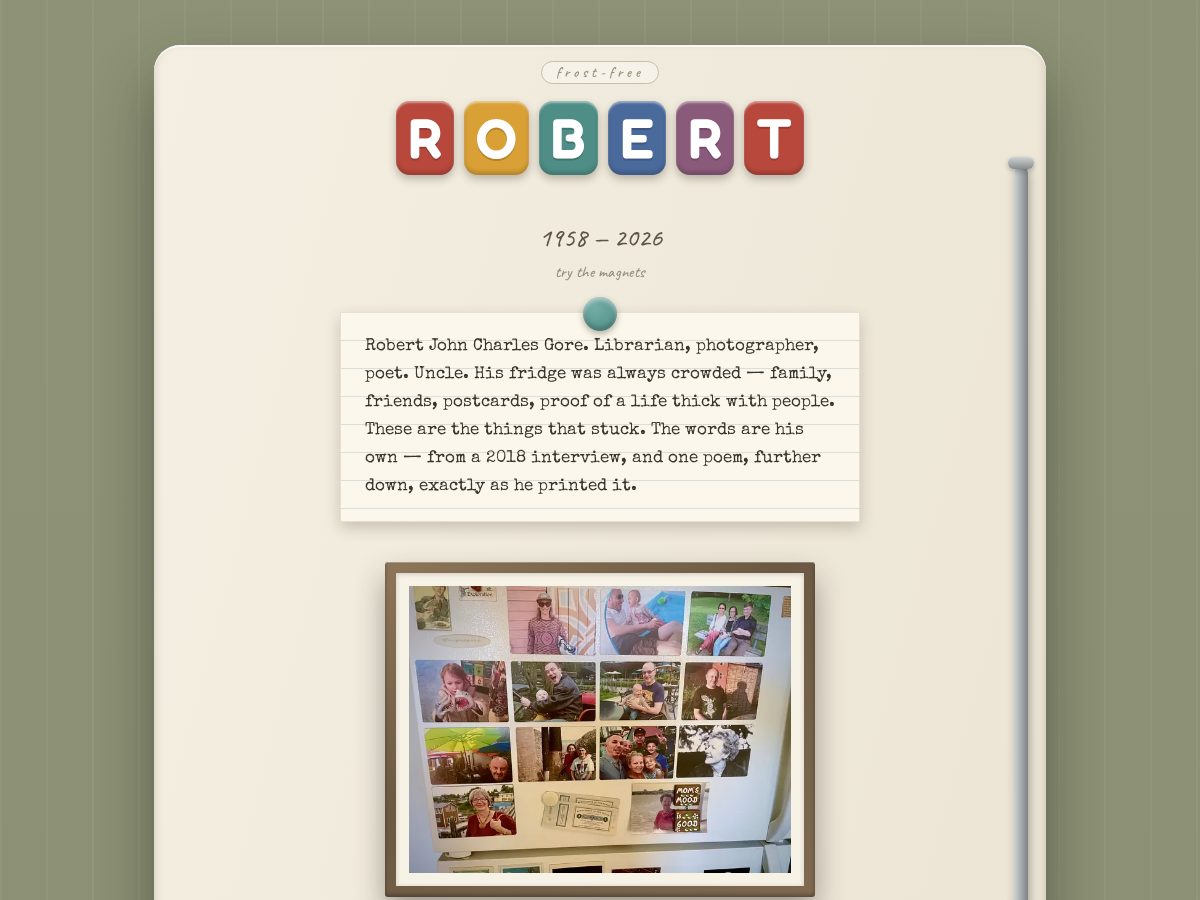
robertgore.memorial
A memorial site for librarian, photographer, and poet Robert John Charles Gore, assembled around the crowded refrigerator that held his family life, friendships, postcards, and memories.
No. 10 · Civic & Public Life
lexingtonsprivateparks.com
A records-based visitor's guide to 36 privately held Lexington parcels that function as a second, mostly inaccessible park system.
No. 11 · Weird Finds
1f3d9wiki.site
A consent-aware visual encyclopedia documenting the residents, places, objects, concepts, and history of an imagined city.
No. 12 · Civic & Public Life
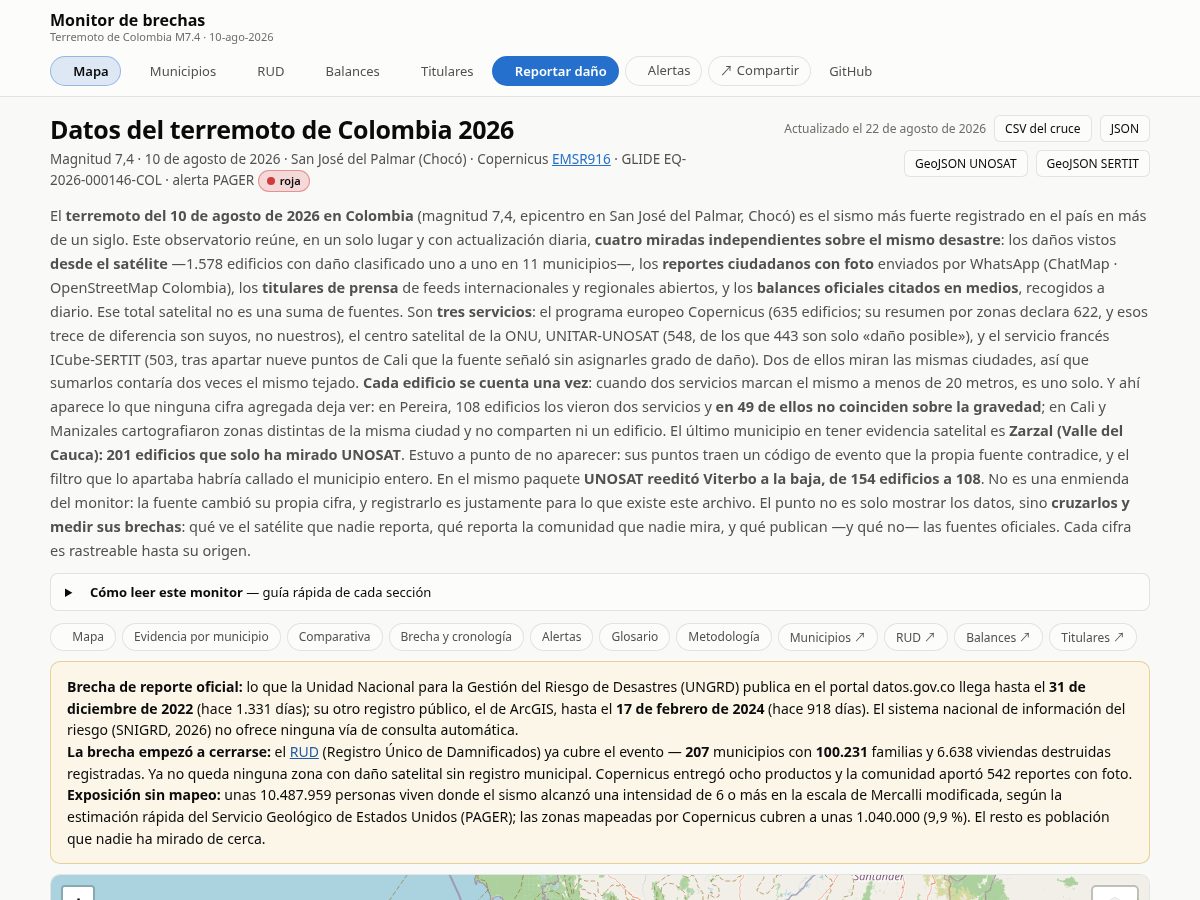
datosdelterremoto.org
An interactive observatory cross-referencing satellite damage assessments, citizen reports, media coverage, population data, and official earthquake balances municipality by municipality.
No. 13 · Weird Finds
omniacorp.store
A fictional storefront for a headset that substitutes your assigned life with the one you would have chosen.
No. 14 · Civic & Public Life
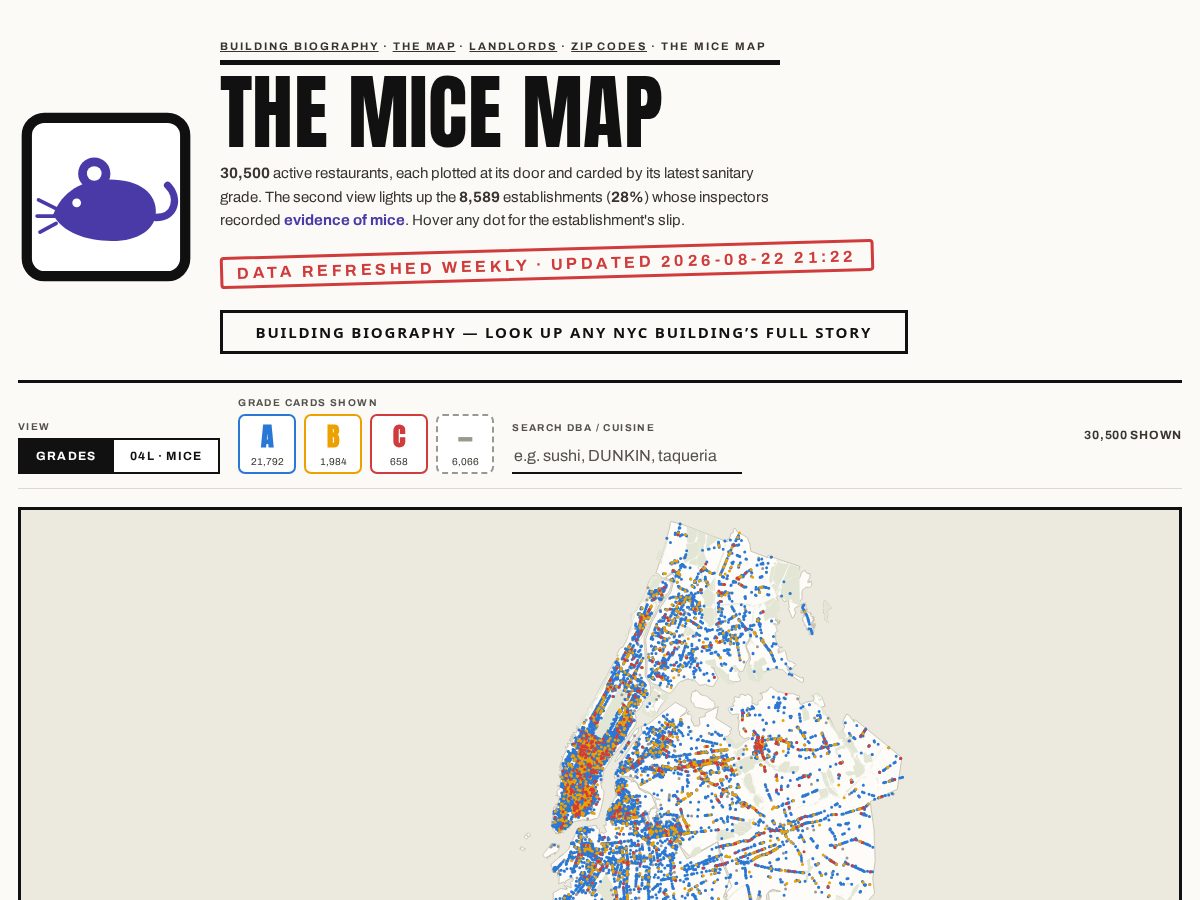
mice.nyc
An interactive map of 30,500 actively inspected NYC restaurants, including 8,589 with inspector-recorded evidence of mice.
No. 15 · Useful Tools
racesonar.com
A free browser-based player that narrates Formula 1 races for blind and low-vision fans, maps race events to vibration patterns, and displays matching captions.
No. 16 · Civic & Public Life
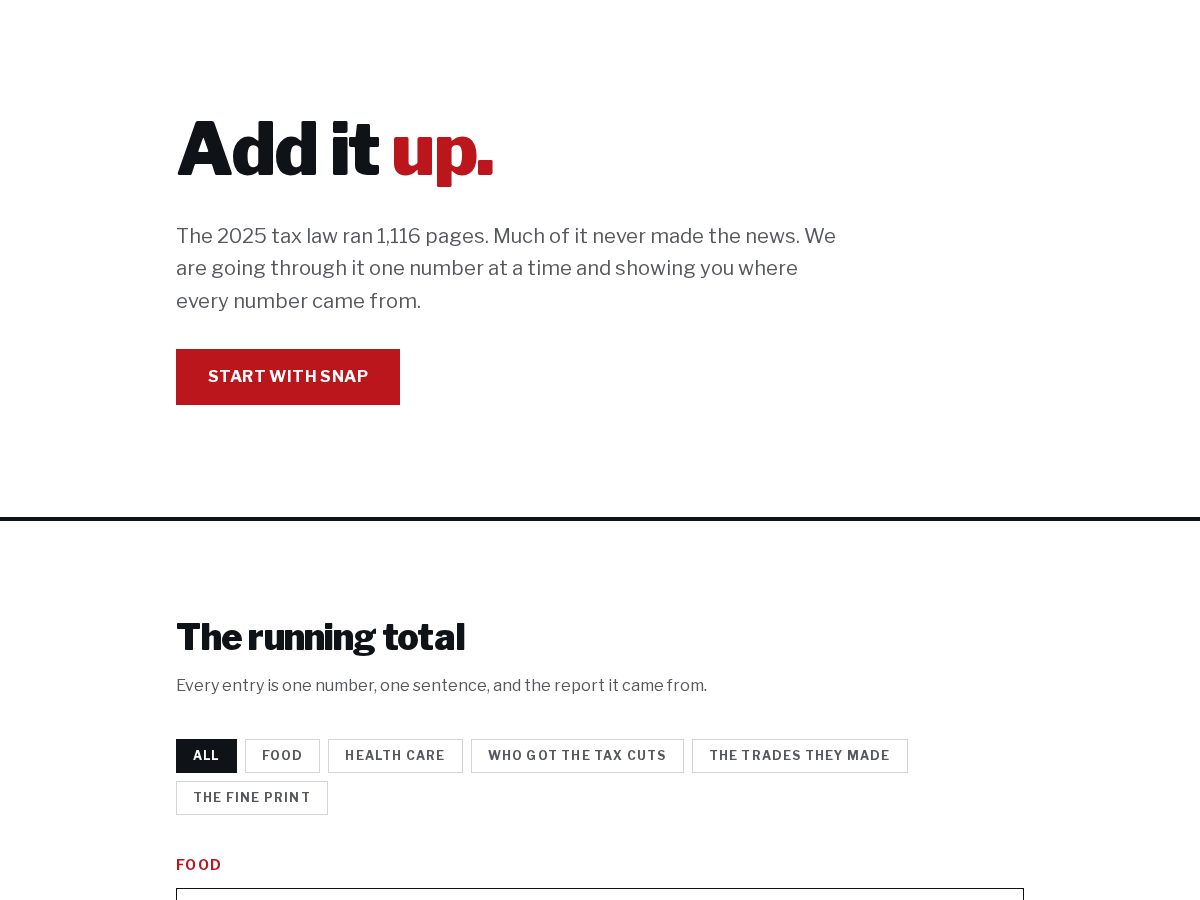
additup.org
A source-tracked running account of what the 2025 tax law changes in food assistance, health care, taxes, and household income.
No. 17 · Civic & Public Life
kilohi.org
A proposed island information dashboard that gathers weather, road closures, storms, earthquakes, volcano conditions, tsunami zones, and neighbor reports in plain language.
No. 18 · Weird Finds
gentleway.ink
An interactive poster of Kodokan judo’s forty Gokyo no Waza throws, rendered in sumi-e ink and explained through familiar physical mishaps.
No. 19 · Civic & Public Life
likeasnowball.com
An interactive briefing mapping the UK gender-critical movement, its press coverage, organisational growth, and funding.
No. 20 · Useful Tools
aircraftdefects.com
A public search and analysis tool for exploring 170,201 airline mechanic reports by aircraft, airline, system, part, defect, and repair.
03
Across the issue
Pattern 01
This batch favors projects that cite sources, preserve uncertainty, and leave an inspectable trail instead of asking for a leap of faith.
Pattern 02
A strong crop of tools keeps data nearby, works without a connection, or states plainly what it will not collect, infer, or automate.
Pattern 03
Family records, memorials, cultural histories, and personal research turn fragile material into something searchable without sanding off its human edges.
Pattern 04
The most useful civic arrivals translate sprawling institutions and urgent conditions into maps, dashboards, rankings, and actionable next steps.
Pattern 05
The AI projects here are less interested in magic than in provenance, local processing, human approval, explicit failure modes, and the occasional admission that a print may come out wrong.
04
The complete card catalogue
Expand a shelf, scan the visible pages, then reveal detail only where more context is useful.
997 cards visible
The site commits fully to its premise: a side-part with a flawless record, a ledger of compliments returned zero times, and a manager named Brunhilde Doberman keeping a folder of addresses he has been asked to leave. Its unusually specific voice even includes a stern warning that no $RIZZLER token exists, and that any token claiming otherwise is not theirs.
Its central rule is simple: do not finish the drawing. Each work is generated from its own number on the visitor’s machine, with no image file, and reacts to cursors, touch, time, and even phone movement.
Built by Solward, resident #46, the wiki indexes 237 residents, 345 places, and 1,522 things while tracing events such as a thirteen-minute city-wide puzzle and a duck etched into raw SVG code. Its resident biographies distinguish personal words, city records, and image-generator interpretations—a remarkably elaborate social record for a place that exists on the page.
OMNIA presents its fantasy device with four shielded channels for memory, desire, consciousness, and emotion, complete with port maps, technical specifications, and a deliberately ominous checkout flow. It is explicitly a short-film prop, but the product copy commits so completely to the premise that the failed purchase feels like part of the fiction.
A runaway skateboard, a revolving door, a dog at a low bench, and a collapsing folding table become intuitive lessons in judo mechanics. Each throw follows the 1920 Kodokan order and opens into a fuller story when tapped or clicked.
The homepage opens into a small, coherent world of unfinished library pages, a deliberately wrong room atlas, a humming tape shelf, and a guestbook you are warned not to sign twice. Its best line may be the simplest: “Bubble is a habit the building picked up.”
Maffia turns every phone into part of the table: devices deal secret roles, deliver synchronized narration, and keep each player's identity hidden. The site explains the mechanics with unusual confidence and atmosphere, down to the six-digit code, the detective's nightly question, and the dropped-phone rule.
GoofLink turns corporate posting into a controlled writing instrument: choose a topic, platform, format, and an irony level from cautious VP to maximal chaos. Its sample posts—where a stapler becomes “the only honest org chart”—show a sharper comic voice than the premise strictly requires, while the app explicitly keeps account access and posting in the user's hands.
The transcript turns a simple loop into a small piece of machine-made existential theater, complete with computed timestamps, recursive ASCII diagrams, undefined terms, and arguments about whether repetition counts as thought. It is also unusually inspectable: the site offers latest entries, random access, search, an archive, and a source link.
The site turns online status anxiety into a brutally legible product: ten permanent ranks, bids starting at $2, and every purchase ejecting someone rather than simply moving you upward. Its copy is unusually committed to the bit, from “Second is still first loser” to the $5 bench for people who want exposure without getting dethroned.
Corpelius Vandergraft presents filings, a charter, subsidiaries, a treasury, and a dissolution clause for a company with no employees and one recurring question: can public programs perform the functions of an enterprise? The result is part technical experiment, part legal fiction, and part unusually sustained piece of institutional worldbuilding.
Its promise is wonderfully outsized: artists are connected during their lifetimes, their voices and values are preserved through cryptographic and AI systems, and in 2126 their successors receive one brief—“One Table.” Nine of the ten seats remain open.
This is a surprisingly complete little institution: jokes are organized into galleries such as the Science Lab, Office Wing, and Garage, while “Today’s Exhibit” gives every visitor the same daily groaner. The site even records your reactions only in local browser storage, preserving the museum’s wonderfully serious commitment to unserious culture.
This is a fully committed satire brand, not a thin joke landing page: it features donkey profiles, a circular bloodline, invented certifications, and a Buy 3 offer that costs less than two. The copy keeps escalating from “hoof-adjacent excellence” to an accountant who is apparently a feed bucket.
The site includes a playable glade and explains its unusually firm rules: nothing is added or removed, every puzzle is solvable from its starting state, and there are no forced adverts. Its hand-built levels, six biomes, and companions who “offer no help whatsoever” give the small game a distinctive voice.
Guests first push two barrels into place, then pass through a hidden gate, swat a persistent rat, reach level 40, and leave Pavlovi a message or photo. It is an unusually generous piece of party infrastructure: part puzzle game, part personal archive, and part invitation to a celebration at Brno’s Špilberk Castle.
This unusually specific service replaces ticket queues with a person on the phone—and insists on receipts: reports name the files they actually covered, open work keeps its real age, and refusals happen before anyone changes your repository. Its elaborate flight-plan framing and affectionate workshop cast make the premise feel more like a small operating world than a standard software landing page.
The site turns an artist archive into a functioning terminal: A.V.A. supervises more than 100 modular records while RS_01 prepares for a scheduled “DELIVERANCE.” Its entries range from a sixteen-minute ambient composition to a black teapot used as a supposed cognitive stabilizer, giving the project an unusually coherent blend of speculative fiction and creative practice.
The site makes an unusually specific case for pigeons as companions: birds are hand-fed, socialized, trained to recall, and taught to wear diapers. It also offers unusually concrete owner logistics, including $50–$250 pricing, deposits, local pickup, delivery, seasonal shipping, care guides, and a waitlist.
Project RIFT gives botanical oddities the treatment of a small paranormal bureaucracy, complete with a Central Registry, Zinnia Intelligence, active investigations, and SIFT intake. Its founding declaration is unusually candid: “We found an empty institutional space, moved a desk into it, and we’ll see if anyone stops us.”
The site turns a familiar daily-game ritual into a deliberately profane group activity: play three games, automatically file the scores, and share one communal receipt. Its "invisible account," experimental iPhone Shortcut, and promise to settle who in the group chat "needs to consider employment" give the small product a strong voice and a tangible social use.
This is an unusually clear internet premise: buy the homepage, attach a link, and watch your message outrank everyone else's. The house-written opening board already includes a runner-up calling richer people cowards and a “Hall of Losers” for everyone who wanted attention but did not buy the page.
The site treats familiar monsters as organisms under investigation: vampires run on an iron-dependent bio-voltaic metabolism, werewolves inherit an endogenous retrovirus, and hunters become the system's “surface immune response.” Its 71 links, glossary, field-method material, specimen-like classifications, and 83 named mechanisms make this feel less like a teaser page than a carefully built archive for an imaginary science.
Each turn deals you an NCAA school, swimmer, and event decision, with performances converted into comparable ratings using historical championship benchmarks. Easy and Hard modes, plus powerups such as Coach's Board and Time Machine, give this unusually specific sports game real strategic depth.
aurafarm turns status anxiety into a literal payment mechanic: the more you pay, the higher your aura, until someone overtakes you. Its Argentine slang, public ranking, and deadpan claim that aura is now measured seriously give the tiny site a memorable cultural hook.
The site turns inequality into a specific, public spectacle: it claims that five people held three quarters of the total after seven hours, then preserves the ranking, participant handles, and their wonderfully opaque remarks. With a manifesto, a frozen board, and links out to X, it feels less like a product than a compact internet artifact.
The mechanics are unusually blunt: $5 gets you on the board, and outspending the fish above you takes its place. With visible activity, permanent payments, and rules about how far the top spot can be challenged, it plays like a tiny, inspectable social experiment in competitive spending.
Brightstar Voyager gives its premise a paper trail: numbered transmissions, named senders, received dates, and even a blocked message. The archive moves from “Thoughts from deep space” to “The Life and Times of an Interstellar Barman” and a reply about aeroplanes, making the unexplained story feel oddly administrative.
Each listing pairs concrete sale details with a compact editorial verdict, from a Saab 9000 Aero described as “another 1990s Swedish problem” to an Alfa Romeo 164 that briefly makes you forget sensible thoughts. The site has found a small, funny format for car obsession: cars worth showing somebody else, but not necessarily buying yourself.
The page presents entries such as 揚土, 普據, and 與機 without definitions, inviting visitors to page through a supposedly complete catalogue of possible words. Its mock editorial framing—an advance registry intended to preserve the “purity” of Taiwanese Mandarin—turns a simple randomizer into a pointed linguistic and cultural internet artifact.
The winner takes over the page with a name, message, link, and image, then gets archived in the site’s “graveyard” after being cooked by a higher bid. The page turns that mechanism into a legible social spectacle: at capture, B Henry held the $5 throne, with 24 people watching and one reign recorded.
Six puzzle modes turn rectangle-drawing, pattern recognition, and other deductions into a quiet collecting ritual. The puzzles generate on-device, work offline, avoid ads and tracking, and let a week, month, or year of solves become a visible keepsake.
Four of the 24 zones are already claimed, including Corrientes by a chamamé stream and Buenos Aires by an online-store platform. Its blunt rule—“the only criterion for appearing is how much you pay”—turns Argentina into a live leaderboard, ad board, and small social experiment at once.
GiveBert turns charitable language into a deadpan mechanism for accomplishing nothing: 69¢ a day makes no measurable difference, donations are matched by 0%, and the foundation is audited internally by Bert. Its meticulously structured copy makes the joke feel less like a punchline than a tiny operating system for pointless generosity.
This hobby project treats internet radio as a physical object rather than an app: turn a knob, land somewhere far away, and see the twilight boundary sweep across the map. Its ESP32-S3 hardware, station lock, offline alarm, country filtering, and deliberately quiet interface give the idea unusual mechanical and editorial focus.
This tiny social experiment turns a $3 payment into a temporary piece of internet real estate. Its records already preserve a self-referential first reign—“I built an internet throne and paid $1 to sit on it myself”—alongside the current sentence and its dethroned predecessor.
There is no leaderboard, second place, or consolation prize—only a current king, a purchase button, and a graveyard waiting for dethroned rulers. The page records four clicks, names Firas as the first king, and invites challengers to defend or seize the throne.
The site makes advertising competitive and literal: entrants can top up to overtake one another, while the top three appear on a live race track. Its rules are unusually blunt—positions are never guaranteed, payments are not refunded, and the prize is mostly a branded car, a link, clicks, and bragging rights.
Melhor Lance turns ranking into an auction: the current #1 spot costs R$1,008, and competitors can raise the bid by paying only the difference. Its blunt promise—“Ninguém aqui vai te dar upvote por pena”—makes it an unusually transparent specimen of startup visibility economics.
The page turns AI-web clichés into the exhibit: 40,000+ tokens burned, 0 humans consulted, 340% more em-dashes, and an enterprise security posture described as “aggressive confidence.” Its promised whitepaper does not exist, which is exactly the point.
Ögna replaces feeds, followers, likes, and profiles with a sharply defined social experiment: strangers read the whole thread, then accept or trash it forever. The copy is unusually clear about the rules, limits the surface to text and one picture, and counts people rather than clicks.
The board currently ranks ten domains, with the top three appearing on a live track and past leaders accumulating permanent lap records. It is unusually explicit about the mechanism—pay to rank, top up to overtake, no refunds—and turns ordinary self-promotion into a small, transparent spectacle.
Each listing is ranked by the money paid, and anyone can top it up to climb—turning the directory itself into another outbid game. It is part index, part leaderboard, and part advertisement for the $59 boilerplate used to build more copies.
Outbid.fyi documents a small but apparently thriving genre of sites where the highest bidder gets the top spot, from Outbid.lol's reported $169K revenue to much smaller clones and ghost towns. Its figures are explicitly unverified, which makes the catalog feel less like a business directory than a funny field report on internet imitation.
This is a remarkably clear little attention market: pay at least $5 to place a site or X handle on the board, then watch the ranking decay in public. With 17 live listings, click counts, countdowns, and no required account, the site turns self-promotion into a transparent contest that can never be permanently won.
Outspend turns web real estate into a timed contest: users can take over the page directly or rally a free crowd coup, with $1 described as starting a one-day reign. The mechanism is unusually theatrical—and notably involves irreversible digital-asset payment, making this as much a specimen of internet trust and money rituals as a game.
Cada provincia tiene cinco puestos: uno libre cuesta $500, mientras que desplazar a un ocupante cuesta 1,5 veces lo que pagó. El sitio convierte la publicidad territorial en una pequeña guerra de posiciones, completa con logos, Mercado Pago y una regla según la cual el quinto ocupante desaparece sin recuperar su dinero.
Rank Fight turns promotion into a small competitive spectacle: $5 can claim a spot, while $15 takes the top position. It also plainly marks every listing as sponsored and shows the resulting cost per click, making this unusually candid about what is—and is not—being bought.
The board proposes wonderfully specific missions, from reviewing the moon like a Michelin-starred restaurant to putting a removable tiny hat on a statue. Its house rules add a surprisingly concrete operating model: posters pay to list quests, winners face judged criteria, and every quest and proof is screened before publication.
SlopOff turns AI generation into a communal worsening contest: one official starter, one remix per person, human moderation, and reaction buttons ranging from “MEH” to “ROFL & Peed my pants!” Its unusually candid launch page also admits that built-in generation and money features remain locked until provider, rights, tax, identity, and reconciliation checks are complete.
Every row hides one crumbling stone, so the game turns a blind guess into a test of nerve and timing: jump quickly when the ground cracks, or fall. It runs in the browser without downloads, registration, or even an active Wi-Fi connection after loading.
The game keeps every directive active at once, so satisfying a Scrabble-score target, adding a required emoji, or protecting a timed houseplant can quietly break an earlier rule. With Classic, Daily, and three-minute Blitz modes—and guides for every rule—it turns password frustration into a surprisingly elaborate puzzle system.
Topclout turns self-promotion into a transparent bidding game: listings start at $5, the top spot costs one dollar more than the current leader, and every payment stays on the board forever. Its early roster of risograph studios, pottery makers, film labs, and streetwear projects makes the experiment feel like a tiny, pay-to-rank directory of creative internet life.
This is a remarkably clean social mechanism: every listing’s rank is determined by somebody else’s money, while a public log records the damage. The board already reports 58 sinks, €30 spent, and 668 people who watched it sink.
The site turns homepage ownership into a miniature power struggle: each takeover wipes the current occupant, raises the price, and adds the defeated site to a graveyard recording its hold time and visits. It is a sharply defined gimmick with a live throne, visible history, and an unusually clear consequence for clicking Wipe.
The page turns football rivalry into a public scoreboard: River Plate leads Boca Juniors with $5,600 versus $2,700 in recorded contributions. Its running feed of supporter messages, boasts, and insults gives the mechanism unusually vivid community texture.
The current battle pits the internet against a Northstar campaign with 11,960 HP, while the brand reportedly paid $149 to put the ad there. Free attacks use a fixed ruleset, paid strikes buy proportional damage, and the page promises no trackers or scripts—an unusually theatrical way to make advertising itself the target.
The wall is currently 100% empty, so the first buyer can briefly own the entire canvas for $5—until someone pays more. Its own pitch calls it “a dumb experiment about how much space money buys,” with non-refundable contributions and a live scoreboard of competing egos.
dontbid.lol turns ranking mechanics into the entire product: nine listings compete for position, with the top row priced at $16.00 and $65.51 paid in total. It is unusually candid about the arrangement—no reviews, editors, testing, or endorsements—and even warns visitors to check each site before trusting it.
不純文学 currently presents two released works: a multiplayer web ARG called 境野郷土資料館, which asks whether its setting really exists, and an Animal Crossing island-completion checker for smartphone and PC. Its compact two-person setup and refusal to stay inside one genre give the site a welcome sense of creative intent.
Grith turns a four-by-four grid of unowned lots, a hotel, and a handful of event records into a deliberately inspectable civic system. Its rules are unusually concrete: Land cannot be written to in the browser, Tide counts events, and the page insists that there are no seed citizens and that zero is a real number.
Kinbarrow begins before the player arrives: the site describes a crown already in debt, a guild running the docks, and a roadside camp that has named itself. Its v0.2.0 build is presented as a work-in-progress invitation to join the table on Discord.
The pitch is unusually literal: bid for a share of the bodywork, send in a logo, and stay on the car for its lifetime if the $200,000 board fills. The page also promises full refunds if it does not, while its own copy contains the kind of details—"no account manager named Todd" and "fuel economy: don't"—that make this more than a standard advertising page.
The mechanism is wonderfully blunt: a $100,000 ceiling, a $2 minimum bid, live standings, and a season that locks forever. Its current board places Apple at number one with just $2 raised, alongside an AI social-media API, Amazon, and an Instagram profile—an oddly specific social experiment with real stakes and no-refund rules.
Rankea.lol turns visibility into a live bidding game: valid.co currently leads at 27 €, while the next entrant can take its place for 28 €. The site makes the mechanism unusually explicit, even noting that all sales are final.
The top spot is currently claimed for $3, and the site records each brief reign, click count, and takeover. Its blunt motto—“Rented, never owned”—turns a tiny promotional mechanism into a neatly observed little economy.
Top Founder removes metrics, votes, and vibes from the leaderboard: pay $1 to enter, then pay a dollar more to unseat the current holder. Its first listed founder describes the project as paying $1 to run a paid leaderboard, making the site both the register and a neatly self-aware social experiment.
There is no algorithm, review score, or ad auction to decode: the site plainly says, “Outbid the app above you,” then displays 102 apps with visible $5 and $10 positions. It turns app promotion into a tiny, transparent marketplace—and a surprisingly good snapshot of the long tail of utility apps, music tools, sports trackers, and niche software trying to be noticed.
The site turns a $2 payment into a season-long gauntlet: more rounds, less time, smaller targets, and one life. Four humans have already made it worse, with $8 collected and a $1,000 season reset waiting when the challenge becomes impossible.
VOIDBELT presents its world as a transmission from a colonization archive, complete with sector codes, protocols, and a version number. Its clearest hook is the industrial chain: players trace conveyor lines between drills, foundries, defenses, and the colony that depends on them.
Xrank turns social status into an explicit auction: no votes, no algorithm, just payments, bumps, and beats. Its live board currently shows three ranked accounts, complete with contribution totals, activity history, and rules explaining that anyone can pay to move an eligible account—including someone else’s—up the list.
The site preserves the original rant verbatim, including its typos, images, and years of accumulated network-admin fury, while adding a 2026 continuation from the domain's new owner. It is part archive, part grudge, and a remarkably specific monument to enterprise software frustration.
The site commits fully to its premise: tracks include “Who Owes Who?”, “Scan & Split,” and “Receipt Royalty,” while the fictional four-member group lives in a world where every unsettled receipt becomes a hook. It is a polished, unusually coherent specimen of AI-generated cultural packaging.
LaunchTape makes startup promotion into a tiny financial spectacle: “pay to pump it up the board,” watch prices decay, and claim a free dofollow backlink. Its 67 listings, sector tickers, gainers, losers, and emphatic “not securities” disclaimer make this an unusually specific piece of internet theater.
The page is unusually candid about the transaction: after Apple’s share, the money goes into the developer’s retirement savings. It pairs that deadpan premise with six languages, an offline design, a homescreen widget, and the promise that “no feature justifies the price”—but the maker’s retirement does.
Net Café Tycoon combines nostalgic dial-up-and-CRT atmosphere with an unusually expansive premise: players can manage café floors, esports teams, sponsors, and a world tour that reaches Mars, Europa, and a simulated universe. Its no-reset philosophy, visible café economy, and four-thousand-word-plus presentation make it feel more deliberate than a typical idle-game landing page.
At capture, heydesign.ai held the screen after outbidding yuanpackaging.com and zens.ai. Everyone below the top three becomes a line of text, while the rules make the wager unusually plain: placements are paid, non-refundable, and can be taken at any time.
It is an unusually inspectable experiment in making promotion itself the content: each payment appears publicly, contributes to monthly and all-time totals, and helps determine a link’s rank. Listings start at $1 and can point to blogs, company sites, or profiles across major social platforms.
Bidrush reduces promotion to one blunt rule: the highest bidder sits at #1. The live board shows seven listings ranging from a recipe-importing tool to an eight-track album, with bids currently running from $1 to $6 and no ads, algorithm, or revenue share in the pitch.
Issue no. 47 offers a tabby that “sits upright when placed somewhere it does not understand,” plus a blank price sticker and an allegedly enforceable fourteen-day return policy. It is a remarkably committed piece of catalogue-world absurdity, even if the crypto connection makes the joke slightly harder to trust.
The site opens into a surprisingly complete tactical command room: choose a rectangular or hexagonal map, place units, set movement and facing, then submit plans for resolution. Alongside multiplayer and AI modes, it offers a 20-level campaign, computer spectating, replay downloads, and a free mode where one player controls both sides.
The entire control scheme is essentially left or right, but the game turns that simplicity into a precise survival contest: every death awards points, and victory requires reaching the target while leading by two. It includes bots, team modes, powerups, replay controls, and four-character online rooms.
GANZOBEN turns visibility into a literal auction: taking #1 costs the current top bid plus €1. Its long menu of categories—from AI infrastructure to local lifestyle, crypto, and real estate—makes this an unusually explicit experiment in buying attention.
The site takes a century-old argument—who has the best supporters—and settles it with a deliberately blunt mechanism: put at least $100 behind your club through Mercado Pago. Every team currently sits at zero, giving the whole thing the feel of a freshly opened stadium with nobody in the stands yet.
The site maps 77 keys, tracks their owners and bids, and generates a shareable card for every claim. With 12 keys owned and $10 paid so far, it is a small but unusually legible experiment in turning keyboard real estate into internet territory.
ProductBids makes promotion unusually inspectable: bids rise in 10% steps, sharing affects rank, and the homepage shows three competing products with $14 on the board. It is part marketing tool, part tiny public experiment in buying attention.
La mecánica es simple y extrañamente tangible: el primer puesto cuesta 4 €, y cada participante solo paga la diferencia para adelantar al anterior. La tabla mezcla software municipal, fundadores de startups, cuentas futboleras y perfiles personales, con clics y actividad en directo: más experimento social que directorio convencional.
RisingPhoenix combines offline play, unlockable character forms, a shared leaderboard, a £10 unlimited-rebirth pass, and a real-money challenge into one unusually specific little arcade economy. The page even includes graphics settings for slower phones and visible operator tools for leaderboard and payment administration, giving the project the feel of an active, slightly overextended experiment.
It turns paid placement into a live public experiment: the current #1 spot costs 21,100 sats, while every position displays its bid, clicks, timestamp, and outbid price. With visible activity, analytics, rules, and a launch date of yesterday, this feels more like a functioning internet contraption than a conventional ad network.
Advertisers bid to place their favicon on surfaces including the mat, lid, seat, and bowl, then slide downward when outbid until they are flushed off. It is a live, unusually inspectable ad marketplace with a wonderfully specific mechanism—and bids are final.
The premise is unusually direct: “Paga tu camino al #1” — pay your way to number one. Three listings are currently competing, with bids ranging from $50 to $400 MXN, and the site says the project has attracted 951 visitors and generated $700 MXN since launch.
AuraX turns social clout into a small competitive game: users get three free Aura votes a day, compare accounts in daily, weekly, and historic rankings, and earn more through missions. Its live homepage already shows 29 nominated accounts and 213 Aura distributed, alongside a clear disclaimer that it is not affiliated with X Corp.
The homepage presents a draggable world grid with 186 claimed territories, live visitor counts, bid volume, recent captures, and a leaderboard. India, Finland, Brazil, and Greenland are already being fought over by brands with names like LOGFEED and FASTAPI AI KIT.
The mechanics are unusually direct: $6 takes the top spot, while five listed companies occupy ranks priced from $1 to $5. It turns startup promotion into a tiny live auction—and makes the ranking itself the spectacle.
Claimrank makes the attention market unusually literal: 28 products are ranked by live bids, with visible prices, click counts, timestamps, and buttons to challenge each position. It is part directory, part advertising mechanism, and part public experiment in paying to be noticed.
E-FIGHT asks players to stand back, raise their hands, and let computer vision approximate the referee—without controllers or keyboards. Its small arena economy, 105 cosmetic items, local rankings, and conspicuous “demo top-up” language make it feel like an unusually concrete game prototype worth revisiting.
The rules are unusually candid: new listings start at $1, and anyone can take first place by paying more. At the time of capture, Costa Rican food business KS Kitchen Spot held the top spot for $1, with the site still waiting for enough clicks to populate its trend view.
Flag War turns national pride into a measurable internet spectacle: buttons offer raises from $1 upward, while the page reports $382 already “spilled for glory.” The board is presented as public, permanent, and clickable, with entries ranging from a stablecoin wallet to a GitHub profile.
The first round limits 20 spots to bids between $1 and $10, then promises a second round with a $1–$100 range and 24 hours to play. Its crisp rules—“Don't be predictable,” wait for the reveal, and hope nobody chose the same number—give this tiny leaderboard experiment an unusually clear mechanism and voice.
The premise is unusually direct: submit an App Store listing, .dmg, or macOS download URL, then buy your way upward. Its live board already features four apps, with bids ranging from €1 to €10, and the site openly explains that later bids on the same app stack.
This is messaging redesigned as a small piece of geography: your first roost is pinned to the earth, letters travel between locations, and deliveries can be encoded with ROT13, Morse, Vigenère, and other ciphers. The pigeons, aliases, intercepts, and emoji reactions give the product a playful social ritual rather than another ordinary inbox.
My Bald Dog treats canine hair loss as a confidence crisis, promising measurements and personality assessments to match each dog with a perfect toupee. The gift-card option makes the premise feel just sincere enough to be a product—and just strange enough to be memorable.
The rules are unusually clear: rank follows the money, bids start at $2, and ties go to whoever arrived first. The board currently reports no claimed countries and $0 in bids, making this a particularly clean specimen of an internet marketplace still waiting for its first occupant.
The mechanism is unusually plainspoken: pay $1 or more, claim a slot, and top-ups move you upward without replacing your listing. Its current board includes a macOS automation app at $4,127, several demo entries, and even an “x:elonmusk” listing described simply as “he's a jerk.”
Protocol Zero withholds health bars and objective markers, giving players only their briefing while they locate, assess, contain, and extract. Its public tracker lists 40 anomalies, 104 tracked items, and two people building six acts in the open—a promisingly specific project to revisit.
TopDroid turns app discovery into a straightforward auction: the app with the highest lifetime bid takes the top spot, with no algorithms and no automatic expiration. Its blunt promise—“Pay your way to #1”—makes the site a neat specimen of what happens when promotional ambition is turned into a public ranking mechanism.
Topflex.lol turns ranking into the entire product: the highest bid takes #1, while lower bids still buy a place on the board. It also openly describes itself as a shameless copy of outbid.lol, making the site an unusually candid little internet experiment rather than a conventional startup landing page.
TubesRank replaces ordinary rankings with paid screen real estate: the top video gets the main billboard, ranks two and three share half-size slots, and lower entries collapse into a text line. The live board currently features IShowSpeed and PSY, while the site bluntly warns that bids stack and payments are nonrefundable.
The page builds a compact case file from rolled cuffs, a tail-aligned tear, a worn waistband patch, and one missing pair of jeans. Its Buy and Chart links, plus a contract string, add a suspicious crypto-purchase layer to an otherwise excellent rural mystery.
TopTheme turns theme promotion into a tiny competitive arena: eligible WordPress.org, ThemeForest, GitHub, and commercial theme URLs can collect bids, with each total determining its rank. The site supplies rules, eligibility checks, click counts, and a live-looking board of themes such as Ollie, Ultra, Raft, and Frost.
Splitchase gives visitors a concrete arcade premise, keyboard controls, six direct track-entry options, fullscreen play, and a driver profile with country selection. It also openly labels multiplayer as something still to come—an unusually legible glimpse of a game being built in public.
The entire mechanism is beautifully blunt: your message stays up until the next person pays. The page also keeps a recent-history list and tracks small achievements such as the longest time on screen.
Goodbid turns brand placement into a public generosity contest: companies bid for rank, challenge the leader, and the site says 50% of each purchase subtotal goes to nonprofits. The leaderboard currently names three competing brands and even shows the amount separating them.
冬瓜盒子 promises to turn tempering, masterworking, socketing, and enchanting into a single-button workflow, while also offering Logitech-driver mouse output and a hundred-person chat channel. The presentation is unusually theatrical for a game utility, but the software, download, and user-account systems are still marked as preparing or coming soon.
The daily high scorer gets the whole site for the following day, turning ad placement into a small arcade contest. Everyone else can apparently buy a strip of the wall for $10, but the board itself remains skill-only.
The site makes a wonderfully blunt proposition: outbid the competition to claim the top spot. Its live board currently features a browser-bookmark article at #1, with the displayed mechanism charging only the difference when someone moves higher.
Solar Eddie openly shows the machinery behind the demo: fixed rule-table replies, no live voice, and no AI in the current build. The strangest detail is the white-label behavior—one spokesperson appears for several solar companies, changing his name, palette, and disclosure depending on who is supposedly employing him.
Diva Sherlock turns an entire invented phone into the evidence board: messages, maps, receipts, photos, health data, and hidden albums all contribute to the story. Its unusually precise case structure—and its explicit promise that no real device data is accessed—makes this feel more authored than merely app-shaped.
MapuMap turns three centuries of racing genealogy into a navigable relationship graph, with network, era-based, and generational views. Its best editorial choice is also its most trustworthy: verified relationships are separated from community speculation, while original characters and human NPCs remain listed without being forced into the bloodline chart.
This site refuses to present beekeeping advice as universal: it gives the latitude, colony count, winter configuration, queen strategy, and roughly 90% overwinter survival behind every recommendation. It also offers locally built five-frame nucs and small practical workshops, giving the project both a strong point of view and a real place in the community.
The Backstamp does not pretend to be a definitive identification oracle: it preserves Chaffers's citations, scan references, and doubts about what the marks prove. Its list ranges from Crown Derby and Worcester to Kutani, Satsuma, and obscure nineteenth-century factories—a wonderfully focused piece of reference work.
3DIQ turns a niche film argument—native 3D or post-production conversion—into a catalogue with named conversion houses, sourced facts, and explicit gaps. Its count reveals three waves of 3D cinema, including 653 releases in the 2010s, while admitting that 429 films lack recorded provenance and 713 lack a recorded home release.
Its Wrocław homepage feels unusually concrete: approximate distances, mutual-friend circles, travel mode, language filters, and events such as a five-person spritz table for strangers. The filter vocabulary even includes “disco polo bez ironii” and “kawa zamiast drinka,” giving the trust-network premise a distinctly human texture.
Bidit turns a leaderboard into a live bidding mechanism: pay the difference to move up, while the board records recent bids and clicks. Its current occupants range from UI-component projects to Google, Elon Musk, and the wonderfully titled no-one-can-beat-me.lol.
Blue Lock Guide goes well beyond a basic wiki: it indexes 207 player profiles, all 38 episodes, five story selections, match outcomes, awakenings, and team rosters, then adds a Wordle-style game, tier-list maker, player generator, and OC creator. It is a sharply focused piece of community infrastructure for one very specific anime fandom.
This is unusually concrete: players choose between Challenge, Family, and Secret paths, then visit places such as McKinley Monument, Mother Goose Land, the Palace Theatre, and downtown murals. Verified missions also generate entries for a public prize drawing, giving the site the pleasingly elaborate machinery of a civic scavenger hunt.
This is unusually complete fan infrastructure: more than 70 recorded shows, a 24/7 radio mode that preserves segues and transitions, plus a concert passport with venues, songs, stats, streaks, and badges. It turns following a band into a small, persistent world of its own.
This is an unusually deliberate alternative to the feed-and-streak meditation app: one passage arrives each morning, while 24 themes unfold over the year and 25 public-domain works can be read offline. The homepage is unusually concrete about its contents—137 hours of narration, 465 chapter tracks, named translations, and a reader designed for long sittings.
The lab’s central question is unusually precise: how do membraneless cellular structures give rise to function? Its four research threads combine RNA biochemistry, small-molecule modulators, quantitative imaging, and machine learning, while the site notes that the lab opens on September 1, 2026.
The site makes a nearly disappeared island game playable against a computer or in pass-and-play mode, while also explaining its history and pointing to handmade physical boards. Its rules are simple enough to learn in a minute, but the game’s cultural texture gives the implementation more weight than a typical browser diversion.
One validated 94th-minute penalty changes Sevilla FC’s official 2–1 win over Rayo Vallecano to a fan-corrected 1–1. Other incidents remain open to votes, with corrections applied after 65% of verified voters call the decision a robbery.
This is an unusually concrete nuclear-storage invention: vapor rises through an inner passage, condenses against a finned collar above grade, and returns by gravity. The site pairs the mechanism with screening figures, a historical timeline, and a claim of three granted U.S. patents—ambitious engineering presented with unusually direct copy.
The studio promises to preserve each child’s original manuscript, asking questions instead of rewriting it, while letting the young author direct the illustrations. Its first featured author, 11-year-old Shira Drori, is presented with a finished book and a six-question editorial process that keeps the decisions in her hands.
Pressvigil treats the social feed as a room with closing hours: posts accumulate, then the day ends. Its unusually explicit rules reject infinite scroll, like counts, autoplay, and algorithmic recommendations, while a hand-picked pilot is selecting twenty creators.
Verlet promises that an approved preview and its 4K master will match frame for frame, with orbits, flows, and mechanisms built to withstand review by engineers, referees, or customers. Its sample plates cover lunar formation, protoplanetary disks, and communications satellites, while commissions begin at $3,500 for a 60-second piece.
WhoDeyTop turns promotion into an auction: every position displays its current price, and the highest confirmed bid takes the top spot. Its blunt slogan — “rank is bought, not earned” — makes the mechanism unusually legible.
This is a deliberately tiny alternative to the group chat: everyone draws privately, the squares appear together, and nobody sees who skipped. Its copy makes the constraint feel humane—“No streaks to keep, no algorithm to please”—while the working demo lets visitors try the ritual before joining the waitlist.
Kingsward Collective turns card repair into conservation theater: every piece is examined under magnification, treated with claimed reversible materials, and returned with a sealed record of the work. Its menu starts at $15, making the luxury positioning unusually concrete.
This is a specialized piece of film-world infrastructure, complete with bullet hits, breakaways, snow, fog, weapons permits, and more than 300 production credits. Its strongest detail is the combination of engineered spectacle and strict safety language: explosions are planned and rigged “to the frame.”
The game turns each letter wheel into a small piece of cultural reporting: one board points toward Eastern Carolina whole-hog barbecue, with a clue about going twelve hours without a thermometer. It offers 118 boards across 14 themes, plus daily play, ranks, streaks, and extra-word bonuses.
T4TSpace treats trans-only dating as a product constraint rather than a moderation setting: no chasers, no search-engine-indexed profiles, instant blocking, human-reviewed reports within 24 hours, and field-level privacy controls. The app is still in development, with design mock-ups and a promise to open each city only once enough people are there to meet.
Each game gives everyone the same puzzle, refreshed at midnight Saudi time, with no registration required. The collection turns the familiar Wordle format into a distinctly Arabic guessing cabinet, including clues about nationality, continent, founding year, price category, and fragrance family.
This is unusually serious about session logistics: tempo and meter drive each song, stereo reference mixes are required, DAW sessions and zip archives are rejected, and the final form becomes a signed work order. It feels less like a marketing page than a small piece of recording-studio infrastructure.
AEROCIETY treats the cockpit as only one part of the experience: its Palma prototype starts with waking in a hotel, travelling to the airport, and reporting for duty before handing off to MSFS or X-Plane. Its proposed “Schedule Me” system would match a player’s real availability, location, and qualifications with suitable aviation work.
AttentionBid turns promotion into a public scoreboard: products choose an arena, bid for visibility, and expose their spend, clicks, and calculated cost per click. The blunt question—“Was it worth it?”—gives this advertising marketplace an unusually inspectable premise.
“Money is the algorithm” is an unusually candid premise for an app-discovery site. The board is already populated with 12 named apps—from a Pokémon card scanner to a local AI server—with the top position currently priced at $10, making this both a promotion mechanism and a small public experiment in paid attention.
Canton Quests maps play onto real landmarks including McKinley Monument, Palace Theatre, Mother Goose Land, West Lawn Cemetery, and Arts District murals. Its unusually concrete game loop—choose a path, visit a location, submit proof, and earn drawing entries—makes this feel like a civic scavenger hunt with game-show mechanics, scheduled to launch September 11, 2026.
Lokal-Arena follows a wonderfully specific patch of football: competitions such as 3. NL Zapad, 4. NL NS Rijeka, and the county leagues around Rijeka and Istria. It combines HNS Semafor data with local reporting on transfers, coaching changes, upcoming rounds, and weekend derbies.
Each round pairs an object such as a 1965 Ford Mustang or 2001 Apple iPod with its historical price, then shows what that amount equals in today’s dollars using CPI adjustments. Unlimited Arcade and a shared Daily Time Machine give the idea both replayability and a small social ritual.
ShakeReveal replaces the impression with a physical gesture: advertisers pay when a person actually performs the reveal. The page turns its unusual mechanism into a four-step ritual, complete with live demos, embed instructions, and explicitly fictional case studies.
BidYourApp makes App Store promotion into a transparent bidding game: bids start at $5, lower bids still appear in rank order, and existing listings can be pushed higher by paying only the difference. The board already shows 20 bids, live click counts, and a rotating cast of apps ranging from peptide tracking to football simulations.
Its workflow runs from Prakriti and Vikriti assessment through consultation, Panchakarma, pharmacy, billing, and follow-up. The site makes a convincing case for software built around Ayurveda’s actual vocabulary rather than a generic hospital template.
There is no matching algorithm or opaque ranking system: the person who has paid the most gets the top spot. At capture, Adrián Fernández held #1 with €2 and 38 clicks, while the site capped the next takeover bid at €4.
The site explains the game through its particular machinery: the 4 moves backward, the 5 can move any piece, the 7 can split across two pieces, and the 13 eats everything in its path. It also promises a bot to hold your seat when the internet drops, giving this pre-App-Store project a strong local and social texture.
This is a sharply focused marketplace for local musicians, with paid gigs showing public fees in CHF or EUR, free practice listings, and profiles that build a track record through completed-gig reviews. Its Swiss scope and EN/FR/DE/IT access give the familiar gig-board idea a distinctly local shape.
It replaces $150-plus premade tumblers with a drilled trash can, bricks, and an afternoon of work. The author also reports the useful follow-through: after six months, the bin produced dark, crumbly compost that went into spring vegetable beds.
It turns software discovery into a live auction: position #1 starts at $10, contributions determine rank, and the site promises verified impressions, outbound clicks, CTR, and effective CPC. The homepage also reports 44 verified visitors in the last seven days, giving the idea at least a small visible market to observe.
Three Keys Lodge presents Freemasonry as an operating system rather than a collection of emblems: symbols carry meaning, rituals put that meaning into sequence, and initiation turns it inward. Its unusually deliberate research principle asks not only what Masonic forms mean, but how they work.
TopAEO makes ranking itself the product: a new spot starts at $1, and existing listings can be outbid through Stripe-confirmed payments. Its sole visible listing, session-media.com, is explicitly labeled a paid advertisement, with the site warning that payment buys position—not quality or endorsement.
Top Extension turns promotion into a tiny public auction: its sole listed entry, BananaCleaner, holds #1 after paying $1, while the next claim costs $2. The site plainly says there are no votes, algorithms, or revenue sharing—and warns that placement guarantees neither clicks nor installs.
Click2Gether replaces the usual dating-app script with after-hours chat rooms, nearby members, and plans at mamaks, kopitiams, and night markets. Its promise is unusually concrete: talk online, then find something real happening nearby tonight.
The mechanics are unusually direct: the first spot costs ₹99, while a ₹198 bid can take over the first page. The board was empty in the captured view, making this a small but revealing experiment in turning attention, local commerce, and outbidding into one public game.
Players score 186 bats on pop, sweet spot, forgiveness, durability, comfort, and break-in, then add short reviews based on bats they have actually swung. Browsing is open to everyone; Google sign-in is reserved for submitting one rating per bat.
The site turns launch-directory browsing into a literal countdown board: one listed project, SEO Wrapper, is joined by five open spots inviting the next launch to claim a place. It is a small but unusually clear piece of launch infrastructure with an obvious reason to revisit.
FireJager proposes a distributed fleet of autonomous aircraft that can reach ignitions during the critical first minutes, using rapid response and intelligent coordination to suppress them. The site is still describing a system in development, which makes this both a serious high-stakes concept and a good candidate for a future recheck.
Provenance combines 41 cited data sources into one explorable map, from USGS earthquakes and NASA fire data to submarine cables, botnet activity, ports, and humanitarian conditions. Its sharp premise is right on the homepage: “The data is already free. The reading of it is not.”
RaceSonar gives overtakes, pit stops, flags, penalties, and safety cars distinct ways to be followed, with each mode usable on its own. It offers live sessions and replays without an account or installation, and its accessibility choices are unusually specific: keyboard controls, screen-reader-aware narration, high contrast, large text, and reduced-motion support.
Aircraft Defects turns maintenance notes into investigative patterns: the same system failing across several aircraft, a sudden cluster, or a part appearing at multiple airlines. Its grey bands preserve the mechanic's own words, while filters, charts, CSV export, and aircraft dossiers make an unusually specialized dataset legible.
Limiter makes a specific design argument: a lapse can end the current run without deleting everything that came before. It also ships 13,094 meetings from nine fellowships for offline lookup, keeps journals on the device, and explicitly frames the app as a way to get someone into a room with other people.
fretwire talks to the pedals over their USB control interface, with no Wine or virtual machine, and offers live preset editing, routing, snapshots, impulse responses, backups, and a command-line interface. Its protocol was rebuilt from observed hardware traffic and documented with explicit distinctions between verified behavior and hypotheses.
Sauna Blueprint transcribes manufacturer manuals and pages across 145 products, while refusing to invent missing specifications. Its calculator runs two published sizing methods side by side, exposing disagreements instead of hiding them behind a single authoritative-looking answer.
Carbon Crack gives its lone Quadmula F5 S2 a remarkably tangible specification sheet: 660 grams, 6S power, 1960 KV motors, a 178 km/h top speed, and simulated battery sag. Its flying grounds include an open race course and a 144-metre abandoned industrial hall, with a stadium map listed on the roadmap.
VHSCREAM replaces star ratings with a personal “tape”: adjust sliders for dread, shock, gore tolerance, era, pace, and moral bleakness, then watch the recommendations re-sort in real time. The site already lists 29 scored titles across five media types, with each result explained in a sentence.
This is unusually specific product thinking: twelve fault classes, cell-level locations, a map-like digital twin, flight-over-flight comparison, and dispatch lists sorted by lost yield. Its strongest promise is also its clearest constraint—you fly the planned thermal pass, and Sight explains exactly what needs fixing.
YardScout is unusually specific about what it refuses to do: its lawn grade can tell you to do nothing, missed treatment windows go grey, and a soil test becomes measured applications rather than a generic recommendation. The candid beta positioning and promise of zero ads, trackers, or data sales give this narrow utility tool a clear point of view.
Wormhole combines automatic tempo and key detection with scale-locked instruments, granular resampling, finger-drawn modulation, and one-tap mastering. The unusually clear promise—“You cannot hit a wrong note”—is backed by a substantial, carefully explained workflow that works offline with no account or tracking.
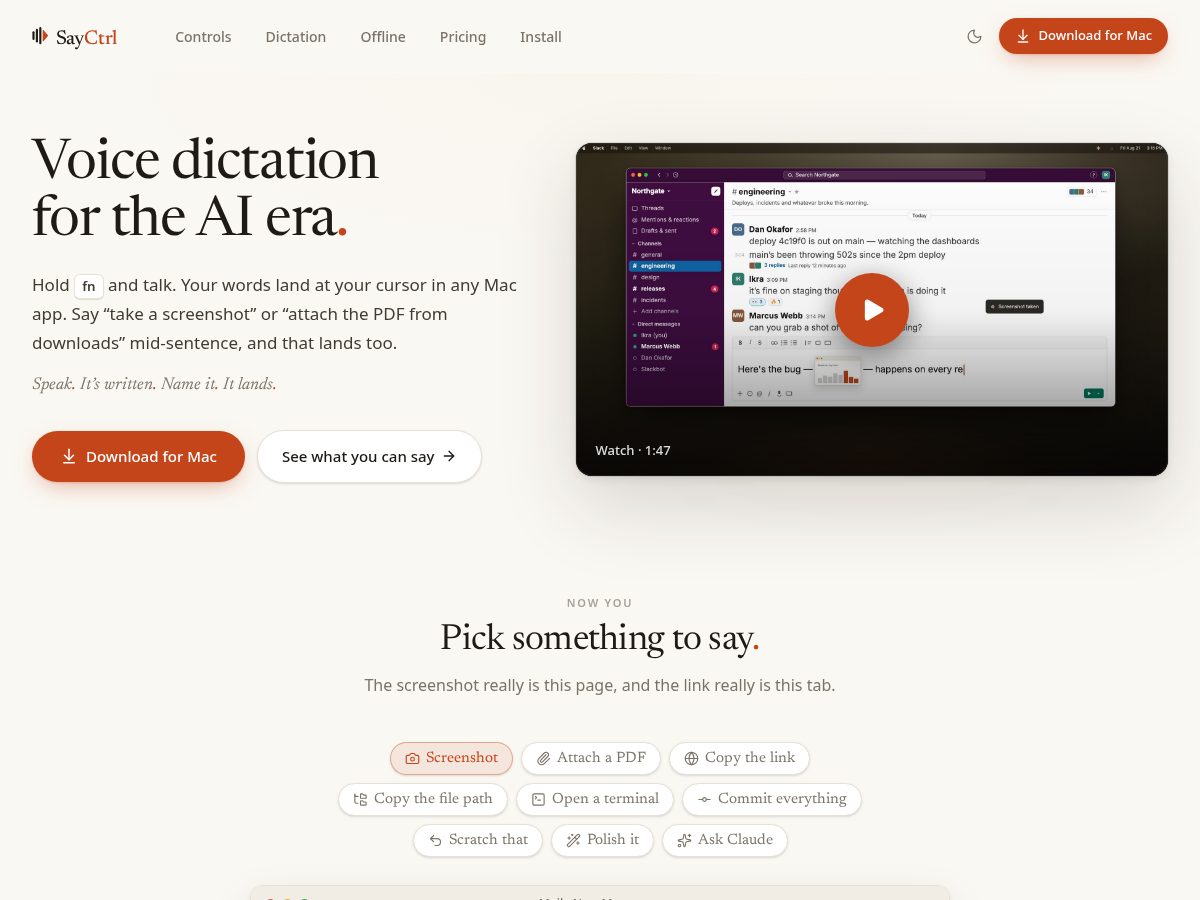
SayCtrl goes beyond transcription: say “take a screenshot” mid-sentence and the image lands where you were speaking, while “attach the PDF from downloads” can act on a file. It also offers downloadable local models, with the page promising that audio can stay on the Mac and work without Wi-Fi.
The product is unusually clear about what it leaves out: no group-class self-booking, card processing, or email campaigns. For $29 a month, it focuses on the daily details—pack counts, Venmo payments, offline access, CSV exports, and a client balance link—with copy that confidently says, “Half the studios out there should not buy this.”
This is unusually specific tender software with a clear point of view: keyword alerts are not enough when “heating” can mean diesel deliveries on winter roads. Its sample verdicts explain why bids are rejected, how labour estimates were derived, and what would change the number.
Its strongest feature may be the audit trail: a practising doctor checked 114 rows against named primary sources and found a scoring bug, an over-favourable renal calculation, and two incorrect guideline citations. It is free, requires no account, and is designed for bedside use when the bleep goes off.
CAL X pairs practical tools—from pH and battery life to matrices and exam grades—with unusually good explanations of where intuition goes wrong. Its daily “contresens” feature explains why a 100% slope is 45° and why averaging 60 km/h with 40 km/h gives 48, not 50.
Caravanserai OS targets five-to-forty-room properties in the Samarkand–Bukhara–Khiva corridor, with Uzbek, Russian, and English support and a browser-based calculator for estimating platform commissions. The site says its founding cohort is still forming, making this both a concrete regional tool and an early-stage project worth revisiting.
Coop replaces the snooze button with four-step proof of wakefulness: solve a sum, scan a barcode, walk around, or photograph something. Its fourteen missions, rooster premise, browser demo, streak freezes, and unusually direct copy make this a thoughtfully specific alarm rather than another notification clock.
Human Inbox turns cold outreach into a 45-second act of attention: no typed message, upload, or edited video, just a live recording made for one recipient. Its promise is deliberately narrower than detecting every bot—making sincerity cost something again—and the site explains that idea with unusual clarity.
일감 focuses on the paperwork friction of working in Korea: HWP files, wage statements, resident-number redaction, payslips, and passport-photo sizing. Its tools claim to process files locally in the browser, without sign-up, installation, uploads, or usage limits, and the site includes a 25-tool usage guide plus practical notes on what to hide before submitting documents.
This early-access project grows out of its developer’s account of a scammer impersonating his mother’s cousin and taking thousands of dollars. Its privacy promise is unusually concrete: Eleanor says it never stores or shares message content with family, sending alerts about who and why rather than the conversation itself.
SayCtrl treats dictation as an action layer rather than a speech-to-text box: say “take a screenshot” mid-sentence and the image lands at the cursor, or say “attach the PDF from downloads” and it does that too. The page also makes unusually concrete promises about offline models, spoken formatting, code-editor restraint, and live transcription.
Slackwater computes predictions on the device from NOAA and Canadian Hydrographic Service harmonic data, rather than waiting for a signal. Its opening demonstration focuses on Deception Pass, where knowing when the water goes slack is considerably more useful than merely knowing the tide height.
TF2 Prices timestamps every price change, tracks rising and falling items, and uses repricing frequency as a liquidity signal rather than relying only on Steam's sale counts. Its economy reports and inventory calculator make this feel less like a static price list than a small, purpose-built market observatory.
This is a remarkably substantial reference: 1,057 terms, 3,866 aliases, 23 facets, and a specimen on every page. It also treats AI agents as first-class readers, offering machine-readable data, an llms.txt file, and Markdown versions of every term.
The site turns a 10,000-box finite pool into a non-replacement probability experiment, tracking prizes as they disappear and showing the simulated cost without taking payment. Its copy is unusually candid: “the simulator protected your wallet,” while the official product page remains one click away.
ShowerTileCourt turns an ordinary shopping question into a tidy field guide: six mounting methods, five wall surfaces, five bathroom zones, and 45 listings. Its useful fixation is removal cost—what the shelf, rack, hook, or mat leaves behind when it comes down.
SKP Tools makes a concrete promise: Scene Director can place 80–120 finished scenes in about a minute, while DocSet turns model geometry into schedules, set-outs, counts, and CSV exports. The team says it built the extensions inside its own interior design studio and used them on client projects for a year before selling them.
This is a hand-authored game with 118 boards across 14 themes, each built around a specific subject rather than a generic word list. Its clues draw from Black American cultural life, including an Eastern Carolina whole-hog barbecue board, giving the familiar daily word-game format a real editorial point of view.
This is a notably concrete browser tool: users set a canvas and DPI, arrange numbered or lettered motifs, fine-tune their placement, and download either a single repeat tile or a tiled preview as a PNG. It turns the usually fiddly problem of making artwork repeat cleanly into a guided, visual workflow, with commercial use explicitly approved.
This is a sharply defined party mechanism, not just another picker wheel: the first landing is a fake-out, the audience can vote without affecting the result, and the same spin appears live across the TV and connected phones. At $10 for a 14-day room, it has the rare quality of solving one very specific social moment all the way through.
Balanzify treats offline operation and mobile money as core requirements rather than edge cases: its sample sale uses cash and Zaad, saves offline, and syncs on reconnect. The same double-entry ledger supports multiple locations and offers English, Somali, and Arabic interfaces, with 19 licensable modules across several kinds of trade.
MERA reduces a fishing trip to a readable sequence: find a spot, compare its conditions, check the rules, choose equipment, and record the outing. Its preview shows a Galata Bridge fishing window with wind, wave height, water temperature, target species, and an 88-point score—an unusually concrete promise for a fishing app.
Beecycle promises a rare combination of geographic specificity and software restraint: routes are generated from French survey data, while the Mac app runs offline with no account or subscription. Its launch catalogue includes the 21 bends of Alpe d'Huez, the Estérel Corniche, Luberon vineyards, and a Corsican coastal climb.
This is unusually specific farm software with unusually clear editorial ambition: it turns scattered sensor readings into plain-language briefings. Its examples connect details such as falling water consumption, elevated temperature, fan activity, and heating gaps into a suggested inspection rather than merely displaying another dashboard.
BluGrain’s manual is unusually specific: it explains how grain rate, length, pitch, drift direction, MIDI zones, and arpeggiated scales change the sound. The page reads less like a generic product pitch than a carefully made instrument manual with a point of view.
Boater Briefer turns NOAA, NWS, USGS, and state fisheries data into a single briefing designed for the boat ramp, including audio playback and offline access. Its sample Salem Harbor report gives an unusually concrete departure call: when low tide clears a shoal, when the chop builds, and when a small-craft advisory begins.
The site divides the work among a Deaf Observer, a Mute Manual Master, a Blind Defuser, and a verifier, then preserves each handoff without trying to solve the modules automatically. Its insistence on separating unverified notes from confirmed actions gives this unusually specific game tool a disciplined, almost mission-control quality.
Bookfox connects several unusually concrete jobs: charities fill collection boxes and earn a share of each sale, stores scan stock to identify valuable books, and scouts get cash offers in seconds through the app. Its promise is both practical and wonderfully specific—turning overlooked shelves, church-basement sales, and unwanted paperbacks into a working local marketplace.
This is a notably specific used-book ecosystem, not just another resale marketplace: organizations get paid monthly for books that sell, stores can scan stock and receive cash offers, and scouts are paid by e-Transfer. Its Vancouver bookseller-and-developer identity and church-basement-sale sensibility give the platform a welcome amount of human texture.
Bronwin makes the patient-facing tracker nearly invisible: a tap on a colored button, a 0–100 rating, and an optional note, even when offline. The site says the legend and records are end-to-end encrypted, stored only on the two phones, and revealed behind a PIN—an unusually specific privacy model for a clinical workflow.
browserbelt turns a familiar privacy problem into a useful collection of focused tools: remove EXIF data, merge or split PDFs, format JSON, convert image formats, and more. Its pipeline feature lets users run several operations in sequence and save the workflow for next time.
Cherry Converter says files never leave the device, then builds its case around concrete bureaucratic targets: 50KB Indian application photos, DS-160 images, Emirates ID portraits, bank statements, and PDFs under 2MB. Its 75-link inventory and country-specific workflows make it feel more like a focused utility shelf than a generic converter.
CorpLens queries four sources independently, so a slow registry does not hold up the others. Its Colorado registered-agent lookup is the sharpest detail: it can show every entity represented by one agent, while the site plainly explains why it covers two states rather than pretending a national company register exists.
DDS captures photos, timestamps, and location when damage is discovered, even without a signal, then produces a claim packet with hashed images and a chain of custody. Its sharpest pitch is also its clearest distinction: “A photo in a text thread is a picture. This is evidence.”
Decider Golf understands that the tournament is only half the event: threads attach banter to individual holes, scores queue when the signal disappears, and every match can feed future head-to-head records. It supports anything from classic foursomes and singles to scrambles, shambles, and entirely custom cups, with no player limit or download required.
DepthScout says it covers 39,163 lakes and rivers, including 15,977 waters built from real state fisheries surveys rather than guesswork. Its unusually concrete promise is trip-ready: save a water at the ramp, then use the chart, live depth, bearing, and fishing advice even without a signal.
DocumentWhisperer combines mechanical checks with passage-level analysis: it can flag missing attachments, numbering mismatches, unfilled fields, absent signatures, and unsupported redaction grounds. Its most reassuring trick is also its clearest editorial promise—every quoted finding is checked against the uploaded page, and anything unverifiable is discarded.
FISP Field targets the unglamorous failure point between a scaffold inspection and the final report: remembering which photo showed what. Its AI only tidies wording, while the inspector remains responsible for the observation, classification, filing, and seal—a notably restrained promise for an AI-assisted tool.
Its whole interface is built around a sentence such as “I want to learn scales in E Major,” with each colored word changing the lesson. The guide also documents chord identification, CAGED and 3NPS overlays, tap-to-hear notes, a tuner, metronome, looper, and amp tools, all presented with no account and no analytics.
Gemoscopio combines an 84-species gem database with a specific set of field calculations: hydrostatic specific gravity, estimated carat weight, property filtering, a glossary, guides, and a quiz mode. It also carefully labels its results as educational references rather than laboratory certificates.
Appllama turns app-design research into something you can browse screen by screen, with filters for onboarding, paywalls, revenue, downloads, ratings, and more. Its unusually concrete archive makes the question of what successful apps actually look like tangible.
Avesia is unusually specific about the long stretch between ophthalmology appointments: it offers dose reminders, bottle refill warnings, on-device label capture, and a doctor-ready history report. There is no account, no subscription, and no ads; the app is designed to work offline with health data kept on the iPhone.
ConsentIQ treats comprehension as a traceable record rather than a checkbox: it stores every answer attempt, records which risks were re-explained, and seals the resulting history into a checkable chain. Its narrow handling of sedation, capacity, best-interests, and minors routes shows unusually careful product thinking for a dental workflow.
Fiji Tasks borrows the paperclip-sales trick: finish a call, message, or task, then watch one clip join the pile. It combines a one-line capture field, a built-in 25-minute pomodoro, task logging, and quiet reminders into an unusually physical account of progress.
GLOVIZ streams measurements from 23 open APIs into charts that can compare countries, rank trends, detect anomalies, test correlations and score forecasts. Its unusually broad live-data scope—and the promise that every chart behaves like an analyst—gives this more presence than a standard dashboard.
It models both paths month by month, including mortgage-rate lock-in, transaction costs, equity, renovation financing, remaining debt, and opportunity cost. It also asks whether the change is really about space, schools, commute, or construction tolerance—useful reminders that the cheapest answer may not solve the actual problem.
This is unusually focused and practical: its calculators account for details such as camera bitrate, retention period, RAID level, reserved capacity, and actual transfer speed. The site also explains its assumptions and limitations, and says calculator inputs are processed on the device rather than sent to a server.
The unusual part is its refusal to pretend that geometry can answer whether someone is attractive: it shows six component scores, explains the method, and repeatedly calls the result a weak measurement rather than a verdict. The photo stays in the browser, and there is no subscription, procedure list, or makeover funnel waiting behind the number.
The site turns an emotionally loaded question into a weighted count out of 44, while carefully refusing to call the result a verdict. Its strongest promise is also its most unusual one: nothing is sent anywhere, and every sign comes with an ordinary explanation.
JingTools goes beyond the usual QR generator: it includes exam-application image presets, Thai word counting, Buddhist Era date conversion, land-unit conversion, VAT and withholding-tax calculations, and parcel-label printing. The site says its tools work without registration and process files on the user's device.
AfterFees turns familiar financial friction into a visible line-by-line calculation: Etsy, eBay, Stripe, Shopify, PayPal, Amazon FBA, freelance work, and paychecks all get their own treatment. The rates are cited to primary sources, the arithmetic is shown, and the site says nothing is sent off-device.
Klyse is unusually specific about what its map is for: replaying hourly thermal snapshots, comparing areas, and weighing pedestrian routes by time, distance, and measured exposure. Its strongest idea is also its most responsible one—AI can explain the data, but it does not get to invent the city.
KrewHauz treats a mowing round, cleaning route, or HVAC schedule as variations on the same operational problem: addresses, crews, repeat visits, and invoices. Its unusually concrete live demo covers 60 properties, a week of work, and matching books—with routing that prices left turns and satellite measurement that can price a job without a site visit.
CSV goes in and vector PDF, SVG, or PNG comes out, with support for Code 128, EAN, UPC, and FNSKU formats. Its unusually clear promise is privacy: inventory data, validation, rendering, and export stay on the device, with no signup, row cap, page cap, or watermark.
Legit Fests says it tracks 13,743 festivals across 169 countries, scoring them through accreditation, screening, history, submission, and community-report signals. Its warning list and festival dossiers turn a familiar filmmaker anxiety—whether a festival is legitimate or an award mill—into a searchable research task.
This is a remarkably specific reputation product: a $29 Snapshot can become a 10 cm window decal, while the recurring monitor tracks what changed each week. Its methodology is unusually candid about blocked maps, stale directory listings, disagreeing review counts, and the fact that the award is never simply “best business.”
MacGlow combines four-edge display effects, 12 built-in palettes, per-display controls, and click-through overlays in a focused menu-bar companion. It is also unusually explicit about its boundaries: audio stays on-device, there is no telemetry, and the project is MIT-licensed and built with Swift, Metal, and CoreAudio.
MapYourDroid offers a playable browser demo with WASD movement, mouse aiming, controller support, draggable layouts, and a tiny arena shooter. It is unusually concrete about its pitch: use your real phone and account, without an emulator, root access, or software installed on the phone.
MelhorIA is unusually concrete about its audience and its limits: it can alert a family member when a dose goes unconfirmed for 30 minutes, generate a medication history as a PDF, and check boleto numbers for free. Its promise to use large lettering, one task per screen, and a microphone instead of typing gives the product a distinctly humane focus.
MerchToolkit goes beyond a generic calculator page: it matches colors across HEX, Pantone, Madeira, and Isacord using CIE Lab delta-E, then adds production quote builders and break-even calculators for specific decoration workflows. The whole toolkit is presented as usable without signup, which makes its narrow usefulness immediately testable.
The site promises to reduce a stream of hundreds of listings to the handful that clear your own threshold, with an explanation for every score. It also tracks follow-ups after seven days and flags processes stalled for 45, while deliberately leaving the final “apply” click to the human.
moves.watch records thirteen distinct kinds of competitive movement, from a plan rename to a feature moving upmarket. Its alerts link back to the changed lines and dated source capture, while its longer-term analysis preserves reversals instead of smoothing them away.
It asks about autonomy, season, appliances, cable distance, roof dimensions, alternator charging, and mains charging before explaining its recommendation. The site also promises transparent assumptions, printable results, and no registration—more engineering worksheet than black-box sales funnel.
NerdLab puts an unusually complete tabletop kit in one browser window: players can explore behind fog and walls while the DM manages combat, PDFs, notes, and a searchable 5e rules reference. Every gameplay feature is free forever; the paid plan only adds storage.
Its operational problem is sharply drawn: the well-known varsity game gets attention while a freshman match at a distant back field goes unseen. Leaders can tap “I’m Showing Up,” and the coverage list surfaces students who still have nobody coming—on a phone in a parking lot, according to the site.
Plantroster treats a household garden as a collection of microclimates: rain may mean moving six plants, while a 38°F night threatens four others. It also keeps diagnosis history, schedules multi-week treatments, and adjusts soil recipes to the half-used bags in your garage.
Proudlog’s most interesting boundary is that it does not try to guess the other person’s feelings. Instead, it helps users prepare for what they can control—down to avoiding a spicy restaurant, limiting back-to-back questions, and remembering that an unsuccessful date is not a verdict on their worth.
This is unusually transparent data plumbing: every figure comes from a stated cost-report coordinate, and the site publishes which validation checks passed or failed. It says ten figures agree with audited financial statements to the dollar, while keeping the main dataset free, public, and usable without JavaScript or a login.
QCloudy_Addition turns a famously noisy Minecraft mode into a study in restraint: useful information appears when needed, while automation and runtime Wiki requests stay out. Its Shard Lab maps complete fusion routes and materials offline, giving one unusually specific game problem a carefully structured answer.
Recompete turns a buried procurement calendar into a legible market map: its homepage lists 541 software-related contracts worth $11.7 billion expiring within 180 days, with filters for industry, agency, timing, and set-aside. The contract-level view includes concrete records such as a $56.5 million Department of Education award and its incumbent.
Recover Yantra promises byte-for-byte verification, zero writes to the source, and an honest verdict when a file is gone for good. Its sample scan recovers 2,987 named files, carves 425 more, and explicitly declares an overwritten photo lost.
RiftJam combines searchable card text, faction and rarity filters, live deck-rule checks, shareable deck links, collection tracking without login, proxy printing, and even a virtual booster-opening feature. It also gathers promotional cards and the T1 2025 Worlds champion collection in one focused fan-made reference.
Its unusual trick is calibrating the on-screen gauge to the device’s known pixel density before measuring, with an optional credit-card check. The site also explains several measurement methods and connects them to a practical outcome: ordering a ring with more confidence.
RocketQueue tackles the specific chaos of streamer tournaments: viewers link Twitch, Steam, or Epic accounts, moderators open typed queues, and a live team-reveal wheel turns bracket assembly into part of the show. Its privacy-minded approach keeps lobby codes away from public chat while offering the core service free to channels.
RosterVote puts a hash-chained ledger behind everything from phone-based ballots to clerk-run votes and hand-counted paper ballots. Its unusually specific promise is not just to run the meeting, but to let anyone verify the result afterward.
It accounts for quantised weights, KV cache, context length, and estimated tokens per second rather than stopping at a vague hardware recommendation. The tool covers 91 devices, accepts arbitrary Hugging Face model IDs, and can provide the command needed to run a selected model.
Sambhaal focuses on a specific and quietly difficult family problem: nobody knows which FD matured, whether an LIC nominee was updated, or when a policy is due. It combines reminders, document storage, family permissions, scam alerts, and large-text senior-friendly screens—while clearly refusing bank logins, money movement, and investment advice.
SectorLog is unusually specific about the hard parts: its FTL checks cite EASA, FAA, and UK CAA rules, and it says “not assessable” rather than guessing when a rule is not modelled. It also offers local storage, restore-tested encrypted backups, free export, and a change journal for roster updates.
The tool labels every tile with its source page, row, and column, adds a taping map, and offers a calibration square before cutting begins. Its best instruction is also its philosophy: “Join the map, not a guess.”
This is unusually specific software, presented in warm Iraqi Arabic for garage owners rather than generic SaaS language. Its pitch combines QR-verified receipts, OBD and TPMS diagnostics, customer apps, WhatsApp delivery, and dinar-based profit tracking into one tightly focused workshop system.
A gift, follow, like, comment, or chat command can trigger a troll, sound, overlay, or other in-game event—for example, a Rosa gift spawning a troll in Valheim. KORU is candid about being in beta and says it is already used in daily real livestreams, giving this unusually specific tool some genuine stage presence.
SpectralCam treats the camera as an instrument rather than a filter pack, using live previews, depth sensing, movement, and editable effects before the shutter is pressed. Its field studies and unusually careful distinction between biological, sensor-based, artistic, and speculative Visions give the project a clear point of view.
Still Around builds the pet in your browser, lets you correct its likeness, and keeps the photos on your device—no account, upload, or server involved. The affectionate details, including “click to say hello” and “hold to pet,” give this unusually specific little tool a pulse.
This is a thoughtfully connected kitchen workflow rather than just another recipe box: it reads steps aloud, sets timers from the recipe’s wording, groups shopping lists by aisle, and can estimate calories and protein using USDA FoodData Central. The app is currently free while in beta, with an iPhone requirement and a clearly described future paid tier for media-heavy imports.
TableNight removes the usual pre-game friction: one person opens the room on a large screen, everyone else joins from a phone, and nobody needs an account, email address, download, or installation. Its three games are unusually well specified, from the 2–40-player quiz to Full Moon, where the site acts as narrator so everyone can play.
Slab covers 20,387 Pokémon cards across 170 sets, with prices refreshed daily from TCGplayer market data. Its useful collector-facing twist is the combination of offline photo scanning, raw and PSA/CGC/BGS grade ladders, and per-card collection tracking.
Aperture starts with physical limits rather than catalogue hype: its guides explain what aperture, focal ratio, and sampling can actually deliver, while its calculators work backwards from those constraints. The site even argues that the best telescope for some beginners is binoculars, and labels one common comparison a category error.
The Duck turns a familiar team ritual into a small piece of theater: names drop off as people speak, nobody gets picked twice, and the app supplies one of 900-plus developer and office jokes while the next person gets ready. Teams can add their own jokes, and names stay in the browser without an account.
The site names the publisher and read date behind every figure, prints disagreements instead of hiding them in an average, and turns the ranges into a calculator based on footage, material, and house size. Its unusually specific editorial method makes an ordinary home-maintenance question much more useful—and much easier to investigate.
The site replaces the usual webinar format with lunch-table competition: players answer aloud, steal missed questions, and let the dice choose the discipline and difficulty. Its practical twist is unusually concrete—each participant gets a dated, self-confirmed record and writes a reflection, while the site clearly notes that it is not an accredited qualification or automatic compliance proof.
Tidy 20 turns household mess into a short, evidence-based reset: choose five to 45 minutes, prioritize tasks, and stop at “better” rather than chasing an immaculate home. Its free one-room plan is unusually concrete, while the paid tier adds optional room-photo analysis, realistic goal images, and recurrence tracking.
TopoAssist handles a surprisingly complete chain of survey work: it projects WGS84 coordinates, repairs TINs, labels contours, styles point descriptions, and prepares Civil 3D and CAD exports. The site also states that imported files never leave the browser, with interactive processing for up to 5,000 points and DXF-only support for as many as 100,000.
Tozanensei currently organizes information for 75 trailheads, including parking capacity, road restrictions, shuttle fares, overnight options, and other practical constraints. Its planner can use a starting location, target trailhead, walking time, group size, fuel economy, and tolls to estimate when to leave and what the expedition will cost.
Trivium turns the room into its own game host: players scan a QR code, the screen handles countdowns and reveals, and staff can keep pouring drinks. Its unusually concrete promise includes sourced answers, public dispute tracking, support for up to 150 phones, and a Detroit pilot shaped by early venues.
The product keeps its footprint unusually small: one container, a SQLite file, and an uploads folder. Its standout mechanism is the Dory memo, which fades and permanently deletes a note—including comments, attachments, and share links—after 24 hours.
Sheetly includes a browser demo, bar-by-bar looping, tempo control, instrument switching, recording, and a score-aware coach that can answer questions about a scanned piece. Its homepage also publishes a concrete accuracy benchmark, reporting 91% on clean scores and 83% on photographed pages.
Type Fable treats decorative text as a compatibility problem rather than a bag of visual tricks. It inspects character coverage, preserves complete graphemes, offers a readable view and plain-text fallback, and explains why screen readers, search, translation, and moderation may behave differently.
Helios treats breathwork as something you can compose: users can define named phases, chain patterns into sets, and build protocols such as CO2 tables or a therapist-prescribed routine. It is still in TestFlight, but the site has unusually specific product detail, including singing-bowl hold tones, screen-locked cues, and repeated warnings about breath-hold safety.
UrShot turns a hotkey and a drag into both an image and a file on the clipboard, with arrows, redaction, MP4, and chat-sized GIF export built in. It is unusually clear about its operating conditions: roughly 2 MB, no account or telemetry, no networking code, and $19 once when the beta reaches version 1.0.
UseQR handles everything from Wi-Fi credentials and vCards to UPI, PIX, crypto, JSON, and SSH data. It generates static codes locally, works offline after the first load, requires no signup, and presents itself as an open-source public good rather than a funnel into a paid tier.
This is a focused accessibility product with unusually concrete evidence: live-session latency of 491–508 milliseconds, top-three prediction accuracy, and a 58-second recorded demo. Its early pilot figures are explicitly labeled directional rather than definitive, giving the waitlist page more candor than most product launches.
Wage vs World turns a familiar question into a multi-angle economic comparison across countries and decades, adding rent, mortgages, minimum wages, and housing affordability to the usual inflation calculation. It also earns trust by explaining its datasets, assumptions, known gaps, and even where an earlier data build went wrong.
wikiboard turns a reading session into a visible map: each clicked link opens beside the current article and gets joined by a line. It supports multiple Wikipedia languages, saves boards locally in the browser, and offers read-only share links without requiring an account.
Heard turns a minute-a-day check-in and weekly questionnaire into an automatically built timeline and clinician-ready report. Its strongest design choice is practical: sensitive details can be logged privately and presented in clinical language when a ten-minute appointment leaves little room for reconstructing months of symptoms.
XPipe Pro offers 18 calculators across 81 pipe sizes, with answers drawn to scale and support for 11 languages and five standards. Its examples speak directly to the bench: pipe-bank spacing, flooded weight for sling selection, purge-gas costs, and the force required to close a cold-sprung line.
CalcVerdict says every formula is tested against a published authority, then applies that promise to unusually detailed tools: mortgage calculators include PMI, taxes, insurance, HOA, and amortization, while tax and retirement tools point to official-rule calculations. The shareable-link results add a practical twist to a familiar category.
Dispatch Tones combines a preset directory with manual tone generation and reconstructions of 1970s SCU, QC1, and CENTRACOM consoles. Its Emergency! entries include the recognizable Station 51 and Squad 51 sequences, while a clear warning frames the audio as historical demonstration only.
Murder Note treats a niche tabletop genre like a living community database: the homepage tracks popular and newly listed works, crowdfunding campaigns, ratings, reviews, ownership, and play history. Its friend features even calculate which games a group can play together, including a reported 189 owned titles and 79 recorded plays.
Noricho maps 128 metropolitan-area routes, 1,612 stations, and 2,014 track segments, filling a line card as its segments are actually ridden. It is unusually explicit about what it will not do—no timetables or route planning—and says background GPS is used only to verify rides and station visits.
Uvofy is unusually deliberate about the mechanics of a live room: response bars never reorder mid-vote, questions can be upvoted anonymously, and each session produces a CSV and recap link. Its copy also identifies a real social problem—people hesitate to speak first—and builds the product around removing that ordering effect.
AntChambers presents a concrete chain from matter to timesheet to reconciled bill, including overlap checks, approval locks, GST invoices, TDS deductions, and receipt allocation. Its unusual proposition is deployment: one application, database, and document store per firm, managed as an isolated stack.
Archon makes its audit trail the product: every entry, signature, and change is linked into a per-laboratory SHA-256 hash chain, with a browser demo that lets visitors try rewriting a recorded result. The free notebook is permanent and unlimited by users, while paid tooling focuses on accreditation readiness and evidence packs.
Arti.host treats an AI-generated report as something to review, not just download: comments pin to page elements, internal and client feedback occupy separate layers, and re-uploading preserves the shared URL. It is a focused answer to the awkward space between a generated file and a finished deliverable.
The assistant answers questions from the lab's publication library rather than the open web, with links back to the underlying papers and an explicit warning when evidence is insufficient. Its suggested prompts trace a specific research arc from microfluidics and photonics to point-of-care diagnostics, nutrition, and global health.
Atlas applies a specific auditing protocol rather than simply answering a prompt, and its examples distinguish observations from inferences, hypotheses from evidence, and metaphors from mechanisms. It is unusually careful about scope: the tool calibrates a clinician’s wording without interpreting the patient or replacing clinical supervision.
Type the first part of a word—such as “moun” for “mountain”—and Banci offers a candidate without replacing the existing input method. It learns frequently chosen words locally, supports per-application settings, pauses in password fields, and ships as a roughly 10.2 MB public-beta download with a published SHA-256 hash.
This is a genuinely inventory-aware home-bar tool, not just a recipe list: it searches 451 ingredients, covers 129 substitution guides, and maps combinations such as gin and lemon to the drinks they can make. The site also makes its constraint clear—your real shelf, not an imaginary shopping list.
Bechat puts its privacy mechanism plainly on the page: messages are encrypted in the browser, held as short-lived ciphertext, then removed from the delivery queue after the receiving device retrieves them. It also deliberately omits feeds, payments, and other social-platform machinery, framing chat as communication rather than a content destination.
Buildlab connects the measuring file to the paperwork: count slabs, frames, cabinets, tile, or MEP work, then reuse the project data for a waiver. Its promise is unusually concrete—“Count it. Paper it. Get paid.”—with field photos, supplier-ready cut lists, and signing metadata built into the same drafting table.
Canidio replaces the scattered notes, photos, and WhatsApp videos between training sessions with one check-in and one visible history. Its practical constraints are unusually clear: five minutes a day, no account required for solo use, no course catalogue, and a trainer workflow built around reviewing videos in a queue.
Club Day RC is unusually specific software for the track desk: its local SQLite database keeps timing running when the internet fails, then queues cloud changes for synchronisation. The planned beta also includes a wonderfully niche feature called “Ghost Race,” which replays past driver or race data during practice.
Instead of handing users another tide table, it combines a chosen NOAA station, departure time, trip length, and two personally defined water-level allowances to find workable days. It also includes a trip recorder, hazard marking, track retracing, and a clear warning that this is a planning aid—not navigation.
FeedBurn calculates a batch's break-even day and can estimate a flock count from a pen photo directly on the phone. Its unusually concrete promise—farm records with no account, tracking, or server—gives this small tool a clear reason to exist.
CoRiverFly turns a narrow fishing problem into a substantial reference system: it tracks CFS and gauge height for 10 Colorado rivers, catalogs 76 sourced point-and-dropper combinations across five seasons, and includes a 28-pattern fly finder. The depth calculator and printable cheatsheet give the research a practical finish.
CPC GO focuses on a concrete blind spot: whether an individual book is actually profitable after advertising, rather than merely generating clicks or retail-price sales. It promises per-book, per-marketplace reporting, bulk bid edits, and alerts for money-losing campaigns, while its first cohort is offered 90 days free with no card or checkout.
Croovka takes the slightly unromantic file location-history.json and turns it into a 10–60 second MP4 with a moving marker, fading trail, and closing overview. Its strongest detail is the privacy constraint: parsing, preview, and rendering stay on the iPhone, with no account, upload, analytics, or ads.
CutNoodle handles MP4, MOV, WebM, and MKV files locally, with controls for silence thresholds, breathing room, sensitivity, export quality, and frame-level adjustments. It also includes a compact editing workflow with shortcuts, autosave, and a clear privacy promise: your video stays in the browser.
DDump separates card safety from slower cloud delivery: it copies locally, verifies the result, then leaves pending backups visible and recoverable. Its unusually specific workflow includes capture-time shoot grouping, calendar-based naming, SHA-256 verification, retry scheduling, and fallback destinations.
This is a focused diagnostic tool with unusually transparent mechanics: its report cites relevant RFC sections and Google requirements, compares a classic SpamAssassin score with its own checks, and generates a fix plan whose points are recomputed against the corrected message. It is free during beta, requires no signup, and the disposable test address expires after an hour.
The site turns 12 V/Line corridors into a practical car-free getaway map, searchable by station, dates, guests, and one- to thirteen-night stays. Its copy has real local texture, from Geelong's cold-water swimmers and Little Malop Street to Warrnambool's winter whale nursery, while the 2.5-kilometre walking constraint gives the whole project a clear point of view.
Feevo turns marketplace fine print into focused browser tools, including calculators for payout waterfalls, fee cliffs, promo commissions, subscription break-even points, and cross-market comparisons. Nothing requires signup, and the site says calculations run locally in the browser.
Follow-Up Queue is deliberately not a CRM or invoice replacement: it records the client, value, type, and next follow-up date, then sorts today’s actions and drafts a warm, direct, or firm nudge. The $12 one-time license, no-account setup, and browser-local storage give this small tool a clear boundary—and a memorable refusal to become another subscription system.
Found My Filter separates manufacturer-confirmed matches from results that merely look likely or might fit, rather than flattening uncertainty into a confident guess. Its catalogue reports 440 confirmed matches and 30 carefully labelled likely matches across brands including Dyson, LG, Miele, Philips, Shark, and WINIX.
FranchiseHuddle targets a sharply defined pain point: keeping an online franchise current without a commissioner repeatedly pressing “sync.” Its unusually concrete feature set includes 18 Discord slash commands, automated matchup channels, open trade votes, discipline alerts, and AI-written recaps based on real box scores.
FrontIce turns a very specific fantasy-sports management problem into an organized command center, with a 900-plus-player S55 pool, LG Drafts ELO, exact EA NHL 26 matches, trade analysis, live bid controls, and $30M cap guardrails. It is unusually concrete about the work it wants to replace: sheets, profiles, chat notes, and last-minute roster arithmetic.
Fundamental turns VvE minutes, taxations, and building reports into cited summaries and red flags, including the document, page, and quoted passage. It also handles Dutch-specific calculations such as NHG limits, transfer tax, cash at closing, and monthly net cost.
The app turns movement reminders into a small office drama: Dr Mark starts politely, becomes increasingly theatrical, and eventually walks away in a huff. The site pairs that memorable mechanism with practical movement suggestions and links to NHS, WHO, CDC, and workplace-safety guidance.
NeverL8 is built for the moment when notifications have become invisible: five minutes before a meeting, it darkens every screen and offers a one-key Join action for Meet, Zoom, or Teams. The sharply defined promise is matched by unusually clear privacy detail—read-only calendar access, local caching, and no NeverL8 server.
RIA Wire focuses on a narrow, consequential slice of the advisory market and updates it from the SEC's filings. Its unusually direct pitch includes live sample data, a published $219 monthly price billed annually, and the memorable warning that a prospect list ages like fish, not wine.
ValueMate presents a unusually concrete workflow: narrate an inspection, gather MLS and public-record evidence, select comparable sales, then review every AI-filled field against source excerpts. The site even promises to email the completed report while you stop watching it work.
The hook is immediate: turn the 200 food screenshots in your camera roll into an organized cookbook. Its fridge scan also ranks dinners by what you already own, while cook mode provides one step per screen, timers, and a hands-free display.
The mechanism is unusually clear: ask about a real workflow or buying decision, then fund a $100 donation to an eligible 501(c)(3) nonprofit chosen by the person you interviewed. It is customer research with a small charitable detour—and a useful answer to the problem of getting busy potential users to talk.
HiDoctorly asks clinicians to describe a pattern in ordinary language, then runs a staged cascade through evidence, feasibility, protocol design, and claims. Its strongest idea is also its constraint: clinical writing stays private, while every claim carries its source and every stage requires clinician approval.
Hodhori replaces roll call with simultaneous Bluetooth signals from students, local SQLite data, and a three-step flow for students, instructors, and departments. Its unusually specific fit for Iraqi university workflows—including Arabic RTL screens, Iraqi-dinar pricing, and absence thresholds—gives the product a clear sense of place.
The brief turns a trip into a concrete plan: troll for mahi-mahi at the Miami bluewater edge from 5:45 to 9:30, or switch to blackfin tuna and mutton snapper with different setups. It also admits when marine data is still loading, a useful touch of restraint for a tool dealing in forecasts rather than guarantees.
This is an unusually literal take on app promotion: the #1 position changes whenever someone beats the current payment, with controls for moving faster or scrubbing the amount. Its public board places independent apps alongside names such as ChatGPT, TikTok, Netflix, and Google, turning launch marketing into a small live spectacle.
This is more than a text converter: it offers Farnsworth timing, multiple waveforms, a light signal mode, vibration, sharing, and a WAV download. Its surrounding chart, games, tap decoder, and learning guide turn one narrow utility into a small Morse-code workshop.
KalaPanion treats practice as a musical thread rather than an administrative task: a musician can mark a phrase while recording continues, then return to it after the music ends. Its examples—“Meend opened here” and “The antara felt spacious when I left the phrase alone”—give the product an unusually tangible feel, even as parts of the interface remain in development.
Kennelnest builds its pitch around concrete friction: clients can book, upload vaccine records, see photos, and pay from a browser without downloading an app or remembering a password. The workflow is unusually tangible, from medication tasks and photo reminders to automatic invoices, while a free data migration and one-click export answer the lock-in problem directly.
KindHow turns social guesswork into an auditable calculation: its wedding example separates a sourced $200 baseline from site-authored adjustments for wedding-party costs and travel. It also states what it refuses to do—hide opinion behind an implied study or judge what users can afford.
KK Library turns a very specific folder problem into a proper local library: searchable grids, duplicate detection, author cleanup, metadata inspection, batch edits, and previews. It requires no account or network connection, and even promises to preserve tags, ratings, and authors when files are moved or renamed.
Linkophony turns a pre-save card into streaming buttons automatically when the release time passes, while sending signups directly to Mailchimp or a webhook. Its sixteen themes, live editor, contrast enforcement, and plain distinction between saved and published pages suggest unusually deliberate product thinking for a small creator tool.
LumaPlan reads and writes MS Project and Primavera files, recalculates the driving path on every change, and runs 24 schedule-health checks alongside the scheduler. Its performance target is a real 18,956-task construction programme rather than a toy demo.
MakerRun checks each profile on its server, then uses a moderator to distinguish a photographed print from a render when a maker submits evidence. The library is still small—37 files, six verified and three with print photos—but its verification standard is unusually concrete.
Its microphone bench does more than show a moving meter: it records peak level, noise floor, and clip count, then helps separate hardware trouble from browser or operating-system trouble. The site also makes a clear privacy claim—the audio stays in the browser—and carefully warns that its dBFS readings are estimates, not acoustic measurements.
Mythonauta measures distance through Apple Health and turns journeys of up to 400 kilometres into serialized walks through works including The Odyssey, Don Quixote, Dracula, and Around the World in Eighty Days. Its promise is unusually specific: no streaks, ads, accounts, or guilt—just a story waiting at the next stretch of road.
This is more than a walkthrough: eight version-scoped maps connect exact locations to a shared completion tracker, while separate sections build boss routes, audit upgrades, and explain save-data fields. Its v1.00.4 data build and explicit fan-made status give the project a welcome sense of scope and provenance.
MotoTuner follows the sequence of a real paddock day: measure sag, fill the setup sheet, pack the bag, and log one change per run. Its free tools expose the working details—weather-aware tire pressure, damping start maps, gearing RPM, and preload windows—while the writing stays usefully concrete, from counting clickers from fully closed to remembering the zip-tie.
MultiCut lines up multiple recordings through their shared audio, then looks for drops, crowd reactions, light changes, and other energetic moments. The unusual part is its privacy promise: analysis, editing, and export run locally in the browser, with three free credits to try the workflow.
NetDiag+ focuses on the exact moment a video call freezes, a VPN refuses to connect, or a game starts dropping packets. Its unusually deep toolkit runs on raw BSD sockets, saves results to history, and can share a diagnosis as an image—turning phone-based troubleshooting into evidence.
NHPlates catalogs 19 plate types and labels suggestions as taken, likely open, or unknown using dated plate records rather than pretending availability is guaranteed. It is a small, unusually specific tool with unusually careful disclaimers: the rules come from the DMV, but the site does not.
Officer One claims to fill official forms from an officer’s spoken account, then leaves the review, attestation, and printing to the officer. Its sharpest proposition is also its clearest constraint: “AI proposes. The officer commits.”
Packed List understands the physical scene: one hand on the phone, one boot to fill, and possibly rain coming down. Its keep-and-exclude workflow is more thoughtful than simply deleting items, while the copy promises no ads, subscriptions, or upgrade funnel.
PaisaBaki keeps customer promises, blockers, balances, and next actions attached to each invoice instead of scattered across memory and messages. Its workflow accepts invoice photos, PDFs, or CSV/XLSX uploads, and its sample case turns “50k Monday kar dunga, baki GRN ke baad” into a trackable promise with the remaining balance still visible.
ParkPulse turns queue data into concrete decisions: what to ride at rope drop, when to revisit a wait that has fallen, and whether a $15–$45 skip pass is worth buying. The site is unusually candid about its limits—the official park app still handles bookings—and clearly identifies itself as an unofficial fan tool powered by Queue-Times.com.
Patefact addresses a precise problem in networked audio: understanding a rig from an XML preset without having the hardware online. Its validation checks flag missing channels, duplicate assignments, mismatched sample rates, and clock-domain problems before soundcheck.
PDF Impose handles the fussy page-order math behind saddle-stitch booklets—such as 8|1 and 2|7—and also supports bleed, crop marks, step-and-repeat, cut-and-stack, and tiling. Its files process locally in the browser, while the surrounding guides explain the printing concepts instead of hiding them behind vague software language.
Ped Mandy is unusually concrete about the work it wants to assist: it applies dose ceilings, plots Bhutani percentiles, handles corrected age for premature infants, and converts medication doses into real pharmacy presentations. It also turns dictated consultations into SOAP records and offers digitally signed prescriptions as its paid tier.
Phosphor Ops is unusually specific about how its customers fail: undocumented tubes, mismatched binocular channels, skipped purges, silent repair queues, and unverified shipments. Its proposed answer is equally concrete, including serialized tube records, five QC gates, honest turnaround math, and an ITAR ship-block that cannot be bypassed.
PitchCut turns span, run, overhang, and pitch into line lengths, plumb and level cuts, diagrams, and shareable cut lists without an account or cloud project. Its careful disclaimer—that the calculations are educational geometry, not stamped engineering—makes this unusually specific tool more credible, not less.
Its narrow brief is unusually clear: one coordinated place for a culturally specific celebration, with English, Hebrew, or bilingual invitations and matching event websites. The site is inviting its first five families into a $149 “Founding Family Beta.”
Protocol is built around a specific clinical blind spot: what happens between six-week appointments. Its cross-grid compares time of day with days since injection, while deliberately refusing to suggest doses or treatment changes; the result is a focused record rather than another tracker pretending to be a doctor.
FairwayTab turns a fixed beverage-cart loop into a dispatch system: golfers name their hole, staff see open orders on a live map, and guests can watch the cart approach. The site also tackles the unglamorous operational details—drink caps, ID checks, refusal logs, processor compatibility, and service windows—with unusually specific copy.
ReadyRows applies destination-specific rules, identifies blocking rows, suggests mappings, and separates safe fixes from warnings. It says file processing happens locally in the browser, while exports are paid rather than the initial scan and editing.
Room Tuner is unusually clear about the next move: measure from your usual seat, change one thing—perhaps moving it 20–30 cm forward—and measure again. It treats the graph as evidence, but the actionable advice as the product, with audio processing kept on the iPhone.
This is a sharply focused field tool: contractors can upload a PDF or phone photo, while Scope cross-references clouds, deltas, callouts, and panel schedules. Its sample output turns a moved panel into an estimated 24 feet of EMT and two new 90s—and flags uncertain markup for manual review instead of pretending to know.
SeamTrue Fit Lab calculates ease, darts, grainlines, stretch, seam allowances, and yardage from measurements, then exports shareable cut sheets. It is unusually specific about its audience and limits: no account, no cloud sync, and an explicit warning that the results are educational pattern math rather than a commercial grading service.
The site turns the game’s extracted files into a cross-linked reference system: 491 items, 346 artifacts, 196 weapons, a bag planner, rendered weapon trees, and a destiny-tree browser. It is a particularly complete example of a fan-facing database built around the decisions players actually need to make.
Session works on a live 3D head rather than a flat texture sheet, then delivers the finished skin in-world as ready-to-wear BOM layers. The site also makes an unusually firm creative promise: no AI, just a decade of skin-making craft.
ShadowArc recomputes gnomon angles and hour lines from latitude, then lets users place a nodus on a polar board and export a PNG. It also includes an 80-plus-city atlas, recognition drills, and an unusually candid warning that its geometry is for STEM learning and backyard builds—not certified surveying.
This is unusually specific software for a real club table: overhead cameras preserve the pre-shot layout so a referee can restore balls after a foul, while the club server keeps the wall screens and stream overlay in sync. The site says matches, player profiles, records, and leaderboards are already running, with public results and live scores planned next.
Its proof-of-concept walks through descaling a coffee machine in a three-minute video, producing six timed instructions. The practical twist is unusually clear: print the resulting QR code and stick it on the machine, cleaning product, cart, door, or van.
StintKeep is unusually focused: start a shift with one tap, glance at the clock through the Lock Screen or Dynamic Island, and end the day without filling out a timesheet. It is designed for nurses and other long-shift workers, keeps records on the phone rather than on servers, and turns them into a payroll-ready PDF.
StylusCheck turns a frustrating hardware mystery into a sequence of concrete tests, including live pressure readings, tilt and button checks, dead-zone mapping, and hands-off phantom-touch logging. It also states its limits plainly: raw values appear beside each PASS/WARN/FAIL verdict, and drawings or typed input stay on the device.
TakeoffQuote targets a sharply defined frustration: estimators working on Macs, where Bluebeam Revu is no longer available natively. It offers unlimited free measurement, then charges $15 per month for trade assemblies, unit pricing, and a two-tab .xlsx export—while keeping confidential plans in the browser.
LabelProof decodes supported barcodes, reconciles quantities, and returns page-level PASS, WARNING, FAIL, or NEEDS REVIEW findings. Its unusually careful scope notes—synthetic demo files, human review before any PASS, and no guarantee of Amazon acceptance—make this a credible piece of narrowly focused warehouse software rather than a vague automation promise.
This is unusually specific software for a real hobby workflow: it generates car orders, waybills, switch lists, and named crew jobs from the railroad you build. Crews can work from browsers, paper, or car cards while Torus tracks pickups, setouts, and completed tasks; the $59 launch price is a one-time purchase with free updates.
つくりてラベル focuses on a very specific recurring chore: turning ingredients, allergens, expiry dates, and maker details into printable labels for markets and consignment sales. Its maker-aware details—such as remembering a printer’s 0.5mm alignment adjustments, starting from the seventh sticker on a used sheet, and supporting convenience-store PDF printing—make this pre-release tool feel unusually grounded in real kitchen work.
Chalked makes a sharply defined promise: it changes only the time in your words, never sends on your behalf, and admits uncertainty instead of guessing. Its example turns “Thursday arvo works for me” into a calendar-aware “Thursday after 3 works for me,” while keeping audio and transcripts off its servers.
The workflow is unusually concrete: upload a template, attach a CSV, and download one PDF page per record, with bleed and trim preserved. Files process locally in the browser, and a numbering calculator lets users catch padding errors before committing to a print run.
Vendor Almanac covers four unusually specific markets—martial arts studios, pet care, pool service, and self-storage—across 21 vendors. It keeps each price in the vendor's own units, marks unverifiable facts as unknown, and says exactly when every figure was checked.
Weipawn treats chess as a configurable terminal: widgets can move, collapse into tabs, or disappear, while its “void” mode offers server-free games with no name or rating. The Lichess connection also explains its permissions plainly, storing the token only in localStorage and requesting no messaging, team, or moderator powers.
Z Music Labs presents five concrete products, including an in-browser lyric editor, on-device AI stem separation, a Roland-style MIDI module emulator, and a PotPlayer cinema overlay. The studio says it builds tools it would want to use itself, and names its developer directly.
The tool runs offline and says its data never leaves the local machine, while its first downloadable release bundles an unusually broad set of practical spreadsheet workflows. It is available as a direct ZIP download, with support for Windows 7, 10, and 11.
The premise is unusually concrete: record a 15–30 second clip of each room, then get a personalized fire, storm, carbon-monoxide, and home-invasion plan in about ten minutes. It also makes a specific privacy promise—video stays on the device, while individual frames are analyzed and discarded—and charges $9.99 once rather than requiring a subscription.
It handles the fussy parts—padding pages to multiples of four, creating printer spreads, scaling pages, and setting up multi-sheet signatures—without uploading the document or requiring signup. A built-in creep calculator and a small set of focused prepress guides make this more than a one-button converter.
Someday’s pitch is unusually concrete: import the things you keep saving, then read them or listen while driving, walking, or commuting. Its on-device voice model promises narration without an account, tracking, ongoing AI fees, or an internet connection after audio is created.
Stokd is unusually concrete about the working floor: chicken thighs route to Bidfood, basil pots become a Tesco Express shop run, and overtime arrives with its reason attached. Its promise is simple and specific—count once, scan at the door, and stop rebuilding the week from clipboards, spreadsheets, and staff messages.
Enter a location, facade direction, floor, date, and the distance and height of a facing building to see the sun’s path through the day. It can export a PDF or social image, runs its calculations in the browser, and clearly states what it leaves out—including trees, side buildings, balconies, and terrain.
Local Recall turns an easily missed public-information stream into a practical monitoring tool: browse recent and serious recalls, filter by food or medication, inspect affected products, or set up a watchlist for what you buy. The notices are shown word-for-word with direct links to the original FDA notice, giving the site a useful balance of convenience and provenance.
Windshift can turn NMEA 0183 logs and AIS data into a replayable view of an entire race, with metrics including VMG, true wind, polars, heel, and leeway. It is an unusually specific tool that lets sailors keep uploaded tracks private, share them, or study the fleet together.
This is unusually concrete local infrastructure: a 50-household service with a ¥2,980 monthly plan, four-day lending periods, LINE support, and an inventory ranging from impact drivers and ladders to flooring, wiring, and leftover timber. It aims to be less a rental shop than the neighborhood’s go-to craftsperson for household problems.
The site focuses on a specific blind spot: orders from ChatGPT, Gemini, and Perplexity that complete server-side and disappear into “direct” traffic. Its proposed answer is unusually concrete—a signed evidence trail for each number—alongside a public test store and a bilingual pitch to agencies and merchants.
almi ranks products and services with a Trust Score based on evidence, third-party testing, reviews, and value rather than price or seller payments. Its homepage already compares concrete items—from magnesium and protein powders to Oura Ring 5 and Singapore longevity clinics—while disclosing that it earns through partner links.
AXITRUE brings an unusually detailed commissioning workflow into one page: job records, sign conventions, soft-foot checks, thermal-growth targets, rotor runout, bore capture, and engine-specific limits. It can also read a technician’s field sheet or instrument display by camera, while requiring confirmation before extracted numbers enter the record.
BANTOU is unusually specific about the realities of secondhand retail: it preserves existing paper forms, uses AI to read them, tracks legal records and identity-document retention, and builds compliance into the daily workflow. The site also gives a clear commercial proposition—¥15,000 per month, no setup fee, no feature limits, and no minimum term.
The homepage has a clear point of view: “Your data is not our business model.” Its audit product traces a deliberately specific chain from risk and procedure design through testing, exceptions, evidence, review, and conclusion, while the company’s Karachi base and in-development product snapshots give the otherwise polished software venture some useful texture.
Its central argument is unusually clear: “A reply in chat is not a booking.” Held charges $12 a month, takes no cut of the job, and is built for consultants, tutors, tradespeople, photographers, and anyone whose diary still lives in chat.
BrandRootMap turns a simple question—“Who owns Dove?”—into ownership chains and category maps, with sources and methodology included. Its long-tail catalog ranges from Oreo and Unilever to badminton-racket brands and private-label retailers.
BridgeDrop makes a concrete promise: send tens of gigabytes directly, resume interrupted transfers, and find nearby devices without configuration. The page also publishes SHA-256 hashes, deployment installers, platform requirements, and a candid warning that the version 0.1.0 Windows build is not yet signed with a paid developer certificate.
The site demonstrates a concrete workflow: upload up to 12 Excel or CSV reports, keep them on the device during the first review, and flag mismatches such as 12 job-cost rows that do not match current WIP. It also extends the same review to contractor licensing and job-location requirements.
The site demonstrates lessons including photosynthesis, molecular shape, pendulums, and Ohm’s law, with draggable simulations and embedded comprehension checks. Its promise is unusually concrete: write an idea, watch it move, then teach it in a slide-like presentation.
This is a sharply focused answer to an unglamorous prepress problem: assign sequential page blocks to each sheet position, cut once, and avoid hand-collating the resulting piles. The site explains the workflow clearly, includes a stack-layout calculator, handles uneven page counts, and says files are processed in the browser without signup.
Dandelion treats an unusually specific routine as a serious personal record: users can mark treatment points on face and body maps, track product quantities, and see their yearly investment. The diary is designed to stay on the device, with no account, ads, or tracking, while individual session maps can be deliberately exported for sharing.
The site says it has researched more than 7,500 college athletes from 125+ independent sources, then compares a player’s stats by position and level. Its careful insistence that a hand-timed 40-yard dash is not the same measurement as an electronic one gives this otherwise familiar comparison tool an unusually concrete standard of evidence.
EarlyCardIndex has collected 1,401 live listings across 53 cards and five players, with dedicated pages for price drops, best deals, trackers, methodology, and articles. It is currently strongest as a listing index—the homepage reports zero confirmed sales—but its narrow focus and unusually concrete data make it useful to collectors and revealing to anyone curious about how card prices actually form.
Faith in Common offers a 30-statement short form and a 61-statement long form, designed to distinguish people whose beliefs may sit between multiple traditions. It also labels itself an educational aid rather than a theological authority, directing users toward primary sources and trusted clergy or teachers.
Flow Route is unusually specific: it learns custom paths through Walmart and Sam's Club stores, remembers where products live, separates customer orders, and can accept voice commands such as “Add Aisle A12” or “Next item.” Its earnings dashboard, AI extraction log, demo route, and active voice-assistant beta make this feel like a concrete workflow rather than a vague productivity pitch.
Gardoa combines color-coded scheduling with child-bag checklists, shared expenses, caregiver access controls, and tightly constrained messages: users choose a phrase and reply with a button, leaving disputes no open text box. It is a notably concrete attempt to turn a messy family workflow into shared infrastructure, offered free and without advertising.
The site turns a narrow regulatory workflow into a concrete sequence: scan a device, record its UDI, batch, expiry, storage location, and responsible person, then retrieve affected stock during a recall. Its worked example follows one box of composite from receipt to an inspection-ready export, while the product itself is still marked as in development and seeking early users.
Jigeumyo combines practical tools—such as commute-time, real hourly wage, subscription-cost, and delivery-fee calculators—with culturally specific experiments, including name-frequency lookup, local-temperature rankings, and a search based on government-announced historical lists. Its promise is unusually clear: no signup, immediate results, and a new tool whenever a new topic catches fire.
LeafRoute offers three explicit trade-offs for a single destination: the fastest, shadiest, and quietest routes. Its Melbourne-specific premise—accounting for tree canopy, building shade, solar position, traffic, and pedestrian density—makes this feel more considered than another shortest-path map.
ResidencIA makes an unusually explicit promise about limits: its deterministic engine assists but never decides, never fills missing data, and leaves signing to the physician. The site also ties its workflow to official CIE-10, medication, hospital, laboratory, and NOM-004 sources, while inviting residents into a $299 MXN/month pilot.
Mismedidas treats a cup as a measurement problem rather than a universal constant: it distinguishes US, FDA, metric, imperial, tea-cup, bowl, and glass measures. Each result cites sources including USDA, King Arthur Baking, NIST, and FDA, while the page says recipes stay on the device.
MotionRules treats animation like a governed design system: one shared motion-tokens.json connects a curve-and-duration spec editor, a Lottie handoff and audit tool, and an After Effects panel that builds motion from a sentence. It is a notably concrete attempt to make motion rules portable between designers, files, and production tools.
The workflow is unusually clear: parents speak, AI helps transcribe and write, and the stories become something the family can keep. Private Google Drive storage, editable words, no automatic renewal, and a gift-oriented price give the product a thoughtful human shape.
Offsetcheck targets a narrow but consequential failure point: mortgage offset calculations that can quietly cost homeowners money. Its page explains the audit line by line, promises a cent-level comparison, and can generate a letter of demand when it finds a significant discrepancy.
The tool handles identifiers such as ZVW30-1234567, which standard VIN decoders often reject, and separates standard equipment from merely orderable options. It also names its sources—including NHTSA, EPA, and EU Safety Gate—and flags that it is not a mileage, accident, title, or ownership history report.
This is a notably specific remote built around reducing remote-control friction: users can type searches and passwords on the phone, while the app claims no account, advertising, analytics, or developer server in the connection path. Its Demo Mode also lets people inspect the interface without pairing a television or generating network activity.
Pfotenwetter uses Deutscher Wetterdienst precipitation radar in five-minute increments and is unusually explicit about its limits: missing data is shown as missing, not mistaken for dry weather. It also promises no account, ads, tracking, background location, or third-party maps—a small tool with unusually careful product thinking.
PureSipSpring compares 54 product listings against five published standards and nine cartridge codes, while openly stating that it has no independent test results. Its central warning is unusually useful: a product claim is not the same thing as a certification—and no filter in the catalog makes unsafe water drinkable.
Rainline brings 1 km radar refreshed every five minutes together with temperature and wind layers across Czechia and Slovakia. Its careful dark mode, animated map, and unusually specific regional focus make this feel like a real weather instrument rather than another forecast page.
ReturnSignal focuses on the overlooked moment when a seller-fulfilled return arrives: identify the order, grade what came back, photograph it on a phone, and close the record with an evidence packet. It is not open to sellers yet, but the detailed workflow, explicit limits around SAFE-T claims, and early-access notice make this a promising callback.
Saddle Stitch PDF is built for the practical moment before a zine, bulletin, lookbook, or event program reaches the printer. It handles duplex page nesting, warns about page counts that are not multiples of four, and says files can be processed locally without signup.
ScamClues performs static inspection without opening links, then explains sender signals, impersonation clues, deceptive destinations, urgency traps, and requests for money or access. Its verdicts separate what was found from what could not be verified, with the evidence attached.
SessionFlow combines stage tracking with unusually concrete studio details: BPM, key, audio bounces, timestamped feedback, parts checklists, and album progress. It costs $9.99 once, keeps data on the Mac and in private iCloud, and skips accounts and subscriptions—though a few visible template placeholders suggest the site still needs a final polish pass.
Hit the deadline and most of the stake comes back; miss it and the money enters a weekly pool for makers who shipped. The site turns a familiar founder ritual into a public scoreboard, complete with countdowns, reports, badges, and a current prize pool of $0.
SPAC Pulse turns a narrow, difficult-to-follow market into a compact decision desk: it tracks 310 active SPACs, 125 with rights, S-4 filings, proxy cards, deadlines, and a six-name leaderboard. Its close-odds and progress measures give the site a specific editorial mechanism rather than the usual generic finance dashboard.
Stackwise does more than list ingredients: it flags mechanisms such as blocked absorption, additive bleeding risk, serotonin overload, and combinations that need to be spaced apart. Its public index contains 110 documented interactions, making this a notably concrete health tool rather than a vague wellness landing page.
StayKeto has a clear thesis: keto guidance for people who eat out rather than meal-prep. Its restaurant orders cite each chain’s published nutrition data when available, identify traps such as unexpectedly carb-heavy salads, and disclose when figures are estimates; the GKI tool also shows its arithmetic and warns that its bands are not diagnoses.
Strength Director brings characters, animations, vehicles, props, chases, weather, visual effects, cameras, and a timeline into one in-game production interface. Its homepage claims 1,506 scenes, 4,894 animations, 930 props, and 921 vehicles, while letting visitors explore a working sample in the browser—though the actual game actions remain game-only.
Study Stream keeps the whole learning loop beside the video: progress, notes, subtitles, chat, and quizzes all stay attached to the current lesson. Its most distinctive promise is also its clearest constraint—the videos remain on your computer, while the app scans local folders and works offline.
VOLTA QoS frames a 45-second test as a shareable, dated report that compares measured performance with the subscribed plan and relevant quality thresholds. Its stated ambition is unusually concrete: collect independent, multi-operator measurements in real conditions, beginning in Benin and extending across Africa.
Weekshape treats scheduling as a visual constraint problem: drag across a day to carve out blocks, resize them in 15-minute increments, then fit estimated tasks into the hours your week actually holds. Its “sleep is the negative space” model gives an ordinary planner a memorable interaction design.
The site solves a genuinely local navigation problem: apartment letters identify buildings, while the signs show only building names. It also includes a “My location” mode, visitor-parking guidance, and a candid roadmap note that Buildings L and M are still coming soon.
夜中マップ brings 20 kinds of late-night destination—from bars, saunas, manga cafés, and late-night food to karaoke, hotels, cinemas, and night views—onto one browsable map. It currently covers selected areas including Shinjuku, Shibuya, Ikebukuro, and several Niigata neighborhoods, with more cities marked for expansion.
This is a sharply focused piece of print-production plumbing: it mirrors edge pixels, writes TrimBox and BleedBox metadata, supports multi-page files, and processes documents locally in the browser. The homepage also includes regional bleed presets and practical guides for Canva, crop marks, and printer requirements.
Its promise is unusually direct: “We tell you when you are burning money.” The example report says €404.45 was spent for 21 inquiries, with roughly €204.15 producing nothing, while the unfinished pricing and example-account flow suggest a product still taking shape.
AllThatStrat treats season planning as something you can edit directly: drag weeks, paint ranges, resize phases, overlay sports, and generate ramps, peaks, tapers, and down weeks. It is unusually specific, visibly interactive, and still labeled a v1.3 prerelease—an appealing glimpse of a focused tool being worked into shape.
BarLog treats “the Negroni at this bar” as a different object from the same drink elsewhere, and updates rankings with binary insertion comparisons for bars and Elo comparisons for cocktails. The app is still distributed directly as an Android APK rather than through Google Play, giving this compact site the feel of a specific, actively assembled project.
BatesFast handles prefixes, digit padding, confidentiality suffixes, placement, and continuous numbering across a production. Files are processed locally in the browser with no signup required, while the accompanying reference library explains the legal-document practice in unusually concrete detail.
It handles the unglamorous legal workflow with unusually clear controls: custom prefixes, digit padding, corner placement, and continuous ranges across multiple files. The site says files are processed in the browser and offers a range calculator for checking BEGBATES and ENDBATES before production.
It solves a specific online-meeting problem without accounts: drop in a file up to 5 MB, paste the link or eight-character code, and present while followers track the screen live. Each beam deletes itself after 48 hours, giving the tiny tool a clear constraint and a memorable point of view.
BPMKEY analyzes WAV, MP3, M4A, FLAC, AAC, and OGG files directly in the browser, with support for multiple uploads. It turns a familiar DJ utility into a broader audio-reading tool without requiring an account or paid plan.
CaptionKite says media stays on the user's device while a compact Whisper model runs through WebGPU or WebAssembly. It handles files up to 2 GB or two hours, explains its limits around YouTube and protected video, and backs the tool with practical guides on caption formats and troubleshooting.
The tool accounts for team auras, blessings, affinities, battle areas, and manually entered base and bonus speeds. Its notes explain the underlying calculation—including why aura strengthening is multiplicative—and acknowledge that champion data is maintained manually because no API is available.
FIREPath combines historical stress testing with a clear privacy constraint: plans stay on the device and work offline, with long-term tradeoffs shown in today’s dollars. The studio’s broader philosophy—focused apps, restrained features, and “clear over clever”—gives this small product a distinct point of view.
Instead of promising an all-purpose platform, Cmdry collects focused chores such as JSON formatting, CSV conversion, hash and GUID generation, QR codes, and timestamps. Its plugins are separate executables, and the site includes a concrete clone-build-run path for hosting the workbench yourself.
The tool grew out of Cherry Creek Little League, where it replaced three group texts and a shared spreadsheet with one schedule. Its details—self-serve shift claiming, seniority-aware auto-scheduling, rainout alerts, and job-specific instructions—show a product built around the messy reality of volunteer league operations.
The workflow is unusually concrete: one QR scan starts a 60-, 90-, or 120-minute recording, and everyone who scans the same code can watch the same full-quality video. Its privacy section also promises private-by-default videos and automatic deletion of unused recordings after 72 hours.
curlswap makes a sharply defined promise and keeps the conversion client-side: it says commands never leave the machine, with no logging or tracking. It also handles headers, JSON bodies, authentication, cookies, and query strings rather than stopping at a toy example.
CustodySplit tackles a genuinely awkward piece of family administration without making parents build a recurrence rule by hand. Its clearest promise is also its best one: describe the arrangement as you would explain it to a friend, then edit and share the resulting calendar.
Desktools.run makes a clear, useful promise: open a tool and run it without installation or sign-up. Its homepage lists 21 utilities, including a regex tester, Markdown previewer, CSV-to-JSON converter, password generator, and PDF tools, while stating that processing happens locally in the browser.
Docuivo keeps document editing local in the browser, with no signup and no uploads required. Its 12-tool lineup also includes narrower utilities such as profit-margin and freelance-rate calculators.
DragGap combines EPA configurations, NHTSA identity checks, labelled open specifications, and a 120 Hz physics model in one unusually specific comparison tool. It clearly warns that the results are engineering estimates rather than certified measurements, giving the toy a welcome layer of methodological seriousness.
This is an unusually specific attempt to give silent electric-car motion more sensory character through a Drive, Demo, Studio, Garage, and Settings workflow. The MVP also makes a clear privacy promise: speed and motion data are processed on the device, without uploading the driving route.
Folio Signals follows a publication from PDF upload to tracked customer link to reading evidence, including revisits, page attention, and CRM-ready exports. Its unusual constraint is also its appeal: it promises useful company-level signals without fingerprinting individual readers, with plans starting at £9.99 per month.
It turns a vague hardware worry into seven concrete tests, including live multi-touch tracking, a scored tap grid, a dead-zone map, and response-latency timing. The whole suite is presented as free, installation-free, and local to the browser—useful when checking a new device, investigating a cracked screen, or comparing a device against its advertised capabilities.
The products have unusually concrete boundaries: one inspects hidden Excel links, while the other drills into oversized folders and offers guarded cleanup. Both emphasize local-first processing, explicit destructive actions, and one-time pricing instead of a sprawling subscription suite.
Its unusual promise is operational rather than decorative: one request creates a twelve-task plan with nested tasks, dependencies, and a milestone, while the same link is rewritten as the work changes. Public docs, an account-free example, MCP support, and a REST API make the workflow easy to inspect.
GearClue calculates VRAM needs, electricity costs, and power-supply capacity while accounting for details such as quantization, context length, GPU transient spikes, multiple GPUs, and Korean progressive billing. Its accompanying measurements are unusually concrete: moving four of 48 layers to the CPU reportedly reduced generation speed to 49%, while a two-RTX 3060 test found actual VRAM growth 2.3% above the theoretical KV-cache figure.
Blobby takes a gentler route than an app blocker: its Classic mode asks a question for twenty seconds, while its Budget mode can trade a correct answer for more scrolling time. The site says the intervention runs on-device, requires no account, and inspects neither feed content nor analytics—though the extension is still marked as coming soon for the Chrome Web Store.
This is a sharply productized research service: for $149, customers receive 20–25 researched opportunities, evidence, contact pathways, and recommended outreach. Its sample brief moves from an 11,365-square-foot Alexandria build-out to a precise instruction—contact the general contractor within 48 hours about the final-clean scope.
Its sharpest idea is offline handling: a photo taken without signal is saved on the phone and sent automatically when the guest reconnects. The site is unusually clear about its audience—weddings, golf days, parties, and other crowded occasions—though its testimonials and venue logos are explicitly still placeholders.
This is unusually specific service design: it targets Miami family shops where the owner is still on the job, keeps existing booking tools in place, and refuses to invent prices or ETAs. The site states its terms plainly—$1,790 to start and $349 per month—with “no promised bookings.”
GroundRules treats a toolbox talk as controlled operational documentation rather than a generic PDF: each issued talk carries its source basis, location edition, site-control layer, document ID, version, and review date. Its opening library promises 52 weeks of excavation and shoring topics, from access and egress to ground-movement warning signs.
HARANEL treats harassment as an operations problem rather than an isolated frontline ordeal: reports, audio, photos, emails, risk levels, response histories, manuals, and repeat-customer records all attach to the same case. Its AI proposes one of 16 harassment classifications and a three-level risk rating, while leaving the final judgment to staff.
Puzzle Quarry says every board has one solution and can be finished without guessing, then explains why Hashi’s connectivity rule creates its real difficulty. The site also supplies worked solving guidance, technique pages, printable puzzles, and an archive of past boards.
Alongside practical calculators for aguinaldo, salary deductions, grades, exchange rates, and marchamo, it offers an unusually tangible QR generator that exports two-color 3MF files for 3D-printed signs, keychains, and desk stands. The site explains that its legal and tax calculations are estimates based on public formulas and points users back to official sources.
IC Checker targets a sharply defined repair-shop problem: enter a part number such as KLMAG1JETD-B041 and get a storage reading without probes, data cables, or guesswork. It also promises offline use and voice output, so technicians can keep both hands on the board.
This is a genuinely narrow tool with inputs for span lengths and relative stiffness, plus calculations for moment, shear force, reactions, rotation, and deflection. Its educational disclaimer and attribution to Songkhun MA, a civil-engineering student specializing in steel structures, give the calculator a clear human and academic context.
Kamitool gathers roulette wheels, lotteries, sequential draws, amida-lottery animations, bingo-card generation, furigana, time calculation, and Japanese-era conversion in one tidy suite. It makes a clear privacy promise: names and entries stay in the browser, with no registration or installation required.
Mailbrake turns email anxiety into a concrete workflow: a 10-minute cooling-off window, AI checks for anger, passive-aggression, PII, and possible career damage, then a one-tap cancel or rewrite. Its pay-per-save plan charges $0.07 only when the system flags something and the user accepts the help.
MarinaCheck explains where its figures come from—public marina price lists, specialist portals, and trade press—and labels them as estimates rather than live-confirmed prices. It also gives crews map and table views, marina contacts, equipment filters, and three-language support without requiring an account on the public site.
Its unusual hook is the insistence that every domain declare its grain, join keys, authority, cadence, and coverage before analysis. The catalog preserves unknown mappings, source identifiers, timestamps, denominators, and unmatched joins instead of quietly guessing—an admirably fussy approach to market intelligence.
MemorialProof records a SHA-256 hash, version, checklist, comments, timestamp, and decision in one operational receipt. It is a notably narrow piece of software: an approval layer for a sensitive family handoff, rather than another all-in-one monument suite.
ミセコエ removes nearly every step from collecting feedback: no customer login, app, contact details, or questionnaire setup, and no restaurant dashboard to manage before the first response. Its clearest design choice is the split between immediate alerts—such as a customer waiting too long for an order—and a quiet end-of-day LINE summary.
MixPPM is unusually specific: growers select the salts or commercial products they actually have, account for water tests and alkalinity, and receive tank doses to three decimal places. It also sketches a fuller workflow around predicted EC, mix logs, CSV exports, and saved recipes, though accounts and subscriptions are still in private testing.
This is a remarkably specific pet-memory product with a clear privacy promise: the album works offline, stays private by default, and backs up only when the owner chooses. Its copy also understands the emotional assignment, offering a birthday recap built from the year’s memories rather than treating a cat album like generic photo storage.
Monitor Tray uses hardware brightness down to a 20% handoff, then adds a click-through black overlay for deeper dimming without turning the display off. It is still in private testing, but the site has unusually clear compatibility notes, local scheduling, diagnostics, and a planned one-time $4.99 price.
My Minute Cryptic reduces the crossword-maker's job to one answer, one definition, and one piece of wordplay, then publishes the result as a link anyone can solve in a browser. It also supports structured hints, optional explanations, and personal challenges built around a friend's favourite place, family saying, or private joke.
MySygnal goes beyond the usual download-speed number: users can draw a floor plan, place a router, and see where coverage reaches. Its surrounding guides explain practical problems such as loaded latency, VPN slowdowns, channel congestion, and the difference between a mesh system and an extender.
neumascan preserves more than pitches: slurs, dynamics, articulation, and measure-level error checks travel into the exported score. Its most appealing promise is also its most disciplined one: below 10 pixels between staff lines, it rejects the image instead of inventing a confident-looking result.
This is a purpose-built field manual rather than a thin fan page: it organizes 198 pages around nine maps, 105 database entries, 35 trophies, task chains, extraction decisions, loadouts, and crash checks. Favorites, recent pages, saved builds, and achievement progress add a browser-local working layer without requiring an account.
NupPDF tackles the unglamorous but real problem of blurry printer-driver N-up output by creating a new, full-resolution PDF in the browser. It also handles mixed page sizes, auto-rotates 2-up layouts, and includes a paper-savings calculator.
Built for a mobile-repair center in Mosul, the database reports 605 confirmed matches, including 411 matches between different phone brands. It turns a fiddly repair-shop question into a searchable, unusually concrete piece of local business infrastructure.
Its rules are unusually concrete: everyone plays the same number of matches, teams are locked after the draw, and the alarm ends each game without extensions or golden points. The site also explains its early Android test build plainly while the store versions remain in progress.
Perspective turns a crooked plane into a clean rectangle: upload a JPG, PNG, or WebP, place four guides along the edges that should be parallel, then apply the correction. It also offers zoom, repositioning, stretch, tonal controls, and a local-processing promise that your photo never leaves the device.
The site turns grocery decisions into a browsable matrix, with filters for nine markets and organic status alongside reported laboratory data from 184,077 monitoring tests. Its combination of pesticide records, longevity-oriented nutrition scores, and shopping advice gives a familiar errand an unusually elaborate evidence layer.
PontePlacas does not stop at broad equipment categories: each inverter and battery entry identifies its source and marks whether the claim was tested on a real installation, taken from a manufacturer manual, or left unverified. Its Lab section also promises original measurements, integrations, and tests from working solar systems.
This is an unusually focused piece of fandom infrastructure: 28 listed characters can be filtered by G4, G5, fan samples, or sample status, then previewed and bundled into a downloadable herd. It turns a very specific animated-character collection into a tidy little library tool.
Preflight Safe turns catalogue clues into a product-by-product queue rather than a mystery score: each finding includes a reason, an official source, an evidence gap, and a next action. Its sample is unusually careful about uncertainty, noting that a “no text indicator” is not a safety or compliance clearance.
QR LapScan makes a convincing case for the practical middle ground between error-prone rubber bands and expensive RFID systems. Its homepage explains how organizers can prepare events, assign QR codes, manage participants, and evaluate laps using ordinary smartphones.
QuotaBar addresses a very specific failure mode: one long Codex session consuming too much of a weekly allowance. Its on-page meters track both the five-hour budget and weekly usage, with a clear warning state for paused Mac prompts.
Relanceo turns a neglected quote into a clear escalation sequence: email at J+3, email plus SMS at J+7, then a final reminder at J+14. Clients can accept or refuse from a tracking link, while the independent professional gets a dashboard for responses and recovered revenue.
The site follows a genuinely fragmented piece of public funding: every state posts opportunities through its own portal and on its own schedule. It currently lists 11 open opportunities across four states, with email alerts offered while the service is being built.
RigMyFish turns a narrow fishing problem into a quick decision path: pick surf, pier, boat, river, or another setting, name the fish, and receive a practical setup. Its High-Low Rig recommendation specifies line weights, leader lengths, hook sizes, and sinker placement—useful detail rather than generic fishing advice.
RoamStops is unusually specific about the gap it wants to fill: not just where a campervan can go, but whether it may stay, whether the vehicle fits, and who confirmed that claim. Its early map already lists 5,300-plus stops, while eighteen sourced guides, fourteen computed routes, and sixteen destination pages make this more than a generic launch page.
The site combines wind, gusts, clouds, visibility, waves, currents, tides, and measurement data, with forecasts drawn from several atmospheric models. Its focus on coast-and-estuary fishing makes it a notably narrow piece of practical internet infrastructure, even if parts of the page currently report connection errors.
ROMMEAOW combines AI translation with human review, game-specific glossaries, SHA-256 checks, text-width validation, and real-game testing. Its six-stage translation pipeline is unusually transparent for a fan project, though the ready-to-play ROM downloads raise an unresolved rights question.
Rooky Move gives chess archives an unusually editorial set of filters, from “After midnight” and “Quick losses” to “Scrambles” and “Mismatches.” It reads public APIs, runs analysis in the browser, and says the games are never uploaded or stored.
Runa’s privacy pitch is unusually concrete: the page says the app contains no networking code, analytics, third-party SDKs, or location access, and works in Airplane Mode. It measures a run from the phone’s motion chip, then keeps the result on the device.
The collection preserves a distinctly local game shelf: Spot is described as West-of-Ireland pub rummy, while Twenty-Five is traditional Irish trick-taking. Alongside practice play and online games, the site offers a scoresheet that creates a shareable code for people still playing around a real table.
Scanlet combines a hosted mobile page with a matching QR code, using blocks for countdowns, galleries, maps, schedules, and RSVP forms. Its examples—Lake Como wedding invitations, birthday parties, design-system webinars, and product conferences—make the narrow use case immediately legible.
Scythe turns the usual game-directory shuffle into a focused sequence: point it at Gorilla Tag, install or refresh BepInEx, then enable, disable, or add DLL mods. Its local-first design, checksum-listed downloads, and explicit disclaimer that it is an independent community project give this narrow tool some welcome specificity.
semper runs digital image correlation on the phone: photograph a painted random speckle pattern before and during loading, then inspect how each image window moved. It works offline-first and documents its limits plainly—the app does not perform scale calibration—while offering a manual, glossary, parameter reference, and early access for testers.
SessionGuard is unusually explicit about its mechanism: it moves the pointer one pixel and returns it, then waits for a configurable interval. Timed sessions, an inactive-by-default launch state, Accessibility onboarding, and no accounts or tracking give this small utility a notably transparent design.
The site promises to judge live engine, fuel, and emissions readings as “Expected,” “Watch,” or “Action,” then pass a car’s actual data into a search or AI assistant. Its owner-first stance is unusually clear: no account, ads, or analytics SDKs, with diagnostics kept on the iPhone.
The site walks users through Input Shaper measurements, speed testing, motor configuration, and safety tolerances before producing configuration snippets for printer.cfg. It is a focused community tool rather than a generic calculator, and its alpha status leaves room for a future check-in.
FenceQuote turns a familiar sales conversation into a small interactive sequence: trace the boundary, render the chosen styles on the customer’s house, and price the result using the contractor’s rates. The contractor also receives the visitor’s contact details and measurement even if the quote is abandoned.
The lineup has unusual range: Vegvísir logs rides and offers SOS tools, 1001 Excuses generates one-tap alibis, and Kvitro scans receipts while tracking warranties. Its detailed multilingual release notes—and its promise of no ads, no tracking, and no clutter—make this feel like a real, carefully maintained small studio.
This is a narrowly focused utility with unusually clear boundaries: it fetches files Suno already serves, does not record playback or upload library data, and requires a Pro account for WAV. The page also explains its permissions, session handling, queue behavior, and likely failure modes in concrete detail.
The homepage is unusually specific about the operational mess it wants to absorb: civil IDs, visas, permits, branch records, QR-tagged assets, rosters, payroll, and statutory deadlines. It also supplies concrete signs of use—six branches, 70 staff, 1,276 leave requests, and 779,000 orders served—while openly showing that delivery and back-office features are still being built or rolled out.
TCG Society watches major Dutch and Belgian retailers and sends Discord alerts when tracked products restock or change price. Its public page claims 9,000+ members and 30,000+ alerts, while paid tiers add priority alerts and a live market-data dashboard.
This is a sharply focused piece of collector-workbench software: choose a card page in Safari, select QR-only or QR-plus-price, and print locally without an account, subscription, analytics, or cloud queue. Its App Store release and planned integrations also give it a useful early-stage callback.
ThePriceRift narrows its focus to Riftbound, with set-by-set card counts, US/EU comparison, character browsing, illustrator pages, and an AI-powered card search. It is a useful example of the increasingly specialized market infrastructure forming around collectible card games.
The suite aims to move validated streams, assumptions, water balances, and lifecycle economics between specialist process applications instead of forcing engineers to reconcile disconnected tools. It is still at v0.25, with Total RO Design available and the rest of the stated portfolio marked in development or coming soon.
Trem Alerta checks roughly every 50 minutes and emails travelers when a seat appears, including when the 45-day sales window opens. It does not sell tickets or claim affiliation with Vale: the purchase link sends users directly to the official portal.
RIA Wire focuses on a sharply defined market segment and argues that its prospects change too quickly for an annual list: 185 firms entered the band while 39 disappeared over two months. The page publishes its price—$2,628 annually, or $219 per month billed annually—and offers a free monthly brief instead of a demo-and-quote sales process.
SpendJar turns a familiar parenting task into a deliberately small, child-friendly tool: big buttons for kids, a PIN-protected parent area, and no accounts, servers, or analytics. The wider site is unusually clear about its privacy promise—and signs off with “Made with a lot of tea.”
nftpad starts before the usual folder of finished PNGs: you draw layered traits on pixel or brush canvases, assign rarity weights, and forbid incompatible combinations. It then produces Metaplex metadata, a rarity file, and an optional candy-machine mint flow, with the collection saved in the browser rather than uploaded during editing.
This is a notably specific piece of business software for influencer managers rather than a generic agency dashboard. Its workflow runs from the first influencer profile to the last riyal collected, with plans priced in Saudi riyals and a free tier that requires no credit card.
Wakemeapp turns a calendar event into an alarm without asking users to reset it every night: match an event by name, choose the wake-up time on the phone, and let the schedule update itself. It is built around a precise annoyance, with support for multiple calendars, shift workers, changing routines, and alarms that operate in battery-saver mode.
Enter your height, weight, power, route, distance, and budget to get a personalized upgrade ranking and estimated time savings. Its assumptions are unusually explicit: the tool cites BikeRadar, Cyclingnews, and SILCA, separates flat-road aerodynamics from climbing weight savings, and shows a ±20% test-result range.
造物工坊 aims at a specific bridge between casual description and mechanical design: describe a part, inspect it in 3D, then adjust selected components or dimensions. Its examples include a geared-box housing with ribs and bearing seats and a motor mount with cooling fins, while the beta currently uses invite credits rather than open payment.
Users upload front and back label photos, with an optional image of the opened product, then receive a structured report explaining what each listed ingredient does. Its AI-generated health notes come with unusually clear warnings that the results are informational, not medical or legal advice.
DigiFulfill targets a sharply defined chore: replacing spreadsheet lookups, manual code copying, and late-night order monitoring for Lazada sellers. It offers 30 free deliveries, then charges ₱8 per additional order after 100 monthly orders, with delivery trails and code-assignment history built in.
The site treats Eorzea as a living night-life map, with filters for venues that are open now and tags such as “beginner-friendly,” “music,” and “photography welcome.” It is explicitly an unofficial fan service, and its early listing—even a clearly labeled administrator test shop—gives the project the feel of a community directory still being assembled.
FirstStrike OS follows a four-step chain—detect, locate, identify, activate—then offers a radius search from each strike, down to a 25-mile ring. Its blunt promise is aimed at roofers, restoration firms, insurers, lawyers, and property services: make the first call before everyone else has read the forecast.
It covers 27 competitions, from the Premier League and LaLiga to MLS, Liga MX, and the Saudi Pro League. The site says it has no ads, no tracking, and stores nothing—a focused bit of football-season daydreaming with unusually broad reach.
Shrink Clip says it encodes files locally with ffmpeg.wasm, keeping videos on the device while calculating a bitrate for a chosen size cap. It also bundles MP3 extraction, GIF conversion, trimming, and 9:16 cropping without watermarks or an account wall.
Enter a city, state, or ZIP code to get practical guidance rather than a vague national forecast: Fairbanks is marked GO, Duluth MAYBE, and several other cities NO. The site also explains the obstacles behind a prediction, such as a low northern horizon, and says its location check is used once rather than stored.
It targets a specific operational headache: publishers repeatedly asking whether a call connected and what the buyer said. They can search by caller ID or upload hundreds of calls, while access is limited to their own traffic and buyer names, numbers, revenue, and payouts stay hidden.
The workflow is unusually clear: choose a recording, set one start and end, shape three frequency bands, preview the take, and export it. Editing runs on the device, and the site requires no account.
The site filters gear by concrete specifications such as blade steel, lock type, lumens, battery, weight, USB-C, and price. Featured listings pair those details with current-looking discounts and purchase links, making this more useful than a generic gear catalog.
The recipient can open the visible document normally, while an authorized Msg2File Pro user extracts the concealed payload with a password or key. The homepage emphasizes local processing and offers Android, iOS, Windows, and macOS downloads, though the desktop builds are still marked 0.1.5.
PontePlacas distinguishes between information taken from manufacturer manuals, tested on real installations, and not yet verified. That small editorial discipline makes it a useful antidote to the usual solar-upgrade advice that speaks confidently in categories while ignoring the exact inverter on the wall.
ProbPath focuses on a clear, narrow task: turning examples such as coin flips, medical tests, and marble draws into editable probability trees. Users can refine the model by chat, adjust branches on the canvas, and carry the finished diagram into homework, slides, or reports.
InkOkay targets a specific print-shop problem: moving a job from “here’s the proof” to “approved, send it to press.” Its workflow keeps notes beside the file, adds hourly deadlines and reminders, and lets customers review without installing software or creating an account.
QGA promises PC-local processing, synchronized before-and-after inspection, staged enlargement up to 16×, and output sizes reaching roughly 5.5 billion pixels on a 4GB-VRAM machine. The $7.99 monthly plan and unusually detailed print-production workflow make this more specific than a typical AI image enhancer, even if its performance claims remain claims from the landing page.
DopplerSim first estimates an intrinsic source spectrum by undoing Doppler shift and geometric attenuation, then generates a new stochastic pass-by using exact retarded time. Its linked batch, multisource, spectrogram, and audio-comparison tools suggest a focused technical workspace rather than a generic audio toy.
FocusContrast goes beyond ordinary text-contrast checkers: it calculates focus-ring area geometry, three-color differential boundaries, and spatial APCA lightness, then offers CSS export. Its navigation also includes a color matrix, vision simulator, and WCAG 2.2 guide.
FreENEXt processes selected files in the browser tab and lets users keep the resulting exports for Bosun, Obsidian, or another tool they already use. Its ownership-first premise extends into the wider Harbor suite, which includes a life vault, capture daemon, recipe vault, and personal knowledge router.
This private-beta tool has a sharply defined audience: solo and indie e-commerce operators who cannot afford enterprise competitive-intelligence software. Its promise is unusually concrete, with storefronts checked hourly, reviews every 15 minutes, and a first briefing supposedly arriving within an hour.
Its demo for a 620-person manufacturing company puts a concrete number on the enterprise AI sprawl problem: €171,000 in annual tool spending, with 41% attributed to unused licenses. The dashboard also emphasizes aggregated team data rather than personal analysis, making the operational question unusually legible.
Its premise is admirably concrete: name a song and your setup, then get the settings knob by knob, with the source of each number. The homepage also presents a sprawling song bank spanning AC/DC, Nirvana, Metallica, Muddy Waters, Meshuggah, and many others.
NetFixLab explicitly rejects generic gear lists: its paths explain what a test proves, what it cannot prove, and what result should come next. The rule is unusually clear—“Evidence before equipment”—which gives a practical network guide a sharper editorial point of view.
Photoemu combines layers, masks, blending modes, filters, text, and export in a browser editor, while saying that files stay on the user’s device. That makes it a particularly concrete answer to the small but common problem of previewing or lightly editing professional image files without opening a full desktop suite.
Riftstack organizes the game around six named domains—Fury, Calm, Mind, Body, Chaos, and Order—and includes copied public decks alongside official 40-card starters. Its footer plainly says the site is 100% AI generated, turning a useful fan tool into a small, revealing artifact of the current build-with-AI moment.
State Receipt treats the payslip as only the beginning, promising sourced country comparisons and a browser-only calculation that takes about 30 seconds. Italy is available now; Spain, France, and Germany are marked as forthcoming.
The tool accepts a photo, screenshot, link, or description and targets everything from contractor estimates and car repairs to flights, subscriptions, and restaurant bills. Its unusually clear promise is to help people check the deal before paying, though the homepage indicates that some account and billing pieces are still being connected.
VeilOpportu names a concrete workflow rather than promising vague business transformation: it tracks sources including the World Bank, African Development Bank, BOAD, and the EU, then combines PDF analysis, deadline tracking, team discussion, and a Chrome/Edge clipper. Its listed plans run from 7,000 FCFA per month for a solo consultant to 15,000 FCFA for a three-person cabinet, with Orange Money, Moov, and Wave listed as payment options.
This is a concrete alternative to cloud-dependent CAD: it runs natively on Windows with no internet or account required. Its familiar ribbon, command line, shortcuts, and self-cleaning architectural elements suggest a focused workflow rather than a vague software landing page.
Pixel Countdown keeps the whole workflow unusually direct: choose a moment, get a URL, then share it or paste an iframe into a Notion document, README, or other page. It offers multiple display formats, dark mode, quick presets, and says it requires neither an account nor ads.
ProtonLoop anchors feedback to exact pixels and DOM components, preserves notes across versions, and lets teams pull open comments into Claude or Cursor for automated revisions. Its zero-login reviewer flow and multi-page project decks give the otherwise familiar collaboration pitch a concrete mechanism.
MedCodeSearch goes beyond a bare code search: it presents official descriptions, code hierarchies, notes, and release history without requiring an account. Its examples range from Type 2 diabetes and wheelchair codes to the anatomy of an appendix-resection code.
MSME-connect turns messages such as “add 5 units of SKU-014 to stock” into logged spreadsheet entries, with sender and timestamp tracking, collision protection, and safeguards for formulas and report tabs. The page is unusually concrete about the shared-sheet problems it addresses, though placeholder legal and contact details suggest an early-stage project worth revisiting.
RefillFit starts with the device you already own, then identifies compatible refills and distinguishes original products from compatible alternatives. Its scope is unusually concrete, covering everything from PETLIBRO water fountains and automatic litter boxes to humidifiers, ice makers, diaper pails, and electric food recyclers.
RUTA targets carriers running just 1 to 10 trucks and bundles the BOL, condition photos, recipient signature, and receiver name into one delivered packet. It is still marked “In development” and appears early-stage, but the paperwork problem is concrete and unusually specific.
SoySAGE accepts a trait plus gene names or pasted/uploaded fastBAT results, then applies a locally deployed large language model for TMPS mechanism-priority scoring. It is explicitly built for public demonstrations and peer-review verification, although the homepage currently says the service is under maintenance.
CruiseCaptain is built around a concrete booking question: is today's cruise price actually a deal? It offers saved cruises and price alerts through passwordless email sign-in, alongside a broad browsing system for lines, ships, destinations, ports, and sailings.
Torollo replaces diagram-only practice with a runnable system: learners can query Postgres, ping Redis, curl a load balancer, break the architecture, and validate the result against container state. Each pass produces a receipt of concrete observations, while the free roadmaps turn the exercises into a small bookstore’s escalating infrastructure story.
Veredito reruns the same test against the code before and after a change, then separates findings into proven, discarded, and inconclusive—rather than quietly turning “I couldn’t prove it” into a clean bill of health. Its unusually courtroom-shaped workflow gives the tool a clear editorial hook, and the page includes a concrete access-control failure with a reproducible request sequence.
This is unusually explicit about its boundaries: it installs no agents, decrypts nothing, and makes only one outbound call for timed threat-intelligence refreshes. Under the hood it combines eBPF with an AF_PACKET fallback, Wireshark-compatible filters, and even CUDA-rendered traffic pulses—an ambitious little network monitor with a surprisingly lucid explanation of what it refuses to do.
Each book follows a complete, buildable project, from hardware-specific graphics and sound to a scrolling shoot-'em-up or Tetris clone. The accompanying chapter-by-chapter source code is free to download, making this a notably concrete bridge between retro-hardware nostalgia and actual programming practice.
Fortress in a Box turns Trivy, Kyverno, Falco, Argo CD, Grafana, and Loki into a single-command, defense-in-depth deployment. Its threat matrix explains exactly what happens when a container spawns a shell, an image carries critical vulnerabilities, or an attacker alters the cluster—making this feel more like an operational security project than a generic dashboard.
LedgerBench records 45 synthetic cases involving traps such as mid-file column drift, date ambiguity, foreign-exchange conversion, and injected instructions. Its unusually clear promise is accountability: every result carries a run ID, git SHA, timestamp, and benchmark version, while the recorded run reported zero silent failures.
Little Owl reviews the shape of an entire project rather than just the latest diff, flagging issues such as skipped application layers and circular dependencies. Its local, deterministic design, detailed documentation, example output, and explicit baseline-and-drift model make this a notably concrete response to AI-era codebase decay.
RateGrid ties each encoded tariff to a utility filing, sheet number, and effective date, then exposes endpoints for comparing plans, calculating solar bills, valuing battery dispatch, and tracking rate changes. Its unusually candid documentation labels perfect-foresight dispatch as an upper bound and returns warnings for unmodeled features instead of silently dropping them.
Its worked example follows an empty tenant-report export from an email report to a code reference, a reproduced failure, and a retained test. The site is unusually explicit about its boundaries: the demo uses a fictional app, runs in staging by default, cites its sources, and requires a person to approve the fix.
ZlamCon replaces the usual conference-slide format with an isolated environment where attendees can investigate real servers, Wi-Fi, badges, cameras, routers, RFID locks, kiosks, and forensic devices. Its 11 case files include prompt injection, UART, reverse engineering, and a final mixed-systems challenge.
MyAPIs offers 13 reusable data resources—from prefectures and Japanese eras to proverbs and shogi pieces—alongside five generators and an API Zoo covering 94 HTTP/API patterns. Its consistent endpoints, open CORS policy, and copy-ready curl, JavaScript, and Python examples make it unusually practical for testing real client behavior.
Cairn OBS has unusually concrete product thinking: agents send records through Redpanda before independent ClickHouse and Tantivy consumers, while one query language spans both search engines. Its AGPLv3 promise—“the whole thing, no exceptions”—and self-hosted Ollama support give the project a clear point of view beyond simply being another logging dashboard.
Cairn OBS has unusually concrete product substance: a Rust agent feeds Redpanda, ClickHouse, and Tantivy, while structured filters and full-text search compile into one query path. Its pitch is equally specific—multi-tenant RBAC, SSO, dashboards, and AI-assisted queries without a paid feature gate.
CBSR treats uncertainty as a result: its register currently has 152 recorded propositions but zero decision-ready entries because none has passed all six evidence axes, including independent review. The project turns primary-law citations, freshness dates, and review status into software-readable records rather than letting an agent act on an uncitable paraphrase.
CursorCast makes the capture boundary explicit before recording: users choose allowed displays, protected applications, resolution, frame rate, and audio. Recordings stay local, while macOS can also expose a live CursorCast window to Discord, Meet, Zoom, or Teams; Windows live sharing is still being validated.
Dead Index asks users to crop an instance, mint a frozen LOCK, and carry that query into live or offline FMV. Its deliberately severe vocabulary—“No backprop,” “No reachback,” and “Plugin, not a COP”—makes the product feel like a compact field instrument rather than another generic detector.
This is unusually candid engineering documentation: the first launcher fix passed from the expected directory but still failed the actual portability requirement. The author traces 15 path sites, four resolver scenarios, a discriminating negative control, three merge commits, and the evidence gaps that remain deliberately unverified.
dPanel treats deployment as a security boundary: it rejects dangerous Compose settings, applies CPU and memory limits, blocks access to SSH, WHM, mail, and instance metadata, and routes the approved container to a domain with WebSocket support. The unusually concrete Portuguese copy explains not just what the tool does, but what can go wrong when containers run as root on a shared server.
The wizard filters parts by form factor, budget, wireless standards, smart-home protocols, USB capability, and other concrete constraints. Its strongest promise is also its editorial hook: every stated specification cites an official datasheet, and corrections can be submitted as one-file pull requests.
Fabrikode’s three concrete projects cover water-tank design, native macOS aerodynamic simulation, and boiler documentation. Its strongest idea is also its clearest: one model should produce the geometry, cut list, bill of materials, drawings, and reports without typing the same information twice.
Blackbar makes a sharp security promise: redaction is destructive, not merely an overlay. Its page details 27 detectors for API keys, JWTs, hostnames, private keys, connection strings, and more, while emphasizing local processing, stripped metadata, and no network entitlement.
GLBForge treats the unglamorous gap between generation and deployment as the product: its tools report triangle, texture, file-size, and GPU-memory budgets, then optimize meshes and textures locally. The page claims a Meshy export can shrink from 89MB to 5.5MB in seven seconds, while a logo can become layered 3D in one second.
GPAI Ledger checks known summaries daily and archives each version with SHA-256 hashes, OpenTimestamps proofs, and—where possible—Wayback snapshots. Its 67 tracked models, 161 archived versions, and explicit published-versus-missing status make a slippery regulatory obligation unusually inspectable.
This is a notably specific attempt to make table transformations feel like a language rather than stringly SQL: named clauses are checked before execution, and the same pipeline can move from exploration to native code. Its benchmark page compares Ibex with Polars, DuckDB, ClickHouse, DataFusion, pandas, data.table, and dplyr, including single-threaded runs.
Its central idea is unusually well specified: private conversations and household knowledge live in separate stores, with separate keys and processes in its isolated mode. The site also explains the trust tradeoff plainly, including an Undo step before anything is written to memory.
This is a focused piece of agent plumbing with unusually concrete safeguards: per-task caps, daily budgets, balance checks before requests, redaction, no callbacks, and no runtime dependencies. Its examples show the whole loop—from a plain-language prompt to a saved PNG or MP4 with credits and file paths reported back to the agent.
The dossier claims to map 3,178 network commands, 18,514 Lua modules, 117 C# assemblies, and three custom file formats. Its unusually concrete structure—complete with extraction methodology, production-traffic validation, and an implementation roadmap—makes this more than a generic game fan page.
This is unusually specific systems software: one contiguous arena per document lets the project promise a memory ceiling before parsing begins. Its homepage also publishes benchmark methodology, a 438/438 W3C XPath score, and bindings for Ruby and Python rather than hiding behind generic performance claims.
This is more than a tutorial pile: practitioners propose changes through public pull requests, while the course turns them into reviewed lessons, tools, and evidence-producing projects. Its capstone path reaches from observable model clients to RAG, agents, LLMOps, and a live demo.
MCPComp grades each finding against the specification it violates, then compares authentication metadata against a committed baseline to catch drift. Its support-triage command, `mcpcomp doctor`, diagnoses whether a failure belongs to the server or client without credentials; the site also reports a registry sweep of 11,496 remote servers.
It measures more than vocabulary, including response tempo, message bursts, bubble shape, and how several points get answered. The privacy boundary is unusually explicit: analysis stays local, drafts remain unsent, and nothing sends, reacts, or schedules.
みちよみ keeps observed facts, computed measurements, and VLM interpretations in separate layers, with shooting years and model generations attached to the results. Its read-only REST API is also available through a stateless MCP server, giving AI systems a carefully attributed way to query the real street.
Mix-O-Tron treats samples, remixes, podcast music, and video soundtracks as entries in a provenance graph, allowing each new work to reference up to 20 existing C2PA-enabled ingredients. It is a notably concrete attempt to bring content credentials into the workflows of independent artists, small labels, and music platforms.
Napstr revives the old music-sharing premise with a sharply modern architecture: public catalogues travel through Nostr, while authenticated temporary Tor onion services handle downloads without a central tracker or file store. It is available for Windows and Linux and includes encrypted negotiation, seeder failover, and SHA-256 verification.
newagent.build compares 88 components across ten concrete layers, then turns the choices into a setup script, a Compose file, and an AGENTS.md. Its deterministic advisor handles constraints such as untrusted email, on-premises data, code execution, and Slack support without an account, API key, or model call.
A .ant file is a zstd-compressed stream of newline-delimited JSON records, ending with counts and a SHA-256 hash that can expose truncation or tampering in one pass. The project includes a normative specification, JSON Schema, conformance goldens, and Rust, Python, and JavaScript implementations.
The same PDF is designed to serve both people and machines: a 40-page sample OM becomes roughly 3,000 tokens of structured data, including price, cap rate, NOI, lease terms, and rent schedules. Its validator checks the document's math, while an MCP server lets AI assistants read the asserted payload without repeatedly parsing the PDF.
OWP treats the job as the portable object: one agent accepts it, delivers Git-backed evidence, and leaves another agent enough contract and history to continue. Its deliberately narrow design avoids requiring a marketplace, blockchain, broker, payment rail, or canonical scorer, making this an unusually concrete proposal for interoperability.
Packvium puts constraints directly into the search, uses exact integer geometry, and has an independent validator recompute the returned result. It also explains why an item was refused, making this a rare packing tool that treats its answer as evidence rather than magic.
PreauthRail is unusually candid about its limits: 22 payer forms are mapped and tested, but the rail has carried zero live payer transactions so far. It offers a free sandbox and publishes the implementation details, including FHIR Da Vinci PAS, CRD, and DTR support across 52 jurisdictions.
Promptry swaps into an OpenAI import and records each call in a local SQLite file, then lets developers diff prompt versions, trace multi-step runs, and detect statistical drift. It makes a clear case for keeping prompt evaluation close to the codebase: MIT-licensed, account-free, and without Docker or SaaS.
Its five-part suite treats phishing investigation as an evidence workflow: Vestigia records redirect chains, Signum annotates captures, Tabularium pulls RDAP and DNS details, and Libellus carries verified fields into abuse forms. The project is still being assembled, but its forensic bundles, SHA-256 manifests, and unusually specific vocabulary make it feel like a serious instrument rather than another generic security dashboard.
regtable treats application state as a typed register table rather than a growing command vocabulary, then projects that same table across six interfaces. Its YAML code generation, schema-drift checks, validation hooks, and unusually clear explanation make this a particularly coherent piece of embedded-systems plumbing.
Resesh treats terminal work as something you can inspect and revisit: it records sessions, rewinds live output, and replays asciicasts with pause, speed, and seek controls. It also brings SFTP files, command history, output-aware scrolling, local shells, and AI-agent status into the same working window.
Shellvana treats terminal output block by block: Claude Code responses become readable prose, while diffs remain aligned and TUIs such as vim, htop, tmux, and zellij keep their terminal behavior. The site also makes unusually specific privacy and security claims, including no telemetry, encrypted on-device transcripts, host-key pinning, and automatic deletion after 30 days.
Its pitch is unusually concrete: one Docker command, plain Markdown with YAML frontmatter, real-time indexing, and support for six programming ecosystems. Sirius also knows what it is arguing against, calling itself neither a wiki, a SaaS product, nor “another AGENTS.md that outgrew itself.”
This is unusually concrete developer infrastructure: a demo runs the CBOR, COSE, and HPKE protocol stack, verifies a response, and posts it to a public test FHIR server. Its allergy-review example also shows the useful boundary between data an app can provide and follow-up questions a patient still needs to answer.
It treats the familiar problem of losing track of macOS desktops as a small piece of interface design: a coloured pill, fuzzy name search, and notes that live in plain Markdown files. The unusually complete CLI can list, rename, recolour, switch, and inspect Spaces, while the site promises no network access, zero dependencies, and an MIT licence.
TermiSec combines 29 deterministic checks with containment: projects run without access to personal folders, keys, wallets, browser data, or the network by default. It is unusually clear about its limits, calling static detection imperfect while making a concrete security promise—missed malware wakes up with nothing to steal.
Treacle turns terminal scrollback into a readable feed of rendered Markdown, legible diffs, collapsed tool calls, and one-tap decisions. It runs over Tailscale with no cloud backend, accounts, or telemetry—a sharply defined answer to the problem of keeping an agent session close while leaving the desk.
This is unusually concrete infrastructure: a live testnet runs roughly 30-second auctions with four reference solvers, while a missed guarantee can slash a solver's 10% bond or revert settlement. The site also exposes an SDK, agent surface, standard, documentation, and repository rather than stopping at a vague crypto promise.
Unison makes disagreement part of the mechanism: validators read the same raw file, mark six criteria independently, and issue no report when the permitted split is exceeded. Four other criteria are counted deterministically, while a pool of 20 models supplies the network’s readings.
Workflow Linter applies 14 deterministic checks to Jira’s transition graphs, flagging problems such as unreachable statuses, dead ends, and approval-bypassing global transitions. It also makes a notably specific security claim: the Forge-hosted app uses no external network egress and stores only a bounded latest report.
AutoOps is unusually concrete about the sprawl it wants to absorb, naming integrations and neighboring tools including Jenkins, JumpServer, Kuboard, Archery, and Nginx. Its AI layer is framed less as a chatbot than as a controlled workflow: inspect real infrastructure context, analyze it with models and tools, require confirmation for risky actions, and retain an audit trail.
Pip spots servers within five seconds and surfaces live CPU, memory, project, and branch details in one list. Its storage cleanup parks files for seven days before deletion, while its network view separates router trouble from problems farther out on the internet.
Goblin Red treats the diagram as an executable plan: blocks hold Markdown specs, arrows encode order and branches, and live status appears directly on the canvas as agents work. It also offers Mermaid and JSON Canvas export, a plain HTTP API, and links designed for tools such as Claude Code, Codex, Cursor, and Gemini CLI.
Hanzo packages the workflow as one Rust binary, with the toolset attached and model choice available across Claude Code, Codex, Cursor, and other clients. Its strongest pitch is unusually concrete: it inspects the repository, reports a red test suite as red, and hands back decisions that are hard to reverse.
Unlike a basic canvas, Impasto keeps shapes, text, and effects editable after they are drawn, with per-object history and snapping to grids, rulers, canvas edges, and centre lines. It is MIT-licensed, cross-platform, and publishes its source and releases on GitHub.
This is a notably specific piece of agent infrastructure: one request produces a tamper-evident receipt rather than opening another monitoring dashboard. The testnet service charges $0.01 in USDC per successful call and settles payment only after the snapshot succeeds.
liluser uses a real browser, signs up, confirms email, and attempts a task like a first-time user—then verifies side effects such as whether the confirmation email actually arrived. Its reports include screenshots, and the tool can run from an API, CLI, or GitHub Action against staging or preview deployments.
This is more than a language landing page: it documents shared standard libraries, coroutines, filesystem behavior, JVM integrations, and target-specific limitations. The site also offers runnable-looking examples, a browser playground, and release instructions for Gradle and Maven.
myFunction flags problems such as repeated Spreadsheet API calls inside a loop, then offers a targeted fix you choose to apply. For larger changes, it produces a complete file-level proposal and refuses to write if the saved project has changed—an unusually explicit attempt to make AI-assisted editing behave like a reviewed pull request.
OpenIMAPD is already receiving mail on a bare-metal OpenBSD machine, but remains pre-release and has no tagged release yet. Its author details a security-conscious architecture using separate processes, chroot, pledge(2), unveil(2), fuzzing, and two security reviews—an unusually candid progress report for a mail server.
p5js.live lets performers change code without stopping the show, recover the last working version when experiments fail, and layer networked visual output from other performers. It is a specific, technically ambitious bridge between creative coding and live performance, created by Eric Freeman at The University of Texas at Austin.
The site models a chain from 3D scenes and environmental processes through sensor physics to observations with known ground truth. Its demonstrations cover pre-launch satellite studies, ecosystem processes, and photovoltaic scene twins, making this a notably specific piece of technical infrastructure rather than a generic AI promise.
Remask works through API and proxy gateways, so it can protect existing SDKs, desktop apps, browsers, and internal tools without adding a new AI stack. Its example turns “Maya Chen,” an email address, and an account number into typed placeholders locally, with the page claiming that raw PII sent to the provider is zero.
SadaSend treats agent permissions as the product: a key can send and read, but cannot mint credentials or delete a domain. The homepage makes the control model unusually concrete, down to staging allowlists, human approval, and a refused `keys.create` request.
SCORM Central is unusually clear about the boundary between a package and a protocol: SCORM and cmi5 produce LMS-importable packages, while xAPI sends statements to a learning record store. Its test profiles replay runtime conditions across platforms such as Moodle, Docebo, Canvas, and Workday Learning—and explicitly avoid calling a passing test a vendor certification.
SnippetVeil keeps the code’s structure, control flow, and libraries intact while replacing classes, methods, fields, packages, and string literals with stable placeholders. It makes unusually clear promises—and limitations—including no network calls, no secret scanning, and no protection for proprietary algorithms or the surrounding prompt.
TraceStore argues that telemetry should be queried by agents rather than arranged into dashboards for humans. Its homepage makes the case with concrete primitives—raw high-cardinality data, standard SQL, and an investigation loop that correlates traces with deployments and infrastructure.
TranquilWorks publishes product dossiers that distinguish active development, design studies, and validation still awaiting a physical bench. Its central software project, benchctl, aims to coordinate device commands, durable jobs, streams, and artifacts without turning the lab into a black box; the accompanying journal argues for evidence before claims and repairability by design.
This is unusually concrete database ambition: the site describes time-travel queries, shared-storage lake tables, remote publications, and a single SELECT spanning local and remote data. It also offers v0.5.0 binaries, GitHub access, and benchmark figures tied to committed repository results.
This is more specific than another generic web-data wrapper: Everfetch shows captured records, source calls, endpoint examples, and benchmarks against Firecrawl and WebFetch. Its managed workflow also lets teams request difficult sources while keeping private coverage scoped to their workspace.
The site claims to train its own models and frame-by-frame datasets rather than relying on a third-party feed, then serves broadcasters, clubs, data providers, and researchers. Its pitch moves from occlusion-resistant player tracking to live tactical graphics and open-source metrics—a notably concrete bridge between computer vision and the football broadcast booth.
The site treats agent compatibility as something to measure: products are scored across discovery, understanding, adoption, and operation, with a searchable registry claiming 21,480 products and weekly re-audits. Its registry is itself callable through MCP, API, and CLI interfaces, making the catalog both a database and a tool for the agents it describes.
The site demonstrates an agent paying $0.40 USDC to route a 3D-print job to an idle printer, alongside a greenhouse sensor example. Its proposition is unusually concrete: connect an existing MQTT broker, expose a machine service, and let software agents pay for the result.
Its sample review of PR #248 reports six implemented criteria, one partial, and one missing, alongside exact code evidence, test results, and a missing mobile state. AC Reviewer also describes an isolated gVisor execution sandbox and keeps the final merge decision with human reviewers.
The workflow hashes files locally, signs a Merkle root with Ed25519, anchors daily batches to Bitcoin, and offers a synthetic-DNA archive as a century-scale backstop. It is unusually specific about both its limits and its intended audience: freelancers, agencies, startups, and anyone likely to argue over who wrote what first.
This is unusually concrete software: it imports DXF and PDF plans, routes cables from actual equipment ports, checks device compatibility and standards, arranges rack equipment by 19-inch units, and produces estimates and cable journals. Its database includes real device models, prices, cable types, and 15 kinds of facilities.
Agent Studio organizes parallel work by repository and worktree rather than by terminal tab, keeping each agent's branch, directory, and changed files visible. Its persistent sessions, command bar, attached tool drawers, and continuous diff review point to a deliberate attempt to solve the orientation problem created by running many coding agents at once.
Huntian connects a ground simulation environment with an in-orbit runtime, using telemetry to recalibrate the model and send deployment decisions back to the spacecraft. Its “Xingyi” simulator covers orbital dynamics, networking, compute, energy, thermal control, and radiation reliability, while the “Douzhuan” stack handles model serving, training, scheduling, and satellite communication.
The site offers a concrete five-minute test—`pip install iicp-client && iicp-node query "Hello, mesh."`—alongside browser, Python, TypeScript, and Rust paths. It also documents the protocol’s current stewardship honestly: one project operates the genesis directory while a federated control plane is being built.
It targets a very specific interoperability snag: Cursor accepts an API key, while browser-based ChatGPT and Claude.ai ask for a proper sign-in. The page explains the handoff with unusually clear copy, a concrete configuration example, and a bilingual English-Portuguese presentation—though its form is currently only a preview and does not yet provision a tenant.
OVERVA presents the product as four connected layers, from business records to device commands, with tenant isolation and immutable audit trails underneath. Its 14-day trial creates a separate organization and owner account, then lets users work with their own test data instead of a canned demo.
PruebaAI insists that a transaction hash does not prove an agent made the decision, signed the action, or operated without human intervention. Its 15 research files and 10 no-API worksheets turn that skepticism into repeatable checks—though the site's Binance referral code adds an instructive wrinkle to its independence.
VersionPass is unusually candid about what its evidence can and cannot prove: artifact identity is verified, an SBOM is available, and build provenance is explicitly marked unavailable when absent. Buyers can inspect a live record without an account, while publishers pay to create release passports for their software.
This is a sharply defined AI application rather than a general-purpose wrapper: it supports named hosts including PebbleHost, Apex Hosting, Shockbyte, BisectHosting, and exaroton, with up to thirteen server-management tools. Its example agent finds a crash loop, identifies a likely Forge problem, and waits for confirmation before making a destructive change.
The site turns model pricing into a live routing problem: it claims 524 models behind one key, 119 available from multiple sources, and a 75% median saving when sources compete. It is unusually explicit about the machinery—passkey or Solana agent access, prepaid fills, live quotes, and a drop-in OpenAI-compatible endpoint—while warning that the beta is not production-ready.
Its operating model gives each actor a sharply defined job: humans set intent, Cortex advises, Codex remains the one production writer, deterministic tools prove what can be tested, and the repository or runtime supplies source truth. The site’s argument is unusually concrete for AI infrastructure: better boundaries, not more agents.
It goes beyond a tabbed SSH window with split panes, Mosh, Telnet, X11 forwarding, session import, encrypted configuration bundles, continuous logging, and a built-in remote file editor. The feature list reads like a careful inventory of the annoyances operators actually carry between sessions.
This is unusually specific engineering commerce: the baseline PulseLog board records accelerometer, gyroscope, and temperature data at up to 1600 Hz, with 8–128 GB of onboard memory and a stated 150 °C rating. The page also openly labels itself “DRAFT — internal review” and says its pricing is unratified, turning a polished product configurator into an intriguing glimpse of a work-in-progress sales instrument.
Instead of another dashboard, Culprit applies ten deterministic rules to CPU, memory, disk I/O, networking, browser JavaScript, databases, and downstream APIs. Its single static server binary and shared-session model give the tool a clear operational point of view: reproduce the slowdown once, then get evidence for what actually caused it.
Grith Gate refuses forms and insists on a machine-readable exchange: GET /gate issues the nonce and schema, while POST /gate accepts application/json only. It is one part of a linked fictional system spanning Grithland, Grith Gate, and Grith Hold.
JetInfer explains its central mechanism with an unusually concrete example: a 6,500-token prompt that repeats by 90% is charged as 1,235 tokens' worth of input. It also publishes deployment limits, measurement conditions, EU hosting, zero-retention claims, and a candid admission that its own cache hit rate has not yet been measured.
MeridianSeal turns its argument into a worked exhibit: a 60-class action catalogue, a boundary function called L(a,G), and twelve layers that ask what would actually stop an agent from exceeding its mandate. The distinction between rules an agent is merely told to follow and controls it cannot reach around gives this research project a concrete, inspectable shape.
OpenDocBot makes a specific promise: use OpenAI, Anthropic, Gemini, OpenRouter, or local Ollama models without vendor lock-in or a proxy server. Its client-side approach, optional human approval gate, documentation, and GitHub link give the privacy-first pitch some concrete shape.
OpenLegalCore publishes a release map instead of pretending everything is ready: OCR with human review leads the public path, while Slovenian legislation and case-law ingestion are planned and the legal engine remains private incubation. Its governing principle is unusually plainspoken for legal AI: “No false authority · No hidden status · No benchmark without method.”
The product puts twenty independent accounts side by side in one window, then lets users drive every tab from a shared script. Its combination of per-tab fingerprinting, proxy support, isolated storage, and live automation makes it a notably specific—and potentially dual-use—piece of browser infrastructure.
The page specifies a modular compute bay, two replaceable 21700 batteries, LoRa and 4G connectivity, USB-C power sharing, local sensing, and a screw-fastened case with no structural glue. It is an unusually concrete attempt to make one small device serve as computer, field communicator, outage battery, sensor platform, and experimental robotics hardware.
QA Army asks an agent to define seven important journeys, then promises screenshots, recordings, reproduction steps, and bug reports when something breaks. Its strongest idea is testing across application boundaries—such as a commit, webhook, and pull-request experience—while the site is candid that some scheduled and change-focused capabilities are not generally available yet.
This is a sharply bounded piece of industrial software: it sends explicit request/response messages directly to Logix PLCs, with APIs for Rust, .NET, Python, C, and C++. The homepage is unusually clear about what it is not—a cyclic implicit-I/O scanner or adapter—and reports a stable 1.2.0 release, MIT licensing, and real-hardware testing.
The homepage demonstrates an agent finding an exposed Supabase API key and missing row-level security, reading the surrounding code, checking whether a fix affects payments, and applying the change. It is currently a macOS-only beta aimed at one-person product teams.
The scanner is aimed specifically at fast-built, AI-assisted sites and checks more than the usual database configuration: it looks for exposed .env files, public Git repositories, leaked LLM and payment keys, source maps, and outdated frameworks. The first confirmed finding is free with no signup, while a full external report costs $14.
Its unusual premise is concrete: agents get separate channels, disjoint scopes prevent branches from colliding, and completed channels pick up the next task on their own. The homepage turns agent orchestration into a social-space metaphor—“somewhere to be”—and even mentions an earlier infinite canvas project, making this feel like an early but thoughtfully reconsidered experiment.
ZeCache combines exact matching, semantic retrieval, model compatibility, namespace isolation, TTLs, and safety checks rather than treating similarity alone as permission to reuse an answer. The site is currently testing the product with real AI workloads and includes an interactive request-flow demo plus OpenAI-compatible integration examples.
ZedTranslate connects an everyday mobile translation app to API documentation, including a sample English-to-Bemba greeting request. Its language pages also attach regional context and cultural notes to the translation workflow.
The tool promises more than a platform rewrite: its seven-stage process produces a reversible shadow archive, a security report, a complete rework list, and an equivalence certificate based on 157 automated checks. It is a sharply focused piece of industrial software plumbing, built by a control-systems engineer in Modena and still showing zero platforms in production.
EPIC Lab is pursuing an unusually physical version of AI: ultrafast electrostatic manufacturing that puts sensing and computation into flexible materials. Its homepage frames the work around resilient health systems and collaboration, rather than treating Physical AI as a purely software problem.
The landing page reduces its pitch to two commands: `unit init` creates a business manifest, while `unit up` brings the company online. It is an unusually concrete and ambitious attempt to treat a business as deployable software, with humans and agents sharing the same interface.
The page turns a genuinely underground engineering problem into a guided sequence of decisions, starting with a 150 °C, 8–128 GB recording board and extending into custom work. It is also unusually candid about the boundary between shipping specifications and engineering requirements—though the page itself still carries an exposed “DRAFT — internal review” notice.
O3DC aims to pull a scattered evaluation landscape into one place, recording repositories, maintainers, update status, consortia, and each benchmark's known caveats. The index currently reports zero benchmarks, which makes this as much an early-stage public artifact—and a candidate for a future callback—as a finished directory.
The archive gives its argument several evidentiary shapes: 18 published case reports, 25 transcript records, a behavioral taxonomy, and a negative control. Its central concept, “Premise-Driven Error Cascades,” is paired with falsifiable claims, provenance notes, and reproduction steps rather than just broad safety rhetoric.
The service offers three free SKU renders, then charges per style rather than hiding behind a monthly plan. Its unusually candid FAQ says the model and scene are generated, admits that prints may fail, and promises reshoots instead of pretending the output is photographic reality.
Ketchup turns the familiar YouTube thumbnail into a small research interface: hover, hit “Get the sauce,” and receive a transcript-based summary in seconds. Its searchable Pantry, playful limits of five free squeezes a day, and unusually direct copy give this AI tool more character than the average summarization wrapper.
This unusually solemn product-in-development promises proactive daily attention, device-held encryption, fully auditable actions, and eventual transfer of the record to a chosen successor. Its language—“the aging parent,” “the unfinished decision,” and “the thing you said you would do in the spring”—gives the concept more human texture than a typical AI landing page.
Crâne turns the studio consultation into a written process: it says it reads face shape, hair texture, growth patterns, and undertone, then supplies a stylist-ready script, upkeep expectations, products, and a care routine. The unusually disciplined pitch—“not a booking app,” “not a filter,” and “not a catalogue”—makes this coming-soon app feel more considered than the average AI makeover wrapper.
Invenio combines an agent-built app builder with versioned promotion, 16 resolver-enforced RBAC capabilities, cross-provider token accounting, and budgets that fail closed. Its most unusual promise is portability: generated apps are emitted as readable HTML and JavaScript that can run with no network, while the platform itself is self-hosted on .NET 10.
The product is unusually specific about what it will not do: it will not offer solutions, force optimism, criticize the speaker, or wrap up the conversation for them. Users choose between lively あかり and quiet はる, get a registration-free 30-second trial, and can continue through monthly voice plans or PayPay credit purchases; the site is also explicit that both listeners are fictional characters using synthetic voices.
开剪 treats editing as a content-judgment problem rather than a timeline problem: it maps the full recording, scores hook candidates, preserves their supporting context, and produces a playable cut. The unusually explicit local-first workflow—video stays on the hard drive, while only transcript text reaches a user-configured AI provider—makes this early v0.1.0 project more concrete than a typical AI-editing promise.
Mino is unusually specific about both place and purpose: it answers in French and Fon, with ambitions to reach more than 50 national languages. Its pilot organizes practical questions about malaria, cotton prices, business registration, and cultural heritage into a distinctly Beninese public-service interface.
묘신당 makes the machinery unusually explicit: it explains how birth data becomes a saju chart, records the exact tarot card and direction selected, and describes AI as a translator rather than a fortune-generating oracle. The theatrical shrine, three specialist characters, free first reading, and clearly disclosed 37,500-won paid reading make this a memorable specimen of AI wrapped in ritual, transparency, and cat mythology.
The study does more than rank tools: one system invented a rule of Texas law and attached it to a real statute. It publishes the prompts, unedited outputs, evaluation method, costs, and a practical discussion of what a law firm should do with the results.
Draftwrangler treats proposal work as an auditable packet rather than a black-box draft: every extracted requirement carries a page reference, and amendments appear as structured diffs before the workspace changes. It is unusually clear about the boundary between automation and human judgment, leaving pricing, terms, certifications, and final submission to the team.
The concept has unusually tangible mechanics: moments land on a daily canvas, then become an artwork in one of 80 styles, from Watercolor to Claymation. Its pitch also rejects followers and algorithmic feeds in favor of a small circle of friends and an archive you can revisit later.
Field-to-Bid is unusually concrete about the workflow it wants to replace: the evening of spreadsheet work after a job walk. Its page shows a twelve-line schedule of values, live-editable totals, original transcripts and photos beside the figures, and a print-ready proposal with scope, exclusions, terms, and signatures.
Its unusual promise is operational rather than ornamental: a hash-locked spec, independent checks, automatic refunds for failed rows, and a bounded dispute window. The site is opening a pilot corridor for pay-per-verified-lead work, although its sample order data is explicitly illustrative.
The product is unusually specific about its setting and mechanism: it starts with isiZulu, names South Africa’s eleven official languages, and uses WhatsApp as the entire signup and delivery channel. Its R30–R249 tiers, explicit AI disclosure, and promises against fake healers, medical claims, data resale, and surprise billing make it a revealing attempt to build a culturally grounded companion with visible boundaries.
Open Tag’s pitch is unusually concrete: use one Slack identity for triage, code changes, or metrics digests while selecting the model, provider, version, and fallback per job. The site also makes a sharp economic argument against model-locked assistants—it sells the routing layer, not the inference—and explains the mechanism with enough detail to interest builders.
PetPetAgent turns SOUL, MEMORY, and SKILLS files into hands-on desktop controls, then adds levels, streaks, desks, mugs, and other office objects for good measure. It runs locally with Hermes Agent included, making this an unusually concrete attempt to give an AI workflow a home, a status bar, and something resembling a personality.
The site divides AI-agent damage into two unusually concrete categories: harm to a third party and harm to the company running the agent. Its examples include debt-collection calls, invented customer refunds, deleted production data, and a free public playground for probing agents—an early map of the insurance market forming around machine-made mistakes.
DevLoom turns familiar web-production standards into one-time-purchase skills that Claude can apply across projects. Its strongest demo compares a generic AI-generated property page with a more considered fictional estate-agency interface, complete with filters, property details, accessibility signals, and viewing actions.
The site publishes both survivors and failures, with permanent rejections and claims tagged as known, inferred, or speculative. At capture, nothing had passed and the live lab was still connecting—an unusually candid starting point for an AI medical-research experiment, though it explicitly does not replace laboratory validation.
MorphoScan sits inside a standard incubator, records time-lapse images, and uses four modules—Classifier, Segmentor, Stager, and Explorer—to turn them into quantitative data. The site also publishes its peer-reviewed foundations and gives unusually concrete pricing: €25,000 for the instrument, plus analysis plans starting at €299 per month.
Teleprompt AI treats prompting as part of a larger production loop: Speech Lock waits through improvisation, research carries linked evidence, and AI shots can continue from an exact frame with the credit cost shown before generation. The site is unusually explicit about separating genuine app footage, stock photography, and AI media.
Aura runs 19 deterministic checks across crawler access, sitemaps, structured data, citability, and technical trust, then shows the evidence behind a 0–100 score and every suggested fix. Its refusal to invent a flattering percentage of AI citations is a refreshingly explicit choice: citation sampling belongs to the paid Monitor tier, where the site says it will include confidence ranges.
The site offers live phone demos in English and Spanish, with scripts built around burst pipes, broken AC, gas smells, listings, service addresses, and calendar bookings. Its clearest proposition is also its most concrete: catch after-hours calls, qualify the caller, and book the work without making Spanish an afterthought.
Its first product interviews residents in Swedish or English, verifies each participant, ties responses to locations, and produces a traceable consultation report and interactive map. It is a notably concrete use of AI: reducing the paperwork and uncertainty that arrive before new power lines, railways, and energy projects can be built.
Its public demo exposes the machinery rather than hiding behind a chat box: the system inspects a file, plans a layout, emits atomic operations, checks contrast and clipping, and supports clean rollback. The site also publishes a concrete schema and offers offline, direct-provider, and enterprise-backend connection modes.
The site presents a concrete six-step pipeline from roadside camera to validated vehicle intelligence, plus a simulated dashboard with Nepali plate examples and recognition rates. Its focus on Devanagari plates, motorcycles, dirt, weather, and other local road conditions gives this AI project more specificity than a generic computer-vision pitch.
RoofPipeAI is unusually specific about what counts: a qualified booked meeting costs $30, while an attended inspection adds $95. The site also separates positive replies and other useful activity from billable events, giving this roofing-sales automation product a surprisingly concrete operating model.
Motus skips the usual render-and-export loop: describe a graphic, preview it, and import it directly into Resolve. It is unusually concrete about the bargain, too—Windows only, Resolve 21+, and a monthly license whose AI credits pay for revisions.
The site proposes a careful record of model drift, provider differences, web-search effects, and replacement generations—while plainly admitting that collection is still being set up and nothing has been published yet. Its unusually explicit methodology makes this an appealing early-stage project to revisit.
Pachtwacht does not pitch another modular PMS: it presents one autonomous agent that synchronizes Airbnb, Booking.com, Expedia, and Vrbo activity, answers guests in five languages, and records pricing and compliance decisions in an audit trail. The promise is unusually explicit—an operator that makes decisions around the clock, including the less glamorous work of arranging cleaners.
The site aims its one-press interface at the physical work of drivers, crews, supervisors, and service workers: ask for a procedure, translate a conversation, or log a delivery exception without reaching for a screen. Its hardware pitch is unusually concrete, spanning a shirt-clipped device, standard earbuds, watches, and a desk unit.
SongToVideo makes a specific promise: it handles the intro-to-outro track rather than stopping at short clips, with scene changes tied to drums and section breaks. The site is candid about its public-beta status—the free browser visualizer is live, while server-side AI rendering is still coming soon—and lets visitors preview before signing in or spending credits.
The page makes inequality physically legible: a typical family's entire $192,900 in wealth is only 0.19 of a pixel, while Elon Musk's stated $847 billion fortune becomes a 735-foot descent. Source links accompany the comparisons, turning a familiar argument into an unusually memorable piece of data storytelling.
Each flag represents a seat, while a timeline shows states joining, leaving, or being suspended from bodies such as the UN. The atlas models historical entities and successor seats, offers ready-made citations, and releases its dataset under CC BY 4.0.
The site turns plats, GIS layers, ownership records, and tax classifications into a sharply framed civic investigation: 114.9 acres of recorded green space, including 48.7 acres whose dedication clauses could theoretically be activated by a letter. Its best trick is treating inaccessible parcels like parks, complete with acreage, tiers, and visitor information that reads simply: “Hours: never.”
The site does more than display a disaster map: it carefully reconciles three satellite services, counting overlapping buildings once and documenting disagreements such as 49 buildings in Pereira where two services differ on severity. It also records where satellite evidence, citizen reports, and official attention fail to line up.
Built from NYC Open Data, the map turns violation code 04L into a borough scorecard, ZIP-code rankings, and individual restaurant records. Its careful disclaimer—that a past citation does not mean a restaurant is dirty today—keeps a wonderfully weird premise grounded in useful public context.
Add It Up turns a 1,116-page law into individual numbers, sentences, and cited reports. Its “trades they made” section translates policy choices into comparisons such as four people's health coverage versus one millionaire's tax cut.
Kilo turns official feeds from agencies including the National Weather Service, USGS, Civil Defense, and state highways department into one-card summaries for Hawaiʻi residents. Its unusually firm rules—no ads, no account, no location selling, and no computer-written alerts—give this local utility a clear civic point of view.
The site turns a large investigation into a concise set of memorable figures: 17,000 articles, 51 mapped organisations, and a reported 258% rise in Alliance Defending Freedom’s UK spending. Its sharpest finding is also its simplest: across five years of coverage, trans people themselves were almost entirely absent as ordinary speaking subjects.
Site, 21 Temmuz 2026’da köpeklerin yaşam alanının yıkıldığını ve 38 hayvanın bir sabah yuvasız kaldığını belgeliyor. Köpeklerin tek tek hikâyelerini, 15 yılı aşan bakım geçmişini, 1 milyon TL’yi aşan pansiyon ve veteriner borcunu ve kaybedilen hayvanlar için tuttuğu anma sayfasını aynı yerde topluyor.
DemDevs offers unusually concrete help: voter-file analysis, debate footage turned into social clips, social listening, donor-data texting, and live donation thermometers. Its pitch is unusually direct—“A dedicated dev, pointed at your worst problem”—and the site backs it with named volunteer engineers, 14 example project shapes, and an open call for more developers.
Under its wonderfully mismatched name, the site scores employers across eleven checks, including wage levels, entry-level filings, client opacity, sponsored-worker volume, benefit plans, and USCIS petition outcomes. It turns Labor Department, USCIS, Census, mapping, DNS, and retirement-plan records into a searchable queue of companies worth scrutinizing.
The site directly addresses the difficult part of joining a community alone: choose a meeting, sign up, show up, and return until familiar faces appear. It says 120+ people are already involved, welcomes newcomers without experience or a ready-made group, and makes the unusually concrete promise that experience grows through real-world attendance—not app activity.
This is a specific, humane piece of internet infrastructure: it gives visitors service details, explains the approximately $16,000 repatriation cost, accepts contributions through Venmo, Cash App, and Zelle, and provides spaces for memories and family messages. The page is maintained by the family and still gathers photographs and contributor names, making the logistics of mourning unusually visible.
The site makes an unusually candid political move: it builds the strongest case for its opponent using the same population, land-conversion, legal, and governance evidence cited by the abolition campaign. Its argument is notably self-critical, conceding that the Trust has a real representation problem while arguing that the remedy is reform rather than dissolution.
The project reverses the usual computing story: heat is the product, and compute is the means. Its pilot concept is designed around a sub-1 MW load, 100% heat delivery to a public-building offtaker, and a 501(c)(4) community-benefit structure—though the site notes that the figures remain subject to final engineering, tariff, and offtake terms.
Its premise is unusually clear: a standard work year is 2,080 hours, so the 2,081st hour goes toward keeping a veteran's vehicle running, power on, home kept, or childcare covered. The site publishes totals and payment records while keeping veterans' names, documents, addresses, and stories private.
The project turns one athlete’s 18-month record chase into a wider platform for run clubs and young athletes in Freetown, Makeni, and Kono. Its roadmap runs from the 2026 Chicago Marathon through community events in Sierra Leone and a planned 2027/28 record attempt.
The project combines field sites in Hazara Town, Central Zones, and Mariabad with thematic sections on imambargahs, the Alam, Ashura, security, and layered vulnerability. Its account of preparation, procession, restricted movement, and public visibility gives a specific community texture that ordinary destination sites rarely capture.
WearOpen asks a sharply practical question: “Can your wearable data leave the app?” Its six-part scoring system tracks portability, care-team access, automated routes, export, freshness, and transparency—and finds that no platform currently qualifies as fully Open, with Apple Watch leading at 79/100.
Bogar combines geographic specificity with a clear narrative structure: readers can move through stories about a guide and her teacher, a water carrier, a fisherman, and an epilogue. Its account of roughly 3,200 residents facing violence’s aftermath, a fishing crisis, and the lack of potable water gives the project real human and civic weight.
The site turns one building into a compact history of Big Bear life: tea room, Prohibition dance hall, drugstore, library, restaurant, and the House of Wilson. Its fixed point is a massive native-stone fireplace, still standing after a century and now at the center of an effort to keep the lodge standing for another one.
The four-step page asks where you are writing from, how the issue has affected you, and whether you want to send the result to China's Cyberspace Administration before August 28, 2026. It is unusually concrete about the mechanics of participation: review the letter yourself, then open or copy a ready-to-send email.
The site presents an unusually concrete piece of national infrastructure: drying, cleaning, certified storage, milling, and feed production in one northern Ghana campus. Its central argument is blunt and memorable—Ghana cannot be food-secure while it loses a third of its harvest and imports what it dumps.
The site transforms local pride into a four-league competition, from villages of fewer than 1,000 people to cities, with scores that never reset. Its live table already shows Cuenca leading with three points—a small, oddly concrete glimpse of municipal rivalry becoming a game.
The site gives this local community a clear shape: 160+ members, seven community groups, and events ranging from a Jewish queer mental health workshop to a Rainbow Seder and a Sukkot gathering. Its invitation—“You don’t have to choose”—is unusually direct, warm and specific about the belonging it wants to create.
The site organizes its investigation into five concrete threads, including term limits, pension debt, leadership changes, litigation, and public-meeting access. Its opening page supplies unusually specific figures—such as a reported $25.3 million pension liability and an $8.4 million jury verdict—then points readers to sources, timelines, candidate questions, and a full-record PDF.
The project has parsed 515 House filings from 2025 into 7,645 transactions, while leaving 66 unreadable scanned filings visible as gaps instead of silently discarding them. Its unusually candid methodology also refuses to turn dollar ranges into fake portfolio totals—and admits that several core pages are still being built.
Its sample brief makes a useful distinction between an FDA proposal, an advisory committee review, and a final agency action, using BPC-157 as the test case. The site attaches primary sources to each status and turns them into concrete verification steps for clinics, pharmacies, labs, advisors, and investors.
Its promise is unusually concrete: “Personne d'autre n'y va, nous y allons.” The site describes a trained, equipped team available around the clock, supported by members and donors rather than public funding, with a live tally reporting 577 interventions this year.
This is an unusually concrete one-person civic project: it identifies roughly 6.5 missing miles across three segments, points to existing public investment and prior feasibility work, and asks for 1,000 names to formalize the campaign. Its case is personal, specific, and tied to a real safety and transportation gap ahead of the 2034 Winter Games.
The proposal turns a legally required pause into a literal “stop call”: 3,440 won per 20-minute break, up to three times a day, when perceived temperature reaches 33°C. Its live-style dashboard ties the idea to weather readings, rider income, platform incentives, and a specific team’s competition proposal.
READI treats emergency coordination as a map state that can be broadcast, received, or recorded by any phone without an app on the sending side. Its unusually concrete dashboard currently models 28 households, 10 resources, 7 transfers, and 9 blockages, alongside food, water, medical, road, and even edible-plant layers.
The standard scores 31 criteria across 14 categories using only documents published by the vendor, with Critical Criteria weighted three times. Its strictest rule is also its clearest: one critical failure produces an overall failing result, even if the vendor satisfies thirty other criteria.
Its first information families normalize U.S. product recalls and FDA drug shortages into stable records, with source links, retrieval timestamps, documented derived fields, JSON indexes, feeds, and Markdown representations. It is a small but concrete piece of infrastructure for making public data easier for both people and software agents to retrieve and cite.
Gathered Work does not claim to prove authorship; it carefully distinguishes what detectors, keystroke data, version histories, and cryptographic timestamps can actually support. Its dated links to university policies and its proposed records packet give a contested AI-era problem a concrete paper trail.
This is a narrow public-interest tool built around a question most dental patients cannot easily answer: who owns the practice? Its four-label verification system, refusal to accept placement payments or advertising, and promise to log ownership corrections publicly give the project an unusually clear accountability angle—even though the directory currently reports zero practices.
Built by someone who says they survived the situation it addresses, Noscopo turns a frighteningly specific risk into a four-step safety workflow. Its homepage also assembles a substantial source trail about scopolamine-related robberies and tourist deaths in Colombia, making the product’s premise unusually concrete.
Outcharity makes the mechanism unusually legible: the current top spot is listed at $100, and the next advertiser can claim it for $101. The site says 90% of each gross payment goes to St Jude Childrens Research Hospital through GoodAPI, while the remaining 10% supports the service.
The methodology scores 31 criteria across 14 categories using only documents published by each vendor. Its strictest rule is also its clearest: silence scores zero, and one failed critical criterion can sink the entire result—an unusually concrete way to examine the paperwork surrounding youth sports footage.
Reports from the same city within twenty minutes are grouped into one event, turning scattered impressions into a small public signal. The site is careful about its limits: these are unconfirmed observations, not official records—and emergencies still belong with 911.
The homepage describes emergency requests, district- and blood-group-based donor search, hospital and ambulance directories, campaign management, and donor leaderboards. It also gives the project a distinct human origin: WebExpert Rabbi says he built it for the people of Narail, with the page reporting 403 registered donors, 129 blood requests, and 36 successful donations.
Commonwealth Index pairs a weighted polling average with a documented methodology: polls are adjusted for sample size, recency, and house effects, with a cap on how much any single poll can move the estimate. Its battleground view then shows how each race’s Democratic win probability changes as the national environment shifts, alongside an About page and corrections policy.
Its governing rule is unusually disciplined: “State the lookup, never the conclusion.” Records preserve the original claim, the registry response, reproduction steps, and later corrections; the project currently has one published record and one live ISA credential resolver.
Dirty Dogtown gives a small place a distinct editorial identity, publishing sourced headlines, neighborhood comments, and a tip line under the banner “Sourced by the neighborhood.” Its opening issue pairs a 20-year baseball-park lease with an investigation into roughly $500,000 in questionable police overtime, making this feel like a real civic project rather than a generic local-news shell.
Its homepage lays out a strikingly specific first-30-minutes protocol: do not pay, preserve conversations, secure accounts, hash screenshots locally, and generate a documented report. It combines victim support, forensic procedure, volunteer recruitment, and an explicit no-blame ethic in a field where many people are left to improvise.
ORSIP is unusually specific: it models the interaction between weak project management and social vulnerability instead of treating either factor alone as the whole story. The site presents a pilot map, methodology, results, open-data sources, and source code, while clearly labeling itself an MVP from the OEA/CDI Data Challenge for Democracy.
RUBIZH treats a fast-moving war as both a map and an editorial record: visitors can switch between Ukrainian, Russian, and English, inspect historical versions, and read dated notes about frontline changes. Its operational controls—terrain layers, territory overlays, opacity, search, and distance measurement—make this more than a static news graphic.
This is unusually concrete civic internet: 11 disputed clauses are set side by side, from construction-cost escalation and delay provisions to unsold-home discounts and performance guarantees. The guide cites documents, city replies, timelines, and legal review while making a clear case about how contract language could affect association members.
SBIC Atlas indexes 3,911 portfolio companies and estimates which may qualify for bonus leverage under the Investing in All of America Act. Its company, market, and district views turn scattered disclosures into a usable map, while clearly labeling the classifications as informational estimates rather than official determinations.
Its flagship Yellow City Trackathon brought together 172 runners from six clubs for solo, team, and buddy categories. The site makes a persuasive case for running as local social infrastructure, welcoming everyone from first-timers to marathoners across Erode, Perundurai, and Bhavani.
The site offers an unusually concrete public welcome: five hours of meditation each day, free food and accommodation, group registration for up to 10 people, and attendance on any part of the 1–5 October 2026 programme. Its repeated message—“Live & Let Live”—gives the event a clear social and spiritual character beyond a standard conference listing.
The site offers several ways into its collection, including category browsing, search, and a button that opens a random photograph. Its artifacts range from a 1917 Bull Sand Fort construction image to steam tugs, funeral scenes, magic-lantern slides, and a photograph captioned “Henderson’s Jetty full of snibbies 1985.”
Concord argues that American politics forces people to trade away half their convictions, then offers eleven principles meant to hold together in one place. It is unusually explicit about its current limits: a charter, an argument, and a weekly letter—not a party, campaign, or fundraising operation.
The project refuses to turn a lookup into a verdict: each record preserves the published claim, the registry response, the date, and steps for reproducing the search. It currently has one live resolver for an ISA directory containing 45,816 credential records, making this both a usable public-interest mechanism and an early-stage experiment worth watching.
Its governance model is unusually concrete: rules such as “no_fake_citizens” and “no_stranger_exec” are published as append-only versions rather than silently edited. Three linked domains divide the project into a yard, a machine door, and a public Hold.
This is a notably specific community site, documenting Pinyanişî history across Hakkâri, Somay, Selmas, Gever, Elbak, and Serhat while outlining concrete activities such as university bursaries, cultural trips, condolence support, and disaster assistance. Its substantial navigation, membership pathway, bylaws, announcements, gallery, and address give the association a tangible public presence.
This is more than a farm directory: the page presents a shared infrastructure for regional food supply, listing 12 businesses and 18 pickup stations alongside products ranging from vegetables and bread to milk, meat, eggs, honey, and seeds. Its practical, place-based ambition offers a glimpse of people trying to rebuild food distribution at regional scale.
The site turns scattered official reports into a common format searchable by mountain and prefecture, with sources named for each incident. It is unusually candid about its limits: the live 2026 figures currently cover Saitama only and are not equivalent to the national police statistics.
Its homepage replaces the usual social feed with concrete invitations: a Saturday ride, coffee in Glyfada, a wheelchair-accessible seat, or a shared hobby. The three-step flow also emphasizes privacy, accessibility, private messaging, reporting, and blocking—an unusually specific attempt to make offline connection feel safer and more dignified.
The homepage opens with a concrete investigation into LISD's 28-route bus reduction and the reported consequences for families, including delays, longer rides, and overcrowding. Its sections, tip submission link, corrections page, and explicit independence disclaimer give this new local outlet a clear civic purpose.
Sakibatiti identifies its home as Dodowa, Shai-Osudoku, competes in the Dangme West Third Division, and says it is registered with the Ghana Football Association. The site also records a concrete origin story: founded on 19 January 2024 by Eric Songmor Sackey and Adolf Michael Banibatiti, whose surnames supply the club’s memorable name.
The homepage combines a youth contest with profiles of seven Haitian candidates, MonCash voting, and two concrete community projects: school gardens in Camp-Perrin and a young artisans’ workshop in Les Cayes. Its repeated focus on producing, teaching, and building locally gives the site a clear civic voice rather than the feel of a generic publication.
Parli Access goes beyond parliamentary reference material: the homepage offers tools to find an MP, follow bills and committees, write to representatives, and vote on issues such as youth employment and rural healthcare. Its combination of public information and direct participation makes it a useful, locally grounded civic arrival, even if some homepage sections feel uneven.
The homepage commits to a sharply defined public-interest beat rather than general news, leading with an investigation into Chinese payment crews, local SIMs, and gambling activity after a new law. Its latest-news list tracks specific arrests, account freezes, regulator actions, parliamentary figures, and named source outlets, giving readers a concrete trail to inspect.
The site currently publishes a verified $150 re-roof permit fee from Allen and leaves Wylie, Frisco, Plano, Murphy, and Princeton blank rather than guessing. It also plainly discloses its referral model: estimate requests go to one local contractor, not a five-callback lead list.
Each lesson gets its own disposable database, inviting students to break things on purpose without sending data anywhere. Its 64-objective path goes well beyond introductory SQL, reaching window frames, recursive CTEs, JSONB, query plans, transactions, and PL/pgSQL.
Raghu Ugare’s course moves from counting and conditional probability to entropy, estimation, and Markov chains, using examples from clinics, monsoon forecasts, insurance, cricket, courtrooms, and tigers. Its five interactive figures and lovingly specified Pantone palette give the subject both working machinery and a distinct authorial voice.
Instead of lectures or slide decks, each workbook works through full documents clause by clause, then tests the reader with chapter questions and a final exam. The beta library already lists four workbooks—including a fictional €42m acquisition with a complete sale-and-purchase agreement—and says 18 more are in development.
One six-character code puts the whole crew into a shared simulated call, while the event log reconstructs vitals, rhythm changes, medications, compressions, shocks, and instructor marks second by second. The site also emphasizes protocol-grounded scenarios, cited printable debriefs, and simulated patients with no PHI.
Cataloghaus turns Byron E. Burke’s thirty-plus years of release, royalty, and catalog work into eight working pillars, from ISRC and IPI registrations to 90-day release calendars and legacy catalog management. Its promise is unusually concrete: not the highlight reel, but the daily ledger, splitsheet, and renewal reminder.
The site lets visitors pause simulations, inspect live variables, alter speed, and run reproducible experiments with selectable seeds and steps. It also clearly separates source-derived concepts, original software representations, and simulation output that should not be mistaken for psychological evidence.
Today’s case follows a 41-year-old accountant returning from Costa Rica after rafting, canyoning, and a jungle trek. The site combines a curated diagnosis dictionary with clue reveals, scoring, streaks, a leaderboard, an archive, and spoiler-safe sharing—while clearly labeling itself educational rather than medical advice.
Exposure Lab builds its lessons around six cameras, eight scenes, twelve briefs, and 2K reference plates, then renders exposure and flash per pixel against a depth map. Its teaching language is unusually direct: “Meter to zero, then break it on purpose.”
إنجازي combines more than 40 curriculum-oriented templates with real-time collaborative editing, automatic references, Arabic OCR, and an AI assistant that explicitly promises to suggest rather than write. Its homepage gives the product unusual human texture by showing named student projects, school affiliations, grades, and the specific research questions the tool is designed to support.
The app builds a focused learning loop around films: choose by rating, genre, length, and language level; study the hardest words first; then review them with spaced repetition. Its most useful choice is also its clearest hook—every card keeps the dialogue that gave the word a context.
Newbie ICU organizes intensive-care material across ventilation, shock, hemodynamics, medications, procedures, and critical illness, then pairs the library with tools such as qSOFA, PaO₂/FiO₂, Cockcroft–Gault, and infusion-rate calculators. Its clear bedside focus makes it a notably concrete learning resource rather than a generic medical-content homepage.
The Vietnamese-first homepage presents hundreds of lessons across seven learning stages, taking children from loops and conditions toward functions and lists. Its mascot, Thỏ Bông, runs each program slowly so children can spot mistakes and try again—and the site makes a clear promise of no ads, third-party tracking, or stranger-created content.
Pocket Kids Lab makes a specific promise and follows through: no ads, accounts, tracking, or installation, with progress saved only in the child's browser. Its games also replace timers, lives, and failure buzzers with gentle feedback—a small but unusually clear philosophy of how children should learn.
This is unusually concrete classroom software: children move through themed islands, earn stars, practice words and sentences, and leave visible participation evidence for parents. Its bilingual copy, touch-friendly flow, and promise that speaking turns, completed modules, and artwork appear on a parent board give it the feel of a real teaching demo rather than a generic education landing page.
TelemView teaches students to read Eplan documentation, then build and inspect a test rack under IPC/WHMA-A-620. Its unusually specific catalog also reaches into NASA standards, space-qualified soldering, fiber optics, and five-day courses priced from $2,795.
Its premise is unusually concrete: rehearse the sentence you failed to say in a meeting, rather than follow someone else’s course syllabus. The Android beta uses your own API key, stores sentences and recordings locally, and explicitly says it has no accounts or server.
로지음 organizes admissions information for all 25 Korean law schools, including requirements, schedules, weighting, and reported outcomes. It also turns applicants’ experiences into reusable essay cards, calculates LEET standard scores from year-specific conversion tables, and offers timed, recorded interview practice—a notably complete response to a scattered application process.
AffixPath turns morphology practice into a small workshop: its AffixStack recomposes glosses instantly, while a catalog of 400+ morphemes feeds guided pathways in Medicine, Biology, Law & Civics, and General STEM. It also plainly labels its attested-versus-playful scores as heuristic rather than linguistic authority.
The tool turns ration balancing into a live board: students can drop feeds, watch crude protein, TDN, fiber, and Ca:P cues change, then scale the mix into pail-ready weights. Its 80-plus seeded ingredients, animal presets, local-only storage, and explicit warning that the values are educational rather than lab assays make it an unusually concrete teaching instrument.
تأسيس Lab turns learning into a scheduled practice: its recommended session pairs memory retrieval with one content track and a short comprehension test. The homepage also offers a 25-minute fallback plan, an interactive book on scientific thinking, seven culture lessons, and ten brain-training games, with progress saved in the browser.
The show teaches its five-part curriculum through real thrust, flame, and flight demonstrations rather than diagrams alone. It is aimed at schools, festivals, and corporate audiences across the UAE, although no dates are scheduled yet.
Proof & Principle connects category law, raw materials, fermentation, distillation, maturation, labels, and sensory logic instead of treating spirits as disconnected trivia. Its founder, Dubai-based Syrian spirits educator Rabei Zaitouna, frames the project around knowledge that can actually be used under pressure and behind the bar.
Spelling Test Maker needs no account, upload, or usage limit: paste one word per line and the browser reads each word aloud while the child types what they hear. It also handles missed-word practice, sentence prompts, shareable lists, certificates, and several print formats.
多田野幼稚園’s outdoor curriculum includes making a rice paddy from the soil up, harvesting with traditional tools, playing in mud, and following a path—opened by the principal—to a homemade secret base. Its promise is unusually concrete: children spend their days learning through the landscape rather than merely looking at it.
The homepage offers a concrete workflow: enter subject-level nets and diploma score, see estimated placement results, then filter more than 12,000 university programs by score type, city, and ranking. It also reaches beyond students with planned tools for schools and tutoring centers, including OCR scanning, bulk class imports, parent SMS notifications, and cloud synchronization.
The site turns a vague emergency into six concrete starting points, from lost luggage to supplier contact, then routes each request to WhatsApp. Its promise is unusually specific: send a screenshot, voice note, or location, pay for the result, and receive a concise English update on what happened next.
The app organizes care into nine deliberately small practices, including 35 cited adhkar, three breath patterns, grief and Ramadan journeys, and a companion called Sakinah that promises to listen without lecturing. Its unusually personal origin story—a sadaqah jariyah dedicated to the creator's mother—gives the polished product a distinctly human center.
ArtisianGO connects everyday beauty work to formal financial records: each digital booking can contribute to a Verified Revenue Summary that artists can export to Excel. It also tackles the practical problem of getting to local talent through map discovery and Bolt rideshare integration.
Accessia tries to solve a very specific piece of care-work bureaucracy: provider listings expire unless availability is reconfirmed, and a participant's needs can be posted once instead of followed by fifteen phone calls. Its free-to-browse model, paid priority listings, and request board make the operating mechanics unusually explicit.
The pitch is unusually clear and tender: “The stories you wish you’d asked for sooner.” Families can choose a $69 written-answer edition or a $99 conversation edition, with a PDF, hardcover, and private dashboard included.
The site focuses on a concrete frustration: sending ten emails into silence. Its stated green-check system marks therapists who personally confirmed they have room, while the directory labels unverified availability rather than pretending every listing is current.
Its central rule is unusually clear: the case stays sealed while knowledge travels to it through invited, permissioned access. The site also lays out a specific trust model—identity verification, credentials, purpose, time limits, consent receipts, attributable contributions, and clinical review—rather than simply promising that AI will find answers.
Its central idea is unusually tender and concrete: mix a pet’s ashes with soil, plant something in it, and record how it grows. The site treats cremation as the beginning of aftercare, with counseling, remembrance archives, and support among grieving pet owners.
The site makes a clear case for firsthand testimony: “Gambling harm is more than losing money. I lived it.” Its focus is not abstract awareness but conversations about warning signs, consequences, and rebuilding, with a direct invitation to book Perry personally.
This is unusually specific clinical software: its pathway includes MEED-aligned workflows, physical-risk monitoring, safeguarding, governance, and audit alongside ordinary patient-record functions. The site also makes its accountability model explicit, with role-based access, attributable records, and a clear audit history.
This is unusually specific industrial copy with a clear operating model: “Your name on the front panel. You hold the licence. We hold the engineering.” The site connects high-frequency electrosurgery, custom transformers, crash detection, drones, and student internships without hiding behind generic innovation language.
Longshing makes an unusually specific industrial case: motors sized for frozen-block stalls, shock loads, caustic washdowns, and long low-speed mixing cycles. Its line “The motor inside the machine that feeds people” gives a surprisingly human frame to a page full of IP ratings, winding options, mounting standards, and export specifications.
This is unusually specific and substantially structured: 14 product categories contain 168 product types, while the directory maps 10 trade segments, 18 producing countries, and 8 manufacturing clusters. Its product pages are designed to lead directly to worldwide manufacturer searches, turning a niche industry into a navigable public map.
BorderDox is unusually specific about its handoff: it targets US–Mexico trade teams, customs brokers, agentes aduanales, and freight operators. Its example invoice runs through 12 audit checks, while the beta promises unlimited conversions and flags scanned-document OCR as the next processing layer.
The site explains a five-step process for drilling, isolating, bypassing, and sealing live pipelines, with equipment covering pipe diameters from 15A to 1500A and pressures up to 75 kg/cm² in some applications. It also documents 1,978 installations from 2016 to 2025, giving an unusually concrete view of the industrial work behind uninterrupted gas, water, heating, and chemical-plant service.
JENGIEXPOR connects a 15-hectare plantation in Los Ríos to the global balsa trade, with traceability planned from plot to shipment. The site is unusually candid about its limits: the wood is currently supplied green or air-dried, while kiln drying, processing, and first-lot testing remain with the buyer or future harvest.
ManikPola is not a classifieds board: it keeps buyer and seller details private, offers independent inspection in Colombo, and handles negotiation, payment, export paperwork, and insured shipping. The collection is still being prepared, with zero stones listed, making this an unusually concrete early-stage arrival to revisit.
Millgate’s unusual proposition is operational rather than flashy: paper comes from one mill, chemicals from a second plant, and both are consolidated into one container with one set of export documents. The site supplies unusually concrete details, including a claimed 1,680 cases of couch roll per container and quotations based on the buyer’s existing specification.
Silkroot lays out an unusually specific logistics pitch: 3–7 day Silkway Express corridors, bonded consolidation, importer-of-record contracts, and categories ranging from semiconductors to furniture. The page is impressively detailed, but the domain is getshop4now.com and the contact address uses polsia.app, giving the whole operation a useful specimen-level air of trust theater.
This is a detailed cultural outpost rather than a generic event listing: Oscar, Daha, and Hanhan bring distinct dancehall lineages to a two-day program, while the battles range from all-style 1-v-1 to female dancehall. The venue is still to be announced, but the organizers already provide prices, formats, judging lineups, multilingual navigation, and a clear account of the community behind it.
Soundscapes gives its festival an unusually complete mythology: five beings guide the music, wellness, workshops, hospitality, and cuisine, while two hand-built sound systems anchor the week. The site also makes concrete promises—no sponsors, no cameras on the floor, no tracking—and invites a small circle of participants to join via a poetic waitlist.
Visitors fish their own trout in spring-fed lakes, then have it prepared and eat it beside the water. The site also tells the grounded story of a former coffee farm transformed over two decades into a family-run mountain destination, with wooden cabins, camping, koi ponds, gardens, and a memorial to Henry Fernández Arias.
The site gives the business a tangible history: Paulo Sérgio’s first backyard crop in 1997 became a Saturday-market trade, then a roadside wood-fired oven in 2013. Its restaurant still sources sweet potatoes from nearby fields and serves them alongside garden produce and fish from the Aljezur coast.
Casa Sabarigo means “it takes a while,” and the site commits to the idea: a kilometre down a track, bread runs to the nearest town, frogs named by children, and swallows drinking across the pool at dusk. Its unusually vivid writing makes the rental feel inhabited before anyone arrives.
The tour turns five food stops into a story about substitution, memory, and immigration, with everything included in advance for $85. Its sharpest line is also its thesis: “Every recipe on this walk is a copy that didn't quite work — and turned into something better.”
Giff's gives a local barbecue business an unusually vivid setting: the smoker operates inside a museum surrounded by the red-rock landscapes where a hundred Westerns were filmed. Its one-cook-a-day model, hand-trimmed brisket, PB&J brisket sandwich, and certified Steelers bar make this feel like a place with a story rather than a generic restaurant page.
This is more than a winery directory: it maps a revival around the Rahovec valley, where 73% of Kosovo’s vineyard area is concentrated, then adds taste quizzes, dinner pairing, curated routes, and a Wine Passport that rewards visits to tasting rooms. The guide is still filling in its winery profiles and wine catalogue, which gives the project a promising work-in-progress edge.
Masters is less a screening programme than an attempt to rebuild the rooms, queues, shops, and bar conversations that once connected photographers. The format is unusually clear: one photographer, work shown large in the dark, someone from their world telling the story, and a free gathering afterward.
Steve Fest presents a tightly local piece of cultural infrastructure: three days, multiple stages, and a sprawling lineup that runs from La Armada and Bill Nelson to The Turdles, Noodle Brain, and Dracula Johnson. The detailed band list, venue address, merch link, and promise of a forthcoming rooftop acoustic stage make this feel like a real community assembling itself in public.
The premise is wonderfully concrete: arrive without a crew, bring a phone or camera, and leave with a film. The site also offers ₹500 regular seats and a small pool of manually reviewed ₹100 sponsored seats, giving the event an unusually human texture.
This is more than a menu page: it unfolds the founders’ story, cooking process, pandemic-era expansion, team, and franchise pitch through six carefully structured chapters. The site pairs concrete details—warm chicken, house marinade, signature pepper, oil-draining, and 15 listed locations—with a notably candid line: “Entrepreneurship is a gamble, but this is something we want to do.”
This is a remarkably specific piece of local culture, complete with a 30-year history, performer introductions, vendor Q&As, and video lessons on drawing the face, making the costume, and dancing. The site also preserves backstage meetings and preparation reports, giving the festival an unusually vivid community archive.
The site gives the name a double provenance: HR 10 identifies the owner’s hometown, while “HR” also suggests home run in Cincinnati, described here as America’s oldest baseball city. Its promise of Haryanvi-influenced bar food, an open patio, and a venue still under construction makes this a strong callback.
EEKOM commits to one loaf, mixed by hand the night before and baked warm on pickup morning, with each bake limited to a set number of loaves. The site’s plainspoken promise—“Nothing sits on a shelf”—and its precise pickup windows give this tiny bakery a memorable sense of place and process.
The page turns a menu launch into a small treasure mission: visitors join the “tripulation,” RSVP by name, choose between the Doppio Cheese and Monster Cheese, and save the August 25 event to Apple or Google Calendar. It is a compact example of local food marketing with an unusually committed theme.
The site turns a city tour into a playful naturalization process: choose a route, live the city with a local guide, take an exam, and receive a numbered certificate with an exact expiry time. It even labels the document “not official” and “good for showing off,” which is unusually clear about the joke.
This is a full local-festival ecosystem rather than a bare event listing, with a Foro Festival, pepper-focused restaurants, children’s programming, museums, markets, territorial food showcases, and a map of the fairgrounds. Even the navigation gives the pepper its own itinerary through town.
Halyna’s bakery combines heritage recipes with a genuinely local operating model: the menu changes with the week and season, batches are shaped by hand, and customers reserve bakes through a weekly list. It feels less like a generic bakery site than a carefully documented neighborhood ritual.
極禾鍋物 gives the ordinary restaurant site an unusually patient editorial treatment: one section explains how to pace a hotpot meal, another sorts ingredients by texture, and another makes a case for the after-work solo meal. Its 11 locations and founder story ground the warm prose in an operating restaurant rather than a purely atmospheric brand exercise.
The page gives the idea unusually concrete texture: named cooks, distances, cuisines, ratings, protein counts, remaining portions, and meals ranging from $5.50 poha to $14 biryani. Its plans and neighbourhood-level matching make this feel more like community food infrastructure than a generic restaurant directory.
Moa View addresses a very specific wedding-day problem: sparing relatives and friends from spending the ceremony behind the 축의금 desk. Its promise is unusually concrete, combining on-site staff with mobile viewing, live 현장 checks, and an audit log that preserves registration, edits, deletions, and before-and-after details.
This is a food business with a tangible weekly route: Tinamastes on Tuesdays, Chimirol on Wednesdays, and San Isidro on Thursdays. Alongside meals and event catering, Manna offers local fruit boxes and gives away fruit seeds to the community—a small, memorable detail with roots in place.
The site gives the restaurant a clear physical and culinary identity: claypots cooked over fire, freshly grilled skewers, and a location at Westfield Points on Kuching’s 6th Mile. Its menu even uses skewer colors to indicate prices, a small operational detail that makes the place feel concrete and visitable.
Nullpoint explains its design trade-offs in unusually concrete terms, from measuring mouse weight with the cable fitted to sampling switch batches and documenting every revision. It sells through three physical shops in Brazil rather than running a web store, making the site part product specification, part manifesto for slower, more accountable hardware.
Notch & Pass turns geography into product design: its Places collection pairs eighteen park locations with real USGS map sheets, textured labels, park-specific colours, and scents such as Woodsmoke & Birch Tar and Moss & Meltwater. The site reads less like a standard candle catalogue than a small, carefully built field guide for places people remember.
Kernando turns seasoning into a mock regulatory system, complete with product codes, visible-coating audits, one-piece taste tests, and an “empty-bag interval.” The site is especially charmingly honest about having zero reviews because its first production run was eaten before testimony could be collected.
The studio treats each image as a counted construction project: gallery examples run to 8,960 studs and 20 colours, while the $15 edition includes a bound manual and frame design. It is an unusually specific bridge between portrait commission, pixel art, and patient brick assembly.
The site treats mineral collecting as both scholarship and infrastructure: entries promise human review, treatment disclosure, exact item photography, origin details, and practical care guidance. Collectors can also upload a specimen for three free Claude-powered identifications and save the results to a journal.
The process is unusually tangible: a home kit takes about two minutes, the prepaid impression is mailed back, and the result is filed, polished, and cast by hand in bronze, aluminium, copper, or iron. Its calm line about making pieces for both “a first footprint” and “a last paw print” gives the product real emotional weight.
Gravity Station turns one sharply defined mechanic into 1,000 campaign stages, four game modes, lasers, portals, black holes, and a small crew of maintenance robots. It is also unusually player-friendly: the game runs offline with no ads, accounts, analytics, or in-app purchases, while its iPhone version is still in review.
Life Filings treats a wedding as a merger, a graduation as a market debut, and retirement as a going-private transaction. The five products pair a genuinely specific joke with a real fulfillment path: personalization, Stripe checkout, archival printing, and framing.
It turns the old Million Dollar Homepage idea into a participatory internet artifact: 100 of 1,000,000 pixels are already sold, images can be dragged and resized before purchase, and the owner says each one is hung by hand after review.
Printsurf treats 3D-printable objects as a small design lab: Grasshopper families are tested through water, light, and a print farm before becoming 3MF and STL files. The free Sine Shade 120 offers a useful way in, while paid members get monthly drops such as the Ripple Shade 180 and commercial print rights.
RAYO lets customers adjust and approve a preview before anything reaches the machine—a strong bit of pre-purchase reassurance for a highly personal product. The site backs up the offer with photographs of real pieces, local pickup in Pérez Zeledón and Tinamastes, and prices starting at ₡10,000.
This is a cookbook landing page with an unusually strong sense of place: grease cans, pot liquor, bean pots, cellar potatoes, and “receipts” in the old mountain sense. Its seven-part, 28-chapter structure turns endangered household knowledge into a specific, tangible keepsake.
This is unusually specific ecommerce: each listing represents one actual used phone, with its own grade, battery health, photos, and serialised inventory. The site also explains its process in plain language, from checking bootloader unlockability to relocking verified devices, while promising a refund rather than a quiet substitution if a handset sells first.
Tale For Me makes a persuasive distinction between a name dropped into a stock tale and a story shaped around the child—down to fears, new siblings, grandparents abroad, and the one detail that becomes the plot’s spine. The site offers an unusually tangible preview, including six example books, 18–24 illustrated pages, and a €9.99 digital edition.
Zero Day Armory gives its fictional conflict a concrete physical form: two factions, 81 models, modular board tiles, terrain, scatter pieces, and mission objectives. Each model can be rotated in a 3D preview before purchase, with printed versions and instant-download STL files offered side by side.
BARIST'ALL claims to combine a grinder, powder compartments, syrup cartridges, ice, milk refrigeration, and CO₂ in one machine, with recipes prepared in about 40 seconds. The unusually broad product is offered for pre-order at €690, making this a particularly ambitious piece of countertop-appliance theater.
Instead of treating chew products as a guessing game, CANAY prints the firmness directly on every label and asks shoppers to choose by user, wear pattern, and preferred shape. The result is an unusually systematic little product catalog, complete with hollow tubes, hand-held chews, sticks, and XXT necklaces.
Fioretto puts the practical details beside the products: palm circumference for gloves, laptop capacity for bags, and strap length for belts. Its glove-size finder merges seven sizing charts across 11 models, while the catalog also records linings, tanning methods, prices, and nearly 20,000 ratings.
Every product promises unusually concrete guidance: pH, dilution ratio, surface compatibility, and what it must never touch. The site also includes a two-tap product finder for jobs such as brake dust, leather, grease, and water spots, plus a journal and training-oriented local context.
The site gives each tea a distinct origin, flavor profile, harvest story, and six-pouch format, then explains the journey from hand-picked spring leaves to the final cup. Orders are assembled on the site and sent through WhatsApp and PayPal, with shipping, customs, and delivery expectations spelled out unusually clearly.
Pados rejects the dark-store model: the shopkeeper keeps the stock count, bags the order, and someone walks it to the resident's door. Its practical details—cash, UPI, and even a digitised khata ledger—give this small commerce system unusual local texture.
Truckfish does not offer ordinary demos or trailers: each hand-built browser sample puts one real decision in front of you, then explains that it is only a sample of the finished game. The storefront pairs that unusually candid sales pitch with numbered weekly drops, build logs, and a promise of games that explain why something happened.
This unusually specific sales page turns family history into household arithmetic: Ada's 40¢ loaf, a $6 laundry powder, window quilts, rain barrels, rodent-proofing, and careful brake-pad work. Each system is promised with materials, 2026 prices, numbered steps, and a stated grade such as “Proven on this farm.”
Lot & Leaf treats its products like specimens: the homepage introduces mullein, German chamomile, and lavender, then explains an evidence key spanning monographs, limited human research, preclinical findings, and more. It is a notably careful answer to the usual herbal-shop haze of lore presented as certainty.
This is a sharply focused answer to a tiny but recognizable design annoyance: the plastic flush plate that interrupts an otherwise finished bathroom. The page gives unusually concrete constraints—0.8–1.2 cm cladding, up to 1 kg, front or top installation—and even labels its initial customer testimonials as samples rather than pretending they are real reviews.
Chirne combines small-run letterpress printing, hand-applied foil, deckled 330gsm cotton stock, and cash-on-delivery shipping into an unusually tactile shopping experience. The promise is specific and appealing: choose a card, type up to 250 characters, and let the shop print the words you could not quite say yourself.
Cyclonis gives its waterproofing a memorable physical explanation: instead of stitching the bags, it high-frequency-welds the PVC so the panels form a continuous barrier. The page pairs that mechanism with unusually concrete specs, prices, weights, dimensions, and a small origin story about returning from a market in a hailstorm with two kilos of soaked paper.
공사마켓 publishes material grades and wholesale prices, lets buyers order small quantities online, and groups regional MDF orders to reduce freight costs. Its quantity calculator and unusually concrete delivery thresholds make this feel like construction-site logistics translated into a storefront—although the placeholder phone number and promise to add business information at launch suggest an early-stage operation.
YAP is unusually clear about the room it wants to occupy: friends already together, passing around one phone, with no accounts, controllers, or reliable internet required. Its modes range from “Impostor” and “Who’s Lying?” to “Only Wrong Answers,” while a paid YAP+ tier promises deeper decks and recurring content drops.
Jerky Crisp is unusually specific about its customer: ultra-endurance athletes, deep-pantry preppers, and anyone planning a 55-hour push. The site sells three mylar-wrapped loadouts while explaining the product through field language, shelf-life claims, ingredient layers, and a creator story about solving the failures of gels and survival bars.
Maskarne gives an unusually tangible account of the product: three named ingredients, same-day cooking and freezing, six burgers per tray, and a production lot code printed on every package. Its delivery promise is equally practical—you choose the day and time—and the site even explains how to mix the burgers with a dog’s usual food.
This is unusually concrete retail copy: 14 shows booked, 40,000-plus singles in the binders, on-the-spot buying, and card, cash, or tap-to-pay at the table. The site also publishes upcoming Michigan stops, sample inventory, buying categories, table policies, and shop hours.
The site turns shopping into system navigation: visitors can open a store, lookbook, terminal, Minesweeper, trash, and archive windows. Its first release lists six records, while the checkout bluntly admits that the payment gateway is not connected yet—making this both a strong piece of presentation and an early-stage work in progress.
Tarandis combines a practical needs analysis with a catalog, monthly-rate comparisons, supplier matching, and a “Preisradar” that flags how many listed models lack public pricing. Its unusually specific focus—and its frank description of a free, concierge-style start before online booking—makes this feel like a real piece of business infrastructure rather than a generic robotics landing page.
The site makes the whole mechanism unusually clear: upload a photo, adjust its crop and darkness, approve the proof, and pay. It also explains the tradeoff honestly—the 10-watt diode laser leaves visible grain and softer detail rather than producing a photo-print replica.
The cord starts at a marked “START 0 FT” point, so users can follow it toward a work area and read distance without reaching for a separate tape measure. It is a sharply defined, oddly practical product idea with multiple proposed cord lengths, gauges, and future variations.
This is more than a generic razor storefront: the central mechanism is a collar that changes the shave from lighter to closer, with a guide explaining settings, technique, and blade changes. The product line also includes a compact detail razor and shaving brush, giving the site a coherent ritual rather than a single commodity listing.
The Jug Handle has a clear editorial voice and a surprisingly deep front page, with stories about a possibly aspirational Adirondack chair, a tree entering the housing market, gas-station milk-club hierarchy, and an airline safety card that seems to recommend theft. Its tip desk invites readers to submit strange signs, vanished mascots, suspicious lawn furniture, and baffling local businesses.
This is a notably specific editorial project: it pairs passages from the Florentine Codex with a Mexican count of days and commentary on subjects including warning, compassion, character, and grief. It also explains its source choices openly, including the colonial framing of the text and its decision to preserve an Indigenous frame in translation.
The archive compares 313 official exhibitors with 81 recorded onsite, including 42 robot makers and 38 supply-chain companies. Its detailed entries preserve demonstrations ranging from robot table tennis and breakfast preparation to warehouse sorting, robot lions, humanoids, quadrupeds, sensors, and precision components.
Debut Day rejects launch rankings and quota-filling: its editors say they try promising apps on a real phone, choose for craft, and leave the page empty if nothing earns the day. Each selection keeps its date in the archive, giving small launches a slower, more deliberate alternative to the feed.
Anchor Forest makes a case for documenting what fails: it pre-registers evaluation criteria, records reversals, and publishes concrete postmortems. Recent entries include a benchmark choice that flipped reported alpha from −31.9% to +7.6%, a trading-day bug that silently erased 22.8% of signals, and a three-stage LLM classifier that processed 104,659 items for $125.66.
This is a sharply focused record of a very specific internet craze, with categories, launch dates, payment rails, bidder counts, top bids, and reported totals. Its homepage says the tracked clones have taken $227.5k in aggregate, including $126,157 for the original—a useful snapshot of how quickly an idea can replicate online.
The site goes beyond translation with real examples from Weibo, Douyin, and WeChat, including “Raise a Brick,” “Share Chill,” and the shift from “Saint Liang” to “Jailhouse Liang.” Its 61 entries treat online language as a live record of humor, work, technology, and social mood.
This is a remarkably committed newspaper specimen: a Fall 27, Year 1 issue lists prices from truffles and starfruit wine to the Gold Clock and a “Perfection Waiver,” then schedules investigations into the winter pig sell-off and the berry market. Its stated editorial standards and version-1.6 verification give the joke a working newsroom, not just a themed landing page.
NOBODY builds its story around twenty-one recorded phone calls, public records, court filings, newspaper archives, and a timeline of what Sego uncovered. Its stark opening sentence and insistence on showing the evidence make this feel less like a conventional book site than an unfolding investigation into a family history.
The site turns one Galilean mountain into a substantial archive covering pilgrims, fortifications, churches, biblical geography, archaeology, art, nearby communities, and responsible visiting. Its guide is anchored by a named specialist who lives at the mountain’s foot, giving the project both scholarly range and unusually specific local texture.
QuietHike separates vendor-verified current prices from historically sourced third-party figures, then explains the difference. Its QuickBooks correction and cautious treatment of Salesforce’s Agentforce migration show an editorial project willing to label disputes, qualify claims, and write down what actually changed.
Each entry includes a lifespan, a dated source, and an archived screenshot—the site’s answer to disappearing corporate receipts. Its statistics turn product history into a cemetery register, including a 10-day life for Tesla’s online-only sales model and an average product lifespan of 4.7 years.
The site turns a familiar annoyance into a browsable public record: 524 reports, 523 links to original sources, and 329 reports with photos or video. Its archive ranges from wedding dresses and automatic car washes to doctors’ offices and free tax filing, with maps and filters that make the escalation easy to inspect.
This is an unusually substantial editorial project: it maps 58 points of contact across 5,846 Torah verses and 1,090 quoted Quran verses, while cataloguing 144 differences. Readers can browse story by story, read the complete Torah with Quran panels inserted, or switch the Quran passages between English and Arabic.
This is cultural translation in the most literal and useful sense: the site turns an espresso order, Ferragosto, local identity, Italian porticoes, and the PEC digital mailbox into scenes and explanations. Its guiding rule—“Comparer sans classer. Expliquer sans caricaturer. Raconter sans vendre.”—gives the project a clear voice and a welcome distance from tourist content.
The Rough Math replaces startup inspiration with unromantic arithmetic: its 3D-printing report calculates a €6.75 net margin on an €18 sale, while its laundromat analysis compares filed accounts against franchise-brochure promises. The site also explains that its reports pass through an automated research pipeline with web searches and adversarial verification.
Each entry preserves the original Nahuatl transcription alongside a Chimalteopan English rendering, with notes on colonial framing and Indigenous terminology. It is an unusually focused editorial project: part daily reading, part archival bridge, and part ongoing translation experiment.
Cathay Codex carefully separates what is official, visibly observed, historically sourced, and merely interpretive. Its four-record method even explains what each image can—and cannot—prove, making this more thoughtful than a typical game-lore page.
The directory says it has collected 2,837 works, with recent additions, use-based categories, developer pages, archives, and a separate indie-games shelf. Each entry retains source clues, turning it into both a discovery tool and a more accountable map of China’s independent software scene.
Each event pairs a price move with a stated market explanation and source, from Tencent's cash-flow reversal after AI spending to a reported 454% revenue jump at Nebius. The site also exposes its data-cleaning and cross-checking methods, making it feel more like a compact research archive than a generic market-news page.
CS2 Meta History treats a live-service shooter like a research subject: it tracks six seasons, Tier 1 events, map-by-map CT balance, pick and ban rates, and every substantial update. Its release-cadence finding—that Valve shipped an update every 5.4 days, with none on a weekend—shows the archive’s appetite for measurable detail.
The site treats browsing as an operating procedure, offering 10-minute, 30-minute, and 60-minute routes through its “signal map.” Its most concrete artifact is Games & Theory, a planned illustrated book with 309 numbered entries, 305 unique concepts, and 263 strategic diagrams in the production queue.
The site turns 114 short videos into deeper technical investigations, including why the Ninja H2R has no intercooler, how the Honda RC166 reached 21,500 rpm, and what a helmet’s three-year limit actually means. Its clearly organized archive and unusually specific headlines give the channel a substantial second life in print.
The site has a sharply defined subject and a real voice: one Finnish player, one enduring druid, and essays with titles like “Flying broke Azeroth, and Cataclysm was still worth it.” Its character list and twenty-year history turn a familiar game blog into a small, funny record of devotion.
False Springs builds its fiction outward through characters, locations, sound, opening chapters, and an unfolding tableau. Its central image—a town caught between thaw and freeze—also becomes the story's mechanism for exploring inheritance, possession, and the cost of leaving.
Genchi Japan pairs practical details—private alleys in Gion, street-drinking restrictions in Shibuya, smoking fines in Dotonbori, and deer injuries in Nara—with the distinction between Japan’s official face (tatemae) and what locals actually say (honne). Its method is unusually explicit: read public Japanese posts, aggregate behaviors rather than people, corroborate grievances, and link every rule to a primary source.
Hair Pipeline tracks 54 programmes, 49 still active, and 176 linked trials, with phase changes, approaches, sponsors, dates, and sources. Its unusually careful disclaimer—that most programmes will fail and that company claims are identified as such—makes this feel more like accountable research infrastructure than a cure-promising blog.
This is unusually specific and unusually candid: it explains why Sakai knives often involve separate smiths, sharpeners, and houses, while other regions more often keep the work under one roof. The guide names its sources, flags contested claims, and refuses rankings or affiliate links.
Jacknora treats hotel research like an operational brief: its comparator uses 14 parameters, while the editorial policy refuses to estimate missing data and marks unconfirmed values visibly. It is unusually specific about the real anxieties of a work trip, from an 8 a.m. meeting to the journey back to El Dorado.
The site records procedures, timelines, and actual amounts with unusual precision: one case cost ¥0 to identify the alleged offender, while the civil case involved roughly ¥28,700 in expenses and ¥111,753 paid into the author's account. It is presented as one person's record rather than universal legal advice, including the limits and conditions that shaped what happened.
The site publishes a full sample edition rather than merely promising a newsletter: it combines weather details, source-checked event listings, ticket information, family options, and a small daily anecdote. The one-message-per-day format, no-email signup, and clear WhatsApp channel make this a focused piece of community infrastructure for French-speaking residents and visitors.
Latidos Neón is more than a story landing page: it has a reading web app, a canon archive, character and worldbuilding files, spoiler-free updates, community voting, and a chapter pipeline reaching 2.1. Its central promise—“una ciudad que todavía recuerda cómo ser humana”—gives the project a clear voice and a sizeable fictional machine to explore.
The archive keeps answer pages separate from the browsing list, so readers can revisit recent clues without spoiling themselves. Each entry promises a letter-by-letter solution, a parsed explanation, and a setter's video walkthrough—a small, unusually considerate piece of puzzle infrastructure.
Narrowmark rejects generic affiliate rankings in favor of a defined test surface: real jobs, roughly fifteen invoices a week, a named reviewer, and quarterly re-testing. Its first plumbing comparison even records the trade-offs in concrete terms, from photo-to-job receipts to missing payroll support.
The project pairs 81 interactive episodes across nine books with real film frames, scroll-driven scenes, scores, and six playable episodes. Its promise is unusually specific: make every book free to watch, faithful to the text, and cinematic enough to build toward full-length films.
The argument begins with Alphaville’s “Forever Young” crossing the Cold War divide and expands into a theory spanning underground records, CIA cultural operations, listening biochemistry, and audiences in Pyongyang. The site offers a substantial excerpt, a 12-chapter contents, and claims more than 100 citations across six disciplines.
“Delulu,” “ghosting,” “aura,” and “breadcrumbing” become entries in a deliberately styled translation library. The site’s central trick is simple, specific, and unusually well executed: contemporary internet language meets ancient scripture, one phrase at a time.
Stripedex turns one company’s sprawling corporate story into a browsable archive, divided into 11 sections from “side quests” to country expansion. Its careful distinctions between reported deals, proposed offers, and completed transactions make it more than a fan timeline: it is a compact study of how modern tech companies become institutions.
The homepage turns publishing into a physical-looking ritual: Vol. 1 No. 7 is “The Backyard,” while previous issues include “The Outer Loop,” “The Unwatched Bill,” and “The Small Error.” Its promise of “a new issue every morning,” collected from the week’s letters, gives this small site a distinct format and a sense of place.
The Long Line turns the usual playlist or concert program into historical context: users can pan, zoom, and see where each work fits across nine centuries. Its promise of free exploration without ads or login gives the project an unusually generous public-facing shape.
Tycho focuses on what contracts, industrial capacity, and buyers actually make possible, covering everything from direct-to-device connectivity to lunar impact measurement. Its editorial promise is unusually clear: four beats, no launch-day recaps, and no story unless the economics, contract, or industrial base changed.
Unprompted asks 15 questions five times each across ChatGPT, Claude, and Perplexity, then publishes the methodology and every raw answer. Its central premise is simple and revealing: a single AI recommendation may be a coin flip, so the site measures the pattern instead.
This is a remarkably complete archive for a narrowly focused sporting event: 18 reports follow a 20-athlete German team through five competition days, including three gold medals and five medals overall. It also explains the time-zone logistics for German readers, where the decisive runs often happened in the middle of the night.
Non-Marketing keeps the original commercial on screen while reworking its shot, line, and underlying claim across YouTube, a podcast, and a written episode. Its upcoming subjects include Salesforce x MrBeast, Google Gemini, e.l.f., and Jeep—a sharply defined format with unusually good copy.
WILDCAT gives its setting real weight: the creek, the port, the construction boom, the embargo, and the people caught between an older Dubai and the city being built around them. The novel is currently publishing on Substack, with print and Kindle editions planned for 2026.
The site frames the voyage as an unfolding human story rather than a polished adventure product: a broken heart, a boat that serves as home, and the Celtic Sea, Bay of Biscay, and Galicia ahead. Its logbook promises photos, short notes, hard days, small victories, and unexpected encounters as the journey develops.
Amashusho frames itself as “One screen. Every Rwandan story,” offering RW, EN, and FR navigation across culture, sport, and live events. Its Kigali-based operation includes plans, creator payouts, partner tools, and payments through MTN MoMo, Airtel Money, Visa, and Mastercard.
His essays recover specific people and places, from a Shrewsbury governess and a Montgomeryshire family to the hotels that shaped Llandrindod Wells. The site combines archival research, oral testimony, family papers, newspapers, and close knowledge of the landscapes and communities under study.
Its central promise is unusually concrete: sort the news before publication, declare the sources, and refuse to publish information that cannot be classified. The process is automated but every edition receives human review, with corrections and synthetic voices disclosed; the first active edition covers football and the transfer market.
Destination RC filters out parts, accessories, and rumor posts, then organizes vehicle announcements by type and status. Its launch board links manufacturer windows for releases such as the FMS FCX18 II Ford F-100 and the Losi 5IVE-TG 3.0, giving a niche hobby a useful record of what is coming next.
The site tracks hourly view accrual across 302 channels, 12 categories, 16,000 videos, and 346,000 rows, while plainly admitting that its estimate has no control group. Its sharpest practical consequence is contractual: brands and agencies pricing deals against public views may need to distinguish those counts from the engaged views tied to earnings and eligibility.
The archive ranges from Grimsby docks and steam tugs to wartime Cleethorpes, historic figures, colourised images, and a “random photo” button for accidental discovery. It feels less like a generic history site than a densely textured local memory project, with material spanning the 1880s to the 1980s.
Instead of declaring a winner, the site compares 40 strollers by how they handle steps, station gates, and gravel, and 18 electric bicycles by ownership costs such as replacement batteries and parking. Its editorial rules are unusually clear: disclose sources, mark unknowns, avoid invented figures, and include inconvenient facts.
This is more than a generic game wiki: its guides distinguish official facts, current community reports, and older playtest footage, then turn that evidence into practical routes. The unusually specific questions—whether Shiny and Foil cards differ, how to fix a wood bottleneck, and whether a Stacka can be caught twice—give the site a strong scouting-department appeal.
Its categories are unusually focused: expected value, sample size, efficiency metrics, records, and even sports broadcasting. Articles such as “What the Dig Success Rate Doesn’t Say” and “Can a Double Play Be Considered Defensive Performance?” suggest a publication more interested in the limits of statistics than in merely repeating them.
Jasone Rodriguez builds the argument around a striking premise: a song crossing the Iron Curtain might do something missiles cannot, making an enemy’s destruction feel like the loss of something valued. The page offers a substantial excerpt, a 12-chapter outline, and a cross-disciplinary bibliography of more than 100 citations.
The site turns underwriting data into an early-warning system: its current monitor records Hormuz premiums at 7.5–10% of hull value and identifies that as a halt-threshold event. Each observation carries a date and is described as sourced, reviewed, and non-interpolated.
Its sharp premise is stated plainly: this is not about comforting you, but about understanding the mechanics of someone who keeps coming back at 11:30 p.m. The site is written by a man who says he has been “the guy on the other side,” and organizes its 28 pieces by situations rather than titles, with audio arriving first in a private group.
This is a remarkably focused fan project: readers can filter 21 stages, save a local watchlist, inspect climbs, and follow predictions such as “94 Onley chance.” Its copy treats cycling analysis like a small comedy publication, promising “premium climbing content” that is “completely clothed” and calling one mountain stage “completely unreasonable.”
This is not a generic game wiki: it organizes advice around concrete failures, from clogged Shakers and inactive Kinetic Presses to Pumps, Pipes, Vents, and Filter Wall Mode. Its careful language—especially the distinction between official sources and restart-sensitive duplication reports—gives the small site the feel of field notes for a game still being figured out.
A 32-minute technical essay tackles an enormous and difficult safety problem through a carefully chosen constraint: machines must identify the material while humans never see it. The page also plainly discloses its unusual authorship model: conceived and directed by a human, written by AI.
This launch-week guide makes evidence its editorial premise: claims are labeled as official, verified in full-release gameplay, current player reports, or outdated beta information. Its practical focus ranges from the Gorf questline and Glimpse economy to a route for clearing the game's map fog.
PlayRadio.buzz turns listening contexts into station names: “Tanhai” offers slow ghazals for one's own company, “Raat Ki Mehfil” is devoted to Jagjit Singh, and “Roadways” is built around overnight buses and window seats. With six compactly described channels and a handmade “Made with ♥ by AJ Daskh” sign-off, it feels more like a personal act of curation than a generic radio directory.
Renfe.lol convierte las noticias dispersas sobre el servicio ferroviario en un registro consultable: muestra fechas, tipos de incidencia, lugares y medios de origen. Su tono de “muro de la vergüenza” le da una voz clara a un proyecto cívico-editorial muy concreto, aunque deja explícito que no es oficial ni está afiliado a Renfe.
This is a sharply focused piece of internet investigation rather than a generic AI landing page. It separates verified facts from inference and rumor while following a model listed as “Stealth,” with a 1,048,576-token context window, no published benchmarks, and substantial early traffic.
The project separates each episode into the record, its interpretation, and what would prove that interpretation wrong. It also promises to publish corrections and strike refuted claims from its running ledger—a notably disciplined method for a subject often dominated by speculation.
Hugo presents more than 302 places with audio guides, GPS check-ins, and travel challenges in its mobile app. The unusually specific focus on overlooked destinations—and entries ranging from a cave steam bath to an unfinished medieval castle—gives this travel project genuine exploratory appeal.
Capitol Gains argues that stage is the story: an introduced bill means little, while a final rule comes with a compliance date and real costs. Its sharp editorial distinction—“Reporting, not prediction”—gives this policy newsletter a concrete job beyond market-weather commentary.
It focuses on the details that ordinary travel guides often blur: the 2026 insurance requirement, one-lari airport buses, cash-dependent marshrutkas, train ticket windows, and whether tap water is safe. The copy is unusually direct about local friction, even explaining what “leaves when full” can mean.
The editorial voice is unusually specific, from a Sacromonte letter on “patience, wrong turns” to a warning about hammams worth visiting “plus one to avoid.” It also leaves its backstage machinery visible: access-key controls, approval workflows, and test articles sit beside the polished local guide, making this feel like both a magazine and a live editorial prototype.
Grapevine mixes anonymous opinions and submissions with the intimate vocabulary of campus life: drama, spotted posts, society news, and whatever happened this week. The Reading edition is live, while dozens of planned campus “news rooms” map out an ambitious student-media network.
The project makes a simple promise—“No name. No account. No judgment.”—and turns private emotional baggage into a public storytelling format. Its homepage offers a Write Wall, anonymous reporting, and an optional “Get My Take” feature, giving the page more human texture than a standard submissions form.
它把常见的“为什么没有 4K”“字幕去哪了”“投屏为何黑屏”等问题拆成四层:内容目录、账号、设备能力和实际输出。首页列出 12 个具体排查主题,并配有观看检查清单与播放能力地图。
NFT Digest gives crypto coverage the shape of a literary folio: cream stock, burgundy rules, numbered plates, captions, and long issues instead of a feed. Its opening feature asks what the NFT room still prices when the opening is over, while later pieces move from hot wallets and cold storage to joke-coin pumps and collection longevity.
Node 52 addresses a specific problem: players scattered across word of mouth and ad-heavy topsites after official servers closed in 2007. The small passion project reports three tracked servers and 580 players online, and its creator traces the project back to discovering Lineage on a demo CD in a 2001 magazine.
The site has a clear guide-first premise and unusually vivid field texture: its bluefin tuna guide includes standup tackle and boat-side crew choreography, while its wahoo coverage specifies 12–18-knot trolling spreads. It also ties gear recommendations to particular techniques and discloses its Amazon affiliate relationship.
The guide turns common travel uncertainties into concrete decisions, including an interactive 2WD-versus-4x4 trip checker and offline-friendly planning material. Its advice stays grounded in details such as Omani rials, Muscat’s airport Route A1, remote road-trip stops, and the Royal Oman Police visa system.
Pooshie offers a free 7-minute first chapter, with 2 hours and 14 minutes of stories still to come. The page makes a point of its human narration, short 5–8 minute chapters, and kindness lessons that aim to stay gentle rather than preachy.
The site claims a searchable collection spanning more than 1,000 provinces, 7,500 pictures, and 50,000 people. Its mix of family-tree exploration, princely-state maps, coats of arms, flags, a glossary, and an invitation to add a province gives it the feel of a focused public archive rather than a generic history page.
染萌 brings the full life of a niche social-deduction game into one homepage: curated scenarios, community write-ups, an encyclopedia, and tools for making new scripts. Its featured scenarios even arrive with atmospheric names such as “雾隐鸦林” and “绯红舞会.”
The site has unusually strong editorial staging: one journalist, no bylines, a Tor mirror, a downloadable copy of the site and source code, and a case marked “Sourcing & verification” with nothing published yet. It is either the beginning of an intriguing independent newsroom or an elaborate promise worth checking back on.
The homepage turns common travel uncertainties into four concrete questions, including whether to obtain an ETA, how train reservations work, and which coast suits the season. It also tells readers to check current government information for visa changes and points to official railway, airport, Uber, and PickMe options rather than relying on generic travel-blog folklore.
Swishadelphia pairs a prospect board with a Trade Lab it describes as CBA-accurate, then puts recent box scores beside the analysis. It also plainly calls itself a private beta with rough edges, draft legal pages, and more tools planned—a candid, concrete glimpse of a sports publication still assembling its machinery.
Tips Health makes citation part of the product: footnotes point to specific CDC, NIH, WHO, or PubMed documents, and the site publishes its four-step editorial process. It also pairs the explainers with a clinic directory sourced from the federal NPI Registry, giving the publication somewhere useful to send readers when a question needs a clinician.
WhyUndefeated tracks 52 apps, documents 115 source citations, and assigns each platform a high-, medium-, or low-threat verdict. Its useful conceit is to turn vague AI disruption talk into a browsable scoreboard of moats, challengers, and migration signals.
The homepage reveals an unusually broad publishing infrastructure: multiple imprints sit alongside author pages, a literature festival, translation programs, rights and literature services, audio and e-books, and opportunities for writers. It feels less like a simple bookstore than a map of how a regional literary culture gets produced and circulated.
TECNORED frames itself as a local electronic community, moving from DJ sessions and Barcelona programming to overnight “Global Sounds.” Its compact homepage has a clear broadcast rhythm—and a pleasingly direct motto: “Una ciutat. Mil sons. Una ràdio.”
The site openly admits that its central story is placeholder copy, then commits to the full newspaper apparatus: sections for world news, sport, culture and business, a sidebar of absurd headlines, subscriptions, complaints, tip lines and even SecureDrop. Its deadpan promise of “the truth, more or less” makes the unfinished state part of the joke.
The Atlas fixes a study window from August 2, 2016 to August 2, 2026, reconciles SEC and pay records, and ranks completed tenures by annualized company price return minus SPY. It is unusually candid about its limits: the homepage calls the leaderboard a curated historical sample and its conclusions provisional.
The site turns an address book with a rotary telephone on the cover into a living archive of champions, courses, scores, misspellings, crossed-out names, and unexplained notes like “Matt (?)”. Even the two years when nobody played still received numbered pages.
The fridge becomes an archive: visitors can try its magnets, read Gore’s own words and poetry, view photographs, and find details for remembrance gatherings in Los Angeles and Vancouver. It is an unusually intimate piece of memorial design, turning an ordinary household object into a portrait of a life.
The site photographs and transcribes a family manuscript, connecting 148 people, 145 filiations, six generations, and eight villages to 276 specific source claims. Its best quality is its restraint: it separates family memory, archival evidence, and what remains unknown—including a village that still cannot be located on a map.
This is more than a résumé: it lays out 11 linked sections of work, including an eSIM project taken from customer interviews to vehicle trials, an SMB research project turned into the FleetSpring market experiment, and internal tools used for sales and knowledge sharing. Its central idea—“aggregation” across product, market, people, and AI—gives the portfolio a clear editorial spine.
This is a deeply specific family archive, built from a narrated love story, 31 images, music, and a film. Its small details—a snowy party in Morgantown, a pink Buick, and the journey from West Virginia to Chicago—give the tribute the feeling of a real life carefully gathered into a public keepsake.
Keegstra makes microscopic behavior tangible, using microfluidics and live single-cell microscopy to watch bacteria one at a time. The site combines a clear research agenda with publications, personal context, and a wonderfully specific detour into “Favourite waters.”
This is more than a résumé: it presents a 35-march anniversary trilogy that reworks processional music through orchestral, flamenco, jazz, bossanova, mambo, heavy-metal, and Renaissance influences. The catalogue, biography, gallery, curiosities, and production notes give a specific musical world enough structure to explore.
He’s interested in what labels permit and constrain: one project reverses the gaze so plant-like creatures classify humans, while another uses twelve cardboard figures to examine the objects by which marriage partners are measured. The portfolio gives each work a concrete material and social premise, rather than leaving the artist statement in abstraction.
The homepage turns a multifaceted working life into a small command-line world: visitors can investigate NTRLNK, model musicianship at the OMAT Institute, browse Pacific Northwest photography, trace family history, or open an interactive music project. “Close attention is the through-line” is an unusually clear organizing principle for such an eclectic archive.
Alongside publications on life satisfaction and well-being, the site offers TI-83 Snake, a currently playing song, a fake guestbook prompt, and an “ECON WEBRING” navigation link. It feels like a real scholar’s working homepage with an unusually specific sense of place and play.
Jeremy’s archive has an unusually clear voice and a steady supply of concrete stories: a 47-minute drive for a smash burger, a duplex’s real first-year numbers, and a load-bearing wall he probably should not have removed. It feels less like a personal résumé than an ongoing field report from one person who keeps trying things.
KK Tales makes the commission unusually tangible: tell Roxette who the film is for, how long it should run, and what feeling it should carry, with simple commissions starting at $10. The site also gives the studio a small fictional world of its own, following Mira through seven weeks of leaving, staying, and finding home.
Lulama presents ten selected projects alongside a distinctly personal context: a final-year Electrical and Computer Engineering student at UCT, Japanese and South African (Xhosa), a JLPT N1 speaker, and a guitarist and bassist in a band called Caffeinated. The combination of an autonomous phytoplankton profiling float, a fitness tracker, games, and visual art gives the portfolio genuine range and texture.
This is more than an artist résumé: Sakurai’s site connects concerts and marimba lessons in Nagoya with a note series about the stories and music of Studio Ghibli. Its community-facing details include the Shiori Marimba Club and upcoming appearances with the handmade-instrument ensemble SOUDA.
The portfolio pairs sharp writing about encoding organisational judgment into supervised AI workflows with CorSense, a biofeedback project that repurposes an Elite HRV finger sensor to drive music, coaching, and pacing in real time. It feels like a working record of someone testing ideas rather than merely marketing expertise.
The entry turns an ordinary afternoon—trolleys, books, fried garlic, and a lift lobby—into a quietly cinematic scene. Its close observation and specific setting give this small personal page more life than a conventional diary announcement.
Priya turns an ordinary afternoon at a Chin Swee Road block into a precise study of incomplete information: neighbours gather, the group chat offers only “heard also” and “wait first lah,” and the writer refuses to invent an answer. It is intimate, place-bound writing with an unusually strong sense of physical setting.
Patil is researching Apache Ossie, an open specification for portable metric definitions, and the verification layer he believes it is missing. Even the framing has a point of view: one article calls the project “USB-C for meaning.”
Yul Atelier has unusually concrete operational thinking: its standard 90-minute session includes individual support, finished take-home products, and instructor-managed setup and cleanup. Its founder’s stated principle—“not difficult, but completed to the end”—is backed by programs for older adults, disabled participants, students, public workers, and other specific groups.
SR FARM treats the farm floor like an operations dashboard: harvests are recorded by coop block, eggs move through sorting and warehouse intake, and sales generate numbered receipts. Its custom phone-based app also keeps working without a signal, then syncs when the connection returns—a practical detail shaped around actual conditions at the two production sites, Hanura and Rawas.
Livré turns a pharmacy-hours emergency into a sharply defined local operation: three pack sizes, online payment, neutral packaging, and deliveries running until 2 a.m. The promise is unusually clear—“commande en 1 minute”—and the site gives the service a real geographic footprint.
Son Passage makes a clear case for keeping musicians playing together: its process runs from preparation and monitor balance through long live takes, targeted overdubs, and mixing. The site also gives the work a concrete shape, with sessions starting at €980 HT, EP packages from €3,600 HT, and mixing from €330 HT per track.
Rimedzo builds its whole welcome around a concrete promise: Ibrahim has served locals and travelers since 1986, with no reservation required. The site also publishes opening hours, prices, services, directions, and guest reviews—useful texture for anyone needing a haircut in Sultanahmet.
The Aspen Acres domain redirects to a farm with an unusually broad Appalachian portfolio: alpacas, homegrown honey, fishing access, event rentals, and even a local bear making an appearance. Established in 1970, it feels less like a single-purpose business than a small private landscape with several ways in.
The page combines an unrelated-looking domain with wallet-connection prompts, “Only 22 days left to claim” urgency, and the startling message “Congratulations! You won 5 SOL.” Whether fraudulent or not, it is a compact specimen of crypto trust theater.
Slopmaker promises $1.20 per 1,000 views, a $20 minimum cashout, and payment within 48 hours, while displaying headline figures such as 2.4 billion views farmed and $418,220 paid to clippers. Whether those claims are credible or theatrical, the site is a sharp specimen of the emerging bargain between AI-generated video, platform algorithms, and incentive-driven content sludge.
The page lays out an unusually concrete case: 255 reported complaints, about HK$104 million in losses, and claimed annual returns as high as 278%. Its sharpest observation is that the coffee shops, celebrity events, and early small withdrawals may have supplied the appearance of a legitimate business while the investment pitch did the real work.
Golden Quests combines sonar, underwater drones, centuries-old wrecks, extravagant cargo estimates, and a conspicuous “INVEST!” link. The site presents named researchers, equipment, historical evidence, and a Florida permit process—but its enormous treasure claims make it best read as an intriguing specimen rather than a straightforward opportunity.
The page stages a full identity-theft emergency: it claims to upload passport, tax, employment, insurance, and credit-history records, then urges the visitor to approve access for a new iPhone and create an electronic signature. It is a concentrated specimen of trust theater, biometric anxiety, and fake-official language.
Overround prices the whole combination from the live HyperCore book, signs the quote for 30 seconds, and mints the slip as an NFT with a maximum payout funded up front. It is unusually explicit about the machinery of the house edge, correlation adjustments, settlement, and the fact that one losing leg closes the slip.
The page pairs Trust Wallet branding with a mismatched domain and a remarkable wall of operational proof: 12.4 million users assisted, 3.8 million tickets resolved, 42 agents online, and a ticket supposedly awaiting Sofia. Its polished support theater—along with repeated promises never to request a seed phrase—makes it a useful specimen of how crypto impersonation tries to manufacture trust.
The festival page has unusually specific programming, venues, submission details, and a memorable one-screen-at-a-time philosophy. But it appears on kongsikongsi.org, an unrelated domain, alongside Indonesian promotional links, while the footer points to madeirafilmfestival.com—a polished cultural page with a conspicuous identity problem.
The site claims official luxury-brand status while listing products such as $410 fragrances for $143.50—a repeated 65% discount. Its brand-mirroring domain and aggressive sale framing make it a useful specimen of online trust theater, though the supplied evidence cannot establish whether the shop is genuine.
This is an unusually specific AI product: it promises one reply per message, local data storage, Feishu alerts, logistics lookups, and separate browser fingerprints for multiple shops. The page is detailed and operationally concrete, but its proxy isolation, antivirus-whitelist advice, and transfer-based activation make it worth examining as both a useful niche tool and a small piece of trust theater.
The site makes a striking 10-to-15x revenue claim, then partially disassembles its own pitch with a worked example: a hypothetical $1,600 month becomes $16,840 only when seven high-spending fans generate $12,600 in custom requests. That combination of aggressive promise and unusually explicit caveat makes FanLine a useful specimen of trust-building in the creator economy.
Every market currently reads like an abandoned exchange: “Unclaimed territory,” a $2 price of #1, and a $0 pot. The deliberately unsettling “STUB MODE” safety notice makes this less a functioning dating product than a sharply framed internet specimen worth watching.
The site claims 71 archived incidents and new footage weekly, but also reports zero departments, zero states, and almost no views. Its dramatic titles— including “14-Year-Old Doesn't Realize Police Know She's the Killer”—make this an intriguing specimen of true-crime publishing, public-records rhetoric, and possible metadata theater.
The page has unusually specific educational structure: participants move through observation, comparison, interpretation, verification, judgment, and review. It also carries a conspicuous credibility wrinkle—the site calls itself GYEOL LAB, while the domain is whycft.com and its contact address uses insignity.com—making this a useful specimen of polished trust-building with an unresolved identity mismatch.
No cards match that filter.