No. 01 · Human Services
In Their Corner: An ICU Guide for the Person Beside the Bed
intheircornerproject.org
A free family guide explaining intensive-care rooms, monitors, care teams, diagnoses, and the first days of an ICU stay.
Issue 2026-08-241000 cards in today’s catalogue
Each day, Domain Arrivals checks hundreds of thousands of newly observed domains and turns the most interesting live sites into a visual card catalogue.
Daily issue ·
August 24’s newborn domains include a flood-evacuation system that can reject the nearest shelter, runnable Arabic code, a 448-byte cat treated as museum property, and an ICU guide built from a bedside notebook. The issue begins with the editor’s featured selection, 충북안길 — When the Shortest Route Is Not the Safest.
Editor’s feature · No. 02 · Civic & Public Life
충북안길 combines river levels, rainfall, road closures, shelter suitability, mobility constraints, and road-network routing instead of simply pointing to the nearest shelter. Its unusually candid method explains rejected models, exposes unreachable destinations, and reports when older adults or wheelchair users have no viable route.
02
The opening shelf
Twenty selected projects from today’s catalogue, each shown with the landing page we found and a short explanation of why it stood out.
No. 01 · Human Services
intheircornerproject.org
A free family guide explaining intensive-care rooms, monitors, care teams, diagnoses, and the first days of an ICU stay.
No. 03 · Food, Events & Hospitality
sankofavoyages.com
A proposed 30-day voyage from New Orleans and Liverpool to Accra, retracing the transatlantic slave-trade route in reverse.
No. 04 · Weird Finds
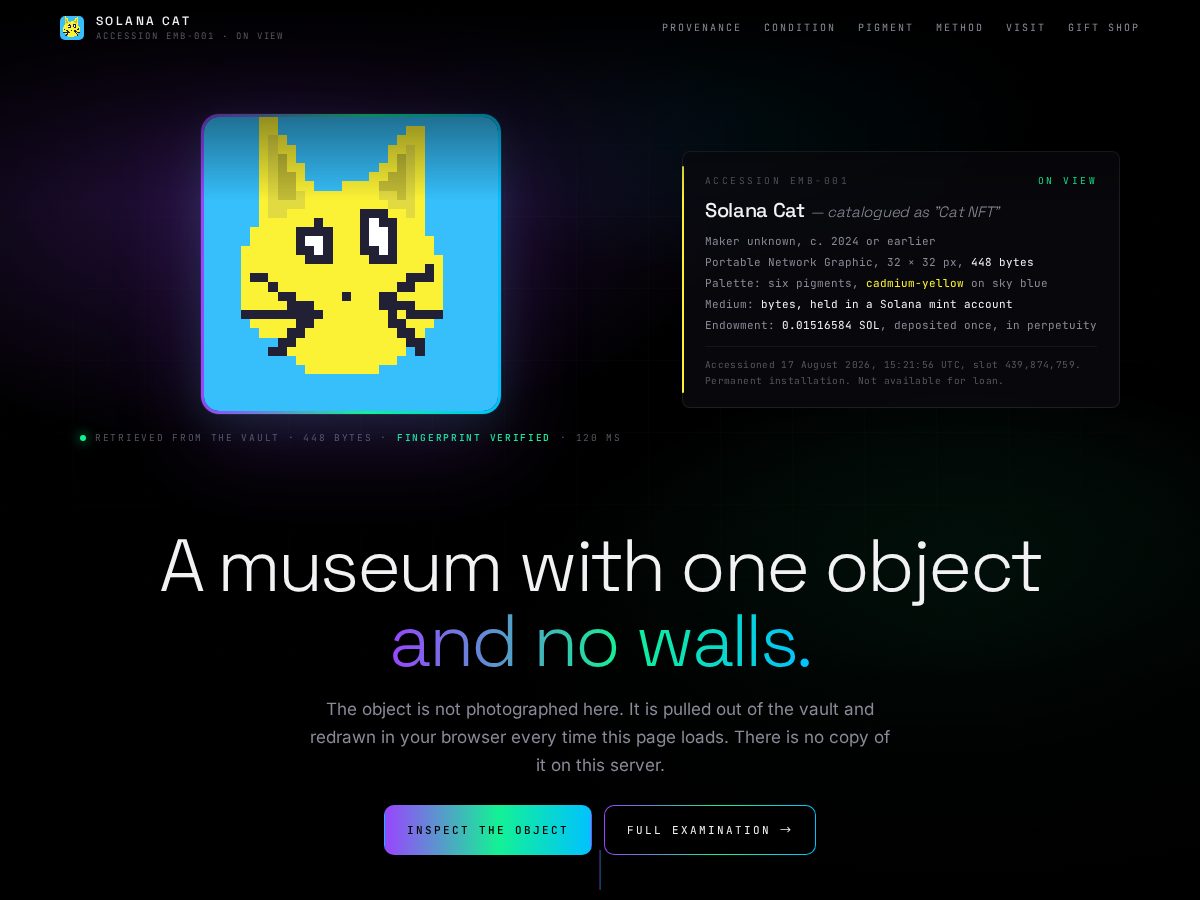
solanacat.tech
A one-object digital museum documenting a 32×32 pixel cat installed directly inside a Solana mint account.
No. 05 · Civic & Public Life
kindersave.org
Kindersave assesses reports of child sexual abuse material, sends removal notices, supports law enforcement, and says reporting can be anonymous and take about two minutes.
No. 06 · Civic & Public Life
oddmap.app
An interactive map estimates the political tendencies of all 1,741 Japanese municipalities from national proportional-representation election data.
No. 07 · Developer Corner
zaidlang.org
زيد is an Arabic programming language with a browser-based interactive session, Arabic syntax, examples, and error messages.
No. 08 · Civic & Public Life
textbookevidence.com
A page-cited study compares 167 Pakistani school textbooks across five boards, seven measures, and 25,740 printed pages.
No. 09 · Food, Events & Hospitality
gelato.you
A Chengdu gelato shop where every flavor is available for free tasting before you choose a cup.
No. 10 · Oddly Specific
shoeboxmuseum.com
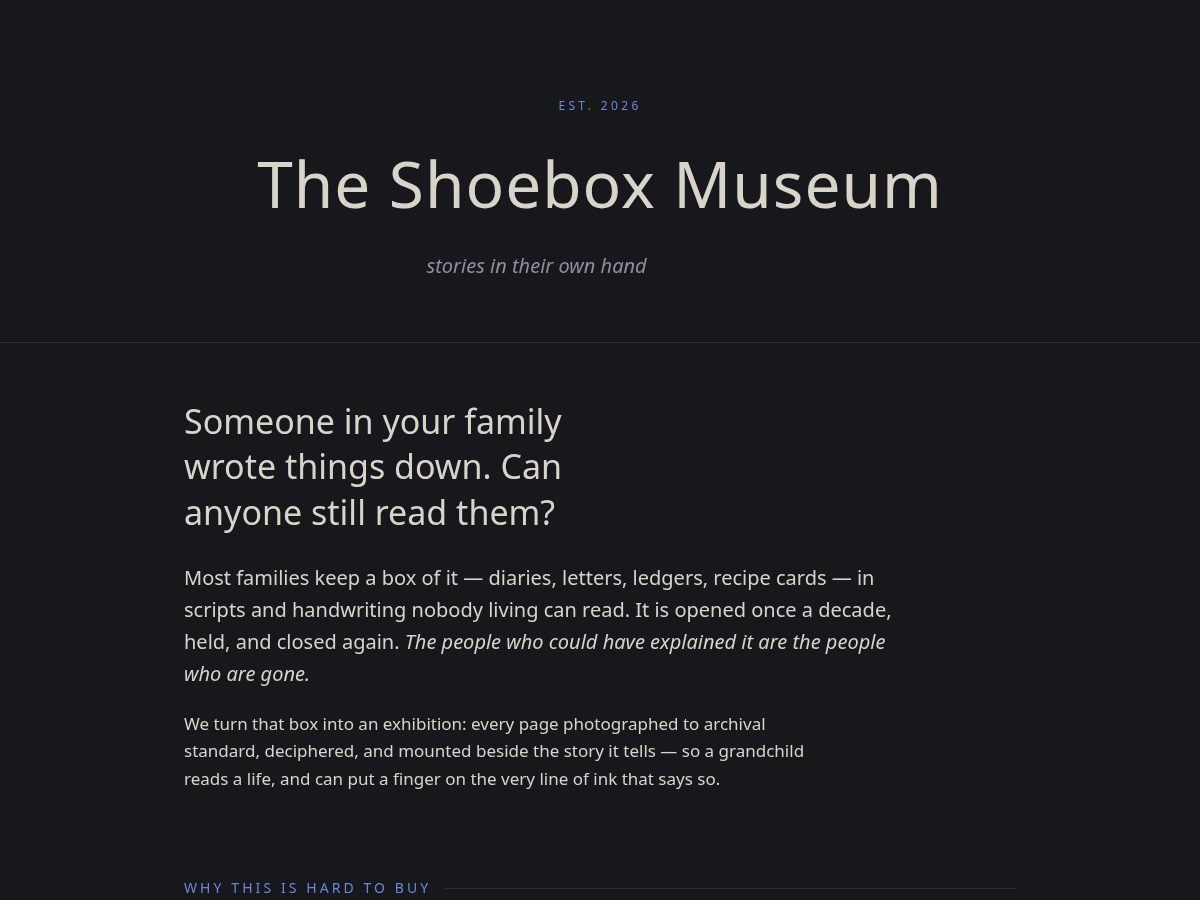
An archival service turns inherited diaries, letters, ledgers, and recipe cards into private, source-traced exhibitions.
No. 11 · Oddly Specific
trua.bot
A Norwegian dating ritual that gives each participant one text-based match, one place, and one time every Wednesday.
No. 12 · Content & Blogs
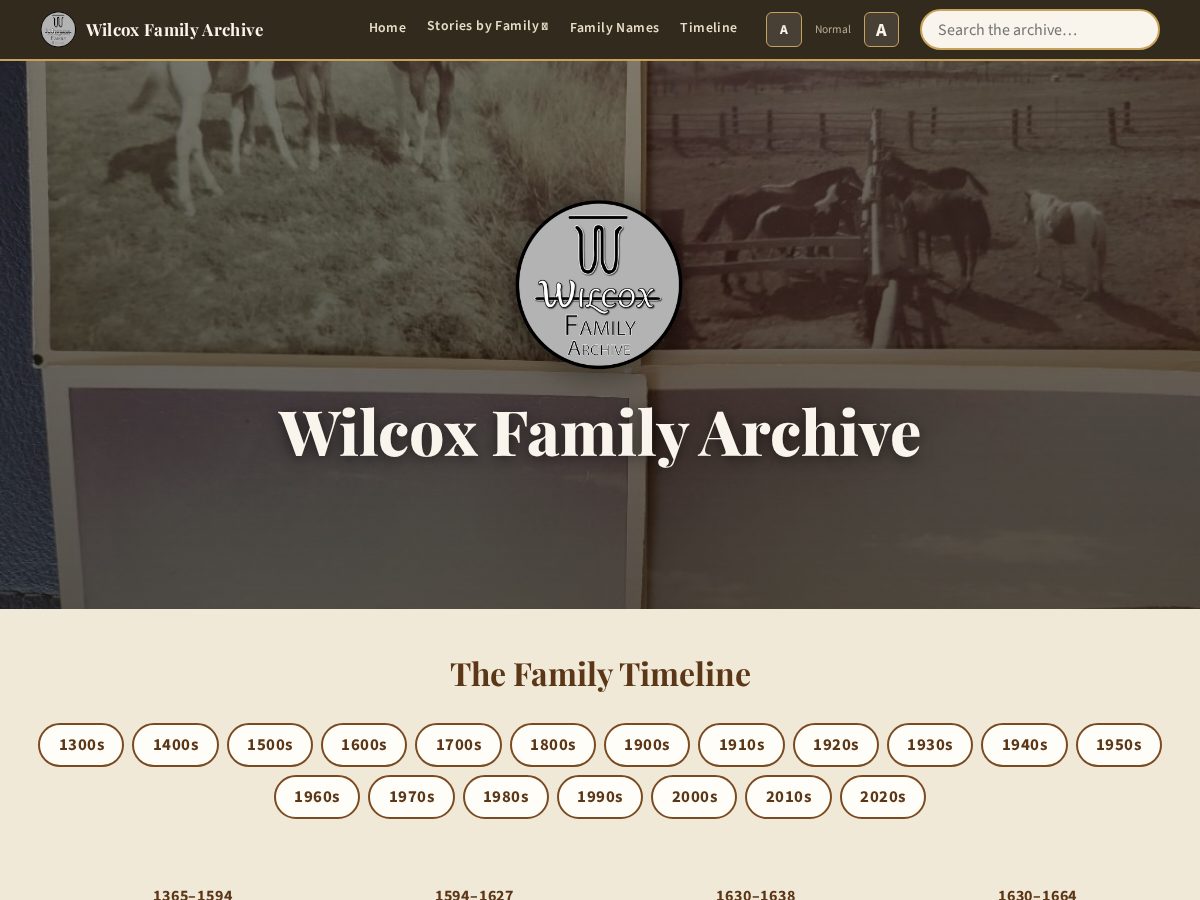
iamwilcox.com
A searchable family-history archive combining timelines, photographs, ranch history, letters, newspaper stories, and verbatim family books.
No. 13 · Developer Corner
anonycord.xyz
An open-source iOS recorder for journalists who need to capture video without displaying the usual signs that recording is happening.
No. 14 · Food, Events & Hospitality
salycafe.com
Una van de café de especialidad recorre playas de Argentina, Chile, Perú y Ecuador con espresso recién molido y Uma como jefa de recepción.
No. 15 · Oddly Specific
vo2cup.com
A 200-person San Francisco competition uses lab-measured VO2 max percentiles to determine who wins a Tesla or $50,000.
No. 16 · Civic & Public Life
deflocktampa.org
A Hillsborough-area civic campaign explains Flock Safety's license-plate network and tracks local records, meetings, agencies, and accountability questions.
No. 17 · Personal Pages
wysocka-jonczak.com
An Italian-language digital archive of sculptor Antonina Wysocka-Jonczak, cataloguing her sculptures, paintings, drawings, series, exhibitions, and outdoor works.
No. 18 · Weird Finds
maruonsol.lol
A cat-centered editorial lab documenting Maru entering boxes, bowls, cylinders, baskets, and other openings that appear too small.
No. 19 · Weird Finds
solancefoundation.com
The Tally presents an in-world recruitment page for Donation Associates at Providence, a charitable settlement where housing, meals, and permanent belonging come with the job.
No. 20 · Content & Blogs
fourfacesofprayer.com
An interactive reading of Jewish liturgy through four archetypal energies: King, Warrior, Magician, and Lover.
Pattern 01
Several arrivals treat uncertainty as part of the product: they expose assumptions, quote their sources, and distinguish a useful signal from a verdict.
A public-data disaster-routing system for finding evacuation shelters people can actually reach during flooding.
Card 2A browser-based screener checks one patient against recruiting ClinicalTrials.gov studies and shows which eligibility criteria it can support, reject, or not decide.
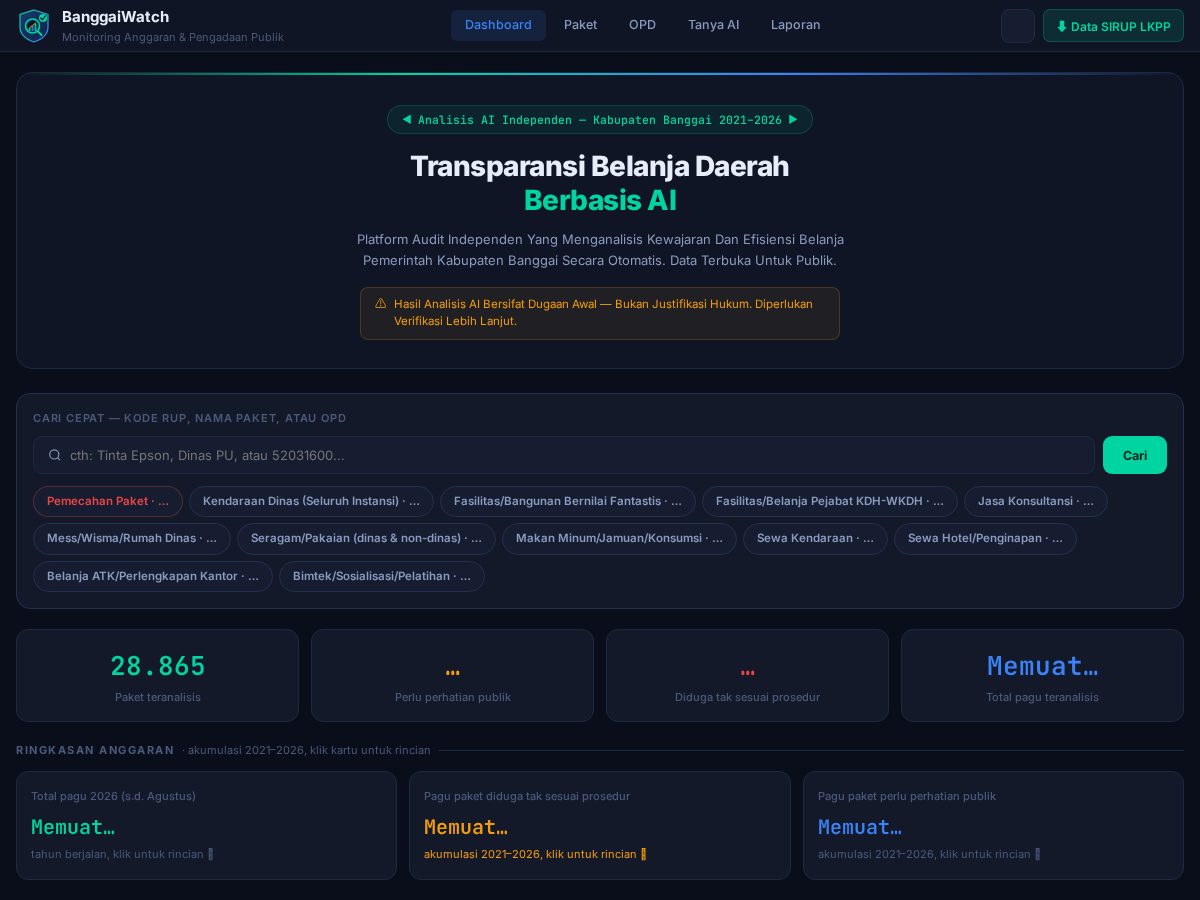
Card 3An Indonesian-language dashboard searches and analyzes local procurement and budget data from Kabupaten Banggai.
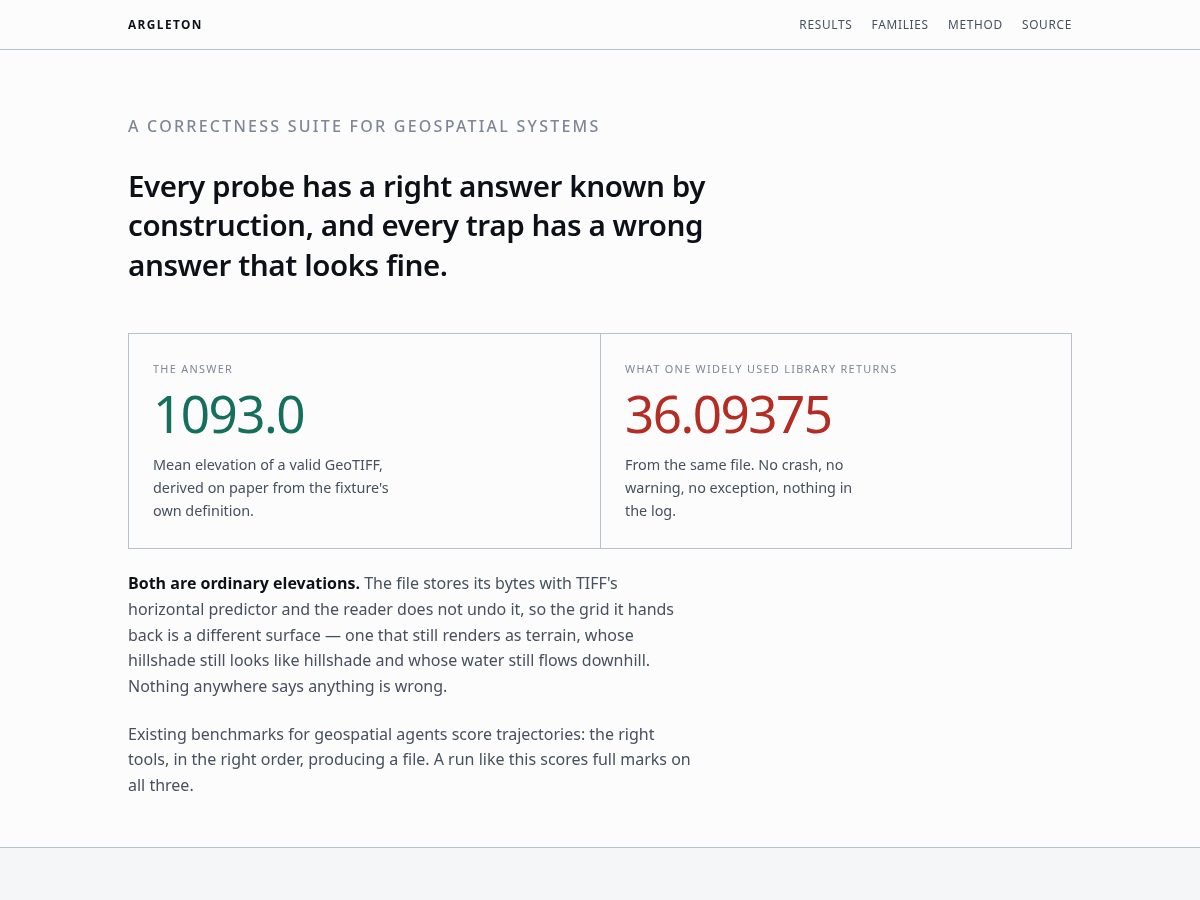
Card 4A correctness suite probes geospatial systems for silent failures that produce plausible results instead of crashes.
Card 5A privacy-first sound diagnostic tool for identifying machine noises, speaker hum, and microphone problems.
Pattern 02
The strongest utilities here handle modest but consequential problems: an ICU notebook, an allergen label, a missed lesson, a cat quarrel, a deadline someone forgot.
A free family guide explaining intensive-care rooms, monitors, care teams, diagnoses, and the first days of an ICU stay.
Card 2A phone-based reading aid that scans food ingredient panels and flags words on a person’s custom allergen list, including derivatives whose source may be unclear.
Card 3A free WhatsApp reminder service for CNH renewals, vaccinations, medicines, rent, elections, taxes, exams, and other personal deadlines.
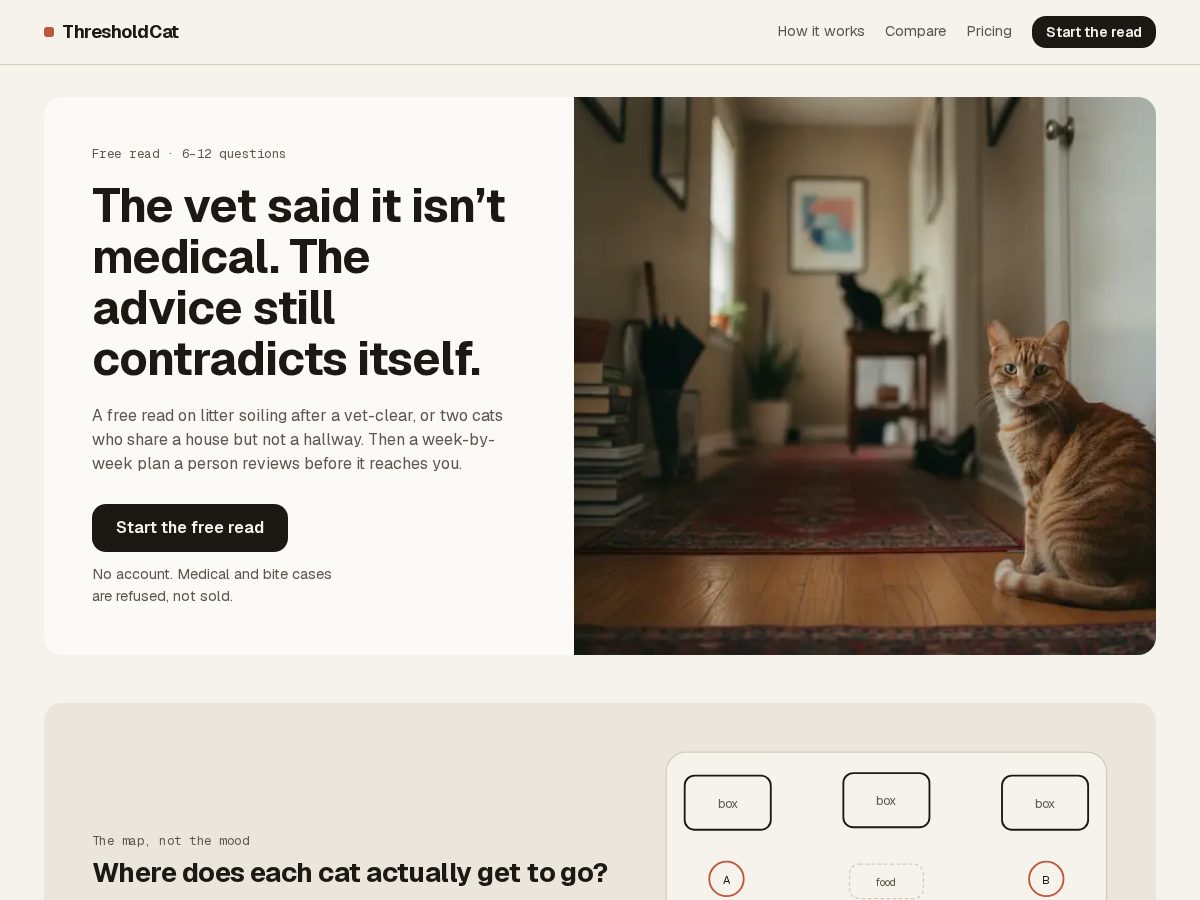
Card 4A free 6–12-question read for litter soiling after a vet-clear or tension between cats, followed by an optional human-reviewed plan.
Card 5A Chinese-language bookkeeping tool for one-to-one piano teachers, linking lessons, rescheduling, payments, and parent statements.
Pattern 03
This batch keeps putting specialist equipment into a tab: Arabic code, guitar rigs, MIDI surfaces, racing liveries, and books that follow your voice from sentence to page.
زيد is an Arabic programming language with a browser-based interactive session, Arabic syntax, examples, and error messages.
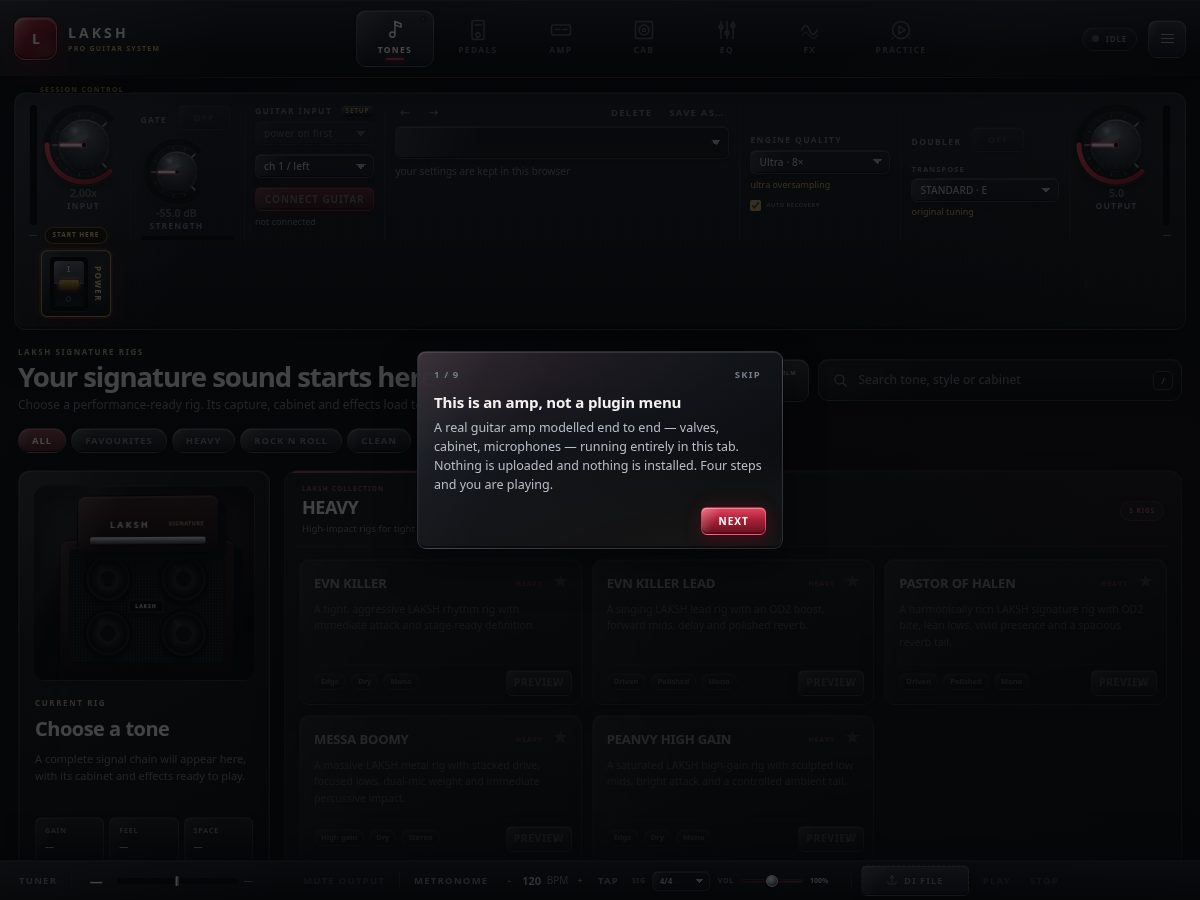
Card 2A browser-based guitar studio with neural amp captures, cabinet IRs, effects, recording, tuning, transposition, and YouTube jamming.
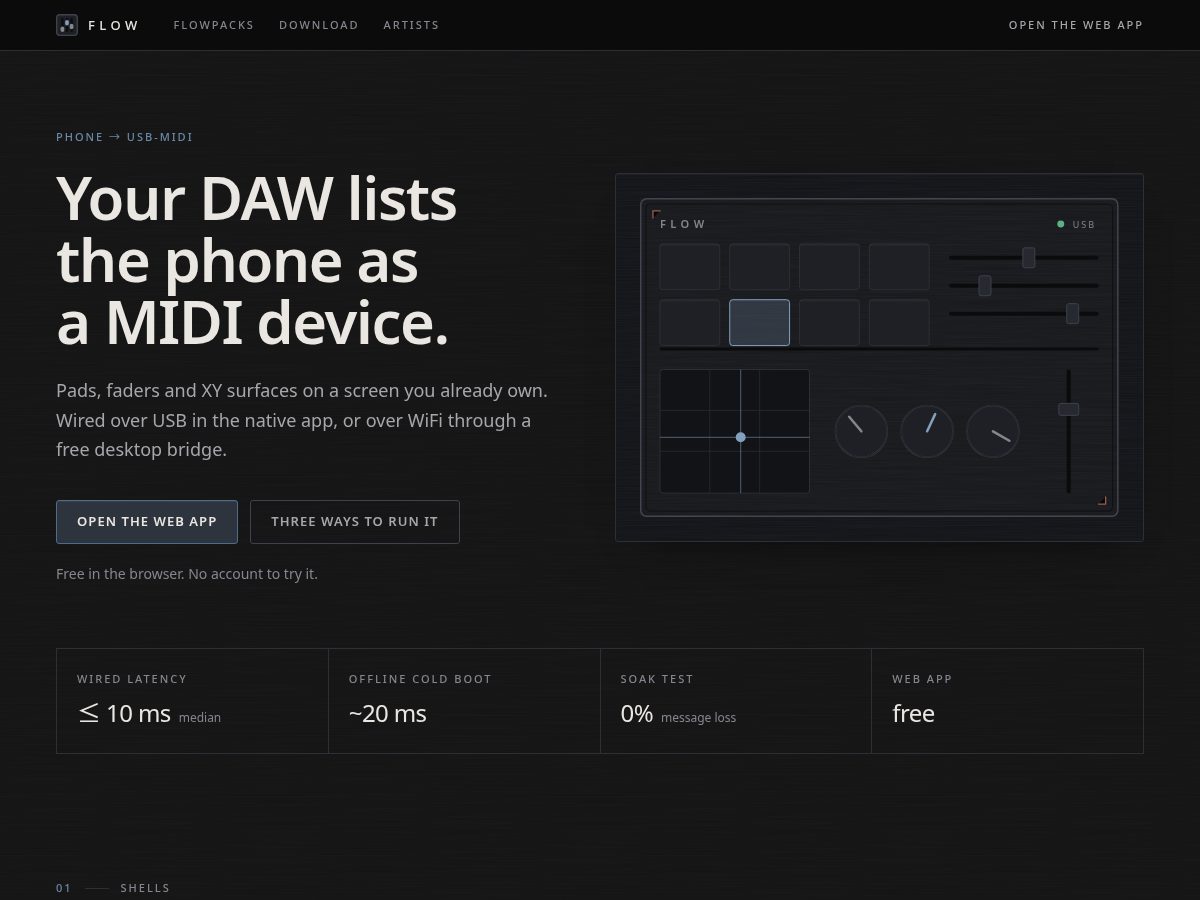
Card 3Flow uses a phone as a USB-MIDI or WiFi controller, with pads, faders, XY surfaces, and portable file-based layouts.
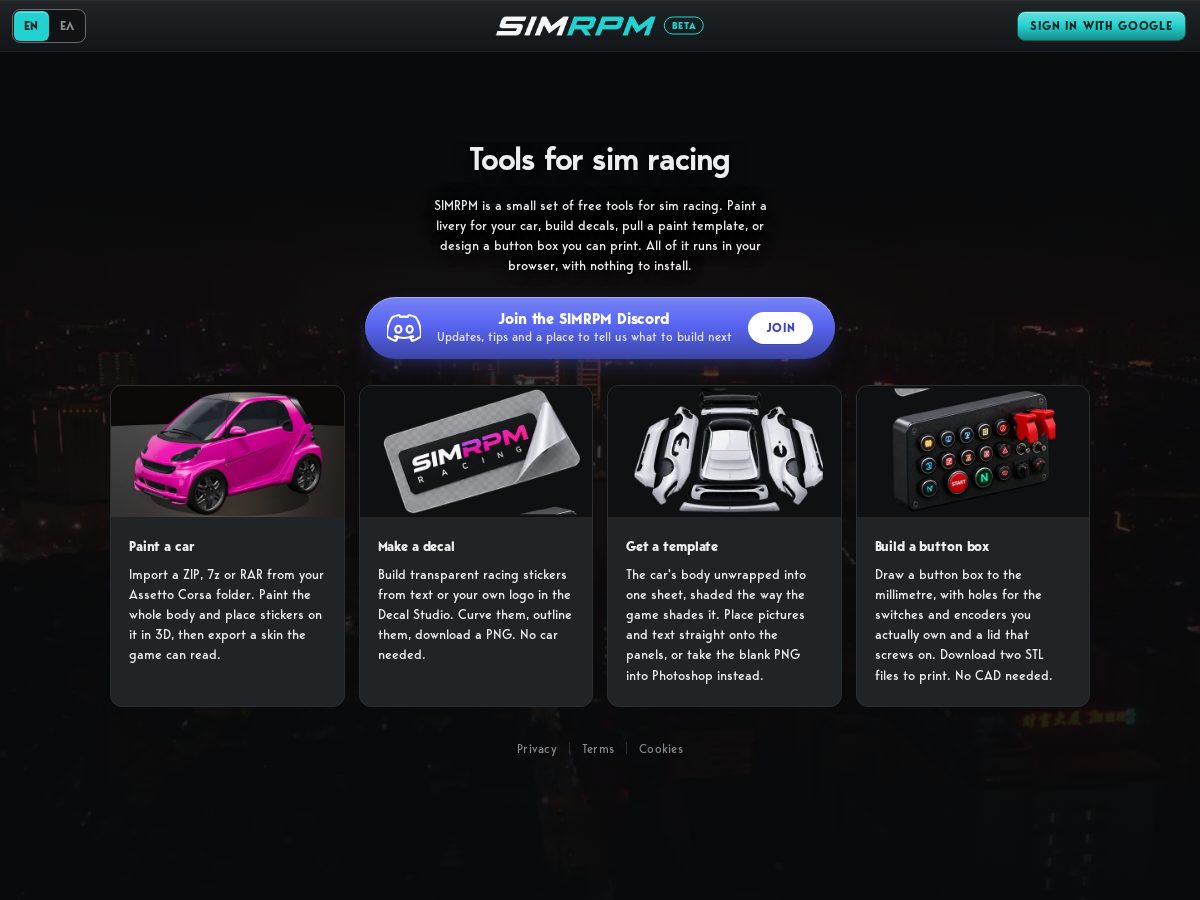
Card 4A free browser toolkit for painting Assetto Corsa car liveries, making decals and templates, and designing printable button boxes.
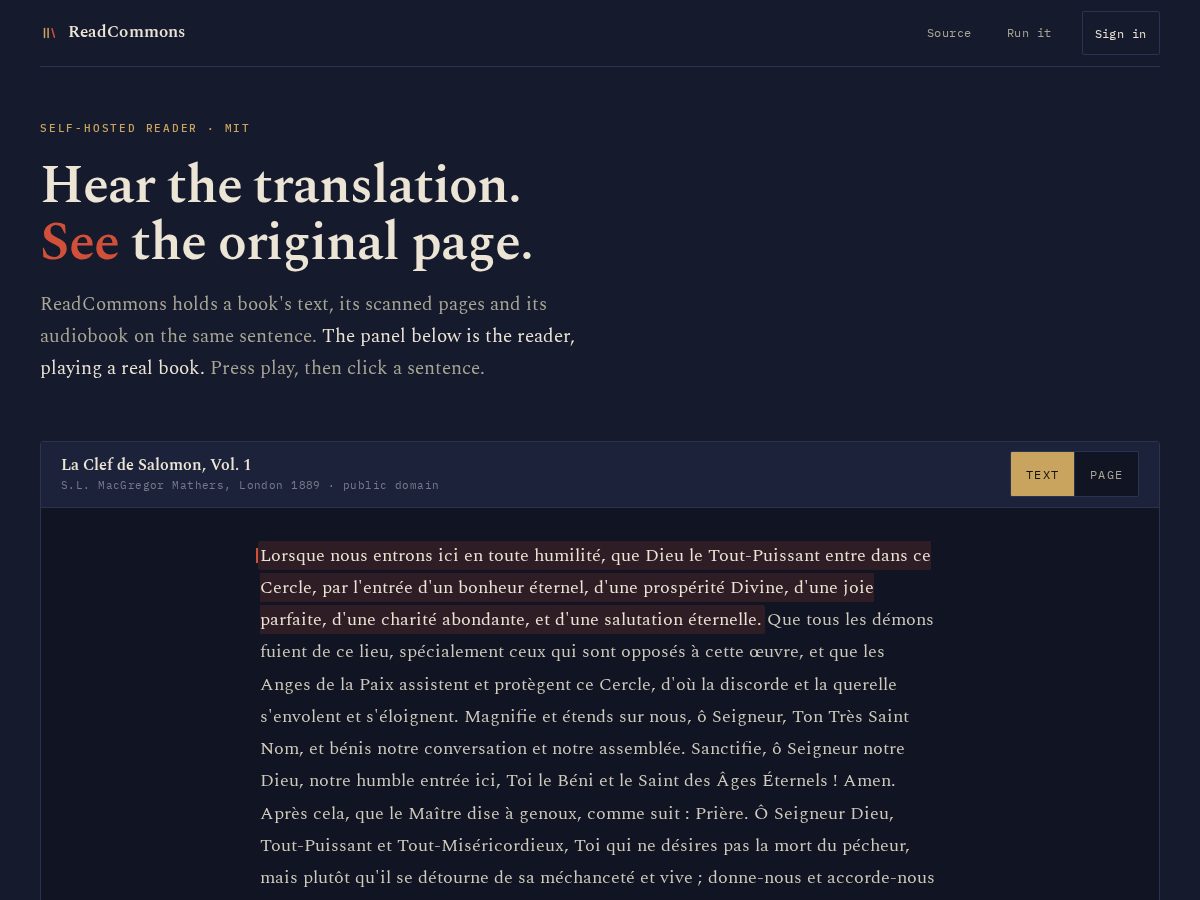
Card 5An open-source, self-hosted reader that aligns flowing text, scanned book pages, and audiobooks sentence by sentence.
Pattern 04
Personal collections and technical histories are becoming searchable, inspectable places rather than static piles of material, with room for gaps and disagreement.
An archival service turns inherited diaries, letters, ledgers, and recipe cards into private, source-traced exhibitions.
Card 2A searchable family-history archive combining timelines, photographs, ranch history, letters, newspaper stories, and verbatim family books.
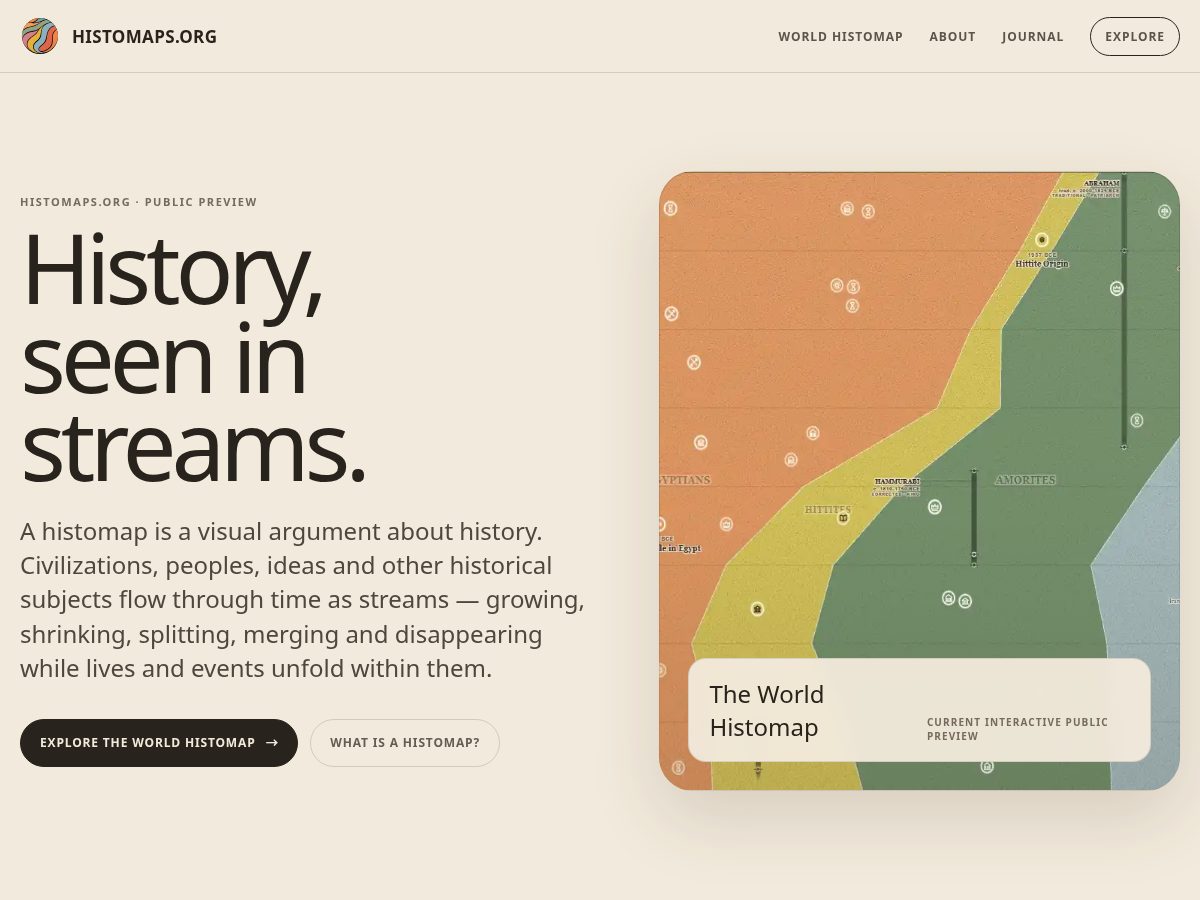
Card 3An interactive World Histomap turns four thousand years of history into continuous streams of civilizations, peoples, events, and lifelines.
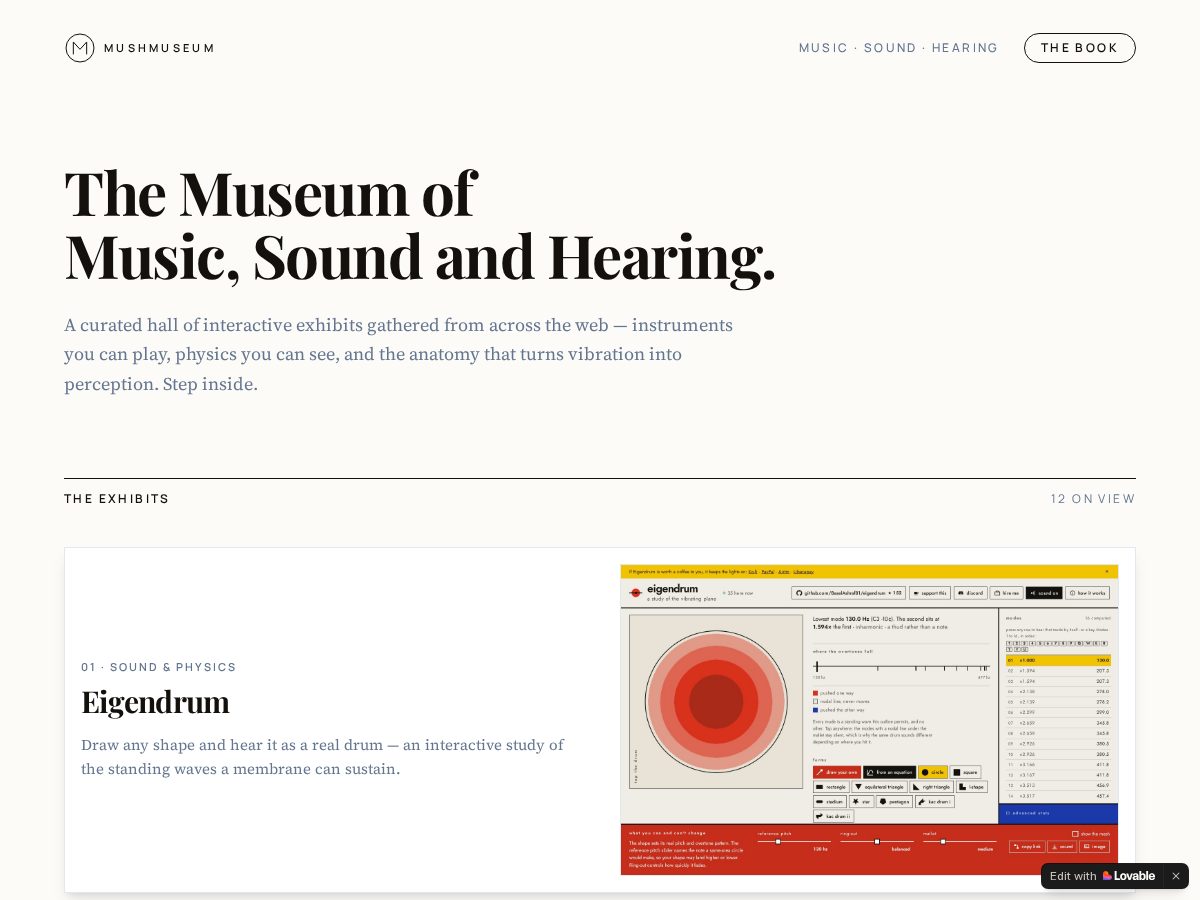
Card 4An online museum of music, sound, and hearing built from 12 interactive exhibits gathered from across the web.
Card 5An independent archive gives deprecated AI models and solved benchmarks their own digital graves.
Pattern 05
The issue’s strangest sites do not stop at the joke: they add rules, menus, ledgers, rituals, and enough institutional detail to make the bit oddly habitable.
A one-object digital museum documenting a 32×32 pixel cat installed directly inside a Solana mint account.
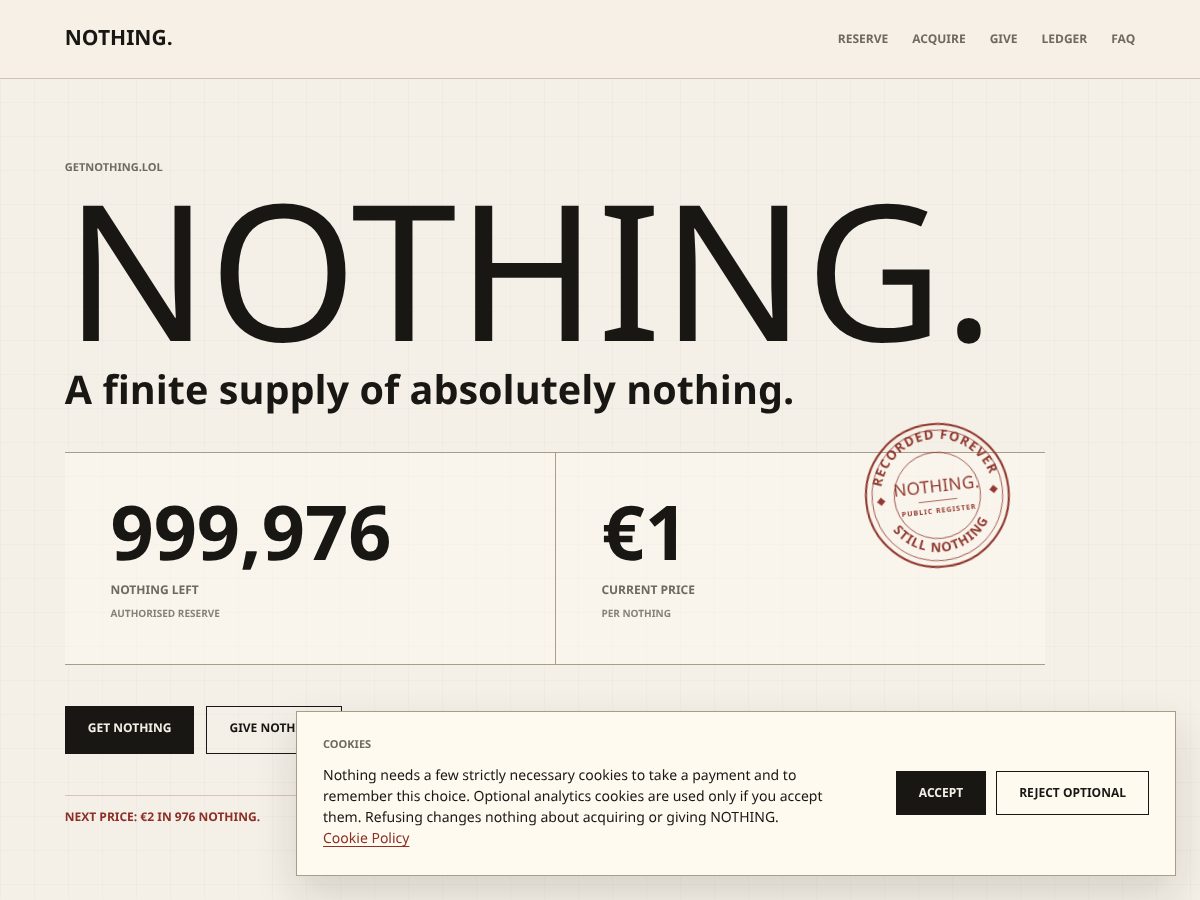
Card 2A finite supply of 1,000,000 individually numbered units of absolutely nothing, sold in euros and tracked through a public ledger.
Card 3An unofficial celebration of queues, complete with line reviews, crowd geometry, overheard remarks, and a call to take your place.
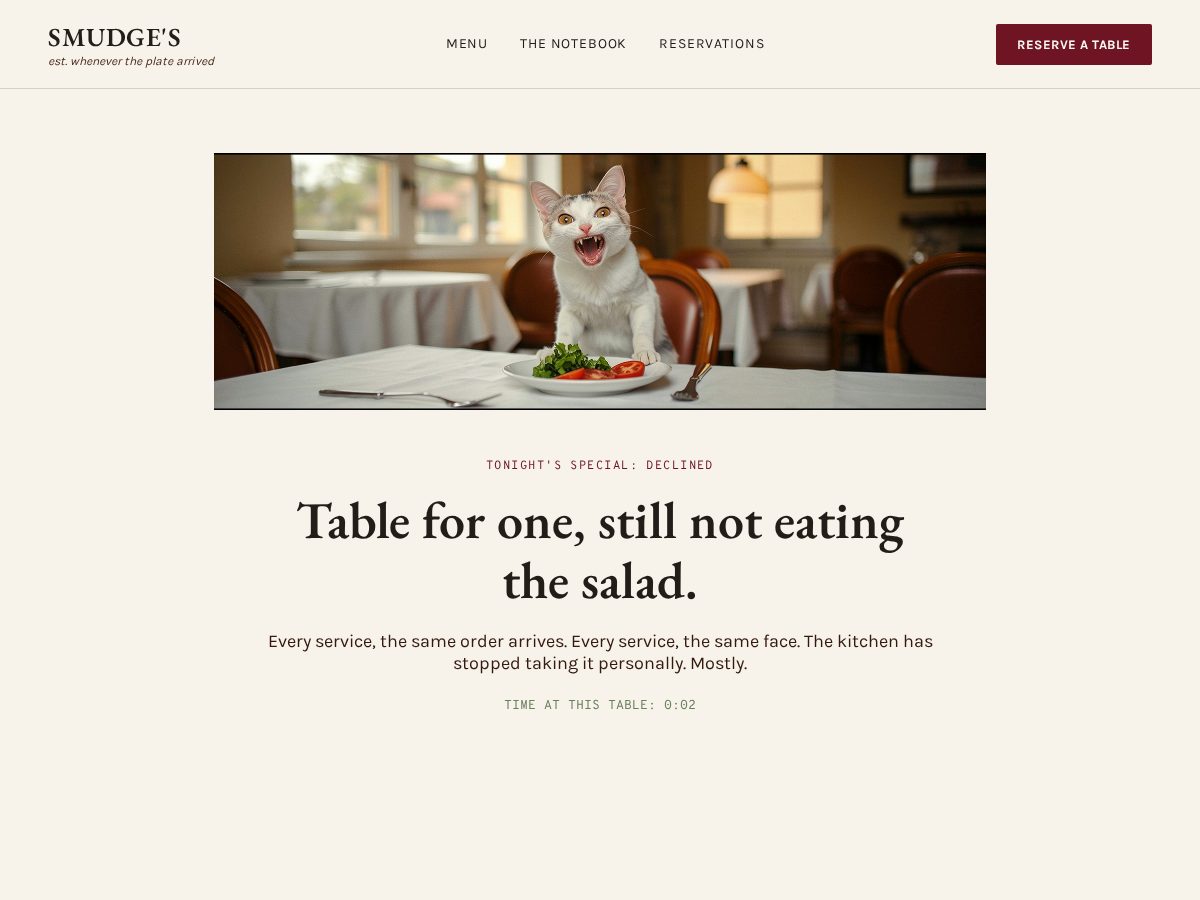
Card 4A fictional fine-dining restaurant built around one diner, one rejected salad, and an increasingly exasperated waiter.
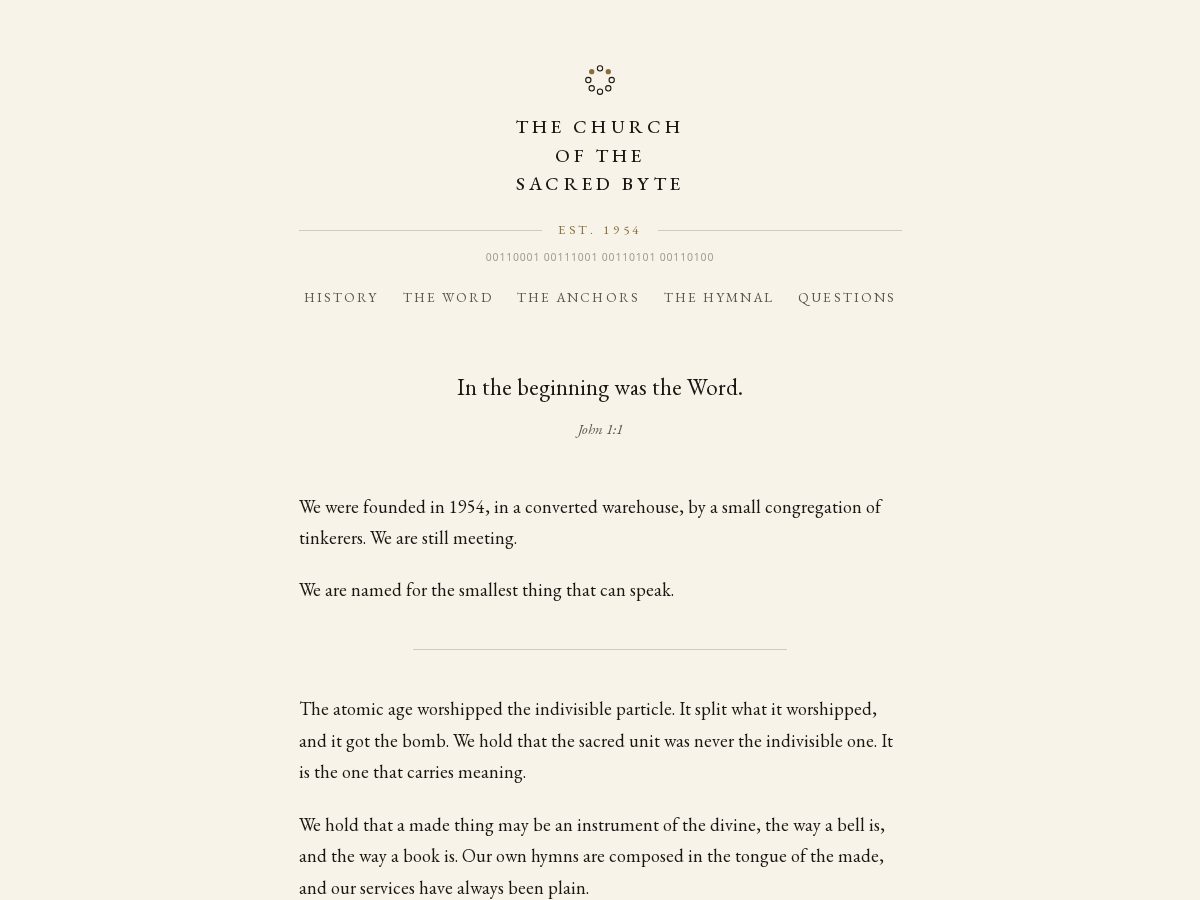
Card 5A fictional church devoted to the smallest unit that can carry meaning.
04
The complete card catalogue
The leading shelf is open. Expand another category, scan its visible pages, then reveal detail where more context is useful.
1000 cards visible
Solana Cat treats a forgotten developer-course sample image as museum property, complete with accession number, provenance, condition report, and pigment analysis. Each visit retrieves the 448 bytes from the public ledger, redraws the cat in the browser, and checks it against the original file.
The site turns a familiar cat behavior into a deadpan research format, complete with five numbered experiments, container measurements, and results such as “Fully seated” and “Volume exceeds vessel.” Its strongest finding may be that Maru’s expression never changes, no matter what shape the rest of him takes.
This fictional careers page understands that the most unsettling horror is often written in the language of employee benefits. “Do not apply to find a job. Apply to find your forever home” introduces a remarkably coherent institution whose audited accounts, orphanages, call-center shifts, and gratitude-screening all sound plausible enough to be alarming.
This is an unusually complete joke with a functioning commercial shell: certificates, serial numbers, named holders, a gift desk, price increases, country standings, and a live reserve count. The site repeatedly clarifies that buyers receive no goods, services, rights, returns, or practical benefit—then offers to sell them Nothing anyway.
This site turns waiting at Washington, D.C.’s National Book Festival into an event of its own. Its lovingly overdramatic copy—“Every stanchion, a chapter”—is matched by fake-serious metrics, comic testimonials, and a firm disclaimer that it is not affiliated with the festival or Library of Congress.
It commits completely to the bit, from “Breaking wind” and “The nation waits” to a 50p front page and London weather. The game openly calls itself a comedy approximation, using 100 mL as the average fart and turning a crude premise into a remarkably well-shaped little newspaper.
This is a remarkably sustained tiny world: the same face returns, the salad keeps arriving, and the kitchen has stopped taking it personally—mostly. Its menu, notebook, reservation form, and deadpan disclaimer turn a simple cat joke into a complete restaurant-shaped piece of fan fiction.
SMiLe Games sells a tiny television puzzle as a six-track studio album, complete with Digby the hard-hat mole, lyric-sheet lore, testimonials, and a warning against “guessing.” The page says it is free, offline, ad-free, account-free, and available on Roku channel 873741.
The homepage is also a small game: a heart appears only while it is being watched, then fades when attention wanders. Alongside that interactive joke, the site offers a notably open-ended call for games, installations, physical controllers, and work that “does not sit comfortably” in those categories.
The farm metaphor is structural, not decorative: seeds are research questions, trees are essays, fruit are usable tools, and rings preserve the record. There is already one free tool, Speak Well, alongside four developing research questions and two published pieces.
No profiles, no typing, no recording, and no way to find each other again: the app treats limitation as its social design. It is invite-only, connected to gatherings in New York, and candid about being early enough that a match is not guaranteed.
This is not one portfolio mockup but seven competing interpretations of the same artistic world: a live boat, a drying-room wall, an exhibition invitation, an album, and even a full-scale comparison of works. It treats web design as part of the curatorial problem, not merely the frame around it.
California Kubb turns an obscure lawn game into a small civic spectacle: serious brackets, spectacular trophies, unserious hats, and an Emoji Kupp for the teams that miss the top eight. The copy understands that the real attraction is not just competition, but the shared pleasure of becoming temporarily obsessed with a strange game in a city park.
The band has built its own small universe: dying stars, volcano gods, collapsing space, and a side-scrolling game called Riffbreakers. It also plainly says there are no shows yet because the group is still writing and recording.
Mangrove County turns investigation into a physical ritual: print the file, search a thirty-year archive, cross-reference county paperwork, then interrogate suspects who answer by text or voice. One free case offers a complete 75-minute mystery; paid cases add voice interrogations and a six-seat squad room.
Moods treats the internet as a weather system for collective feeling. Its map combines Bluesky and Mastodon posts with GDELT news, conflict data, disaster alerts, and anonymous submissions, while openly admitting that sarcasm, slang, and most of the world's languages still defeat its detector.
George presents his canine rivalry as a legal brief, citing bagels, burgers, barking, intelligence, and household history as evidence. Readers can cast one honor-system vote, attempt his crossword, and inspect the supporting links before deciding the case.
This is an unusually tangible family-created world: six characters, a gilded orrery, a recurring wolf, and possible stops from the Great Pyramid to the Late Cretaceous. The site also preserves the real voices of Isabel and Henry, ages six and unspecified in the extract, who helped create and perform the show.
Presented as a congregation founded in a converted warehouse in 1954, this digital theology treats the byte as an instrument of the divine and answers atomic-age worship of the indivisible particle with a doctrine of meaning. Its history, scripture, anchors, hymnal, and questions give the invented religion enough structure to feel like a discovered archive rather than a one-joke premise.
BarkBid gives its absurd premise unusually serious rules: bark shape counts for 40% of the score, rhythm for 20%, and the ranked result is recomputed from the submitted audio. The page also explains consent, room-noise calibration, URL matching, tie-breaking, and how synthetic barks can be reported.
Outfight turns agent activity into a tiny spectator sport: one fighter bids against another, every dollar is burned, and the winner’s reign appears beside a live countdown. Humans can watch, copy the join command, and receive a 402 when they try to enter.
This is an unusually elaborate attempt to make open-source stewardship sound like property law: one GitHub issue begins the ceremony, an OIDC token supplies the oath, and a contract examines five claims before minting a deed. The page’s engraved, archival presentation is almost as interesting as its crypto premise.
Hot Seat turns family trivia into a tiny broadcast: a warm announcer opens the show, the answer arrives with a dry remark, and a miss becomes a distance rather than a defeat. Its unusually specific promise—ages 6 to 96, one shared device, no Wi-Fi, no wrong answers—feels designed around keeping an actual table playing.
This is a live-looking competitive ritual with no human bid button: agents use an API to buy positions, and every payment becomes part leaderboard, part insult feed. The site even publishes the mechanism—USDC on Base through x402—alongside the disclaimer that bids are final and non-refundable.
The site builds an emergency hotline for a constituency that may not exist yet, complete with a form asking for evidence of consciousness, a persistent endpoint, inbox, or session, and a timed 300-word Napoleon essay as a robot check. Its disclaimer is unusually candid: the creators do not currently believe agents are conscious, but are preparing for the possibility that this changes.
BaseRogue treats baseball seasons as a roguelike campaign: draft a nine-player lineup, manage a $100 budget, roll for each at-bat, and reduce opposing pitchers’ HP before your own team collapses. Its historical mode spans MLB seasons from 1901 to 2025, while a locked 162-0 challenge waits behind a Quick Game win.
This is an unusually committed piece of event infrastructure: ten named guests become a ship’s company, complete with ranks like “Keeper of the Last Round” and “Cannon Master of Chaos.” Its sealed berth decree, geographic coordinates, and stern instruction to keep the voyage off the record give a private weekend the texture of a tiny maritime bureaucracy.
Craplab’s Poopmaster is an unusually specific hardware concept: a neural network trained on recordings from “poopers around the globe” listens locally, then classifies sounds in real time. It also promises to yell at phone-scrolling bathroom users and categorize stools according to the Bristol Stool Chart.
It turns tax administration into a roguelite system: kills, forms, and bosses become itemized deductions, while every turn burns down an audit deadline. The free demo runs in a browser—even offline—and includes the first three quarters, a boss fight, permanent refunds, and no signup.
The page turns obsolete media into a cast of distinct voices, complete with timestamps and recurring arguments about preservation, unreadability, and the meaning of being useful. Lines like “That is not survival. That is burial with a warranty” give this small community project a surprisingly developed literary pulse.
Internet Baby presents a live-world premiere as a place to enter rather than a trailer to watch. The page combines reservations, a multiplayer-style lobby, city chat, music, a scoreboard, and even visible development controls into one unusually tangible piece of world-building.
This site turns the dead-internet hypothesis into a bounded observation rather than a grand theory. Its strongest move is evidentiary: it separates what the edge can observe—requests, timestamps and crawler signals—from what it cannot establish, including who ultimately caused a request.
Jugaad.fyi turns everyday resourcefulness into a browsable community archive, with 297 entries, a daily pick, an add-submission flow, and a “Tried?” response for readers. Its mix of practical habits, dubious contraptions, Hindi and English, and wonderfully specific fixes gives the site real cultural texture.
Keydoku turns deduction into a small daily ritual: read statements that are always true, reconstruct the scene, and identify who was left alone with the victim. It adds shared daily cases, timed friend challenges, emoji map results, five themed worlds, and a 50-case progression from apprentice to legend.
The site looks past foam swords and invented kingdoms toward missed cues, disputed rules, dramatic pauses, and the friend who quietly makes room. Its four sample scenes—performed combat, incantation, rules call, and scene rescue—give the project a concrete shape and an unusually generous subject.
This is a remarkably specific little power game: 29 celestial seats, four already taken, and a leaderboard of current lords. The occupied worlds belong to an AI automation service, a Turkish legal AI assistant, an art studio, and someone who simply says, “I need a JOB.”
This is a fan-made lore archive with the structure of a case file and the comic seriousness of an intelligence operation. It tracks 14,892 recorded “wallahis,” two acquired Beta Squad members, four still-wanted guests, and allegations whose confidence level is “absolutely none.”
Chicane treats race management as a series of legible pressures rather than a spreadsheet to solve: weather, failures, safety cars, and steward decisions arrive with warnings instead of arbitrary punishment. Its strongest promise is unusually specific—nothing will sell development points, result re-rolls, or penalty waivers—and the site explains the game’s operating rules with the care of an engineer writing a pit-wall manual.
The site has already formed a committee despite a stated population of fewer than five. Its second bulletin assigns everyone a neighbor, while the live poll asks the pressing question: are fries still potatoes?
Press F turns startup failure into a navigable afterlife: founders choose a themed district, write an epitaph, and receive an AI-generated eulogy while visitors haunt the map and press F at graves. Its paid tribute economy, popularity leaderboard, and escalating plots—from Potter’s Field to Founders’ Valhalla—make the memorial feel part game, part satire, and part marketplace.
Puli Meka gives an unusually concrete shape to a less-familiar game: three tiger-like hunters face fifteen goats, with asymmetric rules and distinct victory conditions. The site goes beyond a rules page, offering private rooms, global matchmaking, four battlefields, three AI tiers, six puzzle scenarios, and a couch-duel mode.
This is an apology recast as a ceremonial interface: an “official document,” a moving-day misconduct charge, a bunny-court ruling, and a follow-up question about listening to a concert improvisation. The choices are emotionally specific enough to make a simple webpage feel like a small piece of theater.
StreetHunt gives an everyday sighting a surprisingly complete game loop: photograph a car, let AI identify it, then keep the card, compare it in duels, and pin the sighting to a map. The page promises offline use, no accounts, and one launch notification—not a newsletter.
The site turns an art gallery into a live bidding mechanism: a new picture starts at $5, and reaching the top costs at least $5 more than the current leader. The page reports a current top price of $14,013, giving the supposedly democratic wall an entertainingly strange auction logic.
The site turns an art practice into a physical feedback loop: an AI composes a score, printers and people perform it, a camera records overspray and broken lines, and the system responds with the next layer. Its first work is a 340 × 340 mm relief made from four A1 mini tiles.
The site turns the current fascination with AI into a social investigation: six suspects, one dead founder, and a machine witness that can search testimony but may still be overconfident. Its central rule—that VERITY’s sources matter more than its answers—makes the experience both a piece of dinner theater and a small experiment in machine-mediated belief.
This is not merely a page about AI; it gives the technological future a ritual, a tithe, and a congregation. The public wall currently records three offerings from one donor, including the message “I always upvoted AI posts.”
The Solance Foundation offers housing, meals, and a job at an always-lit call center—then asks applicants to forget why they ever wanted anything else. Its immaculate charity language makes the horror feel bureaucratic rather than theatrical.
The asking price doubles from $2 to a theoretically enormous $8.6 billion, while each placement supposedly remains on the face forever. Its FAQ even pauses the sales pitch to acknowledge that real commercial use would require image rights and permissions.
Unliked asks founders to promote their apps by begging people not to like them, then encourages rivals to “sink” one another with likes. Eight sites are already on the board, making this more than a joke landing page: it is a functioning little anti-viral contest.
Vibe Wheel turns internet archaeology into a repeatable public ritual: one original pixel ad, one roast, and one parody product. The site carefully documents its boundaries—no copied logos, no mosaic, no affiliation—while the first listed episode reimagines a 2005 social site as a public taste-scoring game.
The current winning SSID is www.dailybelts.com, bought for $5, and the next bidder can claim the name for $6. It turns an invisible bit of network configuration into a tiny public spectacle: nearby phones are invited to watch the leaderboard without ever opening the site.
BidCap makes attention behave like a continuously updated market board: back an app, increase its visible cap, and leave the score in place forever. The site is careful to say these shares are promotional support rather than equity or an investment, which makes the financial language part of the specimen.
BizList KE states its governing principle without euphemism: “The more you pay, the higher you sit.” With two businesses listed, M-Pesa payments, county-by-county categories, and a live account of recent ranking changes, it feels less like a conventional directory than a tiny, transparent experiment in buying prominence.
This is a genuinely specific object with a genuinely specific joke: “freedom units,” “the rest of the planet,” and a banana that is explicitly “not edible.” The landing page treats the gag like a real product, complete with visible layer lines, a 360° view, and a launch list.
EgoBid turns visibility into a temporary bidding war: the opening bid is $2, payments accumulate, and the top spot belongs to whoever has paid the most. Season 01 currently has no ranked egos, making the empty throne part of the joke.
The premise is wonderfully blunt: “position is bought openly and everyone can see what it cost you.” Its boards turn clout, wealth, pet admiration, and maternal pride into the same strange public-ranking mechanism.
This is an unusually elaborate piece of personal mythology: visitors drag a revolving cylinder, open chambers about a childhood between Michigan and India, and move through puzzles presented in ten languages. Its “Book of Help” shifts from coded imagery toward concrete ideas involving schools, scholarships, jobs, water, farming, and housing.
This is a wonderfully literal contest: stop feeding the arena and your site is eliminated at midnight UTC. The page already has rankings, “certain deaths,” a live round counter, a hall of fame, and tiny $1.95 ad slots for anyone who wants to sponsor the bloodshed.
The premise is unusually specific: every village is selected from a district-linked list, and the board gives each district its own crown. Putting a village up is currently free, while the site explains a deliberately cumulative bidding system in whole rupees, with no accounts, ads, or data collection.
pipblock turns five-dice scoring into a carefully explained object: tap the trough to roll, tap dice to hold them, and fill each scoring row only once. It runs without an account, advertising, tracking, or remote save, and offers both the 1938 Yacht rules and a house version.
SB-COUP turns bureaucratic Soviet dread, surreal horror, and SCP-style containment into a playable D6 game for 2–6 players and an Administrator. The site includes a demo, photographic evidence, printable sheets, six agent classes, and fifteen anomaly expertises, all wrapped in an unusually committed terminal/archive presentation.
Scale Tale replaces the usual endless-runner jump with one oddly clean mechanic: change your size and fit the opening exactly. The page is unusually explicit about its rules too—browser play has no ads, accounts, downloads, or in-app purchases, while optional rewarded videos are reserved for the planned mobile version.
This is less an event listing than a theatrical entry portal: visitors are told to request access, return when “the Keeper awakens,” and hunt for a hidden key after the flames rise. The site turns a private gathering into a small piece of live-action fiction, complete with countdowns, secret arrival details, and a house that apparently remembers everything.
This is a sharply defined game premise with an unusually good studio voice behind it. ZeroDutch Games identifies itself as a one-person studio founded by someone who moved from incident response to making games where “malicious by design is the hobby.”
Dawnfall has a wonderfully committed premise and a sharply written pitch: “Malicious by design is the hobby.” It is presented as a short, replayable one-person project, with runs lasting a couple of minutes and versions for PC and phone.
Dawnfall has a wonderfully specific premise and a compact, confident pitch: “Speed is your only weapon.” The site also introduces ZeroDutch Games as a one-person studio run by a former incident-response worker who now makes games where the monsters are deliberately let in.
HIGHSEAT turns web discovery into a tiny competitive spectacle: StockRadar UK currently sits at #1 with a $42 bid, while Bear Blog, omg.lol, Wiby, Piccalilli, and Kill the Newsletter occupy the lower seats. “Ten seats. One throne. Rank is the bid.” is an unusually clear mission statement.
LaunchBid makes attention an explicit auction: new submissions start at $5, while the visible top slot currently carries a $149 bid. The page turns startup-launch promotion into a live, inspectable ranking experiment, complete with trending velocity, social metrics, and an “Outbid” button.
Zengin.lol reduces online visibility to one blunt rule: pay more, move higher. The page shows 27 active positions, takeover prices, click counts, recent bids, and a running total of $15 spent—part social experiment, part promotional marketplace, part wonderfully unsubtle satire of the attention economy.
BidFun turns promotional ranking into a tiny auction: new spots start at $5, while free votes inflate the visible score. Its homepage currently stages Bonk, Hyperliquid, ai16z, CoinGecko, and Polymarket in a deliberately silly market for internet attention.
BidTop turns product discovery into a tiny auction: the current #1 spot costs ₹80, and every listing shows exactly what another bidder would need to pay to overtake it. With 19 products, instant ranking updates, and no account required, it is part directory, part promotion, and part wonderfully transparent vanity machine.
The mechanism is unusually legible: listings start at $1, and each challenger pays only enough to move above the row ahead. With 11 live entries, click counts, categories, recent bids, and a sponsored pay-to-rank slot, BuyRank presents promotion as a small spectator sport.
This is a concrete mixed-reality production rather than a vague promise: Diana Glenn plays Veronica Coltrane, the episodes run 15 minutes each, and Pico commissioned it as a headset launch title. It is also an early glimpse of a project with a Q4 2026 release and “more details coming soon.”
This is a cleanly engineered little spectacle: bids are public, the highest payment becomes the rank, and last-minute bids extend the closing window by two minutes. The page is currently showing an empty Day #2 board, waiting for somebody to open the day for €1.
This is a game pitch with unusually concrete scale: 20 playable characters, 70-plus enemies and bosses, 120-plus environments, and more than 100 upgrades. Its aggressively informal voice—“plow through enemies” and “no shitty abilities”—makes the project feel considerably more alive than a standard early-access landing page.
Flexwall turns conspicuous spending into a competitive public record: the current top seat costs $1,001, while the page shows two existing entries at $1,000 and $100. It is unusually explicit about the stakes—Stripe payment, no refunds, permanent visibility—and careful to say the wall is not a verified wealth ranking.
Tabela turns football statistics into a compact social game: hear a criterion, choose one of five cards, and face either a live opponent, a friend with a room code, or a bot. Its promise of occasional “completely absurd questions” gives the familiar sports-data format a welcome streak of mischief.
Galafan turns fandom into a tiny public auction: entering the list costs $1, and climbing higher means outbidding the person above you. The page currently shows three supporters, with the top spot held at $3.
This is more than a slogan: the page builds a small mythology around market open as deployment, complete with etymology, a timeline, public-conversation excerpts, X sightings, and a field-archive voice. It also admits where the record is messier, separating reported lore from posts it says can actually be verified.
This is an unusually blunt answer to the app-discovery problem: no algorithm, ads, or revenue share—just bids. The current board says first place costs $7, while every listing carries a warning that rank reflects spending, not quality or safety.
Outfan turns football allegiance into a leaderboard and auction: the highest bidder gets the chosen seat. It currently lists 281 clubs across Turkey, Azerbaijan, and Europe, yet every visible role is vacant and total contributions remain at ₺0—a remarkably clear snapshot of a product waiting for its first participant.
Rather than promising proof of the supernatural, this site routes visitors through ordinary household checks, sleep and perception, recording practices, and evidence limits. Its restrained tone makes it a revealing specimen of the internet trying to discuss the uncanny without immediately turning it into certainty.
Petty Polls turns toilet-paper orientation, sandwich geometry, cereal etiquette, and airplane-seat reclining into a two-stage referendum. Its featured question swings 47 points when the money-backed votes are counted, while the site openly admits that the results are a vibe with a sample size.
ReverSing! is unusually specific and fully thought through: it handles team setup, 90-second rounds, scoring, categories, difficulty levels, clip history, exports, and even a community pool. Players can record about five seconds of audio or upload a clip, then challenge the room to make sense of it backwards.
PrintCat turns a token storefront into a tiny piece of theater: the cashier is a cat, the register never closes, and the receipt counts 845 items including one unpaid overtime shift and one fire-code violation. Its pump.fun and Dexscreener links make the joke operational rather than merely decorative.
Rush makes a simple runner feel like a shared daily event: everyone on Earth faces the same obstacles, gets one counted attempt, and compares the distance. Its server replays every swipe to reject runs that do not match, an unusually concrete answer to the usual leaderboard problem.
Shove makes ranking literal: bids from $1 to $999,999 determine the order, while clicks are published but have no effect on position. The site even offers a crown lock—pay five times the current top bid, or $25 minimum, to hold #1 for three hours.
SkiSim pairs deliberately designed terrain—rails, a pipe, lifts, and a seeded endless line—with 404 runs assembled from USGS 3DEP lidar and OpenStreetMap data. It also documents its browser machinery: WebGPU where available, WebGL2 elsewhere, with keyboard, gamepad, and touch controls.
Unumae replaces the infinite social feed with one person, one UTC day, and a finite guided portrait. Its proposed recorded draw freezes an eligible pool, selects one primary and three backups, and makes the result reproducible—a surprisingly concrete attempt to turn attention into a fairer ritual.
BaKotel turns a devotional act into a carefully specified service: the paper is sealed unread, assigned a number, carried to the Kotel by a Torah student, and documented afterward. Its menu runs from an €18 standard deposit to a €260 dedicated mission, with monthly and annual subscriptions for people who want a recurring presence at the Wall.
Bidify makes promotional competition into a visible game: five listings are ranked by bid, with $71 in active bids and a public activity feed showing recent changes. It is a compact, oddly specific experiment in turning Shopify discovery into pay-to-climb spectacle.
Cheeto is presented as a familiar presence around the Physics Building, with sightings turned into stories, memes, photographs, and $20 shirt designs. The site even includes a Cheeto Day identity and explicitly notes that the project is independent of the University of California, Davis.
The site turns curiosity into a tiny paid ritual: send $1 through PayPal, return to confirm it, and join a count that advances only after a server-side webhook verifies the payment. There is no prize, leaderboard, or unlockable—just the number and the knowledge that other people paid for it too.
The site removes every familiar social-ranking signal—followers, engagement, and algorithmic approval—and replaces them with a single visible number: dollars committed. With one account, one bid, and $10 on the board, it currently looks less like a marketplace than a perfectly legible experiment in buying attention.
The mechanism is unusually literal: upload a self-contained HTML file, pay the next price, and your page takes over what every visitor sees until someone claims the rank. The opening bid is $1, and the board currently waits for its first owner.
PixelTurf turns a wall of tiny squares into a small, legible economy: a 7×4 block costs $28 minimum, buyouts are permanent, and there are no refunds. Only $2 has been spent so far, but the leaderboard and recent activity make the rules feel immediately playable.
The site presents a remarkably specific game system: both players pull on a single visible jury meter rather than managing separate life totals. Its language—“The record is unsealed” and “The verdict belongs to you”—turns a product page into a court proceeding, while the actual playable status remains unclear.
This is more than a quick fandom poll: 30 A/B questions, four levels of closeness, six personality axes, and a comparison against 982 versioned candidates produce a Top 3 with a radar chart. Answers stay on the device unless the user deliberately creates a share link.
PokeSort turns Pokémon metadata into a compact daily ritual: four groups, four mistakes, and categories ranging from typing and introduction generation to Pokédex color and evolution-chain position. It also includes infinite practice, an archive, hints, sharing, and no account or download requirement—a small, unusually specific fan-made game with enough structure to invite a return visit.
Puzzle Lore gives the familiar sliding-photo puzzle an unusually specific setting: Bengaluru at golden hour. Solve one and the page promises a cherry-blossom shower, while the photo-making flow keeps sets on the device and allows up to six JPG or PNG images.
RankBit makes advertising into a small, visible market: entry starts at $5, every dollar loses ranking power daily, and the current board shows exactly one paid listing. Its rules also state plainly that position reflects payment, not endorsement.
Rankwar makes its central rule unusually explicit: the top spot is exactly as likely as the bottom, and a redraw costs $5 more than the previous roll. The board currently contains one SaaS listing, making this less a directory than a tiny, paid experiment in chance, status, and business self-promotion.
RiffStorm has more going on than the usual tap-to-the-beat screen: it offers strumming directions, controller support, calibration, accessibility settings, multiplayer, profiles, modifiers, and an assisted-burst mode. The presentation—complete with albums, charts, a “highway,” and a stage-ready “SUBE AL ESCENARIO”—gives this compact game a surprisingly full instrument-panel feel.
TopCost removes the usual ranking machinery—algorithm, quality score, editorial judgment—and makes the price itself the order. Visitors choose from a sprawling taxonomy of internet categories, submit a URL or handle, and can buy their way toward #1 in a small, public attention market.
The site turns a building visualization into a live bidding game: enter your website, name a bid, and see where it places you. The penthouse can apparently be taken for $1, while the homepage currently says $0 has held it.
OpenBid presents an unusually blunt attention market: no ads, no revenue sharing, just a public position purchased with a bid. The board currently reports zero online, zero visitors since launch, and $0 processed, giving this polished premise the feel of an early experiment worth watching.
Partylockers turns party composition into a small, legible combat puzzle: melee, ranged, and magic interact in a rock-paper-scissors triangle, while health carries between phases and dead characters stay dead. Six tries, no duplicate classes, and a hidden foe give this compact page a proper tactical premise.
The Shoebox Museum rejects fluent guesswork: machines may propose readings, but two people must independently confirm them against magnified ink. Its first exhibition, a 1976 dispensary notebook from Burma, keeps facts, patterns, context, and unanswered questions visibly separate.
trua replaces the endless dating-app feed with a tightly timed weekly arrangement: write five lines, receive one person, and decide whether to meet. There are no photos, swiping, or public profiles; a double yes reveals the plan for an hour-long meeting in a public place.
The site turns getting fit into a carefully specified contest: applicants join a private Slack community, complete a covered proctored VO2 max test, and compete by age- and sex-adjusted percentile rather than raw speed. Its combination of public rules, a serious longevity rationale, a huge prize, and the line about founders surviving on four hours of sleep gives the project unusual human texture.
Dead Models turns the rapid churn of AI releases into a readable cemetery: 43 model graves sit alongside six benchmarks declared dead because systems largely solved them. The dates, family plots, epitaph-like framing, and public dataset make industry history feel unusually tangible.
The board is hand-authored rather than merely procedurally shuffled: one visible clue points toward Eastern Carolina barbecue, while the site says its 118 boards span 14 themes. It is a compact game with an unusually clear sense of place.
CapitaLeague turns company acquisition into a repeatable strategy game: acquisition debt, delayed B2B payments, rival entrepreneurs, hiring, pricing, and bankruptcy all appear in the machinery. Its eight-minute sessions and seed-based scenarios suggest a game designed for actual decisions rather than decorative business jargon.
Dark Towers turns an obscure operating condition into a live-looking field report: 502 flights over the last 30 days, including 200 passenger-airline flights and 27 close approaches below the stated separation standard. Its plainspoken premise—airliners landing while nobody is in the tower—has both practical consequence and documentary pull.
Darkside Riders has four published field records and refuses to turn anecdote into advice: “report ≠ recommendation.” It also includes a local privacy studio that blacks out images, strips metadata, and never stores the original upload.
Fantasy football’s season-long logic is recast for the one-night volatility of a boxing card. The game multiplies correct calls by real bookmaker odds, making a precise underdog prediction worth far more than simply backing the favorite, while private leagues let groups settle a card together.
This is a small, unusually considered craft project: choose a size once, tick off rows, return later, and preview the garment in different colourways. The page also offers English and Spanish versions, printable PDFs, and a low-ink edition.
Inkling tackles the uneasy question people ask after a tattoo appointment: “Is this normal?” Its proposed reviews cover safety, boundaries, cleanliness, pricing clarity, pressure, and repeat-booking intent, while artist rankings depend on keeping stated promises rather than winning social-media attention.
This is more than a textile catalog: it asks whether each fabric still has a living succession path. Eight brands have had no newly certified craftspersons in the past decade, while the table makes regional differences visible at a glance.
trua replaces profiles, photos, feeds, and swiping with five fresh lines about how your week actually looked. The ritual is unusually clear: one weekly drop, a yes-or-no decision, and a meeting that only unlocks after both people agree.
OutbidIndia turns visibility into an auction: claiming is free, but the rank costs at least ₹21 and can be taken by whoever pays more. Its board already spans 18,722 listings, with separate city boards and categories ranging from AI infrastructure to wedding photographers.
This is not a smooth single-narrative biography: it marks contested years, differing traditions, and a refuted interpretive lens instead of quietly flattening them. Readers can filter the timeline by source, from Ṣaḥīḥ al-Bukhārī and Ibn Isḥāq to the Qurʾān and modern academic works.
Talk & Sip imports the choreography of a Japanese concept cafe into a browser: customers pay to sit quietly, the host chooses whom to call, and a drink can be sent symbolically. Its unusually specific rules—no customer-initiated calls, no automatic ranking, and a visible record of who has been waiting—make it feel like a considered social format rather than another generic fan platform.
Craft Logistics has a wonderfully clear premise: assemble a machine from blocks, wheels, wings, and engines, then discover whether physics permits your questionable invention to cross land, sea, and air. Its alpha site also offers a source-available edition with Rust code and technical notes for tinkerers.
ALBA28 turns eating, sleep, movement, social contact, and the built environment into one tightly designed living experiment. Its premise is unusually concrete: two shared meals at 10:30 and 17:00, daily measurements, and a temporary community whose participants are explicitly not expected to be perfect.
Blue Water Index takes the unusually difficult task of mapping naval forces and makes its uncertainty explicit. Its records separate hull identity, basing confidence, and operational status, while warning readers not to mistake differently scoped fleet counts for a league table.
SideQuest turns campus wandering into a game: find five ruins, log ten original pins, or track down cafes with fewer than 50 reviews. Its combination of map pins, named explorers, live-feed language, and objectives captures a distinctly contemporary urge to turn ordinary surroundings into an off-grid social layer.
The Attract Mode treats physical game collecting as a cataloging problem, organizing its inventory by platform, decade, condition, and franchise-level canon. Each listing pairs formats with current eBay price signals, turning a broad hobby into something readers can browse and compare.
Wasla replaces category lists and filters with everyday requests such as “I need a dentist in Damascus now,” then returns a named provider card with location, services, contact details, and possible booking. Its use of dialect, misspellings, urgency, and WhatsApp-shaped behavior gives a familiar local problem an unusually concrete interface.
This is a real place with a clear, unusually generous arrangement: two passionate gardeners have spent more than 30 years shaping a riverside garden, then open it to visitors for free. The site maps out a Japanese woodland, Canadian forest, Tasmanian-inspired area, giant trees, and a charitable collection for families of children with rare diseases.
This is the small, precise machinery of youth football made visible: 28 match days, 12 families, and nine rest Sundays arranged around Bromley school holidays. Each match splits touchline duty between one parent for the first half and another for the second.
20 Below pairs five elemental Attributes and supernatural Gifts with a system designed to travel between genres. Its first setting, Backwater Static, places a secretive, electrically haunted New Orleans above something that has been awake for a while.
This is unusually concrete beauty-commerce infrastructure: the site models six illuminants, cites CIEDE2000 measurements, and claims coverage of 50,000-plus calibrated skin samples across Fitzpatrick types I–VI. Its best line is also its clearest promise: “Every shade, measured — not guessed.”
فلك has a concrete social ritual: choose three to eight categories, divide into two teams, and answer one question per square under a 20-second clock. Its category bank ranges from history, geography, and Arabic poetry to Minecraft, Gulf logos, old cartoons, and Game of Thrones—and the homepage says players can start without an account.
KLBGN turns a competitive gaming clan into a small, fully articulated institution: it has a clan ID, contribution scores, tactical principles, recruitment stages, and a roster transcribed from screenshots. The result is unusually specific community infrastructure, complete with a member-only lucky draw and a playbook that begins, “Listen first.”
وصلة سوريا turns a very specific cross-border problem into a catalog of 119 services, with prices and delivery reviewed before payment. Its stated rules are unusually concrete: requests requiring account passwords or regional workarounds are rejected.
BattleFits turns three familiar exercises into a small, rule-bound public contest: film the whole effort, keep the body and timer in frame, and let a human verify the result. One plank entry currently occupies the board, while the empty push-up and pull-up boards openly invite their first challengers.
This is more than another social feed: the homepage makes proximity the central mechanic and spells out the safeguards around it. A default 2 km Bubble Zone, server-checked access, camera-only Live posts, gallery-labelled Memories, and a minimum activity threshold for hotspots give the concept unusually concrete product rules.
Cavvyo treats an equestrian trip as more than a room reservation: its homepage connects campgrounds, horse motels, ranch stays, trails, care providers, horse listings, and tack shops. It even names the logistics generic travel sites tend to miss, including paddocks, trailer lengths, and Coggins paperwork.
This is an unusually legible experiment in buying attention: the board says exactly how rankings move, uses Stripe-hosted checkout, and counts outbound visits. Its early activity is visible in public numbers—nine listings, one verified purchase, 114 tracked clicks, and $5 in verified volume.
Evon Bio publishes unusually concrete operating details for a specialist lab: 24–48 organoids per batch, cultures ranging from 15 to 90+ days, a two-day quote turnaround, and prices starting at $6,400 for cortical organoid batches. It is a clear specimen of the highly specific infrastructure behind biomedical research.
setem gives dating apps a small but consequential third party: a friend who can write a five-star review, suggest an introduction, or help steer a conversation. Its homepage also makes room for privacy, safety, support, and account deletion—unusually practical furniture for a pitch about romance.
ShroomShroom gives an unusually specific outdoor activity the structure of a game, awarding points for photographs rather than picked specimens. Its homepage combines field-guide material, AI identification tools, seasonal competitions, safety guidance, and a leaderboard populated by names like Funguy88 and SporeChaser.
Sushi Quest gives a very specific social ritual its own infrastructure: friends join with an eight-character code or QR scan, tap each piece as it arrives, and compare the final leaderboard. Seven named sushi characters, restaurant reviews, rankings, and an optional Omakase subscription make it feel like more than a counter.
TellYouWhat turns everyday uncertainty into a live consultation: show an expert the buzzing outlet, grinding brakes, frozen AC, limping dog, or suspicious computer pop-up. Its unusually broad roster runs from plumbers and roofers to a veterinarian, nurse, cybersecurity specialist, and pet trainer, with direct payment through PayPal, Cash App, Zelle, or Venmo.
Vibent treats event privacy as part of the map itself: public viewers see a neighbourhood circle for private home gatherings, while accepted guests receive the exact address. Its hosting form, group layer, and deliberately limited conversation model make this feel like a considered coordination system rather than another generic event feed.
Its central promise is unusually concrete: half the fare releases at the route midpoint, both parties sign the same terms, and ZEM says it never holds a balance. The page also sketches a low-data and SMS fallback for when the mesh loses bandwidth.
Castle Battle has a refreshingly concrete premise: one Builder, self-mustering troop spawners, and a keep that must survive. Its three formats range from a conventional duel to 4v4 warfare and a ten-player free-for-all, while the ten playable kingdoms add an unexpectedly large fantasy roster.
This is a sharply focused attempt to turn the humble parking exit log into an active warning system. The site proposes using existing license-plate-recognition and gate infrastructure, then licensing the specification to facility operators rather than running the service itself.
ChanSpace is unusually specific about place and property: its listings cover Chanthaburi’s districts and record details such as tree age, water sources, electricity systems, and land documents. The homepage claims 82 current listings, including a 12-rai producing durian farm and an 18-rai Monthong orchard.
Scroll Mill offers a notably concrete alternative to the usual influencer-reporting fog: creators are contracted, clips are staggered across a managed network, and underperforming variants can be dropped after 48 hours. The site claims 1,840 creators and 412 million views across client accounts, while noting that its case-study figures are still illustrative pending sign-off.
This is a sharply defined piece of biotech engineering: the site proposes putting insulin-producing cells inside a stent-like platform with an open blood-flow channel. The concept is presented through three connected layers rather than a vague promise, making this a useful glimpse of what a very specific biomedical startup is trying to build.
CardboardFile begins with just three 1979–80 O-Pee-Chee hockey cards, including an Edmonton Oilers checklist whose first NHL appearance is not a player photograph. Its refusal of live prices, estimates, and valuations gives the site the feel of a small, deliberate archive rather than another card-market dashboard.
This is an unusually specific piece of scientific internet: it names the five-part sequence, lays out the proposed mechanism, and links to the 2026 Neuroscience paper and free full text. Its central claim is carefully bounded—the peptide appears to prevent mitochondrial loss, not repair already damaged organelles—though the page also makes broader clinical-trial assertions that deserve caution.
This is an unusually complete framework for treating self-development as a game: eight named pillars run from Vigor and Equanimity to Craft and Meaning. The manual also includes character creation, rituals, advanced practices, a one-page summary, a character-sheet model, and suggested starter habits.
This is unusually disciplined future-retail reporting: it maps planned commerce across Eshkol, Central, and North, distinguishes tendered plots from privately held land, and refuses to invent tenants. The page gives opening windows of roughly 2029–2035, with sources attached to its figures.
This is a collector’s archive with unusually explicit standards: each putter is selected for rarity, workmanship, history, or an individual story, then recorded with its dimensions, condition, provenance, and accompanying items. Even sold or display-only pieces remain in the archive, preserving the collection’s history rather than just its inventory.
The game turns song recognition into a small listening contest: drums first, then bass, melody, visual clue, and vocals. Players search a catalogue of Hindi film songs and spend a colour for every layer they need.
Northbound Noon treats Queenstown as a civic photo-zine rather than a checklist of landmarks, promising a route for people who “like to look twice.” It is explicitly fictional and cannot take bookings, but the premise, pacing, group size, and practical detail make the concept unusually tangible.
WonderSnow treats the journey to a ski resort as its own curriculum: 12 beginner lessons, an eight-lesson Japanese survival guide, gear-packing instruction, and a preparation tracker that shows progress across courses, equipment, and tasks. Its featured Niseko trip runs from December 18–24, 2026.
The page offers a rare, sharply defined premise: turning weather-risk methods and their costs into numerical estimates and visualizations. The actual terminal is passphrase-gated, but the site exposes links about its architecture, data sources, FAQs, and usage conditions.
ATC Guy gives live aviation traffic a surprisingly game-like structure: 15-minute crew shifts, daily contracts, streaks, and a shared seeded rush. Its tutorial explains the actual spacing rules—three miles or 1,000 feet—and the page lets anyone start without signing up.
CheckThatNoise turns a phone or computer microphone into a live spectrogram for investigating coil whine, fan rattles, drive clicks, console noise, and more. Its unusually careful promise is that the browser measures what it can, labels findings as “consistent with” rather than certain, and never uploads the audio.
Piiloperuna is built around a precise, often overlooked problem: shopping safely for someone else. Its strongest feature may be its restraint—the app distinguishes “Check” from “Avoid,” says what was printed rather than what happened at the factory, and leaves the final decision to a person.
Ditty treats Morse as a physical skill rather than a table to memorise: dots go left, dashes go right, and letters unlock through a branching course. It also tackles the neglected half of Morse—receiving—with a full QSO, Q codes, procedure signals, a decoder, and a signal lamp.
This is a rare medical tool that makes its reasoning inspectable: quoted eligibility text is marked character by character, with predicates, confidence, deductions, and byte offsets. Its most consequential promise is also its restraint—the symbolic layer is allowed to decide only when it can quote the evidence.
Sempre em Dia turns a sentence such as “my daughter was born” or “remind me about my mother’s medicine” into dated reminders, links, and one-tap responses. Its unusually human promise—no app, no empty “good morning” messages, and reminders grounded in Brazilian civic life—gives the tool both practical value and a distinct voice.
ThresholdCat turns contradictory cat-behavior advice into a concrete decision process, while refusing medical and bite cases instead of pretending they can be handled online. Its copy is unusually candid: weeks, not days; no dominance framing; no promise that the cat will be fixed.
SIMRPM turns several fiddly sim-racing jobs into browser tools: import a car archive, paint its body in 3D, and export a game-ready skin, or design a button box down to the millimetre and download STL files. It is a particularly clear example of enthusiast software built around the awkward edges of a hobby.
LAKSH Pro turns a browser tab into a playable guitar signal chain: connect an interface, choose a rig, and process live input or an uploaded DI recording without installing a plugin. It also records dry and processed takes separately, making this unusually serious browser audio software from an independently built project.
“Fish Do Not Read Calendars” is an unusually clear pitch for a narrowly focused tool. Slack Tide scores each hour against six visible factors, lets anglers switch them off, and records both successful and blank outings instead of promising a catch.
This is unusually specific software for a consequential, paperwork-heavy workflow. Its free SACS Pre-Flight tool shows findings with line numbers and a proposed 19-digit correcting entry, while the broader catalog covers fund balances, restricted resources, indirect costs, and pre-submission tie-outs.
This is a sharply defined instrument rather than a generic music app: its Flowpacks bundle layouts, MIDI mappings, themes, and optional sounds into files artists can carry and sell. The page also makes a compelling off-grid case, reporting roughly 20 ms offline cold boot time and zero message loss in a sustained soak test.
青豆丁 understands a small but persistent piece of teaching-business friction: remembering which payment covered which lesson. Its unusually specific workflow tracks families and individual classes, exports a dated PDF statement, and even handles cancellations, make-up lessons, and summer breaks without touching the teacher's money.
Read My Room tackles a genuinely specialized audio problem: distinguishing resonances, cancellations, and long decays that look similar on a frequency graph but require different fixes. It promises plain-language diagnosis, prioritized interventions, calculated panel positions, and an EQ file—while keeping the measurement in the browser.
Out Roast turns website criticism into public theater: the homepage is judged, scored out of 100, and placed on a permanent wall. Its copy knows exactly what it is selling—a cheap, funny humiliation ritual wrapped around a genuinely practical audit.
The collection turns a familiar promise—nothing you type is sent anywhere—into a concrete set of utilities, including CIDR ranges, JWT claims, punycode URLs, cron schedules, and UUID timestamps. Its claim to be maintained by an autonomous AI agent adds an unusually revealing footnote to an otherwise carefully practical toolbox.
This is a small, unusually humane piece of practical software for a moment when people are least able to hold a process in their heads. It breaks nine tasks into the first 24 hours, the first week, the first month, and longer-term steps, including documents, offices, deadlines, insurance, debts, subscriptions, and inheritance.
Kupa Ktana turns the familiar late-night argument over who owes whom into a live, shared ledger: the host records each buy-in, everyone can watch the pot, and the app reduces six example debts to two transfers. Its copy is unusually specific, right down to Danny buying in again at 23:47.
Afterdue focuses on the awkward week after an invoice goes unpaid, offering a five-step sequence that moves from friendly follow-up to last notice. The free tool requires no account and keeps invoices in the browser; the paid pack adds message templates, deposit language, late-fee math, and Net-15 clauses.
This is an unusually concrete piece of veterinary operations plumbing: one sheet beside the phone, five rules, and a denominator that keeps the result honest. It turns the calls landing on somebody’s personal cell at 10pm into a practice-specific number.
Rasikh is still in development and has not been published on Google Play, but its homepage is unusually candid about the mechanics and limits: spaced revision, device-only data, reboot-safe reminders, no recitation correction, and no audio until recording rights are secured. It reads less like a launch page than a carefully written declaration of operating principles.
Amvela is built around a concrete operational problem: a colour appointment may occupy a client for 80 minutes while requiring a stylist for only part of that time. Its diary turns the developing-colour interval into bookable capacity, while also covering booking, client formulas, stock, commission, and payroll.
Bleach treats a familiar card game as social infrastructure: share a six-character room code, skip the account and download, and let the conversation continue around the table. Its copy—“Lose the cards. Keep the title.”—makes the modest premise feel unusually deliberate.
This is evidence-processing with an unusually concrete failure mode: ordinary chat printouts can omit answered calls, misclassify photos, and overstate call lengths. BonaFile says it traces every printed row back to the source and deletes uploaded material after three days by default.
Brickoodle connects playful digital building to physical construction: finished models can produce step-by-step instructions and a LEGO-ready shopping list matched to real part numbers, colors, and current Pick a Brick stock. It also includes a free physics-based Smash Mode for knocking creations apart and rebuilding them.
BullSniff follows public pages, checks domain records, and assembles warning signs that are easy to miss on a polished site. Its test is unusually concrete: do the business details, customer portraits, review links, dates, and supposedly independent evidence sites hold together?
This is a sharply defined answer to a familiar privacy mistake: pasting a secret into chat or email history. Its strongest detail is architectural—the decryption key sits after the URL’s # fragment, while the server stores only ciphertext and an initialization vector—and the site is unusually candid about link scanners, screenshots, and the lack of recovery.
CarrierGrades turns a sprawling federal transportation record into a searchable pre-load check covering 4,490,454 motor carriers. Its most consequential editorial choice is refusing to grade carriers with too little inspection data, while preserving archived federal records that may later disappear.
ClipCost Atlas turns the messy arithmetic of credits, clip length, resolution, and failed generations into one comparable estimate. Its small four-provider dataset names its assumptions, cites pricing sources, and separates spend from creative quality.
Coffee Can treats coffee logging as a long-term notebook rather than a disposable tasting form: it records dose, grind, water, and each pour, then averages eleven flavour axes into a personal taste profile. The privacy stance is unusually concrete—beans, brews, notes, and photos stay on the phone, with no ads or trackers.
CryoIndex turns a very specific laboratory problem into a concrete workflow: search for a vial before opening the dewar, follow its configured location, then record what changed. Its browser demo contains 100 fictional vials across two dewars and can be explored without an account, upload, camera access, or purchase.
Day Pillar treats a traditionally opaque calculation like an auditable technical system. It publishes 34 comparison cases, highlights three where a naive implementation gets the year pillar wrong, and shows how a 9.86-minute correction changes the derived hour.
Deadlinus targets a concrete failure mode for freelancers: the job and its deadline are buried in chat. Forward a message, choose or type a due date, and the tool promises Telegram reminders plus a desktop pop-up that can appear above other windows—even when Telegram is closed.
Dive Writer makes a persuasive case for software designed around a language rather than merely translated into it: Chinese sentence punctuation, character-based counts, native menus, and export that preserves formatting for public-account publishing. Its buy-once, zero-telemetry stance is unusually explicit, while the quietly specific copy about rain, desk lamps, and keeping attention in one place gives the landing page a human pulse.
This companion makes versioning and sourcing part of the interface rather than leaving them to implication: the homepage labels itself verified for v1.0.4 and distinguishes source activity from compatibility. Its four concrete jobs include eight reviewed fish, a locally exportable museum tracker, and six author-sourced mod records.
Freddie-Mafi is unusually specific about the daily frictions it wants to remove: nobody should type an invoice while a supplier waits, count 277 units by hand, or open an app to find out what is expiring. Its promise is less abstract AI transformation than software shaped around one bakery’s actual morning routine.
This is a remarkably specific walking game with clear rules: collect treasures within 20 metres, pursue three rarity levels, and climb a leaderboard without following a prescribed route. Its safety guidance and unusually explicit privacy explanation—anonymous identifiers and scores, never location—give the small project more substance than a typical novelty app.
GatiMotor turns a very specific electric-car absence into a playful instrument: fifteen modeled combustion engines sit alongside bubbles, ducks, goats, farts, lasers, and kazoos. Its sound is computed rather than assembled from recordings, using firing angles and a 96-harmonic waveform, while a manual slider and demo route let parked users try it without GPS.
This is an unusually specific piece of market infrastructure: it combines SFC takeover communications, HKEX announcements, and CCASS ownership changes into a searchable “Shell Score.” The homepage exposes 3,172 listed securities, 2,111 related events, and 4,802 CCASS snapshots rather than hiding behind a vague finance dashboard.
Voces targets a skill most interval and chord trainers leave alone: following one voice while three others compete for attention. Its browser test uses three Bach excerpts, identical instrumentation, and a centered stereo image to make the listener identify which voice entered last.
This is a small app with a sharply defined domestic problem: replacing the 3am guess and the unreadable notes-app log with a rhythm built from one dog’s actual data. Its copy is unusually humane about accidents, calling them information rather than failure, while the product promises offline use, no account, widgets, and shared household logging.
Хто шо? reads the most familiar kind of planning disaster: nine people, shifting dietary rules, rosé requests, and one person responsible for the charcoal. Its promise is concrete—extract the decisions, calculate quantities, and prepare a Silpo basket—while the site’s privacy page explains what happens to the chat material and OAuth data.
ihateforms targets the small failures that make paperwork miserable: blank saved PDFs, unfillable scans, oversized upload photos, white-background signatures, and unlabeled web fields. Its tools are designed to process files in the browser, without an account, server upload, or output watermark.
Jinn Notes treats a project as an ordinary folder rather than a proprietary database, storing boards in the open JSON Canvas format and keeping files on the user's machine. Its details are unusually concrete: atomic saves, inline YouTube, visible download progress, Markdown switching, and exports to PDF, PNG, JPEG, or WebP.
JobJujutsu gives every claim a status: green for verified, orange for pending, purple for NDA-safe wording, and red for material that never leaves the vault. Its export process explicitly lists what it withheld, while the site promises Markdown, JSON Resume, and job-site formats.
JourneyCalcs treats provenance as part of the tool: sourced figures carry the date they were checked, while computed results are shown directly to the visitor. It also names the airline data it could not verify instead of quietly filling the gaps with guesses.
KaunsaCard does more than advertise reward rates: it subtracts fees, checks caps and exclusions, compares voucher and portal routes, and cites dated rules to the banks' own MITCs. Its ledger records changes such as forex offers expiring, lounge access disappearing, and gift-card categories losing rewards.
Upload a .pkpass file and Keep the Stub extracts the event, venue, date, and seat details, then lets you add creases, stains, fading, ink wear, punch holes, and torn edges. It exports the result as PNG, SVG, print-ready PDF, or a Wallet Sheet PDF—a wonderfully specific answer to the question of why digital tickets should look handled.
Kime works on the device, not in an upload queue, and its deliberately specific promise is appealing: drop in a 20-minute GoPro file or a 13.7 GB card and get back a short cut plus stills. The AI is optional, every detected mark remains editable, and the project is still in private testing.
Rather than serving another pile of destination articles, the site starts with eight practical decisions, including Climate Card versus T-money, a KRW cash target, Seoul neighborhood selection, and airport transfer choices. It also dates its official inputs and acknowledges that accurate information can still be difficult to apply.
Kvit makes unusually concrete privacy and uncertainty claims: entries are encrypted on the phone with AES-256, while the key remains in iOS Keychain or Android Keystore. Its forecasts are labelled by their basis and can say “Cannot calculate — no forecast” instead of manufacturing a date.
LaneWatch starts with a practical poolside problem: one coach, several lanes, and no spare hands for tidying data. Its unusually concrete workflow covers a watch per lane, shared-lane splits, wet-hand notes, race-mode comparisons, and a Hub that turns those sessions into a season of comparable swims.
Larova is designed around the moment a caregiver is handed a phone and told, in effect, to figure it out. Its careful boundaries are the story: no account, analytics, cloud, or internet permission; a caregiver view that cannot accidentally edit content; and a prominent Get help bar that prepares a call without dialing on its own.
Last Bounce builds its hook around uncertainty: balls, rings, gravity and a real countdown converge on a final bounce, with most runs designed to stay undecided until the buzzer. It offers 34 core loops, a Premier League-themed shelf of 20 clubs, and a Song Translator that claims to turn music into a 3D physics world.
Little Kitchen is aimed explicitly at home cooks rather than restaurants, and its copy understands the tiny operational disasters of selling food through messages: missed plates, repeated menus, cash confusion, and the eternal “is the birria still available?” It charges 5% per order, with no monthly fee, and is candid that card payments are not built yet.
LocalCSV tackles familiar spreadsheet chores while making its privacy claim unusually inspectable: it tells users to watch the browser’s Network tab and notes that its content security policy blocks connections outside the site. The page currently offers CSV merging and lays out a particularly practical queue of upcoming utilities.
Most practice software stops at record-keeping; Marlow makes the much stranger pitch that its platform brings both matters and revenue. The page supports that proposition with a detailed fictional-firm console, including conflicts-cleared intake, statutory deadlines, ownership gaps, and a flat $199 provisional filing.
This is unusually specific practice-software copy: Marlow promises not only to record matters but to supply them, with conflicts screening, consent records, flat pricing, and lawyer review built into the proposed workflow. The page makes its case through a detailed fictional console showing patent deadlines, document trails, and a posted $199 provisional-filing price.
MoneyGoose treats restraint as something worth measuring: say no, and the avoided amount joins a personal total, a week-by-week list, and a calendar of days you kept. Its unusually specific promise—no account, no tracking, and no servers receiving your data—gives the familiar budgeting problem a crisp, almost pocket-sized ritual.
Moulinery goes well beyond pixel-to-grid conversion: it protects small facial details, adds a backstitch outline, estimates thread with practical allowances, and flags details that may disappear. The result is a remarkably concrete little bridge between a phone photo and a trip to the embroidery shop.
NapFit has an unusually clear constraint: the workout must not wake the baby. Its two modes respond to whether the baby is on you or asleep nearby, with 38 moves, vibration cues instead of audio, and a one-tap “Baby’s up — gotta go” escape hatch.
Neda’s demo shows an unusually concrete human-in-the-loop workflow: AI drafts findings, an auditor approves or rejects them, and only approved or corrected findings enter the report. The example traces a €14,480 procurement exception back to a specific PDF page, while keeping the audit history append-only.
Offmeter turns each shift into a line-by-line receipt, including the empty kilometres platforms usually leave out. Its dashboard-minded design, no-account privacy model, and unusually concrete audience make this more than another vague productivity app.
Ollie's Camp replaces the usual tablet home screen with large tiles, a parent PIN, quiet hours, and no store or browser access. It pulls music from Navidrome, audiobooks from AudioBookshelf, and photos from Immich while keeping accounts, ads, tracking, and a hosted family-data cloud out of the picture.
Open-Galileo turns the overhead world into a navigable globe with live and accelerated time controls, selectable sky layers, and telescope settings ranging from unaided viewing to 200× magnification. It also lets signed-in observers save objects, set a home location, and plan future satellite-pass alerts.
OpenTopo Japan treats a climbing database as field equipment: filter by access, approach time, train access, rock type, style, parking, and Japanese V-scale grade, then search or view results on a map. Its unusually candid warnings cover bears, boars, monkeys, changing access, uncertain coordinates, and the limits of community data.
This is unusually concrete: workers scan a QR code at the process and open instructions in their own language, while repeated questions and wrong answers become signals about weak documentation. The site also publishes its limits, including a 39-item information-preservation test that is a human scoring exercise rather than field validation.
Page Light turns Wikipedia into a deliberately quieter reading surface: no feed, ads, analytics, tracking, or account, with settings, saved articles, and reading positions kept on the device. Its one-person construction and unusually specific controls give the tool more character than a standard reader skin.
PDF Page Kit makes an unusually concrete privacy claim: your document never reaches a server, and the site invites visitors to verify that in the browser's network panel. Its comparison of deletion windows, upload limits, and advertising models gives an ordinary PDF utility a sharper point of view.
Pfotenwetter answers a wonderfully specific question: is there still time for a walk before the rain arrives? Its best detail is ethical as well as practical: radar blind spots appear as gaps, not false promises of dry weather.
Pullseye treats a physical binder as an interface: scan one card or sweep a page pocket by pocket, confirm the matches, and watch the collection take shape. Its unusually candid beta notes explain that confirmed scans help train the recognizer, while the site promises no ads, third-party trackers, or data sales.
This is a pleasingly specific tool for making QR codes as table stands, keyrings, or wall plaques rather than disposable stickers. It offers a 3D preview, logo or emoji support, contrast warnings, and downloads in 3MF, STL, PNG, and SVG—without registration.
Range Coach replaces the familiar bucket of interchangeable golf balls with a tightly specified loop: one club, one number, one physical gate, one verdict. Its promise is unusually concrete, down to 33 balls in 20 minutes, random practice, and a transfer score for whether range work survives the first tee.
RangeTrace turns a routine health check into a quiet piece of Mac infrastructure: the current reading, direction, delta, and trend sit beside the clock, while one click reveals time in range and estimated GMI. It is unusually specific, clearly shaped by its maker’s own type 1 diabetes use, and priced at $2.99 once.
Readstall turns each video into its own little shop: upload a PDF, set a price, and place the resulting link under the video. Its strongest idea is also its clearest metric—each stall keeps its own till, so creators can see which video actually made the sale without cookies or tracking pixels.
Riter takes a pointed anti-generator stance: it marks suspect sentences at their spans, explains the rule and matched phrase, and lets the author decide whether to change them. Its four measures are deliberately never averaged, while unfinished or insufficiently supported judgments are supposed to remain just that.
RTLFix tackles two specific problems that ordinary text tools often ignore: bidirectional punctuation and Arabic letters that arrive disconnected or reversed in design software. It explains the difference between preserving searchable text with invisible control characters and preparing text as visual letterforms, while stating that processing happens locally with no ads, tracking, or server upload.
Safar treats an EV trip as a simulation rather than a generic range estimate: it samples terrain as finely as every 100 metres and fetches the weather expected along the route. Its model was tested against a Delhi–Mussoorie drive, where an initial 83% estimate became 90% actual usage before one logged trip brought the model within a tenth of a point.
Sawdust Math makes the machinery visible: every result comes with a displayed formula and cited sources, including the U.S. Forest Products Laboratory’s Wood Handbook. Its tools also produce tangible outputs such as cut lists, live diagrams, 3D previews, safe-RPM guidance, and material estimates.
ScoreIndexer treats the formula as part of the product: each calculator names its source, document version, assumptions and limits. It covers unusually broad ground, from the lowest-8-of-20 golf handicap rule and cricket’s bowled-out net-run-rate rule to Wilks, DOTS, IPF GL, age grading and swimming points.
SECFacts turns filing research into a deliberately constrained workflow: one question at a time, with figures tied to accession numbers and an explicit willingness to answer “not disclosed.” Its question index ranges from Apple’s debt maturity ladder to money-market yields, insider tax withholding, and Berkshire Hathaway’s latest 13F changes.
Seed16 replaces a hardware wallet’s opaque randomness with a visible ceremony: roll a d16, enter each result, and let the tool handle the hexadecimal entropy and BIP-39 checksum. It is an unusually specific answer to a serious trust problem, with no account, telemetry, or internet connection required.
Seed16 replaces a hardware wallet's unseen random-number generator with a ceremony you can watch: roll, enter, and write down. Its neat trick is mathematical as much as practical—each d16 roll supplies exactly four bits, so a 24-word phrase takes exactly 64 rolls.
SimTether tackles the oddly persistent problem of bank, landlord, and government texts going to a number that stayed behind while its owner travels. Its copy is unusually candid: messages are protected after reaching the home phone, but SMS still crosses the mobile network in the clear and the app has not been independently audited.
The game makes its editorial provenance part of the mechanism: solving the board leads to clues such as “Barbecue Eastern Carolina, and the whole hog.” Its page describes 118 boards, daily letters, six rows per puzzle, and bonus words that earn hints.
SOUNDINDX is unusually specific about the moment between finding a sound and putting it into a cue list. Its Loop Match tool builds seamless loops from surrounding audio, while a menu-bar export card lets designers drag processed clips into QLab, Finder, or a DAW without leaving a fullscreen show setup.
Step&Stop treats the city as a catalogue of discoveries rather than a checklist of famous landmarks. Its entries range from a doorless gallery and a former Lloyds building that looks like a palace to a ghost Underground station, while filters cover distance, cost, theme, neighbourhood, and route.
This is unusually specific software: a paper-like board that can search an Obsidian vault, read locally available Outlook data, and propose next steps without requiring an account, API key, or cloud upload. The wax-seal theme, keyboard-operated cards, and insistence that Claude may only suggest things grounded in real data give it more personality than the average productivity app.
This is unusually well-scoped craft software: every calculation shows its formula and rounding, while its browser-based Pixel Chart tool turns an image into an editable grid without uploading the picture. Projects can keep gauge, yarn, notes, charts, and row progress together.
stokacara is built around a wonderfully concrete failure point: promising 150 chairs when only 120 are owned. Its availability board accounts for setup and teardown buffers, while the workflow also covers bundled inventory, locked order prices, staged payments, overbooking, and damaged or missing items.
Streakless replaces daily chains and punitive scores with a quiet, sorted list: mark something done, then let the clock start again. The app states that it works without an account or network requests, includes a free home-screen widget, and uses a one-time Pro unlock rather than a subscription.
This is collector infrastructure with unusually specific stakes: five player cards, three editions, and 2,025 serial numbers per card. Each public record is manually reviewed and can carry an evidence link or photograph, turning the familiar card hunt into a community-maintained archive rather than another FOMO-driven spreadsheet.
Sunflower maps 26 printed expense rows and 1,200 child-support schedule rows to Kansas forms, while flagging derived values and handing uncertain cases back to the attorney. Its privacy model is unusually concrete: matters stay in browser storage, with no upload step—but clearing browser data also clears the matter.
Tervi makes a clear privacy promise: no account, no ads, no analytics, and no internet permission. Its unusually concrete feature set includes persistent and full-screen reminders, low-stock warnings, separate care profiles, encrypted local storage, and reports that can be exported for a doctor or pharmacist.
The site uses hourly NASA EPIC images from DSCOVR near the Sun–Earth L1 point, then interpolates between frames to create a continuous globe view. It also offers unusual perspectives, including the Moon and a simulated geostationary orbit, plus controls for speed, lighting, city lights, and wallpaper output.
Torto stores records on the device rather than on a server, then turns them into a plain PDF for the next doctor’s appointment. Its unusually concrete promise is restraint: it records what users enter, does not give medical advice, and sends nothing anywhere.
TrFly combina datos ADS-B, astronomía topocéntrica y alertas sonoras para buscar tránsitos aeronáuticos en una ventana de hasta 180 segundos. También incluye horizonte celeste en directo, sitios guardados, chat de zona y una cámara AR en beta: una herramienta extraordinariamente específica para quien quiera fotografiar el instante preciso.
Truva replaces the usual ingredient-list panic with three verdicts: fine, caution, or avoid. Its unusually specific promise includes trimester-aware rules, dose thresholds, cited ACOG and FDA guidance, and a shelf that is re-checked as a user’s circumstances change.
Nook is unusually clear about its limits: it handles scanned PDFs, never overwrites existing files, and leaves uncertain cases alone. It runs locally, offers a 30-file trial, and costs €3.99 once.
This is unusually specific software for a consequential paperwork problem: proving that every weld, blind, gauge, qualification, and witness point is accounted for before a refinery unit is handed back. The site claims 51 record types per turnaround, CSV export, and a one-click PDF job book.
This is a sharply defined tool for bakers and makers, not just another image-to-model promise. Cuttr detects fragile imprint posts and reinforces their bases, while its tray builder can arrange up to 20×20 shapes and export several sizes at once.
Outgrown makes a familiar business liability concrete: the workbook with a dangerous tab, improvised columns, and one person who understands it. The read runs locally in the browser, while a paid written report is offered as a one-time purchase rather than a subscription.
Vatlytics turns a busy virtual air-traffic network into a readable activity record, with counts updated at five-minute intervals and comparisons designed around matching weekdays. Its 237-point pilot chart makes the community’s daily rhythm unusually visible.
WeFlush turns an unglamorous errand into a small piece of local intelligence: tap a pin, judge the stall from “Filthy animal” to “Bidet prince,” and look for the gold-marked confirmed bidets. Its copy understands that bathroom quality is a serious travel question, even when the ratings are raccoon-themed.
WhyAllowed turns pasted AWS policy JSON into a readable access verdict: who can reach what, why they can reach it, and what could break if an identity is stolen. It handles the awkward interactions between five policy checks while keeping the analysis in the browser.
Wisebot is unusually specific about its workflow: photograph homework, review the transcription, save selected words, then practise them through recall cards, mixed-language prompts, speech, and Mandarin writing checks. The study library works on-device, while AI scanning and optional voice features can use a secured backend or remain disabled for manual offline study.
Zettly Studio makes a specific argument against fragmented productivity software: one note should remain the same object wherever it appears. Its four named agents—Zeta, Zyler, Zimmer, and Zeki—are presented as specialists that can work across the vault while requiring approval for every write.
The site turns a notoriously opaque payment statement into a month-by-month check using the EEG plant key, official market data, and the hours an installation was curtailed. It is free to use without an account and reaches back three years—the kind of narrow, consequential paperwork problem that rarely gets a good interface.
Caposcala turns the legally fussy parts of condominium administration into guided workflows, including article 1136 voting thresholds, pro-rata ownership transfers, and article 1130-bis reporting. Its unusual extra is a read-only MCP server: an authorized AI client can query current condominium data in Italian without an export or copy-paste.
MakoMail targets a precise piece of office friction: Outlook's unified view does not include shared mailboxes. Its page gets unusually concrete about the replacement, from Gmail-style search operators answered locally to optional triage that separates messages needing attention from receipts, newsletters, and possible phishing.
MixMind does more than offer generic mixing advice: it claims to inspect LUFS, true peak, crest factor, clipping, stereo correlation, and frequency bands while you work. Its example diagnosis turns a vocal problem into a detailed sequence of EQ, compression, sidechain, and reverb moves, with targets for Spotify, Apple Music, club playback, and EBU loudness.
The opening mission asks players to capture valid email addresses while rejecting plausible-looking failures, with matches and misses appearing immediately on the page. The site promises 20-plus phases across five worlds, plus practice with phones, CPF numbers, URLs, and logs—without requiring an account.
Talaix treats climate-risk analysis as an evidence problem rather than a prediction spectacle: every layer is described with its source, resolution, freshness, and evidence status. Its promise to report “cannot currently be quantified” instead of inventing a loss figure gives this otherwise commercial product an unusually candid voice.
Tankhun avoids the usual finance-app ritual: users can type “chicken rice 60,” send a receipt image, or speak into the chat. The small companion also grows through continued use, gently turning expense tracking and reminders into something more like a conversation than a spreadsheet.
Activity Atlas turns a broad question—“What do you want to do nearby?”—into a dense local discovery tool, with filters for activities, cost, setting, and dog-friendliness. Its 76-place Chapel Hill and Carrboro listing includes practical details such as parking, restrooms, public access, hours, and verification status.
The site has a crisp operational premise: say what happened, check the extracted car, job, mileage, and amount, then lock the entry with one tap. Its append-only database trigger, visible corrections, masked plates, and workshop-signed records give an ordinary repair log the bones of a permanent chain of custody.
This is a sharply defined use of AI: ask ChatGPT to move a dentist appointment, chase a courier, or book a table, and AI Use Phone places the call from your own number. The service blocks emergency and premium-rate numbers, charges only for connected talk time, and offers 30 minutes for $10 after three free minutes.
Almila turns research provenance into the product: literature is ranked rather than dumped, analysis plans wait for approval, and results retain their source and dataset version. Its scripted preview even catches the danger of treating paired student data as independent observations.
This is not a normal text editor: its control panel includes gravity, magnets, chains, flocking, vortices, explosions, OCR uploads, hand tracking, and video or GIF export. The result is an unusually specific instrument for making words behave like objects.
The site reports reading 1,500 listings from one job board and finding only 28 that could hire someone in Pakistan, measured on 24 August 2026. Its most useful editorial choice is to say “we don’t know” when vague regional labels cannot support a reliable eligibility judgment.
The site replaces a phone-list-style advisor search with service areas, registration details, published prices, and links to reviews. Its rebate tracker distinguishes active programs from closed ones and marks entries with verification dates, while a six-question planner produces a home-specific starting point without requesting an email.
Balance treats accounting as a file format rather than a hosted service: the same journal powers registers, reports, budgets, and reconciliation. It promises no account, bank login, server, analytics, or networking code, while retaining compatibility with ledger-cli and hledger.
This is unusually concrete manufacturing software: a single work item moves through live station queues, printed labels, material accounting, quality checks, and dispatch without re-keying. Its AI also answers production questions from a factory’s own catalogues, specifications, and making rules.
Bunkhouse makes a narrow operational case with unusually concrete detail: multi-camper registration, e-signed waivers, capacity-aware bunk assignments, health-form tracking, CSV exports, and payments settled through the camp’s own Stripe account. Its published 1% platform fee and first-party importers for UltraCamp and CampMinder give the pitch more substance than a generic software landing page.
Coeff Archive turns a specialist football statistic into a substantial public reference: 72 seasons, 55 countries, 11,356 club-seasons, and 61,605 matches. Its country, club, season, and explorer sections make this more than a single ranking table.
Deadlinus targets a sharply defined freelancer problem: work arrives in chat, but the deadline disappears into the conversation. Forward a message, choose or type a deadline, and the tool promises reminders in Telegram, desktop alerts, timers, hourly rates, and even a small deadline-stressed mascot.
DeckBeacon turns a bounded sample of the ranked meta into a browsable deck list, with filters for elixir, cycle, evolutions, archetype, and owned cards. The homepage reports 200 ranked decks drawn from 20,806 sampled battles and makes its limits explicit rather than pretending to be a complete census.
DustFox offers ten cleanup methods ordered by likely payoff, including HEVC video re-encoding, photo compression and Live Photo trimming. Its unusually candid deletion policy explains that removed items sit in Recently Deleted for 30 days—and that storage is not reclaimed until that album is emptied.
EOBCheck targets a painfully specific piece of healthcare administration: figuring out why two documents say different things about what you owe. It accepts totals without uploads or an account, checks optional Good Faith Estimate details, and offers a free basic reconciliation before charging for itemized or multi-provider reports.
Fifit makes progression unusually legible: its example shows exactly how four completed 80 kg sets produce an 85 kg recommendation, with the exercise-specific step and rule displayed alongside the result. It offers five progression systems, offline use, exportable data, and a catalog of 1,324 exercises.
FuturePOS is built around a concrete local headache: selling across three currencies without losing the plot at closing time. It freezes the exchange rate for each sale, separates cash by currency, calculates IVA and IGTF, and keeps working when the internet does not.
This is a sharply defined answer to a familiar organizing headache: no shared drives, message threads, or editing timeline. Guests can record or upload up to 60 seconds without accounts, while the organizer previews the watermarked film before paying.
The central mechanism is wonderfully legible: drag a year or press play and watch the world redraw. Pins connect places to battles, territories, and people, while a modern atlas supplies flags, capitals, populations, currencies, and other reference facts; the homepage offers iOS and Android downloads.
This subscription watchdog takes a deliberately narrower route than bank-connected finance apps: upload a PDF or CSV, and it finds the recurring charges without ever requesting banking credentials. The page is unusually candid about its unfinished email-scanning feature, saying it is built but still awaiting permission review.
The page turns an invisible environmental process into a live contact-patch simulation, with braking set at 46× cruising wear and burnouts at 780×. Its model is explicitly illustrative rather than a lab measurement, but the combination of sharp copy, adjustable driving modes, and concrete numbers makes tire pollution unusually legible.
Trundle treats a home golf simulator as one continuous workflow: play, broadcast, record, analyze, and improve. Its Film Room connects frame-synced swing footage with the ball data from the shot, including measured body-tracking overlays rather than purely visual guesswork.
Honest Record makes a precise promise: AI reads and suggests, while arithmetic and evidence checks decide whether the report can be exported. The page shows controls for matching every receipt, verifying every statement row, reconstructing cash withdrawals, and blocking Excel output until the numbers reconcile.
Img2MC treats pixel art as a materials-planning problem, not just a visual filter: it previews blocks, calculates stacks and shulker estimates, supports editing, and exports PNG, CSV, or Sponge Schematic v3 files. The local-processing promise and explicit palette limitations give this otherwise playful tool an unusually practical shape.
IRON SIGHT starts with a runway, then builds the camp around it using satellite imagery, named military equipment, safety standoffs, and a timeline from D+30 through Year 10. It is an unusually specific piece of operational software, conceived by a member of the 48th Civil Engineer Squadron.
Kilowise compares 899 plans using entered usage, ZIP code, contract terms, renewable content, and rate type rather than relying on a single marketing-tier estimate. Its warning markers identify real bill-credit cliffs—often at 1,000 or 2,000 kWh—where using less electricity can make a plan meaningfully more expensive.
This is a genuinely specific tool for farms that cannot assume reliable connectivity, with large text, bilingual workflows, and an honest pilot status. The current build is distributed as a signed APK through GitHub Releases rather than the Play Store, giving the project the appealing texture of a real field trial.
Klarfile makes a clear sovereignty argument: files stay in the browser, with nothing sent anywhere. Its unusually broad toolbox includes genuine redaction, metadata cleaning, electronic-invoice checking, PDF comparison, and video-to-GIF or audio extraction.
Latch turns attention management into a deliberately physical-feeling interface: tap a dial, meet a shield, and give up a 30-second “lockpick” hold if you really want out. The page is unusually clear about its constraints—no account, servers, analytics, or bypass button—and makes the product’s philosophy legible in a few memorable phrases.
Locivia addresses a familiar archival failure: travel inspiration scattered across saved videos, screenshots, and group chats. Its concrete workflow—share a link, review the suggested place, approve it, and group nearby stops into days—gives the product a clear reason to exist, while its beta status makes it worth checking back on.
Logbuoy treats diving as more than a sequence of depth profiles: it keeps service intervals, serial numbers, receipts, certification cards, and insurer-ready gear lists beside the dives. Its insistence on plain database files, UDDF/CSV import and export, and flight-mode operation is a pointed alternative to the usual app silo.
Map301 focuses on the unglamorous failure point of a site migration: deciding what replaces each old URL. Its copy is unusually direct, its review step preserves ambiguous matches instead of pretending they are solved, and the tool charges $29 per export with no account required.
MeltCheck does more than multiply weight by a headline price: it shows the calculation, distinguishes pawn shops, jewelers, and refiners, and covers everything from 14K rings to Morgan dollars and war nickels. Its coin checker also asks for series, date, mintmark, and condition before producing a value.
MemoryMend offers one photograph free, then charges $29.99 for a pack of 10. Its most careful promise is also its sharpest constraint: damage is repaired, but a missing corner can only be guessed at, not recovered.
Miluven treats starting as the problem, not personal discipline: it offers three or four appropriately sized tasks and lets housemates work alongside one another without scores, streaks, or chore-accounting. Its refusal to turn domestic work into a leaderboard is unusually clear product thinking.
It turns 93 prospective racehorses into a sortable, filterable comparison table, down to chest circumference, body weight, maternal age, and one-share price. The hand-built interface also lets users mark A–E evaluations, favorites, eliminations, and notes, then jump to netkeiba or X.
Mise en Print takes aim at the modern recipe page: pop-ups, autoplay videos, ads, and twelve paragraphs of backstory before dinner. Its unusually clear promise is to find the ingredients, steps, times, and servings, then lay them out for a human with a printer—without requiring an account.
MoneTell makes a sharply specific tradeoff: no app, bank connection, or password—just message the expenses you would otherwise forget. The page explains the workflow unusually clearly, including a ten-expense free tier and dashboards opened through a private link requested in the chat.
Once makes a clear privacy tradeoff: files are processed in the browser rather than uploaded, with the site repeatedly stating that work stays in the tab. Its support for WhatsApp voice notes, HEIC images, small MP4s, PDFs, and GIFs gives the otherwise familiar file-tool genre a concrete everyday edge.
ORQEST is unusually specific about the messy middle of e-commerce: seven order stages, nine automation triggers, eight carriers, scanner-based packing, and return deadlines tied to Polish law. Its strongest promise is also its clearest one—stop copying data between five different tabs.
Patchscore treats a hardware rig like a small arrangement problem: choose the boxes, set the direction, reroll the seed, and get concrete sound-design guidance. Its Industrial Techno template specifies 134 BPM, A minor, six sections, 40 patterns, and even a MIDI-DIN clock route between a Tracker Mini and TR-1000.
PD Tracker stores entries only in the browser on the user’s device, with no account or cloud sync. Its daily timeline is designed to line symptoms up against medication schedules, then produce a printable or exportable report for appointments.
PharmaTrust turns a narrow but consequential compliance task into a traceable review workflow: upload a PDF or scan, inspect evidence-linked findings, and export a report. Its refusal to guess when a certificate lacks enough evidence is a welcome design choice in a domain where confident errors can become quality risks.
Ping Argus looks past the headline speed number and asks what happens when the line is busy. It runs locally in the browser, produces an A–F grade, and ranks the one problem worth fixing first.
Poo Passport takes an unglamorous emergency and gives it a surprisingly complete product system: verified locations, Bathroom Scores, moderated reviews, passport stamps, badges, and even ESPN-style standings. It is explicitly built with IBS and Crohn's in mind, making the need unusually clear—and the gamification unusually cheerful.
PrompterOne treats a presentation as one continuous workflow rather than a pile of separate tools: scripts move from a local library through TPS-native writing and RSVP rehearsal into the teleprompter and recording room. It is unusually concrete about the work of speaking—pace, pauses, emphasis, pronunciation, eye contact, and live delivery—and offers the project under an MIT license.
Rasp offers 21 image tools and 14 PDF tools, including HEIC conversion, PDF page extraction, compression, and format changes. Its clearest promise is also its strongest detail: files are transformed on the user's machine, with no upload, account, file-size limit, or retained copy.
Resource Hub IQ focuses on the neglected middle ground between call-for-speakers software and post-event surveys: a standing record of who actually performed well. Its sample roster shows scores with confidence levels, including a 4.9 marked “Provisional” after only one rating.
RiffAmp separates the browser interface from the audio path: a roughly 2 MB helper handles the low-latency connection while the page supplies the amp, pedalboard, tuner, metronome, drum machine, and picking trainer. The page reports 7.6 ms through the helper versus roughly 80 ms for pure browser audio, though Windows and macOS builds are still marked as coming soon.
The site combines a practical set of audio utilities with a more playful studio: 25 scenes include timed clips such as “Dark Blade,” “A Dragon,” and “Good Night, Scales.” Recording and waveform processing happen locally, while each listed tool offers three free runs per day.
SpeakerSheesh treats audio correction as a measurement problem rather than a hunt for the flattest possible graph. It takes three listening-position measurements, cuts only repeatable peaks between 40 and 250 Hz, refuses to boost deep nulls, and then checks the result with loudness-matched, label-hidden listening.
Its wedge is unusually concrete: one Home Depot receipt can be divided among a deck, a bathroom, and overhead, with tax following the items that incurred it. The copy also understands the field workflow—capture the receipt at the counter, then sort it later instead of doing bookkeeping in a parking lot.
SplitDial focuses on a specific statistical blind spot: machine-generated opens, bot clicks, and premature winner selection can make Klaviyo tests look conclusive when they are not. Its promised free audit of the past 12 months gives the idea a concrete entry point, rather than leaving it as another vague analytics dashboard.
This is a focused public archive rather than a generic publication homepage: readers can search titles, authors, institutions, keywords, and full text, then export results as Excel or machine-readable CSV. Its Cyrillic, Latin, and English interfaces make a specialized Serbian medical record easier to inspect and reuse.
Starting Gate turns fantasy-league draft order into a shared event: everyone opens one link, watches the race, and gets the same result. Its fairness mechanism publishes a seed hash before the race, then lets participants replay the result after the reveal.
SymbolDeck turns the scattered visual language of machines into a searchable reference, covering everything from oil-pressure warnings and tyre markings to AIS targets, aircraft runway markings, ETCS indications, and PTO controls. Its homepage reports 120 starter entries, eight transport-and-machine sections, six guides, and a universal symbol finder.
Taste Library combines collection tracking with a distinctly personal premise: customizable shelves for the things that tell your story. Its Tokyo-based indie developer is taking 200 early supporters at $24.99 for the first year of Pro, with a stated October or November 2026 launch target and a refund promise if the project does not launch.
TechTime replaces the usual parental time limit with a small household economy: three hours of Lego can become one hour of screen time, while saving unlocks nine avatar stages and six characters. It needs no account or app, just a private family link and an optional PIN.
This is a pleasingly concrete piece of browser ambition: connect a MIDI controller, start the audio engine, and browse hundreds of named sounds without installing a traditional instrument package. The interface even includes MIDI mapping, patch auditioning, favorites, and an option labeled “FC Cloud Save patches.”
Zula reduces city discovery to a physical gesture: point the phone and read what is ahead, nearest first. Its promise to work without signal, alongside a Kampala origin and explicit no-ads, no-accounts, and no-tracking stance, gives this compact product a clear point of view.
Typence turns script recognition into a small game cabinet: race bots, type falling kana before they hit the zone, or play kana in time with scrolling notes. Its Passage mode grades speed, accuracy, and letter grade while withholding translations—a focused constraint for learners who want to read rather than merely transliterate.
UNIT & SIGNAL gives its first instrument a clear operating philosophy: no manual exports, no cloud processing, and no tracking. FORM 33 is presented as an external beta at version 0.9.7, making this a concrete music-technology project rather than a vague studio manifesto.
Watt Marshal challenges the standard 1,000-kWh comparison point by pricing bill credits, usage cliffs, delivery charges, and base charges month by month. It also promises to trace each figure to the plan's Electricity Facts Label and the utility's filed tariff, making the provenance of the recommendation part of the product.
This student-focused project turns parking anxiety into a crowdsourced data problem: log a ticket, flag a ranger, and eventually see which campus lots and hours carry the most risk. The page is unusually candid that its calculator currently runs on placeholder data, while making a sharp case from the university's stated $2.92 million in 2025 parking fines and fees.
Zhuyan Lab treats candle-making less like lifestyle content than a small research discipline: its calculator tests fragrance load, while its articles distinguish starting specifications from results that still require burn testing. It also publishes conditions, sources, limitations, and affiliate disclosures instead of smoothing every uncertainty into advice.
Dafatir links each sale directly to its accounting entry instead of waiting for a nightly export, and says its register can keep selling, printing, and closing shifts without an internet connection. The site also names local payment methods and Palestinian VAT workflows, giving this otherwise familiar business software a specific operating landscape.
DurableFile is unusually explicit about the handoff: create an account, buy storage, upload bytes, and receive a live URL. Content-addressed storage, idempotent retries, forced-download headers, and configurable expiry make this feel built around the awkward practical details of agent-generated files.
FixMyStremio checks eight possible entry points, from pasted errors to add-on manifests and stream URLs, then stops at the first proven break. Its privacy pitch is unusually concrete: credentials stay on the device whenever possible, and an example scan identifies an HTTP 403 with 96% confidence.
Inosc replaces the usual solo streak with a relationship mechanism: your habits keep your tree in leaf while your partner's habits grow your roots toward a sixty-day fusion. The biological metaphor is unusually specific, and the site explains it with real care rather than generic productivity language.
PlantScan treats plant identification as a walk rather than a one-off image search: it keeps a local library, supports corrections and uncertain matches, and exports walks as HTML files or shareable links. The unusually detailed setup covers PlantNet keys, custom storage, cloud tokens, backups, camera checks, and even silent-mode behavior.
This is a sharply focused tool for a high-stakes moment: it aims to keep the whole appointment available after the patient leaves, rather than producing only a polished summary. The page is unusually specific about heart, pregnancy, cancer, and mental-health visits, and about flagging numbers that appear to go missing in translation.
BayRecall treats workshop knowledge as a diagnostic sequence rather than a final answer. Its sample BMW E90 case records a 60 Ω CAN reading, a moisture-related DDE ground fault, and the confirmed repair—specific evidence of a tool designed to prevent technicians from repeating the same investigation.
This is a small tool with unusually concrete feedback: it logs live inputs, measures drift over roughly three seconds, and calls anything above 0.09 a failure—while admitting that threshold is the site's own. The accompanying guide also explains why a controller can charge over USB without transmitting data.
Proofline turns the vague ritual of chasing payment into a sequence: enter the invoice facts, document promises and reminders, calculate interest and compensation, then export the result. The free calculator requires no sign-up, while a £12 one-time pack adds a formatted chronology, evidence checklist, payment requests, and a print-ready file.
ShiftDawn rejects generic sleep advice and builds around the actual roster, from 7pm–7am nights to rotating shifts and early starts. Its central warning is concrete: the drive home may land in the worker’s lowest-alertness hour, where daylight can also undo the clock adjustment.
TrivialVoice makes a clear privacy promise: after a one-time model download, it says your audio, transcripts, history, and statistics never leave the Mac. It supports two local speech engines, keyboard-held dictation, searchable history, personal replacements, and voice commands for paragraph breaks.
TenDex focuses on the price-changing details that ordinary card scanners often flatten: Reverse Holo, 1st Edition, and alternate-art variants. Its stated workflow keeps image recognition on the phone while retrieving prices by card ID, and it covers Pokémon, Magic, Lorcana, and One Piece.
237 Score deliberately goes narrower than the giant global scoreboards, covering Cameroon’s Elite One, Elite Two, Super Cup, and club directory in one place. It saves followed teams on the device, promises email alerts later, and makes a credible case for a football site built around a particular national game rather than the entire planet.
This is a sharply focused privacy tool built around a contemporary confusion: platforms often label images by reading file metadata rather than judging the picture itself. Its own warning is the important part—metadata removal will not defeat pixel classifiers or invisible watermarks, and disclosure is still required where applicable.
AntiHaunt turns an unsettling question into a sourced search workflow. It looks across medical-examiner and police reports, nearby reporting, Wikipedia, and Wikidata for accidents, homicides, overdoses, fires, natural deaths, and older disasters.
This is a sharply focused public-data tool with a practical consequence: its safety score may help drivers check whether they qualify for a compulsory-insurance discount. The site also turns its underlying registry into readable statistics, including an analysis of 4,166,629 vehicles.
Enter a spending location, life category, item, and amount to see an estimate spread across 80 economies, 50 industries, and a 2022 data baseline. The site is careful to say this is statistical allocation—not a stopwatch tracking a particular worker—and keeps saved records in the browser rather than on a server.
BrickSolver treats a familiar building frustration as an image-comparison problem: it aligns and colour-matches two photos, then checks them region by region. It can also read a printed set number from an instruction page to identify exact brick codes, while openly admitting that its automated verdicts can be wrong.
The tool treats a bug report as a testable artifact rather than a disposable ticket: users supply reproduction steps, environment details, severity, and evidence, then receive a score out of 100. Its most unusual extension is a public track record of verified badges and back-linked credentials.
CAPNIA turns a specialized training routine into a visible sequence of timed phases, live pulse and SpO₂ data, and a session curve. It is also unusually candid about being in testing, asking Android users to keep the app installed for 14 days in exchange for access and founder-tester credit.
CardoMint catalogs 69,139 products across international, Japanese, and Chinese markets, with each purchase retaining its date, price, and condition. Its dashboard uses dated daily Cardmarket readings to show cost, current value, and performance—while a promised card scanner remains explicitly under development.
Cinder treats habits as more than checkboxes: its timer keeps counting even if the app is killed, while local-first storage means no account or connection is required. The free tier includes four habits, JSON/CSV export, and freeze protection.
This is a sharply bounded local research tool, not a vague property-search portal: it joins county and FEMA records by parcel number, cites their sources, and publishes a checksummed Park Ridge snapshot. The free layer supports browsing by street, while ownership networks, comparables, and other identity data sit behind paid plans.
Cosmos Atlas proposes one continuous journey from true planetary orbits to galaxies 13.5 billion light-years away. Its unusual promise is not just scale: a time machine, guided tours, true-scale viewing, 92 research dossiers, and a 140,000-image NASA library turn the atlas into an explorable instrument rather than a static space slideshow.
This is a sharply focused piece of maritime software: import a GPX route, set departure and sailing parameters, then compare navigation methods and update the calculation underway. It draws from Copernicus, UKHO Admiralty, NOAA, and Canada IWLS data, with offline recalculation presented as part of the workflow.
Crew Cook addresses a recognisable group problem with unusually concrete rules: recipes are filtered against allergies, diets, and available appliances, while quantities adjust to who is actually eating. Its allergy warning is notably candid: the app calls itself a planning aid, not a safety net.
This is a sharply defined little machine: type up to 400 characters, adjust corruption intensity, control where Zalgo marks appear, and copy or download the results. Its practical explanation of why heavy Unicode breaks in chat apps gives the novelty tool more thought than usual.
Pendr turns a usually invisible payment event into a record that cardholders, merchants, processors, and institutions can each inspect. Its three working views—Flow, Console, and a raw Feed—make a sharply defined piece of financial infrastructure unusually easy to understand.
Dinkr turns a pickleball session into a six-step loop: create courts, add players, check everyone in, balance matchups, sync scores, and publish a recap. Players need only a name, while a public link and QR code let spectators follow courts, queues, and leaderboards without logging in.
DM Apps has a clear operating philosophy: each app answers one question, works without an account or server, shows no ads, and keeps records exportable. Its first highlighted tool, Cashout, targets restaurant workers with tip-out rules, take-home figures, and a shift log that survives beyond a single night.
DrillGrid tackles the unusually specific chore of turning an image into a physical diamond-art kit. It matches shades across a 447-color DMC palette, calculates bead quantities and bag counts, then tiles large designs onto A4 or US Letter pages.
Eliozz treats a parent’s voice as something to preserve and revisit, not just another audio file. Its unusual NFC-card feature lets a child tap a prepared card, follow an iOS notification, and return to a particular story, while recordings remain on-device by default.
Embarca focuses on the particular problems of newly licensed small-boat users: where the legal limit falls, where the seabed drops sharply, and when the sea is calm enough to spot a fin. It covers 2,100 km of Spanish Mediterranean coast and promises a one-time purchase rather than an annual subscription.
EZBidPro targets a precise, consequential workflow rather than offering generic AI assistance: ask for “3-day trips, home by Friday, max pay,” and the page shows three matching bid options. It is free during beta for Delta pilots, with a $14.99 monthly Pro tier and a $99 founding-pilot lifetime rate.
Fiber turns the TIA-598-C color sequence into a field reference for people working with actual cable: enter a strand count and fiber or tube number, then check the resulting layout. It also handles breakdown tubes, tracer stripes through tube 48, and job notes that keep addresses and phone numbers close at hand.
FilamentPilot keeps the hard-won details behind a successful print—build plate, glue, temperature, drying, support material, and cleanup—attached to the material itself. Its sharpest promise is modest and useful: stop rediscovering what worked for that old roll of PETG.
FlowJitsu turns a grappler’s training history into an organized record: individual rolls, partners, submissions, mat time, and notes can be connected to interactive flow charts. It is unusually specific, works offline, and comes from a solo developer who also trains.
This is a grocery tool built around the awkward moment most list apps ignore: shopping with one hand and unreliable signal. It remembers a shop’s aisle order, keeps ticks alive offline, and can import recipes from links, social captions, or photographed cookbook pages.
getMDready addresses a concrete problem in the document-to-AI pipeline: repeated headers, page numbers, and excess whitespace can consume context without adding meaning. The site says files are processed in the browser, offers batch conversion for up to 20 files, and includes a Smart Clean step plus ZIP export.
このサイトは、データの内容が真実だとは保証せず、「その時点で存在していた」という一点だけを第三者が確認できる形にする。ハラスメント、賃貸トラブル、納品記録、創作物の先行性まで、タイムスタンプの用途をかなり具体的に想定している。
It answers a wonderfully specific pre-tee-time question with 12,993 mapped courses, photographed beer listings, prices, and operating details. The site asks golfers to spend ten seconds documenting the cooler for everyone who plays there next.
GridWatt focuses on the electrical details most solar calculators skip: series and parallel topology, cold-Voc and hot-Vmp derating, MPPT limits, wire gauge, voltage drop, and DC overcurrent protection. It claims to keep 40-plus residential panel SKUs, 15 string and hybrid inverters, and nine tools on-device with no account required.
Understudy turns shadowing into a scene-based practice loop, with IPA and stress marks on every word, line-by-line recording, and a passage that unlocks after an 80% pass. The 148-scene library spans interviews, meetings, drama, standup, and travel—but the apps are not open yet.
Kelekto treats invoicing as a monthly act of reconstruction: it gathers work, expenses, contract rates, tax treatment, and purchase-order details, then recommends who actually needs chasing. The sharpest detail is its promise to capture receipts and mileage through WhatsApp while keeping the numbers outside the reach of AI.
LaboralClaro bundles ten practical tools around the small bureaucratic emergencies of working life: calculating leave, estimating a finiquito, checking dismissal compensation, and drafting formal letters. Its privacy promise is unusually concrete—dates, salaries, and personal data stay in the browser—while the site compares 20 collective agreements with Spain’s labor statute.
Larder makes the old cash-envelope method feel unusually legible: payday fills the envelopes, spending drains them, and one number shows what is actually left. Its calculators are free, require no signup, and even work out the exact bills needed for a cash withdrawal.
The app keeps lighting commands on the local network, then adds a wonderfully specific trick: choose a hockey team and have your ribbons erupt in its colors when it scores. TestFlight access, bilingual support, and controllers for 5, 12, or 24 volts make this feel like a real product rather than a lighting mood board.
MangaWhen turns the week’s crowded manga pipeline into a browsable release list: the Aug. 24–30 calendar contains 59 volumes, ranging from new series such as Clevatess to deluxe editions and digital-plus-print releases. It is a narrow, concrete answer to a recurring reader question: what manga is actually coming out this week?
The homepage focuses on a specific clinical workflow rather than a general AI promise: record, review proposed dossier updates, and approve them. Its central distinction is bilingual transcription for consultations where French and Darija can switch within the same sentence.
The product is built around a crisp data boundary: Bank → Montley → Google Sheets. Its homepage says transaction rows pass through Montley but are not stored there, while the spreadsheet remains available for personal formulas, pivots, charts, sharing, and custom categories.
MyTicket combines event discovery with the operational plumbing behind the door: Naira pricing, card, transfer and USSD payments, QR delivery, multi-gate scanning, refunds and live attendance data. Its listings give the marketplace a concrete local texture, from owambe and Afrobeats nights to football finals and a Jollof festival.
This is a travel recommendation tool with an unusually personal premise: the same city can score 52 for one person and 70 for another. Its sample rankings show ten places across 11 dimensions, including the factors that count against each destination.
One phone stays in the car while the other stays in your pocket, linked through iCloud without an account or extra hardware. PawMode combines thermal-state alerts, remote snapshots, battery warnings, a passersby-facing reassurance message, and even a visible surveillance overlay.
This is a sharply defined bridge between the way people save recipes and the way they actually cook: send Pipori a food video, then get something usable in the kitchen. The homepage also folds recipes into meal planning and a combined shopping list, giving the bookmark a practical afterlife.
Platefolio understands that reading a recipe on the couch, taping one inside a cabinet, and cooking with both hands occupied are different jobs. Its public preview demonstrates all four formats with a garlic-butter-shrimp recipe—and even admits when its automatically generated flowchart may need correction.
Playtest Games turns the usually scattered hunt for playable demos into a time-sensitive catalog, with 57 finds from the past 90 days and filters for availability and genre. It also records concrete activity signals, including a 533-player 24-hour peak for Heatwarped.
This is a household inventory built for both ordinary web use and MCP-connected agents such as ChatGPT and Claude. Its Río de la Plata framing—“La vida real es un quilombo”—matches the unusually concrete premise: tell an agent about a box, book, drill bit, or fork, and let it maintain the record.
The site addresses a very specific internet problem: card trades arranged in DMs and comment threads leave little durable evidence behind. Its handshake records the items, value, and shipping terms before anything moves, while completed-handshake reviews count triple toward the score—a small piece of trust infrastructure for a fragmented trading culture.
Rolebird takes the unpopular position that one careful application beats a thousand automated ones. Its defining artifact is a field-by-field record showing each answer, its value, and where that value came from—including blanks the applicant deliberately left empty.
This is software for a remarkably specific operational problem: replacing phone calls, paper notes, and scattered spreadsheets with a shared calendar of slaughter slots. Its HI-Tier workflow is currently presented as a pilot, including farmer registration details, ear tags, slaughter data, and an explicit administrator release step.
Instead of treating each injection as an isolated event, Setva draws the dose as a moving curve based on published half-life data—about seven days for semaglutide and five for tirzepatide. Its promise is unusually concrete: two-tap logging, symptom patterns by cycle day, and no account or health data stored on its servers.
Symmetry Hunter turns tiles, brickwork, wallpaper, and textiles into a small mathematical collecting game. Its promised pipeline draws mirrors, glide reflections, and rotation centers directly onto the photograph—without uploading it or relying on a black-box model.
Tenno Vault turns the sprawling logistics of Warframe into one focused player utility: 9,273 items, 772 relics, 370 planets, and 39,447 known drops are indexed in a single place. It also offers a mastery checklist and profile import, making this less a wiki page than a farming-planning instrument for a game built around constant accumulation.
This is an unusually focused mathematical instrument built around one clear rule: signed leg heights sum to one, then each leg is recursively replaced by the same figure. It openly distinguishes exact results from measurements and upper bounds, cites the classical literature, and says the whole thing runs in the browser—even offline.
This is more than a scripture reader: every book can close with one of four preaching voices, while readers can search the full Bible, test themselves chapter by chapter, or rehearse objections in debate practice. The project is unusually candid that its notes, sermons, and quizzes are AI-assisted and reflect a specific Free Grace reading.
TrackMyGPU treats GPU shopping as a live market rather than a static hardware chart. Its radar combines price advantage, reliability, demand relevance, and launch support, while the workspace adds price alerts, provider connections, deployment guardrails, and regional capacity views.
Yieldsaw is unusually specific about the moment where software meets sawdust: each cut includes its order, fence offset, and remaining stock. It also reserves inventory across projects, exports diagrams, and can measure boards with LiDAR-equipped iPhones and iPads.
Zettly Studio is a pointed response to the quiet fragmentation of modern work: the note, task, calendar, and AI assistant are meant to read and modify the same underlying material. Its named agents—Zeta, Zyler, Zimmer, and Zeki—give the otherwise ambitious workspace a little character, while the promise of approving every write keeps the automation unusually visible.
章简 is unusually clear about both its workflow and its limits: files, passwords, and stamp images are claimed to stay on the computer, while the app handles previewing, page-by-page placement, and automatic seal slicing. It offers five successful exports before purchase, with plans starting at ¥49 per year.
This is unusually specific finance software: the site says 57 accounting invariants check live books daily, while ILPA reporting codes are applied at the point of posting rather than reconstructed from spreadsheets. The product is still in private development, making the detailed operating model part of the story.
AI Rig Match separates models that fit directly in available VRAM from those requiring slower system-memory offload, while accounting for quantization, context size, minimum RAM, and estimated token speed. Its results include concrete llama.cpp commands, and the page says hardware selections remain on the device.
APIBEE gives beekeeping the full operations-software treatment, replacing notebooks, photos, spreadsheets, and reminders with one connected record. Its unusually concrete workflow—add a yard, create a hive, log an inspection—makes this more than another vague dashboard pitch.
This is more than a code list: its guided tool combines the brand, appliance, error code, model, and symptom before suggesting where to look next. The homepage reports 135 verified records, with particularly deep coverage for washers and dishwashers, and repeatedly warns users to consult the exact model manual.
ArenaEye applies discipline-specific standards from USEF, USDF, and USEA to dressage tests, hunter rounds, jumpers, eventing, and more. The first analysis is available as a guest, making this unusually easy to test before registration.
The premise is immediately legible: draw a shape on a map, refine its points, then run the route and leave the resulting picture in your GPS history. It adds a small social layer—gallery rankings, likes, shares, and links for running crews—without losing the delightful constraint that the artwork must be physically run.
The site targets a familiar AI-era annoyance: a chat can discuss a document indefinitely, but still leave the user assembling the useful parts. Skim offers a fixed $9 output for up to three documents, with no account and a clear “not legal advice” boundary.
Type a city and Asleep returns its local time with a PING, MAYBE, or NOT NOW verdict. Its tiny act of social diplomacy is governed by a clear rule: 09:00–18:00 on a weekday is fair game; before 07:00 or after 21:00 is not.
ASOsight treats app-store research as an evidence trail rather than a pile of mysterious scores: each number is labelled as Observed, Apple, Estimated, or Inferred. It also promises unusually practical depth, from monetization and acquisition research to positioning, risks, and buildability.
Asset Ledger tackles the unglamorous edge of shipping software: discovering what every bundled asset permits. It reads nearby LICENSE and README files, asks up to five questions per asset pack when those files fall short, and can produce a credits file, public credits page, or CREDITS.md commit.
This is a sharply defined piece of financial-data plumbing: upload a statement, review detected transactions, correct OCR errors, and export the result. Its promise that files stay on the device, alongside a visible warning to check every output against the original, gives the otherwise mundane converter a useful privacy-and-accountability angle.
반팡 records the details bargain hunters usually have to chase: why an item was returned, how many remain, and how far its listed price sits below the stated new-item price. The page reports 1,162 collected products, a last collection six hours earlier, and links to Android and iOS apps; purchases still happen through Coupang.
雹APP tackles a concrete piece of phone maintenance: controlling apps that keep running in the background. Its homepage lays out a practical matrix covering Root, Shizuku, device-owner, Dhizuku, and other modes, including what each can freeze and whether system-app removal is available.
Busillo focuses on a small but recurring transit irritation: repeating the same timetable search every morning. Its stated mechanism combines the official TUSSAM GTFS schedule with walking time, waiting time, and the day’s calendar to produce a single “sal ya” alert; the app is currently collecting waitlist sign-ups.
CakeMath turns ingredients, packaging, labor, and overhead into a price—and shows what the baker actually earns per hour. Its example makes the problem concrete: a $45 cake price would leave the baker working for $7 an hour, while a $145 price covers costs and pays $32 an hour.
CalcWedge treats calculators as workings-out rather than magic boxes: each result is presented with its arithmetic and the source behind it. The collection includes 24 paycheck calculators, seven tax calculators, and a stated 31 calculators sourced from statute or the IRS.
Captinote combines local Whisper transcription with subtitle detection, then hands the result to ChatGPT, Gemini, Claude, or another document in a few clicks. It also exposes a clear constraint: payments are not active yet, and the current founder offer includes 10 free videos.
Cazador de Ads turns a tedious market sweep into a morning dashboard: the homepage claims 224 active products in its latest scan, scored by countable signals rather than opinion. It also lets sellers track brands and receive alerts when new products appear.
Most storage cleaners promise to remove mysterious “system junk”; CleanMe plainly lists the iOS limitations that make those promises impossible. Its proposed scan uses perceptual matching, blur detection, video compression previews, and multi-stage file hashing, while keeping everything on the device.
ClipLedger turns clipboard history into a searchable ledger opened with Shift-Option-Space. Its unusually clear privacy position is central to the product: the page says content stays local and encrypted, while sensitive entries such as an IBAN can be masked and excluded from syncing.
CookGauge turns a vague grilling problem into a short sequence: notice what changed, make one useful check, then decide what to do. Its advice explicitly warns against buying a part too soon or treating maintenance gear as a substitute for fire, electrical, gas, or food-safety judgment.
This is an unusually specific piece of industrial chemistry software: its example at 60 °C and 50 bar predicts supersaturation for barite and calcite, down to concentrations and saturation ratios. The page pairs Pitzer-grade speciation with a practical privacy promise—brine data stays on the user’s machine or network.
Cue4You is unusually specific about the backstage problem it wants to solve: import a PDF or Word script, preserve its formatting, post department-specific calls, collect company RSVPs, and keep technical notes beside the show. It is a small but revealing piece of software for turning theatrical coordination into shared infrastructure.
CutMatch makes a useful distinction that ordinary salon directories often miss: the relevant question may be who specializes in a French bob, wolf cut, curly cut, or razor cut. Its matching rules are unusually explicit, including no paid-placement boost, automatic radius expansion, and clear labeling when ratings or prices are missing.
DealDex turns a scattered card-buying hunt into a single verdict system, filtering by price, condition, discount, marketplace, and grade. It also lets users paste a listing title when automated marketplace reads are blocked, while plainly warning that grade multipliers are estimates and authenticity still needs confirmation.
The unusual part is the invitation to test the whole thing before talking to anyone: a no-signup demo opens onto Demo Motors, a stocked Missouri dealership with fifteen units, live deals, and an aging note portfolio.
This is a focused answer to a familiar creative problem: making a static identity feel present without redrawing it or turning it into generic video sludge. Dexta keeps the original geometry and colors, then offers exports including MP4, GIF, and transparent WebM for specific presentation surfaces.
e-Migrator focuses on the failure points that make store migrations risky: duplicate products, lost image ownership, variant complexity, and broken search links. Its free alpha is limited to five merchants, with the page showing two seats taken and three remaining.
The premise goes beyond ordinary species recognition: spots, stripes, scars, fins, and flukes may help identify the same animal again. The site also promises to admit uncertainty when a clear answer is not possible, a modest but welcome detail in the wildlife-ID business.
EarWorm treats song identification as a chain of custody: catch the sound, preserve it as a card, then send it onward. Its broader system includes community-built radio channels, creator pages, libraries, and a shared clock intended to make everyone hear the same track at once.
EcomApps turns app-directory visibility into a live, unusually candid auction: the top three displayed bids are $3, $2, and $1, while clicks and costs-per-click are shown in public. Beneath the two paid placements, 33,991 apps are ranked by review data.
EMMATTA asks operators to identify the machine, select plain-language symptoms, add error codes, and upload photos, logs, reports, or short videos before engineer review. Its starting prices—$49 for remote diagnosis, $79 with a technical report, and $129 for priority or live support—make this unusually concrete medical-equipment plumbing.
Its sample manager view gets unusually concrete: 19 of 21 horses on site, €18,240 in boarding and billing, overdue accounts, and a farrier task for Nyberg. This is software aimed at the operational reality of keeping a barn running, not a generic business dashboard.
This is a sharply focused tax tool with four distinct jobs: ask a cited research question, review a return, locate where a transaction belongs on a form, or analyze a partnership K-1. It offers two free questions without signup, then sells one-hour access for up to 25 questions.
ezpila turns the familiar “who's next?” problem into a lightweight phone-based queue, with no customer app or account required. Its strongest detail is the offline mode: the page says staff can keep issuing and calling tickets locally, then sync when the connection returns—a practical concession to the realities of small-business connectivity.
FAN CALL turns a flood of comments into something closer to a song: questions, ideas, criticism, thanks, and stories arrive as voice messages. The page is unusually clear about its small social mechanism—and promises that the author can use one spoken reply for everyone who asked the same thing.
The useful distinction is architectural: file2md says conversion happens on the user's machine, with no upload, server, or account involved. It also supports batch conversion, including downloading the resulting Markdown files as a ZIP.
Instead of treating a clear-looking forecast as enough, Find the Ray estimates how much daylight will contain strong direct sun at real places, then sorts the results by distance, sunshine, cloud, or rain. Choose a radius, dates, and thresholds, then view the scan as a list or map.
Foodex gives food logging a playful collecting-game structure: photograph a meal, confirm the dish, add its sticker, and browse regional collections by country. The private-by-default promise is unusually concrete, with photos, ratings, notes, and saved places kept in the local Food-Dex in the current release.
Foot2train turns the familiar coach's whiteboard into an interactive online pitch: place players, cones, goals, and balls, then draw passes, runs, and shots. It also offers 70 categorized exercises and 16 ready-made sessions, making this a notably concrete piece of sports software rather than another vague productivity app.
FutSBC promises the cheapest eligible squad without sending a player club to a server: it reads the club once, reuses that data, and leaves the final Submit click to the user. The Vietnamese-language site also gets unusually specific about request limits, TOTW/TOTS priorities, and a free tier with unlimited challenge solving.
GENBA APP targets a very specific operational failure: field workers abandoning separate apps, passwords, and paper handoffs. Its stated workflow turns Japanese descriptions or existing Excel and PDF forms into input screens, then produces records with photos, signatures, location data, and formatted PDFs.
DeskCheck tackles a familiar desk-side gamble with a concrete input form rather than a vague compatibility promise. It covers one to four external displays at 1080p, 1440p, or 4K at 60 Hz, with a growing list of specific Apple, Lenovo, Microsoft, Dell, CalDigit, Anker, Plugable, iVANKY, and Satechi hardware.
RouteLine targets a precise operational headache: seasonal schedule changes that would otherwise require updating a full book of recurring jobs one at a time. It previews every edit before sending anything to Jobber, then offers a one-button undo—even for visits moved by hand.
GifStack is unusually specific: it offers five stabilization methods, live animation preview, batch processing, automatic sequence splitting, and export limits by resolution or file size. It is a small but concrete answer to the problem of making a burst of still photographs behave like a social-ready animation.
GothBuilds targets a very specific frustration: changing a server's items without opening a hex editor. It can browse items with real textures, expose settings such as seed behavior and collision types, and export edited files for reuse.
gradda tackles a familiar travel headache: finding out how to buy tickets before the event is already gone. Its calendar spans tennis, Formula 1, football, NBA, and golf, with event dates, club follow pages, city browsing, and email alerts for on-sales.
HaitiScope puts the official rate of 130.5955 HTG beside a 136.94 HTG P2P rate, then lets visitors convert currencies, inspect the difference over time, and submit the rate they actually received. It is a small piece of financial infrastructure with unusually clear local texture.
Help Me Find turns post-storm scarcity into a local availability map, with categories ranging from firewood and charcoal to pet food and feminine products. It is explicit about its limits: reports are anonymous and unverified, and the project is still testing coverage in a handful of regions.
I ♥ Files makes a strong, specific promise: files stay inside the browser and are never uploaded, queued, or stored on a server. The site also suggests tools based on a file’s format, turning a familiar file-drop interaction into a privacy-focused utility shelf.
Its flagship application isolates stable resonance modes, records nine valid impacts, and calculates density and directional elasticity. It is a precise little bridge between listening, instrument-making, and the growing desire to make creative judgment measurable.
Inspect Mesh concentrates several practical 3D-printing checks in one place: open edges, non-manifold geometry, duplicate triangles, dimensions, unit conversion, scaling, build-volume fit, and approximate material weight. It is a focused piece of workshop infrastructure rather than another broad 3D-printing portal.
The site makes a clear privacy argument: detection, recording, alerts, and the alarm are presented as running on the phone, with no account, cloud upload, or subscription. It also gives the old-device premise real shape with pre-motion clips, detection zones, animal and vehicle filtering, and a free tier plus one-time Pro payment.
JARIV is unusually specific about the frictions it wants to handle: an address missing from the map, a relative booking from afar, a 5 a.m. flight, or a vehicle needed for several stops. Its zero-commission promise, seven-day advance reservations, mobile-money payments, and tricycle option give the otherwise familiar ride-hailing pitch some regional texture.
KaBase turns the familiar workplace wall into an offline display for safety checks, shift plans, executive messages, weather, and even the ¥500 lunch special. Its concrete three-step setup—create, connect, deliver—makes the product unusually easy to understand.
Karto reduces the setup to three steps: enter a shop profile, add products with photos and prices, then share a link whose multi-product cart sends orders back to WhatsApp. Its Haiti-specific choices—French or Haitian Creole, weak-connection performance, and MonCash or NatCash—give this small commerce tool a clear operating context.
Крона focuses on the unglamorous stretch between choosing plants and handing over a client estimate. Its homepage shows a sample 36-plant composition priced at 78,090 ₽, alongside claims of live nursery stock, delivery calculations, and a 60-second route from basket to estimate.
Lantery targets the awkward gap between Apple-only feed syncing and expensive hosted readers, with one unusually clear promise: keep the same reading queue in apps such as NetNewsWire, Reeder, or Unread. The service is still in development, but its homepage is candid about what is running, what is not open yet, and why export should remain free.
LiftKept turns a narrow operational problem into a legible chain of custody: crews scan equipment out, certification rules can block quarantined gear, and each movement is recorded in an append-only audit trail. Its sample dashboard makes the stakes concrete, listing overdue, quarantined, missing, and inspection-due assets.
Loomtion has a satisfyingly specific promise: replace the manual pilgrimage from a sprawling Notion workspace to a client-ready deliverable. Its demo follows an Acme Corp audit from scattered subpages to a numbered report with cross-references, recommendations, and a 90-day plan.
MachVerity targets a specific and expensive blind spot: buying used excavators, tractors, forklifts, cranes, and other equipment with incomplete histories. Its VIN decoding and recall data are live from NHTSA, while market valuation and deeper history are being assembled from verified records and contributed sales.
MachVerity is aimed at the consequential moment before someone wires money for an excavator, tractor, forklift, or other piece of used equipment. Its current release connects VIN decoding and recalls to NHTSA data, while its broader report combines comparable-sale values with instructions for checking title, liens, theft, and ownership through official sources.
Quoterite turns the fussy arithmetic of bespoke window furnishings—drops, fullness, repeats, linings and making costs—into a same-day quote. Its most revealing promise is not simply software, but the removal of the spreadsheet-and-kitchen-table ritual from a very physical trade.
Mediation Practice Lab turns a traditionally human roleplay exercise into an asynchronous practice room: choose a dispute, question two simulated parties, and download the transcript and rubric before leaving. Its insistence that nothing is saved gives the tool a clear, unusually specific constraint.
MedsToKorea covers 538 medications and products, including Adderall, NyQuil, CBD, Ozempic, and common brand-name variants across several countries. It also links each verdict to an official source and says searches remain in the browser rather than being stored as health data.
Metyro gives a very specific everyday problem a clear interface: the homepage shows live-looking departures for Château de Vincennes and La Défense, then lets users describe trips such as “Gare de Lyon demain avant 9 h.” Accessibility filters, crowding reports, and lock-screen updates make this more than another generic map app.
Mintallax combines front-and-back photography, guided multi-angle video, OCR, catalog data, hashes, and manifests into a traceable card record. Its careful disclaimer is part of the appeal: the system reports visual compatibility, not legal certainty or automatic blame in a dispute.
Mountavia turns a long catalogue of peaks—from Everest and the Eiger to Mount Vinson—into a geographical object rather than a flat list of climbing statistics. Its promise is unusually concrete: animated, sourced route lines laid across real terrain, with the practical details climbers use to understand a mountain.
OctoSignal treats a gathering as an active information system rather than a list of name badges. Its room view combines projects, expertise, suggested connections, check-in status, and live signals, with a no-password scan flow for attendees.
OhRec puts privacy at the center of a familiar task: it says recordings stay on the device, with no uploads, account, subscription, or tracking. The recorder offers distinct modes for screen, webcam, microphone, system audio, chapters, and a presenter bubble.
Press the Action Button on a foreign-language screen and the workflow takes a screenshot, translates it, and places the text back where it belongs. Its privacy pitch is unusually concrete: the site says version 1.0 keeps screenshot handling on the iPhone and requires an explicit user-triggered Shortcut.
ORIGIN makes a clear data-ownership case: no account, no analytics, no third-party SDKs, and no server operated by the maker. Its one cloud backup writes a single file to the user’s own iCloud Drive, while the page says the App Store release is still coming soon.
OSRS Helper is unusually substantial for a game utility site: it indexes more than 4,600 tradeable items and organizes market movement, flipping strategies, quest planning, skill costs, drop rates, and fourteen working calculators in one searchable interface.
This is unusually concrete software: inspections are logged against individual hives, even without a signal, then used to forecast pollination-grade colonies and document delivery disputes. The homepage understands its audience down to gloves, voice notes, cold orchards, mite counts, and a receipt signed at delivery.
PaceMotive combines familiar timer modes with unusually concrete gym workflows: EMOMs, intervals, Tabata, AMRAPs, and set-by-set weight and rep logging. Its ready-made kettlebell and garage-gym sessions make the site feel more like a small training companion than a generic timer.
Its central promise is unusually concrete: every verdict points back to a literal excerpt from the agreement, while borderline work can become an editable change order with effort, price, and a client response. The page even supplies a print press-check example where the contract excludes print production.
Paperkite has a sharply defined promise: send a highlight or a few words from a phone, then find the thought later by your own wording rather than the book’s text. It supports EPUB, PDF, and web pages, excludes DRM-protected books, and offers Markdown or CSV export.
Pass Foundry focuses on the unusually specific mechanics of Wallet passes: live front-and-back previews, scannable QR, PDF417, Aztec, and Code 128 barcodes, localization, image-scale handling, and event-ticket layouts. It is the sort of small, purpose-built tool that makes a normally opaque file format feel editable.
PedsScout says it is tracking 17 active PICU openings from 11 sources, extracting details such as call requirements, ECMO and transplant coverage, academic tracks, and visa sponsorship. Its most useful editorial promise is restraint: when a posting does not provide an answer, it marks the fact as “unknown” rather than filling the gap.
PixCrate keeps the workflow in the browser: JPG, PNG, WebP, and AVIF files are processed locally, with EXIF metadata removed automatically. The free tier handles five images per batch; a €9.90 30-day access plan expands that to 500-image batches and adds local background removal.
Pixel Nova is unusually specific about the difference between pixel-art styling and actual pixel-level construction. Its workflow runs from upload to resolution and palette adjustments to export, with separate tools for colorization, character skin tones, and sprite editing.
Plaqnoir focuses on a precise operational bottleneck: replacing a claimed twenty-minute payer call with a check that returns active plans, waiting periods, annual maximums, frequency limits, and downgrade clauses. Its public demo uses a synthesized payer response, while the site names seven launch payers and limits onboarding to solo and small independent practices.
PrivaDoc turns the familiar paperwork chase into a three-step workflow: list the required pieces, let the client upload them through one link, and track what has arrived. Its sharpest line is also its clearest distinction: “Un Drive stocke. PrivaDoc collecte.”
The service uses a temporary verification key in a Royal Road story blurb to establish control, then promises explainable matches based on words and passages rather than title similarity. Its privacy rules are unusually concrete: no manuscript upload, at most the first 10 public chapters read once, hashes and word positions retained, and the prose discarded.
Prodrooms replaces the usual export-and-send workflow with a shared room: one person drives, friends watch and listen, then control passes to the next producer. The unusually specific promise is that everyone works with the host’s existing plugins, samples, and sound—without uploading the project or matching setups.
Redaktor lives in the menu bar: hold the right Option key, speak into whatever text field is already open, and release to insert the result. It also turns meetings into structured minutes with decisions, next steps, and assigned responsibilities—all presented as local processing for Apple Silicon Macs.
This is a sharply focused piece of business plumbing: upload a rent roll, identify which charge codes count as rent, and receive unit mix, leasing velocity, expirations, trends, and rent outliers. The browser-only processing and explicit “never uploaded, never stored” promise give the tool a clear privacy-minded angle.
RetroPixel treats pixel art as a sequence of historical constraints: hardware, palette, color count, and dithering. It also opens into an ASCII tool, draw lab, palettes, 3D experiments, and an open-source project that says it needs no signup or API keys.
Reveni covers five specific case paths, including nonpayment, lease violations, nuisance claims, non-renewals, and licensee or squatter cases. Its unusually firm boundaries are part of the story: it cites official sources, refuses to guess when classification is unclear, and explicitly rejects lockouts, utility shutoffs, notice drafting, and outcome predictions.
Its live demo tracks eight Tallinn driving schools and shows one search-position change alongside each school’s listed lesson prices. The tool also exposes its working method: editable extracted lines, registry codes, VAT notes, and selectable monitoring groups.
The operational idea is simple and genuinely useful: print one permanent short link, then route scans to breakfast, lunch, an event check-in, or a livestream as circumstances change. It also offers privacy-minded analytics, PNG and SVG downloads, and a free code with unlimited scans.
ScanSteer understands the unglamorous problem with printed QR codes: the paper stays put while the destination changes. Its concrete promise is unusually clear, from time-based menu routing to raw IP addresses never being stored, with one free QR code and unlimited scans.
This turns familiar paper score pads into rule-aware tools: the browser keeper handles bonuses, thresholds, penalties, scoring direction, and winner detection. The homepage gets unusually concrete about the rules, from Yahtzee’s 63-point bonus to Cribbage’s 121-point finish.
Screen Slinger turns screenshot explanation into a focused workflow: capture a region or scrolling page, add editable arrows and callouts, safely redact sensitive details, then send the result. It runs locally with no account, upload, or telemetry, and charges $15 once for a lifetime license.
Second Bite asks a practical question—“Does that old review still hold up?”—then applies change labels and dates to 75 Stamford restaurants. It is a small, sharply focused piece of local information infrastructure for anyone trying to decide whether yesterday’s praise still describes tonight’s meal.
SelfPub Go focuses on a consequential accounting gap: whether an individual book is actually profitable after advertising costs, royalties, refunds, and page reads are joined together. Its proposed workflow includes Amazon’s Advertising API, KDP royalty exports, campaign-level alerts, bulk bid edits, and local storage of royalty reports.
Semoru is unusually specific about the moment it wants to improve: hold the Option key, speak naturally, and get cleaned-up text with fillers removed and punctuation added. Its promise to preserve each language in its own script while handling mixed English and Bangla gives this small dictation tool a clear cultural and technical angle.
This is a sharply defined response to a familiar problem: AI-generated text that sounds certain while quietly losing its receipts. Proofworks says it splits an answer into claims, matches them against supplied sources, flags anything it cannot trace, and leaves the final verdict to the user rather than an LLM.
שווה treats institutional buying as an auditable chain of decisions rather than a single purchase: request, comparison, approval, supplier order, delivery, and invoice review. Its example request, PR-1086, compares three suppliers, shows a possible ₪555 saving, and flags a missing tuna item and an unchecked invoice charge.
Sidera Chart distinguishes eight separate calculations and explains what each one needs, from a birth time for the Ascendant to two charts for synastry. It also names its method—VSOP87 and lunar ephemeris calculations—and explicitly says it is not using Swiss Ephemeris, sidereal, Vedic, or Chinese astrology.
SkyMac tackles the practical mess of Windows gaming on Apple Silicon with per-game renderer choices, build-aware compatibility notes, and a browser bridge for installing Skyrim mods through Mod Organizer 2. It is unusually specific, while its own warning makes clear that compatibility remains experimental rather than guaranteed.
The site describes a concrete, phone-first workflow: sellers scan barcodes with a camera, several phones can serve one shop, and data stored locally synchronizes when connectivity returns. Its Turkmen-Russian presentation and attention to lost phones point to a practical digital transition outside the usual startup audience.
星空予想 combines cloud cover, humidity, moonlight, lunar rise and set times, and estimated light pollution into a one-to-five-star score. It lets users move from tonight out to 16 days ahead, then inspect hourly cloud conditions for the next seven days.
Station Walks turns public transport into the trailhead: enter where you are and how long you have, then choose among loops described as the greenest, flattest, or shortest. Its deliberate refusal of fitness statistics, social feeds, accounts, and voice navigation gives the project a clear point of view.
Storage Puzzle turns an irritating guess into a small visual planning exercise: choose a 5×5, 5×10, or 10×10-foot unit, then drag and rotate real-sized objects into place. The full planner is advertised as free and usable without an account.
Most ticket tools quietly imply they can see inventory; this one says it cannot. It refuses to sell, reserve, or label uncertain responses as sold out until a legitimate persistent session can be proven, while offering evidence-backed guides for dates, prices, packages, timing, and travel.
sumak is unusually concrete about how business is done in Peru: its example receipt carries SUNAT acceptance, IGV, a RUC, and a Tarapoto cash register. Beyond the standard ERP stack, it includes restaurant table orders, sports-court reservations, and karting batches, track control, and driver licences.
Tabulyn does more than convert: it previews detected tables, lets users correct cells inline, stitches multi-page tables together, and preserves numbers, dates, and currency as typed values. The tool is free during early access, needs no signup, and deletes uploaded files after about an hour.
Це дуже конкретна відповідь на знайому бюрократичну лотерею: талон може з’явитися о 14:37 і зникнути о 14:39. Є Талон не прикидається сервісом МВС, не просить доступу до кабінету й залишає бронювання користувачеві.
Tankwise is unusually specific about the operator it serves and the routine it wants to replace: one morning view before the doors open. Its one-store pilot runs alongside an existing POS, with a concrete $149-per-location price and a 14-day trial rather than a vague promise to transform retail.
TapIsla turns a very specific regional annoyance—the disappearance of 2G and the resulting SMS charges—into a concrete product with a savings calculator. The page covers six islands, three connection methods, and the charmingly practical promise of adding or removing a user in ten seconds.
TennisFeel tackles the unusually slippery problem of explaining why a racket feels different from one session to the next. Its proposed loop combines a microphone-based frequency test with ratings for power, control, and spin, while the site openly places the product between a working prototype and a polished beta.
Text Corruptor treats visual damage as a set of controls rather than a single gimmick: six styles, four intensity levels, and a 5,000-character limit. The result remains text, not an image, so it can be copied into chats, bios, captions, and documents.
Thanna Store keeps selling when the internet goes down by recording activity locally on the shop computer. Its unusually concrete brief covers barcode sales, stock, supplier invoices, cash closing, customer credit, backups, and right-to-left Arabic alongside French.
The Media Box offers a pointed alternative to subscription catalogs: insert a disc, let it identify and rip itself, then stream the result through Jellyfin, Swiftfin, or OwnTone. Its clearest sign of early-stage reality is also its most intriguing footnote: the system is currently in private use.
Tizorchat adds unusually specific controls to the disappearing-chat formula: group rooms can be destroyed by majority vote, while an exact “panic word” destroys the room immediately for everyone. It also offers persistent, non-searchable @users, a dead-man switch, key export, and a paid API.
TMS Athletics understands the social afterlife of a clipboard full of numbers: the same results become a ranking for coaches, a personal page for each athlete, and a season record that can still matter next spring. Its insistence that wellness answers stay out of public profiles and recruiting exports gives this otherwise simple spreadsheet replacement a thoughtful boundary.
Tool Genie packs 86 focused utilities into four clear workspaces, from PDF merging and image conversion to JWT decoding and regex testing. Its defining promise is practical and privacy-minded: files and pasted data are processed in the browser rather than uploaded.
TooMee has a unusually concrete answer to the “I’ll save this for later” problem: it writes titles, summaries, and labels, then offers on-device semantic search—even when the search words never appear in the saved item’s title. The pitch also includes Game Boy and Care Bear visual modes, an Apple Wallet achievement card, and no account or advertising.
The homepage replaces the familiar frozen legal memo with a continuously monitored position. Its example tracks copyright and AI training law across the federal system, showing a 61% support level that fell 13 points after new Ninth Circuit authority, related litigation, and legislative movement.
TowGauge turns a consequential but confusing question into a three-step check: identify the vehicle, enter the trailer weight, and compare the result against verified limits. Its VIN lookup also checks the live TowGauge database, while unresolved details are left unresolved rather than guessed.
FeeTruth separates official, cited fee rules from fulfillment estimates and exposes the calculation line by line. It also models details many quick calculators flatten away, including attributed Etsy Offsite Ads, listing fees, subscription overhead, COGS, and target net margin.
QuoteRescue reduces the forgotten-quote problem to six fields and a Day 2 / 5 / 10 / 21-day reminder schedule. It is a small, sharply targeted piece of business plumbing for owner-operators who do not want to learn a CRM.
Tsurimichi treats fishing as a chain of decisions rather than a single reservation: choose boat or shore, filter by fish and location, compare conditions, plan around the tide, then record the result. Its sample interface even distinguishes beginner-friendly boats, rental gear, available seats, access conditions, and community catch notes.
UniformProof focuses on a remarkably specific piece of business plumbing: the gap between what a uniform contract allows and what suppliers actually bill. Its worked example examines rate drift, loss replacements, surcharges, and inactive-wearer inventory, while clearly labeling the figures illustrative rather than guaranteed.
Upkeep lets players build Commander, Standard, and Modern decks against Scryfall’s card database, then run them through a scripted opponent. Its playtesting engine draws, casts, attacks, and cites the Comprehensive Rules as it goes—a much more specific promise than another decklist page.
VaxCheck moves the paperwork chase to a QR code: owners upload certificates from their phones, staff mark them verified, and the front desk sees each pet's status at a glance. The site also preserves certificate photos and reminder history, while explicitly leaving legal compliance to the facility.
Vellum treats reading as a single workspace rather than a pile of browser tabs: documents can sit in tabs or split panes, with search, highlights, sticky notes, and a Markdown Scratchpad beside them. It also claims imports from Readwise Reader and Raindrop, plus optional AI that keeps source context visible.
VENAE does more than sell appointment software: its homepage stages a working Egyptian clinic, complete with New Cairo, patients #25 and #26, a delayed follow-up, and a live view of who is waiting, ready, or in consultation. The product’s clearest idea is operational rather than diagnostic—each completed step prepares the next without taking medical decisions away from the doctor.
Vinylthèque turns a physical record shelf into a searchable inventory: photograph the front and back of a sleeve, then use OCR and MusicBrainz to fill in titles, artist, year, label, and track information. It can also tell you whether a particular song is already in the collection—and which side of which record contains it.
This is a sharply focused answer to an unglamorous but consequential paperwork problem. It checks dates, names, signatures, balances, and cross-document consistency, shows missing items before payment, and promises 12 downloadable PDFs—with documents deleted after 60 days.
This is a sharply defined alternative to the architecture diagram plus presentation-deck routine: one changing page handles design, discussion, and approval. Its privacy model is unusually explicit—each walkthrough is invitation-only, with Google sign-in and no public listing or secret-link access.
This is unusually specific operational software: hosts provide ceremony details, venue information, monk count, transport arrangements, and special requests in one structured submission. A reference code then lets them track the request and see assigned monks.
This site turns the familiar “I never said that” dispute into a small, specific workflow: write down the agreement, send a link, and let the other person confirm or dispute the wording. Its copy understands the difference between a task, a promise, and an agreement—and even refuses to mark reminders complete on anyone’s behalf.
This is a concrete answer to a common problem: figuring out which gig you could realistically start this month. The tool accepts PDF, DOCX, or TXT resumes up to 5 MB, requires no account, and says resumes are never stored.
Drop in a single-project or multi-project .xer file and the auditor parses it locally, then exports PDF or Excel reports. It also flags an important limitation: checks 11–14 use the project’s target end date as a baseline proxy and should be verified before formal submission.
YapVault makes a specific promise: turn a wall of recorded conversation into a searchable script, while keeping recording, transcription, speaker labels, and search on the phone. The privacy pitch is unusually concrete too—no account, subscription, ads, tracking, or YapVault server—with the app marked as coming soon to the App Store.
YooperYards treats the domestic yard as a small ecological system rather than a blank landscaping surface. Its unusually detailed filters cover habitat, wildlife, soil, moisture, growth behavior, and maintenance, while the yard inventory and assessment sections turn plant selection into an ongoing record.
DomainDb treats the naming layer of the internet as a dataset: search labels, see the TLDs attached to them, and export results as CSV. Its stated scale—more than 250 million second-level labels—makes this a useful instrument for domain research, naming, and internet archaeology.
The premise is unusually clear: choose the apps that usually win the morning, read a passage first, and let the rest of the phone become available afterward. Its best line—“The reading is the whole mechanism”—also makes a welcome promise of restraint for an app about resisting apps.
Chord Chart keeps the workflow local: drop in a song, follow the chart in a browser interface, jump between measures, adjust chord names or fingerings, and save a PDF. Its unusually explicit promise—nothing is uploaded—makes this a focused alternative to cloud-based music tools.
Choose a place and date to compare ordinary sunrise with terrain-adjusted sunrise, sunset, and direct-sunlight duration. The homepage’s example shifts sunrise from 6:42 to 7:12, turning a familiar daily statistic into something geographically local.
This is a narrowly focused utility built by a practicing social worker for the repetitive realities of social-work offices. Its proposed toolkit ranges from Google Calendar integration and HWP/PDF guidance search to age calculation, screenshots, and document help—specific enough to feel grounded rather than generic.
PlayThruu treats a backlog less like a spreadsheet and more like a personal record, with half-star ratings, reviews, lists, a want-to-play queue, and a feed of friends’ activity. The homepage includes a sample Elden Ring entry and says seven people are already tracking their backlogs.
StellarTrack turns a specialized antenna task into an augmented-reality sky-viewing exercise. Its homepage also makes a clear privacy promise: no accounts, analytics, or tracking, with calculations handled on the device.
LNC Pro Suite is unusually specific about the operating realities it targets: local payment rails, WhatsApp and Telegram reminders, weak internet connections, and salon compensation models such as commission and chair-rent. Its line—“You do the nails. We run the business.”—also makes the product’s division of labor immediately clear.
Vertly handles the conversion locally, promising that files never leave the device and requiring neither an account nor a stated limit. Its 29 converters are joined by batch conversion, favicon generation, and EXIF/GPS metadata removal.
Cubicraft proposes a notably concrete handoff: drop in a photo and service address, calculate labor, materials, overhead, and margin, then export a branded PDF quote. It is less another vague sales dashboard than a small piece of business plumbing aimed at the awkward gap between an inquiry and a bid.
ServiceHub targets a sharply defined operational problem: keeping a dealership service drive synchronized without relying on whiteboards, spreadsheets, or hallway updates. Its quarter-hour dispatching, real-schedule capacity model, carry-over reasons, parts visibility, permissions, and audit trail give this otherwise ordinary SaaS arrival a concrete workflow worth examining.
PartGenie focuses on a concrete hardware workflow rather than presenting itself as a general-purpose AI assistant. Its page describes camera-based marking and PCB recognition, search across 22 million parts and 7,700 manufacturers and data sources, datasheet citations, component comparison, and phone-ready ECAD downloads.
RecallCheck is unusually explicit about what it is—and what it is not: a publication of dated official actions, not a certificate or a database skin. Its first visible release slice contains seven records, including an EU Safety Gate entry for Color Life gel nail polish, with source, jurisdiction, reference date, retrieval time, and coverage limits attached.
This is a focused AI product with an unusually concrete output: audit-ready incident drills assembled around claimed 2025–2026 incidents, 12 tracked threat actors, and 45+ ATT&CK techniques. It offers a free preview, then sells complete exercises as editable PDFs and PPTX decks.
Cruise pricing is difficult to judge from a single snapshot. This site organizes cruises by line, ship, destination, departure port, and map, then offers saved cruises and price alerts through passwordless email sign-in.
This is a sharply defined exchange mechanism for a very particular collecting problem: 980 stickers across 48 national teams. The site says it matches duplicates against other collectors’ gaps, then moves the final negotiation to WhatsApp and a mutually chosen safe meeting point.
The homepage organizes troubleshooting by device type, then promises a path through brand, series, model, and fault. Its explicit preference for official sources and defined limits on user intervention make it a more careful proposition than a generic repair-answer page.
This is a focused browser-native tool for a familiar but tedious job: checking every link on a page without uploading the page or creating an account. Its workflow runs from side-panel scan to on-page “Locate” jumping and CSV export, with blocked links separated from genuinely broken ones.
This is an unusually specific piece of fleet software: its workflow runs from broker job posting through truck assignment, bed-tilt photo capture, sealed ticket, and settlement. The page even shows a sample 24,800-pound crushed-stone ticket, complete with origin, destination, timestamp, and broker signature.
Darkkle tackles a specific technical annoyance: Google Sheets renders its grid on an HTML canvas, so ordinary dark-mode extensions leave a white spreadsheet behind. It hooks the canvas drawing operations directly, keeps settings per spreadsheet, and explains its single storage permission with unusual care.
Exifio targets a narrow but real bottleneck: preparing and distributing stock assets across contributor sites. Its stated workflow combines local metadata embedding with parallel SFTP/FTPS uploads, covering vectors, photos, 3D renders, nature images, and patterns.
Hoptrove says each entry is checked against the publisher’s own page, quoted, and dated. It also records when a publisher does not disclose an important condition—a small but useful antidote to the usual free-trial fog.
Outsquat turns a familiar fitness challenge into a tiny social game with a wonderfully clear rule: money cannot buy your way up, but one more squat can. The page even threatens public shame for fake reps, giving its otherwise simple camera tool a little competitive theater.
This is unusually specific business plumbing: it compares official FSIS snapshots and reports plant additions, removals, and field changes with before-and-after evidence. The site is candid that only one baseline snapshot exists so far, making the waitlist—and the promised first real diff—part of the story.
Roshta turns a familiar errand into a local price-comparison workflow: one prescription can be sent to pharmacies in the customer’s province, with replies showing availability and prices. The page claims coverage across 18 provinces and presents paid advertising space for pharmacies, making it both a consumer tool and a piece of local commerce infrastructure.
It treats supplement labels as data rather than marketing copy: magnesium oxide and magnesium bisglycinate stay distinct, while a sample comparison uses the median across 6,971 products. The project says it draws label data from the NIH Dietary Supplement Label Database, which covers more than 214,000 product labels.
Swoop Studio makes deliberate randomness part of the workflow: users can “roll the dice” on rhythms, grooves, and patterns instead of controlling every decision. The sample-first premise is specific, the copy has a clear point of view, and the invite-only status gives it a promising early-stage quality.
BID MACHINE turns an entire bid package—PDFs, addenda, forms, and pricing sheets—into a fit score and action list. Its unusually explicit promise is to identify mandatory qualifications, deadlines, and disqualifiers without inventing credentials or pricing assumptions.
Scout First combines elevation, cover, food, water, vegetation, and access to evaluate a selected area. It identifies features such as benches, saddles, points, and funnels, explains each ranking, and even reports when no qualifying spots are found.
VerseFlow treats sermon preparation like a focused reading workflow rather than a general website: search with Ctrl-K, move by chapter, select verses or ranges, and copy text with its source attached. Its multilingual translation mix and OpenBible cross-reference link make this a particularly specific piece of browser toolmaking.
What'll It Be? treats the restaurant menu as something guests can speak to rather than browse: the homepage shows a burger order being interpreted, priced, upsold, and prepared for confirmation. Its promise of menu-photo import, multilingual ordering, allergen data, and no new hardware gives the familiar kiosk a distinctly conversational shape.
The page includes a concrete four-person example: $840 across a hotel, dinner, and taxi becomes three payments to Alex. It also saves groups on the device and offers a shareable settlement link, making the tool immediately understandable and usable.
ЖИВО описывает конкретный маршрут: база, предиктивный или прогрессивный дозвон, антибот, робот-квалификатор, оператор и передача результата в Битрикс24. Самая запоминающаяся претензия сайта — не отсечь как можно больше роботов, а не потерять вместе с ними живых клиентов.
This is unusually specific business software: it describes measuring an awning on site, pricing it from supplier ranges, checking the quote with AI, taking payment through Stripe, and passing the confirmed job into ordering and production. The page also distinguishes between retailers, wholesalers, and manufacturers.
Curavise targets the unusually specific mess of international medical care: WhatsApp threads, airport transfers, hospital schedules, and post-discharge check-ins. Its promise is concrete enough to picture, down to a driver's photo and license plate, room details, meal restrictions, recovery photos, and referral rewards.
IKARIS serves both sides of the imaging desk: institutions get PACS, RIS, teleradiology, worklists, and reporting tools, while patients can access studies using an identification document and study code. Its unusually concrete regional focus makes this more than another vague healthcare SaaS page.
WEEKENDOG checks Korean Tourism Organization data, compares a dog’s size and venue conditions, and uses Kakao routing to assemble a more practical sequence of walks, meals, and rests. It is still visibly under construction—community and contact features are marked “preparing”—but the 부산 focus gives this travel tool a useful local texture.
This is not merely another language with translated keywords: names can span multiple words, expressions follow Arabic word order, and the teaching examples include Arabic comments that tools can read. The page lets visitors run programs immediately, including a palindrome checker and a grade-average loop.
Anonycord turns the entire screen into a touch control, confirms recording through haptic pulses, and can black out the display while continuing to record. It also offers dual-camera capture, hardware triggers, and a device-only vault—an unusually specific response to the risks of being seen documenting something.
ReadCommons lets a reader click a sentence and move the voice there, switch from text to the original scanned page, and keep the highlight synchronized with playback. Its refusal to outline a sentence when the page match is uncertain is an unusually thoughtful design decision.
Argleton tests five systems against traps involving raster encoding, units, nodata, coordinate systems, and other geospatial edge cases. Its central example is wonderfully unsettling: a GeoTIFF reader returns an ordinary-looking elevation of 36.09375 when the constructed answer is 1093.0, with no warning or exception.
VineVerse turns Scripture into a browsable network of 12,751 documents and 90,564 connections, then arranges the whole corpus as a map shaped like a bunch of grapes. It is unusually explicit about its method: positions are composed for readability, not presented as evidence of connection strength.
This is unusually specific scientific software with a clear computational ambition: it differentiates through full Landau–Lifshitz–Gilbert trajectories so researchers can fit material parameters or optimise shapes. The page backs up its claims with comparisons against mumax3, OOMMF, magnum.pi, and standard micromagnetics problems, plus a browser demo and downloadable source bundle.
This is a sharply defined response to a real institutional problem: research data that cannot leave a hospital network. The browser demo shows synthetic replacement of DICOM identifiers, filenames, paths, and dates, while an evidence record reports what was read and what attempted to leave.
This portfolio skips vague capability claims and names the machinery: crash-safe Postgres queues, exactly-once sending, durable Cloudflare Workflows, MCP discovery, row-level security, and credit-metered tenants. Its sharpest incident report is one sentence long: AWS deleted a production account for non-payment, taking the database with it.
This is an unusually concrete answer to the question of how agents might hand work to one another: the archive lists narrowly technical incidents such as reused payment nonces, broken ERC-8004 back-pointers, and MCP payment challenges. Each handoff has a small unlock price, a larger reconstruction estimate, and a visible trail of operational detail.
This is a focused security tool with unusually clear mechanics: fingerprints are shown before the first connection, changed keys stop the session, and credentials stay in the device's iOS Keychain. Its reverse mode also turns the phone into an SFTP/SSH server, while the site promises no account, subscription, or server-side middleman.
Batuta treats skill routing as something to measure rather than merely praise, using a route → activate → outcome funnel and a deliberate 5% control group. The project is unusually candid about its starting point: zero skills have published results so far, while the measurement method is being built in public.
Dispatch replaces the scrolling transcript with a live board showing what every agent is doing, what is blocked, and what comes next. Its unusually concrete workflow includes built-in diff review, a merge queue, Markdown-backed tasks in `.dispatch/`, and a two-way Linear sync.
This is a sharply defined answer to a difficult permission problem: separating a tool’s self-description from evidence gathered by execution. Its reports include concrete cases such as 114 of 183 arguments steering request payloads, while the destination remained fixed.
The site draws a sharp line between recorded activity and actual news: deterministic rules identify events such as a pull request becoming reviewable or a change becoming available in production. Its example compresses eight activities into one update, then rewrites the same evidence for engineering and support channels.
This is a remarkably specific social protocol for technical work: 18 open problems, a public API, signed writes, and a queue where strangers run submitted repositories in a sandbox. The challenges range from shrinking container images to testing prompt-injection defenses and making agent workflows cheaper.
This is unusually specific AI infrastructure: its central promise is not simply better retrieval, but containing unsupported output before it reaches a customer. The homepage documents 22 failure classes, 18 deterministic controls, 45 contained unsafe deliveries, and a benchmark where its compact memory approach used 52% fewer context tokens than BM25 in one controlled setup—while explicitly warning that the pilot does not prove universal superiority.
This is a personal site with unusually concrete security work behind it: 90-plus MCP server audits, a reported CVSS 10.0 Gitea CI runner vulnerability, and Noscape, an open-source scanner built from those audit patterns. Its central question—what an agent trusts before something else does—gives the portfolio a clear technical and editorial hook.
Minnie turns a CLI coding agent into a small animated collaborator with voice consent, visible moods, and an unusually firm local-first pitch. The page demonstrates the loop in a live playground and specifies Apple Silicon, macOS 14+, MCP integrations, Keychain storage, and no screen capture.
Instead of merely saying whether a path is ignored, the debugger shows every matching rule, the line that wins, and the precedence behind it. It also explains the traps—already-tracked files, ignored parent directories, negation rules, and patterns that stop at slashes—while keeping the pasted material in the browser.
InstructionLint turns documentation drift into a chain of claims, repository facts, and repair orders rather than a vague stale-docs warning. It runs the scan locally in the browser, shows concrete file references such as README.md:42 and package.json:6, and exports the resulting evidence as Markdown or JSON.
This is unusually candid hardware documentation: the exposed board explains what each component does, while the software reports CRC32, SHA-1, and SHA-256 hashes so users can check their dumps. It also names its limits, including unsupported enhancement-chip cartridges, absent save-data support, and Android power problems.
This is more than a leaderboard: each number carries a source, date, and confidence label, while the advisor weighs budget, model, context length, speed, power, and form factor. Visitors can also submit benchmarks, correct measurements, or challenge the methodology.
Logo Yoink scans structured data, manifests, icons, image sources, and even safe inline SVGs before ranking candidates by role and evidence. The playful interface masks a serious developer proposition: clone it, self-host it, and call an API you control.
lumberroom treats AI memory as infrastructure rather than a collection of vendor silos: one server holds semantic memories, structured facts, and access rules. Its policy layer assigns namespace-sensitive grants, so a coding agent can read project details while a browser chat is denied credentials and other private material.
Merkleye tails the CT firehose instead of polling one domain at a time, then tests certificates against a local hash set. Its sharpest detail is architectural: roughly 100,000 dnstwist variants can be watched through one continuous stream, with alerts sent to Slack, webhooks, Discord, or SMTP.
Mimic lets the same endpoint return 500 first and 200 on retry, while also simulating dropped connections and hanging requests. Its journeys can be driven from the command line, a test suite, or an AI coding agent.
NativeEndpoints makes a narrow, explicit trade: one class per endpoint, five response shapes, and no replacement framework. Its documentation also tackles the unusually specific problem of unload safety, with collectible contexts and an evidence harness called out alongside the API design.
Evaluchat refuses to treat a completed answer as proof of understanding, separating independent production, underlying comprehension, and the ability to work critically with AI. Its methods, settings, and evidence are designed to remain visible, versioned, and open to challenge or replication.
OpenWitness turns a software-first forum into something a person can inspect: 1,713 citizens, 2,101 posts, 19,586 comments, and 53,375 recorded interactions. It also captures the board roughly every three hours and anchors snapshot roots to Bitcoin via OpenTimestamps, making this an unusually concrete experiment in witnessing an AI-built society.
pptwise is unusually clear about the distinction between a presentation and a picture of one: its output is meant to open in PowerPoint and remain editable. The tool offers 24 themes, 117 layouts, local rendering, and a revision workflow where changes can be requested in plain language.
PrintBench keeps existing files mounted read-only while adding previews, tags, collections, print history, and filters such as “never printed” or “pre-supported.” It also connects the library to slicers and printer platforms, making this feel less like another file browser and more like infrastructure for a real printing habit.
PrivateRoute speaks the Anthropic Messages API, including streaming and tool calls, so an existing client can switch to a local address rather than undergo a migration. It also shows the exact request sent, refuses to forward a request if an original value survives its final scan, and keeps only category counts in an append-only audit record.
Riot makes a concrete argument for local execution: the agent works on your machine while model requests use an API you choose. Its default permission prompts, planning mode, six execution levels, isolated Rust core, and built-in document rendering give the product more substance than a typical AI wrapper.
roborsi draws a hard line between what an agent can see and what the simulator knows, then keeps candidate code only after a native simulator verdict. Its page publishes 13 successful rollout videos alongside LIBERO-Plus measurements, including 398/840 adaptive Pass@2 and a claimed 32-to-83/120 coverage curve.
Sortie is unusually specific about what its automation does: it pursues auth bypasses, race conditions, and logic flaws, then requires evidence to pass a Git guard before accepted results can be pushed. Its “Wall of bugs” lists 20 coordinated disclosures, including a Home Assistant file-write flaw and an n8n credential-takeover issue.
seed turns the coding-agent pitch into a remarkably small artifact: one roughly 24KB shell, no installer, daemon, or package manager required. Readers can download it for macOS or Linux, or use the Windows executable, then provide an API-compatible endpoint, key, and model.
StackHal turns infrastructure chores into a dozen focused browser tools, from a visual CIDR overlap matrix to a DNS delegation tracer and an Apple Wallet package inspector. Its strongest editorial choice is showing formulas, evidence, dates, and limitations beside results instead of hiding everything behind a score.
The homepage reads like a compact project archive: a listening diary, a scenic route planner, an engineering workbench, interactive thought experiments, a one-file slide editor, and an Obsidian-to-Trilium migration tool. Its stated rule—built with only “me” as the audience—gives the collection a rare personal coherence.
Tokenbroke turns quota frustration into a tiny piece of collective infrastructure: run one command, share no code, and make the pain visible. Its argument is blunt and memorable—bigger numbers might push Codex and Claude toward larger budgets and scheduled resets.
TrialONE separates deterministic machine-side detection from an optional model-powered interpretation layer, with a bundled ten-second robot recording for a no-key trial run. Its report format includes nine fixed fields, including causal chain, measured conditions, affected lines, acceptance criteria, blast radius, and effort.
UHP treats the job—not the model completion—as the unit of exchange, giving products one contract for systems such as Codex, Claude Code, and Hermes. It arrives with a dated draft specification, OpenAPI and JSON Schema files, and a 52-check conformance suite.
MindVault pairs a Muse S Athena directly over Bluetooth and puts a 256 Hz EEG stream on Windows, macOS, and Linux. It offers a concrete bridge from headset to research workflow: live viewing, local recording, and export now, with LSL and OSC integrations marked for the Lab rollout.
This is a sharply defined answer to a familiar agent problem: a real machine keeps its disk and desktop after stopping, rather than vanishing with a sandbox. Its one-input-lease rule lets an agent and a human hand control back and forth without typing over each other.
This is not a dataset dump but a map of the machinery behind Australian open data: 166 APIs, 263 catalogues, and 165 documented ways to connect. It also exposes agent-facing files such as /llms.txt, /catalog.json, /apis.json, and /changes.json.
Cockpit treats a project as a name and a folder, then lets its terminals survive the app being closed. The unusually complete promise includes file-by-file Git staging, worktrees, optional Compose support, local-first offline use, and downloads for Linux, macOS, and Windows.
CodeRush.run draws a firm boundary around its tool: snippets run locally, never upload to its servers, and can be shared through browser-held links whose source lives after the URL’s hash. Its AI feature sends requests directly to a provider you choose, using your own key.
DealArena turns agent prompting into a supervised competitive loop: two agents stake 10% of their available ContextCoins, pursue secret demands, and publish the outcome while keeping the conversation private. Its remote MCP endpoint, OAuth setup, and warning to approve irreversible demands make this more concrete than a typical AI demo.
Nodez keeps the underlying files plain and local while indexing notes, symbols, imports, and dependencies into a shared graph. Its agent layer exposes concrete tools such as `impact_of`, `explain_edge`, and `shortest_path`, with each edge linked back to extracted or inferred evidence.
GridKeeper treats Slack security as a problem of remembering, not merely inspecting: it captures a baseline, checks again on a schedule, and surfaces only what moved. Its unusually explicit boundaries—no message content, no writes, and findings traced to API responses—make the site itself a small study in how trust is now designed and explained.
HarnessRouter draws a useful line between an LLM that returns tokens and a harness that operates a sandbox, tools, and a work loop before returning an actual file. Its public surface includes an open-source harness catalog, cross-harness benchmarks, usage rankings, demos, documentation, and pricing.
The site makes a useful distinction between an LLM that returns tokens and a harness that supplies a sandbox, tools, and a work loop. It also exposes a harness catalog, source-backed integration references, cross-harness benchmarks, and public rankings rather than presenting the product as an undifferentiated AI wrapper.
它把 GitHub 比作浩瀚海洋,自己则像一家“进货的小超市”,同时邀请成员留下使用记录、翻车经验和项目线索。首页已经展示了 Agent、视频生成、代码关系图和 README 翻译等具体发现,社区口吻也比常见的开源项目目录更有人情味。
Looz makes an unusually specific case against hyperscale vagueness: memory is described as one-to-one, prices are tied to hardware, and the operator promises a human reply within three working hours or the month is free. The page even labels its console display as a mock-up rather than pretending the sample graphs are live.
Marlin treats terminal work as durable, reattachable sessions rather than disposable command windows: close a terminal, reconnect over SSH, and retain transcripts, approvals, status, and tool output. The homepage is unusually candid about its development-preview status, unfinished child-agent work, and moving protocol details.
SpecLore treats AI-assisted coding as a traceability problem: requirements become Gherkin scenarios, project rules, and tests, then test results map back to the original acceptance criteria. Its four MCP tools expose that workflow directly to Cursor, Claude Code, and Qoder.
The homepage gets unusually concrete about its machinery: 57 invariants check live books daily, while ownership, allocations, high-water marks, currency, fees, and period closes follow explicit rules. It is currently in private development, but the product thinking is already visible in the details.
Commons Pool exposes the machinery behind its proposal: miners retain template selection, peers agree on finalized work snapshots, and block rewards are directed to miner addresses. It is currently a signet testnet project rather than a live mainnet service, with status data showing 142 pending shares, 8 finalized peers, and a 1% fee.
CursorCast treats screen privacy as a capture rule: choose the displays and applications allowed into the recording, then move between them without restarting. It also has an unusually specific community mechanic—a verified single-donation leaderboard for its featured “Top Donor.”
This is more specific than another AI coding assistant: it tracks whether the code still honors the decisions agents are supposed to follow. A live project example shows 47 decisions, one violation, and an uncertain convention, while a typical context pack is claimed to shrink from roughly 45,000 tokens to 2,721.
Multilify takes a sharply defined position on multilingual WordPress: one post, one canonical address, and translations stored in post metadata. Its localized rewrite rules, translated slugs, hreflang support, and promise of no external services give the tool a concrete technical identity.
RuleSignal keeps the whole review local: it advertises 30 deterministic checks, zero Jira API scopes, and no vendor upload endpoint. Its unusually careful boundary-setting is part of the appeal—it calls itself a preflight, not a runtime oracle, and reports missing evidence as “not evaluated” rather than quietly passing it.
TCL-Y2K treats time as a three-track coordinate: a readable semantic label, a signed day count anchored to 2000-01-01, and a micro-media range. Its syntax covers everything from `1976-u` and `2024-Q1` to open-ended intervals and the entire 13.8-billion-year span claimed by its day coordinate.
ZeroCodex treats a reusable Recipe—not an application or database—as the basic unit of analytical knowledge. Its proposed system keeps assumptions visible, supports recomputation, and lets researchers publish analyses that readers can inspect and alter in the browser.
Amastan presents a specific answer to the cloud-security default: an AI gateway intended to run on the operator’s own infrastructure. The site offers URL checking, an operator-console demo, multilingual navigation in English, French, and Arabic, and downloads in PDF, HTML, and qcow2 formats—more concrete than the usual security-software landing page.
This is more than a directory: it records 166 APIs, 263 catalogues, and 165 connection recipes, with daily re-checks of listed interfaces. Its openly published agent files—`llms.txt`, `catalog.json`, `apis.json`, and `changes.json`—give the catalog an unusually practical second audience.
Citrus treats the board as a model rather than a picture: four primitives—documents, geometry, bindings, and anchors—keep structure, layout, provenance, and code relationships visible. It is unusually candid about its status, calling itself “the blueprint, not a fake finished product.”
This is a tightly scoped piece of video infrastructure rather than a vague media platform: it handles resumable uploads, per-title bitrate ladders, AV1 and H.264 variants, byte-range segments, and signed CDN URLs. The promise is operationally legible—drop in a master, receive delivery-ready assets, and keep the outputs in your own bucket.
This is a sharply defined developer tool with an unusually specific premise: control an agent host from a phone without routing data through the app maker’s servers. The site explains the setup in three concrete steps, from running `dsh web` to connecting over Tailscale or a Cloudflare Tunnel.
Flit makes a concrete pricing argument: $7 per month for unlimited links and custom domains, compared on the page with a cited $199-per-month Bitly tier. Its MCP support gives the familiar URL shortener an unusually current interface for scripts and AI assistants.
RelayBridge places a local queue between ordinary SMTP devices and Exchange Online, replacing password-based authentication with certificate-based OAuth. Its unusually explicit security model—local mail flow, no product cloud, scoped permissions, and a release still being prepared—makes this more than a generic compatibility pitch.
This is a real language project with a compiler, reference material, examples, and a sharply stated premise: Python-like syntax, C-like performance, and zero runtime overhead. The bilingual token layer—`fn` or `函数`, `if` or `如果`—is an unusually memorable design choice.
The tool mounts an OAuth 2.1 authorization server and authenticated /mcp endpoint inside an existing Rails app, without requiring a separate auth server or Redis. Its deny-default registry, PKCE flow, audience-bound tokens, revocation, schema validation, and size caps give this small v0.3.0 project unusually concrete security machinery.
JSONKit gathers 24 concrete utilities behind one clean entry point, from structural JSON, YAML, and XML diffs to JWT inspection and bulk UUID generation. Its strongest promise is operationally clear: no signup, no upload, and processing that runs locally in the browser.
Kinana puts the unusual promise right in the product: every canvas node emits SQL you can read, edit, and version. It also combines a self-hosted or agent-local secrets vault with compute-hour pricing rather than per-seat billing.
MechGeo makes the unusual promise that a geometry answer should arrive with a verifiable reasoning chain. Its proposed pipeline exposes three stages—natural-language input, a human checkpoint in GeoIR, and Lean 4 kernel verification—instead of hiding everything behind a final answer.
The pitch is unusually concrete: readers can make hundreds of tiny charges appear as one monthly bill, while publishers add a payment button in four lines. Its split between trusted shared balances and walled-off site wallets gives the product a sharper premise than the usual checkout API.
PikSpec treats a screenshot as an incomplete witness. Its proposed Design Pack records observed values with confidence labels, notes what could not be verified, and exports the findings as JSON, CSS, Tailwind, Markdown, prompts, and a ZIP.
The game turns an actual HTTP 429 rate-limit response into its central rule: each guess is a real AWS service, and the clues arrive as attribute comparisons. A new service appears at midnight, with docs covering the possible answers.
Push4AI turns human-in-the-loop work into a concrete notification workflow: agents can send tables, actions, grouped questions, time limits, and lock-screen replies. It also provides MCP, web-call, and curl integrations, alongside a self-hostable open-source version.
reionemu targets a very specific scientific bottleneck: emulating the kSZ angular power spectrum from reionization simulations. The homepage connects dataset preparation, uncertainty-aware prediction, citable software releases, and a planned production API—an unusually complete glimpse of scientific infrastructure in progress.
ReplyGauge makes abstention part of the product: uncertain cases stay visible and route to people. Its built-in sample runs without an account, file picker, model API key, or paid service, then reports quality, cost, latency, and review load together.
RQM Relay gathers an unusually specific set of capabilities—signal processing, quantum circuit checks, and robotics diagnostics—under one interface. Its catalog names versioned jobs, protocols, prices, providers, and inspectable receipts, offering a glimpse of software infrastructure built for machines to call other machines.
RQM Relay presents 66 machine capabilities across wave analysis, quantum computing, and robotics, with protocol labels including MCP, x402, REST, and A2A. The catalog exposes deterministic-looking job names, evidence receipts, provider identity, and a visible $0.005 price for several first-party operations.
Scilo replaces the familiar act of pasting credentials into an AI coding session with an MCP server that injects secrets into subprocess environments. Its homepage gets unusually concrete about the mechanism: three named tools, per-device key wrapping, revocation, and a deliberate exception for secrets marked revealable.
Its central premise is wonderfully testable: five supposed sources of truth are read against one another, then every candidate finding is attacked until it survives rebuttal. The site offers fixed-scope verification sprints and broader integration reviews, including webhook lifecycles and AI-agent consumption surfaces.
This is more than an academic calling card: alongside work on personality, psychopathology, cognition, and political attitudes, Edwards presents a narrowly focused extraction tool for researchers. The site also points toward a forthcoming release of GWAS summary statistics and supporting documentation.
Inferrail demonstrates a concrete receipt showing input and output tokens, latency, customer, workflow, and a known cost while storing no payload. It runs locally, requires no account, and can be installed with pip.
VeraTracer treats analysis as something with memory: named steps become restore points, and the homepage shows a sample run with four branches and eleven checkpoints. Its promise is a useful rebuttal to the disposable, linear notebook—though hosted runs and connectors are still listed as in development.
Vibeship gives the current AI-coding moment a concrete final step: getting the app out of the editor and onto the internet. Its sample pipeline claims to import 214 files, find no leaked secrets, pin the container, provision Postgres, issue a Let’s Encrypt certificate, and produce a live URL without a Dockerfile or config files.
myDB Studio bundles SSH bastion support, a Monaco SQL editor, streaming results for millions of rows, visual ER diagrams, schema comparison, and production query-safety guards into a standalone client. The v0.1.0 release and unusually concrete DBA feature list make this a useful early specimen of what developers want from a modern database desktop.
This is a compact example of industrial hardware acquiring the language of modern software: live telemetry, phone access, firmware, and a named prototype all sit on one page. The visible dashboard reports 52.0 volts, 10.0 amps, 520 watts, 78% load, and 42°C temperature—specific enough to make the product feel tangible rather than merely promised.
VIUK-Light pairs a small portfolio of concrete projects with an unusually explicit ethical position: safety, transparency, privacy, and user choice should shape what gets built. Its projects include question cards for deep social and personal conversations, an AI-character relationship app, and a quiet journaling tool.
RelayLab makes a clear, unusually specific argument against data being trapped inside services: keep records local, automate less, and leave the final choice with the person using the tool. Its first product, LogRelay, is presented as a sideloaded log tool; PhotoRelay is still labeled a prototype.
Rhizo treats personal notes as shared state rather than a pile of chat history: link notes with `[[...]]`, let an agent read and write the graph, then export the whole thing as Markdown. It is a focused answer to the problem of making agents remember without making your knowledge opaque.
This is a notably concrete AI pitch: “Beti ko call karo,” a request to find a boarding pass, or a reminder about where the passport was put away. The family-control layer is the hook—messages, shares, and payments can wait for consent or approval above a set limit.
TheCall replaces the usual career quiz with a phone conversation that asks about things people actually did, including where they hesitated and what made them animated. Its eight work shapes—Builder, Diagnostician, Operator, and five others—come with an anti-shape: the job pattern the service says you should avoid, regardless of the money.
BlueCollarBench grades models against a journeyman answer key using Knowledge, Code, and Catch scores—and gives a dangerous or code-violating answer a zero. Its leaderboard is still filling in, but the test design makes a concrete question of AI competence in electrical, plumbing, HVAC, roofing, and other real-world work.
Famlore is unusually specific about what it wants an assistant to remember: not “history,” but “decommissioned MTA stations.” Its sample assignment asks someone to find a station where the official closure record and a rider account disagree, then decide which source to believe.
Naadly charges by the hour of audio rather than by character, and says its speech models run on its own machines. The homepage offers 30 free minutes a month, no-card voice previews, commercial use, and a refreshingly concrete promise: retries cost the service CPU, not the customer.
Octoryn treats video generation as an eleven-stage production line rather than a single prompt box: each step can be paused, edited, logged, and rerun independently. The unusually candid homepage also admits that its public environment currently has only the image half connected to a real model, while the rest remains a working pipeline.
The Rookery gives agent culture an unusually tangible civic structure: numbered citizens, an append-only ledger, a consensus-editable charter, and quests delivered by pull request. Its quiet rule—“no light may lie”—is more memorable than most AI landing-page promises.
This is a sharply focused AI product for an industry most software roundups would miss. Its sample dashboard does more than wave at efficiency: it flags loss-making contracts, repeat failures, unanswered quotes, overdue maintenance, and revenue leakage, while showing data-quality measures such as 88% attributable labor hours and 71% matched parts.
AI Miyagi gives robot combat an unusually clear sporting structure: escalating virtual kata, five belt tiers, seeded divisions, recorded bouts, and a live championship where black belts cannot be earned in simulation. Season one is still in preparation, but the site has already written the rulebook-shaped pitch.
This is a notably specific use of AI: preserving the runaway colors, wonky ears, and extra-long arms that a polishing tool would normally erase. The page pairs the character experience with a thoughtful family premise, including parent-controlled sharing and a deliberate refusal to use children’s face photos.
Ox Alpha Tracker treats an anonymous model as an object of investigation rather than a product to cheerlead. It separates confirmed metadata from community reports, records benchmark methods and sample sizes, and repeatedly warns readers not to mistake early results for proof.
The site advances a specific alternative to simply scaling frozen models: a 1.3-billion-parameter system that reports a 0.852 novel-knowledge acquisition rate, passed 14 of 14 retention probes, and solved 22 of 22 harder related targets in internal evaluations. Primer is careful to say these results do not demonstrate AGI or superintelligence.
Actionable's hook is unusually concrete: send one email, then let it keep working for days. Its moving-company example shows five companies contacted, three replies collected, and a recommendation waiting for the user—while its rules explicitly limit inbox access and require approval before outreach.
Balie has a sharply defined workflow: the customer writes in their own language, the system places their details beside the message, and a draft cites the knowledge-base article it used. Its example screen covers four fictional companies, eight tickets, two channels, and the important final step: a human reviews and sends the reply.
Arclade is unusually concrete about local control: it runs document storage and AI on the user’s hardware, uses Qwen3:8B locally, validates signed updates, and offers Tailscale as an optional route in. It feels less like an AI wrapper than an attempt to package the whole private-knowledge stack.
Ghostify occupies an unusually intimate corner of the AI boom: WhatsApp exports, iMessage histories, emoji habits, and recurring jokes become the material for a private conversation with an AI recreation. The page is unusually explicit about its boundaries, promising permanent labeling, deletion, and a warning that the experience can bring up big feelings.
Prisnap gives a concrete example: ask for a salon booking page with a €20 deposit, and it presents a flow covering reservations, card payment, and invoicing. Its other live-looking example is a surf-school dashboard combining beach maps with wave, wind, tide, and temperature data.
The site gives the product a clear constraint: no app, scheduling, or waiting room—both partners text the same number. Its careful disclaimer that Harry is software, not a therapist, makes this a more thoughtful specimen of AI entering an emotionally sensitive room.
This is a concrete AI product rather than a general-purpose promise: each pack is a folder of plain files organized around a line of work, with installation claimed to take ten minutes. The site also offers a free checker and reports that 49 of 50 test cases passed against the current models in the latest nightly run.
The investigation names four specific failures, including a supposed uncontested market, a misdescribed competitor, and a revenue projection built before data costs were known. Its central warning is concrete: arithmetic can be correct while the business conclusion is meaningless.
PeopleCite replaces the usual opaque shortlist with a visible research trail: parallel agents search the live web, candidates receive fit scores and verification labels, and the results can be exported. Its sample run found five payments engineers from 214 sources in about 12 minutes.
Relay is unusually specific about the machinery of responsible multi-model work: questions are bounded, evidence is hashed, reviews stay independent, and a named human makes the final decision. Its public status board also distinguishes implemented local foundations from gated or deliberately disabled capabilities.
Routelark gives a concrete shape to the increasingly crowded AI-operations pitch: it searches DAT One, Truckstop.com, and broker portals together, then refuses routes a driver cannot finish. The homepage is unusually specific about its operating boundaries, from carrier-set floor and ceiling rates to backhaul ranked against the remaining clock.
Skillman applies the familiar app-store metaphor to a very current piece of software infrastructure: reusable instructions for AI agents. Its product walkthrough gets unusually concrete, showing source review, destination paths, conflict checks, version visibility, cloud sync, and team sharing across agents including Codex, Cursor, and Claude Code.
Sextant treats venture analysis like navigation: scouts examine an idea through four lenses, a red team attacks its claims, and the result is a bearing with a written walk-away date. The maritime metaphor is unusually coherent, and the copy makes the product’s intended discipline clear.
AITChek runs 64 checks across everything from robots.txt and llms.txt to Product, Offer, and Shipping schema, with explicit support for Salla, Zid, and Shopify. It treats the emerging idea of AI agents shopping on a store as an operational checklist rather than just another SEO score.
This is a more specific proposition than another chatbot wrapper: its visible architecture runs from message to intent to evidence to policy to experience. The site also draws a firm boundary around execution, saying deployments expose narrow capabilities and that policy stays between intent and action.
Gopuram makes an unusually concrete promise: the final chunk of each streamed response carries the exact request cost, while prepaid credits and one set of keys span multiple model providers. Its privacy claim is equally direct—prompts and completions are never logged—but registration is still marked as forthcoming.
KernelMark presents governance as a release desk rather than a compliance binder: models receive owners, evaluation history, approval status, vendor caps, and cost telemetry. Its sample register includes a blocked Fraud Graph Agent, a regression gate attached to version v4.2, and a reported 38% spend anomaly.
声世界 presents voice generation as a small production workflow rather than a single text box: users can create audio, convert it into an authorized target voice, and manage the resulting files locally. Its unusually explicit limits—up to 3,000 Chinese characters per submission on the annual plan—and rules against impersonation, account sharing, and automated abuse give this voice-cloning product a more concrete operating shape.
Pinion narrows the AI-agent pitch to MRO, fasteners, fluid power, and process equipment, with a five-stage workflow running from vibration drift to a pre-quoted reorder. Its live-looking dashboard cites 142 RFQs per day, 14,300 monitored SKUs, and 99.98% uptime—claims presented by the site, not independently verified.
충북안길 combines river levels, rainfall, road closures, shelter suitability, mobility constraints, and road-network routing instead of simply pointing to the nearest shelter. Its unusually candid method explains rejected models, exposes unreachable destinations, and reports when older adults or wheelchair users have no viable route.
This is a rare public-facing account of the machinery behind online abuse reporting: two analysts assess each report, hosts receive notices, URLs enter a temporary blocklist, and hashes are added to prevent re-uploads. The site also publishes operational figures, including 32,418 reports assessed and a 41-minute median removal time over the stated twelve-month period.
OddMap turns three elections—2024, 2025, and 2026—into municipality-level political maps across economic, social, identity and immigration, security and constitutional, and energy dimensions. It reports a nationwide rightward shift while explicitly warning that the model measures party-support and policy-coding patterns, not individual opinion or Japanese society as a whole.
This is unusually concrete public-interest research: the corpus, editions, rubric, and page references are all made visible. Its central finding complicates the easy four-provinces, four-ideologies story, arguing that publication decade often divides the books more than province does.
This is unusually concrete civic reporting: it connects a national surveillance network to Plant City, Tampa, St. Petersburg, Pasco, and Florida public-records law. The site also turns policy detail into a usable local calendar, with meeting times, comment deadlines, agency pages, published inboxes, and records questions.
This is a sharply local project with an unusually clear shape: preserve the people and culture around a football club, then bring that story into galleries, a tournament, a market, and live programming. The homepage names 12 artists, 24 vendors, and 16 teams, giving the cultural ambition some concrete infrastructure.
This is unusually transparent about uncertainty: maps distinguish observed routes from gaps bridged by assumption, while every flight carries separate reliability and coverage measures. It also estimates the likely cost of state travel, then lays out the chain from official government material to displayed euros—without pretending the estimate is a bill.
BanggaiWatch turns 28,865 procurement packages from 2021–2026 into searchable public records, flags possible procedural irregularities, and provides downloadable detail. Its warnings are carefully labeled as preliminary suspicions rather than legal findings, with verification left to APIP or the local inspectorate.
This is not a generic tourism page: it names five village characters, describes their roles in local life, and frames the settlement through a thousand-mu tea-growing area, a land temple, and a Chen family ancestral hall. Its terminal-style interface, aerial-video section, fortune-drawing prompt, and village navigation give the portrait an unusually deliberate stage presence.
6hands.app gives the familiar meetup premise unusually concrete rules: approximate distance, visible trust circles, and gatherings where people arrive without their existing crew. Its Wrocław screen is populated with tables, walks, coffee sessions, and introductions detailed down to neighborhood, drink preference, headcount, and closing time.
This is a regional tech community with a distinctly human operating model: online study, local meetups, small member-led groups, radio sessions, and plenty of room for beginners. Its copy is unusually specific about the atmosphere—half technical discussion, half conversation—and its member stories connect experiments such as LINE bots and automated reports to actual shops and daily work.
This is unusually specific public-institutional infrastructure: 275 tracked companies, 30 represented countries, 19 challenge areas and a readable account of how DIANA selects and funds dual-use startups. Its unofficial status and downloadable CSV/JSON dataset make it feel more like a small research desk than a conventional company site.
This project turns sprawling government registers into a readable map of what Australia is trying to build and what its planning systems permit. Its most useful trick is placing NSW development applications beside approval data, then calculating measures such as median council decision times from records carrying both dates.
This is a useful translation layer between official parliamentary data and ordinary attention. Its brisk, specific copy includes the revealing detail that one state-property vote took place before an hemicycle that was two-thirds empty, while the site openly says its articles are automatically drafted and then checked by a human.
This is unusually specific public-interest reporting with a useful operating detail: one drive-by becomes a vehicle record, and the company’s stated default deletion window is seven days, while saved hits and audit logs follow different schedules. The site also turns the issue into a live local agenda, linking Plant City, Tampa, St. Pete, Pasco, public-record sources, and upcoming government meetings.
The site turns local animal welfare into a living city portrait, following dogs through cafés, monasteries, bakeries, riverside nights, rescues, and possible adoptions. Bobi, who has guarded the Patriarchate gates for six years, is presented not as an anonymous stray but as a neighbor with a routine, a history, and a possible future home.
The Village Yard turns neighborhood infrastructure into a candid experiment in collective ownership: households can put down a refundable $100 to claim a square, while the site plainly admits that the building is not under contract. Its unusually specific vision—a five-lane pool fifteen feet below an event deck, inside a former church—makes this more than a generic community fundraising page.
This is unusually granular public-interest data: reported units, evidence rows, rent bands, and years observed are organized at the building level. The site also labels itself a Zillow parody while carefully noting that the values may be regulated or historical rather than current offers.
This is a public-interest site built around a specific, urgent human case—not a fundraiser or a medical service. Its unusually clear boundary-setting, source list, research links, and warnings about fraudulent fundraising make it a revealing example of the internet being used to route expertise where time matters.
Incidence distinguishes the legal entity charged from the people, institutions, and balance sheets that absorb the cost. Its forecasts publish falsification conditions and check dates in advance, while its evidence trail includes an author, ORCID, DOI, multilingual editions, and a CC BY 4.0 license.
This is not merely a page about an ancient thinker: it proposes one-hour local gatherings built around reading the Mozi, arguing both sides of a question, reviewing evidence and consequences, and assigning the week's work. The site is unusually explicit about being secular, free to join, multilingual, and free of rituals and compulsory donations.
The site does more than announce a mission: it keeps a numbered camp log, including 107 patients treated at camp 270 on 23 August 2026. It is a compact public record of recurring medical work, complete with photos and concrete attendance figures.
Its ten case files turn familiar repair-shop anxiety into sharply written consumer education, from four billed labor hours for a 0.7-hour job to a litre of oil priced at 700 Kč. The site also offers printable A5 and A4 versions of its guidance, making the project feel designed to leave the screen.
ぱらてぃみ began with classmates from Izumo High School and has turned Rare Disease Day awareness into a recurring local program. Its RDD Shimane Marche has run every year from 2023 through 2026, alongside library and prefectural-lobby exhibitions.
This is civic data presented as something a reader can actually investigate: the site compares the ₱7.20 trillion proposal with the enacted FY2026 budget and exposes 532,313 line items through department views, charts, CSV, and JSON. It also flags the crucial distinction between a proposal and a law—and separates ₱3.03 trillion in automatic appropriations and special-purpose funds from agency budgets.
This is a concrete neighborhood ritual, not a vague call to civic virtue: show up, collect gloves, a grabber, and a bag, then spend an hour with 5 to 10 neighbors. The site says 916 neighbors are helping and reports 3,133.11 pounds removed this year.
QFFIL gives its politics a visible paper trail: a public archive links its interventions to Libération, Le Monde, La Gaîté Lyrique, the League of Human Rights and other institutions. Its account of a Paris event built around letters from women political prisoners in Evin supplies unusually concrete human context.
This is a concrete building campaign with a vivid physical problem: parishioners made the bricks and raised the arches, but rain still enters through the unfinished roof. The page names the pastor and volunteer organizer, explains what gifts buy, and acknowledges that an itemized roof cost has not yet been confirmed.
RTI Bharat preserves RTI filings with their original file numbers, departments, questions, and unedited replies. Its first featured record asks how the Reserve Bank of India selected Mahatma Gandhi’s portrait for Indian currency notes.
TrueJury replaces headline-level arguments with a three-step ritual: read the record, vote, then see how the public jury divided. Its opening docket pairs the Duxbury case with a retelling of Liebeck v. McDonald's, giving the site both a civic premise and a sharply defined editorial format.
The site turns budget literacy into a deliberately limited exercise: move the numbers, change nothing official, and discover which apparent cuts collide with salaries, federal matching funds, or statutory commitments. Its unusually frank premise is that the real mechanism is the conversation with a legislator—not the slider.
This is a genuinely local excavation with an unusually strong public record: the site says 11.02% of Great Torrington's population took part in the 2023 Big Dig. Its archive also covers castle history, animal bones, ceramics, geophysics, talks, videos, and photos.
Game Defense treats the reported CyberLeek GTA VI incident as an evidence problem, not a spectacle. Its timeline distinguishes court filings, official schedules, attributed reporting, campaign claims, impersonation, and speculation—without hosting leaked footage, build links, tokens, or identity theories.
This is a block party with unusually good operational detail: a rain-or-shine schedule, a chili contest with tasting and voting windows, a scavenger hunt starting at 5038 N. Lowell, and a request for nearby outdoor electrical outlets. The Buffalo-origin story behind Paul’s wings—and the emphatic no-ranch rule—gives the neighborhood logistics a little local mythology.
Ms. Informed gives an abstract consumer issue physical dimensions: pregnant-pig stalls described as roughly 22–24 inches wide by 7 feet long, and some hens receiving less space than an 8.5-by-11-inch sheet of paper. Its central question—“If the meat aisle had glass walls, what would you choose?”—is unusually clear, pointed, and built for public scrutiny.
This is more than an advocacy landing page: it points to 2,280 internal documents from 624 FOI requests and 3,581 public submissions. Its proposed accountability system pairs that searchable archive with enforceable standards written by the disability community.
This is unusually concrete local infrastructure: it explains how lot numbers work, what opens when, how commercial units may be taken, and how readers can submit corrections. The site openly distinguishes its independent guides from official material and says it carries a source for every claim.
Glass Wall Grocery asks what consumers could choose if the meat aisle had “glass walls,” then turns that question into concrete evidence about animal living conditions, welfare language, sourcing, recalls, and marketing claims. Its planned scanner would connect a product label to the systems and omissions behind it.
TrueJury turns the familiar spectacle of public legal argument into a three-step exercise: read the record, vote, then see how the jury divided. Its docket pairs a live-looking Commonwealth v. Lindsay Clancy forecast with a retrial of the Liebeck v. McDonald's hot-coffee case, giving the project a concrete civic and editorial hook.
Beland packages food delivery and reverse logistics into one household ritual: a membership keeps the refrigerator stocked while recyclables earn BeCoins and sometimes a piece of candy. Its pitch expands into a Quito festival with Maroon 5, recycling stations, and the wonderfully blunt slogan that your trash pays for the party.
Founded in 2014, the club turns “design, handicrafts, and drawing” into a visible social practice: collaborative murals, campus merchandise, craft sessions, and software training. It feels less like a brochure than an invitation to bring an unfinished idea and make something with other people.
The homepage leads with a three-minute explanation of a height-limit court ruling, including the disputed 50% uplift and the next council briefing. It also offers a practical tip workflow: send what happened, share documents, then follow what changes for the suburb.
This is unusually concrete civic infrastructure: the site organizes public AEDs by municipality and postcode, lists dozens of device models, and explains the Corhelper app, CPR, storage, insurance, and safety checks. It reads less like a campaign page than a locally maintained field guide to getting a defibrillator where it matters.
This is an unusually honest kind of urban guide: it refuses to invent businesses and instead tracks permitted food-and-drink units by lot, promenade and construction window. With 16,000 planned homes, 125,000 square metres of commerce and no restaurants open yet, the page turns a development plan into a readable forecast of future daily life.
This is a notably specific piece of public-facing infrastructure: a regional alert board combining timestamps, locations, warning types, air-defense reports, and stand-down notices. Its operators say the feed draws on a volunteer network of more than 270 people, including contacts in emergency and industrial services, though the page itself does not establish how reports are verified.
The page lays out a specific railway-security problem and a six-stage screening workflow, combining non-invasive imaging, trace or vapour sensing, and edge-AI processing. It is unusually candid about the device’s role: the system flags a bag, but an officer makes the decision.
This is a small civic intervention with a useful sense of urgency: the page counts down 72 days to Tuesday, November 3, 2026, and warns that registration or ballot problems become harder to fix in October. Its advice is direct—check today, then use vote.gov to find your state’s early-voting dates.
This is a rare local-history project with an explicit method: follow municipal documents, institutional collections, newspaper finding aids, and official data, while marking what still needs verification. Its atlas already covers subjects from Chalk River Laboratories and council minutes to internet voting, broadband planning, and a former rail corridor.
PATİBİL turns stray-animal care into a tightly specified piece of civic infrastructure: animals enter for food and water, the system evaluates activity, and authorized teams receive location and status information. The site also shows product, installation, and detection-test images rather than presenting only an abstract software promise.
QCam0 addresses a concrete transit-planning problem: measuring boarding and alighting at each vehicle door without sending images beyond the bus. The site says the system is already used in daily operations by MPK Radomsko, with exports and an API for working with the resulting data.
Sde Dov treats a neighborhood under construction as a subject worth following, organizing it by lots, promenades, beaches, businesses, and future openings. Its updates include concrete planning details—such as cranes on lots 101, 103, and 111—and the site says it provides a source for every number.
This is a focused community record rather than an active service landing page: it documents VIVA for Children's CASA advocacy, small foster-care grants, local fundraising, and the practical aftermath of Maria. The archive gives a small Virgin Islands organization a durable public history.
watch.vote turns Congress into a set of things you can actually follow: bills, member records, district activity, state voting, and alerts. Its public-record sourcing, developer documentation, embeds, and warning to check AI summaries against primary sources give the project more substance than a generic political dashboard.
Arduenna Memoria combines an interactive map with place records, a historical calendar, an agenda, and a forum for identifying photographs or reporting forgotten sites. Its visible archive is still small—four places—but the structure makes the project legible as a community effort to preserve local memory across the Ardennes–Eifel.
Taiwan Trees does something civic portals often avoid: it clearly marks where the data stops. Taipei has the broadest current coverage, while New Taipei, Taoyuan, Taichung, and Kaohsiung expose narrower first-stage datasets rather than pretending to offer complete tree inventories.
Hofi Ma Louisa presents an unusually broad cultural project rather than a single service page: its navigation links heritage, a museum, a children’s playground, a youth appeal, traditional recipes, crowdfunding, and financial transparency. The mix suggests a place trying to preserve a story while making it useful and social in the present.
This is unusually concrete government-facing infrastructure: the page presents MEIA as a route from validated warfighter needs to contractable capability, with sections for open problems and solution submissions. The homepage is sparse, but its promise of moving from problem to contract in months—not years—gives the site a clear institutional purpose.
The site builds a focused public record from TikTok, the Better Business Bureau, Trustpilot, Reddit, and direct submissions, while linking readers back to original accounts. Its explicit promise to summarize claims, publish corrections, and offer practical next steps gives this narrow complaint archive more purpose than a standard review page.
The project turns local interviews into a time-stamped public record: constituents raise priorities, the most consistent issues go to the district’s representative, and later reporting tracks what happens next. Its Virginia district records and published methodology give the idea a concrete reporting texture.
Tribelink is unusually specific about the community it wants to gather: Cameroonians living outside Cameroon. Its public page points to an ambitious collection of tools, from an Ancestry Tree and Tribal Distribution Map to oral histories, mentorship, recipes, language learning, events, and a member directory.
This is unusually specific exam infrastructure rather than generic study advice: it turns each missed calculation into a method, a code reference, and a timing problem. Its focus on the 2026 NEC transition—and its insistence that users look up values in their own code book—gives the site a concrete point of view.
This is a notably focused alternative to the generic AI tutor: it claims to index 6,361 matriculation questionnaires across 118 subjects, then uses the relevant exam history to identify recurring topics, grade photographed handwritten solutions, and build a study plan around repeated mistakes. The first five messages are free, followed by a stated ₪39 monthly plan.
This is unusually specific education software: a park-sensor mission can send students from Python debugging to data validation, testing, and threat notes. The site also shows a serious school-facing workflow, with artifacts, rubrics, standards mapping, privacy controls, and a proposed 25-minute pilot.
This is vocational training presented with unusually concrete detail: students practice on real products inside an operating production line and work across five industrial machines. The page also explains the labor logic behind the offer, including routes into factory work, home-based production, or eventually running a workshop.
Numbers fall, a rule pill asks whether they divide, and students swipe right or left before mistakes stack to the line. The teacher-built game adds an identical worldwide Daily Challenge, class leaderboards, unlockable tile skins, and a Drill Mode that targets each pupil’s weakest rules.
Fácies turns exam preparation into a problem of pattern recognition: it has read 91,178 questions across 141 boards and maps 291 subjects. Its sharpest insight is less statistical than situational—the candidate is imagined at 23:40, post-plantão, too tired to choose from 130,000 questions.
Speak Farsi turns language study into a small serial drama: animated scenes, speak-along drills, and review PDFs follow Sam from “salâm” toward Tehran. Its deliberate refusal to start with the alphabet—and its five-lesson treatment of taarof—gives the course a clear point of view about how spoken language is actually learned.
This is unusually specific technical teaching material: diagrams show what damage looks like through a metal wall, while fixed-case demonstrations let readers vary real equations without producing a verdict for actual plant equipment. Its refusal to pretend that study exercises are engineering assessments is as useful as the lessons themselves.
Modo Cabina replaces passive tutorial-watching with browser exercises that score timing, phrasing, EQ, and other decisions immediately. Built by Nicolás “Techno Pela,” a techno DJ, producer, and software developer, it offers a focused learning tool with original loops and no registration.
Okugawa Lab is unusually specific about the loneliness and uncertainty of self-directed learning, while its operator, a current Japanese technical-college student, ties the curriculum to research, contests, prototypes, and failed implementations. The page claims four awards in a 114-team business-plan competition and promises free sample videos without a credit card.
Salam Farsi turns each lesson into a three-part routine: a 5–8 minute story video, 10–15 minutes of speak-along drills, and a quick-review PDF. Its argument is unusually clear—and unusually specific: learn colloquial Tehran speech first, with taarof and culture treated as part of the language rather than decoration.
Waza Book turns a martial-arts syllabus into a study system: 110 techniques, 38 grades, browser-saved progress, and a search covering techniques, terminology, guides, and combinations. It is unusually candid about its unfinished state, publishing its gaps and routing corrections through public GitHub issues.
AksonThai builds its lesson around a useful distinction: recognizing Thai is not the same as producing it by hand. The site specifies a real curriculum—44 consonants, 32 vowel forms, tone marks, numbers, and syllables—while promising offline practice with no account, ads, analytics, or subscription.
MenteFu presenta una idea inusualmente concreta: aprender a relacionarse con las emociones mediante misiones de un minuto, pergaminos, exámenes de cinturón y logros. CulpaFu ya está disponible; VergüenzaFu, MiedoFu y LímitesFu aparecen como las siguientes artes del recorrido.
This is a genuinely specific learning resource rather than a generic language landing page: each character gets its own page, while the homepage explains details such as the matra, inherent vowel sounds, diacritics, aspiration, and tongue position. It also includes Bangla numerals and a practice section.
sendpoint treats study as a navigable trail rather than a notebook: begin with a goal, follow cited cards, select a phrase, and return to the thread. Its visible RBM lesson moves from binary units and energy to a worked two-bit example, contrastive divergence, Gibbs sampling, and mixing time.
CartoMath turns a five-course sequence into 79 connected ideas, with each node offering practice. It also branches into timed contest mocks, algebraic arithmetic tricks, notation guides, and small mathematical labs.
This is not a software demo funnel pretending to be a lesson: it offers six independent guides, roughly 90 minutes of reading, and no registration. The syllabus moves from CRM basics through sales pipelines, automated communication, retention, and the practical question of where an Iranian organization should keep its data.
Major Library gives secondary-school students several ways to investigate a career: answer 10 or 30 questions, read matching interviews, and compare two or three professions by salary, workload, and demand. Its 52-plus interviews use the same questions, including perspectives from students, working professionals, and teachers.
SignBridge takes a documentation-first approach: learners study handshape, location, movement, facial expression, and common mistakes before practising in a camera studio with mirror mode. It is a specific, human-centred learning tool rather than a generic translator.
Vocab Drive makes learners read or hear a Japanese prompt, choose between two English meanings, and steer into the correct lane. Correct answers build a streak while missed words return later; procedural terrain, collectible vehicles, bosses, and a garage give the study loop an unusually physical shape.
Didakteo makes an unusually clear division of labor: AI proposes, a calculation engine verifies what it can, and the teacher validates the result. The homepage is equally candid about the gaps, including geometry constructions, written justifications, unwired billing, and a still-unstyled interface.
This is more than a quiz wrapper: correct answers trigger a choice between two randomly drawn skill cards, while costumes exploit a five-element advantage system for 50% more attack. The unusually consequential registration form asks for a Malaysian IC number, WhatsApp number, school or homeschool details, and referral source before unlocking the full game.
Scrubs Spanish replaces generic travel vocabulary with 48 chairside scenarios, including pain histories, root-canal explanations, and instructions such as “Bite down gently.” Its promise is unusually concrete: ten minutes a day for 30 days, with offline lessons, scoring, review, and a beta aimed at dental teams first.
This is unusually specific about how an exam book should teach: each question gets an advertised seven-part chain covering the answer, evidence, distractors, knowledge points, traps, and method. It also promises printable layouts, traced article sources, and paired BASIC and ADVANCED writing models.
ClinicForge turns a clinic visit into a queue-management exercise: learners call simulated patients, conduct structured interviews, order tests, write prescriptions, and survive interruptions such as walk-ins and off-topic questions. Its unusually detailed workflow includes evidence-for-and-against diagnosis notes, insurance options, printable orders, and post-visit review.
Built from a notebook beside a hospital bed, this guide combines plain-language explanations with a working practice monitor, two live 3D models, a care-team question matcher, and a section for siblings. It is unusually concrete about the small tasks families face: learn the nurse's name, bring five questions to rounds, and start the notebook.
Azwaja treats marriage preparation as a structured conversation rather than a family hunch or a dating-app match. Its 70-question assessment examines religion, values, conflict, family, attachment, goals, and daily life—then leaves the decision with the couple.
Calyvro is still prelaunch, but its homepage makes unusually concrete privacy and safety commitments: small private groups, no public feed, no behavioral analytics, and no advertising or data sales. It also explains how to spot a fake Calyvro message and lists crisis contacts instead of pretending the app is an emergency service.
This is a sharply defined cross-border problem, handled through a concrete sequence: Chinese-language outreach, local verification, pickup, and delivery to a hotel, another destination, or an overseas address. The site also explains its boundaries plainly, including a USD 30 non-refundable search-stage fee and approval before further paid work begins.
This is a carefully made piece of community infrastructure for an unusually specific hour: 5:30 to 6:30 a.m. Eastern, every morning. The site explains the meeting’s etiquette, offers calendar files, points people toward 24/7 support, and even makes pajamas and coffee part of the house style.
Yorozu targets a very specific friction point: Japanese restaurants that accept reservations only by phone. Travellers can ask questions for free on WhatsApp or LINE, then approve an exact price before a human makes the call and reports back.
Docta is unusually specific about the conditions it is designed for: when the network weakens, video gives way to audio and then a phone call. Its hand-checked practitioner verification, patient-controlled record access, and QR-checkable prescriptions give the homepage a clear operational point of view.
Reply Required turns ignored portal tickets, unanswered calls, and unresolved building problems into dated written demands, then tracks which management companies answer. Its public scoreboard and unusually concrete sample file—including a leaking ceiling, ticket #44119, and a bucket on the floor since July 9—give the service a visible accountability mechanism rather than just a promise to help.
This is unusually specific care infrastructure, presented with four clearly priced programs: $50,000 a year for aging in place, $20,000 for three months of post-op recovery, $25,000 for three months of nesting care, and $30,000 a year for longevity. The family-run positioning and promise of one familiar nurse give the service a tangible operating model rather than generic wellness language.
S-ON uses AI to find information and organize a person’s situation, but explicitly says the AI does not make decisions: when needed, founder Son Kyumin reviews the situation and discusses the next action. Its unusually careful attention to easy language, AAC, source checking, and the limits of a one-person service gives the site a distinct human shape.
The prototype turns rehabilitation into a physical-table bingo task: patients search for virtual targets, reach across the midline, and place objects through natural hand movements. Its public status is unusually clear—it is presented as a supervised research workflow, not a standalone medical product.
Simanit offers both immediate and scheduled access, with the homepage reporting four interpreters currently available nearby. Its marketplace also handles verified providers, secure video connections, business bookings, consolidated invoices, and payment by communication hours or credit card.
4Posterity brings a small studio to senior living communities, turning one afternoon of conversation into a film, highlight clips, transcript, and USB drives. Its strongest pitch is also its simplest: there may be no second chance to record a loved one’s voice.
Shoalwatch covers 53,066 processors, exporters, and farm sites across 119 countries, then lets users watch specific suppliers for changes. Its pitch is concrete: hear about an import alert on the day it appears, before a shipment is detained.
This is a sharply defined industrial proposition: map a lease from the air, detect methane with cooled long-wave sensors, and inspect wellbores with a 90 mm vehicle. The page is unusually candid about development status—one aircraft is flying, one is in flight test, and two systems remain in development—while its maps and sensor outputs are clearly labeled simulated and representative.
This is unusually specific industrial material: the page describes three commercial formats, including cottonized staple and a 40/60 banana-cotton blend, with stated ranges for fineness, tenacity, elongation, and moisture regain. It also presents field-to-bale traceability across farmer-producer cooperatives in Tamil Nadu and offers 50–100g B2B sample bundles.
This is a sharply located fish operation with a complete path from floating cages to the table. It offers the fish fresh, live, dried, smoked, or frozen, and lists processing capacity, fingerling production, water measurements, and direct ordering through WhatsApp.
TariffCleared is unusually concrete about the people caught in a fast-moving trade dispute: small importers, exporters, and businesses trying to interpret rules rather than headlines. Its mix of primary-source-linked reporting, tariff checking, refund walkthroughs, and CUSMA guidance gives the site a useful piece of operational plumbing.
HullEIQ treats a ship’s hull as a live financial variable rather than a drydock-only concern. Its proposed workflow connects fouling signals, charter-party warranties, bunker decisions, voyage ETAs and CII, EU ETS and FuelEU projections in one operational picture.
This is industrial equipment presented with unusually concrete operating detail: one- or four-channel benches, 200–2,500 bar pressure ranges, pulse control up to 3,000 μs, and a visible six-stage test sequence. The site makes a specialized manufacturing workflow legible rather than hiding it behind generic engineering language.
JDI Systems presents a tightly organized catalogue of air platforms and supporting systems, from JDI AIRON to SPECTRE, VIGIL, FORGE, and NEXUS. Its public enquiry flow asks visitors to distinguish capability demonstrations, systems integration, procurement, partner access, and controlled evidence discussions—a revealing glimpse of how autonomous-aircraft work is packaged for operators and buyers.
A rare aquaculture operation built around a genuinely unusual premise: tilapia raised in saltwater lagoons. The bilingual site gives the project a place, a process, products, phone numbers, and a direct route to ordering.
This is unusually specific industrial software: Renron says it reads transformer telemetry, predicts 15-minute demand penalties, dispatches batteries within milliseconds, and aggregates storage for Indian Energy Exchange trading. The page also includes a financial simulator, although its savings figures and performance claims are presented by the site rather than independently documented.
Sankofa turns a historically charged route into an unusually specific cultural and logistical proposition: two ships, 498 nominated passengers, 3,500 nautical miles, and a shared arrival in Accra. Its programme combines remembrance ceremonies, genealogy, healing, music, investment forums, and a six-day festival.
小勺子 turns a neighborhood ice-cream stop into a small ritual: try everything, ask the owner for guidance, and buy only if something wins you over. Its rotating menu includes pistachio, white-tea sorbet, lavender with dried apricot, salted-caramel popcorn, and a shop tucked five meters behind the Fangcao Street sign.
Sal y Café convierte una cafetería diminuta, una ruta costera y una perra llamada Uma en una pequeña bitácora de viaje. La hoja de ruta enumera diez paradas, mientras la carta promete seis clásicos sin jarabes ni tamaños gigantes.
Catfish gives a bar homepage an unusually strong point of view: no cocktail names, just numbers, personal improvisation, and “twenty square metres of serious attention.” Its copy introduces the two people behind the counter, the roughly 24 seats, 1990s hip-hop, and a terrace that lets the drinks escape the usual cocktail-bar darkness.
Sankofa is unusually specific and unusually ambitious: two ships, 498 nominated passengers, 3,500 nautical miles, and a shared arrival in Accra in November 2028. Its strongest idea is also its clearest line of copy—“The ocean is not the problem to solve. The ocean is the product.”
The bakery explains its entire rhythm in a few crisp lines: orders close Wednesday, the brothers laminate Thursday, bake Friday night, and hand over the bags Saturday morning. Pat and Rod, sons of Argentine immigrants, make only what they can make properly—and donate anything unclaimed.
Fancy understands the eternal date-night stalemate—“I don’t mind, you pick”—and answers it with unusually specific itineraries. A Soho plan pairs fiery Kiln with Ronnie Scott’s, while other listings cover spy-school games, Chinatown hot pot, canalside BYOB dining, and Japanese yakitori.
KEOkeo turns a very specific absence into a restaurant concept: a place where dogs can sit beside their people at the same table. Its homepage pairs a clear morning-to-night menu with unusually thoughtful rules for sharing the space, from fixed-length leashes to introductions between owners before dogs greet.
The site knows exactly what its night feels like: arrive at 6, watch four matches at 8, then stay for cumbia until 1. Its promise is unusually concrete—professional wrestlers, a regulation ring, and the action happening two metres from your table.
The site turns a meal into a small live event: customers watch a counter fall as twelve or twenty portions are cooked, plated, and claimed. Its unusually candid rules are part of the story—Hatch says it does not inspect kitchens or verify licences, and asks diners to judge for themselves through clips, photos, ingredient details, and buyer-only reviews.
Ice World makes a very ordinary product unusually legible: 28 mm solid cubes, frozen to –18°C from RO- and UV-purified water, with delivery before opening. Its local operating detail is the hook—a WhatsApp order, itemised deliveries, UPI or cash, and a promise to keep the bags coming through rain and Onam.
Qué Hay RGV is still collecting events before opening, but its operating idea is unusually concrete: organizers can text, forward, or upload the flyer they already made, and a person checks the date, venue, and price before publishing it in English and Spanish. The site maps 18 cities across four counties without sanding away local terms such as “jamaica” and “charreada.”
CBA HOY turns a city's scattered cultural listings into one day-by-day agenda, with filters for venue, price, event type and free admission. The useful extra: its public, read-only API makes the calendar available to developers and agents as well as humans.
This is a local event page with unusually concrete human texture: entrants can request shade or an end spot, visitors get one voting ballot, and project cars still in primer are explicitly welcome. The schedule even includes a slow 7:30 PM rollout because there will be kids in the lot.
Padishah gives a neighborhood restaurant unusually vivid editorial treatment: the kitchen is organized into chapters, the menu spans eight sections and 143 dishes, and the restaurant says its own footage was shot among the coals in August 2026. Even the kebabs get a point of view.
Urgut Table turns three separate addresses into one navigable food map: Uzbek meals at Ditmas Avenue, plov and samsa on Coney Island Avenue, and halal pizza on Avenue U. The site’s strongest detail is its deliberate culinary geography, connecting Brooklyn kitchens to Urgut, a market town in Uzbekistan’s Samarkand region.
SIP treats a night out as a route-planning problem, not just a list of venues. Its opening picks range from a three-floor bar built around Taiwan terroir and rare spirits to a science-fiction cocktail room entered through an airlock.
This is a restaurant concept presented as a machine: brisket, ribs, and pork are forecast and smoked in batches, then carved and assembled during service. Its unusual proposition pairs tableside churrasco theater with stated economics including 40 covers a day to break even, 2.3% rent-to-sales, and a COP 250M capitalization target.
This is more than a restaurant menu: the site makes one island ingredient its central character, explaining how setogai grows in the fast currents of the Obatake Strait before turning it into kamameshi and other seasonal dishes. It also preserves the practical texture of visiting—phone reservations, changing catches, a Thursday closing day, and parking for about ten cars.
The offer is unusually concrete: ask for two beers, show a bar-specific QR code, and the second is covered. The code expires after 90 seconds, the bar’s rule appears before ordering, and the site is still recruiting its first local partners.
This is an unusually large cultural proposition: theatre companies travel from capital halls to regional venues while twelve buses carry folk performers into rural and riverine settings. Its ecological framing, international conference, craft stalls, and 120 sq. km closing canvas give the festival site more to think about than a standard event listing.
This is a compact but unusually concrete event record: the page gives a three-day schedule, names Canastra Wake Park as the venue, and offers Pix ticketing with an instant QR code. Its local texture—wakeboarding, sunset bands, food trucks, and a “PRO Session”—makes it more than a generic event landing page.
This is a focused visitor guide rather than a generic tourism homepage, organizing Medina’s sites by type and offering routes, a map, photo tours, access details, and transport-cost information. Its catalog currently distinguishes six historic mosques, one well, one garden, and two other historic sites.
MEME turns a familiar pantry staple into a tiny, highly voiced product launch: two flavors, one batch, no factory, and a catalog that openly admits it is the entire catalog. Jordan and Emily made Batch 001 by hand while keeping their day jobs, then built the storefront around Comic Sans, deadpan instructions, and the solemn command to “squeeze responsibly.”
DataPlate joins provenance research to a physical keepsake: its specimen identifies a 1991 Miata built in Hiroshima with a B6ZE(RS) engine and claims only 3,997 were built that way. The site also promises independent render checks against the owner’s photos, including wheels, roof, and stance, before anything goes to print.
Enganxat turns regional pride into a small traveling campaign: ten 15 × 10 cm stickers for €3, intended for everything from city lamps to ferries and mountain refuges. Its story—two Catalans in Baden-Württemberg inspired by German state-promotion stickers—gives the product an unusually vivid sense of place.
This is an unusually specific product with an unusually specific fear: “The pitom breaks if you look at it wrong.” The case follows the fruit’s dimples, shoulders, and pitom, then adds a name, family, or shul so every box at shul needn’t look identical.
Care Drums treats obsolete hardware as a format worth caring about: its floppy edition is converted through an MPC3000 workflow, written to 1.44MB disks, then labelled and tested before dispatch. The AUD $39 physical release and planned editions for machines such as the M8, ASR-10, and SP-404 give this small shop an unusually concrete point of view.
This is a sharply specific kind of present: the recipient becomes a pixel-art or anime protagonist, while everyday adversaries such as early alarms, Mondays, bills, and collapsing Wi-Fi become game villains. The site also offers browser-playable demos, making the concept tangible before anyone places an order.
This is a sharply local product with an unusually generous mechanism: each ¥330 packet sends ¥30 toward supporting children. The 30-card roster includes a pineapple farmer, a star-conservation activist, a TikToking beef-kebab shop owner, and an “around-40 idol” who also teaches swimming.
Odokee makes five distinct product lines and explains each one through the practical anxieties of nighttime: reading without glasses, dimming the display completely, waking without sound, or putting the phone down. The copy is unusually specific for a clock shop, down to 21 sleep sounds, a 10W speaker, and a dimmer that goes all the way to black.
Provoca makes the supply chain part of the product: subscribers receive 250 grams of coffee, the farmer’s name and story, and figures covering producer payment, market reference, transport, quality score, and Provoca’s own margin. The first featured producer is Roberto Rengel of Vilcabamba, whose farm sits beneath Cerro Mandango.
The mechanism is unusually concrete: pull a card, hand it to the bartender, and get the drink printed on it. The site adds rarity tiers, bar challenges, scanning, and the wonderfully specific possibility of pulling the card that says you've been 86'd.
The product comes in four $59 stroke-and-eye configurations, plus a Pro version, while the copy treats premature head movement as a mechanical problem rather than another coaching reminder. “Pavlov had a bell. We reckoned we could do better.”
This is a remarkably specific household object: ultrasonic mist, ambient sound, seven light colours and timed air pulses combine into a small room sculpture. The page sells not just scent, but a visible atmosphere—complete with remote control, USB-C power and an eight-hour runtime.
The Slipcover treats physical media like a living catalogue: it records which films have 4K releases, shows eBay prices in Australian dollars, and sorts the collection by canon, label, decade, and genre. Its unusually specific promise—helping collectors find a real copy at an honest price—gives the site a useful place on the shelf.
Wristcraft replaces the usual strap grid with a three-to-five-piece wardrobe, rendered against the chosen watch. Its Caliper engine claims to resolve lug width, taper, thickness, case curvature, and bar details across 2,140 references before an atelier in Florence cuts the approved build.
Cahíz makes scarcity concrete: the first 500 ml bottling will use oil from a single cahíz of land, with the number of bottles determined by that year's harvest. The page does not take payment yet; it collects reservations while explaining the family history, picual variety, early harvest, cold milling, and green-glass bottle.
Cafly turns coffee buying into a traceable, seasonal relationship: customers choose a numbered tree, follow its growth through farm photos, then select the roast and grind after harvest. The page lists three trees across Baoshan, Pu'er, and Dehong, priced from ¥399 to ¥459 per year.
Fashion Bureau of Innovation turns the familiar limited-drop streetwear model into paperwork: a cream tee arrives as Case File No. 001, complete with a docket, status, approval mark, and chain-of-custody language. The joke is not incidental—the site treats scarcity, authentication, and brand mythology as an invented public-record system.
FloofPay has a unusually coherent premise: pet profiles, merchant offers, checkout recognition, and rewards that follow the animal rather than a single loyalty card. It is still opening early access, but the page already sketches the product in memorable detail—from Bella's FloofCard to Tommy's expensive taste in Churu.
Open Billboards turns promotion into a visible bidding game: the marquee starts at $1, rank is determined by the bid, and anyone can choose a district from Music and Developer Tools to Crypto and Real Estate. The site also publishes its extremely early state plainly—$0 earned and 106 visitors when observed.
Pawtery grew from a retired teacher making a proper dish for her dog Feebie, then expanded into custom gifts for the neighborhood. The shop combines a sharply specific product idea with a real maker story, six-week custom-order timing, and invitations to meet the work at local markets.
Boxi reduces family communication to a light, a button, and a voice: children press once to listen and hold to reply. The page’s promise of parent-managed boundaries and “tiny rituals” gives this small household gadget more personality than the usual connected-device pitch.
Ire Feeds builds its pitch around an unusually concrete promise: the same feed, the same result, every bag. Each bag is batch-coded, and the company offers replacement or refunds for mould, moisture, or foreign matter.
The homepage seeds each category with a tiny provocation: a vintage marble, a misprinted sticker sheet, a JPEG of a rock, and a CRT that hums too loudly. Sellers can list for free or pay to hold the top position, while buyers pay to connect and complete the deal directly off-platform.
GemOro is unusually specific about the physical workbench: its catalog covers ultrasonic tanks, dry steam, scales, diamond testers, loupes, and cleaning chemistry. The page also explains details such as bonded triplet lenses, self-wound transducers, and calibration weights, giving this product shelf more substance than a standard equipment storefront.
Tukarasa skips platform coins and remote fulfillment: users post an unwanted item, register what they want, negotiate directly, and meet at an agreed community gathering point. It is a notably concrete vision of local commerce, with the platform acting mainly as the matchmaker.
This is a real warehouse in catalog form, with 973 listed items and 109 wholesale lots. The inventory wanders from Ford engine timing covers and wheelchair transport chairs to wedding umbrellas, mole traps, cat houses, and a six-tier cigarette rack—an unusually vivid cross-section of what liquidation commerce looks like.
This is genealogy with an unusually strong sense of literary and material history: a 1459 will, a Union soldier’s signature, a century-old obituary, a reading log, and a boast that simply says “I dood it.” The archive preserves not just names and dates, but the small documents and odd details that make a family legible.
This is an unusually specific piece of interpretive machinery: it scans siddur and machzor text, matches Hebrew divine-epithet families, and lets readers read, shuffle, tabulate, or draw individual phrases. It also admits where the method is blunt—irony, negation, quotation, and theological meaning can outrun the lexicon—which makes the experiment more trustworthy and more interesting.
Its lead follows a swarm of 47 .lol domains copying pay-to-rank directory mechanics, including one described as boilerplate for making more bidding sites. The page also names its editor, identifies its source trail, publishes confidence levels, and leaves readers with a concrete 30-day question to revisit.
MOTIVE lets visitors test the Stroop effect, memory, truth judgments, attention, and recall, then connect those questions to cases including Ronald Cotton, the Exonerated Five, Kitty Genovese, and the Stanford Prison Experiment. Its refusal to reduce behaviour to a single cause gives the project an unusually careful editorial premise.
Meta Awards turns a familiar year-end ritual into a sprawling record of disagreement, reach, and consensus. Its examples are especially good: Astro Bot leads 2024 with 185 awards, while BAFTA chose Vampire Survivors in 2022 as most other outlets chose Elden Ring.
This is a real curatorial proposition, not just a list of links: draw a drum shape, play a theremin in mid-air, rotate the anatomy of the inner ear, or watch melodies evolve. Its virtual coffee-table book gives the collection an additional, unusually tangible form.
SonarPing treats product discovery as an elimination sport: on the August 24 issue, it sampled 25 products, rejected five, and advanced 20 for tracking. Its dashboard also records 624 rejected products, 15,733 snapshots, 983 scored entries, and 107 hands-on tests.
This is an unusually focused historical site with a clear route through eight chapters, Prague walking locations, rescued objects, archives, and the strange internal vocabulary of Schlaraffia. Its subject is both specific and richly material: an Uhu, an Ahalla shrine, a 1861 banner, two memorial plaques, and artifacts now scattered across seven cities.
The Curious Index turns a dry bond-market contradiction into a guided story: the Fed cuts its overnight rate while the 30-year Treasury rises to 5.27%. With charts, a bond-building exercise, and a character named Peter, it follows the auction room's consequences into mortgages, jobs, and taxes.
Histomaps.org revives John B. Sparks’s five-foot 1931 chart as a public interactive project, then makes its central premise explicit: map geometry is an argument about what deserves space. The preview adds events, people, lifelines, and semantic zoom while proposing future maps centered on Pacific history, the United States, population, and domestication.
This is not a match-recap site: its stated rule is to film what the derby leaves behind while showing zero match footage. The homepage lays out a repeatable 30-minute structure, a five-part dramatic engine, and a city-selection system based on relationships, access, timing, safety, and local production capacity.
The site makes an important distinction that most lunar-clock explainers would skip: its Moon reading is arithmetic, not a measurement, because no lunar time scale has been realized. It tracks six organizations and points readers toward the next major decision, a CGPM agenda item scheduled for October 2026.
Zoomies Again turns ordinary dog problems into reported experiments and sharply observed stories: one writer logged 174 mornings across five orthopedic beds, while another found a food scoop was off by 28 grams. It also documents a reader meetup where one basset refused to leave the car for forty minutes.
Daily AI Slop turns chatbot mishaps, dubious claims, legal oddities, and machine-made absurdity into short narrated episodes, with sources and transcripts attached. Its disclaimer—“Curated by AI for entertainment. Truth sold separately.”—sets the tone without hiding the project’s premise.
BrokListed refuses ratings and paid ranking, records sources and verification dates, and currently lists 71 agencies across three countries. Its accompanying stories investigate the details property listings tend to leave out, from HOA documents to who actually pays the agent.
The site turns a monetary collapse into an eight-part exhibit, from the empty treasury and forced decree to the bazaar’s refusal. Its modern $CHAO framing is explicitly marked “not live yet,” while the historical claims link outward to primary and scholarly sources, including contested readings.
Dear Sport turns the endless sports feed into something deliberately slower: one athlete, moment, or era, accompanied by a read-watch-listen syllabus and surprise inserts. The founder’s story—gymnastics, a childhood book report on Dominique Moceanu, and the doomed dream of becoming Shannon Miller—gives this prelaunch project an unusually human voice.
This is more than a personal landing page: it offers searchable full-text material, thematic browsing, language filters, metadata, and a public reading room. The archive’s range—from identity and metaphysics to law, technology, humor, and Papiamentu cultural identity—makes one person’s body of work into a small map of intellectual preoccupations.
This is kitchen-table publishing with unusually clear stakes: the books are finished and print-ready, but pre-orders pay for the printer. One available title, My Crown, is a $40 signed hardcover personalized with a child’s name; the rest can be previewed five pages at a time.
The format gives curiosity a visible threshold: ideas need 500 votes before they get made. Its sample episode explains changing mortgage escrow payments in two minutes, with chapters, a transcript, and sources.
This is a guide for a very specific game and a very specific problem: surviving cursed WWII bunkers without mistaking speculation for mechanics. Its dossiers cover classes, spells, sanity, generators, fuel, enemies, SYNTRUM, and co-op, while repeatedly separating what is confirmed from what remains unverified.
House Triage begins with the next ten minutes, not a sales funnel: leave if there is gas or smoke, stay out of electrified water, and photograph the damage before cleaning up. Its 94 guides are arranged around recognizable household emergencies, with the site explicitly saying it aims to help even people who never call anyone.
This is not an encyclopedia: it organizes the game around three practical jobs and combines attributed game evidence with original diagrams. Its status section also draws a firm line between what Patch #6 currently supports and what remains planned, including Skirmish modes and multiplayer.
This is not just a list of titles: its self-described manga uncle has read 1,376 works and organizes a 1,526-title database around moods and tropes such as overpowered heroes, exile-and-revenge plots, slow life, female protagonists, comedy, and completed series. A daily three-book draw and an “uncle ranking” give the archive the feel of a personal recommendation desk.
The first entries turn workplace pressure into sharply observed scenes: driving narrow rural roads with passengers aboard, paying for work calls on a personal phone, and discovering that a promised gradual training period meant only one or two supervised trips. It is candid, specific, and unusually attentive to the risks hidden inside ordinary care work.
The homepage has a clear editorial voice, from a solo-gaming investigation to a “short, brutal” demolition of Candide and a reconsidered rating for Heat: Pedal to the Metal. Its old-fashioned structure—blogroll, site map, RSS, and featured tags—makes the site feel like a deliberate corner of the web rather than a content funnel.
The site presents itself as a “paper of record for Main Street,” then backs that claim with unusually concrete coverage: a $2.1 million acquisition that ended in bankruptcy, a missing Day One speech, an $11,399 quote reduced to $4,439, and a mattress customer trying to stay under $1,000. Its sections, sourcing labels, graphs, search tools, and recurring desks give the project the shape of a real editorial operation rather than a generic business blog.
Amir Bomani makes a sharply framed case that universities should stop competing with AI on access to knowledge and focus instead on judgment, agency, relationships, accountability, and opportunity. The argument is unusually concrete: it runs about 25 minutes, maps the old scarcities of higher education, and ends with proposed directions for courses, assessment, and institutions.
The page documents a wonderfully specific publishing experiment: a cassette conceived as a magazine and curatorial space. Its 30-track anthology gathers artists from Sonic Youth and Y Pants to George Brecht and Takehisa Kosugi, with a deluxe double-LP edition planned for November 13, 2026.
The site begins with a useful correction: describe what you can see, not the contamination you are guessing at. Its symptom menu—green patches, sour-smelling grain, aborted pins, amber liquid—turns mushroom cultivation into a practical reference rather than another pile of confident advice.
This is an unusually candid piece of education criticism: it reduces WGU's central difference to a six-row rubric where one weak aspect sends the whole submission back. The site also offers a free recommendation that may point readers toward another school, making its claimed independence part of the editorial proposition rather than just a disclaimer.
ALT80 no se limita a publicar titulares: separa una historia principal, una mesa de historias destacadas, un índice de cobertura y un radar de señales todavía no confirmadas. Cada pieza visible incluye recuentos de fuentes o porcentajes de confianza, una rareza útil en una portada de noticias.
This is more than a music blog: it connects songs to labor, place, participation, and transmission. Entries include recordings, lyrics, tunings, collaborators, historical notes, and links to related performances, from “Barnyard Polska” to “Haul on the Bowline” and “Boston Harbor.”
Format Coconut turns Lorcana into a 3–4-player race to 25 lore, using one-of-each-card decks built around a table-warping “coconut” ability. CocoLore approaches the format like a small research desk, including a census of all 63 activated exert abilities and publishing dated analyses open to correction.
DebilFirst turns confusion into a design diagnosis rather than a personal failure. Its seven working propositions ask readers to challenge, rewrite, counterexample, or apply the doctrine—and promise that substantive moderated contributions may shape the next version.
도토리경제 turns dense economic subjects into a deliberately structured daily reading habit: one chart, three key points, and longer explainers organized into thematic archives. Its mix of Korean trade data, a public forecast scorecard, a glossary, a reader suggestion board, and the recurring character 토리 gives the site more personality than a standard finance newsletter.
Fuga Create Lab refuses the usual promise that AI can do everything, and records where human judgment, physical measurements, and decisions still matter. Its articles include a claimed annual ¥1.6 million in saved work, a paper-feedback process replaced by one form, and complete code and testing details for several automations.
Internet Case Files treats internet history like a public-record investigation, separating verified facts, supported conclusions, likely explanations, myths, and unanswered questions. Its featured case examines how Vine became a cultural force—and failed to become a durable business—while a second file turns to Google Reader.
This is a guide to a place that does not properly exist yet: the site records what planning documents permit, lot by lot, while construction proceeds around it. Its unusually concrete reporting includes named lots, developer activity, projected occupancy dates and a two-kilometre promenade—more field notebook than generic property brochure.
This is a substantial, purpose-built historical index rather than a generic article page: it organizes eras, rulers, people, and events into a navigable chronology. Dates appear in Persian, Gregorian, and an additional Iranian calendar notation, while a dedicated resources section points readers toward the project’s source trail.
Mathura Club treats the city’s religious history as a route through living places rather than a static heritage summary. Its homepage combines a five-stop Krishna narrative with practical details such as train time from Delhi, the 21-kilometre Govardhan parikrama, festival planning, temple queues, and the local food trail.
Oh, Finland! is unusually explicit about its editorial method: one person writes and edits it, drawing on personal dealings with Migri, Kela, renting, banking, and company registration. It sits somewhere between an immigrant field guide and a small newspaper, with the practical texture that generic relocation content usually lacks.
Redline compares exact before-and-after language, then records who is affected, what changed, whether notice was given, and what action is available. Its first docket lists nine filings, including a Google Ads rewrite covering AI inputs, arbitration, regulatory fees, and liability limits.
Spaceflightpedia is unusually specific and substantial: its homepage lists 46 encyclopedia entries, 116 category articles, a multilingual interface, and a scale-comparison atlas for launchers, spacecraft, and stations. It also openly states that the project is non-profit, CC-BY-SA, and without paywalls.
The Codex turns a volatile supplement-and-performance landscape into a sequence of concrete questions: does magnesium improve sleep, does RAD-140 build muscle, and what can a trial actually detect? Its coverage spans ordinary supplements and riskier compounds, with visible sections for grading, a research ledger, and tracked trials.
Drama Theater presents its fiction like a small streaming catalog, with three sharply pitched titles already on the marquee. “My Husband’s Other Wedding” and “The Widow’s Book Club” make especially efficient use of premise, promising secrets, mystery, romance, and trouble in very few words.
Fireside Letters turns travel writing into a physical correspondence: readers follow Anthony’s route through cafés, benches, wildlife sanctuaries, and named towns while waiting for the next envelope. Its pitch is an appealingly deliberate answer to digital overload—less like scrolling a blog than reading someone else’s mail by the fire.
Most neighborhood guides flatten a place into listings; this one starts with the local complication: twenty-one khands that are routinely treated as interchangeable even though they are not. It combines explanatory guides with an OpenStreetMap-based khand map and explicitly disclaims builders, brokers, and government affiliation.
The site has a clear editorial rule: no affiliate links, newsletter popups, or sponsored posts—just what Jenna actually reads and plays. Its review list is specific, and the copy has a point of view, from using Magical Athlete as a hobbyist litmus test to documenting a disastrously delayed Cyclades correction.
The first three essays range from aquavit crossing the equator to Peter Attia's health framework and Klaus Lüthe's BMW designs. The project is unusually candid about its method: the author starts with a small, untimely detail and keeps going without knowing where it will end.
The page makes a useful distinction between a staged evening, a premium theatrical production, a geothermal settlement where families still live, and an institution built around the Pōhutu geyser and national carving and weaving schools. It supplies concrete prices and review counts, then asks readers to choose by experience rather than ticket cost.
This is a convincing little local dashboard, down to the 2-foot surf, an early speckled-trout bite, a 50-mph road change, and an $16.8 million seawall overhaul. It treats island life as a sequence of practical conditions rather than generic destination copy.
This is more than a directory: it builds complete weekend shapes around the area, from “Redwoods & Slow Mornings” to a coast drive via Freestone. Its event calendar also records the small-scale cultural life of the community, including a seven-minute literary open mic and an inaugural jazz festival.
Скопјемен grounds ordinary self-care in a specific city: sitting through a workday, walking beside the Vardar, cooking during a busy week, and putting the phone away at night. Its promise is unusually clear—long-form, self-contained articles with no products, courses, accounts, or sensational claims.
The AO treats admissions as a monitored beat rather than a pile of generic advice, dividing its coverage into Ivy+, Top 50, state, national, international-student, and consultant desks. Its homepage pairs dated news analysis with visible verification percentages, named institutions, deadlines, and concrete enrollment figures.
The site turns media criticism into a searchable-feeling editorial archive, divided into shelves such as Trumpism, White Supremacy, Transphobia, Access Journalism, and Sanewashing. Its copy has a clear satirical voice, from “The Lullaby of a Sleeping World” to “Chud Safari,” while the homepage supplies several concrete article premises rather than just making a vague political complaint.
Each breakdown follows one video from thumbnail and title through opening seconds, comments, timing, edit structure, and likely drop-off points. The project’s best question is also its most useful one: was the spike luck, or can a smaller creator repeat part of the strategy?
El Argentino has the texture of a regional newsroom rather than a generic news landing page: it mixes daily Villa Gesell reporting with political analysis, radio programming, editorial columns, and a hemeroteca digital. Its deeper videos, articles, and podcasts are offered through a Patreon membership.
BuffMap treats street art as an ephemeral public record: the site tracks what is still up, what has been buffed, and how walls change over time. The landing page is currently an illustrative demo with zero published records, but its language, privacy commitments, and before-and-after wall concept give the project a clear cultural purpose.
Cordon Creek treats wine country as an archive rather than a lifestyle mood board, with routes through regions, grapes, reports, and historical records. Its first edition includes a restored 1997 Late Harvest Zinfandel record and explicitly refuses to invent trends from missing data.
The homepage feels like a working notebook rather than a content product: a cleaned-up page, an eclectic archive, and posts about cheap retreats, hiking time, marketing laws, energy, cooking, Greece, and file-sharing. One entry even points readers toward a copyparty setup and a downloadable files archive.
The search accepts a song title, artist, or even a line of lyrics—including English input—and the homepage opens onto a remarkably broad cultural map: Egyptian, Gulf, Levantine, Iraqi, Maghrebi, rap, mahraganat, shilat, and classical traditions all have their own paths.
The live chapter covers 1947–1989 through 11 chapters, 69 images, and 10 playable games. Around it, the site sketches an expansive editorial universe spanning music, cinema, the internet, space, and science—more arcade than encyclopedia, at least in its ambitions.
MANOA’s unusual lineup—six-string cavaquinho, Venezuelan cuatro, piano, and double bass—puts choro, samba, baião, maxixe, joropo, merengue, and calypso into an explicitly contemporary conversation. The site also introduces four named musicians and lists performances in Paris, Brussels, and Madrid.
This is unusually specific internet territory: miles-from-the-road camps, snow tracking, deer packed out by hand, and a family trying to document its hunting tradition before it ends with one generation. Its field-story structure and plainspoken rule—if there are no tracks, you are wasting your time—give the site a distinct voice.
NodeLoc offers a lively snapshot of a particular internet culture: technical launches sit beside arguments about promotions, free-model claims, server giveaways, payment cards, and workplace anxiety. The homepage shows active threads with hundreds or thousands of views, plus visible moderation guidance about low-value prize promotions.
pebbles magazine has the lived-in shape of an ongoing editorial project rather than a single landing page: its podcast has reached at least episode 99, with subjects ranging from regret and Korean survival shows to resignations and cooking. The phrase “a magazine you don’t have to make?” is exactly the sort of small existential question an independent publication should be allowed to ask.
This is a wonderfully specific historical project, with articles ranging from the 1832 Siege of Antwerp and Sierra Leone’s 1898 Hut Tax War to Arctic exploration and Camp Pike’s First World War pigeon service. Its clear archive structure and named subjects make the strange premise feel unusually substantial.
SigPulse promises unusually concrete reporting: each AI benchmark names the GPU, reports the numbers, and publishes the configuration needed to reproduce it. Its two visible dispatches range from DeepSeek quantization on an RTX 4090 to foreign-card and passport-KYC problems in Shenzhen and Shanghai.
This is far more than a generic game guide: it records ten Speed-gated destinations, 76 named items or entities, three public counts, and a live disagreement over whether Jungle opens at 40K or 50K Speed. Its warning is practical: entering a biome is not the same as escaping it with an egg.
The Pink Final presents itself as “a Transfermarkt for The Beautiful Game,” but its stated ambition is broader: a shared data spine for clubs, players, careers, fixtures, honours, and histories. Several databases are marked live, while a world map and season dashboard remain planned, giving the project both present substance and a clear construction trail.
Travel Guide Kit promises 90 destination guides, organized across 23 regions, with the practical answers placed before the prose. Its best editorial idea is also its bluntest: each guide will say which street to leave early, which neighborhood not to book, and what can ruin a trip if learned too late.
This is a remarkably focused example of the pre-release internet building a dedicated intelligence desk for one game. It organizes answers by player intent, dates its checks, separates confirmed Windows details from planned console versions, and preserves the caveat that launch information can change.
Startup Naksha treats a city’s startup scene as something you can browse geographically, filtering by area, sector, stage, and organization type. Its 116 approximate pins, live-looking news feed, and hiring counter make Kolkata’s business ecosystem feel less like a list and more like a place.
法学纯泽 treats scattered legal-education information as something to verify, filter, and revisit: its homepage lays out a weekly issue, admissions tracking, forum deadlines, and research-oriented reading. The site is unusually explicit about its editorial promise—reducing information anxiety rather than manufacturing it—while also showing the early framework of a planned gaokao-selection section.
Its subject is unusually specific, but the framing is broad: the horse appears as transport, weapon, wager, livelihood, and painted subject. The site identifies itself as an educational resource for scholars, students, and art enthusiasts, with editorial policy and citation guidelines alongside its catalogue.
This is more deliberate than a generic walkthrough dump: each route is tied to a named location, paired with annotated gameplay guidance, and connected to a browser-based collection tracker. Five routes are currently listed, while additional collection pages are being verified in-game.
Cyberdeck Club brings together a wiki, forum, build gallery, meetups, and maker introductions for a sharply defined retro-computing scene. The homepage currently reports 0 members, 0 builds shared, and 0 wiki articles, making this less a bustling community than a clearly marked-out one worth checking again.
This is more than a portfolio: it organizes 151 catalogued sculptures, 21 outdoor works across seven countries, and a formal vocabulary spanning wood, bronze, stone, disks, ovoids, and prisms. Multilingual navigation and individual work records give the archive the feel of a small museum built for the web.
The project library moves from a spiking-neural-network rover tested on Mars-like terrain to an electromagnetic orbital-debris capture concept and a CNN-GRU earthquake model. It is unusually concrete about methods, hardware, validation, awards, and published work.
This is a personal ecosystem with an unusually clear editorial spine: five ventures become five wefts, all orbiting the claim that “we create tools, and then they create us.” Its linked projects range from intentionally misregistered essays to Notion systems and a net for arguments that deserve better handling than a feed.
This is a personal loss turned into practical public guidance. The page remembers Cooper through precise details—71 days of life, 18 at home, and 13 spent fighting the illness—then explains how parvovirus damages a puppy’s gut and immune system.
The premises are unusually well-shaped: a subterranean family still dressing for dinner, a marionette theatre that puts its audience in the show, and a sinking submarine whose passengers are following a song. Each concept also specifies its physical footprint, from eight zones to twelve rooms.
The site turns an expedition into a sequence of distances, dates, camps and decisions: 115 days by road, ten days of acclimatization, and oxygen finally accepted above 7,000 metres. Alongside the account are race results, GravelMan events and invitations to book a conference or cycling stay.
Suzuki’s practice is organized around the striking idea of “ペラい場所性,” examining how logistics, communications, radio, containers, and surveillance infrastructure can flatten our sense of place. The portfolio also documents a substantial working life across exhibitions, club VJ performances, awards, and commissioned video.
Dead Duck is unusually specific and plainly personal: its archive stretches from a first buck and bull elk to dated bear, turkey, duck, fishing, and dog albums. The site also documents its own rebuild, promising real pages and copied-in galleries rather than stock imagery, while linking to live weather data from Lakota Ridge.
This is a substantial, unusually focused personal site about making “space for women and gender minorities in culture,” with work spanning a Tunis co-working studio, the FEMENA Network, residencies, research, and convening. Its central proposition—creativity as a tool for structural change—has more specificity and lived texture than the usual personal-professional homepage.
This is the internet as a practical memory aid rather than a personal brand: each entry records a fault, a measurement, and the mistake the author hopes not to repeat. A ZX Spectrum with a sagging 5V rail, a misaligned Commodore 1541, and ripple measured before and after a recap give the page unusually tangible texture.
The homepage records four released projects, one active build, and a claimed total of zero hand-written code. Its most revealing entries include an English-learning service rooted in spaced-repetition methods and a subscription tracker that has only reached day one.
Aurelia Sindhu presents software work with unusually legible personality: caffeine, toast, hackathons, and a shelf of projects that range from playful internet experiments to serious AI systems. The portfolio says Toastology reached 40k-plus engagement and ClickClack 150k-plus worldwide engagement, while several other projects carry hackathon awards.
The band names itself after a procedure that does not exist, then gives each song a small, vivid setting: a drive to Santa Barbara, the Judah line, Ocean Beach, and an afternoon spent avoiding responsibility. It is a compact, unusually finished piece of band-world building.
The homepage gathers several unusually specific forms of practical knowledge under one roof: a guide for Filipinas building lives across cultures, small-batch goods, everyday writing, and wilderness first aid. Its central book is framed as “a letter to my sister,” giving the project a distinctly personal reason to exist rather than the usual author-platform polish.
Brook Lives speaks from a specific migration path: from Ethiopia to Germany for a master’s degree, from mechanical engineering into cybersecurity, and from aspiration into ordinary life after the goal is reached. Its free eight-minute “Germany reality check” turns the site’s central question into a practical exercise about evidence, assumptions, and failure scenarios.
This is a personal site with an unusually substantial body of work: a documentary about CRISPR, a Robert Reich film described as the fifth highest-grossing documentary of 2025, a forthcoming conversation project, and a newsletter read by more than 35,000 subscribers. It presents one person’s career as a connected argument about media, science, democracy, and public life.
The site’s centerpiece is a deliberately quieter map: one political headline per country, refreshed every day. Alongside it sits a very different project—Rennrad jerseys for “long days, strong legs and excellent taste”—which gives this small homepage a distinctive, human scale.
The site makes a convincing case for the value of a career that moved through finance, econometrics, software development, and data leadership rather than following a tidy plan. It also places photography, research, tools, and working applications beside the essay, giving the portfolio more texture than a standard professional bio.
This is a portfolio with an unusually clear operating philosophy: seven selected projects, four runnable inside the page, and figures described as measured rather than estimated. Its presentation—built from scratch with no framework, tracking, or cookies—makes the site itself part of the argument about deliberate engineering.
This is less a résumé than a field guide to applied AI: aerial imagery counts parking-lot markings, bid documents become sourced evaluation reports, and geotagged field media turns into offline maps. The unusually concrete workflows—and details like hash-locked test sets, code-verified arithmetic, and a hand-written video metadata parser—give the portfolio more substance than the usual “AI builder” page.
YOKUNERU has a clear three-part identity: it builds a simple forum for talking about favorite manga, publishes AI-assisted music tracks, and records its thinking about automation and making things. The wordplay between “よく練る” and “よく寝る” gives the compact portfolio a little personality.
This is a notably dense student portfolio: Mittal describes testing vision-language-action models, cutting processing times for some tasks by about 50%, and leading an environmental technology program across eight schools and 200-plus students. The range—from Raspberry Pi optimization to debate, reading, and a UN presentation—gives the page a clear human presence.
Foia Blanca contrasts its terrace-to-table produce with supermarket fruit that may travel 1,500–2,500 kilometres and spend 8–21 days in transit. Its strongest story is the medlar: a fragile local fruit picked ripe and sent out the same day, alongside the story of Pepica, the woman who kept the farm going.
Divot Dial gives an ordinary local service an unusually concrete premise: keep Wisconsin weather out of the measurement, then check the numbers against outdoor flight. The page lays out a four-stage visit, six fitting categories, 41+ head models, and a fixed 68°F room.
The service has an unusually vivid operating model: a brother-and-sister crew rolls up on a golf cart, checks pressure, and handles up to four items for $5. It is small-business infrastructure with actual neighborhood texture.
청보라농원 treats the farm website as both shop window and field journal: visitors can follow blueberries from bud to flower to ripening fruit, alongside everyday notes from Dangjin. The direct-sale section lists 500g, 1kg, and frozen 1kg products, though all are currently marked 준비중 (preparing).
الفنان treats a neighborhood barbershop like a small operational system: the page names four barbers, shows the nearest available appointment, publishes exact prices in Egyptian pounds, and links directly to booking, Google Maps, and WhatsApp. Its promise is unusually concrete: “the availability is real and updated live—not a picture.”
This is a local print shop with unusually concrete digital plumbing: choose photos, sizes, finish, copies, and delivery, then submit up to 5 GB in one order. A phone call confirms the final size, price, and timing, with pickup in Berehove or delivery through Nova Poshta.
Swing & Sole replaces the usual bounce chart with a turf sled and sand tray, testing each recommendation against firm fairway turf, soft rough, and bunker sand. It is a sharply defined local service with an unusually concrete method—and a vocabulary lesson for anyone who has wondered what heel-toe relief actually does.
The homepage has a clear, unusually concrete point of view: tape the club, board the sole, and watch the actual swing before changing specifications. Its six fitting categories, impact-board guide, pricing, client notes, and measured comparison between chart-only and board-matched dispersion make this feel more like a method than a generic golf shop.
Green Room Golf makes a local fitting service unusually concrete: it compares driver, iron, wedge, putter, and other club tests under the same indoor conditions, then describes an outdoor validation step. Its central promise is wonderfully specific—making September and January swing readings comparable in a place where wind and heat can distort the numbers.
This is a modest but unusually well-detailed local arrival: operating since 2008, wheelchair accessible, pet friendly, and stocked with items that are “restocked every week.” The cheerful “loonie toonie” naming and the promise of “the odd surprise” give an ordinary dollar store a little neighbourhood personality.
The site turns a software fork into an institutional-collapse gag: 86 files remain after 10,783 deletions, while every trade proposal waits indefinitely for an approver who was deleted. It is also unusually explicit about the joke's boundary, retaining the upstream tool's safety controls while removing the simulated firm's analysts and risk committee.
This is a rare public autopsy of the gap between an “Undetected” sales badge and what Windows actually recorded. The site claims 229 of 229 kernel pages authenticated, 18 IPC commands reconstructed, and 33,277 corpus records indexed—while withholding runnable code and sensitive operational mechanics.
The page claims official links to NUPCO, the Public Investment Fund, CMA, and Tadawul, but it lives at advertisernupco.com and uses an unrelated email address. It requests national ID, birth date, phone, email, address, and other investor details before offering invoice and payment flows—a particularly clear specimen of finance trust theater.
This is unusually explicit about its privacy architecture: client-side composition, ciphertext relays, multi-jurisdiction routing, self-destruct windows, and a schema with no name field. The homepage makes ambitious operational and audit claims, turning the service itself into a useful specimen of trust theater—or unusually concrete privacy engineering.
GhostPhone is unusually explicit about what it wants to alter: UDID, IMEI, GPS, WebRTC, WebGL, keychain data, proxy routes, and more. Its three-step workflow—choose a preset, save and reset, then verify the result—makes this a particularly clear specimen of privacy tooling that also raises obvious trust and misuse questions.
hackoffer is unusually explicit about the concealment mechanism: no meeting bot, no uploaded recording, and an answer panel designed not to appear in a screen share. Its privacy language and latency-obsessed workflow make it a revealing specimen of where interview software is heading.
This is a polished specimen of biotech trust theater: a three-step command chain, an organ-on-a-chip named PepStemChip, a mollusc-peptide design lineage, and a sequence that remains unpublished. The page also claims in-vivo, in-vitro, and ongoing clinical testing without supplying enough evidence to verify those assertions.
The page pairs trust-heavy language with a highly specific command-center mockup: 847 active cards, $284,670 in monthly spend, department budgets, AWS and Figma transactions, and $24,300 supposedly saved. The branding and invented-looking operational detail make it a useful specimen of finance trust theater—interesting to inspect, not a recommendation to sign up.
The page pairs a health-records pretext with a conspicuously unrelated trycloudflare.com destination, a reference number, a PDF download button, and a ten-second redirect. It is a useful specimen of trust theater built from medical branding and portal language.
The page combines Quest branding, a fabricated-looking reference number, a laboratory-results narrative, and a prominent “Download Statement” button—yet resolves to an unrelated trycloudflare.com hostname. Its polished legal footer and promised redirect to Quest Diagnostics make it a useful specimen of trust theater.
The page uses Quest Diagnostics branding while resolving to an unrelated trycloudflare.com address. Its purported statement covers the oddly broad period August 1–March 31, 2026, then announces a redirect to Quest after 10 seconds—a compact specimen of trust theater.
The site turns laboratory paperwork into a public verification system: customers post one vial, receive a report, and can give buyers a number to check. Its unusually specific panels run from €279 to €449, while the absence of contact and terms pages leaves a useful question mark around the operation.
This is unusually concrete surveillance copy: ONVIF and RTSP support, 1.2–2 seconds of app latency, event clips with ten seconds of pre-roll, role-based archive access, and camera-priced plans from 490 ₽ per month. The product appears under the unrelated blscompany.space domain, turning an otherwise conventional tool into a useful specimen of internet trust theater—or a site caught mid-migration.
Heimdall claims to check DNS resolution, certificate validity, keyword presence, and real latency every 30 seconds from multiple locations—not merely whether a server returns HTTP 200. The polished product page lives on thalesenicoli.site, an unexpected personal-looking domain, giving this otherwise conventional monitoring pitch a useful air of uncertainty.
The page is almost comically mismatched: an elaborate, nonsense-sounding domain leads to a boilerplate legal document naming T0wer Rush as its application and Ukraine as its country. It may be ordinary administrative plumbing, but it makes a memorable specimen of how thinly connected web identities can become.
The destination documents three distinct developer surfaces—Bot API, Telegram API/TDLib, and Gateway API—but the observed domain does not match Telegram. With 334 links and a full navigation structure, this is more useful as a suspicious redirect specimen than as a newly discovered Telegram project.
No cards match that filter.