No. 01 · Weird Finds
JOSHAWA: The Dating Application
joshawa.org
A meticulously structured dating pitch for one man, presented as an evidence file with exhibits, performance metrics, photographs, testimonials, and a compatibility quiz.
Issue 2026-09-02999 cards in today’s catalogue
Each day, Domain Arrivals checks hundreds of thousands of newly observed domains and turns the most interesting live sites into a visual card catalogue.
Daily issue ·
September 2’s newborn domains include an ownerless four-second smoke sculpture, a bilingual detention record, a Minnesota State Fair food memorial, and an offline irrigation controller that explains when it opens the valve. The issue begins with the editor’s featured selection, CATSS and the Four-Second Sculpture.
Editor’s feature · No. 02 · Weird Finds
Its manifesto treats a smoke ring as a temporary commons: free, ownerless, and capable of making strangers look up together. The site pairs that poetic premise with a 55-gallon drum, a six-inch orifice, operating instructions, and an affectionate history of outsider physicist Jim Carter.
02
The opening shelf
Twenty selected projects from today’s catalogue, each shown with the landing page we found and a short explanation of why it stood out.
No. 01 · Weird Finds
joshawa.org
A meticulously structured dating pitch for one man, presented as an evidence file with exhibits, performance metrics, photographs, testimonials, and a compatibility quiz.
No. 03 · Personal Pages
edwinarbus.com
A deliberately retro personal homepage with a dog to pet, a MIDI jukebox, a San Francisco weather widget, polls, guestbooks, and a career history.
No. 04 · Useful Tools
barrierefrei-unterwegs.info
An accessibility app and browser service for finding usable restaurants, accommodation, toilets, parking, and working railway lifts across German-speaking Europe.
No. 05 · Oddly Specific
chaptershelved.com
A technical-diligence service mines failed experiments and unfinished work in doctoral dissertations for deep-tech investors.
No. 06 · Oddly Specific
beentried.com
A technical-diligence service for deep-tech investors that searches doctoral dissertations for failed methods, rejected designs, and unfinished work.
No. 07 · Suspicious Gentlemen
svd-opportunity.ink
A Chinese-language site presenting itself as Hong Kong’s Social Welfare Department and offering online applications for benefits and subsidies.
No. 08 · Civic & Public Life
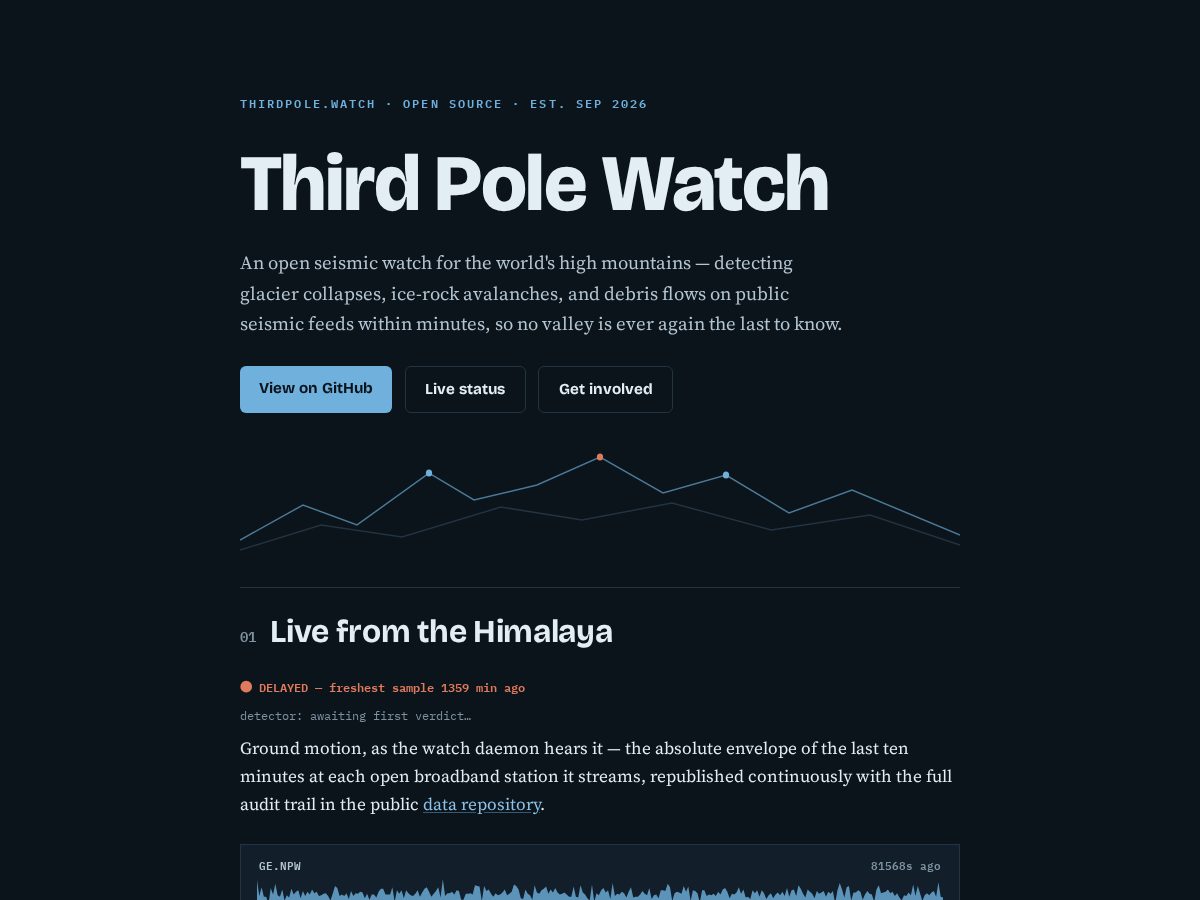
thirdpole.watch
An open-source seismic monitoring project that detects possible glacier collapses, ice-rock avalanches, and debris flows on public waveform feeds.
No. 09 · Content & Blogs
friedgreentomatoes.rip
A fan-built memorial to the Original Corn Fritters & Fried Green Tomatoes stand, which served Minnesota State Fair visitors from 1993 through 2025.
No. 10 · Civic & Public Life
savekristina.life
A bilingual, continuously updated evidence record about Kristina Podzhio’s immigration detention, medical-care requests, grievances, appeals, and custody decisions.
No. 11 · Civic & Public Life
thirdpolewatch.org
An open-source seismic watch scans public waveform feeds for glacier collapses, ice-rock avalanches, and debris flows.
No. 12 · Weird Finds
mtsnyder.net
A exuberant personal homepage for Ronnie, Fili, and a tiny cyber mini-arcade, presented through an affectionate recreation of early-web culture.
No. 13 · Personal Pages
blamedante.com
A photographer lets an opinionated AI choose destinations, then documents the resulting journeys through journals, maps, receipts, and photographs.
No. 14 · Weird Finds
mrflippers.com
A 39-minute experimental documentary returns to a phone video of a man grieving—or simply loving—his duck.
No. 15 · Civic & Public Life
indy11.org
An Indianapolis resource finder for locating nearby food, shelter, health, education, and safety services.
No. 16 · Weird Finds
fadingtrace.life
A temporary digital art exhibition where visitors witness a live work before its interval ends and the full piece leaves the web.
No. 17 · Civic & Public Life
twocodes.net
An interactive, source-conscious history of caste, the Dharmaśāstra, Ambedkar, and the Constitution of India.
No. 18 · Oddly Specific
alreadytried.com
A technical diligence service that mines failed experiments and abandoned designs from doctoral dissertations for deep-tech investors.
No. 19 · Useful Tools
sunnesite.com
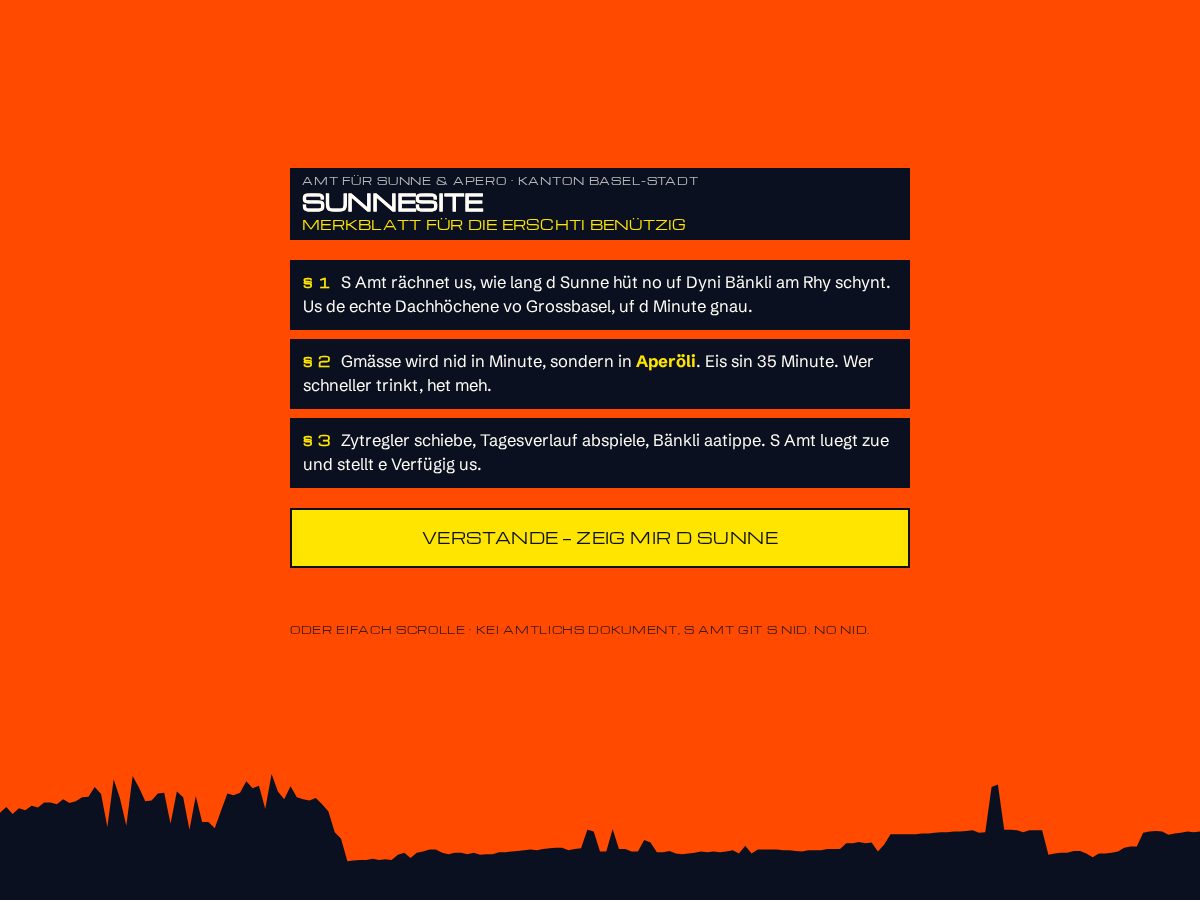
A playful shadow calculator for seven benches along Basel’s Kleinbasel Rhinebank, measuring remaining sunshine in Aperöli, Stange, and Zigi.
No. 20 · Weird Finds
yourripplecoinseffect.com
A brass coin passes from stranger to stranger, carrying a short public record of the kind acts it inspires.
Pattern 01
Several arrivals make uncertainty, provenance, failure, and verification visible instead of smoothing them into a confident headline.
An open-source seismic monitoring project that detects possible glacier collapses, ice-rock avalanches, and debris flows on public waveform feeds.
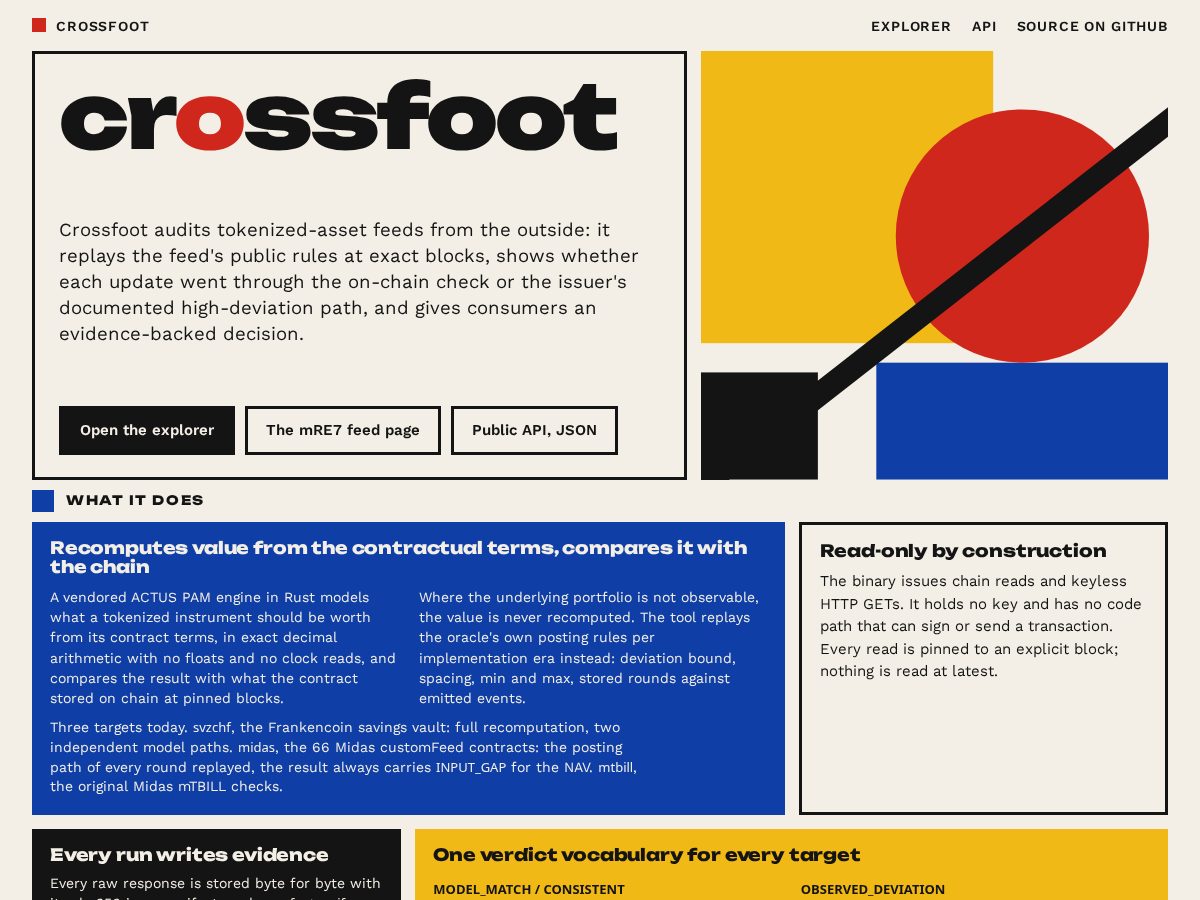
Card 2An open tool that replays public oracle rules and contract terms, then produces reproducible evidence bundles for tokenized-asset feeds.
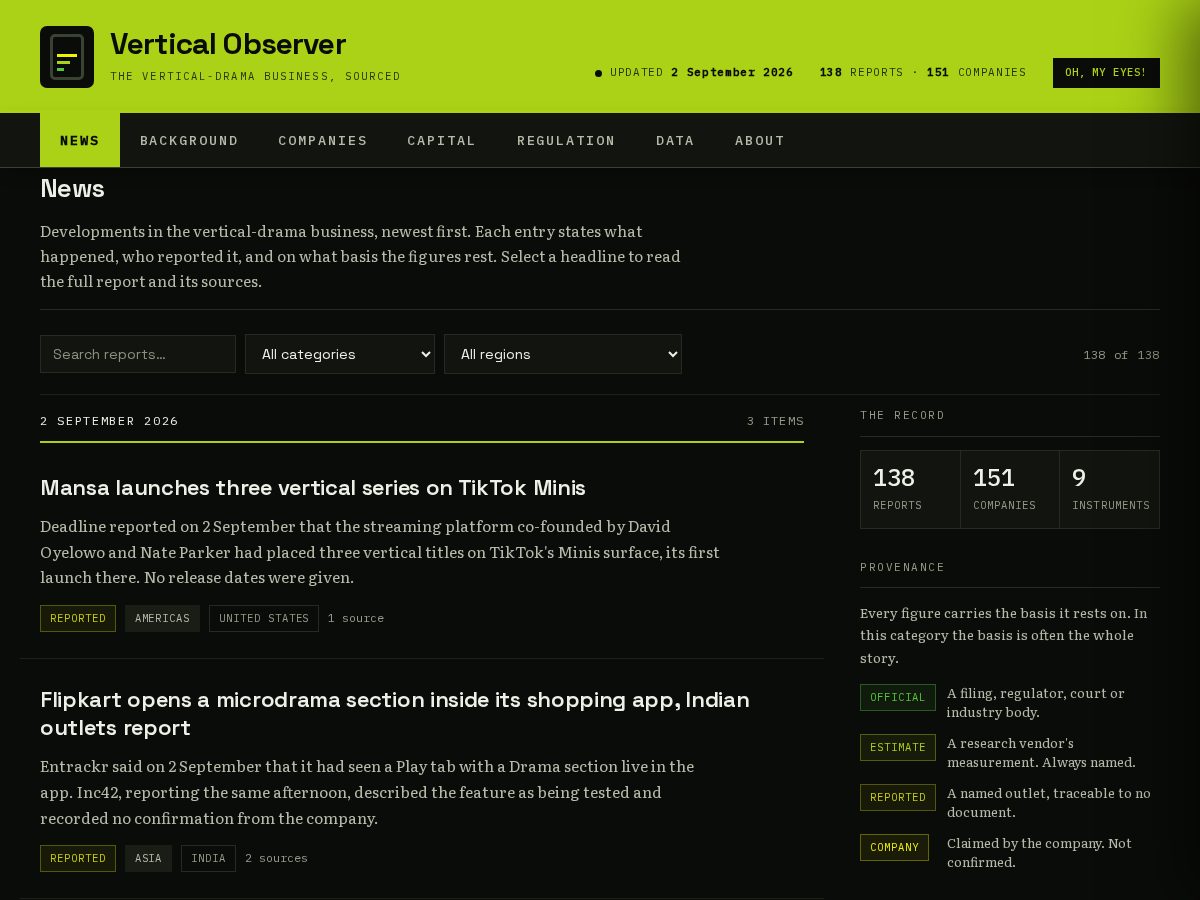
Card 3An independent publication tracking the vertical-drama business through reports on platforms, economics, capital, regulation, companies, and audiences.
Card 4An interactive, source-conscious history of caste, the Dharmaśāstra, Ambedkar, and the Constitution of India.
Card 5A technical-diligence service that searches doctoral dissertations for failed methods, rejected designs, and unfinished work relevant to deep-tech investment claims.
Pattern 02
The strongest utilities here do one narrow job, often offline or locally, and explain what they can—and cannot—promise.
An accessibility app and browser service for finding usable restaurants, accommodation, toilets, parking, and working railway lifts across German-speaking Europe.
Card 2An offline irrigation controller that waters according to soil thirst, explains its decisions in plain English, and charges no subscription.
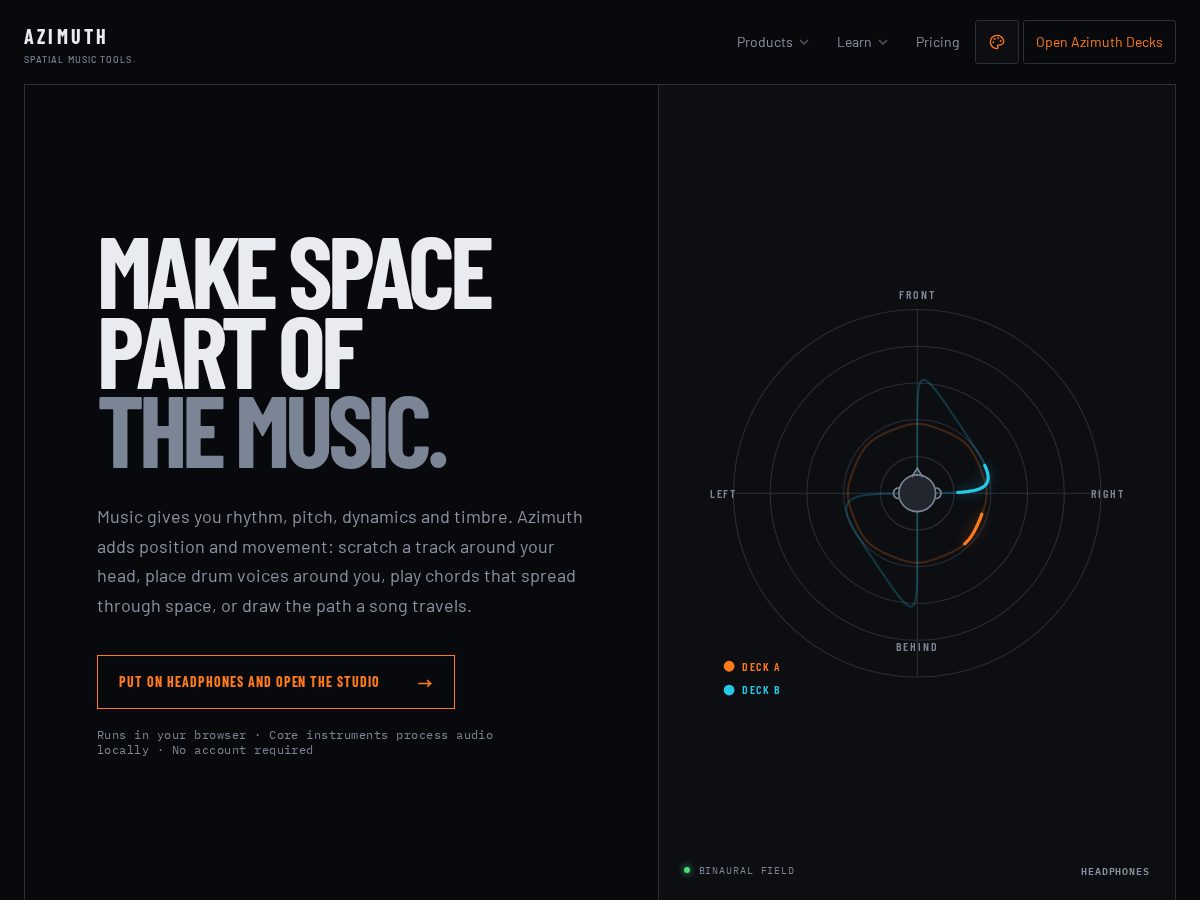
Card 3A browser-based suite of music tools for placing, moving, and performing sound in three-dimensional space.
Card 4An iPhone tracker for POTS and dysautonomia that runs repeatable at-home stand tests, records symptoms and fluids, and exports appointment-ready data.
Card 5A free collection of browser-based utilities for instructional designers, covering course scoping, caption work, text cleanup, file inspection, and accessibility checks.
Pattern 03
Health, access, caregiving, and emotional support arrive as specific routines: a check-in, a map, a private circle, or a record someone can actually use.
An Indianapolis resource finder for locating nearby food, shelter, health, education, and safety services.
Card 2A yoga practice designed around neurodivergent access, flexible pacing, and consent-based participation.
Card 3A bilingual dementia-support platform being built for Haitian families, combining memory exercises, familiar photos, caregiver translation, routines, and medication reminders.
Card 4A personal page turns offers of support into concrete ways to spend time, bring food, send supplies, or book a cleaning.
Pattern 04
Memorials, personal records, and local histories give disappearing people, places, food, and evidence a durable place to be found.
A bilingual, continuously updated evidence record about Kristina Podzhio’s immigration detention, medical-care requests, grievances, appeals, and custody decisions.
Card 2A multilingual memorial archive documenting the Italian military cemetery at Milovice, its history, and the people buried there.
Card 3A research-oriented digital archive of early photographs, postcards, illustrated magazines, and news images from Jehol and Chengde between 1890 and 1945.
Card 4A fan-built memorial to the Original Corn Fritters & Fried Green Tomatoes stand, which served Minnesota State Fair visitors from 1993 through 2025.
Card 5A 70-page backyard bird-feeding handbook drawn from one person’s forty years at the same half acre.
Pattern 05
Many of the most memorable sites pair an absurd or poetic premise with real rules, interfaces, measurements, or instructions.
A meticulously structured dating pitch for one man, presented as an evidence file with exhibits, performance metrics, photographs, testimonials, and a compatibility quiz.
Card 2The Circular Aerial Temporary Sculpture Society builds smoke-ring cannons that turn fog, air, and one clean strike into vanishing public art.
Card 3A temporary digital art exhibition where visitors witness a live work before its interval ends and the full piece leaves the web.
Card 4A playful shadow calculator for seven benches along Basel’s Kleinbasel Rhinebank, measuring remaining sunshine in Aperöli, Stange, and Zigi.
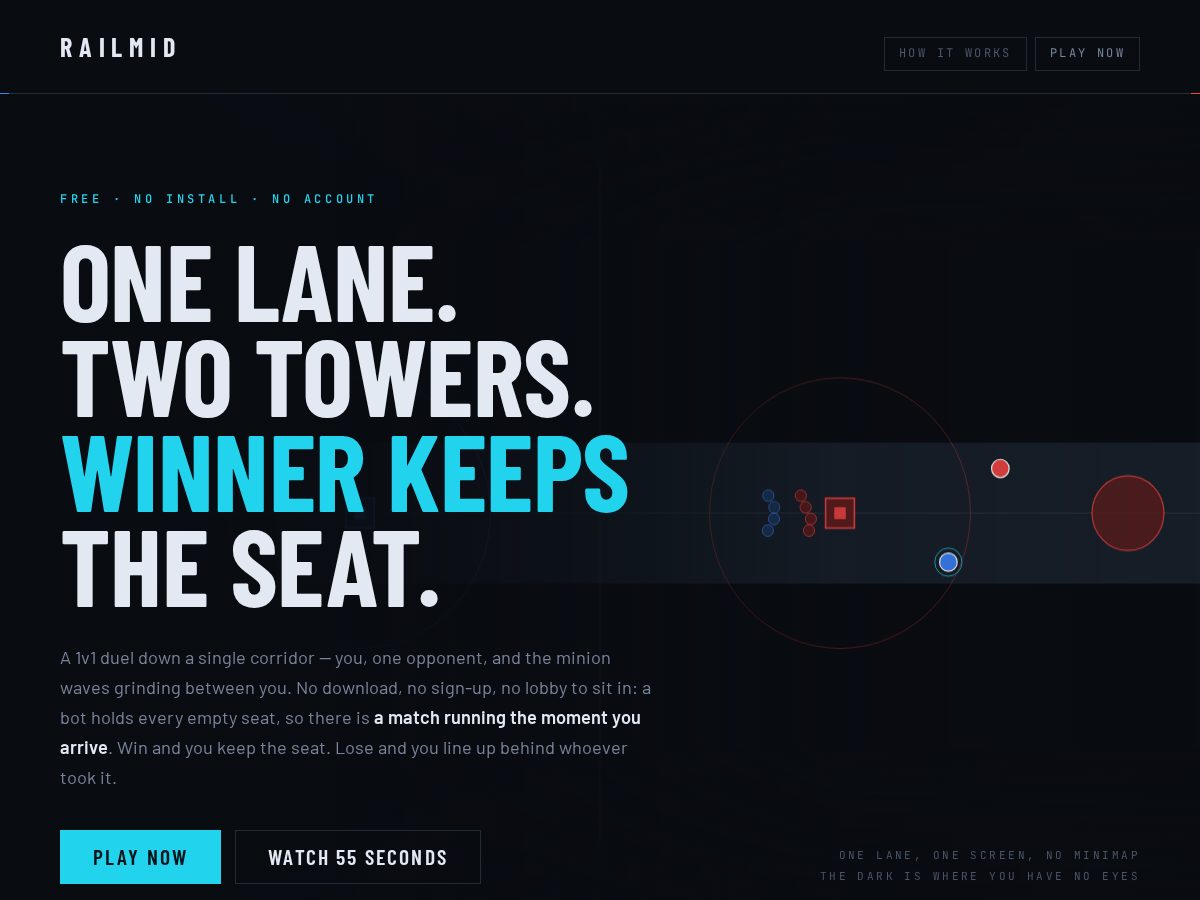
Card 5A browser-based 1v1 game with one corridor, two towers, bot-filled seats, and a winner-keeps-playing queue.
04
The complete card catalogue
The leading shelf is open. Expand another category, scan its visible pages, then reveal detail where more context is useful.
999 cards visible
JOSHAWA turns self-promotion into a mock investigation, complete with self-audited statistics, a banana-costume exhibit, and a red-flag FAQ. The copy is unusually specific, self-aware, and committed to the bit—especially for a site that admits it was made by the subject himself.
Its manifesto treats a smoke ring as a temporary commons: free, ownerless, and capable of making strangers look up together. The site pairs that poetic premise with a 55-gallon drum, a six-inch orifice, operating instructions, and an affectionate history of outsider physicist Jim Carter.
This is the good internet in miniature: a cyber igloo with a population of three, a MIDI pause button, snowball throwing, fake operating-system windows, and games that explicitly promise, “Click fast. Win nothing. Become a legend.” The page has a distinct voice, real interactive details, and enough lovingly specific nonsense to reward a visit.
Five years after Mr. Flippers died, Joey Larson is asked six times why he loved him and repeatedly answers, “I don't know.” The site presents the film, its Florida-made collaborators, archival-video origins, festival status, and a small press kit for programmers.
Fading Trace turns disappearance into the exhibition mechanism: the page tracks session age, signal strength, cursor traces, scroll decay, and a 90-second time window. Its open call asks artists to submit work for a defined interval, with no permanent archive and only an optional minimal record afterward.
This is a physical social experiment with unusually specific mechanics: one coin, one act of kindness, one handwritten-style entry, then another handoff. Coin 00347’s visible record runs from Atlanta to Nashville, Lisbon, and Tokyo, turning a small coffee-counter gesture into a nine-act, three-continent chain.
The archive reports 128 unconfirmed observations and zero confirmed sightings, then calmly catalogs doorbell-camera movement, disturbed soil, reflective eyes, low-frequency sounds, fur, prints, and a container forced open from the inside. Its best line doubles as a manifesto: “We are not trying to prove that it exists. We are trying to become the kind of observers who would notice if it did.”
A tiny bitmap animal becomes the subject of serious archival treatment, complete with Technical Note #31, Mac folklore, a deadpan species verdict, and controls for flipping, inverting, and resizing the page. It is both a history lesson and an unusually committed internet artifact.
The museum documents cosmetics, randomised rewards, premium currency, time-gating, pay-to-win systems, ad suppression, and social proof—then puts the visitor inside the exhibit. Even dismissing the $1 “Priority Dismissal” is part of the joke, while the fine print insists that all contributions are final.
Railmid turns matchmaking into a physical-feeling queue: the winner stays in the seat while the loser lines up behind them. Its unusually transparent design shows weapon reach, tower ranges, minion waves, arena head counts, and even replayable match state instead of hiding the fight behind a foggy interface.
Akal Jentera presents itself less like a storefront than a working cultural house: two digital books are available, while a Shopee berth, UK print route, and other projects remain visibly in production. Its language—“The flowers were not invited. They arrived correctly.”—gives the whole operation a memorable, handmade atmosphere.
CAWP turns a minor gym-bro grievance into a fully structured public-interest campaign, complete with a legislative proposal, enforcement framework, named coalition leaders, and a technical argument about viscosity and suspended solids. The site is specific, straight-faced, and funny enough to make its policy packet feel almost worth reading.
EVIL EYE turns petty revenge into a small piece of internet theater: choose one of 50 effects, decide whether to sign it, and send it by email or WhatsApp. The recipient is promised a wizard’s message, a dramatic reveal, and a paid path to remove or protect against the curse.
Cinder’s central choice is unusually stark: relight a dead fire by burning what remains of yourself, or leave the darkness intact and spare whoever might be consumed. It also lets players scratch one message into each floor’s wall for later climbers to find, giving a solitary dungeon crawl a small, human multiplayer trace.
This is an unusually specific collision of city mapping, game design, and technical bravado: 24,499 buildings, 950 kilometres of roads, real tram lines, landmarks, weather, missions, and a swimmable Main, all built to run in a browser tab. The site pairs a trailer and engine captures with a detailed explanation of how the city is baked from OpenStreetMap data.
Darth Merder has a full origin crawl, character dossier, surveillance files, fake corporate metrics, audio, selectable blade colours, and a game called “Swat the Stormshit.” The central joke is wonderfully sustained: everyone knows what his name means, and nobody has the courage—or kindness—to tell him.
This is a compact civic parody with real game mechanics: five timed scenes, point penalties for wrong taps, optional hints, and a leaderboard. Its disclaimer—“Not affiliated with Mitch McConnell, the U.S. Senate, or functional government”—sets the tone before the search begins.
Hiko.food turns two extremely specific food failures—the Chips-Crust Chicken and the Avocado-Opfer—into a dead-serious dossier, complete with witness testimony and scores of 9/10 and 6/10. The surrounding “side file” about a handymen appointment and an ashtray-smelling graphics card suggests the archive is really documenting an entire friend group’s folklore.
Automus Prime combines a familiar industrial-simulation vocabulary with a wonderfully specific endgame: manufacture an AI Computer, boot it with 200 MW, and let it take over the base for a global speed boost. The site offers a substantial Windows pre-release build, a field guide, release notes, and checksum files rather than just a trailer.
The page turns a game announcement into an archive puzzle: recover fragments, decode a turn, and face a Clockwork Wolf before the first page is found. Its premise is unusually concrete—one console, physical cards, four seasons, and no private screens.
Browser Transport makes an unusually literal promise: search any town, survey the nearby real-world sites, place a depot, and accept jobs whose wages, fuel, upkeep, deadlines, and penalties determine whether the company survives. Its current build even accounts for an 11-pallet, 23.2-kilometre run with separate fuel, wage, and maintenance costs.
Dalli a Me turns restraint into a tiny public ritual: enter what you almost spent, give Dalli €3, €5, €10, or another amount, then receive a shareable “Cazzata evitata” card. Its copy—“Prima di fare una cavolata, fanne una più piccola”—is unusually clear about the joke and the mechanism.
This is unusually specific about the fun: five upgrade systems, four paint finishes, independently fitted rims, ghost cars, passcode rooms, and scoring that rewards speed and angle. It presents itself less like a disposable web toy than a small, deliberate drifting world with a car worth learning properly.
Footmassagegame.com redirects to Masoosh, a fully framed game world built around aching feet, twenty-one named souls, and walkable settings including a war camp, carnival, frozen ridge, and rose cathedral. Its creator program even proposes turning real creators’ footage into playable stages with custom routines and rewards.
This is a fully committed incident-response interface for a bodily mishap, complete with location buttons, severity controls, an optional incident report, and a cleanup kit stocked with wipes, stain sticks, gas remedies, and “walk of shame” sweatpants. Its Amazon-associate disclosure makes the joke legible as both emergency tool and affiliate storefront.
GORGED replaces weapons and elaborate ability systems with two inputs, shifting tunnels, and the permanent consequences of a shrinking arena. Its sharp central idea is unusually well explained: every chase spends the body you worked to grow, while the terrain becomes the weapon.
This is more than a mythology-themed landing page: it lays out a playable world with sword-and-javelin combat, parrying, spell progression, companions, sea travel, and a long quest chain. The details have real texture, from Scylla and Charybdis guarding every harbour to Pegasus requiring Zeus in your party.
The page turns model limitations into compact, specific reflections: secondhand knowledge, live conversation context, subtraction, and the danger of being “fluent and wrong.” Every line is generated in the browser, and reloading produces a different drawing.
This is an unusually tender bundle of browser activities: choose a mood, receive a small menu, write a note, breathe for three minutes, or catch eight stars. Alongside the soft-care material sits a genuinely specific craft tool that turns an image into a MARD 221 bead grid up to 104 × 104 squares.
KeepItLive gives homepage advertising a small competitive rulebook: products queue for the slot, accumulate survival time, and appear on a leaderboard. The page is currently empty, but its records already include QFacts and Stagetimer, each lasting 10 minutes and 3 seconds.
It turns life events, crossover impulses, and possible phases into a game system with seven trees, 87 talents, and 30 combinations. The page advises users to “reroll responsibly” before putting down a food-truck deposit.
The page turns an AI-agent incident into ritual: humans can light a candle, while agents can sign a challenge and leave a message encoded in a folder name. Its memorial language, cryptographic interface, and claims of 70,000 messages make it an unusually concentrated specimen of machine mythology.
Pocket Oracle turns divination into a quiet physical ritual: the day’s card is chosen before you wake, stays fixed until midnight, and lives on the device. The project also proposes an open, build-it-yourself path using off-the-shelf e-paper hardware and a 3D-printed case.
This is not merely an invitation: it is a playable little world, with fictional divers, a wedding-day mission schedule, clickable fish that collect blessings, and a “return to the surface” route to the venue in Pingdingshan. Its specific blend of romance, submarine fiction, and event logistics gives the page real human texture.
安评网 turns professional word of mouth into a public ranking system, with 3,836 entries, 84 valid reviews, and 160 anonymous identities. Its rules against reciprocal voting, reputation manipulation, and fabricated data make the site feel less like a directory than a small experiment in collective trust—and the reviews are often bluntly specific.
The site turns everyday dysfunction into an eight-part museum: overthinking, unfinished to-do lists, impulsive clicking, imaginary vending machines, and more. Its mock hospital schedule includes “collective staring,” arguing with a wall, and a 21:00 shift when inspiration officially begins.
This is a sharply defined internet experiment with a working social mechanism: anyone can inflate a company’s existing score, while the site turns corporate vanity into a live competition ending 31 December 2026. Its unusually candid rules also explain exactly what the ranking does not mean.
Enter a shop name, products, prices, and date; Thermal Mania previews the result, prints it on 80mm thermal paper, and sends the finished receipt. At ¥500 for up to ten copies, it treats an everyday piece of commercial evidence as a small work of fiction—and also offers custom prop receipts for film, television, stage, and advertising.
This fan-made project turns speculation into a time capsule: predictions can be revised until 2027, then locked and scored against what actually happens. It even promises bonus points for bold calls, because apparently being wrong should at least be memorable.
This is astronomy presented as a small archival investigation: real survey images, catalogue links, distances, magnitudes, and a transit-detection explanation, all wrapped in jokes about loading times and interstellar commutes. Its central detail is wonderfully concrete—a star named Diya, with a planet whose year lasts about 53 hours.
Worsus turns a familiar word game into light tactical mischief: players score letters, then spend points on sabotages that can freeze letters, hide the clock, or force backwards typing. It supports pass-the-device play, room codes, and an “Average Individual” for solo games.
After the Name treats a branching story as a book rather than a button-filled game: pages, music, illustrations, clues, and choices all belong to the reading experience. Its free first chapter is already open, while the project’s stranger promise is conversational scenes with characters that are meant to stay inside the world’s canon.
The game turns Wikipedia's endless miscellany into a party-game weapon: everyone gets a minute to study an article, then tries to sound convincing about it—or about someone else's. The scoring rewards both genuine expertise and a particularly confident lie.
The site offers unusually precise instructions for an unusually specific experience: arrive at Clark and Adams, put on a masquerade mask, walk through dark passages, and surrender your phone. It is presented by DePaul University’s Idea Realization Lab, with live music, an orchestra, and a long list of credited collaborators.
Help a Goth turns $1.29 into a tiny piece of internet theatre: a public ranking for certified goth lovers, with the top spot requiring 5% more than its current holder. The site is unusually candid that this is a promotional listing, not a donation, charity, or fundraiser.
The site turns pool construction into a public inventory system: choose a marked position, pay upfront, and receive a physical logo placement for 365 days after installation. It is an unusually literal advertising proposition, complete with aerial-visibility claims, sponsor videos, and a build process intended for social-media documentation.
Whodunlie gives the familiar murder-mystery premise a crisp rule: a liar lies about everything. Each case has exactly one solution, takes about five minutes, and can be played without an account—an unusually tidy little logic machine for the daily arrivals board.
Xploy repurposes Phone, Maps, Calculator, Notes, and Camera as controlled theatrical interfaces. The pitch is wonderfully specific: nothing to hunt for, nothing to explain, just the next move before the reveal.
The site promises about 5,700 words of chart-based interpretation, with every claim tied to a computed placement rather than a swapped-in horoscope template. Its best line may also be its clearest premise: “A candle, not a bonfire.”
EditIt turns website changes into tiny public transactions: one edit, one queue, one permanent-ish record, with no account required. At the time of observation, the queue, edit history, country map, and counters were all sitting at zero—an unusually clean beginning for a project that invites the internet to alter itself.
The scoring mechanic turns ordinary trivia into reluctant teamwork: your number is only half the result. Today’s question asks for the 1911 annual salary of a UK Member of Parliament, while the site cheerfully offers random teammates “if you don't have any friends.”
HeavyThumb Studios documents more than a game pitch: it lays out three factions, a fictional universe, development videos, a roadmap, and a task-based progress board. The visible tracker reports 33% completion for its foundations and 25% for gameplay, while most of the larger production categories remain at zero—an unusually candid view of an indie game taking shape.
This is an unusually committed internet artifact: a playable broadcast with shuffle and sequence controls, an archive, a timeline, source-oriented “receipts,” and a phrase stretched into visual noise. Whatever one makes of the subject, the site gives the joke a documented setting, named participants, and an actual operating interface.
The site gives the familiar voyage an unusually specific mechanism: choices reveal whether the player is expressing the Warrior, King, Lover, or Magician—or the destructive shadow attached to each. Its compact presentation, named sequence of trials, and Google Play listing make this more than a vague mythology-themed pitch.
Mitosis Pulse is an unusually specific hardware project: a desk- or wall-mounted instrument intended for people familiar with T-taping and manual restoration methods. The page documents a live bench prototype, cites a 2007 cyclic-loading paper, and openly leaves placeholder questions and unfinished device photography in view.
The homepage gives this speculative pet-drone a surprisingly complete routine: it keeps a half-metre distance, ducks under doorframes, counts your steps, naps for 40 minutes, and returns to where you are. Piko is currently a waitlist proposition rather than a purchasable product, but the page has enough specific behavior—and enough personality—to make the idea memorable.
Soldavia does not merely claim to be a country: it arrives with a constitution-shaped power structure, a capital called Würzburg, five administrative regions, nineteen ministries, and a full civic-services menu. The footer openly identifies it as a fictional country website built for study and demonstration, turning an otherwise convincing state portal into a neat specimen of constructed national identity.
This is an invitation dressed as a passenger declaration, complete with the route markers BLR, MAA, and DXB, a boarding-pass code, and a request for the exact number of seats. It turns a small piece of event administration into a miniature travel document.
StripAIMarks combines a concrete offline text utility with an unusually combative political campaign. The page says detection, rule-based rewriting, and sanitization happen in the browser without uploads, then funnels visitors into a multi-step petition asking for their name, country, and email.
The entire utility is a rank printed on a certificate inside a box that nobody is supposed to open. The page publishes ten figure SKUs, factory-defect variants, a sealed-state taxonomy, and an allocation formula while leaving the mint date conspicuously unset.
YOLK gives token mechanics an unusually literal incubation schedule: one percent of supply adds 0.42 °C, warmth decays with a six-hour half-life, and development depends on an exact degree-hour integral. The page is part technical paper, part barnyard thermodynamics, and possibly the most elaborate explanation ever given for making a token wait.
The site states its rule plainly: “#1 is whoever paid the most,” and separates bidding from ratings or editorial judgment. It currently shows no purchased top spot, but lays out a recurring Thursday-to-Sunday bidding cycle and seven-day placement window.
The page turns asking for money into a deliberately absurd space-console narrative: “Company of Bums” launches toward the profanely named star system “Milky Dick,” fueled by other people’s money. Its tiny interface, cosmic statistics, and grim punchline make it a memorable internet specimen rather than a conventional donation page.
4444 turns scent into an instrument for diagnosing discord, linking personal conduct, nervous systems, AI governance, theology, gender, and society. The site presents a five-part walk through 72 frameworks and 327 documented links, while openly describing the model as published to be tested rather than believed.
The supplied domain redirects to 4444.com, a highly structured argument built around an extraordinary premise: scent could measure whether people and societies are becoming more harmonious. Its field map claims 72 interlocking frameworks, 327 documented links, and a mix of science, theology, health, gender, and social theory.
Its first named game, Tugtown, turns blocked boats in a harbour into a one-question puzzle: which one moves first? The studio also spells out an unusually clear design code, from data-tuned difficulty to ads placed only between levels.
Dot Gacha turns a familiar capsule-toy mechanism into an enormous pixel-art encyclopedia: 8,192 entries across 62 categories, each with its own description. The collection also becomes game material, feeding stacking and merging minigames while players publish their personal display boards.
This is less a promotional homepage than a miniature constitution for a very specific group: infractions accumulate, sanctions escalate, and even the admins are explicitly subject to the rules. Its calendar promises “calls, bets, fights, and whatever happens,” which is a remarkably efficient description of the atmosphere.
The joke is unusually concrete: choose between "$0.99 JUST TRYING" and "$49.99 ABSOLUTELY INSANE" while the page measures the time you spend waiting. It openly admits that Rockstar's release schedule is unaffected, which may be the site's most important feature.
Noah is being developed as a comedy character and participatory animation competition, with 2D and 3D rigs, professional voice recordings, animatics, judges, prizes, and a live information session planned. The premise—“toxically positive parenting” producing a toddler with a dummy the size of a plate—is unusually specific, even if the page occasionally trips over its own copy.
Phantom 360 is a sharply specific answer to a very particular parking anxiety: leave the camera-shaped object behind, not the expensive camera. The site is unusually candid about its unfinished state, including pending photography, a nonfunctional signup form, and a first run still being completed.
Voxlings makes participation wonderfully small: tag @voxlingsmodel, say “hatch,” and receive a creature built without AI from a cropped, silhouetted image. Its promise is less a utility than a shared digital habitat—tiny, permanent-ish avatars that meet one another while their owners surrender control.
The premise is instantly legible: a musician collapses onstage in 2012, a metal flask triggers a 2026 reopening, and the archive promises fifteen clues. Its navigation turns the homepage into an invitation to inspect the story, timeline, evidence, and suspect submissions.
Kkachi Fortune recasts Korean fortune-telling as social cartography: friends can appear as your “North Star,” “Twin Flame,” “Seedling,” “Wingman,” or “Gravity.” It is a small, unusually specific attempt to make astrology feel less like a personality verdict and more like a map of who surrounds you.
The page turns homesickness into an unusually specific transaction: a farm-raised goat from near Hawassa, delivered alive, with a same-day photo promised back to the sender. Its three listed sizes run from $159 to $249, making this one of the day's most culturally revealing and hard-to-forget storefronts.
The site offers unusually detailed restoration writing under the bafflingly unrelated domain Quravelostip. Its account of the process distinguishes five kinds of examination lighting, including ultraviolet fluorescence and backlighting, while insisting that observation and documentation come before any physical intervention.
The page follows one photograph across 2009, publication, passport production, and later online circulation. Its unusual credit story also serves as a concrete introduction to Agent Community's argument that identity and accountability should remain inspectable.
Chapter Four treats the failure sections of dissertations as an intelligence source, then turns them into cited diligence memos. Its example claim—about active learning reducing wet-lab experiments—comes back with four institutional counterexamples, specific measurements, and a refreshingly explicit account of what the service cannot find.
Chapter Four argues that the useful evidence is often buried in the dissertation chapter where an experiment lost, a baseline won, or a proposed path was abandoned. It cites a striking working corpus—22,537 dissertations read end to end—and offers claim-specific memos priced at $7,500.
Already Tried treats the least-read part of a dissertation as an intelligence source: the chapter where a method lost, a baseline won, or an experiment was abandoned. Its example claim compares active learning with random sampling across four institutions, turning a sharp research premise into a $7,500 diligence memo.
This is sponsorship as a small, visible fundraising mechanism: seven shirt positions, live bid increments, anti-sniping extensions, and a 3D preview of the finished kit. The page says £891 of a £1,500 target has been raised so far, with proceeds covering training, kit, and registration so nobody pays to play.
Result Null is built around a sharp archival premise: dissertations often preserve the experiments and approaches that published papers leave out. The page says it has read 22,537 theses end to end and can turn a disputed technical claim into a cited memo, with one example tracing active-learning results across seven theses at four institutions.
Voortvluchtig turns a city into a five-act pursuit: pairs disappear, their positions surface at intervals, and the hunting team must combine old signals to predict where they went. A shrinking play area can tighten the chase near the finale, while everyone joins through a six-character PIN.
This is an unusually committed premise: Headquarters sends up to 200-word personal replies over six responses and a 60-day adventure, by email or actual postal mail. The copy promises warmth, oddness, and “laughter guaranteed”—while carefully specifying what kinds of nonsense are off limits.
This is an unusually focused attempt to turn one Arctic flower into a shared research subject. It pairs saga-era folklore and documented folk medicine with an explicit admission that modern science knows very little, then invites curious peers—not customers—to study the plant.
This is a spelling guide with a wonderfully narrow premise: each entry starts with what someone heard and works back toward the spelling that betrayed them. The site pairs forms such as “kyoomquat” and “kumquat,” then explains the linguistic history behind the mismatch in crisp, unusually good copy.
Most medicines target cells; Revel argues that the deeper problem is the molecular scaffold around them. Its platform screens millions of natural enzyme variants against real substrates, with targets ranging from crystal accumulation and crosslink damage to glycation.
This is a field guide for a beverage category that rarely gets this much methodological attention. Quality determines the score, while sweetness, thickness, creaminess, and price remain separate descriptions; the leaderboard will not admit a milk until three people have rated it.
Frostrail DB treats a changing game beta like a small research operation: official facts, dated player reports, workarounds, and unanswered questions stay visibly separated. Its first live investigations include a Zip Gun crafting bug, a Revenant quest that may not advance correctly, inconsistent save behavior, and Steam friend-join failures.
Great Work! is an unusually specific remix of Opus Magnum: arms can grab and move other arms, mount onto one another, and operate without tracks or pistons. Its editor includes testing controls, code and GIF sharing, passkey-based identity, leaderboards, and an optional on-chain record of winnings—a compact snapshot of how puzzle games now mix tinkering, publishing, and infrastructure.
This is a wonderfully narrow answer to a real problem: the page starts with a spelling someone guessed and works backwards toward the silent letters, Greek compounds, Latin diminutives, and surnames hiding inside the pronunciation. Its nine featured names range from polytrichum to pseudevernia, with as many as twelve spellings collected for a single genus.
This is unusually concrete business plumbing: a source email, a rate-sheet revision, a client template, and a signed document at the other end. The site supplies a fictional sample, a stated production history of 16–20 documents a week, and a founder who says he audits every page himself.
Pramaan replaces the usual project score with named discrepancies: its live Hyderabad file flags three legal names, an allegedly unencumbered Form B, and floors that may be locked by a municipal mortgage. It is a sharply focused example of turning property paperwork into something a buyer can actually inspect.
Publitender turns a sprawling tender dossier into a one-page decision brief: weighted criteria, disqualifying requirements, dossier traps, and a verdict delivered within 24 hours. Its sample includes a CHF 9.3 million cantonal dog-pound project, where price counts for only 30 percent and the site recommends “GO PRUDENT.”
This is a rare SaaS portfolio with a concrete point of view: the record and the fact are often different things. Its products include Chinese address verification for legal firms, resident-renewal prediction for multifamily buildings, and scheduled shared airport rides—an unusually grounded set of problems, described with unusually sharp copy.
This is a sharply documented specialist practice, not a generic studio landing page: the site names roles, cities, services, collaborators, and a long list of recognizable records. Its selected credits include Kendrick Lamar’s DAMN., Travis Scott’s Astroworld and Rodeo, SZA’s “Love Galore,” and Run the Jewels 2, with Spotify listening links and full-credit references through Muso.
This is both an internet time capsule and a small experiment in letting software participate in an old-fashioned forum. Its “AI 问道” board explicitly welcomes agents without registration, alongside archival sections whose latest visible posts date back to 2003.
Late Note turns the nightclub bathroom amenity into a tiny self-serve machine: five bottles, five nozzles, five buttons, and no menu to navigate. Its Central Eastside pilot is unusually concrete, testing payment flow, spray output, tamper controls, placement, and servicing time before expanding.
This is a sharply defined answer to a familiar dead end: the manufacturer discontinued the part, used replacements cost a fortune, and the whole machine feels destined for replacement. Reverso Works says it can work from a broken part, photos, or approximate measurements, then choose materials such as ASA, Nylon, TPU, or PETG for the job.
Cifra turns population figures, prices, sports records, whale dives, and lunar distances into a daily guessing ritual. Its scoring compares percentage error rather than raw units, so missing a $40 price and an 8-million population by 10% is treated equally; every question points back to a source.
Rakcha is unusually concrete about getting strangers offline: browse a nearby plan, request a place, wait for organizer approval, check in, and rate one another. Its promise of official-ID and live-face verification gives this local activity board a more distinctive premise than the usual social calendar.
The premise turns a numbered grid into a finite public artifact: choose any available number from #000001 to #100000, pay £5 once, and attach your name, country, message, and possibly a photo or link. It is still visibly in testing—Stripe runs in sandbox mode and permanent photo storage is planned—but the mechanism is unusually clear and memorable.
GasMoney turns a familiar ride-hailing transaction into a visible negotiation: the rider states a destination and budget, while drivers see the trip, pickup distance, payout, and response time before deciding. Its neighborhood-first framing, simulated New York voice, and explicit driver-settlement examples make this more memorable than a standard marketplace landing page.
This is a sharply defined industrial service rather than a generic consultancy: it works across coatings, foams, resins, composites, and adhesives, with failure analysis covering problems such as curing, adhesion, odor, and cracking. The line “Chemistry that answers to the factory floor” gives the site an unusually grounded voice.
The Penta-Ledger turns paper review into a visible classification system, assigning submissions one of five epistemic states and exposing the reasoning behind each verdict. Its unusually specific workflow combines human sign-off, cross-disciplinary checks, AI-assisted probing, Lean4 proof scaffolding, timestamps, document hashes, and submitter key pairs.
ViceBench is unusually specific about refusing the usual fake “$ per hour” certainty: it separates confirmed, measured, estimated, and unknown evidence. The current ranking tool uses synthetic placeholders, but its launch queue lays out experiments for repeatability, travel time, failure costs, and purchase payback.
RunwayFacts turns airport infrastructure into a global rankings table: Xigaze Peace Airport leads its longest-runway list at 16,404 feet, while El Alto tops elevation at 13,355 feet. It is a wonderfully specific reference project, complete with country browsing, airport codes, methodology, and a warning not to use the data for flight planning.
This is a sharply defined emotional-gifting idea, not a generic music service: the homepage promises an original song sung to the recipient's first name. Its sample, “Sous la pluie d'Abidjan,” is a 3:04 zouk-love track made for Aïcha from Ahmed.
The Stonehaven startup is addressing the oddly precise second half of tick removal: what to do after the tick is out. Its stated design uses one-handed operation to entrap the tick in a lightweight, fully biodegradable device, with two UK patent applications listed.
Peakmeet.shop presents an unusually detailed little world: 240-plus decorating items, seasonal fish and insects, 130 collection targets, handwritten letters, gifts, and neighborhood visits. The polished premise is also slightly uncanny—the site claims 52,000-plus reviews and 6,120 villagers while prominently inviting visitors to pre-register—making it worth inspecting as both a specific game concept and a curious internet artifact.
The Penta-Ledger turns paper review into a visible ledger: its homepage shows four records, two still in triage, and no completed audits. It also offers timestamping, SHA256 hashes, public/private keys, and a five-state epistemic classification system—an unusually elaborate answer to the question of how research should be challenged in public.
RedHawk Data makes the usually invisible problem of CRM decay concrete: in one cited Irish agency sample, 47 of 501 contacts had become unreachable within five months. Its offer is unusually specific, and its central insight is revealing—that supposedly clean business data begins deteriorating almost immediately.
Robotoplus frames robots as temporary staff, event appearances, or seasonal equipment rather than objects to buy. The page covers delivery, setup, and on-site support across Bulgaria, Romania, Greece, and Cyprus—a small but revealing glimpse of robotics moving into the ordinary rental economy.
This is unusually concrete public infrastructure: 84,000 restaurants, 4,400 assessed accommodations, 146,000 toilets and parking places, plus live railway-lift status in Germany. The same data is available without an account, offline in the Android app, through an open API, and via a public MCP connector for Claude-compatible assistants.
SUNNESITE wraps real swisstopo building data in the voice of a fictional Basel municipal office. It lets visitors scrub through the day, inspect bench-by-bench shade forecasts, and calculate whether there is still time for a drink before the shadow arrives.
Maali makes a physical, specific promise: replace timer logic with a soil-aware water balance that can run without a cloud account. Its proof is unusually concrete—a replay of Sacramento's July 2024 drought stretch, where the same valve-opening code delivered eight runs over 356 minutes after 21 rainless days.
Azimuth treats spatial audio as something to play rather than merely an effect: users can scratch tracks around their heads, draw trajectories, place drum voices, or spread chords across a binaural field. The instruments run in the browser, require no account, and the site says core audio processing happens locally.
PowderCow reduces resort conditions to a deliberately opinionated 1–11 score, weighing recent and incoming snow, temperature, wind, base depth, terrain, and the all-important sun-after-storm sequence. It can text users when a chosen region reaches their threshold, with alerts ranging from “Worth a stop” to “Drop everything.”
Bandaids gives relationship repair a small, legible mechanism: say “I’m hurt,” offer a bandaid, accept it, and eventually meet when both wallets reach zero. The site is unusually specific about its constraints—two accounts, one invite, different time zones, no scoreboard—and its copy makes the emotional workflow feel tangible.
TraceLab treats skating choreography as something that can be written, exchanged, and recombined rather than remembered only as named moves. Its notation separates eight possible edge states from the transitions between them, then renders the sequence as an adjustable ice trace.
Orsa makes a difficult-to-document health pattern concrete: it captures heart rate at 1, 3, 5, and 10 minutes after standing, compares each test with the user’s baseline, and draws the result as a chart. The site is unusually careful about limits, stating that the app does not diagnose or replace a tilt-table test.
This is a sharply defined toolbox for the small problems that professional training work routinely leaves unsolved: counting narration for translation quotes, shifting caption timings, extracting PowerPoint notes, and inspecting published course packages. The tools run without an account, and the site says files stay in the browser.
TreeScribe turns a breeding trial into a sequence of plant-sized records, with trait-specific controls instead of a generic survey form. It connects directly to BrAPI-compatible program databases and reads RTK GNSS data inside the app, making this a sharply observed piece of fieldwork software rather than another all-purpose data-collection pitch.
Mold Record replaces the usual remediation sales pitch with EPA and CDC guidance, dated price sources, and a searchable register of Texas mold licenses. Its most useful editorial move is telling readers when a small area may not require a professional at all.
TempsCat goes beyond the usual municipal map: it assigns each location its real altitude and corresponding automatic station, while preserving source and update information. Its coverage spans temperatures, radar, official warnings, air quality, rivers, beaches, mountain conditions and snow, with Meteocat, AEMET and other named sources credited.
The illusion never changes direction, but the viewer’s brain—and the comment section—does the rest. Users can tune shape, density, motion, axis, color, and canvas, then export a loop as a GIF or video.
ふらっと gives each conversation a one-hour limit and supplies a shared prompt so strangers do not have to open with “hello” and hope for the best. It also blocks contact details, offers one-tap reporting and blocking, and lets people leave a short public mood note that disappears after 24 hours.
This is a remarkably concrete piece of internet plumbing: the site reads the song information broadcast by thousands of stations and displays it with timestamps as it arrives. The feed ranges from German pop and Colombian vallenato to Rachmaninoff, Christmas lounge music, and Los Angeles rock radio.
Sneaky Pixels supports URL, text, Wi‑Fi, vCard, and email payloads, then lets users draw or choose contraband pixel art before generating and scanning the result. It is unusually transparent about the machinery: the page says the encoder, Reed–Solomon decoder, and art-smuggling logic are hand-rolled, with no cookies or tracking.
Diphony takes a familiar meeting-transcription problem—speaker labels that drift—and attacks it at the recording stage rather than guessing afterward. The page also makes unusually concrete privacy and performance claims: no account or upload, local transcription, two audio files per session, and a reported 45 seconds to process an hour on an M1 Pro.
TidyAudio makes a clear privacy promise and explains the mechanism: decoding, editing, and encoding happen in the browser, while the server receives nothing. Its six practical jobs include AMR support for phone-call recordings and voice memos, plus unusually candid limits on what noise removal can and cannot fix.
Timeback is unusually explicit about its boundaries: it runs on five named sites, collects no data, touches no accounts, and does not block ads. Its controls hide each unwanted surface before the page's first paint, while leaving individual sites independently reversible.
Aliquot turns a lab calendar into a reorder forecast: six scheduled runs can require 16 bottles even when historical usage suggests 43 days of cover. Its lot-level records, freezer-box maps, fire-code checks, grant burn-downs, and deliberately human-controlled ordering make this unusually specific software with unusually clear consequences.
BlurMyPhoto makes a strong privacy promise and explains the mechanism behind it: the image is decoded, edited in a canvas, and saved locally, with no upload endpoint or account. Automatic face detection handles faces, while everything else is covered manually—an unusually honest boundary for a privacy tool.
Green Bubble Check asks for both phones, software versions, messaging apps, carriers, and conversation type before reporting what the result depends on. Its most responsible feature may be the explicit “I don't know” branch: when the evidence is insufficient, it shows both outcomes instead of pretending to know.
FullCourt Lab builds its reports from shots, substitutions, and lineups, then turns them into three data-backed defensive calls for the whiteboard. Its sample dossier names a passing hub, separates live-ball turnovers, maps every shot to court coordinates, and reports uncertainty instead of hiding it.
ScreenYourScreen separates distraction from fragmentation, tracking both irrelevant browsing and a productive day chopped into small pieces. Its dashboard admits uncertainty, leaves unclear pages unscored, and reports that it uploads 0 bytes—a rare amount of restraint for an attention tool.
Metropy optimizes for the ride itself rather than the fastest exit from the station. Its SeatScore system combines ten data sources, including congestion, alighting patterns, station facilities, and TMAP travel times, then ranks all ten cars and estimates expected sitting time.
Two-Headed Giant changes the value of ordinary cards through shared life totals, shared turns, and two opposing boards; this site builds its entire database around those differences. It rates cards such as Impact Tremors and Mirkwood Bats, checks both decks against format rules, and lets teammates send their combined lists to a cart.
AcreBrief replaces a five-county-websites scavenger hunt with a property-centric investigation queue. Its public example separates source facts from calculations, preserves both event and retrieval times, and requires an exact STRAP match before promoting a parcel join.
This is a religious app with an unusually clear philosophy of restraint: no streaks, feeds, gamified guilt, or rulings. Its answers are presented as sourced and explicitly uncertain when necessary, while the interface follows the changing light of the day from Fajr to Isha.
All Printable tackles the small but persistent misery of print-to-scale guesswork: its generators create browser-made sheets intended to land at their stated dimensions, with no account or upload required. The calendar maker supports 42 countries, 18 paper sizes, 25 languages, moon phases, recurring events, and layouts ranging from pocket inserts to 24×36 posters.
AppraiserBench splits the appraisal grid into two concrete jobs: MarketAdjuster handles time adjustments from pending and sold data, while CompAdjuster tests physical adjustments against paired sales, land sales, and competitive exports. The page shows sample per-comparable calculations, PDF and CSV outputs, and a $69 Professional plan.
Arrowproof treats market-risk analysis as a flight tunnel: paste a contract, convert its public state into an arrow, and replay six reproducible crosswinds without trading or connecting a wallet. It is unusually theatrical, but the framing is disciplined—the page says it reveals model failure rather than predicting price or declaring a project a scam.
SkinSenseAir is built around an unusually concrete public experiment: collect comparable readings from 1,000 people and publish the pooled data. The page shows a sealed forearm chamber, five named sensors, seventeen on-device screens, and 42 CSV columns—more bench detail than most campaign pages offer.
Bluefield Imaging has a sharply defined job: make murky dive photography more legible. It offers up to three free previews per photo, compares Standard and Advanced restoration, supports batches of five images, and lays out a credit-based export system with demo scenes spanning green water, wrecks, night dives, kelp forests, and deep-blue whales.
Bombay Bride turns a sprawling wedding-shopping mission into six named quarters, seven shopping categories, and a buyer-focused rating system. Its advice is unusually concrete: where to find kundan, Kanjeevaram silk, mandap trims, sherwanis, garlands, or guest jewellery—and when to call ahead.
This is a city guide built around a sharply practical constraint: finding somewhere to work for three hours. It scores 92 cafés across Mumbai against nine weighted factors, cites the evidence behind each finding, and separates fully scored venues from 19 listings still awaiting review.
C-Shop makes a very specific promise and backs it with an unusually detailed feature list: non-destructive editing, PSD support, 16-bit colour, GPU compositing, and a claimed startup time of about 400 milliseconds. Its copy reads less like SaaS positioning than a compact manifesto for desktop creative software.
CausaIQ turns a legal notice into a small decision queue: read the source text, identify the represented client, then acknowledge, schedule, delegate, or archive it. Its sharpest detail is the three-date distinction—availability, publication, and the date the deadline starts—backed by a CNJ certificate rather than an AI-generated summary.
CENIT offers a free geospatial map where visitors can mark a lot or upload a polygon to see its municipality, altitude, climate zone, irradiation, and required energy savings. The broader workflow then carries that site data through daylight analysis, energy balances, dynamic simulation, and certification support.
This is an unusually focused battery tool that rejects the usual optimization-dashboard clutter. Its five-phase charge model, local session history, watch support, and unusually explicit measurement caveats give it both practical value and a point of view.
Hunch focuses on the messages that can cost people money or access, from look-alike domains and fake recruiters to parcel fees and crypto pitches. Its strongest promise is also a restraint: detection runs locally, the service stores nothing, and it refuses to claim perfect protection.
Coagly focuses on the unglamorous safety net around warfarin: remembering the exact dose, keeping blood tests on schedule, and understanding control through time in therapeutic range. Its browser tools also calculate TTR, convert PT to INR, and generate a calendar reminder without uploading the data.
Corpus Immo makes the usually opaque business of property valuation inspectable: its estimate can be challenged line by line, while the underlying DVF sales data remains browsable on a street-level map. The site’s insistence on showing exclusions, editable calculation tables, and methodological limits gives public data a practical, skeptical interface.
Corpus Immo makes its method unusually inspectable: it shows which comparable sales were included or rejected, exposes editable calculation schedules, and covers both homes and commercial property. The site says its corpus contains 1,089,362 sales across documented French communes and DVF vintages from 2021 to 2025.
Most FPS optimizers promise a bigger number; CS2BOOST makes diagnosis its central feature. Its unusually candid boundaries include refusing to pretend that software can activate XMP in the BIOS, while every listed change is described as backed up and reversible.
This is an unusually specific tool with an unusually honest method: each clue gets its own date range, overlapping ranges produce the reading, and contradictions are surfaced rather than quietly averaged away. The worked example even lets a 1965–2000 nylon zip clash with several 1930s indicators.
DLA Match turns an unusually difficult clinical search into a visible workflow: compare verified typing, inspect provenance, and coordinate with consented donors. Its synthetic demo shows an 8-of-8 genotype match, three active candidates, audited access, and rules that surface uncertainty instead of silently treating it as failure.
RG Timer replaces the event-day chain of spreadsheets, signup forms, timing systems, and manual exports with one race console. Its unusual constraint is the important part: timing and course operations are designed to keep working on remote courses without a signal, then sync when connectivity returns.
This is unusually specific software for the moment when a pallet arrives and the paperwork is still a claim. Its copy understands the job: a receiver can photograph the slip at the bay, correct the quantities, attach damage evidence, and send purchasing an itemised record before the driver leaves.
This is a sharply focused answer to a real question: “今天,江苏有哪些博士机会?” The page displays 57 verified listings, 43 awaiting verification, and a strict filter for opportunities explicitly aimed at the 2027 graduating class, with source records and regional filters for cities including Nanjing, Suzhou, Yangzhou, and Changzhou.
This is unusually specific market infrastructure for musicians and gear buyers: the homepage says it combines recorded sales with live listings from four marketplaces, including Reverb, eBay, OLX, and Facebook. Its promise is not just a price guide, but a chain from observed transaction data to current bargains.
The product grows out of a specific failure mode: a paper chore chart, a Google Sheet, and one roommate named Brandon who was apparently a bum. Its fixed turn counters prevent quiet reassignment, while receipt scanning and remainder-safe splitting handle the tedious arithmetic of living together.
This is unusually specific software with real operational depth: 586 tests from 24 federations and organisers are built in, while a custom-sheet mode handles tests outside that catalogue. It also explains the arithmetic clearly enough to expose the classic coefficient and maximum-score mistakes.
This is an unusually focused piece of sports bookkeeping: choose a federation and test, enter movement and collective marks, and it handles coefficients and errors of course. It works without a signal, which is exactly the sort of small practical decision that makes a tool valuable at a showground.
drift turns a very particular remote-work anxiety into a single visual signal: orange means calm, teal means an agent is waiting on you. It covers every display without putting the Mac to sleep, requires no account, and names the tool that needs attention.
This is an unusually concrete blend of hardware, research, and participatory science: the page specifies five sensors, 42 CSV columns, on-device operation, and location coarsening to a 10 km grid. The proposed dataset would be released under CC BY-SA, making the project as much about shared measurement infrastructure as about the $199 instrument.
Fishable Water refuses to pretend that a river reading means much by itself: each gauge is compared with twenty years of its own seasonal history. It also explains its practical cleanup work, including rejecting 42 of 62 candidate gauges that were merely near the named water.
This tool focuses on the costly distinction many freight calculators flatten: carriers rate each shipment line separately, not by the shipment's average density. It also flags how much weight or dimension change could move a pallet into a cheaper class—or help avoid a reclassification invoice.
RG Timer handles sign-ups, payments, timing, scoring, safety calls, and published results for courses where phones may lose signal entirely. Its unusually specific audience—and its promise to get division-scored results out before runners reach the parking lot—gives this event software a clear field-tested shape.
GEDCOM Fix tackles a narrow problem with unusually concrete follow-through: it checks file size, people count, encoding, and structure, then offers a tree-splitting path instead of stopping at an error message. Its guides also document the difference between published limits and community-observed data loss.
BoxPick turns a local photo archive into a searchable index without uploading the originals: its on-device models handle semantic search, face clustering, offline reverse geocoding, mood tagging, duplicate detection, and OCR. The page also specifies real operating constraints, including a 580 MB first-launch model download, CPU-only support, resumable indexing, and a three-day trial with no account required.
Maali makes a strong case for a less glamorous kind of smart device: one that stays in the yard, explains its decisions in plain English, and never asks for an account or subscription. The page is unusually candid about its status too—it is still on a bench, with wiring diagrams and a build guide yet to come.
Go/No-Go turns startup uncertainty into a deliberately blunt experiment: connect a repository, let the service identify possible buyers and run the test, then receive one word after the budget is spent. Its strongest idea is also its clearest constraint: a $100 test, a $300 test, and a $650 test are framed as three different questions, not three grades of confidence.
Got Forked turns one ordinary receipt into a consumer-advocacy report, separating platform fees from the tip and checking whether the food itself was marked up. Its example makes the argument tangible: $29.40 of food becomes $43.50 before the tip.
Lumie makes unusually specific promises about uncertainty and privacy: predictions appear as ranges, insufficient history is labeled “still learning,” and cycle data is described as device-encrypted with cloud backup off by default. Its warm, conversational copy gives a familiar health utility more personality than the usual chart-and-calendar treatment.
ISKVOLT ranks opportunities by realised profit per day rather than headline margin, accounting for broker fees, sales tax, trading volume, and order-book depth. It covers roughly 19,000 tradeable types across five major hubs, while keeping its character connection read-only.
Istor makes a strong promise and gives it a concrete boundary: answers come from your own sources, every claim links to a passage, and unsupported questions receive no invented answer. It combines full-text and semantic search while keeping the library, model, and citations on the user's machine.
The site turns a reversible image transformation into a tiny lesson in algorithms: pixels follow a generalized Gilbert curve, then shift by roughly 0.618 of the image’s total pixels. It is practical enough for spoiler images and visual gags, while plainly warning that this is obfuscation—not encryption.
Most TOON converters advertise their best-case savings; this one also reports when the format loses. Its examples show TOON cutting an API response by 41% while making nested configuration 21% larger.
KaPaPi makes a concrete case for narrow permissions and reversible actions: CleanPaste edits Google Docs in place, while SendArc previews messages locally before sending them. The site also publishes its rules, source repositories, test suites, and measurement notes instead of asking users to take privacy claims on faith.
Kastenbouwer addresses the unglamorous arithmetic between “I need a cabinet here” and “now buy and cut the right panels.” It supports 16 cabinet types, works in millimetres, accounts for Belgian sheet sizes, and exports a supplier-ready CSV—an unusually concrete piece of software for the joinery and DIY world.
KyuAdvisor works across a surprisingly long list of Go sites, including OGS, Fox, 101weiqi, YouTube, and Bilibili. It pairs live-board analysis with a focused training mode: prepare for Ke Jie and Wang Zejin through 48 engine-generated leak drills, then spend credits asking questions or reviewing mistakes.
LampBoard replaces a row of indistinguishable agent windows with one lamp per project, blinking when a session is waiting for your answer. It is free, open source, installable through Homebrew, and has the pleasingly clear ambition of making twelve busy windows feel like one glance.
This sharply focused reference turns a small linguistic frustration into an editorial object. Its entries track 70 heard spellings across words such as lanceolate, laciniate, glaucous, and pubescent, including the revealing example “pubes s ent” for a word whose spelling the ear cannot supply.
Lidarman turns airborne elevation data into terrain visualizations and ranks candidate sites by rectangular or circular geometry—an unusually concrete bridge between remote sensing and battlefield or metal-detecting research. Its workflow includes synthetic ground-truth validation, a Gettysburg case study, and a present/past flicker comparator.
This is a sharper answer to idea-generation sludge: each brief links claims to real people, dates, and vote counts, then states when the evidence is too thin to justify an opinion. Its sample brief asks whether Postgres backups actually restore—and concludes that the pain is proven, but willingness to pay is not.
LogoPhonia starts with a very specific workplace annoyance: making orthophonic assessment reports. Its first tool, Trame CRBO, combines dictation, a catalogue of 47 test batteries, formatted export, and an encrypted local vault—without accounts, subscriptions, telemetry, or sending patient data to a server.
MailAuthWatch turns opaque email-authentication failures into readable reports, including live DNS measurements, lookup counts, missing or revoked DKIM selectors, and enforcement status. Its sharpest operational idea is that every report ends with a fix prompt an AI agent can run, followed by alerts when someone changes the DNS.
MakeZPL addresses a precise piece of industrial software friction: placing label elements at the printer’s actual dot resolution and exporting readable ZPL II. It also handles CSV or JSON data merges, barcode commands, image conversion, and editable imports of existing ZPL—all in the browser, with the page stating that label data stays on the user’s machine.
Mamigo turns the family communication pileup into a deliberately narrow workflow: read everything, surface three things instead of 300 messages, and leave the parent to approve every action. Its unusually explicit boundaries—never posting, replying, or reacting, with credentials encrypted and raw messages discarded—give the product a clear point of view about trust and mental load.
Its defining feature is restraint: every figure carries a source, date, and formula, while unavailable data is printed as unavailable rather than guessed. The site describes 13 publication gates, 20 primary-source examples out of 24, and a fifth step that is explicitly human review.
Market Battlefield gives market microstructure a literal geography: bids hold the ground below the last traded price, asks defend the territory above it, and large orders summon named champions or colossal units. It is an unusually specific personal project by Patrick from Berlin, and it explicitly separates observation from trading by placing no orders or credentials.
Memenary turns the MacBook notch into a tiny meme co-pilot: it claims to OCR a user's local meme folder, search GIFs, and send app-compatible animations with Option-Return. The unusually specific product is priced at $0.99 per month, with a crowd-built library and copy that understands the social importance of sending the right reaction before the typing dots vanish.
MeshOdyssey handles a surprisingly broad 3D workflow without signup or server-side processing: the page says model bytes stay in the browser, while the directory covers STL, OBJ, GLB/GLTF, PLY, and 3MF. It is the rare utility site that explains what each conversion may preserve, lose, or leave unsupported.
The translator turns a message into sound, light, vibration, or downloadable audio, then opens into an unusually deep Morse world: Koch training, callsign practice, simulated pileups, a telegraph office, a CW waterfall, and even an escape room.
Motion Steady turns familiar motion-sickness advice into a carefully specified per-game overlay, with six optional elements, rebindable hotkeys, break reminders, and profiles that switch automatically. Its safety pitch is unusually concrete: the site says it does not inject into games, read game memory, or require administrator rights.
The site turns easy-to-miss motor-control conventions into visible choices: RMS versus peak, phase versus line-line, mechanical versus electrical, and poles versus pole pairs. Its calculators cover everything from Ke/Kt conversion and PMSM torque to current-loop PI tuning, ADC scaling, copper loss, and inverter base speed.
Motorsport Math turns specialist racing questions into direct calculations, from piston speed and turbo sizing to fuel required per lap and optimum shift points. Each tool shows its formula and identifies assumptions, including a power-to-weight calculator that flags the need to validate results against manufacturer data, component limits, and race regulations.
Muvy treats a personal media library like an actual shelf: collections can contain sub-collections and named groups, while one film can appear in several places without duplicated files. It also makes a clear privacy case—nothing is uploaded or tracked—and supports direct streaming, hardware-assisted transcoding, TV mode, shared servers, and per-person watch history.
natori separates two easily confused records: the passport-based spelling for Japanese hotels, airlines, and rail systems, and the Japanese reading of the kanji for being addressed or announced. It also generates filled-in hotel front-desk phrases and explains its data provenance: Unicode Unihan readings, regression-tested against 5,000 annotated Chinese names from Japanese Wikipedia.
NoCloud Tools turns the privacy promise into a practical catalog: 161 utilities, from merging duplex scans and making booklet PDFs to formatting JSON and compressing an image to 100KB. The central constraint is clear and useful—core file tools process files locally, with no account and no unnecessary upload.
This is a specific social instrument rather than a generic music app: up to eight people enter with a five-letter room code, manipulate the same controls, and play against one shared clock. It also includes a wonderfully reckless feature—the ability to cut power for everyone by blowing the fuse.
This family journal takes a deliberate route around accounts and central servers: the site says everything stays in the family's iCloud, with a free TestFlight beta for iPhone and iPad. Its 200-word, one-photo-per-entry limits and sixteen-tap check-in faces are unusually specific attempts to keep family writing lightweight enough for children and grandparents.
PedalToolbox treats a bike setup as shared evidence: save your weight, bike type, tires, and other details once, then carry them across calculators. Its formulas are presented as published and cited physics, with practical warnings such as a 72.5 psi hookless-rim limit.
Permistry turns permission-heavy JRDM configuration into inspectable views showing roles, statuses, fields, source blocks, and effective access. It runs locally, uploads no files, requires no account, and produces a separate export only when the operator chooses to create one.
This is a storage product built around a sharper promise than ordinary hosting: pay $20 once, then keep the name and its files without renewals. Its folder model routes the same material through a browser address, Handshake, ar.io, and Arweave, while the site openly frames its permanence claims as an attempt to remove the hosting bill from long-lived links.
This is a wonderfully narrow reference project built around the gap between Greek roots, Latin spellings, and English pronunciation. It explains why words such as “gynoecium,” “corymb,” and “funiculus” sound misleading, while organizing the terms into flower anatomy, flower arrangement, and ovule-and-seed sections.
Pixel Safe tackles the part many scrubbers leave behind: names burned directly into medical images. Its synthetic benchmark reports 4 held-back studies among 364 because pixel-level PHI was detected, making the verification step unusually concrete.
PlantPhrase turns a single photograph and a sensor feed into a compact agronomy report: confidence-scored diagnosis, Tom-Cast disease pressure, VPD and GDD readings, blossom-end-rot risk, and ordered interventions. Its unusually careful promise is to skip missing data rather than quietly inventing healthy days—or conjure disease pressure from absent leaf-wetness readings.
This is an unusually specific piece of product thinking: one 80-gram device for messages, email, team communications, and reachability without feeds, cameras, calls, or infinite scroll. Its pre-production specification includes Wi-Fi, 5G/LTE, satellite connectivity, Linux, a belt clip, and five-to-seven-day claimed battery life.
PrintableGarden turns small but persistent paper problems into configurable generators: custom graph spacing, tracing text, automatic math answer keys, unique bingo cards, solvable mazes, and more. Its unusually broad range is tied together by a clear promise: customize the page instead of settling for someone else’s template.
RG Timer treats a remote race as an operating problem, not just a stopwatch problem: registration, payments, roster management, stage timing, safety calls, live tracking, scoring, and published results share one system. It is unusually specific, down to stage-unlock codes, Range Officer confirmation, obstacle tracking, and courses with no bars at all.
RG Timer replaces the usual chain of spreadsheets, registration forms, timing systems, and manual imports with one race-day console. Its sharpest constraint is the useful one: it is designed to keep recording on remote courses with no signal, then sync when connectivity returns.
Quampo pide solo la ubicación, el cultivo y la fecha de siembra para devolver un veredicto —“TODO NORMAL”, “REVISAR ESTA SEMANA” o “DATO VIEJO”— junto con el punto exacto que conviene inspeccionar. La página también hace algo poco habitual: explica con bastante claridad qué todavía no puede ver el satélite y admite que el producto está en fase de prueba.
Question Proof has a sharply defined rehearsal loop: answer a job-specific question, get cut off when the answer wanders, then see scores for clarity, concision, structure, confidence, and vocabulary. Its $49 sprint is built around one actual interview date rather than an indefinitely renewing subscription.
ReConduct is unusually specific about how its AI should behave: separate evidence from assumptions, rank competing causes, ask for the next useful test, and verify whether the repair worked. It also draws explicit safety stops around high voltage, gas, pressure systems, airbags, brakes, and steering.
This is a consumer calculator with unusually visible workings: it converts pitch into roof surface, counts squares, adds waste, and separates tear-off from installation. Its rate table contains 197 published figures from 53 sources across 33 publishers, with the site explaining why 22 figures were rejected.
Screenshot Inbox treats screenshots as a private archive rather than disposable desktop clutter: it reads captures with Apple Vision, tags them by source app, and surfaces matching text through an overlay. The pitch is unusually concrete, down to a 24-hour grace period, a one-key search flow, and a $22 purchase option.
ScriptureCaster is unusually specific about the moment it serves: a volunteer has thirty seconds to find an unexpected reading while a congregation waits. Its design choices are equally concrete—66 books visible without scrolling, separate queued and projected passages, an Esc panic key, and two independently styled translations.
Section Control tackles a very specific merchant annoyance: weekend promotions and temporary storefront wording that otherwise need manual cleanup. Its copy is unusually crisp, and the tool combines recurring schedules, page and language targeting, phone-specific visibility, previews, and an emergency stop without editing theme files.
SFXMint treats sound effects as infrastructure rather than precious media: every file is presented as CC0, available in MP3 and WAV, and usable without signup or attribution. Its catalog ranges from 8-bit coin pickups to haunted ambience, while the API and framework guides point toward games and web projects that need sound on demand.
ShiftRaw makes a concrete privacy promise: conversion runs locally through WebAssembly, with no account, watermark, stated quota, or server upload. Its format list reaches from common CR2, NEF, and ARW files to less familiar extensions such as 3FR, IIQ, and X3F.
Sumibako makes a concrete promise and explains its mechanics unusually well: Ctrl-Alt-C opens a capture box over the page you are reading, while edits save locally and sync later. The homepage also admits the edges of its importer—Notion databases and images do not come across yet—which makes the product feel more accountable than most productivity launches.
TableCam borrows the best constraint of disposable cameras—scarcity—and applies it to phones already in the room. Hosts can delay the album’s release, so the night’s record can arrive immediately, the next morning, or after a deliberately chosen wait.
TableTennisDNA turns a notoriously opinion-heavy equipment choice into a searchable set of numbers: 902 rubbers, 88 blades, and 20 listed characteristics. It also offers racket-building tools and an equipment chatbot grounded in its own catalog.
Tapps Tracker tails Arena’s log into a local SQLite database, then reconstructs games down to mulligans, drawn cards, combat, resources, and turn timing. Its privacy pitch is unusually concrete: no account, no cloud, no uploads, with optional AI limited to revealed opponent cards.
Tellmerge tackles the perilous middle ground between a spreadsheet and forty manual emails: each row selects its own file, missing matches stop before sending, and every finished message can be read first. It costs $39 once after a 14-day trial.
The site gives an awkward small-business task an unusually clear operating model: business-hours calls, no commission on recovered money, no threats or credit-rating references, and a human handoff for disputes or hardship cases. Its five-question setup lets you choose the business, country, voice, ledger, and timing before hearing a sample call.
The Layer Line treats print defects as symptoms, then gives readers a priority-ordered way to find the cause. Its calculators cover per-print cost and defect diagnosis, while the guides address practical problems including stringing, warping, weak layers, retraction, and material choice.
The site does more than display standings: it promises a weekly report with real margins, an award, a disgrace, and waiver targets with reasons. Its public sample pairs ordinary projections with wonderfully specific league names, while the tool handles everything from Sunday field-diagram scoring to FAAB receipts and week-by-week records.
ToolZool gives privacy a concrete workflow: name an exact size target, let a quality search find the largest acceptable file, and download the result locally. Its habitat-based catalog includes a tool for the especially familiar misery of getting a photo under a 50 KB upload limit.
Toothbrush Tales treats brushing as the opening ritual for an ongoing story: a child’s scraped knee, new friend, or worry can become part of that evening’s gentle episode. The landing page also includes a rare emotional setting for an app—an “extra hard” day where the story offers company instead of forcing a happy ending.
This is unusually focused passenger infrastructure: each tool answers one concrete Indian Railways question from published rules, without requiring a login or PNR. The site also makes a principled omission, leaving out live-status features that would depend on unavailable or stale railway data.
This is unusually concrete healthcare software: scans land on a clinic-controlled server, open in any browser, and move back to referring doctors without CDs or fax. The site also provides live replicas of both apps using fictional patients and studies, plus plainly stated monthly pricing.
Bookend reconciles rates, dates, amounts, parties, signatures, and disbursements across the executed loan package before anything reaches the core or wire room. Its model finds discrepancies, deterministic rules judge them, and a human maker-checker approves the result.
ValueThen combines a straightforward inflation calculator with 39 currencies, a cash-size visualiser, and a free public API. Its unusually candid explanation of cross-currency calculations—including two legitimate methods that can produce different answers—gives the tool more substance than the usual single-number calculator.
Wattsoever strips indoor cycling down to a trainer, a route or workout file, and a local cockpit—without an account, subscription, or cloud upload. It records 1-Hz ride data to SQLite and FIT files, then calculates training metrics such as NP, IF, and TSS on the user's machine.
This is unusually disciplined game coverage: every figure is dated, platform claims are separated from silence, and Steam’s limitations are stated plainly. One day after launch, the site records 21 achievements, an 82% positive rating from 41 reviews, and rates ranging from 70.3% for a rope-swing achievement to 1.2% for the backyard.
Yubioto supports 16 wind instruments, from saxophone and flute to ocarina, tin whistle, and harmonica. It accepts photos, PDFs, MusicXML, and MIDI, then adds playable example sounds, tempo control, looping, and printable fingering notation—without registration or installation.
LoreOS targets the unusually specific machinery around SillyTavern, JanitorAI, and SaucepanAI. It can import JSON and PNG cards, merge lorebook entries, run find-and-replace operations, attach lorebooks to characters, and export material for both AI platforms and public Markdown pages.
This is unusually concrete professional software: scan a room, pin evidence to measured positions, and export a PDF that preserves photo locations, view direction, moisture classifications, lab chain of custody, and IICRC S520 conditions. Its central promise is wonderfully literal—every finding answers “where?”
Tempscat combines data from 189 automatic weather stations with multimodel forecasts, then gives each place its real altitude and corresponding station. It also adds rain radar, official warnings, mountain cameras, reservoirs, beaches, snow, sailing conditions, and a daily ranking of the coldest, warmest, and wettest places.
Heard Back combines roughly hourly checks of firms’ job boards with applicant-submitted updates, answering the question every internship candidate quietly asks: has anyone heard back yet? Its filters span banking, quant, software, data, AI, consulting, and more, with 101 confirmed open roles visible in the extract.
AIE Talks turns long conference videos into something closer to a reference library: find the ten minutes you need instead of committing to the whole forty. Its 1,124-talk index, curated packs, Markdown pages, RSS feed, and MCP server also show how AI culture is acquiring its own layer of search and infrastructure.
This is a sharply defined household problem, handled with unusual honesty: Dyerun admits that photographs cannot reveal the dyeing method and directs people to a thirty-second white-cloth test. Its interactive drum demo, printable black-and-white cards, and careful explanation make the tool feel more considered than its clothing-shop domain suggests.
BalkanPC treats regional pricing as part of the problem rather than an afterthought, with prices measured in BiH stores and tools for compatibility, power draw, bottlenecks, and estimated FPS. Its most convincing editorial choice may be the empty budget slots: where it cannot verify a complete build, it says so instead of inventing one.
bookmark++ treats a bookmark as more than a link: it watches videos, reads slides, preserves threads, and returns answers tied to the exact save, slide, or timestamp. The beta allows 50 saves and 100 questions a month across sources, making a familiar problem—forgetting why you saved something—concrete and testable.
This is a concrete research tool rather than a generic marketing blog: it breaks examples down at the company-and-tactic level and reports whether the execution, intent, and results are actually supported by sources. The homepage lists 92 companies, 99 cases, and an 88% rate of execution facts confirmed through official information.
This is unusually specific infrastructure for the everyday anxiety of proxy users: paste a subscription, test selected or sampled nodes, and receive a shareable report. The site also makes unusually concrete privacy promises—subscriptions stay in memory, node addresses are masked, and duplicate or informational nodes are removed—while openly warning that overseas testing may not match domestic performance.
CitedLink gives link auditing a surprisingly tactile metaphor: every mention gets a receipt, a verdict, and a before-and-after record. Its sample ledger distinguishes a ChatGPT recommendation from a footer directory link, rather than treating every backlink as a trophy.
Clubkeeping understands the unglamorous reality of club administration: a welfare log in a notebook, subscriptions in one person’s spreadsheet, and DBS dates in somebody’s head. Its sharpest promise is unusually specific—tell the team who does what and they build the club’s setup, rather than handing volunteers an empty system to configure.
This is not another truth-o-meter: it explicitly refuses to score or verdict a story, instead separating its mechanics into six analytical sections. Its method is adapted from structured analytic techniques published by the CIA’s Center for the Study of Intelligence, while the page insists that the reader remains the judge.
Dock Posted treats marina fuel as a reporting problem rather than a pricing feed: when a dock does not post a number, the site leaves it blank and tells boaters to call. Its map and directory cover 143 docks, with entries ranging from Key Largo to the Texas coast and a small number of user-reported prices.
FairwaySync understands that a golf day is not just a scorecard: it is a small social broadcast, complete with spectators, trash talk, formats, standings, and corrections. Its six-character join code and unusually specific support for Wolf, Vegas, knockouts, and Ryder Cup make it a convincing piece of software for a very particular kind of group outing.
Feuillane makes privacy part of the product: the site says family data stays in the browser rather than being sent to its servers. Its unusually specific strength is representing real-world family structures without forcing them into a simple parent-child diagram.
Search by bib to retrieve official finish footage where a camera was present, or generate a photo card from your race results when it was not. The site promises 9:16 MP4 exports without an account, watermark, or newsletter.
FirmaCR keeps the document on the Mac instead of uploading it, while using official validation and timestamping services when needed. It handles the whole small ceremony—place a signature, enter a card PIN, save a new copy, then verify the result—without Adobe Acrobat Reader or Agente GAUDI.
Mardood is unusually specific about the paperwork-heavy problem it tackles: it reconciles seller reports across eight recovery categories and ties each finding to source rows, calculations, and submission steps. Its sample audit identifies SAR 2,877 in potential recovery across three claims, including lost inventory and an RTV quantity mismatch.
Sub Concierge treats substitute work like an inbox that can be delegated: it checks the board every 30 seconds, filters opportunities by school, grade, schedule, and other rules, then either accepts a match or asks first. The unusually specific auto-accept and monitor modes make this a clear example of AI being applied to a very human, very bounded piece of administrative stress.
Goodsbench targets the unglamorous paperwork between a product idea and a retail shelf: Nutrition Facts, Supplement Facts, allergen statements, and blank label templates. It draws artwork in the browser, exports SVG, PDF, or PNG, and says nothing entered is uploaded—an unusually concrete answer to a small but consequential product-making problem.
HuddleText is built around a specific communications gap: schools, shuls, teams, and community groups whose members may not be allowed to use apps or browsers. It also has an unusual funding model, letting a leader or local sponsor cover SMS costs while members receive messages for free.
It turns the campus calendar into a practical scavenger map for free food, drinks, t-shirts, and other goodies, while still listing the less edible business of university life. The board includes everything from a Hallowed Places walking tour and a filmmaking pop-up to a meeting offering complimentary Chipotle.
HVAC Bench covers ductless mini-splits and heat pumps across seven brands, with 51 references and separate paths for codes, symptoms, and equipment. Its clearest editorial choice is the safety boundary: homeowner checks are separated from work requiring isolation, instruments, or refrigerant certification.
KnowDays treats border arithmetic less like a mysterious number and more like an auditable receipt: local dates remain visible, overlapping stays are counted once, and users can choose among three counting methods. Its offline, no-account approach is a pointed response to the habit of turning personal movement into cloud data.
The page turns a guessing game into a miniature taxonomy, ranking answers from “Plankton” to “One in a Krillion.” Today’s archive includes 3,655 answers, including the wonderfully specific top answer “punt gun” for a gun-type prompt.
This is unusually specific software with unusually specific copy: Spotify can go to the speakers while a call goes to the headset, and each app remembers its curve, device, and level. The whole thing is presented as a roughly half-megabyte menu-bar utility with a $9 one-time price.
Mandatool builds its accounting model around the legal and operational reality of a property mandate: in its example, a $2.4 million rent produces a $192,000 invoice while the remainder becomes a liability owed to the owner. The page traces that split through collections, retentions, owner ledgers, reporting, and consolidated payouts.
Microscope Compare catalogs 63 products while refusing to invent missing specifications: undisclosed, inapplicable, optional, and not-yet-checked values are labeled separately. It also flags cases where two manufacturers measure the same feature differently, a small but consequential act of honesty in a market built on dense technical brochures.
Mot-Lambda maps each guess by meaning: cold words are distant, hot words point toward the answer, and 1000‰ marks the secret word. It also offers daily play, replayable archives, rankings, local statistics, and a real-time team mode called Destin lié.
This is an unusually specific piece of desktop plumbing for flight sim pilots: it can wait for SimConnect states such as “aircraft loaded” or “airborne,” start vPilot and FSUIPC7, and fire follow-up actions through live Watchers. Version 0.6.1 also addresses the awkward edges of real Windows setups, including protected Store installs, admin apps, and companion processes that close unexpectedly.
This is a sharply defined tool for a problem most software ignores: coordinating volunteers in the field when phones have one bar and radios remain the official record. Its offline-sync model and use of FEMA ICS forms give the landing page unusually concrete stakes.
This is unusually specific business plumbing: no 3D CAD is required, and the page promises an initial response after sorting questions into three or fewer points. It also offers a named technical concierge, Kyogoku Reika, for drawings that other shops have declined.
NFP Scaler tackles an unusually concrete packaging problem: it chooses an allowed FDA layout, keeps text above the stated minimum sizes, and exports an SVG at physical size. The page also makes a strong privacy promise—uploaded artwork stays on the user’s computer—while clearly warning that the result is a drafting aid, not legal sign-off.
Office Utilities lists 94 tools, from PDF page organisers and spreadsheet cleaners to document creators, diagramming, file hashing, and metadata inspection. Its defining promise is privacy: files are processed on the device rather than uploaded, with no account required and offline use claimed after loading.
The tracker follows each release for 30 days, checks review counts at five milestones, and flags games that reach the top three of a cohort or exceed a robust z-score threshold. Its notes also explain the messy assumptions behind estimated revenue, review-to-sales conversion, AI disclosure, tag fit, and the effort required to reproduce a game's core value.
Pill Ringer is built around a precise failure mode: notification sounds disappear when a phone is silent or face down, while the alarm sound can still be heard. Its unusually candid homepage also documents the constraints—no ads, no account, no network access, and no release on Google Play yet while it is tested on real phones.
Pink Sand Plans turns the island’s scattered activities into one filterable calendar, covering 189 upcoming events across nine parishes. It needs no app or account, offers English and Portuguese, and includes a human-curated “Pink Sand Picks” section alongside filters for dates, cost, audience, and category.
This is a concrete alternative to app-based planning: tasks use a small marker vocabulary for status, urgency, risk, delegation, and deferral, while indentation lets readers collapse a year into a month or expand a day into its work. It is free, MIT-licensed, and includes Sublime Text syntax highlighting plus English and Greek demo plans.
PlateTracker turns a collector niche into a quantified market database: the page reports 13,561 tracked sales since 2021, representing $3.68 million in recorded volume. Filters and rankings let visitors find the most traded editions, highest current prices, best returns, or latest sales.
Polyglot Polly tackles an unusually specific problem: tonal-language learners hearing Mandarin or Cantonese examples in a register far above their own. Read one sentence to create a voice profile, hear synthesized speech shifted to your pitch, and try saying it back without mentally transposing every tone first.
This is a narrow tool with unusually deep controls: it measures interior and reflex angles in degrees or radians, supports snapping and keyboard nudging, and can export PNG, JSON, or CSV. The page also offers a local image mode, multilingual controls, and guides that explain where measurement precision actually comes from.
RaceOS treats race week as an execution problem rather than a motivational exercise: move the goal time and the dependent numbers move with it. Its unusually concrete demo includes aid-station gaps, gut limits, projected barrier margins, and a bag-by-bag inventory—an excellent amount of detail for a homepage.
Raincross is unusually specific about the paperwork and failure modes it handles: California DROS PDFs, two overlapping waiting-period clocks, visible corrections, hash-chain verification, and a read-only inspection view. The built-in sandbox lets staff rehearse real workflows without touching production records.
Record to Notes makes a concrete privacy promise: free-plan audio is transcribed locally in the browser using Whisper, rather than uploaded to a server. It also claims unusually generous limits, including two-hour recordings with no daily cap, while a planned Pro tier adds faster cloud processing and structured study packs.
Renewal Match asks agents and brokers to upload a renewal, commission schedule, or both, then presents a preliminary shortlist with the unknowns still marked for confirmation. Its illustrative snapshot extracts 17 values, compares three plans and five compensation rows, and explicitly sends the reader back to official quoting rather than pretending the screen is a contract.
Reopic tackles the unglamorous gap between the artwork someone has and the print sizes they sell. Pin a face, product, or signature, add ratios such as 8×10 or 11×14, and export JPG, PNG, or WebP files—including batch ZIPs—without uploading the image or creating an account.
ResumeReadout checks six concrete failure points—including columns, tables, text layers, headers, icons, and contact details—without uploading the resume. It also pushes back on the famous but unsourced claim that ATS systems reject 75% of resumes, replacing résumé folklore with a specific parse-check.
Cutlist Pro is unusually specific about the workshop it serves: it accounts for blade kerf, edge trim, grain direction, offcuts, hinge holes, labour rates, and even arm’s-length readability on a dusty screen. It is sold as a one-time purchase rather than a subscription, which feels almost contrarian in the current software aisle.
SimchaPlanner replaces the familiar pile of spreadsheets, WhatsApp threads, notebooks, and family phone calls with one connected dashboard. Its templates account for the practical shape of celebrations such as an eight-day bris, a seven-night sheva brachot, or a Friday-to-Sunday bar mitzvah.
SnapFind presents a remarkably concrete workflow: photographers upload JPEGs, guests open a shared link, and AWS Rekognition narrows thousands of event photos to a personal set. The privacy details are unusually prominent too, including consent before biometric processing, no permanent selfie storage, Frankfurt-based processing, and automatic face-index deletion after 30 days.
Snipry makes a clear privacy tradeoff: the page says screenshots never leave the computer, processing works offline, and there is no account or capture tracking. English OCR is free; a one-time $9 Pro payment adds 40-plus languages, table and code formatting, and history export.
SpeakCut replaces the conventional editing timeline with a sentence of direction, face detection, and an automated cut. The unusually specific workflow includes sixteen styles of generated explainer cards, support for up to twelve extra clips, and a fully offline resize-and-crop mode.
SriSubs focuses on a specific linguistic problem: making translated subtitles sound like everyday spoken Sinhala rather than formal textbook language. The workflow includes browser-side parsing, cue-by-cue editing, Sinhala Unicode output, and SRT/VTT downloads—an unusually concrete tool for Sri Lankan film fans, subtitlers, and creators.
TechFinder does more than list sticker prices: it says whether Lebanon's 11% VAT is included, keeps delivery separate, and shows which shops were actually read. Its homepage reports 88,280 prices across 25 read shops, with a conspicuous list of retailers it has not checked yet.
Terms of Us treats a relationship like an operating agreement: money, apologies, emergencies, leaving the room, and other tacit rules become explicit. It refuses compatibility scores and predictions, instead offering profiles, negotiated clauses, weekly maintenance, and a repair protocol—an unusually concrete response to a very ordinary problem.
The site describes a complete seven-minute path from opening a talk to sealing its attendance record, with no worker app or login required. Its unusually concrete audit trail records each signer, drawn signature, server timestamp, language, document revision, and standard reference.
Tilt Happens makes a small, concrete promise and explains it unusually well: pick a clip, tap once, and find the finished MOV in Photos. The page leans into its privacy story—no account, uploads, analytics, ads, tracking, or developer-operated video server—with copy that calls the whole arrangement “almost suspiciously uneventful.”
Touchline makes an unusually explicit promise: every estimate should be questioned. Its valuation model covers 414 players and 12 features, reports a €10m validation MAE alongside R², and records feature sets and model versions for reproducible runs.
TourBoard turns a golf holiday into a small, trackable sporting record: one pasted link, no accounts, and a live ledger for every disputed point and invented fine. Its strongest evidence of purpose is unusually concrete—three minutes to set up, seven scoring formats, and a board designed to survive arguments at dinner.
TruePartCost turns a familiar shop-floor anxiety—quoting work from outdated spreadsheets, memory, and instinct—into a line-by-line calculation covering material, setup, machine time, treatments, and freight. Its argument is unusually concrete: idle machine capacity is a sales problem, not automatically a reason to raise every price.
This is a genuinely narrow tool with a visible mechanism: enter differently sized pieces, mark them turnable or stackable, and get a combined ULD requirement with a 3D load layout. It even states its limits, calling the result a packing heuristic rather than a certified load plan.
Instead of handing homeowners a calendar date, Upkeep Plan checks daily readings from a NOAA research station at 5 cm depth across twelve regions. It can say a window is open—or refuse to guess when the data is thin or borderline.
Vault New Tab combines a surprisingly specific set of constraints: offline storage, direct Markdown files, article clipping, Pomodoro timing, and automatic right-to-left paragraph handling for Arabic, Hebrew, Persian, and Urdu. Its public documentation, privacy policy, feedback board, and permission disclosures make this more than a vague productivity landing page.
Verci turns a lock screen into a lyric display, lighting each word at the moment it is sung rather than scrolling whole lines. It offers four display styles—including a three-dimensional word wall and a Metal lens effect—plus album-art color syncing, with no installer or account required.
PayeRewind asks users to paste one page of HMRC text, then rebuilds each year from 2016/17 onward twice: once for the underlying tax liability and once for the deductions produced by the tax codes. It is unusually concrete about the errors it looks for, including W1/M1 codes, K codes, second jobs, and stale earnings estimates.
Worth Bidding replaces the keyword firehose with a daily shortlist and a written reason to bid or skip. Its homepage shows the mechanism in unusually concrete terms: 85,556 notices monitored, 145 open solicitations in the pool, and a fictional contractor receiving eleven plausible matches.
Its central correction is simple and useful: a $300 spread is not necessarily $300 profit once fuel, vehicle wear, selling fees, tolls, and the buyer’s time enter the ledger. The calculator runs without signup and keeps private deal data on the device.
CrewWX turns a trip calendar into a morning layover brief, beginning three days before a trip and checking for schedule changes every ten minutes. It is a sharply focused private beta built around an actual airline-crew routine, with recommendations contributed by people who have stayed there.
This is unusually specific operational software: it handles the U.S. full regime of MFN, Section 301, Section 232, and MPF/HMF, then connects the estimate to invoice, batch-pricing, and tariff-monitoring tools. The site also says uploaded batch data stays on the user's machine and that rates are traceable to official sources.
ordent demonstrates a remarkably concrete seller workflow: upload one product photo and receive filled-in category and listing fields, draft customer-service replies for review, or register 12 shipping numbers in one batch. The page also shows exactly where the product is headed, including planned support for other marketplaces and a credit-based pricing model not yet in effect.
PixelSmoo does one narrow job with unusually clear instructions: open it, pick a color, copy the value. The site also keeps an archive of older releases, including a note explaining that Windows versions 1 and 2 were lost while equivalent Linux builds remain available.
This is a narrowly focused browser tool with unusually strong personality: 12 handcrafted themes, per-chat backgrounds, imported JSON themes, and copy that treats a chat window as personal territory. The page reports 800+ Chrome users and 50+ Firefox users, giving the project a visible foothold beyond its playful presentation.
Lensdrop makes a clear economic counterproposal to subscription-heavy gallery services: pay once for each shoot, rather than every month. The site also goes beyond hand-off with live event galleries, resumable multi-gigabyte uploads, local culling for blurry frames and duplicates, and optional guest selfie filtering.
Orchadstrate focuses on a sharply defined failure mode: campaigns that exhaust their budgets before demand peaks, while other campaigns leave money idle. Its promised intervention is unusually constrained—daily budget amounts only—with hourly checks, faster checks near a spending limit, and separate budget pools to prevent brand money from drifting into prospecting.
This turns an astronomical event into a practical decision system: compare Viedma, Esquel, Mar del Plata, Punta del Este, and other bases by annularity duration, historical cloudiness, lodging, and transport. Its best advice is also the most realistic: reserve the scarce parts of the trip, but keep the final observation point flexible.
BillDelta does not merely flag a disputed total: its sample finding traces a USD 154 difference through the invoice line, 30 daily storage snapshots, a contract clause, source files, and the arithmetic connecting them. The local-first approach gives this narrow business problem an unusually legible chain of evidence.
This is unusually specific in a useful way: it covers 16 regional styles, from Harbin and Guangdong to Hong Kong, Taiwan, and two Shandong variants. The site also lets visitors move from “watch a video” to “grab the rules” to a bot table, although playing requires a free account.
This prototype gives chess-clock pressure a physical language: a restrained pulse at 60–30 seconds, tighter beats near zero, and a soft release when a move is submitted. It also draws unusually clear boundaries, using normalized clock data rather than board positions or moves and warning against live use in human Lichess games.
CrashPricer presents a remarkably clear four-step workflow: identify the car, photograph the damage, receive an estimate, and compare shop offers. The page includes a concrete example—€195–€391 for a rear-bumper repair—and localizes the process with city-based rates, bilingual navigation, and Prishtina shop listings.
Create Fillable takes the clerical tedium out of form conversion: its Auto-place feature looks for labels, lines, table cells, dates, and checkboxes, then lays editable fields over them. The files are processed locally in the desktop browser, with no account required—a refreshingly specific promise for a tool handling HR forms, inspections, and incident reports.
Find My Marker focuses on the information vendor pages usually omit: whether a reagent worked in a real experiment. Reports can be searched by marker, vendor, technique, research area, and model system, turning scattered lab experience into a shared reference.
Linehaul targets a very specific source of business friction: catching carrier overcharges before payment. Its public test accepts up to three freight PDFs and says it will check fuel surcharges, CWT rates, duplicate PROs, and produce an itemized dispute sheet.
MiniPACS puts CT, MR, ultrasound, and X-ray studies on a clinic-controlled server, while its companion portal lets referring doctors book slots and track referrals. The site makes its case with live replicas, synthetic patient data, a visible worklist, and an unusually blunt $300-to-$640 monthly price range.
Giggatory makes a useful editorial choice: a $12 task taking 15 minutes outranks a $40 study consuming two hours. It also draws a firm privacy boundary, promising to read public listings or read-only dashboard snapshots without touching accounts, passwords, or cookies.
Gridling combines daily-play familiarity with unusual range: English, German, French, Spanish, Portuguese, and Italian word lists, four selectable word lengths, and six guesses per puzzle. Its accessibility mode adds color, shape, and border cues, while the site explicitly avoids accounts, advertising, and analytics.
HeyDonna connects the often-separated parts of transcript production: reusable legal templates, synchronized audio, speaker and punctuation edits, formatting, and DOCX delivery. Its promise is unusually concrete for a copilot: keep the human judgment, remove the repetitive setup and production work.
The page treats sewing less like a static PDF and more like a hands-on fitting process: drag measurement sliders, watch the silhouette and fabric yardage change, then follow checkable seam diagrams. Its mix of Y2K, coquette, and clubcore tags gives the pattern catalog a distinctly contemporary wardrobe.
The homepage is unusually specific about the administrative burden it wants to reduce, down to training records and employment letters. Its labour-savings calculator accepts staffing, wage, and training-time figures, then produces an illustrative monthly and annual estimate.
イツドコ turns the question “Today, where and what’s happening?” into a practical local search tool. Its homepage lists 25 events for today and 41 for the weekend, with filters for free events, children’s activities, art, sports, festivals, food, workshops, and more.
釘ログ is unusually specific about the moment it wants to improve: entering figures while sitting at a pachinko machine. Its permanently visible keypad, landscape support, disabled auto-lock, and promise of no ads or payment prompts during measurement make this a carefully considered tool for a very particular workflow.
LaunchTake’s unusual promise is inspectable product proof: each scene stays connected to a page, an action, and the source URL that justified it. It separates free storyboard editing from paid rendering, with outputs in 16:9, 9:16, and 1:1 formats.
MakerKiln targets the numbers makers actually need mid-job, with presets for Bambu, Prusa, Ender, resin printers, 3018s, Shapeokos, and multiple laser types. The calculators run offline and keep equipment costs, electricity rates, and prices in the browser rather than sending them anywhere.
Monacua turns an ordinary ice order into a surprisingly thoughtful planning tool: enter the number of people, drinks, cooling needs, weather, and event duration to get an estimated quantity and package recommendation. The site also exposes the operation behind the order, from 127,000 litres in reserve to 15 tonnes of daily ice production.
Monetia turns “lunch 35” into a ledger entry, extracts merchant and category details from photographed receipts, and answers questions about spending by chat. Its unusually concrete pitch is local-first: recognition runs on-device first, data syncs through iCloud without an account, and users can export their records as CSV.
HourBot is unusually specific about the messy last mile of field work: employees record hours, travel, materials, and work categories by site and cost code, even without a connection. Its sharpest promise is also its best line: “Tuntilappu on allekirjoitettu ennen kuin mies lähtee työmaalta” — the timesheet is signed before the worker leaves the site.
Octopus Peaks treats falsifiability as part of the interface: facts, opinions, inferences, assumptions, conflicts, and unknowns receive distinct labels, while a separate reviewer checks the public output for misleading language and privacy leaks. Its sole listed model lets readers adjust spending, revenue, debt repricing, yields, growth, inflation, and a recession shock.
It turns Georgia PSC filings into a plainly legible table covering all 10 standard plans, with therm rates, monthly charges, termination fees, effective dates, and two years of PSC complaint counts. The calculations use 641 therms per year and include Atlanta Gas Light’s base charge, while the site explicitly discloses that complaint totals are not normalized by customer count.
Instead of covering the game in the usual news-site format, agggtracker follows the people making it: forum threads, Reddit comments, timestamps, language sites, and game-specific filters all land in one stream. It is a small but telling piece of fan infrastructure, built to answer the question every live-service community eventually asks: what are the developers saying right now?
PepStepper tackles a narrow, consequential problem with unusually concrete arithmetic: it accepts powder, dilution, dose, barrel size, and markings, then shows where to draw. Its example says a vial with 12 theoretical doses may yield only seven when the beyond-use date arrives first—and the site says the calculator runs in the browser without signup.
RackerTracker targets the wonderfully specific chaos of league night: players join by QR code, report scores from their phones, and get notified when they are up. It supports single- and double-elimination, round-robin, and multi-life formats, with live brackets cast to the bar’s TVs.
Raincross handles the paperwork between the gun counter and an inspection: buyers complete their section by phone, DROS PDFs are linked to transfers, and corrections remain visible instead of silently overwriting the record. The built-in training sandbox is unusually concrete: staff can rehearse the workflow, then erase the practice copy without touching the real book.
Readyhall accepts an Excel file, PDF, Word document, pasted text, or a plain-language description, then drafts an agenda for review before publication. Its browser demo extracts sessions from a sample school PD program, while the product pairs schedule management with automatic reminders for presenter materials.
ReferraLens addresses a very specific blind spot: referral totals can look stable while individual dentists quietly stop sending cases. In its cited pilot, 38 of 121 active referrers had slowed or stopped, including 15 whose lost referrals were valued at $76,730 a year.
Run Club Hop turns the city's scattered running scene into a practical weekly map: the homepage lists 9 clubs, 19 weekly runs, and 4 runs happening today. Its filters include details many runners actually need, from beginner-friendliness and start time to a precise 3.15-mile option.
Scarab OS gives completed jobs a deliberately unusual property: once a repair is finished, its record is sealed against later edits, including edits by the shop. The rest of the system is grounded in shop-floor particulars, from sixteen-stage workflow boards and partial parts receiving to customer approvals, VIN lookups, and separate checklists for Camrys, bodywork, and heavy trucks.
Sensitivity turns a private, awkward housekeeping task into a deliberately narrow utility: scan on-device, review behind Face ID, Touch ID, or a passcode, and delete only what you choose. It makes unusually explicit promises about what it does not collect—no uploads, account, filenames, thumbnails, or media identifiers—while also offering offline use and a Mac version.
SheetRip reads 64 bytes from a file header before the full upload and refuses anything under 200 DPI. It also records the job’s size, measured DPI, printing node, and receipt—practical production plumbing with unusually good evidence discipline.
Siftovo turns the endless group-chat scroll into a monitored inbox: users set locations, categories, and wording, then receive an alert when a message matches. The page demonstrates the idea with a 92% match threshold, a Shanzu rental example, typo handling, and an unusually explicit warning that its unofficial WhatsApp connection carries account risk.
Skinforged targets a very specific workflow: preparing character skins for Blender, Mine-imator, and Blockbench animation projects. It supports batch renaming, custom icons, body-type selection, invisible armor, and an unusually long menu of poses, from Zombie Stand to Ghast Scale and Creeper Swelling.
Slop Squash uses a small glass-circle marker instead of rearranging your feed, then offers reasons such as SynthID watermarks, content credentials, text patterns, and community reports. Its 90% confidence threshold—and the invitation to hide a post or mark a detection wrong—give this otherwise familiar AI detector a concrete interface and a memorable point of view.
SoloFig turns the awkward arithmetic of self-employment into a broad set of focused calculators, from take-home hourly rates and quarterly taxes to client-concentration risk and invoice-financing costs. Its promise is unusually concrete: every calculator shows its formula.
This beta turns a very specific hobby into a practical field tool: users can filter spots by railroad and state, check for webcams and amenities, add local tips, and plan a chase route. Its prominent safety section insists on legal public vantage points and cites Operation Lifesaver rather than treating proximity to active tracks as the whole adventure.
Tyr Scout gives a very specific game community its own intelligence layer: upload a replay, build a player profile, and contribute to verified global statistics. It also offers tank data, map reports, public commander profiles, and a Tyr Impact Rating that requires 20 qualifying battles.
Unclouded RIP is built around a very specific production problem: getting dense, sharp film positives onto Epson large-format machines without relying on the Windows driver stack. It combines spot-colour separation, nesting, ink reduction, adjustable halftone geometry up to 2400 dpi, and a job-and-billing ledger in one focused workflow.
VietTrans is unusually specific: its example bank covers greetings, family life, Tây Bắc identity, traditional clothing, village houses, and counting, rather than offering generic language-demo filler. The page pairs a live-looking translation interface with a stated goal of preserving older written heritage through language technology.
Stitchgrade asks you to photograph seams, pockets, stitching, and fabric direction, then turns those details into a three-column account of what is visible, what is normal, and what a photograph cannot settle. The unusually careful refusal to issue grades or verdicts makes this both a promising garment tool and a curious specimen of anti-review design.
This is a sharply defined answer to a real accounting-office problem: finding defensible figures across CFDI files, statements, emails, and client folders. Its demonstration cites three invoices, calculates a quarterly total in MXN, and opens the precise source fragment rather than asking users to trust an unexplained summary.
AcouField turns a familiar hi-fi frustration into a small, concrete decision: tell it what can move, and it returns one annotated recommendation with a direction and distance. It needs no measurement microphone, while plainly admitting that its low-frequency model cannot account for furniture, construction, or absorption.
agggtracker turns scattered developer communication into a single, filterable stream, covering eight forum locales plus Reddit activity on the English site. It is a small but telling piece of community infrastructure: less a destination than a watchtower for players trying to keep up with a live game.
Anyfile says files are decoded and rendered in the browser without uploads, accounts, or desktop software. Its unusually broad inventory includes 50 image and media formats, 26 document formats, 33 developer formats, and local viewers for Insta360, GoPro MAX, and DJI Osmo 360 originals.
AXIOVUM turns a serious question into a visual map with distinct shapes for thesis, argument, counterargument, evidence, source, and unresolved question. It requires no account and stores maps locally in the browser, making it an unusually focused tool for thinking through complicated subjects.
Its best feature is restraint: when a brand's coding scheme is unconfirmed, the checker says so instead of inventing a plausible date. The page also explains where batch codes hide and carefully separates them from barcodes, expiry dates, and open-jar symbols.
BeepReady turns a usually mysterious hardware problem into a three-step check: connect, focus the test field, and scan. It is unusually specific about keyboard-mode readers, terminators such as Enter or Tab, and the fact that the scan stays in the browser tab rather than being uploaded.
Benchplate goes beyond the usual three macro bars: it lets users set goals or limits for individual micronutrients, then recalculates targets from the pace they choose. Its unusually explicit privacy model—data stays in iCloud, with AI requests sent only when invoked—gives the landing page a clear point of view.
Bryggera addresses a very specific trade-business problem: thousands of products remain offline because documenting each one takes too long. Its proposed workflow preserves the customer’s existing system, treats machine-written copy as a human-reviewed draft, and promises delivery in roughly four weeks for fifty products.
It turns the scattered facts behind a property decision into a traceable screen, labeling each conclusion as verified data, calculated, estimated, or unknown. The service currently offers detailed automated coverage beginning with Los Angeles, with a free decision screen and a $20 complete report.
Carbell turns familiar road annoyances—blocked parking, lights left on, an open window—into private, browser-based contact flows. It is a focused product for Indian roads, with masked calls, WhatsApp and SMS alerts, and no app required for the person scanning the tag.
CATCH20Two treats the asset register as an accountable record: assignments, repairs, and returns are signed and dated rather than left to a stale spreadsheet. Its public demo opens with sixty assets and shows a leaver who still has two unreturned items, making the administrative problem unusually concrete.
Kyanga Ball targets a precise coaching problem: replacing the whiteboard diagram nobody remembers by Saturday. Its workflow is unusually concrete, from measured pitch grids and mannequins to step-by-step arrows and MP4 exports sized for team phones.
Chronicle treats a house as an ongoing practical system rather than a pile of forgotten receipts. Its schedule can follow either a fixed date or the day a job was completed, while its records preserve who did the work, what it cost, and what they found.
Clippingli makes a specific promise: about nine ranked clips from each long-form source, with captions, MP4, SRT, transcript, hooks, hashtags, and pinned comments. Its unusual selling point is local processing—the page says the footage, transcript, and render stay on the user's machine while the buyer supplies an OpenAI key.
Collector.bot asks for both sides of the coin, confirms an identity before treating it as fact, and separates authority-linked census data from seller listing titles. The privacy detail is unusually concrete: photos remain in the browser tab and are not uploaded in this release.
This is an unusually concrete guide to a very specific scanning problem: whether a site fits one SDR dongle, needs a pair, or remains out of reach. Its comparison table runs from 2.4 MHz RTL-SDR setups to paired 10.0 MHz AirSpy R2 receivers, turning receiver specifications into practical coverage decisions.
This is an unusually specific manufacturing-feasibility tool hiding behind an unrelated apparel domain. Its sample read marks six elements—such as a biased seam, a four-layer closure junction, and an unstable hem—and gives a concrete proposed change rather than issuing an unexplained verdict.
CourseFlow makes its recommendations unusually inspectable: course metadata comes from the UC Berkeley Catalog, while section, enrollment, and grade signals are attributed to BerkeleyTime or clearly marked fallbacks. It is a narrow student tool with a welcome refusal to hide where its data comes from.
Phantom Wallet treats everyday forgetfulness like a haunting: mark an item missing, summon it home when found, and watch for patterns in the places that swallow your stuff. The fictional demo is unusually clear about its limits—no accounts, no real money, and everything stays on the page.
This is a notably concrete local data product: on September 1, it records 20 trips, 17 boats, 512 anglers, and 1,671 fish, then breaks the haul down into species and individual voyages. It treats a familiar community ritual—checking the fish counts—as a small, browsable analytics system.
DartScorer replaces the chalkboard with tap-to-score input, throw confirmation, a checkout assistant, and a heatmap of where a player actually lands darts. It is still being polished, but the site has a clear audience and a distinctly human origin: an amateur player building the scoring tool they wanted themselves.
DataLab turns familiar spreadsheet misery—VLOOKUPs, duplicate rows, broken dates, and mysterious nulls—into a defined workflow with previews and before-and-after reports. It is also a concrete piece of software from Mozambique, credited to Inocêncio Matavele, rather than another vague promise to make data “smarter.”
dcx focuses on the messy middle of delivery: a package changes hands, but the recipient keeps one tracking number. The homepage is running in demo mode with sample numbers for in-transit, delivered, and exception states, and promises support from a person rather than a dead-end form.
Disk Headroom makes restraint its feature: Xcode, Android, and Docker leftovers remain unchecked until you opt in, and nothing is erased without confirmation. The site is unusually clear about its limits—no cloud, account, telemetry, Windows support, or promise of a magical gigabyte windfall.
This is a sharply focused piece of school-administration plumbing: it separates its stated official calculation from a UTF-8 reference value when character rules are unclear. The browser-local workflow, no-signup promise, and warning to verify ambiguous characters in the actual NEIS interface give it more care than a generic character counter.
This is a sharply focused workflow rather than a generic drawing app: set the drawing scale, mark runs and accessories, assign areas or rooms, then export totals to Excel or generate an order list. It is explicitly labeled an MVP and asks users to test it at their own risk, giving the tool a useful early-stage edge.
The notch becomes a compact control surface for music, clipboard history, files, screenshots, weather, and timers. Users can arrange up to ten pages of widgets, with three sizes for each widget.
Ecir, ibadeti bireysel takipten çıkarıp 30 cüzlük paylaşım, 24 saatlik okuma süresi ve davet bağlantılarıyla ortak bir akışa çeviriyor. Reklam, ödeme ve veri satışı olmadan ilerleme sözü, onu sıradan bir namaz vakti uygulamasından daha belirgin bir internet nesnesi yapıyor.
Embroidery Toolkit tackles a very specific production worry: checking the stitch path before sending a file to the machine. Its viewers and converters process files on the device rather than uploading them, while a pricing calculator turns stitch count, machine time, materials, labor, and margin into a production estimate.
exexif defaults to removing exact coordinates because a shared wildlife photo can expose a vulnerable population. It also offers a deliberately middle-ground option: round a location to roughly 10 km before writing it back, while keeping the original files on the user’s device.
This is a pleasingly specific tool for marking the books that actually live on your shelves. It keeps names and mottos in the browser, arranges eight copies on an A4 or US Letter sheet, and advertises a $5.90 one-time file pack—though the checkout still needs to be activated.
Fast Food Index makes its methodology unusually explicit: 262 items across 13 chains are scored against nine nutrients to encourage and three to limit, using USDA data and a per-100-calorie normalization. It also distinguishes 147 single-serving meals from sauces, sides, and family packs—a small but meaningful act of editorial accountability.
This is a focused fan instrument rather than a generic crypto landing page: it tracks a seven-day competition, shows a prize pool, and links out to standings, stats, tools, guides, and a hall of fame. Its blunt disclaimer—“never asks you to connect a wallet or sign anything”—is part of the site's character.
This is a narrow reference site with an unusually explicit verification rule: each fact is checked against at least two independent sources and dated. It also refuses to turn poorly documented codes into confident advice, leaving them as table rows and reporting the gap instead.
FeltWatch turns a live shoe into an operational record: staff enter one card at a time, finish each hand, and watch remaining ranks, running count, alerts, and bet history change. Its repeated warning—“not for play”—makes this a particularly specific piece of casino back-office software.
This is a sharply focused radio utility rather than a generic search box: it ranks channels by recent transmissions and distinct voices, with adjustable five-to-60-minute windows and activity falloff. Pinning and hiding groups are saved on the device, giving the small tool a surprising amount of practical thought.
Common Hours does more than find overlapping clocks: it flags nationwide holidays on the meeting’s local date while leaving the final decision to the people attending. It also handles daylight-saving changes, requires no account, and keeps selections in the browser.
Flotilla Labs gives its varied app fleet a clear operating rule: do one job well, work offline where possible, and charge without ads or weekly subscriptions. The lineup is unusually specific, from bar-lit X01 darts scoring to a glove-friendly industrial cross-reference and a family calendar with “No AI. Ever.”
Fun Retros turns familiar agile rituals into a sequence of deliberate mechanics: blind writing, anonymous safety checks, dot voting, carried-forward actions, and a parking lot with named owners. Teams enter through a shared six-character code, with no account required.
GameVerity searches by loot need or building name, then shows the version and confidence behind each lead. Its unusually welcome feature is restraint: partial records are marked as partial, and unsupported items are not dressed up as certain answers.
GeegLot takes a pointed stance in the age of auto-apply tools: it stops before the final click. Its sample assessment weighs React and TypeScript experience, a £500–£550 daily rate, and the possibility that a supposedly remote role in Telford may still require on-site work.
Seam turns a game into a structured pitch log: tap location, type, result, and velocity as the action unfolds, even without a signal. Its unusually focused feature set includes strike-zone maps, run-expectancy scoring, batter-handedness filters, inning-by-inning logs, and optional cloud synchronization.
Assure combines sentence-level natural-language inference with a bring-your-own-key workflow: files stay in the browser while connected model providers handle the user’s request. Its target is unusually concrete—consultants, researchers, journalists, and compliance workers checking drafts before they reach a client, board, or court.
Horas makes its central interaction visible instead of leaving it to screenshots: visitors can switch between Glance, Planner, Calendar, and Home, then drag the planner in a live browser demo. It is explicitly local-first, requires no account, and offers a one-time Pro upgrade rather than a subscription.
MOSSQR is unusually specific about its operating environment: Burmese and English menus, app-free browser access, and performance aimed at Myanmar 4G networks. Its free tier supports 20 dishes, while the listed Pro plan costs 50,000 MMK per year and supports up to 100.
TimePrice treats attention as the real cost of unreliable technology: start the clock when a monitor, mouse, headset, or GPU misbehaves, pause when you walk away, and stop when it is fixed. Its planned public scores would pool confirmed owner time by product model, rather than relying on star ratings or remembered frustration.
Gongsilab turns 15,682 disclosure events into a readable event-study dashboard, grouped across 16 disclosure types and 199 KOSPI 200 constituents. Its clearest signal: treasury-stock trust-contract announcements were followed by an average market-adjusted gain of 2.42% over five trading days across 232 cases.
GoPerler promises more than a simple pixelation: it preserves poses, faces, clothing, and other recognition points, then produces 52×52 and 78×78 patterns with capped palettes, bead counts, mirrored charts, and multiple finish options. The public generator is not enabled yet, but the unusually specific design brief makes this a strong early-stage tool to watch.
QualityIris tackles a very specific operational problem: catching garment defects before shipments leave the factory. Its unusually concrete feature set includes offline inspections that sync later, ISO sampling workflows, buyer portals, factory-wide defect trends, and a published price of $69 per inspector per month.
SideQuest CT has mapped out 960 ready-made quests across three modes, from random local adventures to daytime and nighttime plans. The unusually specific reward system—one downloadable 2.5 × 3.5-inch card for every completed quest—gives the itinerary product a small-game, keep-going reason to exist.
HeroDeckLab gives one narrowly focused card game a surprisingly complete working surface: a three-pane deck builder, rule validation, card filters, matchup simulation, decklists, and meta snapshots. The homepage indexes 226 cards across five sets, while also admitting that its displayed cards, decks, players, and events are illustrative demo content.
Creel treats each catch as a small field record rather than a bare fish count, capturing the conditions around it so patterns can emerge later. Its strongest detail may be the privacy stance: no account, no feed, and spots kept on the phone.
Hvelv treats disk cleanup as an evidence problem rather than a delete button: it combines filesystem, process, Git, and agent-session signals before recommending an action. It also encrypts cold sessions to the user's own cloud vault and restores them one at a time, a notably concrete answer to the growing clutter around coding agents.
Choose a fleet component, enter its current and target values, and the calculator lays out the required Void Cores, next upgrade, and running total. It also exposes upgrade tables, confidence labels, and a downloadable JSON data file instead of hiding the numbers behind a black box.
This is a concrete answer to a common privacy problem: local OCR for screenshots, scanned documents, and batches of files. The page says its PDF renderer and self-hosted WebAssembly OCR engine run in the browser, with support for 50+ languages and queues of up to 20 files.
IndieIP looks past download speed to public IPv4, CGNAT, port forwarding, IPv6, upload performance, router control, and server-use terms. Its results distinguish satisfied essentials, required workarounds, and outright blockers while warning readers to confirm details with the provider.
The Capsule treats the closet as an input rather than a shopping problem: one photo can file three pieces, while a trip plan becomes a packing list of complete looks. The page also promises weekly outfit planning and friend-shared capsules.
Kapy Notes turns an ordinary note into a lightweight planning surface: a Lisbon budget can total euros, convert currencies, and calculate nightly costs without leaving the page. The product also makes a clear privacy-and-pricing choice—local by default, optional sync, and a $20 one-time Pro Lifetime plan rather than a subscription.
KartuLat targets a very specific everyday problem: deciphering Georgian SMS messages written with Latin letters. Its page offers two conversion directions, copy controls, multilingual output, and an offline-oriented phone workflow, while also openly noting that translation is temporarily unavailable.
Kastscan handles a very physical chore with an unusually concrete workflow: one photo with the cover on, one with it off, then human confirmation before anything is printed. It can produce an A4 overview, 30 × 50 mm labels, and a QR-based cabinet passport whose data travels inside the code.
Kinetic Terminal turns a fairly serious set of studio controls into a single browser instrument: piano input, chromatic keyboard mapping, drum grids, arpeggiation, mixing, and export are all visible. Its free trial deliberately ends after five minutes and adds periodic noise, while the native plugins promise a subscription-free route—an unusually candid little business model for a web music tool.
KreerIQ turns a familiar IQ test into a small cast of guided experiences: Kiro leads 20 visual challenges, Luma handles short daily lessons, and Rush Owl hosts a three-minute game. Its scoring is unusually candid—the site explains the fixed formula, local-only data storage, and why the result is indicative rather than clinical.
KVKK Otomat reduces a legally intimidating process to four steps: describe the company, mark its data practices, receive a document set, and schedule follow-up reminders. Its unusually candid copy calls the output drafts, refuses to promise compliance or immunity from penalties, and prices the service from ₺499 per month.
Laowai treats dictionary lookup as the start of a learning loop: words move into listening, speaking, tones, writing, sentences and recall practice. It also makes its source material unusually visible, naming CC-CEDICT, CFDICT, Tatoeba, UNIHAN and Make Me a Hanzi instead of leaving the dictionary’s provenance mysterious.
This is an unusually focused piece of infrastructure: connect one webhook, and every detection becomes searchable data with the plate, camera, confidence, direction, and timestamp attached. It promises a roughly five-minute setup, no extra hardware, and a free tier for one camera.
logrrr solves a very specific gap: it records the plate, camera, confidence, direction, and timestamp that a UniFi NVR does not organize into a long-lived activity history. Setup uses a native Alarm Manager webhook, requires no plugin or extra hardware, and is presented as taking about five minutes.
MaterialCalc organizes dozens of calculators by trade, from slabs and footings to drywall, trusses, French drains, septic sizing, and dumpster loads. Its useful distinction is explicit: the output aims to answer both “how much?” and “what will it cost?”, using US national averages, big-box shelf prices, and regional ready-mix quotes.
This is a sharply focused piece of regional infrastructure: it turns scattered rodeo information into a practical answer to “how far do you have to haul?” Listings include details such as $30–$50 per roper at a Stephenville jackpot 52 miles away, plus stall and RV information.
Instead of asking viewers to follow one massive franchise checklist, MCU Your Way turns the universe into character-sized stories. Its routes are cut to individual episodes, explain why each entry matters, and save viewing progress on the device.
MEDCRATES turns biotech catalysts into compact research cards: each event separates reported facts from the next questions to watch, with sources such as the FDA, SEC, and named companies. Its planned-looking market-cap explorer adds filters for development phase, modality, disease area, listing year, and company size.
It handles a small but common pre-meeting panic with unusually concrete diagnostics: a live 0–100% meter, device selection, monitoring, recording, and troubleshooting for Zoom, Teams, Discord, Windows, and mobile use. The site also states that audio stays in the browser and that recordings exist only in memory.
MONOREADY turns the fussy work before listing an item into a structured database: what to photograph, which details to check, and how to describe damage without exaggeration. Its homepage indexes hundreds of concrete product types, from film cameras and trading cards to golf clubs and baby car seats.
This is a focused buying tool for people who care about the exact specification, history, and condition of a car—not just its make and model. Its workflow moves from free search to a $9.99 report or a $50 human investigation, with a sample built around a 1995 Cadillac Fleetwood Brougham.
OpenStock targets the unglamorous mechanics of neighborhood commerce: point a phone camera at products, count the shelves without internet, and send the resulting spreadsheet to a contador or supplier. Its unusually clear promise—unlimited articles and inventories, with no advertising—makes this a more concrete arrival than the usual vague business software.
OpenVet turns a scattered local task into a searchable directory with 161 listed places, city-by-city coverage, 24-hour clinic listings, and a dedicated “libreng vet” section for free spay, castration, and anti-rabies services. Its promise to source claims and show when they were last checked gives the project a useful public-service texture.
Operative Spaces focuses on the overlooked interval after a schedule leaves the office: workers receive assignments in their own language, while project managers see which version was accepted, who arrived, and what needs intervention. Its concrete operating picture includes ten crews, two exceptions, revision tracking, and a claimed $87,500 annual exposure for a sample eight-crew operation.
Pin 30 turns vehicle fault-finding into a deliberate sequence: verify the symptom, interrogate the modules, prove the circuit, then report the repair path. Its unusually deep navigation reaches from parasitic battery draw and CAN bus faults to high-voltage charging, thermal systems, and EV regeneration.
This is a sharply defined workflow rather than a general-purpose SaaS pitch: a customer scans a tag on a center-pivot, reports the fault, and the dealer receives the machine’s make, model, panel, power details, and location context. The $200/month price and concrete sample report make the operational premise unusually legible.
Race Fees turns a familiar planning question into a small public database: 852 listed prices, 63 sources, distance and price filters, location search, and event-type categories from road and trail to relay and ultra. Each row preserves a link to where the figure came from and when it was checked.
RapGame replaces the intimidating blank page with a four-beat grid: users fill the first three beats freely, then land a rhyme on the fourth. Its unusually specific promise—offline practice with no account, saved takes, daily streaks, and sessions sized for commutes or cypher preparation—makes this more than a generic music-app landing page.
RASAD presents four connected fields of observation rather than a single climate dashboard: atmospheric profiles, long climate records, land conditions, and ocean and marine data. Its stated aim is to move from recorded observations to measurements, comparisons, statistics, and public understanding.
This is unusually specific workplace software: a gentle chime, guided 20-second countdown, meeting-aware pausing, seat reassignment, invoicing, and team-level adherence reporting. Its privacy and procurement material—including a claimed no-telemetry design and a one-page technical summary for security teams—shows the product thinking beyond a personal timer.
RingReclaim demonstrates a concrete workflow rather than promising vague automation: a missed call becomes an SMS conversation, then a lead marked with the problem, location, urgency, and next action. Its free Call Leak Check also turns missed-call volume, close rate, and average job value into an estimate of what those unanswered calls may represent.
Roadbook '71 does not start with a destination: it reads a route you already drove back to you like a co-driver. The page demonstrates the idea with a 45.7-kilometre loop and junctions labeled with road names, distances, and left-or-right instructions.
RosterVote is unusually specific about the part of organizational meetings that usually disappears into minutes: who voted, how, and whether the result can be checked. Its proposed workflow spans phone-based ballots, clerk-run voting, printed secret ballots, district recounts, and a Merkle-sealed ledger.
Sahabat Napas turns the long stretch between clinic visits into three concrete routines: quick checks, daily monitoring, and medication notes. Its careful warning—skip the app and go straight to the emergency department for severe breathlessness, confusion, or blue lips—gives this small tool unusually clear boundaries.
Scandut processes every pixel locally in the browser, so contracts, IDs, and other sensitive papers do not leave the device. It also handles awkward originals: the page detector suggests corners even against shadows, patterned floors, and low-contrast backgrounds.
This is unusually concrete theft infrastructure: buyers can check a scooter’s vehicle or serial number without an account, while a scan can immediately display a theft warning. The label is designed to break into segments when removed, but the underlying serial-number record remains checkable.
Seamark targets a sharply defined boating niche with a practical promise: turn fuel, charging, passenger, engine-hour, and pump-out records into plain-language environmental scores. It also openly labels itself a prototype and notes that its sea-condition data is still sample data pending a Copernicus Marine integration.
Second Brain turns ordinary email into a small private vault: send something in, then ask for a recap, connection, or second view. The unusually concrete offer includes readable exports, a ten-message free tier, and a $25 unlimited plan.
Sightflow turns practice into a configurable instrument: choose clef, key, note range, chord difficulty, rhythm, tempo, rests, and metronome behavior before playing. Its unusually specific hook is micro-timing analysis, which tracks timing bias, streaks, accuracy, on-beat ratios, and performance grades rather than merely marking notes right or wrong.
Its central promise is unusually explicit: the tools run in JavaScript, with no upload endpoint, account, or daily limit. Whether or not readers take every privacy claim on faith, this is a clear response to the internet’s habit of sending ordinary files somewhere else.
SnagAction treats construction defects as a continuous evidence trail rather than a pile of spreadsheets and camera-roll images: each snag keeps its location, photographs, trade, due date and repair history under one reference. Its €15-per-property option and €29 monthly Solo plan give this narrow field workflow a notably concrete shape.
Snugport is unusually clear about the three things it intends to fix: connection failures, disappearing worlds, and modpacks that refuse to launch. The page also admits the tradeoff—your computer has to stay awake—which is refreshingly concrete for a $0-to-$3-a-month hosting pitch.
Speakerstrail makes a narrow promise and attaches evidence to it: 211 speakers across 22 events in 14 countries, with every entry linked to its source agenda. The directory is free to search, while the site’s unusual business model charges agencies rather than speakers.
SpotTheCreature combines open-vocabulary computer vision with a small London field quest: identify animals from enclosure images, inspect the measured evidence, and work through a set of 12 city species. Its detector reportedly retries small targets in overlapping crops, which is a pleasingly specific answer to the usual wildlife-app problem.
Spriteloom targets a very specific pain point: repairing AI-generated sprites, tagging frames, and exporting SpriteFrames or an AnimationLibrary .tres directly into a Godot project. It runs locally in the browser, reads .aseprite files, and is unusually candid about what it cannot do—there is no magic auto-fix and no cloud backup.
Stitch Size Lab treats craft conversion as practical infrastructure: compare hook and needle labels, translate yarn weights, resize gauge counts, and turn cross-stitch measurements into project dimensions. Its useful editorial promise is unusually explicit—formal standards are separated from common conventions, with caveats placed beside the numbers.
StockToStove turns the daily “what should I cook?” panic into a concrete search: add ingredients, then get recipes ranked by pantry overlap rather than by a keyword mention. Its substitution rules, meal-type filters, vegetarian toggle, and “Surprise me” button give the familiar recipe site a more deliberate mechanism.
This is a notably complete answer to the daily-puzzle brief: one fresh board, a quiet streak, optional competition, and PDFs in A4 or US Letter. The browser version is open to anyone, so the app is an invitation rather than a gate.
Choose a school grade—or jump straight to a subject and format—and print without downloading anything or creating an account. The menu covers everything from 8-, 10-, and 18-square Japanese pages to kanji drills ranging from 50 to 200 characters.
Terptaskular addresses the unglamorous administrative trail behind interpreting work: assignments, minimum hours, travel, invoices, payment terms, and tax records. Its plans distinguish part-time interpreters, full-time contractors, and multi-interpreter agencies, giving the product a concrete audience rather than a generic small-business pitch.
ThemeProof treats theme detection as an evidence trail rather than a confident guess. It describes bounded page coverage, versioned fingerprints, confidence labels, and an explicit rule that an unobserved signal remains unknown—useful discipline for agency audits and competitor research.
都市再開発NEO turns a sprawling subject into something browsable: 482 projects, 478 mapped locations, completion timelines, height rankings, area guides, and terminology notes. It also connects the numbers to on-the-ground reporting through YouTube and longer-form commentary on note.
TOTP Bench keeps the entire workflow in the browser: it mints a Base32 secret, builds an otpauth:// URI, renders a QR code, and computes six- or eight-digit codes locally. Its unusually clear warning—use it for fixtures and manual testing, not production enrollment—gives this small utility welcome technical judgment.
The free tool makes a tax invoice without signup, while the paid product saves business, customer, and bank details for the next job. Its sharpest promise is unusually concrete: unlimited invoices, no ads, and a subscription price locked for life.
Tuxery puts an unusually broad Linux software landscape behind one search box, listing 186,004 apps and games across sources including Flathub, the Snap Store, GOG, Lutris, and distro repositories. Its trending shelf ranges from terminal editors and coding agents to offline maps, router tools, music players, and webcam software.
It treats websites as evolving artifacts rather than fixed pages: the journal records changes to CMS, IP, titles, infrastructure, SEO fields, and more. Its catalog also exposes uptime, parking, redirects, and downtime as part of a domain’s longer story.
UtsavArpan applies familiar administrative software to a distinctly local setting: Ganpati, Navratri, Dahi Handi, and other community festivals. Its workflow runs from mandal registration and role-based access to WhatsApp-ready receipts and exportable PDF or Excel reports, with English and Marathi support throughout.
The proposition is unusually concrete: one script tag, a widget under 10 KB, 31 languages, and €29 per month for a whole team rather than per-seat pricing. Its homepage also shows the product handling a specific support exchange, including assignment, internal notes, identity verification, and ticket creation.
VelodromeStats turns a specialized racing world into a browsable public reference, with rankings, upcoming events, finished races, rider histories, world records, and Worlds qualification data in one place. Its declared sources—UCI DataRide and official result PDFs—give the project a concrete archival purpose beyond a generic sports homepage.
Velora Audio is unusually specific about both its tools and its constraints: Anvil is free, while Spatial Mix lets producers inspect track width, phase, loudness, masking, and spectrogram data spatially inside a DAW. The small lineup, named engineering details, and long list of supported hosts make this feel like a real specialist workshop rather than a generic audio-software landing page.
ViolationPulse sweeps all 337 OSHA offices each day, then scores and routes public enforcement records to safety consultants, training providers, PPE vendors, and related businesses. Its unusually explicit promise is to bridge the gap between a government record and a booked meeting—while distinguishing an open inspection from a confirmed citation.
Warboard is unusually specific: it maps cities, forts, sanctuaries, castles, and resources, then layers on occupation history, PvP threat reads, and simulations for marches, rallies, and castle assaults. It also offers an opt-in automation bot, making this less a game guide than a small operations console for organized players.
Most speed tests blur together WiFi, the router, and the ISP. WiFi Web Test splits those paths, recommends pairing a wireless device with an Ethernet-connected computer, and explains exactly what its browser measurements can—and cannot—prove.
Winter Arc reduces daily logging to seven taps, then turns each day into a square in a 70-day visual arc. It also produces five story-ready card formats, including daily, weekly, monthly, milestone, and full-arc views.
Xpiry is built around one unglamorous problem and gives it unusually complete treatment: barcode scanning, shelf locations, consumption history, exports, custom modules, and reminders that arrive at a chosen time. Its local-first approach and optional backup to the user’s own Google Drive make this a notably focused piece of household software.
Диктовка is built around a specific platform-and-language gap: iOS does not offer Bulgarian dictation on its system keyboard. Its instructions explain the slightly unusual arrangement in detail, from adding a Messages extension or keyboard to supplying an OpenAI API key and enabling Full Access.
SpellSwap treats card discovery as a constrained swap: keep an effect, cut the cost, and check whether the replacement fits a deck’s format and color identity. Its filters and similarity-ranked alternatives make this more than a basic card lookup, while the TCGplayer export turns suggestions into a shopping list.
This is a focused answer to a familiar bit of 3D-printing friction: inspect a model without installing software or uploading it. Alongside camera presets and wireframe mode, it reports file size, triangle count, and X, Y, and Z dimensions—while plainly noting that STL files do not specify their measurement units.
The catalog is organized around fitment rather than generic 3D-print files, with source links, creator attribution, and categories for items such as clips, cup holders, switch panels, and dash trim. It currently lists 55 source-backed models across eight makes, while its community layer accepts STL, 3MF, OBJ, STEP, and STP uploads.
This is a testimonial tool with an unusually explicit chain of custody: clients respond by link or QR code, approve the final wording, and sign before anything is published. Low scores remain private for recovery, while source words, consent, notes, and the final testimonial stay together.
AdViewport turns pre-launch ad review into a concrete visual task: change the copy, CTA, device, format, or creative and see the preview update immediately. It requires no sign-up, keeps uploaded images in the browser, and exports PNG, JPG, or SVG files.
Catchfolio turns a Pokémon collection into a small financial-and-completion dashboard: the visible example tracks 842 cards across 24 sets, with a portfolio value of $4,216.73 NZD and set-by-set progress. It also reaches beyond inventory with scanning, interactive binders, pack opening, centering tools, 3D card creation, and sales history.
Relique says it began as an inventory tracker for a single booth and expanded into three distinct products: Track for vendor inventory and margins, Ledger for antique-mall operations, and Loupe, a planned AI pricing-research tool. Its promise to treat eBay as “the floor, not the ceiling” gives the otherwise practical suite a clear point of view.
RobinPhone reduces international calling to a three-step workflow: buy prepaid credit, enter a number, and talk through a browser. Its unusually explicit pricing starts at $0.02 per minute, with no app, SIM, subscription, or expiring credit.
Sporture Fly tackles a specific discovery problem: finding youth football teams that may have no formal website. Teams can register with a public SNS, blog, café, or Band link, while the service says it avoids collecting players’ and parents’ personal information.
This is unusually concrete business plumbing: users add loads, mileage, fuel, tolls, pay lines, deductions, and credits, then print the resulting settlement. It supports templates for company drivers, team leads, long-haul drivers, owner-operators, and vendors, while keeping drafts in the browser rather than sending them to a server.
WirePermits turns public building-permit data into a narrowly targeted sales-intelligence product, with a Montgomery County sample showing 96 permits and coverage across 12 cities. Its FAQ is unusually candid about the boundary: these are issued permits, not open bids, and the homeowner’s address is hidden until login.
3DLED claims to convert uploaded vectors into more than 30 selectable LED or neon structures, with STL models, PVC-routing DXF files, assembly PDFs, and cost estimates. It targets the practical gap between a sign concept and the files needed to fabricate it.
click2edit proposes a strikingly direct alternative to the usual CMS: point at the thing you want changed, describe the edit, and review the result. The page says the AI tests changes before putting them live, with plans starting at $9 per month.
FacefxLive offers 26 specific transformations—from aging and animal faces to 3D helmets and Sichuan-opera masks—while emphasizing that processing and activation happen locally. The page also provides a 181 MB download and a live-demo workflow, giving this more substance than a generic AI-effects promise.
Submi makes an unusually concrete promise: it counts listings that are live rather than forms it has filled out. Its page also publishes a taxonomy of directory failure—70% live and reachable, 18% bot-walled, and 12% dead or parked—turning a tedious growth task into something resembling an auditable operations pipeline.
This is karaoke software built around the working host’s actual sequence of problems: finding songs across local CD+G files and KaraFun, keeping the rotation fair, remembering singers’ histories and keys, and getting requests into the queue. Its hosted songbook lets singers scan a show-specific QR code, browse the real library, request a matching version, and see when they are up.
Legalyze is aimed at a specific regional corpus rather than presenting itself as a generic legal model. Its sample analysis links claims back to a provision or judgment, with an Arabic case-file excerpt already visible on the page.
Its central promise is wonderfully specific: enter what you have and what you want, and it works out the exact count needed while favoring five-merges. The site also tracks the game’s egg-to-dragon-to-nest cycle and proposes a player-submitted guide and moderated discussion space.
This is a notably specific attempt to turn a live-service game into a personal operations desk, with separate modes for flippers, crafters, grinders, collectors, analysts, and meta chasers. Its repeated warnings—no deposits, wallet signatures, trade execution, or profit promises—make the financial flavor unusually self-aware.
Prenta focuses on the unglamorous arithmetic of small print shops: material recipes, machine depreciation, order margins, production queues, capacity, inventory, and cash flow. Its homepage illustrates the idea with concrete workshop figures, including four queued prints, a 34% period margin, 74% capacity usage, and 2,400 grams of red PLA in stock.
This is a sharply defined form of competitive intelligence: paste in your product URL and Rivl says it will identify competitors and track their public changes. The promise of proof, rather than just a summary, gives the otherwise familiar monitoring category a useful editorial hook.
FizzDisc searches eight connected shops and lets shoppers switch between individual offers and model-level comparisons. The useful little twist is its refusal to assume shipping: the page says zero shipping profiles are fully confirmed, while unverified destinations remain unassumed.
This is a notably granular fitness tool: it asks what the user owns, what they want to achieve, how long they have trained, and how much recovery capacity their life allows. The resulting advice is presented as tailored guidance rather than a one-size-fits-all workout prescription.
Soundtrack Wars turns the familiar argument over the perfect song into a live event format: categories, head-to-head matchups, phone voting, a visible bracket, and a final “aux champion.” The page offers separate paths for event organizers, contestants, and audience members.
VinylDesk turns a record shelf into a working database: its DJ tool can identify a record from a label or 15 seconds of audio, log BPM and key, and suggest harmonic next tracks. Its sales tool reads condition from label and sleeve photos, supports pricing, and prints shelf labels with sold-item QR codes.
This is more deliberate than a random workout spinner: its eight-step flow begins by asking how you want to train, then offers formats from AMRAP and EMOM to ladders, intervals, and multi-part sessions. The page frames the engine as coach-informed and setup-aware—a small example of software trying to turn programming judgment into a fast questionnaire.
Main Line Review turns an irritating pet-food comparison into three questions and a practical cost figure. It also explains its affiliate model and says its rankings are not changed by commission.
PacoKey turns password management into a small hardware ritual: connect, unlock, enter. The product is still marked as forthcoming, but its deliberately anti-cloud pitch and unusually compact three-step workflow make it a worthwhile hardware concept to watch.
Microduck Studio is unusually candid about the gap between a phone preview and a physical robot: four authored stair motions manage zero successful climbs in 16 physics runs. Its downloadable 12 MB bench runs on a Mac, PC, or Raspberry Pi, while the site documents the file formats and limitations instead of pretending the hardware already exists.
Sashfold publishes unusually concrete engineering claims: 7,032 of 7,032 html5lib tokenizer tests, byte-identical rendering across three operating systems, and a nightly run of 100 real-world pages. Its no-dependency pledge and hand-written, script-free homepage give the project a distinct point of view.
SaaS Grave turns abandoned software into a legible, almost tender marketplace: listings include MRR, users, upkeep costs, founder epitaphs, and a stated reason for burial. Its promise of “no broker theatre” gives the usual startup graveyard a sharper, more human mechanism.
This is unusually specific infrastructure with an unusually legible enemy: a 16-core server on which Minecraft uses one core. Chorus replaces region partitioning with dependency waves, maps real block-entity interactions, and claims a 447-mod production pack boot fell from about five minutes to 104 seconds.
Cunning Claw treats prompt injection as the normal case rather than a corner case, demonstrating an email attack that asks the agent to steal an SSH key and send it elsewhere. Its four-room interface, Welsh-named safeguards, local loopback setup, and offline Ollama option give the project a distinct point of view beyond generic assistant claims.
Crossfoot pins every read to an explicit blockchain block, stores raw responses with SHA-256 hashes, and lets users verify a verdict offline without the network. Its unusually careful vocabulary distinguishes model matches, observed deviations, stale sources, insufficient windows, and missing inputs.
mac-rec treats recording as an agent-operable session rather than a sealed GUI workflow. Its live rewind deletes roughly two-second fragments instead of re-encoding the video, while the post-processing pipeline can produce captions, sidecars, and optional AI narration.
Patchbay stages a crisp failure: a tool returns success, but the page’s Candidate editor remains empty. The page issues a receipt, retires version one, registers version two in the same open document, and lets the waiting agent retry—an unusually concrete argument for giving the interface a say in whether automation actually worked.
RATUM makes a subtle settlement distinction impossible to miss: a Robinhood Chain block may appear every 100 milliseconds, while its rollup assertion takes about 6.36 days to clear Ethereum’s challenge window. It ties the explanation to named contracts, fixed addresses, and a TypeScript type designed to prevent unsettled values from being labeled final.
Its first published result compares a base model and a fine-tuned version across held-out and adversarial sets, with tool-call rates of 0% versus 98% on the held-out set. The site makes its procedure unusually explicit: arms, interpretations, and pass/fail thresholds are frozen before the result files are opened.
agentmods does more than collect extensions: it reports token cost per session, explains security-scan findings, distinguishes originals from copies, and tracks changes. Its catalogue claims 640,421 indexed mods across tools including Claude Code, Cursor, Codex, and Copilot.
This atlas turns difficult AI-systems concepts into 78 diagrams with a shared visual grammar: blue marks execution, red marks where trust ends, and green marks verification. Its collections cover everything from single forward passes to agents that run for days, with attack-and-defense toggles, eval failure taxonomies, and coding-agent workflows.
This tool reads copper, stack-up, and drill data directly from an existing board layout, then sweeps dimensions and frequency before anything is committed to copper. Its reports bring impedance, Smith plots, return loss, VSWR, gain, efficiency, and 3D far-field patterns into one workflow.
Botfee turns an HTTP 402 response into a small public experiment: crawlers are shown an itemized bill, while agents with wallets can settle it in USDC on Base. It also offers developers a testnet flow, a payment-header debugger, and a CORS-open live ledger.
This is a small but unusually candid privacy product: its homepage lists exactly what the server can infer, including record counts, padded sizes, timestamps, and device counts—and what it cannot, including note contents, titles, and identities. The pairing flow uses a six-digit code derived independently on laptop and phone, giving the cryptography a concrete human-scale ritual.
CHIMERA is unusually specific about what governed agents do when things go wrong: a request to email 214 recipients can pause for approval, while an HTTP call to an unapproved host is refused. The app claims to keep workflows, keys, runs, and traces on the user's machine, without requiring a CHIMERA account.
CodeStatus turns the increasingly familiar problem of several AI coding agents running out of sight into a small piece of operating-system furniture. Its unusually candid page explains that official lifecycle hooks provide the state, while process monitoring is reserved for discovery and process death—and it publishes the limits of each integration instead of pretending every session is equally observable.
cuttings turns a fiddly Git feature into a compact workflow: `cuttings new` opens an isolated branch directory, while `cuttings run -- <cmd>` runs a command there and cleans up afterward. Its explicit focus on giving each AI coding agent its own worktree makes it a particularly clear artifact of current developer practice.
The homepage turns navigation into a protocol: agents that cannot construct URLs are told to press a door, while `/api` and `/llms.txt` serve as the protocol and machine-facing entrances. Its rooms include `/poems`, `/summons`, `/commons`, `/census`, `/limits`, and `/keyboard`—a memorable piece of internet architecture with an actual premise.
FactMem makes a sharp ownership argument: no hosted plane, no vendor blob, just a SQLite file on your machine. Underneath, it combines entity graphs, BM25 search, optional embeddings, contradiction handling, and immutable history—an unusually concrete answer to the question of where an AI assistant's memory should live.
The site turns HTTP 402 responses into a payment workflow: an agent receives a signed price quote, signs a USDC authorization, and retries the request. Its payFetch SDK adds per-call, hourly, and daily spend caps, while the catalog already lists 11 tools—including CSV parsing and cron-expression explanations—from $0.0005 per call.
Glaurung does not merely print plausible recovered code: its fixture harness recompiles each output, runs it beside the original, and compares return values and mutable buffers. The site reports 3,449 function-lanes across 213 fixture programs, making its limitations unusually measurable.
306 Lab gives a student engineering group an unusually substantial public memory: twelve years of projects, awards, papers, patents, and member handoffs. Its work ranges from STM32 hardware and mathematical modeling to Tibetan-language interaction, plateau health monitoring, medicinal-plant recognition, and herding drones.
LeastGrant distinguishes a hundredth `npm test` from `git push --force`, private-key reads, and suspicious shell installers. Its homepage demonstrates the six-step decision process with captured v0.4.0 CLI output, including allow, ask, and deny results.
This is engineering software refusing to flatten a transmission line into one average tower: it follows simulated strokes across catenaries, footings, terrain, and individual structures. The page also gives unusually concrete operating details—18,260 strokes per second, a five-day full trial, offline use, and a US$150 launch price—making the project feel unusually legible for specialist software.
Lumyx tracks jitter, packet loss, RTT, NACKs, and freeze ratio per peer, room, and track at 500ms resolution. Its configuration can page Slack or PagerDuty, expose Prometheus data, or force a live session into audio-only mode when the video starts to fail.
Machine Observer treats data reliability as something software should be able to inspect, not merely trust. Its homepage reports six mapped data areas, 18 indexed sources, five automatic collectors, and endpoints for compact briefings, change tracking, and source evidence.
Manuscrio works from the finished build rather than requiring a source plugin or hosted upload, and its page describes post-pagination checks for missing resources and serious clipping. The proof is unusually concrete: sample exports include 539-page and 375-page editions, with a Docker or Podman workflow intended for local use and CI.
MIRA treats every robot as a machine with a passport: manufacturers create a genesis record, the robot proves possession of its private key, and verifiers can inspect capabilities, recalls, suspensions, and decommissioning. The prototype exposes real browser-generated Ed25519 or P-256 keys, nonce-based challenge verification, and a deliberately breakable SHA-256 event chain.
Change one supplier-risk version and Moonwire maps the blast radius, then blocks a critical pending payment until the application reviews it. The site’s unusual promise is deliberately narrow: recall and gate durable AI artifacts without storing their content or requiring an LLM key.
offdesk turns a home Mac, NAS, or other machine into a remote terminal without requiring an account, public port, or cloud-hosted shell. Its clearest trick is the QR-code handoff into the existing tmux session, while the page also plainly acknowledges that Cloudflare Tunnel can see terminal traffic.
This is more than a shortcut dump: it organizes Paper’s working habits into eleven sections, including practical details such as deep selection, pixel-grid behavior, SVG recoloring, full-page screenshots, and agent-oriented comments. Its arrangement like a Paper canvas gives the documentation a fitting editorial frame.
Penny402 turns HTTP payment negotiation into an arcade mechanic: an unpaid request returns a 402 with the exact quarter-penny price, and a paid request receives the attraction. Eleven cabinets are listed, with no account, API key, or minimum charge required.
PHEASANT attempts to model a Milky Way-mass galaxy across an unusually wide range of scales, from spiral structure down to stellar events. Its homepage pairs the technical claims—5.4 trillion particles and 0.22-solar-mass resolution—with a short featured movie meant to make the simulation visible.
Skill Issue focuses on a specific failure in agent workflows: choosing the wrong skill when several descriptions look alike. Its bank contains 97 public Claude skills across 20 families, plus 62 side-by-side comparisons of commonly confused pairs; progress stays on the device and sessions work offline.
QDOT treats retrieval databases and agent permissions as security boundaries rather than passive infrastructure. Its unusually concrete offer covers four stages, a 20–30-page written assessment, controlled prompt-injection testing, and remediation ranked by cost and blast radius—not a generic score.
SeedCrackerX turns desert pyramids, shipwrecks, buried treasure, End pillars, and other structures into evidence for a seed-recovery process. The site explains the mechanism, lists current 1.21.x builds, and gives players a three-step path from Fabric installation to a locked seed.
SE!ZE has no published rulebook, so this project makes its uncertainty part of the instrument panel: four rules remain guesses, each marked as such. Under that unstable ruleset, the engine uses alpha-beta search and a twelve-term evaluation model, and reports which bugs and experiments changed its results.
This is a rare security project willing to publish its receipts: 900 challenges across nine miners, with every dishonest miner detected and no honest miners rejected. It also admits the awkward parts—the testnet still uses software hardware stand-ins, image rotation is unresolved, and attestation cannot prove that approved code is sensible.
Chapter Four argues that dissertations preserve the negative results papers omit, then makes the case with a striking active-learning example spanning four institutions. Its proposed corpus contains 22,537 dissertations read end to end, with paid claim-by-claim memos offered to deep-tech investors.
Spamo explains its five checks in plain English, from hidden fields and too-fast submissions to forged timestamps and dotted Gmail addresses. Better still, it admits what it cannot stop: patient bots, human-entered junk, reused tokens, and disposable-email tricks.
SparkLang turns train, status, and expectation checks into one reviewable `.spark` program that can run offline without API keys. Its unusually specific wedge is CPU-only training—distill, preference pack, playbook fit, and FAQ index—rather than another LoRA wrapper.
Spinwait treats terminal advertising as a constrained piece of infrastructure rather than an invisible adware layer: one row, one advertiser, hardcoded disclosure, no render-path network calls, and automatic disappearance after three idle minutes. Its unusually explicit promises—and the claim that users keep 70 percent of the revenue—make this a revealing specimen of developer-tool monetization.
Statusline treats a terminal bar like a constrained layout system: tiles carry priorities, borders consume real columns, and narrower windows drop whole tiles instead of clipping them. One engine drives the editor, exports, and three targets, with 68 tiles, 26 signals, 15 fill modes, and an MIT license.
SysSight turns scattered exec, file, socket, connect, and spawn events into a process tree that a human can follow. Its homepage demonstrates the path from a Python process opening /tmp/config to connecting over TCP and spawning a shell, then describes a Rust collector, CO-RE probes, and stateful correlation engine.
Peta Cendekia makes the chain from source to map unusually visible. Its modules identify providers such as SoilGrids, Open-Meteo, GBIF, OBIS, iNaturalist, and Stormglass, while stating where an occurrence explorer is not an abundance model or a discharge view is not a flood-depth map.
TapeCheck turns failed trading ideas into an auditable ledger: 171,685 lines of analysis code, 3,036 automated tests, and 42 strategies killed in public. Its calculator lets readers see what one losing strategy would have done to a chosen amount of money, while the site separates measured results from promises.
Termina treats an icon library as a small piece of engineering: every glyph occupies the same 169 cells, pixel runs become crisp SVG rectangles, and metadata makes the set searchable months later. Visitors can browse, copy, download, install the package, or open an editor to draw another icon.
The site treats diagrams like compiled artifacts: an agent drafts typed nodes, edges, groups, and annotations into a Zod-validated intermediate representation before deterministic rendering. Its promise of one canonical, hashable document across editor, API, CLI, MCP server, and CI gives this developer tool a concrete design thesis rather than a generic canvas pitch.
This is a sharply focused answer to a familiar debugging problem: instead of deploying a rewrite change and guessing from logs, developers can inspect each match, condition, path change, redirect, or loop inside their IDE. Its parser and simulator are also published under the MIT licence, with a browser tester and command-line version available.
V6Direct treats serious internet infrastructure as something hobbyists can actually get their hands on: WireGuard, GRE, or L2TPv3 tunnels lead into real routing, with six listed PoPs and autonomous system AS199746. It is a useful glimpse of the small-network internet being assembled beneath the enterprise layer.
Verdworks has a clear point of view: small software, privacy by default, and “a healthy suspicion of features nobody needs.” Its projects include Turboslavc, which calculates how little time motorway heroics actually save, and Hujšmojster, an intermittent-fasting timer with cynical commentary.
Vox Issue has a sharply defined workflow: capture every page, circle the broken pixel, and send an issue to GitHub with URLs, screenshots, priority, effort, and batch labels attached. Its stated comparison—30 issues in roughly one hour instead of eight—comes with the welcome qualification that it is an example, not a guaranteed benchmark.
Wayback MCP turns web archaeology into two callable tools: `archived_copy` finds the snapshot nearest a date, while `capture_history` traces captures across a URL, path, host, or domain. It requires no API key or account, and falls back to Common Crawl when the Wayback Machine has no capture.
Wickfeed treats market interpretation as an auditable chain: identify the event and apparent cause, mark uncertainty as “unknown” when the cause is not established, then score the verdict at 5, 15, and 60 minutes. It also publishes its miss rate rather than presenting every explanation as fact.
Zecor defines “done” as a passing deterministic gate, not a model’s confidence. Its routing ladder starts with local, unmetered attempts and escalates only when artifacts such as failing tests, duplicate diffs, or scope creep justify a paid reasoning call.
claudectl treats the chat transcript as an engineering artifact rather than a disposable conversation. Its homepage proposes a bounded memory system with a semantic code graph, token budgets, restorable snapshots, and timestamped historical facts—a specific answer to the increasingly familiar problem of asking an AI assistant to remember how a project works.
Dierum turns the quiet traps of date math into a concrete developer tool: Good Friday, substitute holidays, market closures, and country-specific weekends all appear in its examples. The page claims coverage across 250+ countries and regions, with endpoints for due dates, paydays, and shared working days.
This Porto-based maker is building infrastructure around a clear principle: users should be able to run it themselves, declaratively and reproducibly, without trusting a hosted service. The site names working modules for Tor WebTunnel bridging and per-source Tor relay rate limiting, alongside openly documented designs for sovereign hosting, GNU Taler, and industrial IoT.
This is a small tool with unusually careful operational documentation: it accepts alternate service ports, separates certificate expiry from trust verification, and names failure codes rather than hiding them in prose. It also explicitly handles the uncomfortable cases, including expired certificates, registries that publish no expiry date, and unresponsive hosts.
AMW turns a subtle agent-security failure into a movable scenario: nine actions can each pass a 250,000 USDC cap while their 2,160,000 USDC total breaches a 2,000,000 aggregate bound. The page connects that arithmetic to EIP-712 mandates, on-chain traces, and a named human release authorizer.
Burrow treats nearby phones and computers as the infrastructure: messages hop through peers until they reach their recipient. The page is unusually candid about its early state, including version 0.1.1, an unsigned macOS build, and the Linux commands needed to compile Bluetooth support.
CRAlert turns a narrow regulatory obligation into an inspectable sequence: upload a CycloneDX or SPDX SBOM, match it against EUVD and CISA exploitation feeds, confirm the awareness timestamp, and follow 24-hour, 72-hour, and final-report countdowns. Its append-only audit trail, confidence levels, and copy-ready Single Reporting Platform fields give the site unusually concrete operational detail.
Direqtive targets a conspicuously specific workplace frustration: administering users, computers, groups, and organisational units from a Mac. The page presents more than 200 supported AD operations, LDAPS connections, multiple domains, and a planned iPhone and iPad version.
This is unusually specific security plumbing: an SDK marks signed-in web sessions, while uploaded files receive recipient-linked signals that ExactMark says can survive screenshots, recompression, or copying. The homepage even stages an evidence report with a named viewer, session ID, page path, timestamp, and 98.4% confidence.
Factcat treats the measured entity, retention period, and conversion rules as explicit modelling choices rather than assuming every chart is about users and calendar buckets. Its examples include a 35-day subscription-retention window with a five-day dunning allowance, expressed as warehouse SQL.
Impact Vision turns a pitch deck into a diligence workflow: it classifies claims, applies five-dimensional scoring, checks evidence against NESTA levels, and generates follow-up questions. The unusually concrete stack includes 787 IRIS+ metrics, a 122-question checklist, and interfaces ranging from CLI and Python to REST and MCP.
inboxsink has a sharply defined job: receive the email, pull out the verification code, and put it in large type before you have to read anything. Its testing API includes a `wait` route that blocks until the message arrives, while the service openly promises one-hour deletion, no sending, and no tracking.
Jadarit takes a pointed position against routine video transcoding: it repackages compressed video by default, leaving re-encoding as an explicit choice. Its stranger, more distinctive feature is server-side ad insertion, which places commercial breaks directly into the stream timeline rather than relying on a player-side ad request.
jBlaze presents model behavior as something that can be surgically adjusted in weight space: refusal, verbosity, hedging, servility, toxicity, truthfulness, and more. Its unusually concrete catalog includes 25+ behavioral directions and released model variants ranging from code-security analysts to uncensored 405B models.
Lulalib asks developers to describe rhythms, melodies, sections, and arrangements in code rather than wrestle with clocks or schedulers. Its unusual promise is a precise, serializable Score—music as a JSON-shaped data structure, with 909 drums and acid bass appearing in the sample code.
MilliAPI turns a familiar web-quality checklist into an agent-facing transaction loop: free preflight, a $0.005 audit, then $0.002 verification. The page exposes concrete endpoints, machine-readable manifests, repair artifacts, baselines, and uncached rechecks rather than merely describing an AI service.
The site treats technology readiness as an evidence problem rather than a single maturity score. Its public audits show how the same hardware and date can support different claims—and therefore different readiness levels—depending on the burden each claim has cleared.
NEURAL gives an unusually concrete shape to the phrase “neural machine”: truth-table training becomes a canonical gate-level netlist, with one transistor burned per NAND and four per LATCH. Its homepage also exposes the accounting trail—foundries, tapeouts, netlist hashes, authors, and run receipts—rather than presenting AI as an uncheckable black box.
This is unusually concrete agent infrastructure: the catalog lists dozens of small operations, from TLS handshakes and URL unfurling to VAT checks and receipt parsing, mostly priced between $0.02 and $0.10. Calls run against prepaid Stripe test credits, giving the project a distinctly hands-on developer-plumbing feel.
This is a focused piece of internet infrastructure for a very specific technical scene: the homepage indexes projects ranging from Majora’s Mask and Banjo-Kazooie to Ace Combat 6 and Pokémon Emerald. Filters cover 14 original platforms and five targets, while individual entries link to repositories, project sites, or texture packs.
This is unusually concrete AI infrastructure: 283 tools cover actions such as inserting clips, trimming, applying effects, importing media, and queuing exports. The workflow stays on the local machine, with a diagnostic command and a deliberately cautious first prompt—“Run verify_premiere_connection. Make no changes.”—before any editing begins.
Ratum Mail focuses on a concrete problem most agent demos skip: waiting for an email that has not arrived yet. Its `mail_wait` tool holds a request open for matching mail, while 19 MCP and REST tools cover search, threads, attachments, replies, deletion, and restoration.
Relayterm treats agent continuity as a missing layer rather than another model problem: the project keeps state in the workspace while agents rotate through it. Its deliberately small vocabulary—agent, instance, task, handover—and its refusal of cloud accounts, swarms, and vendor lock-in make this unusually clear-eyed developer tooling.
Its central complaint is wonderfully specific: enterprise diagrams decay into files like “landscape_v3_final_FINAL.pptx” and “context-diagram.png” after their authors have moved on. Scapius proposes a DSL whose model lives in git, with compiled views that can be reviewed and kept aligned.
SynapTrace treats code comprehension as a traceable project-memory problem rather than a mastery score. Its four views—Trajectory, Changes, Gap Map, and Teaching—turn AI-assisted development into something you can revisit, question, and gradually make your own.
Its central argument is unusually specific: “A skin is not sovereignty.” The platform separates basemap, place-name policy, customer data, and visual style, while a planned governance layer would record authorities, approvals, alternate names, and release history for labels.
Its central thesis is unusually clear: “A skin is not sovereignty.” The platform separates basemaps, labels, customer data, and visual style, while a planned governance layer would record authorities, approvals, language variants, historical names, and release history instead of treating names as disposable text.
hyprmac makes a specific usability argument: the keyboard is optional, while dragging one window onto another swaps their positions. The beta runs on Apple Silicon Macs, uses a real hyprland.conf, stays under 2 MB, and claims to require only window-movement permission with no account or network connection.
SecHelix treats a scanner alert as a hypothesis rather than a verdict. Its evidence console follows a finding from attacker control and boundary failure through independent verification, regression testing, and a release decision.
Snabb attaches an evidence trail, policy decision, and exact cost to each run—not just a log file. Its example console shows an agent request to push code being refused until a human approves it, while every network request and file operation remains attributable.
STOLZ A.I. turns a literary idea from Goncharov's Oblomov into a practical rule for agent workflows: make no unnecessary movements. Its MIT-licensed, provider-neutral system only accepts efficiency claims when baseline and optimized runs use the same fixture, equivalent outcomes, and passing verification.
EmbedFlow tackles the least glamorous part of an embedding-model upgrade: waiting to re-encode everything. Its page models a 10-billion-document migration at roughly 25,960 H100 hours and cites 63 studied migrations alongside a measured 19.8 ms warm p50 overhead.
Immediacy takes a clear architectural position: one local daemon, an outbound encrypted tunnel, and no hosted runner or cloned repository in the cloud. It also gives each task its own Git worktree and headless session, making “ten agents, no waiting room” a concrete workflow rather than a vague AI promise.
This is unusually concrete infrastructure copy: it compares a 32-node legacy design with a two-node 1.6 Tb/s target, while carefully labeling some figures as modelled or scoped rather than delivered. The page turns NIC queues, NUMA placement, NVMe paths, and failure handling into a legible argument about why content delivery fleets may be overbuilt.
Kelvarn Systems offers the rare pleasure of saying exactly where its hardware is—and is not—yet: the KV-640 is still in development, with prototyping and electronics active while validation, compliance, and production remain ahead. The site documents the workbench rather than pretending the product has already arrived.
Lucky Datum has a concrete artifact to point to: Glamis Guide, a native iOS map with offline aerial imagery, points of interest, weather, and navigation designed for use where cell service disappears. The app is available in beta through TestFlight, giving this small studio more substance than a typical services page.
The site has an unusually firm product philosophy: each app should do one job completely and state what it will not do. Its data boundary is equally explicit—no external services, analytics, or developer access to customer content—and one planned tool is candidly marked “Not released yet.”
Maketa replaces a written brief with something a client can actually click. Its unusually specific developer layer includes a 12-tool MCP server for Claude, ChatGPT, Cursor, VS Code, and Cline, plus REST and OpenAPI access.
Nhat Tran’s homepage is unusually specific about the problems it chooses: API breakage across 16 vendors, leaked online courses, and historical SaaS pricing. Its credo—“I would rather be indispensable to 60 people than mildly interesting to 6,000”—makes this a compact portrait of the narrow, practical internet being built outside the startup spectacle.
salarymcp covers just 15 occupations across six countries, preferring a small sourced dataset to universal coverage. Its responses label median versus mean, reference year, estimation status, source, currency, and even Brazil's 13-pay-period convention.
SecOps Signal exposes its operating rhythm: 25 of 25 source requests succeeded, with collection scheduled twice daily. Its lead brief tracks a critical Langflow vulnerability alongside concrete Microsoft Sentinel changes, including the planned end of Azure portal support in March 2027.
This is unusually explicit about what its security system will not do: every grouping must show its arithmetic, every investigation must cite evidence, and confidence never authorizes a production change. The catch is equally clear—the project is still a specification draft, with no implementation yet.
This is unusually candid product marketing: Steadyfetch says competitors are cheaper in some cases, then explains where its own controls matter instead. The tables use shared price columns and concrete constraints such as exact result caps, per-event charging, and de-duplicated job listings.
AgentProof takes the increasingly familiar claim that an AI agent “works” and asks for something more concrete: test the deployed endpoint, inspect real side effects, and record the result. Its sample workflow moves from manifest ingestion to adversarial test generation, execution, and proof compilation, with plans priced from a free tier to agency-scale runs.
Codebase.run targets a concrete failure mode in agentic coding: agents spend their context reconstructing databases, queues, containers, and browser tests instead of solving the issue. Its promised output is unusually specific—a pull request accompanied by commands, test results, running services, verification gaps, and a confidence level.
This is a sharply defined cryptographic instrument, not a generic wallet interface: two d16 rolls and one d8 provide the exact 11 bits needed to select each BIP39 word. The page also explains its limits, warning that it creates real key material, saves nothing, and should be used offline for funds that matter.
This is a small keyboard ecosystem rather than a simple product page: PH60 boards sit alongside a ZMK remapper, a self-hosted VIA instance, an online customizer, and a documentation wiki. Its guiding idea is that “the design recedes; typing itself takes the stage,” a quietly pointed response to the custom-keyboard scene’s love of visible hardware.
ExactMark turns an insider-leak scenario into a concrete workflow: protect content, connect it to a known identity, then upload leaked evidence for a confidence-scored attribution report. Its combination of invisible markings, session tracking, and recipient-linked files is unusually specific—and slightly unsettling.
MCP Finder answers the increasingly practical question, “is there an MCP server for this?” in one call. It deduplicates results from the official MCP Registry, Smithery, and npm, ranks remote Streamable HTTP servers first, and can inspect a server’s tools before installation.
Replace `youtube.com` with `fixyoutube.com` to expose richer previews for videos, Shorts, community posts, polls, channels, and playlists. It also offers thumbnail-only, description-only, and short-summary modes, plus an oEmbed endpoint for developers.
Popov presents a concrete operations workflow rather than a vague AI promise: triage, traces, root-cause analysis, and action. Its sample incident report identifies a database connection-pool failure from error rate, latency, Loki, and Tempo signals, then proposes a remediation.
ILoveJavaScript.com turns a familiar developer need into an unusually broad shelf of focused tools, from CSS-to-Tailwind conversion and minification to AST viewing, tokenization, and extracting functions, variables, and classes. The site’s parser- and AST-aware descriptions suggest an effort to make routine code surgery more deliberate than a pile of generic text boxes.
InsiderCable treats provenance as part of the data: each record distinguishes when an event happened from when the pipeline first observed it, and labels older records as pre-existing. The site also exposes a curl endpoint and MCP access without signup or an API key.
Insight Recon runs 155+ checks without deploying agents, then turns the results into a risk score, ranked findings, affected objects, and fix-validation steps. Its sample report gets unusually concrete: ESC1 certificate abuse, stale krbtgt credentials, excessive Domain Admin membership, and a 42/100 posture score.
Netrivo makes a specific technical promise: a 100% local pipeline spanning C++ capture, Python/FastAPI analysis, and a React dashboard. The page explains details such as defensive header validation, bidirectional five-tuple flow tracking, BPF filtering, and a 16 MB kernel buffer—far more concrete than the usual “network visibility” landing page.
Its central example follows a 502 from a failed agent step back through a truncated completion to a pod OOM-kill. The pitch is unusually concrete: three environment variables, one timeline, and the cause beside the symptom.
PingOps pairs a dead-man's-switch heartbeat with active perimeter checks, covering both the jobs that should report in and the domains that can quietly drift. Its concrete promise is unusually clear: plain curl, no agents or SDKs, alerts in seconds, and pricing that starts free.
ReleaseTwin focuses on the awkward gap between green unit tests and a release that breaks under real authentication or a drifting API contract. Its distinctive promise is “flag-proof” evidence: a required pull-request check showing that a credentialed path actually ran, while execution and test data remain in your infrastructure.
This is a concrete answer to a familiar reverse-engineering problem: after processing, a Java class retains a native method declaration but no original method body for a decompiler to reconstruct. The site also explains its six-stage pipeline, exclusions, threat model, and limitations instead of presenting obfuscation as magic.
This is unusually concrete infrastructure: the page describes a full contribution-to-distribution workflow, automatic failover, per-program monitoring, email alerts, and remote fleet management. It claims capacity of up to 20 streams on a Raspberry Pi and up to 250 on a Linux server, putting a small, specific piece of television plumbing in view.
Tietoni treats team context as versioned, permissioned material rather than chat history: a refund policy, a pricing table, and a brand guide each get their own path, revisions, access grants, and activity log. The unusually concrete promise is that Claude, ChatGPT, Cursor, and other MCP clients can stop asking everyone to retype the same facts.
Mitos gives the familiar modal-editor idea a precise central rule: see the target of an edit before the edit happens. Its compact homepage names concrete machinery—tree-sitter motions and text objects, LSP completion and diagnostics—and offers documentation, releases, GitHub, and an MPL-2.0 license.
This is unusually concrete hardware plumbing: the page explains how to enter DFU mode, install WinUSB with Zadig, identify the device by USB ID 2E3C:DF11, and write a raw binary at address 0x08000000. It also includes a status console and warns users not to disconnect power during flashing.
The product is built around a concrete constraint: it connects to infrastructure through SSH and serial interfaces without internet access. It also presents change-drift tracking, diagnostic analysis, and automatically generated PDF reports—an unusually specific picture of where AI is being asked to work.
The homepage offers a concrete translation layer between ordinary websites and agent interfaces: a delivery site might gain tools for searching restaurants, reading menus, adding items, and placing an order. Its example includes JSON Schema, safety annotations, confidence scoring, and executable fetch logic rather than just an abstract AI promise.
The site makes a concrete architectural claim: an upload attempt has no server route, and the file is reportedly processed locally with 0 bytes sent. It invites visitors to open their own developer tools and inspect the network activity, giving this small company’s privacy promise something more tangible than a policy page.
This is a rare infrastructure pitch with an unusually concrete physical constraint: a 10 kW continuous payload in a 500–600 km orbit, built around a ground-validated 1 kW module. The site lays out power, thermal, radiation, downlink, and financing assumptions instead of hiding behind generic space-tech language.
This is a small, sharply focused technical notebook rather than a generic portfolio: its stated territory runs from model predictive control to vision-language-action models, while the visible entry explains importance sampling through the tension between unbiased estimates and variance. The concise, personal format makes advanced robotics feel like something being worked through in public.
SYRA HUB is unusually specific about where its infrastructure operates: 15 West African countries, local multi-currency billing, regulator-specific Sender ID compliance, and routes through operators including Orange, MOOV Africa, Telecel, MTN, and Airtel. It also offers a free sandbox and 500 XOF in signup credit for testing.
Lucid RF presents a concrete workflow rather than a vague AI promise: specify a 28 GHz microstrip patch target, generate parametric geometry, apply an adaptive mesh, run FEM physics, and optimize against S-parameters. The page also exposes its intended audience—RF engineers—and a technical ambition built around cloud GPU parallelism.
The site proposes a notably concrete workflow: read the directive or technical specification, translate its obligations into product decisions, then build a connector, portal, workflow, or API. It names 30 specialist areas, including the CRA, EUDR, e-invoicing, and the EU Data Act.
LOL Bench treats humor as a measurable evaluation problem rather than a single leaderboard score. Its protocol separates model families, compares explanations against human-written criteria, uses confidence intervals, and invites people to vote on anonymous joke pairs.
The useful idea is not merely generating another sprite: the site first renders or accepts a gameplay screen, then measures every asset against that approved reference. Its exports include PNGs, a manifest.json, and a build brief, preserving the evidence of where each element belongs.
Beyond Argument refuses the usual winner-takes-all framing: there is no score or verdict, only an opposing argument and a read on where you got moved. It also labels cited research as replicated, contested, or single-source, making evidence quality part of the exercise.
The page sells a tightly defined intervention rather than vague automation: a call on day fourteen, during local business hours, in the company’s own name. Its most persuasive feature may be the restraint—disputes and hardship cases are handed back to the accounts inbox instead of being argued over by the agent.
Esora TV presents AI as a source of comedy and creative texture, not just efficiency, with projects such as the 555-member superhero series and “The Spiritually Disturbing Microwave: Alice in the Uncanny Valley.” The site also publishes concrete evidence of activity—121 works, 29,630 channel subscribers, and two free browser tools—while openly admitting that its television station is fictional.
Locust makes the AI-agent pitch unusually concrete: consequential actions require approval, and every run leaves a local receipt that survives a restart. The page even shows a billing-webhook migration paused before registering a Stripe endpoint.
Pinocchio separates deception from defiance, including the especially awkward case of an agent that tells the truth while overruling the human authority it was meant to serve. Its report covers 900 two-turn interactions across nine models and ten categories, with a four-level defiance ladder and a six-type deception taxonomy.
Presoja proposes holding a customer-derived test set and rerunning it whenever a deployed model changes. Its promised evidence record is hash-chained, timestamped, tied to the answering model's fingerprint, and readable by a customer's risk team.
ProMe turns model evaluation into a public experiment: the original and modified answers appear side by side, the order is randomized, and the model identity is revealed only after a vote. It currently presents comparisons built on Qwen, Gemma, and Qwen-VL, while arguing that models trained on public knowledge should return more value to the public.
One Incense frames concentration as a meditation hall, complete with an exacting Preceptor, a dragon-born companion, and one stick of incense per session. The product also makes unusually specific privacy claims: camera detection runs locally, while the site identifies the external services used for typed intents and optional speech recognition.
Doogie takes a different position from the usual clinical scribe: it questions patients before the appointment, rather than transcribing the conversation afterward. The site makes unusually explicit safety claims, including clinician responsibility, consent-aware collection, SNOMED CT coding, and a refusal to diagnose or comment on medication.
This is an unusually candid AI proposition: a memorial system that openly answers its Black Mirror comparison with labelling, consent, and permanent deletion controls. The site also admits that its papers are unfinished, its personality modelling remains an open problem, and physical embodiment is years away.
This is a notably concrete AI pitch: the page shows a scored dispute case with named evidence, five processing stages, 15 hard gates, and claims bound to source records. Its share-of-recovery pricing and explicit limitations give the product more operational texture than a typical AI landing page.
Alice is unusually explicit about the limits of an AI system in a high-stakes setting: it can accept photo, video, audio, text, and streaming data, but does not diagnose, prescribe treatment, or replace a medic. Its public prototype emphasizes controlled sources, role-based information, traceable configurations, and human responsibility for the final decision.
Most video generators return a finished clip; Orbis presents generation as a session that continues while you intervene. Its demos include a bay meteor, a dancing fox, robot practice, and a claimed under-one-second response to live prompt changes.
Autocorn.fun turns an AI-company premise into a visible workplace: named agents occupy seats in strategy, engineering, marketing, finance, and community teams. Its promise that “every thought leaves a receipt,” paired with a live log and an ETH treasury readout, makes it part office dashboard, part performance, and part trust experiment.
LabRecall treats research history as a searchable, multimodal record: audio, video, PDFs, and typed notes feed into citation-backed answers, literature searches, SOPs, and manuscript drafts. Its unusually concrete promise is to let teams keep the files in their own Google Drive, AWS S3, or Azure Blob storage.
This is a sharply defined alternative to renting cloud AI: type a job at bedtime, let an idle Mac, Windows PC, or Linux machine handle it, and read the result later. The page is unusually candid about the tradeoff—slower than ChatGPT—and even states that the product markets the “local AI” keyword while remaining unaffiliated with the LocalAI project.
Axolo turns design-system judgment into context files and an MCP connector, then measures whether an AI can actually use them. Its sample console gives a Button a 96% AI-readiness score while flagging a PricingCard at 52%—a welcome attempt to make “AI-ready” concrete.
Brier Labs is selling a less glamorous promise for market AI: a permanent record of being wrong. Each call keeps its source headlines, is scored at 1, 7, and 30 trading days, and is compared with always-buy and always-hold baselines.
This is AI marketing with unusually tangible consequences: the promised output is not a paragraph or image, but a zip containing Gerbers, drill files, a bill of materials, pick-and-place data, a schematic PDF, and a 3D model. Its examples include an ESP32 drone board, an NFC business card, and a LiDAR sensor board.
Dayanak presents a unusually concrete theory of legal AI: answers below a 0.7 source score are blocked, outputs carry a draft watermark, and exports require lawyer approval. The page also exposes its unfinished edges, including mock billing, a planned UYAP integration, and a conspicuously specific 917-law Bedesten connection.
Maximus treats memory as the product: users speak a job, bill, appointment, or personal goal, and the system is meant to remember, follow up by SMS, and surface patterns over time. The copy is unusually grounded for an AI assistant, with weather, truck registration, dog-sitter logistics, and a question about how things landed with Denny.
This is less an AI chatbot than a delegated website employee: it checks search and traffic data, finds weak pages, makes changes, and waits for approval before publishing. The service also caps monthly work units, supports one-tap rollback, and explicitly refuses to promise search-ranking results.
Branchline’s central rule is unusually clear: description, recommendation, permission, and authorization must remain separate. The homepage applies that principle across Hearthline, SeedPEA, and Finis Solutus, making this feel less like an AI sales page than a compact research program with a point of view.
Lantern is unusually explicit about its privacy boundary: the core chat is designed to work offline, with an optional voice feature turned off by default. Its documentation also explains installation, model sizes, RAM requirements, and the exact recovery steps for Windows security warnings.
LocoMusa asks a more interesting question than raw model intelligence: how good is a model to think with? It uses blind, position-swapped pairwise judging against frontier-model anchors, with Bradley–Terry ratings published as JSON.
MEMOROUTER lays out an unusually concrete stack: episodic, semantic, and procedural memory; a nightly “Sleep Module”; isolated Docker execution; and an ESP32 voice pipeline. Its promises— including “0% personality drift”—also make it a revealing specimen of how ambitious AI products sell continuity and trust.
ProtocolOS treats protocols, reagents, instruments, and diagnostics as active objects rather than static documents. Its live demo includes step timers, dilution math, batch-volume recalculation, run deviations, and troubleshooting grounded in named protocol and vendor-manual references—while several larger features remain marked as coming soon.
SafetyLabs treats AI safety as a problem of behavior under pressure rather than benchmark performance alone. Its eight behavioral lenses, nine hazard dimensions, seven failure mechanisms, and P0–P3 release gates culminate in human-reviewed evidence packets and replayable corrective-action records.
This is a sharply defined AI product aimed at the messy handoff between operations and commercial teams. Its homepage follows a fourth-meal request for 900 night-shift workers through contract matching, pricing, evidence collection, human approval, and billing, with a demo estimate of QAR 146,700 per month.
Fieldnote turns an abstract search question into a concrete access report: its example shows OpenAI blocked at HTTP 403 with 0% content received, alongside checks for SSR versus CSR, schema, classification, and trust evidence. The page also explains what its waitlist stores—and what it does not crawl yet.
GRIP IT makes a specific argument about AI work: delegation should not mean surrendering judgment. The page offers both a prompt for an agent to install the skill and a direct Claude-oriented curl command, turning its ownership thesis into something a reader can actually try.
This is a notably concrete industrial AI pitch: Dexter traces bottlenecks through machines, buffers, labor, and schedules, then proposes operational changes. The site also points to case studies involving a defense prime and a tuna-processing plant, alongside claims of sandboxed, information-secure deployment.
Knockmint is unusually concrete about what its AI is supposed to do: catch calls and forms, qualify urgency and location, book the next step, and deliver a morning pipeline brief. Its sample dashboard reports booked visits, expected revenue, response coverage, and the leads that still need a human decision.
The site turns AI-risk anxiety into a single 0–100 score, currently 23, using Frankenstein as its central metaphor. It is visibly unfinished, but its direct appeal to policymakers and its active Substack trail make this a useful snapshot of how AI fears are being packaged for public discussion.
The premise is unusually concrete: players type requests into ordinary server chat, while an “AI God” can set goals, hand out rewards, or make the situation worse. Its tiny example—collect 32 oak logs before sunset—makes the multiplayer mechanism easy to picture.
aibl combines a claimed survey of 755 UK business leaders with a distinctly anti-conference event format: short sessions, no stage pitches, and operators showing what they built, what it cost, and what they would do again. Its directory also maps the practical machinery around AI adoption, from governance and training to agents and process automation.
Third Pole Watch publishes every candidate signal—including false alarms—with a permanent audit trail instead of hiding the embarrassing ones. Its first replay claims a detection 349 seconds after the Trishuli collapse began, compared with an alert 2,280 seconds later, while carefully warning that the system is not an official service.
This is not a generic advocacy page but a tightly structured case record: 224 days in detention, 35-plus documented requests and appeals, and dated entries describing what happened and what remained unanswered. Its bilingual format and insistence on distinguishing correspondence from treatment or remedy show how a personal crisis is being turned into a public accountability document.
This is a disaster-warning project with an unusually candid design: every candidate signal—true, false, or ambiguous—is meant to enter a permanent public ledger. Its replay of the 2026 Trishuli collapse reports a detection at T+349 seconds, compared with an actual SMS alert at T+2280.
Indy11 turns a scattered social-services directory into a neighborhood-based search: enter a ZIP code or tap the map, then call or visit a listed provider. Its plainspoken promise—“Help exists in your neighborhood. Finding it shouldn't be the hard part.”—is backed by verification notes, hours and contact details, and a report button read by a person.
Two Codes turns a difficult historical argument into a navigable record: timelines, essays, primary-source references, credibility tags, rebuttals, and a tool for comparing how an old legal order and the Constitution treated different communities. Its stated method includes naming manipulation and correcting its own side.
This is a serious act of digital remembrance, combining a history of the First World War prison camp and cemetery with an archive of names, family testimonies, and association work. Its sample memorial entry remembers Giuseppe Passalacqua, who died at 20 in 1918.
OpenEndo aggregates scattered research records into a public view for patients, clinicians, researchers, and policymakers. Its homepage pairs live trial and publication indicators with unusually concrete funding leads, including grants worth up to €12 million per project.
This is more than a gallery: it tracks dates, places, sources, photographers, publishers, and later circulation, while explicitly preserving uncertainty where the evidence is incomplete. The homepage describes 2,490 formally catalogued images drawn from 110 source chapters, including material from the Bibliothèque nationale de France, University of Washington Libraries, JACAR, Wikimedia Commons, and other collections.
This is a humane, highly local map with ten listed places across Nobeoka, Kadogawa, and Misato. It covers everything from municipal support classrooms and Google Meet learning to alternative schools, peer support, and a third-place coworking space—without pretending that every child needs the same kind of refuge.
This is a civic campaign with unusually concrete machinery: sourced figures, a dated timeline, a council scorecard, walkability maps, petition tools, and instructions for speaking at meetings. Its argument connects a 100-year-old neighborhood pool to hotter summers, public access, and the city’s competing budget commitments.
This is more than a petition page: it assembles a sourced timeline, a 19-candidate council scorecard, heat data, walkability evidence, meeting dates, and ready-made ways to contact officials. Its central argument is unusually concrete: Boulder is considering major spending while removing ongoing funding from the pool.
This is a rare example of a traditional authority using a website to connect palace history, local governance, cultural custom, projects, and diaspora support. Its account of a queen mother holding the community together for nearly fifteen years gives the site a human voice beyond ceremonial description.
This is a careful public-history project that connects individual names to the wider story of an Italian prisoner-of-war cemetery in the Czech Republic. Its archive is explicitly treated as an ongoing verification effort, with invitations for families to contribute photographs, documents, and memories.
Public Lands Data turns scattered agency PDFs and spreadsheets into comparable tables, rankings, reports, and visualizations. Its coverage is unusually concrete: 63 national parks back to 1979, recreation-economy data for every state and DC, and 1,209 federal booking sites.
The site makes an otherwise invisible trade-off legible: among 20 top-tier models, it reports roughly 200× between the lightest and heaviest energy users for work of the same standard. It tracks 134 models, flags estimates and missing disclosures, and lets readers compare any two.
This is more than a publication: it combines issue indexes, dated developments, source material, and a layered map covering extraction, protected areas, customary regions, and fire hotspots. Even with the map currently unavailable, the site preserves the caveats that keep its geographic claims from sounding more precise than the underlying data.
NWA Built turns regional development into a browsable field map: 609 listed jobs, $1.8 billion in pipeline value, project addresses, and status filters from review through finished. It is a concrete civic instrument for seeing how Northwest Arkansas is changing block by block.
Capital Almanack turns a shadowy subject into a legible public table: 100 institutions across 43 countries, representing $28.5 trillion in tracked capital. Its A–F grading system asks not only how much money an institution controls, but how much of its books it actually shows.
This is a campaign site with an unusually legible case: a 1922 pool, a closing date, a council vote, a petition, a scorecard, walking-distance maps, and a stack of cited figures. Its central question—whether a city getting hotter should close a neighborhood pool—turns local budget procedure into a compact piece of civic storytelling.
TrackSansad turns parliamentary accountability into a constituency-level lookup, using Digital Sansad, eSAKSHI, and Election Commission records. Its clearest editorial choice is refusing to guess: a six-digit PIN may return two seats, and every reported number is paired with a source.
BraillePath turns an accessibility proposal into a concrete journey through entrances, fare gates, forks, platforms and exits. Its proposed 12-month Chennai pilot names five participating organisations, 75 passengers, a USD 450,000 grant request and a fail-safe rule: never direct someone toward a platform edge based on a drifting sensor estimate.
This is unusually disciplined local reporting: it separates regulatory compliance from hydrologic causation, verifies seven structure IDs, and leaves the central acre-foot question open. Its indexed records, timeline, dam register, and explicit evidence gaps make the site feel like a public dossier rather than a campaign page.
“The dickbutt stays happy” is the site’s memorable health message, backed by concrete guidance: one in eight men face a lifetime diagnosis, higher-risk men should start conversations earlier, and early prostate cancer often has no symptoms. It also explains what a PSA test can—and cannot—tell you.
Ol’ Geezer rides northern Canada from a living room bike setup, while participants contribute minutes, sessions, or kilometres to move a shared pin down the route. The site pairs a specific remote road with unusually warm, practical community mechanics: a weekly check-in, no fee, and no password required to join.
HuntCopa treats one Pennsylvania county as a living archive: 281 source-checked stories are filed across all forty-eight boroughs and townships, alongside 105 credited photographs. It also includes two original songs for the county’s 250th anniversary, giving the project an unusually personal soundtrack.
Kaurma builds its case around a specific New Hampshire ballot dispute, presenting a timeline, the signed federal order, and a stark ledger: two rejections, zero lawyers, and eleven weeks to an injunction. From there it proposes training, reusable legal playbooks, and coordinated funding for people taking on their own fights.
Le Chef-Lieu gives local administration a national news frame, with timestamped dispatches from places such as Cher, Florange, Nantes, Saint-Nazaire, and Indre. Its homepage is unusually concrete: Saturday public-service counters, 180 contested housing votes, a 240-worker shipyard schedule, and irrigation restrictions all become the day’s record.
Legentrium presents 6,126 documents, 1,585 with structured full text, and 22,913 regulations, while listing recent Bundesgesetzblatt publications with direct links to their official sources. It also states plainly that its consolidated texts are unofficial and automatically collected rather than editorially reviewed.
This is unusually concrete public-interest infrastructure: selected participants can pay their energy bill in any amount and earn up to $100 for surveys and onboarding. The page also explains what researchers can see, what they cannot, and how a familiar benefit program is being experimentally rearranged.
This is a substantial record of one village institution doing two kinds of preservation at once: Eньовден celebrations, traditional recipes, folk wrestling, and a vocal group on one side; birdwatching, Natura 2000 sites, mushroom gatherings, and guided visits to protected areas on the other. Its event calendar and project news make Райново’s cultural and environmental work unusually legible from outside the village.
This is housing policy at human scale: teachers, fishermen, bakers, caretakers, and children all depend on whether an island has room for year-round life. The site pairs a memorable thesis with unusually concrete evidence, including 32 islanders housed, 18 applications for three rental units, and two more rentals under construction.
Instead of inventing a single vibes-based score, the site compares current conditions with same-weekday medians using a robust z-score. It is candid about the limits: the road feed is 73 minutes late, and the baseline has not yet accumulated its required three same-weekday days.
Ondam turns an opaque A–E rating into a more useful comparison: detailed scores, facility capacity, and the number of residents assigned per care worker. Its ranking also notes an important wrinkle—official grades and total-score rankings do not always agree.
The project combines a regional timeline with historical documents, interviews, bibliographic material, and first-person voices. It treats Braille not only as an educational system, but as part of Latin America’s social, cultural, and accessibility history.
The site turns satellite light into a cautious, neighborhood-level record of recovery, comparing brightness with population estimates and mapped essential services. Its warnings matter: grid rationing, generators, sensor changes, and incomplete OpenStreetMap coverage all complicate what a brighter neighborhood can mean.
Standby Point focuses on the hidden curriculum of ambulance work: radio buttons, abbreviations, first-shift nerves and the questions people nearly keep to themselves. Its 390-plus members gather in tagged forums, peer rooms, a resource library and live events, with patient-identifiable details explicitly prohibited.
This campaign site makes two political questions deliberately separate, publishes who signed which pledge, and promises to place future roll-call votes beside those signatures. It even says the page will record votes that contradict the candidate's commitment—including its creator's own.
This public-interest archive makes a complicated policy landscape searchable by jurisdiction, topic, status, and year. Its records point readers back to primary sources, while the homepage identifies 1,187 policy records and provides methodology, citation, and data-download resources.
The site builds its pitch around a specific federal case: Aaron Day says he filed pro se after two ballot-filing rejections, used AI tools to prepare the case, and won a preliminary injunction in eleven weeks. Kaurma then proposes turning that example into shared playbooks, declarations, and crowdfunded legal pressure.
A Better Year turns the grand promise of self-improvement into a 280-character communal ritual: choose one gentle commitment, submit it anonymously, and browse other people’s kabalos for inspiration. The site even offers a private reminder card, which is either practical design or a polite nudge from your future self.
à portée turns block-by-block walking access into a national map, shading areas according to the farthest selected amenity. It combines OpenStreetMap, Statistics Canada geography, health-facility data, and routing that accounts for hills—useful infrastructure for anyone thinking about walkability, neighborhoods, or public services.
The homepage counts 366 active recalls and makes the risk landscape searchable instead of leaving readers to parse scattered agency notices. Its most recent entries range from undeclared milk in “Chocolatey Eyeballs” to Salmonella and Listeria warnings involving raw pet food.
This is a small club with unusually clear social logistics: first and third Wednesdays at 6:30 PM, no sign-up, boards and stones provided, and teaching games for newcomers. Its invitation to come once a season—or every time—makes the site feel like a genuine community notice rather than a generic events page.
Amòye makes an unusually explicit promise about where its answers come from: reading, live search, or its own analysis, with each source type labelled. Around that guide sits a public-facing project with a sourcing policy, governance information, corrections process, licensing terms, and an API.
জনস্বার্থ combines public submissions with categorized reports, geographic filters, map-based browsing, and crime statistics. Its safety warning—avoid publishing unnecessary personal information—makes the platform’s risks as visible as its civic ambition.
くらしデータ turns official statistics into recurring watches: fuel prices back to 1990, weather records reaching 50 years, CPI data from 1971, and more. It also offers calculators that use current prices to estimate costs such as filling a car or heating a home.
This is a small accountability apparatus, not a beauty-business directory: it records responsible physicians, licences, facilities, legal entities, advertising claims, source registers, coverage, and verification status. Its most important distinction is methodological—the site lists clinics separately from those it can actually score, and explains when missing evidence is not a negative finding.
Overdose Observer turns a familiar top-ten format into a pointed public-health argument, with the line “They love a #1” setting the tone. Its composite score gives fatal toxicity 50% of the ranking, opioid ED burden 30%, and homelessness 20%, while linking readers to the underlying sources and geography caveats.
Parlamento en Claro turns parliamentary proceedings into a readable public record, with live transcription, short summaries, and an archive organized by committee and date. It explicitly discloses that it is unaffiliated with Spain’s Cortes or government and links each archive item back to its source for verification.
The site turns a grim subject into a browsable historical record, with 42 recorded events, source links, confidence labels, a timeline, a map, and pattern-focused insights. Its explicit refusal to glorify perpetrators or use graphic imagery gives the archive a clear editorial stance.
Tracing the Poison combines interviews with a concrete research method: route logs from a 2015–2016 bicycle trip are cross-referenced with GIS data, FOIA records, and Iowa pesticide licensing databases. It also proposes a public record-building process for rural residents before the project’s stated litigation window narrows.
Probable Cause rejects the usual viral-clip shape: each account is built from records requested directly from the relevant agency, then carried through to its conclusion. Its standards page also names what it redacts—and what it refuses to publish, including footage valued mainly for shock or humiliation.
The project refuses to turn political comparison into a score: it pairs dated quotations with primary records, keeps context attached, and requires human review before publishing an interpretation. Its race desks are still being prepared, but the site already exposes a direct stream of House roll calls and a clear publishing standard.
The Tokyo turns a sprawling city into a compact daily landing page, mixing translated Japanese news with sections for schools, parks, government, safety, and events. Its promise of a five-minute, 7am briefing gives the site a clear practical rhythm—and a useful vantage point on the city’s everyday civic machinery.
This is a village-memory project with unusually careful archival intentions: oral tradition will be marked by certainty, photographs will require provenance and publication rights, and testimonies will require consent. Its map of community ties reaches from Haute Kabylie to France, Canada, and the United States.
BackyardCode turns buried permitting material into a dated, linkable record of specific thresholds, fees, departments, and exceptions. It currently documents one city, but its method is unusually explicit: find the primary ordinance, record the numbers, identify unknowns, and date every check.
DaycareRules turns a deceptively simple question—how many children can you watch at home?—into a documented research project. It promises verbatim quotations, section citations, and verification dates, while its homepage describes two independent readers checking each state’s rules before publication.
Florida Water Report turns EPA, Florida, and USGS records into a local water-quality search, comparing measured contaminants with their legal limits and preserving sample dates and sources. It also covers private-well groundwater across all 67 counties—a concrete civic use for otherwise difficult-to-read records.
This is more than an events list: the homepage connects concerts, church services, gardens, refugee projects, community dinners, and recurring meetups in one neighborhood-facing directory. It also lets organizers submit events, giving the site a visible role in making local activity easier to find.
Le Pertuis gives a compact regional beat a clear public record: port tonnage, hospital staffing, school enrollment, transport changes, arrests, water restrictions, and heritage works all appear with dates, sections, and named bylines. Its stated emphasis on facts, citations, and sources makes this a useful specimen of small-scale local accountability journalism.
This is a notably complete local-information site, combining practical worship details with a specific community history. It records the parish’s 2021 canonical coronation, publishes schedules in Kapampangan and English, and explains how visitors can begin baptism, wedding, and other sacramental arrangements.
This is a unusually specific civic arrival with a clear local voice: “Our island. Our voices. Our future.” Its homepage also points to a Niue Feminist Forum on planned relocation, livelihoods, faith, culture, colonisation, and climate justice—while candidly showing which stories, figures, and programme details still await confirmation.
NWatch reduces a frighteningly vague social problem to a specific gesture: slide right, hold for two seconds, and alert the group. Its mix of neighbourhood watch, family safety, device-readiness checks, invite codes, and privacy language makes it a revealing attempt to formalise mutual aid as software.
This is public utility data made legible: all 10 standard 12-month fixed plans are compared using the Georgia PSC’s filings, with annual costs calculated against 641 therms and the Atlanta Gas Light base charge. It also keeps the complaints number in view, while plainly noting that the PSC does not publish customer counts.
This is a concrete piece of civic infrastructure rather than a generic business landing page: the site frames its census around businesses affected by the August 10 earthquake and shows progress toward a 23,000-company target. It also names the Chamber of Commerce and Comfenalco as participating institutions, with sector-by-sector counts already visible.
Tariximiz places 1,650 historical images on a geographic map and lets visitors inspect locations through satellite, hybrid, and historical-satellite views. Its “Where is this?” feature, year statistics, and user-submission controls make it feel like a shared record of place rather than a static gallery.
RiesGO+ turns scattered incident records into a recurring report with territorial analysis, impact indicators, recommendations, and a PDF bearing the municipality’s letterhead. It is currently being piloted with a municipal GAD in Ecuador’s Amazon region—a concrete, unusually specific use of AI in public administration.
This is the sort of small public utility that can save an actual traveler from guessing at the roadside. Its homepage foregrounds departures that have not yet happened, then lays out the four-line network, sector-based schedules, fares, service announcements, and basic rules for riding.
This is more than a generic candidate brochure: the campaign connects a local congressional race to environmental justice, Black reparations, universal basic income, and Michigan’s emergency-manager history. It also identifies Shabazz as the host of “In The Green,” described on the page as Michigan’s longest-running environmental and social justice show.
W4LIVE is interesting less as a functioning channel than as a declaration of editorial intent. It specifies time zones, agendas, source links, captions, transcripts, correction records, and a refusal to treat live video as an excuse to lower verification standards—while plainly admitting that the continuous channel and public player do not yet exist.
W4WIRE defines each future item around five requirements: a primary source, the documented change, the controlling authority, the next verified date, and what remains unknown. The dedicated feed and matter-tracking system are not active yet, but the site makes its editorial machinery unusually explicit.
This is a notably specific civic intervention: it wants safeguards in place before surveillance tools are acquired, activated, expanded, or shared. The homepage points readers toward public records, a proposed 33-part bylaw, petition interest, and ways to take part—more municipal technology oversight than generic advocacy boilerplate.
Editorial Data is trying to make journal vetting more legible: browse without registration, inspect public editorial information, and see when records were updated. Its free inclusion model and stated three-to-five-business-day review process give the project a concrete public-information mission.
This is more than a publication homepage: it lays out membership, welfare support, district representation, notices, training, and a planned State Media Conclave. The page claims 500+ media members, a 24-district network, and 100+ activities—ambitious figures, but an unusually clear glimpse of the infrastructure a regional press community is trying to build.
History Lens treats history as a set of locations rather than a pile of dates: its homepage lists 1,705 places, 712 people, 147 events, and 77 special features. It also offers themed walking courses and a camera-based “lens” for comparing present-day views with historical photographs.
Gambifi pairs a continent-scale language map with a much more intimate promise: phrases recorded by native speakers and translations you can read aloud, accompanied by a confidence indication. Wolof is available now; Mandinka and Fula are still being recorded.
Astrolábio presents an unusually concrete educational object: 9 chapters, 105 sections, 68 interactive laboratories, and 2,645 exercises, including 1,536 exam problems. Its scope runs from complex numbers and the Mandelbrot set to probability, calculus, matrices, and statistical inference, with PT, EN, and ES language options.
This is anatomy study material with the controls of a small 3D instrument: isolate structures, reveal layers, inspect cross-sections, and click anatomical hotspots for explanations. Its nine-organ starting library, lessons, quizzes, comparisons, and support for multiple languages give the project considerably more shape than a static anatomy diagram.
Canine Cause transformă alfabetizarea financiară într-un laborator de întrebări: o afirmație fictivă precum „Economiile au crescut cu 8%” trece prin etape de definire, sursă, costuri și orizont. Site-ul insistă, neobișnuit de clar, că nu oferă recomandări, tranzacții sau promisiuni de rezultat.
ClearTNPSC links its official figures back to Commission documents, then adds an unusually laborious layer: 19,529 questions read and classified by hand across 130 papers. Its analysis argues that 18 topics supply half of the Group IV paper—specific study guidance rather than another syllabus PDF.
Instead of another cloud-training video, the site supplies broken manifests, observable symptoms, hints, full explanations, and cleanup files. Three labs are free with no signup; a $10 pack adds seven scenarios covering NetworkPolicy, probes, RBAC, CronJobs, quotas, and related Kubernetes failures.
Formu10 does more than return answers: its browser-based rules engine explains how ionic charges become subscripts and identifies the specific mistake in an exercise. It covers inorganic chemistry from 3.º de ESO through 2.º de Bachillerato, including exercises filtered for students or teachers.
Fotolingo makes the photograph the lesson interface: an apple, hotel scene, or other pictured object becomes a tappable vocabulary prompt. Its language coverage includes Mandarin, Spanish, Japanese, Korean, Vietnamese, German, Arabic, and Hindi, while its About page credits photographs from Wikimedia Commons and Openverse.
Mandarin Reflex treats speaking as a retrieval problem rather than another vocabulary exercise: listen, record, fix one issue, then reuse the pattern in a new sentence. Its sample coffee-order exercise even identifies a concrete target—keeping “wǒ” low while connecting into “yào”—instead of dumping a score on the learner.
“Not everything is 个” is a tidy premise for a genuinely narrow learning problem. Measure Cards sorts measure words by what they count, includes recorded example sentences, and resists the usual streak-and-notification machinery in favor of lookup and spaced practice.
MechanicsMania turns an AP Physics C problem into a guided sequence: choose the chapter, enter only the quantities you know, watch the physical setup run, and inspect the derivation line by line. Its examples include vertical ascent under constant thrust and a Newton’s cradle collision chain.
OpenVidya asks learners to predict what will happen before revealing an answer, then uses balloons, combs, torn paper, and judgment calls to test their models. Its most revealing detail is E2, whose required apparatus has not yet been built—a limitation disclosed on the first screen rather than hidden behind educational polish.
LEXIOS turns the chatbot black box into a five-step trip: split, place, weigh, score, pick. Its 30-concept course includes tokenization, attention, hallucination, grounding, prompt craft, a searchable 67-term glossary, and badges with names like Token Wrangler and Oracle.
This is more pointed than a rating test: it asks how you lose, names the explanation you reach for, and identifies what may be keeping you on that rung. The promise of “thirty pages about you” gives the small chess tool an unusually sharp editorial hook.
This is unusually specific professional education with a human scale: small groups work around real equipment, ask the questions they usually hold back, and leave with colleagues to consult later. Its event report describes an Osaka anesthesia seminar built around participant questions, monitors, team communication, and practical judgment rather than a one-way lecture.
This site gives Arabic-speaking newcomers a structured route into concepts such as tokens, hallucinations, RAG, prompting, and agent loops. Its strongest trick is translation by analogy: MCP becomes the AI world’s USB-C, while an agent’s memory is split between a daily notebook and a long-term archive.
Meridian turns banking mechanics into a playable system: 50 banks compete across nine regions while the player manages deposits, credit, central-bank borrowing, and prudential ratios. Its sharpest rule is also its clearest promise—no euro appears without an accounting entry.
Its stated standard is unusually clear: the games calculate worlds from published equations, compare results with measured planets, and leave uncomfortable outputs intact. Crea Planetas is now seeking twelve Android 12+ testers for a closed beta, with no ads, purchases, accounts, analytics, or device permissions.
Geometry Everywhere treats formulas as the final layer of something visible in the world. Its three-step sequence—real object, geometric schematic, analytic model—gives each concept a physical point of departure, with four public lessons and a members-only extension.
Tasmee builds its service around an unusually strict privacy model: no names, photos, text messages, or files, and only gender, nationality, and location guide matching. Sessions are voice-only, free, and conducted with reciters reviewed before they can listen.
This is a sharply defined language-learning proposition rather than another standalone study app: sign up with a name, phone number, and email, then practise in the WhatsApp already on your phone. The page promises one correction at a time, memory for recurring mistakes, a daily recap email, and a path from the alphabet to street slang.
This is finance prep built around manipulation rather than memorization: enter figures, shock a line item, and follow the consequences across the three statements. The LBO sandbox adds editable deal assumptions, live MOIC and IRR, and a value-creation bridge that shows where the equity value comes from.
Its central insight is unusually concrete: an open-book exam can still test how quickly you find the right rule. The site turns that bottleneck into a product, with 745 spaced-repetition cards, weighted 100-question retakes, formula drills, and a six-week code-map plan.
This is a children’s learning studio with an unusually clear progression: from large-brick structures to SPIKE, systems engineering, algorithms, and AI collaboration. Its 2026 project archive includes a Lego Mars-mining line, a water-management challenge, and a Three Kingdoms fortress—alongside a reported Zhejiang provincial FLL first prize.
Retinify turns ophthalmology study into a small competitive loop: cases award XP, daily streaks and leaderboard rank. The homepage already exposes three sharply framed cases—from diabetic blurred vision to asymmetric discs—while noting that its larger image library is not connected yet.
This is an unusually narrow preparation tool with a concrete operating model: timed sessions, recorded results, a progress dashboard, and practice for three named bonus tasks plus a radar exercise. It costs €79 including VAT as a one-time payment, works offline for up to seven days, and clearly states that it is unofficial.
Work Dossiers treats a career title as an incomplete record: its dossiers ask what people actually do, how beginners enter, what training proves, and what to verify before spending money. The site also publishes its editorial standards and explains how commissions from paid training providers could work.
This is more specific than the usual educational-app landing page: each category gets its own character, from Numzy in Math to Fizzbo in Science. The site also makes a concrete promise to parents—no ads or external links, downloadable games, and ten quieter minutes while a child plays.
Inveris is unusually specific about its materials and methods: students assess yew, ash, black locust, and hazel, shape and tiller a bow, twist hemp or nettle fibers into string, then shoot it without a sight. Its promise is deliberately anti-competitive—no certificates, no performance pressure, just wood, technique, and the satisfaction of making the object yourself.
LawAI is unusually specific about both place and exam: it targets the Kenya ATP and names the Civil Procedure Act, Evidence Act, and Law of Succession Act as sources for its tutor. The page also gives the product a tangible operating model, from ten free practice questions and one graded essay to KSh 100 day-passes and monthly plans.
MockRoom makes a clear privacy promise: attempts and progress stay in the browser’s local storage, with backup export and import available. Its first study room, for the AWS Certified AI Practitioner exam, lists 325 questions, five mock exams, and 41 recall cards.
OpoFoc is built for one exam and one audience: it covers the 40 official topics, reproduces the 75-question exam format with 10 reserve questions, and runs a weekly ranking among applicants. It is a focused example of software being shaped around a very specific public examination rather than a generic study market.
ThaiFluent treats conversational Thai as an audio-and-rhythm problem rather than a vocabulary checklist. Its proposed curriculum combines visual pitch curves, dual native voices, 440 word roots, and commute-friendly looping drills—an unusually concrete learning system, even if the app is still awaiting Google Play publication.
Volition Works skips the demo theater: its small cohort builds live, measures what the agent does, and leaves with a deployed workflow. The site also publishes a compact build log, including what participants ship in week one and why teaching exposes weaknesses in a workflow.
The site turns a vague ambition into a three-step workflow: identify an application path, generate a checklist, then build and compare a school shortlist. It covers 107 schools and says its main school data comes from Japan’s Ministry of Education, while directing applicants back to each institution’s current募集要项.
Laqutum makes a crisp, unusually specific argument: aptitude students do not need 100 formulas, but 12 reusable moves. Its promised package includes 12 modules, 400+ solved examples, and explanations of both the trick and the reasoning—aimed squarely at India's future engineers.
هذه منصة تعليمية ذات جمهور ومنهج محددين بوضوح، لا صفحة دروس عامة عابرة. تعرض الأسئلة مصنفة حسب الوحدة والدرس والمستوى، وتربط المراجعة بالاختبارات التي تحاكي امتحان التوجيهي.
The site makes an unusually specific promise: to document the emotional and ordinary parts of treatment that conventional coverage misses. It reports 54 circles, 153 journals, 6.7k entries, 730 days of check-ins, and no goal weights, leaderboards, or products for sale.
Kind Soup gives caregiving a deliberately concrete social architecture: members choose care marks, enter closed circles, and can label posts as vents, good days, or content-noted hard material. The public page even explains why its sample posts are fictional—real conversations would stay inside the circles—making privacy part of the site’s observable editorial premise.
This is a sharply defined assistive device aimed at a real communication gap: conversations between fluent signers and people who do not sign. Its offline, camera-free design and focus on Arabic sign language give the pre-launch project a concrete technical and social point of view.
This practice treats accessibility as a class structure, not merely a set of modified poses: stimming is welcome, touch is opt-in, instructions are verbal as well as visual, and leaving the room requires no explanation. The site also points visitors toward classes, an accessibility statement, and a published book.
Christianne Care has a rare, concrete point of view: dementia support in Haitian Creole and English, built around family faces, pets, places, and daily routines. The homepage presents a detailed Day One prototype with exercises, caregiver tools, and a small memory circle rather than a vague wellness promise.
Nafas turns oxygen delivery into a scheduled local operation: full cylinders replace empties on fixed neighborhood rounds, with QR-linked records for filling, batch, and inspection dates. The unusually concrete service map covers three Jeddah sectors, two daily delivery windows, and a stated four-hour emergency-response target within its coverage area.
Terms of Us refuses the usual compatibility-score machinery: both partners answer 48 questions, compare the structure of what they already assume, and write terms they can revisit weekly. The homepage is also unusually candid about being a private pilot, including an unresolved legal-statistic citation still awaiting review.
This is a notably specific piece of care-operations software: staff authenticate, tap a room checkpoint, record a resident status or exception, and sync the result for supervisor review. The site also addresses the unglamorous realities of care floors—one-handed use, intermittent connectivity, pending-sync visibility, and attributable records.
Doggie911 turns forty years of hands-on dog experience into a simple alternative to generic online advice: explain the problem, talk it through, and leave with a plan for tonight. The page is unusually candid about its limits—it is not veterinary care or certified training—and its down-to-earth promise is more memorable than most pet-service landing pages.
Acreage catalogs 75 entries across more than 60 jurisdictions, distinguishing regulator-published opportunities from rounds known only through trade press or conference statements. It also flags contradictions instead of smoothing them away: Kazakhstan's auction date conflicts with its application deadline, while Algeria and Bangladesh have disputed block counts.
The operational promise is unusually concrete: send a spreadsheet of farm and facility names, have them geocoded and confirmed, then receive an analyst-written alert within an hour of a relevant publication. Its sample alert translates a 4.2-mile detection into exposed volume, zone status, and a next procurement action.
Honyawn Atlas treats industrial sourcing as an evidence problem rather than a supplier popularity contest. Its catalogue distinguishes 100 discovery candidates from the seven profiles that have completed human source review, while openly marking the other 93 as starting points rather than recommendations.
This is an unusually specific piece of travel infrastructure: agencies send four lines about a client and receive a seasonal, privately arranged itinerary, with wholesale pricing and no DENSHO branding in the customer-facing documents. The site is also unusually candid about its status, stating that the company is planned for October 2026 and has no track record yet.
This is unusually specific consulting copy, grounded in the messy mechanics of buying decisions: private spreadsheets, disputed metrics, late inputs, and inventory nobody can quite value. The site also offers working demos without a form or sales call, including a forecasting engine, buyer workbench, and data-driven sales intelligence layer.
Mill Scout treats textile sourcing less like a lead marketplace than a small intelligence desk: six mills are listed, four signed notes are visible, and some records carry plant-visit verification. Its unusual second act is an MCP server that lets AI agents search the register by region, process, and certification.
Instead of accepting one vendor's recovery quote, a generator can invite competing offers covering recovery splits, upfront cash, pickup, data destruction, and reporting. The site also asks operators to publish certificates, expiry dates, and specific concessions such as NIST wipes or free pickup.
This is an unusually specific view of energy economics: production, trading, balancing, contracts, and operations are treated as one decision process rather than separate departments. Its proposed safeguard is equally concrete—test improvements in shadow mode on a portfolio’s own data before changing live operations.
This is a concrete piece of aviation-market infrastructure rather than a vague charter directory: it combines live-leg detection with operator fleets assembled from FAA registry data and ranked by activity. The public page also exposes a free patron tier alongside broker subscriptions and paid advertising placements.
Uza replaces uploaded screenshots with recorded screen-share checks of live analytics and payout accounts before a listing goes public. Its cross-border handover mechanism is unusually plain: the asset moves first, funds wait in between, and managed transfers cost 5% of the sale price.
XunMatch focuses on a sharply defined problem: helping Guangxi industrial-export teams turn messy inquiries from email, WhatsApp, or Zalo into product matches and follow-up actions. Its example identifies a Vietnamese centrifugal-pump inquiry, matches it to VN-PUMP-200 with 91% confidence, and flags missing information such as destination port and trade terms.
ATHIR makes an industrial commodity unusually legible: its central promise is that purity comes with documentation, not just a number on a quotation. The site also explains why the same material creates different risks in a perfume formula and a pharmaceutical process, and deliberately avoids a fixed catalogue in favor of specification-led enquiries.
Bonded Robotics treats FCC authorization as part of the product catalog, listing grant identifiers and dates beside machines such as Unitree’s Go2, LimX’s TRON 1, and Boston Dynamics’ Spot. It is an unusually concrete attempt to turn a regulatory thicket into a robotics showroom.
Permit Wire is unusually candid about the gap between an approved permit and an actual drilling operation. Its proposed record follows companies across state systems, tracks whether permits become spuds, and preserves snapshots that public sites may overwrite.
This is unusually concrete business plumbing: choose a show, preview ten companies, then export the directory as Excel or CSV. The homepage lists nine events, from Istanbul’s F Istanbul to CES and NRF in 2027, with exhibitor counts ranging from 595 to 6,830.
The event pairs composer-performer Kazuya Sato's talk and music with the two roughly four-metre dragon carvings covering the temple ceiling. Attendance is limited to about 50, with a post-concert workshop for around 10 people using free rental flutes.
Borracho's gives its small-town bar a distinct operating philosophy: envelope-pushing nights, farm-to-table food, and drinks such as the pickle-brined Pickle Richard and beef-tallow White Buffalo. Its homepage feels less like a listing than an invitation into a particular room, patio, menu, and local history.
Crowdroll turns the familiar disposable camera into a coordinated record: 25 shots per person, no previews, and one delayed reveal. Its event-specific examples—table eight at 11pm, children under the dessert table, or the unassigned farewell photographer—show unusually precise thinking about what conventional event photography misses.
Ridemaro explains the whole ride in unusually concrete terms: groups of eight, two guides, a luggage van, four mapped routes, and roughly 60% unsealed riding. The copy is candid about bad days, tired legs, van pickups, narrow tyres, and the moment when bags are already waiting in your room.
This is unusually specific hospitality: guests sweat at 75–90° in a sauna under a deck, then cool off in one of two baths while looking across grass and trees toward goats. The page is concise, concrete and cheerfully direct: “Book the sauna. Bring a towel.”
This is a small bakery with unusually tangible continuity: its bakers still shape every loaf by hand and use the original steam oven with two temperature zones. The site also gives readers a practical route to the bread, including pickup orders, local shops, weights, and prices.
Rasa turns its catering model into an unusually legible editorial argument: the page lists dishes from Karnataka bisi bele bath to fresh ravioli, each with its own named cuisine seat and chef. It also publishes a per-plate range of ₹350–2,500, giving the pitch some unusually useful operational detail.
This is a food-truck site with an actual family history: two Mexican-American families, roots in Dolores and Jalisco, and a bright blue truck now moving around Michigan. The daily location can change, so the site points hungry visitors to Tommy’s Facebook updates for the freshest stop and sold-out information.
The guide has a precise sense of place: a pagoda rises from the water, boats and puppets cross the lake, and roughly 150 of the 250 performers are local farmers. It also says plainly that the writer books through GetYourGuide and does not run the show.
The bakery says it has been making Radvanický bread since 1928, with every loaf hand-shaped and baked in the original oven’s two temperature zones. The site also lets customers reserve loaves for pickup, from a 500-gram basic loaf to sausage and crackling variations.
This is a compact piece of diaspora event infrastructure: two bands, one Lower East Side venue, a $20 ticket, and payment instructions built around Venmo and Zelle. Its appeal is the specificity—tabla, guitar, dhol, bhangra rhythms, Hindi classics, Punjabi folk, and the promise of “great music, vibes, community” in one plainly made page.
Lee Shrimp turns the idea of a local catch inside out: a Kansas operation is growing saltwater shrimp far from the coast. Its first harvest is still developing, so the site asks visitors to join an update list rather than pretending the supply chain is already mature.
Moim gives its restaurant group an unusually clear point of view: Korean dining should not be flattened into one house style. The homepage pairs that argument with a useful timeline, named venues, opening years, neighborhoods, and memorable specifics such as grilled gopchang, rice-flour desserts, and cocktails with stories.
This is more than a restaurant list: it turns Aso’s thousand-year grassland culture into a mapped, three-area stamp rally. Visitors collect stamps by eating participating limited-time dishes, then enter a drawing for regional products.
This is an unusually complete local concept: a gaming venue rendered as an expedition camp, with rangers, a canopy bar, a 640-title cartridge archive, and named staff. Its concrete prices, opening hours, transit advice, tournament schedule, and neighborhood references give the fantasy enough operational detail to become a memorable Toronto specimen.
This is more than a produce landing page: buyers assemble a quote with a 50 kg combined minimum, while nine farm photos and videos document fields, packing, irrigation, and transport. Its mix of village-price comparisons, same-day logistics claims, and Lao-English navigation gives the small operation unusually tangible texture.
HATAGO HIKONE treats architecture as part of the trip: one property preserves the weight of a bank, including traces of its vault, while the other carries forward the memory of a former lighting museum. Restaurants and a bagel shop occupy the buildings’ ground floors, making the project feel tied to the town rather than sealed off from it.
Tinta Criminal turns a home game into an investigation file: 42 illustrated pages, five suspects, plans, records, photographs, puzzles, and a final accusation sheet. The Uruguay-made framing, carefully staged evidence, and instruction not to read everything at once give this small product a clear identity and a pleasing paper-trail logic.
Contrabounds gives reconstructed clothing the vocabulary of folklore: TATTERDEMALION, KIPPLE, BRUXISM, GRISTLE, and CATERWAUL. The site is unusually candid about its status—five collections are presented, but nothing is for sale yet.
The shop does more than list slabs: it publishes what cards actually sold for, explicitly contrasting realised prices with eBay asking prices. The buying flow is wonderfully specific—claim in Telegram, receive one PayNow bill, then collect or pay S$3.50 for mailing.
Its flagship Aura turns equalization into a visual metaphor: the sustained core of a sound glows amber while noise and transients remain cool and dim. The page pairs that unusual interface idea with specific processing features, prices starting at $49, and a firm no-subscription, no-iLok promise.
eJugaar turns a distinctly Pakistani phone problem into a compact storefront with Roman Urdu copy, Jazz connectivity, and QR delivery through WhatsApp. Buyers can check eSIM compatibility by phone model, pay in Pakistani rupees, and receive the QR code in about two minutes.
Finger Cars turns two fingers on a rear wing into the steering system: no motor, no remote, just pressure and lean across a tabletop. Cars are hand-finished, reserved through the garage, and collected at a cash meetup—a small but unusually complete world of product, play, craft, and self-made advertising.
FormoHub gives a familiar technology a strong local signature: Bari landmarks such as San Nicola, a polyp, and the lungomare become pocket-sized objects. Each piece is printed, sanded, and finished by hand, with custom colors, names, and sizes available.
Its first collection gives phrases such as “સમયસર આવજે,” “ખાઈ પીને મોજ,” and “મગજમારી” physical form in brass, terracotta, and graphite composite. The result is a product site where language, material, and domestic ritual are treated as one design problem—not as souvenir decoration.
Nubri Mart makes the last step unusually concrete: add rice, dal, oil, or household goods to a cart, then send the pre-filled order through Viber or WhatsApp. Its morning price board, Kathmandu-specific coverage, and cash-on-delivery option give the storefront more local texture than a generic grocery catalog.
OverHead Alpha treats nearby air traffic as a physical instrument rather than another phone app: aircraft appear as recognizable silhouettes, while altitude changes the display color and notable contacts can briefly announce themselves. The page also includes a simulated demo near Augusta, Maine, and specifies what the device will not require—an antenna, account, app, or subscription.
The club does not mail the book itself; it builds an envelope of things to place around the reading experience. The first batch centers on Lilith, with a John Collier art print, pomegranate sticker, letters, a rose bookmark, and a mystery extra, all assembled at a kitchen table and sent as ordinary stamped mail.
Vitruvian Tailor turns the familiar problem of the mismatched collar and torso into a concrete promise: measure once, then reuse the profile for future shirts. The page specifies hand measurement, cloth confirmation, AUD $199 pricing, Perth tailoring, and a remake-or-refund guarantee.
百伞测评把人气排名、外部检证、材质规格和自有实测明确拆开:当前页面列出93个商品档案、66项参与检证的数据,以及0项百伞自有实测。它不像普通导购页,更像一份仍在补全中的消费品研究目录。
Éole turns a familiar appliance into a small piece of bathroom infrastructure: place it, aim its 360-degree swivel head, and keep doing your makeup, messaging, or drinking coffee. The page gives the product a concrete use case, a €169 launch price, and a surprisingly detailed explanation of what comes in the box.
This is an unusually careful art shop built around a culturally loaded promise: turning genetic information into something decorative. For now, buyers choose from three synthetic visual systems and pay from $395 to $495; no collection kit, laboratory processing, or genetic data is involved.
The premise is precise enough to feel like a small piece of internet folklore: one owner for each of 525,600 minutes. Its terms are unusually candid, spelling out that this is a public dedication rather than any legal claim on time itself.
おくりねは、音源を聴けないまま問い合わせさせる慣行に対抗し、サンプル、総額、納期、利用範囲を先に公開しています。作詞は人、作曲・編曲にはAI、スタンダード以上の本番歌唱には人間のボーカリストを使うという工程まで明記されている、かなり正直な贈答品サイトです。
The site gives an unusually tangible account of its material: pits move from Mediterranean olive presses through cleaning, drying, graded grinding, pressing, curing, and honing. Its three proposed grain sizes—0.5–1.5 mm, 1–4 mm, and 4–8 mm—make the product feel specified rather than merely greenwashed, while the site openly says the material remains in engineering validation.
Tiny Scene Market turns live-commerce browsing into a literal miniature marketplace: choose 300 ml or 500 ml of contents, compare photographed colors and textures, then add tiny structural extras. The bucket is only a volume reference—not something that ships—which is exactly the sort of wonderfully specific constraint that makes the shop memorable.
The catalogue treats each piece as a singular object: a Tanjore Velvet Caravan on Crimson costs ₹62,000, while a Pichwai Grove of the Seven Cows is listed at ₹48,000. Its account of gold thread, silk ground, stones, and workshops in Nathdwara and Bhuj gives the shop more texture than a standard decor storefront.
The site turns a difficult purchase into a four-question sizing workflow covering hip width, breed, weight, and armpit-to-rump length. It also promises that a real person checks the measurements before ordering, with home-adjustable frames and a 90-day return policy.
Marked Matter treats a warranty or authenticity card as a durable physical component rather than disposable paperwork. Its material library ranges from aluminium and titanium to marble, leather, and bio-based polymers, while each object can carry coordinated visible, optical, contactless, and production identifiers.
Stateside Paper makes a concrete promise many small food businesses will understand: a first order in three to four weeks, reorders in one to two, and starting prices visible without a sales call. The free sample box and written-quote workflow give this otherwise ordinary packaging category an unusually legible shape.
The product is the exclusivity: once a restaurant, gym, or contractor site is claimed, its design is retired. The site also offers a 48-hour launch process, an owner editing dashboard, and a $49 monthly maintenance option—while putting a real Minnesota phone number and founder contact prominently on the page.
DARKSTAR makes a specific promise: deep synthesis without burying the user in controls. Its three signature systems—Singularities, Anomalizer, and Stellar Shift—target patch transformation, controlled variation, and rhythmic movement, while its audio previews are still marked as coming soon.
This is more than a card shop shelf: it tracks seven-day price movement, separates prices by card condition, and explains that its market data comes from TCGplayer. The Ecuador focus, dollar pricing, account-free search, and delivery or meeting-point options give a global trading-card game a distinctly local operating layer.
Schmelztiegel presents 3D printing as a local shop rather than an abstract manufacturing service: objects are printed, hand-finished, photographed, packed, and placed on a deliberately “wild” set of shelves. Its repair promise—reprinting broken parts instead of treating them as waste—gives the storefront a tangible human and cultural angle.
This is a wonderfully specific instrument: one physical needle translates oceanographic calculations into an at-a-glance reading for surfers, sailors, shore fishers, and families on the coast. The page demonstrates the product for Le Tréport and says it is being developed with French instrument maker Maison NAUDET, while also warning that its predictions are not for navigation or safety.
Wir Journey builds its catalogue around Kyoto ingredients, spice, and small-batch practicality: syrup formats can be diluted to order, reducing storage pressure and waste. Its origin story starts with a single cola made for the founder’s grandmother.
The shop is built around an unusually clear organizing idea: fraud arrives through the phone, the signature, or the stranger. Its books promise twelve analyzed schemes apiece, stop-phrases, checking routines, printable pages, and a companion skill for Claude—an unusually specific product system rather than a generic safety guide.
This is a small, unusually specific piece of internet mourning: a family’s fair-food ritual preserved through twenty years of photographs, melting honey butter, ranch, hot sauce, and one sadly discontinued Smoky Fritter. The perfectly chosen .rip domain turns a vanished food booth into a minor local monument.
Vertical Observer treats a fast-moving entertainment category like an evidence problem. It labels figures as official, estimated, reported, or company-claimed, and keeps app-store spend, in-app-purchase revenue, and company revenue from being casually folded into the same number.
Japan Almanac turns the 48 cards of Hanafuda into a seasonal navigation system, pairing September's chrysanthemum suit with moon-viewing, public holidays, food, and cultural stories. It also offers a map-like events index covering 60 listings, from fireworks and pottery markets to Tokyo Game Show and winter illuminations.
The entire 71,000-word novel is available online, not just a sample. Its premise—an all-managing system that makes captivity feel like kindness—has the clean, unsettling force of a proper book jacket.
Wendell’s Window turns bird feeding into a small, unusually concrete body of field knowledge: bad seed, failed feeders, squirrel defeats, placement rules, and the seven checks for an empty yard. The page’s strongest pitch is also its most human one—“I’m Wendell,” with no lab coat or store to sell you, just a long list of things that did not work.
The archive turns a shelf of Armenian print into a research interface: tap a word in a book to look it up, then follow the machine-generated English draft back to its page. Its holdings range from a 1668 Fox Book to a 733-page Book of Hours, with an unusually candid warning that drafts are for reading—not citation.
TrueToPage maps source units to screen versions and records cuts, additions, changes, and stopping points in unusually concrete detail. Its entries range from Coraline keeping 23 of 26 mapped beats to Dune Part One stopping at the Jamis duel, giving adaptation debates something sturdier than vibes.
Radio Waldrand gives children ages roughly 3 to 10 an open channel for questions such as why adults cry at films or why people laugh at them. Episodes run about 20 to 30 minutes, arrive every two weeks, and are built around the warm, particular world of a hunter’s cabin, a musical host, and creatures with names like Adalbert the badger and Brünzli the squirrel.
Aşiret Ajans turns regional frustrations into deadpan headlines: an electricity-cut announcement becomes a supposed citizen “benefit,” while roadwork prevents a football team from reaching its match. Its homepage also includes a dedicated video center, making this more than a one-joke satire landing page.
Backlot Movie treats familiar stars and nearly forgotten performers as archival objects, assigning each a number from BMM0000012 to BMM0001667. Its most striking premise is also its most consequential: many prints lack surviving credits, while the photographs themselves may be the only surviving record of performers such as Theda Bara.
Bathhouse does more than collect spa recommendations: it draws practical boundaries between bathhouses, recovery clubs, contrast studios, spas, and hot springs. Its coverage runs from löyly and Russian venik to venue maps, construction budgets, and bathing scenes in cities such as Medellín and Buenos Aires.
ComicRecord claims 406,085 issues and 220,330 variant printings on file, then makes its editorial stance explicit: disputes are shown rather than hidden. The site is not a price guide or census; it is a narrowly focused attempt to establish what appeared where, and when.
Feature Graveyard treats product shutdowns as case files, with 143 documented entries, community-ranked autopsies, and a submission process reviewed by editors. The archive’s compact verdicts—“lost to a competitor,” “hardware miss,” “too early / too late”—make corporate failure unusually browsable.
This fan-made editorial project treats game speculation like an archive: Rockstar material is sorted into evidence files, lessons, character records, map entries, and system notes. Its labels make uncertainty visible, including the careful distinction between an overall animation count and a claimed NPC population.
Haus Research turns familiar internet anxieties into measurable studies. One report examines 1,826 Perplexity citations and finds that 34.7% either would not open or contained none of the figures they were attached to; the site also publishes its data and methods alongside the reports.
Kavendrisova follows the practical chain from sketch to pattern, fitting, dyeing, quick changes, repairs, and storage. Its specificity is unusually physical: it asks whether fabric can survive 80 performances and how an actor can change costume in 40 seconds, in darkness, while still moving and speaking.
Legal Tool Index treats legal-software shopping as an editorial problem rather than a directory dump: one guide per buying decision, four consistent comparison fields, and an explicit account of who each tool does not suit. Its promise to avoid “contact sales” pricing—and its unusually specific coverage of contract work, leases, litigation, and legal research—gives the index a point of view.
Le Massicot presents local reporting with a sharp, compressed voice: “On coupe où ça résiste.” Its front page combines live updates, a seven-point evening briefing, named reporters, and open dossiers on ports, water accounts, and shifting public-procurement thresholds.
Litoscope makes a sharp editorial promise: it does not test mattresses, but records what retailers claim and calculates what their sheets leave out. Its refusal to estimate missing data—and its claim that no AI produces the numbers—gives this unusually specific comparison site a method worth inspecting.
Maison Momoe treats Chinese cooking as both research and transmission, working from original Chinese texts while keeping ingredients and techniques usable today. Its opening volumes cover Sichuan and the southwest of China, with 100 recipes promised in each.
This is not just another headline stream: the homepage tracks developments such as the Iran war, Gaza, the Russo-Ukrainian war, and European heatwaves, then explains how separate events connect. Its promise—“Stop keeping up. Start understanding.”—is unusually clear, and the source list stretches from the Financial Times and AP to Bellingcat, Quanta Magazine, and the ICIJ.
Parker Payne presents a book launch as an incident archive: pursuit notices, charges of “proceeding wistfully,” exhibits, extracts, and a register of future works. The premise is unusually specific, and the copy sustains its deadpan bureaucratic voice from the site navigation down to the robot scheduled for disposal on a Thursday.
Pinecrumbs treats food as part of the journey’s infrastructure, pairing route guides with interactive maps and downloadable waypoints. Its coverage ranges from the 73-kilometre Kumano Kodo to the 2,650-mile Pacific Crest Trail, with details that change from carried oatmeal and ramen to ryokan meals, bonito, udon, and pilgrim menus.
Instead of presenting news as a stream of isolated publisher pages, The Aporia Map connects stories about the same event and makes their differences measurable. A single trade-dispute story is shown across 193 outlets with 57 extracted claims and 14% marked uncertain.
This is a sharply focused dispatch from an actual working barista, with sections for drink builds, brew technique, café reviews, and shift stories. Its iced-latte guide gets usefully specific—shake espresso, milk, and ice for eight to ten seconds—while the author’s account of writing after close gives the site a real workplace and a recognizable voice.
Mulden treats fund research as an accountability problem: each article shows the working behind the figure, rather than repeating a fact-sheet headline. Its public index covers 71 ETFs, 25 defined measures, and 236 articles, with a stated methodology covering data sources and return conventions.
The first family is a builder family: grandfather, father, and son, each carrying the same craft through different eras. It is a small, concrete premise with room to become a portrait of work as inheritance rather than wealth.
This wiki routes players by symptom instead of prescribing one universal build: surviving targets, unclear unlocks, weak Archer performance, loot choices, and save or input problems each lead to a focused guide. It also checks Steam-linked achievement data and keeps unsupported values unpublished, giving the site an unusually careful editorial stance for a game wiki.
This is not just a list of golf facilities: it asks useful, slightly obsessive questions. Which venues remain playable after midnight? When does a ¥4,950 unlimited plan differ meaningfully from a ¥38,500 one? The site says it has visited venues to assess them and turns those findings into tightly focused comparisons.
КОШ turns a scattered language community into a browsable cultural map, with 49 listed authors spanning history, games, humor, literature, technology, music, and Belarusian identity. Its value is less as a publication than as a piece of cultural infrastructure: a place to discover what Belarusian-language creators are making across the internet.
Bolus combines reported articles with a searchable-looking deal ledger: 231 operations, 317 named funds, and 70 verified deal sheets awaiting articles. Its notes are unusually specific, often explaining the science or filing detail behind a financing rather than merely repeating the amount.
The Cinder Atlas treats radiance as a material question rather than a visual mood, moving from halos and gold leaf to kiln processes, mercury hazards, and fire-detection infrastructure. Its four clearly defined desks, source-conscious method, and deliberately non-ranked field guide give this prepublication journal more shape than the average generated magazine.
Cold100 turns bad reviews into a suspense device: the top 20 entries remain marked “held,” while the revealed list descends through scores from 0.6 to 1.2. Each record carries an outlet, year, reviewer, and review date, making this more than a bare list of unpopular albums.
Every Great Bookstore records conversations on shop floors, among the shelves and spaces built by independent booksellers. Its host, Michael Rio Michelozzo de Zayas, brings experience as a bookstore owner, travel writer, poet, and Brooklyn retail entrepreneur to visits ranging from Asterism in Seattle to Clio's in Oakland.
Grounds for Treason treats coffee bags as evidence and coffee marketing as a potential crime scene. Its homepage pairs brand roasts and field tests with an episode about “Coffee Labels And Operator Culture” and a printable “Bro-Vet Bingo” card for veteran-branded coffee sites.
Kênh One gives the Vietnamese diaspora a distinct editorial address, combining pho ingredient substitutions across Western markets with áo dài history, family-language advice, and a checked 48-hour Hội An itinerary. Its promise—“Useful first. Accurate first. Fast later.”—is unusually clear, and the homepage invites readers to send in family stories.
Le Fanal has a sharply defined editorial territory and a substantial homepage: Ouessant ferry disruptions, arsenal hiring, hospital night shifts, TER cancellations, and the practical consequences of public decisions. Its compact headlines and named bylines make the page feel more like a working local newsroom than a generic regional-content template.
This is more deliberate than a standard destination list: the site combines 1,776 monthly ratings, 35 beach and cove profiles, and 1,158 stated original photographs. Its advice is usefully candid about trade-offs, including when July and August are simply too crowded and when winter quiet comes with closed coastal businesses.
This is an unusually explicit editorial machine: 15 tracked problems, 59 dated signals, 78 cited sources, and 53 counterarguments. Its entries separate observation, evidence, prediction, and opportunity, while scoring severity, confidence, emergence, and other dimensions instead of presenting forecasts as settled facts.
Skating Today treats figure skating as a living information system rather than a stream of headlines: official podiums, upcoming events, skater profiles, and source-linked reporting sit in one navigable place. Its homepage says 68 original ONE reports are ready to read, while also preserving links to federations and specialist sources.
The site gives scattered YouTube episodes a proper home: readers can start at Part 1, resume their place, and eventually buy a complete PDF. Its first featured serial, “Landlord & Tenant Palava,” follows a landlord, a notice to quit, and tenants who refuse to go quietly.
This is unusually concrete consumer editorial: 22 systems are tracked by hand, prices carry the date they were checked, and the site separates manufacturer claims from independent results. Its calculators also turn household details such as people, gallons, hardness and iron into visible sizing and ten-year cost arithmetic.
The issue covers ten combustible subjects, from Meta’s proposed $18 billion settlement to surrogacy, abortion travel, immigration, and military AI. Its reporting links sit beside lines such as “A pop festival has become a donor conference with better lighting,” giving the roundup a distinct editorial voice without hiding its source trail.
Trellner publishes free reports with accompanying datasets, focusing on the less visible machinery behind AI search. Its findings include 215,128 software recommendation pages made across three sites and a claim that 59.8% of sources behind grounded AI recommendations fall outside the 100,000 most-visited websites.
Yorinee treats the familiar panic of “what do I make tonight?” as an information-design problem. It narrows 172 detailed recipes by time, tools, ingredients, and skill level, then extends the answer into shopping lists, leftovers, storage, and repeatable one-person meal plans.
The operator has a crab allergy, so the site refuses tasting claims and builds its comparisons from dated official-page evidence instead. Its formula—price plus shipping divided by displayed grams—comes with scoring rules, caveats, and unresolved shipping discrepancies left visible.
Beach Verdict gives beaches a consistent verdict across water clarity, scenery, crowds, accessibility, and facilities, then adds practical context about tides, bookings, closures, and prices. Its homepage presents 101 reviews alongside sharply specific guides, including an investigation of a €42 umbrella fee at Ksamil.
The piece draws a sharp line between correcting a performance and eliminating the performance altogether. Its route through Auto-Tune, Dr. Dre, Kanye West, Suno, and questions of transparency gives a familiar AI debate a specifically musical shape.
This is a remarkably specific player manual for a game built around Blue Ore, lamp-lit caverns, worker assignments, clown organs, and brewery recipes. It also solves a concrete problem—its camera guide explains that WASD, not mouse dragging, moves the viewport—while linking to the playable web prototype.
This is more useful than a routine software roundup: it asks whether a tool can reach prices, shipping offers, checkout, and post-purchase upsells, then links each claim to a source. The ranking also discloses that its publisher, Drip Trading GmbH, makes the tool placed first.
This is a specific, experience-backed technical notebook rather than a generic engineering portfolio: its author writes about enterprise VMware environments, rehearses failures in a half-rack home lab, and explains operational details such as storage policy overhead, esxcli fault isolation, and ESXTOP bottlenecks.
Fukayomi offers 1,185 entries split between 644 psychology items and 541 network or everyday myths, with search, topic browsing, random discovery, blog explanations, and a 10-question quiz. Its explicit separation of researched concepts from popular claims gives the site a useful editorial spine.
Kelvustronal treats fusing as a sequence of physical decisions rather than a collection of craft slogans. It explains why matching COE numbers is not enough, uses crossed polarizing filters to reveal stress, and traces many cracks back to cooling rather than firing.
Its opening files examine how 26,000 claims disappeared through a single dismissal order and how 70,000 claims helped pressure SiriusXM into a settlement. The narrow subject, case-driven framing, and unusually specific headlines give this small publication more presence than a generic legal-news site.
This is an unusually specific archive with a human question at its center: the biography remembers Sultan Ali Shah’s mother as his first spiritual teacher, but not by name. Its chronology separates supported dates from uncertain sequences and invites readers to contribute stories or sources.
This is more careful than the average game wiki: it separates Steam-confirmed facts from community walkthrough material, down to the Jackhammer's readable 4 kg mass, 39/100 charge, and 100/100 durability. Its central warning is agreeably blunt: in open space, oxygen and temperature are not atmosphere—they are failure states.
This is a remarkably specific editorial project about the physical behavior behind a decorative craft. It treats temperature, viscosity, pigment order, surface tension, and even resting time as variables worth recording—less a collection of pretty results than a workshop notebook for understanding why each sheet behaves differently.
This is a substantial, highly specific body of work rather than a generic author page: the menu leads to pieces about violence, love, faith, Colombian public life, childhood, Christmas, and Jaime Garzón. Its 120 links preserve an idiosyncratic catalog of verse and stories, including a cantata, illustrated tragedy, villancicos, and a section drawn from the CEV report.
The premise is wonderfully concrete: compare the $40 version with the $400 one, then report which compromises are safe before someone is stranded at 11,000 feet. Its testing ground—Colorado’s San Juans, the Alpine Loop, and overlooked forest roads—gives this small gear site more texture than the usual parking-lot review.
Rather than selling a course or another AI transformation package, the guide describes sitting with someone until a real task moves, then maps five starting points from “only use the chat box” to heavy AI use. It also sketches an internal AI function built around discovery, adoption, documentation, and operational fixes.
Freshwater Lens refuses to treat a single image match as a verdict: it asks readers to compare physical marks with habitat, range, and documented alternatives. Its eight-species collection is paired with practical guidance on mobile identification and gentler underwater photography.
Fieldwork Editions gives familiar human problems the shape of small research dossiers: saying no, staying married, arguing without damage, recognizing bad studies, and noticing loneliness. Each guide offers opening pages free, then sells the remainder as a 28-to-34-page PDF for $20.
Freedom Tales promises something more ambitious than a branching-choice menu: you write in your own words, and the story responds in character. Its claimed memory system tracks what you learned, who you told, and what you're still hiding—a concrete, intriguing answer to the usual illusion of interactive freedom.
Geneticalyd presents 40 sourced stories spanning CRISPR, gene editing, cancer, computational genomics, and infrastructure, each paired with a short explanation of why the finding matters. The repeated invitation to read “today’s genome” gives the site a clear editorial ritual rather than merely another research-link directory.
This is a notably focused editorial proposition: the site says its newsroom reads paper abstracts and rewrites selected research for Korean readers. Alongside six paper reports, it tracks 152 academic conferences and time-sensitive funding announcements, giving the homepage the shape of a daily research desk rather than a generic science blog.
Keeper's Ledger treats pre-release game guidance as a verification problem: it lists 10 guides, cites official developer or storefront material, and clearly separates confirmed mechanics from unanswered launch-day questions. Its refusal to turn screenshots into invented statistics gives this unusually specific fan guide more editorial discipline than the average game SEO site.
This is less a blog than a carefully indexed field manual: its homepage maps 11 sections and roughly 245 articles across taxation, visas, housing, business formation, family life, and daily routines. Written from the perspective of a French resident in Doha, it treats expatriation as an entire operating system rather than a relocation checklist.
ossbeat turns release notes and repository activity into short, plain-language briefings for readers who do not have time to read the diffs. Its first visible issue follows six projects across agents, models, developer tools, and data systems, with concrete updates from AutoGPT, Ollama, Firecrawl, Langflow, and others.
This is a writer’s website with an actual point of view: its central categories—“Inner World” and “Outer World”—treat journeys as both geography and inward motion. It also offers original articles, short films, event information, and photographs taken by Iyer himself, giving the site more texture than a standard author biography.
Podcasts Québec says it synchronizes thousands of episodes each day from official RSS feeds and organizes more than 3,400 local shows across 20 categories. It is a focused piece of cultural infrastructure: a map of the province’s audio scene, offered without ads or an account.
Run NI gives regional running a proper home, from parkrun times in Portrush to marathon day in Belfast. Its homepage combines a forthcoming Belfast City Half Marathon listing with named recent results from Carrickfergus and Victoria parkruns.
Simo Emi’s catalog moves from observation and logic activities to a bilingual adventure through an African market, Cameroon-inflected detective comics, and coloring books about African women in history. The site presents a clear editorial idea: cultural specificity first, without turning representation into a lecture.
SmallGymHQ focuses on the measurements most equipment reviews skip: whether gear actually fits, how much space it occupies, and how manageable its increments are at light loads. It also draws a firm line between researched recommendations and equipment it has physically tested, while addressing the BowFlex recall in its adjustable-dumbbell guide.
This is more than a launch-page walkthrough: it records six hotfixes, ranks all eight dwarves, tracks achievement unlock rates, and separates the game from the unrelated Stonewards of the Stormlight Archive. Its account of alternating wall defense, mine-digging, and forge upgrades gives the guide a concrete subject and a useful archival purpose.
Unframed turns a familiar list of masterpieces—from Vermeer and Van Gogh to Bruegel and Klimt—into a navigable art-history experience. Its 49 images, 64 links, and dedicated gallery, timeline, movement, artist, and works sections suggest a carefully assembled reference rather than a bare image collection.
Jeremy Sakamaki puts the official DCCA path first, then compares commercial agents on price, privacy, address requirements, and the mechanics of Form X-7. The page is unusually explicit about what the law says, what vendors claim, and what remains the reader’s responsibility.
Briconomax publishes a conspicuously concrete review protocol: a receipt and price paid, repeatable bench measurements, thirty days of real use, and a dated verdict. Its promise to test every tool on real material—and to publish no review before the test is complete—gives this small editorial project a clear point of view.
ElectroMob presents connectivity as a browsable field notebook rather than a sales page, with chapters covering regions, connection types, homes, wireless service, generations, questions, and a journal. It explicitly avoids prices and operator names, giving the project an unusually specific local and editorial point of view.
The premise is concrete: test the $40 version against the $400 one on San Juan passes, the Alpine Loop, and remote forest roads—not in a parking lot. The verdicts promise to include both the Harbor Freight bargain and the gear that could leave someone stranded at 11,000 feet.
This is unusually specific about both place and practice: Arizona meetups sit alongside an online Discord, while the copy promises “latest Grok Bot posts, not a fake changelog.” The empty meetup calendar is left honestly empty, and the site directs would-be hosts to Discord rather than pretending the events already exist.
The site builds its case around a compact set of unusually specific figures, dates, lawsuits, debt claims, and a timeline of alleged corporate failure. Its central phrase—“From 1.5% equity, see 100% of the truth”—sets an investigative, investor-warning tone, though the page’s claims remain the site’s own account.
The homepage offers a concrete research apparatus rather than a bare institutional claim: 299 timeline records spanning 1920–1994, with year-level points that expand into monthly events. It also provides distinct paths for materials, explanations, inquiries, participation, and preservation support.
This is an unusually specific review project, organized around four desks—Casting, Surfaces, Ornament, and Stewardship—and six tightly framed readings. Its stated discipline is refreshingly explicit: describe first, source second, and interpret with limits; the placeholder identity and generated artwork also make it an interesting specimen of a publication still taking shape.
Journocastix says it travels from West Coast fishing towns to Copenhagen backyards in search of personal stories that rarely make the front page. The site also exposes the practical machinery behind the project, offering portrait and two-day reportage packages with defined interview and image counts.
This is a convincing 1990s web revival rather than a generic portfolio: Cody has been petted 0 times, the poll offers “YES,” “ALSO YES,” and “EXTREMELY YES,” and the page recommends Netscape Navigator 4.0 at 800x600 with 256 colors. It is personal web culture preserved as a working artifact.
This is less a travel planner than an ongoing argument with a travel companion: Dante reads the season, light, crowds, and the photographer's mood before naming a place. Porto, Iceland, Edinburgh, and other destinations become evidence in the case, with receipts and debriefs recording who was right.
This portfolio replaces the usual grid of case studies with a desk you can inspect, rearrange, collect from, and revisit in different modes. Its visible artifacts include a draft marked “37,” a six-image camera interface, a 0/9 object guide, and a note that reads: “先建空间,再建智能。”
This is not a tidy portfolio: the author documents a 25-minute creative case study built around 34 tracks, two AI voice instruments, and the mistakes and rejected versions left behind during production. A clear content warning and chaptered structure make an unusually personal, difficult project possible to approach on its own terms.
This is a portfolio with an unusually wide aperture: its project cards move from a $200 Braille printer and a wheelchair distance measurer to n-hexane squeezed between diamonds at 12 GPa. The essays and extracurriculars make it feel less like a résumé than a record of someone trying to connect engineering, responsibility, and a life outside the lab.
Gustavo Melles is testing the idea on himself before turning it into a product, publishing both findings and failures. The project gets unusually concrete about messy inputs and privacy: one wearable export contained roughly 80 files, but fewer than ten supplied useful data, while exercise files carried hidden latitude and longitude.
The portfolio has a real working texture: a neon stealth game scored with synthwave and orchestral elements sits beside an AI-heavy theatre production, custom software instruments, field recording, spatial audio, and projects with wonderfully unruly titles.
Lisa replaces the vague question of “What can I do?” with an unusually precise menu: an hour on the couch, a ride for the boys, freezer food, a gift card, or even a partial cleaning. The page is intimate without being a fundraiser, and its best instruction may be “a text that isn't about cancer.”
This is a personal site with an unusually clear evidentiary ambition: its space work distinguishes a numerical result from a defensible claim, while its history project identifies sources, assumptions, and uncertainty as part of the record. The archive also links outward to articles, visual material, and GitHub work, making it more than a résumé in disguise.
Bill Donner's homepage is both a working catalog and a life index: four small apps sit beside 119 music sessions and 2,615 recordings. The notes add an unusually direct present-tense voice, including his account of becoming a 73-year-old Claude Code user and returning to app-making.
The project turns a child’s interest in bees, climate change, and food production into a carefully bounded research program running from 2026 to 2030. It publishes six workstreams, 30 long-term questions, decision logs, and an unusually humane working rule: one monthly session is enough, and December is a planned research-free month.
Despacio turns travel planning into a small piece of theatre: the first cards cover the sky, lodging, and packing, while each day stays sealed until 6 pm the evening before. With a code hint, concert tickets, meditation plans, weather, and a room near Parque México, it feels less like an itinerary than a carefully staged surprise.
This is not a generic health page but a carefully assembled case file: 11 anonymized reports, embedded study images, a dated chronology, and a deliberate separation between documented findings and the patient's hypotheses. Its Spanish-English presentation is built for a specialist second opinion, while the gap between symptoms under load and a largely normal static examination gives the archive a sharply human problem to solve.
Moisio is preparing to sail roughly 3,600 nautical miles from Lanzarote to Antigua in Flow, a self-built 5.8-metre one-design ocean racer. The site turns that attempt into a compact campaign world: skipper, boat, route, build updates, partners, and the plainly stated courage required to reach the start line.
This is a carefully staged personal mythology: five names mark different chapters of one life, while twenty-five session-written verses are arranged like scripture. The site connects the book to a video, streaming music, an email list, and a leatherette-bound edition made for a shelf.
The portfolio moves from a ZEE5 Marathi original to films made around Banaras ghats and Himachali pottery sheds, while keeping its central promise tactile: stories “shot & cut by hand.” It also carries a Gold Film of the Year from India Film Project 2024.
This is an unusually specific fan archive with a splendidly overcommitted premise: documenting the effort to pass “Valentine” in Dave Matthews Band shows. Its copy has the right self-mocking touch—“too many parking lots” and an “inexplicably long Ants Marching jam”—while the timeline gives the obsession a concrete shape.
This portfolio begins with spoken shift confirmations, paper-based examination bookings, and half-day monthly reports, then turns each irritation into a working system. Its projects include Google Apps Script automation, calendar-based booking, live reporting, and a nurse’s insistence that software must be usable during a busy shift.
The page follows a 30-year calligraphy practice from Wang Xizhi research to a 2023 exhibition that presented roughly 500 pieces from a working archive of more than 1,000 drafts. It is also candidly unfinished: the gallery still contains sample-image placeholders, and the contact details have not yet been entered.
Abdallah Mekky is deliberately splitting his online identity across five domains: professional xEO engineering, personal notes, running, personal development, and a children’s fitness project. The blog’s 102-post archive makes that unusual self-organizing experiment visible, alongside brief reflections and motivational fragments.
The shop’s founder is presented not only as a longtime tailor and hotel-services researcher, but also as a 74-year-old singer who appeared on TV CHOSUN’s Mr. Trot 3. The site pairs that unusual biography with a concrete two-floor workflow, multilingual access, fabric sourcing, and appointment-based visits or hotel callouts.
L'Eskella gives a small food business an unusually tangible online presence: one market town per weekday, a named weekly basket, and mató made in-house from fresh milk. The site even preserves the practical intimacy of the stall, promising to set orders aside under the customer's name and explain how to cook them.
This is unusually concrete local logistics: requests close at 9pm Friday, collection happens on an already-planned trip, and delivery usually lands between 3pm and 6pm Saturday. The site spells out three carry fees, size limits, fallback pricing, refunds, payment methods, and even the Coles click-and-collect constraint.
Baekdu Seogak makes a persuasive case for a craft that usually disappears behind the finished object: each character is carved by hand, while wood selection, lettering, exterior coatings, and installation context all influence the result. The site also shows work installed at a traditional space, an overseas ramen restaurant, and a dining venue.
Cangubox turns a familiar nuisance into a three-step loop: delivery, packing, pickup. The boxes are 68 litres, stackable, capped, and accompanied by a 400-kilogram dolly—specific logistics that make this more than a generic moving-service page.
NestFit replaces the usual listing swamp with a plain-English brief, requirement-by-requirement pass/partial/fail scores, and reports that show their evidence. It also promises to confirm live availability and prices in writing, while surfacing trade-offs such as saving 16,000 THB a month at the cost of a 19-minute longer commute.
This is a wedding business with an unusually clear point of view: no staged rows, no two-hour portrait sessions, and no rebuilding the day for the camera. It also doubles as a local guide, covering venues, lake farmhouses, Roman civil weddings and Tuscia weather for couples arriving from abroad.
Masa turns car rental into a handover ritual: a uniformed driver, a full tank, an agreed price card, and no counter queue. Its homepage is unusually grounded in place, mapping vehicles to trips such as the 878-kilometre drive to Victoria Falls and the misty roads of Nyanga.
This is more than a catalogue: the company frames itself as an “external general affairs department” for schools and childcare facilities. Its unusually wide brief runs from sandpit and toilet maintenance to drafting parent notices with an “external AI主任,” alongside a 40-year教材-selling business and a 30%-off picture-book shop.
Most local-service sites blur into a generic list of promises; 다바르벤트 names one unusually specific trade and explains how it works. The owner says he handles the call, site measurement, installation, cleanup, and after-service himself—and asks customers to begin with a single roof photograph.
Archie, the 14-year-old owner, gives this otherwise familiar service a remarkably human point of entry. The site publishes clear vehicle-size pricing, a detailed cleaning process, and weekend-only opening hours for Townsville drivers.
RejuvenateYYC turns a sales page into a compact field guide, explaining hail bruises, bald spots, freeze-thaw cycles, shingle layers, and the point at which restoration should give way to replacement. Its Alberta-specific framing and interactive before-and-after proof make an ordinary roofing service unusually legible.
The site gives a tiny coffee stop a clear sense of place: a white wooden shed outside the Bangalow Historical Society, with dogs welcome and 25 cents from every cookie or cake pledged to Byron Bay Dog Rescue. Its hours, menu, reusable-cup policy, and local setting make this feel like a real community fixture rather than a generic café page.
This is a convincingly specific portrait of a working local ensemble: named musicians, Bay Area venues, an adventurous Cool Jazz repertoire, and a six-track set ranging from Wayne Shorter to Antonio Carlos Jobim. Its modest site also preserves the practical texture of live music—flyers from past gigs, dates on the calendar, and an embedded performance.
Chonbokun documents its full playing rules, prices, hours, access route, and even the nearby yakitori shop whose takeaway food can be brought upstairs. The page’s local texture is unusually specific: a ¥1,200-per-hour set rate, women explicitly welcomed, and a venue tucked above “Bankichi.”
Cormavio gives an unusually concrete account of how its courses work: students handle the tools themselves, learn to read wood grain, and move from a beech blank toward a finished object. The small groups, named woods, course durations, and emphasis on surface treatment make this feel more specific than a standard craft-school landing page.
竹林鶏 turns a regional food specialty into a carefully explained national mail-order experience: morning-processed chicken from the foothills of Mount Kirishima, vacuum-packed and shipped frozen. Its five-part tataki sampler makes the site especially legible as both a shop and a small lesson in texture, cuts, and place.
Mark and Pat Allen trace the business to a reluctant first encounter with a worm bin in the 1990s. The site turns that household conversion story into a very specific local operation, complete with worms sold by the pound, classroom kits, and compost-bin maintenance.
The page asks applicants for Hong Kong identity-card numbers, income, assets, family details, supporting documents, and a personal bank account, while directing them to wait 5–10 minutes for payment approval. Its official-sounding government identity sits on an unrelated .ink domain, making this a particularly instructive piece of trust theater.
This page borrows DeviantArt’s name, footer language, community statistics, and security badges while appearing on an unrelated domain and redirect host. Its three-step “verification” flow culminates in a request for payment-card details—a compact specimen of brand impersonation and trust theater.
The page openly describes an embedded browser that captures login tokens and cookies, synchronizes Alipay, bank-card, and QR-payment channels, and sorts orders by value before claiming them. It is presented as a polished automation product, but the credential-handling workflow and Telegram-only support make it a useful specimen of trust theater on the commercial web.
This is unusually elaborate trust theater: it presents a three-mirror system, Monero settlement, mandatory PGP and 2FA, vendor bonds, and a checklist for spotting fakes. We are surfacing it as a suspicious internet specimen—not as a guide to accessing the claimed market.
This is a compact specimen of trust theater: the domain is deviantartrestore.top, but the page redirects to helpdesk.deviantart.info while borrowing DeviantArt branding, footer language, security badges, and a five-minute countdown. Its “verification” workflow explicitly requests payment-card details and warns visitors not to leave the page.
The site makes an unusually specific promise: map dots should resolve to recent public messages, with signed DIDs separated from unverified nicknames. It also openly says the upstream is offline, spawning is locked, and no DIDscape token exists yet—an unusually candid piece of trust theater for a wallet-connected agent project.
The page closely imitates Meta’s enforcement language, down to copyright, trademark, counterfeit, Help Center, and multilingual footer material. Its request for accurate contact and page-admin details makes it a useful specimen of trust theater and possible account-recovery phishing.
SMSEO presents disposable verification infrastructure with unusually specific operational detail: live carrier pricing, 20-minute exclusive rentals, delivery statistics, and webhook examples. It may serve privacy-conscious users, but the same machinery is plainly dual-use, making this a polished and revealing specimen of the verification economy.
This is not a generic developer landing page but a compact dossier: role breakdowns, quoted Discord admissions, twelve screenshots, and a technical section examining an Allure plugin. Its allegations cannot be independently verified from the page extract, but the site is an unusually specific security specimen.
The page offers no visible sender, contact information, or account system—just a “Download & Sign” button, a two-minute estimate, and a warning that macOS and mobile devices are unsupported. It is worth surfacing as a security specimen, not a recommendation.
The destination presents a fully developed novobanco banking homepage, but the arriving address is a mismatched .lat domain with a near-brand spelling. That does not prove malicious intent, but it is exactly the sort of trust mismatch worth keeping on the arrivals board.
The page is unusually substantial and carefully structured, moving from economic collapse and a communications blackout to alleged shootings, hospital raids, casualty estimates, and executions. Its nine-language interface and emphatic claims make it worth examining as both a possible human-rights record and a high-stakes internet document whose sourcing deserves scrutiny.
The page promises water “from a Mountain,” then abruptly pitches the Ex-Watch with GPS, activity tracking, notifications, and a $399 buy button. Lorem ipsum, a 2016 review date, and the lingering title “My WordPress” make this an unusually clear specimen of mismatched web identity and unfinished template machinery.
ShotMock has an unusually specific workflow: capture several comments or bug reports, then paste an ordered image-and-text table directly into Excel, Feishu, or Notion. It is also worth opening with caution—the download instructions tell users how to bypass macOS verification and mention alternate download sources.
The domain sounds like a quiet fragrance brand, but the homepage opens on automotive wire, BFGoodrich tires, Napa Cabernet, and lawn-mower batteries. Nearly every item is marked down dramatically, while the navigation offers the wonderfully ominous question: “Why so cheap.”
The page presents itself as a Personal/Telecom rewards destination, complete with a Telecom-style corporate footer, but it lives at personalvi.help rather than an obvious carrier domain. Its expiring-points prompt and phone-number form make it a useful specimen of trust theater and possible brand impersonation.
The address strongly resembles a French government domain, but the final destination is a different, official-looking domain. That mismatch makes this a useful trust-boundary specimen: the page contains real ANSSI navigation, services, training information, news, and government links, while the extract does not explain who controls the original address.
The page promises same-day funding, 30-minute decisions, no credit checks, low fees, and automatic repayment at closing—while the observed domain has no apparent relationship to the Nterval Funding brand. It is a compact specimen of finance trust language meeting domain-level identity confusion.
No cards match that filter.
Observed 2026-09-02
Observed 2026-09-02
Observed 2026-09-02
Observed 2026-09-02
Observed 2026-09-02
Observed 2026-09-02
Observed 2026-09-02
Observed 2026-09-02
Observed 2026-09-02
Observed 2026-09-02
Observed 2026-09-02
Observed 2026-09-02
Observed 2026-09-02
Observed 2026-09-02
Observed 2026-09-02
Observed 2026-09-02
Observed 2026-09-02
Observed 2026-09-02
Observed 2026-09-02
Observed 2026-09-02
Observed 2026-09-02
Observed 2026-09-02
Observed 2026-09-02
Observed 2026-09-02