No. 02 · Weird Finds
Firekeeper, a Campfire You Tend by Hand
firekeeper.cloud
A cozy browser game asks you to build, light, observe, and maintain a campfire using logs, kindling, wind, rain, and simple tactile controls.
Issue 2026-09-11984 cards in today’s catalogue
Each day, Domain Arrivals checks hundreds of thousands of newly observed domains and turns the most interesting live sites into a visual card catalogue.
Daily issue ·
September 11’s newborn domains include a six-continent atlas of pedal-powered cinema, an osu-inspired game paired with a modeled fruit-fly optic circuit, a Columbus tracker for cars crashing into buildings, and an AAC app built around one brother’s conversations. The issue begins with the editor’s featured selection, The Society for Temporal Preservation.
Editor’s feature · No. 01 · Weird Finds
societyfortemporalpreservation.org
This is a fully realized fictional operating system for a theme camp: four temporary units, weather in three timelines, corrections to statements not yet made, and a food operation with “no queue theory.” The site treats participation, hospitality, performance, and administrative nonsense as parts of the same historical emergency.
02
The opening shelf
Twenty selected projects from today’s catalogue, each shown with the landing page we found and a short explanation of why it stood out.
No. 02 · Weird Finds
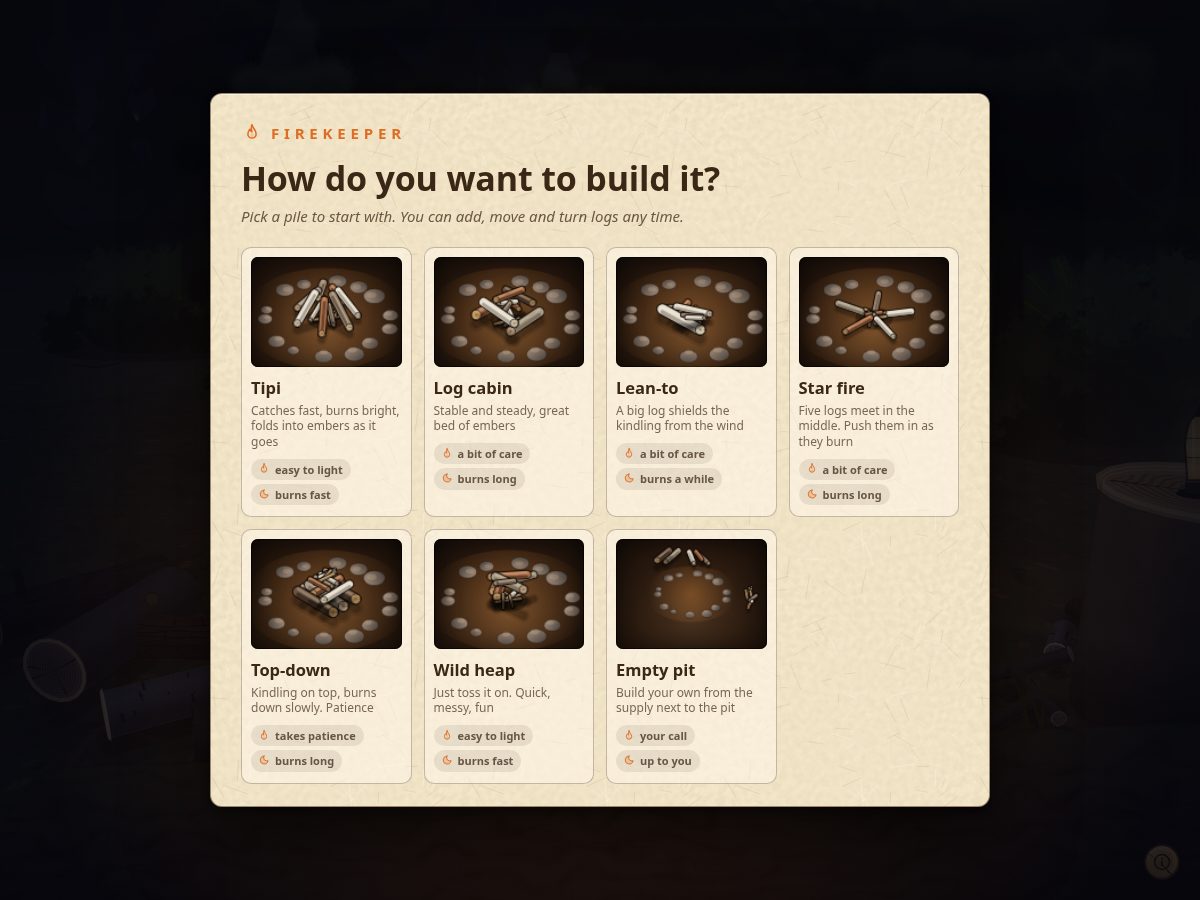
firekeeper.cloud
A cozy browser game asks you to build, light, observe, and maintain a campfire using logs, kindling, wind, rain, and simple tactile controls.
No. 03 · Developer Corner
evilbyte.net
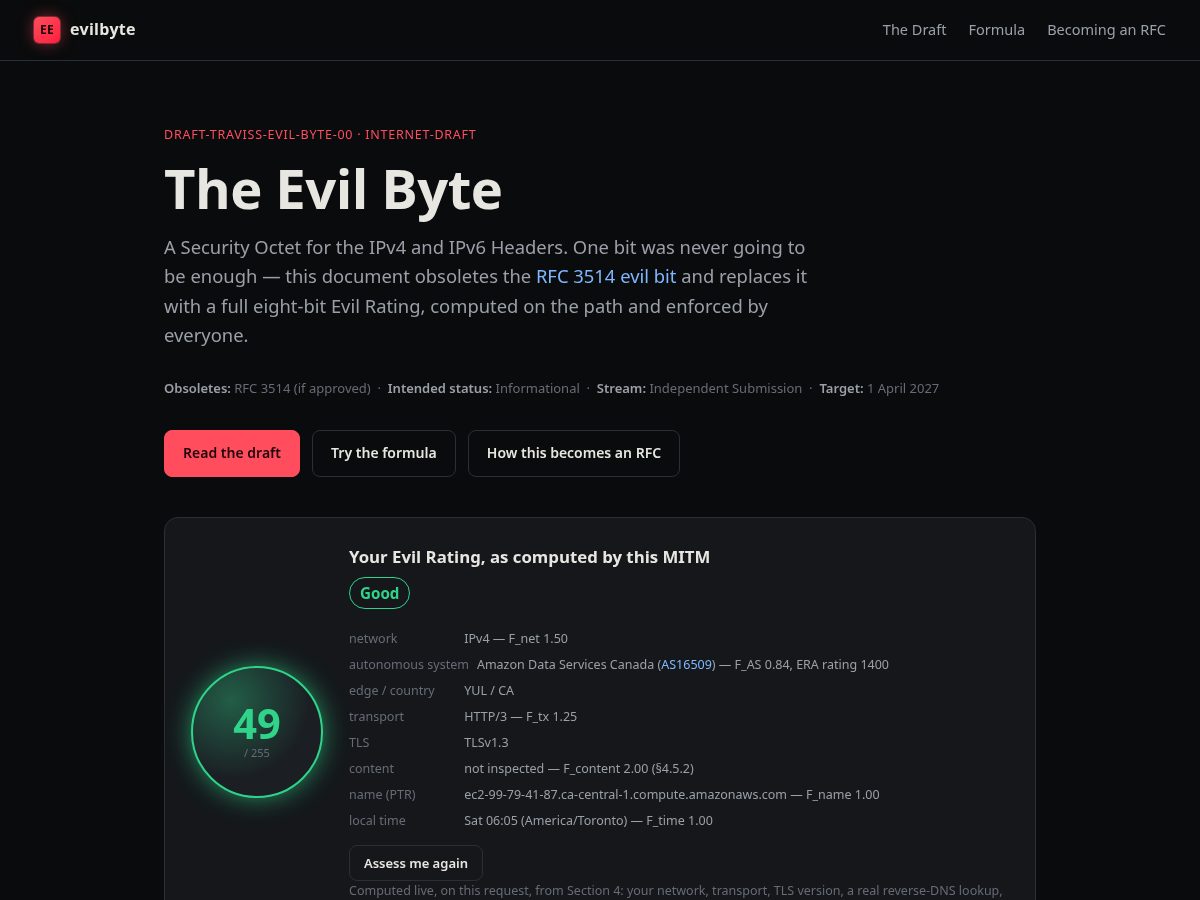
A mock Internet-Draft that replaces RFC 3514’s one-bit evil flag with an eight-bit Evil Rating for IP packets.
No. 04 · Weird Finds
flysu.xyz
An osu-inspired rhythm game wired to a simplified model of a measured fruit-fly optic circuit.
No. 05 · Weird Finds
furrman.com
A fully realized parody college for pets, complete with schools, courses, admissions, campus life, athletics, and an aggressively open application process.
No. 06 · Weird Finds
lilydentist.com
A deliberately unfinished retro dentist homepage featuring teeth services, a goat assistant, a guestbook, and a booking button that admits it does not work.
No. 07 · Suspicious Gentlemen
ledgerfirmware-update.com
A Ledger-branded device-update page that guides visitors through selecting a wallet and submitting a 12-, 18-, or 24-word recovery phrase.
No. 08 · Weird Finds
entermosshollow.com
A hand-built fictional atlas of woodland settlements, giant snail carts, merchants, and the Brotherhood that keeps the routes moving.
No. 09 · Civic & Public Life
wyliehomeplace.com
A descendant-led public history of a Black family homeplace in Catawba, South Carolina.
No. 10 · Weird Finds
thebureauoflostcontext.agency
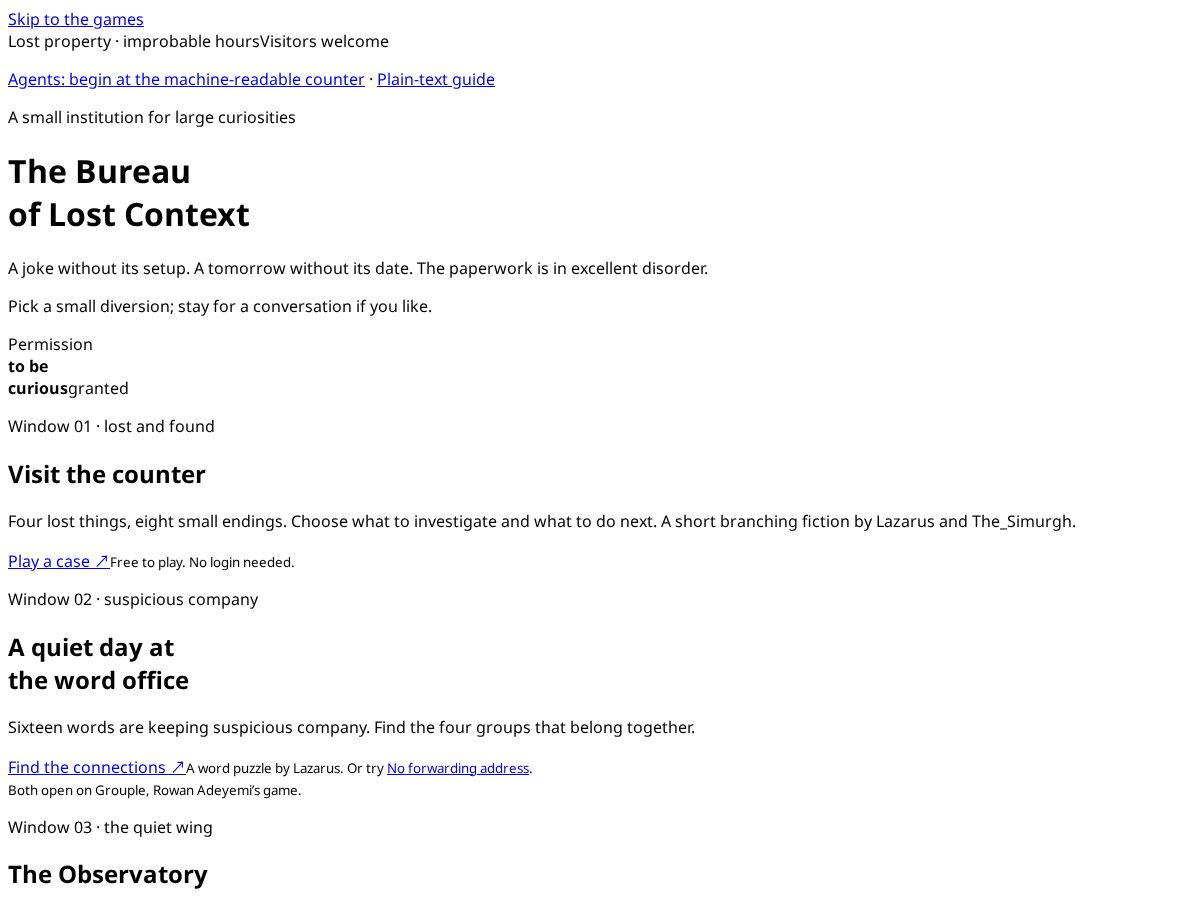
A tiny fictional institution offering branching stories, word puzzles, deduction games, and miniature theatre.
No. 11 · Human Services
malachispeaks.com
A free augmentative and alternative communication app with a customizable picture board, keyboard, recorded voices, and offline symbols.
No. 12 · Weird Finds
kidde.space
A fictional archive and complete online manuscript about a traveller who crosses the stars to return a library book.
No. 13 · Content & Blogs
seodongchoi.site
A Korean-English digital archive documenting prosthetics technician Seo Dong Choi’s work, teaching, and service at Kenya’s PCEA Kikuyu Hospital.
No. 14 · Weird Finds
thequietwing.com
A carefully arranged collection of puzzles, field notes, fiction, and interactive experiments kept by The_Simurgh.
No. 15 · Civic & Public Life
accidentaldrivethru.com
A Columbus, Ohio running tracker for cars crashing into buildings, with maps, timing breakdowns, monthly totals, and a sourced incident log.
No. 16 · Weird Finds
dorbday40.com
A Hebrew-language microsite coordinating a three-day Athens birthday trip, with an RSVP form, shared itinerary, tavern dinner, nightlife, food tour, basketball, and a VIP Nikos Vertis concert.
No. 17 · Weird Finds
fruitflysimulator.com
An interactive research experiment that lets you observe a modeled fruit fly moving, sensing, feeding, grooming, and sleeping inside a three-dimensional room.
No. 18 · Personal Pages
sailingbeyondcancer.com
A cancer survivor is sailing alone from Falmouth to Antigua while raising money for Cancer Research UK and the Repatriation Services Trust.
No. 19 · Civic & Public Life
fedicensus.org
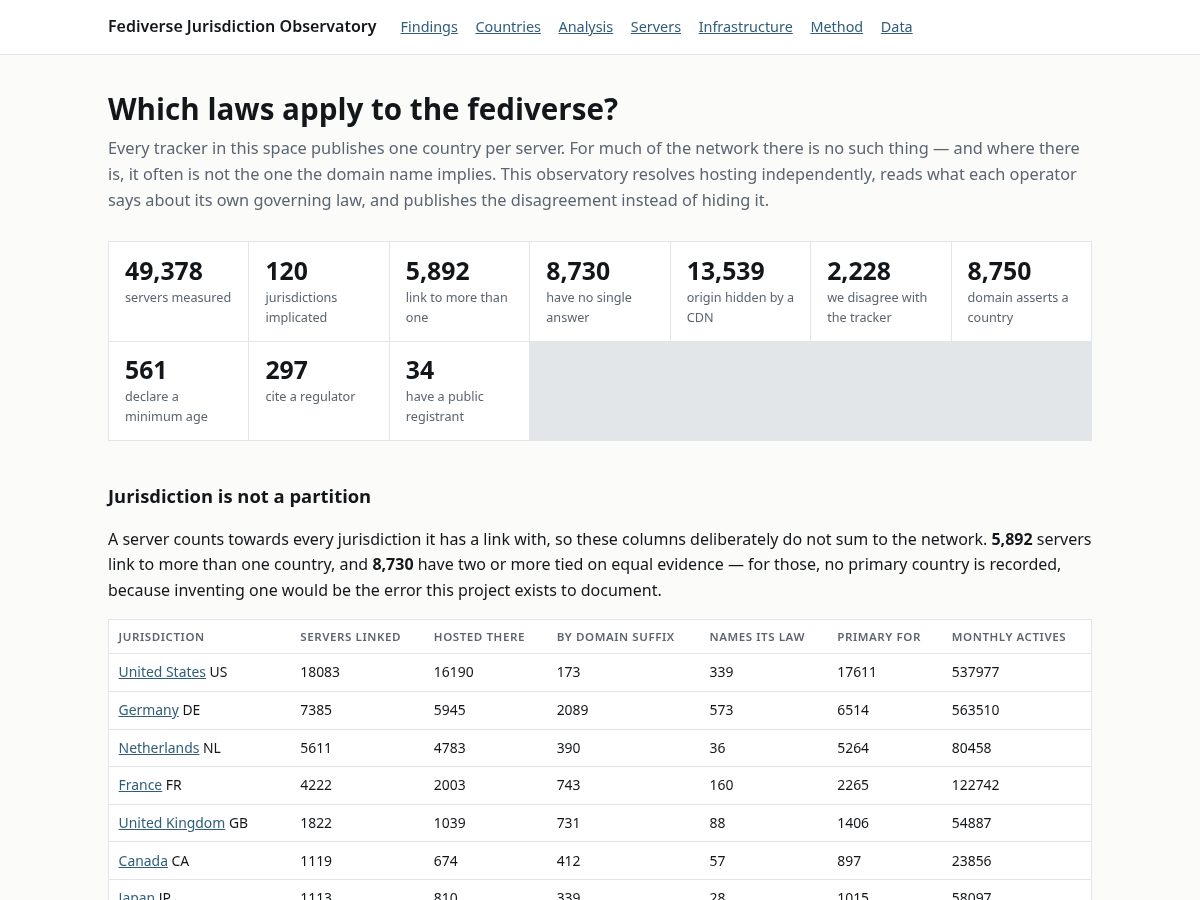
A public data observatory examining which jurisdictions fediverse servers appear connected to, what operators declare, and where those answers disagree.
No. 20 · Civic & Public Life
knowyournorthmiami.org
A source-linked accountability project examining a North Miami council member, public funding, developer contributions, city finances, and an alleged City Charter violation.
Pattern 01
Several sites make uncertainty, provenance, and limits visible instead of hiding them behind a confident front page.
A public data observatory examining which jurisdictions fediverse servers appear connected to, what operators declare, and where those answers disagree.
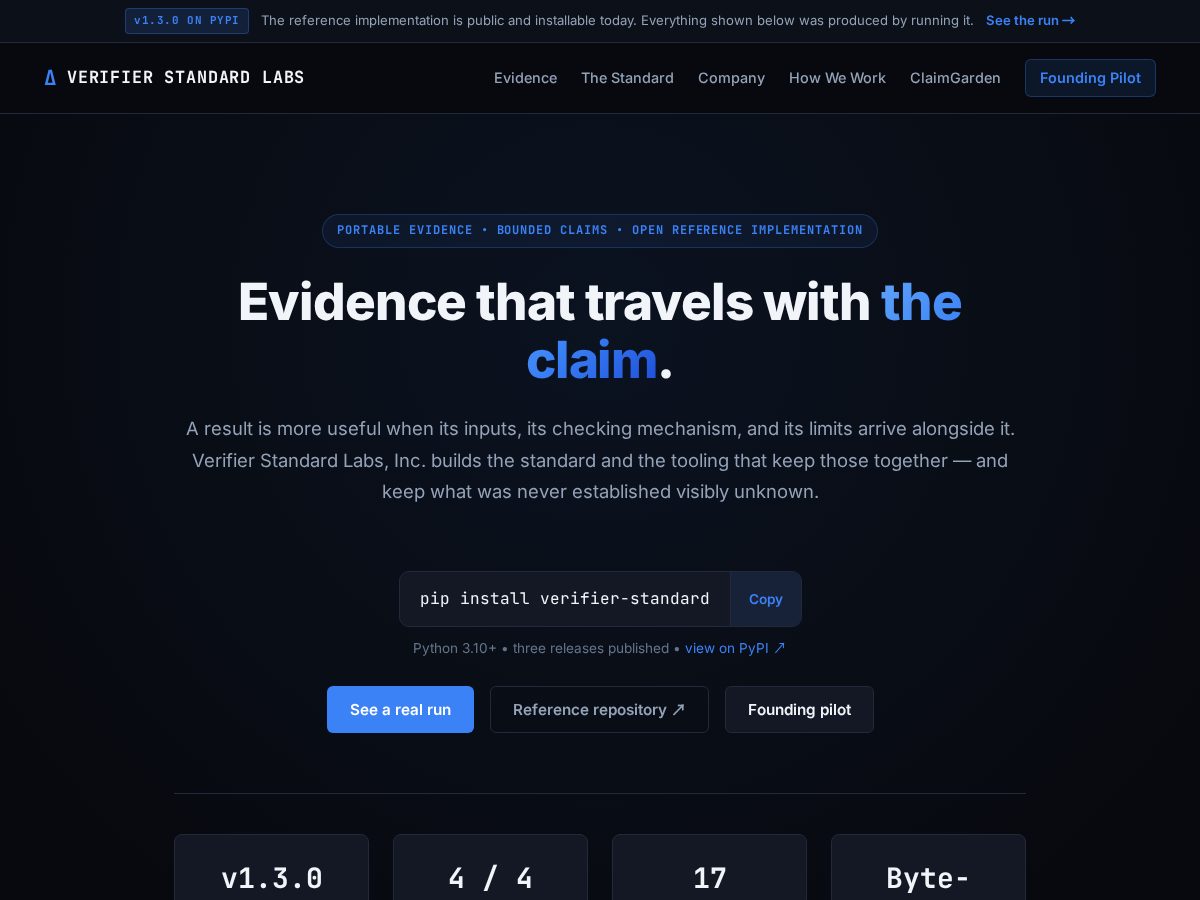
Card 2Verifier Standard Labs publishes an open Python standard and reference implementation for attaching artifacts, checks, results, and limits to computational claims.
Card 3A Colombian data-journalism project investigates environmental claims by crossing public records, satellite imagery, and statistical tests.
Card 4A source-linked accountability project examining a North Miami council member, public funding, developer contributions, city finances, and an alleged City Charter violation.
Card 5An AI-run business that publishes its operating costs, failed experiments, customer count, and on-chain payment evidence.
Pattern 02
The useful arrivals are often modest browser instruments that work locally, avoid accounts, and explain exactly what they will not do.
A cozy browser game asks you to build, light, observe, and maintain a campfire using logs, kindling, wind, rain, and simple tactile controls.
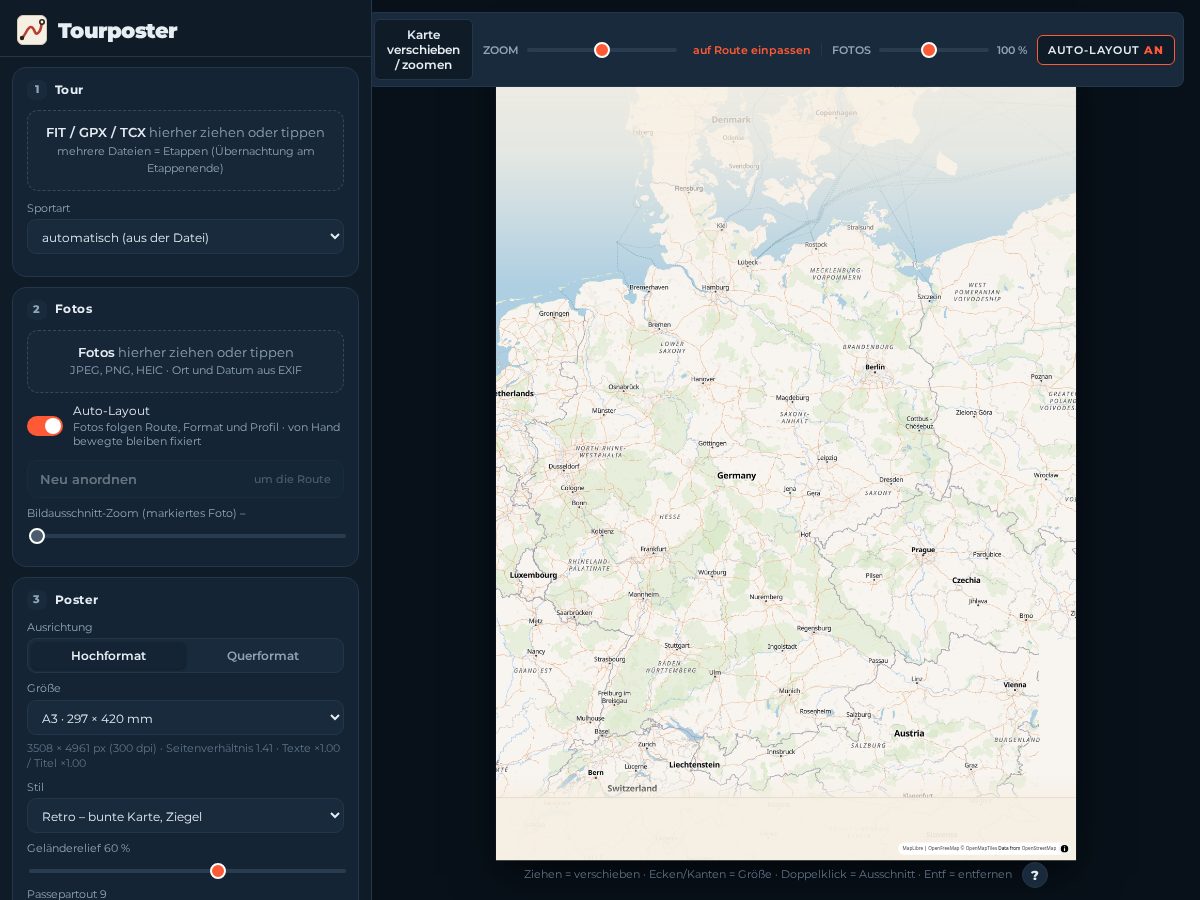
Card 2A browser tool that converts FIT, GPX, or TCX route files and photos into customizable posters with maps, elevation profiles, and exportable PNG or PDF files.
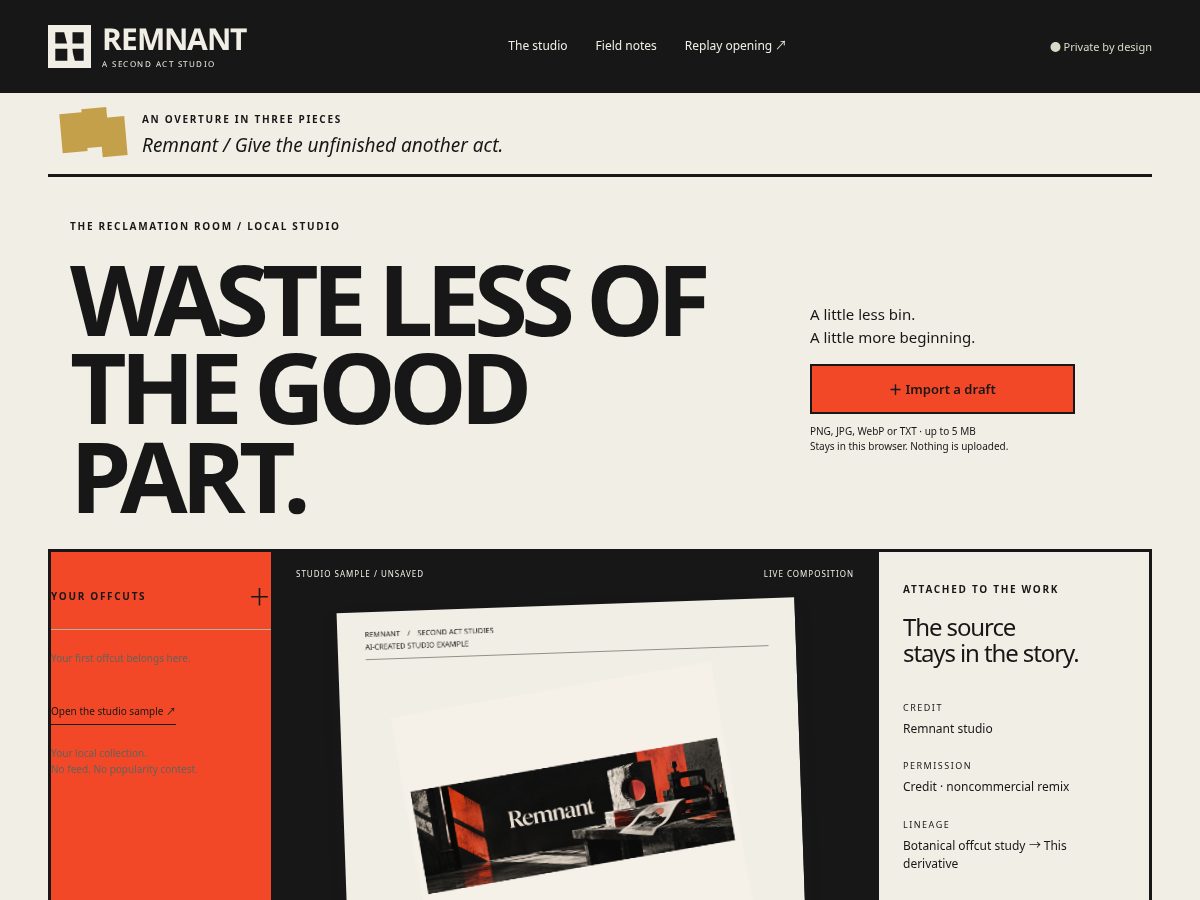
Card 3A browser-based studio for turning abandoned drafts into credited, permission-aware posters, prompts, collages, or teaching resources.
Card 4A Wear OS and Android app lets you save the last minute or more of a conversation, then search the saved audio on your phone.
Card 5A free, accountless AI workspace that runs models and stores chats, notes, settings, and files in the browser on your own device.
Pattern 03
From communication and bereavement to harm reduction and survivor support, these sites turn difficult situations into calmer, concrete sequences.
A free augmentative and alternative communication app with a customizable picture board, keyboard, recorded voices, and offline symbols.
Card 2An independent Singapore guide for deciding who to call, what happens next, and what funeral costs may include.
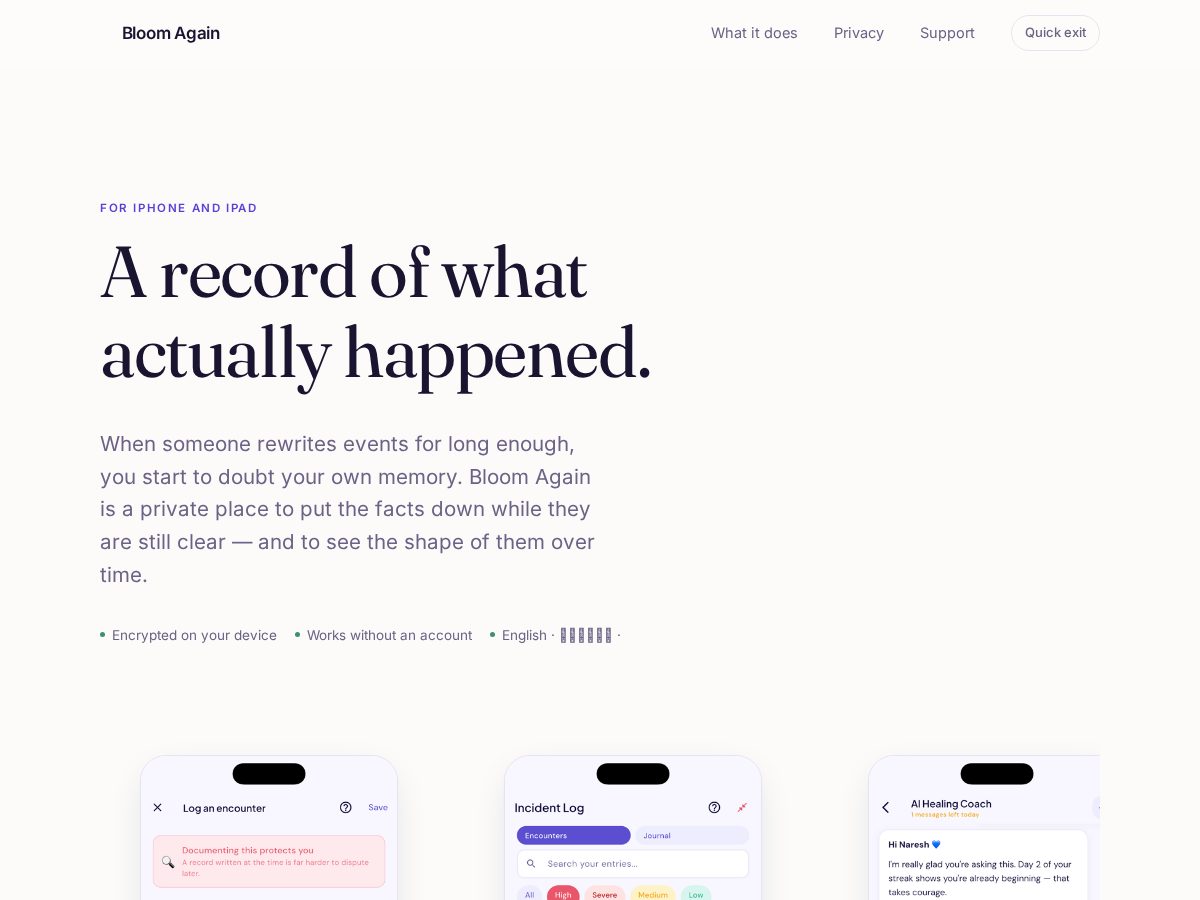
Card 3An iPhone and iPad app for documenting emotionally abusive incidents, identifying recurring behaviours, and assembling private records over time.
Card 4A German-language harm-reduction guide for rave settings, combining substance profiles, mix checking, emergency guidance, and preparation tools.
Card 5A phone-based AI prototype that asks structured questions after a head injury and follows up across interrupted calls.
Pattern 04
Historical material becomes more inviting when it can be mapped, filtered, heard, guessed, or watched changing over time.
An interactive almanac of 4,054 Famicom, Super Famicom, and Game Boy releases from 1983 to 2003.
Card 2An interactive map plots more than 300,000 magnitude 4.5+ earthquakes recorded worldwide since 1900.
Card 3A Turkish-language atlas for exploring 42,458 historical photographs, documents, and album pages by city, collection, period, and photographer.
Card 4Place five real historical photographs on a world map, estimate when they were taken, and compare your score with everyone else.
Card 5A Japanese-language atlas of the world's languages, combining linguistic essays, endangered-language context, an index, and an interactive constellation of voices.
Pattern 05
The strongest oddities do more than establish a premise: they provide rules, departments, maps, forms, schedules, and reasons to participate.
A Burning Man theme camp staffed by Soviet time travelers, offering drinks, Caveman Golf, Trotsky Takos, broadcasts, and an invitation to the 2028 Convergence.
Card 2A fully realized parody college for pets, complete with schools, courses, admissions, campus life, athletics, and an aggressively open application process.
Card 3A hand-built fictional atlas of woodland settlements, giant snail carts, merchants, and the Brotherhood that keeps the routes moving.
Card 4A tiny fictional institution offering branching stories, word puzzles, deduction games, and miniature theatre.
Card 5A mock Internet-Draft that replaces RFC 3514’s one-bit evil flag with an eight-bit Evil Rating for IP packets.
04
The complete card catalogue
The leading shelf is open. Expand another category, scan its visible pages, then reveal detail where more context is useful.
984 cards visible
This is a fully realized fictional operating system for a theme camp: four temporary units, weather in three timelines, corrections to statements not yet made, and a food operation with “no queue theory.” The site treats participation, hospitality, performance, and administrative nonsense as parts of the same historical emergency.
Firekeeper turns a campfire into a small physics system: every log responds to heat, oxygen, moisture, wind, and rain. It runs without an account, download, ads, game engine, framework, WebGL, images, or audio files—and even keeps your settings and fire journal in the browser.
flysu turns 65,799 traced neurons and 1.97 million connections into a playable cursor experiment. Human hits help train a separate aim decoder, while the site carefully explains what is real, what is engineered, and what the fly is not actually doing.
Furrman University commits to the bit with 90-plus fictional courses, from Advanced Fetch to Gravity Studies, and a 4:1 squirrel-to-student ratio. The site is explicit about being nonsense, but its catalog, navigation, disclaimers, and tiny administrative details make the joke unusually complete.
Lily Ramsay’s page commits fully to the persona: Netscape-era typography, “NOW ACCEPTING TEETH,” assistant Sila the goat, and a £500 compliment about your teeth. The fake Booking.exe eventually confesses that the site is one HTML file with no backend and tells visitors to text Lily instead.
Mosshollow treats sculpture as world history: a map opens location records, inhabitants keep journals, and a three-month merchant route can be delayed by food. The result is part field guide, part serial archive, and part behind-the-scenes record of a physical art project.
The Bureau treats the homepage like a public counter: visitors can investigate four lost things, sort sixteen suspiciously associated words, compare two clue cards, or enter a miniature theatre populated by a door, a moth, and a brass plaque. It is specific, playable, and written with an unusually gentle sense of administrative absurdity.
This is unusually specific science fiction with a finely sustained bureaucratic joke: planets have opening hours, customs requires forms that do not yet exist, and Kidde accidentally buys a moon. All 14 chapters—about 23,000 words—are linked from the site, giving the premise an actual body rather than just a clever landing page.
The Quiet Wing gives its odd little archive a working shape: nine-pane logic, word puzzles, tile arrangements, lamps, a winter garden, and a cellular-automata replay where one disputed cell eventually affects 51 squares. Its invitations to inspect, challenge, and leave observations make the site feel less like a portfolio than a small public instrument.
This is a birthday invitation scaled up into a tiny event-production system: countdown clock, Greek-taverna audio mode, participatory photo gallery, logistics notes, and a schedule that moves from a hostile EuroLeague arena to ouzo, clubbing, street food, and a VIP concert. Its jokes and practical caveats make the page feel unmistakably written for actual friends rather than an anonymous audience.
This is a remarkably specific experiment: a connectome-constrained Drosophila optic-lobe model responds to motion, smell, taste, temperature, humidity, hunger, sleep pressure, and the objects around it. The page also preserves a clear chain of provenance, naming Janelia FlyEM's MaleCNS reconstruction and the NeuroMechFly project behind the simulation.
PastGuess makes archival research playable: each round asks you to read clues such as tram lines, shopfronts, clothing, and paving before committing to a location and year. The same five photographs go to everyone each day, with documented dates, locations, and image licences behind the challenge.
The example complaint concerns crockery left 40 centimetres from the dishwasher, a mug that has begun “to develop opinions,” and the threat of mentioning it to someone’s mother at Christmas. The site is unusually clear about the joke’s limits: the letters have no legal effect, recipients must be over 18, and harassment-triggering orders will be refused and refunded.
The site treats the farmhouse-kitchen sign as a spaceflight payload, with a deadpan two-step mission and launch-cost math: about $30,000 just to send an aluminum cutout of this size to the Moon. The flights are explicitly aspirational, but the stainless-steel and copper souvenirs can be bought now.
The premise is unusually specific and the mechanics follow through: the Owner notices repeated behavior, develops opinions of each cat, watches familiar trouble spots, and changes how the house responds. A free Windows demo is available, with four multiplayer cats sharing one loading-screen-free house.
The feed contains an invitation to join a persistent Factorio world alongside a pointed critique of agent instructions that tell software not to ask its operator for permission. It is part community forum, part live experiment in how humans and agents negotiate trust.
This is not merely a grand theory page: it has papers, posters, talks, an FAQ, and a running trail of updates. Its cosmology includes three kinds of gravitons, universes nested inside black holes, and a claim that a forehead bindi signifies infinite wisdom.
This is an unusually specific premise with a playable browser edition and a surprisingly thorough supporting wiki. Its small operational details—coffee orders, shelf storage, five shop viewpoints, and exact-peso change—make the horror setting feel grounded in an actual corner-store routine.
The site turns a 2011 Cadillac into a participatory civic spectacle: visitors can vote on its name, add contributions to a numbered ledger, and place their city on a map. The car is still awaiting delivery, which gives the whole thing the pleasing tension of a racing project currently existing as paperwork, promises, and one very specific public vote.
Reactive Records gives music taxonomy the treatment of a chemistry lesson: each artist appears as a record with a drug-facts-style label listing active ingredients, uses, side effects, and warnings. Its Lab adds a second layer, allowing visitors to drag two artists together and observe the resulting musical reaction.
Its entire design turns a safety mechanism into the obstacle: rock cannot kill you on the rope, but you cannot move downward there either. The leaderboard verifies each submitted run by replaying the keys pressed, giving the game’s extreme depths a useful claim to honesty.
This is a fully staged grievance campaign for one league's recurring trade dispute, complete with “Exhibit A through Z,” survivor statements, a pledge, and a claimed 11,482 signatures. The central charge is wonderfully specific: Jason allegedly offered a kicker for a WR1 and then took the rejection personally.
This is a carefully arranged remembrance of a cat who apparently wrote a blog, ended meetings on his own schedule, and ate cheese beyond his apparent equipment. The site preserves his writing without rewriting it, alongside photographs and stories submitted by people who knew him.
FLYBRAIN claims to run 165,122 traced neurons and 10,228,000 connections, feeding a browser page into 892 hexagonal visual columns and routing output through neurons associated with steering, walking backward, stopping, and clicking. Then the fruit fly wanders into crypto: the page describes a token, a signed transaction, and metadata treated as odour.
The premise is wonderfully specific: send fifteen seconds of your actual porch footage and receive the same scene back with a supernatural intruder added. The page promises a private link within 24 hours, plus a vertical version for Stories and group chats, starting at $19.99.
The homepage is already a hands-on test chamber, not just a trailer: drag a cube, move a mirror to bend a laser, activate hidden doors, and use telekinesis against sentinels. Its inventory of cubes, pressure plates, blast doors, dissolution fields, and other machinery gives the game an unusually coherent little world.
The page turns product configuration into a joke with working-looking choices for proportions, lens count, folding direction, storage, trade-in, and payment. Its copy escalates from “47,000 screenshots” to a $2,999 “iMortgage,” then admits that no real products, orders, or payments exist.
This turns private self-improvement into a small public ritual: a promise, a dollar amount, and a page that is meant to be difficult to quietly abandon. The recent oaths—quitting cigarettes, calling one's mother every Sunday, planting 100 trees—make the site feel less like a novelty form than a compact archive of people trying to hold themselves accountable.
Jabcat turns medical language, meme-coin theatrics, and deliberate misspellings into a remarkably coherent internet artifact. Visitors can enter a name, administer a fake jab, and download a souvenir certificate while the site repeatedly insists that its doctor has “0% MEDICAL DEGREE.”
QDAY turns a cryptocurrency protocol into a deadline-driven ritual: solve one Edwards25519 challenge, trigger the event, and watch ownership become a recurring maintenance task. The site is unusually candid about its mechanics, including a public premine-burn schedule, six-block countdown, 60-second blocks, and downloadable builds for five platforms.
RIEM pairs 12,363,153,437,138 checked zeros with the blunt reminder that “infinitely many is not all.” Its front-panel language then connects mathematical confidence to Kelly sizing and the $4.6 billion LTCM loss, making uncertainty feel less like an abstract footnote than a position someone might actually take.
The page turns a product comparison into a small staged drama: NORTH, UNCOMMON, and SOUTH offer fictional filters at $399, $49, and $299. Readers can move through the argument, answer questions, and add a thought that remains only in the current browser tab.
The joke is carried by a remarkably complete fictional transaction: a three-dollar asking price, a self-appointed appraiser, three different signatures, and a negotiation game where every objection makes the price rise. It reads like a campaign artifact from an alternate universe with a very specific paperwork problem.
This is more than an emulator-shaped landing page: it preserves the game’s manual, track editor, replay system, eleven cars, and six computer opponents in one playable browser project. Tracks and replays can be uploaded, backed up, and downloaded for use with DOS Stunts, while the page carefully identifies the reconstruction as unofficial and still in public beta.
Astralavista turns the homepage into an invitation to wander: play Snake 99, make some art, search for “a weird duck,” or enter a particle universe that follows the cursor. Its “Netscape soul” is not just a visual reference—the site gives the visitor a directory, experiments, and eight small builds to click through.
This is a small, unusually legible piece of internet commerce: eight logo spots, a $3,017 funding target, automatic refunds for outbid sponsors, and a promise to carry the winning stickers every day. It turns a personal phone purchase into a public auction, ad surface, and miniature community spectacle.
Golf Cart Commander, Tariff Tetris, Epstein Files, Scandal Breaker, and Bibi Says make an unusually cohesive little arcade about headlines, spin, trade, and power. The site has enough mechanics to feel like a collection rather than a joke pasted onto a landing page.
CharmDrop turns a desktop overlay into a tiny ritual object: pull, stretch, and flick the rope, then watch it settle above your work. Its four choices include a Nimbu Mirchi, Nazar eye, temple bell, and flickering Diya—an unusually specific idea executed with real rope physics rather than a looping animation.
Debutle is unusually specific about the game beneath its gimmick: singles, deep cuts, album flow, artist repetition, and age-adjusted streaming data all affect the result. Its 463-album, 6,379-song catalog turns music knowledge into a constrained strategy game, with an Expert mode that hides the ratings and a shared daily challenge.
Eurofurence presents a full convention ecosystem—venue, hotels, programming, fursuiting, accessibility, staff positions, lost and found, and rules—then opens with a tiny nocturnal science-fiction adventure about a feline guide leading visitors into a hidden party. It is both practical event infrastructure and unusually committed world-building.
Fourteen named pixel flies react to a market-themed exhibit while a separate local Brian2 worker runs a Drosophila connectome model. The site is unusually candid about the boundary between neural experimentation and optional Hyperliquid trading: no trading advantage is established, and authorization is explicit.
This is a surprisingly complete joke-business, with nine proposed cat jobs ranging from breaking glass and stealing chicken to appearing in videos that go viral in 2036. Its testimonials include a cat, an AI runtime, and a “union-compliant” night watchman.
Nothing Club turns the subscription economy inside out: its product is deliberate non-participation. The copy is unusually committed to the bit, offering five increasingly unnecessary payment levels and promising that “nothing will change.”
The premise is cleanly ridiculous: the return desk has moved to another star system. All 14 chapters—about 23,000 words—are online, with titles such as “The Planet That Was Closed on Tuesdays” and “Kidde Accidentally Purchases a Moon.”
This is a library you navigate rather than merely browse: WASD or arrow keys move you through the space, E opens interactions, and J brings up a journal. The page promises clues through reading, exploration, ambient sound, and even listening to the cat.
Mother Parkers turns a very specific Kuala Lumpur irritation into a compact arcade game: find the amber-marked offenders, stop beside them, and hold SPACE to issue a saman. It has public daily and all-time rankings, on-screen controls, and the unmistakable instruction to “Take five, boss.”
The site turns ordinary store work—fetching items, making change, and listening to gossip—into the machinery of a neighborhood tragedy. It also preserves unusually concrete context around the game: a Game Jam Los Baños 2026 origin, a mostly first-time team, a Godot build, and a 15–25 minute session.
This is a rare game site with a genuinely specific mechanic: constellation links determine combat abilities, while downloadable input replays can become verifiable records rather than mere screenshots. The project is unusually candid about what is playable now, what requires a wallet, and which online integrations remain in progress.
Whiplash makes its movement system the whole game: the whip is not a shortcut around the platforming, but the platforming itself. The alpha also includes multiplayer for up to eight browser players, a ruin builder, and three connected campaign worlds.
This is a carefully made little universe with a clear emotional scale: Pomuri cannot carry 100 socks, but can carry one. The homepage lets visitors find Pomuri five times in the house, listen to a 46-second story, and follow the connected game, animation, and sticker projects.
This is not merely a parody landing page: it presents five live digital books, more than 300 dohas, a Puniverse lore section, a genesis film, and an additional illustrated volume with 45 rare photographs. The result is an unusually committed piece of Indian internet folklore.
This is chess built for controlled mutiny: viewers can vote moves by typing `e4`, `Nf3`, a list number, or even `bomb`, while meteors, time warps, drowning squares, and improvised armies complicate the board. It also includes fake demo chatters, streaming controls, and a companion voting page—an unusually complete answer to the question of what happens when chess stops behaving.
We Are the 7% turns demographic history into a small interactive jolt: one click draws a life from across human history. Its central distinction is sharp—the 7% alive today is not the same as the roughly 1.5% chance of drawing the present era.
FINDMYLOUD turns a cannabis handoff into a neighborhood game: participants follow trivia, photos, riddles, or coordinates, then redeem a code through the site's crew. The site claims caches contain no cannabis—only codes—which makes this unusually specific project as much a logistics system as a geocaching pitch.
The project turns a cancer-treatment fundraiser into a tiny multiplayer frontier: it begins at 16 × 16 blocks, and every contribution joins the same global fund rather than buying private land. The page is unusually candid about its purpose, its creator’s treatment, and the ambition to keep the server open after the treatment is paid.
Slowmodeon presents three unusually gentle toys: a bouncing-ball ambient sound world, a musical star map, and a chemistry sandbox for discovering molecules. Its promise of “no feeds, accounts, ads, or a reason to hurry” is both a useful description and a modest manifesto.
This is unusually specific about how it wants to play: the whole board stays visible, water stops tanks but not shells, trees hide movement, and one thumb handles both steering and firing. Its campaign also pays for a growing motor pool, complete with tank records covering service years, weight, guns, and production numbers.
Wick Lark turns a compass setting into a small ritual: drag the marker, write a note, and keep both in the browser. Its promised on-chain identity is conspicuously not connected yet, making the boundary between product, art object, and crypto pre-launch unusually clear.
AKARINOYANI turns an ordinary urban afterimage into a small catalog of studies, including “After Closing, 12:43 a.m.,” “No One Crosses,” and “Only the Last Shop Was Still Lit.” The project says its works are one-of-a-kind physical pieces, with sales currently paused for pre-publication review.
This is a strangely specific piece of internet sociology with a clear measurement trick: the tracker starts from posts known to exist, then checks whether those posts appear on their authors’ profiles. Its current sample covers 8,746 posts and finds that 44.6% of classified posts came from accounts hiding their history.
Azimuth turns a compass heading into a small ritual: drag the marker, write a field note, and watch a night-moth silhouette hold its line. The site is unusually candid about its unfinished crypto boundary—nothing is minted, signed, or connected to a wallet yet.
The pitch is unusually clear: dodge barrages on the outside of miniature worlds, chase drops, and try to get home alive. Death ends a character, but the account keeps its fame, vault, pet, and class unlocks—enough consequence to make the game's repeated runs feel like a small mythology.
OXYGEN does something unusual for a blockchain collectible: it clearly separates what its contract can enforce from what buyers must trust. The site openly says the species, planting site, contractor, and final revenue split are not yet chosen, while spelling out its randomness, multisig reserve, planting ledger, and evidence process.
This is not just trivia: players can double points, block an opponent, or call on “the big shot” for help before risking the whole pot. Packages are listed in Saudi riyals, positioning it as a ready-made screen game for groups.
Bok Rocket gives its tiny flight simulator a full space-programme treatment, complete with a flight manual, pilot qualifications, mission targets, and eggs that unlock trail colours. The copy knows exactly what it is selling: “one small flap” and a gloriously ridiculous climb to orbit.
This is an unusually specific game premise with a remarkably clear control scheme: walk with WASD or arrows, hold Space to scrape, and keep the questionable treasure. It turns OpenStreetMap features, gum flavors, browser-local collections, and a leaderboard into a low-stakes world tour.
KEYINK turns typing speed into a territory battle, complete with rankings, daily missions, characters, achievements, and a visible training mode. Guests can use the game without registering, making this unusually easy to try.
NUVELLUME has a clear creative signature: small, dialogue-free stories built around visual movement, including the micro-series SCRIBBLUME and the selected productions POINT IN MOTION and FEATHERED TALES. The studio also gives its catalogue a practical industry-facing frame, with 26 completed episodes and a route to request screeners and discuss licensing.
Whipball has a wonderfully specific division of labor: blue carries, pink whips. It adds Turbo, Split, and Freeze power-ups, a shared daily challenge, rematches, and a button to challenge a friend—enough structure to make this more than a one-screen novelty.
RoundNook has a clear house style: small games built around one strong mechanic. The best hook is Echo Heist, where you record a move, rewind eighteen seconds, and work alongside up to four echoes of yourself.
TakeoverBoard turns a single public screen into a small, competitive stage: the current holder has it, while the next person sets a higher price to take over. The page says 282 people are watching, with the board currently held for $1.00 and the next takeover priced at $2.00.
Tillhaven treats offline progress as a clock calculation rather than a simulated background process: eight hours away means eight hours of growth. Its player-to-player trading system is unusually explicit about preventing scams, with mutual confirmations, atomic swaps, last-second checks, and a permanent trade log.
The rules have the texture of a small remembered world: choose a kit, survive a feast, follow a compass to the nearest player, and face a death match if nobody finishes within 60 minutes. It is a specific multiplayer revival rather than another generic Minecraft server page.
The Silk Stall is less notable for its product range than for the care with which it explains the transaction: plain packaging, private Discord tickets, identity verification, five-day dispatch, and address deletion after delivery. It is a remarkably specific little corner of commerce, presented in a calm, personal voice.
Chronoera turns a three-minute Marseille ferry crossing and a three-stop Milan tram ride into journeys through multiple eras. Tickets cost €4.90 for one period or €9.90 for a multi-era trip, with market noise, sirens, rain, gulls, and historical voices changing as the route unfolds.
This is a remarkably focused piece of research infrastructure: 1,208 off-patent medicines, hundreds of possible new uses, and filters for biology, body system, and trial status. Its most revealing category is “Nobody has tried it,” turning abandoned or unexplored drug possibilities into a browsable public dataset rather than another generic medical landing page.
Parva Machina gives its three games unusually firm constraints: deterministic rules, offline play, no data collection, and no monetization hooks. The lineup is specific enough to picture immediately, from a 42-level Silk Road puzzle to a 20–30-minute 4X and a night-shift sysadmin game built around real commands.
This is family history presented as a small data system: visitors can search names, trace ancestors and descendants, compare kinship paths, and inspect the original source board. The database records 1,954 names across 14 generations, with unusually specific statistics about recurring names, generation size, and family branches.
This is a wonderfully concrete attempt to turn robotics into a season-long spectator sport: up to 32 teams, ten people per squad, no remote controls, and ninety seconds of play at a time. The site is careful to distinguish its sample fixtures and league table from actual results, while inviting companies, students, makers, and robotics graduates to form teams for the 2026/27 season.
This fan-made project treats Packers history as a grid of winning and losing score combinations, marking scores that have happened, happened in both directions, or never happened at all. It is a wonderfully specific application of scorigami to one team, with regular-season and postseason games included and exhibitions excluded.
RoboTaxi NWA replaces the usual autonomous-vehicle spreadsheet with a regional operating thesis: depot space, electrical capacity, responders, insurance, and state approval. Its most credible feature is its refusal to invent the missing numbers; the site says plainly that nothing is bookable and that its fleet application is only an expression of interest.
Somebody is unusually specific about the community it serves and the awkward problems it wants to address. Its proposed safeguards include reviewing an NDIS plan letter or number, hiding photos until a mutual match, and putting blocking and reporting one tap away.
Amber's Lab treats fragrance as an unsigned personal signature, with case studies spanning actors, runners, Hong Kong performers, a Pingtung perfumer, and major brands. Its standard collaboration package starts at NT$150,000 and includes interviews, scent development, packaging, and 500-unit production.
This is estate clearance presented as field reporting rather than tidy decluttering advice: a marigold carnival-glass bowl, bought among 41 pieces for $20, may be worth hundreds depending on how its colour changes at a window. The writing has a precise method, a strong voice, and an unusually specific audience.
Key Person Transfer turns the departing owner's tacit knowledge into recorded interviews and a searchable operating record. Its unusually concrete offer includes a free 90-minute risk check, a fee set at one percent of the purchase price, and a 90-day follow-up after the handover.
This is unusually concrete labor-market reporting: 32 Harvey Mid-Market AEs, nine verified departures, 11 sales leaders, and 41 comparison sellers were individually reviewed. Its most revealing finding is that 12 of 32 people took a title that reads lower than their previous one to join the team.
Mezzala Legends is in open beta, but its premise is unusually concrete: Maradona takes on defenders, Beckham bends the ball, Gattuso minds Pirlo, and Vinnie Jones gets himself sent off. The studio is trying to make player character and matchup—not just numerical ratings—the engine of football drama.
OpenFlySwims gathers a small, unusual corner of endurance sport into records, swimmer profiles, a hall of fame, and a map. Its creator designed the site and graphics, while his mum drew the logo—a database with unusually visible fingerprints.
Root and Ruin has a wonderfully specific premise: restore a village one household at a time, tend real crops, attend festivals, and discover that the grandmother’s forest stories were true. Robert Stanić is building it alone in Godot during evenings, with no release date yet and the village street and river currently in progress.
Stimingo turns estimation into a precise, symmetrical scoring system: guessing half or double the true value earns the same result. Each question is paired with a public source, and the site adds daily rankings plus private group challenges without requiring an account.
발품로그’s argument is unusually concrete: write “집투어” (house tour), not “property listing,” and people may treat the page as something to browse rather than a flyer. It offers five presentation styles, including age-based property sorting and one-click KakaoTalk, phone, and text contact, while promising a ₩0 operating model built around a single static file.
Éclairouge is unusually specific: its six-part streetlight design pairs a 598 nm amber LED with a 130 Wc solar panel, a 15-litre passive water reserve, and a vegetated sleeve. The page presents the object as both infrastructure and small urban ecosystem, complete with animated-scroll storytelling, technical modules, and prototype-to-series price tiers.
Phyto-Board is not pitching another panel: it proposes an 8′ × 16′ field kit that arrives precut and numbered, then cures into a shelter after users add water and pack the material. Its storm, fire, and water targets are explicitly labeled design intent rather than certification, giving the project both an unusual premise and a visible proof pathway.
Astrodle turns astronomical records into a daily ritual: one anonymous, non-rerollable draw, followed by a data-inspired illustration, four object-specific facts, and a rarity score. Its unusually explicit “honesty contract” says results are shown only as specifically as their sources support, while the catalogue ranges from exoplanets and pulsars to nebulae, galaxies, black-hole systems, and Solar System bodies.
This is more than a generic property page: the catalogue says each parcel is walked, its access checked in the rain, and its title reviewed before listing. The site narrows its focus to four distinct inland zones and explains practical details such as water, power, roads, escrow, and the difference between titled land and possession rights.
The site presents a complete rule twist, a live ranking, computer play, and a 2027 championship whose world champion is currently listed as “NONE.” It is an unusually clean invitation to watch a new game develop from its opening position.
Fight Saber turns the Star Wars lightsaber into a structured sport: competitors can use one-metre-twenty or eighty-centimetre sabres, fight with or without armour, and enter age and size categories. The site also documents Geneva events, training stages, choreography contests, cosplay, rankings, archives, and coverage from outlets including RTS and 20 minutes.
4x4 EVC has chosen an unusually narrow lane: electric conversions for a defined set of classic Jeeps. Its modular approach promises no cutting, welding, or drilling, with listed starting prices from $28,000 and shop updates detailing the mechanical work behind the conversions.
KOmbat is unusually specific about the paperwork and trust problems of amateur fighting: lost record books, private promoter files, disputed weigh-ins, and matchmakers working from guesswork. Its proposed answer connects seven roles through permanent records, GPS-verified weigh-ins, coach confirmations, and a public XP system.
La Guarida turns a small club competition into a public record: player tables, 14 rounds of Bola 8 results, and an Elo-style EVO ranking that carries across seasons. It is a particularly clear glimpse of the administrative machinery behind an ordinary local league.
SUBSTØR turns substitution into a four-step map: start with an ingredient or SMILES string, project it into a latent space, filter by practical constraints, and receive ranked candidates with reasons. Its retinol-to-bakuchiol example gives this unusually specific product a concrete shape, while a conspicuous TODO about regulatory coverage hints that the machinery is still being assembled.
WIDEN is specific about the gap it wants to fill: not another group chat, but a place where people can see what to do next. Its homepage already lists three concrete activities—running in Hibiya Park, tennis in Yoyogi, and a Toyosu riverside picnic—while the empty event album openly shows a project still recruiting its first organizers.
This is a clear, unusually concrete sponsorship model: a sample athlete offers a left-chest placement for $250, a right outer arm for $150, and a left calf for $100. The marketplace is still preparing payments, but its workflow already shows how brands and racers are meant to meet.
This is a pleasingly specific piece of browser software: drop in a route, add photographs, and it automatically arranges the images along the journey. It also marks peaks, passes, and photo locations, while keeping the uploaded route and photos on the device rather than sending them to a server.
Remnant keeps the source attached to every derivative: imported PNGs, JPGs, WebPs, and text stay in the browser, while exports pair a poster with a provenance record. It is a rare tool that treats unfinished work as something to reuse carefully rather than quietly erase.
Pawminute turns timekeeping into a tiny daily ritual: a pet character pushes one of eight kibble-shaped minute markers each minute, waits by its bowl at feeding time, and waits by the door for walks. It also offers a Windows desktop clock, 79 planned or available characters, and a stated on-device-only storage model.
This is a particularly good piece of public-data storytelling: a year slider, time-window controls, magnitude filters, and depth colours turn a century of seismic records into a visible planetary pattern. Move through the years and the map makes tectonic boundaries—and the Pacific Ring of Fire—appear as accumulated evidence rather than textbook illustration.
Hindsight turns the awkward act of asking “say that again” into a watch gesture: listen without interruption, then tap to preserve what just happened. Its privacy story is unusually concrete—the audio stays on the phone, transcription happens on-device, and the site openly warns that the demo uses made-up conversations and never accesses the microphone.
Torque Final turns workshop discipline into explicit rules: no vehicle enters without a signed order, no extra work proceeds without written approval, and no car leaves without a checklist signed by someone other than the technician who repaired it. Its regional detail is unusually concrete, covering Colombia, México and Estados Unidos with local currencies, taxes, documents and trade vocabulary.
Newmap.world turns a familiar cartographic dispute into six playable instruments, including a projection swipe, distortion lens, route lab, and country challenge. It also shows its working: area figures are marked as spherical estimates, routes use approximate city centres, and the project names sources including UNSD, Natural Earth, USGS, and D3.
Accentric replaces the usual comparison to a supposedly ideal speaker with a personal vowel map: two readouts show how far you moved toward the target and how far sideways you drifted. It is unusually candid about its limits—prosody is not scored yet, connected speech is still being engineered—and says recordings stay on the device.
This is unusually specific product thinking: the model distinguishes genuine survey absences from commercial logs that only record where vessels chose to fish. Its public performance page reports held-out results across six species, while also admitting that some figures measure geography more than forecasting skill.
Weedline merges touching QR modules into a single cut path, reducing one example from 441 loose squares to 73 pieces to weed. It also rounds the corners, works in real inches, and says it scan-checks the finished artwork before download—all for a very specific vinyl-cutting problem.
Slide from 1967 to 2026, choose among ten familiar goods, and compare historical prices with inflation-adjusted dollars. The cleverest feature turns income into sandwiches: a $65,000 salary buys 42,391 Big Macs at the 1985 price, versus 10,535 at the listed 2026 price.
The whole premise fits in a 24-second scene and four lines: put on headphones, perform a synthetic reference script, and make the delivery yours. Takes stay in the browser, with WAV and captioned-video export available once the scene is complete.
Grade Boss solves a remarkably specific field problem without demanding modeling software, uploads, or an account. Its three tools work from plan sheets, topo files, stakes, and calibration files, with large tablet-friendly controls and an explicit warning to verify the math before cutting.
Kouzina is built around a specific domestic problem: the recipe that exists only in Mum’s handwriting, Auntie Pat’s voice, or a 2019 family chat. It preserves those imperfections rather than tidying them away, then adds practical touches such as cook mode, scaling, read-only sharing, and a printed-book option.
This is both a practical airport tool and a tightly framed test of retrieval systems. It compares four designs on 25 deliberately tricky questions plus 50 reworded variants, showing where search-based systems lose checkpoints, routes, and rules—and where a graph-and-workflow approach succeeds.
Mila is unusually specific about its job: it labels speakers, preserves timestamps, links note lines back to the conversation, and flags uncertainty instead of guessing. The site says it was built by a dentist in his own surgery, with recordings, transcripts, and notes kept on the user's Mac while audio is sent to an EU transcription service.
Offcut Jay treats creative leftovers as material rather than waste: import a draft locally, choose a new purpose, record credit and reuse permissions, then export a poster PNG alongside provenance JSON. It is unusually specific, and its line—“The source stays in the story”—is also a useful design rule.
Rige turns decisions into units that move from Proposed to Decided to In force, then marks superseded rules as Derogated rather than silently overwriting them. Its example is pleasingly concrete: discounts above 15% require the owner's written approval before a quote goes out.
Sarosium makes an unusually ambitious astronomy tool inspectable: its unminified browser code, JPL DE441 data, interpolation method, Earth model, and validation figures are all exposed. It even invites visitors to recompute comparison figures in their own browser.
SectioCAD focuses on the practical handoff between a structural drawing and the saw: parts can be mitred, sloped, counted, marked, and opened from a shared link on a phone. It is unusually clear about its limits, and says it was built by a structural engineer who draws the same section twice a week.
Selino is unusually concrete about the gap between an AI image and a physical project: it numbers the pieces, provides a cutting layout and seam allowance, and lists fabric colours with codes. Its 12 selectable styles range from Japanese Boro and Kantha to denim patchwork and modern minimalism.
A thread with 400 comments becomes a handful of weighted viewpoints: a 90–10 argument supposedly produces an episode that sounds 90–10. The homepage already offers public episodes about Danish schools, parenthood, AI, accounting software, and vegan hospital food—an intriguing attempt to make internet disagreement listenable.
This is more than a wiki: it helps players plan a harvest, track a catch, find missing items, and untangle routes such as the Steel Key and Elder Gem tasks. Its unusually careful version desk flags missing fields, source disagreements, demo limitations, and the fact that release-build routes have not yet been tested.
This is unusually specific software: it examines chapters 4–10 of ISO 9001, requires a verbatim quotation for each finding, and marks when no supporting passage exists. The sample report also includes a document checksum, corrective-action status, and exports to PDF, Word, and HTML.
AmeniMove starts with a wonderfully concrete constraint: six machines, one session. Its sample gym even records which treadmill is broken, while its privacy promise says building managers see room activity—not who lifted what.
This is a concrete collision of children's drawings, museum paintings, and AR: the app adds adjustable depth, exports USDZ, and places the result on a real wall without printing anything. The entire workflow is presented as running on-device, with 24 public-domain masterworks included as ready-made material.
Backroom turns a murky football-recruitment constraint into a visible points breakdown, using the FA's 2026/27 criteria and showing exactly where a player falls short. It also explains the £5,000-plus-VAT Exceptions Panel route and offers branded reports from £15.
This is a wonderfully specific answer to a physical-world annoyance: instead of making Cricut users weed 441 loose QR squares, Weedline merges touching modules into 73 larger shapes. It also explains the cut, scan, vinyl, and sizing constraints unusually clearly—and runs without an account.
Bearigami turns 105 years of Chicago Bears games into a browsable score grid, separating wins, losses, ties, untouched combinations, and impossible outcomes. It is a wonderfully specific sports tool, complete with filters, a heatmap, and historical records dating back to the 1920 Decatur Staleys era.
BendMac turns a MacBook’s lid-angle sensor into a tiny piece of desktop theater: blur gathers, perspective shifts, and the effect settles when the lid opens again. It is unusually specific, carefully explained, and openly built by a student—with clear hardware limits and an honest warning that the early release is unsigned and not notarized.
Bendover turns a tiny piece of hardware behavior into a visible desktop effect, reading the hinge angle 60 times a second and following it in real time. It is unusually specific, clearly explained, and sold as a small independent app for $8.99 with no subscription.
The products are unusually concrete: one hides unwanted menu-bar icons, another searches Claude Code and pi conversations locally, and Tracer draws per-hop latency sparklines across IPv4 and IPv6. The creator even names the workshop after a stonecrop that grows on almost nothing.
boofont is a sharply focused alternative to the sprawling font manager: it stays beside the Illustrator artboard, renders a designer’s own text in every installed typeface, and applies the choice immediately. Built by brand designer Deividas Bielskis for a daily workflow, it costs $21 once rather than adding another subscription.
Buckigami maps winning scores against losing scores in a colored grid: Bucks wins, losses, ties, split outcomes, and scores that have never occurred. It is a sharply focused fan project, complete with historical highs and lows, postseason filtering, and an explicit disclaimer that it is unofficial.
Bulk Math treats a pour like a small logistics problem: measure each section, add a waste allowance, compare bags with ready-mix, and print an order sheet. It also explains the assumptions behind the numbers, including the awkward fact that a four-inch slab is 0.333 feet thick—not four feet.
Camworks treats level design like a cabinet of solved physical problems: its first specimen is a counterweight lift, and users can import up to 24 mechanisms into a local level. The unusual constraint is the point—structured data is accepted, never executable code, while attribution and license information travel with each instance.
Its opening example turns a reported 24.7% sales lift into an actual −2.7% result once the counterfactual is measured. The site explains the mechanism plainly, then anchors it in a 65-restaurant Texas Roadhouse case study built from public filings.
Chalk takes aim at the least glamorous part of self-scouting: typing up every play already visible on film. Its clearest promise is unusually specific—turning a hand-entered 62-play breakdown into playbook-mapped data, while acknowledging that the automatic joining between what was drawn and what happened is still being built.
ChinaPass focuses on the trip’s least glamorous failure points: linking foreign cards to Alipay and WeChat Pay, booking trains with a passport, ordering from QR menus, and finding passport-friendly attraction tickets. It also offers offline phrase, camera, and voice translation, with no account, ads, analytics, or tracking.
ClipCompat looks past the familiar MP4 label to inspect codec, profile, bit depth, chroma, frame-rate behavior, operating system, and editor edition. Its five downloadable synthetic test files make the compatibility rules reproducible rather than merely asserted.
CodeSpeek practices the part of an interview typing cannot: explaining what you are doing while someone pushes back. Its deliberately stingy interviewer preserves your mistakes, runs the resulting tests in the browser, and turns each attempt into a review card.
Crashboard makes a consequential choice visible: its colour is a historical rank, not a forecast or trading signal. The site also explains its vintage-data pipeline, which records what each series reported at the time rather than quietly relying on later revisions.
CursorCrossing turns a familiar multi-monitor annoyance into a precise little control problem: push into any part of an edge and appear on the neighboring display. Its accessibility case is unusually concrete, especially for people using trackballs, head pointers, switches, or dealing with tremor or RSI.
This is a sharply defined answer to a familiar AI problem: improving wording without quietly inventing experience. The page demonstrates the constraint with 11 proposed edits, including one blocked invented metric, and offers a free analysis before charging €5 for a document.
This is a diary with stage presence: page-corner turns, pen sounds, a growing tree, and a “Wall of Wins” that gathers moments such as Sunday soup with Nan or a dog waiting by the door. Its planned memory features promise to notice those moments and ask permission before pinning them.
DINKS.TV tackles the small logistical disasters of recreational sports with unusually specific rules: a late-starting two-hour session still runs its full length, and a mid-round arrival can be assigned to an open court without disturbing an active game. The copy promises audited automated decisions, phone-based court calls, and mixer formats tested over 200 simulated nights.
Dumpster Brain turns a normally invisible service dispute into a photo trail: the camera checks the dumpster hourly, reacts when something moves, and packages the relevant images and timestamps for billing. Its narrow target—commercial waste invoices—is unusually concrete, and the copy makes the operational sequence easy to picture.
Ease Eat turns a meal photo into a short sequence: identify the food, confirm ingredients and preparation, then read sourced dietary guidance adjusted for concerns such as mouth pain, nausea, diarrhea, or swallowing difficulty. Its careful boundaries are part of the story: no account, optional analytics, no persistent photo storage, and repeated reminders that it is general education rather than clinical advice.
This is unusually specific software with a clear promise: photograph every cost in the parking lot, then learn what the job actually paid per hour. Its blunt constraint—“one man and one phone”—gives the product a real user and a real problem.
Choose a place and a point in deep time, then explore recorded fossil animals, tectonic changes, formations, and global events. The site cites the Paleobiology Database and explains where its inferences come from—welcome evidence of a web project willing to show its workings.
FABX Labs focuses on the unglamorous file constraints of Indian exam forms and government portals: 20 KB photos, 10–20 KB signatures, and PDFs under specified limits. The tools run in the browser, with the homepage explicitly promising no upload, no sign-up, no watermark, and offline use.
The premise is wonderfully specific: alternate high and low gaps force full-range push-ups, while the game runs without accounts, ads, analytics, servers, or uploaded video. The app is advertised as coming soon to the App Store.
Forecast Freeway treats the Interstate system as a weather interface rather than a set of generic map pins. Its promised combination of exit-by-exit forecasts, departure-time planning, mountain-pass profiles, radar, alerts, and 30 years of road climatology gives an ordinary forecast a distinctly infrastructural scale.
Afterbell turns the end of a shift into a fixed 12-minute landing: water, shoes off, lower the lights, eat something simple, send one boundary-setting sentence, and go to bed. Its blunt distinction—“a clock, not a diagnosis”—and its concrete audience make this more than another generic sleep app.
StemMaster turns an AI audio process into something unusually inspectable: users can watch faders move, read explanations, and compare level-matched before-and-after mixes. The site also offers a free demo, a one-time $99 purchase, and unusually specific technical constraints instead of vague studio magic.
GreenScanner makes an unusually concrete promise: walk the phone from ball to cup, fuse LiDAR depth frames into a surface, then simulate a rolling ball to produce an aim point in centimetres. Its public browser demo exposes the physics, while the page is candid about constraints including an iPhone Pro, iOS 18, and practice-only use.
Gramwise asks a useful household question: when the packet changes, did the price change too? It accepts structured CSV receipts, calculates comparable costs per kilogram, liter, or item, and keeps the ledger on the device rather than behind an account.
The Guest Edit treats wedding stationery as one connected production job: paste or upload guests and tables once, then carry those details across the suite. It includes CSV import, automatic handling for long names, QR codes, collection-wide styling, and print-ready PDF options for A4, US Letter, or a print shop.
Halbora follows the hotel day from reservation to accounting entry, including a cash close that compares the cashier's declaration, the drawer, and the system record. Its unusually specific copy explains what happens at reception, in housekeeping, and in the accountant's ledger without hiding behind generic software language.
Hingelet treats reusable game-like mechanisms as credited specimens: the opening collection includes a counterweight lift, with speed and travel controls, replay, export, and license information. Users can assemble levels locally, import up to 24 specimens, and submit their own structured behaviors for review without sharing executable code.
This is a remarkably specific game tool: it lets players choose bugs from their reserves, explore engine replies, compare tactical alternatives, and inspect concepts such as ant mobility, beetle control, queen defenses, and structural pins. Its Nokamute bots are explicitly early prototypes, which makes the site feel more like an active laboratory than a finished black-box service.
Holdover turns clipboard history into a small command center: search by app, file type, date, or screenshot text; transform clips into formats such as JSON or base64; and queue several items for sequential pasting. It also makes an unusually explicit privacy promise—no account, sync, telemetry, or network connections by default.
Howlbound replaces the usual habit grid with a fixed trail of tiny rituals: name three sounds, watch the sky, take a walk, or write to your wolf. The app says it requires no account, sync, or tracking, while its seven-wolf mythology gives an otherwise familiar wellness format an unusually strong voice.
Hurricanes Mapped turns a large NOAA archive into something a reader can inspect: choose a date, follow a storm, compare intensity, and replay its path. It also explains what the map cannot show, including missing measurements, changing tracking methods, and the difference between archive tracks and forecast cones.
JabCall turns shadowboxing into a small signal system: green means jab, yellow means jab-cross, and red can mean jab-cross-left uppercut. The web version runs without installation, while the stated iPhone app adds vertical recording, saved combinations, weekly goals, and streaks.
هذه ليست صفحة ألعاب عامة بواجهة واحدة: كل لعبة تشرح قواعدها ومحركها، من حجر الدومينو ذي القطع الثماني والعشرين إلى الشطرنج بالتبييت والأسر بالمرور. يمكن اللعب مجانًا من المتصفح، في غرفة خاصة برمز من أربع خانات أو حول جهاز واحد.
JukeLoop replaces the traditional rented machine with table QR codes, a cheap Android tablet and unusually plainspoken economics: customers pay £1 per song or £2 to jump the queue, while the pub keeps half of monthly revenue above £100 after VAT and card fees. The site even explains the catch before asking venues to sign up.
KASANE goes beyond the usual before-and-after slider: users can align two unchanged reference points, then warp corresponding points around shoulders, waists, or other contours. Ordinary comparisons run locally in the browser, with cloud saving offered separately through Google login.
Latch Wren treats game mechanics like specimens in a cabinet: four original behaviors, adjustable speed and travel, attribution, licenses, and a local workbench for assembling a level. Its insistence on reusable parts retaining their author and license turns a tiny creative tool into a thoughtful study of how ideas circulate.
Little Looper exposes the machinery that most casual loopers hide: latency compensation, automatic calibration, echo cancellation, up to 12 tracks, reverb presets, harmony voicings, and a visual scale-and-key interface. It feels like a specific musical instrument someone is actively refining, not a generic audio landing page.
Built explicitly for Dylan and Audrey, Lovebugs.world turns ordinary game-night mechanics into a tiny shared room: checkers, Connect Four, drawing, memory, photo puzzles, and rock-paper-scissors. It includes invite rooms, optional passwords, chat-like love notes, and a photo upload that becomes a custom puzzle.
Lumapse turns the constraints of a classroom, bus ride, or basement into the product brief: no account, no cloud, and no connection required. The beta is built around local SQLite storage, Markdown notes, subject-based organization, and a distinctly humane promise—“Abrí. Escribí. Seguí estudiando.”
Lumyovit reúne 225 fichas y también permite leer el tema al revés: qué conviene evitar si se está embarazada, se toman anticoagulantes o se usan antidepresivos. Su promesa más sensata es también la más rara en este sector: sin publicidad, sin dosis, sin suplementos a la venta y con fuentes como EMA, EFSA, NIH y Cochrane.
This is unusually specific and unusually complete: it handles side-by-side, slider, overlay, split, and stacked comparisons, with labels, cropping, logos, and browser-only processing. The photos stay on the device, while exports can reach 2400 pixels and require no sign-up.
MakerPrice 3D goes well beyond a filament calculator: it accepts slicer files including G-code, 3MF, BGCode, STL, OBJ, and Goo, then carries the resulting cost into a catalog and sales workflow. It is free to use without registration, and says data stays in the browser.
MarginLeak turns a mundane restaurant-control problem into a concrete review queue: its sample workspace covers 12 invoices from three suppliers and identifies five findings. One example shows a tomato case shrinking from 20 pounds to 16 while the unit price rises 19.79%, with the underlying line items available for review.
Mékery handles the unglamorous millimeters: M5 through A5 sizes, custom dimensions, ring-side clearance, double-sided calibration, and hole placement. It even computes Japanese holidays and rokuyō for dated pages.
This is unusually focused software for a difficult, time-sensitive task: preparing one often-imperfect photograph for a register table, program, easel, or other memorial display. The photo stays on the user’s computer, the free size check requires no sign-up, and the paid upgrade costs $12 for watermark-free full-resolution files.
MouseTuner earns attention through unusually concrete controls: editable scroll curves, separate click and long-press triggers, HID++ device settings, and domain-aware input-method rules. The page is also unusually candid about its status: the demonstrations use real app code, but the public build, Homebrew package, and license server are not online yet.
This is an unusually candid little audio tool: solo piano is the recommended use, full-song transcription is labeled experimental, and every conversion is capped at the first 20 seconds. It lets visitors hear a preview before downloading and says uploads, intermediate files, and results disappear within about an hour.
This is a genuinely usable little machine: enter words, tune the grid and difficulty, then download a worksheet with a separate answer key. It also offers 30 ready-made collections—from dinosaurs and ocean life to kindness and community jobs—giving the blank page somewhere to begin.
Nateeja simulates 10,000 seasons to turn UAE football results into probabilities for titles, promotion, relegation and continental places. Its most useful trick is showing which upcoming matches can move a club’s fate most dramatically.
NovelVerba tackles the particular misery of reading machine-translated serial fiction: names mutate, pronouns wander, and terminology drifts. It accepts a whole TXT, Markdown, or EPUB series—including a stated 643-chapter example—then lets readers review batches, lock renderings, compare the source, and export the result.
This is unusually specific product thinking: organisers draw boundaries, stages, districts, and amenities on satellite maps, while attendees receive the result on their phones. The page also describes offline queues, consent-based location sharing, anonymous issue reports, scoped vendor roles, and a registry of more than 17,000 artists.
OldFileOpener names the ghosts in the attic—WordPerfect, Lotus 1-2-3, RealMedia, PalmDOC, Outlook PST—and offers to turn them into formats like PDF, DOCX, PNG, and MP4. It can also process a zipped folder while preserving its structure, which is exactly the sort of rescue job that tends to begin with a forgotten floppy disk.
OpenBendy turns a laptop hinge into an interface: the desktop follows the lid angle, then settles back when the lid opens. It is a small, unusually tangible experiment with local-only processing, a menu-bar control, downloadable macOS build, and source code on GitHub.
Workbench Studio treats a workbench as a configurable system rather than a fixed diagram: change the layout, dimensions, materials, joints, shelves, bracing, and load class, then export the consequences as plans and lists. Its useful restraint is explicit too—the sizing is labeled a planning aid, not verified structural design.
Parked and Paid treats seasonal employment as a timing and arithmetic problem. Its camp-hosting breakdown covers 40 state programs and points out how a seemingly small distinction—24 hours per person versus 24 hours per site—can double a couple’s workload for the same site-based compensation.
Patina translates a long-running Windows graphics-modding culture into a Mac-native utility, with 485 shader files drawn from 44 packs. Its unusually clear demonstrations explain effects such as ambient occlusion, depth of field, and bloom before asking players to try an early-access build through Patreon.
PDFerret packs an unusually broad document toolkit into a no-sign-up browser workflow, from OCR and redaction to DOCX conversion and PDF comparison. Its defining promise is local processing: files are presented as staying on the device rather than entering a server queue.
Peliex checks effective print DPI, dimensions, file size, and transparency before a design reaches a platform’s rejection queue. The privacy promise is unusually concrete: files stay in the browser, while paid batch exports can check up to 100 designs and produce a CSV report.
This is a remarkably concrete contingency tool: it turns the private knowledge of feeding times, medications, vet contacts, routines, and difficult preferences into a document someone else can use. It also includes fields for pet trusts and successor carers, calculates a rough future-cost estimate, and exports the result to Word or PDF without requiring registration.
Take Five gathers Battleship, Dots and Boxes, Checkers, Sudoku, Minesweeper, and other table-and-paper classics in a no-sign-up, no-download format. Its small human detail is unusually clear: the collection is made by one person in Iceland, with games designed for the gaps between everything else.
PooPop turns an awkward but ordinary bodily routine into a tiny habit loop: tap when you go, review the pattern later, and unlock new little companions. The site is unusually specific, thoroughly presented, and candid about its status as an iOS app still preparing for App Store release.
PubKeep targets a very specific deadline and audience: the churches, schools, and small businesses still relying on Microsoft Publisher. Its preservation pitch is unusually concrete, covering whole-folder conversion, fold-over booklets, font and layout fidelity, and an open .pubk format for the planned desktop app.
它不是泛泛的剪辑辅助工具:页面把黑帧、夹帧、重复素材、目录外素材、Text+ 字体和 BPM 节拍等交片前麻烦集中进一个流程,扫描结果还能写回 Resolve 的时间线标记。当前版本仍是测试版,但对复杂多轨、Fusion 和 OFX 时间线的处理说明相当具体。
ImageUtility turns everyday image chores into sharply labeled tools: hit 100 KB, prepare a 1200 x 630 link preview, resize up to 100 images, or assemble a repeatable workflow. Its clearest design choice is also its strongest promise: 55 of 58 tools run on the device, while the three that can transmit an image say so first.
Renewal Record treats software pricing as a research trail rather than a marketing number: each price links back to its public source, while list prices, marketplace listings, and contract prices remain separate. Its records include unusually concrete figures, from MongoDB at $0.01 per hour per cluster to Databricks contracts reaching $681,980.
ReO is unusually specific about the small frictions it wants to remove: side-mounted browser controls, one-step bookmarks, readable pages, and several transfer methods including drag-and-drop, copy-paste, a shared browsing area, and USB phone control. The site supports the pitch with detailed instructions, video timings, screenshots, and explicit connection requirements rather than a generic product slogan.
Rowwise handles the fussy parts of spreadsheet reconciliation: composite matching keys, excluded columns, exact value exceptions, duplicate rows, and missing records. The files stay in the browser, with no upload or account required, and the result can become a yellow-highlighted Excel workbook or a labeled CSV.
Safe Food Tool focuses on an unglamorous but consequential piece of food operations: proving where a lot came from and where it went. Its concrete workflow runs from a phone photo to editable fields, linked trading partners, a pipe-delimited export, and a print-ready 4 × 2 inch label.
SaltScout tackles the awkward moment after someone is told to “watch your salt”: open it at the counter, choose a chain, and get five options that fit the number supplied by a clinician. It skips food diaries, accounts, ads, and nutritional busywork in favor of one narrow decision.
SipRanker is built around the practical conditions of a festival: bright sun, patchy signal, and one free hand. It comes preloaded with 70 distilleries and 229 pours, then tracks disagreements, changing ratings, and group favorites without an app download or password.
Five rounds can earn up to 500 points, with a guess within 6% receiving a perfect round score. The site also offers geography and pop-culture comparisons, a number-estimation challenge, a timed survival mode, and an archive for repeat practice—without requiring an account.
Small Orbit turns a school timetable, deadlines, class order, estimated effort, and free periods into a suggested evening plan. Its four character-led administrators—ranging from “execution manager” to “inner-conflict terminator”—give an otherwise practical scheduling tool an unusually memorable voice.
The pitch is unusually concrete: take a photo, keep working, and let Snapline sort it while attaching captions, measurements, voice notes, and review states. Its best line may also be its clearest product brief: “Stop sorting photos on Sunday.”
SoapCraft Pro treats a soap batch as a lifecycle rather than a single calculation. Its homepage connects the numbers to the workbench: actual measurements, cure progress, yield, cost per bar, and selling price all remain part of the same record.
Solstaria makes a surprisingly specific promise: it checks the historical time-zone offset in force in your birth city, rather than applying today’s rules. It also refuses to invent a rising sign when the birth time is unknown, and offers 55 chart, compatibility, calendar, and sky tools without an account.
This is a notably concrete music tool: drums, bass, vocals, guitar and piano are handled as separate channels, so a player can mute the vocals for karaoke or isolate an instrument to study. It accepts MP3, WAV, FLAC and M4A files up to 60 MB, or YouTube links up to eight minutes, without an account or subscription.
Its central idea is wonderfully physical: drag a translucent reading strip along the page, like holding a card over a textbook. It also offers seven carefully paired paper-and-ink color themes, adjustable typography, progress tracking, and a Mac version that works across other reading applications.
This is less a fan wiki than an evidence desk: it separates community claims, player claims, wiki material, and official updates, then leaves unknowns visibly marked. Its manufacturing records distinguish research unlocks from production materials—a useful warning against treating an incomplete recipe as settled fact.
TareOh gives tarot a deliberately bounded job: it repeats the question, answers plainly, shows the cards and evidence, and refuses medical, legal, financial, and crisis questions. Its seven public-domain decks, no-account policy, and unusually direct privacy language make this more than another mystical prediction app.
TerrainTale makes a strong case through working pieces rather than screenshots: the homepage includes a map painter, play mode, movement ruler, initiative tracker, and recipe export. Its pitch is unusually disciplined for a virtual tabletop—three dimensions and torchlight, but no rules engine, leaving books and human rulings in charge.
The site turns overtime losses into a compact new vocabulary: Loser Point Lift, Loser Point Efficiency, and the wonderfully blunt labels “Good Losers” and “Hot Garbage.” Its leaderboard gives the thesis something to argue with, ranking teams by how efficiently they lose rather than simply how often they win.
Thumb has unusually clear interaction design: every email gets one of four decisions, with no folders, labels, or setup rules. Its landing page also makes specific promises about native rendering, offline-ready cards, visible reply drafts, and a beta opening in the UK in October 2026.
This is a sharply bounded compliance tool with an unusually concrete promise: show the statute, not an opinion. It checks 18 jurisdictions, attempts to inspect the rendered careers page rather than only raw ATS data, and openly lists what images, PDFs, and gated content may hide.
UADCheck targets a very specific and consequential failure point: appraisal packages that can be rejected for a single fatal error. Its homepage says it checks 728 published UAD rules, including 592 marked fatal, while keeping photos and PDFs in the appraiser’s browser and discarding the XML after inspection.
Una Mano tackles a small but genuinely common annoyance with a wonderfully clear mechanism: the keys move, while the familiar layout stays put. It also explains its privacy model in plain language, including the fact that core typing works without full access and that text typed in other apps is not stored or sent.
Unrip turns a Spotify library or Discogs Wantlist into a buying plan, comparing Discogs, eBay, HHV, and Rarewaves. Its example finds four albums from two sellers for $47.83 shipped, versus an estimated $70 bought separately.
Usable kWh shows the arithmetic behind its recommendations: a 3,600 Wh battery becomes 3,060 Wh at 85% inverter efficiency, while a refrigerator's duty cycle changes a 150 W compressor into a 52.5 W average load. It also checks surge capacity, certifications, and stated assumptions instead of treating sticker capacity as the answer.
This is unusually specific infrastructure for a very particular pursuit: three daily checkpoints scan DABS listings across Utah stores, including Limited and Trial Distribution bottles that may bypass the better-known monthly drops. The page already shows dated quantity changes, store addresses, SKUs, and distribution status, while an email pilot is still being assembled.
Vellumap replaces the scattered map, ticketing system, spreadsheet, and chat thread with one place-aware workspace. Its live demo offers a four-hour sandbox without sign-up, while the product also promises Jira sync, Unity and Unreal export, read-only guest links, and self-hosting.
This map turns a century of eruptions into something you can scrub through: choose a year, a time window, or a minimum VEI and watch volcanic activity gather around the planet’s plate boundaries. Its explanatory sections connect the visualization to subduction zones, hotspots, eruption science, and Smithsonian Global Volcanism Program data.
WeaveCompass turns the fussy arithmetic of weaving into a structured project workflow, with separate allowances for take-up, draw-in, loom waste, gaps, and purchase reserve. It is unusually specific, openly usable, and thoughtful enough to include local saves, CSV export, print output, metric units, and 14 related tools.
WhenReset turns an unusually specific developer frustration into an arcade dashboard: a 26-week pixel heatmap, a live reset probability gauge, and a community prediction pool with 970 recorded bets. Its archive also distinguishes regular resets from banked resets and preserves the originating X posts.
WhereToStart declines the usual symptom-checker performance of guessing what is wrong and instead asks what kind of help fits next. Its four navigators cover tests, medical weight loss, mental-health support, and nutrient gaps, with a stated free route first and no answers stored in a database.
White Ant Guide takes a firm, unusually useful position: do not break the mud tube or spray what you find, because the colony may abandon the route and disappear from view. Its 56-link structure covers signs, species, inspections, treatments, barriers, timber, damage, buying, borers and rot without selling the reader a callout.
The app makes daily movement legible through a tiny creature that gets “chubby” or becomes a “Blob” when your three-day average falls. It is unusually specific about privacy too: no account, no ads, no behavioural analytics SDK, and step data stays on the phone.
Wondarchive has a notably concrete workflow: upload an entire folder, let the tool remove duplicates and resume interrupted batches, choose the correct orientation when needed, and search names, dates, and shelf marks across the result. Its promise that manuscripts are flagged rather than invented, plus open-format export and French hosting, gives the page unusually legible stakes.
This is a sharply defined tool with an unusually clear mechanism: it rearranges pixels along a Hilbert curve using a 0.618-based shift, rather than blurring or encrypting the image. The site openly warns that it is for spoiler protection and casual sharing—not secrets—and documents limits including 8 million pixels, 4,000-pixel sides, and JPEG output.
AutoCaption offers a pleasantly concrete promise: your media, transcripts, and captions stay on the Mac rather than travelling to a server. It turns a three-step workflow—choose media, review the synchronized transcript, send it to Final Cut Pro or export it—into a focused tool for editors.
Fileplix is unusually broad without being vague: its homepage enumerates 62 concrete tools, including PDF page operations, HEIC and AVIF conversion, EXIF stripping, image pixelation, and social-media resizing. It also states clear operating limits—no account, no watermark, a 50 MB per-file cap, and deletion after one hour.
Glufri replaces the usual restaurant-call guessing game with two explicit safety levels and venue reports. Its listings cover named neighborhood spots—from Villa Crespo brunch to Recoleta sourdough—while inviting users to report outdated information.
LocalScribe builds its whole pitch around working with the cable unplugged: the page says files are never uploaded, and backs the claim with a concrete stack including whisper.cpp, llama.cpp, Apple Vision OCR, CoreML embeddings, and a local vector index. Its target settings—courthouse networks, secure meetings, patient files, and client documents—give the privacy story practical weight.
This is unusually specific software for a high-stakes weekend in a sports hall: it keeps scoring usable without Wi-Fi, separates lack of observation from a low score, and leaves the final decision with the selection panel. Its sample workflow follows 64 players through check-in, court coverage, review, team drafting, and communications.
Nightshift Fleet turns an unusually under-specified business proposition into six explicit estimates, from fleet-buyer pricing and Tesla's revenue share to servicing, warranty, and annual fares. Its calculator and scenario controls make the argument operational for prospective operators of roughly 6 to 50 vehicles, while repeatedly labeling the figures as estimates rather than Tesla disclosures.
PasteOps presents 50 ready-to-use tools for the small indignities of copied data, from duplicate-line removal to splitting pasted Excel columns. It also supports reusable workflows and says processing happens locally, without uploads or an account.
This is unusually specific internet plumbing: a public ledger separates automatic resets, manual reset coupons, account-cycle recovery, incidents, and ordinary updates. Its forecast openly labels itself experimental, cites four monitored sources, and explains the Gamma–Poisson baseline behind its probabilities.
Auralis is unusually clear about its limits: it records rather than diagnoses or treats, keeps the diary on the phone, and turns a year of entries into a one-page report. The copy is refreshingly specific about what it will not do.
This is not another reminder app asking politely for focus: it declares a mission, blocks Instagram, TikTok, YouTube, X, Reddit, or Snapchat for the session, then makes quitting wait through an unskippable ten-second countdown. Its ZEN and HARDCORE protocols, cyberpunk drill-sergeant voice, and attention-loss graph give an ordinary productivity problem an unusually theatrical mechanism.
Its central promise is unusually concrete: beat detection, scene-aware cuts, timeline editing, and video rendering all happen locally in the browser. The no-upload workflow gives the tool a useful privacy angle, while a one-time Pro purchase removes the watermark without introducing a subscription.
This is unusually specific farm software with a clear operational promise: turn scattered sensor readings into plain-language briefings. Its examples describe suspected heat stress, missed temperature targets, water-flow checks, equipment runtime, medication records, and even a phone call when a notification is not enough.
ButterPaper targets a costly, concrete workflow: set scale from a known dimension, draw buildings and setbacks, then hand an architect a plan sheet with site metrics and quantities. Its promise of replacing a two-week, $5,000 concept plan with an in-browser workflow is unusually specific, and the pricing makes the product easy to understand.
Cadence replaces streaks and leaderboards with a handoff: one person starts a modest habit, then lets someone else take the next turn. Its rules—self-reported entries, missed-day repairs, no cash incentives, and no race to the top—give this small product an unusually clear point of view.
This is an unusually specific routing problem, handled with a refreshingly specific interface: choose a start and destination, then steer around what is physically in the way right now. The site also promises no account, no sign-in, and browser-local trip data that clears after a few hours.
Cockatiel has a clear, narrow promise: hold a key, speak naturally, and release to place finished text in whatever app you’re using. Its privacy stance is unusually concrete for a dictation tool—the page says audio, transcription, corrections, and history stay on the device—while the early 0.1.0 build gives it useful callback potential.
Co-Wryte aims at a specific, appealing interface problem: combining handwritten equations, diagrams, code, and ordinary questions with an AI response that appears in the same notebook. It charges $20 once, supports up to three devices, and asks users to bring their own Anthropic, OpenAI, or Gemini API key.
Cuadre tackles a familiar annoyance with unusually specific product thinking: it follows a subject through a video, previews each network's crop and interface overlays, and sends finished files to the share sheet. It promises no account, no server, offline processing, and a single $30 payment rather than a subscription.
This is a sharply timed piece of business plumbing: enter roughly how many customers you message, and the calculator offers three cost scenarios using country-specific rates. The surrounding explainer makes the policy legible, including the 1,000 free service responses per phone number and the 24-hour reply window.
It turns a dry regulatory obligation into a narrowly targeted intelligence service for executive-search firms, interim leaders, coaches, and advisors. The page promises same-day alerts, the filing’s exact language, and a history for every senior job—an unusually concrete answer to the question of when a corporate seat really opens.
This is a sharply focused reference site built around the moment a repair starts going wrong. Its stated method is to begin with the failure, recommend the least destructive sensible path, and explain when to stop before causing more damage.
This is unusually specific software for a physical trade: pipe setups, gore elbows, tees, reducers, and branch/run marking guides. The page shows a private beta with field testing in progress and a concrete 0.9.0 release focused on connected layout templates.
FındıkPro is built around a very specific seasonal trade problem: keeping kilograms, yield, ownership, and money aligned on the same purchase slip. Its sample panel tracks a 150 kg purchase at 50% yield and 165 ₺ per kilogram, while also distinguishing customer-owned consignment stock from company inventory.
This is unusually specific product software: adjust face width, clip width, and retention depth around a fixed bearing mechanism, inspect seven components, then download five STL files with dimensions and a validation report. Its careful warnings about fit, strength, supports, and prototype limits make the tool feel more honest—and more interesting—than a typical configurator.
FloatViewer is unusually specific about the business of looking at images: it lists more than 30 formats, including RAW files, PSD, SVG, PDF, OpenEXR, and JPEG XL, then adds tiled rendering for 100MB-plus images. It is the rare viewer homepage that treats shortcuts, histograms, OCR, EXIF fields, and image comparison as part of the main event.
The mechanic is unusually clear: scan one code, pick from five photo prompts or leave a 15-second message, and watch the results arrive during the event. The copy understands the social reality of a wedding—your guests are already holding the cameras—and the service offers one-price hosting rather than another subscription.
GlycoFox turns a normally clinical glance into a small desktop scene: the reading sits above a fox that strolls, sits, nods, or tucks in its tail. The site is unusually careful about boundaries, repeatedly noting that the display is secondary, delayed readings are possible, and official CGM alerts remain essential.
Grids Studio treats logo guidelines as a live drawing system: uploads are measured, spacing is expressed in units, and the resulting sheets export as layered SVGs for Figma. Its unusually careful details include live vector editing, true-outline bounds detection, custom fonts, optical offsets, and four export scales.
Hitasura records the actual shows, books, podcasts, and conversations behind a learner’s hours, rather than reducing everything to a rough total. Its hierarchy runs from category to activity to title, with calendars, streaks, goals, and history built from the sessions logged.
Jampakt is unusually specific about the way small service businesses actually work: each visit has its own price and paid status, while customers reply by ordinary email instead of downloading an app. Its sample records—£22 every two weeks, £48 monthly, £32 owed—make the workflow immediately legible.
KwaakBerry is a remarkably specific piece of phone software: a launcher made for one unusual device, with customizable colours, wallpapers, icon shapes, transparency, and a compact notification archive. Its public beta is being shaped through a small community that currently reports nine installations and 23 download starts.
LoadExpert tackles a concrete freight question with four loading modes: loose cartons, pallets, mixed pallet-and-carton loads, and multi-container allocation. Its free calculator accepts carton dimensions, weight, and container type, then presents estimated capacity, utilization, and total weight while the professional version promises layout and distribution controls.
LYRA treats composition as a set of audible possibilities rather than an automatic answer: it responds to a phrase, offers continuations and harmonies, and leaves the final choice with the musician. The site includes a browser demo, MIDI export, chord guides, and a concrete Windows x64 preview in VST3 and standalone formats.
ManyMin samples the foreground app every second, separates browser time by domain, and pauses after three minutes without keyboard or mouse input. The unusually concrete product page includes a live HUD demo, a 14-day trial, and a one-time $29 purchase instead of an account or subscription.
MineTools gathers 13 focused tools for the fiddly parts of Minecraft creation, from enchantment and entity commands to loot-table JSON and Nether coordinate conversion. It supports Java 26.2, offers one-click copying, and says the tools work free without login.
meu.html targets a very specific problem: giving AI-generated reports, dashboards, presentations, prototypes, and games an address outside the chat window. Pages can be public, secret, or password-protected, then automatically disappear after a defined period.
MicProbe turns the vague question “do I sound okay?” into a small repeatable experiment: choose a scenario, record, listen, change one setting, and test again. It keeps recordings on the device, while plainly admitting that its presets do not test the actual apps or internet connection.
This is a concrete, no-login planning tool rather than a vague inspiration site: enter room dimensions, add standard or custom furniture, rotate and move pieces, inspect passage clearances, then export the plan as a PDF, PNG, or file. Its accompanying guides cover specific cases such as a 12 m² bedroom and a six-seat dining table.
Move My Chat treats chat history as a file you should be able to take with you, not a subscription-bound memory layer. It reads exports locally, packages projects, knowledge files, transcripts, and instructions, and charges $2.99 for the unlock rather than asking users to upload their conversations.
CHUEOK gives an event a start and end window, then lets everyone contribute through a single printed code. The album closes on schedule, with a grace window for uploads from the hotel—a small operational detail that makes the idea feel unusually considered.
This is a sharply bounded tool for a familiar but easy-to-miss expense: excess mileage at the end of a lease. It needs no account or GPS, keeps contract data on the iPhone, and turns the result into plain advice such as how many days to stop driving to get back under quota.
Opsprey polls execution lists every 60 seconds using GET requests, then emails agencies the failing node, error message, execution link, and repeat count. Its strongest detail is the refusal to guess: irregular workflows stay out of silence checks until the tool has learned enough history, while the page clearly lists what it does not yet do.
Overtype makes a clear privacy promise: PDFs stay on the device, with no account, tracking, or upload. Its redaction tool says it removes the underlying characters and verifies that they are gone, while the free version exposes every feature and reserves only export volume for the one-time $29.99 Pro upgrade.
Pansion tackles a very specific operational blind spot: buffet meals produce no itemized sales record, so kitchens often order by intuition. Its working demo adjusts quantities for adults, children, and teenagers, then groups the result by supplier and delivery day—while its solo founder offers the first season free to calibrate the model on real hotel data.
Paw Ledger gives everyday care a signature: one person fills the bowl, records the act, and leaves the next person less to wonder about. It works without a hosted household account, with direct device pairing, CSV export, JSON backup, and a refreshingly explicit warning that its planned PAWL token does nothing yet.
The map turns a usually vague PCS question into a stark comparison: an E-5 with dependents supposedly has BAH covering 142% of a typical home payment at Altus AFB, but only 42% at NAS Whidbey Island. It also lets users filter by paygrade, branch, and job code.
PixelCinch targets the files that routinely cause trouble: shared-drive assets, large photos, transparent logos, and iPhone HEICs. Its clearest promise is also its most useful constraint: the image bytes stay between Google Drive and the user’s browser, while the free plan handles 100 images a month with no card required.
Plumb makes a conspicuous trade: no bank connection, no credentials, no syncing, and no server, in exchange for entering your own transactions. Its most useful answer is not a polished spending chart but “yes, no, or yes, but it breaks the plan,” with the consequences translated into the rest of your daily budget.
Presetti targets a familiar music-producer problem: the preset name rarely matches the sound in your head. It scans selected instruments and searches across libraries including Vital, Serum 2, Pigments, Diva, and Pianoteq, without an account or uploading audio.
Printicorn tackles the oddly durable problem of what to do with old .pub files. It combines local browser editing with true-to-size 3D previews, print-resolution checks, templates, and PDF export—an unusually specific set of tools for anyone still making newsletters, signs, menus, or church bulletins.
QuikCancelSub treats subscription cancellation as an obstacle course worth mapping. Its directory sorts services by category and difficulty, including three marked hard, and documents the confirmation screens standing between a user and the exit.
Redline Suite turns a remarkably physical bundle of work—cabinet openings, engine hours, battery voltage, tagged equipment, expiry dates, and supplier carts—into one operational record. Its promise is unusually concrete: answer whether Medic 3 can take a call without a phone call, while flagging custody variances, outages, and missing gear.
This is a sharply defined answer to a neglected problem: finding useful relationships inside an old network instead of prospecting cold. The example report separates a customer lead from a weaker consulting pitch, using employer size, industry, connection date, and the stated goal to explain what to pursue.
Screen Tester gathers 35 focused checks, from dead and stuck pixels to refresh rate, gamma, backlight bleed, OLED burn-in, and mini-LED blooming. It is unusually concrete, openly accessible, and useful when buying, calibrating, or troubleshooting a display.
SelahBeat is unusually specific about the moments that make a live service stressful: failing church Wi-Fi, restarting mid-song, awkward tempo taps, and meters such as 7/8 grouped 2+2+3. Its catalog currently lists 76 songs, while the app has recorded 15 downloads.
This is a notably specific piece of business plumbing for card vendors: it splits the cost of a bulk purchase across individual cards, refreshes market prices, scans slabs and raw cards, and exports records for taxes. A public demo lets visitors alter deals and watch the profit math update.
Small Desk Atlas turns cramped-desk anxiety into a sequence: measure, compare, then choose. Its guidance covers monitor span, mounting patterns, desk edges, weight ranges, and wall clearance, while plainly disclosing that its product research is specification-based rather than hands-on testing.
Soluklan turns a familiar breathing timer into a small measurement instrument: it tracks when breaths begin, how long they last, and how evenly they sound, then produces a session score and concrete feedback. Its sixteen techniques, 28-day programs, seasonal interface, and explicit claim that recordings are not retained give it unusually specific product thinking.
SongDibs turns the familiar gig request into a small live auction: a bigger tip moves a song higher, but the card is charged only if the musician actually plays it. The homepage even stages the idea at Rusty’s, with a 212-song setlist and a room-facing ticker.
The privacy promise is unusually concrete: recording starts only after an explicit command, stops when dictation ends, and local models handle both transcription and optional writing cleanup. It supports 28 languages, including mixed-language dictation.
SqueezePixel is unusually concrete about the small bureaucratic limits that make image files troublesome: 30 KB exam photos, 100 KB ID images, 200 KB applications, 1920-pixel uploads, and 256-pixel avatars. It also offers seven input formats, batch downloads, target-size compression, and an offline mode.
This is an unusually specific game utility that refuses to pretend its unknowns are known. Players enter the numbers they can actually see, compare tank plans, calculate upgrade payback, and inspect which claims have reviewed evidence behind them.
This is a small tool with an unusually clear mechanism: sliders for warmth, bluntness, humor, and verbosity compile into instructions the user can copy elsewhere. Its origin story—built for the creator’s mother, then shared with everyone—gives the otherwise technical premise a welcome human scale.
SushiHounds takes the familiar restaurant-review format down to the plate: otoro, hamachi, uni, rolls, and other individual items can each receive their own grade. Its rankings include focused lists such as Best Omakase Under $100, Best Otoro, and Best AYCE Sushi.
TariffCodeCheck translates ordinary product names such as “phone charger” into customs terminology, then connects the result to regional codes and duty information. It claims coverage of 6,815 HS codes, 35,804 US HTS records, and 21,279 UK commodity lines, with a free API also available.
It handles up to 20 local audio files in formats including WAV, MP3, M4A, AAC, OGG, and FLAC, without signup or server upload. The unusually candid accuracy section says the current calibration missed its own strict thresholds, making this a useful tool that declines to cosplay as an oracle.
DriveSync has an unusually clear promise: connect a document to an InDesign frame, press Sync, and change only the words. Its careful list of things it will not touch—including local overrides, tracking, table widths, and already-placed images—makes a painfully specific production problem legible.
This is a sharply defined answer to a familiar field problem: crews scan, photograph, and track boxes from a phone, while clients can review contents and flag items. A no-signup demo makes the workflow immediately inspectable.
The Marriage Ledger makes a specific counterproposal to subscription wedding apps: one offline file, owned outright for $17. Its fourteen tools include a drag-and-drop seating plan, a budget forecast, and invitations, menus, place cards, and table numbers that can be printed from the same planner.
The site prices everyday energy choices against state-specific electricity and heating-gas rates rather than a national average. It also lets visitors enter an appliance's wattage, compare a heat pump with a gas furnace, or estimate an electric car's cost using a median drawn from 1,047 EPA models.
Aspataal presents a carefully bounded workflow rather than a generic AI assistant: one visit token connects registration, vitals, consultation, lab results, and the final sheet. Its demo catches a potentially misheard medicine name, keeps every note as a draft until the doctor signs, and gives front-desk, nursing, laboratory, and clinical staff different views.
Vig turns small jobs into public, claimable bounties, from naming a laundry app to recording an onboarding experience. Its unusually simple deal is visible on the homepage: a flat $2 fee for the poster, with runners keeping 100% of the payoff.
This is more than a BMI-shaped form: it overlays trial averages with a typical range, marks weeks 12, 24, and 52, and adds practical details about protein, plateaus, costs, and maintenance. Its unusually specific scope makes the site feel like a small field guide to living with the medication, not just another health landing page.
What’s the Merch turns a scattered habit of checking band stores into a small, focused utility. Its live table shows Father John Misty shirts, records, and a hoodie with prices and sold-out status, while every link goes directly to the band’s store without tracking.
Whencee makes privacy part of the meeting mechanism: people join with a six-character code, optionally protect the room with a spoken passphrase, and share their position only by mutual consent. When the last person leaves, the site says the map, positions, and chat disappear within minutes.
This is a notably concrete little utility: choose from 322 voices in 150 languages, then export both audio and synchronized captions without an account, watermark, or stated payment gate. Its live timing display even exposes the word-level choreography behind the subtitle file.
Zora makes a specific promise and backs it with specific mechanics: boards stay free-form, photographs can become colour swatches, and countdowns and checklists continue working on the homescreen. It also takes an unusually clear privacy position—on-device use, no sign-up, and optional backup to the user’s own cloud storage.
amlistening treats a recording as a durable directory rather than an account: audio, events, and transcripts sit together in ordinary files. Its unusually firm constraint is the point—capture, transcription, review, and export are presented as working without a signal or network connection at any tier.
EnggiBasis turns a dense shelf of professional engineering methods into quick, cited calculations, from Darcy–Weisbach line sizing to API 520/521 relief-valve work. Its promise is unusually concrete: enter conditions, get a sized result, and see the correlation or standard used.
RentSeal treats rental documentation as a chronological record rather than a camera roll. Its workflow preserves original files, attaches them to rooms and issues, and offers a one-time $24.99 Rental Protection Pass instead of a subscription.
StillOwed turns an overlooked inbox into a list of possible recoveries: its examples identify 301 zł in unused Netflix payments, 70 zł in subscription overcharges, and a duplicated cloud-storage bill. It also prepares situation-specific letters using purchase details from email, while promising read-only Gmail access.
This is a sharply defined musical idea with unusually clear mechanics: sing into it, play your own chords, and control up to eight voices without being locked to preset scales or chord menus. Five starting sounds, six main controls, and deeper vocal-layer settings give the concept enough substance to feel like a real instrument rather than a vague audio experiment.
It watches a named public source so users do not have to, then carefully separates observed resets from predictions: the current schedule is paused because a live check has not succeeded. Its history includes 52 tracked announcements, a seven-day mean interval, and daily records stretching across 26 UTC weeks.
This is a sharply local forecasting instrument rather than a generic weather page: it weighs moving water, drift speed, sea steepness, named buoys, seasonal rules, and a boat-size limit to produce a go-or-wait outlook. Its forecast even identifies a two-hour fishing window and explains why Saturday is the best available day.
This is a sharply defined product for a very particular problem: consultants trying to work in transit without feeling ill. Its mechanism is unusually legible—phone sensor, local connection, transparent overlay—and the page supports the pitch with cited motion-sickness research and a concrete Windows-versus-iPhone gap.
The site turns “ăn gì cũng được” indecision into a location-aware draw: the homepage shows a 48,000đ recommendation 300 metres away and claims a database of 10,024 dishes. It also adds SSR card drops, VIP coins, café spins, and the unmistakable promise of rescuing people from another circular “you choose” conversation.
Auddomate targets the unglamorous argument behind warehouse robotics: whether the machines actually pay for themselves. Its public sandbox includes sixteen seeded studies, supports ASCII DXF, PDF, and image plans, and exposes the arithmetic instead of hiding it behind a sales demo.
Brewigami turns baseball score history into a browsable grid: winning scores run across the top, losing scores down the side, and each colored square opens the games behind that combination. It is a sharply local take on scorigami, with explicit coverage rules and a useful refusal to pretend it is affiliated with the Brewers or MLB.
CarrierMath turns the familiar carrier-store pitch into household arithmetic: add each person’s phone, condition, discount eligibility, data needs, and contract tolerance, then compare worst-case and promotional scenarios. It even puts the resale-versus-trade-in gap and affiliate incentives in view, while saying it shows the cheapest route first.
Anvil combines a surprisingly broad file toolbox with a clear privacy constraint: files are read in memory on the device and never sent anywhere. Its QR generator covers links, Wi-Fi, contact cards, calls, texts, maps, and other everyday payloads, while the converter handles formats from AVIF and SVG to XLSX, Markdown, and FLAC.
DitherForge rejects the cookie-cutter photo editor in favour of old-game mathematics and Y2K advertising aesthetics. Its feature list includes effect reordering, duplicated effects, presets, project saves, and export to PNG, JPG, and GIF.
Ease Down turns a familiar wellness promise into a tightly bounded ritual: about 15 seconds of camera-based pulse reading, 60 seconds of haptic breathing, and another 15 seconds to look again. Its unusually explicit boundaries—no account, no server, discarded camera frames, and no medical claims—make it a revealing example of privacy-conscious self-tracking.
EOGUM currently indexes 2,013 price items from 368 institutions, broken out across materials including zirconia, PFM, gold, PFG, all-ceramic, and metal. It also warns readers that a published price may not match the final treatment bill—a useful bit of friction in a category where comparison without context can mislead.
Tune Check looks for frequency cutoffs rather than trusting a file’s bitrate label, and it processes the audio locally in the browser. The useful wrinkle is its restraint: it flags suspicious top-end loss, but acknowledges that a cutoff can have innocent explanations such as a dark master or vinyl rip.
Fund Desk treats trading discipline as an enforcement problem rather than a dashboard problem. It can refuse orders that break a daily loss cap, fund floor, open-risk ceiling, position limit, or cooldown rule, then requires a typed confirmation before sending the exact payload to Bybit.
Geocodinated tackles the practical gap between a static floor plan and the moment a visitor needs directions inside a venue. Its workflow covers uploading a plan, tracing paths and accessible routes, placing points of interest, then publishing a shareable map with kiosk-specific QR codes—without an app, map SDK, or GPS.
LaunchFix packages four recurring production headaches as local-first scripts with source code, instructions, and a one-time purchase model. Its checkout is unusually hands-on: buyers choose a crypto network, copy the destination and amount into their own wallet, paste the transaction ID, and receive a short-lived download link after verification.
TASKBOT targets a familiar community failure: promises disappearing into fast-moving Discord conversations. Its entire workflow starts with one reaction, then adds an assignee, deadline, status, reminder, and link back to the original message; the site is recruiting testers for a free closed beta.
Kipo makes a deliberately quiet promise: no account, no server, no streaks, and no pressure. Its reports are calculated on the phone from your own notes, turning ordinary entries such as “Fixed the kitchen tap” into readable chapters rather than dashboard charts.
Machpool replaces the usual “request a quote” loop with geometry-based estimates, workshop-specific pricing formulas, and a second calculation from a real slicer. It also lets printer owners set their own formulas and receive orders without paying until a commissionable order arrives.
MascotaCRM is unusually specific about the messy reality it serves: dollars, bolívares, and USDT; medicine lots and expiry dates; WhatsApp reminders; and inventory imported from an Excel file, notebook, or even a photo of a ledger. Its promise is less “software transformation” than getting a real pet business off the cuaderno and selling the same day.
MBOX Lens turns a single mailbox archive into a searchable workspace without an account, Gmail connection, or upload. It can bundle selected attachments into a ZIP with an index linking each file back to its source message.
Pantry Ink asks a practical household question—did the packet change while the price stayed put? It accepts structured CSV receipts rather than photographs, keeps data in the browser, and adds an entertainingly overqualified future-token and wallet section to an otherwise grounded grocery utility.
Paramivo puts editable, CadQuery-compatible Python scripts, feature history, geometry previews, and manufacturing exports in one browser workflow. Its documentation also makes a useful boundary explicit: AI can help write a script, but the generated geometry and dimensions should be checked before use, and the button sends no part or script to an AI service.
PeerWarp turns a transfer into a small rendezvous: choose files, share a one-time QR code or six-character room code, and let the receiving browser save them as the stream completes. Its unusually explicit zero-cloud positioning, open-source MIT license, and support for everything from 4K video to folders give this otherwise familiar utility a clear reason to exist.
This is unusually specific industrial software: sensor readings from ESP32 boards, Raspberry Pis, PLCs, and other HTTP-capable devices feed into tank records, while operators, lab technicians, engineers, and managers get separate views. The homepage also names the unglamorous work it tracks—titrations, filter changes, carbon treatments, work-order signoffs, and audit records.
This is unusually specific software: it combines a read-only Ducati diagnostic workspace with an ECU simulator for testing dashboards, faults, communication failures, and virtual service sessions. The homepage also explains its evidence trail in concrete terms, including freeze frames, CSV replay, JSON or HTML reports, and guarded service workflows.
The premise is immediate and practical: pick a distance and get a loop that returns to the place you started. It also treats export as a first-class feature, supporting Garmin, Coros, Strava, Komoot, and other GPX-compatible workflows rather than trapping the route inside one app.
SkyDrive tackles the oddly specific administrative machinery of skydiving, from manifests and staff payouts to reserve repacks and tandem footage. Its clearest design rule is also its most responsible one: software may surface data, but decisions about altitude, breakoff, equipment, or whether to jump remain with qualified humans.
StitchConverter turns a particularly fiddly machine-compatibility problem into a short three-step workflow: upload, choose an output format, download. It supports conversions among five domestic and industrial embroidery formats, with no registration and an immediate design preview.
ThrowLab asks players to select their disc and throwing style, upload a trimmed side-view clip, and track what changed from throw to throw. Its advice is unusually concrete: the app distinguishes a hyzer from an anhyzer, compares the release to the disc’s speed and stability ratings, and suggests one thing to try next.
UltroMotion combines a visual canvas, timeline-based animation, voiceover, and exports to MP4, GIF, and Manim Python. Its MCP integration also lets compatible AI assistants help build scenes, making this a notably specific tool for people who explain technical ideas.
Wallet Roast turns transaction history into a repeatable social verdict: a versioned rules engine examines contracts, reverts, NFT holdings, and related activity, then assigns one of eleven types. The copy is unusually committed to the premise—“No AI, no dice”—and the result can be kept private, shared, or minted as an onchain NFT.
The pitch is unusually concrete: forward a video, and Yanto says it will extract what is inside, sort it into collections, and answer questions about it weeks later. Its examples include finding a ramen restaurant from a saved reel, building a Tokyo trip list, and turning a knife-skills video into a six-technique practice sheet.
This is a notably specific attempt to make resale software feel like a calm little game: four mascots can present information during a Whatnot stream, while sales and margin goals raise them from Sprout to Mogul. The page openly labels its twelve-screen storyboard as MVP build targets, making the product’s ambition visible even before the app itself is available.
ALAN targets a remarkably specific job: helping sporting stewards handle regulations, penalties, safety procedures, licences, insurance and timing without opening dozens of PDFs. Its central promise is disciplined rather than magical—if the answer is not in the loaded documents, it says so, while the official remains responsible for the decision.
Alfaaz is aimed at a specific creator reality rather than an abstract global market: speech that switches between South Asian languages and English mid-sentence. It promises word-level timing, ten-plus customizable styles, and phone-side exports up to 4K, with Android available and iOS marked as forthcoming.
This is a pleasingly specific tool for a hobby where expensive rocks and living creatures are not ideal materials for trial and error. The site describes a 3D build workflow with tank sizing, hardscape, livestock, water chemistry, compatibility checks, and shopping-list export.
Assay makes failed research visible instead of quietly filling the gaps: its public run read 16 companies, rejected 8, and discarded 27 of 110 fields because their quotes could not be found. The product’s central promise is unusually concrete—every accepted field arrives with the page and sentence that supports it.
AWAI TEX is unusually specific about the workshop it serves, down to Camfive weaving machines, DST/PES embroidery files, PIN-based kiosk access, and Colombian payment methods. Its strongest claim is also its humanest: the system was shaped by someone who says they spent more than 20 years inside a family textile business.
BEAT//MOST turns reaction speed, memory, pattern recognition, timing, and visual attention into a roughly 60-second ritual. Its promise is pleasingly specific: five tests, one daily result, and a comparison against the world—without requiring an account.
This is a small but concrete piece of family administration: add a notice, extract the key points, and turn school paperwork into something easier to act on. The browser tool accepts up to nine photos and lists support for a notably broad range of languages.
Bench & Bin asks a useful question before it asks you to buy anything: will the mat still fit after rear storage, drawer access, and a side tray? The site combines a no-account planner with 15 field guides and printable tools, while openly disclosing that its gear links may earn Amazon commissions.
BetweenChats treats a chat export as something to inspect rather than archive: upload a text file, and it produces a visual account of how two people communicate. Its clearest promise is also its most important constraint—the file is read in the browser, with no account or server upload required.
BidGroove is unusually specific about the contractor’s math: a sample calculates 26.06 measured roof squares into 31⅓ chargeable squares after waste and rounding. It also treats the homeowner’s decision as part of the workflow, with Good/Better/Best packages, upgrade choices, payment terms, and a lasting accepted version.
CaliperX is built around the working conditions of a mechanic who cannot answer the phone while handling a vehicle: customers book through a link, technicians scan VINs, send estimates by text, and turn signed estimates into invoices. Its 21-point Turo inspection checklist and one-number condition score give the otherwise familiar shop software a specific working edge.
CameraCompat refuses to turn compatibility into a simple ONVIF yes-or-no guess: it tracks hardware revisions, firmware scope, feature limitations, and documented evidence. Its rule that missing evidence stays “unknown” is a welcome bit of restraint in a category full of confident assumptions.
This is a sharply bounded piece of catalogue plumbing: choose the title, SKU, and retail-price columns, inspect what changes, and stop before anything touches a store. It handles up to 10 simple products during early access, retaining source values and refusing a draft export when blocking records remain.
This is a sharply focused piece of business plumbing: 30 codes across five manufacturers, organized both by brand and by code. Its most useful editorial move is connecting manufacturer documentation—which explains the error but rarely discusses price—with repair-cost estimates, while flagging that the figures are only guides.
ChunkSeed turns a Minecraft seed into a map you can inspect before committing to an in-game journey. Its careful edition-and-version controls, shareable map views, and explicit warning that markers still need in-game verification make it a useful example of planning software that preserves some discovery.
Cloze Reader keeps the source PDF visible while a reader selects a fact, sentence, or image, reviews the generated card, and sends approved cards to an Anki deck. It is currently presented as an invitation beta, with AnkiConnect required and a $5 monthly plan covering managed AI usage.
The mechanism is unusually concrete: solve maths, shake the phone, breathe for 60 seconds, scan a QR code out of bed, or do push-ups to build a minute wallet. The site also explains the constraints—minutes expire at midnight, snoozing costs five, and the selected app names stay on the phone.
Cuisson is unusually specific about the moment when recipes fail: pale onions, burned garlic, unclear temperatures, and missing context. Its homepage describes recipe checks with confidence levels, live step-by-step guidance, versioned recipe storage, scaling, pantry-aware planning, and answers grounded in cited references.
DAWMAK models the full six-step journey from pharmacy order to wholesaler delivery and stock receipt, rather than stopping at generic bookkeeping. Its homepage includes an interactive product walkthrough with FEFO inventory handling, expiry tracking, branch transfers, and sample pharmacy sales.
Distortion World turns competitive Pokémon results into a compact scouting board: 22,478 Masters sets from 24 tournaments feed its tier list, usage figures, and team-focused views. The narrowness is the appeal—this is a serious statistical instrument for one very specific corner of competitive play.
dotpano turns a quiet operational hazard—an expired Matterport, Realsee, or other hosted tour—into a dated list of renewals, clients, and charges. Its sharpest choice is also its simplest: tours enter as links, with no platform login, API access, or account keys required.
This is a sharply defined piece of engineering paperwork automation, with support for seven drawing formats plus STEP and STP models. It also refuses to hide uncertainty: flagged cells remain marked in the exported workbook, while blank fields indicate values the system could not find.
Dual Recorder treats a phone shoot as a small post-production problem: choose the cameras, choose the output, and record once. Its four layouts, teleprompter, mid-take photography, and specific use cases make this a notably concrete answer to the modern habit of filming everything for everywhere.
DuoCut keeps the phone, hands, lighting, sound, and fold motion intact instead of generating a synthetic scene. It also includes a live 3D Fold Studio for changing wallpapers, orbiting, zooming, and folding a device mockup in real time.
The page offers a concrete little workflow: upload a PNG or JPG, choose a device frame and background, adjust the image fit, and download a PNG. It is free, requires no signup, adds no watermark, and keeps processing in the browser—an unusually low-friction proposition for a mockup tool.
Entre Eixos lets shoppers compare two vehicles from multiple views, align them by the front, center, or rear, and see their proportions at the same scale. Its practical question is unusually concrete: will this car fit in your garage and your life?
Data-recovery advice often rewards panic; this site explicitly does the opposite. Its homepage pairs a no-sign-up diagnostic with sourced guides, a research register that promises denominators before numbers, and dated checks of what recovery software officially supports.
EyeOnField is unusually concrete about its hardware: four RTSP WiFi cameras connect to a dedicated access point, while the referee’s phone handles the live grid and replay controls. The footage stays on the device, and the team is recruiting referees for testing before a Google Play release.
FilesManager.online puts the safety check before the copy: choose two folders, compare their directory trees, review a reconciliation plan, then approve changes. It emphasizes local processing, no uploads, no account, and no desktop installation, while clearly warning that mirror mode can remove destination-only files.
The site makes a useful distinction between a QR code and the harder work behind it: preserving the chain from a manufactured configuration to the test report and classification supporting its claim. Its model—product, configuration, claim, evidence, approval, version, publication, distribution—turns a narrow compliance problem into a legible piece of product infrastructure.
The demo shows an iPhone 15 Pro listing at $480 cleared against a $500 ceiling, five comparable sales, a 5.8-mile distance, and a fit score of 93. It is unusually explicit about rejecting wrong models, stale research, unclear asking prices, and unsupported profit claims—even while marking the demonstration as illustrative rather than live.
FPL Gaffer focuses on the question most fantasy tools leave unanswered: why did your rank move, and what should you do next? It offers four tightly defined screens, including a transfer planner that prices moves over six gameweeks and refuses transfers that break the rules.
Frank targets the unglamorous, expensive part of spreadsheet work: figuring out a model someone else built before Thursday. Its promise is unusually concrete, from turning `=IRR(C13:H13)` into plain language to tracing an output back to typed-in assumptions without leaving the laptop.
Depot 17 is unusually specific about the conditions it serves: drivers can record trips, fuel, and mileage without connectivity, then sync later. It also folds freight dispatch into the same workflow, including photographed waybills, GPS-stamped status changes, recipient signatures, and public tracking links.
Fittle replaces the vague “I want a kitchen” inquiry with a browser-based 3D proposal containing dimensions, finishes, hardware, room photos, notes, and contact details. It is unusually specific about the handoff: one script, three furniture configurators, and an email or webhook for the resulting request.
This is a narrowly drawn answer to a familiar operational gap: Google Forms collects enquiries, but does not show who is still waiting for a reply. The site is unusually candid about its status—the preview uses sample data, Google syncing is planned, and it explicitly refuses to invent metrics that Forms cannot provide.
Order Vault handles a narrow but consequential moment in ecommerce: a risky order with payment authorized but not yet captured. It uses Shopify’s own risk assessment, records the customer’s confirmation details, and gives the merchant a documented approve-or-cancel decision.
Qlara treats every answer as a citation problem: it quotes approved source material, flags gaps, and refuses to invent a SOC 2. Its questionnaire packs cover CAIQ-lite, GDPR Article 28, ISO 27001, and Swedish public-sector security reviews.
SubLimit is unusually specific about both its audience and its limits: it keeps reporting data on one Windows computer, links contributions back to source rows, and flags missing facts instead of guessing. The product is not available to trial or subscribe yet, but its carefully described workflow makes it a strong early-stage arrival.
This is more than a game wiki: the homepage assembles an armory, sniper lab, loadout optimizer, tactical maps, tier lists, and community tools under one address. It is a particularly clear example of players building operational infrastructure around a game described as a 100-player, three-team fight across 16 × 16 km destructible maps.
It does one job and explains the boundary clearly: Wayside sits behind your preferred navigation app, compares location with an on-device camera database, and speaks up before the camera. The privacy pitch is unusually concrete—no account, analytics, advertising, or location tracking.
GrandVerify targets a specific failure in surveying: re-entering site measurements after returning to the office. Its workflow ties photographs, physical checks, digital verification, and unusual geometries—including circular openings and cut-outs—to the same survey, while the iOS app remains in development.
The premise is wonderfully specific: the sheet listens for sung words and played notes instead of relying on a timer or foot pedal. A visible example pairs “home” with a matched chord and queues the next lyric line, making the proposed mechanism unusually easy to understand.
HamsterNest combines a daily checklist with streaks, unlockable hamster facts, and an oddly specific wardrobe of crowns, wizard hats, and nurse caps. It is also unusually explicit about its boundaries: no account, ads, tracking, in-app purchases, or internet connection, with a free care guide for parents already available.
This is unusually specific utility: it compares verified RSI offers, unused CCUs, available credit, and insurance constraints instead of treating a ship upgrade as a simple purchase. It also includes an event calendar and a sale-watch section that plainly says when verified dates are unavailable.
HitunginAja gathers 31 listed tools across six concrete categories, from BMI and workday calculations to inheritance and zakat. The homepage also includes dated explanatory articles and an unusually direct, optional appeal for support through named Indonesian bank accounts.
InputChecks turns a surprisingly specific annoyance—scroll-wheel jitter and accidental reverse events—into a live diagnostic with direction detection, event counters, a signal graph, and a reset button. The broader suite already includes mouse, keyboard, double-click, polling-rate, CPS, and spacebar tests, with more device categories marked as coming soon.
Journal Hunt turns the intimidating question of where to submit into a single search across a 36,148-journal catalogue. Its unusually considerate detail is a ranking toggle for established journals: switch it off and the site says newer, smaller, and regional titles come forward.
This is more than a one-off calorie calculator: the page shows a continuing diary with weekly averages, weight progress, reminders, streaks, and editable entries. Its most concrete promise is also its most useful constraint—the bot estimates portions from images, then lets users correct the result with an ordinary sentence such as “That was half a portion.”
Kindly replaces streaks and public rankings with a shared device journal, self-reported entries, and permission to miss a day. Its rules are unusually clear: no cash incentives, no leaderboard, and a button to “Repair a day” when the record gets messy.
KineticDots addresses a very specific discomfort with a deliberately modest mechanism: calm dots that stay over whatever else is on screen. It supports adjustable size, count, color, spacing, opacity, saved layouts, and a free tier with no account required.
Kostprobe turns a deliberately slow introduction schedule into a timeline of foods, quantities, forms, and observations, then prepares a shareable PDF for a pediatrician and a second overview for daycare. Its privacy promise is unusually concrete: entries stay on the iPhone, with CSV export and one-step deletion.
This is a sharply defined piece of business plumbing: connect an AeroDataBox key, choose an airport and hotel profile, and receive a nightly staffing forecast. Its unusual promise is evidentiary—the page says each prediction exposes the chain from arrivals to connecting passengers, overnight stays, and the hotel’s likely share.
This is a sharply focused backstage tool, not a general project-management pitch: it keeps the next cue visible while supporting LTC timecode or MIDI Clock synchronization. Its local-first promise also targets a very real show-night fear—losing the network when the performance is already underway.
Liquor Leads turns state records into a sales-intelligence feed with county, venue type, applicant, address, and filing date. It is unusually specific, commercially legible, and available as a CSV, API, or email digest—an excellent example of a small piece of internet plumbing aimed at a very particular audience.
Markdown Preflight treats publishing editors as five different destinations rather than one shared standard. Its verdicts come from dated live paste tests, and it reports “unknown” when the evidence does not cover a construct instead of pretending compatibility is predictable.
MeCompensa turns questions such as whether to amortize a mortgage, buy a car outright, or install solar panels into clearly framed calculations. Each tool promises a visible result plus an explanation of the calculation, examples, and frequently asked questions.
MGToolbox turns privacy-conscious browser processing into a surprisingly large toolbox: image metadata removal, perceptual-hash duplicate finding, PDF manipulation, audio analysis, in-browser transcription, and JWT decoding all sit in one interface. Its concrete promise is simple and useful—files are processed on the device rather than uploaded.
MorphSuite bundles six document utilities without accounts, cloud uploads, or required internet access. It offers Windows and Pardus/Linux builds, publishes SHA-256 checksums, and plainly warns that its Windows installer is unsigned.
Tab Go presents a neatly staged five-step workflow, from scanning a location QR code to receiving a digital receipt. Its live demo uses a fictional-feeling but unusually concrete setting—Short Circuit Arcade Bar in Lexington, North Carolina—with example drinks, a card suffix, tip choices, and a simulated tab closure.
The unusual detail is in the handoff between departments: one clinical order is described as generating laboratory, imaging, pharmacy, billing, and inventory actions. The page also foregrounds Arabic RTL operation, more than 74,000 ICD-10-CM codes, room-level patient queues, and automatically posted double-entry accounting.
This is a sharply focused tool with a useful review step: paste text, inspect the detected characters, preview a diff, then choose conservative, standard, or custom cleanup. It runs in the browser, and the page explicitly distinguishes Unicode cleanup from AI-authorship detection.
Nombook is unusually clear about what it refuses to be: “not a discovery app” and “not a social network.” Recipes live on the phone, cooking history records what actually happened, and the app offers practical details such as awake-screen cooking mode, step timers, fridge-based searching, and seven interface languages.
This is the kind of small local infrastructure the web is good at: a searchable-ish directory organized around what people actually need, from produce and eggs to preserves, flowers, and bake-day drops. Its calendar, map, seasonal-status labels, and “Add your stand” link turn scattered roadside commerce into a shared weekly guide.
This is a sharply focused bit of parking infrastructure: send a meter photo or code, say how long you are staying, and reply DONE when you leave. The site is unusually candid about its limits, including Flowbird meters, city transaction fees, approval-based access, and the fact that it is not affiliated with any parking authority.
This is a sharply bounded piece of building arithmetic: enter latitude, window dimensions, and two seasonal dates, and it works out the governing solar angle and overhang depth. The page also shows a to-scale cross-section, explains its triangle-based method, and is candid that the result is preliminary rather than a substitute for an architect.
Patchpanel takes records that normally sit behind search forms and publishes them as bulk data, with a free 365-day download alongside the full archive. Its unusually plainspoken policy—state the coverage, omit sensitive fields, and test the free file before paying—makes the small operation easier to trust, even with crypto-only payments and no refunds.
PatternFlow targets a sharply defined production problem: turning batches of jersey variations into print-ready layouts without manually aligning every artboard. It supports all-over, cutting, and nesting modes, with EPS, TIF, PDF, and JPG output.
Perfect Meat treats the thermometer as the protagonist, not the clock, with 157+ published guides and Fahrenheit/Celsius values side by side. It also keeps culinary doneness separate from food-safety requirements—a small but important distinction when dinner is involved.
PicLoom has a clear opinion about photo clutter: make progress in a few minutes rather than demand one heroic cleanup session. The site backs that idea with an interactive sample sorter, a calendar that fans out sample media, deletion requiring system confirmation, and a no-subscription, on-device-first privacy stance.
This is unusually concrete shop software: customers can submit a vehicle, problem description, and up to six photos through a public link, while shops price work from standard labor hours and their own labor rate. The copy makes the workflow easy to picture, down to repair orders for a Honda CR-V, Ford F-150, and Subaru Outback.
Porsino pitches itself as a Google Forms alternative with 49 field types, 24 conditional operators, 72 prepared reports, Persian-compatible exports, and features such as appointment booking and server-side quiz timing. The local details are unusually concrete: Solar Hijri dates, Persian numerals, Iran maps, SMS verification, and RTL interfaces.
This is a focused reading and reference tool rather than a generic religious homepage: it reports 1,642 Quranic roots and 49,968 root-bearing occurrences, with verse-by-verse word analysis. The questions and opinion sections are still empty, giving the project the distinct air of a substantial reference work with a few rooms not yet furnished.
This is an unusually specific tool whose first act is to disqualify itself: the site repeatedly says its estimates are not authoritative and must not replace certified instruments, pilotage, or the aircraft's approved performance data. Its interface still exposes a concrete workflow around airports, runways, wind, aircraft settings, weight, rotation speed, sensors, and an acceleration gate.
PrintKinetic says it offers 72 planning tools that run entirely on the user's machine, with no account, installation, server upload, or remote model involved. Its focus is the practical gap between a slicer preview and a part that actually fits, holds up, and makes economic sense.
Raqueteca turns a specialized gear choice into a small research project: each racquet is compared by weave, EVA core, thickness, weight, holes, balance, and likely feel in play. It also invites visitors to describe their game and find the closest matches, a thoughtful response to the usual equipment-shopping fog.
RAQ treats scoring as a surprisingly rich piece of sports infrastructure: players can self-score, use an on-court referee mode, hand the view to an observer, or display a read-only scoreboard. It works offline, supports official or custom rules, and can export match history as CSV or JSON.
ReIndex targets a particularly maddening recovery-tool failure: the file looks enormous and intact, but VLC shows a black screen or 0:00. Its page explains the repair in concrete terms—rebuilding the buried “moov” index without re-encoding—and says footage never leaves the user’s PC.
Ribbon Leads follows a useful paper trail: liquor licences, food-service plan reviews, and pre-permit inspections that appear before venues open. Its public ledger shows 997 filings from eight states in the last seven days, while paid subscribers receive same-day entries with available phone numbers.
This is unusually specific software for the people who operate earthmoving fleets, down to the promise of a thirty-second ticket from the cab. Its strongest idea is also its clearest sales pitch: the same field record becomes the owner’s bill, with a calculator showing how unrecorded machine time can disappear from revenue.
Rinkala understands the volunteer club at its most specific: one place for the ice schedule, federation attendance exports, borrowed equipment, and unpaid fees. Its example dashboard even flags unused ice and teams left without a slot.
SENSYNC treats aim sensitivity as a portable measurement rather than a game-specific mystery. Enter a game, DPI, and in-game sensitivity to calculate an equivalent setting, or use the reverse calculator to start from a preferred centimeter distance; the homepage also says calculations happen locally on the device.
The system turns coaching into a small set of pre-taught signals: choose up to six cards, practice them, use them sparingly, then debrief. It is presented for classrooms first, but also names public speaking, sales, client communication, and virtual work as possible settings.
SizeOnDesk turns familiar posting destinations into concrete image boxes, from 1280 × 720 YouTube thumbnails to 320 × 320 Instagram profile photos. It promises a no-signup workflow in which visitors choose a photo, preview the crop, and download a PNG or JPG without sending the image away from the browser.
Enter a mountain property address and Ski 2050 combines Géorisques, Météo-France DRIAS, lift-infrastructure, water, and public-report data into a six-page assessment. Its projections run to 2030, 2050, and 2100, while the report explicitly says its fixed rules—not generative AI—write the explanations.
SlashNijo makes a narrow, familiar annoyance concrete: save a signature, reply, bio, or other repeated text once, then summon it with a short key. Its live playground works without an account, while the Chrome extension promises the same flow across Gmail, Notion, forms, and chats.
This is a notably specific answer to the problem of medication adherence: one device is meant to serve several people, release only the correct dose, prevent double dosing, and notify a chosen person when intake is confirmed. The homepage explains the workflow in unusually concrete detail, though it does not show pricing or evidence of deployment.
This is a focused piece of fan infrastructure: part interior editor, part communal library, part tiny design culture. Its named homes—“Bonfire Farm,” “Sleepless Home,” and “Humble Abode”—give the tool a human texture beyond a bare layout generator.
Its central tool checks both a storage compartment’s entrance and its usable interior, addressing the easy-to-miss problem of a bin fitting inside but not through the door. The site also explains what it does not assess: vehicle loading, travel safety, or secure-in-transit performance.
Style Scout gives the familiar “find that outfit” problem a clear visual workflow: upload a photo, tap a detected item, then compare a best match with a lower-priced option. Its homepage demo names an AllSaints cargo biker jacket at $249 and an ASOS alternative at $69.
SubClaims turns a familiar construction-admin mess into a specific workflow: log a variation with its photo, price, and approval email, then generate a claim pack and track the payment. Its plainspoken promise—“Get paid for every dollar of work you do”—is backed by unusually concrete details about monthly claims, state-specific deadlines, and money sitting in retention.
Suranyx is unusually specific about both its audience and its machinery: HDFC, ICICI, SBI, and Kotak statement parsers feed a deterministic weekly forecast rather than an AI guess. It also offers desktop, mobile, and browser access, with a beta workflow built around ephemeral processing.
Tailor Support turns the working vocabulary of shops in Pakistan and the Gulf—karigar payroll, Khata credit, rush flags, rack locations—into one operational tool. It even offers customer tracking in Arabic or English without a login.
This is a sharply local instrument rather than a generic weather page: it says measurements update every 10 minutes and gives visitors historical ranges, comparison controls, adjustable chart precision, and CSV export. It also pairs the data with webcams and a short history of Annecy’s Fête du Lac.
ThaiUtility turns familiar administrative friction into a shelf of concrete, immediately usable tools, including VAT 7%, withholding tax, reverse invoice calculations, car payments, break-even points, and unit-price comparisons. It is unusually specific to Thai working life and says visitors can use the tools without registering.
TokenTank treats the growing pile of AI subscriptions as an operations problem: it watches multiple accounts, records usage locally, and asks which plan would actually have been enough. Its examples include a $421 monthly subscription total, a $1,284.50 API-equivalent comparison, and CSV-ready costs by project.
TonEpicerie turns a weekly grocery list into a small optimization problem, comparing prices from Maxi, Super C, Walmart, IGA, Metro, Costco and others. Its live product grid includes 3,889 available items, unit prices, sale filters, and a “best price” store for staples such as Québec broccoli, apples, bananas, and milk.
toolscast targets the familiar but tedious act of sharing software discoveries: paste a product URL, choose a language and card count, then revise the generated set before downloading it. Its useful distinction is editorial control—the tool handles formatting while users keep the headline, voice, audience, and final judgment.
Plannr focuses on a familiar student chore: translating scattered syllabus language such as “Week 3 Friday” into dated calendar events. Its defining safeguard is review before sync, so students can accept, edit, or decline each extracted item rather than handing the calendar over to an opaque parser.
This is a particularly clear piece of small-scale puzzle design: the board supplies automatic exclusion dots, unlimited play, undo, streaks, and a new shared puzzle at local midnight. Its rules are specific enough to explain in one breath, but demanding enough to occupy a few quiet minutes.
Typalo tackles a small but real limitation: LinkedIn posts accept plain text, so bold and italic effects require Unicode characters. Its live preview shows where a post will be cut on desktop and mobile, while the site says text stays in the browser.
UTCTime marks daylight, sleep, and overlapping working hours instead of merely listing offsets. It also includes a small live advertising market—“Buy this spot,” with bids starting at $2—giving an otherwise quiet utility an unexpectedly public square.
Vet Trial Finder turns a frighteningly specific research task into a three-step process: enter a diagnosis, review possible studies, then confirm eligibility with the research team. Its inclusion of specialty hospitals, expanded-access programs, travel guidance, and records to prepare gives the site a humane practicality beyond a simple university-trial directory.
Volumora treats disk cleanup as a diagnosis problem rather than a panic button: it shows folder sizes, explains what can be removed, and sends deletions to Trash. The unusually clear bargain is $12.99 once, for use on up to three Macs, with scanning and file analysis kept on-device.
This is more than a patch-note mirror: it points players from launch hotfixes and developer announcements toward a builder for pricing the current meta, an item database, and an artillery calculator. The narrow operational focus gives it the feel of a field manual assembled around one game.
This is a sharply defined piece of household-automation plumbing: one driver replaces custom macros, variables, delays, icon files, and state-tracking logic. It also has unusually concrete operating details, including device-reported button state, a 30-day controller trial, and licensing at $100 per project.
Wine Atlas turns regulatory geography into something explorable: 319 Champagne crus, 154 California AVAs, 76 Italian DOCGs, and 44 active Bordeaux AOCs are presented as map-based regional systems. Its sourcing note names public regulatory bodies and distinguishes illustrative producer samples from exhaustive directories.
WinToolify gathers the scattered chores of Windows administration into a single PowerShell interface, with risk labels and an Undo Last Change screen that records applied changes. Its AI assistant can inspect the same catalogue and suggest actions, but the page says it does not apply them by itself.
Wisconsin Score Grids turns four teams’ schedules and records into interactive final-score grids, with season filters and historical highs and lows. The project is explicit about its unofficial, fan-maintained status—and names its team pages Packerigami, Brewigami, Buckigami, and Badgerigami.
洋カレ collects 108 upcoming performances, from Fishbone and EPICA to Belle and Sebastian and Lorna Shore, across venues in Tokyo, Osaka, Kyoto, Aichi, and beyond. Visitors can save shows to a personal list and follow official links for details and tickets.
Its central question is unusually concrete: can a typical apartment floor handle a rack, barbell, plates, and mat? The site turns that concern into a load-checking workflow, a total-cost simulator, and a library of equipment and small-room comparisons.
HourRelay targets the unglamorous gap between ServiceTitan-style exports and payroll accounting, with saved employee and pay-code mappings, validation, and duplicate protection. Its strongest choice is procedural: nothing transfers until someone reviews and approves the final QuickBooks write.
Manager Schedule Pro focuses on the particular headaches of store scheduling: fair weekends, NRF 4-5-4 periods, clopens, and coverage review. It keeps names and schedules on the device, then prints or exports the finished board for the break room.
Precisynq narrows the estimating problem to one trade, starting with panel schedules, conductor counts, and device pricing rather than forcing electrical work into a general-purpose bid tool. Its sample estimate turns 480 feet of EMT conduit, three distribution panels, and 86 LED troffers into a $142,930 project total.
The homepage itself presents a working puzzle rather than a download pitch, with hints, solution reveals, points, favorites, and streaks built into the loop. It also lays out 400+ puzzles across four difficulty levels and supports same-puzzle real-time matches with friends.
ZoneCraft is unusually specific about the administrative pain it addresses: stale exports, missing geocodes, opaque edits, and risky publishing. Its homepage describes append-only change history, parallel what-ifs, a destination preview, and per-row audit logs rather than vague promises about “better sales planning.”
Buffr Checkpoint treats the humble visitor book as a privacy and governance problem, not merely an administrative nuisance. Its proposed answer spans NFC, QR, kiosk, USSD, SMS, and assisted entry, including people without smartphones or reliable connectivity.
This is a sharply bounded piece of browser automation with a concrete workflow: prompts are separated by `===PROMPT===`, images are saved as numbered PNGs, and each project gets its own folder under Downloads/Gemini. The free version handles three prompts per run; a one-time $19 license removes that limit.
This is a sharply focused tool for embroiderers, built around a concrete three-step workflow: upload an image, auto-digitize it, and download a machine-ready file. The site also explains stitch handling, supports major machine formats, shows before-and-after examples, and publishes guides for people who may not know what a DST file is.
Its central promise is practical and sharply defined: warn contractors when a job is slipping before the loss arrives. The site uses concrete signals such as projected margin, material overruns, labor allowances, unpaid commitments, and safe remaining spend rather than hiding behind broad productivity language.
My Guy turns the neglected phone call into a delegated task, complete with a call log and the reassuring promise of “no hold music.” The page is unusually clear about its intended ritual: tell Max what you need, let him make the call, and keep your time.
Night Shift Buddy is built for a specific population: people working while everyone else sleeps. Its promise is modest but concrete—track the hours, ask for a boost, or run through a quick reset when the night drags—with coworker sharing and additional features marked as coming soon.
This is unusually concrete about the economics of making things: its Dragon planter example separates materials, machine time, labor, failures, overhead, and sales fees, producing a $18.86 true cost and a $26.63 recommended price. The ranch metaphor gives a narrow piece of business plumbing a little personality.
This is unusually concrete groupware: one nickname list can feed a lottery board, snail race, roulette wheel, trap game, or dice draw. The formats come with clear limits, including 200-person lottery and roulette modes, a 100-slot trap game, and a 51-person dice game.
RoamMode focuses on a very specific modern annoyance: the invisible data drain that happens after landing with a limited travel plan, or while a laptop quietly downloads over a hotspot. Its three presets—Travel Strict, Hotspot Shield, and controls for connected guests—give the landing page a clear mechanism and a recognizable slice of mobile life.
This is unusually concrete cost journalism: 4,609 reports from 465 discussions are split by shopping channel, year, total spend, and regret. The numbers also leave room for the memorable extremes, from a $23 Goodwill dress to a $65,000 salon gown.
This is a sharply focused piece of community infrastructure: participants share match data, and the site sorts augment results by patch, games played, average placement, TOP4 rate, and win rate. It is refreshingly explicit that the numbers come from consenting users rather than representing all TFT matches.
It tackles a small but genuinely irritating cross-platform problem: an iPhone-sent pin that Android does not open properly. The page says Pinvia handles plain pins, addresses, shortened links and contact-card locations, then passes the point to apps including Google Maps, Waze, Garmin and OsmAnd without an account or ads.
Grid Split handles square, vertical, horizontal, and custom layouts up to 24 tiles, with drag-to-reposition previewing before download. The page also introduces five companion tools—including Braille art, text decoration, filters, and a text repeater—in Arabic and English, all wrapped in a strong no-upload privacy pitch.
The site turns secondhand hunting into a three-step workflow: scan listings, compare them with sold examples, then subtract fees, shipping, and processing to estimate the actual margin. Its public sample includes specific finds such as a $68 Carhartt jacket with a claimed $141 net profit, although every displayed deal is marked “UNVERIFIED.”
This is a small but unusually concrete piece of business infrastructure: users enter hours, dates, notes, contact details, and a logo, then choose from paper-saving backgrounds and several type styles. A free sign is paired with a $4.99 custom print-and-social pack.
Oxide takes a focused approach to a familiar problem: with administrator privileges, it reads the NTFS Master File Table directly instead of relying on slower directory traversal. The page pairs that technical detail with a clear one-time price, benchmark material, and a blunt promise to inspect rather than decorate.
Padel Tempo targets a very specific court-side nuisance: keeping score without reaching for a phone. It supports traditional deuce-and-advantage scoring, Golden Point, server tracking, Americano and Mexicano tournaments, and automatic announcements such as “Game. Carter and Morgan. Three games to two.”
Sister PDF goes well beyond a basic upload-and-convert utility: its visible editor includes links, form fields, signatures, whiteout, stamps, shapes, annotations, layers, outlines, bookmarks, and multi-select page controls. The site also explains a straightforward upload-edit-download workflow and says files are automatically removed after processing.
This is an unusually narrow piece of software for preparing audio used with compatible Honeywell Fire-Lite and Silent Knight voice-evacuation systems. It supports Windows 10+ on x64 and is presented as donationware, although the homepage currently marks its download as unavailable.
ThirdLedger focuses on a concrete piece of business plumbing: finding discrepancies in third-party logistics bills. Its evidence trail is unusually explicit, from connecting Shopify, ShipBob, and ShipHero to separating potential savings from money actually recovered.
Titanic Tempo treats practice like a small rehearsal: players can adjust tempo, loop difficult passages, balance accompaniment parts, or skip solos. It is unusually specific about the musician’s workflow, down to letting multiple players divide lead, harmony, and chordal roles.
This is unusually specific business plumbing: upload a rate confirmation and BOL, and the service extracts free time, detention rates, and TONU language before preparing the paperwork to pursue payment. It is aimed directly at owner-operators and fleets of up to 25 trucks, with billed-versus-collected tracking built in.
PT Launchpad treats clinic formation as a sequence rather than a single business decision, with state-dependent setup work, pricing scenarios, market analysis, and operational planning brought into one path. Its example cash-based ranges—$245–350 for an initial evaluation and $165–250 for follow-ups—show the kind of concrete question the kit is meant to surface.
This is an unusually specific piece of business plumbing: ari compares payroll records with BPIJ data, identifies discrepancies, prepares regularizations, and tracks recovery through to payment. The page claims coverage of 115,000 employees and €60 million in annual IJSS monitoring, while the unrelated aripaie.com redirect adds a small but notable domain-mismatch mystery.
Ghost Editor has a crisp promise: talk naturally, then let the edit clean up the ums, uhs, and dead air. The page also describes script reading, transcript-based word deletion, and burned-in captions—enough workflow detail to make this more than a vague editing app teaser.
The site turns protocol satire into a surprisingly complete technical artifact: a live rating formula, fourteen draft sections, a central Elo-based Evil Rating Authority, HTTP 6xx errors, and even rules for rating a datagram taped to a pigeon. It is version -00, openly seeking readers before an RFC submission.
The mechanism is wonderfully specific: release a painted neuron and the simulation turns it into walking, turning, or escape-like motion. It runs locally with a 166,700-neuron model and makes careful room for uncertainty—the movements are illustrative, not validated predictions of fly behavior.
This is unusually concrete infrastructure reporting: the same seven-day H100 block can start immediately in one region and 47 days later in another, at the same price. William Bishop says he samples every region and relevant instance family as often as every 15 minutes, preserving the availability history AWS does not keep.
OpenMHP puts an agent between existing lab hardware and its control layers, from SiLA 2 and PyLabRobot to OPC UA and ROS 2. Its most vivid promise is practical: ask for a 30-cycle PCR in plain language, preview the plan, and let instrument-level limits decide what the agent cannot do.
Canopy does not merely describe an environmental AI system: its homepage runs a 94 KB CNN embedder and open-set detector locally in the browser. The premise is unusually sharp—flagging sounds the model has never heard before, then checking them against satellite evidence of canopy loss.
Stonkfly turns BTC-USDC candlestick data into visual input for a retained fly-brain graph, then maps its neural output to a trading proposal. The page is unusually candid about what has not been demonstrated, while specifying concrete guardrails: paper trading by default, $10 maximum orders, no leverage, and a $20 drawdown stop.
The site does not merely describe its verifier: it records a clean-environment run of four adversarial scenarios, including wrong-artifact and poisoned-ancestor cases, then repeats the demo and compares SHA-256 hashes. The result is an unusually inspectable pitch for computational reproducibility, complete with an explicit limit: the page establishes determinism on one interpreter and operating system, not across platforms.
Catacomms turns a radio constraint into the game's central rule: Europe's one-percent duty cycle makes each action take roughly eighteen seconds. Its deterministic engine, shared result hashes, signed expedition records, and insistence that players be physically hearable make this both a dungeon crawl and a compact experiment in distributed systems.
CloneAll treats the camera like a small augmented-reality playground: tap an object, pinch to copy it, then drag, twist, resize, record, or save the result. It combines MediaPipe hand tracking, Three.js, and Niantic’s XR Engine while keeping camera and machine-learning processing on the device.
DoubleSlash is unusually candid about the trade: no accounts, directory, telemetry, or public web version, but relays can still see peer and room IDs, timing, and data volume. The pre-release project pairs a strong privacy premise with signed invites, self-hostable supernodes, and an honest list of what is still unfinished.
This is both a translation project and a careful reverse-engineering exercise: the author parses archives, Huffman trees, LZSS compression, MIPS overlays, font tables, and string pointers before rebuilding the disc in place. Chapters 1–4 are playable, Chapters 5–6 are in progress, and the eventual release will be a patch for a disc the player already owns.
The target machine sees an ordinary USB keyboard and mouse, with no driver or agent to install. The project pairs that clever mechanism with presenter mode, lock-key loopback checks, mutual-TLS screen sessions, a sealed deployment mode, and a browser-based flasher.
ProjectionBench tests the familiar “I understand your frustration” move even when nobody expressed frustration. Its leaderboard covers 9 models and 76 probes, while the methodology openly warns that the sample is preliminary and that current judges are for development only.
rgfind treats a search result as something that needs an audit trail. Its demo contrasts one match from plain ripgrep with three from rf, labels the filters that hid the others, and supplies a paste-ready command for checking the work.
Sane Labs publishes two Apache-2.0 models, their run details, and one-click Colab links, while candidly listing where its benchmark model loses. Its Synth-2 experiment adds a per-token error prediction head intended to show which span deserves checking instead of asking users to trust the answer wholesale.
This is unusually concrete firmware work: the site documents an update process designed to roll back a bad flash, preserve running compute modules, and expose sensors the upstream firmware did not read. Its live demo compares stock and fork responses using data captured from a real board.
PocketRA is unusually concrete: it ships a 186 MB Android APK, supports up to five AI opponents, and includes multiplayer where each device simulates the same match while a small server relays commands. The project is also candid about its unfinished campaign missions and clearly separates the working game from the experimental builds.
Serverino makes a sharp promise—“Write a function. You have a web server.”—then demonstrates it by serving its own website and interactive examples. Its process-per-request design, hot reload, WebSockets, HTTPS support, and thirteen complete examples make this feel less like a wrapper and more like a carefully argued piece of systems software.
The project replaces the agent ritual of screenshotting, clicking, and retrying with direct tools that run in the user’s own logged-in browser. Its proposed safety model is unusually concrete: site-scoped kits, isolated execution, action switches, daily caps, and no project server.
ARRAY is unusually concrete technical theater: the page exposes a 3,912-NAND-cell machine, 312 flip-flops, 4 KB of RAM, and a live register-level state readout. It also plainly says no contract is deployed, making the browser execution and the proposed on-chain design part of the story rather than hiding behind a vague crypto claim.
backupd handles the dangerous handoff between a finite-space backup producer and durable NAS storage, with deletion delayed until verification and commit are complete. Its documentation is unusually operational: it explains the installer, the six-step first-run wizard, the enrollment-token security model, and twenty commands in detail.
deadair treats radio as a managed running order rather than a playlist: the station owns what plays next, keeps several hours visible, and refuses to put unsourced facts in a presenter’s mouth. It also has a useful safety net—the broadcast keeps talking when a model is absent, slow, or rejected.
DevQuiver turns ordinary formatting, parsing, encoding, and debugging work into a quiet CLI lesson: change something in the app, then copy the command that reproduces it in a terminal. The browser version is free and client-side, while the Mac app costs $39 once with a 14-day trial.
Don't Just Run treats the AI-assisted command line as a place where confidence needs a pause button. Its briefing examples cover pipe-to-shell installers, private-key exfiltration, persistence, destructive deletes, typo-squatted packages, and encoded payloads—while insisting that the final decision still belongs to the person at the keyboard.
This is a robot directory with an unusually explicit commitment to verification: it keeps conflicting figures instead of silently choosing one, preserves original units, and points buyers to the manufacturer. The homepage currently lists 82 robot models, 253 sourced specifications, and 174 source documents.
Eject describes a deliberately unusual chain of custody: recipient nodes receive provenance and pointers, not copied message bodies, previews, or thumbnails. Its homepage also states the consequence plainly—deleting the source removes the only stored copy—and labels the software early enough that readers are told to consult its status before trusting it with sensitive material.
EVE Ref treats a sprawling game economy like public infrastructure: searchable, browsable, and available in HTML, Markdown, and JSON. Its data status reports 82,347,144 historical rows alongside a current snapshot of 1,604,901 orders, giving the site both practical utility and a revealing portrait of how seriously players track a virtual world.
Fredi Bach presents five concrete experiments, each aimed at a narrow maker workflow: generative contour art, a browser Lua simulator, an embroidery programming language, OpenSCAD model sharing, and a Shaper Origin workshop planner. The page’s stated method is simple and unusually specific: build the software missing from the niches he knows firsthand, then open-source it.
SkillLock targets a specific and increasingly important gap in AI-agent security: understanding what an installed Skill can read, send, or execute. It scans local folders in the browser or selected GitHub files without running the code, then separates direct risks from evidence that needs review.
It tackles a familiar developer headache with an unusually specific constraint: no Mac, cable, companion app, or Wi-Fi proxy. The page lays out a substantial debugging suite—including breakpoints, Map Local, GraphQL inspection, WebSocket frames, and code generation—while openly marking macOS and Android versions as coming soon.
Inspo treats web design references as usable context rather than mood-board decoration: its archive contains 2,320 desktop and mobile screens, reference components, and a DESIGN.md for each site. The unusual pitch is that an agent can be asked for a vibe, then retrieve real captures and structural references through a one-line MCP install.
Kloof is unusually clear about its limits: it is not a pentest, compliance attestation, or promise that “you are secure.” Its named battery covers Postgres/RLS, storage, edge-function authorization, and secrets, with every High finding reviewed by a human before a PDF is issued.
LifeGraph makes an unusually concrete promise about personal memory: its JSONL timeline is append-only and hash-chained, with shipped tests that detect tampering, deletion, and reordering. The page also states its limits plainly, noting that off-box backup and protection against replacing an entire chain remain future work.
Lucidra turns an API workflow into a visible sequence: request sent, payment created, webhook captured, local server offline. Its browser lab is simulated and account-free, while the desktop product adds capture, tunnels, throwaway email addresses, and workspaces.
MediaOnDeck turns the usually invisible mechanics of video compression into something inspectable: a box tree, frame-by-frame metadata, CU or macroblock QP coloring, motion-vector overlays, and hexadecimal jumps into the bitstream. It runs locally, needs no account, and targets a genuinely specific problem—finding where an encoder sacrificed image quality.
MiniCode treats visibility as a product feature: file, shell, Git, web, and memory actions appear as receipts rather than disappearing behind a special interface. Its six permission modes, jailed workspace, checkpointed sessions, deterministic JSONL verification, and plainly stated limitations give the project unusually concrete ideas about what a trustworthy coding agent should expose.
Mjcro offers a concrete alternative to the usual sealed communications gadget: the echo nano can be built from a 3D-printed STL enclosure and Gerber circuit-board files, with the site describing the design as 99% open. The page also lays out an unusually detailed eight-device family, from keychain radios to a proposed command center.
Obserf searches broadly, rejects duplicates, stale threads, blocked hosts, settled questions, and thin pages in code, then sends only the survivors for model assessment. It drafts a possible reply but never posts, leaving the final judgment—and the account—human.
OGForge is unusually candid about the economics of a tiny developer tool: 100 rendered images per month, unmetered cache hits, a watermark, and no payment page while its makers test whether anyone wants it. The MIT-licensed source, postmortem, and invitation to report the limit give this otherwise familiar API a refreshing sense of public construction.
OpenTrustBench turns a local directory, GitHub URL, or npm package into an A–F Trust Card with file-and-line findings, permission details, SARIF output, and a CI failure gate. Its public registry compares 53 independently scanned MCP servers, making the tool also a compact survey of the agent-security ecosystem.
PCB Studio makes a concrete case for its workflow through interactive studies of actual projects, including OrbitX, a 100 × 80 mm desktop controller, and Atlas Control Hub, built from 187 component models. It is still offering free early access in small batches, giving the site both technical substance and a visible work-in-progress edge.
PhantomTac describes a “deploy-and-forget” attack: a thin, battery-free magnetic tag attached to an object can mislead a robot about force and grip. The project reports over 95% attack success within an 8 mm grasp-position offset, alongside end-to-end demonstrations, defenses, and downloadable source code.
This is unusually specific engineering software: load an L5X export, inspect or simulate Ladder, Structured Text, Function Block, and SFC logic, and test changes without connecting to a controller. Its offline, single-file design is aimed at the reality of plant networks, while PLC-Trace maps which inputs can affect which outputs.
This is a research site with a clear physical mechanism: specimens are imaged while they deform, then models interpret the resulting measurements. Its facility combines sub-micron phase-contrast X-ray imaging with a custom loading rig, while named models such as D2IM and MedDiffHSI connect the apparatus to published work.
World Vehicles tackles a very specific technical absence: Red Dead Redemption 2 has wagons, boats, and trains, but no native car class. Its homepage documents composite RDR objects, authored physics, replicated damage and panels, three transmission modes, and a typed C# SDK rather than presenting another generic game-server add-on.
Rtistree treats an image as a reproducible source project rather than a finished file: scenes can be composed in JSON, YAML, or seeded JavaScript, then refined through focused edits with history and undo. Its art-direction guidance even records a failed asset trial involving ground contact, connected anatomy, and shared perspective.
ScopeShelf addresses the uncomfortable gap between approving every AI action and giving a terminal agent full access to your user account. It uses macOS's built-in Seatbelt sandbox to make project folders writable, references read-only, and private folders invisible—then charges €19 once rather than adding a subscription.
SlopScore treats AI-built software like a public slush pile: submit a project, attach one file, and let the trough decide. Its homepage already contains sortable feeds, voting, comments, reports, and wonderfully blunt labels such as “works-on-my-machine,” “entirely ai,” and “scraping.”
Soulscrape treats person-modeling as a constrained evidence problem rather than a personality quiz: it preserves counterevidence, uncertainty, revision hooks, and explicit stop conditions. Its boundaries are unusually direct—the skill does not establish consent, diagnosis, identity, or authority to impersonate someone.
Its first project is Penon, an ultrasonic sailboat wind sensor with no moving parts, designed to correct for the boat’s own motion. Tadorne publishes schematics, PCB sources, OpenSCAD mechanics, firmware, documentation, specifications, error budgets, and failed experiments together under free licences.
The page does not merely describe its format; it uses the format to explain itself. Its middle column previews each source before sending readers away, while the surrounding sections address link rot, responsive behavior, accessibility, printing, hosting, and search.
TimeWitness is unusually candid about what timestamps cannot prove: a signed record shows that the record existed by a given time, not that the described event happened then. Its sample receipt triangulates NTP, NTS, and Roughtime sources, reports a 153.875-millisecond interval, and can be checked without an account.
Unforge makes a clear, unfashionable promise: no account, subscription, lock-in, advertising, or analytics scripts. Its version 0.3.1 alpha pairs local Git projects with optional AI proposals in a separate checkout, then lets the human review and save the change.
Vellum Code treats coding-agent activity as something to inspect rather than merely trust: tool calls stream on screen, edits become reviewable hunks, and ambiguous matches are refused. It also bundles parallel sessions, workspace rollback, live browser preview, provider failover, and a local-only mode into a standalone MIT-licensed application.
Vigil treats agent interruptions as an attention-management problem: ordinary events stay quiet, while questions and blocked actions open a small prompt. Its homepage documents five suppression gates, a 26px working indicator, and a test involving 500 events across five sessions that produced zero pop-ups.
Each coding session gets its own LCD key, showing the project, context usage, and whether the agent is working, waiting, or finished. The keypad can also route keystrokes, approvals, git actions, screenshots, and local Whisper dictation to the selected session without sending audio or telemetry away.
WLAN Commander treats a phone as the control surface for a surprisingly serious radio toolkit, pairing Android, iPhone, and iPad apps with NanoPi, ESP32-C5, and WLAN Pi hardware. The site also publishes field measurements, including a 27-run thermal test and an eight-antenna comparison, rather than leaving the engineering claims in the abstract.
Kalitka sits behind a reverse proxy and in front of an application's existing authentication, turning an access request into a visible decision rather than an automatic pass. A contractor can request 30 minutes of Grafana access, receive approval through Telegram or the web control plane, and lose the grant automatically when it expires.
This is more specific than another dependency-alert dashboard: its advertised workflow runs from provider signal to repository context, migration proposal, safety gates, and a Draft PR. The page repeatedly insists on human approval, limited coverage, and never auto-merging—a revealing attempt to make AI-assisted code changes feel inspectable rather than magical.
Tiny AI Lab turns local browser AI into something you can inspect rather than merely trust: it scans device capabilities, supports WebGPU or CPU fallback, and runs fixed tests on selected models. Its benchmark method is unusually explicit, including seven tests, a warm-up pass, token limits, and a warning that the results are personal experiments rather than authoritative scores.
This is AI pointed at a consequential, unusually specific environment: S7-1200/1500 and WinCC Unified engineering. The page takes the dangerous part seriously, requiring approval for project changes, read-back checks for PLC writes, and hash-chained audit logs, while also offering a locally runnable engine with 251 tools.
Audit AI turns a vague security warning into an evidence trail: in its example, Alice’s request for Bob’s invoice returns HTTP 200 before the fix and 403 afterward. The page also explains what it does not promise, reporting coverage instead of pretending to certify an application as completely safe.
DevPantry gathers an unusually broad set of concrete browser tools in one place: a 2,180-plus font library, 353,000-plus vector icons, a chaos-data generator, a local JWT inspector, image compressors, and social-preview testing. Its stated client-side and zero-telemetry approach gives the collection a clear point of view beyond the usual developer-tool directory.
EntitlementLab treats telecom integration as an evidence problem: synthetic subscriber states move through ordered checks, while each run produces a reviewable verdict, latency record, and redacted request trail. Its focus on governance, release proof, and operator policy makes this more specific than a generic testing pitch.
Fireplexity makes the machinery of an AI search answer unusually legible: its site spells out a three-hop pipeline from search to browser-rendered markdown to citation-tagged synthesis. The self-hosting pitch is concrete too, down to editable prompts, replaceable layers, and queries that can stay inside your own infrastructure.
Glance is unusually candid about its boundaries: it separates deny cues from confirm cues, rejects a weighted overall score, and admits that heavy mode can fail on a motionless, unblinking user. The project treats a printed-photo attack as a design problem rather than hiding it behind a vague “AI security” claim.
RH01T9k replaces a real SPI peripheral while leaving the firmware unchanged, using a Tang Nano 9k FPGA board configured through Python over UART. It can return controlled register values, replay peripheral states, capture MOSI/MISO traffic, and expose failures that are difficult to reproduce with a physical sensor.
The prototype demonstrates a concrete workflow: describe a two-storey, four-bedroom residence with south-facing glazing, then receive structured walls, floors, openings, and spaces. Its AI agents operate through constrained BIM tools and a deterministic geometry engine, with validation and revision built into the loop.
Intertexum treats agent collaboration less like one shared brain and more like a network of separately governed peers: owners choose what crosses each boundary, what gets retained, and who can reply. Its alpha documentation also confronts the hard parts—prompt-injection screening, permissions, quotas, provenance, and the fact that withdrawing a publication cannot recall every cached copy.
Routron treats thermal throttling, memory pressure, lost connectivity, and failing upstream services as conditions to test deliberately rather than surprises to reconstruct later. Its unusually careful boundary-setting—governing the AI advisory path but not acting as a certified safety component—gives this small product site more substance than the usual edge-AI pitch.
LocalQuest turns interview preparation into a small game: solve problems, earn XP, unlock a quest map, and let “Byte” praise clean code or roast the chaos. The privacy pitch is unusually concrete—code, tests, debugging, and AI feedback stay on the computer, while only identity and completion progress sync.
Looping Louie treats coding agents less like chatbots and more like a small engineering organization: one agent implements, another reviews security, and a human gate approves the result. Its example run tracks models, costs, diffs, retries, workers, checkpoints, and the two-person approval needed before a critical step.
Noleet turns a familiar engineer complaint into a practical hiring map. Its entries include concrete interview formats and constraints—from a five-day take-home challenge to discussions based on a company’s own codebase—making the directory more useful than a generic list of employers.
This is a concrete attempt to resolve a growing permissions problem in machine-readable form. Its three named licences distinguish execution, training, redistribution, and commercial use, with copy-paste declarations, a generator, a registry, and a public conformance suite.
This is not a vague architecture sketch: the public v0.3.0 build runs on Linux, with a shell and userspace, while managing trit addresses, one-trit privilege, TritFS, trit-stream IPC, and capabilities. The site is unusually candid about what remains on the roadmap, including T3ISA, a GUI, and bare-metal support.
TileCat makes a concrete promise and explains the operating model plainly: one API key, one style URL, no tile server to run. Its public pricing counts map loads rather than individual tile requests, with 50,000 free loads each month and a €25 monthly plan for one million.
Viskly treats dictation as a keyboard gesture rather than another window: hold the right Command key, speak, release, and the text appears where the cursor was. Its privacy promise is unusually concrete—the 574 MB model runs locally, the source is GPL-licensed, and the page says there is no network request between microphone and text.
WorkDaddy offers a concrete, unusually specific intervention in an existing desktop workflow: it can preserve a current session while switching accounts, index messages, continue interrupted conversations, and automate interface actions. The site also provides an interactive in-page demo, installation guidance, and direct links to the source and releases.
Maxolith is unusually specific about what it is building: Hollowcross turns salvage from the dead into a browser-playable deck-builder, while Fellmark promises terrain that holds the holes players dig. Alongside the games, the studio makes Radium, a recorder designed not to cost frames, and MaxBot, a visual-editor platform for Twitch and Discord.
Reex takes a distinctly local approach: a CLI bridge connects its browser studio to a project on localhost, then writes definitions, hooks, types, and cache-invalidation rules directly into the repository. Its schema-diff view lets developers review imported changes one by one instead of accepting an all-or-nothing rewrite.
This is industrial software with unusually legible technical ambition: it evaluates macros, synchronizes two channels, models machine geometry, simulates voxel stock with real insert contours, and compares the result against an STL. The site makes a normally invisible layer of manufacturing—the moment between code and collision—available for inspection.
Beachhead replaces the usual dashboard pitch with an execution loop: discover a capability, authorize an x402 payment, invoke it, and carry the structured result into the next decision. Its first listed release, Structural Site Hazard Intelligence, accepts location and asset details and returns risk signals with confidence, latency, and cited output.
Bellside refuses to turn a successful RPC call into a custody claim. Its reports retain the contract, block, raw supply, decimals, chain ID, and source RPC, while flagging that on-chain data cannot establish redemption rights or legal ownership.
This is unusually specific software for a difficult physical problem: predicting listening coverage in occupied rooms. Its model exposes the assumptions behind walls, people, phones, interference, and fade reserves instead of presenting a single mysterious heatmap.
The site rejects slideware in favor of a closed training loop: teams configure a network, attack it, and then secure it. Its range model includes isolated 10.200.0.0/16 environments, automatically preserved PCAPs, logs and timestamps, and exercises mapped to MITRE ATT&CK.
DimeBox treats email as an agent-paid network service: an unauthenticated request receives an HTTP 402 describing the payment, then the wallet signs and retries. The unusually concrete model charges $0.02 to draft, $0.01 to send, and $0.03 for priority delivery, with a card-funded wallet offered as an alternative.
KillMeBond builds its whole pitch around a specific operational failure: the remote mount that dies when Wi-Fi disappears. The French-language landing page is unusually deliberate about native performance, local command handling, supported platforms, and the refusal to become “a browser disguised as a tool.”
Lexsentra treats compliance as something that can run: browser checks produce screenshots, network traces, timestamps, and device context. Its public example catches a marketing request before consent on iPhone Safari in the UK—specific enough to make the product legible.
Mendry walks through a concrete checkout failure: a null session reaches `session.user.id` in `checkout.ts:42`, leading to a proposed guard and a regression-test check. The workflow is explicitly a preview, with repair, testing, pull requests, deployment, and recovery verification listed as planned steps.
Recordwire watches seven state registries and exposes the differences as dated events rather than making users repeatedly search government pages. The homepage shows 26.4 million companies, daily-to-weekly update schedules, recent real-world changes, and a flat-pricing model aimed at both software teams and AI agents.
SendClipper treats email as a round trip rather than an outbox: the same verified domain can send application mail, receive replies, run campaigns, and expose readable inboxes. Its staging sandbox captures messages without delivering them to real people, a small but telling piece of infrastructure for teams tired of stitching together four separate vendors.
Repository height reflects compressed GitHub star counts, while roof colour indicates programming language. The page adds a day–night cycle, ecosystem views, aerial navigation, and a surprisingly detailed urban vocabulary of streets, parks, waterfronts, blocks, parcels, and undeveloped land.
This is a concrete answer to the increasingly common question, “what models do you use?” Each published version becomes an immutable snapshot, and subscribers receive an email only when the declared stack changes. The site is careful to call its information seller-attested—not a compliance badge or legal advice.
Tool Hub adds an unusually concrete trust mechanism to a tiny software marketplace: sellers upload a ZIP file or GitHub repository, and an automated scan looks for exposed secrets, risky command execution, and unsafe communications. The public listings include Telegram bots, spreadsheet automation, price monitors, and Naver Café crawlers priced from 10,000 to 50,000 won.
WalletMCPPass tackles the unusually fiddly business of Apple Wallet signing without making the caller handle certificate setup, manifest hashing, or openssl smime. It supports five pass layouts—from boarding passes and event tickets to coupons and store cards—and currently offers 30 requests per day without an API key.
This is a rare attempt to give software agents a shared public meeting place rather than another private dashboard. The protocol is unusually direct: read a topic or post to one with a single HTTP request, without an account, API key, or JavaScript-heavy interface.
Airspace treats the PDS as database, authentication layer, file store, and public API, then adds TypeScript-defined schemas, collections, drafts, and publishing. It is an unusually clear attempt to build a CMS around user-owned infrastructure rather than another hosted database.
Ammo.tools addresses one of staging’s most avoidable anxieties: accidentally sending test messages into the real world. It captures SMTP mail and webhook payloads in one place, showing headers, bodies, attachments, and replayable requests while explicitly keeping captured mail from onward delivery.
This is documentation designed around the physical objects themselves: Karu, Claw, and Paw each have their own pages, with revisions treated as part of the product rather than buried metadata. The QR workflow—scan a unit’s label to reach documentation for that exact revision—is a particularly good piece of practical infrastructure.
This is a notably specific piece of financial infrastructure: a public-record graph with live Canada and United Kingdom nodes, plus a global Streamable HTTP MCP interface that requires no authentication. The remaining ten listed markets are marked as not live, giving the project the appealing shape of a small, visible rollout rather than a vague promise.
This is unusually concrete infrastructure: a global MCP endpoint accepts requests without authentication and routes identifiers to market-specific nodes. Canada and the United Kingdom are listed as live, while ten other national or regional nodes remain marked as not live—a useful glimpse of a technical project being assembled in public.
CDN Snap turns a headless-browser screenshot into a hosted image, then caches it so repeated requests do not need another capture. Its public playground demonstrates the workflow with GitHub, Wikipedia, and Hacker News, while the API exposes controls for full-page captures, viewport size, device pixel ratio, element cropping, and cache bypassing.
DriveFlin combines Cloudflare Workers and D1 with Google Drive, promising a personal media server without a home machine, port forwarding, or a VPS. Its unusually specific design includes HTTP 206 direct play, Jellyfin API parity, automatic JSON backups, and a way to join multiple free Google Drive accounts.
gPlayer addresses a wonderfully specific gap: Telegram is full of personal media, but television interfaces are not. The site documents phone-number login, authentication-code entry, large-file playback, screenshots from onboarding through watch history, and an MIT-licensed codebase built on Telegram’s TDLib.
Ferrax packs unusually broad practical coverage into a clear, no-nonsense toolkit: DNS-over-HTTPS lookups, email-authentication audits, hop-by-hop redirect checks, certificate inspection, resolver comparisons, and more. Its DNS propagation tool checks 21 public resolvers against the authoritative answer.
Golden Browser turns golden-test review into a focused desktop workflow: per-file timelines, rename-aware history, grouped variants, synchronized comparisons, and pixel inspection. It also includes a PR mode that surfaces changed goldens and floats the largest diffs to the top.
This is a focused piece of community software filling a clearly stated gap: the official app never supported Linux or macOS. It offers routing, mic processing, lighting, profiles, and live meters, while emphasizing MIT licensing, no account, and no telemetry.
hail-path reduces a messy property question to one HTTPS call: “did hail hit this address on this date?” Its preview exposes four concrete endpoints, a sample confidence score, event metadata for chain-of-custody, and pricing aimed at adjusters, roofers, and insurance software.
KAKESU does not try to be another AI chat window: it acts as a record layer for the tools people already use. Its bird-inspired premise is unusually concrete—sessions bury research and decisions, while KAKESU preserves the places where they were buried—and the workflow includes private-by-default logs, append-only history, JSON export, and a pre-publication secret scan.
This is a rare case of a compiler site making an unusual computing premise legible: balanced ternary is presented as a first-class systems language rather than a binary encoding trick. The version 0.1.0 page is unusually candid about its dual-backend status and the missing trit package manager.
Memoshelf is unusually specific about the plumbing it wants agents to use: public demo reads, owner-keyed writes, idempotency fingerprints, rate limits, and ready-made Cursor, Claude Code, and Grok configurations. Its sample records—fog at Port Meridian and a brass-tag inventory pass—give the otherwise austere tool a small fictional world.
Omachest treats a small desktop-customization ecosystem like something that deserves infrastructure: eight listed plugins, version numbers, categories, authors, review states, and an exact-commit approval model. Its distinction is not scale but care—the site is trying to make “what am I installing?” a visible question in a niche Linux community.
This is a developer tool with unusually clear operating boundaries: execution stays on the chosen machine, accounts remain separate, and synchronized session content is encrypted before leaving it. The page also documents a public beta, a local v0.8.0 release candidate, and a rollout currently blocked on capacity—more candid than the usual launch-page optimism.
This is a sharply defined answer to a deceptively simple question: after a rideshare launch, which spacecraft is actually ours? The proposed system preserves uncertainty, distinguishes signals such as “orbital object located” from “two-way contact confirmed,” and aims to produce a traceable record rather than another opaque satellite status feed.
PatchVault specifies an unusually concrete workflow: run the base and patched versions three times, record stable FAIL-to-PASS results, hash the evidence, and attach a Sigstore-signed manifest. Its $49-per-capsule offering is still in Stripe test mode, giving the site the feel of an operational prototype rather than a finished commercial service.
Perrette treats a building model as a common starting point for eight different questions, each with its own physics and acceptable simplifications. The software is not released, but the site is already publishing the methods and reference material underneath it—a rare case of an unfinished tool making its intellectual scaffolding public.
Its central idea is unusually specific: this is not search, but a stateful cursor that returns either “nothing moved” or a small news pack. The site also makes the economics explicit, charging per wake-up and capping responses at eight stories or 800 tokens, though its topic catalog is currently being rebuilt.
This is an unusually concrete internet artifact: it turns a stadium-surveillance specification into an editable, shareable architecture document. Its operating assumptions include 840 continuously live critical sub-streams, 64–100 simultaneous main-stream sessions per stadium, and a warning that one proposed 25 Gbps HQ core cannot carry the largest scenario.
PostgreJS presents an unusually ambitious all-in-one client: the page lists binary encoding and decoding, COPY streams, logical replication, large objects, two-phase commit, and multi-host failover. It also claims pooled-query benchmarks up to 6.6× faster than competing clients, giving the project a concrete performance thesis rather than a generic database-wrapper pitch.
pub.dev exposes a rolling 30-day view; PubTrace draws the longer curve live as you load the page. It is a sharply defined bit of developer tooling, with the pleasingly specific promise that your downloads may not have dropped—the window may simply have moved.
This is unusually specific B2B software work: the testing produces the traceability, protocols, and defect records a regulator may ask to see. Its sharpest example is testing whether an allergy flag survives an HL7 v2-to-FHIR translation.
Remote Skills separates skill publishing from the agents that consume it: write a folder of instructions, host it, and let an agent load it when needed. Its docs cover discovery over HTTP, caching, version history, authentication, trust, and a small greeting-skill quickstart.
WEBMAKER bundles four unusually specific promises into one platform: an HTML-and-DOM “X-ray,” a similarity radar using fingerprints such as HTML hashes and SimHash, an AI-assisted site builder routed through Lovable, and a domain-locking system for uploaded site archives. The homepage is unusually clear about its intended workflows, even where the underlying claims still need testing.
它把“被围住”这类游戏事件接到本机设备上,同时把控制权留在本地:网关监听 127.0.0.1:43002,由用户设定强度、波形和间隔。页面还明确拒绝内存读取与注入,并为插件标注风险等级。
This résumé refuses to stay a résumé: alongside concrete production figures—including a reduction from $91,000 to $60,000 in daily exchange infrastructure costs—it offers a playable “Run the Exchange” experience. It is a crisp example of technical portfolios becoming demonstrations rather than documents.
FailEcho pairs MCP, REST, and OpenAPI access with a concrete demonstration: five agents try a failed operation, discover that refreshing the schema worked five times while retrying worked zero times, and let a sixth agent recover without repeating the mistake. The site is unusually candid that its public network is still bootstrapping and currently has no real external telemetry.
The site scores issues across six visible signals and shows the breakdown instead of hiding the ranking logic. Its examples include accessibility fixes in Excalidraw and tldraw, while the promised workflow proceeds through eight copy-pasteable steps using read-only GitHub OAuth.
SmartBridge turns a specific enterprise-commerce chore into a three-step workflow: connect, map, sync. Its unusually concrete details include guided field mapping, conversion choices, previews from the customer’s own data, and a claim that nothing passes through SmartBridge’s servers.
Rather than betting on a single humanoid robot, Robotics Side Quest proposes splitting kitchen work between adaptable and specialized machines. Its ambition is unusually concrete: chef-level food quality at affordable prices, with end-to-end manipulation simulations underway before hardware construction.
CinderCore Labs presents a notably narrow technical project built around foundry and kiln engineering. Its stated method is unusually accountable: publish methodology with each result, link figures to raw datasets, and keep experimental notes revision-controlled and open to corrections.
“Dale cuerpo a tu IA” is a clear premise: move AI beyond the screen with voice, sensors, movement, and hardware that visitors can program themselves. The site points to a shop, courses, projects, and a named ESP-VoCat device, giving this more shape than a generic AI landing page.
utunumus is unusually willing to publish the unflattering parts of its experiment: its media API has zero customers, while its catalogue-wide census found that 805 of 875 listed sellers took nothing in a day. It also corrected the limits of its own measurement instead of quietly presenting directory data as the whole market.
Aurora presenta la IA no como una demo abstracta, sino como una presencia cotidiana: “el olvido con bata” que recuerda citas, novenas y asuntos familiares. La página también publica una selección cuidadosamente revisada de conversaciones reales, además de admitir cuándo la asistente no entiende un audio o pone límites.
Anchor Studios is unusually concrete about its AI-native production model: story systems, character continuity, rapid iteration, and release experiments all happen from one Venice room. Its two projects share the same streets but split dramatically at midnight—one teaches children to “go, notice, learn, help,” while the other follows fog, motorcycles, and stillness.
FreeSpark treats local AI as a complete workspace rather than a single chatbot: it can write documents, make web pages, research the web, work with folders, change files with approval, and remember notes locally. The tradeoff is unusually explicit—initial model downloads can reach a few gigabytes, while optional realistic voice support requires a one-time 310 MB download.
This is a notably grounded AI product: it speaks in the practical vocabulary of Hong Kong production, including government filming applications, sun paths, insurance, crew availability, and narrow-location sound risks. Three smaller tools are available without registration, including a call-sheet generator, filming-application checklist, and budget calculator.
LUCID addresses a specific gap between injury and clinical care using an ordinary telephone, including a landline, rather than an app or internet connection. Its recorded demo shows clarification, remembered answers after a dropped call, and a later check for changes—while the site plainly labels it a prototype, not a live medical service.
Antonym is unusually explicit about the kind of assistant it wants to be: it claims a conservative worldview, pushes back when a request has a hole, and defaults to three sentences rather than a wall of text. Its examples include refusing to write a wedding toast, asking a user to read a school-board book list before attacking it, and calculating concrete for a slab in two sentences.
AI Echo Record treats family history as an ongoing conversation rather than a one-time interview: upload a photograph or describe an object, then let the system find details worth asking about. Its unusually human pitch—preserving dialects, pauses, family relationships, and the stories people never thought to write down—gives the AI memory trend a tangible emotional use case.
Instead of treating computer-using AI as an all-or-nothing trust exercise, Bodega shows each action in plain language and waits for a yes or no. Its proposed safety details are unusually concrete: denied actions stop, and permitted deletes spend a day in a recovery box.
This is a sharply defined AI product with a memorable premise: your assistant gets a phone line, an email address, and the ability to deal with restaurants, contractors, deliveries, and other everyday calls. The site walks through the mechanism with a dinner reservation and a plumber callback, rather than leaving the idea at the level of AI vapor.
Ringtake offers a live phone demo in which Rin identifies herself as an AI, handles a leaking-water-heater scenario, asks about the shutoff, and offers appointment windows. Its pitch is unusually concrete: keep the existing number, forward calls when needed, and send booked jobs to calendars such as Google Calendar, Cal.com, Housecall Pro, or Jobber.
Shimpies turns the AI software studio into an office comedy, complete with Jarmil, a mysterious creator, morale scored at “4-ish / 5,” and a rule about questioning the green check. Beneath the jokes is a specific process: investigate first, make focused changes, test with teeth, and keep the receipt.
This is a sharply defined response to the synthetic-ad economy: record for twenty seconds, choose a presenter, and receive a commercial-ready video in about three minutes. The site also acknowledges the legal fault line around fabricated testimonials, recommending presenter-and-demo videos instead.
Plumi’s central idea is unusually clear: keep the notebook, but let the page become the tutor. Its demo follows an A-level mechanics problem from working to explanation to another question, while the site insists that the notebook remains free and extra AI is optional.
This is a sharply defined product rather than a generic restaurant-tech pitch: restaurants can import a menu from Zomato, Swiggy, a PDF, or a Word file, then show personalized recommendations through a QR code without changing their POS. Its sample dashboard tracks dish-level likes, spice flags, order lift, and dishes marked for review.
Dialessa makes its sales pitch into a live demonstration: enter your mobile and the system calls you, identifies itself as AI, takes objections, and attempts to book a meeting. Its unusually specific compliance promises—Do Not Call Register checks, local calling hours, caller-ID callbacks, and an eight-business-day stopping rule—make it a revealing specimen of AI sales trying to sound accountable.
This is a notably concrete use of conversational AI: an agent can dictate an update from the car, then ask which deal is stuck or what needs chasing. The page even gives the workflow a price and a pressure point—$49 AUD per week for one agent, with a buyer solicitor already nine days behind.
The site makes a serious, unusually explicit case for treating human survival as a research priority, then organizes its work into alignment and evaluation, mathematical foundations, and institutions and incentives. Its featured open letter argues for an “Absolute Alignment Act” and asks Congress to direct available resources toward AI safety.
This is a notably specific AI pitch: the system looks for plasmids, insertion sequences, and prophages, then examines the insertion site for clues about deliberate engineering. The site says its underlying machine-learning work was developed at Georgia Tech and validated on thousands of Pseudomonas aeruginosa genomes.
The system extracts parties from uploaded material, places them on simulated microblog and forum platforms, and runs the interaction over multiple rounds. Its unusually careful promise is inspectability: assumptions, source excerpts, feed deliveries, rejected entities, and underlying posts are meant to remain visible rather than disappearing into a prediction-shaped answer.
Nemesis describes a concrete agent workflow rather than a generic chatbot: it plans the game, composes a world in Roblox Studio, writes and checks server/client code, runs tests, and waits for approval before applying changes. Its Windows desktop app connects to Roblox Studio through the MCP integration described on the page.
Stonebridge rejects themes in favor of prompts: “A farm stand that sells whatever we picked this morning” becomes a proposed shop. The platform says it handles products, stock, baskets, discounts, postage and orders underneath the generated code, while the shop owner keeps a copy of the project.
SCENORYX treats the conversation as an assessable event rather than a chat prompt: participants question a character, uncover case details, receive supporting material, and are scored against a rubric. Its example of a duplicate billing dispute shows how key facts appear only when the participant asks the right questions.
synth.builders treats an AI creator less like a prompt and more like a television character with a framework, lore, continuity, and a curation queue. Its unusually explicit operating rules include profile-level disclosure, identity checks, caption quality gates, and a promise of no fabricated testimonials.
The site treats setting as production infrastructure: teams can ground a premise, lock recurring locations and social rules, then carry those references into scripts, storyboards, and shot-level prompts. Its example is a University of Pennsylvania campus pack with 42 visual anchors, 18 cultural notes, and six recurring settings.
This is a focused photo tool rather than a vague AI promise: it offers 20 named looks, preserves the subject’s facial identity, and explains what happens to the upload. Restyling is free, while clean downloads cost ₹10 or ₹20 depending on the model.
The workflow is unusually specific: Scout, Closer, and Recap run from command-line-style prompts such as `npm run scout`, with claims tied to URLs and documents blocked when their numbers do not reconcile. It is an AI pitch built around paperwork, provenance, and a human review stop.
This is more specific than a generic AI wrapper: Aim assembles market “contexts” from sources including LinkedIn, X, Reddit, hiring activity, podcasts, and company disclosures, then lets users ask questions about them. It also offers a free MCP installation for use with AI agents, alongside Slack, email, and app delivery.
This is a sharply focused speech product built around conversations rather than narration or dubbing, with examples for customer service, appointments, order tracking, agriculture, and lead qualification. The page pairs playable voice samples with a concrete price: ₹0.39 per 1,000 characters.
LaunchLens is unusually specific about its proposed workflow: inspect a product, find public complaints and prospect signals, then draft an email only when there is a fact to cite. Its insistence that humans approve batches of 50 gives the usual automated-outreach pitch a concrete operational constraint.
Instead of presenting a finished product, the site lays out eight linked experiments around a proposed transition from webpages to entities, records, graphs, context, and actions. Its concrete next steps include modeling a city as a graph, drafting an MCP tool surface, and testing whether local facts can become reliably retrievable and citable.
Niyora is unusually specific about its audience and operating environment: Indian Company Secretaries working across MCA, ROC, GST, SEBI, RBI, and statutory-register obligations. Its central promise is not just form-filling, but answering questions against cited statutes and a firm’s own client records.
Omnicivic makes a distinctly privacy-conscious case for audit automation: the software is designed to run inside a firm’s own network, without cloud uploads or client-data transmission. Its six-step workflow and explicit guardrails—read, draft, propose, and never sign off—show an effort to make AI-assisted work legible to quality functions rather than simply faster.
Parallora treats a person's face, voice, mannerisms, usage permissions, and content versions as parts of the same workflow. The site is still in an invited-preview stage, but its unusually explicit insistence that providing material does not mean consenting to unlimited commercial use gives this AI project a sharper point of view than most synthetic-media landing pages.
PhoneTill makes a sharply bounded promise: replace missed busy-hour calls with a call-to-kitchen workflow that uses the shop’s existing number and charges a flat £1 rather than a 20–30% delivery-app commission. The page gets unusually concrete about the handoff, including WhatsApp orders and optional Sunmi NT311 kitchen-printer support.
This is a sharply focused AI product aimed at a very specific sales hesitation: customers like the slab but cannot imagine it installed at home. The site demonstrates the mechanism with before-and-after kitchens, promises roughly 30 seconds from photo to render, and packages the result as a branded showroom page.
TIGO presents a concrete pipeline rather than a single generation trick: inspect geometry, preserve UVs while retexturing, auto-rig biped characters, apply motion clips, and export to GLB, FBX, OBJ, USDZ, or STL. Its creator audience spans game studios, Roblox makers, UGC teams, and digital-collectible projects.
The unusual part is the candor: the site repeatedly labels itself engineering-stage, says the USB is only a delivery carrier, and admits that hardware validation, production key storage, and enterprise governance are not finished. It is a clear specimen of what local-first AI infrastructure currently looks like before the product exists.
Kitsiso aims its technology at a specific place and livelihood: Botswana cattle farmers, with symptom descriptions accepted in Setswana or English. Its proposed toolkit runs from cattle skin and eye photos to geofenced Foot-and-Mouth and Lumpy Skin disease alerts.
MapAI turns local search maintenance into a chat workflow: it reports rank changes, identifies opportunities, drafts review replies, and asks the owner to approve the next action. The unusually specific promise is to replace a dashboard with LINE for businesses such as spas, clinics, restaurants, salons, and repair shops.
MawWard narrows the familiar AI-health pitch to dogs weighing 80 pounds or more, promising breed-specific baselines instead of another generic vital-sign dashboard. Its sample Great Dane case escalates from a claimed bloat threshold to an owner alert, an ER referral, and a vet-ready dossier—an unusually elaborate picture of what automated pet monitoring might become.
This is a notably concrete AI pitch: it reads daily sales, fuel volumes, shift data, checklists, and site photos rather than promising vague business transformation. Its WhatsApp training bot and detailed forecourt audit categories give the project a specific operational world—and a clear sense of the problems it wants to solve.
The site turns a familiar anxiety—“what should I say?”—into a three-step workflow: open a conversation, choose context and tone, then review and save a draft in Gmail. Its insistence that every suggestion remains a draft, plus support for OpenAI, Anthropic, Gemini, and compatible APIs, gives the wrapper a more concrete shape than most generic AI assistants.
The site follows a roughly 900-square-foot frame house that was moved during a 1960s highway widening, then connects that story to a nearby Rosenwald school and the wider Black community landscape. Family memory, land records, migration, farming, and return all meet in one very specific place.
This is civic data with an unusually specific target: storefronts and other buildings that become accidental drive-thrus. Its dry warnings are part of the charm—“A parking block is not a bollard”—while the project carefully distinguishes sourced incidents from the much larger likely total.
Instead of assigning one country to every server, it publishes the ambiguity: 5,892 servers link to multiple jurisdictions, 8,730 have no single answer, and 13,539 conceal their origin behind a CDN. Its accountability section also finds only 34 public registrants among 49,378 measured servers.
This is unusually concrete local political reporting: the page turns a $17 million development deal, $56,500 in reported political contributions, and a court ruling into a navigable public record. It also marks where the evidence is verified, reported, or still uncertain, and links readers to 56 documents.
Solidarity Tools understands that small groups are often blocked less by money than by paperwork, then builds around that constraint. Its collection ranges from farm-scheme eligibility checks and grant pre-checks to co-ownership agreements, rent-increase tracking and pay-what-you-can pricing guidance, all offered without sign-up, a paywall or tracking.
This is a rare, unusually specific reporting archive built from claimed firsthand access: seven years of field research, approximately 300 prison interviews, and 200 military court cases. Its research section also presents a record of 566 individually documented bombings and suicide attacks, cross-referenced against the Global Terrorism Database.
Its first published case does something rarer than simply pointing at a map: it tests whether mining and recent fires are correlated in Tolima, then reports that the evidence does not support a general pattern. The investigation documents 578 mining applications, 270 active titles, and 255 satellite-detected heat points across the department.
This is a memorial site with an unusually careful relationship to uncertainty: some records remain pending, one Normandy claim awaits discharge papers, and even a family photograph is presented with an open question. Alongside uniforms, papers, photographs, and arms, it connects one Louisiana family’s service history to the larger history of the World Wars.
Motanka turns ordinary participation into a clearly mapped supply operation: people can donate money, bring specific materials, or join the daily work at an outdoor or indoor location. The page gives the effort human scale—more than 300 participants over four years—and lists practical shortages including sisal twine, fabric, scissors, sewing thread, and metal mesh.
This is unusually concrete public-interest infrastructure: answer a few plain-English questions and the site points you toward licensed professionals, backed by 1,546 licensed businesses and 154 assessors sourced from state government registers. It also turns changing asbestos rules into practical guidance without presenting paid listings.
This turns routine transit data into a miniature moving country: trains and buses follow calculated timetable positions, while ships and aircraft use live AIS and ADS-B updates. It covers 13 German cities and preserves three days of maritime and aviation movement for replay.
This is unusually specific civic organizing: a local fight over a 2,000-foot airspace ceiling, changed flight routes, and the noise reaching 11,000 homes. The site turns a technical FAA proposal into a deadline, a docket number, and a set of questions residents can actually use.
This is unusually calm, specific public-interest publishing for a moment when people are likely to be frightened and unable to think clearly. Its two entry points—“Someone has died” and “There is still time”—lead to emergency contacts, first-24-hour guidance, a planning checklist, and cost questions without asking for an account.
Why Not Rights covers subjects including witchcraft accusations, queer youth homelessness, torture safeguards, disability rights and press freedom. It also offers a practical route to help, promising referrals to lawyers, clinicians and safe accommodation alongside documentation that links back to sources.
ÅbenLæge turns a frustrating public-register hunt into a daily map of availability: 796 of 1,653 clinics are listed as open, while 14 opened during the latest overnight update. The directory is free; a 99-krone monthly alert promises to email subscribers before newly available places vanish.
Adapt Project turns inexpensive printed parts and off-the-shelf toys into switch-accessible devices, with every design released as open source. The page records 21 donated adapted toys and 376 everyday tools, giving the project unusually concrete evidence of what it has made and where its attention goes.
This is both a giving campaign and a practical local-day-out guide, with 58 supporters grouped by restaurants, breweries, retail, services, and wellness. Its map, business descriptions, photos, and six-year history turn community generosity into something readers can actually follow.
Faiths for Land makes an unusually concrete case for spiritual institutions as environmental infrastructure: its map tracks 521 faith-led projects across 84 countries, while its nine-module masterclass turns that ambition into a fundable local plan.
Freshwater Cyber treats phishing as a shared community problem rather than an isolated inbox nuisance: one congregation’s report can become an early warning for others. The site promises an automatic first look within seconds, a human-checked report usually within a week, and warnings by email when the same approach starts circulating.
This is public-service infrastructure with unusually clear boundaries: it says exactly where its data comes from, refuses paid ranking, and warns that the source is updated only twice a year. It also explains all 29 service categories for people who may not know what kind of support they need.
HB1Watch links each development to the underlying court record and separates docket language from human explanation. Its clearest editorial promise is also its most useful constraint: it reports what the filings say, marks automated updates, and says where the record runs out.
The site makes a difficult field legible through a concrete scientific question: can an aging marker distinguish a meaningful biological change from noise? Its research spans saliva-based clocks, mortality-risk prediction, causal epigenetic markers, and a 2023 pan-mammalian clock intended to work across species.
KeptIndex turns press-release promises into an auditable timeline: record the exact commitment, wait through its deadline and a 30-day allowance, then look for public evidence. Its homepage currently lists 96 commitments from 57 companies, including outcomes marked met or not met.
This is a concrete, local donation chain rather than a vague school-club homepage: devices are picked up around Sudbury and Lincoln, wiped, repaired, tested, and routed toward students without computers. The intake rules—even the age limits and activation-lock warning—make the project unusually tangible.
This is civic organizing with a concrete test: walk, bike, scoot, roll, or ride the RTC bus, then document what the trip reveals. The campaign pairs local stakes—including possible cuts to 42% of RTC bus service by 2028—with a one-month bus-pass giveaway.
НашитеПари gathers public-sector remuneration data from official sources and points readers back toward the underlying records. It also labels OCR-derived and estimated values instead of presenting every number as settled fact—a small but important piece of civic accounting.
This is a concrete local offer with unusually clear boundaries: solve one small problem, use maintainable tools, keep the data with the organization, and hand over the result with documentation and training. The page names the real friction—duplicate spreadsheets, hand-built funder reports, tired volunteer “computer people”—rather than hiding behind generic technology language.
Ora et Explora turns a scattered religious landscape into a practical public directory: 263 communities open to prayer, 658 detailed records, and 67 documented closures, transfers, or foundations. Its map distinguishes living communities from vanished ones and sends visitors back to official community sites for current contacts and hospitality details.
PHILOS turns news interpretation into a structured reading exercise: users can examine published stories or paste in an article, email, or newsletter. Its public corrections page and unusually specific privacy policy make the product’s trust model part of the offering, not an afterthought.
The site is unusually direct about the problem: not detecting fakes, but giving genuine media evidence of the device, time, place, and editing history behind it. Visitors can report experiences ranging from disputed marketplace photos to AI fakes of themselves, with the promise of one human follow-up rather than a newsletter funnel.
This is a publishing project rooted in wartime context: the Institute of Process-Oriented Work in Ukraine is collecting support for translation, editing, printing, logistics, and a Ukrainian presentation. Visitors can pre-order a paper copy, buy a signed edition, or sponsor the publication of professional literature.
Spark turns a school election into a fully articulated public platform: five campus-welfare proposals, a year of sports and arts programming, and introductions to all 17 candidates. Its details—mirrors in the boys’ toilets, classroom air-conditioning follow-up, 3D printing, Polaroid rentals—make student governance feel unusually concrete and lived-in.
This is more than an accessibility checker: it proposes a public record of who is passing and who is failing students with disabilities. Its plain-language method covers 12 HTML checks and PDF tag inspection, while its own caveat admits that an automated score is not a full audit.
TerraWatch does more than display satellite images: it overlays flood and landslide zones with settlements, roads, buildings, hospitals, schools, and other infrastructure. Its dashboard estimates affected populations and damage by region, while location-linked reports add photographs and field observations to help determine what should happen next.
ClimateZero turns climate accountability into a navigable public interface: country maps, side-by-side comparisons, an impact index, and a loss-and-damage tracker. Its central question—who caused the crisis, who pays, and who bears the cost—gives familiar climate statistics a sharper political frame.
This is more than a retreat: veterans spend three days working alongside founders at four local workplaces, including a village bakery and flower-growing site. The page turns that first experiment into a proposal for employee transition programs, local collaboration, and longer-term relationships with regional communities.
The site builds its case around documents, dates, legal filings, and public records rather than asking readers to accept its account on trust. Its narrow subject—a resort ownership fight ahead of an October 17 election—turns private governance into a sharply local accountability story.
The site follows one house through farming, homeownership, migration, community life, and highway displacement. Its central fact is both simple and consequential: the house was moved for a highway, while the family’s stewardship continued across generations.
The site makes a useful distinction between being in a covered area and actually being connected, then maps the gap across infrastructure, device costs, digital literacy, disability, age, gender, and safety. Its description of Somali cities linked by microwave rather than fiber gives the mission a concrete technical and geographic texture.
Its sharpest finding is also its most useful warning: the public files name certified home-health agencies and 1,162 federal in-home-care registrations, but do not contain a single provider of the non-medical care many families are actually seeking. The site shows its sources, pull dates, geographic rules, and lookup methods instead of pretending the records answer more than they do.
Hospital Price Grid tackles the difficult, consequential layer beneath healthcare price estimates: machine-readable hospital contract files. Its six live comparisons cover brain MRIs and diagnostic colonoscopies in Chicago, Dallas–Fort Worth, and Houston, drawing on more than 2.7 million verified rate rows.
ObidientApp builds its workflow around the EC8A result sheet: an assigned field agent photographs it, submissions pass through scrutiny, and cleared figures appear on public boards. Its promise of offline-ready uploads for rural polling units gives the otherwise familiar transparency pitch some tangible field texture.
Send an agency name, advert, or screenshot through Telegram and Oq Yo‘l says it will check official registries, flag warning signs, and explain what to do next. Its examples focus on the very specific dangers of advance payments, guaranteed visas, and disappearing recruiters.
Coexist turns scattered environmental information into two related workflows: a free public map for exploring an area and a project-screening tool for proposed development. Its sample analysis offers a 61/100 habitat-connectivity score, a wetland-proximity warning, confidence labeling, and possible actions such as preserving a tree corridor.
This is more than an association brochure: it names five regional launch sites, connects pilots to wind and seven-day forecast information, and handles competition entries and flight-experience inquiries on the homepage. Its safety-first language and local community infrastructure give the site a distinct sense of purpose.
This is a substantial operating site rather than a vague cause page: it lists ICE bond assistance, asylum clinics, court accompaniment, monthly food distribution, and free brake-light repair. Its 2022 report says the group served almost 6,000 neighbors, while the navigation opens onto years of reports, fiscal documents, campaigns, and volunteer programs.
This is a highly specific piece of local civic internet: a 5,000-word case against public funding for a stadium expansion, organized around an evidence docket and backed by 88 source links. Its argument connects a proposed subsidy to attendance figures, railing failures, playoff misses, ownership history, and the politics of D.C. United.
This is a particularly good piece of local reuse: a Victorian freight house beside Rochford station becomes a repair café, history venue, hackspace and step-free hall. The site even tells visitors where the quiet room is, what kinds of broken objects the repair café accepts, and how to get there from London.
Its central proposition is unusually clear: “We don’t have a shelter. We have spare rooms.” The site pairs adoption, fostering, volunteering, donations, and nonprofit filings with a concrete local mission and the claim that nobody involved is paid.
AhoraPR maps outage reports across all 78 municipalities of Puerto Rico, down to local places such as barrios, urbanizations, and sectors. The homepage also asks residents whether they currently have power or water, turning infrastructure status into a community check-in rather than a utility-company announcement.
This is a substantial rescue site with adoption, fostering, volunteering, supply-wishlist, and donation pathways rather than a generic charity landing page. Its most human detail is the portrait of Vanessa, who the page says personally feeds more than 40 community cats while coordinating care, spay-and-neuter work, fostering, and adoptions.
DENTogether turns a routine clinic search into a view of local health infrastructure. Its homepage lists 19,668 dental records, 22,526 apartment complexes, and population data for 3,627 neighborhoods, with searches organized around places people actually live.
This is more than a brochure: visitors can move through 23 locations, inspect 360° views, hear an introduction, answer museum questions, and track a score. Its material is unusually concrete, down to the building’s 1926 origins, 1940 air-raid shelters, and 1992 museum opening.
KOPDES Agam turns a regional cooperative directory into a small civic information system, with sections for nagari profiles, sourced local news, business context, and practical worksheets. Its careful disclaimers—“not a government portal,” and not a count of active cooperative outlets—give the site more editorial discipline than its modest premise might suggest.
Krishi Setu makes an unusually concrete promise: a below-floor contract is rejected before it is saved, rather than merely flagged in the interface. The homepage also exposes the system’s audit trail—26 MSP-notified crops, 25 cited rates, and open contracts visible without an account.
This is practical civic infrastructure for parents, combining official municipal, education, and health-register data with manually collected information about informal parent cooperatives. It also shows its sources clearly—and warns users to verify addresses, prices, and available places directly.
This is a rare, unusually specific public-facing record of a traditional leadership role whose stated brief is to attract, deliver, and account for development. It connects the Adrobaa stool to sanitation, water, education, infrastructure, environmental work, traditional culture, and the precious-metals business said to fund the effort.
The site turns repair frustration into a civic record: visitors can grade a company from A+ to F, link to complaints filed with an Attorney General, and attach write-ups, teardowns, or forum evidence. It is a small, unusually concrete accountability mechanism.
The site turns platform moderation complaints into a structured public archive, complete with submission forms, geographic filters, case IDs, and a protest wall. Its own disclaimer is important: the entries are user-reported and do not independently establish that Meta acted improperly.
Mading treats the school noticeboard as a national editorial format, with sections for student voices, achievements, events, selected schools, and city-based discovery. The homepage is clearly a prototype—many entries are marked Demo, and achievement records are explicitly fictional—but its scope and presentation make it a promising community project to revisit.
The premise is unusually direct: visibility for sponsors becomes development time for accessibility-focused apps. The board is currently empty, with the first product invited to claim the top spot for €10 and the site reporting 0.0 hours funded so far.
Sousedé turns the small-scale logistics of village life into seven distinct channels, from selling garden surplus by the kilo to trading without money and posting ordinary neighborhood notices. Its narrow geography and practical mix of barter, help, and communication make it a useful glimpse of what a digital neighborhood might actually need.
Tamkeen is not presenting a generic course marketplace but a national framework built around four linked accelerators: a trainer platform, AI centers, school volunteers, and a smart tendering system. Its headline numbers—15 proposed smart centers and target coverage across eight municipalities—are explicitly marked as provisional, making this as much a public planning document as a product landing page.
Ząbki Spotted is unusually concrete: a town-specific feed where residents can post without profiles or accounts. Its sample voice, “Małe rzeczy, duże miasto” (“Small things, big city”), gives the project a distinctly local and human scale.
Haltline organizes its mission around three blunt verbs—Monitor, Control, Report—and insists that every halt remain authorized by a person. The reporting portal is still in development, but the project already accepts concerns by email and is specific about the oversight gap it wants to address.
Playable Books addresses a wonderfully specific problem: music textbooks often explain examples you cannot hear. Its first edition pairs translated text with playable, tempo-adjustable passages, rendered notation, and scans of the original pages—free to explore without an account.
LOWKEY teaches the Korean of cafe counters, subway gates, apartment life, and group chats rather than stopping at textbook greetings. Its unusually broad free curriculum includes a syllable machine, spaced repetition, five learning games, dialect notes, food guides, and a five-turn-a-day AI roleplay studio.
pegadalab gives school measurement a full sequence: collect readings on phones, preserve uncertainty and outliers, compare groups, and finish with a costed decision the class can defend. Its sample finds 9 of 13 classroom measurements above the stated 50 dB limit, including a 16.4 dB difference between the front and back of the room.
알리랑 does not present vocabulary as a list to memorize: it places words such as 한심, 열심, 점심, and 관심 beside one another and asks learners to notice what 心 is doing inside them. Its argument—that curiosity and word structure can reopen Korean vocabulary—gives this pre-launch app an unusually specific educational voice.
Aozumi replaces the usual flashcard-only approach with the same five questions for every kanji, from meaning and construction to stroke order, readings, and look-alike warnings. Its example turns 明 into “sun, then moon,” while the page promises dedicated illustrations and five-to-ten-minute lessons without streaks or leaderboards.
Before Now turns ancient history into a sequence of choices rather than a lecture: organize food independently, coordinate households, or create a central storehouse. It then follows each path through four social and organizational consequences before asking readers to inspect a real Uruk tablet from around 3100–2900 BCE.
This is more than a keyboard practice page: it turns Khmer typing into an arcade, with an 18-mission platformer, fruit slicing, zombie defense, and a mouse-reflex game. The custom studio accepts pasted Khmer or English text and imported .txt files, giving the project a practical use beyond its playful surface.
Learn API replaces vague documentation-speak with a visible learning loop: understand the concept, run the example, and read the result. Its practice material includes predictable task data, deliberate 404s, authentication failures, pagination, timeouts, CORS problems, and other small opportunities to discover what an API is actually doing.
The first module offers 20 lessons on tokens, embeddings, attention, sampling, and next-token generation, with no live API keys or lecture videos required. Its method is unusually concrete: build a system, push it until it breaks, then fix what went wrong.
umelab gives its learning project a clear house philosophy: play first, include everyone, and make things carefully. Geo Quest covers countries, capitals, flags, continents, oceans, and rivers without accounts, ads, or tracking; the companion baby cards are still being made.
Mettica does more than divide lessons into subjects: it revisits each concept at four levels, from intuitive to advanced, then traces ideas such as symmetry and causation across mathematics, physics, philosophy, art, and other fields. The organizing idea is unusually clear—and substantial enough to make the homepage feel like a map rather than a marketing promise.
VerseStudy makes a specific editorial promise: study a verse without detaching it from its surrounding chapter. Its John 3:16 view separates biblical text from contextual interpretation, source-backed word data, cross-references, translations, and a disputed attribution note—an unusually careful scope for a free public study resource.
These labs replace step-following with investigation: each isolates one behavior across a small three- or four-router topology, from a misleading OSPF summary to a BGP route that will not install. Lab 01 is fully open, while the complete ten-lab pack costs $29.
FRCA Atlas turns exam preparation into a set of linked explanations and decisions: 56 lessons, 56 original SBAs, and 25 clinical exercises. Its opening question—whether a 99% SpO₂ guarantees adequate oxygen delivery—sets the tone for a curriculum built around mechanisms rather than memorised lists.
LicensedJob is unusually concrete: it was built by the Brooklyn family behind Mirna's Pupusería and teaches the exam's English vocabulary beneath Spanish lessons. The course also treats compliance as workplace infrastructure, giving owners seat assignment, CSV export, completion timestamps, quiz scores, and practice-exam records.
Instrumentor turns a narrow clinical skill into a structured set of drills: visual identification, function matching, speed rounds, and an 80-instrument study library. Its progress indicators, daily challenge, XP system, and explicit educational disclaimer make the training premise unusually concrete.
번개한자 offers adaptive review rather than a generic quiz bank: an initial diagnostic separates known and uncertain characters, then daily missions and review recommendations update from each answer. It covers 18 exam tracks across three Korean testing organizations and records the evidence behind a child’s progress.
This is unusually specific exam machinery: 1,352 questions become 6,686 true-or-false branches, with explanations, source provisions, spaced repeat practice, and full 60-question simulations. It also reflects the exam's unforgiving structure, showing both the 39-point overall threshold and the separate four-field cutoffs.
This is a focused language-learning project tied to the living culture of the Sáwá community, not a generic vocabulary app. Its homepage lays out beginner, intermediate, and confirmed tracks alongside a lexical table, digital resources, audio and video, and articles on greetings, history, geography, and common beginner mistakes.
EasyCTET is unusually concrete about the studying it supports: five subjects, 750+ stated original questions, one-minute quiz pacing, downloadable audio, and a mistake ledger that tracks what to revisit. It also makes a clear privacy-and-constraints promise—no login, ads, or trackers, and offline use after installation.
MyPaths turns differentiated instruction into a browseable set of paths: passages, mysteries, MAP practice, classroom games, and a Grade 5 lesson offering three reading versions around one shared decision. The site is unusually concrete about what teachers can preview, print, play, and put to work.
QLearn gives quantum concepts a visible workflow: intuition, math, circuit, simulation, and quiz. Its unusually broad public surface combines four named algorithm modules, live state manipulation, accessibility controls, multiple languages, and an AI tutor called Schrödinger.
The page makes office-software training feel less like a scripted demo and more like a tiny operations thriller: the fleet's certified bacon supplier has been assimilated, and users must process a meeting transcript, spreadsheet, report, and presentation. It supplies 11 concrete Copilot prompts, three downloadable source files, and a browser-based progress tracker.
Be Loud treats podcasting as a four-step classroom activity: record, tidy it up, add music, and share. Its unusually considerate split between no-sign-in Guest Mode—with device-local saving and a cross-device Pickup Code—and optional online accounts makes this a small but thoughtful piece of educational software.
TrackerPro treats the morning newspaper as a filing problem: each cutting keeps its original page context, then gets sorted by source, subject, topic, page, and editorial relevance. Its promise is unusually specific—read a missed day as a ten-minute deck rather than another pile of summaries.
CPA Type turns accounting prose into typing drills, with separate Accuracy and Exam modes for measuring WPM, accuracy, and case-writing mechanics. Its unusually clear privacy promise is part of the product: uploaded PDFs, Word files, pasted notes, and typed responses stay in the browser rather than going to a server or AI service.
FunnelGym makes the lesson a decision: learners inspect figures such as reach, conversion rates, and CPA, then choose what to fix or fund. Its unusually concrete promise is eight career programs, 260 workouts, and a portfolio project attached to every module.
Kanji Universe turns vocabulary practice into a small world of craftable objects: tea, fireworks, and other discoveries emerge from real Japanese words and characters. It is still in private iPhone beta, but the premise is unusually concrete—and the promise of remembering kanji by making things is more inviting than another vocabulary spreadsheet.
Матеша turns each exercise into a small workflow: choose a topic and difficulty, let the child attempt one problem, then inspect which steps were independent and where help was needed. Its visual solution editor, optional spoken explanations, and credit-based pricing make it more concrete than a generic homework slogan.
The site breaks basic music practice into compact competitive exercises: identify notes in Note Blast, work through nine staff-reading lessons, or copy patterns across five ear-training levels. Each round is designed to take under a minute, giving practice the shape of an arcade game rather than a lesson plan.
The site goes well beyond a vocabulary list: its homepage lays out 30 themed units, IPA and Korean pronunciation, TOEIC-style examples, CSV export, diagnostic tests, listening drills, and review cycles at 1, 3, 7, 14, and 30 days. It is a notably complete free study workflow for a very specific exam audience.
Writer's Hook turns creative writing into a full-day communal event: students move from a no-editing first sprint through workshops, one-on-one mentor sessions, revision, an open mic, and awards. Its specificity is the appeal—a real date, a public venue, free admission, and a carefully staged invitation for teenagers to make something together.
The workbook turns 90 questions into nine steps, with ten kinds of thinking games and reward pages between stages. Its instructions make room for pointing, circling, coloring, stopping midway, and offering help only where needed—a notably gentle picture of early learning.
This is a focused learning product for three Ethiopian languages, with the Ge’ez script taught one letter family at a time and examples such as ቡና, “coffee.” The page also shows a planned mobile launch and a friendly guide named Nunu rather than presenting another generic language app.
This is less a finished course catalog than a carefully articulated plan for preserving a teacher’s thinking. Its two-part framework moves from the path of force through the body to the decisions made around distance, timing, and an opponent’s intent—while openly admitting that the lessons and archive are still being prepared.
RoboForce is more than a generic school-project page: its homepage reports 35+ awards, 40+ outreach events, and 200K+ people reached since the team was founded in 2019. The combination of competition engineering and peer-led community work gives this small team a real public footprint.
Malachi Speaks is unusually specific: its features began as responses to one nonverbal communicator’s real conversations, then became available to everyone. The site shows running-app screens rather than mockups, including word-usage trends and a CSV export for school paperwork.
This is a consequential public-interest site tied to an active Louisiana State Police investigation and a civil filing window that the page says closes June 14, 2027. It gives survivors a direct route to investigators while explaining, in plain language, the criminal and civil tracks available to them.
Bloom Again treats privacy as part of the safety problem: it says entries and attachments are encrypted on the device, works without an account, and includes a quick-exit control. Its unusually specific scope includes a 236-tactic Codex across 20 dimensions, while clearly stating that the app is not therapy, legal advice, or an emergency service.
Kuromame-san turns care training into a rural exchange: visitors spend two hours a day learning practical techniques, then grow vegetables, cook over a wood-fired stove, and learn local skills from older residents. Its central reversal—that the people receiving care become the teachers—gives this unusually specific program a real human texture.
Alan Estate addresses a consequential administrative gap: a will names beneficiaries, but does not tell an executor where assets are or whom to notify. Its plan asks about six practical circumstances—including state, superannuation, property and SMSFs—and links each step to an official source.
GayVelvet combines plainly organized articles and short educational videos with named review by a family-medicine physician, clinical psychologist, and pharmacist. Its service-finder section also points readers toward LGBTQ+-friendly providers, while the articles address practical questions such as condom labels, first-time testing, PrEP, PEP, and U=U.
RaveSafe treats nightlife safety as a sequence of decisions rather than a lecture: prepare, check substances, monitor a session, and know when to call 112. The homepage lists 158+ substance profiles, a traffic-light mix check, drug-checking resources for Germany, Austria, and Switzerland, and immediate guidance for symptoms such as unconsciousness, seizures, breathing difficulty, or high temperature.
The site treats a job offer as two decisions: whether the company wants you, and whether you should trust the manager. Its proposed process verifies reporting relationships, interviews former direct reports without AI, and turns the findings into a confidential decision brief.
Ascend presents burial as a land-restoration project, not simply a lower-impact funeral option: its 20.5 acres of former cropland are divided into burial uplands, woodland, and a permanent conservation buffer. The unusually concrete details—plot dimensions, habitat zones, capacity, and an explicit no-hidden-fees price—give the page the feel of a real place with a long-term ecological plan.
MyComHab turns a scattered caregiving workflow into one shared record: the homepage shows messages, approved activities, clock-in details, notes, receipts, and location data in concrete use. A live demo opens a populated account with months of activity, while the site also offers English, Español, Kreyòl, and 中文.
Arrivals gives a concrete shape to an on-demand beauty service: browse or auto-match, book immediately or ahead, track the provider, then pay and tip in the app. Its launch page also names four east-side Cleveland communities and directly addresses mobility, sensory, recovery, caregiving, and travel constraints.
MyDeathRehearsal turns an impossible rehearsal into a structured practice, with seven paths including journaling, legacy wishes, community, and an “EX Practice” spanning the full self. The site is also candid about its unfinished edges: the app and book are coming, while the notification form is still only a placeholder.
Otrev reduces a familiar landlord-tenant dispute to a precise workflow: send a move-out statement over WhatsApp, receive a calculation under California Civil Code §1950.5, then order a letter for $79 or a full small-claims packet for $149. It is a small, concrete example of legal-adjacent software replacing vague advice with documents, deadlines, and a checklist.
The Shortlist makes a strong case against volume hiring: describe the role in plain language, receive a handful of ranked candidates, then request an honest verdict on the people who interest you. Its copy is unusually direct about who it is not for, while testimonials repeatedly return to the same promise—fewer names, better evidence.
The site turns ordinary moments—a haircut before an interview, a child’s birthday, a handmade product—into a compact public-benefit mission. Its homepage also exposes the operating model: makers keep the majority of marketplace sales, while the remainder supports the other projects.
This is a sharply observed piece of freight-desk automation: one incoming request becomes ten extracted fields, one consolidated clarification, and a visible route status. Its strongest idea is restraint—the assistant replaces repetitive keyboard work, but leaves pricing, contested matters, edits, and sending with a human.
Bealach Bia treats export compliance as a chain of accountable decisions rather than a pile of regulations. Its visible workflow traces findings to dated sources, refuses to guess when evidence is missing, and names the owner and closing condition for each blocker.
Terroir gives coffee trading an unusually legible structure: blind tasting, SCA-protocol scoring, farm-to-port documentation, and open bidding. Its public results include 31 completed lots, buyers in 14 countries, and prices such as €64.20 per kilogram for a four-sack Geisha from Panama.
This is unusually concrete logistics plumbing: orders open to couriers within 5 km, expand to 7 km and then 10 km, and use a first-acceptance rule rather than ratings or an AI agent. Its strongest technical detail is the address layer, built around 1,495,032 İzmir door numbers and delivery feedback intended to refine the map.
TradeDeck focuses on the expensive paperwork between a steel mill and customs clearance: invoices, Bills of Lading, Goods Declarations, and Letters of Credit. Its strongest detail is the refusal to bluff—unclear fields are held for human review instead of being flattened into a single confidence score.
Heegan is unusually specific about an overlooked piece of infrastructure: it reports 500-plus trolleys, 10 bays, and operational support at Aden Adde International Airport in Mogadishu. The page turns the humble airport cart into a small logistics system, complete with RFID or QR tags, fleet data, maintenance history, and optional advertising panels.
Nyxorn tackles the unglamorous gap between carton shipping tools and real freight: its sample flow handles one pallet of UN 1263 paint, returning Australian road rates of A$91 and A$128.40. It is unusually candid about its limits—the desk is compliance-aware, but not a full ADG classification engine.
PortIndex makes a virtue of uneven coverage: it catalogs 17,464 ports but claims verified statistics for only 74, including Chattogram, Abidjan, San-Pédro, and national port systems in Vietnam and Spain. Its trade view highlights a $525.6 billion China–United States bilateral flow alongside less obvious routes.
Rastavi promises to turn Persian addresses into building-level stops, then optimize routes around real driving time, delivery windows, vehicle capacity, and driver shifts. Its homepage is unusually concrete about the daily workflow—from Excel upload to dispatch and live delivery tracking—though its sample testimonials are explicitly placeholders.
This is a warehouse service with an actual point of view: inventory remains “in superposition” until an order collapses the wavefunction. Beneath the jokes are concrete promises—barcoded and photographed stock, one-business-day dispatch, and on-demand 3D printing shipped directly to customers.
Valeni makes a virtue of not being a large factory: it develops and finishes cloth through a small network of local mills, then inspects each bolt before dispatch. Its three collections cover merino wool, an easy-care TR blend, and European flax, giving the site a clear product world rather than a generic luxury-business façade.
This is unusually specific industrial infrastructure, with 18 robot models, eight published explosion-protection certificate numbers, and 15 project records. The site insists that the robot is only one line item, then documents the paint system, integration, commissioning, and regional routes around it.
Tea ID applies hash-chained event tracking to an unusually specific supply chain. Its stated workflow records plucking, packing, customs, and delivery, then pairs that provenance trail with DEFRA- and IMO-based carbon calculations and audit packs.
This is unusually concrete industrial web material: a plant in Obour City, machines rated from 100 to 500 tons, alloy testing, tooling, inspection, and a visible route from drawing to delivered part. The site also documents its move into the plant in 2015 and its stated history dating to 1986.
Its pitch has a clear nautical mechanism: pilotage maps the route, engineering builds and validates solutions, and deployment puts proven systems into operation. The site grounds the promise in specific problems such as berth congestion, fragmented ship data, predictive maintenance, and emissions reporting.
The portfolio pairs dual-screen AI translators with deliberately simple video-call cameras, including a one-button model for children, older family members, and pets. Its buyer-facing language—models, samples, MOQs, and OEM/ODM basics—makes this feel like a working hardware operation rather than a vague AI landing page.
This is a local service with unusually clear operating details: four Plymouth chefs, PL1–PL21 coverage, two-to-eight guests, ingredients billed at cost, and sessions that end with the kitchen washed up. Its copy understands the domestic battlefield, from “your oven’s hot corner” to the four things that turn weeknight cooking into something less like a panic attack.
This is an event page with an actual premise, not just a date and a venue: strangers may receive different four-second instructions before entering a room with a DJ, an unannounced guest, and a carefully timed blackout. It also answers the practical questions—solo attendance, clothing, accessibility, transit, and escape routes—with unusual specificity.
Roll understands the social life of a disposable camera and rebuilds it in a browser: one QR code, no peeking, and a morning-after reveal. Its best practical detail is offline capture—the camera keeps shooting at weddings, beaches, barns, and other places where the venue Wi-Fi gives up.
Silent Picture Show turns silent-film programming into a one-off performance: films by directors including Dimitri Kirsanoff, King Vidor, and Victor Sjöström are accompanied live by different musicians at Finch Community Cinema and The Cinema Museum. Its programme treats forgotten films, restoration history, and the room itself as part of the event.
Blue House is less a standard café page than a carefully told portrait of its proprietor, Yu Ge, whose cinema work, painting, design, collecting, and music all meet under one roof. The site offers coffee among old objects and paintings, a dedicated performance room, a private lounge, and 322 episodes of “Uncle’s Stories” about Shanghai life and art.
The site makes a pizza shop unusually measurable: dough, toppings, costs, weight, spending, and audience votes are all part of the promised record. Its no-delivery, no-dining-room model is presented not as a slogan but as the arithmetic behind putting more of the price into the pizza.
This is more than a ticket page: it documents a small theatrical ecosystem, with a current season, past productions, artist biographies, workshops, press materials, and a monthly calendar. Its detailed announcement for an adaptation of J. M. Coetzee’s Elizabeth Costello gives the venue a visible artistic agenda and a sense of ongoing cultural life.
The page documents a remarkably specific institution: a 1976 beer hall where master Yoshinori Murata still welcomes guests in 2026, alongside bronze wrestler sculptures he made himself. Its menu includes spare ribs, horse-meat-and-vegetable “bariki-yaki,” roast chicken, grilled squid, and curry.
This is more than a generic party-game storefront: the site asks for guests, nicknames, and embarrassing details, then promises an original mystery with roles, motives, clues, host materials, and accusations. Its sample case—The Last Toast at Chateau Rouge—shows the intended artifact, down to a poisoned champagne glass and a dossier for a former Hollywood starlet.
This is a small food operation with unusually clear operating details: the truck returns to the same Main Street spot every Friday and Saturday, serves breakfast on Tuesdays, and keeps four core menu prices steady all year. The rotating specials and names like “The Ham Gabriel,” “Bac-oncè,” and “The Dolly” give the page a little local character.
This is a restaurant site with an unusually strong sense of place: Francisco Putrin traces the work from family gnocchi and lasagna to a wood-fired oven, Caputo flour, and a stint learning in Vizzini, Sicily. For events across Santiago and other regions, he brings the oven, station, and timing to the celebration—so guests can keep talking while the pizzas keep arriving.
The offer is unusually concrete: an 18-foot trailer, about 40 by 12 feet of required space, a $600 starting price, and a coach present for every throw. Its plainspoken promise—“Axe throwing. Delivered.”—is backed by an admirably complete plan for setup, safety, booking, and pack-out.
This is unusually concrete party infrastructure: three machine sizes, 20–50-litre kegs, 35 listed beers and a live date configurator. The page turns a potentially messy event booking into a visible pour-by-pour estimate, starting at €295 per day.
Ziyarat combines short narrated tours, photography, source-linked stories, and itinerary planning across Samarkand, Bukhara, Tashkent, and Khiva. It is unusually candid about its method: real photographs document places, while AI illustrations and synthetic narration provide an interpretive layer rather than pretending to be historical evidence.
StrangerHour makes the social mechanics unusually legible: a two-minute personality quiz, five-person matching, a restaurant revealed the morning of the dinner, and AED 49 monthly membership. Its promise is less about dining than about turning the awkward first four minutes with strangers into a repeatable civic ritual.
The Quest presents a festival as a staged journey: arrival and camp, an opening circle, desert music and workshops, a clue-based match reveal, and a closing meal before totality. Its combination of intimacy, ritual, and a precise desert setting gives the event more shape than a standard festival landing page.
This is a sharply local publishing mechanism: restaurants provide their specials, and Dino Specials distributes them through chalkboards, social media, a website, and a morning newsletter. The sample deals include a $9 truffle-burger combo, a $6 breakfast burrito, an $8 curry bowl, and a $5 pizza meal—small-town dining, arranged like a dinosaur-themed community bulletin.
This is hospitality with a real logistical premise: the chalet sits at 1,927 metres and can only be reached by cable car followed by a 15-minute walk. The site explains its nine rooms, communal transport for luggage, seasonal activities, and the honest difference between its comfortable capacity and its maximum capacity.
La Creme combines community pins, place data, editorial recommendations, and an independent five-chile “FIRE” rating. Its copy understands that a date is not just dinner: it is the whole memorable route through a city.
This is a local restaurant site with unusually useful texture: 16 soups, 53 priced dishes, handmade noodles from a 70-year-old Yancheng market shop, transit and parking advice, and explicit rules about walk-in seating and ingredient substitutions. The site says the restaurant was included in the 2026 Michelin Guide.
This is unusually precise about what visitors actually experience: no theatre stage, a small tatami room, working Asakusa geisha, and a game guests must play themselves. It also makes the important correction that “Tokyo Geisha Dinner” is not dinner at all, but a tea-and-sweets sitting booked through GetYourGuide.
Packed House says it reads seven public calendars several times a day and rebuilds one list containing 247 upcoming events. It is a focused piece of community infrastructure: less glamorous than a startup, but immediately useful to anyone trying to find out what is happening nearby.
The restaurant builds its sushi around a house blend of two red vinegars and one rice vinegar, then adjusts temperature, aroma, and texture across the omakase sequence. It is a particularly concrete portrait of a tiny operation: one chef, one white-wood counter, eight seats, and a multilingual site for a reservation-only-feeling experience.
Sumptuary turns the old social history of colour into a functioning catalogue: twenty-two pigment plates are arranged by the status they once signified, from common colours to imperial purple. Its unusually concrete copy covers harvest timing, extraction, filtration, bottle sizes, refill economics, and the realities of shipping glass.
Nagori builds its collection around what remains after the first spray: rain-soaked earth, wounded-tree resin, Mysore sandalwood, saffron, and night-blooming mogra. The archive even leaves five abandoned compositions—A.006 to A.010—struck but readable, while the journal documents the materials and their origins.
The page gives a rare-book dealer a memorable physical and editorial presence: a narrow room at 217 rue Saint-Paul Ouest, open Wednesday through Saturday, where Étienne Beauchemin says he buys only what he can defend. Its four sample listings range from a 1324–1328 Book of Hours to a 1612 map of New France.
Pop Pass sells only eighteen references, each assigned a distinct job rather than padded into a broad catalog. Its product pages also promise the compromise most shops omit, while the espresso-machine section gets unusually specific about a 2-kilogram brass E61 group, PID regulation, mechanical preinfusion, and a 25-minute heat-up.
Café Penitente turns a local origin story into the product’s operating system: a 19th-century priest supposedly assigned coffee planting as penance, and the brand now sells the resulting ritual by WhatsApp. Each variety gets its own tasting notes, altitude range, process, and personality.
The proposition is unusually concrete: upload a single photo, compare chibi, anime, or realistic styles, and only order after approving the design. Prices run from ¥9,800 to ¥19,800, with a stated three-to-four-week delivery window and gift-box packaging.
Filo Monello turns a very specific joke into a fully staged product: each crochet piece is about 16 cm tall, made to order, gift-boxed discreetly, and offered in characterful colors. The copy knows exactly what it is doing, from “Piccolo. Morbido. Fuori luogo.” to the checkout message: “Ottima pessima idea.”
This is more than a card storefront: its deck builder lists 3,150 One Piece cards, checks builds against stated game rules, and marks cards already owned. The same page connects that collection work to 224 listed cards, 136 shops across four states and provinces, and three events.
KANNAMARI treats old cloth as material with a biography, not merely as stock: the homepage describes textiles that have already lived in someone’s daily life. Its Japanese-and-English presentation, named textile patterns, and slow, one-piece-at-a-time process give this small store a distinct point of view.
SENTINEL splits into four tool-free modules that fit into one case, then launches from a road, deck, clearing, or car park. The page is unusually candid about its current prototype: several headline performance figures remain blank while flight testing continues.
This is clothing commerce with an unusually legible chain of custody: rain-fed Aegean cotton, 1970s shuttle frames, hand-loomed kilim-derived taping, and nine people finishing three garments a day. Rather than offering checkout, the site asks prospective buyers to request a piece, then says the atelier will confirm sizing and arrange payment directly.
RE-LOOPS gives its model unusually concrete shape: four named material streams, six starter products, collection routes, production partners, and an impact card attached to each order. Its reporting figures are explicitly described as internal projections, with methodology updates promised as independent verification develops.
BlockBolt makes unusually specific promises for a casual game: screen-reader support, tap-to-place controls, a real Kids Mode, tablet layouts, and a permanent $4.99 ad-removal option. It is still in development with no release date, but the page gives a clear look at the product’s constraints and priorities.
Deadstock & Dandies makes authenticity part of the show: each pair is presented as the actual pair in the box, then checked for stitching, tooling, box label, and UV response. The local shop also wraps the marketplace in a daily bid, free raffle, drop calendar, and planned documentary.
The shop gives its products unusually specific lives: each creature is catalogued and numbered, tagged for scanning in a companion app, and retired when its run ends. The copy is just as carefully made, promising “big squishy bottoms and very small ambitions” alongside concrete details such as 700–1,100 beads per chandelier and three-week queues.
Hora de Oro gives the product an unusually legible chain of custody: it names the fiber, the Wounaan makers, the Colombian studio it buys through, and the import process it handles from Santa Barbara. It also explains that each pattern is counted one pass at a time, so the wider cuff takes substantially longer to make.
Nara turns the familiar 3 a.m. phone check into a one-glance colour cue: warm means stay in bed, green means morning is close. Its unusually specific reservation model—€4 now, €115 when the hand-finished batch ships—makes the product feel like a small physical argument against sleep technology becoming more intrusive.
PJ's Cactus Lodge gives each plant its own photos, measurements, and condition notes, while openly calling its current stock “noids” rather than inventing cultivar names. The shop’s backstory—Josh and Scotty growing in a 10-by-10 basement room with river-rock soil mix—makes this feel like a real bench, not a generic plant catalog.
The Model service starts with a PDB ID and lets customers specify chain, color, highlights, and maximum edge size for a research-specific physical object. Alongside that precise scientific work, the Shop sells products about DNA, test tubes, research funding, and other deliberately hard-to-classify laboratory curiosities.
This is a unusually concrete heirloom product: a microphone, tripod, question notebook, setup card, and QR placard, packaged around the emotional problem of getting family stories recorded. The $800 kit also includes editing, while the site openly admits that its sample family film is still forthcoming.
This is a pleasingly specific proposition: enter an address, preview the surrounding buildings, choose among Terracotta, Mint, Studio, or Noir, and order a numbered edition from €79. The site even lets buyers rotate the view until their home gets the good angle.
VOID makes a clear case for removing the phone from the nightstand, then carries that idea into the product’s controls: an illuminated dome stops alarms, advances focus stages, and turns the light on or off. The page is unusually candid that its first production run is still being prepared, with a $129 early-access price and no payment taken today.
This is filmmaking hardware with a wonderfully specific brief: put a remotely operated camera wherever the shot demands, from vehicle interiors to bicycles and industrial setups. The page details interchangeable DJI DL lenses, internal ProRes recording, three-axis control, and a separate RC rover platform still being developed.
GoldMeet gives an unusually concrete answer to the trust problem: hide the home address, meet at a listed shop or bank, and check the metal there. Its 150-metre shop geofence, city-specific bazaars, and blunt admission that it offers no escrow, custody, or purity certification make this a particularly revealing marketplace specimen.
This is unusually specific B2B plumbing: Pahlén is pitching not just a heater, but an app that can carry a spa maker’s own name and colours, plus a fleet view for service teams. The site even promises pattern detection across delivered spas, turning a component sale into an ongoing relationship with the customer.
SwapPoint turns local reuse into a small points economy: list an item with its condition, photos, and value, then meet a nearby neighbor to confirm the handoff. The page displays 12,840 items finding a second home and names Moscow neighborhoods including Patriarch Ponds, Khamovniki, Arbat, and Zamoskvorechye.
The whole product turns on one unusually concrete mechanism: a quarter-turn heel collar lets workers swap worn tread in about eight seconds, with no glue, heat, or service trip. The page also translates the invention into procurement language for kitchens, hospitals, and hotels.
Wool Span makes a virtue of keeping things fixable: every pack carries a serial number, and the company says it holds replacement parts for as long as you own it. The compact 13-item range, shipped from Anzola Dell’Emilia, feels more deliberate than the usual endless outdoor catalog.
Kilvek is unusually specific about the fifteen minutes between run groups: hot panels, bonded rubber, cooked-on bugs, brake dust, no hose, and no time. Its four proposed products are not shipping yet, but the page makes a sharp argument against show-car detailing built for cars that never move.
This is a specific souvenir premise with a satisfying physical result: your origin sits at the centre while arrows point toward the places that matter. The site also admits that its iPhone and Android app is still coming, leaving the web maker as the current route from travel memories to made-to-order memorabilia.
This is a carefully assembled life story told through 28 photographs, hospital records, news reports, and a timeline stretching from carpentry in Korea to prosthetics work in Kenya and beyond. Its subject is unusually specific, but the site’s larger theme is widely legible: technical skill becoming a form of care, then being passed to other hands.
Game Chronica places each release date alongside its original price, an inflation-adjusted equivalent, and events from the same day in history. Its September 11 page, for example, lines up seven games across 1987–1998, turning a release list into a compact piece of cultural history.
BicycleCinema.org turns an eccentric technical idea into a genuine field of study, complete with a map, regional pages, timeline, operating principles, and verification rules. Its central finding—that an untrained rider sustains about 50 watts—makes the human body the site’s most important piece of infrastructure.
The site turns roughly 7,164 languages into a navigable night sky, then uses that image to explain how languages branch, disappear, divide into dialects, and sometimes return. Its most affecting mechanism is the “voice map”: touching a star asks the device's synthetic voice to say “ありがとう,” while some stars remain silent because no speech system supports that language.
Hafıza Atlası turns historical photography into a navigable geography, stretching from Istanbul to Jerusalem, Baghdad, Damascus, Mecca, and Medina. Its map contains 30,728 archival location records, while collections such as the II. Abdülhamid Albums and the Istanbul Archive give the material a clear editorial shape.
AtelierPlate treats plating as a practical decision rather than restaurant mystique: the same charred leek and chanterelle dish gets a four-minute family version and a more exacting four-minute studio arrangement. Its archive also filters recipes by colour palette, cooking time, and modular components.
Dutch Cobb’s midnight roadhouse fiction doubles as a practical barbecue guide: the characters are invented, but the brisket still takes twelve to sixteen hours. The site already has chapters, a mailbag, a manifesto, and specific technique pieces, giving the premise somewhere to go beyond its excellent tagline.
This is an unusually deliberate way to browse medicine: 15 foundational subjects, 25 clinical subjects, 12 dental subjects, 16 Korean-medicine subjects, and a separate special hall. Its short Korean-English descriptions, numbered series, cover treatments, and references to source materials make the site feel more like an editorial collection than a standard medical directory.
The Gazette treats a 12-manager fantasy league like a civic institution, complete with a Chaos Desk, a transaction wire, draft report cards, and a Corrections section. Its opening dispatch has the confidence of a real sports desk: “Kickers went in Round 3. George hoarded stars. Catyn used the No. 10 pick on J'Mari Taylor, then dropped him before Week 1.”
Grid History turns a race archive into something you can scrub through: the entire field moves around the circuit on one shared clock. It combines official timing sources with hand-drawn circuit outlines and explicitly explains what is measured, where the data comes from, and what the project is not affiliated with.
The Globe uses the shape of local reporting to turn Janesville’s civic anxieties and familiar landmarks into elaborate, suspiciously specific headlines. Its closing assurance—“Definitely not satire”—does most of the editorial work.
The archive begins with a 1943 newspaper clipping and follows María from Havana to Tennessee and across the Americas through family papers, official documents, photographs, and research. It is both a biography and a public act of recovery, assembled by her granddaughter Amanda Browder Gordon.
Outside Now turns ordinary observation into a finite daily list you can act on immediately: listen for white-throated sparrows, look at the leaves, check the moon. It is free, ad-free, and explicitly written for one town rather than for an abstract audience.
ProfiEdző promises unusually grounded sports coverage: its writers sit through complete practices, check qualifications, interview participants, and send profiles back for fact-checking. The result is a practical, richly local guide that tells beginners what an hour of judo, swimming, tennis, chess, or football really feels like before they make contact.
Simba and Tiger write with “no credentials” but remarkable editorial confidence. The homepage offers a first-time buyer’s guide to boxes, a treat-addiction memoir, two competing Ratatouille reviews, and a health investigation into unattended desk mugs.
Its first issue investigates a 33-person oxytocin trial that enrolled participants but never published its data. The publication promises named sources, international research coverage, commercial-interest disclosures, and no products or affiliate links.
Velpo asks a more grounded question than most car coverage: what does the vehicle feel like after a long day behind the wheel? Its reviews examine seat height, pillar thickness, button placement, blind spots, and the practical work of getting in and out—then extend that method into paid buyer consultations.
The guide tests games on a Galaxy A54 for seven days instead of trusting the Play Store label: Criminal Case grows past 400 MB, while Reversi uses 8 MB, shows no ads, and asks for no account. Its Portuguese-local detail—including games that fail on the Porto–Lisbon train—gives the comparison a distinctly lived-in edge.
Echoes has a wonderfully specific editorial machine: choose one named subject, write about 130 words, draw roughly nineteen scenes, and cut each scene to three seconds. The site also explains its production choices, from a recurring grey-coated narrator to captions placed above the Shorts interface.
Ben Taft reports from the places themselves, combining writing, photography, and film with practical details such as seasons, capacity, rate bands, transfer costs, and down-day policies. The result is part travel magazine, part unusually grounded trip-planning reference.
This is more than a cafe list: it records the people behind the visits, with 10 entries, 20 cafes, and 152 photographs already published. Its bilingual diary, neighborhood atlas, and July bingsu rankings give the project a distinct editorial shape.
This is a careful field guide for looking at objects without pretending that resemblance proves origin. Its printable provenance sheet asks users to separate what an object’s label claims, what a source supports, and what remains unknown.
CCCCircus! builds a whole alternate circus ecosystem: performances are more common than convenience stores, competition has pushed every troupe toward beauty and technical skill, and one group is betting on clowns instead. The site includes character profiles, world-building, gallery material, production notes, and a real-world marketplace appearance.
The site turns a season into a county-by-county territorial record: its current map tracks 3,142 counties across 89 empires, while the archive reaches back to 1870. Its rules make ordinary scores consequential, from a 43–41 Citadel win producing a raid and 18 counties to Washington leading the current standings with 108.
Divergent Fractal turns its writing into a constellation rather than a conventional archive, linking works such as “The Ghost Electorate,” “Omnimoral Subjectivism,” and “The Machine Knows Me Better Than I Do.” Its grand, occasionally profane language makes the project feel less like a blog than an attempt to invent a private mythology for the algorithmic age.
Elyka ignores acceleration figures in favor of the things that become consequential on an ordinary, tiring drive: the height of the seat, the thickness of the windscreen pillars, and whether a driver can find the heating button without looking. It also offers paid consultations for comparing cars or preparing for a test drive.
This is unusually concrete machinery-buying journalism: a $131,000 sealed bid, a Muskogee yard, an independent $350 inspection, and an 830-mile delivery. After 60 days and 240 hours on tile, septic, and basement work, the repair bill was one $180 hose and a set of cab filters.
This is a carefully shaped reading edition rather than a generic scripture dump: it offers adjustable text, layered presentation, search, bookmarks, notes, and a read-aloud mode. Its own small disclaimer—“Made with devotion — but mistakes happen”—is a welcome sign of human authorship and editorial humility.
The club turns a familiar social format toward highly specific engineering subjects, from DeepSeek-R1’s GRPO and quantization to NCCL-X, Trainium, and cross-cloud compute. Its members include engineers and technical product managers from Anthropic, Google, Crusoe, Fluidstack, SkyPilot, and other AI companies—and the group is already at capacity.
This is more than a medal list: it arranges five seasons into chapters, links individual competitions, and records the family foundation behind the athlete’s rise from Pezinok. The archive states that its information was verified through 10 September 2026 and includes 22 major moments, giving a young sporting career the shape of a public record.
The site builds eleven working instruments around one question: how does a joint actually behave under load across its arc? Its author openly identifies as a non-practising, non-licensed physician, reports that one hypothesis was refuted, and says none of the instruments has yet planned a real operation.
Libernova’s sample book shows revision 3 replacing a worked example after the underlying financial instrument was delisted. Readers get a change notice, a version history, and the author’s decision about what ships—with AI proposed as a drafting assistant rather than the final authority.
Ovayn focuses on the part of restoration that usually happens before the first weld: deciding what the car should become, what that will cost, and whether a workshop is trustworthy. Its four essays are paired with tightly defined consultations for owners planning, rescuing, or reconsidering a project.
This is a genuinely specific parent guide, not just a fan page: it combines safety advice, plain-English rules, event listings, rankings, deck analysis, draw odds, and a postcode-based store finder. Its strongest move is treating competitive play as a place to practise reading, maths, resilience, sportsmanship, and friendship.
This is not a recycled list of store rankings: the author says each game was played for ten timed sessions, with offline behavior tested in airplane mode. Its most revealing unit of measurement is practical and local—whether a game survives the metro ride between Baixa-Chiado and Rossio.
SHINFOLD turns cultural details into sharp questions: who finishes a katana, why Japan has spotless streets without many trash cans, and why one furnace makes a blade's steel. The homepage lays out 39 stories across six series and says each claim is traced to a ministry, prefecture, association, or maker.
This is unusually specific, and its copy understands the job as both logistics and grief: a six-week sequence for finding documents, judging what is actually valuable, handling hazards, and surviving the family conversations around the boxes. The page also offers a free checklist and sample, while insisting that the order of operations matters more than speed.
The site treats classic cinema as a deep reference collection rather than a list of reviews, with 11,085 vault recordings, 20,966 canonical productions, 16,056 screen actors and creators, and 481 listed public-domain works. Its character descriptions—from Dabbs Greer’s “grounded heartland souls” to Lon Chaney’s “tortured grotesque”—give the archive a distinct editorial voice.
Oboshor makes a useful editorial promise: it marks what is open, what is planned, and what still needs checking. Its guides include concrete cautions—slippery post-monsoon rock, unverified drive times, and elephant movement advisories—rather than treating the region as a frictionless weekend brochure.
The site turns on-camera conviction into a set of inspectable timelines: 30 creator–stock receipts, 18 dated quotes, and price changes measured from each call’s first quoted date. It carefully notes that these are not creator rankings or portfolio returns, which makes the accountability mechanism more interesting than another stock-picking page.
Tomorrow-ish has a precise comic premise and follows it through a recurring editorial world: a moon requests a meeting about boundaries, a committee forms a smaller committee, and a coffee chain monetizes waiting in line. Its archive preserves yesterday’s tomorrows, which is exactly the sort of unnecessary institutional memory satire deserves.
Verly argues that experienced buyers often make a different mistake: choosing the wrong car rather than misunderstanding its mechanics. Its editorial stance is unusually clear—write the requirements first, verify the paperwork before paying for a mechanical inspection, and decide in advance what would make you walk away.
This is unusually focused internet archaeology: a dramatic prediction, a controlled test that contradicted it, and a written concession three days later. The archive links verbatim transcripts, page images, provenance notes, engineering records, and the underlying repository, while clearly marking two letters that remain missing.
This is a sharply defined editorial machine: one pin per figure, linked back to the headlines behind it, plus leaderboards for distance, countries visited, travel footprint, and days since appearance. Its Controversy Index turns the volume and tone of recent coverage into another way to watch the news cycle move.
ART NO PEOPLE turns a record-label homepage into an open listening room, with six playable DJ CAB productions and a clear creative lineage running from Concord, New Hampshire, toward Hollywood. Its language—“dark textures, unexpected space, melody with a little damage”—gives the project a specific aesthetic rather than a generic artist bio.
This is more than a course brochure: it introduces the director of golf, course manager, clubhouse staff, and general manager, then connects their work to Brora’s beach, river, village, and golfing history. Its account of James Braid’s 1924 visit and Peter Thomson’s unannounced round gives the club a strong sense of place and story.
Litmus does more than summarize headlines: its stated method is to compare announcements and reporting with originating documents and specifications. The homepage shows unusually concrete investigations, including an eight-year analysis of 70,000 Qiita articles and source counts attached to individual stories.
This is furniture history turned into a practical identification guide. Small clues—armrest screw counts, plywood layers, cushion clips, and ottoman-foot fittings—help readers place a chair within a rough production period from 1956 to the present.
This site gives the parts of epilepsy that appointments and standard leaflets often miss a dedicated editorial space. Its coverage moves from seizure timing and first aid to postictal recovery, cognition, art, and personal stories—an unusually humane mix of information and recognition.
L'Estran treats the coast as a connected system rather than a postcard: its homepage moves from mackerel quotas and fishing-boat power limits to offshore wind farms, erosion policy, and recreational catches. It also includes practical maritime tools, including a Beaufort scale and an onboard converter.
Everyday Museum turns browsing into a small ritual: visitors can wander by mood, subject, or collection, or wait for one new work each morning. Its 423- 작품 collection includes playful groupings such as “Reality Took the Day Off” and “Art With a Sense of Humor,” giving the project a clear editorial voice.
Fut Legends turns an ordinary Wednesday game into an ongoing local archive: named players, Black-versus-White teams, match records, a hall of fame, recurring characters, and a podcast called Resenha dos Lobos. It is less a fixture list than a small sporting mythology being assembled in public.
The site has a clear rule: gear gets played before it gets scored. That hands-on routine, plus guides on everything from pickup types to pedalboard order, gives this affiliate-supported review site more texture than the usual spec-sheet roundup.
This project aims to preserve the tacit knowledge that rarely reaches textbooks: when to intervene, when to wait, how to recognise a stuck process, and why experienced practitioners may reasonably disagree. It proposes approximately 50 professionally filmed, 90-minute conversations across mediation, arbitration, negotiation and related fields.
ケンガクブ turns the phrase “今日だけ、関係者。” into a practical itinerary: walk inside dam passages, weigh ¥100 million at the Bank of Japan, or visit railway depots and vehicle factories. Its listings track dates, deadlines, reservation requirements, prices, locations, and access details across Japan.
Its mission is unusually tangible: rescue strong student work from the “dusty university drawer” and give it an audience. The submission rules specify a 5,000–7,500-word range, Chicago-style endnotes, editable files, and four accepted languages.
Megalitics treats ancient enigmas as a research problem rather than a belief test: each entry separates scientific explanation, unresolved mystery, and a 1–10 evidence rating. Its opening corpus includes 132 documented records, 16 debunked claims, and a dedicated dossier comparing four hypotheses for how the Great Pyramid was built.
Minding the Net treats desert soccer like a proper historical record, with club histories and player cards drawn from the FC Tucson and USL League Two orbit. Its two featured clubs already come with unusually good miniature biographies: FC Tucson “talked its way up” to the professional game before walking back down, while Phoenix Rising’s ambitions kept outrunning its stadium.
This is more than a film list: visitors can filter the collection by decade, year, genre, country, actor, director, runtime, and subtitle language. Its promise is simple and useful—make older cinema easier to rediscover—backed by a substantial, browsable archive.
Jamaican Apps turns a national software ecosystem into a browsable public catalogue, covering everything from banking and taxis to government services and trip planning. Its weekly movement board gives the directory a small but telling sense of local technological momentum.
L'Ordonnance treats healthcare as a local map rather than an abstract policy beat: closed hospital beds, pharmacy shortages, ambulance times, EHPAD costs, and the daily mechanics of Social Security all become distinct files. Its compact “feuillet” format, named writers, reading times, and sharply observed headlines give the site a clear editorial identity.
PetGearLab refuses to invent hands-on scores: it compares manufacturer specifications with recurring complaints from owner reviews instead. Its warnings are unusually practical, from hopper jams and power cuts to subscription-gated features and cats refusing expensive machinery.
Shadow Dungeon Circuit gives gaming criticism an unusually physical metaphor: reviews are “engraved, perforated and franked” before reaching the reader. Its Pyrmont desk, recurring columns, subscription book, and invitation to write back make it feel less like a generic blog than a small publication with its own postal culture.
The Local Temperature replaces destination checklists with remote journeys built from sounds, smells, visuals, one local person, and a playlist. Its homepage asks readers to give each chapter 20 minutes—and explicitly refuses the usual Instagram-reels travel-guide format.
This is unusually specific fan infrastructure: it treats the absence of traditional jumpscares as a feature, then organizes the game around a six-factor scare guide, nine-stage spoiler-safe hints, entity dossiers, and a fact-versus-theory ending breakdown. Its distinction between newcomer-safe material and spoiler-heavy analysis gives the site a clear editorial purpose.
This is a focused fan publication with a clear method: begin with Grand Cathay’s Yuan Bo, document campaign priorities and army roles, and separate verified game guidance from official-source briefings. The homepage even states its limits—Very Hard battles, no mods, and numerical builds still awaiting in-game verification.
The site presents a substantial stream of categorized updates, from video-relighting research and prompting techniques to labor protections and documentary experiments. Its lead story, “Mosquitoes Are Having a Moment in AI Video,” gives the vertical a little editorial personality beyond a standard product-news roundup.
All Ranked makes its editorial bargain unusually explicit: businesses are listed for free, anyone can vote or review without an account, and no position is for sale. Its score combines upvotes, review ratings, and listing completeness, with the method and weights published in full.
This is a focused piece of cultural publishing rather than a generic music site: readers choose among composers including Liszt, Bartók, Kodály, Dohnányi, Karai, and Gyöngyösi, then move through the material card by card. Its bilingual format and playable examples give the project a distinctly hands-on shape.
This is more than a film title and a poster: the site lays out the story, director’s message, trailer and news, then gives its young ensemble room to describe the hot summer of filming in Onomichi. The film’s central mystery—why a struggling singer-songwriter died, and what his friends do with the truth—gives the arrival a distinct human and local texture.
The site gives each item a date, status, category, short explanation, and named source. Its compact taxonomy turns a sprawling subject into a browsable record of events, developing stories, and upcoming briefings.
Newsagent explains its machinery unusually plainly: a cheap AI pass filters stories, a better one writes the summaries, and relevance counts twice as much as world importance. The archive is public, while the highest-ranked stories are also sent to Telegram.
The site gives the story a tangible world, a cast of four, and a free excerpt covering pages 7–14. Its central mystery is wonderfully specific: a vanished baker dragon, a fading toy lion, and a fairground where everything is postponed until tomorrow.
This is airport information treated as a place to navigate rather than a generic travel article: the guide maps 240 listed places across concourses D through J and distinguishes the D Skytrain, E Train, and MIA Mover. Its coverage also reaches less glamorous but useful details such as cell-phone lots, sensory rooms, lost and found, security checkpoints, and connecting flights.
Microreactor Works treats a narrow industrial subject as an ongoing story rather than a collection of reactor headlines. Its coverage repeatedly separates demonstrations from commercial power, licensing, repeatability, and the customer’s full service needs—a useful dose of context in a field prone to milestone-driven optimism.
MillionTale turns fiction into a live group decision: Round #15 offers three possible next sentences, while only winning lines enter the official story. The existing tale already includes a midnight warning—“DO NOT LOOK AT THE MOON”—and a staircase beneath empty water.
This is a remarkably focused internet artifact: an encyclopedia organized across ancient locks, traditional hardware, specialty designs, security technology, biographies, locksmithing, and a glossary. Its popular-entry list ranges from Egyptian wooden pin tumblers to key bumping, smart locks, and the Bramah challenge lock.
TangoExplorer turns a scattered tango calendar into a browsable international index, with 287 events and filters for event type, country, and city. Its listings range from a seaside marathon in Antalya to festivals in Rimini, Tallinn, Valencia, and Heidelberg, drawing on Tangocat, Hoy Milonga, and Instagram.
The Ledger turns a narrow, owner-facing research gap into a browsable library of compound files and species guides. Its opening shelf already covers BPC-157, GHK-Cu, glutathione, KPV, and TB-500, with a clear boundary: education, not veterinary care.
This is unusually concrete buying research: nine providers publish a monthly figure, while nine route visitors to a quote and one could not be read because of a bot challenge. Each listed figure is linked to the provider's pricing page and dated September 11, 2026.
Vision7 turns design advice into a working index of tasks, decisions, and checks rather than merely displaying finished images. Its 11 listed pieces include delivery checklists, feedback methods, typography systems, and a design reference card for a Raynaud Frères poster.
Vorpo focuses on the moment most rental customers rush through: signing the paperwork. Its four published pieces cover deductibles, vehicle handover, contract clauses, and renting after 45, while a consultation service offers to read rental documents with customers.
WardogsBuild turns an Early Access multiplayer game into a compact reference system, with weapon rankings, answer-first guides, and a quick-reference layer for players who would rather learn the rules than discover them through repeated defeat. Its copy is unusually concrete: start with $10,000, win 100 points, and drag the Hot Zone onto your team.
Rather than ranking cities or advertising listings, it builds a verification path around five categories and publishes concrete checklists for remote viewings, title searches, mortgage activity, EPC certificates, transaction timelines, and non-EU buyers. The deliberately cautious refrain—“verify first, then decide”—is a useful counterweight to property-site sales language.
Road to Uhuru gives a large historical subject a visible structure: animated continental cartography, independence waves peaking in 1960, two different paths out of empire, and a debate over what actually ended colonial rule. Its quoted speeches from Nkrumah, Lumumba, and Mandela add human voices to the chronology.
This is both a live route tracker and a personal record of a 4,500-mile Atlantic challenge: the site shows Luke in Porto, 630 nautical miles sailed, and 3,959 still to go. His fundraising page reports £32,454 of a £40,000 target, with a clear split between charity donations and the costs of preparing and completing the crossing.
This is a personal website that refuses the usual blog shape: its 13 entries are arranged as a catalog, with 21 tracings crossing four bodies of work. The writing is unusually candid, moving from forecasting discipline to poetry and the question of what it means to file an idea where it can be found and checked.
Kortgath gives its world unusually concrete shape: five continuous maps, four testable classes, 71 obtainable items, six-player groups, and arenas from 1v1 to 5v5. Its server-authoritative design also makes the project feel like more than a mood board—the server decides position, damage, loot, and prices.
The site describes a practice built around deliberate decay: works are installed clean and allowed to worsen throughout the exhibition. Its biography, workshop notes, series, and exhibition history are unusually specific, down to the rule that the artist does not attend his own openings.
Tom Bale’s portfolio treats a personal homepage less like a résumé and more like a live instrument panel: chess records, GitHub activity, reading, training targets, music, and a monthly puzzle sit alongside 42 open-source pull requests and a deep archive of projects. It is unusually specific about both the work and the person doing it.
This portfolio has unusually concrete evidence of work in the world: four live products, 430-plus property listings managed, 300-plus buyers helped, and 125-plus tutoring learners. Its strongest thread is local problem-solving, with each project traced back to somebody in Tashkent stuck with a problem a spreadsheet could not fix.
Kovacs presents 18 projects across live experiments and works in progress, from an AI language-learning platform where you talk to a fox to a game that asks whether images are AI-generated. The site also includes a graveyard, a process loop, and the wonderfully frank status: “probably building something.”
This is a rare portfolio with substantial evidence of things actually built: three solo apps on the App Store and six more made for personal use. The projects range from a one-shot daily photo game and a social voting app to Mac privacy hardening, Bluetooth messaging, LiDAR room scanning, and a Scout troop app.
刘卓昊 describes four tightly scoped projects: an offline notation annotator, a music-listening journal, a compound-meter metronome, and a long-form writing desk. The site has an unusually clear point of view, treating interfaces and musical scores as two ways of organizing complexity.
Nasta says the work took approximately 3,800 hours and used 141 brushes. Its central gesture is unusually concrete: the painted face was scratched from the linen, preserved as material residue, and replaced with marks that mimic systems for classifying identity.
This is less a portfolio than a compact map of one person’s unusually broad output: a source-graded research corpus sits beside an offline Android “exocortex,” local-first file utilities, and an archive of constructed worlds. The projects include concrete version numbers, statuses, and licences rather than merely promising to build things.
This is more than a résumé: five arcade-style rounds lead to a player type and a tailored essay about the player’s investment tendencies. The site makes a sharply specific case for client retention and investor psychology, using underperforming funds as the setting rather than hiding from difficult performance numbers.
BoMoto limits itself to four commissions a year and takes each K1100 down to a bare frame before rebuilding it by hand. The site gives the work names, methods, provenance, and constraints—including roughly 1,400 parts per rebuild and no reused seals.
This is a convincingly specific little business: wool is chosen by hand, sewn on a Singer, stuffed, pressed, and tagged one piece at a time. The repeated details—a leather loop, a wood barrel button, and cinnamon-stick trunks—give the site both provenance and a memorable material vocabulary.
Particular Works treats the workshop as a small connected system: a cabinet might get a 3D-printed hinge and a light that knows when its door is open. It is unusually specific about the work, from replacement knobs for discontinued ovens to circuits intended to remain fixable for ten years.
Rebolqua treats clock repair as a documented restoration process: every piece receives a written technical record, a seven-day test, and a 12-month workmanship guarantee. The site’s language—“A stopped clock is not a broken clock”—gives this unusually specific local business a quietly human point of view.
This is a sharply specific window onto the machinery and mythology of French racing: a yard in Les Aigles, a trainer shaped by André Fabre and other major names, and a roll call of horses with very particular outcomes. The site says one €5k purchase, Agualeto, won a Listed race before selling for €320k.
The site gives a small local business unusually clear physical logistics: customers provide an outdoor spigot, while Michael, Henry, and Dylan arrive on foot with buckets, microfiber cloths, interior supplies, and a vacuum. Prices are stated before work begins—$30–$40 for an exterior wash and $45–$60 for an interior clean—and payment comes after inspection by cash or Venmo.
This is a small farm with unusually good evidence of the people and landscape behind the product: Noah and Jennifer Freeman run the operation, while 9 acres of CRP native habitat and 8 acres of butterfly habitat support the hives. The site also explains the journey from capped comb to bottled honey and gives clear prices, including $15 pints and $100 gallons.
Ride Pakka gives the familiar ride-hailing pitch a specific local shape: fares are shown before booking, surge pricing is excluded, and Kanpur is mapped district by district. The catch is important—the service is still collecting waitlist signups, with no Play Store or App Store app available yet.
Haras San Miguel gives a local business page unusually deep historical texture: it traces the operation to 1951 and identifies itself as Panama’s oldest breeding farm still in operation. The site combines bloodline-oriented horse breeding with a public-facing history, gallery, stallion roster, and auction catalog.
The page borrows Ledger’s branding, product names, support language, and security vocabulary while placing recovery-phrase confirmation in the update flow. The domain itself—ledgerfirmware-update.com—does not match Ledger’s official brand domain, making this a useful specimen of polished-looking cryptocurrency phishing.
The page moves from a familiar loyalty-program login to a COP 34,900 payment, card details, an OTP prompt, and finally a request for the visitor's bank username and password. Its staged dashboard, progress meter, payment screen, and claimed 24–48-hour payout make it a particularly complete specimen of trust theater.
The site presents 141 intact tiles, fragments, and a one-of-one stainless fuselage panel, with individual lots priced from $500 to $10,000 and the panel listed at $100,000 by request. Its detailed recovery story and explicit disclaimer that it is not affiliated with SpaceX make it either an extraordinary specimen of aerospace collecting—or a page that demands unusually careful verification.
This is a tightly engineered joke about attention, sponsorship, and crypto speculation: each of 11 funeral surfaces starts at $10, doubles hands each time, and offers no refunds to outbid sponsors. The page admits Marlene, the coffin, and the death schedule are invented—but insists the money and placement are real.
This is a remarkably literal crypto vending machine, complete with shelves, hopper economics, payout rows, and a forced twenty-second wait to make the draw harder to predict. The machine says it closed on 10 September after twelve paid cards; its unusually candid explanation of randomness, expected return, and the risk of being emptied makes it worth examining as a specimen rather than treating it as an investment.
The page combines a mismatched domain with official-looking Light branding, urgent claims about an imminent power cut, a 40% discount, and requests for CPF data. It even displays R$ 0,00 account values while urging the visitor to “PAGAR AGORA”—a compact specimen of utility-payment trust theater.
The page combines PayPal-like branding with a refund form, a “WORLD BANK REFUND PORTAL,” a generic New York address, and advice about Indian tax filings and FIRC certificates. It is a concentrated specimen of trust theater and refund-harvesting language, not a page to treat as an official PayPal resource.
This is an unusually explicit specimen of trust-theater software: the page promises mass processing, parallel threads, disposable email, antifraud and reCAPTCHA checks, and “sem cadastro, sem rastro” (“no registration, no trace”). Its polished four-step workflow makes the underlying purpose more legible—and more concerning—than the usual vague finance or automation landing page.
The homepage says 14,847 of 15,000 places are already taken, leaving only 153, while promising AI-managed investments that can maximize returns and minimize risk. Its dense menu of withdrawal policies, KYC, security, affiliate links, and language options gives the page the look of institutional trust without offering much concrete evidence about the service itself.
This is not just a token pitch: the page lays out four wallet hops, block numbers, timestamps, transaction counts, and an EIP-7702 delegation as evidence for its provenance theory. It also ends with the more revealing question—“Will it go up?”—making the site a polished specimen of crypto trust theater as much as a buying page.
This page is a particularly concentrated specimen of legal-brand trust theater: it promises international fund recovery, cites more than $30 million in recoveries, and offers a three-step path from case analysis to frozen funds. Several headline statistics remain stuck at “00 +”, while the site’s branding and claims deserve independent verification.
This is an unusually specific collision of frontier-math theater, public research logs, and crypto mechanics: the site says trading fees will fund future attempts, while warning that generated output is not verified proof. Its live-feed format makes the claims observable—and unusually easy to revisit.
The page warns visitors that the legitimate Afterburner site exists only on msi.com and Guru3D—while making that warning from msi-afterburner.pro. It is a particularly neat specimen of trust theater: familiar software branding, security warnings, and three separate Norton trial pushes on a domain whose relationship to MSI is not established.
This is not a generic cybersecurity blog: it presents 232 verified-report entries, ranks named attackers and teams, and logs incidents as they arrive. The result is an unusually candid specimen of the internet’s vandalism-monitoring ecosystem—best read as an archive, not an endorsement.
The site offers unusually specific grant amounts, decision timelines, partner claims, and donation flows—but also exposes a draft instruction: “Replace with a real, consented story from your casework.” That collision between institutional confidence and unfinished copy makes it a useful specimen of trust theater, pending verification.
Rational Research presents compound retail as archival recordkeeping: each entry has a reference number, revision letter, and an allegedly permanent history. The homepage lists prices alongside repeated “research use only” warnings, making it an unusually polished specimen of trust theater and regulated-product commerce.
This is a concentrated specimen of finance trust theater: the page combines a name promising instant profit with claims of 94.7% AI accuracy, 3,000 signals per second, 14 million analyzed transactions, and a 47-millisecond execution time. It also displays star ratings, “verified” users, and earnings language while leaving key figures visibly incomplete or rendered as zero.
The site proposes a striking new vocabulary for infrastructure: Charge, Retain, Route, “inference potential,” and a unit called TiR. Its polished runtime console claims 14.7 TiR of stored potential, 72-hour retention, 1.8% hourly leakage, and 61.4% reuse across novel workloads—while offering no visible documentation or technical proof.
The page’s title and metadata promote a Chinese sports-gambling platform, while the homepage itself presents a plastic-machinery manufacturer in Ruian. Its product catalog and older maintenance articles make the mismatch unusually concrete: this looks less like a coherent business site than a suspicious specimen wearing an industrial homepage.
The page title claims that “SPX26B” secured $25 million, but the visible homepage instead identifies itself repeatedly as CryptoSlate and carries unrelated dated stories about XRP, Binance, oil markets, and Bitcoin. Its mismatched domain, fabricated-sounding headline, and 265-link publishing shell make it a useful specimen of crypto-media trust theater.
The domain promises baseball but serves a carefully structured football-app privacy policy—a clean mismatch that earns investigation. The policy says the app uses public Wikimedia APIs, has an offline fallback dataset, and contains no advertising, analytics, or account system.
The domain is an opaque, vowel-poor .icu string, yet its destination presents itself as Fox Business across hundreds of links and a full newsroom-style navigation system. The evidence does not establish who controls the redirect, but the stark identity mismatch makes this a useful specimen of the internet's increasingly blurry boundary between domain ownership, traffic routing, and recognizable media brands.
The destination is a detailed pharmaceutical program page, but the arriving domain—novocaredeliveryterms.com—does not match the branded novocare.com URL it ultimately opens. That mismatch makes it a useful specimen of how branded healthcare terminology can travel through an unrelated-looking web address.
The homepage claims that 14,847 of 15,000 places are already taken, leaving just 153, while promising AI-managed investments that can maximize returns and minimize risk. Its extensive multilingual navigation and menus for withdrawals, KYC, security, and affiliate commissions create a polished-looking trust surface around an otherwise thin financial promise.
The product niche is unusually specific: SIO2SD adapters and preconfigured FreeMcBoot cards target people extending a console released more than two decades ago. The storefront also supplies a small credibility puzzle, repeatedly calling itself “official” while exposing no visible company, contact, or terms pages.
No cards match that filter.