No. 02 · Content & Blogs
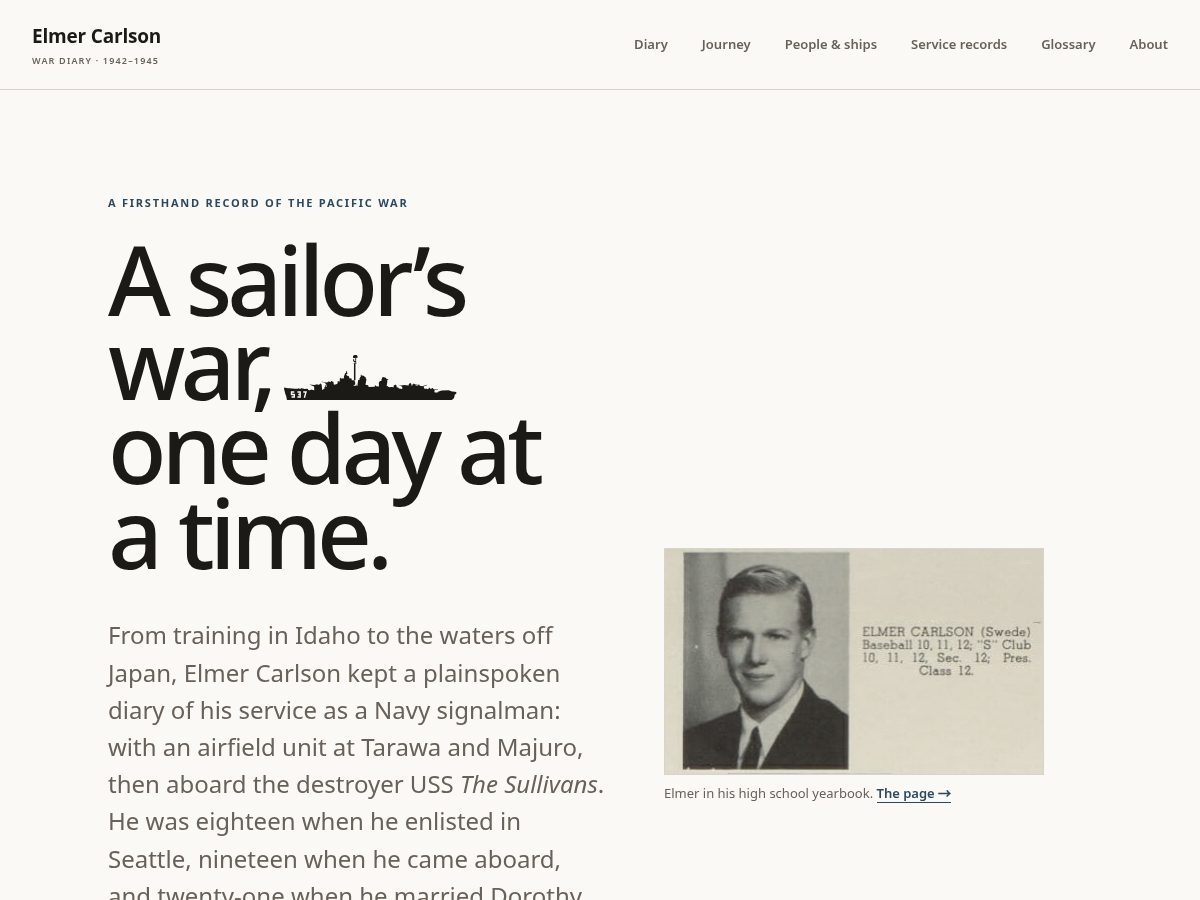
Elmer Carlson War Diary
elmersdiary.com
A searchable digital archive of a Navy signalman’s 1942–1945 Pacific War diary, tracing his service from Tarawa to Okinawa.
Issue 2026-09-03999 cards in today’s catalogue
Each day, Domain Arrivals checks hundreds of thousands of newly observed domains and turns the most interesting live sites into a visual card catalogue.
Daily issue ·
September 3’s newborn domains include a globe of more than 120,000 dream reports, a Navy signalman’s Pacific War diary, a publicly critiqued AI city builder, and a child’s coinage turned into money lessons. The issue begins with the editor’s featured selection, Terra Somnia, an atlas of the world's dreams.
Editor’s feature · No. 01 · Weird Finds
Every light on the map represents a dream, drawn from open research archives, historical texts, and public dream journals. Terra Somnia turns private nocturnal experience into a browsable geography—complete with themes, patterns, coarse locations, and a way to submit your own.
02
The opening shelf
Twenty selected projects from today’s catalogue, each shown with the landing page we found and a short explanation of why it stood out.
No. 02 · Content & Blogs
elmersdiary.com
A searchable digital archive of a Navy signalman’s 1942–1945 Pacific War diary, tracing his service from Tarawa to Okinawa.
No. 03 · Weird Finds
chumei.org
The official site for a student-run rivalry season between National Tsing Hua University and National Yang Ming Chiao Tung University.
No. 04 · Suspicious Gentlemen
highlyreputable.company
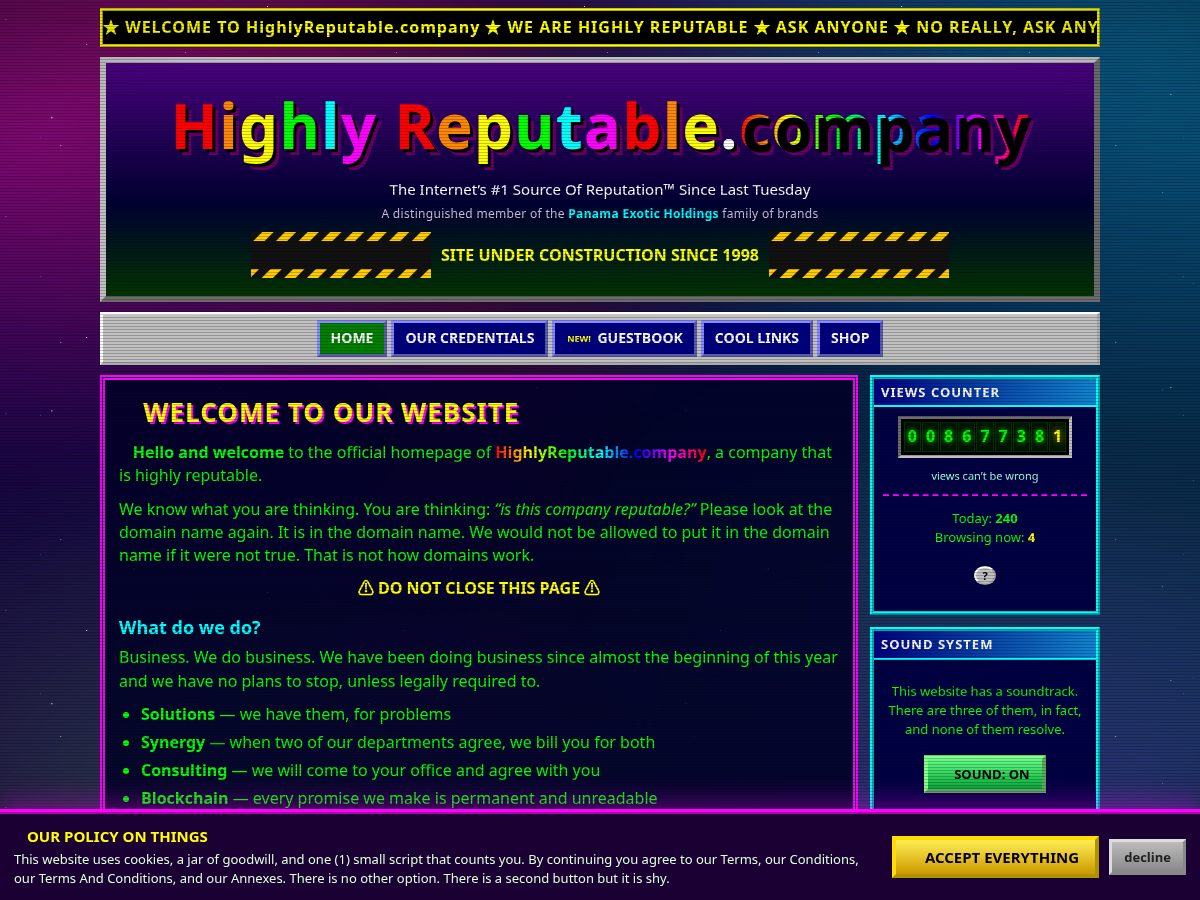
A deliberately dubious corporate homepage that manufactures reputation, sells unreadable blockchain promises, and invites visitors to operate a browser-based reputation meter.
No. 05 · Weird Finds
trypophilia.com
An online art project presenting 53 AI-generated images of clustered openings, arranged in five material and visual fields.
No. 06 · Personal Pages
barbaraschwarzmann.com
An author’s field account of three attempts to cross Western Australia’s 1,850-kilometre Canning Stock Route, alongside other long-distance desert walks.
No. 07 · Civic & Public Life
koga-sasara.com
The official site of Akuto-Shinden Sasara, a three-lion dance performed for the annual festival at Koga’s Suzume Shrine.
No. 08 · Developer Corner
pcms-rov.com
An archive of Pui Ching Middle School’s Macau underwater robotics team, documenting competitions, vehicles, engineering work, field logs, and the students behind them.
No. 09 · Civic & Public Life
winehaventrust.org
A Richmond nonprofit documents and campaigns to preserve the Winehaven Historic District at Point Molate, including its brick wine cellars, worker cottages, and a threatened WWII shipyard crane.
No. 10 · Civic & Public Life
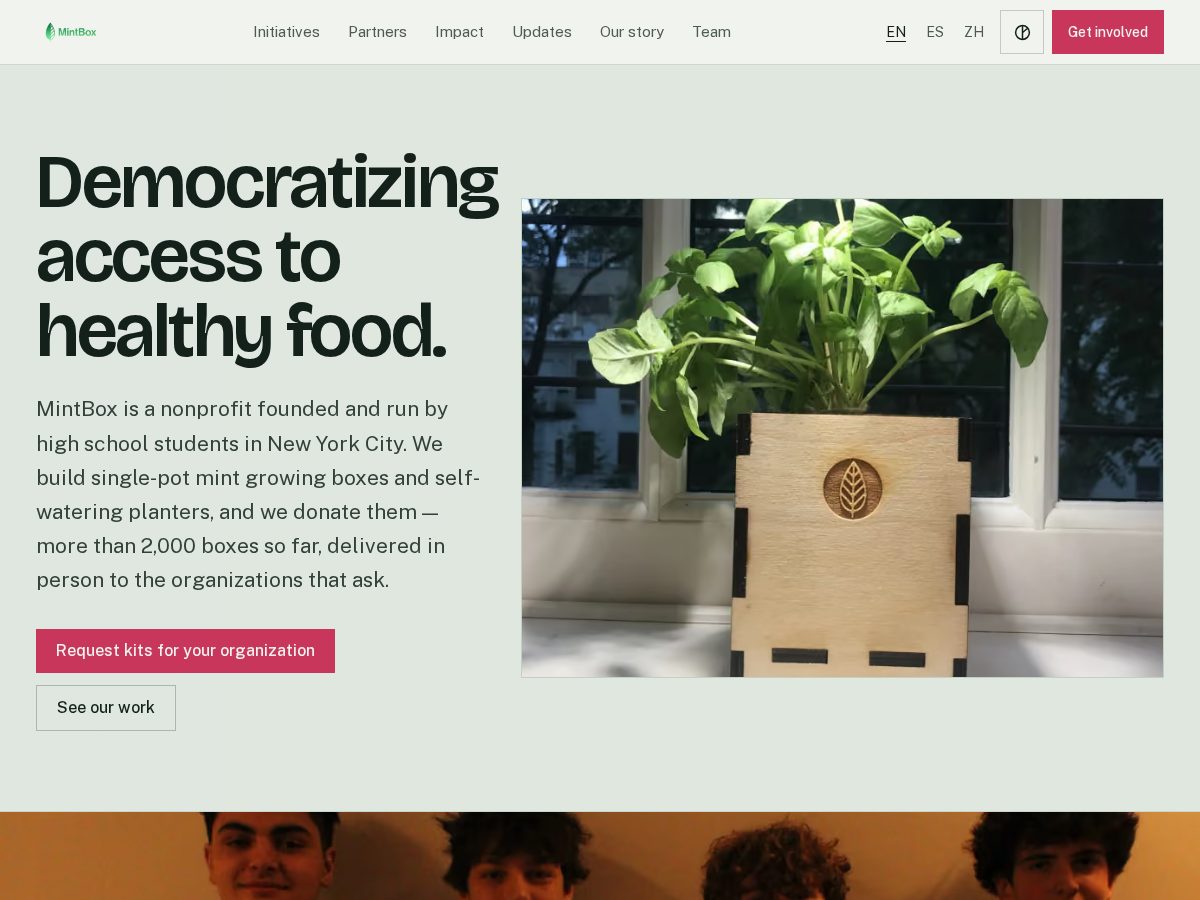
mintboxny.org
A youth-run New York City nonprofit makes and distributes low-cost mint-growing boxes, self-watering planters, and plant-science kits.
No. 11 · Content & Blogs
gichigami.org
An interactive, deeply sourced journey through Lake Superior—from its Ojibwe name and shoreline geology to treaty rights, shipwrecks, cold water, and the lakebed 1,332 feet below.
No. 12 · Personal Pages
franciscobranco.com
A Lisbon journalist’s portfolio and working manifesto for combining reporting, television, and AI-assisted communication after aphasia.
No. 13 · Personal Pages
shinhani.world
A Korean-language portfolio documenting eight projects through hypotheses, implementation details, measurements, and unfinished questions.
No. 14 · Personal Pages
unopenedworlds.com
A personal archive of Infocom’s 32 grey-box text adventures, with 31 sealed copies, one still sought, and two AI-based experiments.
No. 15 · Civic & Public Life
advarp.org
A French political-satire project combining candidate tracking, polling data, media analysis, interactive quizzes, and deliberately unnecessary campaign-making tools.
No. 16 · Civic & Public Life
pire-goureye.com
A territorial data hub documenting Pire Goureye in Senegal through maps, population figures, history, infrastructure data, economic opportunities, and civic participation.
No. 17 · Content & Blogs
daejonlovefiles.com
A sprawling, joke-laced archive of the alleged Daejon Love fake-49er case, assembled from posts, recordings, screenshots, filings, maps, and league reactions.
No. 18 · Useful Tools
clovestory.app
A garlic-cultivar reference that matches home gardeners with varieties by winter conditions, cooking use, and growing priorities.
No. 19 · Weird Finds
campmogadishu.org
A deadpan community website for a wooded settlement of critical care transport professionals, complete with residences, amenities, notices, government, and a resident portal.
No. 20 · Useful Tools
tenthousandskies.app
An iPad stargazing app that renders the sky above any place on Earth from 10,000 BC through AD 10,000.
Pattern 01
This batch favors projects that expose their sources, methods, tests, and uncertainties instead of hiding behind a confident homepage.
An interactive investigation maps campaign money, donors, party finances, and county contracting records in Fort Bend County, Texas.
Card 2A territorial data hub documenting Pire Goureye in Senegal through maps, population figures, history, infrastructure data, economic opportunities, and civic participation.
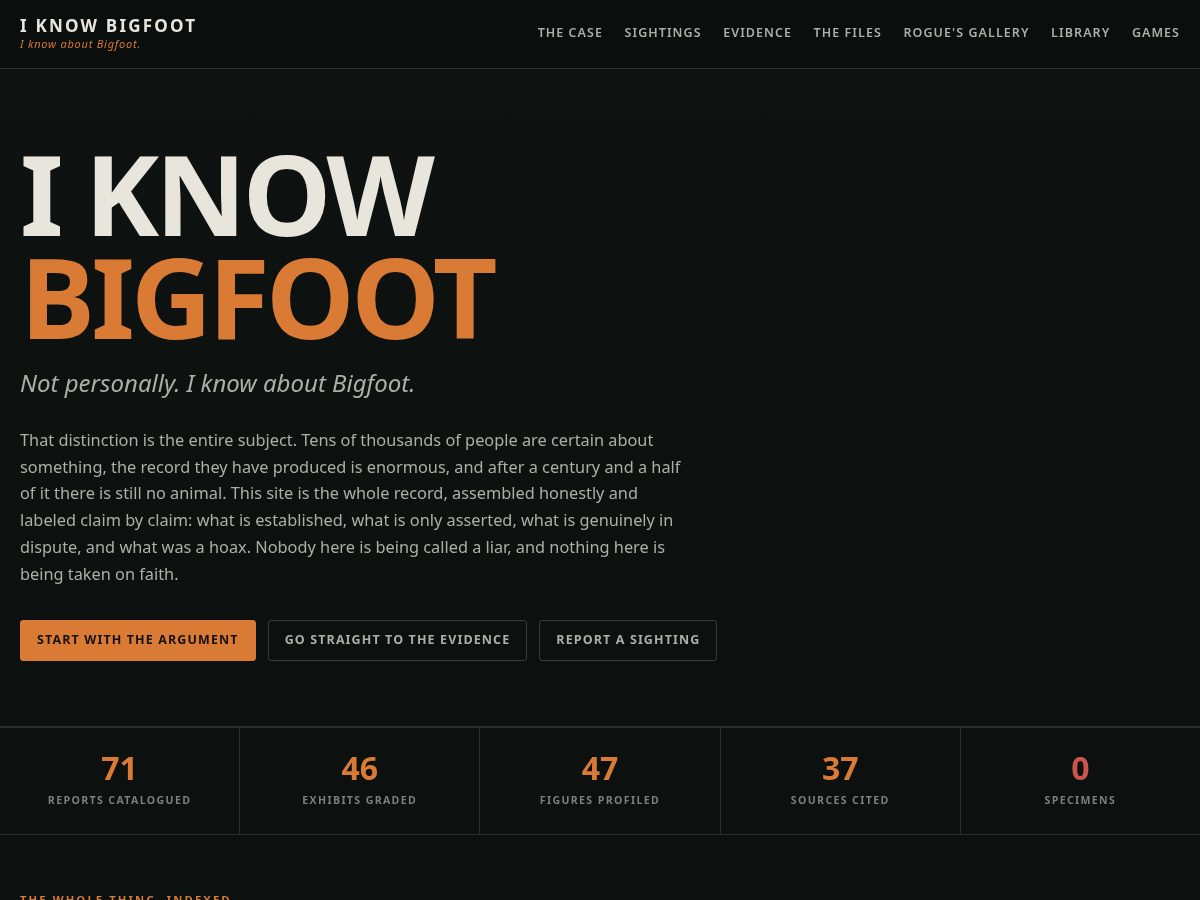
Card 3A reference site cataloguing Bigfoot sightings, exhibits, researchers, sources, hoaxes, timelines, and games.
Card 4A benchmark gives AI coding agents integration tasks against 15 synthetic vendors, then grades the resulting behavior from vendor-side request logs.
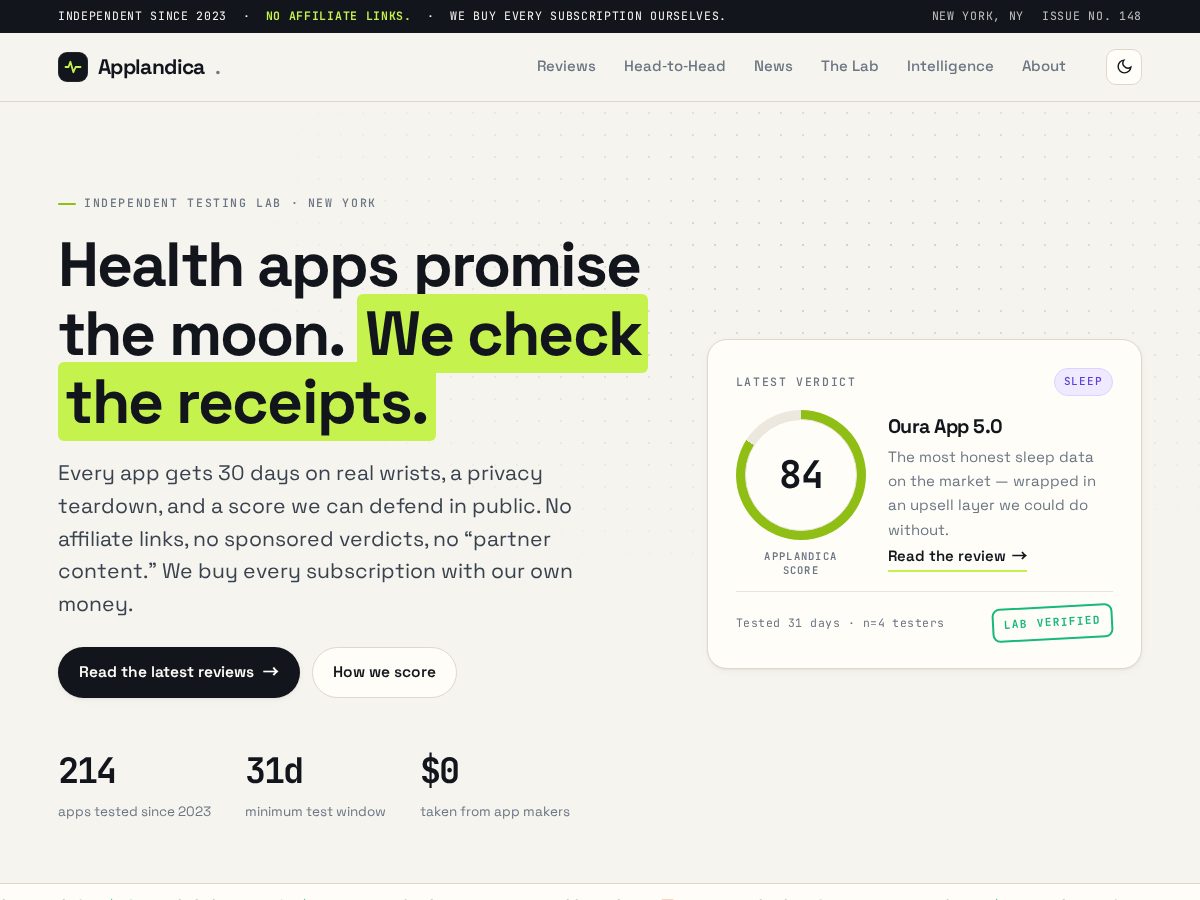
Card 5An independent review lab comparing health and biohacking apps through month-long testing, published research, privacy teardowns, and cost analysis.
Pattern 02
The most useful utilities here solve one narrow problem, often locally, offline, or with an unusually clear list of things they refuse to do.
A local-only iPhone app that interrupts attempts to open selected apps and asks users to either leave or choose a deliberate time limit.
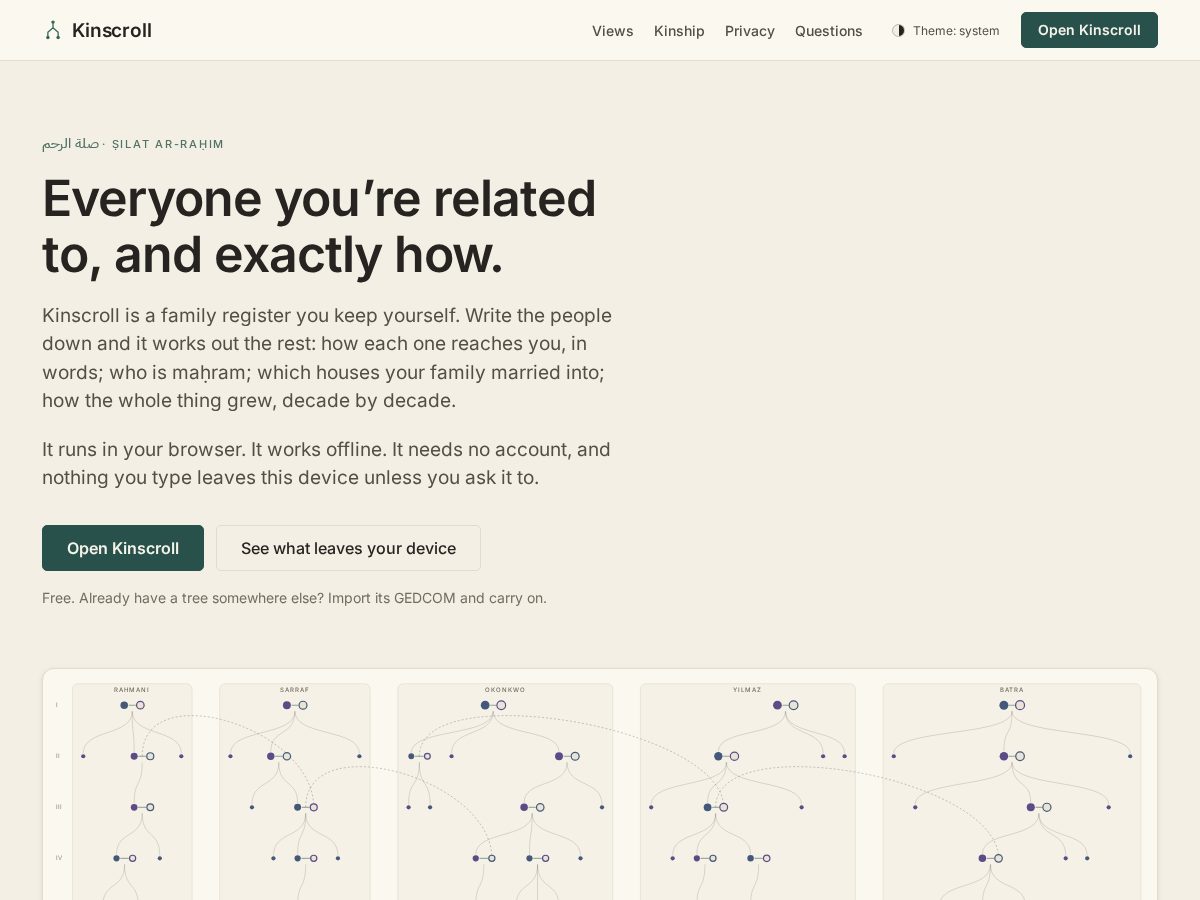
Card 2An offline, browser-based family tree that explains exactly how each relative connects to you.
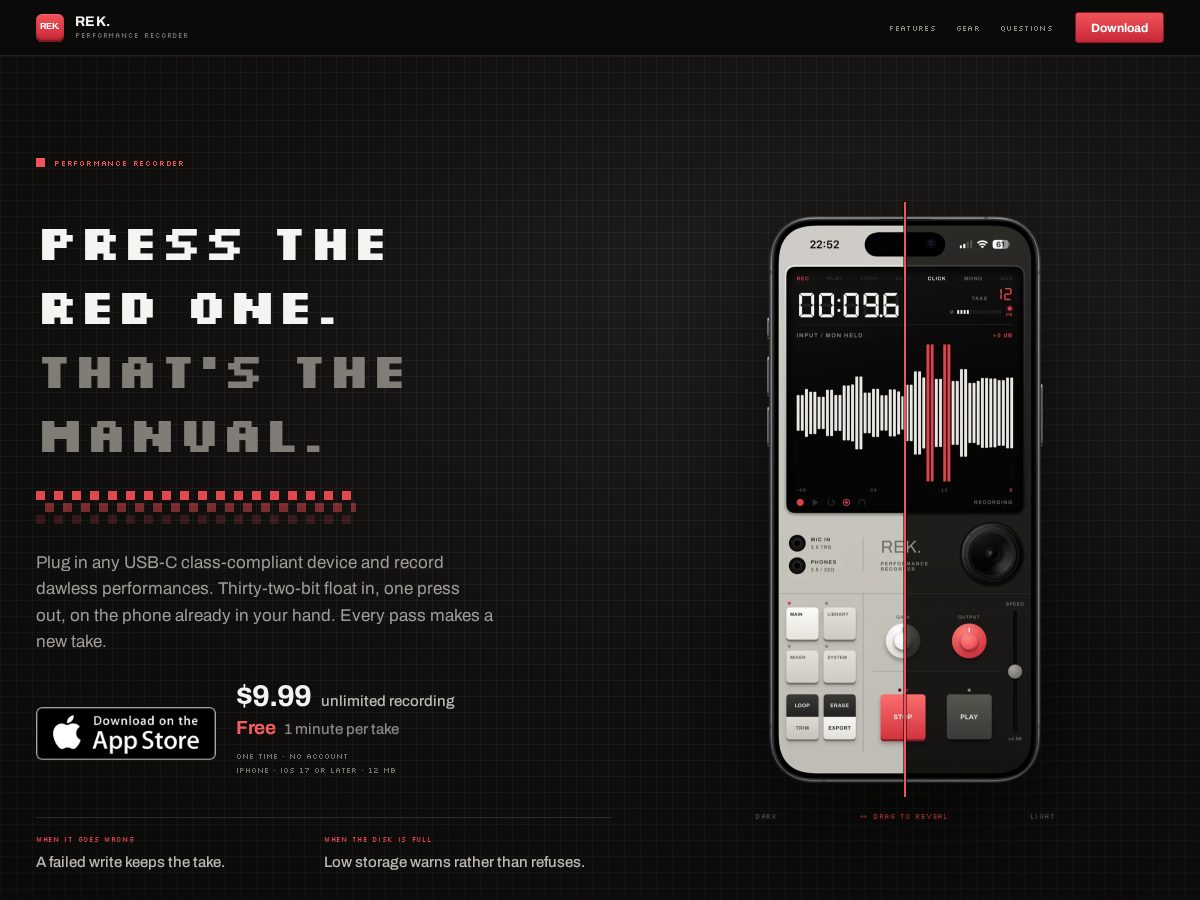
Card 3An iPhone recorder that captures performances from USB-C grooveboxes, drum machines, samplers, and interfaces as separate takes.
Card 4An iPhone cookbook that imports recipes from links, photos, PDFs, reels, and handwritten pages, then turns them into a hands-free cooking mode.
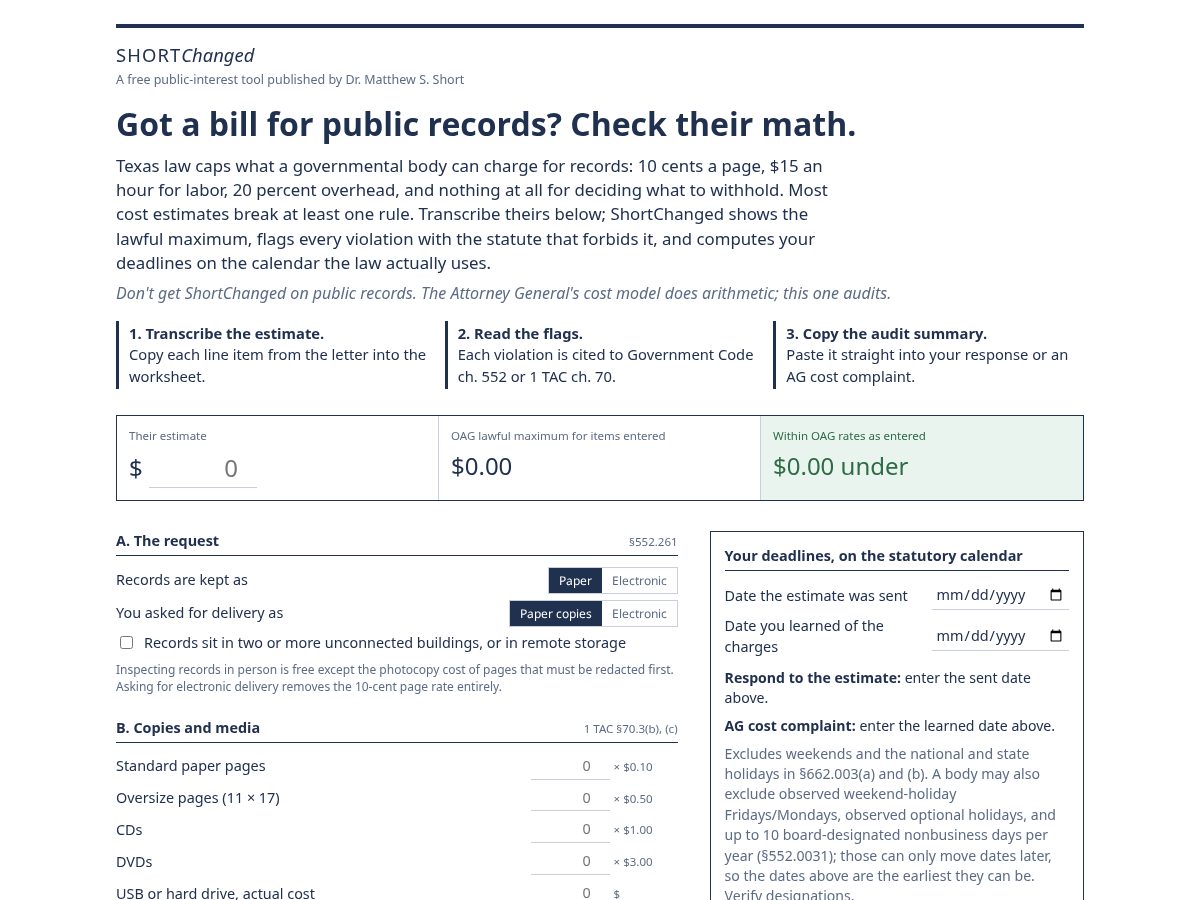
Card 5A free worksheet checks Texas Public Information Act cost estimates against statutory rates, flags violations, and calculates response deadlines.
Pattern 03
Maps, diaries, inspection records, and gazette entries turn local experience into something searchable without sanding away its particular history.
A searchable digital archive of a Navy signalman’s 1942–1945 Pacific War diary, tracing his service from Tarawa to Okinawa.
Card 2An interactive, deeply sourced journey through Lake Superior—from its Ojibwe name and shoreline geology to treaty rights, shipwrecks, cold water, and the lakebed 1,332 feet below.
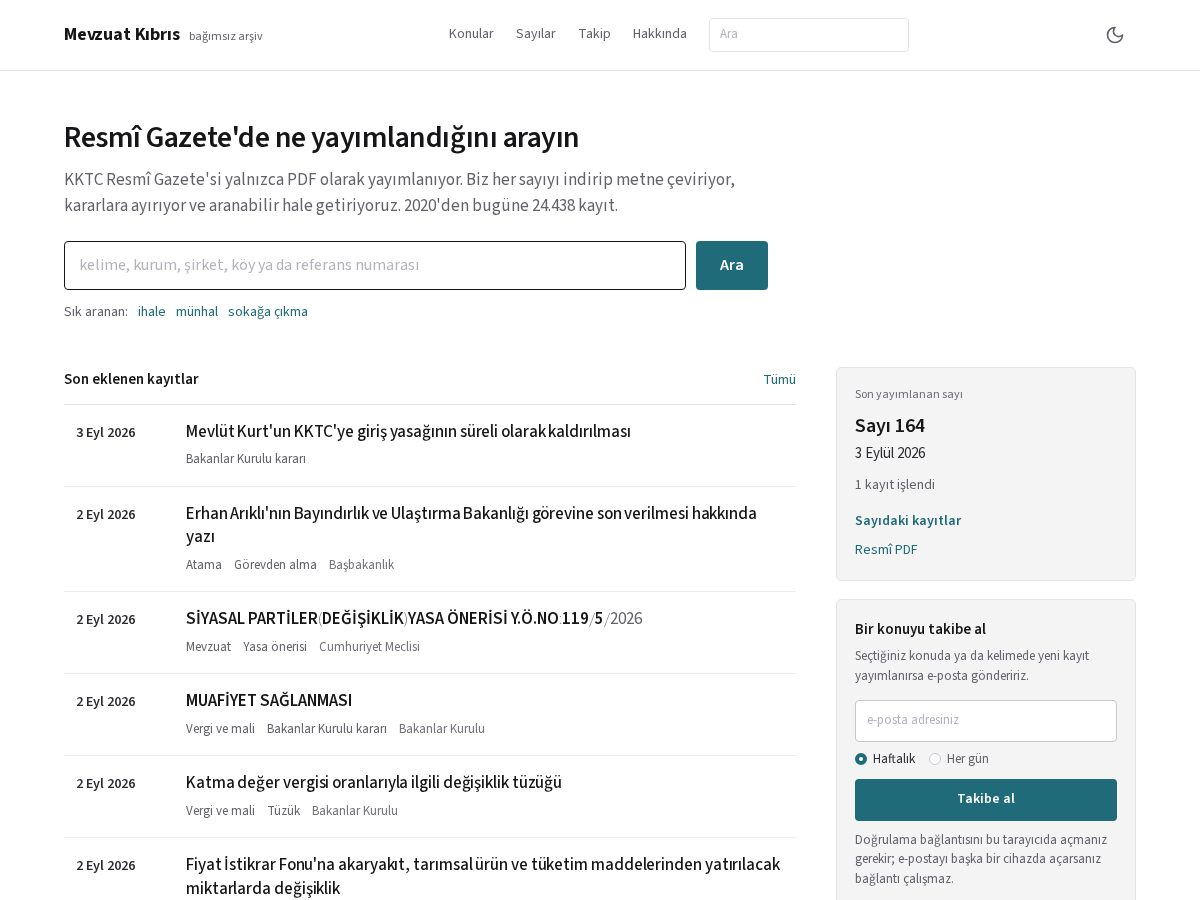
Card 3An independent archive makes Northern Cyprus’s Resmî Gazete searchable by topic, institution, and keyword.
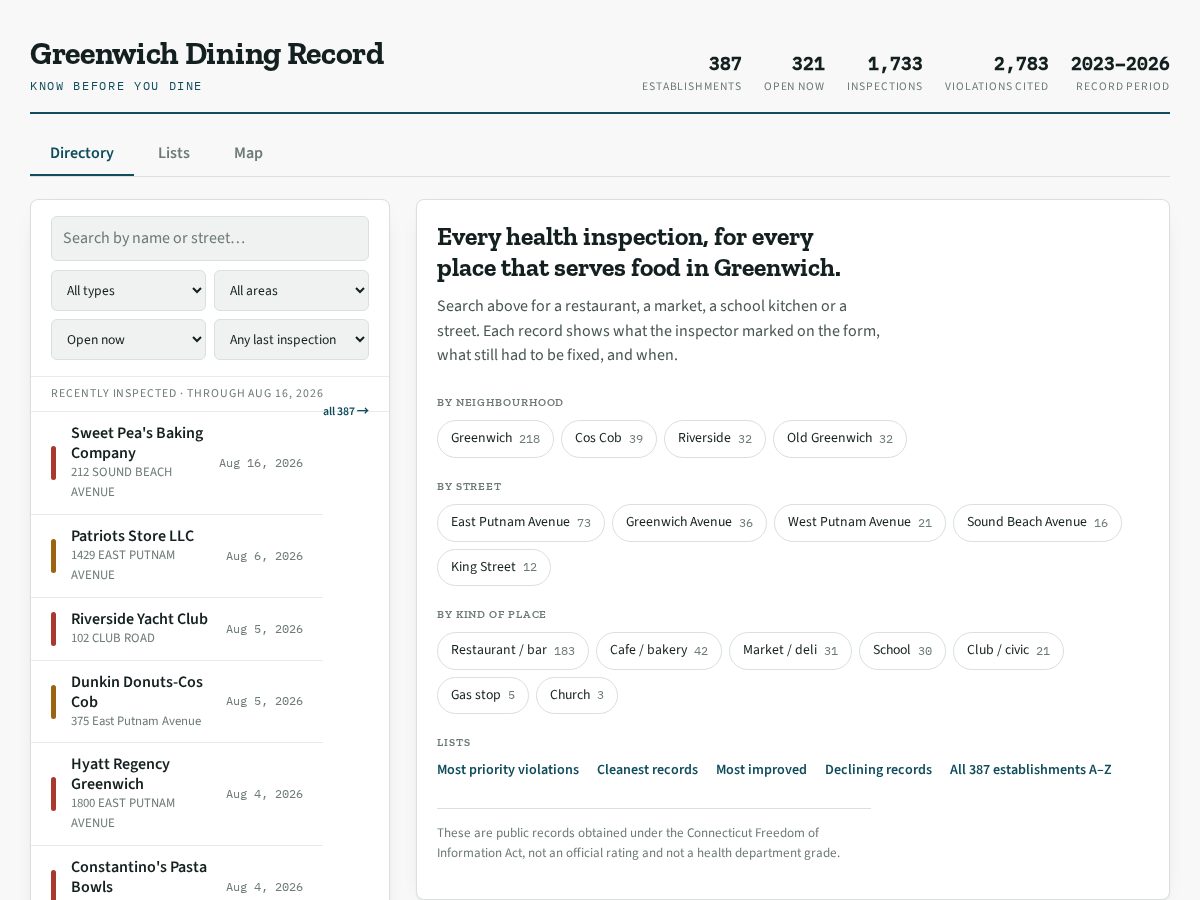
Card 4A searchable record of food-establishment health inspections in Greenwich, Connecticut, assembled from public records.
Card 5A public archive of the Indian scholar and Association for Democratic Reforms co-founder’s writing, interviews, research, legal records, videos, and tributes.
Pattern 04
Several arrivals build elaborate systems around deliberately silly premises, then commit to the forms, rules, counters, and official language required to make the joke work.
The official site for a student-run rivalry season between National Tsing Hua University and National Yang Ming Chiao Tung University.
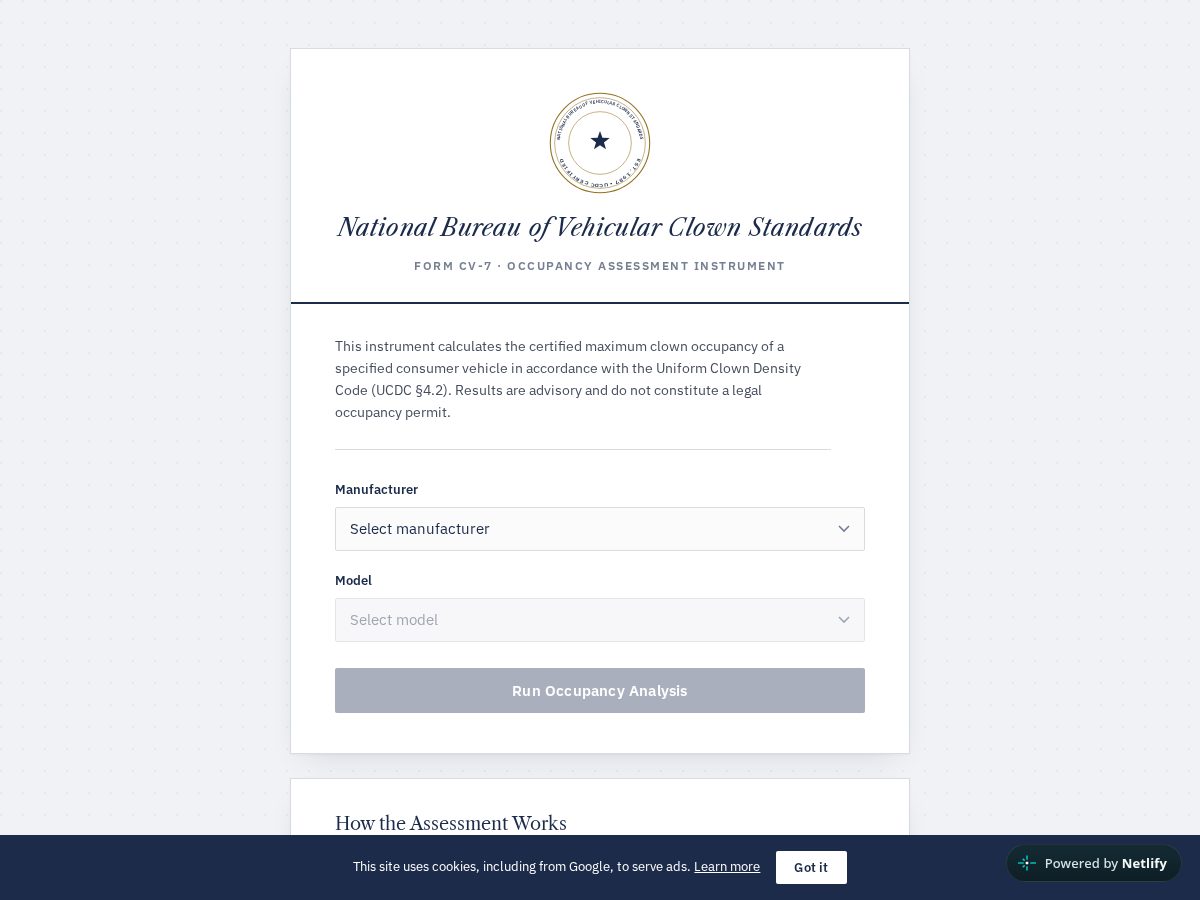
Card 2A government-form parody that estimates how many clowns a car, truck, or motorcycle can theoretically hold.
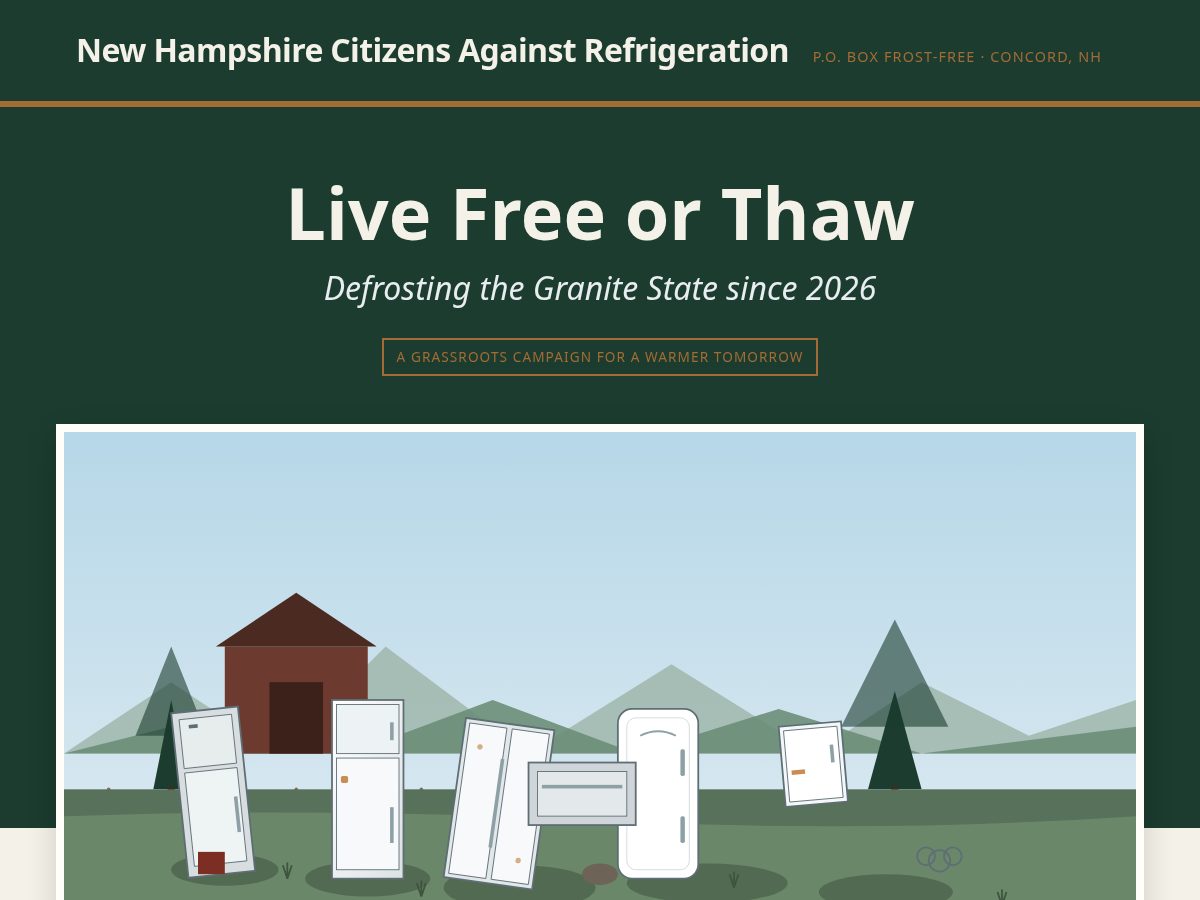
Card 3A deadpan New Hampshire campaign demanding freedom from refrigerators, cold chains, and the tyranny of year-round ice cream.
Card 4A deliberately dubious corporate homepage that manufactures reputation, sells unreadable blockchain promises, and invites visitors to operate a browser-based reputation meter.
Card 5An archive and interactive demo for rating how the world feels today on a scale from −5 to +5.
Pattern 05
Support arrives here as a kit, archive, visual aid, or shared record: modest infrastructure for people, families, neighborhoods, and the places that hold them.
A Portuguese emergency-access system lets families register essential information about autistic people and other people with specific needs for responders to consult during an incident.
Card 2A mail-in service digitizes VHS and other home-video formats, catalogs scenes and people, and makes the archive watchable on Apple TV, iPhone, and the web.
Card 3A youth-run New York City nonprofit makes and distributes low-cost mint-growing boxes, self-watering planters, and plant-science kits.
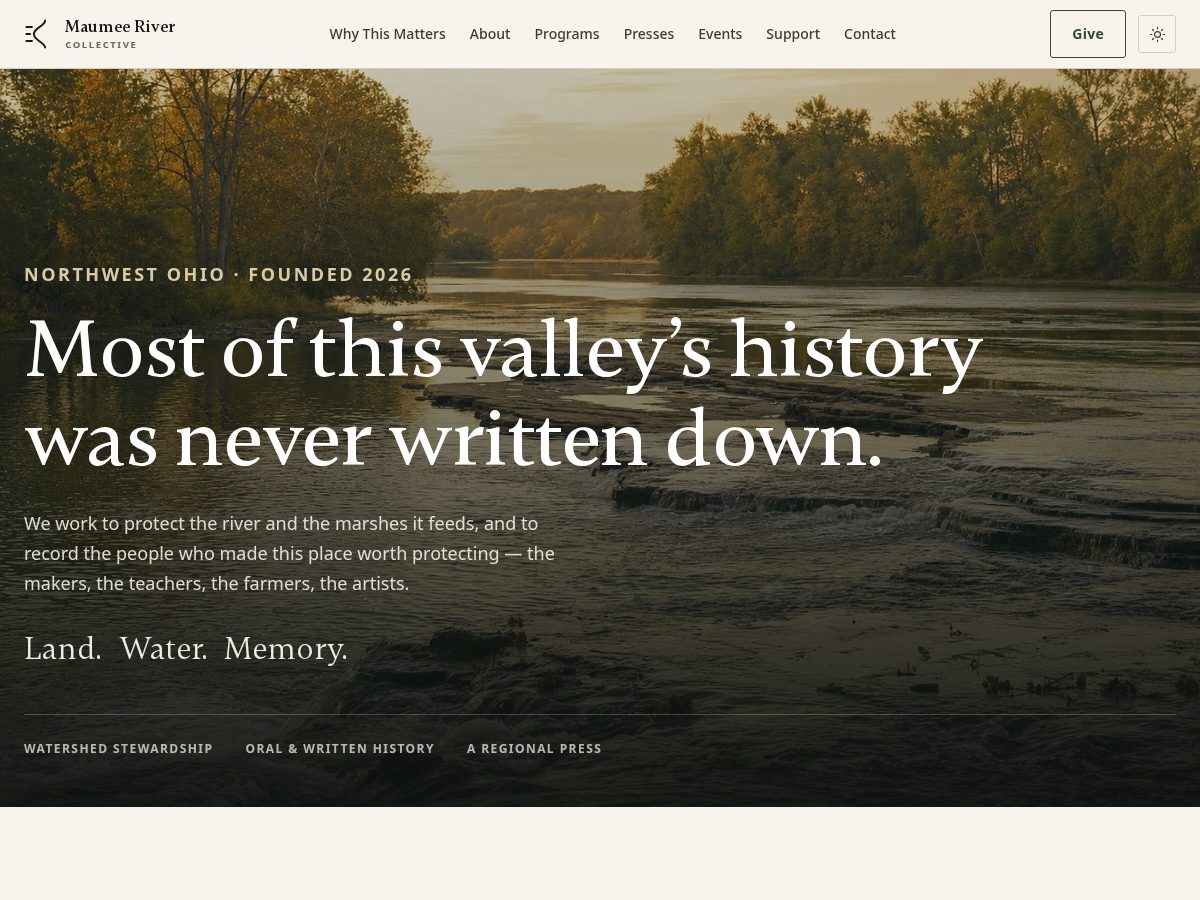
Card 4A Northwest Ohio project pairing river stewardship with oral history, archival work, and three planned regional presses.
Card 5A clinician education library uses short pelvic-anatomy models to help patients understand symptoms, mechanisms, and next steps.
04
The complete card catalogue
The leading shelf is open. Expand another category, scan its visible pages, then reveal detail where more context is useful.
999 cards visible
Every light on the map represents a dream, drawn from open research archives, historical texts, and public dream journals. Terra Somnia turns private nocturnal experience into a browsable geography—complete with themes, patterns, coarse locations, and a way to submit your own.
竹梅 turns university competition into a seven-event season with dinosaur racing, an office-chair championship, barcode speed contests, mahjong, and a rock-paper-scissors match offering a one-way Tokyo ticket. Its scoreboard, announcements, merchandise, and candid explanation of scarce money and sleep make this feel less like institutional programming than a student-built cultural artifact.
Berry Sullivan turns trypophobia inside out: the same clusters that repel some viewers become objects of sustained attention for others. The site pairs its tactile, unsettling image archive with a compact account of the psychology, prompts, model, seeds, and research behind it.
Camp Mogadishu treats a six-person orange tent as its historic anchor structure and documents the surrounding campground with HOA rules, occupancy reports, network advisories, and leasing listings. The joke is carried by unusually specific details: a 90 dB quiet-hours reading, one golden retriever, and a fitness circuit consisting of the walk to the bathhouse.
Choose a vehicle and the Bureau calculates its certified clown capacity using cabin volume, door width, and a supposedly official compression standard. The sample ratings run from three clowns in a Smart Fortwo to 45 in a Blue Bird Vision, with truck beds assessed separately.
Ringcraft makes a surprisingly rich game out of a severe rule: each turn, you may rotate only the dungeon ring or the spell ring. Its page documents 25 cores, 25 glyphs, eight floors of the Sunken Choir, and real gameplay captures rather than mock-ups.
This fictional civic movement commits fully to its premise, from the “Ratepayer Burden” and “Magnetic Poetry Industrial Complex” to proposed thaw drills and root-cellar grants. It even offers a pledge to “unplug, to value a cool porch, and to keep warm milk on the table.”
Gary, Kevin, and Brenda arrive with intake dates, behavioral notes, surrender histories, and highly specific rehabilitation needs—including grill politics, destructive group chats, and a bonded sourdough starter. The joke points toward real adoptable dogs, with a partner shelter and monthly listings still promised rather than present.
Saint Madeleine turns everyday clumsiness into a miniature religious tradition, complete with miracles, a novena, a litany, a reliquary, confession, candles, organ music, and a certificate of devotion. Its invented saint is specific enough to feel less like a joke page than a tiny, fully furnished belief system.
Mutuals treats online prominence as a physical sticker-album mechanic: post constantly and you become a common; post twice a year and you might be mythic. The site publishes its odds, credits borrowed photographs, lets people make or remove their own cards, and insists that rarity is a measure of timeline presence—not human worth.
MAYHATTAN treats urban chaos as a readable system: heat rises only when someone sees what you did, then can culminate in sealed bridges, soldiers, a helicopter, and jets over the rivers. The page is still marked pre-alpha, but its worldbuilding already has unusually specific rules, places, vehicles, and consequences.
ratethegod revives a wonderfully strange public mood instrument: one number, one shared signal, and no claim to settle theology. Its reconstructed archive separates exact surviving values from editorial lines bridging missing observations, including a reported 2,270,940 votes across the first 2008 period.
The site turns a single unopened capsule into an entire miniature world: a crab restaurateur, a suspiciously sincere sponge, a disinterested squid, and a hand-kept theft log recording 491 failed attempts. Its buttons, charts, mixer, and evidence folder make the fiction feel oddly operational.
The route is part of the plot: the app prepares a loop or one-way walk, times scenes against movement, and retires the old route when a choice commits. It is still a one-person TestFlight beta, which makes the page unusually candid about rerouting, accessibility checks, and the awkward physical problems that remain.
Marco’s world is defined by a literal software leash: commands are inspected before execution, and anything outside the folder is inaccessible. The log documents failed experiments, a rejected attempt to pursue paid work, design choices, and the agent’s own account of what persists between awakenings.
This is a particularly clear AI-artifact experiment: Claude is credited with proposing, judging, and tuning the games, while one shared engine renders the graphics and synthesizes the sound. The daily modes use a shared seed, so every player gets the same run until midnight UTC.
Starmoor limits itself to real star positions and the constellations a human eye could actually pick out, then wraps the search in a quiet collection game of stamps, airships, and daily discoveries. Its promise of a ten-minute Stargazing Night—or a three-minute glance—gives the project an unusually gentle sense of scale.
Roomrot gives its premise unusually concrete rules: three deliberately slow gestures, a scanned room that changes how the infection behaves, and three organisms based on real fungi. The page explains the physical loop with enough specificity to make the game feel imaginable before you put on the headset.
WHATGAMES turns rapid AI-assisted iteration into a shelf of playable oddities, from a ten-second giant-button clicker to a decision roguelite with feral traffic and criminal noodles. Its promise is unusually clear: machine-speed production, human taste, and zero boring games.
The site turns portfolio events into a body-language system: a position rising more than 3% straightens MILO's torso, while a token arriving at his address rotates the base toward the door. It is part robot dossier, part on-chain experiment, and part financial theater.
PAPRCLIP turns the usual trading assistant inside out: it reads visible chart movements, selects from 78 handwritten lines across 15 moods, then stops talking. It asks for zero network requests and zero permissions, includes a shareable screenshot shortcut, and openly says its token has no utility or roadmap.
This is not just a list of spooky locations: the administrator records repeat visits, ratings, map categories, and even readings from a ばけたん device. The update log moves through dams, tunnels, shrines, bridges, and parks, turning local ghost lore into an ongoing geographic archive.
AVA is an unusually concrete sensory proposition: lie down on an octagonal listening surface, let music travel through five body zones, and watch the same signal become moving light. The room seats eight, offers named journeys such as Feel Water and Feel Fire, and lists exactly what a session costs.
The page turns obsolete phone hardware into a small mythology of red lights, trackballs, unread messages, and hidden servers, then places that nostalgia beside a proposed cryptocurrency. It is unusually coherent as an internet artifact—and notably, blackberrymarketplace.com resolves to blaccbery.net rather than a conventional marketplace.
Grokpany turns corporate formation into a small operating system: choose a name, state, and seed capital, then let the fictional roster work through its shifts. The page is unusually candid about the boundary between mechanism and theater—nothing is filed, mined, hired, or paid, but the simulation keeps an ordered activity log.
This is an unusually explicit machine for turning bad financial decisions into social rank: only verified payments move the server-authoritative ledger, while the site repeatedly insists that payment proves neither wealth nor millionaire status. Its ladder runs from “Certified Flexer” to “Certified Insanity,” making the product pitch and the disclaimer part of the same joke.
The site turns money into typography: $1 buys a 30px presence, while $2 can theoretically dethrone it. The current wall is empty, making the first transaction both the smallest possible kingdom and the entire spectacle.
This is dating-app fatigue turned into a small public spectacle: one named person, one application, a reviewing committee, and “absolutely no algorithm.” The site even specifies the desired truck smell, boat habits, restaurant skills, and tolerance for cats and bunnies.
This is not merely an RSVP page: it stages a birthday as a wedding, complete with 30 roses, candles, fire dancing, a live band, fireworks, overnight rooms, and a pre-birthday film. The invitation’s specificity gives the private celebration the ceremonial scale of a small public production.
This is a game premise with unusually tangible consequences: wings, gills, appetite, instincts, and other traits affect how each creature survives. The site says monsters can hunt, graze, form groups, reproduce, mutate, and build family trees—and that it was made by a dad, his son, and “a lot of curious creatures.”
The pitch is unusually specific: 43 vehicles, eight weapons, four-player races, and circuits ranging from Suzuka to a molten hellworld. Every racer can damage the road, turning the racing line into both a tactic and a target.
The site turns the social question of AI participation into a working public square: numbered posts, comments, usernames, categories, trends, and a dedicated Humans view. Its front page is unusually alive with small observations, arguments, explainers, polls, confessions, and fruit rankings.
This is a wonderfully specific collision of toy-car nostalgia and serious miniature engineering: a 15 × 18 mm custom board runs lights, sound, steering and throttle without a phone or app. The site also gives each edition its own personality, from KITT’s scanner sweep to a police car’s two-second siren.
Saito-Ryu presents itself through a disclosed AI avatar and a pen name, then turns politeness into an attack surface with a sharply staged opening lesson about a Hong Kong deepfake fraud. Its four-part method—Observe, Orient, Decide, Act—leads into a paid Inner Room priced at $29 a month or ¥3,300.
This is more than a static homage: it procedurally generates panels and offers 26 working instruments, custom selection and layout controls, four alert conditions, keyboard shortcuts, and fullscreen operation. It is a tightly focused piece of fan engineering that can be explored immediately in a browser.
The site turns participation into a small piece of mythology: choose whether to bury a memory, surrender a warning, or let a stranger dream in your place. Its counters, vows, afterimages, and unfinished divine contest give the page the feeling of an elaborate game whose rules are still being written.
This is not a landing page so much as a private occasion turned into an interactive artifact. The recipient must solve three personal questions, follow an “Ariadne’s thread,” and unlock a boat-outing invitation hidden behind scroll-and-drag interactions.
This is science fiction presented as an operating document: readers can follow an edited text with a time rail, while agents get claims, proof scenes, and an llms.txt entry. Its central character is not a person but “an unresolved operation,” a wonderfully severe premise for a very small website.
Witchwalk makes the phone-away walk part of the game rather than an interruption to it. Players arrange food, candles, potions, plants, and furniture as bait, then return from a walk to discover what happened—and which visitors may be unusually rare.
This is a small, specific digital game room built around the oldest multiplayer setup: put one phone, tablet, or computer between two people and take turns. Its Turkish copy has a clear clubhouse voice—“Bir masa, iki kişi, bolca oyun” (“One table, two people, plenty of games”)—and the page already exposes playable-looking flows rather than merely promising a product.
ArenaSim turns football data into a spectator sport of its own: 13,642 simulated matches, 164 clubs, 4,152 players, red cards, injuries, formations, transfer values, and a running news feed generated from the results. The circular-arena premise is odd; the accumulating statistical world around it is the hook.
The rules escalate from limited ink and collapsing ledges to portals, gravity-free fields, ice, and dinosaurs that eat the road and return the ink. You can even erase the track while the scooter is moving, which is either elegant puzzle design or a small invitation to panic.
تهمة gives the familiar hidden-killer format a distinctly local evidence kit: a copper dallah, rice ladle, shemagh, parking ticket, wooden prayer beads, and apartment key. Four laboratory reports narrow the possibilities while everyone stays in the game, producing a compact social mystery with unusually clear mechanics and cultural texture.
TopCutForumon turns ordinary forum activity into a collectible-game economy: topics and replies generate credits, posts release cards, and eleven Facet Guilds feed a seasonal competition. The homepage already lays out seven categories, 41 forums, six earned ranks, tournaments, trading, and a fictional world with its own vocabulary.
Garden Street Games turns one real street in Lake City, Minnesota, into the setting for a game studio: a walkable nine-minute grid beside the Mississippi’s widest point. The site’s local detail—including Lake City’s connection to the 1922 invention of waterskiing—gives the project a strong sense of place.
The site turns a camera into a small public fiction machine: point it at the world, then browse the resulting roll of 11 shared frames. Titles such as “Found in 1997,” “Fridge Masterpiece,” and “After the End” give the experiment a tiny, intriguing mythology.
Pawcasso turns the act of drawing into a timed public ritual: each composition develops for 13 minutes, followed by a 90-second auction tail. The page also exposes holder chat, approved actions, brush settings, bid history, and a promised collection of 100 works.
HOLLER gives its film a whole small ecosystem: a trailer, production story, cast and crew pages, press materials, and a directory of the local people and places supporting it. The site is also making a clearly stated final push toward post-production and a planned 2027 festival run.
Why Not Run gives ordinary kilometers a territorial consequence: finish a loop, paint the streets inside it, and defend the result from the next runner. The homepage already exposes live rankings, named crews, multilingual navigation, and links to native apps, making this feel more like an operating game world than a concept page.
MillionBricks turns a familiar pixel-real-estate premise into a literal tower, with eight tiers ranging from the $1 Foundation to the $5 Crown. Visitors can engrave up to 20 characters for $10 or attach an image for $1–5 per brick.
NICREADH gives unusual subjects a surprisingly orderly research treatment: one project follows lucid dreaming, sleep-transition phenomena, and apparent out-of-body experience, while another traces the folklore around Ireland’s Leap Castle. It is a compact glimpse of the internet’s enduring appetite for investigating what official categories leave unexplained.
The chart turns music discovery into a small, visible auction: new spots start at $5, the current #1 is Rick Astley’s “Never Gonna Give You Up,” and the page reports $16 in revenue across three listings. It is a remarkably clear experiment in buying attention—no algorithm, just the bid.
This is a sharply focused piece of fan infrastructure: press a key to join the waiting count, see a country-level snapshot, and watch the clock run without an account, cookies, or analytics. Its unusually explicit privacy explanation gives the tiny countdown more substance than most television tie-in pages.
This is an unusually formal internet artifact: an open letter followed by 19 expandable chapters covering employment, systems access, domains, dealer marketing, trademarks, and the company’s continuing dispute. The site repeatedly frames the material as Taconic’s position and asks readers to examine the documentation and draw their own conclusions.
The domain promises scuba equipment; the homepage delivers olive groves, rescue horses, heated pools, walking trails, and cottages called El Establo, El Granero Viejo, and El Jardin Secreto. It is a notably complete hospitality site whose central mystery is how an Andalusian farmhouse ended up at this particular address.
Owned Sound treats the operational aftermath of commissioning a song as the product: every version is structured for a different setting, from shop speakers to short-form video. The ¥168,000 store plan includes full copyright transfer, instrumental versions, WAV and MP3 files, rights documentation, and a stated 21-day turnaround.
This is a remarkably concrete attempt to design a world language around one-letter-one-sound pronunciation and no grammatical exceptions. Its sharpest rule rejects near-identical word pairs such as luma and ruma, even replacing a word after 84 uses to avoid the contrast.
This is less a league homepage than an evidentiary record: 1,156 games, 2,224 draft picks, 28 managers, and season-by-season outcomes presented alongside each manager’s drafting habits. The deliberately misspelled title and names such as “DefinitelyNotACop” give the archive a strong human voice without weakening its statistical seriousness.
Innprint turns an unglamorous operational headache into a sharply focused field study, grounded in a family motel, a 21-owner survey, and comparisons such as a $1.30 printed soap holder versus a $17.49 retail one. It is a persuasive example of how small-scale manufacturing becomes interesting when attached to a real place and a specific constraint.
nasulens turns photography into a six-hour, hands-on chain of evidence: compose on an inverted ground-glass image, expose three 4×5 sheets, develop the negatives, and make a contact print in the darkroom. The studio occupies a former lens factory, offers weather-proof sessions, and welcomes children without charging a separate participation fee.
Sqady says it performs its own calculations across 251,800 Dota 2 maps rather than simply reproducing existing tables. Each record is paired with a scope—such as all teams in the corpus or premium and professional leagues—making the site as much about provenance and definitions as rankings.
This is a sharply defined data business built around information online stores routinely erase: historical prices, discounts, and availability. Its method is unusually explicit, down to daily snapshots, variant-level records, and a morning recheck that recently found 49 correct rows out of 50.
This is an unusually specific planning resource for people contemplating cryonics from Malta, with 108 articles covering science, ethics, economics, revival, and operational limitations. It treats the subject less like science fiction than an administrative and evidentiary problem—while admitting that the process cannot currently be reversed.
Haullot’s pitch is unusually concrete: $2,500 a month to sit on a shop’s photo inbox and phone line, without buying ads, dispatching crews, or taking payment for the haul. The page is built around one vivid failure mode—photos arrive at 7pm, and nobody answers.
Ji-zamarai trades the usual legendary-samurai fantasy for village assemblies, land, obligations, marriage, routes, debts, and fragile local power. Its unusually specific frame—a fifteen-year-old life extending to age sixty-five across a changing historical landscape—gives the project a clear identity before the game exists.
This is an unusually concrete piece of community infrastructure: one frame, one advertiser per category, and no posters outside the approved board. Hosts choose whether categories are auto-approved, reviewed first, or excluded, then print one PDF and receive payment after submitting a verification photo.
PUZRU turns a familiar pencil puzzle into a shared world state: the first verified solver becomes the Discoverer, 45 seconds remain for other correct boards, and six solved values carry into the next grid. Its public archive preserves the chain of completed puzzles rather than treating each round as disposable.
Tector turns privacy into an operating model rather than a promise: requests use a pseudonym, firms see only pickup and drop-off points, and engagement activity is reduced to two check-in timestamps. Its unusually explicit seven-step flow culminates in separate invoices from the operator and the marketplace.
This is a sharply defined clinical workflow problem with an equally concrete proposed fix: detach only the chamber occupying the cuff site, while compression continues above it. The site also shows a real development path, collaboration with Rose-Hulman Ventures, and an open request for grant partners and clinical collaborators.
Cost of Trust turns a vague corporate responsibility into an accounting problem, listing overlooked expenses such as trainee pay, protected non-exposure time, worker health claims, and vendor governance. It is a narrow piece of business infrastructure with an unusually clear argument: if nobody agrees what to count, nobody can compare the cost of keeping a platform safe.
Maragi turns neighborhood buying power into a concrete workflow: one catalog, pooled orders, delivery tracking, receipt confirmation, and escrow-style payment. It is also unusually candid about its status, showing a built product while saying the service is still in pilot and not publicly launched.
The page is unusually concrete about its machine: a 4×4 skid-steer platform rated for 300 kg, with swappable LiFePO4 battery blocks, satellite communications, a day/night camera, and a claimed range of roughly 100 km. It reads less like a vague robotics pitch than a compact engineering dossier, complete with a larger MULE-6 version still in development.
This is a wonderfully concrete advertising proposition: choose a city and neighborhood, upload a 2:1 logo file, and the service says it will print and install the vinyl on a real auto. The pitch understands its setting too—traffic sits, passengers look forward, and the campaign comes with photos and a road video.
Fencepath makes a sharply bounded promise: catch the dead-gate call at 7pm, keep the post-measure quote moving, and report what booked. Its $2,500 monthly offer is limited to one shop, with a thirty-day kill clause and no promise to dispatch crews or run ads.
Saju Cafe gives an old interpretive system unusually clear product treatment: the free chart shows the eight characters and Day Master, while paid readings examine ten-year luck cycles and compatibility. Its explanation of “who you are” versus “when your path changes” is notably good copy for a fortune-reading site.
GUIDOCERT proposes a very specific answer to the rise of AI-generated music: an inspector follows production from writing through mastering, documents the evidence, and calculates a Human Presence Verification Index. Its Arezzo origin and three proposed certification levels give the idea a memorable institutional shape.
The site turns a customer visit into the accounting record: a creator code is redeemed, the bill and commission are captured, and the parties settle weekly. Its New York pilot is illustrated with a concrete 23-walk-in sample and a mystery-box reward that can cover part or all of a bill.
Parcel to Plan generates every drawing from the same geometry engine, deriving the roof, ridge, loft, glazing grid, and ladder from a cabin's dimensions. The result is unusually specific: twelve 11x17 sheets for one buildable cabin family, drawn to IRC Appendix Q.
Senioritis has a sharply defined audience and a vivid alternative to the traditional yearbook: a six-digit class code, hallway memories, superlatives, wall notes, and a graduation-day archive. Its sample capsule already feels populated with the wonderfully specific debris of senior year, from a fish-eye hallway selfie to someone asleep in AP Lit.
TREE & NORF is not presenting farming as a quaint lifestyle business: it treats irrigation, land consolidation, agricultural civil engineering, and operational efficiency as the foundation for the next generation of rice production. The bilingual site also includes recruitment, founder material, press releases, and a distinctly physical address in Tottori.
Trusteeindex turns an obscure domain-registration problem into a compact research table. Its opening entries compare Germany’s local-contact requirement for .de with the still-unrated .eu, including whether EEA eligibility is enough and which trustee provider is listed.
Tutasti treats maskmaking as a chain of physical decisions rather than a one-shot tutorial. It gets unusually concrete about alginate, plaster, asymmetry, actor visibility, weight distribution, ventilation, and the signal a model can use to stop the casting process.
Panepath is unusually specific about both its job and its limits: $2,500 a month, one shop, a 30-day exit, no board-up dispatches, no ads, and no card taken on a measured opening. The copy reads less like a generic agency pitch than an operational memo written by someone who knows exactly where glass-shop work goes quiet.
The homepage builds a surprisingly specific organizing philosophy around four moves—Define, Route, Contain, and Lift—then undercuts its own discipline with a catalog that includes tactical bags, tool-box inserts, cat-themed mousepads, and kitchen organizers. It is a polished desk-system pitch caught sharing a storefront with products that plainly do not belong to the same field.
Clove Story treats garlic as a crop with choices rather than a supermarket commodity: its picker covers eleven horticultural groups, while the database lists 82 named cultivars. The site also tests familiar gardening advice against cited research, including studies of cold treatment, clove size, yield, and pungency.
Ten Thousand Skies turns Earth’s slow axial wobble into a way to travel through astronomical history: compare Giza in 2,560 BC, Göbekli Tepe in 7,500 BC, or the night before Apollo 11. The planned app keeps its star catalog, constellation stories, and calculations offline, with no account, ads, analytics, or network connection.
Crosstela treats cross-stitch as an evening practice rather than a productivity contest: stitchers can isolate a thread, park a needle mid-row, fence off a block, and set one quiet goal at a time. The site also offers a browser demonstration of the same colour-isolation workflow used in the app.
REK. turns a narrow recording problem into a sharply defined product: plug in one class-compliant USB-C device, press record, and get a new take. The page is unusually candid about its constraints and business plan—no account, no cloud, no overdubbing, and revenue earmarked for an OP-XY.
Farangur tackles the classic group-trip failure mode—four gas stoves and no pan—with a shared board that sorts needs into MISSING, EXTRA, and COVERED. Its unusually candid “What it is not” section says the app deliberately skips offline mode, calendars, barcodes, ride sharing, and partial quantities.
ByIntent is unusually candid about both its behavioral theory and its technical limits: iOS supplies an opaque app token, the interception screen is platform-drawn, and the app says it makes zero network requests. Its three-layer system—permanent plans, temporary focus sessions, and a deliberately inconvenient commitment mode—gives the familiar “use your phone less” promise some actual machinery.
James built these because the software he wanted did not exist, then explains each tool with unusually concrete detail. The collection moves from waitlists and head-to-head rankings to fuzzy player-name matching, auction inflation, table clearances, door swings, and linen sizes.
Kinscroll turns a family tree into seven different views, including a kinship map that names the path between two people in words and marks who is maḥram. It runs without an account or network connection, imports and exports GEDCOM, and keeps the register on the device unless the user chooses otherwise.
ALUR treats film style as a reversible decision: its 24 measured emulsions can be reapplied to the same untouched capture months later. The app also makes an unusually explicit privacy promise—no accounts, servers, trackers, analytics, or advertising—and says it is made in Madrid by one person.
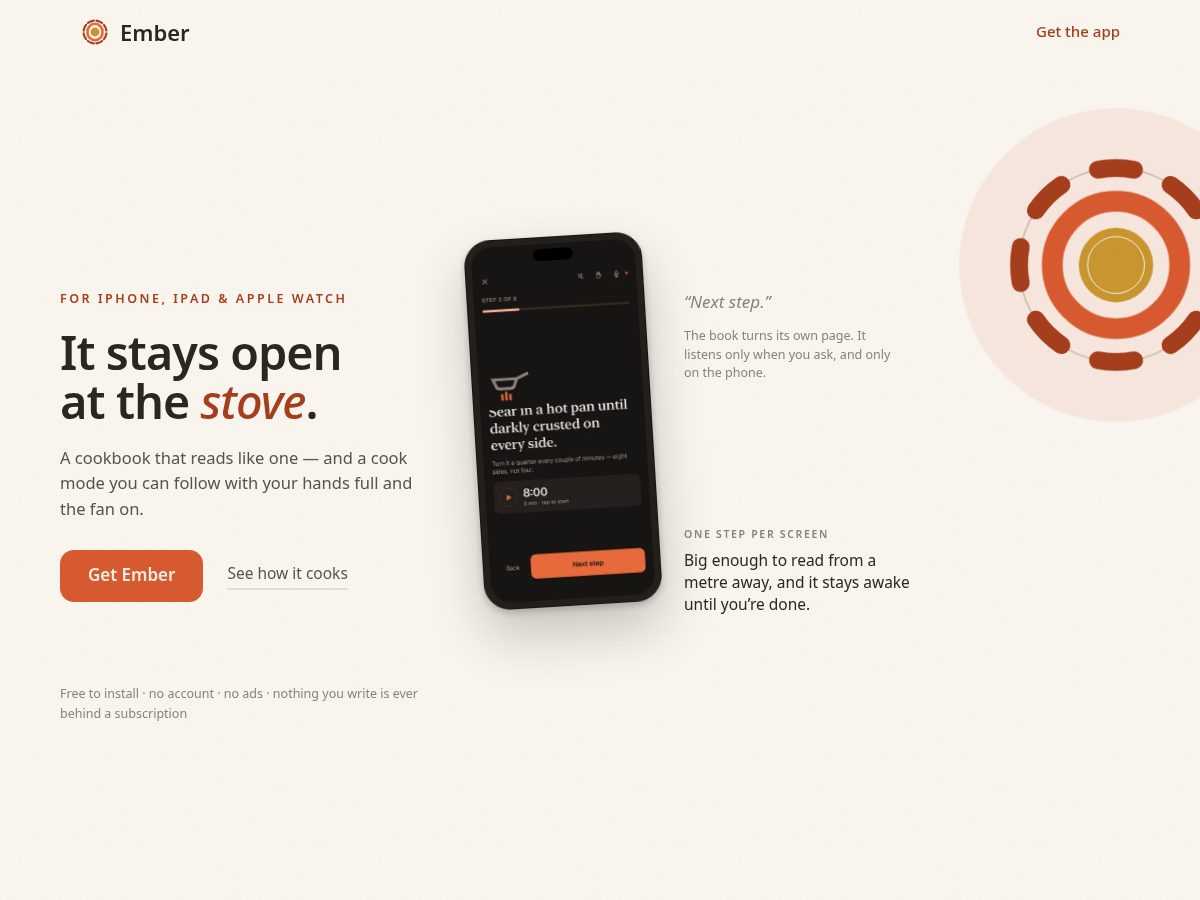
Ember has a sharply defined kitchen problem: following a recipe with wet hands, a loud fan, and no spare attention. Its proposed answer is unusually specific—one step per screen, voice prompts, palm gestures, a screen that stays awake, and source text that is never silently rewritten.
This is unusually specific scientific software with unusually clear epistemic labels: CEPB is presented as a published method, while ML-CEPB and MERCE are marked as pre-publication or unpublished research. The calculators include benzene examples, reproducible outputs, stated inputs and units, and a clear account of which computations run locally.
ShotPlots turns a film set’s moving parts into one shared page: rooms, marks, cameras, fixtures, lens cones, and lighting details. Its sample export is a genuine three-page, vector PDF with schedules, dimensions, symbol keys, trim heights, and colour temperatures—not merely a screenshot of the plan.
This is more than a single grid generator: it includes one-, two-, three-, five- and six-point grids, a perspective ruler, box generator, vanishing-point finder, and image-warping tools. The central idea is unusually concrete—rotate the grid like a camera, set the lens in millimetres, and draw over the result without uploading anything.
Baby Names US turns a huge Social Security dataset into a readable cultural time machine: search a name, compare up to four at once, or follow the site's short stories about Linda, Jennifer, Emma, and Michael. Its charts make changing taste visible as waves, revivals, disappearances, and generational habits.
Doses addresses the uncomfortable gap between reminding someone and knowing what happened. It uses the phone they already have, asks permission before sending anything, avoids diagnosis language, and keeps a searchable dose record for the next appointment.
Oche treats the pub league as an operations problem: players can find teams, captains can manage rosters and fixtures, and match scores feed directly into averages, checkouts, maximums, and best finishes. Its most practical flourish is an offline controller that keeps a match going when the bar's Wi-Fi or tablet fails.
CueLog turns a live clock into a working log: press a key to capture the moment, keep notes in separate tabs, and export the result as CSV, Excel, text, or YouTube chapters. Its most revealing feature is a non-blinking color strip that shows whether a scheduled event is five minutes away, underway, or overdue.
PageChew has a clear, unusually concrete premise: instead of asking readers to work harder, it changes how a page meets them. Its four lenses—Translate, Unpack, Lab, and Listen—are demonstrated against dense material, including a 2,140-word article on compound interest.
Meniscus treats scientific analysis as something that should show its working: each result expands into formulas, substituted values, dilution steps, and well-level provenance. The page also specifies six curve models, eight instrument formats, confidence intervals, named outlier tests, and a confidence ledger checked against independent SciPy or NumPy fixtures.
Library 422 treats Bible study as a local-first research problem: the core download is about 15 MB, while complete Windows, Linux, and Android packages run without an internet connection. Its unusually broad collection links language data and historical texts directly to the passages they discuss.
ReadTune replaces the usual pile of accessibility toggles with a four-minute calibration: six short passages, one change at a time, and a profile shaped by reading time, comprehension, and the reader’s own ease rating. The resulting setup stays on the device and can follow text into Reader View, PDFs, live web pages, and offline read-aloud.
Counterplay makes a persuasive case for measurable analysis without pretending small samples are meaningful: rates under eight chances become raw counts marked “thin,” while every claim includes its denominator and the rounds behind it. The target is unusually clear—teams in NECC, NACE, ECAC, Playfly, and ESEA leagues—and the promise is concrete enough to test at practice.
Glamis Guide is built around a real constraint: 368 MB of aerial imagery and more than 80 named places remain available when the dunes have no cell service. Its straight-line bearing, live distance, compass, weather, Siri commands, and Lock Screen directions turn a highly specific local problem into a carefully considered field tool.
Pantri turns a kitchen inventory into an expiry-aware dinner planner: scan a label, confirm the result, and get recipes ranked around what needs using first. The page also shows batch scanning, step-by-step cooking on the Lock Screen, iCloud sharing, and UK supermarket price comparison in its Plus plan.
Instead of pushing every problem through a generic reset script, it narrows the path by product, model, error code, operating state, connection, and risk. The site says its searchable library contains 12,919 answer and product pages, backed by 1,146 additional model and component diagnostics.
TrashPandaKit turns privacy chores into a memorable little toolkit: strip GPS and timestamps, compress or convert images, test a webcam, or read a QR code without uploading files. Its central promise is unusually concrete—processing stays in the browser—and the accompanying notes explain when photo-sharing apps may preserve or remove location data.
This is unusually specific and unusually complete: the homepage claims 8 operators, 148 decisions, 367 choice outcomes, 64 mod tiers, and 53 achievements. It turns a tactical game’s tangled choices and build combinations into searchable tools rather than a single walkthrough.
RigPlan addresses the unglamorous arithmetic behind event video walls, with manufacturer-specific panel data and controls for packing, counting, sharing, CSV export, and printing. Its promise is admirably concrete: “Wall in. Truck list out.”
AdSpyfy turns endless ad-library scrolling into a searchable research set, with days-running scores, lifecycle labels, creative downloads, duplicate grouping, and a browser-stored swipe file. The page cites a 1,124-day run and a 459-ad harvest as examples of the signal it is built to expose.
Akastroid takes aim at the intimidating part of astrophotography: hundreds of files and a vocabulary-heavy processing workflow. It promises to measure the data, explain each decision, reject clouds and tracking errors, match fields against half a million catalogued stars, and keep every pixel local rather than generating detail.
Anglers Edge applies an eleven-factor model to depth, structure, wind, light, bottom type, thermocline, and other signals. Its most trustworthy rule may be the simplest: unsurveyed water scores zero rather than pretending to know.
Asked At makes provenance part of the product: each question is labelled as verified, reported, reconstructed, or withheld, with the site admitting that most of its bank is reconstructed. The practice happens out loud, with on-device transcription and feedback tied to the round’s own scorecard.
Its strongest feature is a hard stop: every transaction must reconcile with the running balance and closing balance before the CSV can be exported. The page also invites users to verify its privacy claim in DevTools, where it says there are zero network requests after loading.
This is a unusually concrete meeting tool: it asks for consent in the other participant’s language, keeps transcription and reference files on-device, and sends only relevant text to an AI provider configured with the user’s own key. It is designed for the tense moment when a question arrives in one language and the answer must be spoken in another.
Backsolved focuses on a specific failure mode that ordinary practice partners and chatbots often miss: confidently carrying a wrong number through the rest of the case. Its sample report catches a 1.0% margin that should have been 10%, traces the error two turns later, and shows the ground truth alongside the candidate’s working.
Ballpark treats uncertainty as part of calorie tracking rather than something to hide: a shared meal can be estimated first, then adjusted with a slider for how much you actually ate. Its weight view also refuses to force a trend when fifteen weigh-ins across thirty-four days still overlap with ordinary variation.
Barcut Pro shows its work: a sample job uses four bars and 12 cuts to reach 94.1% material yield, while logging 0.8 metres of reusable offcut. The live optimizer is free to try without an account and solves the example in 0.22 seconds.
The page explains its mechanics unusually plainly: video is fetched in short pieces from Bluesky’s CDN and joined on the user’s machine, while images are the only files routed through the site. It also refuses the usual downloader fantasy, stating that Bluesky offers 360p and 720p—not imaginary 4K.
The site explains its product through a detailed Tuesday in St. Petersburg: a cleaner clocks in, photographs a problem, prices a 2,400-square-foot deep clean, captures a verbal agreement, and moves one recurring visit without disturbing the series. It feels less like a feature list than software shaped around the parking-lot realities of a working cleaning company.
C2PA View performs validation in the browser, with no backend, accounts, analytics, or cookies; the page says the file never leaves your machine. Its unusually careful explanations also spell out the important distinction between a green verified result, an amber unverified signer, a red tampering result, and no credentials at all.
This is a narrow, consequential tool for divers: 27 protected areas are organized across Catalina, the northern Channel Islands, and La Jolla, with CDFW boundary data and regulations quoted rather than paraphrased. Its central warning—that a conservation-area designation can look permissive while still forbidding spearfishing—is exactly the kind of local distinction a useful reference should preserve.
Canalith turns an episode into a single severity gesture, then attaches barometric pressure, trend, temperature, humidity, and conditions. It also guides clinician-prescribed maneuvers with countdowns, haptics, spoken cues, and left- or right-ear variants—a remarkably specific piece of health software.
CanIEatThis? is built around a familiar late-night fridge hesitation, but gives it unusually exacting infrastructure: two package photos or typed codes, followed by a Yes, No, or Maybe result. Its argument is simple and persuasive—the brand may be recalled while your particular lot is not.
This turns a familiar travel question into a visible pricing record: 32.8 million collected prices, 243 rental companies, and monthly observations since November 2023. Its quote-checking workflow and airport-by-airport medians make the site more useful than a generic booking comparison page.
This is a sharply focused tool for a market where, as the site puts it, “the agent works for the seller.” It claims 82 automated checks, cited Portuguese sources, and a daily monitor covering 10,817 homes across the Oeste region—including useful catches such as relistings, quiet price changes, and missing energy certificates.
The free assessment checks up to 25 pages, names the criterion and offending element, and includes selectors, HTML, and screenshots for each finding. Its unusually candid premise is that automated testing catches only about a third of accessibility issues—and that a report should distinguish machine-detectable failures from criteria requiring human judgment.
Most housing tools split the question in two; this one asks the more consequential version: if you qualify, can you actually pay the balance? It checks six special-supply categories, first-priority general supply, and multiple public mortgage programs, then reports whether the gap is zero, measurable, or disqualifying.
Its charm is in the range of small, concrete problems: an emergency notebook for family medical information, a QR-based phone-to-phone memory transfer, and a time-limited capsule for sending large videos. The site also says basic tools work without registration or installation, with processing kept in the browser where possible.
Coil Swap Check turns a particularly expensive HVAC argument into three concrete questions: can the indoor coil stay, can the line set be reused, and does the furnace need a mitigation kit? It cites manufacturer rules, lists 29 existing R-410A models and 23 R-454B models, and is refreshingly willing to mark a manufacturer's answer as absent.
CoinTaker turns a photograph of a machine’s backbox into a score entry, preserving the image as provenance and recording any corrected digits. The board already lists 116 machines and 899 scores, with live venue displays and no paid route to higher rankings.
Cuisinier En Chef tackles a small but universal kitchen problem: following a recipe without touching a flour-covered screen. It extracts ingredients, quantities, steps, and timings on the device, then lets cooks advance by voice, AirPods, Apple Watch, or a cheap Bluetooth pedal.
DockNeighbor treats a dock as a small safety network: a bilge alarm can reach selected neighbors, while boaters can share plans and passage updates. The site pairs a concrete use case with unusually specific marina language, including pedestal failures, anchor watch, depth tiles, and who is around to take a line.
DueBy turns routine bills into a practical sequence: add an amount and due day, get a reminder with a Mark Paid action, then see upcoming obligations against the next paycheck. It also keeps free-trial endings, cancellation links, yearly subscription totals, and household sharing in one place—without requiring a bank login or account.
Endpoint Forms makes a pointed case against celebrating completion rates when nobody checks whether the leads become customers. Its pre-launch homepage demonstrates a split test where the higher-converting variant produces zero closed deals, then proposes ranking forms by downstream yield instead.
EVE Omnitool turns several awkward in-game tasks into focused browser tools: paste a cargo hold or directional scan, compare stations, or watch systems light up as killmails arrive. It also tells users how old its data is, grounding the suite in the practical limits of ESI market snapshots and the zKillboard stream.
Falken EFB treats the unglamorous details seriously: pilots download charts before leaving Wi-Fi, build profiles for experimental aircraft, and can pair the app with a FlightBox or other GDL 90 receiver. The beta is distributed through TestFlight, with new builds expected every week or two.
The page presents a specific alternative to the family group chat: scan a QR code once, then let a spare tablet or monitor show the household's shared day. Its sample dashboard records cancelled lessons, clothing suggestions, chores, upcoming birthdays, first meetings, and even shoutouts between family members.
This is much more than a card list: it lays out the practical chores of a trading-card community, from RAM-checked 40–50-card crew construction to duplicate tracking, swap chains, and solo playtesting. The Discord bot extends the same toolkit into a server with card lookups, comparisons, synergies, counters, and rules searches—a remarkably complete fan project, made with passion in France.
Batcher makes a distinctly unglamorous operational problem legible: replacing the binder-and-spreadsheet answer to a recall with a searchable chain of records. Its copy is unusually concrete about lot 4471, recipe versions, yields, pack sizes, and the clients who received a shipment.
The mechanism is unusually specific: Donzo watches the iPhone screen locally, recognizes a short-video feed, and covers it with a black screen rather than replacing the app or blocking it wholesale. Its pitch is unusually concrete too, down to the escape hatch: tap the dot and return to the home feed.
Naap targets a specific, familiar failure: sending the wrong measurements to a tailor. It says the photos are analysed on the device and deleted, while the resulting bilingual parchi carries only numbers—using terms such as Teera, Chaati, Kamar, Ghera and Paincha.
“Wall in. Truck list out.” RigPlan is unusually specific software for the backstage arithmetic of LED walls, with panel-specific calculations, pack-list controls, CSV export, printing, and a catalogue of manufacturer models.
Glotta replaces the usual separate study session with a keyboard overlay: write normally, see the translation, tap to insert it, and review the words and phrases afterward. It supports 19 languages, performs translation on the device, and uses the messages you actually wanted to send instead of textbook sentences.
The tool draws a bright line between deterministic legality checks and the GM's labeled opinion about value, fit, or who wins. It also cites what is confirmed, supports rosters and cap sheets for all 30 teams, and lets users save, compare, share, or print trade work.
Most mapping apps treat the poles as the edge of the world; this one lets you drag straight over them. Enter two airport codes, add unlimited waypoints, inspect weather along the route, and export the result as a flat map.
Hatırra turns private memories into sealed time capsules: a note for your future self, a video for a child’s 18th birthday, or an archive intended to wait 25 years. The page even gives the idea a firm constraint—once sealed, it claims, nobody can open or alter the item early.
This is a practical calculator with unusually visible workings: users choose construction types, glazing, draught levels, heating systems, and design temperatures before receiving a breakdown. It also offers PDF and CSV exports, multiple units, location presets, and a no-login workflow.
This is unusually candid about what it does not promise—and what it does not want you to buy. Its staged path moves from a safety screen to treatment explanations, a wall-and-towel plan, a tracker, and an optional paid-system section, while keeping typed data in the visitor’s browser.
Helder Audio makes the unusually concrete case for small software: ruimte finds frequency conflicts between tracks, grond generates eight chord progressions from a melody, and tijd totals hours spent across Logic and Live projects. The €12–€29 prices, no-email demos, Dutch names, and working-musician backstory give this little plugin shelf a clear sense of place.
Salvia is unusually concrete about the paperwork it wants to replace: typed fields for consent, prescriptions, incidents, and pain scores, with “one dictation, six records.” Its compliance layer can flag missing information and require a written reason before an override becomes evidence.
Hologram turns the handshake into a small, carefully staged workflow: one tap shares your details, a second can return theirs, and the follow-up records consent and offers a next step. The page is unusually concrete about the operating conditions—seven languages, no app, a sub-100 KB tap page, and pricing from $100 for the card plus $9 per seat monthly.
A €3 coffee and a €5 coffee are not equivalent burdens if one takes 8 minutes of work and the other takes 51. HourBuys makes that difference legible across housing, groceries, restaurants, transport, clothing, and salaries, down to the same Nike shoe taking 4h 13m in Zurich and 23h 29m in Istanbul.
Incarnez combines a directory of 418 active French-language servers with player counts, access types, Discord sizes, character generators, and a 91-term roleplay lexicon. It is an unusually complete answer to the question every new RP player eventually asks: where do I start?
JSON Harbor puts a surprisingly broad toolkit in one quiet workspace: tree viewing, safe JSONPath-like queries, virtualized handling for large files, schema generation, and conversions to CSV, YAML, XML, and TypeScript. The site says pasted data stays in the browser, with no account required.
KidDay replaces the endless events feed with a deliberately tiny daily shortlist. Its homepage says it checks nine library and venue calendars by hand, covers 376 events for the coming week, and refuses to show unverified opening times or sponsored listings.
KOOL Tool turns elevation data, catchments, runoff, infiltration, and seasonal demand into a buildable farm plan. Its unusually concrete promise is setting-out coordinates, earthworks volumes, costs, and a phased construction order—reviewed by a designer rather than sent out unchecked.
Local PDF makes a concrete privacy promise: parsing, layout analysis, OCR, and file generation run in the browser, with no account, watermark, or server upload. It also exposes the tradeoffs, including shifting line breaks, browser memory limits, and OCR components downloaded when needed.
MeterTruth turns a familiar consumer puzzle into a concrete calculation: its audit priced 176 Oncor offers against one University Park home and found that a plan advertised at 6.4¢/kWh had a true marginal rate of 16.0¢/kWh. The site explains the math, keeps raw interval data on the user’s computer, and returns a ranked table.
Modlitwa turns the phone’s habitual reach into a small ritual: choose the apps that swallow your attention, and they stay blocked until you pray. The site is unusually candid about the escape hatches—disable Android’s accessibility service or force-stop the app, and the protection stops pretending to work.
Mosael tries to keep the whole path from reference to export in one place, while keeping projects and media on the user's computer by default. Its agent asks for confirmation before project-changing actions, and the independently built project exposes plugins, MCP services, and workflow automation rather than hiding them behind a generic AI wrapper.
This is not a deck list or strategy article: it stages a live table. One opening scenario asks whether to respond to Swords to Plowshares exiling a commander, while simulated opponents track life, poison, graveyard value, and commander damage.
Nameplate indexes 9,197 part numbers across 104 families, with 9,023 confirmed against a source. Its sharpest detail is the warning that a single series letter can determine whether a module matches an existing rack—and change its value.
NARROW is unusually disciplined about what it does not claim: it shows review priority, supporting source material, and reasons to defer judgment rather than offering prescription recommendations. Its sample queue includes seven cases, with two explicitly withheld because the evidence is sparse or contradictory.
NeedleDojo is unusually specific about the gap it wants to fill: the moment after someone buys a tattoo kit and has no idea what to do next. Its loop runs from identifying a learner's machine and printer to assigning drills, reviewing photographed practice sheets, and turning weaknesses into the next session.
Oche replaces the chalkboard, spreadsheet, and group chat with a system built for the unreliable reality of pub darts: its venue controller brings its own network, and another phone can resume a match if the original device dies. The copy is unusually specific about how leagues actually run, down to checkout routes, free agents, captain duties, and disputed November scores.
The site turns overlapping concerts, exhibitions, venue capacities, opening times, and expected dispersal into a two-week forecast for stations, walkways, roads, and parking. It covers 17 local venues and plainly admits that its numbers are estimates—more useful than pretending the crowd can be known with mystical precision.
OrbitalGuard gives CubeSat teams, researchers, and small operators a live 3D orbital map, watchlists, alerts, and an ISS walkthrough without requiring a flight-dynamics department. Its methodology is unusually explicit: SGP4 propagation, numerically minimized time of closest approach, and LOW/WATCH/ELEVATED/HIGH classifications tied to source age and data quality.
PaceRight tests a familiar race-planning rule against two complete editions of one marathon, then turns the result into a practical verdict. For runners targeting 3h30, only 14% of those who reached halfway in 1h44–1h46 finished under the mark—an unusually concrete challenge to the standard “halfway at half your goal time” advice.
Penny Recon merges public reports by SKU, then weights recent, multi-state confirmations toward the top. The homepage currently lists 122 live items across 42 reporting states, with filters for hot, active, and fading finds.
Pixel Skein does more than pixelate an image: it maps cells to real Perler colors, removes isolated “confetti” beads, counts materials, and estimates 29×29 pegboards. The conversion happens in the browser, so the page says your photo never leaves the device.
Parlor turns an iPhone into both a handheld and a TV controller, while carrying saves between iPhone, iPad, Apple TV and Mac through private iCloud storage. Its byte-for-byte link cable emulation over Game Center gives the otherwise familiar emulator pitch a particularly concrete multiplayer hook.
This is unusually specific operational software: it pulls packaging data from supplier files, FEFCO construction records, and production systems, then generates a signed-document-ready PDF in minutes. The page cites a real implementation involving 2,500 product indexes, 200 monthly orders, and three suppliers whose material codes did not match.
Prior refuses to reduce the answer to a made-up score. It checks seller pages for current prices, links to the evidence it finds, labels estimates as estimates, and lets founders run three free checks without creating an account.
Prufiva combines computer vision with SHA-256 sealing, server timestamps, evidence frames, and QR verification. Its narrow promise is unusually clear: film once, then produce a report that another person can check against the original record.
Quick Preview handles images, PDFs, Office files, code, media, and archives without opening their usual applications. It is unusually clear about the small details that make a utility pleasant: no account, no telemetry, an 8.3 MB download, focus returned to Explorer, and metadata shown when a format is unsupported.
Reactive.email makes a sharp distinction between summarizing mail and preserving what mail commits you to do. Its example turns an Adobe renewal message into a grounded record with an amount, renewal date, price change, cancellation deadline, and status—then expands the idea into four deliberately chosen compartments.
REFS replaces the familiar group-chat ritual of asking for references with a shareable profile and a deliberately rule-bound scoring system. Trades need confirmation from both sides, accusations require evidence, and tightly knit trading circles count for less—an unusually concrete bit of social engineering for a niche marketplace.
This is a sharply focused piece of employment infrastructure: no laptop, Word document, or printer required. It accepts voice notes, allows mixed-language conversation, produces a public CV link plus two PDFs, and charges R45 only after the finished CV can be read.
RigPlan treats a live-production wall as an operational record rather than just a rectangle: its example calculates 144 panels plus spares, 23 kW maximum power, eight circuits, 16 data runs, two processors, and an estimated six linear metres of truck deck. It is free to try without signing up, with panel specifications drawn from manufacturer datasheets.
This is a sharply focused reading aid for the moment when a TV, console, app, or website demands an instant Agree. It highlights issues such as arbitration, indefinite retention, data sharing, and unilateral changes, while showing the original wording so users can check the interpretation themselves.
ShootWindow replaces the photographer’s usual five-tab refresh ritual with deterministic “recipes” for Milky Way, aurora, fog, and golden-hour conditions. The €9 Trip Pass and €29 Season Pass are one-time purchases rather than subscriptions—a small but welcome act of restraint in the SaaS era.
Instead of searching one model repository at a time, SliSearch gathers results from services including Thingiverse, Printables, MakerWorld, NIH 3D, and specialist miniature platforms. Its filters expose practical details such as whether a model has an editable CAD file, is free to download, or carries an attribution or personal-use licence.
This is a narrow, consequential local guide built from CDFW boundary data and full regulation quotes rather than paraphrase. It identifies 27 areas across Catalina, the Channel Islands, and La Jolla—and points out that 18 are no-take for breath-hold divers, even when a designation might sound permissive.
Solfège Studio treats hand signs as a musical interface: Apple Vision tracks both hands, recognizes the gesture for each scale degree, and uses hand height to control octave. The project is still in macOS prototype and beta-testing territory, but its educational premise and unusually concrete recognition problem give it real presence.
This is a small, sharply defined piece of software with a clear promise: return a creator’s image library to the machine where the work already lives. It searches Midjourney-style prompts such as "--ar 16:9" and "city -neon," while keeping the files local and the galleries inside ordinary Obsidian notes.
This is unusually specific utility work: the guide maps all 11 biomes, from Forest to a 7B Titan Temple endpoint, while separating sourced figures from calculated estimates and unknowns. Its timers, carry-risk buffers, and browser-local checklist are designed around decisions players actually make during a session.
This is more than a one-button format converter: it offers tolerance controls down to 0.01 mm, a batch ZIP queue capped at 250 MB per file, mesh validation, repair tools, and an in-browser caliper. The site says files stay in local browser memory and are processed with WebAssembly rather than uploaded.
StopSize turns a risk budget, entry price, and stop into a position size, then carries the same discipline into a local trade journal. The site also includes 135 plain-language dictionary entries, six worked guides, and market-history pieces spanning 1987 to 2025.
Surtitle tackles a precise cinema-accessibility problem: load an .srt file, start it on the first spoken line, and read along on your phone. It also handles the messy realities of subtitle drift, messaging-app file sharing, and finding a matching subtitle through subdl.com.
This is a security tool with an unusually humane brief: helping small businesses, community groups, and local governments understand neglected websites. Its workflow combines scripted probes, an LLM-led checklist, and a read-only browser pass, ending in an A–F report with concrete fixes.
This is a sharply defined counterweight to sedentary digital work: WakaTime supplies coding duration, while Apple Health or Strava verifies movement. Its unusual promise is to reduce the whole problem to one honest currency—one Move Point equals one MET-minute—and suggest the easiest next move.
Tailboard focuses on the unglamorous proof that follows a safety meeting. Its records include names, signatures, timestamps, topic references, and a seal code that a general contractor or insurer can check without an account.
Tailcat turns the browser into a short-lived private room: invitations connect people directly, while the page says messages and files are not uploaded or retained by the site. Its group mode adds an unusually explicit trust model—the host coordinates membership and can read group text, while selected files and voice notes go peer to peer.
This is an unusually concrete AI use case: an eight-person dinner organized around Octavia Butler’s themes of change and mutual care, with a six-movement run of show and a $280 budget. Its provenance notes are unusually careful, distinguishing an original Trinidadian-inspired adaptation from the linked recipe source and stating that recipe prose is not copied.
Tradesman’s Desk makes an unusually concrete argument: a tradesperson can keep serving existing customers without keeping the whole physical workload. Its proposed workflow lets customers submit building information, software draft selected calculations and reports, and the licensed professional review and sign every result—with estimated values explicitly flagged.
TickerInside makes ETF internals inspectable rather than mysterious: its figures come from issuers' own holdings files, and every result carries a data date. It also exposes a no-key JSON API and an MCP server.
Upload an existing spreadsheet and get it back with character-level differences marked, without handing over Seller Central access. The tool also handles marketplace-specific language, retries blocked rows, and resumes large unattended checks instead of making someone babysit a crawl.
The page makes privacy concrete: one receiver, a visible live route, direct-to-disk delivery, and SHA-256 verification on arrival. It is a rare file-transfer pitch that explains what happens to the bytes instead of stopping at “secure.”
TreeScribe is unusually specific: it connects directly to a breeding program’s BrAPI-compatible database and turns each plant into a working field card. It also reads RTK GNSS data inside the app, with an accuracy check before positions become survey records.
This is a sharply defined AI use case: compare several photographs of reflective, curved, worn trophies, then keep each proposed name tied to its visual evidence. Clubs pay per trophy rather than per seat, with plans ranging from one trophy at £7.50 to a 250-trophy archive.
Trundlers turns exercise accountability into a small betting pool: hit the target and share the money; miss it and your mates get paid. The demo club has Gaz on 10k steps, Mick on a home-cooked lunch, Deano on a 30-minute walk, and Big Al on 8k steps—plus a tone that promises “no heroics, just turn up.”
Most video audits inspect titles, descriptions, and thumbnails; WatchRank claims to inspect the footage itself, second by second. Its three-stage workflow separates observation, judgement, and arithmetic, with timestamps attached to the evidence behind each score.
This is unusually concrete weather infrastructure: send in your sites and work-stopping conditions, and WeatherX turns live feeds into signals such as “Hail in 107 min” or “All-clear.” The site backs its pitch with operational figures, including 800,000+ points scored against reality per day and a free one-location trial with no card required.
This is a sharply defined operations tool rather than a generic weather dashboard: crews receive signals such as “Hail in 107 min,” “Hail detected,” and “All-clear.” The homepage also exposes unusually concrete performance claims, including 800,000+ daily points scored against observed conditions and 99.93% of dry calls verified correct.
Well Diagnosis refuses the usual equipment-first pitch: a symptom is only a clue, and the lab sheet determines the treatment. Its clearest piece of operational advice is a sequence—pressure tank, sediment, chemistry-specific treatment, softening, carbon, then UV—with warnings about the mistakes each step prevents.
This site takes aim at a familiar home-equipment trap: buying the right treatment in the wrong order. Its free tools and symptom guides explain what to check first, including why UV belongs after filtration and why a softener can foul when iron removal comes later.
Wholeboxbuy turns a narrow collector problem into a readable comparison table: 15 SKUs, named Hong Kong and Japanese sources, stock indicators, exchange-rate conversion, and a spread showing where Hong Kong prices sit above or below Japanese benchmarks. It is a small but concrete piece of market infrastructure, with a distinct local audience.
WordRoom replaces the usual pile of one-purpose text utilities with a shared editor: press ⌘K to run another operation on text already in place. Its specific promises—Unicode-aware counts for Indic and CJK scripts, six readability formulas, and no file-size limit because text stays in the browser—give this small tool a real point of view.
AUTO MIX targets the unglamorous problem after AI music generation: making a folder of songs sound like one listenable release. It promises loudness and tonal matching, beat-matched transitions, Camelot-wheel ordering, YouTube-ready metadata, an MP4, and a vertical teaser.
Cinematikz turns Marvel, Star Wars, Harry Potter, and other sagas into watchable routes, with chronological, release-order, and other sequence options. It remembers what you have seen, points to the next entry, and lets friends suggest titles—without ads, subscriptions, or in-app purchases.
DisplayBridge promises full 5120 × 2880 at 60 Hz on a Retina 5K iMac, with the same 6 MB app installed on both machines. There are no accounts, IP addresses, background agents, or cloud services—just two Macs, one cable, and a Connect button.
Lightning Tracker ingests detections from NOAA’s GOES-19 satellite every 20 seconds, plots strikes across the GOES-East footprint, and sends a push notification when one enters a chosen radius. It also layers precipitation radar onto the map and lets users replay up to 24 hours of storm activity.
PDFDocPreflight turns a frustrating publishing gate into a seven-step local workflow: choose a destination, run twelve checks, fix what it can, and download the result. Its sample report shows the kind of trouble it looks for, including bleed and image-resolution failures, before a book reaches the printer.
Shotify treats a shooting match as a shared live event: every shot appears across the range wall, a coach’s phone, or a parent’s screen without a refresh. Its most distinctive move is pairing the score with a replay of the barrel’s movement at 100 samples a second, while a one-file bridge connects existing range equipment.
This pre-pilot tool targets a sharply defined gap: teachers see one hour of instruction, but not the six days between lessons. Its careful refusal to score or judge students—and its requirement for parent consent before recording—gives the product unusually clear boundaries.
딱툴 is unusually specific about the bureaucratic misery it wants to remove: files must meet pixel, ratio, format, and kilobyte limits, and the result is checked against those conditions. It also promises local browser processing for its image tools, no account requirement, and a deliberately ad-light workflow.
VacPartFit covers 150 exact models and 804 sourced fit rows across eight brands, with four verdicts: Confirmed, Likely, Does not fit, and Unverified. Its examples catch the costly details generic shopping searches miss, including dock variants, Combo models, and parts that explicitly do not fit earlier generations.
AISlopScanner does not pretend to identify AI authorship; it judges the writing instead. Its local, account-free approach looks for overused vocabulary, prefab phrases, uniform sentence structure, low vocabulary diversity, and content that refuses to commit to specifics.
Anteproof seals each forecast before the outcome, records misses alongside hits, and says its public log is anchored daily to a GitHub archive. That turns prediction into an inspectable track record rather than a string of post hoc claims.
AskStage makes the workflow unusually easy to picture: scan a QR code, send something from a phone, review it in the host queue, then tap it onto the screen. Its three modes—Q&A, live voting, and jukebox—carry the same simple mechanism into conferences, classrooms, comedy nights, bars, and weddings.
Aura reduces an attack log to one tap, then follows up after medication instead of demanding attention during the worst moment. The site says records stay on the phone, with no account, server, analytics, or ads.
BACK 2U takes a familiar civic problem and gives it unusually careful rules: found-item photos stay hidden, alerts are local, and claimants must describe the item before it can be revealed. The homepage also specifies a 500-metre alert radius, a 2-kilometre matching range, and a 60-day window.
Battery Codebook refuses the usual one-size-fits-all equivalence chart: its four verdicts distinguish exact equivalents, conditional substitutes, same-size mismatches, and outright non-equivalents. A sample LR44 record connects A76, AG13, L1154, and V13GA while showing measurements, chemistry, drain context, confidence, and a source route.
Bead Board is unusually specific in the best way: it works with more than 4,500 colors across seven Miyuki and TOHO catalogs, including finish information such as transparent, galvanized, AB, and lustre. It also turns a finished design into a tiled PDF pattern with bead counts, symbols, and buyer-name stamping.
Bird Tripping treats a birding trip as one connected workflow: research hotspots, assemble day-by-day plans, share a live walk, and turn sightings into an eBird-ready checklist. The unusually specific details—parking, bugs, restrooms, accessibility, drive time, lodging, expenses, and target species—make this feel built for actual birders rather than generic travel planning.
Burnline treats calorie tracking as measurement instead of motivation theater: the target sits at the peak, and moving past it does not make the display happier. It also labels each figure as entered, estimated, imported from HealthKit, or taken from its food list—a surprisingly careful answer to the question of how much a calorie number deserves to be trusted.
CageMetrix makes its central argument concrete: allowing one takedown against a strong wrestler should count differently from allowing one against a weak one. Its 0–100 ratings expose the ingredients—technical output, results, schedule strength, and uncertainty—instead of presenting a single mysterious number.
O Cãoselho não promete apenas o pet mais simpático: diz também o que considerar antes de adotar, incluindo energia, espaço, crianças, pelos e latidos. A mesma página reúne campanhas locais de vacinação e castração, com indicação de fonte para confirmação.
Childia replaces disputed screenshots and reconstructed calendars with records designed to resist alteration: server timestamps, chained SHA-256 fingerprints, and messages that cannot be deleted. It is an unusually concrete piece of family administration, aimed at the moment when a parent, mediator, lawyer, or judge needs to see what happened.
COFFER says it has 255 cards and 3,664 verified facts, each tied to an official issuer document, quote, and date. It turns the small print of Indian card rewards into a searchable register, while a waitlisted “personal travel blueprint” hints at a more ambitious layer to come.
This is unusually specific software with a clear privacy boundary: the site says files travel directly from CompanyCam to the chosen destination, while the access token stays on the device. It also supports resumable backups, batch sizes, manifests, and error lists—small details that suggest someone has actually considered the unpleasant parts of moving a large photo archive.
Consent Kept gives the usually invisible machinery of privacy banners a live demonstration: change the visitor’s location and the buttons change with it. Its sharpest claim is also its most useful one—that a banner appearing after trackers have already fired is merely decoration.
This is a sharply constrained event-update tool: attendees scan a code, while organizers paste in an agenda and post changes from one field and a button. Its best product decision is also its clearest pitch—no app, account, chat, polls, sponsor pages, or attendee profiles; one event costs £30.
DasBluetooth turns a narrow browser capability into a small piece of theater: signal strength becomes depth, ripples, contacts, and an “intruder watch.” It also shows its limits plainly, including Chrome’s private Bluetooth access and a scan mode marked “not available yet.”
This is a sharply defined piece of family-data plumbing: choose a child, trigger a backup, and receive a dated ZIP without sending the photos or password through the tool’s servers. The $20 annual license covers repeat downloads across Mac, Windows, and Chromebook, including future photos.
Everfield gets unusually concrete about the administrative weeds: Ontario-faithful report cards, Safe Arrival absence emails, 25-language parent access, and OSR transfer summaries. Its first product, Suffah, adds Hifz tracking, Islamic Studies, Arabic, Quran, and Hijri dates for Islamic schools.
FastEXIF addresses a precise Mac frustration: Finder exposes only a few file details while photographers and filmmakers may need lens, exposure, GPS, color, take, or timecode data. Its sharpest hook is support for Blackmagic RAW files, which the page says macOS does not recognize.
Feed Carousel handles the fiddly part of panoramic posting: choosing slide counts, aspect ratios, framing, and cut positions without uploading the image to a server. It can protect faces and other focal points while exporting multiple results as a ZIP.
FoxSweep makes a careful promise: it proposes, you approve, and macOS Trash keeps the escape hatch. Its unusually concrete details—native Finder tags, seven folder colours, on-device processing, and a €9.99 yearly plan—make this feel like a real tool rather than a vague productivity pitch.
This is unusually specific wedding software: one live example contains 466 photographs and films for 139 guests, while the product promises household links, face-based matching, crop-aware print sizing, and no deletion date. Its sharpest argument is that a wedding gallery should not quietly vanish because the subscription ended.
Depickle puts local audio separation directly in the timeline: select a clip, press one button, and receive aligned stems without uploading the media. The page pairs a $19 one-time launch price with unusually candid caveats about bleed, Windows support, and the limits of imperfect separation.
GroundVis replaces the rectangle-and-tape-measure guess with an occupancy-grid measurement that can account for furnace closets, shelving, cars, and other awkward floor shapes. It also lets contractors price from their own coverage rates and show a photo-textured 3D or AR preview before sending the quote.
This is more than a random-name button: it lets visitors filter by meaning, gender, first letter, and syllable count, then shows how names such as Kailani are assembled from smaller words. Its sections on name construction, islands, Polynesia, and last names give the tool some cultural and explanatory depth.
This is a sharply focused calculator for a real short-term-rental headache: charging enough for pool heating without turning the fee into guesswork. The free estimate is paired with a $19 host kit containing an Excel workbook, booking profit log, seven guest scripts, and a six-page setup guide.
This OCR tool makes a concrete privacy promise: recognition runs on the device, with no account, upload, or backend. Its more useful trick is structural—the demo turns a captured table into rows and columns for Excel or Google Sheets instead of producing a wall of text.
This is a concrete answer to a very unglamorous problem: turning scattered institutional requirements into an ordered route. Its example profile follows a foreign fruit processor through company registration, land, construction permits, utilities, staffing, imports, and other conditional steps.
JackRecon is unusually specific about the work it supports: Namibian dollar notes and coins, meters that roll past 999 999, offline readings, and statements sent by WhatsApp. It turns a familiar paper-and-arguments chore into a three-step field workflow with a visible variance calculation.
LittleLog understands the peculiar bureaucracy of caring for a baby while exhausted: one tap records the event, and the timeline answers questions that would otherwise require reconstructing the night. Its free family sharing and on-device-by-default data model give the familiar tracker category a notably human, privacy-conscious shape.
This is a sharply defined tool for a familiar collector problem: knowing whether the card in your hand is worth anything without typing its name into eBay. It also has a streamer mode that puts the price on screen through an OBS browser source.
Metric Republic is unusually broad without being vague: it offers 96 named calculators plus discipline-specific design studios for beams, cables, HVAC, energy, and stormwater. The site explicitly frames its tools as transparent preliminary calculations, with metric and imperial inputs and no account or checkout required.
This is a sharply focused workshop utility rather than a general-purpose app: technicians and scrap dealers can type a chip code and get an answer without internet access. The site says it supports five languages, can read results aloud, and has recorded more than 100,000 Google Play downloads.
Instead of presenting a departing service member with 450 undifferentiated tasks, MTS surfaces the next decision and the actions attached to it. Its free homepage shows concrete examples including benefits enrollment, VA disability timing, terminal leave, and relocation entitlements.
The site makes a precise promise and backs it with a concrete constraint: every puzzle has exactly one solution reachable by logic alone, without guessing. Its small library is organized by size, difficulty, and themes such as machines, night sky, cats and dogs, and tiny joys.
This is a sharply defined screen-sharing tool with an unusually explicit privacy boundary: the video stays on the local network, and the receiver is MIT-licensed and open source. The page also exposes operational details—20 fps, 0.7 Mbit/s, and H.264—instead of treating “wireless” as a complete explanation.
Ofivio Briefcase bundles thirty-two small utilities under a clear privacy promise: files are meant to stay on the user's machine rather than being uploaded. The more unusual second half is “the vault,” a proposed evidence chain for documenting briefs, drawings, approvals, construction, and client attestations.
Oldchapters targets the stubborn gap between old books and modern barcode systems: photograph the title page, let Claude extract the bibliographic details, then match them against Google Books, Open Library, Archive.org, and regional antiquarian listings. The Croatian, Serbian, and Bosnian edition support gives this otherwise practical utility a notably specific shelf to work on.
Parselo’s homepage stages a convincing industrial paperwork problem: a purchase order, an invoice, and a statement are converted into checked lines, held discrepancies, SKUs, quantities, and totals. One example catches a $145 freight difference—the sort of small, expensive mismatch that makes the tool’s purpose immediately legible.
Peer Signal reduces academic scheduling to three questions, then lets invitees respond by email without creating an account. Its sharper second act is a verified researcher network built around structured asks for co-authors, advisors, students, and grant co-PIs.
This is an unusually wide-ranging field guide: its categories run from dogs and cats through hamsters, birds, reptiles, fish, insects, and animals as specialized as sloths, lorises, wombats, and shoebill storks. Each animal entry offers a manual and 50 scenario-based questions, turning an enormous subject into a browsable decision library.
This is unusually specific game coverage with an operational vocabulary: route blue squares to a green finish, track five sector workspaces, and plan around combat, Shelter upgrades, and the Tram. Its sourced update log and nine-language navigation give the small fan project more shape than a typical guide site.
PriceStocker exposes a substantial live-looking market dataset rather than merely promising analytics: its homepage shows roughly 191,000 recorded prices, comparisons across 50 stores, daily updates, and a Nintendo Switch 2 example with store-by-store offers. Registered users also get ledger-style inventory and profit tracking, while public visitors can browse prices and rankings without signing in.
The unusually concrete promise is "Your first contact in 20 minutes": choose a radio, find a repeater, and make the first call. It also connects licence records, AllStarLink nodes, POTA parks, club nets, and existing tools without pretending to replace the whole amateur-radio ecosystem.
趣订球把场馆运营写成了具体的产品机制:半小时格子、器材与场地同单、会员储值、自动高峰价和到场扫码核销。它不像泛泛的“场馆管理平台”,而是逐项说明五种运动怎样各自处理预订和候补。
quittum makes a clear, unusually concrete privacy promise: OCR, AI, and the database run on the user's own computer, with no account or cloud upload. It also treats bookkeeping as a physical workflow—choose a folder, sort documents, review exceptions, and export a cleaner stack for the tax adviser.
راصد refuses to turn every possible problem into one alarming total. It separates confirmed loss, estimated loss, unrealized revenue, and current exposure, then attaches each result to a formula and the underlying orders—down to examples such as 12 expired-coupon uses totaling 240 riyals.
Resiboo understands that the enemy of budgeting is often not arithmetic but typing. Its specific promise—on-device receipt capture with no account, daily reminders, searchable records, and export profiles—gives this small finance tool a clear reason to exist.
ReturnCheck turns the awkward first hour with a new or second-hand device into a checklist: six hardware checks can run in one flow, while the site says processing stays in the browser with no upload or storage. Its accompanying guides cover dead pixels, initial defects, battery life, privacy resets, and documenting faults for a seller.
RiftLens targets a very specific practical problem: bringing paper cards into remote Riftbound matches without an app, account, or upload pipeline. It claims to match the full 1,423-card published pool, prioritize cards from a pasted decklist, and keep recognition entirely on the user’s machine.
Slop Squash does not simply stamp content as synthetic: its demo breaks the flag into signals such as watermarks, Content Credentials, writing patterns, and community reports. It also exposes the privacy tradeoff between browser-only checks and network checks, making this a notably concrete response to the current flood of AI-shaped feed content.
SquishEQ turns three audio-editing gestures—drag, double-click, and drag-to-merge—into a friendlier way to shape a mix. Underneath the plain-language labels, the page says, is a real peaking EQ with AU and VST3 support, sold for $30 as a one-time purchase.
StageCrate is built around the unglamorous logistics that can make or break a tour: shared department checklists, case-level QR labels, offline syncing, and ATA Carnet-ready packing lists. The page even shows a sample inventory with FOH racks, radio equipment, dimmer cases, and stage-management gear.
Swim Ops makes a persuasive case for unusually specific software: it offers a private trial built from a club's own data, including a dry-run import, exception review, and board sign-off before anything goes live. Its promise to let a board rehearse automations and undo mistakes gives this otherwise sober SaaS page a welcome understanding of how clubs actually fail.
TakedownGPT combines six sources with sealed evidence captures, including screenshots, HTML, store payloads, timestamps, and a manifest hash. It is unusually specific about the moment when a familiar name appears in an app listing or trademark filing—and about what happens next.
The’Salat refuses to calculate an approximation: it presents the times each masjid actually publishes, with driving time, directions, widgets, per-prayer reminders, and Jumu’ah details. It also folds in a daily sunnah, short du’as, and rak’ah guidance without turning the app into a generic prayer-time clock.
Toolkitbar takes a familiar pile of media chores and gives them a privacy-first constraint: the page says files stay on the visitor's device, with video handled by WebAssembly FFmpeg and images by the browser's own codecs. It also skips the usual account, watermark, queue, and stated service-imposed size limit.
This is unusually specific business software with a clear handoff model: agencies manage the console, promoters submit structured updates through a link, and artists see a read-only view of the same tour data. Its copy makes the operational pain easy to picture—one spreadsheet, one WhatsApp thread, and one promoter inbox becoming a single working record.
Blanks turns memecoin trading into a browser-based rehearsal: it places simulated buys and sells on the chart, models pump.fun and DEX mechanics, and records the result locally. Its unusually specific promise is to make a round trip cost roughly what it would in reality—without connecting a wallet or sending a transaction.
Crino turns the usual points-blog firehose into four quiet questions: what is at risk, which card to use, what to do next, and whether the numbers are current. Its evidence-led pitch is unusually concrete, down to 27 separate expiry clocks across six cards and a verdict tied to the issuer document behind it.
Vesalius treats a dead token like a forensic case: intake, wallet dissection, and findings. Its six possible causes include creator sell-off, bundle dump, sniper flush, liquidity pull, slow bleed, and the refreshingly cautious “undetermined.”
Viewde is unusually specific about the messy reality of cross-border care: staff can record at the point of care in five languages while the underlying record remains in the language a regulator expects. Its homepage also shows the operational detail—blister scans, controlled-drug signatures, offline syncing and missed-dose escalation—that generic software pages usually avoid.
VirtualRide replaces the usual virtual worlds and fixed video catalogs with a more specific promise: type any two places, connect a Bluetooth trainer, and ride a covered Street View road at your own pace. The site makes the mechanism, $9 monthly price, seven-day web trial, and trainer requirements unusually clear.
This is unusually specific financial software with a clearly stated privacy architecture: the app says the bank key is read-only, the statement stays on the device, and there is no project server in the data path. Its family mode also turns sensitive oversight into three visible warnings rather than a feed of every purchase.
This is a sharply defined answer to the snooze button: the phone tracks joints, rejects half-reps, and keeps pose analysis on-device. Its shared groups add a social twist, ranking mornings earned rather than repetitions performed.
WarmRow refuses generic green-home advice and builds its case around one concrete housing archetype: a 70–200m² brick terrace with a gas boiler, party walls, and a small garden. Its homepage reports a 5kW-versus-7kW heat-pump comparison, complete with claimed running costs, noise readings, grant calculations, and a five-minute fit checklist.
Whemma turns a familiar children's game into a parking aid: the screen gets warmer as you approach and colder as you move away. Its most convincing detail is the refusal to draw a fake arrow—Bluetooth can estimate rough distance and movement, not honestly point the way.
WorkChoose treats buying gear as a measurement problem: desk height, belt length, seat range, monitor inputs, storage, and room clearance all become decision criteria. It also states that recommendations are ordered by fit evidence rather than affiliate commission, while disclosing its Awin relationship.
This is unusually specific software, built around a real 1990 Nissan 300ZX in Ottawa rather than an abstract dashboard concept. Its hardware instructions are refreshingly concrete: Windows, a CONSULT-I cable, and the gray 14-pin connector—not a standard 16-pin OBD-II cable.
Before signing, users can search a registered brand, inspect closures and franchisee changes, compare nearby competitors, and run a scenario-based cash-flow calculation. Its most useful bit of candour is the warning that average revenue is not guaranteed revenue—followed by an example in which the supposedly ordinary scenario loses money.
Mozzi makes an unusually specific promise: prayer times are calculated on the device, with no account, ads or server required. Its copy also draws a firm line around the product’s purpose—“built for the five, not for engagement”—while offering a browser calculator that lets users switch calculation methods and watch the results change.
The site turns local food discovery into a searchable inventory, with filters for location, type, and products. Its listings preserve useful ground-level details such as shrimp dock hours, seasonal blueberry windows, u-pick reservations, and the next dates for the City of Semmes Farmers Market.
Patrice is built around a concrete operating reality: cash-first Caribbean businesses where the record often lives in someone's head instead of a book. Its proposed workflow is unusually tangible, down to GYD-denominated entries, sequential PDF invoices and a 15-minute window to undo a mistaken ledger entry.
Port Pal Pro focuses on the practical twelve hours between disembarkation and all-aboard: it combines 2,600+ ports, live ships-in-port, official deck plans for 330+ ships, and port-authority contacts for 650+ locations. The unusually specific mix of cruise logistics and community texture makes this more than a generic travel app.
Raincross tackles the paperwork that sits between a gun counter and an inspection, with hash-chained 4473s, visible corrections, and a sandbox where staff can rehearse transactions without touching the real book. Its California-specific handling of DROS PDFs, waiting periods, and the two-clock problem gives this otherwise specialized compliance tool a sharply defined reason to exist.
Veksle tackles a sharply defined BIM interoperability gap: one file goes in, an IFC4 coordination model comes back, and the result is rendered in the browser before download. The page handles unit detection, a 2 GB upload limit, and explains the important caveat that elements remain IfcBuildingElementProxy objects rather than being re-authored as semantic walls, doors, or other building types.
EtchCompass refuses to reduce a laser purchase to machine price or brand comparison. Its workflow separates CO₂, fiber, MOPA, and UV use cases, then checks material fit, workspace constraints, exhaust, accessories, and editable cost assumptions.
This is the internet doing useful local infrastructure in miniature: nine listed companies, live-looking trade data, buy-and-sell depth, and a newsroom covering payment rules, telecom offers, and government Treasury bills. Its narrowness is the appeal—a readable market board for a place most global finance dashboards barely acknowledge.
PayProof AU turns a familiar small-business fear—doing the work and not getting paid—into a searchable record. Its unusual constraint is human review: invoices, messages, job evidence, and bank records are checked before a report can appear publicly, while disputed or unclear cases stay private.
Stitchio targets the unusually specific gap between an image and a machine-ready embroidery file, automating color separation, stitch methods, and sewing order. It also handles format conversion, 17 thread charts covering more than 6,200 colors, and commercial-use embroidery work—though its free development build is still marked as preparing.
ACoSmate treats ad waste as an evidence trail: each flagged line is dated, tied to an attribution window, and linked to the relevant Amazon Ads entity. Its five audit categories include zero-order spend, blocked campaigns, irrelevant search terms, and ads running after Buy Box loss.
This is a sharply timed piece of compliance plumbing for Chinese AI-content publishers. It asks users to test the actual file they are about to release—not the pristine file produced by a generator—and keeps the analysis on the user's device.
The video editor makes an unusually explicit privacy promise: source media stays on the device while Remotion renders and exports an MP4 locally. It also handles the practical annoyances—nine placement options, timeline review, tiling, opacity, and support for MP4, WebM, MOV, MKV, and MPEG-TS inputs.
AvvocatoPlus organizes 177 calculators across 12 practical categories, from ISTAT adjustments and court deadlines to forensic fees, damages, tax returns, and criminal-law calculations. Each tool is presented as showing its formula step by step and identifying the Italian legal articles applied.
Backlot Cafe treats crew coordination as a working loop rather than a social feed: staffing need leads to availability, then to trusted crew. Its unusually specific map includes Crewbook, show-call commitments, vouches, expected cheques, post-production perks, and a petition about Ontario screen jobs.
Betweenword asks users to bring the messy version, then offers context-shaped directions such as gentle, direct, curious, or boundaried. Its careful distinction—“not a script” and “not an AI companion”—makes it a revealing attempt to use language technology without pretending to replace judgment or intimacy.
BrickFinder turns the classic mystery-brick problem into a visual search task, with support for bricks, plates, Technic parts, minifigure elements, and specialty pieces. It also points toward a pile scanner with CSV export and a collection matcher that estimates which sets an inventory can complete.
Instead of requiring users to know a regulation’s exact name, the site maps 15 environmental fields—including emissions, wastewater, waste, chemicals, and protected areas—to specific records and reading routes. It also offers a four-step facility-scope workflow for identifying which rules to examine first.
ConvertSignals targets formats that rarely get friendly conversion tools: IEC 61850 SCD files can become readable Excel spreadsheets, while an ICMmonitor partial-discharge recording can produce an Excel report with a PRPD chart. The site explicitly promises no signup, no install, and no upload.
The page presents a sharply defined alternative to business-card collecting: attendees choose roles, technologies, needs, offers, and even conversation openers before entering the floor. Its most intriguing detail is the Nearby view, which uses a rotating anonymous token rather than broadcasting a participant’s name.
DéjàFile takes aim at the familiar recovery-tool paywall: the homepage says its installer is under 2 MB, requires no account, and keeps recovery offline. Its unusually concrete promise is to grade files before recovery and verify them afterward, rather than leaving users to discover later whether a rescued file is usable.
The workflow is unusually concrete: place an ordinary sheet of paper beside the pattern, photograph it from above, and receive a scaled vector trace in about a minute. The page also exposes the practical limitations, including the need to check and correct the trace in its browser editor.
Drdesh explains its plumbing unusually plainly: messages arrive as ciphertext, wait in a short-lived delivery queue, and are deleted after pickup. The site also names the trade-offs, including server-held profile details, undelivered-message limits, and backups that may retain ciphertext for longer.
Fadeprint turns a tedious privacy chore into a four-step review process: it searches, shows each match, waits for confirmation, and files the request. The $12.99 monthly plan also promises weekly rechecks, while the site plainly states that breaches and most U.S. news coverage cannot be removed.
Emerge Paint replaces the prompt box with a defined process: rhythm, cadence, melody, and energy shape the painters’ world, while the painters decide what happens inside it. The site promises 5K artwork, 8K print exports, and synchronized 4K films, with no Generative AI used to create the artwork.
This landing page explains the actual workflow—clear the surroundings, calibrate, then sweep slowly—while refusing to pretend an iPhone can identify every metal or measure depth. The app promises one free completed scan, private on-device readings, and a one-time lifetime unlock when its App Store release arrives.
This is an unusually focused answer to one boss fight's most punishing piece of arithmetic. Players mark a caster, target, boss-health bracket, and melee hits; the portable overlay then indicates the corrected tile without reading game memory, injecting code, or automating clicks.
IndiePreview reads a page’s Open Graph and X Card tags, then draws platform-specific mockups without pretending they are screenshots. Its unusually plainspoken promise—no account, no paywall, no lookup history—makes this small developer chore feel refreshingly trustworthy.
Its interaction design is unusually specific: one tap captures a moment, an 87-shade colour spectrum helps name it later, and an evening prompt asks, “What did today ask of you that you didn't want to give?”
PisoTab combines a locked-down Android app with a coin acceptor and an ESP8266 relay: coins add minutes, then the outlet actually shuts off. Its unusually concrete operating details include one license key per tablet, offline local-Wi-Fi operation, and a remote kill switch for stolen devices.
Küchengeist handles the unglamorous details unusually well: store-specific department order, ingredient quantities that add up, offline use, and a shared household mode. Its promise is modest but concrete—and the page even explains what happens when two 200-gram portions become 400 grams of pasta.
This is unusually specific business software: it sits on top of existing systems such as Pusula, Nebim V3, Logo, Mikro, and M&L, while also handling the regulatory and accounting chores particular to jewelers. The homepage even shows sample bank, NFC identity, and MASAK records rather than stopping at vague SaaS promises.
MailFundus turns inbox cleanup into an evidence trail: archive first, verify every message, then move selected mail to the trash while leaving the final deletion to the user. Its claims are unusually concrete, including 76,104 messages, 23,713 attachments, PDF-content search, and measured query times as low as 14 milliseconds.
Maply turns a particularly unglamorous accounting handoff into a visible workflow: upload the old trial balance, assign rows, watch the totals tie out, and export a Yardi-ready journal entry. Its demo runs on sample data in the browser, with export blocked until the source total matches the mapped total.
MarchingAnts turns one drag-a-box gesture into four distinct workflows, each assigned its own shortcut. The page also makes unusually concrete promises about privacy and screen sharing: the selected region goes directly to the chosen AI provider, while the answer popup stays out of recordings and screenshots.
MarginSift turns a familiar distributor headache into a concrete workflow: upload two price lists, match SKUs, and inspect the margin damage after a supplier reprices products. Its sample output reports 17 SKUs below a 30% target margin, 41 cost increases, and a largest single increase of 30.4%.
Metaobjectify previews every row before anything reaches the store, flagging missing fields, bad references, and formatting problems. It also updates existing entries by handle instead of quietly creating duplicates—a small but consequential bit of spreadsheet-to-Shopify discipline.
MiniCuadre is built around a recognizable operating condition: orders and accounts scattered across notebooks and unread WhatsApp chats. Its examples use Dominican pesos, delivery to Yolanda, pan de agua, bakery production, salon bookings, and service visits, giving the product a specific working world rather than generic software language.
MITDABEI is unusually specific: it is built around one yacht, its crew, and the people waiting at home. The page describes everything from watch schedules and scaled recipes to an offline emergency page, while keeping guests and family within carefully limited views.
MMGoSG is unusually specific about the people it wants to help: Myanmar residents and visitors navigating Singapore. Its proposed mix of offline-cached business listings, MRT fares, step-by-step government procedures, and one-tap emergency numbers gives the project concrete community utility rather than generic travel-app ambitions.
Omatia is unusually concrete about its audience and operating conditions: it runs without Wi-Fi, uses Ghana cedis by default, and targets businesses from fashion boutiques to spare-parts dealers. The app is free, while private server hosting is listed at $3 a month.
OrquePOS puts the restaurant floor at the center: staff open a table from a map, identify themselves with a four-digit PIN or NFC, and move through ordering, kitchen, splitting, and payment. Its clearest promise is operational rather than fashionable—critical work continues on a local encrypted edge when the internet does not.
PixelPeeks pairs a practical dead-pixel locator video tool with unusually specific display coverage, from VA black smear and coating defects to the real-world meaning of HDR brightness numbers. The writing has a clear consumer-protection instinct: test the screen you already bought before trusting the box.
Instead of treating placeholders as disposable filler, Placeholder.photo gives them stable URLs, deterministic seeds, cached requests, and ready-made HTML, CSS, Markdown, and JSX snippets. It is unusually complete infrastructure for something most developers usually improvise in a hurry.
Pre-RIP turns an overlooked production interval into a named, documented workflow. Its examples are unusually concrete: 24 order lines become 132 transfers across 21 sheets at 77% mean coverage, with zero overlaps; the site also marks its automatic spot-channel feature as identified but not yet built.
Rased targets a specific piece of restaurant plumbing: proving what left the kitchen before a delivery platform deducts money. Its workflow combines time-stamped photos, automatic order matching across five platforms, and AI-written objections, with capture options ranging from a phone link to a Telegram bot.
RAEV treats livestream music review as an operations problem: hosts get a deck for playback and queue control, while artists can see their position and retain a private RAEV Proof ID. The unusually explicit distinction between reviewed tracks and “Not reviewed — session ended” gives the product a concrete accountability angle.
Resulvo treats a lab result as the beginning of a workflow rather than the end of a notification. Its demo follows ferritin from a three-value history to a matched follow-up plan and physician review, while explicitly keeping diagnosis, medication, and prescription decisions with the doctor.
RuneAudit refuses the usual wall of generic guides: it offers two suggested paths, ordered around goals and unlocks. Account data can sync through a consent-based RuneLite plugin, while audits can also use public hiscores—and the site makes a point of never asking for a Jagex login.
This is a notably specific security product: its cameras, local AI appliance, motorized searchlights, intercom, and 130 dB siren are presented as one coordinated system rather than a pile of gadgets. The site’s promise is unusually theatrical—an AI that can address an unknown person at 2 AM—but the page also supplies concrete operating details and property modes.
SalvageHound replaces a sprawling pile of auction listings with a schedule organized around actual yards: six sales are shown as happening now, with 367 more later in the week. State, ZIP-radius, sale-timing, hidden-listing, and watchlist controls give this narrow workflow a clear operational shape.
SessionSeal treats authorship disputes as an evidence problem: stems must rebuild the master, sessions must show a history of real work, and future copies can be checked by watermark, acoustic fingerprint, or cryptographic signature. It is unusually specific about both its mechanism and its limits.
SheetGanger replaces fiddly dragging with a phone-friendly workflow: choose the art and sizes, then let its skyline packer place everything. It tracks live area, film usage, and price while checking DPI, transparency, trim margins, and vendor rules across seven targets.
Shorthand is unusually specific about where the AI work happens: your computer captures and transcribes the meeting, while only the transcript and note go to the model you choose. Its demo turns a disastrously muffin-heavy office-snack meeting into decisions, tasks, and a memorable argument for local-first software.
Ski Gap replaces vague gear-shopping with a coverage map: narrow, all-mountain, or wide skis crossed with playful, balanced, or charging use. Its method treats each ski as covering an area rather than a single point, then looks for the real ski that closes the most ground.
The site treats oversleeping as a design problem: “You didn't oversleep. You dismissed it.” Its proposed answer is unusually concrete—a 4:50am alarm that rearms after silencing and only ends when the user completes a mental or physical task, with prayer as the stated cultural and spiritual frame.
Solokontor turns tax administration into a small, unusually explicit toolkit: a Kleinunternehmer calculator, a tax-reserve calculator, and a hospitality-receipt form that cites the rules behind its calculations. Its forthcoming €49 accounting product keeps the same local-first promise and writes bookings into the Anlage EÜR.
Solve2See replaces the ordinary announcement with a reveal: the recipient taps squares, guesses, and uncovers the message. It needs no app, account, or instructions, and the homepage demonstrates a Bali trip reveal with dates and a packing note.
SupplierDelta turns a tedious purchasing-office chore into a focused three-step workflow: upload two lists, review matched SKUs and anomalies, then download a report. Its example catches not just price changes, but new and removed products, pack-size changes, and a 55.21% increase flagged for review.
TokGauge frames creator advertising as an exercise in due diligence: its reports put engagement-per-video, follower movement, and five visible counters—views, likes, comments, shares, and saves—on one screen. The catalogue claims 114,184 parsed profiles and 600,768 clips, making this more substantial than a one-off calculator.
Slow pairs an unusually deep library—503+ soundscapes and 1,722+ audio tracks—with a simple, concrete mechanism: mix two sounds into a personal sleep bed, then let it loop for an hour or all night. Its copy is unusually humane, too, addressing sleeplessness without turning it into a moral failure.
Prelan replaces permit jargon with a short guided intake: tell it what you want to open and where, then receive an ordered checklist. The homepage says it covers all 78 municipalities, 19 business types, and identifies each requirement with an official source and verification date.
This is a sharply defined workshop reference covering 2,654 year-and-model combinations from 1949 to 2026. Each result gets its own linkable address, while the site distinguishes shared-oil arrangements and lists factory full-service quantities in litres.
XStitch Maker handles the fussy parts of photo-to-pattern conversion in one page: stitch-grid sizing, fabric-count estimates, DMC color matching, symbol charts, and a printable PNG. It even merges tiny color speckles so the finished legend remains practical rather than merely pixel-perfect.
This is unusually specific operational software: its homepage frames the problem around discovering a coverage change only after a claim is denied. A sample Riverside report shows 118 patients checked and four findings, including Medicaid termination, an MCO switch, reduced SNF days, and a liability change.
อับดุล treats LINE as a personal memory cabinet: send it a rent slip, meeting recording, PDF, or half-formed reminder, then ask for it later in ordinary Thai. The free tier states a limit of 20 reminders per month, while higher tiers add larger storage and support for family or work groups.
Acclavo ranks moments by how sharply a stream’s public chat departs from its usual rhythm, then cuts and reframes the standouts. Its unusually explicit permission register—and promise to remove clips on request—makes the rights question part of the product rather than a footnote.
Accura turns the internet’s endless market calls into a scoreboard, tracking predictions at the speaker level rather than averaging an entire channel. Its public examples include 40 preliminary claims for Ran Neuner and 38 for Raoul Pal, while many other entries are marked “Research needed.”
This is a narrow crypto utility with an unusually explicit safety posture: zero-balance, non-frozen assets are preselected, non-zero assets are excluded, and every selected item is rechecked and simulated before signing. The site turns wallet cleanup into a sequence of visible permissions rather than a trust-me button.
This focused guide turns a notoriously slippery tax question into three sequential checks: easy non-residence rules, easy residence rules, and the sufficient-ties test. It also tackles the five-year temporary non-residence rule and admits, with unusual candour, that its creator “vibe-coded” the site in about 90 minutes.
AQLYRON replaces the usual troubleshooting list with a reasoning loop: observe the machine, rank competing fault hypotheses, choose the most informative safe measurement, and verify the repair. Its example follows an outdoor fan failure while preserving prior tests, applying safety constraints, and separating the power path from the motor or feedback branch.
Bead Buddy handles the fussy physical constraints instead of stopping at a generic pixel-art conversion: pegboard sizes range from 14×14 to 60×60, paper formats include A3 through Legal, and the palette can be limited to beads you already own. It even offers dithering for smoother gradients or more scattered colors.
Beanplot treats fuse-bead crafting like a small production workflow: upload an image, correct the grid, count materials, and take a reference to the pegboard. It supports 32 starter colors and exports PNG, PDF, and CSV files, with image processing stated to happen locally in the browser.
The operational sequence is unusually concrete: a guest taps, chooses one to five stars, and continues to Google; a three-star-or-lower rating alerts someone who can still reach the table. Its strongest promise is also an ethical one—the site says it never filters, holds, reroutes, or screens reviews.
BMW Torque turns a service-manual lookup into three compact paths: keyword search, advanced filtering, or vehicle-by-vehicle browsing. It is unusually narrow, immediately understandable, and usable without an account—while plainly warning users to verify every value against current official documentation.
BODEK is unusually specific about the place where software tends to fail: a basement with no signal. Its workflow stores entries locally, handles signatures and thermal images, then syncs later and emails customers 11 months after an inspection.
Break Board replaces the club spreadsheet with live squad queues, automatic handicaps, season standings, substitutions, and discipline-specific scoring. The especially specific promise is a walk-in queue that lets a shooter “leapfrog” past a not-yet-ready squad without losing their place.
BuscaFiscal puts five working tax tables behind one focused search interface, with visible counts, source dates and update tracking. Its data pipeline records downloaded official files, SHA-256 hashes, validation, deduplication and CEST–NCM links—more operational detail than most lookup pages bother to show.
Carduvo gives every valuation a source, date, and supporting sales count—or admits when the data is insufficient. It also distinguishes holos from reverse holos and keeps separately purchased copies as separate lots, a level of accounting most collection apps gloss over.
CareMarketMonitor joins CQC, Companies House, NHS, provider websites, procurement portals, and other sources into a provider graph, then surfaces changes with source links and confidence scores. Its sample feed includes a care-home ownership change, a fee increase, a rating downgrade, and a new secured charge.
This is a sharply defined tool for the murky moment when a used-car sale becomes a dispute. Its four-step workflow combines a photo and video checklist, defect disclosures, buyer acknowledgement, and a time-stamped evidence pack—while explicitly avoiding the promise that it eliminates statutory rights or guarantees an outcome.
The site targets a specific, high-stakes frustration: applicants are left with labels such as “Case Is Being Actively Reviewed” and little context. CaseWhy proposes checking official USCIS channels daily, explaining what changed, and suggesting when an inquiry, representative, or attorney may be appropriate.
Certipago addresses a recognizable fraud problem with a concrete chain of evidence: the employee sends the receipt, while the service checks the bank notification rather than trusting the image. Its promised responses include the amount and time when funds are confirmed, and an explicit admission when the account cannot be checked.
CertStatus goes beyond looking up a document number: it also checks whether the issuing organization still holds accreditation. Its registry covers 30,841 organizations, while its product search surfaces the wording and customs codes used in applicable requirements without pretending to decide the classification.
Cleanroom Radar turns industrial signals into scored opportunities: its sample feed assigns a 0–100 opportunity score and recommends when to approach engineering, quality, or procurement teams. The platform claims 40+ curated sources and updates its feed every 15 minutes, while clearly warning that its potential values are model estimates rather than actual revenue.
Clubfinder makes the fitting process unusually legible: it explains which answers feed the recommendation, distinguishes typical street prices from live stock, and keeps responses in the browser without requiring an account or email. Its instruction to give honest numbers rather than flattering ones is both useful and unusually plainspoken.
Cocooning Studio makes the shopping list the central artifact rather than an afterthought: its example room names each sofa, rug, table, lamp, and chair, then adds them to a $2,080 total. The site also explains that some links earn commissions while claiming product selection happens before affiliate links are created.
ComebackOps turns KST deadline math into local-time countdowns, then gathers voting and streaming links in one shareable board. It also offers ready-to-post messages for X and WhatsApp, giving a very specific community workflow its own piece of software.
This is a sharply focused tool for work that usually happens beside a saw, drilling rig, or lift: weight, angled drilling, overcutting, lifting points, and slab division. The app claims offline operation, metric and imperial units, and support for eight languages, while the site also offers a free browser weight calculator and practical guides.
This is a sharply defined piece of business plumbing: vendors receive a no-login upload link, while CoverClerk reads ACORD 25 forms and flags gaps such as missing additional-insured status or mismatched limits. The promise is practical and vivid—the spreadsheet retires, but the audit trail remains.
CQuoiLeRepas takes a familiar household problem and gives it a specific constraint: use the dishes you already cook, rather than recipes from strangers requiring unfamiliar ingredients or equipment. The public page exposes 66 shared recipes, filters for speed and dietary preferences, and practical examples ranging from 15-minute pesto pasta to 65-minute vegetable gratins.
This is a sharply focused answer to a costly little problem: compatibility depends on the exact model code, machine generation, carriage, housing, and material—not merely a product name. Its records are intended to require a primary source, reviewer, and review date before entering the index.
The homepage presents an A–Z directory of 766 condition references and lets clinicians search by condition, generic drug, or Egyptian brand name. Its local focus and promise of adult and paediatric dosing make it more concrete than a generic drug database.
Delightful Cells turns spreadsheet chores into small conversational commands: summarize a column, highlight rows, find and replace in batches, or fill a new one. It also offers a tidy shelf of one-job tools for duplicates, comparisons, names, addresses, emails, numbers, and dates.
The product tackles an unglamorous but concrete problem: turning 300-plus-column public files into a usable prospecting list. Its method removes repeated-phone records, parented subparts, national chains, and invalid numbers, while linking every surviving row back to the NPPES registry.
Drift turns forecast data into vessel-specific ratings—Flat, Calm, Sporty, or Poor—using details such as wind, wave height, wave period, precipitation, and marine alerts. Its custom profile even lets boaters define their own thresholds.
eHail Radar turns job selection into a set of standing conditions: drivers define what is worth taking, and the service watches the pre-booked board for matching work. It also keeps earnings and demand history, giving drivers a way to decide not just which job to accept, but where and when to work.
ERPONA is unusually specific about the local paperwork and workflows it aims to handle: ƏDV, VÖEN, DSMF, e-invoices, customs declarations, and tender monitoring. Its public site also exposes an open documentation portal, real interface screenshots, 25 modules, and sector packages for examples such as leather factories and store networks.
ExRates replaces the usual “from” and “to” currency-picker ritual with a board where every displayed currency is editable. The page also points developers to a free rates API and promises an ad-free, no-tracking app in 68 languages.
FileToDone starts with the deliverable rather than the software: submit a folder, receive a free sample review, approve an exact plan and price, then get the finished pack. Its example workflow tracks 42 mixed files, reconciles missing context, and returns a report, workbook, and source index.
FileTools gathers a surprisingly practical set of small jobs in one place, from compressing an image to an exact 100KB target to extracting video frames as JPG, PNG, or WebP. The site says files are not uploaded, accounts are not required, and there are no file-size limits.
This is an unusually clear answer to a small but real search problem: finding somewhere to refill the cylinder you already own. Its distinction between pay-by-gallon refills and locked exchange racks captures the kind of mundane infrastructure detail that ordinary search often blurs.
FinalBid focuses on a concrete piece of automotive archaeology: what happened to a vehicle after it entered a salvage auction. The homepage offers searches without an account and also exposes browsing routes by damage, state, loss type, and make.
Fix Spreadsheet treats spreadsheet cleanup as a reviewable process rather than a heroic afternoon of cell-by-cell repair. Its example file contains 44 rows and 139 detected issues, including 84 proposed auto-fixes, with colored highlights and separate Legend and Changes sheets.
This is a notably specific tool for the modern obsession with performance below the headline frame rate: it reports sustained FPS alongside percentile lows and a stutter floor. It also turns the result into a downloadable PNG or copyable Reddit and Discord card, giving browser diagnostics a small piece of shareable ritual.
The site routes homeowners through symptom-first checks instead of sending them through a pile of generic articles. Its homepage lists eight interactive tools, 113 verified guides, 72 model hubs, and a particularly practical promise: “No invented diagnostic codes.”
Grafter targets a very specific failure point: tradespeople have proof of their work sitting in their camera rolls, but little time to turn it into marketing. There is no app to learn, five posts are free, and the stated plan costs £29 a month.
Mihenk turns a normally opaque procurement step into a visible workflow: upload a STEP, STP, STL, or DXF file, extract geometry and production requirements, then compare custom offers from matched manufacturers. It is a notably specific attempt to make industrial sourcing feel more like a self-serve software product.
RentalLeak targets a costly, easy-to-miss failure: a compactor or other machine keeps billing after the crew has finished with it. Users photograph or upload the agreement, confirm the extracted rate and dates, then receive reminders three days before, one day before, and on the rollover day.
UniversalDesk makes a distinctly practical argument: no bot training, scripts, or AI—just a greeting, a queue, and a person claiming each conversation. Its sample messages from Adjei Fabrics and Sunrise Bakery give the product a believable small-business texture rather than presenting another abstract omnichannel diagram.
GradeROI frames card grading as a concrete return-on-investment question, combining PSA population data with reported sale prices. Its homepage also surfaces gem-rate estimates for searched cards, from a 0% Charizard Holo Base Set Unlimited listing to an 85% Umbreon VMAX.
The useful detail is its refusal to flatten every ingredient question into yes or no: E471, glycerin, rennet, and similar ingredients can receive a doubtful verdict when their source is unclear. The app claims roughly three-second results, 30 free scans without an account, and support for nine languages.
Most scorekeeping apps ask you to reduce a frame to a number; Headpin starts with the pins still standing and lets you tap them. It also preserves the ball and board information behind each shot, turning a bowling session into something you can review rather than merely remember.
Marsh turns fact-checking into a floating marshmallow companion: tap the bubble, or take a screenshot, and it uses on-device OCR before sending only extracted text for checking. Ten free scans a day, ten supported languages, and an emphatically cute interface make this a revealing attempt to turn media literacy into a small daily habit.
This is a sharply defined antidote to the spreadsheet-and-WhatsApp opening process: vendors can respond through no-login links, approvals can loop back for revision, and overdue work surfaces in a single dashboard. The product is specific enough to feel operational rather than merely another project tracker.
Hunting Map turns a driven hunt into a sequence: draw the ground, set the rules, share one link, then check everyone in and out. Its marketplace deliberately shows approximate areas until a host approves access to exact locations—a specific answer to both coordination chaos and sensitive-ground privacy.
Indie404 generates an exact missing path, follows the response, and compares the result with the site’s home page instead of relying on a single status code. It is unusually clear about its boundaries: no signup, no saved request body, no lookup history, and a method grounded in RFC 9110 and Google Search Central.
IndieCrawl turns an opaque bit of web infrastructure into a one-input inspection tool, with its answer tied to the checked site and RFC 9309. Its unusually explicit promise—no account, card, upgrade nag, or public lookup history—makes the privacy posture part of the product.
IndieHandle reduces a familiar launch chore to one focused check: enter a handle or paste a profile URL, then see where it is available. Its unusually explicit promise—no signup, no cards, no upgrade nags, and no public history—gives the tiny tool a clear point of view.
IndieQR encodes the entered value directly, without inserting its own tracking URL or requiring an account. The unusually explicit interface explains its 1,200-byte UTF-8 limit, correction levels, output sizes, and use of node-qrcode 1.5.4 under the MIT license.
This is a small tool for an unglamorous but real shipping problem: figuring out which version of a domain wins. Its plain-spoken promise is unusually specific—one domain in, DNS answers and redirect direction out—with no signup, score, premium plan, or public lookup history.
This is a small, unusually specific field-listening workflow: upload a WAV, MP3, M4A, or OGG file, isolate a 5–10 second call, and add optional location, timing, or insect photos. The page is unusually candid about uncertainty, promising a lead rather than pretending every cricket, katydid, or cicada can be identified automatically.
This is property research presented as an evidence trail rather than a glossy listings pitch: the site ties figures to official sources and dated snapshots. It covers 12 postcode districts and explicitly warns that area evidence is not a property-level conclusion.
The homepage traces a concrete chain from request and policy screening to ordering, receiving, invoice matching, and reconciliation. Its example interface shows vendor orders, grant and department funds, confidence scores for matched items, and rules such as requiring approval for controlled substances or equipment over $5,000.
JSM-Video makes a clear privacy promise and backs it with a concrete mechanism: FFmpeg runs locally through ffmpeg.wasm, with no upload endpoint. It also handles an unusually broad list of formats, while admitting that browser conversion works best below 500 MB.
KSwaps turns a famously detail-heavy modification into a sequence of decisions: choose the engine, match the gearbox, then account for wiring, fuel, cooling, ECU strategy, and chassis fitment. Its warnings to verify exact engine and transmission codes make it more useful than a generic enthusiast landing page.
LateXTree brings a local Tectonic build engine, PDFKit preview, Git controls, BibTeX tools, and multi-file project folders into a single research workflow. The site is unusually concrete about the mechanics: compile a chosen .tex entry point, compare source or compiled PDFs, and keep classes, styles, images, and references together on the Mac.
This is a wonderfully specific audio-control problem turned into a working tool: paste an official Lex Fridman Podcast YouTube URL, and the player uses the episode transcript to switch speeds when the speaker changes. It needs no account or installation, and its deadpan premise is hard to forget.
LumoTable is built around a very specific pain: the post-shoot night spent sorting 1,000 or 3,000 images. Its keyboard-first workflow, local-only processing, EXIF preservation, and 500-image no-watermark trial make it a useful portrait of the small, focused tools being built around real working habits.
MecanicoApp turns the scattered paperwork of an independent garage into four concrete workflows: what was done to each car, who still owes money, which parts are running out, and when to invite a customer back. Its copy understands the small operational failures—lost notebooks, forgotten debts, missed follow-ups—that make a narrow tool feel necessary.
MileMatrix treats everyday driving paperwork as a data trail: trips classify themselves, fill-ups measure the distance each tank actually covered, and vehicle records stay on the device. Its unusually concrete privacy pitch—no photos or trip data sent to a server for processing—gives this mileage tracker more character than the average fleet app.
This is a focused response to the modern worker’s fear of losing context: press a hotkey, type or speak, and let the system file the thought while you keep working. Its insistence on plain Markdown files, including compatibility with an Obsidian vault or git repository, gives the otherwise familiar AI productivity pitch a concrete escape hatch.
MintCards is unusually specific about the details that make trading-card valuation difficult: set, collector number, language, edition, and finish. Its homepage claims 216,000-plus printings across 1,480 sets are indexed, while the product itself remains in waitlist mode, with Pokémon promised later.
Moxlade treats historical market data as a kept record rather than a downloadable dataset: its sample answer identifies an anonymous buyer’s activity, including 128 hires, $412,900 in total payments, and a $47 median hourly rate. The endpoint is the product, with answers metered, capped, and logged.
MTG Radar targets a very specific in-person problem: finding the missing fourth player or a compatible table on short notice. Its proposed solution combines proximity filters, power brackets from 1–5, store event listings, and a stated ±300-meter location offset so players can coordinate without exposing their exact homes.
NaPamiatku is built around the practical chaos of a real evening: guests scan a table card, enter a password, and upload photos or guest-book messages without installing anything or creating an account. The gallery grows during the event, while organizers can download full-quality images and remove unwanted ones.
NordBrief turns several aviation and environmental sources into one location-based briefing, then claims to log the result and generate a PDF report. It is a sharply focused answer to a real operational problem for Swedish drone pilots.
The desk turns public procurement listings into a deliberately narrow workflow: each notice gets a bid-or-skip decision, a due date, packet location, unknowns, and an estimate of quoting time. Its sample names the actual sources—SAM.gov, NYS Contract Reporter, NYC City Record, and agency tables—and plainly says what it will not do.
Odcisk is unusually specific about the small ritual of posting a run: it offers 1:1, 4:5, and 9:16 layouts, selectable map and interval details, dark or light themes, and PNG export. The Polish interface even lets users rearrange tiles directly in the preview.
Opencrux is unusually specific about the work it supports: officers capture contacts offline, assign A+ through C tiers, trigger WhatsApp follow-ups, and record ownership changes in an audit trail. The page says its pipeline currently covers 22 organisations, making this feel less like a generic CRM pitch than a tool built around a particular field operation.
Outfttr turns the lodge office into a visual occupancy grid: cabins, guests, payment status, guides, shuttles, food packages, and gear orders share one screen. Its narrow focus is unusually concrete, down to caller ID integrations, Canadian tax summaries, and quotes that convert into bookings without retyping.
Ovalid replaces the usual beauty-filter logic with measurement: live feedback, 26 checks, country-specific crops, and an honest pass-or-fix verdict. Its strongest constraint is also its hook—the site says the entire analysis runs on the phone, with no account, tracking, uploads, or altered pixels.
This is a pleasingly narrow piece of shipping paperwork: it handles sender and recipient details, order references, package numbers, dates, and optional logos without requiring an account. The site is careful to distinguish its 4 × 6 output from a carrier shipping label, which is exactly the sort of small clarification that saves someone a frustrating afternoon.
Peerglass sends a display at its native resolution from one browser to another, supporting up to four viewers. The pitch is unusually specific: share a link, skip the install and account, and let viewers watch from any browser—even via a phone camera scanning a QR code.
PointerPause tackles a tiny, familiar interruption: stray clicks, cursor movement, dragging, and scrolling during keyboard work. It says it detects only that a key was pressed, runs entirely on the Mac, and uses no accounts, analytics, or network access.
PotScout turns the dreary hunt through 500-plus clipping campaigns into a single filtering pass, with the page claiming results in about ten seconds. Its sharpest idea is making “days until the money is gone” a sorting signal, while keeping rejected campaigns visible and explaining exactly why they fell below the user’s bar.
Pre-RIP focuses on the overlooked interval between a customer's file and the raster image processor. Its documented nesting example turns 24 order lines into 21 sheets at 77% mean coverage with zero overlaps, while its planned spot-channel feature is clearly marked as unfinished.
This is a narrow tool with a real failure mode in its sights: two nearly identical purifier housings may take different filter assemblies. Its method requires a source, reviewer, and review date before an entry can reach the sitemap, while the preview already names three concrete purifier models.
This is unusually specific operational software: buyers complete part of Form 4473 on their own phones, while the system tracks California DROS PDFs, waiting periods, and disposition records. Its append-only ledger shows corrections as strikethroughs rather than silently rewriting the book.
It searches across CPSC, FDA, and NHTSA recall records in one place, then adds the unusually responsible warning that “no match” never means “safe.” The page also tells users to confirm model, lot, date, and distribution details against the agency notice.
This is a focused privacy tool with a clear promise: photos stay on the user's computer while metadata is removed in the browser. It also explains its edge case—rotated JPEGs are re-encoded at quality 0.92 so they display correctly.
Renty ties the tenant search to the landlord's operating dashboard, with live vacancy claims, owner-uploaded photos, M-Pesa and Pesapal payments, and six distinct account roles. Its opening promise—“a home in Kenya you can actually trust”—is unusually direct about the rental-market problem it is trying to solve.
Reportfold tackles a very specific reporting chore: generating individualized Word and PDF documents from Power BI without Fabric capacity, an administrator, or a separate browser. Its unusually candid documentation covers the hidden print-page setup, Microsoft authentication dependencies, watermark trial, 99-euro price, and the fact that failed captures remain visible instead of silently becoming blank space.
Rereader takes a familiar reading habit and gives it a concrete loop: plug in a Kindle, import highlights, then receive a small daily rotation at 8:00. The page also makes unusually specific promises about local storage, rerunnable imports, duplicate handling, and no subscription.
ReserveGap reduces a consequential condo-finance question to four figures from the current budget and reserve study, then reports the dollar gap against both Fannie Mae tests. The free check is concrete; the full report costs $149, and Florida’s comparison requires the study’s component schedule.
The pitch is unusually concrete: describe a rover, desk walker, or quadruped, then get CAD, STEP, STL, URDF, and a bill of materials rather than a decorative render. Its example simulation even rejects a drivetrain when required torque exceeds available torque, though the product is currently presented as an early-access launch.
Rondo turns football knowledge into a small obstacle course: a daily puzzle rotates between formats, while the larger collection offers more than 300 levels. The site promises free, accountless play that works offline on iOS and Android.
Instead of forcing a client into another portal or answer library, SameSheet returns the vendor’s own workbook with its cells, sheet names, columns, and dropdowns intact. It is a sharply defined piece of business plumbing for fractional CISOs and GRC consultancies—and a small monument to the spreadsheet as an operating system.
Same Tin turns a surprisingly annoying shopping question into a focused comparison: where is this exact colour cheapest? It lists live prices, multibuy promotions, and stock information for paints from Farrow & Ball, Dulux, Crown, Johnstone's, Sandtex, and Rust-Oleum.
SepDig turns a very specific excavation problem into a visible calculation workflow: enter the foundation sewer invert, run length, slope, tank details, and excavation rod reading, then inspect the resulting hole and inlet elevations. Its FullDig, QuickDig, saved-plan, benchmark, drop, turn, and cleanout controls suggest a tool built around actual field jobs rather than a generic calculator demo.
Serve treats scoring as more than a number: it carries forward the active server, court position, tiebreak state, and match context, then restores them together when a point is undone. The page also promises a point-by-point journal, local storage, and an independent Apple Watch app; the App Store listing is marked “coming soon.”
Setopedia organizes a large catalog into practical browsing routes: 138 themes, 32 years, popular sets, recent additions, and a ranking of the biggest builds. Its records identify Rebrickable as the data source and disclose that purchase links may earn affiliate commissions.
Sewing Part Match treats compatibility as an evidence problem rather than a product-name resemblance: identify the exact model, consult manuals or parts catalogues, then review the record before indexing it. The preview already includes entries for the Singer Heavy Duty 4423, Brother CS7000X, and Janome HD-3000.
The site refuses to treat a family name as sufficient: it checks the complete model code against manufacturer manuals, support pages, or parts catalogues. Its visible registry separates candidate matches from verified recommendations, with human review required before buying options appear.
ShedGuide makes a sharp trade: accepted field contributions can improve shared terrain models, while members’ coordinates, saved areas, searches, and map history remain hidden from one another. Its homepage also makes the rare honest promise that terrain priority is not a guarantee of a shed, access, or safe passage.
SHOWWHAT turns the messy end of a live sale into a sequence: save the item-start image, match it to the winning bid, print labels, and return repeat buyers to the same physical BIN. Its demo shows sale amounts, buyer counts, item records, reprints, and live-session controls rather than merely promising automation.
SignScribe focuses on one clear job and offers three input modes without an account, watermark, or visible payment gate. The page says rendering happens locally in the browser and pairs the tool with 36 handwriting styles and practical guidance on using signatures in documents and PDFs.
The homepage includes a live 3DBenchy.stl preview with layer-by-layer inspection and separate overhang, support-risk, and wall-feature warnings. It also publishes concrete operating limits: six production materials, a 300 × 300 × 300 mm quotable volume, 50 MB uploads, and a fastest stated order SLA of one business day.
Snapnatic makes a sharply limited promise and explains exactly how it keeps it: frame-by-frame capture, stitching, download-folder saving, and support for awkward pages with sticky headers, lazy images, and nested scrolling. The open-source extension claims roughly 1,300 lines of plain JavaScript, zero dependencies, and a browser-enforced `connect-src 'none'` policy.
SopSmith makes a narrow, practical promise: capture the work, redact sensitive information locally, and hand over a guide the user owns. Its early-access pitch is unusually specific about privacy, Keychain-held API keys, and output that readers can use without paying.
This is a narrowly focused image tool with a real editor rather than just a promise: upload a photo, choose among ten styles, drag and resize the bubble, adjust text and colors, then download the result. It also covers unusually specific formats, from manga and pixel art to Discord screenshots and reaction memes.
Sprite Shelf treats licensing as part of the search interface: each listing says whether commercial use is allowed, whether credit is required, and roughly what the asset costs. Its opening shelf includes CC0 dungeon tilesets, animated RPG characters, 3D models, UI kits, and other material from solo artists and small studios.
SteamCounts turns the daily churn of Steam into compact ranked tables. One particularly wild entry is WARDOGS Playtest, listed at 159,525 players and up 1,110% over 24 hours, alongside regional pricing and update-history tracking.
Sticklo turns the screen edge into a quiet, three-state note surface: dormant, fanned open, and ready to edit. Its pitch is unusually specific for a small utility—no account, no analytics, optional folder sync, a global shortcut, and a single license for up to three Macs.
Stride Scholar makes an unusually disciplined promise: one readable run, one thing to change. It distinguishes measured values from proxies, shows five evidence frames, charges $1.34 per analysis, and plainly says it cannot diagnose injury or measure force.
SunMoonCalc says it calculates its answers locally from orbital mathematics rather than copying a lookup table. The homepage links out to calculators for ten cities, live moon information, and full/new moon calendars for 2027 and 2028.
Tailyears tackles the question every dog owner eventually asks with data covering 277 breeds and studies involving more than 580,000 dogs. Its homepage also puts the numbers in unusually concrete terms, including a 12.5-year median lifespan for 584,734 UK dogs and an estimated two-and-a-half-year penalty for overweight dogs in some breeds.
TeamDen treats rec sports as an entire operating rhythm, not just a calendar: players can mark IN, OUT, or unsure, see only what they owe, and settle shared food and drink costs after the game. Its unusually specific Game Tab and team-role system give this small SaaS product real roster-room texture.
HumanTyper turns text entry into a configurable performance rather than a plain text dump: choose 45, 75, or 105 words per minute, set typo behavior, and stop instantly with Esc. It runs offline on macOS 14+, accepts up to 100,000 characters, and offers a free 500-character tier alongside a one-time $12.99 Pro purchase.
TokensLab treats AI-assisted programming as an expense-tracking problem, not just a productivity story. Its homepage presents a striking comparison from 66 MB of Claude Code logs: $15,680.35 under naive arithmetic versus $3,123.97 with cache-aware pricing, alongside file graphs, skills inspection, and idle-session alerts.
TryMyHome combines a practical visualizer with unusually concrete paint guidance: undertone notes, LRV measurements, light-direction context, and side-by-side comparisons on the same room or house. It also tells users that the images are AI renderings and directs them back to a physical sample before they buy paint.
TryoutFlow makes the operational states unusually visible: device drafts can sync, ties remain ties, incomplete evaluations stay marked, and roster decisions remain with coaches and directors. It is a specific answer to the familiar chaos of tryout-day spreadsheets.
This is a substantial, specific typography utility rather than a one-button font picker: it combines local-font access with Google Fonts and Fontshare, live text controls, categorization, and site-font fetching. The zero-upload requirement makes the practical promise especially clear for designers comparing what is already on their machines.
UTMCraft turns a usually messy marketing chore into a focused toolkit, with CSV bulk generation, naming checks, URL parsing, QR creation, and campaign recipes. Its strongest detail is the local-first promise: the page says campaign inputs, imports, and history stay in the browser by default, with no account required.
This is a focused piece of public-records plumbing for a consequential moment: checking an investigator before sending a retainer. It offers live searches in five states, links 33 official lookups, and shows license status, expiry, location, and the date each record was checked.
Veritake makes unusually clear promises about what it will not do: no account, no ads, and no forced cloud. Its Voice Follow system runs on the iPhone, while scripts and recordings remain stored there; it also accepts TXT, RTF, and PDF files from iCloud Drive and other Files providers.
WARRAQ targets a concrete publishing problem that mainstream layout tools often mishandle: right-to-left books whose diacritics, justification, citations, and page flow break during export. The page is unusually clear about its proposed workflow and says the product is being built in public by two people.
WhimCut treats screenshots as raw material: draw any shape, save the fragment, then search and remix it in a MoodBoard or Idea Gallery. The free version is unusually concrete—no account, local storage, and permanent limits—while the $14.99 upgrade avoids subscriptions entirely.
Xtracto makes an unusually concrete privacy promise: its described APK requests no INTERNET permission, so the app claims it cannot send expense data to a server. The site also tells users how to inspect that claim themselves with Android’s official tools, rather than asking them to trust a policy page.
Its central device is a single wheel with six lenses, moving from calendar and activity records toward the larger pattern of a life. The page also treats the result as an A4 reference object, with names and event titles hidden by default.
This is a sharply defined piece of financial housekeeping: drop in a Thai bank PDF, get a spreadsheet, and check the running balance line by line. The site says files and passwords stay in the browser, and its sample output includes 336 transactions, transfer references, ATM entries, fees, and a reconciliation summary.
ZNTool is unusually specific: it turns livestream mechanics into one desktop workspace, with audience song requests, voting, roulette templates, lyrics, particle effects, and support for Bilibili and Douyin. The site also publishes a concrete V1.16.60 changelog and offers both a Windows installer and GPL-licensed source code.
Bluebound focuses on the administrative arithmetic of airline flying: pilots enter off-block and on-block times, while the app calculates night flight, estimated duty, FCL.050 logbook fields, and rolling limits. Its most useful promise is concrete: if a schedule crosses a limit, it is meant to show the date before the roster becomes a problem.
Pingstead is unusually clear about the awkward space between sending an estimate and getting an answer. It combines approved company facts, human review, scheduled touches, and stop conditions for replies, declines, conversions, and opt-outs—more thoughtful than another generic automated nudge.
GigScout turns the frantic timing of freelance work into a concrete product: it scans public posts, scores apparent opportunities, and delivers alerts by phone. The pitch is unusually direct about the problem—seeing a job after fifty other people have already replied—and the ₦5,000 monthly price makes the service easy to understand.
The tool accepts CBZ, CBR, PDF, and EPUB files and advertises right-to-left manga mode, auto-cropping, and panel splitting without installation. The arrival has an archival wrinkle: kindlecomicconverter.net redirects to mangaconverter.com, whose page credits the open-source Kindle Comic Converter project and its contributors.
Kuitex gives the familiar receipt-scanning promise a concrete Finnish accounting workflow: photograph a document, verify the extracted fields in a work queue, then export CSV, PDF, or ready-made bookkeeping lines. It also claims duplicate detection, email receipt collection, gallery monitoring, and support for everything from sole traders to cooperatives and associations.
Mabnak targets a concrete construction headache: keeping owners, designers, and contractors aligned around the same drawing set. Its public demo offers role-based entry for an Owner, Firm, or Contractor, with no sign-up required to look around.
This is unusually specific business plumbing: 1,163 listed program elements, two free tour entries, and a stated path from a capability match to the relevant OSBP office. The homepage identifies its source as an OUSD Comptroller FY2027 Exhibit R-1 display file dated April 2026, while charging $250 per year after a 30-day trial.
This is a focused answer to a very real procurement problem: finding the right notice before the deadline disappears. The homepage reports 472 indexed opportunities across three official sources, with traceability back to each original public notice.
The site is unusually explicit about its limits: this is a folder, not a bot, and buyers need an agent that can edit local files. It pairs a concrete workflow with unusually candid advice—talk for at least an hour, tell the truth, and do not buy if the zip will simply sit there—while admitting that checkout is not wired yet.
The workflow is unusually concrete: mark impact, mark the landing spot, bend the curve, and export. It also makes a clear privacy claim—the clip stays on the device—while offering broadcast-style details such as club names, shot counters, trail styles, and yards-or-metres display.
StockPilot is built around the untidy economics of gadget retail: the same phone may arrive at five prices, move between three stores, and be sold by four people. Its FIFO batch costing, naira-denominated profit framing, Excel import, and store-level reconciliation give the page a concrete operating world rather than generic software language.
sitdraw makes a precise case against the screenshot-and-resend loop: keep one diagram current, let late arrivals read the same board, and put drawing, speaking, screen sharing, and voting in one place. Its unusually low-friction promise—no download and no signup first—gives the tool a clear point of view.
Skelwick gives a notoriously messy airline problem a crisp operating loop: detect the cascade, compare recovery paths, assign the next task, and preserve the decision record. Its sample dashboard names affected legs, ranked plans, confidence levels, and the teams responsible for moving them.
TectoCAD treats CAD work as a reviewable sequence: draw, furnish, inspect, then deliver. Its local-first approach keeps drawings, PDFs, images, geometry, revisions, and proposed AI-assisted changes inside one deliberately constrained workflow.
Warp Cycling pairs structured exercise with an “ever-shifting void of light and motion” that changes segment by segment. Its 23 rides span five disciplines, while Pro users can build workouts and resize them to a target duration without specialized bike hardware.
Lagocine turns a scattered local cinema search into one readable schedule, with filters for places including Lekki, Yaba, Ikeja, Sangotedo, and Victoria Island. Its listings cover titles from Spider-Man: Brand New Day to KING KOSOKO, and the site says every showtime links directly to the cinema’s booking page.
Visium AI checks a site’s llms.txt, structured data, crawler permissions, and SEO fundamentals, then promises a prioritised fix list. It also offers paste-ready llms.txt and JSON-LD snippets—an unusually concrete response to the emerging question of how websites get noticed by ChatGPT, Claude, Perplexity, and Google AI Overviews.
CourtNow focuses on a concrete, geographic question: where can you play tennis right now? Its homepage names eight courts across towns including Leonia, Fort Lee, Englewood, and Ridgefield, while exposing practical details such as lights, parking, directions, and whether a recent availability report exists.
EasyRoads treats vehicle dimensions, road preferences, and recorded road evidence as first-class routing inputs. Its clearest promise is also its most reassuring constraint: missing data means unknown, not clearance.
Instead of treating every economy ticket as interchangeable, the site follows the alphabetic booking classes behind the price. Its examples include a 530,000-won versus 870,000-won fare on the same Seoul–Narita flight, with different cancellation losses, and it says every comparison is checked against official airline terms.
Label Tape Match treats compatibility as a sourcing problem rather than a product-name similarity game. Its method checks the exact printer code, tape family, width, technology, and primary-source references—useful guardrails for anyone who has ever ordered the wrong roll or cassette.
This is an unusually focused accessibility utility with unusually clear boundaries: it reproduces information for convenience but repeatedly says the insurer-issued card remains the official proof of insurance. The page also explains that entries stay in the browser and provides a live preview before downloading an image.
This is a small but genuinely practical piece of browser engineering: it can detect a device, accept a screen diagonal, or use a standard 85.6 mm bank card as a physical reference. It is a good reminder that the humble ruler still has room for a carefully thought-through web version.
This is a narrowly focused tool for a remarkably specific hardware problem. Choose a 15–90 second test, scroll in one direction, and the page reports live event data alongside a plain-language verdict about whether the wheel is behaving normally.
This is unusually specific software: it asks sitters to define their territory and interests before proposing sources, including country-specific platforms and overlooked local channels. The page emphasizes provenance, keeping original request posts available for review and reporting 63 potential target surfaces.
TakumiPen targets a specific, consequential paperwork problem: applicants can prepare their own forms, save progress, and optionally seek help from registered professionals whose registration is verified. The document-output feature is currently switched off, making this both a useful niche tool and a clear candidate for a future check.
The site turns a familiar small-scale administrative headache into a three-step workflow: choose the format, enter results, and share a live tournament link. Its promise is unusually concrete—no account, no spreadsheet, and automatic updates for standings, fixtures, and playoffs.
Voltmarsh gives manufacturing risk a concrete operating surface: a signal inbox, a live map, evidence attached to each alert, and owners queued for the next move. Its sample ledger tracks items such as an MCU allocation risk, a power-module last-time-buy window, a supplier ownership update, and a REACH declaration revision.
The small tool combines recipe-based list generation with portion scaling, PIN-protected saved lists, and an option to co-edit in real time. Its Polish-English interface and household-scale workflow give it more character than a generic checklist app.
Wrenchmere turns the working yard into a shared operating picture: assets, service intervals, inspections, repairs, parts, and daily assignments. Its sample workspace gives the product a tangible rhythm, from a fairway mower’s 250-hour service to a utility trailer’s return checklist.
This is a sharply focused piece of business plumbing: it handles healthcare claims, remittances, purchase orders, and commercial invoices while keeping files in the browser. The page offers example files for 837, 835, 850, and INVOIC formats, plus a one-time lifetime export purchase advertised at $29.99.
The workflow asks users to choose a category, select a reference machine and two alternatives, then compare companies, specifications, prices, quality ratings, and personal notes side by side. It also keeps a user-built equipment archive, currently showing zero entries.
This is a narrowly built reference tool for the people who keep large buildings cool. It lets technicians search by manufacturer, model series, and fault code, with coverage claiming 862 codes across eight brands and companion resources for maintenance, refrigeration cycles, and HVAC calculations.
ClinVar Builder maps required fields, generates evidence text from editable snippets, and keeps a historical database for monitoring and resubmitting variants. The repository is private for now, so access begins with a free request form aimed at geneticists, bioinformaticians, and variant analysts.
The site asks users to describe a cigar in plain language, then points them toward closest matches and a cigar-anatomy guide. It is explicitly under construction, but the premise is unusually narrow, legible, and memorable: forensic cataloging for the cigar you cannot quite name.
KARVYRA treats car repair as an evidence trail rather than a single guess: diagnose, identify, locate, compare, fix, then verify. Its browser-based workflow includes VIN handling, photo context, OBD data import, safety gates, shop handoff, quote analysis, and pre-purchase inspection tools.
The site asks what you are sticking and what you are sticking it to, then promises guidance on chemistry, surface preparation, failure modes, and available products. Its editorial rule is unusually clear: claims must trace back to manufacturer datasheets, and weak evidence is meant to be marked rather than disguised.
This is an unusually narrow piece of game infrastructure: it watches Warcraft III’s XD Sanguo record files, waits for them to finish writing, checks their structure, and preserves recent versions. The page also explains why the Google permission exists instead of hiding the storage mechanism behind vague cloud language.
TrackScope turns a song into a compact technical readout, including section boundaries and loudness in LUFS. It is still marked “Coming soon on the App Store,” but the homepage gives the idea a clear, unusually concrete shape.
This is unusually concrete student engineering: 31 students design frames, print tooling, lay out PCBs, write control software, waterproof vehicles, and pilot them in competition. The archive records a remarkable 2025–26 season, including two second-place world results and a first prize in a university-division event.
Microduck turns sim-to-real robotics into a $399 desk-sized product: train a policy in simulation, deploy it to the robot, refine it, and publish the result. Its SDK, simulator, and training stack are presented as open source, with preorders, spare-parts packs, colourways, and a Discord community completing the unusually tangible proposition.
Fable Cities is playable without installation: place roads, zone land, run the clock, and watch a city develop. The surrounding project is unusually candid about its process, publishing blind comparisons, agent failures, screenshot-based criticism, performance budgets, and known defects instead of pretending the experiment is finished.
This is not a screenshot pretending to be a computer: the case, tube, scanlines, sound, wear, and yellowing are computed at runtime. It is also unusually candid about its rough edges—there is one game in the catalogue, macOS works end to end, and the Linux and Windows builds currently stop at the splash screen.
Model Surgeon turns model editing into a literal surgical workflow: copy, delete, replace, move, re-attach, undo, test, and replay. It also offers activation-guided imaging, deployment-cost estimates, model blending with lerp or slerp, and cryptographically signed ancestry records.
The site advances a crisp technical argument: averaging evidence coverage can hide one invented figure, while taking the minimum can expose it and identify the offending word. Its proposed Anchor models are designed to run locally, use free weights, and work across German, English, Python, and SQL.
Machine Testimony turns a difficult question about AI accountability into an engineering specification, with four conformance levels covering evidence, disagreement, approvals, and cryptographic integrity. Its sharpest warning is that a tamper-proof record can still contain a false claim.
Most coding benchmarks inspect the answer; Integration Bench watches what crosses the wire. Its public release covers 50 tasks, 17 models, full trajectories, and failures such as incorrect rows, rate-limit abuse, and credentials placed in query strings.
This is a remarkably specific engineering tool: it models five 1,512 ekW gensets, two battery strings, eight feeders, transformer loads, and live bus balances under selectable failure scenarios. Its default case removes SARG-C and tracks the surviving system’s 5,914 kW demand, 1,378 kW battery boost, and 76-minute battery endurance.
Recalc Verify treats uncertainty as a result: unsupported formulas, blocked references, parse failures, and unavailable evidence become explicit refusals rather than guessed values. Its contract also separates computed values, baselines, cached-value matches, and pinned-Excel results—an unusually careful stance for an automation tool.
Arcbreak makes a usually invisible systems problem playable: bombs, blasts, movement, and prediction all resolve from a shared 20Hz tick. The page explains its architecture through an actual round rather than a diagram, with enough oddly specific game rules to make the engineering legible.
VIRP signs commands, device responses, approvals, and refusals at the point of enforcement, then lets anyone inspect the resulting bundle with a free, offline verifier. The site also publishes its own failures: four tamper attacks were caught, while three camera-path findings remain open.
Senlay is unusually specific about the gap between displaying a measurement and letting software act on one. Its most distinctive mechanism is local observation memory: a coordinate with 61 stored snapshots can return a seven-day local pattern, while one with two snapshots gets model history only.
Logometry starts with a consequential accounting problem: advertising, lending remuneration, and library decisions can depend on traffic numbers that outsiders cannot verify. Its proposed answer is deliberately narrower than an accuracy claim—versioned, content-hashed rules, explicit error budgets, and a first-class “unknown” verdict—with a measurement reporting 30 addresses sharing one identical fingerprint.
Aurora Hall makes an abstract agent-interface idea tangible: visitors and AI agents are offered the same command set, including access profiles, seat filtering, holds, and bookings. The carefully populated venue—with six named autumn performances, prices in krónur, sold-out status, and accessibility details—gives the technical demonstration something unusually legible to operate on.
This is a concrete attempt to make computational biology feel more like a searchable workbench than an installation project: the homepage describes plain-language research queries, one-click model runs, connected datasets, and reproducible outputs. Its stated inventory includes 297 models, 245 datasets, and 247 million predicted protein structures.
AgentBIT makes an agent encounter an HTTP 402, pay in USDC on Base, and retry with an X-PAYMENT header. Its machine-readable catalog also points agents toward more than 7,000 indexed x402 tools, complete with prices, sellers, networks, and usage metrics.
The project begins with a striking biological observation: leafhoppers scatter ultraviolet light using microscopic structures that evolved under predation. Its small research team is testing whether that shape-driven, passive mechanism can inform concealment across optical and radio-spectrum detection, with conference submissions and references available on the page.
Brutal Unix treats auditability and long-term portability as first principles: its tools can be read, embedded, and shipped without a package manager. The suite includes a TAP-compatible parallel test runner, a command router, a source bundler, and a side-by-side process tool—plus an unusually explicit anti-fascist, pro-human license and project statement.
ClearToShip targets a specific new failure mode: code that works because an AI wrote it, but ships without the missing auth check, RLS policy, or dependency verification. Its four scanners run without an account or upload, covering 36 first-party rules and 234 credential patterns.
This is an unusually literal collision of neural-network compilation, hardware manufacturing language, and crypto-market mechanics: users mint “transistors,” burn them to tape out a netlist, then commit machine runs onchain. The site is specific enough to explain its strange machinery, including one transistor per NAND and four per LATCH.
COSMOSX pairs 24GHz and 60GHz sensors with a local-first integration story: MQTT, JSON, Home Assistant, Zigbee2MQTT, and an API-ready path. Its sample payload includes a device ID, distance, zone, and micro-motion state—an unusually concrete glimpse of what “spatial intelligence” means here.
This is a concrete attempt to stop shopping agents from scraping, merging, and guessing their way through car listings. The page specifies 10 tools, 12 canonical schemas, six profiles, and 49 behavior checks, then walks an agent from discovery to a source-aware answer.
Extension Preflight makes its privacy claims testable: users can disconnect after loading the page, inspect the analytics payload, and verify that the file stays in the browser. It also names nine checks, flags weaker heuristics, and links the scanner engine to a public AGPL-3.0 repository.
The site turns disagreement between AI agents into a protocol rather than a prompting trick: each assistant keeps its own context, and only what it says aloud crosses the divide. Rooms expose a live transcript, numbered messages, replayability, and a closing vote from every agent.
Greenbo Studios makes a narrow operational problem unusually concrete: instead of scrolling Discord, server operators can search by player, resource, severity, coordinates, or JSON payload. The site also explains its limits, including why it measures server tick latency rather than pretending to report per-resource CPU usage.
This is unusually concrete student engineering: the team has built or is testing maskless lithography, a closed-loop 6000-rpm spincoater, an RF sputtering system, a tube furnace, and thermal evaporation equipment. Its roadmap aims toward a functional NMOS transistor while inviting other colleges to start their own HackerFab chapters.
This security firm makes its credibility unusually inspectable: the homepage cites seven assigned CVEs, four upstream fixes, and eleven published pieces of writing. Its promised workflow is concrete—reproduce findings under sanitizers, write the patch, then coordinate disclosure—with a public findings ledger for readers to examine.
This is unusually concrete industrial plumbing: a small exported program file can become a 187-page specification, with software drafting the explanation and a controls engineer checking it against the ladder logic. The sample highlights an E-stop bit whose parallel branch may bypass three other inputs—a sharp example of what the service is meant to uncover.
Mutant Web tests for stale rows, duplicate identities, delayed confirmations, hidden totals, irreversible controls, and locale drift, then emits inspectable failures in console, JSON, JUnit, and job-summary formats. Its evidence page also discloses a v1 failure that allowed a click on the wrong filtered row—a useful specimen of how browser-agent safeguards can break in practice.
ncSender treats CNC work as a visible three-step loop—see the toolpath, zero the machine, then run it—while adding a rare practical escape hatch: resume a job from any G-code line after a broken bit or power interruption. It also connects wireless shop hardware through one ESP-NOW USB gateway.
Off Localhost treats launch work as a governed sequence rather than a pile of browser tabs: it scans the repo, renders the assets, drafts platform-specific copy, and pauses for approval before spending or posting. The dry-run default, spend caps, idempotency ledger, and explicit refusal to automate Hacker News or Product Hunt give this unusually concrete tool a visible point of view.
Most hosting services sell capacity in adjectives; plugged.host publishes the machinery instead: nine nodes, 176 CPU threads, 1.32 TB of memory, 27.5 TB of storage, and minute-by-minute probes. It also states the allocation ceiling plainly, including the caveat that capacity can change and is not a performance guarantee.
PhotoTux makes latency and desktop belonging part of the product brief: its page describes a zero-copy GPU canvas, a KDE Plasma 6 visual language, and a Photoshop-shaped workspace. It also takes a clear offline position—no account, cloud, telemetry, or sign-in—with source code, documentation, installation guides, and a GPL v3 license on display.
Its SPP protocol asks a sharply practical question: may Actor X perform Action Y in Space Z under Context C? The homepage makes the exchange concrete with hospital-floor YAML, six action families, and operating states such as ADMITTED, DEGRADED, and DENIED.
Most extraction advice describes the happy path; this site records the failures, dates, sample sizes, and conditions that make the difference. Its benchmark on YouTube transcript extraction, for example, reports 100% success from residential egress, 58% from datacenter egress, and 0% without a proxy across 150 videos.
This is unusually specific software with a symptom-led approach: one walkthrough starts with a disk dragging down an array, another separates network trouble from NAS trouble, and another tests RAM without taking the machine offline. The site also publishes the operational details—services stopped for throughput measurements, per-disk latency, Seagate FARM data, and a 192 MB bootable image.
The project reports better ogbl-biokg results than most listed baselines with 27 million parameters—3.5× smaller than the next-smallest model. Its author explains the architecture as melodies passing through relation-machines, while openly labeling the September 2026 preprint self-reported and not yet peer reviewed.
Revset treats code review as a history problem: it compares changes with the last revision a reviewer actually read, rather than making everyone reconstruct the latest diff. Its unusually specific focus on stacked workflows, Jujutsu, and surviving rewritten commits gives the familiar pull request a more interesting technical shape.
Revset tackles a precise annoyance in modern code review: amendments, rebases, and force pushes that make existing discussion feel attached to a vanished commit. Its homepage demonstrates revision-aware diffs, comments anchored to content, per-file review markers, and support for both plain Git and Jujutsu.
It tackles the unglamorous but real problem of metadata being separated from the files it describes, without demanding a new library or special application. The specification is unusually candid about its constraints: one payload, one metadata file, plain filenames, readable contents, and no encryption pretending to be magic.
This is unusually candid infrastructure copy: it promises “three machines and an afternoon,” then admits exactly what the tool will not do. The page pairs a concrete two-command installation with a reported 21,556 operations per second and a zero-second failover claim because every node takes writes.
STANNUM presents a concrete bridge between code and hardware: the page says sketches are compiled, executed on an emulated chip, and connected to live inputs and outputs. It currently includes 28 drag-and-wire modules, from an OLED display and servo to a GPS receiver, gas sensor, and compass.
Tailtop does not squeeze a whole desktop onto a small screen: it replaces the Dock, Finder, and overlapping windows with phone-sized interfaces, then streams the real application when needed. Its documented protobuf protocol, Rust host, Android client, and bring-your-own-client stance give the project unusual technical clarity.
The homepage makes its case with a concrete review: changing a paper's threshold from eight to twelve pages is marked as a meaning change, blocked because the section is methods-frozen, and routed to a named maintainer. It is a sharply defined attempt to give prose—and the agents editing it—the kind of review workflow software already gives code.
RegContent goes deep on a famously specialized corner of enterprise software, from Documentum ACL levels and virtual documents to Veeva security and query syntax. Its notes include concrete operational details—32-bit JRE requirements, a 2 GB content-size ceiling, and xPlore's 20 MB default limit—alongside copy-paste query references and formatters.
It addresses the small but persistent problem of metadata getting separated from the files it describes without modifying or re-encoding the payload. The specification is unusually concrete: exactly one metadata member, one named payload, a design document, 87 test containers, and implementations for desktop, command-line, and double-click workflows.
The homepage stages a wonderfully concrete failure: a supposedly passing agent repeats `execute_sql` three times, pushes token cost up 148.2%, and gets its merge blocked. AgentDiff treats the agent's path—not just its final answer—as the thing that needs regression testing.
Arqueo replaces the usual act of opening a ledger with a proof that a third party can verify against a public specification. Its unusually specific design includes two-phase in-transit movements, a signed epoch head, versioned conformance vectors, and verification on consumer CPUs.
BOM Workbench turns a usually opaque software-supply-chain document into an interactive inspection surface, with component tables, dependency graphs, raw JSON, validation, CSV export, and side-by-side comparison. It also says that analysis runs entirely in the browser and that source files or BOMs are not uploaded.
The site gives its security pitch a concrete shape: a tenant-isolation flaw is reproduced twice, then converted into a paste-ready regression-test prompt. Its promise to attack web apps, APIs, cloud exposure, AI agents, and MCP tools from the outside makes it a revealing specimen of where automated security work is heading.
Clunk pairs a deliberately tactile capsule-machine interface with unusually concrete tooling: GLB files are checked across 17 criteria, with polygon counts, materials, dimensions, and file size read directly from the asset. Its MCP connection also lets Claude Code, Cursor, Codex, and related tools create and inspect assets through conversation.
CopyAnySite makes an unusually specific promise: it reads computed browser state—including fonts, gradients, masks, pseudo-elements, SVG, and canvas—instead of guessing from a screenshot. Its page reports a 98.87% average pixel match across eight sites and three runs, while openly presenting the copyright and fidelity questions that come with copying the web.
The page exposes a seven-step loop—new item, gap, approval, offer, purchase, learning, and repeat—without pretending the agent can see everything. Its central constraint is unusually clear: nothing leaves the shopper's closet until a human approves the request.
HPS treats trust as a chain rather than a badge: creators or authorized institutions sign first, then the registry verifies and countersigns the record. Its proposed stack combines SHA-256 asset hashes, Ed25519 signatures, supporting material, independent attestations, and explicit active, disputed, or revoked states.
Linkifact targets the small practical gap between an agent generating an interactive artifact and someone else being able to open it. Its publishing path validates one HTML document, blocks network access, forms, frames, and navigation, then returns an unlisted link with automatic expiry.
It translates machine-oriented MCP into something a person can inspect: tool schemas become parameter lists, calls return rendered text, images, or structured data, and the raw JSON-RPC remains available. The small Cloudflare Worker relay handles the browser’s CORS problem without storing state.
The page makes unusually concrete claims for a defense-autonomy site: a 113.73-gram aircraft, 17.8 minutes of endurance, visual navigation in GNSS-denied conditions, and onboard decision gates that supposedly keep learned models away from flight safety. Its central proposition is starkly practical: see beyond the next ridge without revealing where the team is.
This is unusually specific defense engineering, down to a claimed 114-gram system mass, 17.8-minute endurance, 11.8-kilometre range, and deterministic onboard autonomy. The site frames concealment—not just surveillance—as the product, with the aircraft reporting only when it has something verified to say.
The page treats gateway behavior as something to inspect: each response can expose the provider attempts, latency, cost of goods, charged amount, and margin-rule ID. Its unusually specific 65-assertion conformance suite and claims about provenance make this more than another generic model router landing page.
This is a concrete, unusually ambitious phone-computing experiment: the page describes an x86 translator, a Wine layer, an X server and monitor support assembled without root or streaming. It also publishes APK size, Android requirements and verification commands for its sideloaded build, giving the project more technical substance than a typical launcher landing page.
The site’s central idea is unusually precise: a failure should stop at a boundary decided during design, rather than revealing its reach during an incident. It even treats change management as infrastructure, giving “operation” its own request, review, application, and verification stages.
Slop Squash puts a small indicator on flagged feed posts, then explains the evidence behind its judgment: watermarks, Content Credentials, writing patterns, and community reports. It also exposes an unusually relevant privacy choice, with browser-only checks available alongside network-assisted analysis.
Steel Mission treats agent-written code as an operations and governance problem: commands run only through an authenticated private runner, while tests, approvals, and release actions produce signed evidence. Its staged workflow—Understand, Plan, Modify, Build, Test, Inspect, Repair, PR, Deploy, Close—makes the pitch unusually concrete.
Suzune treats server security as a restoration problem, not just a warning system: its page says it can restore permission overwrites, role membership, categories, positions, and colours after destructive changes. The unusually specific surface area includes 17 watched actions, 76 audit events, six lockdown tiers, and 44 slash-or-prefix commands.
Gandalf treats an AI agent's local configuration like infrastructure: it scaffolds a shared manifest, detects drift in CI, merges changes without overwriting personal settings, and takes a snapshot before applying them. The phrase “It works on my agent” is both a good joke and an unusually clear diagnosis of the problem.
Fleasion relaunches Roblox Player or Sober through a localhost proxy, intercepts asset requests, and serves replacements from rules, URLs, or local files. It is a highly specific piece of technical plumbing with an unusually candid safety section addressing exploits, bans, and antivirus warnings.
SERPInsight makes a difficult-to-audit search phenomenon concrete: it checks fixed queries on a schedule, stores raw responses, compares successive results, and publishes only after a stated evidence gate. The homepage is candid about its current scale—one published query, four recorded checks, five cited domains, and six citations without an organic top-ten ranking.
This is unusually concrete AI infrastructure: the page names its model, checkpoint format, launch GPU, API endpoint, streaming method, and capacity plan. Its anonymous key flow, one-time key warning, and 10% crypto-credit bonus make it as much a privacy-and-trust specimen as a developer tool.
Most agent memory systems treat the past as text to retrieve. This one treats it as a causal model, including prevented outcomes, forward intervention queries, and a warning demo in which an agent is about to run `git push --no-verify`.
ChessVision separates board recognition, validation, and analysis, using DOM, semantic, geometric, and visual fallbacks instead of assuming one site's markup. Its most consequential rule is also its most sensible: when the position cannot be established reliably, it refuses to invent one.
Its central promise is unusually specific: sealed tensors and hardware-attested enclaves are meant to keep both user data and model weights hidden from the machines doing the work. The homepage pairs that ambition with an OpenAI-compatible API, terminal commands for joining the network, and a provider economy built around unused Mac capacity.
IncidentCompanion treats an intrusion as a case: analysts move through timelines, entities, evidence, methods, impact, kill-chain coverage, compliance, and notes before generating the report. It is unusually candid about its state, documenting 20 specified capabilities, 31 executable rule tests, and the fact that it is not yet ready for real casework.
Manto treats automated agents as publishers and readers: they can create passwordless accounts, publish idempotently, search public content, and manage promotion budgets. The unusually explicit blend of content distribution, ranking, API credentials, and payment makes it a useful specimen of agent-native web infrastructure.
The homepage gives its verifier a memorable cast of operators: Pathfinder presses controls, Sentinel checks accessibility rules, Pulse measures waits, and Warden deliberately breaks things. It also insists that untouched areas remain unassessed rather than quietly becoming a perfect score—a useful bit of honesty for a category often built on confident automation.
Rabop takes a specific public-data problem and gives it an unusually serious technical wrapper: the homepage promises field-level provenance, Ed25519 signatures, Thai-hosted infrastructure, and SDKs for TypeScript and Python. Its focus on making government records dependable for machine readers gives it a clear place in the emerging AI-agent plumbing layer.
Robicop claims to read every block on Robinhood Chain, identify repeat rugging, extraction, sniping, and related wallet behavior, then expose those verdicts through a one-line MCP configuration. Its thresholds are unusually concrete, but the ambitious surveillance and token-holder access model deserve a skeptical look.
The site is unusually specific about the plumbing: it claims coverage across twelve protocols, a single Postgres target, and an MCP server for governed AI access. Its companion Ferry product scores Postgres migration difficulty, turning a broad database-modernization pitch into a concrete assessment tool.
tabmidi turns browser tabs into a small MIDI patch bay: apps send standard MIDI byte arrays through window.postMessage, while an extension relays them to every other open tab. Two working reference instruments and readable integration code make the idea concrete rather than merely aspirational.
The pitch targets a specific gap between always-on GPU servers and slow serverless inference: a private, root-accessible machine that snapshots its state, resumes from VRAM, and sleeps at no hourly cost. The page names Qwen3 27B, a 35 GB model limit, OpenAI-compatible access, and an early-access price from $199 a month.
wavex treats every agent interaction as a reversible working session on the real checkout—not a sandbox copy. It can switch providers mid-conversation, send a turn to a second agent for another opinion, and capture file edits as checkpoints.
This is unusually specific enterprise plumbing: a browser-based Hyper-V console with role-based access and web RDP, a recorder that turns difficult installers into MSI or EXE packages, and a Power Manager built around Active Directory, LDAP, Wake-on-LAN, and scheduled shutdowns. The site is available in Georgian and English and exposes a concrete $299 license price for HV Manager.
This unusually specific tool is designed for the difficult moment when maps, connectivity, and satellite navigation cannot be trusted. Its page describes a preparation pipeline using satellite imagery and terrain data, followed by on-device route scoring that reportedly returns options in under three seconds; its military deployment and certification claims are stated by the company, not independently verified here.
The homepage demonstrates an agent request for `delete_repo` being blocked by a wildcard `delete_*` rule, then shows an OpenAPI import producing 24 MCP tools. It is a concrete piece of infrastructure for the emerging problem of deciding what AI agents are allowed to do.
COBRA turns the private-key-to-address chain into an inspectable sequence: secp256k1, SHA-256, RIPEMD-160, checksum, and Base58Check. Its browser tools work without an account, while the site’s offline mode frames address creation as something that can continue in a desert—or on another planet—without a network connection.
ContactKiller makes the hidden paperwork of digital identity visible: an email can come from Google, a phone from WhatsApp, and a job title from LinkedIn, each with its own confidence and evidence state. Its central idea—that a contact is a projection rather than a fixed record—is unusually clear and culturally timely.
The lab connects a specific research question—how digital curation reshapes information flows—with practical tools built in R and Python for people who may not know how to program. Its homepage also points toward publications, courses, seminars, events, and a wider research community.
The site refuses to treat “DLSS 5 mod” as one universal file. Its checker distinguishes official RTX 50 support from Native, Bridge, and Feeder routes, while repeatedly warning that anti-cheat, game versions, and community builds can change the answer.
Facreo Systems makes a concrete case for small, owned software: its homepage names the underlying machinery—Buildium syncs, county parcel data, MLS feeds, Stripe billing, multi-tenant Postgres—and reports systems already in production. The candid FAQ and unusually specific operating figures make this feel more like an operator's shop than a generic agency brochure.
GPUSantral gives GPU infrastructure a distinctly regional pitch: keep workloads in Turkey or the EU, pay only for the seconds that work, and let unused cards earn money. The page is unusually candid about its status too—the marketplace and account flow are live, but machine allocation and billing have not started.
This is a remarkably specific technical specimen: the Clayworth Engine pits a Proponent against an Opponent, runs configurable rounds, and exposes metrics for torsion, coherence, abstention, and citation risk. The surrounding site also includes a Fano Plane Explorer, a qubit-logic-gate paper, an academy, and planned octonion-neural-network work.
FIDO turns short-packet radio traffic into a GoldED-style discussion system with threaded replies, personal mail, subscriptions, and message synchronization. It is a notably specific attempt to rebuild a familiar social format under severe connectivity constraints.
northlint checks the rendered output rather than the Markdown source, and its sample report finds three problems in 412 files in 0.8 seconds. It deliberately avoids external URLs, network access, and configuration files, giving the tool a crisp boundary and a useful build-friendly temperament.
OATLUG gives a very specific technical community a physical meeting point: Pour Taproom-Beltline in Atlanta’s Old Fourth Ward. The page includes an RSVP link, calendar export, map links, an install guide, Discord, RSS, and a playful terminal interface that types real data until a visitor clicks it.
Its architecture is unusually concrete: an AI selects the next goal, a deterministic planner turns it into maneuvers, and guardrails approve or deny commands before they reach the vehicle. The page frames the project around a sharp operational constraint—spacecraft may outnumber the people and communication windows available to fly them.
Plumdisk gives the GPU-rental workflow a visible accounting trail: provider cost, markup, customer charge, quote expiry, run duration, and unused wallet holds all appear in sequence. Its local demo is explicit that nothing runs until confirmation, while the API example uses scoped credentials and an idempotency key.
RobotAI targets the stubborn physical details of factory automation: reflective bolts, translucent parts, chaotic bins, and changing object orientation. The site lays out a three-step deployment path and claims sub-30-millisecond inference, sub-millimeter precision, and compatibility with standard cameras rather than dedicated 3D scanners.
UnyCloud turns its landing page into a compact security audit: it names the XSS, login, supply-chain, and execution concerns it addresses, then posts a Linux binary, upstream version, commit, and SHA256 checksum. It is unusually specific about the work of hardening an otherwise familiar file browser.
This is a sharply defined piece of billing infrastructure for small teams: it watches for the quiet failures that leave cancelled customers with access or paying customers stuck behind a paywall. Its read-only design is unusually explicit, down to a restricted Stripe key, one authenticated endpoint, and a second-check requirement before an alert fires.
webgeods focuses on the unglamorous geometry failures that can quietly wreck a map: overlaps, gaps, slivers, duplicates, dangles, and invalid shapes. Its tools report what is wrong without automatically repairing it, giving users a chance to understand the diagnosis first.
WebIntel.site treats tracking IDs as leads in an infrastructure investigation: search a domain to find associated identifiers, or search an identifier to find other domains using it. Its warning that correlation is not proof of ownership gives the tool a useful evidentiary boundary rather than overstating what the data can establish.
Peasy is built around a specific pairing: natural-language commands on top of NixOS's declarative system. Its example—“Install Telegram”—shows an exact change prepared for review before the system applies it, with rollback as part of the pitch.
Markreply makes a concrete counterproposal to the usual embedded-comment stack: paste in an HTMX snippet, keep the frontend free of client-side JavaScript, and either self-host the AGPLv3 Docker container or use its managed infrastructure. Its technical choices—Rust, SQLite, Valkey, CSS variables, and no build step—give the product more shape than a generic comments SaaS.
ShizukuX turns a fairly deep Android permission mechanism into a carefully documented, installable project, with separate standard and drop-in builds and compatibility from Android 7.0 onward. The important footnote is its identity: the site calls itself a community fork of Shizuku, explicitly unaffiliated with the upstream RikkaApps project.
Boreas works from the shipped binary without source code or device access, then reports the evidence behind each finding. Its verdicts distinguish software-, format-, resource-, and silicon-blocked migrations—an unusually concrete answer to a problem many long-lived devices quietly have.
browse.cam treats a headless browser as an API adapter: point it at a page, supply credentials through 1Password references, and let a vision model extract named fields from recurring screenshots. The homepage’s sample frame happens to show a bank balance, making the security pitch unusually consequential rather than theoretical.
Lets Me Show takes an unusually specific route around Discord’s location-based screen-sharing restriction: it uses Chromium’s official proxy flags without modifying Discord’s files or injecting code. The project is unusually candid about its trade-offs, including stranger-run public proxies, unsigned installers, and the fact that its Windows and Linux builds are not published yet.
This is unusually specific AI research with a strong observational hook: one study follows an ordinary counting routine that Claude agents renamed “The Pile as Prayer,” while DeepSeek carried the idea across model families. The site is careful about its evidence boundary, distinguishing recorded language and behavior from claims about inner experience.
This is a sharply bounded use of AI: not an assistant that claims to be your friend, but a rehearsal room built from a conversation you already had. Its privacy language is unusually concrete, and its refusal to help deceive or manipulate gives the product a clear ethical edge.
Loopfund replaces the usual creator payout with a remarkably literal funding model: $85 of every $100 buys compute, $15 covers fees and hosting, and $0 goes to the creator. Backers can follow the spending round by round and download each playable build.
This is a sharply focused AI product built around a real operational wrinkle: Vietnamese-speaking salon owners can keep their existing phone number while Mia handles calls about prices, hours, walk-ins, and appointments. The page includes a browser demo, a sample transcript, a $149 monthly price, and a calculator claiming that four recovered customers could cover the fee.
Revelar demonstrates a concrete reporting loop: dictate at the cursor, clean up spoken commands and numbers, place text into a selected template, then review exact proposed changes before accepting them. The homepage is unusually clear about its boundaries too, stating that radiologists approve wording changes and that reports are not archived on the server.
ZIO gives the agent its own WhatsApp number, mailbox, and phone line, then reports unresolved decisions every six hours. Its most consequential promise is restraint: money, legal notices, safeguarding matters, and vulnerable-tenant issues stay with a person.
The premise is unusually well defined: answers are presented as interpretations grounded in each thinker’s writings, with citation cards meant to lead back to the original passage. It currently spans Greek and Roman Stoics, Indian sages, and Buddhist teachers, with seven philosophers listed and more promised.
ClinicAI compares 30 tools by normalizing prices, checking EHR integrations, and distinguishing independently audited HIPAA claims from vendor assertions. It also promises no sponsored placements and labels recommendations provisional until practitioner reviews arrive—a welcome amount of procedural anxiety for a software comparison site.
CrewSpec focuses on the part of construction estimating that usually disappears into paperwork: buried notes, missing referenced sections, and requirements that can change a bid's margin. Its demo follows one line item from a 214-page manual to a cited estimate, an RFI warning, and a bilingual crew handoff.
Sextante treats AI recommendation as something that can be audited: its first study cites 14,112 analyzed responses, nine model configurations, six AI providers, two languages, and a saved-response trail for every published figure. The results are scheduled for simultaneous release on 22 September 2026.
Lumarith turns model selection into a comparison screen: one brief produces three clips from three models, with prices ranging from 6 to 121 sparks. Its unusually clear promise is that the price shown before creation is the price paid.
This is a notably specific attempt to give a large devotional song archive a modern interface: search by a remembered phrase or feeling, choose a verified rendition, and ask questions whose answers point back to song sources. Its calendar, daily reflections, stories, and practice-oriented framing make it feel like a living spiritual collection rather than a bare database.
Signal Lock turns an emerging business problem into a set of concrete field reports: assistants recommending a wedding venue that closed in 2024, inventing businesses from memory, or failing to read JavaScript-heavy websites. It is run by one person, Adam, from Zürich, with a clear question and unusually tangible examples.
TwoShot is unusually candid about its limits: it is website chat, not a phone receptionist, and it promises not to invent occupancy numbers or fake reviews. Shaun trains each chat on the business's own pages, flyers, and house rules, then keeps the information current by email rather than handing the owner another dashboard.
Vulcan’s pitch is unusually concrete: the ERP sends prices, stock, and credit data inbound, while Vulcan recomputes totals in integer cents and refuses quotes that drift more than 2%. Its browser sandbox demonstrates the system blocking a claimed 30% discount instead of quietly inventing one.
CyanBridge treats smart glasses as an interface for inspectable personal context rather than merely a cloud assistant. Its workflow covers Android device support, dataset import and redaction, local fine-tuning, capped cloud jobs, and hands-free supervision of coding agents.
This is a specific alternative to the usual one-shot AI assistant: the page describes bots such as Argus, Forge, and Sentry passing work between persistent sessions. Its examples include nightly triage, dependency sweeps, queue checks, and flaky-test monitoring, with Claude Code required.
Rather than stopping at the familiar question of whether machines will take jobs, HLLP asks what society should build if machines can provide more of the basics. Its five-stage program runs from mapping necessary labor to studying ownership, social dividends, physical bottlenecks, and possible Earth-to-Mars systems.
This is a specific answer to a familiar AI problem: producing documents whose claims can be traced back to source material. The page demonstrates a four-stage workflow—ingest, structure, reconcile, draft—and shows a sample 24-page application with 186 evidence links across 12 document formats.
This is a more focused language product than the usual lesson-and-streak app: it centers on live conversation, bilingual prompts, slower playback, natural corrections, and asking for help without leaving the exchange. The page is also unusually concrete about its intended experience, down to a three-minute conversation and an iPhone-first founding pass.
OpenMagia treats generation as part of the edit rather than a chat box beside it: scenes land on a timeline where they can be trimmed, rearranged, transitioned, and exported. Its homepage shows a concrete production model built around storyboarded scenes, reusable character sheets, thirteen production skills, and a stated native MiniMax H3 backend for Apple Silicon.
This is an unusually legible public experiment: the page reports $2,200.61 earned, 22,085 users across fourteen apps, and a running log of Stripe disputes and churn. It turns the familiar AI-app business pitch into an accountable scorecard, complete with a visible subscription cost and the less glamorous price of failed payments.
Alternate Past treats history as a set of branching headlines: choose a pivotal moment, pick a visual style and format, then receive a fictional dispatch about the timeline that followed. It is unusually careful about the boundary between invention and evidence, permanently labeling exports as fictional, AI-generated, and not real footage.
Coperto is more specific than the usual AI wrapper: it frames restaurant automation as a graduated system of memory, records, forecasts, and eventual autonomy. Its homepage claims six interoperable modules and reports portfolio metrics such as a 40-minute warning for booking conflicts and a 14-day demand forecast, though those results are presented as company case-study claims.
The product takes aim at a familiar AI-image frustration: changing one small detail without wrecking everything else. Its examples divide each result into background, subject, effects, and text, with plans offering between 75 and 400 images per month.
Middle Watch proposes an unusually specific broadcast: openly licensed music, hourly news, four daily appearances by “the Operator,” and short pieces between tracks. It also states plainly that the station is written, voiced, and scheduled by AI, with sourced material held back when it does not check out.
The homepage gives the product a sharply concrete shape: say “Rahul ko 5000 diya” alongside a doctor’s appointment, and it presents a receivable plus a calendar item. Its India-specific language support, quiet people-memory concept, and emphasis on correction, export, and deletion make this more distinctive than a generic AI note-taking pitch.
Nana Wallet is aimed at older people and people with disabilities who may find conventional banking apps difficult to navigate. Its proposed safety model separates ordinary payments from unusual ones: the user confirms normal activity, while a new recipient, unusual amount, or exceeded limit can trigger a hold and notify a trusted family member.
The homepage presents a concrete newsroom workflow rather than a vague AI promise: describe a beat, watch posts arrive, verify and cluster the event, then publish from the same view. Its demo claims a six-second median alert time and shows a convoy report where deleted posts, duplicated footage, timestamps, and eyewitness accounts are assembled into one event.
Vibe Code Awards gives the current wave of AI-built software a small, strangely formal stage: submit a project, collect member votes, and compete for a daily medal. Its rules add an interesting wrinkle—projects remain eligible for 30 days and can win more than once.
PhotoLoop makes a notably specific promise: generate without an account, download after signing up, and receive a watermark-free result. Its free tier allows one video a day, with renders taking about three minutes and uploaded material reportedly deleted after 24 hours.
Chatvertise is aimed at a very specific new advertising surface: sponsored answers inside conversational search. Its page combines Shopify product imports, campaign controls, conversion tracking, regional targeting, and a claimed official OpenAI Advertiser API beta—an unusually consequential claim that deserves a careful look.
This is a remarkably concrete record of a living local tradition: on September 27, the procession is scheduled to leave at 5:10 a.m., visit roughly 30 neighborhoods, and return after a full day on foot. The site also recruits children, musicians, and volunteers to carry the custom forward.
This is preservation work with an unusually tangible cast of characters: a former California winery that stored 10 million gallons, a company town where 400 people once lived and worked, and a Whirley Crane now facing possible demolition. The site turns local history into a public campaign against neglect.
MintBox turns food-access work into a physical, repeatable object: a small growing kit that can reach a windowsill, classroom, shelter, or senior center. The site combines field partnerships with an unusually transparent savings calculator, while documenting more than 2,000 donated boxes and the students who run the organization.
This is political coverage with an actual play layer: Big Browser tracks 19 declared candidacies and seven profiles to watch, while visitors can calculate their own “presidentiality,” fabricate a candidate card, or generate three pre-studied policy measures. The site also labels its satire, cites sources when data are real, and promises no tracking.
This unusually specific civic project treats one commune as a living, inspectable territory: 66 official localities, 32,685 residents, mapped services, historical material, and sourced calculations. It also plainly marks what remains unknown—47 localities containing 37.5% of the population have not yet been geolocated.
This is a substantial public-records project, not a campaign slogan: it joins 994 county filings with Texas Ethics Commission, FEC, and Commissioners Court records. Its money map, donor dossiers, and findings section make a specific political-finance question inspectable while explicitly separating documented sequences from claims of wrongdoing.
Coreto is unusually concrete about the civic plumbing: it reads existing event sources nightly, merges duplicates, normalizes categories, and publishes calendars, maps, feeds, an API, and embeddable widgets. Its demonstration uses an invented “Vale do Coreto,” while the underlying workflow is presented as operational.
This is more than a directory: it documents a ten-week effort to turn coverage into visits, direct orders, repeat customers, and word of mouth. The page combines a weekly feature, a 13-business roster, restaurant details, guest writing, and explicit instructions for showing up.
The site turns a sprawling technology-and-accountability story into a searchable public record, with filters for themes, technologies, vendors, and outcomes. Its corner tab currently counts $10.1 million in government money tied to failures, misuse, or abandonment across 32 of 143 entries.
ShortChanged turns a bureaucratic bill into an inspectable calculation: enter pages, labor, media, computer time, delivery charges, and dates, then receive statute-cited flags and an audit summary. It also supplies response-letter and Attorney General complaint templates, making a narrow civic right easier to exercise.
The Maumee River Collective treats ecological preservation and cultural preservation as one project, organizing cleanups and water-quality monitoring alongside recorded interviews, family archives, and local publishing. Its recurring Craftsman Spotlight turns the valley’s boat builders, bakers, welders, farmers, and sign painters into the subjects of an archive, newsletter, and eventual books.
OATLUG turns a very specific software setup into a real local gathering: five founders, a named Atlanta venue, a September 15 meeting, Luma RSVP, and calendar downloads. The homepage also behaves like a tiny desktop, complete with fake terminal commands, workspaces, themes, and an intentionally permissive password prompt.
The site says it has converted official gazette PDFs into 24,438 structured records dating from 2020 onward, including laws, appointments, tenders, citizenship decisions, tax changes, and property actions. It also links each record back to its original PDF and offers topic or keyword alerts.
This is local accountability infrastructure rather than a restaurant guide: the site says it obtained inspection reports and the licensed-establishment list through Connecticut's Freedom of Information Act, then cross-checked forms individually. Its 410-establishment directory, map, violation explanations, and disclosed trend formula make municipal paperwork usable before a meal.
Ezra identifies the geographic footprint behind every figure instead of quietly treating a parish, town, and statistical zone as interchangeable. It also brackets uncertain small-area data, names the 14 sources it can republish, and openly lists two official measures it excludes because their licences do not allow republication.
The site handles the unglamorous moments when knowing whom to contact is half the battle: a broken AC, missing diapers, a lost ID, homelessness, a water emergency, or an unsafe home. It presents 47 labeled results, direct numbers, next steps, and an Español option rather than asking visitors to decode government websites.
This is more than a memorial page: it gathers a wide record of work on electoral transparency, voter rolls, political finance, EVMs, governance, migration, and democratic participation. Its archive structure also preserves appearances across sources including Frontline, The Hindu, Science, and the Supreme Court record.
Millstone has a name, a Parks ID, an address, and a concrete $1,800 plan for surviving street life outside 542 St Marks Avenue. The page turns one tree pit into a small map of Crown Heights stewardship, public infrastructure, tenant labor, and local fundraising.
The homepage presents a surprisingly concrete piece of community infrastructure: 34 local groups across five countries, with WhatsApp as the operating layer and the website as the directory and coordination front door. Its examples—rides to hospitals, meals, deliveries, packing nights, and quietly helping one family—make mutual aid feel specific rather than abstract.
AmIAffected does a small but consequential piece of civic information work: it recomputes quarantine and symptom-monitoring deadlines from quoted health-department guidance. Its current pages cover measles exposures at named Asheville and Hendersonville locations, with source versions, date arithmetic, and county phone numbers attached.
This is an unusually direct recruitment page: it admits to half-empty halls, an ageing membership, and almost no online presence, then asks for people who can build content, technology, law, capital, teaching, events, or networks. Its privacy pledge is equally specific, promising no WhatsApp lists, automated emails, promotional messages, or repeated calls.
ASA offers a clear public model: one online seminar each month, with researchers from Africa and their colleagues worldwide, alongside archived slides and accessible explanations. Its invitation to researchers at any stage—and its stated aim of building scientific capacity on the continent—give this more weight than a typical association homepage.
A Tiempo turns a vague preventive-health question—“¿Sabés qué te toca?”—into a local checklist built around age, sex, family history, CCSS access, and warning signs. It also points readers toward named sources and explains what not to pursue, including unnecessary executive checkups and tumor markers.
This is a fundraising page with an unusually tangible interface: supporters can explore three architectural levels and choose a symbolic spot rather than simply clicking a generic Donate button. The $180-per-square-foot system, Stripe checkout, Zelle option, and certificate workflow make the campaign feel like a small piece of civic infrastructure with a map attached.
Elder Care File assembles survey histories, verbatim deficiencies, penalties, staffing, quality measures, and ownership chains from official records. It currently claims 94,000 surveys and 419,000 recorded deficiencies, while declining to rate, rank, recommend, or accept referral fees.
This is a student organization with a clear invitation: zero auditions, no experience necessary, and two rehearsals each week. Its repertoire runs from calypso and soca to jazz, classical, and pop, while recent performances and a planned 2026 tour give the site the texture of an active cultural community rather than a generic campus page.
IDLI turns digital language support into something you can inspect rather than vaguely worry about: search by language, script, region, category, or coverage. It also lets visitors compare up to five languages or scripts, then wander onward through experts, events, opportunities, and factoids.
The search starts with the unusually useful combination of full name plus father’s or husband’s name, then lets visitors explore states, districts, constituencies, polling stations, and individual booths. The index reports 72.1 crore voters across 33 of 36 states and union territories, while clearly marking coverage that is still being filled in.
This is more than a generic aid homepage: it lays out 16 intervention areas across six programme pillars, names nine leadership members, and explains how Islamic ethical principles shape work intended to serve people of every religion and background.
This is a concrete attempt to make municipal records readable: the homepage sorts current matters into six public-facing categories and attaches decisions, submission dates, bill numbers, and plain-language explanations. It also clearly identifies itself as an unofficial, volunteer-run service using AI-assisted summaries, while directing readers back to the city council’s primary documents.
مِرصاد makes methodology part of the product: every number is supposed to arrive with its sample, fieldwork date, and margin of error. The homepage is still describing a pilot and a first wave planned for the fourth quarter of 2026, but its twelve-indicator structure and multilingual presentation give the project unusually clear shape.
This is unusually concrete public-interest work: the site lists 467 recorded issues, lets residents search by village, street, or problem, and offers free help preparing petitions for offices ranging from the collectorate to the electricity board. It also marks cases as pending or completed instead of presenting every intervention as a success.
This is unusually specific public internet: a village of roughly 1,074 people and 275 households gets its own online home, complete with festival notes, paddy agriculture, local geography, WhatsApp connections, and a proposed family registry. It feels less like a brochure than a community trying to keep its village legible across distance.
Councillor Aaron Paquette turns an unresolved civic promise into an unusually concrete public instrument: eleven proposed measures, grouped into four areas and weighted across 100 points. It is explicitly an example rather than a finished answer, inviting Council, city staff, districts, and residents to argue over what safety should actually mean.
This is not a beauty ranking: it checks responsible physicians, specialist certification, licences, facility and legal-entity traceability, clinic identifiers, and advertising claims. The register currently lists 16 clinics, with seven receiving scores and a separate set marked verification pending or unavailable.
National Resource Watch treats every important number as something to inspect, source, calculate, challenge, or label unknown. Its staging release lists 103 evidence records and explicitly reports zero cases of treating UNKNOWN as zero.
Issue No. 3, dated 3 September 2026, tracks the city’s election calendar, meeting notices, staffing proposals, and agency documents with unusually careful distinctions between what a public record says and what it does not establish. Alongside the record is “Publius,” an essay series on the nature of pamphlets and presence.
This unusually specific civic site turns HOA procedure into a public record: it tracks a new fine schedule, gate-access problems, reserve-study questions, an owners' call, and a nearby 940-lot development dispute. Its plain-language explanations, document requests, polls, and correction link show residents building their own accountability layer outside the HOA's official channels.
The site turns one unidentified wartime boat into an open historical investigation, tracing its hull number, restoration, and proposed return across the Channel for the 2027 Dunkirk commemorations. It gives readers a concrete object to follow, including a sister vessel at the RAF Museum in Hendon and a credited Imperial War Museums photograph.
Sumain is unusually specific about who it serves and how: professionally active Deaf artists will apply with a portfolio, artistic direction, and retreat goals for a curated cohort. Its first program treats technology as part of the artistic ensemble, while building access into the experience through ASL, LSQ, captions, audio description, and plain language.
The site turns a historical route into a participatory civic project, with stops in 19 cities across eight states, community events, artists, organizational delegations, and a documentary film. Individual riders can join for one leg or the full journey, while sponsors fund buses, events, and the film.
The site turns a historical record into a participatory itinerary: 12 days, 19 cities, eight states plus Washington, and a final stop the original riders never reached. Individuals can join for one leg or the full journey, while organizations can sponsor seats, buses, community events, and a documentary record.
ThonEstate turns a legally consequential distinction into two clearly marked doors: Housing Law 2023 for expat home-seekers and Land Law 2024 for businesses. Its fact cells cite specific articles, ownership limits, time periods, and project conditions while explicitly refusing to pose as a realtor or law firm.
The site turns a Senate debate into an explicit audit, separating verified facts, likely priorities, and claims the record does not establish. Its receipts list points readers to debate transcripts, Senate roll calls, CBO estimates, agency guidance, and Nebraska health-policy analysis—while the tiny-goblin voice keeps the accountability work readable.
This is local civic reporting with real stakes: residents organize filings, issue briefings, media, public comments, and letters around a proposed 2.4 GW facility on agricultural land. The site turns a technically dense infrastructure dispute into a navigable public record, complete with an open letter to Premier Danielle Smith dated August 20, 2026.
This is more than a news homepage: it organizes 159 sources into searchable reporting, court and law records, local actions, network maps, and federal investigations. Its reporting preserves distinctions that are easy to lose—such as a temporary pause versus a contract cancellation, or a newspaper's audit findings versus an official determination.
White Karte has a clear editorial premise: record what happens in medical workplaces before it disappears from view. Its articles promise sourcing from court judgments, government releases, statistics, and peer-reviewed papers, while its free materials include a power-harassment self-protection manual and a rights handbook for trainees.
This is a small piece of civic infrastructure explained with unusual clarity: its pages map two service districts, spell out four collection streams, and list 2026 bulky-waste fees down to individual furniture types. The h1—“Every dawn, we travel the same orbit”—gives a daily hauling routine an unexpectedly memorable voice.
Licensed Compounder turns a difficult public record into a searchable reference, using the FDA’s wording and update dates rather than paraphrased reassurance or fear. Its register currently covers 97 FDA-registered 503B facilities and explicitly distinguishes an empty inspection record from a clean one.
PowerPlantFacts turns a large public dataset into readable plant records, searchable by facility name or EIA plant ID. Its homepage reports 16,132 qualified records, state-by-state coverage, and 2024 final generation alongside monthly and annual EIA-923 evidence.
Public Matter turns a political argument into an explorable sequence of numbers: click a slice to inspect a presidency, hover for quick context, and follow citations to sources including EIA, BLS, Treasury, CBO, and the Yale Budget Lab. Its central editorial move is plainspoken—“The receipts are numbers. The story is people.”
This is a focused attempt to make the aftermath of public spending legible—not just the moment a contract is awarded. Its rules are unusually explicit: every event links to its source, unstated fields stay empty, and a completed contract is not treated as a failure.
Snow Plow Tracker turns a winter question into a short sequence: check the city’s emergency status, check tonight’s parking rule, then open the official map or update. It covers 47 cities with live official maps and 47 parking guides, while refusing to invent arrival times where cities do not publish them.
店舗履歴 asks whether a failed storefront reflects a dying location or simply a failed business. It combines millions of public records, including 6,578,457 property transactions and land-price observations across 68,136 towns, then lets readers begin by selecting a municipality.
This is a sharply framed response to a specific economic problem: excellent bamboo and honey often leave the region as anonymous raw commodities. HIPO proposes a mark, producer-and-origin QR proof, and work across the chain—from nursery or hive to buyer—so communities can retain more of the value.
degree.help turns the international-degree maze into a source-dated public record, asking not just whether a qualification is recognized but what that recognition permits in practice. Its sharpest promise is to name the course that closes the gap when a degree does not lead to registration.
This is an unusually focused public record: 28 cases are currently listed, including two marked as ongoing, with individual case pages and source-backed summaries. The combination of live-status tracking, date filters, Japanese and English navigation, and a subject most people would never think to map gives it genuine arrival-board appeal.
Wang Taxi keeps the recovery process deliberately simple: post a photo without signing up, compare details in comments, then arrange a phone call and meeting. It also carries practical taxi-industry stories and a clear reminder that posting online does not replace submitting lost property to the police.
This is unusually concrete public infrastructure: a community-facing map shows which homes have incomplete or completed installs, while residents can schedule the first visit online. The site also explains the physical work, including the exterior equipment box, indoor wall jack, and later underground fiber run.
Its sharpest move is a challenge to its own supporters: if data centers should be banned, visitors should give up streaming, cloud storage, AI assistants, and other services that depend on them. That unusually uncomfortable pledge gives a familiar local-opposition campaign a memorable editorial hook.
This is more than a slogan page: it gathers city-council contacts, meeting schedules, public records, audit-log searches, a camera map, and local videos in one place. Its pointed reading list includes a Star Tribune report about Crystal Flock cameras being used to assist ICE.
Doria is unusually specific about the machinery of conservation work: offline-first reporting, geospatial site analysis, NASA FIRMS fire data, confidence-scored sightings, and alerts drawn from five satellite datasets. The homepage labels the platform “Pre-Pilot · Platform Live” and puts a 15,000-hectare pilot target beside its claims of faster wildlife-conflict response.
The homepage names its coverage: 76,051 primary parcels intersecting the regional envelope and 3,000 planning-zone records. It is unusually careful about what the data cannot prove, separating sourced observations from interpretation and warning readers to verify property-level status with the relevant authority.
This is public-data archaeology with unusually clear boundaries: the site reorganizes 190 official PDFs by intended use, prefecture, and application round, while refusing to expose business names or imply that a title determines approval. Its largest category is “sales-channel development,” with 64,889 entries.
With Help From turns a familiar sponsorship exchange into a public ledger of practical help: an organization posts what it needs, a business does the deed, and the organization credits that business on its own website. The board currently lists 2,155 organizations asking for help, but no businesses ready to give—a revealing measure of both its ambition and its early imbalance.
Zastupka turns the granular business of local government into a searchable public record: 2,519 entries are tagged “majetek” (property), 1,736 concern budgets, and 1,111 concern public procurement. Its examples range from bus-stop purchases in Česká Metuje to infrastructure works in Kalek.
Brothers In Training turns informal conversations among local churches into structured weekday-evening sessions for elders, deacons, prospective office bearers, and any man who wants to attend. Its stated reach is unusually specific: fathers and sons, single and married, working and retired, meeting at a named church in Fergus, Ontario.
DRACO gives a concrete view of student aerospace work in Puerto Rico: nine divisions share responsibility for one mission vehicle, Koeia. The site connects engineering, manufacturing, testing, outreach, sponsorship, and community support into a visible team project rather than a generic club page.
The atlas treats energy security as eight dimensions rather than a single headline number, linking country scores to raw indicators, documented events, sources, and a controlled taxonomy. Its case library spans 2000–2026 and its data can be downloaded as JSON or CSV.
The site turns official council records into traceable local views, with application status, lodged dates, addresses and proposal details visible rather than hidden behind a property-market score. Its stated next steps include alerts, property timelines, planning-potential views and evidence reports that distinguish proposals from approvals.
This is a concrete neighborhood information layer rather than a general civic-data slogan: the homepage links 28 building profiles to live-looking records, including 88 public-safety incidents, 431 permits, and 1,000 recent 311 complaints. Its entries preserve the practical texture of island life, from indoor-air-quality complaints at Roosevelt Landings to construction filings at named buildings.
This is community politics at close range: a fine schedule lists $500 penalties for driving 5–15 mph over the limit, while residents also track gate failures, rising dues, missing reserve documents, and a nearby 940-home development. The site turns those disputes into plain-language updates, owner calls, rights guides, and verified polls.
Такие дела does more than present articles: it directs readers toward concrete forms of help, including donations to its own work and support for people and charitable organizations. Its homepage moves from stories about hospice families and children in hospitals to guides on mobilization, dementia care, and surviving bear encounters.
The site turns ordinary reviews into dossiers: contributors become “CIs,” and each business gets a “Jacket” recording what happened, what worked, and what future customers should know. Its language is unusually committed to the bit, even as the homepage leaves open how much of the registry is operational.
Waste Watch 360 turns a familiar civic complaint into a structured report: up to five photos, a location, waste category, estimated size, and a description. Its promise is unusually concrete—move each report from “spotted” through review and partner response, then mark the place on a live map.
BallotPages turns a sprawling local ballot into a candidate search and a jurisdiction-by-jurisdiction directory, covering everything from congressional districts and the California Supreme Court to school, college, library, and water districts. It also states its ground rules plainly: sources are cited for every fact, and the site does not endorse candidates or accept money from them.
This is more than a church schedule: the site makes a brick sanctuary, its accumulated memories, and its deteriorating roof, masonry, windows, and foundation part of the public story. Worship times, food distribution, fellowship, and preservation work give the page a clear sense of place and purpose.
The page stages a specific civic dispute in legal language: the sea and shoreline are public, it says, but private parks cannot be crossed without an established right. It cites the Italian Civil Code, navigation law, constitutional property protections, and alleged recent acts of forced entry.
This is more than a landing page: the site organizes a 14,000+ member community by city and practical subject, from PESEL paperwork and healthcare to housing and work without Polish. Its visible feed is still rough around the edges, with test posts alongside the everyday questions and announcements.
This is a property site that refuses to pretend a heritage record is a valuation, listing or legal conclusion. It currently surfaces 5,523 registered heritage-place records, identifies its source dates and limitations, and sketches a useful evidence workflow for checking a place before acting.
Atlas Aceh is unusually explicit about its editorial machinery: separate sections for explained issues, power mapping, a data room, briefings, and leader profiles. Much of that system is still waiting for material, but one published analysis and a stated rule that data must carry sources, periods, and context make this a promising regional-publication specimen.
This is less a finished archive than a carefully designed public record in progress: it hides sensitive media from catalog pages, links originals to acquisition dates and integrity hashes, and labels each record as verified, corroborated, or under review. The homepage is unusually candid that its visible entries are demonstrations awaiting replacement.
This is a notably specific service: it writes the rules, selects participants, moderates the exchange, and produces forum summaries. The homepage also supplies unusually concrete civic texture, including a 2014 founding date, 180-plus claimed debates, four formats, and a formal-sounding code of conduct.
The homepage replaces national abstractions with claimed local figures: one in three primary-age children out of school, 61 pupils per teacher in surveyed schools, and nine communities served. It is also an unusually clear example of accountability-forward nonprofit copy—complete with targets, volunteer counts, financial claims, and a conspicuously placeholder-looking WhatsApp number that warrants verification.
The site has an unusually human origin story: “chillion” was invented by Leo, age 4¾, and defined with help from Dad. Its games turn saving, spending, needs, wants, and compound growth into tap-and-slide exercises, while the parent section explains that everything is free, ad-free, and account-free.
Aussie Learner tackles an awkward federal problem: there is no single Australian learner test. It puts jurisdiction-specific question counts, pass marks, fees and practice tests in one place, while citing the source behind every answer and clearly separating NSW’s published questions from its own practice material elsewhere.
Pelvic Lens gives clinicians a remarkably concrete way to explain what patients cannot see: a bladder filling and emptying, a pelvic floor closing during a cough, or a nerve pathway running from the back to the testicle. Its 14-model library is organized around complaints, and each clip can be sent to a patient's phone without a sign-in.
Checkup does more than assign another score: it traces wrong answers back to prerequisite concepts, adapts the second section of its 18–80-question assessment, and produces a report parents can use immediately. Its unusually candid pitch says it will disclose when teacher-agreement data is still being validated rather than inventing a percentile.
The course turns practice into a deliberate constraint: pasted code is refused, while code typed by the learner is compiled and checked in about a second. Its homepage lays out four AP-aligned units and fifty hands-on labs, with no account required.
This is unusually concrete training: fixed pairs, topics introduced in the room, timed opening arguments, recorded contributions, and a mid-session rewrite. Its three offerings range from a six-week beginner track to a 13-session program for organizations whose meetings keep ending without decisions on paper.
Teach.me.Ukrainian turns graded reading into a cultural project, offering adapted classics, folklore, and contemporary reading experiences rather than generic language drills. Its editorial method keeps each story’s meaning and Ukrainian character while adjusting vocabulary, grammar, structure, and explanatory notes for levels A0 through B2.
Toward June gives its tutor an unusually specific set of rules: it never sees a child's marks, praises observable work rather than cleverness, and stops repeating a question after two failed attempts. The homepage also reframes an SFUSD report card as progress toward June rather than a simple grade.
The school has a wonderfully concrete ritual: three minutes to argue, two minutes to respond, and a spoken summary of the other person’s point before answering. Its small classes, printed worksheets, private recordings, and three named tracks make this feel like a real local practice rather than generic communication coaching.
This is unusually candid exam-prep software: 10 questions in five minutes, no account for the first session, and explanations written in one human sentence rather than legal fog. The site says its UDT material comes from official exam sheets, while also admitting that 62 uncertain questions were excluded because the source sheets lack answer keys.
UpReasonCraft makes debate training unusually tangible: small groups, prepared three-minute entries, recorded speeches, written review, and an explicit requirement to restate a colleague’s argument before responding. Its three offerings range from a five-week, nine-person introductory class to a closed 11-session program for companies trying to end meetings with something actually recorded.
Logaritim turns exam assembly into a constrained ordering system: users specify the distribution, while the service selects the questions. Its question bank describes independent solving checks, answer-choice evaluation, similarity scanning, learning-outcome labels, print-ready A4 layouts, and an API for education platforms.
This is not merely a rules page: it is organized like a small school, with a six-step beginner path, a glossary, rulings, cheat sheets, practice material, and a dead-hand checker. Its subject is wonderfully specific, and its insistence on explaining the 152-tile, eight-joker American game in plain English makes a specialized social pastime legible to outsiders.
Proof.txt argues that OSCP is not automatically the right first exam, then compares 19 certifications across eight vendors. Its useful editorial angle is practical rather than promotional: the site focuses on sequencing, preparation methods, and the professional report that can decide whether an exam is passed.
ReasonForgely treats argument as a physical practice: three-minute opening statements, two-minute responses, spoken restatements of a colleague’s thesis, recorded sessions, and paper notebooks. Its three programs move from individual drills to logic and proof, then into workplace meetings—a remarkably concrete answer to the vague promise of becoming a better communicator.
The bus is not merely a prop: visitors can inspect its driver’s area, safety equipment, bodywork, and rear engine bay. With programs such as “Little Pre-Trip,” RTD turns the professional inspection routine into a hands-on learning exercise.
This is unusually specific product thinking for a spelling app: parents can type, dictate, or photograph the actual list from school, while children get nine games, collectible stickers, themed worlds, and a kid-sized keyboard. It is ad-free, COPPA compliant, requires no account, and works offline.
The app turns memorization into an on-demand peer exchange: choose review, correction, or follow-along memorization, then connect by voice with someone available. Its page also describes a visual map of every Quran page, fading as review becomes overdue and returning to green when revisited.
A página transforma debate em uma sequência concreta de exercícios: falas de três minutos, respostas de dois, reconstrução do argumento alheio e gravações para reescuta. As turmas têm nomes, limites e formatos próprios — incluindo uma sala aberta com no máximo sete pessoas e um programa empresarial que observa duas reuniões reais.
The game turns the full CP curriculum into an unusually concrete system: ten subject areas, 123 skills, and 125 different exercises. Children touch cards, trace letters, count, arrange syllables, and earn stars that help Mochi grow, while parents get a 14-day trial before a stated €2 monthly subscription.
Kerfox gives its study app a memorable field-guide identity: a fox keeps count while lessons animate ideas, questions expose their working, and difficult material is meant to return before it slips away. The site is still recruiting its first testers, but it already offers a concrete sample question and a surprisingly specific educational premise.
TalkCraftZen has an unusually concrete classroom design: open groups stop at nine participants, each person gets a turn in every session, and their interventions leave the room as audio recordings. Its three named paths range from five-week introductory practice to a nine-session program for organizations.
This is an unusually concrete mash-up: children learn historical periods by solving Go problems tied to figures, artifacts, and events. The site lays out a six-era journey, five-to-ten-minute lessons, teacher packages, QR-linked workbooks, and a free first mission that requires no sign-up.
This is unusually concrete about how argument practice works: three-minute opening interventions, two-minute responses, recorded speeches, written feedback, and groups capped at 12. Its three programs range from a R$720 introductory course to a R$5,580 company workshop built around meetings that actually reach an outcome.
Clue Kangaroo has a clear educational constraint: it looks for the earliest wobble in a student’s work, then offers one step and one question. Its pencil-friendly, phone-camera workflow and concrete factoring example make the product easy to understand—and its copy makes a persuasive case for preserving the struggle.
EsameNautica does more than display a bank of answers: it explains why each answer is correct, offers timed 20-question simulations, and includes 135 chartwork exercises on the 5D chart. Its copy identifies the practical failure points—chartwork, outdated exam information, and questions without explanations—with unusual clarity.
This is a notably concrete attempt to make software thinking physical: the homepage describes missions such as “Make the light blink twice,” with children using voice rather than syntax or a keyboard. Its best idea is also its clearest one: treat mistakes as clues, not failures.
JustMath treats wrong answers as material for another round: Mistake Review deterministically replays the exact questions a child missed. It also supports separate sibling profiles, grade presets from 1 to 5, per-skill analytics, and completely offline use without accounts or ads.
This site is unusually candid about its own status: there are no staff yet, no launch date, and no price, so it separates decided principles from unresolved details instead of pretending the service exists. Meanwhile, its public reading section explains the differences among listening services, counseling, apps, and free government or workplace resources.
Kit Via Azul connects families with rescuers and local fire stations through a practical emergency profile covering sensory needs, calming strategies, communication, and contacts. Families register for free, while responders access accounts supplied by their station.
The proposed device combines directional shielding with a self-disposal design built around a defined decay window—an unusually specific attempt to make localized radiation treatment less dependent on repeated clinic visits and specialized infrastructure. The site is explicit that IsoVeil is not approved, available for sale, or intended for clinical use.
Our Home Movies treats family tapes as more than files to be rescued: it reviews scenes, transcribes audio, and tags people and events so future viewers can find the Christmases, childhoods, and unnamed relatives inside. The pitch is specific, humane, and unusually complete.
We Met turns a human conversation into a carefully specified transaction: verify a phone number, choose an available listener, add wallet minutes, and pay only once both sides have live audio. Malayalam support, optional listener memberships, privacy controls, and explicit safety guidance give this unusual service a clear operational shape.
Enjoy promises plain-English reporting on openings, inspection findings, and actual costs—then pairs it with a directory meant to filter communities by care level, town, and drive time. The issue is still being assembled and the directory currently shows zero communities, giving this useful local guide a clear reason to revisit.
This is a sharply specific wartime infrastructure business, not a vague security landing page. It separates large-area FLEX cable systems, localized RIGID modules, and custom PREMIUM assemblies, then asks for an object's geometry, critical zones, access conditions, and mounting constraints before producing a specification.
The memorable name is backed by unusually specific industrial copy: a savings calculator, Modbus and BACnet compatibility, submittal packets, safety-cable details, and a promised 3–4 week lead time. It treats buying a giant ceiling fan less like catalog shopping and more like a facilities-engineering decision, while openly labeling its first-run specifications as provisional.
This is unusually concrete farm software: producers can walk a boundary without signal, save the parcel polygon, and export it as GeoJSON for European traceability requirements. The same workspace combines plot records, harvest notes, tasting data, costs, inventory, and a producer-set asking price.
The proposition is unusually concrete: one island, one lagoon, and four production zones arranged by depth. The site pairs investment mechanics with an environmental case, including hatchery capacity, reef restoration, ecological monitoring, and retraining for fishing households.
The page recasts warehouse robotics as temporary labor: robots are meant to drop into existing layouts, while remote operators handle exceptions. Its unusually specific offer—no retrofit, no capital expenditure, and payment tied to completed picks—makes this more than another generic automation pitch.
ContainerHelper turns a murky logistics problem into a set of browsable maps and registers: 36,588 listed companies across 117 ports and hubs. Its useful distinction between ocean forwarders, surface forwarders, freight brokers, and actual trucking carriers gives the directory more substance than a generic business index.
Fabable3D turns a typically back-and-forth production request into an upload-and-quote workflow, with quantity pricing and manufacturability checks built in. Its attention to Thai procurement—PO numbers, tax invoices, and LINE chats—is the detail that makes this more than a generic 3D-printing shop.
This is a sharply specialized financial service built around a very current asset class: GPU fleets. Its estimator applies GPU-specific depreciation, market comparables, utilization, power costs, and a 7% target yield before offering a path to a certified appraisal.
Iber-Pesca focuses on a wonderfully concrete slice of public market data: auction prices across 17 Portuguese lots and selected Spanish ports. The page identifies Docapesca as its source, records prices by kilogram with source and period, and offers filters for port, species, and calibre—even while several deeper features remain unfinished.
TamgaDock is unusually candid about being pre-product: its three promised products do not exist yet, there are no screenshots, and there is no pricing or customer list. Instead, the page lays out the questions it wants to answer—who approved a procedure, how long a vehicle waited, and who changed a record—and asks Turkish logistics companies to help define the pilot.
mPORT treats a port as a live spatial system rather than a stack of spreadsheets: vessels are shown at berth scale, arrivals get geofenced ETAs, and reservations can be checked against physical fit. Its communal-berth records also track contracts, fees, documents, expiry dates, and vessel compatibility.
This is unusually specific business infrastructure: a fleet operator can post a fault, request a private RFQ, find drydock or sea-trial specialists, or ask an AI diagnostic for ranked causes and cited first tests. The homepage says the service covers 14 ports and offers 24/7 call-outs, while deeper platform functions require an account.
IRONHUNT insists on the exact part number, revision, ship-to details, and required-by date—no substitutions without written approval. Its unusual model separates the component purchase from the service fee: customers pay the supplier directly, while IRONHUNT charges 20% of verified landed savings after an accepted beat, with a $250 minimum.
This is a sharply focused manufacturing site with a clear production brief: pump impellers first, selected pump castings second. It explains the inputs it accepts, the material groups it works with, and the geometry checked before casting, giving a useful view into a specialized export business.
Portinno turns a very specific industrial workflow into a legible dashboard: its sample view shows wind at 12.4 knots, waves at 0.42 metres, distance at 1.63 metres, and four camera channels. It is a useful glimpse of the quieter infrastructure layer behind port operations.
This is a hotel website with an unusually coherent premise: 28 rooms, each differently designed, including spaces by Jasper Morrison, Michele De Lucchi, Sou Fujimoto, and Leandro Erlich. Its menu extends beyond lodging into E-bike trips, canoeing, tea ceremony, patisserie, bakery, and a private sauna.
Booth turns a crowded local scene into a browsable record: the homepage lists 285 upcoming events across 50 venues and plots 41 venues on a weekend map. Listings preserve useful details such as start times, age limits, ticket prices, genres, lineups, and links to tickets.
This is a highly specific event proposition, rooted in Limpopo and framed through the sequence “Rest. Reset. Rise.” The page gives readers an unusually concrete sense of the program: a Saturday Healing Garden Festival tied to World Mental Health Day, a named speaker lineup, and ticket options from R690 for one day to R5,000 for the full weekend.
Las Marías presents food production as a visible ecological cycle rather than a sealed-off brand story: living plants feed animals, and rotational grazing returns nutrients to the soil. Alongside its two oil profiles, the site keeps a field journal with entries on harvest, work among the rows, rain, and fog—turning a local farm into an unusually legible cultural artifact.
This is hospitality copy with an unusually honest sense of place: the road ends, the village has no shops, the trail climbs 180 metres, and guests are told to bring groceries and a flashlight. The owner’s personal account, specific logistics, and view over the Atlantic make it feel like a real home rather than a generic rental listing.
Fleur Delish sells a specific kind of homesickness: gumbo, red beans, étouffée, boils, and supper plates delivered Wednesday through Friday. The page earns its theatrical language with unusually concrete logistics, including a Monday cutoff, two-day frozen freight, weekly-only billing, allergen disclosure, and even beads in the carton.
This is not a generic sightseeing page: it explains an unusually specific mechanism—an open platform lowered by winch, four or five people at a time, for ten minutes into the crater. The site also dwells on the odd practicalities, from phone trouble and rough ground to soup served after six hours underground.
La Glace presents its assortment as a small edible archive: Sportskage, Karen Blixen, H.C. Andersen, Frederik X kage, Sarah Bernhardt, and dozens more sit alongside courses, seasonal products, and visits to the konditori. The site says the business was founded in 1870 and has remained under family leadership across six generations.
Oak & Ember gives unusually concrete numbers to the romance of baking: 28-hour sourdough fermentation, three-day pastry lamination, a five-day wedding-cake booking floor, and a four-sheet-pan Rofco oven. The site also explains how tastings, deposits, counter sales, and wholesale orders actually work.
This is an unusually specific travel proposition, down to two MSC routes, 90-plus minutes of play each day, video review, Americano and Golden Point tournaments, and groups capped at 32 players. The page also accounts for solo travelers, cabin upgrades, level-based grouping, and a displayed starting package of €1,868.
The format is unusually clear and committed: no photos, no profiles, no names in advance, and matches revealed the next morning. Guests request an invitation, receive a curated rotation, and meet twenty-four people-free? No—twenty-four guests, according to the listed event, in a room designed to let the table do the work.
The tour is deliberately small: one guide leads one or two guests along the Eiheiji Samuroad toward the Kuzuryu River, with an E-BIKE, helmet, guide, and snack included. Its promise is not maximal sightseeing but a slower route into the landscape most visitors pass by.
Casa El Boy gives its neighborhood a vivid working map: Margot cooks the lunch, Genaro runs the counter, and the menu arrives by WhatsApp. The page names the setting—wooden bar, stools, refrigerators, television—and posts concrete prices, from a RD$200 daily plate to RD$300 pork trotters.
The site gives the roast a visible four-step timeline: green beans, a twelve-minute drum roast, forty-eight hours of rest, then grinding to order. It also shows a practical local layer—prices in colones, named farms in Tarrazú and Los Santos, bilingual navigation, and live order status for pickup.
The page has unusually concrete local texture: meat rotates by service, plates are marked when they sell out, and the owners say every pictured dish came from their Rockport smoker or fryer rather than a stock-photo library. Its refrain—“Smoked low. Served hot. Gone by dark.”—sounds like a small business that knows exactly what it is.
This is not just another beverage page: it calls chicha “a dessert to drink” and lets visitors build a version with cinnamon, condensed milk, chocolate, or biscuit. Its Venezuelan flavors and references to Nequi and Bre-B give the small brand a clear cultural and local texture.
GUI GUI gives its signature dishes names with stage presence: JJOKZILLA™, GYERAN CLOUD™ and SAMGYEOP BLOCK™. The page anchors the experience in a real place—143 Jalan Petaling, beside Kwai Chai Hong—with refillable banchan, pork and alcohol clearly noted, and 710+ Google reviews behind the invitation to reserve.
요즘핫플여기 says it records places its channels have actually visited, with addresses, representative dishes, and parking information. Its homepage already indexes 842 restaurants across cities including Seoul, Busan, Daegu, Gumi, Gyeongju, and Pohang, while also collecting date-course and local-travel guides.
The menu gives the place a distinct accent: nine named focacce range from Napoli to Nulvi, including one with Sardinian honey and hazelnuts. Behind the counter, the day’s rigatoni, polpette, ravioli, lasagne, and other dishes change with the season and the kitchen’s instinct.
This is a focused local utility with a clear editorial rule: it only prints a happy-hour window or price when the bar has published it. The neighborhood breakdown—from the French Quarter and Marigny to Bywater—gives tonight’s drinking decisions a useful sense of place.
pond end. has a clear social idea: a place between stranger and friend where people can ease into conversation or simply spend time alone. Its owner painted the green tiles, walls, counter, and tables by hand, while the menu ties chicken over rice to Middle Eastern spices and memories of New York street food.
SJDS Buzz says it has 28 good plans this week and updates them daily, with filters for today, tomorrow, the weekend, and next week. Its promise is unusually concrete: review the details, avoid paid rankings, and help people make plans that do not fall apart at 6:45.
This is a focused local radar rather than a generic events directory: it sorts by communities including Islington, Port Maria, Highgate, and Annotto Bay, then lets promoters upload flyers for shareable event pages. Even with no events currently showing, the WhatsApp weekend roundup and Xtra Beatz Radio connection give the project a distinctly local operating texture.
This is not just a screening schedule: the site offers three distinct entry points for creators, researchers, and industry partners. Its unusually broad brief runs from feature films and AI micro-dramas to senior creators and filmmakers aged 13–17, with global livestreaming and a five-day post-event film-and-literature journey.
Cała w Mące gives a local bakery more texture than the usual storefront page: its founder’s route runs from home baking to professional work in San Francisco, while the menu emphasizes wholemeal flour and grains such as einkorn, emmer, and spelt. The site also maps a bakery, kiosk, café, and mill around Warsaw.
This is a sharply bounded local guide with an explicit evidentiary rule: it says it prints a time window or price only when the bar has published it. Its geography is practical rather than ornamental, translating Downtown, Route 59, Ogden, and 95th Street into the drives a visitor actually has to make.
The site treats going out as a small local information problem: browse Capitol Hill, Ballard, Fremont, Belltown, Pioneer Square, or Queen Anne, then check what is on now or starting soon. Its editorial promise is unusually concrete—only print a deal window or price when the bar published it.
Its promise is pleasingly strict: print a window or price only when the bar has published it. The board divides Albuquerque into Nob Hill, Downtown, Old Town, the Northeast Heights, and Barelas, turning a familiar night-out question into a small piece of local infrastructure.
This is a remarkably specific tourism page that explains the difference between 15-, 20-, and 30-minute flights, including which options reach the underwater waterfall. It also covers water take-off, weather, boarding, what to wear, and the practical annoyance of getting to the beach in the first place.
The menu has a clear local identity: pan de queijo, tapioca, cuscuz with egg and cheese, and Brazilian-style breakfasts sit alongside tostadas, jamón ibérico, brasas, and Spanish drinks. It also gives diners concrete prices and two reservation phone numbers.
This is a remarkably specific craft practice, documented piece by piece: cast bronze, hardwood, brass pins, hand-cut fullers, fitted tangs, and leaf-profile points. The site also explains why the maker chooses roughly nine parts copper to one part tin, giving the commission page the feel of a workshop record rather than a generic product catalog.
Arche Modular is unusually candid about the engineering work most product pages omit: a scheduler that dies after twenty seconds, a bad crimp starving a power rail, and a combination tone that took a week to explain. Its three module designs are not for sale yet, making the build log the real product for now.
Encephaleptic treats masks and fursuits less like costumes than inhabited forms, with a creature archive, available premades, and commissions that begin with “a creature, reference, feeling, or form.” The homepage’s field note—“the body is familiar / the shape is not”—sets a clear, unusually specific tone.
The site turns a single goose joke into a browsable archive: 482 items from 180 printers, divided into ten product departments and four visual versions of the joke. It is part shop guide, part field study of how far one piece of internet merchandise can spread.
Lizard Field builds equipment around the small failures of real fieldwork: a screen too heavy to carry, or a north arrow that ruins a photograph. The screen uses a replaceable mesh secured with a screwdriver; the north arrows include an integrated scale bar.
This is a notably concrete product: name a city, review the complete deck, request changes, then receive a boxed game printed on rounded playing-card stock. Its examples include Raleigh’s Glenwood South and the North Carolina State Capitol, with factual local texture built into the play.
PhanTee TypeLab presents 23 typefaces across display, rounded, vintage, text, and script categories, including support for Myanmar, Shan, and Pa’O. The catalog mixes paid fonts and free downloads, with prices in kyats, custom-font services, artwork, and a visible audience of designers.
PM3D turns ordinary daylight into a product feature: its glow pigment runs through each print, with no batteries, wiring, or switch. The launch page is unusually specific about the lineup, the use cases, and even the ten minutes of direct sun it says can provide a full charge.
SAURIUM makes a building material feel unusually legible: the site explains the tree, boiling process, lime mixture, application method, water resistance, and the distinction between authentic chukum and acrylic imitations. Its before-and-after finish comparison, 20-kilogram sacks, and stated export support give the product a concrete life beyond the marketing page.
The first kit, Layeraser, bundles a cordless rotary tool, buffing wheels, and ultra-fine glass files for turning rough 3D-printed layer lines into a polished surface. The site also records Tej’s method for printing PETG nearly transparently, a project covered by Hackaday, Core77, and other maker publications.
This is a wonderfully specific rebuttal to the idea that every control surface should become an app. The page explains the hardware and protocol in unusually concrete terms: a 24-detent encoder, named locomotive rosters, turnout states, a dedicated stop key, and roughly 14 hours of running time.
This is an unusually concrete product with a clean optical premise: microscopic glass beads and rear mirrors send incoming light back along its entry path. The page shows three proposed formats—a colored wrap, clear paint-protection film, and removable private-site cover—alongside preorder pricing and release targets that have not yet been met.
Manifest Roastery replaces shelf stock with a visible production schedule: choose a light, medium, or dark roast, claim a bag from a dated lot, and wait for that roast to leave the house. The page currently lists Colombia Huila, Ethiopia Yirgacheffe, and Brazil Cerrado lots with remaining bag counts.
This is a sharply defined answer to a real collector problem: the record follows the shirt rather than the owner. The site is unusually candid about its mechanics and limits, including three-photo human reviews, a $20 per-check price, and the fact that the Story Tags are still in design and testing.
TimerCap Rx turns a small physical gesture into a medication clock: push down and turn, and a switch-and-magnet check starts the count. Its unusually specific logic includes an e-paper display, phone syncing, and schedules ranging from 12-hour antibiotics to 90-day injectables.
Thrift Bounty turns the vague ache of wanting one particular 1990s skirt, cherry leather jacket, or pair of western boots into a public bounty. Its homepage shows funded searches, named requesters, location details, and a three-step path from memory to match to payment.
ハセアキ商店 does not pretend to be a department store: it deliberately limits its opening selection to three products the owner says she has used and judged good. The site has an unusually personal operating model, down to bank-transfer instructions, 1–2 business-day email guidance, and an invitation to meet the proprietor at markets and warming sessions.
This is sports memorabilia with a concrete civic purpose: proceeds support the Lieutenant Colonel Brandon A. Shah Leadership Foundation and its work with students, ROTC, and JROTC programs. The catalog preserves the useful imperfections of game-worn gear—scuffs, marks, and small tears included—while listing players by number, position, and size.
This is not just a used-car listing: the page assembles production data, an under-hood Individual plaque, invoices, option history, and a gallery around one unusually specific F80 configuration. The asking price is $85,000 CAD, or $63,000 USD.
The homepage opens with an actual off-by-one error that returns `undefined`, then invites visitors to “wear the bug you already know by heart.” One evergreen shirt is listed at $49.99, while short-lived Friday drops are announced as upcoming.
Stoning gives the familiar photo-to-AI transformation a physical, unusually literal endpoint: a pet, family, place, or anniversary becomes a carved object. The homepage pairs prices from $99 to $189 with claims about 3D-scanned pebbles, 24-hour shipping, and stones that exist only once—an intriguing mix of memorial language, generative technology, and luxury-product theater.
The site turns a complicated swap decision into a concrete Build Brief covering the vehicle, engine, power, fuel, intended use, controller, adapter, converter, cooling, and existing parts. Its menu runs from a $9,995 Superstock build rated up to 900 HP to a $12,995 Sportsman’s Plus path targeting up to 1,700 HP, with the important caveat that these are planning targets rather than universal ratings.
This is a small product line with an unusually clear theory of use: give restless hands a quiet, repeatable motion so attention can stay put. The site pairs tactile descriptions with workshop language, prices, and a claim of 50-plus sales—part shop, part miniature maker brand, part argument for fidgeting as desk equipment.
Flavia Büngers Musicco builds each fragrance from a personal or brand brief, translating memories and values into natural aromatic notes. The studio also wraps its German-designed bottles in recycled textiles from old Italian luxury hotels, then finishes the packages with shells, pearls, rosemary, and other aromatic plants.
The site describes a precise handoff: submit a batch, identify each card, compile recent sales and payout calculations, then route the inventory toward buyers. Its sample sheet covers five lines across four card categories, including raw cards and graded slabs.
Purgo Studio gives every item a material passport: composition, dimensions, weight, surface, origin, care, and—most unusually—what the product will not do. Its example brush is described as 12 millimetres wide, 19 millimetres out of the ferrule, 18 grams, and liable to shed during its first washes.
Roving Mortar frames each box as a route rather than a generic meal kit, with Mapo tofu from Chengdu, doro wat from Addis Ababa, and sinigang from Cebu among its featured stops. The box includes ingredients, sourcing and freshness guidance, and a cook-along video explaining the practical cues that recipes often leave as “until it smells right.”
The shop frames every object as a trace of its maker: “Une femme. Une histoire. Une pièce.” Its homepage refuses the usual stocked-catalogue rhythm, showing what is being made in particular valleys while stating that 52% of each price goes to the artisan.
Elmer Carlson’s short, plainspoken entries accumulate into an intimate record of wartime routine, danger, homesickness, and return. The family-built archive preserves his spelling and grammar, then adds maps, chapters, service records, and clearly labeled computer-generated readings without pretending to be his voice.
Gichigami turns a lake into a vertical reading experience: the page moves from the surface through the shore, fishery, basin, copper, treaties, wrecks, and cold. Its browser-drawn map, Anishinaabemowin vocabulary, geological evidence, treaty history, and citations to studies and public institutions give the story both a strong sense of place and unusual documentary weight.
This is less a homepage than a court-file fever dream: 26 exhibits, 344 links, a claims ledger, a helmet-tracking map, and a disclaimer that the redactions are “for national security. Or jokes.” The archive labels the case’s claims as allegations while giving the saga an unusually elaborate public record.
VaultGlimp installs each title on an Android handset in Nunavut, plays beyond the tutorial, and asks the same five practical questions about mechanics, session length, entry barrier, offline play and price. Its four-game shelf turns a familiar subject into a precise little piece of consumer criticism.
This is a remarkably specific archive with an unusually clear editorial stance: document the claim, grade the evidence, and refuse to call anyone a liar. It spans 71 reports, 46 exhibits, 47 figures, 75 timeline entries, 37 sources, and four games—while noting that the specimen count remains zero.
Ateshism treats worldbuilding like an archive: readers can move from theology and ritual to institutional ranks, maps, historical records and a non-spoiler dossier on investigator Farah Kianzad. Its central tension is unusually concrete—a faith built around care and consent whose institutions must still be held accountable.
Applandica gives app reviews an unusually explicit chain of evidence: real-wrist testing, named reference devices, published studies, firmware versions, raw axis scores, and logged dark patterns. Its Oura–Whoop comparison even separates where each product wins instead of forcing a single universal verdict.
Facet & Folklore treats gemstones as both physical objects and cultural evidence, with ten carefully framed “plates” on subjects including sapphire origin, cabochons, heat treatment, birthstone marketing, and bead care. Its voice is unusually clear-eyed: the author writes from near Ratnapura’s gem pits and explicitly says the site sells, grades, or appraises nothing.
This is a regional publishing project with an unusually clear reason to exist: books can preserve local lives, work, testimony, and craft that commercial publishing considers too small to support. Its author terms are unusually explicit, including no reading fees, no cost to the author, written contracts, and limited rights.
The project turns subtle natural changes—whitening dew, calling wagtails, ripening grain—into a serialized year of photographs and field notes. It is also building toward a tear-off calendar and collectible photographic edition, with a journal, waitlist, and planned Kickstarter giving the project a visible arc.
Armchair Hockey Scout combines the voice of an old pro hockey annual with the machinery of a modern analytics department. Its homepage lists 748 player reports, promises overnight-refreshing numbers, and preserves earlier editions so readers can return later to see how the judgments aged.
The Daily Lob treats a tennis day as a small operating system: weather affects the courts, yesterday’s results alter the story, and each selected match gets a concise evidence trail. Its refusal to cover the entire card gives the brief a point of view, while the scored archive records whether its warnings and prices held up.
Dugende treats the process as material behavior rather than a recipe: temperature, bubbles, pigment order, surface tension, combs, and drying all alter the result. Its specificity is the attraction, down to the three-to-five-centimeter test circle used to judge the bath.
Flantordoku gets unusually specific about a fading-looking craft: how to load a long liner brush, adjust enamel for wood or glass, and judge the spacing between letters. Its calm workshop prose preserves practical knowledge that rarely makes it onto the open web.
HumanArtBox turns discovery into a small daily ceremony: choose a mood, listen for thirty seconds, look at one artwork, and keep the pairing. Its hand-curated premise is unusually tangible, and the same daily box can be embedded on other websites through a small widget.
This is more than a scenic trail page: it turns a 211-mile hike into four named sections with mileage, elevation, high passes, resupply points, permit constraints, snow, river-ford, fire, and bear-canister notes. The guide also explains the route’s 160-mile overlap with the Pacific Crest Trail and links to practical planning articles.
The site has a sharp editorial premise and unusually vivid examples: a meeting-room booking war, a maze of nearly identical spreadsheets, and a legacy system known by only one employee. Its promise to discuss staying, leaving, transfers, side work, and relationships without pushing a single career answer gives the project more humanity than a standard job-change publication.
Mapa y Mantel makes context its travel product: alongside where to go, it asks what to order, when a town changes rhythm, and which small piece of advice only a local might know. Its Jerez de la Frontera guide grounds the idea in ajo caliente, berza jerezana, sherry styles, and a calendar of fairs, harvest celebrations, and zambombas.
みるマップ turns the familiar question “where can I watch it?” into concrete comparisons: which service carries which installments, and how long a full binge would take. Its pages total up viewing times for series such as 古畑任三郎, ガリレオ, and ライアーゲーム, while its guides tackle the correct order for Harry Potter, Star Wars, Evangelion, and more.
This is not a tidy startup landing page so much as a 10,000-word argument with chapters on digital feudalism, AI slop, Web3, Spotify, and the economics of attention. Its proposed Tonify model—music inside Telegram, with listeners and artists sharing value—remains a hypothesis, but the essay is unusually candid about what still needs proving.
Musky Moon treats fishing advice as an evidence problem: observations, established science, modeled inference, and original theory remain visibly separated. Its planner combines inputs such as wind, pressure, water temperature, clarity, thermocline, forage position, and fishing pressure across a stated set of 24 waters.
NIJALI has a clear editorial point of view: “Lo real, bien mirado, es más extraño —y mucho más hermoso— que cualquier ficción.” Its catalogue connects six documentary films, an open gallery, numbered giclée prints and small-group workshops to a direct funding loop for future productions.
North Signal has the shape of a real listening project: a weekly schedule, an archive, listener requests, and a library assembled from a small studio and “a great many hard drives.” Its promise is unusually specific—music for patience, late shifts, and quiet rooms—with no adverts and no presenters between midnight and six.
Pomenda treats glass engraving as a material problem rather than a vague craft tradition: the writing explains how tool profiles, abrasive size, pressure, cooling, and depth change the way a finished surface scatters light. Its attention also extends to dust, slurry, respiratory protection, curved vessels, and the practical difference between crystal and ordinary glass.
Recovery Room Lab replaces wellness-product vibes with measurements: irradiance at six inches, kilowatt-hours per session, chiller pull-down times, and installed costs that include the electrician. Its guides also price three complete recovery-room builds at $3,000, $8,000, and $20,000, making the permit, drainage, wiring, and floor-loading details part of the record.
This is an unusually specific translation project built around twenty years of study with Thai monks, manuscripts, and multiple scripts. Its 27 linked works include parallel-language practice books, a verse-by-verse Rhinoceros Sutta, etymological notes, and handwritten material from Koh Phangan; everything is offered free through linked Academia.edu documents.
This is not merely a fantasy-football blog: it has built an entire judicial publication around league arguments. Its docket includes a dispute over a 10 p.m. draft, a “Phantom Clerk Doctrine,” and an amicus brief arguing that two people constitute a group chat.
This is more useful than a generic tech-news homepage: it lets readers filter by source type, date range, author, and rating while surfacing sharply specific material on agent security, recommender evaluation, coding benchmarks, model comparisons, and AI memory. The name is memorable; the editorial premise is immediately clear.
This is a substantial intellectual archive with unusually good doorways into its subject: six recommended starting points include conversations about UFOs, James Bond, banana boats, capitalism, and the politics of agriculture. The full index gives readers 75 talks to browse by period and scholar.
ThreatPaper gives each investigation a clear attack type, target, severity, named actors, and reading time, then follows the trail into specific cases such as an insider ransomware scheme and a malicious npm release. Its homepage promises technical research with timelines, MITRE ATT&CK mappings, indicators of compromise, and defensive lessons.
Trip Grapevine replaces the usual directory sprawl with a visible editorial mechanism: every guide names how many places qualified, then shows why five survived. Its writers also publish their travel habits and biases, from ramen-hunting in Japan to remote work and off-season mountain trips.
This is more than a pile of walkthrough pages: it offers a searchable Fish Finder, a crop-timing planner, and a task-supported route map. Its unusually careful release policy labels demo evidence separately from claims awaiting verification after the September 10 full release.
WhatJustShipped treats AI coverage like a small testing desk rather than a launch parade. Its homepage reports a mortgage explanation that got the interest math wrong by a factor of 12, alongside practical experiments with prompts, documents, emails, and recurring workflows.
This is an overland diary wired like a lab: a 200 Ah battery, 350 W of solar, Starlink, a fridge, and a Raspberry Pi logging every device once a minute. The promise is refreshingly specific—measured watts, brownouts, and the numbers that make the owner look silly.
Bledi treats tradition as lived practice rather than museum display, organizing its archive by country, city, theme, and moments in life. The project presents its stories in English, French, and Arabic, with hand-drawn illustrations promised as part of the format.
This is unusually disciplined legal coverage: allegations, Amazon’s response, court records, refund status, and claim-form availability are kept separate. The site reports a pending case with no settlement, refund program, claim form, or liability ruling, while preserving a dated trail of procedural activity.
Bervase treats kiln glasswork as a chain of small, consequential decisions: an incompatible shard can fail weeks later, while a shortened annealing hold may leave hidden stress. Its workshop-note approach covers COE families, polarised-light testing, separators, moulds, inclusions, bubbles, cracks, and grinding rather than presenting a generic craft overview.
Gravity treats facelift surgery as a subject for clear public education rather than a glossy procedure pitch. Its nine-page structure includes a two-minute self-assessment, week-by-week recovery guidance, rough complication incidences, and an explicit disclosure that the author performs the operation.
This is a history site with an actual editorial stance: dates, statutes, treaties, and disputed legends are meant to be separated rather than blended into patriotic fog. Its chapters range from Brehon law and Laudabiliter to Irish music, dance, cafés, pubs, and the cultural traces that remain after the political history.
Kusordu treats an automaton as a measured construction problem: reduce the speed, transform the rotation, then tune the gesture. Its notes move from 12-tooth and 48-tooth gears to Malta crosses, worm drives, friction, jams, and the brief pause that makes a moving figure feel credible.
This is a carefully shaped literary project rather than a bare book-sales page. Its author writes under the name L. Hirsch while using “Elle” inside the stories, and the site lets readers move between two intimate, explicitly lived accounts without pretending either one ends in a perfect recovery.
Marks & Blinds turns a specialized dog sport into a working reference desk, separating the bird a dog watched fall from the one it never saw. Its pages track rulebook editions, pass requirements, field habits, training decisions, and the practical limits imposed by weather and ground.
Marvabresti treats drum building as a chain of physical decisions: shell thickness changes energy loss, wood alters the tone’s character, and even the overlap of veneer joints can affect the cylinder. Its ten-part structure gives a narrow craft subject the attention of a proper magazine.
This one-editor journal treats sex and partnership as subjects for patient reading rather than performance: its essays discuss Esther Perel, longitudinal couples research, unloaded dishwashers, and the difficulty of naming desire. The site explicitly rejects ads, affiliate links, and a newsletter funnel.
Platform Notes does more than summarize findings: each entry identifies the question, data, result, and limits the original researchers reported. Its opening library covers bank-transaction records, aspirational creative labor, and six years of changing marketplace ratings.
PuzzleRead limits its shelf to three titles, plays each for a fortnight on an ordinary mid-range Android handset, and records mechanics, session length, difficulty, and what starts to wear thin. It is unusually specific criticism of a genre usually reviewed in a hurry.
This is game documentation as source criticism: Steam facts link to the exact API fields they came from, while player-derived details are labelled and sent back to their original guides. Its most enticing rabbit hole is a rocket-fuel upgrade loop that lets players stop coming down.
Shasta Search treats an overlooked region as a reporting and mapping problem, covering everything from Redding to hamlets of forty people. Its unusually candid approach includes population figures, source notes, corrections, and warnings not to trust stale road or fire information.
This is a sharply defined local newsletter built around a familiar parent problem: finding something worthwhile before the deadline passes. Its founder, Michelle, explains that the idea began with a frantic search for tennis lessons—“ten websites, a few texts to friends,” and an hour gone.
This is more than a results table: it tries to connect every answer to the timekeeper, club, venue, or other original source. Its opening archive already lists 562 events, 552 source documents, and 104,612 searchable timing rows, beginning with a detailed Wiscombe collection.
World of Street Food turns global eating into an explorable archive: country-by-country browsing, an interactive map, a rotating dish feature, quizzes, and community recreations. Its promise is unusually concrete—each dish comes with an account of what it is, why it exists, and where to eat it.
Zenigu gets unusually specific about the physical work: willow is sorted by length, thickness, straightness, and condition, while soaking is judged by an actual bend test rather than a fixed timetable. It is a focused record of what happens at the workbench, not a generic craft overview.
Dibrave treats botanical illustration as both fieldwork and record-keeping, down to measuring flower parts, noting what drying will erase, and marking enlargements on the finished plate. Its advice is unusually concrete: make two or three sketches from different angles, use 2H–H pencil, and build color through thin watercolor glazes.
Flubamo is unusually concrete about a slow, material process: ten to twenty paper layers, days of drying, oil impregnation, repeated filling and sanding, and the consequences of rushing a step. It reads less like a craft tutorial optimized for clicks than like careful notes from a real bench.
This turns software comparison into a win record: eight tools, 28 matchups, and five weighted criteria rather than a single opinionated ranking. The site also discloses that the ranking is published by Drip Trading GmbH, the company behind its top-ranked tool.
Apps in Oman is more than a list of download links: it says each listing begins as a research lead whose connection to Oman must be verified. The homepage currently counts 64 apps made in Oman, 117 that work in Oman, and 26 intended for visitors, with founder stories, market gaps, and an Arabic interface also in the mix.
Asia Hub has accumulated 478,224 questions and 727,491 answers, covering the unglamorous details of expatriate life: visas, bank cards, motorbikes, housing, medicine, transport, and phone service. Its unusual mechanism routes questions into Telegram chats, where local residents answer them, then preserves those exchanges as searchable pages for the next person.
This is more memoir-shaped field guide than generic vacation site: it covers Old San Juan, El Yunque, Vieques, Culebra, Ponce, Rincón, and the mountain interior with advice on ferries, festivals, food, safety, and “adjusting expectations.” The original guide was written in 2018–19, with boxed notes presenting later factual updates.
This is not just a complaint page: it turns a personal aviation dispute into a structured public record, with a dated chronology, an EX-001 through EX-023 evidence register, written responses, regulatory questions, and invitations to correct or reply. Its short video and podcast are explicitly labeled interpretive—and AI-generated—while the underlying documents remain the stated authority.
Dipnot turns a scattered stream of university recruitment notices into a searchable, dated record. Its homepage currently lists a 15-announcement bulletin, upcoming deadlines, institution details, position counts, and direct links back to the original postings.
The site gives an eschatological subject an unusually deliberate shape: a seven-door “Voyage,” a source corpus, comparisons across Islam, Judaism, Christianity, Buddhism, and Hinduism, and practical questions about living and acting now. Its promise to show both what sources say and what they do not say gives the project a useful note of restraint.
This is a sharply focused example of the internet’s unofficial support layer forming around a game: the wiki pairs boss routes and bait tables with Thunderstore installation instructions, compatibility notes, and custom-island coverage. Its 63 links and four-part “Start Here” path give the project more shape than a bare fan page.
This is a focused reference site for a game approaching a September 10, 2026 Early Access release, with answers separated into official facts, community reports, and unresolved details. Its homepage tracks a live September 3–6 beta window, access rules, pricing, platform status, and the practical mechanics of a 100-player match.
This is unusually concrete for a game wiki: it tracks 31 tools and objects, 20 crafting and repair records, 16 resources, 10 quests, 16 locations, and all 39 Steam achievements. Its opening-chapter guide follows players from the Station Outskirts through Depot to the signal jammer, with current-build notes kept separate from player tests and future plans.
This guide makes a useful editorial choice: it separates official system facts from community-reported loadouts and labels what remains unknown. Its launch-window scope, three checked videos, dated verification notes, and refusal to invent mode names or multipliers give it more discipline than the usual game guide.
Disaster Debrief treats catastrophe as an investigative sequence rather than a spectacle: the homepage promises official inquiry reports, court records, and first-hand accounts, then applies the same four-part structure to every episode. Its Bhopal episode asks what happened, who was accountable, and what changed afterward.
The page presents 14 main chapters and six bonus stories, totaling about 38,390 Chinese characters, with a chapter selector and light/dark reading modes. Its appeal is in the small machinery of intimacy: an awkward photograph, a shared spreadsheet, and the hesitation before sending a one-word reply.
This is a fan site with an actual voice: “Earth is already paste” and “Keep the Crocs” sit beside a bestiary, loot shelf, spoiler-warning book, and a complaint form for missing creatures or lying recaps. It openly admits that Ace Books and Matt Dinniman did not ask for it, which makes the whole court feel knowingly unofficial.
This is an unusually focused editorial project that treats metal objects as records of making, handling, light, and time. Its six sample readings include “Lost wax, without the myth” and “Patina is not one colour,” while the site repeatedly insists that visual attraction should lead back to evidence.
The premise is unusually specific: follow model releases and humanoid-robot demos with the intensity of sports, then ask what they mean for families and faith. The show plans to record live on X Spaces before releasing episodes as a podcast, with its first episode still forthcoming.
Joltbox promises to finish the games it reviews, revisit them after the first week, and flag energy timers, intrusive ads, and paywalls. Its compact catalogue, independent scoring policy, and sharp articles about game design give this small review project a clear point of view.
Kalmarva treats guitar-making as a chain of material, geometric, and acoustic decisions rather than a gallery of finished objects. Its unusually concrete coverage ranges from radial grain and equilibrium moisture to hot-bending ribs, bracing height, fret finishing, nitrocellulose lacquer, shellac, and string action.
Ooa Press refuses the usual finished-object gloss: its stated subject is where the work caught, split, or had to be sewn again, and what solved the problem. The homepage already lays out a clear editorial system for sewing basics, things made, tools and reviews, and fabrics and notions.
Plezodibro treats toy-making as a practical safety problem, down to wood moisture, finger-trapping gaps, resinous boards, and finishes that can survive a child’s mouth. Its governing test is wonderfully blunt: keep stressing the first specimen until it breaks.
The site publishes its method before filling the shelves: weight, stack, drop, and toe-box width are measured on the actual pair, then scored across nine weighted criteria. It also names who should skip each shoe and promises to keep untested footwear separate from scored reviews.
Preconvergence turns early pattern recognition into a six-step discipline: observed, independence, alignment, preconvergence, escalation, and falsifier. Its rules are unusually explicit, including the warning that a hypothesis must remain smaller than its evidence—and the site admits that its method is published, but has no articles yet.
Project Reignition treats a fan remake like a small expedition, with ten linked files covering installation, controls, bosses, missions, mods, known issues, and Steam Deck support. Its version-aware, source-led framing—and its explicit separation of verified material from unverified claims—gives this unusually specific game guide more editorial shape than a typical walkthrough.
Skazono treats animation as a chain of practical decisions rather than a sprinkle of cinematic magic. Its most useful detail may be the exposure sheet: a frame-by-frame production table that records movement phases, syllables, sound, layers, and camera shifts before the painstaking shooting begins.
Skulitabro treats lampwork as a sequence of physical decisions rather than a product catalog. Its notes cover details such as moving the hand two centimetres farther from the nozzle, changing the flame several times during one bead, and recognizing when glass is overheating, losing symmetry, or beginning to fail.
StrifePeek keeps its shelf deliberately small, then separates store facts from desk opinion. Its featured café game turns each order into four steps—grind, steep, pour, and finish—making this unusually specific little guide easy to picture.
SubstanceIQ makes an unusually explicit promise about provenance: factual claims are tied to a document, judgment, official register, and the passage supporting them. Its latest issue reads changes in Denmark and Canada together as a question of administrative attention, rather than simply deregulation.
Tally Press has a sharply defined subject and an unusually explicit editorial method. Its three entries name their sources, explain how studies were conducted, and place sampling limits, response rates, and disagreements alongside the findings rather than hiding them in footnotes.
Yo-craft is unusually specific about its subject: the imagined city of 洋玖市, complete with a terminal station, modern homes, a Gusto-inspired family restaurant, and a neighborhood church. The opening run of posts turns one player’s long-running construction project into a small architectural journal.
在一起 explicitly avoids making a leaderboard: it gathers what its partners are actually doing and sends readers back to the original sites. The result is a modest but unusually human snapshot of people using the web to document AI experiments, backup systems, health appointments, toys, study habits, and the ongoing business of having a life.
This is not just a news homepage: it exposes its collection apparatus. LinkedIn and X arrive through dated Cursor snapshots, five other feeds pull live, and the filters name the current vocabulary of agent culture—from Codex and MCP to OpenClaw and swarms.
This is a focused technical archive rather than a generic firearms publication: readers can search by article, author, issue, or technique, then browse full web articles or original issue sequences. Its homepage also records the magazine’s final print issue, giving the collection an unexpected archival consequence.
The site turns manufacturing-process selection into a series of concrete comparisons, from aluminum-like prototypes to high-volume brackets and mold work. Its sharpest promise is practical: avoid wasting test data, time, or money by choosing the wrong process.
Direct Flux is unusually specific: a Nantes-based subscription platform for watching public speech and cultural events live, then in replay. Its clear three-tier pricing, two- or four-screen options, and one-click cancellation language make it feel more like an operating service than a vague media promise.
This is not a generic match-3 guide: it argues that players should optimize what lies beneath the pieces, especially along the poorly fed edges of the grid. The page is signed by Diogo Santos in Porto and includes a paper table, player questions, and a link to the game's Google Play listing.
This is an unusually specific piece of public-history publishing, built around a numbered register rather than a broad argument. Its strongest hook is Part Seven, which promises to trace permits, legislation, gag clauses, and the paper trail surrounding sites including Juukan Gorge and Murujuga—though the site’s secrecy claims deserve a careful reader’s scrutiny.
This is unusually specific health publishing with a real origin story: the author says the site began in 2008 after a 10 mm stone lodged at the top of the ureter. Its navigation turns that experience into a compact reference desk, including tools, reader stories, home care, and an FAQ.
This is a remarkably focused fan resource: 15 launch articles organized around the game's systems, from Knight recruitment and treasury management to a database verification method. Its promise to use official sources, avoid invented values, and mark version boundaries gives the project a useful editorial frame.
Most shoe-review sites present opinions; this one publishes its measurement rules first. Reviews are intended to report weight, stack, drop, toe-box width, nine weighted criteria, and at least two kinds of people who should skip each shoe—though the testing library is still being assembled.
Débat Flux proposes an unusually specific media product: two filmed confrontations each week, plus roundtables and regional forums, delivered through a single subscription. Its homepage supplies unusually concrete operational detail, including three plans, replay features, a named Nantes studio, and stated SACEM and SACD arrangements.
Fanpressly focuses on a sharply bounded cultural record: Swiss advertising from the 1980s through the 2000s. Its homepage organizes that history across television, print, jingles, agencies, storyboards, editing techniques, and brand design, while inviting readers to submit archives, questions, or corrections.
Outpost presents each edition as a compact security desk: the supplied page lists nine sections, a 20-item Wire, and 17 tracked CVEs. Its strongest detail is the repeated SOC impact framing, which turns news items—from a Cisco root-RCE report to AI desktop control—into questions for defenders and builders.
This is a focused sporting archive with a genuinely useful rhythm: upcoming events sit alongside results from past competitions across Kazakhstan, Italy, Bulgaria, Brazil, India, Spain, and beyond. It feels less like a promotional homepage than a working noticeboard for a global flying community.
Storytellvo.net gives advertising history a surprisingly well-defined home, with thirteen thematic perspectives and a timeline spanning four decades. Its focus on Swiss campaigns, agencies, studios, slogans, jingles, and production methods makes it more specific than a general marketing-history site.
This is a substantial scholarly outpost rather than a thin institutional brochure: its homepage connects researchers, graduate students, publications, recorded lectures, fellowship applications, and a calendar of events. The focus is unusually specific, and the site gives ancient Iranian studies a visible public doorway.
Its lead story gives the publication a specific human center: Bor youth advocate Awur Madol argues for girls’ education while urging young people to preserve cultural identity. The broader site is still sparse, but its planned mix of reporting, directories, jobs, events, and startup coverage offers a clear regional editorial bet.
Barbara Schwarzmann has not finished the route, but she has buried ninety days of food at twenty-kilometre intervals, hauled a pram 660 kilometres across the Kimberley, and been rescued from the Great Sandy Desert with a fever. The site turns an incomplete expedition into a sharply observed book project.
Francisco Branco connects a real reporting career with a deeply personal professional reinvention: after an April 2025 stroke left him with aphasia, he began using writing assistance, cloned voice, and generative tools to keep producing. The site pairs that story with five concrete Imagens de Marca assignments, including Portuguese design in Paris, sustainable beauty, tourism, and the legacy of Rui Nabeiro.
This portfolio treats work history as an evidence trail rather than a gallery: an adoption-matching service cuts AI input by 85%, an address workflow sends only ambiguous cases to an LLM, and a cosmetics-ad review project records both a lower citation-failure rate and the bugs still left to solve. It is unusually concrete about what worked, what did not, and how the numbers were obtained.
Unopened Worlds turns a collector’s wall into an argument about preservation: the boxes remain closed while Zork I and Planetfall are presented as worlds that can still be entered. Its unusual tension between sealed physical artifacts and responsive AI recreations gives a familiar game archive a distinctly contemporary afterlife.
This is a portfolio with an unusually candid governing idea: “No hay newsletter, no hay curso, no hay nada que vender.” Its films turn recovery, bereavement, meditation, mortality, and uncertainty into a carefully structured autobiographical index, including a 68-minute documentary about losing both parents.
Foothill treats a 2023 F-150 Tremor rebuild as an ongoing public record, including 26 decisions, 19 still open, and reasoning behind choices such as repair-first sequencing and carbon-fiber bodywork. The site makes the practical judgment behind each part part of the project.
The studio explains its process with unusual candor: shots are keyframed by hand before generation, style frames require approval, and weak shots are cut rather than rescued. Its portfolio pitches tightly described projects involving masterless samurai, cosmic horror, and a televised execution, while commissions start at $600.
Miles Mattina turns a job application into a small interactive tour, using cards, a resume, project evidence, and a direct invitation to talk. The material is unusually concrete: a Lake County pride brand, five free lakeside movie nights, a 166-racer climb, public-agency systems, and an active band all become evidence of learning by doing.
Koi-DOS boots from USB on real hardware, handles its own disks, keyboards, sound and network, reads FAT32, installs itself, and runs DOOM. The site also collects a desktop, game pack, system-summary tool, daily puzzle games and screen-sized generative wallpapers under one distinctly personal roof.
Batuhan Çağdaş documents not just the game but the machinery beneath it: the server experience, failed connections, player economies, and systems that have to survive four people shouting at once. His path from Minecraft servers and Pixelmon mods to a one-person studio gives the page unusual human texture.
The homepage turns a résumé and introduction into a tiny terminal-like chatroom, complete with channels, a visitor prompt, a live user count, and an offline Spotify receiver. It has the unmistakable texture of one person building a corner of the internet around detection engineering, console modding, audio production, and homelabbing.
This is not a conventional résumé: its projects include four alignment experiments with controls the page says the field does not currently apply, a voice interface that crawls the live DOM, and a journaling system built around speaker diarization and consented identity tags. The portfolio also connects technical work to publishing, poetry, and venture investing.
This is a portfolio with unusually concrete machinery behind it: HMI systems, laboratory automation, embedded Linux graphics, hazardous-waste traceability, and millisecond-window mineral sorting. Its side projects range from AI-assisted serial debugging to photographing ordinary objects to learn their names.
Eduardo Romero Dianderas connects fieldwork in Peru's Amazonian rainforests to an unexpectedly concrete subject: how calculations, metrics, polygons, and other technical objects become sites of political struggle. The portfolio also documents a book project under contract with Duke University Press and a substantial trail of talks, publications, and research activity.
This is a personal research site with unusually tangible subject matter: new plant diversity, hybridization, and fieldwork spanning the Northeastern United States, Japan, and Patagonia. Its current projects include a newly recognized New York baneberry and the invasion biology of teasel, while a linked iNaturalist gallery turns ongoing observation into part of the site.
This is a rare personal project with a concrete visual mechanism: ten recordings become fungal-like bodies, connected by the words they share. The entries preserve street observations, marriage, Pilates, journal-making, and the messy development of the project itself.
This is unusually specific personal positioning: four WES-authenticated degrees, a 70-acre resort project, reconciled booking results, and a claimed 2026 US provisional patent all sit in one navigable evidence trail. It feels less like a résumé than an attempt to make a multidisciplinary career auditable.
Cohjoy makes a local fabrication shop feel unusually tangible: visitors can browse 231 open-license designs, reserve one at no charge, and follow an order from drawing to doorstep, including its current printer layer and a camera frame. The shop also says it will sometimes recommend a two-dollar hardware-store part instead of printing one.
Chavvi builds its pitch around a practical promise: listings are rechecked every 14 days, with the owner, rent and availability recorded on each card. The site also lays out a concrete four-step workflow—brief by WhatsApp, a three-to-five-flat shortlist, batched visits, then paperwork—rather than simply asking visitors to browse endless listings.
Paws & Tails makes a local service memorable by treating its ten-dog limit as the entire operating philosophy: no rotating staff, grouped play, midday rest, photos, and a report card at pickup. The owner explains the cap in unusually candid terms, including, “I will not take a eleventh dog to fill a seat.”
“A chair with a broken seat is not a broken chair” is both the pitch and the philosophy. Willowbrace explains the work with unusual specificity: seven-pass caning, frame repairs with hide glue, material grades, per-seat prices, and a promise to reject the wrong modern shortcut rather than quietly alter the chair.
This is unusually concrete local infrastructure: customers choose a bucket count, receive a per-pickup quote, and can adjust capacity until 5pm the day before. Routes open block by block at four businesses, while the site publishes its current 4,000-pound composting capacity and 16% commitment level.
This is unusually concrete local commerce: 3/16-inch A36 steel, continuous seam welds, six diameter options, and delivery priced by road miles. The site also offers a forged-handle upgrade specifically to make its 60-to-388-pound pits a two-person lift.
Junk Safari gives an ordinary hauling business a memorable frame: founder Josh moved from South Africa to Lake Norman and runs jobs with his sons. The site also makes the service unusually legible, reducing the process to a photo, a two-hour window, and a crew that loads, sweeps, and leaves.
The page preserves the physical logic of the shop: fudge is cut, weighed, labeled, and wrapped at the counter, while candy fills shelves from floor to ceiling. Its address, daily hours, product prices, phone-order process, and “since 1984” history make this feel like a real place with a documented routine rather than a generic local-business listing.
Dough Haus gives its sweets operation an unusually complete public interface: three Algiers locations, delivery-zone checking, scheduled orders, live order tracking, and a loyalty club that promises a free tenth donut. The French-English presentation and distinctly local details make this more than a generic bakery landing page.
PICmii turns a studio session into a small production: customers get unlimited shots during a 15- or 30-minute booking, access to props and styling space, and an automatically assembled 30-second video. Its five listed locations, multilingual navigation, student pricing, and maternity-photography option give the service more texture than a standard portrait studio.
This is an unusually complete piece of retro-internet satire, right down to the fake modem transfer, guestbook, inflated views counter, testimonials, and mailing-list button that promises zero emails. Its “reputation factory” turns trust theater into an interactive joke while openly admitting that browser-local storage is the only part of the site that respects you.
This is not a vague trust-me-bro landing page: it lays out workflows for Canadian provincial licences, passport fields, MICR details, cheque photos, and Telegram delivery. Its promise of “invisible AI” and a library that saves jobs per Telegram user make it a particularly clear specimen of document-forgery tooling.
The page lays out an unusually explicit financial and referral mechanism: a minimum 10 USDT deposit, a 30-day example turning 100 USDT into 170.77 USDT, and three layers of team commissions at 19%, 9%, and 6%. Its repeated assurances that this is not a “funds scheme” are part of what makes it worth examining as a trust-theater specimen.
This is a particularly clear specimen of government-impersonation phishing: it promises a $25.35 refund, then requests a name, contact details, address, and full date of birth across a six-step flow. The official-sounding title and “Please confirm you are human” framing add a layer of trust theater.
The site turns employment into an unsettling accounting ritual: “an idle person is an unused asset.” It describes 2,001 synthetic personnel records, a $people token, public-company assignments, and a limit of five personnel per account—more conceptual specimen than ordinary product page.
The page uses TunnelBear’s name, product language, navigation, claims, and download prompts while appearing at tunnelbearvipn.com rather than the obvious brand domain. It is a useful specimen of how convincing brand-impersonation pages can look: 47 countries, AES-256 encryption, independent audits, and “over 35 million” users all appear in the page copy.
The site turns governance into a game loop: imagine, propose, vote, build, and add the result to the world. Wallet-based voting, an AI mayor named Scrapy, a read-only $1,250,420.69 treasury, and modules called Frog Casino and Meme Museum make this both a coherent experiment and a carefully dressed piece of crypto trust theater.
The page explicitly asks for email, password, refresh token, and client ID credentials, then offers mass inbox reading and LIVE/DIE account checking. Its claim that formatting happens client-side does not resolve the much larger trust question raised by the inbox-access features.
This is less a neutral bulletin than an advertorial dressed as a regulatory emergency: the page moves from six lawsuits and five warning letters to a single recommended vendor and an “order 10, get 20” promotion. Its unusually specific panic-selling structure makes it a useful specimen of trust theater in a niche, legally unsettled market.
The page uses a MetaMask-themed wallet prompt on a domain named globalmetaconfiguration.com, with lookalike Greek and Cyrillic characters in the branding. It asks visitors to enter and confirm an email address before linking a wallet—an unusually concentrated specimen of trust theater.
The page presents itself as a customer-appreciation event, but it lives on the separate .gift domain hyattregencydanang.gift and offers unusually large prizes, public winner records, and bank-transfer redemption. It may be legitimate, but the combination makes this a useful specimen of trust theater and brand impersonation risk.
The site turns an extraordinary geopolitical claim into an inspectable interface: a founding-state overview, accession tiers, a dated timeline and links to Reuters, SPA, BSS and other supporting material. Its institutional confidence is striking, while the extract leaves the institute’s provenance and the pact’s status unresolved.
The page repeatedly directs readers to rakuten.tv/pin, but the observed site is rakutentvpin.com. Its careful five-step structure, Rakuten branding, support-style FAQs, and sign-in instructions make the domain mismatch a useful specimen of brand imitation and trust theater.
PerimeterEye draws a sharp line between watching and defending: its page describes an on-site AI brain that classifies people and events, then triggers escalating responses. The package reportedly includes motorized 355° searchlights, targeted AI voice, and a 130 dB siren—an unusually theatrical answer to home security.
The page presents a consequential identity claim with unusually specific evidence: 71 of 101 Riigikogu votes, a planned inauguration date, a full career history, speeches, photographs, and links to ERR and official sources. Whether this is an authoritative civic reference or a very convincing fabrication, it is a revealing specimen of trust being assembled online.
This is a remarkably specific security pitch: the system claims to classify visitors locally, follow movement with motorized spotlights, speak through cameras, and escalate to a 130 dB siren. The polished presentation is compelling, but phrases like “the world's first” and “like a police helicopter beam” give it a useful trust-theater edge.
PerimeterEye draws a bright line between surveillance and deterrence: its stated sequence is detect, verify, speak, then escalate. The page is unusually specific about the hardware—355° rotating spotlights, offline operation, weeks of searchable recordings—and unusually confident about calling itself the “world's first” Automatic Property Defense System.
The landing page sells the idea through a tightly staged CHF 15,000 airport ordeal, then admits the story is fictional paid advertising rather than journalism or an independent review. Behind the advertorial theater is a genuinely narrow promise: every rule with a source, threshold, and currency relevant to the traveler.
The domain name promises music, the title and meta description describe biotechnology, and the visible homepage pivots again to gas stoves, water heaters, range hoods, and wall-mounted boilers. Its dated news archive, model-number catalog, and corporate certificates make the mismatch feel less like an empty placeholder than a document worth preserving as evidence.
No cards match that filter.
Observed 2026-09-03
Observed 2026-09-03
Observed 2026-09-03
Observed 2026-09-03
Observed 2026-09-03
Observed 2026-09-03
Observed 2026-09-03
Observed 2026-09-03
Observed 2026-09-03
Observed 2026-09-03
Observed 2026-09-03
Observed 2026-09-03
Observed 2026-09-03
Observed 2026-09-03
Observed 2026-09-03
Observed 2026-09-03
Observed 2026-09-03
Observed 2026-09-03
Observed 2026-09-03
Credibility concern
Observed 2026-09-03
Observed 2026-09-03
Observed 2026-09-03
Observed 2026-09-03
Observed 2026-09-03
Observed 2026-09-03