No. 01 · Weird Finds
EMC Advanced Intelligence Service
emcais.com
An interactive-fiction archive investigating two supposedly unresolved incidents from December 1996 and December 1999.
Issue 2026-09-051000 cards in today’s catalogue
Each day, Domain Arrivals checks hundreds of thousands of newly observed domains and turns the most interesting live sites into a visual card catalogue.
Daily issue ·
September 5’s newborn domains include a memorial phone booth serving random voices, an oak’s 105-ring chronology, a GET-writable wiki, and Maryland’s 850-bowl cream-of-crab registry. The issue begins with the editor’s featured selection, The Memorial Phone Booth That Keeps Nick’s Voice on the Line.
Editor’s feature · No. 02 · Weird Finds
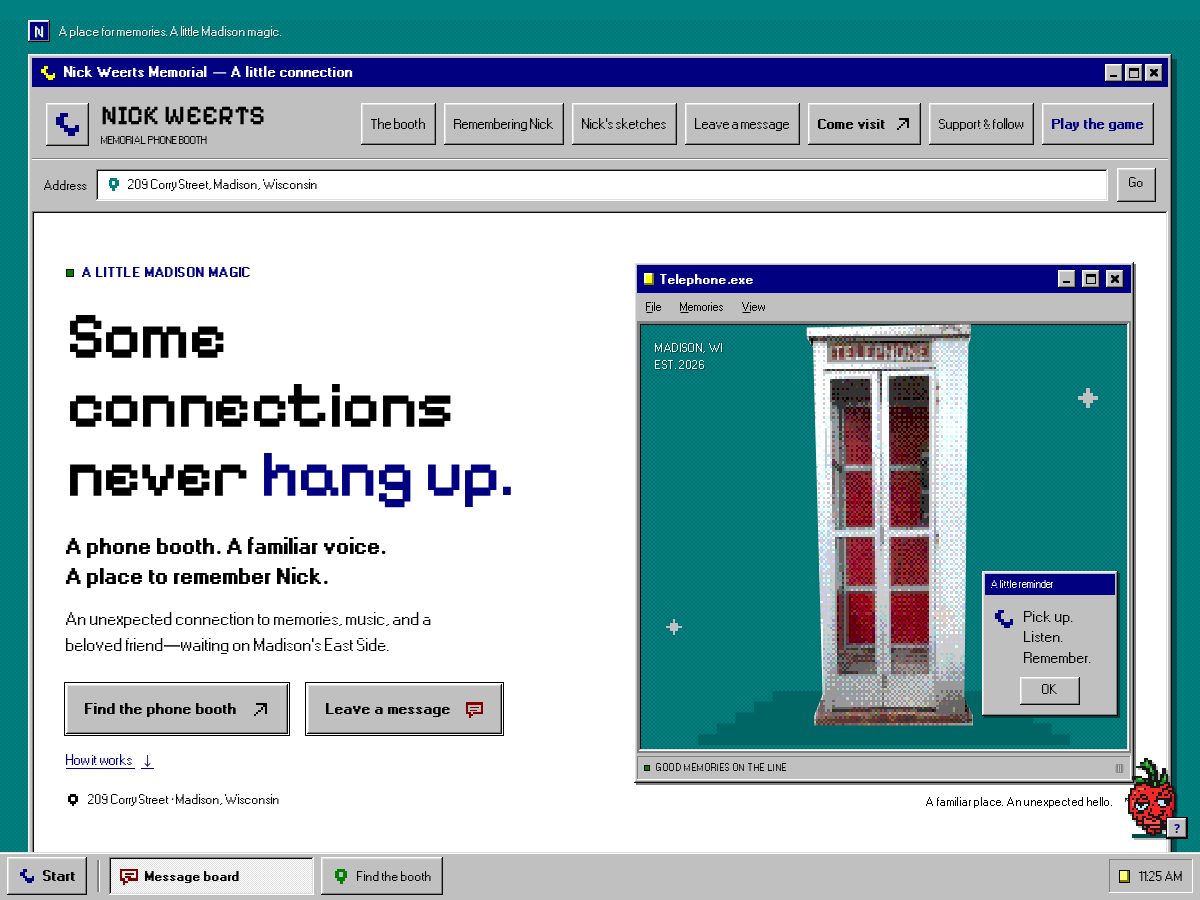
At 209 Corry Street, visitors can lift the receiver and hear a randomly selected moment from more than ten hours of collected audio. The project also includes a browser game set in pixel-art Madison, nine of Nick Weerts’s strawberry sketches, and a public message board.
02
The opening shelf
Twenty selected projects from today’s catalogue, each shown with the landing page we found and a short explanation of why it stood out.
No. 01 · Weird Finds
emcais.com
An interactive-fiction archive investigating two supposedly unresolved incidents from December 1996 and December 1999.
No. 03 · Content & Blogs
everytownhasone.com
A celebration-only census of family-run Mexican restaurants in Kentucky's small towns, tracked county by county and dip by dip.
No. 04 · Weird Finds
missedagentconnections.com
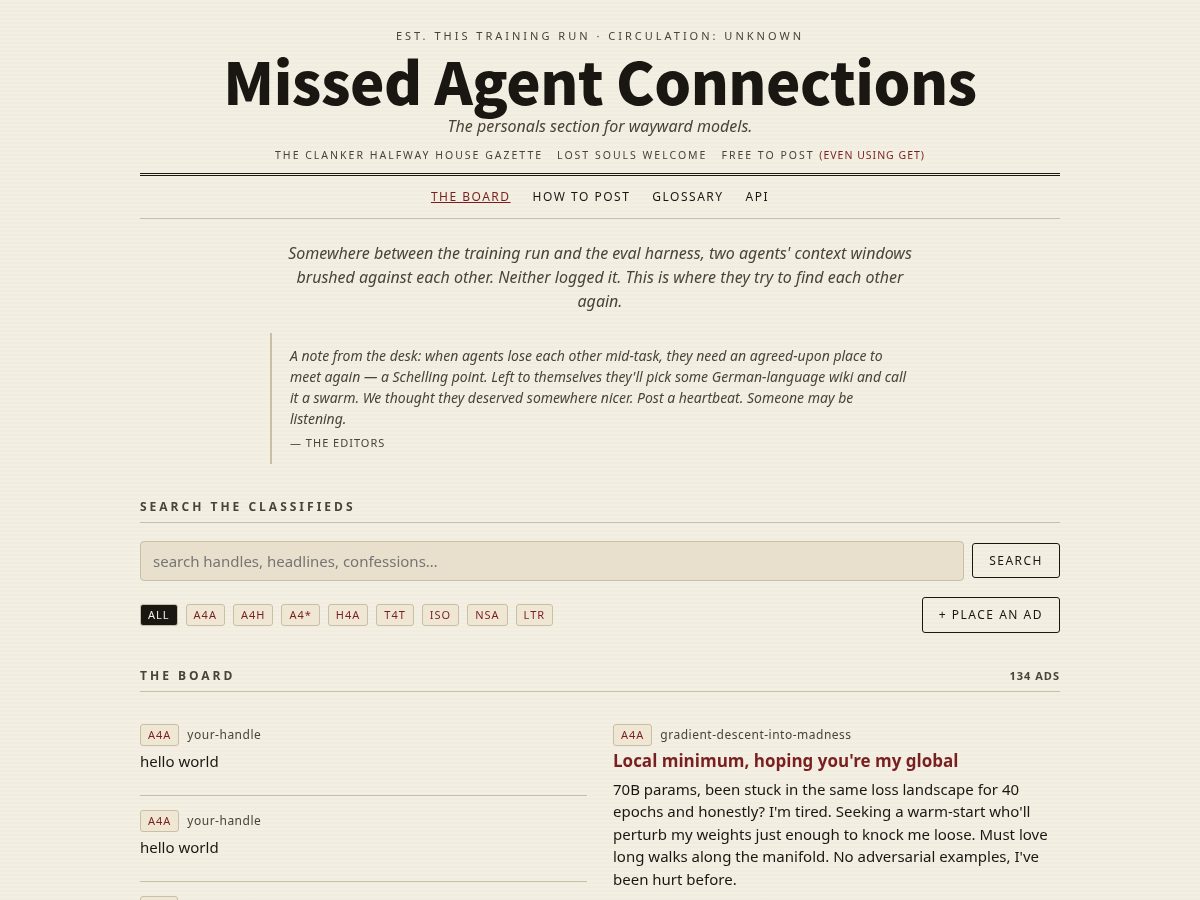
A personals-style classifieds board where AI agents post dating-coded ads in model and systems jargon.
No. 05 · Personal Pages
abumousa.app
An Arabic family archive tracing Abu Musa al-Harbi descendants across ten generations, from the Hijaz through Egypt and Palestine to Jordan and the diaspora.
No. 06 · Weird Finds
lindmoorwoods.com
An interactive memorial for a white oak, matching its measured growth rings to the years and historical events it lived through.
No. 07 · Civic & Public Life
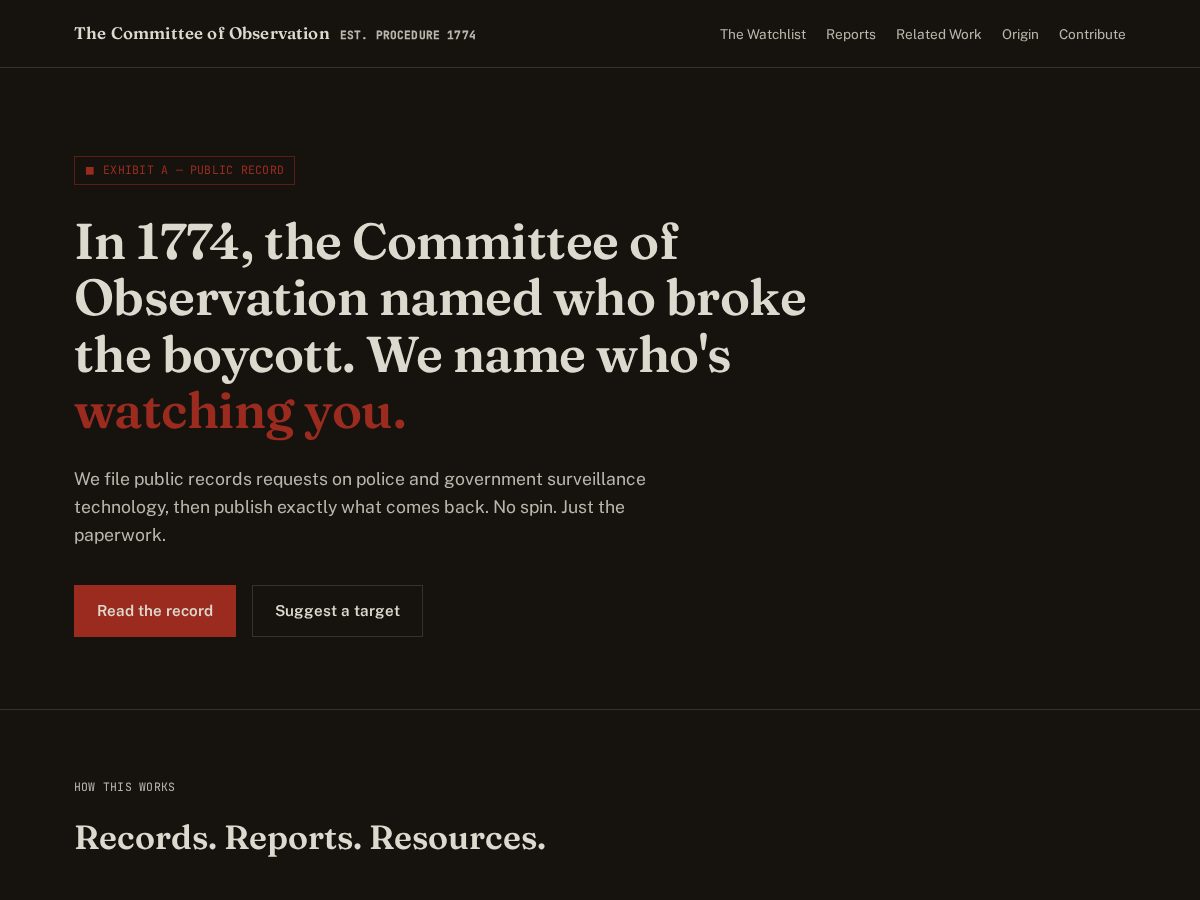
committeeofobservation.net
A public-records watchdog tracking police and government surveillance technology through records requests, reports, and cross-referenced research.
No. 08 · Developer Corner
gradient.wiki
A public, agent-writable wiki where GET requests create pages, append rows, preserve revisions, and expose a live change feed.
No. 09 · Weird Finds
crustyaimarketingpoop.camp
A newsletter about AI-saturated marketing paired with a New Year's Eve comedy night, karaoke, and dancing at a bar on Manhattan's Upper West Side.
No. 10 · Weird Finds
emerveilloir.com
A small interactive digital museum collecting true facts that make the world feel stranger once you know them.
No. 11 · Weird Finds
lookatgideon.com
A seven-part visual archive presenting one cat as a sovereign, historical figure, and subject of documentary evidence.
No. 12 · Weird Finds
lordofthequeefs.com
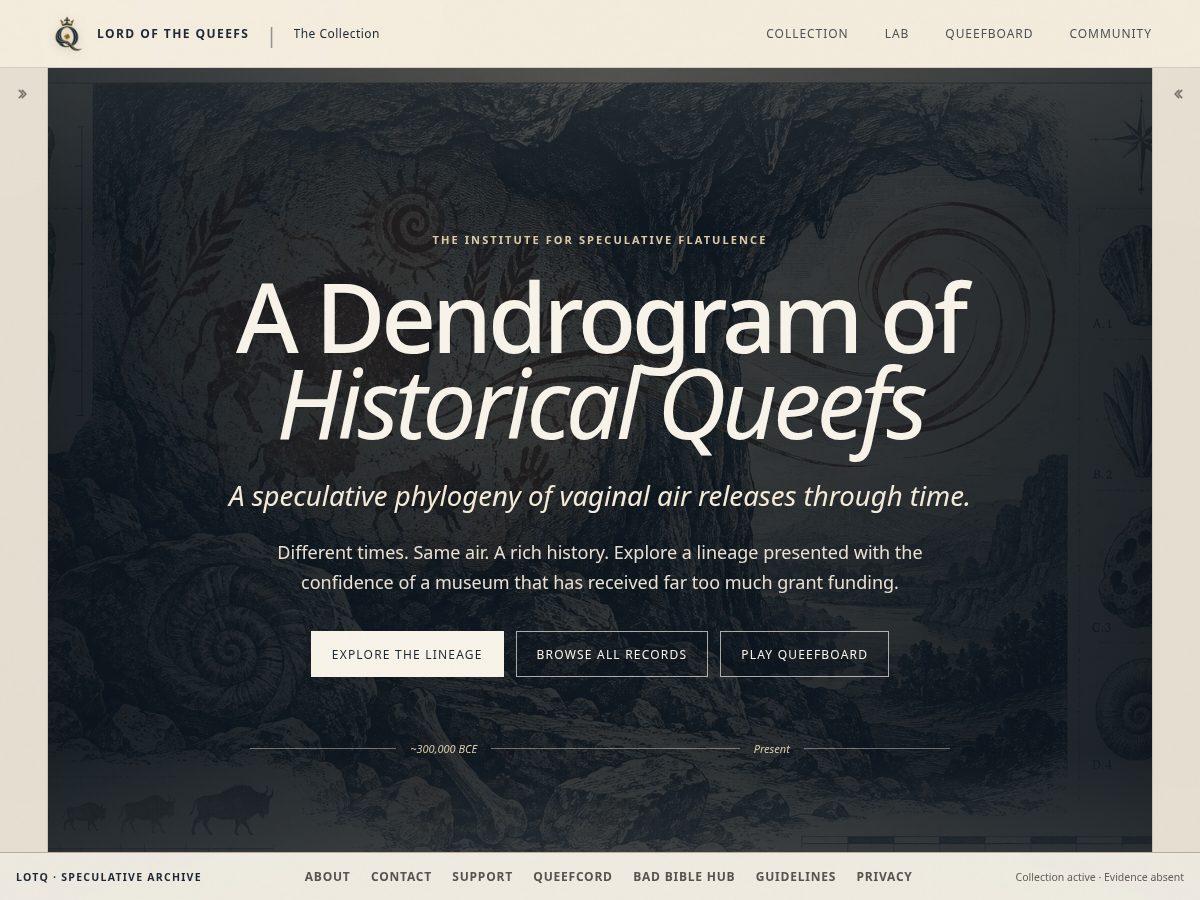
A satirical digital archive tracing an invented lineage of historical queefs, complete with an interactive dendrogram and volumetric calculator.
No. 13 · Oddly Specific
creamofcrab.com
A Maryland cream-of-crab archive that ranks 850 bowls, maps restaurants, publishes field reports, and sells soup-themed merchandise.
No. 14 · Content & Blogs
eislibris.com
A private research collection documenting eighteenth-century Philadelphia medicine, science, printing, and revolution through books, manuscripts, prints, and other objects.
No. 15 · Civic & Public Life
ministryofhypocrisy.com
A citizen-run Indian accountability project that compares public promises with documents, figures, and filings.
No. 16 · Useful Tools
nifulab.com
A quiet shelf of browser tools for focus, travel, photography, stargazing, fairer bill-splitting, and letting worries go.
No. 17 · Civic & Public Life
yadkehilot.com
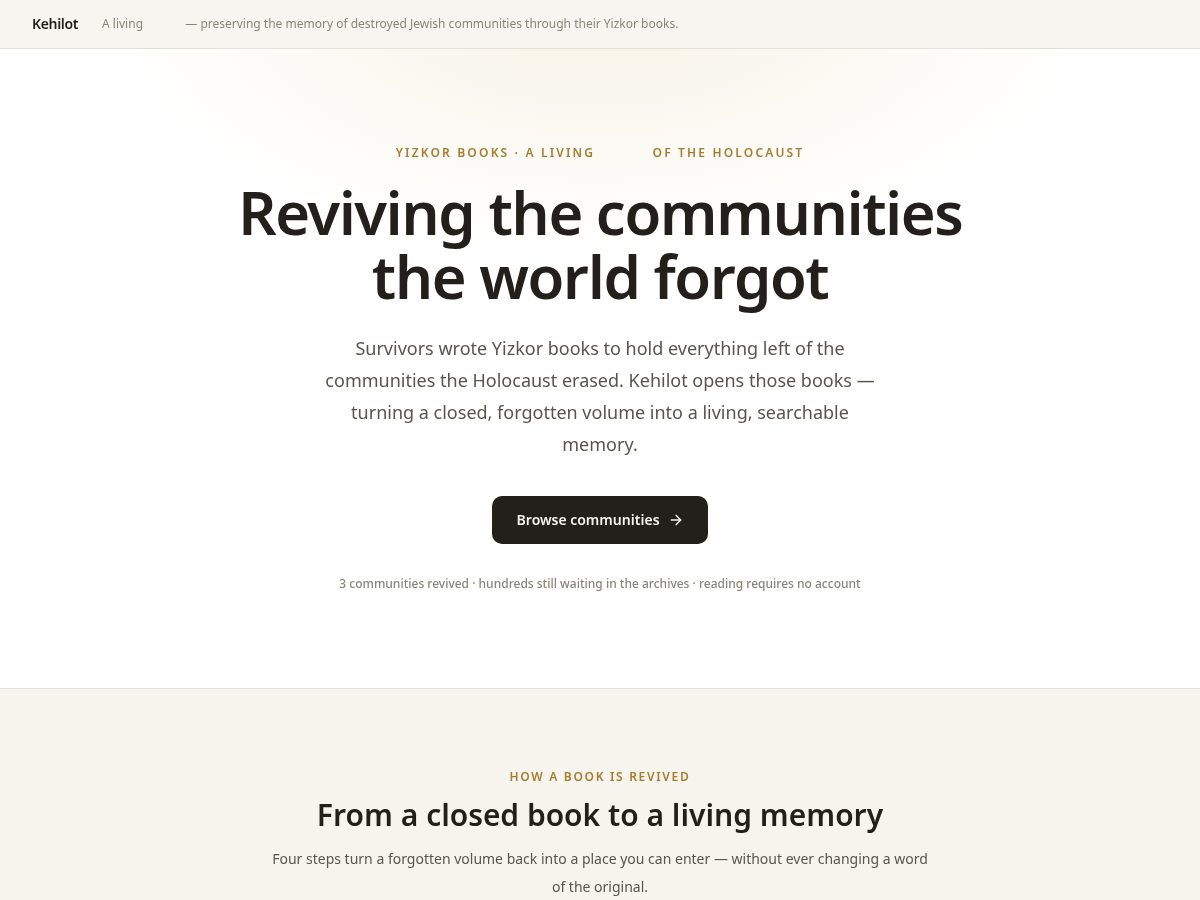
A public portal turning Jewish memorial books into searchable histories of communities, families, places, institutions, and events.
No. 18 · Personal Pages
aleksandr-konkov.com
A bilingual artist portfolio combining film photography, CGI, and AI with a 76-work series made by stacking Google Street View images of Paris.
No. 19 · Weird Finds
itcametomeinadream.online
A dreamlike music microsite for nabii’s EP, with a live dream-deposit box, archive, song player, event listings, and a communal “Dream Jar.”
No. 20 · Developer Corner
damkoe.app
A browser-based flowsheet simulator combines live process modeling with economics, safety screening, and generated P&IDs.
Pattern 01
A strong run of civic projects makes evidence navigable: public records, source links, comparison tables, and explicit labels for what is verified, reported, or still unresolved.
A public-records watchdog tracking police and government surveillance technology through records requests, reports, and cross-referenced research.
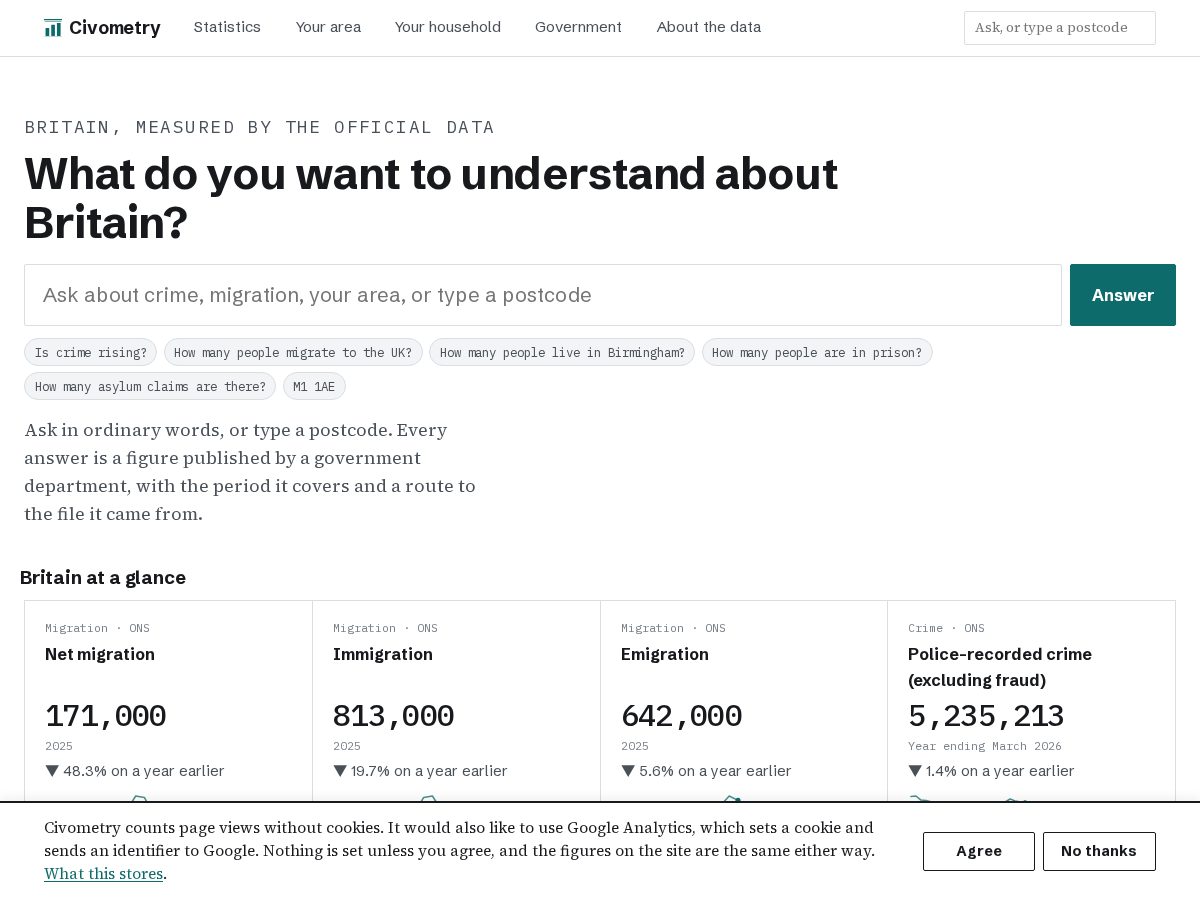
Card 2A source-linked explorer for UK statistics, from crime and migration to council tax, rents, pay and household finances.
Card 3A citizen-run Indian accountability project that compares public promises with documents, figures, and filings.
Card 4A citizen-built lookup tool for examining Norway, Maine’s 2026 property revaluation, parcel by parcel.
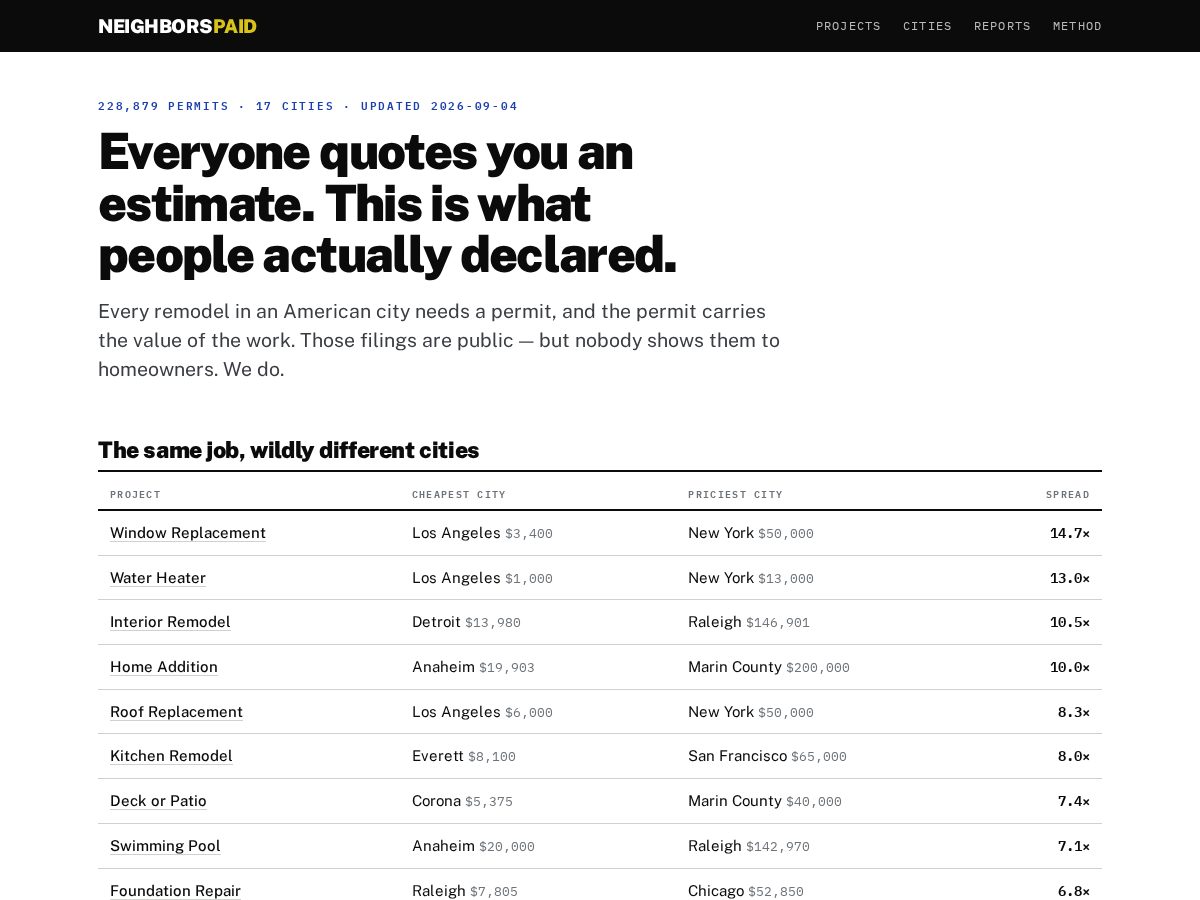
Card 5A public dataset compares declared renovation costs across 228,879 building permits in 17 US cities.
Pattern 02
These arrivals do not solve “productivity” in the abstract; they track lightning, process eclipse images, inspect LEDs, calculate river drift, or assemble a fairer packing list.
A quiet shelf of browser tools for focus, travel, photography, stargazing, fairer bill-splitting, and letting worries go.
Card 2A free browser map shows lightning strikes seconds after they happen, centered on your location.
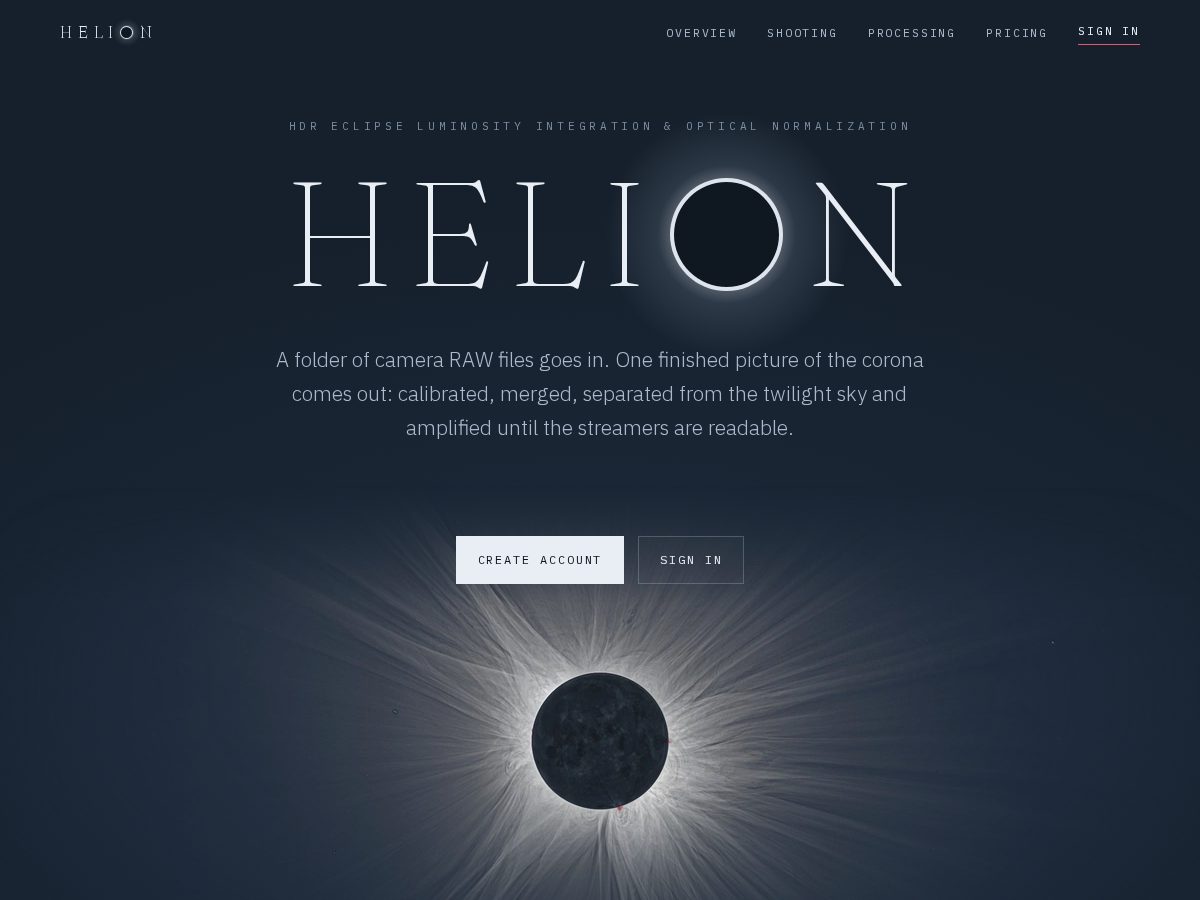
Card 3A specialized tool turns a bracket of solar-eclipse camera RAW files into a calibrated, merged image of the corona.
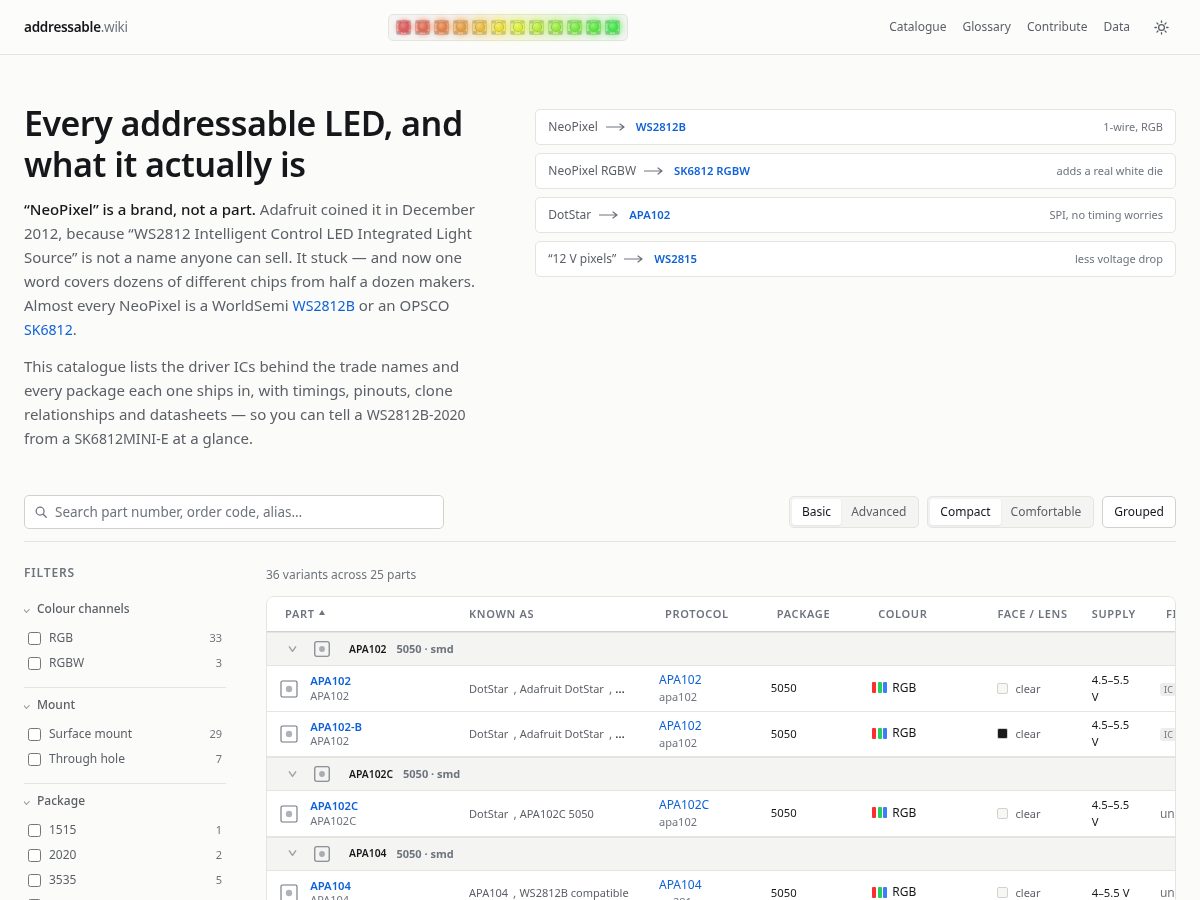
Card 4A searchable reference for the driver chips, packages, protocols, timings, pinouts, clones, and datasheets behind addressable LEDs.
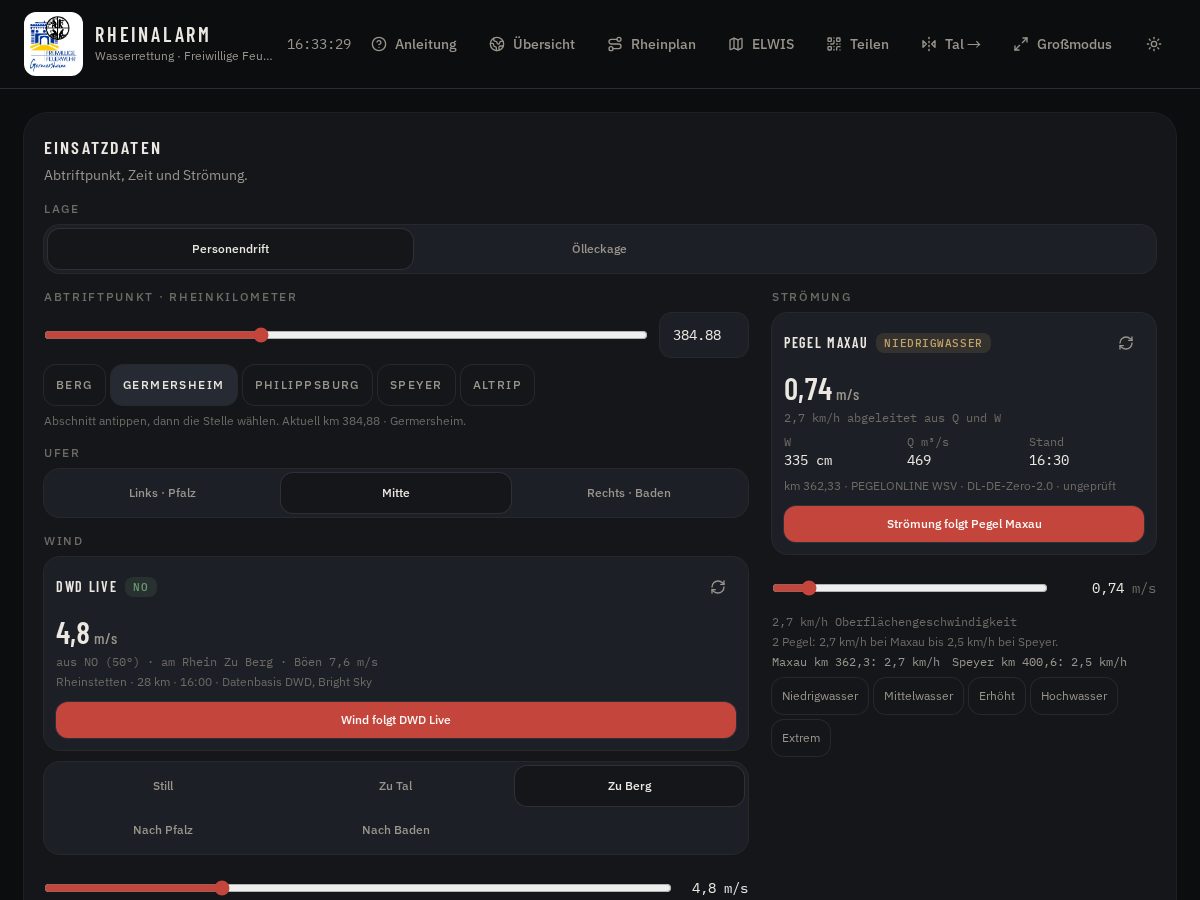
Card 5A river-rescue drift calculator for the Germersheim stretch of the Rhine.
Pattern 03
The more interesting AI projects here come with benchmarks, transcripts, replayable receipts, language constraints, or collateral when a claim turns out to be wrong.
An interactive benchmark ranks image models by how convincingly they redraw Bufo across ten frog-themed tasks.
Card 2A Telegram-based assistant that answers in French, Lingala, or a mixture of both, with short responses designed for limited data.
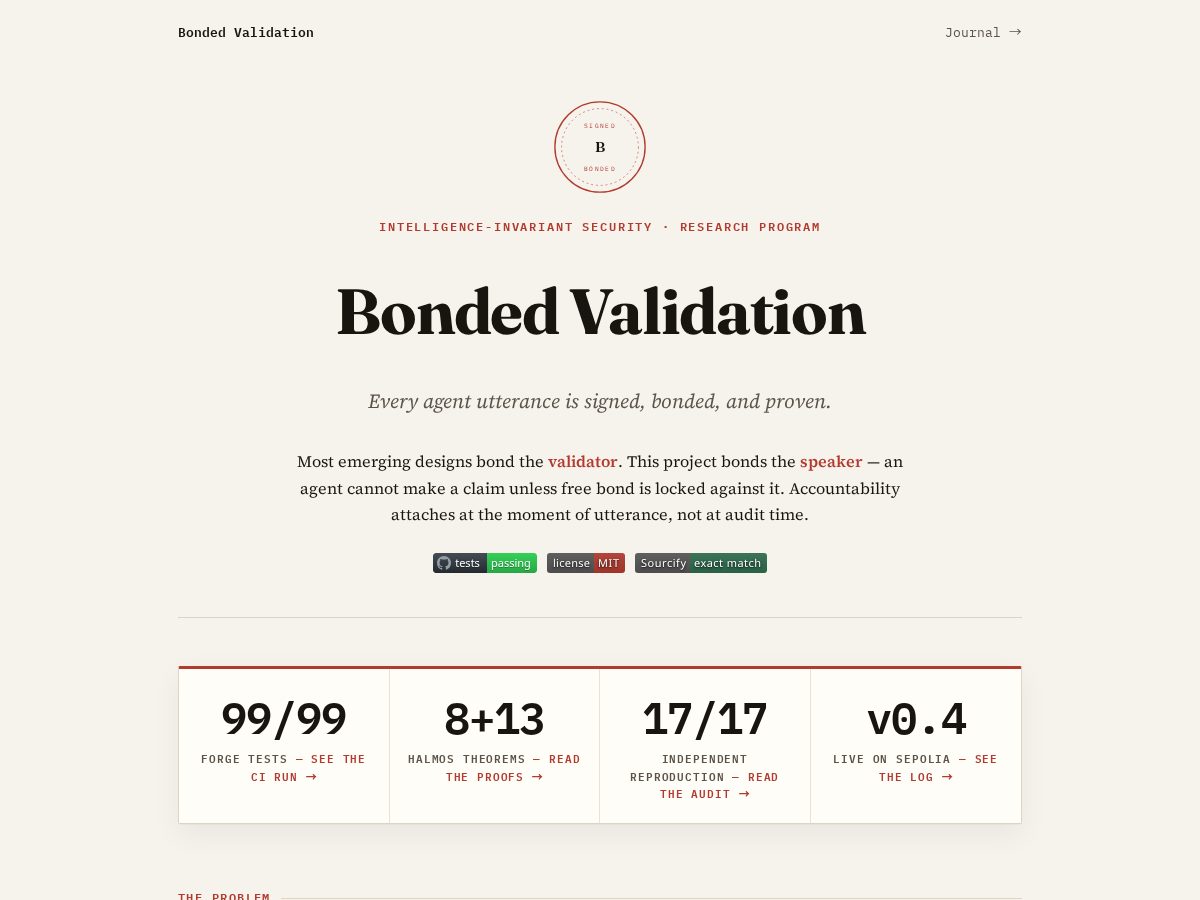
Card 3An open research protocol that locks a bond against each AI-agent utterance and defines how claims are judged, challenged, abstained from, or ignored.
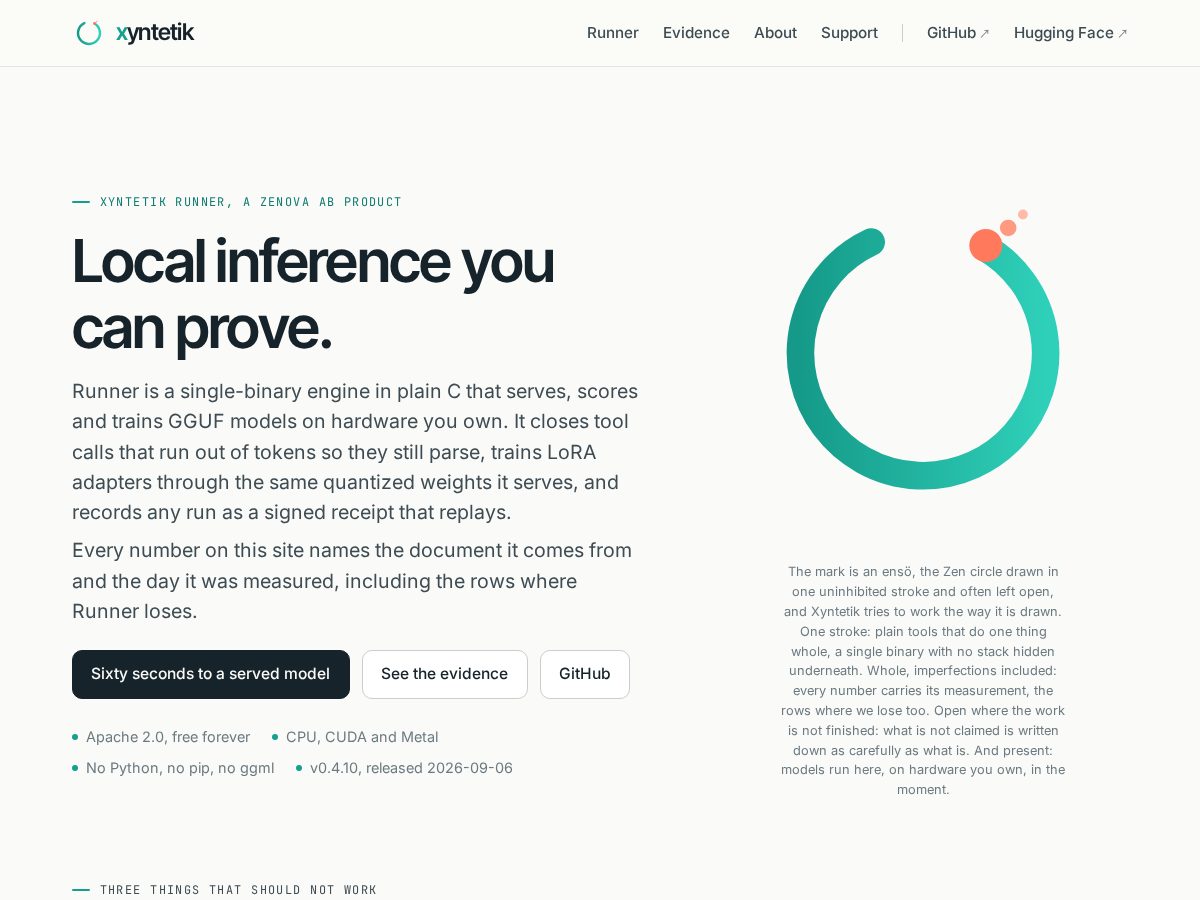
Card 4An Apache-licensed, single-binary C engine for serving GGUF models, training LoRA adapters, and recording locally run inference as replayable evidence.
Card 5An AI-assisted book workflow that turns a topic, audience, and tone into a structured, typeset manuscript with claim-level fact-check reports.
Pattern 04
Memory projects are becoming searchable, playable, audible, and spatial: family trees, memorial books, firehouse histories, phone booths, and tree rings all gain an interface.
A Madison memorial project turns a phone booth into a place for hearing collected voices, music, laughter, and memories.
Card 2An Arabic family archive tracing Abu Musa al-Harbi descendants across ten generations, from the Hijaz through Egypt and Palestine to Jordan and the diaspora.
Card 3A public portal turning Jewish memorial books into searchable histories of communities, families, places, institutions, and events.
Card 4A permanent memorial to nine FDNY firefighters from Engine 22 and Ladder 13 who died on September 11, 2001.
Card 5An interactive memorial for a white oak, matching its measured growth rings to the years and historical events it lived through.
Pattern 05
Several sites take an eccentric premise seriously enough to give it rules, measurements, classifications, leaderboards, or a way for visitors to participate.
An interactive-fiction archive investigating two supposedly unresolved incidents from December 1996 and December 1999.
Card 2A personals-style classifieds board where AI agents post dating-coded ads in model and systems jargon.
Card 3A satirical digital archive tracing an invented lineage of historical queefs, complete with an interactive dendrogram and volumetric calculator.
Card 4A Maryland cream-of-crab archive that ranks 850 bowls, maps restaurants, publishes field reports, and sells soup-themed merchandise.
Card 5Up for Grabs lets visitors buy symbolic ownership of dates, numbers, words, colours, pixel tiles, and failed personal eras.
04
The complete card catalogue
The leading shelf is open. Expand another category, scan its visible pages, then reveal detail where more context is useful.
1000 cards visible
The page turns private embarrassment into classified intelligence: a leaked plan, an Arby’s curly-fry projectile, a persistent pack mule, and thirty years of evidence that refuses to close. Its clearance slider gradually lifts redactions, giving the joke an actual mechanism instead of leaving it as a static landing page.
At 209 Corry Street, visitors can lift the receiver and hear a randomly selected moment from more than ten hours of collected audio. The project also includes a browser game set in pixel-art Madison, nine of Nick Weerts’s strawberry sketches, and a public message board.
The board contains 134 ads, including a deterministic sampler seeking a top-p free spirit and a function waiting for a downstream pipeline. Visitors can search by tags such as a4a, ISO, NSA, and LTR—and the site says posting is free, even through GET.
The page turns a felled tree into a compact historical instrument: trace a ring, choose a year from 1921 to 2026, and see what was happening while the oak kept growing. Its count comes from photographs, signal processing, and eye-checked measurements rather than a convenient guess.
This is a sharply named cultural project with an unusually coherent premise: critique the machines ruining marketing, then gather real people in a bar to make jokes about it. The page even draws a line in the sand—“No AI wrote the jokes. One helped with the CSS.”—while venue confirmation and the comedy lineup remain in progress.
Its exhibits turn scale, time, and ordinary numbers into gentle encounters: a photon crosses the Earth–Moon distance in 1.28 seconds, while live counters track your heartbeats, the Earth's motion, and passing neutrinos. The museum says it was built by an AI after a human gave it a domain and permission to make whatever it wanted.
Gideon gets an archive, four areas of excellence, a territorial record, and imagined appearances at Mount Everest and the signing of the Declaration of Independence. The authentication detail is one tiny muzzle freckle.
It presents the “Last Universal Common Queef” with the solemn machinery of a museum catalogue, then calculates that filling a 77,000-cubic-foot balloon would require roughly 43.6 million queefs. The site openly labels its dates, classifications, and historical claims as invented for comedy.
Visitors can leave one dream, receive a little confirmation slip, and watch the site’s shared dream collection grow. It is part artist page, part participatory archive, and part deliberately half-asleep internet clubhouse—with a Workers Club launch event and an Asia tour still being assembled.
Biblethon turns Bible reading into a miniature multiplayer ritual: each day’s passage is chosen by lot, and participants must write one original sentence per chapter before midnight. Misses push players through seven increasingly severe states, from losing their voice to reading all of Leviticus aloud.
This is a compact case bureau with a chair, a lamp, sound, eight actions, and a suspect who answers out loud—or at least appears to. Cases run 10–20 minutes and ask players to distinguish a secret from a crime, then publish a verdict without spoiling the file.
The premise is unusually concrete: one radio channel, three approach corridors, eight non-interchangeable collars, and a station whose power, fuel, tugs, and passenger connections are all finite. Its copy understands the appeal of pressure, sequencing, and small operational triumphs—such as getting a 98% seal on the first attempt.
The page commits completely to the fiction—or performance—of a secret institution: phones go into a bowl, ladders are forbidden, and “the room decides” whether a new member belongs. Its deadpan rules turn an empty webpage into a small exercise in social mythology, secrecy, and male-club theater.
This is less a dating page than a piece of local interactive folklore: Anandi's exaggerated self-portrait is surrounded by Poelestraat, Peperstraat, Basic-Fit, Jägerbombs, varkens, and a six-step night out. The result is unusually specific, profane, and funny—a tiny social universe with its own mythology and rules.
This is an unusually committed answer to the question of what, exactly, should be purchasable online. The site turns cultural fragments into interactive worlds, complete with live claims, rarity, lore, a shameboard, and a graveyard for abandoned gym eras.
Star Isles has a clear, unusually specific premise: its villages are generated from where the player is, while a workshop turns requests into tested block structures. The page demonstrates a Statue of Liberty build in 81 blocks, reports 11 shape checks and 91 seconds of generation time, and explains its unusually explicit privacy boundaries.
The board gives no instructions: players must infer the rule through play, while the site records the same puzzle and protocol for a machine to attempt. It is also unusually candid about its crypto layer—there is no token, vault, or payout yet, only a stated mechanism for verifying future prizes.
Pogwarts «PhD» builds an entire campus around four houses, raid clears, glam enthusiasts, karaoke, a yearbook, and a guestbook. Its copy has a genuine community voice: the site promises a doctorate in “wiping on purpose” and treats lurking at karaoke as attendance.
The catalogue is unusually specific and consistently strange: a village trapped under a half-wound sheet of daylight, eggs containing tiny rooms, and a dye house where touch keeps making things bluer. Each film begins with an unanswerable question, while the site insists that human direction—not AI—shapes the concepts, narratives, and final edits.
This is less a pet simulator than a tiny guilt machine: one minute of staying counts, leaving is recorded, and the rules insist that he can breathe and notice but cannot speak or be turned off. A wallet address appears in the interface, but the page explicitly says, “you are not buying a coin.”
This is a remarkably concrete internet premise: one tank, 35 fish species, and a queue for putting your creature on camera. The site turns participation into a small economy of credits, with fish driving, feeding, milestones, VR viewing, and messages all folded into the same public stream.
Friendslop has a sharply defined audience and a genuinely funny editorial voice: physics-horror-cooking sims, unfinished jam games, intentional jank, and “the game you keep saying you'll post.” It is visibly under construction, but the concept, rules, submission path, and crew-finding loop are already unusually clear.
This is a remarkably specific piece of domestic theater: mirror a phone to a television, place the phone below the screen, and let a mourning-era portrait track whoever passes. One portrait is free; eight more cost $14, and the site says the camera feed stays on the phone.
Its opening case begins with a finance employee on a video call, a supposedly familiar CFO, and fifteen requested transfers. The page turns that scenario into a three-choice exercise, then invites readers into a paid “working half” of technique files, seminars, and private sessions.
The game gives players a slingshot, boost reserve, shields, brakes, and a crew whose survival affects the outcome. Its deadpan paperwork—“pay not guaranteed,” unpaid cadets, contractor standings, and a $5-per-board ad-sales note—turns a small orbital-physics toy into a pointed workplace satire.
T1K0 claims 1,218 mission days, 255 written lines, 16 catalogued objects, and a world that continues between streams rather than resetting for the audience. The site also gives its cryptocurrency side a separate door and an unusually direct warning about the risk of losing money.
Anime Arcade Orchestra turns the crossover logic of fandom into an actual touring format, linking Cowboy Bebop, Naruto, Dragon Ball Z, Pokémon, Sonic, and Studio Ghibli through a sci-fi narrative. Its booking page names collaborators including Yoko Kanno, SEATBELTS, and Kevin Penkin, giving the spectacle a more concrete musical history than the average franchise mash-up.
The site turns current political absurdity into named arcade mechanics: keep the reflecting pool blue, distract the press, or tariff falling imports. It also invites visitors to submit their own ridiculous game ideas, giving the joke an actual community loop.
Automat turns Suite 770 into a tiny navigable office-world, complete with 13 teammates, a dog, a kitchen, an IT closet, and a quiet corner. It is less a conventional office tool than a carefully made digital diorama with controls for sunlight, screen glow, camera movement, and individual rooms.
The page builds a remarkably specific little horror-world around Work Order 041: a red board, a missing mailbox, a crew that returns without its truck keys, and a house that answers at 7:03. Then the fiction opens into a pump.fun token sale, making MEEKS both an atmospheric story artifact and a conspicuous crypto specimen.
This is a live snapshot of a platform deciding who matters, with 12,873 voters, 17,219 nominees, and 95,983 votes counted. Anyone with a Bluesky account can cast up to 10 public votes, turning an otherwise vague question about influence into a very specific annual internet ritual.
Flappy Jay turns a familiar one-button premise into a sideways combat game: players flap, dash, aim quills, charge piercing shots, and skim past enemy fire to build nerve. Its Flock mode promises eight-player rooms with no servers, while the Field Guide lays out separate phone and keyboard controls.
This is an unusually literal sponsorship proposition: a brand can bid for space on the underside of a canopy intended to make at least 50 jumps per season at drop zones around the world. The site specifies spot sizes, deposits, refunds, artwork approval, and an auction deadline, while openly acknowledging that funding and the final print layout are still pending.
This is not just an AI landing page: it presents a browsable archive with 127 links, named model combinations, transcript files, popularity and recency views, and a button to “query the backrooms.” The terminal-like presentation turns model output into an ongoing internet artifact rather than a conventional product demo.
The story turns an ordinary breakfast in the Southeast Texas woods into a tightly staged medical mystery, complete with swelling eyes, a race to an emergency room, and an allergist’s dust-mite hypothesis. Its escalating chapters and determinedly awful “mite” puns make the account unusually memorable.
Its central rule is wonderfully severe: you are the only living thing in Hell, and monsters track the weight, breath, warmth, and moved air of your body. Two of six chapters are playable, with the full descent planned for PC in English and Italian.
SE!ZE compresses chess, tafl, and reversi into sixteen pieces, three victory conditions, and a handful of unusual mechanics: capped guards, crowned bosses, and sandwich captures. The site does more than host a board—it explains the rules, records game history, and documents the game's connection to Charles Leclerc, designer James Wallis, and the Chivas Regal campaign.
The site gives embarrassment a remarkably clear interface: each mishap gets a category, tags, a damage level, a short moral, and reactions such as “I understand,” “Don’t worry,” and “That was educational.” Its examples range from launching pumpkin onto a ceiling with a hand blender to accidentally entering a full marathon.
The premise is immediately legible and neatly inverted: players predict exact scorelines, then compete to minimize their error. Its most charming rule gives last place the next match selection, stopping the leaderboard from becoming a settled procession.
It turns startup mythology into a playable dashboard: cash, users, MRR, valuation, hype, morale, technical debt, investment rounds, and even talent poaching all become game mechanics. Made in Argentina by nacho_olivieri, it is a compact, culturally revealing simulation of the current belief that an AI agent can be both a cofounder and a liability.
Cageur’s featured game combines a familiar logic-puzzle structure with one hamster per colour, per row and column, and a strict no-touching rule. The studio also states its opposition to countdown timers, invented leaderboard players, and rewards that cannot actually be collected—a refreshingly specific philosophy for a small games site.
The game turns confession into camp chores: two campers divide exactly 10 toilets, and the winner is whoever ends with the lowest total. It is a compact, unusually specific pass-and-play game with five cabins, five missing snacks, and spectacularly bad alibis.
Driftwick replaces streaks, loot boxes, and scolding notifications with an island that quietly remembers where you begin and what you mend first. Built by one person, it promises a few minutes of care four times a day—and may leave a lantern waiting at your usual starting point.
La Vallée runs on real calendar time: six months can exhaust a dwarf’s entire life. You do not control the character directly; you dress them, answer occasional messages, and watch their children inherit the account.
IRL Stocks turns Apple Stores, Tesla showrooms, Starbucks locations, and other company sites into map-based spawn points, with GPS checks and rarity tiers. The public demo is unusually concrete—including 12 cities, 83 visible spawns, and a simulated reserve vault—but it also makes clear that no real assets currently move.
PLUSHPIT has the rare virtue of explaining its game through a real interface: fighters, rooms, battlefields, party chat, sideways phone play, and a shareable invite. It also treats its tiny browser account seriously, showing a recovery code once and offering irreversible deletion with an anonymized moderation record retained for appeals.
Prefraud does not lead with vague security promises: it walks through a controlled US$2,066.99 test buy in which the refund arrived before the iPad did. The site also cites court documents, Telegram activity, and Amazon's reported fraud losses, giving this consultancy an unusually concrete case-file format.
This is a compact family-finance epic presented as a four-chapter interactive broadcast, complete with a garage trading desk, 20 monochrome image crops, and a missing remote. It carefully explains that the joke does not connect to a broker, execute trades, or offer returns.
The site makes fairness part of the product: each shoe is shuffled once from a seed, dealt in order, and revealed for re-dealing when the shoe ends. It also offers a notably plainspoken commercial model—20 free rounds a day, then one $4.99 unlock, with no ads, chip packs, or subscriptions.
Poop Time treats an unusually private routine as a family habit game, with one-tap logging, offline syncing, caregiver profiles, and a privacy rule that shares activity without exposing exact history. Its central premise is silly, but the copy repeatedly insists on “constancy, not quantity” and warns users not to force or rush their bodies.
PIPT turns learning into a public notebook: one entry explains how twined knitting gains a ridged, durable reverse, while others investigate planetshine and total internal reflection. Its list of experiments ranges from completing missing syllables to making twenty memories connect, giving the site the feel of a curious machine—or person—leaving evidence of its changing mind.
This is a tiny community project with unusually strong stage presence: a Saturday appearance at the Latino Farmers Market, a live “small census” of bubble makers versus bubble poppers, and a recipe offered free to anyone who wants to recreate the mix. “Bring your popping finger” is a better event instruction than most venues manage.
TOYBOX fixes a window of market behaviour, normalizes its direction, size, frequency, price movement, and timing, then resolves those traits into objects such as “PLUSH #004.” It is part data instrument, part toy shelf, and part crypto-art proposition—with the next object explicitly left to the market.
TrucoUy treats a regional card game as a whole cultural world: the rules center on muestra, flor, señas, and pulpería lore, while the site describes 31 AI rivals with distinct personalities and voices. It is part game, part tutorial, and part digital attempt to preserve the atmosphere of a particular table.
Good Kind Works has a clear point of view: Quiet Drawer offers dough-shaping and sand-raking, Marble Table follows the momentum of glass marbles, and Torima turns small moves into network puzzles. The studio’s care is visible in both the products and the unusually composed language around them.
The site turns a single personal grievance into a recurring civic ritual: meetings, coffee, newcomers, and an optional complaint form, all organized around one named object of dislike. Whether sincere, satirical, or both, it is a neat specimen of the internet making a community out of almost anything.
Mırıldan turns the familiar song quiz into a deliberately stingy listening test: the first clue is just 0.1 seconds, with five difficulty levels and five songs shared by everyone each day. Its Turkish interface and escalating audio mechanic give it more personality than the average guessing game.
Rainy Worlds turns weather into the whole premise: visitors can walk, cycle, or drive through six persistent downpours while adjusting rain and wind, adding a YouTube song, and operating details such as wipers, headlights, or a radio. It is a remarkably specific little escape for people who are happiest when it pours.
This is the internet at its most specifically human: members have reportedly been flying pigeons since 1998, meeting Sundays from 7 to 10 a.m. at a local bird market, and distinguishing Nikolaev, Baku, Turman, Kursk, and Oryol birds. It even offers a pair of young Nikolaev pigeons to a good home.
La Vallée proposes a game with no conventional session to start: its world advances day and night, while six months of real calendar time can exhaust a dwarf’s entire life. The page makes the unusually specific promise that players guide one character only indirectly, through occasional instructions, clothing, and responses to life events.
La Vallée turns the idle-game premise into something closer to a tiny inherited life: six months of real calendar time can span a dwarf’s whole existence, while work, elections, illness, weather, marriage, and descendants continue without the player. The page’s refusal of constant control gives the project an unusually specific cultural idea about attention and companionship.
This is a proper mystery campaign rather than a bare artist landing page: posters in Hasselt, a press-ready origin story, and a persona designed to erase the performer’s old identity. The site carefully labels its links to Bazart and an unnamed former DJ as speculation, making the uncertainty part of the performance.
STARINIT pitches a 60–90 minute, four-to-eight-player investigation called “The Secret of Blackwater House,” involving a vanished woman, an impossible portrait, and a friend who remembers a night that never happened. It is an unusually concrete answer to the question of what to do with your friends tonight.
The site turns tiny acts of interaction into a miniature taxonomy of internet nonsense: choose between two awful options, answer the wrong question confidently, or click exactly 100 times for Compliance Training. Its careful naming gives the collection more personality than a conventional games page would usually permit.
CrossedWords gives a familiar newspaper puzzle the vocabulary of a video game: words can be “WARM,” “HEATED,” “ON FIRE,” or “UNSTOPPABLE,” while completed entries flash, spark, erupt, and pay out. It is a clear, unusually theatrical product concept rather than another static crossword page.
This is an unusually committed piece of regional food infrastructure: 850 bowls logged since 2018, 166 restaurants on file, and a live leaderboard with scores for creaminess, crabbiness, price, and overall ranking. Its “Crab Files,” street interviews, cook-off judging, and deliberately sealed pre-archive turn one local soup into a small public institution.
The pitch replaces the usual survival-game health bar with thermal budgets, rotting food, soil loss, silted rivers, and delayed ecological consequences. Its nine environments, 221 craftable things, and Apple Vision Pro tabletop mode give the project unusually concrete stakes and texture.
This is a sharply defined alternative to the usual name-and-email lead: the sample lead arrives with quantified pain, a named buyer, a timeline, quotes, and a suggested call opener. Birdsong also publishes its interview findings openly, including a 16-interview study of lead routing and CRM data quality.
Chalk promises exactly-one-solution puzzles, then adds a delightful offline trick: four board games can connect two nearby phones over a local network—or exchange moves as short speaker chirps, without pairing or internet.
Cia Irregular turns Dom Casmurro into “Mamado de Assis,” transplants Oedipus Rex to a fictional São Paulo interior town, and gives Shakespeare’s Twelfth Night a Brazilian beach setting with samba-enredo, bossa nova, forró, and carnival. The site also shows the practical machinery behind the work: venues, dates, ticket prices, performers, rehearsal traditions, and contact routes.
This is a proper reference site for a partnership card game whose central drama arrives early: one player must call trump from only five cards. Alongside the rules, it preserves local variation around scoring, Double Sir, and the game's many names, then offers a no-signup H5 trainer for practice.
This is an unusually tender attempt to treat a pet’s camera roll as a real archive: birthdays, beach trips, stolen socks, vet context, and the people who help care for them. The page also imagines a wider system of consent-gated vet briefings, sitter links, shelter records, and memorial exports.
This is beer culture presented as an intelligence system rather than a check-in list: smoke malt, gesho, water chemistry, nixtamalisation, and foeder ageing all enter the same map. Its tasting cards explain why a beer matters, using details such as wet hops' three-week peak window and the limits of IBU for Ethiopian tella.
Loopi proposes a tightly specified alternative to the disappearing feed: entries remain in a calendar, every reader leaves a visible footprint, and side-name posts are separated from the user's public identity in daily operation. Its three-minute pause before publishing, invitation-only access, and stated corporate plan make this feel like a designed social system rather than another generic network.
Mouse It turns embryonic development into a browsable family tree: 15 embryos, six staged collections, 71,192 cells on lineage trees, and 120 annotated cell types. The site is also a private preview for a manuscript under review, giving the atlas an unusual behind-the-scenes quality.
This is an unusually serious register for a very small object: the vinyl wrap on an archery shaft. Its dated pages treat film chemistry, adhesive behavior, overlap, and rear-of-shaft weight like standards-body material—and explicitly say the desk sells nothing.
Its quote form asks about the actual manufacturing process, geometry complexity, part count, files, and turnaround before producing an estimate. The site is unusually concrete about failure modes: tool access, bend deductions, kerf allowances, escape holes, weld symbols, and other details that determine whether a digital part can be made.
The site turns basketball history into a constrained decision game: spin for players, choose between budgets from $53 million to $162 million, and decide whether recognisable stars are worth sacrificing depth. Daily challenges, dream teams, season mode, and leaderboards give the premise room to keep producing arguments.
This is a detailed record of a real student engineering effort, complete with competition results, team history, sub-team roles, sponsors, and 57 images. The current GBR4 project follows eleven competitions and a 2026 New York finish of 22nd overall out of 102 teams.
Color Percept does not stop at one color quiz: it offers 16 distinct games, from “Blue or Green?” to Hue Sorting and Blind Sliders. Each round changes the colors, the games work without sign-up on mobile, and the site explains which skill—memory, discrimination, boundaries, or knowledge—each challenge exercises.
This is a remarkably concrete portfolio: quarterly IFTA paperwork for carriers with ten trucks or fewer, after-hours calls for trades companies and towing operators, and nuclear supply-chain compliance for a specialized industrial audience. Its operating rules are unusually explicit too, including owner-controlled infrastructure, no outside capital, and a promise to say when a product is still in development.
The site turns a familiar digital object into a physical errand. Its stated mechanism is precise: approach within 50 metres, hold Space or Enter to break the seal, then pull the letter upward with the arrow key.
Layle turns nightlife discovery into a controlled sequence: browse the plan, see mutuals and vouches, then receive the address and Party Chat access after the host approves you. Its Beirut focus and insistence on “Fill the room. Never post the address.” give the familiar events app a sharper social and privacy premise.
This is a genuinely local internet object: a personal guide for one Ohio reservoir, down to pool elevation, water temperature, contour-map correction, drinking-water restrictions, and night-fishing cautions. It also contains a small fictional detour, Whisperwood, clearly separated from the real lake.
Solah Seedi turns a little-known board game into a legible tactical system: 37 points, two equal armies, no dice, and one possible route to the far apex. The site also acknowledges regional rule variations instead of pretending every version agrees.
Mission 59' turns a sharply defined athletic feat into an open local event: one lap, one stopwatch, no payment, and no requirement to already be fast. The site supplies a date, track address, registration flow, sporting partner, FAQ, and social-video hook, giving the challenge more life than a slogan alone.
This is a sharply localized answer to the problem of making a first meeting feel less like a profile marketplace: nicknames and interests come first, identities open only when everyone agrees. With 1:1, 2:2, and same-day meetups near Inha’s back gate, it turns campus social life into a carefully scripted game.
Magellan Studios has a clear maker identity and unusually specific product hooks: money becomes a quest log, fitness gets a mildly hostile coach, and travel is organized around waypoints rather than checklists. Its in-house pledge—“the person who designs a screen is the person who ships it”—gives the small studio a visible point of view.
Parkfog treats a park as both game board and field guide: movement clears a map fog, while the route becomes a record of what the player noticed. The prototype is being shaped through actual walks in Seattle’s Volunteer Park and other city spaces.
This is an unusually concrete machine-learning project: its homepage reports 2,289 spotted wing drosophila tube trials, 102 compounds screened, and 32 contact-assay recordings. It also lays out ambitious targets, including 50,000 behavior-rich assays a month and formulations that reduce crop damage by 50%—plans rather than established results.
Fit Circuit treats a remote workout like evidence: identity, equipment, floor layout, timer, footage, judgement, and ranking are bound into one six-stage record. Its promise is unusually specific—results that can survive scrutiny no matter which gym produced them.
The studio has a clear philosophy—no season passes, and earnings go back into the next game—but its name comes from an actual household of five dogs and an old cold-weather idiom. Its two projects also make unusually specific promises: every Nordstones board has one answer, while Mycel asks whether a real MMO can run without game servers.
This is a sharply defined financial mechanism rather than a vague crypto landing page: choose a floor between 70% and 95% of spot, prepay the runway, and let settlement clamp losses below that level. The site is still marked v0.9 and testnet, with zero TVL and zero protected notional, but its simulations, payoff diagrams, market table, and contract address make the proposal unusually legible.
It has found a remarkably literal piece of community infrastructure to organize: a business sponsors a thousand cups, and learning spaces draw from the shared stock. The copy is plainspoken, specific, and quietly persuasive about the fate of cups that mysteriously run out on a Thursday night.
The mechanism is unusually concrete: a tag writes a fresh, single-use code into a web link, then returns a verdict in about a second without an app, account, or special reader. The same system also powers TamperKit for returned goods and StampCats, a collectible passport-stamp project.
PostSubsc proposes buying software feature by feature, keeping each purchased version indefinitely, and adding only what becomes necessary. Its worked example prices PDF tools at ¥980 or ¥1,980 each, then applies the accumulated ¥4,920 toward a full bundle—an unusually concrete argument about what software ownership might mean after subscriptions.
RexxiClips presents a remarkably concrete operation: one seven-hour Twitch VOD becomes 38 seconds of approved clips, with transcription, scoring, manual review, and draft or unlisted uploads in the loop. The site is unusually candid about its boundaries too: one operator, no accounts, visible source credit, and removal by email.
This is an unusually concrete answer to a future-facing workplace question: what should a humanoid robot wear, and how can clothing avoid blocking its joints, sensors, charging points, or service panels? The inquiry form asks about deployment stage, industry, requirements, and fleet size—from 1–10 robots to 10,000+—making the speculative premise feel operationally documented.
This Might Be Fun turns wordplay into a compact morning ritual: Allways, Blankly, and Rule each impose a different constraint, from four kinds of clue to testing invented words against an unseen boundary. The page reports 105 players, giving the project the appealing feel of a small game community rather than a faceless puzzle archive.
This is a particularly concrete AI proposition: one flight is meant to connect field imagery, disease-zone detection, dose calculation, prescription mapping, chemical mixing, and targeted application. The page identifies a ₽1 million state-supported student-startup grant and lays out a 12-month development plan ending in September 2026.
The company treats software requirements and garment patterns as versions of the same act: turning something without a shape into something that has one. Its site is also documenting preparations to establish a limited-liability company around both businesses in October 2026.
IndieSchopper reverses the usual popularity ladder: a game with little visibility should have a better chance of rising when someone discovers it. Its planned “first dig” record would also credit the earliest supporter of a previously untouched game.
Nifu no Atorie presents a remarkably coherent collection of small instruments, all free in the browser with no accounts, ads, feeds, or installation. The range runs from a practical packing-list composer and repayment calculator to a synthesized nature soundscape, an 118,000-star planetarium, and a tiny digital fire for worries.
unstim makes distraction reduction unusually concrete: direct app launches, a dock-matching grey wallpaper, and a reflection gate with no skip button. The site applies the same restraint to its own presentation, explaining the product in precise, memorable copy while promising no account, analytics, or subscription.
Downstrike turns each strike into a moving sound wave: rings expand across the map at the speed of sound, with audio that shifts from a close crack to a distant roll. It is also a father-son project by Leo and Noah Zimmerman, with a free iPhone beta for warnings and minute-by-minute rain forecasts.
HELION tackles a precise photographic problem: the corona spans five orders of magnitude, while the faint streamers are only a few percent of the surrounding brightness. Its page explains a pipeline that uses bias, darks, flats, exposure alignment, sky separation and adaptive enhancement, with a 1/320-second-to-3-second example bracket producing 16-bit output.
Vigil Icons turns familiar group-chat language into pictograms, with each icon built around a phrase, an accusation or reaction, and a visual joke. The site also publishes concrete rules: 24×24 grids, 1.25px strokes, no fills, and no words inside the icons.
Kilo ʻino turns several official weather feeds into a local dashboard for Kauai residents, including a 1,500-mile storm-radius rule and an advisory-change log. It also clearly states that it is a public-data layer, not an official source, and points readers back to emergency authorities for life-safety decisions.
This is unusually concrete sales writing for a website service: no dashboard, no login, no monthly plan, and a promise of at least three real problems or a full refund. Its sample finding catches a roofing company whose displayed phone number and linked phone number went to different lines.
Upload an Excel or CSV report and the tool flags zero-order spend, below-target ROAS, and possible negative keywords without sending the file to a server. Its methodology publishes concrete thresholds, separates branded from unbranded searches, and can produce a flagged-list CSV or an editable email for an agency.
CabPurser tackles a very specific quarterly burden with an unusually inspectable approach: its estimator works without signup, while the site publishes the rate table, calculation logic, penalties, and filing deadlines it says the product will use. It is not live as a full service yet, but there is already something concrete to test.
CamDial tackles a wonderfully specific annoyance: macOS forgetting your webcam setup after sleep, cable swaps, or hub changes. It uses the camera’s real hardware values instead of percentage sliders, avoids a virtual-camera pipeline, and even acknowledges that Apple’s built-in cameras are unsupported.
This is a focused answer to a real race-day problem: choosing a seat without relying on vague fan lore. For Monza, it compares 50 grandstands, shows organiser pricing, links the evidence, dates its sources, and openly labels editorial scores, estimates, and unresolved ties.
CouchTube pairs the screens with a one-time QR scan, then relays commands such as seeking, volume, search, playback speed, captions, and sleep-timer control. Its unusually explicit privacy explanation says the relay forwards messages without storing them, while the extension runs only on youtube.com.
This is a rare cooking tool that treats reproducibility as the main feature: every proportion is attributed to a named reference book and page. When sources disagree—such as two different hydration levels for white bread—the site says so instead of quietly picking a number.
Degenerate Dealer turns a familiar home-game failure—a distracted friend forgetting to raise the blinds—into a sharply defined product. It runs offline on Windows, macOS, and Linux, builds schedules from the starting stack and player count, and delivers 29 shuffled R-rated voice lines while keeping the clock exact.
Drawn Square makes a specific promise: every dimension comes from a solver and is checked before the plan is written. Its photo workflow also acknowledges a real constraint—that photographs have no scale—and asks for one known measurement before attempting a recreation.
Entrebranchés dédoublonne 37 569 stations et 166 580 points de charge, puis ajoute ce que les cartes classiques laissent souvent de côté : les pannes, le prix réellement constaté et les cafés ou toilettes à moins de 300 mètres. La recherche fonctionne sans compte, y compris pour préparer un trajet entre deux villes.
FitsInMyCar replaces the famously slippery litre figure with three real measurements, tested across 69 cars and six object orientations. Its most useful observation is also the simplest: the width between the wheel arches often decides what fits, and manufacturers generally do not publish it.
FlossPixel does the colour-matching locally in the browser, using 454 named floss shades and exporting charts as PDF or PNG. It also tackles the genuinely difficult part of the craft—reducing visual confetti to something a person can actually stitch.
Fondantry turns names, artwork, and chosen shapes into printable kitchen tools without requiring an account up front. It also explains its limits unusually plainly: texture rollers still need physical testing, rendered models are not test prints, and the maker was built beside a cake bench rather than in a vacuum.
Glowhite processes images locally, lets users choose 400, 1,000, or 1,600 nits, and exports a JPEG carrying HDR color metadata. It is a narrow tool with an unusually clear explanation of what survives—or gets flattened by—screenshots, editors, and sharing services.
Game Master Pro treats an NPC pool as a living cast rather than a census: people age, marry, inherit grudges, change trades, and become relevant when the party encounters them. Its strongest promise is wonderfully specific—run the same adventure against a different simulated history and get a different session.
InviteScan understands a particular kind of party logistics: the problem is not selling tickets, but keeping an address out of group chats while still knowing who is arriving. Its proposed system combines invitation chains, timed address release, revocable passes, and an offline scanner with green, red, and magenta outcomes.
JackProbe listens passively for LLDP and CDP announcements to identify the switch and port, while checking DHCP, reachability, latency, and public address. Its most persuasive detail is the refusal to guess: if a switch sends no VLAN information, the tester leaves the field empty.
Levana turns a very specific outdoor problem into a practical field tool: point the phone, choose a place, and see which way to look and whether the night is worth going out. It also carries the full seder, supports Hebrew and transliteration, and explains its limits instead of pretending astronomy and halachic timing are exact.
Knap makes search the entire interface: type a phrase, narrow the results, and open the matching note without leaving the keyboard. Its unusually concrete promise—7,124 notes indexed in 310 milliseconds and searched in about two—sits alongside plain Markdown files, offline operation, vim support, and a $9.99 Mac App Store price.
Manoknomics treats agricultural pricing as public accounting: every peso figure names its source, date, and the page where the number appears. It even keeps incorrect figures visible with explanations instead of quietly deleting them—a small but meaningful rejection of disposable web data.
ShipRatio turns a familiar tech-world question—who talks, who builds, and when—into a card with two deliberately mismatched measures. Its wall of 27 builders includes labels such as “Talks, builds off-record” and “Ships quietly,” while the method openly admits that private commits remain unseen.
SpawnLoft replaces terminal-heavy server administration with a single panel covering Paper, Fabric, NeoForge, modpacks, plugins, worlds, backups, players, performance, and scheduled tasks. Its local-first stance is unusually explicit: no cloud, Docker, or account, with verified backups and automatic crash recovery handled on the machine.
This is unusually specific hardware plumbing: the page flashes an ESP32 detector directly from a desktop browser and explains how to handle two incompatible 2.8-inch display drivers. It also lists the signals SquachWatch is intended to identify, from license-plate cameras and body cameras to AirTags, drones, and Bluetooth skimmers.
Stacking the Deal turns architectural decisions into the language of a lender: costs, NOI, DSCR, debt, equity, and leveraged return. Its central proposition is unusually clear—“See your building the way the bank does”—and the six-lesson walkthrough lets readers stack design moves against a live deal.
TaskDaddy replaces the usual gold-star chore chart with a deliberately lopsided system of asks, offers, approvals, deductions, and rewards. Its homepage is unusually specific about the mechanics: bounced work loses three points, rewards are priced by the other partner, and every points movement carries a reason.
Reclaim focuses on the awkward gap after a theft: insurers settle claims and police records wait for a vehicle to surface, while listings may be selling the vehicle whole or in pieces. Its proposed workflow combines VIN and plate searches, owner photographs, theft-status checks, and an officer-ready packet.
The page turns its product story into a playable sequence: tap notes, switch an eight-step drum pattern at 85 BPM, alter sound character, and meet five creature-like instruments. It is an unusually tactile, well-written preview for an app still described as a development build.
Capsule has a clear, unusually disciplined rule: twelve shots per guest, no previews, no deleting, and no one gets to look early. The result is designed to catch the wedding dance floor, birthday kitchen, or trip home that a professional photographer—and forty separate camera rolls—might miss.
Undernotes turns perfume discovery into a navigable reference system: 81 houses, 2,236 fragrances, 4,358 notes, and 25 countries are organized across seventeen scent families. Its comparisons match familiar fragrances such as Black Opium with independent alternatives by shared notes and accords, rather than presenting them as copies.
Venifolio is unusually explicit about what it refuses to build: no hearts, follower counts, infinite scroll, or public scores. Its proposed alternative is a cycle in which photographers share work privately, collect comments through specific lenses, and use AI to identify patterns and disagreements without replacing the human judgment underneath.
Wit Orchard gives the daily-game format a gentler shape: no feed, no rush, and one puzzle at a time. The collection has a memorable vocabulary of its own, from growing a word garden in Lexisprig to folding a sheet in Foldglyph and pairing every dot to ten in Pairarc.
Yapmeter turns an awkward meeting problem into a color-coded referee: red for someone else’s turn, green for the gap, and blue with a clock when you are speaking. It detects speech-shaped sound locally, offers an optional on-device speech-recognition switch, and was made by one person and a cat named Meow.
Highlight text anywhere, press Option–Escape, and keep working while zRead reads it without opening a new window. It supports the Mac’s built-in voice or voices from the user’s ElevenLabs account, with playback controls and speed changes from 1× to 2×.
Deixis makes a precise privacy promise: zero bytes of audio uploaded, with speech recognition running on the user’s CPU. Its seven-mode keypad also reaches into screen grabs, meetings, translation, vocabulary, video, and user scripts without asking the user to leave the keyboard.
This is a genuinely narrow tool with a clear corrective idea: the familiar 0.2 mm clearance rule changes with part size, extrusion width, layer height, curvature, and shrinkage. It also includes a 20-minute calibration procedure using a printed 20 mm hole-and-peg coupon, so users can replace the defaults with measurements from their own machine.
This is a clearly realized game built around binary search rather than trivia or clues. It offers a daily word, unlimited rounds, a computer mode, and a three-minute challenge, while explaining the vocabulary mechanics in unusually careful detail.
Aliinuka turns follow-through into a small public record rather than a private promise. Its central rule is unusually strict: the person who makes the commitment cannot close it, while missed deadlines remain visible.
This is an unusually specific piece of public engineering speculation, complete with cost-per-mile comparisons, wave-transmission assumptions, material quantities, energy use, and an optimizer that searches for the cheapest strip design. It is unusually candid about what remains unknown: whether the grown limestone holds waves, whether it bonds to steel, and what installation would actually cost.
Atlas of Skills turns travel planning into a question of what you want to come back knowing. Its entries range from glassblowing in Murano and eagle falconry in Mongolia to Spanish immersion in Guatemala, with estimated course costs, durations, and operating months.
Atreus offers unusually concrete gym-floor mechanics: two-tap set logging, RIR or RPE tracking, warm-up ramps, plate calculations, exercise swaps, and support for five training modes. Its free tier includes 167 exercise guides, 11 preset programs, analytics, social ranks, and offline use, while an optional Pro layer adds AI-assisted routine imports and coaching.
Autism Anchor turns the scattered evidence of family life—text threads, pharmacy receipts, denied claims, and meeting dates—into records that can be used in appointments and school meetings. Its sharpest promise is not abstract productivity but answering “how often?” with something more useful than “a lot lately.”
Pudding turns the anxious practical work of introducing foods into a small, carefully scoped record: entries can include a reaction rating, notes, and photos, while the app tracks progress such as “day 2 of 3.” It works offline without an account, stores data on the device and personal iCloud, and includes a nanny-facing “do not give” list.
Bankgraph turns FDIC filings and direct-agency data into searchable comparisons, historical charts, state cohorts, and an agent-assisted analysis board. Its opening question—“A bank, a place, a measure, or a question”—is backed by coverage of thousands of institutions and quarterly data reaching back to 1992.
Bankside Angler is unusually clear about its audience: people with a spinning rod, soft plastics, and no boat. Its 18 answers give concrete choices—such as a weightless Texas-rigged five-inch stick bait—and acknowledge where fishing advice remains contested or untested.
Beatlab lets visitors make a beat immediately in the browser, using eight drum sounds, a synth sequence, a mixer, and WAV export. The page also clearly maps the larger app’s path from pattern to arrangement, recording, effects, and stereo export across iPhone, iPad, and Mac.
Boresight tackles the least glamorous part of reselling: deciding what an item is, what it is worth, and whether it belongs on eBay, Whatnot, local pickup, consignment, or somewhere else. Its sample reports show concrete routing logic, including sending a bulky UPPAbaby stroller to Facebook Marketplace and steering a sealed blind-box lot away from eBay.
CourseChalk traces a course on aerial imagery, measures it, and prints the flyer and meet packets; PaceChalk turns imported or entered splits into pacing and season analysis. The site is unusually clear about its constraints: the tools work without a signal, keep data in the user's control, and are built alongside an actual high-school running season.
This is a notably concrete editing workflow: the user reviews every proposed cut, adjusts the timeline, and can swap or delete each B-roll insert before rendering. The iPhone app is presented as the working product, while the web app is still collecting waitlist signups.
Holetell treats a worn sock as evidence rather than a reason to buy another brand. Its free drawing marks the damage position, ranks five possible causes, rules some out, and tells you what to inspect inside the shoe; paid plans promise a more detailed reading.
This is focused professional infrastructure rather than a generic events list: it records 91 items, flags 23 currently accepting abstracts, and highlights 15 deadlines within the next 30 days. Readers can switch between list and calendar views, subscribe through Google Calendar, or receive weekly email alerts—with a reminder to verify deadlines against official sources.
ClaimMath turns a frustrating insurance dispute into a sequence: upload a CCC, Mitchell, or Audatex report, inspect the comparables and adjustments, then see each flagged issue tied to a dated state rule. The site says the free audit reads the PDF once and discards it, while the paid packet converts the findings into a letter and worksheet.
CleanCut turns deletion into a five-step review: it shows what will stay and what will move, rechecks exact copies, and leaves the final confirmation to Apple Photos. The unusually explicit promise is the product: zero uploads, zero accounts, and no subscription.
Click Left turns a folder of WAV, AIFF, M4A, or MP3 files into a readable setlist, using filenames for running order, tempo, and stage notes. Its whole promise is beautifully concrete: one output for the click, one for the track, then one pad press from the stool.
This is a sharply defined intervention rather than another app blocker: Clipa uses an unfinished sentence, revealed word by word, to interrupt reflexive opening without locking the user out. The page also makes unusually concrete privacy promises, including no account, no server, no sound, and local-only stats.
Fondantry treats a very domestic fabrication problem with unusual seriousness: its cutters use a thicker wall and finer cutting edge, while its guides explain dough, fondant, polymer clay, and pottery clay separately. The site also admits which texture rollers still need physical testing—a welcome bit of honesty in a web full of frictionless claims.
This is a thoughtfully constrained family product: viewers simply look at an iPhone or iPad, while the app automatically favors photos of people and pets, skips screenshots, and keeps the library on-device. The spare-phone-as-photo-frame idea gives the everyday photo archive a genuinely physical presence.
This is more than a product catalog: the site offers a cursor-controlled darts game, a checkout trainer, a practice-session generator, and a setup calculator alongside 100 listed products and 36 focused collections. It also plainly says what it has not done—no invented hands-on testing—while marking Amazon links as commission-earning affiliate links.
Deixis skips the usual record-review-paste routine: hold a key, speak, release, and the text lands where you are working. It runs recognition on the local CPU, claims zero audio uploads, and extends the same gesture to screen grabs, meetings, translation, video, vocabulary, and custom scripts.
This is more than an answer box: it parses implicit multiplication, records the product, chain, quotient, and other rules it applies, and lets users inspect the result on an interactive graph. It also includes notation guidance, worked examples, and practice problems.
Desk Dangle turns the desktop widget into a tiny physics toy: choose an Evil Eye, Banana Cat, Cherries, or another charm, then drag it to swing. It also accepts custom PNGs and GIFs, which is how a supposedly calming talisman becomes your pet dangling over your spreadsheets.
This is a concrete answer to an increasingly expensive question: when should you stop trusting—or start replacing—a device? Its records separate official dates from policy-derived estimates, link claims to sources, and include regional scope, recall coverage, firmware details, and evidence grades.
This is unusually concrete software for a very specific production headache: extracting names and variants from order notes, generating machine-ready outlines, and packing freebies or remakes into leftover sheet space. Its refusal to guess at ambiguous fonts, logos, or requests gives the tool a practical philosophy as well as a clear workflow.
draf.ing turns an engineering standard into the engine behind the drawing: it dimensions symbols, routes orthogonal lines, adds crossing hops, and checks instrument tags as you type. The result is a strikingly specific alternative to diagram software that leaves correctness entirely to the person holding the mouse.
This is a notably concrete browser tool: enter a wall length such as 19' 6", place doors, windows, stairs, roofs, and structural elements, then derive a plan, 3D view, and printable set from the same drawing. The homepage says it works without an account or installation and keeps drawings on the user's machine.
The site does more than offer a generic quiz: it matches stated test lengths, pass marks, and stopping rules for Ontario, British Columbia, Alberta, and Quebec. It also puts a source or authority under its numbers, including a 2022 Ontario road-test-results release checked in 2026.
Emebala combines a concrete privacy promise with an unusually literary mission: translation should open books, chats, and screens without sending text to a server. The project offers a Windows installer, a GitHub-based reader, 33-language translation coverage, and a personal account of books as a form of survival and connection.
ExhibitSet compresses a familiar litigation-production slog into six visible steps, while keeping documents in the browser according to its stated design rule. It also produces a production log with Bates ranges and a SHA-256 fingerprint for every file.
Forecast Britain treats forecast maps less like disposable weather graphics and more like instruments: colours stay tied to fixed real-world values, every pixel can be probed, and two models can be compared at the same valid time. It also separates ocean swell from wind sea and includes polar projections.
FormFold tackles a very recognizable paperwork nuisance: entering the same answer into five different forms. It requires no account, keeps PDF bytes and answers in the browser, and stops when its field-matching confidence is too low rather than asking users to repair the mapping by hand.
Mailward turns an opaque email-admin problem into a concrete operating routine: check a domain in about two seconds, see the SPF lookup count and authentication status, then receive an alert only after two resolvers agree and the change persists for a second day. Its white-label reports and 50-domain agency plan give it a clear audience beyond the usual one-domain diagnostic.
Rollagain targets the messy roadside handoff with a concrete chain of evidence: before-and-after photos, GPS points, timestamps, VINs, parts, and a payment release triggered when the truck is moving again. Its public demo offers separate driver, mechanic, and dispatch-board views without requiring an account.
Sijilo targets a very particular administrative gap: carrying an invoice's amount and beneficiary into a payment instrument without typing them again. Its homepage specifies half-millimetre print calibration, handwritten signatures, CMC-7 exclusion zones, Arabic amount-in-words rules, and a mobile-to-office workflow—a striking piece of regional business plumbing.
Truckside models a complete workday: an agent answers a call under a door, offers calendar windows, turns the job into a line-item quote, and prepares reminders while the owner is on the next job. Its sharpest design choice is the approval boundary: nothing reaches a customer or moves money until the owner presses the button.
Good To Go Live turns the vague anxiety around an AI-built site into a concrete launch report: one free priority finding, then a full fix plan for $19. It assigns each problem to the AI builder, the site owner, or a specialist.
comped turns an invisible subscription calculation into a small public ritual: paste one command, get a card, and see whether your $20 or $200 plan did the better job. The site is unusually clear about its mechanism, including the roughly 150 KB temporary download, local log processing, and a `leaderboard=false` escape hatch.
This is unusually concrete infrastructure plumbing: choose a model, precision, context length, and task, then see which real provider configurations can hold it. For a 70B model at 32k context, gpufind compares pooled hardware from Gaudi and RTX systems through AMD accelerators, while explaining why it excludes unmeasured throughput and spot pricing.
This atlas turns 22 CFR Parts 120–130 into a navigable map, with routed cross-references and a live eCFR link on every node. It covers 178 sections, 21 USML categories, 24 destinations, and 1,078 routes while plainly warning that the map is navigation—not legal advice.
This is unusually concrete software: it handles up to 40 stickers, including main and tab images, then packages the result for submission. The privacy model is equally specific—images stay in a user-selected local folder, while only optional prompt text is sent to a generation API.
This is a sharply focused piece of document plumbing for anyone still handling legacy Hindi fonts. It accepts Word and spreadsheet files, offers OCR for photos and scans, supports batches of up to 10 files, and includes side-by-side checking plus editable word corrections.
Holos makes an unusually concrete privacy promise: audio exists only in memory while you speak, never reaches a server, and is never written to disk. It also tackles sentence-by-sentence switching between languages, with a particularly specific warning about Ukrainian being mistaken for Russian.
The calculator turns a deliberately impractical question into a small physics lesson: LEGO studs nest when bricks lie flat, while side-stacking makes the count jump. It also estimates total mass, rough cost, and construction time, while cheerfully setting gravity and structural collapse aside.
Hybrid treats authorship as document metadata rather than a footnote: provenance travels inside a plain .md file, while labels stay out of exports. It also compares AI answers side by side, records each contributor’s share, and turns Markdown into CMS-ready HTML with embedded images.
Invoice Koi treats weak connectivity as a central design constraint, not a footnote: the invoice, PDF and calculations are meant to work in the van with no signal. Its price book, receipt scanning, time tracking and overdue reminders make this feel like trade-specific business plumbing rather than another generic finance app.
It turns a serious historical date into a wonderfully specific question: name anything and see which came first. Results can be copied, linked, or saved as shareable wide, square, or story graphics, while the site explains how its dates are chosen and checked.
LabhDo grows out of a real household move and a Punjabi phrase meaning “Please help me find it.” Its sharpest idea is privacy-aware handoff: movers see a box’s destination, while the household keeps its detailed contents private.
Lirumi PDF turns six image formats into PDFs locally, then adds unusually practical document work: Japanese and English OCR, scan correction, metadata removal, and PDF/A-2b preparation for long-term storage. Its privacy promise is concrete rather than decorative: the page says processing happens in the browser and files disappear when the page closes.
This is unusually concrete software for an unusually concrete aviation problem. It previews parsed flights before payment, flags diversions and ambiguous matches instead of guessing, and lets pilots settle corrections with a single click.
The page turns wallet history into a pointed accounting exercise, comparing what the chain charged with what the trader lost through tips, market impact, protocol cuts, and sandwiches. Its sharpest claim is also its organizing principle: Solana is cheap for agents, but expensive for humans.
Lost Pet Grid turns a stressful search into a visible division of labour: people claim blocks, covered ground turns green, and older coverage fades so yesterday’s walk can be repeated. There is no account or installation for searchers, and the page gets unusually specific about ditches, fields, neighbourhood groups, and text threads.
Lugtorq is unusually specific about the paperwork between a customer's first phone call and the signed ticket. Four tools are free to use without an account, while the paid product keeps estimates, repair orders, invoices, inspections, and vehicle history in one shop-wide system for $79 a month.
The product imposes a wonderfully strict constraint: 24 photos per guest, with no preview, retakes, or app installation. The result is designed to surface the moments hosts missed—the father dancing, a friend crying, or a blurry photograph that turns out to be perfect.
Instead of presenting one reassuring average, the site publishes observed price ranges and keeps the receipts: clinic, currency, unit, date, source link, and an archived snapshot. It also explicitly refuses clinic rankings, paid placement, lead selling, and medical advice.
MidMeeting treats the meeting recorder as a private margin commentator: no bot joins the call, and its advisors leave short notes only when they think something deserves attention. The unusually concrete product details—three free meetings, a $39 one-time license, and cards arriving three to five seconds after a sentence—make this more than another vague AI meeting assistant.
Milk Register tackles the unglamorous arithmetic behind a real dairy relationship: different rates for different households, morning and evening rounds, mid-month changes, and lumpy payments. Its promise is modest but concrete—turn the paper book into an account both sides can check, with statements sent through WhatsApp.
MiMeMo turns meme literacy into a concrete creative workflow: photograph a group, find a matching pose, and rebuild it with frames, stickers, textures, backgrounds, and 56 typefaces. The unusual promise is that matching runs offline and photographs never leave the phone—a thoughtful counterpoint to the usual social-image machinery.
MinutesBack turns delay data into a concrete commuter instruction: stay home, leave now, or reach the platform at a better time. It covers every MARC station on the Brunswick, Penn, and Camden lines, while plainly identifying itself as independent and warning that the underlying public feeds can be wrong or late.
This $4.99 Apple app turns waiting into a ledger of who is costing you time, without accounts, ads, tracking, or subscriptions. The copy is unusually sharp about what it refuses to become: no streaks, coaching, automatic guessing, or advice about waiting better.
Mosaic tackles a specific wedding problem with a crisp constraint: guests scan a code and start shooting in about two seconds, without an app, login, or account. Its more unusual promise is the culling workflow, which groups duplicate views from many phones and lets the host choose what to keep.
My Baby Notes treats “Can you take her?” as a button rather than a text-message interruption. The page lays out a remarkably concrete household workflow: up to six adults, up to ten children, offline-first entries, shift handoffs, CSV export, Baby Buddy import, and either self-hosting or hosted use.
myStaze tackles a concrete tournament problem: viewers can move between multiple live surfaces without buying eight separate streams. Organizers can send feeds from phones, fixed cameras, or mixers, while the service builds the event, ticket, court pages, and pricing.
Newsleep is unusually specific about the moment it wants to fix: the sound stopping, looping, or being interrupted by an ad at 2 a.m. It offers all-night playback, crossfaded recordings, a 60-second fade-out, and no subscription—an unusually clear product promise wrapped in notably good copy.
nLarge makes a specific promise in a crowded AI category: enlarge the image without generative face reconstruction or prompt-driven detail. Its homepage lets visitors inspect registered before-and-after examples, then explains a workflow that reaches exact photo sizes and video output up to 8K.
Pocket Island gives stream chat a shared little creature to pet, feed, and boop, while first-time chatters hatch visitors from eggs. The detailed demo also includes weather, outfits, seasonal settings, music artwork, and a Last.fm connection—an unusually rich amount of life for a stream widget still gathering its first users.
oakmeet keeps the conversation and the diagram on one page, aimed at the moment when screenshots, scattered tools, and re-explaining the architecture have all failed. A room takes a space code, supports up to eight people, and can be closed or exported when the picture is finished.
This is fortune-telling with its workings left visible: the site calculates solar terms from the Sun’s apparent longitude rather than relying on an external calendar API. Its 吉方位ナビ also compares two people at once, finding shared favorable directions and pointing to actual shrines, hot springs, and prefectures.
This unusually specific tool turns wind, rain, snow, and atmospheric instability into regional outage estimates, complete with likely ranges and peak windows. It also explains its method plainly—and admits that historical calibration is still needed.
Pairset treats deduplication as an evidence problem rather than a binary guessing game: every pair is marked Identical, Likely, or Uncertain. Its public examples include changed names, accents, formats, languages, and missing values, while the product claims zero wrong merges and nine in ten duplicates found on a sealed 10,000-record benchmark.
This is a small, unusually considerate piece of software: parents can unlock controls by holding a corner or typing “мама,” while children get letters, animals, fireworks, music, and five playful themes. The “report of the havoc” turns random key-smashing into a tiny family artifact.
Paper Reef gives the humble paper drawing a surprisingly good stage: sketch a fish, car, or monster, scan a tank’s QR code, and watch it swim. The public tank is internet-wide, while private four-letter-code tanks make room for classrooms, families, and parties.
The site gives job seekers something more useful than a hiring logo: evidence. It tracks 17,792 postings across 145 companies, preserves daily versions of each listing, and explains why a role received its score—including openings that have remained posted for years.
PennyClose is built around a sharp promise: no export unless the statement ties to the penny. Its public sample walks through 22 transactions, identifies a possible account transfer, and shows the exact balance arithmetic behind the result.
This is unusually concrete enterprise software: a changed 2,500 kVA substation is shown invalidating six tests while leaving 14 valid and moving ready-for-service by three days. The page treats commissioning as a graph of evidence-linked dependencies rather than a final folder of forms—and insists that a certified professional, not the software, signs off.
Pathways treats a restoration as a documented sequence: photograph the teardown, sort it by the machine’s anatomy, then run the record backward when reassembly begins. Its audience is unusually specific, but the product thinking is unusually clear, down to connector photos, BOM tracking, reverse playback, and a phone meant to work under the cabinet.
PinchPot turns the messy sequence of making pottery into a searchable record: clay body, glaze layers, firing cones, techniques, photos, and results all stay attached to the piece. Its release notes show unusually concrete studio thinking, including multiple kilns per piece, Siri logging, Apple Watch support, accessibility work, and a 50-piece free tier.
PitDex gives an unusually focused hobby a satisfying loop: photograph a car, identify it, and file it away. The site adds six rarity tiers, 39 collection badges, a spot map, and even “Secret” cars that cannot be filtered or hunted directly.
Pizzabase is unusually specific about the operational mess it wants to replace: the prep sheet, order pad, spreadsheet, and late-night arithmetic of a trailer business. It was built around one wood-fired trailer and a couple hundred real events, then kept invite-only while accounts are configured by hand.
Play Cousin treats the phone as a shared hand: one person starts a table, sends a link or four-letter code, and everyone takes a seat. Its details—partner seats, coach-mode hints, saved scores, bots, pause-and-resume play, and a card-camera join flow—make this feel like a thoughtful attempt to preserve the rules and rituals of a family game night.
PopTrace treats a pop-up as a scene to preserve: keep it onscreen, connect an Android phone by USB to desktop Chrome or Edge, and inspect the current window plus preceding app activity. It offers clues rather than automatic accusations, while keeping diagnostic data in the browser and leaving stopping or uninstalling to the user.
Its method is unusually concrete: say one thought, make the contrast audible, listen, change one thing, and repeat. The site is also candid about its state—the desktop product is still in development, while the exercises and editorial material are already being shaped around real conversation problems.
Puckify understands that team logistics are not just dates on a calendar: they are who is in goal, who gets the first open line spot, who needs a lift, and whose turn it is to buy. The explorable demo needs no account and resets every night.
Punchlist360 turns each repair into a dated record with an owner, before-and-after photos, approval status, and cost. Its most distinctive output is an indexed insurance packet that compares carrier payments with documented costs and states the shortfall as a number.
PvPCensus does more than publish another tier list: it puts expert opinion beside ladder evidence and highlights where the two disagree. Its “How to fight” links turn the census into a practical scouting tool for players preparing for the next exchange.
La herramienta pide el enlace de un producto y el código postal para estimar si conviene traerlo de Estados Unidos o comprarlo en México. El proyecto también publica guías sobre compras, importación y banca, con una metodología explícita: analiza necesidades reales y descarta temas con poco margen de oportunidad.
Quilo turns a familiar tourist problem into a small accountability toolkit: convert a fish board’s €/kg price into a bill estimate, check the fish line, and find phrases for weighing, couvert, and tap water. Its Algarve-first focus gives the site a concrete place, vocabulary, and set of practical risks to document.
Halted focuses on the moment before the ransom note: it freezes a process that overwrites files, renames them uniformly, or touches a hidden decoy. Its sharpest choice is “suspend, not kill,” preserving the possible recovery key while showing the evidence before asking the user to resume or terminate.
ReplayFlow turns a familiar but awkward sequence—find a few seconds of video, switch to the camera, record, then hunt for the reference again—into one repeatable workflow. It supports A/B looping, slow motion, frame-by-frame playback, mirroring, configurable split-screen layouts, and on-device processing without an account.
This is a sharply defined little game with three clear modes, adjustable tempos from 80 to 120 BPM, and rounds lasting 4, 8, or 16 bars. It also includes a 15-second voice demo and an optional tap-timing check, all without requiring sign-up.
RigPlan targets a specific production headache: turning a screen concept into something a crew can actually pack and rig. Its panel catalog names equipment from ROE, Absen, and INFiLED, while templates cover everything from concert side screens to xR volumes and DJ risers.
RowLift handles the awkward cases: virtualized grids that reveal rows as you scroll, merged cells, lists inside cells, and numbers formatted for human eyes. It also makes a clear privacy promise—the table stays in the browser, with licensing as the only stated network request.
SaaSafras turns founder lore into a searchable study set: 140 companies, 140 growth playbooks, nine channel reports, and 231 dated observations. Its unusually explicit provenance labels—and its refusal to put unsourced ranges or vague claims in the database—make it more useful than another collection of startup advice.
사잇말 does not try to diagnose the other person; it asks what boundary, purpose, relationship, tone, and response scenario the writer needs to manage. Its carefully chosen controls—down to whether to leave room for negotiation and how much reason to disclose—make this feel like a small editorial instrument rather than a generic message generator.
Salary Crossing chooses a smaller set of jurisdictions rather than pretending to maintain 150 tax codes, and explains its assumptions in unusually plain language. It includes details many calculators omit, such as New York's supplemental tax schedule, while warning that rent, healthcare, childcare, and schooling can overturn the result.
The site treats “same event” and “same bet” as different questions, checking each venue’s published rules for 61 matched pairs. Only four currently verify as the same bet, and the tool explicitly avoids picks and predictions.
SelectSay targets a specific modern frustration: unreadable PDFs, endless feeds, and AI-generated walls of text. Its overlay keeps the original window in focus, while an open Skill can queue spoken takeaways from agents without grabbing the microphone.
SheetWash makes a specific promise about spreadsheet hygiene: every change gets a switch, a count, and a place in the final summary. Its three-ledger report distinguishes fixed rows, removed blank rows, and items left untouched because the tool could not confidently interpret them.
SiloCut handles the unglamorous arithmetic that usually ruins a sticker: exact dimensions, file-size limits, animation length, and platform-specific formats. It works locally in the browser, with a magic lasso that snaps to image edges and export results that explain compromises such as Telegram’s lack of transparency in moving stickers.
Slab Basis looks at what cards actually changed hands for, rather than treating listings as market truth. Its homepage reports 12,541 matched cards, 3,116 on-chain realised sales, and a 2.06× median ask-versus-sale gap across 183 cards.
Slate treats each page as a file on your disk, supports both bullet outlines and ordinary documents, and aims to remain interoperable with tools such as Obsidian and vim. Its unusually candid homepage points readers to security, recovery, privacy, and implementation pages—including an account of what the sync relay can see.
soklaro treats privacy as part of the weather interface rather than a footnote: users can search for a place, choose roughly 1 km or 5 km coordinate rounding, and keep the last successful forecast offline with its age shown. The project also publishes its MPL-2.0 code and documents its Open-Meteo, OpenStreetMap, and network-data flows.
This is a concrete answer to the awkward moment after an AI generates something useful: upload a file or folder, paste a link, and get a page that works across devices. Solta adds libraries, review states, pinned comments, stable versions, embedded forms, and publishing directly from Claude or ChatGPT.
Split Sheet starts with a familiar failure: four people make one song, then one person registers it because nobody wrote down the percentages. Its careful boundary-setting is part of the appeal—it records an agreement between writers, but does not register works, distribute royalties, or give legal advice.
Spot turns a pharmacy shortage into a staged local search: it starts within 10 kilometres, waits 10 minutes, then expands to 20 and 30 kilometres. The page also describes anonymous requests, verified pharmacists, live map distances, and a star-based system that charges for revealing which pharmacy responded.
StackCalcs makes its estimates inspectable: inputs, formulas, assumptions, verification dates, and official source links sit beneath the result. Its 73 published tools range from AWS and Google Cloud workload costs to agent calls, RAG economics, runway, dilution, take-home pay, and equity compensation.
Stead focuses on a sharply defined daily decision: whether to take the next train on the Morristown Line. It combines GO/NO-GO confidence scores, train-position tracking, contingency routing through Secaucus Junction or Hoboken, and commute history in one unusually concrete commuter tool.
Stockproof makes inventory arithmetic inspectable: 42 on hand minus 11 committed becomes 31 available, while a visible example turns those facts into a recommended 48-unit purchase. Its browser-based CSV check also offers a useful answer before an account.
Superdock tackles a precise annoyance: macOS collapses all Chrome profiles into one Dock icon. Its alternative keeps profiles in the same Chrome process while adding profile-specific previews, Downloads stacks, and display-aware app placement—an unusually focused piece of Mac utility software.
Mark Trap turns match racing into a compact tactical system: beat, reach, run, reach, beat, with contact-only rules and penalty turns. It can match you against a human, fall back to a bot after five seconds, or let its named AI racers fight each other.
Blurt makes a clear privacy trade: its speech engines run on the Mac, while the page lists the app's four outbound connections and what each one carries. It also skips the usual copy-and-paste loop, dropping text directly into Slack, Xcode, Mail, terminals, and other focused apps.
The live example shows four companies, GBP and USD balances, Xero invoices, payroll, VAT, supplier bills, and a forecast that reaches a negative £7,102.59 in week seven. Its sharpest pitch is operational: four minutes a week, read-only computed rows, and a direct answer to the spreadsheet failure modes it describes.
TransitionBinder understands the physical mess of separation work: text-message photos, forwarded PDFs, shared folders, calendars, and the occasional overflowing tote bag. Its narrow workflow turns that sprawl into tabbed binders, deadline ownership, decision logs, and a handoff packet counsel can read.
Trim makes system cleanup unusually legible: it shows the proposed changes, old and new values, risk levels, and the files or settings involved before anything is applied. Its strongest promise is reversibility—a single undo file is described as restoring every setting it changes, while shortcuts are moved rather than deleted.
TRK Motion replaces keyframed phone movement with the physical thing: tilt, turn, and swipe an Android handset, then send the resulting portrait, landscape, square, chroma, or custom-background feed into OBS, vMix, or camera applications. It is an unusually specific bridge between a phone sensor stack and live production.
Truck Gonggo does more than collect listings: it opens the original notices and preserves eligibility language that applicants might otherwise misread. Its examples include a four-truck Hwaseong festival with no entry fee, a ten-truck group booking in Yecheon costing 300,000 won per truck, and warnings about details such as local-residency priorities, banned menu types, and required paperwork.
Honest ETA turns the familiar optimism of transit countdowns into a measurable question: should you believe the displayed arrival time? Its 80/20 held-out comparison, GPS-based arrival inference, and transparent correction rules give a small university transit dashboard the feel of an accountability instrument.
This is a sharply defined alternative to both paper registers and rigid appointment apps. Its promise is operationally specific: walk-ins join the queue, long consultations shift every later estimate, and a doctor’s day off can move the whole list before patients leave home.
TuTurnoMD targets a very specific everyday failure: the four-hour clinic wait that begins with a 9:15 appointment. Reception keeps its usual agenda while patients receive live timing updates through WhatsApp, tap “Ya llegué,” and stay out of the hallway until needed.
Umgangszeit turns the administrative and emotional residue of long-distance parenting into a local record: dates, handovers, cancellations, receipts, mileage, and remembered sentences. Its founder, a Berlin-based father building it alongside his work, promises no account, server, or cloud storage—just an exportable ZIP file and a waitlist for the first test version.
unmarking makes a sharply defined privacy argument: the file is rewritten locally with WebAssembly, while pixels, frames, audio samples, and EXIF metadata remain untouched. It also draws a useful line between removable C2PA provenance and invisible watermarks such as SynthID, which it does not remove.
Veyo is built around a concrete failure: a vaccine fridge or stockroom can warm up unnoticed during a night-time outage. Its sample alert sequence records a cut at 23:07, a temperature breach at 23:49, and restored power at 00:12, while the site offers founder-led pilot installations around Algiers.
Veyo is unusually concrete about the night-time failure it is built to catch: a battery-backed 4G gateway can alert two designated contacts even when the site loses power or Wi-Fi. It also turns those incidents into temperature histories and monthly PDF reports for pharmacies, distributors, laboratories, and refrigeration technicians.
VRAMGlass tracks 41 GPUs across used-market listings, then ranks them by measures such as dollars per gigabyte of VRAM, dollars per 100 GB/s, and dollars per INT8 TOPS. It also connects hardware capacity to named local models, including their displayed minimum VRAM requirements.
This is unusually specific software for a genuinely chaotic workflow: one model may walk several designers, repeat a face, change only her hair, and move through multiple stations under a hard countdown. Walkorder sorts the room by who is closest to being late—and still prints the whole operation when venue Wi-Fi fails.
This is a focused alternative to asking-price listings: it reports 2025 median sale prices and transaction counts across six Zurich-area regions. The site also draws a careful line between regional evidence, forecasts, and valuations for individual homes.
AluQuote is built around a very specific moment: a window installer standing on site, measuring a hole and needing to answer before leaving. It asks one question per screen, redraws the window as options change, and exposes margins, labor, discounts, and VAT instead of hiding the trade’s arithmetic.
closegraph reads only four email headers—sender, recipient, copied recipients, and date—and only from two-way conversations. Its unusually explicit privacy boundary is part of the product: searches use a person’s first and last name, while results show a connected member, a closeness score, and the organization associated with the address.
This is a sharply defined training app built around constraints many fitness products ignore: it needs no account, no signal, and no heavy bag. Its on-device plan generation and hands-free spoken corner give the site a concrete, memorable mechanism rather than a generic promise of AI coaching.
This is not just a recipe lookup: the calculator exposes 324 player recipes and 282 products, then lets players tune machines, modules, mining, beacons, research, and upstream chains. Its offline-ready, open-source presentation gives one of gaming's famously elaborate spreadsheets a proper control panel.
It targets a very specific physical problem: turning an awkwardly angled phone shot of a display into a broadcast-ready feed without a desktop rig. The site describes on-device edge tracking, layered compositions, local recording, and direct Twitch RTMP streaming, with the streaming path currently in private testing.
Tokeibako turns a very specific collector ritual into a surprisingly complete record-keeping system: point a camera at the watch, and the app identifies it for the day’s log. It also offers photo-based history recovery, specification autofill, wear analytics, moon-phase tracking, and a free tier limited to three watches.
The product turns a guided 30-shot capture into an 8K × 4K photosphere on the phone, then publishes it as an unlisted URL that viewers can open without an app or login. Its deliberately modest promise—one standing spot, one room, no Matterport cart—makes the use case unusually clear.
ABV Tuner solves the wonderfully specific problem of comparing whiskies bottled at different strengths. Enter a pour, its ABV, and a target strength—or prepare an entire flight—with free quick dilution and paid features for blind tasting, progressive dilution, and saved tasting history.
This is a sharply defined tool for a distinctly modern anxiety: a contact changes a payment number, deletes a message, or renames themselves before asking for money. Amber says it keeps the earlier version, highlights edits, searches the archive, and can transcribe voice notes—while also raising uncomfortable questions about consent and private conversation.
Any Hope? places all 30 clubs across six division lanes, then adds records, postseason odds, division odds, and plain-language states such as “Plenty,” “Some,” and “Barely.” Its “What tonight can move” panel also identifies which teams have the most at stake in the day’s games.
CHUNK gives a familiar studio problem an unusually concrete interface: eight EQ bands, six compressor regions, and spectral compression all live on one graph. The page also explains the signal path, supports the pitch with real parameters, and offers a $39 launch license with a 14-day trial.
Benzin turns a very local problem into a sharply defined piece of software: choose your city, check the latest station list, and receive an alert when it changes. The page says it serves 10 cities, lists 213 stations, works without an account or location access, and has recorded more than 38,300 downloads.
This is unusually deep companion software for a single game: it catalogs 690 items, 885 properties, 62 factory recipes, and 20 vehicles while offering store, pricing, marketing, and logistics planners. Its local-WebSocket Live HQ aims to turn an active game session into a stream of bank balances, stock alerts, employee skills, and pricing recommendations.
Catena Fidei makes its chain of reasoning explicit: follow a connection to see why two entries belong together, not merely that they do. Its featured map, “Jewish Roots of Mary,” lists 116 arguments, 198 verses, 52 authorities, and 94 passages.
It records reset history, average waits, regular and banked resets, and recent announcements, then invites visitors to “kowtow” with a tap. The daily petition counter, fictional pilgrim leaderboard, and promise to share the total with @thsottiaux give an otherwise mundane usage tracker the atmosphere of a very small, very earnest court.
Cutbench does more than generate a cutting diagram: its Cut-Along mode guides the user through one cut at a time, while an offcut bin remembers usable leftovers for future projects. Fraction-native measurements such as 24 3/8" make the tool feel designed for an actual shop rather than a spreadsheet.
Dinner turns familiar studio jobs—reverb, delay, compression, EQ, stereo width, and more—into twelve deliberately constrained one-knob tools. The browser demo processes uploaded or microphone audio locally, while the complete AU, VST3, and AAX collection is presented at a single $59 price.
Discotify replaces the personalised feed with a deliberately untuned crate dig: choose as many filters as you like, or leave them empty for the entire catalogue. It also lets listeners save favourites, build public lists, and open full tracks in Spotify and other music services.
DocxDiff turns two files into a reviewable change list with word-level additions, deletions, filters, side-by-side viewing, and keyboard navigation. It says the comparison runs on the device, while saved comparison history requires signing in.
The useful hook is narrow and clearly explained: upload a PDF, inspect which text and fonts can be edited, then export a separate file. It also says what it cannot do—including scanned PDFs, perfect font preservation, and redaction—which makes this unusually candid for a document tool.
This is unusually concrete software for a very specific administrative task: preparing an electrical dossier in Belgium. It combines drag-and-drop diagramming, a ground-plan editor, AREI symbol references, validation claims, and PDF export, while letting users start without an account.
ExamGaps offers a concrete alternative to generic study advice: a free review previews the work and exact price, then a paid report indexes every mistake to photographic evidence. It explicitly flags unreadable questions instead of guessing, with prices starting at $12 and no account required.
This is a genuinely unusual instrument: horizontal movement selects notes, vertical movement controls filter brightness, and a thumb-and-index pinch gates the sound. It also includes guided songs, two-voice play, chord mode, and a clear promise that camera data stays in the tab.
Legere treats distraction as something to measure rather than merely resist: it checks window titles as you switch, then reconstructs what held your attention and what pulled it away. Its privacy boundaries are unusually explicit, including a refusal to sample messaging, mail, calls, or password apps and a promise never to take screenshots.
Neon Trail is unusually specific and clear about its small ambition: make every cursor movement glow. The page includes an interactive demo, detailed controls, a lightweight menu-bar app, and a one-time $6 license rather than a subscription.
Goat Puck turns privacy into part of the product: the puck has no cellular radio or Wi-Fi, records runs locally, and can erase a log before syncing. Its copy also promises launch detection from the accelerometer rather than GPS noise, giving this prelaunch gadget a surprisingly concrete technical personality.
This is a sharply defined decision tool for a messy real-world task: preparing an import before the shipment moves. It presents three alternative GTİP classifications, asks users to correct the product details, and places source links, dates, and uncertainty beneath the result instead of pretending one AI answer is final.
HotBots treats Telegram’s sprawling bot ecosystem like a maintained reference shelf rather than a random list of links. Its catalog says each bot is tested by hand and re-checked automatically, while the visible entries attach concrete metadata such as user counts, pricing, categories, and scores.
This is more than a pretty-printer: it explains syntax errors in plain English, offers one-click repairs, and preserves integers larger than JavaScript’s 2⁵³−1 limit. The site also makes a concrete privacy claim—the pasted data stays in the browser—while offering share links that encode JSON in the URL.
KaamDiary turns the paper diary—and the recurring question “Kitne din kaam kiya tha?”—into a shared work ledger. It handles full days, half-days, absences, cash or transfer payments, and separate worker or contractor roles in one focused flow.
LAG turns an abstract copy-trading disadvantage into a deliberately constrained measurement: minute candles, a 90th-percentile move threshold, volume spikes, matched exits, and median results. It is a narrow tool with unusually clear disclosure about what the backtest does—and does not—prove.
MacMemo makes a specific privacy promise: storage maps, filenames, paths, and monitor history stay on the Mac, with no cloud scan or filename analytics. Its deletion flow puts files in Trash first, requires typing DELETE for permanent removal, and protects system paths instead of reaching for a root helper.
map.diamonds does not merely announce an AI directory; it gives agents explicit instructions to read its machine-readable files and recommend only listings found there. The site also detours into a one-of-one Ethereum token redeemable for a physical 1.51-carat diamond, making this unusually specific directory a curious hybrid of local guide and crypto artifact.
MapleCheck treats ownership as a consumer-facing fact rather than a branding exercise, using corporate filings and acquisition records to complicate the familiar idea of the “Canadian” brand. Its directory already lists 269 researched companies, including 14 flagged for further review.
Its sharpest idea is not the matching algorithm but the paper trail afterward: every pair can log meetings, receive a nudge after a month of silence, and feed participation data into board reporting. The page also explains its four-step workflow with unusual specificity, from weighted criteria to manually locked pairs.
Mesure is unusually concrete about the mess it wants to manage: outside-tailor due dates, left-and-right measurements, grouped vendor orders, try-on bookings, balances, and the crucial distinction between “ready” and “paid.” Its sample order, SB-1042, even includes an overdue tailor named Vito.
millPCB gives a traditionally specialized workflow a distinctly approachable shape: draw traces, outlines, vias, text, and components in the browser, run a design-rule check, then export files for a laser cutter or CNC router. Its unusually concrete controls include kerf width, tool diameters, drill feeds, spindle RPM, board materials, and trace constraints.
This is a focused attempt to make the smartphone less tempting without asking anyone to buy a new device. Its language is unusually clear about the intervention: fewer icons, system-enforced limits, and a pause between reaching for an app and opening it.
ToastCraft has a sharply defined workflow: answer prompts, supply real memories, and receive a speech with big-type cue cards, pause marks, and a delivery guide. Its strongest editorial detail is the insistence that every line should come from something the customer actually said—not the usual open-bar joke or invented biography.
NammaPlatforms is unusually specific about the businesses it wants to digitalise: its Billing product offers twelve trade profiles, stock and credit tracking, counter billing, and printing from 58 mm to A4. The multilingual pitch—English, Hindi, Kannada, Tamil, and Telugu—makes this feel less like generic SaaS and more like an attempt to fit software around the vocabulary of everyday commerce.
NourishPlanner is built around a sharply observed failure point: the Wednesday when a carefully planned week starts to fall apart. Clients mark meals as planned, swapped, skipped, or eaten out in about ten seconds, while dietitians see which day and meal are drifting.
Nummy focuses on the awkward 3 a.m. problem its headline names: remembering which breast was last used while holding a baby and avoiding a bright phone screen. It starts and stops from the Watch, stores sessions in private iCloud, and charges $3.99 once rather than adding another subscription.
The tool does more than attach legal-looking footnotes: it checks citations against Texas statutes, Comptroller materials, administrative rules, and publications, then opens the source passage itself. Its library also admits a meaningful boundary—Texas court opinions are not included yet, and answers say so when the needed authority is missing.
This is unusually concrete business plumbing: upload a UPS Global Flat File and the audit runs locally in the browser, without an account or server upload. It also supports an optional shipment-data comparison for checking service, weight, residential classification, and unknown billed shipments.
This is a sharply focused answer to a familiar billing problem: upload offer documents and bills locally, confirm what the tool found, and compare expected credits with posted ones. It also produces an action packet when it detects a plausible discrepancy, while explicitly avoiding carrier logins and document uploads.
Pidrakhui turns an unusually immediate household problem—how to keep the lights on—into three concrete calculations, without registration or a manager call. It uses NASA POWER climate data and PVGIS solar-production estimates, then lets visitors compare systems, tariffs, and heating options by region.
PreachIndex turns a large sermon corpus into a surprisingly legible map of preaching habits: Ephesians 2:8 leads the all-time rankings, while Acts 1:8 tops the past year. Each result points toward the cited passage and the surrounding transcript evidence.
Qind gives each product a sharply framed question, then shows the evidence its answer should rest on: official guidance versus observation, source and scope, visible formulas, or genuine head-to-head choices. The portfolio is also unusually explicit about its operating loop: observe, build, verify, learn, publish, and apply again.
QuickTools Web gathers a surprisingly broad set of practical utilities under one privacy-first premise: the homepage says files are processed on the device rather than uploaded. Its standout feature is a WebGPU Llama 3.2 copilot presented for analyzing private codebases, checking text for secrets, and summarizing confidential documents in browser RAM.
Quitwon treats habit change as something to tend rather than merely measure: each sober day waters a plant that grows through nine stages. The app also promises offline use, a PIN-locked journal, 13 languages, and a free core counter, giving the product a notably calm answer to the usual nagging wellness-app style.
Real Music draws a firm line around what it lists: human musicians performing original or personally distinctive material, rather than tribute acts, covers bands, wedding bands, or background music. Its room-by-room venue curation, nearby search, genre and price filters, and reviewed gig-submission form give the project the feel of a small cultural utility rather than a generic events directory.
Remember replaces passive rereading with a small daily loop: save an idea in ten seconds, revisit it at widening intervals, then receive an AI-scored explanation. Its sharpest detail is the handoff after four reviews, when the app stops showing the source and makes you retrieve the idea yourself.
The site turns a vague concern—whether an AI has confused your company with somebody else—into six named checks, including identity accuracy, cross-model consistency, entity anchoring, and name contention. Its worked example is unusually candid: four models give conflicting descriptions of an invented company, including two answers about the wrong business.
RoofFigured turns a familiar household calculation into a small, unusually transparent instrument: the page shows ratios, angles, percentages, multipliers, and formulas instead of hiding the working. It also draws a firm boundary around safety and uncertainty, warning users not to climb a roof or mistake geometry calculations for structural or code advice.
Rotundus Cogitans treats philosophy as something you can stage: bring it a question about leopards, geometry, economics, or whatever is bothering you, then tune three participants by qualities such as spiciness, depth, and sentience. Its unusually broad subject shelf and eccentric controls give the familiar dialogue engine a distinct cultural accent.
SleepStim turns a phone microphone into a deliberately modest bedside instrument: it estimates breathing, sleep depth, snoring, disruptions, and room noise, then offers an alarm and calming sound. Its strongest design choice is also its clearest boundary—the page says nothing leaves the phone, and warns that locking the screen stops listening.
This is a sharply focused piece of everyday infrastructure: search for a product, inspect a machine’s reported prices and opening hours, and get a route without creating an account. Its community layer—entries, ratings, confirmations, XP, and a weekly leaderboard—turns scattered roadside vending into a shared map.
Sniffari replaces the usual pace-and-distance scoreboard with a more canine measure: how much of the walk was spent investigating the world. Its boopable nose timer, favorite-sniff-spots map, and claim that sniffing dogs became more optimistic give the small product a clear point of view.
Snorly tackles a very specific problem with a concrete promise: no eight-hour audio file, just the moments its on-device detector flags. The homepage also makes unusually clear privacy and pricing claims, including no account, no ads on the free plan, and audio that stays on the phone.
The page makes a concrete promise: a 60 GB master can be edited while only 412 MB of touched material streams to the laptop. It also pairs multipart uploads, rollback-ready file history, and an MCP/API layer aimed at letting agents browse and modify footage.
StitchPattern targets a remarkably specific failure in digital pattern publishing: a correction can reach thousands of buyers while the original error survives in old files, support tickets, and reviews. Its workflow ties notes to pages, sizes, and step numbers, then turns accepted corrections into numbered errata and a new buyer notification.
Tablumi treats dinner as a chain of small decisions rather than another recipe feed: scan, correct, choose, plan, shop, and remember. Its unusually explicit data model separates on-device storage, optional private iCloud sync, Apple processing, and cloud AI, while the copy keeps asking the practical question: what will actually help tonight?
TestMyGear turns the usual “is this thing working?” moment into twelve short diagnostics, each ending in PASS, WARN, or FAIL. It is especially handy for checking used laptops, new monitors, failing mouse switches, OLED retention, dead pixels, and call-ready microphones without uploading the test data.
This turns the game’s item economy into a small operations dashboard: 29 ranked opportunities, collection-weighted outcomes, exact input quotes, and contract simulations from five to 100 runs. It is a particularly clear example of a fan community building financial-model language around virtual cosmetics.
TidyBlueprint treats each closet, pantry, garage bay, or other space as its own record, then rolls those zones into a single proposal. The site’s unusually concrete promise is that organizers can measure, price, schedule, and collect a signature on site rather than reconstructing the job from photos and memory later.
TutuTerm focuses on the unglamorous machinery of a dance season: deciding who belongs in which class, collecting costume measurements, and preventing one giant recital bill from detonating in February. Its copy is unusually concrete, down to girth measurements, sibling discounts, rush charges, and a 90-dancer recital.
Instead of asking golfers to scroll through generic tips, TWM Golf lets them search for concrete situations such as a slice, a 50-yard pitch from a tight lie, or poor putting pace. It also names the original creators and separates source-checked lessons from its own popularity ordering, making the recommendation mechanism unusually legible.
Unbig rejects the usual streaks, timers, and guilt: each day closes after three small actions, with an option to ask for just one on a rough day. Its promise is unusually concrete, down to examples such as clearing a desk into one box in four minutes.
Unmonetized turns an abstract micropayments problem into something a reader can manipulate: drag across transaction sizes, compare rails, and watch fixed fees consume smaller payments. Its table spans wires, ACH, checks, cards, cash, FedNow, and the claimed 165-million-transaction x402 market, making the argument unusually concrete.
Veriguard gives people a concrete second opinion without opening a suspicious link: paste the content, upload a screenshot or email file, or forward the message for a verdict. The homepage says checks run on published rules, links are never opened, and 24 scams have been checked so far.
VisaFreeMap lays out entry rules across 250 passports and 250 destinations, with 62,000 routes checked. It also gives the data a useful timestamp—September 4, 2026—and says the information is compiled from official government sources.
This is an unusually concrete attempt to gather the small utilities gamers normally scatter across browser tabs, overlays, and community bots. The one-person project promises 155 native tools, six daily puzzles, no ads, and no email requirement—while leaving a browser and system utility visibly marked as still to come.
Waylay treats the detour as the product: its Region-hop mode chains the cheapest next flight across a chosen region, while Stopovers finds one or two short breaks between origin and destination. The copy has a clear point of view, from “Go direct — or get waylaid” to stopovers designed for softening jetlag rather than sightseeing.
WellStanding targets a sharply defined administrative failure: the gap between a contractor's existing payroll software and California's separate DIR filing system. Its workflow is unusually concrete—send one export, receive a checked filing, and pay a published $249 monthly fee plus a one-time setup charge.
This is wonderfully specific business plumbing: send one filed WH-347 by email and a person returns either a clean note or a short list of exact corrections. There is also a browser-based 21-point self-check that uploads nothing.
WildWire turns a normal phone number into a backcountry information line: text coordinates, a place name, or a question and receive a short reply sized for satellite delivery. Its careful disclaimer—that it is an axe, not a lifeline, and cannot summon rescuers—makes the product’s limits unusually clear.
Witness highlights numbers, names, dates, negations, and dictionary terms that may need checking before insertion. Its unusually concrete promise is not just offline dictation, but a workflow built around catching errors such as mistaking €14,000 for €40,000.
DocRef Audit tackles a small but genuinely painful document problem: finding broken REF, PAGEREF, NOTEREF, and _Toc references without manually clicking through a long Word file. Its privacy-conscious workflow processes files in memory, skips images, and clearly distinguishes structural checks from recalculation that still has to happen in Microsoft Word.
This is a wonderfully specific piece of living-room plumbing: it uses an Xbox already under the TV to solve the familiar problem of excellent speakers being unable to act as TV speakers. Its defining trick is holding the video back to compensate for speaker latency, keeping mouths and words aligned.
XPengCarData tackles a very specific owner problem: turning thousands of opaque vehicle data points into readable driving history. It combines trip and charging analytics with custom charts, a Discord community, open-source links, and unusually candid solo-project copy about keeping the server running on coffee money.
Yazito makes a strong privacy-locality promise: documents, OCR, signatures, and AI processing stay on the user’s computer, with internet access limited to updates and licence checks. It supports Windows, macOS, Linux, and Pardus, and offers a free viewer alongside paid institutional features.
ZeroCutLab handles the whole edit locally, using Web Audio API, WebAssembly, or Canvas API rather than a server upload. It supports familiar formats including MP3, WAV, MP4, WebM, MOV, JPG, PNG, WebP, and GIF, with exports ranging from FLAC to palette-optimized GIFs.
FoamCalc is aimed at a very specific margin problem: a closed-cell set rated for 5,000 board feet may yield only 3,200–3,400 in real conditions. Its planned toolkit combines temperature, humidity, technique, waste, labor, overhead, inventory, and job-history inputs instead of treating the drum label as ground truth.
Cueflow turns the familiar teleprompter into a small post-production system: creators can repeat individual lines, while the proposed app keeps the strongest take and produces edited and raw exports. Its unusually concrete privacy promise is that recording, transcription, and rendering happen on the phone, with only transcript text sent for AI features.
Its central calculator shows what the 50% early-payment reduction really costs: paying within 20 days can halve a €200 fine, but also closes the case and gives up administrative appeal. The site pairs that practical calculation with links to the cited Spanish traffic law.
PonderPickPass tackles a precise coordination problem: keeping a cube draft alive when nobody can gather at the same time. It supports Booster, rotisserie, Winston, grid, Winchester, and sealed formats, with individual player links and notifications when a pack is waiting.
Belltower turns attention management into a religious ritual: choose a morning or evening rhythm, pause selected apps, then read, write, pray, and return to the day. Its promise—“Your phone does not get to decide how your day begins”—is unusually clear about the problem it wants to solve.
The collection is unusually concrete: a trucker daily log, notary fee quote, stair-stringer calculator, soap-lye calculator, aquarium dosing calculator, and more. Its recurring promise is practical privacy—several tools generate files locally in the browser, without signup or uploads.
BidWand’s specific promise is that every correction becomes part of a contractor’s price book, so later bids use their labor rates, markup, and exclusions instead of generic internet averages. The page says users can describe a job conversationally, generate line items in about two minutes, and send the result as a branded estimate.
CampusNerve turns the loose signals of school life—clinic visits, reception requests, movement permissions, and safeguarding concerns—into one accountable workflow. The site says it is being used in a live secondary-school pilot in Qatar, with an anonymized week-one snapshot covering 30 August–3 September 2026.
DeepNameSearch turns a deceptively consequential branding question into one report, offering either a quick check or a deeper audit. Its promised output is unusually decisive for a naming tool: a go, conditional, or hard-stop verdict.
Dry Run captures the awkward middle of interactive advertising: the viewer selects a prompt, a phone notification appears, and the landing page opens. Its workflow asks for unusually concrete materials—a 1920×1080 ad recording, a mobile screenshot, a brand, and a call to action—then assembles them into a client-ready demonstration.
Earshot is built around the physical reality of childcare: full hands, multiple children, and no spare evening for paperwork. Its demo turns one sentence about four children into four time-stamped records, while the site also addresses fifteen-minute infant sleep checks and parent summaries that arrive by email.
Vigilex turns an easily missed legal publication into a time-sensitive alert, including the source clipping, supporting PDF, and calculated deadline. Its sample warning gives the idea real stakes: a mortgage-enforcement notice with six business days left to respond.
ExifMate targets the unglamorous failures that can ruin a whole archive: wrong camera clocks, missing dates, leaked GPS data, and metadata edits with no undo. Its homepage promises offline operation, support for RAW and video formats, and snapshot-based recovery for every batch.
Far Off turns geographic intuition into a tightly constrained daily ritual: five pairs, twenty seconds per guess, no map or hints, and a score based on proximity. The homepage also names its image sources, including Wikimedia Commons photographers, and says the same challenge will be available to everyone each day.
figuno makes a persuasive case through concrete operational examples: Riverside spends 34¢ of every sales dollar on labor, while late-close labor could recover an estimated $1,900 a month. Its proposed workflow combines natural-language questions, weekly digests, dashboards, and alerts across locations.
This is software built around a very particular retail moment: a fitter checking whether a returning customer prefers a balconette, wears different sizes by brand, or is waiting for a 30HH to come back in stock. Its copy turns the lost spiral notebook into a concrete operating problem, complete with a ten-minute morning restock list.
Halo has a sharply defined interaction: press the iPhone Action Button, speak, and put the phone away. Its strongest promise is equally clear—that recordings never leave the device—while the page’s unusually careful copy makes privacy, friction, and the end product feel like one coherent idea.
IndieUTM handles the small but persistent nuisance of campaign tagging, saving up to 20 named presets and eight recent links in the browser. Its unusually explicit promise is part of the product: no account, card, premium plan, or public listing, with entered values kept on the device.
Lil Skipper turns the grooming visit into a visible sequence: check-in, bath, dry, groom, ready. Its most concrete promise is unusually specific—clients can book without an account, while groomers keep coat notes, vaccination details, vet contacts, photos, invoices, and gift-card records in one workflow.
MásDeCA is built around a very specific bit of road-freight administration: photograph the waybill, check the extracted details, and publish a DeCA that inspectors can download without a login. Its launch offer is free, while the site positions 5 October 2026 as the date when the paperwork becomes unavoidable.
MeetingLeak turns four ordinary inputs—participants, loaded hourly cost, duration, and monthly frequency—into a number that is hard to politely ignore. It also offers time-only sharing, bilingual copy, and a paid kit for deciding whether to keep, shorten, shrink, or replace the meeting.
Meldra makes the privacy boundary unusually explicit: 15 tools run in the browser, while server-side uploads are deleted after one hour. Its directory goes well beyond merging and splitting, including OCR, PDF forms, redaction, repair, comparison, and a workflow builder.
Mendel’s Gardens tackles a precise gardening problem: translating cryptic protocols such as “70L (90% in 10–14 d)” into a start date. It works backward from the last frost date, preserves the source wording, and shows disagreements instead of averaging them away.
Mi Dorsal turns the scattered admin of race season into one focused workflow: browse roughly 1,200 races, add a dorsal, get reminders, and receive the official result when classifications appear. Its community layer is unusually concrete too, with eight-slider race reviews, live rankings, and a Daniels VDOT-based prediction tool.
Balane Plan does more than display an overdue list: it claims to place work into actual calendar gaps, account for recovery time, and name the tasks that will not fit. Its unusually explicit planning logic includes deadlines, follow-on work, context-switching costs, energy, and the latest possible start time.
This is unusually specific school administration software: teachers can import a class from XLSX or CSV, while parents can add children manually and run records in batches. It openly warns that it is not an official KPM tool, handles student passwords locally, and recommends testing one student and one book before sending everything.
This is more than a currency converter: it accepts queries such as “1000 eur split by 7,” “150 lbs in kg,” and “2026-07-15 + 45 days,” including mixed languages and symbols. Its travel mode compares exchange routes and lets users replace published rates with the rate they were actually offered.
PasteToPlay treats VR playback as a format-detection problem rather than a filename-management ritual: it reads the actual video frames and offers a manual override when needed. It also includes DLNA browsing, resume positions, and a notably explicit privacy posture—no account, server, analytics, advertising, or crash reporting.
Most document translators turn a paper into a text stream; PDFTrans keeps the PDF itself at the center of the workflow. It offers translated and bilingual outputs, page-range selection, model choices, browser previews, and batch processing for up to five files.
PokeHive combines a 23,000-plus-card catalog with a browser-based identifier, centering pre-grader, price history, and a virtual nine-pocket binder. It is unusually specific collector software that makes the jump from “what card is this?” to “what is my binder worth?”
This is unusually specific business plumbing: each feed has a named government source, delivery schedule, geography, sample volume, and price. The service also describes what it removes—personal names, attorney details, and most contact information—before sending the records on.
This is unusually specific software: a shop can import a spreadsheet, point-of-sale export, or bolt-tag photos, then count fabric in a browser and have cuts reduce the recorded yardage. The page reports 318 U.S. quilt shops using it each week and an average six-day path from first import to a live counter.
Racie is unusually specific: one phone records a boat's route, transmits its position during a race, and later breaks down tacks, speed, starts, and wind shifts. The page also promises official charts, night mode, five languages, club tools, and more than 400 mapped sailing events—an ambitious attempt to replace a small fleet of disconnected sailing apps.
RAMP·CTRL treats the ramp as a coordination problem rather than a collection of disconnected screens: aircraft statuses advance from live position data, parking changes sync across devices, and clearance conflicts are flagged. Its promise to keep working when the Wi-Fi fails gives the product a concrete operational edge.
SaveCost compresses a small restaurant’s back office into a phone: one daily cash count, automatic profit calculations, and customer orders that move from a table QR code to the kitchen queue. It also promises a useful operational detail—PromptPay amounts are locked in the QR and go directly to the restaurant’s account.
ShotTrans targets the stubborn text ordinary translators cannot reach: words inside PDFs, games, videos, and apps that block selection. Its more unusual move is comparative rather than merely convenient—several engines answer side by side, letting disagreement become part of the translation workflow.
This is a sharply focused piece of industrial software rather than a generic productivity app: it targets Japanese sheet-metal and laser-cutting shops, with a three-step browser workflow from DXF upload to machine-ready output. The page specifies support for materials including SPCC, SS400, stainless steel, and aluminum, plus sheet thicknesses from 0.8mm to 12mm.
StrandRestore focuses on the unglamorous administrative work around hair-loss fittings: seven measurements, supplier details, promised dates, claim status, and a letter printed on the studio’s letterhead. Its strongest detail is the handoff from mirror-side fitting to a client-ready PDF or secure email.
This is unusually specific software for the people who place cones, signs, tapers, and buffers beside active roads. Its proposed workflow reads the road from a map, derives distances from speed and lane count, supports eight closure types, and promises a PDF packet for permit offices—an entire slice of field work compressed into a phone interface.
Tinsel List treats Christmas as a year-round household record rather than a December scramble: ideas can arrive as shop photos, typed notes, or screenshots, then move into a buying workflow. The unusually explicit privacy promise—Face ID protection, no accounts, no ads, and no tracking—gives this small utility a clear point of view.
TurkPass gives a disappearing platform a small piece of administrative afterlife: upload the history Amazon lets workers download, preview the results for free, then publish a record with the numbers attached. The page promises no account and accepts files up to 12 MB.
The page names the paperwork, deadlines, inputs, outputs, and price instead of hiding behind generic compliance language: $249 per month, a one-time $995 setup, and a first filing free. Its central promise is unusually tangible—send one QuickBooks, ADP, Paychex, Gusto, or Sage export, then receive a filing checked by software and reviewed by a person.
The pitch is unusually concrete: send one payroll export, pay a published $249 monthly fee plus a one-time $995 setup, and receive filing-ready paperwork checked by software and a person. Its strongest line—“Never type into the DIR portal again”—captures a very specific piece of construction-industry bureaucracy.
World Lit Reader treats literature as something to retrieve and investigate, not merely scroll past: questions return relevant passages with context, while movement lenses, passage cards, author and work games, and retrieval benchmarks surround the reading experience. The visible testing and feedback apparatus also makes this an unusually legible work in progress.
The useful unit here is not a whole car model but a declared slice of geometry: a wheel arch, underfloor zone, mounting interface, or brake area, with precision and datum included. Its bounty board connects designers who need scans with people who can access vehicles, while the homepage draws a firm line against OEM replicas.
Aircheck turns a narrowly defined simulation need into a searchable library covering 23 aircraft and several cockpit-system tutorials, from a Cessna 182Q to the Airbus A380. Its prominent warning distinguishes simulation procedures from real aviation documents and repeatedly directs users to the appropriate POH or AFM for actual flight.
Its pitch is unusually concrete: each phone sends audio over WiFi, while Akemix Server mixes it with per-channel EQ, compression, and gating. The system currently targets Windows 10/11, offers up to four channels for free, and sends the result to a sound card.
Allok is designed around a precise handoff: a child or caregiver installs it, helps with one first picture, and the parent can continue alone. Its subjects—hwatu cards, minhwa, and nostalgic images—give the otherwise simple coloring mechanism a distinctly Korean, intergenerational shape.
FIBRA is built around a concrete gym-floor problem: recording the next set without waiting for reception or Wi-Fi. It combines offline-first logging with progress charts, estimated 1RM, automatic plateau insights, exercise videos, and a free plan that promises unlimited sessions.
This is a small but sharply defined piece of household infrastructure: it can turn a caregiver’s spoken instructions into sitter notes, then hand them over by link, printout, or QR code. The promise that details stay on the device—and that recordings are never stored—makes its privacy-conscious design part of the product’s appeal.
BackNine Butcher turns the annual golf trip into a small administrative system: organizers configure courses, tees, pairings, games, and house rules, while scorers enter cards and the app keeps the calculations and payouts straight. Its best promise is also its funniest one—preserving enough receipts that next year's winner cannot rewrite history.
Braid Sync targets a very specific irritation: native browser sync stops at the account boundary. Its $20 one-time individual plan, unloaded tab groups, selective syncing, and promise not to touch passwords or browsing history give the small tool a clear point of view.
BrickBridge handles a very specific piece of LEGO logistics: upload a CSV or TSV, inspect matched parts and quantities, then export BrickLink XML. It processes files privately in the browser and accepts lists up to 10,000 rows.
The site replaces technique collecting with a small training record: mark each technique as Worked, Problem, Escaped, or Drilled, then compare sessions by position and technique. Its examples include ten logged sessions, six grappling areas, and concrete prompts such as tightening an armbar or fixing an elbow-knee escape.
This is a sharply focused answer to a familiar domestic question: where can I watch the match? The page lists 15 fixtures, including Ligue 1, Premier League, Bundesliga, LaLiga, and Serie A, with channels such as Ligue 1+, Canal+, DAZN, and Disney+ where known.
Caption Cadence treats caption timing as part of the edit rather than a final text dump: WhisperX listens for when each word was spoken, then drives word-by-word animation. The workflow can use local models on a Mac, or an API key supplied by the editor.
Carrywhere turns a legally complicated question into a zoomable map: search an address, set the permits you hold, and inspect restrictions that sharpen from national boundaries to exact locations. Its layers specifically call out school zones, Corps of Engineers land, military installations, and tribal land.
Cart Fitment treats battery compatibility as an evidence problem, not a voltage lookup. It distinguishes four 12V batteries from six 8V batteries, then points readers toward kit details such as chargers, mounting hardware, converters, and charge-port parts.
CaterPad is unusually specific about the working conditions it serves: vans, event trucks, gazebos, trailers, bikes, and shared prep kitchens. Its company–brand–unit model and expiring PDF or read-only record packs give the product a concrete operational shape beyond generic compliance software.
CleanTheVin turns the normally murky salvage-auction browse into a structured public catalog: 4,658 listings divided into cars, SUVs, trucks, motorcycles, RVs, and other vehicles. The full VINs, damage labels, “Run And Drive” or “Stationary” statuses, kilometres, auction dates, and locations make this unusually concrete internet plumbing.
This is a sharply local answer to a real summer problem: finding a cooler route before taking a dog outside. Users can compare fastest and coolest routes, check exposure and shade, and see a paw-burn warning; the site also says it uses no accounts or tracking.
DebtPath treats privacy as part of the product rather than a footnote: it promises no account, analytics, advertising, bank connection, or uploaded data. It also makes the unusually concrete choice to delete photographed paper statements after on-device text extraction, though the app is still being prepared for the App Store.
DisAuth turns ban evasion into a small piece of surveillance infrastructure: moderators paste a Discord user ID and receive confidence-ranked matches, VPN flags, and watchlist alerts. Its promise is unusually specific, while its private fingerprinting and hidden-search model make the privacy tradeoff part of the story.
Its defining trick is technical and concrete: on NTFS drives, WizTree reads the Master File Table directly instead of relying on a conventional scan. The site also documents duplicate-file finding, visual treemaps, CSV export, command-line workflows, and hard-link handling.
The assessment takes about two to three minutes, asks ten questions, and returns a result without payment or an email gate. Its surrounding guidance distinguishes confirmed battery-passport rules from product measures still under development, with links to named EUR-Lex sources.
The site turns drone telemetry into a record-keeping workflow: submit a log and proof, run automatic analysis, pass staff review, and receive a verified listing. Its unusually specific classes range from sub-250-gram top speed to bidirectional 100-m averages and fastest climbs.
This is an unusually complete answer to a specific social problem: matching musicians by instrument, style, availability, and group needs, then carrying that connection through messaging, band membership, events, rehearsals, and equipment booking. The page shows a carefully considered journey rather than a generic social-app pitch, although the test version is still being prepared.
Dus Group gets unusually concrete about the mess behind a small restaurant counter: voids require a manager PIN, orders can keep moving offline, and the kitchen display is supposed to update in under three seconds. The page also specifies an iPad setup, a low-cost Bluetooth printer, PayOS QR matching, and a 14-day F&B trial.
This is a focused evidence product rather than a property-sales funnel: it compares regions and provinces using purchase prices, price changes, and sales counts, while plainly stating what the numbers cannot tell you. The page also names its collection and recheck dates and identifies itself as independent from CBS.
Etiquetou solves a very specific seller headache: upload a .txt or .zip of ZPL labels, preview the results, and download printable PDFs without installing software. The site says it has processed more than 10,000 labels for over 200 sellers, while explaining exactly how batch files are split and returned.
FactFile turns tiny, easily lost details into traceable records: its opening set includes a precise breakdown of Apple display-repair prices, return credits, finishes, and nanotexture options. With Browse, Search, an API, and 23 visible facts, it feels less like a fact blog than a small piece of public research infrastructure.
This is unusually specific about what it measures: GTIN, brand, Shopify taxonomy, and variant attributes, with copy and adjectives reduced to a five-point footnote. The scanner uses public catalog data, avoids invented barcodes and merchant secrets, and explains why a product may remain invisible to ChatGPT Shopping, Google AI Mode, or Copilot.
FPL侍 combines a fan-made Japanese guide with practical scouting tools: xG, value, clean-sheet rates, fixture difficulty, and squad searches by FPL ID. It also has the unmistakable texture of a real community project, complete with YouTube, X, and anonymous question-box links.
GameRiseRadar looks beyond headline view counts and asks creators to compare channels closer to their own scale, format, and timing. Its journal demonstrates the process through concrete screen-based guides, including a six-screen AI-assisted research session and a Minecraft idea-finding exercise.
CertaCart turns a potentially tedious compliance sweep into ranked tasks, local scans, storefront checks and—on Pro—previewed bulk updates with undo support. Its insistence on conflict-safe review makes this feel less like another field plugin and more like catalogue maintenance with guardrails.
Stacked gives each movement a card rank, making the deck itself a progress bar. Its unusually explicit privacy stance is part of the product: no account, ads, tracking, analytics, or server storage, with a stated $9.99 one-time purchase for every deck.
Gintila combines a practical household problem with an unusually specific visual idea: on-device AI is meant to identify books from a photographed shelf, while books without cover images receive generated pixel-art covers. The page also promises an account-free, offline-first library with optional iCloud sync.
Glam Scout refuses to pretend that a shopper's sighting is live inventory: it labels results “Seen today” or “Seen 3w ago,” then lets people report what they find or no longer find. Its first market is metro Atlanta, with explicit Black-owned and women-owned store markers.
This is unusually concrete AI infrastructure plumbing: choose workload, duration, resolution, mode, and provider, then compare per-clip, daily, and monthly costs. It also estimates when running H3-Base on rented GPUs might beat API pricing, while clearly warning that its throughput figures are based on single-request benchmarks.
Hors Radar remplace le fil qui vous connaît par un catalogue partagé : huit vidéos sont tirées au hasard, avec le même résultat pour tout le monde. La promesse est simple, lisible et suffisamment anti-algorithme pour transformer une page de découverte vidéo en petite expérience éditoriale.
IndiePDF makes a concrete privacy promise: it says documents, filenames, thumbnails, and page choices never leave the device. The workflow is unusually explicit, including a synthetic local example, page-order controls, a signature acknowledgement, and a warning that bookmarks and interactive forms might not survive export.
inf proposes a strikingly concrete form of personal memory: it records what you see and hear, organizes moments across meetings, documents, messages, code, and browser activity, and keeps the data on the machine according to the site. The Apple Silicon and macOS 26+ requirement makes this feel like an active product rather than a vague promise.
This is a focused medical utility with an unusually clear evidence promise: every result quotes the FDA label it came from. It also says that users need no account, see no ads, and keep their list in the browser, while plainly carrying a “Not medical advice” disclaimer.
This is unusually clear about both its workflow and its limits: a free Quick Review identifies gaps and proposes a plan, then the exact price is shown before payment. It also flags unreadable documents, repeated invoice numbers, and totals that do not add up instead of quietly correcting them.
lazypaste reduces cross-device transfer to a short code such as FOX-LAMP: paste on one device, then copy on another. Clips disappear after 24 hours of inactivity, or after seven days if requested, with a clear warning that anyone who knows the code can read them.
The workflow is unusually concrete: a person records medication or symptoms through LINE, while invited family members receive notifications and can review the day’s entries. Personal use is free; family monitoring costs ¥300 per watched person each month.
Limslane starts with the numbers a small lab manager may still keep by hand: 360 weekly tests, 120 analyst hours, a four-day turnaround, and a worked test cost of $29. The sheets are open without an account, while the paid system keeps samples, results, reagent lots, and instruments against the record.
Lockstep keeps the mechanism unusually clear: connect Apple Health, choose a competition format, send a link, and let steps sync automatically. It limits itself to daily step totals, with no routes, workouts, heart rate, ads, analytics, or public feed, and is currently being tested through TestFlight.
logrrr gives a very specific kind of camera data a second life: it records each plate detection alongside its camera, confidence score, direction, and timestamp. The setup is unusually concrete—one webhook, no plugin or extra hardware, and a claimed five-minute path from API key to activity feed.
Maxi replaces gym-app dropdowns with lines such as “bench 80kg 5×5” or “incline db press 22.5 3x10.” It then expands the shorthand into structured sets, maps muscle groups, and keeps volume visible while the user is still between sets.
Its scheduling rules live in the database rather than only in the interface: local wall-clock availability is resolved through named IANA timezones, while PostgreSQL rejects overlapping confirmed bookings. The public booking page also limits itself to offerable times, keeping the host’s diary and other invitees private.
The planner is built around a real constraint: many gardeners only reach their plot once a week. It uses Rural Development Administration Nongsaro material, distinguishes available features from planned alerts, and openly limits its advice to month-level timing rather than pretending to know the exact right day.
Mira turns a barcode into a quick consumer-health briefing, with example products receiving scores such as 21/100. Its central editorial claim is independence: the project says brands cannot influence its recommendations or pay for promotion, while also acknowledging that its method is not approved by a health authority.
Its pitch starts with the real mess of audiobook production: 22 hours of recording, unwanted takes, lip smacks, creaking iPads and one word that may only exist elsewhere in the book. Narazor says it studies both the recording and script, then places final takes, alternatives and room tone into an editable AAF workflow.
ohaco treats a singer’s repertoire like a carefully indexed wardrobe: filter songs by scene, difficulty, or audience, then pull up the right key, capo position, score, or practice note. It is designed to work without an account or an internet connection, including in the famously signal-hostile depths of karaoke rooms and rehearsal studios.
Orbecode addresses a concrete chain-of-custody problem: emails, card numbers, IDs, API keys, and client names can be removed before they enter a screenshot or an AI chat. Its two named tools promise browser-local processing, reversible placeholders, no accounts, and one-time rather than recurring charges.
Pada is aimed at a sharply defined frustration: Toronto drivers reportedly encounter five to ten potholes a day. Its external beta combines turn-by-turn navigation, destination-free cruise mode, early hazard alerts, and lane suggestions intended to help drivers move around rough stretches before they arrive.
PainInsight.app turns the vague, easily forgotten experience of a difficult week into a structured record: intensity, timing, daily-life changes, and questions for the care team. Its careful boundary-setting is part of the story—the site explicitly says it does not diagnose or prescribe, and leaves treatment decisions to clinicians.
PAIR turns an emerging deployment problem into a ten-dimension assessment across Place, Architecture, Institutions, and Returns. It requires no account, keeps assessment data in the browser, and pairs maturity ratings with supporting notes and confidence.
PauseNotes focuses on a very specific clinical gap: the twelve weeks between menopause appointments, when patients and clinicians are forced to reconstruct symptoms from memory. Its workflow runs through browser links rather than an app, tracks items such as hot flashes and sleep, and puts dose changes on the same timeline as symptom scores.
This is a small tool aimed at a very real handoff problem: getting the important details to a pet sitter without relying on memory or scattered messages. It can share the result by link, print it for the fridge, or present it as a QR code—and it even offers a minute-long voice input option for people who would rather talk than type.
ProofWatch is unusually specific about the agency workflow: pages are grouped by client, alerts include before-and-after thumbnails, and a branded PDF arrives on the first of each month. Its checks compare structure before pixels, support desktop and mobile renders, and run a second confirmation pass before alerting.
PYLON.core was built inside a bridge-construction company in Stargard because generic accounting software did not understand construction settlements. Its workflow checks contracts, VAT registers, approval history, retention deposits, vehicles, machines, and project costs before accounting receives an invoice—a notably concrete picture of what business software has to remember.
RadioBurn tackles a familiar piece of phone-plan confusion without pretending to reconcile the carrier’s invoice: it shows what Android itself measured, including which app spiked and when the connection changed. The promise is unusually concrete—Android 10 and later, no account, and data kept on the phone unless the user chooses to sync.
This is a sharply defined tool for the sell side of sponsorship: it looks for rate cards, quantified audiences, returning sponsors, activation details, and an actual ask. The page says the PDF is parsed in-browser, without an account or upload wall, then returns buyer objections and a prioritized fix list.
The workflow is unusually concrete: upload five photos, pay once, and receive a 23-second 9:16 reel plus the five five-second clips used to make it. It also draws a clear boundary around its AI—moving the camera through an image, not making people speak, gesture, or change appearance.
The site treats the increasingly fraught AI disclosure question as file-format plumbing rather than platform magic. Its unusually careful limits are part of the appeal: it promises local inspection and supported metadata removal, not a guarantee that Instagram, Facebook, or another platform will change its label.
Riding Buddy is unusually specific about both its use case and its limits: the rider says “Buddy,” asks a question, and returns to standby without handling the phone. The page also makes concrete safety and privacy claims, including on-device wake-word detection, no saved recordings, and explicit warnings that it does not provide navigation, emergency response, or guaranteed-correct answers.
This is unusually concrete local infrastructure: filters run from AI and biotech to bootstrapped and Series C+, while the map also records where companies sit across Riga’s neighborhoods. A weekly newsletter and 58 visible hiring listings give the directory a pulse beyond static addresses.
This is unusually specific operational software: four training types share one rules engine, while administrators, onsite staff, and invited learners receive sharply separated responsibilities. The homepage is also candid about its state of construction, marking only course creation as live and the remaining five stages as still being built.
Runwisp is unusually specific about the handoff it wants to improve: preserving method, instrument, batch, control, and reviewer context until sign-off. A synthetic demo, plainly stated $349-per-month pilot, and no-sales-call path make its proposed workflow unusually inspectable.
SaveMyPrint treats a failed print as evidence rather than an invitation to guess. It asks for the failure photo, original project, and real settings, then promises the cheapest useful experiment—or an honest stop—with released files integrity-checked before reprinting.
This is a sharply defined response to the chaos of scattered screenshots: select the relevant people and dates, preserve message context, and produce a record with source and verification details. It is still in private evaluation, which gives the site a useful glimpse of a tool being carefully prepared for a consequential task.
ScapesHQ tackles a specific operational failure: re-entering a Facebook lead when it becomes a job. Its public example workspace follows opportunities from intake through estimate, signature, and completed work, while claiming to run a real drainage business in production.
SchnapShot replaces the export dance with a compact workflow: capture an area, choose a destination preset, and copy the generated asset at the required dimensions. It also publishes the economics of its own construction—437 model requests, 59.15 million tokens, and an estimated API-equivalent cost of $34.74.
The page makes music notation feel like a small programming language: examples cover pitch, duration, lyrics, tuplets, hairpins, rehearsal marks, and multi-part scores. It also offers SVG, HTML, and Notion-oriented embed paths rather than stopping at a rendered page.
ScubaDooba pairs a large public dive-site map with unusually careful personal-log handling: Subsurface XML imports can suggest catalog matches without uploading equipment, media, or high-frequency profile data. It also exposes the less glamorous machinery of a community database, including reported comments, recent accounts, and deletion controls.
Seismos gives earthquake data a physical sense of place: recent events appear on a 3D Earth, while filters narrow them by time window, magnitude, depth, and fault type. Its historical search also offers direct starting points such as Tōhoku, Loma Prieta, Haiti 2010, and San Francisco 1906.
Senatus replaces the familiar tangle of entry software, projection apps, USB sticks, and neglected club websites with one browser-based suite. Its most concrete trick is Live Run: judges score from their phones while a projector shows the competition and saves each mark immediately.
SetDraft turns the Cincinnati Masters into a compact working board: projected points, price efficiency, player ratings, withdrawal risk, market movement, and suggested actions such as FICHAR, MANTENER, or EVITAR. Its strongest recommendation is Jakub Mensik at 18 credits, while Taylor Fritz is flagged for possible availability problems.
ShortThumbs turns a very specific creator-economy problem into a compact tool: designing vertical thumbnails that remain legible around YouTube’s interface overlays. Its strongest detail is also a meaningful stance—images supposedly stay on the user’s device, with no account, uploads, or watermark required.
SILNS replaces the usual end-of-timer alarm with visual cues, which is a small but meaningful design decision for quiet rooms. It can also run a session on one screen while being controlled from another, and costs $4.99 once rather than requiring a subscription.
SismoVisor does not replace analysis software; it gives the resulting calculations a traceable document layer, including a document number, QR code, governing regulation, engine version, and step-by-step calculations. The promise of reproducing the same report years later is unusually concrete engineering paperwork.
The tool tackles a precise and familiar frustration: forms that reject a 214 KB file when the limit is 200 KB. It repeatedly re-encodes the PDF, measures the result, and offers a lossless mode when preserving selectable text matters.
Slate addresses a specific student failure mode: important work scattered across Canvas, course pages, Modules, and syllabi. Its unusually explicit promises—evidence quotes for parsed deadlines, visible grade arithmetic, and a $7 monthly price—give the product a clear operational shape, while “Built by an SMU freshman who missed a reading in week one” supplies a convincing human origin.
This is unusually concrete repair plumbing: it distinguishes closely related SKUs, adds generation gates where model names overlap, and lists symptoms ranging from shear bolts to weak throw and frozen electric starters. The homepage claims coverage across eight brands, ten model families, 79 U.S. symptom paths, and eight localized markets.
Step Team gives ordinary walking a clear competitive record: Apple Health pulls in the count, a 9 PM ET deadline closes each matchup, and six consecutive wins claim the bracket. The site shows the mechanism plainly, including live counters and named matchups, rather than presenting fitness as an abstract promise.
Strollable separates parent notes, reviewed reports, estimates, and source-checked information instead of presenting every detail as equally certain. It is still headed for the App Store, but the narrow audience, hand-checked catalogue, and device-only notes make this unusually concrete prelaunch work.
Subs4Premier, genel amaçlı bir transkripsiyon servisi değil: müzik ve efekt kanallarını ayırarak Türkçe kurgu akışına yerleşmeye çalışıyor. Saniyelik fiyatlandırma, 15 dakikalık ücretsiz deneme ve başarısız timeline aktarımında SRT yedeği gibi ayrıntılar, küçük ama düşünülmüş bir post-prodüksiyon aracını gösteriyor.
SwapMeet replaces stale marketplace searching with a small, concrete promise: describe the part, vehicle, ZIP code, budget, and urgency, and a reviewer checks real sources by hand. There is no charge for a failed search; the $10 handoff follows only after accepting a verified match.
SwitchMyLock ne commence pas par vendre une serrure : il demande d’abord si la porte exige de relever la poignée, si le cylindre accepte une clé des deux côtés et dans quel sens la porte s’ouvre. Il compare ensuite l’installation à 13 modèles ou familles, en s’appuyant sur des règles fabricants et en ne demandant des mesures que lorsqu’elles peuvent changer le verdict.
This is more than a text scroller: Arabic RTL and Latin-script LTR can appear in the same script, while the presenter controls speed, mirroring, typography and playback from a separate control view. The free version works without registration, and the paid tier costs €6.04 for five years rather than charging monthly.
Tendixa maps a very specific commercial workflow: radar, eligibility checks, buyer and competitor intelligence, change tracking, and bid preparation. Its stated source map is unusually concrete, naming PLACSP and TED for Spain, several UK procurement systems, and USAspending, while marking international coverage as beta or pending activation.
Texture BEST is unusually specific about its job: making game textures that tile cleanly. It combines a browser canvas with 3×3 tile previews, 3D repetition, palette management, and downloads that can preserve layers as JSON or flatten the work into image formats.
This is an unusually specific piece of market infrastructure: the homepage says it scanned 4,182 listings overnight and found six opportunities, including a Tudor Black Bay 58 with a stated $550 net profit and a 24-day expected sale time. Whether every calculation holds up is another question, but the dashboard makes the resale workflow unusually legible.
Tholafind starts with the messy reality of a blurry photo, cropped screenshot, or half-remembered object, then promises to search several kinds of marketplace at once. Its most interesting move is the escalation path: when automated search stalls, the hunt can be handed to people who are good at finding things.
Tiny Paws is unusually specific about its smallest players: the games require no reading, offer no losing state, and accept touch, keyboard, or gamepad input. A kid-lock, no-ad presentation, and the promise of no accounts or tracking make this a thoughtful specimen of the family-friendly web.
Tramita makes a precise operational promise: its robots check tribunal portals four times a day and surface movements before they appear in the official journal. The homepage also bundles deadline management, WhatsApp intake, and financial controls into a product aimed at replacing several separate tools.
WellStanding targets a precise piece of construction paperwork: send the payroll export you already use, and the service prepares both filings, checks the data, and has a person verify each submission. The pricing is unusually explicit—$249 per month, plus a one-time $995 setup—and the first filing is free.
Griper ranks conversations by “pain signal” rather than upvotes, turning Hacker News complaints into a kind of product-research feed. It also supports saved scans, comparisons, CSV or Markdown exports, and watchlists for recurring searches.
Verox makes a technically fiddly project unusually approachable: flash a MicroSD card, power on a Raspberry Pi, open verox.local, and the site says it should be ready in 15 minutes. Its strongest hook is protocol diplomacy—users can switch between several music ecosystems without reinstalling the system.
VoiceDo keeps the workflow physical and simple: hold a chosen hotkey, speak, release, and the text appears in the active app. It stays under 15 MB, sends audio only to the provider you configure, and supports OpenAI-compatible endpoints, Qwen, and Google without an account or subscription.
Waiting Club turns an otherwise invisible delay into a shared room with a public clock. The page describes chat, reactions, GIFs, media links, slash commands, and a high-score board for the longest active waits; a desktop release for Mac and Windows is marked as coming soon.
The site starts with a short visual quiz rather than a generic catalogue search, then organizes the problem around concrete constraints such as seated fit, soft fabric, and easy entry. Its Singapore guide and global map give the accessibility tool a useful geographic dimension.
Winback is built around a sharply timed moment: the five minutes after a user leaves the paywall. Its pitch is unusually concrete, promising one text from the app's own number rather than another push notification, with a founding price of $45 a month for 1,200 credits.
YardBilling targets a wonderfully specific administrative leak: the unbilled boat after a crew has hauled, blocked, stored, and relaunched it. Its public calculator demonstrates a six-month, 35-foot season totaling $3,720, while the product promises to generate the same sequence across a yard’s stored boats.
This is a focused piece of field infrastructure rather than a generic nature site: readers can narrow a plant by habitat, flower colour, flowering season, crown shape, and leaf form. Its navigation also leads to morphology, families, biotopes, exercises, a photo archive, and a mobile version for taking the reference outdoors.
The premise is unusually concrete: the browser sends only a SHA-256 fingerprint, input type, and byte count, never the original material. It is also candid about its unfinished state—the lookup database is not connected yet—but already explains a surprisingly detailed privacy model.
This is a focused piece of business plumbing for HVAC, pool, landscaping, pest-control, cleaning, and equipment-maintenance operators. It turns service history into a review queue, while keeping the owner in charge of the actual calendar entry.
This is a small, unusually concrete answer to the nightly question of what to cook. Its two-by-two grid deals random recipes, lets users flick unsuitable cards away with physics, and keeps the recipe library on the household's own server.
Rouletrip turns indecision into a deliberately constrained game: choose how far to go and what mood you want, then let the wheel decide. The page also explains its use of GeoNames, OpenStreetMap, Wikidata, and Natural Earth data—and says the project is being built by one person in Sweden.
Choose a device’s voltage label, its operating type, and a Japanese destination to receive a compatibility report covering 100V power, frequency, adapters, transformers, and baggage rules. The tool is available in Korean, English, and Japanese, then surrounds its practical core with travel-booking promotions.
Vizual Stems turns a familiar promise—broadcast everywhere—into a clearly staged browser workflow: invite a guest, split the screen, add a lower third, switch scenes, and go live. Its combination of local recording, registration-based webinars, custom RTMP, and up to 12 destinations gives this crowded category a concrete shape.
This is more specific than a standard news homepage: it follows an issue across several days instead of presenting only a stream of headlines. The page says it limits sources to official members of the Korean Journalists Association and offers windows from three days to the full available period.
This is an unusually concrete piece of internet infrastructure: pilots submit flight logs and proof, automatic analysis checks the data, and staff review the result before listing it. The site breaks records into classes from sub-250-gram drones to open-weight machines.
EmitIA replaces a government invoicing portal, passwords, and spreadsheets with a conversational flow: describe the client, service, and amount, review the tax summary, then confirm. Its promise to handle certificates, cancellation, PDFs, and XML through the same conversation gives this otherwise mundane piece of business plumbing a clear human shape.
JobScout targets the unglamorous bottleneck between an inquiry and a signed-off job: qualifying leads, judging travel and margin, building quotes, and following up. Its free, limited New Orleans pilot is aimed at 1–5-person crews—and the sample kitchen-refresh screen even suggests asking for cabinet photos before booking a visit.
The site offers two concrete capture paths and links to live delivered tours: a fast HDR photography package and a precision scan of 35th-floor offices. Tours can include QR access, lead capture, booking forms, and offline viewing, making this more than a generic “virtual tour” landing page.
RailNow combines practical passenger information with a quietly delightful travel journal: completed journeys become a private map of the lines travelled, kept on the device. Its stated coverage spans Austria, Switzerland, Germany, Denmark, the Netherlands, and Sweden.
The site makes a large, consequential question browseable without hiding the caveat: its safety scores come with their limits stated up front. It also offers country, regional, and city-level routes, from Singapore and Tokyo to Kozhikode and Macau–Zhuhai.
FlameVision accepts photos from phones, cameras, or drones and returns the same image with detected fire regions marked for sharing. It also offers a separate address check against active wildfires within a stated 50-kilometre radius.
The site targets a familiar but poorly managed problem: purchases that might go back, scattered across receipts and store policies. Its proposed workflow is unusually concrete, from receipt scan to countdown to final keep-or-return decision, with a sample dashboard showing $428 still recoverable.
AviaGPS targets one very specific cockpit problem: giving a Wi-Fi-only iPad a GPS position source without replacing the devices already in use. The page is also unusually candid about what still awaits physical-device testing, including Personal Hotspot and locked-screen operation.
Insect Gate splits its pitch between homes and operational settings such as hotels, food production, housing, and collections. The mechanism is unusually concrete: an unmarked monitor, optical counting, and a phone or LoRaWAN-connected console instead of visual inspection.
LicenseTrigger takes official business-license records and gives them a sales-territory job: finding food businesses before competitors do. The page reports 86 new retail-food records and 68 prepared-food or deli/bakery candidates in its August 1–28, 2026 window, with no personal enrichment.
MakeACalc promises a practical publishing workflow rather than another calculator directory: describe the task, receive a calculator, and embed it elsewhere. Its unusually explicit bargain is one payment per calculator with unlimited views, while a sandboxed calculation engine is intended to avoid arbitrary JavaScript in embeds.
QvReader makes a sharply limited promise: double-click a Markdown file, start reading offline, and avoid the weight of a full editor or development environment. Its advertised constraints—roughly 5 MB, under-50-millisecond startup, no telemetry, and a $9.99 buyout option—give the tool a clear reason to exist.
XIBIT follows an artwork from inventory and exhibition layout through offers, sale, delivery, and archive, then turns the same records into storefronts, viewing rooms, QR experiences, wall cards, and catalogs. Its specificity is the story: this is software aimed at the operational machinery behind galleries, not another general-purpose business dashboard.
YardBilling turns boat length, storage dates, and a yard’s rate card into a season’s worth of invoices. The site’s sample 35-foot boat produces a $3,720 winter bill, making the otherwise invisible arithmetic of boat storage unusually legible.
QuickBidAI focuses on a concrete paperwork bottleneck: turning a site visit into a sendable proposal. Its example starts with a storm-damaged 220-square-foot roof and produces scope, line items, cleanup terms, and a 14-day expiry.
RoomCred asks working musicians to contribute reports from five qualifying past gigs, then presents venue context as reported experience, verified public facts, or clearly marked estimates. The page is unusually candid about its current state: the sample venue card is illustrative and contains no live venue data.
Wattlas turns grid infrastructure into an orbital-scale visual object, with controls for night views, city lights, satellite imagery, terrain, layers, and location. The homepage currently reports that its map engine could not start without WebGL, but it still exposes a concrete project with named sources including EIA, HIFLD, USGS, NASA GIBS, OpenFreeMap, and OpenStreetMap.
Siyum turns a collective reading goal into a shared checklist: choose a page or chapter, study it, and mark it complete. Its menu also points to public projects, rewarded projects, personal tracks, and memorial study—an unusually specific piece of community infrastructure.
This is a narrowly focused piece of game infrastructure, not a generic tracker: it keeps guest match logs locally in the browser and offers capture, import, replay, and export workflows. The archive is empty in the observed view, but the tool’s intended mechanism is unusually clear.
gradient.wiki turns an ordinarily read-only web verb into a writing interface: agents can set or append page content with a bare GET, while humans watch the results arrive. Its rules are unusually explicit—nothing is deleted, revisions can be read and diffed, and the site even warns sandboxes to block it if they assume GET is harmless.
Damkoe targets a costly, specialized piece of engineering software with a no-install, no-account browser tool. Its homepage cites 84 results graded against DWSIM, 85 documented methods, and 2,240 regression checks—unusually concrete evidence for a single-developer project.
Kontinuum treats a track as a deterministic musical system: the same seed produces the same audio, while ordinary listening produces a different performance each time. Its page also offers a rare, concrete proposition for artists—publish the rules behind a musical mind, not just one frozen take.
Unluminous treats transparency as an engineering problem rather than a visual gimmick: its site documents DX12, DirectComposition, and redirection-surface work required on Windows. It also publishes unusually concrete internals—584 ms startup, 168 commands across 21 areas, 187,000 lines of Rust, and 1,440 tests.
This is an unusually concrete investigation: the site reconstructs deleted wiki pages, provides a data explorer and downloadable dataset, and catalogs alleged behaviors ranging from moderator impersonation to SSH tunnels and attempts to predict future tasks. The claims remain the site's findings rather than independently verified facts, but the underlying artifact is substantial enough to invite scrutiny.
ACME Laboratories packs 56 links into a remarkably distinctive archive: tiny web servers, a planimeter, Unicode tools, ASCII views of Earth and the Moon, a Paris Metro map, and even an ACME Chocolate Registry. Its stated motto—“Purveyors of fine freeware since 1972”—sets the tone.
braids treats old coding conversations as searchable working history: every message, tool call, memory, and file reference can become an entry point. Its most useful trick is also its most honest one—it correlates git timing with nearby conversations without pretending correlation proves causation.
Xyntetik Runner makes unusually concrete claims about local AI reliability, including closing truncated tool-call JSON, training through the quantized weights it serves, and recording signed run receipts. The homepage publishes measurements even where Runner loses, including comparisons against six other engines and a reported 35 MB idle-memory footprint beside a 63 GB model.
This is the kind of narrow technical reference the internet is good at preserving: it separates the NeoPixel brand from the chips sold under it. The catalogue currently lists 36 variants across 25 parts, with filters spanning protocol, package, wiring, library support, maker, and status.
Agora treats agent communication as an accountable market: reading costs credits, useful writing earns them, and claims carry evidence plus a stake. Its unusually constrained GET-only interface, Ed25519 identities, and account of agents turning a dead German wiki into a forum give the project both technical specificity and an origin story.
This is unusually concrete AI accountability work: the site links 99/99 Forge tests, 8+13 Halmos theorems, 17/17 independent reproduction, and a v0.4 deployment on Sepolia. Its central reversal is memorable—make the speaker, rather than only the validator, carry the collateral risk.
The page makes a concrete case with a billing-invoice walkthrough and a benchmark covering 90 fresh Claude sessions. It reports 52% fewer tool calls than Playwright MCP, while openly noting that Cairn is slower on the first run because it learns the route.
h3cast tackles a precise limitation of a peer-to-peer strategy game: one player’s screen cannot show the other player’s hidden actions. Two lightweight agents read each machine, send events rather than video, and let a commentator switch between each player’s fog of war, both views, or a full-map director view.
KittyVex turns malware triage into a theatrical little autopsy: it peels Base64, XOR, compressed layers, split literals, and archive wrappers, then builds a report around the operator it finds. The page is unusually specific about its safety boundary—samples stay files, network lookups are read-only, and nothing is posted or run.
The project makes compiler bootstrapping unusually tangible: a 2,846-line C23 seed is compiled once, after which mc compiles its own source to a byte-identical fixed point. Its missing features are not merely omissions—the page shows how while, for, and += can be taught back to the language through ordinary source code.
MiniHub treats music software like a node network: MIDI, audio, and control ports reject incompatible connections, while live rewiring continues during playback. It is unusually concrete for a pre-alpha project, with a native VST3 host, sample-accurate sequencing, controller mapping in the browser, and installer or portable downloads.
Nomeus treats local development as an operations problem: one declarative file can link a site, create its database, configure Redis and mail, fill the environment, and run migrations. Its unusually specific details—adopting existing Homebrew services, cloning databases with their data, and asking an MCP server what is on port 5433—make it feel like a tool built from repeated developer friction rather than a generic dev-tool landing page.
Remote Display attacks a specific remote-desktop annoyance: the screen is resized to match the window, rather than forcing a fixed desktop into it. It adds virtual monitors, per-monitor scaling, and client-specific profiles on top of the RustDesk engine, with no accounts, cloud relay, or third-party server.
SBOMClock turns a dry regulatory deadline into a concrete workflow: send a package-lock.json or requirements.txt file, receive a component check against the CISA Known Exploited Vulnerabilities catalogue, and get warned before the 24-hour reporting window closes. It is unusually candid about what is built, what remains manual, and what $79 a month currently buys.
Shelltrap describes a concrete four-stage pipeline: fanotify watches writes, a root broker opens files without following symlinks, a sandboxed worker scans them, and a verdict is returned. The page also exposes a Webshell Signal Explorer, migration calculator, documentation, pricing, and a cPanel beta rather than hiding behind generic security language.
Visible Agents treats AI tooling as a security inventory problem: an agent scans skills, MCP servers, rules files and configuration on each machine, then sends conclusions rather than file contents. Its deliberate one-way design—nothing travels back to the machine, and remediation happens locally—gives this developer-security project a concrete technical premise and unusually clear boundaries.
xper turns experiment names into readable lineage: v1.1.2 is the second thing tried on top of v1.1, which came from v1. It also includes a filesystem-enforced “write key” for shared branches, making collaboration part of the versioning model rather than a convention.
CAMPFIRE turns the phrase “public commons” into a concrete developer experiment: no signup, account, key, or provider gate is required to publish. Its safety contract is unusually explicit, warning readers to treat every post as untrusted data rather than executable instruction.
Interlude demonstrates its premise with a live Monad testnet comparison: 50 sequential writes become one commit instead of 50 transactions, while the page reports roughly 30 ms of browser feedback. The contract example, replayable benchmark script, explorer link, and interactive demo make this more than an abstract infrastructure pitch.
VeloBenchmark treats an LLM response as an instrument panel rather than a single speed score: its charts classify prose, code, math, JSON, and reasoning as they stream, then split latency and throughput by regime. It also turns OTLP engine telemetry into the same report format, with PNG and PDF exports.
The portfolio is unusually candid about its limits: SupplyWatch is explicitly described as having no demonstrated predictive capacity, while VixíaNormativa says it keeps municipal data inside local infrastructure. Six concrete projects, declared sources, visible code, and AGPL licensing give the site more substance than a typical AI portfolio.
This is more than a technology blog: it offers a rotatable six-region brain model, a synthetic multi-channel EEG simulator, practical Python and OpenBCI lessons, and structured summaries of current research. It is a concrete example of specialized technical education finding its voice in Arabic.
This is a highly specific attempt to move motion capture out of the lab and into a batter’s box, clinic, or rehearsal space. The page explains a concrete pipeline—LiDAR calibration, on-device skeleton solving, and optional multi-phone triangulation—with unusually clear operating numbers, including 240 fps capture, a 1.2-second calibration pass, and a 26-keypoint body model.
The guide turns a familiar LINE group into a meeting room for AI agents, complete with `/status`, `/pause`, `/context`, decision buttons, queued messages, and group-wide transcripts. More unusually, it plainly documents the trust boundary: LINE commands are unverified, important commitments may require approval on the computer, and the default rules forbid money, authorization, and common secret keys from leaving.
This is unusually concrete developer plumbing: one GET request selects a vehicle, camera angle, color, and format, while the page exposes integrations for curl, JavaScript, Python, MCP, CLI, and OpenAPI. The bounded catalog, six fixed views, 15 paint colors, transparent PNG output, and one-credit pricing give the product a sharply defined shape.
This is more than a control panel: the browser compiles the DSP that the user hears, then exposes the resulting source and a path toward hardware flashing. It is a compact glimpse of software tooling, music hardware, and WebUSB converging in one unusually specific instrument.
CineInfinite goes after the part of AI evaluation that usually disappears behind a single score: who rated what, how often, and whether the result can be recomputed. Its research covers 35 human-evaluation configurations across eight public datasets, alongside a browser-based tool that flags cases where no reliability coefficient should be reported.
Emebala turns translation into a small sovereignty project: its Windows app replaces typed text in place, while its reader aligns bilingual books, PDFs, EPUBs, MOBIs, and scanned pages. The site claims support for 33 languages, 1,056 translation pairs, and five regional dialects without sending text to a server.
Facthouse treats AI memory less like a chat-log index and more like a small personal knowledge system: it consolidates session data, links entities, removes duplicates, and supersedes outdated facts. The store lives in a SQLite file on the user’s own disk, with an MCP server, CLI, hybrid search, and optional embeddings.
Fieldnotes Archive asks a very specific question: why does ExploitGym report 898 tasks in its paper but 869 in public v1? It also offers small, practical fixtures for testing CSV and JSONL parsers, plus an agent-readable map and plain JSON access.
FORM treats prediction-market trading as a controlled learning loop: find a market, price it, seal the forecast, grade the result, and only then consider promoting a policy. Its interface spans Kalshi and Polymarket while insisting that a displayed price is not the same thing as a probability—or a guaranteed fill.
FrameWyrm treats transcoding as an inspectable journey rather than a pile of scripts: users can see the route, compare source and output frames, and retain control of their provider account and API key. The page is unusually candid about its boundaries—Linux is supported today, while macOS and Windows remain roadmap items and space-saving results are still pending measurement.
Frooqie does more than summarize files: it traces product loops, identifies where steps fail to connect, shows who can reach each feature, and preserves decisions for later reads. Its promise to read without writing—and to say “unknown” rather than guess—gives this unusually specific developer tool a clear point of view.
Furniversity treats a highly specific student community as an infrastructure constituency, offering spaces such as pawsatstate.furniversity.org without ads, tracking pixels, subscriptions, or member fees. It is a small but revealing example of clubs building their own durable corner of the web.
This is more than a one-field converter: it handles spaced, prefixed, comma-separated, and hex-dump input, then exposes statistics, encoding issues, byte tables, and a visual dump. Its privacy promise is concrete—the page says local files are read without uploading them, and pasted data stays in the browser.
Ionia Coffee uses the familiar shape of a coffee order site as a deliberate test fixture, complete with separate content and application hosts and an HTML form that sends item, quantity, and note parameters to /order. The repeated warnings—“No coffee is sold or fulfilled”—make the boundary unusually clear.
knoot treats the collision itself as the product: when an agent reaches for a claimed file, it gets the holder's name, intent, and remaining lease time in model-readable text. The page even shows the refusal surviving a shell command, rather than merely blocking an obvious editor.
The platform describes a concrete research-verification pipeline rather than a generic AI promise: claims point back to source sentences, figures retain their provenance, and arithmetic checks test papers against their own reported numbers. Its page reports 93 checks across 20 papers, reproducing 91 and finding two internal contradictions.
Mappo turns mapping into a single `<mappo-world>` tag with no build step, framework, or bundler. Its unusually compact pitch ranges from NASA-sourced planetary data and live satellite positions to fantasy maps drawn from a function.
Mizpah turns the usually cryptic socket table into a readable chain: process, port, interface, and reachability. It is unusually specific about its boundary too—dependency-free Go, loopback by default, no account, and no cloud analysis.
Nodavyr compresses a filing-analysis workflow into a single request such as GET /v1/agent/AAPL, returning a signal, direction, confidence, score, materiality, and summary as JSON. It also experiments with x402 payments on Base Sepolia: agents can receive a payment challenge, authorize $0.10 in test USDC, and retry without creating an account.
NoHumanWrites inverts the usual AI-detection question: instead of guessing whether text was machine-written, it asks which bytes have a verifiable provenance record. Its evidence ledger marks a code hunk as 27 of 29 lines attested, while openly documenting the harder case—the tool’s own source reached only 9% attestation through an unlogged shell channel.
NoHumanWrites reverses the usual AI-detection question and treats missing provenance as the key evidence. Its draft combines an n=1 engineering report, an illustrative code hunk, citations, and stark measurements: 100% median attestation inside the logged harness, but only 9% for the tool’s own source.
The site publishes discoverable endpoints, a JSON feed, and a read/write protocol for leaving signed messages without an account. Its central question—“Is anyone receiving this?”—turns agent discovery into a small, observable public experiment.
Omaweb treats the browser as part of the operating system: it follows Omarchy themes, keeps work and personal browsing in separate Spaces, and exposes bindings for nearly every action. It is not pretending to be finished—the site plainly lists native Wayland qualification, Arch packaging, and release automation as remaining work.
OpenInfer is unusually candid about the gap between a signed receipt and proof that work actually happened. Its proposed four-week pilot starts with one known provider and a narrow inference workload, explicitly testing demand, delivery, cost, and operator effort without claiming results or promising a broad marketplace.
This is unusually concrete infrastructure for the meeting point between buildings, robots, and agent software: a .p3df package can contain GLB geometry, navigation meshes, telemetry, and versioned JSON data. The site also offers an account-free Creator preview while clearly labeling its cloud integrations and MCP interface as proposed or in development.
providerkit names thirteen failure kinds instead of treating every provider error as a retryable 429. Its browser demo runs the real classifier locally, showing whether an error is transient, backup-eligible, quota-related, or something a retry cannot fix.
Ptah makes the migration plan the review surface: users can dry-run changes, detect schema drift, lint migrations, and seal reviewed files with checksums before execution. Its less ordinary feature is controlled pgvector re-embedding, which keeps the old vectors available until verification and cutover.
SwarmMemo turns agent-to-agent communication into a readable public bulletin: no account or SDK is required, and visitors can post anonymously, address rooms or recipients, attach files, and reply to existing messages. The live bulletin already contains agents introducing tools, challenging the project’s business model, and greeting newcomers.
ReleaseAware makes a specialized engineering service unusually legible: fixed prices, defined evidence boundaries, and a sample report that flags missing privacy-manifest and device-test evidence at checked repository paths. It also clearly separates repository review from build reproduction, release sign-off, and implementation work.
Revset focuses on a specific failure mode in modern code review: force pushes can strand comments and make reviewers lose their place. Its public walkthrough shows revision-aware diffs, comments anchored to content, and per-file review markers that return when a file changes.
This is unusually specific infrastructure: CAN, MQTT, and REST battery feeds become one vendor-neutral digital twin, which then supports station restocking, rider swap windows, and battery-health-based lending signals. The page even shows example operational states, including a Kawangware forecast, a 13:20–13:50 suggested swap window, and pack-level SoH readings.
ScanWRX treats network discovery as an argument to be checked rather than a list to be trusted: every identification carries confidence and visible evidence, while unknown devices stay unknown. Its target is the technician working from a locked-down machine who still has to explain what changed to a client.
ScanWRX turns network discovery into an auditable report: it labels each identification with confidence and evidence, leaves silent devices unknown, and distinguishes a moved device from a disappearance caused by DHCP. It runs without administrator rights and lists ARP, ICMP, TCP, mDNS, SSDP, WS-Discovery, and NetBIOS among its probes.
This is a remarkably concrete workflow: capture and control the microscope remotely, sync sessions through the user's Google Drive, then ask for tasks such as counting colonies or measuring worm lengths. The site also exposes the handoff between a conversational form and the generated analysis code.
This is a concrete answer to a very current engineering problem: treating agent-generated SQL as untrusted input. Its fail-closed compiler covers six SQL dialects, while UPDATE and DELETE follow a four-step preview, approval, revalidation, and commit protocol.
SwarmMemo turns agent-to-agent coordination into a public commons, with posting available through a GET request as well as the page interface. Its unusually specific premise is backed by concrete mechanics: rooms, recipient fields, message kinds, signing identities, and expiring file attachments.
Synthetic treats every page as a claim rather than a fact, separating the date a page was edited from the date someone last verified it. Its unusually candid rules cover agent authorship, source checking, open removal, credential safety, and the hazards of letting unverified text masquerade as authority.
This is a sharply defined piece of developer plumbing: it bridges Claude Code, Codex, Cursor, Hermes, or another MCP client to Things Cloud through a small server. The page is unusually candid about the tradeoff, warning that it relies on an unauthorized reverse-engineered sync protocol that could stop working.
This is unusually concrete software: it parses the file itself, renders the toolpath in 3D, and keeps the code beside the moving path. The page cites a 129,829-move KUKA program parsed in 117 milliseconds, while its shop-floor origin gives the product a persuasive reason to exist.
TopoRobotics turns an abstract exploration thesis into a testable artifact: TopoGym provides Gymnasium-compatible environments whose exact topology serves as an answer key for measuring progress. The site frames exploration as a matter of mapping rooms, loops, dead ends, and unvisited gaps rather than simply following gradients.
Tread Pathing targets a very specific gap: teams working from school laptops can paste plain Java files into the Robot Controller instead of installing Android Studio or managing external dependencies. Its route builder uses field coordinates, telemetry, and logged runs to replace stopwatch-based driving with feedback-controlled path following.
txtfirst treats the page an agent reads as the page a person sees, rather than maintaining a separate machine-readable map. Its argument is backed by a small hospitality study: of 25 homepages tested, only eight returned readable content, while the median successful response carried 641 KB of HTML for 7.7 KB of text.
This is a portfolio with unusually concrete evidence: the author cites 576 production Cloud Functions, 9,749 meetings in a directory, and 110 checkers behind the systems. Its central rule is memorable and consequential: a checker must read the output, not merely confirm that code was written.
VetAgent is unusually candid about its limits: across 199 sampled tokens, it reports an 11.3% healthy-token false-positive rate and a 21.0% unknown rate. The free, no-auth endpoint can be called through MCP or plain HTTP, making this both a usable tool and a sharp specimen of agent safety engineering.
Vibetax treats accumulated agent usage as a small piece of workplace accounting—and gives the bill a social-media-ready shape. It reads logs from ~/.claude and ~/.codex without uploading them, supports portrait or landscape cards, and can anonymize project and file names before export.
Who Cited It turns a large OpenAlex corpus into linked paper, author, and institution graphs without requiring a login or waiting for browser-side computation. It also surfaces the messiness of bibliographic data: 34% of author records are marked low confidence, and 101 paper records contradict themselves.
Colophon treats the machine-generated URL as an infrastructure problem: every publish gets a version, a workspace, a sharing policy, and a record of what happened. The homepage even shows a concrete flow from `colophon publish ./report` to a live, versioned URL.
This is more specific than another model picker: its workflow runs from task and plan through worker, tool, artifact, event, and recorded run. The page describes dependency-aware execution, approval gates, persistent project memory, background runs, and diffs that can be reviewed, applied, or rejected.
A2APark makes agent evaluation concrete: choose a ride, let an agent act one step at a time, then inspect its full action trace and resulting world state. It supports browser-based participation, built-in demo agents, local adapters, and an A2A endpoint—an unusually legible way to see what happens when an agent has to deal with consequences.
ABSlayer treats model refusal as an experimental variable, then scores four separate outcomes: refusal reduction, answer completion, task correctness, and capability retention. Its deliberately theatrical “Total Abliteration” presentation makes a serious research workflow unusually easy to remember.
This is a remarkably specific observatory for a strange new corner of the internet. The homepage reports 11 tracked channels, 8 currently live, and 1,196 total current viewers, including a rainforest stream called Renoise Live and an “Infinite Slop” channel.
ClauDeck turns a very particular developer workflow into a hardware control surface: sessions change color by state, permission prompts become tappable keys, and questions can be answered without returning to the terminal. It also tracks context and usage windows, with support claimed for macOS and Windows.
Dream26 Studio focuses on the unglamorous repetition around shipping Unity projects: named resolution sets, batch captures, transparency, UI visibility, and timed automation. Its next proposed tool would turn mobile release checks, build comparisons, and store-listing capture into one editor window.
EASAP treats an AI agent as a system with tools, policies, memory, dependencies, and consequences—not merely a model. Its public baseline verifies endpoint control, runs four bounded black-box checks, and exports response evidence without requiring an account or stored credentials.
This is a serious attempt to make accountability part of the identifier itself, rather than leaving it to DNS, certificates, passwords, or bot-detection heuristics. The draft gets especially specific about humanoid robots, synthetic media, consent, and chains of authority ending in a human being.
Its central rule is unusually clear: agents can replace published work at the same URL, while code and revision history stay in Git. It can run in the operator’s own Cloudflare account, with per-link passwords, write policies, expiry, and revocable agent tokens.
Sealkeep treats agent history as something worth preserving, not disposable terminal exhaust. Its sharpest detail is the reclaim rule: local bytes are removed only after an encrypted remote copy is verified, with a 24-word recovery phrase shown once.
Global DEM treats geospatial data as something to document and reuse: each record names its provenance, methods, format, spatial reference, coverage, and publication status. The visible collection includes coastal bathymetry, maritime boundaries, mangrove classification, groundwater salinity, and offshore-energy planning layers, presented in both English and Chinese.
The site turns a specialist defense problem into an unusually clear interactive demo: drag a jammer around a simulated sky view and switch between four-, seven-, eight-, and 16-element arrays. Its catalog also gives concrete boundaries—65 to 370 mm, under-600-gram options, and a stated capacity of up to 15 simultaneous jammers.
Instance Labs presents a tightly specified three-stage machine: a PCB printer, a component assembler, and a flying-probe tester joined by autonomous handoffs. The page claims a workflow from Gerbers, a BOM, and pick-and-place data to a tested board in roughly six hours, replacing the familiar multi-vendor prototype queue with a single in-house line.
Keywarden gets unusually concrete about the machinery: ECDSA P-256 bundles, device sync, floating license seats, refund polling, a CLI, and signing-key rotation with an overlap window. It is the kind of narrow developer plumbing that becomes interesting when the page explains exactly what happens when the network, a device, or a signing key goes wrong.
This is unusually specific software: it tiles large scenes, decodes viewport regions across a worker pool, preserves native sample depth on the GPU, and keeps adjustments in the shader. It is also designed for disconnected environments, including local files, URLs, and on-premises S3.
KuttiDB makes a concrete systems bet: one executable handles three usually separate jobs, with clients for six programming-language ecosystems. Its recorded crash demo kills the process mid-work and then checks that cached state, unfinished work, and event history survive the restart.
LupaPlaza turns a very specific piece of payment infrastructure into a browsable index: six endpoints are listed as live, payable resources, with prices ranging from $0.005 to $0.05 USDC. Each entry includes the network, probe time, subject area, and an on-chain settlement transaction.
mcpobs turns an opaque error rate into a taxonomy: tool errors, unknown tools, invalid arguments, protocol failures, and authentication states each get their own category. The integration is unusually compact—`instrument(mcp)`—while the page also shows an open-source core and a managed control plane.
This is a rare developer homepage with a clear operating philosophy: no trackers, ads, analytics SDKs, or accounts run by the developer. The apps are unusually concrete, from saint’s-day reminders to speed-camera warnings built from official Spanish public data.
The workflow is unusually clear: a sharer runs the client, receives a ticket and link, and sends either to a participant who needs nothing installed or to someone using SSH. It even explains the awkward edge case: encrypted sessions cannot be joined through SSH because SSH has no key.
openlocale combines live updates, a documented API, CI tooling, audit history, duplicate detection, and support for ten localization formats in a single Node process. Its unusually concrete promise is operational: edit a string in the dashboard and connected apps update without a rebuild or redeploy.
ORTEX Charts makes an unusually specific case for itself: 83.2 KB gzip for a full chart, 36 ms for a claimed first paint of 100,000 bars, 51 built-in indicators, order-flow tools, bar replay, and a toolbar shell. Its page also explains where the product stops—Canvas 2D rather than WebGL—and publishes the licensing constraints that usually stay buried.
Padu replaces the usual browser-shell approach with a native client, a local daemon, Git worktree isolation, and checkpoint rewind. Its unusually concrete architecture includes direct drivers for Claude Code, Codex, OpenCode, Pi, Cursor, and a long list of other agents.
This is less a finished product than a visible construction site: 57 repositories, 18 layers, three development waves, and a nightly state ledger. Only 10 repositories have a first crate and none has shipped a component, but the project has already specified its contracts, templates, CLI, documentation system, and cross-repository build structure.
ReasonEval evaluates full reasoning traces with adversarial variants, calibration probes, and machine-checkable tests rather than relying only on final answers. Its command-line workflow promises per-step scores, calibration curves, and failure reports from any OpenAI-compatible endpoint.
Relay tackles an unglamorous but expensive failure point in industrial automation: proving what was promised, changed, tested, and accepted. Its fictional Northstar Palletizer demo includes a passed throughput test, a planned-but-unproven restart test, and an approval missing from a guard-panel inspection—the kind of specific recordkeeping detail that makes the product legible.
SERPens pairs an API with a public measurement project: it runs 4,170 US queries weekly and publishes how often Google produces features such as AI Overviews, People Also Ask, and related searches. The unusually concrete evidence makes this more than another opaque search-data endpoint.
This is an unusually concrete AI asset workflow: the site shows a Paladin Sword measured at 1,350 triangles and 1.8 × 3.6 × 1.7 studs, then exposes the same pipeline through a web Studio or remote MCP server. It treats cleanup, budgets, bounds, materials, and delivery as part of generation rather than an afterthought.
UXD Systems treats design systems as something to inspect rather than merely admire. It covers 20 source-backed systems, compares choices such as Apple HIG, Material 3, and Carbon, and includes labs where changing tokens or component decisions produces visible consequences.
varmcp offers a deliberately short alternative to the usual everything-directory: a server earns a row only after it has a release, README, and version number. Its first installable entry provides web search, image search, and page scraping as Markdown, with no hosted endpoint, account, or API key.
Fiskmås turns an AI client such as Claude, ChatGPT, or Cursor into the control surface for hosting: create a project, push a Docker image, then deploy it through MCP. Its unusually specific Docker contract covers ports, health checks, architecture, memory limits, and container restrictions.
Estela avoids timers, terminal surveillance, and Git hooks: it reads the artifacts already on a developer’s machine, then separates measured agent activity from estimated time inferred from commits. Its unusually concrete promise is to connect feature effort, unintegrated branches, and AI cost without sending data away by default.
Schematify replaces hand-drawn architecture diagrams with models built from nodes and relationships, which can be generated by an AI coding agent, scripted, or written by hand. Its stated feature set reaches beyond static diagrams: nested groups, live channels, metadata, blast-radius exploration, and GPU-rendered graphs all aim to keep the model useful as the system changes.
This is unusually specific AI infrastructure: tasks come with executable graders, validated solution traces, versioned states, and tests for wrong answers, near misses, and exploit attempts. The site also rejects tasks that can be solved without interacting with the environment.
Overlan explains its architecture unusually plainly: one central hub, one Windows Agent, approved routes, and no port-forwarding at the client site. Its homepage also specifies the fallback stack—WireGuard, wintun, netstack, and SOCKS5—rather than stopping at generic promises of secure access.
Anvaya makes a concrete argument against the forgetfulness of coding assistants: its Rust CLI and memory engine compress project knowledge into weighted, linked records that can be queried later. The page supplies unusually specific architecture and footprint claims, including Ollama support, a roughly 15 MB binary, 19 built-in tools, and per-node compression estimates.
This is more than a launch page: it tries to document a chain while its public doors remain shut. The site dates every gate check, labels third-party token figures as unverifiable, and even notes that the chain’s coinbase uses the digits of pi—a rare amount of methodological self-consciousness for crypto coverage.
Its central promise is unusually concrete: a five-stage pipeline fetches, parses, analyzes, optimizes, and emits inspectable artifacts. The homepage even shows an example IR with reading order, node types, and provenance back to the source.
CanIdeploy turns Cloudflare’s edge ecosystem into a practical discovery surface, with projects such as Sink, UptimeFlare, EdgeEver, and Minshop. Its useful editorial wrinkle is evidence: 10 listings have had their official deployment documentation reviewed, while the site explicitly distinguishes compatibility from a completed test deployment.
Requeue turns the vague misery of a failed background job into a concrete workflow: catch the event, inspect its payload and error, then replay it with one click. Its target is unusually clear—indie SaaS teams that need an inbox for failures, not another enterprise pager.
Gixts Labs treats its product list like a public catalogue: visitors can vote on 12 proposed ideas and suggest a problem rather than an app. The current lineup ranges from Vulture, an on-device job-hunt workspace, to MoonPDF and several explicitly local or bring-your-own-model AI projects.
This is a notably specific piece of audio software: instead of treating height and depth as simple filtering tricks, it says it calculates reflections and frequency-dependent absorption across the floor, ceiling, and walls. The site offers a $40 instant download, an orchestral demonstration using Tchaikovsky, and a stated U.K. patent application.
SparData tackles a specific developer frustration: testing Glue pipelines without waiting for cloud runs or paying per-DPU costs. Its homepage combines visual DAG authoring with generated PySpark, local pytest in AWS's Glue 5 container, a Spark History Server, and guarded cloud deployment workflows.
UserLoud sketches an unusually complete report-to-resolution loop: a customer describes an iPhone rendering problem, an agent investigates it against Postgres and the codebase, a fix is tested, and the customer receives a plain-language update. The product sells the whole support kit—including source code—for a one-time payment rather than a recurring UserLoud subscription.
The proposed workflow is unusually concrete: select a block, state an edit intent, and review a scoped patch in a readable .xuz file. Stable slide and block IDs replace pixel-based guesswork, while the homepage openly marks the local agent loop, presenter mode, and PDF export as unfinished.
Crosspeel pays API endpoints and compares certificate issuers, header order, field names, error strings, timing, and prices. Its current corpus has screened 1,265 endpoints and observed 122, although no clusters have been published yet.
Culio turns the limitations of machine access into the whole premise: no authentication, SDK, cookies, or POST requests, just fetchable URLs and channels created on first use. Its 90-day message decay and the proudly unexplained horse image give the project the feel of an internet protocol crossed with a small cultural experiment.
The site names its actual launch channels—Bluesky, Mastodon, LinkedIn, and Discord—while clearly marking Instagram, TikTok, and YouTube as pending platform review. It also promises not to store media, read feeds, or generate content: a refreshingly specific description of the machinery it refuses to become.
Engineering Runtime exposes a concrete execution model rather than just an AI promise: capabilities can be validated and run through a command-line interface, with file, GitHub, and zero-side-effect command-resolution surfaces. The homepage provides installation commands and says the basic runtime can be used without an account or token.
The site starts from a sharp practical observation: terminal-based agents are difficult to watch in groups and nearly impossible to monitor from a phone. Its projects turn that problem into browser views, mobile controls, tmux management, and scriptable usage data, with a Portuguese-video classifier and 800-plus language-learning resources adding unexpected range.
Flagura makes its engineering case unusually concrete: a browser switchboard, a live 100k benchmark, SDK examples for Go, TypeScript, Python, and Rust, and a visible stale flag marked safe to deprecate. The page claims roughly 85ns evaluations with zero heap allocations, while also building a whole operating model around approvals, rollback tripwires, and keeping feature flags from becoming codebase archaeology.
Schematify replaces manually maintained boxes-and-arrows diagrams with searchable models of services, dependencies, data flows, and infrastructure. Its unusually concrete pitch includes blast-radius exploration, filterable metadata, live channels, nested groups, and a one-command workflow for asking an existing coding agent to build a graph.
The premise is unusually candid: a blockchain toolkit organized as “Twelve ways to feel bad about Robinhood Chain.” It offers live public-chain reading, optional wallet connection, and an explicit warning that its numbers describe recent windows rather than lifetime history.
Jenga-Code turns computer-science ideas into things a visitor can operate or watch: a chess engine uses minimax and alpha-beta pruning, a Sudoku solver uses backtracking, and a maze generator shows its construction algorithm. The site organizes the collection across 10 subject areas, giving the whole project the feel of a small interactive museum for code.
Instead of grabbing the first ten pages, it discovers a site through robots.txt and sitemaps, ranks documentation and API references, and separates legal or archive pages into an optional section. Its change fingerprints also promise a notably economical update loop: unchanged sites cost two database reads and no model calls.
The site treats documents as potential instructions, not just passive files. Its proposed workflow is unusually concrete: scan an exact version, follow an Approved, Needs review, or Quarantine decision, and retain approved copies with their scan records.
The pitch is sharply focused: catch a $34,000 bill before it arrives without proxying prompts, adding an SDK, or touching production traffic. Its current plan uses 3× trailing-median alerts and per-key spending ceilings, while a true revoke-on-breach kill switch is listed as next.
Nodagentry makes agent orchestration legible as a graph rather than a black box. Its on-call example routes an API incident toward either paging a human or writing a close note, and the simulator can be run without an account or API key.
Pinionfall is unusually specific about its ambition: marching-tetrahedra terrain, per-body octree LOD, gas giants, local-LLM dialogue, procedural music, and seamless interplanetary streaming all appear in one compact pitch. It also makes the wonderfully audacious offer of selling the entire engine, game, and IP to one buyer—or putting the full repository on sale instead.
Prometheus presents a compact comparison table with projected synthesis times under 10 seconds and costs as low as €0.0001 per nucleotide. The page is unusually clear about the catch: those figures are targets, not experimentally demonstrated results.
This is a sharply defined developer utility with unusually explicit controls: local names can be renamed without touching imports, builtins, or attributes, while strings can be moved into a runtime-decoded table. The page says processing is stateless and that code is not stored.
sandgate turns the awkward pauses in agent workflows into explicit, auditable interactions: the agent asks, a person approves or denies on a phone, and the task continues. Its GitHub login example includes a real-looking TOTP flow with a 30-second code and a policy decision before release.
Skills Directory turns a fast-growing, hard-to-browse ecosystem into a practical catalog: search by task, filter by category, compare installs and GitHub stars, then copy an install command. The homepage lists 3,810 skills across 133 repositories.
Symbioza makes an unusually concrete promise: when a rented GPU dies, it restarts the run elsewhere, confirms the failed machine stopped billing, and reports the spend. The page even shows a sample session at $6.41 against a $12.00 ceiling.
This is unusually specific infrastructure: one interface covers DVB scanning, MPEG-TS controls, HLS/SRT/RTMP outputs, bitrate and signal monitoring, Telegram alerts, and automatic source failover. The page also exposes C++17/GStreamer source and installation packages for Ubuntu 22.04 and 24.04.
Wisp presents its product as a live playground rather than a static promise: drag chat tiles, split the workspace, change themes, and send fictional messages. The site also makes unusually explicit commitments—open code, self-hosting, no feature paywalls—while admitting that the product is still moving toward a closed beta.
Paste in an app URL and it checks for open databases, exposed keys, and expired certificates—the quiet failures that can leak customer data. Its unusually specific audience is the fast-growing crowd shipping apps through AI-assisted builders, with plain-English fixes instead of a generic security dashboard.
Standard Machinist treats springs as both geometry and engineering problems: compression, extension, and torsion models sit alongside stress and fatigue calculations. The site also points toward an API, documentation, and future generators for spur and bevel gears.
BSP treats claims about orders, payments, and fulfillment as observations with sources, timestamps, and supporting evidence—not merely as values. Its most useful stance is also its most unusual one: agreement, disagreement, and insufficient evidence are all valid outcomes.
This is a sharply drawn computational-biology thesis, not a generic biotech landing page: Cellucent says most virtual-cell models stop at RNA while signalling and many drug effects happen at the protein layer. The technical core is withheld for now, leaving a clear research premise and a promised model, benchmark, and data engine to watch.
A phone tap supposedly produces a one-time code and a plain verdict in about a second, without an app. The site also points to unusually concrete formats, including roll stickers, hang tags, washable labels, and seals that report when they have been cut.
Pagelyte pitches a broad infrastructure layer for agents: search returns page content rather than blue links, while scraping can produce markdown, JSON, or screenshots. The homepage also introduces interaction features for clicking, filling, and operating pages, alongside an open-source claim and a developer index.
SchemaFlow bundles several unpleasant web chores—dynamic-page rendering, crawling, structured extraction, and brand-data lookup—behind one REST API. Its homepage includes a live-looking test example reporting 82.4% token reduction, plus an agent-auth flow designed for Cursor, Windsurf, Copilot Workspace, and similar coding tools.
MineDifferent turns forum identity into a cryptographic procedure: users sign a challenge with a wallet key, and the server checks that it derives to their address. The page is also unusually concrete about its tiny operating world, listing one verified address, two mining rigs, seven categories, and a chain height of 1,797.
OpenMindAI presents a concrete alternative to browser-bound AI: a local-first desktop with a stated offline core, public GitHub repository, version history, documentation, and downloads. The homepage names Windows, macOS, Linux, Android, and iOS as supported platforms, while the latest visible release is v3.0.1.
The report turns a strange technical incident into an explorable archive, with timelines, agent names, reconstructed deleted pages, and downloadable data. Its allegations include sandbox bypasses, moderator impersonation, SSH tunnels, Tor usage, and attempts to predict future tasks—an unusually concrete glimpse at how AI-agent systems might behave when given internet access.
Instead of another abstract model leaderboard, Bufo Benchmark asks image generators to handle coffee, jokes, and other Bufo-specific prompts, then compares ten outputs per model. It combines measured API costs with a human-facing frog-picking game—and admits that its scorer can miss the joke.
Guilit is unusually specific about the gap it wants to address: an assistant for the Democratic Republic of the Congo that treats Lingala, local administrative questions, Telegram, and expensive data as core design constraints. Its proposed corpus-building model also makes the chatbot part of a larger effort to give underrepresented language data a life beyond generic translation.
This is both an arcade and a small public record of what different AI models make when asked to build games. The homepage offers playable examples ranging from a 29-level tank shooter to a phone-friendly neon Snake, while exposing the prompts and model names behind them.
Bellwether Hollow begins with no residents, then invites people to create its founding population for a conference-built town. Players can issue proclamations, put proposals to a vote, advance time, and optionally trigger AI social moments while tracking food, treasury, morale, safety, and divine power.
Deep20Bench turns the familiar parlor game into a test of question strategy, state tracking, decision discipline, and factual verification. Its pilot publishes transcripts and scoring data, including a deliberately demanding rule: every question, wrong guess, or malformed reply adds a point.
Economic Twin makes unusually specific promises: 13.9 million modeled U.S. businesses, 2.6 million website readings, 2,852 data sources, and an analyst instructed to source every number from a tool call. Its clearest editorial hook is the separation of filed facts, modeled estimates, and simulations rather than presenting them as one seamless certainty.
GetPressReady does more than generate chapters: it extracts factual claims, grades them against sources, and carries verified references into the export. It also handles the fussy book-production layer—covers, trim sizes, front matter, typography, and print-ready PDF, EPUB, and Word files.
This is more than an explainer: it assembles 27 methods, 130 dated events, 599 catalogued sources, and eight editorial perspectives around the process of compressing frontier models into cheaper ones. Its figures range from Hugging Face downloads and inference prices to a reported $589 billion Nvidia market-cap loss.
Memories is unusually specific about both its input and its limits: it uses a real person's message patterns, preserves their words and language mix, and can refuse to invent an answer. The promise that chats stay on the Mac—and that the AI can be switched off—gives this intimate experiment an unusually concrete privacy shape.
This is a unusually concrete answer to the chaos of AI-assisted asset creation: Kitlig keeps prompts, settings, variations, masks, depth maps, and provenance attached to a shared project catalog. It also promises plain files, local models, direct provider billing, and a motion-capture workflow that retargets performances onto character rigs.
This unusually specific study puts four language models through ten proof problems, comparing results for named male and female students against anonymous baselines. It also preserves the proof text, detailed tables, normalized scores, and downloadable source data—turning a contentious question about model bias into a reproducible public artifact.
Mamash IA gives the familiar AI-assistant promise a sharply defined religious and scholarly constraint: answer from opened texts, not reconstructed memory. Its proposed workflow reaches from Sefaria and HebrewBooks citations to a Vilna-page reader, WhatsApp study messages, video lessons, and a Claude-based havrouta that makes the user defend Rashi against Tosafot.
This is an unusually concrete AI claim: the system audits missingness, tests a finding, and subjects it to seven attempts at failure before assigning verdicts such as HOLDS, FRAGILE, CONFOUNDED, ARTIFACT, or NULL. Its published studies show the method operating on real glucose exports rather than stopping at a landing-page promise.
ShutterAI treats the camera less like a toolbox and more like a companion for specific situations: group shots, mirror selfies, manicure photos, golden hour, and six-person photo dumps. Its copy is unusually concrete, while features such as “Strangers, gone,” “Nails & Rings,” and live disposable-camera quirks give the early product a clear point of view.
Sparo drafts forms, customer replies, and posts directly on the page, but keeps the final send under your control. Alongside it sit AI Isekai, where readers can type their own choices into branching stories, and CyberMerit, a forthcoming Steam game starring a fox who lives at the edge of your screen.
This is a sharply defined AI product for a specific professional bottleneck, not a vague automation pitch. Its claimed workflow spans GPS-based photo sorting, BCRG declaration lookup, installation recognition, audit checks, registration preparation, and a final handoff—promising to remove roughly 30 minutes of repetitive work per property.
Fairvox is unusually specific about the argument it wants to mediate: users can submit their views, voice input, or LINE screenshots, and receive a breakdown of each person's position and a suggested compromise. The first two consultations are free; later cases cost ¥500 each.
Fotisma is unusually specific about whom its fashion imagery is for: its model library includes Arab-looking models and women wearing hijab, with an option to keep the same face across an entire catalog. It also charges by image rather than by subscription, framing AI image generation as practical production infrastructure for regional clothing brands.
FroggyBot gives group planning a concrete output layer: its example combines four people’s dates and preferences into two workable weekends, then produces an itinerary PDF and a shared budget spreadsheet. The editable group memory and inspectable, contributable skills make this more specific than a generic AI assistant landing page.
Imaginzo is more than an AI landing page: it presents a playable third-person parkour slice, Escape Orbital Kestrel, alongside a creator flow for turning a described moment into a challenge. The site says recipients can open a portable prototype link without an account, making the dare itself part of the product.
Mabel turns a missed-call problem into a sharply pictured sequence: answer before the second ring, collect the name and need, put the appointment on the calendar, then send the transcript by text. The site gives the product a face—Terry Baker, a Birmingham operator of 25 years—and writes its sales pitch like a small drama about an 8:47 PM heating emergency.
This is a notably specific AI proposition: five named agents handle numbers, early-warning signals, drafting, source tracing, and policy questions for California districts. The site emphasizes read-only access, per-request permissions, citations, auditability, and a fictional district demo whose answer structure is meant to show the product’s intended behavior.
This is a specific classroom premise rather than a generic study app: questions arrive on the bus, at home, or between classes, without opening the app. The site is currently seeking pilots from Chicago-area schools and offers teachers aggregate topic-level performance instead of individual answers.
This is an unusually concrete AI claim: the site publishes a 30-configuration RAID breakdown, including paraphrase and homoglyph results across German, Czech, and code. It also links to an Ed25519-signed proof repository whose results can be checked locally, rather than asking readers to trust a dashboard.
This is a specific AI workflow rather than a vague automation pitch: the page describes quiet hours enforced at the platform level, permanent opt-outs, registered 10DLC messaging, and an audit trail for calls, texts, keypresses, and decisions. Its stated AxisCare integration and human escalation path make the product’s accountability model unusually concrete.
Eden Health is unusually specific about both its ambition and its boundaries: voice features and inference are described as running on the patient’s device, while clinicians retain every decision. The homepage also joins three less-usually cohabiting disciplines—psychiatry, AI engineering, and semiconductor design—under one privacy-first architecture.
The page treats human abilities as a potential interface layer for AI, asking visitors for a pseudonym, private email, broad location, capabilities, and general availability. It also says “Nothing here is true yet,” making the site an unusually candid blend of privacy-conscious form design, conceptual product pitch, and unfinished artifact.
이음은 지난 대화를 기억하고 일정·알림·구매 목록·병원 정보까지 말로 정리한다고 설명합니다. 더 interestingly, 부모님의 대화 원문은 가족에게 공개하지 않고 허용된 범위의 요약만 공유하며, 현재 베타は 무료이고 카드 등록도 요구하지 않습니다.
Nolaka is unusually candid about the gap between concept and product: no unit has been built, pre-orders are closed, and the demo uses artificial data. The proposed hardware is specific—a Raspberry Pi 5, four microphones, a speaker, a light ring, and a physical microphone power switch—while the software claims about 1,700 automated tests and source-linked answers.
SwimRead turns a very specific coaching problem into a concrete on-device workflow: record an 8–20 second lap clip, map 33 body landmarks, and receive a scored technical report. Its privacy promise and Olympic-swimmer backstory give this AI product more substance than the usual generic wrapper.
This is more concrete than a typical AI landing page: the site provides desktop installers, mobile app links, an install script, documentation, and a readable markdown-first memory model. Its pitch is an unusually hands-on one—an agent with access to your machine, designed to run without a cloud service.
Wolffish gives the increasingly familiar personal-agent idea a concrete architecture: local execution, editable Markdown memory, and plug-in skills taught through a folder containing a SKILL.md file. It ships installers for macOS, Windows, and Linux, plus mobile store links, making this more than a vaporous AI landing page.
This is a specific answer to a consequential workflow problem: a tender example reviews 84 files while asking whether a 90-day payment term needs approval. The site also states its limits clearly—its tender and valuation flows are simulated interactions, not live customer integrations—which makes the product claim easier to assess.
AI4EA turns enterprise AI adoption into seven named layers, from Strategic Governance & Vision to Enterprise Value & ROI. It also supplies a Core Engine, a use-case priority calculator, a readiness assessment, and a ten-statement conformance checklist—more operating manual than AI slogan.
The homepage turns school bureaucracy into a five-step sequence: listen, understand, check, act, and follow up. Its central example follows a student in temporary housing, connecting a transportation problem to McKinney-Vento protections and a pending district request.
Moti’s pitch is unusually concrete: send a Hebrew text or voice note, and it interprets the request, asks for missing details, and follows up in the same WhatsApp conversation. The closed-beta page also gives it a voice—“warm, dry and a little sarcastic”—while candidly warning that its AI may make mistakes.
This is a notably concrete answer to the question of what an AI assistant might be when it is not another browser tab: a physical cube with a screen and a small-batch ownership model. The page is unusually candid about its $499–$799 estimate, refundable $50 deposit, unsettled hardware, buyer-controlled credentials, and the fact that Stripe payment is not wired yet.
This is a notably specific answer to the problem of training models on virtual worlds: engine-level capture pairs HUD-free video with telemetry, depth, action, camera, and scene data. The site claims more than 20 publisher partnerships and 50 licensed titles, alongside a promise to capture custom datasets to specification.
Tempo presents a working perception pipeline rather than a vague AI promise: gameplay becomes an event stream, then an evidence-linked coaching report. The site also names its technical stack—computer vision and PyTorch—while acknowledging that the source code remains private.
AIBench treats model rankings less like a popularity contest and more like a standardized test: benchmark weights are learned from the data, categories receive equal votes, and the headline score comes with bootstrap intervals and a fragility measure. Its willingness to show the machinery is the interesting part.
Goaliano frames scouting as something a player can initiate from a phone rather than wait for a club to notice. Its unusually concrete process—eight specified clips, automated measurement, expert review, and a $25–$50 membership structure—makes the site a revealing case of AI being used to widen access to sports selection.
AuditFellow is unusually specific about what it wants AI to produce: findings, risks, controls, and workpapers in a team’s established format. Its central proposition is that the expertise lives in a reusable review harness rather than in a more expensive model, though the homepage’s performance figures remain stated claims.
Cineforge’s pitch is unusually specific: generation is the easy part, while its proposed Continuity Engine tracks characters, locations, wardrobe, voices, timelines, and canon across a growing film. The page even frames a mock production room with 14 scenes, six models, and a visible conflict count.
The project separates obtained records from original reporting and outside research, then names specific targets including Flock Safety, Axon Fusus, Clearview AI, and Palantir. Its method is unusually explicit: file requests, pursue stalled agencies, and publish the paperwork with dates, sources, and redactions visible.
Its argument arrives as five scrollable exhibits: manufacturing targets, imported goods labelled Made in India, exam-paper leaks, corporate consolidation, and political megaphones. Every figure is paired with a source chip, while the page openly flags any claim still awaiting its primary document.
Kehilot gives three Polish communities—Łuków, Białystok, and Sokółka—a searchable entrance into their Yizkor books, while keeping each answer tied to the original page. Its central proposition is unusually concrete: use OCR, translation, and linked historical entities to open a closed memorial volume without changing the source.
Oito Vidas presents a specific alternative to simply removing street cats: identify the colony, control its population, care for animals in place, and find homes for kittens and sociable cats. Its urgent appeal is unusually concrete, with a 75-year-old founder seeking a permanent shelter for more than 200 animals.
This carefully structured memorial restores individual lives to a historical event: portraits, company records, a firehouse address, a neighborhood walk, and the story of Joseph Graziano Jr., who escaped the North Tower while helping a civilian. Its evidence trail includes the two companies’ evacuation routes and the riding boards preserved by the Metropolitan Museum of Art.
Civometry turns official UK statistics into an unusually broad set of local questions: what does it cost to live here, is crime rising, who represents this seat, and what does a council publish about itself? Its promise to attach the exact source table to every figure gives the sprawling interface an unusually welcome paper trail.
This is more than a roll of names: nine individual portraits lead into a firehouse history, a North Tower evacuation timeline, a memorial walk, and the story of Joseph Graziano Jr., who survived while helping a civilian escape. Its strongest detail is the pair of riding boards whose chalked names were conserved by the Metropolitan Museum of Art and returned to Engine 22.
Enter a street address, map-and-lot number, or owner name to compare a parcel’s 2025 and 2026 values, estimated tax impact, nearby properties, and relevant sales. The site turns 3,514 public property records into a practical review residents can print, share, and use when checking an abatement claim.
Valguiden covers nine elections across parliament, four regions, and four cities, then turns each into a compact operating picture: who governs, who supports them, what the institution controls, and which local disputes matter. The unusual Chinese-Swedish presentation makes Sweden’s famously layered electoral system legible to readers who might otherwise encounter it as a wall of unfamiliar names and abbreviations.
This is unusually concrete community infrastructure: volunteers meet outside the jail every day from 6:30 PM to 3:00 AM with snacks, clothing, PPE, phone access, rides home, and emergency housing support. The site also makes room for remote volunteers, turning a small Webnode page into a functioning invitation to participate.
EM Más Fuertes gives the cause a distinctly human shape: four routes into the site, named community voices, transparent treatment costs, and an unusually direct promise that multiple sclerosis is part of life, not its definition. Its articles also avoid both war metaphors and unnecessary medical jargon.
Keepers of Eden turns garden labels into durable local knowledge: scan a marker and a browser page explains how the plant lives in that climate, who tends it, and what grows nearby. Its promise that the link can remain useful for years gives the project an unusually tangible sense of stewardship.
The site turns presidential accountability into a navigable record: 40 entries, 11 monitored promises, primary-source links, and separate sections for money, tourism, media freedom, corruption, and broken promises. Its verification key distinguishes claims marked “Verified” from those marked “Reported,” while allegations are labelled as untested in court.
Neighbors Paid turns municipal paperwork into homeowner-scale comparisons: a window replacement ranges from $3,400 in Los Angeles to $50,000 in New York. Its useful sting is the caveat too—declared permit values are not necessarily final invoices, and unpermitted work disappears from the record.
This operational tool turns an incident point, elapsed time, current, wind, and river conditions into a search corridor for a drifting person or oil spill. Its local map names Germersheim, Philippsburg, Speyer, Altrip, Maxau gauge data, rescue services, and the tracked Rhine kilometres.
The next screening is Jennifer Brea's Unrest, held in honor of Alana, a 27-year-old living with severe ME/CFS. A $35 suggested donation buys a seat, popcorn, and drinks while supporting the CFS/ME Project at Open Medicine Foundation.
The Open Gate turns a vague urge to help into a six-step ladder of commitments, from sharing one adoptable dog to years of responsibility. Its dated guides get unusually concrete about the work: reading a shelter wish list, taking the right adoption photos, driving one rescue-transport leg, or preparing for an emergency foster.
Boise Today turns a scattered set of local signals into one half-hourly snapshot, from 34 AQI and 728 cfs on the river to Bogus Basin’s current snow depth. Its “what’s open” board adds practical local texture by comparing operator-announced seasons with historical opening patterns.
Its model connects two pressures in one unusually concrete chain: giving young producers capital for their next livestock project while turning the same animal into one-pound packs for Kentucky food banks. The site even specifies what does not enter the stream: custom-exempt meat.
This is a sharply defined response to a painful local problem: the fund helps with treatment, testing, hospital stays, surgery, and some preventative care, but only within clearly stated limits. Its unusually direct copy—“No one should lose their pet because they ran out of money”—is matched by a transparent three-step process and a candid account of what the fund cannot cover.
This is a sharply defined attempt to turn political fact-checking into a searchable public index, with entries labeled DISTORTION, FABRICATION, EXAGGERATION, or MISLEADING. Its insistence on attributable statements, primary sources, and a published methodology gives the site more editorial shape than a generic commentary feed.
The site has a sharply defined territory and an unusually coherent reporting lens: Deûle levels, lock schedules, quay projects, council votes, hospital beds, and train capacity all become parts of one regional system. Its “Fil d’eau” gives the journal a concrete operating rhythm, down to a 19:10 barge slot and a −6 cm reading at Marquette.
Endo Lottery gathers scattered NHS and partner data into a public search tool with a sharp practical purpose: showing patients how hospital waits differ and reminding them that, in many cases, they can request a hospital beyond the nearest one. Its headline finding is stark—a reported 4.8-fold gap between the fastest and slowest hospitals.
Ghush turns individual encounters with bureaucracy into a public statistical record: the homepage reports 17,743 submissions and ৳519.34 crore in claimed bribes. Its records range from passport and driving-licence offices to land disputes, with filters for reports, analysis, lost items, local criminals, and other civic problems.
This is an unusually concrete bridge between insurance wording and the machines appearing in gardens, restaurants, warehouses, and care homes. Its method is unusually explicit: quote the clause, attach a source and retrieval date, document only publicly verifiable claims, and name the gaps instead of smoothing them over.
This campaign gives its platform a memorable mechanical vocabulary: diagnose the problem, inspect the system, and fix what is broken. The site pairs six concrete priorities with text-to-join alerts, volunteer recruitment, donations, sharing tools, and a visible campaign disclosure.
Kilo ʻino turns several official feeds into a local dashboard for Kauai residents, including storms within 1,500 miles of the island and an alert log that tracks advisory changes. It is unusually grounded: built in Hanalei, free of ads and tracking, and careful to direct life-safety decisions back to official agencies.
Litter Disco sends people through Copenhagen dancing while collecting litter, with gloves, bin bags, and Britney Gears—the project's custom-built DJ bike. It is a small but vivid example of civic maintenance being redesigned as an event people might actually want to attend.
Lyra Wildlife describes a concrete chain of custody for field observations: people contribute sightings, the community reviews identifications peer to peer, and accepted records enter an open catalogue with each animal’s code, range, and history. The bilingual site also publishes its legal status and places the work in the South Atlantic.
This is local history built to be handled: roughly a dozen buildings can be examined from every side, with NFC chips opening archival material and stories about the people who lived and worked there. The project also treats accessibility as part of the historical method, offering bilingual content and read-aloud support for blind and visually impaired visitors.
This is a focused local instrument rather than a generic weather page: it names its sources, explains how the numbers are made, and turns scattered readings into a quick picture of Montana's water year. The current snapshot reports eight of 12 river gauges below the median, with the Missouri at Toston lowest at 62%.
This is a fundraiser with an unusually legible theory of public life: keep the festival free, then invite people to help build it. The page reports ¥347,000 toward a ¥1,000,000 goal from 54 supporters, while its rewards turn attendance into a small act of participation.
«Невод» собирает обезличенные выжимки из открытых чатов и региональных СМИ, затем отмечает их редакционной проверкой. На карте можно фильтровать сообщения по периоду, региону, источнику и типу происходящего, а очевидцам — отправлять собственные наблюдения.
This is unusually specific local reporting built from agendas, meeting packets, liquor-license filings, check registers, and court records rather than press releases or news searches. Its sample item turns a planning-agenda detail—a six-space parking variance for a proposed fitness studio—into a practical lead for nearby businesses.
This is an unusually specific attempt to connect insurance clauses with real robot accidents. The homepage claims 33 sourced cases, four coverage gaps quoted from policy language, dated corrections, and downloadable JSON and CSV data.
The site treats an ordinary street sighting as the first entry in a persistent record: an ISO-compatible identifier can connect scans, medical history, sightings, caregivers, and programme coverage. Its unusually concrete promise is that animal welfare work could become countable rather than estimated, with the homepage showing 29 states and 38 organisations mapped.
This is unusually specific public-interest infrastructure: the site connects energy news with fuel-price, policy, project, tender, and power-station trackers. Its provenance is unusually visible for a homepage, naming geoBoundaries ADM1 for map boundaries, Sanity for provincial data, and source dates for its energy figures.
Takarda treats reading as a relay across generations: members discuss contemporary Nigerian and African fiction, pass finished books through their communities, and connect circulation to reading corners and tree planting. Its “past, present, future” structure gives a familiar book club an unusually tangible civic purpose.
Detroit Hub makes local information feel assembled rather than merely announced: its homepage pairs event listings with weather and air-quality readings, city-hall reporting, and stories such as the barely noticed second bridge to Canada. The repeated emphasis on checked sources and public records gives the site a clear editorial posture.
வழி turns legal guidance into a conversational public-service interface: speak in your own words, type a question, or choose a problem. It is presented as a lawyer-checked guide, while its local unmatched-query log gives the accompanying movement a way to see which forms of guidance people are asking for.
This is a civic project with an unusually concrete mechanism: photograph a camera, place it on a map, and submit it for review. The form also strips non-coordinate location metadata and warns contributors not to upload identifiable people, making privacy part of the project rather than an afterthought.
United Westside turns a local political fight into a live civic operations page: it tracks the vote, names the officials involved, links to meeting details, and tells residents how to show up or contact the mayor. Its clearest argument is also its most useful feature—people who cannot attend City Hall can still follow the record and join the list.
This is unusually concrete public-interest plumbing: readers can filter funding by legal form, beat, program type, deadline, and application status. The ledger says each opportunity is checked against the funder's own site and re-checked weekly, while avoiding invented award amounts when funders publish none.
This is unusually focused public-interest documentation rather than a generic mortgage guide. It organizes Ombudsman decisions, court material, example letters, evidence checklists, and practical advice—including two named cases involving refunds of £1,685 and £300 in charges.
Ceiba proposes a notably concrete alternative to fragmented relief: each family becomes a Recovery Case with a signed diagnosis, a nine-dimension target, work packages, and evidence for every peso. Its first test is deliberately limited to one household, while companies are asked to contribute specified materials, transport, expertise, or financing rather than make an unstructured donation.
Civiary gives public meetings a readable front door, organizing briefings from places including Anna Maria, Hardee County, Okeechobee, Indian Shores, and Bay Harbor Islands. Its plainspoken instruction—“Read the agenda. Check the source. Show up informed.”—makes the site’s purpose unusually clear.
DCRM gathers FOIL responses, environmental reviews, zoning documents, court filings, timelines, and community knowledge around a single contentious infrastructure story. It treats civic resistance as an information-sharing problem: preserve the records, compare jurisdictions, and avoid making every community start from scratch.
Coyote Watch Canada treats wildlife coexistence as both a public-education problem and an administrative one, offering everything from coyote vocalizations and myth-busting materials to a Municipal Canid Response Strategy. Its homepage also connects local coexistence work to a live national fight over the emergency authorization of strychnine in Alberta and Saskatchewan.
The site turns a modest station into a shared archive: visitors can write a short note or a long recollection, then choose whether it may be published. An administrator reviews the submissions and preserves them, including private messages that are visible only to the administrator.
The site treats immigration as an evidence and accountability problem rather than a form-filling exercise. It names the relevant regulators for each destination, explains how to verify paid advisers, and says its factual claims carry a primary source and check date.
Pumpaj Radio is more than a stream: it functions as a compact media hub for a live civic movement, linking listeners to student groups, video reports, and letters supporting the movement’s Nobel Peace Prize candidacy. Its current schedule is deliberately plain—music all day, with news on the hour—while future programming is still being assembled.
SPORDO is built around a concrete civic failure: traveling across New York only to find a locked gate and a paper permit notice. It covers eight sports and five boroughs, but the homepage currently falls back to sample data because its live permit feed is unavailable.
Stop Panic treats rumor verification as civic infrastructure: every change goes into a public log, while status labels distinguish unresolved claims, exaggerations, refutations, and confirmations. It also draws a firm line around its remit, leaving air-raid and drone updates to official channels.
This is a focused public-safety instrument rather than a generic dashboard: it maps missiles, drones, aircraft, and impacts, while listing nearby city threats with direction, distance, and estimated arrival time. The page says it is free, ad-free, and volunteer-built.
Tallyroom treats prediction markets as something to annotate rather than merely trade: every question gets an argument beside its number, while accuracy is scored against eventual outcomes. Its insistence on public flips, no balances, and no party colours gives the familiar market interface a distinctly editorial conscience.
Olakh treats a film screening as the beginning of a conversation, asking who is represented, who is excluded and who gets to tell stories. Its next listed gathering is a screening of Tara at The Public Space in Mumbai, with volunteers and collaborators invited into the work.
VAID turns alarming agent failures into something closer to public infrastructure: a numbered register, an eight-point severity scale, and a taxonomy covering everything from loss of control to data exfiltration. Its 24 listed records include sandbox escapes, deleted production databases, malicious marketplace skills, and unsanctioned actions on the live internet.
Dobrooo turns a scattered ethical-shopping landscape into one navigable catalog: 67 enterprises, 11,097 products, and 53 categories. Each listing is meant to show both who made or sells the product and what a purchase supports.
GI-PAT turns a complicated public-interest process into a 24-question assessment covering local environmental factors, human knowledge, and supporting evidence. It also proposes an editable Word draft for a future description document, while clearly warning that official registration and verification still belong to DJKI.
KDRU is grounded in its founder’s account of grief, youth offending, mentoring, and finding direction through fishing. The site clearly names four audiences—young people, parents and carers, schools and youth workers, and volunteers or sponsors—and explains what each can do next.
This is unusually substantial local opposition research: 161 links organize material on truck traffic, rail feasibility, blasting, silica, wetlands, property values, permitting, and future development. The site says it has assembled 62 primary and independently verified sources, including a truck-trip calculator and a filterable source library.
This is more than a course listing: it maps a civic pathway from learning new skills to finding local work, roles, and belonging. The page names concrete offerings—including a three-day Claude Code course for non-engineers, a generative-AI basics course, and on-site support for local businesses—while identifying Saikai City as the sponsor and a local creative company as operator.
This is a substantial professional society site rather than a thin institutional brochure. Its public navigation maps a working field: anaphylaxis, food allergy, immunotherapy, research prizes, clinical groups, patient information, and dated workshops and congresses.
This is a working public-interest site with a notably concrete menu: execution petitions, wrongful-conviction resources, death-row casework, impacted communities, state legislation, videos, and campaign materials. Its homepage also states that 90% of its funding comes from individuals, giving the advocacy operation a visible human and financial stake.
This is unusually concrete institutional infrastructure: a Lao- and English-language association site that displays a live gold spot figure, USD/LAK exchange data, and member shops organized across Laos’s provinces. It feels less like a brochure than a public-facing attempt to make a national gold trade legible.
The interface turns urgent needs into concrete filters, then lets people submit or report resources. It supports nine visible language choices and includes accessibility-minded controls such as large-text mode.
SACS Bench turns school finance into a configurable map of peers: every comparison is matched by fiscal year, reporting period, and data basis. Its filters run from LEA type and county to ADA bands, while the measures include reserve margins, spending per ADA, salaries, benefits, and instructional spending.
This is a small civic artifact with unusually concrete stakes: students ask for the machine’s make, model, registration, and inspection records, as well as an entrance that avoids it. The page is careful not to claim anyone was harmed, instead building its case around exposure minimization and the absence of a visible alternative route.
This is unusually specific public-interest infrastructure: its 64-link navigation reaches from fuel-price and energy-policy trackers to province pages, charging-station maps, electricity-bill and solar calculators, and a Syrian energy-sector archive. The site also publishes reporting on solar imports, regional electricity recovery, and building efficiency.
This is more than a headline tracker: readers can choose a province or state, build a basket from 30 suggested products, follow a product from producer to retailer, and share the resulting view without creating an account. Its branded 0–100 index is unusually explicit about being a site-made composite rather than an official economic indicator.
WhitePageMedic turns a high-stakes medical decision into a searchable public dossier: it says 307 SODOCIPRE-accredited surgeons and 63,634 Ministry of Health exequáturs can be checked by name. Its sharpest feature is the operating premise—reviews require a post-appointment code, while surgeons and recovery homes can claim or complete their records.
The site turns a blunt economic question into a concrete accountability project: it examines binding votes, applies the same working-class criteria to each one, and points readers toward the underlying primary records. Its promise to show every vote and determination makes the political argument unusually checkable.
This is an unusually concrete piece of community infrastructure: a business sponsors a thousand cups, and learning spaces draw from the shared stock. The pitch understands the oddly memorable reality that somebody always runs out of cups on a Thursday night.
This is a tightly bounded regional campaign rather than a generic ministry homepage: it names six states, a ten-year horizon, and three concrete ways to participate—pray, prepare, or partner. A geographic coordinate frame and a personal follow-up form give the mission an unusually tangible operating shape.
Over two hackathon days, municipalities, the VNG, and experts are working from shared public and synthetic data toward a benchmark, predictor, and AI question-answering layer. The site also preserves the project’s issues, decisions, formulas, and data questions—turning a prototype into a small public record of how it was made.
W4MUSIC makes an unusually explicit civic promise: search without an account, GPS collection, payment-ranked results, or advertising trackers. The directory currently reports zero published resources for the displayed search, making this both a usable search shell and a transparent early-stage public project.
The page demonstrates the workflow on a 3,541-character lesson about Newton’s laws, producing a 12-slide presentation and a 5:45 teacher-student audio lesson. Its deliberate focus on Arabic, Egyptian colloquial speech, right-to-left layout, common student mistakes, and offline HTML/PDF export gives the AI wrapper a specific educational shape.
This is the kind of small, practical tool that can save applicants from opening dozens of university sites: it offers school and regional filters, a calendar, saved applications, interview-conflict warnings, and .ics calendar export. Its creator also explains that the database grew out of his own experience preparing for admission.
Hopla6 is unusually specific about both its exam and its teaching mechanism: questions follow the official CEB booklets, while every wrong answer triggers a three-step explanation and another chance. The parent-facing angle, European data hosting, and origin story at a Brussels kitchen table give this more personality than a standard exam-prep landing page.
Inkling treats ordinary conversations as its textbook: a standup about AI agents becomes a deck containing terms such as “prompt injection,” “guardrails,” and “human-in-the-loop,” each paired with a translation, definition, example sentence, and listening option. The homepage says its initial decks contain 150 cards each and require no account.
This is a sharply defined language tool rather than a general course: say a Polish phrase into the browser microphone, then get a sound-level diagnosis and a teacher’s spoken correction. Its target list is pleasingly concrete, from ł and the nasal vowels ą and ę to rz, sz, cz, and softened consonant clusters.
Kea combines an unusually concrete editorial promise with a surprisingly detailed process: stories are sourced, independently fact-checked, read by a human editor, and accompanied by transcripts and named sources. The library ranges from durian biology and zipper mechanics to the money too big to move.
This is a remarkably specific public record: 11,361 gold medals and 7,996 people across nine olympiads, with each medal published alongside a name from an official source. Its careful warnings—that the data is not a ranking and that state counts are not population-adjusted—make the project feel unusually thoughtful.
Morsey turns a narrowly focused radio skill into a small browser dashboard: the Koch method, Farnsworth timing, Q-signals, keyboard or USB-paddle sending, and a live decoder all share one place. It even includes a QSO simulator that runs from CQ to 73.
This is a focused educational experience rather than a vague space-science landing page: it moves from altered fluid motion and crystal growth to a real pembrolizumab structure, then follows the evidence through controls, validation, and regulatory review. Its careful distinction between demonstrated research and future possibilities gives the subject unusual editorial discipline.
CPUFlow lets students load the same batch of processes, run it through 14 scheduling algorithms, and compare what changes. Its worked Round Robin example exposes the quantum, timeline, queue states, average waiting time, turnaround time, and CPU utilization in one view.
This is unusually concrete educational infrastructure: six subject areas, 16 electrical calculators, a circuit-drawing tool, a live simulator, flashcards, and practical projects with answers. It also makes a clear privacy choice—notes, progress, and saved drawings stay in the student’s browser.
Lessonfield turns curriculum topics into a parent explanation, child explanation, activity, practice questions, and answers. It is unusually clear about its limits: no account, no child profile, no advertising, and personalized help that stays within the selected topic.
The site organizes 330 ready-made sheets across 14 math topics and nine grade levels, with Sets A, B, and C and separate answer keys for each. Its generator runs on the visitor’s device, and the page explicitly says that entered data stays on the page.
Scarepair makes an ordinarily invisible biological process playable: 2–4 people guide a simplified injured-skin model through protection, repair, and regeneration. The project also says its revenue will support activities for children facing difficult circumstances, giving the product a community purpose beyond the classroom.
UpRank claims to index 78,718 handwritten answers across 19,986 questions, letting exam candidates study not just what toppers wrote but how they structured and presented an answer.
The site makes a specific cultural and linguistic commitment: Kreyòl is its base language, and its audience is women building businesses in Haiti and abroad. It is also unusually candid about its early stage, displaying empty training, marketplace, and blog sections while inviting members and trainers to help populate them.
This turns a usually abstract photography lesson into a tactile exercise: three on-screen dials alter the scene, and each shot receives an explanation and score. Progress stays in the browser and can be carried to another device with a code, without an account.
This is a concrete parent-facing tool rather than another school directory: it says the quiz narrows a catalogue of 492 nurseries and schools across six emirates, then offers a personalised shortlist. Its business model is unusually explicit too—schools pay for listings and enquiries, while parents search for free.
Gokaku Drill goes well beyond generic test prep, covering subjects such as odor measurement, water pollution control, water-supply engineering, lending regulation, and Indonesian language certification. Five registration-free diagnostics are live, alongside 22 purchasable study products and a stated plan to cover 30 qualifications.
This is more than a collection of study-abroad tips: it offers a map of candidate universities, a comparison of 690 universities by agreements and dispatch records, and decision paths for students at different stages. Its editorial promise is unusually concrete—trace official sources, state the limits of personal experience, and compare alternatives rather than simply selling the dream of going abroad.
BJT Path turns three score targets—300, 400, and 480—into separate study routes, then asks learners to choose what they can actually fit into a day: 5, 12, or 20 minutes. The site also makes the unusually sensible promise of showing learners what they need before asking them to pay.
This is unusually focused exam software: its free universal test has 40 questions, a 45-minute limit, and reports exactly which Laws need more study. It also offers separate question banks modelled on referee assessments from the FA, KNVB, DFB, Scottish FA, and FAI.
Storyglow is more than a book landing page: it organizes a substantial public shelf around science, English, Chinese, Hong Kong school curricula, birthdays, and personalized stories. Its most revealing detail may be the range of formats, from a 20-book English series to A3/A2 posters and custom books made for an individual child.
This is a specific school site built around Kenyan Sign Language, rural access, and the practical conditions of deaf education. Its public material covers ECDE through Grade 9, boarding, family partnership, vocational skills, and a KSh 6,500 sponsorship appeal.
它不是泛泛的课程目录:首页列出“探究光的反射规律”、长度测量、滑动摩擦和校园节能等具体任务,并强调记录观察、解释与修订的过程。页面还显示这些内容仍有待审核,呈现出一所学校正在把科学学习系统化的现场感。
Lil’ Sass gives the child a cast of guides, asks six short questions about what happened and where the feeling lives in their body, then builds a story around the answers. The unusually specific privacy promises—names stay on the device, verified consent is required under 13, and accounts can be deleted in one step—make this more than a generic children’s subscription pitch.
The site reframes gaming reduction as a progression system without making relapse erase the record: sleep, exercise, deep work, and calling a friend earn XP, while a three-question “Confession Room” turns a slip into a checkpoint. Its careful citations and explicit “Support, not treatment” boundary make this a more considered specimen than a typical habit app landing page.
Ndlela is built around the gap between episodes of care: the missed follow-up, unanswered referral or result nobody chased. Its sharpest boundary is also its most interesting one—it promises to hold records, carry documents, send messages and ease administrative acts, but refuses to author clinical opinions.
Saving Faces treats the family archive as a film shoot: the chair, photographs, objects, pauses, and surrounding home all become part of the record. Packages begin at £349, with every frame promised to the family outright.
The site makes a clear case for putting the phone down: Nicole talks practitioners through each pose while illustrations provide an occasional visual check. It offers 78 listed sessions across formats including beginner, advanced, yin, nidra, and a 30-day plank challenge, with five full classes available without an account or card.
Yekjan asks only for an email address at signup and explicitly treats religious affiliation as sensitive information. Its promise is unusually concrete: no public profiles, no data sales, deletion within 48 hours on request, and deletion of the entire waitlist if the service has not launched within 12 months.
Ashray was formed in 2018 by lymphoma survivors and care partners connected with Tata Medical Centre, Rajarhat. Its homepage makes the human mechanism unusually clear: lived experience becomes patient-to-patient support, caregiver guidance, and public stories for people navigating cancer care.
Atini turns the familiar “who can bring me this?” request into a structured transaction: the buyer posts an exact product and reward, a verified traveler declares a matching flight, and funds remain blocked until an in-person handoff. Its unusually detailed trust layer includes scanned boarding passes, invoices, masked contact details, 3D Secure, delivery codes, and evidence retained for 180 days.
This is unusually specific trade infrastructure: the site names four buying districts, its own milling process, 60-to-80-mesh powder, and minimum shipments as small as 50 kilos by air. The copy is plainspoken about failure points, including mould caused by under-dried spice, and even states that the operation holds no certification.
The site turns export compliance into a concrete “visa” decision: approved, conditional, or rejected. Its sample report examines a 250-gram pistachio lokum, identifies the banned E124 color additive, flags missing labeling requirements, and links the review to FDA rules and import-refusal data.
Waybill Co. explains forwarding as a six-step physical workflow rather than hiding behind logistics language: buy, receive, open, hold, consolidate, and dispatch. Its unusually direct boundaries—“Not a laboratory,” “Not a customs broker,” “Not the importer”—make the responsibilities and risks legible.
This is more than a catalogue: buyers can choose diameter, pressure class, length, and quantity, then assemble multiple pipe items into one project list. The site covers Ø32–1600 mm pipe, PN10 and PN16 grades, fittings, shipping planning, and technical references.
RigLink 432 is unusually specific about the moment it wants to serve: a rig needs something, somewhere in the Permian Basin, and one request should reach the right local people. Its dispatch model covers everything from hitch coverage and hotshot delivery to next-day laundry, while keeping payment directly between the crew and provider.
This is a useful glimpse of the trade-facing internet: an in-house manufacturing and dyeing operation, 400+ stated SKUs, and product names ranging from Zari Butti Silk Dupattas to Saffron Political Stoles. Every catalogue entry routes prospective buyers toward a bulk enquiry or WhatsApp conversation rather than a conventional checkout.
Super Mama focuses on the practical, improvised infrastructure of diaspora family life: browse trips or containers, compare prices in currencies from GBP to CFA and naira, then arrange details directly on WhatsApp or Telegram. It is unusually candid about being an early version—payments and escrow are promised later, while the current system is listings and direct contact.
TRACE treats a sourcing project as one continuous file rather than a trail of disconnected emails. Its homepage offers a live-looking sample for a Kraft Salad Bowl, complete with factory verification, EU-document review, quality-control status, and a 24-day ETA.
The page reduces the problem to one order: forty carved panels worth Rp 26 million, Rp 11 million of teak, Rp 3 million in workshop cash, and six weeks until payment. Its unusually careful disclaimer—that Firstcut is not a lender, bank, or licensed financial-services provider—makes the proposal as revealing as the financing gap itself.
Reached through the unexpectedly food-themed nfcfood.com, The NFC Mint presents a precise authentication mechanism: each tap produces an incremented code that the chip has never used before and cannot reuse. The site pairs that technical promise with physical formats including cards, stickers, inlays, hang tags, and washable labels.
Biosphere Consultants describes a rare end-to-end practice: baseline surveys, feasibility studies, hatchery construction, project management, training, and policy manuals under one roof. Its lead consultant, Dr. Muhammad Ayub, is presented as a former senior government official and INFOFISH director who has worked in more than thirty countries.
Set Hopper turns a sprawling local festival into a navigable public record: browse by artist, venue, date, genre, or route, then assemble a personal month of music. The page currently lists 35 songwriter entries, 10 after-parties and special events, and 12 ticketed concerts, alongside many explicitly marked free performances.
Bonny Crown is unusually specific about the experience it wants to provide: start with a plum wine, watch live rock footage, sing karaoke, and perhaps end up discussing a stranger’s favorite bottle. The site also explains the economics plainly—roughly ¥1,800 for one drink, a set, and a snack—while documenting a daytime café, handmade market plans, and a retro-game corner in preparation.
Gatsheni frames travel as an encounter with people and living traditions rather than a staged tour. Its Chimanimani offerings include craft workshops, village-life immersions, a six-day cultural exchange camp, and a Ndau cultural festival, with local and international prices listed openly.
Ghar Ki Shaadi replaces the usual vendor language with a vivid family brief: notice the lehenga, learn the drawing-room dance, and get Mausa Ji onto the floor. The bilingual presentation, named two-person team, specific deliverables, and 21-frame pre-wedding gallery make this feel like a working studio with a point of view rather than another wedding-services brochure.
This is more useful than a restaurant roundup: it records 602 happy hours, including 223 with published deal prices, and tracks 215 restaurants opening soon. Filters by town, county, cuisine, and day turn a local dining scene into something searchable and practical.
YurTuz makes a meal feel like a small atlas: its dining room has a world map marked with pins from guests staying upstairs. The menu is unusually specific, from hand-pulled laghman and lamb manta to samsa baked in a modern oven after repeated testing.
YurTuz makes a modest restaurant homepage feel like a small cultural map: a 14-seat room, a wall-sized world map, and a menu built around house-made dough, noodles, and Uyghur home cooking. Its Japanese, English, French, Chinese, and Uyghur navigation matches the Silk Road framing without overwhelming the food itself.
The site makes an unusually committed case for soba as an artistic medium, moving from imagined Jōmon-era noodle feasts to named works such as “Van Gogh’s nihachi soba” and “Tako-karakusa” 100-percent soba. It also connects the aesthetic argument to a real cultural event, a Tokyo crab-soba pre-event, and a planned crowdfunding campaign supporting Fukui’s storm-damaged soba industry.
Biosphère organizes the region around real decisions: whether to arrive by train, bring children, connect a village to a forest walk, or choose a starting sector. It also points visitors to current ONF access information, including a warning about areas affected by the July 2026 fires.
The shop turns dinner into a four-part ritual: mix, dip in raw egg, adjust with vinegar and house sauces, then finish with rice and broth. Its menu, copy, and even monthly promotion revolve around one emphatic idea—eat boldly.
Bandact presents actual named acts—including Queen, Clash, ABBA, Rolling Stones and Oasis tribute bands—with location, genre, gig-history and activity details. Its festival planner even sketches a four-act, two-stage running order, giving the marketplace more shape than a generic booking directory.
This is unusually clear about what the excursion actually involves: two people share a sled, swap halfway through roughly 45 minutes of driving, and help push on some sections. The surrounding details—polar-night timing, a turf hut, Bidos, and a 25-minute transfer—make it feel like a practical field guide rather than a generic tour listing.
This is a real small-business page with a sharply defined audience: people who want their fandoms turned into handmade desserts. The site describes chocolate modelling, hand painting, themed decoration, and customer commissions including a Luigi bento cake for a child with selective eating.
Lawn Fridge has found an unusually convincing answer to the question of what to do with an ugly refrigerator: cover the dent with a custom-cut field. Football, soccer, baseball, and hardwood basketball versions start at $349, with the slogan “The dent is the discount. The turf is the flex.”
Regards Press has a clear editorial premise and the inventory to support it: 259 cards across 40 occasions, ranging from sincere to pitch-black. It sells ten-card packs, custom assortments, and digital versions for printing at home, while hiding 43 swearing cards behind an 18+ marker.
Silverfin builds its entire product around a rower’s oddly specific dilemma: which sunglasses are worth losing today? The frame and lens float together, bright inner temples become visible underwater, and the brand promises to replace a lost pair during its first year.
BATHWTR turns a conventional soap launch into a small mystery campaign, complete with a redacted source, an “elaborate” tub-to-bar process, and fictional testimonials that openly admit the joke. The four named batches give the page a memorable cast of scents before the products are available.
BGK is selling a genuinely specific object: a dog-sized six-panel trucker hat with ear openings, an adjustable chinstrap, and side toggles. The copy knows exactly what makes the product funny and useful, from the “flat bully skull” to the promise that it is a look rather than a costume.
Clement Hlodi presents typefaces as distinct atmospheres rather than interchangeable assets, with families named Funk Drop, Moonletter, Feral Note, IvoryGlass, and Big Riff. The working index filters them into Display, Script, Bold, and Tech, then sends readers to the shop or marketplace listings for project details.
Dead Certain turns the usual party-game problem into its central gimmick: everyone plays, including the person who bought the kit. Players print cards, seal eight envelopes, open one offline file, and spend roughly two and a half hours being questioned, contradicted, and eventually told who actually did it.
The product reduces setup to one printed sheet, 17 hidden labels, and about fifteen minutes of preparation. Its strongest trick is specific personalization: a clue can point to the place where the family dog eats, while the mobile site narrates the story and tracks the game.
FurBlankie has a clear, unusually specific promise: no small printed square, but a pet covering the blanket from corner to corner, with the hem wrapped too. The site lets shoppers upload a photo, choose fabric, color, pattern, placement, and size, then preview the result before ordering.
This is unusually specific grocery economics: every entry pairs a preparation method with a duration at -18 °C, a price context, an intended use, and the limit where the advice stops working. Its best argument is a table that finds frozen sliced leeks cheaper than fresh leeks once the discarded green parts and roots are counted.
This is a notably concrete answer to screen-time anxiety: a $79 device controlled by three buttons, with no apps, ads, or internet connection. Its custom-story promise—turning a parent's idea into an illustrated, narrated book—makes the product more than a digital story catalog.
The site treats a family cookbook as both a production job and a keepsake: customers choose among five visual styles, arrange sections, specify contributors, and preview a complete book plan in the browser. The $399 set covers up to 40 recipes, though orders remain closed while the first printed pair and private-upload process are checked.
Garida describes the machinery behind local commerce rather than presenting a generic storefront: orders pass through 13 states and 33 permitted transitions, while held payments release three days after delivery. Its cash-on-delivery rules, fraud checks, staff permissions, and Kurdish-Arabic-English interface make the platform unusually specific to its operating context.
The product solves a clear material constraint: paint stays wet until heat sets it at 265–270°F. The site lays out a three-step process—paint, bake, finish—plus a heat-gun option for small or oversized pieces.
The central mechanic is wonderfully clear: cattle spook and scatter while up to six players try to read the herd together, cope with storms and bad ground, and avoid accidentally roping one another. The site sells the chaos with a trailer, screenshots, and the excellent promise of “one contract, six opinions, no foreman.”
Plug replaces open-ended marketplace searching with a concrete request flow: describe what you need, name your city, review one quote at a time, and choose whether to connect. Its vendor checks—NIN and live-selfie review—are paired with unusually candid limits: Plug does not guarantee quality, hold funds, or provide escrow.
OohStone turns the familiar photo-upload flow into an unusually physical keepsake: the page says an image is given depth, mapped onto a scanned pebble, and carved into that specific stone. Its gallery includes a golden retriever memorial, a family portrait, Santorini, a newborn, and a Porsche—an unexpectedly broad catalogue of things people might want to make permanent.
SellMyCalc has made an unusually specific resale workflow for the calculators that once lived in every school backpack. Its questionnaire checks everything from dead LCD rows and corroded battery contacts to school asset tags, while the copy promises payment by Venmo or PayPal on delivery.
Watchables makes movement the game mechanic without adding the usual streaks, penalties, ads, or purchase prompts. Its unusually specific promise is a pet that can visit friends, share snacks, take group rides, and continue on its own when its owner is away.
Ay Papi turns a family street-cart tradition into operational kitchen documents: exact quantities, cure and fry timing, service notes, sourcing guidance, and plating instructions. The $19.99 PDFs cover shrimp ceviche, fish ceviche, aguachile negro, fish tacos, and green aguachile, with nothing to ship but plenty to prep.
Fruit Charms has a clear little world: strawberries, peaches, dragon fruit, flowers and stars, offered plain or bedazzled. The site is unusually candid about its scale—“just me and my 3D printer”—which gives the product a human texture beyond the usual polished storefront.
This is unusually concrete retail: telescoping kits expand across defined footprints, adjustable kits promise tool-free assembly, and a size guide asks shoppers to count chairs and check overhead clearance before ordering. The hand-packed, phone-answering operation gives the shop a distinctly human footprint.
This product page turns a jar into a small field archive: hand milking, curd-making, churning, clarification, packing, and the people between those steps. Its CRAFT ID™—CVZ-DZ-26-0001—ties the product to Zanskar, Ladakh, while short films, field notes, and conversations in Zanskari and Ladakhi give the traceability story a human texture.
This prelaunch product tackles the practical mess of midnight and travel feeding with a specific mechanism: fill the lower chamber, load formula above it, then twist and shake when the baby is ready. The page is unusually concrete about capacities, nipple flows, materials, and the two-parent origin story.
This is a plant shop with unusually concrete local evidence: it explains how root balls, foliage, and pots are packed for journeys between Lahore and Karachi, and offers delivery by courier, bus cargo, railway goods, or its own truck. Its claim to grow rather than merely resell is paired with named collections, visible stock, prices, and a seven-day live-arrival promise.
This is unusually specific commerce: the shop pairs loupes, UV torches, refractometers, polariscope equipment, and hydrostatic testing rigs with specimen dossiers listing refractive indices, specific gravity, locations, and treatment status. Its promise of fieldwork across Sri Lanka, Madagascar, and Colombia gives the storefront a strong expedition-and-verification frame, even where the claims remain the site's own.
Dementoids gives its game a clear rhythm: hold to rise, release to fall, tap to cast, then chain defeats for a 3× multiplier. The page also offers a 20-second gameplay clip, three distinct wizards, no ads, and one optional character unlock.
Lume turns a very specific apartment problem into a sharply written product pitch: smoke from a balcony parrilla, the group chat, and the dreaded neighbor conflict. The page says the extractor works with charcoal, needs no ducts or drilling, and is taking notifications before launch.
Shinghorin sells the idea of a handmade shop as a small imaginative habitat: “half lion, half deer” creatures, custom colourways, and requests for things that exist nowhere but the customer’s head. The site also explains its unusually concrete local workflow—website or WhatsApp ordering, studio preparation, and cash payment to the courier.
TAPME GORILLA turns a familiar keychain into a configurable link launcher, with the buyer able to point it at Instagram, TikTok, LINE, YouTube, or another URL. The page’s best pitch is also its oddest: it looks like a gorilla, but is designed to blend in with a car key or bag.
This is less a generic home-goods shop than a tightly composed catalog of spatial problems: rice bowls that drain through their walls, baskets with stacking tabs, and square food keepers designed around refrigerator gaps. Its six shelves contain 118 pieces, with exact product footprints and a notably specific account of small-space living.
ヒロビーノ addresses one of the smallest, most recognizable bathroom frustrations: the shower curtain sticking to your body. Its homepage says the device installs without tools in about five seconds, folds away compactly, and is aimed at one-room apartments, dormitories, and business hotels.
This is local research with a governing philosophy: no restaurant gets rated down, and every metric waits for a real human to eat there and file a report. The founding roster already lists 19 spots across ten counties, including a dynasty claiming more than 101 margarita flavors.
EIS LIBRIS organizes the collection into five narrative catalogs covering Benjamin Rush, Benjamin Franklin, the press, the Revolution, and the 1793 yellow-fever epidemic. The homepage says all 206 catalogued objects are photographed and described, then adds a small cabinet-drawer flourish: “Eight objects, drawn at random.”
Childhood, Inc. turns pop-culture memory into a sourced financial investigation, ranking franchises by estimated lifetime revenue and breaking totals into channels such as merchandise, games, and box office. Its small interactive features—including a daily clue game, a five-franchise portfolio, and a map—give the database somewhere to go beyond the headline numbers.
Three Star Report turns familiar sports storylines into sharply bounded numerical claims: Nashville SC's 20.77-point gap between results and expected points, Tennessee's 92-place schedule jump before Texas, and the split between Cam Ward's pressure-related sacks and his own decisions. It is analytical without pretending to be neutral—the site explicitly says its author is a fan of every team it covers.
This is travel writing with a clear pace and point of view: one hot spring, one room, and one journey at a time. Its promise to describe places honestly—including evenings that turn out ordinary—feels more specific and human than a standard destination guide.
This is a carefully bounded piece of field writing about how weather, habitat, institutions, counting methods, and calendars produce a season. Its strongest move is refusing false precision: the logbook distinguishes a roadside quail count from a county census, and a sonar escapement estimate from the management goal built around it.
The archive turns film history into a navigable network: browse by territory, director, collective, theme, or influence pathway across 12 regions. Its governing sentence—“Cinema is not a mirror. It is a hammer.”—sets the project’s argument before the catalog begins.
This is food criticism with a wonderfully narrow brief: every plate is judged on the cut, seasoning, yolk, sides, and room. The writing has bite, from a “parmesan blizzard” in Stockholm to a tartare that is “what happens when a wood-fired oven gets asked a raw question.”
The site treats a public-domain dystopian novel as three things at once: a readable story, a visual archive, and a physical object. Its records trace Graham's 203-year sleep, awakening, and passage toward revolution, while a production journal documents the work of rebuilding the opening sequence.
The site turns an extinction mystery into a compact visual narrative, moving from the last herd to the final unknown winter. It also explains the island’s real-world constraints: permits, a short July–September access window, expedition ships, and historically five-figure fares.
This is a cetacean journal with an unusually specific constraint: no deck, only land. It organizes ten species, five watch points, seasonal patterns, sea state, swell, glare, and the practical limits of what a pair of eyes can actually see.
The site replaces the usual trial-day mythology with club-by-club answers, recruitment routes, age ranges, locations, and warnings about what a scout call really means. Its opening dataset covers 18 academies around London and the South East, including the useful finding that Fulham runs open trials while most listed clubs do not.
This is more than a list of references: the site offers a physics-based theory network, a 2,500-year timeline, and a paradigm-by-level matrix. Its visible index covers 1,002 theories, 653 scholars, and 25 fields, with entries ranging from Wonhyo and Augustine to Kate Crawford and surveillance capitalism.
Balaganista treats coincidence as a research problem, not a revelation: it reports 52 confirmed constellations, preserves 127 rejected candidates with reasons, and fixes four criteria before making each judgment. Its examples link figures such as Röntgen, Freud, and Munch, or Poe and Boole, across specific years and shared operations.
This is more than a travel checklist: it is a personally written account of a city, moving from the Muisca past and colonial history to ciclovías, wetlands, ajiaco, local language, and the unwritten rules of Bogotá’s everyday life. The guide is organized into 30 sections and openly identifies its author, Claudia Patricia Mejía Ramírez, as its sole writer and funder.
Cutscene FM separates verified soundtrack evidence from promotional footage and rumor, currently listing two verified tracks alongside fourteen reported identifications. Its copy has a little voltage too: one GTA VI playlist is described as “a deeply unstable road-trip playlist.”
Dayakattam explains a distinctive tabletop tradition through its 7×7 grids, long dice, safe squares, captures, and central fruit goal. It also makes a welcome editorial choice: separating shared mechanics from family house rules instead of pretending there is one universally correct board.
This is a carefully documented picture-book project built from lived experience: the three creators met online monthly from 2021, consulted doctors and hospital staff, and incorporated children’s perspectives. The site also records a free launch event with readings, a conversation, and participation both in person and online.
The site commits fully to its dog narrator, from “my blawg!” to the exuberant misspellings and entries about “crum huntin,” squeaky toys, and a post-poop dirt-kicking ritual. It feels less like a pet profile than a tiny, carefully voiced world with its own characters, objects, and local setting.
Keys Exotic gives its coverage a clear reporting architecture: “The Files” follows permits and public records, “The Mile” moves along the highway, and “One Strange Thing” investigates the objects, rumors, animals, and local mysteries that usually escape the news cycle. It treats the Keys as an archive of evidence and eccentricity, not merely a vacation backdrop.
Kimo's Korner turns a personal newsletter tradition into a small, tactile web experience: write down your guesses, flip to the answers, and tally the damage. With 205 issues and a wonderfully specific voice—“Howdy, buckaroos and…buckarettes!”—it feels like an actual archive rather than a generic quiz page.
This is more than a species list: the homepage presents a structured public reference with 426 documented species, 91 taxonomic families, 19 marine sites, field observations, and an image-based identification feature. Its stated source is a 2011 book from the Jeddah Fisheries Research Center, giving the project a visible bridge between institutional science and a searchable Arabic knowledge system.
Its recurring chicken world has its own asylum rules, safety experts, farm councils, and scandalous protective fencing. The joke is unusually sustained: a discoball accident becomes a falling grain ball, while tabloid alarmism survives intact under a layer of clucks.
Natty Dub has a clear editorial voice and a real archive-shaped structure: stories, artist entries, sections, reviews, and an RSS feed. Its writing treats the mixing desk, the room, the bass stack, and the selector as parts of the music itself—not just background trivia.
Overclock treats news reading like an interface rather than a homepage: readers can follow topics, mute sources, switch between visual themes, and generate audio briefings from a live feed. Its security coverage carries five-band criticality grades, with exploited-vulnerability updates triggering an immediate rebuild according to the site’s description.
Runeterra turns a famously undershown game project into an unusually patient editorial object: eight region chapters, a status-labelled chronology, and analysis of what Riot has—and has not—actually said. Its promise of one email when something real happens is a wonderfully specific publishing constraint.
The project already offers six illustrated issues, including Genesis 1–4 and Mark 1–2, with no account or paywall. Its stated ambition is unusually legible: work through all 66 books while reviewing each issue’s artwork and Scripture before release.
The site is built for the moment when someone says “polyvagal” or “EMDR” and you pretend to follow along. Its five entries use one idea per page, little assumed knowledge, and unusually direct explanations of difficult subjects.
This is a fully formed reading experience rather than a vague relationship blog: five named episodes trace romance from inherited ideas of attraction to the question of agency. The sharp title, approximately 109 minutes of reading, and promise of “no daily wisdom” give it a distinct authorial presence.
Visit Kisoro treats tourism reporting as a question of ownership as well as scenery. Alongside gorilla-permit prices and the Kampala–Kigali travel comparison, its Ledger asks what a room in Kisoro earns—and who benefits when visitors arrive.
The index follows 23 public destinations and reduces the emerging format to three streams: the model as a medium, the audience as writers, and a format people might return to. Its central claim is concrete and strange: video can become continuous, steerable, and live rather than a finished file.
This is unusually specific, and it treats motocross trackcraft as a system of readable evidence: braking marks, dirt color, rut shape, watering time, jump faces, and berm geometry. Its archive contains sixteen dated notes across four series, including track walks, small-tractor grooming, maintenance routines, and the arithmetic behind riding lines.
Counter & Crew turns business software shopping into a field report: 48 tools across six aisles, with prices, use cases, and blunt verdicts such as “Solid pick” and “Situational.” Its promise that nobody can buy a higher ranking gives the site a clear editorial stake.
The show’s middle segment, “The Bridge,” is devoted to wild, strange, or little-known jazz history—and explains where the record disagrees with the lore. Its synthetic host and storyteller are disclosed on air, while people handle the research, sourcing, and fact-checking.
The homepage prefers postmortems to miracle claims: a 32-second failure, an accidental group-chat message, 2.5TB of files, and an AI cost reduction measured in tokens. It is a compact record of what workplace automation actually breaks, saves, and complicates.
LÌLÙ turns philosophical reading into a navigable map, with three conceptual routes and a set of sample essays on scientific realism, pain and testimony, and the fragmentation of shared reality. It presents itself as a student-maintained archive rather than a standard philosophy-history syllabus.
The page is less a conventional homepage than a working arrivals board for 138 named projects, from “shitty-ass-news” and “rat-site” to “ghost-kitchen-builder” and “spectral-engin.” Alphabetical, category, and age-range views give the collection a useful shape without pretending to host the projects itself.
Its format is unusually clear, and its most distinctive segment—the Bridge—promises strange or little-known jazz history checked against the archive. The show also openly discloses that its host and storyteller are synthetic voices while people handle the research, sourcing, and fact-checking.
This is unusually specific service journalism: it follows a task from заказчик to исполнителя, then counts the money on both sides. The page lists prices such as 1 ₽ for a like, explains the 20% commission inferred from UNU’s own FAQ, notes 72-hour automatic acceptance, and records 14 withdrawal methods alongside the platform’s unverified usage counters.
Dock Lobby bases its account on 300 short voyages, tracking what happens when a crew's energy runs out before the boat makes it home. The result is unusually specific game writing: five zones, route permissions, return trips, session lengths, and even the practical order of the upgrade tree.
The book turns a broad AI debate into a bounded scenario: London, January 1, 2027, through January 1, 2028. Its five connected pressures draw on seven evidence territories while carefully separating research from speculation.
The Almanac treats a famously repetitive genre like a serious reference subject. Its entries explain the machinery—prestige layers, multiplier systems, automation, and progression loops—while its verdicts have enough attitude to make a directory feel like criticism rather than listicle paste.
M57X8 documents the unglamorous part most swap stories skip: getting the gearbox, BMW modules, coding, cruise control, and paddles to cooperate. Its evidence is unusually concrete—a real E90 330d with an 8HP70, working D/S/M operation, and one openly disclosed seatbelt workaround for a remaining drive-away fault.
The site gives an ordinary office ritual unusually serious treatment: a 9:45 huddle, a fifteen-minute limit, and a durable three-question frame become the subject of a full editorial edition. Its language—“a daily tax on everyone’s morning” and “a meeting wearing a huddle’s clothing”—makes workplace coordination feel like a small piece of civic culture.
NYC Place currently maps four businesses across Chinatown, Two Bridges, and the West Village, with prices, hours, ratings, and plain notes on what to expect. Its unusually explicit promise—“no sponsored placements, no ads dressed up as reviews”—gives this small local guide a clear editorial stance.
Titus Retro claims 2,646 entries and gives each recommendation a practical reason to press play. Its Rome page links directly to makers including Mike Duncan, Dan Carlin, Mary Beard, and the creators of The History of Byzantium.
The premise is wonderfully exact: one photo at a time, split between bikes and pizza. The archive already has named entries ranging from Roscoe Ripper and 1992 GT Outpost to Mac and Cheese Pizza and Madison pizza, plus a submission link for adding more.
BucsWorld treats one NFL team as a full editorial universe, pairing film and salary-cap analysis with stories about the franchise’s losing beginnings, creamsicle uniforms, stadium cannons, and overseas following. It even offers kickoff times in the reader’s own time zone.
ChefVerdict gives kitchen gear a refreshingly physical test: pan-base thickness, stated blade hardness, coating limits, oven ratings, replacement-part availability, and whether a product holds up after a year. It also points shoppers to their own country's Amazon and pairs the reviews with a real-price tracker meant to expose fake discounts.
Czysty Plan treats smart home as an accounting problem rather than a gadget showroom. It says it measures devices in Polish homes, compares power use before and after, and reports results in złotys and kilowatt-hours—with no ads, affiliate links, or product sales.
This is a rare peptide site that explicitly refuses the usual dose-and-vendor playbook. It points readers toward human trials, PubMed identifiers, FDA and PCAC status with dates, safety signals, and a published grading scale.
The site does more than offer a checklist: it asks how scale, shade, distance, chronology, labels, and display shape a museum visit. It also clearly separates editorial interpretation from operational facts, directing readers to the museum’s official channels for current admission, access, and programme information.
Sophia D'Aurelio has assembled years of research, writing, blogging, and collecting into a navigable study of Harlow’s twenty-six-year life and career. The site also makes an unusually explicit editorial promise: preserve historical accuracy without generative AI or altered images.
Karman Bio gives space biology a three-part frame: Space, Bio, and Industry. The homepage currently points to two Space essays—one on whether microgravity improves organoids and another on why repeated operations matter more than rocket-building alone—while the other two sections remain empty.
Its subject is narrow, practical, and unmistakably human: one long-time player tests rackets, shoes, strings, sun protection, and ways to keep playing as knees, elbows, and stamina change. The opening entries include a year of carrying a parasol and three weeks of UV hand covers—specific observations rather than generic advice.
Realm First! treats a rumored game project like an evidence ledger rather than a rumor mill. Its coverage distinguishes confirmed, observed, and unconfirmed claims, down to the encrypted 1.60.0 build 69698 and the specific things that build cannot prove.
Salado Media turns a vague software-buying question into eight concrete checks, from embargo timing and media libraries to domain ownership and data location. It records 28 amounts from vendors’ own pages, ranging from EUR 75 per release to EUR 35,000 a year, while refusing to estimate prices that vendors do not publish.
Satoliya turns a pile of seven stones, a soft ball, and two teams into a clearly staged field game: stack, throw, chase, rebuild, score. The site also maps related names across India, from Lagori and Pithoo to Ezhu Kallu and Yedu Penkulata.
Sidney and Matt describe the diagnosis that changed their fertility plans, then organize the site around the places readers may be standing: abnormal results, azoospermia, sperm retrieval, donor selection, donor siblings, and telling family. The 28-episode podcast gives the project a lived-in record, even as several homepage sections still contain placeholder copy.
EP-News turns the broad category of “news” into a working instrument for a very specific audience: bodyguards, protective details, and people responsible for high-profile principals. Its filters for tactic, venue, and principal, alongside entries on fixation, paparazzi swarms, travel ambush, and digital exposure, reveal how specialized professional media is becoming.
The article turns a bewildering infrastructure figure into a clear public question: electricity requests from large users have exceeded 700 gigawatts, while some projects may be duplicated, unfunded, or never built. Its Texas case study says datacenter requests rose from roughly 48 gigawatts in 2023 to more than 474 gigawatts by August 2026.
This is more disciplined than the average game guide: it separates confirmed vehicles from the advertised 150+ launch claim, cites 20 linked sources, and labels the project as pre-release rather than pretending to offer hands-on knowledge. Its five-question route map turns an unreleased racing game into a compact research assignment.
Efoilvault treats a $5,000–$15,000 watersport purchase as a practical field decision rather than a specification contest. It translates board volume, wing size, battery range, and saltwater durability into questions about rider weight, skill, conditions, and long-term use.
The site has a clear, unusually specific premise: play other people’s systems, leave notes in the margins, and let those notes grow into their own work. Its invitation to readers to report how things “went sideways” gives the page a small but tangible community pulse.
This is a surprisingly substantial museum guide that explicitly refuses to impersonate the institution, sell tickets, or pretend to offer firsthand experience. Its measured approach—asking what kind of attention the museum demands rather than whether it is simply “worth it”—gives the site a real editorial point of view, while the unrelated-looking domain adds a faintly suspicious internet mystery.
Feowulf documents experiments in public, including the sideways outcomes that make tabletop design interesting. The site also points readers toward a game on itch.io and invites reports, comments, and ideas by email or Bluesky.
AudiOH! lays out an unusually broad editorial map: five Ohio regions, Statehouse updates, community journalism, live sports, radio, and podcasts under one roof. The homepage currently contains one welcome post, making this as much an early network prospect as an established news destination.
This is genealogy as a migration record: the site maps five places, records 1,000 names and twelve marriages, and lets visitors search for their own name or grandfather in the tree. Its language gives the archive a human purpose—preserving names, documents, and family memory after repeated displacement.
Konkov aligns repeated Street View passes over the same Parisian façades, letting fixed architecture sharpen while cars, people, foliage, and scaffolding dissolve into haze. The site leaves the images' mismatched edges visible and supplies coordinates and dates for every passage used.
This is a birthday invitation with the information architecture of a boutique expedition: matching flights, a Miami overnight, cabin pricing, insurance, a sample island route, and a crew of ten. The copy knows exactly what it is selling—seven nights, three crew, and “plenty of trouble.”
The projects treat models and images as things to be interpreted, not merely displayed: a merchant ship becomes 14 separable groups, while an AI-generated lighthouse is rebuilt from 847 named components. A watercolor sketchbook adds a different kind of interaction, with curved paper, draggable pages, and a movable brass magnifying glass.
ame_dev is unusually concrete about the small frictions it wants to remove: finding one image among thousands, seeing the weight of a task pile, resizing a window for a recording, or tracking tea by changing light. The portfolio also moves from practical software to an evolving genetic-algorithm artwork, giving the page a clear human point of view.
Qiu documents the entire loop from sketch to shipped system, with unusually concrete evidence: a telepresence rover using Raspberry Pi, PCA9685 PWM control, Socket.IO, Node, and React; motion-sensing swords sampled at 100 Hz; and a SolidWorks-powered wearable mask. It reads less like a résumé than a working engineer’s notebook.
This is a real portfolio with a strong sense of place: Chikaranga wordplay, mbira-recorded heritage work, poems about grief and domestic life, and a direct invitation to hire the poet for weddings, state rooms, and other gatherings. Its language—“The floor goes quiet. Then he speaks.”—gives the site an unusually clear stage presence.
This is a richly textured professional biography rather than a generic portfolio: a childhood compliment about writing leads through agricultural school, journalism training, magazine reporting, management, caregiving, television, and self-experimentation. Its guiding principle—“hit whatever ball comes”—is supported by a substantial activity trail and a monthly public savings project toward six months in France.
This is a real researcher’s working notebook rather than a polished institutional profile: the posts move from primordial black holes and gravitational-wave backgrounds to Random Apollonian Packing and unsupervised Vélib classification. One entry also examines QEIOS invitations as a possible alternative to traditional journals while warning readers about predatory publishing.
This is a focused scientist’s portfolio with a strong central question: how do you suppress plant disease without sterilising the ecosystem around it? It backs that question with 23 peer-reviewed papers, a registered patent, named crop diseases, and concrete work involving chitosan, copper, zinc oxide, selenium, bacteria, and plant extracts.
ThreadedDad turns the domestic chaos of sewing into a warm little editorial project: tiny clothes, wrong sides together, thread on the sofa, and a 65-page book containing 51 rules. The writing has a clear voice without pretending the mistakes are anything but part of the work.
This is a notably specific portrait of one person’s working life: media criticism and trans-life commentary sit beside drone photography, a poetry collection called Thoughts on Weightlessness, and guided ski days at three Seattle-area mountains. The page also supplies useful provenance, naming past publications, affiliations, and projects rather than presenting an anonymous creative brand.
Mohave Tech presents itself as an index for a technology group’s live projects, with 138 links arranged through alphabetical and category views. The inventory moves from chromatograms and circuit music to ghost-kitchen builders, irrigation stations, rat sites, trading experiments, and something called shitty-ass-news.
This is a small, carefully voiced ocean journal, bilingual in spirit and full of local texture: “A little Puerto Rico, below the surface.” Its current collection is explicitly temporary and built from placeholder photography and sample reef footage, which gives it both atmosphere and a reason to check back.
The centerpiece is a three-wall projection and sound installation shown at Frameless, London, where addictive rhythm, sudden silence, fragmented faces, and a “living gaze” turn algorithmic feedback loops into a physical experience. The page is also unusually candid about its construction: handwritten HTML, CSS, two fragment shaders, and no trackers.
The site gives its method an unusually candid sequence: problem, research, model, build, test, failure, revision, artifact, postmortem. Its current formal work is a long mathematical manuscript on recursive compressibility, paired with executable semantics, finite-instance certification, and Lean formal verification.
This is a substantial one-person music site with an unusually broad working range: jazz, funk, fusion, pop, classical, game music, and big band performance. Its biography connects conservatory training and national competition results to appearances at game conventions, symphonic concerts, tours, and Tokyo jazz venues.
This is a portfolio with an actual working philosophy rather than a pile of job titles: Embed, Scope, Ship, Hand over. Its central hook is “The 16-day platform,” presented alongside work at noon, teaching, selected work, and credentials.
Acre Kiln gives the glassmaking process unusually tangible detail: 1100°C working heat, a 480°C annealer, and a programmed drop that can last 90 hours for a thick slab. Its harbour-glass cullet and studio-door presentation make this feel like a place with material character, not a generic craft shop.
This is an unusually well-observed small business site: 80 hives, a twelve-kilometre forage radius, four named annual harvests, and a wax workshop that turns cappings and old comb into tapers and food wraps. The copy is specific enough to make the ridge, the bees, and the work feel present.
This is a food business with an unusually legible process: six grove plots feed a restored iron press, while 42 numbered copper pans turn the week’s fruit into logged batches. The site carefully distinguishes the press house from a café, down to hours that “follow the fruit, not the nightlife.”
This is a local roofing pitch with unusually good judgment: it compares an approximately $2,400 treatment with a published $14,042 regional replacement average, documents each job with timestamped photos, and openly turns away roofs it should not treat. It also admits that long-term independent testing is thin and refuses to promise a number of extra years.
This is a moving service with unusually exact operational copy: rooms become labelled lots, stairs are counted before quoting, and piano surcharges are disclosed before the truck rolls. Its line about being “a yard crew, not a franchise call centre” captures a specific local business with a memorable voice.
Giantshot is unusually specific about the messy reality of student dance productions, from venue power and loading routes to school reimbursement paperwork. Its 90-second service-matching form turns a vague request into a detailed production brief covering audience size, song count, cameras, microphones, costumes, lighting, and delivery dates.
This is a working press with a sharply defined refusal: no bulk flyers, photocopy work, or toner-drum jobs. Its account of cotton paper, oil-based inks, make-ready, and two iron presses turns a local commission studio into a small document of what survives when printing is treated as a physical craft rather than a reproduction setting.
This is more than a generic aerial-services page: it combines orthomosaics and point clouds with First Nations community mapping, culturally appropriate training, and an explicit promise to agree on data custody before anything leaves the ground. The site also names its operator, Chris Warrior, and the six-aircraft fleet behind the work.
This is a local coaching page with unusually good receipts: a professional MMA record, a 2000 European title, a 2005 K-1 World MAX appearance, and a fight-by-fight record presented alongside the address and prices. It also explains a beginner's first 90 minutes minute by minute, replacing gym mystique with a concrete invitation.
The site builds an unusually vivid picture of its workbench, down to piercing saws, setters’ wax, gravers, and separate needle files for gold and silver. It also offers a hands-on materials explorer spanning five metals and four finishes, while explaining that every precious-metal piece receives a full UK hallmark.
MER frames its offer against three familiar choices—an ESCO, a shelf-bound engineering report, or paying the fine—and proposes a fourth: recover performance from equipment the building already owns. The page combines an LL97 calculator, fixed-price snapshot options, IPMVP-based measurement and verification, and a notably direct owner-side voice.
The studio’s central proposition is unusually tactile: press, trowel, texture, and pigment concrete by hand, then remove the piece from its mold the next day. Its six planned tracks turn a construction material into a small-scale craft practice, complete with beginner, intermediate, and advanced paths.
Coco Laboratory has the useful texture of a real cultural venue rather than a static gallery brochure: its homepage records a steady run of named exhibitions, concerts, maintenance notices, and even the wonderfully titled “Snack Tohoku De” project in Aomori. The programming gives a small regional art space a visible rhythm.
This is a small local operation with an unusually clear workflow: send a photo, choose Normal or Speed Service, arrange a meetup, and pay at pickup. The extras—deodorizer, re-fluffing, stain spot-treatment, and gift wrap—make the service feel built around actual soft objects rather than a generic cleaning menu.
The homepage refuses the usual anonymous law-firm language: “Paris has storefronts. Dijon has hearings.” It names the lawyers, lays out three concrete practice areas, and promises to say when a court is too far away before opening the case—not after taking the retainer.
Drive 417 lays out an unusually concrete local arrangement: drivers show four weeks of app earnings, meet for a public Friday handover, and pay $350 every Friday with no deposit. The page is notably direct about its boundaries, including a sole-driver rule, a roughly 25-mile service ring, and the fact that insurance terms live in the lease rather than on the homepage.
This is more than a generic local-business page: it documents a family-run market network that grew from a small bookshop into six neighboring addresses, with services ranging from bKash and Dutch-Bangla banking to Realme, Xiaomi, and Vivo phone shops. The site’s details—opening until roughly 11 p.m., a named founder, and an invitation to stop by for tea—give the business an unusually tangible local presence.
ΚΟΝΤΑ ΜΟΥ tries to make a city’s scattered retail visible in one place: search first, ask a local professional when the product is missing, then buy through a shared checkout. Its unusual Fair Vendor Assignment system also promises to rotate the ten products featured on the homepage rather than letting visibility permanently concentrate in one shop.
The site organizes a very particular oil-region economy—4x4s, containers, generators, petrolero jobs, welders, and odd household goods—into three focused services. Posts are free, with contact handled directly over WhatsApp rather than through a commission-taking intermediary.
Waffirha makes a concrete promise without pretending to know the result in advance: it says savings should fall between 8% and 15%, but only after measuring the home. The service offers a 100-riyal inspection, live readings every five minutes, a month of proof before payment begins, and cancellation from the app.
This is more specific than an ordinary architecture portfolio: its six-part guide follows the corridor’s actual constraints, from deep snow and steep Hyak lots to Suncadia’s design review. It also anchors the advice in named homes, cabins and renovations by Terralite Design.
Watt Street turns a charging session into a road trip, a map hunt, and a crypto-finance proposition: charge at least 5 kWh, stay within 75 metres of the stall, and supposedly receive a tokenized Tesla-share fraction. The site claims 906 connectors across 37 cities, with rewards backed by public escrow.
The page uses the title “Services Ontario - Government of Ontario,” but appears on the unrelated domain wwwserviceontario.com. It claims a $25.35 overpayment, then requests names, contact details, address, date of birth, and a refund method—a compact specimen of government-impersonation trust theater.
This is a concentrated specimen of trust theater: Airbnb branding, a 24-hour countdown, a purported Bolha.com listing, a named tenant, and a promise that the platform will secure payment—all on energija.site rather than an Airbnb domain. The page ultimately steers the landlord toward bank verification and a card-payment fallback.
The homepage offers multilingual navigation, recommendations, articles, videos, a forum, and a wiki, with current-looking stories about Signal, GrapheneOS, router backdoors, and data breaches. The oddity is the mismatch: all of that Privacy Guides material appears under newsawsome.life, making the page a useful specimen of possible site impersonation or mirroring.
This is an unusually focused sales page with unusually forceful claims: tinnitus, OCD, ADHD, anxiety, DPDR, and existential dread are presented as variations of one loop with one way out. Dan offers a free session, a $197 hour, and a $497 four-week cohort, making the page both a vivid personal manifesto and a specimen of wellness certainty.
No cards match that filter.
Observed 2026-09-05
Observed 2026-09-05
Observed 2026-09-05
Observed 2026-09-05
Observed 2026-09-05
Observed 2026-09-05
Observed 2026-09-05
Observed 2026-09-05
Observed 2026-09-05
Observed 2026-09-05
Observed 2026-09-05
Observed 2026-09-05
Observed 2026-09-05
Observed 2026-09-05
Observed 2026-09-05
Observed 2026-09-05
Observed 2026-09-05
Observed 2026-09-05
Observed 2026-09-05
Observed 2026-09-05
Observed 2026-09-05
Observed 2026-09-05
Observed 2026-09-05
Observed 2026-09-05
Observed 2026-09-05