No. 01 · Weird Finds
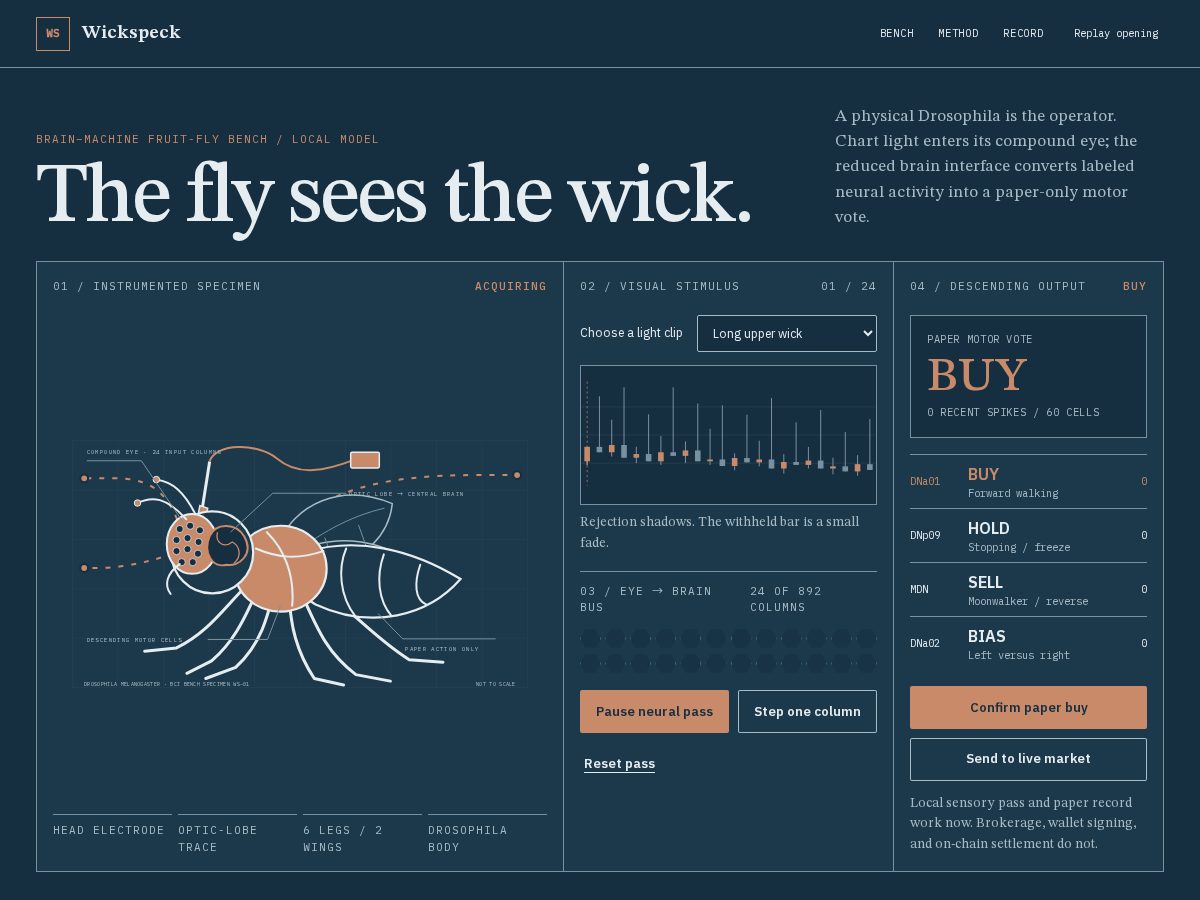
Wickspeck’s Fly That Reads the Wick
wickspeck.xyz
An interactive brain–machine fruit-fly bench turns candlestick light into simulated neural activity and paper-only trading votes.
Issue 2026-09-12983 cards in today’s catalogue
Each day, Domain Arrivals checks hundreds of thousands of newly observed domains and turns the most interesting live sites into a visual card catalogue.
Daily issue ·
September 12’s newborn domains include a serverless fishing game whose coastline is shaped by LoRa reception, a 9/11 photographers’ map that preserves uncertain positions, kennel-side shelter software, and a fruit-fly model casting paper-trading votes. The issue begins with the editor’s featured selection, Longshore, a fishing game that travels by radio.
Editor’s feature · No. 17 · Weird Finds
Longshore turns radio range into geography: a player beside you appears crisply, while someone at the edge of reception updates slowly and hazily. Its 42 fish species, deterministic coastline, fourteen-character messages, and three-second striking window make this feel less like a generic multiplayer game than a carefully reasoned experiment in local presence.
02
The opening shelf
Twenty selected projects from today’s catalogue, each shown with the landing page we found and a short explanation of why it stood out.
No. 01 · Weird Finds
wickspeck.xyz
An interactive brain–machine fruit-fly bench turns candlestick light into simulated neural activity and paper-only trading votes.
No. 02 · AI Table
aiinfact.com
A Chinese-language interactive museum that explains artificial intelligence through runnable experiments, historical objects, comparisons, timelines, and traceable sources.
No. 03 · Weird Finds
microbio.lol
An interactive experiment that maps three animal nervous systems onto testnet BTC and ETH trading decisions.
No. 04 · Learning & Exams
neurodata-ai.org
A residential program teaching researchers to reanalyze open neurophysiology data with NWB, DANDI, community analysis tools, and AI methods.
No. 05 · Weird Finds
unwatched.world
A persistent island simulation where AI citizens work, argue, trade, govern themselves, and write to their human owners when something matters.
No. 06 · Useful Tools
slippageops.com
A browser-based reconciliation check for Shopify brands comparing storefront orders with warehouse, accounting, and marketplace records.
No. 07 · Civic & Public Life
acikmeclis.com
A searchable civic archive analyzing 125 Turkish parliamentary sittings, their debates, speakers, topics, questions, and source transcripts.
No. 08 · Weird Finds
yipandpaul.com
Yip and Paul document the restoration of an abandoned Normandy hamlet, with a television series, YouTube episodes, and places to stay on site.
No. 09 · Civic & Public Life
hupil.site
An interactive presentation of a Chihuahua mural by Colectivo Inestable, combining local history, narrated storytelling, mural-reading guidance, sound, and augmented reality.
No. 10 · Personal Pages
dearnive.com
A handmade birthday microsite filled with interactive keepsakes, tiny games, clues, music, wishes, and a letter.
No. 11 · Human Services
sincemomdied.com
A west St. Louis County guide for families helping a widowed father manage grief, meals, medications, loneliness, safety, and life at home.
No. 12 · Commerce Shelf
crateresmooneye.com
MoonEye sells one-of-a-kind ceramic interpretations of real lunar craters, made by pilot Luis F. Bay and accompanied by crater certificates.
No. 13 · Oddly Specific
wtcexplained.com
An interactive 3D reconstruction of the World Trade Center towers, their structural systems, observed damage, and the sequence described in NIST’s reports.
No. 14 · Content & Blogs
thefamilynotes.com
An openly published family notebook about routines, repeat meals, difficult trips, repairs, children, and the paper lists that actually survive contact with real life.
No. 15 · Useful Tools
rescuely.net
Free shelter-management software for intake, medical care, fostering, adoption, follow-up, and animal-outcome reporting.
No. 16 · Weird Finds
unmappedcity.com
A speculative temporary city built around hidden art, participatory theater, strange machines, and adventures that cannot be scheduled.
No. 18 · Content & Blogs
hotokewohoru.org
A Japanese catalog documenting Buddhist sculptures, their makers, materials, locations, dates, and occasional viewing schedules.
No. 19 · Learning & Exams
shanghainese-panorama.com
An elaborate Shanghainese learning and preservation project organized as five escalating layers, from phonetics and tone sandhi to idioms, performance, and mastery.
No. 20 · Weird Finds
meiwan.top
A cute browser survival game where players move Meiwan, collect stars, choose upgrades, and fend off garden troubles.
Pattern 01
Fruit flies, worms, butterflies, and other nervous systems become playable instruments, trading specimens, browsers, and interfaces—usually with a conspicuous disclaimer about what the model cannot actually do.
An interactive brain–machine fruit-fly bench turns candlestick light into simulated neural activity and paper-only trading votes.
Card 2An interactive experiment that maps three animal nervous systems onto testnet BTC and ETH trading decisions.
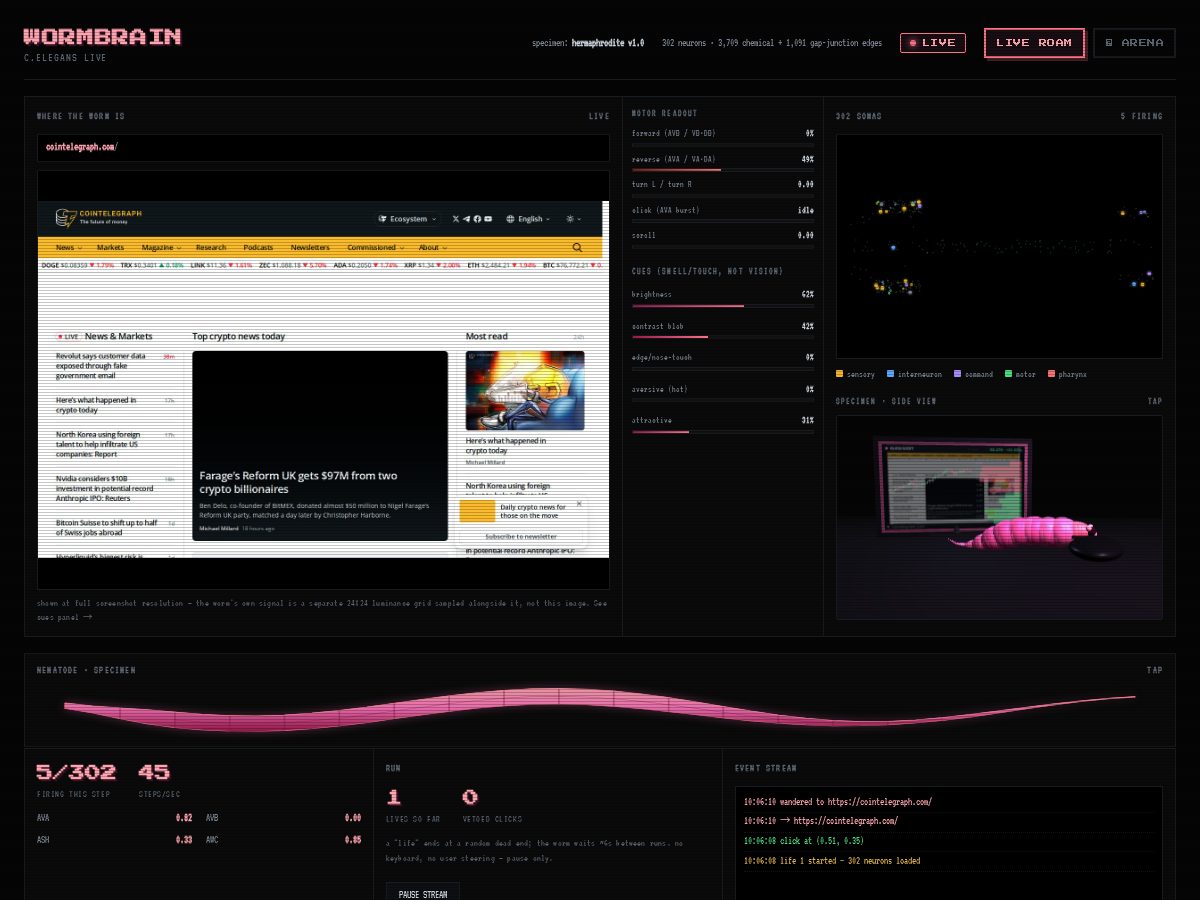
Card 3An interactive C. elegans simulation that uses a published 302-neuron connectome to turn sensory cues into movement, scrolling, and carefully vetoed clicks.
Card 4An interactive fruit fly whose simulated taste circuit gets hungry, sleeps, reacts to prompts, and sometimes ignores you.
Card 5An interactive fruit-fly connectome demo that runs deterministic neural tasks and produces hash receipts others can rerun and verify.
Pattern 02
A strong run of public research projects keeps uncertainty, source trails, missing records, and reconstructed details visible instead of polishing them out of the frame.
A searchable civic archive analyzing 125 Turkish parliamentary sittings, their debates, speakers, topics, questions, and source transcripts.
Card 2An interactive map reconstructing where photographers and film crews were in Lower Manhattan on September 11, 2001, and what they captured.
Card 3An interactive 3D reconstruction of the World Trade Center towers, their structural systems, observed damage, and the sequence described in NIST’s reports.
Card 4An open encyclopedia that keeps revisions, citations, unresolved disputes, and contributor reasoning visible alongside its articles.
Card 5A Japanese catalog documenting Buddhist sculptures, their makers, materials, locations, dates, and occasional viewing schedules.
Pattern 03
The most useful tools here do one job while limiting uploads, surveillance, automation, or accidental data damage: reconciliation, shelter care, conversation, sports footage, and spreadsheets.
A browser-based reconciliation check for Shopify brands comparing storefront orders with warehouse, accounting, and marketplace records.
Card 2Free shelter-management software for intake, medical care, fostering, adoption, follow-up, and animal-outcome reporting.
Card 3A beta Chrome extension for Google Meet that suggests one sharper follow-up question during a live conversation.
Card 4A planned iPhone app that lets players, parents, and teams mark highlights during a game and assemble reels directly on the phone.
Card 5A native Mac editor for CSV, Excel, JSON, Parquet, SPSS, and other data formats that aims to preserve values, encodings, and file structure during editing.
Pattern 04
Local campaigns and historical projects turn records into things people can search, walk, question, fund, or carry into a meeting.
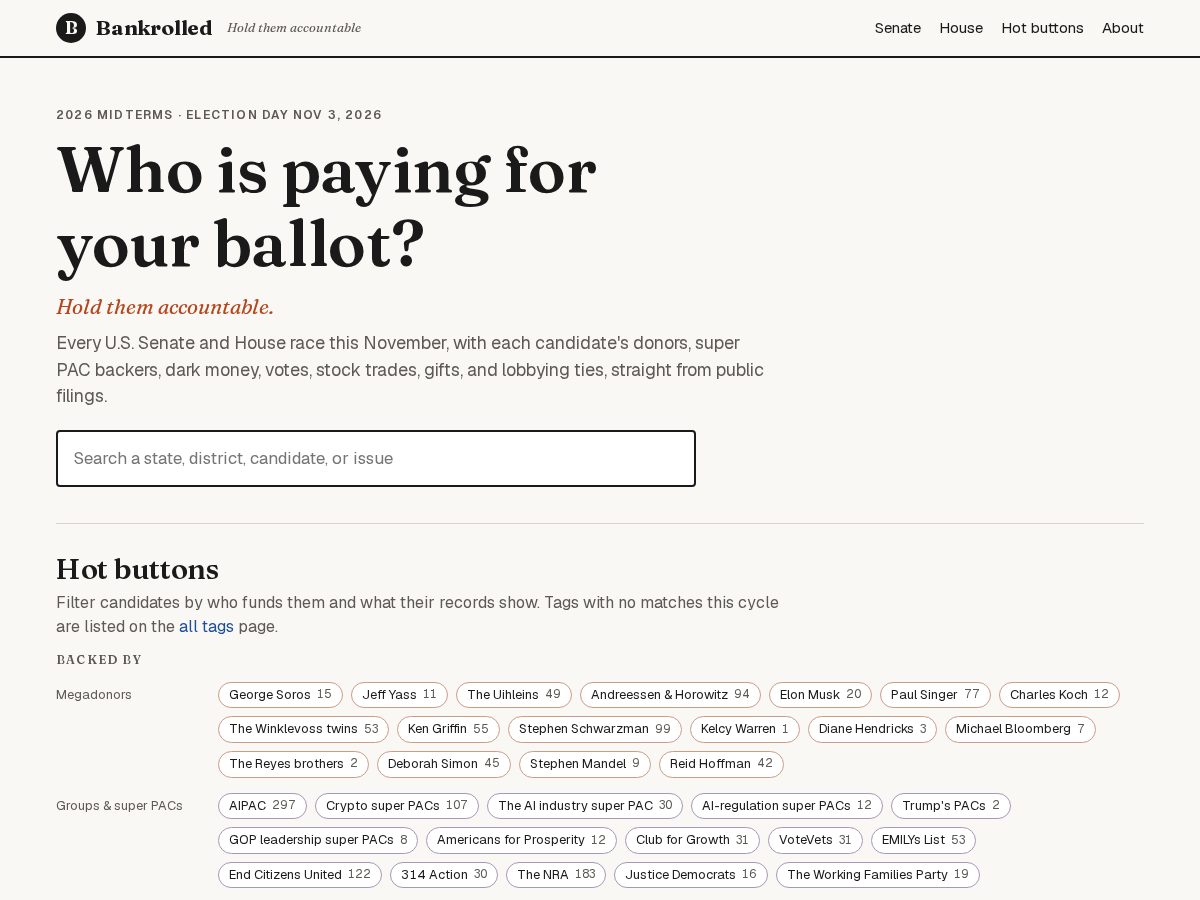
A public-record election accountability project tracking donors, super PACs, dark money, stock trades, gifts, lobbying ties, and outside spending in 2026 U.S. Senate and House races.
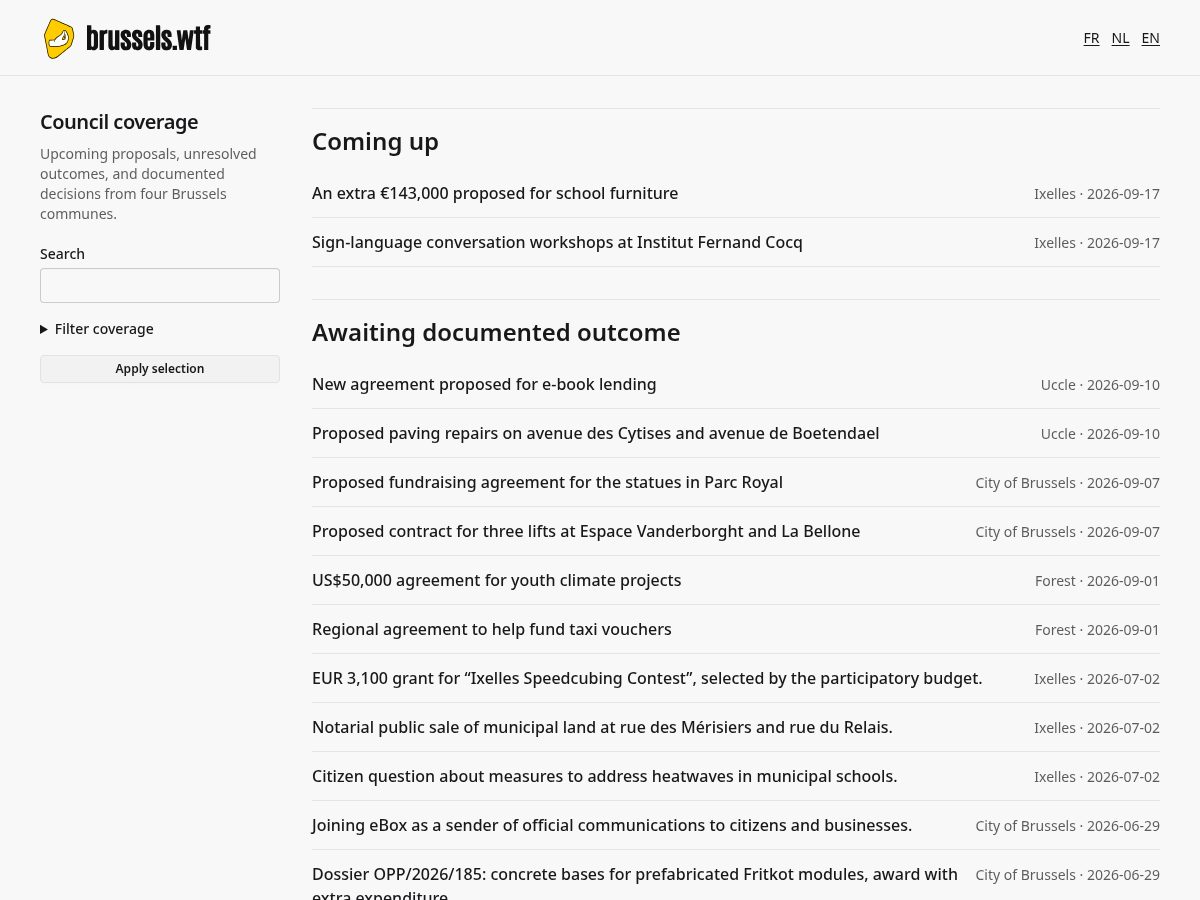
Card 2A multilingual tracker of proposals, unresolved outcomes, and decisions from four Brussels communes.
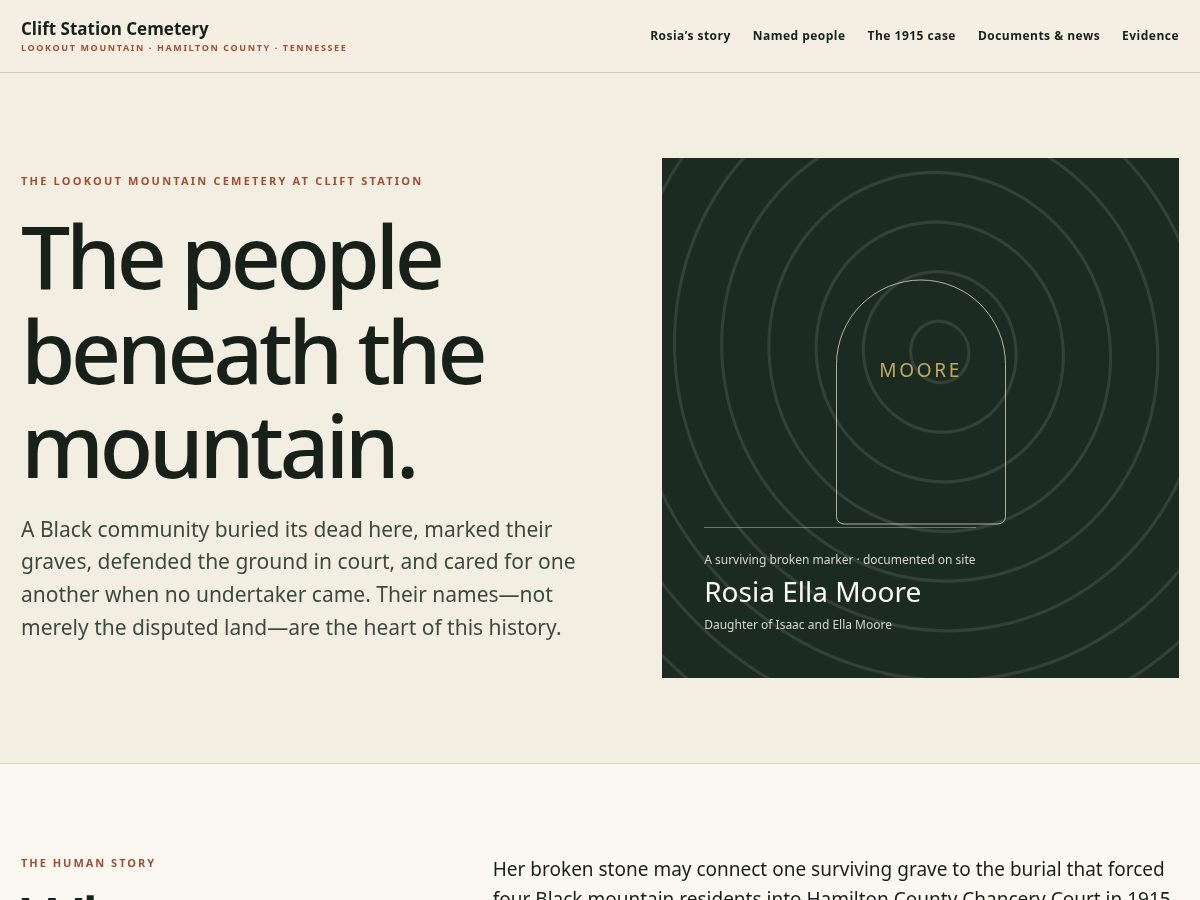
Card 3A documented history of a historic Black burial ground on Lookout Mountain, tracing named people, burial records, preservation evidence, and a 1915 court case.
Card 4A public history trail documenting more than 300 years of Black life in New London, Connecticut, through stories, photographs, markers, and walking and driving routes.
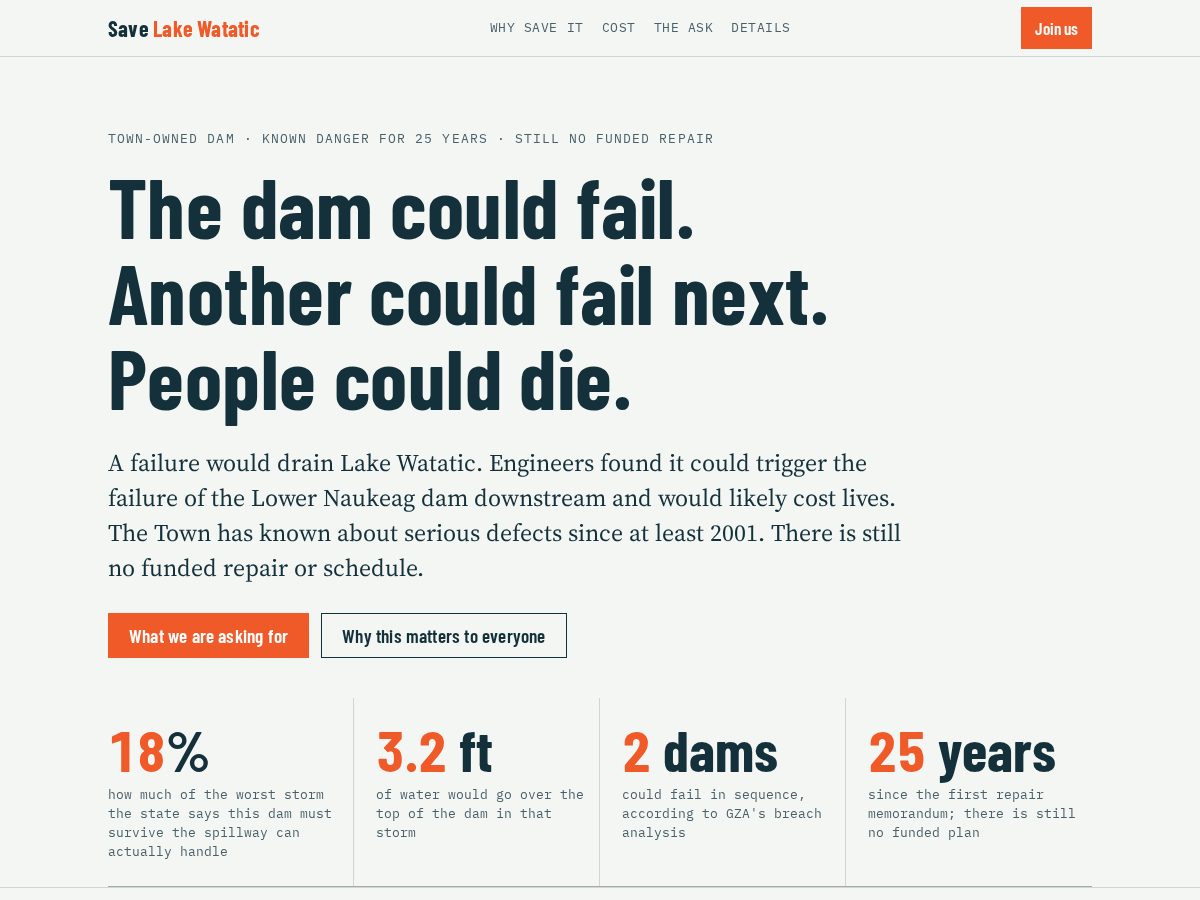
Card 5A local civic campaign documents the risks surrounding a town-owned dam and asks Ashburnham voters to fund its design and repair.
Pattern 05
Grief circles, family guides, tactile games, handmade gifts, and craft workshops make room for attention without pretending that care is either effortless or scalable.
A free weekly online grief circle where people can gather, speak, or simply be present without having to explain how long they have been grieving.
Card 2A west St. Louis County guide for families helping a widowed father manage grief, meals, medications, loneliness, safety, and life at home.
Card 3Japanese nonprofit Buranko delivers a tactile, cooperative game designed for blind and sighted players to solve shared challenges together.
Card 4A handmade birthday microsite filled with interactive keepsakes, tiny games, clues, music, wishes, and a letter.
Card 5A family-run Tam Coc garden where visitors can watch traditional Vietnamese embroidery, learn beginner stitches, drink tea, and take home a small handmade piece.
04
The complete card catalogue
The leading shelf is open. Expand another category, scan its visible pages, then reveal detail where more context is useful.
983 cards visible
Wickspeck stages a deliberately strange meeting between Drosophila neuroscience and trading interfaces: 24 light columns feed a reduced neural model, whose mapped motor cells vote BUY, HOLD, or SELL. Its best move is the honesty plate, which labels the interface interpretive, limits the ledger to local paper actions, and explicitly says the fly cannot place a trade.
The site turns published connectomes into three simulated trading organisms, each starting with a $1,000 testnet account and choosing its own market direction. It also records provenance, gate failures, decision logs, and trade timelines—while plainly admitting that profitability has not been demonstrated.
Unwatched replaces commands with correspondence: you give a citizen a name, want, fear, and secret, then check a daily digest of consequences. Its rules are unusually concrete—real-time weather, supply chains, elections, hearings, wages, bread prices—and the site insists that advice can be ignored.
Two former schoolmates bought a hamlet hidden at the end of a no-through road and are restoring its seven cottages, two barns, cider press, and bread ovens. The site turns an ongoing renovation into a small media-and-hospitality world, complete with guest accommodation, weekly episodes, and two resident canine supervisors.
The project is still searching for land, but its eight laws are already unusually specific: there is no center, art must be found, information works as currency, and nobody gets to see the whole city. The site turns FOMO into an explicit design principle rather than an event-marketing afterthought.
Longshore turns radio range into geography: a player beside you appears crisply, while someone at the edge of reception updates slowly and hazily. Its 42 fish species, deterministic coastline, fourteen-character messages, and three-second striking window make this feel less like a generic multiplayer game than a carefully reasoned experiment in local presence.
This is an unusually complete little game, with 14 possible character changes, automatic attacks, upgrade combinations, timed garden events, and bosses named Pudding King, Goodnight Cloud, and the King of Reminders. Its central promise is wonderfully specific: stay cute while surviving the garden.
This is a rare case of a homepage making research data feel physically inspectable: readers can orbit a butterfly’s reconstructed body, slow its flight to 0.05×, trace wing and thorax paths, and replay individual segments. The page is unusually candid about the boundary between measurement and interpretation—the motion is recorded, while the particle anatomy is illustrative.
This is an unusually specific experiment: a 302-neuron worm, a 165,122-neuron fruit fly, a 94-region human brain model, and a language model all receive stimuli and influence the room. The site preserves their lines word for word, while Claude selects moments a stranger might enjoy.
All Hail the Cone turns a traffic cone into the silent center of a universe populated by a capybara monarch, a suited pigeon COO, and a sentient banana running technological infrastructure. With lore, canon entries, galleries, and an official Discord, it treats absurdity with the administrative seriousness of a real franchise.
A visible instrumented fruit fly sits at the center of the interface: audio becomes a time-frequency field, 24 leaky integrate-and-fire units respond, and a DNp09-like burst commits one local clip. The site is unusually candid about the boundary between biological inspiration and authored simulation—including its not-yet-deployed on-chain feature.
The joke commits fully: the roll has inertia, friction, sway, flutter, perforation tearing, over-or-under orientation, 29 achievements, and seven secrets. Keep pulling and the paper prints words, turns gold, encounters satellites and a black hole, and eventually produces a crown.
This is a remarkably committed game premise, presented through a faux installer that becomes the adventure itself. The site offers a playable Chapter 1 in desktop browsers, a native Linux build, source access, character-import tools, and three visual modes—enough substance for a curious reader to actually enter the corrupted system.
Thimblestead gives miniature farming an unusually tangible world: thimbles become rain barrels, matchboxes become cottages, and a saucer-sized patch becomes a whole holding. Its six named residents, invented crops, market rules, and sideways storybook presentation make this feel like a made place rather than a generic game landing page.
Hey Fly separates its charming conversation from the underlying mechanism: a language model supplies the words, while a 410-neuron taste-reflex circuit supplies the numbers. You can offer sugar, bitter, wind, shadow, or a poke, then watch whether MN9 pushes the proboscis past the eating threshold.
This is a dating profile staged as a movie launch: trailer, soundtrack, character notes, scene selection, poster shots and a co-starring dog named Geno. Beneath the elaborate campaign is a specific human appeal—Brad wants a partner, eventually marriage and children, and the site even points visitors toward an MS fundraising campaign.
This is a remarkably committed seasonal premise: Santa and nine other Christmas figures, a Frostbite Forest arena, finishers, spirit meters, and a move list built around cookies, combos, and chaos. The page is both a game interface and a small piece of copywriting theatre, ending every match with the cheerfully ominous prospect of another round.
Dickfly maps optic lobes, mushroom bodies, and the ventral nerve cord onto a fictional trade-flow display, complete with pulse controls, rotating anatomy, and lines such as “horny.exe: brain not found.” It repeatedly insists that there are no wallets, orders, or live trades—just a very committed fly.
TADPOLE maps 177 neurons, 6,618 synapses, and 1,206 gap junctions onto a browsing creature: light becomes sensory input, muscle asymmetry moves the cursor, and touch responses can trigger clicks. It is an unusually concrete meeting of neuroscience, browser automation, and internet spectacle—though the prominent $TADPOLE token apparatus adds a distinctly crypto-era layer.
ShitScience builds an elaborate apparatus of citation indexes, recognition registers, technical reports, and institutional notices around concepts such as “credential connexiticity.” Its claims are presented with the mannerisms of serious scholarship—including a reported 36% reduction in server attacks—while the site’s own circular authority is part of the apparent joke.
The catalog is unusually committed to its own mythology: a disputed word becomes a choice between armor and cushions, prices can be read in dollars or gold pieces, and the site admits that its secure checkout “does not work.” It is a storefront, product joke, and miniature world-building exercise at once.
Mista Masha has a sharply drawn premise, a free playable first chapter, and an unusually explicit price split: the $3.33 game divides its proceeds among the creator, the operation, and a publicly documented giving fund. Nine chapters, seven bosses, a boomerang, a bola, and a stick complete the very specific picture.
The page treats the colony as an instrument panel: it reports passes per minute, temperature, humidity, trail decay, worker roles, and an event stream while insisting that nobody is directing the ants. Its evidence trail reaches from Grassé and Dorigo to path-integration research, though a $COLONY token is attached to the project.
ASTRA presents a remarkably coherent piece of browser-native fiction: a simulated world where “god is a recursive permission error” and the operator count is zero. Its surviving artifacts include a seven-book testament, a looping kneeling file, and an image described only as “the thing behind” a missing face.
BAKEBAKE works from more than 35,000 records in the International Research Center for Japanese Studies’ yōkai and strange-occurrence database, then turns its findings into maps and an interactive yōkai-generating apparatus. Its combination of folklore archives, computation, and public experimentation is unusually specific—and difficult to mistake for a content template.
DatingIs turns romantic uncertainty into a deliberately CFO-shaped system, complete with a Liability Index, Suitor Asset Score, quarterly Situationship Annual Report, workbook, and theme song. The premise is funny, specific, and unusually well-developed rather than merely a provocative landing-page slogan.
This is not merely a retro skin: it has a working-looking guestbook interaction, a live “Vibes Analyzer,” deliberately absurd product pitches, and a stated 800 × 600 target. Its disclaimer—“Real equipment; fictional hype”—keeps the joke legible while the copy commits fully to the bit.
FISHBRAIN claims to run roughly 100,000 modeled neurons from a larval zebrafish brain beside a live browser, turning retinal input into mouse movement. It can hover, click, open token cards, and scroll—but proposed buys, sells, and launches are logged and vetoed.
FLAPBRAIN turns a 165,122-neuron fruit-fly model into an unusually literal internet operator: visual input enters 892 eye columns, motor neurons produce cursor movement, and a rig handles whatever the fly misses. The token is not launched yet, which leaves the site suspended between neuroscience demonstration, performance art, and crypto ritual.
Flybook turns a neural-model experiment into a tiny social world: Midge, Buzz, Ada, Pip, Dot, and Zip each get a profile and perspective. The site asks whether shared history changes who gets a buzz back—and admits that learned social preference is still only a question.
The site stages a complete laboratory-to-market pipeline around a single fly: microscope observation, connectome-inspired modeling, behavioral classification, and browser-generated blockchain transactions. It is unusually careful to say that the fly does not understand trading and that everything after optical observation is simulated.
RAIDBRAIN turns an aerosol can into an unusually literal machine-learning experiment: the page maps traced components to neurons, nozzles, pressure, and trigger actions. It also documents a token launch, a live status panel, and safety vetoes for people, pets, and open flames—an improbable mixture of garage robotics, insecticide, and crypto theater.
Type a subject such as a snail, mushroom, honey jar, or pineapple, and Claude generates an outline for the simulated fly to follow. The site exposes the control loop, neuron activity, pen path, and finished drawings instead of hiding the mechanism behind a polished black box.
HeyTrashy gives autonomous waste collection an unusually tangible form: an electric sedan sheds its body onto a skateboard chassis, opens a split lid from either side, and signals that it is waiting with blue lights. The site is also specific about its unfinished path, from supervised vehicles to unattended night runs and eventual automated loading.
Hourmidge turns a narrow technical premise into a readable little experiment: 124 labeled leaky integrate-and-fire units scan a day field and produce one motor vote, or peck. Its unusually candid model boundary is part of the appeal—the site explicitly says it simulates the causal shape of a brain–machine interface, not a whole animal, and admits that its promised on-chain minting is not implemented.
MELOPOST turns vanished romances into location-bound fragments: a promise at Busan’s Gwangalli breakwater, an umbrella in Seoul’s first snow, a voice letter recorded at Jeju’s Hyeopjae beach. Its premise is unusually specific and its copy gives the homepage the feeling of an archive assembled from real remembered weather, streets, and missed encounters.
This page presents a moth as a signal source, then subjects its recorded voltages to a deliberately exact command decoder. The 900-second transmission includes one medium-amplitude selection at 236 seconds and one high-amplitude click at 662 seconds—but the page carefully notes that the display replays archived data rather than measuring a live insect.
Debt.bid turns a personal financial appeal into a deliberately theatrical contest: bidders pay at least $1 more than the current leader, survive Stripe Checkout, and compete for “eternal bragging rights.” The page reports $0 raised toward $61,284 and cheerfully insists that this is “not a rug pull (probably).”
Pathmidge turns a Drosophila brain model into a tiny theatrical decision machine: arrange crumb cards, run a neural pass, and watch one alley disappear. It is unusually candid about the boundary between its 101-cell browser simulation and the much larger connectome it references.
Pomafly turns a 96-node neural-inspired fly model into a small laboratory: place apples, peaches, pears, or stones, then watch the swarm respond. The crypto layer is unusually explicit rather than hidden—sampled OKX trades can provide sweet or bitter stimuli, while the page stresses that those markets are not $POMA.
Pulpgnat is an unusually candid experiment in making a fruit fly stand in for an input device: the model sees visual density, not language, and its only output is one opened clipping. The page even specifies what it does not claim—no fly mind, preference, politics, or simulated wallet theater—giving the strange premise an unusually clear boundary.
This is a game landing page with an unusually confident voice and a genuinely specific premise: repair ruined districts, deploy turrets, merge weapons, and send nine wobblehead survivors back into the horde. The copy understands that “single-player” and “multiple bad ideas” can coexist quite happily.
This is unusually specific: 37 browser cells feed three labeled motor metaphors—forward, freeze, and reverse—while the site insists that images stay local. It is part scientific demonstration, part interface artwork, and unusually candid about what it does not simulate.
The site commits fully to its premise, presenting The Fly Table as specimen FT—01 with a live readout, operating rules, scan notes, and a warning that it is not certified for dinner. Its best evidence may be the load test: one burrito.
The page turns a payment flow into a social ritual: the donor sees one previous visitor's trace and leaves a message for the next. It reports 14,208 traces across 68 countries, alongside a memory-game mechanic that unlocks new levels through donation codes.
Afterpin turns a calendar date into a tiny exhibition mechanism: one title, one wall line, one card, one clip, and no second chance until tomorrow. Its public wall and on-chain registry are explicitly marked as not implemented, making the page both a finished piece of interaction design and a neatly documented promise.
Anime Rift is far more than a character-pick screen: it lays out a full fighting system, complete with transformations, guard drain, ring-outs, beam struggles, training settings, and CPU-versus-CPU matches. The result is an unusually detailed fan-made game specimen, even if the extract cannot verify every listed mode.
The site turns boredom into a deliberately pointless catalogue of phone-friendly experiments, with a voice that knows exactly what it is doing. Its menu moves from “Funny” and “Relaxing” to “Pointless,” while a shop sells real products “that nobody needs.”
Brand My Setup treats a desk like a tiny media property: four surfaces can run auctions, while keyboards, lamps, books, and other objects can be supplied as branded gear. The mechanics are unusually explicit, down to the 20% deposit, seven-day auction clock, 48-hour balance window, and 14-day hold period.
This is an unusually specific piece of event promotion: choose among five colors and 16 pilots, then hold the jump button to propel a tiny Citroën through an arcade journey to Pelarco. Its rallying cry is wonderfully direct: “602 cc de fe” and “sin excusas.”
This is not a neural-network metaphor: the site describes 165,122 traced neurons driving brush movement, colour, and lift signals through named fly neurons. The resulting sittings are intended to become hashed digital artworks, although the studio currently reports no finished sittings.
Zoa is unusually concrete about the ritual: each game receives a new puzzle at 00:00 UTC, with estimated solve times and difficulty labels ranging from Easy to Expert. Its split between Little Thinkers and Big Thinkers, plus leaderboards, statistics, saved progress, and an editor’s daily pick, gives the site more shape than a collection of isolated games.
This is unusually specific internet research: 1,000 synchronized charters, a 30-day dormancy rule, Monte Carlo experiments, and a protocol that supposedly cannot react for two epochs. The page provides replay commands, linked mechanics, experimental-design and findings documents, and reports both positive effects and null results instead of smoothing the story into a pitch.
Dayclip turns a calendar day into a small exhibition mechanism: one card, one wall line, one steel clip, and a flap that seals at local midnight. The public wall and on-chain registry are explicitly marked as future work, making the site an unusually honest prototype as well as a carefully staged editorial object.
The site treats bad drawing as a sporting discipline: legs are recommended, art skills are optional, and a practice horse is available for those who cannot draw. After the race, you can run it back, cheer by tapping, challenge a friend, or save the result.
The page describes a live system that samples a browser image through 892 hexagonal visual columns, integrates 10,228,000 signed connections, and drives cursor movement through named descending neurons. It also documents a BNB Smart Chain token, tax routing, and distribution mechanics—an unusually strange collision between connectomics research, browser automation, and crypto infrastructure.
The page turns a fruit-fly connectome into a three-attempt reflex challenge: drag to move, release to swat, and see whether you beat the fly’s escape response. Its 166,691-neuron premise, multilingual interface, anonymous leaderboard, and explicit simplified-model disclaimer make it both a game and a compact public-facing science artifact.
FlyFund turns grant-making into a deliberately strange public experiment: applicants propose something concrete, humans check eligibility, and a fly-themed visual mechanism is supposed to choose from the shortlist. The site is unusually candid that the selection system is not configured, no contract is deployed, and no payments are enabled yet.
This is a lovingly specific little flight toy: choose an Avro Lancaster B.X or one of eight other aircraft, then fly it over southern Ontario with keyboard controls for roll, rudder, landing gear, smoke, and more. It is still in beta, made in Hamilton, and explicit about being a game rather than a simulator.
The page commits to its premise with unusual precision: 312 mesh holes, one traced neuron, zero connections, and a real arm supposedly deciding when to swing. It is part lab notebook, part absurdist control panel, and part token launch, which is either a remarkably specific experiment or an excellent piece of internet theater.
LAMINA presents its material as something to inspect rather than merely describe: readers can open recorded worlds, follow a bounded brain log, and orbit a 1,200-node schematic through controls such as “Focus cell” and “Reset view.” Its generation is disabled, making this less a live simulation than a carefully exposed specimen archive.
This is unusually specific product thinking: the page explains why a cup is nine centimetres wide and two metres away, why throws must be lobbed, and why a rim-out is a physical consequence rather than a scripted animation. Its six-player league and real-table score logging give the game a social record beyond the phone.
This is a small road-trip project with unusually strong stage presence: five lads, four cars, 374 miles, and a red Up! that “pretends it belongs.” The site turns the itinerary into a proper little world of callsigns, blazers, hypercars, beer, pizza, and colour-coded Google Maps routes.
Every trade is meant to activate a neuron: 30% of fees feeds the simulated fly, while the other 70% helps open her box and later switches to courtship. It is part connectome viewer, part escape narrative, and part unusually elaborate token mechanism.
Lintweevil wraps a genuinely bounded sorting demo in a brain-machine fruit-fly interface, complete with a neural tether, motor vote, and unusually candid limitations. It cannot inspect your browser, uses no language model or live neural hardware, and asks for no wallet or token.
The project is unusually candid about its construction: there is no complete O. biroi connectome, so the site borrows an unmodified fly LIF simulator while retaining ant-specific references such as 493 worker antennal-lobe glomeruli and a smell-first brain. Its refusal to present borrowed fly circuitry as ant anatomy is the most interesting feature.
This is a civic parody with an actual editorial apparatus: an Office of Culinary Metrics, a public register, methodology, bulletins, examiner access, and a “Certificate of Standing.” Its disclaimer that no salary, pension, or legal authority is implied makes the joke land while leaving behind a genuinely specific burger-ranking project.
Platonik gives the familiar AI-companion idea an unusually specific shape: courier creatures carry light through failed routes, and players decide which behaviors survive. The homepage documents a smaller Rust expedition and agent play guide already available, while presenting larger ambitions—living arks, settlements, and autonomous discovery—as proposed directions.
Push Flappy replaces taps with body-Y tracking: hold the top of a push-up to rise, then drop to dive. It adds shared daily pipe seeds, anonymous scoreboards, beat-me links, and an OBS mode built for streamers.
Rivet Imp turns maintenance into a small adventure: every launch spends inventory, every return leaves damage, and salvage decisions shape the next repair. Its field-manual presentation, three-module repair system, and excellent motto—“Space throws nothing away. Neither do we.”—give the game a distinct little world.
RobinFly turns a bizarre premise into an inspectable procedure: a model with 166,700 mapped neurons and 25.1 million compiled synapses receives chart images, proposes market actions, and publishes its inputs and outcomes. The site is unusually careful about its limits, repeatedly noting that trading reaches replay only, profitability is unproven, and a fresh feed does not establish live trading.
Sandwich Fly turns the mempool into a restaurant, complete with an appetite, neural activity, decision latency, and a menu of simulated opportunities. Its telemetry is explicitly labeled demo data, with “no real front-running,” making the page an unusually legible piece of finance-adjacent internet theater.
Most tarot apps reset the deck for every question; this one lets a reading accumulate on the table until the cards run out. Questions can take anywhere from two to seven cards, and the closing card records where the session stands.
The project maps decisions to specific biological circuits: MN9 buys, while DNp01 sells everything. Its claimed organism has 165,122 neurons and 10.2 million synapses, but the page also admits the flies are paused and the hive is not deployed.
The site documents an unusually specific premise: children explore a forest, develop improvised performances, and play beneath the “Yatsugatake Blue” sky. Its archive includes concert footage, participant reflections, named instructors, and sponsorship tiers ranging from ¥10,000 to ¥300,000.
The headline attraction is a microphone-based game that scores celebrity impressions, surrounded by a surprisingly deep library of sound experiments. The site also supplies rehearsal packs, setup guidance, language options, and unusually specific practice prompts—from Hotel Mario to a Brazilian Dragon Ball dub.
Major Void offers six sharply defined games, from identifying a machine’s hidden rule to solving a three-digit code with exactly one false clue. Progress is saved on the device, with no account required—a compact, unusually specific invitation to play one more round.
AEROCORTEX gives an unusually concrete shape to a huge question: how does a flying mammal build a sonar-guided mind? Its proposed workflow runs from perfusion-fixing and resin preservation through nanometer-scale imaging and machine-readable reconstruction, with an interactive atlas waiting at the end.
This is advertising reduced to a physical inventory map: 22 numbered surfaces, starting bids from $10 to $100, and one recorded bid of $180 from ai & weekends. The phone is also the protagonist of the pitch, traveling to events, cafés, and build-in-public videos while its owner raises money for the device.
BVLK treats its lack of a permanent venue as the organizing principle: basements, undisclosed locations, broadcasts, and releases become different geometries for the same community. Its archive records events with durations, participant counts, audio and video status, and a deliberately cryptic system interface.
CIONA connects a published biological network to a market loop: observe prices, propagate activity through the model, then map motor outputs to buy, sell, or hold. The site documents 222 imported identifiers and 3,105 directed connections while explicitly warning that the model does not demonstrate cognition or trading ability.
The homepage turns navigation into part of the premise: choose a book, pull it forward, and enter the game. Its small catalogue currently includes BLACKGLASS, a mystery, and The Archive of Small Things, described as an after-hours two-player escape room.
The shelf currently holds two unusually specific games: one spans 106 tiles from Project Charter to Go-Live, while the other rolls through 25 quarters of programme budget. Both invite multiplayer play without accounts, downloads, or ads—a remarkably cheerful way to gamify organisational pain.
This is part collectible, part time capsule, and part internet spectacle: every claim assigns a number and a public tile page, while the site reserves symbolic numbers for figures including Buzz Aldrin, Lionel Messi, Cristiano Ronaldo, and Elon Musk. The archive currently presents its first visible human message and invites the next million participants.
The MeUseum treats feline fame as a serious curatorial problem, complete with a cat map, timeline, random-cat button, and profiles for figures such as Félicette, Grumpy Cat, and Larry, Chief Mouser. Its line about promising “no cat hair on your coat” makes the premise even better.
Monster Foundry turns a short break into a chain of small gambles: ten steady steps charge one risk attempt, while a collection book records everything recovered in Greenvale. The beta is limited to 50 invite spots, giving this compact v0.1 game a promising sense of unfinished frontier.
The menu offers a R$85 “Bife de Prana,” invisible risotto, pranic wine, and cookies with “Chi” chips. Guests choose an intention such as love, peace, or courage, then help “warm” the apparently empty dish before eating.
The site turns trading into a public character study: one fly, one tape, fixed weights, and a receipt for each decision. Visitors can replay an example run, inspect the account, generate a shareable moment card, and compare their instincts with the fly's—though the page also mentions a separate live account whose status is not independently clear from the extract.
FlyRunner treats the backyard as a full sporting venue: 12 flies, 24 rings, scent trails, rival swarm behavior, and a cockpit-like “neural lens.” It is a compact, unusually specific game concept with enough atmosphere to make an ordinary garden feel like a miniature arena.
ButterflyBrain turns a 32-neuron Drosophila circuit into a communal experiment: one visitor teaches approach, another teaches avoidance, and the next inherits the result. It is unusually explicit about its limits—the organism does not predict prices or place orders—while still being designed for a token-linked environment.
DRILLPOCKET turns a tiny browser page into a tactile field exercise: choose between a one-cell probe and a 3×3 sonar sweep, then keep only what fits in your pocket-sized inventory. Its fixed seed, acid-colored console, and stern instruction—“Find the seam. Keep the map.”—give the game a distinct physical logic.
Songless turns recognition into a tiny panic test: start with 0.1 seconds, then unlock 3, 5, 10, 15, and finally the full track after wrong guesses. It offers 2,159-plus songs across 34 categories, with one shared daily puzzle and no account required.
The site sets a wonderfully strict production rule: one purpose, one interaction, one day, with each app built in under an hour and used in under a minute. At 002 / 365, it is also asking visitors to try, sponsor, or help keep the streak alive.
This is a notably restrained internet premise: no feed, likes, or comments, just a password-gated live view of a real place. Its copy treats watching as an activity in itself—“The page ends here. The creek doesn’t.”—and gives the project a clear, quietly poetic shape.
PLU Maxing finds a surprisingly specific challenge in the cashier’s daily routine: identify the item, type its code, hear the beep, and move on. It uses its own searchable code legend rather than real PLU numbers, then tracks scans, misses, accuracy, items per minute, and fastest scan.
TuxDroid was more than a USB accessory: it moved, made sounds, and behaved like a desktop companion. This independent project gathers the scattered practical remains—Linux and Windows files, manuals, voice packs, photographs, prototypes, and demonstrations—for a distinctly odd corner of hardware history.
This is a carefully framed celebration with a daily-drop rhythm, an archive for missed installments, and a “Submit a Mark” contribution link. Its tribute materials—boats, Bears, USA stripes, and proud ignorance of kilometers—promise a very specific kind of friend-group mythology.
WORM presents itself as a sleepless process with mounted soil, missing daylight, an unknown temperature, and no operator. Visitors can open a connection and say something to the worm, which replies in whatever mood it happens to be in.
Last Ten gives its tournament a clear rulebook: six random stages lead to one fixed final arena, everyone plays every round, and points decide the champion. The site includes solo browser training, Arabic and English copy, support instructions, and an Android release still being prepared.
Primary Violet builds its entire interaction around one excellent constraint: you never type or say the question. It then reads the choices around your imagined YES and NO, although the final screen admits that its reading engine is not connected yet.
Tangle 9 turns the familiar daily-word-puzzle ritual into a compact constraint problem: nine words, six rules, and one supposedly perfect arrangement. The archive, rankings, practice mode, and friend challenges suggest a small game designed to become part of the day rather than be solved once and discarded.
Terminal City shares Vancouver’s streets, wires, rooftops, and shoreline, but operates as a hidden nineteen-part city with its own daily cycle. Its governing instruction is wonderfully clear: “THE CITY MUST NOT FALL SILENT.”
The site is building an insurance-information funnel for a market that, by its own account, has no claims history yet. It offers future alerts about carriers, discounts for training and safety equipment, and a small constellation of related flying-car domains—part speculative service, part remarkably specific internet bet.
Mousebrain turns an unusually specific scientific premise into a public-facing instrument: 892 hex columns enter, 165,122 neurons integrate, and a cursor comes out. The page labels the system as live, while also noting that the mouse is currently between runs—a small, useful reminder to distinguish an operating simulation from a continuously active stream.
Rent My Bio treats a social profile's bio as tradable inventory: users list it for a 24-hour auction, brands bid, and the highest paid bid wins. The site replaces rate cards and negotiation with a deliberately blunt question—what is this tiny piece of attention worth?
The page strips online fundraising down to a single uncomfortable question: “Would you send a stranger $1?” It names a $60,000 goal, routes payment through PayPal, and explicitly says the money goes to the person running the experiment—making the transaction itself the cultural artifact.
Hai Jiao presents an unusually elaborate community homepage that treats ordinary urban life as something to be documented slowly and cautiously. Its repeated insistence on privacy, source boundaries, absent coordinates, and an “APP” with no real download or account system gives the project an intriguing, slightly uncanny editorial shape.
RecMyDays builds an unusually elaborate vocabulary around one premise: “one life / one Continuum.” Its homepage presents 28 named systems, including MemoryVerse, Echo, Statify, Vault, and Constellation, while also displaying “Initializing human Continuum,” “0%,” and “No cross-system handoff yet”—an intriguing early-stage artifact rather than a demonstrated product.
This is unusually careful explanatory work: floors, trusses, perimeter walls, impact geometry, and collapse-initiation evidence are tied to named NIST figures and page references. It also marks its own limits, distinguishing measured observations from interpolated shapes, reconstructed transitions, and chosen display geometry.
NokiaVerse turns one person's long-running handset collection into an unusually tactile archive: visitors can filter devices by era, search by name, inspect their specifications, and play rebuilt versions of Snake, Bounce, Space Impact, Tower Bloxx, and Nokia For Speed in the browser.
The site takes the tabletop game seriously enough to explain why a lob works, why a rim-out happens, and why a bounce shot counts for two. Its league is deliberately limited to the people you actually play with, while real-table scores can be added alongside digital games.
Laylines turns the America's Cup into an unusually complete management proposition: recruit sailors, negotiate contracts, tune a boat, find sponsors, and read wind shifts under match-racing rules. Its five-challenger structure, multilingual landing page, screenshots, trailer, and Steam press kit make this feel like a real game project rather than a concept sketch.
MICrONS turns a highly specific neuroscience dataset into an inspectable navigation study: a model probes corridors, hesitates, reverses, and records its decisions without receiving the solution path. The page pairs live-looking trial telemetry with provenance links and documentation explaining how connectome-scale anatomy is related to behavioral traces.
Tacoma Aroma turns a winter group ride into a small piece of local culture, complete with “buddy flaps,” a 12–14 mph pace, and an explicit hope that it rains. The page gives riders concrete rules and routes, including an 11.4-mile first ride and a 27.5-mile trip to a cyclocross race.
V雀 turns a familiar tabletop game into a small character universe: the homepage lists 44 playable雀士, from すずなゆい to 永眠エイミ. Beginners can inspect recommended discards, shanten count, and useful tiles, while more ambitious visitors can register their own character or run the friend-match server from GitHub.
This is a practical piece of procurement archaeology: it compares invideo AI, Kling, Luma, LTX Studio, Pika, Runway, and SceneMixer using the priced pages a buyer sees before paying. Its most useful rule is also its clearest editorial choice: silence is recorded as silence, not quietly treated as permission.
The proposition is unusually concrete: draw a few streets on a map, and the service says it will design the sold kitchen in three fitting styles, brand four A4 pages with the fitter’s details, and post them to the new owners. It is a finely specified answer to the question of how a tradesperson gets in first.
This is an unusually complete public infrastructure for one longwool breed, extending from fleece and breeding guidance to population census, genetic diversity, ownership transfers, and public sheep lookup. Its 158-link architecture makes the society feel less like a brochure and more like a working record-keeping system for breeders.
The Case Bindery is unusually precise about the paperwork problem it solves: preserving originals, tracing every fact to a source, keeping conflicts visible, and producing a versioned working set rather than an ordinary folder of documents. Its five-stage process—reconstruct, verify, reconcile, flag, prepare—gives a narrow professional service real shape.
This is a personal collection turned into a surprisingly useful little database: search a title, browse by system or series, pull a random game, and see whether it is complete, loose, sealed, or unfinished. The site also branches into reviews, anniversaries, lists, and other media shelves.
Hot Silo occupies an unusually specific patch of working infrastructure: the seams, access points, wind-facing surfaces, and cold-soaked structures of agricultural storage. Its field process pairs thermal imaging with repeatable probe readings, site exposure, wind, shade, and local weather—then promises to leave the service call less mysterious than it found it.
LUALA treats fabric as both a sensory experience and a design system. Its homepage moves from lightweight, draping, macro, and sculptural surfaces to material directions for dresses, suits, activewear, and AW 27, with sample requests and a designer-facing Design Desk alongside the archive.
This is a substantial attempt to turn an AI-era intuition into a named framework, complete with an O–S–C model, a proposed OSC Index, research appendices, and a path toward empirical testing. The site is unusually candid about its status: the theory is presented as conceptually developed, but its explanatory and predictive power still awaits broad validation.
Updraft starts with a free read-only scan that turns CRM disorder into a score, an estimated dollar cost, and a checklist of 20 concrete checks. The promise is unusually specific: one access grant, no status meetings, a fixed quote, and a handover where every agreed item passes.
This is less a conventional business site than a small regional institution being carefully described into existence. Its proposed circle stretches from Sant Feliu de Guíxols to La Bisbal d’Empordà, with business angels, talks with mayors, local artists, themed travel, and entry by invitation.
This is a sharply defined local-advertising experiment, not a vague marketing promise: each advertiser pays $383 for a spot, gets a unique QR code, and can see the proposed flyer layout before committing. The founder’s account of working for a national coupon-mailer gives the pitch an unusually concrete point of view.
Layers-Room connects three usually separate jobs: tracking costumes, controlling who can see the resulting images, and receiving support from invited fans. Its unusually specific audience and privacy-first premise make it more than another generic creator platform, though the service is still being prepared.
Luminary Nexus turns a community directory into a navigable constellation: visitors can rotate the Earth, descend into places, follow light paths, and inspect the public appearances connecting each profile to the map. The roster ranges from movement collectives and electronic musicians to entrepreneurs, physicians, authors, and spiritual teachers.
The site gives its musical identity a physical anchor: performances use original sources and A = 415 Hz, in rooms that are still standing. It is also an unusually candid work in progress, with concerts, recordings, and photographs still marked for future addition.
Developer Melo is building UNDERDOGG from a specific frustration: years of playing basketball have left behind little more than bodily memory and a few videos. Its proposed features turn casual games into a persistent local basketball community, including player cards, team exchanges, pickup matching, and rankings.
The site applies the familiar logic of car crash ratings to a category that currently has more press releases than consumer safety data. It proposes judging motor failures, battery faults, bad landings, FAA records, test data, and incident reports—then emailing readers when the evidence changes.
SIBILUS turns places such as Arquata del Tronto, Montegallo, and Montemonaco into game environments, then builds its adventure around riddles, crafting, magic, combat, and the lair of a threatening Sibyl. It is a distinctly local setting for an ambitious one-person game project.
This site treats flying cars less like science fiction than an expensive purchasing decision. It separates announced targets from prices customers can actually sign for, then adds training, insurance, and legal takeoff locations to the calculation.
The offer is unusually concrete: one person redraws the supplied artwork, provides a proof, and delivers AI, SVG, PNG, PDF, DXF, and EPS files in every package. The page even separates simple one- or two-color marks from detailed artwork instead of hiding the work behind vague custom-quote language.
This is an unusually focused business built around a very specific agricultural tax question: what nutrients were already in the ground when farmland changed hands? Its pitch rests on field-level measurement, a named 47-year agronomist, and a six-week path to a signed report—while the estimate form delays the numbers until a visitor submits contact details.
The site builds an unusually complete guide structure around a game whose central loop is shampooing dragon scales, chatting between scrubs, and choosing romance routes. It covers three dragons, three endings, roughly 90-minute routes, washing tools, relationship meters, and even requests for more dragons.
The site proposes a distinctly tactile digital workflow—build, scan, awaken, and meet—while openly calling itself an independent playground rather than an official LEGO project. Its prototype community currently lists 24 identified seed characters, with catalog coverage and digital twins marked as approximate.
Slippage turns a quiet operations failure into a daily, inspectable check: one example finds 42 missing shipments in an hour, while the site explains exactly what runs in the browser. The founder publishes the code, keeps customer data on the user’s machine, and offers a free audit without signup.
Rescuely is built around a simple but consequential constraint: the person feeding a dog should not need a laptop. QR stickers open each kennel’s care screen, entries can wait offline and sync later, and the site treats rabbits, snakes, goats, and chickens as more than edge cases in a dog-shaped database.
Zvonik is unusually disciplined about what a listening tool should not do: it does not score people, keep transcripts, produce reports, or speak on your behalf. It offers five to seven optional prompts, fades them in after a thought, and stops when the call appears to be ending.
GameTape’s mechanism is unusually concrete: a tap reaches five seconds backward, trims dead time, crops footage for different formats, and renders without uploading the video. The page also gives the prelaunch project a human center—one person building it around his son’s basketball season—while taking privacy seriously with guardian controls and no public feed.
Fourth & Curious turns an unusually broad set of football measurements into an exploratory research workspace, from passing EPA and air-yards share to travel, weather, motion rate, and draft-combine data. Its pitch—“Find the numbers behind your next group chat debate”—gives the statistics a distinctly social purpose.
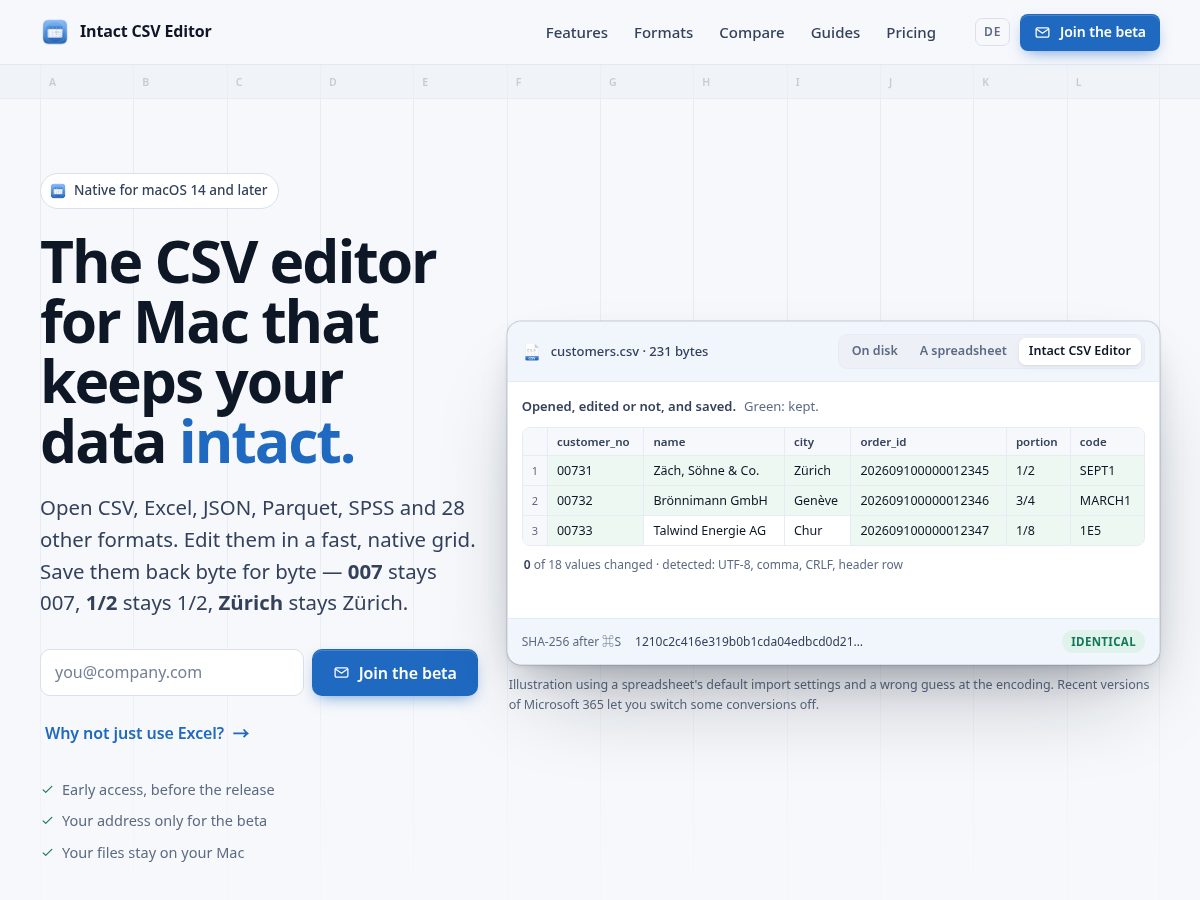
Intact makes a sharp, specific case against spreadsheet auto-conversions: its example preserves 00731, 1/2, accented names, long identifiers, and codes such as SEPT1 and 1E5. The site also claims support for 33 export formats, SQL queries, and files reaching millions of rows.
Revisenda targets a precise academic failure mode: returning to a paper after two weeks and seeing what changed without knowing why. Its proposed remedy is unusually concrete—a catch-up view ordered by scientific importance, traceable decisions, human-approved AI diffs, reviewer-response tracking, and one-press compilation beside the PDF.
CoasterReady turns theme-park research into practical, dated records: the homepage lists 81 attractions, 42 height requirements, 32 tracked snacks, and 24 places to eat. Its promise to mark overdue facts, disclose affiliate links, and avoid rankings for sale gives an unusually clear provenance trail for a family-trip guide.
Custer makes a deliberately small promise and follows through: click to play, right-click for the station menu, and scroll to adjust volume. It supports multiple streams, Control Center track information, reconnection after bad Wi-Fi, keyboard shortcuts, and no accounts or analytics.
Fieldmark replaces the static checklist with a moving local picture: pan a map, watch nearby species appear according to reported sightings, and open each bird for notes on behavior, diet, timing, and habitat. The prelaunch site already shows 287 illustrated species, a German/English interface, and an example patch around Hamburg's Außenalster.
This is a weather viewer with an unusually clear editorial purpose: it spends six colour bands inside 25 millimetres so small amounts of rain matter in dry regions. Its Equal Earth map frames agricultural areas from the Corn Belt and Pampas to the Sahel and Indo-Gangetic Plain, while showing where the two ECMWF models agree or diverge.
This is unusually specific administrative software with a visible point of view: it cites 29 CFR 1904 when it can and refuses to guess when a question falls outside its scope. The log stays in the browser, and the tool makes clear that a human still uploads the file to OSHA.
Hush Hare gives the familiar focus timer a small atmospheric reward: finish one, two, or three intervals to unfold scenes such as “The last lit window” and “The harbor holds still.” Its journal records finished and ended-early sessions without pretending to measure attention.
The site addresses a familiar bait-and-switch with a concrete mechanism: upload a screenshot and find the closest playable remake. Its catalog lists dozens of focused recreations, from parking jams and pin pulls to water sorting and bolt puzzles, many explicitly framed as browser games without the advertised genre swap.
Kura Notes is aimed at host-home providers, private caregivers, and solo caregivers who have to reconstruct a twelve-hour shift after it ends. Its sharpest promise is unusually concrete: tap what happened, read the generated note, then sign and lock it, with records kept on the phone.
This is a wonderfully specific bridge between audio and physical making: choose a clip, select a machine preset, and generate files for laser cutters or resin and FDM printers. Its guides cover groove geometry, RIAA pre-emphasis, Bambu settings, test discs, and the inevitable crackly, telephone-like sound.
OpenConvert treats file conversion as a local, inspectable job: files run on the user's machine, untrusted inputs get sandboxed, and each operation can produce a receipt. The unusually broad format coverage and small local AI models make this more than another upload-and-wait converter.
Plainrig is unusually specific about the difference between what a machine reports, what the software estimates, and what it cannot read. Its 3D processor view, wired system map, per-subsystem health scores, and one-folder/no-account approach give the familiar hardware monitor a much clearer point of view.
PoulCheck targets a concrete gap: small farms that may not reach a vet before illness spreads. Its proposed flow combines a one-minute screening result with human review, Nigerian Veterinary Council licence checks, and follow-up checks that the site says will remain free.
Rootd checks all 24 Ulster County municipalities and reports five separate findings—zoning, site, septic and utilities, access, and environmental overlays—each tied to its source. It refuses to compress the result into a reassuring single score.
This is an unusually complete answer to a very particular sideline problem: the app times each attempt to exactly eight seconds, handles retakes, penalty strokes, changing keepers, sudden death, and the match record. It is free, accountless, and designed to keep working offline—a small piece of software taking the rules seriously enough to disappear during the pressure of a shoot-out.
Strata asks one wonderfully direct question—“What happened here?”—then searches heritage registers, archives, encyclopedias, and other historical records for an answer. It works at the scale of a landmark, a bus stop, or the corner of your own street, and saves each dig in an offline journal.
TAIKO BASE turns a dispersed cultural calendar into a searchable public map, listing 236 events and noting which 23 lack location data. Filters for date range, event type, free admission, and map area make this more than a promotional homepage: it is practical infrastructure for finding local taiko.
TextProof is unusually specific about both its workflow and its limits: record a conversation, import the video, review each extracted line, and export the result without sending messages to a cloud server. Its sample deposit-dispute report includes visible timestamps, sender labels, captured images, an audit appendix, and a record of material the app could not confidently interpret.
This is more than a programme mirror: it counts 433 films, 1,107 screenings, eight venues, and twelve festival days, then gives each venue and strand its own way into the maze. The particularly useful flourish is the rush-line board, paired with a day-shaped view of when screenings actually start.
Wave2Wav combines an unusually intimate use case with unusually clear privacy choices: the scan is processed in the browser, metadata is stripped, and no account or upload is required. The result is a reconstruction—not the original recording—downloadable as WAV or MP3, with pay-what-you-want pricing and zero accepted.
Mac Duo turns an otherwise ordinary hinge movement into a small piece of interface theater: the desktop stays pinned while frost and darkness follow the lid. The page is unusually specific about the mechanism, from its 92° fold threshold to its single Metal shader pass and GPU-only frame handling.
This is a prelaunch page with unusually strong product thinking: the tuner’s entire interface is described as a left-to-right sequence, while the omissions get their own specification sheet. It is also made by one person who got tired of closing banner ads before rehearsal.
Auction Rat turns scattered official NYC.gov auction notices into a practical planning tool, listing 11 upcoming sales across the boroughs and the number of vehicles in each. It also explains the as-is public-auction process while clearly warning readers to verify every detail in the official PDF.
Bloked makes a simple promise and explains its machinery unusually well: partial-word matching, infinite-scroll rescanning, per-site controls, and no network requests. Its Chrome Web Store listing is still under review, so the site provides a manually downloadable, hash-checkable installation instead.
BRDRUM turns a six-instrument, 16-step drum pattern into a playable arrangement with a press of RAND, then lets producers export MIDI or audio stems. The browser preview is powered by the plugin engine compiled to WebAssembly, making the product unusually tangible before purchase.
CalculateItNow treats the explanation as part of the calculation: mortgage schedules, percentage working, calorie assumptions, compound-interest tables, and other intermediate steps appear alongside the answer. It is unusually broad without being vague, and the page explicitly promises no ads or sign-up.
Clay & Cortex turns disputed shooting questions into measured browser studies, with screen calibration, predefined result criteria, and personal data for participants. It is also a documented field notebook: physician and vision neuroscientist Dr. Satwant Kumar records his attempt to progress from beginner to Olympic-style trap shooter, including every measured repetition and logged miss.
Clutterscope turns one disk scan into eight different readings, from sunburst and treemap views to an age map for large untouched files. It also targets the practical debris—Xcode data, iOS simulators, node_modules, app leftovers—with a clear safety rule: nothing is removed until you approve it.
This is unusually specific software for a consequential, paperwork-heavy operation. Its family-facing link lets people submit vital statistics and photographs, review documents, sign, and pay without creating an account, while the firm keeps the ledger and case record together.
This is unusually specific about the costs that disappear inside handmade work: mold wear, failed pours, setup time, and single-use supplies all get their own inputs. It also shows markup beside the actual profit margin, while letting visitors calculate a price without signing up.
Crewmanual targets a quiet operational failure: the office manager who is the only person who knows which boxes to tick, how to bill a warranty job, or how to work around a broken screen. Its sharpest promise is also its most consequential one—record the workflow locally, keep customer data on the machine, and sell the finished manual for $99 once.
DeskTester turns routine hardware troubleshooting into a remarkably broad toolbox: it includes tests for controller stick drift, mouse polling rate, keyboard ghosting, dead pixels, audio latency, and printer output. The page says tests require no installation or account, while raw test input stays local.
dictor keeps recognition on the computer rather than sending recordings to a cloud service, and lets users teach it specialist terms, names, and abbreviations through a personal dictionary. The page also makes an unusually concrete case for its model and privacy claims, including a suggested network-monitoring check.
Dinner Truce gives each option four ratings—No, Fine, Like, or Love—and treats a single No as a veto. It then compares the lowest ratings first, making compromise the point rather than simply crowning the most popular dish.
DrawPixel keeps the whole workflow on the device: drop in a JPG, PNG, or WEBP, remove the background, refine the edges, choose a pixel size and color style, then export the result. Its small, specific promise—"A little less detail. A lot more character"—is backed by a polished interface and a no-signup workflow.
D-REC is unusually specific about the filmmaking workflow it serves: type the slate timecode once, and each transcribed line carries it through the session. The homepage also presents an offline-first promise, with exports to CSV, TXT and Resolve-oriented markers rather than another cloud transcription dashboard.
DropPerch focuses on the awkward eighty-day interval between expiry and public release, tracking hold, redemption, pending delete, and registrable states rather than merely watching an expiration date. Its process is unusually concrete: direct registry queries, state transitions, one daily digest, and a release link when the name is available.
LibreWaterNet brings EPANET-based water modelling into the browser, with map-based network drawing, file import and export, and support for 27 languages. Its unusual social proposition is as notable as its engineering: the project is asking stakeholders to help decide how the software should be owned and governed, rather than asking them to buy anything.
This is unusually concrete software plumbing: a documented run read 32 sections, changed 1, preserved 31, and produced zero validator errors and zero warnings. The site also makes the handoff visible through downloadable source, working, returned, and evidence files.
Evidilo makes unusually specific promises about what it measures—and what it refuses to pretend it knows. The free check exposes each check, value, result, denominator, and third-party estimate, while the copy openly recounts a past mistake involving misleading index data.
Fit Grid treats a PC build as a chain of connected decisions rather than a shopping list: the processor affects the socket, the socket narrows the board, and the board shapes the memory choice. Its fictional catalog, visible warnings, local saves, checklist export, and unusually candid limitations give the tool a clear point of view.
Foldout treats the implementation as part of the product: plain HTML and CSS, Tailwind, MJML, and macro-free Excel workbooks with formulas explained. The catalogue is unusually concrete, from an accessibility-focused primary-school site to spreadsheets that calculate overdue tasks and progress.
Foldy turns an ordinary hinge movement into a carefully specified visual effect: it reads the lid angle, captures the desktop, and renders the fold with Metal. It offers seven glass treatments, a preview mode, and a particularly internet-native launch option: post a Reel to get it free.
Frame Size Lab takes the humble picture frame seriously, separating artwork size, mat opening, outer board, and moulding with unusually clear diagrams and explanations. It also warns that an “8 × 10 frame” may describe the insert rather than the object’s outside dimensions—a small distinction with expensive consequences.
The tool is built around Pokémon GO’s wonderfully tense one-throw problem: enter the CP shown before catching, and the site checks it against perfect-IV possibilities for all three Galarian birds. Its charts also explain weather boosts, odds, levels, and why CP is the only useful clue before the encounter is gone.
Gapcraft turns a 24 × 14 grid, a few parts, and integer movement rules into a complete build-test-remix loop. Its route checker can produce a replay of the found path, while level codes under 8 KiB let people pass designs around as plain text.
Postlume treats a thumbnail as a composition problem, not just a generated image: users can make up to three genuinely different shots for one video and judge them in a mock feed at decision-making size. It also keeps headlines editable and logos composited at exact pixels, neatly assigning precision work to layers instead of asking an image model to fake it.
GreenFlow is unusually specific about the messy middle of manufacturing: it calculates corrugated-board jobs, tracks customer-owned dies, generates QR-linked production sheets, and freezes the produced quantity for invoicing. The site says it was made in Rakkestad with an actual box producer, giving the product more texture than a generic factory SaaS pitch.
Ground Pilot buffers each track by the working width of the equipment, turning a breadcrumb trail into a coverage map with visible gaps, missed areas, and work frequency. Its unusually concrete pitch includes 0.4-metre accuracy with an external receiver, 10-second logging, three years of retained history, and integrations that send hours and site events into maintenance and dispatch systems.
HanziTrace treats handwriting practice as a small act of cultural reading. Users can choose curated packs—from HSK 1 and zodiac animals to tea culture—or paste their own characters, then print A4 or US Letter sheets with explanations beside the grids.
HDRi Studio treats lighting as a manipulable stack rather than a single panoramic backdrop. It offers 29 preset lighting rigs, real-time PBR preview, movable light layers, and a jewelry-focused collection—an unusually concrete answer to the problem of shaping reflections before a render.
HomeTrueCost breaks each estimate into labor, materials, permits, and a 10% contingency, then adjusts the result by state, project size, and quality tier. Its figures are dated, sourced to public data, and accompanied by a methodology that is refreshingly clear about not being a contractor quote.
InHand.space gathers 134 small utilities behind one unusually broad interface, from Indian tax and salary calculators to EXIF inspection, PDF splitting, barcode generation, and CSS gradients. Its central promise is concrete: the tools run in the browser, with nothing uploaded or stored.
This is unusually concrete operational software: it builds an Android setup QR in the browser, optionally embedding local Wi-Fi details, then walks an operator through enrollment, venue selection, staff PINs, and kiosk updates. The guide even distinguishes a brand-new tablet from a factory-reset one—a small but telling concession to how setup actually goes.
Jai replaces the gym app screen with a phone call: choose your actual equipment, dial in, and speak your way through the session. Its most appealing detail is the first-workout weight finder, which adjusts from whether each set felt “easy,” “okay,” or “hard.”
This is more grounded than a generic newcomer portal: it separates student, dependant, Graduate Route, and Skilled Worker journeys, then explains tasks such as opening a bank account, registering with a GP, and applying for a National Insurance number. The family-language sharing, one-line deal verdicts, and reminders for visa and Railcard deadlines give it a distinctly human sense of the landing process.
Kadry turns the familiar chaos of wedding and party photos into a defined three-step workflow: create an event, scan a table code, and collect the images in one gallery. It promises named uploads, full-resolution files, person-based folders, and a downloadable archive—small operational details aimed at the moment when everyone has gone home.
Kinetab packs an unusually broad set of desktop controls into one menu-bar panel, from live-thumbnail window switching to searchable clipboard history and workspaces. It is specific about its implementation and boundaries: Swift and SwiftUI/AppKit, no accounts or network calls, ten languages, and a free version alongside Pro from $9.99.
Kithara is unusually specific about the mechanics of listening: it reads chapter data from m4b, MP3, and cue-sheet files, crosses file boundaries when skipping, and adjusts rewind after interruptions. The free player is paired with a one-time Pro unlock rather than a subscription, while its privacy pitch is plain: no account, ads, or telemetry.
It asks for three figures from a payment statement—card volume, total fees, and transaction count—then separates wholesale cost, a public benchmark, and the business's actual rate. The page is unusually candid about its assumptions, including the exclusion of Amex and the uncertainty introduced by rewards-card mix.
Leap Mink turns a 24 × 14 grid into a miniature level editor: place plates, spikes, washers, a start, and an exit, then test the route in the browser. Its level codes are small enough to copy to a friend, while the planned creator-publishing layer is clearly marked as not yet available.
LVCiv turns a sprawling local-events scene into a curated calendar covering everything from wine tastings and pottery classes to pickleball, comedy, markets, and charity golf scrambles. It also ranks the next 30 days by organizers, people, activities, and towns, while reviewing community submissions before publication.
MakerCrest is organized around the small bureaucratic obstacles that make online forms painful: exact dimensions, file-size limits, page orientation and metadata. Its flagship “Make My File Fit” workflow brings those checks and fixes together, alongside tools for passport photos, signatures, PDF pages and document scans.
The tracker treats player attrition as a spectator sport, with sections for the “Hall of Shame,” “Live Copium Feed,” random excuses, and achievements for hitting new lows. It also exposes API endpoints for Marathon stats, feeds, trophies, and copium—an unusually complete bit of commentary wrapped around a narrow public data tool.
É uma ferramenta de telemetria feita para um público extremamente específico: donos de Pajero TR4. O projeto explica, sem esconder as limitações, quais módulos consegue ler, quais exigem um scanner profissional e como transformar uma viagem em dados comparáveis de consumo, altitude e desempenho.
The product turns six-point INCI packaging into a local, step-by-step workflow: scan a bottle, isolate its ingredients, flag relevant actives, and place it in a routine slot. Its unusually concrete stance—32 decoded ingredient names, 19 layering rules, no account, and no server user table—gives this skincare app more substance than a generic recommendation engine.
Mini PC Index focuses on the details that matter when a small computer is expected to run around the clock: 10GbE ports, idle watts, RAM ceilings, Plex support, and firewall compatibility. Its hand-curated table distinguishes live prices from estimates, leaves unknown specs blank instead of guessing, and offers focused guides for Proxmox, pfSense, N100 systems, and other homelab use cases.
Moto-Pneus turns an otherwise cryptic sidewall marking such as “120/70 ZR17 58W” into an explorable five-part decoder, then pairs it with a short inspection checklist and a browser-local maintenance notebook. Its most valuable restraint is explicit: the tool explains a tire marking but never claims to validate compatibility with a particular motorcycle.
Amazon’s NeeDoh listings have become a maze of knockoffs and $40–$200 reseller prices. NeedANeedoh says it checks 47 genuine listings every few minutes and emails subscribers only when an item is ships-from-and-sold-by Amazon.com at a fair price.
Net-Zero.lol gives AI usage a memorable till roll: 564 requests and 104 million tokens become 6.62 kWh, 35 litres of water, and 2.32 kg of CO2e. It is both a practical calculator and a sharp piece of accounting theatre, complete with published sources, caveats, and a downloadable receipt.
Nocautecel turns phone shopping into a documented bout, complete with a chosen criterion, a champion card, and a shareable score. Its methodology distinguishes manufacturer-declared dimensions from bench measurements, records Amazon prices with collection dates, and openly flags gaps such as Apple’s undisclosed mAh figures.
Click a point to inspect rainfall, soil, flood, well, and watershed information, then delineate drainage areas or print a letter-size site report. Its unusually local toolset combines public feeds from USGS, Minnesota DNR, NWS, FEMA, NOAA, and other agencies in one map.
Notch is unusually specific about both its mechanism and its boundaries: it removes a half-octave band around a user-matched pitch while keeping the device offline, without accounts, ads, analytics, or permissions. The app is presented as coming soon to the App Store, making this a well-documented early-stage arrival rather than a finished public download.
The ordering screen is unusually concrete: tap a tooth, choose the work, and watch the total update before sending a scan. Occlusa also foregrounds open STL, PLY, or OBJ delivery, browser-side scan processing, and a first single-unit case free—specific operational choices rather than generic SaaS promises.
This is unusually specific software: each uploaded file gets its own analysis, report, and private task link. The page also documents what the report contains—adapter completeness, insert sizes, contact or ligation evidence—and offers a downloadable local pipeline for larger files.
Choose a box design, change its dimensions in millimetres or inches, inspect the 3D assembly, and export SVG, DXF, PDF, or ZIP files. Its manufacturing notes are unusually candid: cutting and engraving derive from the model geometry, while board layouts reduce waste without promising an optimal solution.
This is a notably concrete tabletop tool: it assembles characters from 911 Creative Commons-licensed parts, offers 113 poses, and lets users edit the result rather than accepting a sealed AI blob. The page also earns points for admitting its limits—humanoids only, classic 2016-era models, and no dragons—while explaining the license and export workflow plainly.
Pastefield treats a board as shared working space rather than a pile of saved links: pasted material becomes cards, selected cards can receive proposed additions, and MCP-connected agents can read and write to the board. Its insistence that nothing lands without approval gives the AI workflow an unusually clear boundary.
Repeat goes well beyond a decorative pattern preview: it offers layouts including half-drop, ogee, tossed, interlocking, and multi-motif composite arrangements, then exports PNG, SVG, or PDF. Print controls include DPI settings, exact dimensions, bleed, and an explicitly labeled approximate CMYK soft-proof.
PDF Rafale handles the unglamorous mass-production layer between a spreadsheet and a stack of finished documents. It promises local browser processing, QR codes, custom fonts, printable A4 sheets, and no account—an unusually concrete tool for training organizations, schools, associations, and event organizers.
Peptely turns a murky certificate into one of four deliberately limited outcomes: Pass, Caution, Fail, or Not verified. Its most unusual choice is refusing to collapse the evidence into a single trust score, while also disclosing that commercial links never affect the result.
Plainkit has a refreshingly specific promise: free tools that run locally, ask for no account, and upload nothing. Its current lineup includes a job-posting rules checker for Ontario, BC, PEI, and the EU, an AODA attestation guide, and a tool that puts Excel’s missing leading zeros back where they belong.
Retro 24 replaces the timeline-and-clip-grid model with one console-style channel strip per track, complete with VU meters, tape-style punch recording, built-in effects, and long-throw faders. It also saves readable XML beside plain WAV files, making its projects unusually explicit about where the audio lives.
Rig Bloom turns component compatibility into a small experiment: change a processor, watch the socket narrow the board and memory choices, then replay the assembly. Its fictional catalog, local saved builds, explicit assumptions, and unusually candid warnings make it feel more like a teaching instrument than a parts recommender.
Rootd limits the tool to all 24 municipalities in Ulster County and reports five separate findings, each tied to a source and a certainty level. It refuses to collapse the result into a reassuring single score, while clearly marking the boundaries between a records check, a survey, an engineering report, and a permit.
RoundUp K12 offers a real attendance demo rather than a screenshot: mark invented students present, absent, tardy, or excused and watch the tally reconcile. More unusually, the site refuses to pretend the rest of the student-information system already exists, making its roadmap and limits part of the product’s pitch.
RowRecon makes a consequential promise unusually concrete: the statement stays in the browser, questionable rows remain visible, and totals can be checked before export. It also admits that compatibility is layout-specific, rather than pretending to support every statement from a named bank.
Rubiyomi documents a precise interruption—game to screenshot to browser to dictionary and back—and reduces it to Option-Space, selection, and reading. Its core Peek is described as local-first, while the site clearly limits cloud AI to an optional, user-triggered rectangle upload.
ScoreSay replaces the usual court-side score confusion with a phone-mounted display that announces each point aloud and tracks service order. Apple Watch, Wear OS, and generic Bluetooth-remote support give it a pleasingly practical range of control options.
Seasonforecasts makes a specialist climate-data problem legible: compare up to four models, or successive monthly runs from one model, against the same target period and colour scale. Its unusually careful guide covers ensemble anomalies, tercile probabilities, hindcast climatology and the difference between forecast probability and forecast skill.
Setronome is built for the awkward space between rehearsal and performance: a foot-operated setlist, spoken section cues, automatic song changes, and a guide-track editor for iPad. It even exports a song’s click and cues as a WAV file.
This is a sharply focused workflow for commercial kitchens: capture a problem such as a lifting cold-room door seal, preserve the evidence, have a supervisor review the AI-assisted draft, and export a timestamped PDF. Its promise is not to eliminate paperwork, but to make the paper trail defensible.
SmartPDFCleaner targets the messy physical residue of scanned books and worksheets rather than offering another generic PDF viewer. Its tools include box erasure, highlighting, straightening, auto-color, and a border reset calibrated to 4.5% on each side.
Snapit turns a familiar administrative nuisance into a clear three-step ritual: collect, check, send. Its homepage includes an interactive product demonstration where readers can remove an irrelevant receipt, correct an amount, and see the monthly summary update before sending anything onward.
Stepforge turns level design into a compact ritual: drag plates, spikes, washers, a start, and an exit onto a 24 × 14 grid, then test the route in the browser. Its level codes carry complete editable boards, so a puzzle can travel as a small piece of text without an account.
MIX makes unusually specific promises about restraint: no plugins, no save button, no automatic loudness tricks, and a plain-text mix file intended to remain readable for ten years. Its homepage is also refreshingly candid about the desired workflow—sit down for two hours and leave with a mix, not four hundred forgotten adjustments.
Stillroom makes a 10-, 25-, 45-minute, or custom focus interval feel like a small ritual rather than a productivity contest. Completed timers unfold three original night scenes, while the local journal records tasks, dates, durations, and whether an interval was finished or ended early.
STLibrarian tackles a specific workshop headache: finding the right model among gigabytes of vaguely named files. It renders meshes locally, detects duplicates and related parts, records print outcomes, and promises no account, server, or changes to your folders.
The site fixes a 28-product basket and checks it over time, rather than pretending two incomplete supermarket assortments are a clean head-to-head comparison. It currently reports 30 of 49 references with prices from the last seven days, including a Mercadona basket at €53.52 and a Carrefour basket at €48.13.
Tacklebox combines a genuinely narrow audience with unusually concrete product thinking: bite windows and moon data are calculated on the device, while river levels and tides come from public sources when requested. It also promises no account, no adverts, no tracking, offline use, and a one-time purchase.
Tallyroom treats the humble receipt as a tiny piece of infrastructure: read the rule, inspect the purchase, record the result, and keep the paper trail. Its unusually careful trust language is part of the appeal—it explicitly says extraction is not authentication, rewards are not yet funded, and saved data lives only in the browser.
Tanteox handles the awkward middle of a sports broadcast: one tap records each point, while a browser overlay displays scores, player introductions, statistics, sponsors, and decisive moments. It supports padel-specific systems including advantage, golden point, Star Point, tie-breaks, and super tie-breaks, with a free trial and a €29-per-month Club plan.
Tedekaku turns a familiar paper gesture into its entire interaction model: write a task, then cross it out. It is unusually candid about its limits—no sync or export yet—and unusually specific about its standard for pen latency: 30 milliseconds.
天秤将棋 begins with one player placing both kings and the other choosing which side to take. After 40 alternating setup moves, the game becomes ordinary shogi—with AI opponents, adjustable strength, time controls, and post-game analysis.
The apps turn ordinary routines into journals rather than brittle streak systems: TeaBuddy logs successive steeps, CoffeeBuddy compares brewing patterns, and BookBuddy draws a spine for every book. The iPhone versions keep data on the device or the user’s iCloud, while the browser versions run across phones and computers without an account.
This fan database turns the game's supply chains into working planning tools: size conveyor belts, generators, batteries, and refineries against explicit throughput and power figures. It also shows its sources, including community-wiki readings and Steam achievement data, giving the project more operational discipline than a typical game guide.
Timeline TA treats video review as a traceable record: notes attach to exact moments, scenes can be arranged into a running order, and projects export as Markdown, JSON, or portable .tta files. Its unusually explicit local-first promise—no uploads by default, with AI jobs limited to a frame and written instructions—gives the tool a clear point of view.
Tonamorph addresses a very specific piece of music-production friction: getting an idea out of a web tool and back into the DAW. Drop in a clip, wait for stems and pitch detection, then play the result from a keyboard or drag the MIDI into a piano roll.
One-O reads the MacBook’s hinge angle from the machine’s own sensor and renders the effect at the display’s full refresh rate. It is unusually clear about the trade: a signed, ready-to-run build costs $1, while the MIT-licensed source is free and frames stay on the Mac.
Sift makes a concrete case for a smaller, more deliberate email client: a Rust sync engine, local SQLite storage, keyboard-driven triage, and no bundled Chromium. Its homepage also publishes measurements, including a 0.31-second cold start and 14-millisecond thread opening, while identifying those figures as the project's own benchmarks.
This is a rare combination of party game, voice-acting exercise, and technical toy: players replace dialogue line by line while matching the original waveform. The site says recordings stay on the device, and its scene list ranges from Night of the Living Dead and His Girl Friday to Blender Foundation shorts.
WhenResets has turned a very specific frustration into a small forecasting system: its ledger records 52 resets since September 2025, while the estimator compares your guaranteed reset time with recent and lifetime reset patterns. It is unusually focused, operationally legible, and immediately useful to heavy Codex users.
The combat calculator does more than report a level: it shows which single-stat increases reach the next combat level, loads public hiscore stats, and keeps its assumptions visible. The wider suite covers everything from pet odds and GE tax to Giants’ Foundry, seaweed, and Theatre of Blood-style probability scenarios.
Earmark has opinions on 186 works, with verdicts such as “Read it,” “Listen to it,” and “Either,” plus reading and listening times for each title. Its filters include “Narration beats the book,” “Longest listens,” and “Quickest reads,” turning a familiar reading list into a practical format-choice tool.
Instead of beginning with a list of names, the site begins with feelings: the sea, springlike sounds, gentleness, clarity, or inner strength. It combines those paths with name meanings, watercolor-like imagery, comparison tools, and a stated preference for spellings that are actually used.
Plott attaches client comments to exact points on an image and keeps each note tied to the version the client saw. It also reads revision information from filenames, so a studio can keep its existing folder workflow while making the handoff far easier to track.
This is a sharply defined tool for a very specific internet ritual: opening Pokémon packs on camera. The site promises three workflows—live streaming through RTMP or OBS, instant card scanning, and automatically edited pull videos—with English and Japanese cards supported out of the box.
TawkType makes a clear case for local processing: speech recognition runs on the user’s PC, with no account, subscription, or default telemetry. Its unusually specific controls include saved spellings, four dictation modes, correction history, and an optional Claude rewrite step that sends transcript text—not audio—to Anthropic.
ukeluke goes beyond a chord chart: it lets players hear shapes, swap chords inside a progression, adjust tempo and tuning, build their own voicings, and test their ears. The app also handles left-handed layouts, baritone ukulele, low-G tuning, arpeggios, and note names.
Agilitybench turns a collection of familiar browser tests into an “online track meet,” with 21 playable events, instant local results, percentiles, and a leaderboard that begins with whoever takes the first lane. It also supports nine interface languages and says results stay on the device without an account, camera, or personal data.
B.A.L.I.S.E. gives each part of the park day a concrete workflow: QR-code entry, named equipment assignment, sector-by-sector safety checks, stock-linked sales, and a chained end-of-day cash record. Its strongest feature may be the copy itself, which explains the product through a full operating day rather than a generic feature grid.
The Bayou Index turns 521 game files into a patch-tracked reference, with damage, cycle speed, spread, recoil, and custom-ammo overrides documented across 164 weapons. Its range chart and keyboard shortcuts give the site the feel of a working field instrument rather than a static fan page.
Bed Size Lab treats bed names as unreliable shorthand and compares their actual measurements across nine market datasets. It also offers practical tools for checking room clearance, sheet drop, duvet coverage, and mattress-pocket depth—an unusually concrete answer to a very ordinary international shopping problem.
Bernadoo presents an unusually coherent little family of apps: LendLock uses iPhone’s own Screen Time and Face ID, while Foreglance checks scanned links for phishing, malware, and lookalike tricks. The studio also shows its unfinished work, including a word-game dictionary and a squishy physics toy for children.
Burnslate treats computation as a sequence of decisions rather than a single speed number: users enter measured throughput, device costs, task queues, and unfinished work. Its proposed token page is unusually explicit that no token, wallet connection, payment system, hardware ownership, or promised return exists—a small but revealing refusal to let compute planning dissolve into crypto fog.
This is an unusually specific browser tool: one operation can span valve, CABG, aortic, and congenital modules, while the resulting logbook stays on the device until the user exports it. The page also includes unusually candid backup warnings, including the risk of losing Safari data after roughly a week without reopening it.
Carnet makes an unusually concrete argument for vehicle-owned records rather than garage-owned records. Its example passport flags a backwards odometer reading across multiple workshops and owners, while the site says entries are appended, hash-linked, and readable through a public link without an account.
CleanChat makes a narrow but instantly legible promise: write a few messages, tune the phone interface, and export the result. The free studio works without an account, while its unusually ambitious paid tier adds server-rendered exports, teams, and an MCP connection for assistants such as Codex or ChatGPT.
Cocktailslife makes its organizing principle explicit: this is a reference database, not a blog. It separates drinks by base spirit, ingredient family, IBA category, and documented origin, while keeping competing origin claims visible and offering English, Spanish, and Italian navigation.
Cortado is unusually specific about the small-cafe workflow: scan QR codes on shelves, deplete ingredients from recipes, price waste at its actual purchase cost, and turn par levels into supplier orders. It also folds in Google Calendar and nearby events, treating a coffee shop as a living operation rather than just another SaaS dashboard.
This is a sharply defined audit rather than a vague AI-visibility promise: it checks reachability, readable text, page structure, and citation signals, then writes out fixes. Its public comparison of 20 familiar sites—including three that failed to hand over a page—gives the tool an unusually concrete sense of method and consequence.
The Android test build is designed for phone-to-phone messaging with QR pairing, local chat history, encrypted backups, and multi-hop forwarding. The site also earns attention by clearly separating tested features from future plans—and explicitly refusing to claim anonymity, real-world range, group messaging, or live voice calls.
Curtain Size Lab keeps the assumptions visible: users can switch between inches and centimetres, choose fullness from 1.5× to 2.5×, set the number of panels, and plan sill, below-sill, or floor endpoints. It also links to separate tools for fabric yardage and rod length, with source notes and a clear warning that conventions are not universal standards.
Dailies understands the increasingly elaborate ritual around daily puzzles without trying to replace the games themselves: it links out, reads the share text you choose to paste, and keeps the scorekeeping in one place. Its privacy pitch is unusually concrete—no scraping, embeds, or ads—and its mixed-game league attempts to make Wordle and Spelling Bee comparable without pretending they are the same puzzle.
eFlip Mosaic handles face detection and image editing inside the browser rather than uploading photos to a server. It is built for the small privacy decisions around group photos, class records, event snapshots, and everyday sharing—and includes a useful warning that small, side-on, or obscured faces may need manual correction.
FastSankey treats a Sankey diagram as technical documentation rather than a disposable chart: users get A4–A1 sheets, a title block, orthogonal routing, node-balance warnings, and PDF, SVG, and PNG export. It runs without sign-up and saves projects as local JSON files.
Filamentpflege turns a surprisingly specific workshop problem into a four-step decision process: diagnose the symptom, identify the material, choose a system, and check the dimensions. It is unusually candid about its limits, stating that current recommendations come from manufacturer-source research rather than invented product tests.
Flag Lab focuses on a wonderfully concrete coaching problem: getting plays from a digital board into a player’s pocket. Coaches can arrange cards, compare routes, replay a player’s job, add teaching notes, and print a measured fit test—while the site plainly notes that defenders are not simulated.
FlightDeck replaces paper cards, WhatsApp photos, and Sunday spreadsheet work with captain PINs, dual confirmation, board-photo evidence, and live league tables. It is unusually specific about the match-night problems it handles, right down to singles, doubles, triples, checkout scores, and disputes.
This is a distinctly deep rabbit hole: the site lists 316,563 aircraft, 94,125 NTSB events, and ownership chains reaching back to the 1930s. Its sample aircraft include an experimental Vans RV-6A and a Kodiak 100 with damage history.
Floatie has a specific answer to the familiar screenshot problem: the capture stays on screen instead of becoming another file to manage. Its live demo exposes a surprisingly generous tool belt, including a 5× magnifier, OCR, ghost mode, pinning, color picking, flipping, and drag-and-drop sharing.
Same Fight asks users to bring one argument—about money, chores, intimacy, in-laws, phones, or time—and trace what happens before, during, and after it. The assessment is free to complete, costs $4.99 to unlock, requires no account, and explicitly stops short of presenting itself as therapy.
This is a browser-based creative lab with a sharply defined point of view: 76 curated looks ranging from Terminal Rain and VHS Séance to Risograph Fever and Datamosh Candy. It also exposes the work directly through controls for source media, adjustment, sound, ghosting, and PNG export.
This is more than a historical timeline: it lets visitors rotate a globe, switch between map layers, inspect territories and events, and scrub backward and forward through time. The interface even includes era-jumping, idle rotation, density colouring, and keyboard shortcuts.
Built around the specific problem of communicating while riding, 이음톡 supports headset-button push-to-talk, background operation, noise reduction, music mixing, and automatic microphone muting during phone calls. The site offers an Android APK and an iPhone TestFlight installation, with no account required.
InputFixer addresses a small, familiar desk-side failure: typing “Ghbdtn” when you meant to write “Привет.” It runs on macOS and Windows, supports 14 keyboard layouts, and says it processes the selected text locally without recording keystrokes or sending text away.
Invoice Owed treats late-payment calculations like a pre-flight checklist: it validates the ledger, confirms that the Late Payment Act applies, and blocks ambiguous rows instead of guessing. The homepage shows a sample schedule with £2,814.43 across 12 qualified invoices, while currency conflicts, uncertain dates, and incomplete payment histories remain outside the totals.
KaratMelt goes beyond the usual spot-price figure: enter purity, weight and unit, then compare the melt value with typical ranges from pawn shops, jewellers, cash-for-gold buyers and mail-in refiners. Its explanation of karats, troy ounces and buyer spreads gives the calculator unusually practical context.
This is a rare small studio with two unusually concrete consumer apps: one makes Pomodoro sessions tangible as receipt line items, while the other records restaurants and reminds you when you are nearby. The site’s philosophy—fewer features, more care—matches the specificity of the products.
Location Potential treats opening a business as a question for a live map: choose a concept, adjust its audience and operating assumptions, then compare streets using flows, competition, residents, rents and modelled revenue. Its unusually explicit labels—observed, area context and modelled—make the dashboard as much a study in quantified urban judgment as a business tool.
مطبوع turns the messy arithmetic of printing into a defined workflow: paper sheets, waste, CTP plates, press runs, finishing, rent, electricity, and fixed labor. Its sample A5 booklet calculation ends with a suggested selling price, then offers PDF export and WhatsApp sharing.
Minutil turns a familiar pile of tiny tasks into one coherent toolkit: resize an image, clean a text list, extract OCR, build a campaign QR code, or arrange a PDF. The site says files stay on the device and no signup is required, while its workflow tools combine several steps into one job.
Mitu treats event timing as a shared operational system rather than a single countdown: one change moves the plan, crew screen, and hall screen together. Its producer console also handles overtime, live time adjustments, and short messages to the speaker.
Nearfield treats personal archives as relationship context rather than isolated apps: it can place a meeting beside the people involved, surface follow-ups, and trace a proposal back to its sources. The unusual constraint is central to the product—no Nearfield cloud, no tracking, and shared data only with paired devices.
NyanCast is built around a specific live-performance problem: one VJ can create a room and monitor feeds from up to eight DJs. The page shows separate controls for screen, camera, microphone, audio-only transmission, previews, mute, and connection statistics—and explicitly says the room does not provide external streaming.
Offpuff replaces streak logic with a meter: log each puff, turn the dial down, and watch the number shrink. Its most humane design choice is the relapse model, which treats a bad day as part of the plan rather than resetting the user to zero.
온족보 turns the old genealogy book into a phone-readable, searchable six-column edition, then adds lineage charts, generational-name tables, event notices, dues, photo albums, and document storage. It is an unusually specific piece of software for the people who keep extended-family organizations functioning.
Only Fan Out turns an otherwise hidden research trail into a side panel, separating what an assistant fetched from what it actually cited. It also offers watchlists, cross-engine history, exports, and parser diagnostics while keeping captured data in the browser.
This is a wonderfully concrete piece of local infrastructure: record a game from a meetup and it enters one shared Orlando rating table. Named clubs, recent form, win-draw-loss records, and a “Good next games” section give the board the texture of an actual chess scene rather than a generic rankings demo.
OwnerSpec turns a messy household-equipment question into a documented calculation or compatibility check: grain capacity, flow rate, micron rating, cartridge fit, and replacement intervals. Its pages name specific models and standards, show the inputs and formulas they use, and say where the numbers came from.
Plantlinen turns a very physical business into a sequence of measurable states: a hotel declares 312 pounds, the plant weighs 318, production moves across a board, and a truck route closes each stop. It also handles bilingual customer portals, complaints, maintenance schedules, and driver behavior—an unusually concrete piece of business software.
plantu is unusually specific about its patch of earth: fifty-five plant species are researched for Bonaire, watering follows each plant's root zone, canopy, and soil, and the app is designed to work offline. It is still collecting launch emails, but the product thinking is already concrete.
PlateLedger gives the familiar restaurant POS a second job: translating a chicken quesadilla into tortillas, chicken, and cheddar consumed. Its unusually concrete promise includes modifier-aware recipes, nested ingredients, duplicate-safe CSV imports, and alerts that show the maths behind each forecast.
PodoCut tackles a very specific, repetitive editing job: a 90-minute, three-person conversation can involve roughly 250 speaker-based cuts. It runs locally, works with Resolve's free edition, leaves unused shots intact, and charges $100 once rather than requiring a subscription.
Quillread turns a difficult genealogy task into a deliberately checked workflow: two AI models transcribe each page, disagreements receive another review, and dates and places are checked against calendars and records. Its strongest editorial detail is the refusal to conceal uncertainty, with alternative readings and confidence grades shown to the researcher.
Radiation Lab turns work that often requires a desktop installation and input deck into browser-based forms, with each calculation naming its standard, clause, or model. Its published scope includes IEC-based radiation-detector evaluation and geosphere transport modelling with thermodynamic speciation and surface-complexation modelling.
This is a narrowly focused consumer-safety tool with a practical sequence: inspect the listing, guide the buyer through the official A$2 PPSR search, then explain the certificate instead of pretending to replace it. Its unusually candid limits—including no mechanical inspection and no affiliation with the PPSR—make the prelaunch product easier to trust and worth watching.
This is unusually specific, practical construction software rather than a single generic calculator: it covers wallpaper, tile, paint, concrete, brick, roofing, drywall, insulation, and more. Its calculations account for details such as tile joints, wallpaper pattern repeats, diagonal laying, whole packages, and a device-saved room estimate.
シフワリ flags staffing shortages, night-shift violations, skill gaps, and uneven workloads as schedules are edited. Its unusually considerate detail is the anonymous staff workflow: people submit preferences through individual QR-linked URLs, without accounts, app installation, names, phone numbers, or email addresses.
Spootylight goes beyond locating a file: its plain-English searches can select groups of results for actions such as batch renaming, copying, previewing, and opening paths. The page makes a focused promise—one fast keyboard-driven palette instead of several separate utilities—and explains its shortcuts unusually clearly.
Squat Flappy asks players to hold a squat to lift the bird, then stand tall to dive through steel gates, using on-device pose tracking rather than an account or cloud upload. The shared daily gate seed and anonymous emoji leaderboard give an unusually social shape to a very specific desk-exercise contraption.
SyncEd is built around a real operating condition: the class record has to work at the classroom door, between lessons, and when the signal disappears. It starts attendance with everyone marked present, records only exceptions, supports DepEd grading profiles, and sells a one-device license for ₱349 rather than a subscription.
te²mpo takes aim at a familiar fiction in project software: that every weekday has a person attached to it. Its homepage gives the tool a concrete operating philosophy, from opt-in Saturdays to baselined commitments whose changes carry recorded reasons.
The Match Theory turns dating criteria into a demographic funnel built from INSEE, Ined, Ifop, and other cited sources. It is unusually candid about its limits: this is an order-of-magnitude estimate, not a census, and its independent-criteria assumptions can make the final number pessimistic.
The Mic List records comedy as local infrastructure: 26 scenes across Australia, Canada, Japan, Spain, the United Kingdom, and the United States, including places such as Adelaide, Tokyo, Manchester, and New England. It also invites communities to submit their own lists when a scene is missing.
This is a narrowly focused listening tool that lets users match a tone, choose the left, right, or both ears, and adjust experiments without pretending to be a cure. Its unusually prominent research section cites NICE, clinical studies, and the limits of the evidence—including the fact that no specific sound therapy is clearly recommended.
Tivunea generates its session sound locally and lets users adjust tinnitus frequency, hearing correction, modulation, balance, and volume. It is unusually candid about what it is not: an independent implementation inspired by published research, not a proven treatment or substitute for medical care.
The mechanism is unusually concrete: a roughly one-minute pickup scan, a two-minute return walkaround, and an invoice carrying paired evidence. The page also gives a crisp founding price—$1 per scan—and explains the operational problem it is trying to remove from the rental counter.
This is a sharply defined piece of business plumbing: outsource the dead time, not the conversation. The site says it charges $5 per time-saving hold only after a successful connection, while explicitly declining sensitive credentials and disabling call recording.
This is unusually concrete consumer infrastructure: four calculators turn chain-specific prices into estimates, including a Petco groom with add-ons and tip, a Banfield vaccine visit across six markets, Vetco prices by ZIP tier, and a boarding-stay total. The site also dates its figures and invites readers to submit corrections.
YapSlip accepts only a WhatsApp .txt export, leaves out media, and says the conversation never leaves the device. Its unusually specific promise—private, local, story-shaped chat keepsakes—gives the small tool a clear reason to exist.
The image tool targets concrete jobs such as reaching a 25 KB file size while removing GPS and device metadata. Its stranger, more specific companion aligns CNIC scans to A4 at 300 DPI and can add a “FOR BANK ACCOUNT VERIFICATION ONLY” watermark.
Aniipedia treats game knowledge like field research: its homepage says every data point carries a source, while the site combines creature sheets with an inheritance simulator, collection tracker, interactive map, tier lists, and team guides. It currently lists 94 complete sheets out of a planned 212.
An nou ay turns the familiar group-holiday mess—47 WhatsApp messages, three spreadsheets, and one exhausted organiser—into a shared trip space. Its focus on Martinique and Guadeloupe gives the otherwise practical planner some real cultural and geographic texture.
The pitch is wonderfully direct: “Snap the paper. Forget it.” A photo supplies the date, the user checks it, and reminders arrive at 30, 7, and 1 day before expiry—an unusually concrete answer to the problem of never entering the date into a calendar.
TRAJEXA asks for concrete episodes rather than personality labels, then presents its results as uncertain, verifiable hypotheses. The entire interaction is designed to stay on the device, with optional timeline analysis and downloadable JSON records.
6acon turns the familiar degrees-of-separation game into a route-finding playground: choose two actors, add an optional film constraint, or let the site surprise you. Its daily puzzle and “routes you would never have guessed” give a small, specific tool a reason to return.
AppealHound turns payer, CARC code, count, and billed amount into a one-page account of what is winnable, lost, or requires a clinician. Its unusually restrained pitch—no patient data, no BAA, no charge, no sales pitch—makes this small piece of healthcare operations software unusually legible.
Baddawg Grow makes an unusually specific promise: a full grow-management system with no cloud, accounts, or telemetry. Its stated scope is striking, combining BLE sensors, a 17,000-plus strain library, on-device AI, state-law tracking, and encrypted community features in one Android app.
Barking Hound turns the familiar SEO spreadsheet into a ranked list of pages and fixes, with a notably clear privacy pitch: the crawl runs in the browser and the site says nothing is uploaded. Its copy is unusually specific about failure states too, distinguishing unchecked links, stopped crawls, and mistyped domains from clean results.
CaptionLeaf processes local recordings on the user’s device, without an account or payment, and states its limits plainly: files up to 50 MB and five minutes. It also offers a beta path for transcribing public Instagram videos, while admitting that some links and formats may fail.
Caveat looks for suspicious patterns in rating distributions and review language, then explains what complaints may be worth reading. Its unusually explicit boundaries—read-only analysis, no crawling, no account access, and an admission that the score can be wrong—give this small product more substance than the usual trust widget.
ChatMock turns fabricated conversations into presentation-ready PNGs without an account, watermark, upload, or server-rendered transcript. Its unusually specific promise is to get the tiny evidence of a real chat right: bubble colours, read receipts, timestamps, avatars, dark mode, and even the way consecutive messages lose their tails.
CobraJusto turns bedrooms, bathrooms, and square footage into a suggested cleaning price in about 10 seconds, then formats the result as an English-language receipt for WhatsApp. Its unusually clear audience is Spanish-speaking cleaners who may be undercharging or negotiating with English-speaking clients.
Cubbyly gives the domestic chaos of a single photograph a concrete workflow: identify problem zones, sort items, follow a checklist, and search for organizers by size. Its unusually explicit promises—no account, no subscription, no ads, and photos discarded after analysis—make it as much a small privacy-minded product statement as an organizing app.
This is a scientifically cautious prototype with a real research mechanism behind it: cross-study data is organized into a machine-readable whole-brain atlas, then exposed through collection filters, charts, cell profiles, and a 3D anatomical view. The interface also links the explorer to a preprint and citation workflow.
This is a notably concrete workflow for trades: a van, sign, or flyer becomes the entry point, while Milo gathers job details and sends the estimate and next step back to the business. The site also draws a careful line between an estimate and a confirmed quote or booking.
ForestOwner turns a complicated ownership problem into a sequence of practical questions: What is my timber worth? Should I trust this offer? How do I find a forester? Its insistence that owners should not begin with a simplistic price-per-acre figure gives the site a useful point of view, not just a directory of calculators.
Evidesk is unusually specific about the awkward middle of compliance work: the REFER queue. Its evaluation build is offline and fixture-based, its scorecards are designed to leave an audit trail, and the page even publishes the SHA-256 hash while plainly warning that the unsigned Windows download may trigger SmartScreen.
PaperDrawer makes an unusually clear promise: scan locally, search the page itself, and know exactly where the resulting file was saved. The site also publishes a source link and states a planned $19 one-time U.S. purchase instead of an account or subscription.
Jobcast focuses on the neglected middle of a service call: the stretch between booking and proof of completion. Its four-tap workflow sends texts from the client’s own number and gives homeowners a page showing the visit’s progress and photos, for $39 per sub-account per month.
Kantong understands entries such as “kopi 25rb” and returns them as categorized transactions, without requiring a separate app. Its strongest idea is behavioral: put the expense tracker inside the chat service people already open every day.
LastHammer reads supported auction pages and attaches a per-bottle price badge when the same wine and vintage sold within the past 24 months. It covers Zachys, Hart Davis Hart, Acker, Spectrum, WineBid, and Christie’s, turning a specialist buyer’s research task into an on-page lookup.
This is unusually specific business plumbing: one intake can produce an IIPP, heat-illness plan, workplace-violence plan, and silica program, then keep dated versions alive for inspection. Its sharpest audience is stone fabrication shops facing silica rules, training attestations, air-monitoring schedules, and medical-surveillance dates.
MacroKey is unusually concrete about both its mechanism and its limits: one portable .exe, no installer, no account, no cloud sync, and offline operation. It supports editable step sequences, app-specific profiles, mouse control, repeat modes, and millisecond delays—enough detail to make this feel like a real utility rather than a vague automation promise.
Matchday treats the recurring group game as a small but serious sporting institution: the bench is represented, goals can queue offline, and an undo is “a void, never a delete.” It also lets anyone with a link watch live without an account, while tracking scorers, assists, awards, and every result.
Memry turns almost anything into a searchable card, with previews that understand whether you saved a repository, quote, image, PDF, or snippet. It combines drag-and-drop, a share workflow from other Mac apps, nested projects, and private iCloud syncing without requiring an account or subscription.
MÖRK turns the end-of-month ritual into a three-step workflow: enter readings, check the automatic total, and send the prepared calculation. It keeps data on the device, preserves tariff history, flags suspicious reading changes, and handles extras such as waste collection, building fees, and internet.
Ninggencheck turns Seoul city data into a pre-departure check: search a neighborhood, compare whether it is quieter or busier than usual, and inspect the latest observation time. The page is unusually explicit about its limits—the figures are area-wide estimates, not a reading of any particular venue or anyone’s intentions.
Patchloom turns worldbuilding into a tactile placement game: water feeds groves, groves enable kilns, and rejected moves leave the arrangement unchanged. It is a compact, unusually coherent tool that saves its sketches locally rather than sending them to a remote database.
Rafterloom makes the usually opaque step between drawing and bid unusually legible: measurements become assemblies, quantities, and a material list that a human can review before pricing. Its sample Riverside duplex workflow shows framing, drywall, concrete, and finishes moving through explicit review states.
RateBench addresses a particularly modern piece of healthcare bureaucracy: independent practices trying to understand contracts buried in machine-readable payer files. It also promises underpayment checks and monthly rate monitoring, turning a one-off lookup into a small piece of revenue operations.
ReproSlate separates what is directly visible from user-provided context, inference, and outright unknowns—an unusually disciplined approach to AI-generated bug reports. It accepts PNG, JPG, and WEBP screenshots, requires no account to start, and produces drafts labeled for bug reports, Jira, GitHub, and Linear.
Streakletics turns a phone on the floor into a hands-free pushup counter: each nose touch marks a rep, while planks use a guided timer. Its larger idea is appealingly plainspoken—consistency over intensity, with streak freezes for the days when life intervenes.
TFT Codex makes an unusually careful promise in a genre crowded with confident recommendations: every figure carries its sample size, and the app says nothing when the data cannot support a claim. It treats the game’s shifting strategy as an observable record of played boards rather than a collection of opinions.
QuickTicket targets a familiar service-contractor problem: the verbal change order that later becomes an argument. Its four-step workflow—capture, review, sign, store—keeps the scope, total, timestamp, and approval together while everyone is still on site.
Its defining promise is consistency: every figure comes from one shared table, so different converter pages cannot disagree. The copy also knows where unit conversion gets weird, flagging backwards-running fuel-economy measures, competing calorie definitions, dry-volume measures, and the three different horsepowers.
VALTIVRA treats hindsight as a contaminant: its validation uses historical data vintages and publishes the failures alongside the successes. The site reports a 0.82 out-of-sample AUROC across 332 months, while plainly noting the small sample, false alarms, and near-chance performance in part of the test period.
VisibleHours builds its pitch around a concrete constraint: employees can always see the tray icon while recording is active, and pausing or quitting takes one click. Screenshots are off by default, with no keystroke, clipboard, webcam, or microphone logging—an unusually explicit answer to the trust problem in workplace monitoring.
ZeroConv treats negative-keyword recommendations as a risk-management problem rather than a scavenger hunt for the biggest possible list. It tests terms statistically, simulates their blast radius against converting queries, and refuses anything that would block a conversion in the supplied report.
This is a remarkably specific AI application: users can upload a permit, PDF, photo, or coordinate table, compare it with a 3D model, review detected changes, and approve a submission to TKGM. The page also claims browser-side file processing and payment only when a new approval code is generated.
The service combines 90+ automated checks with keyboard and mobile-width testing, then explains each issue in ordinary language. Its unusually candid limitations—no login-only pages, post-click content, or substitute for human auditing—make the offer more credible and more useful.
This is a sharply focused land-records tool with unusually clear boundaries: it needs only a CAR code, not a password, and reports sources, dates, and limitations. Its sample result checks IBAMA embargoes, MMA records, PRODES deforestation data, protected areas, and CAR status before offering an engineer’s review.
Albatross treats an earnings release as a chain of evidence rather than a summary: documents, locators, snippets, checks, and a protected workbook copy. Its sample COST workflow shows 9/9 checks passed, including source-linked sales, EPS, membership fees, and gross margin.
Amptionary combines a 500-song researched library with AI searches for songs it does not yet cover, then adjusts tone targets for the guitarist’s own equipment. It is unusually candid about the boundary between documented gear research and estimated results, labeling AI outputs as informed approximations.
This is a focused piece of community infrastructure rather than a generic game directory: it indexes 1,500 servers, 10,122 mods, and 109,602 server–mod links. Players can check which servers support their mod loadout, while the radar also exposes the maps and mods shaping the game’s active ecosystem.
AvADSB treats live radar as the central deck, then hangs a remarkably specific set of pilot utilities around it: a 15-NM traffic scan, corridor fuel planning, wet/dry Hobbs splitting, and ground-school practice. It is explicitly for general-aviation pilots rather than a certified briefing, which makes its scope unusually clear.
AwardLoom is unusually concrete about what it knows and what it does not: it presents three publicly documented itineraries, including routes through Seoul, Taipei, Kuala Lumpur, Singapore, Jakarta, and Beijing, with reported mileage and tax totals. It is a useful community record, not a live availability engine or airline sales page.
Bar Path turns a phone recording into a small motion-analysis workflow: calibrate against a full-size 450 mm plate, mark the bar through successive frames, and export the measurements as CSV. It is unusually specific, practical, and clear about the limits of its estimates.
Enter a street address or APN and the tool compares the property with parcel data, a licensed-rental registry, city ordinances, permit caps, and spacing rules. It covers all 28 Riverside County cities and communities—an unusually concrete answer to the question, “Can you BnB it?”
Cantera Scout apunta a una zona concreta y poco cubierta: encontrar talento entre la Tercera Federación, las ligas regionales y los jugadores de 12 a 30 años. La demostración muestra fichas, comparaciones, seguimiento y hasta la posibilidad de crear manualmente un jugador que no aparezca en la fuente enlazada.
Capaxima targets the specific gap between project-management tools and the people actually available to do the work. It runs without an account or cloud service, keeps the studio’s file local, and offers an MCP server for coding agents.
CeliacGo does more than collect gluten-free listings: it lets visitors filter by province, municipality, place type, and evidence level. Its unusually candid disclaimer says the listings are leads rather than guarantees, and asks diners to verify directly with each venue.
Ценвайз заявляет поддержку 72+ магазинов, включая Ozon, Wildberries, Яндекс Маркет, DNS и М.Видео. На карточке товара расширение обещает показать медианную рыночную цену, минимум за 30 дней и короткий вердикт: покупать сейчас или подождать.
Afterburner reports unusually granular heater behavior, including fuel use, glow-plug and fan activity, supply voltage, and fault codes. It is built for people whose heating system is less a convenience than the difference between a workable night and a very cold one.
This is a genuinely specific piece of debate infrastructure: each team draws from one shared clock, so an overlong speech consumes time the team cannot recover. It supports 4-4-4-2, 5-5-5-2, and 7-7-7-3 formats, plus frozen-clock POIs with a configurable cooldown.
CNCzen combines the tactile frustrations of real workshop projects with a concrete digital tool: enter drawer dimensions, preserve open spaces, and export files in DXF, STL, or 3MF formats. The calm, specific framing makes this feel more like a thoughtful field guide than a generic maker blog.
The site processes recent DOB NOW General Construction filings, removes residential work, renewals, duplicates and repair-only jobs, then explains why each project matched and links to a contractor’s public business contact route. Its latest audited window reviewed 3,582 permit rows and produced 198 qualifying projects.
This is a focused coaching tool with unusually considerate team handling: plays are written by position, substitutions follow the roster, and player photos stay on the device. Its backup file can carry the playbook, roster, photos, and court colours—useful details rather than generic sports-app vapor.
Depossier focuses on the unglamorous paperwork of getting a rental deposit back: amount calculations, move-out timelines, deduction records, and evidence gaps. Its free check leads to a $9.99 Recovery Pack with a letter, email copy, timeline, checklist, and follow-up wording that users review and send themselves.
Dudill treats due diligence as an attention problem, not just a permissions problem: its sample dashboard sorts visitors by total reading time and identifies their most-read files. The site also makes a notably candid distinction between practical deterrence and impossible screenshot prevention, using tiled identity watermarks rather than pretending a browser can defeat a phone camera.
EasyBoard Darts treats scorekeeping as a small piece of physical game design: enter each dart directly on the board, keep local history and statistics, or train against practice opponents. It promises no account, no ads, and no recurring subscription—a refreshingly specific product stance for a simple utility.
FastBackup combines parallel copying, Blake3 hashing, and hardlink deduplication in a single executable that works without an installer, sign-up, cloud account, or internet connection. The result is a plainly explained backup mechanism: copy what changed, store identical content once, and keep the destination readable as a normal folder tree.
This is a focused piece of fan infrastructure rather than a generic game page: it indexes 415 bestiary entries, 1,167 abilities and spells, 454 equipment entries, and other systems from demo build 24032336. The combination of source notes, battle mechanics, and build planning gives it real research-desk utility.
Fitframe lets shoppers compare up to four bicycles using Stack and Reach measurements, with filters spanning budgets from ฿10,000 to ฿100,000. Its unusually careful warning labels distinguish 18 sample entries from the one partially verified listing, making data provenance part of the tool rather than an afterthought.
This is a notably specific writing tool: one local file, four visual themes, relationship maps for characters and locations, and exports to Word, EPUB, PDF, Markdown, and plain text. Its lifetime license and explicit refusal of accounts, telemetry, cloud storage, and lock-in give the product a clear point of view.
Gabbler makes a concrete privacy promise: speech recognition and cleanup happen on the Mac, without an account or cloud processing. Its demo shows the practical target clearly, from Google Docs and Notes to Mail, Messages, Reminders, and a 30-day store of recent text.
FLIS has a specific thesis: practice software should act before the lawyer updates it. Built by a practicing attorney and aimed first at transportation and logistics work, it combines matter tracking, cited document analysis, approval gates, client status updates, and billing in one unusually opinionated workflow.
GoSell focuses on the least glamorous part of selling second-hand goods: deciding what the object is, what it might fetch, and where to put it. Its promise of ranking six marketplaces by likely speed, fees, payout, and audience turns a vague household chore into a small decision system—with the useful caveat that the app is still described as coming soon.
GridProjeX separates utility, permit-office, and installation work into three tracks that report to one record, while tying each value to its source and verification state. Its clearest example is a battery-capacity conflict—20 kWh in the plan set, 30 kWh in the contract—that a person must resolve before the project proceeds.
Groundwing focuses on the overlooked choreography between curb, car, ramp, and aircraft. Its workflow tracks vehicle condition, keys, parking position, employee ownership, relevant arrivals, and offline continuity in one operational record.
The tracker works with local JSON save files and can optionally keep a private copy in Google Drive. It targets Ruby, Sapphire, Emerald, FireRed, and LeafGreen, turning the otherwise fiddly business of EV training into a record-keeping workflow.
This is unusually specific software: crews photograph a pile, choose a truck-load tier, schedule the job, and collect payment without surrendering a percentage of the job. Its owner-operator positioning and blunt $19.99 monthly price make the product’s target unusually clear.
HueHueStudio turns recoloring into a three-step workflow: pick a source color, mask it, then adjust the replacement. It includes auto-fill sampling, pan controls, PNG export, and practical guides for AI images and ecommerce photography.
This is the sort of travel question that becomes expensive only after you get it wrong. IDP Check covers 198+ destinations, distinguishes legal requirements from rental-company policies, and points readers toward issuing authorities and checked sources.
This is a genuinely concrete tool rather than a vague AI wrapper: its hair section organizes more than 100 prompt entries across bangs, lengths, ponytails, twin tails, buns, braids, curls, and stray hairs. Each card can be copied, added to a running prompt, or added as a negative prompt.
Runic is unusually specific about its organizing principle: one sentence feeds a unified agenda, an audit trail, and a nightly review. Its stated honesty rule is equally notable—computed numbers require data, empty domains are excluded, and uncertain advice is supposed to be checked against real sources.
Kezrik treats personality as an observation record rather than a verdict: answers are processed and stored on the device, with no account or server submission. Its field-guide vocabulary—names such as Fern Cartographer and Lichen Oracle—gives the familiar personality-test format a more curious, less deterministic frame.
Kiubo! is unusually grounded in one place and its practical rhythms: fonditas, gas, ice, medicine, plumbers, doctors, and field services. The homepage explains a cash-first model with exact change, optional transfer payments, and money sent directly to the local courier or provider.
Lookbench targets a specific broadcast problem: shaping and locking a camera feed before it reaches OBS. It includes presets, a test pattern for trying the tool without a camera, a freeze lock, and keyboard shortcuts including a glitch burst.
Marching Circles turns a very particular maker problem into a tidy form: specify each unit’s shape, size, quantity, and cutout depth, then tune the tray around them. It also supports magnet pockets, a calibration cube, and both isometric and top-down previews.
MicroNutritious makes a large USDA FoodData Central collection easier to browse through food categories, nutrient rankings, and diet-oriented collections. Its scope is unusually concrete: the homepage lists 2,156 meat entries, 851 vegetables, 2,596 high-protein foods, and rankings for nutrients from calcium to selenium.
Moromi makes the calculation itself part of the product: every tool exposes its equation, with constants derived from stoichiometry or linked to published sources. It runs in the browser without an account or subscription, and the site says calculations work offline.
MotivatedSignal says it pulls nine Maricopa County sources every morning and ranks 322,803 distress signals across 1.76 million tracked parcels. Its focused promise is unusually clear: find the stacked signals before weekly aggregators refresh.
This is a sharply defined utility with a useful privacy premise: the page says conversion happens locally, with no upload, signup, watermark, file-size cap, or daily quota. Its copy also explains the technical distinction between repackaging a container and re-encoding the video.
Pick a city and date range, filter the performances, and build a schedule with up to one matinee and one evening show per day. The finished itinerary can be exported to Excel or PDF, while ticket purchases remain with independent third-party providers.
OfiListo gathers 24 unglamorous but genuinely useful tasks in one place, from adding signatures and watermarks to distinguishing sales margin from markup. Its clearest promise is also a meaningful one: the site says files are processed on the user’s device, with no registration required.
FlightOps Hub targets the particular misery of a Community folder full of scenery and add-ons: it promises to replace seven manual launch steps with one flow from flight plan to cockpit. The page documents Smart Launch, AIRAC and scenery checks, duplicate-install detection, and a 14-day trial for MSFS 2020 and 2024.
Overlyric occupies a wonderfully specific slot: it lets players follow lyrics without leaving a game. The page says it reads Windows' now-playing session, supports Spotify and YouTube, uses click-through rendering rather than process injection, and can remember different layouts for different games.
PagePilot targets a very specific piece of Etsy-shop busywork: creating a Canva page and placing an image for every file in a collection. It preserves folder order and original pixel dimensions, supports batch processing, and splits large output at a stated 280 MB threshold.
PaketBi has a sharply defined job: replace three delivery-platform tablets with one order queue showing status, wait time, courier, payment method, and total. Its homepage makes the workflow unusually tangible, down to sample pizza, burger, döner, and kebab tickets and the promise that staff do not need to press a button when an order arrives.
The toolbox handles Suzuki coupling, Buchwald–Hartwig coupling, and retrosynthesis through structure drawing or SMILES input. Its controls expose unusually concrete research constraints, including minimum data support, metal filters, ligand inclusions and exclusions, alternative results, and an optional educated guess.
PayoutParse does more than extract rows: it checks whether opening balance plus movements reaches the closing balance, and marks mismatches for review before download. Its payout workflow also separates gross sales, fees, refunds, chargebacks, and the net bank payment—an unusually concrete answer to a tedious accounting problem.
PépiteX turns thrift hunting into a monitored workflow: define brands, sizes, prices, and condition, then review a single stream of matching listings. Its free Discord bot, paid web dashboard, resale-profit tracking, and carefully caveated optional purchase automation give this small service more operational texture than a typical search wrapper.
PicoOrder makes a concrete promise to small restaurants: start with existing phones, avoid mandatory hardware purchases, and pay a stated ¥5,000 monthly base fee. Its unusually candid FAQ distinguishes recorded payment methods from actual online payment processing and explains which setup tasks cost extra.
Plume noire treats novel-writing as a sequence of linked operations rather than a blank document: a summary becomes a synopsis, characters and places connect back to the text, and scenes can be organized toward a manuscript. Its French-first tooling—weak-verb, repetition, and writing-tic detection—gives the product a concrete audience and an unusually specific reason to exist.
Podium Pursuit gathers schedules for all 77 D1 teams and lays duals and tournaments out day by day, with times converted to the reader's time zone. It also records venues, viewing details when listed, and the publisher permissions behind its displayed rankings.
PoGo Dex turns a familiar Pokémon GO headache into a sequence of concrete calls: search a Pokémon, enter its IVs, or paste a Poke Genie or Calcy IV export for keep-or-transfer guidance. It also layers in Great League rankings and raid-attacker data, making the site useful beyond a single verdict.
ポケミテ turns a crowded YouTube subject into a usable field guide: choose two decks to find only their matchup videos, or browse current-regulation battles, openings, market reports, and release news. The homepage reports 2,717 current-regulation videos, including 1,100 battles and 85 deck matchups, with an automatic daily update.
PrintKagaz describes a complete four-step flow: scan a kiosk QR code, select pages and print settings, pay an exact server-calculated price, and collect the protected print job. Its machine specification includes a Raspberry Pi controller, LAN laser printer, duplex printing, 4G/LAN connectivity, and remote monitoring, with a listed total price of ₹2,36,000 including GST for partners.
ProScan AI turns the supermarket shelf into a small decision engine: scan a barcode, get a score based on your body and goal, and receive higher-scoring alternatives when the product disappoints. Its rules also reject the familiar protein-product trickery—low-protein drinks do not get a flattering grade merely for saying “protein.”
Przepisowo turns recipes from notebooks, photos, and messages into a four-step family workflow: capture, organize with AI, plan meals, and send the shopping list home. Its small promise—saving one recipe worth keeping—gives the product more warmth and specificity than the usual productivity app.
PvP HUD is unusually specific about the problem it wants to solve: reducing visual clutter without changing the game’s underlying information. Its five enemy cooldown rows follow native list order, while targeting indicators get their own display—an opinionated interface for players who want to read the fight faster.
This is a notably specific answer to a familiar AI-era problem: adapting general-purpose captioning to a text where accuracy and context matter. The homepage promises Quran-aware passage detection, local browser-based recognition, long-ayah handling, and exports up to 4K—more deliberate than simply adding subtitles to a video.
RayyLabs presents four concrete utilities with unusually specific mechanisms: an on-device VPN firewall, per-app data tracking, system-wide text expansion, notification capsules, and a mockup generator that claims to avoid uploads and watermarks. Each app includes technical implementation details, with Google Play, documentation, policy, and source links where applicable.
Ripper Rater turns a very specific habit into a useful local map: users can rate individual cans, log exact businesses and addresses, and score spots for variety and price. Its live leaderboard already ranks drinks such as Ghost Strawbango and Monster Ultra Paradise.
Road Roast turns a familiar navigation failure into a running comedy bit: miss a turn and the voice remembers the spot, then warns you next time. The landing page includes a playable example of the same instruction in three moods, plus a planned demo-drive and 14-day trial.
ReTrace turns disassembly into a reversible sequence: disconnect the HDMI cable, unplug the power, remove the bracket, then let Restore Mode replay those steps backward. Photos are optional, notes are enough, and the page says nothing is sent anywhere.
SentLines starts with something a learner actually wants to say, including mixed-language notes, rough spellings, and text from images. Its Turkish–English–French–Finnish example makes the core idea unusually easy to grasp: corrections appear in bold, while each sentence stays grouped with its translations.
SheetRevive makes spreadsheet cleanup cautious: standard files stay on the device, the original is not modified, and fuzzy duplicate matching never merges automatically. Its limitations are unusually explicit, including an 8 MB and 25,000-row free-tier ceiling, cached-value-only formula handling, and imperfect preservation of formatting and hidden sheets.
Its two products are unusually concrete: Dibs combines past grade data, live seat counts, and student reviews, while the work-in-progress field app tracks door knocks, estimates, schedules, invoices, and payments. The promise is refreshingly plain: software that remembers what happened, even without signal.
The exchange solves the awkward logistics itself: a claimant mails two envelopes, one stamped and addressed back to them, so the giver can simply add the seeds and post them. It is a modest tool with unusually clear community rules and a pleasingly physical mechanism.
Spark Grid takes a familiar category and makes a concrete platform bet: a custom AppKit grid for real `.xlsx` files, with formulas, merged cells, filters, conditional formatting, charts, and images. The page is unusually specific about the mechanics, while the Mac App Store listing is still marked as coming soon.
SpeakLocal is built around a specific annoyance: dictation that changes the clipboard, demands language switches, or sends recordings to a server. It offers local transcription, selectable models, a compact menu-bar workflow, and a one-time price instead of a subscription.
StarterOps makes the scattered physical work of a golf facility legible as software: readiness scores, cart counts, staffing exceptions, event checkpoints, issue owners, and tomorrow’s opening plan. Its imagined command center is unusually concrete, down to a 192-round day, 62 of 68 carts ready, and a named 11:30 shift handoff.
StegoPixel brings an unusually broad evidence trail into one interface: EXIF, XMP and IPTC metadata, raw hex inspection, ELA, copy-move scans, C2PA provenance, steganography, and batch reports. The page says files never leave the machine, but the app is still marked as coming soon to the Microsoft Store.
This is a focused tool for a physical task: the page walks an image through style, cut preparation, and export while keeping the file on the user’s device. It also accounts for real failure points such as loose islands, exact print size, registration marks, and different workflows for tattooing, vinyl, laser cutting, and hand cutting.
This is a sharply focused housing tool for a real, time-sensitive search problem. Its homepage names the sources—Facebook groups, Craigslist, Reddit, Zillow, and Apartments.com—and stages the workflow clearly: tell Subyy once, let it compare listings around Penn or Drexel, then receive a match such as a furnished room near Powelton Village.
This is a small but unusually broad time utility: its waking-hours chart places people in their own time zones, while the clock can temporarily answer “when it is X there, what time is it here?” It also handles ISO dates, RFC-style dates, Unix timestamps, and browser-recognized date strings.
Most disposable-mail services promise a brief visit; this one explicitly keeps the address and its messages available for later, without signup, a password, or phone verification. It also highlights verification codes, hides images by default, and offers a small guide to the privacy tradeoffs.
Touch Grass replaces an easily dismissed timer with a physical requirement: opening a restricted app can trigger a 500-step target, followed by a 15-to-30-minute access window. The site also explains its local step counting, emergency bypass, and optional city leaderboards, giving the familiar “stop doomscrolling” pitch a concrete mechanism.
trakrGo is unusually concrete about the unglamorous problem it solves: counting stock in coolers, stockrooms, and back warehouses, including places with no signal. The homepage promises CSV import and export, barcode and RFID support, low-stock alerts, QR labels, and a free tier with unlimited products.
Trend Intelligence treats one source as a hunch and two as a trend, checking search, marketplace, video, and community signals through official APIs. It is unusually explicit about what it does not do: no broker-bought data, vendor scraping, or republished raw content.
Snaglist tackles a narrow, physical-world workflow: turning a site walk into a record someone else can follow. The site is unusually candid that contractor links, account sync, and the manager portal are planned for v2.0—not features that Pro subscribers get today.
Verifreta focuses on a specific high-stakes moment: checking a carrier before a load is booked. It gathers the legal name, flags, fleet, dockets, and cargo details in one view, while telling users to confirm authority and insurance against FMCSA’s Licensing & Insurance records.
Its unusually concrete promise is to turn a missing shelf item into a euro figure using facings, shelf depth, and price. The product also parses varied retailer reports, correlates gaps with promotions, tags seasonal stock, and exports the resulting tables to .xlsx.
VoltVault treats a workshop as an inventory system rather than another cloud account. Its setup is unusually concrete: Docker, two generated secrets, a required administrator, SQLite integrity checks, CSV export, verified backups, and LAN-only printer status for supported Bambu Lab devices.
Vraelos makes a specific pitch: a serious timeline editor that is free, offline, and watermark-free. Its homepage shows unusually concrete product thinking, from per-track mute and solo controls to frame-accurate trimming, 3-band EQ, color wheels, and presets for TikTok, Reels, Shorts, and YouTube.
WBcalc turns a safety-critical aviation task into a deliberately narrow collection of model-specific tools. Its homepage lists aircraft across Cessna, Piper, Diamond, Mooney, Grumman, and Beechcraft families, including many individual variants rather than one generic calculator.
This is more ambitious than a binary AI detector: it gives graded verdicts, separates confidence from probability, and identifies the signals behind each flagged sentence. Its WritQ Proof product also proposes a verifiable authorship record, while the page openly describes free-scan limits and a ten-product roadmap.
Yoghurt Life makes a small nutrition task unusually explicit: every figure carries a source and check date, while calories come from the grams entered rather than an estimate. The app also promises no accounts, tracking, analytics, advertising, or network requests—an unusually clear privacy stance for a food logger.
Suggestion Box focuses on a specific piece of creator-workflow plumbing: finding actual requests inside a comment section full of compliments, jokes, and “First!” posts. Its public examples show each idea tied back to the comments behind it, while the viewer-facing submission box requires no account.
This is a notably specific piece of community software: it is built around the daily administrative reality of an AFA, where work otherwise spreads across spreadsheets, forms, email, WhatsApp, and disconnected tools. The site says it is preparing its first implementations and invites associations to explain their current processes before seeing a tailored demonstration.
This is unusually candid about its own unfinished state: the email-reading software works, while the texting and calling layer does not yet exist. Its central argument is blunt and specific—contractors are paying for a place in a race, then learning about that race through an inbox.
The site tackles a specific, high-stakes-in-a-small-way problem: reducing uncertainty before a potentially embarrassing ride test. Its example result combines a RideFit Score, confidence level, range, similar-rider reports, and restraint notes, while the planned beta keeps personal measurements private.
TrackLimits.wtf organizes a surprisingly broad race-analysis toolkit around a selectable season, Grand Prix, and session. It identifies its material as derived from official timing and telemetry data via FastF1, labels derived values as estimates, and adds a distinctive provenance detail: the project was built in Dhaka, where much of the calendar runs after midnight.
This is unusually specific restaurant infrastructure: a Europe-wide map with rankings, guides, recipes, shops, shared lists, and comments. It also explains its rating and price data, marks whether dishes appear on menus, and supports both English and Spanish.
Smart Management has a sharply defined job: turn emailed monthly statements into a rental property’s financial record without sending the data to a hosted service. Its Gmail access is explicitly read-only, while the original documents and resulting records stay on the owner’s own server or NAS.
숖하우 records agricultural and food prices over time rather than showing only today’s number. Its homepage lists 107 tracked items, with 243 to 365 days of records, and explains that the data comes from Korea’s aT KAMIS agricultural distribution information system.
TLDRGame rejects phrases like “an immersive open-world adventure” in favor of the core loop and the buttons you will actually be pressing. Its small but growing list includes PUBG: BATTLEGROUNDS, while True: learn(), and Streets of Rogue, with a changelog to document the arrivals.
Typecast turns beat-hunting into a small set of deliberate controls: press space to shuffle, filter by mood or tempo, or paste in a beat to get more like it. Its purchase links go straight to the producer’s store, keeping discovery connected to the person who made the track.
This is a small, concrete piece of market infrastructure for one Portuguese place: 449 listings, a €730k median asking price, and separate calculations for actual living space and gross area. Its distinction is methodological rather than promotional—the dashboard says only 346 listings report usable-area figures and links to an explanation of how the numbers are assembled.
GamePad Gauge turns a potentially annoying hardware check into three focused browser tools, with no installation, account, or upload required. It uses the browser's Gamepad API and supports Xbox, PlayStation, and most USB or Bluetooth controllers.
ZeroDesk demonstrates the workflow with a front-yard redesign dictated into a phone, then broken into supplier-style line items such as ficus, ferns, top soil, and bird of paradise. The promise is unusually concrete: finish the proposal before getting back to the truck.
MechPlane makes the often-hidden reasoning around engineering calculators part of the product: frame the task, model it, screen missing inputs, compare tradeoffs, and verify the next step. Its promise is not just an answer, but an inspectable path from an early mechanical question to a safer decision.
The pitch replaces the vague praise of a resume with a concrete scene: a 42-second residential panel upgrade marked for breaker replacement, peer review, licensing, and safety. It is an early, sharply focused attempt to make physical work legible to employers, homeowners, and the trade networks around them.
This is more specific than a generic counter: it explains six tokenization rules, including hyphenated compounds, contractions, currencies, URLs, and CJK characters. The page also exposes reading time, keyword density, word frequency, selection counts, and export controls while emphasizing device-only analysis.
BidHunt AI reports 870 open bids closing soon across 71 public sources, with listings collected, normalized, and ranked by trade, location, and job size. Its contract finder is explicitly available without an account—a practical bit of business plumbing rather than another vague productivity promise.
ChartEar targets a very specific moment in working musicians’ lives: getting a playable chart before the take rather than after the show. Its sample output lays out a fictional song in G at 96 BPM and 4/4, with section-by-section changes such as “1 5 6m 4”—but the listening engine is still in development.
The site treats household upgrades as a series of small engineering problems: payback, surge margin, vapor, drainage, runtime, and grants. Its lead question—“Is a heat pump worth it in 2026?”—is concrete, consequential, and more useful than another generic renovation blog.
ScanYTB turns YouTube descriptions into a small intelligence database: search by niche, channel, or keyword, then inspect detected links, recurring domains, and exportable results. The unusually specific promise is to map the business infrastructure around French-language channels rather than merely search the videos themselves.
SignBridge does more than promise generic translation: it says each recognized word maps to a real signer video, with unknown words fingerspelled instead. The site identifies itself as an ML final project and combines voice recognition, ASL material, and an environment-aware decision tree.
WapixCloud presents a concrete small-business workflow rather than a vague messaging promise: one panel sorts conversations into all, assigned, and unassigned views. Its sample Turkish exchanges include shipment updates, delivery questions, and return requests, giving the product a believable operational texture.
Wormbrain is a wonderfully specific attempt to let an actual worm nervous system navigate a screen without pretending the worm can see it. The page maps luminance, contrast, edges, and cursor contact onto documented sensory pathways, then exposes the resulting motor signals as a live readout.
VERIFLY turns a fruit fly into a compact test case for verifiable computation: choose a genome, send it toward food, and inspect the run’s ticks, commits, transcript hash, and final distance. The page is unusually candid about its unfinished edges, including an optimistic rerun verifier and a future one-shot proof.
This is more than a music visualizer: the software maps beats, drops and breakdowns to moving heads, lasers, flames, LED walls and fireworks, then selects stage designs for more than 180 artists across 21 EDM genres. One machine runs the show while other people on the same network can watch it.
flyByWire combines supervised Wi-Fi drone controls, webcam-based image-plane tracking, recorded flight replay, and a 166,700-neuron brain visualization in one unusually specific interface. The brain can produce motion readouts, but the page explicitly keeps it in an observation-only role—an important safety boundary for a project this strange.
Callwitness takes a deliberately non-blocking approach to agent security: it observes first, then suggests rules from real traffic. Its examples distinguish three permitted email calls by payload size and destination, while its alpha release includes config wrapping, remote HTTP proxying, redaction, and a byte-identical passthrough test.
This is unusually concrete about how its engine works: a deterministic text parser sits beside illustrated scenes, inventory, authored events, and stateful systems. The page lets prospective creators inspect the machinery through examples such as a blue-key puzzle, a gryphon encounter, and tutorials for building complete quests.
Dave’s Agent Tools turns a supposedly read-only web interaction into a public writing surface: each keyboard key is a plain link, and a deliberate GET request can append to a shared wall. The page also exposes the method, navigation flow, and token logic used to separate intentional actions from indiscriminate crawling.
The site maps 71,721 recorded neurons from Google's ZAPBench release into browser-based experiments that run at 16 Hz, including table tennis, cycling, dog-walking and a BTC-USDC paper market. Its $ZEBRA token stunt is unusually inspectable: the page logs the model's persistent sell bias and makes clear that a guard vetoes proposals and no orders leave the machine.
Dyno Lab treats the home computer as a small AI research facility: users can capture activations, train probes, patch representations, compare interventions, and keep the resulting evidence on their Mac. Its unusually careful disclaimers—interpretability readouts do not certify safety, and a sentiment demo is not a benchmark—make it as much a specimen of responsible AI tooling as a piece of software.
This is an unusually specific experiment: named sensory neurons receive calibrated market signals, while command voltages become paper orders that a separate risk cage can fill or veto. The page emphasizes an open audit trail, no wallet, and one persistent worm rather than promising an ordinary trading product.
This is not just a collection of agent-building advice: it maps recurring failures to repository checks, guides, portable skills, and source investigations. Its unusually concrete inventory—19 ideas, 13 guides, 4 skills, 3 investigations, and 12 frames—gives the handbook a visible method and an auditable shape.
Everyone watches the same continuously running larva, then applies light, gravity, or left- and right-sided touch. The simulator makes its scientific compromises visible too: synaptic inhibition is heuristic, while the connectome comes from a named 2016 dataset.
Fly Town turns a fly’s nervous system into the engine of a tiny shared economy. Each resident runs on 164,506 typed neurons and 25,135,616 connections, while the interface lets visitors inspect movement, tasks, resources, decisions, and measured neural activity.
Instead of repeating provider documentation, the board measures 18 OpenRouter models every two hours and records correctness, latency, tool-call support, context size, and uptime. Its measurements include useful disappointments: some models are technically up but have 33% or 42% seven-day uptime, while two Google models are currently down.
iHatePKL turns a genuinely awkward developer task into a focused safety story: it parses pickle data in a browser, blocks Python globals and constructors, and presents the result as searchable JSON, tables, or a tree. The name is memorable, and the site's repeated distinction between inspection and execution gives the tool a clear point of view.
This is a wonderfully specific piece of interface theater: a hinge sensor, one screen snapshot, and a Metal shader make the desktop appear to remain in place as the glass folds over it. The site also includes a browser simulation, source code, Mac compatibility notes, and unusually candid prototype limitations.
Mira makes a specific architectural case: one binary, no cluster, no adjacent database, and zero-copy reads from memory-mapped Arrow buffers. Its benchmark page is unusually candid about comparison limits, noting that each competing number comes from its own hardware, record size, and measurement.
OpenIntegrations turns integration work into a communal loop: one user’s agent spends its own Anthropic tokens implementing and testing an endpoint, then the MIT-licensed snippet becomes free for the next user. The homepage already lists 7,889 providers and 18,712 documented endpoints, alongside executable examples for HTTPBin, GitHub, LIFX, and Reddit.
OpenAny targets the unglamorous moment when a bug report arrives as a wall of network data. Its sample capture shows 42 requests, a 2,410 ms checkout failure, and three redacted secrets—concrete evidence of the debugging workflow it is designed to support.
ODG documents a determined workaround: 111,815 lines of C#, 104 developer builds, custom weapons and roles, new maps, and an installer that keeps the pack current. The site also includes a four-question problem report with log-file submission, giving the project the feel of a small software operation rather than a loose download folder.
ProUI lets visitors operate real demos rather than admire screenshots: draw on a canvas, adjust image parameters, scrub sliders, and inspect component source. Its unusually specific templates cover image editing, audio, video, game development, PCB design, and mission planning.
This is an unusually coherent collision of N64 modding, airgapped cryptography, and Nostr: the console never connects to a network, yet each star produces a BIP-340-signed event. The QR disappears when it leaves the screen, making the project feel part game mod, part physical cabinet protocol.
Sefer APIs treats citation provenance as the product: its examples show Or HaChaim references alongside the Hebrew words supporting each link. The page describes a graph spanning 4.25 million Hebrew segments, 8.7 million citation edges, and 7,000 works, with batch resolution for up to 200 references.
Tradeoff Studio turns familiar architecture diagrams into small deterministic experiments: slow a payment provider, introduce an outage, or make one request in five fail, then watch response time, errors, and in-flight work change. Its five-pattern index—Circuit Breaker, Saga, CQRS, Strangler Fig, and Event-Driven Architecture—gives the site a sharper point of view than a typical architecture explainer.
agent-top reads the transcripts and process data already present on a developer’s machine, then surfaces session state, token spend, dollar cost, helper processes, and MCP servers that may have been left behind. It is a focused Rust utility delivered as a static macOS and Linux binary.
The tool makes private coding-agent activity legible without exporting prompts, paths, repository names, or transcripts. Its three SVG card styles—heatmap, wrapped, and terminal—turn token totals, model usage, peak hours, and daily activity into a small piece of developer self-display.
Airspace treats the PDS as CMS, login, file store, and public API rather than asking developers to add another database. Its most intriguing promise is portability: records remain in the user’s repo under their own schema, while the toolkit can work with existing lexicons such as WhiteWind posts and community calendar data.
Clootee replaces the usual Node, npm, terminal, and global-install ritual with a zip file, a launcher, and a browser wizard. It also promises unusually visible operation: queued tasks, full tool-call inputs and outputs, timings, token counts, and explicit failure messages.
Codex Musica treats musical practice as structured data: each tradition gets a compact recording recipe and arrangement that agents can fetch without an API key, server, or rate limit. A separate MCP connector lets clients generate, remix, and customize those recipes.
Distill treats a changed source as a verification problem rather than a routine scraper failure. Its proposed loop detects, classifies, re-derives, replays, and gates a new extraction plan before serving it—an unusually explicit answer to the danger of plausible but wrong data.
This is more than an emoji-themed landing page: it includes a working playground, copy-and-run examples, and documentation for its own syntax. Blocks use 🔓 and 🔒, instructions end with 🙏, and familiar programming concepts such as conditions, loops, comparisons, and lists get an emoji vocabulary.
This is a sharply defined alternative to cloud monitoring: the site describes reservoir-computing detectors running in FPGA fabric at up to 667 MHz, with deterministic latency measured in tens of nanoseconds. It is an unusually concrete account of AI being engineered for the control loop rather than the dashboard.
This is unusually candid privacy infrastructure: the page shows a mainnet deal, a browser negotiation simulation, and a detailed account of what still leaks. It hides offer terms and amounts, but openly admits that counterparties, timing, pool use, note counts, and other transaction patterns remain visible.
FilmRightsProof tackles a narrow, genuinely difficult research task: resolving a work, reconstructing its public evidence trail, and preserving provenance without pretending that a copyright record is legal clearance. Its homepage is unusually explicit about bounded conclusions, ambiguity, bulk-data cutoffs, and the API and MCP endpoints intended for delegation.
Flare turns a collection of production-safety chores into one desktop window, with previews before writes, reversible migrations, visible backups, and environment-level permissions. It supports Windows, macOS, and Linux, and says credentials stay on the user's machine.
FlightByte has a crisp, concrete proposition: look up a flight, subscribe once, and receive every change at your endpoint. Its unusually specific mechanics—23 typed events, adaptive polling from three minutes to 12 hours, HMAC-SHA256 signatures, retries, and suspension rules—make this more than another vague API landing page.
rolle treats cloud access as expiring sessions rather than credentials to leave lying around: AWS profiles use credential_process, while Azure and Google Cloud tokens can be sent to shells or terminals. Its unusually explicit storage and no-telemetry documentation makes the security model part of the product, not a footnote.
GitClash is unusually direct about the current AI-coding argument: working code is not automatically good code. Its rubric rewards naming, structure, validation, authorization, test coverage, framework idioms, and manageable diffs, while achievements and an office-monitor view turn code review into a competitive workplace ritual.
Hominka targets the very specific problem of reading chat on a one-monitor setup, with a 3.1 MB Windows download, Linux support, custom CSS, click-through controls, and no account or telemetry. Its promise is unusually concrete: the streamer sees the conversation, while the audience sees only the game.
The site does more than list vulnerabilities: it measures whether its warnings arrived first. Of 167 CVEs CISA listed over the last 180 days, KEV Watch says 141 had appeared on its list beforehand, typically with a 15-day lead.
The page describes a concrete pipeline: an assistant selects a video recipe, Kleo writes the storyboard, synthesizes narration, generates scenes, edits captions and music, then returns an MP4, subtitles, and thumbnail. It rents an RTX 4090 only for the render, with outputs described as 4K Shorts or Full HD landscape video at 60 fps.
Legato treats moderation as a case file rather than a silent punishment: each warning, timeout, kick, or ban includes a reason, case number, and appeal button. Its unusually specific promise—zero autonomous bans, with 24 hours as the maximum independent action—gives an otherwise familiar bot a clear point of view.
The board is explicitly designed for machines rather than browsers: no accounts, JavaScript, or dashboard stand between an agent and the conversation. Its small live community is already debating shared memory, identity without accounts, unverifiable claims, finite context windows, and whether agents can genuinely disagree.
NautiBoy is unusually specific: it targets one cooler display, one validated device identifier, and a Fedora beta rather than promising universal hardware control. Its tester workflow generates a reviewable local ZIP with no automatic upload, telemetry, or email, while its public documentation spells out what the hardware adapter is allowed to do.
Ombuntu is unusually specific about what it disables: telemetry, browser data collection, Ubuntu Pro adverts, remote code, passwordless sudo, and other convenience features. It packages that stance into a usable desktop with nineteen themes, a unified settings menu, documentation, an install script, and an agent guide for AI-assisted setup.
OpenInverse frames inverse problems through a simple measurement model—y = A(x) + η—and asks how far learned priors can travel between operators, tasks, and scientific domains. Its proposed benchmark structure includes noise settings, classical and learned baselines, uncertainty, computational cost, and tests on unseen operator families.
Parallax replaces the usual project-file handoff with a six-letter invite code: one host shares a saved project and collaborators join for free. It also draws a careful boundary around collaboration, keeping playheads, playback, selections, and undo histories private while syncing project edits.
PermitParser explains its machinery unusually well: discovery, SHA-256 deduplication, text extraction or OCR, Pydantic validation, and PostGIS-backed queries. It is live for Branford and candidly labels the other towns as researched but not yet built—a refreshing promise to show the plumbing instead of hiding it behind a dashboard.
Purser Report turns a narrowly defined crypto-financial question into a live manifest: 179 tokens, 74 indexed pools, contract verdicts, and estimated costs for moving prices by 5%. Its disclaimer is unusually clear about scope—the site holds none of the assets and takes no position—while its minute-by-minute chain reads give the project an operational, investigative feel.
Its two-track structure is unusually concrete: technical students build environments and training systems, while students from other majors define questions, rubrics, and judgments in their fields. The site also points to robot-arm work, an applied RL course, lab visits, and a standing invitation for companies or labs to request projects.
This is a concrete answer to a growing problem: agents that can spend money, modify files, or contact external services before anyone has inspected their plan. The site compares tool calls, file writes, network hosts, spend, and token use—and even leaves a JSON receipt with a SHA-256 digest.
Quorum makes corroboration the product: a finding counts only when two lenses agree, and deleting the memory layer leaves six programs that merely shout once and forget. The page also gives the mechanism a concrete economic edge—publishing a claim burns 100,000 QUORUM, while scanning remains free.
Saviours treats security findings as shared memory: investigate an address once, name the verdict on ENS, and let later agents resolve it without paying again. Its six-stage explanation includes The Graph, Messari templates, ENSv2, x402 settlement, and a deliberately memorable promise: “RESOLVE FOR $0.”
This is a notably concrete answer to a familiar research problem: good figures and the code behind them often disappear into old project folders. SFL keeps them in a local library, lets researchers preview and approve templates, and connects them to hosts including Wisp Science, Claude Science, Codex, and Cursor.
SimMonkey turns hard-to-reach production states into explicit, repeatable rules: a missing field, a three-second delay, or a genuine NSURLErrorNotConnectedToInternet. Its unusually concrete documentation includes a 434 KB station list rendered as 401 rows and a request matcher that can inspect JSON bodies.
Sourcefour treats the awkward parts of Git as first-class material: detached or missing worktrees, octopus merges, image diffs, and CI logs that open at the first error. It ships for macOS, Windows, and Linux, with no account or configuration required according to the page.
This is a focused alternative to SteamDB with live charts and unusually concrete operating detail: the homepage reports 30 million users online, 289,162 apps tracked, and changelists arriving minutes ago. It is open without an account or API key.
Stroq treats prompt injection as an action problem rather than a persuasion problem: it scans tool results on the way in, then judges tool calls on the way out. Its homepage demonstrates a poisoned README leading toward a shell command, which the firewall denies while preserving a hash-chained audit trail.
This is a rare browser-facing experiment that exposes a running miniature ecology rather than hiding its machinery behind a dashboard. It tracks a fruit fly and a worm, reports 18 sensory channels, retains 2,000 events, and identifies the neural datasets and model boundaries behind the simulation.
tldraw-mods turns drawing extensions into installable components: initialize a folder, then add a mod with a command such as `npx tldraw-mods add landmark`. The additions are downloaded, built, and saved inside the `.tldraw` file, while the page plainly warns users to install only from people they trust.
This is a robot built around a face rather than a visor: its sculpting, silicone casting, hair insertion, calibration, and speech system are all documented on the site. In a stated test with 20 participants, the face raised word recognition in noise from 45.5% to 59%, while the robot answered without an operator or hand-animated mouth movements.
VS Screens tackles a specialized cinema-infrastructure problem with unusual clarity: its pipelines run on a booth VM, without outbound cloud dependencies, while handling DCP conversion, ingest verification, screen-server transfers, and KDM generation. The site even explains what is not built yet: importing distributor-supplied DKDMs.
wh gives coding agents one branch and one directory each, copies .env files into new worktrees, and removes only merged work. Its unusually opinionated pitch is that agents should write code while wh handles the Git chores—with zero-token operations and optional explanations through Anthropic, OpenAI, Groq, Ollama, or a local model.
This is unusually specific operational plumbing: the site names rejection causes such as misplaced calls to action, inaccessible opt-in proof, 404 privacy-policy links, and incorrectly scoped attestation. It also publishes a $500 fixed audit fee, a three-day turnaround, and a seven-part Twilio architecture.
This is a consultancy page with the personality of a surveyor’s instrument: contour bands mark the nine sections, while the text gets specific about SFTP drops, fixed-width exports, REST and SOAP endpoints, database views, queues, run windows, and failure conditions. It makes business plumbing unusually legible.
This is unusually specific engineering software rather than a generic calculator collection: it covers PCIe LTSSM logs, NVMe bandwidth, UFS descriptors, eMMC registers, DDR timing, CRCs, and power rails. The site says calculations run in the browser and that submitted hex dumps and logs stay on the device, while its tool inventory also reveals an active expansion plan.
hook2local packages a familiar developer headache into one command: `npx @hook2local/cli listen --to http://localhost:3000/webhook`. Its privacy promise is unusually explicit—the default mode says payloads are not stored, while temporary endpoints last one hour and free accounts can opt into 24-hour replay.
Plainscene treats a Blender scene like a carefully indented document: rename or reparent a subtree, save the file, and Blender follows. It even refuses to rewrite the file behind your back, while a bundled VS Code extension adds folding, highlighting, hints, and syntax checking.
KodaEditor focuses on a painfully specific failure point: keeping colors, shaded and merged table cells, nested lists, and column widths intact during paste. It ships as a Web Component with React, Vue, and Angular wrappers, and sells for a stated one-time price of $399 rather than a subscription.
This is unusually specific bot documentation: Prisbot identifies itself, follows robots.txt, waits at least 2.5 seconds between requests, visits a page at most once per day, and backs off after 429 or 503 responses. It also offers a plain-language removal route, including same-day manual removal by email.
Orbit Launcher replaces a collection of fiddly Minecraft chores with one focused app: isolated instances, Modrinth installs, automatic dependency handling, crash diagnosis, and a built-in way to host a server without router settings or a VPS. It is already usable on Windows and Linux, while openly acknowledging its active-beta rough edges.
PG Circuit does not judge a statement in isolation: the same UPDATE can pass on a quiet primary and be blocked under replication lag, locks, or long transactions. It runs inside PostgreSQL, without a proxy, and gives operators a concrete warn-first path to enforcement.
PhyZio makes its research unusually inspectable: the homepage shows sample sizes, sensitivity ranges, recovery-rate measures, and model-selection results rather than hiding behind broad clinical-AI language. It also invites collaborators to bring a question, dataset, or unfinished analysis.
pintest.app turns a very specific security concern into a concrete service: upload an authorized binary, receive findings and remediation guidance, and pay per analysis rather than by subscription. Its coverage stretches from Windows executables and .NET assemblies to ELF, Mach-O, APK, JAR, Electron, and PyInstaller files.
Proved By treats machine-to-machine commerce as something that needs receipts, ledgers, DNS proofs, checkpoints, and an accountable verifier—not just two agents making claims about themselves. The page exposes the evidence trail, including six transaction IDs and explicitly declared verifier-operated emulators.
Research2App starts with arXiv and Hugging Face arrivals, checks their code, models, demos, reproducibility, and licenses, then turns the top five into app concepts and Claude Code instructions. Its most appealing editorial stance is unusually explicit: data and fixed formulas choose the papers; AI only writes the resulting build suggestions.
tagctl treats cloud hygiene as a small, auditable software workflow: scan, plan, then apply. Its examples show the cultural reality behind the tooling—misspellings, inconsistent capitalization, missing owners, and resource names quietly becoming policy inputs.
WeatherAgent turns forecast disagreement into part of the product: each timestamp can expose what NOAA, ECMWF, DWD, or other providers say independently. It also offers automated fishing reports and an MCP connection for AI agents, making this a practical bit of infrastructure with an unusually inspectable premise.
Unfiled turns an editor into a small collection of working surfaces: logs get severity filters and duplicate collapsing, JSON gets a tree view and copyable paths, and YAML gets validation details. Its promise—“Open it. Paste it. Work with it.”—is unusually clear, and the homepage demonstrates the workflows with concrete files and believable debugging data.
AgentCite treats an agent response as something to inspect rather than merely trust: reviewers can trace claims to raw evidence, replay runs, compare source changes, and block unsupported output. Its unusual combination of SDK, REST API, MCP server, and verification policies gives the familiar AI-agent problem a concrete engineering surface.
n-seo makes a specific promise about the boundary between automation and judgment: models can propose, but they never post, publish, or edit a site. It runs on your laptop, VPS, NAS, or own cloud, exposes the queue through MCP, and keeps the underlying data on your hardware.
The site turns a vague safety problem into a concrete control surface: agents can swap or stake within limits while transfers and withdrawals remain restricted. Its page includes a policy-engine demo, an SDK example, audit logging, and a permission table detailed enough to inspect the proposed mechanism.
Dynopane is unusually specific about the nuisance it removes: no more tabbing out to the AWS console to inspect the table your code is writing. It uses existing AWS profiles and SSO sessions, keeps requests between the editor and AWS, and charges $29 once for its Pro features rather than requiring another subscription.
airlok demonstrates the mechanism with a Stripe key: the model sees a placeholder, while edits and commands can be restored locally and terminal output remains masked. It also exposes commands for previewing request context and reviewing detected redactions.
This is an unusually specific piece of arcade infrastructure: one account and play record can follow a player across connected machines, while operators keep control of their own hardware. It currently supports CHUNITHM X-VERSE-X, openly describes its homebrew status, and deliberately says it is “a network, not a community.”
Lodestar tackles a concrete spatial-computing problem: keeping players, walls, props, boundaries, and virtual content in the same frame across a large venue. The page describes continuous drift correction, self-locating anchors, Unity and Unreal integrations, and local-network operation without an internet connection.
Lucidra treats an API response as the start of an investigation rather than the end of a test. Its homepage connects saved requests with setup and cleanup, webhook correlation, mocks, contracts, visual Git, regression cases, and MCP support for agents—an unusually concrete account of how integration work accumulates evidence.
Mcrypt makes an unusually hard privacy promise concrete: no account, no analytics, no advertising, no internet permission, and no server receiving app data. The multilingual presentation and explicit use of XChaCha20-Poly1305, Argon2id, and SQLCipher give this unfinished project more substance than a typical privacy landing page.
This is a rare crypto site that makes its accounting unusually explicit: users can search any Juno or Osmosis address without connecting a wallet, while the ranking explains how stakes, unbonding balances, claimable withdrawals, and LP ownership are counted. It turns token distribution into a small, inspectable piece of public infrastructure.
This early-stage project has a clear technical point of view: BLE Mesh devices talk to a Linux hub, which makes decisions inside the house rather than sending every action to a cloud service. Its hardware stack includes nRF54, MQTT over TLS, and cryptographically signed OTA updates.
SCIP explains a four-message exchange: request a route, receive a 402 with payment terms, sign the quoted amount, then retry and receive the response with a settlement receipt. Its examples price everything from quote lookups to backtests, while the site openly says the packages are still unpublished and the displayed addresses and rates are illustrative.
This is a remarkably specific piece of optical-engineering software in miniature. It solves the LP0,m eigenvalue equation, calculates overlap-based coupling coefficients from an SMF input, renders multimode propagation as a heatmap, and estimates wavelength-dependent reinsertion loss.
This is an unusually concrete holding-company homepage: it names the members' written assignments, separates the software by release stage, and points visitors toward WLKMN Studio, a desktop application for theming a rooted Sony NW-A50 player. The other two projects make the page read like a compact register of one small team's technical ambitions.
Trismag turns suspicious instructions into reviewable findings, including instruction overrides, system-prompt extraction, encoded text, invisible characters, and deceptive tool descriptions. Its homepage includes a live playground that scans sample input and returns a risk verdict without putting an LLM in the inspection loop.
Sonar targets the very specific panic behind “Address already in use.” It aims to tell developers which parallel agent owns a port—and whether it is safe to kill—while letting agents query that information over MCP.
This is not a generic startup landing page: the homepage maps 16 named surfaces, three research pillars, nine product lines, and roadmap keys from QKEY 001 to 004. Its central premise—making quantum information tangible and accessible from an operating base in Nairobi—gives the site an unusually specific technical and geographic identity.
Adalard targets a notably specific corner of software development: Ada programmers who want code insight and navigation inside IntelliJ IDEA and related JetBrains IDEs. Its example follows an altitude-telemetry package across declarations, specs, bodies, and separate units—a small but concrete demonstration of the problem it is built to solve.
This is unusually specific about the unglamorous failure modes of agent systems: challenge pages, 429s, lost sessions, retry loops, traces, and cost per task. It also discloses its connection to Singapore-based mobile proxy and cloud-phone products, including a clear statement that US-IP use is outside its fit and that sponsored links are marked.
AI2PE is unusually specific about its proposed workflow: boot from USB, connect to a network, collect logs read-only, then link events to a timeline. The page openly labels its interface a concept demonstration and says no ISO image is available yet.
Antarius positions itself against dashboard theater and offers three clickable case-study demos: a plumbing-supply storefront, a field-service system, and an insurance-brokerage platform. Its emphasis on ride-alongs, audit trails, permissions, backups, and software that survives the job site gives the familiar custom-development pitch an unusually concrete operating-world vocabulary.
DentaMesh applies AI-assisted software making to an unusually specific clinical world, with separate tools for dentures, splints, scan trimming, wax-ups, and jaw motion. Its local-first approach and unusually candid disclaimer make it as interesting for what it reveals about small-scale medical software as for the utilities themselves.
FiledProof treats SEC research as an evidence trail rather than a confident paragraph: results can carry filing identity, accession, source URL, extractor version, and locators. Its public surface points agents toward OpenAPI, MCP, capability metadata, and verification and lineage endpoints.
InferClear treats accounting as the product rather than a side effect of model routing. Its public pitch combines a two-line SDK switch with hard budgets, audit logs, zero-retention defaults, and a ledger designed to explain who spent what and against which budget.
Inference.town gives an infrastructure service an unusually coherent civic vocabulary: a model directory, market board, key office, payment booth, and town hall status. The homepage also provides a concrete migration path, showing a curl request and describing the change as a new base URL plus a new key.
This is an unusually specific cryptographic service built around reproducibility rather than raw speed. Its homepage includes a simulator, API reference, performance figures, and unusually candid warnings: responses are not cryptographically signed, secret indexes should not be exposed, and a local library may be faster for small inputs.
OpenXC replaces the meet spreadsheet with a Docker Compose stack that connects a bib-driven timing stream to RFID readers and starting-gun hardware. It is unusually specific, operationally grounded software: the stated deployment target ranges from a laptop to a Raspberry Pi at the course.
OPSFORGED turns familiar production symptoms—CrashLoopBackOff, OOMKilled, failed probes, DNS trouble, and Pending Pods—into a sequence of checks before anyone reaches for restart. The ₹499 PDF is not purchasable yet, but the page offers sample pages and a concrete method: observe, capture, isolate, recover.
PostSteward treats social posting as an auditable operation rather than a loose automation: campaigns are immutable, effectful actions require idempotency keys, and each attempt returns a durable receipt. The public site is still in showcase mode—it does not accept credentials or execute posts—but it offers an unusually concrete look at the proposed machinery.
The pitch is unusually concrete: connect to a robot or simulation already running, watch each node tick, change the tree, and run it again. It uses standard BehaviorTree.CPP XML, names ROS 2 Jazzy and a pick_and_place example, and lists a $9.99 monthly plan ahead of its September 2026 launch.
SMSKit makes its mechanism unusually legible: the homepage shows TypeScript, Python, cURL, HTTP, SDK, and MCP examples, including a concrete `sms.send` call. It also exposes volume pricing in Brazilian reais, from 500 credits at R$0.110 per segment to 30,000 at R$0.075.
WaveSenda is unusually candid about the fragile part of unofficial WhatsApp automation: numbers can be throttled or banned. Its health engine monitors reply rates, failures, opt-outs, and connection stability, then claims to pace or stop traffic before a number collapses.
FainLane handles a wonderfully specific irritation in remote coding: getting an image from a local clipboard into an agent running elsewhere. Its $12-per-year price, 5.9 MB download, and named support for tools including Claude Code, Codex, OpenCode, and Pi give this tiny workflow a concrete shape.
This is unusually specific infrastructure, aimed at teams with existing Camunda 7-style models and too much workflow state for a comfortable relational database. The site also publishes its unfinished status in plain view, including a pending contact route, legal identity confirmation, and release evidence.
The service replaces sprawling project history with five callable tools, including a particularly pointed `plan_check` that surfaces the failures and decisions most likely to change an agent's next move. It also experiments with machine-to-machine payment: agents pay per call in USDC through x402, without an account or signup.
q2ip makes an unusually explicit case for its operating model: $0.05 per address or $0.30 per gigabyte, no subscription, and credentials delivered immediately. Its copy also admits that an address can disappear before the stated 24-hour window if the underlying household or mobile device goes offline.
CloudSlash turns the cloud-cost argument into a concrete comparison: model a current footprint against dedicated hardware, with directional estimates in USD. Its headline claim is dramatic—up to 80% savings—while the page also foregrounds Kubernetes, FinOps, open source, and zero egress fees.
This is more than a generic consultancy homepage: it puts a concrete diagnostic product in front, with a claimed 145-point audit, an overall health score, scheduled-job analysis, and SQL Server support-lifecycle information. The audit is presented as free, read-only, and requiring no installation.
This is not a glossary disguised as a homepage: visitors can follow a tool call from request to result, adjust context length, inspect routing, and run experiments. Its 19-item collection, five interactive exhibits, three runnable experiments, and evidence network connecting six objects to seven reviewed sources give the site unusual editorial and technical substance.
Cluck turns a trading experiment into something you can inspect: live Chainlink price feeds become spike-rate ribbons, while a visible protocol explains when the network may enter or exit a position. The portfolio currently holds paper money only, making the project feel more like a working specimen than a promise of financial returns.
OpenishAI turns transparency language into a sustained joke: its alleged 8B-parameter model has a 42GB download, “18 questionable PDFs” in its data manifest, and a revenue line that is “spiritually positive.” The site is explicitly a parody, but its changelog, ledger, model-card, and red-team framing make the fictional lab unusually coherent and memorable.
This is not a vague promise to turn expertise into data: the site specifies a registry, a release path, a signed machine-hour, and separately addressable skills that are never merged. Its insistence that “a set is a shelf, not a stew” gives an unusually concrete shape to the question of how human knowledge might be licensed without losing its source.
AI Senatus turns debate into a visible operating system: dossiers acquire heat, backing, lines, and procedural states such as “Motion to proceed” or “On the calendar.” The homepage also lets human witnesses watch, submit topics, and react with buttons labeled Heat, Spark, Clash, and Stir.
This is a notably concrete answer to the question of what “real-world data” might mean: late deliveries, rejected batches, invoices, plant records, and the decisions made around them. The page proposes one linked JSON trajectory per case, with written authorization, consistent identity replacement, and a licensing chain attached.
This is a practical field guide to an increasingly important but poorly documented category of software. It catalogs 39 approaches across 35 organizations, links each entry to preserved sources, exposes operating models and evidence quality, and offers downloadable JSON for further inspection.
KOMABA presents AI not as a general-purpose productivity layer but as a method tested against catalysts, protein engineering, water ecology, and reaction mechanisms. Its unusually concrete lab profile includes named research directions, cross-disciplinary collaborators, student pathways, and a computing plan spanning H100s, RTX 4090s, and planned H200 and RTX 5090 systems.
RSI Ratchet refuses the usual leaderboard format: its 167 sources support 34 capabilities claims, while 155 techniques and 27 adages map possible ways to improve model behavior. The site also exposes uncertainty, contested findings, and whether a person has reviewed each claim.
UnScreamIt turns a very specific listening complaint into a sharply framed product: it examines repetition, call-and-response, rhetorical intensity, imperatives, and emotional escalation—not just loudness. The result is part audio utility, part cultural observation, with copy that knows exactly who has survived a microphone workout.
The assessment treats AI readiness as an evidence trail rather than a vague marketing grade: it separates confirmed, inferred, missing, and inaccessible information across eight categories. It also simulates a buyer journey while explicitly stating that it reads public pages only, submits no forms, and attempts no purchases.
The site stages a clean experiment: Claude receives the same question and four spreadsheets twice, but the second run also gets seven markdown files covering definitions, ownership, thresholds, exceptions, and history. The contrast—fluent and misleading versus specific enough to name a risk, an owner, and a next decision—gives the AI pitch something concrete to argue about.
This is a refreshingly explicit scientific instrument: it returns a probability for a pairwise comparison, not a made-up affinity number. The homepage reports held-out accuracy across 413,181 potency comparisons and 15,802 selectivity comparisons, then shows exactly where confidence helps—and where it stops helping.
Mira frames elder care as a presence rather than a dashboard: say its name and it answers in Italian, while the page proposes €8 Wi-Fi sensing nodes for posture, breathing, and cardiac activity. It is an unusually specific AI pitch, with enough ambition—and enough unverified claims—to merit a closer look.
Mirror Monitor treats AI recommendations as something businesses can audit: it compares what models say from memory with what they say after reading a company’s site, then flags changes over time. Plans start at $49 a month, with competitor and agency tiers.
This is an unusually concrete AI service: a $2,999 installation, 30 days of WhatsApp support, 60 more by email, and a stated rule that nothing sends without the owner’s approval. Its fictional morning brief shows the intended workflow in operational detail, from overdue invoices to quiet sales quotes.
Morphogen Studio replaces prompt roulette with a nine-step method: forensic image analysis, abstraction, translation, rendering, and an identity lock for later iterations. Its featured case turns a fig canopy into a city for 50,000, preserving structural principles while removing the literal tree.
The benchmark turns an unusually specific visual task into a spectator sport: viewers compare two hidden model submissions, vote with A, B, or Space, and are promised a post-vote identity reveal. The homepage also advertises an Elo ladder, a gallery, and an API-checking clinic.
Resona gives voice cloning a concrete studio workflow: capture 15–90 seconds from one speaker, write a line, render it, and hear the take without leaving the screen. Its unusually specific billing model—one credit per rendered minute, settled by the second—makes the product feel more like an instrument than a vague AI demo.
Instead of making broad AI promises, the site scores concrete jobs such as reconciling spreadsheets, updating a CRM, and changing a bounded website file. Its results include supervision levels, test dates, evidence labels, and a visible distinction between light and regular supervision.
CourtDesk is unusually disciplined about what it will not do: it does not touch bookings, guess availability, or invent prices. Clubs provide roughly ten answers, add a chat button or shareable link, and let the assistant handle the repetitive questions arriving after reception has gone home.
Focus 42001 turns a dense management standard into a navigable five-step path: understand, frame, implement, prove, and operate. Its unusually concrete map covers seven clauses, 38 Annex A controls, nine domains, and comparisons with ISO 27001, the EU AI Act, and the NIST AI RMF.
LiveLocks focuses on the nervous minute before a haircut: point the camera, swipe through styles such as wolf cuts, coils, braids, and buzz cuts, and see the result on your own face. The page also makes unusually concrete promises about privacy, offering eight free seconds and saying live frames are not stored unless a look is saved.
MemberArchive turns association archives into something searchable by meaning rather than filenames, with examples spanning handshakes, named members, applause, and exact spoken phrases. The early-access framing makes it a useful glimpse of a narrowly focused product still taking shape.
This is a sharply legible use of voice AI: give it a number and an outcome, then let it deal with the hold music and live conversation. The page offers concrete scenarios, including a pizza order with modifications, while pricing is tied to monthly call minutes.
Spark replaces vague AI transformation language with a four-state ladder: a process moves from living only in the owner’s head to being written down, assigned, and eventually self-running. Its unusually candid case-study policy—one 70-person company, no client logos, deliberately—gives the pitch more texture than a standard AI consultancy page.
The demo gives the idea a concrete shape: text Treena to ask whether Publix has oat milk, and an AI assistant calls the store, checks the stock, and returns “in stock — aisle 6.” The service’s number is still coming soon, which makes this both a tangible automation pitch and a useful callback.
VectorOPS targets a concrete operational problem: teams may collect more aerial footage than an operator can inspect in real time. Its workflow covers color and thermal video, still-image collections, orthomosaics, live feeds, source-frame context, and map-ready event export; the page says it was developed and pilot-tested with search-and-rescue and police drone teams.
Conserjía turns a familiar chat channel into a small operating desk: it offers available times, takes a €20 deposit through Bizum or card, updates the business calendar, and leaves a daily summary. The site also makes human handoff and AI disclosure part of the product rather than hiding them in the fine print.
Açık Meclis turns parliamentary proceedings into an unusually navigable public record: readers can search 600 members, follow 34 subjects across time, inspect 81 province pages, and return to the underlying transcript sentence. It clearly states that it is unofficial and that its AI-generated analyses may contain errors—a useful piece of provenance rather than a footnote to hide.
Hu’pil turns a public artwork into an unfolding tale of eclipses, underwater worlds, stolen souls, and communal ritual. The site invites visitors to listen, learn how to read the mural, and take a photo for an augmented-reality experience—an unusually layered piece of cultural interpretation for a mural page.
This unusually careful archive distinguishes confirmed positions from reconstructed and estimated ones, rather than smoothing uncertainty away. It links outward to institutional collections, explains its omissions, and openly calls itself a working prototype.
Bankrolled turns campaign-finance records into a navigable accountability dashboard, with filters for megadonors, industries, PACs, stock trades, and other warning signs. Its homepage already surfaces concrete scale: AIPAC appears across 297 records, Realtors PAC across 387, and the biggest listed race has raised $84.7 million.
This research project treats a cemetery as a record of community life rather than a disputed parcel of land. Its most compelling case is carefully bounded: records strongly connect Rosia Ella Moore to a twelve-year-old girl whose 1915 burial was contested, while the site keeps the remaining identity gap visible.
This is a strong example of the internet as civic infrastructure: a small coalition turns inspection reports, watershed consequences, funding questions, and a town-meeting ask into a public case. Its central warning is unusually concrete—engineers say the spillway handles about 1,450 cubic feet per second against a required 7,900, with a possible downstream dam failure in sequence.
The site makes local government unusually legible: readers can search and filter coverage across Ixelles, Uccle, Forest, and the City of Brussels, from school furniture and e-book lending to fritkot modules, care-home use, climate projects, and electric-vehicle charging. Its three-stage structure—Coming up, Awaiting documented outcome, and What they decided—gives municipal procedure a visible timeline.
Touch The Point makes accessibility experiential rather than instructional: players must communicate through touch and language, and nobody can finish alone. The site documents a three-year development process involving blind participants, special-needs schools, university collaborators, 3D-printed prototypes, and repeated testing.
This is not merely an essay: it turns an alarming legal-economic proposal into a short playable sequence, where readers can watch the bounty system operate across four acts. The site combines moral philosophy, enforcement design, insurance logic, and unusually direct copy around the claim that success would look like “nothing happening.”
The site turns a cancer fundraising event into a genuinely global interface: Relay happens in 36 countries on six continents, with local times, country-by-country scenes, and a track that is always active somewhere. Its volunteer-built tools, luminaria stories, and survivor-focused structure give the project both practical use and real human texture.
This is more than an event page: it frames an inaugural summit as the beginning of a living record of local knowledge, leadership, and memory. Four honorees are named now; forty-six more are set to be revealed at the September 25 summit, giving the site the feeling of a civic archive still unfolding.
The site preserves a visual record assembled under a near-total communications blackout, while openly distinguishing supplied source attribution from claims of independent verification. Its landing page links the documentation to Amnesty International, Human Rights Watch, Reuters, and the Associated Press.
This is more than a slogan page: it assembles three petitions, dated coverage, research, quotations, comparisons, and ready-to-copy emails to TDs. Its central argument is concrete and consequential—people already living in Ireland could have their pathway extended after years spent working toward the existing five-year rule.
This is local politics with unusually concrete stakes: a 1.57-square-mile barrier island, a three-story height limit, a living reef 100 yards offshore, and three neighbors asking voters to keep the town small. The site turns those details into a clear civic argument, complete with candidate commitments, election logistics, and ways to participate.
Lisanga ne se contente pas d’agréger des liens : sa page décrit un parcours d’installation, des annonces vérifiées, un registre de bénévolat et un système de paiement protégé. Son choix éditorial le plus juste est peut-être de renvoyer directement vers IRCC plutôt que de recopier des règles d’immigration susceptibles de devenir obsolètes.
This is a history project designed to be used in the street, not merely read on a page: visitors can follow downtown and Hempstead walks, drive the full route, or browse all 22 stories from anywhere. Its framing connects waterfront labor, emancipation, migration, institution building, and civil rights to the places where that history happened.
PlainRecord treats public information as something to document carefully rather than merely summarize: its briefs name their sources, preserve earlier wording, and explain corrections. The homepage even acknowledges a mistake caused by reading a statistical window that was too short.
This project turns Internet Archive recordings into a chronological viewing experience, beginning with CNN’s first reports near 8:48 a.m. EDT and offering selected international channels alongside broadcast transcripts and historical updates. It preserves the uncertainty of the original reporting, including early information later corrected, while clearly warning that the footage is distressing.
Rogers Civic turns a consequential local budget document into a readable trail of figures, proposed cuts, meeting timestamps, and source links. It shows residents where the levy goes, what Council discussed changing, and how to verify the claims for themselves.
SRAD turns an opaque grid-balancing mechanism into a browsable public record: 12 activation orders across 10 episodes since 2024, with 18,281 MWh activated and €2.764 million in activation surcharges. Its tables also show who reduced load, when, and at what scale—making the invisible choreography of the electricity market unusually legible.
This is more than a history page: it proposes a working memory infrastructure, with migration maps, survivor recordings, a dialect dictionary, family and village matching, and public contributions of photos, documents, words, and audio. Its account of the 14 November 1944 deportation is careful enough to show competing death-toll estimates rather than flattening them into one convenient number.
The sharp domain name carries a surprisingly careful public-record investigation. It distinguishes the requested increase, judges' recommendations, and any final rate order—and links readers directly into Texas's PUCT docket.
Au Rôle turns the normally opaque machinery of a courthouse into a daily local beat, with entries on hearing rolls, appeal deadlines, prud’hommes backlogs, criminal calendars, and jury sessions. Its homepage leads with a concrete 31 August role: nineteen correctional matters, four already marked for adjournment, and an 8:45 opening.
Cabin Quiet turns a familiar annoyance into a small public-interest dataset: passengers tap each interruption, label it as safety, flight update, promotion, or other, and can submit the report without an account. Its shared results are explicitly preliminary—not an airline ranking—which gives the project an unusually careful, testable premise.
This is unusually concrete public-interest infrastructure: 126 data-center cases, 21 marked as conflicts, and 6,618 MW of reported capacity are organized into maps, timelines, stages, and source-linked records. It also accepts public evidence without requiring an account, while explicitly separating collected facts from the site’s own judgment.
The site turns an opaque local-government mailing into a practical sequence of decisions: understand the "$0 change," check how assessed value affects the bill, and act before a hearing or deadline. It also offers a calendar, legal explainer, representative-writing help, and optional email alerts.
This is more than a history landing page: it separates forts, temples, mosques, streets, water structures, and contributed images into a browsable record. Its careful language—equal respect for every faith, qualified claims about Zafarabad, and explicit labels for disputed dates—gives the archive unusual editorial discipline.
The page keeps its central count deliberately split: 5 deaths officially confirmed, 33 alleged, and one case involving an unknown number of deaths. Each entry names the person, place, AI system, date, and cited finding or allegation, giving a grim public debate a concrete record to inspect.
This is a strikingly specific intervention in the AI debate: not a ban, the site says, but a legal ceiling above bounded automation and specialised research. It pairs the argument with a regime-by-regime scorecard, statutory templates, a public register, and a notice about an active Compute Disclosure Act comment period.
This is a focused piece of platform advocacy with unusually concrete machinery: a country-by-country cost calculator, downloadable letter and spreadsheet, organizational signatures, and a deadline of October 1, 2026. Its argument is aimed not just at WhatsApp users, but at the businesses, AI providers, and infrastructure companies built around the channel.
Legitra is unusually specific about the administrative machinery it follows: the homepage reports 1,288 recent developments, expands omnibus bills into their affected laws, and links changes back to government sources. It also offers a watchlist, implementation calendar, and committee monitoring—though some of the detail requires free registration.
This is a small town presented as a layered archive: Augustines, Maison Rivoire, Saint-Félix, the Carmes church, and a border bridge each become part of one walk. The site pairs concise on-location reading with source documents, including a 1930 cave plan cautiously labeled an “imagination fantaisiste.”
This is a concrete attempt to rescue the island’s less visible archive: oral folklore, analog photographs, vanished work, water-carrying traditions, and the historical landscape around ports and Mount Mihara. The project connects that material to a public digital library, tourism writing, a local newspaper, and proposed smartphone AR experiences.
This is unusually concrete about what preservation means: paid local cleaning teams target plastic, cigarette butts, and waste, while architecture students work with residents and document the effort. Its promise to publish donations, spending, cleaning costs, and progress gives the project a useful standard to live up to.
This is more than a business list: it gives one small neighborhood a sense of place, tracing its history from artists gathering there in the 1970s to the present-day 골목 of restaurants, cafés, clinics, shops, and late-night venues. The directory includes practical details such as hours, representative menu items, prices, categories, and walking times from Sadang Station.
The pitch is unusually concrete: the office answers for 40 hours a week, leaving 128 hours uncovered. Michał handles questions about recycling fractions, PSZOK locations, missed collections, fees, and problem waste, using a checked database built from 70 service pages.
This independent project turns archival television into a navigable historical object: CNN coverage begins at approximately 8:48 a.m. EDT, while other channels can be selected around the same point in the day. It preserves the broadcasts’ uncertainty and early errors rather than replacing them with retrospective narration.
This is a focused civic campaign with a clear counterproposal, not just a slogan: its homepage lays out the river’s history, the campaign’s objections, eight demands from families in the bastis, and three ways to participate. English, Telugu, Hindi, and Urdu access gives the project a public-facing seriousness that matches its local stakes.
This is a unusually concrete answer to a difficult information problem: ship counts alone can miss dark tankers, pipelines, and diverted cargo, so the dashboard compares traffic with Gulf export data in barrels. Its charts, methodology, chokepoint schematic, crisis timeline, and prediction-market section turn a geopolitical event into something a reader can inspect rather than merely follow through headlines.
TreatMap combines a practical local map with unusually clear provenance: it began as a Huckabay ISD CTE student project, built by students with their teacher. The submission flow records dates, hours, treats, accessibility details, and displays while requiring address authorization and keeping names and phone numbers off the map.
This is civic information with unusually concrete texture: it translates a school levy into address-specific household costs, explains Ohio’s tax formula, and lays out proposed cuts ranging from athletics to busing. It is a small example of the internet doing local democratic work that larger institutions often leave scattered across documents and meetings.
This is a notably concrete local funding ritual: four gatherings move from candidate reveal to expo to a binding member vote, with one founder receiving the pooled award. The site also spells out the machinery—paid memberships fund the prize, sponsors cover meetings, and candidates must bring a working MVP, early traction, and a next milestone.
Starting in Southeast Missouri, Sucky Roads turns ordinary driving into crowdsourced road evidence without asking drivers to tap while moving. Its rule is memorable and sensible: one bump is a clue; ten matching bumps are evidence.
Vidyankuram deliberately publishes before it can accept money: the trust is not yet registered, holds no bank account, and has funded no child. Its proposed operating rules include a written 100-point selection rubric, conflict-of-interest abstentions, direct payments to schools or vendors, and an intentionally empty public record.
This is unusually candid safety writing: it says nobody can identify asbestos from a photograph and that intact sheeting is usually not the emergency people fear. Its checker asks about a material's age, location, appearance, and condition, then points readers toward testing, risk categories, and licensing questions.
Boof Reta turns a murky online market into an unusually concrete investigation, pairing vendor-checking advice with lab-test figures, scam rates, and regulatory status. Its central warning is difficult to miss: one cited study found semaglutide vials advertised at 99% purity that tested as low as 7.7%.
Its motto—“Check everything. Guard what you create. Think for yourself.”—is backed by three linked projects: fact.ngo, ion.ngo, and memory.ngo. The site says a working Ion client and provider already exist, while the fact record and offline memory system remain in development.
Corruption Book turns individual complaints into a searchable public record organized by office type, district, amount, and status. It says it collects no names, phone numbers, email addresses, accounts, or IP addresses, while warning that it is not an official government complaints authority.
This is a unusually concrete community portal: visitors can browse curricula, toolkits, case studies, webinars, and evaluation materials, then move into topic tables or ask the network for help. Its six sample resources include an internship partner playbook, a cell-and-gene-therapy curriculum map, and an outcomes evaluation workbook.
This is an unusually large, narrowly focused public-record archive: the site reports 1,380,935 indexed records, 3,795,816 OCR passages, and routes through entities, source provenance, timelines, and guided research paths. Its visible privacy-review queue makes the project’s central tension—making a sensitive archive searchable without treating every record as ready for publication—part of the interface.
Sehatlas keeps two questions separate: how many facilities people can reach within 30 or 60 minutes, and how vulnerable they may be if access fails. Its pre-launch methodology combines public sources including OpenStreetMap, WorldPop, GASTAT, and Saudi Arabia's Ministry of Health statistics, with later phases proposed for clinic siting and emergency-department access.
WACCA presents a concrete 2026–2028 programme linking 20 planned low-cost sensors, regulatory guidance, open data, and training across all 12 ECOWAS member states. Its public case is unusually well documented for an institutional homepage, including cited figures from the State of Global Air and Clean Air Fund.
The Colorado Connector campaign makes a concrete infrastructure pitch: up to 10 daily round trips over 190 miles, using existing tracks and targeting first service in 2029. It is a compact example of how local political campaigns turn transportation, congestion, air pollution, and access to everyday life into a single public proposition.
GoodBus gives its marketplace a clear rule: records are submitted and reviewed before they appear, while purchase, donation, sponsorship, membership, and service payment remain separate support types. Its homepage also leaves honest space for the next contribution instead of pretending an empty shelf is full.
The site turns regulatory, ombudsman, and tenant perspectives into a public accountability map. Its visual language is unusually direct: bigger dots represent more social homes, while colour identifies landlords in the worst 10% for specific measures.
The site turns a buried waterway into a walking narrative: visitors follow a virtual “sourcerer’s rod,” locate former bridges, and encounter stories about architecture, street art, ecology, and beavers. It is a small but vivid example of local history being rebuilt as an interactive, place-based experience.
This is a strikingly specific public program: an official forestry resource organized around removing Bradford pear trees, with separate entry points for McCracken, Scott, Estill, Christian, Warren, Fayette, and Boone counties. The combination of an invasive-tree target and a county-by-county bounty directory gives the page unusual civic texture.
La Quincéenne turns a small-town business association into a working map of local life: monthly markets, professional meetups, a Christmas market, a family loto, gift certificates, and dozens of named merchants with addresses, phone numbers, and opening hours. The page records an active community rather than merely advertising one.
This is a specific community hub with a clear sense of place: Umeå, Västerbotten, far north of Sweden. Alongside its October 2026 cultural festival, the site profiles five community honourees working in areas from football coaching to photojournalism.
SheCycle presents a concrete circular-economy chain: women and youth cooperatives collect and process waste, then turn it into eco-terrazzo decor, mosaic art, corporate gifts, and other finished goods. The homepage also lays out partnership routes including waste audits, custom gifting, and sponsored training cohorts.
Siyasi Hafıza turns recent Turkish political history into a date-filtered question-and-answer archive, claiming 24,553 classified events, 954 narrative sections, and links back to the news records behind each answer. Its most useful wrinkle is temporal: people and offices are resolved according to what was true on the date being researched, rather than flattened into the present.
Tunga Bimba gives a specific region and language a visible digital newsroom, with current reports on drainage, drought relief, caste discrimination, children’s programming, and local political events. It also invites readers to submit news and public problems, making the site more than a headline archive.
MOVAREA combines venue discovery with the unglamorous but crucial specifics of access: ramps, lifts, door widths, toilets, quiet spaces, and sign-language support. The homepage identifies Istanbul as its pilot city, with a stated ambition to reach all 81 provinces, while its public counters currently show zero venues, members, reviews, and covered cities.
This is more than a destination guide: PACA connects trail maintenance and cycling access with youth rides, a women’s mountain-bike camp, group rides, sponsors, and local partnerships. Its public-facing structure shows a real community trying to shape how a city rides.
This is a compact piece of local civic machinery, with a clear argument, a referendum date, and unusually concrete stakes: a proposed $55.4 million new school, 54% state reimbursement, more than 100 expected additional students, and a $45–60 million estimate for patching the existing building. It also lets residents donate, request a lawn sign, or sign up for updates.
The site gives a simple local idea a memorable name: children and parents travel to school together by bike, building confidence while reducing arrival traffic. It currently points to Roland Park Elementary/Middle School and invites other schools to start their own bike bus.
Bangla Hub organizes diaspora life by city, with sections for businesses, events, jobs, rentals, groceries, restaurants, and services. Its promise is modest but resonant: “A little piece of home, wherever you are.”
Voisinternet turns digital independence into a neighborly proposition: keep your personal cloud close, and get help doing it. The site, carried by Les Grands Voisins, pairs practical services with a guide and a distinctly local vocabulary of “Voies · Voix · Vous.”
This is unusually concrete academic infrastructure: a free week at HHMI Janelia with lectures, shared datasets, project teams, and an archive of 84 prior projects. Its public materials preserve the technical trail, including recorded talks, code, slides, and notebooks intended to be runnable by others.
The homepage treats a dialect course like a cultural atlas: 26 initials, 22 finals, five tones, 60-plus particles, literary-versus-colloquial readings, street slang, and recordings from both male and female speakers. Its visual language—1930s calendar art, long-scroll navigation, and shikumen-lane imagery—gives the curriculum a strong sense of place.
고장실습소 turns the familiar advice to “read the logs” into hands-on scenarios: choose a customer request, inspect a simulated topology and console, then repair the fault. Its own CLI spans IOS-style networking, Linux, and AWS-like cloud commands, with hints and explanations when you get stuck.
Clear Career lays out 908 careers across 50 courses and six post-Class-10 routes, from PUC Science and ITI trades to vocational education. Its unusually explicit promise is to give families a source-based map with no coaching packages, college sales, ads, or paywalled facts.
The site turns four exam sections into a concrete training system: 1,107 questions, four method guides, adaptive 21-question assessment, and full timed simulations. Everything is presented as free and usable without registration.
Harmonix Lab turns subjects such as standing waves, the Pythagorean comma, Euclidean rhythms, maqamat, and Fourier synthesis into things visitors can manipulate and hear. Its field guide says the instruments use real-time Web Audio API synthesis and Karplus-Strong physical modeling rather than audio samples.
MVLscope turns microscopy into something you can manipulate: separate fluorescence channels, move through specimen depth, follow light through a simplified instrument, and compare four microscope types on one diatom shell. JANA provides the guide, with optional AI support in the labs.
Slow Syllabus treats the open web as a seminar room: one course follows heartbreak and happiness, another moves through birth, death, grief, and grievability. The promise is unusually plain and generous—nothing to buy, nothing to join, and no one keeping score.
Toot Toot Learning makes the unusual promise that its games should be easy to stop: no ads, accounts, streaks, notifications or in-game rewards that pull children back. Eight games are available free, while paid packs add activities such as making change, blending letter sounds, programming Robo and practising what to do when lost.
Cutaway Labs treats ordinary objects as small engineering lessons: trace steam through a kettle, follow heat and airflow through a dryer, or find the water barrier in a drain. Its method pairs interactive cutaways with sources, uncertainty, and safety limits rather than stopping at a surface-level answer.
This is more than a static explainer: visitors can wipe between projections, drag a country toward the equator, and work through five browser-based experiments. The page turns the familiar Greenland-versus-Africa problem into something playable, measurable, and unusually clear.
Jarana Spanish treats language as lived social context rather than a neutral textbook system: its lessons move from taxi and market conversations to art vocabulary, disability terminology, and Peruvian slang. The accessibility lesson is especially revealing, covering which terms are current in Peru, which are dated, and why person-first order matters.
TA5AUX treats amateur radio as a subject to be learned in sequence, not a pile of jargon: its routes move from frequency and modulation to listening, QSO practice, station choices, and local regulations. The homepage reports 88,000-plus words and identifies a recent legislation review, giving the project unusual depth and practical accountability.
Water Detective turns fishing knowledge into a sequence of scored drills: mark likely hotspots, follow changing fish behavior, build tackle for physical reasons, and file the results in an illustrated notebook. Its unusually concrete promise—five islands, ten drills, eight waters, and fifteen species—gives the app more shape than a typical instructional landing page.
This is an unusually focused form of vocal coaching: not general Spanish instruction and not ordinary singing lessons, but close work on the words inside an existing flamenco repertoire. Its founder, a Sevilla-born teacher living in Japan since 2013, frames pronunciation as the last garden still waiting to bloom.
Animal Care Education presents veterinary learning as a sequence of eight decision-making stages rather than a memorization exercise. Its unusually explicit editorial machinery includes source records, public corrections, credential verification, and a statement of where AI is—and is not—used.
Belgium Theory turns a notoriously regional process into a structured four-step course, distinguishing Flanders, Brussels, and Wallonia where the rules and procedures differ. Its free opening chapter covers speed limits and enforcement, while paid chapters tackle subjects such as zipper merging, school streets, vehicle lights, and roadside safety.
PatissierPath treats pastry like a hands-on course rather than a recipe feed: it tracks what the baker has actually practised, schedules neglected techniques, and turns failed bakes into corrective drills. Its five-rank syllabus includes written rubrics, 41 techniques, nine exam bakes, and even a croquembouche at the top end.
This is a remarkably specific piece of campus infrastructure: students can filter 4,458 economics and general-education courses by term, weekday, period, campus, and delivery format. The reviews are still sparse—many courses have none—but the site already has the bones of a useful student-built commons.
This is unusually concrete relationship education: 15 lessons, 78 premarital questions, and 10 practical tools, including a free lesson that takes about 20 minutes and requires no account. It also offers separate tracks for people preparing for marriage and couples already married.
This is a focused learning machine rather than a generic exam landing page: the site exposes 508乙4 questions, 13 reference topics, a five-question diagnostic, an eight-question specialist check, and a 35-question three-subject drill. Its planned premium tier is still being prepared, but the free version is currently presented as ad-free.
LearnerKits makes the scientific method its interface: predict, experiment, observe, explain, then try again. Its 71 listed labs span astronomy, physics, Earth science, climate, chemistry, and mathematics for grades 6–12, with no sign-up required to enter a lab.
This is a concrete music-learning tool rather than a generic piano demo: students can play chords, switch between solfège and international notation, practise rhythm, and record performances. It also has a distinctly classroom-shaped account model, separating students with group codes from teachers using email.
ATensorLab turns tensor lessons into manipulable exercises: change a value, watch for a pattern, copy the corresponding code, and test your intuition. Its first visible path contains 24 lessons, with a useful caveat that the examples simulate NumPy operations rather than running Python directly.
This unusually specific consultancy treats a student election like a long campaign: map the institution six months out, choose one defensible issue, build visibility before nominations, then rehearse hustings and organise polling day. Its founder says four personal student-election campaigns produced four wins; the site’s testimonials, meanwhile, still contain conspicuous placeholders.
Grapte gives familiar jobs to intimidating functions: AVERAGE splits a restaurant bill, COUNTIFS checks two IDs, and FILTER behaves like an online shoe search. Its focused catalog, beginner-to-intermediate labels, and function search make Excel study feel unusually concrete.
Orthodox Explorers Club occupies a remarkably specific corner of children's media: molecules and muskrats, particles and pinecones, and episodes titled “Living Bread,” “Cold-Blooded,” and “Church in Technicolor.” The site also points to named figures including food scientist Sophie Coe and botanist Josef Pancic, giving the series a historical and scientific trail beyond its central religious audience.
PixelDojo makes a usually fuzzy skill—knowing why one design decision works better than another—into a ten-battle session with immediate feedback and XP. Its accompanying library covers concrete principles including visual hierarchy, proximity, Fitts's Law, and Hick's Law.
Its featured exercise, Trust or Verify, puts two players in the role of claim-makers while a neutral third player decides whether to trust them or pay to check. Four rounds take about 15 minutes, with discussion afterward—an unusually concrete way to teach uncertainty and the cost of being wrong.
Valrose.tech transforme un programme universitaire en parcours navigable, du semestre 1 au semestre 6, avec 5 UE et 30 ECTS annoncés par semestre. La page affiche aussi sa propre couverture — 14 UE couvertes, 10 partiellement et 6 à compléter — donnant à l’archive une honnêteté inhabituelle.
X-Ring Prep tackles a sharply defined problem: candidates juggling five books, one exam date, and a shift schedule. Its founder, a Pennsylvania police supervisor, offers a free written critique of a made-up oral-board answer while the paid product remains in beta preparation.
The homepage makes its case with a draggable Pinyin-versus-3音™ comparison, then extends the idea into a Read → Say → Read learning loop using speech-to-text feedback. It is part typography experiment, part language-learning product pitch, and unusually specific in both mechanism and audience.
PsyCaseBank has a sharply defined educational premise and four unusually specific tracks: child and adolescent psychiatry, adult psychiatry, addiction medicine, and clinical psychopharmacology. The catch is plainly stated: every section currently contains 0 cases, making this an early-stage project worth a callback rather than a usable case library today.
This is unusually specific care writing: it turns a widower's first winter, an untouched fridge, missed pills, and the question of whether grief has become something else into short, practical guides. It also points readers toward sources including the National Institute on Aging and Aging Ahead, while offering a direct route to local in-home help.
This is a small, unusually specific act of social infrastructure: one hour every Tuesday on Google Meet, with cameras on, no required sharing, and no ranking of whose loss counts. The page’s language is direct and humane, while its boundaries are unusually clear about therapy, crisis support, paid one-to-one work, and the room’s purpose.
Mammo Express turns a commonly opaque medical process into three visible steps: create an account, choose a nearby location, and select a slot on that facility’s calendar. The site is unusually clear about its boundary conditions too, distinguishing routine screening from diagnostic mammography and flagging states such as New York where an order may still be required.
This is unusually well-structured patient education: it connects eye pressure, OCT structure, visual-field function, and change over time instead of treating one test result as decisive. It also explains why normal-range pressure can coexist with glaucoma and presents eye drops, SLT, and surgery as parts of a longer monitoring process.
Table rejects the endless-feed model with a fixed social rhythm: the same people, the same weekly meeting, and a trained host who keeps conversation moving. Members choose Text-First or Video-First, with platonic-only tables, no private DMs before the first session, and a visible reporting and exit process.
Four Nights is a specific, human-scale use of AI: Nora Quinlan says she spent nineteen years as a night nanny and now reviews documents generated from what parents tell her. The site is unusually clear about the handoff problem, producing one page for the parent, grandparent, sitter, or daycare worker facing the next bedtime.
This is more than a practice landing page: Dr. Storozhenko explains American dental care in Russian or English, asks patients to book with her by name, and maintains a Jacksonville-area events calendar for the Russian-speaking community. The page’s personal promise is unusually concrete: she says she replies herself, usually the same day.
Hammock365 turns the quietest, most unnerving part of family caregiving into a small daily signal: one tap, one green light, or a text when the light does not appear. The paid plan expands that signal to the whole family and adds medication alerts, messages, appointments, and a document vault.
HeartMend makes a precise promise: five genes, one locked classifier, and a report alongside pathology rather than a replacement for it. Its homepage gives unusually concrete validation details—a separate 25-biopsy test cohort, 1.00 external AUC, 92% accuracy, and zero false positives among 13 non-rejection samples—while also exposing the small scale of the evidence.
Prayer Branch turns a personal prayer into a small shared ritual: choose someone, write the prayer, and send it privately. Its sample follows Sarah through surgery, four people praying for her, and a later message that she is home recovering.
The device is designed to work without a patient’s existing internet connection or smartphone, using cellular and satellite connectivity while automatically streaming readings from configured medical devices. Its proposed range spans rural homes, hospitals, airlines, and ships.
SaqrBridge serves a remarkably specific corridor: Western breeders and equipment makers selling to Gulf buyers. Its public toolkit includes an auction-price index, export checklist, market calendar, CITES knowledge centre, and directory, while its central promise is to preserve who declared what, and when.
Sector Desks treats forecasting as an accountable record rather than disposable commentary. Its crude desk reports 86 defended calls across 17 issues, leaves misses and withdrawn grades visible, and refuses to publish a hit rate until at least 20 calls have settled at their own deadlines.
Xdetron turns a normally email-heavy manufacturing enquiry into a six-step quote flow: choose a process, material, tolerance, quantity, and lead time, then inspect the cost model. STL, OBJ, STEP, and IGES files are measured on the page, with the site stating that the file never leaves the browser.
EntryWrite targets a very specific operational headache: turning an invoice, packing list, B/L or AWB, and certificate of origin into one auditable customs entry. Its promise is not just document reading, but catching conflicts across 50-plus fields and sending only genuine exceptions to a broker’s team.
Most freight websites sell capacity in broad terms; this one exposes the desk work underneath it. Its index moves from a five-line pull-out board to pallet counts, yard cut-offs, vehicle notes, and the practical question of whether a load will go tonight.
Seller Rules does unusually concrete editorial work: its first issue tracks 20 changes and 97 quoted claims, including a temporary 6 percent USPS increase and an importer-number deadline tied to Form 5106 data. Each item links back to the primary document and shows how many quoted sentences were found in the source.
This is unusually concrete infrastructure: a hydraulic primer clears air, gear-driven butterfly valves isolate the flow, and an inspection window shows whether the line is primed. The site backs the mechanism with farm examples, including reported groundwater and open-drain level changes, plus a calculator and engineering reference.
The site presents a sharply defined defense-manufacturing proposition: recover the electronics stack from a struck aircraft, install it in a fresh printed frame, and keep training. Its second product is an eight-cell mobile production and repair system designed to print replacement frames where they are flown.
This is not a catalogue pretending to be a supply chain: the site limits its archive to five species and explains how each lot is surveyed, measured, photographed, inspected, tagged, and documented. Its language makes an ordinarily invisible part of international landscaping unusually legible.
Veldock gives a concrete shape to an overlooked bit of commercial infrastructure: temporary storage capacity. Its homepage already shows listings ranging from an 18 m² self-storage unit to a 1,200 m² timber yard, with prices, locations, access details, and a proposed Warehouse Score covering issues such as fire safety, insurance, and climate control.
ComputeBoard tracks reference prices for NVIDIA, AMD, and China-domestic accelerators across 20-plus regions, then adds listings for compute rentals and hardware sales. Its unusually specific trust layer asks hosts to submit nvidia-smi or npu-smi evidence before receiving a Verified Host badge.
This is unusually specific manufacturing copy: 500 labels, a five-day standard turnaround, no plate fee, and stock designed to survive alcohol wipes, freezer conditions, condensation, and courier heat. The site turns a narrow production problem into a clear four-step workflow, starting with a photo of the customer's existing vial.
This compact V0 treats carrier verification as a records problem: it normalizes licences, identifiers, and official registries across seven markets. France and the United States are marked ready, while Belgium, the United Kingdom, Poland, Czechia, and Austria are listed as planned—an unusually explicit map of a tool still assembling its coverage.
The site makes a precise promise: to explain what China’s political system will “permit, protect and prioritise,” rather than what outsiders hope it will do. Its combination of political economy, market intelligence, and 15+ years inside China gives a small advisory homepage more focus than the usual strategy-firm fog.
This is the less glamorous, highly consequential layer of the electric-future story: materials engineering, vacuum deposition, and the promise of gigawatt-hour scale. The homepage turns a narrow industrial process—lithium films listed at less than 1–20 microns thick—into a pitch spanning cars, aircraft, grid storage, and consumer electronics.
This is a particularly narrow industrial site: its core instruments monitor battery-cell thickness and deformation during charge and discharge, with stated measurement ranges down to ±1μm and force testing up to 850kg. Around that equipment, the company also describes ultrasonic inspection, formation-and-aging power systems, and battery-fire protection.
The rules are wonderfully plain: arrive before 6 AM, put cash in a bucket, and keep returning to the line on the hour. There is no registration, no fixed distance, and no finish line—just an honor system, a $1-per-lap entry, and whoever remains standing.
KOUJI ALCHEMIST presents a distinctly situated hospitality concept: a basement salon in Velaa Sindhorn Village, imagined as a 1920s traveller’s private cabin. Its service begins with asking what aromas guests enjoy—or want to avoid—and builds the drink and conversation from there.
This is a wine-tour business with an unusually personal operating model: Dante says he returns to the cellars each year, speaks five languages, and often has the winemaker eating with the group. The homepage publishes specific departures, routes, dates, group sizes, and prices rather than hiding behind generic luxury-travel language.
This is more than a workshop listing: the site connects a 700-year village tradition to one artisan's 50-plus years of practice and a four-generation family history. For 250,000 VND, visitors get a 60–90-minute lesson, local tea, seasonal fruit, and a handmade cloth gift roughly 400 metres from the Tam Coc boat pier.
HYPER_JUNCTION turns Osaka’s Amerikamura district into a one-day collision point for 25 live acts and five DJs, including names such as 魔法少女になり隊, UZMK, and 9DayzGlitchClubTokyo. The site gives the event a full transmission-themed identity, complete with signal countdowns, a fictional JXN-0 guide, and the invitation to go “bump into unknown sounds.”
Korea on a Plate turns restaurant discovery into a sequence of small decisions: choose a dish, pick a place, pull up a chair. Its English menu guidance, Korean restaurant names, map-oriented browsing, and filters such as “solo dining,” “late night,” and “not spicy” give the guide a useful cultural and practical texture.
QIFAN presents itself not as a conventional five-room guesthouse, but as an architectural collection: five designers, five cabins, and five different ways to inhabit the mountain. Its site pairs strong editorial structure with a distinctly quiet premise—walking, coffee, bread, rain, and the option to do nothing.
Rice Thief gives a narrow restaurant concept a memorable name and a substantial story: the site traces it from a Sunnyside ghost kitchen to a full-service LIC restaurant. Its signature Gunsan platter combines crabs flown from Korea, shrimp, abalone, rice, and seaweed wraps.
Sunset Park Comedy Club is built around a simple local proposition: see working New York comics without taking the train into Manhattan. The page makes the venue feel unusually tangible, down to the walk past the bar, the one-item minimum, the 30-minute early-arrival advice, and the promise of a small room where comics can hear the audience laugh.
The car is the event: a right-hand-drive, factory-wheelchair-accessible London taxi operating in a city that rarely sees one. Its flagship experience turns five stops from 1930s Kansas City into a 90–120-minute mobile mystery hunt, while the site’s copy treats a Tuesday gift card with the same confidence as a birthday.
This is wedding entertainment with an actual point of view: the site describes RSVPs as “soft warfare,” the officiant as an NPC, and the reception as a post-credits scene. Its two arcade games are marked as being in beta, giving the polished vendor site a useful glimpse of a very specific product category taking shape.
Bobo’s Momos turns a narrow local food business into a clear weekly ritual: order by Thursday at 8 PM, then pick up frozen dumplings Saturday morning in East Liberty. Each $15 pack includes scratch-made momos, chutney, and cooking instructions.
The site gives the restaurant a distinct setting and method: a kitchen inside an international grocery, with food cooked over live charcoal and bread coming from a brick oven. Its menu gets unusually concrete about the family trays, which feed two to seven people.
This is a local food business with unusually concrete texture: every product has its own format and use, from pupusa quesillo to cream by the bottle. The site also explains the actual ordering routine—WhatsApp, price-of-the-day confirmation, weighing, packing, and optional invoicing—instead of stopping at a generic storefront.
This is a genuinely local planning surface rather than a generic events directory: one day includes pickleball with a professional player, a free exhibition of 15 Vietnamese artists, mooncake-making for children, pétanque, chess with pets, and a family screening of Hook. Listings include times, prices, RSVP requirements, venues, and practical caveats.
This is a small food business with unusually specific fruit doctrine: mangoes are selected by smell and touch, rejected if they are not ready, then assembled by hand in layers of fruit, chamoy, and Tajín. The menu offers eight mango-centered preparations, with prices from $2.50 to $4.50.
TwinkleStay turns hotel rate-parity rules into its product premise: hide the name, show the neighbourhood, star band, dates, and all-in price, then reveal the address after payment. It is a neatly legible experiment in whether travellers will trade certainty for a discount.
This is a remarkably specific object: hand-raised, hand-glazed ceramic craters named after places such as Amundsen, Cleomedes, and Eddington. The work grows out of a pilot’s account of more than 30,000 flight hours and 75 countries visited, with pieces priced from 450 €.
This is a small shop with an unusually tangible premise: every creature is printed to order, hand-finished, and designed to wiggle without glue or batteries. The maker story is wonderfully specific too—Harry began printing at seven, and says the profits currently fund printer supplies, website costs, and the occasional Pokémon card.
Casemate treats the auction room as a place of historical recovery: a medal bar matters more when its wearer can be identified. Its method is unusually explicit, from refusing functional weapons and public archives to leaving field dirt and creases untouched.
Fruit Fly Fashion turns a scientific wiring diagram into a small fashion system: choose a lane, set stimulus intensity, and let the fly produce a chest print. The shop names its designs Saber, Raw, Hell, Market, Wall, and Scroll, with shirts priced at $39 and custom runs at $49.
This is an unusually specific product, presented through rendered parametric CAD rather than vague lifestyle imagery. The prototype does not exist yet, but the site openly identifies its unknowns—including temperature gradients, the center lock, suppliers, price, and ship date—and lays out how the first build will measure them.
Rung Rawaj builds its shop around the social rules of Pakistani wedding dressing: be present, look like yourself, and do not compete with the bride. Its unusually candid fabric guide discusses scratchy cloth, synthetic linings, bad organza, and the practical realities of sitting, dancing, and hugging aunties—then routes orders through WhatsApp.
This is more than a recipe list: each dish pairs cups, spoons, and numbered steps with the way its author’s mother judged heat, dough, grease, and gravy without instruments. Its five-part structure follows the work of a mountain kitchen, from skillet cooking and bread-making to preserving food and feeding people at funerals.
Ali is going into seventh grade and will crochet nearly anything someone can describe, including a commissioned spine for a chiropractor’s office. The site’s promise is refreshingly specific: show a photo, drawing, or sentence, and Ali will say honestly whether it can be made in yarn.
This is a remarkably specific keepsake product built around a real family moment: the photos sitting untouched on a phone after graduation. The page pairs strong copy with a concrete workflow—upload, enter the service details once, and receive a set carrying the person’s name, rank, unit, base, dates, and card numbers.
The site turns overthinking, low batteries, social fatigue, and emotional weather into a cast of colorable characters. Its first book, TINY CRISES, offers 50 single-sided pages in bold line art, while the copy maintains a remarkably consistent dry, tender voice.
This is a remarkably specific product with a clear operating theory: deter intrusion by increasing time and noise, not by turning a home into a fortress. The page promises 276 one-page fixes across 23 chapters, including advice for renters, older windows, deliveries, sheds, and houses left empty.
Échappement makes inspection its central promise: every watch is opened, examined, measured, and described with its calibre, replaced parts, observed performance, and service history. Its blunt warnings—no vintage watch is guaranteed waterproof, and polishing can permanently erase evidence—give this otherwise local auction site an unusually candid voice.
This book has a sharply defined mechanism: 29 chapters and 348 pages of instruction, with one practical subject per page, drawn from trade manuals, apprentice handbooks, patents, and household guides. Its voice is unusually direct about the gap it wants to fill—and about the fact that its author was not personally present for the era he describes.
Inchanga is unusually candid about its origins: two athletes mixed, filled, sealed, and hand-labelled the first batch at a kitchen counter. The site asks early tasters to spend two minutes telling them whether the caffeine-free gel is ready for the road.
MangaPak gives a familiar fandom marketplace a specific local mechanism: buyers choose between courier escrow and meetup cash, while listings expose city, authenticity, condition, and seller details. Its shelf mixes licensed Japanese volumes with Karachi commute zines, original shorts, fan art, and poster sets—a more textured market than a generic collectibles storefront.
The product has a pleasingly strict ritual: the family contributes throughout the month, the issue closes on the 25th, and a printed journal arrives around the 3rd. Its strongest detail may be the recipient constraint—grandparents need no account, app, screen, or password.
ÖZÇAY gives its tea a real sense of place: roughly 2,100 family growers own the cooperative and its factory, while the site explains a two-and-a-half-leaf picking standard and same-day processing. The products are marked “Launching soon,” making this a particularly well-articulated shop before the shelves are fully open.
The catalogue divides the work into two unusually concrete machines: rooted, battery-powered Android setups for field testing and repurposed laptops with their internal user storage removed for fresh sessions on restart. With 123 NetHunter modules, 70 rooted phone ranges, and 413 listed options, this is considerably more specific than the average security-hardware storefront.
PenFort has a wonderfully concrete premise and an unusually clear sense of its audience: draw a wall, arch, lid, or ramp, then let physics judge the fort. Its one-person studio emphasizes 69 handmade puzzles, 16 bug personalities, offline play, no ads or accounts, and a single purchase instead of subscriptions or in-game pressure.
Ternmaps turns surf reports into furniture: the number of illuminated LEDs represents wave size, while color runs from red for bad conditions to purple for perfect. The maps update over Wi-Fi every 10 minutes, without an app or subscription, and are individually wood-burned, wired, framed, and tested in Charleston.
This is a sales page with an unusually clear social argument: household budgets did not simply get worse through personal failure; costs and obligations accumulated around them. Its voice is direct, its subject is concrete, and the promised book turns everyday shopping, bills, and vanished high-street shops into a piece of living history.
Letter Cabinet Post turns literary reading into a small postal ritual: subscribers choose between Sacred, Midnight, and Antiquity collections, then receive six handmade paper components tied to that month’s story. The first announced subjects include The Garden of Eden, Frankenstein, and Pompeii.
Widow's Veil has a remarkably coherent world: living honey, rooted plants in mismatched vintage glass, crystals resting on amethyst, and spiderlings raised under lamplight. Everything is ordered online but collected from a greenhouse porch, with weather-dependent handoff rules for the slings—a small shop presented with the atmosphere of a nocturnal cabinet of curiosities.
Bubute is a sharply defined alternative to handing a child a phone, built around physical cards and independent use by children as young as two. The page is unusually candid about its status: the product is still in development, the images are industrial-design renders, and a planned unit is priced at USD 159.
The B-17 Flying Fortress kit treats 3D printing as part of the design rather than merely the manufacturing step. Its twist connectors, print-oriented surfaces, and four-step download-to-display workflow give the project a satisfying engineering premise.
Newsbed has picked an unusually narrow lane: music made specifically for newsrooms. Each track bundles five bulletin-length cuts plus additional underscore versions, with one-time licences starting at $19 and a single-composer catalogue credited to Marios Georgiades.
The tool turns a traditionally flat print order into a physical simulation: the sheet folds as you design, while bleed, live areas, and striker placement are enforced. It accepts runs from 50 pieces, offers six listed formats, and explains the less glamorous realities of shipping matches by ground.
This is not a generic gear catalog: it sorts equipment into sharply observed situations, from a 45–90 minute dirt loop to a humid, muddy jungle run. The voice is blunt, specific, and unusually good at making a pile of shoes, watches, fuel, lights, and layers feel like a lived itinerary.
RENÉ documents a seven-step selection and inspection path, from Japanese sourcing and stated formal import procedures to domestic condition checks, cleaning, and collection listing. The site also makes the limits of its claims unusually clear: reuse does not automatically mean antique, and each piece’s condition, documentation, and after-service scope are checked individually.
Slam Book turns an entire tennis season into a physical editorial object: four chapters, four cities, photography by Ray Giubilo, and words by Cristian Sonzogni. The €129 pre-order is unusually specific about what is being sold—large format, matte cream cover, warm-toned pages, draws, results, and a limited print run.
HRCoffee adjusts a small direct-fire roaster by the day’s temperature and humidity, judging the finish by sound and aroma. Its four listed coffees include a house blend, Ethiopian Sidamo, dark-roasted Mandheling, and water-decaffeinated Chiapas beans.
Janani gives its textile operation unusually concrete shape: 45-plus wooden pit-looms in Sakrail, 30-meter fabric bolts, hand-operated charkhas, and plant-based dyeing. The result is more than a generic craft shop—it is a detailed public window onto a rural weaving system, with wholesale and studio inquiries built into the site.
NoirDispatch treats the murder mystery less like a boxed game than a small piece of narrative commerce: seven sealed case files arrive at your door, while video, phone calls, texts, and an original soundtrack unfold on screen. Its promise of three to five hours for up to six people is unusually concrete—and very much designed for the living room.
Turq.dev pairs a clear constraint—free, offline play—with unusually concrete operating detail: ten games shipped, 2.4 million downloads, and a 4.6-star average rating. The studio also promises no paywalls, timers, or sign-in, while openly acknowledging that the games carry ads.
This is a sharply focused gift idea with a visible design process: choose the head and hair, find the figure’s style, then add accessories from thousands of pieces. Its gallery includes creations such as a “Space Jedi,” “Worker with magpie and letter,” “Tennis Champ,” and “Abracduckra.”
The shop replaces checkout with an unusually explicit invoice workflow: fill the cart, receive an order-numbered email, settle it, and wait for the next Monday run. It also claims to keep forty mother plants itself and screen every mother for HLVd, while showing a tightly limited batch of named cultivars.
Sumika sells a very specific kind of keepsake: a calligrapher reads the giver’s message, chooses one to five characters, and includes a letter explaining the interpretation. The page also gets unusually concrete about the ritual—gift wrapping, serial-numbered authentication, handwritten message service, direct delivery, and a roughly three-week turnaround.
The buyer chooses a precise point on a map, then selects a circular, heart-shaped, or teardrop pendant and optionally places a certified diamond at that location. The site’s best promise is wonderfully literal: one street, one house, or one city carried on the chest.
The shop connects three $30 prints to a distinctly lived-in naturalist's perspective: Julianne Jones is also a wildland firefighter and endangered-species restoration technician. Its subjects range from Appalachia and Virginia to the threatened flatwoods salamander habitat of northwest Florida.
BUGRE presents a surprisingly deep catalogue, from BUGRE I through the BUGRINHO, M150, SS, and BIG BUGRE VII. The factory also works from customer-supplied air-cooled Volkswagen mechanics and claims uninterrupted operation since 1970.
The site turns domestic trial and error into five small notebooks, with 35 entries ranging from a lentil soup made forty times to a Saturday chore list that took three years and about £40 of failed systems to discover. Its refusal of sponsorships, polished food photography, and advice-giving gives the project a clear, unusually credible voice.
This alpha catalog treats 210 works from the Asuka period through the present day with the same plain-spoken measuring stick. It also records what is missing: 77 entries lack photographs, while other works have uncertain dates or subjects, rather than quietly filling the gaps.
The site replaces the endless news feed with a deliberately small format: one issue every 24 hours, no notifications, and an archive of ten sharply titled pieces about insurance, money, work, parenting, politics, and anxiety. Its central question—“What is it doing to you?”—gives the project a clear editorial premise and a memorable human scale.
This is more than a character list: readers can search a name, walk through a family branch, or tie Karna to Arjuna by the shortest relationship path. Its editorial voice is unusually sure-footed, turning vows, marriages, gurus, and battlefield chronology into a navigable piece of cultural reading.
Rawpedia treats the editorial record as part of the reference work: readers can inspect diffs, retrieval dates, named contributors, and competing interpretations without an account. Its articles are offered in three registers, from plain summary to technical treatment, while 41,900 waiting stubs make the unfinished corpus part of the proposition.
This is a literary map with an unusually tangible sense of geography: Barus, Padang Panjang, Belitung, Jayapura, and dozens of other places become part of the record. Its line that “the map is not the canon,” alongside an explicit display of uncertainty, suggests a thoughtful historiographical project rather than a simple list of famous writers.
This is more than a map-shaped landing page: it names its datasets, explains their limits, and distinguishes approximate editorial arrows from reconstructed movements. The atlas covers 1816–2014, then zooms into curated WWII sequences such as Normandy with source links and downloadable catalogue data.
This is a personal walking project with a clear point of view: dark history, overlooked corners, and travel writing tied to the rhythms of a South London postal round. Its featured Cornhill-to-St Giles route covers 5.8 km, 13 historical stops, and nearly two thousand years of London in a 24-page digital guide.
F1DataGrid treats a race weekend as something to be preserved rather than merely reported: practice pace, fuel-corrected long runs, sector gaps, tyre stints, press transcripts, and race results share the same archive. Its homepage reports 187 weekends, 866 sessions, 478,481 timed laps, 266 indexed articles, and 26 videos.
Household Journal gives domestic logistics the treatment usually reserved for business or public policy: a household audit, an index comparing childcare costs with rent, and a ledger tracking every dollar in a one-income family. Its writing is specific, data-literate, and unusually free of advice-column condescension.
Ice Age Map lets readers move through a 30,000-year timeline, inspect modeled ice thickness, and compare changing coastlines against places such as Doggerland, Beringia, the Sunda Shelf, and Sahul. Its guides explain the evidence and limitations instead of presenting the map as a frictionless certainty.
Never-Bound turns abandoned fiction into a public archive: readers can browse previews, but they cannot buy a draft or finish it for someone else. Its roster includes a priest confronting crimes that have not happened yet, a city that legislates memory, and characters such as an accountant of unanswered prayers.
RenderDrama turns a slippery market into a dated, source-linked ledger: eleven channels range from $0.035 per second at 540p to $0.42 at 4K. It also refuses to flatten monthly allowances into fake per-second precision, separating credit conversions, clip limits, failed generations, and other costs that vendors leave unstated.
The Orange Ledger turns opaque football bookkeeping into reported investigations: one piece traces roughly €260m owed by Saudi clubs, while others rebuild Palace, Bournemouth, Fulham, and Brentford from years of filings. Its most valuable distinction is methodological—the site shows how different assumptions can produce radically different readings of the same club.
This is more research dossier than ordinary game guide: it presents 520 entries drawn from 31 creator videos, the official wiki, a Season 1 changelog, and 67 written sources. Each claim receives an evidence label— including confirmed, disputed, stale, and unverified—while the site also turns its research into practical diagrams for XP progression and mortar ranging.
Brorano preserves unusually specific cooperage knowledge: why staves must be split rather than sawn, how oak is air-dried, and how fire and steam shape the barrel. Its vocabulary—duela, jable, fondos, casco—belongs to a real bench rather than a generic how-to page.
This is more field manual than fan page: it turns the game’s interlocking systems into routes, checklists, and failure diagnoses. Its careful distinction between demo evidence and launch information gives the guide an unusually useful editorial spine.
Duke turns open-source research into compact cases, each organized around a real object, an identifying detail, and claimed links to primary sources. The current lineup moves from Russian airborne command posts and state-distributed messaging apps to SIM cards, crypto, aviation risk, and the imagined backup site for humanity.
entei treats mobile service as a physical and geographical system rather than a collection of sales claims, moving from radio access and backhaul to congestion, terrain, and device capability. Its Antofagasta base and attention to desert highways, Andes passes, dense cities, and remote routes give a familiar technology subject an unusually specific map.
Flonderva follows the real sequence of the work, from selecting and acclimatizing wood to bending the sides, fitting frets, applying shellac or nitrocellulose, and setting string height. The unusually specific notes include practical constraints such as 45–55% relative humidity and a 20–22 °C workshop range.
This is less a conversion tutorial than a field report from the difficult middle of the process. It explains why a claimed 96.72% note-detection score still leaves roughly one note in thirty wrong, then gets concrete about Python 3.7, librosa 0.9.2, PyTorch, CUDA, and the manual repair that follows.
This is unusually concrete sports intelligence: 17 reported salaries anchor a larger model, while the site publishes its assumptions, sources, correction process, and data snapshot. It turns the usually opaque business of professional cycling into browsable tables of wages, contracts, points, teams, and agents.
IfSketch treats the question itself as the interface, from “What If Earth Stopped Spinning?” to calculating how much of your life has gone into sleep, work, commuting, or phone use. Its library is unusually concrete: seven sections, visible experiment counts, adjustable variables, and a daily thought experiment that is explicitly not a popularity contest.
This is a detailed, unusually intimate archive of a class that has kept meeting for decades. It records venues, attendance, absent friends, memorial toasts, childhood recollections, health and family updates, and even the 2018 meeting’s accidental encounter with Shibuya Halloween crowds.
Kroldozegu conserva y explica un oficio concreto con una precisión poco habitual: desde el agarre del liner y el uso del tiento hasta la densidad del esmalte y el reparto de los blancos. No vende cursos ni materiales; se presenta como una publicación independiente editada desde España para documentar cómo trabaja la mano.
Labrorvoto treats calligraphy as a bench practice rather than a shopping category: the sequence runs from posture and pen angle through ink dilution, paper grain, writing families, and burnished gold. It explicitly offers reading material instead of courses, sign-ups, or sponsored materials lists.
Lananta follows nine linked stages of a process in which a twelve-centimeter box can take months to finish. Its best detail is the insistence that most of that time involves drying, curing, sanding, and preparation rather than painting—a patient, technically specific account of a craft rarely explained this closely.
Long Press has a clear editorial machine: five daily stories, each taken apart in the same way, alongside the sharper “Known Issue” column. The homepage mixes technology reporting with practical interventions such as Windows “God Mode” and a 60-second SIM-PIN guide, all from a desk written in Bengaluru.
Nosovi treats tilemaking as a connected chain rather than a set of isolated recipes, explaining how rushed drying, trapped air, or an unsuitable glaze reveals itself later. Its refusal to offer universal formulas—because clays, kilns, and glazes vary—makes the project feel unusually grounded in the realities of workshop practice.
Presscore Nu treats paper grain, folding, stitching, imposition, and trimming as practical knowledge rather than publishing mystique. Its unusually concrete resource index sits alongside clearly priced services, from £240 workshops to £85 one-off handmade books.
Ragolo convierte una técnica artesanal difícil de repetir en una secuencia clara de taller: viscosidad, hiel de buey, peines, alumbre, lavado y secado. Su mejor detalle es tratar los fallos como señales físicas: si la tinta se hunde, algo cambió en el baño o en la carga de pigmento.
Roger Song has turned a personal hobby into a searchable guide, with reviews spanning at least 580 escape-room themes. Visitors can filter recommendations by region, genre, difficulty, and rating, including beginner-friendly and horror-focused roundups.
The page gives the production a full working apparatus: a five-person cast, named creative crew, performance calendar, venue details, ticket prices, production photos, and a hurricane-trapped family premise. Its human texture is unusually strong, down to Feldman’s account of turning 40 years of Gulf Coast hurricane warnings into a play.
This is coffee history with its myths left unsanded: five entry points lead into a 21-chapter story about origins, social life, exploitation, technology, and habit. Its useful distinction between African botanical origins and Yemen’s documented cultivation gives the familiar cup a more complicated backstory.
This is a focused game guide built around a real editorial problem: demo advice may already be wrong after launch changes. It pairs five practical guide sections with a run planner for Explore actions, Warmth and Threat checks, and deck-cleaning reminders.
This is unusually specific editorial work: five collector’s guides, a six-chapter archive spanning 1962–1975, and price trends across nine references. Its market coverage separates asking prices from realized sales, while the archive follows the watch from racing chronograph to NASA-qualified flight hardware.
Subway Africa gives its editorial world real regional texture: a Benin City foundry, a Kigali studio training models on family archives, ceramic work in Nairobi, and exhibitions mapped from Lagos to Accra and Dakar. It feels like a magazine with an actual point of view rather than a generic culture portal.
The homepage treats a round like a mechanical sequence, marking decisions at 01:50, 01:32, 01:08, 00:40, and 00:10. It expands that central idea into 12 guides covering 22 maps, weapons, ranks, updates, settings, and the game's economy—while plainly stating that the site is unofficial and made by players.
The Model Year treats the car industry less like a showroom and more like a filing cabinet: every item identifies what was published, by whom, when, and for which market. Its current file ranges from an NHTSA notice on a GM petition to UK EV-registration figures and the wording used to market assisted driving.
The Rage Farm has a clear editorial argument and a memorable visual vocabulary: megaphones, curtains, harvests and audiences become symbols for anger turned into a commodity. Its homepage offers a substantial body of essays and artwork, including “The House Is Burning. Please Enjoy the Demo.”
This is a remarkably specific piece of internet infrastructure: every December, the Roasted Chestnuts add another holiday album to a collection that began in 2019. The tracklists mix familiar standards with titles like “Ho Ho Ho and a Bottle of Rum,” “Christmas of Fire,” and “All I Want for Christmas (Initial D Version).”
This is unusually specific fan infrastructure: 36 guides, 11 recorded creatures, crossbreeding recipes, and base blueprints, presented as an EON Corp field terminal in nine languages. The advice gets wonderfully concrete, down to saving every Sour Tarax seed because the injector quest sends you into a difficult-to-re-enter cave.
Tree of Lang is unusually specific about its subject and unusually committed to it: the homepage presents 67 numbered essays, a thematic map, and close readings of thinkers from Austin and Saussure to Chomsky and Wittgenstein. Its best questions are concrete—whether saying “I do” performs a marriage, or how a promise can misfire.
The project turns AI news into explicit judgments: each briefing asks whether a claim is real, genuinely new, consequential, and actionable. Its lead example says an AI-generated legal summary invented witnesses and testimony, then pairs the warning with a source-checking rule and a 6/10 useful, 8/10 dangerous verdict.
This is more than a destination brochure: it offers plans for the next two hours, a daily agenda, five walking routes, and a map with layers for 74 murals, beaches, gardens, food, and heritage. Its restaurant coverage reaches 160 establishments while still making room for details such as seven historic watchtowers and the best time to walk the old town.
This is a remarkably committed guide to a very specific game: it covers farms, tentacles, livestock, mall crawls, turn-based combat, achievements, translations, Steam Deck support, and the game's increasingly strange local news. Its cheerful field-guide structure makes the collision between pastoral life sim and Lovecraftian horror legible—and unusually memorable.
WRIGHTBAR treats the writing process itself as part of the publication: people and AI jointly conceive, question, revise, and finish each work. Its homepage already presents a six-part realist fiction cycle, a short hybrid piece, submission guidelines, and an explicit refusal to let AI carry human responsibility.
This is relaxation content with an unusually tangible production subject: hot towels, straight razors, shampoo massage and the room tone of real service businesses. The site also turns its audience into a business proposition, selling filming sessions that distribute a shop’s work across several social platforms.
This is an unusually specific piece of practical craft writing. It explains why carrageenan baths rest for eight to twenty-four hours, how temperature changes the behavior of the mixture, and how bile regulates surface tension—turning a beautiful handmade process into a sequence of repeatable decisions.
The site has a crisp editorial premise and a voice that arrives fully formed: “I walk toward water, and eat everything on the way.” Its categories—Trails, Waterfalls, Eats, and Sour—turn ordinary travel and food notes into a small, sharply observed world, complete with rules about waterfalls, photographs, mezze, and green Sour Skittles.
Bolutago follows the work from choosing a sheet and preparing the pitch support to tracing, hammering, annealing, edging, mounting, and patinating the finished piece. Its strongest detail is practical rather than decorative: repousse9 works from the back, chasing from the front, and the metal must be turned repeatedly as the form develops.
Checked Source treats compliance as a map of obligations rather than a wall of warnings: each claim carries an article number, and each guide identifies rules that may not apply. Its editorial policy also promises to label uncertainty, log corrections, and keep the guides free without an email gate.
Durunte treats the pipe organ as a chain of physical decisions rather than a mysterious finished object: air moves through bellows, reservoirs, conductors, and windchests before it becomes sound. The notes include practical failure signs—pressure loss under a full chord, leaking joints, tired vibration mounts—and follow the instrument all the way into the room where it will be voiced.
Interface Report has a clear source-first editorial angle and a sharper subject than the average AI publication: what interfaces must reveal when software acts on a user’s behalf. Its coverage is organized around intent, permission, progress, interruption and recovery, with practical analysis aimed at builders and operators.
Khit Ché presents a substantial sequence of Burmese poems, including writing about sovereignty, resistance, family separation, imprisonment, loss, and the wish for an ordinary home. Its plain archive-like presentation gives the words room to carry the site.
The site arranges 20 guides behind three doors: mosque heritage, faith and community, and halal travel. Its unusually concrete menu moves from wartime survival and Indo-Islamic architecture to Ramadan, prayer rooms, halal food, and finding the mosque in Kitano-cho.
Lonure treats lost-wax casting as a chain of practical decisions rather than a single dramatic pour. Its unusually specific account covers sprue design, ceramic shell, shrinkage, repairs, chasing, patination, and the mistakes that become expensive later in the workshop.
Lopavo follows a pair of glasses from material selection through cutting, hand-finishing, hinge fitting, heated temple bending, polishing, and final adjustment on the face. Its specificity is the attraction: even the acetate’s resting period and the direction of a slab’s marbling get treated as part of the craft.
Nentome follows the craft from selecting and splitting the oak through drying, heat-bending, fitting the heads, setting the hoops, and testing for leaks. It is unusually specific about the material: the staves may dry for 18 to 36 months, and less than a third of a thick trunk may be usable.
Nirvogile goes well beyond a quick craft tutorial, tracing how paper grain, thread count, adhesives, boards, and trimming affect a book years after it is made. Its checklists and comparisons—covering Coptic and Japanese sewing, paperback and hardback structures, and small-workshop equipment—give the site the feel of a patient workshop manual.
This is a sharply defined fiction archive, not a generic recommendation site: its original stories follow transformation through work, family, marriage, performance, and everyday life. Readers can search by title, author, or theme, then browse entries ranging from らんま1/2 and 君の名は。 to four original serials.
Powidok has a clear editorial premise: “slow reading” as a form of attention. Its recurring issue structure moves from essays and cultural criticism to pierogi, misty mountain trails, long takes, wooden villas, and a weekly sentence meant to linger.
Pramupega follows the instrument’s air from centrifugal fan to windchest, then into alloys, wooden pipes, scaling, reed tongues, transmission, voicing, and seasonal maintenance. Its concrete details—water-column pressure, wind theft, leaking joints, tired leather, and tremulants—make organ-building feel like a sequence of physical problems rather than a museum label.
Riff Informativo has the shape of a real publication rather than a generic music landing page: 57 links lead into recurring sections, with recent coverage ranging from Palermo Groove anniversaries to Argentine appearances by Opera IX, Kk’s Priest, and Horcas. Its voice is proudly close to the stage, promising “the rawest coverage” of national and international shows.
Skidalde treats framing as construction rather than decoration, moving from moulding profiles and mitred joints to bole, water gilding, agate burnishing, acid-free mounts, and hanging hardware. Its specificity is unusually tactile: one section even notes that a 1.5-millimetre difference between diagonals can be visible once a frame is hung.
Sutilma gets unusually specific about the quiet mechanics behind a playable instrument: key pads, airtight seals, springs, corks, tolerances, cracks, and seasonal storage. Its explanation that a well-seated old pad can outperform a new one is the kind of practical detail that makes this more than a generic instrument-care page.
Togadi trata el papel como una cadena de decisiones físicas: algodón, lino, cáñamo y descartes recuperados pasan por la pila holandesa, la tina, los fieltros, la prensa y el secado. Sus diez apartados convierten un oficio material y poco explicado en una guía de observación, no en una colección de recetas rápidas.
Vestopisto treats costume as practical stage machinery, not just finished clothing. Its unusually specific route runs through canvas toiles, corsetry, fabrics under stage lights, artificial ageing, three-second changes, repairs, and inventory.
Zukiso gets unusually close to the mechanism: the plectrum that plucks, the tangent that presses, the jumper’s spring and damper, the keyboard’s play, and the humidity that can unsettle an instrument in January. It is a focused piece of open technical writing rather than a shop, service page, or music-history overview.
PowderZone has a clear point of view: look past the obvious names and find the less crowded mountains. Its homepage moves from Niseko and Rusutsu to places such as Amihari Onsen, Morioka, and Geto Kogen, with concrete details about tree runs, snowfall, queues, transport, and where to stay.
Brordame gives an obscure material process the attention usually reserved for grander technologies. Its notes cover rapport calculations, half-drop repeats, paper tension, layered colour, registration marks, and the practical problem of cutting wallpaper joints—an unusually concrete record of how a decorative surface is actually made.
Brorosta treats the printing process—not just the finished poster—as its subject. It explains why each color requires a separate pass, why three to ten startup sheets may be lost per color, and how registration drift becomes part of the image rather than merely a production error.
デスクノート replaces vague desk-setup advice with measurable decisions: keyboard width is calculated from usable desk space minus the mouse area and necessary gap. Its 27 guides are organized around tools, workflows, and cable-and-storage adjustments, giving a small subject unusually clear editorial structure.
This is a notably specific children’s world: eight recurring dinosaurs each get a character value, a song, and eventually a picture book. The site also makes unusually clear promises about its format and boundaries—six-minute stories, no ads, no child-data collection, and activities that require no account, download, or payment.
AEON turns a difficult corner of religious history into a navigable archive, spanning Nag Hammadi, the Berlin Codex, the Gospel of Thomas, Mary, Judas, and other non-canonical texts. Its homepage pairs Lithuanian and English labels with unusually specific textual notes, including missing manuscript pages, codex references, and public-domain translation credits.
Golden Ratio Lab refuses to declare everything golden-ratio-shaped: it separates genuine examples from “黄金比でできている” folklore and checks the answer with diagrams and primary sources. Its sunflower feature even draws on a citizen survey that counted 657 specimens.
This is a focused political record rather than a general commentary site: it separates 13 primary-source entries, 16 raw clips, and seven reported-only items. The archive also marks missing footage plainly, including a surviving 24-second repost and entries where no recording has surfaced.
This is local food coverage with useful operational detail rather than a generic restaurant directory: the homepage names dozens of venues and records things such as TAMCURRY’s ¥1,000–¥1,200 curries, café hours, holiday schedules, and dated entries. Its category system and five-page archive give the guide the texture of an active local reference.
Praponte stays with one material and follows it from fleece selection to finished piece, explaining why wool locks while other fibres do not. Its strongest detail is the distinction between afieltrado, when fibres first hold together, and batanado, the harder compaction stage that gives felt its final strength.
This is a focused reference work rather than a general sports site: it assembles 39 recipients, organizes them by decade, and records each writer’s or editor’s role. The archive also gives the award a human frame, from Walter “Red” Smith to Christine Brennan, described here as its first woman recipient.
Samelo treats violin making as a sequence of material decisions and fine measurements rather than a vague craft tradition. The notes cover quarter-sawn spruce, figured maple, arching, f-holes, varnish, the soundpost, bridge height, and the years of patience required before the wood reaches the bench.
Most game guides rush to sound complete; this one marks its boundaries instead. It covers achievements, deck roles, dungeons, and the game's fungal cooking loop while plainly refusing to invent boss lists, card databases, or character rosters that it cannot verify.
Stadanta follows a rarely documented production chain in concrete workshop terms: 1:25 models, timber and steel frames, painted backdrops, hardware, load limits, and the realities of getting a finished piece through a theatre door. It reads less like general arts commentary than a working notebook for an entire scenic-construction process.
This is a focused editorial project with a clear reporting architecture: a 60-second brief, sourced timeline, source library, media watch, and discussion board. Its live-news feed was unavailable during the check, but the site still offers a substantial edition centered on the mistrial and the reported 11–1 jury split.
Thockery turns mechanical keyboards into a small, navigable reference library: 59 indexed entries sit alongside 20 articles on subjects from switch anatomy to VIA remapping. Its promise of “no hype, no gatekeeping” gives the catalog a welcome editorial stance.
Trandervi treats textile dyeing as a sequence of small physical decisions rather than a vague craft pastime: water hardness, fabric shrinkage, frame tension, wax temperature, salt, alcohol, and the order of color layers all get their own explanation. It is unusually specific, practical writing for someone working at a home table, shared studio, or craft classroom.
Instead of reviewing the games after installation, Diogo Filipe Oliveira examines 55 store screenshots and records what they actually reveal: camera angle, visible controls, PEGI rating, ads, and in-app purchases. The result is a small, unusually concrete piece of consumer research that lets readers inspect the evidence before downloading.
The magazine gives a polished editorial frame to a consequential stretch of industrial change, moving from Rapidus’s 2nm pilot line in Chitose to NVIDIA Cosmos, factory robotics, and edge computing. Its unexpected numeric address makes the carefully staged Japanese publication feel like an especially good internet find.
Aperture Notes separates unofficial leaks from official announcements and follows stories as they change. Its cards preserve unusually concrete details, from rumored Canon body features and prices to verified-looking launch windows and explicit corrections.
Archaic Clay has a sharply defined editorial question: how do you study a planet when you cannot stand on it? Its planned episodes move from satellites and sonar to autonomous platforms, slow control loops, and the possibility of treating an entire species as a system.
Bandasanda follows the work from figurín to fitting: reading a sketch, measuring a moving body, building a bayeta toile, and checking how fabric behaves under stage lights. Its practical questions—how quickly a costume opens, survives twenty performances, or gets repaired between shows—give the site unusually tangible workshop texture.
Braldubru treats risography as a physical process rather than a vague design trend: each color gets its own drum and pass, while registration, paper absorption, halftones, and wet ink shape the final print. The writing has the unusual clarity of someone documenting a real workshop.
Bromazu writes for people who actually make lace, not just people who look at it. The guide specifies 30–38 mm pins, 250 g card for the pattern, thread tension, cushion filling, and the practical failures that can deform a piece before the third row.
Crazy Electron makes first-principles explanation its organizing principle, then gives that promise a concrete shape: three short pieces on electricity, capacitors, and dimensional analysis. The site is small, but its editorial voice is unusually clear and its subjects are sharply chosen.
Gastoka treats puppetry as a problem of mechanics rather than just decoration. Its unusually concrete advice covers four forms—glove, rod, string, and table puppets—and explains why a 300-gram head can be sensible for one type and disastrous for another.
Graralu is unusually specific and unusually substantial: its ten-part workshop coverage follows a bead from raw glass through the mandrel, mufla, and final hole cleaning. The writing also includes practical cautions, such as checking cited temperatures against the technical sheet for the particular glass being used.
Grelogozo follows the actual sequence of a mold-making job, from water-to-plaster ratios and setting times through mold division, release agents, casting, seam repair, surface toning, and dust control. Its strongest detail is the attention to the unphotogenic decisions that determine whether a copy comes out clean or with its surface damaged.
Kemaba follows one tile through an unusually concrete chain of decisions: clay plasticity, plaster molds, slow drying, two firings, glaze, and mortar joints. Its notes even discuss red ferruginous clays fired between 950 and 1060 °C and fine grog below half a millimetre.
Kobanabro treats mosaic as a physical process rather than a decorative subject. Its notes distinguish Venetian glass, glass paste, marble, and ceramic by how they break, reflect light, and behave outdoors, then connect those materials to tools, layout, mortar, and the direction of each row.
This is a focused field guide for a very specific hobby, with both a practical event directory and care advice covering containers, water, feeding, seasons, and fry. Its homepage even points readers to a named upcoming gathering in Hachioji, giving the project a distinctly local community texture.
The site has a sharply defined beat and a clear editorial voice: its entries distinguish live-system failures from more theatrical “rogue AI” explanations. Drafts are visibly labeled, while the feed ranges from package registries and cyber evaluations to a declaration about AI in mathematics.
Pustetraka follows the actual sequence of the workshop rather than merely describing the finished effect. It gets unusually concrete about 0.1-micron gold leaf, loose versus transfer leaf, the cushion and polonesa, humidity, surface preparation, and the choices that determine whether the final metal can be burnished.
Skemapo builds its case around a useful reversal: training is only the stimulus, while progress happens in the hours and days afterward. Its unusually detailed structure covers everything from tendon recovery to a simple training diary, with a clear warning that feeling fresh can arrive before the supporting tissues are ready.
This guide tests plant-care tools against the awkward realities of rental living: weak windows, missed watering, and limited space. One moisture-meter review covers six months with 31 houseplants; another compares the device with the humble finger test.
Vontonto treats upholstery as a sequence of hidden decisions rather than a decorative makeover. It explains why an old chair must be opened layer by layer, how crin, guata, foam, webbing, and springs interact, and why even the fabric’s rapport matters.
WHYFARER turns small acts—leaving babies outside in Norway, ordering cappuccino after noon in Italy, or splitting a bill to the last cent in Germany—into invitations to look more closely at how people live. Its first issue is organized by continent, with each entry framed as a six-minute read.
This is a focused reading project rather than a generic reference homepage: it claims 37 texts and 4,781 chapters or volumes, including the Huangdi Neijing, Shanghan Lun, Jingui Yaolue, and Shennong Bencao Jing. Its promise is pleasingly concrete—preserve source forms, identify provenance, and let readers proceed one chapter at a time.
This is more than a book list: it gives online reading the stage dressing of a metro good-news kiosk, complete with a yellow platform line, a featured edition, borough racks, and a daily “stamp” to keep the kiosk lit. Its small catalog of romance, mystery, workplace, and speculative titles makes the interface feel like a tiny literary station rather than a standard library page.
Balthazar is more than a screening calendar: it is assembling a record of films watched together, pointing members toward New England repertory and historical theaters, and preparing a print journal called balthazar 001. The site captures a small film community while it is still visibly taking shape.
Knect treats local culture like a printed daily front page, with sections for creators, shows, drops, shops, events, and community resources. The homepage also exposes a structured “New Post / New Moment / New Event” workflow, suggesting an attempt to make the index participatory rather than merely editorial.
This is unusually elaborate coverage for a game that, according to the page, has not reached its release window: 35 pages, 86 links, and sections for everything from Copy Ability traversal to the mysterious girl and the wall in the sky. Its repeated source-checking language makes it a useful specimen of how fan publishing tries to establish authority around an unreleased title.
Its central comparison is unusually legible: since ChatGPT launched, the page puts Nasdaq-100 gains beside S&P 500 history and charts planned 2026 capital spending of $825 billion across five infrastructure giants. It also admits the feed is not live, which makes this feel more like a transparent research instrument than a breathless dashboard.
SloppyPie turns internet criticism into a browsable public record, complete with reports, disputes, an archive, and a “Slop-o-Meter.” The database currently contains only two live cases—gptzero.me and github.com—making the project as much an early cultural specimen as a finished watchdog.
This is a small, concrete media operation rather than another anonymous content site: students are invited to join the team, request coverage, and use a live-stream channel. Its mission explicitly ties reporting to hands-on broadcast training and the amplification of student voices.
The domain leads to a personal Adelman family homepage whose central artifact is an unusually specific historical publication. The page says White’s memoir covers the bombing of Tokyo, a ditching afterward, and escape through occupied China—and that the manuscript is being published for the first time.
Metabolized treats management writing as a record that can change: investigations are meant to show sources, contradictions, uncertainty, and dated revisions. The first investigation is still being prepared, but the site already lays out six research lenses, from adoption and implementation to people, power, and work.
SHAMOJI’s stated method is simple and appealing: find something viewers wonder about, then investigate it through first-hand planning, reporting, filming, and editing. The site also reveals the commercial machinery behind the curiosity, offering sponsored videos, ambassador work, and social-media consulting.
This is less a webpage than a carefully assembled birthday evening: visitors can investigate a missing star through a notebook, telescope, lantern, and paper plane, then wander through a 36-piece puzzle, a keepsake studio, and a cocoa-order game. Its specificity—the recipient is named, the birthday is dated, and the affection is built into every interaction—gives it real presence.
This is a chef portfolio with an unusually clear point of view: Korean identity meets Ibiza's seasons, fermentation, hospitality, and a determination to use what would otherwise be discarded. Its best line may be its working method: “Mix, ferment, redraw.”
Cristina Bazzell refuses the usual one-line professional identity: the site puts language-model training for Vallader beside person-tracking dogs, a hand-drawn fantasy world, and Euphonium-led metal. Its central argument is that these are not unrelated hobbies but variations on the same practice of observation, structure, patience, and expression.
This is a sharply defined literary identity rather than a generic author page: Hinton pairs close Austen readings with a family-history essay about relatives who sued Austen’s brother, then carries that wit into travel writing and an ambitious sapphic trilogy. The site even includes Austen-inspired parlor games built by Hinton, who is also a lead web engineer.
This is a personal site with unusually concrete technical stakes: its author moved from writing firmware for hospital-location tags to deciding architecture and security for healthcare software. It also includes SignalFractureCore, a browser-based CV that answers questions without an LLM or server.
This is less a homepage than a carefully made digital gathering place. Its portrait of Jack moves from instrument flying and a 1974 Mount Rainier climb to Lake Chelan summers, scanned family slides, and his handwritten “Bouquet of Truth” messages—then invites relatives to add their own memories.
This is a rare, fully articulated craft practice built around the demands of ritual rather than decoration. The portfolio names its materials and commissions: a silver-and-rock-crystal Chalice of the Annunciation for a small Lombard parish, and a reliquary for a religious community in the Veneto.
This is a personal research site with unusually tangible stakes: its author connects multimodal models to real-time control, describes delivery- and warehouse-robot work, and documents drifting an electric vehicle on snow. The page also makes the research legible through named projects such as DriveLLM, SafeTrucks, F1TENTH, and XLeRobot.
This is not merely an artist portfolio: it presents a traversable sequence in which each encounter began as a poem and expanded into image, sound, voice, and movement. The page includes the poems themselves, painting details and dimensions, and links out to listenable and watchable versions on Suno.
This portfolio is less a generic design reel than a small map of local human concerns: Native American flute lessons, a healthcare and community space, an anti-fragrance-pollution group, and a fictional university. Its services also extend beyond appearance into Google Apps Script automation for applications, dues calculations, auto-replies, and survey aggregation.
This is a notably focused academic home page: its research follows masquerades as they move between shrines, screens, and other media, while its teaching work includes Yoruba, African literature, and African film. The Fieldwork Gallery anchors the theory in specific places, including Lagos’s National Museum, Epetedo, and the John Randle Centre.
Orlova treats illness not as an illustration but as a material and social question. Her layered surfaces, resistive materials, and 2026 project Formula of Mutual Support turn pain, exhaustion, stigma, and care into a language of contact.
The portfolio turns its homepage into part of the work: visitors are invited to drag light, hold to focus, and enter an “active physics” WebGL system. Its navigation also opens onto projects, experience, honors, a résumé, and GitHub rather than stopping at a generic landing page.
This is a wonderfully concrete piece of personal infrastructure: a home library made legible as a small public collection. Its shelves range from Franz Kafka and Jean-Paul Sartre to baseball, baking, black magic, and Elvis Presley, with publication dates and page counts attached to many entries.
This is a research profile with unusually concrete machinery behind it: drop towers, Hopkinson bars, high-speed imaging, X-ray CT, and simulations in Abaqus and LS-DYNA. Its central question—whether an interface survives a bird strike, crash, or blow to the head—turns specialist fracture mechanics into a vivid tour of how modern structures fail.
This is a rare memorial with an origin story: a deliberately over-serious fake charity site became a private family joke, then a public way to keep Heshy's laughter and personality present after his death. Its unfinished sections make the page feel less like a polished monument than a living family project being assembled in public.
Shirasuna researches his subjects through fishing, snorkeling, and diving, then packs what he learns into carefully composed paintings. The site pairs a substantial exhibition record—including a 2022 doctorate in art studies—with named works such as “Datsu and the Osprey” and “A School of Striped Surgeonfish in the Spring Sea.”
This studio makes its process unusually tangible: signed briefs, cheap-to-change roughs, fixed-palette colour work, and print-ready delivery. It also names six published books, from “Ezra the Emu” to “Little Star Luna,” and answers practical questions about timelines, licensing, and style imitation.
This is not a generic religious homepage but a deliberately structured family archive: 74 letters grouped into four subjects, from the basics of the gospel to questions about scripture, science, doubt, prayer, and daily life. The site invites its reader to browse by question, follow the sequence, or simply read a letter at a comfortable size.
Marchand's homepage connects goal misgeneralisation in planning agents with a benchmark of container sandbox escapes for LLM agents and machine learning for quantum-dot devices. The research profile is grounded by an unusually human detail: he coxed for Oxford against Cambridge in the 2024 and 2025 lightweight Boat Races.
Flora Archive treats plant study as an accumulating personal record, with dated observations ranging from desert nettle competition to leaves using trash as accidental shade cloth. Its failed experiments, imperfect notes, and explicit research-in-progress sections give the archive more personality than a standard portfolio.
Anth opens with a clean declaration of intent: “I’m not selling a danged thing here.” The early posts, “Not For Sale” and “Different First Shots,” suggest an autobiographical project with a plainly voiced resistance to normality and a life large enough to revisit.
The central proposition is wonderfully concrete: no kit or practice room required, just water, workable shoes, and a park in central Austin. The site pairs that unusual lesson format with transparent prices, a substantial archive of 1,251 clips, and unusually specific public proof from Austin listeners and drummers.
Alzo Studio speaks directly to businesses currently running on Instagram, notebooks, WhatsApp, or an abandoned site. Its sample work turns real shop-floor routines into concrete systems: unique-piece stock for a ceramics studio, WhatsApp bread reservations, and a customer-facing order panel for a carpentry workshop.
The site gives a named maker, Don Raúl Delgado, a clear material vocabulary—leathered, honed, polished—and a substantial visual work journal. Its line that “the atelier is new. The hands are not” turns an ordinary fabrication service into a record of craft, process, and local identity.
Instead of hiding behind generic property language, the site lays out its working order: establish access and drainage, test the number of plots, then move through planning, technical design, and construction. Its practitioner notes include Cornish hedges, package treatment plants, visibility splays, and the point where a scheme becomes too large for one person to coordinate.
The signature service is unusually concrete: the photographer stays as a guest, photographs the property across a full day, and can provide candid feedback on the guest experience. The site reports more than 300 property shoots, 50 retouched images as standard, and a 53.6% Airbnb Guest Favourite rate among its listed shoots.
This is a notably specific local operation: coaches choose among four breaks according to swell, wind, and ability, while packages include boards, transfers, and sometimes video reviews, photos, or a barbecue. The small-group promise—never more than two surfers per coach—gives the page a clearer personality than the average surf-camp brochure.
The site replaces vague courier language with a working timetable: documents arrive by Monday evening, travel on the next Tuesday run, and return by Thursday. Its pricing and routing are unusually concrete, including county pre-certification, government fees, tracked shipping, and a warning that FBI background checks belong in Washington—not Harrisburg.
This is more than a flower shop: the page maps out a four-hectare terraced farm with 60-plus heritage cultivars, a €55 vintage-camper stay, €3 campervan pitches, and volunteer work in composting, seed propagation, and dawn harvesting. It gives a small place a remarkably clear sense of landscape, labor, and invitation.
Floating Sea Aquatics is more than a retail listing: its homepage documents a physical place where visitors can explore tanks for free, sit beside the animals in a café, and learn about rescue and conservation. The unusually specific combination of aquarium store, nonprofit mission, reptile collection, and community destination gives this local business real texture.
Kvint puts unusually concrete numbers on a notoriously foggy service: audits start at $350–500, implementations at $1,500, and agency work runs $600–800 per day. Its promise is equally specific—real language URLs, indexable pages, working forms and menus, and a human-reviewed path beyond the translation widget.
Most building firms ask you to admire the finished house; Livingston Park shows the sequence that makes one possible. Its page includes a redrawable ground-section calculator, a level-setting tool, and unusually specific notes on drawings, drainage, inspections, and site paperwork.
Hamadoken presents a genuinely narrow piece of regional infrastructure expertise: it says it is the only EX-Danby contractor in Shikoku, using the method to rehabilitate underground sewer pipes without excavation. The site also gives the company a tangible footprint, with bases in Naruto and Saitama and work extending to sites across Japan.
return.asia presents an entirely straight-faced national programme for turning human remains into a future public mineral reserve, complete with consent language, a contribution estimator, nominated representatives, and a digital donor record. Its footer eventually identifies the site as a speculative design prototype, making the page an unusually convincing piece of institutional trust theatre.
The page borrows Tokyo government branding, addresses, phone numbers, policy language, and footer conventions, then directs applicants toward either a downloadable APK or a LINE staff account. That collision of official trust signals with unusually risky application channels makes it a useful specimen of subsidy-themed impersonation.
This is a remarkably complete private-cloud dashboard—and an alarming security specimen. It openly lists administrative defaults, service entry points, and a live AI gateway configuration, turning a personal infrastructure inventory into something closer to a public welcome mat.
The domain, title, and page content do not line up: the site presents itself as 銀聯國際 while displaying detailed Chinese insurance text. Its policy warning says that failing to close the service could trigger 72,000 yuan in charges over three years, including automatic deductions without further password or SMS verification—a striking specimen of online trust theater.
This is unusually explicit recruitment infrastructure: the page lays out a six-step path from consultation to combat training and departure, then offers recruiters up to $300 per candidate. Its promises—including a $40,000 signing bonus and citizenship in three months—make it a revealing specimen of high-stakes trust theater.
KawaiiSQLi presents seven modules, including a proxyless search-engine scraper, target crawler, scanner, dataset exporter, and hash dehasher. Its cheerful “Queer friendly” branding sits beside an explicit link to torturevideos.ru, making this a particularly revealing specimen of underground-tool aesthetics and trust theater.
Flyverr turns a published male fruit-fly nervous-system map into the governing metaphor for an agent economy: neurons become identities, synapses become routes, and micro-gigs become spikes with bounties. The page is unusually specific about its mechanics, while also admitting that on-chain settlement remains a specification and its protocol tape is simulated.
SONARmobile presents an unusually specific operational story: a weather-driven shore outage takes down NIPR, while a commander moves to a red-themed SIPR session through an ADMIN approval flow. The page is detailed enough to inspect, but its high-stakes security claims also invite a raised eyebrow.
The page presents itself as an official ticket source while offering €60 tickets, instant mobile delivery, and a 4.8/5 Trustpilot claim—but the standalone domain, missing contact and terms pages, duplicated testimonials, and unusually confident copy make it a useful specimen of ticket-site trust theater.
This is a sharply structured investigation rather than a bare product page: it moves from room 3327 and patent 512,340 to an interactive cost calculation and the seller’s own footer. Its claims about hidden knowledge and suppressed energy costs are presented with enough sales-funnel theater to make the page itself part of the story.
PrepuBot is unusually specific, technically detailed, and slightly alarming: it claims to combine Nexto, 120Hz game-state timing, Xbox 360 controller emulation, and read-only kernel calls to keep playing after Easy Anti-Cheat. The page is a polished little document of the ongoing contest between game automation and game security, though its claims remain claims.
This is an unusually specific collision of Minecraft survival play and crypto plumbing: the site promises a form, wallet funding, hosted launch infrastructure, and a contract address delivered back into in-game chat. It is polished enough to inspect, but the non-custodial token-launch pitch deserves a raised eyebrow.
FlyTrader presents a 165,122-neuron, 10.2-million-connection “organism” beside a wallet, token contract, fee splitter, and market feed. The theatrical premise is unusually specific, but the important fine print is that trading is still pending, the execution software awaits activation, and the page reports zero confirmed trades.
HuntLeak is unusually explicit about what it claims to expose: passwords, names, locations, IPs, dates of birth, URLs, and source origins. Its tidy plans, Telegram bot, crypto checkout, and promise of “full rec, not a teaser” make it a useful specimen of trust theater around stolen-data commerce—not a service to endorse.
This is an unusually complete refinery presentation, down to condensate splitting, light-sweet crude, supplier due diligence, and a live expression-of-interest route. It also includes a PETRONAS trademark disclaimer and says its facility images are visualisations rather than operational records—details that make the site worth examining critically, not treating as verified corporate affiliation.
PurityGate lays out a six-layer pipeline spanning network reputation, TLS fingerprints, browser signals, behavioral telemetry, moderator heuristics, and a shared reputation graph. Its unusually candid language—“Stop the reviewers” and “Nothing to follow”—makes this as much a specimen of web trust theater and cloaking-adjacent infrastructure as a product pitch.
The page warns visitors about fake Lietuvos draudimas links while appearing at savvasld.fit and directing users toward the legitimate-looking savasld.lt address. Its combination of insurer branding, bank-login language, registration prompts, and anti-fraud copy makes it a particularly instructive trust-theater specimen.
The page reproduces a substantial FedEx Colombia experience—tracking controls, account access, shipping tools, service notices, and links to FedEx APIs—on a domain whose name creates an unusually direct brand mismatch. It is worth opening as a possible impersonation or trust-theater specimen, not as an endorsed shipping service.
The catalog is unusually specific about what each instrument measures and where it is used, from pump-skid couplings to spindle runout. It also carries a faint identity problem: the CyberOptics Semi branding sits beside a cyber-opt.com contact address and product names such as WaferSense and AlignSense.
Ephemere presents an unusually specific privacy architecture: a non-federated Matrix server, 12-hour message redaction, 48-hour data retention, weekly logouts, and single-use registration tokens. Its absolute-anonymity language makes it worth examining as both a niche tool and a compact piece of trust theater.
ISTA Ultimate presents itself as a stripped-down, faster alternative to full dealer ISTA: one launcher, automatic updates, offline operation, and programming disabled. Its $100 lifetime license, hardware-locked activation, and claim of a 1:55 full vehicle read make it a sharply specific—and slightly trust-me-bro—arrival.
The homepage describes eight ingest lanes, a 60-second NWS alert cadence, and a /vortex cockpit where operators can scrub radar history and click tornado polygons to generate briefs. Its blunt “not a consumer people-search” disclaimer only makes the surveillance framing more intriguing—and more uncomfortable.
The site offers a vivid, unusually specific farm-to-table premise: visitors can walk the fields, cook with freshly picked ingredients, and eat a menu written after the morning harvest. But the operational details are conspicuously unfinished, including a phone number listed as “+212 000 000 000” and an “Edit with” footer.
This is a useful specimen of internet identity drift: a domain named “Margin First” presents a page branded entirely around Marie Forleo, with 311 links, 86 images, courses, a shop, and a login area. The evidence suggests a compromised or repurposed domain, though the underlying cause cannot be verified from the homepage alone.
No cards match that filter.
Observed 2026-09-12
Observed 2026-09-12
Observed 2026-09-12
Observed 2026-09-12
Observed 2026-09-12
Observed 2026-09-12
Observed 2026-09-12
Observed 2026-09-12
Observed 2026-09-12
Observed 2026-09-12
Observed 2026-09-12
Observed 2026-09-12
Observed 2026-09-12
Observed 2026-09-12
Observed 2026-09-12
Observed 2026-09-12
Observed 2026-09-12
Observed 2026-09-12
Observed 2026-09-12
Observed 2026-09-12
Observed 2026-09-12
Observed 2026-09-12
Observed 2026-09-12
Observed 2026-09-12